1
Inclusive Design
/// Criteria B
Higher Level Design Technology
Irvin Acosta Year 12
2
Task A1 Design Need
Problem
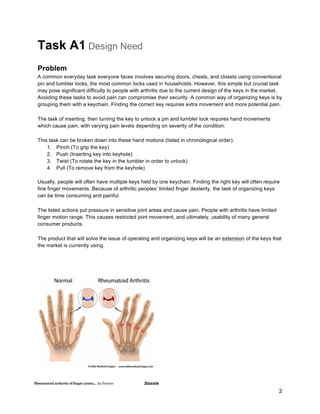
A common everyday task everyone faces involves securing doors, chests, and closets using conventional
pin and tumbler locks, the most common locks used in households. However, this simple but crucial task
may pose significant difficulty to people with arthritis due to the current design of the keys in the market.
Avoiding these tasks to avoid pain can compromise their security. A common way of organizing keys is by
grouping them with a keychain. Finding the correct key requires extra movement and more potential pain.
The task of inserting, then turning the key to unlock a pin and tumbler lock requires hand movements
which cause pain, with varying pain levels depending on severity of the condition.
This task can be broken down into these hand motions (listed in chronological order):
1. Pinch (To grip the key)
2. Push (Inserting key into keyhole)
3. Twist (To rotate the key in the tumbler in order to unlock)
4. Pull (To remove key from the keyhole)
Usually, people will often have multiple keys held by one keychain. Finding the right key will often require
fine finger movements. Because of arthritic peoples’ limited finger dexterity, the task of organizing keys
can be time consuming and painful.
The listed actions put pressure in sensitive joint areas and cause pain. People with arthritis have limited
finger motion range. This causes restricted joint movement, and ultimately, usability of many general
consumer products.
The product that will solve the issue of operating and organizing keys will be an extension of the keys that
the market is currently using.
3
Task A5 Product design specifications
Specification Justification
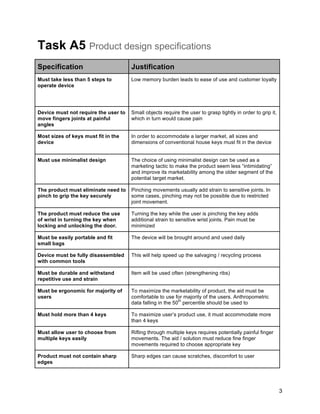
Must take less than 5 steps to
operate device
Low memory burden leads to ease of use and customer loyalty
Device must not require the user to
move fingers joints at painful
angles
Small objects require the user to grasp tightly in order to grip it,
which in turn would cause pain
Most sizes of keys must fit in the
device
In order to accommodate a larger market, all sizes and
dimensions of conventional house keys must fit in the device
Must use minimalist design The choice of using minimalist design can be used as a
marketing tactic to make the product seem less “intimidating”
and improve its marketability among the older segment of the
potential target market.
The product must eliminate need to
pinch to grip the key securely
Pinching movements usually add strain to sensitive joints. In
some cases, pinching may not be possible due to restricted
joint movement.
The product must reduce the use
of wrist in turning the key when
locking and unlocking the door.
Turning the key while the user is pinching the key adds
additional strain to sensitive wrist joints. Pain must be
minimized
Must be easily portable and fit
small bags
The device will be brought around and used daily
Device must be fully disassembled
with common tools
This will help speed up the salvaging / recycling process
Must be durable and withstand
repetitive use and strain
Item will be used often (strengthening ribs)
Must be ergonomic for majority of
users
To maximize the marketability of product, the aid must be
comfortable to use for majority of the users. Anthropometric
data falling in the 50
th
percentile should be used to
Must hold more than 4 keys To maximize user’s product use, it must accommodate more
than 4 keys
Must allow user to choose from
multiple keys easily
Rifling through multiple keys requires potentially painful finger
movements. The aid / solution must reduce fine finger
movements required to choose appropriate key
Product must not contain sharp
edges
Sharp edges can cause scratches, discomfort to user
4
8 Initial Designs
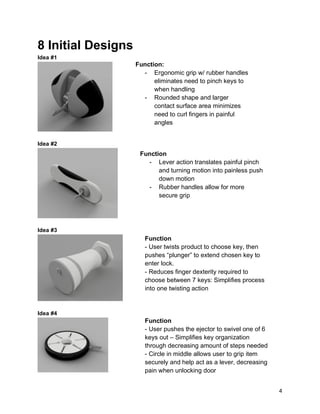
Idea #1
Idea #2
Idea #3
Idea #4
Function:
- Ergonomic grip w/ rubber handles
eliminates need to pinch keys to
when handling
- Rounded shape and larger
contact surface area minimizes
need to curl fingers in painful
angles
-
Function
- Lever action translates painful pinch
and turning motion into painless push
down motion
- Rubber handles allow for more
secure grip
Function
- User twists product to choose key, then
pushes “plunger” to extend chosen key to
enter lock.
- Reduces finger dexterity required to
choose between 7 keys: Simplifies process
into one twisting action
Function
- User pushes the ejector to swivel one of 6
keys out – Simplifies key organization
through decreasing amount of steps needed
- Circle in middle allows user to grip item
securely and help act as a lever, decreasing
pain when unlocking door
5
Idea #5
Idea #6
Idea #7
Idea #8
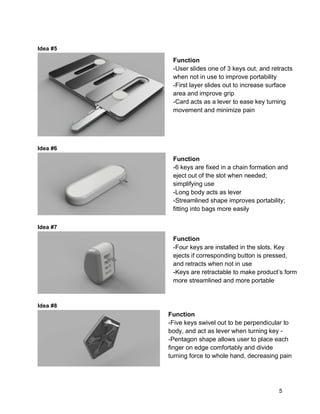
Function
-User slides one of 3 keys out, and retracts
when not in use to improve portability
-First layer slides out to increase surface
area and improve grip
-Card acts as a lever to ease key turning
movement and minimize pain
Function
-6 keys are fixed in a chain formation and
eject out of the slot when needed;
simplifying use
-Long body acts as lever
-Streamlined shape improves portability;
fitting into bags more easily
Function
-Four keys are installed in the slots. Key
ejects if corresponding button is pressed,
and retracts when not in use
-Keys are retractable to make product’s form
more streamlined and more portable
Function
-Five keys swivel out to be perpendicular to
body, and act as lever when turning key -
-Pentagon shape allows user to place each
finger on edge comfortably and divide
turning force to whole hand, decreasing pain
6
Task B1b Development of Solution
Improvements Based on Feedback
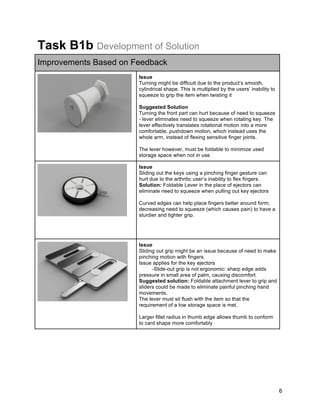
Issue
Turning might be difficult due to the product’s smooth,
cylindrical shape. This is multiplied by the users’ inability to
squeeze to grip the item when twisting it
Suggested Solution
Turning the front part can hurt because of need to squeeze
- lever eliminates need to squeeze when rotating key. The
lever effectively translates rotational motion into a more
comfortable, pushdown motion, which instead uses the
whole arm, instead of flexing sensitive finger joints.
The lever however, must be foldable to minimize used
storage space when not in use
Issue
Sliding out the keys using a pinching finger gesture can
hurt due to the arthritic user’s inability to flex fingers.
Solution: Foldable Lever in the place of ejectors can
eliminate need to squeeze when pulling out key ejectors
Curved edges can help place fingers better around form;
decreasing need to squeeze (which causes pain) to have a
sturdier and tighter grip.
Issue
Sliding out grip might be an issue because of need to make
pinching motion with fingers.
Issue applies for the key ejectors
-Slide-out grip is not ergonomic: sharp edge adds
pressure in small area of palm, causing discomfort
Suggested solution: Foldable attachment lever to grip and
sliders could be made to eliminate painful pinching hand
movements.
The lever must sit flush with the item so that the
requirement of a low storage space is met.
Larger fillet radius in thumb edge allows thumb to conform
to card shape more comfortably
7
Design 1 Revised
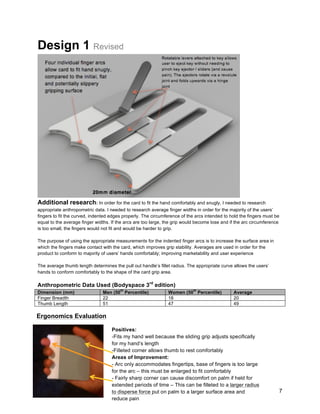
Additional research: In order for the card to fit the hand comfortably and snugly, I needed to research
appropriate anthropometric data. I needed to research average finger widths in order for the majority of the users’
fingers to fit the curved, indented edges properly. The circumference of the arcs intended to hold the fingers must be
equal to the average finger widths. If the arcs are too large, the grip would become lose and if the arc circumference
is too small, the fingers would not fit and would be harder to grip.
The purpose of using the appropriate measurements for the indented finger arcs is to increase the surface area in
which the fingers make contact with the card, which improves grip stability. Averages are used in order for the
product to conform to majority of users’ hands comfortably; improving marketability and user experience
The average thumb length determines the pull out handle’s fillet radius. The appropriate curve allows the users’
hands to conform comfortably to the shape of the card grip area.
Anthropometric Data Used (Bodyspace 3rd
edition)
Dimension (mm) Men (50
th
Percentile) Women (50
th
Percentile) Average
Finger Breadth 22 18 20
Thumb Length 51 47 49
Ergonomics Evaluation
Positives:
-Fits my hand well because the sliding grip adjusts specifically
for my hand’s length
-Filleted corner allows thumb to rest comfortably
Areas of Improvement:
- Arc only accommodates fingertips, base of fingers is too large
for the arc – this must be enlarged to fit comfortably
- Fairly sharp corner can cause discomfort on palm if held for
extended periods of time – This can be filleted to a larger radius
to disperse force put on palm to a larger surface area and
reduce pain
8
Design 2 Revised
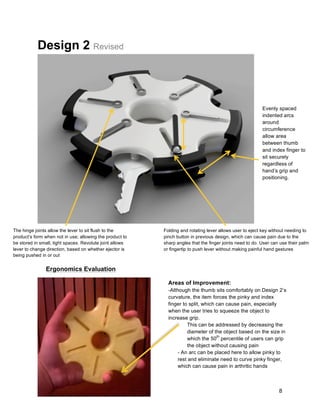
Evenly spaced
indented arcs
around
circumference
allow area
between thumb
and index finger to
sit securely
regardless of
hand’s grip and
positioning.
Folding and rotating lever allows user to eject key without needing to
pinch button in previous design, which can cause pain due to the
sharp angles that the finger joints need to do. User can use their palm
or fingertip to push lever without making painful hand gestures
The hinge joints allow the lever to sit flush to the
product’s form when not in use; allowing the product to
be stored in small, tight spaces. Revolute joint allows
lever to change direction, based on whether ejector is
being pushed in or out
Ergonomics Evaluation
Areas of Improvement:
-Although the thumb sits comfortably on Design 2’s
curvature, the item forces the pinky and index
finger to split, which can cause pain, especially
when the user tries to squeeze the object to
increase grip.
- This can be addressed by decreasing the
diameter of the object based on the size in
which the 50
th
percentile of users can grip
the object without causing pain
- An arc can be placed here to allow pinky to
rest and eliminate need to curve pinky finger,
which can cause pain in arthritic hands
9
Design 3 Revised
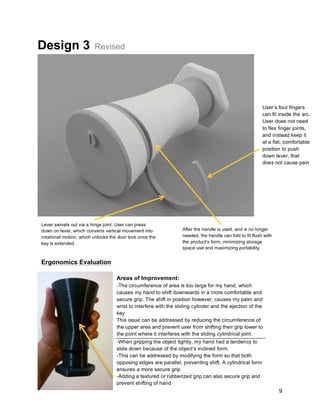
Lever swivels out via a hinge joint. User can press
down on lever, which converts vertical movement into
rotational motion, which unlocks the door lock once the
key is extended.
After the handle is used, and is no longer
needed, the handle can fold to fit flush with
the product’s form, minimizing storage
space use and maximizing portability
User’s four fingers
can fit inside the arc.
User does not need
to flex finger joints,
and instead keep it
at a flat, comfortable
position to push
down lever, that
does not cause pain
Ergonomics Evaluation
Areas of Improvement:
-The circumference of area is too large for my hand, which
causes my hand to shift downwards in a more comfortable and
secure grip. The shift in position however, causes my palm and
wrist to interfere with the sliding cylinder and the ejection of the
key
This issue can be addressed by reducing the circumference of
the upper area and prevent user from shifting their grip lower to
the point where it interferes with the sliding cylindrical joint.
-When gripping the object tightly, my hand had a tendency to
slide down because of the object’s inclined form.
-This can be addressed by modifying the form so that both
opposing edges are parallel, preventing shift. A cylindrical form
ensures a more secure grip
-Adding a textured or rubberized grip can also secure grip and
prevent shifting of hand
10
Task B1c Appraisal of solutions against specification requirements
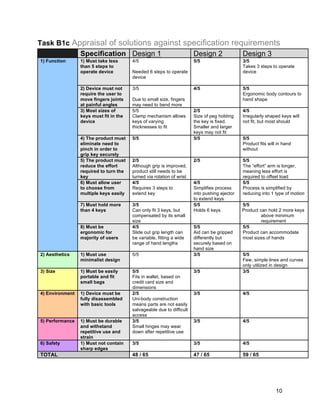
Specification Design 1 Design 2 Design 3
1) Function 1) Must take less
than 5 steps to
operate device
4/5
Needed 6 steps to operate
device
5/5 3/5
Takes 3 steps to operate
device
2) Device must not
require the user to
move fingers joints
at painful angles
3/5
Due to small size, fingers
may need to bend more
4/5 5/5
Ergonomic body contours to
hand shape
3) Most sizes of
keys must fit in the
device
5/5
Clamp mechanism allows
keys of varying
thicknesses to fit
2/5
Size of peg holding
the key is fixed.
Smaller and larger
keys may not fit
4/5
Irregularly shaped keys will
not fit, but most should
4) The product must
eliminate need to
pinch in order to
grip key securely
5/5 5/5 5/5
Product fits will in hand
without
5) The product must
reduce the effort
required to turn the
key
2/5
Although grip is improved,
product still needs to be
turned via rotation of wrist
2/5 5/5
The “effort” arm is longer,
meaning less effort is
required to offset load
6) Must allow user
to choose from
multiple keys easily
4/5
Requires 3 steps to
extend key
4/5
Simplifies process
into pushing ejector
to extend keys
5/5
Process is simplified by
reducing into 1 type of motion
7) Must hold more
than 4 keys
3/5
Can only fit 3 keys, but
compensated by its small
size
5/5
Holds 6 keys
5/5
Product can hold 2 more keys
above minimum
requirement
8) Must be
ergonomic for
majority of users
4/5
Slide out grip length can
be variable, fitting a wide
range of hand lengths
5/5
Aid can be gripped
differently but
securely based on
hand size
5/5
Product can accommodate
most sizes of hands
2) Aesthetics 1) Must use
minimalist design
5/5 3/5 5/5
Few, simple lines and curves
only utilized in design
3) Size 1) Must be easily
portable and fit
small bags
5/5
Fits in wallet, based on
credit card size and
dimensions
3/5 3/5
4) Environment 1) Device must be
fully disassembled
with basic tools
2/5
Uni-body construction
means parts are not easily
salvageable due to difficult
access
3/5 4/5
5) Performance 1) Must be durable
and withstand
repetitive use and
strain
3/5
Small hinges may wear
down after repetitive use
3/5 4/5
6) Safety 1) Must not contain
sharp edges
3/5 3/5 4/5
TOTAL 48 / 65 47 / 65 59 / 65
11
Chosen Design Justification
Although design 3 may be less portable due to its irregular shape, it compensates for its superior
ergonomics, simplified user interaction and low memory burden. Tactile and auditory feedback could be
utilized through incremental clicks that notify user that chosen key is aligned and ready to be extended.
These various features simplify user interaction and is more appropriate for the older age range where
cognition, memory and physical ability is limited. Design 3 is also the only design that reduces wrist
movement required to unlock door.
A point in which design 3 excels at is the number of steps required to operate product. The spring loaded
cylinder joint halves the required steps because retracting the moving parts after use has been
automated. Since it requires the lowest amount of steps to operate the product, it also has the lowest
memory burden. A low memory burden improves the user experience by simplifying user interaction.
Design 3 overall, is the simplest in terms of user interaction. It effectively solves the issue of managing
keys by simplifying the process through translating otherwise uncomfortable hand movements into more
manageable pushing and turning motions.
12
Task B2a Development of Design
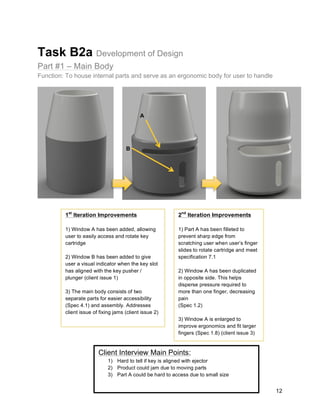
Part #1 – Main Body
Function: To house internal parts and serve as an ergonomic body for user to handle
1st
Iteration Improvements
1) Window A has been added, allowing
user to easily access and rotate key
cartridge
2) Window B has been added to give
user a visual indicator when the key slot
has aligned with the key pusher /
plunger (client issue 1)
3) The main body consists of two
separate parts for easier accessibility
(Spec 4.1) and assembly. Addresses
client issue of fixing jams (client issue 2)
2nd
Iteration Improvements
1) Part A has been filleted to
prevent sharp edge from
scratching user when user’s finger
slides to rotate cartridge and meet
specification 7.1
2) Window A has been duplicated
in opposite side. This helps
disperse pressure required to
more than one finger, decreasing
pain
(Spec 1.2)
3) Window A is enlarged to
improve ergonomics and fit larger
fingers (Spec 1.8) (client issue 3)
A
B
Client Interview Main Points:
1) Hard to tell if key is aligned with ejector
2) Product could jam due to moving parts
3) Part A could be hard to access due to small size
13
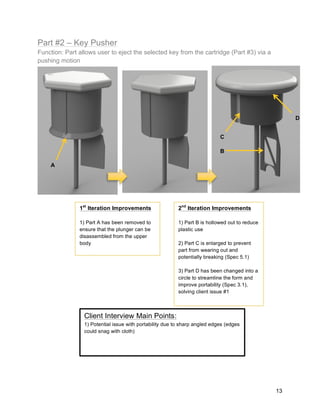
Part #2 – Key Pusher
Function: Part allows user to eject the selected key from the cartridge (Part #3) via a
pushing motion
1st
Iteration Improvements
1) Part A has been removed to
ensure that the plunger can be
disassembled from the upper
body
A
2nd
Iteration Improvements
1) Part B is hollowed out to reduce
plastic use
2) Part C is enlarged to prevent
part from wearing out and
potentially breaking (Spec 5.1)
3) Part D has been changed into a
circle to streamline the form and
improve portability (Spec 3.1),
solving client issue #1
B
C
D
Client Interview Main Points:
1) Potential issue with portability due to sharp angled edges (edges
could snag with cloth)
14
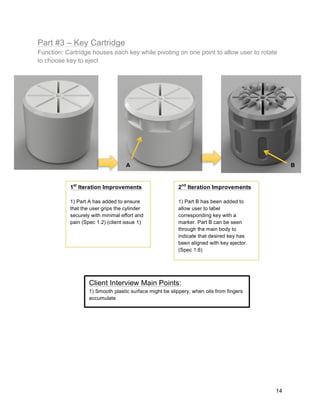
Part #3 – Key Cartridge
Function: Cartridge houses each key while pivoting on one point to allow user to rotate
to choose key to eject
1st
Iteration Improvements
1) Part A has added to ensure
that the user grips the cylinder
securely with minimal effort and
pain (Spec 1.2) (client issue 1)
2nd
Iteration Improvements
1) Part B has been added to
allow user to label
corresponding key with a
marker. Part B can be seen
through the main body to
indicate that desired key has
been aligned with key ejector.
(Spec 1.6)
A B
Client Interview Main Points:
1) Smooth plastic surface might be slippery, when oils from fingers
accumulate
15
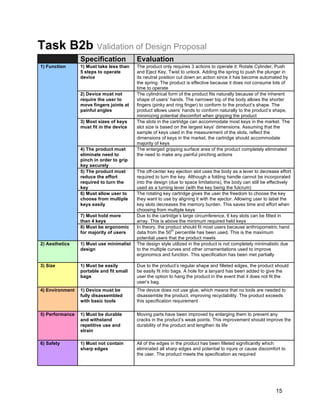
Task B2b Validation of Design Proposal
Specification Evaluation
1) Function 1) Must take less than
5 steps to operate
device
The product only requires 3 actions to operate it: Rotate Cylinder, Push
and Eject Key, Twist to unlock. Adding the spring to push the plunger in
its neutral position cut down an action since it has become automated by
the spring. The product is effective because it does not consume lots of
time to operate
2) Device must not
require the user to
move fingers joints at
painful angles
The cylindrical form of the product fits naturally because of the inherent
shape of users’ hands. The narrower top of the body allows the shorter
fingers (pinky and ring finger) to conform to the product’s shape. The
product allows users’ hands to conform naturally to the product’s shape,
minimizing potential discomfort when gripping the product
3) Most sizes of keys
must fit in the device
The slots in the cartridge can accommodate most keys in the market. The
slot size is based on the largest keys’ dimensions. Assuming that the
sample of keys used in the measurement of the slots, reflect the
dimensions of keys in the market, the cartridge should accommodate
majority of keys
4) The product must
eliminate need to
pinch in order to grip
key securely
The enlarged gripping surface area of the product completely eliminated
the need to make any painful pinching actions
5) The product must
reduce the effort
required to turn the
key
The off-center key ejection slot uses the body as a lever to decrease effort
required to turn the key. Although a folding handle cannot be incorporated
into the design (due to space limitations), the body can still be effectively
used as a turning lever (with the key being the fulcrum)
6) Must allow user to
choose from multiple
keys easily
The rotating key cartridge gives the user the freedom to choose the key
they want to use by aligning it with the ejector. Allowing user to label the
key slots decreases the memory burden. This saves time and effort when
choosing from multiple keys
7) Must hold more
than 4 keys
Due to the cartridge’s large circumference, 6 key slots can be fitted in
array. This is above the minimum required held keys
8) Must be ergonomic
for majority of users
In theory, the product should fit most users because anthropometric hand
data from the 50
th
percentile has been used. This is the maximum
potential users that the product meets
2) Aesthetics 1) Must use minimalist
design
The design style utilized in the product is not completely minimalistic due
to the multiple curves and other ornamentations used to improve
ergonomics and function. This specification has been met partially
3) Size 1) Must be easily
portable and fit small
bags
Due to the product’s regular shape and filleted edges, the product should
be easily fit into bags. A hole for a lanyard has been added to give the
user the option to hang the product in the event that it does not fit the
user’s bag.
4) Environment 1) Device must be
fully disassembled
with basic tools
The device does not use glue, which means that no tools are needed to
disassemble the product, improving recyclability. The product exceeds
this specification requirement
5) Performance 1) Must be durable
and withstand
repetitive use and
strain
Moving parts have been improved by enlarging them to prevent any
cracks in the product’s weak points. This improvement should improve the
durability of the product and lengthen its life
6) Safety 1) Must not contain
sharp edges
All of the edges in the product has been filleted significantly which
eliminated all sharp edges and potential to injure or cause discomfort to
the user. The product meets the specification as required
16
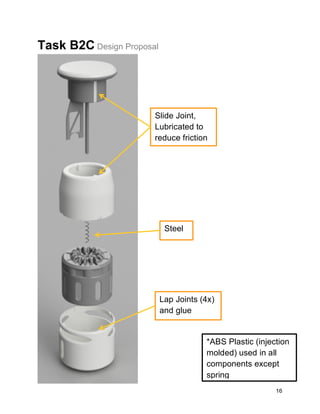
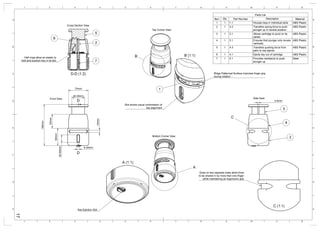
Task B2C Design Proposal
*ABS Plastic (injection
molded) used in all
components except
spring
Lap Joints (4x)
and glue
Slide Joint,
Lubricated to
reduce friction
Steel
17

17irvinA - Inclusive Design

  • 1.
    1 Inclusive Design /// CriteriaB Higher Level Design Technology Irvin Acosta Year 12
  • 2.
    2 Task A1 DesignNeed Problem A common everyday task everyone faces involves securing doors, chests, and closets using conventional pin and tumbler locks, the most common locks used in households. However, this simple but crucial task may pose significant difficulty to people with arthritis due to the current design of the keys in the market. Avoiding these tasks to avoid pain can compromise their security. A common way of organizing keys is by grouping them with a keychain. Finding the correct key requires extra movement and more potential pain. The task of inserting, then turning the key to unlock a pin and tumbler lock requires hand movements which cause pain, with varying pain levels depending on severity of the condition. This task can be broken down into these hand motions (listed in chronological order): 1. Pinch (To grip the key) 2. Push (Inserting key into keyhole) 3. Twist (To rotate the key in the tumbler in order to unlock) 4. Pull (To remove key from the keyhole) Usually, people will often have multiple keys held by one keychain. Finding the right key will often require fine finger movements. Because of arthritic peoples’ limited finger dexterity, the task of organizing keys can be time consuming and painful. The listed actions put pressure in sensitive joint areas and cause pain. People with arthritis have limited finger motion range. This causes restricted joint movement, and ultimately, usability of many general consumer products. The product that will solve the issue of operating and organizing keys will be an extension of the keys that the market is currently using.
  • 3.
    3 Task A5 Productdesign specifications Specification Justification Must take less than 5 steps to operate device Low memory burden leads to ease of use and customer loyalty Device must not require the user to move fingers joints at painful angles Small objects require the user to grasp tightly in order to grip it, which in turn would cause pain Most sizes of keys must fit in the device In order to accommodate a larger market, all sizes and dimensions of conventional house keys must fit in the device Must use minimalist design The choice of using minimalist design can be used as a marketing tactic to make the product seem less “intimidating” and improve its marketability among the older segment of the potential target market. The product must eliminate need to pinch to grip the key securely Pinching movements usually add strain to sensitive joints. In some cases, pinching may not be possible due to restricted joint movement. The product must reduce the use of wrist in turning the key when locking and unlocking the door. Turning the key while the user is pinching the key adds additional strain to sensitive wrist joints. Pain must be minimized Must be easily portable and fit small bags The device will be brought around and used daily Device must be fully disassembled with common tools This will help speed up the salvaging / recycling process Must be durable and withstand repetitive use and strain Item will be used often (strengthening ribs) Must be ergonomic for majority of users To maximize the marketability of product, the aid must be comfortable to use for majority of the users. Anthropometric data falling in the 50 th percentile should be used to Must hold more than 4 keys To maximize user’s product use, it must accommodate more than 4 keys Must allow user to choose from multiple keys easily Rifling through multiple keys requires potentially painful finger movements. The aid / solution must reduce fine finger movements required to choose appropriate key Product must not contain sharp edges Sharp edges can cause scratches, discomfort to user
  • 4.
    4 8 Initial Designs Idea#1 Idea #2 Idea #3 Idea #4 Function: - Ergonomic grip w/ rubber handles eliminates need to pinch keys to when handling - Rounded shape and larger contact surface area minimizes need to curl fingers in painful angles - Function - Lever action translates painful pinch and turning motion into painless push down motion - Rubber handles allow for more secure grip Function - User twists product to choose key, then pushes “plunger” to extend chosen key to enter lock. - Reduces finger dexterity required to choose between 7 keys: Simplifies process into one twisting action Function - User pushes the ejector to swivel one of 6 keys out – Simplifies key organization through decreasing amount of steps needed - Circle in middle allows user to grip item securely and help act as a lever, decreasing pain when unlocking door
  • 5.
    5 Idea #5 Idea #6 Idea#7 Idea #8 Function -User slides one of 3 keys out, and retracts when not in use to improve portability -First layer slides out to increase surface area and improve grip -Card acts as a lever to ease key turning movement and minimize pain Function -6 keys are fixed in a chain formation and eject out of the slot when needed; simplifying use -Long body acts as lever -Streamlined shape improves portability; fitting into bags more easily Function -Four keys are installed in the slots. Key ejects if corresponding button is pressed, and retracts when not in use -Keys are retractable to make product’s form more streamlined and more portable Function -Five keys swivel out to be perpendicular to body, and act as lever when turning key - -Pentagon shape allows user to place each finger on edge comfortably and divide turning force to whole hand, decreasing pain
  • 6.
    6 Task B1b Developmentof Solution Improvements Based on Feedback Issue Turning might be difficult due to the product’s smooth, cylindrical shape. This is multiplied by the users’ inability to squeeze to grip the item when twisting it Suggested Solution Turning the front part can hurt because of need to squeeze - lever eliminates need to squeeze when rotating key. The lever effectively translates rotational motion into a more comfortable, pushdown motion, which instead uses the whole arm, instead of flexing sensitive finger joints. The lever however, must be foldable to minimize used storage space when not in use Issue Sliding out the keys using a pinching finger gesture can hurt due to the arthritic user’s inability to flex fingers. Solution: Foldable Lever in the place of ejectors can eliminate need to squeeze when pulling out key ejectors Curved edges can help place fingers better around form; decreasing need to squeeze (which causes pain) to have a sturdier and tighter grip. Issue Sliding out grip might be an issue because of need to make pinching motion with fingers. Issue applies for the key ejectors -Slide-out grip is not ergonomic: sharp edge adds pressure in small area of palm, causing discomfort Suggested solution: Foldable attachment lever to grip and sliders could be made to eliminate painful pinching hand movements. The lever must sit flush with the item so that the requirement of a low storage space is met. Larger fillet radius in thumb edge allows thumb to conform to card shape more comfortably
  • 7.
    7 Design 1 Revised Additionalresearch: In order for the card to fit the hand comfortably and snugly, I needed to research appropriate anthropometric data. I needed to research average finger widths in order for the majority of the users’ fingers to fit the curved, indented edges properly. The circumference of the arcs intended to hold the fingers must be equal to the average finger widths. If the arcs are too large, the grip would become lose and if the arc circumference is too small, the fingers would not fit and would be harder to grip. The purpose of using the appropriate measurements for the indented finger arcs is to increase the surface area in which the fingers make contact with the card, which improves grip stability. Averages are used in order for the product to conform to majority of users’ hands comfortably; improving marketability and user experience The average thumb length determines the pull out handle’s fillet radius. The appropriate curve allows the users’ hands to conform comfortably to the shape of the card grip area. Anthropometric Data Used (Bodyspace 3rd edition) Dimension (mm) Men (50 th Percentile) Women (50 th Percentile) Average Finger Breadth 22 18 20 Thumb Length 51 47 49 Ergonomics Evaluation Positives: -Fits my hand well because the sliding grip adjusts specifically for my hand’s length -Filleted corner allows thumb to rest comfortably Areas of Improvement: - Arc only accommodates fingertips, base of fingers is too large for the arc – this must be enlarged to fit comfortably - Fairly sharp corner can cause discomfort on palm if held for extended periods of time – This can be filleted to a larger radius to disperse force put on palm to a larger surface area and reduce pain
  • 8.
    8 Design 2 Revised Evenlyspaced indented arcs around circumference allow area between thumb and index finger to sit securely regardless of hand’s grip and positioning. Folding and rotating lever allows user to eject key without needing to pinch button in previous design, which can cause pain due to the sharp angles that the finger joints need to do. User can use their palm or fingertip to push lever without making painful hand gestures The hinge joints allow the lever to sit flush to the product’s form when not in use; allowing the product to be stored in small, tight spaces. Revolute joint allows lever to change direction, based on whether ejector is being pushed in or out Ergonomics Evaluation Areas of Improvement: -Although the thumb sits comfortably on Design 2’s curvature, the item forces the pinky and index finger to split, which can cause pain, especially when the user tries to squeeze the object to increase grip. - This can be addressed by decreasing the diameter of the object based on the size in which the 50 th percentile of users can grip the object without causing pain - An arc can be placed here to allow pinky to rest and eliminate need to curve pinky finger, which can cause pain in arthritic hands
  • 9.
    9 Design 3 Revised Leverswivels out via a hinge joint. User can press down on lever, which converts vertical movement into rotational motion, which unlocks the door lock once the key is extended. After the handle is used, and is no longer needed, the handle can fold to fit flush with the product’s form, minimizing storage space use and maximizing portability User’s four fingers can fit inside the arc. User does not need to flex finger joints, and instead keep it at a flat, comfortable position to push down lever, that does not cause pain Ergonomics Evaluation Areas of Improvement: -The circumference of area is too large for my hand, which causes my hand to shift downwards in a more comfortable and secure grip. The shift in position however, causes my palm and wrist to interfere with the sliding cylinder and the ejection of the key This issue can be addressed by reducing the circumference of the upper area and prevent user from shifting their grip lower to the point where it interferes with the sliding cylindrical joint. -When gripping the object tightly, my hand had a tendency to slide down because of the object’s inclined form. -This can be addressed by modifying the form so that both opposing edges are parallel, preventing shift. A cylindrical form ensures a more secure grip -Adding a textured or rubberized grip can also secure grip and prevent shifting of hand
  • 10.
    10 Task B1c Appraisalof solutions against specification requirements Specification Design 1 Design 2 Design 3 1) Function 1) Must take less than 5 steps to operate device 4/5 Needed 6 steps to operate device 5/5 3/5 Takes 3 steps to operate device 2) Device must not require the user to move fingers joints at painful angles 3/5 Due to small size, fingers may need to bend more 4/5 5/5 Ergonomic body contours to hand shape 3) Most sizes of keys must fit in the device 5/5 Clamp mechanism allows keys of varying thicknesses to fit 2/5 Size of peg holding the key is fixed. Smaller and larger keys may not fit 4/5 Irregularly shaped keys will not fit, but most should 4) The product must eliminate need to pinch in order to grip key securely 5/5 5/5 5/5 Product fits will in hand without 5) The product must reduce the effort required to turn the key 2/5 Although grip is improved, product still needs to be turned via rotation of wrist 2/5 5/5 The “effort” arm is longer, meaning less effort is required to offset load 6) Must allow user to choose from multiple keys easily 4/5 Requires 3 steps to extend key 4/5 Simplifies process into pushing ejector to extend keys 5/5 Process is simplified by reducing into 1 type of motion 7) Must hold more than 4 keys 3/5 Can only fit 3 keys, but compensated by its small size 5/5 Holds 6 keys 5/5 Product can hold 2 more keys above minimum requirement 8) Must be ergonomic for majority of users 4/5 Slide out grip length can be variable, fitting a wide range of hand lengths 5/5 Aid can be gripped differently but securely based on hand size 5/5 Product can accommodate most sizes of hands 2) Aesthetics 1) Must use minimalist design 5/5 3/5 5/5 Few, simple lines and curves only utilized in design 3) Size 1) Must be easily portable and fit small bags 5/5 Fits in wallet, based on credit card size and dimensions 3/5 3/5 4) Environment 1) Device must be fully disassembled with basic tools 2/5 Uni-body construction means parts are not easily salvageable due to difficult access 3/5 4/5 5) Performance 1) Must be durable and withstand repetitive use and strain 3/5 Small hinges may wear down after repetitive use 3/5 4/5 6) Safety 1) Must not contain sharp edges 3/5 3/5 4/5 TOTAL 48 / 65 47 / 65 59 / 65
  • 11.
    11 Chosen Design Justification Althoughdesign 3 may be less portable due to its irregular shape, it compensates for its superior ergonomics, simplified user interaction and low memory burden. Tactile and auditory feedback could be utilized through incremental clicks that notify user that chosen key is aligned and ready to be extended. These various features simplify user interaction and is more appropriate for the older age range where cognition, memory and physical ability is limited. Design 3 is also the only design that reduces wrist movement required to unlock door. A point in which design 3 excels at is the number of steps required to operate product. The spring loaded cylinder joint halves the required steps because retracting the moving parts after use has been automated. Since it requires the lowest amount of steps to operate the product, it also has the lowest memory burden. A low memory burden improves the user experience by simplifying user interaction. Design 3 overall, is the simplest in terms of user interaction. It effectively solves the issue of managing keys by simplifying the process through translating otherwise uncomfortable hand movements into more manageable pushing and turning motions.
  • 12.
    12 Task B2a Developmentof Design Part #1 – Main Body Function: To house internal parts and serve as an ergonomic body for user to handle 1st Iteration Improvements 1) Window A has been added, allowing user to easily access and rotate key cartridge 2) Window B has been added to give user a visual indicator when the key slot has aligned with the key pusher / plunger (client issue 1) 3) The main body consists of two separate parts for easier accessibility (Spec 4.1) and assembly. Addresses client issue of fixing jams (client issue 2) 2nd Iteration Improvements 1) Part A has been filleted to prevent sharp edge from scratching user when user’s finger slides to rotate cartridge and meet specification 7.1 2) Window A has been duplicated in opposite side. This helps disperse pressure required to more than one finger, decreasing pain (Spec 1.2) 3) Window A is enlarged to improve ergonomics and fit larger fingers (Spec 1.8) (client issue 3) A B Client Interview Main Points: 1) Hard to tell if key is aligned with ejector 2) Product could jam due to moving parts 3) Part A could be hard to access due to small size
  • 13.
    13 Part #2 –Key Pusher Function: Part allows user to eject the selected key from the cartridge (Part #3) via a pushing motion 1st Iteration Improvements 1) Part A has been removed to ensure that the plunger can be disassembled from the upper body A 2nd Iteration Improvements 1) Part B is hollowed out to reduce plastic use 2) Part C is enlarged to prevent part from wearing out and potentially breaking (Spec 5.1) 3) Part D has been changed into a circle to streamline the form and improve portability (Spec 3.1), solving client issue #1 B C D Client Interview Main Points: 1) Potential issue with portability due to sharp angled edges (edges could snag with cloth)
  • 14.
    14 Part #3 –Key Cartridge Function: Cartridge houses each key while pivoting on one point to allow user to rotate to choose key to eject 1st Iteration Improvements 1) Part A has added to ensure that the user grips the cylinder securely with minimal effort and pain (Spec 1.2) (client issue 1) 2nd Iteration Improvements 1) Part B has been added to allow user to label corresponding key with a marker. Part B can be seen through the main body to indicate that desired key has been aligned with key ejector. (Spec 1.6) A B Client Interview Main Points: 1) Smooth plastic surface might be slippery, when oils from fingers accumulate
  • 15.
    15 Task B2b Validationof Design Proposal Specification Evaluation 1) Function 1) Must take less than 5 steps to operate device The product only requires 3 actions to operate it: Rotate Cylinder, Push and Eject Key, Twist to unlock. Adding the spring to push the plunger in its neutral position cut down an action since it has become automated by the spring. The product is effective because it does not consume lots of time to operate 2) Device must not require the user to move fingers joints at painful angles The cylindrical form of the product fits naturally because of the inherent shape of users’ hands. The narrower top of the body allows the shorter fingers (pinky and ring finger) to conform to the product’s shape. The product allows users’ hands to conform naturally to the product’s shape, minimizing potential discomfort when gripping the product 3) Most sizes of keys must fit in the device The slots in the cartridge can accommodate most keys in the market. The slot size is based on the largest keys’ dimensions. Assuming that the sample of keys used in the measurement of the slots, reflect the dimensions of keys in the market, the cartridge should accommodate majority of keys 4) The product must eliminate need to pinch in order to grip key securely The enlarged gripping surface area of the product completely eliminated the need to make any painful pinching actions 5) The product must reduce the effort required to turn the key The off-center key ejection slot uses the body as a lever to decrease effort required to turn the key. Although a folding handle cannot be incorporated into the design (due to space limitations), the body can still be effectively used as a turning lever (with the key being the fulcrum) 6) Must allow user to choose from multiple keys easily The rotating key cartridge gives the user the freedom to choose the key they want to use by aligning it with the ejector. Allowing user to label the key slots decreases the memory burden. This saves time and effort when choosing from multiple keys 7) Must hold more than 4 keys Due to the cartridge’s large circumference, 6 key slots can be fitted in array. This is above the minimum required held keys 8) Must be ergonomic for majority of users In theory, the product should fit most users because anthropometric hand data from the 50 th percentile has been used. This is the maximum potential users that the product meets 2) Aesthetics 1) Must use minimalist design The design style utilized in the product is not completely minimalistic due to the multiple curves and other ornamentations used to improve ergonomics and function. This specification has been met partially 3) Size 1) Must be easily portable and fit small bags Due to the product’s regular shape and filleted edges, the product should be easily fit into bags. A hole for a lanyard has been added to give the user the option to hang the product in the event that it does not fit the user’s bag. 4) Environment 1) Device must be fully disassembled with basic tools The device does not use glue, which means that no tools are needed to disassemble the product, improving recyclability. The product exceeds this specification requirement 5) Performance 1) Must be durable and withstand repetitive use and strain Moving parts have been improved by enlarging them to prevent any cracks in the product’s weak points. This improvement should improve the durability of the product and lengthen its life 6) Safety 1) Must not contain sharp edges All of the edges in the product has been filleted significantly which eliminated all sharp edges and potential to injure or cause discomfort to the user. The product meets the specification as required
  • 16.
    16 Task B2C DesignProposal *ABS Plastic (injection molded) used in all components except spring Lap Joints (4x) and glue Slide Joint, Lubricated to reduce friction Steel
  • 17.