Genome Structure
Kinetics and Components
Genome
• The genome is all the DNA in a cell.
– All the DNA on all the chromosomes
– Includes genes, intergenic sequences, repeats
• Specifically, it is all the DNA in an organelle.
• Eukaryotes can have 2-3 genomes
– Nuclear genome
– Mitochondrial genome
– Plastid genome
• If not specified, “genome” usually refers to
the nuclear genome.
Genomics
• Genomics is the study of genomes,
including large chromosomal segments
containing many genes.
• The initial phase of genomics aims to map
and sequence an initial set of entire
genomes.
• Functional genomics aims to deduce
information about the function of DNA
sequences.
– Should continue long after the initial genome
sequences have been completed.
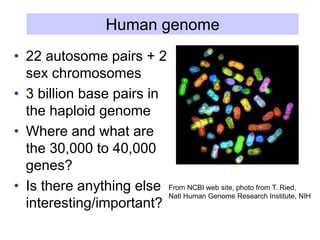
Human genome
• 22 autosome pairs + 2
sex chromosomes
• 3 billion base pairs in
the haploid genome
• Where and what are
the 30,000 to 40,000
genes?
• Is there anything else
interesting/important?
From NCBI web site, photo from T. Ried,
Natl Human Genome Research Institute, NIH
Components of the human Genome
• Human genome has 3.2 billion base pairs of
DNA
• About 3% codes for proteins
• About 40-50% is repetitive, made by
(retro)transposition
• What is the function of the remaining 50%?
The Genomics Revolution
• Know (close to) all the genes in a genome,
and the sequence of the proteins they
encode.
• BIOLOGY HAS BECOME A FINITE
SCIENCE
– Hypotheses have to conform to what is present,
not what you could imagine could happen.
• No longer look at just individual genes
– Examine whole genomes or systems of genes
Genomics, Genetics and Biochemistry
• Genetics: study of inherited phenotypes
• Genomics: study of genomes
• Biochemistry: study of the chemistry of living
organisms and/or cells
• Revolution lauched by full genome
sequencing
– Many biological problems now have finite (albeit
complex) solutions.
– New era will see an even greater interaction
among these three disciplines
Finding the function of genes
Genome Structure
 Distinct components of genomes
 Abundance and complexity of mRNA
 Normalized cDNA libraries and ESTs
 Genome sequences: gene numbers
 Comparative genomics
Much DNA in large genomes is non-coding
• Complex genomes have roughly 10x to 30x
more DNA than is required to encode all the
RNAs or proteins in the organism.
• Contributors to the non-coding DNA include:
– Introns in genes
– Regulatory elements of genes
– Multiple copies of genes, including
pseudogenes
– Intergenic sequences
– Interspersed repeats
Distinct components in complex genomes
• Highly repeated DNA
– R (repetition frequency) >100,000
– Almost no information, low complexity
• Moderately repeated DNA
– 10<R<10,000
– Little information, moderate complexity
• “Single copy” DNA
– R=1 or 2
– Much information, high complexity
Reassociation kinetics measure
sequence complexity
Sequence complexity is not the same
as length
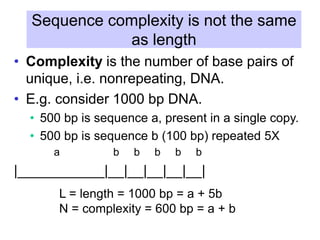
• Complexity is the number of base pairs of
unique, i.e. nonrepeating, DNA.
• E.g. consider 1000 bp DNA.
• 500 bp is sequence a, present in a single copy.
• 500 bp is sequence b (100 bp) repeated 5X
a b b b b b
|___________|__|__|__|__|__|
L = length = 1000 bp = a + 5b
N = complexity = 600 bp = a + b
Less complex DNA renatures faster
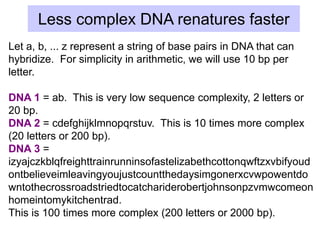
Let a, b, ... z represent a string of base pairs in DNA that can
hybridize. For simplicity in arithmetic, we will use 10 bp per
letter.
DNA 1 = ab. This is very low sequence complexity, 2 letters or
20 bp.
DNA 2 = cdefghijklmnopqrstuv. This is 10 times more complex
(20 letters or 200 bp).
DNA 3 =
izyajczkblqfreighttrainrunninsofastelizabethcottonqwftzxvbifyoud
ontbelieveimleavingyoujustcountthedaysimgonerxcvwpowentdo
wntothecrossroadstriedtocatchariderobertjohnsonpzvmwcomeon
homeintomykitchentrad.
This is 100 times more complex (200 letters or 2000 bp).
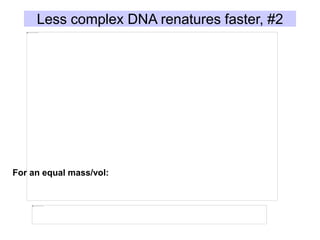
Less complex DNA renatures faster, #2
For an equal mass/vol:
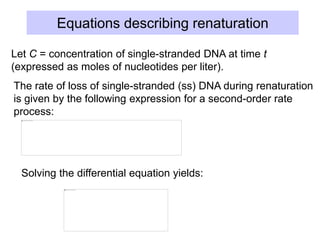
Equations describing renaturation
Let C = concentration of single-stranded DNA at time t
(expressed as moles of nucleotides per liter).
The rate of loss of single-stranded (ss) DNA during renaturation
is given by the following expression for a second-order rate
process:
Solving the differential equation yields:
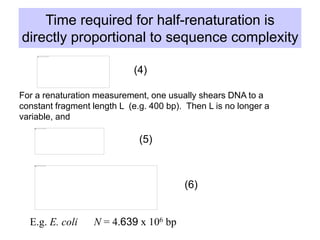
Time required for half-renaturation is
directly proportional to sequence complexity
For a renaturation measurement, one usually shears DNA to a
constant fragment length L (e.g. 400 bp). Then L is no longer a
variable, and
E.g. E. coli N = 4.639 x 10⁶ bp
(4)
(5)
(6)
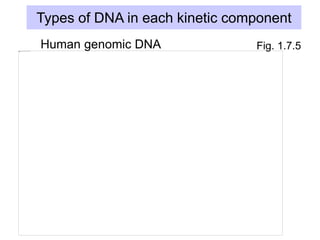
Types of DNA in each kinetic component
Fig. 1.7.5
Human genomic DNA
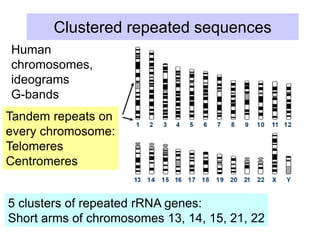
Clustered repeated sequences
Human
chromosomes,
ideograms
G-bands
Tandem repeats on
every chromosome:
Telomeres
Centromeres
5 clusters of repeated rRNA genes:
Short arms of chromosomes 13, 14, 15, 21, 22
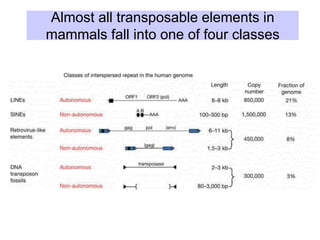
Almost all transposable elements in
mammals fall into one of four classes
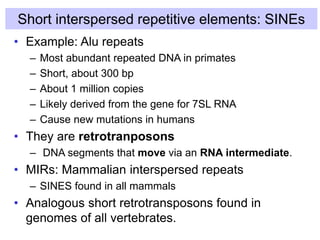
Short interspersed repetitive elements: SINEs
• Example: Alu repeats
– Most abundant repeated DNA in primates
– Short, about 300 bp
– About 1 million copies
– Likely derived from the gene for 7SL RNA
– Cause new mutations in humans
• They are retrotranposons
– DNA segments that move via an RNA intermediate.
• MIRs: Mammalian interspersed repeats
– SINES found in all mammals
• Analogous short retrotransposons found in
genomes of all vertebrates.
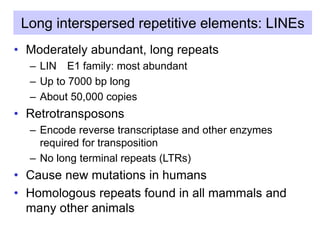
Long interspersed repetitive elements: LINEs
• Moderately abundant, long repeats
– LIN E1 family: most abundant
– Up to 7000 bp long
– About 50,000 copies
• Retrotransposons
– Encode reverse transcriptase and other enzymes
required for transposition
– No long terminal repeats (LTRs)
• Cause new mutations in humans
• Homologous repeats found in all mammals and
many other animals
Other common interspersed repeated
sequences in humans
• LTR-containing retrotransposons
– MaLR: mammalian, LTR retrotransposons
– Endogenous retroviruses
– MER4 (MEdium Reiterated repeat, family 4)
• Repeats that resemble DNA transposons
– MER1 and MER2
– Mariner repeats
– Were active early in mammalian evolution but
are now inactive
Finding repeats
• Compare a sequence to a database of
known repeat sequences from the organism
of interest
• RepeatMasker
• Arian Smit and P. Green, U. Wash.
• http://ftp.genome.washington.edu/cgi-
bin/RepeatMasker
• Try it on INS gene sequence

1_7_genome_1.ppt

  • 1.
  • 2.
    Genome • The genomeis all the DNA in a cell. – All the DNA on all the chromosomes – Includes genes, intergenic sequences, repeats • Specifically, it is all the DNA in an organelle. • Eukaryotes can have 2-3 genomes – Nuclear genome – Mitochondrial genome – Plastid genome • If not specified, “genome” usually refers to the nuclear genome.
  • 3.
    Genomics • Genomics isthe study of genomes, including large chromosomal segments containing many genes. • The initial phase of genomics aims to map and sequence an initial set of entire genomes. • Functional genomics aims to deduce information about the function of DNA sequences. – Should continue long after the initial genome sequences have been completed.
  • 4.
    Human genome • 22autosome pairs + 2 sex chromosomes • 3 billion base pairs in the haploid genome • Where and what are the 30,000 to 40,000 genes? • Is there anything else interesting/important? From NCBI web site, photo from T. Ried, Natl Human Genome Research Institute, NIH
  • 5.
    Components of thehuman Genome • Human genome has 3.2 billion base pairs of DNA • About 3% codes for proteins • About 40-50% is repetitive, made by (retro)transposition • What is the function of the remaining 50%?
  • 6.
    The Genomics Revolution •Know (close to) all the genes in a genome, and the sequence of the proteins they encode. • BIOLOGY HAS BECOME A FINITE SCIENCE – Hypotheses have to conform to what is present, not what you could imagine could happen. • No longer look at just individual genes – Examine whole genomes or systems of genes
  • 7.
    Genomics, Genetics andBiochemistry • Genetics: study of inherited phenotypes • Genomics: study of genomes • Biochemistry: study of the chemistry of living organisms and/or cells • Revolution lauched by full genome sequencing – Many biological problems now have finite (albeit complex) solutions. – New era will see an even greater interaction among these three disciplines
  • 8.
  • 9.
    Genome Structure  Distinctcomponents of genomes  Abundance and complexity of mRNA  Normalized cDNA libraries and ESTs  Genome sequences: gene numbers  Comparative genomics
  • 10.
    Much DNA inlarge genomes is non-coding • Complex genomes have roughly 10x to 30x more DNA than is required to encode all the RNAs or proteins in the organism. • Contributors to the non-coding DNA include: – Introns in genes – Regulatory elements of genes – Multiple copies of genes, including pseudogenes – Intergenic sequences – Interspersed repeats
  • 11.
    Distinct components incomplex genomes • Highly repeated DNA – R (repetition frequency) >100,000 – Almost no information, low complexity • Moderately repeated DNA – 10<R<10,000 – Little information, moderate complexity • “Single copy” DNA – R=1 or 2 – Much information, high complexity
  • 12.
  • 13.
    Sequence complexity isnot the same as length • Complexity is the number of base pairs of unique, i.e. nonrepeating, DNA. • E.g. consider 1000 bp DNA. • 500 bp is sequence a, present in a single copy. • 500 bp is sequence b (100 bp) repeated 5X a b b b b b |___________|__|__|__|__|__| L = length = 1000 bp = a + 5b N = complexity = 600 bp = a + b
  • 14.
    Less complex DNArenatures faster Let a, b, ... z represent a string of base pairs in DNA that can hybridize. For simplicity in arithmetic, we will use 10 bp per letter. DNA 1 = ab. This is very low sequence complexity, 2 letters or 20 bp. DNA 2 = cdefghijklmnopqrstuv. This is 10 times more complex (20 letters or 200 bp). DNA 3 = izyajczkblqfreighttrainrunninsofastelizabethcottonqwftzxvbifyoud ontbelieveimleavingyoujustcountthedaysimgonerxcvwpowentdo wntothecrossroadstriedtocatchariderobertjohnsonpzvmwcomeon homeintomykitchentrad. This is 100 times more complex (200 letters or 2000 bp).
  • 15.
    Less complex DNArenatures faster, #2 For an equal mass/vol:
  • 16.
    Equations describing renaturation LetC = concentration of single-stranded DNA at time t (expressed as moles of nucleotides per liter). The rate of loss of single-stranded (ss) DNA during renaturation is given by the following expression for a second-order rate process: Solving the differential equation yields:
  • 17.
    Time required forhalf-renaturation is directly proportional to sequence complexity For a renaturation measurement, one usually shears DNA to a constant fragment length L (e.g. 400 bp). Then L is no longer a variable, and E.g. E. coli N = 4.639 x 10⁶ bp (4) (5) (6)
  • 18.
    Types of DNAin each kinetic component Fig. 1.7.5 Human genomic DNA
  • 19.
    Clustered repeated sequences Human chromosomes, ideograms G-bands Tandemrepeats on every chromosome: Telomeres Centromeres 5 clusters of repeated rRNA genes: Short arms of chromosomes 13, 14, 15, 21, 22
  • 20.
    Almost all transposableelements in mammals fall into one of four classes
  • 21.
    Short interspersed repetitiveelements: SINEs • Example: Alu repeats – Most abundant repeated DNA in primates – Short, about 300 bp – About 1 million copies – Likely derived from the gene for 7SL RNA – Cause new mutations in humans • They are retrotranposons – DNA segments that move via an RNA intermediate. • MIRs: Mammalian interspersed repeats – SINES found in all mammals • Analogous short retrotransposons found in genomes of all vertebrates.
  • 22.
    Long interspersed repetitiveelements: LINEs • Moderately abundant, long repeats – LIN E1 family: most abundant – Up to 7000 bp long – About 50,000 copies • Retrotransposons – Encode reverse transcriptase and other enzymes required for transposition – No long terminal repeats (LTRs) • Cause new mutations in humans • Homologous repeats found in all mammals and many other animals
  • 23.
    Other common interspersedrepeated sequences in humans • LTR-containing retrotransposons – MaLR: mammalian, LTR retrotransposons – Endogenous retroviruses – MER4 (MEdium Reiterated repeat, family 4) • Repeats that resemble DNA transposons – MER1 and MER2 – Mariner repeats – Were active early in mammalian evolution but are now inactive
  • 24.
    Finding repeats • Comparea sequence to a database of known repeat sequences from the organism of interest • RepeatMasker • Arian Smit and P. Green, U. Wash. • http://ftp.genome.washington.edu/cgi- bin/RepeatMasker • Try it on INS gene sequence