South Carolina Alliance to Fix Our Roads
Case
Study
Case Study
South Carolina Alliance
to Fix Our Roads
LIVESDEPENDED
ONTHIS
The Problem and Opportunity
South Carolina has some of the worst roads and bridges in the
nation. The state is often the leader in the number of highway fatal-
ities. It has the 4th largest highway system in the country and the
3rd lowest gas tax in which to fund repairs and upkeep. For decades
the South Carolina General Assembly has refused to either raise the
gas tax or reform how the state’s Department of Transportation is
funded.
The Challenge:Raising a tax in Conservative South Carolina
The SC Alliance to Fix Our Roads (SCFOR) is a
non-profit organization consisting of chambers
of commerce and businesses whose mission is to
bring about a change in how the state funds its
roads and bridges. In April 2014 SCFOR engaged
Push Digital to execute a digital campaign to change the narrative
around the issue, build an active coalition of grassroots advocates
and to influence policy decisions in the General Assembly.
Target Audience
Push Digital developed target audiences for a comprehensive digital
campaign based on the following question - who would most likely
personally be impacted by the deteriorating condition of the state’s
highway system?
Push Digital focused on a few key demographics, parents with
young children, small business owners and people involved in
heavy industry (transportation, distribution, manufacturing). These
audiences would be the most impacted by a deteriorating highway
system – keying on the inherent danger or impact to the economy
from bad roads and bridges.
Goals and Objectives
Push Digital identified the main goal as building a critical
mass of grassroots pressure and attention on legislators
that would result in support for comprehensive reform and
increasing the state’s gasoline tax from key elected offi-
cials. To achieve this, over a three-year period we targeted
multiple pieces of legislation to motivate our audiences
to engage their legislators. Despite numerous legislative
setbacks, each bill it served as a focal point to build that
critical mass for comprehensive reform for future legisla-
tive session.
We chose a digital advocacy campaign specifically be-
cause of the growing segment of users aged 35 and up
using the Internet for news, the speed at which informa-
tion could be disseminated to the audience and the ability
to quickly convert the audience into activists. We set an
objective to build an online grassroots coalition that would
contact legislators, garner news media coverage from
traditional outlets and ultimately win public support from
legislators and the Governor. We measured that objective
against daily online metrics, the number of news articles
generated, contacts from supporters to legislators and
ultimately statements from elected officials.
Project Implementation and Production
Push Digital began by analyzing the existing
message and throwing it away. The message before
our involvement had focused on money only. It had
failed. We developed a strategic message aimed
at building people’s personal opinions about the
condition of roads and bridges. We then developed
a digital strategy that would allow them the
chance to voice that opinion to others – including
their elected officials.
Push Digital began by
analyzing the existing
message and throwing
it away. We developed
a strategic message
aimed at building people’s
personal opinions about
the condition of roads
and bridges.
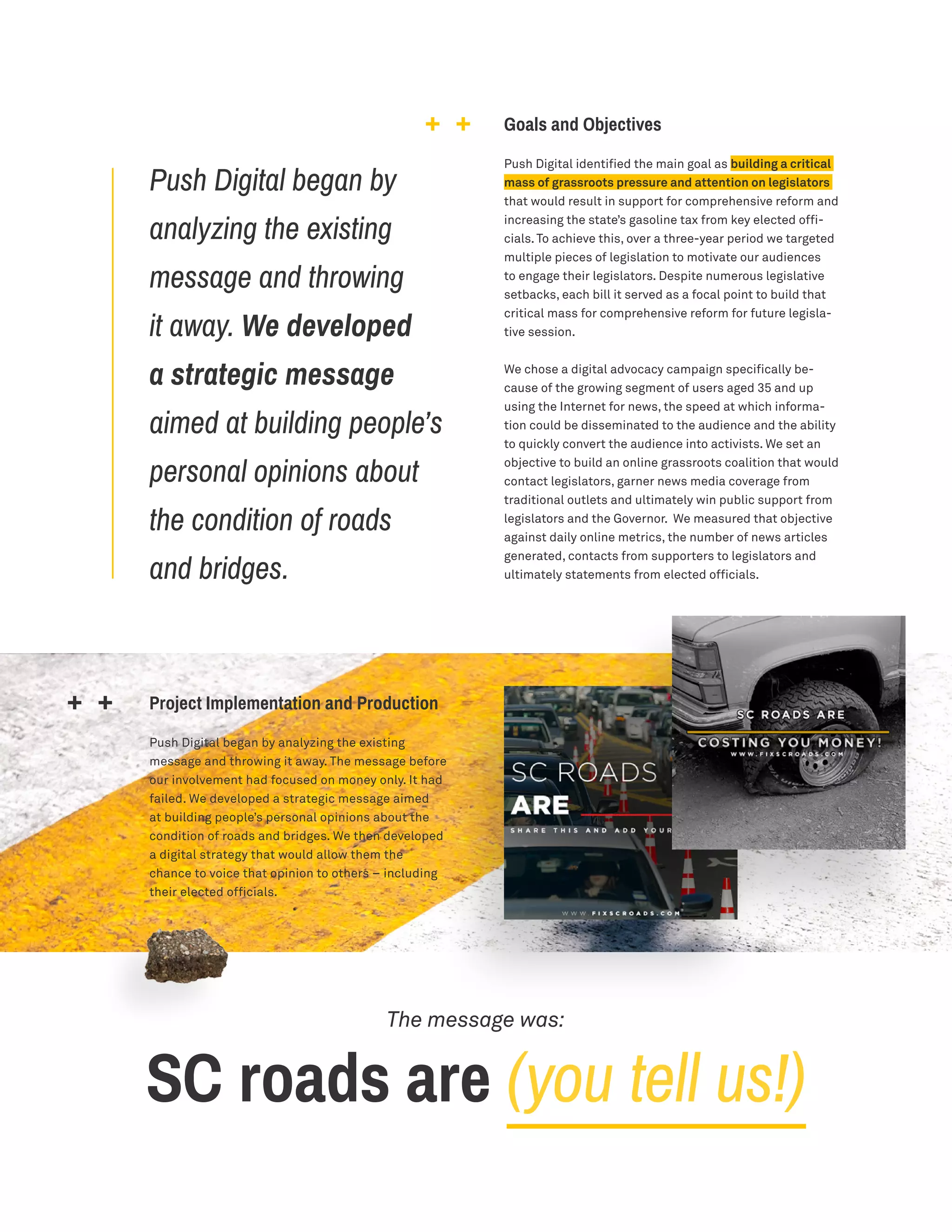
The message was:
SC roads are (you tell us!)
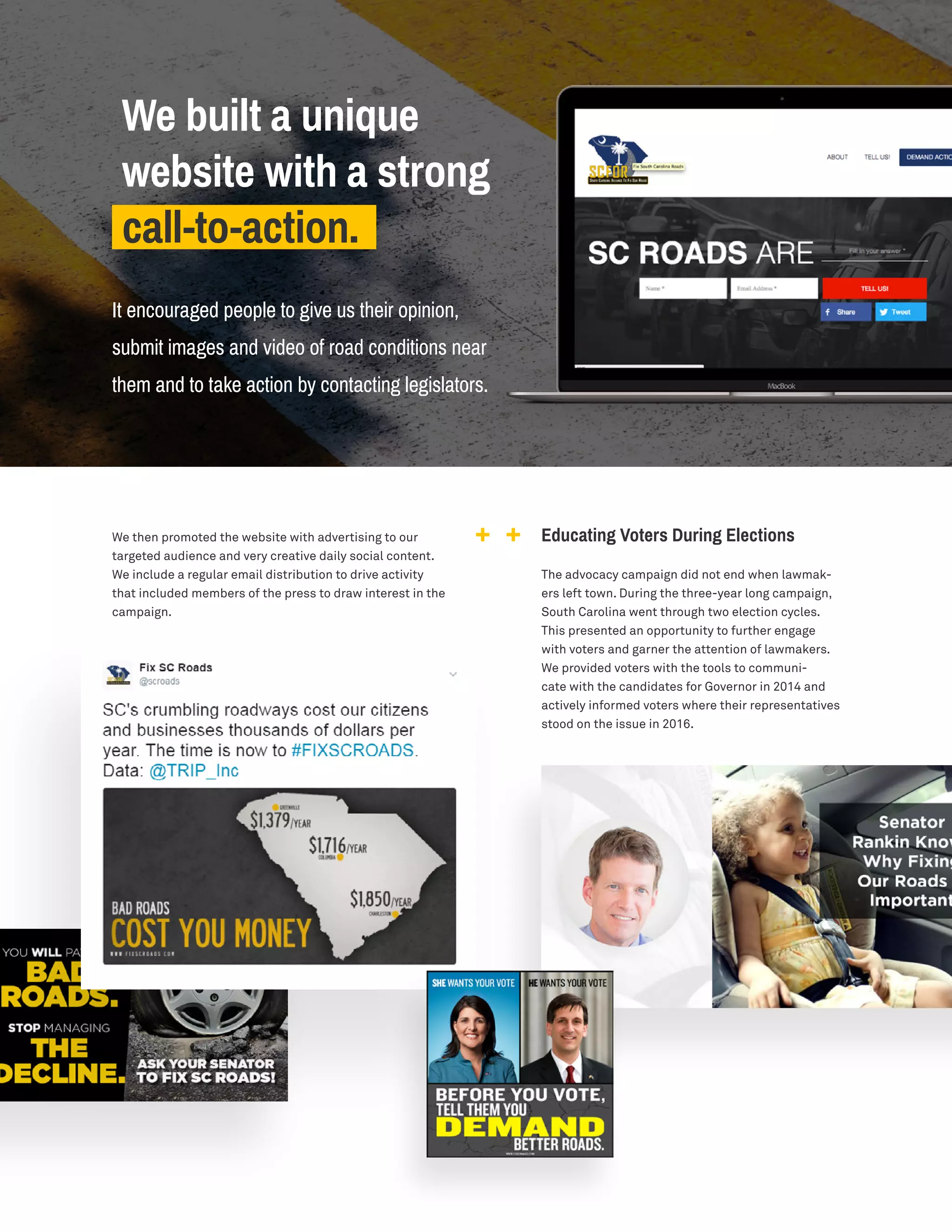
We then promoted the website with advertising to our
targeted audience and very creative daily social content.
We include a regular email distribution to drive activity
that included members of the press to draw interest in the
campaign.
We built a unique
website with a strong
call-to-action.
It encouraged people to give us their opinion,
submit images and video of road conditions near
them and to take action by contacting legislators.
Educating Voters During Elections
The advocacy campaign did not end when lawmak-
ers left town. During the three-year long campaign,
South Carolina went through two election cycles.
This presented an opportunity to further engage
with voters and garner the attention of lawmakers.
We provided voters with the tools to communi-
cate with the candidates for Governor in 2014 and
actively informed voters where their representatives
stood on the issue in 2016.
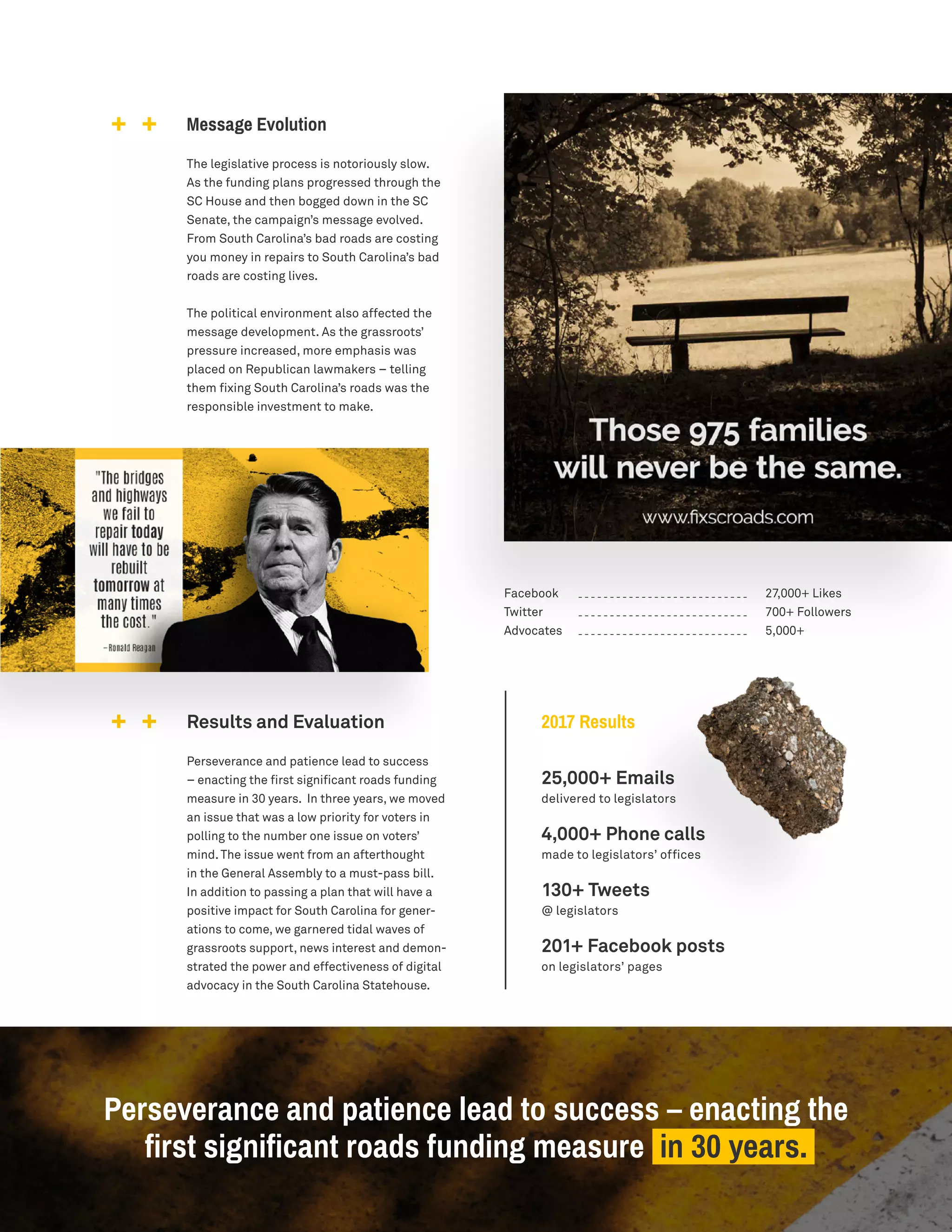
Message Evolution
The legislative process is notoriously slow.
As the funding plans progressed through the
SC House and then bogged down in the SC
Senate, the campaign’s message evolved.
From South Carolina’s bad roads are costing
you money in repairs to South Carolina’s bad
roads are costing lives.
The political environment also affected the
message development. As the grassroots’
pressure increased, more emphasis was
placed on Republican lawmakers – telling
them fixing South Carolina’s roads was the
responsible investment to make.
Results and Evaluation
Perseverance and patience lead to success
– enacting the first significant roads funding
measure in 30 years. In three years, we moved
an issue that was a low priority for voters in
polling to the number one issue on voters’
mind. The issue went from an afterthought
in the General Assembly to a must-pass bill.
In addition to passing a plan that will have a
positive impact for South Carolina for gener-
ations to come, we garnered tidal waves of
grassroots support, news interest and demon-
strated the power and effectiveness of digital
advocacy in the South Carolina Statehouse.
Facebook
Twitter
Advocates
2017 Results
25,000+ Emails
delivered to legislators
4,000+ Phone calls
made to legislators’ offices
130+ Tweets
@ legislators
201+ Facebook posts
on legislators’ pages
Perseverance and patience lead to success – enacting the
first significant roads funding measure in 30 years.
27,000+ Likes
700+ Followers
5,000+

170725 push scfor_case_study

  • 1.
    South Carolina Allianceto Fix Our Roads Case Study
  • 2.
    Case Study South CarolinaAlliance to Fix Our Roads LIVESDEPENDED ONTHIS The Problem and Opportunity South Carolina has some of the worst roads and bridges in the nation. The state is often the leader in the number of highway fatal- ities. It has the 4th largest highway system in the country and the 3rd lowest gas tax in which to fund repairs and upkeep. For decades the South Carolina General Assembly has refused to either raise the gas tax or reform how the state’s Department of Transportation is funded. The Challenge:Raising a tax in Conservative South Carolina The SC Alliance to Fix Our Roads (SCFOR) is a non-profit organization consisting of chambers of commerce and businesses whose mission is to bring about a change in how the state funds its roads and bridges. In April 2014 SCFOR engaged Push Digital to execute a digital campaign to change the narrative around the issue, build an active coalition of grassroots advocates and to influence policy decisions in the General Assembly. Target Audience Push Digital developed target audiences for a comprehensive digital campaign based on the following question - who would most likely personally be impacted by the deteriorating condition of the state’s highway system? Push Digital focused on a few key demographics, parents with young children, small business owners and people involved in heavy industry (transportation, distribution, manufacturing). These audiences would be the most impacted by a deteriorating highway system – keying on the inherent danger or impact to the economy from bad roads and bridges.
  • 3.
    Goals and Objectives PushDigital identified the main goal as building a critical mass of grassroots pressure and attention on legislators that would result in support for comprehensive reform and increasing the state’s gasoline tax from key elected offi- cials. To achieve this, over a three-year period we targeted multiple pieces of legislation to motivate our audiences to engage their legislators. Despite numerous legislative setbacks, each bill it served as a focal point to build that critical mass for comprehensive reform for future legisla- tive session. We chose a digital advocacy campaign specifically be- cause of the growing segment of users aged 35 and up using the Internet for news, the speed at which informa- tion could be disseminated to the audience and the ability to quickly convert the audience into activists. We set an objective to build an online grassroots coalition that would contact legislators, garner news media coverage from traditional outlets and ultimately win public support from legislators and the Governor. We measured that objective against daily online metrics, the number of news articles generated, contacts from supporters to legislators and ultimately statements from elected officials. Project Implementation and Production Push Digital began by analyzing the existing message and throwing it away. The message before our involvement had focused on money only. It had failed. We developed a strategic message aimed at building people’s personal opinions about the condition of roads and bridges. We then developed a digital strategy that would allow them the chance to voice that opinion to others – including their elected officials. Push Digital began by analyzing the existing message and throwing it away. We developed a strategic message aimed at building people’s personal opinions about the condition of roads and bridges. The message was: SC roads are (you tell us!)
  • 4.
    We then promotedthe website with advertising to our targeted audience and very creative daily social content. We include a regular email distribution to drive activity that included members of the press to draw interest in the campaign. We built a unique website with a strong call-to-action. It encouraged people to give us their opinion, submit images and video of road conditions near them and to take action by contacting legislators. Educating Voters During Elections The advocacy campaign did not end when lawmak- ers left town. During the three-year long campaign, South Carolina went through two election cycles. This presented an opportunity to further engage with voters and garner the attention of lawmakers. We provided voters with the tools to communi- cate with the candidates for Governor in 2014 and actively informed voters where their representatives stood on the issue in 2016.
  • 5.
    Message Evolution The legislativeprocess is notoriously slow. As the funding plans progressed through the SC House and then bogged down in the SC Senate, the campaign’s message evolved. From South Carolina’s bad roads are costing you money in repairs to South Carolina’s bad roads are costing lives. The political environment also affected the message development. As the grassroots’ pressure increased, more emphasis was placed on Republican lawmakers – telling them fixing South Carolina’s roads was the responsible investment to make. Results and Evaluation Perseverance and patience lead to success – enacting the first significant roads funding measure in 30 years. In three years, we moved an issue that was a low priority for voters in polling to the number one issue on voters’ mind. The issue went from an afterthought in the General Assembly to a must-pass bill. In addition to passing a plan that will have a positive impact for South Carolina for gener- ations to come, we garnered tidal waves of grassroots support, news interest and demon- strated the power and effectiveness of digital advocacy in the South Carolina Statehouse. Facebook Twitter Advocates 2017 Results 25,000+ Emails delivered to legislators 4,000+ Phone calls made to legislators’ offices 130+ Tweets @ legislators 201+ Facebook posts on legislators’ pages Perseverance and patience lead to success – enacting the first significant roads funding measure in 30 years. 27,000+ Likes 700+ Followers 5,000+