The CIO,
Enterprise Mobility and
Digital Advantage
Bill Limond
www.limond.com
bill@limond.com
The CIO,
Enterprise Mobility and
Digital Advantage
Bill Limond
Apps World Germany
20th April 2016
www.limond.com
bill@limond.com
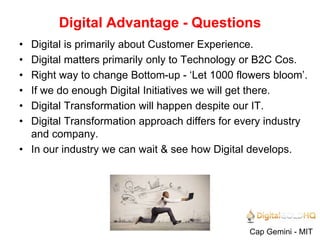
Digital Advantage - Questions
Cap Gemini - MIT
• Digital is primarily about Customer Experience.
• Digital matters primarily only to Technology or B2C Cos.
• Right way to change Bottom-up - ‘Let 1000 flowers bloom’.
• If we do enough Digital Initiatives we will get there.
• Digital Transformation will happen despite our IT.
• Digital Transformation approach differs for every industry
and company.
• In our industry we can wait & see how Digital develops.
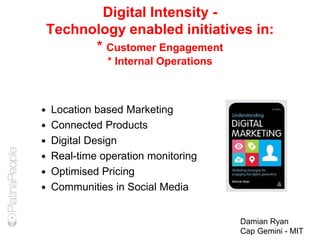
Digital Intensity -
Technology enabled initiatives in:
* Customer Engagement
* Internal Operations
 Location based Marketing
 Connected Products
 Digital Design
 Real-time operation monitoring
 Optimised Pricing
 Communities in Social Media
Damian Ryan
Cap Gemini - MIT
Transformation Management Intensity -
Leadership capabilities including:
Vision
Governance
Engagement
IT-Business Relationships
 Vision of the organisation’s future
 Cross-silo coordination
 Evolving the Culture
 New Skills
Cap Gemini - MIT
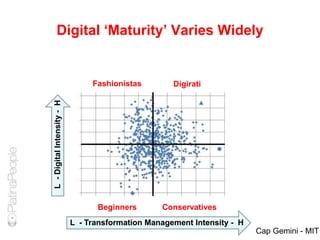
Digital ‘Maturity’ Varies Widely
L - Transformation Management Intensity - H
L-DigitalIntensity-H
Fashionistas
Beginners
Digirati
Conservatives
Cap Gemini - MIT
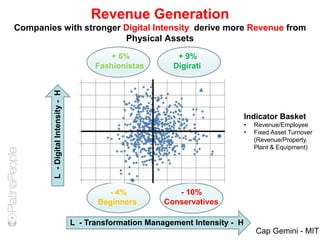
Revenue Generation
Companies with stronger Digital Intensity derive more Revenue from
Physical Assets
L - Transformation Management Intensity - H
L-DigitalIntensity-H + 6%
Fashionistas
- 4%
Beginners
+ 9%
Digirati
- 10%
Conservatives
Indicator Basket
• Revenue/Employee
• Fixed Asset Turnover
(Revenue/Property,
Plant & Equipment)
Cap Gemini - MIT
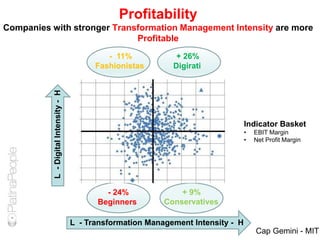
Profitability
Companies with stronger Transformation Management Intensity are more
Profitable
L - Transformation Management Intensity - H
L-DigitalIntensity-H - 11%
Fashionistas
- 24%
Beginners
+ 26%
Digirati
+ 9%
Conservatives
Indicator Basket
• EBIT Margin
• Net Profit Margin
Cap Gemini - MIT
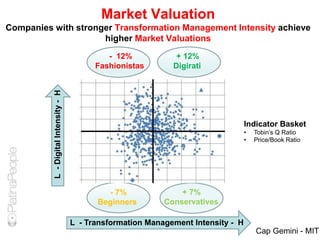
Market Valuation
Companies with stronger Transformation Management Intensity achieve
higher Market Valuations
L - Transformation Management Intensity - H
L-DigitalIntensity-H - 12%
Fashionistas
- 7%
Beginners
+ 12%
Digirati
+ 7%
Conservatives
Indicator Basket
• Tobin’s Q Ratio
• Price/Book Ratio
Cap Gemini - MIT
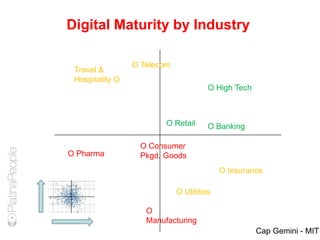
Digital Maturity by Industry
Travel &
Hospitality O
O Pharma
O Telecom
O High Tech
O Consumer
Pkgd. Goods
O
Manufacturing
O Utilities
O Insurance
O Retail O Banking
Cap Gemini - MIT
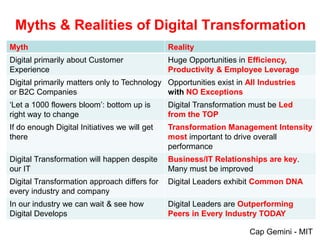
Myths & Realities of Digital Transformation
Myth Reality
Digital primarily about Customer
Experience
Huge Opportunities in Efficiency,
Productivity & Employee Leverage
Digital primarily matters only to Technology
or B2C Companies
Opportunities exist in All Industries
with NO Exceptions
‘Let a 1000 flowers bloom’: bottom up is
right way to change
Digital Transformation must be Led
from the TOP
If do enough Digital Initiatives we will get
there
Transformation Management Intensity
most important to drive overall
performance
Digital Transformation will happen despite
our IT
Business/IT Relationships are key.
Many must be improved
Digital Transformation approach differs for
every industry and company
Digital Leaders exhibit Common DNA
In our industry we can wait & see how
Digital Develops
Digital Leaders are Outperforming
Peers in Every Industry TODAY
Cap Gemini - MIT
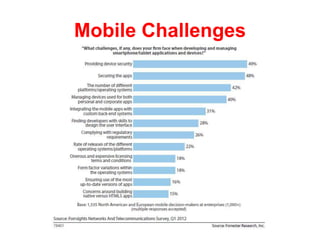
Mobile Challenges
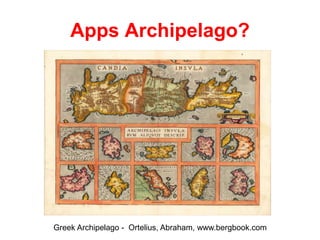
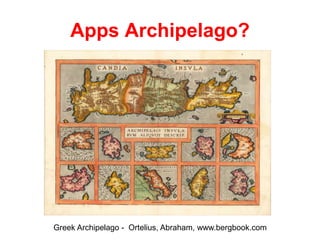
Apps Archipelago?
Greek Archipelago - Ortelius, Abraham, www.bergbook.com
Opportunities & Challenges
• Business users want to access more than email.
• Use consumer mobile device sharing & access capabilities -
including app-based cloud services.
• Use smartphones & tablets as primary computing endpoints.
• High expectations for mobile collaboration capabilities.
• Access & share everything from email to desktop files
• Internally & externally.
• Use corporate repositories, Microsoft SharePoint and Windows File
Shares, from behind the firewall, on all devices.
• New opportunities — & challenges as
• Content access & control move from IT
• To the individual user.
• After MDM, next mobile problem
- ‘Information Sprawl’.
Information Sprawl
The Next Mobile Challenge
• MobileIron report - 3000 respondents
• 80% using personal smartphones & tablets for
work.
• 451 Research - > 40% enterprises increased spend
on Mobile Device Management (MDM)
• No longer If, but
• When & How Businesses
• Manage Mobile Devices.
MobileIron
Mobile devices
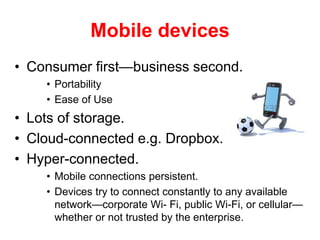
• Consumer first—business second.
• Portability
• Ease of Use
• Lots of storage.
• Cloud-connected e.g. Dropbox.
• Hyper-connected.
• Mobile connections persistent.
• Devices try to connect constantly to any available
network—corporate Wi- Fi, public Wi-Fi, or cellular—
whether or not trusted by the enterprise.
Thought for the Day
“ Email, Calendar & Contacts (Personal
Information Management), mobile file
syncing apps, & mobile web browsers, are the
three basic tools most users use on mobile
devices to get lot of everyday work done.
You can probably solve 99% secure mobile
enterprise access, with 1% of the effort,
through these three mobile Apps.”
– Madden
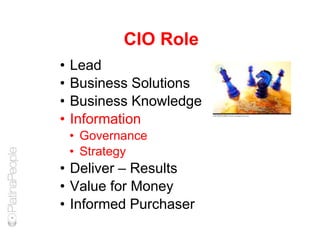
CIO Role
• Lead
• Business Solutions
• Business Knowledge
• Information
• Governance
• Strategy
• Deliver – Results
• Value for Money
• Informed Purchaser
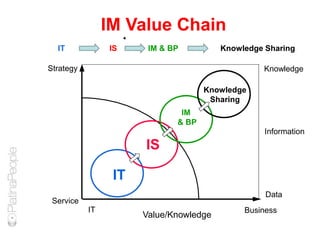
Value/Knowledge
IT
IS
Knowledge
Sharing
IT
Service
Business
Strategy
IT IS IM & BP Knowledge Sharing
Knowledge
Data
Information
IM
& BP
IM Value Chain
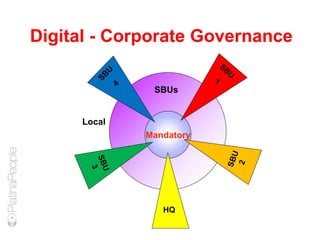
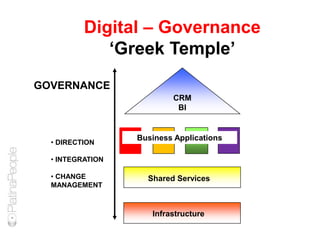
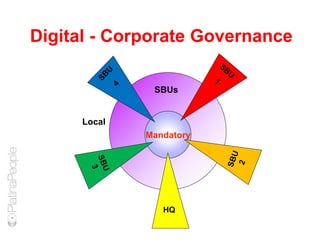
Digital - Corporate Governance
Mandatory
SBUs
Local
HQ
CRM
BI
Business Applications
Shared Services
Infrastructure
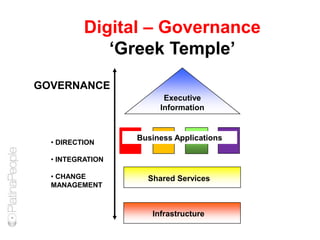
Digital – Governance
‘Greek Temple’
• DIRECTION
• INTEGRATION
• CHANGE
MANAGEMENT
GOVERNANCE
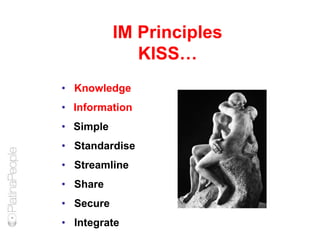
IM Principles
KISS…
• Knowledge
• Information
• Simple
• Standardise
• Streamline
• Share
• Secure
• Integrate
CIO Mission
CIO is Custodian of KEY INFORMATION & DATA ASSETS of
organisation, responsible for Governance, Management &
Security; just as CFO is responsible for financial assets.
CIO mission is to facilitate & improve, cost effectively:-
o ‘Digital Engagement’ with Customers, Clients, Citizens &
Stakeholders
o Secure management & communication of Information &
Data
o Streamlining of business processes
o Sharing of Knowledge, across the organization.
As Peter Drucker said: as Knowledge Workers, All we have to
manage is INFORMATION.
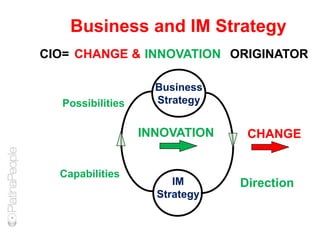
Business
Strategy
Direction
Capabilities
CHANGE
IM
Strategy
Possibilities
Business and IM Strategy
INNOVATION
INNOVATIONCHANGE &CIO= ORIGINATOR
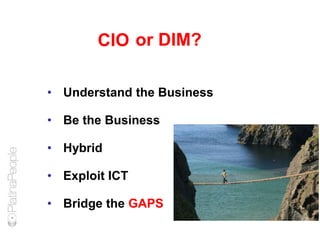
• Understand the Business
• Be the Business
• Hybrid
• Exploit ICT
• Bridge the GAPS
CIO or DIM?
1. Let users pull - don't push I.T. (too much)
2. It's easy for the organisation to tie
itself in I.T. knots
3. Harness the potential
4. Keep your balance
5. Avoid the lynching party
CIO Rope Tricks
CIOs will disappear ?
• Career Is Over?
• When IT standard, organisations will no longer
need CIOs?
• Information ASSET
• Change & Innovation Originators
• Organisations still need CIOs
“In the End
All that we have to manage is -
Information.”
Big Data?
Thank You
Bill Limond
Apps World Germany
20th April 2016
www.limond.com
bill@limond.com
The CIO,
Enterprise Mobility and
Digital Advantage
Back-up Slides
Apps Archipelago?
Greek Archipelago - Ortelius, Abraham, www.bergbook.com
Opportunities & Challenges
• Business users want to access more than email.
• Use consumer mobile device sharing & access capabilities -
including app-based cloud services.
• Use smartphones & tablets as primary computing endpoints.
• High expectations for mobile collaboration capabilities.
• Access & share everything from email to desktop files
• Internally & externally.
• Use corporate repositories, Microsoft SharePoint and Windows File
Shares, from behind the firewall, on all devices.
• New opportunities — & challenges as
• Content access & control move from IT
• To the individual user.
• After MDM, next mobile problem
- ‘Information Sprawl’.
Information Sprawl
The Next Mobile Challenge
• MobileIron report - 3000 respondents
• 80% using personal smartphones & tablets for
work.
• 451 Research - 41% enterprises increased spend
on Mobile Device Management (MDM) in 2013.
• 46% plan to in 2014.
• No longer If, but
• When & How Businesses
• Manage Mobile Devices.
MobileIron 2014
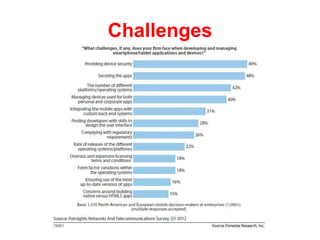
Challenges
Mobile devices
• Consumer first—business second.
• Portability
• Ease of Use
• Lots of storage.
• Cloud-connected e.g. Dropbox.
• Hyper-connected.
• Mobile connections persistent.
• Devices try to connect constantly to any available
network—corporate Wi- Fi, public Wi-Fi, or cellular—
whether or not trusted by the enterprise.
Thought for the Day
“ Email, Calendar & Contacts (Personal
Information Management), mobile file
syncing apps, & mobile web browsers, are the
three basic tools most users use on mobile
devices to get lot of everyday work done.
You can probably solve 99% secure mobile
enterprise access, with 1% of the effort,
through these three mobile Apps.”
– Madden, 2013
Digital - Corporate Governance
Mandatory
SBUs
Local
HQ
Executive
Information
Business Applications
Shared Services
Infrastructure
Digital – Governance
‘Greek Temple’
• DIRECTION
• INTEGRATION
• CHANGE
MANAGEMENT
GOVERNANCE
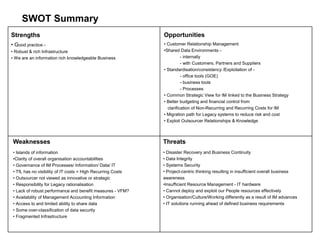
SWOT Summary
Strengths
• Good practice -
• Robust & rich Infrastructure
• We are an information rich knowledgeable Business
Weaknesses
• Islands of information
•Clarity of overall organisation accountabilities
• Governance of IM Processes/ Information/ Data/ IT
• TfL has no visibility of IT costs = High Recurring Costs
• Outsourcer not viewed as innovative or strategic
• Responsibility for Legacy rationalisation
• Lack of robust performance and benefit measures - VFM?
• Availability of Management Accounting Information
• Access to and limited ability to share data
• Some over-classification of data security
• Fragmented Infrastructure
Opportunities
• Customer Relationship Management
•Shared Data Environments -
- internally
- with Customers, Partners and Suppliers
• Standardisation/consistency /Exploitation of -
- office tools (GOE)
- business tools
- Processes
• Common Strategic View for IM linked to the Business Strategy
• Better budgeting and financial control from
clarification of Non-Recurring and Recurring Costs for IM
• Migration path for Legacy systems to reduce risk and cost
• Exploit Outsourcer Relationships & Knowledge
Threats
• Disaster Recovery and Business Continuity
• Data Integrity
• Systems Security
• Project-centric thinking resulting in insufficient overall business
awareness
•Insufficient Resource Management - IT hardware
• Cannot deploy and exploit our People resources effectively
• Organisation/Culture/Working differently as a result of IM advances
• IT solutions running ahead of defined business requirements
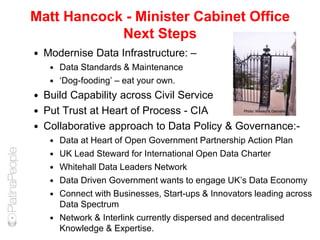
Matt Hancock - Minister Cabinet Office
Next Steps
 Modernise Data Infrastructure: –
 Data Standards & Maintenance
 ‘Dog-fooding’ – eat your own.
 Build Capability across Civil Service
 Put Trust at Heart of Process - CIA
 Collaborative approach to Data Policy & Governance:-
 Data at Heart of Open Government Partnership Action Plan
 UK Lead Steward for International Open Data Charter
 Whitehall Data Leaders Network
 Data Driven Government wants to engage UK’s Data Economy
 Connect with Businesses, Start-ups & Innovators leading across
Data Spectrum
 Network & Interlink currently dispersed and decentralised
Knowledge & Expertise.
Photo: Wesley & Dannells
Internal Big Data Collaboration
UK Government
Potential Rewards
 Policy makers – think differently & enhance service provision
 Public access ever-increasing, more easily ‘digestible information
aids informed decision making
BIS – Business Innovation & Skills
 Building Data Science capability – interdisciplinary collaboration
 Innovative interactive visualisation UN trade data for Global audience
DWP – Dept. Work & Pensions – Universal Credit Data
 Increase effectiveness of departmental operations
 Jobcentre Plus & other organisations e.g. Housing Associations
understand claimant caseload by location
 Public has UC roll-out timetable by locality
Data Science Competition
 Supported by Government Data Science Partnership (Cabinet Office,
GDS, Go-Science & ONS)
 Using Big Data techniques & SW to answer business questions,
visualise information across wide range of depts.
Internal Collaboration
Data driven companies
(McAfee & Brynjolfsson – HBR)
 McKinsey/MIT HBR study 330 N American Companies
 Data Driven Companies better performers than Competitors:
 5% more productive
 6% more profitable
 Reflected in Stock Market Valuations
 Better predictions, surprising sources:-
 Wharton Big Data House Market Prices better than National Association of Realtors
 John Hopkins used Google Flu Trends to predict surges week before Centre for
Disease Control
 Twitter updated & tracked Haiti Cholera spread 2 weeks ahead of Official Reports
 Passur Aerospace – RightETA virtually eliminated gaps between Airline Estimated and
Actual Arrival Times. “Worth $ Millions”
 Sears – Big Data Technologies & Practices (Hadoop clusters) – directly analysed cluster
data. Promotion lead times dropped from 8 weeks to 1 week & still dropping.
Internal
Collaboration
 Companies have applied Big Data and analytics capabilities to
sales and marketing data to better understand and engage their
customers, but scant few have directed these types of
technologies ‘inward’ to improve their own organizations.
 Collaboration data can reveal how an organization’s biggest
assets – its people – are working together and what the
organization is really focused on.
 In a Collaboration centric culture, data sharing helps build bridges
and collapse silos to develop competitive advantage
 Today collaboration data is likely the most valuable untapped
data source in the enterprise
http://www.digitalistmag.com/technologies/big-data/leveraging-big-data-
redefine-collaboration-enterprise-01243242
Photo: JP Goguen
Collaboration & Security
• Collaboration & Sharing may pose new risks
• Opportunity to advocate & enable secure collaboration in high-risk
environments
• Take both data- & identity-centric approach to controlling information
in collaboration environments
• 4 main steps:-
1. ‘Turn Big into Small Data’ means System keeps up to enable faster, more
accurate & business-relevant decisions
2. Determine Information context; Who communicating How. Leads to better, fine-
tuned decisions.
3. Deploy controls to securely enable on-premise email & collaboration. Then
determine how & where to deploy data controls
4. Deploy controls to securely enable cloud and mobile collaboration. Manage
areas of High Risk
• Instead of security of “No”. Empower security of “Know”
(Tyson Whitten – CA)
Photo: Paulo Valdivieso

160419 CIO Enterprise Mobility Dig Advantage

  • 1.
    The CIO, Enterprise Mobilityand Digital Advantage Bill Limond www.limond.com bill@limond.com
  • 2.
    The CIO, Enterprise Mobilityand Digital Advantage Bill Limond Apps World Germany 20th April 2016 www.limond.com bill@limond.com
  • 3.
    Digital Advantage -Questions Cap Gemini - MIT • Digital is primarily about Customer Experience. • Digital matters primarily only to Technology or B2C Cos. • Right way to change Bottom-up - ‘Let 1000 flowers bloom’. • If we do enough Digital Initiatives we will get there. • Digital Transformation will happen despite our IT. • Digital Transformation approach differs for every industry and company. • In our industry we can wait & see how Digital develops.
  • 4.
    Digital Intensity - Technologyenabled initiatives in: * Customer Engagement * Internal Operations  Location based Marketing  Connected Products  Digital Design  Real-time operation monitoring  Optimised Pricing  Communities in Social Media Damian Ryan Cap Gemini - MIT
  • 5.
    Transformation Management Intensity- Leadership capabilities including: Vision Governance Engagement IT-Business Relationships  Vision of the organisation’s future  Cross-silo coordination  Evolving the Culture  New Skills Cap Gemini - MIT
  • 6.
    Digital ‘Maturity’ VariesWidely L - Transformation Management Intensity - H L-DigitalIntensity-H Fashionistas Beginners Digirati Conservatives Cap Gemini - MIT
  • 7.
    Revenue Generation Companies withstronger Digital Intensity derive more Revenue from Physical Assets L - Transformation Management Intensity - H L-DigitalIntensity-H + 6% Fashionistas - 4% Beginners + 9% Digirati - 10% Conservatives Indicator Basket • Revenue/Employee • Fixed Asset Turnover (Revenue/Property, Plant & Equipment) Cap Gemini - MIT
  • 8.
    Profitability Companies with strongerTransformation Management Intensity are more Profitable L - Transformation Management Intensity - H L-DigitalIntensity-H - 11% Fashionistas - 24% Beginners + 26% Digirati + 9% Conservatives Indicator Basket • EBIT Margin • Net Profit Margin Cap Gemini - MIT
  • 9.
    Market Valuation Companies withstronger Transformation Management Intensity achieve higher Market Valuations L - Transformation Management Intensity - H L-DigitalIntensity-H - 12% Fashionistas - 7% Beginners + 12% Digirati + 7% Conservatives Indicator Basket • Tobin’s Q Ratio • Price/Book Ratio Cap Gemini - MIT
  • 10.
    Digital Maturity byIndustry Travel & Hospitality O O Pharma O Telecom O High Tech O Consumer Pkgd. Goods O Manufacturing O Utilities O Insurance O Retail O Banking Cap Gemini - MIT
  • 11.
    Myths & Realitiesof Digital Transformation Myth Reality Digital primarily about Customer Experience Huge Opportunities in Efficiency, Productivity & Employee Leverage Digital primarily matters only to Technology or B2C Companies Opportunities exist in All Industries with NO Exceptions ‘Let a 1000 flowers bloom’: bottom up is right way to change Digital Transformation must be Led from the TOP If do enough Digital Initiatives we will get there Transformation Management Intensity most important to drive overall performance Digital Transformation will happen despite our IT Business/IT Relationships are key. Many must be improved Digital Transformation approach differs for every industry and company Digital Leaders exhibit Common DNA In our industry we can wait & see how Digital Develops Digital Leaders are Outperforming Peers in Every Industry TODAY Cap Gemini - MIT
  • 12.
  • 13.
    Apps Archipelago? Greek Archipelago- Ortelius, Abraham, www.bergbook.com
  • 14.
    Opportunities & Challenges •Business users want to access more than email. • Use consumer mobile device sharing & access capabilities - including app-based cloud services. • Use smartphones & tablets as primary computing endpoints. • High expectations for mobile collaboration capabilities. • Access & share everything from email to desktop files • Internally & externally. • Use corporate repositories, Microsoft SharePoint and Windows File Shares, from behind the firewall, on all devices. • New opportunities — & challenges as • Content access & control move from IT • To the individual user. • After MDM, next mobile problem - ‘Information Sprawl’.
  • 15.
    Information Sprawl The NextMobile Challenge • MobileIron report - 3000 respondents • 80% using personal smartphones & tablets for work. • 451 Research - > 40% enterprises increased spend on Mobile Device Management (MDM) • No longer If, but • When & How Businesses • Manage Mobile Devices. MobileIron
  • 16.
    Mobile devices • Consumerfirst—business second. • Portability • Ease of Use • Lots of storage. • Cloud-connected e.g. Dropbox. • Hyper-connected. • Mobile connections persistent. • Devices try to connect constantly to any available network—corporate Wi- Fi, public Wi-Fi, or cellular— whether or not trusted by the enterprise.
  • 17.
    Thought for theDay “ Email, Calendar & Contacts (Personal Information Management), mobile file syncing apps, & mobile web browsers, are the three basic tools most users use on mobile devices to get lot of everyday work done. You can probably solve 99% secure mobile enterprise access, with 1% of the effort, through these three mobile Apps.” – Madden
  • 18.
    CIO Role • Lead •Business Solutions • Business Knowledge • Information • Governance • Strategy • Deliver – Results • Value for Money • Informed Purchaser
  • 19.
    Value/Knowledge IT IS Knowledge Sharing IT Service Business Strategy IT IS IM& BP Knowledge Sharing Knowledge Data Information IM & BP IM Value Chain
  • 20.
    Digital - CorporateGovernance Mandatory SBUs Local HQ
  • 21.
    CRM BI Business Applications Shared Services Infrastructure Digital– Governance ‘Greek Temple’ • DIRECTION • INTEGRATION • CHANGE MANAGEMENT GOVERNANCE
  • 22.
    IM Principles KISS… • Knowledge •Information • Simple • Standardise • Streamline • Share • Secure • Integrate
  • 23.
    CIO Mission CIO isCustodian of KEY INFORMATION & DATA ASSETS of organisation, responsible for Governance, Management & Security; just as CFO is responsible for financial assets. CIO mission is to facilitate & improve, cost effectively:- o ‘Digital Engagement’ with Customers, Clients, Citizens & Stakeholders o Secure management & communication of Information & Data o Streamlining of business processes o Sharing of Knowledge, across the organization. As Peter Drucker said: as Knowledge Workers, All we have to manage is INFORMATION.
  • 24.
  • 25.
    • Understand theBusiness • Be the Business • Hybrid • Exploit ICT • Bridge the GAPS CIO or DIM?
  • 26.
    1. Let userspull - don't push I.T. (too much) 2. It's easy for the organisation to tie itself in I.T. knots 3. Harness the potential 4. Keep your balance 5. Avoid the lynching party CIO Rope Tricks
  • 27.
    CIOs will disappear? • Career Is Over? • When IT standard, organisations will no longer need CIOs? • Information ASSET • Change & Innovation Originators • Organisations still need CIOs
  • 28.
    “In the End Allthat we have to manage is - Information.” Big Data?
  • 29.
    Thank You Bill Limond AppsWorld Germany 20th April 2016 www.limond.com bill@limond.com
  • 30.
    The CIO, Enterprise Mobilityand Digital Advantage Back-up Slides
  • 31.
    Apps Archipelago? Greek Archipelago- Ortelius, Abraham, www.bergbook.com
  • 32.
    Opportunities & Challenges •Business users want to access more than email. • Use consumer mobile device sharing & access capabilities - including app-based cloud services. • Use smartphones & tablets as primary computing endpoints. • High expectations for mobile collaboration capabilities. • Access & share everything from email to desktop files • Internally & externally. • Use corporate repositories, Microsoft SharePoint and Windows File Shares, from behind the firewall, on all devices. • New opportunities — & challenges as • Content access & control move from IT • To the individual user. • After MDM, next mobile problem - ‘Information Sprawl’.
  • 33.
    Information Sprawl The NextMobile Challenge • MobileIron report - 3000 respondents • 80% using personal smartphones & tablets for work. • 451 Research - 41% enterprises increased spend on Mobile Device Management (MDM) in 2013. • 46% plan to in 2014. • No longer If, but • When & How Businesses • Manage Mobile Devices. MobileIron 2014
  • 34.
  • 35.
    Mobile devices • Consumerfirst—business second. • Portability • Ease of Use • Lots of storage. • Cloud-connected e.g. Dropbox. • Hyper-connected. • Mobile connections persistent. • Devices try to connect constantly to any available network—corporate Wi- Fi, public Wi-Fi, or cellular— whether or not trusted by the enterprise.
  • 36.
    Thought for theDay “ Email, Calendar & Contacts (Personal Information Management), mobile file syncing apps, & mobile web browsers, are the three basic tools most users use on mobile devices to get lot of everyday work done. You can probably solve 99% secure mobile enterprise access, with 1% of the effort, through these three mobile Apps.” – Madden, 2013
  • 37.
    Digital - CorporateGovernance Mandatory SBUs Local HQ
  • 38.
    Executive Information Business Applications Shared Services Infrastructure Digital– Governance ‘Greek Temple’ • DIRECTION • INTEGRATION • CHANGE MANAGEMENT GOVERNANCE
  • 39.
    SWOT Summary Strengths • Goodpractice - • Robust & rich Infrastructure • We are an information rich knowledgeable Business Weaknesses • Islands of information •Clarity of overall organisation accountabilities • Governance of IM Processes/ Information/ Data/ IT • TfL has no visibility of IT costs = High Recurring Costs • Outsourcer not viewed as innovative or strategic • Responsibility for Legacy rationalisation • Lack of robust performance and benefit measures - VFM? • Availability of Management Accounting Information • Access to and limited ability to share data • Some over-classification of data security • Fragmented Infrastructure Opportunities • Customer Relationship Management •Shared Data Environments - - internally - with Customers, Partners and Suppliers • Standardisation/consistency /Exploitation of - - office tools (GOE) - business tools - Processes • Common Strategic View for IM linked to the Business Strategy • Better budgeting and financial control from clarification of Non-Recurring and Recurring Costs for IM • Migration path for Legacy systems to reduce risk and cost • Exploit Outsourcer Relationships & Knowledge Threats • Disaster Recovery and Business Continuity • Data Integrity • Systems Security • Project-centric thinking resulting in insufficient overall business awareness •Insufficient Resource Management - IT hardware • Cannot deploy and exploit our People resources effectively • Organisation/Culture/Working differently as a result of IM advances • IT solutions running ahead of defined business requirements
  • 40.
    Matt Hancock -Minister Cabinet Office Next Steps  Modernise Data Infrastructure: –  Data Standards & Maintenance  ‘Dog-fooding’ – eat your own.  Build Capability across Civil Service  Put Trust at Heart of Process - CIA  Collaborative approach to Data Policy & Governance:-  Data at Heart of Open Government Partnership Action Plan  UK Lead Steward for International Open Data Charter  Whitehall Data Leaders Network  Data Driven Government wants to engage UK’s Data Economy  Connect with Businesses, Start-ups & Innovators leading across Data Spectrum  Network & Interlink currently dispersed and decentralised Knowledge & Expertise. Photo: Wesley & Dannells
  • 41.
    Internal Big DataCollaboration UK Government Potential Rewards  Policy makers – think differently & enhance service provision  Public access ever-increasing, more easily ‘digestible information aids informed decision making BIS – Business Innovation & Skills  Building Data Science capability – interdisciplinary collaboration  Innovative interactive visualisation UN trade data for Global audience DWP – Dept. Work & Pensions – Universal Credit Data  Increase effectiveness of departmental operations  Jobcentre Plus & other organisations e.g. Housing Associations understand claimant caseload by location  Public has UC roll-out timetable by locality Data Science Competition  Supported by Government Data Science Partnership (Cabinet Office, GDS, Go-Science & ONS)  Using Big Data techniques & SW to answer business questions, visualise information across wide range of depts.
  • 42.
    Internal Collaboration Data drivencompanies (McAfee & Brynjolfsson – HBR)  McKinsey/MIT HBR study 330 N American Companies  Data Driven Companies better performers than Competitors:  5% more productive  6% more profitable  Reflected in Stock Market Valuations  Better predictions, surprising sources:-  Wharton Big Data House Market Prices better than National Association of Realtors  John Hopkins used Google Flu Trends to predict surges week before Centre for Disease Control  Twitter updated & tracked Haiti Cholera spread 2 weeks ahead of Official Reports  Passur Aerospace – RightETA virtually eliminated gaps between Airline Estimated and Actual Arrival Times. “Worth $ Millions”  Sears – Big Data Technologies & Practices (Hadoop clusters) – directly analysed cluster data. Promotion lead times dropped from 8 weeks to 1 week & still dropping.
  • 43.
    Internal Collaboration  Companies haveapplied Big Data and analytics capabilities to sales and marketing data to better understand and engage their customers, but scant few have directed these types of technologies ‘inward’ to improve their own organizations.  Collaboration data can reveal how an organization’s biggest assets – its people – are working together and what the organization is really focused on.  In a Collaboration centric culture, data sharing helps build bridges and collapse silos to develop competitive advantage  Today collaboration data is likely the most valuable untapped data source in the enterprise http://www.digitalistmag.com/technologies/big-data/leveraging-big-data- redefine-collaboration-enterprise-01243242 Photo: JP Goguen
  • 44.
    Collaboration & Security •Collaboration & Sharing may pose new risks • Opportunity to advocate & enable secure collaboration in high-risk environments • Take both data- & identity-centric approach to controlling information in collaboration environments • 4 main steps:- 1. ‘Turn Big into Small Data’ means System keeps up to enable faster, more accurate & business-relevant decisions 2. Determine Information context; Who communicating How. Leads to better, fine- tuned decisions. 3. Deploy controls to securely enable on-premise email & collaboration. Then determine how & where to deploy data controls 4. Deploy controls to securely enable cloud and mobile collaboration. Manage areas of High Risk • Instead of security of “No”. Empower security of “Know” (Tyson Whitten – CA) Photo: Paulo Valdivieso