Recent Changes by PLT
Implementation Act
Stanley Kang

Lowe Hauptman & Ham LLP
Suite 1400
2318 Mill Road
Alexandria VA 22314
Tel. (703) 684-1111
Fax. (703) 518-5499
www.ipfirm.com

©2014—Lowe Hauptman & Ham , LLP - All
Rights Reserved
Contents
1. Procedures for Filing Patent Applications
2. Restoration of Right of Priority
3. Time Period for Responding to Office Actions

2/19
Effective Dates
• Filing Guidelines for Non-Provisional
Applications filed on or after December 18,
2013
• Restoration of Priority effective December 18,
2013
• Response Time for Office Actions
– Office Action posted on or after December 13,
2013
– Office Actions issued on or after December 18,
2013
3/19
Procedures for Filing Applications
• A non-provisional patent application may be
filed without claims or drawings or by
reference to a previously filed application
– Exception: Does not apply to design applications

• The non-provisional application will NOT be
placed on an Examiner’s docket until the
application includes:
– A specification
– At least one claim
4/19
What is the Filing Date?
• Filing date of a provisional or non-provisional
application is the date on which the USPTO
receives a specification with or without claims
• If a non-provisional is filed without a claim,
Office of Patent Application Processing (OPAP)
issues a notice to Applicant providing a time
period to submit at least one claim to avoid
abandonment
– Likely at least two-months
5/19
Drawing Requirement
• No drawing is required to receive the filing
date
• A drawing can still be required during
prosecution
– Guidelines for including claimed subject matter in
drawings has not changed
– Cannot enter new matter
6/19
No Change to Design Applications
• The Patent Law Treaty Implementation Act
does not change the requirements for filing a
design application.

7/19
Reference Filing
• A reference filing is a filing of a nonprovisional application by referencing a
previously filed application
– Reference to previous application in Application
Data Sheet (ADS)
– Indicate that the specification and drawings are
replaced by the previous application
– Previous application can be Non-provisional,
Provisional, PCT, Non-US application
8/19
Reference Filing
• If previous application is not in English
– OPAP will issue notice to file an English language
copy

• Will NOT be placed on Examiner’s docket until
at least one claim is filed
– Delayed Examination

9/19
Strategies
• File application without claims to get the filing
date, but wait to determine what scope
should be covered
– Experiments
– Market testing
– Prior art search

• Still recommend filing drawings with first filing
to avoid new matter rejections
• Reference filing can be used to quickly file a
last minute U.S. application

10/19
Restoration of Priority Rights
• Applicant may claim priority to a non-US
application or a provisional application filed
up to fourteen (14) months earlier
– Two month increase in time
– Incorporation by reference would still be new
matter

• Petition to restore the priority must be
granted by Office of Petitions
– No guidance regarding level of proof needed
11/19
Petition To Be Filed
• Petition to restore right of priority to a foreign
application
– 37 C.F.R. 1.55(c)

• Petition to restore benefit of priority to a
provisional application
– 37 C.F.R. 1.78(b)

12/19
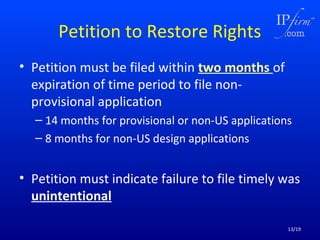
Petition to Restore Rights
• Petition must be filed within two months of
expiration of time period to file nonprovisional application
– 14 months for provisional or non-US applications
– 8 months for non-US design applications

• Petition must indicate failure to file timely was
unintentional
13/19
Strategies
• Still strongly recommend claiming priority
when the non-provisional (or provisional)
application is originally filed
• Safety net in case of unintentional error

14/19
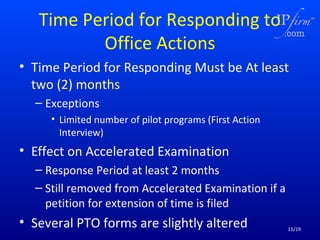
Time Period for Responding to
Office Actions
• Time Period for Responding Must be At least
two (2) months
– Exceptions
• Limited number of pilot programs (First Action
Interview)

• Effect on Accelerated Examination
– Response Period at least 2 months
– Still removed from Accelerated Examination if a
petition for extension of time is filed

• Several PTO forms are slightly altered

15/19
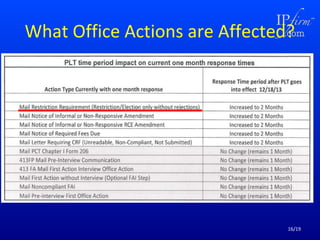
What Office Actions are Affected?

16/19
Strategies
• Notable Office Actions
– Restrictions/Election of Species
– Notice of Non-Responsive
– Notice of Non-Compliant

• Extra time to consider RR/ER

17/19
After Final Consideration
Pilot 2.0 Program
Stanley Kang

Lowe Hauptman & Ham LLP
Suite 1400
2318 Mill Road
Alexandria VA 22314
Tel. (703) 684-1111
Fax. (703) 518-5499
www.ipfirm.com

©2014—Lowe Hauptman & Ham , LLP - All
Rights Reserved
After Final Consideration Pilot 2.0
(AFCP 2.0)
 Gives More Opportunity to Amend After Final
-> for reducing cases along without the need to file an RCE when the
case was very near to completion

 Requirements
1. Request(Form PTO/SB/434) to participate in AFCP 2.0
with submitting a Response after final rejection
2. The Response must include an amendment to
at least one independent claim
02/18/14

19
After Final Consideration Pilot 2.0
(AFCP 2.0)
 Procedures
1. The examiner will be allotted a set amount of time (3 Hours
for
patent application) under AFCP 2.0 to consider the response.
2. The examiner will request an interview with the applicant to
discuss a response, if the response did not result in a
determination that all pending claims are in condition for
allowance.

 No additional fee required to request consideration of
an amendment after final rejection under AFCP 2.0
1. Request to participate in AFCP 2.0

02/18/14

20
After Final Consideration Pilot 2.0
(AFCP 2.0)
 Benefits
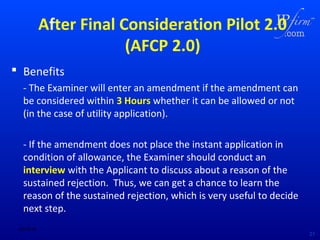
- The Examiner will enter an amendment if the amendment can
be considered within 3 Hours whether it can be allowed or not
(in the case of utility application).
- If the amendment does not place the instant application in
condition of allowance, the Examiner should conduct an
interview with the Applicant to discuss about a reason of the
sustained rejection. Thus, we can get a chance to learn the
reason of the sustained rejection, which is very useful to decide
next step.
02/18/14

21
After Final Consideration Pilot 2.0
(AFCP 2.0) - Example
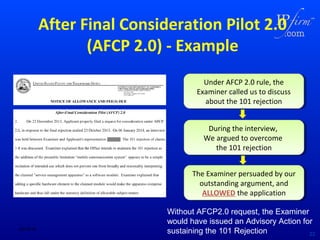
Under AFCP 2.0 rule, the
Examiner called us to discuss
about the 101 rejection
During the interview,
We argued to overcome
the 101 rejection
the 101 rejection
The Examiner persuaded by our
outstanding argument, and
ALLOWED the application

02/18/14

Without AFCP2.0 request, the Examiner
would have issued an Advisory Action for
sustaining the 101 Rejection
22
Q&A

©2014—Lowe Hauptman & Ham , LLP - All
Rights Reserved

140218 seminar feb_revised-syk

  • 1.
    Recent Changes byPLT Implementation Act Stanley Kang Lowe Hauptman & Ham LLP Suite 1400 2318 Mill Road Alexandria VA 22314 Tel. (703) 684-1111 Fax. (703) 518-5499 www.ipfirm.com ©2014—Lowe Hauptman & Ham , LLP - All Rights Reserved
  • 2.
    Contents 1. Procedures forFiling Patent Applications 2. Restoration of Right of Priority 3. Time Period for Responding to Office Actions 2/19
  • 3.
    Effective Dates • FilingGuidelines for Non-Provisional Applications filed on or after December 18, 2013 • Restoration of Priority effective December 18, 2013 • Response Time for Office Actions – Office Action posted on or after December 13, 2013 – Office Actions issued on or after December 18, 2013 3/19
  • 4.
    Procedures for FilingApplications • A non-provisional patent application may be filed without claims or drawings or by reference to a previously filed application – Exception: Does not apply to design applications • The non-provisional application will NOT be placed on an Examiner’s docket until the application includes: – A specification – At least one claim 4/19
  • 5.
    What is theFiling Date? • Filing date of a provisional or non-provisional application is the date on which the USPTO receives a specification with or without claims • If a non-provisional is filed without a claim, Office of Patent Application Processing (OPAP) issues a notice to Applicant providing a time period to submit at least one claim to avoid abandonment – Likely at least two-months 5/19
  • 6.
    Drawing Requirement • Nodrawing is required to receive the filing date • A drawing can still be required during prosecution – Guidelines for including claimed subject matter in drawings has not changed – Cannot enter new matter 6/19
  • 7.
    No Change toDesign Applications • The Patent Law Treaty Implementation Act does not change the requirements for filing a design application. 7/19
  • 8.
    Reference Filing • Areference filing is a filing of a nonprovisional application by referencing a previously filed application – Reference to previous application in Application Data Sheet (ADS) – Indicate that the specification and drawings are replaced by the previous application – Previous application can be Non-provisional, Provisional, PCT, Non-US application 8/19
  • 9.
    Reference Filing • Ifprevious application is not in English – OPAP will issue notice to file an English language copy • Will NOT be placed on Examiner’s docket until at least one claim is filed – Delayed Examination 9/19
  • 10.
    Strategies • File applicationwithout claims to get the filing date, but wait to determine what scope should be covered – Experiments – Market testing – Prior art search • Still recommend filing drawings with first filing to avoid new matter rejections • Reference filing can be used to quickly file a last minute U.S. application 10/19
  • 11.
    Restoration of PriorityRights • Applicant may claim priority to a non-US application or a provisional application filed up to fourteen (14) months earlier – Two month increase in time – Incorporation by reference would still be new matter • Petition to restore the priority must be granted by Office of Petitions – No guidance regarding level of proof needed 11/19
  • 12.
    Petition To BeFiled • Petition to restore right of priority to a foreign application – 37 C.F.R. 1.55(c) • Petition to restore benefit of priority to a provisional application – 37 C.F.R. 1.78(b) 12/19
  • 13.
    Petition to RestoreRights • Petition must be filed within two months of expiration of time period to file nonprovisional application – 14 months for provisional or non-US applications – 8 months for non-US design applications • Petition must indicate failure to file timely was unintentional 13/19
  • 14.
    Strategies • Still stronglyrecommend claiming priority when the non-provisional (or provisional) application is originally filed • Safety net in case of unintentional error 14/19
  • 15.
    Time Period forResponding to Office Actions • Time Period for Responding Must be At least two (2) months – Exceptions • Limited number of pilot programs (First Action Interview) • Effect on Accelerated Examination – Response Period at least 2 months – Still removed from Accelerated Examination if a petition for extension of time is filed • Several PTO forms are slightly altered 15/19
  • 16.
    What Office Actionsare Affected? 16/19
  • 17.
    Strategies • Notable OfficeActions – Restrictions/Election of Species – Notice of Non-Responsive – Notice of Non-Compliant • Extra time to consider RR/ER 17/19
  • 18.
    After Final Consideration Pilot2.0 Program Stanley Kang Lowe Hauptman & Ham LLP Suite 1400 2318 Mill Road Alexandria VA 22314 Tel. (703) 684-1111 Fax. (703) 518-5499 www.ipfirm.com ©2014—Lowe Hauptman & Ham , LLP - All Rights Reserved
  • 19.
    After Final ConsiderationPilot 2.0 (AFCP 2.0)  Gives More Opportunity to Amend After Final -> for reducing cases along without the need to file an RCE when the case was very near to completion  Requirements 1. Request(Form PTO/SB/434) to participate in AFCP 2.0 with submitting a Response after final rejection 2. The Response must include an amendment to at least one independent claim 02/18/14 19
  • 20.
    After Final ConsiderationPilot 2.0 (AFCP 2.0)  Procedures 1. The examiner will be allotted a set amount of time (3 Hours for patent application) under AFCP 2.0 to consider the response. 2. The examiner will request an interview with the applicant to discuss a response, if the response did not result in a determination that all pending claims are in condition for allowance.  No additional fee required to request consideration of an amendment after final rejection under AFCP 2.0 1. Request to participate in AFCP 2.0 02/18/14 20
  • 21.
    After Final ConsiderationPilot 2.0 (AFCP 2.0)  Benefits - The Examiner will enter an amendment if the amendment can be considered within 3 Hours whether it can be allowed or not (in the case of utility application). - If the amendment does not place the instant application in condition of allowance, the Examiner should conduct an interview with the Applicant to discuss about a reason of the sustained rejection. Thus, we can get a chance to learn the reason of the sustained rejection, which is very useful to decide next step. 02/18/14 21
  • 22.
    After Final ConsiderationPilot 2.0 (AFCP 2.0) - Example Under AFCP 2.0 rule, the Under AFCP 2.0 rule, the Examiner called us to discuss Examiner called us to discuss about the 101 rejection about the 101 rejection During the interview, During the interview, We argued to overcome We argued to overcome the 101 rejection the 101 rejection The Examiner persuaded by our The Examiner persuaded by our outstanding argument, and outstanding argument, and ALLOWED the application ALLOWED the application 02/18/14 Without AFCP2.0 request, the Examiner would have issued an Advisory Action for sustaining the 101 Rejection 22
  • 23.
    Q&A ©2014—Lowe Hauptman &Ham , LLP - All Rights Reserved