Overview on After Final Practice
at the USPTO
Presented by Justin J. Cassell
February 2017
© 2017 Workman Nydegger
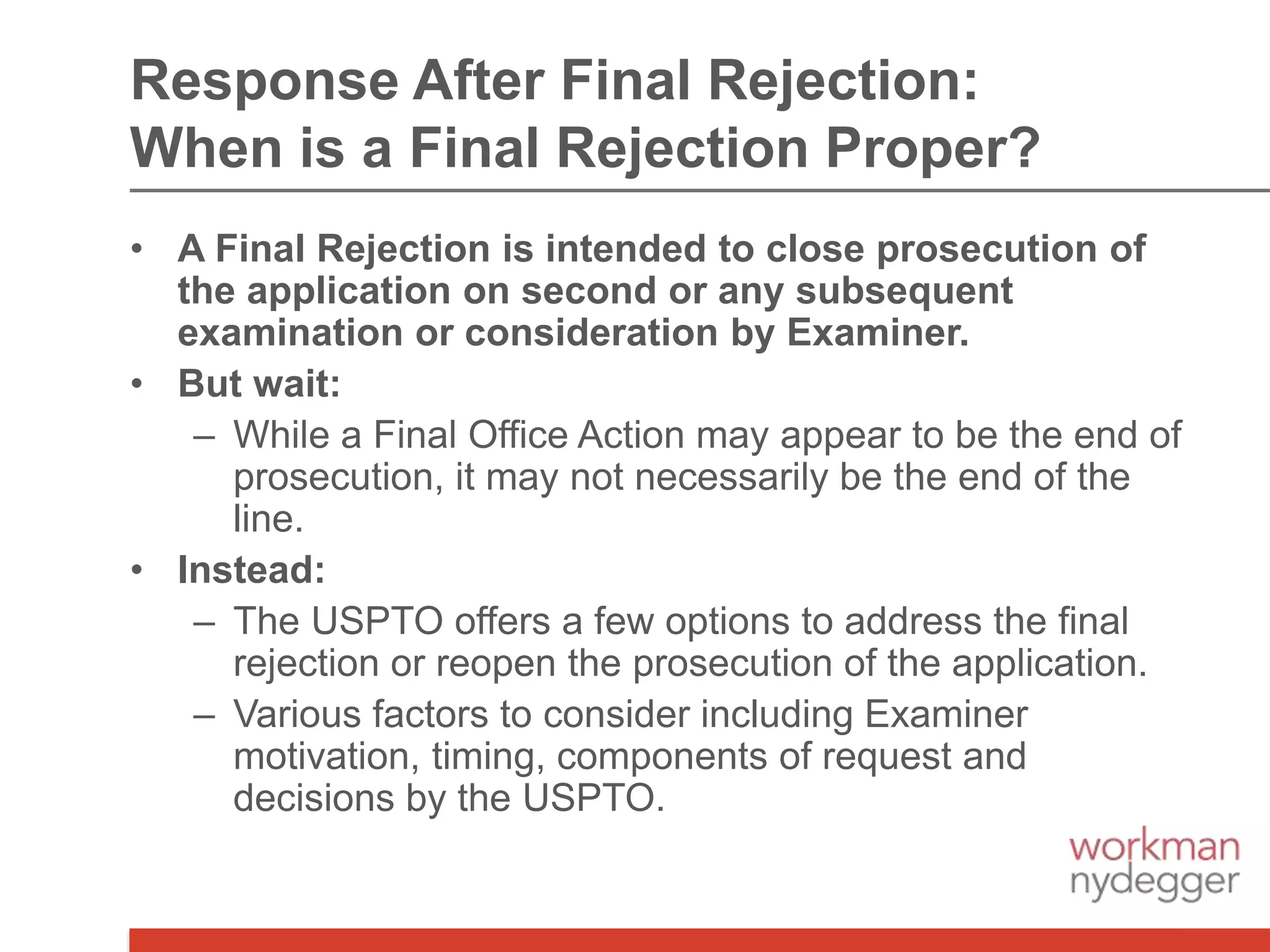
• A Final Rejection is intended to close prosecution of
the application on second or any subsequent
examination or consideration by Examiner.
• But wait:
– While a Final Office Action may appear to be the end of
prosecution, it may not necessarily be the end of the
line.
• Instead:
– The USPTO offers a few options to address the final
rejection or reopen the prosecution of the application.
– Various factors to consider including Examiner
motivation, timing, components of request and
decisions by the USPTO.
Response After Final Rejection:
When is a Final Rejection Proper?
Options in Responding After a Final
Office Action
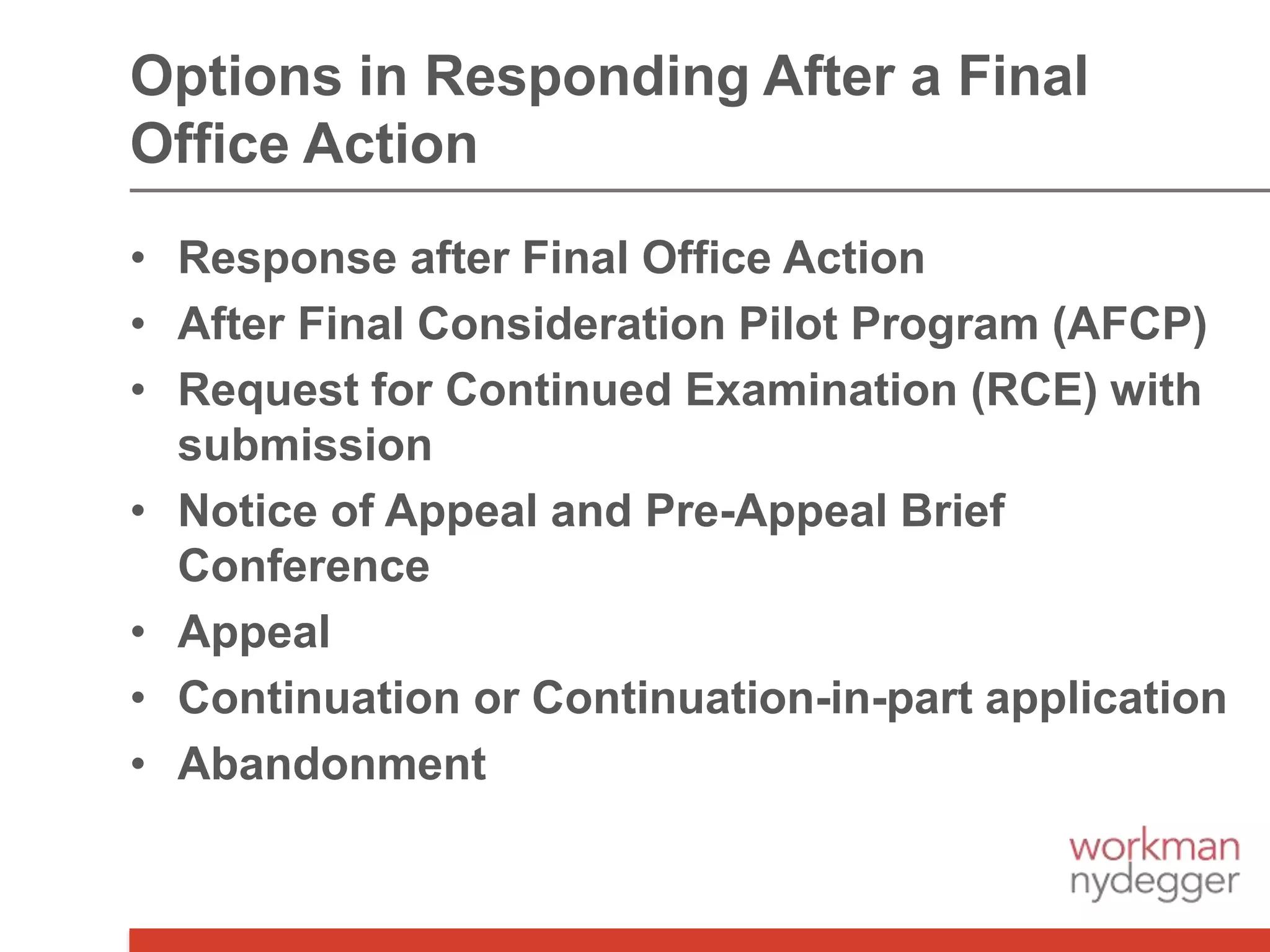
• Response after Final Office Action
• After Final Consideration Pilot Program (AFCP)
• Request for Continued Examination (RCE) with
submission
• Notice of Appeal and Pre-Appeal Brief
Conference
• Appeal
• Continuation or Continuation-in-part application
• Abandonment
Response After Final Rejection:
How much time is an Examiner allocated?
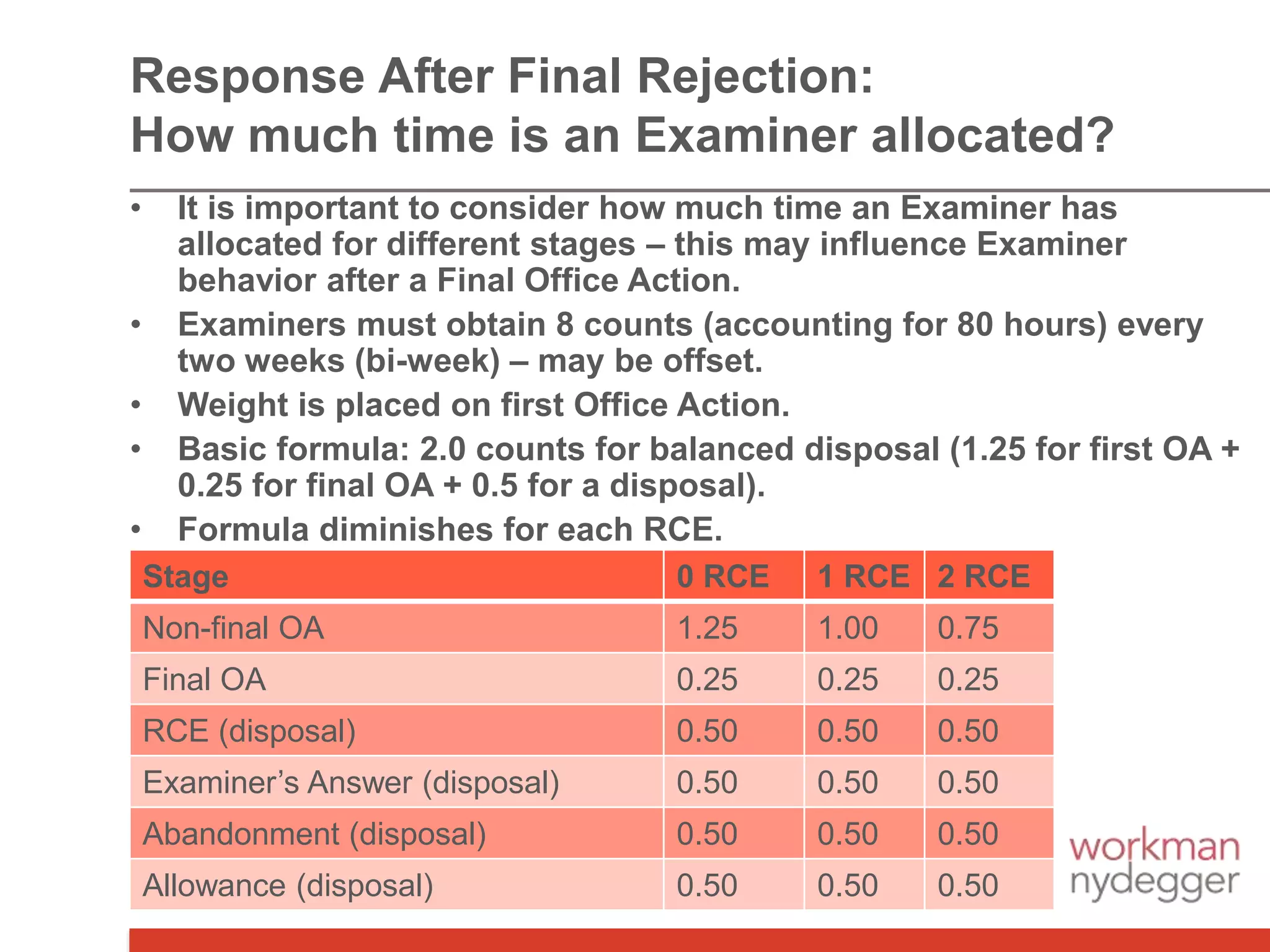
• It is important to consider how much time an Examiner has
allocated for different stages – this may influence Examiner
behavior after a Final Office Action.
• Examiners must obtain 8 counts (accounting for 80 hours) every
two weeks (bi-week) – may be offset.
• Weight is placed on first Office Action.
• Basic formula: 2.0 counts for balanced disposal (1.25 for first OA +
0.25 for final OA + 0.5 for a disposal).
• Formula diminishes for each RCE.
Stage 0 RCE 1 RCE 2 RCE
Non-final OA 1.25 1.00 0.75
Final OA 0.25 0.25 0.25
RCE (disposal) 0.50 0.50 0.50
Examiner’s Answer (disposal) 0.50 0.50 0.50
Abandonment (disposal) 0.50 0.50 0.50
Allowance (disposal) 0.50 0.50 0.50
Response After Final Rejection:
How much time is an Examiner allocated?
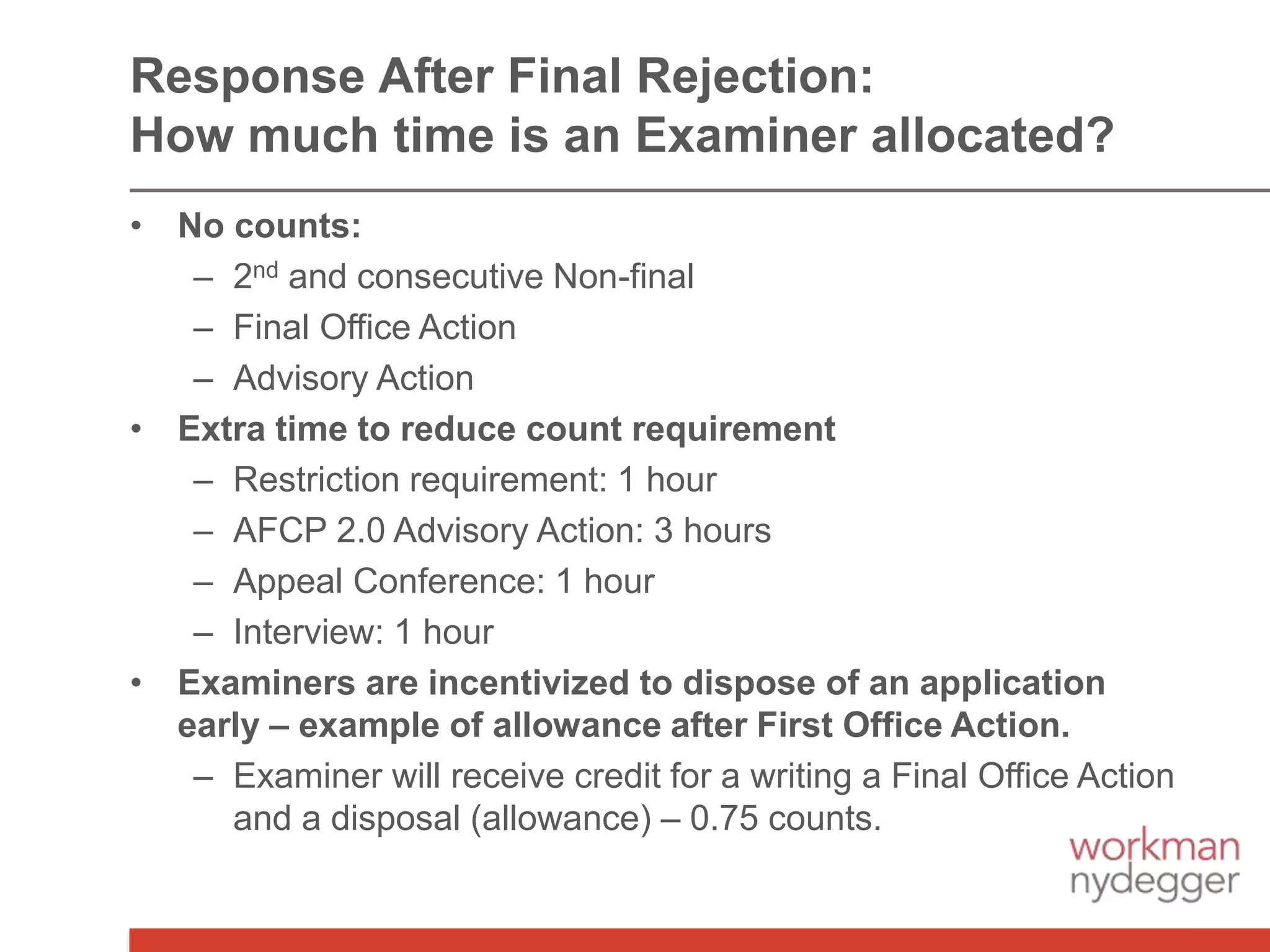
• No counts:
– 2nd and consecutive Non-final
– Final Office Action
– Advisory Action
• Extra time to reduce count requirement
– Restriction requirement: 1 hour
– AFCP 2.0 Advisory Action: 3 hours
– Appeal Conference: 1 hour
– Interview: 1 hour
• Examiners are incentivized to dispose of an application
early – example of allowance after First Office Action.
– Examiner will receive credit for a writing a Final Office Action
and a disposal (allowance) – 0.75 counts.
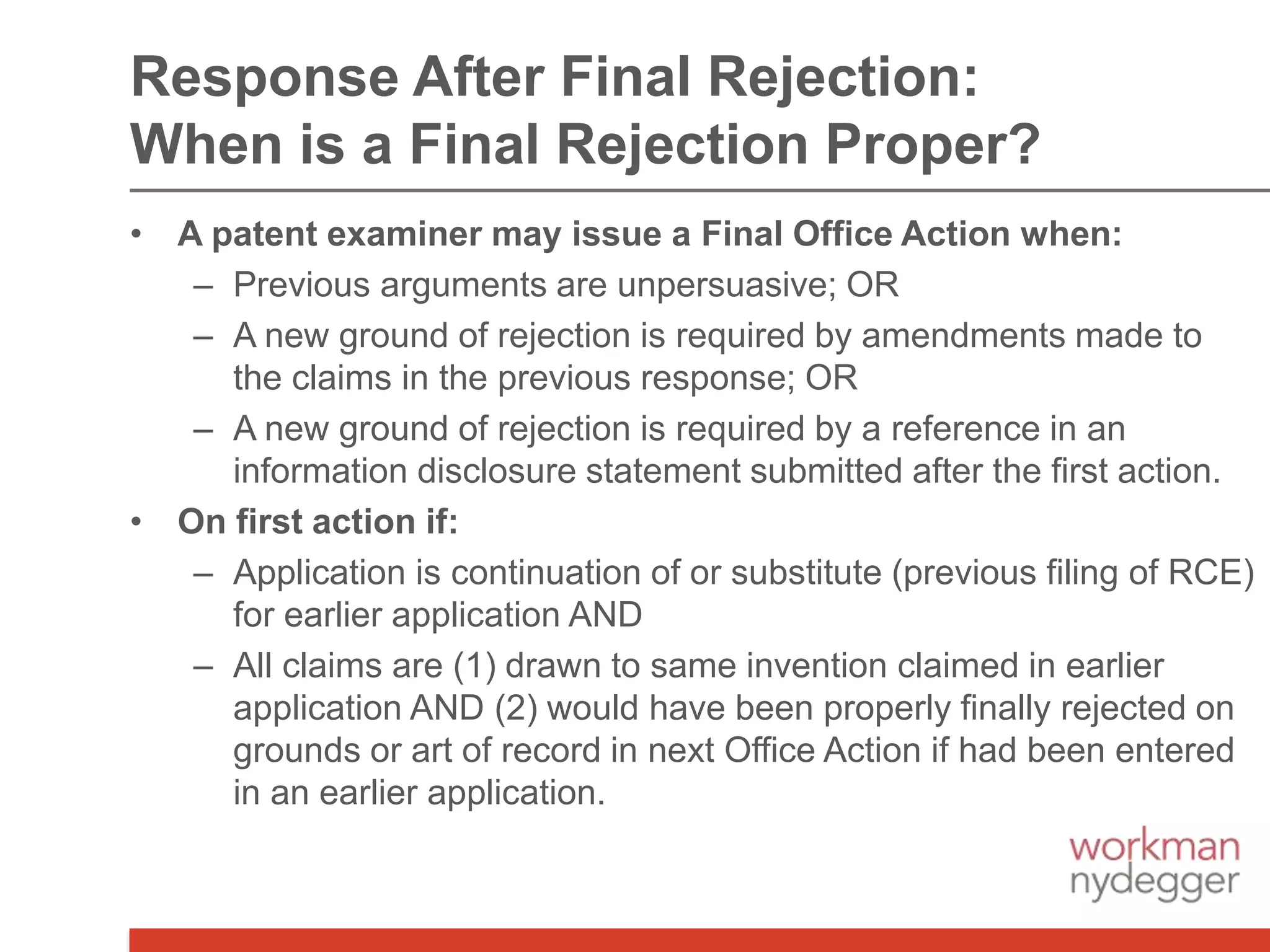
• A patent examiner may issue a Final Office Action when:
– Previous arguments are unpersuasive; OR
– A new ground of rejection is required by amendments made to
the claims in the previous response; OR
– A new ground of rejection is required by a reference in an
information disclosure statement submitted after the first action.
• On first action if:
– Application is continuation of or substitute (previous filing of RCE)
for earlier application AND
– All claims are (1) drawn to same invention claimed in earlier
application AND (2) would have been properly finally rejected on
grounds or art of record in next Office Action if had been entered
in an earlier application.
Response After Final Rejection:
When is a Final Rejection Proper?
Response After Final Rejection:
Applicant Options and USPTO Results
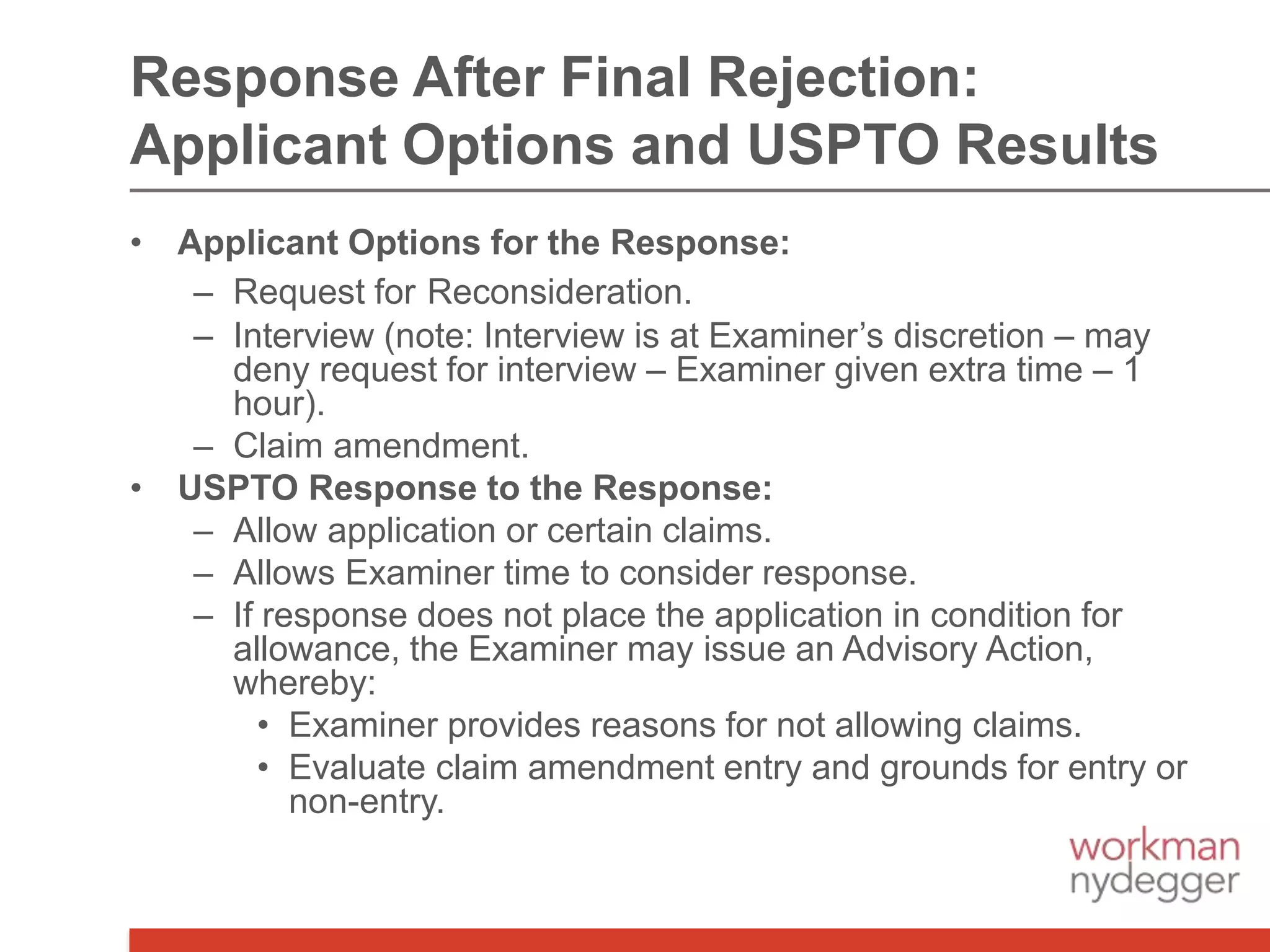
• Applicant Options for the Response:
– Request for Reconsideration.
– Interview (note: Interview is at Examiner’s discretion – may
deny request for interview – Examiner given extra time – 1
hour).
– Claim amendment.
• USPTO Response to the Response:
– Allow application or certain claims.
– Allows Examiner time to consider response.
– If response does not place the application in condition for
allowance, the Examiner may issue an Advisory Action,
whereby:
• Examiner provides reasons for not allowing claims.
• Evaluate claim amendment entry and grounds for entry or
non-entry.
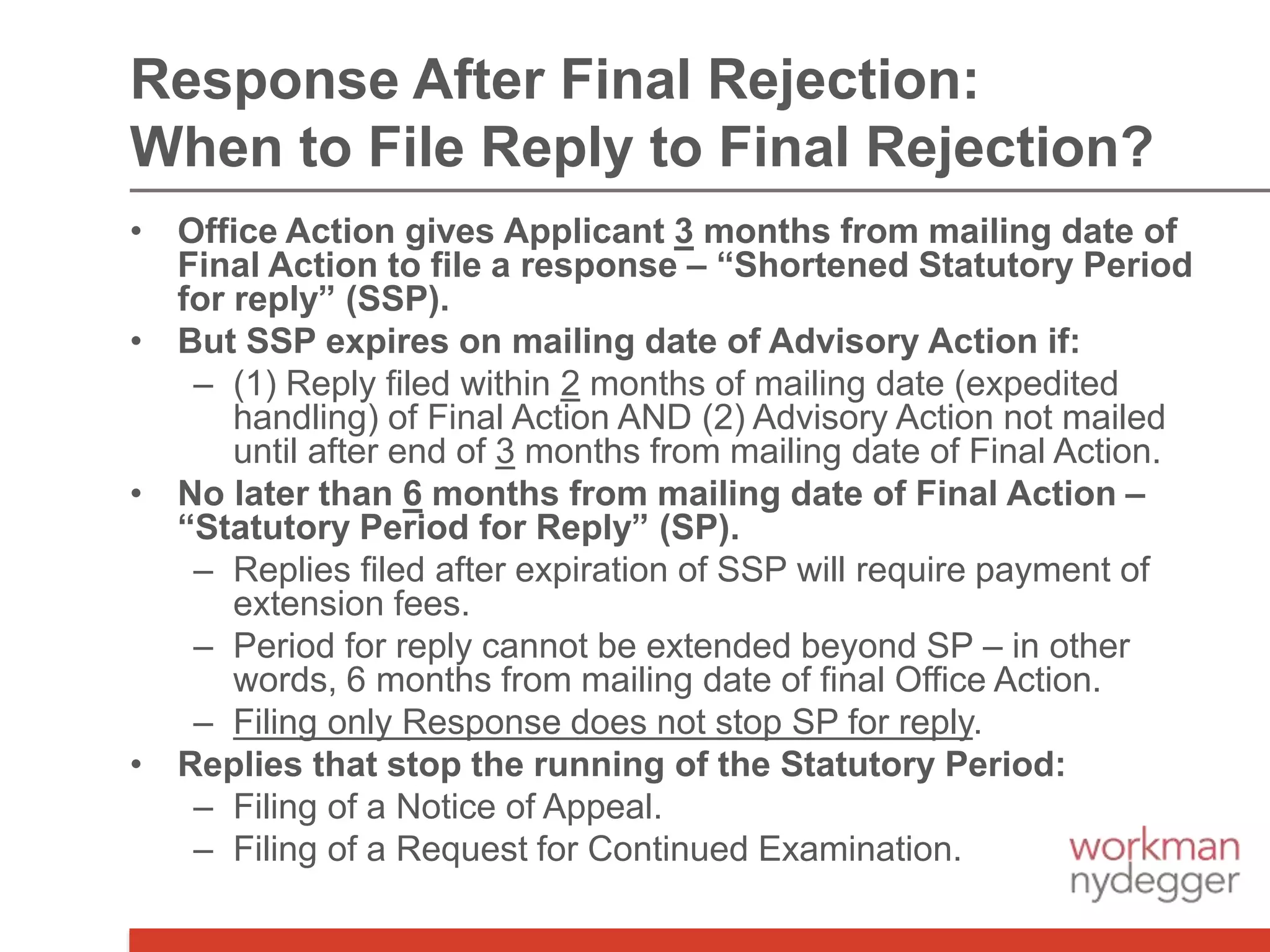
• Office Action gives Applicant 3 months from mailing date of
Final Action to file a response – “Shortened Statutory Period
for reply” (SSP).
• But SSP expires on mailing date of Advisory Action if:
– (1) Reply filed within 2 months of mailing date (expedited
handling) of Final Action AND (2) Advisory Action not mailed
until after end of 3 months from mailing date of Final Action.
• No later than 6 months from mailing date of Final Action –
“Statutory Period for Reply” (SP).
– Replies filed after expiration of SSP will require payment of
extension fees.
– Period for reply cannot be extended beyond SP – in other
words, 6 months from mailing date of final Office Action.
– Filing only Response does not stop SP for reply.
• Replies that stop the running of the Statutory Period:
– Filing of a Notice of Appeal.
– Filing of a Request for Continued Examination.
Response After Final Rejection:
When to File Reply to Final Rejection?
Response After Final Rejection:
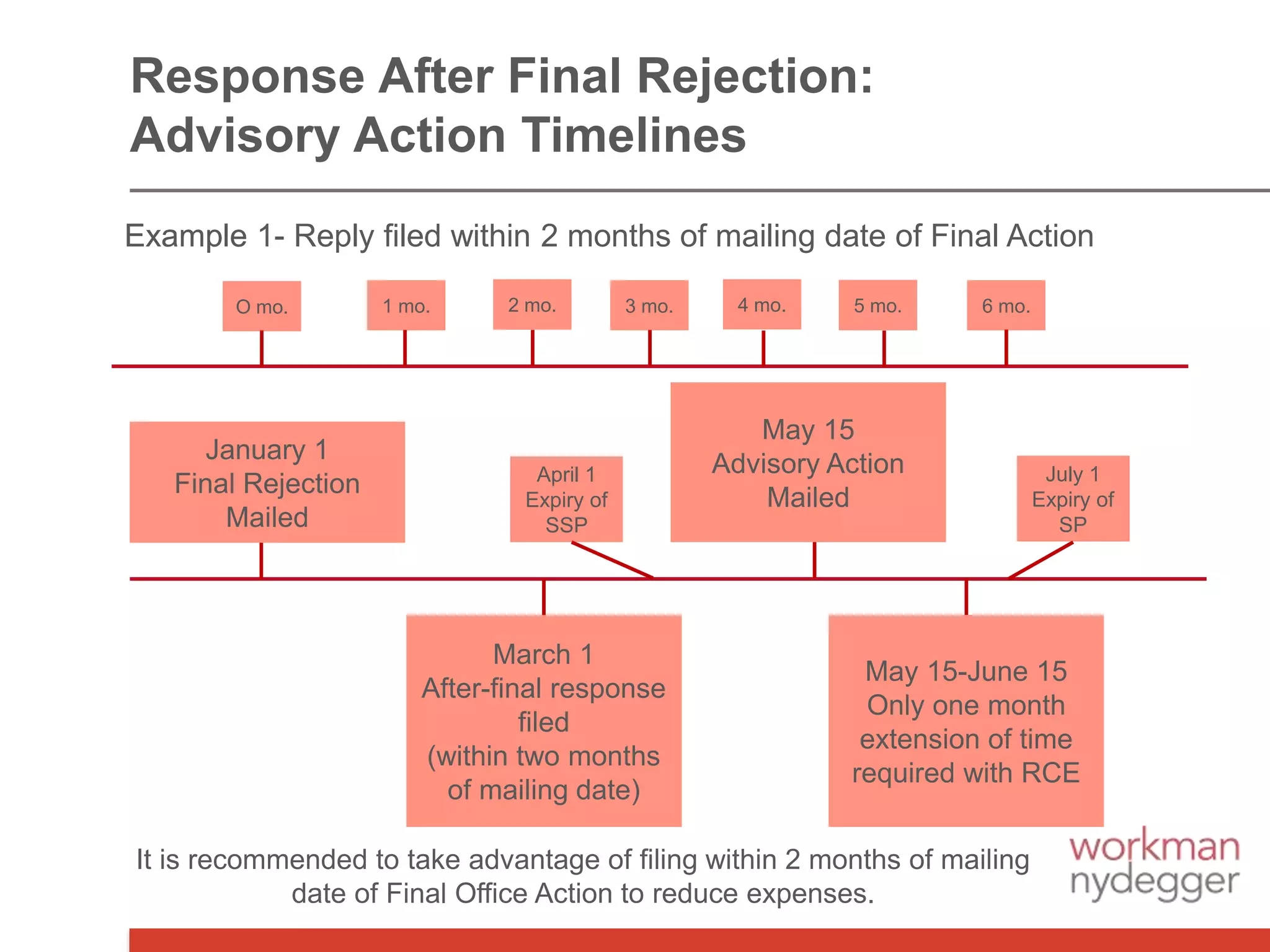
Advisory Action Timelines
Example 1
January 1
Final Rejection
Mailed
March 1
After-final response
filed
(within two months
of mailing date)
May 15
Advisory Action
Mailed
May 15-June 15
Only one month
extension of time
required with RCE
O mo. 1 mo. 2 mo. 3 mo. 4 mo. 5 mo. 6 mo.
July 1
Expiry of
SP
April 1
Expiry of
SSP
Example - Reply filed within 2 months of mailing date of Final Action
It is recommended to take advantage of filing within 2 months of mailing
date of Final Office Action to reduce expenses.
Response After Final Rejection:
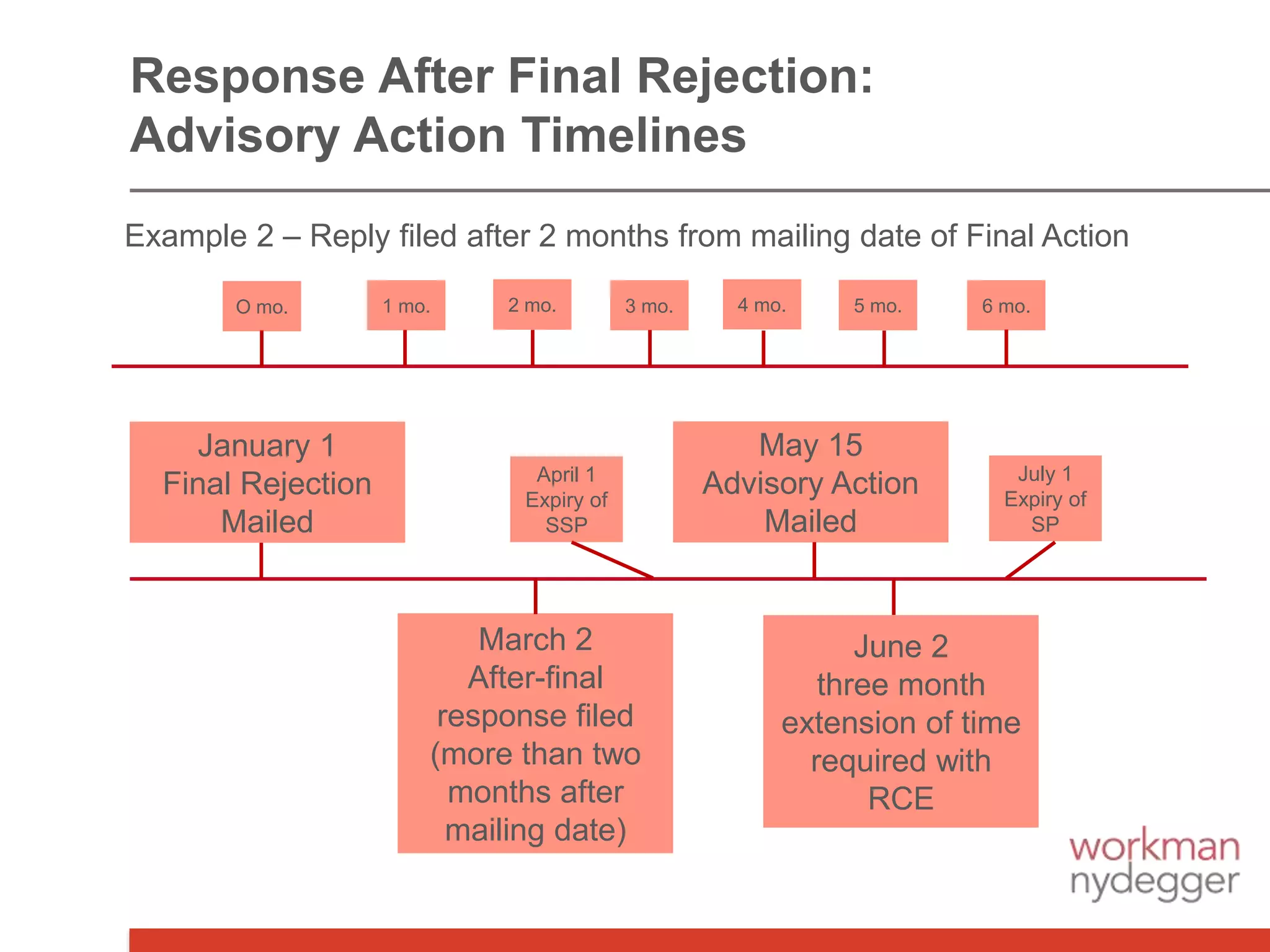
Advisory Action Timelines
Example 2 – Reply filed after 2 months from mailing date of Final Action
January 1
Final Rejection
Mailed
March 2
After-final
response filed
(more than two
months after
mailing date)
May 15
Advisory Action
Mailed
June 2
three month
extension of time
required with
RCE
O mo. 1 mo. 2 mo. 3 mo. 4 mo. 5 mo. 6 mo.
July 1
Expiry of
SP
April 1
Expiry of
SSP
Response After Final Rejection:
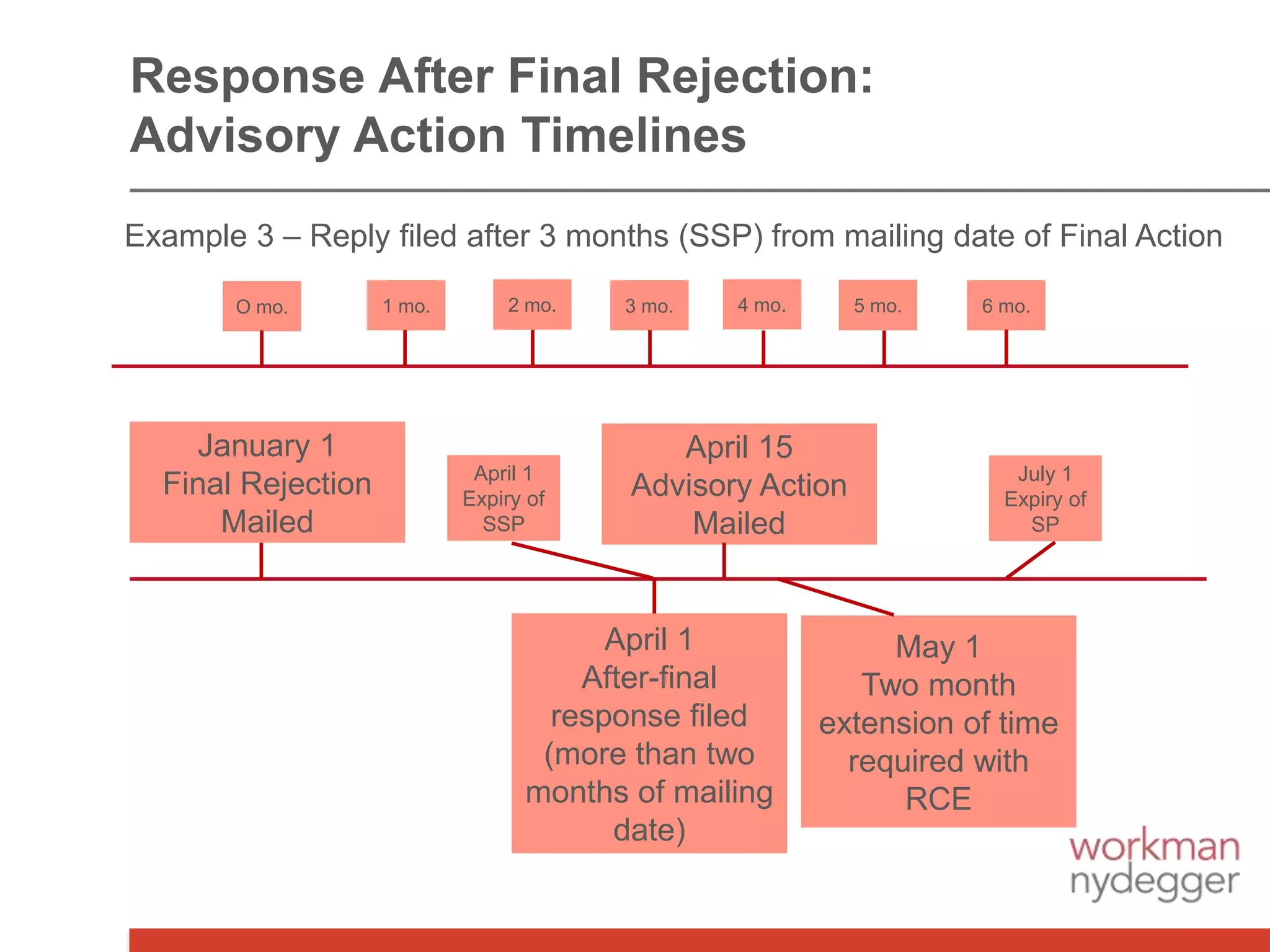
Advisory Action Timelines
Example 3 – Reply filed after 3 months (SSP) from mailing date of Final Action
January 1
Final Rejection
Mailed
April 1
After-final
response filed
(more than two
months of mailing
date)
April 15
Advisory Action
Mailed
May 1
Two month
extension of time
required with
RCE
O mo. 1 mo. 2 mo. 3 mo. 4 mo. 5 mo. 6 mo.
July 1
Expiry of
SP
April 1
Expiry of
SSP
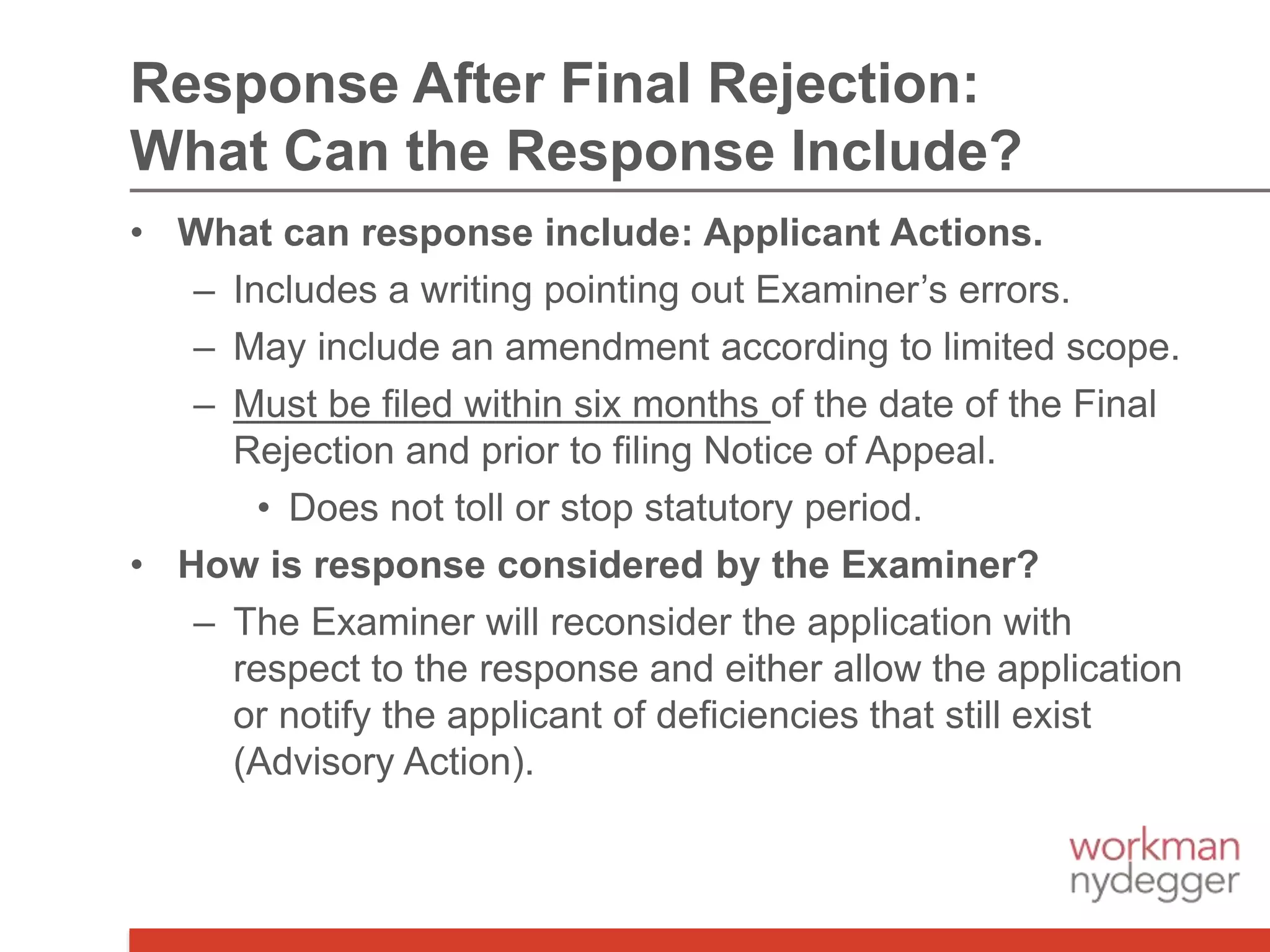
• What can response include: Applicant Actions.
– Includes a writing pointing out Examiner’s errors.
– May include an amendment according to limited scope.
– Must be filed within six months of the date of the Final
Rejection and prior to filing Notice of Appeal.
• Does not toll or stop statutory period.
• How is response considered by the Examiner?
– The Examiner will reconsider the application with
respect to the response and either allow the application
or notify the applicant of deficiencies that still exist
(Advisory Action).
Response After Final Rejection:
What Can the Response Include?
Response After Final Rejection:
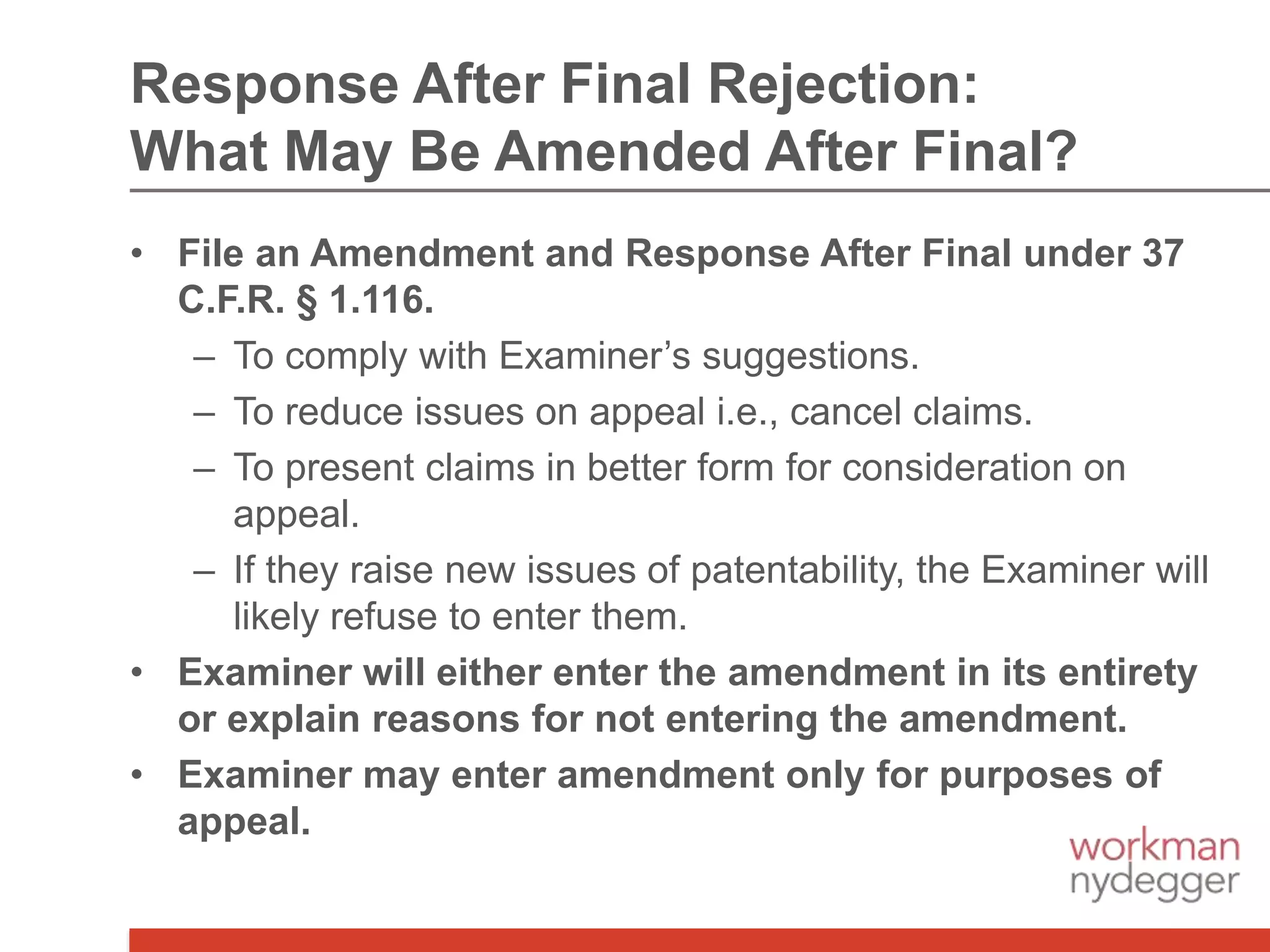
What May Be Amended After Final?
• File an Amendment and Response After Final under 37
C.F.R. § 1.116.
– To comply with Examiner’s suggestions.
– To reduce issues on appeal i.e., cancel claims.
– To present claims in better form for consideration on
appeal.
– If they raise new issues of patentability, the Examiner will
likely refuse to enter them.
• Examiner will either enter the amendment in its entirety
or explain reasons for not entering the amendment.
• Examiner may enter amendment only for purposes of
appeal.
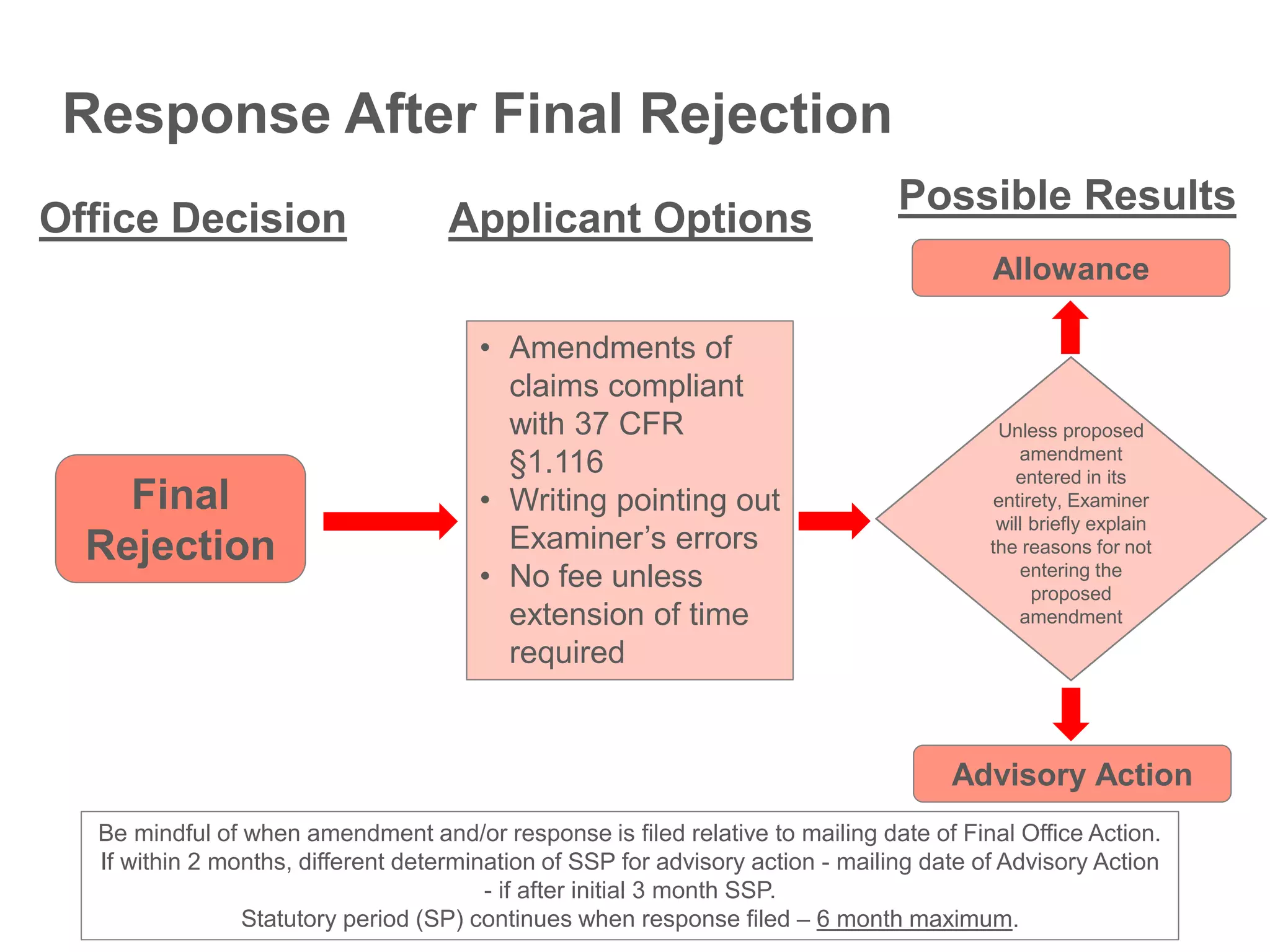
Final
Rejection
• Amendments of
claims compliant
with 37 CFR
§1.116
• Writing pointing out
Examiner’s errors
• No fee unless
extension of time
required
Office Decision Applicant Options
Possible Results
Advisory Action
Allowance
Be mindful of when amendment and/or response is filed relative to mailing date of Final Office Action.
If within 2 months, different determination of SSP for advisory action - mailing date of Advisory Action
- if after initial 3 month SSP.
Statutory period (SP) continues when response filed – 6 month maximum.
Unless proposed
amendment
entered in its
entirety, Examiner
will briefly explain
the reasons for not
entering the
proposed
amendment
Response After Final Rejection
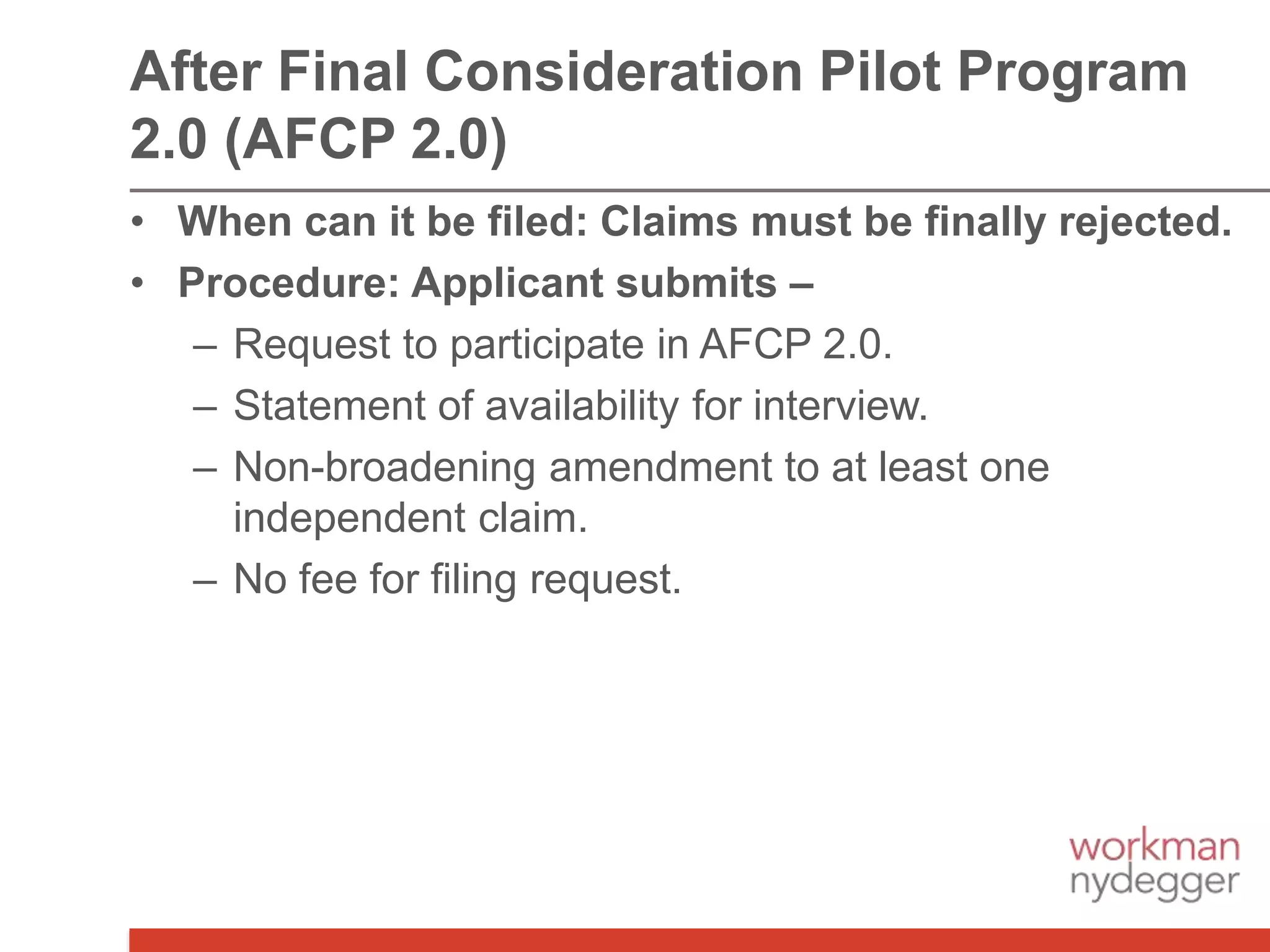
• When can it be filed: Claims must be finally rejected.
• Procedure: Applicant submits –
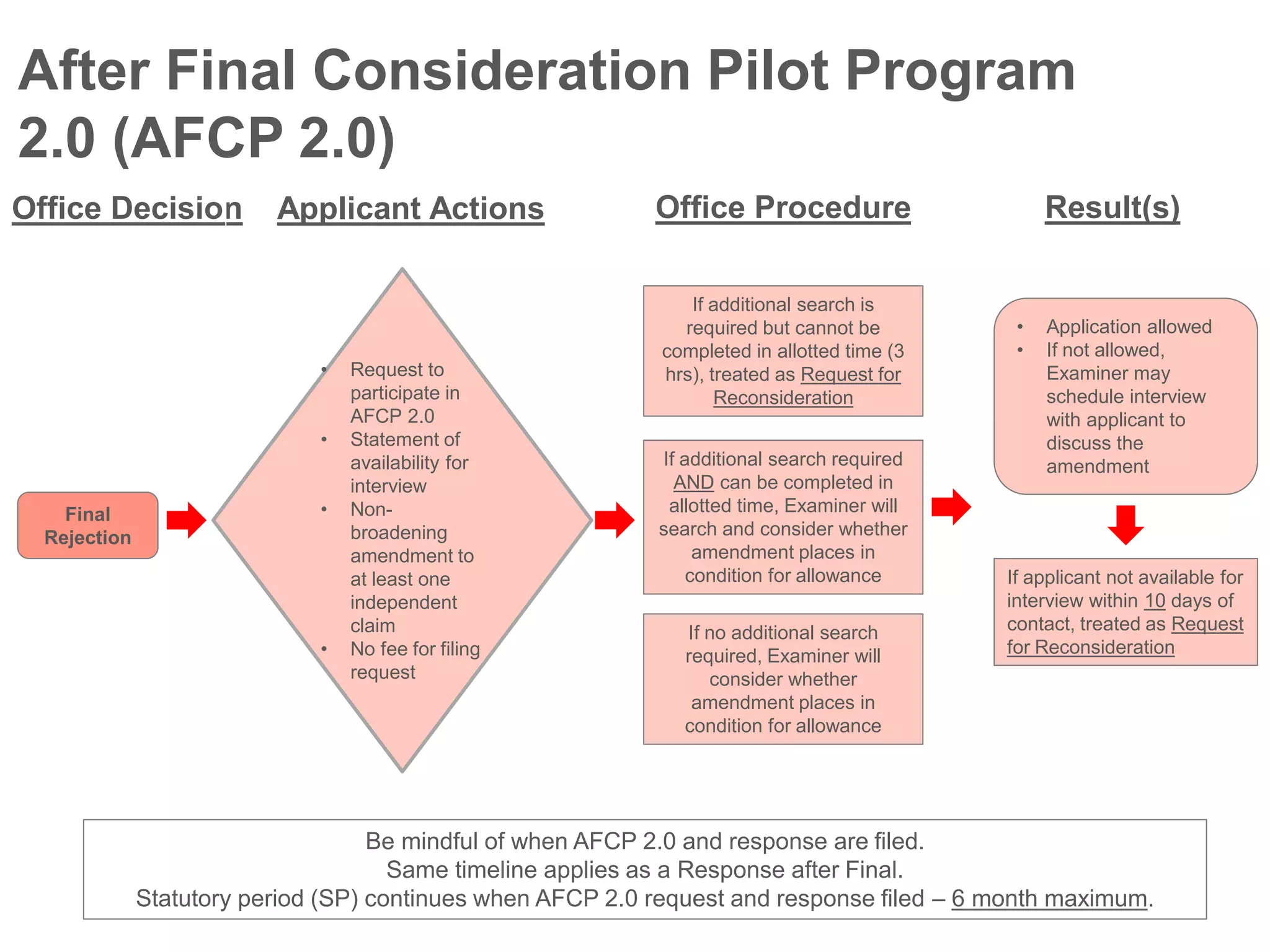
– Request to participate in AFCP 2.0.
– Statement of availability for interview.
– Non-broadening amendment to at least one
independent claim.
– No fee for filing request.
After Final Consideration Pilot Program
2.0 (AFCP 2.0)
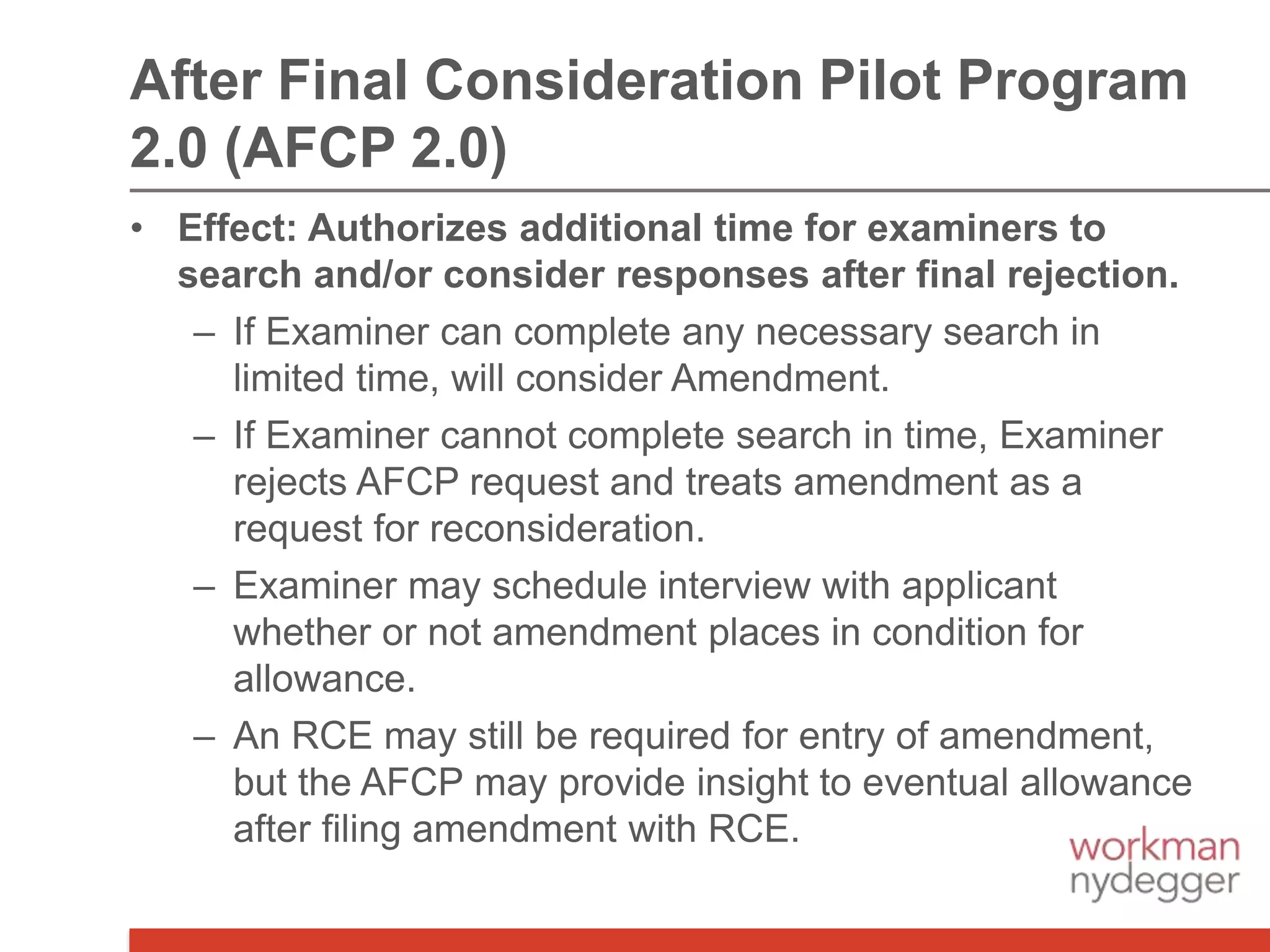
• Effect: Authorizes additional time for examiners to
search and/or consider responses after final rejection.
– If Examiner can complete any necessary search in
limited time, will consider Amendment.
– If Examiner cannot complete search in time, Examiner
rejects AFCP request and treats amendment as a
request for reconsideration.
– Examiner may schedule interview with applicant
whether or not amendment places in condition for
allowance.
– An RCE may still be required for entry of amendment,
but the AFCP may provide insight to eventual allowance
after filing amendment with RCE.
After Final Consideration Pilot Program
2.0 (AFCP 2.0)
Final
Rejection
• Application allowed
• If not allowed,
Examiner may
schedule interview
with applicant to
discuss the
amendment
If additional search is
required but cannot be
completed in allotted time (3
hrs), treated as Request for
Reconsideration
If additional search required
AND can be completed in
allotted time, Examiner will
search and consider whether
amendment places in
condition for allowance If applicant not available for
interview within 10 days of
contact, treated as Request
for Reconsideration
Office Decision Applicant Actions Result(s)Office Procedure
If no additional search
required, Examiner will
consider whether
amendment places in
condition for allowance
• Request to
participate in
AFCP 2.0
• Statement of
availability for
interview
• Non-
broadening
amendment to
at least one
independent
claim
• No fee for filing
request
After Final Consideration Pilot Program
2.0 (AFCP 2.0)
Be mindful of when AFCP 2.0 and response are filed.
Same timeline applies as a Response after Final.
Statutory period (SP) continues when AFCP 2.0 request and response filed – 6 month maximum.
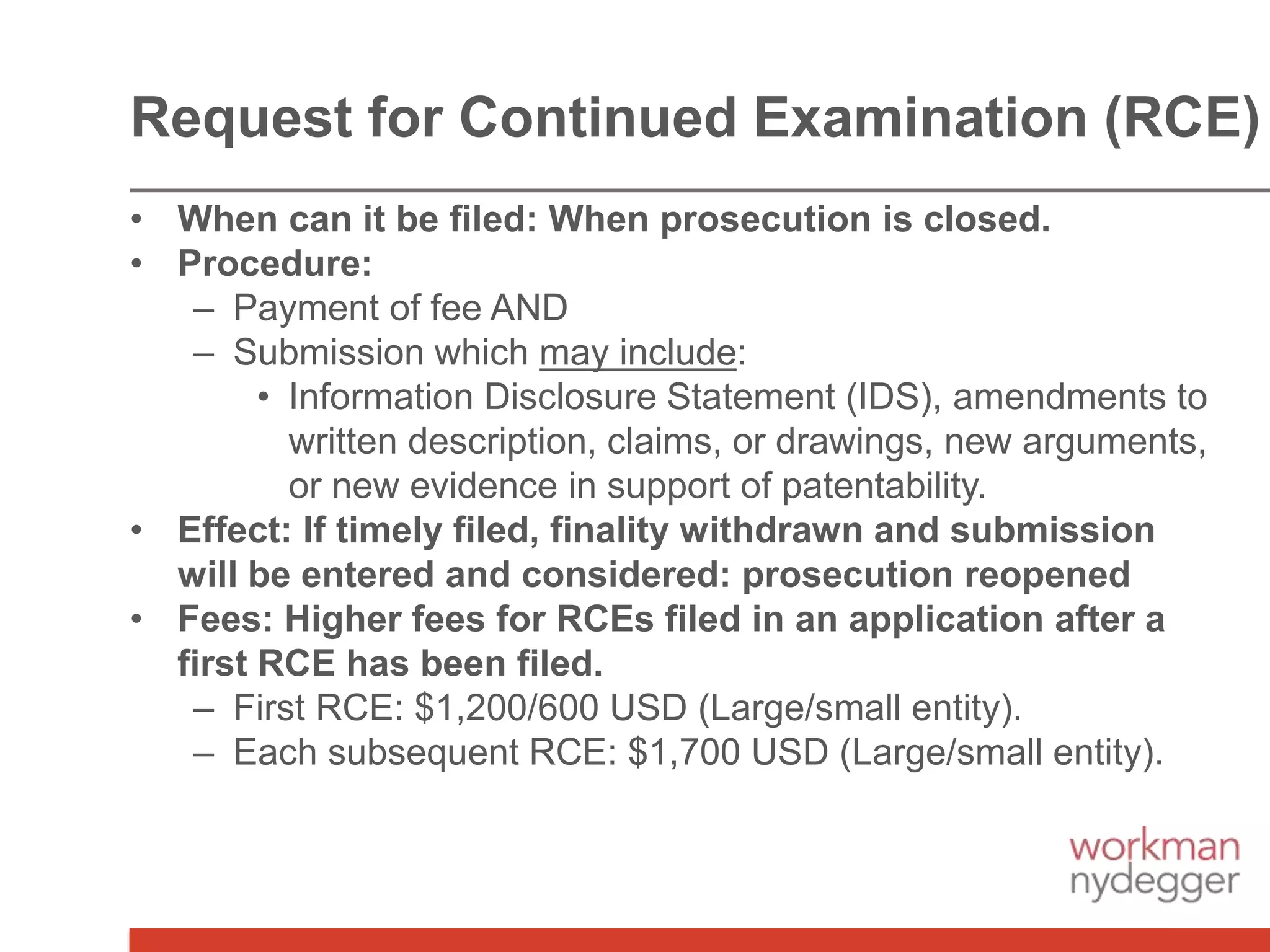
• When can it be filed: When prosecution is closed.
• Procedure:
– Payment of fee AND
– Submission which may include:
• Information Disclosure Statement (IDS), amendments to
written description, claims, or drawings, new arguments,
or new evidence in support of patentability.
• Effect: If timely filed, finality withdrawn and submission
will be entered and considered: prosecution reopened
• Fees: Higher fees for RCEs filed in an application after a
first RCE has been filed.
– First RCE: $1,200/600 USD (Large/small entity).
– Each subsequent RCE: $1,700 USD (Large/small entity).
Request for Continued Examination (RCE)
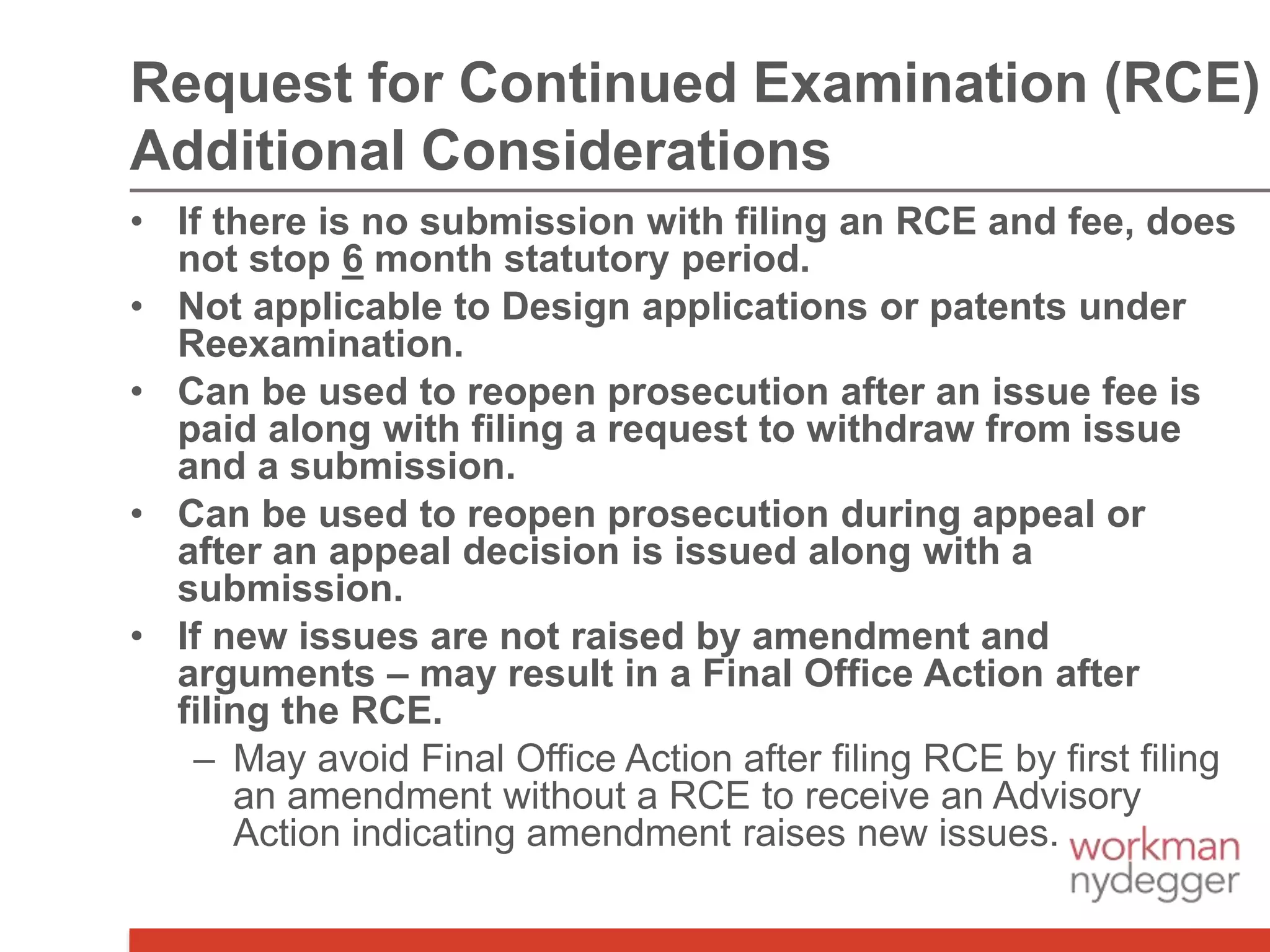
• If there is no submission with filing an RCE and fee, does
not stop 6 month statutory period.
• Not applicable to Design applications or patents under
Reexamination.
• Can be used to reopen prosecution after an issue fee is
paid along with filing a request to withdraw from issue
and a submission.
• Can be used to reopen prosecution during appeal or
after an appeal decision is issued along with a
submission.
• If new issues are not raised by amendment and
arguments – may result in a Final Office Action after
filing the RCE.
– May avoid Final Office Action after filing RCE by first filing
an amendment without a RCE to receive an Advisory
Action indicating amendment raises new issues.
Request for Continued Examination (RCE)
Additional Considerations
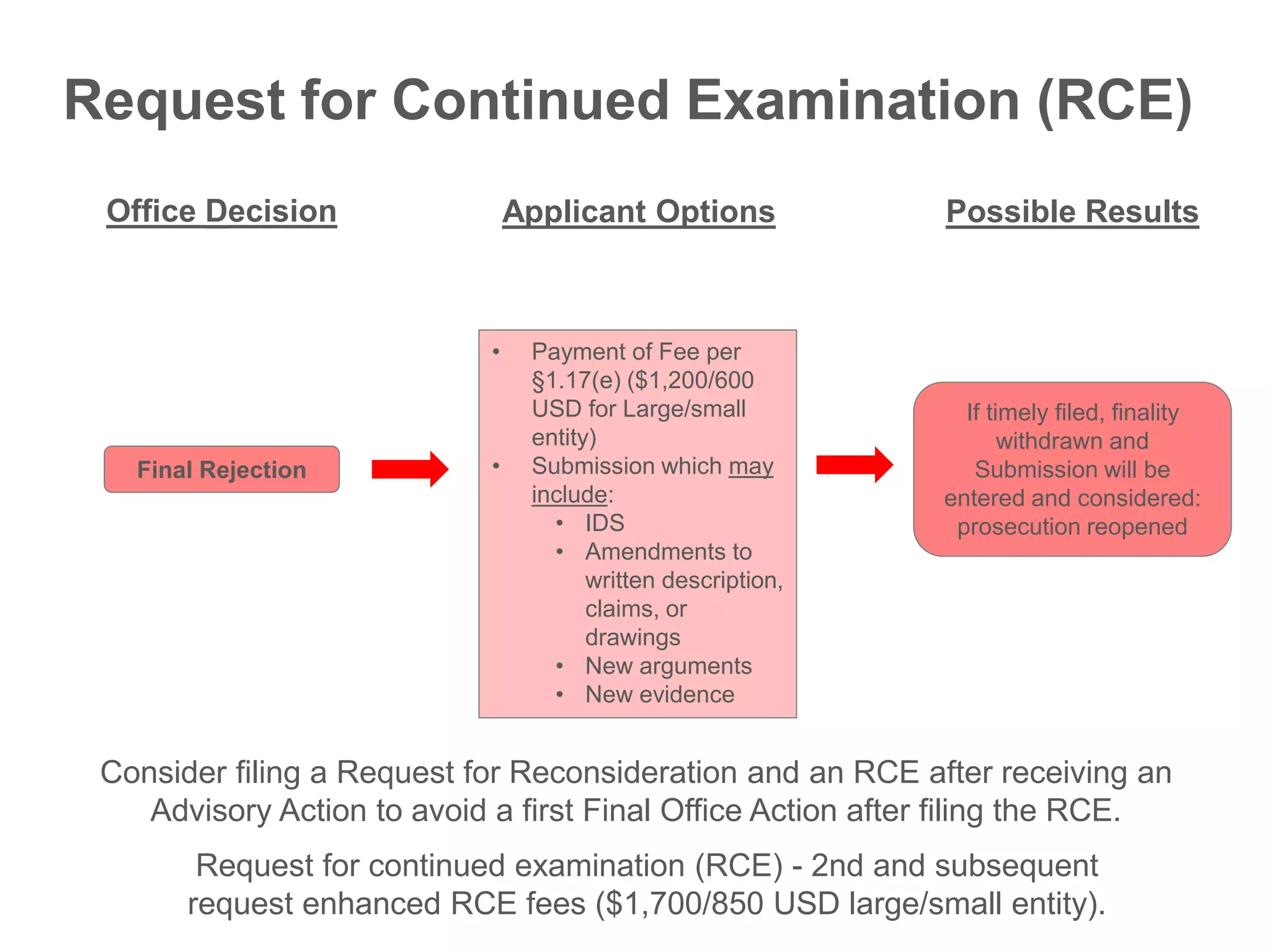
Final Rejection
• Payment of Fee per
§1.17(e) ($1,200/600
USD for Large/small
entity)
• Submission which may
include:
• IDS
• Amendments to
written description,
claims, or
drawings
• New arguments
• New evidence
If timely filed, finality
withdrawn and
Submission will be
entered and considered:
prosecution reopened
Office Decision Applicant Options Possible Results
Request for Continued Examination (RCE)
Request for continued examination (RCE) - 2nd and subsequent
request enhanced RCE fees ($1,700/850 USD large/small entity).
Consider filing a Request for Reconsideration and an RCE after receiving an
Advisory Action to avoid a first Final Office Action after filing the RCE.
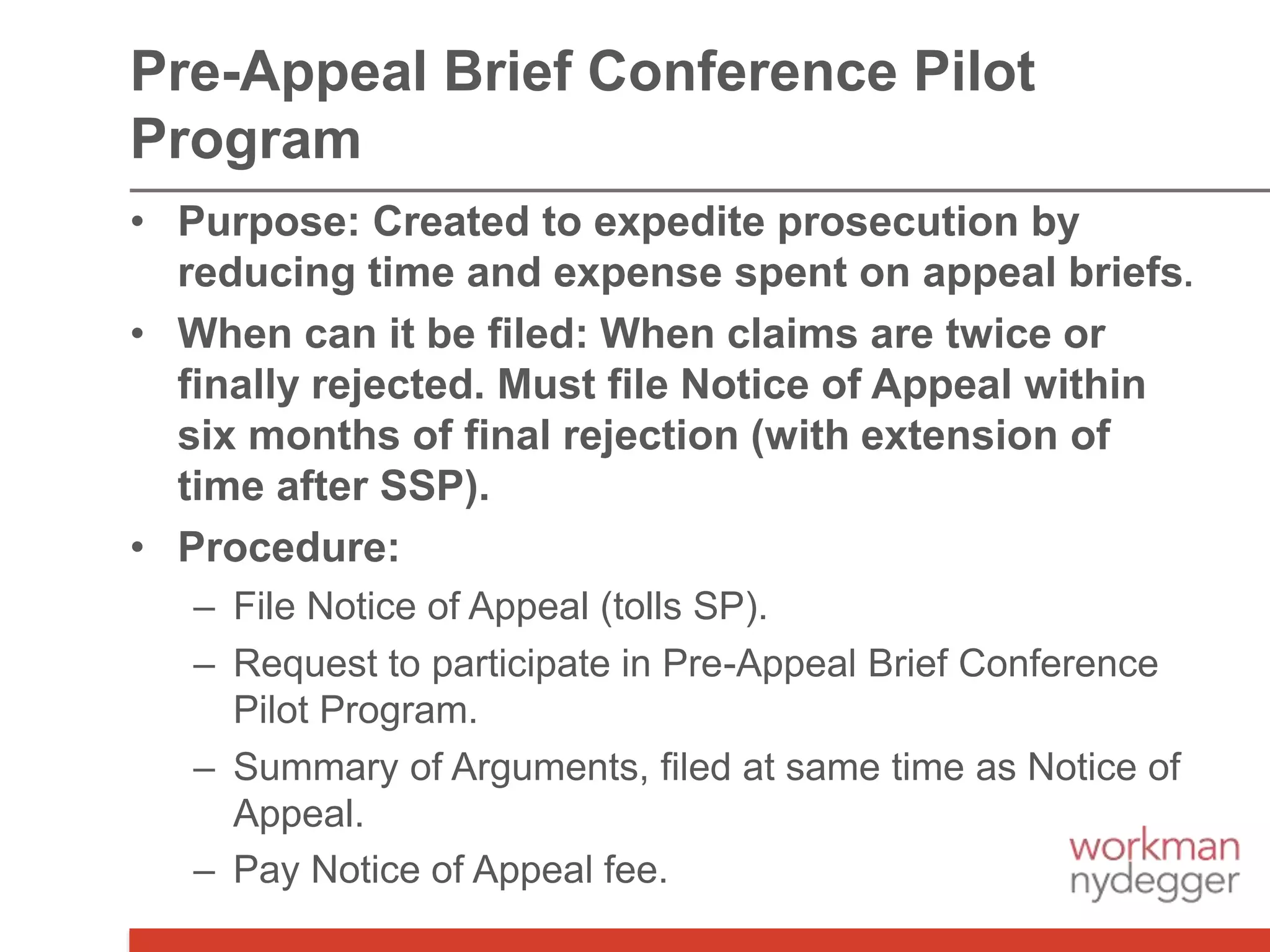
• Purpose: Created to expedite prosecution by
reducing time and expense spent on appeal briefs.
• When can it be filed: When claims are twice or
finally rejected. Must file Notice of Appeal within
six months of final rejection (with extension of
time after SSP).
• Procedure:
– File Notice of Appeal (tolls SP).
– Request to participate in Pre-Appeal Brief Conference
Pilot Program.
– Summary of Arguments, filed at same time as Notice of
Appeal.
– Pay Notice of Appeal fee.
Pre-Appeal Brief Conference Pilot
Program
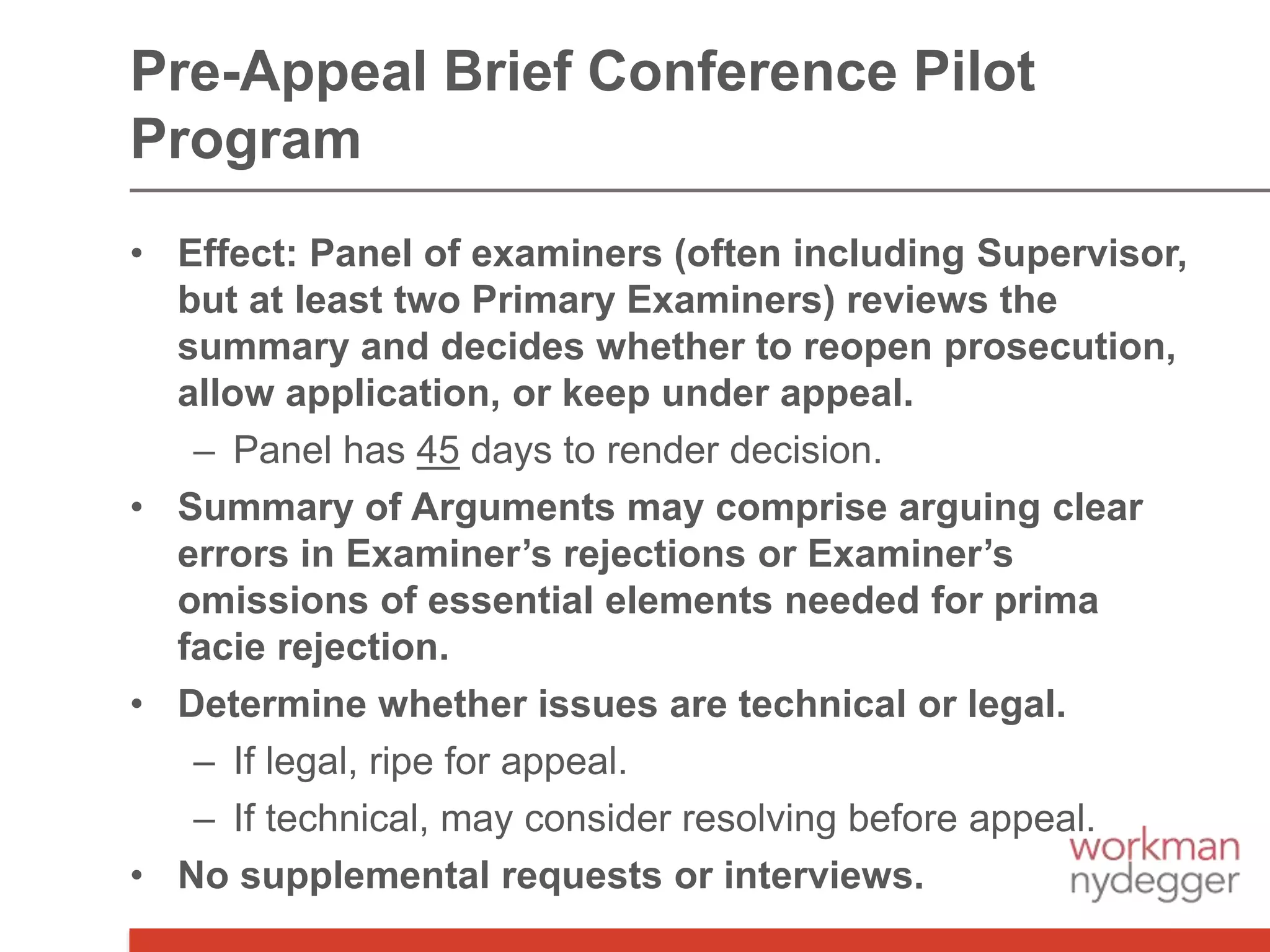
• Effect: Panel of examiners (often including Supervisor,
but at least two Primary Examiners) reviews the
summary and decides whether to reopen prosecution,
allow application, or keep under appeal.
– Panel has 45 days to render decision.
• Summary of Arguments may comprise arguing clear
errors in Examiner’s rejections or Examiner’s
omissions of essential elements needed for prima
facie rejection.
• Determine whether issues are technical or legal.
– If legal, ripe for appeal.
– If technical, may consider resolving before appeal.
• No supplemental requests or interviews.
Pre-Appeal Brief Conference Pilot
Program
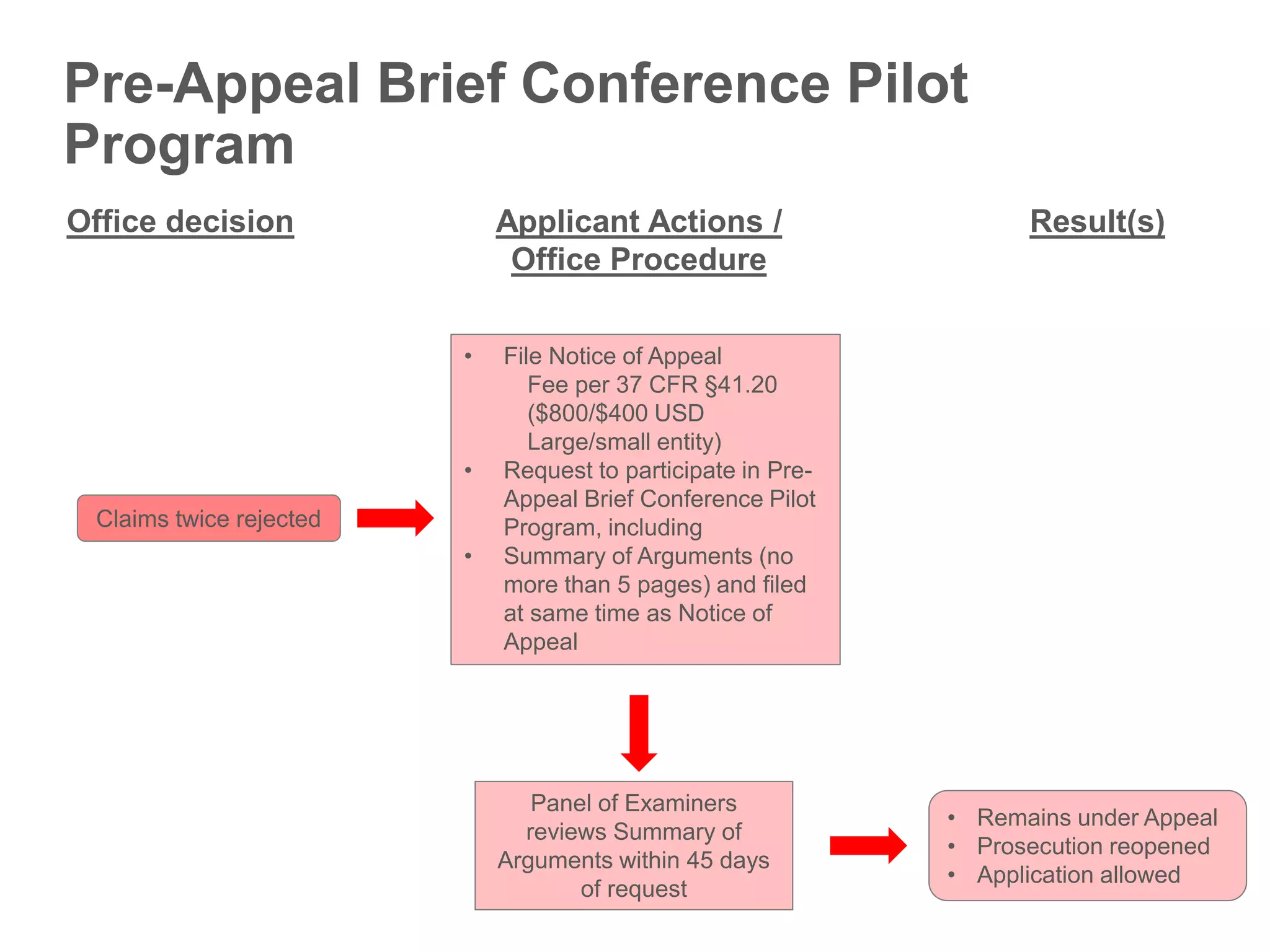
Claims twice rejected
• Remains under Appeal
• Prosecution reopened
• Application allowed
Panel of Examiners
reviews Summary of
Arguments within 45 days
of request
• File Notice of Appeal
Fee per 37 CFR §41.20
($800/$400 USD
Large/small entity)
• Request to participate in Pre-
Appeal Brief Conference Pilot
Program, including
• Summary of Arguments (no
more than 5 pages) and filed
at same time as Notice of
Appeal
Office decision Applicant Actions /
Office Procedure
Result(s)
Pre-Appeal Brief Conference Pilot
Program
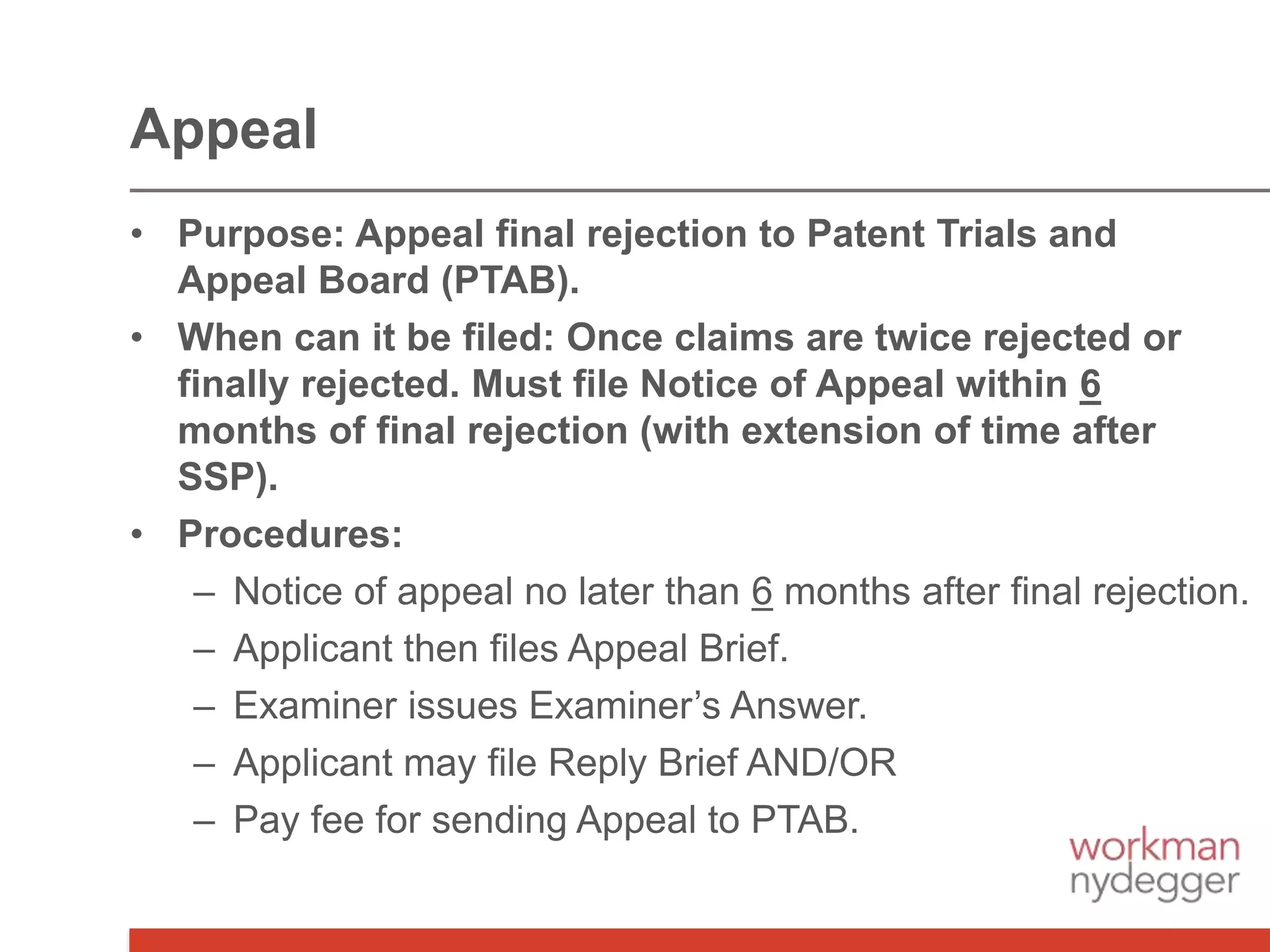
• Purpose: Appeal final rejection to Patent Trials and
Appeal Board (PTAB).
• When can it be filed: Once claims are twice rejected or
finally rejected. Must file Notice of Appeal within 6
months of final rejection (with extension of time after
SSP).
• Procedures:
– Notice of appeal no later than 6 months after final rejection.
– Applicant then files Appeal Brief.
– Examiner issues Examiner’s Answer.
– Applicant may file Reply Brief AND/OR
– Pay fee for sending Appeal to PTAB.
Appeal
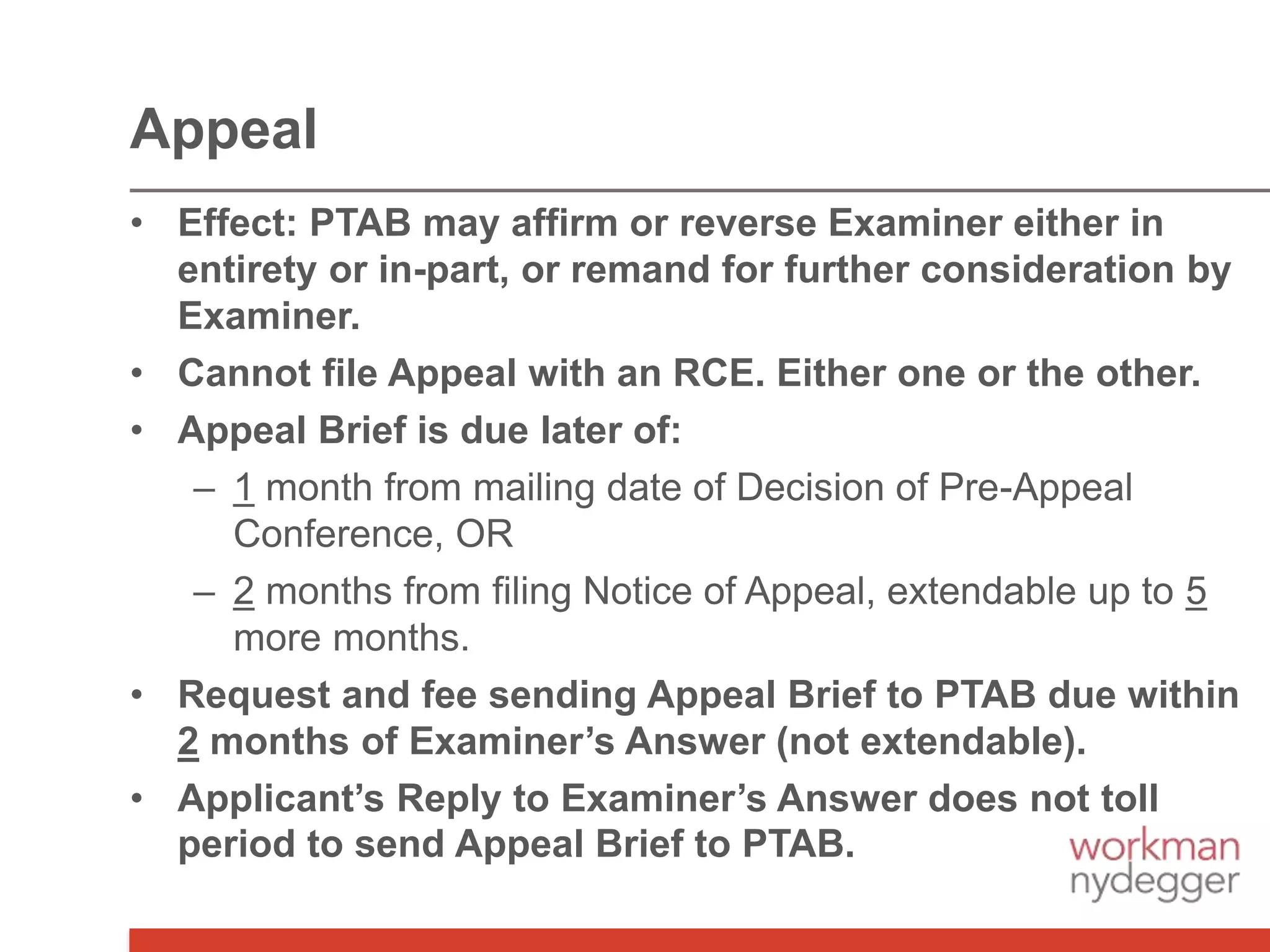
• Effect: PTAB may affirm or reverse Examiner either in
entirety or in-part, or remand for further consideration by
Examiner.
• Cannot file Appeal with an RCE. Either one or the other.
• Appeal Brief is due later of:
– 1 month from mailing date of Decision of Pre-Appeal
Conference, OR
– 2 months from filing Notice of Appeal, extendable up to 5
more months.
• Request and fee sending Appeal Brief to PTAB due within
2 months of Examiner’s Answer (not extendable).
• Applicant’s Reply to Examiner’s Answer does not toll
period to send Appeal Brief to PTAB.
Appeal
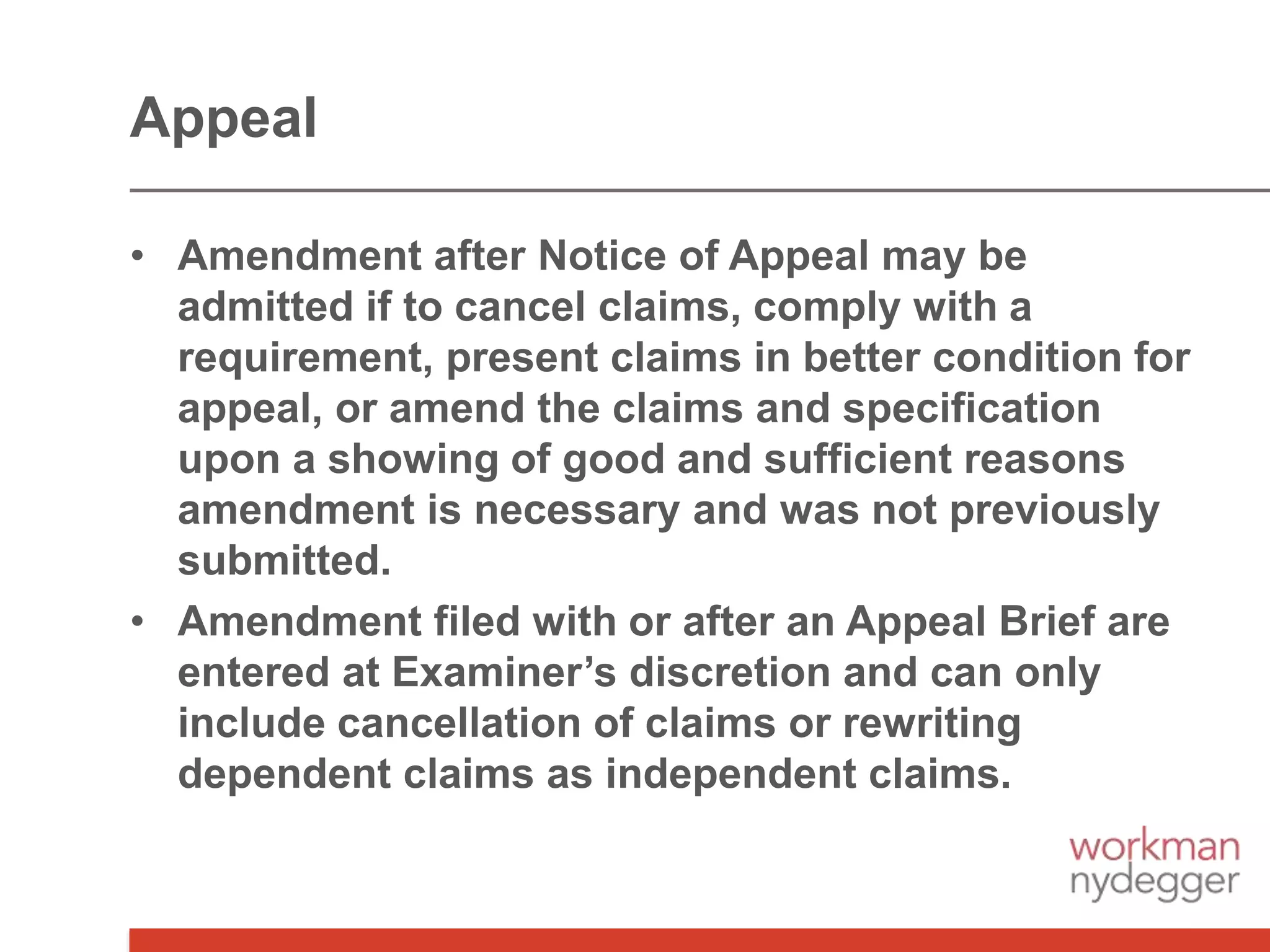
• Amendment after Notice of Appeal may be
admitted if to cancel claims, comply with a
requirement, present claims in better condition for
appeal, or amend the claims and specification
upon a showing of good and sufficient reasons
amendment is necessary and was not previously
submitted.
• Amendment filed with or after an Appeal Brief are
entered at Examiner’s discretion and can only
include cancellation of claims or rewriting
dependent claims as independent claims.
Appeal
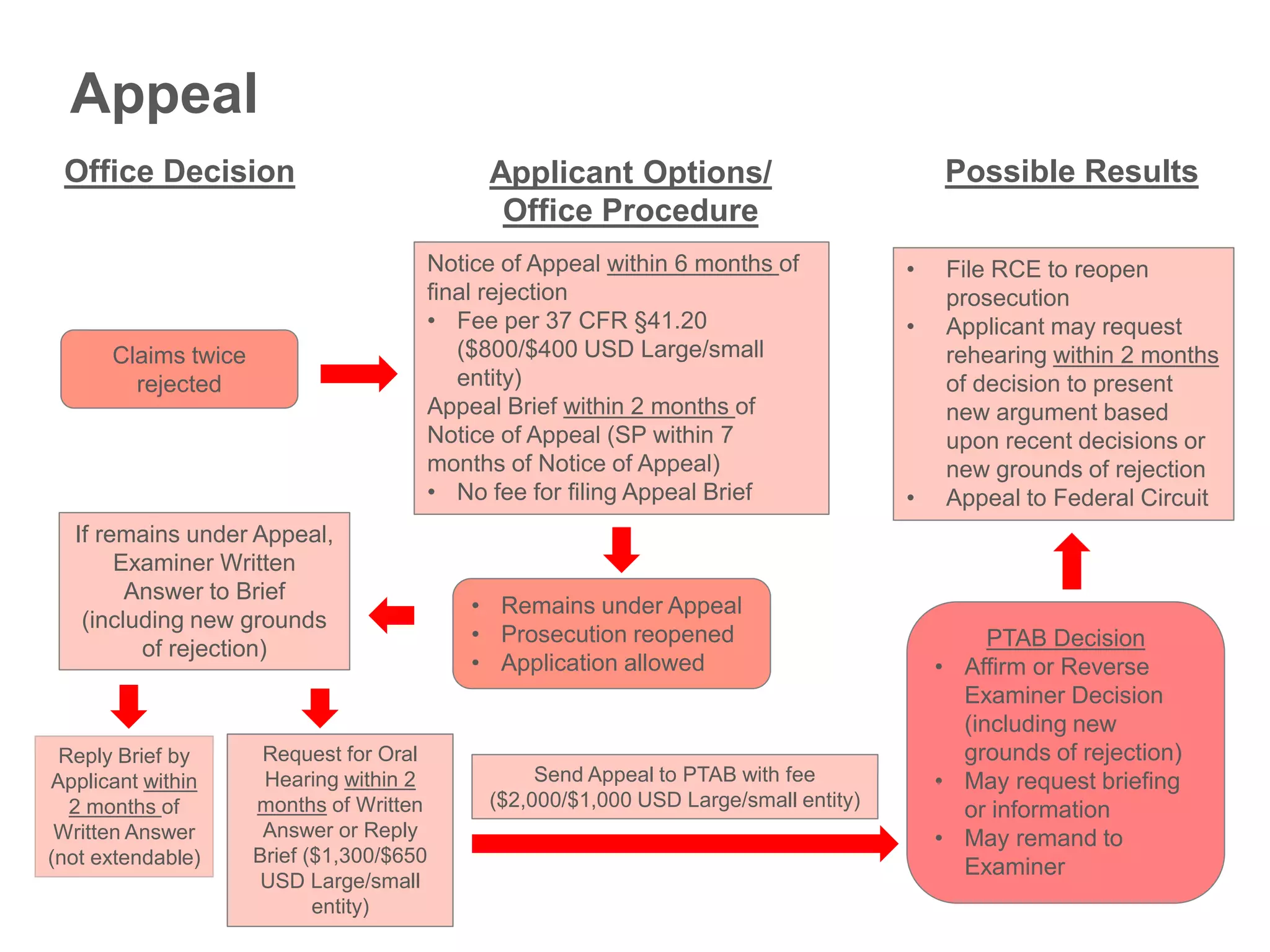
• File RCE to reopen
prosecution
• Applicant may request
rehearing within 2 months
of decision to present
new argument based
upon recent decisions or
new grounds of rejection
• Appeal to Federal Circuit
Claims twice
rejected
Notice of Appeal within 6 months of
final rejection
• Fee per 37 CFR §41.20
($800/$400 USD Large/small
entity)
Appeal Brief within 2 months of
Notice of Appeal (SP within 7
months of Notice of Appeal)
• No fee for filing Appeal Brief
PTAB Decision
• Affirm or Reverse
Examiner Decision
(including new
grounds of rejection)
• May request briefing
or information
• May remand to
Examiner
Reply Brief by
Applicant within
2 months of
Written Answer
(not extendable)
Request for Oral
Hearing within 2
months of Written
Answer or Reply
Brief ($1,300/$650
USD Large/small
entity)
If remains under Appeal,
Examiner Written
Answer to Brief
(including new grounds
of rejection)
Office Decision Applicant Options/
Office Procedure
Possible Results
Appeal
• Remains under Appeal
• Prosecution reopened
• Application allowed
Send Appeal to PTAB with fee
($2,000/$1,000 USD Large/small entity)
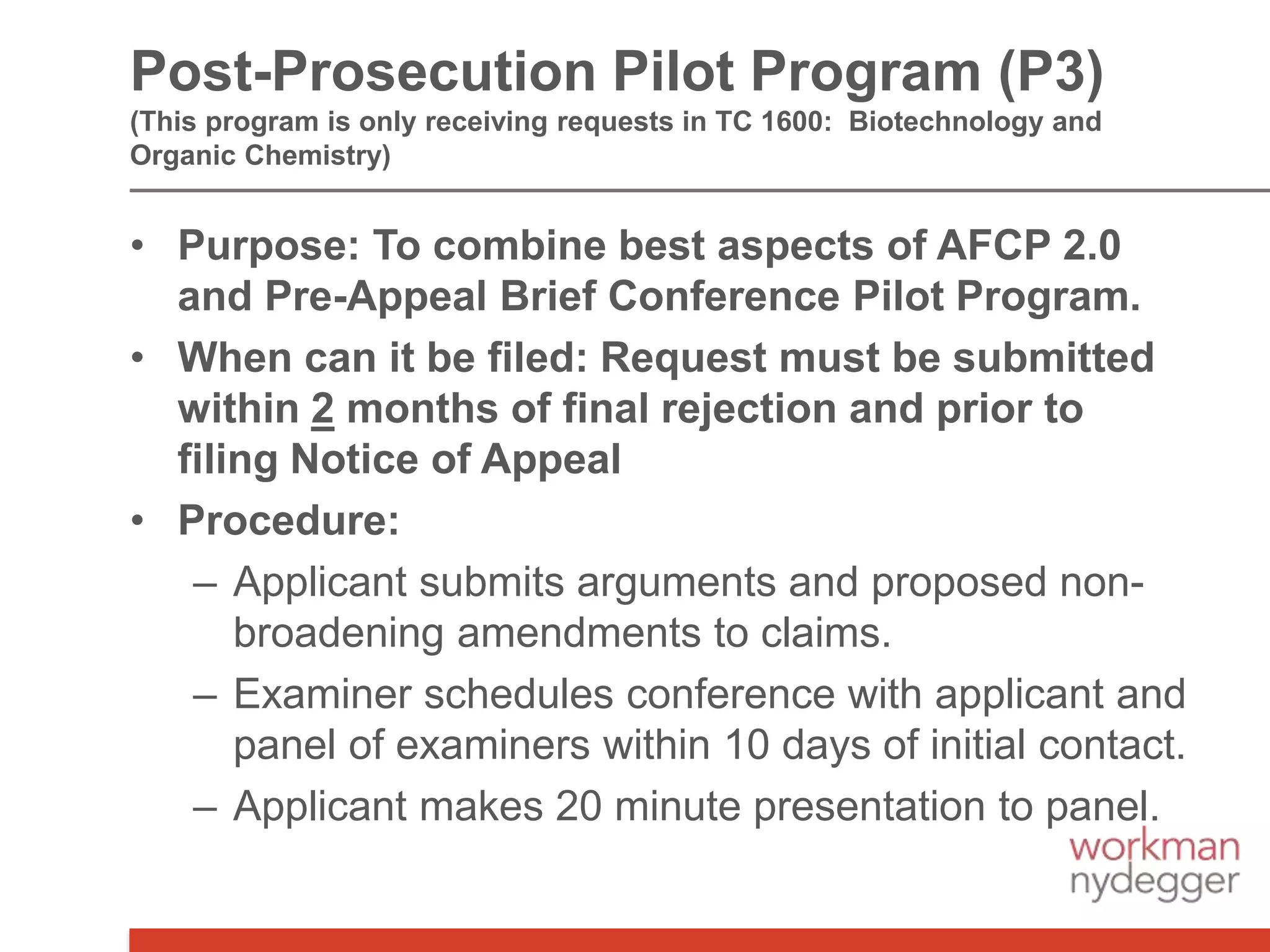
• Purpose: To combine best aspects of AFCP 2.0
and Pre-Appeal Brief Conference Pilot Program.
• When can it be filed: Request must be submitted
within 2 months of final rejection and prior to
filing Notice of Appeal
• Procedure:
– Applicant submits arguments and proposed non-
broadening amendments to claims.
– Examiner schedules conference with applicant and
panel of examiners within 10 days of initial contact.
– Applicant makes 20 minute presentation to panel.
Post-Prosecution Pilot Program (P3)
(This program is only receiving requests in TC 1600: Biotechnology and
Organic Chemistry)
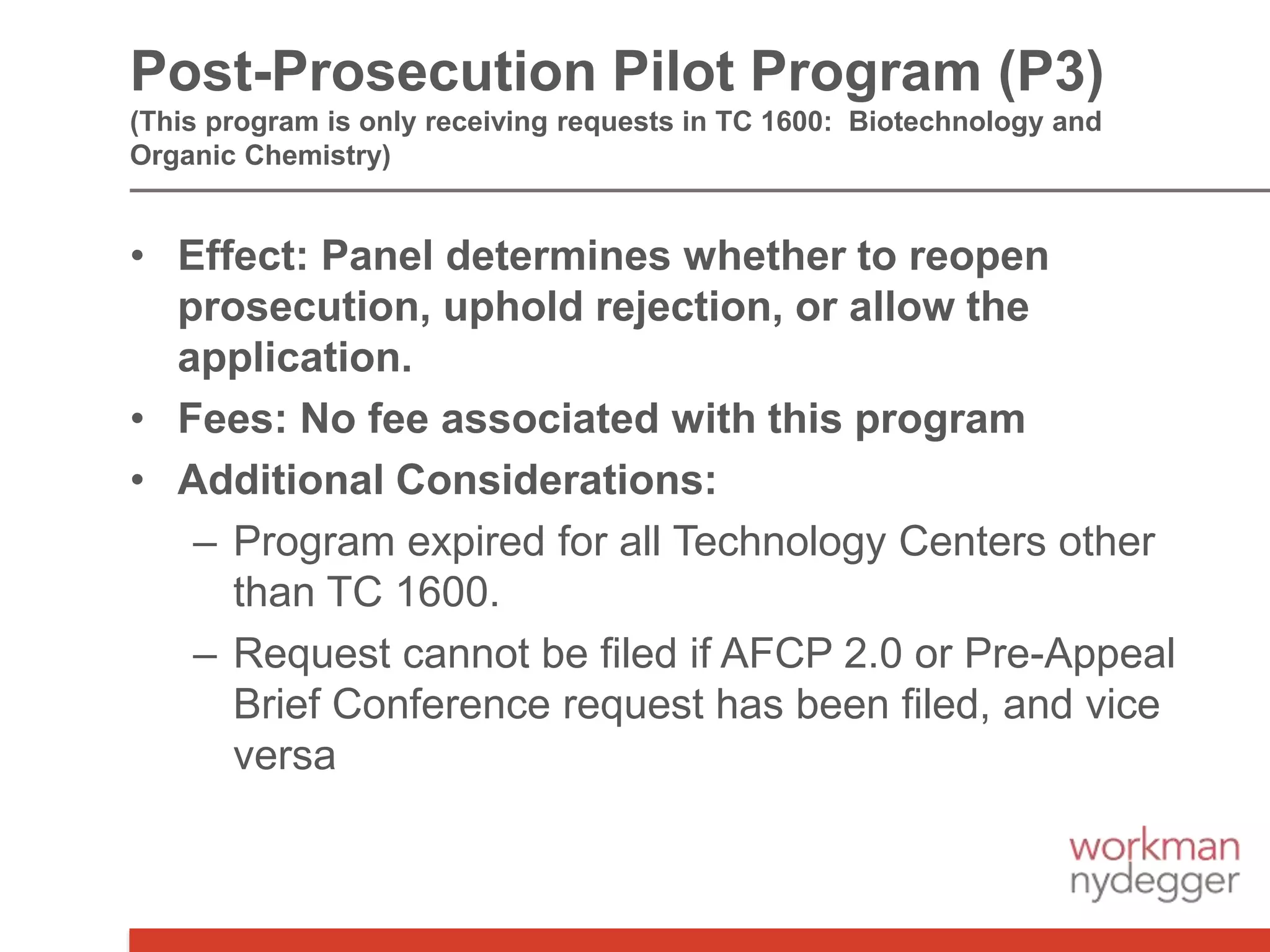
• Effect: Panel determines whether to reopen
prosecution, uphold rejection, or allow the
application.
• Fees: No fee associated with this program
• Additional Considerations:
– Program expired for all Technology Centers other
than TC 1600.
– Request cannot be filed if AFCP 2.0 or Pre-Appeal
Brief Conference request has been filed, and vice
versa
Post-Prosecution Pilot Program (P3)
(This program is only receiving requests in TC 1600: Biotechnology and
Organic Chemistry)
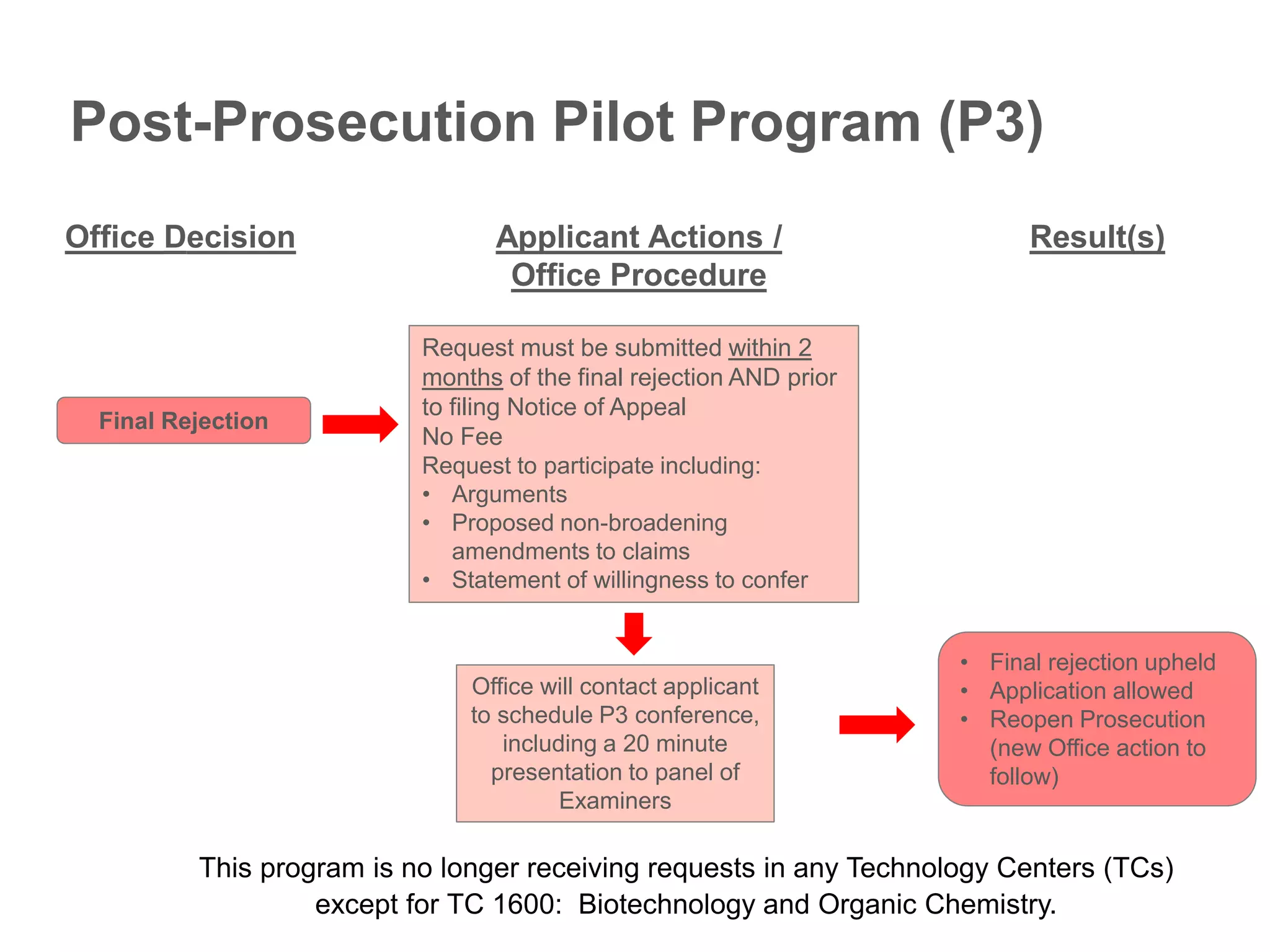
Final Rejection
• Final rejection upheld
• Application allowed
• Reopen Prosecution
(new Office action to
follow)
Office will contact applicant
to schedule P3 conference,
including a 20 minute
presentation to panel of
Examiners
Request must be submitted within 2
months of the final rejection AND prior
to filing Notice of Appeal
No Fee
Request to participate including:
• Arguments
• Proposed non-broadening
amendments to claims
• Statement of willingness to confer
Office Decision Applicant Actions /
Office Procedure
Result(s)
This program is no longer receiving requests in any Technology Centers (TCs)
except for TC 1600: Biotechnology and Organic Chemistry.
Post-Prosecution Pilot Program (P3)
• New continuing applications based on the current or
parent application.
• Continuation and divisional applications have the
same disclosure as parent application and share its
priority date.
– Do not require new declaration by inventor(s).
• All three types of applications restart the application
process for the new applications.
• Abandonment of the current application does not
abandon the new application.
• Current or parent application must be pending (i.e.,
extensions paid, if applicable) to claim priority in
subsequent continuing application.
Divisional, Continuation and
Continuation-in-part Applications
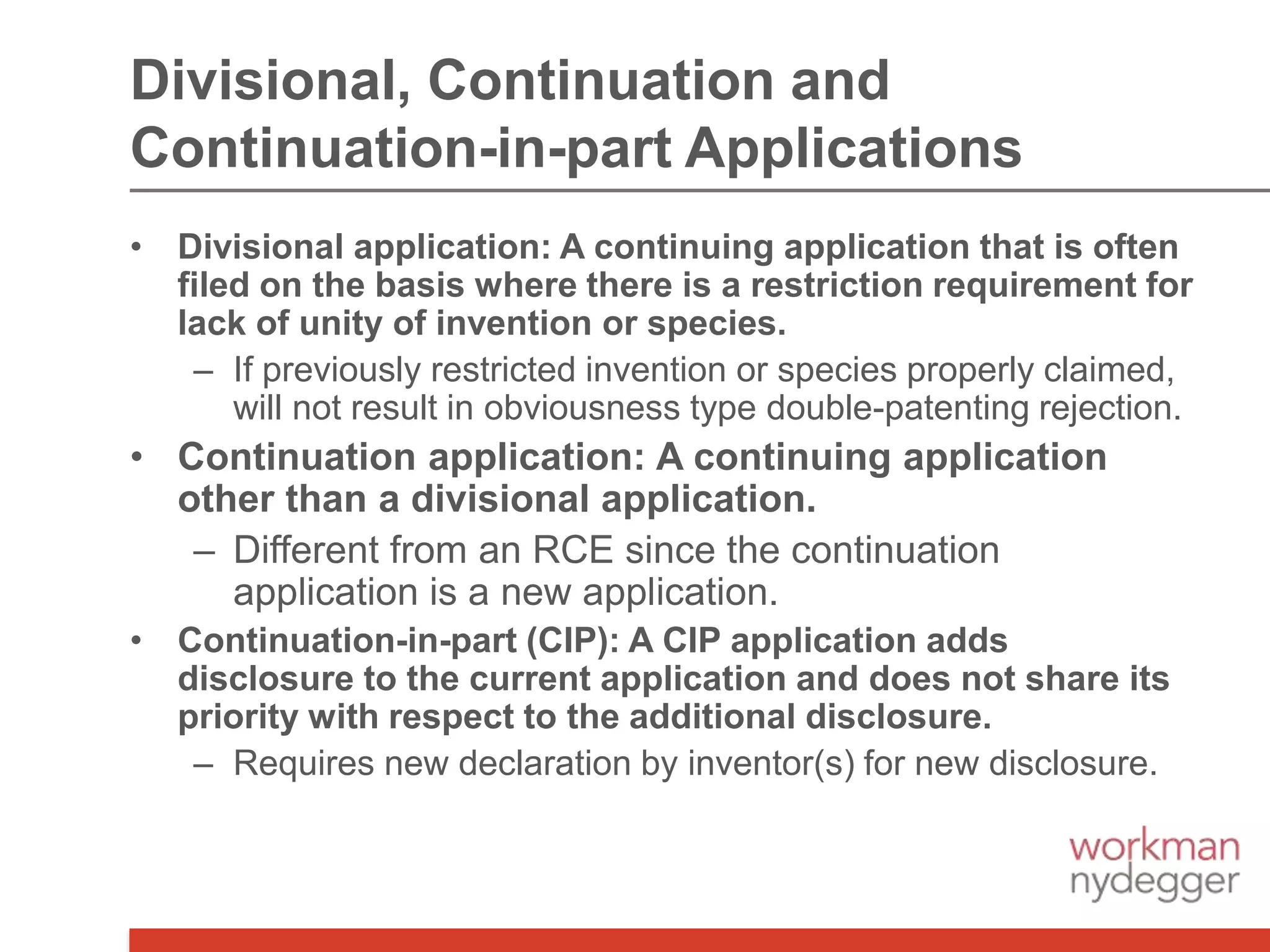
• Divisional application: A continuing application that is often
filed on the basis where there is a restriction requirement for
lack of unity of invention or species.
– If previously restricted invention or species properly claimed,
will not result in obviousness type double-patenting rejection.
• Continuation application: A continuing application
other than a divisional application.
– Different from an RCE since the continuation
application is a new application.
• Continuation-in-part (CIP): A CIP application adds
disclosure to the current application and does not share its
priority with respect to the additional disclosure.
– Requires new declaration by inventor(s) for new disclosure.
Divisional, Continuation and
Continuation-in-part Applications
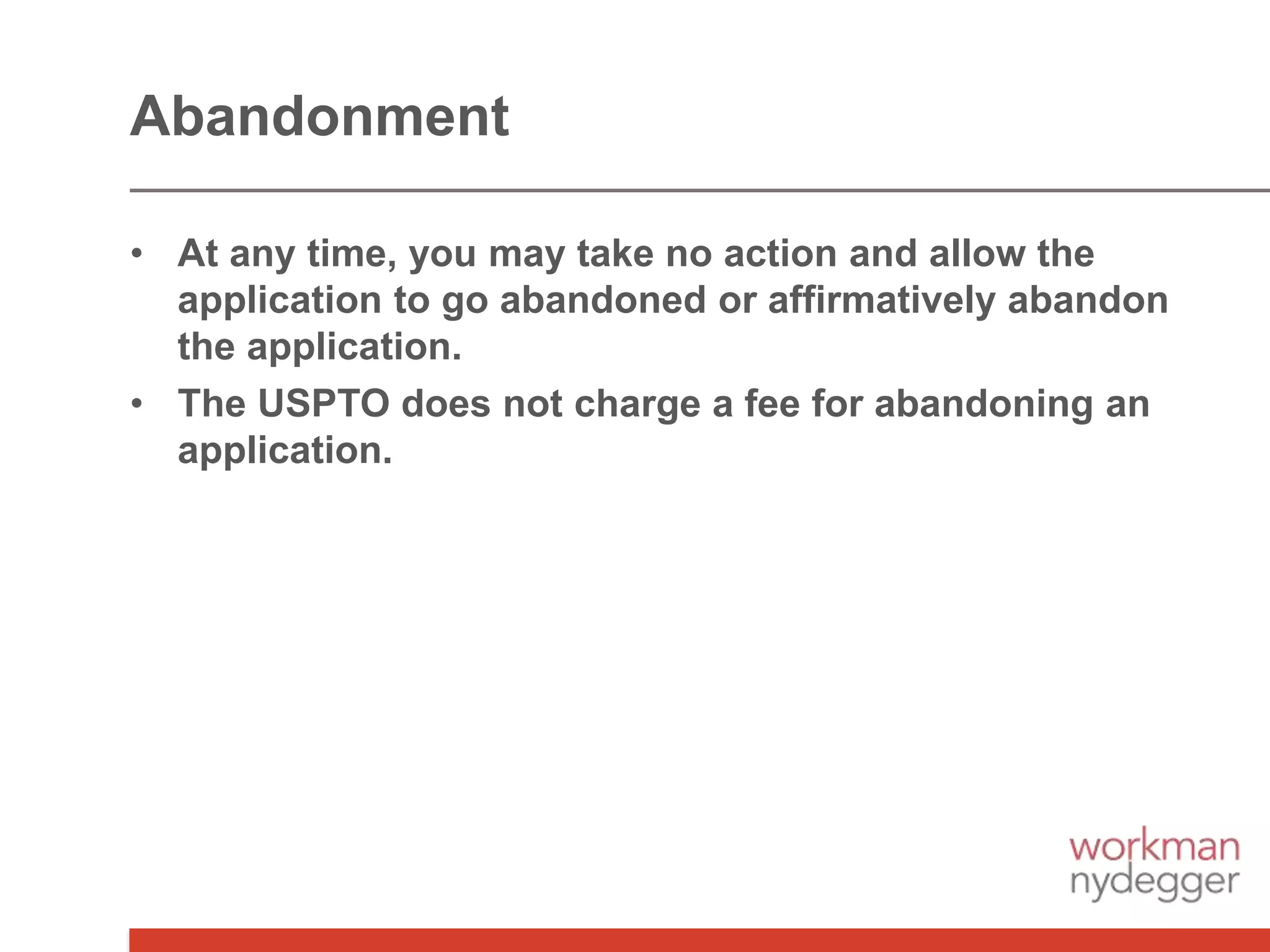
• At any time, you may take no action and allow the
application to go abandoned or affirmatively abandon
the application.
• The USPTO does not charge a fee for abandoning an
application.
Abandonment

Overview on After Final Practice at the USPTO

  • 1.
    Overview on AfterFinal Practice at the USPTO Presented by Justin J. Cassell February 2017 © 2017 Workman Nydegger
  • 2.
    • A FinalRejection is intended to close prosecution of the application on second or any subsequent examination or consideration by Examiner. • But wait: – While a Final Office Action may appear to be the end of prosecution, it may not necessarily be the end of the line. • Instead: – The USPTO offers a few options to address the final rejection or reopen the prosecution of the application. – Various factors to consider including Examiner motivation, timing, components of request and decisions by the USPTO. Response After Final Rejection: When is a Final Rejection Proper?
  • 3.
    Options in RespondingAfter a Final Office Action • Response after Final Office Action • After Final Consideration Pilot Program (AFCP) • Request for Continued Examination (RCE) with submission • Notice of Appeal and Pre-Appeal Brief Conference • Appeal • Continuation or Continuation-in-part application • Abandonment
  • 4.
    Response After FinalRejection: How much time is an Examiner allocated? • It is important to consider how much time an Examiner has allocated for different stages – this may influence Examiner behavior after a Final Office Action. • Examiners must obtain 8 counts (accounting for 80 hours) every two weeks (bi-week) – may be offset. • Weight is placed on first Office Action. • Basic formula: 2.0 counts for balanced disposal (1.25 for first OA + 0.25 for final OA + 0.5 for a disposal). • Formula diminishes for each RCE. Stage 0 RCE 1 RCE 2 RCE Non-final OA 1.25 1.00 0.75 Final OA 0.25 0.25 0.25 RCE (disposal) 0.50 0.50 0.50 Examiner’s Answer (disposal) 0.50 0.50 0.50 Abandonment (disposal) 0.50 0.50 0.50 Allowance (disposal) 0.50 0.50 0.50
  • 5.
    Response After FinalRejection: How much time is an Examiner allocated? • No counts: – 2nd and consecutive Non-final – Final Office Action – Advisory Action • Extra time to reduce count requirement – Restriction requirement: 1 hour – AFCP 2.0 Advisory Action: 3 hours – Appeal Conference: 1 hour – Interview: 1 hour • Examiners are incentivized to dispose of an application early – example of allowance after First Office Action. – Examiner will receive credit for a writing a Final Office Action and a disposal (allowance) – 0.75 counts.
  • 6.
    • A patentexaminer may issue a Final Office Action when: – Previous arguments are unpersuasive; OR – A new ground of rejection is required by amendments made to the claims in the previous response; OR – A new ground of rejection is required by a reference in an information disclosure statement submitted after the first action. • On first action if: – Application is continuation of or substitute (previous filing of RCE) for earlier application AND – All claims are (1) drawn to same invention claimed in earlier application AND (2) would have been properly finally rejected on grounds or art of record in next Office Action if had been entered in an earlier application. Response After Final Rejection: When is a Final Rejection Proper?
  • 7.
    Response After FinalRejection: Applicant Options and USPTO Results • Applicant Options for the Response: – Request for Reconsideration. – Interview (note: Interview is at Examiner’s discretion – may deny request for interview – Examiner given extra time – 1 hour). – Claim amendment. • USPTO Response to the Response: – Allow application or certain claims. – Allows Examiner time to consider response. – If response does not place the application in condition for allowance, the Examiner may issue an Advisory Action, whereby: • Examiner provides reasons for not allowing claims. • Evaluate claim amendment entry and grounds for entry or non-entry.
  • 8.
    • Office Actiongives Applicant 3 months from mailing date of Final Action to file a response – “Shortened Statutory Period for reply” (SSP). • But SSP expires on mailing date of Advisory Action if: – (1) Reply filed within 2 months of mailing date (expedited handling) of Final Action AND (2) Advisory Action not mailed until after end of 3 months from mailing date of Final Action. • No later than 6 months from mailing date of Final Action – “Statutory Period for Reply” (SP). – Replies filed after expiration of SSP will require payment of extension fees. – Period for reply cannot be extended beyond SP – in other words, 6 months from mailing date of final Office Action. – Filing only Response does not stop SP for reply. • Replies that stop the running of the Statutory Period: – Filing of a Notice of Appeal. – Filing of a Request for Continued Examination. Response After Final Rejection: When to File Reply to Final Rejection?
  • 9.
    Response After FinalRejection: Advisory Action Timelines Example 1 January 1 Final Rejection Mailed March 1 After-final response filed (within two months of mailing date) May 15 Advisory Action Mailed May 15-June 15 Only one month extension of time required with RCE O mo. 1 mo. 2 mo. 3 mo. 4 mo. 5 mo. 6 mo. July 1 Expiry of SP April 1 Expiry of SSP Example - Reply filed within 2 months of mailing date of Final Action It is recommended to take advantage of filing within 2 months of mailing date of Final Office Action to reduce expenses.
  • 10.
    Response After FinalRejection: Advisory Action Timelines Example 2 – Reply filed after 2 months from mailing date of Final Action January 1 Final Rejection Mailed March 2 After-final response filed (more than two months after mailing date) May 15 Advisory Action Mailed June 2 three month extension of time required with RCE O mo. 1 mo. 2 mo. 3 mo. 4 mo. 5 mo. 6 mo. July 1 Expiry of SP April 1 Expiry of SSP
  • 11.
    Response After FinalRejection: Advisory Action Timelines Example 3 – Reply filed after 3 months (SSP) from mailing date of Final Action January 1 Final Rejection Mailed April 1 After-final response filed (more than two months of mailing date) April 15 Advisory Action Mailed May 1 Two month extension of time required with RCE O mo. 1 mo. 2 mo. 3 mo. 4 mo. 5 mo. 6 mo. July 1 Expiry of SP April 1 Expiry of SSP
  • 12.
    • What canresponse include: Applicant Actions. – Includes a writing pointing out Examiner’s errors. – May include an amendment according to limited scope. – Must be filed within six months of the date of the Final Rejection and prior to filing Notice of Appeal. • Does not toll or stop statutory period. • How is response considered by the Examiner? – The Examiner will reconsider the application with respect to the response and either allow the application or notify the applicant of deficiencies that still exist (Advisory Action). Response After Final Rejection: What Can the Response Include?
  • 13.
    Response After FinalRejection: What May Be Amended After Final? • File an Amendment and Response After Final under 37 C.F.R. § 1.116. – To comply with Examiner’s suggestions. – To reduce issues on appeal i.e., cancel claims. – To present claims in better form for consideration on appeal. – If they raise new issues of patentability, the Examiner will likely refuse to enter them. • Examiner will either enter the amendment in its entirety or explain reasons for not entering the amendment. • Examiner may enter amendment only for purposes of appeal.
  • 14.
    Final Rejection • Amendments of claimscompliant with 37 CFR §1.116 • Writing pointing out Examiner’s errors • No fee unless extension of time required Office Decision Applicant Options Possible Results Advisory Action Allowance Be mindful of when amendment and/or response is filed relative to mailing date of Final Office Action. If within 2 months, different determination of SSP for advisory action - mailing date of Advisory Action - if after initial 3 month SSP. Statutory period (SP) continues when response filed – 6 month maximum. Unless proposed amendment entered in its entirety, Examiner will briefly explain the reasons for not entering the proposed amendment Response After Final Rejection
  • 15.
    • When canit be filed: Claims must be finally rejected. • Procedure: Applicant submits – – Request to participate in AFCP 2.0. – Statement of availability for interview. – Non-broadening amendment to at least one independent claim. – No fee for filing request. After Final Consideration Pilot Program 2.0 (AFCP 2.0)
  • 16.
    • Effect: Authorizesadditional time for examiners to search and/or consider responses after final rejection. – If Examiner can complete any necessary search in limited time, will consider Amendment. – If Examiner cannot complete search in time, Examiner rejects AFCP request and treats amendment as a request for reconsideration. – Examiner may schedule interview with applicant whether or not amendment places in condition for allowance. – An RCE may still be required for entry of amendment, but the AFCP may provide insight to eventual allowance after filing amendment with RCE. After Final Consideration Pilot Program 2.0 (AFCP 2.0)
  • 17.
    Final Rejection • Application allowed •If not allowed, Examiner may schedule interview with applicant to discuss the amendment If additional search is required but cannot be completed in allotted time (3 hrs), treated as Request for Reconsideration If additional search required AND can be completed in allotted time, Examiner will search and consider whether amendment places in condition for allowance If applicant not available for interview within 10 days of contact, treated as Request for Reconsideration Office Decision Applicant Actions Result(s)Office Procedure If no additional search required, Examiner will consider whether amendment places in condition for allowance • Request to participate in AFCP 2.0 • Statement of availability for interview • Non- broadening amendment to at least one independent claim • No fee for filing request After Final Consideration Pilot Program 2.0 (AFCP 2.0) Be mindful of when AFCP 2.0 and response are filed. Same timeline applies as a Response after Final. Statutory period (SP) continues when AFCP 2.0 request and response filed – 6 month maximum.
  • 18.
    • When canit be filed: When prosecution is closed. • Procedure: – Payment of fee AND – Submission which may include: • Information Disclosure Statement (IDS), amendments to written description, claims, or drawings, new arguments, or new evidence in support of patentability. • Effect: If timely filed, finality withdrawn and submission will be entered and considered: prosecution reopened • Fees: Higher fees for RCEs filed in an application after a first RCE has been filed. – First RCE: $1,200/600 USD (Large/small entity). – Each subsequent RCE: $1,700 USD (Large/small entity). Request for Continued Examination (RCE)
  • 19.
    • If thereis no submission with filing an RCE and fee, does not stop 6 month statutory period. • Not applicable to Design applications or patents under Reexamination. • Can be used to reopen prosecution after an issue fee is paid along with filing a request to withdraw from issue and a submission. • Can be used to reopen prosecution during appeal or after an appeal decision is issued along with a submission. • If new issues are not raised by amendment and arguments – may result in a Final Office Action after filing the RCE. – May avoid Final Office Action after filing RCE by first filing an amendment without a RCE to receive an Advisory Action indicating amendment raises new issues. Request for Continued Examination (RCE) Additional Considerations
  • 20.
    Final Rejection • Paymentof Fee per §1.17(e) ($1,200/600 USD for Large/small entity) • Submission which may include: • IDS • Amendments to written description, claims, or drawings • New arguments • New evidence If timely filed, finality withdrawn and Submission will be entered and considered: prosecution reopened Office Decision Applicant Options Possible Results Request for Continued Examination (RCE) Request for continued examination (RCE) - 2nd and subsequent request enhanced RCE fees ($1,700/850 USD large/small entity). Consider filing a Request for Reconsideration and an RCE after receiving an Advisory Action to avoid a first Final Office Action after filing the RCE.
  • 21.
    • Purpose: Createdto expedite prosecution by reducing time and expense spent on appeal briefs. • When can it be filed: When claims are twice or finally rejected. Must file Notice of Appeal within six months of final rejection (with extension of time after SSP). • Procedure: – File Notice of Appeal (tolls SP). – Request to participate in Pre-Appeal Brief Conference Pilot Program. – Summary of Arguments, filed at same time as Notice of Appeal. – Pay Notice of Appeal fee. Pre-Appeal Brief Conference Pilot Program
  • 22.
    • Effect: Panelof examiners (often including Supervisor, but at least two Primary Examiners) reviews the summary and decides whether to reopen prosecution, allow application, or keep under appeal. – Panel has 45 days to render decision. • Summary of Arguments may comprise arguing clear errors in Examiner’s rejections or Examiner’s omissions of essential elements needed for prima facie rejection. • Determine whether issues are technical or legal. – If legal, ripe for appeal. – If technical, may consider resolving before appeal. • No supplemental requests or interviews. Pre-Appeal Brief Conference Pilot Program
  • 23.
    Claims twice rejected •Remains under Appeal • Prosecution reopened • Application allowed Panel of Examiners reviews Summary of Arguments within 45 days of request • File Notice of Appeal Fee per 37 CFR §41.20 ($800/$400 USD Large/small entity) • Request to participate in Pre- Appeal Brief Conference Pilot Program, including • Summary of Arguments (no more than 5 pages) and filed at same time as Notice of Appeal Office decision Applicant Actions / Office Procedure Result(s) Pre-Appeal Brief Conference Pilot Program
  • 24.
    • Purpose: Appealfinal rejection to Patent Trials and Appeal Board (PTAB). • When can it be filed: Once claims are twice rejected or finally rejected. Must file Notice of Appeal within 6 months of final rejection (with extension of time after SSP). • Procedures: – Notice of appeal no later than 6 months after final rejection. – Applicant then files Appeal Brief. – Examiner issues Examiner’s Answer. – Applicant may file Reply Brief AND/OR – Pay fee for sending Appeal to PTAB. Appeal
  • 25.
    • Effect: PTABmay affirm or reverse Examiner either in entirety or in-part, or remand for further consideration by Examiner. • Cannot file Appeal with an RCE. Either one or the other. • Appeal Brief is due later of: – 1 month from mailing date of Decision of Pre-Appeal Conference, OR – 2 months from filing Notice of Appeal, extendable up to 5 more months. • Request and fee sending Appeal Brief to PTAB due within 2 months of Examiner’s Answer (not extendable). • Applicant’s Reply to Examiner’s Answer does not toll period to send Appeal Brief to PTAB. Appeal
  • 26.
    • Amendment afterNotice of Appeal may be admitted if to cancel claims, comply with a requirement, present claims in better condition for appeal, or amend the claims and specification upon a showing of good and sufficient reasons amendment is necessary and was not previously submitted. • Amendment filed with or after an Appeal Brief are entered at Examiner’s discretion and can only include cancellation of claims or rewriting dependent claims as independent claims. Appeal
  • 27.
    • File RCEto reopen prosecution • Applicant may request rehearing within 2 months of decision to present new argument based upon recent decisions or new grounds of rejection • Appeal to Federal Circuit Claims twice rejected Notice of Appeal within 6 months of final rejection • Fee per 37 CFR §41.20 ($800/$400 USD Large/small entity) Appeal Brief within 2 months of Notice of Appeal (SP within 7 months of Notice of Appeal) • No fee for filing Appeal Brief PTAB Decision • Affirm or Reverse Examiner Decision (including new grounds of rejection) • May request briefing or information • May remand to Examiner Reply Brief by Applicant within 2 months of Written Answer (not extendable) Request for Oral Hearing within 2 months of Written Answer or Reply Brief ($1,300/$650 USD Large/small entity) If remains under Appeal, Examiner Written Answer to Brief (including new grounds of rejection) Office Decision Applicant Options/ Office Procedure Possible Results Appeal • Remains under Appeal • Prosecution reopened • Application allowed Send Appeal to PTAB with fee ($2,000/$1,000 USD Large/small entity)
  • 28.
    • Purpose: Tocombine best aspects of AFCP 2.0 and Pre-Appeal Brief Conference Pilot Program. • When can it be filed: Request must be submitted within 2 months of final rejection and prior to filing Notice of Appeal • Procedure: – Applicant submits arguments and proposed non- broadening amendments to claims. – Examiner schedules conference with applicant and panel of examiners within 10 days of initial contact. – Applicant makes 20 minute presentation to panel. Post-Prosecution Pilot Program (P3) (This program is only receiving requests in TC 1600: Biotechnology and Organic Chemistry)
  • 29.
    • Effect: Paneldetermines whether to reopen prosecution, uphold rejection, or allow the application. • Fees: No fee associated with this program • Additional Considerations: – Program expired for all Technology Centers other than TC 1600. – Request cannot be filed if AFCP 2.0 or Pre-Appeal Brief Conference request has been filed, and vice versa Post-Prosecution Pilot Program (P3) (This program is only receiving requests in TC 1600: Biotechnology and Organic Chemistry)
  • 30.
    Final Rejection • Finalrejection upheld • Application allowed • Reopen Prosecution (new Office action to follow) Office will contact applicant to schedule P3 conference, including a 20 minute presentation to panel of Examiners Request must be submitted within 2 months of the final rejection AND prior to filing Notice of Appeal No Fee Request to participate including: • Arguments • Proposed non-broadening amendments to claims • Statement of willingness to confer Office Decision Applicant Actions / Office Procedure Result(s) This program is no longer receiving requests in any Technology Centers (TCs) except for TC 1600: Biotechnology and Organic Chemistry. Post-Prosecution Pilot Program (P3)
  • 31.
    • New continuingapplications based on the current or parent application. • Continuation and divisional applications have the same disclosure as parent application and share its priority date. – Do not require new declaration by inventor(s). • All three types of applications restart the application process for the new applications. • Abandonment of the current application does not abandon the new application. • Current or parent application must be pending (i.e., extensions paid, if applicable) to claim priority in subsequent continuing application. Divisional, Continuation and Continuation-in-part Applications
  • 32.
    • Divisional application:A continuing application that is often filed on the basis where there is a restriction requirement for lack of unity of invention or species. – If previously restricted invention or species properly claimed, will not result in obviousness type double-patenting rejection. • Continuation application: A continuing application other than a divisional application. – Different from an RCE since the continuation application is a new application. • Continuation-in-part (CIP): A CIP application adds disclosure to the current application and does not share its priority with respect to the additional disclosure. – Requires new declaration by inventor(s) for new disclosure. Divisional, Continuation and Continuation-in-part Applications
  • 33.
    • At anytime, you may take no action and allow the application to go abandoned or affirmatively abandon the application. • The USPTO does not charge a fee for abandoning an application. Abandonment