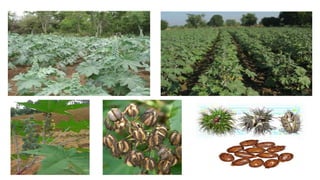
CASTOR
S.N: (Ricinus communis),
Family:Euphorbiaceae
Origin: Eastern Africa and most probably
originated in Ethiopia
IMPORTANCE
It is an important oilseed crop especially used as
lubricant in industries
Because of its deep root system
drought hardiness and quick growth
it finds a place of prestige in the cropping systems of dry land agriculture in
semi arid zones of India.
It is the most important commercial non edible oilseed crop of the country.
3.
The oilacts as the best lubricant for high speed engines, aeroplanes,
Manufacturing soaps, transparent papers, printing inks, varnishes, linoleum
and plasticizers, synthetic resins and fibres. etc.,
Castor oil contains a very high percentage of hydroxyl fatty acid known as ricinoleic
acid.
The dehydrated castor oil is in demand for paints and varnishes because of its non
yellowing quality.
It is also used as an illuminant, giving a bright and steady flame and burning much
longer than any other vegetable oil.
Hydrogenated castor oil is used in polishes, cosmetics, hair dressings, soaps
and
disinfectants.
4.
Castor oilis also used as purgative (act of cleaning)
It is used in the preparation of Turkey Red in dyeing industries.
Oil is used in many veterinary uses.
It is used externally as an emollient (medicine that softens the texture of
animals)
It is also used as soothing medium, when dropped in to the eyes
of animals after removal of foreign bodies.
The castor oil cake is a valuable manure but because of the presence of
poison ricin it is unfit for cattle feed.
It contains 5.5% N, 1.8-1.9% P and 1.1% K
5.
Area production andproductivity
World
Area: 1.51 m. ha.
Production: 1.48 m.t.
Productivity:1,002 kg/ha
India occupies number one position and accounts for nearly 57 %
of world’s area and 74 % of world’s castor production.
6.
Distribution
In the world:
Southern region of Canada, Central Russia and Korea in the Northern
hemisphere to Chile, South Africa and Australia in the
Southern hemisphere.
China, Mozambique and Brazil are the other important countries
producing castor.
In India:
Gujarat, Rajasthan and
AP, castor.
are the most important states producing
It is also grown to some extent in KA, Odisha, TN, and MH.
7.
Distribution
Gujarat accountsfor 73 % of India’s castor production with about
56% of castor area and has the highest productivity of 1,978 kg/ha
Area: 8.85 lakh ha
Production:1.3 m t
Productivity: 1,512 kg/ha
In KA: Koppal, Raichur, Bellary, Bijapur and Haveri
8.
Classification
Popova (1926) dividedthe species in to 6 sub species
geographical groupings. Ricinus communis sub species
1. Persicus
2. Chinensis
3. Zanzibarinus
4. Sanguineus
5. Africanus
6. Maxicanus
based on eco-
9.
Soil requirement
Welldrained loamy soils are best suited.
Very heavy clays and marshy conditions are unfavorable for
proper growth.
Highly susceptible to water logged conditions so confine the cultivation to
upland areas.
Crop cannot tolerate alkalinity of soil but can withstand slight to moderate
acidity.
10.
Climatic requirement
Castorcrop requires a moderately high temperature of 20-27oC with low
humidity throughout the growing season.
It grows best in areas with clean warm sunny days.
Prolonged cloudy weather with high temperature at flowering
results in poor seed set.
High temperature > 41 oC at flowering for short period also
results in blasting of flowers and poor seed set.
It is very resistant to drought and can be grown with 80-100 mm
evenly distributed rainfall.
Heavy rains at flowering reduces the yield and very sensitive to frost
11.
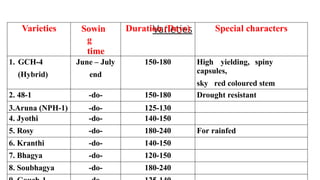
Varieties
Varieties Sowin
g
time
Duration (Days)Special characters
1. GCH-4
(Hybrid)
June – July
end
150-180 High yielding, spiny
capsules,
sky red coloured stem
2. 48-1 -do- 150-180 Drought resistant
3.Aruna (NPH-1) -do- 125-130
4. Jyothi -do- 140-150
5. Rosy -do- 180-240 For rainfed
6. Kranthi -do- 140-150
7. Bhagya -do- 120-150
8. Soubhagya -do- 180-240
12.
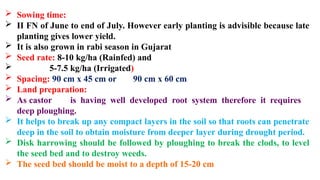
Sowing time:
II FN of June to end of July. However early planting is advisible because late
planting gives lower yield.
It is also grown in rabi season in Gujarat
Seed rate: 8-10 kg/ha (Rainfed) and
5-7.5 kg/ha (Irrigated)
Spacing: 90 cm x 45 cm or 90 cm x 60 cm
Land preparation:
As castor is having well developed root system therefore it requires
deep ploughing.
It helps to break up any compact layers in the soil so that roots can penetrate
deep in the soil to obtain moisture from deeper layer during drought period.
Disk harrowing should be followed by ploughing to break the clods, to level
the seed bed and to destroy weeds.
The seed bed should be moist to a depth of 15-20 cm
13.
MANURES AND FERTILIZERAPPLICATIONS
FYM: 5 t/ha
RDF:
40:40:20 NPK kg/ha (Rainfed) and
75:50:20 NPK kg/ha (Irrigated)
Apply 50% of N and full dose of P and K as basal and 50% N at
40-45 DAS
14.
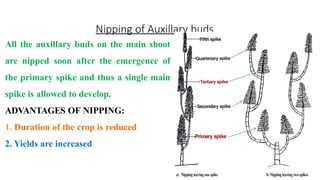
Nipping of Auxillarybuds
All the auxillary buds on the main shoot
are nipped soon after the emergence of
the primary spike and thus a single main
spike is allowed to develop.
ADVANTAGES OF NIPPING:
1. Duration of the crop is reduced
2. Yields are increased
15.
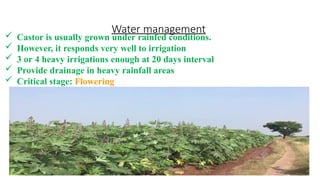
Water management
Castoris usually grown under rainfed conditions.
However, it responds very well to irrigation
3 or 4 heavy irrigations enough at 20 days interval
Provide drainage in heavy rainfall areas
Critical stage: Flowering
16.
Weed management
Becauseof wide spacing, weeds grow luxuriantly during early
stages of growth.
Two hand weedings first at 30 DAS and second at 60 DAS.
Intercultural operations at 30 and 60 DAS controls weeds and
Earthing up (Moisture conservation and safe removal of excess
water (Drainage)
Fluchloralin 45 EC @ 1.3 g or
Alachlor @ 1.7 g per litre of water.
About 750 lit of spraying solution is required per ha.
Moisture should be there at the time of spraying
17.
Cropping systems
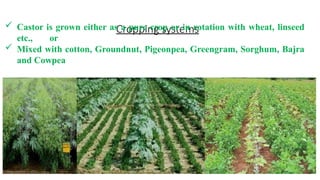
Castoris grown either as a pure crop or in rotation with wheat, linseed
etc., or
Mixed with cotton, Groundnut, Pigeonpea, Greengram, Sorghum, Bajra
and Cowpea
18.
Harvesting
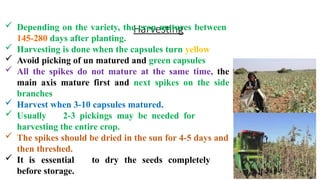
Depending onthe variety, the crop matures between
145-280 days after planting.
Harvesting is done when the capsules turn yellow
Avoid picking of un matured and green capsules
All the spikes do not mature at the same time, the
main axis mature first and next spikes on the side
branches
Harvest when 3-10 capsules matured.
Usually 2-3 pickings may be needed for
harvesting the entire crop.
The spikes should be dried in the sun for 4-5 days and
then threshed.
It is essential to dry the seeds completely
before storage.
19.
Yield
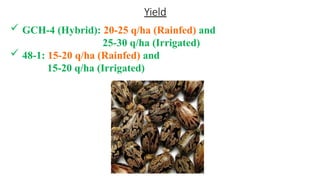
GCH-4 (Hybrid):20-25 q/ha (Rainfed) and
25-30 q/ha (Irrigated)
48-1: 15-20 q/ha (Rainfed) and
15-20 q/ha (Irrigated)