Presentation Title
“Reversed Carnot Cycle”
Reversed Carnot Cycle
 Reversing the Carnot cycle does reverse the
directions of heat and work interactions.
 A refrigerator or heat pump that operates on the
reversed Carnot cycle is called a Carnot refrigerator or
a Carnot heat pump.
The reversed Carnot cycle is the most efficient
refrigeration cycle operating between two specified
temperature levels.
 It sets the highest theoretical COP.
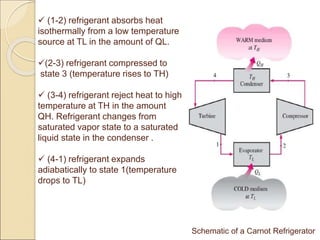
Schematic of a Carnot Refrigerator
 (1-2) refrigerant absorbs heat
isothermally from a low temperature
source at TL in the amount of QL.
(2-3) refrigerant compressed to
state 3 (temperature rises to TH)
 (3-4) refrigerant reject heat to high
temperature at TH in the amount
QH. Refrigerant changes from
saturated vapor state to a saturated
liquid state in the condenser .
 (4-1) refrigerant expands
adiabatically to state 1(temperature
drops to TL)
Schematic of a Carnot Refrigerator and T-S diagram of Reversed Carnot
Cycle
Reversed Carnot Cycle
 Consists of 4 processes
1. Adiabatic Compression
2. Isothermal Compression
3. Adiabatic Expansion
4. Isothermal Expansion
 (1-2) Adiabatic compression of
the working fluid with the aid of
external work.The temperature
of the fluid rises from T2 to T1.
 (2-3) Isothermal compression
of the working fluid during
which heat is rejected at
constant high temperature T1.
 (3-4) Adiabatic expansion of
the working fluid. The
temperature of the working fluid
falls from T2 to T1.
 (4-1) Isothermal expansion of
air where heat is absorbed at
low temperature T2 from the
space being cooled.
Reversed Carnot Cycle
Q1
Q2
T1
T2
Adiabatic
Comp
Adiabatic
Exp
Isothermal
Comp
Isothermal
Exp
Q1
Q2
Reversed Carnot Cycle
 The result is a
cycle that operates
in the
counterclockwise
direction on T-S
diagram, which is
called the
Reversed Carnot
Cycle.
COP of Refrigerator
Heat absorbed Q2 = T2ds
Heat rejected Q1 = T1ds
Work input = Heat Rejected – Heat Absorbed
= Q1- Q2 = T1ds - T2ds =(T1-T2)ds
COPR = cooling effect = QL = Q2 = T2ds
work input Wnet.in Q1- Q2 (T1-T2)ds
Point to remember ….!
Practically, the reversed Carnot cycle
cannot be used for refrigeration purpose
as the adiabatic process requires very
high speed operation, whereas the
isothermal process requires very low
speed operation.
Thanks

13502376.ppt

  • 1.
  • 2.
    Reversed Carnot Cycle Reversing the Carnot cycle does reverse the directions of heat and work interactions.  A refrigerator or heat pump that operates on the reversed Carnot cycle is called a Carnot refrigerator or a Carnot heat pump. The reversed Carnot cycle is the most efficient refrigeration cycle operating between two specified temperature levels.  It sets the highest theoretical COP.
  • 3.
    Schematic of aCarnot Refrigerator  (1-2) refrigerant absorbs heat isothermally from a low temperature source at TL in the amount of QL. (2-3) refrigerant compressed to state 3 (temperature rises to TH)  (3-4) refrigerant reject heat to high temperature at TH in the amount QH. Refrigerant changes from saturated vapor state to a saturated liquid state in the condenser .  (4-1) refrigerant expands adiabatically to state 1(temperature drops to TL)
  • 4.
    Schematic of aCarnot Refrigerator and T-S diagram of Reversed Carnot Cycle
  • 5.
    Reversed Carnot Cycle Consists of 4 processes 1. Adiabatic Compression 2. Isothermal Compression 3. Adiabatic Expansion 4. Isothermal Expansion
  • 6.
     (1-2) Adiabaticcompression of the working fluid with the aid of external work.The temperature of the fluid rises from T2 to T1.  (2-3) Isothermal compression of the working fluid during which heat is rejected at constant high temperature T1.  (3-4) Adiabatic expansion of the working fluid. The temperature of the working fluid falls from T2 to T1.  (4-1) Isothermal expansion of air where heat is absorbed at low temperature T2 from the space being cooled. Reversed Carnot Cycle Q1 Q2 T1 T2 Adiabatic Comp Adiabatic Exp Isothermal Comp Isothermal Exp Q1 Q2
  • 7.
    Reversed Carnot Cycle The result is a cycle that operates in the counterclockwise direction on T-S diagram, which is called the Reversed Carnot Cycle.
  • 8.
    COP of Refrigerator Heatabsorbed Q2 = T2ds Heat rejected Q1 = T1ds Work input = Heat Rejected – Heat Absorbed = Q1- Q2 = T1ds - T2ds =(T1-T2)ds COPR = cooling effect = QL = Q2 = T2ds work input Wnet.in Q1- Q2 (T1-T2)ds
  • 9.
    Point to remember….! Practically, the reversed Carnot cycle cannot be used for refrigeration purpose as the adiabatic process requires very high speed operation, whereas the isothermal process requires very low speed operation.
  • 10.