CSE 403
Lecture 13
Black/White-Box Testing
Reading:
Software Testing: Principles and Practices, Ch. 3-4 (Desikan, Ramesh)
slides created by Marty Stepp
http://www.cs.washington.edu/403/
2
Testing questions
• Should I test my own code, or should somebody else?
• Which code of my project should I test the most/least?
• Can I test all possible inputs to see whether something
works?
• How do I know if I've tested well/enough?
• What constitutes a good or bad test case method?
• Is it good or bad if a test case fails?
• What if a test case itself has a bug in it?
3
JUnit exercise
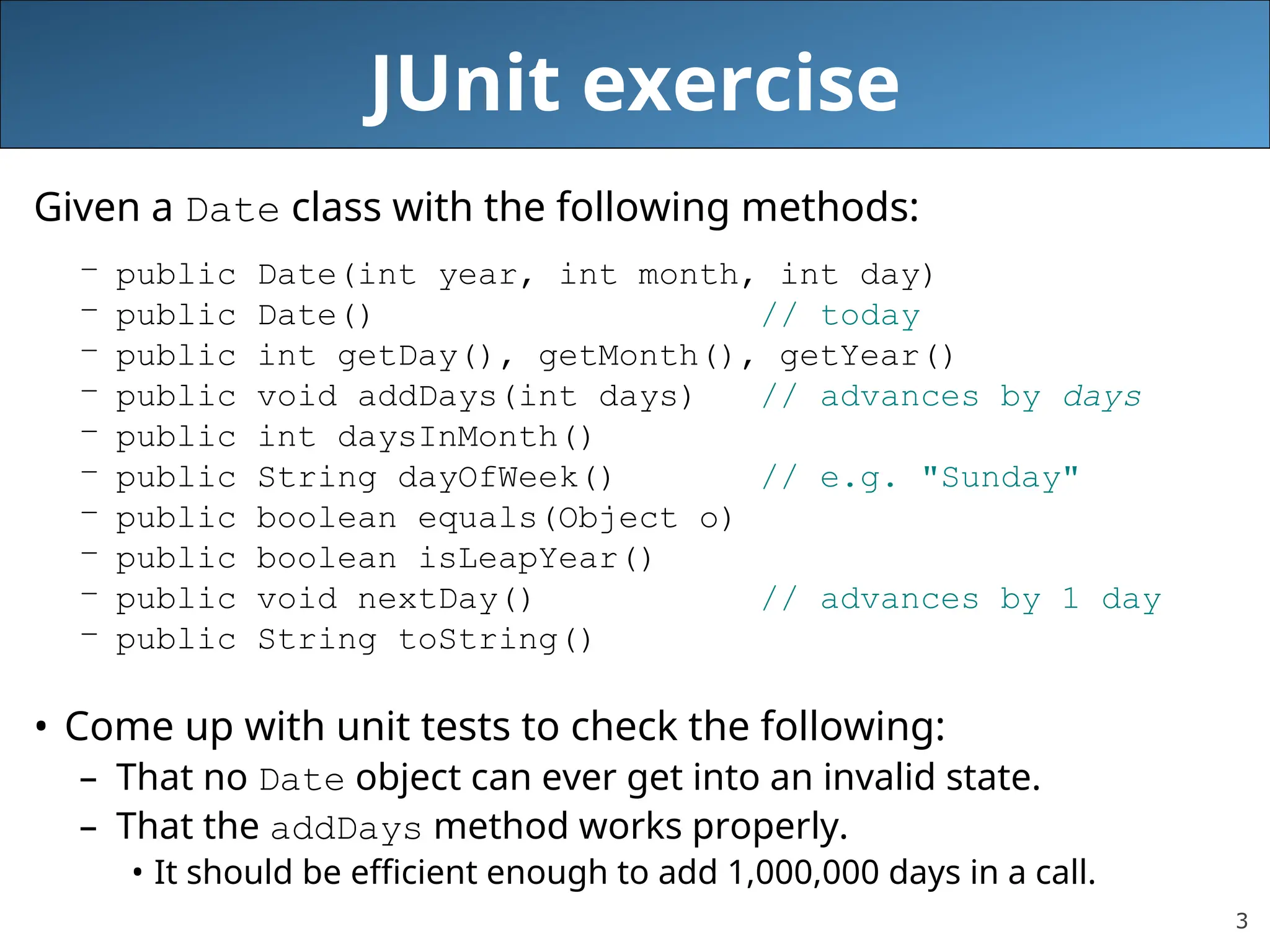
Given a Date class with the following methods:
– public Date(int year, int month, int day)
– public Date() // today
– public int getDay(), getMonth(), getYear()
– public void addDays(int days) // advances by days
– public int daysInMonth()
– public String dayOfWeek() // e.g. "Sunday"
– public boolean equals(Object o)
– public boolean isLeapYear()
– public void nextDay() // advances by 1 day
– public String toString()
• Come up with unit tests to check the following:
– That no Date object can ever get into an invalid state.
– That the addDays method works properly.
• It should be efficient enough to add 1,000,000 days in a call.
4
Test-driven development
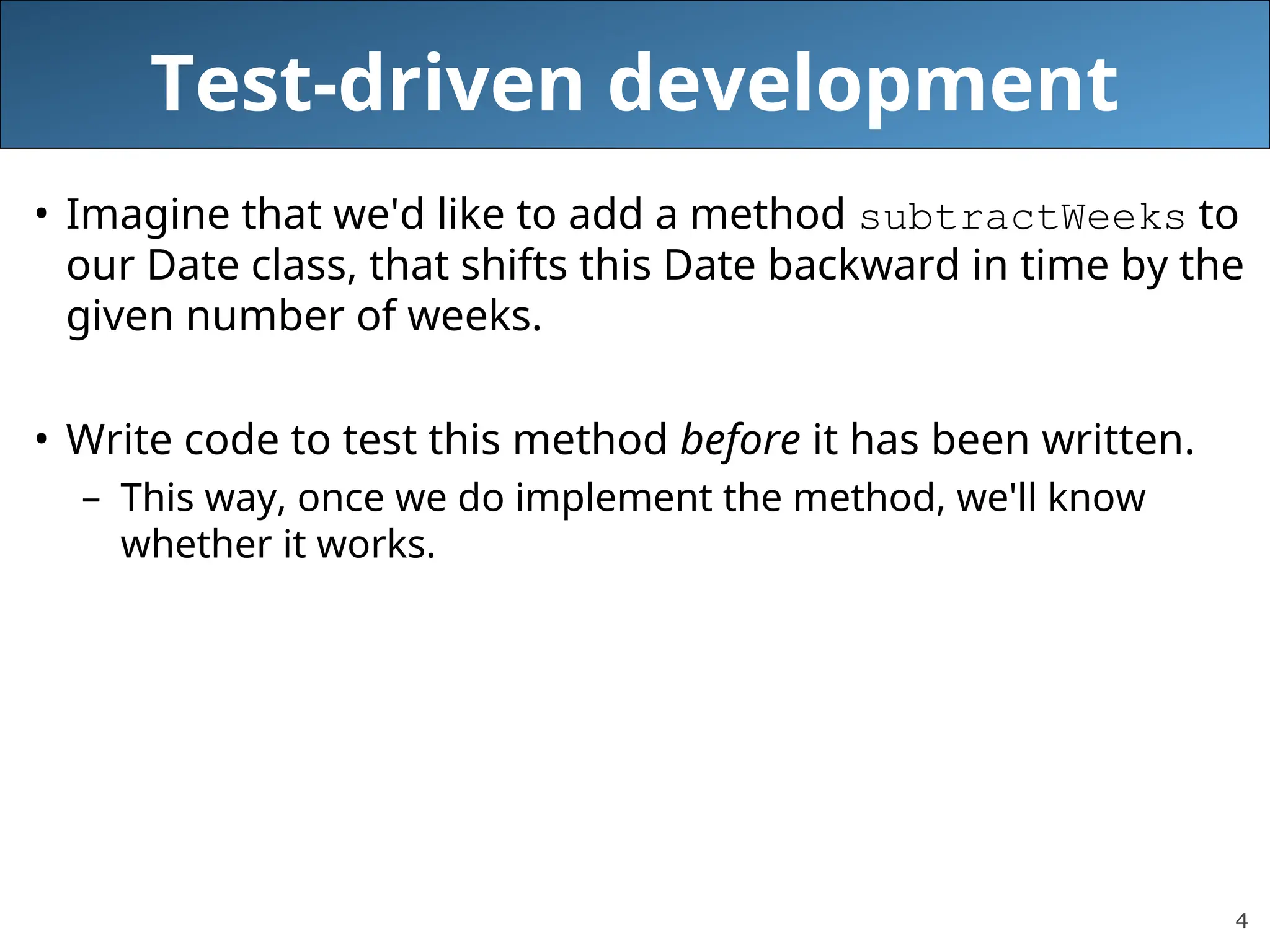
• Imagine that we'd like to add a method subtractWeeks to
our Date class, that shifts this Date backward in time by the
given number of weeks.
• Write code to test this method before it has been written.
– This way, once we do implement the method, we'll know
whether it works.
5
Black and white box testing
What is the difference between black- and white-box testing?
• black-box (procedural) test: Written without knowledge of how
the class under test is implemented.
– focuses on input/output of each component or call
• white-box (structural) test: Written with knowledge of the
implementation of the code under test.
– focuses on internal states of objects and code
– focuses on trying to cover all code paths/statements
– requires internal knowledge of the component to craft input
• example: knowing that the internal data structure for a spreadsheet
uses 256 rows/columns, test with 255 or 257
6
Black-box testing
• black-box is based on requirements and functionality, not
code
• tester may have actually seen the code before ("gray box")
– but doesn't look at it while constructing the tests
• often done from the end user or OO client's perspective
• emphasis on parameters, inputs/outputs (and their
validity)
7
Types of black-box
• requirements based
• positive/negative - checks both good/bad
results
• boundary value analysis
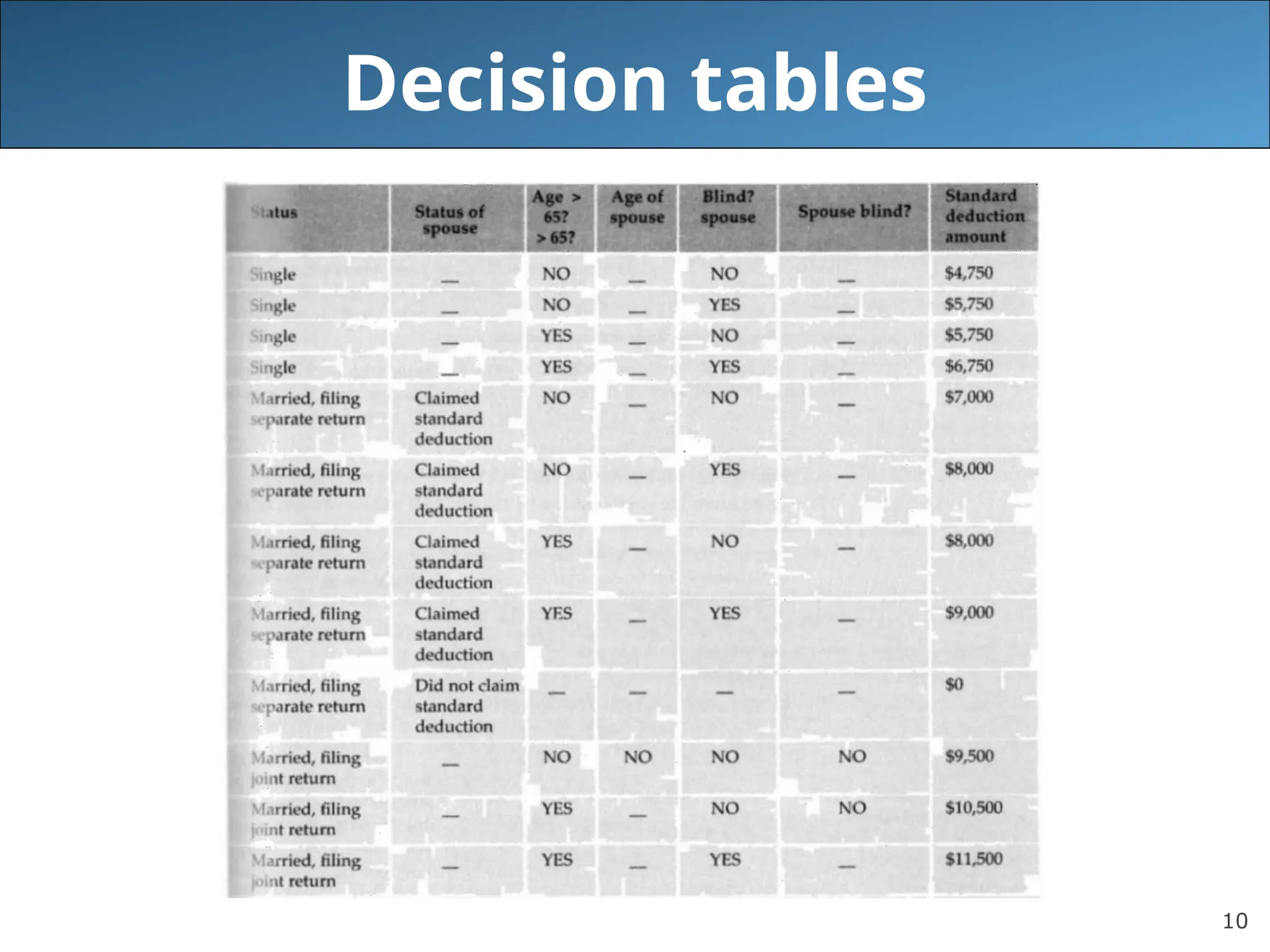
• decision tables
• equivalence partitioning - group related
inputs/outputs
• state-based - based on object state
diagrams
• compatibility testing
• user documentation testing
• domain testing
8
Boundary testing
• boundary value analysis: Testing conditions on bounds
between classes of inputs.
• Why is it useful to test near boundaries?
– likely source of programmer errors (< vs. <=, etc.)
– language has many ways to implement boundary checking
– requirement specs may be fuzzy about behavior on boundaries
– often uncovers internal hidden limits in code
• example: array list must resize its internal array when it fills capacity
9
Boundary example
• Imagine we are testing a Date class with a
daysInMonth(month, year) method.
– What are some conditions and boundary tests for this
method?
• Possible answers:
– check for leap years (every 4th yr, no 100s, yes 400s)
– try years such as: even 100s, 101s, 4s, 5s
– try months such as: June, July, Feb, invalid values
10
Decision tables
11
Equivalence testing
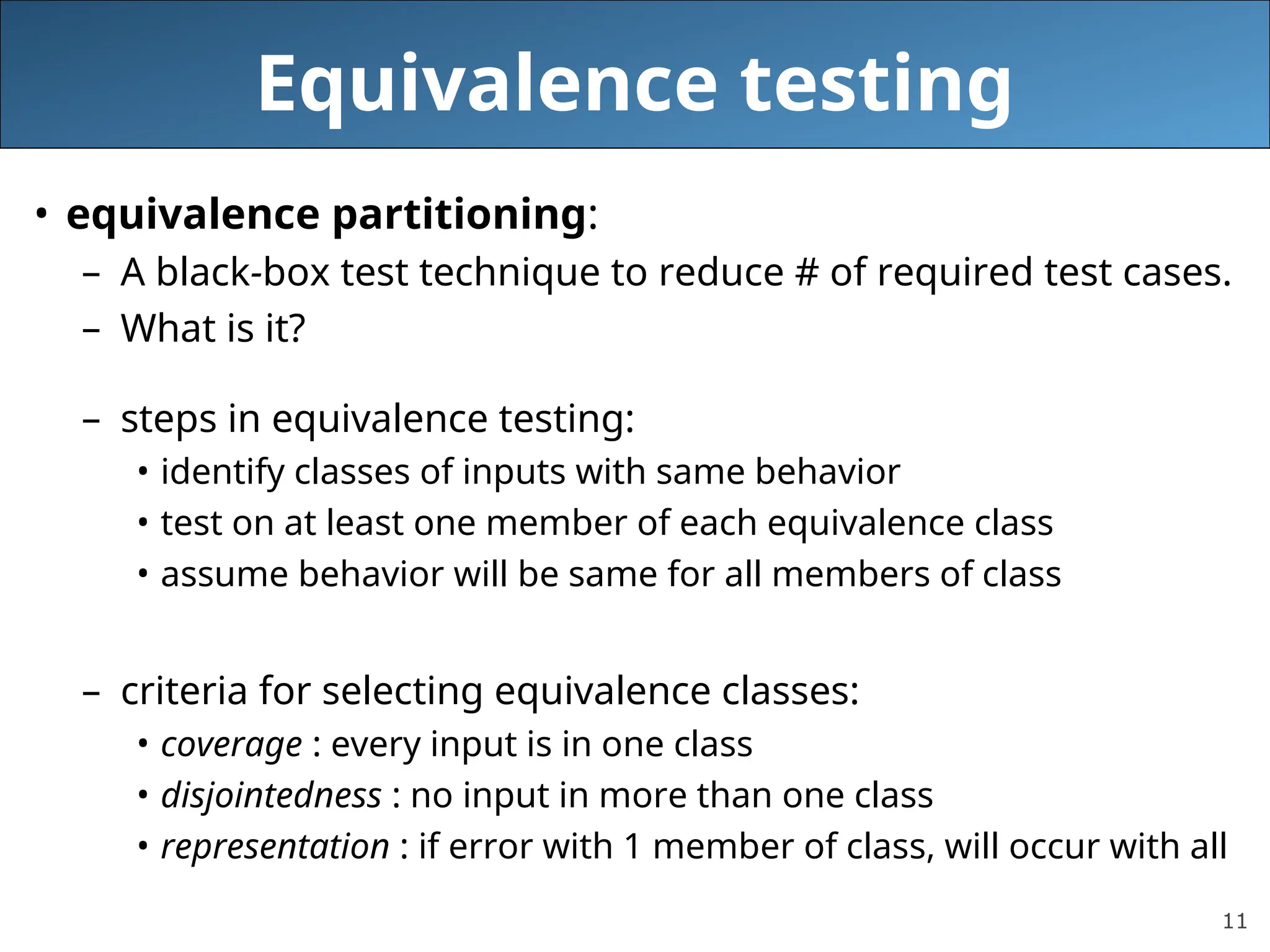
• equivalence partitioning:
– A black-box test technique to reduce # of required test cases.
– What is it?
– steps in equivalence testing:
• identify classes of inputs with same behavior
• test on at least one member of each equivalence class
• assume behavior will be same for all members of class
– criteria for selecting equivalence classes:
• coverage : every input is in one class
• disjointedness : no input in more than one class
• representation : if error with 1 member of class, will occur with all
12
White-box testing
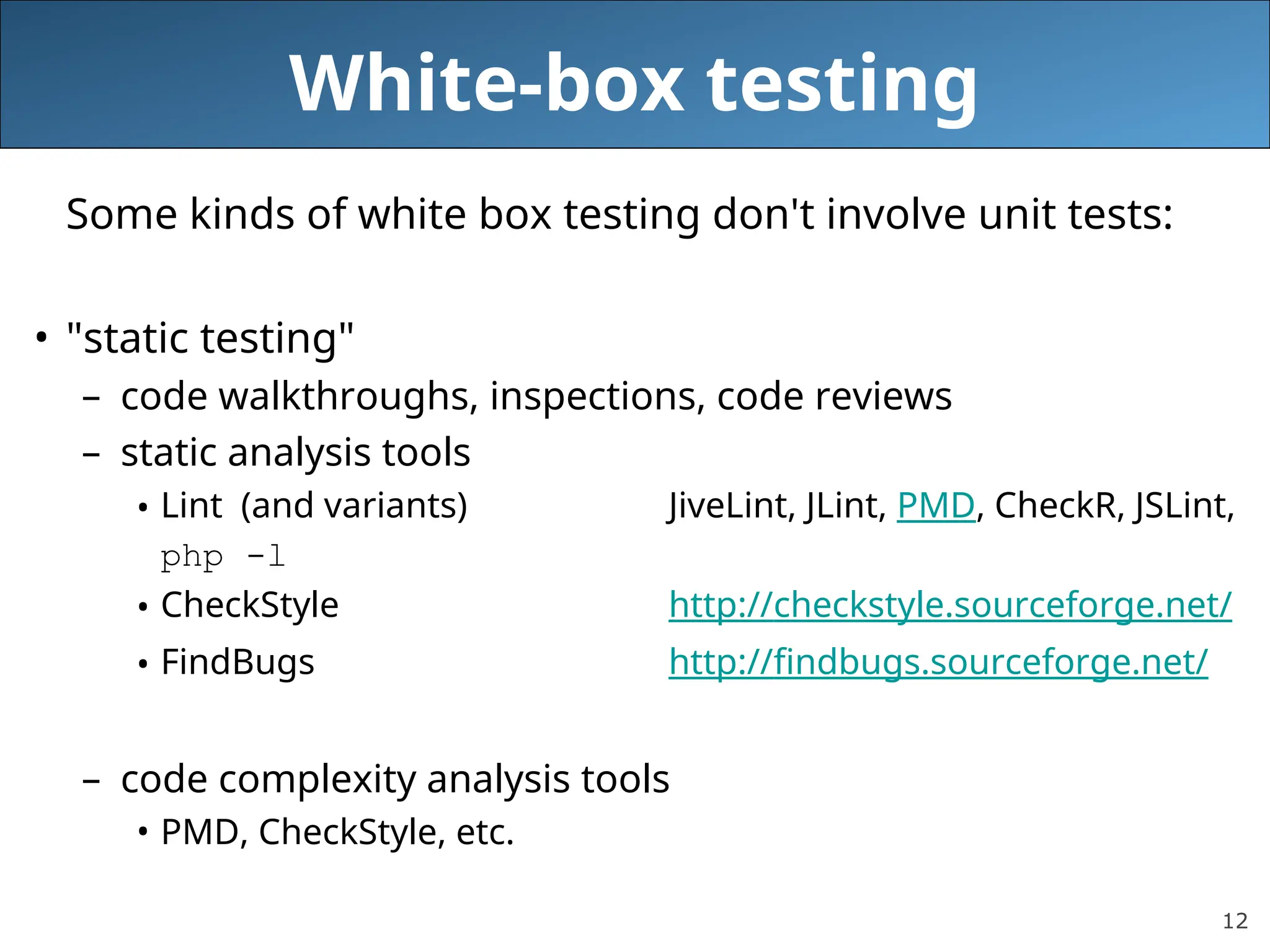
Some kinds of white box testing don't involve unit tests:
• "static testing"
– code walkthroughs, inspections, code reviews
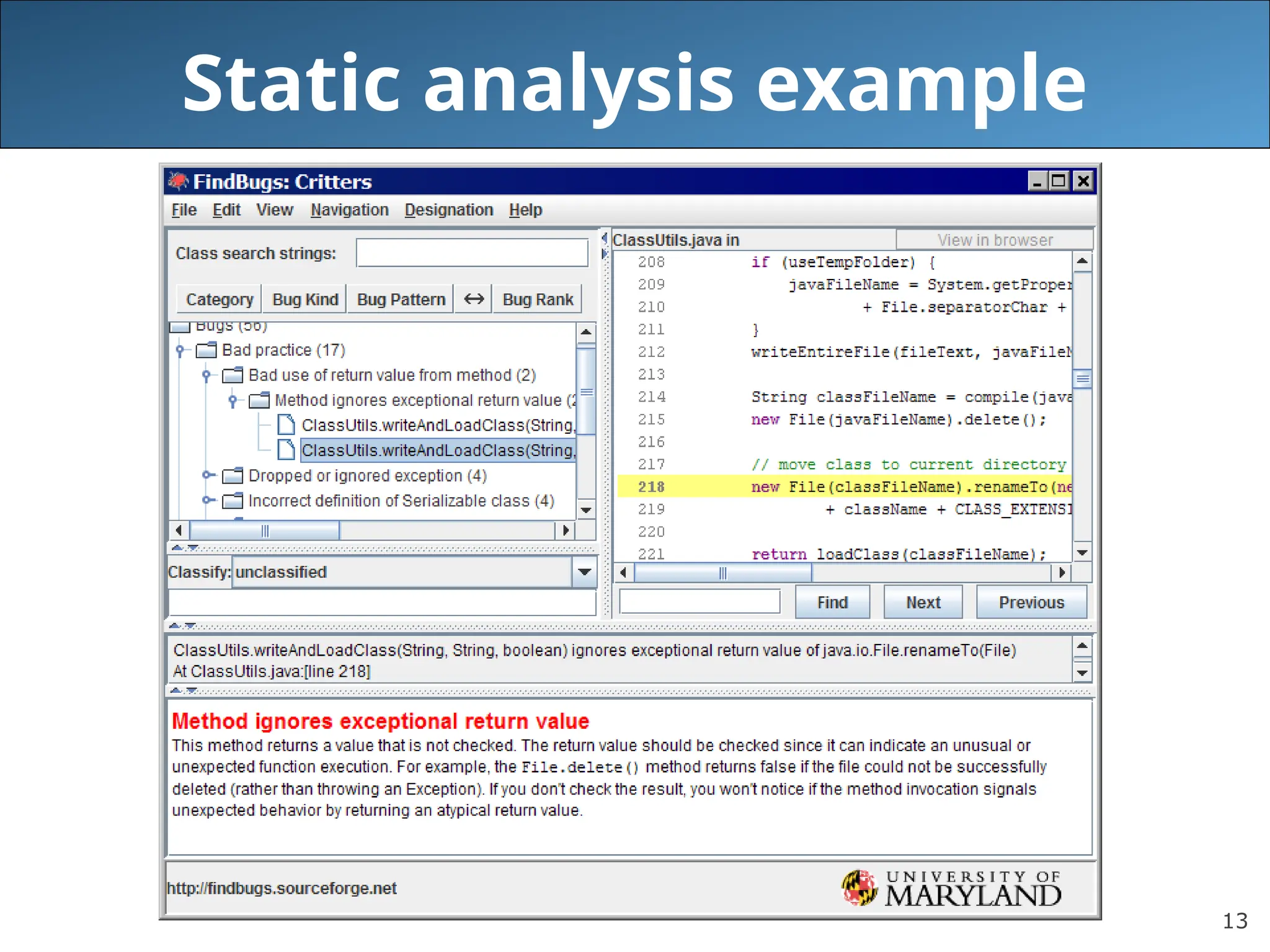
– static analysis tools
• Lint (and variants) JiveLint, JLint, PMD, CheckR, JSLint,
php -l
• CheckStyle http://checkstyle.sourceforge.net/
• FindBugs http://findbugs.sourceforge.net/
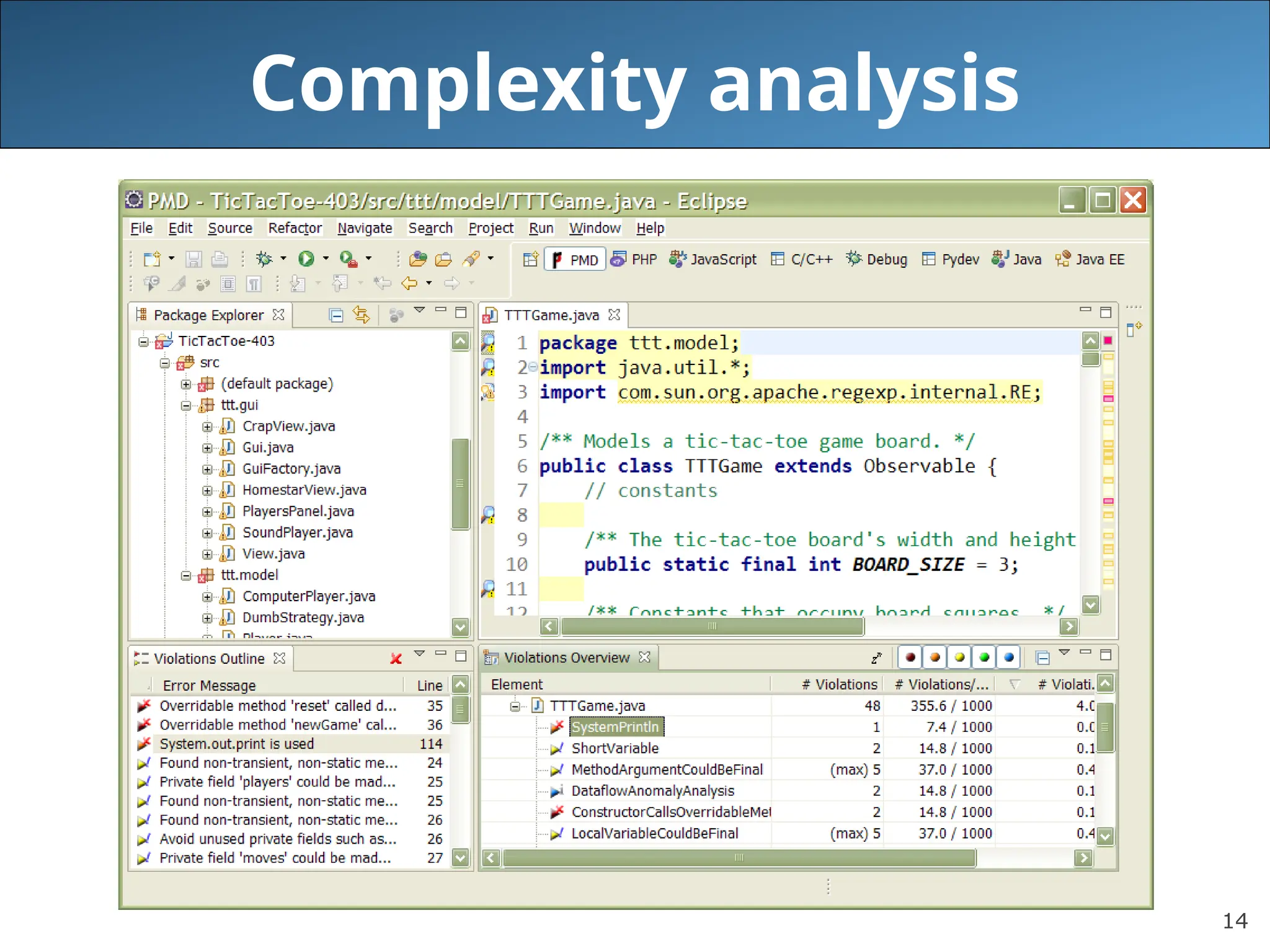
– code complexity analysis tools
• PMD, CheckStyle, etc.
13
Static analysis example
14
Complexity analysis
15
Path testing
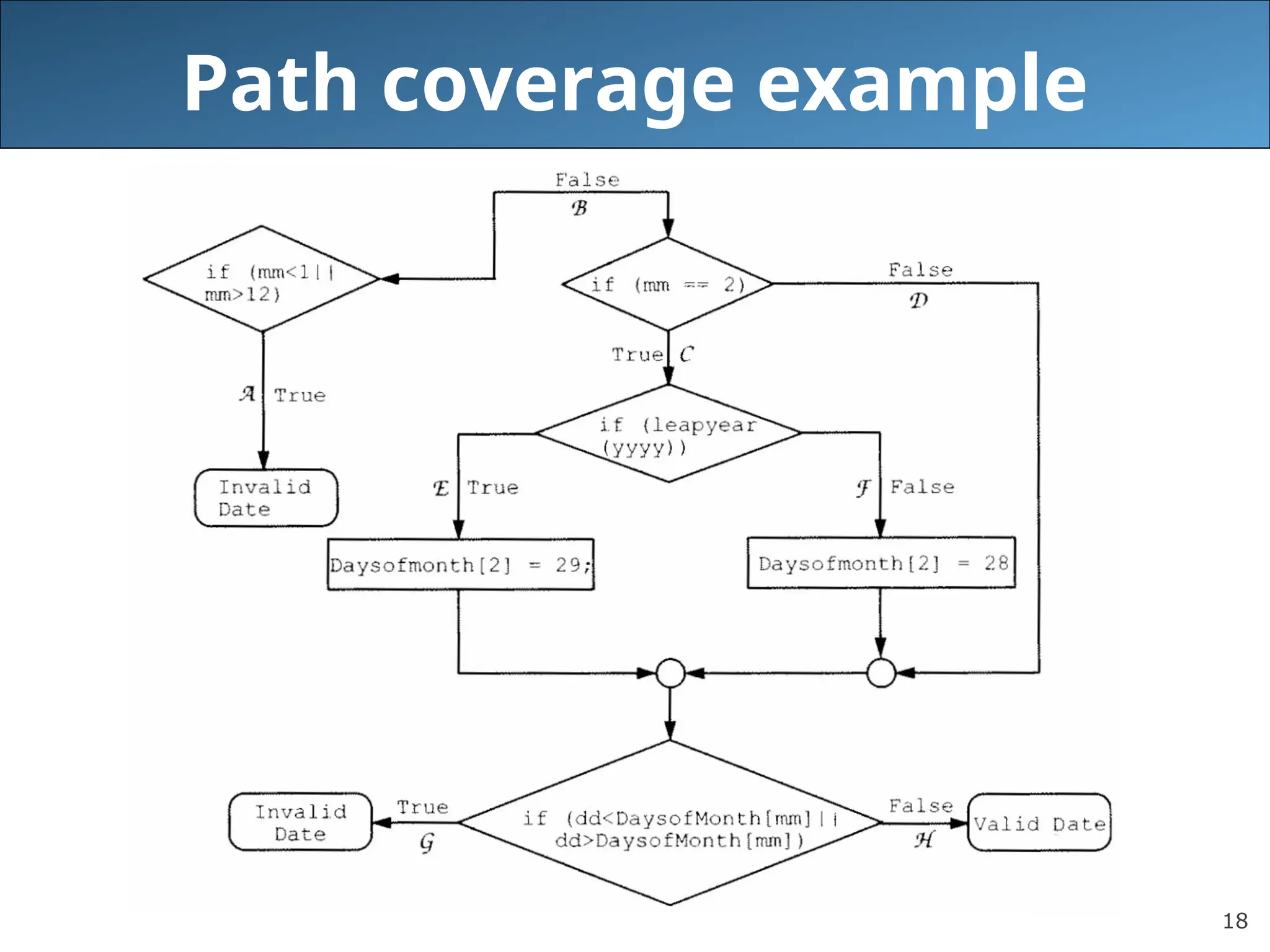
• path testing: an attempt to use test input that will pass
once over each path in the code
– path testing is white box
– What would be path testing for daysInMonth(month, year)?
some ideas:
• error input: year < 1, month < 1, month > 12
• one month from [1, 3, 5, 7, 10, 12]
• one month from [4, 6, 9, 11]
• month 2
– in a leap year, not in a leap year
16
Code coverage testing
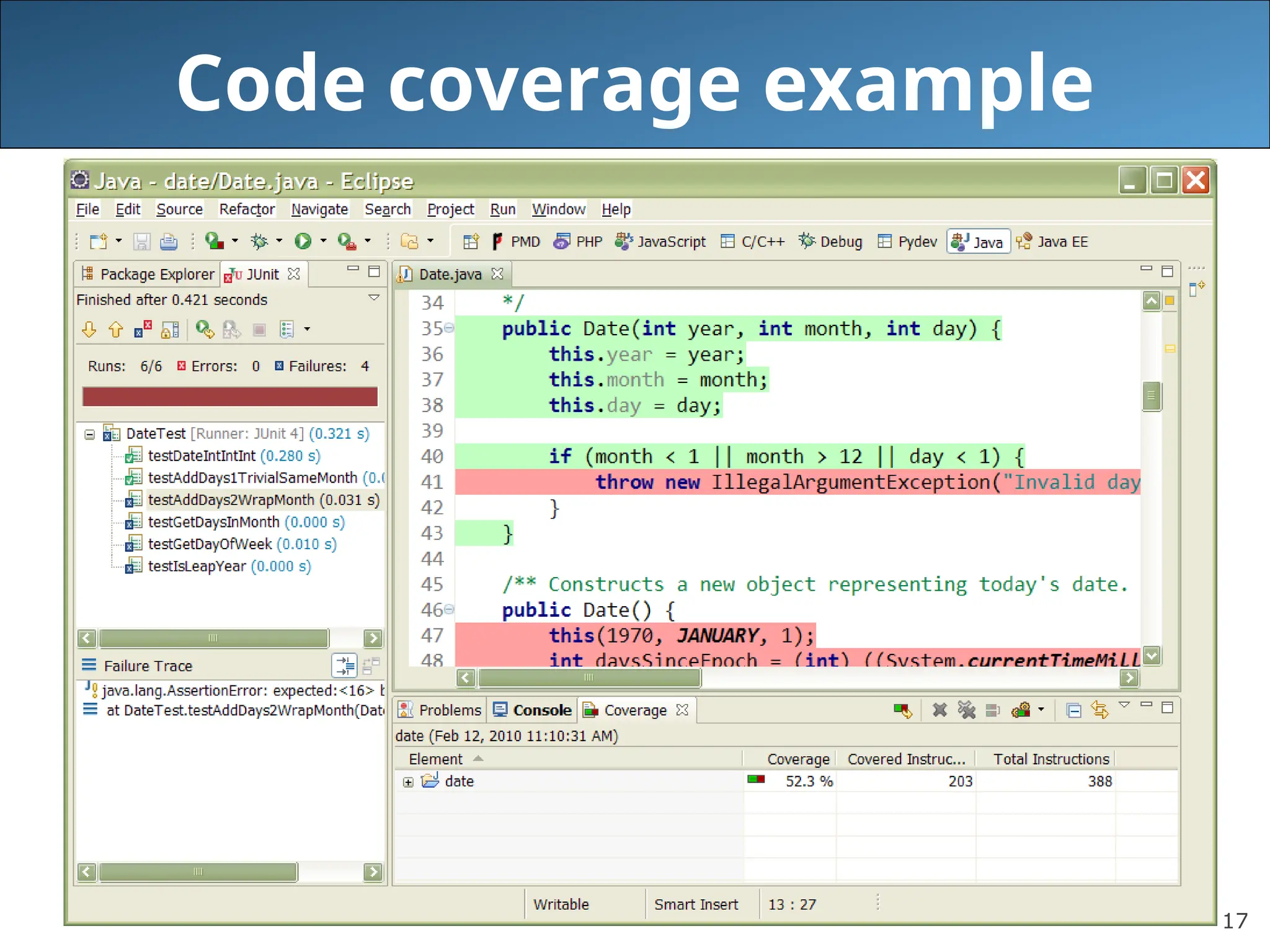
• code coverage testing: Examines what fraction of the code
under test is reached by existing unit tests.
– statement coverage - tries to reach every line (impractical)
– path coverage - follow every distinct branch through code
– condition coverage - every condition that leads to a branch
– function coverage - treat every behavior / end goal
separately
• Several nice tools exist for checking code coverage
– EclEmma, Cobertura, Hansel, NoUnit, CoView ...
17
Code coverage example
18
Path coverage example
19
White box testing is hard
• Developers can't easily spot flaws in their own code.
• Test cases that are too focused on code may not be
thinking about how the class is actually going to be used.
• Code coverage tools can give a false sense of security.
– Just because code is "covered" doesn't mean it is free of bugs.
• Code complexity can be misleading.
– Complex code is not always bad code.
– Complexity analysis tools can be overly picky or cumbersome.
20
Testing exercise 1
• Imagine that we have a Date class with working methods
called isLeapYear(year) and daysInMonth(month, year).
– Question: What is the pseudo-code for the algorithm for an
addDays(days) method that moves the current Date object
forward in time by the given number of days. A negative
value moves the Date backward in time.
– Question: Come up with a set of test values for your addDays
method to test its correctness.
21
Testing exercise 2
• Consider tests to determine whether a Scrabble move is legal:
– Are all tiles in a straight line?
– Are the tiles contiguous or separated only by existing old tiles?
– Are the tiles touching an existing old tile?
– On each of the words made:
• What is the score of this word?
• Is this word in the dictionary?
• Question: What is/are some suitable Scrabble test board
configuration(s) and moves that check each of these
conditions?
– Make both passing and failing tests.

13-blackwhiteboxtestingfreedownloading.ppt

  • 1.
    CSE 403 Lecture 13 Black/White-BoxTesting Reading: Software Testing: Principles and Practices, Ch. 3-4 (Desikan, Ramesh) slides created by Marty Stepp http://www.cs.washington.edu/403/
  • 2.
    2 Testing questions • ShouldI test my own code, or should somebody else? • Which code of my project should I test the most/least? • Can I test all possible inputs to see whether something works? • How do I know if I've tested well/enough? • What constitutes a good or bad test case method? • Is it good or bad if a test case fails? • What if a test case itself has a bug in it?
  • 3.
    3 JUnit exercise Given aDate class with the following methods: – public Date(int year, int month, int day) – public Date() // today – public int getDay(), getMonth(), getYear() – public void addDays(int days) // advances by days – public int daysInMonth() – public String dayOfWeek() // e.g. "Sunday" – public boolean equals(Object o) – public boolean isLeapYear() – public void nextDay() // advances by 1 day – public String toString() • Come up with unit tests to check the following: – That no Date object can ever get into an invalid state. – That the addDays method works properly. • It should be efficient enough to add 1,000,000 days in a call.
  • 4.
    4 Test-driven development • Imaginethat we'd like to add a method subtractWeeks to our Date class, that shifts this Date backward in time by the given number of weeks. • Write code to test this method before it has been written. – This way, once we do implement the method, we'll know whether it works.
  • 5.
    5 Black and whitebox testing What is the difference between black- and white-box testing? • black-box (procedural) test: Written without knowledge of how the class under test is implemented. – focuses on input/output of each component or call • white-box (structural) test: Written with knowledge of the implementation of the code under test. – focuses on internal states of objects and code – focuses on trying to cover all code paths/statements – requires internal knowledge of the component to craft input • example: knowing that the internal data structure for a spreadsheet uses 256 rows/columns, test with 255 or 257
  • 6.
    6 Black-box testing • black-boxis based on requirements and functionality, not code • tester may have actually seen the code before ("gray box") – but doesn't look at it while constructing the tests • often done from the end user or OO client's perspective • emphasis on parameters, inputs/outputs (and their validity)
  • 7.
    7 Types of black-box •requirements based • positive/negative - checks both good/bad results • boundary value analysis • decision tables • equivalence partitioning - group related inputs/outputs • state-based - based on object state diagrams • compatibility testing • user documentation testing • domain testing
  • 8.
    8 Boundary testing • boundaryvalue analysis: Testing conditions on bounds between classes of inputs. • Why is it useful to test near boundaries? – likely source of programmer errors (< vs. <=, etc.) – language has many ways to implement boundary checking – requirement specs may be fuzzy about behavior on boundaries – often uncovers internal hidden limits in code • example: array list must resize its internal array when it fills capacity
  • 9.
    9 Boundary example • Imaginewe are testing a Date class with a daysInMonth(month, year) method. – What are some conditions and boundary tests for this method? • Possible answers: – check for leap years (every 4th yr, no 100s, yes 400s) – try years such as: even 100s, 101s, 4s, 5s – try months such as: June, July, Feb, invalid values
  • 10.
  • 11.
    11 Equivalence testing • equivalencepartitioning: – A black-box test technique to reduce # of required test cases. – What is it? – steps in equivalence testing: • identify classes of inputs with same behavior • test on at least one member of each equivalence class • assume behavior will be same for all members of class – criteria for selecting equivalence classes: • coverage : every input is in one class • disjointedness : no input in more than one class • representation : if error with 1 member of class, will occur with all
  • 12.
    12 White-box testing Some kindsof white box testing don't involve unit tests: • "static testing" – code walkthroughs, inspections, code reviews – static analysis tools • Lint (and variants) JiveLint, JLint, PMD, CheckR, JSLint, php -l • CheckStyle http://checkstyle.sourceforge.net/ • FindBugs http://findbugs.sourceforge.net/ – code complexity analysis tools • PMD, CheckStyle, etc.
  • 13.
  • 14.
  • 15.
    15 Path testing • pathtesting: an attempt to use test input that will pass once over each path in the code – path testing is white box – What would be path testing for daysInMonth(month, year)? some ideas: • error input: year < 1, month < 1, month > 12 • one month from [1, 3, 5, 7, 10, 12] • one month from [4, 6, 9, 11] • month 2 – in a leap year, not in a leap year
  • 16.
    16 Code coverage testing •code coverage testing: Examines what fraction of the code under test is reached by existing unit tests. – statement coverage - tries to reach every line (impractical) – path coverage - follow every distinct branch through code – condition coverage - every condition that leads to a branch – function coverage - treat every behavior / end goal separately • Several nice tools exist for checking code coverage – EclEmma, Cobertura, Hansel, NoUnit, CoView ...
  • 17.
  • 18.
  • 19.
    19 White box testingis hard • Developers can't easily spot flaws in their own code. • Test cases that are too focused on code may not be thinking about how the class is actually going to be used. • Code coverage tools can give a false sense of security. – Just because code is "covered" doesn't mean it is free of bugs. • Code complexity can be misleading. – Complex code is not always bad code. – Complexity analysis tools can be overly picky or cumbersome.
  • 20.
    20 Testing exercise 1 •Imagine that we have a Date class with working methods called isLeapYear(year) and daysInMonth(month, year). – Question: What is the pseudo-code for the algorithm for an addDays(days) method that moves the current Date object forward in time by the given number of days. A negative value moves the Date backward in time. – Question: Come up with a set of test values for your addDays method to test its correctness.
  • 21.
    21 Testing exercise 2 •Consider tests to determine whether a Scrabble move is legal: – Are all tiles in a straight line? – Are the tiles contiguous or separated only by existing old tiles? – Are the tiles touching an existing old tile? – On each of the words made: • What is the score of this word? • Is this word in the dictionary? • Question: What is/are some suitable Scrabble test board configuration(s) and moves that check each of these conditions? – Make both passing and failing tests.

Editor's Notes

  • #3 some ideas: - write a too-big test for addDays with for loops and many calls - develop a test-add-days-helper method that is called by many tests - show the benefit of testing against a known "expected" object rather than 3 ints
  • #5 (test case example: Microsoft Web Excel)