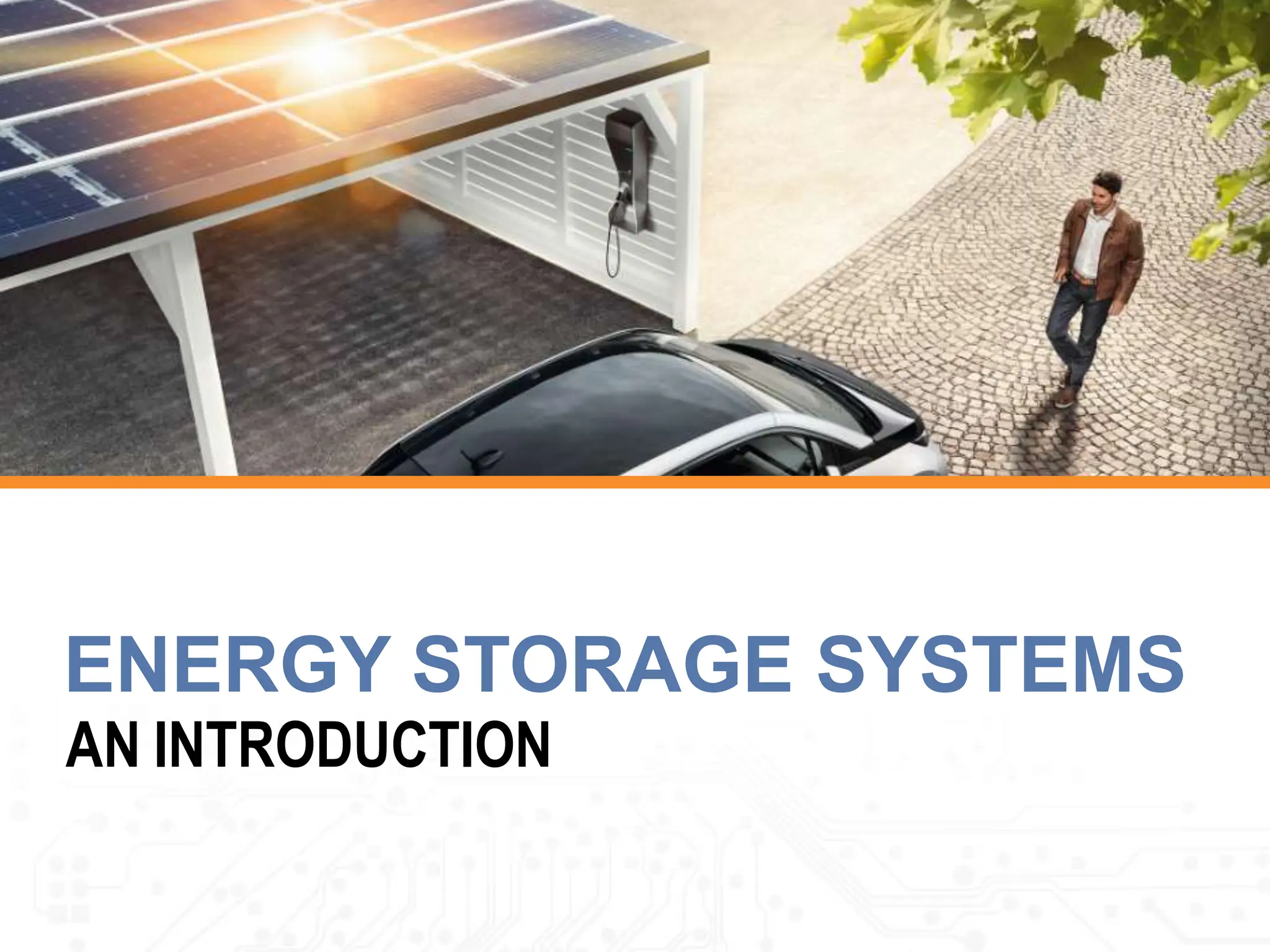
ENERGY STORAGE SYSTEMS
Date
AN INTRODUCTION
CHARACTERISTICS OF ENERGY STORAGE TECHNIQUES
Energy storage techniques can be classified
corroding to these criteria:
• The type of application: permanent or
portable.
• Storage duration: short or long term.
• Type of product: maximum power needed.
It is therefore necessary to analyse critically the
fundamental characteristics (technical and
economical) of storage systems in order to
establish comparison criteria are for selecting
the best technology.
The main characteristic of storage systems on
which the selection criteria are based the
following.
Storage Capacity
This is the quality of available energy in the
storage system after charging. Discharge is
often incomplete. For this reason, it is defined
on the basis of total energy stored, Wst (Wh),
which is superior to that actually retrieved
(operational), noted Wut (Wh). The usable
energy, limited by the depth of discharge,
represents the limit of discharge depth
(maximum-charge state). In conditions of the
quick charge or discharge, the efficiency
deteriorates and the retrievable energy can be
much lower than storage capacity. On the
other hand, selfdischarge is the attenuating
factor under very slow regime (see Fig. 16).
Available power
This parameter determines the constitution and
size of the motor-generator in the stored
energy conversion chain. It is generally
expressed an as average value, as well as a
peak value often used to represent maximum
power of charge or discharge, Pmax(W)1.
Depth of discharge or power transmission rate
Energy storage is a slow process that
subsequently must quickly release energy on
demand. The power output, or discharge, can
be a limiting factor called the power
transmission rate. This delivery rate
determines the time needed to extract the
stored energy. The power must be available
for delivery during peak hours, that is to say
the amount of energy used, if significant, is
representative of a non-optimum system
design, or a fundamental limit of the storage
apparatus.
CHARACTERISTICS OF ENERGY STORAGE TECHNIQUES
ELECTRIC ENERGY
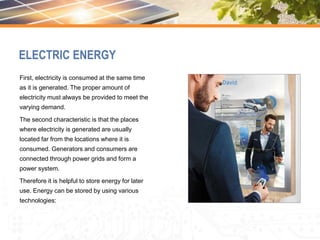
First, electricity is consumed at the same time
as it is generated. The proper amount of
electricity must always be provided to meet the
varying demand.
The second characteristic is that the places
where electricity is generated are usually
located far from the locations where it is
consumed. Generators and consumers are
connected through power grids and form a
power system.
Therefore it is helpful to store energy for later
use. Energy can be stored by using various
technologies:
ENERGY STORAGE TECHNOLOGIES
Flywheels
Mechanical Energy
Storage
Kinetic
Energy
Storage
Potential
Energy
Storage
Electrostatic
Energy
Storage
Electrical Energy
Storage
Compressed
Air
Pumped
Hydro
Magnet/current
Energy
Storage
Thermal Energy
Storage
Chemical Energy
Storage
Low
Temperature
Energy
Storage
High
Temperature
Energy
Storage
Electro-
chemical
ES
Chemical
ES
Capacitors
Supercapacitors
Superconducting
Magnetic Energy
Storage
Aquifier LT-ES
Cryogenic LT-ES
Sensible Heat
Storage
Latent Heat
Storage
Batteries
Fuel Cells
Solar
Hydrogen
Solar Metal
Solar
Ammonia
Solar Methane
Thermal
ES
The Bath County Pumped Storage Station is a
pumped storage hydroelectric power plant, which is
described as the “largest battery in the world”, with a
generation capacity of 3,003 MW[3] The station is
located in the northern corner of Bath County,
Virginia, on the southeast side of the Eastern
Continental Divide, which forms this section of the
border between Virginia and West Virginia. The
station consists of two reservoirs separated by about
1,260 feet (380 m) in elevation.
It is the largest pumped-storage power station in the
world. Construction on the power station, with an
original capacity of 2,100 megawatts (2,800,000
hp), began in March 1977 and was completed in
December 1985 at a cost of $1.6 billion, Voith-
Siemens upgraded the six turbines between 2004
and 2009, increasing power generation to 500.5
MW and pumping power to 480 megawatts
(640,000 hp) for each turbine.
MECHANICAL ENERGY
Technology Type
Open-loop Pumped
Hydro Storage (Time Shift)
Rated Power in kW
3,003,000
Duration at Rated Power
10:18.00
ELECTRICAL ENERGY STORAGE
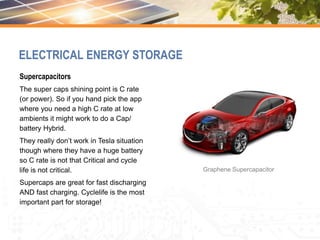
Supercapacitors
The super caps shining point is C rate
(or power). So if you hand pick the app
where you need a high C rate at low
ambients it might work to do a Cap/
battery Hybrid.
They really don’t work in Tesla situation
though where they have a huge battery
so C rate is not that Critical and cycle
life is not critical.
Supercaps are great for fast discharging
AND fast charging. Cyclelife is the most
important part for storage!
Graphene Supercapacitor
ELECTRICAL ENERGY STORAGE
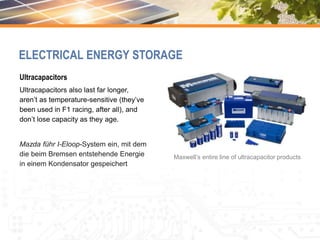
Ultracapacitors
Ultracapacitors also last far longer,
aren’t as temperature-sensitive (they’ve
been used in F1 racing, after all), and
don’t lose capacity as they age.
Mazda führ I-Eloop-System ein, mit dem
die beim Bremsen entstehende Energie
in einem Kondensator gespeichert
Maxwell’s entire line of ultracapacitor products
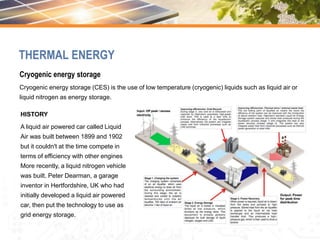
Cryogenic energy storage
Cryogenic energy storage (CES) is the use of low temperature (cryogenic) liquids such as liquid air or
liquid nitrogen as energy storage.
HISTORY
A liquid air powered car called Liquid
Air was built between 1899 and 1902
but it couldn't at the time compete in
terms of efficiency with other engines
More recently, a liquid nitrogen vehicle
was built. Peter Dearman, a garage
inventor in Hertfordshire, UK who had
initially developed a liquid air powered
car, then put the technology to use as
grid energy storage.
THERMAL ENERGY
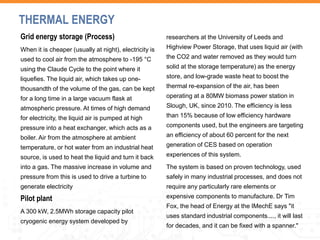
Grid energy storage (Process)
When it is cheaper (usually at night), electricity is
used to cool air from the atmosphere to -195 °C
using the Claude Cycle to the point where it
liquefies. The liquid air, which takes up one-
thousandth of the volume of the gas, can be kept
for a long time in a large vacuum flask at
atmospheric pressure. At times of high demand
for electricity, the liquid air is pumped at high
pressure into a heat exchanger, which acts as a
boiler. Air from the atmosphere at ambient
temperature, or hot water from an industrial heat
source, is used to heat the liquid and turn it back
into a gas. The massive increase in volume and
pressure from this is used to drive a turbine to
generate electricity
Pilot plant
A 300 kW, 2.5MWh storage capacity pilot
cryogenic energy system developed by
researchers at the University of Leeds and
Highview Power Storage, that uses liquid air (with
the CO2 and water removed as they would turn
solid at the storage temperature) as the energy
store, and low-grade waste heat to boost the
thermal re-expansion of the air, has been
operating at a 80MW biomass power station in
Slough, UK, since 2010. The efficiency is less
than 15% because of low efficiency hardware
components used, but the engineers are targeting
an efficiency of about 60 percent for the next
generation of CES based on operation
experiences of this system.
The system is based on proven technology, used
safely in many industrial processes, and does not
require any particularly rare elements or
expensive components to manufacture. Dr Tim
Fox, the head of Energy at the IMechE says "it
uses standard industrial components...., it will last
for decades, and it can be fixed with a spanner."
THERMAL ENERGY
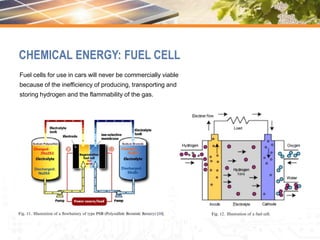
A fuel cell is a device that converts the chemical
energy from a fuel into electricity through a
chemical reaction of positively charged hydrogen
ions with oxygen or another oxidizing agent. Fuel
cells are different from batteries in that they
require a continuous source of fuel and oxygen or
air to sustain the chemical reaction, whereas in a
battery the chemicals present in the battery react
with each other to generate an electromotive
force. Fuel cells can produce electricity
continuously for as long as these inputs are
supplied.
CHEMICAL ENERGY: FUEL CELL
Vehicle
Model
Year
Combined Fuel
Economy
City
Fuel Economy
Highway
Fuel Economy
Range
Annual
Fuel Cost
Honda FCX Clarity 2014 59 mpg-e 58 mpg-e 60 mpg-e 231 mi (372 km) NA
Hyundai Tuscon Fuel Cell 2016 50 mpg-e 49 mpg-e 51 mpg-e 265 mi (426 km) US$1,700
Toyota Mirai 2016 66 mpg-e 66 mpg-e 66 mpg-e 321 mi (502 km) US$1,250
Notes: One kg of hydrogen is rough equivalent to one U.S. gallon of gasoline.
Comparison of fuel economy express in MPGe for hydrogen fuel cell vehicles
Available for leasing in California and rated by the U.S. Environmental Protection Agency as of August 2015 [23]
Fuel cells for use in cars will never be commercially viable
because of the inefficiency of producing, transporting and
storing hydrogen and the flammability of the gas.
CHEMICAL ENERGY: FUEL CELL
Sensible heat thermal storage is achieved
by heating a bulk material (sodium, molten
salt, pressurized water, etc.) that does not
change states during the accumulation
phase; the heat is then recovered to
produce water vapor, which drives a turbo-
alternator system.
The use of molten salt in the Themis station
in France has made it possible to store heat
economically and simplify the regulation of
the solar panel (Fig. 5.)[8]. This system was
designed to store 40,000 kWh of thermal
energy, equivalent to almost 1 day of
average sunlight, in 550 tonnes of fused
electrolyte [8].
SENSIBLE HEAT THERMAL STORAGE
WORLDWIDE INSTALLED STORAGE CAPACITY
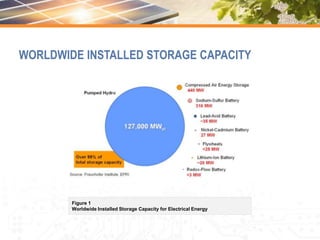
Figure 1
Worldwide Installed Storage Capacity for Electrical Energy
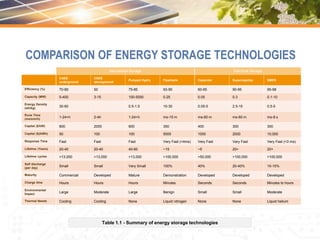
COMPARISON OF ENERGY STORAGE TECHNOLOGIES
Mechanical Storage Electrical Storage
CAES
underground
CAES
aboveground
Pumped Hydro Flywheels Capacitor Supercapcitor SMES
Efficiency (%) 70-89 50 75-85 93-95 60-65 90-95 95-98
Capacity (MW) 5-400 3-15 100-5000 0.25 0.05 0.3 0.1-10
Energy Density
(wh/kg)
30-60 0.5-1.5 10-30 0.05-5 2.5-15 0.5-5
Rune Time
(ms/s/m/h)
1-24+h 2-4h 1-24+h ms-15 m ms-60 m ms-60 m ms-8 s
Capital ($/kW) 800 2000 600 350 400 300 300
Capital ($|/kWh) 50 100 100 5000 1000 2000 10,000
Response Time Fast Fast Fast Very Fast (<4ms) Very Fast Very Fast Very Fast (<3 ms)
Lifetime (Years) 20-40 20-40 40-60 ~15 ~5 20+ 20+
Lifetime cycles >13,000 >13,000 >13,000 >100,000 >50,000 >100,000 >100,000
Self discharge
(per day)
Small Small Very Small 100% 40% 20-40% 10-15%
Maturity Commercial Developed Mature Demonstration Developed Developed Developed
Charge time Hours Hours Hours Minutes Seconds Seconds Minutes to hours
Environmental
Impact
Large Moderate Large Benign Small Small Moderate
Thermal Needs Cooling Cooling None Liquid nitrogen None None Liquid helium
Table 1.1 - Summary of energy storage technologies
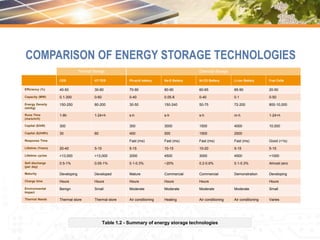
COMPARISON OF ENERGY STORAGE TECHNOLOGIES
Table 1.2 - Summary of energy storage technologies
Thermal Storage Chemical Storage
CES HT-TES Pb-acid battery Na-S Battery Ni-CD Battery Li-ion Battery Fuel Cells
Efficiency (%) 40-50 30-60 70-90 80-90 60-65 85-90 20-50
Capacity (MW) 0.1-300 0-60 0-40 0.05-8 0-40 0.1 0-50
Energy Density
(wh/kg)
150-250 80-200 30-50 150-240 50-75 72-200 800-10,000
Rune Time
(ms/s/m/h)
1-8h 1-24+h s-h s-h s-h m-h 1-24+h
Capital ($/kW) 300 300 3000 1500 4000 10,000
Capital ($|/kWh) 30 60 400 500 1500 2500
Response Time Fast (ms) Fast (ms) Fast (ms) Fast (ms) Good (<1s)
Lifetime (Years) 20-40 5-15 5-15 10-15 10-20 5-15 5-15
Lifetime cycles >13,000 >13,000 2000 4500 3000 4500 >1000
Self discharge
(per day)
0.5-1% 0.05-1% 0.1-0.3% ~20% 0.2-0.6% 0.1-0.3% Almost zero
Maturity Developing Developed Mature Commercial Commercial Demonstration Developing
Charge time Hours Hours Hours Hours Hours Hours
Environmental
Impact
Benign Small Moderate Moderate Moderate Moderate Small
Thermal Needs Thermal store Thermal store Air conditioning Heating Air conditioning Air conditioning Varies
STORAGE TECHNIQUES
Figure 24 – Distribution of storage techniques as a function of investment costs per unit of energy [10].
100 1,000 3,000 10,000
10,000
Capital
Cost
per
Unit
Energy
–
5kWh-output
(Cost/capacity/efficiency)
Capital Cost per Unit Power - $/kW
High Power
E.C. Capacitors
Long Duration
Flywheels
10
100
1,000
Pumped
Hydro
CAES
Flow Batteries
300
Li-ion
NaS
Battery
Long Duration
E.C. Capacitors
Lead-Acid
Batteries
Metal-Air
Batteries
High Power
Fly Wheels
Zinc-Air
Batteries
Rechargeable
Ni-Cd
Better for UPS and
Power Quality Applications
Better
for
Energy
Management
Applications
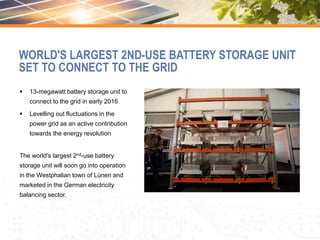
 13-megawatt battery storage unit to
connect to the grid in early 2016
 Levelling out fluctuations in the
power grid as an active contribution
towards the energy revolution
The world's largest 2nd-use battery
storage unit will soon go into operation
in the Westphalian town of Lünen and
marketed in the German electricity
balancing sector.
WORLD'S LARGEST 2ND-USE BATTERY STORAGE UNIT
SET TO CONNECT TO THE GRID
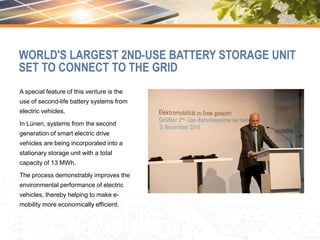
A special feature of this venture is the
use of second-life battery systems from
electric vehicles.
In Lünen, systems from the second
generation of smart electric drive
vehicles are being incorporated into a
stationary storage unit with a total
capacity of 13 MWh.
The process demonstrably improves the
environmental performance of electric
vehicles, thereby helping to make e-
mobility more economically efficient.
WORLD'S LARGEST 2ND-USE BATTERY STORAGE UNIT
SET TO CONNECT TO THE GRID

12629131.ppt

  • 1.
  • 2.
    CHARACTERISTICS OF ENERGYSTORAGE TECHNIQUES Energy storage techniques can be classified corroding to these criteria: • The type of application: permanent or portable. • Storage duration: short or long term. • Type of product: maximum power needed. It is therefore necessary to analyse critically the fundamental characteristics (technical and economical) of storage systems in order to establish comparison criteria are for selecting the best technology. The main characteristic of storage systems on which the selection criteria are based the following. Storage Capacity This is the quality of available energy in the storage system after charging. Discharge is often incomplete. For this reason, it is defined on the basis of total energy stored, Wst (Wh), which is superior to that actually retrieved (operational), noted Wut (Wh). The usable energy, limited by the depth of discharge, represents the limit of discharge depth (maximum-charge state). In conditions of the quick charge or discharge, the efficiency deteriorates and the retrievable energy can be much lower than storage capacity. On the other hand, selfdischarge is the attenuating factor under very slow regime (see Fig. 16).
  • 3.
    Available power This parameterdetermines the constitution and size of the motor-generator in the stored energy conversion chain. It is generally expressed an as average value, as well as a peak value often used to represent maximum power of charge or discharge, Pmax(W)1. Depth of discharge or power transmission rate Energy storage is a slow process that subsequently must quickly release energy on demand. The power output, or discharge, can be a limiting factor called the power transmission rate. This delivery rate determines the time needed to extract the stored energy. The power must be available for delivery during peak hours, that is to say the amount of energy used, if significant, is representative of a non-optimum system design, or a fundamental limit of the storage apparatus. CHARACTERISTICS OF ENERGY STORAGE TECHNIQUES
  • 4.
    ELECTRIC ENERGY First, electricityis consumed at the same time as it is generated. The proper amount of electricity must always be provided to meet the varying demand. The second characteristic is that the places where electricity is generated are usually located far from the locations where it is consumed. Generators and consumers are connected through power grids and form a power system. Therefore it is helpful to store energy for later use. Energy can be stored by using various technologies:
  • 5.
    ENERGY STORAGE TECHNOLOGIES Flywheels MechanicalEnergy Storage Kinetic Energy Storage Potential Energy Storage Electrostatic Energy Storage Electrical Energy Storage Compressed Air Pumped Hydro Magnet/current Energy Storage Thermal Energy Storage Chemical Energy Storage Low Temperature Energy Storage High Temperature Energy Storage Electro- chemical ES Chemical ES Capacitors Supercapacitors Superconducting Magnetic Energy Storage Aquifier LT-ES Cryogenic LT-ES Sensible Heat Storage Latent Heat Storage Batteries Fuel Cells Solar Hydrogen Solar Metal Solar Ammonia Solar Methane Thermal ES
  • 6.
    The Bath CountyPumped Storage Station is a pumped storage hydroelectric power plant, which is described as the “largest battery in the world”, with a generation capacity of 3,003 MW[3] The station is located in the northern corner of Bath County, Virginia, on the southeast side of the Eastern Continental Divide, which forms this section of the border between Virginia and West Virginia. The station consists of two reservoirs separated by about 1,260 feet (380 m) in elevation. It is the largest pumped-storage power station in the world. Construction on the power station, with an original capacity of 2,100 megawatts (2,800,000 hp), began in March 1977 and was completed in December 1985 at a cost of $1.6 billion, Voith- Siemens upgraded the six turbines between 2004 and 2009, increasing power generation to 500.5 MW and pumping power to 480 megawatts (640,000 hp) for each turbine. MECHANICAL ENERGY Technology Type Open-loop Pumped Hydro Storage (Time Shift) Rated Power in kW 3,003,000 Duration at Rated Power 10:18.00
  • 7.
    ELECTRICAL ENERGY STORAGE Supercapacitors Thesuper caps shining point is C rate (or power). So if you hand pick the app where you need a high C rate at low ambients it might work to do a Cap/ battery Hybrid. They really don’t work in Tesla situation though where they have a huge battery so C rate is not that Critical and cycle life is not critical. Supercaps are great for fast discharging AND fast charging. Cyclelife is the most important part for storage! Graphene Supercapacitor
  • 8.
    ELECTRICAL ENERGY STORAGE Ultracapacitors Ultracapacitorsalso last far longer, aren’t as temperature-sensitive (they’ve been used in F1 racing, after all), and don’t lose capacity as they age. Mazda führ I-Eloop-System ein, mit dem die beim Bremsen entstehende Energie in einem Kondensator gespeichert Maxwell’s entire line of ultracapacitor products
  • 9.
    Cryogenic energy storage Cryogenicenergy storage (CES) is the use of low temperature (cryogenic) liquids such as liquid air or liquid nitrogen as energy storage. HISTORY A liquid air powered car called Liquid Air was built between 1899 and 1902 but it couldn't at the time compete in terms of efficiency with other engines More recently, a liquid nitrogen vehicle was built. Peter Dearman, a garage inventor in Hertfordshire, UK who had initially developed a liquid air powered car, then put the technology to use as grid energy storage. THERMAL ENERGY
  • 10.
    Grid energy storage(Process) When it is cheaper (usually at night), electricity is used to cool air from the atmosphere to -195 °C using the Claude Cycle to the point where it liquefies. The liquid air, which takes up one- thousandth of the volume of the gas, can be kept for a long time in a large vacuum flask at atmospheric pressure. At times of high demand for electricity, the liquid air is pumped at high pressure into a heat exchanger, which acts as a boiler. Air from the atmosphere at ambient temperature, or hot water from an industrial heat source, is used to heat the liquid and turn it back into a gas. The massive increase in volume and pressure from this is used to drive a turbine to generate electricity Pilot plant A 300 kW, 2.5MWh storage capacity pilot cryogenic energy system developed by researchers at the University of Leeds and Highview Power Storage, that uses liquid air (with the CO2 and water removed as they would turn solid at the storage temperature) as the energy store, and low-grade waste heat to boost the thermal re-expansion of the air, has been operating at a 80MW biomass power station in Slough, UK, since 2010. The efficiency is less than 15% because of low efficiency hardware components used, but the engineers are targeting an efficiency of about 60 percent for the next generation of CES based on operation experiences of this system. The system is based on proven technology, used safely in many industrial processes, and does not require any particularly rare elements or expensive components to manufacture. Dr Tim Fox, the head of Energy at the IMechE says "it uses standard industrial components...., it will last for decades, and it can be fixed with a spanner." THERMAL ENERGY
  • 11.
    A fuel cellis a device that converts the chemical energy from a fuel into electricity through a chemical reaction of positively charged hydrogen ions with oxygen or another oxidizing agent. Fuel cells are different from batteries in that they require a continuous source of fuel and oxygen or air to sustain the chemical reaction, whereas in a battery the chemicals present in the battery react with each other to generate an electromotive force. Fuel cells can produce electricity continuously for as long as these inputs are supplied. CHEMICAL ENERGY: FUEL CELL Vehicle Model Year Combined Fuel Economy City Fuel Economy Highway Fuel Economy Range Annual Fuel Cost Honda FCX Clarity 2014 59 mpg-e 58 mpg-e 60 mpg-e 231 mi (372 km) NA Hyundai Tuscon Fuel Cell 2016 50 mpg-e 49 mpg-e 51 mpg-e 265 mi (426 km) US$1,700 Toyota Mirai 2016 66 mpg-e 66 mpg-e 66 mpg-e 321 mi (502 km) US$1,250 Notes: One kg of hydrogen is rough equivalent to one U.S. gallon of gasoline. Comparison of fuel economy express in MPGe for hydrogen fuel cell vehicles Available for leasing in California and rated by the U.S. Environmental Protection Agency as of August 2015 [23]
  • 12.
    Fuel cells foruse in cars will never be commercially viable because of the inefficiency of producing, transporting and storing hydrogen and the flammability of the gas. CHEMICAL ENERGY: FUEL CELL
  • 13.
    Sensible heat thermalstorage is achieved by heating a bulk material (sodium, molten salt, pressurized water, etc.) that does not change states during the accumulation phase; the heat is then recovered to produce water vapor, which drives a turbo- alternator system. The use of molten salt in the Themis station in France has made it possible to store heat economically and simplify the regulation of the solar panel (Fig. 5.)[8]. This system was designed to store 40,000 kWh of thermal energy, equivalent to almost 1 day of average sunlight, in 550 tonnes of fused electrolyte [8]. SENSIBLE HEAT THERMAL STORAGE
  • 14.
    WORLDWIDE INSTALLED STORAGECAPACITY Figure 1 Worldwide Installed Storage Capacity for Electrical Energy
  • 15.
    COMPARISON OF ENERGYSTORAGE TECHNOLOGIES Mechanical Storage Electrical Storage CAES underground CAES aboveground Pumped Hydro Flywheels Capacitor Supercapcitor SMES Efficiency (%) 70-89 50 75-85 93-95 60-65 90-95 95-98 Capacity (MW) 5-400 3-15 100-5000 0.25 0.05 0.3 0.1-10 Energy Density (wh/kg) 30-60 0.5-1.5 10-30 0.05-5 2.5-15 0.5-5 Rune Time (ms/s/m/h) 1-24+h 2-4h 1-24+h ms-15 m ms-60 m ms-60 m ms-8 s Capital ($/kW) 800 2000 600 350 400 300 300 Capital ($|/kWh) 50 100 100 5000 1000 2000 10,000 Response Time Fast Fast Fast Very Fast (<4ms) Very Fast Very Fast Very Fast (<3 ms) Lifetime (Years) 20-40 20-40 40-60 ~15 ~5 20+ 20+ Lifetime cycles >13,000 >13,000 >13,000 >100,000 >50,000 >100,000 >100,000 Self discharge (per day) Small Small Very Small 100% 40% 20-40% 10-15% Maturity Commercial Developed Mature Demonstration Developed Developed Developed Charge time Hours Hours Hours Minutes Seconds Seconds Minutes to hours Environmental Impact Large Moderate Large Benign Small Small Moderate Thermal Needs Cooling Cooling None Liquid nitrogen None None Liquid helium Table 1.1 - Summary of energy storage technologies
  • 16.
    COMPARISON OF ENERGYSTORAGE TECHNOLOGIES Table 1.2 - Summary of energy storage technologies Thermal Storage Chemical Storage CES HT-TES Pb-acid battery Na-S Battery Ni-CD Battery Li-ion Battery Fuel Cells Efficiency (%) 40-50 30-60 70-90 80-90 60-65 85-90 20-50 Capacity (MW) 0.1-300 0-60 0-40 0.05-8 0-40 0.1 0-50 Energy Density (wh/kg) 150-250 80-200 30-50 150-240 50-75 72-200 800-10,000 Rune Time (ms/s/m/h) 1-8h 1-24+h s-h s-h s-h m-h 1-24+h Capital ($/kW) 300 300 3000 1500 4000 10,000 Capital ($|/kWh) 30 60 400 500 1500 2500 Response Time Fast (ms) Fast (ms) Fast (ms) Fast (ms) Good (<1s) Lifetime (Years) 20-40 5-15 5-15 10-15 10-20 5-15 5-15 Lifetime cycles >13,000 >13,000 2000 4500 3000 4500 >1000 Self discharge (per day) 0.5-1% 0.05-1% 0.1-0.3% ~20% 0.2-0.6% 0.1-0.3% Almost zero Maturity Developing Developed Mature Commercial Commercial Demonstration Developing Charge time Hours Hours Hours Hours Hours Hours Environmental Impact Benign Small Moderate Moderate Moderate Moderate Small Thermal Needs Thermal store Thermal store Air conditioning Heating Air conditioning Air conditioning Varies
  • 17.
    STORAGE TECHNIQUES Figure 24– Distribution of storage techniques as a function of investment costs per unit of energy [10]. 100 1,000 3,000 10,000 10,000 Capital Cost per Unit Energy – 5kWh-output (Cost/capacity/efficiency) Capital Cost per Unit Power - $/kW High Power E.C. Capacitors Long Duration Flywheels 10 100 1,000 Pumped Hydro CAES Flow Batteries 300 Li-ion NaS Battery Long Duration E.C. Capacitors Lead-Acid Batteries Metal-Air Batteries High Power Fly Wheels Zinc-Air Batteries Rechargeable Ni-Cd Better for UPS and Power Quality Applications Better for Energy Management Applications
  • 18.
     13-megawatt batterystorage unit to connect to the grid in early 2016  Levelling out fluctuations in the power grid as an active contribution towards the energy revolution The world's largest 2nd-use battery storage unit will soon go into operation in the Westphalian town of Lünen and marketed in the German electricity balancing sector. WORLD'S LARGEST 2ND-USE BATTERY STORAGE UNIT SET TO CONNECT TO THE GRID
  • 19.
    A special featureof this venture is the use of second-life battery systems from electric vehicles. In Lünen, systems from the second generation of smart electric drive vehicles are being incorporated into a stationary storage unit with a total capacity of 13 MWh. The process demonstrably improves the environmental performance of electric vehicles, thereby helping to make e- mobility more economically efficient. WORLD'S LARGEST 2ND-USE BATTERY STORAGE UNIT SET TO CONNECT TO THE GRID