THIS UNIT INCLUDES
Vocabulary jobssuffixes -er,-or and -ist
compoundnouns
Grammargoingtowillwillforoffers
Speakingdiscussingopinionsaboutjobs
talkingaboutyourplansmakingand
receivingphonecalls
Writinganapplicationletter
Label the photos with six of the words
below.
farmer hairdresser
Label the photos with six of the words
below.
engineer journalist
Label the photos with six of the words
below.
nurse teacher
Label the photos with six of the words
below.
Listen, repeat and check.
Translate all the words into your own language
/ fA:m
@r/
/ he@dre
s@r/
/endZI n
I@r/
/ dZ@:n@
lIst/
/n@:
s/
/ ti:
tS@r/
Not illustrated
/ {kt
@r/
/ A:kI
tek/
/ A:t
Ist/
/ bIld
@r/
/ dO:k
t@r/
/Ilek t
rISn/
/ f{kt@rI
w@:k@r/
/ lO:
j@r/
/mI k{nI
k/
/mju: zI
Sn/
/ plVm
@r/
/ pr@ugr{m
@r/
/rI sepS@
nIst/
Not illustrated
/ saI@ntIst/ / sekI
tri/
/ SQp @%sIst@nt/ / s@udZ@r/
/ t{ksI %draIv@r/ /vet/ / weIt@r/
Read the Look out! box. Then write three sentences
about your friends and family and the jobs they do.
Listen to six different people on the phone and
identify the jobs they do. Choose jobs from exercise 1
1 ___________________
2 ___________________
3 ___________________
4 ___________________
5 ___________________
6 ___________________
Farmer Yes, right. I’m going to feed the chickens now.
Then I need to check the horses … Yes … Yes, OK.
[Pig snorts]
Farmer What? No! That wasn’t me, it was the pig.
OK, see you later.
1
Architect I see. So you want a house with eight bedrooms
and … how many bathrooms? … Six. No problem
... Well, no, I sometimes design houses bigger than
that! Now, I need some idea of the style of building
you want … Yes … OK …
2
Secretary Good Morning, Westlake Pharmaceuticals,
Mrs Smith’s office … I’m sorry, Mrs Smith is busy
at the moment … Yes, she’s in a meeting … No, I
can’t interrupt her, I’m afraid. Can I take a
message? … Uh-huh. And who shall I say called?
… Her mother. OK, no problem. Goodbye.
3
Builder Yes, hello? … Yes, we’ve got a problem here.
I’m starting on the back wall of the house but the
windows are the wrong size. They don’t fit …
No it’s definitely not my fault. I didn’t order the
windows. We need to get some more … I don’t know.
Maybe two weeks? It’s bad news, because the
weather is getting worse …
4
Shop assistant Hello, Madeley’s … Yes, we have those jeans
in most sizes … Extra large? Just a moment,
I’ll check … Yes, we do … No, I’m sorry, they
aren’t in the sale – they’re full price. That’s
£45 … We’re open until six o’clock this
evening … Yes … OK. Bye
5
Vet Good afternoon … I see – and what’s the problem with
your cat? … He’s feeling unwell. Is he eating? …
Hmm. And how old is he? … Five. OK, well you’d better
bring him to the surgery … Yes, we have appointments
this afternoon – in fact, I can see him myself at half past
four … Great. And the name? … Sylvester. Is that Mrs or
Ms? … Oh, that’s the cat’s name. What’s yours?
6
Listen to a musician, a hairdresser and a lawyer
talk about their jobs. Are they generally happy or unhappy
with their jobs?
They are all generally happy with their jobs.
Listen again. Complete the sentences with
musician, hairdresser or lawyer.
lawyer
musician
hairdresser
hairdresser
Listen again. Complete the sentences with
musician, hairdresser or lawyer.
lawyer
musician
musician
hairdresser
I play keyboards in a band. There are six of us, and we play all
over the world – at festivals and concerts. It’s great to travel with
work; you get to see some really interesting places. I can’t imagine
doing a different job. When I was at primary school, I wanted to
be a musician!All my friends were into computer games, but I hated
computers. I still hate computers. Fortunately, I never use them!
I prefer working with people – and the best thing about my job is
that I’m part of a team. The other guys in the band are great. We’re
good friends. And our boss – the band’s manager – is OK too!
1
Yes, it’s hard work – I’m on my feet all day. And the days are long
too because a lot of people come to get their hair cut after work.
So I have to work long hours – until nine o’clock in the evening,
sometimes later. But I enjoy it – and because I own the salon,
I’m my own boss, so I can decide when to take holidays. I don’t
have to ask anyone! Sometimes the customers are difficult, though.
And I have to smile and be really polite! But that’s what it’s like
for people in my job – you have to deal with the public. Some of
them are nice, though. You definitely meet some interesting people.
2
I worked for a big law company for about ten years, but now I work
for a charity that helps homeless people. The work is completely
different now. It’s a lot more interesting, and I enjoy helping people
who really need help. Sometimes, I need to work at weekends –
it certainly isn’t a normal 9–5 job, but that’s OK. That’s good! I had
a 9–5 job for ten years, and I got bored with it! Because I work
for a charity, I don’t earn a lot of money. But, you know, money
isn’t everything. Although when I tell people I’m a lawyer, they
always think I’m really rich! I’m not rich – but I love my job.
3
Read the sentences about jobs below. Do you think they
are positive or negative points?
Look at the jobs in exercise 1. Decide which you think is
the best job and which is the worst job. Write sentences
about the reasons for your choices. Use phrases from
exercises 6 and 7 and your own ideas.
Work in pairs. Ask and answer questions
about what you think are the best and the worst jobs.
Give your reasons
T
Read and listen to the dialogue.
Are the sentences true or false?
F
F
Read the Learn this! box. Then complete the table below
with the examples of going to in the dialogue.
’m going to work
Read the Learn this! box. Then complete the table below
with the examples of going to in the dialogue.
aren’t going to save
Are you going to save
Listen to the conversation. Tick the things
that Amber and Zak are going to do this weekend.

 

 


Amber Hi Zak!
Zak Oh, hi, Amber. How are you?
Amber I’m fine, thanks. What are your plans for this weekend?
Zak I’m going to go shopping on Saturday morning. I need to
buy some new jeans. Do you want to come?
Amber No, thanks. I hate shopping! Anyway, I’m going to study
on Saturday morning. We’ve got an exam on Monday,
remember?
Zak Yes, yes, I know. I’m going to study in the afternoon. And
maybe on Sunday too.
Zak Hey! Why don’t we meet up on Sunday and study together?
Amber I can’t. I’m really busy. I’m meeting my friend Jack at the
sports centre on Sunday morning.
Zak Are you going to go swimming?
Amber No. We’re going to play tennis.
Zak What about Sunday afternoon?
Amber I’m going to visit my grandparents. We’re going to look at
photos from their holiday.
Zak Oh, I just remembered – I’m busy on Sunday afternoon
too. I’m going to visit my uncle and aunt. We’re going to
have a barbecue in their garden.
Amber Sounds good! More fun than looking at holiday photos,
anyway!
Zak Hmmm. What about Sunday evening? Do you want to
study together then?
Amber Yes, OK. Let’s meet at my house.
Write sentences. Use the affirmative or negative form of
going to.
2 Zak / go shopping
Zak's going to go shopping.
3 Amber and Zak / study
Amber and Zak are going to study.
Write sentences. Use the affirmative or negative form of
going to.
4 Amber / play tennis
Amber's going to play tennis.
5 Amber and Zak / visit family
Amber and Zak are going to visit family.
6 Zak / look at photos
Zak isn't going to look at photos.
7 Amber / have a barbecue
Amber isn't going to have a barbecue.
Work in pairs. Ask and answer questions
about Amber and Zak’s plans for the weekend.
What are your plans for this evening? Complete the
first column of the chart. Tick or cross.
Work in pairs. Ask and answer questions
about your partner’s plans for this evening. Complete
the second column of the chart in exercise 6.
Look at the photos and answer the questions.
1 Where are the people? What are they doing?
2 Which job looks the most interesting? Why?
Read the text. Find the age of each person
and the country each person lives in.
Sienna
Imogen
Blake
seventeen years old, lives in Australia
fifteen years old, lives in the UK
sixteen years old, lives in the USA
Imogen Blake
Blake
Sienna
Sienna
Sienna
Imogen
Imogen
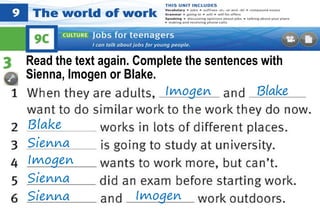
Read the text again. Complete the sentences with
Sienna, Imogen or Blake.
Match the highlighted words in the text
with the definitions below.
Listen to three people discussing part-time jobs
for teenagers. Which speakers think part-time jobs are a
good idea? Tick or cross.
  
Listen again. Match each speaker (1-3) with
two opinions about part-time jobs (a-h). There are two
opinions that you do not need.
Speaker 1 ____ and ____
Speaker 2 ____ and ____
Speaker 3 ____ and ____
d f
a e
b g
a. They are a good way to learn useful skills.
b. They stop teenagers asking their parents for money.
c. They can help you decide on your career.
d. They make teenagers too tired to study properly.
e. They teach teenagers how to be responsible.
f. Companies employ teenagers to get cheap workers.
g. They teach teenagers how to work in a team.
h. They aren’t as useful as studying for a qualification.
I don’t have a part-time job because I don’t think they’re a good
idea. Not for people my age. I’m sixteen and I’m studying for
important exams this year. I haven’t got time to work as well. A
lot of my friends have got jobs and they can’t study in the
evenings because they fall asleep – they’re so tired! And
companies that employ teenagers never pay them much money
– that’s why they employ them! They only pay them £3 an hour
or less. Adults ask for a lot more money
1
I work in a shop every weekend. It’s only a few hours – and it’s
fun. I’m learning useful skills. For example, how to deal with the
public and how to solve different problems. These skills are going
to be useful in the future – so my job helps me to prepare for
life after school. I’m also learning to be reliable and responsible.
I mean, I can’t send text messages or make phone calls all the
time! No, I need to be on time for work every Saturday and Sunday
– and I need to work hard while I’m there. I think the job
teaches me how to behave at work. That’s useful for the future.
2
I work a few hours a week – after school and on Saturdays. The
job isn’t very interesting: I clean offices. But it’s good, because
I get money to spend on clothes and going out with my friends.
My mum and dad haven’t got much money, so I’m happy I don’t
have to ask them. That’s one of the best things about doing a
part-time job: I get my own money. Five of us do the same
cleaning job, and we help each other – we work as a team.
That stops it being too boring. And I’m learning a useful skill –
how to work with other people in a team.
3
Work in pairs. What do you think about
part-time jobs? Take turns to be A and B.
Student A: Express an opinion from exercise 6 or your
own idea. Student B: Say if you agree or disagree. Use the
phrases below to help you.
Read the title of the text. Then read the text. What
answer does it give to the question in the title?
Teachers will probably not be robots in the future.
Read the Learn this! box. Then look at the table below.
Underline one example of the affirmative, negative and
interrogative in the text in exercise1.
Read the Learn this! box. Then look at the table below.
Underline one example of the affirmative, negative and
interrogative in the text in exercise1.
Read the Learn this! box. Then look at the table below.
Underline one example of the affirmative, negative and
interrogative in the text in exercise1.
Read the text in exercise1again.Complete predictions
1–5 . Use the affirmative or negative form of will and the
verbs in brackets.
will repair
will write
will fly
won’t work
won’t teach
1 It’s my dad’s birthday next week. He ________ forty.
2 My sister is at university. She __________her degree
next June.
3 The new sports centre _______________ until next year.
Read the Look out! box. Then complete the sentences
about the future with will and the verbs below.
’ll be
’ll finish
won’t open
4 The coach ______________ the hotel at 8 a.m. tomorrow -
please be on time.
5 Halley’s Comet passes Earth every 75 years. We _______
______ it again until 2061.
6 The next surfing World Championship ________________
in Hawaii.
Read the Look out! box. Then complete the sentences
about the future with will and the verbs below.
will leave
won’t
see
will take place
Think about your future. Make predictions. Write notes
in the chart below.
2 what job / do? How much / earn?
What job will you do? How much will you earn?
3 get married? How old / be?
Will you get married? How old will you be?
4 have children? How many?
Will you have children? How many will you have?
5 live in a house or flat? Where / be?
Will you live in a house or a flat? Where will it be?
Work in pairs. Ask and answer your questions
from exercise 6.
Work in pairs.
Discuss the questions.
1 What are the advantages of
taking a year off after school?
2 What are the disadvantages?
Look at the reading strategy. Then read the text and
underline any words you do not understand. Without
looking up the words, try to answer the questions.
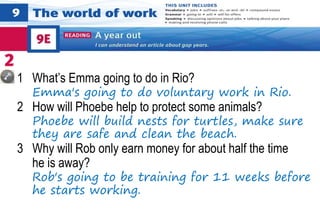
1 What’s Emma going to do in Rio?
2 How will Phoebe help to protect some animals?
3 Why will Rob only earn money for about half the time
he is away?
1 What’s Emma going to do in Rio?
Emma's going to do voluntary work in Rio.
2 How will Phoebe help to protect some animals?
Phoebe will build nests for turtles, make sure
they are safe and clean the beach.
3 Why will Rob only earn money for about half the time
he is away?
Rob's going to be training for 11 weeks before
he starts working.
Read the text again. Are the sentences true or false?
1 All three teenagers are going to work in Europe.
2 Emma won’t earn any money during her gap year.
3 Phoebe will work with a group of people.
4 All three teenagers are going to do something connected
with their future careers.
F Emma is going to South America and Phoebe
is going to Africa.
F She'll do part-time jobs as she's travelling.
T
F Rob is going to be a lawyer, which is not
connected to skiing.
Read the text again. Are the sentences true or false?
5 Emma will go to more than one country.
6 All three teenagers are planning to go to university.
7 Rob and Phoebe are both going to give lessons.
8 Rob needs to get a qualification before he can earn
money.
T
T
F
T
Phoebe isn't going to give lessons.
Match the two halves of the compound
nouns. Then check your answers in the text. Use the
compound nouns to complete the sentences below.
voluntary work
tourist industry
part-time jobs
conservation project
French Alps
skiing instructor
Match the two halves of the compound
nouns. Then check your answers in the text. Use the
compound nouns to complete the sentences below.
1 They’re working on a _____________________ to protect
tigers.
2 I’m doing three different ________________ to pay for my
university studies.
3 Languages are useful for people who work in the _______
___________.
conservation project
part-time jobs
tourist
industry
Match the two halves of the compound
nouns. Then check your answers in the text. Use the
compound nouns to complete the sentences below.
4 My grandmother doesn’t work for money, but she does
_________________ at our local school.
5 In the winter, he’s a ___________________ but in the
summer, he teaches surfing.
6 Chamonix is a famous ski resort in the _______________.
voluntary work
French Alps
skiing instructor
Complete the phrases with the verbs
below. Check your answers in the texty happen.
earn
take
do
get
learn
give
do
lead
Think about the three jobs in the text and answer the
following questions.
1 Which job do you think will be the most fun? Why?
2 Which job do you think will be the most work? Why?
3 Which job do you think will be the most dangerous? Why?
Work in pairs. Discuss your ideas from
exercise 6. Tell your partner your opinion. Give reasons.
Read and listen to the dialogue. Is it formal or
informal? How do you know?
The dialogue is formal. We know that it is
formal because of the context and because
the language used is very polite.
Read the Learn this! box. Underline an example of an
offer with I’ll... in the dialogue.
Complete the offers with I’ll and the verbs below.
1 ‘I m thirsty.’ ‘I’ll get you some water.’
2 ‘We can’t see the TV.’ ‘Sorry! ________ down.’
3 ‘ I can’t find Sue’s number.’ ‘________ on my phone.’
4 ‘ I’m hungry.’ ‘__________ you a sandwich.’
5 ‘ I need some money.’ ‘________ my dad.’
6 ‘ Jo isn’t here.’ ‘___________ again later.’
I’ll sit
I’ll look
I’ll make
I’ll ask
I’ll phone
Listen to two phone calls. Do the callers speak
to the people they want to?
The caller doesn’t speak to the person they
want to, but the second caller does.
Listen again.Tick the phrases you hear.
Secretary Good morning. Can I help you?
Man Oh, hello. Is it possible to speak to Jeff Hart?
Secretary Of course. I’ll try him for you.
Man Thank you!
[…]
Secretary I’m afraid he’s on the phone.
Man Oh, OK. Can you pass on a message for me?
Secretary Yes, certainly. What’s the message?
Man Erm … could you tell him I can’t come to the meeting
tomorrow.
Secretary And the name is?
Man Adam. Adam Bright.
Secretary Fine. Would you like him to give you a call?
Man Oh, yes. Thank you.
Secretary Can you give me your number, please?
Man Yes, it’s 01167 436777.
Secretary 01167 436777.
Man That’s right.
Secretary Thank you very much. Goodbye.
Martha Oh, hello. Is Jack there, please?
Dad Yes, I think so. Hold on a minute. I’ll find him.
[…]
Dad OK, he’s here.
Jack Hello?
Martha Hi, it’s Martha. How are you?
Jack Oh, hi, Martha. I’m fine. I’m just trying to finish my
homework!
Martha How’s it going?
Jack Not very well.
Martha So you don’t fancy going to the park … ?
Jack Well, I don’t know. I really want to finish this work. Can I
see how it goes?
Martha Sure. Give me a call later.
Jack Speak later. Bye!
1 3
2 4
Read the Look out! box.
Then listen and repeat the phone numbers.
Work in pairs. Write down three phone
numbers each. Take turns to say them to your partner.
Your partner writes them down. Check they are correct.
Work in pairs. Prepare a dialogue like the
dialogue in exercise1. Use phrases from exercise 5 and
the prompts below.
Read the letter. Who is the sender? Why is he writing
the letter?
The sender is Joel Taylor. He is writing to
apply for a job in the cinema.
Read the letter again. Number the parts of the letter in
the order they appear in the application letter.
1
5
3
4
2
Look at the plan for an application letter below. Find one
point in the plan which Joel does not include in his letter.
Paragraph 1
• what the job is
• where you saw the advertisement
Paragraph 2
• what you are doing at the moment
• your recent experience and the
skills you learned
Paragraph 3
• why you want the job
• why you are the right person
for the job
Paragraph 4
• when you can start work
• what you are enclosing with
the letter
Underline phrases in Joel’s letter that mean the same or
nearly the same as the phrases below.
1 I would like to apply for...
I am writing to apply for...
2 I saw your advertisement online.
I read about the vacancy on your website.
3 I am very interested in this job because...
I am very keen to do this job because ...
Underline phrases in Joel’s letter that mean the same or
nearly the same as the phrases below.
4 I am sending you my CV.
I am enclosing my CV ...
5 I hope to hear from you soon.
I look forward to hearing from you soon.
Read the writing strategy. Why does Joel finish his
letter with Yours faithfully, and not Yours sincerely?
Joel finishes the letter with Yours faithfully
Because he opened it with Dear Sir or Madam.
He does not know the name of the recipient.
Read the job advertisement below. Think of reasons
why you would be right for this job. Make notes.
Write an application letter (90–120 words) applying for
a job at the theme park in exercise 6. Use your notes
from exercise 6 and phrases from exercise 4. Follow
the plan in exercise 3, inventing information where
necessary.
Work in pairs. Look at the photos
and answer questions 1 and 2 below.
1 What jobs do the photos show?
2 What do you want to do when you finish your education? Why?



F C A E B
1
I love studying science at school and I want to study biology at
university. I’m very interested in the sea and everything that lives
under the water. When I was four or five, I visited a huge aquarium
at the seaside and I was amazed with the fish I saw. It was an
important moment in my life. I never stopped thinking about it. So
I want to be a biologist in the future. My dream is to discover
something new – a new plant, or animal or fish.
2
When I was six I wanted to be a fireman like my grandpa. But
now my dream is to be a footballer! I play football all the time.
I’d like to be like Leo Messi one day. He’s the best. I go to
training five nights a week. I already play for the local football
team, and I score a lot of goals. I want to be chosen for one of
the top teams in the country and also to play in our national team.
3
There is a tradition in my family that the women become dentists.
My parents can’t imagine me doing anything else. But I plan to be
a vet. I love animals and I’ve got quite a lot of them at home. I’ve
got dogs and cats and I hope to have a horse soon. I already help
out at the local vet’s on Saturdays. It’s quite difficult to become a
vet, but I can study hard!
4
I want to be a pilot. I really want to fly planes. I think they’re
wonderful. I can’t decide if I want to fly passenger planes,
helicopters or fighter jets. But I don’t need to decide just yet!
When I’m eighteen, I want flying lessons. They’re very
expensive, so I’m saving for them now.
5
I just want to be an actress. I love English and drama classes
and I’m in the school show every year. I love singing too. I have
singing lessons every week. Besides, most members of my
family are actors. My grandpa is an actor and my uncle and two
of my cousins. My mum acts in TV programmes as well, so
she’s not surprised by my decision.
Read the exam
task in exercise 6 below. Then listen to Katie in the
exam. What is her answer to the question? Do you
agree with her?
Katie thinks earning a lot of money is more
important.
Examiner Do you think earning a lot of money is more important
than enjoying your work?
Katie Yes, I do.
Examiner Really? Why?
Katie Because earning money is the main reason for
working. Without money, you can’t lead a normal life.
Examiner What do you mean?
Katie Well, you need to rent an apartment. And you need to
pay the bills. These things are very expensive.
Examiner So you need to earn a lot?
Katie Of course. I want a nice place to live when I’m older,
so I need to earn a lot of money.
Examiner But what about enjoyment? Shouldn’t work be fun?
Katie Not really. That’s why you have hobbies. When you
aren’t working, you can do things you enjoy – you can
join clubs, do sport, go to the cinema.
Examiner I see. So work is just to earn money.
Katie Exactly. People should work to earn money. Then,
they can have fun in their free time, when they aren’t
working.
opened
bigger
buildings
difference smaller
working
called
education
older
Match 1–5 with a-e to make
compound nouns. Then translate them into your own
language.
1 protection from an illness or disease
2 to take the skin from a fruit or vegetable
3 the part of a shirt, jacket, etc. that covers
your arms
4 causing a bad feeling in part of your body
5 bringing up the food in your stomach
C
E
D
A
Work in pairs. Discuss these
questions.
1 What kind of holidays do you like?
2 What kind of accommodation do you like to stay in?
3 What kind of activities do you like to do on holiday?
Read the exam task in exercise 13 and
complete the three extracts with the words below.
Then listen to Michael in the exam and check your
answers.
about
shall
know
Read the exam task in exercise 13 and
complete the three extracts with the words below.
Then listen to Michael in the exam and check your
answers.
quite
Let’s
instead
rather
should
idea
Examiner Where shall we go? How about going to the coast?
Michael Mmm. I don’t know. Why don’t we go to the mountains?
We can go walking and climbing.
Examiner OK. That sounds good. What about accommodation?
Michael Let’s stay in youth hostels.
Examiner I haven’t got very much money.
Michael Youth hostels are quite cheap. But we can go
camping instead, if you like.
Examiner OK. Good idea.
Michael Now, how are we going to travel? Perhaps we should
go by car.
Examiner Travelling by car is quite expensive. I’d rather cycle.
Michael I don’t think that’s a great idea. It’s a bit dangerous
when the roads are very busy.
Examiner OK, let’s take the car.
Michael We can always hire bikes when we get there if we
want to go cycling for the day.
Examiner That sounds perfect.
[123doc] - giao-an-dien-tu-solution-elementary-powerpoint-unit-9.pptx

[123doc] - giao-an-dien-tu-solution-elementary-powerpoint-unit-9.pptx

  • 1.
    THIS UNIT INCLUDES Vocabularyjobssuffixes -er,-or and -ist compoundnouns Grammargoingtowillwillforoffers Speakingdiscussingopinionsaboutjobs talkingaboutyourplansmakingand receivingphonecalls Writinganapplicationletter
  • 2.
    Label the photoswith six of the words below.
  • 3.
    farmer hairdresser Label thephotos with six of the words below.
  • 4.
    engineer journalist Label thephotos with six of the words below.
  • 5.
    nurse teacher Label thephotos with six of the words below.
  • 6.
    Listen, repeat andcheck. Translate all the words into your own language / fA:m @r/ / he@dre s@r/ /endZI n I@r/ / dZ@:n@ lIst/ /n@: s/ / ti: tS@r/
  • 7.
    Not illustrated / {kt @r/ /A:kI tek/ / A:t Ist/ / bIld @r/ / dO:k t@r/ /Ilek t rISn/ / f{kt@rI w@:k@r/ / lO: j@r/ /mI k{nI k/ /mju: zI Sn/ / plVm @r/ / pr@ugr{m @r/ /rI sepS@ nIst/
  • 8.
    Not illustrated / saI@ntIst// sekI tri/ / SQp @%sIst@nt/ / s@udZ@r/ / t{ksI %draIv@r/ /vet/ / weIt@r/
  • 9.
    Read the Lookout! box. Then write three sentences about your friends and family and the jobs they do.
  • 10.
    Listen to sixdifferent people on the phone and identify the jobs they do. Choose jobs from exercise 1 1 ___________________ 2 ___________________ 3 ___________________ 4 ___________________ 5 ___________________ 6 ___________________
  • 11.
    Farmer Yes, right.I’m going to feed the chickens now. Then I need to check the horses … Yes … Yes, OK. [Pig snorts] Farmer What? No! That wasn’t me, it was the pig. OK, see you later. 1
  • 12.
    Architect I see.So you want a house with eight bedrooms and … how many bathrooms? … Six. No problem ... Well, no, I sometimes design houses bigger than that! Now, I need some idea of the style of building you want … Yes … OK … 2
  • 13.
    Secretary Good Morning,Westlake Pharmaceuticals, Mrs Smith’s office … I’m sorry, Mrs Smith is busy at the moment … Yes, she’s in a meeting … No, I can’t interrupt her, I’m afraid. Can I take a message? … Uh-huh. And who shall I say called? … Her mother. OK, no problem. Goodbye. 3
  • 14.
    Builder Yes, hello?… Yes, we’ve got a problem here. I’m starting on the back wall of the house but the windows are the wrong size. They don’t fit … No it’s definitely not my fault. I didn’t order the windows. We need to get some more … I don’t know. Maybe two weeks? It’s bad news, because the weather is getting worse … 4
  • 15.
    Shop assistant Hello,Madeley’s … Yes, we have those jeans in most sizes … Extra large? Just a moment, I’ll check … Yes, we do … No, I’m sorry, they aren’t in the sale – they’re full price. That’s £45 … We’re open until six o’clock this evening … Yes … OK. Bye 5
  • 16.
    Vet Good afternoon… I see – and what’s the problem with your cat? … He’s feeling unwell. Is he eating? … Hmm. And how old is he? … Five. OK, well you’d better bring him to the surgery … Yes, we have appointments this afternoon – in fact, I can see him myself at half past four … Great. And the name? … Sylvester. Is that Mrs or Ms? … Oh, that’s the cat’s name. What’s yours? 6
  • 17.
    Listen to amusician, a hairdresser and a lawyer talk about their jobs. Are they generally happy or unhappy with their jobs? They are all generally happy with their jobs.
  • 18.
    Listen again. Completethe sentences with musician, hairdresser or lawyer. lawyer musician hairdresser hairdresser
  • 19.
    Listen again. Completethe sentences with musician, hairdresser or lawyer. lawyer musician musician hairdresser
  • 20.
    I play keyboardsin a band. There are six of us, and we play all over the world – at festivals and concerts. It’s great to travel with work; you get to see some really interesting places. I can’t imagine doing a different job. When I was at primary school, I wanted to be a musician!All my friends were into computer games, but I hated computers. I still hate computers. Fortunately, I never use them! I prefer working with people – and the best thing about my job is that I’m part of a team. The other guys in the band are great. We’re good friends. And our boss – the band’s manager – is OK too! 1
  • 21.
    Yes, it’s hardwork – I’m on my feet all day. And the days are long too because a lot of people come to get their hair cut after work. So I have to work long hours – until nine o’clock in the evening, sometimes later. But I enjoy it – and because I own the salon, I’m my own boss, so I can decide when to take holidays. I don’t have to ask anyone! Sometimes the customers are difficult, though. And I have to smile and be really polite! But that’s what it’s like for people in my job – you have to deal with the public. Some of them are nice, though. You definitely meet some interesting people. 2
  • 22.
    I worked fora big law company for about ten years, but now I work for a charity that helps homeless people. The work is completely different now. It’s a lot more interesting, and I enjoy helping people who really need help. Sometimes, I need to work at weekends – it certainly isn’t a normal 9–5 job, but that’s OK. That’s good! I had a 9–5 job for ten years, and I got bored with it! Because I work for a charity, I don’t earn a lot of money. But, you know, money isn’t everything. Although when I tell people I’m a lawyer, they always think I’m really rich! I’m not rich – but I love my job. 3
  • 23.
    Read the sentencesabout jobs below. Do you think they are positive or negative points?
  • 24.
    Look at thejobs in exercise 1. Decide which you think is the best job and which is the worst job. Write sentences about the reasons for your choices. Use phrases from exercises 6 and 7 and your own ideas.
  • 25.
    Work in pairs.Ask and answer questions about what you think are the best and the worst jobs. Give your reasons
  • 26.
    T Read and listento the dialogue. Are the sentences true or false? F F
  • 27.
    Read the Learnthis! box. Then complete the table below with the examples of going to in the dialogue. ’m going to work
  • 28.
    Read the Learnthis! box. Then complete the table below with the examples of going to in the dialogue. aren’t going to save Are you going to save
  • 29.
    Listen to theconversation. Tick the things that Amber and Zak are going to do this weekend.        
  • 30.
    Amber Hi Zak! ZakOh, hi, Amber. How are you? Amber I’m fine, thanks. What are your plans for this weekend? Zak I’m going to go shopping on Saturday morning. I need to buy some new jeans. Do you want to come? Amber No, thanks. I hate shopping! Anyway, I’m going to study on Saturday morning. We’ve got an exam on Monday, remember? Zak Yes, yes, I know. I’m going to study in the afternoon. And maybe on Sunday too.
  • 31.
    Zak Hey! Whydon’t we meet up on Sunday and study together? Amber I can’t. I’m really busy. I’m meeting my friend Jack at the sports centre on Sunday morning. Zak Are you going to go swimming? Amber No. We’re going to play tennis. Zak What about Sunday afternoon? Amber I’m going to visit my grandparents. We’re going to look at photos from their holiday.
  • 32.
    Zak Oh, Ijust remembered – I’m busy on Sunday afternoon too. I’m going to visit my uncle and aunt. We’re going to have a barbecue in their garden. Amber Sounds good! More fun than looking at holiday photos, anyway! Zak Hmmm. What about Sunday evening? Do you want to study together then? Amber Yes, OK. Let’s meet at my house.
  • 33.
    Write sentences. Usethe affirmative or negative form of going to. 2 Zak / go shopping Zak's going to go shopping. 3 Amber and Zak / study Amber and Zak are going to study.
  • 34.
    Write sentences. Usethe affirmative or negative form of going to. 4 Amber / play tennis Amber's going to play tennis. 5 Amber and Zak / visit family Amber and Zak are going to visit family. 6 Zak / look at photos Zak isn't going to look at photos. 7 Amber / have a barbecue Amber isn't going to have a barbecue.
  • 35.
    Work in pairs.Ask and answer questions about Amber and Zak’s plans for the weekend.
  • 36.
    What are yourplans for this evening? Complete the first column of the chart. Tick or cross.
  • 37.
    Work in pairs.Ask and answer questions about your partner’s plans for this evening. Complete the second column of the chart in exercise 6.
  • 38.
    Look at thephotos and answer the questions. 1 Where are the people? What are they doing? 2 Which job looks the most interesting? Why?
  • 39.
    Read the text.Find the age of each person and the country each person lives in. Sienna Imogen Blake seventeen years old, lives in Australia fifteen years old, lives in the UK sixteen years old, lives in the USA
  • 40.
    Imogen Blake Blake Sienna Sienna Sienna Imogen Imogen Read thetext again. Complete the sentences with Sienna, Imogen or Blake.
  • 41.
    Match the highlightedwords in the text with the definitions below.
  • 42.
    Listen to threepeople discussing part-time jobs for teenagers. Which speakers think part-time jobs are a good idea? Tick or cross.   
  • 43.
    Listen again. Matcheach speaker (1-3) with two opinions about part-time jobs (a-h). There are two opinions that you do not need. Speaker 1 ____ and ____ Speaker 2 ____ and ____ Speaker 3 ____ and ____ d f a e b g a. They are a good way to learn useful skills. b. They stop teenagers asking their parents for money. c. They can help you decide on your career. d. They make teenagers too tired to study properly. e. They teach teenagers how to be responsible. f. Companies employ teenagers to get cheap workers. g. They teach teenagers how to work in a team. h. They aren’t as useful as studying for a qualification.
  • 44.
    I don’t havea part-time job because I don’t think they’re a good idea. Not for people my age. I’m sixteen and I’m studying for important exams this year. I haven’t got time to work as well. A lot of my friends have got jobs and they can’t study in the evenings because they fall asleep – they’re so tired! And companies that employ teenagers never pay them much money – that’s why they employ them! They only pay them £3 an hour or less. Adults ask for a lot more money 1
  • 45.
    I work ina shop every weekend. It’s only a few hours – and it’s fun. I’m learning useful skills. For example, how to deal with the public and how to solve different problems. These skills are going to be useful in the future – so my job helps me to prepare for life after school. I’m also learning to be reliable and responsible. I mean, I can’t send text messages or make phone calls all the time! No, I need to be on time for work every Saturday and Sunday – and I need to work hard while I’m there. I think the job teaches me how to behave at work. That’s useful for the future. 2
  • 46.
    I work afew hours a week – after school and on Saturdays. The job isn’t very interesting: I clean offices. But it’s good, because I get money to spend on clothes and going out with my friends. My mum and dad haven’t got much money, so I’m happy I don’t have to ask them. That’s one of the best things about doing a part-time job: I get my own money. Five of us do the same cleaning job, and we help each other – we work as a team. That stops it being too boring. And I’m learning a useful skill – how to work with other people in a team. 3
  • 47.
    Work in pairs.What do you think about part-time jobs? Take turns to be A and B. Student A: Express an opinion from exercise 6 or your own idea. Student B: Say if you agree or disagree. Use the phrases below to help you.
  • 48.
    Read the titleof the text. Then read the text. What answer does it give to the question in the title? Teachers will probably not be robots in the future.
  • 49.
    Read the Learnthis! box. Then look at the table below. Underline one example of the affirmative, negative and interrogative in the text in exercise1.
  • 50.
    Read the Learnthis! box. Then look at the table below. Underline one example of the affirmative, negative and interrogative in the text in exercise1.
  • 51.
    Read the Learnthis! box. Then look at the table below. Underline one example of the affirmative, negative and interrogative in the text in exercise1.
  • 52.
    Read the textin exercise1again.Complete predictions 1–5 . Use the affirmative or negative form of will and the verbs in brackets. will repair will write will fly won’t work won’t teach
  • 53.
    1 It’s mydad’s birthday next week. He ________ forty. 2 My sister is at university. She __________her degree next June. 3 The new sports centre _______________ until next year. Read the Look out! box. Then complete the sentences about the future with will and the verbs below. ’ll be ’ll finish won’t open
  • 54.
    4 The coach______________ the hotel at 8 a.m. tomorrow - please be on time. 5 Halley’s Comet passes Earth every 75 years. We _______ ______ it again until 2061. 6 The next surfing World Championship ________________ in Hawaii. Read the Look out! box. Then complete the sentences about the future with will and the verbs below. will leave won’t see will take place
  • 55.
    Think about yourfuture. Make predictions. Write notes in the chart below.
  • 56.
    2 what job/ do? How much / earn? What job will you do? How much will you earn? 3 get married? How old / be? Will you get married? How old will you be? 4 have children? How many? Will you have children? How many will you have? 5 live in a house or flat? Where / be? Will you live in a house or a flat? Where will it be?
  • 57.
    Work in pairs.Ask and answer your questions from exercise 6.
  • 58.
    Work in pairs. Discussthe questions. 1 What are the advantages of taking a year off after school? 2 What are the disadvantages?
  • 59.
    Look at thereading strategy. Then read the text and underline any words you do not understand. Without looking up the words, try to answer the questions. 1 What’s Emma going to do in Rio? 2 How will Phoebe help to protect some animals? 3 Why will Rob only earn money for about half the time he is away?
  • 60.
    1 What’s Emmagoing to do in Rio? Emma's going to do voluntary work in Rio. 2 How will Phoebe help to protect some animals? Phoebe will build nests for turtles, make sure they are safe and clean the beach. 3 Why will Rob only earn money for about half the time he is away? Rob's going to be training for 11 weeks before he starts working.
  • 61.
    Read the textagain. Are the sentences true or false? 1 All three teenagers are going to work in Europe. 2 Emma won’t earn any money during her gap year. 3 Phoebe will work with a group of people. 4 All three teenagers are going to do something connected with their future careers. F Emma is going to South America and Phoebe is going to Africa. F She'll do part-time jobs as she's travelling. T F Rob is going to be a lawyer, which is not connected to skiing.
  • 62.
    Read the textagain. Are the sentences true or false? 5 Emma will go to more than one country. 6 All three teenagers are planning to go to university. 7 Rob and Phoebe are both going to give lessons. 8 Rob needs to get a qualification before he can earn money. T T F T Phoebe isn't going to give lessons.
  • 63.
    Match the twohalves of the compound nouns. Then check your answers in the text. Use the compound nouns to complete the sentences below. voluntary work tourist industry part-time jobs conservation project French Alps skiing instructor
  • 64.
    Match the twohalves of the compound nouns. Then check your answers in the text. Use the compound nouns to complete the sentences below. 1 They’re working on a _____________________ to protect tigers. 2 I’m doing three different ________________ to pay for my university studies. 3 Languages are useful for people who work in the _______ ___________. conservation project part-time jobs tourist industry
  • 65.
    Match the twohalves of the compound nouns. Then check your answers in the text. Use the compound nouns to complete the sentences below. 4 My grandmother doesn’t work for money, but she does _________________ at our local school. 5 In the winter, he’s a ___________________ but in the summer, he teaches surfing. 6 Chamonix is a famous ski resort in the _______________. voluntary work French Alps skiing instructor
  • 66.
    Complete the phraseswith the verbs below. Check your answers in the texty happen. earn take do get learn give do lead
  • 67.
    Think about thethree jobs in the text and answer the following questions. 1 Which job do you think will be the most fun? Why? 2 Which job do you think will be the most work? Why? 3 Which job do you think will be the most dangerous? Why?
  • 68.
    Work in pairs.Discuss your ideas from exercise 6. Tell your partner your opinion. Give reasons.
  • 69.
    Read and listento the dialogue. Is it formal or informal? How do you know? The dialogue is formal. We know that it is formal because of the context and because the language used is very polite.
  • 70.
    Read the Learnthis! box. Underline an example of an offer with I’ll... in the dialogue.
  • 71.
    Complete the offerswith I’ll and the verbs below. 1 ‘I m thirsty.’ ‘I’ll get you some water.’ 2 ‘We can’t see the TV.’ ‘Sorry! ________ down.’ 3 ‘ I can’t find Sue’s number.’ ‘________ on my phone.’ 4 ‘ I’m hungry.’ ‘__________ you a sandwich.’ 5 ‘ I need some money.’ ‘________ my dad.’ 6 ‘ Jo isn’t here.’ ‘___________ again later.’ I’ll sit I’ll look I’ll make I’ll ask I’ll phone
  • 72.
    Listen to twophone calls. Do the callers speak to the people they want to? The caller doesn’t speak to the person they want to, but the second caller does.
  • 73.
    Listen again.Tick thephrases you hear.
  • 74.
    Secretary Good morning.Can I help you? Man Oh, hello. Is it possible to speak to Jeff Hart? Secretary Of course. I’ll try him for you. Man Thank you! […]
  • 75.
    Secretary I’m afraidhe’s on the phone. Man Oh, OK. Can you pass on a message for me? Secretary Yes, certainly. What’s the message? Man Erm … could you tell him I can’t come to the meeting tomorrow. Secretary And the name is? Man Adam. Adam Bright. Secretary Fine. Would you like him to give you a call? Man Oh, yes. Thank you.
  • 76.
    Secretary Can yougive me your number, please? Man Yes, it’s 01167 436777. Secretary 01167 436777. Man That’s right. Secretary Thank you very much. Goodbye.
  • 77.
    Martha Oh, hello.Is Jack there, please? Dad Yes, I think so. Hold on a minute. I’ll find him. […] Dad OK, he’s here. Jack Hello? Martha Hi, it’s Martha. How are you? Jack Oh, hi, Martha. I’m fine. I’m just trying to finish my homework!
  • 78.
    Martha How’s itgoing? Jack Not very well. Martha So you don’t fancy going to the park … ? Jack Well, I don’t know. I really want to finish this work. Can I see how it goes? Martha Sure. Give me a call later. Jack Speak later. Bye!
  • 79.
    1 3 2 4 Readthe Look out! box. Then listen and repeat the phone numbers.
  • 80.
    Work in pairs.Write down three phone numbers each. Take turns to say them to your partner. Your partner writes them down. Check they are correct.
  • 81.
    Work in pairs.Prepare a dialogue like the dialogue in exercise1. Use phrases from exercise 5 and the prompts below.
  • 82.
    Read the letter.Who is the sender? Why is he writing the letter? The sender is Joel Taylor. He is writing to apply for a job in the cinema.
  • 83.
    Read the letteragain. Number the parts of the letter in the order they appear in the application letter. 1 5 3 4 2
  • 84.
    Look at theplan for an application letter below. Find one point in the plan which Joel does not include in his letter. Paragraph 1 • what the job is • where you saw the advertisement Paragraph 2 • what you are doing at the moment • your recent experience and the skills you learned Paragraph 3 • why you want the job • why you are the right person for the job Paragraph 4 • when you can start work • what you are enclosing with the letter
  • 85.
    Underline phrases inJoel’s letter that mean the same or nearly the same as the phrases below. 1 I would like to apply for... I am writing to apply for... 2 I saw your advertisement online. I read about the vacancy on your website. 3 I am very interested in this job because... I am very keen to do this job because ...
  • 86.
    Underline phrases inJoel’s letter that mean the same or nearly the same as the phrases below. 4 I am sending you my CV. I am enclosing my CV ... 5 I hope to hear from you soon. I look forward to hearing from you soon.
  • 87.
    Read the writingstrategy. Why does Joel finish his letter with Yours faithfully, and not Yours sincerely? Joel finishes the letter with Yours faithfully Because he opened it with Dear Sir or Madam. He does not know the name of the recipient.
  • 88.
    Read the jobadvertisement below. Think of reasons why you would be right for this job. Make notes.
  • 89.
    Write an applicationletter (90–120 words) applying for a job at the theme park in exercise 6. Use your notes from exercise 6 and phrases from exercise 4. Follow the plan in exercise 3, inventing information where necessary.
  • 90.
    Work in pairs.Look at the photos and answer questions 1 and 2 below. 1 What jobs do the photos show? 2 What do you want to do when you finish your education? Why?
  • 92.
  • 93.
    F C AE B
  • 94.
    1 I love studyingscience at school and I want to study biology at university. I’m very interested in the sea and everything that lives under the water. When I was four or five, I visited a huge aquarium at the seaside and I was amazed with the fish I saw. It was an important moment in my life. I never stopped thinking about it. So I want to be a biologist in the future. My dream is to discover something new – a new plant, or animal or fish.
  • 95.
    2 When I wassix I wanted to be a fireman like my grandpa. But now my dream is to be a footballer! I play football all the time. I’d like to be like Leo Messi one day. He’s the best. I go to training five nights a week. I already play for the local football team, and I score a lot of goals. I want to be chosen for one of the top teams in the country and also to play in our national team.
  • 96.
    3 There is atradition in my family that the women become dentists. My parents can’t imagine me doing anything else. But I plan to be a vet. I love animals and I’ve got quite a lot of them at home. I’ve got dogs and cats and I hope to have a horse soon. I already help out at the local vet’s on Saturdays. It’s quite difficult to become a vet, but I can study hard!
  • 97.
    4 I want tobe a pilot. I really want to fly planes. I think they’re wonderful. I can’t decide if I want to fly passenger planes, helicopters or fighter jets. But I don’t need to decide just yet! When I’m eighteen, I want flying lessons. They’re very expensive, so I’m saving for them now.
  • 98.
    5 I just wantto be an actress. I love English and drama classes and I’m in the school show every year. I love singing too. I have singing lessons every week. Besides, most members of my family are actors. My grandpa is an actor and my uncle and two of my cousins. My mum acts in TV programmes as well, so she’s not surprised by my decision.
  • 99.
    Read the exam taskin exercise 6 below. Then listen to Katie in the exam. What is her answer to the question? Do you agree with her? Katie thinks earning a lot of money is more important.
  • 100.
    Examiner Do youthink earning a lot of money is more important than enjoying your work? Katie Yes, I do. Examiner Really? Why? Katie Because earning money is the main reason for working. Without money, you can’t lead a normal life. Examiner What do you mean? Katie Well, you need to rent an apartment. And you need to pay the bills. These things are very expensive.
  • 101.
    Examiner So youneed to earn a lot? Katie Of course. I want a nice place to live when I’m older, so I need to earn a lot of money. Examiner But what about enjoyment? Shouldn’t work be fun? Katie Not really. That’s why you have hobbies. When you aren’t working, you can do things you enjoy – you can join clubs, do sport, go to the cinema. Examiner I see. So work is just to earn money. Katie Exactly. People should work to earn money. Then, they can have fun in their free time, when they aren’t working.
  • 104.
  • 105.
  • 106.
    Match 1–5 witha-e to make compound nouns. Then translate them into your own language.
  • 107.
    1 protection froman illness or disease 2 to take the skin from a fruit or vegetable 3 the part of a shirt, jacket, etc. that covers your arms 4 causing a bad feeling in part of your body 5 bringing up the food in your stomach
  • 109.
  • 110.
  • 111.
  • 112.
  • 113.
    Work in pairs.Discuss these questions. 1 What kind of holidays do you like? 2 What kind of accommodation do you like to stay in? 3 What kind of activities do you like to do on holiday?
  • 114.
    Read the examtask in exercise 13 and complete the three extracts with the words below. Then listen to Michael in the exam and check your answers. about shall know
  • 115.
    Read the examtask in exercise 13 and complete the three extracts with the words below. Then listen to Michael in the exam and check your answers. quite Let’s instead
  • 116.
  • 117.
    Examiner Where shallwe go? How about going to the coast? Michael Mmm. I don’t know. Why don’t we go to the mountains? We can go walking and climbing. Examiner OK. That sounds good. What about accommodation? Michael Let’s stay in youth hostels. Examiner I haven’t got very much money. Michael Youth hostels are quite cheap. But we can go camping instead, if you like. Examiner OK. Good idea.
  • 118.
    Michael Now, howare we going to travel? Perhaps we should go by car. Examiner Travelling by car is quite expensive. I’d rather cycle. Michael I don’t think that’s a great idea. It’s a bit dangerous when the roads are very busy. Examiner OK, let’s take the car. Michael We can always hire bikes when we get there if we want to go cycling for the day. Examiner That sounds perfect.