SIGNATURE
FORGERIES AND THEIR
DETECTION
Dr. S. C. Mittal
Principal Scientific Officer
CFSL, CBI
NEW DELHI
TYPES OF SIGNATURE
FORGERIES
• Traced Forgery
• Simulated or Copied forgery
• Practiced Forgery
• Spurious Forgery
• Transplanted Forgery
• Computerized Forgery
• Colour Copy Forgery
• Traced Forgery
• Simulated or Copied forgery
• Practiced Forgery
• Spurious Forgery
• Transplanted Forgery
• Computerized Forgery
• Colour Copy Forgery
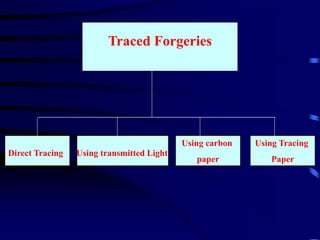
Traced Forgeries
Direct Tracing Using transmitted Light
Using carbon
paper
Using Tracing
Paper
TRACED FORGERY
• Traced signatures are forged by tracing
from some genuine model of signature.
Traced forgeries exhibit the presence of
guidelines underneath the signatures. These
guidelines may be in the form of
indentations or carbon outlines and ink
strokes will be found adhering to the
guidelines.
FORGERY BY
SIMULATION/COPYING
• The signatures in this type of forgery are
produced by copying the genuine signatures of
any person by process of drawing just keeping
the model signature in front of him and making
a copy by drawing. Such type of forged
signatures show all kind of defects in their line
quality.
PRACTISED FORGERY
• These Signatures are Created by practice
over a Genuine model of Signature and
temporary memorizing the Model and
Design of signature. Such signatures lack
natural variations in comparison with
genuine Signatures. They show Hybrid
Characters of original writer as well as
forger. Size of such signature is normally
bigger than the genuine signatures.
SPURIOUS FORGERY
• Signature executed on any document in the
name of a non-existent person or in the
name of any person without seeing the
genuine signature of that person. This type
of forgery is normally freely written and the
authorship is fixable with the standards.
TRANSPLANTED
SIGNATURES
• Genuine signatures are transplanted on
Desired Documents using Cello Tape,
Computer Scanner and Printer, Colour
Xeroxing and Cut and Paste method using
Xeroxing.
COMPUTERISED FORGERY
• Signatures forged by Computers using
Scanner and Colour Printer can be
identified by a careful examination using
good Quality Lens with Light Source.The
Signature created by Inkjet printing will
show only colour Dots and there will be no
track of Ball Pen, Nib or Fiber tip Pen.
COLOR COPY FORGERY
• This type of signature forgery is done by
taking coloured xerox print using some
genuine model of signature. On careful
examination of such signatures using
magnifying glass will show numerous
segmented horizontal and vertical lines.
Continuous and curve lines will be missing
in this type of forgery.
TRICKERY FORGERY
• These forgeries involve most of the genuine
portion of writing / signature and
slightly addition of strokes in the rest of the
portion of writing / signature . These kind
of forgeries can be detected using different
kind of light sources viz infrared ,
ultraviolet or high intensity light source etc.
THE CHARACTERISTICS OF
GENUINE SIGNATURES
• Any thing of any kind that shows
carelessness on the part of the writer are the
signs of genuineness.
• Pen Movement
• Ball-Point Pen Movement
• Pen-lifts , Halts and Hesitations
• Increase in Pen-lifts due to Ill-Health
 The salient features which are
indicative of forgery (except in case of
simple forgery and built-up
documents) are
(a) slow and drawn writing.
(b) show pen lifts at the unusual places.
(c) retouching / careful additions.
(d) hesitations and tremors in writing.
(e) presence of indentations or carbon
outlines in the vicinity of the
suspected signatures.
GUIDELINES
Do not pass a Cheque or TC:-
1. There is Chemical eraser below the signature.
2. There is Physical eraser below the signature.
3. Signature is executed with a Sign or Thick Pen.
4. Slant of Signature on Cheque and Specimen card is
altogether different.
5. Size of the signature show mark difference.
6. Spellings of Name of signatory are different.
7. Use of Mr. Or Mrs. Before the signature.
8. Signature lacks naturalness, Speed and Rhythm.
9. If two signatures superimpose over each other.
INCASE OF DOUBT ASK FOR
ANOTHER SIGNATURE
Or
CONSULT HANDWRITNG
EXPERT
THANKS

12150145.ppt

  • 1.
    SIGNATURE FORGERIES AND THEIR DETECTION Dr.S. C. Mittal Principal Scientific Officer CFSL, CBI NEW DELHI
  • 2.
    TYPES OF SIGNATURE FORGERIES •Traced Forgery • Simulated or Copied forgery • Practiced Forgery • Spurious Forgery • Transplanted Forgery • Computerized Forgery • Colour Copy Forgery • Traced Forgery • Simulated or Copied forgery • Practiced Forgery • Spurious Forgery • Transplanted Forgery • Computerized Forgery • Colour Copy Forgery
  • 3.
    Traced Forgeries Direct TracingUsing transmitted Light Using carbon paper Using Tracing Paper
  • 4.
    TRACED FORGERY • Tracedsignatures are forged by tracing from some genuine model of signature. Traced forgeries exhibit the presence of guidelines underneath the signatures. These guidelines may be in the form of indentations or carbon outlines and ink strokes will be found adhering to the guidelines.
  • 5.
    FORGERY BY SIMULATION/COPYING • Thesignatures in this type of forgery are produced by copying the genuine signatures of any person by process of drawing just keeping the model signature in front of him and making a copy by drawing. Such type of forged signatures show all kind of defects in their line quality.
  • 6.
    PRACTISED FORGERY • TheseSignatures are Created by practice over a Genuine model of Signature and temporary memorizing the Model and Design of signature. Such signatures lack natural variations in comparison with genuine Signatures. They show Hybrid Characters of original writer as well as forger. Size of such signature is normally bigger than the genuine signatures.
  • 7.
    SPURIOUS FORGERY • Signatureexecuted on any document in the name of a non-existent person or in the name of any person without seeing the genuine signature of that person. This type of forgery is normally freely written and the authorship is fixable with the standards.
  • 8.
    TRANSPLANTED SIGNATURES • Genuine signaturesare transplanted on Desired Documents using Cello Tape, Computer Scanner and Printer, Colour Xeroxing and Cut and Paste method using Xeroxing.
  • 9.
    COMPUTERISED FORGERY • Signaturesforged by Computers using Scanner and Colour Printer can be identified by a careful examination using good Quality Lens with Light Source.The Signature created by Inkjet printing will show only colour Dots and there will be no track of Ball Pen, Nib or Fiber tip Pen.
  • 10.
    COLOR COPY FORGERY •This type of signature forgery is done by taking coloured xerox print using some genuine model of signature. On careful examination of such signatures using magnifying glass will show numerous segmented horizontal and vertical lines. Continuous and curve lines will be missing in this type of forgery.
  • 11.
    TRICKERY FORGERY • Theseforgeries involve most of the genuine portion of writing / signature and slightly addition of strokes in the rest of the portion of writing / signature . These kind of forgeries can be detected using different kind of light sources viz infrared , ultraviolet or high intensity light source etc.
  • 12.
    THE CHARACTERISTICS OF GENUINESIGNATURES • Any thing of any kind that shows carelessness on the part of the writer are the signs of genuineness. • Pen Movement • Ball-Point Pen Movement • Pen-lifts , Halts and Hesitations • Increase in Pen-lifts due to Ill-Health
  • 13.
     The salientfeatures which are indicative of forgery (except in case of simple forgery and built-up documents) are (a) slow and drawn writing. (b) show pen lifts at the unusual places. (c) retouching / careful additions. (d) hesitations and tremors in writing. (e) presence of indentations or carbon outlines in the vicinity of the suspected signatures.
  • 14.
    GUIDELINES Do not passa Cheque or TC:- 1. There is Chemical eraser below the signature. 2. There is Physical eraser below the signature. 3. Signature is executed with a Sign or Thick Pen. 4. Slant of Signature on Cheque and Specimen card is altogether different. 5. Size of the signature show mark difference. 6. Spellings of Name of signatory are different. 7. Use of Mr. Or Mrs. Before the signature. 8. Signature lacks naturalness, Speed and Rhythm. 9. If two signatures superimpose over each other.
  • 15.
    INCASE OF DOUBTASK FOR ANOTHER SIGNATURE Or CONSULT HANDWRITNG EXPERT
  • 16.