Charleston Conference 2012
Goals for today
• Introduce you to GOKb
• Discuss what GOKb IS and what it ISN’T
• Provide an overview of what’s innovative
about GOKb
• How can I interact with GOKb and why would I
want to?
• What else should we be thinking about?
Introduction to GOKb
GOKb will be a freely available community-
managed data repository that will contain key
publication information about electronic
resources as it is represented within the supply
chain from content publishers to suppliers to
libraries.
What is the problem we’re trying to
solve?
1. Kuali OLE needs a KB
2. Current model is:
a. Too local
b. Inefficient
c. Duplicative
d. Hinders access
e. No good match points
3. Lack of open, community-maintained source for
publicly available information that supports
eresource management
Scope
• Management not discovery
• KB for Kuali OLE
• Collaboration with JISC (KnowledgeBase+)
– Data model
– Data
– Management infrastructure
• KB data for other projects
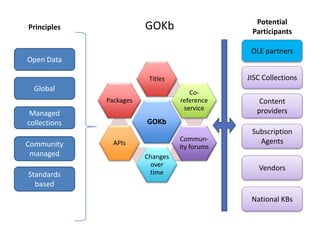
GOKb
Titles
Co-
reference
service
Commun-
ity forums
Changes
over
time
APIs
Packages
GOKb
Open Data
Standards
based
Community
managed
Principles
Potential
Participants
JISC Collections
Content
providers
Subscription
Agents
Vendors
OLE partners
National KBs
Global
Managed
collections
What will make GOKb a success
1. GOKb has to support management of e-resources in
OLE, be well integrated with OLE interfaces so data
management happens as part of regular library
workflows
2. GOKb has to also be of interest to a broader
community that will be want to use the data and
contribute to its maintenance
3. GOKb should improve the quality of metadata in the
supply chain (outside GOKb)
4. GOKb supports coordination of cooperative efforts
across national KB initiatives
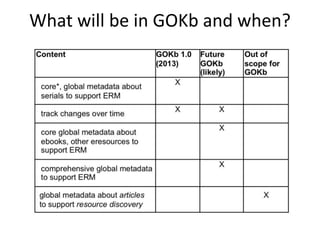
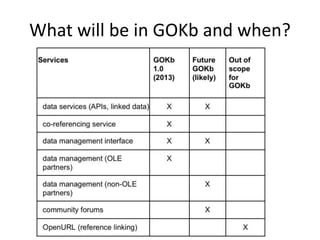
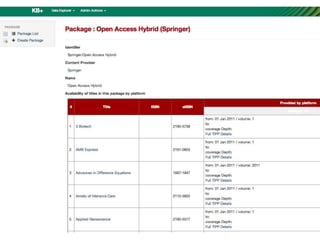
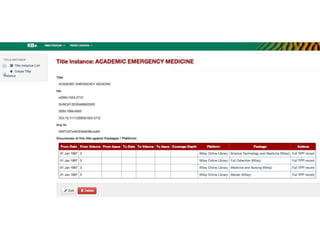
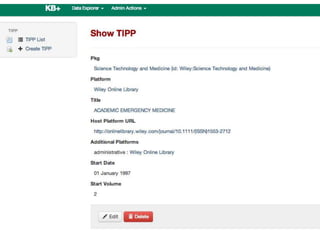
What will be in GOKb and when?
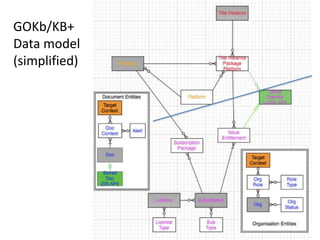
GOKb/KB+
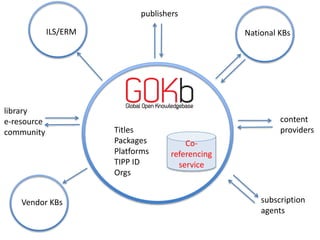
Data model
(simplified)
Co-
referencing
service
National KBs
Titles
Packages
Platforms
TIPP ID
Orgs
ILS/ERM
Vendor KBs subscription
agents
library
e-resource
community
content
providers
publishers
Sustainability
• Sustainability = community participation and
organizational commitment
• Governance
• Community = librarians, publishers, content
providers, vendors, standards groups
• Technical architecture = rules-based data
processing
Questions
• How does GOKb fit? How can GOKb help
solve existing problems?
• Thinking of the sector YOU represent,
what GOKb could do that would make
you willing to use GOKb data and
contribute data to GOKb?
• What barriers do you see to this project?
• What does a sustainable community
look like?

GOKb Focus Group (Charleston 2012)

  • 1.
  • 2.
    Goals for today •Introduce you to GOKb • Discuss what GOKb IS and what it ISN’T • Provide an overview of what’s innovative about GOKb • How can I interact with GOKb and why would I want to? • What else should we be thinking about?
  • 3.
    Introduction to GOKb GOKbwill be a freely available community- managed data repository that will contain key publication information about electronic resources as it is represented within the supply chain from content publishers to suppliers to libraries.
  • 4.
    What is theproblem we’re trying to solve? 1. Kuali OLE needs a KB 2. Current model is: a. Too local b. Inefficient c. Duplicative d. Hinders access e. No good match points 3. Lack of open, community-maintained source for publicly available information that supports eresource management
  • 5.
    Scope • Management notdiscovery • KB for Kuali OLE • Collaboration with JISC (KnowledgeBase+) – Data model – Data – Management infrastructure • KB data for other projects
  • 6.
  • 7.
    What will makeGOKb a success 1. GOKb has to support management of e-resources in OLE, be well integrated with OLE interfaces so data management happens as part of regular library workflows 2. GOKb has to also be of interest to a broader community that will be want to use the data and contribute to its maintenance 3. GOKb should improve the quality of metadata in the supply chain (outside GOKb) 4. GOKb supports coordination of cooperative efforts across national KB initiatives
  • 8.
    What will bein GOKb and when?
  • 9.
    What will bein GOKb and when?
  • 10.
  • 15.
    Co- referencing service National KBs Titles Packages Platforms TIPP ID Orgs ILS/ERM VendorKBs subscription agents library e-resource community content providers publishers
  • 16.
    Sustainability • Sustainability =community participation and organizational commitment • Governance • Community = librarians, publishers, content providers, vendors, standards groups • Technical architecture = rules-based data processing
  • 17.
    Questions • How doesGOKb fit? How can GOKb help solve existing problems? • Thinking of the sector YOU represent, what GOKb could do that would make you willing to use GOKb data and contribute data to GOKb? • What barriers do you see to this project? • What does a sustainable community look like?