© Crown copyright Met Office 
Rachael Connerton, Water Resources Policy Advisor 
Trevor Bishop: Deputy Director Environment Agency 
3 October 2014 
DMCSEE/GWP CEE capacity build training 
From monitoring to end user 
Environment Agency: Drought Management
© Crown copyright Met Office 
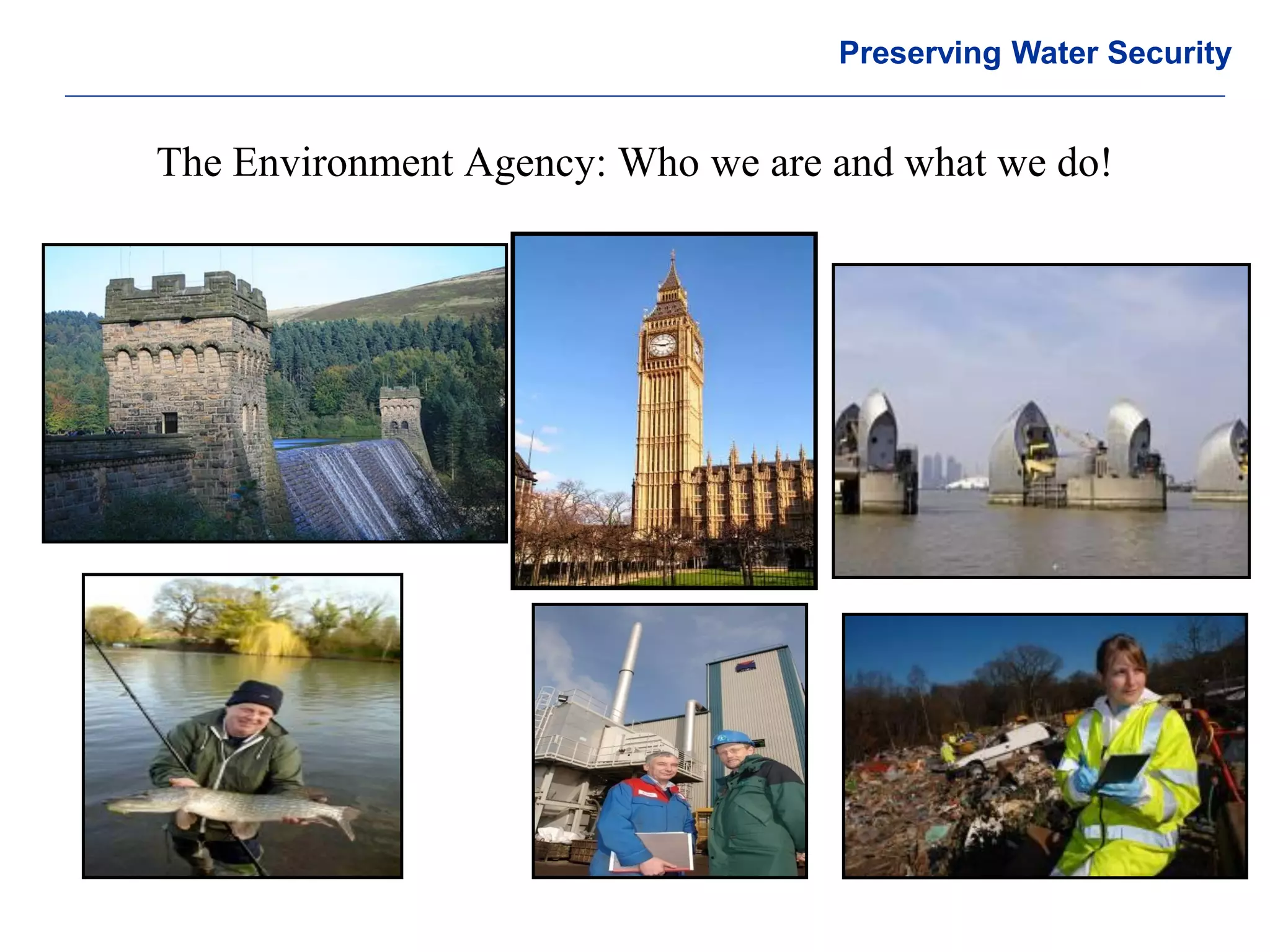
The Environment Agency: Who we are and what we do! 
Preserving Water Security
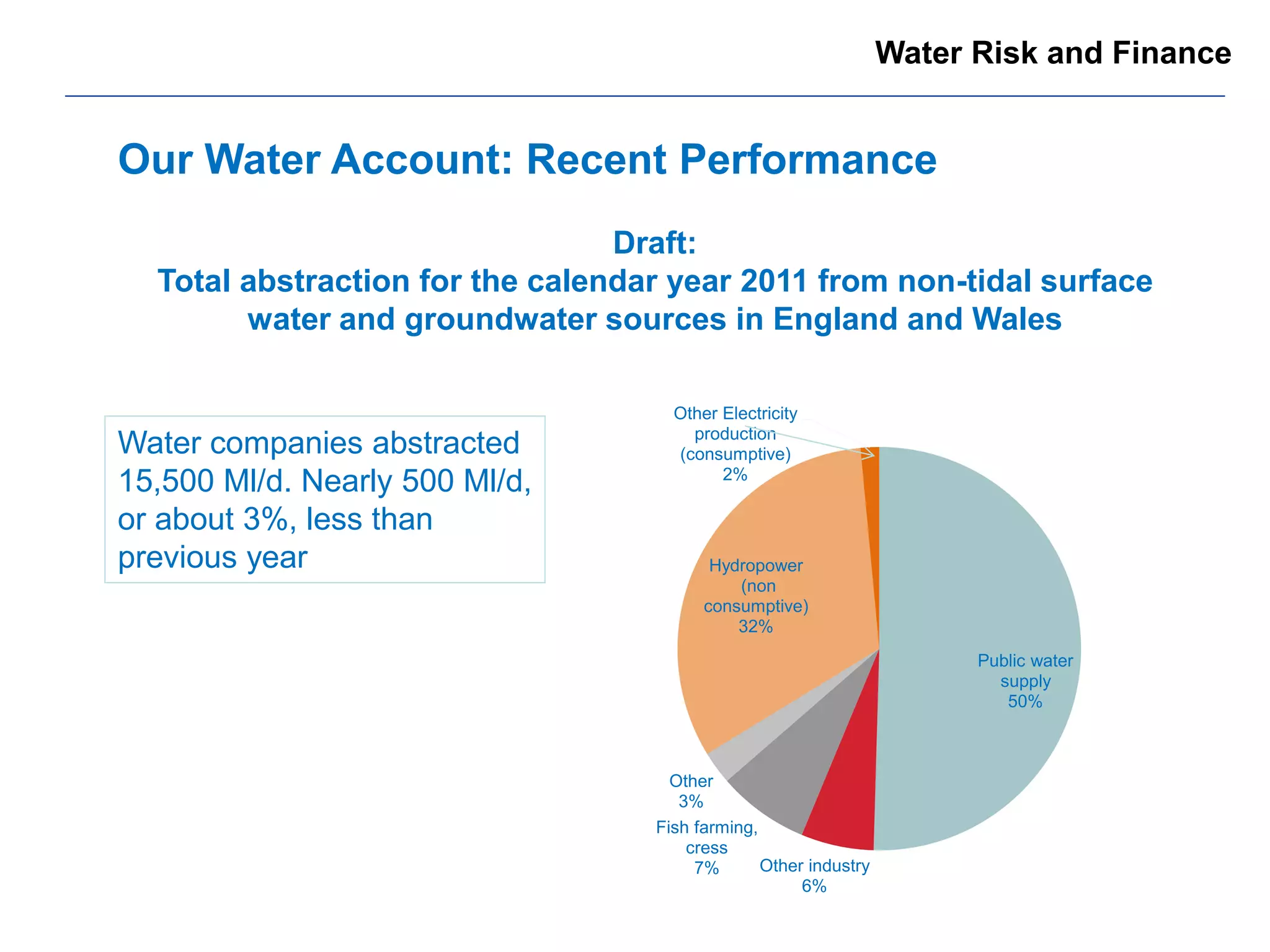
Public water supply 50% 
Other industry 6% 
Fish farming, cress 7% 
Other 3% 
Hydropower 
(non consumptive) 32% 
Other Electricity production (consumptive) 2% 
Our Water Account: Recent Performance 
Water companies abstracted 15,500 Ml/d. Nearly 500 Ml/d, or about 3%, less than previous year 
Total abstraction for the calendar year 2011 from non-tidal surface water and groundwater sources in England and Wales (source Environment Agency) 
Draft: Total abstraction for the calendar year 2011 from non-tidal surface water and groundwater sources in England and Wales 
Water Risk and Finance
• Demand reduced by approximately 2% compared with the previous year. 
• Overall demand shows a consistent reduction of about 1% a year since 2006. 
• From 2003 a small but consistent average decline in pcc of about 1% each year. 
• Average pcc now 146 l/p/d (2% or 3 litres less than previous year) 
• An 18% difference between measured and unmeasured pcc (129 –v- 155) 
• Average leakage per property in England and Wales has dropped by 7% to 127 l/prop/d. 
Our Water Account: Recent Performance 
Total abstraction for the calendar year 2011 from non-tidal surface water and groundwater sources in England and Wales (source Environment Agency) 
[t1]Interesting number, can we just confirm that its 127 l/prop/d. It’s the same as metered pcc? 
Draft: The main components of PWS demand between April 2011 and March 2012 
Water Risk and Finance
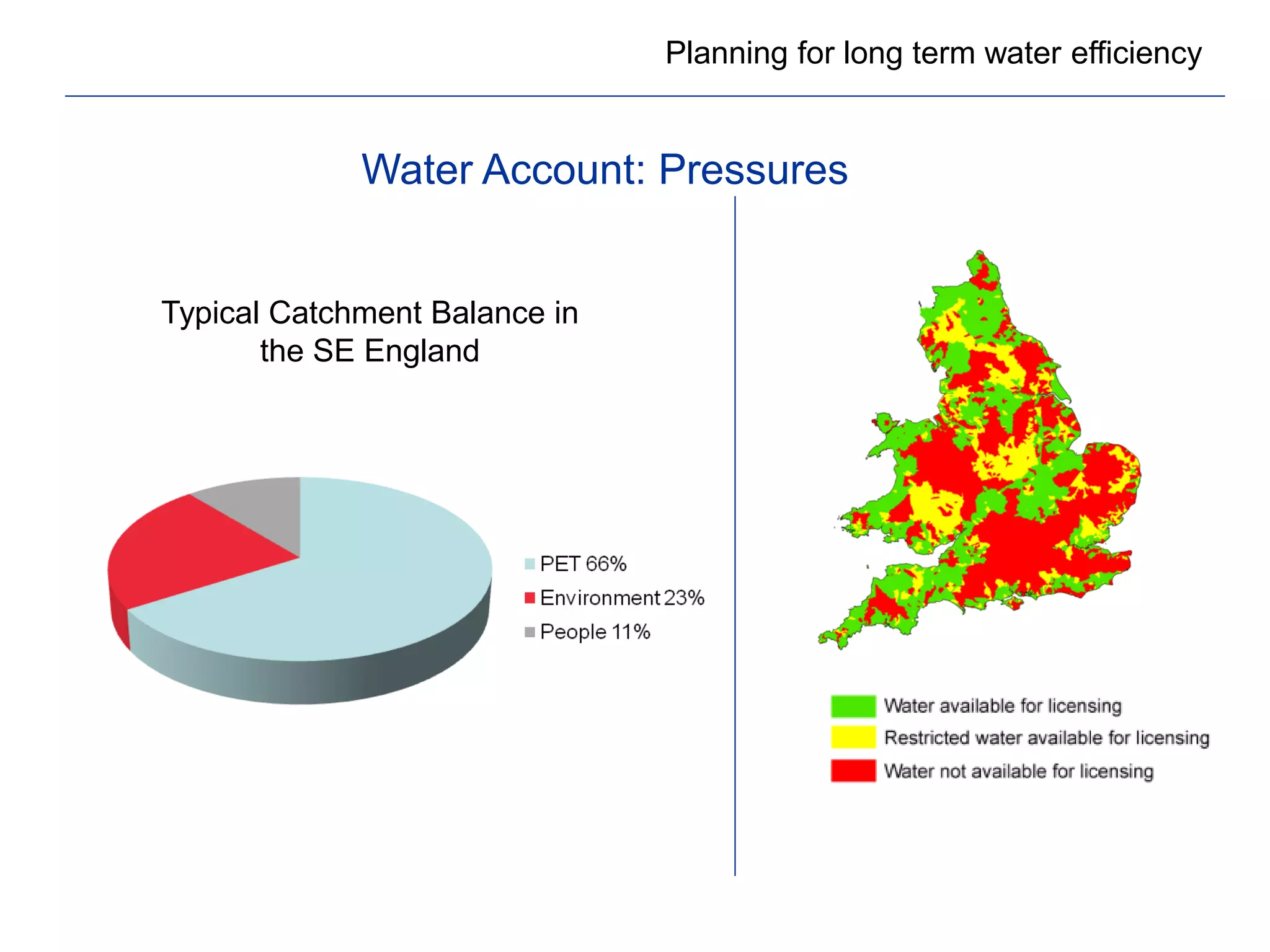
Water Account: Pressures 
Planning for long term water efficiency 
Typical Catchment Balance in the SE England
© Crown copyright Met Office 
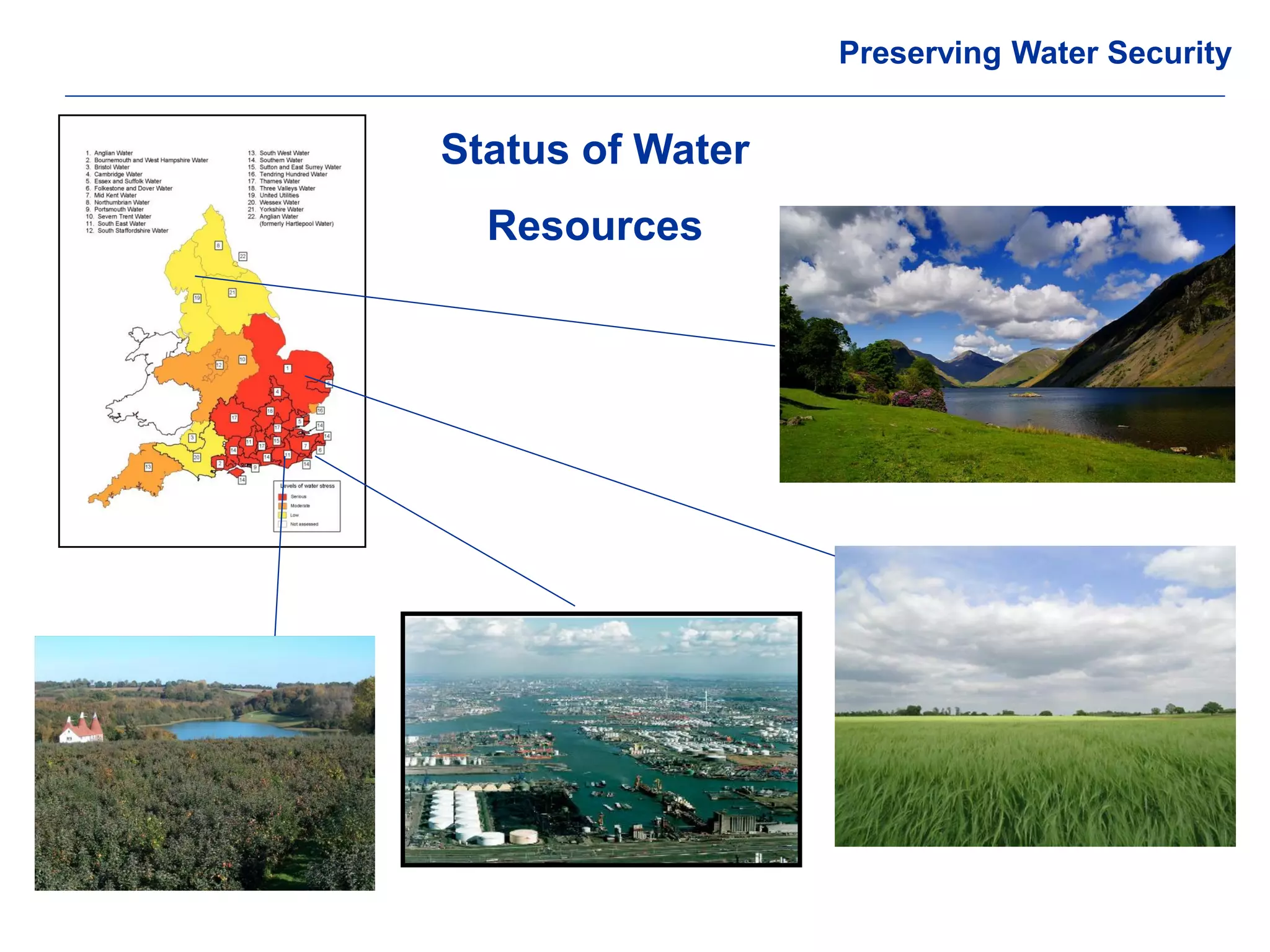
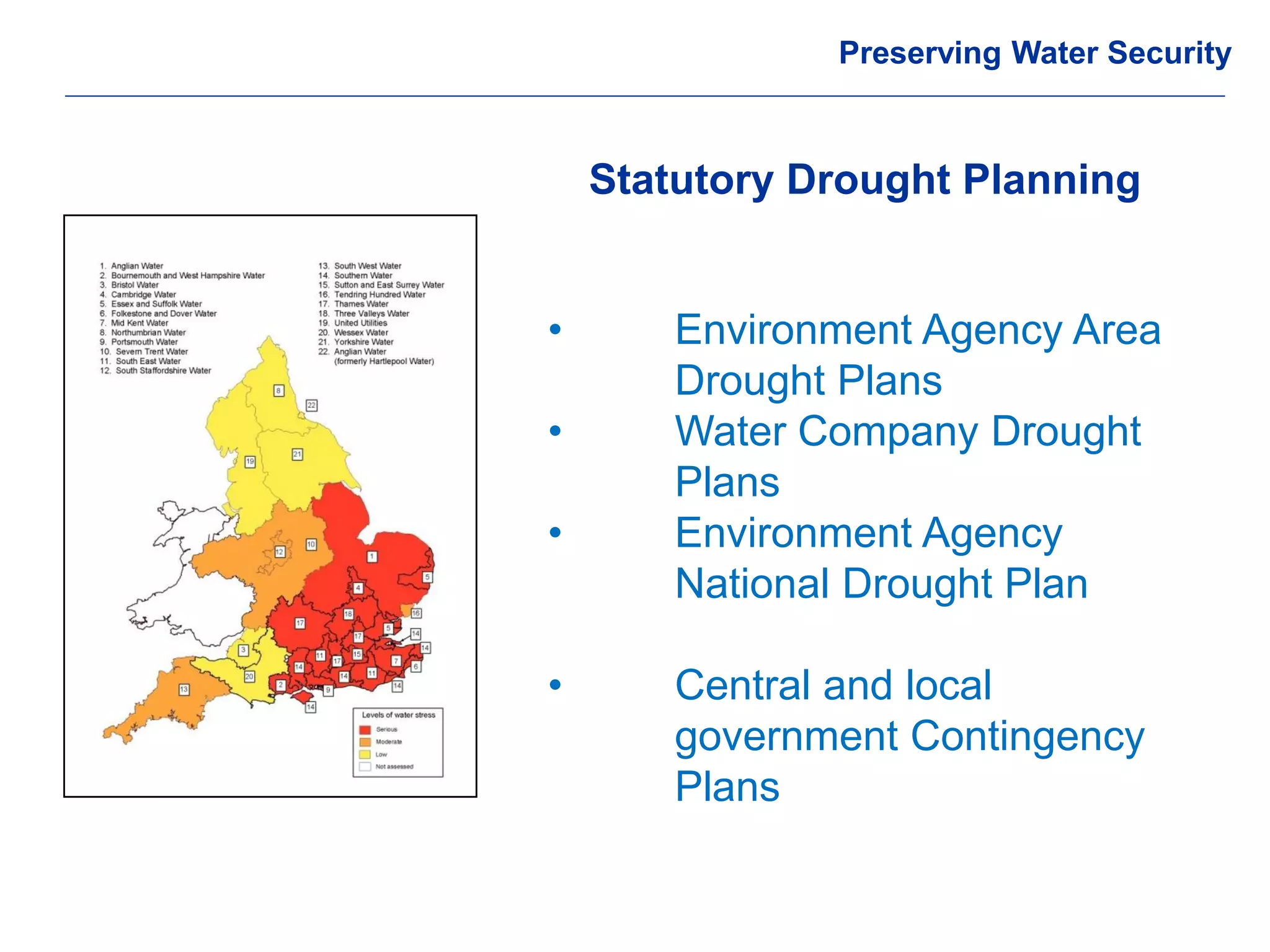
Status of Water 
Resources 
Preserving Water Security
© Crown copyright Met Office 
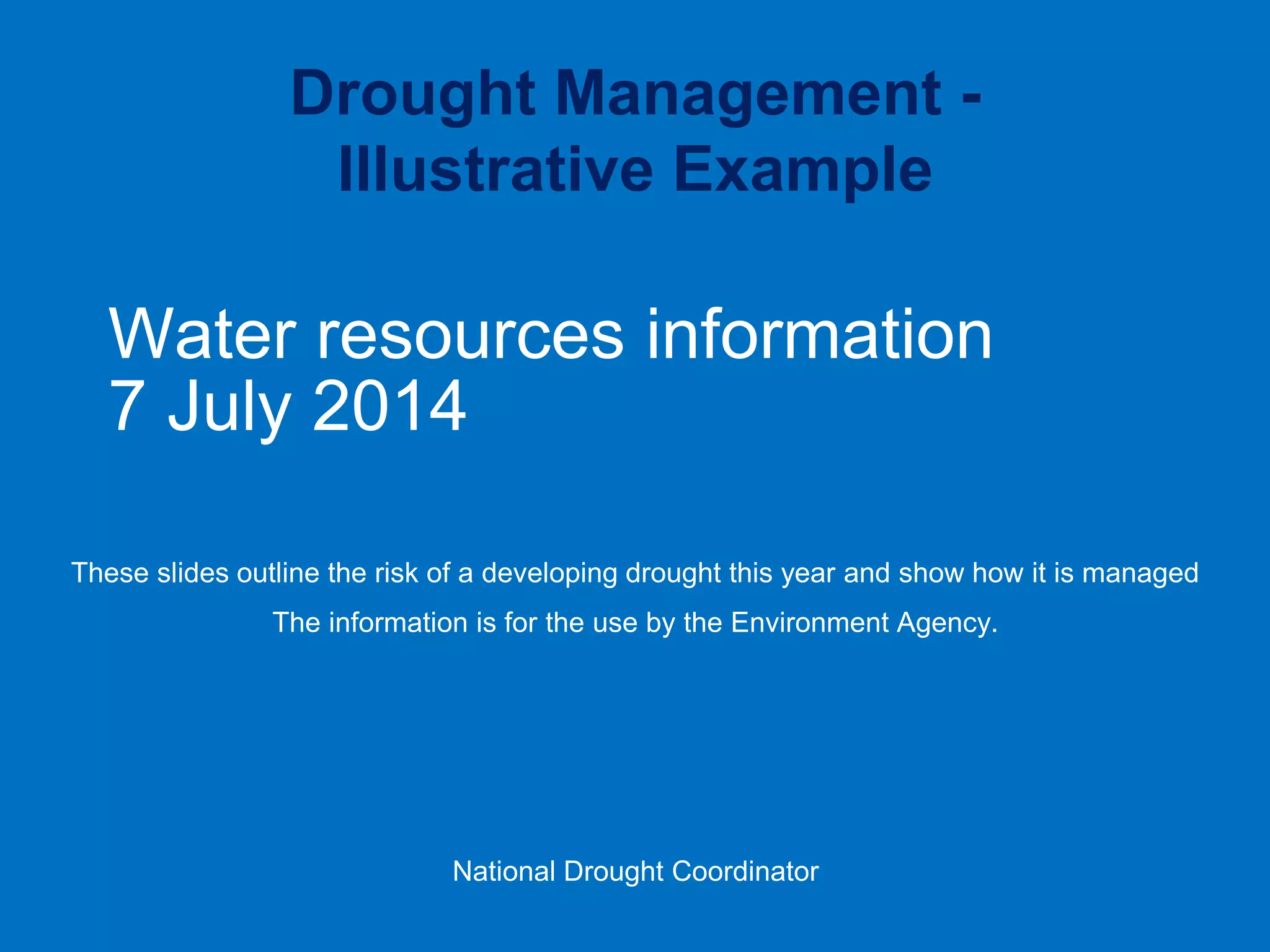
Statutory Drought Planning 
Preserving Water Security 
• Environment Agency Area Drought Plans 
• Water Company Drought Plans 
• Environment Agency National Drought Plan 
• Central and local government Contingency Plans
Water resources information 7 July 2014 
These slides outline the risk of a developing drought this year and show how it is managed 
The information is for the use by the Environment Agency. 
National Drought Coordinator 
Drought Management - Illustrative Example
WR Information – 2 July 2014 
9 
Context – Public Water Supply and Drought 
• Water Company Water Resource Management Plans (WRMP) is a strategic 25 year view of Water Company’s area aiming to enable cost effective security of supply under normal conditions – WRMP are a Statutory process signed-off by the Secretary of State. 
• Water Company Drought Plans (DP) set out timely actions for security of supply under periods of low rainfall. Actions typically escalate through encouraging voluntary customers reductions, mandatory customers restrictions and relaxing environmental protections to allow access to additional resources. 
• The transition between normal operation and drought (resilience) is set between each water company and the level of service for its customers which is then endorsed by the Secretary of State through the WRMP and DP process and plans. 3
WR Information – 2 July 2014 
10 
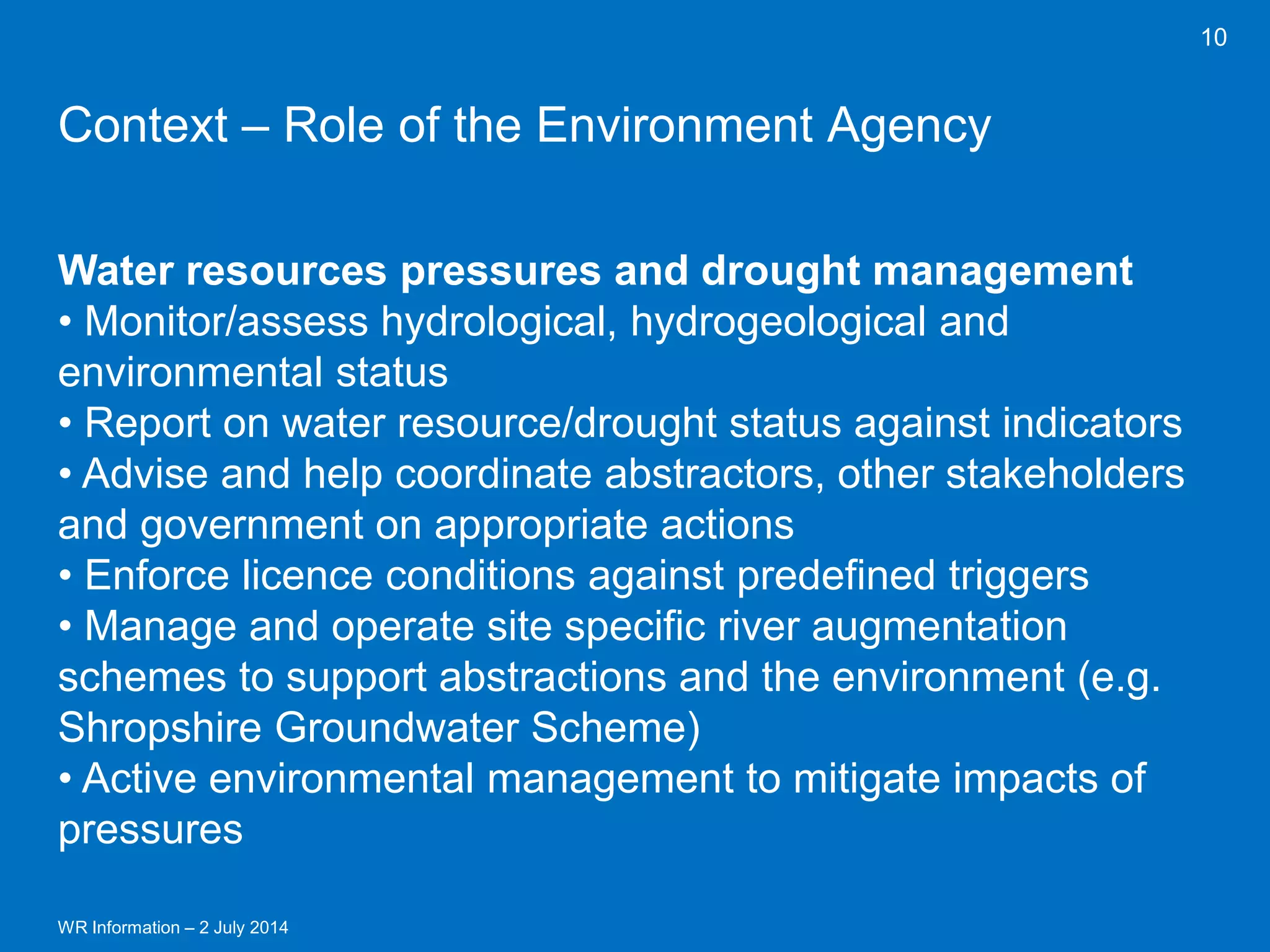
Context – Role of the Environment Agency 
Water resources pressures and drought management 
• Monitor/assess hydrological, hydrogeological and environmental status 
• Report on water resource/drought status against indicators 
• Advise and help coordinate abstractors, other stakeholders and government on appropriate actions 
• Enforce licence conditions against predefined triggers 
• Manage and operate site specific river augmentation schemes to support abstractions and the environment (e.g. Shropshire Groundwater Scheme) 
• Active environmental management to mitigate impacts of pressures
WR Information – 2 July 2014 
11 
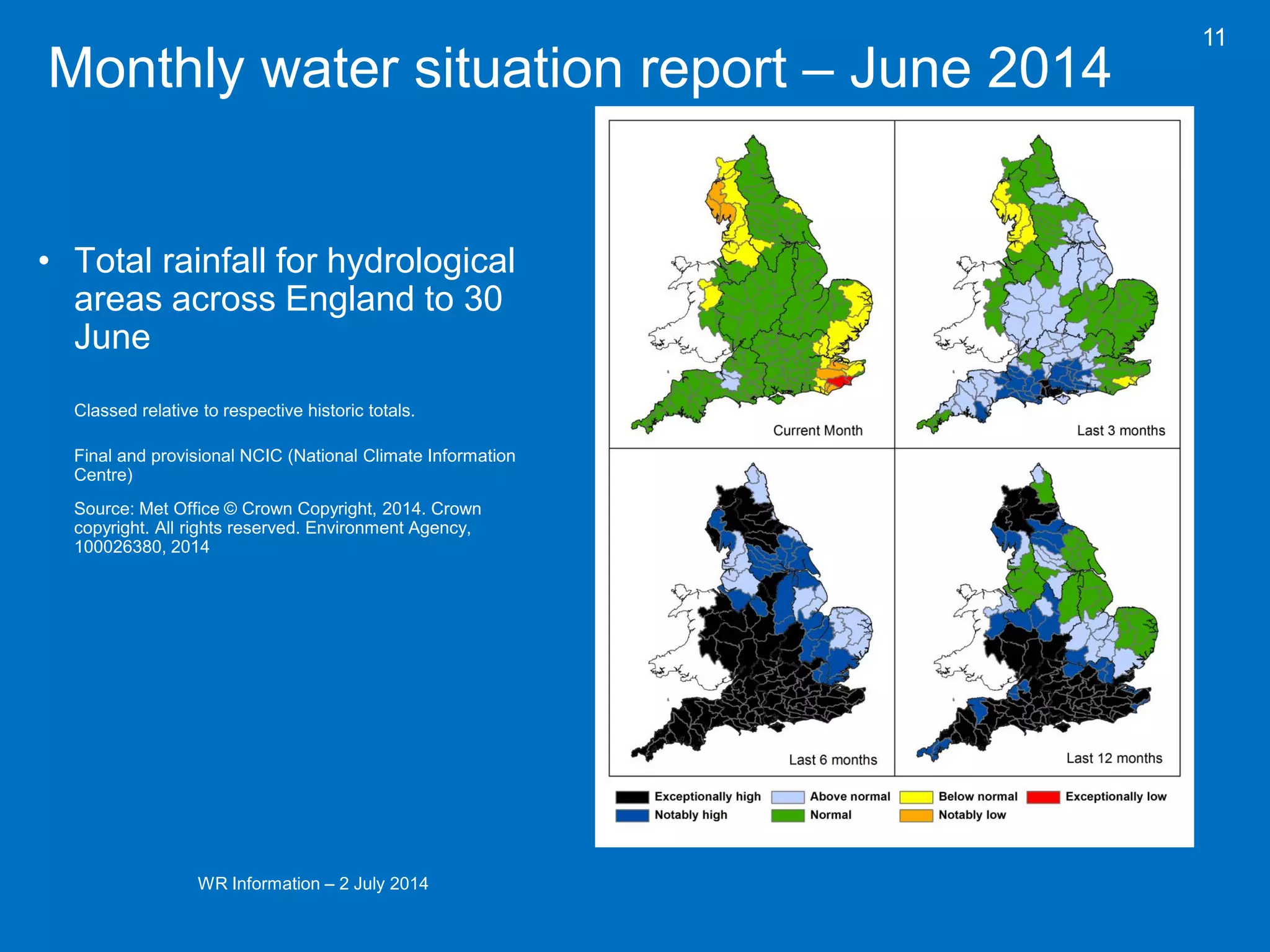
Monthly water situation report – June 2014 
•Total rainfall for hydrological areas across England to 30 June 
Classed relative to respective historic totals. 
Final and provisional NCIC (National Climate Information Centre) 
Source: Met Office © Crown Copyright, 2014. Crown copyright. All rights reserved. Environment Agency, 100026380, 2014
WR Information – 2 July 2014 
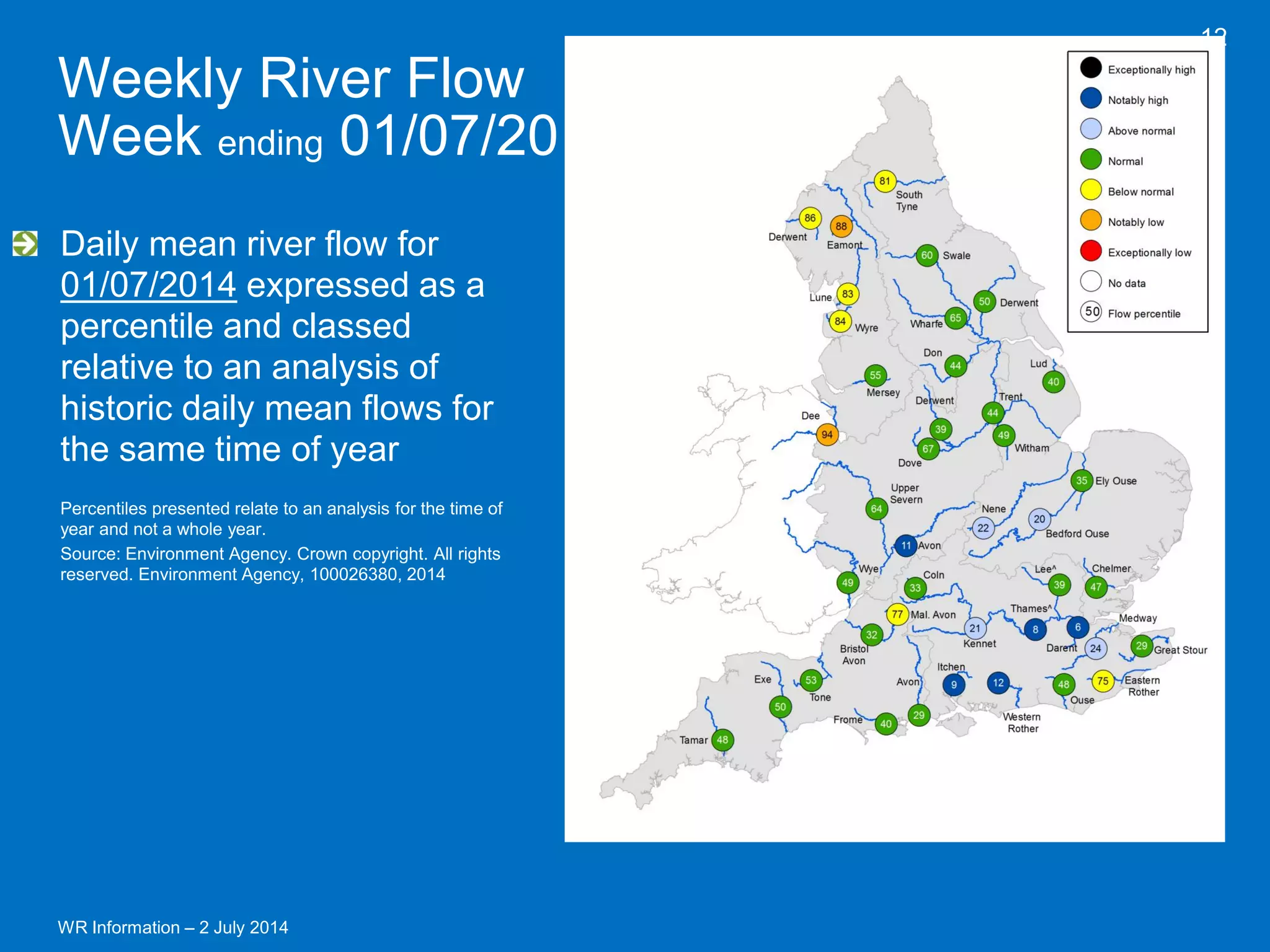
12 Daily mean river flow for 01/07/2014 expressed as a percentile and classed relative to an analysis of historic daily mean flows for the same time of year Percentiles presented relate to an analysis for the time of year and not a whole year. Source: Environment Agency. Crown copyright. All rights reserved. Environment Agency, 100026380, 2014 
Weekly River Flow Week ending 01/07/2014
Probabilistic 
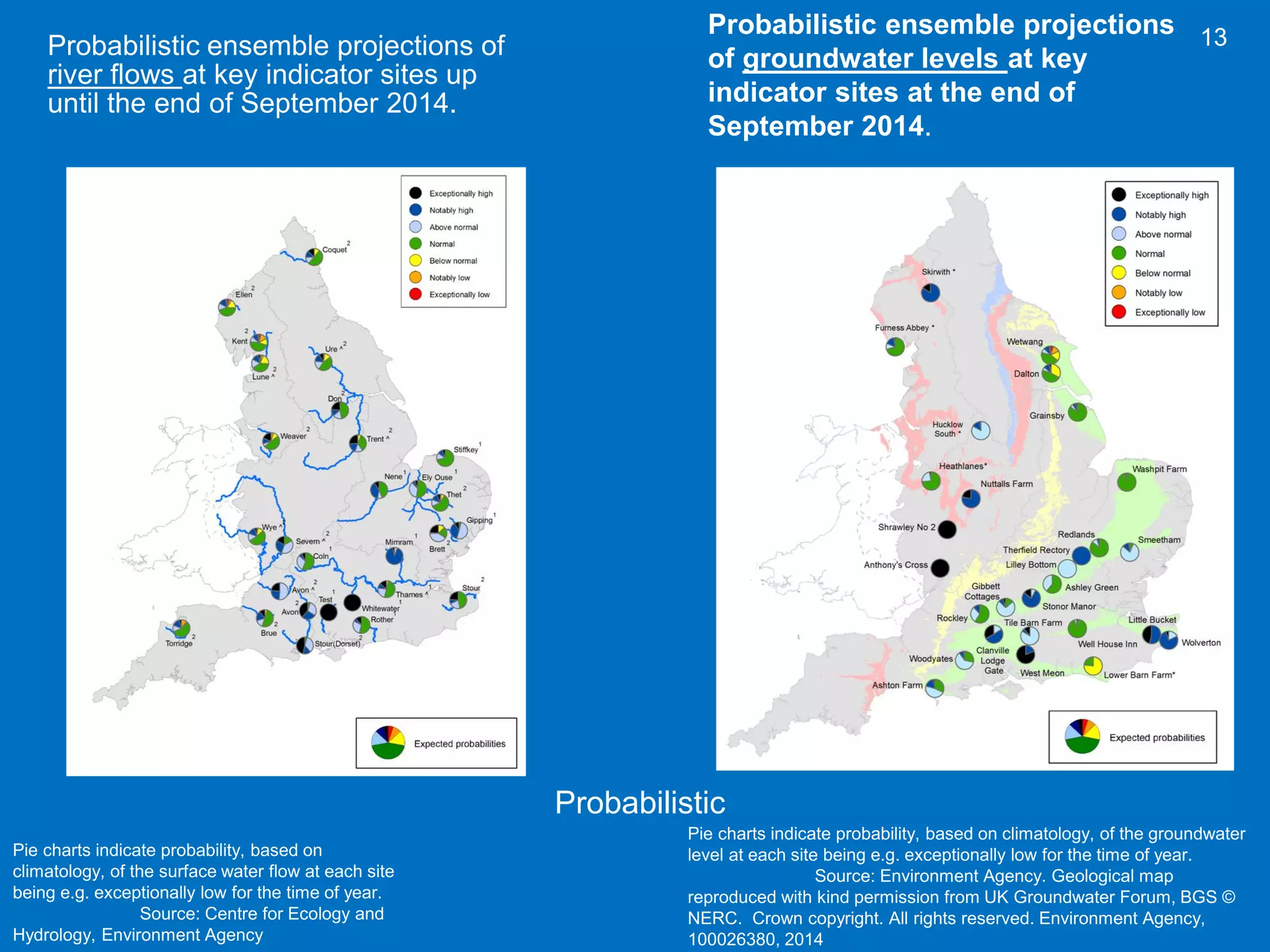
Probabilistic ensemble projections of 13 
river flows at key indicator sites up 
until the end of September 2014. 
Probabilistic ensemble projections 
of groundwater levels at key 
indicator sites at the end of 
September 2014. 
Pie charts indicate probability, based on climatology, of the groundwater 
level at each site being e.g. exceptionally low for the time of year. 
Source: Environment Agency. Geological map 
reproduced with kind permission from UK Groundwater Forum, BGS © 
NERC. Crown copyright. All rights reserved. Environment Agency, 
100026380, 2014 
Pie charts indicate probability, based on 
climatology, of the surface water flow at each site 
being e.g. exceptionally low for the time of year. 
Source: Centre for Ecology and 
Hydrology, Environment Agency
WR Information – 2 July 2014 
14 
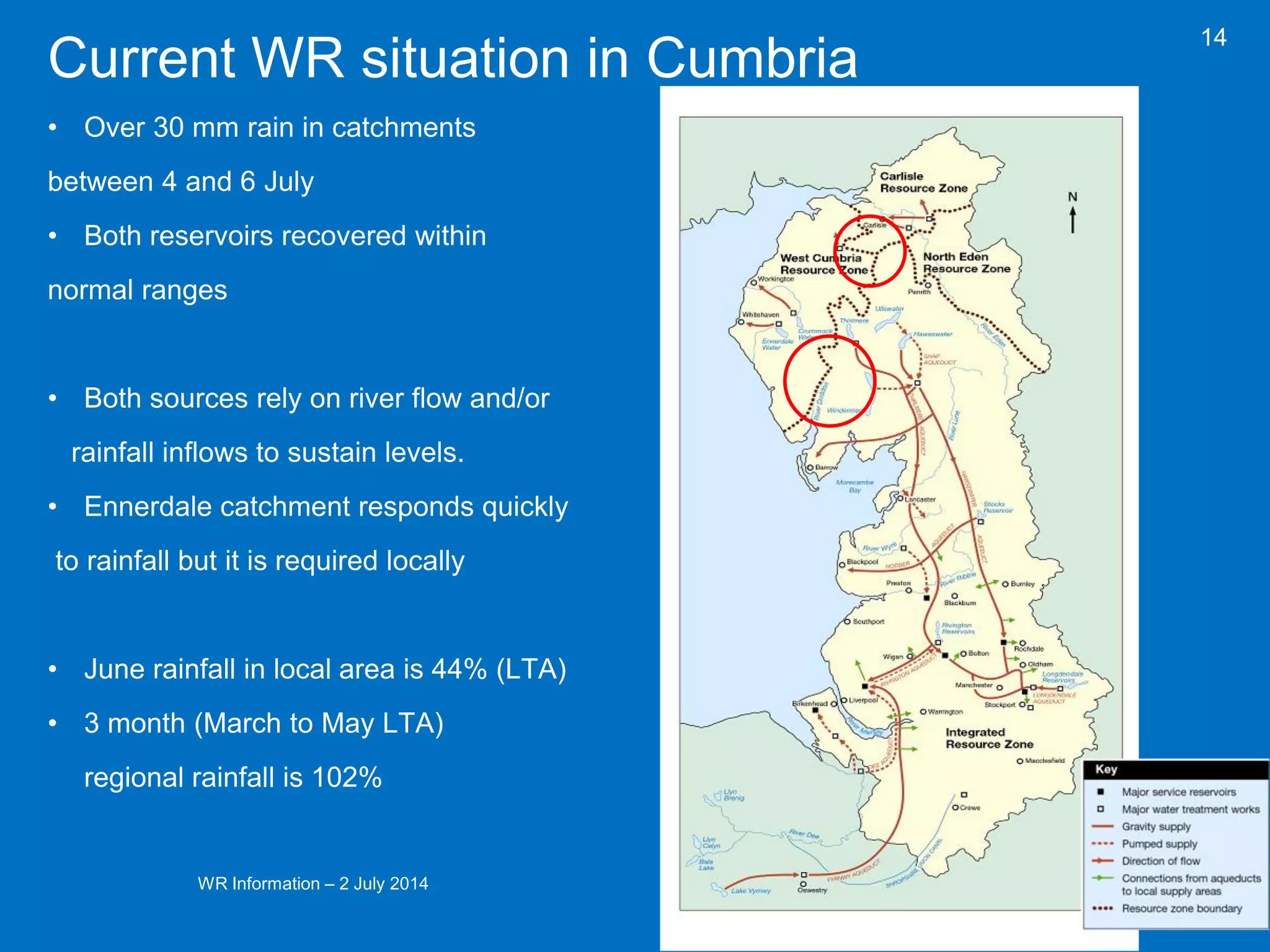
Current WR situation in Cumbria 
•Over 30 mm rain in catchments 
between 4 and 6 July 
•Both reservoirs recovered within 
normal ranges 
•Both sources rely on river flow and/or 
rainfall inflows to sustain levels. 
•Ennerdale catchment responds quickly 
to rainfall but it is required locally 
•June rainfall in local area is 44% (LTA) 
•3 month (March to May LTA) 
regional rainfall is 102%
WR Information – 2 July 2014 
15 
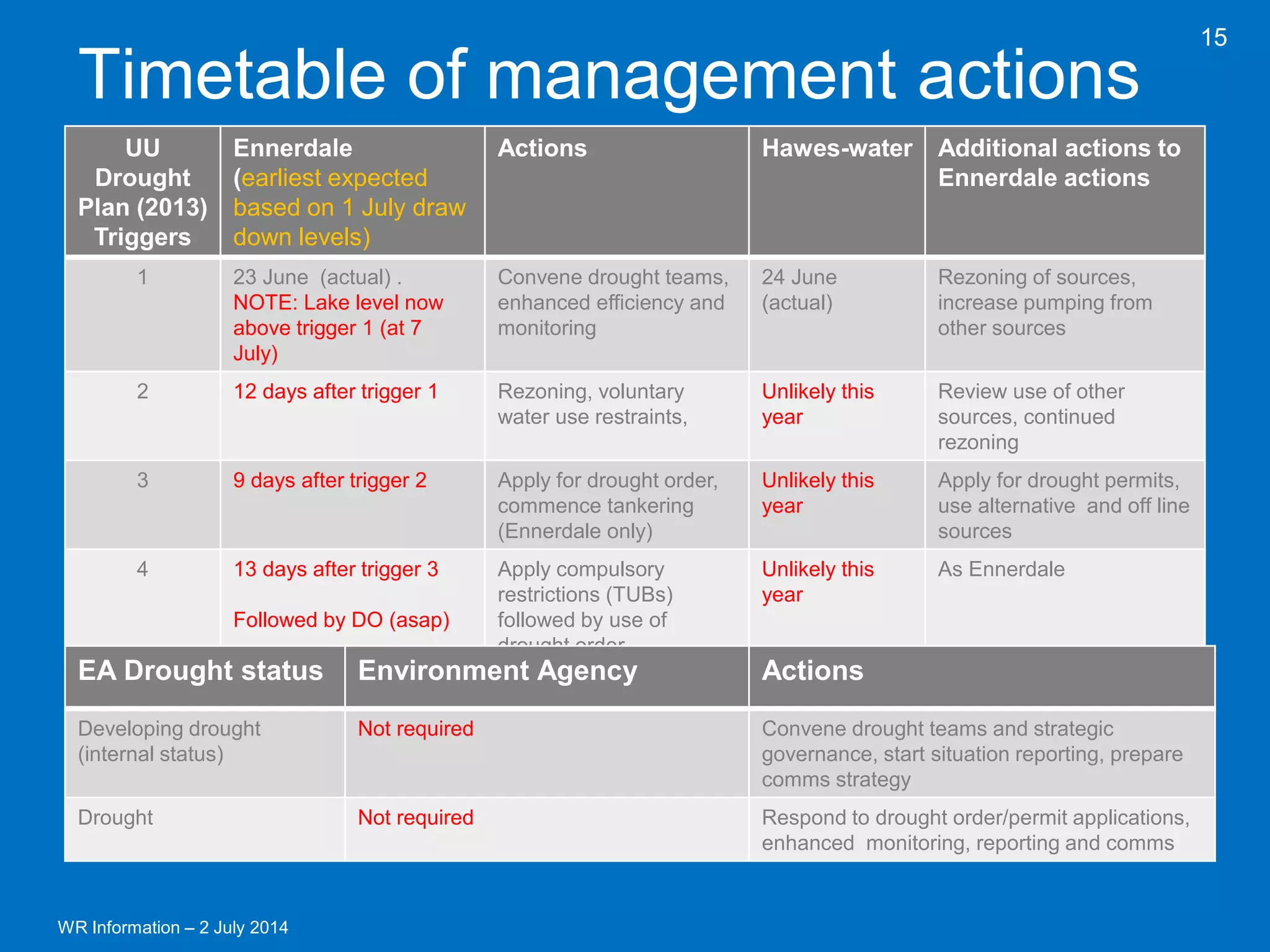
Timetable of management actions 
UU Drought Plan (2013) Triggers 
Ennerdale 
(earliest expected based on 1 July draw down levels) 
Actions 
Hawes-water 
Additional actions to Ennerdale actions 
1 
23 June (actual) . 
NOTE: Lake level now above trigger 1 (at 7 July) 
Convene drought teams, enhanced efficiency and monitoring 
24 June 
(actual) 
Rezoning of sources, increase pumping from other sources 
2 
12 days after trigger 1 
Rezoning, voluntary water use restraints, 
Unlikely this year 
Review use of other sources, continued rezoning 
3 
9 days after trigger 2 
Apply for drought order, commence tankering (Ennerdale only) 
Unlikely this year 
Apply for drought permits, use alternative and off line sources 
4 
13 days after trigger 3 
Followed by DO (asap) 
Apply compulsory restrictions (TUBs) followed by use of drought order 
Unlikely this year 
As Ennerdale 
EA Drought status 
Environment Agency 
Actions 
Developing drought (internal status) 
Not required 
Convene drought teams and strategic governance, start situation reporting, prepare comms strategy 
Drought 
Not required 
Respond to drought order/permit applications, enhanced monitoring, reporting and comms
WR Information – 2 July 2014 
16 
Forward look 
•Recovering situation as reservoirs return within normal range for time of year due to significant rainfall 
•Local area teams maintain close monitoring on levels and situation over summer 
•Local and national leads review response to identify lessons for future preparedness 
•UU, Defra and EA resume weekly telecons on IROPI and EIP preparation
WR Information – 2 July 2014 
17 
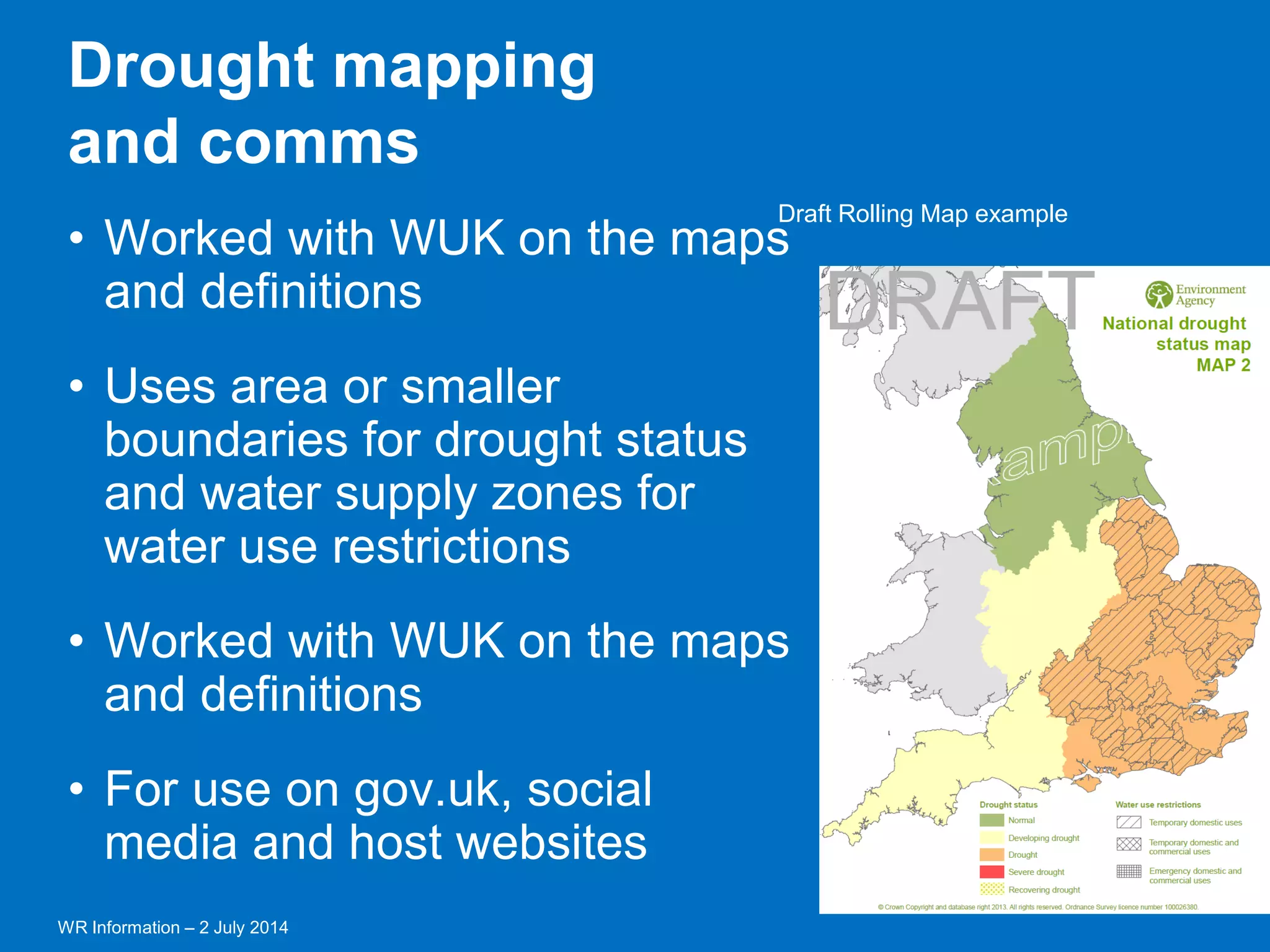
Draft Rolling Map example 
•Worked with WUK on the maps and definitions 
•Uses area or smaller boundaries for drought status and water supply zones for water use restrictions 
•Worked with WUK on the maps and definitions 
•For use on gov.uk, social media and host websites 
Drought mapping 
and comms
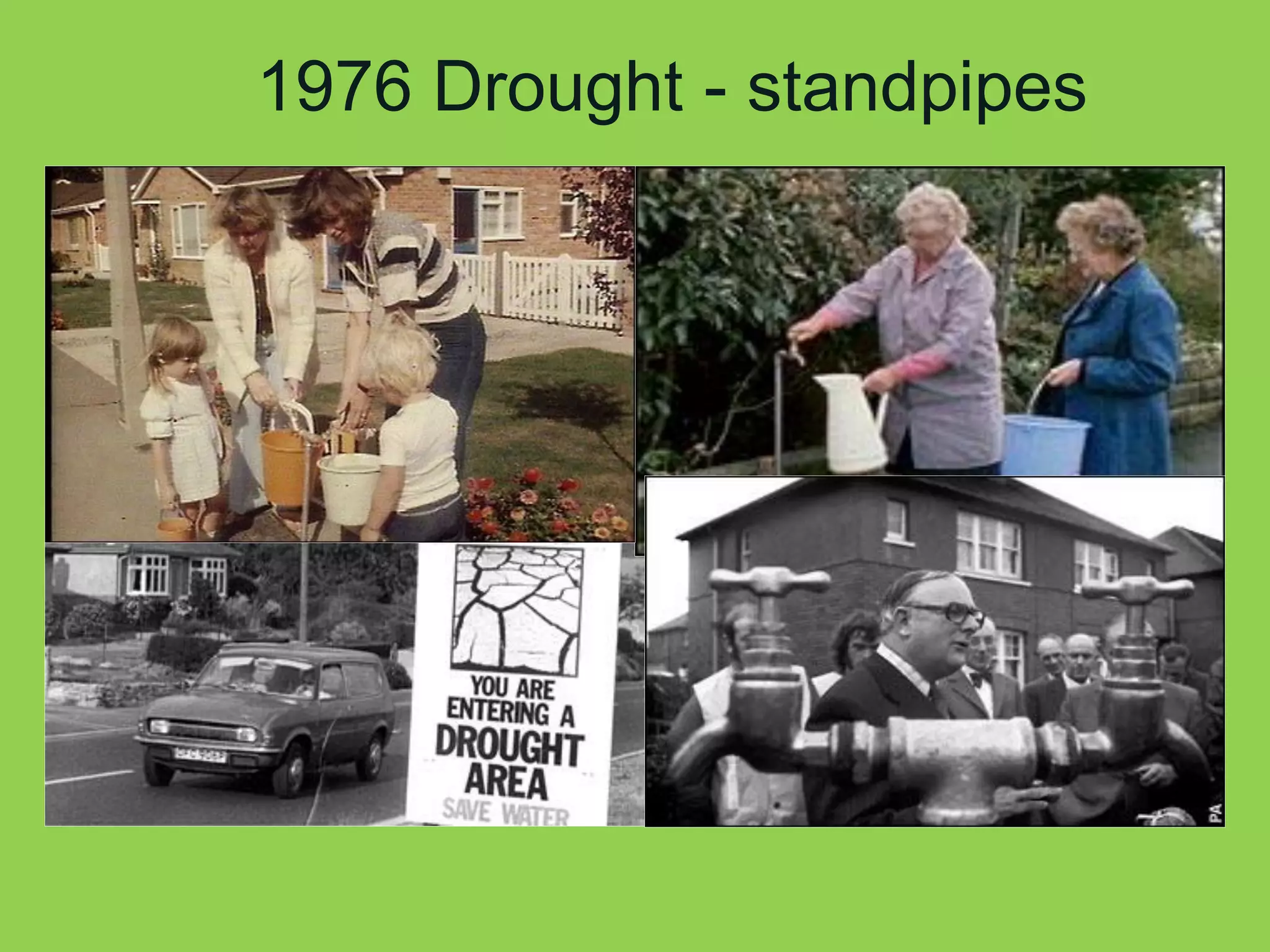
1976 Drought - standpipes
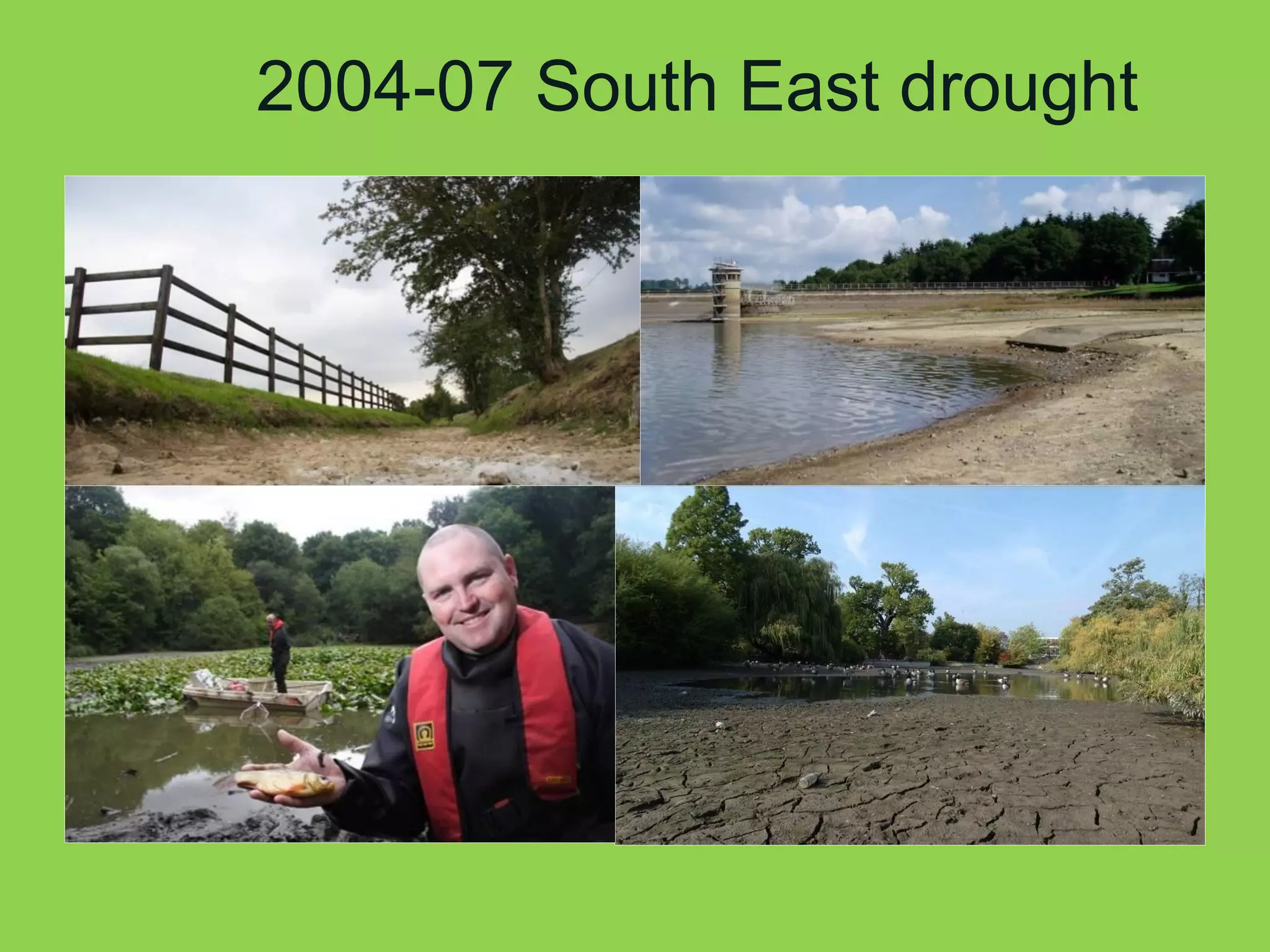
2004-07 South East drought
Legislation 
•Pre-1945 Byelaws 
•1945 Water Act, Section 16 
•Water Industry Act, 1991, Section 76 
•Water Resources Act 1991 (amended by Environment Act 1995 and Water Act 2003) – Sections 73 - 81 
•Flood and Water Management Act 2010 
•Drought Direction 2011 affecting the 'non-essential uses'
Water use restrictions – new provisions 
•New legislation commenced on 1 Oct 2010: 
•Flood and Water Management Act 2010 
•Water Use (Temporary Bans) Order 2010 (detail and definitions) 
•Water companies can restrict and/or prohibit more types of water use during a drought. 
•Replaces the hosepipe bans from the Water Industry Act 
•New powers – in response to 2004-07 drought 
•Reduces the need for non-essential use drought orders
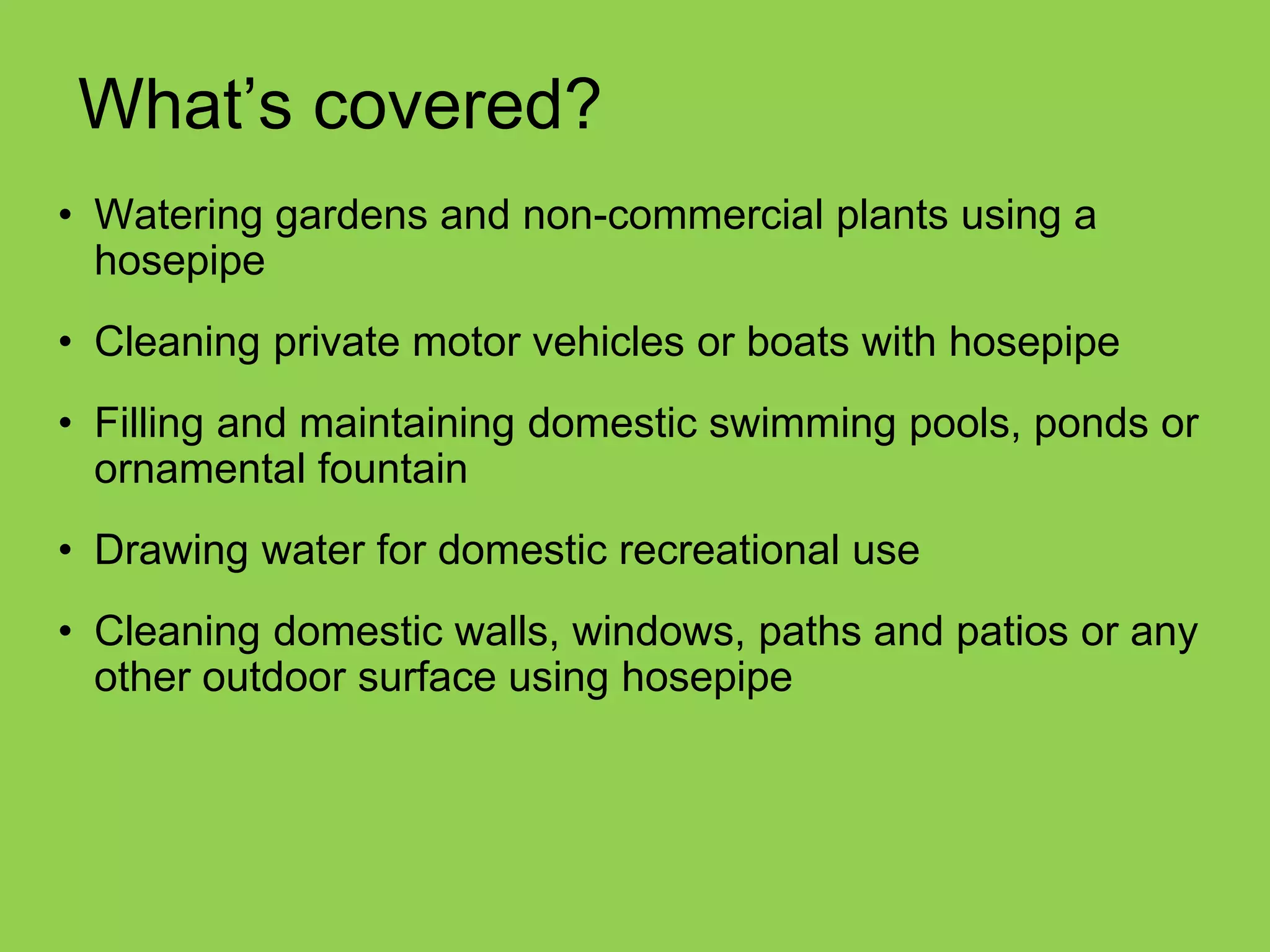
•Watering gardens and non-commercial plants using a hosepipe 
•Cleaning private motor vehicles or boats with hosepipe 
•Filling and maintaining domestic swimming pools, ponds or ornamental fountain 
•Drawing water for domestic recreational use 
•Cleaning domestic walls, windows, paths and patios or any other outdoor surface using hosepipe 
What’s covered?
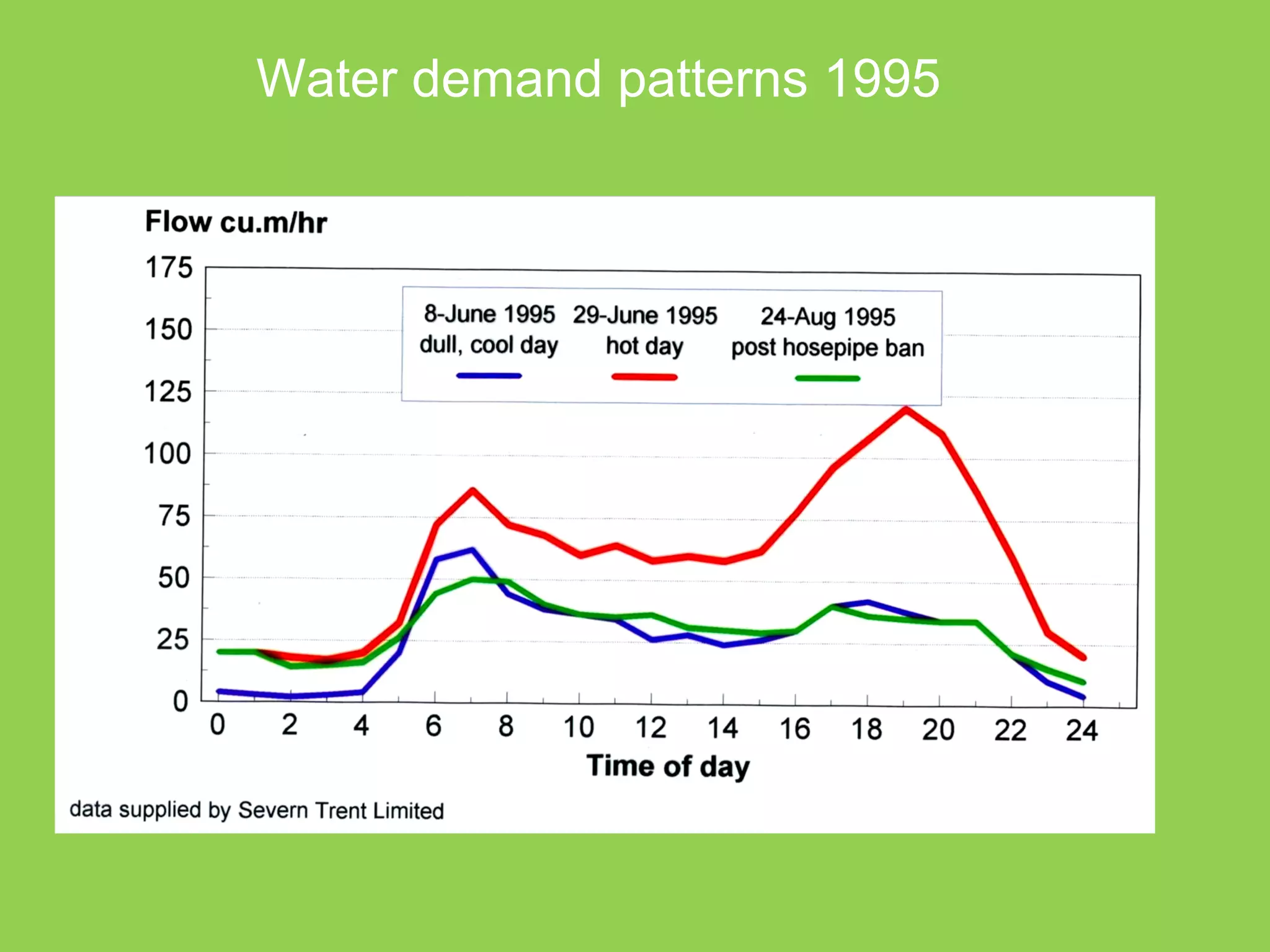
Water demand patterns 1995
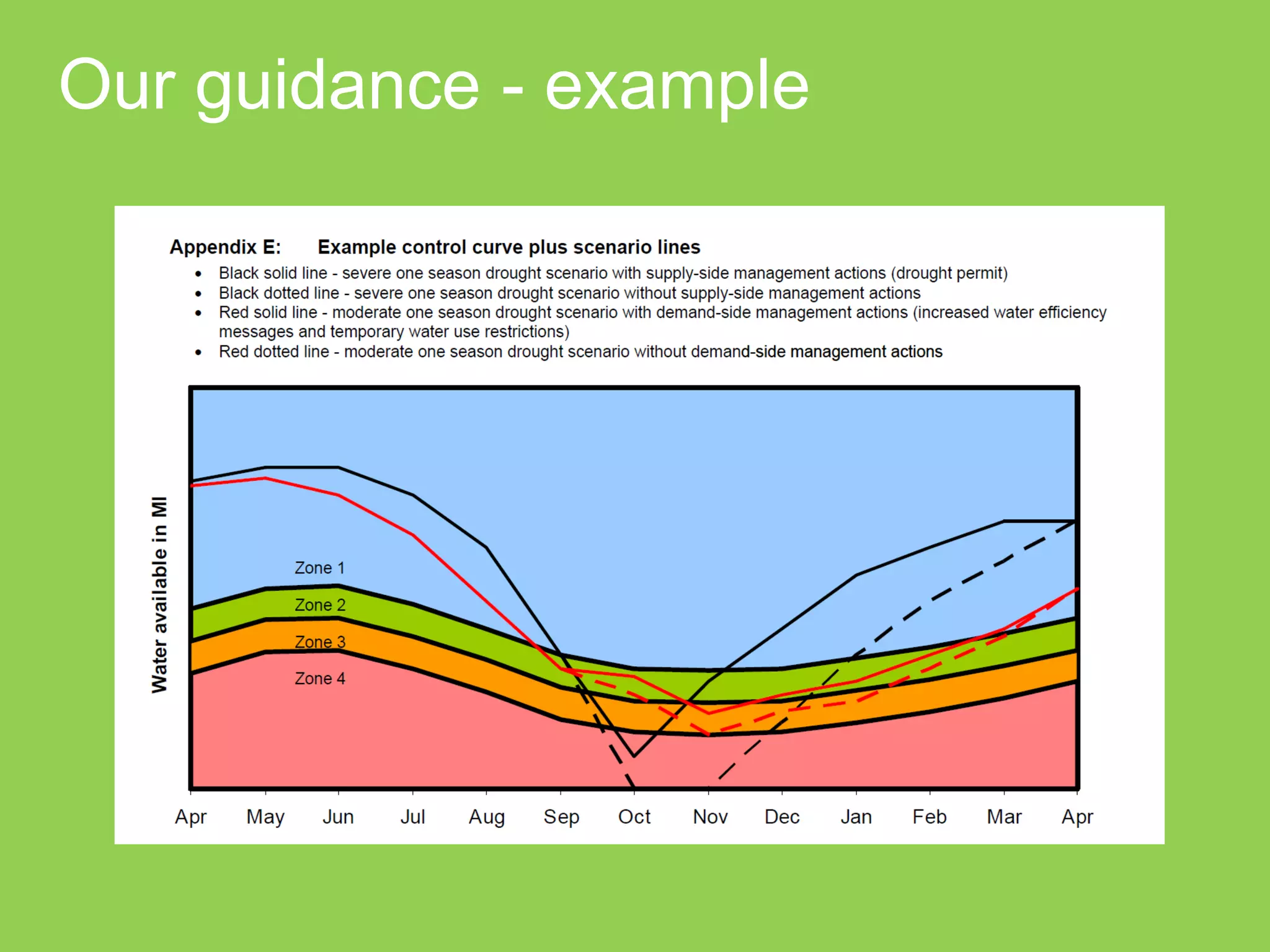
Our guidance - example
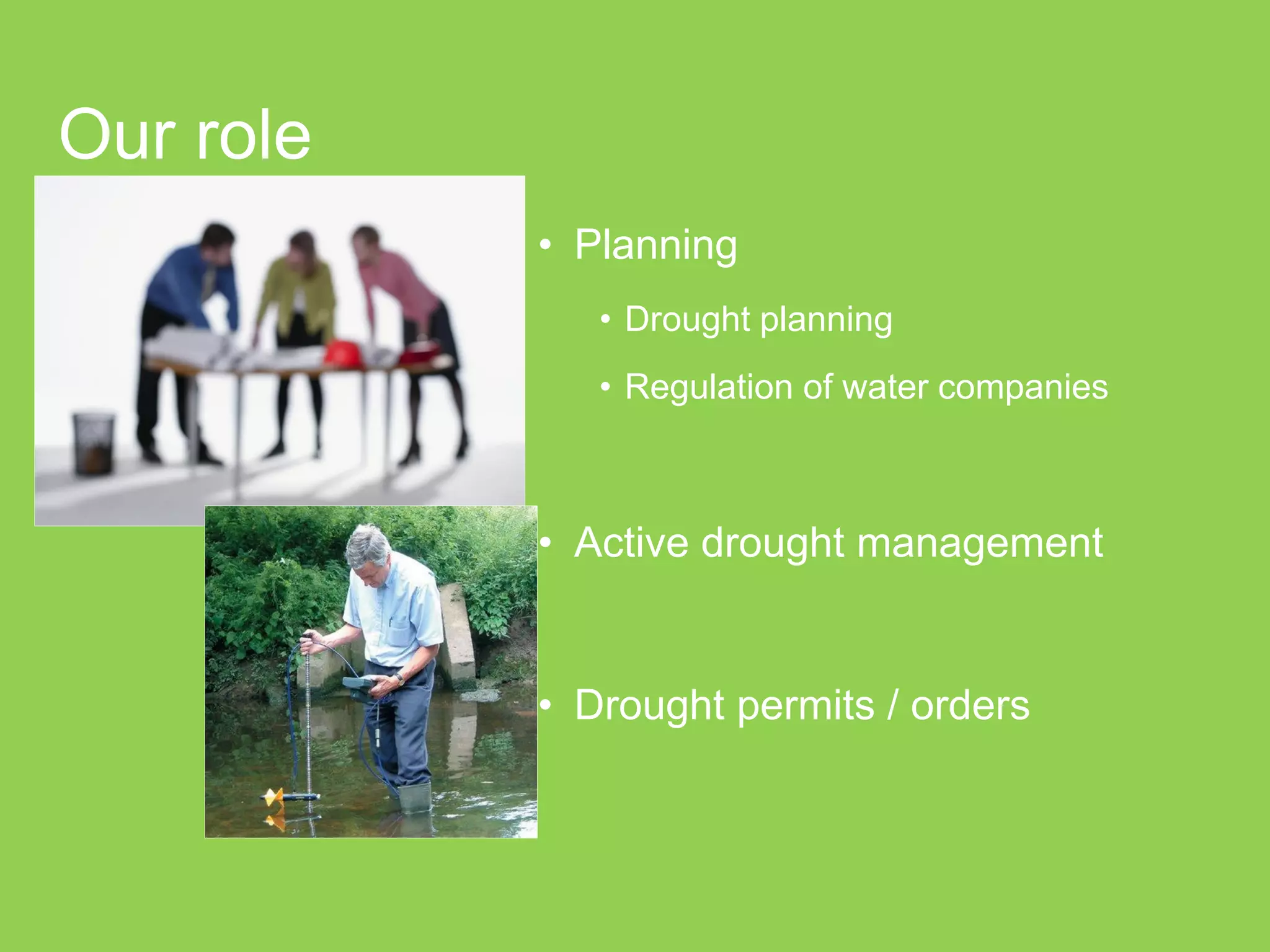
Our role 
•Planning 
•Drought planning 
•Regulation of water companies 
•Active drought management 
•Drought permits / orders
Drought management – head office 
•Communications 
•Co-ordination of communications, internal and external 
•Requests for information by Chief Executive, Defra, Ministers 
•Increase in press interest and from other organisations such as NFU 
•National briefings 
•Weekly one message briefings – cabinet office and Defra 
•Support to the regions 
•Drought permits 
•Advice and guidance
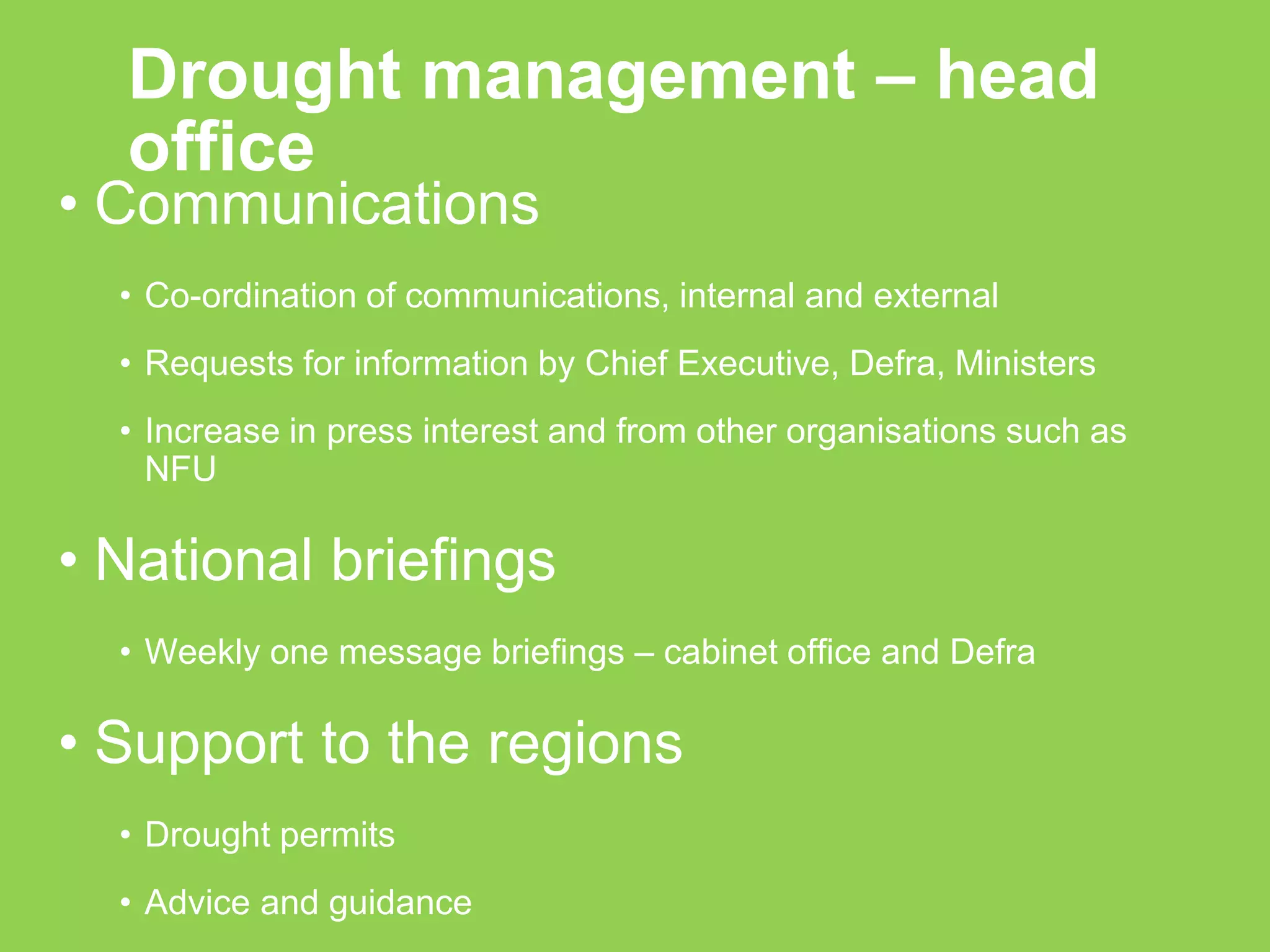
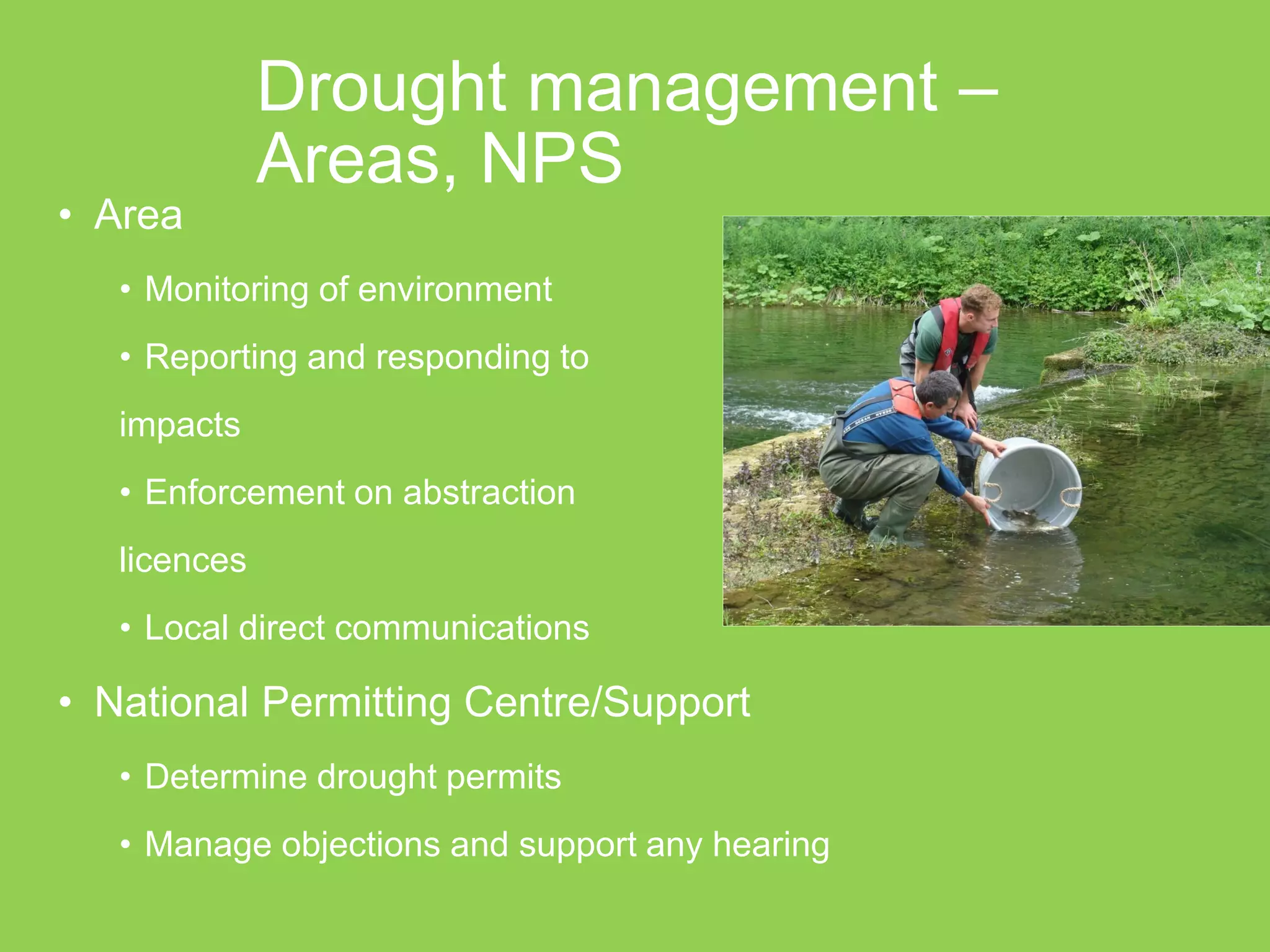
Drought management – Areas, NPS 
•Area 
•Monitoring of environment 
•Reporting and responding to 
impacts 
•Enforcement on abstraction 
licences 
•Local direct communications 
•National Permitting Centre/Support 
•Determine drought permits 
•Manage objections and support any hearing
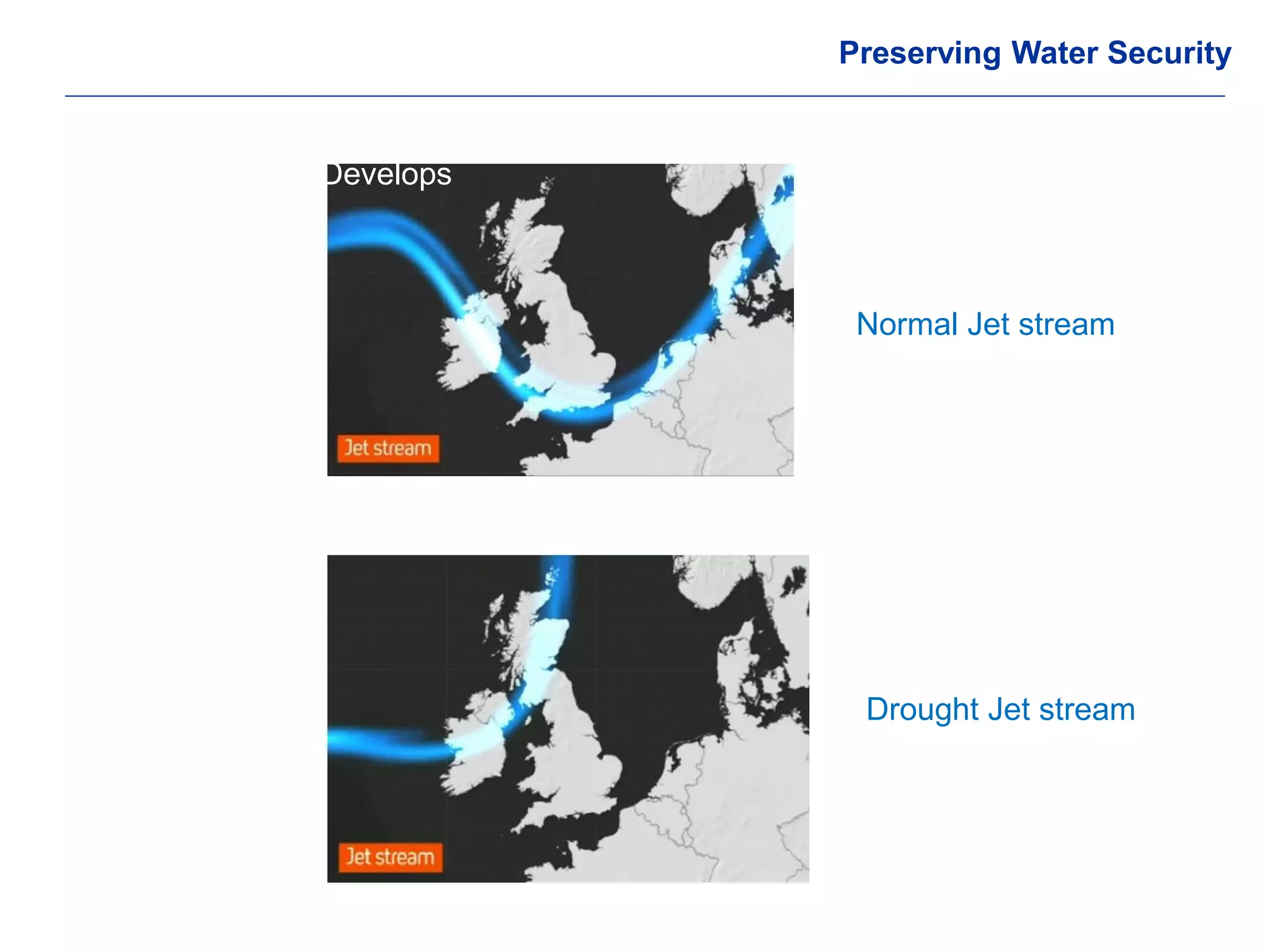
The Environmental Drought Develops 
Normal Jet stream 
Drought Jet stream 
28 
Preserving Water Security
© Crown copyright Met Office 
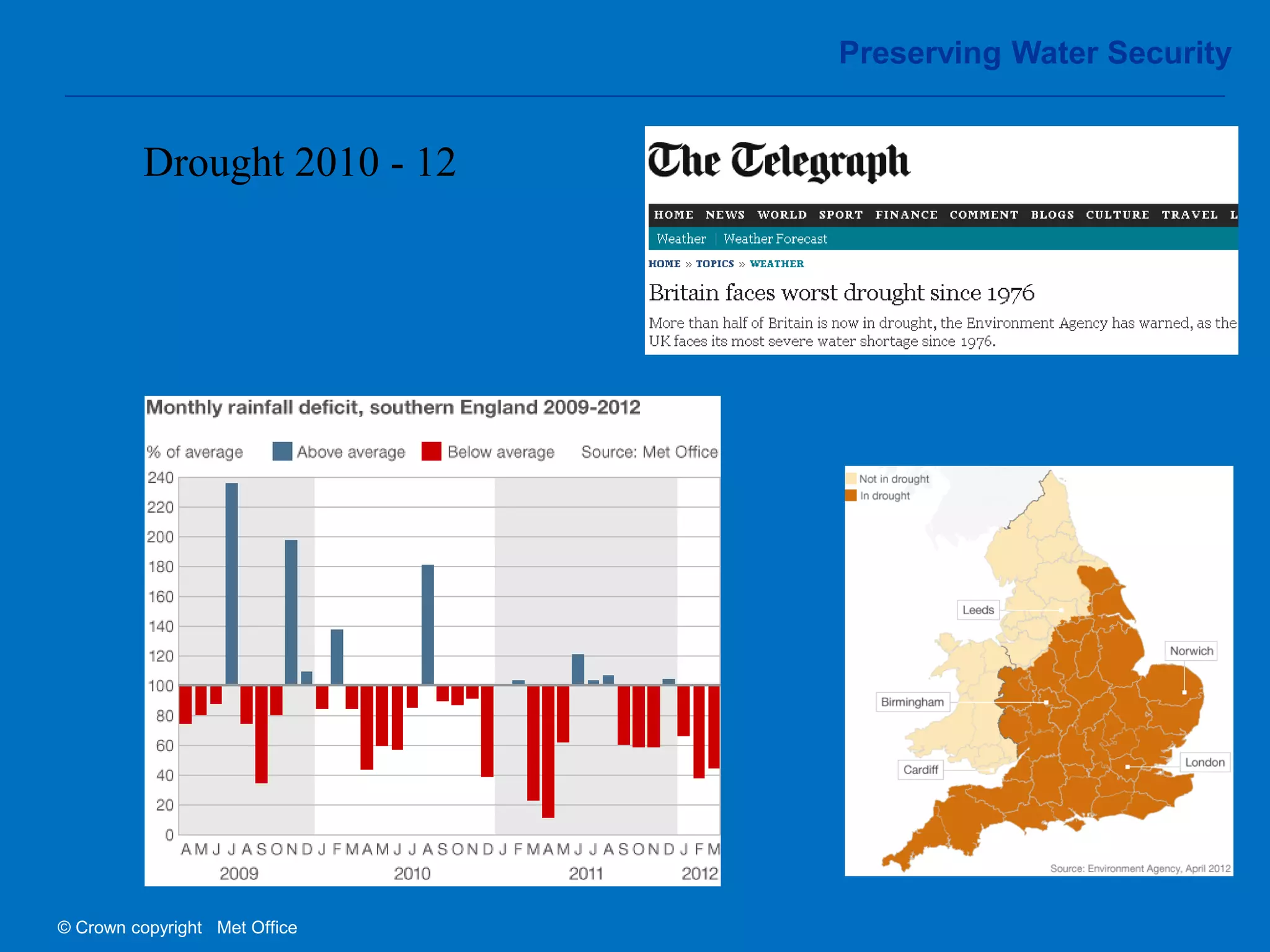
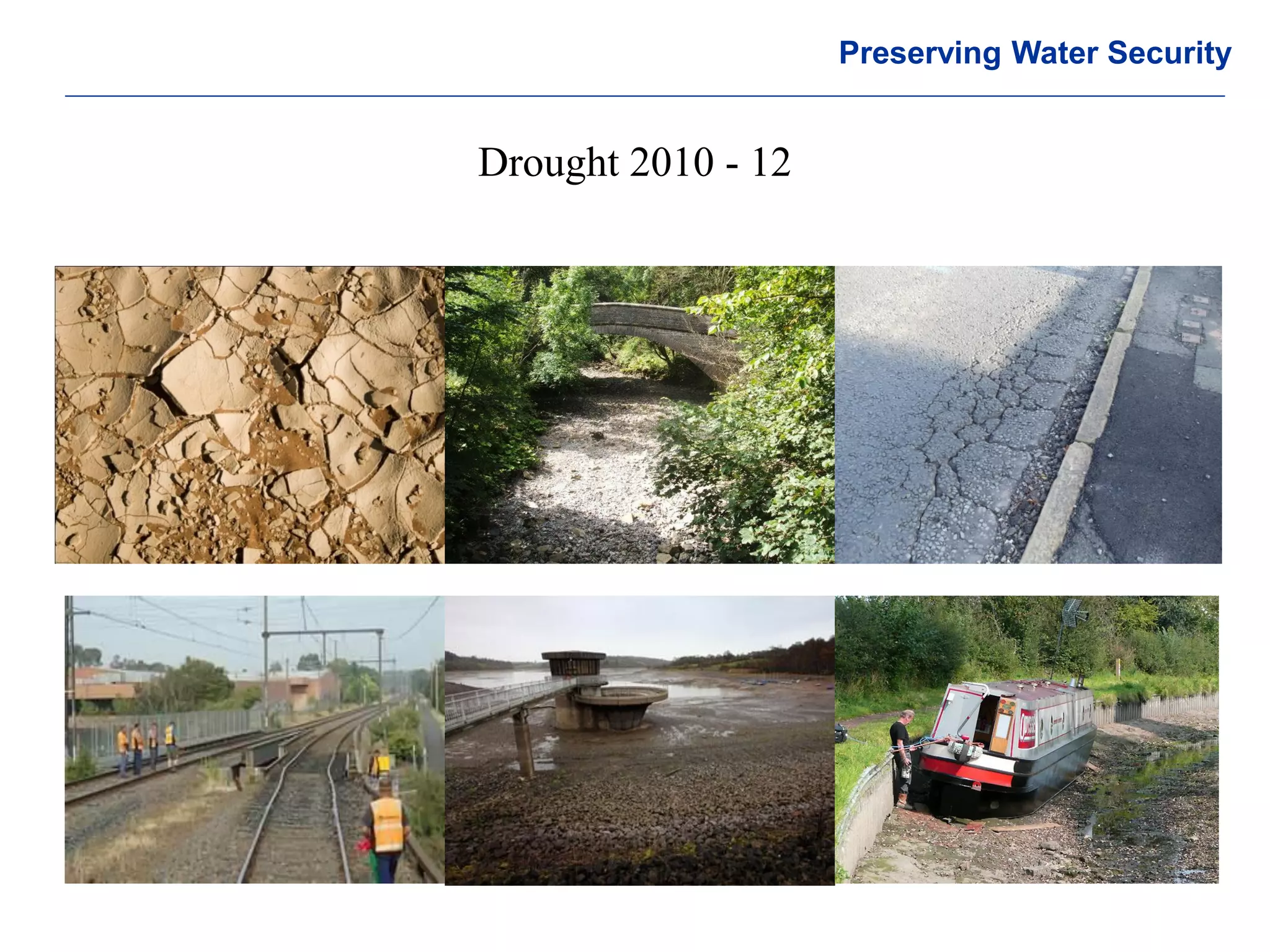
Drought 2010 - 12 
Preserving Water Security
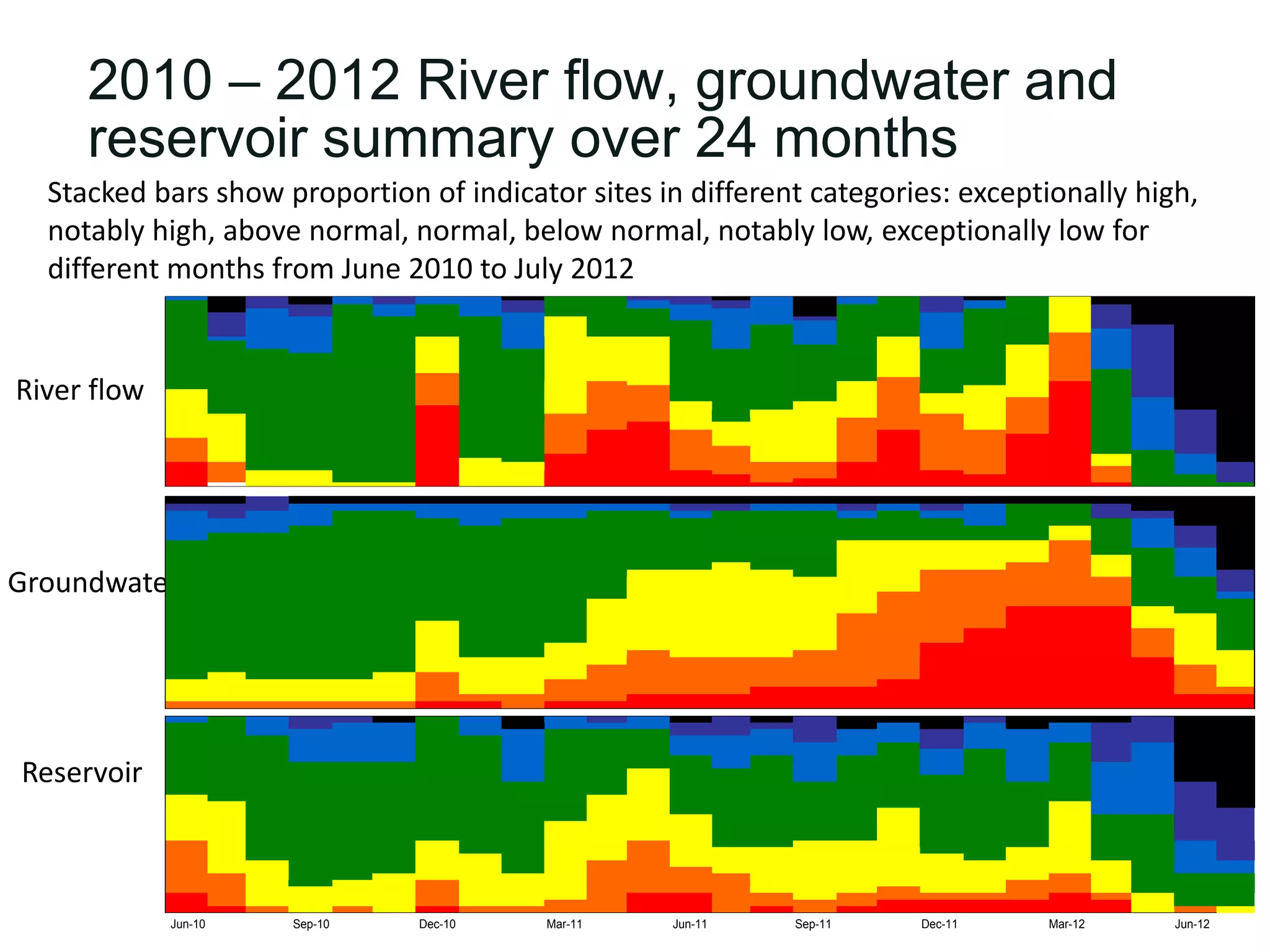
2010 – 2012 River flow, groundwater and 
reservoir summary over 24 months 
River flow 
Groundwater 
Reservoir 
Stacked bars show proportion of indicator sites in different categories: exceptionally high, 
notably high, above normal, normal, below normal, notably low, exceptionally low for 
different months from June 2010 to July 2012 
C A B A C B C C A D D B B A C A C D B A D E A A A A 
D A B A C B C C B D D C B B C A C D B C D E A A A A 
D A B B D C D C B D D C C B C A D D B C D E B A A A 
D A C B D C D C B D D D C C C A D D B D D E B A A A 
D B C B D C D C C D D D C C C A D D C D D E B A A A 
D B C C D D D D C E D D C C C B D D C D D E B A A A 
D B C C D D D D C E D D D C C C D D C D D E B A A A 
D B C C D D D D C E D D D C D C D D C D D E B B A A 
D B C C D D D D C E D D D C D C D D C D D E C B A A 
D B C C D D D D C E D D D C D C D D C D D F C B A A 
D C C C D D E D C E E E D C D C D E C D D F C B A A 
D D C C D D E D C E E E D C D C D E C D D F C B A A 
D D C C D D E D C E E E D C D D D E C D E F C B A A 
D D D C D D E D D E E E D D D D D E D D E F C B A A 
D D D D D D E D D E E E D D D D D E D D E F C B A A 
D D D D D D E D D E E E D D D D D E D D E F D B A A 
D D D D D D F D D E E E D D D D D E D D E F D B A A 
D D D D D D F D D E E E D D D D D F D D E F D B A A 
D D D D D D F D D E F E D D D D E F D D E G D B A A 
D D D D D D F D D E F F D D D D E F D E E G D B A A 
E D D D D D F D D E F F D D D D E F D E E G D B A A 
E D D D D D F D D E F F D D D D E F E E E G D B A A 
E D D D D D F D D E F F D D D D E F E E F G D C A A 
E D D D D D F D D E F F E D D E E F E E F G D C A A 
E D D D D D G D D E F F E D D E E F E E F G D C A A 
E D D D D D G D D E F F E D E E E F E E F G D C B A 
E E D D D D G D D F F F E D E E E F F E F G D C B A 
E E D D D D G D D F F F E D E E F F F E F G D C B A 
E E D D D D G D D F F G E E E E F F F E F G D C B A 
E E D D D D G D D F G G F E E E F G F F F G D C B A 
E E D D D D G D D F G G F E E E F G F F G G D C B A 
F E D D D D G D D F G G F E E E F G F F G G D C B A 
F E D D D D G D D F G G F F E E F G F F G G D C B A 
F E D D D D G D D F G G F F E E F G F F G G D D B A 
F E D D D D G D D G G G F F E E F G F F G G E D C A 
F E D D D D G E D G G G F F E E F G F F G G E D C A 
G F D D D D G E E G G G F F F F G G F F G G E D C B 
G F D D D D G E E G G G F F F F G G F F G G F D C B 
G F E E D D G E E G G G G F F F G G G F G G F D C B 
G F E E D D G E E G G G G G F F G G G G G G F D D B 
G F E E D D G E E G G G G G F G G G G G G G F D D B 
G E E E E E E G G G G G G G G G G G G G G D D C 
A A B A A A A A A A A A A A A A A A A A A A A A A A 
B B B C C C C C C C C C B B C C B C B C D D B A A A 
C B C C D D C C C C D D C D D D C D C C D D B B A A 
C C C C D D D C D D D D D D D D D D D C D D D C A A 
C C C D D D D D D D D D D D D D D D D D D E D C B A 
C D D D D D D D D D D D D D D D D D D D D E D C B A 
D D D D D D D D D D D D D D D D E E E E E F D C B A 
D D D D D D D D D D D D D D D D E E E E E F D D C A 
D D D D D D D D D D D D D D D D E E E E E F E D C A 
D D D D D D D D D D D D D E D D E E E E F F E D C A 
D D D D D D D D D D D E E E E D E E F F F F E D C B 
D D D D D D D D D D D E E E E E E E F F F F F D D B 
D D D D D D D D D D D E E E E E E F F F F F F D D C 
D D D D D D D D D D E E E E E E E F F F F F F D D D 
D D D D D D D D D D E E E E E E E F F F G G G E D D 
D D D D D D D D D D E E E E E E F F F F G G G E E D 
D D D D D D E D D D E E E E E E F F F F G G G E E D 
D D D D D D E D D D E E E E E E F F F G G G G F E D 
D D D D D D E D D E E E E E E E F F G G G G G F E D 
D D D D D D E D D E E F E E E F F F G G G G G F E E 
D D D D D D E E E E E F F F F F F F G G G G G G E E 
D D D D D D E E E E F F F F F F F F G G G G G G F E 
D E D D D E F E E E F F F F F F F F G G G G G G F E 
E E E E E E F E E F F F F F F F F G G G G G G G F E 
E E E E E E F E E F F F F F G G G G G G G G G G F F 
E E E E E E F F F F F G G G G G G G G G G G G G G G 
F F F F F F G G F G G G G G G G G G G G G G G G G G 
C D C B B A D C A C B C A B A B A A A B A A A B A A 
D D C B C C D C A C C C B B B B A C A C A C B B A A 
D D C C C C D C C D D D B B C B C C B C C C B B A A 
D D D C C C D D C D D D C C C B C C B C C C B B A A 
D D D C C C D D C D D D C C C C C D B C C D B C A A 
D D D C C C D D C D D D C C C C C D C D C D B C A A 
D D D C C C D D C D D D D C D C D D C D C D B C A A 
D D D D D D D D C D D D D C D C D D C D C D C C A A 
D D D D D D D D C D D E D D D C D D C D C D C C A A 
D D D D D D D D C D D E D D D C D D D D C D C C A A 
D D D D D D D D D D D E D D D D D D D D D D C C B A 
E D D D D D D D D D E E D D D D D D D D D D C C B A 
E E D D D D D D D D E E D D D D D D D D D E C C B A 
E E D D D D D D D D E E D D D D D E D D D E C C B B 
E E D D D D D D D D E E E D D D D E D D D E D D B B 
E E D D D D D D D E E E E D D D D E D D D E D D B B 
F E D D D D E D D E E F E D D E E E D D D E D D C B 
F E D D D D E D D E E F E E E E E E D D E E D D C B 
F E D D D D E E D E E F E E E E E E E D E E D D C B 
F E E D D D E E D E F F E E E E E E E E E E E D C C 
F E E D D D E E D E F F F E E E E E E E E E E D C C 
F F E D D E E E E E F F F F E E E E E E E F E D D D 
F F E D E E F E E E F F F F E E E E E E F F E D D D 
F F E E E E F E E E F F F F E E E F E E F F E D D D 
G F E E E E F E E E F G G F F E F F F F F G F E D D 
G F E E E E F E E F F G G F F F F G G G G G G E D D 
G G F E F E G F F F F G G F G F G G G G G G G E F E 
Jun-10 Sep-10 Dec-10 Mar-11 Jun-11 Sep-11 Dec-11 Mar-12 Jun-12
© Crown copyright Met Office 
Drought 2010 - 12 
Preserving Water Security
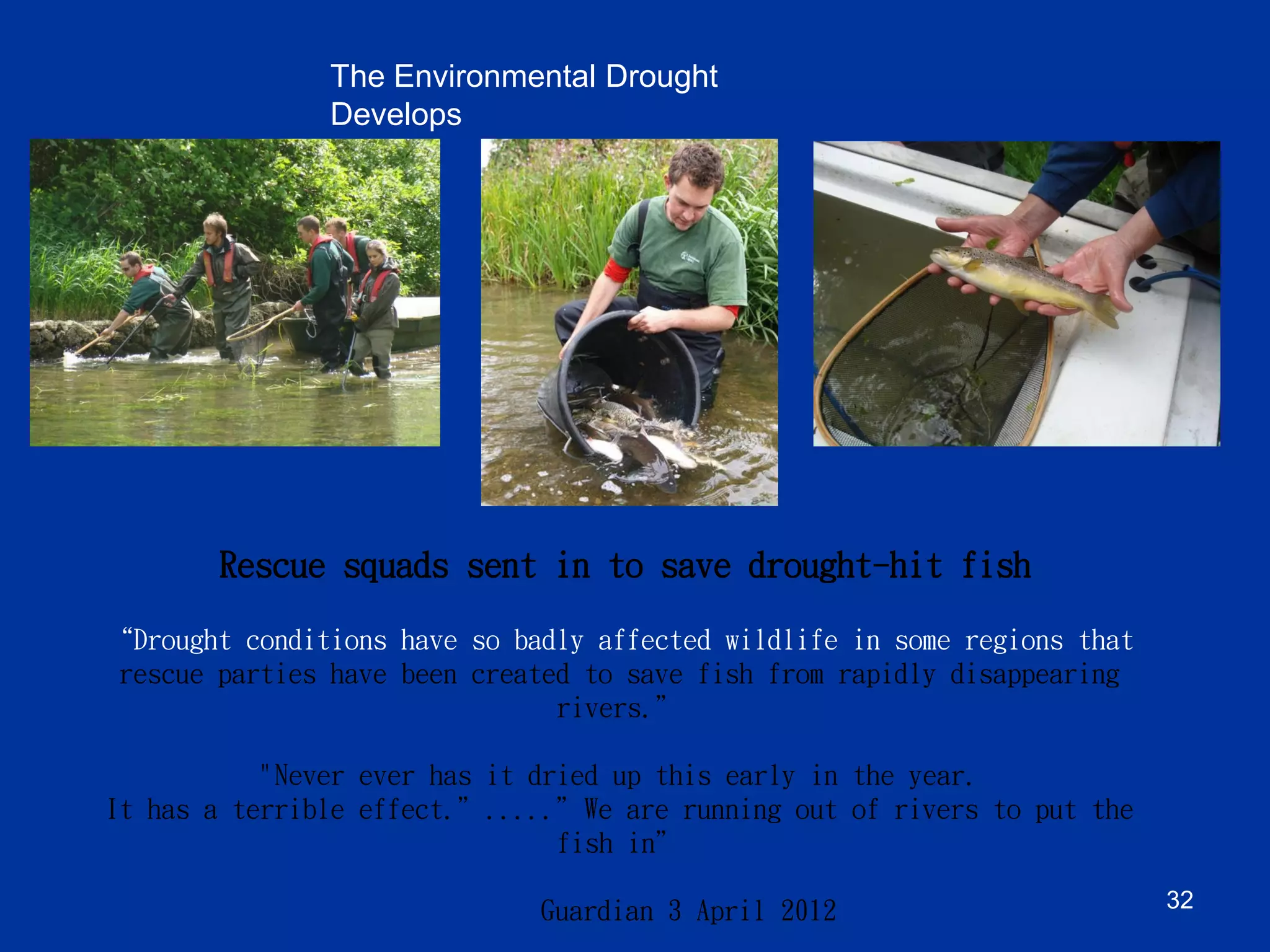
“Drought conditions have so badly affected wildlife in some regions that rescue parties have been created to save fish from rapidly disappearing rivers.” "Never ever has it dried up this early in the year. It has a terrible effect.”.....”We are running out of rivers to put the fish in” Guardian 3 April 2012 
Rescue squads sent in to save drought-hit fish 
The Environmental Drought Develops 
32 
Preserving Water Security
© Crown copyright Met Office 
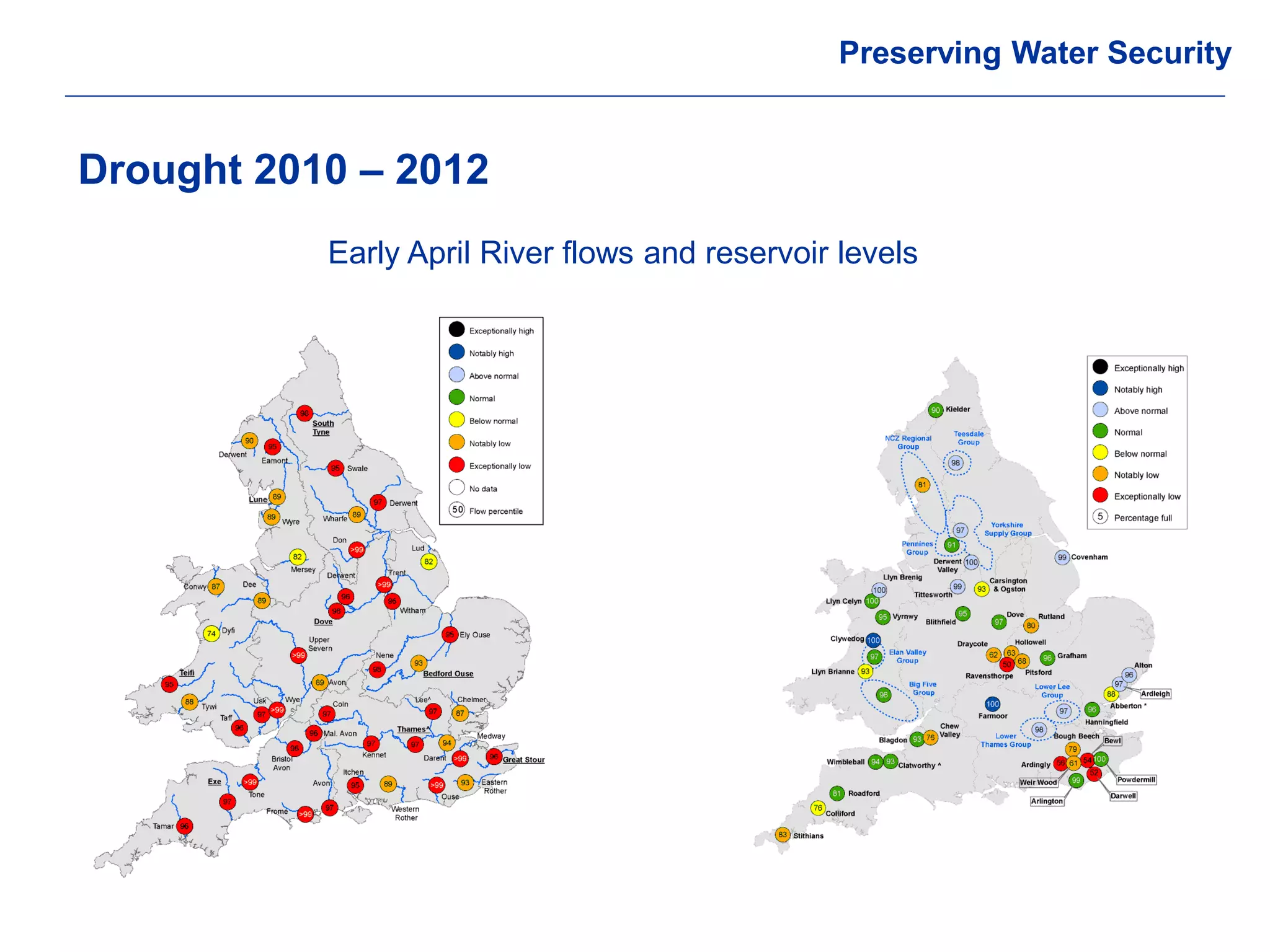
Drought 2010 – 2012 
Early April River flows and reservoir levels 
Preserving Water Security
© Crown copyright Met Office 
Drought 2010/12: What was different? 
Preserving Water Security 
• Awareness of Resilience 
• Political Interest 
• Drought Governance 
• Water Community 
• Media 
• Public 
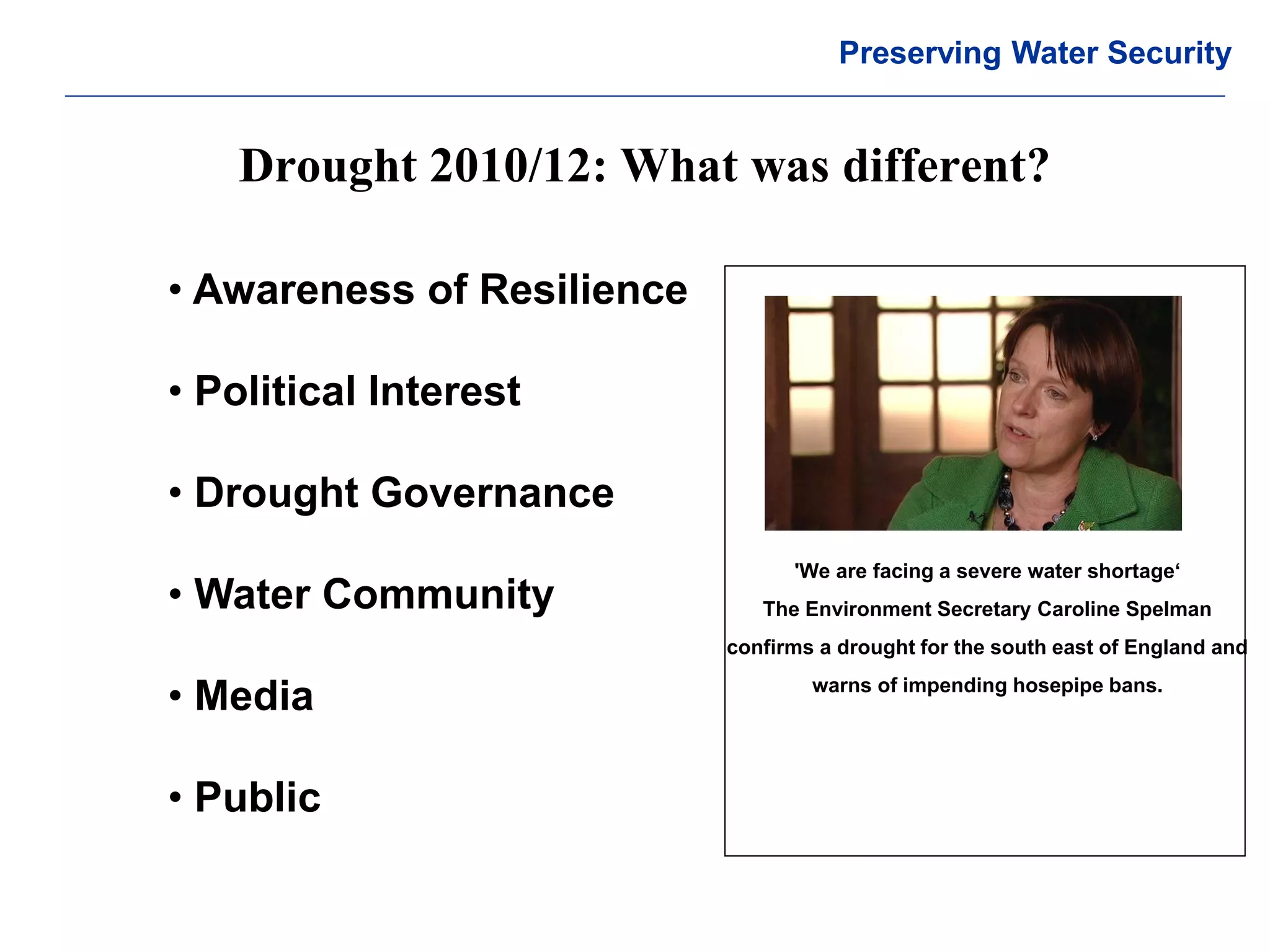
'We are facing a severe water shortage‘ The Environment Secretary Caroline Spelman confirms a drought for the south east of England and warns of impending hosepipe bans.
© Crown copyright Met Office 
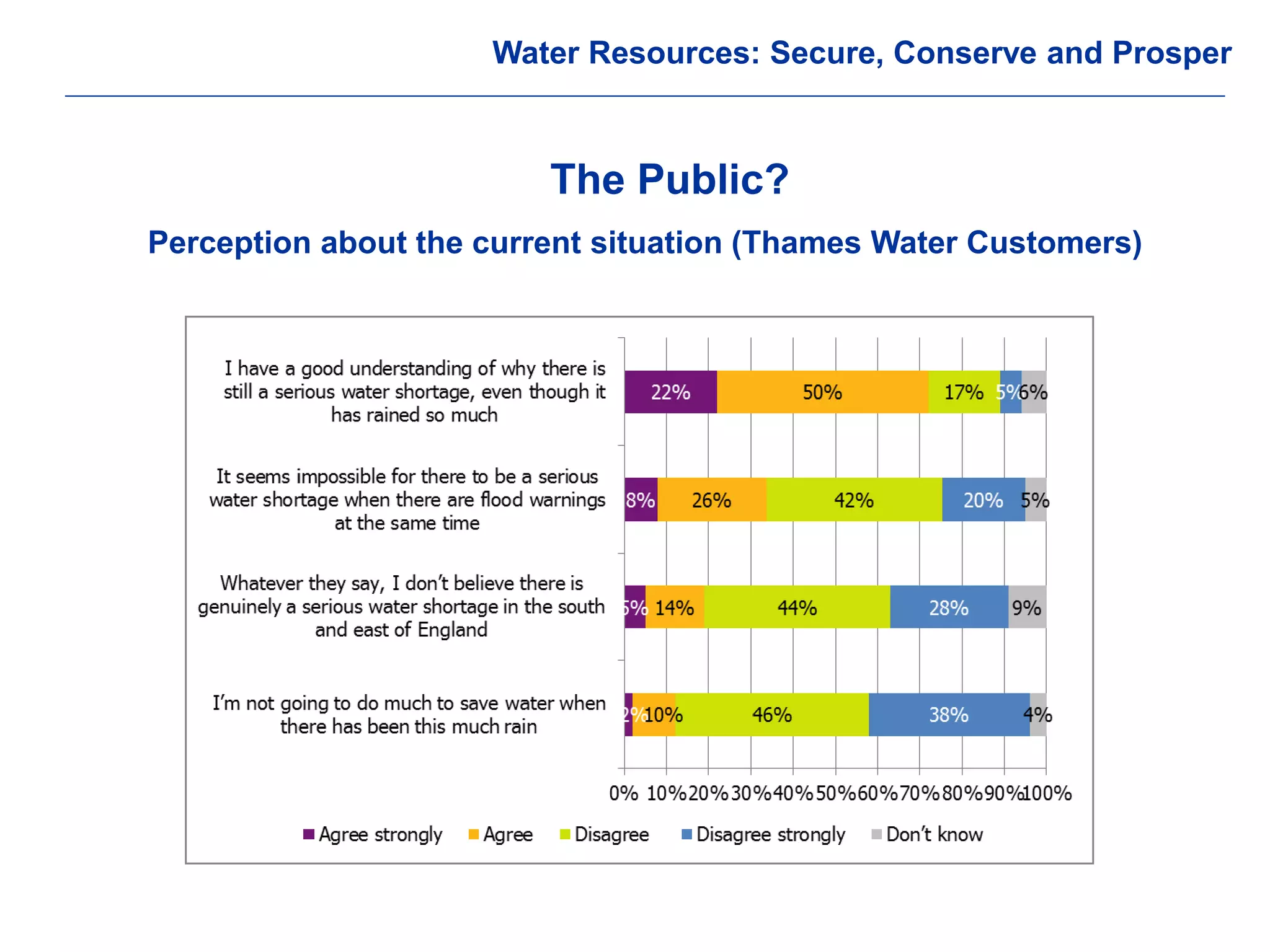
The Public? 
Perception about the current situation (Thames Water Customers) 
Water Resources: Secure, Conserve and Prosper
© Crown copyright Met Office 
Drought 2010 – 12: PWS Resilience 
Preserving Water Security 
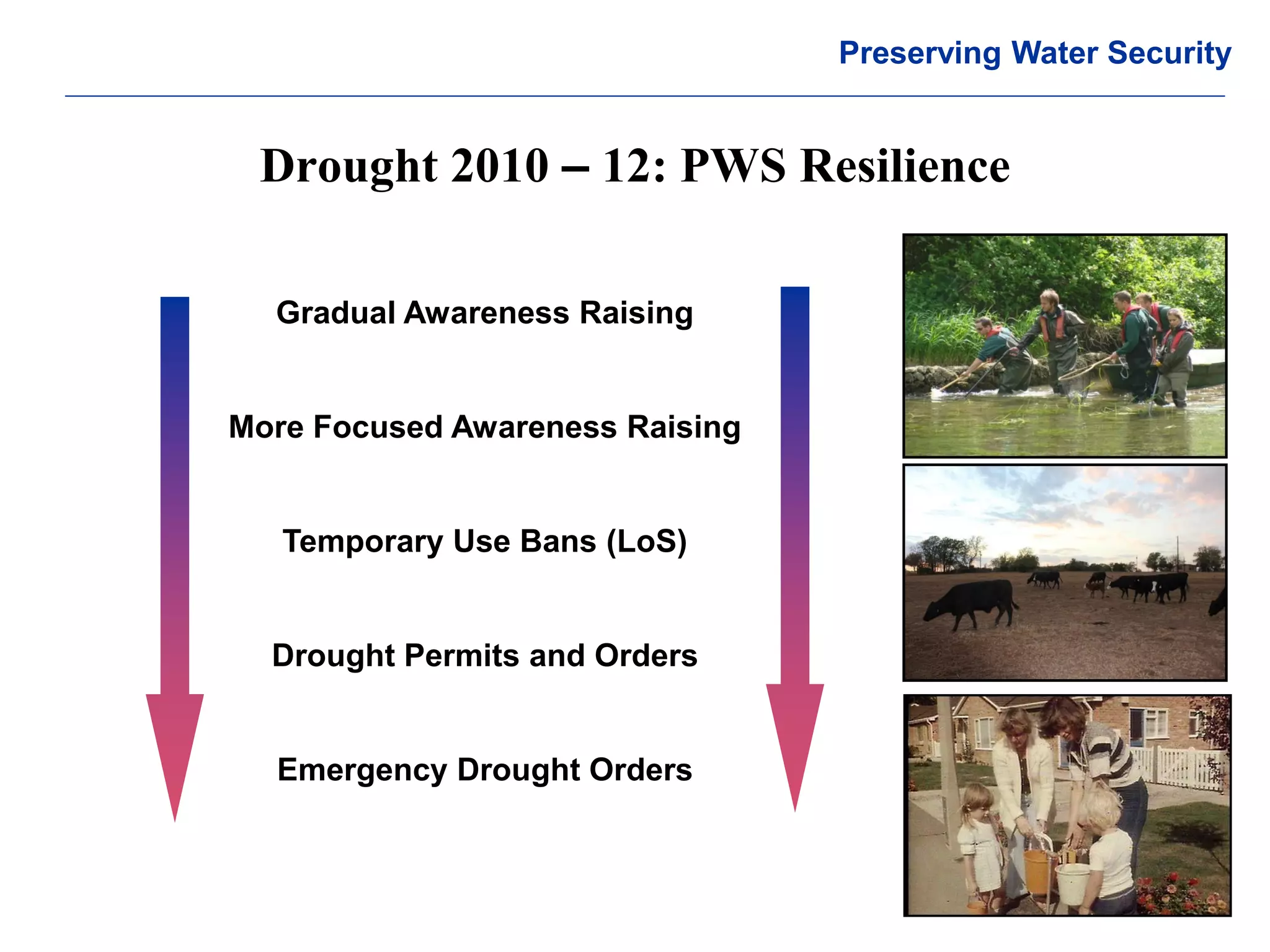
Gradual Awareness Raising More Focused Awareness Raising Temporary Use Bans (LoS) Drought Permits and Orders Emergency Drought Orders
© Crown copyright Met Office 
Drought: Planning Water Security 
Preserving Water Security 
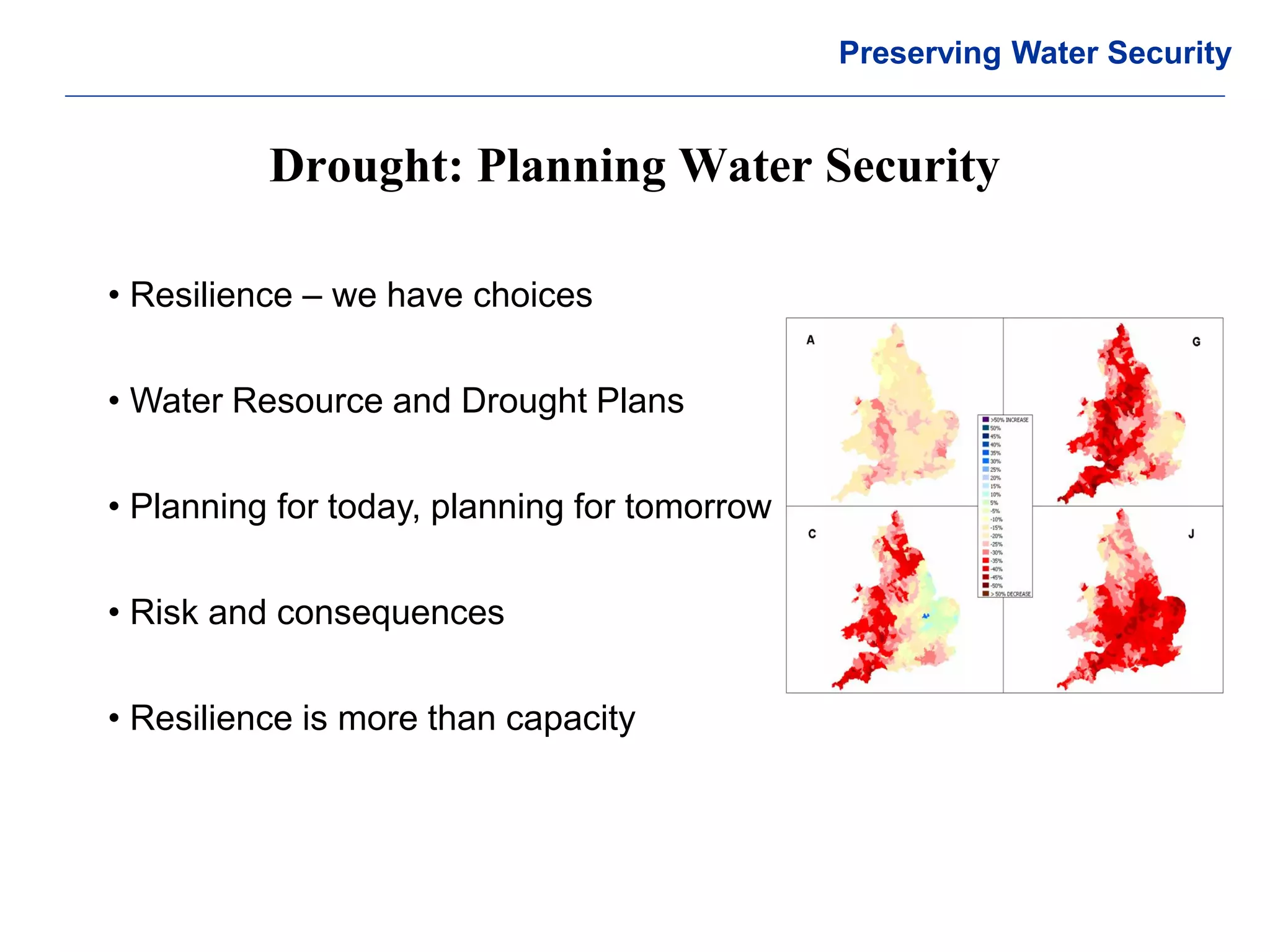
• Resilience – we have choices 
• Water Resource and Drought Plans 
• Planning for today, planning for tomorrow 
• Risk and consequences 
• Resilience is more than capacity
© Crown copyright Met Office 
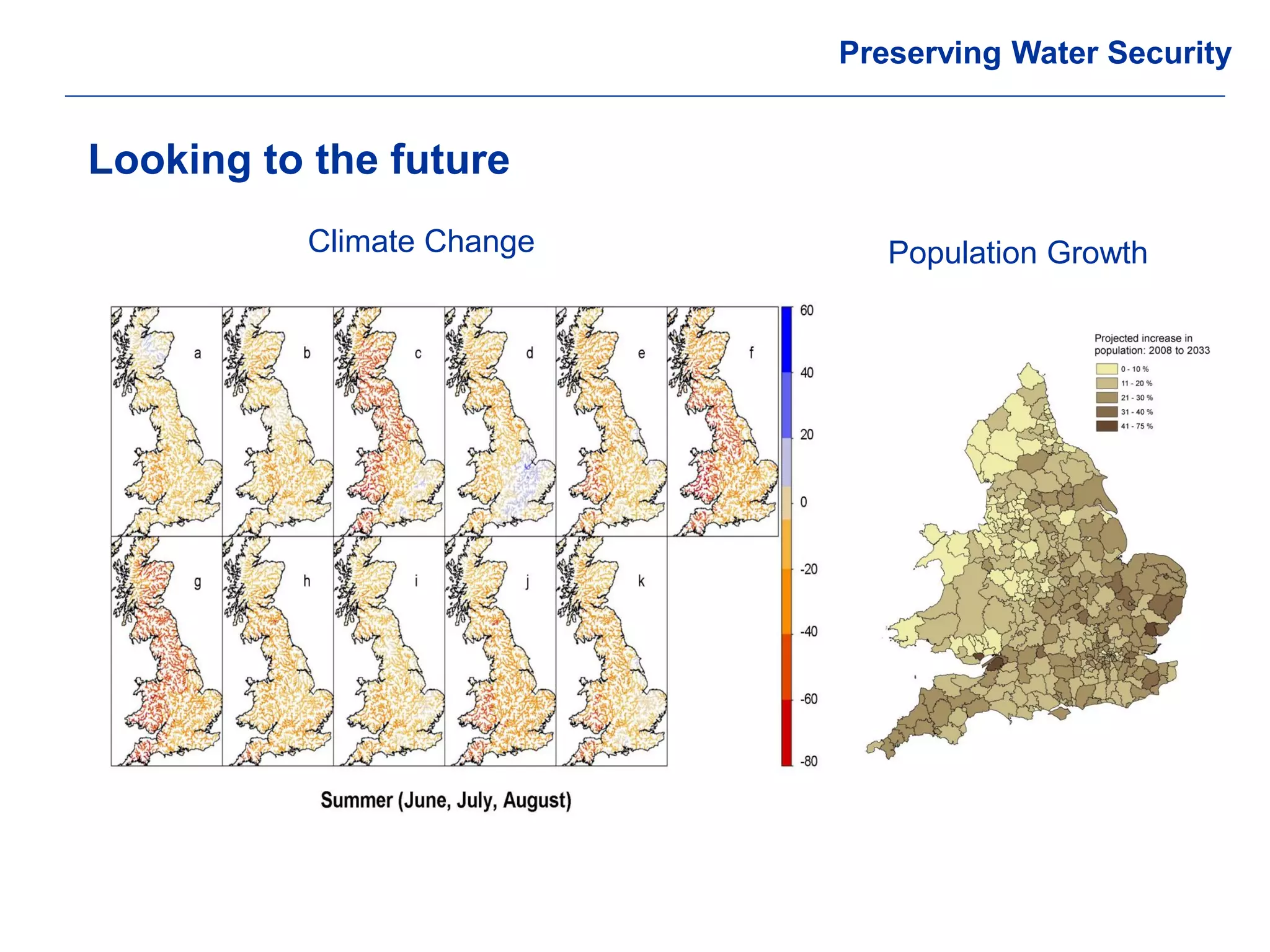
Looking to the future 
Climate Change 
Population Growth 
Preserving Water Security
© Crown copyright Met Office 
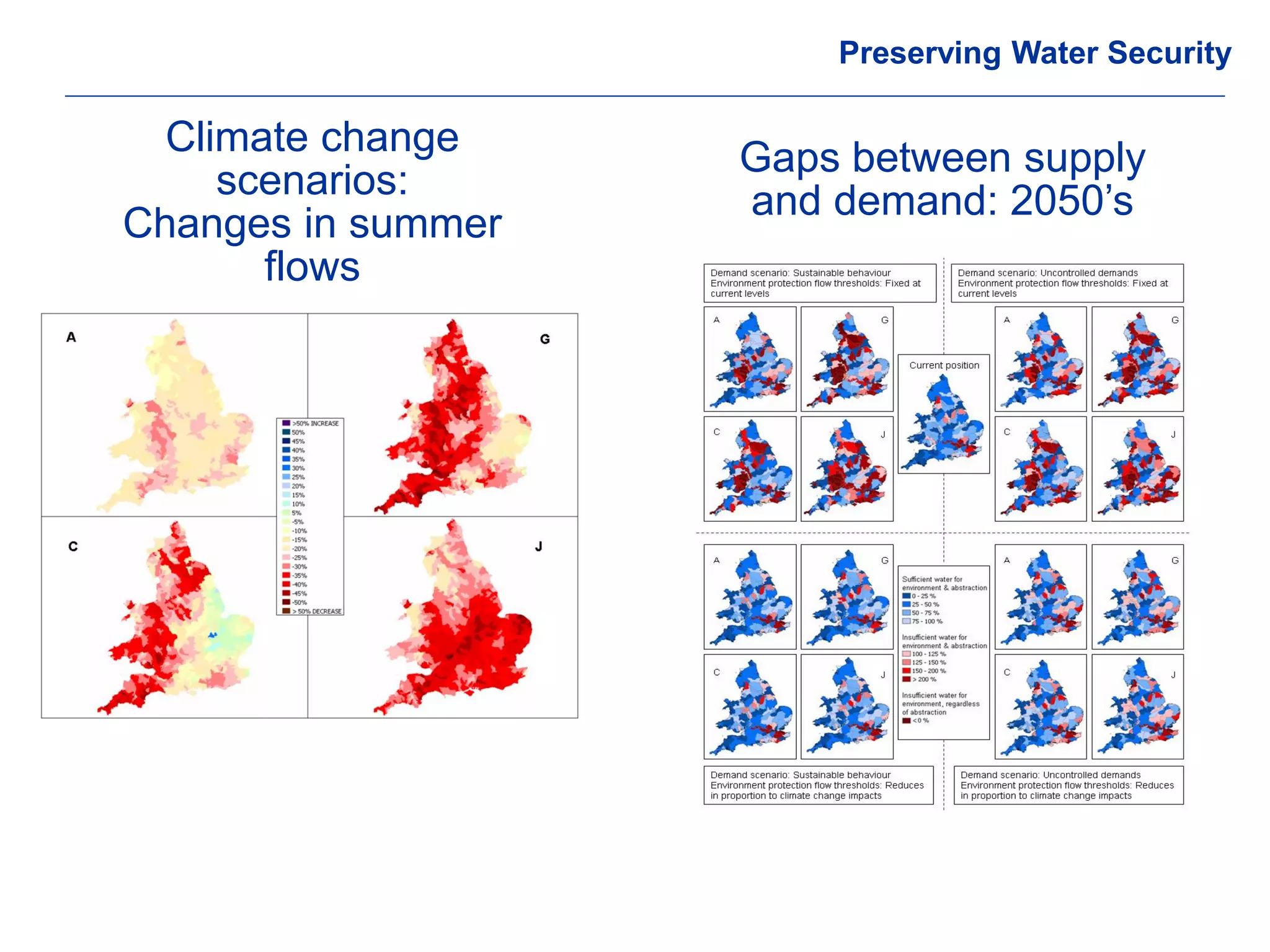
Climate change scenarios: Changes in summer flows 
Gaps between supply and demand: 2050’s 
Preserving Water Security
© Crown copyright Met Office 
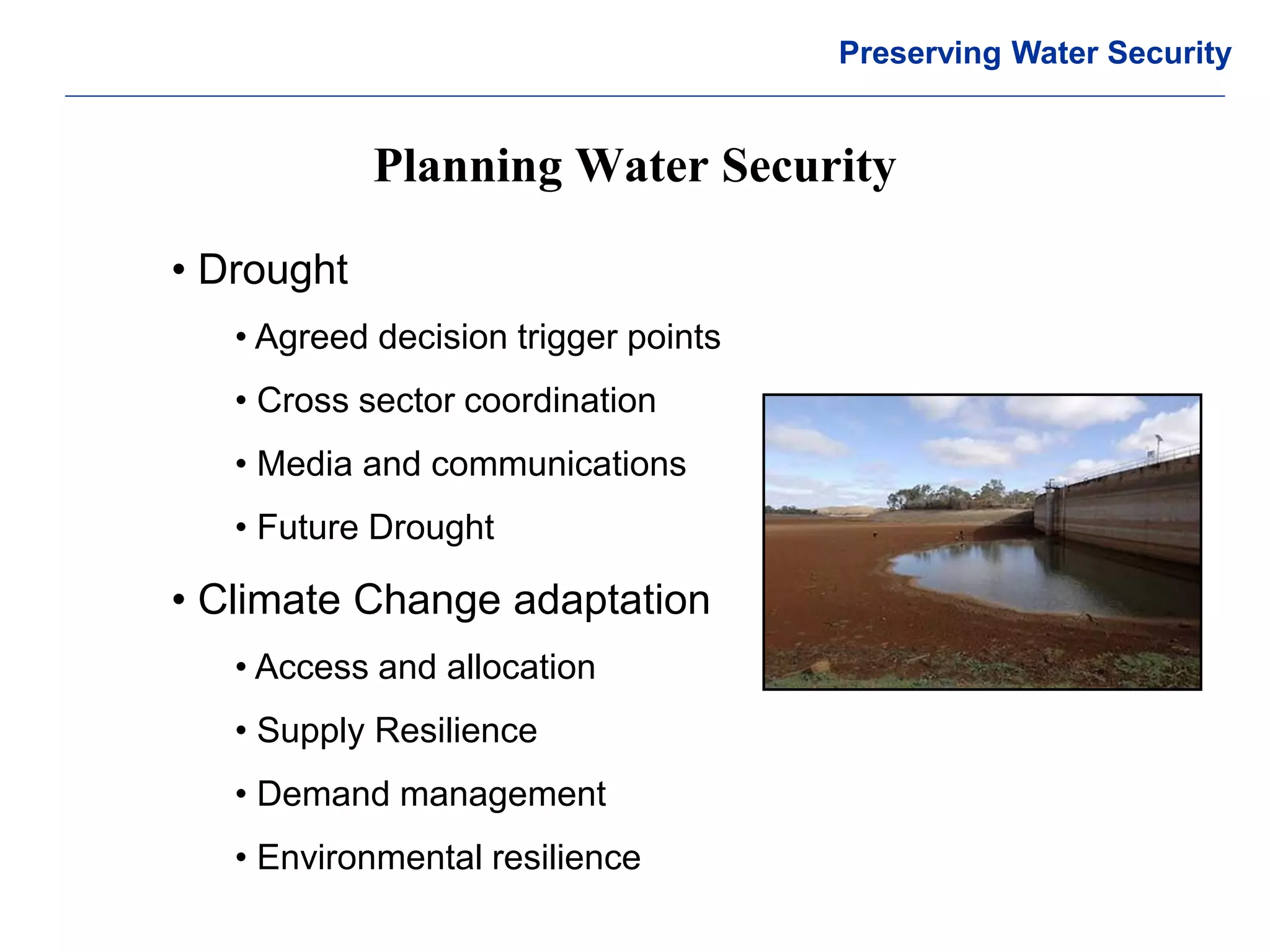
Planning Water Security 
Preserving Water Security 
• Drought 
• Agreed decision trigger points 
• Cross sector coordination 
• Media and communications 
• Future Drought 
• Climate Change adaptation 
• Access and allocation 
• Supply Resilience 
• Demand management 
• Environmental resilience
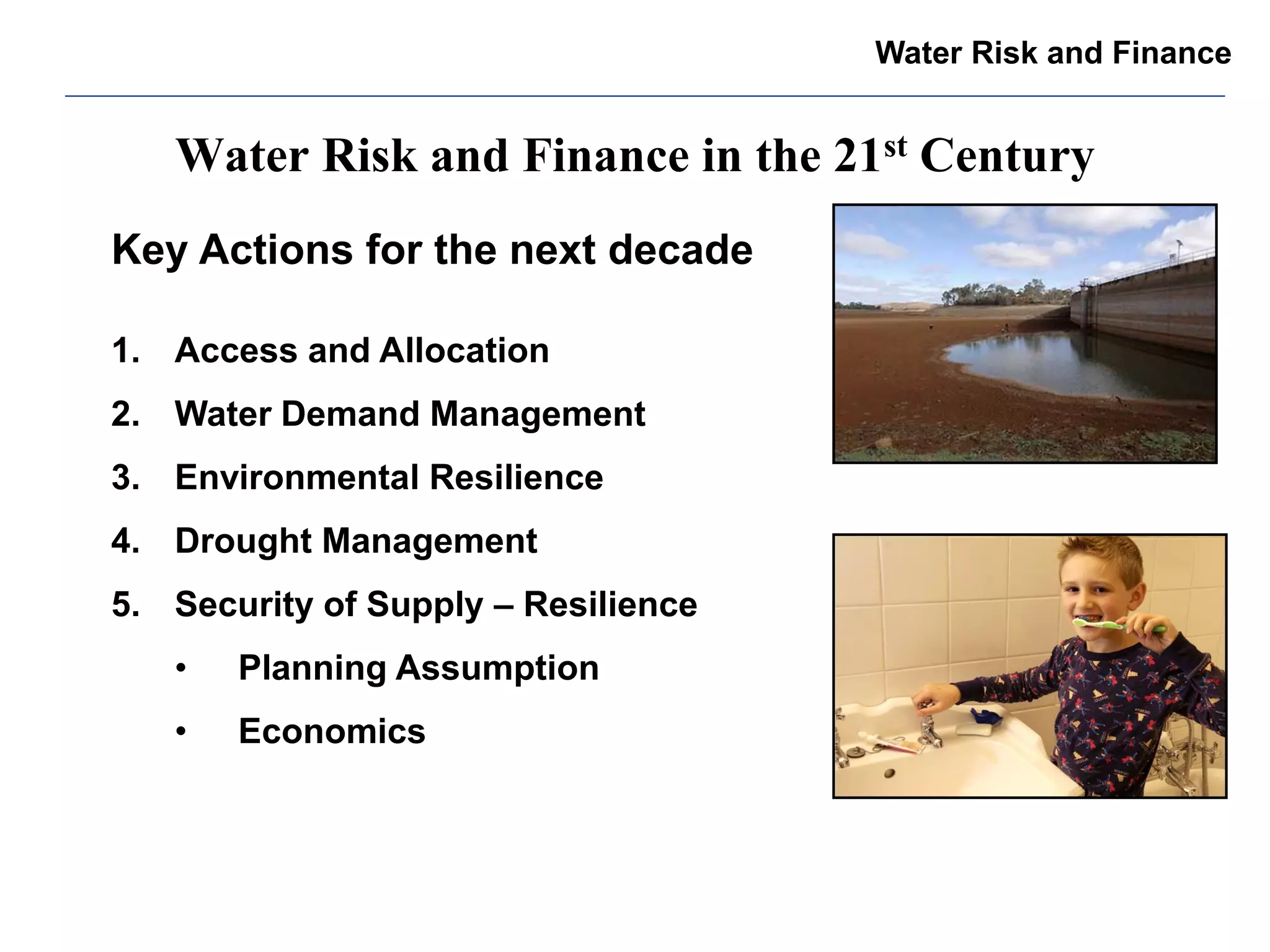
Water Risk and Finance in the 21st Century 
Key Actions for the next decade 
1.Access and Allocation 
2.Water Demand Management 
3.Environmental Resilience 
4.Drought Management 
5.Security of Supply – Resilience 
•Planning Assumption 
•Economics 
Water Risk and Finance
Planning Assumptions: Stochastic hydrology 
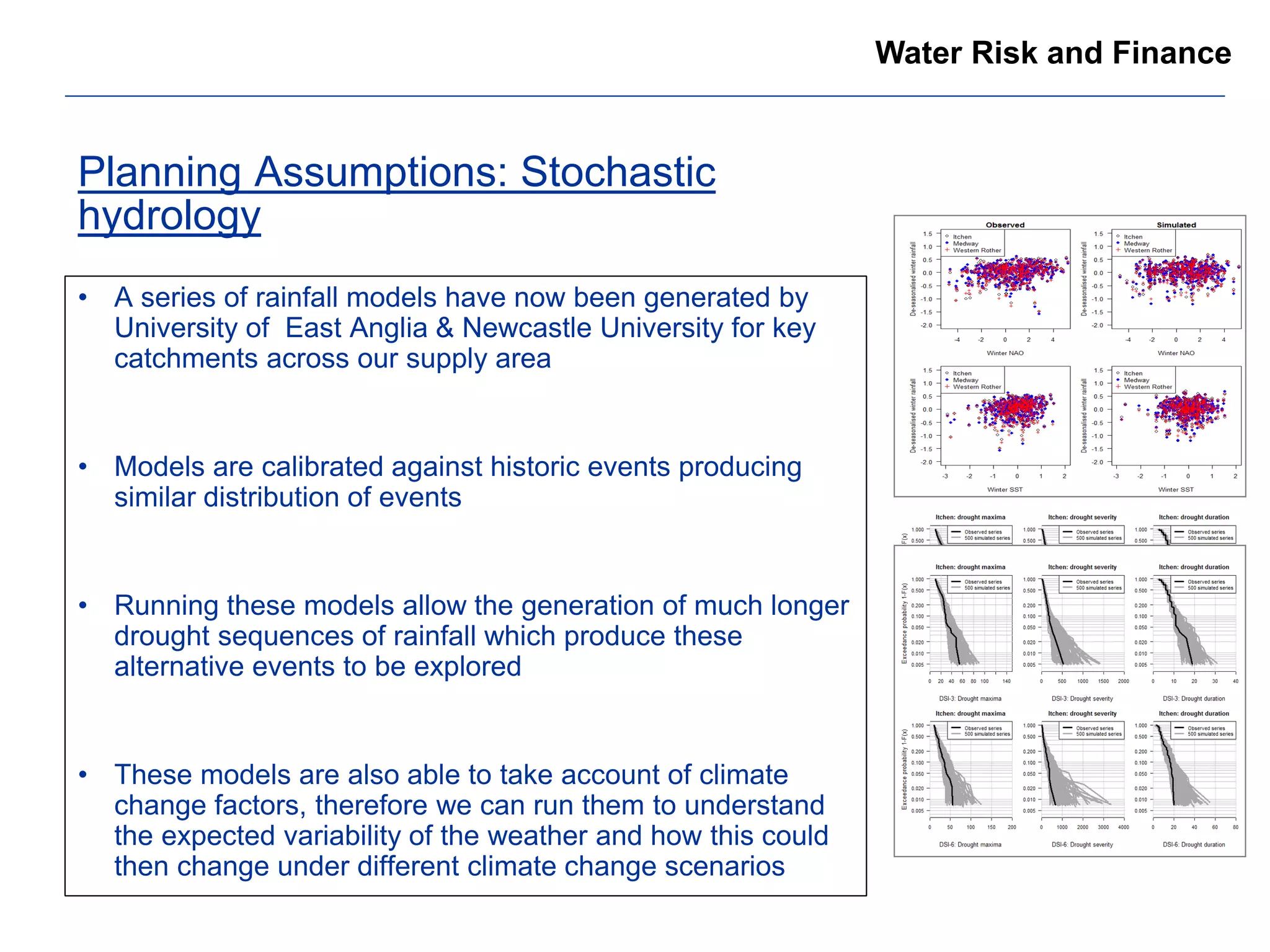
•A series of rainfall models have now been generated by University of East Anglia & Newcastle University for key catchments across our supply area 
•Models are calibrated against historic events producing similar distribution of events 
•Running these models allow the generation of much longer drought sequences of rainfall which produce these alternative events to be explored 
•These models are also able to take account of climate change factors, therefore we can run them to understand the expected variability of the weather and how this could then change under different climate change scenarios 
Water Risk and Finance
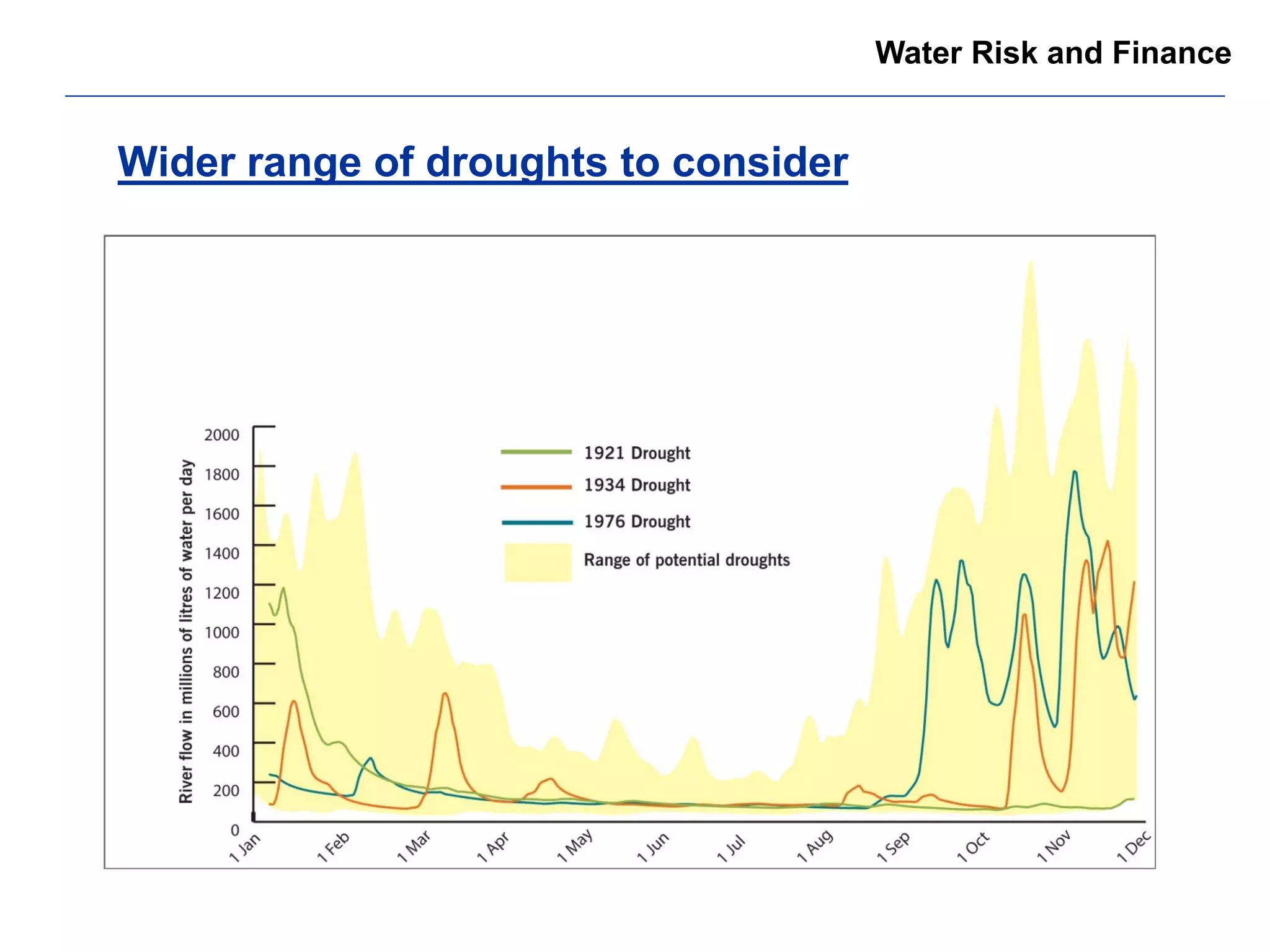
Wider range of droughts to consider 
Water Risk and Finance
Use of Economics for Decision Support 
Water Risk and Finance 
• Previously 
• Financial efficiency - Least cost, just in time approach 
• Future 
• Compound/Deep uncertainties 
• New Paradigm for water – Robust Decision Making, Real Options Valuation ... 
• TE 2100 
• Water Infrastructure and Water White Paper

Joint GWP CEE/DMCSEE training: Drought management principles in UK by Trevor Bishop

  • 1.
    © Crown copyrightMet Office Rachael Connerton, Water Resources Policy Advisor Trevor Bishop: Deputy Director Environment Agency 3 October 2014 DMCSEE/GWP CEE capacity build training From monitoring to end user Environment Agency: Drought Management
  • 2.
    © Crown copyrightMet Office The Environment Agency: Who we are and what we do! Preserving Water Security
  • 3.
    Public water supply50% Other industry 6% Fish farming, cress 7% Other 3% Hydropower (non consumptive) 32% Other Electricity production (consumptive) 2% Our Water Account: Recent Performance Water companies abstracted 15,500 Ml/d. Nearly 500 Ml/d, or about 3%, less than previous year Total abstraction for the calendar year 2011 from non-tidal surface water and groundwater sources in England and Wales (source Environment Agency) Draft: Total abstraction for the calendar year 2011 from non-tidal surface water and groundwater sources in England and Wales Water Risk and Finance
  • 4.
    • Demand reducedby approximately 2% compared with the previous year. • Overall demand shows a consistent reduction of about 1% a year since 2006. • From 2003 a small but consistent average decline in pcc of about 1% each year. • Average pcc now 146 l/p/d (2% or 3 litres less than previous year) • An 18% difference between measured and unmeasured pcc (129 –v- 155) • Average leakage per property in England and Wales has dropped by 7% to 127 l/prop/d. Our Water Account: Recent Performance Total abstraction for the calendar year 2011 from non-tidal surface water and groundwater sources in England and Wales (source Environment Agency) [t1]Interesting number, can we just confirm that its 127 l/prop/d. It’s the same as metered pcc? Draft: The main components of PWS demand between April 2011 and March 2012 Water Risk and Finance
  • 5.
    Water Account: Pressures Planning for long term water efficiency Typical Catchment Balance in the SE England
  • 6.
    © Crown copyrightMet Office Status of Water Resources Preserving Water Security
  • 7.
    © Crown copyrightMet Office Statutory Drought Planning Preserving Water Security • Environment Agency Area Drought Plans • Water Company Drought Plans • Environment Agency National Drought Plan • Central and local government Contingency Plans
  • 8.
    Water resources information7 July 2014 These slides outline the risk of a developing drought this year and show how it is managed The information is for the use by the Environment Agency. National Drought Coordinator Drought Management - Illustrative Example
  • 9.
    WR Information –2 July 2014 9 Context – Public Water Supply and Drought • Water Company Water Resource Management Plans (WRMP) is a strategic 25 year view of Water Company’s area aiming to enable cost effective security of supply under normal conditions – WRMP are a Statutory process signed-off by the Secretary of State. • Water Company Drought Plans (DP) set out timely actions for security of supply under periods of low rainfall. Actions typically escalate through encouraging voluntary customers reductions, mandatory customers restrictions and relaxing environmental protections to allow access to additional resources. • The transition between normal operation and drought (resilience) is set between each water company and the level of service for its customers which is then endorsed by the Secretary of State through the WRMP and DP process and plans. 3
  • 10.
    WR Information –2 July 2014 10 Context – Role of the Environment Agency Water resources pressures and drought management • Monitor/assess hydrological, hydrogeological and environmental status • Report on water resource/drought status against indicators • Advise and help coordinate abstractors, other stakeholders and government on appropriate actions • Enforce licence conditions against predefined triggers • Manage and operate site specific river augmentation schemes to support abstractions and the environment (e.g. Shropshire Groundwater Scheme) • Active environmental management to mitigate impacts of pressures
  • 11.
    WR Information –2 July 2014 11 Monthly water situation report – June 2014 •Total rainfall for hydrological areas across England to 30 June Classed relative to respective historic totals. Final and provisional NCIC (National Climate Information Centre) Source: Met Office © Crown Copyright, 2014. Crown copyright. All rights reserved. Environment Agency, 100026380, 2014
  • 12.
    WR Information –2 July 2014 12 Daily mean river flow for 01/07/2014 expressed as a percentile and classed relative to an analysis of historic daily mean flows for the same time of year Percentiles presented relate to an analysis for the time of year and not a whole year. Source: Environment Agency. Crown copyright. All rights reserved. Environment Agency, 100026380, 2014 Weekly River Flow Week ending 01/07/2014
  • 13.
    Probabilistic Probabilistic ensembleprojections of 13 river flows at key indicator sites up until the end of September 2014. Probabilistic ensemble projections of groundwater levels at key indicator sites at the end of September 2014. Pie charts indicate probability, based on climatology, of the groundwater level at each site being e.g. exceptionally low for the time of year. Source: Environment Agency. Geological map reproduced with kind permission from UK Groundwater Forum, BGS © NERC. Crown copyright. All rights reserved. Environment Agency, 100026380, 2014 Pie charts indicate probability, based on climatology, of the surface water flow at each site being e.g. exceptionally low for the time of year. Source: Centre for Ecology and Hydrology, Environment Agency
  • 14.
    WR Information –2 July 2014 14 Current WR situation in Cumbria •Over 30 mm rain in catchments between 4 and 6 July •Both reservoirs recovered within normal ranges •Both sources rely on river flow and/or rainfall inflows to sustain levels. •Ennerdale catchment responds quickly to rainfall but it is required locally •June rainfall in local area is 44% (LTA) •3 month (March to May LTA) regional rainfall is 102%
  • 15.
    WR Information –2 July 2014 15 Timetable of management actions UU Drought Plan (2013) Triggers Ennerdale (earliest expected based on 1 July draw down levels) Actions Hawes-water Additional actions to Ennerdale actions 1 23 June (actual) . NOTE: Lake level now above trigger 1 (at 7 July) Convene drought teams, enhanced efficiency and monitoring 24 June (actual) Rezoning of sources, increase pumping from other sources 2 12 days after trigger 1 Rezoning, voluntary water use restraints, Unlikely this year Review use of other sources, continued rezoning 3 9 days after trigger 2 Apply for drought order, commence tankering (Ennerdale only) Unlikely this year Apply for drought permits, use alternative and off line sources 4 13 days after trigger 3 Followed by DO (asap) Apply compulsory restrictions (TUBs) followed by use of drought order Unlikely this year As Ennerdale EA Drought status Environment Agency Actions Developing drought (internal status) Not required Convene drought teams and strategic governance, start situation reporting, prepare comms strategy Drought Not required Respond to drought order/permit applications, enhanced monitoring, reporting and comms
  • 16.
    WR Information –2 July 2014 16 Forward look •Recovering situation as reservoirs return within normal range for time of year due to significant rainfall •Local area teams maintain close monitoring on levels and situation over summer •Local and national leads review response to identify lessons for future preparedness •UU, Defra and EA resume weekly telecons on IROPI and EIP preparation
  • 17.
    WR Information –2 July 2014 17 Draft Rolling Map example •Worked with WUK on the maps and definitions •Uses area or smaller boundaries for drought status and water supply zones for water use restrictions •Worked with WUK on the maps and definitions •For use on gov.uk, social media and host websites Drought mapping and comms
  • 18.
    1976 Drought -standpipes
  • 19.
  • 20.
    Legislation •Pre-1945 Byelaws •1945 Water Act, Section 16 •Water Industry Act, 1991, Section 76 •Water Resources Act 1991 (amended by Environment Act 1995 and Water Act 2003) – Sections 73 - 81 •Flood and Water Management Act 2010 •Drought Direction 2011 affecting the 'non-essential uses'
  • 21.
    Water use restrictions– new provisions •New legislation commenced on 1 Oct 2010: •Flood and Water Management Act 2010 •Water Use (Temporary Bans) Order 2010 (detail and definitions) •Water companies can restrict and/or prohibit more types of water use during a drought. •Replaces the hosepipe bans from the Water Industry Act •New powers – in response to 2004-07 drought •Reduces the need for non-essential use drought orders
  • 22.
    •Watering gardens andnon-commercial plants using a hosepipe •Cleaning private motor vehicles or boats with hosepipe •Filling and maintaining domestic swimming pools, ponds or ornamental fountain •Drawing water for domestic recreational use •Cleaning domestic walls, windows, paths and patios or any other outdoor surface using hosepipe What’s covered?
  • 23.
  • 24.
  • 25.
    Our role •Planning •Drought planning •Regulation of water companies •Active drought management •Drought permits / orders
  • 26.
    Drought management –head office •Communications •Co-ordination of communications, internal and external •Requests for information by Chief Executive, Defra, Ministers •Increase in press interest and from other organisations such as NFU •National briefings •Weekly one message briefings – cabinet office and Defra •Support to the regions •Drought permits •Advice and guidance
  • 27.
    Drought management –Areas, NPS •Area •Monitoring of environment •Reporting and responding to impacts •Enforcement on abstraction licences •Local direct communications •National Permitting Centre/Support •Determine drought permits •Manage objections and support any hearing
  • 28.
    The Environmental DroughtDevelops Normal Jet stream Drought Jet stream 28 Preserving Water Security
  • 29.
    © Crown copyrightMet Office Drought 2010 - 12 Preserving Water Security
  • 30.
    2010 – 2012River flow, groundwater and reservoir summary over 24 months River flow Groundwater Reservoir Stacked bars show proportion of indicator sites in different categories: exceptionally high, notably high, above normal, normal, below normal, notably low, exceptionally low for different months from June 2010 to July 2012 C A B A C B C C A D D B B A C A C D B A D E A A A A D A B A C B C C B D D C B B C A C D B C D E A A A A D A B B D C D C B D D C C B C A D D B C D E B A A A D A C B D C D C B D D D C C C A D D B D D E B A A A D B C B D C D C C D D D C C C A D D C D D E B A A A D B C C D D D D C E D D C C C B D D C D D E B A A A D B C C D D D D C E D D D C C C D D C D D E B A A A D B C C D D D D C E D D D C D C D D C D D E B B A A D B C C D D D D C E D D D C D C D D C D D E C B A A D B C C D D D D C E D D D C D C D D C D D F C B A A D C C C D D E D C E E E D C D C D E C D D F C B A A D D C C D D E D C E E E D C D C D E C D D F C B A A D D C C D D E D C E E E D C D D D E C D E F C B A A D D D C D D E D D E E E D D D D D E D D E F C B A A D D D D D D E D D E E E D D D D D E D D E F C B A A D D D D D D E D D E E E D D D D D E D D E F C B A A D D D D D D E D D E E E D D D D D E D D E F C B A A D D D D D D E D D E E E D D D D D E D D E F C B A A D D D D D D E D D E E E D D D D D E D D E F D B A A D D D D D D F D D E E E D D D D D E D D E F D B A A D D D D D D F D D E E E D D D D D F D D E F D B A A D D D D D D F D D E F E D D D D E F D D E G D B A A D D D D D D F D D E F F D D D D E F D E E G D B A A E D D D D D F D D E F F D D D D E F D E E G D B A A E D D D D D F D D E F F D D D D E F E E E G D B A A E D D D D D F D D E F F D D D D E F E E F G D C A A E D D D D D F D D E F F E D D E E F E E F G D C A A E D D D D D G D D E F F E D D E E F E E F G D C A A E D D D D D G D D E F F E D E E E F E E F G D C B A E E D D D D G D D F F F E D E E E F F E F G D C B A E E D D D D G D D F F F E D E E F F F E F G D C B A E E D D D D G D D F F G E E E E F F F E F G D C B A E E D D D D G D D F F G E E E E F F F E F G D C B A E E D D D D G D D F G G F E E E F G F F F G D C B A E E D D D D G D D F G G F E E E F G F F G G D C B A F E D D D D G D D F G G F E E E F G F F G G D C B A F E D D D D G D D F G G F E E E F G F F G G D C B A F E D D D D G D D F G G F F E E F G F F G G D C B A F E D D D D G D D F G G F F E E F G F F G G D D B A F E D D D D G D D G G G F F E E F G F F G G E D C A F E D D D D G E D G G G F F E E F G F F G G E D C A G F D D D D G E E G G G F F F F G G F F G G E D C B G F D D D D G E E G G G F F F F G G F F G G F D C B G F E E D D G E E G G G G F F F G G G F G G F D C B G F E E D D G E E G G G G G F F G G G G G G F D D B G F E E D D G E E G G G G G F G G G G G G G F D D B G E E E E E E G G G G G G G G G G G G G G D D C A A B A A A A A A A A A A A A A A A A A A A A A A A B B B C C C C C C C C C B B C C B C B C D D B A A A C B C C D D C C C C D D C D D D C D C C D D B B A A C C C C D D D C D D D D D D D D D D D C D D D C A A C C C D D D D D D D D D D D D D D D D D D E D C B A C D D D D D D D D D D D D D D D D D D D D E D C B A D D D D D D D D D D D D D D D D E E E E E F D C B A D D D D D D D D D D D D D D D D E E E E E F D D C A D D D D D D D D D D D D D D D D E E E E E F E D C A D D D D D D D D D D D D D E D D E E E E F F E D C A D D D D D D D D D D D E E E E D E E F F F F E D C B D D D D D D D D D D D E E E E E E E F F F F F D D B D D D D D D D D D D D E E E E E E E F F F F F D D B D D D D D D D D D D D E E E E E E F F F F F F D D C D D D D D D D D D D E E E E E E E F F F F F F D D D D D D D D D D D D D E E E E E E E F F F G G G E D D D D D D D D D D D D E E E E E E F F F F G G G E E D D D D D D D E D D D E E E E E E F F F F G G G E E D D D D D D D E D D D E E E E E E F F F G G G G F E D D D D D D D E D D D E E E E E E F F F G G G G F E D D D D D D D E D D E E E E E E E F F G G G G G F E D D D D D D D E D D E E F E E E F F F G G G G G F E E D D D D D D E E E E E F F F F F F F G G G G G G E E D D D D D D E E E E F F F F F F F F G G G G G G F E D E D D D E F E E E F F F F F F F F G G G G G G F E E E E E E E F E E F F F F F F F F G G G G G G G F E E E E E E E F E E F F F F F G G G G G G G G G G F F E E E E E E F F F F F G G G G G G G G G G G G G G G F F F F F F G G F G G G G G G G G G G G G G G G G G C D C B B A D C A C B C A B A B A A A B A A A B A A D D C B C C D C A C C C B B B B A C A C A C B B A A D D C C C C D C C D D D B B C B C C B C C C B B A A D D D C C C D D C D D D C C C B C C B C C C B B A A D D D C C C D D C D D D C C C C C D B C C D B C A A D D D C C C D D C D D D C C C C C D C D C D B C A A D D D C C C D D C D D D D C D C D D C D C D B C A A D D D D D D D D C D D D D C D C D D C D C D C C A A D D D D D D D D C D D E D D D C D D C D C D C C A A D D D D D D D D C D D E D D D C D D D D C D C C A A D D D D D D D D D D D E D D D D D D D D D D C C B A D D D D D D D D D D D E D D D D D D D D D D C C B A E D D D D D D D D D E E D D D D D D D D D D C C B A E E D D D D D D D D E E D D D D D D D D D E C C B A E E D D D D D D D D E E D D D D D E D D D E C C B B E E D D D D D D D D E E E D D D D E D D D E D D B B E E D D D D D D D E E E E D D D D E D D D E D D B B E E D D D D D D D E E E E D D D D E D D D E D D B B E E D D D D D D D E E E E D D D D E D D D E D D B B F E D D D D E D D E E F E D D E E E D D D E D D C B F E D D D D E D D E E F E E E E E E D D E E D D C B F E D D D D E E D E E F E E E E E E E D E E D D C B F E E D D D E E D E F F E E E E E E E E E E E D C C F E E D D D E E D E F F F E E E E E E E E E E D C C F F E D D E E E E E F F F F E E E E E E E F E D D D F F E D E E F E E E F F F F E E E E E E F F E D D D F F E E E E F E E E F F F F E E E F E E F F E D D D G F E E E E F E E E F G G F F E F F F F F G F E D D G F E E E E F E E F F G G F F F F G G G G G G E D D G G F E F E G F F F F G G F G F G G G G G G G E F E Jun-10 Sep-10 Dec-10 Mar-11 Jun-11 Sep-11 Dec-11 Mar-12 Jun-12
  • 31.
    © Crown copyrightMet Office Drought 2010 - 12 Preserving Water Security
  • 32.
    “Drought conditions haveso badly affected wildlife in some regions that rescue parties have been created to save fish from rapidly disappearing rivers.” "Never ever has it dried up this early in the year. It has a terrible effect.”.....”We are running out of rivers to put the fish in” Guardian 3 April 2012 Rescue squads sent in to save drought-hit fish The Environmental Drought Develops 32 Preserving Water Security
  • 33.
    © Crown copyrightMet Office Drought 2010 – 2012 Early April River flows and reservoir levels Preserving Water Security
  • 34.
    © Crown copyrightMet Office Drought 2010/12: What was different? Preserving Water Security • Awareness of Resilience • Political Interest • Drought Governance • Water Community • Media • Public 'We are facing a severe water shortage‘ The Environment Secretary Caroline Spelman confirms a drought for the south east of England and warns of impending hosepipe bans.
  • 35.
    © Crown copyrightMet Office The Public? Perception about the current situation (Thames Water Customers) Water Resources: Secure, Conserve and Prosper
  • 36.
    © Crown copyrightMet Office Drought 2010 – 12: PWS Resilience Preserving Water Security Gradual Awareness Raising More Focused Awareness Raising Temporary Use Bans (LoS) Drought Permits and Orders Emergency Drought Orders
  • 37.
    © Crown copyrightMet Office Drought: Planning Water Security Preserving Water Security • Resilience – we have choices • Water Resource and Drought Plans • Planning for today, planning for tomorrow • Risk and consequences • Resilience is more than capacity
  • 38.
    © Crown copyrightMet Office Looking to the future Climate Change Population Growth Preserving Water Security
  • 39.
    © Crown copyrightMet Office Climate change scenarios: Changes in summer flows Gaps between supply and demand: 2050’s Preserving Water Security
  • 40.
    © Crown copyrightMet Office Planning Water Security Preserving Water Security • Drought • Agreed decision trigger points • Cross sector coordination • Media and communications • Future Drought • Climate Change adaptation • Access and allocation • Supply Resilience • Demand management • Environmental resilience
  • 41.
    Water Risk andFinance in the 21st Century Key Actions for the next decade 1.Access and Allocation 2.Water Demand Management 3.Environmental Resilience 4.Drought Management 5.Security of Supply – Resilience •Planning Assumption •Economics Water Risk and Finance
  • 42.
    Planning Assumptions: Stochastichydrology •A series of rainfall models have now been generated by University of East Anglia & Newcastle University for key catchments across our supply area •Models are calibrated against historic events producing similar distribution of events •Running these models allow the generation of much longer drought sequences of rainfall which produce these alternative events to be explored •These models are also able to take account of climate change factors, therefore we can run them to understand the expected variability of the weather and how this could then change under different climate change scenarios Water Risk and Finance
  • 43.
    Wider range ofdroughts to consider Water Risk and Finance
  • 44.
    Use of Economicsfor Decision Support Water Risk and Finance • Previously • Financial efficiency - Least cost, just in time approach • Future • Compound/Deep uncertainties • New Paradigm for water – Robust Decision Making, Real Options Valuation ... • TE 2100 • Water Infrastructure and Water White Paper