Tachycardia,
Cardioversion and Drugs
Dr.Ahmed Abouzied
Assistant Professor of Emergency
Medicine,
MD, FOM-SCU
Learning outcomes
At the end of this workshop you should:
Be able to recognise types of tachycardia, defined by
regularity and QRS width
Understand the principles of treatment
Know the indications for electrical and chemical
cardioversion
Know how to perform synchronised cardioversion
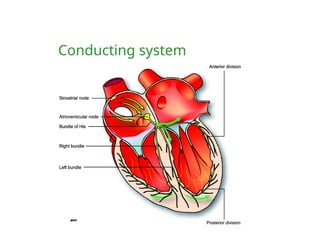
Conducting system
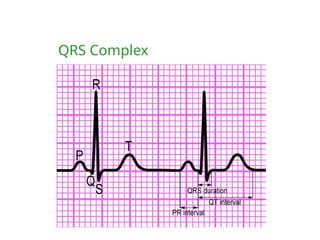
QRS Complex
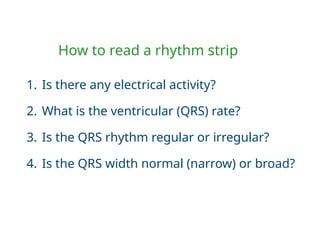
How to read a rhythm strip
1. Is there any electrical activity?
2. What is the ventricular (QRS) rate?
3. Is the QRS rhythm regular or irregular?
4. Is the QRS width normal (narrow) or broad?
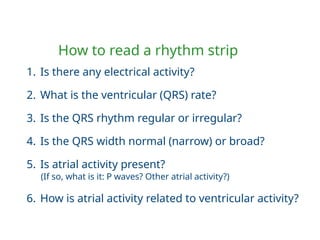
How to read a rhythm strip
1. Is there any electrical activity?
2. What is the ventricular (QRS) rate?
3. Is the QRS rhythm regular or irregular?
4. Is the QRS width normal (narrow) or broad?
5. Is atrial activity present?
(If so, what is it: P waves? Other atrial activity?)
6. How is atrial activity related to ventricular activity?
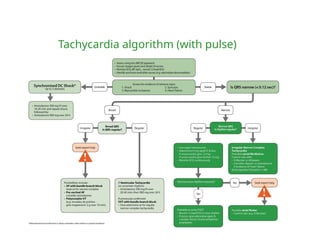
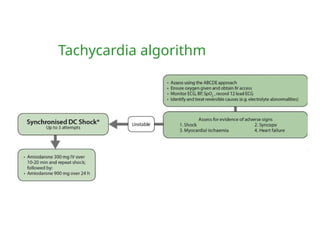
Tachycardia algorithm (with pulse)
Tachycardia algorithm
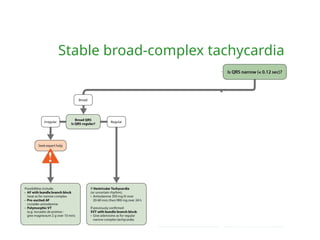
Stable broad-complex tachycardia
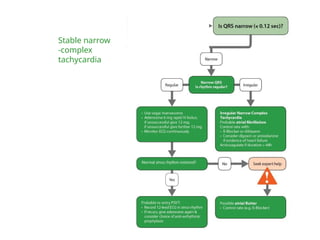
Stable narrow
-complex
tachycardia
Case study 1
Clinical setting and history
– 65-year-old woman
– In monitored bed 3 days after anterior myocardial infarction
– Complains to nurse of feeling unwell
Clinical course
– ABCDE
• A : Clear
• B : Spontaneous breathing, rate 26 min-1
• C : Looks pale, HR 180 min-1
, BP 70/42 mmHg, CRT 3 s
Initial rhythm?
• D : Alert, glucose 5.6 mmol l-1
• E : Nil of note
What action will you take?
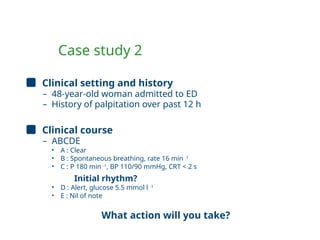
Case study 2
Clinical setting and history
– 48-year-old woman admitted to ED
– History of palpitation over past 12 h
Clinical course
– ABCDE
• A : Clear
• B : Spontaneous breathing, rate 16 min -1
• C : P 180 min -1
, BP 110/90 mmHg, CRT < 2 s
Initial rhythm?
• D : Alert, glucose 5.5 mmol l -1
• E : Nil of note
What action will you take?
Case study 2 (continued)
Clinical course
– No response to vagal manoeuvres
– Vital signs unchanged
What action will you take now?
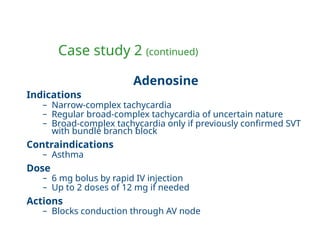
Case study 2 (continued)
Adenosine
Indications
– Narrow-complex tachycardia
– Regular broad-complex tachycardia of uncertain nature
– Broad-complex tachycardia only if previously confirmed SVT
with bundle branch block
Contraindications
– Asthma
Dose
– 6 mg bolus by rapid IV injection
– Up to 2 doses of 12 mg if needed
Actions
– Blocks conduction through AV node
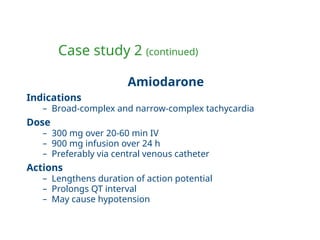
Case study 2 (continued)
Amiodarone
Indications
– Broad-complex and narrow-complex tachycardia
Dose
– 300 mg over 20-60 min IV
– 900 mg infusion over 24 h
– Preferably via central venous catheter
Actions
– Lengthens duration of action potential
– Prolongs QT interval
– May cause hypotension
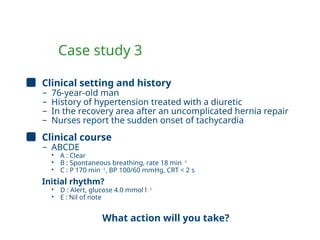
Case study 3
Clinical setting and history
– 76-year-old man
– History of hypertension treated with a diuretic
– In the recovery area after an uncomplicated hernia repair
– Nurses report the sudden onset of tachycardia
Clinical course
– ABCDE
• A : Clear
• B : Spontaneous breathing, rate 18 min -1
• C : P 170 min -1
, BP 100/60 mmHg, CRT < 2 s
Initial rhythm?
• D : Alert, glucose 4.0 mmol l -1
• E : Nil of note
What action will you take?
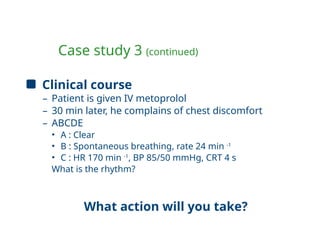
Case study 3 (continued)
Clinical course
– Patient is given IV metoprolol
– 30 min later, he complains of chest discomfort
– ABCDE
• A : Clear
• B : Spontaneous breathing, rate 24 min -1
• C : HR 170 min -1
, BP 85/50 mmHg, CRT 4 s
What is the rhythm?
What action will you take?
Case study 3 (continued)
Clinical course
– Cardioversion restores sinus rhythm
– Patient is transferred back to the day-case unit
What actions may be required as part of
discharge planning?
Any questions?
Summary
You should now:
Be able to recognise types of tachycardia, defined by
regularity and QRS width
Understand the principles of treatment
Know the indications for electrical and chemical
cardioversion
Know how to perform synchronised cardioversion

12.2 Tachycardia, cardioversion 2010v1.ppt

  • 1.
    Tachycardia, Cardioversion and Drugs Dr.AhmedAbouzied Assistant Professor of Emergency Medicine, MD, FOM-SCU
  • 2.
    Learning outcomes At theend of this workshop you should: Be able to recognise types of tachycardia, defined by regularity and QRS width Understand the principles of treatment Know the indications for electrical and chemical cardioversion Know how to perform synchronised cardioversion
  • 3.
  • 4.
  • 5.
    How to reada rhythm strip 1. Is there any electrical activity? 2. What is the ventricular (QRS) rate? 3. Is the QRS rhythm regular or irregular? 4. Is the QRS width normal (narrow) or broad?
  • 6.
    How to reada rhythm strip 1. Is there any electrical activity? 2. What is the ventricular (QRS) rate? 3. Is the QRS rhythm regular or irregular? 4. Is the QRS width normal (narrow) or broad? 5. Is atrial activity present? (If so, what is it: P waves? Other atrial activity?) 6. How is atrial activity related to ventricular activity?
  • 7.
  • 8.
  • 9.
  • 10.
  • 11.
    Case study 1 Clinicalsetting and history – 65-year-old woman – In monitored bed 3 days after anterior myocardial infarction – Complains to nurse of feeling unwell Clinical course – ABCDE • A : Clear • B : Spontaneous breathing, rate 26 min-1 • C : Looks pale, HR 180 min-1 , BP 70/42 mmHg, CRT 3 s Initial rhythm? • D : Alert, glucose 5.6 mmol l-1 • E : Nil of note What action will you take?
  • 12.
    Case study 2 Clinicalsetting and history – 48-year-old woman admitted to ED – History of palpitation over past 12 h Clinical course – ABCDE • A : Clear • B : Spontaneous breathing, rate 16 min -1 • C : P 180 min -1 , BP 110/90 mmHg, CRT < 2 s Initial rhythm? • D : Alert, glucose 5.5 mmol l -1 • E : Nil of note What action will you take?
  • 13.
    Case study 2(continued) Clinical course – No response to vagal manoeuvres – Vital signs unchanged What action will you take now?
  • 14.
    Case study 2(continued) Adenosine Indications – Narrow-complex tachycardia – Regular broad-complex tachycardia of uncertain nature – Broad-complex tachycardia only if previously confirmed SVT with bundle branch block Contraindications – Asthma Dose – 6 mg bolus by rapid IV injection – Up to 2 doses of 12 mg if needed Actions – Blocks conduction through AV node
  • 15.
    Case study 2(continued) Amiodarone Indications – Broad-complex and narrow-complex tachycardia Dose – 300 mg over 20-60 min IV – 900 mg infusion over 24 h – Preferably via central venous catheter Actions – Lengthens duration of action potential – Prolongs QT interval – May cause hypotension
  • 16.
    Case study 3 Clinicalsetting and history – 76-year-old man – History of hypertension treated with a diuretic – In the recovery area after an uncomplicated hernia repair – Nurses report the sudden onset of tachycardia Clinical course – ABCDE • A : Clear • B : Spontaneous breathing, rate 18 min -1 • C : P 170 min -1 , BP 100/60 mmHg, CRT < 2 s Initial rhythm? • D : Alert, glucose 4.0 mmol l -1 • E : Nil of note What action will you take?
  • 17.
    Case study 3(continued) Clinical course – Patient is given IV metoprolol – 30 min later, he complains of chest discomfort – ABCDE • A : Clear • B : Spontaneous breathing, rate 24 min -1 • C : HR 170 min -1 , BP 85/50 mmHg, CRT 4 s What is the rhythm? What action will you take?
  • 18.
    Case study 3(continued) Clinical course – Cardioversion restores sinus rhythm – Patient is transferred back to the day-case unit What actions may be required as part of discharge planning?
  • 19.
  • 20.
    Summary You should now: Beable to recognise types of tachycardia, defined by regularity and QRS width Understand the principles of treatment Know the indications for electrical and chemical cardioversion Know how to perform synchronised cardioversion
Editor's Notes