NAVAL
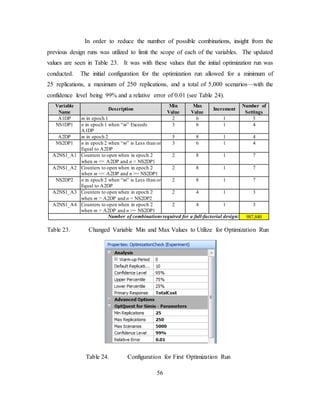
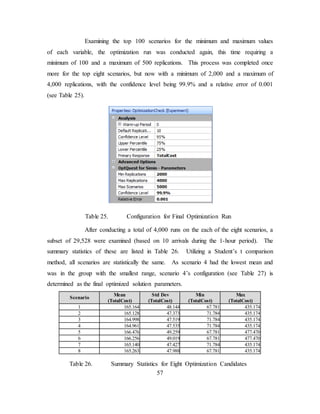
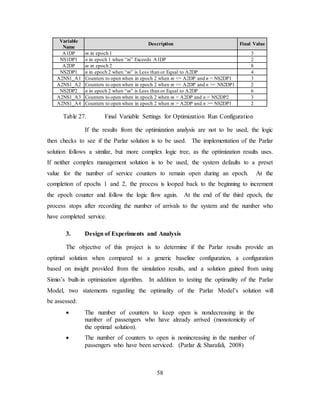
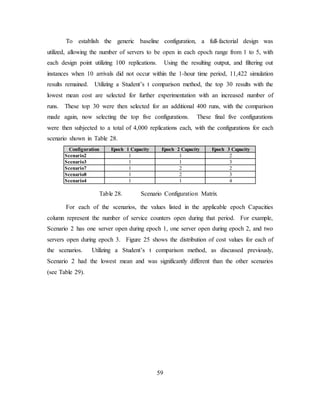
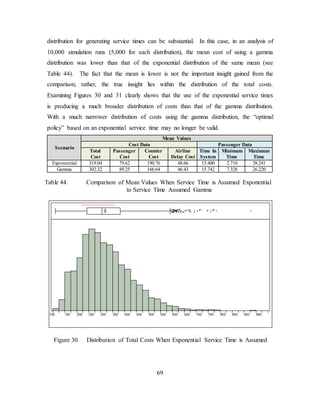
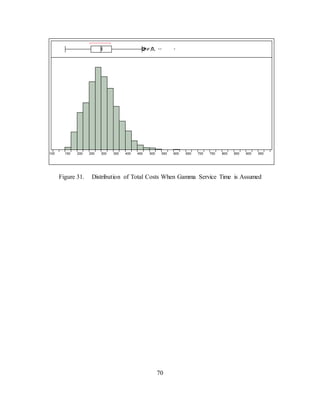
POSTGRADUATE
SCHOOL
MONTEREY, CALIFORNIA
THESIS
Approved for public release; distribution is unlimited
CHANGING THE PARADIGM: SIMULATION,
A METHOD OF FIRST RESORT
by
Ben L. Anderson
September 2011
Thesis Advisor: Thomas W. Lucas
Second Reader: Devaushi Singham
THIS PAGE INTENTIONALLY LEFT BLANK
i
REPORT DOCUMENTATION PAGE Form Approved OMB No. 0704-0188
Public reportingburden forthis collectionof informationis estimatedtoaverage 1 hour per response,includingthe time for reviewing instruction,
searchingexistingdata sources, gatheringandmaintainingthe data needed, and completing and reviewing the collection of information. Send
comments regardingthis burden estimate or any otheraspect ofthis collectionof information, including suggestions for reducing this burden, to
Washington headquarters Services, Directorate for Information Operations andReports, 1215 Jefferson Davis Highway, Suite 1204, Arlington, VA
22202-4302, and to the Office of Management and Budget, Paperwork Reduction Project (0704-0188) Washington DC 20503.
1. AGENCY USE ONLY (Leave blank) 2. REPORT DATE
September 2011
3. REPORT TYPE AND DATES COVERED
Master’s Thesis
4. TITLE AND SUBTITLE Changing the Paradigm: Simulation, a Method of First
Resort
5. FUNDING NUMBERS
6. AUTHOR(S) Ben L. Anderson
7. PERFORMING ORGANIZATION NAME(S) AND ADDRESS(ES)
Naval Postgraduate School
Monterey, CA 93943-5000
8. PERFORMING ORGANIZATION
REPORT NUMBER
9. SPONSORING/MONITORING AGENCY NAME(S) AND ADDRESS(ES)
N/A
10. SPONSORING/MONITORING
AGENCY REPORT NUMBER
11. SUPPLEMENTARY NOTES The views expressed in this thesis are those of the author and do not reflect the official policy
or position of the Department of Defense or the U.S. Government. IRB Protocol number N/A.
12a. DISTRIBUTION / AVAILABILITY STATEMENT
Approved for public release; distribution is unlimited
12b. DISTRIBUTION CODE
A
13. ABSTRACT (maximum 200 words)
The computing capability to which Operations Research (OR) analysts have access today is over 1,000,000,000 times more
powerful than the first simulation pioneers had sixty years ago, yet the concept that simulation is a “method of last resort” still
plagues the OR community. Many real-world problems are complex, with properties such as high dimensionality, non-linear
effects, stochastic elements, and dependence between variables. Solving these problems analytically often requires simplifying
assumptions, running the risk of making a Type III error (i.e., getting the right answer to the wrong problem). This paper explores
the development of computer simulation, and the key design principles that must be followed, to demonstrate how simulation is
often the appropriate tool in understanding complex, real-world problems. Contrasting the results of a recently published
analytical approach to the analysis of an airport check-in counter scheduling problem versus those of a simulation study of the
same system, we demonstrate that simulation can quickly provide the same answers with any desired degree of precision and with
no loss of insight. More importantly, simulation can easily use both empirical data and more realistic assumptions—which allows
for the analyst to address the right problem. With current computational capabilities and methods, it is time to change the
paradigm. Simulation is a method of first resort.
14. SUBJECT TERMS Simulation, Queuing Theory, Design of Experiments (DOE), Object
Orienting Modeling, ComputationalTractability, Airport Scheduling, Simio
15. NUMBER OF
PAGES
105
16. PRICE CODE
17. SECURITY
CLASSIFICATION OF
REPORT
Unclassified
18. SECURITY
CLASSIFICATION OF THIS
PAGE
Unclassified
19. SECURITY
CLASSIFICATION OF
ABSTRACT
Unclassified
20. LIMITATION OF
ABSTRACT
UU
NSN 7540-01-280-5500 Standard Form 298 (Rev. 2-89)
Prescribed by ANSI Std. 239-18
ii
THIS PAGE INTENTIONALLY LEFT BLANK
iii
Approved for public release; distribution is unlimited
CHANGING THE PARADIGM: SIMULATION,
A METHOD OF FIRST RESORT
Ben L. Anderson
Lieutenant, United States Navy
B.S., North Carolina State University, 2004
Submitted in partial fulfillment of the
requirements for the degree of
MASTER OF SCIENCE IN OPERATIONS RESEARCH
from the
NAVAL POSTGRADUATE SCHOOL
September 2011
Author: Ben L. Anderson
Approved by: Thomas W. Lucas
Thesis Advisor
Devaushi Singham
Second Reader
Robert F. Dell
Chair, Department of Operations Research
iv
THIS PAGE INTENTIONALLY LEFT BLANK
v
ABSTRACT
The computing capability to which Operations Research (OR) analysts have access today
is over 1,000,000,000 times more powerful than the first simulation pioneers had sixty
years ago, yet the concept that simulation is a “method of last resort” still plagues the OR
community. Many real-world problems are complex, with properties such as high
dimensionality, non-linear effects, stochastic elements, and dependence between
variables. Solving these problems analytically often requires simplifying assumptions,
running the risk of making a Type III error (i.e., getting the right answer to the wrong
problem). This paper explores the development of computer simulation, and the key
design principles that must be followed, to demonstrate how simulation is often the
appropriate tool in understanding complex, real-world problems. Contrasting the results
of a recently published analytical approach to the analysis of an airport check-in counter
scheduling problem versus those of a simulation study of the same system, we
demonstrate that simulation can quickly provide the same answers with any desired
degree of precision and with no loss of insight. More importantly, simulation can easily
use both empirical data and more realistic assumptions—which allows for the analyst to
address the right problem. With current computational capabilities and methods, it is
time to change the paradigm. Simulation is a method of first resort.
vi
THIS PAGE INTENTIONALLY LEFT BLANK
vii
THESIS DISCLAIMER
The reader is cautioned that the simulation model presented in this thesis has not
been exercised and tested to its fullest extent. While every effort has been made within
the time available to ensure that the simulation represents the scenario presented by
Parlar and Sharafali (2008) (henceforth referred to as the Parlar Model), interpretations of
their intentions and distributions were made to facilitate the development of the
simulation. Further, this model does not represent a real-world system, and has been
made to demonstrate the benefits of computer simulation when examining real-world
problems.
viii
THIS PAGE INTENTIONALLY LEFT BLANK
ix
TABLE OF CONTENTS
I. INTRODUCTION........................................................................................................1
A. BACKGROUND AND LITERATURE REVIEW .......................................1
1. A Brief History of Computer Simulation...........................................2
a. Precomputer Era.......................................................................2
b. Formative Period.......................................................................3
c. Expansion Period......................................................................4
d. Maturation Period.....................................................................5
e. Distributed Processing Era.......................................................6
2. Changes in Computer Architecture and Cost...................................7
a. Application of Moore’s Law .....................................................7
b. Relative Cost and Quantity of Memory ....................................9
c. Computational Tractability.....................................................10
3. Use of Simulation in the Department of Defense ............................14
a. Acquisition and Logistics........................................................16
b. Analysis....................................................................................16
c. Experimentation......................................................................16
d. Intelligence..............................................................................17
e. Testing.....................................................................................17
f. Training...................................................................................17
g. Planning..................................................................................18
4. Related Studies...................................................................................19
B. RESEARCH QUESTIONS...........................................................................21
C. BENEFIT OF THE STUDY .........................................................................22
D. THESIS ORGANIZATION ..........................................................................22
II. ANALYSIS OF AN ANALYTICAL SOLUTION TO A COMPLEX
PROBLEM .................................................................................................................23
A. BACKGROUND ............................................................................................23
B. ASSUMPTIONS.............................................................................................24
1. Passengers...........................................................................................24
2. Service .................................................................................................26
3. Costs ....................................................................................................27
C. INTERPRETING THE SOLUTION ...........................................................29
III. THE SIMULATION APPROACH ..........................................................................33
A. HOW A SIMULATIONIST WOULD APPROACH THE PROBLEM...33
1. FORMULATE THE PROBLEM.....................................................34
2. COLLECT INFORMATION/DATA AND CONSTRUCT
CONCEPTUAL MODEL .................................................................35
3. IS THE CONCEPTUAL MODEL VALID? ...................................35
4. PROGRAM THE MODEL...............................................................36
5. IS THE PROGRAMMED MODEL VALID?.................................36
6. DESIGN, CONDUCT, AND ANALYZE EXPERIMENTS ..........38
x
7. DOCUMENT AND BRIEF THE RESULTS ..................................38
B. THE SIMIO SOFTWARE............................................................................39
C. SIMULATION MODEL BASED ON THE PARLAR MODEL...............41
1. Formulation, Data Collection, and Conceptual Model...................41
2. Program and Validate Model ...........................................................43
a. Basic Model .............................................................................43
b. Cost Factors.............................................................................49
c. Decision Management ............................................................51
3. Design of Experiments and Analysis ................................................58
4. Document and Brief Results .............................................................65
D. USING SIMULATION TO EXPAND OUR UNDERSTANDING...........66
1. Service Rate Does Not Change..........................................................66
2. Service Rate Uses Gamma Distribution...........................................67
IV. CONCLUSIONS ........................................................................................................71
A. WHY SIMULATION SHOULD BE A METHOD OF FIRST
RESORT.........................................................................................................71
B. SUMMARY OF COMPARISON BETWEEN THE SIMULATION
AND ANALYTICAL RESULTS OF THE AIRLINE COUNTER
QUEUE ...........................................................................................................72
C. RECOMMENDATIONS FOR FUTURE RESEARCH.............................73
LIST OF REFERENCES ......................................................................................................75
INITIAL DISTRIBUTION LIST.........................................................................................79
xi
LIST OF FIGURES
Figure 1. Student’s Comparison of Theoretical Frequency Curve With an Actual
Sample Originally Published in Biometrika (From Student, 1908)...................3
Figure 2. Moore’s Law Depicted Through the Change in Transistor Count Over
Time (From Moore’s Law, 2011) ......................................................................8
Figure 3. Moore’s Law and Peak Performance Over Time (From Dongarra, Meuer,
Simon, & Strohmaier, 2000)..............................................................................9
Figure 4. Hard Drive Cost per Gigabyte (From Komorowski, 2011) .............................10
Figure 5. Transient Probability Graph With 1c = Having the Highest Peak (From
Parlar & Sharafali, 2008) .................................................................................11
Figure 6. Transition Rate Diagram for 3N = (From Parlar & Sharafali, 2008) .............12
Figure 7. Simulation Result for Transition Probability Graph........................................13
Figure 8. DoD M&S Governance (From MSCO, 2011).................................................15
Figure 9. Hierarchy of Combat Models and Corresponding Navy Simulation
Systems (From NMSO, 2009) .........................................................................18
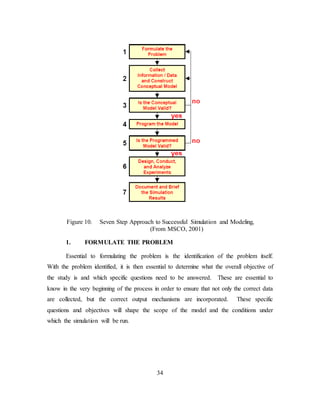
Figure 10. Seven Step Approach to Successful Simulation and Modeling, (From
MSCO, 2001)...................................................................................................34
Figure 11. Taxonomy of Verification and Validation Techniques for Conventional
Simulation Models (From Balci, 1997) ...........................................................37
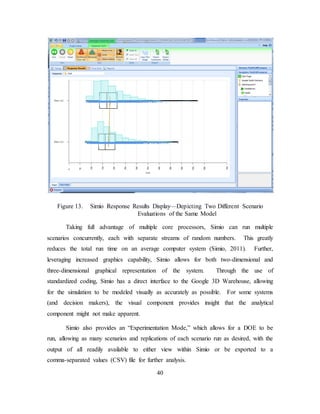
Figure 12. Simio Model View of the Airport Terminal Example Scenario ......................39
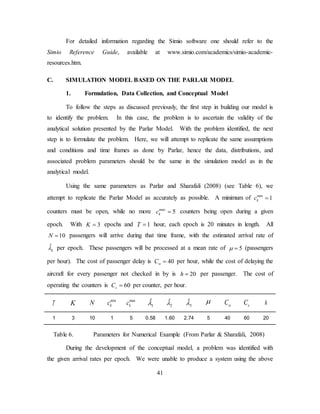
Figure 13. Simio Response Results Display—Depicting Two Different Scenario
Evaluations of the Same Model .......................................................................40
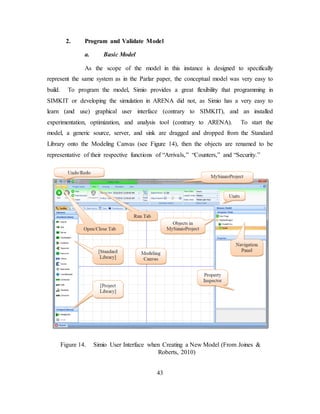
Figure 14. Simio User Interface when Creating a New Model (From Joines &
Roberts, 2010)..................................................................................................43
Figure 15. Basic Simio Implementaiton of the Parlar Model............................................44
Figure 16. Update Counter Cost Rate Process ..................................................................47
Figure 17. Update Service Rate Process............................................................................47
Figure 18. Add All Passenger Costs Process ....................................................................48
Figure 19. Airline Delay Cost Process ..............................................................................50
Figure 20. Total Cost Summation Process ........................................................................50
Figure 21. Management Process........................................................................................51
Figure 22. Logic Flow for Epochs 1 and 2........................................................................53
Figure 23. Updating Epoch Data.......................................................................................54
Figure 24. Optimization Results Server Capacity Assignment Logic...............................55
Figure 25. One-Way Analysis of Cost by Scenario ..........................................................60
Figure 26. Branching Condition for Modified Baseline—Using Variable X ,
Controlled in the Experiments Window to Determine Branching...................62
Figure 27. Branching Condition for 2nd
Modified Baseline—Using Variable X ,
Controlled in the Experiments Window to Determine Branching...................63
Figure 28. Finalized Modified Baseline Configuration.....................................................64
Figure 29. Comparison of Exponential to Gamma Distributions With the Same Mean
Times................................................................................................................68
Figure 30. Distribution of Total Costs When Exponential Service Time is Assumed......69
xii
Figure 31. Distribution of Total Costs When Gamma Service Time is Assumed ............70
xiii
LIST OF TABLES
Table 1. Partial List of Levels of Combat Model Sophistication (From Committee
on Modeling and Simulation for Defense Transformation, 2006)...................14
Table 2. Numerical Example of Estimated Arrival Rates (From Parlar & Sharafali,
2008) ................................................................................................................26
Table 3. Service Rate Table Based on the Parlar Model................................................27
Table 4. Parameters for Numerical Example (From Parlar & Sharafali, 2008).............30
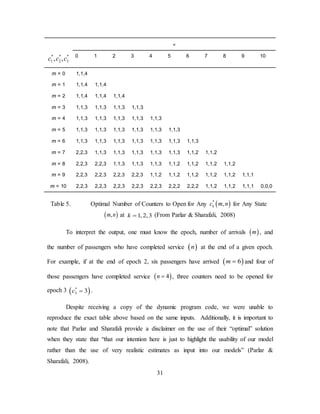
Table 5. Optimal Number of Counters to Open for Any ( )*
,kc m n for Any State
( ),m n at 1,2,3k = (From Parlar & Sharafali, 2008)......................................31
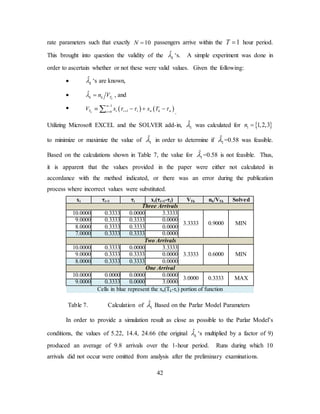
Table 6. Parameters for Numerical Example (From Parlar & Sharafali, 2008).............41
Table 7. Calculation of 1
ˆλ Based on the Parlar Model Parameters ..............................42
Table 8. Properties of the “Arrivals” Object..................................................................45
Table 9. Arrivals Rate Table ..........................................................................................45
Table 10. Properties of the “Counters” Object.................................................................46
Table 11. Assignment for Total Counter Cost Tally Statistic..........................................47
Table 12. Service Rate Calculations ................................................................................48
Table 13. Properties of the “Security” Object..................................................................48
Table 14. Passenger Delay Cost Calculations..................................................................49
Table 15. Decision to Close Counters Logic ...................................................................49
Table 16. Closing the Counters by Setting Capacity to Zero...........................................49
Table 17. Logic to Decide Whether or Not to Implement Aircraft Delay Cost...............50
Table 18. Aircraft Delay Cost Assignment......................................................................50
Table 19. Total Cost Calculation .....................................................................................51
Table 20. Current Epoch Calculations .............................................................................52
Table 21. Epoch Decision Logic......................................................................................52
Table 22. Variable Names and Descriptions for Optimization Run ................................55
Table 23. Changed Variable Min and Max Values to Utilize for Optimization Run ......56
Table 24. Configuration for First Optimization Run .......................................................56
Table 25. Configuration for Final Optimization Run ......................................................57
Table 26. Summary Statistics for Eight Optimization Candidates ..................................57
Table 27. Final Variable Settings for Optimization Run Configuration..........................58
Table 28. Scenario Configuration Matrix ........................................................................59
Table 29. Means Comparisons for Each Pair Using Student’s t......................................60
Table 30. Summary Analysis of 18,472 Baseline Runs...................................................60
Table 31. Summary Analysis of Instances with Total Cost Greater Than or Equal to
Three Standard Deviations Compared to Those With Less Than Three
Standard Deviations .........................................................................................61
Table 32. Summary Analysis of Instances With Total Cost Greater Than or Equal to
Three Standard Deviations Based on Major Cost Component ........................61
Table 33. Summary Analysis of Instances (Using Modified Baseline) With Total
Cost Greater Than or Equal to Three Standard Deviations Based on Major
Cost Component...............................................................................................62
xiv
Table 34. Summary Analysis of 18,476 Modified Baseline Runs...................................62
Table 35. Comparison of Generic and Modified Baseline Statistics ...............................63
Table 36. Comparisons for Each Pair Using Student’s t Test..........................................63
Table 37. Comparison of Modified Baseline (More Than 7 Served in Epoch 2), With
Opening an Additional Counter in Epoch 3 Based on Number of Arrivals
(With None Completing Service by the End of Epoch 2) ...............................64
Table 38. Comparison of Modified Baseline (More Than 7 Served in Epoch 2), With
Opening an Additional Counter in Epoch 3 Based on 3 Arrivals (and Less
Than or Equal to X Completing Service by the End of Epoch 2) .................64
Table 39. Comparison of Four Scenarios.........................................................................65
Table 40. Means Comparisons for Each Pair Using Student’s t Test ..............................65
Table 41. Means Comparison of Each Configuration With Corresponding p-Values ....65
Table 42. Constant Versus Increased Service Rate Comparison of Mean Values ..........67
Table 43. Optimal Baseline Counter Schedule for System When Service Rate is Not
Increased as a Function of the Number of Passengers in the System Who
Have Not Completed Service...........................................................................67
Table 44. Comparison of Mean Values When Service Time is Assumed Exponential
to Service Time Assumed Gamma...................................................................69
xv
LIST OF ACRONYMS AND ABBREVIATIONS
AMSO Army Modeling and Simulation Office
AP EXCOM Adaptive Planning Executive Committee
AT&L Acquisition, Technology, and Logistics
C4ISR Command, Control, Communications, Computers Intelligence,
Surveillance, and Reconnaissance
CAC Common Access Card
CAPE Cost Assessment and Program Evaluation
CAPS C4ISR Architecture Planning/Analysis System
COCOM Combatant Commander
COSMOS C4ISR Space and Missile Operations Simulation
CPU Central Processing Unit
CSV Comma-Separated Values
DIMSCG Defense Intelligence Modeling and Simulation Coordination Group
DoD Department of Defense
DOE Design of Experiments
EADSIM Extended Air Defense Simulation
EOSAN European Organization for the Safety of Air Navigation
ENIAC Electronic Numerical Integrator and Computer
FAA Federal Aviation Administration
FLOPS Floating Point Operations per Second
GCAM General Campaign Analysis Model
GEOINT Geospatial Intelligence
HUMINT Human Intelligence
xvi
ITEM Integrated Theater Engagement Model
JCDE EC Joint Concept Development and Experimentation Executive Committee
JFCOM Joint Forces Command
JIMM Joint Integrated Mission Model
JS Joint Staff
JTLS Joint Theater Level Simulation
M&S Modeling and Simulation
M&S SC Modeling and Simulation Steering Committee
MSCO Modeling and Simulation Coordination Office
NMSO Navy Modeling and Simulation Office
NSS Naval Simulation System
OR Operations Research
OSD Office of the Secretary of Defense
OUSD Office of the Under Secretary of Defense
P&R Personnel and Readiness
ROI Return on Investment
SE Systems Engineering
SIGINT Signals Intelligence
SSA SC Standard Simulation Architecture Steering Committee
Simio Simulation Modeling framework based on Intelligent Objects
STORM Synthetic Theater Operations Research Model
SPL Simulation Programming Language
T2 ESG Training / Transformation Executive Steering Group
T&E BOD Test and Evaluation Board of Directors
TACWAR Tactical Warfare Integrated Environment
xvii
USAF United States Air Force
USD(I) Under Secretary of Defense (Intelligence)
V&V Verification and Validation
VIC Vector-in Commander
VV&A Verification, Validation, and Accreditation
WSC Winter Simulation Conference
xviii
THIS PAGE INTENTIONALLY LEFT BLANK
xix
EXECUTIVE SUMMARY
If anyone, here or later, can tell us how the approach of certainty—
traditional mathematics—is going to answer the questions that practical
data analysts are going to have to have answered, I will rejoice. But until I
am reliably informed of such a utopian prospect, I shall expect the critical
practical answers of the next decade or so to come from the approach of
simulation—from a statistician’s form of mathematics, in which ever more
powerful computing systems will be an essential partner and effective. . .
—John Tukey, (1986)
The paradigm that simulation is a method of last resort has been around for over 50 years,
with its first use in operations research focused literature by John Harling (1958), in an
article entitled “Simulation Techniques in Operations Research.” In that article, Harling
uses the term “it has been often said,” implying that the paradigm of simulation being a
tool of last resort was not just prevalent at the time, but had been for several years
(Harling, 1958). The phrase saw continued use throughout the operations research
community, and is perhaps best known from Harvey Wagner’s seminal textbook
Principles of Operations Research (Wagner, 1969). Why was this the paradigm of the
time? Was it a valid paradigm at the time, and is it a valid paradigm now?
Since the inception of computer simulation with the use of the Electronic
Numerical Integrator and Computer (ENIAC), there have been significant advances in
both processing power and storage capability. Computing power today is over
1,000,000,000 times what it was just 60 years ago. It took the ENIAC’s computational
capabilities to solve the complex integrals needed in the design of a thermonuclear
weapon, and with the increases in computing power, many more computationally
challenging problems have now become computationally tractable. We define
“computationally tractable” as follows: A model is computationally tractable if it can be
solved on a computer to any required level of precision in a short period of time.
Unfortunately, some in the OR community have not fully embraced the power of
today’s computers, and has failed to recognize the benefits of simulation to its fullest.
One may argue that simulation can only provide an approximate solution, while an
xx
analytical one presents an exact one. That statement, however, needs to be placed into its
proper context. An analytical solution may only be exact when it is done in the absence
of assumptions. The moment one must “assume,” is the moment the analytical solution
slips away from the paramount of perfection, to simply providing an “approximate”
solution.
This thesis provides an examination of a paper written by Parlar and Sharafali
(2008) on an analytical approach to providing an optimal solution on the allocation of
airline check-in counters. Numerous assumptions were made by Parlar and Sharafali in
order to present an analytically tractable problem. Many of which are made contrary to
the actual workings of the system. Three of the most significant assumptions are:
• the time period in which the counters are open is a fixed time ( )T that can
be partitioned into ( )K segments, in which the arrival rate can be
estimated as a constant;
• service times are exponentially distributed; and
• a linear increase in service rate, based on the number of passengers in the
system who have not completed service.
These assumptions have a dramatic impact on the authors’ objective function to
be minimized. This objective function, which is evaluated through the use of a dynamic
program, calculates the minimum expected cost to go from time kt to T , given m
arrivals and, of those arrivals, n having completed service. This expected cost function
is significantly affected by the distribution of service times and the linear increase in
service rate.
With an understanding of the model presented by Parlar and Sharafali, this thesis
then presents the methodology presented originally by Law and Kelton (1982), and
adopted by the Defense Modeling and Simulation Coordination Office for Verification,
Validation and Accreditation (Modeling and Simulation Coordination Office (MSCO),
2001). Through this process, and the use of Simio simulation software, this thesis
produced a simulation model, copying the assumptions and distributions of the Parlar and
Sharafali model as closely as possible. As this model is computationally tractable,
through simulation we quickly were able to replicate the transition probabilities
xxi
calculated by Parlar and Sharafali to any degree of precision required. The simulation
model was then exercised to test the validity of Parlar and Sharafali’s findings of the
optimal configurations, the monotonicty within the optimal solution, and that the number
of counters to open is nonincreasing in the number of passengers who have
been serviced.
Contrary to Parlar and Sharafali’s findings, our results demonstrated that not only
did monotonicity not exist in the solution, but the “optimal” solution calculated by the
dynamic program did not have the lowest mean cost. To investigate this, we examined
two of the key the assumptions made by Parlar and Sharafali. First, the linear increase in
service rate was evaluated. We demonstrated that this assumption played a significant
role in the development of the optimal solution and, through a numerical illustration, is
not a reasonable assumption. The second demonstration illustrated the importance of
choosing the right distribution model. Utilizing a more realistic distribution, with the
same mean value, demonstrated that the average total cost of a run is lower, and from a
much narrower range, than when calculated with the exponential distribution due to the
heavier weightings of the exponential distribution at higher numbers.
With today’s computing power and storage capacity, combined with a logical and
formal method for developing and validating simulation studies, simulation should no
longer be looked at as a method of “last resort.” No longer are analysts constrained to
having to make assumptions such as normality, independence, memorylessness,
deterministic, linear, stationary, and homoscedasticity—as the advanced simulation suites
handle these conditions with ease. No longer do analysts have to manipulate a problem
to make it analytically tractable, which can lead the analyst away from solving the real
problem as they are preoccupied by solving the analytical one. Simulation allows for a
more realistic analysis to be done, being able to incorporate actual statistics of the real
systems into the simulation. It allows for the simultaneous exploration of multiple
parameters of the system through a proper design of experiments. It provides the insight
needed by decision makers to make robust decisions. It is time to change the paradigm.
Simulation is a method of first resort.
xxii
THIS PAGE INTENTIONALLY LEFT BLANK
xxiii
ACKNOWLEDGMENTS
The opportunity to attend the Naval Postgraduate School (NPS) has been an
incredible step in my life’s journey. Eighteen years ago (September 1993), I departed my
native land of Canada and arrived upon the hallowed yellow footprints at Marine Corps
Recruit Depot San Diego. From my first day of Boot Camp, to the graduation
ceremonies here at NPS, the military has never stopped providing me with opportunities
to learn and develop as an American citizen, as a member of the armed forces, as a
leader, as a husband, and as a father.
Throughout my eighteen years of service, it is neither what I have personally
achieved, nor the places that I have been which have guided me to who I am today. It has
been the people whom I have met, worked for, and worked with that have made this
journey a wonderful, enjoyable, and enriching experience.
The two people who have provided the most significant impact on my life are my
wife and daughter. My wife, Laurel, has provided me with a stability I never would have
thought possible. Taking care of the all the details of life, while enduring my many
absences due to military obligations, with nothing but a “can-do” attitude, has enabled me
to work harder and focus more on the tasks at hand, rather than having to worry if all was
being taken care of on the home front. My daughter London motivates me to ensure that
the decisions I make will ensure the long-term success of our family. Without the two of
them standing with me and supporting me, I doubt I would have been able to achieve
what I have.
Several key military leaders have had a more profound impact on my
development than others. First, Corporal (USMC) Joel Montejano taught me that no
matter how hard one worked, unless one could work well with others—the benefit of the
hard work would never be realized. Second, General (USA, Retired) Henry Hugh
Shelton, through his seminar on “Transformational Leadership” at the Shelton Leadership
Conference at North Carolina State University, taught me that while the “status quo” may
be what is comfortable, a true leader has to seek improvements, even when they are not
xxiv
desired. Finally, Captain (USN) David Honabach, my commanding officer while serving
on the USS Jimmy Carter (SSN-23), has two sayings which I failed to fully appreciate at
the time, but now hold in high regard:
“Communication is the key to success, lack of communication is the key to
failure.”
“Some training is good, more training is better, too much training is just
right.”
Dr. Thomas Lucas, my advisor and mentor, has been instrumental in my
development as a scholar. Through stimulating conversations and enriching
opportunities to concise and constructive criticism, he has challenged me to broaden my
viewpoint, bolster my arguments, and realize when I have sufficiently proven my point.
The lessons learned through his class, and the opportunity he provided via International
Data Farming Workshops, has greatly enriched my life.
To accomplish this thesis, two others have contributed significantly in
formulating the thought process, reasoning the arguments, and vetting my many
grammatical errors. I give my sincere appreciation to both Dr. W. David Kelton and
Dr. Dashi Singham, for their help, mentoring, and critiquing throughout this experience.
At NPS, several other professors taught me much more than what was indicated
on their respective syllabi. Dr. Paul Sanchez, Dr. Casey Lucius, and Captain (USN,
Retired) Jeffrey Kline have all taught me (albeit in different subjects), that sometimes the
most important facts are the ones that aren’t mentioned and that true understanding can
only come from delving into the unknown, the unexplained, the unmentioned, or
the unreasoned.
“Ex umbris et imaginibus in veritatem” Plato
(Out of shadows and semblances into the truth)
1
I. INTRODUCTION
It has been often said that a simulation is a last resort.
—Harling, (1958)
A. BACKGROUND AND LITERATURE REVIEW
The paradigm that simulation is a method of last resort has been around for over
50 years. The earliest record of the phrase (as quoted above) is from 1958, when
John Harling gave a presentation to the London School of Economics on operations
research. One must note that Harling uses the term “it has been often said,” thus
implying that the paradigm of simulation as a tool of last resort was not just prevalent at
the time, but had been for several years (Harling, 1958). The phrase saw continued use
throughout the operations research community, and is perhaps best known from pages
887 and 890 of Harvey Wagner’s seminal textbook Principles of Operations Research
(Wagner, 1969). Why was this the paradigm of the time? Was it a valid paradigm at the
time, and is it a valid paradigm now?
First, to discuss the term simulation, one must be clear of the definition being
used. In the case of this paper, simulation strictly refers to the use of a numerical model
to study the behavior of a system as it operates over time using a computer (Kiviat,
1967). To have a clearer understanding of the term in the operations research context,
one should turn to the explanation provided by John E. Cremeans in his 1967 paper
entitled “Why Simulation?” Cremeans, rather than defining simulation in a concrete
way, chose to provide a characterization of what a simulation is and is not. First,
Cremeans clarifies that simulations are not optimizing programs, and that only through
data analysis of the simulation output can one gain insight into the model and apply that
insight in an effort to optimize the system. Second, Cremeans compares simulation to
that of a laboratory experiment, where the variables can all be controlled and altered as
seen fit by the programmer. In fact, a stochastic simulation can be run multiple times
with all the parameters remaining the same, or changing them as the designer sees fit,
which is different from virtually all true laboratory experiments.
2
From the Buffon needle experiments in the 1770s to estimate π, to the complex
models run on supercomputers and computing clusters today, simulation persists and has
grown in its use, but the phrase “as a last resort” can still be seen in scholarly papers.
One should examine how simulation has evolved over time in order to make the
determination if the adage is still valid.
1. A Brief History of Computer Simulation
If you would understand anything, observe its beginning and its
development.
—Aristotle
Keeping with the academic spirit of Aristotle, let us examine the development of
simulation over time in order to gain an appreciation of the history of simulation and how
it has changed with the advances of technology. To examine the history of simulation,
Goldsman, Nance, and Wilson (2009) have provided a framework with which one can
segregate the changes of computing power over time and its effect on simulation. Their
framework consists of three definitive phases: the Precomputer Era (Pre–1945), the
Formative Period (1945–1970), and the Expansion Period (1970–1981). Their study of
simulation history stopped at 1981, as they did not believe that sufficient time had passed
to see any definitive changes since that time (James R. Wilson, personal communication,
August 11, 2011). However, during a discussion with Professor James Wilson of
North Carolina State University regarding the substantial increases in computing power
and memory availability, it was proposed that two additional periods may be examined:
the Maturation Period (1983–2000 [approximately]) and the Distributed Processing Era
(2000–present).
a. Precomputer Era
The idea behind the Monte Carlo approach. . . is to [replace] theory by
experiment whenever the former falters.
—Hammersley & Handscomb, (1964)
Although the term “Monte Carlo Simulation” was not known or discussed
at the time, the process we know today as “Monte Carlo Simulation” has been utilized as
3
far back as 1777, when Buffon conducted his famous “needle experiment” to estimate the
value of π (Goldsman, Nance, & Wilson, 2009). Further, in 1908, William Sealy Gosset
used a manual simulation to verify the probability density function for his “Student’s ‘t’
Distribution” prior to his seminal paper’s 1908 publication (see Figure 1). It is important
to note that these “simulations” conducted by Buffon and Gosset were both validated
later through analysis; Buffon’s by Laplace (Laplace, 1812) and Gosset’s by Fisher
(Fisher, 1925).
Figure 1. Student’s Comparison of Theoretical Frequency Curve With an Actual
Sample Originally Published in Biometrika (From Student, 1908)
b. Formative Period
It was John Von Neumann, Stanislaw Ulam, and Nicholas Metropolis who
can take credit for coining the phrase “Monte Carlo methods” when the trio were working
on the issue of neutron diffusion and also realized the computational potential of the
computers being built (Metropolis, 1987). Recognizing the challenge in the analytical
analysis of the diffusion of particles and either particle procreation or multiplication, the
trio created a mathematical description of the problem that consisted of both deterministic
and stochastic processes. Then, through the use of random sampling, they were able to
obtain sample sets of the results for a statistical analysis. This “Monte Carlo method”
was adopted by many more people as expanded access to computers became a reality.
What enabled the trio to develop their “Monte Carlo method” was the
invention of America’s first computer—the ENIAC (Electronic Numerical Integrator and
Computer). Using their method and formulas, the trio submitted their calculations for
4
computation by ENIAC and, with the results, were able to design a working
thermonuclear weapon. It is essential to recognize that prior to the ENIAC, the complex
integrals needed to design the weapon where analytically intractable (Fritz, 1994). These
calculations became computationally tractable only through the building of the ENIAC
and the development of the “Monte Carlo method” to solve them.
With the potential of computer simulation just starting to be realized, the
period from 1945 through 1970 saw the development of computing capacity all over the
world in government, corporate, and academic institutions. Not only was the access to
computing facilities becoming readily available to researchers and scientists, others
began to develop programming languages to better facilitate the use of these machines.
For example, FORTRAN was developed between 1954 and 1957 in order to
automatically generate efficient machine code from an easier to read input design
(Padua, 2000).
As the use and availability of simulation grew, so did the understanding of
the difficulties associated with simulation. In order to confront these difficulties,
Conway, Johnson, and Maxwell of Cornell University addressed them in two key papers
in 1959 and 1963. They identified two components to the use of computer simulation
that needed to be examined: the construction of the model and the analysis of the results.
These papers identified issues in both components, some of which have been resolved,
while others are still being researched.
c. Expansion Period
Up until the late 1970s, computer access time was costly and severely
limited to institutions that could afford the large computers. It was the advent of the
“personal computer” that brought the computing power needed for computer simulation
to the average user.
As the availability of computers grew, so did the number of available
simulation programming languages (SPLs). The primary source of improvement through
the 1970s was the development of more efficient and user friendly SPLs. As the number
of SPLs increased, the textbooks also began to change. Several key texts were published
5
that were not arbitrarily tied to a specific SPL and focused on computer simulation as a
method in general (e.g., Law & Kelton, 1982).
In addition to the improvement of SPLs, several other key topics were
advanced during this period. A new object-oriented approach to simulation design
entitled “Conical Methodology” was developed by Nance (1978). Additionally, advances
in random number generation, event graphs (Schruben, 1983), and the need for formal
verification and validation (Blaci & Sargent, 1981) were brought forward. The text
Simulation Modeling and Analysis by Law and Kelton (1982) has been credited with
being the first of many that brought the advanced methodologies to a wide audience
(Goldsman, Nance, & Wilson, 2010).
d. Maturation Period
With a definitive structure set in place on the issues that face the use of
simulation, combined with an ever increasing source of experts, research continued
throughout the maturation period on how one can achieve more reality and fidelity in
simulation. One source which has had a significant influence, and continues to underpin
these developments, is the Winter Simulation Conference (WSC).
While the WSC provides a forum for discussion of the most recent
advances in simulation, it also “provides the central meeting place for simulation
practitioners, researchers, and vendors working in all disciplines and in the industrial,
governmental, military, service, and academic sectors” (White, Fu, & Sanchez, 2011).
The WSC has annually brought together individuals and sponsors from six major
professional organizations and one government agency to accomplish this through a
completely volunteer lead effort for over 40 years (White, Fu, & Sanchez, 2011). For
more information on the WSC, and access to their past presentations and papers, refer to
http://wintersim.org/.
The Department of Defense’s (DoD) reliance on modeling and simulation
grew throughout the 1990s. It was during this period that the use of simulations for
operational wargaming became widespread (Army Modeling & Simulation Office
[AMSO], 2011). With that usage came the realization that without proper quality control
6
being applied, the validity of the models and simulations would be dubious. To address
this, and several other issues, the DoD published Directive 5000.59 in 1994, mandating
all services and defense agencies to establish a modeling and simulation (M&S) office in
order to provide a structure in which future M&S initiatives would be developed
and controlled.
e. Distributed Processing Era
Goldsman, Nance, and Wilson (2009) stopped their detailed analysis of
the history of simulation at the end of the expansion era, as it was felt that “insufficient
history had been accumulated” since that time to effectively comment on the maturation
period (James R. Wilson, personal communication, August 11, 2011). However, during a
phone interview with Professor Wilson, it was suggested that the maturation period was
over and that the Distributed Processing Era had begun. Professor Wilson not only
agreed that this was the case, but stated that entering into the Distributed Processing Era
may be as significant to the simulation community as the realization of the potential of
the ENIAC back in 1946 (James R. Wilson, personal communication, August 11, 2011).
The ability to run simulations on multiple processors simultaneously is not
a new concept or capability; however, the ability to do so on a relatively inexpensive
machine is. With multicore architecture now the standard on processors, simulation
software companies who specialize in the development of software for those who do not
have access to computer clusters are beginning to exploit the capabilities of the new
multicore architectures. For example, a simulation software suite entitled Simio
(Simulation Modeling Framework based on Intelligent Objects), having recognized the
greater performance that can be achieved through using the multicore architecture, have
included the following statement in their hardware requirements page: “Multiple
scenarios and replications run in the Experiment Window take full advantage of each
available processor (e.g., a quad-core processor will execute 4 replications or scenarios
simultaneously” (Simio, 2011).
7
2. Changes in Computer Architecture and Cost
The new slope might approximate a doubling every two years, rather than
every year, by the end of the decade.
—Gordon Moore, (1975)
a. Application of Moore’s Law
While many people quote Moore’s “law,” there are many who quote him
incorrectly. Mr. Moore provided clarification of what Moore’s “law” entails in a video
interview he did with Intel in 2005. Moore clarified that while his original prediction of
transistor density was correct at the time (i.e., the number of transistors per chip were
doubling twice per year), that it was only valid until 1975. In 1975, he reevaluated his
estimate to complexity doubling once every two years. He also asserted that not only has
it proven to be true, but it is now a driver behind the progress, as industry holds it as a
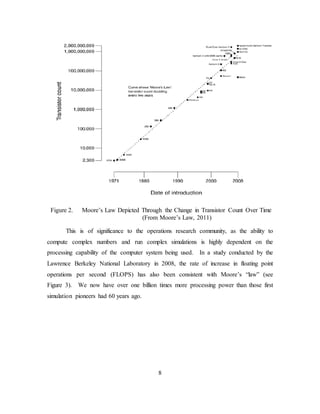
standard to live up to. Figure 2 shows a plot of transistor count to production year, from
1971 through 2008.
8
Figure 2. Moore’s Law Depicted Through the Change in Transistor Count Over Time
(From Moore’s Law, 2011)
This is of significance to the operations research community, as the ability to
compute complex numbers and run complex simulations is highly dependent on the
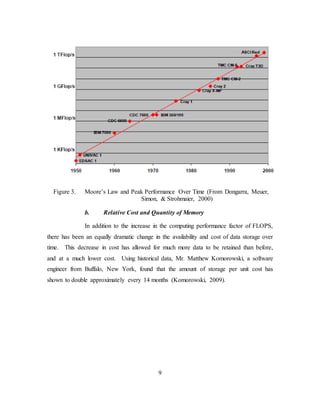
processing capability of the computer system being used. In a study conducted by the
Lawrence Berkeley National Laboratory in 2008, the rate of increase in floating point
operations per second (FLOPS) has also been consistent with Moore’s “law” (see
Figure 3). We now have over one billion times more processing power than those first
simulation pioneers had 60 years ago.
9
Figure 3. Moore’s Law and Peak Performance Over Time (From Dongarra, Meuer,
Simon, & Strohmaier, 2000)
b. Relative Cost and Quantity of Memory
In addition to the increase in the computing performance factor of FLOPS,
there has been an equally dramatic change in the availability and cost of data storage over
time. This decrease in cost has allowed for much more data to be retained than before,
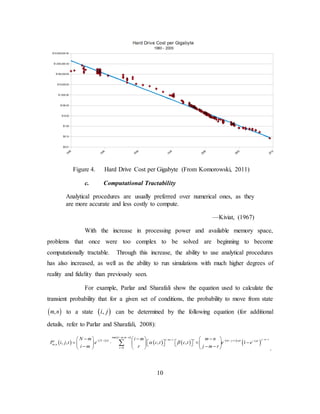
and at a much lower cost. Using historical data, Mr. Matthew Komorowski, a software
engineer from Buffalo, New York, found that the amount of storage per unit cost has
shown to double approximately every 14 months (Komorowski, 2009).
10
Figure 4. Hard Drive Cost per Gigabyte (From Komorowski, 2011)
c. Computational Tractability
Analytical procedures are usually preferred over numerical ones, as they
are more accurate and less costly to compute.
—Kiviat, (1967)
With the increase in processing power and available memory space,
problems that once were too complex to be solved are beginning to become
computationally tractable. Through this increase, the ability to use analytical procedures
has also increased, as well as the ability to run simulations with much higher degrees of
reality and fidelity than previously seen.
For example, Parlar and Sharafali show the equation used to calculate the
transient probability that for a given set of conditions, the probability to move from state
( ),m n to a state ( ),i j can be determined by the following equation (for additional
details, refer to Parlar and Sharafali, 2008):
.
( ) ( )
( ) ( )
( )
( )
( )
max ,
,
0
, , , , 1
i m m n
j n ri m r rN i t m j r c tc c t
m n
r
N m i m m n
P i j t e c t c t e e
i m r j m r
λ µ µ
α β
− −
− −− −− − − − + −
=
− − −     
= ⋅ × −           − − −     
∑
11
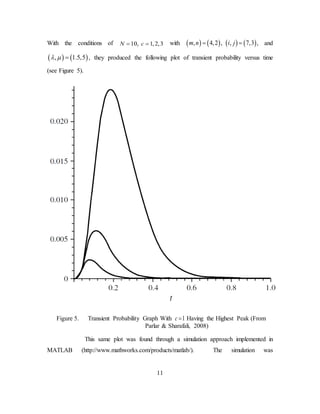
With the conditions of 10, 1,2,3N c= = with ( ) ( ) ( ) ( ), 4,2 , , 7,3m n i j= = , and
( ) ( ), 1.5,5λ µ = , they produced the following plot of transient probability versus time
(see Figure 5).
Figure 5. Transient Probability Graph With 1c = Having the Highest Peak (From
Parlar & Sharafali, 2008)
This same plot was found through a simulation approach implemented in
MATLAB (http://www.mathworks.com/products/matlab/). The simulation was
12
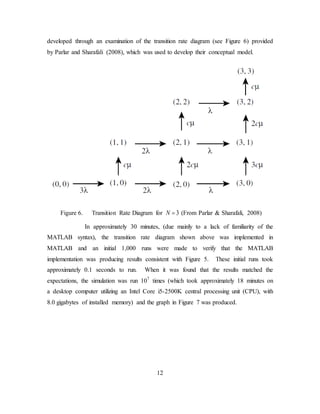
developed through an examination of the transition rate diagram (see Figure 6) provided
by Parlar and Sharafali (2008), which was used to develop their conceptual model.
Figure 6. Transition Rate Diagram for 3N = (From Parlar & Sharafali, 2008)
In approximately 30 minutes, (due mainly to a lack of familiarity of the
MATLAB syntax), the transition rate diagram shown above was implemented in
MATLAB and an initial 1,000 runs were made to verify that the MATLAB
implementation was producing results consistent with Figure 5. These initial runs took
approximately 0.1 seconds to run. When it was found that the results matched the
expectations, the simulation was run 107
times (which took approximately 18 minutes on
a desktop computer utilizing an Intel Core i5-2500K central processing unit (CPU), with
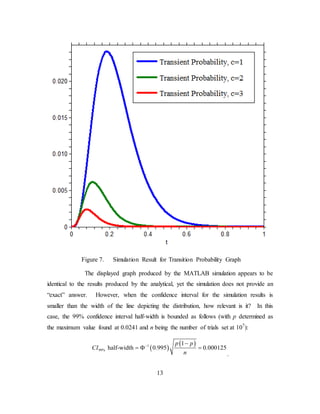
8.0 gigabytes of installed memory) and the graph in Figure 7 was produced.
13
Figure 7. Simulation Result for Transition Probability Graph
The displayed graph produced by the MATLAB simulation appears to be
identical to the results produced by the analytical, yet the simulation does not provide an
“exact” answer. However, when the confidence interval for the simulation results is
smaller than the width of the line depicting the distribution, how relevant is it? In this
case, the 99% confidence interval half-width is bounded as follows (with p determined as
the maximum value found at 0.0241 and n being the number of trials set at 107
):
( )
( )1
99%
1
half-width 0.995 0.000125
p p
CI
n
− −
=Φ =
.
14
With the capability to quickly run the simulation a vast number of times in
a relatively short time span, the simulation results converge on the analytical results with
such closeness that one must determine when it is “close enough” to count as an
equivalent answer. It is also important to note that while asserting the superiority of
analytical solutions due to them being more precise, the calculations are most often being
made by computer, which (unless conducting strictly integer operations or symbolic
manipulation) contain a degree of error to the manner in which real arithmetic operations
are conducted.
3. Use of Simulation in the Department of Defense
The DoD has been on the forefront of computer simulation use since its inception
with the ENIAC and the Monte Carlo method being used to solve the complex integrals
required for the design of the thermonuclear bomb. A recent study conducted by the
National Research Council, and published in a book entitled Defense Modeling,
Simulation, and Analysis: Meeting the Challenge, recognizes that through the increase in
computing power, richer approaches in modeling and simulation have been made
possible (Committee on Modeling and Simulation for Defense Transformation, 2006).
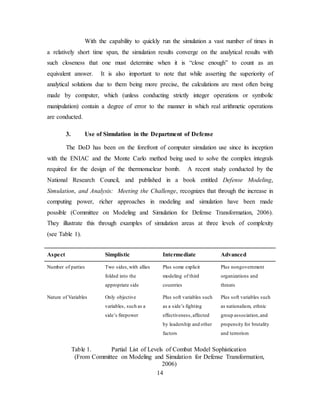
They illustrate this through examples of simulation areas at three levels of complexity
(see Table 1).
Aspect Simplistic Intermediate Advanced
Number of parties Two sides,with allies
folded into the
appropriate side
Plus some explicit
modeling of third
countries
Plus nongovernment
organizations and
threats
Nature of Variables Only objective
variables, such as a
side’s firepower
Plus soft variables such
as a side’s fighting
effectiveness,affected
by leadership and other
factors
Plus soft variables such
as nationalism, ethnic
group association,and
propensity for brutality
and terrorism
Table 1. Partial List of Levels of Combat Model Sophistication
(From Committee on Modeling and Simulation for Defense Transformation,
2006)
15
The use of simulation has grown to span virtually every component of the DoD.
The projected spending for DoD training, training support, and simulation is estimated to
total nearly $35 billion annually (MSCO, 2010). In 2010, the DoD M&S workforce
consisted of approximately 30,000 military personnel, government civilian employees,
and contractors (MSCO, 2010). In addition to the DoD employees, each branch of
service has created their own M&S office and separate human capital strategy plan for
M&S (see www.ms.army.mil/, nmso.navy.mil/, www.mccdc.usmc.mil/MCMSMO/, and
www.afams.af.mil/). Additionally, each service has established a virtual catalog of
models and simulations applicable and employed by their respective service. For
example, within the Navy’s Model and Simulation catalog (accessible via
https://nmso.navy.mil/NavyMSRR/Browse/tabid/85/Default.aspx), there are currently
924 simulation models being utilized. Figure 8, which represents the DoD’s M&S
Governance, shows how vested the DoD is in simulation.
Figure 8. DoD M&S Governance (From MSCO, 2011)
16
a. Acquisition and Logistics
M&S provides virtual and constructive test beds through which weapon,
equipment, and ammunition factors can be prototyped, tested, and evaluated during the
acquisition process. M&S develops a level of understanding of the interaction of the
parts of the logistical system, and of the logistical system as a whole, which is seldom
achievable via any other process. The use of M&S reduces testing time and costs, and
allows measurement of phenomenon that cannot be measured using traditional methods.
The results of these tests provide data on which procurement decisions are based.
Additionally, it allows for the selection and characterization of optimal material
solutions. On the logistics side, things such as deployment timelines and studies on how
to improve the efficiencies of logistical operations are conducted. The Marine Corps
Acquisition M&S community provides access to anyone with a Common Access Card
(CAC) with DoD certificates to see their M&S services, tools, and data via their website
(linked through https://www.mccdc.usmc.mil/MCMSMO/acquisition.htm).
b. Analysis
The analysis community employs M&S to analyze the performance,
effectiveness, survivability, trade-offs, and cost/benefit on everything from logistical and
personnel systems to force structure and risk. Additionally, tests are done to determine
the effectiveness of weapon systems, performance and system characteristics of
equipment and system purchases, and the effectiveness of force management decisions.
The DoD’s integrated support activity, the Modeling and Simulation Analysis Center, can
be reached at http://www.dod-msiac.org/).
c. Experimentation
Through the exploration, testing, and validation of warfighting ideas,
insight is found into how we will transform our forces and potentially fight future battles.
This is done through experiments involving soldiers and leaders within live, virtual, and
constructive environments (see http://www.nps.edu/research/TRAC/).
17
d. Intelligence
M&S helps provide actionable events designed to stimulate/simulate the
proper human intelligence (HUMINT), signals intelligence (SIGINT), and geospatial
intelligence (GEOINT), which was gathered in real-world operations. M&S is also used
in training intelligence personnel for counterinsurgency operations.
e. Testing
With changes in the DoD instruction for acquisition, M&S is required to
be used throughout a program’s life cycle (Office of the Under Secretary of Defense
(Acquisition, Technologies, and Logistics [OUSD-AT&L], 2006). This is done in order
to support requirements definition, the design and engineering phase, test planning,
rehearsal, and then the conduct of actual tests. It also is used to aid in evaluating the
performance of tested items, systems and/or organizations, and the early examination of
soldier interface and missions. Finally, simulation is used to help determine system
performance and safety. (For more information, refer to the Acquisition Modeling and
Simulation Master Plan available via the OUSD-AT&L website at:
www.acq.osd.mil/se/docs/AMSMP_041706_FINAL2.pdf.)
f. Training
M&S has been instrumental in preparing personnel for deployment to
recent combat operations through the significant growth of “the ability to link together
disparate virtual simulators and integrate constructive simulations to achieve complex
mission environments” (United States Air Force [USAF], 2010). Through the delivery of
integrated live, virtual, and constructive training environments that support personnel and
mission rehearsal requirements, predeployment training exercises, and mission
rehearsals, M&S has helped to ensure that personnel being deployed are trained and
ready. The United States Marine Corps has fully embraced the use of simulations in
training, and in an article on the Defense Transformation website (http://www.defense.
gov/transformation/), one article states:
18
“Live-fire training events come with a high price tag in the form of
money, risks, logistics and time,” said Jilson. Because of this, tactical
decision-making simulations is one of the resources available to provide
the same effective training without the risks. Research has also shown
that there is effective training transfer when simulations are used to
augment live training. In other words, when they are taught a new skill,
they learn that skill better. (Bohanner, 2004)
g. Planning
The planning community utilizes a system of systems approach for
examining long-term issues, which range from determining our next warfighting
capabilities requirements, to examining the total force manpower. The assessment made
by the Navy Modeling and Simulation Office (NMSO) is that “many of the emerging
modeling technologies will play a key role in this new analytical realm, including agent-
based models, computational social science, artificial societies, and behavior models”
(NMSO, 2009). Figure 9 depicts the hierarchal relationship between models, and lists
some of the models employed by the Navy for the respective hierarchies.
Figure 9. Hierarchy of Combat Models and Corresponding Navy Simulation Systems
(From NMSO, 2009)
19
4. Related Studies
If the relationships that compose a model are simple enough, it may be
possible to use mathematical models to obtain exact information on
questions of interest.
—Law & McComas, (2001)
While there are no specific papers that discuss the paradigm of “simulation being
a method of last resort,” or when specifically to choose a simulation over an analytical
solution, there are numerous papers and texts that identify situations in which the authors
believe simulation should be utilized.
Averill Law (2007), in his textbook entitled Simulation Modeling and Analysis,
provides the following list of applications of simulation:
• Designing and analyzing manufacturing systems
• Evaluating military weapon systems or their logistics requirements
• Determining hardware requirements or protocols for
communication networks
• Determining hardware and software requirements for a computer
system
• Designing and operating transportation systems such as airports,
freeways, ports, and subways
• Evaluating designs for service organizations such as contact
centers, fast-food restaurants, hospitals, and post offices
• Reengineering of business processes
• Analyzing supply chains
• Determining ordering policies for an inventory system
• Analyzing mining operations
When Law discusses analytical solutions versus simulation, he states that model
complexity is the primary factor when deciding which approach to use. If the
relationships between variables within the model are simple enough, Law states it is often
possible to find an analytical solution. Law conditions this with the fact that some
analytical solutions require vast computing resources, so while it may be possible to find
an exact analytical solution, it may not be feasible based on available resources.
20
Pradeep Bhatia, of the Guru Jambheshwar University of Science and Technology
in Hisar, India (http://www.gjust.ac.in/) provides some advantages and disadvantages to
the use of simulation, along with recommendations on when to choose simulation as the
primary option of exploration in his course notes for his class “System Simulation and
Modeling.” Bhatia (2010) states that the following are the advantages and disadvantages
to simulation:
Advantages: Simulation arbitrary models complexity, circumvents
analytically intractable models, facilitates what-if and sensitivity analyses,
and building a model can lead to system improvements and greater
understanding that can be used to verify analytic solutions.
Disadvantages: Simulation provides only estimates of the solution, only
solves one parameter at a time, can take a large amount of development
and/or computer time (“simulation as a last resort”). Don’t use computer
simulation if a common-sense or analytical solution is available, or if
resources are insufficient, or if simulation costs outweigh benefits.
While we can agree with the advantages Professor Bhatia has listed, we cannot
agree with the concept that simulation “only solves one parameter at a time” (Bhatia,
2010). The belief in this concept is perhaps one of the reasons the “last resort” paradigm
has continued to plague the OR community. Through a proper design of experiments
(DOE), one can search for robust solutions to problems, and examine the simultaneous
effects of thousands of input variables concurrently (Kleijnen, Sanchez, Lucas, &
Cioppa, 2005).
Professor Andrew Loerch of George Mason University (http://www.gmu.edu/)
also addresses how one should choose between an analytical solution and a simulation in
his course notes for OR540, Management Science (http://classweb.gmu.edu
/aloerch/OR540.htm). In his notes, Professor Loerch states that in order to use a
simulation to provide an optimal solution, one needs to analyze the output, make changes
to the system, and then run the simulation again to see if an improvement has been
achieved. He further states that one must weigh the advantages and disadvantages of
using simulation, and use simulation only if the advantages outweigh the disadvantages.
21
Of the advantages Professor Loerch states, two are extremely important in the
realm of military application of simulation. First, Professor Loerch (2001) states that
simulation is “not subject to so many assumptions.” Analytical solutions often require
multiple assumptions to be made in order to find a solution (e.g., normality,
independence, memorylessness, deterministic, linear, stationary, and homoscedasticity).
One distinct benefit of simulation is that one can often reduce the number of or change
the assumptions, which will allow for data outliers to enter the system. These outliers
may identify critical problems or shortfalls within the system that would never have been
seen using an analytical solution. Perhaps more importantly, Professor Loerch states that
simulation results are “easy for [a] decision maker to understand” (2001).
With the premise that “unplanned, hit-or-miss course of experimentation with a
simulation model can often be frustrating, inefficient, and ultimately unhelpful,” Kelton
(2000) provides a basic understanding on what is required in a simulation in order to
maximize the benefit from it in his paper “Experimental Design for Simulation.” This
paper, presented at the 2000 Winter Simulation Conference, discussesfive key
components that need to be addressed when developing a simulation:
• What model configuration should you run?
• How long should the run be?
• How many runs should you make?
• How should you interpret and analyze the output?
• What’s the most efficient way to make the runs?
Professor Kelton (2000) then continues to educate his readers on the importance
of utilizing carefully planned simulation studies to avoid “an undue amount of
computational effort or (more importantly) your time.”
B. RESEARCH QUESTIONS
This research seeks to answer the question as to when simulation should (and
should not) be used to gain insight into a problem. It further seeks to identify the benefits
one receives through a simulation approach to a problem, compared to the benefits of an
analytical solution to the same problem.
22
C. BENEFIT OF THE STUDY
The primary benefit of this study is to demonstrate that the adage of simulation
being a method of last resort is no longer valid. This paper will illustrate the benefits of
using simulation to gain insight into complex problems and the adaptability to examine
different assumptions of the input variables. Finally, the paper will highlight the
responsibilities of the simulationist, analyst, and decision maker, which are inherent to a
successful simulation study.
D. THESIS ORGANIZATION
The remainder of this thesis is organized into the following chapters. Chapter II
provides an in-depth analysis of the analytical approach used by Parlar and Sharafali in
their 2008 paper “Dynamic Allocation of Airline Check-In Counters: A Queuing
Optimization Approach.”
Chapter III begins with a discussion on the methodology employed by
simulationists when approaching a problem, followed by a brief introduction to the Simio
software suite. With the basics of the simulation process explained, they are then
illustrated through the development of a simulation created using as close to the criteria
and assumptions made by Parlar and Sharafali as possible. The chapter concludes with a
demonstration of how simulation can often provide more insight to a problem through the
ability to easily explore different assumptions and distributions with no change to the
core model.
The research is concluded in Chapter IV, where the significant findings to the
research questions are posed. Additionally, Chapter IV provides recommendations for
future improvements and extensions of this research in order to demonstrate how the use
of simulation should be one of “first resort” for many complex, real-world problems.
23
II. ANALYSIS OF AN ANALYTICAL SOLUTION TO A
COMPLEX PROBLEM
Because our model is analytical and more realistic, the optimization
results are on firmer ground than those based on simulation.
—Parlar and Sharafali, (2008)
A. BACKGROUND
Mahmut Parlar and Moosa Sharafali published a paper entitled “Dynamic
Allocation of Airline Check-In Counters: A Queuing Optimization Approach” in
Management Science in August 2008. In this paper, the authors proposed an analytical
method to optimize the management of airline check-in counters. They claim that while
others have “resorted to simulation,” they found that “this complicated problem is
amenable to analytical treatment.”
The authors were motivated to write this paper after witnessing the demands
placed on the counter management staff to meet their customer-service criteria, security
requirements, and service efficiency standards in various international airports. They
claim that there should be two phases in their research, of which they are focusing only
on the first. Parlar and Sharafali’s focus was to study “the queuing and statistical analysis
phase to help determine the optimal number of counters needed for each flight over time
to minimize a certain expected cost function (while implicitly achieving a desired level of
customer service),” (Parlar & Sharafali, 2008).
The authors saw two distinct benefits to airline-counter management as a result of
their research. First, their methodology, through the use of a dynamic program, would
enable counter management staff to make optimal decisions on manning the counters to
minimize total cost. Second, the methodology could also be utilized to ensure that the
airline is meeting a quality of service standard.
Our intent through this discussion is not to fully define and explain the methods
used by Parlar and Sharafali, but to provide a simplified framework with which their
24
assumptions can be seen in their analytical context. For a detailed explanation on their
methodology, it is best to refer to their paper.
B. ASSUMPTIONS
Such an assumption would also destroy the Markovian nature of the
process and make the model intractable.
—Parlar & Sharafali, (2008)
We have always assumed that the lifetimes and the service times are both
exponential, and with this assumption we derived analytic expressions for
quantities of interest (the most important being the transient solution of the
conditional probability.
—Parlar & Sharafali, (2008)
Assumptions underpin all models; in practice, to make an analytical solution
possible, many assumptions must often be made to constrain the problem to something
that is solvable. In Parlar and Sharafali’s case, it was the authors’ goal to solve the
problem, their result was the solution to a mathematical exercise, with little relevance to
the original problem (Type III error). With the goal to develop an analytical solution, the
authors had to continually make assumptions until they were in a position to use an
analytical process.
In their paper, the authors explicitly stated some of the assumptions they made in
the model development. However, while some of the assumptions were stated,
simplifying assumptions were not addressed, and it is important to recognize all
assumptions made in the model—not just the stated ones.
1. Passengers
To begin, let us examine the assumptions made concerning the passengers. The
first assumption is that all passengers for a specific flight will arrive at the window
accounted for by the model (e.g., a 3-hour window prior to flight). This assumption is in
direct conflict with reality. The problem of no-shows for any given flight has been a
problem that has vexed the airline industry since its inception, as each empty ticket is a
loss of potential revenue. In one recent study, the mean no-show rate for a given flight
25
was approximately 10% (Lawrence, Hong, & Cherrier 2003), which is why airlines
attempt to factor in the expected number of no-shows when overbooking a flight.
The next assumption is that all passengers arrive as individuals. From anecdotal
evidence alone, we know this to be categorically false. This has several significant
effects on their optimal solution. First, the calculated arrival rates for the subintervals do
not take group arrival into consideration. Second, the service time is based on assisting
an individual, vice a group of people who are traveling together (e.g., a husband and
wife). Another key assumption is that all passengers have the same complexity and
needs. This, too, each of us knows to be false based on personal experience. There are
times when scheduling issues, seat issues, or connection issues take place that make the
initial check-in process more complex. In addition, passengers arrive according to a
specific profile, which must be known in advance. This profile is used to determine the
length of the subintervals and the arrival rates ( )ˆ
kλ for each subinterval.
The calculation and use of ˆ
kλ for each subinterval is also suspect. Their
calculations are based on the procedure given in Basawa and Prakasa Rao (1980). This
procedure calculates a constant arrival rate over a subinterval. See Parlar and Sharafali
(2008) (when referring to the model and assumptions made by Parlar and Sharafali, it
shall be henceforth referred to as the Parlar Model for brevity) for amplification.
( ) ( )
1
10
ˆ
k
k
n
T i i i n k ni
k k T
V x x T
n V
τ τ τ
λ
−
+=
≡ − + −
=
∑
Through the use of the equations above, Parlar and Sharafali provide a numeric example,
as shown in Table 2 (from this table, each period k is one hour in length). To see a
detailed definition of these variables, refer to Parlar and Sharafali (2008).
26
Period k
No. of Passengers Arrived
( )kn
Arrival Times
[ ]( )1 hrs.nτ τ< ⋅⋅⋅ <
ˆ
kλ
1 4 [0.32, 0.34, 0.42, 0.47] 0.31
2 6 [1.15, 1.46, 1.47, 1.58, 1.93, 1.96] 0.69
3 5 [2.11, 2.44, 2.57, 2.71, 2.87 1.83
Table 2. Numerical Example of Estimated Arrival Rates (From Parlar &
Sharafali, 2008)
Given that these arrival rates are constant over each 1-hour period, one would
expect that the projected number of arrivals would be able to be calculated. In this case,
there were 15 arrivals scheduled; however, using the calculated arrival rates, one cannot
match the expected number of arrivals with the number that actually arrived.
Finally, the authors assumed that all passengers arriving are traveling in the same
class. This is instrumental in their calculation of the passenger delay cost, as the cost is
set at a fixed value for all passengers. This, too, does not reflect the reality of most
airline traffic. It only applies when one is addressing a very minor number of instances
where there is no class differentiation on price of seat, or significance of the passengers.
2. Service
The way in which the customers are served is the next set of assumptions that are
examined. First, over any given epoch, a constant number of counters are available. The
number of open counters can only change at the beginning of each period ( )k , which is
based on the number people who have arrived and the number of people who have
arrived and already completed service. The times at which these decisions are made are
based on the history of previous arrivals on which the arrival rates have already been
calculated. Thus far, the conditions set are not too unrealistic. However, when the
service rate is examined, it is another story. First, the authors assume that the service rate
for a given counter ( )µ is the same for each counter. Second, the service rate increases
as a function of the number of people who have not been served, and the number of open
counters. This presents a major issue with the analytical solution, as it is not reasonable
27
that service rates increase linearly as a function of the number who have arrived and not
yet had service completed. Table 3 illustrates service rate (as a function of passengers
per unit time) with this assumption.
Number of Passengers Arrived Who Have Not Completed Service
1 2 3 4 5 6 7 9 9 10
Numberof
Open
Counters
1 5 10 15 20 25 30 35 40 45 50
2 10 20 30 40 50 60 70 80 90 100
3 15 30 45 60 75 90 105 120 135 150
4 20 40 60 80 100 120 140 160 180 200
5 25 50 75 100 125 150 175 200 225 250
Service Rate (Passengers/Unit Time)
Table 3. Service Rate Table Based on the Parlar Model
In addition to an impossible increase in rate of service, the authors assume an
exponential service time distribution in order to make the model mathematically
tractable. The fact that the mode of the exponential probability density function is equal
to zero, one can reasonably argue against the validity of the “most likely” service time is
zero assumption. The authors did provide a discussion regarding the potential use of
Erlang service times, but concluded that “such a generalization would probably require a
computational approach (rather than an analytic approach as used in this paper) due to the
resulting high dimensionality” (Parlar & Sharafali, 2008). This statement illustrates that
the author’s goal was to provide an analytical solution vice a solution which actually
addresses the problem (Type III error).
3. Costs
The goal of the authors was to provide an optimal solution that is based on
minimizing cost to the airline; thus, the assumptions made regarding cost play a
significant role in the development of their solution.
The first cost is the Passenger Delay Cost ( wC ). The authors chose to use
wC =$40, which they claim is close to the value of the Federal Aviation Administration’s
(FAA) estimate for business class customers. As mentioned previously, all passengers
are considered to be in the same class. The total expected cost for the passengers during
28
each period is based on the calculation for the expected wait time during each period.
This value is determined by the authors as follows (in passenger hours):
( )
( )
( )
( )
( )
1
1
k k k k
k k
c t c t
t tk k
k k k k
k k k
N m N me e
W c m n e e
c c c
µ µ
λ λλ
λ µ µ λ µ
+
+
− −
− −− −  −
= + − + − 
− −  .
It is important to note that in this equation, the arrival rates are based on the
previous estimates, and the service rate is affected by the number of open counters and
the number of passengers who have arrived, but not completed service. Thus, any
problem with the assumptions has a direct impact on the optimal solution they calculate.
Another important item to note regarding this cost is that the cost is only attributed to the
expected delay that the passenger experiences while waiting in the queue and the service
time itself. The time to walk between their arrival point and the security checkpoint are
not accounted for.
The next cost assumed is the Check-In Counter Operating Cost, ( )sC . Here the
authors chose to use a value of 60sC = . The authors based this cost on their “best
guess” of associated costs, as no real analysis had been previously done to provide a cost
estimate for the assumptions made in their counter model. Their estimate is based on the
cost of the employee, use of the telephone, counter space, restrooms, and etcetera. The
interesting part of this assumption is that the cost is a deterministic cost, based solely on
the number of counters open during a specific period. This means that the cost is only
incurred when the counter is manned.
The cost for each interval is based on the number of counters open during the
interval and the expected wait time and cost of the passengers:
( ) ( ) ( ) ( )1, ,k k k k k k w k k s k k kg c g c m n C W c C t t c+= = + −
.
The third cost taken into account is the Aircraft Delay Cost, (h). The authors
chose $20h = as the value to use in the optimization. This represents the cost incurred
by the airline for every passenger not cleared when the counter is expected to close. The
authors assumed that this would most likely cause a delay in the departure of the aircraft.
29
The authors used data from the European Organization for the Safety of Air Navigation
(EOSAN), which provides a cost estimate due to delays in transportation by source in
cost per minute values. The authors assumed that the delay would be due to people not
checked in, and took the average duration of delay and divided it by the number of
passengers not checked in. While some airlines may have sufficient slack in their
schedule that they may wait for a passenger to arrive, one can safely say that it would be
the exception to the norm if it occurred.
C. INTERPRETING THE SOLUTION
The error of the third kind is the error committed by giving the right
answer to the wrong problem.
—Kimball, (1957)
After Kimball provided the definition of the Type III error as quoted above, he
went on to say “In defining it this way we are allowing the statistician the benefit of the
doubt by rejecting the possibility that he would give the wrong answer to the wrong
question” (2008). In the case of Parlar and Sharafali’s (2008) paper, one must wonder if
this is an example of a Type III error.
Parlar and Sharafali (2008) utilized a dynamic program written in Maple to
calculate their optimal solution. The optimal solution they provide is a table that
indicates the number of counters that should be open during a specific epoch, given the
number of people who have arrived and the number of people who have already been
served. Table 4 lists the parameters that were used as an example to compute
their output:
30
T K N min
kc max
kc 1
ˆλ 2
ˆλ 3
ˆλ µ wC sC h
1 3 10 1 5 0.58 1.60 2.74 5 40 60 20
Table 4. Parameters for Numerical Example (From Parlar & Sharafali, 2008)
Based on the values above, the dynamic program calculated the transient
probabilities and the expected number of passengers in the system. Based on those
values, the dynamic program then calculated the minimum expected cost to go from the
beginning of the subinterval until the final time using the following expression:
( )
( ) ( )
( ) ( ) ( )min max , 1 1
, 0, , 0
, min , , ,
k k k
k k
N i
c
k k k m n k k k
c c c
i m j n
c N N V N N
V m n g c p i j t t V i j+ +
≤ ≤
= =
= =
 
= + − 
 
∑∑
.
The output of the dynamic program was consolidated into Table 5.
31
n
* * *
1 2 3, ,c c c 0 1 2 3 4 5 6 7 8 9 10
m = 0 1,1,4
m = 1 1,1,4 1,1,4
m = 2 1,1,4 1,1,4 1,1,4
m = 3 1,1,3 1,1,3 1,1,3 1,1,3
m = 4 1,1,3 1,1,3 1,1,3 1,1,3 1,1,3
m = 5 1,1,3 1,1,3 1,1,3 1,1,3 1,1,3 1,1,3
m = 6 1,1,3 1,1,3 1,1,3 1,1,3 1,1,3 1,1,3 1,1,3
m = 7 2,2,3 1,1,3 1,1,3 1,1,3 1,1,3 1,1,3 1,1,2 1,1,2
m = 8 2,2,3 2,2,3 1,1,3 1,1,3 1,1,3 1,1,2 1,1,2 1,1,2 1,1,2
m = 9 2,2,3 2,2,3 2,2,3 2,2,3 1,1,2 1,1,2 1,1,2 1,1,2 1,1,2 1,1,1
m = 10 2,2,3 2,2,3 2,2,3 2,2,3 2,2,3 2,2,2 2,2,2 1,1,2 1,1,2 1,1,1 0,0,0
Table 5. Optimal Number of Counters to Open for Any ( )*
,kc m n for Any State
( ),m n at 1,2,3k = (From Parlar & Sharafali, 2008)
To interpret the output, one must know the epoch, number of arrivals ( )m , and
the number of passengers who have completed service ( )n at the end of a given epoch.
For example, if at the end of epoch 2, six passengers have arrived ( )6m = and four of
those passengers have completed service ( )4n = , three counters need to be opened for
epoch 3 ( )*
3 3c = .
Despite receiving a copy of the dynamic program code, we were unable to
reproduce the exact table above based on the same inputs. Additionally, it is important to
note that Parlar and Sharafali provide a disclaimer on the use of their “optimal” solution
when they state that “that our intention here is just to highlight the usability of our model
rather than the use of very realistic estimates as input into our models” (Parlar &
Sharafali, 2008).
32
THIS PAGE INTENTIONALLY LEFT BLANK
33
III. THE SIMULATION APPROACH
There are some serious misunderstandings concerning the nature of
simulation and its ease of employment. The truth of the matter is that
there’s no such thing as ‘simple simulation.’ It’s a myth often
inadvertently perpetuated by manufacturers of simulation software and
professors who want their students to believe they’re learning an easier
alternative to tools like linear programming.
—Keller, Harrell, and Leavy, (1991)
A. HOW A SIMULATIONIST WOULD APPROACH THE PROBLEM
Throughout operations research textbooks (e.g., Hillier & Lieberman, 1986),
simulation textbooks (e.g., Law & Kelton, 2000), and papers, the methodology used to
develop a solution to a given problem is consistent. The DoD’s MSCO for Verification,
Validation, and Accreditation (VV&A) cite the seven-step approach (developed by Law
and Kelton) to successful simulation modeling in the document entitled “A Practitioner’s
Perspective on Simulation Validation,” available via their website at http://vva.msco.mil/
Key/key-pr.pdf. It is through this process that the simulation for this paper is developed.
The logical flow of this seven-step approach is illustrated in Figure 10.
34
Figure 10. Seven Step Approach to Successful Simulation and Modeling,
(From MSCO, 2001)
1. FORMULATE THE PROBLEM
Essential to formulating the problem is the identification of the problem itself.
With the problem identified, it is then essential to determine what the overall objective of
the study is and which specific questions need to be answered. These are essential to
know in the very beginning of the process in order to ensure that not only the correct data
are collected, but the correct output mechanisms are incorporated. These specific
questions and objectives will shape the scope of the model and the conditions under
which the simulation will be run.
35
2. COLLECT INFORMATION/DATA AND CONSTRUCT
CONCEPTUAL MODEL
The most successful procedure for model building has been to work from
simple and small to the larger and more complex.
—Ancker, (1995)
With the problem formulated and the specific questions and objectives specified,
the next step is to collect the information necessary to create a simulation that operates in
the same manner as the airline-counter system being studied. The data collected are used
to program the model parameters and the probability distributions of events in the system
(e.g., arrival times of passengers, number of passengers who travel together, and the
service times of passengers).
Essential to this process is ensuring that any assumptions made for the system are
documented, along with any algorithms used when developing a conceptual model.
There are several factors that help determine what level of detail should be represented
within the model. Some of these are constraints on model complexity due to the
computer system being utilized, the cost of programming, and the amount of time it
takes. Others are to ensure there is sufficient detail to be able to address the credibility of
the model. For example, if the objective is to determine how many service counters to
open at an airport to minimize the delay passengers experience, while also minimizing
the operating costs, one can model the arrivals from the time they enter the airport to the
time they have completed checking in. Modeling their method of arrival, highway or
parking delays, or their passage through the security checkpoints are all irrelevant when it
comes down to answering the specific question posed in the formulation process.
3. IS THE CONCEPTUAL MODEL VALID?
Once the conceptual model has been developed, it is critical that a structured
walk-through is conducted to verify its validity. This walk-through needs to be
conducted with people who are knowledgeable about the system to ensure that any
erroneous assumptions on operations are addressed, and along with the analysts, to ensure
that the required metrics are being output. This is an iterative process, so if there are any
36
issues, it is important to address them, redesign the model (or reformulate the problem if
it was not being understood correctly), and then check the model for validity again.
4. PROGRAM THE MODEL
For any given study, in selecting the tools to use, analysts must weigh
several competing attributes, such as the models’ ease of use, agility,
transparency, reproducibility, and realism.
—Lucas and McGunnigle, (2003)
As pointed out by Lucas and McGunnigle (2003), choosing the right tool is
essential in constructing the simulation model. The tool that one picks is based on
availability, knowledge, cost, and capabilities. Some models can be implemented in
commercial programs such as Simio and ARENA, whereas others are better suited to be
done in a programming language such as C++ or JAVA. Regardless of the software used
to implement the model, the limitations of the software and how those limitations affect
the capability of the software to implement the model as designed need to be known,
understood, and accounted for in the design and in the analysis portion.
5. IS THE PROGRAMMED MODEL VALID?
Whether a solution is provided through an analytical model or a simulation, one
must be able to validate the results. The output from the model needs to be reviewed by
subject matter experts to determine whether or not the results are consistent with the
understanding of the system.
There has been a substantial volume of information published on the VV&A
process. Osman Balci, in his paper for the 1997 Winter Simulation Conference,
published a very succinct taxonomy of the verification and validation techniques for both
conventional and object-oriented simulation models. Figure 11 is the taxonomy for his
conventional simulation models.
37
Figure 11. Taxonomy of Verification and Validation Techniques for Conventional
Simulation Models (From Balci, 1997)
38
6. DESIGN, CONDUCT, AND ANALYZE EXPERIMENTS
Unfortunately, few simulation practitioners seem to be aware of the
additional insights that can be gleaned by effective use of designs.
—Kleijnen et al., (2005)
Understanding how to properly design a series of experiments for the maximum
effectiveness is critical for both the stakeholder and the analyst. Through a robust DOE,
one can gain a better understanding of the system and find more robust solutions than if
one limits the design to looking only for an optimal solution. In the paper entitled “A
User’s Guide to the Brave New World of Designing Simulation Experiments,” Kleinjnen
et al. (2005) attempt to change the mindset of simulation practitioners and researchers so
that the DOE process is considered instrumental in any simulation study.
When a system is complex with many variables, it becomes a significant
challenge to run a full-factorial design. Through a proper DOE and utilizing tools such as
efficient nearly orthogonal and space-filling Latin hypercubes (see Cioppa & Lucas,
2007), one can maximize the efficiency and ability of the analysts to “examine multiple
factors within the simulation through fitting models with main, quadratic, and interaction
effects with nearly uncorrelated estimates of the regression coefficients for the linear
effect terms” (Cioppa & Lucas, 2007).
7. DOCUMENT AND BRIEF THE RESULTS
In order for the simulation to be useful to the person who requested it in the first
place, the results need to be presented in such a manner that the true implications of the
analysis are unambiguous. Simply stating the mean values of some of the parameters of
interest is insufficient when presenting the results of the simulation to the stakeholders. It
is imperative that the analyst not only provide the means, but the confidence intervals and
the conditions under which those means were ascertained. Then, if sensitivity analysis
was conducted, present that information as well, followed by the identification of
possible improvements to remove bias, increase precision (fidelity), or other factors
needed for better sensitivity analysis.
39
B. THE SIMIO SOFTWARE
The software chosen to implement a simulation version of the Parlar Model is
Simio (www.simio.com). Simio (Simulation Modeling framework based on Intelligent
Objects) provides a graphical, object-oriented modeling framework that allows for both
continuous and discrete time events, as well as supporting an event, process, object, and
agent modeling view. Figure 12 shows the graphical user interface of Simio, which
allows for representation in both two and three dimensions.
Figure 12. Simio Model View of the Airport Terminal Example Scenario
With a built-in analytical tool, the “quick look” of the simulation data is
extremely convenient. It allows for the user to verify the outputs of the model during the
course of the model development without having to export the results and interpret the
results using additional software. The software allows for a box plot, histogram,
individual observations, confidence intervals, and a means line to all be depicted on the
same graph. Figure 13 illustrates this functionality utilizing two different scenarios of the
same model.
40
Figure 13. Simio Response Results Display—Depicting Two Different Scenario
Evaluations of the Same Model
Taking full advantage of multiple core processors, Simio can run multiple
scenarios concurrently, each with separate streams of random numbers. This greatly
reduces the total run time on an average computer system (Simio, 2011). Further,
leveraging increased graphics capability, Simio allows for both two-dimensional and
three-dimensional graphical representation of the system. Through the use of
standardized coding, Simio has a direct interface to the Google 3D Warehouse, allowing
for the simulation to be modeled visually as accurately as possible. For some systems
(and decision makers), the visual component provides insight that the analytical
component might not make apparent.
Simio also provides an “Experimentation Mode,” which allows for a DOE to be
run, allowing as many scenarios and replications of each scenario run as desired, with the
output of all readily available to either view within Simio or be exported to a
comma-separated values (CSV) file for further analysis.
41
For detailed information regarding the Simio software one should refer to the
Simio Reference Guide, available at www.simio.com/academics/simio-academic-
resources.htm.
C. SIMULATION MODEL BASED ON THE PARLAR MODEL
1. Formulation, Data Collection, and Conceptual Model
To follow the steps as discussed previously, the first step in building our model is
to identify the problem. In this case, the problem is to ascertain the validity of the
analytical solution presented by the Parlar Model. With the problem identified, the next
step is to formulate the problem. Here, we will attempt to replicate the same assumptions
and conditions and time frames as done by Parlar, hence the data, distributions, and
associated problem parameters should be the same in the simulation model as in the
analytical model.
Using the same parameters as Parlar and Sharafali (2008) (see Table 6), we
attempt to replicate the Parlar Model as accurately as possible. A minimum of min
1kc =
counters must be open, while no more max
5kc = counters being open during a given
epoch. With 3K = epochs and 1T = hour, each epoch is 20 minutes in length. All
10N = passengers will arrive during that time frame, with the estimated arrival rate of
ˆ
kλ per epoch. These passengers will be processed at a mean rate of 5µ = (passengers
per hour). The cost of passenger delay is 40wC = per hour, while the cost of delaying the
aircraft for every passenger not checked in by is 20h = per passenger. The cost of
operating the counters is 60sC = per counter, per hour.
T K N min
kc max
kc 1
ˆλ 2
ˆλ 3
ˆλ µ wC sC h
1 3 10 1 5 0.58 1.60 2.74 5 40 60 20
Table 6. Parameters for Numerical Example (From Parlar & Sharafali, 2008)
During the development of the conceptual model, a problem was identified with
the given arrival rates per epoch. We were unable to produce a system using the above
42
rate parameters such that exactly 10N = passengers arrive within the 1T = hour period.
This brought into question the validity of the ˆ
kλ ‘s. A simple experiment was done in
order to ascertain whether or not these were valid values. Given the following:
• ˆ
kλ ‘s are known,
• ˆ
kk k Tn Vλ = , and
• ( ) ( )
1
10k
n
T i i i n k ni
V x x Tτ τ τ
−
+=
≡ − + −∑ .
Utilizing Microsoft EXCEL and the SOLVER add-in, 1
ˆλ was calculated for { }1 1,2,3n =
to minimize or maximize the value of 1
ˆλ in order to determine if 1
ˆλ =0.58 was feasible.
Based on the calculations shown in Table 7, the value for 1
ˆλ =0.58 is not feasible. Thus,
it is apparent that the values provided in the paper were either not calculated in
accordance with the method indicated, or there was an error during the publication
process where incorrect values were substituted.
xi τi+1 τi xi(τi+1-τi) VTk nk/VTk Solved
Three Arrivals
10.0000 0.3333 0.0000 3.3333
3.3333 0.9000 MIN
9.0000 0.3333 0.3333 0.0000
8.0000 0.3333 0.3333 0.0000
7.0000 0.3333 0.3333 0.0000
Two Arrivals
10.0000 0.3333 0.0000 3.3333
3.3333 0.6000 MIN9.0000 0.3333 0.3333 0.0000
8.0000 0.3333 0.3333 0.0000
One Arrival
10.0000 0.0000 0.0000 0.0000
3.0000 0.3333 MAX
9.0000 0.3333 0.0000 3.0000
Cells in blue represent the xn(Tk-τi) portion of function
Table 7. Calculation of 1
ˆλ Based on the Parlar Model Parameters
In order to provide a simulation result as close as possible to the Parlar Model’s
conditions, the values of 5.22, 14.4, 24.66 (the original ˆ
kλ ‘s multiplied by a factor of 9)
produced an average of 9.8 arrivals over the 1-hour period. Runs during which 10
arrivals did not occur were omitted from analysis after the preliminary examinations.
43
2. Program and Validate Model
a. Basic Model
As the scope of the model in this instance is designed to specifically
represent the same system as in the Parlar paper, the conceptual model was very easy to
build. To program the model, Simio provides a great flexibility that programming in
SIMKIT or developing the simulation in ARENA did not, as Simio has a very easy to
learn (and use) graphical user interface (contrary to SIMKIT), and an installed
experimentation, optimization, and analysis tool (contrary to ARENA). To start the
model, a generic source, server, and sink are dragged and dropped from the Standard
Library onto the Modeling Canvas (see Figure 14), then the objects are renamed to be
representative of their respective functions of “Arrivals,” “Counters,” and “Security.”
Figure 14. Simio User Interface when Creating a New Model (From Joines &
Roberts, 2010)
44
As seen in Figure 15, each of these objects is connected via a “Connector”
object (again taken from the Standard Library), which allows for a zero time transit
between the objects (as assumed in the Parlar Model).
Figure 15. Basic Simio Implementaiton of the Parlar Model
As mentioned previously, Simio has an object-oriented architecture.
Combining the object-oriented architecture with an easy to navigate graphical user
interface, it is extremely easy for beginning users to quickly customize each of the
objects in the Standard Library. By selecting an object on the Modeling Canvas, the
properties of that object are displayed in the Property Inspector (see Figure 15). To
establish some of the conditions of the Parlar Model, the “Arrivals” object must be
modified. By selecting the “Arrivals” object, the properties of that object are then
displayed (see Table 8). The first parameter to change is “Arrival Mode,” by selecting
the “Time Varying Arrival Rate.” This allows for a rate table to be utilized in lieu of a
single distribution, allowing for complex arrival rates to be modeled within the
simulation, which is much more representative of reality. A portion of the simulation
control is also embedded in the “Arrivals” object, as it will only produce a maximum of
N arrivals (where N was previously defined as 10N = by the Parlar Model).
45
Table 8. Properties of the “Arrivals” Object
The Arrivals Rate Table (as seen in Table 9) allows for any number of
time periods of constant length to be entered. Upon reaching the end of rate table, Simio
loops back to the first row if the simulation is still running.
Table 9. Arrivals Rate Table
46
With the parameters set for the “Arrivals” object, the “Counters” object
requires settings to be established (see Table 10). First, the initial server capacity is set to
a variable “E1SC” (epoch 1 Server Capacity). The processing time for each entity is
determined through a random exponential draw, based on the variable “ServiceRate.”
Upon the model’s initialization, the “EstablishInitialServiceCounterRate” process is
called, and then upon processing each entity, the “UpdateServiceRate” process is called
(see Figure 16). This process is included to mimic the Parlar assumption that the service
rate at the counter will increase as a function of the number of people in line and being
served. Table 10 shows the properties of the “Counters” object.
Table 10. Properties of the “Counters” Object
The cost of the counters is tallied using a “Rate Tally Statistic.” This
allows for the rate at which cost is accrued (based on the number of open counters and
47
the counter operating cost) to happen in the background since that portion of the cost is
not passenger dependent. The first time this process is called is on the initialization of
the project. It also will run each time the “Counters” object capacity (which represents
the number of open counters) changes (see Figure 16 and Table 11).
Figure 16. Update Counter Cost Rate Process
Table 11. Assignment for Total Counter Cost Tally Statistic
A key assumption of the Parlar Model is that the service rate provided is
dependent on the number of people in the system who have not completed service (see
Figure 17). As one of the tests that will be run removes this assumption, two different
assignments functions are utilized, depending on which case is being examined (see
Table 12).
Figure 17. Update Service Rate Process
48
Table 12. Service Rate Calculations
Upon completion of service, the passengers arrive at the “Security” object.
As the entities are destroyed, the first cost process is called (see Table 13 and Figure 18).
The first portion of this process is to record the passenger delay cost in the variable
assigned to track the total cost of passenger delay (see Table 14). The process then
checks to see if all N passengers have arrived, and if so, closes the counters (see Tables
15 and 16).
Table 13. Properties of the “Security” Object
Figure 18. Add All Passenger Costs Process
49
Table 14. Passenger Delay Cost Calculations
Table 15. Decision to Close Counters Logic
Table 16. Closing the Counters by Setting Capacity to Zero
b. Cost Factors
With the basic flow of the model complete, the final cost elements need to
be included. The first of these is the Airline Delay Cost (see Figure 19). This cost is
incurred for all passengers who are scheduled to be on the plane, but have not cleared the
service counter at the time the service counter is supposed to close (Table 17). This
process is called each time an entity arrives at the “Security” object. The current time is
checked to determine whether or not the counters should be closed, and if they are—the
Aircraft Delay Cost is invoked (see Table 18).
50
Figure 19. Airline Delay Cost Process
Table 17. Logic to Decide Whether or Not to Implement Aircraft Delay Cost
Table 18. Aircraft Delay Cost Assignment
At the end of the run, the “OnRunEnding” process is called (see
Figure 20). This process calculates the total cost for the run by the summation of the
airline delay costs, the service counter costs, and the passenger delay costs (see
Table 19). This is the key output of the simulation, on which results will be compared.
Figure 20. Total Cost Summation Process
51
Table 19. Total Cost Calculation
c. Decision Management
With all necessary objects, connections, and cost calculations in place, the
remaining portion of the implementation is the decision management criteria for how
many service counters should be open, given the state of the system. The logic of the
management process is seen in Figure 21.
Figure 21. Management Process
52
Upon run initialization, this process commences its work. The first
assignment is to update the variable tracking which epoch the simulation is in (see
Table 20). After each epoch is complete, the process loops back to the epoch Tracker to
move to the next epoch.
Table 20. Current Epoch Calculations
The next step is to determine which epoch we are in, in order to facilitate
the decision-making process (see Table 21). Considering changes only occur at the end
of the first and second epoch, the logic for the third epoch is much simpler, and does not
have to loop back to the epoch tracker.
Table 21. Epoch Decision Logic
Figure 22 shows the logic flow for epoch 1. As the first and second epoch
logic works the same, with the only difference in updating the specifics for each epoch,
the discussion of the logic flow for epoch 1 applies to both.
53
Figure 22. Logic Flow for Epochs 1 and 2
Upon reaching either epoch 1 or 2, a delay of 20 minutes occurs before
proceeding to the next step. This time is based on T K where T was the time allotted (in
this case, 1T = hour) and the number of epochs ( )3K = . Following the delay, the
number of arrivals and the number of people served during that period are calculated in
the Update epoch Data step. Simio allows for multiple variables to be manipulated with
each assigned step, as shown in Figure 23.
54
Figure 23. Updating Epoch Data
Using the “Experiment” feature of Simio, logic was included in the system
to determine which type of decision-making process to use. The first option checks to
see if the configuration generated by the built-in optimization process is to be used, and if
it is, it executes it.
Figure 24 shows the logic flow for the optimization results. Each of the
decision points within the logic is determined via the built-in optimization tool
“Opt-Quest.” This tool uses a heuristic algorithm and can be configured for multiple
settings and variables. For each epoch, there is a decision point for the number of arrivals
that have occurred from the start of the run to the end of that epoch. Based on whether or
not the number of arrivals were less than or equal to that decision point, the next step of
the logic is executed. The next step is based on the number of passengers served from the
start of the run to the end of that epoch. Based on the number of passengers served, the
“Counters” capacity is updated with a value between 1 and 5.
55
Figure 24. Optimization Results Server Capacity Assignment Logic
The results of the optimization are discussed in the analysis segment.
Table 22 lists the variable names, along with their definitions and range of values. To do
a full-factorial design requires a total of 100,656,875 design points. Regardless of the
computing power available, running a sufficient number of replications for each of those
design points could not be done in a reasonable time.
Variable
Name
Description
Min
Value
Max
Value
Increment
Number of
Settings
A1DP m in epoch 1 0 10 1 11
NS1DP1 n in epoch 1 when “m” Exceeds
A1DP
0 10 1 11
A2DP m in epoch 2 0 10 1 11
NS2DP1 n in epoch 2 when “m” is Less than
or Equal to A2DP
0 10 1 11
A2NS1_A1 Counters to open when in epoch 2
when m <= A2DP and n < NS2DP1
1 5 1 5
A2NS1_A2 Counters to open when in epoch 2
when m <= A2DP and n >=
NS2DP1
1 5 1 5
NS2DP2 n in epoch 2 when “m” is Less than
or Equal to A2DP
0 10 1 11
A2NS1_A3 Counters to open when in epoch 2
when m > A2DP and n < NS2DP2
1 5 1 5
A2NS1_A4 Counters to open when in epoch 2
when m > A2DP and n >= NS2DP1
1 5 1 5
Number of combinations required for a full-factorial design: 100,656,875
Table 22. Variable Names and Descriptions for Optimization Run
56
In order to reduce the number of possible combinations, insight from the
previous design runs was utilized to limit the scope of each of the variables. The updated
values are seen in Table 23. It was with these values that the initial optimization run was
conducted. The initial configuration for the optimization run allowed for a minimum of
25 replications, a maximum of 250 replications, and a total of 5,000 scenarios—with the
confidence level being 99% and a relative error of 0.01 (see Table 24).
Variable
Name
Description
Min
Value
Max
Value
Increment
Number of
Settings
A1DP m in epoch 1 2 6 1 5
NS1DP1 n in epoch 1 when “m” Exceeds
A1DP
3 6 1 4
A2DP m in epoch 2 5 8 1 4
NS2DP1 n in epoch 2 when “m” is Less than or
Equal to A2DP
3 6 1 4
A2NS1_A1 Counters to open when in epoch 2
when m <= A2DP and n < NS2DP1
2 8 1 7
A2NS1_A2 Counters to open when in epoch 2
when m <= A2DP and n >= NS2DP1
2 8 1 7
NS2DP2 n in epoch 2 when “m” is Less than or
Equal to A2DP
2 8 1 7
A2NS1_A3 Counters to open when in epoch 2
when m > A2DP and n < NS2DP2
2 4 1 3
A2NS1_A4 Counters to open when in epoch 2
when m > A2DP and n >= NS2DP1
2 4 1 3
Number of combinations required for a full-factorial design: 987,840
Table 23. Changed Variable Min and Max Values to Utilize for Optimization Run
Table 24. Configuration for First Optimization Run
57
Examining the top 100 scenarios for the minimum and maximum values
of each variable, the optimization run was conducted again, this time requiring a
minimum of 100 and a maximum of 500 replications. This process was completed once
more for the top eight scenarios, but now with a minimum of 2,000 and a maximum of
4,000 replications, with the confidence level being 99.9% and a relative error of 0.001
(see Table 25).
Table 25. Configuration for Final Optimization Run
After conducting a total of 4,000 runs on the each of the eight scenarios, a
subset of 29,528 were examined (based on 10 arrivals during the 1-hour period). The
summary statistics of these are listed in Table 26. Utilizing a Student’s t comparison
method, all scenarios are statistically the same. As scenario 4 had the lowest mean and
was in the group with the smallest range, scenario 4’s configuration (see Table 27) is
determined as the final optimized solution parameters.
Scenario
Mean
(TotalCost)
Std Dev
(TotalCost)
Min
(TotalCost)
Max
(TotalCost)
1 165.164 48.144 67.781 435.174
2 165.128 47.373 71.784 435.174
3 164.998 47.519 71.784 435.174
4 164.961 47.535 71.784 435.174
5 166.476 49.259 67.781 477.470
6 166.256 49.019 67.781 477.470
7 165.140 47.427 71.784 435.174
8 165.263 47.988 67.781 435.174
Table 26. Summary Statistics for Eight Optimization Candidates
58
Variable
Name
Description Final Value
A1DP m in epoch 1 3
NS1DP1 n in epoch 1 when “m” Exceeds A1DP 2
A2DP m in epoch 2 8
NS2DP1 n in epoch 2 when “m” is Less than or Equal to A2DP 4
A2NS1_A1 Counters to open when in epoch 2 when m <= A2DP and n < NS2DP1 3
A2NS1_A2 Counters to open when in epoch 2 when m <= A2DP and n >= NS2DP1 2
NS2DP2 n in epoch 2 when “m” is Less than or Equal to A2DP 6
A2NS1_A3 Counters to open when in epoch 2 when m > A2DP and n < NS2DP2 3
A2NS1_A4 Counters to open when in epoch 2 when m > A2DP and n >= NS2DP1 2
Table 27. Final Variable Settings for Optimization Run Configuration
If the results from the optimization analysis are not to be used, the logic
then checks to see if the Parlar solution is to be used. The implementation of the Parlar
solution follows a similar, but more complex logic tree, as the optimization results uses.
If neither complex management solution is to be used, the system defaults to a preset
value for the number of service counters to remain open during an epoch. At the
completion of epochs 1 and 2, the process is looped back to the beginning to increment
the epoch counter and follow the logic flow again. At the end of the third epoch, the
process stops after recording the number of arrivals to the system and the number who
have completed service.
3. Design of Experiments and Analysis
The objective of this project is to determine if the Parlar results provide an
optimal solution when compared to a generic baseline configuration, a configuration
based on insight provided from the simulation results, and a solution gained from using
Simio’s built-in optimization algorithm. In addition to testing the optimality of the Parlar
Model, two statements regarding the optimality of the Parlar Model’s solution will
be assessed:
• The number of counters to keep open is nondecreasing in the
number of passengers who have already arrived (monotonicity of
the optimal solution).
• The number of counters to open is nonincreasing in the number of
passengers who have been serviced. (Parlar & Sharafali, 2008)
59
To establish the generic baseline configuration, a full-factorial design was
utilized, allowing the number of servers to be open in each epoch range from 1 to 5, with
each design point utilizing 100 replications. Using the resulting output, and filtering out
instances when 10 arrivals did not occur within the 1-hour time period, 11,422 simulation
results remained. Utilizing a Student’s t comparison method, the top 30 results with the
lowest mean cost are selected for further experimentation with an increased number of
runs. These top 30 were then selected for an additional 400 runs, with the comparison
made again, now selecting the top five configurations. These final five configurations
were then subjected to a total of 4,000 replications each, with the configurations for each
scenario shown in Table 28.
Configuration Epoch 1 Capacity Epoch 2 Capacity Epoch 3 Capacity
Scenario2 1 1 2
Scenario3 1 1 3
Scenario7 1 2 2
Scenario8 1 2 3
Scenario4 1 1 4
Table 28. Scenario Configuration Matrix
For each of the scenarios, the values listed in the applicable epoch Capacities
column represent the number of service counters open during that period. For example,
Scenario 2 has one server open during epoch 1, one server open during epoch 2, and two
servers open during epoch 3. Figure 25 shows the distribution of cost values for each of
the scenarios. Utilizing a Student’s t comparison method, as discussed previously,
Scenario 2 had the lowest mean and was significantly different than the other scenarios
(see Table 29).
60
Figure 25. One-Way Analysis of Cost by Scenario
Level Mean
Scenario4 A 172.44781
Scenario8 B 169.58419
Scenario7 C 159.83866
Scenario3 D 156.30028
Scenario2 E 148.36898
Levels not connected by same letter are significantly different.
Table 29. Means Comparisons for Each Pair Using Student’s t
With the generic baseline configuration established, one can exploit the benefits
of simulation to analyze the underlying conditions that cause the variability within the
cost data, as using simulation lets you examine the conditions which cause the outliers—
if the appropriate parameters are recorded during the simulation run. After conducting a
total of 20,000 runs on the baseline configuration, a subset of 18,472 were examined
(based on 10 arrivals during the 1-hour period). The summary statistics of these are listed
in Table 30.
COST
Mean Std Dev Min Max
$148.08 $45.97 $57.49 $553.07
Table 30. Summary Analysis of 18,472 Baseline Runs
As the intent is to minimize cost, the instances in which the cost of the run
exceeds the mean are examined. Through selecting a subset of data in which the total
10
20
30
40
50
TotalCost
Scenario2 Scenario3 Scenario4 Scenario7 Scenario8
Scenario
Each Pair
Student's t
0.05
61
cost was three or more standard deviations above the mean (see Table 31), we can
examine the conditions under which these outliers occur.
Number of
Rows
Total
Cost
Passenger
Cost
Counter
Cost
Arrivals
Epoch 1
Arrivals
Epoch 2
Served
Epoch 1
Served
Epoch 2
>=3 Standard
Deviations
248 $319.85 $89.54 $133.53 1.33 4.58 0.53 1.91
< 3 Standard
Deviations
18,224 $145.74 $57.30 $76.40 1.81 6.67 0.79 3.45
Table 31. Summary Analysis of Instances with Total Cost Greater Than or Equal to
Three Standard Deviations Compared to Those With Less Than Three Standard
Deviations
With the counters closing on the completion of service to the last passenger, the
Counter Cost component to the total cost is significant when passengers are arriving later,
forcing the counters to stay open longer. This is seen in Table 31, with the increased
counter cost, and lower number of passengers served during epoch 2 (Served epoch 2)
than the corresponding values in the case with less than three standard deviations in
total cost.
Table 32 allows for us to identify two issues. First, counter cost is greater when
the counters have to remain open for a longer period due to late arrivals. When limited to
changing the number of open counters only at the designated intervals, the only option to
minimize this cost is to have fewer counters open during epoch 3. This modification,
however, brings the risk of increasing the passenger delay cost. To investigate this, a
modification was included that set the number of open counters in epoch 3 to one when
the number served in epoch 2 equaled five. Executing an additional 20,000 runs with this
modification yielded the results of Tables 33 and 34. As expected, the counter operating
costs decreased; however, the passenger delay costs increased too much, resulting in a
higher overall mean cost.
Mean Values
Counter
Dominant
Number
of Rows
Total
Cost
Passenger
Cost
Counter
Cost
Arrivals
Epoch 1
Arrivals
Epoch 2
Served
Epoch 1
Served
Epoch 2
Counter 191 $315.48 $79.69 $143.01 1.29 4.53 0.60 2.17
Pax 57 $334.52 $122.57 $101.78 1.46 4.75 0.28 1.02
Table 32. Summary Analysis of Instances With Total Cost Greater Than or Equal to
Three Standard Deviations Based on Major Cost Component
62
Mean Values
Counter
Dominant
Number
of Rows
Total
Cost
Passenger
Cost
Counter
Cost
Arrivals
Epoch 1
Arrivals
Epoch 2
Served
Epoch 1
Served
Epoch 2
Counter 31 $366.70 $92.41 $151.06 0.65 3.32 0.29 1.26
Pax 291 $388.36 $170.13 $90.12 2.11 6.56 1.24 3.43
Table 33. Summary Analysis of Instances (Using Modified Baseline) With Total
Cost Greater Than or Equal to Three Standard Deviations Based on Major Cost
Component
COST
Mean Std Dev Min Max
$158.25 $59.10 $58.66 $655.97
Table 34. Summary Analysis of 18,476 Modified Baseline Runs
Leveraging the ability to assign a variable and run multiple experiments of the
simulation, a variable X was inserted into the logic to see if any value of number served
in epoch 2 would enable the closing of one counter in epoch 3 (see Figure 26).
Figure 26. Branching Condition for Modified Baseline—Using Variable X ,
Controlled in the Experiments Window to Determine Branching
Executing 5,000 runs at each configuration, the top three results—compared to
the baseline simulation—are seen in Table 35. The only scenario that was able to achieve
a lower mean cost than the baseline was to only allow one counter to be open during
epoch 3, when the number of served passengers during epoch 2 was greater than 7.
While this does show an improvement, when a means comparison is done using Student’s
t test, none of the scenarios is statistically significantly different from the other (see
Table 36).
63
COST
Scenario Mean Std Dev Min Max
Baseline 148.66 46.59 63.71 449.56
X = 6 148.47 46.98 66.37 449.56
X = 7 148.32 46.74 66.37 449.56
X = 8 148.37 46.71 63.71 449.56
Table 35. Comparison of Generic and Modified Baseline Statistics
Level - Level Difference Std Err Dif Lower CL Upper CL p-Value
Baseline X = 7 0.3379828 0.9729054 –1.56900 2.244967 0.7283
Baseline X = 8 0.2914047 0.9729054 –1.61558 2.198389 0.7645
Baseline X = 6 0.1887487 0.9729054 –1.71824 2.095733 0.8462
X = 6 X = 7 0.1492341 0.9729054 –1.75775 2.056219 0.8781
X = 6 X = 8 0.1026560 0.9729054 –1.80433 2.009641 0.9160
X = 8 X = 7 0.0465781 0.9729054 –1.86041 1.953563 0.9618
Table 36. Comparisons for Each Pair Using Student’s t Test
The other insight gained from the original data is that when there are few arrivals
in epochs 1 and 2, and few served by the end of epoch 2, the mean cost is higher. Using
the same concept as before, a variable X was assigned to the modified baseline (see
Figure 27) and the experiment was run 5,000 times at each design point { }0,1,2,3,4X ∈
to determine if any improvement could be made. In order to see the results clearly, the
conditional statement used is (Arrive < X && Served <= 0).
Figure 27. Branching Condition for 2nd
Modified Baseline—Using Variable X ,
Controlled in the Experiments Window to Determine Branching
Of the 30,000 combined runs (5,000 per simulation), 27,713 runs met the
previously stated criteria of all 10N = arrivals occurring during the 1T = -hour time
frame. The summary statistics for these runs are listed in Table 37.
64
COST
Scenario Mean Std Dev Min Max
Mod 7 w/o Change 148.32 46.74 66.37 449.56
Mod 7 X=0 148.32 46.74 66.37 449.56
Mod 7 X=1 148.33 46.76 66.37 449.56
Mod 7 X=2 148.33 46.72 66.37 449.56
Mod 7 X=3 148.30 46.70 66.37 449.56
Mod 7 X=4 148.36 46.56 66.37 447.46
Table 37. Comparison of Modified Baseline (More Than 7 Served in Epoch 2), With
Opening an Additional Counter in Epoch 3 Based on Number of Arrivals (With
None Completing Service by the End of Epoch 2)
Utilizing the result with the lowest mean cost (when the number of arrivals in
epoch 2 is less than 3), one additional set of experiments is conducted. Given the
conditional statement (Arrive < 3 && Served <= X ), where { }0,1,2,3X ∈ , we conducted
10,000 replications at each design point. Based on the results listed in
Table 38, there was an improvement when the X value was set to two and three.
Considering that the results in both cases are identical, the finalized modification has the
conditional statement set at (Arrive < 3 && Served <= 2). The finalized implementation
is seen in Figure 28.
COST
Scenario Mean Std Dev Min Max
Mod S7 A3 X=0 148.30 46.70 66.37 449.56
Mod S7 A3 X=1 148.21 46.58 66.37 449.56
Mod S7 A3 X=2 148.13 46.37 66.37 449.56
Mod S7 A3 X=3 148.13 46.37 66.37 449.56
Table 38. Comparison of Modified Baseline (More Than 7 Served in Epoch 2), With
Opening an Additional Counter in Epoch 3 Based on 3 Arrivals (and Less Than or
Equal to X Completing Service by the End of Epoch 2)
Figure 28. Finalized Modified Baseline Configuration
65
With the modified baseline configuration determined, the final comparison
between the four models can now be assessed. Utilizing a total of 80,000 runs (20,000 of
each configuration), 73,879 runs met the 10 arrival requirement. The summary statistics
of the four different configurations is listed in Table 39. Further discussion of these
results is in the next section.
COST
Scenario Mean Std Dev Min Max
Baseline 148.08 45.97 57.49 553.07
Modified Baseline 147.59 45.73 57.49 449.56
Optimization Results 151.71 47.44 57.49 467.35
Parlar Model 154.28 48.78 57.49 510.45
Table 39. Comparison of Four Scenarios
With the results having very similar values, a one-way analysis was conducted
that showed that the Modified Baseline and Baseline were statistically comparable;
however, the Parlar Model and the Optimization Results configurations were not (see
Tables 40 and 41), and had higher average costs.
Level Mean
Parlar Model A 154.27976
Optimization Results B 151.71097
Baseline C 148.07510
Modified Baseline C 147.59466
Table 40. Means Comparisons for Each Pair Using Student’s t Test
Level - Level Difference Std Err Dif Lower CL Upper CL p-Value
Parlar Model Modified Baseline 6.685103 0.4890703 5.07574 8.294466 <.0001*
Parlar Model Baseline 6.204661 0.4890306 4.59543 7.813894 <.0001*
Optimization Results Modified Baseline 4.116312 0.4890901 2.50688 5.725741 <.0001*
Optimization Results Baseline 3.635871 0.4890504 2.02657 5.245169 <.0001*
Parlar Model Optimization Results 2.568791 0.4890504 0.95949 4.178088 <.0001*
Baseline Modified Baseline 0.480441 0.4890703 –1.12892 2.089805 0.3259
Table 41. Means Comparison of Each Configuration With Corresponding p-Values
4. Document and Brief Results
As discussed previously, it is essential that the insight learned within a simulation
study is conveyed to the decision maker in a manner that is clear and concise, addressing
the questions raised by the study. From the analysis of the four different model
66
configurations, the following are the significant findings (with the optimal resulting
design output, as previously shown in Figure 28):
• The configuration leading to the lowest mean cost was the Modified
baseline.
• Contrary to the statement of monotonicity by Parlar and Sharafali,
monotonicity does not exist in the optimal solution.
• The finding by Parlar and Sharafali that the number of counters to open is
nonincreasing in the number of passengers who have been serviced
held true.
• While the Modified baseline configuration had a lower mean than any
other configuration, it did not have a statistically significant difference
with that of the baseline configuration.
D. USING SIMULATION TO EXPAND OUR UNDERSTANDING
With the comparison between the analytical model of Parlar and Sharafali and a
simulation complete, let us now turn to demonstrating the way simulation can expand our
understanding of a situation. Utilizing the same arrival profiles, number of confirmed
passengers, associated costs, and number of available counters, we shall examine the two
following changes to the simulation:
• Service rate does not increase as a function of the number of personnel
in line.
• The service rate is approximated using a gamma distribution, with
parameters( )6, 2α β= = .
1. Service Rate Does Not Change
Utilizing the baseline configuration previously discussed, 8,000 simulation runs
were conducted, with 4,000 of those runs utilizing the increased service rate (as discussed
previously), and the other 4,000 runs utilizing a nonadjusting service rate with the same
mean time of service as before. It took less than two minutes to make the changes in the
scenario, conduct the runs, and view the resulting statistics. As expected, the mean cost
for the configuration without the increased service rate is higher (see Table 42).
67
Mean Values
Scenario Total Cost Passenger Cost Counter Cost Service Rate
Constant Service Rate 388.41 147.81 147.67 12.0000
Increased Service Rate 148.37 57.46 77.14 4.0701
Table 42. Constant Versus Increased Service Rate Comparison of Mean Values
With these results being assessed so quickly, as conducted for the initial study, a
full-factorial design was utilized to test all possible combinations of counters being open
in each epoch. Running these 125 design points, with 1,000 repetitions each, took a total
of three minutes, the majority of which was utilized in setting up the optimization
interface. Taking the top 10 design points and utilizing a Student’s t test to compare
means, the top five scenarios had no statistically significant difference. Conducting a
further 4,000 runs per design point (for a total of 5,000 each). The total elapsed time to
conduct all the experiments was just under nine minutes. The optimal baseline
configuration when the service rate is not increased as a function of the number of people
who have arrived, but not been served, is one counter in epoch 1, three counters in
epoch 2, and three counters in epoch 3. The results of these runs are listed in Table 43.
Mean Values
Scenario
Total
Cost
Passenger
Cost
Counter
Cost
Airline Delay
Cost
Servers: 1 3 3 319.04 79.62 190.76 48.66
Servers: 1 2 3 322.85 90.52 177.19 55.15
Servers: 1 4 3 326.37 73.79 207.58 44.99
Servers: 1 2 4 326.87 79.70 203.36 43.81
Servers: 1 3 2 329.57 97.92 167.84 63.82
Table 43. Optimal Baseline Counter Schedule for System When Service Rate is Not
Increased as a Function of the Number of Passengers in the System Who Have
Not Completed Service
2. Service Rate Uses Gamma Distribution
Continuing from the previous example, the same problem is examined utilizing a
service rate based on a gamma distribution. As the intention is to maintain the same
mean service time, the parameters utilized for the gamma distribution should provide the
same mean service time as that of the exponential service rate. As the previous scenario
utilized an exponential distribution with a mean number passengers having service per
hour 5µ = , the expected service time was 12 minutes. Corresponding parameters for the
68
gamma distribution ( )6, 2α β= = achieve the same expected service time. Figure 29
illustrates the difference in the two distributions.
Figure 29. Comparison of Exponential to Gamma Distributions With the Same
Mean Times
With the two distributions presented visually, one must question the validity of
the use of an exponential service time in the first place. In the case of service times,
when looking up the “Random.Exponential(mean)” function in the Simio Reference
Guide, the following statement appears: “This distribution is generally not appropriate
for modeling process delay times” (Simio, 2011). The effect of choosing the wrong
69
distribution for generating service times can be substantial. In this case, in an analysis of
10,000 simulation runs (5,000 for each distribution), the mean cost of using a gamma
distribution was lower than that of the exponential distribution of the same mean (see
Table 44). The fact that the mean is lower is not the important insight gained from the
comparison; rather, the true insight lies within the distribution of the total costs.
Examining Figures 30 and 31 clearly shows that the use of the exponential service times
is producing a much broader distribution of costs than that of the gamma distribution.
With a much narrower distribution of costs using the gamma distribution, the “optimal
policy” based on an exponential service time may no longer be valid.
Scenario
Mean Values
Cost Data Passenger Data
Total
Cost
Passenger
Cost
Counter
Cost
Airline
Delay Cost
Time In
System
Minimum
Time
Maximum
Time
Exponential 319.04 79.62 190.76 48.66 15.400 2.710 38.241
Gamma 302.32 89.25 166.64 46.43 15.742 7.328 26.220
Table 44. Comparison of Mean Values When Service Time is Assumed Exponential
to Service Time Assumed Gamma
Figure 30. Distribution of Total Costs When Exponential Service Time is Assumed
100 150 200 250 300 350 400 450 500 550 600 650 700 750 800 850 900 950 1
70
Figure 31. Distribution of Total Costs When Gamma Service Time is Assumed
100 150 200 250 300 350 400 450 500 550 600 650 700 750 800 850 900 950 1
71
IV. CONCLUSIONS
A. WHY SIMULATION SHOULD BE A METHOD OF FIRST RESORT
The days of limited access to computers, simulation software, and modeling
experts has long passed, yet the operations research community is still plagued by the
adage that simulation is a “method of last resort.” In an attempt to change the paradigm,
this thesis has demonstrated how simulation has changed since its inception. With a brief
overview of the history of simulation, to identifying the increase in computing power,
insight was given to the reader on where simulation started and where it is today.
With an understanding of the changes in simulation over the decades, this thesis
then demonstrated the power of simulation when faced with a complex problem over that
of an analytical solution. Often, to make a complex solution tractable, many assumptions
have to be made, which are often in conflict with how the system really works. With
today’s robust simulation software capabilities, many of these assumptions (e.g.,
normality, independence, memorylessness, deterministic, linear, stationary, and
homoscedasticity) are not required to be made. In a detailed examination of Parlar and
Sharafali’s (2008) paper “Dynamic Allocation of Airline Check-In Counters: A
Queueing Optimization Approach,” this thesis identified the vast number of assumptions
that had to be made in order to make this solution analytically tractable. Then, through
the use of a simulation study utilizing as many of the assumptions and conditions in the
Parlar Model as possible, a comparison was made between the simulation and
analytical results.
When the restrictions of the Parlar Model were removed from the simulation, this
thesis demonstrated how simulations can easily adapt to changes, often providing much
more insight on the workings of a system, as well as enabling analysts to find not only the
optimal design, but robust designs as well.
72
B. SUMMARY OF COMPARISON BETWEEN THE SIMULATION AND
ANALYTICAL RESULTS OF THE AIRLINE COUNTER QUEUE
This thesis provides an examination of a paper written by Parlar and Sharafali
(2008) on an analytical approach to providing an optimal solution on the allocation of
airline check-in counters. Numerous assumptions were made by Parlar and Sharafali in
order to present an analytically tractable problem. Many of these assumptions are made
contrary to the actual workings of the system and, at times, were completely illogical.
With an understanding of the model presented by Parlar and Sharafali, this thesis
then presents the methodology originally presented by Law and Kelton (1982), and
adopted by the Defense MSCO for VV&A (MSCO, 2001). Through this process, and the
use of Simio simulation software, this thesis produced a simulation model, copying the
assumptions and distributions of the Parlar and Sharafali model as closely as possible.
The simulation model was then exercised to test the validity of Parlar and Sharafali’s
findings of the optimal configurations, monotonicty within the optimal solution, and that
the number of counters to open is nonincreasing in the number of passengers who have
been serviced.
With the simulation model mimicking the Parlar and Sharafali’s model as closely
as possible, the results indicated that Parlar and Sharafali’s solution was not optimal, and
that monotonicity did not exist in the solution. After disproving these two points, the
simulation demonstrated the effect two of the assumptions had on their analysis. First,
Parlar and Sharafali assumed that service rate would increase as a multiple of the number
of people in line. This assumption played a dramatic role in the development of the
optimal solution, which if attempted in reality, would be ineffective. The second
demonstration illustrated the importance of choosing the right distribution model. Parlar
and Sharafali used an exponential service time, which is also not representative of reality.
Utilizing a gamma distribution with the same mean value demonstrated that the average
total cost of a run is lower, and from a much narrower range, than when calculated with
the exponential distribution due to the heavier weightings of the exponential distribution
at higher numbers.
73
C. RECOMMENDATIONS FOR FUTURE RESEARCH
More literature could exist on the topics of when to utilize simulation, how to
choose the correct simulation software, and the importance of using advanced DOE
techniques when conducting a simulation study. Future research relating to the use of
simulation can extend to the following:
• Guidance on how to choose a simulation software suite based on the
nature of the problem to be studied.
• Analysis of simulation study results, which utilized an inadequate DOE.
• The effects of incorrect assumptions of input data (e.g., normality,
independence, memorylessness, deterministic, linear, stationary, and
homoscedasticity) on simulation study results when input assumptions
were made for convenience.
74
THIS PAGE INTENTIONALLY LEFT BLANK
75
LIST OF REFERENCES
Ancker, C. J. (1995). A proposed foundation for a theory of combat. Naval Research
Logistics, 42, 311.
Army Modeling and Simulation Office (AMSO). (2011). History of modeling &
simulation. Retrieved from http://www.ms.army.mil/about/history/index.html
Balci, O. (1997). Verification, validation and accreditation of simulation models.
Proceeedings of the 1997 Winter Simulation Conference, Atlanta, GA,
135–141.
Balci O., & Sargent, R. G. (1981). A methodology for validating multivariate response
simulation models by using simultaneous confidence intervals. (Technical Report
CS81019-R). Blacksburg, VA: Virginia Polytechnic Institute
Basawa, I. V., & Prakasa Rao, B. L. S. (1980). Statistical inference for stochastic
processes. New York: Academic Press.
Bhatia, P. (2010). MCA-504 systems simulation and modeling class notes. Unpublished
manuscript. Retrieved from http://210.212.119.186/studymaterial/mca-5/mca-
504.pdf
Bohanner, D. (2004). Simulations prepare Marine Corps for war. Retrieved from
http://www.defense.gov/transformation/articles/2004-12/ta120204d.html
Cioppa, T. M., & Lucas, T. W. (2007). Efficient nearly orthogonal and space-filling Latin
hypercubes. Technometrics, 49(1), 45.
Committee on Modeling and Simulation for Defense Transformation (2006). Defense
modeling simulation, and analysis – Meeting the challenge (1st ed.).
Washington, D.C.: National Academies Press.
Cremeans, J. E. (1967). Why simulation? (Paper No. RAC-P-30). McLean, VA.
Dongarra, J., Meuer, H., Simon, H. D., & Strohmaier, E. (2000). High performance
computing today. No. LBNL Paper LBNL-45666).Lawrence Berkeley National
Laboratory. Retrieved from http://escholarship.org/uc/item/81m1d8cx
Fisher, R. A. (1925). Applications of ‘student’s’ distribution. Metron, 5, 90–104.
Fritz, W. B. (1994). ENIAC-A problem solver. IEEE Annals of the History of Computing,
16(1), 25–45.
76
Goldsman, D., Nance, R. E., & Wilson, J. R. (2009). A brief history of simulation.
Proceeedings of the 2009 Winter Simulation Conference, Austin, TX,
310–313.
Hammersley, J. M., & Handscomb, D. C. (1964). Monte Carlo methods. London & New
York: Chapman and Hall.
Harling, J. (1958). Simulation techniques in operational research. OR, 9(1), 9–21.
Hillier F. S., & Lieberman, G. J. (1986) Introduction to operations research (4th
ed).
Oakland, CA: Holden-Day.
Joines, J. A., & Roberts, S. D. (2010). Simulation modeling with simio: A workbook.
Raleigh, NC: Simio, LLC.
Keller, L., Harrell, C., & Leavy, J. (1991). The three best reasons why simulation fails.
Industrial Engineering, 23(4), 27–31.
Kelton, W. D. (2000). Experimental design for simulation. Proceedings of the 2000
Winter Simulation Conference, Orlando, FL, 1, 32–38.
Kimball, A. W. (1957). Errors of the third kind in statistical consulting, 52(278),
133–142.
Kiviat, P. J. (1967). Digital computer simulation: Modeling concepts.
(MEMORANDUM No. RM-5378-PR). Santa Monica, CA: The RAND
Corporation.
Kleijnen, J. P. C., Sanchez, S. M., Lucas, T. W., & Cioppa, T. M. (2005). A user’s guide
to the brave new world of designing simulation experiments. INFORMS Journal
on Computing, 17(3), 263–289.
Komorowski, M. (2009). A history of storage costs. Retrieved from
http://www.mkomo.com/cost-per-gigabyte
Laplace, P. S. (1812). In Courcier (Ed.), Théorie analytique des probabilités. Paris,
France.
Law, A. M. (2007). Simulation modeling and analysis (4th ed.). New York, NY:
McGraw-Hill Higher Education.
Law, A. M., & Kelton, W. D. (1982). Simulation modeling and analysis (1st ed.).
New York, NY: McGraw-Hill Higher Education.
Law, A. M., & Kelton, W. D. (2000). Simulation modeling and analysis (3rd ed.).
New York, NY: McGraw-Hill Higher Education.
77
Law, A. M., & McComas, M. G. (2001). Building valid models: How to build valid and
credible simulation models. Proceedings of the 2001 Winter Simulation
Conference, Arlington, VA, 1, 22–29.
Lawrence, R. D., Hong, S. J., & Cherrier, J. (2003). Passenger-based predictive modeling
of airline no-show rates. Proceedings of the Ninth ACM SIGKDD International
Conference on Knowledge Discovery and Data Mining, Washington, D.C.: 1,
397–406.
Loerch, A. (2001). Introduction to computer simulation (class notes for OR540).
Unpublished manuscript. Retrieved from http://classweb.gmu.edu/aloerch/
simulation540.pdf
Lucas, T. W., & McGunnigle, J. E. (2003). When is model complexity too much?
illustrating the benefits of simple models with Hughes’ salvo equations. Naval
Research Logistics (NRL), 50(3), 197–217.
Metropolis, N. (1987). The beginning of the Monte Carlo method. Los Alamos Science,
(Special Issue), 125-130.
Mitroff, I. I., & Featheringham, T. R. (1974). On systemic problem solving and the error
of the third kind. Behavioral Science, 19(6), 383–393.
Modeling and Simulation Coordination Office (MSCO). (2001). A practitioner’s
perspective on simulation validation. Unpublished manuscript. Retrieved from
http://vva.msco.mil/Key/key-pr.pdf
Moore, G. (1975) Excerpts from a conversation with Gordon Moore: Moore’s law.
Intel Corporation.
Moore’s Law. (2011). Moore’s law. Retrieved from http://en.wikipedia.org/wiki/
Moore%27s_Law
Nance, R. E. (1978). Model representation in discrete even simulation: Prospects for
developing documentation standards. (Technical Report No. CS78001-R).
Blacksburg, VA: Virginia Polytechnic Institute and State University.
Navy Modeling and Simulation Office (NMSO). (2009). Analytical models: Evolution
and revolution. Retrieved from https://nmso.navy.mil/
Office of the Under Secretary of Defense (Acquisition, Technology and Logistics)
(OUSD-ATL). (2006). Department of defense acquisition modeling and
simulation master plan.
Padua, D. (2000, January/February) .The FORTRAN I complier. Computing in Science
and Engineering, 70-75.
78
Parlar, M., & Sharafali, M. (2008). Dynamic allocation of airline check-in counters: A
queueing optimization approach. Management Science, 54(8), 1410–1424.
Schruben, L. (1983). Simulation modeling with event graphs. Communications of the
ACM, 26(11), 957–963.
Simio LLC (Simio). (2011). In Simio LLC (Ed.), Simio reference guide. Retrieved from
http://www.simio.com/downloads/public/academic/SimioReferenceGuide.zip
Student. (1908). The probable error of a mean. Biometrika, 6(1), 1–25.
United States Air Force. (2010, July). Air Force modeling and simulation vision for the
21st century. Headquarters, United States Air Force.
Wagner, H. (1969). Principles of operations research with applications to management
decisions. Prentice-Hall.
White, K., Fu, M. C., & Sanchez, S. M. (2011). The winter simulation conference: The
premier forum on simulation practice and theory. Unpublished manuscript.
Retrieved from http://wintersim.org/ArticleWSC11.pdf
79
INITIAL DISTRIBUTION LIST
1. Defense Technical Information Center
Ft. Belvoir, Virginia
2. Dudley Knox Library
Naval Postgraduate School
Monterey, California
3. Director, SEED Center
Naval Postgraduate School
Monterey, California
4. Dr. W. David Kelton
Department of Operations and Business Analytics
University of Cincinnati
Cincinnati, Ohio
5. Dr. James R. Wilson
Department of Industrial and Systems Engineering
North Carolina State University
Raleigh, North Carolina
6. LT Ben Anderson
Naval Postgraduate School
Monterey, California

11Sep_Anderson

  • 1.
    NAVAL POSTGRADUATE SCHOOL MONTEREY, CALIFORNIA THESIS Approved forpublic release; distribution is unlimited CHANGING THE PARADIGM: SIMULATION, A METHOD OF FIRST RESORT by Ben L. Anderson September 2011 Thesis Advisor: Thomas W. Lucas Second Reader: Devaushi Singham
  • 2.
  • 3.
    i REPORT DOCUMENTATION PAGEForm Approved OMB No. 0704-0188 Public reportingburden forthis collectionof informationis estimatedtoaverage 1 hour per response,includingthe time for reviewing instruction, searchingexistingdata sources, gatheringandmaintainingthe data needed, and completing and reviewing the collection of information. Send comments regardingthis burden estimate or any otheraspect ofthis collectionof information, including suggestions for reducing this burden, to Washington headquarters Services, Directorate for Information Operations andReports, 1215 Jefferson Davis Highway, Suite 1204, Arlington, VA 22202-4302, and to the Office of Management and Budget, Paperwork Reduction Project (0704-0188) Washington DC 20503. 1. AGENCY USE ONLY (Leave blank) 2. REPORT DATE September 2011 3. REPORT TYPE AND DATES COVERED Master’s Thesis 4. TITLE AND SUBTITLE Changing the Paradigm: Simulation, a Method of First Resort 5. FUNDING NUMBERS 6. AUTHOR(S) Ben L. Anderson 7. PERFORMING ORGANIZATION NAME(S) AND ADDRESS(ES) Naval Postgraduate School Monterey, CA 93943-5000 8. PERFORMING ORGANIZATION REPORT NUMBER 9. SPONSORING/MONITORING AGENCY NAME(S) AND ADDRESS(ES) N/A 10. SPONSORING/MONITORING AGENCY REPORT NUMBER 11. SUPPLEMENTARY NOTES The views expressed in this thesis are those of the author and do not reflect the official policy or position of the Department of Defense or the U.S. Government. IRB Protocol number N/A. 12a. DISTRIBUTION / AVAILABILITY STATEMENT Approved for public release; distribution is unlimited 12b. DISTRIBUTION CODE A 13. ABSTRACT (maximum 200 words) The computing capability to which Operations Research (OR) analysts have access today is over 1,000,000,000 times more powerful than the first simulation pioneers had sixty years ago, yet the concept that simulation is a “method of last resort” still plagues the OR community. Many real-world problems are complex, with properties such as high dimensionality, non-linear effects, stochastic elements, and dependence between variables. Solving these problems analytically often requires simplifying assumptions, running the risk of making a Type III error (i.e., getting the right answer to the wrong problem). This paper explores the development of computer simulation, and the key design principles that must be followed, to demonstrate how simulation is often the appropriate tool in understanding complex, real-world problems. Contrasting the results of a recently published analytical approach to the analysis of an airport check-in counter scheduling problem versus those of a simulation study of the same system, we demonstrate that simulation can quickly provide the same answers with any desired degree of precision and with no loss of insight. More importantly, simulation can easily use both empirical data and more realistic assumptions—which allows for the analyst to address the right problem. With current computational capabilities and methods, it is time to change the paradigm. Simulation is a method of first resort. 14. SUBJECT TERMS Simulation, Queuing Theory, Design of Experiments (DOE), Object Orienting Modeling, ComputationalTractability, Airport Scheduling, Simio 15. NUMBER OF PAGES 105 16. PRICE CODE 17. SECURITY CLASSIFICATION OF REPORT Unclassified 18. SECURITY CLASSIFICATION OF THIS PAGE Unclassified 19. SECURITY CLASSIFICATION OF ABSTRACT Unclassified 20. LIMITATION OF ABSTRACT UU NSN 7540-01-280-5500 Standard Form 298 (Rev. 2-89) Prescribed by ANSI Std. 239-18
  • 4.
  • 5.
    iii Approved for publicrelease; distribution is unlimited CHANGING THE PARADIGM: SIMULATION, A METHOD OF FIRST RESORT Ben L. Anderson Lieutenant, United States Navy B.S., North Carolina State University, 2004 Submitted in partial fulfillment of the requirements for the degree of MASTER OF SCIENCE IN OPERATIONS RESEARCH from the NAVAL POSTGRADUATE SCHOOL September 2011 Author: Ben L. Anderson Approved by: Thomas W. Lucas Thesis Advisor Devaushi Singham Second Reader Robert F. Dell Chair, Department of Operations Research
  • 6.
  • 7.
    v ABSTRACT The computing capabilityto which Operations Research (OR) analysts have access today is over 1,000,000,000 times more powerful than the first simulation pioneers had sixty years ago, yet the concept that simulation is a “method of last resort” still plagues the OR community. Many real-world problems are complex, with properties such as high dimensionality, non-linear effects, stochastic elements, and dependence between variables. Solving these problems analytically often requires simplifying assumptions, running the risk of making a Type III error (i.e., getting the right answer to the wrong problem). This paper explores the development of computer simulation, and the key design principles that must be followed, to demonstrate how simulation is often the appropriate tool in understanding complex, real-world problems. Contrasting the results of a recently published analytical approach to the analysis of an airport check-in counter scheduling problem versus those of a simulation study of the same system, we demonstrate that simulation can quickly provide the same answers with any desired degree of precision and with no loss of insight. More importantly, simulation can easily use both empirical data and more realistic assumptions—which allows for the analyst to address the right problem. With current computational capabilities and methods, it is time to change the paradigm. Simulation is a method of first resort.
  • 8.
  • 9.
    vii THESIS DISCLAIMER The readeris cautioned that the simulation model presented in this thesis has not been exercised and tested to its fullest extent. While every effort has been made within the time available to ensure that the simulation represents the scenario presented by Parlar and Sharafali (2008) (henceforth referred to as the Parlar Model), interpretations of their intentions and distributions were made to facilitate the development of the simulation. Further, this model does not represent a real-world system, and has been made to demonstrate the benefits of computer simulation when examining real-world problems.
  • 10.
  • 11.
    ix TABLE OF CONTENTS I.INTRODUCTION........................................................................................................1 A. BACKGROUND AND LITERATURE REVIEW .......................................1 1. A Brief History of Computer Simulation...........................................2 a. Precomputer Era.......................................................................2 b. Formative Period.......................................................................3 c. Expansion Period......................................................................4 d. Maturation Period.....................................................................5 e. Distributed Processing Era.......................................................6 2. Changes in Computer Architecture and Cost...................................7 a. Application of Moore’s Law .....................................................7 b. Relative Cost and Quantity of Memory ....................................9 c. Computational Tractability.....................................................10 3. Use of Simulation in the Department of Defense ............................14 a. Acquisition and Logistics........................................................16 b. Analysis....................................................................................16 c. Experimentation......................................................................16 d. Intelligence..............................................................................17 e. Testing.....................................................................................17 f. Training...................................................................................17 g. Planning..................................................................................18 4. Related Studies...................................................................................19 B. RESEARCH QUESTIONS...........................................................................21 C. BENEFIT OF THE STUDY .........................................................................22 D. THESIS ORGANIZATION ..........................................................................22 II. ANALYSIS OF AN ANALYTICAL SOLUTION TO A COMPLEX PROBLEM .................................................................................................................23 A. BACKGROUND ............................................................................................23 B. ASSUMPTIONS.............................................................................................24 1. Passengers...........................................................................................24 2. Service .................................................................................................26 3. Costs ....................................................................................................27 C. INTERPRETING THE SOLUTION ...........................................................29 III. THE SIMULATION APPROACH ..........................................................................33 A. HOW A SIMULATIONIST WOULD APPROACH THE PROBLEM...33 1. FORMULATE THE PROBLEM.....................................................34 2. COLLECT INFORMATION/DATA AND CONSTRUCT CONCEPTUAL MODEL .................................................................35 3. IS THE CONCEPTUAL MODEL VALID? ...................................35 4. PROGRAM THE MODEL...............................................................36 5. IS THE PROGRAMMED MODEL VALID?.................................36 6. DESIGN, CONDUCT, AND ANALYZE EXPERIMENTS ..........38
  • 12.
    x 7. DOCUMENT ANDBRIEF THE RESULTS ..................................38 B. THE SIMIO SOFTWARE............................................................................39 C. SIMULATION MODEL BASED ON THE PARLAR MODEL...............41 1. Formulation, Data Collection, and Conceptual Model...................41 2. Program and Validate Model ...........................................................43 a. Basic Model .............................................................................43 b. Cost Factors.............................................................................49 c. Decision Management ............................................................51 3. Design of Experiments and Analysis ................................................58 4. Document and Brief Results .............................................................65 D. USING SIMULATION TO EXPAND OUR UNDERSTANDING...........66 1. Service Rate Does Not Change..........................................................66 2. Service Rate Uses Gamma Distribution...........................................67 IV. CONCLUSIONS ........................................................................................................71 A. WHY SIMULATION SHOULD BE A METHOD OF FIRST RESORT.........................................................................................................71 B. SUMMARY OF COMPARISON BETWEEN THE SIMULATION AND ANALYTICAL RESULTS OF THE AIRLINE COUNTER QUEUE ...........................................................................................................72 C. RECOMMENDATIONS FOR FUTURE RESEARCH.............................73 LIST OF REFERENCES ......................................................................................................75 INITIAL DISTRIBUTION LIST.........................................................................................79
  • 13.
    xi LIST OF FIGURES Figure1. Student’s Comparison of Theoretical Frequency Curve With an Actual Sample Originally Published in Biometrika (From Student, 1908)...................3 Figure 2. Moore’s Law Depicted Through the Change in Transistor Count Over Time (From Moore’s Law, 2011) ......................................................................8 Figure 3. Moore’s Law and Peak Performance Over Time (From Dongarra, Meuer, Simon, & Strohmaier, 2000)..............................................................................9 Figure 4. Hard Drive Cost per Gigabyte (From Komorowski, 2011) .............................10 Figure 5. Transient Probability Graph With 1c = Having the Highest Peak (From Parlar & Sharafali, 2008) .................................................................................11 Figure 6. Transition Rate Diagram for 3N = (From Parlar & Sharafali, 2008) .............12 Figure 7. Simulation Result for Transition Probability Graph........................................13 Figure 8. DoD M&S Governance (From MSCO, 2011).................................................15 Figure 9. Hierarchy of Combat Models and Corresponding Navy Simulation Systems (From NMSO, 2009) .........................................................................18 Figure 10. Seven Step Approach to Successful Simulation and Modeling, (From MSCO, 2001)...................................................................................................34 Figure 11. Taxonomy of Verification and Validation Techniques for Conventional Simulation Models (From Balci, 1997) ...........................................................37 Figure 12. Simio Model View of the Airport Terminal Example Scenario ......................39 Figure 13. Simio Response Results Display—Depicting Two Different Scenario Evaluations of the Same Model .......................................................................40 Figure 14. Simio User Interface when Creating a New Model (From Joines & Roberts, 2010)..................................................................................................43 Figure 15. Basic Simio Implementaiton of the Parlar Model............................................44 Figure 16. Update Counter Cost Rate Process ..................................................................47 Figure 17. Update Service Rate Process............................................................................47 Figure 18. Add All Passenger Costs Process ....................................................................48 Figure 19. Airline Delay Cost Process ..............................................................................50 Figure 20. Total Cost Summation Process ........................................................................50 Figure 21. Management Process........................................................................................51 Figure 22. Logic Flow for Epochs 1 and 2........................................................................53 Figure 23. Updating Epoch Data.......................................................................................54 Figure 24. Optimization Results Server Capacity Assignment Logic...............................55 Figure 25. One-Way Analysis of Cost by Scenario ..........................................................60 Figure 26. Branching Condition for Modified Baseline—Using Variable X , Controlled in the Experiments Window to Determine Branching...................62 Figure 27. Branching Condition for 2nd Modified Baseline—Using Variable X , Controlled in the Experiments Window to Determine Branching...................63 Figure 28. Finalized Modified Baseline Configuration.....................................................64 Figure 29. Comparison of Exponential to Gamma Distributions With the Same Mean Times................................................................................................................68 Figure 30. Distribution of Total Costs When Exponential Service Time is Assumed......69
  • 14.
    xii Figure 31. Distributionof Total Costs When Gamma Service Time is Assumed ............70
  • 15.
    xiii LIST OF TABLES Table1. Partial List of Levels of Combat Model Sophistication (From Committee on Modeling and Simulation for Defense Transformation, 2006)...................14 Table 2. Numerical Example of Estimated Arrival Rates (From Parlar & Sharafali, 2008) ................................................................................................................26 Table 3. Service Rate Table Based on the Parlar Model................................................27 Table 4. Parameters for Numerical Example (From Parlar & Sharafali, 2008).............30 Table 5. Optimal Number of Counters to Open for Any ( )* ,kc m n for Any State ( ),m n at 1,2,3k = (From Parlar & Sharafali, 2008)......................................31 Table 6. Parameters for Numerical Example (From Parlar & Sharafali, 2008).............41 Table 7. Calculation of 1 ˆλ Based on the Parlar Model Parameters ..............................42 Table 8. Properties of the “Arrivals” Object..................................................................45 Table 9. Arrivals Rate Table ..........................................................................................45 Table 10. Properties of the “Counters” Object.................................................................46 Table 11. Assignment for Total Counter Cost Tally Statistic..........................................47 Table 12. Service Rate Calculations ................................................................................48 Table 13. Properties of the “Security” Object..................................................................48 Table 14. Passenger Delay Cost Calculations..................................................................49 Table 15. Decision to Close Counters Logic ...................................................................49 Table 16. Closing the Counters by Setting Capacity to Zero...........................................49 Table 17. Logic to Decide Whether or Not to Implement Aircraft Delay Cost...............50 Table 18. Aircraft Delay Cost Assignment......................................................................50 Table 19. Total Cost Calculation .....................................................................................51 Table 20. Current Epoch Calculations .............................................................................52 Table 21. Epoch Decision Logic......................................................................................52 Table 22. Variable Names and Descriptions for Optimization Run ................................55 Table 23. Changed Variable Min and Max Values to Utilize for Optimization Run ......56 Table 24. Configuration for First Optimization Run .......................................................56 Table 25. Configuration for Final Optimization Run ......................................................57 Table 26. Summary Statistics for Eight Optimization Candidates ..................................57 Table 27. Final Variable Settings for Optimization Run Configuration..........................58 Table 28. Scenario Configuration Matrix ........................................................................59 Table 29. Means Comparisons for Each Pair Using Student’s t......................................60 Table 30. Summary Analysis of 18,472 Baseline Runs...................................................60 Table 31. Summary Analysis of Instances with Total Cost Greater Than or Equal to Three Standard Deviations Compared to Those With Less Than Three Standard Deviations .........................................................................................61 Table 32. Summary Analysis of Instances With Total Cost Greater Than or Equal to Three Standard Deviations Based on Major Cost Component ........................61 Table 33. Summary Analysis of Instances (Using Modified Baseline) With Total Cost Greater Than or Equal to Three Standard Deviations Based on Major Cost Component...............................................................................................62
  • 16.
    xiv Table 34. SummaryAnalysis of 18,476 Modified Baseline Runs...................................62 Table 35. Comparison of Generic and Modified Baseline Statistics ...............................63 Table 36. Comparisons for Each Pair Using Student’s t Test..........................................63 Table 37. Comparison of Modified Baseline (More Than 7 Served in Epoch 2), With Opening an Additional Counter in Epoch 3 Based on Number of Arrivals (With None Completing Service by the End of Epoch 2) ...............................64 Table 38. Comparison of Modified Baseline (More Than 7 Served in Epoch 2), With Opening an Additional Counter in Epoch 3 Based on 3 Arrivals (and Less Than or Equal to X Completing Service by the End of Epoch 2) .................64 Table 39. Comparison of Four Scenarios.........................................................................65 Table 40. Means Comparisons for Each Pair Using Student’s t Test ..............................65 Table 41. Means Comparison of Each Configuration With Corresponding p-Values ....65 Table 42. Constant Versus Increased Service Rate Comparison of Mean Values ..........67 Table 43. Optimal Baseline Counter Schedule for System When Service Rate is Not Increased as a Function of the Number of Passengers in the System Who Have Not Completed Service...........................................................................67 Table 44. Comparison of Mean Values When Service Time is Assumed Exponential to Service Time Assumed Gamma...................................................................69
  • 17.
    xv LIST OF ACRONYMSAND ABBREVIATIONS AMSO Army Modeling and Simulation Office AP EXCOM Adaptive Planning Executive Committee AT&L Acquisition, Technology, and Logistics C4ISR Command, Control, Communications, Computers Intelligence, Surveillance, and Reconnaissance CAC Common Access Card CAPE Cost Assessment and Program Evaluation CAPS C4ISR Architecture Planning/Analysis System COCOM Combatant Commander COSMOS C4ISR Space and Missile Operations Simulation CPU Central Processing Unit CSV Comma-Separated Values DIMSCG Defense Intelligence Modeling and Simulation Coordination Group DoD Department of Defense DOE Design of Experiments EADSIM Extended Air Defense Simulation EOSAN European Organization for the Safety of Air Navigation ENIAC Electronic Numerical Integrator and Computer FAA Federal Aviation Administration FLOPS Floating Point Operations per Second GCAM General Campaign Analysis Model GEOINT Geospatial Intelligence HUMINT Human Intelligence
  • 18.
    xvi ITEM Integrated TheaterEngagement Model JCDE EC Joint Concept Development and Experimentation Executive Committee JFCOM Joint Forces Command JIMM Joint Integrated Mission Model JS Joint Staff JTLS Joint Theater Level Simulation M&S Modeling and Simulation M&S SC Modeling and Simulation Steering Committee MSCO Modeling and Simulation Coordination Office NMSO Navy Modeling and Simulation Office NSS Naval Simulation System OR Operations Research OSD Office of the Secretary of Defense OUSD Office of the Under Secretary of Defense P&R Personnel and Readiness ROI Return on Investment SE Systems Engineering SIGINT Signals Intelligence SSA SC Standard Simulation Architecture Steering Committee Simio Simulation Modeling framework based on Intelligent Objects STORM Synthetic Theater Operations Research Model SPL Simulation Programming Language T2 ESG Training / Transformation Executive Steering Group T&E BOD Test and Evaluation Board of Directors TACWAR Tactical Warfare Integrated Environment
  • 19.
    xvii USAF United StatesAir Force USD(I) Under Secretary of Defense (Intelligence) V&V Verification and Validation VIC Vector-in Commander VV&A Verification, Validation, and Accreditation WSC Winter Simulation Conference
  • 20.
  • 21.
    xix EXECUTIVE SUMMARY If anyone,here or later, can tell us how the approach of certainty— traditional mathematics—is going to answer the questions that practical data analysts are going to have to have answered, I will rejoice. But until I am reliably informed of such a utopian prospect, I shall expect the critical practical answers of the next decade or so to come from the approach of simulation—from a statistician’s form of mathematics, in which ever more powerful computing systems will be an essential partner and effective. . . —John Tukey, (1986) The paradigm that simulation is a method of last resort has been around for over 50 years, with its first use in operations research focused literature by John Harling (1958), in an article entitled “Simulation Techniques in Operations Research.” In that article, Harling uses the term “it has been often said,” implying that the paradigm of simulation being a tool of last resort was not just prevalent at the time, but had been for several years (Harling, 1958). The phrase saw continued use throughout the operations research community, and is perhaps best known from Harvey Wagner’s seminal textbook Principles of Operations Research (Wagner, 1969). Why was this the paradigm of the time? Was it a valid paradigm at the time, and is it a valid paradigm now? Since the inception of computer simulation with the use of the Electronic Numerical Integrator and Computer (ENIAC), there have been significant advances in both processing power and storage capability. Computing power today is over 1,000,000,000 times what it was just 60 years ago. It took the ENIAC’s computational capabilities to solve the complex integrals needed in the design of a thermonuclear weapon, and with the increases in computing power, many more computationally challenging problems have now become computationally tractable. We define “computationally tractable” as follows: A model is computationally tractable if it can be solved on a computer to any required level of precision in a short period of time. Unfortunately, some in the OR community have not fully embraced the power of today’s computers, and has failed to recognize the benefits of simulation to its fullest. One may argue that simulation can only provide an approximate solution, while an
  • 22.
    xx analytical one presentsan exact one. That statement, however, needs to be placed into its proper context. An analytical solution may only be exact when it is done in the absence of assumptions. The moment one must “assume,” is the moment the analytical solution slips away from the paramount of perfection, to simply providing an “approximate” solution. This thesis provides an examination of a paper written by Parlar and Sharafali (2008) on an analytical approach to providing an optimal solution on the allocation of airline check-in counters. Numerous assumptions were made by Parlar and Sharafali in order to present an analytically tractable problem. Many of which are made contrary to the actual workings of the system. Three of the most significant assumptions are: • the time period in which the counters are open is a fixed time ( )T that can be partitioned into ( )K segments, in which the arrival rate can be estimated as a constant; • service times are exponentially distributed; and • a linear increase in service rate, based on the number of passengers in the system who have not completed service. These assumptions have a dramatic impact on the authors’ objective function to be minimized. This objective function, which is evaluated through the use of a dynamic program, calculates the minimum expected cost to go from time kt to T , given m arrivals and, of those arrivals, n having completed service. This expected cost function is significantly affected by the distribution of service times and the linear increase in service rate. With an understanding of the model presented by Parlar and Sharafali, this thesis then presents the methodology presented originally by Law and Kelton (1982), and adopted by the Defense Modeling and Simulation Coordination Office for Verification, Validation and Accreditation (Modeling and Simulation Coordination Office (MSCO), 2001). Through this process, and the use of Simio simulation software, this thesis produced a simulation model, copying the assumptions and distributions of the Parlar and Sharafali model as closely as possible. As this model is computationally tractable, through simulation we quickly were able to replicate the transition probabilities
  • 23.
    xxi calculated by Parlarand Sharafali to any degree of precision required. The simulation model was then exercised to test the validity of Parlar and Sharafali’s findings of the optimal configurations, the monotonicty within the optimal solution, and that the number of counters to open is nonincreasing in the number of passengers who have been serviced. Contrary to Parlar and Sharafali’s findings, our results demonstrated that not only did monotonicity not exist in the solution, but the “optimal” solution calculated by the dynamic program did not have the lowest mean cost. To investigate this, we examined two of the key the assumptions made by Parlar and Sharafali. First, the linear increase in service rate was evaluated. We demonstrated that this assumption played a significant role in the development of the optimal solution and, through a numerical illustration, is not a reasonable assumption. The second demonstration illustrated the importance of choosing the right distribution model. Utilizing a more realistic distribution, with the same mean value, demonstrated that the average total cost of a run is lower, and from a much narrower range, than when calculated with the exponential distribution due to the heavier weightings of the exponential distribution at higher numbers. With today’s computing power and storage capacity, combined with a logical and formal method for developing and validating simulation studies, simulation should no longer be looked at as a method of “last resort.” No longer are analysts constrained to having to make assumptions such as normality, independence, memorylessness, deterministic, linear, stationary, and homoscedasticity—as the advanced simulation suites handle these conditions with ease. No longer do analysts have to manipulate a problem to make it analytically tractable, which can lead the analyst away from solving the real problem as they are preoccupied by solving the analytical one. Simulation allows for a more realistic analysis to be done, being able to incorporate actual statistics of the real systems into the simulation. It allows for the simultaneous exploration of multiple parameters of the system through a proper design of experiments. It provides the insight needed by decision makers to make robust decisions. It is time to change the paradigm. Simulation is a method of first resort.
  • 24.
  • 25.
    xxiii ACKNOWLEDGMENTS The opportunity toattend the Naval Postgraduate School (NPS) has been an incredible step in my life’s journey. Eighteen years ago (September 1993), I departed my native land of Canada and arrived upon the hallowed yellow footprints at Marine Corps Recruit Depot San Diego. From my first day of Boot Camp, to the graduation ceremonies here at NPS, the military has never stopped providing me with opportunities to learn and develop as an American citizen, as a member of the armed forces, as a leader, as a husband, and as a father. Throughout my eighteen years of service, it is neither what I have personally achieved, nor the places that I have been which have guided me to who I am today. It has been the people whom I have met, worked for, and worked with that have made this journey a wonderful, enjoyable, and enriching experience. The two people who have provided the most significant impact on my life are my wife and daughter. My wife, Laurel, has provided me with a stability I never would have thought possible. Taking care of the all the details of life, while enduring my many absences due to military obligations, with nothing but a “can-do” attitude, has enabled me to work harder and focus more on the tasks at hand, rather than having to worry if all was being taken care of on the home front. My daughter London motivates me to ensure that the decisions I make will ensure the long-term success of our family. Without the two of them standing with me and supporting me, I doubt I would have been able to achieve what I have. Several key military leaders have had a more profound impact on my development than others. First, Corporal (USMC) Joel Montejano taught me that no matter how hard one worked, unless one could work well with others—the benefit of the hard work would never be realized. Second, General (USA, Retired) Henry Hugh Shelton, through his seminar on “Transformational Leadership” at the Shelton Leadership Conference at North Carolina State University, taught me that while the “status quo” may be what is comfortable, a true leader has to seek improvements, even when they are not
  • 26.
    xxiv desired. Finally, Captain(USN) David Honabach, my commanding officer while serving on the USS Jimmy Carter (SSN-23), has two sayings which I failed to fully appreciate at the time, but now hold in high regard: “Communication is the key to success, lack of communication is the key to failure.” “Some training is good, more training is better, too much training is just right.” Dr. Thomas Lucas, my advisor and mentor, has been instrumental in my development as a scholar. Through stimulating conversations and enriching opportunities to concise and constructive criticism, he has challenged me to broaden my viewpoint, bolster my arguments, and realize when I have sufficiently proven my point. The lessons learned through his class, and the opportunity he provided via International Data Farming Workshops, has greatly enriched my life. To accomplish this thesis, two others have contributed significantly in formulating the thought process, reasoning the arguments, and vetting my many grammatical errors. I give my sincere appreciation to both Dr. W. David Kelton and Dr. Dashi Singham, for their help, mentoring, and critiquing throughout this experience. At NPS, several other professors taught me much more than what was indicated on their respective syllabi. Dr. Paul Sanchez, Dr. Casey Lucius, and Captain (USN, Retired) Jeffrey Kline have all taught me (albeit in different subjects), that sometimes the most important facts are the ones that aren’t mentioned and that true understanding can only come from delving into the unknown, the unexplained, the unmentioned, or the unreasoned. “Ex umbris et imaginibus in veritatem” Plato (Out of shadows and semblances into the truth)
  • 27.
    1 I. INTRODUCTION It hasbeen often said that a simulation is a last resort. —Harling, (1958) A. BACKGROUND AND LITERATURE REVIEW The paradigm that simulation is a method of last resort has been around for over 50 years. The earliest record of the phrase (as quoted above) is from 1958, when John Harling gave a presentation to the London School of Economics on operations research. One must note that Harling uses the term “it has been often said,” thus implying that the paradigm of simulation as a tool of last resort was not just prevalent at the time, but had been for several years (Harling, 1958). The phrase saw continued use throughout the operations research community, and is perhaps best known from pages 887 and 890 of Harvey Wagner’s seminal textbook Principles of Operations Research (Wagner, 1969). Why was this the paradigm of the time? Was it a valid paradigm at the time, and is it a valid paradigm now? First, to discuss the term simulation, one must be clear of the definition being used. In the case of this paper, simulation strictly refers to the use of a numerical model to study the behavior of a system as it operates over time using a computer (Kiviat, 1967). To have a clearer understanding of the term in the operations research context, one should turn to the explanation provided by John E. Cremeans in his 1967 paper entitled “Why Simulation?” Cremeans, rather than defining simulation in a concrete way, chose to provide a characterization of what a simulation is and is not. First, Cremeans clarifies that simulations are not optimizing programs, and that only through data analysis of the simulation output can one gain insight into the model and apply that insight in an effort to optimize the system. Second, Cremeans compares simulation to that of a laboratory experiment, where the variables can all be controlled and altered as seen fit by the programmer. In fact, a stochastic simulation can be run multiple times with all the parameters remaining the same, or changing them as the designer sees fit, which is different from virtually all true laboratory experiments.
  • 28.
    2 From the Buffonneedle experiments in the 1770s to estimate π, to the complex models run on supercomputers and computing clusters today, simulation persists and has grown in its use, but the phrase “as a last resort” can still be seen in scholarly papers. One should examine how simulation has evolved over time in order to make the determination if the adage is still valid. 1. A Brief History of Computer Simulation If you would understand anything, observe its beginning and its development. —Aristotle Keeping with the academic spirit of Aristotle, let us examine the development of simulation over time in order to gain an appreciation of the history of simulation and how it has changed with the advances of technology. To examine the history of simulation, Goldsman, Nance, and Wilson (2009) have provided a framework with which one can segregate the changes of computing power over time and its effect on simulation. Their framework consists of three definitive phases: the Precomputer Era (Pre–1945), the Formative Period (1945–1970), and the Expansion Period (1970–1981). Their study of simulation history stopped at 1981, as they did not believe that sufficient time had passed to see any definitive changes since that time (James R. Wilson, personal communication, August 11, 2011). However, during a discussion with Professor James Wilson of North Carolina State University regarding the substantial increases in computing power and memory availability, it was proposed that two additional periods may be examined: the Maturation Period (1983–2000 [approximately]) and the Distributed Processing Era (2000–present). a. Precomputer Era The idea behind the Monte Carlo approach. . . is to [replace] theory by experiment whenever the former falters. —Hammersley & Handscomb, (1964) Although the term “Monte Carlo Simulation” was not known or discussed at the time, the process we know today as “Monte Carlo Simulation” has been utilized as
  • 29.
    3 far back as1777, when Buffon conducted his famous “needle experiment” to estimate the value of π (Goldsman, Nance, & Wilson, 2009). Further, in 1908, William Sealy Gosset used a manual simulation to verify the probability density function for his “Student’s ‘t’ Distribution” prior to his seminal paper’s 1908 publication (see Figure 1). It is important to note that these “simulations” conducted by Buffon and Gosset were both validated later through analysis; Buffon’s by Laplace (Laplace, 1812) and Gosset’s by Fisher (Fisher, 1925). Figure 1. Student’s Comparison of Theoretical Frequency Curve With an Actual Sample Originally Published in Biometrika (From Student, 1908) b. Formative Period It was John Von Neumann, Stanislaw Ulam, and Nicholas Metropolis who can take credit for coining the phrase “Monte Carlo methods” when the trio were working on the issue of neutron diffusion and also realized the computational potential of the computers being built (Metropolis, 1987). Recognizing the challenge in the analytical analysis of the diffusion of particles and either particle procreation or multiplication, the trio created a mathematical description of the problem that consisted of both deterministic and stochastic processes. Then, through the use of random sampling, they were able to obtain sample sets of the results for a statistical analysis. This “Monte Carlo method” was adopted by many more people as expanded access to computers became a reality. What enabled the trio to develop their “Monte Carlo method” was the invention of America’s first computer—the ENIAC (Electronic Numerical Integrator and Computer). Using their method and formulas, the trio submitted their calculations for
  • 30.
    4 computation by ENIACand, with the results, were able to design a working thermonuclear weapon. It is essential to recognize that prior to the ENIAC, the complex integrals needed to design the weapon where analytically intractable (Fritz, 1994). These calculations became computationally tractable only through the building of the ENIAC and the development of the “Monte Carlo method” to solve them. With the potential of computer simulation just starting to be realized, the period from 1945 through 1970 saw the development of computing capacity all over the world in government, corporate, and academic institutions. Not only was the access to computing facilities becoming readily available to researchers and scientists, others began to develop programming languages to better facilitate the use of these machines. For example, FORTRAN was developed between 1954 and 1957 in order to automatically generate efficient machine code from an easier to read input design (Padua, 2000). As the use and availability of simulation grew, so did the understanding of the difficulties associated with simulation. In order to confront these difficulties, Conway, Johnson, and Maxwell of Cornell University addressed them in two key papers in 1959 and 1963. They identified two components to the use of computer simulation that needed to be examined: the construction of the model and the analysis of the results. These papers identified issues in both components, some of which have been resolved, while others are still being researched. c. Expansion Period Up until the late 1970s, computer access time was costly and severely limited to institutions that could afford the large computers. It was the advent of the “personal computer” that brought the computing power needed for computer simulation to the average user. As the availability of computers grew, so did the number of available simulation programming languages (SPLs). The primary source of improvement through the 1970s was the development of more efficient and user friendly SPLs. As the number of SPLs increased, the textbooks also began to change. Several key texts were published
  • 31.
    5 that were notarbitrarily tied to a specific SPL and focused on computer simulation as a method in general (e.g., Law & Kelton, 1982). In addition to the improvement of SPLs, several other key topics were advanced during this period. A new object-oriented approach to simulation design entitled “Conical Methodology” was developed by Nance (1978). Additionally, advances in random number generation, event graphs (Schruben, 1983), and the need for formal verification and validation (Blaci & Sargent, 1981) were brought forward. The text Simulation Modeling and Analysis by Law and Kelton (1982) has been credited with being the first of many that brought the advanced methodologies to a wide audience (Goldsman, Nance, & Wilson, 2010). d. Maturation Period With a definitive structure set in place on the issues that face the use of simulation, combined with an ever increasing source of experts, research continued throughout the maturation period on how one can achieve more reality and fidelity in simulation. One source which has had a significant influence, and continues to underpin these developments, is the Winter Simulation Conference (WSC). While the WSC provides a forum for discussion of the most recent advances in simulation, it also “provides the central meeting place for simulation practitioners, researchers, and vendors working in all disciplines and in the industrial, governmental, military, service, and academic sectors” (White, Fu, & Sanchez, 2011). The WSC has annually brought together individuals and sponsors from six major professional organizations and one government agency to accomplish this through a completely volunteer lead effort for over 40 years (White, Fu, & Sanchez, 2011). For more information on the WSC, and access to their past presentations and papers, refer to http://wintersim.org/. The Department of Defense’s (DoD) reliance on modeling and simulation grew throughout the 1990s. It was during this period that the use of simulations for operational wargaming became widespread (Army Modeling & Simulation Office [AMSO], 2011). With that usage came the realization that without proper quality control
  • 32.
    6 being applied, thevalidity of the models and simulations would be dubious. To address this, and several other issues, the DoD published Directive 5000.59 in 1994, mandating all services and defense agencies to establish a modeling and simulation (M&S) office in order to provide a structure in which future M&S initiatives would be developed and controlled. e. Distributed Processing Era Goldsman, Nance, and Wilson (2009) stopped their detailed analysis of the history of simulation at the end of the expansion era, as it was felt that “insufficient history had been accumulated” since that time to effectively comment on the maturation period (James R. Wilson, personal communication, August 11, 2011). However, during a phone interview with Professor Wilson, it was suggested that the maturation period was over and that the Distributed Processing Era had begun. Professor Wilson not only agreed that this was the case, but stated that entering into the Distributed Processing Era may be as significant to the simulation community as the realization of the potential of the ENIAC back in 1946 (James R. Wilson, personal communication, August 11, 2011). The ability to run simulations on multiple processors simultaneously is not a new concept or capability; however, the ability to do so on a relatively inexpensive machine is. With multicore architecture now the standard on processors, simulation software companies who specialize in the development of software for those who do not have access to computer clusters are beginning to exploit the capabilities of the new multicore architectures. For example, a simulation software suite entitled Simio (Simulation Modeling Framework based on Intelligent Objects), having recognized the greater performance that can be achieved through using the multicore architecture, have included the following statement in their hardware requirements page: “Multiple scenarios and replications run in the Experiment Window take full advantage of each available processor (e.g., a quad-core processor will execute 4 replications or scenarios simultaneously” (Simio, 2011).
  • 33.
    7 2. Changes inComputer Architecture and Cost The new slope might approximate a doubling every two years, rather than every year, by the end of the decade. —Gordon Moore, (1975) a. Application of Moore’s Law While many people quote Moore’s “law,” there are many who quote him incorrectly. Mr. Moore provided clarification of what Moore’s “law” entails in a video interview he did with Intel in 2005. Moore clarified that while his original prediction of transistor density was correct at the time (i.e., the number of transistors per chip were doubling twice per year), that it was only valid until 1975. In 1975, he reevaluated his estimate to complexity doubling once every two years. He also asserted that not only has it proven to be true, but it is now a driver behind the progress, as industry holds it as a standard to live up to. Figure 2 shows a plot of transistor count to production year, from 1971 through 2008.
  • 34.
    8 Figure 2. Moore’sLaw Depicted Through the Change in Transistor Count Over Time (From Moore’s Law, 2011) This is of significance to the operations research community, as the ability to compute complex numbers and run complex simulations is highly dependent on the processing capability of the computer system being used. In a study conducted by the Lawrence Berkeley National Laboratory in 2008, the rate of increase in floating point operations per second (FLOPS) has also been consistent with Moore’s “law” (see Figure 3). We now have over one billion times more processing power than those first simulation pioneers had 60 years ago.
  • 35.
    9 Figure 3. Moore’sLaw and Peak Performance Over Time (From Dongarra, Meuer, Simon, & Strohmaier, 2000) b. Relative Cost and Quantity of Memory In addition to the increase in the computing performance factor of FLOPS, there has been an equally dramatic change in the availability and cost of data storage over time. This decrease in cost has allowed for much more data to be retained than before, and at a much lower cost. Using historical data, Mr. Matthew Komorowski, a software engineer from Buffalo, New York, found that the amount of storage per unit cost has shown to double approximately every 14 months (Komorowski, 2009).
  • 36.
    10 Figure 4. HardDrive Cost per Gigabyte (From Komorowski, 2011) c. Computational Tractability Analytical procedures are usually preferred over numerical ones, as they are more accurate and less costly to compute. —Kiviat, (1967) With the increase in processing power and available memory space, problems that once were too complex to be solved are beginning to become computationally tractable. Through this increase, the ability to use analytical procedures has also increased, as well as the ability to run simulations with much higher degrees of reality and fidelity than previously seen. For example, Parlar and Sharafali show the equation used to calculate the transient probability that for a given set of conditions, the probability to move from state ( ),m n to a state ( ),i j can be determined by the following equation (for additional details, refer to Parlar and Sharafali, 2008): . ( ) ( ) ( ) ( ) ( ) ( ) ( ) max , , 0 , , , , 1 i m m n j n ri m r rN i t m j r c tc c t m n r N m i m m n P i j t e c t c t e e i m r j m r λ µ µ α β − − − −− −− − − − + − = − − −      = ⋅ × −           − − −      ∑
  • 37.
    11 With the conditionsof 10, 1,2,3N c= = with ( ) ( ) ( ) ( ), 4,2 , , 7,3m n i j= = , and ( ) ( ), 1.5,5λ µ = , they produced the following plot of transient probability versus time (see Figure 5). Figure 5. Transient Probability Graph With 1c = Having the Highest Peak (From Parlar & Sharafali, 2008) This same plot was found through a simulation approach implemented in MATLAB (http://www.mathworks.com/products/matlab/). The simulation was
  • 38.
    12 developed through anexamination of the transition rate diagram (see Figure 6) provided by Parlar and Sharafali (2008), which was used to develop their conceptual model. Figure 6. Transition Rate Diagram for 3N = (From Parlar & Sharafali, 2008) In approximately 30 minutes, (due mainly to a lack of familiarity of the MATLAB syntax), the transition rate diagram shown above was implemented in MATLAB and an initial 1,000 runs were made to verify that the MATLAB implementation was producing results consistent with Figure 5. These initial runs took approximately 0.1 seconds to run. When it was found that the results matched the expectations, the simulation was run 107 times (which took approximately 18 minutes on a desktop computer utilizing an Intel Core i5-2500K central processing unit (CPU), with 8.0 gigabytes of installed memory) and the graph in Figure 7 was produced.
  • 39.
    13 Figure 7. SimulationResult for Transition Probability Graph The displayed graph produced by the MATLAB simulation appears to be identical to the results produced by the analytical, yet the simulation does not provide an “exact” answer. However, when the confidence interval for the simulation results is smaller than the width of the line depicting the distribution, how relevant is it? In this case, the 99% confidence interval half-width is bounded as follows (with p determined as the maximum value found at 0.0241 and n being the number of trials set at 107 ): ( ) ( )1 99% 1 half-width 0.995 0.000125 p p CI n − − =Φ = .
  • 40.
    14 With the capabilityto quickly run the simulation a vast number of times in a relatively short time span, the simulation results converge on the analytical results with such closeness that one must determine when it is “close enough” to count as an equivalent answer. It is also important to note that while asserting the superiority of analytical solutions due to them being more precise, the calculations are most often being made by computer, which (unless conducting strictly integer operations or symbolic manipulation) contain a degree of error to the manner in which real arithmetic operations are conducted. 3. Use of Simulation in the Department of Defense The DoD has been on the forefront of computer simulation use since its inception with the ENIAC and the Monte Carlo method being used to solve the complex integrals required for the design of the thermonuclear bomb. A recent study conducted by the National Research Council, and published in a book entitled Defense Modeling, Simulation, and Analysis: Meeting the Challenge, recognizes that through the increase in computing power, richer approaches in modeling and simulation have been made possible (Committee on Modeling and Simulation for Defense Transformation, 2006). They illustrate this through examples of simulation areas at three levels of complexity (see Table 1). Aspect Simplistic Intermediate Advanced Number of parties Two sides,with allies folded into the appropriate side Plus some explicit modeling of third countries Plus nongovernment organizations and threats Nature of Variables Only objective variables, such as a side’s firepower Plus soft variables such as a side’s fighting effectiveness,affected by leadership and other factors Plus soft variables such as nationalism, ethnic group association,and propensity for brutality and terrorism Table 1. Partial List of Levels of Combat Model Sophistication (From Committee on Modeling and Simulation for Defense Transformation, 2006)
  • 41.
    15 The use ofsimulation has grown to span virtually every component of the DoD. The projected spending for DoD training, training support, and simulation is estimated to total nearly $35 billion annually (MSCO, 2010). In 2010, the DoD M&S workforce consisted of approximately 30,000 military personnel, government civilian employees, and contractors (MSCO, 2010). In addition to the DoD employees, each branch of service has created their own M&S office and separate human capital strategy plan for M&S (see www.ms.army.mil/, nmso.navy.mil/, www.mccdc.usmc.mil/MCMSMO/, and www.afams.af.mil/). Additionally, each service has established a virtual catalog of models and simulations applicable and employed by their respective service. For example, within the Navy’s Model and Simulation catalog (accessible via https://nmso.navy.mil/NavyMSRR/Browse/tabid/85/Default.aspx), there are currently 924 simulation models being utilized. Figure 8, which represents the DoD’s M&S Governance, shows how vested the DoD is in simulation. Figure 8. DoD M&S Governance (From MSCO, 2011)
  • 42.
    16 a. Acquisition andLogistics M&S provides virtual and constructive test beds through which weapon, equipment, and ammunition factors can be prototyped, tested, and evaluated during the acquisition process. M&S develops a level of understanding of the interaction of the parts of the logistical system, and of the logistical system as a whole, which is seldom achievable via any other process. The use of M&S reduces testing time and costs, and allows measurement of phenomenon that cannot be measured using traditional methods. The results of these tests provide data on which procurement decisions are based. Additionally, it allows for the selection and characterization of optimal material solutions. On the logistics side, things such as deployment timelines and studies on how to improve the efficiencies of logistical operations are conducted. The Marine Corps Acquisition M&S community provides access to anyone with a Common Access Card (CAC) with DoD certificates to see their M&S services, tools, and data via their website (linked through https://www.mccdc.usmc.mil/MCMSMO/acquisition.htm). b. Analysis The analysis community employs M&S to analyze the performance, effectiveness, survivability, trade-offs, and cost/benefit on everything from logistical and personnel systems to force structure and risk. Additionally, tests are done to determine the effectiveness of weapon systems, performance and system characteristics of equipment and system purchases, and the effectiveness of force management decisions. The DoD’s integrated support activity, the Modeling and Simulation Analysis Center, can be reached at http://www.dod-msiac.org/). c. Experimentation Through the exploration, testing, and validation of warfighting ideas, insight is found into how we will transform our forces and potentially fight future battles. This is done through experiments involving soldiers and leaders within live, virtual, and constructive environments (see http://www.nps.edu/research/TRAC/).
  • 43.
    17 d. Intelligence M&S helpsprovide actionable events designed to stimulate/simulate the proper human intelligence (HUMINT), signals intelligence (SIGINT), and geospatial intelligence (GEOINT), which was gathered in real-world operations. M&S is also used in training intelligence personnel for counterinsurgency operations. e. Testing With changes in the DoD instruction for acquisition, M&S is required to be used throughout a program’s life cycle (Office of the Under Secretary of Defense (Acquisition, Technologies, and Logistics [OUSD-AT&L], 2006). This is done in order to support requirements definition, the design and engineering phase, test planning, rehearsal, and then the conduct of actual tests. It also is used to aid in evaluating the performance of tested items, systems and/or organizations, and the early examination of soldier interface and missions. Finally, simulation is used to help determine system performance and safety. (For more information, refer to the Acquisition Modeling and Simulation Master Plan available via the OUSD-AT&L website at: www.acq.osd.mil/se/docs/AMSMP_041706_FINAL2.pdf.) f. Training M&S has been instrumental in preparing personnel for deployment to recent combat operations through the significant growth of “the ability to link together disparate virtual simulators and integrate constructive simulations to achieve complex mission environments” (United States Air Force [USAF], 2010). Through the delivery of integrated live, virtual, and constructive training environments that support personnel and mission rehearsal requirements, predeployment training exercises, and mission rehearsals, M&S has helped to ensure that personnel being deployed are trained and ready. The United States Marine Corps has fully embraced the use of simulations in training, and in an article on the Defense Transformation website (http://www.defense. gov/transformation/), one article states:
  • 44.
    18 “Live-fire training eventscome with a high price tag in the form of money, risks, logistics and time,” said Jilson. Because of this, tactical decision-making simulations is one of the resources available to provide the same effective training without the risks. Research has also shown that there is effective training transfer when simulations are used to augment live training. In other words, when they are taught a new skill, they learn that skill better. (Bohanner, 2004) g. Planning The planning community utilizes a system of systems approach for examining long-term issues, which range from determining our next warfighting capabilities requirements, to examining the total force manpower. The assessment made by the Navy Modeling and Simulation Office (NMSO) is that “many of the emerging modeling technologies will play a key role in this new analytical realm, including agent- based models, computational social science, artificial societies, and behavior models” (NMSO, 2009). Figure 9 depicts the hierarchal relationship between models, and lists some of the models employed by the Navy for the respective hierarchies. Figure 9. Hierarchy of Combat Models and Corresponding Navy Simulation Systems (From NMSO, 2009)
  • 45.
    19 4. Related Studies Ifthe relationships that compose a model are simple enough, it may be possible to use mathematical models to obtain exact information on questions of interest. —Law & McComas, (2001) While there are no specific papers that discuss the paradigm of “simulation being a method of last resort,” or when specifically to choose a simulation over an analytical solution, there are numerous papers and texts that identify situations in which the authors believe simulation should be utilized. Averill Law (2007), in his textbook entitled Simulation Modeling and Analysis, provides the following list of applications of simulation: • Designing and analyzing manufacturing systems • Evaluating military weapon systems or their logistics requirements • Determining hardware requirements or protocols for communication networks • Determining hardware and software requirements for a computer system • Designing and operating transportation systems such as airports, freeways, ports, and subways • Evaluating designs for service organizations such as contact centers, fast-food restaurants, hospitals, and post offices • Reengineering of business processes • Analyzing supply chains • Determining ordering policies for an inventory system • Analyzing mining operations When Law discusses analytical solutions versus simulation, he states that model complexity is the primary factor when deciding which approach to use. If the relationships between variables within the model are simple enough, Law states it is often possible to find an analytical solution. Law conditions this with the fact that some analytical solutions require vast computing resources, so while it may be possible to find an exact analytical solution, it may not be feasible based on available resources.
  • 46.
    20 Pradeep Bhatia, ofthe Guru Jambheshwar University of Science and Technology in Hisar, India (http://www.gjust.ac.in/) provides some advantages and disadvantages to the use of simulation, along with recommendations on when to choose simulation as the primary option of exploration in his course notes for his class “System Simulation and Modeling.” Bhatia (2010) states that the following are the advantages and disadvantages to simulation: Advantages: Simulation arbitrary models complexity, circumvents analytically intractable models, facilitates what-if and sensitivity analyses, and building a model can lead to system improvements and greater understanding that can be used to verify analytic solutions. Disadvantages: Simulation provides only estimates of the solution, only solves one parameter at a time, can take a large amount of development and/or computer time (“simulation as a last resort”). Don’t use computer simulation if a common-sense or analytical solution is available, or if resources are insufficient, or if simulation costs outweigh benefits. While we can agree with the advantages Professor Bhatia has listed, we cannot agree with the concept that simulation “only solves one parameter at a time” (Bhatia, 2010). The belief in this concept is perhaps one of the reasons the “last resort” paradigm has continued to plague the OR community. Through a proper design of experiments (DOE), one can search for robust solutions to problems, and examine the simultaneous effects of thousands of input variables concurrently (Kleijnen, Sanchez, Lucas, & Cioppa, 2005). Professor Andrew Loerch of George Mason University (http://www.gmu.edu/) also addresses how one should choose between an analytical solution and a simulation in his course notes for OR540, Management Science (http://classweb.gmu.edu /aloerch/OR540.htm). In his notes, Professor Loerch states that in order to use a simulation to provide an optimal solution, one needs to analyze the output, make changes to the system, and then run the simulation again to see if an improvement has been achieved. He further states that one must weigh the advantages and disadvantages of using simulation, and use simulation only if the advantages outweigh the disadvantages.
  • 47.
    21 Of the advantagesProfessor Loerch states, two are extremely important in the realm of military application of simulation. First, Professor Loerch (2001) states that simulation is “not subject to so many assumptions.” Analytical solutions often require multiple assumptions to be made in order to find a solution (e.g., normality, independence, memorylessness, deterministic, linear, stationary, and homoscedasticity). One distinct benefit of simulation is that one can often reduce the number of or change the assumptions, which will allow for data outliers to enter the system. These outliers may identify critical problems or shortfalls within the system that would never have been seen using an analytical solution. Perhaps more importantly, Professor Loerch states that simulation results are “easy for [a] decision maker to understand” (2001). With the premise that “unplanned, hit-or-miss course of experimentation with a simulation model can often be frustrating, inefficient, and ultimately unhelpful,” Kelton (2000) provides a basic understanding on what is required in a simulation in order to maximize the benefit from it in his paper “Experimental Design for Simulation.” This paper, presented at the 2000 Winter Simulation Conference, discussesfive key components that need to be addressed when developing a simulation: • What model configuration should you run? • How long should the run be? • How many runs should you make? • How should you interpret and analyze the output? • What’s the most efficient way to make the runs? Professor Kelton (2000) then continues to educate his readers on the importance of utilizing carefully planned simulation studies to avoid “an undue amount of computational effort or (more importantly) your time.” B. RESEARCH QUESTIONS This research seeks to answer the question as to when simulation should (and should not) be used to gain insight into a problem. It further seeks to identify the benefits one receives through a simulation approach to a problem, compared to the benefits of an analytical solution to the same problem.
  • 48.
    22 C. BENEFIT OFTHE STUDY The primary benefit of this study is to demonstrate that the adage of simulation being a method of last resort is no longer valid. This paper will illustrate the benefits of using simulation to gain insight into complex problems and the adaptability to examine different assumptions of the input variables. Finally, the paper will highlight the responsibilities of the simulationist, analyst, and decision maker, which are inherent to a successful simulation study. D. THESIS ORGANIZATION The remainder of this thesis is organized into the following chapters. Chapter II provides an in-depth analysis of the analytical approach used by Parlar and Sharafali in their 2008 paper “Dynamic Allocation of Airline Check-In Counters: A Queuing Optimization Approach.” Chapter III begins with a discussion on the methodology employed by simulationists when approaching a problem, followed by a brief introduction to the Simio software suite. With the basics of the simulation process explained, they are then illustrated through the development of a simulation created using as close to the criteria and assumptions made by Parlar and Sharafali as possible. The chapter concludes with a demonstration of how simulation can often provide more insight to a problem through the ability to easily explore different assumptions and distributions with no change to the core model. The research is concluded in Chapter IV, where the significant findings to the research questions are posed. Additionally, Chapter IV provides recommendations for future improvements and extensions of this research in order to demonstrate how the use of simulation should be one of “first resort” for many complex, real-world problems.
  • 49.
    23 II. ANALYSIS OFAN ANALYTICAL SOLUTION TO A COMPLEX PROBLEM Because our model is analytical and more realistic, the optimization results are on firmer ground than those based on simulation. —Parlar and Sharafali, (2008) A. BACKGROUND Mahmut Parlar and Moosa Sharafali published a paper entitled “Dynamic Allocation of Airline Check-In Counters: A Queuing Optimization Approach” in Management Science in August 2008. In this paper, the authors proposed an analytical method to optimize the management of airline check-in counters. They claim that while others have “resorted to simulation,” they found that “this complicated problem is amenable to analytical treatment.” The authors were motivated to write this paper after witnessing the demands placed on the counter management staff to meet their customer-service criteria, security requirements, and service efficiency standards in various international airports. They claim that there should be two phases in their research, of which they are focusing only on the first. Parlar and Sharafali’s focus was to study “the queuing and statistical analysis phase to help determine the optimal number of counters needed for each flight over time to minimize a certain expected cost function (while implicitly achieving a desired level of customer service),” (Parlar & Sharafali, 2008). The authors saw two distinct benefits to airline-counter management as a result of their research. First, their methodology, through the use of a dynamic program, would enable counter management staff to make optimal decisions on manning the counters to minimize total cost. Second, the methodology could also be utilized to ensure that the airline is meeting a quality of service standard. Our intent through this discussion is not to fully define and explain the methods used by Parlar and Sharafali, but to provide a simplified framework with which their
  • 50.
    24 assumptions can beseen in their analytical context. For a detailed explanation on their methodology, it is best to refer to their paper. B. ASSUMPTIONS Such an assumption would also destroy the Markovian nature of the process and make the model intractable. —Parlar & Sharafali, (2008) We have always assumed that the lifetimes and the service times are both exponential, and with this assumption we derived analytic expressions for quantities of interest (the most important being the transient solution of the conditional probability. —Parlar & Sharafali, (2008) Assumptions underpin all models; in practice, to make an analytical solution possible, many assumptions must often be made to constrain the problem to something that is solvable. In Parlar and Sharafali’s case, it was the authors’ goal to solve the problem, their result was the solution to a mathematical exercise, with little relevance to the original problem (Type III error). With the goal to develop an analytical solution, the authors had to continually make assumptions until they were in a position to use an analytical process. In their paper, the authors explicitly stated some of the assumptions they made in the model development. However, while some of the assumptions were stated, simplifying assumptions were not addressed, and it is important to recognize all assumptions made in the model—not just the stated ones. 1. Passengers To begin, let us examine the assumptions made concerning the passengers. The first assumption is that all passengers for a specific flight will arrive at the window accounted for by the model (e.g., a 3-hour window prior to flight). This assumption is in direct conflict with reality. The problem of no-shows for any given flight has been a problem that has vexed the airline industry since its inception, as each empty ticket is a loss of potential revenue. In one recent study, the mean no-show rate for a given flight
  • 51.
    25 was approximately 10%(Lawrence, Hong, & Cherrier 2003), which is why airlines attempt to factor in the expected number of no-shows when overbooking a flight. The next assumption is that all passengers arrive as individuals. From anecdotal evidence alone, we know this to be categorically false. This has several significant effects on their optimal solution. First, the calculated arrival rates for the subintervals do not take group arrival into consideration. Second, the service time is based on assisting an individual, vice a group of people who are traveling together (e.g., a husband and wife). Another key assumption is that all passengers have the same complexity and needs. This, too, each of us knows to be false based on personal experience. There are times when scheduling issues, seat issues, or connection issues take place that make the initial check-in process more complex. In addition, passengers arrive according to a specific profile, which must be known in advance. This profile is used to determine the length of the subintervals and the arrival rates ( )ˆ kλ for each subinterval. The calculation and use of ˆ kλ for each subinterval is also suspect. Their calculations are based on the procedure given in Basawa and Prakasa Rao (1980). This procedure calculates a constant arrival rate over a subinterval. See Parlar and Sharafali (2008) (when referring to the model and assumptions made by Parlar and Sharafali, it shall be henceforth referred to as the Parlar Model for brevity) for amplification. ( ) ( ) 1 10 ˆ k k n T i i i n k ni k k T V x x T n V τ τ τ λ − += ≡ − + − = ∑ Through the use of the equations above, Parlar and Sharafali provide a numeric example, as shown in Table 2 (from this table, each period k is one hour in length). To see a detailed definition of these variables, refer to Parlar and Sharafali (2008).
  • 52.
    26 Period k No. ofPassengers Arrived ( )kn Arrival Times [ ]( )1 hrs.nτ τ< ⋅⋅⋅ < ˆ kλ 1 4 [0.32, 0.34, 0.42, 0.47] 0.31 2 6 [1.15, 1.46, 1.47, 1.58, 1.93, 1.96] 0.69 3 5 [2.11, 2.44, 2.57, 2.71, 2.87 1.83 Table 2. Numerical Example of Estimated Arrival Rates (From Parlar & Sharafali, 2008) Given that these arrival rates are constant over each 1-hour period, one would expect that the projected number of arrivals would be able to be calculated. In this case, there were 15 arrivals scheduled; however, using the calculated arrival rates, one cannot match the expected number of arrivals with the number that actually arrived. Finally, the authors assumed that all passengers arriving are traveling in the same class. This is instrumental in their calculation of the passenger delay cost, as the cost is set at a fixed value for all passengers. This, too, does not reflect the reality of most airline traffic. It only applies when one is addressing a very minor number of instances where there is no class differentiation on price of seat, or significance of the passengers. 2. Service The way in which the customers are served is the next set of assumptions that are examined. First, over any given epoch, a constant number of counters are available. The number of open counters can only change at the beginning of each period ( )k , which is based on the number people who have arrived and the number of people who have arrived and already completed service. The times at which these decisions are made are based on the history of previous arrivals on which the arrival rates have already been calculated. Thus far, the conditions set are not too unrealistic. However, when the service rate is examined, it is another story. First, the authors assume that the service rate for a given counter ( )µ is the same for each counter. Second, the service rate increases as a function of the number of people who have not been served, and the number of open counters. This presents a major issue with the analytical solution, as it is not reasonable
  • 53.
    27 that service ratesincrease linearly as a function of the number who have arrived and not yet had service completed. Table 3 illustrates service rate (as a function of passengers per unit time) with this assumption. Number of Passengers Arrived Who Have Not Completed Service 1 2 3 4 5 6 7 9 9 10 Numberof Open Counters 1 5 10 15 20 25 30 35 40 45 50 2 10 20 30 40 50 60 70 80 90 100 3 15 30 45 60 75 90 105 120 135 150 4 20 40 60 80 100 120 140 160 180 200 5 25 50 75 100 125 150 175 200 225 250 Service Rate (Passengers/Unit Time) Table 3. Service Rate Table Based on the Parlar Model In addition to an impossible increase in rate of service, the authors assume an exponential service time distribution in order to make the model mathematically tractable. The fact that the mode of the exponential probability density function is equal to zero, one can reasonably argue against the validity of the “most likely” service time is zero assumption. The authors did provide a discussion regarding the potential use of Erlang service times, but concluded that “such a generalization would probably require a computational approach (rather than an analytic approach as used in this paper) due to the resulting high dimensionality” (Parlar & Sharafali, 2008). This statement illustrates that the author’s goal was to provide an analytical solution vice a solution which actually addresses the problem (Type III error). 3. Costs The goal of the authors was to provide an optimal solution that is based on minimizing cost to the airline; thus, the assumptions made regarding cost play a significant role in the development of their solution. The first cost is the Passenger Delay Cost ( wC ). The authors chose to use wC =$40, which they claim is close to the value of the Federal Aviation Administration’s (FAA) estimate for business class customers. As mentioned previously, all passengers are considered to be in the same class. The total expected cost for the passengers during
  • 54.
    28 each period isbased on the calculation for the expected wait time during each period. This value is determined by the authors as follows (in passenger hours): ( ) ( ) ( ) ( ) ( ) 1 1 k k k k k k c t c t t tk k k k k k k k k N m N me e W c m n e e c c c µ µ λ λλ λ µ µ λ µ + + − − − −− −  − = + − + −  − −  . It is important to note that in this equation, the arrival rates are based on the previous estimates, and the service rate is affected by the number of open counters and the number of passengers who have arrived, but not completed service. Thus, any problem with the assumptions has a direct impact on the optimal solution they calculate. Another important item to note regarding this cost is that the cost is only attributed to the expected delay that the passenger experiences while waiting in the queue and the service time itself. The time to walk between their arrival point and the security checkpoint are not accounted for. The next cost assumed is the Check-In Counter Operating Cost, ( )sC . Here the authors chose to use a value of 60sC = . The authors based this cost on their “best guess” of associated costs, as no real analysis had been previously done to provide a cost estimate for the assumptions made in their counter model. Their estimate is based on the cost of the employee, use of the telephone, counter space, restrooms, and etcetera. The interesting part of this assumption is that the cost is a deterministic cost, based solely on the number of counters open during a specific period. This means that the cost is only incurred when the counter is manned. The cost for each interval is based on the number of counters open during the interval and the expected wait time and cost of the passengers: ( ) ( ) ( ) ( )1, ,k k k k k k w k k s k k kg c g c m n C W c C t t c+= = + − . The third cost taken into account is the Aircraft Delay Cost, (h). The authors chose $20h = as the value to use in the optimization. This represents the cost incurred by the airline for every passenger not cleared when the counter is expected to close. The authors assumed that this would most likely cause a delay in the departure of the aircraft.
  • 55.
    29 The authors useddata from the European Organization for the Safety of Air Navigation (EOSAN), which provides a cost estimate due to delays in transportation by source in cost per minute values. The authors assumed that the delay would be due to people not checked in, and took the average duration of delay and divided it by the number of passengers not checked in. While some airlines may have sufficient slack in their schedule that they may wait for a passenger to arrive, one can safely say that it would be the exception to the norm if it occurred. C. INTERPRETING THE SOLUTION The error of the third kind is the error committed by giving the right answer to the wrong problem. —Kimball, (1957) After Kimball provided the definition of the Type III error as quoted above, he went on to say “In defining it this way we are allowing the statistician the benefit of the doubt by rejecting the possibility that he would give the wrong answer to the wrong question” (2008). In the case of Parlar and Sharafali’s (2008) paper, one must wonder if this is an example of a Type III error. Parlar and Sharafali (2008) utilized a dynamic program written in Maple to calculate their optimal solution. The optimal solution they provide is a table that indicates the number of counters that should be open during a specific epoch, given the number of people who have arrived and the number of people who have already been served. Table 4 lists the parameters that were used as an example to compute their output:
  • 56.
    30 T K Nmin kc max kc 1 ˆλ 2 ˆλ 3 ˆλ µ wC sC h 1 3 10 1 5 0.58 1.60 2.74 5 40 60 20 Table 4. Parameters for Numerical Example (From Parlar & Sharafali, 2008) Based on the values above, the dynamic program calculated the transient probabilities and the expected number of passengers in the system. Based on those values, the dynamic program then calculated the minimum expected cost to go from the beginning of the subinterval until the final time using the following expression: ( ) ( ) ( ) ( ) ( ) ( )min max , 1 1 , 0, , 0 , min , , , k k k k k N i c k k k m n k k k c c c i m j n c N N V N N V m n g c p i j t t V i j+ + ≤ ≤ = = = =   = + −    ∑∑ . The output of the dynamic program was consolidated into Table 5.
  • 57.
    31 n * * * 12 3, ,c c c 0 1 2 3 4 5 6 7 8 9 10 m = 0 1,1,4 m = 1 1,1,4 1,1,4 m = 2 1,1,4 1,1,4 1,1,4 m = 3 1,1,3 1,1,3 1,1,3 1,1,3 m = 4 1,1,3 1,1,3 1,1,3 1,1,3 1,1,3 m = 5 1,1,3 1,1,3 1,1,3 1,1,3 1,1,3 1,1,3 m = 6 1,1,3 1,1,3 1,1,3 1,1,3 1,1,3 1,1,3 1,1,3 m = 7 2,2,3 1,1,3 1,1,3 1,1,3 1,1,3 1,1,3 1,1,2 1,1,2 m = 8 2,2,3 2,2,3 1,1,3 1,1,3 1,1,3 1,1,2 1,1,2 1,1,2 1,1,2 m = 9 2,2,3 2,2,3 2,2,3 2,2,3 1,1,2 1,1,2 1,1,2 1,1,2 1,1,2 1,1,1 m = 10 2,2,3 2,2,3 2,2,3 2,2,3 2,2,3 2,2,2 2,2,2 1,1,2 1,1,2 1,1,1 0,0,0 Table 5. Optimal Number of Counters to Open for Any ( )* ,kc m n for Any State ( ),m n at 1,2,3k = (From Parlar & Sharafali, 2008) To interpret the output, one must know the epoch, number of arrivals ( )m , and the number of passengers who have completed service ( )n at the end of a given epoch. For example, if at the end of epoch 2, six passengers have arrived ( )6m = and four of those passengers have completed service ( )4n = , three counters need to be opened for epoch 3 ( )* 3 3c = . Despite receiving a copy of the dynamic program code, we were unable to reproduce the exact table above based on the same inputs. Additionally, it is important to note that Parlar and Sharafali provide a disclaimer on the use of their “optimal” solution when they state that “that our intention here is just to highlight the usability of our model rather than the use of very realistic estimates as input into our models” (Parlar & Sharafali, 2008).
  • 58.
  • 59.
    33 III. THE SIMULATIONAPPROACH There are some serious misunderstandings concerning the nature of simulation and its ease of employment. The truth of the matter is that there’s no such thing as ‘simple simulation.’ It’s a myth often inadvertently perpetuated by manufacturers of simulation software and professors who want their students to believe they’re learning an easier alternative to tools like linear programming. —Keller, Harrell, and Leavy, (1991) A. HOW A SIMULATIONIST WOULD APPROACH THE PROBLEM Throughout operations research textbooks (e.g., Hillier & Lieberman, 1986), simulation textbooks (e.g., Law & Kelton, 2000), and papers, the methodology used to develop a solution to a given problem is consistent. The DoD’s MSCO for Verification, Validation, and Accreditation (VV&A) cite the seven-step approach (developed by Law and Kelton) to successful simulation modeling in the document entitled “A Practitioner’s Perspective on Simulation Validation,” available via their website at http://vva.msco.mil/ Key/key-pr.pdf. It is through this process that the simulation for this paper is developed. The logical flow of this seven-step approach is illustrated in Figure 10.
  • 60.
    34 Figure 10. SevenStep Approach to Successful Simulation and Modeling, (From MSCO, 2001) 1. FORMULATE THE PROBLEM Essential to formulating the problem is the identification of the problem itself. With the problem identified, it is then essential to determine what the overall objective of the study is and which specific questions need to be answered. These are essential to know in the very beginning of the process in order to ensure that not only the correct data are collected, but the correct output mechanisms are incorporated. These specific questions and objectives will shape the scope of the model and the conditions under which the simulation will be run.
  • 61.
    35 2. COLLECT INFORMATION/DATAAND CONSTRUCT CONCEPTUAL MODEL The most successful procedure for model building has been to work from simple and small to the larger and more complex. —Ancker, (1995) With the problem formulated and the specific questions and objectives specified, the next step is to collect the information necessary to create a simulation that operates in the same manner as the airline-counter system being studied. The data collected are used to program the model parameters and the probability distributions of events in the system (e.g., arrival times of passengers, number of passengers who travel together, and the service times of passengers). Essential to this process is ensuring that any assumptions made for the system are documented, along with any algorithms used when developing a conceptual model. There are several factors that help determine what level of detail should be represented within the model. Some of these are constraints on model complexity due to the computer system being utilized, the cost of programming, and the amount of time it takes. Others are to ensure there is sufficient detail to be able to address the credibility of the model. For example, if the objective is to determine how many service counters to open at an airport to minimize the delay passengers experience, while also minimizing the operating costs, one can model the arrivals from the time they enter the airport to the time they have completed checking in. Modeling their method of arrival, highway or parking delays, or their passage through the security checkpoints are all irrelevant when it comes down to answering the specific question posed in the formulation process. 3. IS THE CONCEPTUAL MODEL VALID? Once the conceptual model has been developed, it is critical that a structured walk-through is conducted to verify its validity. This walk-through needs to be conducted with people who are knowledgeable about the system to ensure that any erroneous assumptions on operations are addressed, and along with the analysts, to ensure that the required metrics are being output. This is an iterative process, so if there are any
  • 62.
    36 issues, it isimportant to address them, redesign the model (or reformulate the problem if it was not being understood correctly), and then check the model for validity again. 4. PROGRAM THE MODEL For any given study, in selecting the tools to use, analysts must weigh several competing attributes, such as the models’ ease of use, agility, transparency, reproducibility, and realism. —Lucas and McGunnigle, (2003) As pointed out by Lucas and McGunnigle (2003), choosing the right tool is essential in constructing the simulation model. The tool that one picks is based on availability, knowledge, cost, and capabilities. Some models can be implemented in commercial programs such as Simio and ARENA, whereas others are better suited to be done in a programming language such as C++ or JAVA. Regardless of the software used to implement the model, the limitations of the software and how those limitations affect the capability of the software to implement the model as designed need to be known, understood, and accounted for in the design and in the analysis portion. 5. IS THE PROGRAMMED MODEL VALID? Whether a solution is provided through an analytical model or a simulation, one must be able to validate the results. The output from the model needs to be reviewed by subject matter experts to determine whether or not the results are consistent with the understanding of the system. There has been a substantial volume of information published on the VV&A process. Osman Balci, in his paper for the 1997 Winter Simulation Conference, published a very succinct taxonomy of the verification and validation techniques for both conventional and object-oriented simulation models. Figure 11 is the taxonomy for his conventional simulation models.
  • 63.
    37 Figure 11. Taxonomyof Verification and Validation Techniques for Conventional Simulation Models (From Balci, 1997)
  • 64.
    38 6. DESIGN, CONDUCT,AND ANALYZE EXPERIMENTS Unfortunately, few simulation practitioners seem to be aware of the additional insights that can be gleaned by effective use of designs. —Kleijnen et al., (2005) Understanding how to properly design a series of experiments for the maximum effectiveness is critical for both the stakeholder and the analyst. Through a robust DOE, one can gain a better understanding of the system and find more robust solutions than if one limits the design to looking only for an optimal solution. In the paper entitled “A User’s Guide to the Brave New World of Designing Simulation Experiments,” Kleinjnen et al. (2005) attempt to change the mindset of simulation practitioners and researchers so that the DOE process is considered instrumental in any simulation study. When a system is complex with many variables, it becomes a significant challenge to run a full-factorial design. Through a proper DOE and utilizing tools such as efficient nearly orthogonal and space-filling Latin hypercubes (see Cioppa & Lucas, 2007), one can maximize the efficiency and ability of the analysts to “examine multiple factors within the simulation through fitting models with main, quadratic, and interaction effects with nearly uncorrelated estimates of the regression coefficients for the linear effect terms” (Cioppa & Lucas, 2007). 7. DOCUMENT AND BRIEF THE RESULTS In order for the simulation to be useful to the person who requested it in the first place, the results need to be presented in such a manner that the true implications of the analysis are unambiguous. Simply stating the mean values of some of the parameters of interest is insufficient when presenting the results of the simulation to the stakeholders. It is imperative that the analyst not only provide the means, but the confidence intervals and the conditions under which those means were ascertained. Then, if sensitivity analysis was conducted, present that information as well, followed by the identification of possible improvements to remove bias, increase precision (fidelity), or other factors needed for better sensitivity analysis.
  • 65.
    39 B. THE SIMIOSOFTWARE The software chosen to implement a simulation version of the Parlar Model is Simio (www.simio.com). Simio (Simulation Modeling framework based on Intelligent Objects) provides a graphical, object-oriented modeling framework that allows for both continuous and discrete time events, as well as supporting an event, process, object, and agent modeling view. Figure 12 shows the graphical user interface of Simio, which allows for representation in both two and three dimensions. Figure 12. Simio Model View of the Airport Terminal Example Scenario With a built-in analytical tool, the “quick look” of the simulation data is extremely convenient. It allows for the user to verify the outputs of the model during the course of the model development without having to export the results and interpret the results using additional software. The software allows for a box plot, histogram, individual observations, confidence intervals, and a means line to all be depicted on the same graph. Figure 13 illustrates this functionality utilizing two different scenarios of the same model.
  • 66.
    40 Figure 13. SimioResponse Results Display—Depicting Two Different Scenario Evaluations of the Same Model Taking full advantage of multiple core processors, Simio can run multiple scenarios concurrently, each with separate streams of random numbers. This greatly reduces the total run time on an average computer system (Simio, 2011). Further, leveraging increased graphics capability, Simio allows for both two-dimensional and three-dimensional graphical representation of the system. Through the use of standardized coding, Simio has a direct interface to the Google 3D Warehouse, allowing for the simulation to be modeled visually as accurately as possible. For some systems (and decision makers), the visual component provides insight that the analytical component might not make apparent. Simio also provides an “Experimentation Mode,” which allows for a DOE to be run, allowing as many scenarios and replications of each scenario run as desired, with the output of all readily available to either view within Simio or be exported to a comma-separated values (CSV) file for further analysis.
  • 67.
    41 For detailed informationregarding the Simio software one should refer to the Simio Reference Guide, available at www.simio.com/academics/simio-academic- resources.htm. C. SIMULATION MODEL BASED ON THE PARLAR MODEL 1. Formulation, Data Collection, and Conceptual Model To follow the steps as discussed previously, the first step in building our model is to identify the problem. In this case, the problem is to ascertain the validity of the analytical solution presented by the Parlar Model. With the problem identified, the next step is to formulate the problem. Here, we will attempt to replicate the same assumptions and conditions and time frames as done by Parlar, hence the data, distributions, and associated problem parameters should be the same in the simulation model as in the analytical model. Using the same parameters as Parlar and Sharafali (2008) (see Table 6), we attempt to replicate the Parlar Model as accurately as possible. A minimum of min 1kc = counters must be open, while no more max 5kc = counters being open during a given epoch. With 3K = epochs and 1T = hour, each epoch is 20 minutes in length. All 10N = passengers will arrive during that time frame, with the estimated arrival rate of ˆ kλ per epoch. These passengers will be processed at a mean rate of 5µ = (passengers per hour). The cost of passenger delay is 40wC = per hour, while the cost of delaying the aircraft for every passenger not checked in by is 20h = per passenger. The cost of operating the counters is 60sC = per counter, per hour. T K N min kc max kc 1 ˆλ 2 ˆλ 3 ˆλ µ wC sC h 1 3 10 1 5 0.58 1.60 2.74 5 40 60 20 Table 6. Parameters for Numerical Example (From Parlar & Sharafali, 2008) During the development of the conceptual model, a problem was identified with the given arrival rates per epoch. We were unable to produce a system using the above
  • 68.
    42 rate parameters suchthat exactly 10N = passengers arrive within the 1T = hour period. This brought into question the validity of the ˆ kλ ‘s. A simple experiment was done in order to ascertain whether or not these were valid values. Given the following: • ˆ kλ ‘s are known, • ˆ kk k Tn Vλ = , and • ( ) ( ) 1 10k n T i i i n k ni V x x Tτ τ τ − += ≡ − + −∑ . Utilizing Microsoft EXCEL and the SOLVER add-in, 1 ˆλ was calculated for { }1 1,2,3n = to minimize or maximize the value of 1 ˆλ in order to determine if 1 ˆλ =0.58 was feasible. Based on the calculations shown in Table 7, the value for 1 ˆλ =0.58 is not feasible. Thus, it is apparent that the values provided in the paper were either not calculated in accordance with the method indicated, or there was an error during the publication process where incorrect values were substituted. xi τi+1 τi xi(τi+1-τi) VTk nk/VTk Solved Three Arrivals 10.0000 0.3333 0.0000 3.3333 3.3333 0.9000 MIN 9.0000 0.3333 0.3333 0.0000 8.0000 0.3333 0.3333 0.0000 7.0000 0.3333 0.3333 0.0000 Two Arrivals 10.0000 0.3333 0.0000 3.3333 3.3333 0.6000 MIN9.0000 0.3333 0.3333 0.0000 8.0000 0.3333 0.3333 0.0000 One Arrival 10.0000 0.0000 0.0000 0.0000 3.0000 0.3333 MAX 9.0000 0.3333 0.0000 3.0000 Cells in blue represent the xn(Tk-τi) portion of function Table 7. Calculation of 1 ˆλ Based on the Parlar Model Parameters In order to provide a simulation result as close as possible to the Parlar Model’s conditions, the values of 5.22, 14.4, 24.66 (the original ˆ kλ ‘s multiplied by a factor of 9) produced an average of 9.8 arrivals over the 1-hour period. Runs during which 10 arrivals did not occur were omitted from analysis after the preliminary examinations.
  • 69.
    43 2. Program andValidate Model a. Basic Model As the scope of the model in this instance is designed to specifically represent the same system as in the Parlar paper, the conceptual model was very easy to build. To program the model, Simio provides a great flexibility that programming in SIMKIT or developing the simulation in ARENA did not, as Simio has a very easy to learn (and use) graphical user interface (contrary to SIMKIT), and an installed experimentation, optimization, and analysis tool (contrary to ARENA). To start the model, a generic source, server, and sink are dragged and dropped from the Standard Library onto the Modeling Canvas (see Figure 14), then the objects are renamed to be representative of their respective functions of “Arrivals,” “Counters,” and “Security.” Figure 14. Simio User Interface when Creating a New Model (From Joines & Roberts, 2010)
  • 70.
    44 As seen inFigure 15, each of these objects is connected via a “Connector” object (again taken from the Standard Library), which allows for a zero time transit between the objects (as assumed in the Parlar Model). Figure 15. Basic Simio Implementaiton of the Parlar Model As mentioned previously, Simio has an object-oriented architecture. Combining the object-oriented architecture with an easy to navigate graphical user interface, it is extremely easy for beginning users to quickly customize each of the objects in the Standard Library. By selecting an object on the Modeling Canvas, the properties of that object are displayed in the Property Inspector (see Figure 15). To establish some of the conditions of the Parlar Model, the “Arrivals” object must be modified. By selecting the “Arrivals” object, the properties of that object are then displayed (see Table 8). The first parameter to change is “Arrival Mode,” by selecting the “Time Varying Arrival Rate.” This allows for a rate table to be utilized in lieu of a single distribution, allowing for complex arrival rates to be modeled within the simulation, which is much more representative of reality. A portion of the simulation control is also embedded in the “Arrivals” object, as it will only produce a maximum of N arrivals (where N was previously defined as 10N = by the Parlar Model).
  • 71.
    45 Table 8. Propertiesof the “Arrivals” Object The Arrivals Rate Table (as seen in Table 9) allows for any number of time periods of constant length to be entered. Upon reaching the end of rate table, Simio loops back to the first row if the simulation is still running. Table 9. Arrivals Rate Table
  • 72.
    46 With the parametersset for the “Arrivals” object, the “Counters” object requires settings to be established (see Table 10). First, the initial server capacity is set to a variable “E1SC” (epoch 1 Server Capacity). The processing time for each entity is determined through a random exponential draw, based on the variable “ServiceRate.” Upon the model’s initialization, the “EstablishInitialServiceCounterRate” process is called, and then upon processing each entity, the “UpdateServiceRate” process is called (see Figure 16). This process is included to mimic the Parlar assumption that the service rate at the counter will increase as a function of the number of people in line and being served. Table 10 shows the properties of the “Counters” object. Table 10. Properties of the “Counters” Object The cost of the counters is tallied using a “Rate Tally Statistic.” This allows for the rate at which cost is accrued (based on the number of open counters and
  • 73.
    47 the counter operatingcost) to happen in the background since that portion of the cost is not passenger dependent. The first time this process is called is on the initialization of the project. It also will run each time the “Counters” object capacity (which represents the number of open counters) changes (see Figure 16 and Table 11). Figure 16. Update Counter Cost Rate Process Table 11. Assignment for Total Counter Cost Tally Statistic A key assumption of the Parlar Model is that the service rate provided is dependent on the number of people in the system who have not completed service (see Figure 17). As one of the tests that will be run removes this assumption, two different assignments functions are utilized, depending on which case is being examined (see Table 12). Figure 17. Update Service Rate Process
  • 74.
    48 Table 12. ServiceRate Calculations Upon completion of service, the passengers arrive at the “Security” object. As the entities are destroyed, the first cost process is called (see Table 13 and Figure 18). The first portion of this process is to record the passenger delay cost in the variable assigned to track the total cost of passenger delay (see Table 14). The process then checks to see if all N passengers have arrived, and if so, closes the counters (see Tables 15 and 16). Table 13. Properties of the “Security” Object Figure 18. Add All Passenger Costs Process
  • 75.
    49 Table 14. PassengerDelay Cost Calculations Table 15. Decision to Close Counters Logic Table 16. Closing the Counters by Setting Capacity to Zero b. Cost Factors With the basic flow of the model complete, the final cost elements need to be included. The first of these is the Airline Delay Cost (see Figure 19). This cost is incurred for all passengers who are scheduled to be on the plane, but have not cleared the service counter at the time the service counter is supposed to close (Table 17). This process is called each time an entity arrives at the “Security” object. The current time is checked to determine whether or not the counters should be closed, and if they are—the Aircraft Delay Cost is invoked (see Table 18).
  • 76.
    50 Figure 19. AirlineDelay Cost Process Table 17. Logic to Decide Whether or Not to Implement Aircraft Delay Cost Table 18. Aircraft Delay Cost Assignment At the end of the run, the “OnRunEnding” process is called (see Figure 20). This process calculates the total cost for the run by the summation of the airline delay costs, the service counter costs, and the passenger delay costs (see Table 19). This is the key output of the simulation, on which results will be compared. Figure 20. Total Cost Summation Process
  • 77.
    51 Table 19. TotalCost Calculation c. Decision Management With all necessary objects, connections, and cost calculations in place, the remaining portion of the implementation is the decision management criteria for how many service counters should be open, given the state of the system. The logic of the management process is seen in Figure 21. Figure 21. Management Process
  • 78.
    52 Upon run initialization,this process commences its work. The first assignment is to update the variable tracking which epoch the simulation is in (see Table 20). After each epoch is complete, the process loops back to the epoch Tracker to move to the next epoch. Table 20. Current Epoch Calculations The next step is to determine which epoch we are in, in order to facilitate the decision-making process (see Table 21). Considering changes only occur at the end of the first and second epoch, the logic for the third epoch is much simpler, and does not have to loop back to the epoch tracker. Table 21. Epoch Decision Logic Figure 22 shows the logic flow for epoch 1. As the first and second epoch logic works the same, with the only difference in updating the specifics for each epoch, the discussion of the logic flow for epoch 1 applies to both.
  • 79.
    53 Figure 22. LogicFlow for Epochs 1 and 2 Upon reaching either epoch 1 or 2, a delay of 20 minutes occurs before proceeding to the next step. This time is based on T K where T was the time allotted (in this case, 1T = hour) and the number of epochs ( )3K = . Following the delay, the number of arrivals and the number of people served during that period are calculated in the Update epoch Data step. Simio allows for multiple variables to be manipulated with each assigned step, as shown in Figure 23.
  • 80.
    54 Figure 23. UpdatingEpoch Data Using the “Experiment” feature of Simio, logic was included in the system to determine which type of decision-making process to use. The first option checks to see if the configuration generated by the built-in optimization process is to be used, and if it is, it executes it. Figure 24 shows the logic flow for the optimization results. Each of the decision points within the logic is determined via the built-in optimization tool “Opt-Quest.” This tool uses a heuristic algorithm and can be configured for multiple settings and variables. For each epoch, there is a decision point for the number of arrivals that have occurred from the start of the run to the end of that epoch. Based on whether or not the number of arrivals were less than or equal to that decision point, the next step of the logic is executed. The next step is based on the number of passengers served from the start of the run to the end of that epoch. Based on the number of passengers served, the “Counters” capacity is updated with a value between 1 and 5.
  • 81.
    55 Figure 24. OptimizationResults Server Capacity Assignment Logic The results of the optimization are discussed in the analysis segment. Table 22 lists the variable names, along with their definitions and range of values. To do a full-factorial design requires a total of 100,656,875 design points. Regardless of the computing power available, running a sufficient number of replications for each of those design points could not be done in a reasonable time. Variable Name Description Min Value Max Value Increment Number of Settings A1DP m in epoch 1 0 10 1 11 NS1DP1 n in epoch 1 when “m” Exceeds A1DP 0 10 1 11 A2DP m in epoch 2 0 10 1 11 NS2DP1 n in epoch 2 when “m” is Less than or Equal to A2DP 0 10 1 11 A2NS1_A1 Counters to open when in epoch 2 when m <= A2DP and n < NS2DP1 1 5 1 5 A2NS1_A2 Counters to open when in epoch 2 when m <= A2DP and n >= NS2DP1 1 5 1 5 NS2DP2 n in epoch 2 when “m” is Less than or Equal to A2DP 0 10 1 11 A2NS1_A3 Counters to open when in epoch 2 when m > A2DP and n < NS2DP2 1 5 1 5 A2NS1_A4 Counters to open when in epoch 2 when m > A2DP and n >= NS2DP1 1 5 1 5 Number of combinations required for a full-factorial design: 100,656,875 Table 22. Variable Names and Descriptions for Optimization Run
  • 82.
    56 In order toreduce the number of possible combinations, insight from the previous design runs was utilized to limit the scope of each of the variables. The updated values are seen in Table 23. It was with these values that the initial optimization run was conducted. The initial configuration for the optimization run allowed for a minimum of 25 replications, a maximum of 250 replications, and a total of 5,000 scenarios—with the confidence level being 99% and a relative error of 0.01 (see Table 24). Variable Name Description Min Value Max Value Increment Number of Settings A1DP m in epoch 1 2 6 1 5 NS1DP1 n in epoch 1 when “m” Exceeds A1DP 3 6 1 4 A2DP m in epoch 2 5 8 1 4 NS2DP1 n in epoch 2 when “m” is Less than or Equal to A2DP 3 6 1 4 A2NS1_A1 Counters to open when in epoch 2 when m <= A2DP and n < NS2DP1 2 8 1 7 A2NS1_A2 Counters to open when in epoch 2 when m <= A2DP and n >= NS2DP1 2 8 1 7 NS2DP2 n in epoch 2 when “m” is Less than or Equal to A2DP 2 8 1 7 A2NS1_A3 Counters to open when in epoch 2 when m > A2DP and n < NS2DP2 2 4 1 3 A2NS1_A4 Counters to open when in epoch 2 when m > A2DP and n >= NS2DP1 2 4 1 3 Number of combinations required for a full-factorial design: 987,840 Table 23. Changed Variable Min and Max Values to Utilize for Optimization Run Table 24. Configuration for First Optimization Run
  • 83.
    57 Examining the top100 scenarios for the minimum and maximum values of each variable, the optimization run was conducted again, this time requiring a minimum of 100 and a maximum of 500 replications. This process was completed once more for the top eight scenarios, but now with a minimum of 2,000 and a maximum of 4,000 replications, with the confidence level being 99.9% and a relative error of 0.001 (see Table 25). Table 25. Configuration for Final Optimization Run After conducting a total of 4,000 runs on the each of the eight scenarios, a subset of 29,528 were examined (based on 10 arrivals during the 1-hour period). The summary statistics of these are listed in Table 26. Utilizing a Student’s t comparison method, all scenarios are statistically the same. As scenario 4 had the lowest mean and was in the group with the smallest range, scenario 4’s configuration (see Table 27) is determined as the final optimized solution parameters. Scenario Mean (TotalCost) Std Dev (TotalCost) Min (TotalCost) Max (TotalCost) 1 165.164 48.144 67.781 435.174 2 165.128 47.373 71.784 435.174 3 164.998 47.519 71.784 435.174 4 164.961 47.535 71.784 435.174 5 166.476 49.259 67.781 477.470 6 166.256 49.019 67.781 477.470 7 165.140 47.427 71.784 435.174 8 165.263 47.988 67.781 435.174 Table 26. Summary Statistics for Eight Optimization Candidates
  • 84.
    58 Variable Name Description Final Value A1DPm in epoch 1 3 NS1DP1 n in epoch 1 when “m” Exceeds A1DP 2 A2DP m in epoch 2 8 NS2DP1 n in epoch 2 when “m” is Less than or Equal to A2DP 4 A2NS1_A1 Counters to open when in epoch 2 when m <= A2DP and n < NS2DP1 3 A2NS1_A2 Counters to open when in epoch 2 when m <= A2DP and n >= NS2DP1 2 NS2DP2 n in epoch 2 when “m” is Less than or Equal to A2DP 6 A2NS1_A3 Counters to open when in epoch 2 when m > A2DP and n < NS2DP2 3 A2NS1_A4 Counters to open when in epoch 2 when m > A2DP and n >= NS2DP1 2 Table 27. Final Variable Settings for Optimization Run Configuration If the results from the optimization analysis are not to be used, the logic then checks to see if the Parlar solution is to be used. The implementation of the Parlar solution follows a similar, but more complex logic tree, as the optimization results uses. If neither complex management solution is to be used, the system defaults to a preset value for the number of service counters to remain open during an epoch. At the completion of epochs 1 and 2, the process is looped back to the beginning to increment the epoch counter and follow the logic flow again. At the end of the third epoch, the process stops after recording the number of arrivals to the system and the number who have completed service. 3. Design of Experiments and Analysis The objective of this project is to determine if the Parlar results provide an optimal solution when compared to a generic baseline configuration, a configuration based on insight provided from the simulation results, and a solution gained from using Simio’s built-in optimization algorithm. In addition to testing the optimality of the Parlar Model, two statements regarding the optimality of the Parlar Model’s solution will be assessed: • The number of counters to keep open is nondecreasing in the number of passengers who have already arrived (monotonicity of the optimal solution). • The number of counters to open is nonincreasing in the number of passengers who have been serviced. (Parlar & Sharafali, 2008)
  • 85.
    59 To establish thegeneric baseline configuration, a full-factorial design was utilized, allowing the number of servers to be open in each epoch range from 1 to 5, with each design point utilizing 100 replications. Using the resulting output, and filtering out instances when 10 arrivals did not occur within the 1-hour time period, 11,422 simulation results remained. Utilizing a Student’s t comparison method, the top 30 results with the lowest mean cost are selected for further experimentation with an increased number of runs. These top 30 were then selected for an additional 400 runs, with the comparison made again, now selecting the top five configurations. These final five configurations were then subjected to a total of 4,000 replications each, with the configurations for each scenario shown in Table 28. Configuration Epoch 1 Capacity Epoch 2 Capacity Epoch 3 Capacity Scenario2 1 1 2 Scenario3 1 1 3 Scenario7 1 2 2 Scenario8 1 2 3 Scenario4 1 1 4 Table 28. Scenario Configuration Matrix For each of the scenarios, the values listed in the applicable epoch Capacities column represent the number of service counters open during that period. For example, Scenario 2 has one server open during epoch 1, one server open during epoch 2, and two servers open during epoch 3. Figure 25 shows the distribution of cost values for each of the scenarios. Utilizing a Student’s t comparison method, as discussed previously, Scenario 2 had the lowest mean and was significantly different than the other scenarios (see Table 29).
  • 86.
    60 Figure 25. One-WayAnalysis of Cost by Scenario Level Mean Scenario4 A 172.44781 Scenario8 B 169.58419 Scenario7 C 159.83866 Scenario3 D 156.30028 Scenario2 E 148.36898 Levels not connected by same letter are significantly different. Table 29. Means Comparisons for Each Pair Using Student’s t With the generic baseline configuration established, one can exploit the benefits of simulation to analyze the underlying conditions that cause the variability within the cost data, as using simulation lets you examine the conditions which cause the outliers— if the appropriate parameters are recorded during the simulation run. After conducting a total of 20,000 runs on the baseline configuration, a subset of 18,472 were examined (based on 10 arrivals during the 1-hour period). The summary statistics of these are listed in Table 30. COST Mean Std Dev Min Max $148.08 $45.97 $57.49 $553.07 Table 30. Summary Analysis of 18,472 Baseline Runs As the intent is to minimize cost, the instances in which the cost of the run exceeds the mean are examined. Through selecting a subset of data in which the total 10 20 30 40 50 TotalCost Scenario2 Scenario3 Scenario4 Scenario7 Scenario8 Scenario Each Pair Student's t 0.05
  • 87.
    61 cost was threeor more standard deviations above the mean (see Table 31), we can examine the conditions under which these outliers occur. Number of Rows Total Cost Passenger Cost Counter Cost Arrivals Epoch 1 Arrivals Epoch 2 Served Epoch 1 Served Epoch 2 >=3 Standard Deviations 248 $319.85 $89.54 $133.53 1.33 4.58 0.53 1.91 < 3 Standard Deviations 18,224 $145.74 $57.30 $76.40 1.81 6.67 0.79 3.45 Table 31. Summary Analysis of Instances with Total Cost Greater Than or Equal to Three Standard Deviations Compared to Those With Less Than Three Standard Deviations With the counters closing on the completion of service to the last passenger, the Counter Cost component to the total cost is significant when passengers are arriving later, forcing the counters to stay open longer. This is seen in Table 31, with the increased counter cost, and lower number of passengers served during epoch 2 (Served epoch 2) than the corresponding values in the case with less than three standard deviations in total cost. Table 32 allows for us to identify two issues. First, counter cost is greater when the counters have to remain open for a longer period due to late arrivals. When limited to changing the number of open counters only at the designated intervals, the only option to minimize this cost is to have fewer counters open during epoch 3. This modification, however, brings the risk of increasing the passenger delay cost. To investigate this, a modification was included that set the number of open counters in epoch 3 to one when the number served in epoch 2 equaled five. Executing an additional 20,000 runs with this modification yielded the results of Tables 33 and 34. As expected, the counter operating costs decreased; however, the passenger delay costs increased too much, resulting in a higher overall mean cost. Mean Values Counter Dominant Number of Rows Total Cost Passenger Cost Counter Cost Arrivals Epoch 1 Arrivals Epoch 2 Served Epoch 1 Served Epoch 2 Counter 191 $315.48 $79.69 $143.01 1.29 4.53 0.60 2.17 Pax 57 $334.52 $122.57 $101.78 1.46 4.75 0.28 1.02 Table 32. Summary Analysis of Instances With Total Cost Greater Than or Equal to Three Standard Deviations Based on Major Cost Component
  • 88.
    62 Mean Values Counter Dominant Number of Rows Total Cost Passenger Cost Counter Cost Arrivals Epoch1 Arrivals Epoch 2 Served Epoch 1 Served Epoch 2 Counter 31 $366.70 $92.41 $151.06 0.65 3.32 0.29 1.26 Pax 291 $388.36 $170.13 $90.12 2.11 6.56 1.24 3.43 Table 33. Summary Analysis of Instances (Using Modified Baseline) With Total Cost Greater Than or Equal to Three Standard Deviations Based on Major Cost Component COST Mean Std Dev Min Max $158.25 $59.10 $58.66 $655.97 Table 34. Summary Analysis of 18,476 Modified Baseline Runs Leveraging the ability to assign a variable and run multiple experiments of the simulation, a variable X was inserted into the logic to see if any value of number served in epoch 2 would enable the closing of one counter in epoch 3 (see Figure 26). Figure 26. Branching Condition for Modified Baseline—Using Variable X , Controlled in the Experiments Window to Determine Branching Executing 5,000 runs at each configuration, the top three results—compared to the baseline simulation—are seen in Table 35. The only scenario that was able to achieve a lower mean cost than the baseline was to only allow one counter to be open during epoch 3, when the number of served passengers during epoch 2 was greater than 7. While this does show an improvement, when a means comparison is done using Student’s t test, none of the scenarios is statistically significantly different from the other (see Table 36).
  • 89.
    63 COST Scenario Mean StdDev Min Max Baseline 148.66 46.59 63.71 449.56 X = 6 148.47 46.98 66.37 449.56 X = 7 148.32 46.74 66.37 449.56 X = 8 148.37 46.71 63.71 449.56 Table 35. Comparison of Generic and Modified Baseline Statistics Level - Level Difference Std Err Dif Lower CL Upper CL p-Value Baseline X = 7 0.3379828 0.9729054 –1.56900 2.244967 0.7283 Baseline X = 8 0.2914047 0.9729054 –1.61558 2.198389 0.7645 Baseline X = 6 0.1887487 0.9729054 –1.71824 2.095733 0.8462 X = 6 X = 7 0.1492341 0.9729054 –1.75775 2.056219 0.8781 X = 6 X = 8 0.1026560 0.9729054 –1.80433 2.009641 0.9160 X = 8 X = 7 0.0465781 0.9729054 –1.86041 1.953563 0.9618 Table 36. Comparisons for Each Pair Using Student’s t Test The other insight gained from the original data is that when there are few arrivals in epochs 1 and 2, and few served by the end of epoch 2, the mean cost is higher. Using the same concept as before, a variable X was assigned to the modified baseline (see Figure 27) and the experiment was run 5,000 times at each design point { }0,1,2,3,4X ∈ to determine if any improvement could be made. In order to see the results clearly, the conditional statement used is (Arrive < X && Served <= 0). Figure 27. Branching Condition for 2nd Modified Baseline—Using Variable X , Controlled in the Experiments Window to Determine Branching Of the 30,000 combined runs (5,000 per simulation), 27,713 runs met the previously stated criteria of all 10N = arrivals occurring during the 1T = -hour time frame. The summary statistics for these runs are listed in Table 37.
  • 90.
    64 COST Scenario Mean StdDev Min Max Mod 7 w/o Change 148.32 46.74 66.37 449.56 Mod 7 X=0 148.32 46.74 66.37 449.56 Mod 7 X=1 148.33 46.76 66.37 449.56 Mod 7 X=2 148.33 46.72 66.37 449.56 Mod 7 X=3 148.30 46.70 66.37 449.56 Mod 7 X=4 148.36 46.56 66.37 447.46 Table 37. Comparison of Modified Baseline (More Than 7 Served in Epoch 2), With Opening an Additional Counter in Epoch 3 Based on Number of Arrivals (With None Completing Service by the End of Epoch 2) Utilizing the result with the lowest mean cost (when the number of arrivals in epoch 2 is less than 3), one additional set of experiments is conducted. Given the conditional statement (Arrive < 3 && Served <= X ), where { }0,1,2,3X ∈ , we conducted 10,000 replications at each design point. Based on the results listed in Table 38, there was an improvement when the X value was set to two and three. Considering that the results in both cases are identical, the finalized modification has the conditional statement set at (Arrive < 3 && Served <= 2). The finalized implementation is seen in Figure 28. COST Scenario Mean Std Dev Min Max Mod S7 A3 X=0 148.30 46.70 66.37 449.56 Mod S7 A3 X=1 148.21 46.58 66.37 449.56 Mod S7 A3 X=2 148.13 46.37 66.37 449.56 Mod S7 A3 X=3 148.13 46.37 66.37 449.56 Table 38. Comparison of Modified Baseline (More Than 7 Served in Epoch 2), With Opening an Additional Counter in Epoch 3 Based on 3 Arrivals (and Less Than or Equal to X Completing Service by the End of Epoch 2) Figure 28. Finalized Modified Baseline Configuration
  • 91.
    65 With the modifiedbaseline configuration determined, the final comparison between the four models can now be assessed. Utilizing a total of 80,000 runs (20,000 of each configuration), 73,879 runs met the 10 arrival requirement. The summary statistics of the four different configurations is listed in Table 39. Further discussion of these results is in the next section. COST Scenario Mean Std Dev Min Max Baseline 148.08 45.97 57.49 553.07 Modified Baseline 147.59 45.73 57.49 449.56 Optimization Results 151.71 47.44 57.49 467.35 Parlar Model 154.28 48.78 57.49 510.45 Table 39. Comparison of Four Scenarios With the results having very similar values, a one-way analysis was conducted that showed that the Modified Baseline and Baseline were statistically comparable; however, the Parlar Model and the Optimization Results configurations were not (see Tables 40 and 41), and had higher average costs. Level Mean Parlar Model A 154.27976 Optimization Results B 151.71097 Baseline C 148.07510 Modified Baseline C 147.59466 Table 40. Means Comparisons for Each Pair Using Student’s t Test Level - Level Difference Std Err Dif Lower CL Upper CL p-Value Parlar Model Modified Baseline 6.685103 0.4890703 5.07574 8.294466 <.0001* Parlar Model Baseline 6.204661 0.4890306 4.59543 7.813894 <.0001* Optimization Results Modified Baseline 4.116312 0.4890901 2.50688 5.725741 <.0001* Optimization Results Baseline 3.635871 0.4890504 2.02657 5.245169 <.0001* Parlar Model Optimization Results 2.568791 0.4890504 0.95949 4.178088 <.0001* Baseline Modified Baseline 0.480441 0.4890703 –1.12892 2.089805 0.3259 Table 41. Means Comparison of Each Configuration With Corresponding p-Values 4. Document and Brief Results As discussed previously, it is essential that the insight learned within a simulation study is conveyed to the decision maker in a manner that is clear and concise, addressing the questions raised by the study. From the analysis of the four different model
  • 92.
    66 configurations, the followingare the significant findings (with the optimal resulting design output, as previously shown in Figure 28): • The configuration leading to the lowest mean cost was the Modified baseline. • Contrary to the statement of monotonicity by Parlar and Sharafali, monotonicity does not exist in the optimal solution. • The finding by Parlar and Sharafali that the number of counters to open is nonincreasing in the number of passengers who have been serviced held true. • While the Modified baseline configuration had a lower mean than any other configuration, it did not have a statistically significant difference with that of the baseline configuration. D. USING SIMULATION TO EXPAND OUR UNDERSTANDING With the comparison between the analytical model of Parlar and Sharafali and a simulation complete, let us now turn to demonstrating the way simulation can expand our understanding of a situation. Utilizing the same arrival profiles, number of confirmed passengers, associated costs, and number of available counters, we shall examine the two following changes to the simulation: • Service rate does not increase as a function of the number of personnel in line. • The service rate is approximated using a gamma distribution, with parameters( )6, 2α β= = . 1. Service Rate Does Not Change Utilizing the baseline configuration previously discussed, 8,000 simulation runs were conducted, with 4,000 of those runs utilizing the increased service rate (as discussed previously), and the other 4,000 runs utilizing a nonadjusting service rate with the same mean time of service as before. It took less than two minutes to make the changes in the scenario, conduct the runs, and view the resulting statistics. As expected, the mean cost for the configuration without the increased service rate is higher (see Table 42).
  • 93.
    67 Mean Values Scenario TotalCost Passenger Cost Counter Cost Service Rate Constant Service Rate 388.41 147.81 147.67 12.0000 Increased Service Rate 148.37 57.46 77.14 4.0701 Table 42. Constant Versus Increased Service Rate Comparison of Mean Values With these results being assessed so quickly, as conducted for the initial study, a full-factorial design was utilized to test all possible combinations of counters being open in each epoch. Running these 125 design points, with 1,000 repetitions each, took a total of three minutes, the majority of which was utilized in setting up the optimization interface. Taking the top 10 design points and utilizing a Student’s t test to compare means, the top five scenarios had no statistically significant difference. Conducting a further 4,000 runs per design point (for a total of 5,000 each). The total elapsed time to conduct all the experiments was just under nine minutes. The optimal baseline configuration when the service rate is not increased as a function of the number of people who have arrived, but not been served, is one counter in epoch 1, three counters in epoch 2, and three counters in epoch 3. The results of these runs are listed in Table 43. Mean Values Scenario Total Cost Passenger Cost Counter Cost Airline Delay Cost Servers: 1 3 3 319.04 79.62 190.76 48.66 Servers: 1 2 3 322.85 90.52 177.19 55.15 Servers: 1 4 3 326.37 73.79 207.58 44.99 Servers: 1 2 4 326.87 79.70 203.36 43.81 Servers: 1 3 2 329.57 97.92 167.84 63.82 Table 43. Optimal Baseline Counter Schedule for System When Service Rate is Not Increased as a Function of the Number of Passengers in the System Who Have Not Completed Service 2. Service Rate Uses Gamma Distribution Continuing from the previous example, the same problem is examined utilizing a service rate based on a gamma distribution. As the intention is to maintain the same mean service time, the parameters utilized for the gamma distribution should provide the same mean service time as that of the exponential service rate. As the previous scenario utilized an exponential distribution with a mean number passengers having service per hour 5µ = , the expected service time was 12 minutes. Corresponding parameters for the
  • 94.
    68 gamma distribution ()6, 2α β= = achieve the same expected service time. Figure 29 illustrates the difference in the two distributions. Figure 29. Comparison of Exponential to Gamma Distributions With the Same Mean Times With the two distributions presented visually, one must question the validity of the use of an exponential service time in the first place. In the case of service times, when looking up the “Random.Exponential(mean)” function in the Simio Reference Guide, the following statement appears: “This distribution is generally not appropriate for modeling process delay times” (Simio, 2011). The effect of choosing the wrong
  • 95.
    69 distribution for generatingservice times can be substantial. In this case, in an analysis of 10,000 simulation runs (5,000 for each distribution), the mean cost of using a gamma distribution was lower than that of the exponential distribution of the same mean (see Table 44). The fact that the mean is lower is not the important insight gained from the comparison; rather, the true insight lies within the distribution of the total costs. Examining Figures 30 and 31 clearly shows that the use of the exponential service times is producing a much broader distribution of costs than that of the gamma distribution. With a much narrower distribution of costs using the gamma distribution, the “optimal policy” based on an exponential service time may no longer be valid. Scenario Mean Values Cost Data Passenger Data Total Cost Passenger Cost Counter Cost Airline Delay Cost Time In System Minimum Time Maximum Time Exponential 319.04 79.62 190.76 48.66 15.400 2.710 38.241 Gamma 302.32 89.25 166.64 46.43 15.742 7.328 26.220 Table 44. Comparison of Mean Values When Service Time is Assumed Exponential to Service Time Assumed Gamma Figure 30. Distribution of Total Costs When Exponential Service Time is Assumed 100 150 200 250 300 350 400 450 500 550 600 650 700 750 800 850 900 950 1
  • 96.
    70 Figure 31. Distributionof Total Costs When Gamma Service Time is Assumed 100 150 200 250 300 350 400 450 500 550 600 650 700 750 800 850 900 950 1
  • 97.
    71 IV. CONCLUSIONS A. WHYSIMULATION SHOULD BE A METHOD OF FIRST RESORT The days of limited access to computers, simulation software, and modeling experts has long passed, yet the operations research community is still plagued by the adage that simulation is a “method of last resort.” In an attempt to change the paradigm, this thesis has demonstrated how simulation has changed since its inception. With a brief overview of the history of simulation, to identifying the increase in computing power, insight was given to the reader on where simulation started and where it is today. With an understanding of the changes in simulation over the decades, this thesis then demonstrated the power of simulation when faced with a complex problem over that of an analytical solution. Often, to make a complex solution tractable, many assumptions have to be made, which are often in conflict with how the system really works. With today’s robust simulation software capabilities, many of these assumptions (e.g., normality, independence, memorylessness, deterministic, linear, stationary, and homoscedasticity) are not required to be made. In a detailed examination of Parlar and Sharafali’s (2008) paper “Dynamic Allocation of Airline Check-In Counters: A Queueing Optimization Approach,” this thesis identified the vast number of assumptions that had to be made in order to make this solution analytically tractable. Then, through the use of a simulation study utilizing as many of the assumptions and conditions in the Parlar Model as possible, a comparison was made between the simulation and analytical results. When the restrictions of the Parlar Model were removed from the simulation, this thesis demonstrated how simulations can easily adapt to changes, often providing much more insight on the workings of a system, as well as enabling analysts to find not only the optimal design, but robust designs as well.
  • 98.
    72 B. SUMMARY OFCOMPARISON BETWEEN THE SIMULATION AND ANALYTICAL RESULTS OF THE AIRLINE COUNTER QUEUE This thesis provides an examination of a paper written by Parlar and Sharafali (2008) on an analytical approach to providing an optimal solution on the allocation of airline check-in counters. Numerous assumptions were made by Parlar and Sharafali in order to present an analytically tractable problem. Many of these assumptions are made contrary to the actual workings of the system and, at times, were completely illogical. With an understanding of the model presented by Parlar and Sharafali, this thesis then presents the methodology originally presented by Law and Kelton (1982), and adopted by the Defense MSCO for VV&A (MSCO, 2001). Through this process, and the use of Simio simulation software, this thesis produced a simulation model, copying the assumptions and distributions of the Parlar and Sharafali model as closely as possible. The simulation model was then exercised to test the validity of Parlar and Sharafali’s findings of the optimal configurations, monotonicty within the optimal solution, and that the number of counters to open is nonincreasing in the number of passengers who have been serviced. With the simulation model mimicking the Parlar and Sharafali’s model as closely as possible, the results indicated that Parlar and Sharafali’s solution was not optimal, and that monotonicity did not exist in the solution. After disproving these two points, the simulation demonstrated the effect two of the assumptions had on their analysis. First, Parlar and Sharafali assumed that service rate would increase as a multiple of the number of people in line. This assumption played a dramatic role in the development of the optimal solution, which if attempted in reality, would be ineffective. The second demonstration illustrated the importance of choosing the right distribution model. Parlar and Sharafali used an exponential service time, which is also not representative of reality. Utilizing a gamma distribution with the same mean value demonstrated that the average total cost of a run is lower, and from a much narrower range, than when calculated with the exponential distribution due to the heavier weightings of the exponential distribution at higher numbers.
  • 99.
    73 C. RECOMMENDATIONS FORFUTURE RESEARCH More literature could exist on the topics of when to utilize simulation, how to choose the correct simulation software, and the importance of using advanced DOE techniques when conducting a simulation study. Future research relating to the use of simulation can extend to the following: • Guidance on how to choose a simulation software suite based on the nature of the problem to be studied. • Analysis of simulation study results, which utilized an inadequate DOE. • The effects of incorrect assumptions of input data (e.g., normality, independence, memorylessness, deterministic, linear, stationary, and homoscedasticity) on simulation study results when input assumptions were made for convenience.
  • 100.
  • 101.
    75 LIST OF REFERENCES Ancker,C. J. (1995). A proposed foundation for a theory of combat. Naval Research Logistics, 42, 311. Army Modeling and Simulation Office (AMSO). (2011). History of modeling & simulation. Retrieved from http://www.ms.army.mil/about/history/index.html Balci, O. (1997). Verification, validation and accreditation of simulation models. Proceeedings of the 1997 Winter Simulation Conference, Atlanta, GA, 135–141. Balci O., & Sargent, R. G. (1981). A methodology for validating multivariate response simulation models by using simultaneous confidence intervals. (Technical Report CS81019-R). Blacksburg, VA: Virginia Polytechnic Institute Basawa, I. V., & Prakasa Rao, B. L. S. (1980). Statistical inference for stochastic processes. New York: Academic Press. Bhatia, P. (2010). MCA-504 systems simulation and modeling class notes. Unpublished manuscript. Retrieved from http://210.212.119.186/studymaterial/mca-5/mca- 504.pdf Bohanner, D. (2004). Simulations prepare Marine Corps for war. Retrieved from http://www.defense.gov/transformation/articles/2004-12/ta120204d.html Cioppa, T. M., & Lucas, T. W. (2007). Efficient nearly orthogonal and space-filling Latin hypercubes. Technometrics, 49(1), 45. Committee on Modeling and Simulation for Defense Transformation (2006). Defense modeling simulation, and analysis – Meeting the challenge (1st ed.). Washington, D.C.: National Academies Press. Cremeans, J. E. (1967). Why simulation? (Paper No. RAC-P-30). McLean, VA. Dongarra, J., Meuer, H., Simon, H. D., & Strohmaier, E. (2000). High performance computing today. No. LBNL Paper LBNL-45666).Lawrence Berkeley National Laboratory. Retrieved from http://escholarship.org/uc/item/81m1d8cx Fisher, R. A. (1925). Applications of ‘student’s’ distribution. Metron, 5, 90–104. Fritz, W. B. (1994). ENIAC-A problem solver. IEEE Annals of the History of Computing, 16(1), 25–45.
  • 102.
    76 Goldsman, D., Nance,R. E., & Wilson, J. R. (2009). A brief history of simulation. Proceeedings of the 2009 Winter Simulation Conference, Austin, TX, 310–313. Hammersley, J. M., & Handscomb, D. C. (1964). Monte Carlo methods. London & New York: Chapman and Hall. Harling, J. (1958). Simulation techniques in operational research. OR, 9(1), 9–21. Hillier F. S., & Lieberman, G. J. (1986) Introduction to operations research (4th ed). Oakland, CA: Holden-Day. Joines, J. A., & Roberts, S. D. (2010). Simulation modeling with simio: A workbook. Raleigh, NC: Simio, LLC. Keller, L., Harrell, C., & Leavy, J. (1991). The three best reasons why simulation fails. Industrial Engineering, 23(4), 27–31. Kelton, W. D. (2000). Experimental design for simulation. Proceedings of the 2000 Winter Simulation Conference, Orlando, FL, 1, 32–38. Kimball, A. W. (1957). Errors of the third kind in statistical consulting, 52(278), 133–142. Kiviat, P. J. (1967). Digital computer simulation: Modeling concepts. (MEMORANDUM No. RM-5378-PR). Santa Monica, CA: The RAND Corporation. Kleijnen, J. P. C., Sanchez, S. M., Lucas, T. W., & Cioppa, T. M. (2005). A user’s guide to the brave new world of designing simulation experiments. INFORMS Journal on Computing, 17(3), 263–289. Komorowski, M. (2009). A history of storage costs. Retrieved from http://www.mkomo.com/cost-per-gigabyte Laplace, P. S. (1812). In Courcier (Ed.), Théorie analytique des probabilités. Paris, France. Law, A. M. (2007). Simulation modeling and analysis (4th ed.). New York, NY: McGraw-Hill Higher Education. Law, A. M., & Kelton, W. D. (1982). Simulation modeling and analysis (1st ed.). New York, NY: McGraw-Hill Higher Education. Law, A. M., & Kelton, W. D. (2000). Simulation modeling and analysis (3rd ed.). New York, NY: McGraw-Hill Higher Education.
  • 103.
    77 Law, A. M.,& McComas, M. G. (2001). Building valid models: How to build valid and credible simulation models. Proceedings of the 2001 Winter Simulation Conference, Arlington, VA, 1, 22–29. Lawrence, R. D., Hong, S. J., & Cherrier, J. (2003). Passenger-based predictive modeling of airline no-show rates. Proceedings of the Ninth ACM SIGKDD International Conference on Knowledge Discovery and Data Mining, Washington, D.C.: 1, 397–406. Loerch, A. (2001). Introduction to computer simulation (class notes for OR540). Unpublished manuscript. Retrieved from http://classweb.gmu.edu/aloerch/ simulation540.pdf Lucas, T. W., & McGunnigle, J. E. (2003). When is model complexity too much? illustrating the benefits of simple models with Hughes’ salvo equations. Naval Research Logistics (NRL), 50(3), 197–217. Metropolis, N. (1987). The beginning of the Monte Carlo method. Los Alamos Science, (Special Issue), 125-130. Mitroff, I. I., & Featheringham, T. R. (1974). On systemic problem solving and the error of the third kind. Behavioral Science, 19(6), 383–393. Modeling and Simulation Coordination Office (MSCO). (2001). A practitioner’s perspective on simulation validation. Unpublished manuscript. Retrieved from http://vva.msco.mil/Key/key-pr.pdf Moore, G. (1975) Excerpts from a conversation with Gordon Moore: Moore’s law. Intel Corporation. Moore’s Law. (2011). Moore’s law. Retrieved from http://en.wikipedia.org/wiki/ Moore%27s_Law Nance, R. E. (1978). Model representation in discrete even simulation: Prospects for developing documentation standards. (Technical Report No. CS78001-R). Blacksburg, VA: Virginia Polytechnic Institute and State University. Navy Modeling and Simulation Office (NMSO). (2009). Analytical models: Evolution and revolution. Retrieved from https://nmso.navy.mil/ Office of the Under Secretary of Defense (Acquisition, Technology and Logistics) (OUSD-ATL). (2006). Department of defense acquisition modeling and simulation master plan. Padua, D. (2000, January/February) .The FORTRAN I complier. Computing in Science and Engineering, 70-75.
  • 104.
    78 Parlar, M., &Sharafali, M. (2008). Dynamic allocation of airline check-in counters: A queueing optimization approach. Management Science, 54(8), 1410–1424. Schruben, L. (1983). Simulation modeling with event graphs. Communications of the ACM, 26(11), 957–963. Simio LLC (Simio). (2011). In Simio LLC (Ed.), Simio reference guide. Retrieved from http://www.simio.com/downloads/public/academic/SimioReferenceGuide.zip Student. (1908). The probable error of a mean. Biometrika, 6(1), 1–25. United States Air Force. (2010, July). Air Force modeling and simulation vision for the 21st century. Headquarters, United States Air Force. Wagner, H. (1969). Principles of operations research with applications to management decisions. Prentice-Hall. White, K., Fu, M. C., & Sanchez, S. M. (2011). The winter simulation conference: The premier forum on simulation practice and theory. Unpublished manuscript. Retrieved from http://wintersim.org/ArticleWSC11.pdf
  • 105.
    79 INITIAL DISTRIBUTION LIST 1.Defense Technical Information Center Ft. Belvoir, Virginia 2. Dudley Knox Library Naval Postgraduate School Monterey, California 3. Director, SEED Center Naval Postgraduate School Monterey, California 4. Dr. W. David Kelton Department of Operations and Business Analytics University of Cincinnati Cincinnati, Ohio 5. Dr. James R. Wilson Department of Industrial and Systems Engineering North Carolina State University Raleigh, North Carolina 6. LT Ben Anderson Naval Postgraduate School Monterey, California