UNCCD global framework on Drought Management and the regional response 
United Nations Convention to Combat Desertification 
Joint DMCSEE / GWP CEE capacity building training From monitoring to end users 3 October 2014 Jamal Annagylyjova Programme Officer Central and Eastern Europe
UNCCD global framework 2013-2015 
Subject 
Outline
Subject 
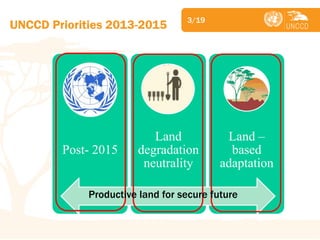
UNCCD Priorities 2013-2015 
3/19 
Post- 2015 
Land degradation neutrality 
Land – based adaptation 
Productive land for secure future
Subject 
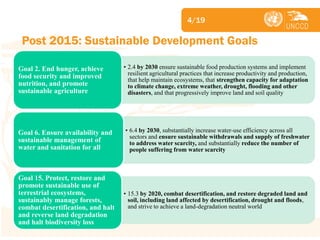
Post 2015: Sustainable Development Goals 
4/19 
•2.4 by 2030 ensure sustainable food production systems and implement resilient agricultural practices that increase productivity and production, that help maintain ecosystems, that strengthen capacity for adaptation to climate change, extreme weather, drought, flooding and other disasters, and that progressively improve land and soil quality 
Goal 2. End hunger, achieve food security and improved nutrition, and promote sustainable agriculture 
•6.4 by 2030, substantially increase water-use efficiency across all sectors and ensure sustainable withdrawals and supply of freshwater to address water scarcity, and substantially reduce the number of people suffering from water scarcity 
Goal 6. Ensure availability and sustainable management of water and sanitation for all 
•15.3 by 2020, combat desertification, and restore degraded land and soil, including land affected by desertification, drought and floods, and strive to achieve a land-degradation neutral world 
Goal 15. Protect, restore and promote sustainable use of terrestrial ecosystems, sustainably manage forests, combat desertification, and halt and reverse land degradation and halt biodiversity loss
Subject 
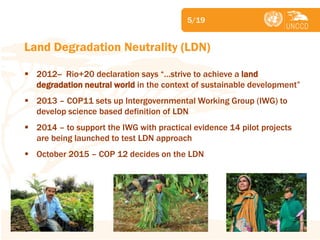
Land Degradation Neutrality (LDN) 
5/19 
2012-- Rio+20 declaration says “…strive to achieve a land degradation neutral world in the context of sustainable development” 
2013 – COP11 sets up Intergovernmental Working Group (IWG) to develop science based definition of LDN 
2014 – to support the IWG with practical evidence 14 pilot projects are being launched to test LDN approach 
October 2015 – COP 12 decides on the LDN
Subject 
Land-based adaptation 
Land-based adaptation is a pathway to resilience and security – food security, water security, energy security, economic security and even human security 
UNCCD activities on land-based adaptation: 
Explore mechanisms which drive land-based adaptation measures 
Cooperation with other UN and multilateral bodies 
Demonstrate the multiple benefits of land restoration, including climate change adaptation and poverty alleviation (2014 Climate Change Summit and 2015 UNFCCC COP 21) 
6/19
Subject 
GM Programme on Liaison - Land, Security and Resilience (LLSR) 
Mission: The main aim is to increase investments in sustainable land-based practices to improve people’s livelihoods, while maintaining healthy ecosystems. 
LLSR also works to improve the resilience of local communities to food and water insecurity , droughts and climate change: 
Build national capacities and enhance resilience to drought and climate change, sustainable land management finance, 
Support the implementation of national drought policies, land-based adaptation to climate change 
7/19
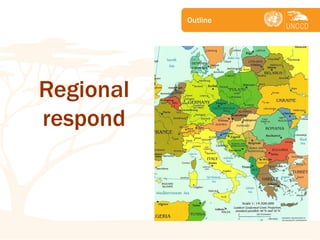
Regional respond 
Subject 
Outline
Subject 
9/19 
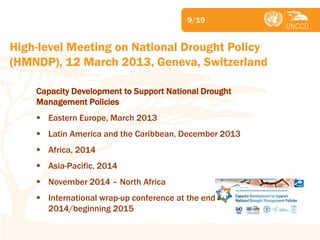
Capacity Development to Support National Drought Management Policies 
Eastern Europe, March 2013 
Latin America and the Caribbean, December 2013 
Africa, 2014 
Asia-Pacific, 2014 
November 2014 – North Africa 
International wrap-up conference at the end of 2014/beginning 2015 
High-level Meeting on National Drought Policy (HMNDP), 12 March 2013, Geneva, Switzerland
Subject 
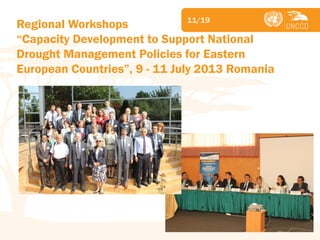
Regional Workshops “Capacity Development to Support National Drought Management Policies for Eastern European Countries”, 9 - 11 July 2013 Romania 
11/19
Subject 
Regional Workshops “Capacity Development to Support National Drought Management Policies for Eastern European Countries”, 9 - 11 July 2013 Romania 
12/19 
Main observations for the region: 
Awareness of drought impacts is limited among wider public 
The losses caused by drought have not been well communicated to the higher decision-making level 
While there is high research capacity in the field of drought monitoring, vulnerability and impact assessment, there is a need for enhanced cooperation and networking between various stakeholders 
Several countries mentioned the need to improve national drought monitoring and development of drought risk management systems
Subject 
13/19 
Main observations for the region (cont.): Major challenges for NDMP? 
Contradictory policies and conflicting responsibilities 
Lack of awareness about drought , not a top policy priority 
Lack of financial resources Existing experience? 
•Romania - National committee for drought is recently reactivated 
•Turkey -Agricultural drought plan updated annually 
•Macedonia, Croatia, Montenegro, Slovenia, Boasnia&Herzegovina – UNCCD National Action Programmes are under elaboration 
Regional Workshops “Capacity Development to Support National Drought Management Policies for Eastern European Countries”, 9 - 11 July 2013 Romania
Subject 
Central and Eastern Europe (Annex V) of UNCCD 
17/19 
Consultations to develop of the Regional Action Programme (RAP) for CEE: 
Task force (National Focal Points , Science and Technology Correspondents, civil society organizations) 
Paper for discussion is in progress. Preliminary proposals for the regional cooperation platform: 
Drought mitigation and disaster preparedness - one of the suggested areas for regional cooperation in CEE
Subject 
Building awareness on cost of drought 
14/19 
Communication from the Commission to the European Parliament and the Council in 2007, the costs evolving from drought and water scarcity [in EU] amounted to €100 billion over the past 30 years. Drought in 2003 in Bosnia and Herzegovina caused 200 mln Euro in agricultural damage (National reports)
Subject 
15/19 
22nd OSCE Economic and Environmental Summit, Prague, September 2014 – UNCCD: 
•Drought is a slow-onset disaster which affects more people and larger areas 
•Southern and Eastern Europe as the region likely to be seriously affected by drought 
• Prevention cost for slow-on set disaster are less than mitigation cost 
•OSCE member states can already start to take bold action on preventing and restoring degraded land; by understanding the economic costs and opportunities; by enhancing collaboration on cross-border water resources and by developing national drought management policies.
Subject 
19/19 
Conclusions and recommendations 
Drought management is a priority for the SDGs and the UNCCD 
As such COP12 is sought to address, at the highest level the progress made on drought management. 
Secretariat and partners to support further in the development of national drought policies; partners should include GEF, for example, with dedicated funds for drought issues 
How do parties from the region see that UNCCD and FCCC – for example- engage in synergies using drought / water scarcity as issue for CC adaptation?
Thanks

Joint GWP CEE/DMCSEE training: UNCCD global framework on Drought Management and the regional response by Jamal Annagylyjova

  • 1.
    UNCCD global frameworkon Drought Management and the regional response United Nations Convention to Combat Desertification Joint DMCSEE / GWP CEE capacity building training From monitoring to end users 3 October 2014 Jamal Annagylyjova Programme Officer Central and Eastern Europe
  • 2.
    UNCCD global framework2013-2015 Subject Outline
  • 3.
    Subject UNCCD Priorities2013-2015 3/19 Post- 2015 Land degradation neutrality Land – based adaptation Productive land for secure future
  • 4.
    Subject Post 2015:Sustainable Development Goals 4/19 •2.4 by 2030 ensure sustainable food production systems and implement resilient agricultural practices that increase productivity and production, that help maintain ecosystems, that strengthen capacity for adaptation to climate change, extreme weather, drought, flooding and other disasters, and that progressively improve land and soil quality Goal 2. End hunger, achieve food security and improved nutrition, and promote sustainable agriculture •6.4 by 2030, substantially increase water-use efficiency across all sectors and ensure sustainable withdrawals and supply of freshwater to address water scarcity, and substantially reduce the number of people suffering from water scarcity Goal 6. Ensure availability and sustainable management of water and sanitation for all •15.3 by 2020, combat desertification, and restore degraded land and soil, including land affected by desertification, drought and floods, and strive to achieve a land-degradation neutral world Goal 15. Protect, restore and promote sustainable use of terrestrial ecosystems, sustainably manage forests, combat desertification, and halt and reverse land degradation and halt biodiversity loss
  • 5.
    Subject Land DegradationNeutrality (LDN) 5/19 2012-- Rio+20 declaration says “…strive to achieve a land degradation neutral world in the context of sustainable development” 2013 – COP11 sets up Intergovernmental Working Group (IWG) to develop science based definition of LDN 2014 – to support the IWG with practical evidence 14 pilot projects are being launched to test LDN approach October 2015 – COP 12 decides on the LDN
  • 6.
    Subject Land-based adaptation Land-based adaptation is a pathway to resilience and security – food security, water security, energy security, economic security and even human security UNCCD activities on land-based adaptation: Explore mechanisms which drive land-based adaptation measures Cooperation with other UN and multilateral bodies Demonstrate the multiple benefits of land restoration, including climate change adaptation and poverty alleviation (2014 Climate Change Summit and 2015 UNFCCC COP 21) 6/19
  • 7.
    Subject GM Programmeon Liaison - Land, Security and Resilience (LLSR) Mission: The main aim is to increase investments in sustainable land-based practices to improve people’s livelihoods, while maintaining healthy ecosystems. LLSR also works to improve the resilience of local communities to food and water insecurity , droughts and climate change: Build national capacities and enhance resilience to drought and climate change, sustainable land management finance, Support the implementation of national drought policies, land-based adaptation to climate change 7/19
  • 8.
  • 9.
    Subject 9/19 CapacityDevelopment to Support National Drought Management Policies Eastern Europe, March 2013 Latin America and the Caribbean, December 2013 Africa, 2014 Asia-Pacific, 2014 November 2014 – North Africa International wrap-up conference at the end of 2014/beginning 2015 High-level Meeting on National Drought Policy (HMNDP), 12 March 2013, Geneva, Switzerland
  • 10.
    Subject Regional Workshops“Capacity Development to Support National Drought Management Policies for Eastern European Countries”, 9 - 11 July 2013 Romania 11/19
  • 11.
    Subject Regional Workshops“Capacity Development to Support National Drought Management Policies for Eastern European Countries”, 9 - 11 July 2013 Romania 12/19 Main observations for the region: Awareness of drought impacts is limited among wider public The losses caused by drought have not been well communicated to the higher decision-making level While there is high research capacity in the field of drought monitoring, vulnerability and impact assessment, there is a need for enhanced cooperation and networking between various stakeholders Several countries mentioned the need to improve national drought monitoring and development of drought risk management systems
  • 12.
    Subject 13/19 Mainobservations for the region (cont.): Major challenges for NDMP? Contradictory policies and conflicting responsibilities Lack of awareness about drought , not a top policy priority Lack of financial resources Existing experience? •Romania - National committee for drought is recently reactivated •Turkey -Agricultural drought plan updated annually •Macedonia, Croatia, Montenegro, Slovenia, Boasnia&Herzegovina – UNCCD National Action Programmes are under elaboration Regional Workshops “Capacity Development to Support National Drought Management Policies for Eastern European Countries”, 9 - 11 July 2013 Romania
  • 13.
    Subject Central andEastern Europe (Annex V) of UNCCD 17/19 Consultations to develop of the Regional Action Programme (RAP) for CEE: Task force (National Focal Points , Science and Technology Correspondents, civil society organizations) Paper for discussion is in progress. Preliminary proposals for the regional cooperation platform: Drought mitigation and disaster preparedness - one of the suggested areas for regional cooperation in CEE
  • 14.
    Subject Building awarenesson cost of drought 14/19 Communication from the Commission to the European Parliament and the Council in 2007, the costs evolving from drought and water scarcity [in EU] amounted to €100 billion over the past 30 years. Drought in 2003 in Bosnia and Herzegovina caused 200 mln Euro in agricultural damage (National reports)
  • 15.
    Subject 15/19 22ndOSCE Economic and Environmental Summit, Prague, September 2014 – UNCCD: •Drought is a slow-onset disaster which affects more people and larger areas •Southern and Eastern Europe as the region likely to be seriously affected by drought • Prevention cost for slow-on set disaster are less than mitigation cost •OSCE member states can already start to take bold action on preventing and restoring degraded land; by understanding the economic costs and opportunities; by enhancing collaboration on cross-border water resources and by developing national drought management policies.
  • 16.
    Subject 19/19 Conclusionsand recommendations Drought management is a priority for the SDGs and the UNCCD As such COP12 is sought to address, at the highest level the progress made on drought management. Secretariat and partners to support further in the development of national drought policies; partners should include GEF, for example, with dedicated funds for drought issues How do parties from the region see that UNCCD and FCCC – for example- engage in synergies using drought / water scarcity as issue for CC adaptation?
  • 17.