HADITH & SUNNAH:
DEFINATION:
Hadithis the second source of Islamic law and in Islamic
terminology every deed, saying and sermon delivered or any
act done in the presence or knowledge of Holy Prophet (SAW)
and to which he did not express his dislike is called Hadith.
3.
Abu Bakr al-Jassas(370 H.)
stated in al-Fusool fil Usool a
clearer definition, when he
said: "The Sunnah of the
Prophet "( سلم و عليه الله )صلى
is what he said or did in
continous manner so that
others follow"[ُهَّالل ىَّلَص ِّيِبَّالن ُةَّنُس
:
ىَدَْتقُيِل ، ُهَالَق ْوَأ ، ُهَلَعَف اَم َمَّلَسَو ِهْيَلَع
ِهْيَلَع َمَاوَدُيَو ، ِهيِف ِهِ]ب.
4.
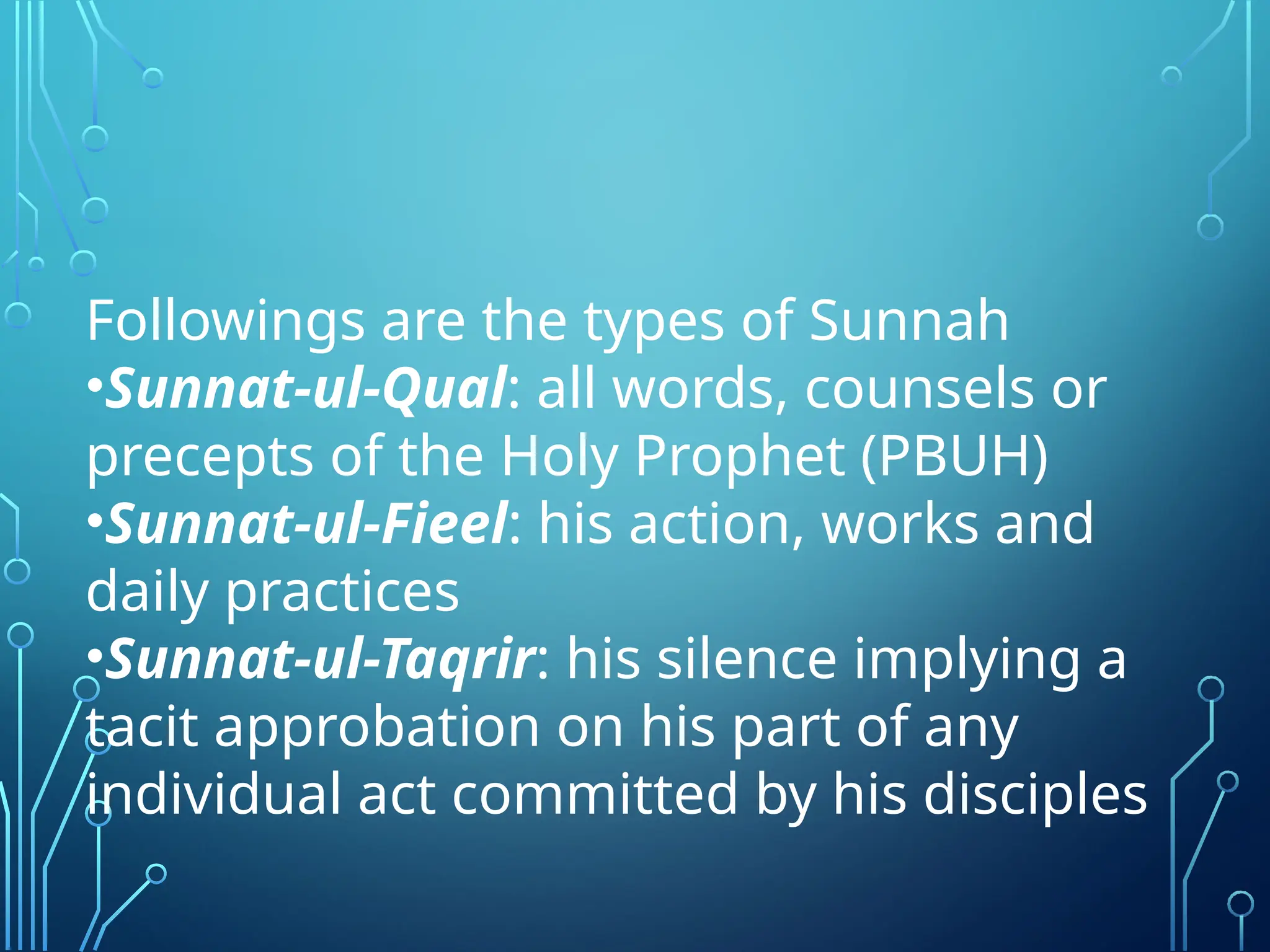
Followings are thetypes of Sunnah
•Sunnat-ul-Qual: all words, counsels or
precepts of the Holy Prophet (PBUH)
•Sunnat-ul-Fieel: his action, works and
daily practices
•Sunnat-ul-Taqrir: his silence implying a
tacit approbation on his part of any
individual act committed by his disciples
5.
• b) ‘ilmulHadith dirayatan is that branch which discusses the
rules of narrating a Hadith, the grading of the Hadith, the
reliability of the narrators and the deduction of legislation
()أحكام there from etc.
• a) ‘ilmul Hadith riwayatan is that branch which
consists of the mere reciting of the Hadith with
absolute precision.
6.
• RIWAYAT
1. Discusswith sanad.
2. Reporter of Hadith.
3. Discuss with
screening of reporter
as his education,
piety, power of
memory, self control,
patience, internal &
external relation
with others.
• DERAYAT
1. Verification of material.
2. Verification of Arabic
grammar.
3. If one hadith showing huge
reward like jannat on a
ordinary action or huge
punishment like hell on a
ordinary sin, hadith is weak
a/c to the law of dirayat.
4. Any tribe reference
property.
5. Prophecy projected words
not excepted.
Imam Muslim documentedin his Saheeh that Aisha (الله رضي
)عنها said: Going down "al-Abtah" is not Sunnah. The Prophet
only went down there because it was easier for him when he
wanted to exit the place"
[ Saheeh Muslim: 1311]
Imam al-Nawawi said in his Sharh: " Aisha and Ibn Abbas did
not act upon it because thet viewed this act to happen not for
a religious purpose. Yet, other companions acted upon it and
because identifying whether this act was performed on
religious basis or not, companions differed on it"
From the above, we conclude that companions and scholars
differentiated between the acts of the Prophet (عليه الله صلى
)وسلم. They viewed acts that are performed on religious basis
to get one closer to Allah as Sunnah while other acts that are
done for other reasons as general acts.
9.
• IMPORTANCE OFHADITH:
1)Practicable as Quran.
2)Does not say by his own will.
3)Explain what so ever revealed.
4)Who so obey Prophet.
5)If you want to love Allah.
11.
• COMPILATION OFHADITH:
1) During the period of Holy Prophet ,Hazrat Abdullah-ebne-Amar,
Abu Huraira 5374, Ali and Anas were writing Ahadith of Holy
prophet(saw).
2) In 99 Hijrah Hazrat Umer bin Abdulaziz gave order to Hazrat
imam Zohri.
3) Imam abu Hanifa (Kitabul asar), Imam Malik(muatta), Sufyan
sorri (kitabul jamay).
4) Saheh Bukhari by imam Bukhari, Saheh Muslim by Imam
Muslim, Sunan Tirmazi by Imam Tirmazi, sunan Abu dawood by
Imam dawood, Sunan Nissae by Imam Nisaae and Sunan Ibne
Maja by Imam Maja. (Sahahey Sittah)
12.
• 1. Muhammadb. Ismail al Bukhari, (194 A.H.-256 A.H.): Sahih.
This work is next to the Quran in authenticity.
2. Muslim bin Qushairi (204 A.H.-261 A.H.): Sahih. This is the next
most important work on Hadith.
3. Ibn Majah (202 A.H.-275 A.H.): Sunan
4. Abu Isa al Tirmizi (209 A.H.-279 A.H.): Jame
5. Abu Abdur Rahman an Nasai (214 A.H.-303 A.H.): Sunan
6. Abu Da‘ud (202 A.H.-275 A.H.): Sunan
13.
• 1. Thefirst stage relates to the period of the Prophet till 10 A.H.
2. The second stage is approximately from 11 A.H. to 100 A.H. This
is the period of Sahaba, the companions of the Prophet.
3. The third stage is from about 101 to nearly 200 A.H. This is the
period of the Tabiun, the disciples of the companions of the Prophet.
4. The fourth stage is roughly from 200 A.H. to 300 A.H. This is the
period of Taba Tabiun, the disciples of the disciples.

![Abu Bakr al-Jassas (370 H.)
stated in al-Fusool fil Usool a
clearer definition, when he
said: "The Sunnah of the
Prophet "( سلم و عليه الله )صلى
is what he said or did in
continous manner so that
others follow"[ُهَّالل ىَّلَص ِّيِبَّالن ُةَّنُس
:
ىَدَْتقُيِل ، ُهَالَق ْوَأ ، ُهَلَعَف اَم َمَّلَسَو ِهْيَلَع
ِهْيَلَع َمَاوَدُيَو ، ِهيِف ِهِ]ب.](https://image.slidesharecdn.com/11-introduction-to-sunnah-250424140838-ea5d9f18/75/11-introduction-to-sunnah-full-presentation-pptx-3-2048.jpg)


![Imam Muslim documented in his Saheeh that Aisha (الله رضي
)عنها said: Going down "al-Abtah" is not Sunnah. The Prophet
only went down there because it was easier for him when he
wanted to exit the place"
[ Saheeh Muslim: 1311]
Imam al-Nawawi said in his Sharh: " Aisha and Ibn Abbas did
not act upon it because thet viewed this act to happen not for
a religious purpose. Yet, other companions acted upon it and
because identifying whether this act was performed on
religious basis or not, companions differed on it"
From the above, we conclude that companions and scholars
differentiated between the acts of the Prophet (عليه الله صلى
)وسلم. They viewed acts that are performed on religious basis
to get one closer to Allah as Sunnah while other acts that are
done for other reasons as general acts.](https://image.slidesharecdn.com/11-introduction-to-sunnah-250424140838-ea5d9f18/75/11-introduction-to-sunnah-full-presentation-pptx-8-2048.jpg)


