HOW TO ACT ON DATA
Strategizing marketing solutions
through measurement
BRIAN WIBORG

Vice President of Marketing
bwiborg@theroomplace.com

MICHAEL MORIN
Executive Vice President
michaelm@yaffe.com
WHY DATA MATTERS
“Many businesses are collecting data,
but they don’t know what to do with it,
or if they know what to do with it,

they’re not doing it.”
– Fred Newell
TECHNOLOGY=

NEW
TOOLS
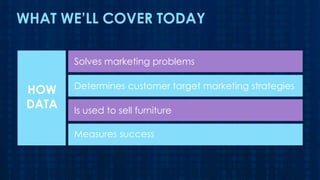
WHAT WE’LL COVER TODAY
Solves marketing problems

HOW
DATA

Determines customer target marketing strategies
Is used to sell furniture

Measures success
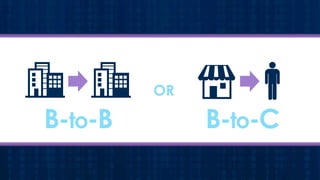
OR

B-to-B

B-to-C
SHARE
YOUR BEST
PRACTICES
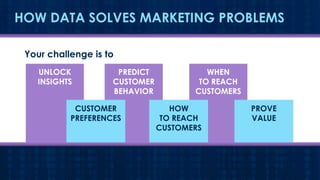
HOW DATA SOLVES MARKETING PROBLEMS
Your challenge is to
UNLOCK
INSIGHTS

PREDICT
CUSTOMER
BEHAVIOR

CUSTOMER
PREFERENCES

WHEN
TO REACH
CUSTOMERS
HOW
TO REACH
CUSTOMERS

PROVE
VALUE
PROBLEM:
Who is your
customer?

SOLUTION:
Data collection
and analysis.

• What’s the value?
• Relevant messaging
• Media buys
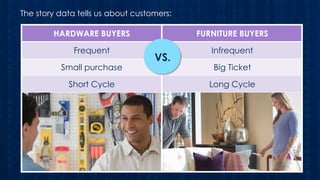
The story data tells us about customers:

HARDWARE BUYERS

FURNITURE BUYERS

Frequent

Infrequent

Small purchase

Short Cycle

VS.

Big Ticket

Long Cycle
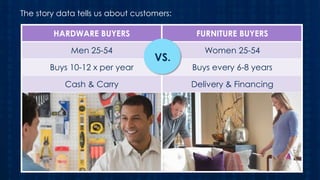
The story data tells us about customers:

HARDWARE BUYERS

FURNITURE BUYERS

Men 25-54

Women 25-54

Buys 10-12 x per year

Cash & Carry

VS.

Buys every 6-8 years

Delivery & Financing
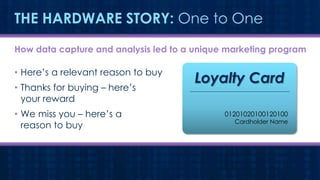
THE HARDWARE STORY: One to One
How data capture and analysis led to a unique marketing program

• Here’s a relevant reason to buy
• Thanks for buying – here’s
your reward
• We miss you – here’s a
reason to buy

Loyalty Card
01201020100120100

Cardholder Name
THE HARDWARE STORY: One to One
How data capture and analysis led to a unique marketing program

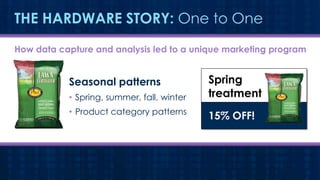
Seasonal patterns
• Spring, summer, fall, winter
• Product category patterns

Spring
treatment
15% OFF!
THE FURNITURE STORY: Speed Up the Cycle
How data capture and analysis led to specific marketing targets

SALE!

Saturday
ONLY!
THE FURNITURE STORY: Customers buy infrequently
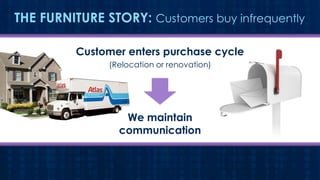
Customer enters purchase cycle
(Relocation or renovation)

We maintain
communication
THE FURNITURE STORY: Customers buy infrequently

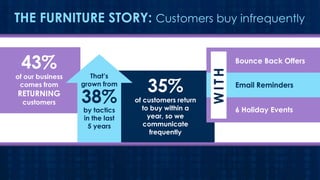
of our business
comes from

RETURNING
customers

That’s
grown from

38%
by tactics
in the last
5 years

35%
of customers return
to buy within a
year, so we
communicate
frequently

WITH

43%

Bounce Back Offers
Email Reminders
6 Holiday Events
THE FURNITURE STORY:
Customers buy
during holidays…

Get to the top of their
consideration list

SALE
THE FURNITURE CHALLENGE: The Other 39 Weeks
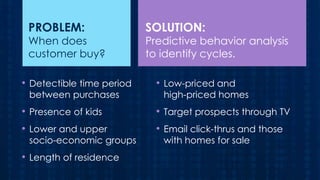
PROBLEM:

When does
customer buy?

SOLUTION:

Predictive behavior analysis
to identify cycles.

• Detectible time period

• Low-priced and

• Presence of kids

• Target prospects through TV

• Lower and upper

• Email click-thrus and those

between purchases

socio-economic groups

• Length of residence

high-priced homes

with homes for sale
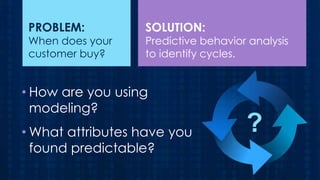
PROBLEM:

When does your
customer buy?

SOLUTION:

Predictive behavior analysis
to identify cycles.

• How are you using
modeling?
• What attributes have you
found predictable?

?
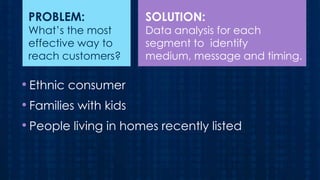
PROBLEM:

What’s the most
effective way to
reach customers?

SOLUTION:

Data analysis for each
segment to identify
medium, message and timing.

• Ethnic consumer
• Families with kids
• People living in homes recently listed
SOLUTION:
PROBLEM:
Test/Learn,
How do you know
Test/Learn, Repeat.
what works?
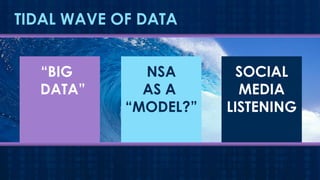
TIDAL WAVE OF DATA
“BIG
DATA”

NSA
AS A
“MODEL?”

SOCIAL
MEDIA
LISTENING
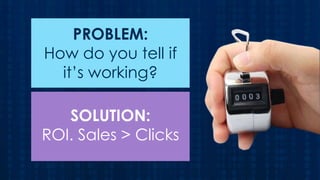
PROBLEM:
How do you tell if
it’s working?
SOLUTION:
ROI. Sales > Clicks
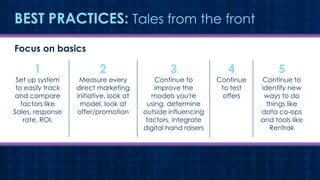
BEST PRACTICES: Tales from the front
Focus on basics

1

Set up system
to easily track
and compare
factors like
Sales, response
rate, ROI,

2

Measure every
direct marketing
initiative, look at
model, look at
offer/promotion

3

Continue to
improve the
models you're
using, determine
outside influencing
factors, integrate
digital hand raisers

4

Continue
to test
offers

5

Continue to
identify new
ways to do
things like
data co-ops
and tools like
Rentrak
QUESTIONS

?
AMA Momentum's How to Act on Data by Michael Morin

AMA Momentum's How to Act on Data by Michael Morin

  • 1.
    HOW TO ACTON DATA Strategizing marketing solutions through measurement
  • 2.
    BRIAN WIBORG Vice Presidentof Marketing bwiborg@theroomplace.com MICHAEL MORIN Executive Vice President michaelm@yaffe.com
  • 3.
    WHY DATA MATTERS “Manybusinesses are collecting data, but they don’t know what to do with it, or if they know what to do with it, they’re not doing it.” – Fred Newell
  • 4.
  • 5.
    WHAT WE’LL COVERTODAY Solves marketing problems HOW DATA Determines customer target marketing strategies Is used to sell furniture Measures success
  • 6.
  • 7.
  • 8.
    HOW DATA SOLVESMARKETING PROBLEMS Your challenge is to UNLOCK INSIGHTS PREDICT CUSTOMER BEHAVIOR CUSTOMER PREFERENCES WHEN TO REACH CUSTOMERS HOW TO REACH CUSTOMERS PROVE VALUE
  • 9.
    PROBLEM: Who is your customer? SOLUTION: Datacollection and analysis. • What’s the value? • Relevant messaging • Media buys
  • 10.
    The story datatells us about customers: HARDWARE BUYERS FURNITURE BUYERS Frequent Infrequent Small purchase Short Cycle VS. Big Ticket Long Cycle
  • 11.
    The story datatells us about customers: HARDWARE BUYERS FURNITURE BUYERS Men 25-54 Women 25-54 Buys 10-12 x per year Cash & Carry VS. Buys every 6-8 years Delivery & Financing
  • 12.
    THE HARDWARE STORY:One to One How data capture and analysis led to a unique marketing program • Here’s a relevant reason to buy • Thanks for buying – here’s your reward • We miss you – here’s a reason to buy Loyalty Card 01201020100120100 Cardholder Name
  • 13.
    THE HARDWARE STORY:One to One How data capture and analysis led to a unique marketing program Seasonal patterns • Spring, summer, fall, winter • Product category patterns Spring treatment 15% OFF!
  • 14.
    THE FURNITURE STORY:Speed Up the Cycle How data capture and analysis led to specific marketing targets SALE! Saturday ONLY!
  • 15.
    THE FURNITURE STORY:Customers buy infrequently Customer enters purchase cycle (Relocation or renovation) We maintain communication
  • 16.
    THE FURNITURE STORY:Customers buy infrequently of our business comes from RETURNING customers That’s grown from 38% by tactics in the last 5 years 35% of customers return to buy within a year, so we communicate frequently WITH 43% Bounce Back Offers Email Reminders 6 Holiday Events
  • 17.
    THE FURNITURE STORY: Customersbuy during holidays… Get to the top of their consideration list SALE
  • 18.
    THE FURNITURE CHALLENGE:The Other 39 Weeks
  • 19.
    PROBLEM: When does customer buy? SOLUTION: Predictivebehavior analysis to identify cycles. • Detectible time period • Low-priced and • Presence of kids • Target prospects through TV • Lower and upper • Email click-thrus and those between purchases socio-economic groups • Length of residence high-priced homes with homes for sale
  • 20.
    PROBLEM: When does your customerbuy? SOLUTION: Predictive behavior analysis to identify cycles. • How are you using modeling? • What attributes have you found predictable? ?
  • 21.
    PROBLEM: What’s the most effectiveway to reach customers? SOLUTION: Data analysis for each segment to identify medium, message and timing. • Ethnic consumer • Families with kids • People living in homes recently listed
  • 22.
    SOLUTION: PROBLEM: Test/Learn, How do youknow Test/Learn, Repeat. what works?
  • 23.
    TIDAL WAVE OFDATA “BIG DATA” NSA AS A “MODEL?” SOCIAL MEDIA LISTENING
  • 24.
    PROBLEM: How do youtell if it’s working? SOLUTION: ROI. Sales > Clicks
  • 25.
    BEST PRACTICES: Talesfrom the front Focus on basics 1 Set up system to easily track and compare factors like Sales, response rate, ROI, 2 Measure every direct marketing initiative, look at model, look at offer/promotion 3 Continue to improve the models you're using, determine outside influencing factors, integrate digital hand raisers 4 Continue to test offers 5 Continue to identify new ways to do things like data co-ops and tools like Rentrak
  • 26.

Editor's Notes

  • #3 Introductions
  • #4 We’ll talk about him being the father of one-to-one marketing, the writer of 4 books and being a real visionary. Books include: The New Rules of Marketing - How to Use One-to-One Relationship Marketing to be the Leader in Your Industry - 1997Loyalty.com - Customer Relationship Management in the New Era of Internet Marketing – 2000.
  • #5 We’ll talk about how essential technology is to what we do, but analyzing and acting on the data is what impacts the business. For instance, we’ve been trying for a long time to improve response from our tertiary customer groups and in our last two events we saw a 50% lift in response
  • #7 We’ll ask, How many are in marketing for B-to-C/retailing or B-to-B companies?
  • #8 We’ll talk about getting more out of this session if you are willing to share some of your personal best practices along the way. We’ll be inviting your participation, please join in.
  • #9 We’ll say something like you’re not a hamster on wheel, you’re a strategic partner. Marketing is more about strategic planning and not the production of an ad or the building of a database. In order to prove value you need to agree up front what to measure, measure it and gain insight to improve.
  • #10 (We’ll talk about needing to start with a marketing database. Ask, what data are you collecting to enhance your knowledge of your customer? How are you collecting it and what tools are you using to collect it?) (We’ll continue with, knowing the customer’s persona is most important. It drives everything. For a furniture retailer in Chicago, demographics, especially ethnicity, is very important. It will guide strategy and media buys, medium, potential partners, language.) (We’ll continue to talk about knowing your customer is the most important information you can have. Analyzing this data is the key to making it profitableData drives everything.)(We’ll talk about using the knowledge we have about our customer to buy media. We know the trade area of a store for circular distribution, the demographics of our customer, the programs they watch on TV. And as Chris Wilson showed us earlier, we have opportunities to do it better today because of improvements in technology. We always start with a marketing database that is a repository of transactional information, demographics, responses to marketing, indications of hand raising, etc.)
  • #13 (We’ll say something like: in the furniture business, everything is delivered so you have customer information—name, address, phone, email, etc. Hardware is a cash and carry type of business so it’s hard to get customer contact information. That’s why so many retailers use a customer loyalty card, which is scanned at the cash register, to capture data. Then you know the frequency of visit, amount of sale, what was bought. It’s tied to customer data like email, address, etc. so you can communicate with them via email/ mail. Try to do things smarter by understanding the customer base. Track who bought, how often, what are the transactions like? If you haven’t bought in a while, we send a “We miss you” campaign so you’ll be encouraged to come back in. Get customer to stretch by using incentives to get them to next purchase threshold. Look at variables, like seasonal purchases, i.e. lawn fertilizer. If you wow them when they come in, then hit them the next fertilizer season again with a targeted message, you will capture that fertilizer buy every year.)
  • #14 (We’ll say something like: in the furniture business, everything is delivered so you have customer information—name, address, phone, email, etc. Hardware is a cash and carry type of business so it’s hard to get customer contact information. That’s why so many retailers use a customer loyalty card, which is scanned at the cash register, to capture data. Then you know the frequency of visit, amount of sale, what was bought. It’s tied to customer data like email, address, etc. so you can communicate with them via email/ mail. Try to do things smarter by understanding the customer base. Track who bought, how often, what are the transactions like? If you haven’t bought in a while, we send a “We miss you” campaign so you’ll be encouraged to come back in. Get customer to stretch by using incentives to get them to next purchase threshold. Look at variables, like seasonal purchases, i.e. lawn fertilizer. If you wow them when they come in, then hit them the next fertilizer season again with a targeted message, you will capture that fertilizer buy every year.)
  • #15 (We’ll say something like: when was the last time you saw a tire ad?Selling furniture is like selling tires.Our marketing efforts are aimed at people who are thinking about buying, we try to get more than our share by giving them a compelling reason to by today. We call that speeding up the market.
  • #16 (We’ll say something like: Furniture is unlike most of other categoriesCustomers buy infrequentlyBuying cycle is typically every 6-8 yearsOnce a buyer is in cycle, they are more likely to come back for additional purchases. If they are involved in a home move/for sale, or a project at home, we will tap them several times to get the most from this buying cycle. We send communications to stay connected: “Thank you, do you need something else?” Take advantage of need/likelihood for additional items.)
  • #17 (We’ll say something like: Our direct marketing efforts are aimed at getting our existing customers to return to buy and increasing the frequency of purchase. 43% of our business comes from returning customers, 57% from new. That's grown from 38% by our tactics over the last 5 years. We know that 35% of our customers return to buy within a year, so we aim our efforts at communicating more frequently with them. We start by mailing multiple bounce back offers, that get followed up with email reminders, and then we add 6 major holiday events.)
  • #18 (We’ll say something like: Customers think the best time to buy are holidays, so we target them. We moved from arbitrarily chosen events throughout the year to focusing on the holidays and we've been able to increase our ROI.  People are going to buy during 6 holiday times. New Years, President’s Day, Memorial Day, Labor Day, Thanksgiving and Christmas. The shoppers are out there, the challenge for us is that we need to grab a lot of market share during those times. We want them to do the shopping that we know they are going to do with us. We use the data to make sure we are on the top of the consideration list for those shoppers. We have a data list of 1.4 or 1.5 million that we are going to tap to get them into our stores. Now it’s about being loud and getting them in the store.)
  • #23  (We’ll say something like: we all have limited budgets, so our data insight helps us determine where to allocate resources.Our program is a test and learn situation. You have a sales hypothesis, then test out it out in segments and compare against your control groups. Sometimes surprising what is best segment response. The data proves quickly what is right and wrong. It’s a constant Test/learn, test/learn, test/learn cycle.)
  • #24  (We’ll say something like: we all have limited budgets, so our data insight helps us determine where to allocate resources.Our program is a test and learn situation. You have a sales hypothesis, then test out it out in segments and compare against your control groups. Sometimes surprising what is best segment response. The data proves quickly what is right and wrong. It’s a constant Test/learn, test/learn, test/learn cycle.)
  • #25 (We’ll say something like: Prove value. Agree in advance what you want to know, what needle needs to move, and what you need to track so what you are doing can be counted as valuable. For us were more interested in ROI and Sales. We measure clicks but we want to know that they turned into a sale.)
  • #27 We’ll talk about getting more out of this session if you are willing to share some of your personal best practices along the way. We’ll be inviting your participation, please join in.