Shock
Sabnam, a 2 year old child came to ER with multiple
episodes of loose stool and vomiting. On arrival her
vitals were :
•HR: 140 bpm
•RR: 50/ min
•BP: 60/40 mmHg
•CRT= 4 seconds
•SpO2: 94% in room air
What are the problems with this child?
Definition of shock
• Shock is defined as a physiological state characterized by inadequate
tissue perfusion to meet metabolic demand and tissue oxygenation.
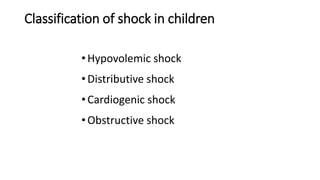
Classification of shock in children
•Hypovolemic shock
•Distributive shock
•Cardiogenic shock
•Obstructive shock
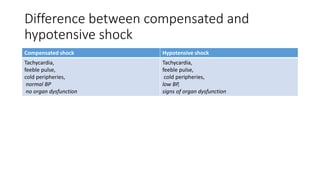
Difference between compensated and
hypotensive shock
Compensated shock Hypotensive shock
Tachycardia,
feeble pulse,
cold peripheries,
normal BP
no organ dysfunction
Tachycardia,
feeble pulse,
cold peripheries,
low BP,
signs of organ dysfunction
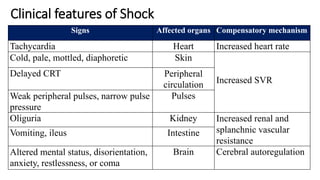
Clinical features of Shock
Signs Affected organs Compensatory mechanism
Tachycardia Heart Increased heart rate
Cold, pale, mottled, diaphoretic Skin
Increased SVR
Delayed CRT Peripheral
circulation
Weak peripheral pulses, narrow pulse
pressure
Pulses
Oliguria Kidney Increased renal and
splanchnic vascular
resistance
Vomiting, ileus Intestine
Altered mental status, disorientation,
anxiety, restlessness, or coma
Brain Cerebral autoregulation
Clinical features of Hypovolemic Shock
• Quiet tachypnea
• Tachycardia
• Weak or absent peripheral pulses, Normal or weak central pulses
• Delayed CRT
• Compensated or hypotensive shock with narrow pulse pressure
• Cold, pale, mottled skin/ Dusky/pale distal extremities
• Altered level of consciousness/ Decreasing level of consciousness as
shock progresses
• Oliguria
Clinical features of septic shock
• Hyperthermia/ hypothermia
• Features of poor perfusion:
Low BP, CRT prolonged, mottling of skin, fast and weak pulse
• Decreased urine output
• Altered mental status
Clinical feature of Cardiogenic shock
• Maintainable airway unless altered level of consciousness
• Tachypnea, ↑ WOB
• Tachycardia
• Weak/absent peripheral pulses
• Normal or weak central pulses
• Prolonged CRT with cold extremities
• Normal or low BP with a narrow pulse pressure
• Signs of congestive heart failure
• Cyanosis
• Cold, pale, mottled skin
Investigations
• In all kinds of Shock
CBC, RFT, Electrolytes, ABG, urine RME, Stool RME
• Important investigations in:
oHypovolemic: RFT, Electrolytes, ABG, urine RME, Stool RME
oSeptic: ESR, CRP, Blood C/S, Urine RME, URINE C/S, CXR
oCardiogenic: ABG, cardiac enzymes, lactate, TFT, CXR, ECG, ECHO
Basic rules for management of shock in children
• Optimize oxygen content of the blood
• Improve volume and distribution of cardiac output
• Reduce oxygen demand
• Correct metabolic derangements
General management of shock
• Positioning of child & Support airway, oxygenation, and ventilation
• Establish vascular access: peripheral, intraosseous, central
• Fluid resuscitation:
oIsotonic crystalloid (Normal Saline or Ringer’s Lactate) @ 20ml/kg IV bolus
oVolume and rate of administration should be decided based on types of
shock
General management of shock (Continued)
• Monitor vitals & Reassessment: trends of vitals, response to
therapy
• Laboratory investigations
• Medications:
Early antibiotics administration in septic shock
Inotropes/Vasodilators/Vasopressors
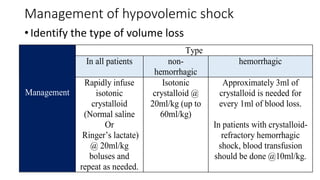
Management of hypovolemic shock
• Identify the type of volume loss
Management
Type
In all patients non-
hemorrhagic
hemorrhagic
Rapidly infuse
isotonic
crystalloid
(Normal saline
Or
Ringer’s lactate)
@ 20ml/kg
boluses and
repeat as needed.
Isotonic
crystalloid @
20ml/kg (up to
60ml/kg)
Approximately 3ml of
crystalloid is needed for
every 1ml of blood loss.
In patients with crystalloid-
refractory hemorrhagic
shock, blood transfusion
should be done @10ml/kg.
Management of hypovolemic shock
• Replace volume deficit:
Determine the grade of dehydration and
Replace the volume deficit & replace and prevent ongoing losses
• Correct metabolic derangements: hypoglycemia, hyponatremia etc.
• Consider laboratory investigations as mentioned above
• Vasoactive agents
Not routinely indicated
Profound hypotension may require short-term administration of
vasoactive agents such as epinephrine
Management of Septic Shock
• Step 1: 0-5 min  recognize decreased perfusion/call for
help oxygen management
• Step 2: 0-60min  IV access (if 3 attempts fail then IO)
Send blood/ urine test
If features of shock: 1st bolus @10-20ml/kg reassess the child
after each bolus (max. 40-60ml/kg)
1st dose of empirical antibiotics within 1 hr after blood CS
Correct hypoglycemia
Place urinary catheter
Management of Septic Shock contd
Step 3: Fluid Refractory Shock
• Start inotropes / vasoconstrictors
• Differentiate between Cold and Warm shock
• Epinephrine in cold shock/ Nor-epinephrine in warm shock
• Dopamine if Epinephrine & Nor-epinephrine is not available
• Dobutamine: if BP is normal or high with poor peripheral circulation
• IV Hydrocortisone
Management of Cardiogenic Shock
 Supplemental oxygen/NIV/IMV
 Small isotonic fluid boluses @ 5-10 ml/kg should be given
slowly over 10-20 minutes
 Monitor signs of fluid overload/pulmonary edema:
o Respiratory rate and work of breathing
o Jugular vein distension
o Tender hepatomegaly
o Basal rales
o Gallop rhythm
Management of Cardiogenic Shock (Contd)
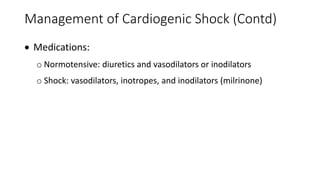
 Medications:
o Normotensive: diuretics and vasodilators or inodilators
o Shock: vasodilators, inotropes, and inodilators (milrinone)
Any Question?
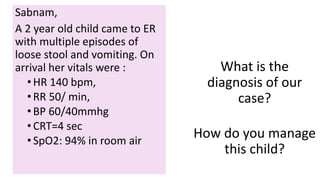
What is the
diagnosis of our
case?
How do you manage
this child?
Sabnam,
A 2 year old child came to ER
with multiple episodes of
loose stool and vomiting. On
arrival her vitals were :
•HR 140 bpm,
•RR 50/ min,
•BP 60/40mmhg
•CRT=4 sec
•SpO2: 94% in room air
Thank You

10-Shock(1).pptx

  • 1.
  • 2.
    Sabnam, a 2year old child came to ER with multiple episodes of loose stool and vomiting. On arrival her vitals were : •HR: 140 bpm •RR: 50/ min •BP: 60/40 mmHg •CRT= 4 seconds •SpO2: 94% in room air What are the problems with this child?
  • 3.
    Definition of shock •Shock is defined as a physiological state characterized by inadequate tissue perfusion to meet metabolic demand and tissue oxygenation.
  • 4.
    Classification of shockin children •Hypovolemic shock •Distributive shock •Cardiogenic shock •Obstructive shock
  • 5.
    Difference between compensatedand hypotensive shock Compensated shock Hypotensive shock Tachycardia, feeble pulse, cold peripheries, normal BP no organ dysfunction Tachycardia, feeble pulse, cold peripheries, low BP, signs of organ dysfunction
  • 6.
    Clinical features ofShock Signs Affected organs Compensatory mechanism Tachycardia Heart Increased heart rate Cold, pale, mottled, diaphoretic Skin Increased SVR Delayed CRT Peripheral circulation Weak peripheral pulses, narrow pulse pressure Pulses Oliguria Kidney Increased renal and splanchnic vascular resistance Vomiting, ileus Intestine Altered mental status, disorientation, anxiety, restlessness, or coma Brain Cerebral autoregulation
  • 7.
    Clinical features ofHypovolemic Shock • Quiet tachypnea • Tachycardia • Weak or absent peripheral pulses, Normal or weak central pulses • Delayed CRT • Compensated or hypotensive shock with narrow pulse pressure • Cold, pale, mottled skin/ Dusky/pale distal extremities • Altered level of consciousness/ Decreasing level of consciousness as shock progresses • Oliguria
  • 8.
    Clinical features ofseptic shock • Hyperthermia/ hypothermia • Features of poor perfusion: Low BP, CRT prolonged, mottling of skin, fast and weak pulse • Decreased urine output • Altered mental status
  • 9.
    Clinical feature ofCardiogenic shock • Maintainable airway unless altered level of consciousness • Tachypnea, ↑ WOB • Tachycardia • Weak/absent peripheral pulses • Normal or weak central pulses • Prolonged CRT with cold extremities • Normal or low BP with a narrow pulse pressure • Signs of congestive heart failure • Cyanosis • Cold, pale, mottled skin
  • 10.
    Investigations • In allkinds of Shock CBC, RFT, Electrolytes, ABG, urine RME, Stool RME • Important investigations in: oHypovolemic: RFT, Electrolytes, ABG, urine RME, Stool RME oSeptic: ESR, CRP, Blood C/S, Urine RME, URINE C/S, CXR oCardiogenic: ABG, cardiac enzymes, lactate, TFT, CXR, ECG, ECHO
  • 11.
    Basic rules formanagement of shock in children • Optimize oxygen content of the blood • Improve volume and distribution of cardiac output • Reduce oxygen demand • Correct metabolic derangements
  • 12.
    General management ofshock • Positioning of child & Support airway, oxygenation, and ventilation • Establish vascular access: peripheral, intraosseous, central • Fluid resuscitation: oIsotonic crystalloid (Normal Saline or Ringer’s Lactate) @ 20ml/kg IV bolus oVolume and rate of administration should be decided based on types of shock
  • 13.
    General management ofshock (Continued) • Monitor vitals & Reassessment: trends of vitals, response to therapy • Laboratory investigations • Medications: Early antibiotics administration in septic shock Inotropes/Vasodilators/Vasopressors
  • 14.
    Management of hypovolemicshock • Identify the type of volume loss Management Type In all patients non- hemorrhagic hemorrhagic Rapidly infuse isotonic crystalloid (Normal saline Or Ringer’s lactate) @ 20ml/kg boluses and repeat as needed. Isotonic crystalloid @ 20ml/kg (up to 60ml/kg) Approximately 3ml of crystalloid is needed for every 1ml of blood loss. In patients with crystalloid- refractory hemorrhagic shock, blood transfusion should be done @10ml/kg.
  • 15.
    Management of hypovolemicshock • Replace volume deficit: Determine the grade of dehydration and Replace the volume deficit & replace and prevent ongoing losses • Correct metabolic derangements: hypoglycemia, hyponatremia etc. • Consider laboratory investigations as mentioned above • Vasoactive agents Not routinely indicated Profound hypotension may require short-term administration of vasoactive agents such as epinephrine
  • 16.
    Management of SepticShock • Step 1: 0-5 min  recognize decreased perfusion/call for help oxygen management • Step 2: 0-60min  IV access (if 3 attempts fail then IO) Send blood/ urine test If features of shock: 1st bolus @10-20ml/kg reassess the child after each bolus (max. 40-60ml/kg) 1st dose of empirical antibiotics within 1 hr after blood CS Correct hypoglycemia Place urinary catheter
  • 17.
    Management of SepticShock contd Step 3: Fluid Refractory Shock • Start inotropes / vasoconstrictors • Differentiate between Cold and Warm shock • Epinephrine in cold shock/ Nor-epinephrine in warm shock • Dopamine if Epinephrine & Nor-epinephrine is not available • Dobutamine: if BP is normal or high with poor peripheral circulation • IV Hydrocortisone
  • 18.
    Management of CardiogenicShock  Supplemental oxygen/NIV/IMV  Small isotonic fluid boluses @ 5-10 ml/kg should be given slowly over 10-20 minutes  Monitor signs of fluid overload/pulmonary edema: o Respiratory rate and work of breathing o Jugular vein distension o Tender hepatomegaly o Basal rales o Gallop rhythm
  • 19.
    Management of CardiogenicShock (Contd)  Medications: o Normotensive: diuretics and vasodilators or inodilators o Shock: vasodilators, inotropes, and inodilators (milrinone)
  • 20.
  • 21.
    What is the diagnosisof our case? How do you manage this child? Sabnam, A 2 year old child came to ER with multiple episodes of loose stool and vomiting. On arrival her vitals were : •HR 140 bpm, •RR 50/ min, •BP 60/40mmhg •CRT=4 sec •SpO2: 94% in room air
  • 22.