Health Education
Created by
Sunil Kumar Gupta
PRINCIPAL
MDNPC
Health Education
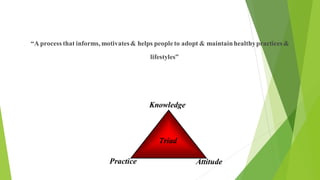
“A process that informs, motivates& helps peopleto adopt & maintainhealthypractices &

lifestyles”
Triad
Knowledge
Practice Attitude
Importance of Health Education
 Giving patients handouts about tetanus increased the rate of immunization against
tetanus among adults threefold.
Cates CJ
 An educational booklet on back pain for patients reduced the number of consultations
made by patients over the following year & 84% said that they found it useful.
RonaldM, Dixon M, JR Coll G
Aims of Health Education
1. To ensure that health is valued as an asset in the community
2. To equip the people with skills, knowledge & attitudes to enable them solve their
health problems by their own actions & efforts
3. To promote the development & proper use of health services
Objectives of Health Education (1 of 3)
1. Impart knowledge, this will:
 Clear the barriers of ignorance, prejudice & misconceptions
 Lead to assuming more responsibility towards one’s health care
 Induce awareness about health needs, minimizing the gap between needs &
demands
Objectives of Health Education (2 of 3)
2. Motivating people:
 The emphasis should be on motivating the consumer to choose his
own alternatives about the health actions
Objectives of Health Education (3 of 3)
3. Guiding into action:
 The suggested technology must be available, culturally
acceptable & economically affordable
 The stimulus to continue with the change should be persistent
Models
 Cognitive Model – “Telling people”
 Health
 Illness
 Ways to improving & protecting health & efficient use of the
delivery system.
 Is it enough?
 Why?
Model
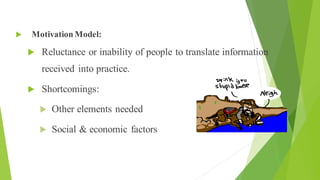
 Motivation Model:
 Reluctance or inability of people to translate information
received into practice.
 Shortcomings:
 Other elements needed
 Social & economic factors
Model
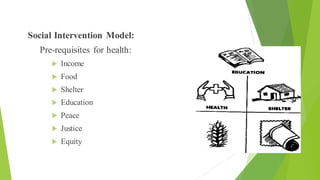
Social Intervention Model:
Pre-requisites for health:
 Income
 Food
 Shelter
 Education
 Peace
 Justice
 Equity
Stages for Health Education
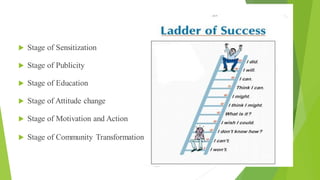
 Stage of Sensitization
 Stage of Publicity
 Stage of Education
 Stage of Attitude change
 Stage of Motivation and Action
 Stage of Community Transformation (social change)
Principles of Health Education
1. Interest.
2. Participation.
3. Proceed from known to
unknown.
4. Comprehension.
5. Reinforcement by repetition.
6. Motivation
7. Learning by doing
8. People, facts and media.
9. Good human relations
10. Leaders
Principles of Health Education
1. INTEREST: People are unlikely to listen to those who are not of their
interest.
2. PARTICIPATION: based on active learning - How? Group discussion,
workshops, panel discussions.
3. Start from the KNOWN & lead the people to the UNKNOWN, i.e.
knowledge. This will enable the community to develop an in-depth insight
into their own health problems.
Principles of Health Education
4. MOTIVATION: By creating the desire in a person to learn through
incentives like praise, love, rivalry, rewards, etc.
5. LEARNING BY DOING:
Usually leaves a lasting imprint & leads towards positive action
Principles of Health Education
6. GOOD HUMAN RELATIONSHIPS:
People must accept you as a friend & well-wisher & have
the confidence to confide to you.
The personal qualities of the health educator are more
important than his technical qualifications
Principles of Health Education
7. LEADERS:
People learn best from people who they respect & admire.
Try to make use of Community Head, School Teachers, etc.
Contents of Health Education
1. Personal hygiene
2. Proper health habits
3. Nutrition education
4. Personal preventive measures
5. Safety rules
6. Proper use of health services
7. Mental health
8. Sex education
9. Special education (occupation, mothers …..etc)
Communication
 Communicator: the person or the team gives the message (Educator).
 Message: the contents (materials) of health education
 Channel: method of carrying the message
 Audience: the receivers (users or targets) of the message
Good Communication Technique
 Source credibility.
 Clear message.
 Good channel: individual, group & mass education.
 Receiver: ready, interested, not occupied.
 Feed back.
 Observe non-verbal cues.
 Active listing.
 Establishing good relationship.
Educator
 Personnel of Health Services
 Social Worker / Community Worker / Multipurpose Worker
 Students
 School personnel
 Community leaders & influential
Requirements:
 Personality: popular, influential and interested in work.
 Efficiency trained and prepared for the job.
 Must show good examples.
Message
 What information to be communicated.
 Simple, at the level of understanding.
 Culturally accepted.
 Interested.
 Meet a felt need.
 Avoid technical jargon.
 Use audiovisual aids.
Practice
1. Individual
Face to face
Education through spoken word.
A- Occasions of health appraisal.
B- Home
Practice
2. Group
a. Lessons and lectures in schools.
b. lectures in work places e.g. factories.
c. Demonstration and training
3. Mass media.
1. Broadcasting: Radio & TV
2. Written word: Newspapers, Posters, Booklets
3. Others e.g. theaters
Communication Barriers
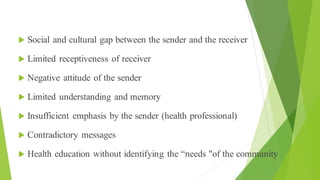
 Social and cultural gap between the sender and the receiver
 Limited receptiveness of receiver
 Negative attitude of the sender
 Limited understanding and memory
 Insufficient emphasis by the sender (health professional)
 Contradictory messages
 Health education without identifying the “needs "of the community
Adoption of new ideas or practice
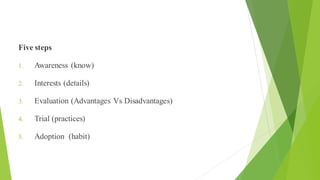
Five steps
1. Awareness (know)
2. Interests (details)
3. Evaluation (Advantages Vs Disadvantages)
4. Trial (practices)
5. Adoption (habit)
Health Education The Process of Change
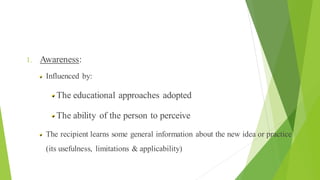
1. Awareness:
Influenced by:
The educational approaches adopted
The ability of the person to perceive
The recipient learns some general information about the new idea or practice
(its usefulness, limitations & applicability)
Health Education The Process of Change

2. Interest:
The recipient seeks more detailed information
He is willing to listen or read more about it
3. Evaluation:
The recipient weighs the pros & cons of the practice, its usefulness to him or his
family resulting in a decision to try or reject the proposed practice.
Health Education The Process of Change
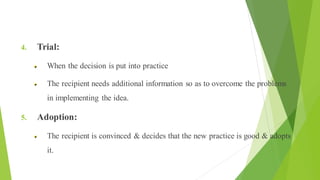
4. Trial:
When the decision is put into practice
The recipient needs additional information so as to overcome the problems
in implementing the idea.
5. Adoption:
The recipient is convinced & decides that the new practice is good & adopts
it.
Process of Health Education
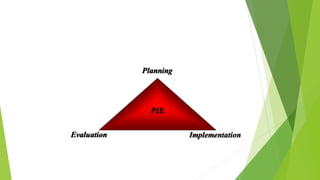
PIE
Planning
Evaluation Implementation
Process of Health Education
1. Planning & Implementation:
❖ Pre-requisites:
1. Identification of the community health problems.
2. Identification of the vulnerable & at-risk groups.
Process of Health Education
 Identification of resources & defining the required inputs from:
The health centre
The local governmental sectors
The community
 Identification of possible barriers, inadequacies & constraints &
alternative methods to overcome them.
Process of Health Education
Set up objectives:
The priority health problems to be tackled
The priority groups to be educated
Choose your methods of communication & material (the message to be passed on
in detail)
Schedule your activities on a time basis (weekly, monthly, biannual, annual), e.g.
day/date/time, Group/#, Venue, Subject, Media, Educator, comment.
Process of Health Education
2. Evaluation:
Should not be left to the end, but should be made from time to time to assess the progress.
Evaluate by using indicators for monitoring:
Structure:
Manpower
Materials (media & facilities)
Process of Health Education
Measure its relevancy by:
The number participating
The frequency of sessions
Outcome:
In terms of achievements throughplan objectives, e.g.
reduction of disease, incidence measured in terms of
numbers, rates & percentages.
Questions

10-public_health_educationppt

  • 1.
    Health Education Created by SunilKumar Gupta PRINCIPAL MDNPC
  • 2.
    Health Education “A processthat informs, motivates& helps peopleto adopt & maintainhealthypractices & lifestyles” Triad Knowledge Practice Attitude
  • 3.
    Importance of HealthEducation  Giving patients handouts about tetanus increased the rate of immunization against tetanus among adults threefold. Cates CJ  An educational booklet on back pain for patients reduced the number of consultations made by patients over the following year & 84% said that they found it useful. RonaldM, Dixon M, JR Coll G
  • 4.
    Aims of HealthEducation 1. To ensure that health is valued as an asset in the community 2. To equip the people with skills, knowledge & attitudes to enable them solve their health problems by their own actions & efforts 3. To promote the development & proper use of health services
  • 5.
    Objectives of HealthEducation (1 of 3) 1. Impart knowledge, this will:  Clear the barriers of ignorance, prejudice & misconceptions  Lead to assuming more responsibility towards one’s health care  Induce awareness about health needs, minimizing the gap between needs & demands
  • 6.
    Objectives of HealthEducation (2 of 3) 2. Motivating people:  The emphasis should be on motivating the consumer to choose his own alternatives about the health actions
  • 7.
    Objectives of HealthEducation (3 of 3) 3. Guiding into action:  The suggested technology must be available, culturally acceptable & economically affordable  The stimulus to continue with the change should be persistent
  • 8.
    Models  Cognitive Model– “Telling people”  Health  Illness  Ways to improving & protecting health & efficient use of the delivery system.  Is it enough?  Why?
  • 9.
    Model  Motivation Model: Reluctance or inability of people to translate information received into practice.  Shortcomings:  Other elements needed  Social & economic factors
  • 10.
    Model Social Intervention Model: Pre-requisitesfor health:  Income  Food  Shelter  Education  Peace  Justice  Equity
  • 11.
    Stages for HealthEducation  Stage of Sensitization  Stage of Publicity  Stage of Education  Stage of Attitude change  Stage of Motivation and Action  Stage of Community Transformation (social change)
  • 12.
    Principles of HealthEducation 1. Interest. 2. Participation. 3. Proceed from known to unknown. 4. Comprehension. 5. Reinforcement by repetition. 6. Motivation 7. Learning by doing 8. People, facts and media. 9. Good human relations 10. Leaders
  • 13.
    Principles of HealthEducation 1. INTEREST: People are unlikely to listen to those who are not of their interest. 2. PARTICIPATION: based on active learning - How? Group discussion, workshops, panel discussions. 3. Start from the KNOWN & lead the people to the UNKNOWN, i.e. knowledge. This will enable the community to develop an in-depth insight into their own health problems.
  • 14.
    Principles of HealthEducation 4. MOTIVATION: By creating the desire in a person to learn through incentives like praise, love, rivalry, rewards, etc. 5. LEARNING BY DOING: Usually leaves a lasting imprint & leads towards positive action
  • 15.
    Principles of HealthEducation 6. GOOD HUMAN RELATIONSHIPS: People must accept you as a friend & well-wisher & have the confidence to confide to you. The personal qualities of the health educator are more important than his technical qualifications
  • 16.
    Principles of HealthEducation 7. LEADERS: People learn best from people who they respect & admire. Try to make use of Community Head, School Teachers, etc.
  • 17.
    Contents of HealthEducation 1. Personal hygiene 2. Proper health habits 3. Nutrition education 4. Personal preventive measures 5. Safety rules 6. Proper use of health services 7. Mental health 8. Sex education 9. Special education (occupation, mothers …..etc)
  • 18.
    Communication  Communicator: theperson or the team gives the message (Educator).  Message: the contents (materials) of health education  Channel: method of carrying the message  Audience: the receivers (users or targets) of the message
  • 19.
    Good Communication Technique Source credibility.  Clear message.  Good channel: individual, group & mass education.  Receiver: ready, interested, not occupied.  Feed back.  Observe non-verbal cues.  Active listing.  Establishing good relationship.
  • 20.
    Educator  Personnel ofHealth Services  Social Worker / Community Worker / Multipurpose Worker  Students  School personnel  Community leaders & influential Requirements:  Personality: popular, influential and interested in work.  Efficiency trained and prepared for the job.  Must show good examples.
  • 21.
    Message  What informationto be communicated.  Simple, at the level of understanding.  Culturally accepted.  Interested.  Meet a felt need.  Avoid technical jargon.  Use audiovisual aids.
  • 22.
    Practice 1. Individual Face toface Education through spoken word. A- Occasions of health appraisal. B- Home
  • 23.
    Practice 2. Group a. Lessonsand lectures in schools. b. lectures in work places e.g. factories. c. Demonstration and training 3. Mass media. 1. Broadcasting: Radio & TV 2. Written word: Newspapers, Posters, Booklets 3. Others e.g. theaters
  • 24.
    Communication Barriers  Socialand cultural gap between the sender and the receiver  Limited receptiveness of receiver  Negative attitude of the sender  Limited understanding and memory  Insufficient emphasis by the sender (health professional)  Contradictory messages  Health education without identifying the “needs "of the community
  • 25.
    Adoption of newideas or practice Five steps 1. Awareness (know) 2. Interests (details) 3. Evaluation (Advantages Vs Disadvantages) 4. Trial (practices) 5. Adoption (habit)
  • 26.
    Health Education TheProcess of Change 1. Awareness: Influenced by: The educational approaches adopted The ability of the person to perceive The recipient learns some general information about the new idea or practice (its usefulness, limitations & applicability)
  • 27.
    Health Education TheProcess of Change 2. Interest: The recipient seeks more detailed information He is willing to listen or read more about it 3. Evaluation: The recipient weighs the pros & cons of the practice, its usefulness to him or his family resulting in a decision to try or reject the proposed practice.
  • 28.
    Health Education TheProcess of Change 4. Trial: When the decision is put into practice The recipient needs additional information so as to overcome the problems in implementing the idea. 5. Adoption: The recipient is convinced & decides that the new practice is good & adopts it.
  • 29.
    Process of HealthEducation PIE Planning Evaluation Implementation
  • 30.
    Process of HealthEducation 1. Planning & Implementation: ❖ Pre-requisites: 1. Identification of the community health problems. 2. Identification of the vulnerable & at-risk groups.
  • 31.
    Process of HealthEducation  Identification of resources & defining the required inputs from: The health centre The local governmental sectors The community  Identification of possible barriers, inadequacies & constraints & alternative methods to overcome them.
  • 32.
    Process of HealthEducation Set up objectives: The priority health problems to be tackled The priority groups to be educated Choose your methods of communication & material (the message to be passed on in detail) Schedule your activities on a time basis (weekly, monthly, biannual, annual), e.g. day/date/time, Group/#, Venue, Subject, Media, Educator, comment.
  • 33.
    Process of HealthEducation 2. Evaluation: Should not be left to the end, but should be made from time to time to assess the progress. Evaluate by using indicators for monitoring: Structure: Manpower Materials (media & facilities)
  • 34.
    Process of HealthEducation Measure its relevancy by: The number participating The frequency of sessions Outcome: In terms of achievements throughplan objectives, e.g. reduction of disease, incidence measured in terms of numbers, rates & percentages.
  • 35.