트리플헬릭스:
 산학협력에서 산학융합으로

    박한우 교수

 영남대 언론정보학과
영남대 사이버감성연구소
아시아트리플헬릭스학회

  TEDxPalgong
대구경북소셜미디어포럼

네델란드왕립아카데미(전)
옥스퍼드인터넷연구소(전)

 hanpark@ynu.ac.kr
  www.hanpark.net
The Origins of the Triple Helix Model
  The Triple Helix thesis emerged from a confluence
   between Etzkowitz’ longer-term interest in the study of
   university-industry relations (e.g., Etzkowitz, 2002) and
   Leydesdorff’s interest in an evolutionary model that can
   generate a next-order hyper-cycle—or in terms of the
   TH, an overlay of communications (cf. Leydesdorff,
   1995).
  After Etzkowitz’ (1994) participation in a workshop and a
   proceedings volume, the metaphor of a Triple Helix
   emerged in discussions about organizing a follow-up
   conference under this title in Amsterdam in January
   1996 (Etzkowitz & Leydesdorff, 1995).
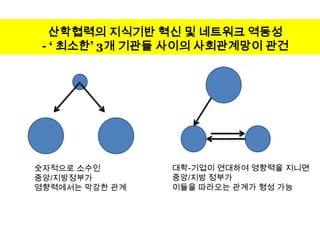
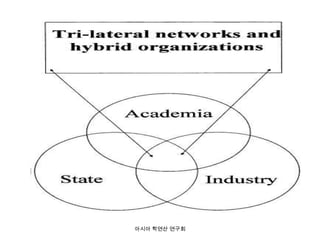
산학협력의 지식기반 혁신 및 네트워크 역동성
 - ‘ 최소한’ 3개 기관들 사이의 사회관계망이 관건


숫자적으로 소수인       대학-기업이 연대하여 영향력을 지니면
중앙/지방정부가        중앙/지방 정부가
영향력에서는 막강한 관계   이들을 따라오는 관계가 형성 가능
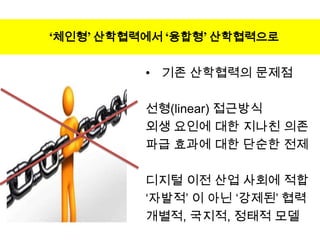
‘체인형’ 산학협력에서 ‘융합형’ 산학협력으로


          • 기존 산학협력의 문제점

          선형(linear) 접근방식
          외생 요인에 대한 지나친 의존
          파급 효과에 대한 단순한 전제

          디지털 이전 산업 사회에 적합
          ‘자발적’ 이 아닌 ‘강제된’ 협력
          개별적, 국지적, 정태적 모델
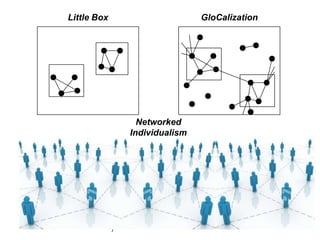
Little Box                   GloCalization


               Networked
             Individualism
M.Castells (2009), 커뮤니케이션 파워
   1) Networking power(네트워킹 파워): 누가 그리고 무엇
    이 네트워크에 포함되는지를 결정하는 힘. ‘Mass self-
    communication’, 개인의 메시지를 대중에게 전달하기 위
    해 뉴미디어를 사용함.
   2) Network power(네트워크 파워): 네트워크 커뮤니케이
    션 프로토콜의 힘. Mass self-communication에서 포맷의
    다양성은 규칙이며 이는 메시지 전파를 증폭시킴.
   3) Networked power(네트워크된 파워): 네트워크 내에서
    다른 노드(node)에 대해 특정 노드가 가지는 힘. 이는 네트
    워크를 소유 또는 운영하는 조직 내에서의 관리, 아젠다 세
    팅, 편집, 그리고 의사 결정하는 힘을 뜻함
   4) Network-making power(네트워크 메이킹 파워): 멀티미
    디어 또는 전통적인 매스 커뮤니케이션의 네트워크가 소
    유자와 통제자에 의해 형성되고 프로그램되도록 하는 능
    력
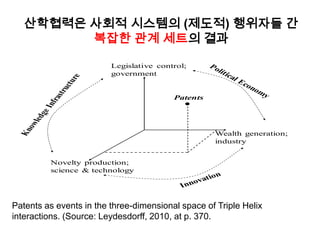
산학협력은 사회적 시스템의 (제도적) 행위자들 간
         복잡한 관계 세트의 결과

                         Legislative control;
                         government


                                         Patents


                                                   Wealth generation;
                                                   industry


         Novelty production;
         science & technology


Patents as events in the three-dimensional space of Triple Helix
interactions. (Source: Leydesdorff, 2010, at p. 370.
기존 산학관 협력 모델의 문제점

• 자유방임형 모델

• 인적 자원, 혁신, 지식 교환에 기반한 긍정적인
  외적 영향을 이끌어 내는 내생 요인의 부족

• (1) 경제 교환 관계, (2) 새로운 것의 조직화된 생
  산, (3) 규범적 통제 메커니즘이라는 세 개의 하
  부 역학(subdynamics)은 적절한 인터페이스에
  서 운영되어야 함
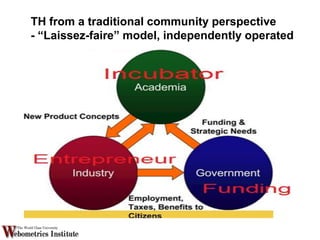
TH from a traditional community perspective
- “Laissez-faire” model, independently operated
아시아 학연산 연구회
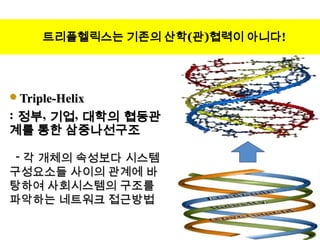
트리플헬릭스는 기존의 산학(관)협력이 아니다!


 Triple-Helix
: 정부, 기업, 대학의 협동관
계를 통한 삼중나선구조

 - 각 개체의 속성보다 시스템
구성요소들 사이의 관계에 바
탕하여 사회시스템의 구조를
파악하는 네트워크 접근방법
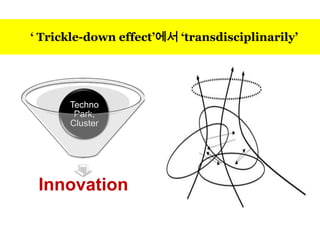
‘ Trickle-down effect’에서 ‘transdisciplinarily’


      Techno
       Park,
      Cluster


 Innovation
Endogenous VS Exogenous
•   TH는 endogenous 요인강조
•   혁신은 시스템 내부에서!
•   human capital, innovation, knowledge transfer
•   positive externalities
•   spillover effects
•   institutional collaborations among UIG

• endogenous is when the infection originates
  within the body and exogenous means the
  infection originates outside of the body
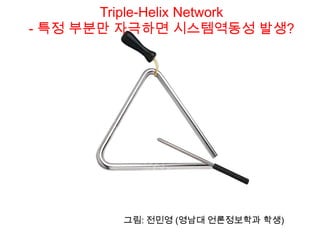
Triple-Helix Network
- 특정 부분만 자극하면 시스템역동성 발생?


         그림: 전민영 (영남대 언론정보학과 학생)
공통적인 오해

• TH 접근 방식은 산학 관계 또는 정부-대학
  협력의 중요성을 부인한다?
• 이는 전혀 사실이 아니다!!
• TH는 분명 더블-헬릭스 제도의 영향을
  받지만, 우리는 세 행위자의 상호작용을
  관찰함으로써 흥미로운 숨겨진 결과
  이상을 기대할 수 있다고 주장한다


           아시아 학연산 연구회
2 차원에서 상호 정보 :
    Tij =   Hi + Hj – Hij
    Tij ≥   0
3차원에서 상호 정보:

    TUIG = HU + HI + HG
           – HUI – HIG – HUG
           + HUIG

    TUIG 는 잠재적으로 마이너스

            마이너스 엔트로피는 네트워크 수준의
            상호 관계의 결과가 될 수 있음.

            이 설정은 불확실성을 감소시킴.
                            아시아 학연산 연구회
아시아 학연산 연구회
UIG가 언제나 필요한가? 아니다!

• TH의 목적은 한 쌍의 행위자들 간의 상호
  관계를 관련된 (중요한) 타자(들)를 고려해
  살펴 보는 것!

• 세 명의 행위자들이 권고 되지만 각
  행위자가 자신의 업무 수행을 개선하고,
  타자의 행위에 영향을 미치고/또는 타자의
  혁신의 또 다른 원천이 된다면, 그보다 많은
  수의 n-헬릭스(helix)도 언제나 가능함.
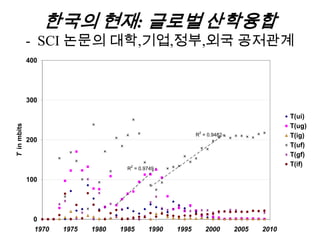
한국의 현재: 글로벌 산학융합
             - SCI 논문의 대학,기업,정부,외국 공저관계
             400


             300

                                                                                       T(ui)
T in mbits


                                                                                       T(ug)
                                                           R2 = 0.9482                 T(ig)
             200
                                                                                       T(uf)
                                                                                       T(gf)
                                                                                       T(if)
                                     R2 = 0.9749

             100


              0
              1970   1975   1980   1985      1990   1995      2000       2005   2010
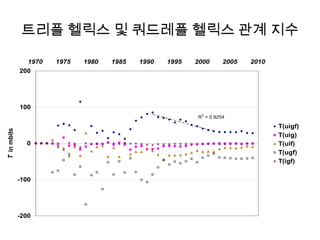
트리플 헬릭스 및 쿼드레플 헬릭스 관계 지수

               1970   1975   1980   1985   1990   1995   2000      2005   2010
             200


             100
                                                         R2 = 0.9254

                                                                                 T(uigf)
T in mbits


                                                                                 T(uig)
               0                                                                 T(uif)
                                                                                 T(ugf)
                                                                                 T(igf)

             -100


             -200
TH 행위자와 분석 단위
• (개인, 단체, 기관, 도시, 지방, 국가 등)
  모든 사회적 행위자들이 나선형으로
  일어나는 창의성 개발에 영향을
  미친다면 이는 TH 혁신의 구성요소가
  될 수 있다.
• 나는 (L. Leydesdorff와 함께 협력하고
  있는) 커뮤니케이션과 정보
  과학자로서, 어떻게 (정보공유의
  측면에서) 의미의 사회학적 관념이
  제도적 agent 사이에서 교환되는지에
  관심을 갖고 있다.
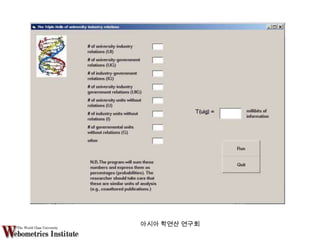
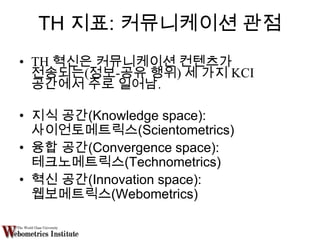
TH 지표: 커뮤니케이션 관점
• TH 혁신은 커뮤니케이션 컨텐츠가
  전송되는(정보-공유 행위) 세 가지 KCI
  공간에서 주로 일어남.

• 지식 공간(Knowledge space):
  사이언토메트릭스(Scientometrics)
• 융합 공간(Convergence space):
  테크노메트릭스(Technometrics)
• 혁신 공간(Innovation space):
  웹보메트릭스(Webometrics)
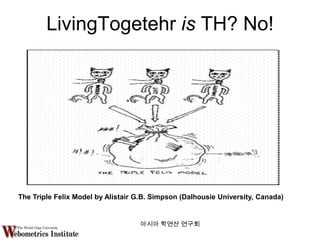
LivingTogetehr is TH? No!


The Triple Felix Model by Alistair G.B. Simpson (Dalhousie University, Canada)


                                   아시아 학연산 연구회
Triple Helix Innovation: An
   Institutional Units Framework
• The Triple Helix Innovation process, on the other hand, is
  characterized by academia (A), government (G), and industry
  (I) playing fully integrated and overlapping roles.
• This process typically begins with the formation of a social
  mission, which may arise in any sector but is often
  championed by government. Once the social mission is
  established, AGI institutional units are drawn into collaborative
  funding, R&D, and commercialization processes.
• Under such collaborative arrangements, it is not surprising
  that academia, government, and industry may fund R&D to
  achieve a social mission. Similarly, all three institutional units
  may perform the R&D. To a lesser extent, academia and
  government may commercialize new knowledge, technology,
  or products and services—a pursuit traditionally reserved for
  industry.
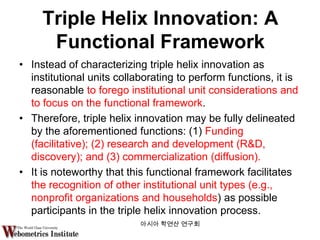
Triple Helix Innovation: A
      Functional Framework
• Instead of characterizing triple helix innovation as
  institutional units collaborating to perform functions, it is
  reasonable to forego institutional unit considerations and
  to focus on the functional framework.
• Therefore, triple helix innovation may be fully delineated
  by the aforementioned functions: (1) Funding
  (facilitative); (2) research and development (R&D,
  discovery); and (3) commercialization (diffusion).
• It is noteworthy that this functional framework facilitates
  the recognition of other institutional unit types (e.g.,
  nonprofit organizations and households) as possible
  participants in the triple helix innovation process.
                           아시아 학연산 연구회
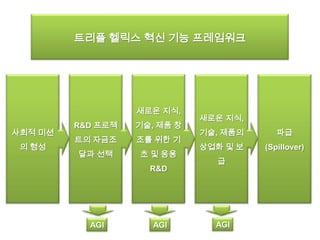
트리플 헬릭스 혁신 기능 프레임워크


                   새로운 지식,
                              새로운 지식,
         R&D 프로젝   기술, 제품 창
사회적 미션                        기술, 제품의      파급
         트의 자금조    조를 위한 기
 의 형성                         상업화 및 보   (Spillover)
         달과 선택     초 및 응용
                                급
                     R&D


           AGI        AGI       AGI
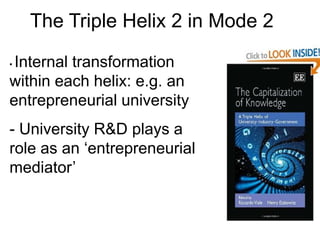
The Triple Helix 2 in Mode 2

•Internal transformation
within each helix: e.g. an
entrepreneurial university
- University R&D plays a
role as an ‘entrepreneurial
mediator’
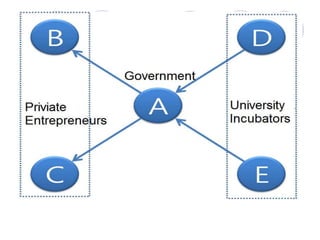
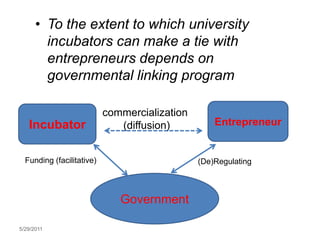
• To the extent to which university
        incubators can make a tie with
        entrepreneurs depends on
        governmental linking program

                           commercialization
   Incubator                  (diffusion)          Entrepreneur


  Funding (facilitative)                       (De)Regulating


                              Government

5/29/2011
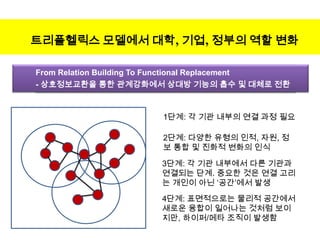
트리플헬릭스 모델에서 대학, 기업, 정부의 역할 변화

From Relation Building To Functional Replacement
- 상호정보교환을 통한 관계강화에서 상대방 기능의 흡수 및 대체로 전환


                        1단계: 각 기관 내부의 연결 과정 필요

                        2단계: 다양한 유형의 인적, 자원, 정
                        보 통합 및 진화적 변화의 인식

                       3단계: 각 기관 내부에서 다른 기관과
                       연결되는 단계. 중요한 것은 연결 고리
                       는 개인이 아닌 ‘공간’에서 발생
                       4단계: 표면적으로는 물리적 공간에서
                       새로운 융합이 일어나는 것처럼 보이
                       지만, 하이퍼/메타 조직이 발생함
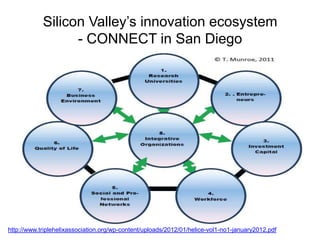
Silicon Valley’s innovation ecosystem
                  - CONNECT in San Diego


http://www.triplehelixassociation.org/wp-content/uploads/2012/01/helice-vol1-no1-january2012.pdf
Discussion issues
Configurations may
constrain the further TH
developments at national
system level by
generating more
uncertainty than can be
managed by three TH
actors

- L. Leydesdorff


                           아시아 학연산 연구회

트리플헬릭스 산학협력에서 산학융합으로(10_july2012)

  • 1.
    트리플헬릭스: 산학협력에서 산학융합으로 박한우 교수 영남대 언론정보학과 영남대 사이버감성연구소 아시아트리플헬릭스학회 TEDxPalgong 대구경북소셜미디어포럼 네델란드왕립아카데미(전) 옥스퍼드인터넷연구소(전) hanpark@ynu.ac.kr www.hanpark.net
  • 2.
    The Origins ofthe Triple Helix Model  The Triple Helix thesis emerged from a confluence between Etzkowitz’ longer-term interest in the study of university-industry relations (e.g., Etzkowitz, 2002) and Leydesdorff’s interest in an evolutionary model that can generate a next-order hyper-cycle—or in terms of the TH, an overlay of communications (cf. Leydesdorff, 1995).  After Etzkowitz’ (1994) participation in a workshop and a proceedings volume, the metaphor of a Triple Helix emerged in discussions about organizing a follow-up conference under this title in Amsterdam in January 1996 (Etzkowitz & Leydesdorff, 1995).
  • 4.
    산학협력의 지식기반 혁신및 네트워크 역동성 - ‘ 최소한’ 3개 기관들 사이의 사회관계망이 관건 숫자적으로 소수인 대학-기업이 연대하여 영향력을 지니면 중앙/지방정부가 중앙/지방 정부가 영향력에서는 막강한 관계 이들을 따라오는 관계가 형성 가능
  • 7.
    ‘체인형’ 산학협력에서 ‘융합형’산학협력으로 • 기존 산학협력의 문제점 선형(linear) 접근방식 외생 요인에 대한 지나친 의존 파급 효과에 대한 단순한 전제 디지털 이전 산업 사회에 적합 ‘자발적’ 이 아닌 ‘강제된’ 협력 개별적, 국지적, 정태적 모델
  • 8.
    Little Box GloCalization Networked Individualism
  • 9.
    M.Castells (2009), 커뮤니케이션파워  1) Networking power(네트워킹 파워): 누가 그리고 무엇 이 네트워크에 포함되는지를 결정하는 힘. ‘Mass self- communication’, 개인의 메시지를 대중에게 전달하기 위 해 뉴미디어를 사용함.  2) Network power(네트워크 파워): 네트워크 커뮤니케이 션 프로토콜의 힘. Mass self-communication에서 포맷의 다양성은 규칙이며 이는 메시지 전파를 증폭시킴.  3) Networked power(네트워크된 파워): 네트워크 내에서 다른 노드(node)에 대해 특정 노드가 가지는 힘. 이는 네트 워크를 소유 또는 운영하는 조직 내에서의 관리, 아젠다 세 팅, 편집, 그리고 의사 결정하는 힘을 뜻함  4) Network-making power(네트워크 메이킹 파워): 멀티미 디어 또는 전통적인 매스 커뮤니케이션의 네트워크가 소 유자와 통제자에 의해 형성되고 프로그램되도록 하는 능 력
  • 10.
    산학협력은 사회적 시스템의(제도적) 행위자들 간 복잡한 관계 세트의 결과 Legislative control; government Patents Wealth generation; industry Novelty production; science & technology Patents as events in the three-dimensional space of Triple Helix interactions. (Source: Leydesdorff, 2010, at p. 370.
  • 11.
    기존 산학관 협력모델의 문제점 • 자유방임형 모델 • 인적 자원, 혁신, 지식 교환에 기반한 긍정적인 외적 영향을 이끌어 내는 내생 요인의 부족 • (1) 경제 교환 관계, (2) 새로운 것의 조직화된 생 산, (3) 규범적 통제 메커니즘이라는 세 개의 하 부 역학(subdynamics)은 적절한 인터페이스에 서 운영되어야 함
  • 12.
    TH from atraditional community perspective - “Laissez-faire” model, independently operated
  • 13.
  • 14.
    트리플헬릭스는 기존의 산학(관)협력이아니다!  Triple-Helix : 정부, 기업, 대학의 협동관 계를 통한 삼중나선구조 - 각 개체의 속성보다 시스템 구성요소들 사이의 관계에 바 탕하여 사회시스템의 구조를 파악하는 네트워크 접근방법
  • 15.
    ‘ Trickle-down effect’에서‘transdisciplinarily’ Techno Park, Cluster Innovation
  • 16.
    Endogenous VS Exogenous • TH는 endogenous 요인강조 • 혁신은 시스템 내부에서! • human capital, innovation, knowledge transfer • positive externalities • spillover effects • institutional collaborations among UIG • endogenous is when the infection originates within the body and exogenous means the infection originates outside of the body
  • 17.
    Triple-Helix Network - 특정부분만 자극하면 시스템역동성 발생? 그림: 전민영 (영남대 언론정보학과 학생)
  • 18.
    공통적인 오해 • TH접근 방식은 산학 관계 또는 정부-대학 협력의 중요성을 부인한다? • 이는 전혀 사실이 아니다!! • TH는 분명 더블-헬릭스 제도의 영향을 받지만, 우리는 세 행위자의 상호작용을 관찰함으로써 흥미로운 숨겨진 결과 이상을 기대할 수 있다고 주장한다 아시아 학연산 연구회
  • 19.
    2 차원에서 상호정보 : Tij = Hi + Hj – Hij Tij ≥ 0 3차원에서 상호 정보: TUIG = HU + HI + HG – HUI – HIG – HUG + HUIG TUIG 는 잠재적으로 마이너스 마이너스 엔트로피는 네트워크 수준의 상호 관계의 결과가 될 수 있음. 이 설정은 불확실성을 감소시킴. 아시아 학연산 연구회
  • 20.
  • 21.
    UIG가 언제나 필요한가?아니다! • TH의 목적은 한 쌍의 행위자들 간의 상호 관계를 관련된 (중요한) 타자(들)를 고려해 살펴 보는 것! • 세 명의 행위자들이 권고 되지만 각 행위자가 자신의 업무 수행을 개선하고, 타자의 행위에 영향을 미치고/또는 타자의 혁신의 또 다른 원천이 된다면, 그보다 많은 수의 n-헬릭스(helix)도 언제나 가능함.
  • 22.
    한국의 현재: 글로벌산학융합 - SCI 논문의 대학,기업,정부,외국 공저관계 400 300 T(ui) T in mbits T(ug) R2 = 0.9482 T(ig) 200 T(uf) T(gf) T(if) R2 = 0.9749 100 0 1970 1975 1980 1985 1990 1995 2000 2005 2010
  • 23.
    트리플 헬릭스 및쿼드레플 헬릭스 관계 지수 1970 1975 1980 1985 1990 1995 2000 2005 2010 200 100 R2 = 0.9254 T(uigf) T in mbits T(uig) 0 T(uif) T(ugf) T(igf) -100 -200
  • 24.
    TH 행위자와 분석단위 • (개인, 단체, 기관, 도시, 지방, 국가 등) 모든 사회적 행위자들이 나선형으로 일어나는 창의성 개발에 영향을 미친다면 이는 TH 혁신의 구성요소가 될 수 있다. • 나는 (L. Leydesdorff와 함께 협력하고 있는) 커뮤니케이션과 정보 과학자로서, 어떻게 (정보공유의 측면에서) 의미의 사회학적 관념이 제도적 agent 사이에서 교환되는지에 관심을 갖고 있다.
  • 26.
    TH 지표: 커뮤니케이션관점 • TH 혁신은 커뮤니케이션 컨텐츠가 전송되는(정보-공유 행위) 세 가지 KCI 공간에서 주로 일어남. • 지식 공간(Knowledge space): 사이언토메트릭스(Scientometrics) • 융합 공간(Convergence space): 테크노메트릭스(Technometrics) • 혁신 공간(Innovation space): 웹보메트릭스(Webometrics)
  • 27.
    LivingTogetehr is TH?No! The Triple Felix Model by Alistair G.B. Simpson (Dalhousie University, Canada) 아시아 학연산 연구회
  • 28.
    Triple Helix Innovation:An Institutional Units Framework • The Triple Helix Innovation process, on the other hand, is characterized by academia (A), government (G), and industry (I) playing fully integrated and overlapping roles. • This process typically begins with the formation of a social mission, which may arise in any sector but is often championed by government. Once the social mission is established, AGI institutional units are drawn into collaborative funding, R&D, and commercialization processes. • Under such collaborative arrangements, it is not surprising that academia, government, and industry may fund R&D to achieve a social mission. Similarly, all three institutional units may perform the R&D. To a lesser extent, academia and government may commercialize new knowledge, technology, or products and services—a pursuit traditionally reserved for industry.
  • 29.
    Triple Helix Innovation:A Functional Framework • Instead of characterizing triple helix innovation as institutional units collaborating to perform functions, it is reasonable to forego institutional unit considerations and to focus on the functional framework. • Therefore, triple helix innovation may be fully delineated by the aforementioned functions: (1) Funding (facilitative); (2) research and development (R&D, discovery); and (3) commercialization (diffusion). • It is noteworthy that this functional framework facilitates the recognition of other institutional unit types (e.g., nonprofit organizations and households) as possible participants in the triple helix innovation process. 아시아 학연산 연구회
  • 30.
    트리플 헬릭스 혁신기능 프레임워크 새로운 지식, 새로운 지식, R&D 프로젝 기술, 제품 창 사회적 미션 기술, 제품의 파급 트의 자금조 조를 위한 기 의 형성 상업화 및 보 (Spillover) 달과 선택 초 및 응용 급 R&D AGI AGI AGI
  • 31.
    The Triple Helix2 in Mode 2 •Internal transformation within each helix: e.g. an entrepreneurial university - University R&D plays a role as an ‘entrepreneurial mediator’
  • 32.
    • To theextent to which university incubators can make a tie with entrepreneurs depends on governmental linking program commercialization Incubator (diffusion) Entrepreneur Funding (facilitative) (De)Regulating Government 5/29/2011
  • 33.
    트리플헬릭스 모델에서 대학,기업, 정부의 역할 변화 From Relation Building To Functional Replacement - 상호정보교환을 통한 관계강화에서 상대방 기능의 흡수 및 대체로 전환 1단계: 각 기관 내부의 연결 과정 필요 2단계: 다양한 유형의 인적, 자원, 정 보 통합 및 진화적 변화의 인식 3단계: 각 기관 내부에서 다른 기관과 연결되는 단계. 중요한 것은 연결 고리 는 개인이 아닌 ‘공간’에서 발생 4단계: 표면적으로는 물리적 공간에서 새로운 융합이 일어나는 것처럼 보이 지만, 하이퍼/메타 조직이 발생함
  • 34.
    Silicon Valley’s innovationecosystem - CONNECT in San Diego http://www.triplehelixassociation.org/wp-content/uploads/2012/01/helice-vol1-no1-january2012.pdf
  • 35.
    Discussion issues Configurations may constrainthe further TH developments at national system level by generating more uncertainty than can be managed by three TH actors - L. Leydesdorff 아시아 학연산 연구회

Editor's Notes

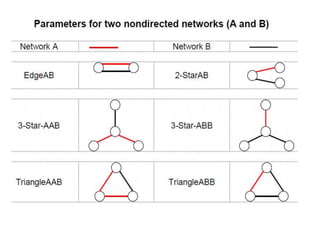
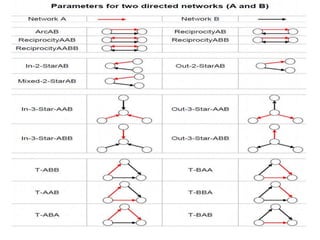
  • #5 추상적인 그래프로 이해하면 이렇게 두 가지라는 걸 알 수 있음
  • #8 연결이 중요한 것이 아니라 연결’망’즉 망의 구조가 중요한 것
  • #15 연결이 중요한 것이 아니라 연결’망’즉 망의 구조가 중요한 것
  • #16 연결이 중요한 것이 아니라 연결’망’즉 망의 구조가 중요한 것