10.2 sampling.notebook                                             March 26, 2013

           Write down the definitions for the types of sampling.

           convenience sample:


           self­selected sample:


           systematic sample:


           random sample:
10.2 sampling.notebook                                                                    March 26, 2013


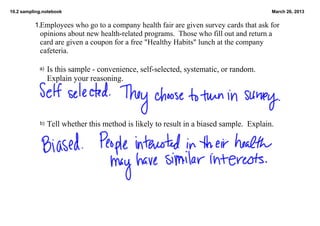
            Employees who go to a company health fair are given survey cards that ask for 
          1. 
            opinions about new health­related programs.  Those who fill out and return a 
            card are given a coupon for a free "Healthy Habits" lunch at the company 
            cafeteria.

            a)   Is this sample ­ convenience, self­selected, systematic, or random.  
                 Explain your reasoning.


            b)   Tell whether this method is likely to result in a biased sample.  Explain.
10.2 sampling.notebook                                                                  March 26, 2013


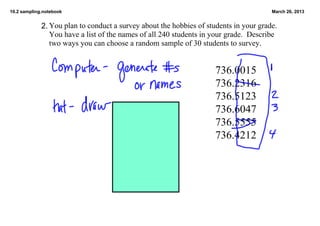
             2. You plan to conduct a survey about the hobbies of students in your grade.  
                You have a list of the names of all 240 students in your grade.  Describe
                two ways you can choose a random sample of 30 students to survey.


                                                                     736.0015
                                                                     736.2316
                                                                     736.5123
                                                                     736.6047
                                                                     736.5555
                                                                     736.4212
10.2 sampling.notebook                                                                  March 26, 2013

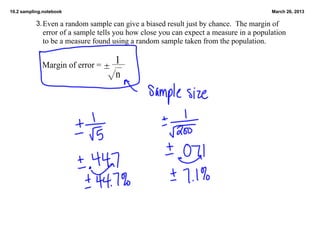
           3. Even a random sample can give a biased result just by chance.  The margin of 
             error of a sample tells you how close you can expect a measure in a population 
             to be a measure found using a random sample taken from the population.


             Margin of error = ±
                                     1
                                  √n
10.2 sampling.notebook                                                                       March 26, 2013


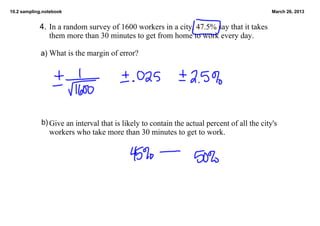
            4.  In a random survey of 1600 workers in a city, 47.5% say that it takes 
                them more than 30 minutes to get from home to work every day.

             a) What is the margin of error?


             b) Give an interval that is likely to contain the actual percent of all the city's
                workers who take more than 30 minutes to get to work.

10.2 types of sampling

  • 1.
    10.2 sampling.notebook March 26, 2013 Write down the definitions for the types of sampling. convenience sample: self­selected sample: systematic sample: random sample:
  • 2.
    10.2 sampling.notebook March 26, 2013 Employees who go to a company health fair are given survey cards that ask for  1.  opinions about new health­related programs.  Those who fill out and return a  card are given a coupon for a free "Healthy Habits" lunch at the company  cafeteria. a) Is this sample ­ convenience, self­selected, systematic, or random.   Explain your reasoning. b) Tell whether this method is likely to result in a biased sample.  Explain.
  • 3.
    10.2 sampling.notebook March 26, 2013 2. You plan to conduct a survey about the hobbies of students in your grade.   You have a list of the names of all 240 students in your grade.  Describe two ways you can choose a random sample of 30 students to survey. 736.0015 736.2316 736.5123 736.6047 736.5555 736.4212
  • 4.
    10.2 sampling.notebook March 26, 2013 3. Even a random sample can give a biased result just by chance.  The margin of  error of a sample tells you how close you can expect a measure in a population  to be a measure found using a random sample taken from the population. Margin of error = ±    1 √n
  • 5.
    10.2 sampling.notebook March 26, 2013 4.  In a random survey of 1600 workers in a city, 47.5% say that it takes  them more than 30 minutes to get from home to work every day. a) What is the margin of error? b) Give an interval that is likely to contain the actual percent of all the city's workers who take more than 30 minutes to get to work.