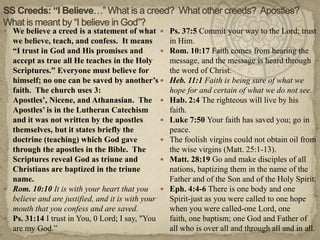
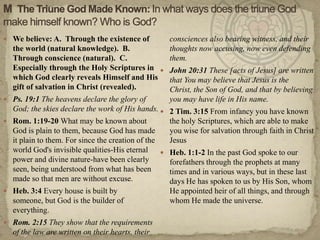
Chain the Catechism: A topical study through the Lutheran confessionsApostle’s Creed IntroMemorization Verses:  Rm 10:10  It is with your heart…Heb 11:1  Faith is…. Ps 19:1  The heavens…Rm 2:15  They show that the requirements…Jn 20:31  These [acts of Jesus] are written…
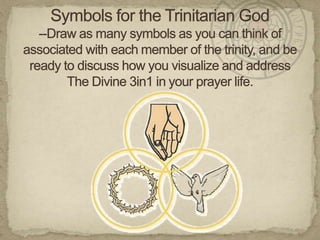
Symbols for the Trinitarian God--Draw as many symbols as you can think of associated with each member of the trinity, and be ready to discuss how you visualize and address The Divine 3in1 in your prayer life.
God is three in one, three in one, three in one…The Father makes us all.  The Son sets us free.The Ho-ly Spirit breathes life in me.  Three in One
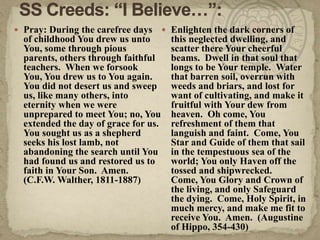
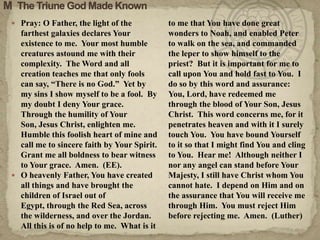
Heavenly Father….Dear Jesus…O Holy Spirit…Pray
LSB 953  lutheran-hymnal.com/online/tlh-252.mid G-|GBAG|FFG-|FGAG|FFE-1. We All Believe in One True GodFather, Son, and Holy Ghost,Ever-present Help in need,Praised by all the heavenly host,By whose mighty power aloneAll is made and wrought and done.2. We all believe in Jesus Christ,Son of God and Mary's Son,Who descended from His thronesAnd for us salvation won;By whose cross and death are weRescued from all misery.3. We all confess the Holy Ghost,Who from both fore'er proceeds;Who uphold and comforts usIn all trials, fears, and needs.Blest and holy Trinity,Praise forever be to Thee!
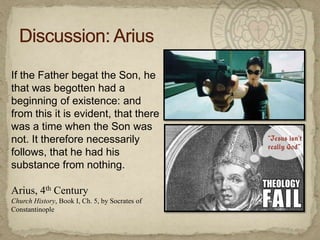
Discussion: AriusIf the Father begat the Son, he that was begotten had a beginning of existence: and from this it is evident, that there was a time when the Son was not. It therefore necessarily follows, that he had his substance from nothing.Arius, 4th CenturyChurch History, Book I, Ch. 5, by Socrates of Constantinople
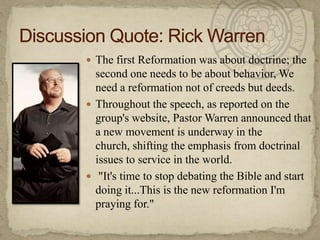
Discussion Quote: Rick WarrenThe first Reformation was about doctrine; the second one needs to be about behavior, We need a reformation not of creeds but deeds.Throughout the speech, as reported on the group's website, Pastor Warren announced that a new movement is underway in the church, shifting the emphasis from doctrinal issues to service in the world."It's time to stop debating the Bible and start doing it...This is the new reformation I'm praying for."
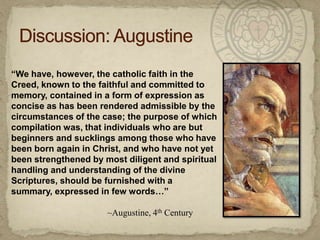
Discussion: Augustine“We have, however, the catholic faith in the Creed, known to the faithful and committed to memory, contained in a form of expression as concise as has been rendered admissible by the circumstances of the case; the purpose of which compilation was, that individuals who are but beginners and sucklings among those who have been born again in Christ, and who have not yet been strengthened by most diligent and spiritual handling and understanding of the divine Scriptures, should be furnished with a summary, expressed in few words…”			~Augustine, 4th Century
Discussion Quote: Large CatechismNow, there properly follows the Creed, which sets forth to us everything that we must expect and receive from God, and, to state it quite briefly, teaches us to know Him fully. 2] And this is intended to help us do that which according to the Ten Commandments we ought to do. For (as said above) they are set so high that all human ability is far too feeble and weak to [attain to or] keep them. Therefore it is as necessary to learn this part as the former in order that we may know how to attain thereto, whence and whereby to obtain such power. 
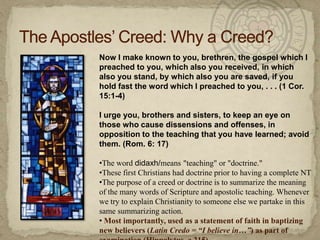
The Apostles’ Creed: Why a Creed?Now I make known to you, brethren, the gospel which I preached to you, which also you received, in which also you stand, by which also you are saved, if you hold fast the word which I preached to you, . . . (1 Cor. 15:1-4)I urge you, brothers and sisters, to keep an eye on those who cause dissensions and offenses, in opposition to the teaching that you have learned; avoid them. (Rom. 6: 17)The word didaxh/means"teaching" or "doctrine."
These first Christians had doctrine prior to having a complete NT
The purpose of a creed or doctrine is to summarize the meaning of the many words of Scripture and apostolic teaching. Whenever we try to explain Christianity to someone else we partake in this same summarizing action. 
Most importantly, used as a statement of faith in baptizing new believers (Latin Credo = “I believe in…”) as part of examination (Hippolytus, c.215)The Apostles’ Creed: HistoryBased on the Matthew 25 text regarding the nature and name of baptism (Father, Son, Holy Spirit)
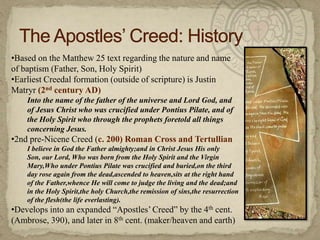
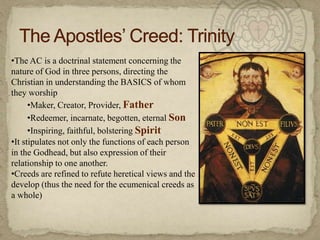
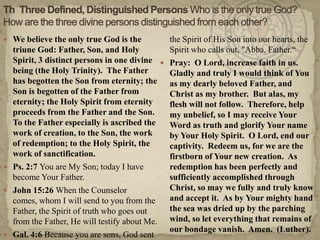
Earliest Creedal formation (outside of scripture) is Justin Matryr(2nd century AD)Into the name of the father of the universe and Lord God, and of Jesus Christ who was crucified under Pontius Pilate, and of the Holy Spirit who through the prophets foretold all things concerning Jesus.2nd pre-Nicene Creed (c. 200) Roman Cross and TertullianI believe in God the Father almighty;and in Christ Jesus His only Son, our Lord, Who was born from the Holy Spirit and the Virgin Mary,Who under Pontius Pilate was crucified and buried,on the third day rose again from the dead,ascended to heaven,sits at the right hand of the Father,whence He will come to judge the living and the dead;and in the Holy Spirit,the holy Church,the remission of sins,the resurrection of the flesh(the life everlasting).Develops into an expanded “Apostles’ Creed” by the 4th cent. (Ambrose, 390), and later in 8th cent. (maker/heaven and earth)The Apostles’ Creed: TrinityThe AC is a doctrinal statement concerning the nature of God in three persons, directing the Christian in understanding the BASICS of whom they worship
Maker, Creator, Provider, Father
Redeemer, incarnate, begotten, eternal Son
Inspiring, faithful, bolstering Spirit
It stipulates not only the functions of each person in the Godhead, but also expression of their relationship to one another.
Creeds are refined to refute heretical views and the develop (thus the need for the ecumenical creeds as a whole)The Apostles’ Creed: TrinitySelf-Apparent difference between “being” and “person”
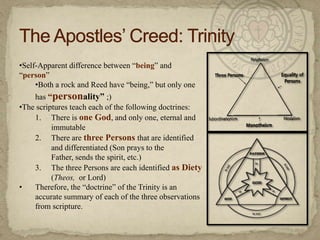
Both a rock and Reed have “being,” but only one has “personality” ;)
The scriptures teach each of the following doctrines:There is one God, and only one, eternal and immutableThere are three Persons that are identified and differentiated (Son prays to the Father, sends the spirit, etc.)The three Persons are each identified asDiety(Theos,  or Lord)Therefore, the “doctrine” of the Trinity is an accurate summary of each of the three observations from scripture.The Apostles’ Creed: ApplicationEmphasis on Christ as savior
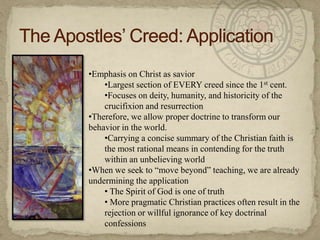
Largest section of EVERY creed since the 1st cent.
Focuses on deity, humanity, and historicity of the crucifixion and resurrection
Therefore, we allow proper doctrine to transform our behavior in the world.
Carrying a concise summary of the Christian faith is the most rational means in contending for the truth within an unbelieving world

10.12.03 apostles' creed intro

  • 1.
    Chain the Catechism:A topical study through the Lutheran confessionsApostle’s Creed IntroMemorization Verses: Rm 10:10 It is with your heart…Heb 11:1 Faith is…. Ps 19:1 The heavens…Rm 2:15 They show that the requirements…Jn 20:31 These [acts of Jesus] are written…
  • 2.
    Symbols for theTrinitarian God--Draw as many symbols as you can think of associated with each member of the trinity, and be ready to discuss how you visualize and address The Divine 3in1 in your prayer life.
  • 3.
    God is threein one, three in one, three in one…The Father makes us all. The Son sets us free.The Ho-ly Spirit breathes life in me. Three in One
  • 4.
  • 5.
    LSB 953 lutheran-hymnal.com/online/tlh-252.mid G-|GBAG|FFG-|FGAG|FFE-1. We All Believe in One True GodFather, Son, and Holy Ghost,Ever-present Help in need,Praised by all the heavenly host,By whose mighty power aloneAll is made and wrought and done.2. We all believe in Jesus Christ,Son of God and Mary's Son,Who descended from His thronesAnd for us salvation won;By whose cross and death are weRescued from all misery.3. We all confess the Holy Ghost,Who from both fore'er proceeds;Who uphold and comforts usIn all trials, fears, and needs.Blest and holy Trinity,Praise forever be to Thee!
  • 6.
    Discussion: AriusIf theFather begat the Son, he that was begotten had a beginning of existence: and from this it is evident, that there was a time when the Son was not. It therefore necessarily follows, that he had his substance from nothing.Arius, 4th CenturyChurch History, Book I, Ch. 5, by Socrates of Constantinople
  • 7.
    Discussion Quote: RickWarrenThe first Reformation was about doctrine; the second one needs to be about behavior, We need a reformation not of creeds but deeds.Throughout the speech, as reported on the group's website, Pastor Warren announced that a new movement is underway in the church, shifting the emphasis from doctrinal issues to service in the world."It's time to stop debating the Bible and start doing it...This is the new reformation I'm praying for."
  • 8.
    Discussion: Augustine“We have,however, the catholic faith in the Creed, known to the faithful and committed to memory, contained in a form of expression as concise as has been rendered admissible by the circumstances of the case; the purpose of which compilation was, that individuals who are but beginners and sucklings among those who have been born again in Christ, and who have not yet been strengthened by most diligent and spiritual handling and understanding of the divine Scriptures, should be furnished with a summary, expressed in few words…” ~Augustine, 4th Century
  • 9.
    Discussion Quote: LargeCatechismNow, there properly follows the Creed, which sets forth to us everything that we must expect and receive from God, and, to state it quite briefly, teaches us to know Him fully. 2] And this is intended to help us do that which according to the Ten Commandments we ought to do. For (as said above) they are set so high that all human ability is far too feeble and weak to [attain to or] keep them. Therefore it is as necessary to learn this part as the former in order that we may know how to attain thereto, whence and whereby to obtain such power. 
  • 10.
    The Apostles’ Creed:Why a Creed?Now I make known to you, brethren, the gospel which I preached to you, which also you received, in which also you stand, by which also you are saved, if you hold fast the word which I preached to you, . . . (1 Cor. 15:1-4)I urge you, brothers and sisters, to keep an eye on those who cause dissensions and offenses, in opposition to the teaching that you have learned; avoid them. (Rom. 6: 17)The word didaxh/means"teaching" or "doctrine."
  • 11.
    These first Christianshad doctrine prior to having a complete NT
  • 12.
    The purpose ofa creed or doctrine is to summarize the meaning of the many words of Scripture and apostolic teaching. Whenever we try to explain Christianity to someone else we partake in this same summarizing action. 
  • 13.
    Most importantly, usedas a statement of faith in baptizing new believers (Latin Credo = “I believe in…”) as part of examination (Hippolytus, c.215)The Apostles’ Creed: HistoryBased on the Matthew 25 text regarding the nature and name of baptism (Father, Son, Holy Spirit)
  • 14.
    Earliest Creedal formation(outside of scripture) is Justin Matryr(2nd century AD)Into the name of the father of the universe and Lord God, and of Jesus Christ who was crucified under Pontius Pilate, and of the Holy Spirit who through the prophets foretold all things concerning Jesus.2nd pre-Nicene Creed (c. 200) Roman Cross and TertullianI believe in God the Father almighty;and in Christ Jesus His only Son, our Lord, Who was born from the Holy Spirit and the Virgin Mary,Who under Pontius Pilate was crucified and buried,on the third day rose again from the dead,ascended to heaven,sits at the right hand of the Father,whence He will come to judge the living and the dead;and in the Holy Spirit,the holy Church,the remission of sins,the resurrection of the flesh(the life everlasting).Develops into an expanded “Apostles’ Creed” by the 4th cent. (Ambrose, 390), and later in 8th cent. (maker/heaven and earth)The Apostles’ Creed: TrinityThe AC is a doctrinal statement concerning the nature of God in three persons, directing the Christian in understanding the BASICS of whom they worship
  • 15.
  • 16.
  • 17.
  • 18.
    It stipulates notonly the functions of each person in the Godhead, but also expression of their relationship to one another.
  • 19.
    Creeds are refinedto refute heretical views and the develop (thus the need for the ecumenical creeds as a whole)The Apostles’ Creed: TrinitySelf-Apparent difference between “being” and “person”
  • 20.
    Both a rockand Reed have “being,” but only one has “personality” ;)
  • 21.
    The scriptures teacheach of the following doctrines:There is one God, and only one, eternal and immutableThere are three Persons that are identified and differentiated (Son prays to the Father, sends the spirit, etc.)The three Persons are each identified asDiety(Theos, or Lord)Therefore, the “doctrine” of the Trinity is an accurate summary of each of the three observations from scripture.The Apostles’ Creed: ApplicationEmphasis on Christ as savior
  • 22.
    Largest section ofEVERY creed since the 1st cent.
  • 23.
    Focuses on deity,humanity, and historicity of the crucifixion and resurrection
  • 24.
    Therefore, we allowproper doctrine to transform our behavior in the world.
  • 25.
    Carrying a concisesummary of the Christian faith is the most rational means in contending for the truth within an unbelieving world