Apostles’ creed
Answers thequestions:
• Who is God?
• Who is Jesus?
• Who is the Church?
• What is salvation?
3.
Apostles’ creed
I believein God, the Father Almighty, Creator of Heaven and earth;
and in Jesus Christ, His only Son Our Lord,
Who was conceived by the Holy Spirit, born of the Virgin Mary,
suffered under Pontius Pilate, was crucified, died, and was buried.
He descended into Hell; the third day He rose again from the dead;
He ascended into Heaven, and sits at the right hand of God, the Father almighty;
from thence He shall come to judge the living and the dead.
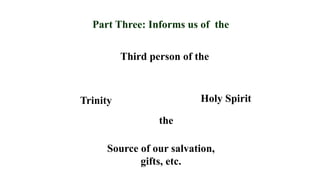
I believe in the Holy Spirit,
the holy Catholic Church,
the communion of saints,
the forgiveness of sins,
the resurrection of the body
and life everlasting.
Lutheran Perspective
• Whatdoes this mean? I believe that Jesus Christ, true God, begotten of
the Father from eternity, and also true man, born of the Virgin Mary, is
my Lord, who has redeemed me, a lost and condemned person,
purchased and won me from all sins, from death, and from the power of
the devil; not with gold or silver, but with His holy, precious blood and
with His innocent suffering and death, that I may be His own and live
under Him in His kingdom and serve Him in everlasting righteousness,
innocence, and blessedness, just as He is risen from the dead, lives and
reigns to all eternity.
• This is most certainly true.
14.
• We believein one God, the Father, the Almighty, maker of heaven and earth, of
all that is, seen and unseen.
• We believe in one Lord, Jesus Christ, the only Son of God,
eternally begotten of the Father,
God from God, Light from Light,
true God from true God,
begotten, not made,
of one Being with the Father;
through him all things were made.
For us and for our salvation
he came down from heaven,
was incarnate of the Holy Spirit and the virgin Mary
and became truly human.
15.
• For oursake he was crucified under Pontius Pilate; he suffered death and
was buried.
• On the third day he rose again in accordance with the scriptures; he
ascended into heaven and is seated at the right hand of the Father.
He will come again in glory to judge the living and the dead, and his kingdom
will have no end.
• We believe in the Holy Spirit, the Lord, the giver of life, who proceeds from
the Father and the Son, who with the Father and the Son is worshiped and
glorified, who has spoken through the prophets.
We believe in one holy catholic and apostolic church.
We acknowledge one baptism for the forgiveness of sins.
We look for the resurrection of the dead,
and the life of the world to come. Amen.
#9 ‘Jesus’ means “God saves” in Hebrew; invoke His name for salvation
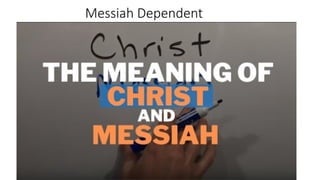
‘Christ’ is the Greek translation of the Hebrew word for ‘Messiah’
God’s fatherhood is more than creator/parental to creation, He is Father eternally to His only Son
The Sonship of Jesus is particular to Him, different from previous uses
Lord indicates divine sovereignty and the same substance as the Father
#11 The mission of the Holy Spirit ordered and joined to that of the Son
He sanctifies the womb of Mary for The Word to take on flesh
What the Church teaches about Mary points to the teachings on Christ
Jesus is a real person, He was born
Mary was the virgin of prophecy, therefore Jesus is the The Christ
The spousal character of the human vocation in relation to God is fulfilled perfectly in Mary’s virginal motherhood (CCC 505)
Virginity is transformed – no longer shameful
#13 I believe that Jesus Christ, true God, begotten of the Father from eternity, and also true man, born of the Virgin Mary, is my Lord, who has redeemed me, a lost and condemned creature, purchased and won [delivered] me from all sins, from death, and from the power of the devil, not with gold or silver, but with His holy, precious blood and with His innocent suffering and death, in order that I may be [wholly] His own, and live under Him in His kingdom, and serve Him in everlasting righteousness, innocence, and blessedness, even as He is risen from the dead, lives and reigns to all eternity. This is most certainly true.
For Luther (and all believers) this article of the Creed explains the greatest blessings God has provided us with and how that was achieved through the life, death, resurrection and ascension of Jesus Christ that we might be saved from sin and given a right relationship with God (also known as redemption). As we reflect on the magnitude of what Jesus accomplished for us, it is important to do so with the explanation of the First Article in mind—that God provides everything, including salvation, out of “…pure fatherly, divine goodness and mercy, without any merit or worthiness in me”. We are never going to do enough, or be good enough to warrant this incredible gift. But instead, as we recognize the blessing we have been given, we are called to live lives of gratitude, which reflect the reality of all we have been given in Christ. This also calls us to understand what Jesus has done, is doing and will do on our behalf, frees us and enables us to live gratefully to God—it is through Jesus Christ, that we are able to be and people and live the lives to which God has called and created us.
#16 Messiah, (from Hebrew mashiaḥ, “anointed”), in Judaism, the expected king of the Davidic line who would deliver Israel from foreign bondage and restore the glories of its golden age. The Greek New Testament’s translation of the term, christos, became the accepted Christian designation and title of Jesus of Nazareth, indicative of the principal character and function of his ministry. More loosely, the term messiah denotes any redeemer figure; and the adjective messianic is used in a broad sense to refer to beliefs or theories about an eschatological improvement of the state of humanity or the world.
The biblical Old Testament never speaks of an eschatological messiah, and even the “messianic” passages that contain prophecies of a future golden age under an ideal king never use the term messiah. Nevertheless, many modern scholars believe that Israelite messianism grew out of beliefs that were connected with their nation’s kingship. When actual reality and the careers of particular historical Israelite kings proved more and more disappointing, the “messianic” kingship ideology was projected on the future.








![Statement Of Faith[1]](https://cdn.slidesharecdn.com/ss_thumbnails/statementoffaith1-090722042154-phpapp02-thumbnail.jpg?width=640&height=640&fit=bounds)


