Objectives:
● Define difficultpatients.
● Clarify what makes a patient interaction challenging.
● Identify common types of difficult patients and their behaviors.
● Explore effective communication and de-escalation strategies.
● Learn system-based solutions to prevent and manage difficult encounters.
● Enhance interpersonal skills to foster positive patient interactions.
3.
Introduction
● Challenging interactionsare common in healthcare.
● Understanding challenging interactions is key to becoming an effective
healthcare provider.
● Proper management reduces provider burnout and improves patient
outcomes.
● Effective communication fosters trust and cooperation.
4.
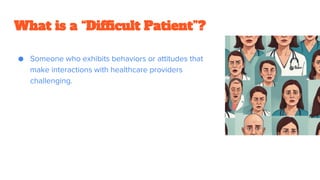
What is a“Difficult Patient”?
● Someone who exhibits behaviors or attitudes that
make interactions with healthcare providers
challenging.
5.
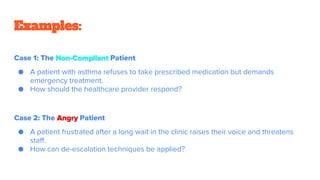
Examples:
Case 1: TheNon-Compliant Patient
● A patient with asthma refuses to take prescribed medication but demands
emergency treatment.
● How should the healthcare provider respond?
Case 2: The Angry Patient
● A patient frustrated after a long wait in the clinic raises their voice and threatens
staff.
● How can de-escalation techniques be applied?
6.
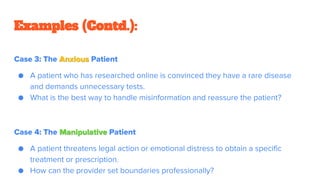
Case 3: TheAnxious Patient
● A patient who has researched online is convinced they have a rare disease
and demands unnecessary tests.
● What is the best way to handle misinformation and reassure the patient?
Case 4: The Manipulative Patient
● A patient threatens legal action or emotional distress to obtain a specific
treatment or prescription.
● How can the provider set boundaries professionally?
Examples (Contd.):
7.
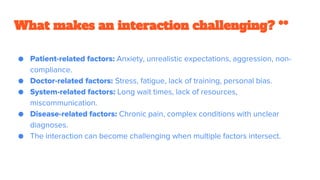
What makes aninteraction challenging? **
● Patient-related factors: Anxiety, unrealistic expectations, aggression, non-
compliance.
● Doctor-related factors: Stress, fatigue, lack of training, personal bias.
● System-related factors: Long wait times, lack of resources,
miscommunication.
● Disease-related factors: Chronic pain, complex conditions with unclear
diagnoses.
● The interaction can become challenging when multiple factors intersect.
8.
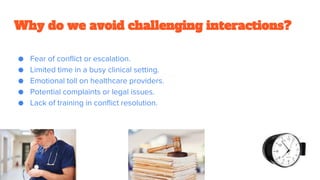
Why do weavoid challenging interactions?
● Fear of conflict or escalation.
● Limited time in a busy clinical setting.
● Emotional toll on healthcare providers.
● Potential complaints or legal issues.
● Lack of training in conflict resolution.
9.
Common Types ofDifficult Patients
● Angry or Aggressive Patients – Express frustration, sometimes in threatening
ways.
● Demanding Patients – Expect specific treatments, medications, or diagnostic
tests.
● Non-Compliant Patients – Ignore medical advice or prescribed treatments.
● Somatizing Patients – Experience multiple vague symptoms with no clear
diagnosis.
● Anxious or Depressed Patients – Fearful about medical outcomes, need
reassurance.
● Frequent Flyers – Regular visitors with non-emergency issues.
10.
● Medical conditions(pain, chronic illness, undiagnosed symptoms).
● Psychosocial factors (mental health, personal stress, past trauma).
● Miscommunication (unclear instructions, language barriers).
● Mistrust in healthcare (previous bad experiences, skepticism).
● System-related stressors (long wait times, overworked staff, poor patient
experience).
Common Causes of Difficult Behaviour **
11.
How to Dealwith Difficult Patients?
General Approach:
1. Stay calm and professional – Do not react emotionally.
2. Acknowledge emotions – Show empathy and understanding.
3. Listen actively – Allow the patient to express concerns.
4. Set boundaries – Be firm but respectful.
5. Provide clear explanations – Use non-medical language.
6. Offer solutions – Focus on what can be done.
12.
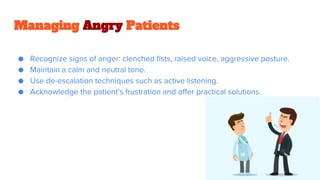
Managing Angry Patients
●Recognize signs of anger: clenched fists, raised voice, aggressive posture.
● Maintain a calm and neutral tone.
● Use de-escalation techniques such as active listening.
● Acknowledge the patient’s frustration and offer practical solutions.
13.
Managing Non-Compliant Patients
●Educate about consequences of not following medical advice.
● Use motivational interviewing techniques.
● Identify potential barriers to compliance.
● Establish a collaborative plan for treatment.
14.
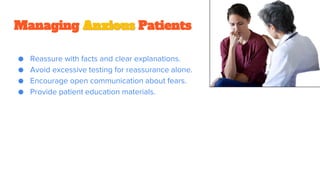
Managing Anxious Patients
●Reassure with facts and clear explanations.
● Avoid excessive testing for reassurance alone.
● Encourage open communication about fears.
● Provide patient education materials.
15.
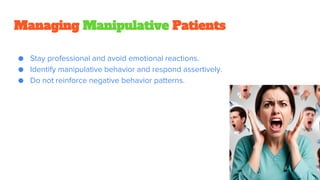
Managing Manipulative Patients
●Stay professional and avoid emotional reactions.
● Identify manipulative behavior and respond assertively.
● Do not reinforce negative behavior patterns.
16.
Managing Demanding Patients
●Clearly explain medical limitations and evidence-based treatments.
● Address unrealistic expectations with empathy.
● Offer alternative solutions when possible.
● Set firm but respectful boundaries.
17.
De-escalation Techniques
● Usea calm and non-threatening tone.
● Give the patient personal space.
● Use open-ended questions to allow them to express feelings.
● Avoid confrontation and redirect aggressive behavior.
● If necessary, involve a senior colleague or security.
18.
The role ofEmpathy?
● Empathy fosters trust and cooperation.
● Helps patients feel heard and understood.
● Reduces patient anxiety and frustration.
19.
System-Based Solutions
● Establishclinic policies for handling difficult encounters.
● Train staff in conflict resolution and emotional intelligence.
● Improve scheduling efficiency to reduce patient wait times.
● Provide mental health support for healthcare providers.
20.
Ethical Considerations
● Respectpatient autonomy while maintaining professional integrity.
● Ensure fair treatment and non-discrimination.
● Balance empathy with professional boundaries.
● Document all encounters carefully to protect both patient and provider.
21.
Case Study Discussion
●Scenario: A patient is demanding antibiotics despite no clinical indication.
● How would you handle this?
● Discuss in pairs and share your approach.
22.
The Role ofCommunication
● Active listening and empathy improve patient trust.
● Non-verbal communication impacts patient perception.
● Clarity in explaining medical decisions reduces frustration.
● Building rapport fosters cooperative relationships.
23.
Key Takeaways
● Difficultpatients are a challenge in all healthcare settings.
● Understanding the root causes helps manage interactions effectively.
● Communication, empathy, and setting boundaries are key.
● Training and system-based solutions can prevent conflict.



![PERI-PROSTHETIC FRACTURE NAIL-PLATE CONSTRUCT [NPC].pptx](https://cdn.slidesharecdn.com/ss_thumbnails/drarunkumardrmohamedashrafperiprostheticfrasturenail-plateconstructnpc-260209164459-7e9d15a1-thumbnail.jpg?width=640&height=640&fit=bounds)