Valuation of Intellectual Property
Japan Patent Office
Asia - Pacific Industrial Property Center,
Japan Institute for Promoting Invention and Innovation
©2017
Collaborator: Dr. Yasuyuki ISHII
President, IP Economic Research Institute.
Adjunct Professor, Tokyo University of Science.
2
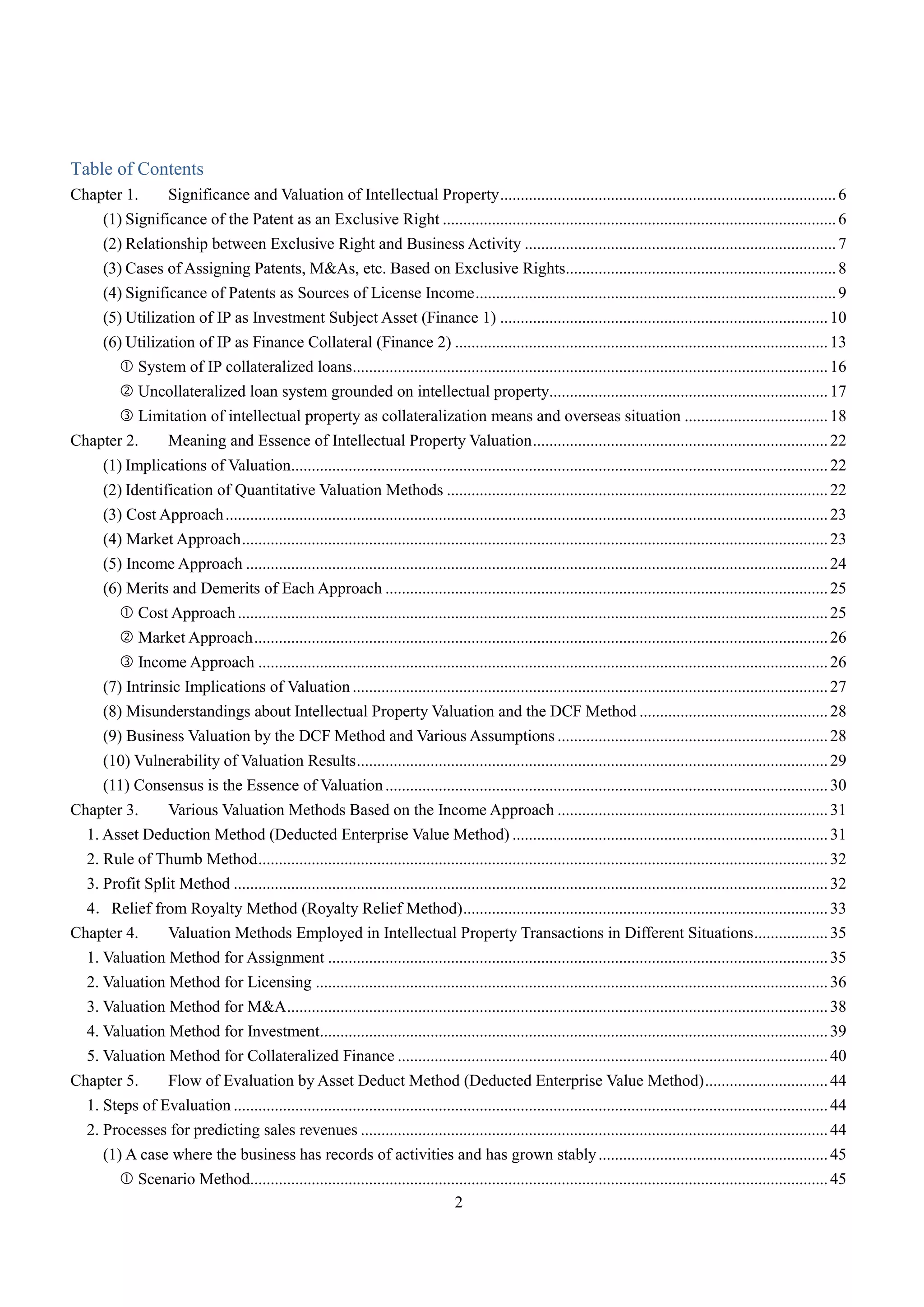
Table of Contents
Chapter 1. Significance and Valuation of Intellectual Property..................................................................................6
(1) Significance of the Patent as an Exclusive Right ................................................................................................6
(2) Relationship between Exclusive Right and Business Activity ............................................................................7
(3) Cases of Assigning Patents, M&As, etc. Based on Exclusive Rights..................................................................8
(4) Significance of Patents as Sources of License Income........................................................................................9
(5) Utilization of IP as Investment Subject Asset (Finance 1) ................................................................................10
(6) Utilization of IP as Finance Collateral (Finance 2) ...........................................................................................13
 System of IP collateralized loans....................................................................................................................16
 Uncollateralized loan system grounded on intellectual property....................................................................17
 Limitation of intellectual property as collateralization means and overseas situation ...................................18
Chapter 2. Meaning and Essence of Intellectual Property Valuation........................................................................22
(1) Implications of Valuation...................................................................................................................................22
(2) Identification of Quantitative Valuation Methods .............................................................................................22
(3) Cost Approach...................................................................................................................................................23
(4) Market Approach...............................................................................................................................................23
(5) Income Approach ..............................................................................................................................................24
(6) Merits and Demerits of Each Approach ............................................................................................................25
 Cost Approach................................................................................................................................................25
 Market Approach............................................................................................................................................26
 Income Approach ...........................................................................................................................................26
(7) Intrinsic Implications of Valuation....................................................................................................................27
(8) Misunderstandings about Intellectual Property Valuation and the DCF Method ..............................................28
(9) Business Valuation by the DCF Method and Various Assumptions ..................................................................28
(10) Vulnerability of Valuation Results...................................................................................................................29
(11) Consensus is the Essence of Valuation............................................................................................................30
Chapter 3. Various Valuation Methods Based on the Income Approach ..................................................................31
1. Asset Deduction Method (Deducted Enterprise Value Method) .............................................................................31
2. Rule of Thumb Method...........................................................................................................................................32
3. Profit Split Method .................................................................................................................................................32
4.Relief from Royalty Method (Royalty Relief Method).........................................................................................33
Chapter 4. Valuation Methods Employed in Intellectual Property Transactions in Different Situations..................35
1. Valuation Method for Assignment ..........................................................................................................................35
2. Valuation Method for Licensing .............................................................................................................................36
3. Valuation Method for M&A....................................................................................................................................38
4. Valuation Method for Investment............................................................................................................................39
5. Valuation Method for Collateralized Finance .........................................................................................................40
Chapter 5. Flow of Evaluation by Asset Deduct Method (Deducted Enterprise Value Method)..............................44
1. Steps of Evaluation .................................................................................................................................................44
2. Processes for predicting sales revenues ..................................................................................................................44
(1) A case where the business has records of activities and has grown stably........................................................45
 Scenario Method.............................................................................................................................................45
3
 Simulation Method.........................................................................................................................................46
(2) A case where the business has no past records of activities or the performance was not stable........................57
Chapter 6. Cash Flow ...............................................................................................................................................60
1. Definition of cash flow ...........................................................................................................................................60
2. Major Financial Statements and Cash Flow............................................................................................................60
(1) Profit and Loss Statement and Cash Flow.........................................................................................................62
 Structure of Profit and Loss Statement...........................................................................................................62
 Operating Profit and Cash Flow.....................................................................................................................63
(2) Balance Sheet and Cash Flow ...........................................................................................................................64
 Structure of Balance Sheet .............................................................................................................................64
 Net Working Assets and Cash Flow ...............................................................................................................66
3. Cash Flow and Profits.............................................................................................................................................67
(1) Positioning of Cash Flow and Profits................................................................................................................67
(2) Three Elements That Cause a Difference between Operating Profit and Cash Flow ........................................67
 Investments in fixed assets.............................................................................................................................67
 Depreciation/amortization expenses...............................................................................................................68
 Increase in net working capital.......................................................................................................................69
4. Calculation and Prediction of Cash Flow................................................................................................................69
(1) Cash Flow..........................................................................................................................................................69
(2) Cash Flow..........................................................................................................................................................70
 Prediction of operating profit after tax ...........................................................................................................70
 Prediction of Investments in Fixed Assets and Depreciation/Amortization Expenses...................................71
 Prediction of Increase in Net Working Capital...............................................................................................71
Chapter 7. Example of Calculation of Predicted Cash Flow ....................................................................................75
1. Prediction of operating profit after tax....................................................................................................................75
(1) Prediction of sales..............................................................................................................................................75
(2) Prediction of operating profit ............................................................................................................................76
(3) Prediction of operating profit after tax ..............................................................................................................77
2. Prediction of Depreciation/Amortization Expenses and Investment in Fixed Assets .............................................77
(1) Fixed Asset Turnover Ratio...............................................................................................................................77
(2) Depreciable and Amortizable Fixed Assets and Depreciation and Amortization Rates ....................................78
(3) Investments in fixed assets ................................................................................................................................79
3. Prediction of Net Working Capital..........................................................................................................................81
4. Calculation of Cash Flow........................................................................................................................................83
5. Use of Alternative Data...........................................................................................................................................83
Chapter 8. Discount of Cash Flow and Business Value............................................................................................84
1. Business value.........................................................................................................................................................84
2. Reason for discounting ...........................................................................................................................................85
(1) Income on investment........................................................................................................................................85
(2) Significance of discounting in equivalent transactions......................................................................................86
3. Mid-Year Theory.....................................................................................................................................................88
Chapter 9. Calculation of Discount Rate ..................................................................................................................90
1. Weighted Average Cost of Capital ..........................................................................................................................90
2. Costs of debt and equity..........................................................................................................................................91
4
(1) Cost of debt .......................................................................................................................................................91
(2) Cost of equity ....................................................................................................................................................92
(3) β (beta value).....................................................................................................................................................93
3. Calculation of Discount Rate..................................................................................................................................94
(1) Factors for calculating a discount rate...............................................................................................................94
(2) Example of calculation of WACC .....................................................................................................................94
 Interest rate for liabilities................................................................................................................................94
 Effective tax rate.............................................................................................................................................95
 Risk free rate ..................................................................................................................................................95
 Rate of return in stock market ........................................................................................................................95
 β of individual stock.......................................................................................................................................96
 Capital structure .............................................................................................................................................96
(a) Current value of liabilities .........................................................................................................................96
(b) Current value of equity..............................................................................................................................97
(c) Capital structure of a similar company......................................................................................................97
 Calculation of discount rate............................................................................................................................97
4. Discount coefficient and business value .................................................................................................................99
Chapter 10. Calculating the Value of Permanent Business.......................................................................................100
1. Basic equation of Income Approach .....................................................................................................................100
2. Present value of terminal value.............................................................................................................................102
(1) Cash flow of the sixth year and long-term growth rate ...................................................................................102
(2) Calculation of terminal value ..........................................................................................................................104
3. Calculating the value of permanent business........................................................................................................105
4. Calculating the value of business that does not permanently continue.................................................................106
Chapter 11. Determining the Value of Technology by Asset Deduction Method.....................................................108
1. Methods to valuate technology assets by Income Approach.................................................................................108
2. Financial assets and intangible assets ...................................................................................................................108
(1) Significance of determining the value of intangible assets..............................................................................108
(2) Financial assets................................................................................................................................................109
(3) Valuation of tangible and intangible assets...................................................................................................... 110
3. Extracting the value of technology from intangible assets ................................................................................... 112
(1) Results of a questionnaire survey by the Japan Intellectual Property Association .......................................... 112
(2) Comparison between patents and technology with respect to their economic impact..................................... 112
(3) Comparison between intangible assets and technology with respect to their contribution to economic growth
113
4. Calculating the value of technology by asset deduction method .......................................................................... 115
Chapter 12. Conventional Valuation Method and Summary of Results ................................................................... 117
1. Rule of Thumb Method......................................................................................................................................... 117
2. Profit Split Method ............................................................................................................................................... 117
3. Relief from Royalty Method................................................................................................................................. 118
4. Summary of valuation results ............................................................................................................................... 119
Chapter 13. Valuation of Individual Patents or Technology .....................................................................................121
1. Technology assignment from Z to X, and the business condition of X ................................................................121
2. Significance of technology and prediction of sales, etc. of X...............................................................................124
5
3. Prediction of cash flows........................................................................................................................................125
(1) Prediction of the amount of depreciation/ amortization expense.....................................................................125
(2) Prediction of the amount of investment in fixed assets ...................................................................................126
(3) Prediction of increase in net working capital ..................................................................................................126
(4) Prediction of cash flows ..................................................................................................................................127
4. Calculation of discount rate, business value, and intangible asset value ..............................................................128
5. Extracting the value of technology .......................................................................................................................129
6. Calculation of fee for assignment by conventional valuation methods.................................................................131
(1) Valuation by Rule of Thumb Method..............................................................................................................131
(2) Calculation of fee for assignment by Profit Split Method...............................................................................132
(3) Relief from Royalty Method............................................................................................................................134
7. Summary of valuation results and determination of the assignment fee...............................................................136
Chapter 14. Successful Cases of University Technology Transfer to the Private Sector, and Intellectual Property
Valuation 137
1. Establishing University TLOs, etc. .......................................................................................................................137
2. Statistical summary of results ...............................................................................................................................138
3. Successful cases available from disclosed information and the significance thereof ...........................................141
(1) Definition of “successful” technology transfer................................................................................................141
(2) Transfer of super-resolution technology to Digital Design Co., Ltd. (Tokyo Tech)........................................142
(3) Transfer of “Bypass Vitamin C” technology to YPTECH Co., Ltd. (Kyoto University) ................................143
4. Valuation methods in licensing, etc. of university technology..............................................................................145
6
VALUATION OF INTELLECTUAL PROPERTY
December 8, 2016
Yasuyuki Ishii, Professor
Master of Intellectual Property,
Graduate School of Innovation Studies,
Tokyo University of Science
Chapter 1. Significance and Valuation of Intellectual Property
Among various intellectual property (IP) systems available today, the patent system is positioned as
an industrial property right system of overwhelming importance for intellectual property management.
According to the fiscal year 2014 results of the Survey of Intellectual Property-Related Activities,
which is conducted by the Patent Office every year, 69% of the total costs spent on the management of
industrial property rights (i.e. patents, utility models, designs and trademarks) was accounted for by the
cost required for application-related tasks, such as the filing of applications and the maintenance and
management of rights. Patents represented 93% of application-related costs, while most of the amount
associated with industrial property was spent on patent right management. In this sense, the patent
system is, without a doubt, the most notable representative of the intellectual property system. In the
sections below, the significance of intellectual property rights will be identified through consideration
of technologies centering on patents.
(1) Significance of the Patent as an Exclusive Right
A patent provides an exclusive right to an invention that has been developed by investing a large sum
of money, and ensures a competitive advantage over competitors. This situation of patented inventions
is also true in the case of technological trade secrets, technological know-how and technological skills.
The aspect of securing competitive advantages is the most fundamental role of the patent system—a
fact that also commonly applies to design rights, trademark rights, copyrights and other intellectual
property rights.
One industry that can typically benefit from exclusive rights provided by patents is the
pharmaceutical industry. Pharmaceutical manufacturers invest heavily in R&D activities to develop new
drugs. In order to develop a well-selling drug, pharmaceutical manufacturers need to make heavy
investments to support research activities that continue for many years in a situation where the
probability of success is very low. Once an effective drug is developed, however, the medicinal
properties of the new drug are protected by a patent right and the drug will deliver monopoly profits
until the patent right expires (or the end of the data protection period)—thereby bringing effects far
beyond those of achieving a return on the investment in the drug.
For example, among Takeda Pharmaceutical Company Limited's consolidated sales of 1,691.7 billion
yen in 2013, the top five best-selling new drugs, including the hypertension medication “BLOPLESS,”
accounted for approx. 595.9 billion yen, or 35% of overall company sales.1
This fact demonstrates the
benefits for the pharmaceutical industry in terms of the business significance of new drugs that are
1 Takeda Annual Report 2014 (http://www.takeda.co.jp/investor-information/annual/files/ar2014_jp.pdf. - accessed- 2016.8.24)
7
protected by patent rights.
In this context, exclusive effects that are realized through intellectual property rights are of crucial
importance for the very existence of companies, and their economic value is expected to be
significantly large.
While these effects can be clearly recognized in the fields of pharmaceuticals and some chemicals,
other industries are not necessarily experiencing in many cases where a high income is achieved
through an exclusive right. For example, it would be difficult for the electric appliance and automobile
industries to expect high incomes through the exercise of exclusive rights based on patents, because
manufacturers use many patented technologies to manufacture one product. In fact, a vast number of
patents in these industries have been acquired by companies, and it is difficult from a practical
standpoint for a single company to monopolize all of the patent rights involved in the manufacture of
one product. In these industries, therefore, it would be impossible to hold a monopoly over a market
solely by means of patent rights and other intellectual property rights.
However, it is advantageous for a company to hold a rich portfolio of patents. For example, in the
event that the company violates a patent of a competitor, the likelihood increases that a path to counter
the competitor may open for the company by instituting a lawsuit claiming the violation of its own
patent by the competitor. In this situation, the company will be able to enter into negotiations for a
patent license with the competitor on equal terms. It would then become possible to achieve an
agreement under which the parties grant their respective patent rights to each other. An agreement to
mutually grant licenses for the parties’ respective technologies is called a cross-license agreement, and
it is actively executed in many industries.
The patent lawsuits that have been fought since April 2011 between Apple, Inc. and Samsung
Electronics Co., Ltd. of Korea are said to be so-called “surrogate lawsuits” between Apple, Inc. and
Google, Inc., which offers Android. Google acquired Motorola Mobility LLC in May 2012 for 12.5
billion dollars—an amount equaling its annual operating income. Through this acquisition, Google
obtained 17,000 patents and technologies under development owned by Motorola Mobility. Google’s
intention behind the acquisition is considered to have been to open a path for cross-licensing with
competitors, and as consideration for these patents and developed technologies, Google recorded 5.5
billion dollars on its balance sheet for the term.2
(2) Relationship between Exclusive Right and Business Activity
Even for industries that can hardly expect to benefit from a market monopoly, patents have an
important significance insofar as companies can utilize patents to ensure a high degree of freedom in
their business initiatives. In order to use a patented technology owned by a third party, for example, you
must obtain permission for use (or a license) from the third party and pay a royalty for such use. In
cases where the third party is your competitor, you are likely to encounter difficulties in obtaining a
license for the patented technology from the third party. Under ordinary circumstances, few companies
would be willing to make their important business resources available to their competitors. Such
circumstances may change, however, in cases whereby they have a technology developed in-house that
the third party desires to use. The competitor may even be using a patented technology owned by a
company without its permission (thereby constituting an infringement).
2 Google Form 10-k 2012.12, p.75, (https://www.sec.gov/Archives/edgar/data/1288776/000119312513028362/d452134d10k.htm - accessed-
2016.8.24)。
8
In this case, the company may take the approach of issuing a warning to the competitor and
prohibiting its implementation of patent, stating that it is committing a patent infringement. Another
possible approach is to grant mutual licenses for the respective technologies that the company and its
competitor desire to use—thereby opening a two-way path for useful technologies.
If a company has a rich portfolio of patent assets, moreover, it may be able to counter the third party
by claiming an infringement of its own patent by the third party, even in the event that it had infringed
the third party's patent right, as described above.
Patents can not only be held and exploited within one's own company, therefore, but may also be
utilized as a powerful tool to make available the patent of a third party. Therefore, patents have
important significance in that they permit a high degree of freedom in promoting one's business.
(3) Cases of Assigning Patents, M&As, etc. Based on Exclusive Rights
The purpose of the aforementioned acquisition of Motorola Mobility by Google was to obtain
Motorola's patents and technologies—not its business—as described above. This was clear from the
fact that within less than two years from the acquisition, Google sold to another company all of
Motorola's assets and businesses except for its patents and related technologies.
Prior to the acquisition, beginning around 2010, Motorola had been extensively engaged in lawsuits
against companies including Apple and Microsoft. Google’s aim is said to have been to gain Motorola’s
power to effectively assert its rights based on patents against Apple, etc., as well as to build its own
patent portfolio. In addition, Google acquired 1,029 patents from IBM in July 2011, and over 50 patent
rights from Magnolia Broadband in June 2012.
Meanwhile, Apple formed an alliance with other companies—thereby acquiring patents from
Nortel for 4.5 billion dollars in 2011. In April 2012, Microsoft responded to a patent sale offer by AOL,
a major Internet service provider, and acquired over 800 patent rights and patent-pending inventions,
along with over 300 patent licenses, for 1.056 billion dollars. Amazon, eBay, Facebook and even
Google reportedly participated in this bidding. Microsoft’s intention in this move is said to have been to
gain advantages over Google in its patent disputes with the company.
Later, in April 2014, Microsoft acquired Nokia, a long-established Finnish mobile phone
manufacturer. The purpose of this acquisition is known to have been to get a foothold in the mobile
phone business, and to acquire licenses for the patents owned by Nokia. Among the businesses operated
by Nokia, Microsoft acquired the device and service business, and also obtained 10-year licenses for
related patents. The consideration for the acquisition was reportedly 5.44 billion euros (770 billion yen
at the then exchange rate) in total, consisting of 3.79 billion euros (worth 537 billion yen at the same
rate) for the device and service business, and 1.65 billion euros (worth 234 billion yen at the same rate)
for the patent licenses.3
Since there are many intensive ongoing patent disputes in the mobile terminal industry, as
described above, many cases have been observed whereby a company purchases patents and
technologies from another company—or in-licenses another company’s patents and technologies—with
a view to building its own patent portfolio. This trend has not been confined to the mobile terminal
industry, but has also spread to the social networking service (SNS) industry.
In February 2012, Yahoo sent a warning to SNS provider Facebook demanding the latter to enter
3 Nokia Form 20-F 2014 p.160 (http://company.nokia.com/sites/default/files/download/investors/nokia_form_20-f_2014.pdf - accessed-
2016.8.24).
9
into a license agreement for its patented technology and pay a reasonable patent fee. Facebook was
founded in 2004, and rapidly grew into a global top-class SNS provider. Yahoo has a history ten years
longer than Facebook’s, having been founded in 1994.
Yahoo filed a lawsuit against Facebook with a US federal district court on March 12, 2012, alleging
that Facebook infringed 10 patents owned by Yahoo, including its advertising model, privacy settings,
messaging, and other technologies. When the lawsuit was filed, Facebook expected to have an IPO
(Initial Public Offering) in two months’ time—and apprehensions mounted about the influence of the
lawsuit on the first price of the IPO. This lawsuit reminds many of the tactics taken by Yahoo in the
past—including the filing of a lawsuit against Google immediately before being listed and receiving a
settlement of 2.7 million shares in Google stock, worth 230 million dollars (ca. 25.5 billion yen), in
2004. There are speculations, therefore, that Yahoo again resorted to the same tactics.
Twenty days after this lawsuit, Facebook acquired 750 patents from IBM. Facebook is an emerging
company, and its portfolio is not sufficient—consisting of only 56 patents and 503 impending patents.
As a self-defense measure against patent lawsuits from Yahoo and other companies, Facebook needed
to enhance its patent assets as quickly as possible. On April 3, Facebook countered Yahoo by filing a
lawsuit alleging that Yahoo was infringing 10 of its patents.
Around this period, Microsoft had already purchased patents—and acquired patent licenses—for
email, messaging, mobile technology, positional information technology, etc., as stated above.
Immediately afterward, Microsoft reached an agreement with Facebook to reassign to Facebook 650
patents for 550 million yen, which were part of the patents purchased from AOL, and to enter into
cross-license agreements for other patents.
Through these experiences, Yahoo seems to have found it to be difficult to maintain advantages
over Facebook in patent disputes on the grounds of patent infringement. Yahoo and Facebook entered
into a cross-license agreement for their respective patents on July 6, and agreed to form a business
tie-up. It was pointed out that Facebook's purchase of patent rights from IBM and Microsoft worked
effectively in the case of this settlement.
(4) Significance of Patents as Sources of License Income
In addition to being used in-house, patents can be licensed to third parties and deliver income in the
form of license royalties. License royalties are income generated with little cost, meaning that their
contribution to profits can be huge. Typical examples of companies with significant incomes from
license royalties include Qualcomm, Inc.4
and Telefonaktiebolaget LM Ericsson.5
In fiscal 2014,
Qualcomm achieved licensing revenues of 7.86 billion dollars (ca. 860 billion yen), accounting for
approximately 30% of its gross sales. Ericsson earned a license income of 9.9 billion SEKs (or ca. 14.1
billion yen) in 2014, thereby more than doubling its profit ratio.
A royalty can be obtained simply by lending your asset to a third party, and requires no raw materials
or other costs. Since most royalties directly become income, companies can expect a high profit ratio.
In the case of Qualcomm, the final net income in fiscal year 2014 was as high as 30%—with royalty
4 Qualcomm, Inc. (2014) "Qualcomm Announces Fourth Quarter and Fiscal 2014 Results- Record Fiscal Year Results -" p.12
(http://www.prnewswire.com/news-releases/qualcomm-announces-fourth-quarter-and-fiscal-2014-results-281666711.html - accessed-
2016.8.24.)
5
Telefonaktiebolaget LM Ericsson (2014) “Welcome to the networked society, Ericsson Annual Report 2014” p.74
(https://www.ericsson.com/res/investors/docs/2014/ericsson-annual-report-2014-en.pdf - accessed- 2016.8.24.)
10
income considered to be an important factor therein.
While royalty incomes of individual companies are rarely disclosed, some major Japanese electronics
manufacturers are reported to be earning royalty incomes in the order of several tens of billions of yen.6
Royalty incomes received by companies from overseas, however, are said to be mostly from overseas
affiliated subsidiaries, etc. If we focus on royalty income received from competitors only, the situation
may be different for companies such as Qualcomm.
In any case, a proper royalty level should be set when a company grants to a third party a license for
its own technology or patent, or when it in-licenses a technology owned by a third party. For this, it is
necessary to valuate technologies or patents, and to establish the amounts that can be referenced when
calculating royalties.
(5) Utilization of IP as Investment Subject Asset (Finance 1)
An intellectual property can be an effective means of raising funds by utilizing it as an investment
subject asset.
A notable example of utilizing an intellectual property as an investment subject asset is the approach
taken by rock vocalist David Bowie, who was born in England and active in the U.S. He raised a fund
of 55 million dollars, backed by the royalties (claims) from albums containing his songs. The history of
financing backed by intellectual properties probably dates back to 1992, when Walt Disney Company
financed the opening of Disneyland Paris by issuing unsecured securities totaling 400 million dollars
with a term of seven years, backed by future box-office income from the copyright portfolio of a
planned film. Subsequently, in 1993, securities were issued backed by royalty claims based on the
exclusive use of the Calvin Klein trademark. This approach to liquidization of an intellectual property,
in which a business raises funds by securitizing income from intellectual property and then recruiting
investors in the securities, took root—primarily in the U.S.—as intellectual property finance.
In the U.S., investment banks, full-service financial institutions, investment funds, etc. have been
arranging schemes for fund-raising. These include the Pullman Group, which is engaged in
securitization of music copyrights; UCC Capital, which is engaged in securitization of brands; and
Royalty Pharma, Drug Royalty (whose name was changed to DRI Capital in July 2007), Morgan
Stanley, Cowen Healthcare Royalty Partners and Pole Capital, which are engaged in securitization of
license royalties for pharmaceutical patents. Thus, unlike Japan, the U.S. has many arrangers that have
continuously provided finance services through securitization of intellectual properties (see Fig. 1.1).
Business strategies promoted by arrangers in the U.S. change rapidly. For example, UCC Capital
was acquired in June 2006 by NexCen Brand, which went on to fully utilize the professionals and
networks inherited from UCC Capital in order to acquire brand-name companies such as Athlete’s Foot
(sports shoes) and Bill Blass (high-fashion clothing), which were the clients of UCC Capital’s
securitization service. Using the acquisition as a foothold, in other words, NexCen Brand transformed
from a franchisee with about 1,800 sites in 35 countries worldwide to a brand management company
with annual sales topping 1 billion dollars. NexCen Brand then decided to sell its franchise business to
Global Franchise Group, LLC in May 2010 (see Fig. 1.1).
6 For example, Canon Inc. reported through its IR library that its patent fee revenues in FY2013 were approximately
24.1 billion yen. 「Canon Fact Book 2014-2015」(http://web.canon.jp/about/library/pdf/canon_factbook.pdf -accessed -2014.11.30)
11
Assets targeted as investment subject assets in the US have been royalty claims based on
intellectual properties. A finance practice conducted in relation to these royalty credits is to convert
assets in the form of intellectual properties to cash by securitizing them, and recruiting investors in
these securities. Investment subject assets are diverse, and have included brands (see Fig. 1.2) and a
wide range of intellectual properties, such as patents and copyrights (see Fig. 1.3).
The scheme of securitization employed by David Bowie is as shown in Fig. 1.4 below. First,
entities including the Pullman Group, the arranger, and major investment banks formed an independent
Special Purpose Vehicle 2 (SPV 2), with Pullman Group playing the central role. The Pullman Group
and the banks then formed SPV 1, a subsidiary wholly owned by David Bowie, who was the originator
of the albums. Bowie assigned his albums to SPV 1 (), which in turn assigned, or assigned in trust,
the royalty credits on the albums to SPV 2 (). By going through this two-tiered assignment, the
royalty credits on the album were completely disconnected from David Bowie (a process known as
“bona fide assignment”). As the result, the royalty credits on the album were disconnected from David
Bowie and were safely preserved—thereby immune to bankruptcy.
12
SPV 2 securitized the royalty credits, issued the securities, and recruited investors. It sold the
securities to an institutional investor, Prudential Insurance (), which paid the purchase money to SPV
2 (). The purchase money was then paid to David Bowie via SPV 1 () as consideration for the
assignment of the album assets (). The amount of the purchase money was 55 million dollars.
Through this method, David Bowie was able to convert his song albums, or the subject intellectual
property, into cash (i.e. liquidization).
Later, SPV 1, which was in possession of the albums, granted EMI a distribution license for the
songs (). In consideration for the license granted, EMI paid royalties to SPV 2, the owner of the
royalty credits (). The royalties thus obtained were returned and reimbursed to the investor at an
interest of 7.9% (). The scheme ended on the expiry of a period of 10 years (or 15 years for part of the
royalties) following the reimbursement.
Thereafter, this type of fund raising (or liquidation) backed by intellectual property became quite
common. In the wake of the collapse of subprime mortgage loans in 2007 and the Lehman Shock in
2008 in the U.S., however, the securitization market shrank rapidly, and the tendency of companies
undertaking the securitization practice of intellectual property began to be rarely seen in the U.S.
Following the inclusion of intellectual properties in trust subject properties in Japan as the result of
an amendment to the Trust Business Act in 2005, several companies registered themselves as trust
business operators and provided an intellectual property liquidation service through intellectual
property trusts. All of these companies went bankrupt or out of business due to the credit crunch
originating in the U.S., however, and there are now no companies engaged in the fund-raising support
business backed by intellectual property.
When an investment activity is conducted as described above, it is necessary to valuate the economic
value of the intellectual property to be invested in, and determine the amount of investment by using the
valuation amount thus obtained as a basis. It should be noted, however, that there is a fundamental
difference between the U.S. and Japan in terms of how investment in intellectual properties is
conducted for finance purposes.
In Japan, most investment decisions are made for the values of intellectual properties themselves; or
for potential future income from businesses based on intellectual properties. In the U.S., almost all
13
investments are made in the royalty credits of intellectual properties. Investment in royalty credits
means investment in the expectation of royalty income, wherein the expectation is justified by the fact
that the subject intellectual property was licensed in the past, and has a good record of generating
royalty income; or that it is highly likely to be licensed and generate royalty income. In cases where an
intellectual property has a good licensing record, there should exist historical data concerning royalty
amounts. In cases where an intellectual property is highly likely to be licensed, it should be relatively
easy to estimate the level of potential royalty amounts.
By contrast, if an investment is made for the potential future earning power of an intellectual property,
which is the case in Japan, it is necessary to forecast the future status of the business based on the
intellectual property.
In other words, the difference between the U.S. and Japan is that the former country mostly invests in
intellectual property assets themselves (which is called “asset finance”), while the latter mostly invests
in business activities (known as “project finance”).
In the case of an asset finance investment backed by a royalty credit, it suffices to pay attention to the
creditworthiness of the existing licensee company that is to pay royalties, along with the stability of its
business. On the other hand, in the case of a project finance investment, more difficult study is required
with respect to the future prospects of the company itself, competitors’ trends, the judgment of
technological advantages and so on, which is similar to investments in venture companies with
technological competence. What is sought here is an extensive level of valuation capability, which is
more than simple valuation of intellectual properties.
(6) Utilization of IP as Finance Collateral (Finance 2)
In October 1995, a society sponsored by the Ministry of Economy, Trade and Industry (the then
Ministry of International Trade and Industry) publicized the “Report of the Society on Evaluation
Means for Collateral Value of Intellectual Property Right.” The report stated that for the development of
the Japanese economy, it was essential to nurture venture companies and other new enterprises, but that
there were no angels or other similar investors in Japan as seen in the U.S.; and the activities of venture
capitalists were not necessarily sufficient. Against this background, the necessity was pointed out to
utilize bank loans that are unique to Japan as a measure for financing venture companies and other
initiatives.7
However, start-up venture companies usually do not have adequate tangible asset collateral,
such as land and buildings, which is demanded by financial institutions in order to secure finance. As a
solution to this situation, the report suggested that new technologies and other intangible assets should
be utilized as collateral rather than tangible assets.
While loans collateralized by intellectual property rights had been provided in Japan by financial
institutions and other entities in the private sector, such finance can be considered to have attained
social recognition around 1995, when the report was compiled.
An example of an IP collateralized loan is the one provided by the Development Bank of Japan (the
then Japan Development Bank: DBJ) on October 12, 1995. The bank reportedly provided a five-year
finance loan of 100 million yen to Design Automation, which is a Kyoto-based venture company
engaged in the development of software.8
This is considered to be one of the earliest cases of an IP
7
“Report of the Society on Evaluation Means for Security Value of Intellectual Property Right” by the Society on Evaluation Means for
Security Value of Intellectual Property Right, October 1995, p.1
8 ”JDB Finances ¥100 Mil. to Software Company, Making the 1st Application of Venture Finance,” October 13, 1995, morning edition,
14
collateralized loan among those found in materials publicized in and after 1995. The article reporting
this case stated that the bank planned to implement four more new finance loans in the same month,
implying an active commitment to promoting the finance system.
Since then, several financial institutions have provided IP collateralized loans—most of which are
accounted for by the DBJ. Until 2007, the DBJ led IP collateralized loans in Japan by actively
providing financial support to venture companies and other entities. Through this finance system, which
started in 1995, the DBJ financed approximately 300 loans—worth over 18 billion yen—by July 2007.
The DBJ launched co-financing with Hyakujushi Bank in 1996, around when co-finance with other
private financial institutions was promoted on an experimental basis. Efforts became more active in and
after 2004. Perhaps through these co-financing efforts, know-how on IP collateralized loans was
accumulated by regional banks and other entities throughout Japan.
Even where an intellectual property right was secured as collateral, it seems that financial
institutions actually had difficulties in placing complete trust in the collateral capability of intellectual
property rights. Around 2004, the DBJ began attempting to supplement the yieldability of this generally
low-return finance system by receiving equity warrants from borrowers, and obtaining certain capital
gains when the borrowers were listed. It was confirmed on the DBJ’s website at that time that 87 cases,
worth 4.3 billion yen in total, were financed as of the end of December 2007.
Other bank loans then began to be publicized, including those of the Japan Finance Corporation for
Small and Medium Enterprises in 1999, followed by those of other major financial institutions, such as
Fuji Bank and Aozora Bank, in 2001. Beginning in 2005, the trend spread to regional banks, which
began to finance independently rather than through co-financing with the DBJ, as in the past. Moreover,
loans by government-affiliated financial institutions, including Shoko Chukin Bank and the Japan
Finance Corporation, began to be noted.
Offers of loans made by these financial institutions were common in that borrowers were mostly
venture and other small and medium-sized companies. Excluding a few exceptions, finance projects
were mostly small in scale, ranging between several tens of million yen and 100 million yen in amounts
financed. One notable case was a copyright-collateralized loan to JustSystems lent jointly by the Bank
of Tokyo-Mitsubishi UFJ, Hyakujushi Bank, Resona Bank, Awa Bank and the Kansai Urban Banking
Corporation. This loan drew attention due to its high funding ceiling of 5.8 billion yen. The intellectual
properties secured as collateral were the new product “xfy,” which can display multiple documents,
images, etc. on one screen, as well as home learning software, the kana-kanji conversion software
“ATOK,” etc. The collateral value was calculated by considering license income from these assets.9
An
interesting aspect of this co-finance was the fact that an IP collateralized loan was utilized by a famous
software development company like JustSystems, which served as evidence that this system had
already widely spread throughout society at that time.
The highest amount of finance among those publicized was 35.5 billion yen collateralizing patents
on agrichemical technologies, which was jointly lent in September 2003 to entities including the Arysta
LifeScience Corporation by UFJ Bank (the current Bank of Tokyo-Mitsubishi UFJ), the Sumitomo
Mitsui Banking Corporation, Aozora Bank, and the Sumitomo Trust and Banking Company. The
Arysta LifeScience Corporation is a venture company that was founded in 2001, and has made sharp
Tokyo Yomiuri Shimbun, p.6
9 ”Mitsubishi-Tokyo UFJ, etc. set a funding ceiling for JustSystems with four software copyrights secured as collateral,” from Nikkei
Kinyu Shimbun on April 23, 2007, p.4
15
growth into a middle-scale or large company with annual sales of approx. 23.5 billion yen and a capital
of approx. 77.8 billion yen. The company is now a diversified company that extensively handles
pharmaceuticals, cosmetics and chemicals, but its product line-up at that time was limited to chemicals,
agrichemicals, agricultural materials and natural enemy pesticides utilizing insects, microorganisms, etc.
One of the growing fields of the company at that time was presumably natural enemy pesticides. The
company had filed several tens of patent applications by the time of the co-finance, and it is unknown
which of the patented or patent-pending inventions were secured as collateral. It would be unreasonable
to deem that the collateral value of 35.5 billion yen was recognized in the patents only. The financial
institutions probably made the finance decision in expectation of the potential value of the company’s
business itself, or in other words, the future cash flow that is expected to be generated from the
company’s business. Namely, the core of the credit decision in this case was the value of the business
of the borrower. In fact, the “Consideration on Industrial Property Right Collateral (Third Edition)”
issued by the DBJ stated that its finance policy was to make finance decisions by focusing on the
earning power of the business that a company was engaged in, rather than the collateral capability of
the intellectual property rights that the company owned.10
It is presumed that there existed many other
cases wherein finance decisions were made under policies similar to that of the DBJ. This situation
provides a glimpse of the realistic difficulties faced by lenders in relying exclusively on the collateral
capability of intellectual properties.
10
“Consideration on Industrial Property Right Collateral (Third Edition),” New Business Support Division, Japan Development Bank,
March 1997, p.4. The document states that the subject of collateral should be selected and evaluated by an approach whereby a proprietary
product (patented product) is evaluated in terms of its business feasibility, and the necessary and sufficient intellectual property rights in
that product (including rights other than patent rights as necessary) are then secured as collateral.
16
Figs. 1.5 to 1.7 show cases of IP collateralized loans provided by financial institutions other than
the DBJ in the 2000s. All of the data in these figures are based on the materials publicized in Japan. Fig.
1.7 shows a case wherein Patent Finance Consulting, a consulting company specializing in the
valuation of intellectual properties, conducted a valuation regarding the collateral value of the collateral.
Finance cases similar to this one also began to appear around this time.
An observation of the recent financial situation involving intellectual properties in Japan shows that
this type of finance is moving in two directions: IP collateralized loans and uncollateralized loans. The
former has a literal meaning, in that it provides loans by using an intellectual property itself as credit
support. The latter can be considered as substantial finance, insofar as it provides loans by relying on
the technological competence and/or the potential for growth exhibited by the borrower. It seems that
the latter case somewhat exceeds the former in number.
The schemes of Chiba Bank and North Pacific Bank would fall under the latter case. Examples of
the former case are the finance system offered by Howa Bank, Minato Bank, etc., which uses patent
rights and other intellectual properties as collateral. In such cases, it is at least required to identify the
value of the subject intellectual property, valuate its economic collateral value, and express the results
in the form of a monetary amount. Howa Bank is attempting to increase efficiency in finance practice
by consigning the process of valuating the economic collateral value of intellectual properties to a
company specializing in such valuation.
These two approaches are briefly explained below by taking the schemes of several banks as
examples.
 System of IP collateralized loans
Howa Bank in Oita Prefecture began IP collateralized loans in 2011. In doing so, it targeted
companies with main offices in Oita, Fukuoka or Kumamoto Prefectures that owned patent and other
intellectual property rights. The bank consigned the process of valuating intellectual properties to a
consulting company specializing in such processes at a fee ranging from 300,000 yen to 1 million yen
per case. Based on the valuation results, the bank provides a borrower with a loan up to 30% to 50% of
the valuation amount. In principle, the bank creates a security interest in each subject intellectual
property.11
Minato Bank, based in Kobe City, Hyogo Prefecture, also offers IP collateralized loans,
11 ”Intellectual Property Right Collateralized Finance” Howa Bank (http://www.howabank.co.jp/corporate/fund/seichoukiban.html
-accessed -2016.10.22)
17
collateralizing patents, trademarks and copyrights. The bank handles not only established patent rights,
but also inventions for which applications have been laid open. The bank also uses collateral value
valuated by third party professionals.12
 Uncollateralized loan system grounded on intellectual property
Chiba Bank started providing loans grounded in intellectual property (hereinafter, “IP grounded
loans”) in May 2014. Under this system, the Mitsubishi Research Institute prepares a company-owned
patent report stating the technological competence, product strength, etc. of a borrower, based on the
results of an actual patent acquisition analysis of the borrower based on the patent publication
information of the Japan Patent Office, and on studying the business strategy of the borrower. The
report is used as a basis of judgment regarding whether or not the finance to the borrower should be
approved. The conditions for a borrower to obtain a loan through this system are as follows: (a) annual
sales of over 100 million yen, (b) positive operating profit and recurring profit, (c) not being in a state
of insolvency, and (d) ownership in patents worth over 10 million yen in terms of the valuation amount
of the economic value reported by the Mitsubishi Research Institute. The borrower can obtain a loan
without pledging collateral, although a personal guarantee must be provided by the representative in the
case of a corporation. In this sense, this type of finance makes a clear distinction from the finance
system based on intellectual property as collateral. The first finance case was implemented in June 2014,
providing a five-year loan worth 10 million yen to Sanritsu Machine Industry, which is engaged in the
manufacture and sales of tools including waste electric cable treatment machines.13
It was reported that Yamaguchi Bank also launched a similar finance system in April 2015 that
provides companies based in Yamaguchi Prefecture with a loan up to the valuation amount of the
patents owned by the borrower, and within the range of 5 million to 80 million yen, with a term of up to
five years. The bank makes finance decisions based on its judgment of the future business potential of a
borrower, which is made by utilizing the company-owned patent report prepared by the Mitsubishi
Research Institute to valuate the patent rights held by the borrower. A guarantee by the credit guarantee
association of the prefecture is required, but collateral is, in principle, not necessary.14
North Pacific Bank, based in Sapporo City, started a similar system in October 2015. The finance
system, named “Hokuyo IP Grounded Loan,” targets companies that are located in Hokkaido and have
patent rights or other intellectual property rights. The bank makes it a condition for utilizing this system
that the borrower obtains a valuation report from a third party, including the patent attorneys designated
by the bank and the Patent Office. This system does not require any intellectual property to be pledged
as collateral, but it provides loans in expectation of the potential earning power of the business based on
an intellectual property.15
Yachiyo Bank and Shinginko Tokyo (formerly the Tokyo Tomin Bank) entered into a business tie-up
with a specialty consulting company for the valuation of intellectual properties, and created an
12
”Intellectual Property Right Collateralized Finance ” The Minato Bank, Ltd. (http://www.minatobk.co.jp/corporate/financing/ipr/
-accessed-2016.10.22)
13
”Chiba Bank Starts Handling ‘ChibaGin Finance Utilizing IP” The Chiba Bank, Ltd., May 7, 2014
(http://www.chibabank.co.jp/news/hojin/2014/0507_01/ -accessed -2016.10.22)
14
”Yamaguchi Bank Starts Handling ‘YamaGin Finance Utilizing IP,” The Yamaguchi Bank, Ltd., March 31, 2015
(https://www.yamaguchibank.co.jp/portal/news/2014/news_0331.pdf -accessed -2016.10.22)
15 ”North Pacific Bank Starts Handling ‘Hokuyo Finance Utilizing IP,” North Pacific Bank, Ltd. October 16, 2015
(http://www.hokuyobank.co.jp/newsrelease/pdf/20151016_070362.pdf -accessed -2016.10.22)
18
intellectual property valuation finance system called “Chizai-no-Chikara” (The Power of IP). With this
system, the banks aimed to not be excessively dependent on collateral and guarantees, and to improve
their financial intermediary function.16
Aichi Bank formed a business tie-up with a consulting company
and launched a similar finance system,17
as did Hyakugo Bank with the Mitsubishi Research Institute.18
In November 2015, the Bank of Iwate was reported in the same month to have financed 30 million yen
to a medium-sized company engaged in the manufacture of precision machinery and equipment,
following a judgment to approve the finance based on an IP business valuation report.19
As described above, finance systems have increased under which lenders pay attention to intellectual
properties owned by borrowers, and focus on the earning power and future potential of intellectual
properties rather than relying on intellectual property as collateral. One major factor behind this
situation is the existence of public support by the Japan Patent Office to promote the IP grounded loans
system.20
This system aims to facilitate support of small- and medium-sized companies with a focus on
intellectual properties by providing financial institutions that have responded to a public invitation with
subsidies for the cost of preparing IP business valuation reports—thereby encouraging their finance
efforts focusing on intellectual properties.21
Under this system of supporting the preparation of IP
business valuation reports, around 120 cases were invited for fiscal year 2016, implying that there
should exist many more financial institutions other than the examples described above that provide
finance by referring to these reports.
 Limitation of intellectual property as collateralization means and overseas situation
In considering the validity of IP collateralized loans, it is important to confirm whether or not
intellectual properties themselves truly have repayment capacity as collateral. However, some doubts
have been voiced in this respect.
The intellectual property pledged as collateral is sold to a third party in the event of a failure to repay,
and the proceeds from the sale are used to cover the remaining obligations. The third party to whom the
intellectual property is assigned needs to do business by utilizing the intellectual property.
The Report of the Society on Evaluation Means for Collateral Value of Intellectual Property Right in
1995 described above states that the value of a business based on an intellectual property right as a
whole should be obtained by calculating the business cash flow expected to be achieved when a third
party acting as the assignee of the intellectual property operates the business, and then converting the
results to the present value. The report further states that the collateral value should be calculated by
deducting various costs required during the period from when a new business is started until the
business begins to earn income, from the value of the business thus obtained. Costs to be deducted
16
“Business tie-up for assessment of intellectual properties under Tokyo Tomin Bank’s intellectual property assessment and finance
system (product name: Chizai-no-Chikara (meaning ‘Power of IP’),” Patent Finance Consulting Co., Ltd., January 29, 2016
(http://www.ptfc.co.jp/pdf/20160129.pdf -accessed -2016.10.22);“Business tie-up for assessment of intellectual properties under Yachiyo
Bank’s intellectual property assessment and finance system (product name: Chizai-no-Chikara (meaning ‘Power of IP’),” Patent Finance
Consulting Co., Ltd., March 23, 2016 (http://www.ptfc.co.jp/pdf/2016032301.pdf -accessed -2016.10.22)
17
“Business tie-up with Patent Finance Consulting Co., Ltd. in the area of intellectual property assessment,” The Aichi Bank, Ltd.,
January 27, 2015 (http://www.aichibank.co.jp/news/documents/news20160127.pdf -accessed -2016.10.22)
18 “Hyakugo Bank starts a service in collaboration with Mitsubishi Research Institute, Inc. – intellectual property assessment area
---“ The Hayakugo Bank, Ltd., January 28, 2016 (http://www.hyakugo.co.jp/news/img/20160128-2news.pdf.pdf -accessed -2016.10.22)
19
“Conclusion of finance contract utilizing an IP business valuation report,” The Bank of Iwate, Ltd., November 18, 2015
(https://www.iwatebank.co.jp/business/information/pdf/2015/11/20151118_intellect-fortune-business.pdf -accessed -2016.10.22)
20
“IP Finance Portal Site,” Patent Office (http://chizaikinyu.jp/ -accessed -2016.10.22)
21 “Public Invitation Information | IP Finance Portal Site,” Patent Office (http://chizaikinyu.jp/offer/ -accessed -2016.10.22)
19
include all costs assumed to be newly incurred by the assignee of the intellectual property in developing
the business, including but not limited to capital investment such as new buildings and machines, as
well as costs including adjustment and relocation of the existing equipment.
In other words, the approach suggested in the report identifies the collateral capability on the basis of
the value of the business to be operated by utilizing an intellectual property, rather than the value of the
intellectual property right itself, and uses the value of the business entity as the grounds of the finance
decision. Therefore, the report indicates that assets to be secured as collateral include not only
technologies that are positioned at the center of the business activities, such as patent rights and
copyrights, but also design rights, trademark rights (brands), know-how, various manuals, customer lists
and so on that are related to the business; and emphasizes that all of these should be secured as an
integral part of the collateral. Moreover, in order to proactively manage obsolescence of the patented
technologies and other collateral acquisitions resulting from technological advancement, the report
finds it important to incorporate as additional collateral improvement patents, improvement software,
etc. as they are developed in the future.
As stated above, when valuating the collateral value of an intellectual property, the report mentioned
that that various costs necessary to start a business should be deducted from the business value.
Even so, whether or not a third party can safely purchase an intellectual property that has been
secured as collateral would be a difficult judgment to make, since if the third party is assigned the
intellectual property, certain risks will always be involved in starting a business based on the
intellectual property. For this reason, there have existed not a few cases where a financial institution
attempted to sell an intellectual property collected as collateral from an obligator who failed to repay a
finance loan, but failed because it could not find any viable assignee.
One of the factors behind this situation is that a distribution market for technologies and other
intellectual properties (which is also called a “secondary market” where intellectual properties secured
as collateral are distributed) does not exist in Japan. On this point, there is a great difference between
Japan and China, where technologies have been actively distributed during the country's history by
organizations throughout the nation that are engaged in technological transfer.22
Considering these circumstances, it can be said that careful judgment would be required when
judging whether or not an intellectual property can function as collateral.
In contrast, information from abroad indicates that IP collateralized loans are being promoted more
actively than in Japan. Examples, primarily in the US and China, will be introduced briefly below.
In the US, Hochberg, Serrano and Ziedonis (2015) demonstrated that start-up venture companies
are active in fund-raising in recent years by pledging their patents as collateral.23
Relecura Inc. conducted a survey on presently-existing finance backed by patents, targeting patent
22
In China, national-level-related organizations handling technology transfer include the Chinese Academy of Sciences, the Ministry of
Education, the Ministry of Science and Technology, and the Commission of Science, Technology and Industry for National Defense. In
addition, diverse related organizations exist as technology transfer organizations across multiple layers in different industrial sectors and in
different regions. Furthermore, diverse platforms at the national and regional level, such as the High-Tech Industrial Development Zone,
the National University Science Park and the Bio-industry Base have been involved in technology transfer. Supported by the existence of
multi-layered technology transfer related organizations, China reportedly achieved a total technological contract amount of 643.7 billion
yuan (ca. 8,130 billion yen) in 2012. For details, refer to “2014 Edition: Actual Situation of Technology Transfer System in China,” China
Research and Communication Center, Japan Science and Technology Agency, March 2014.
23 Hochberg, Y.V., C.J.Serrano and R.H.Ziedonis (2015) “Patent Collateral, Investor Commitment, and the Market for Venture Lending”
(https://www.tilburguniversity.edu/upload/73d2cc0b-dc53-42a9-b0e1-c49fbceab70a_HSZ%20150810.pdf – accessed- 2016.12.4)
20
application cases that were filed between 2009 and 2014.24
According to the survey, major financial
institutions including JP Morgan Chase and the Bank of America were among those that have provided
finance collateralized by patents, with JP Morgan Chase and the Bank of America handling 49,000 and
47,000 patents, respectively. The number of patents handled as collateral by the top 20 financial
institutions was 365,000, and the relevant finance transactions accounted for 5.5% on average of all the
finance transactions concluded by each financial institution. Clients that obtained patent-backed finance
from financial institutions included major companies such as GM, Avago, Alactel-Lucent, Kodak,
Seagate and Dell. The number of patents pledged by the top 20 borrowers as collateral was 94,000.
In its 2013 survey, Mann (2016) found that 38% of respondent companies raised funds by finance
collateralized by patents at any point. The results of the survey suggested that since the rights of
financial institutions that approved credit were enhanced as a result of a series of court rulings between
2002 and 2009, an increasing number of companies have become more active in R&D investment—and
intensified their tendency to acquire more patents.25
In China, encouraged by the support of the State Intellectual Property Office, an IP collateralized
loan system was started in some regions around 2008. The system began to spread to other regions in
2011, when business tie-ups with the Bank of Communications Limited, one of the five major banks of
China, became possible. The survey stated that IP collateralized loans worth 9 billion yuan (ca. 110
billion yen) in total were provided in 2011, resulting in its cumulative total passing the line of 20 billion
yuan. The number of patents and other collateral acquisitions was 1,953.26
According to Thomson Reuters, Chinese authorities publicized that the amount of IP collateralized
loans in China in 2012 was 38.3 billion yuan (ca. 485 billion yen) in total, of which patent rights, etc.
accounted for 14.1 billion yuan, trademark rights 21.5 billion yuan, and copyrights 2.75 billion yuan.27
The number of collateral agreements involving intellectual property rights was a cumulative total of
2,073 over the past five years.
In January 2015, China's State Council announced its goals regarding the “Construction of a Nation
with Strengths in Intellectual Property Rights.” The goals stated that the nation aims to improve the
quality of intellectual property rights, and that the target finance amounts for IP collateralized loans are
75 billion yuan for 2015 and 180 billion yuan for 2020.28
In China, the whole nation appears to be vigorously pushing forward toward the use of intellectual
properties for finance.
In Korea, it was reported around the middle of the 2000s that IP collateralized loans had not yet
spread widely. The reasons given for this situation were the lack of financial institutions’ knowledge
regarding IP collateralized loans, and the absence of any trading market for intellectual property
24
“IP Backed Financing Overview of Trends” Relecura IP Intelligence Report (https://relecura.com/reports/IP_Backed_Financing.pdf -
accessed - 2016.10.22), Jack Ellis “Study reveals the most active borrowers and lenders in US patent-backed financing” September 29th
,
2015. (http://www.iam-media.com/blog/Detail.aspx?g=903ced39-1ddb-40ec-8688-af0458629e2d&vl=1613045854 - accessed -
2016.10.22)
25
Mann, W. (2016) “Creditor rights and innovation: Evidence from patent collateral”
(https://papers.ssrn.com/sol3/papers.cfm?abstract_id=2356015 – accessed- 2016.10.22)
26
Amount of IP Collateralized Finance Reaches 9 Billion Yuan in 2011,” February 3, 2012, China Intellectual Property Portals
(https://www.ejpo.com/newstopics/n1202031.html - accessed – 2016.10.22)
27
Source: “Foreign Information China Back Number,” Thomson Reuters, IP Newsletter of Office of Intellectual Property Rights, JETRO
Beijing (http://ipscience.thomsonreuters.jp/products/ipservices/pnr/intl/china/ - accessed- 2016.10.22)
28 “China Announces a Strategic Action Plan toward Advanced Industries,” Tsai, Lee & Chen
(http://www.tsailee.com/news_show_jp.aspx?cid=5&id=467 - accessed- 2016.10.22)
21
rights.29
According to a report of the Japan External Trade Organization (JETRO) as of March 2014,
however, the Electronics and Telecommunications Research Institute (ETRI) in Korea was financed by
a major Korean commercial bank at an amount of 10 billion won (ca. 1 billion yen) based on the
collateral of the patent royalties receivable in the future. The report stated that this was the first finance
case provided under the “Scheme for Vitalizing Intellectual Property Finance to Realize Creative
Economy,” which was announced by the Korean Government in the previous year. The core
technologies held by ETRI had been evaluated highly, and the company has actually received annual
license royalties of 10 billion won in the past five years.
The ETRI case involves investment in intellectual properties, and distinctively differs from finance.
In fact, the ETRI case is categorized as asset finance, which used to be actively provided in the U.S. and
Japan in the past. It will be worthy to note how intellectual property finance in Korea will develop in
the future.
In any case, the absence of any distribution market for intellectual properties, which we pointed out
as a problem in Japan and which is also a concern in Korea, is undoubtedly an obstruction to the
promotion of IP collateralized loans.30
Such circumstances draw our attention to the fact that
technology transfer is highly active in China, and that the schemes of protecting accounts receivable or
supplementing credit decisions are employed in countries including the U.S. Analysis and research on
these topics are eagerly awaited in the future.
29
Lee, S., (2006) “Collateral of Intellectual Property Rights – With Focus on the Actual Situation and Challenges of Korea,”
Comprehensive Policy Collection, Vol. 5, No. 1, Tohoku Bunka Gakuen University
30
With regard to this point, it is reported that India and almost all other countries in Asia, excluding China, are placed in a similar
situation. Refer to “Research Report Regarding How the Technology Transfer Market in Japan Should Be in the Future from Comparative
Perspectives with Foreign Countries,” Mizuho Research Institute Ltd., March 2010.
22
Chapter 2. Meaning and Essence of Intellectual Property Valuation
(1) Implications of Valuation
Valuation of the value of patented technologies and other intellectual properties is often discussed
in books and papers, and is also needed in many situations in the world of practice. At the same time,
such valuation is a difficult issue, with many challenges still remaining to be solved. This chapter
considers the implications and characteristics involved in the process of valuating intellectual properties,
and identifies challenges faced when valuating intellectual properties.
In the course of valuating an intellectual property (the term “intellectual property” as used in the
discussion below refers mainly to technological assets), it is often considered that a fundamental
technology serves as a basis of other technologies, or as a mere improvement to an existing technology.
Valuation here focuses on the characteristics of a technology, and thus can be categorized as qualitative
valuation. However, there are situations where valuation is made in terms of the amount of money, such
as the consideration to be paid when a technology is assigned, the royalty to be paid when a technology
is licensed, and the value of a technology owned by a company as a management asset. Such valuation
in terms of the amount of money can be categorized as quantitative valuation.
Thus, the term “valuation” has at least two implications: qualitative and quantitative. We will
hereafter focus on the latter one, i.e. quantitative valuation, and identify its implications and challenges
to be solved in detail. It should be noted, however, that even when quantitative valuation is made, the
results of qualitative valuation of a technology are referenced all the same. For example, when one
deals with a fundamental technology and an improvement technology, differences should always be
observed in the results of their quantitative valuation. And when linking the results of qualitative
valuation to those of quantitative valuation, a new difficult challenge will arise regarding how
qualitative properties can be quantified.
(2) Identification of Quantitative Valuation Methods
While quantitative valuation methods have already been identified in various reports, we will
summarize methods for quantitatively valuating intellectual properties in a brief and comprehensive
manner.
The three major approaches listed below have been proposed as methods for valuating assets,
which are not limited to intellectual properties. This also applies to the appraisal of real estate
properties.
a. Cost Approach
b. Market Approach
c. Income Approach
In addition to the above, the Real Option Approach is introduced in other reports. This approach is
based on the concept that there are various potential forms of exploiting an asset in the future, and that
the owner (or the prospective owner) of the asset has the right to choose any of such forms. According
to this concept, the value of each option available to the owner is valuated. Possible options related to a
patented technology are to purchase it, or not. In finance theory, an option to purchase is called a “call
option.”
23
An advantage of the Real Option Approach is that it can valuate a subject based on a specific formula.
A disadvantage of the approach is that it requires specifically-accumulated data regarding the value of
the underlying asset (in other words, the market price of the patented technology itself) to ensure
effective valuation. In most cases, the service of a specialty consulting firm is used for this purpose. The
fact is, however, that this valuation method is rarely used in actual valuation practices.
The valuation methods listed in items a. to c. above do not require specific data to be accumulated,
and can usually produce viable results by using generally available data. There would of course be
cases where data necessary for the valuation methods in items a. to c. are not readily available. Even in
such a case, it is possible for the valuator to reach a result by forming data based on his predictions.
In any case, it is necessary to have a clear understanding of the advantages and disadvantages of
these three valuation methods (approaches) when applying them to actual valuation processes.
The contents of these valuation methods, which can be guessed from their names, are briefly
described below.
(3) Cost Approach
This approach derives the value of an asset (e.g. a technology) based on the costs required to
acquire or develop the asset. Within the Cost Approach, there is a method called the “Historical Cost
Approach” that valuates the value of an asset based on historical cost requirements from the perspective
of how much money was spent on the asset in the past. Another approach within the Cost Approach is
called the “Replacement Cost Approach,” whose name comes from the fact that it calculates the value
of an asset based on hypothetical cost requirements, from the perspective of how much money would be
required if an asset were to be acquired or developed at the present point in time.
The Historical Cost Approach makes a valuation based on the costs that have been required “up to
the present” in order to acquire or create a subject asset; whereas the Replacement Cost Approach
makes a valuation based on the costs that would be required for reacquiring an equivalent to a subject
asset at the present point in time. While the Historical and Replacement Cost Approaches differ in that
the former uses past results and the latter uses currently assumed costs, they are common in that both
use the cost for acquiring an asset as a basis of valuation. Valuation on the basis of the acquisition cost
is useful in its own way for the owner (or prospective owner) of an asset, as the required costs are
reflected in the valuation amount.
The Cost Approach is problematic, however, in that the value described here is the passive value of
an asset, and does not reflect the positive value that the asset may generate, such as income.
Examples of situations where an asset valuation method based on the Cost Approach is actually
used are as follows:
 Setting of the selling price of a product via the cost plus pricing method
 Determination of the contract fee for construction work
 Determination of the fee, which is fixed according to the number of steps of development, for
outsourced software development
(4) Market Approach
The Market Approach references comparable cases in which comparables to a subject asset were
actually traded in transactions, and uses the transaction prices as a basis of valuating the subject asset.
24
A transaction price in a comparable case is the amount at which a comparable to a subject asset was
actually traded at the present time, and thus is the most likely to be deemed credible. This is because a
price at which an asset is traded in the market can be considered to reflect the valuation results obtained
by taking into consideration the costs for acquiring the asset, the future potential earning power of the
asset, and various additional factors related to the asset. In addition, the fact that the asset was actually
traded at that price will be deemed as evidence that the price represents the guaranteed value of the
subject asset. In this sense, the Market Approach can be considered to provide highly credible values
that can be safely referenced when conducting economic transactions.
Examples of valuating assets using the Market Approach based on comparable cases are as follows:
 Appraisal of a parcel of land in Japan
 Setting the price of a regularly formed product (e.g. PET-bottle beverages)
 Setting the royalty rate for a patent license, etc.
What can also be categorized as the Market Approach is a case where a technology is valuated by
comparing a product manufactured utilizing a subject technology with a product manufactured without
utilizing that subject technology in terms of product price and margin percentage. This approach
assumes that the use or non-use of the technology has given rise to the differences observed in the
comparison. This approach is useful when comparing a subject company with its comparables in terms
of enterprise value and business value, based on the stock prices of the subject company and the
comparables in addition to margin percentage. This approach can also be applied when valuating a
subject company, based on ROE and other investment measurements for comparable companies, by
identifying differences of the subject company from comparable companies in terms of various indexes,
such as the amount of profit and profitability rate. This means that in situations where it is difficult to
reference the transaction prices of an intellectual property itself, but where comparable companies do
exist, you can conduct a comparative analysis of those companies and obtain data that may be viably
used for valuation of a technology, etc. In this sense, the approach may well be called something like
the “Business Index Approach” rather than the Market Approach.
The Market Approach is advantageous in that its results are the most likely to be deemed credible,
because it references the valuation amounts of existing assets and the actual economic benefits realized
by a technology, etc. (e.g. differences in margin percentage), as stated above. However, there may often
be few comparables that can be viably referenced when valuating a technology or other intellectual
property, and this can be a serious problem with the approach. The reason for the likely absence of
comparables is that information concerning transactions of technologies, etc. is mostly handled as
confidential information between parties, and is not disclosed to external entities.
This is also true with the Business Index Approach, because it could be extremely difficult to find
comparable companies that are similar to a subject company in all aspects, except for the existence or
absence of a technology, etc. For these reasons, it can be concluded that the Market Approach is a
valuation method whose results are likely to be deemed credible, although the approach is generally
difficult to apply to actual practices.
(5) Income Approach
The Income Approach valuates an asset based on the level of income that can be expected by
utilizing the asset for purposes such as business activities. The term “income” can mean many things,
25
including sales, various profits and cash flow, of which “cash flow” is the most generally used as a term
representing the concept of income. While this concept can be represented in many examples, including
net income after tax, sales and operating income, cash flow is very often used as concrete income in
ordinary valuation practices.
This is because the concept of income represented by cash flow is the most highly compatible with
the below-described concept of discount calculation, which obtains the present value by discounting
relevant future income. An important consideration in discount calculation is that of the times when
income flows into the company. The present value can be calculated in a more accurate and realistic
manner when it is calculated according to the actual times when cash flows into the company, as
opposed to when it is calculated based on the year in which income is generated in accordance with the
accounting system.
While an accumulation of income after tax over a certain number of years usually results in an
amount almost equal to that resulting from an accumulation of cash flows over the same period,
divergences are very often found between these amounts when they are compared on a year-to-year
basis. This is because profit does not represent actual flow of cash into the company, but is rather
calculated pursuant to the accounting rules employed in order to accurately grasp the actual business
performance of the company. In the course of complying with the accounting rules, the amount of profit
tends to deviate from the amount of the relevant cash flow.
Examples of cases where the Income Approach is used for valuation are as follows:
 Valuation of a share price or the market value of a share
 Valuation of a company to be acquired in an M&A
 Appraisal of a parcel of land or other asset in many countries represented by the US
The Income Approach focuses on the positive value, or the earning power, of an asset. It is a highly
economically reasonable valuation method, and can provide a viable ground of judgment in asset
transactions.
(6) Merits and Demerits of Each Approach
The three valuation approaches that are individually described above have their own merits and
demerits. The following sections explain each merit and demerit of the approaches in detail, although
some parts of the descriptions have already been stated above.
 Cost Approach
In the case of the Cost Approach, particularly the historical Cost Approach, it is likely that the results
obtained are the same regardless of who conducts the valuation, since data on past cost requirements
can be found in objective materials. This fact makes these valuation results look as if they were
objective.
Suppose that a person wants to sell an asset, e.g. a technology, for the amount of consideration
determined based on the valuation amount obtained by the Cost Approach. The amount of the
consideration would be satisfactory to the assignor (or the seller). However, there is no guarantee that
the assignee (or the purchaser) of the asset will be able to derive benefits that can justify the payment of
that level of consideration. From the standpoint of the prospective assignee, or the prospective
purchaser of the asset, it might often be doubtful that the consideration required to acquire the asset is
26
really in alignment with the economic value of the asset. Unless the prospective assignee is able to
confirm that the asset (e.g., a technology) will generate value (i.e., income) that can justify the purchase
price of the asset, it will not be able to accept the results obtained by the Cost Approach without any
objection. The Cost Approach disregards the earning power of an asset, and will therefore face
difficulties in ensuring the successful closing of a transaction. This is a fatal drawback of the approach.
 Market Approach
The Market Approach references fact-based values at which assets have actually been traded. This
nature of the approach gives an impression of security and reliability to the valuation amounts derived
from this approach. An assignee can be assured that it can sell the asset to a third party for the same
price as it paid to purchase the asset. This is a merit of this valuation approach.
In the case of a technology asset in particular, however, there exists little information concerning
comparable transactions. As stated above, non-disclosure agreements are entered into between parties to
transactions involving technologies, and the contents of such transactions—including transaction prices
and other terms and conditions—are therefore usually not disclosed to third parties. For this reason, the
Market Approach is a method beyond your reach, which you could not actually use even if you wished
to. The situation is the same if you make a valuation by comparing a subject company with comparables
in terms of business indexes. It is almost impossible to find companies that are viably comparable with
a subject (i.e., companies similar to a subject in all aspects except for the existence or absence of a
certain technology, etc.). This is the fundamental problem with this approach.
 Income Approach
This approach is advantageous in that it can overcome the demerit of the Cost Approach. More
specifically, the Income Approach valuates a technology asset based on its potential income. When this
approach is used, the prospective assignee of the asset would not have a feeling of hesitation to make a
deal by referencing the results obtained by this valuation approach.
A problem with this approach is that it needs forecasts of future income. There is no guarantee that
valuation results based on forecasts will be realized as expected. Another problem is that forecasts of
income require the process of setting assumptions and premises, which is inevitably susceptible to the
subjective judgments of the valuator. It is not easy to ensure the objectivity of valuation results, which
is a demerit of the Income Approach.
In the course of this valuation approach, it is of particular importance to make persistent efforts to
collect various kinds of data that are useful in maintaining the objectivity of valuation results.
Fig. 2.1 shows a brief summary of the merits and demerits of each approach described above.
27
Among the three valuation methods, the Income Approach is regarded as an international standard
for asset valuation, and is employed widely despite the demerit of requiring difficult future forecasts.
The Income Approach is considered to have established a so-called global standard for asset valuation.
To date, the approach has been widely recommended as a standard method for asset valuation and has
existed as a fundamental valuation approach. This document focuses on the Income Approach, and
explains and organizes valuation practices based on this approach. It also discusses problems found
with the income valuation approach.
(7) Intrinsic Implications of Valuation
It should be kept in mind that the act of valuation itself, whether qualitative or quantitative, is
nothing but a subjective act of humans. In other words, it is inherently meaningless to seek absolute
objectivity in valuation results.
For example, suppose that a PET-bottle beverage is sold for a price (value) of 130 yen. In Japan, it
is believed that prices are set based upon the universal value of the beverage. However, this is a
misunderstanding. For extreme examples, it is doubtful that the same PET-bottle beverage would be
sold for 130 yen in a country with vast deserts, where drinking water is hard to get. In situations of high
demand and low supply, the PET-bottle beverage might even be sold for 1,000 yen. In another example,
a baseball pitcher with superb control will never become a million-dollar player in the Kingdom of
Bhutan, which measures the value of a nation based on the Gross National Happiness index. The issue
here is not only a different level of national wealth, but also a different sense of subjectivity (sense of
values), upon which valuation is based.
Even if the subject of valuation is the same product or service, valuation results could vary
diversely, depending upon the senses of subjectivity and assumptions used by valuators, including
environmental conditions and prerequisites for valuation.
Does this mean that there is little meaning in valuating technology and other assets by using
valuation methods?
Actually, not.
The formation of a “consensus” on valuation results will become easier by using various valuation
methods, collecting objective information that can minimize discretion to the greatest extent possible,
and developing a valuation method that can obtain approval of stakeholders interested in valuation
results.
28
The formation of a consensus is the most important issue in valuation. This will be realized by
learning about the valuation methods and collecting information necessary for valuation with serious
efforts. Valuation is an inherently subjective act, and the intrinsic significance of using valuation
methods lies in building objectivity, or a consensus, within the act of valuation. Keeping this in mind is
of great importance when addressing valuation.
(8) Misunderstandings about Intellectual Property Valuation and the DCF Method
In the context of how technology assets or other intellectual properties are valuated, the following
is generally believed: "A commonly used valuation means is the Discounted Cash Flow (DCF) Method,
which is based on cash flows generated by intellectual properties.” Is this true, however?
Realistically speaking, for example, it is almost impossible that a technology asset will generate cash
flows on its own, except in the businesses of licensing or providing software technology. A technology
does not generate cash flows unless it is utilized in a business activity. There are currently no known
valuation practices that divide cash flows thus generated into a part derived from the technology asset
and one derived from other business assets.
This means that the value calculated by the use of cash flows generated from a business is the value
of the business as a whole (i.e. business value), and thus the value of a technology itself cannot usually
be derived directly by the DCF Method. The problem with the belief mentioned at the beginning of this
section is the lack of recognition of, or a misunderstanding about, the fact that the DCF Method deals
with the value of a business.
In a technology valuation, it is necessary to extract the value of the technology asset from the
business value calculated by the DCF Method. Information indicating this necessity is extremely scarce,
giving rise to major problems with technology valuation. This point will be discussed in detail in the
next section, but a little hint may be useful here. In other words, the problem may relate to the fact that
only empirical and traditional customary practices have existed. Examples of these practices include the
Rule of Thumb Method, which is commonly called “25% rules,” the Profit Split Method, and the Relief
from Royalty Method (the Royalty Relief Method) based on royalty rates. These customary approaches
have been used not because they are supported by sufficient theories and empirical analysis, but
because they have been used in many valuation practices. What is behind the spread of these
approaches is merely the ease of forming a consensus due to the sense of reassurance from following
customary practices.
(9) Business Valuation by the DCF Method and Various Assumptions
Calculation of a business value via the DCF Method requires various assumptions to be set. The
first relates to the size of the business in which a technology asset is used. These assumptions define
how large the size of the business will be in the future (usually in terms of sales), and at what pace the
sales will continue to grow (i.e., the growth rate). These assumptions are the most important items for
calculating business value. Briefly put, cash flow amounts and business value vary in tandem with the
size of a business, and if the weight of a technology asset is constant, the value of the technology asset
changes in tandem with business value.
The problem with this is that forecasts about business size are nothing more than hypothetical
suppositions about the future. The valuator needs to draw a work of art—namely, a future
outlook—rather than measuring the size based on facts collected from the past. The future outlook
29
drawn by the valuator must also be credible.
Through the processes of business size forecasting to cash flow forecasting, the valuator is
expected to assume forecasts of fixed asset investments, depreciation allowances, and future operating
capitals and liabilities in an orderly and reasonable manner.
Once cash flow forecasting is completed, the valuator must determine a discount rate to convert the
cash flow forecasts into present values. Depending upon the discount rate to be applied, the business
value varies and even the value of the technology is affected. The discount rate is usually defined by an
investor in the business, based on the earning rate expected from the investment. In other words, those
who have provided funds to a business, by way of purchasing the shares or subscribing to corporate
bonds of the company operating the business, expect to obtain certain returns on their investments. The
expected rate of return on investment is employed as the discount rate. The discount rate may
sometimes be adjusted by taking into consideration the risk elements separately identified, but it is
basically set on the basis of the return on investment. The rate of return on investment is also a forecast
of the future earning rate. For example, suppose two cases where a rate of return on investment of 8% is
used as the discount rate, and where a rate of return on investment of 4% is used as the discount rate. If
we assume that the business will continue permanently, a simple calculation results in a difference of
two times between the two cases in terms of business value. The lower discount rate generates a larger
business value than the higher one, so in the process of calculating a discount rate, it is necessary to
collect information that can provide sufficient supporting grounds so that the rate can have high
credibility.
(10) Vulnerability of Valuation Results
An amount resulting from valuation may not be an absolute one, but once defined, the valuation
amount gives something resembling a sense of presence. What is important here is to keep in mind that
a valuation result itself more or less has certain vulnerability.
For example, when you forecast the size of a business, you assume a specific business entity that
operates the business. If the business entity is a small company, the level of sales from the business is
low; and so, consequently, is the cash flow from the business. This leads to a low business value and a
low value of the technology. In contrast, if the business entity is a large company, the size of the
business is large; and so, consequently, is the value of the business and technology. The value of a
technology asset fluctuates depending on who is the business entity assumed by the valuator, and as a
consequence, the valuation amount varies.
Furthermore, the valuation amount varies depending upon the point in time that valuation focuses
on. If the valuator focuses on the time immediately after the start of a new business, the risks are high,
the amount of cash flow is usually low, and an accordingly high discount rate is applied. As a
consequence, the valuation converges into a low valuation amount. By contrast, if the valuator focuses
on the time when the business has progressed actively and entered a stable phase, and where its cash
flow has grown to a significant level, then the risks are low and an accordingly low discount rate is
applied to the high cash flow. A high valuation amount results as a consequence.
Furthermore, if the valuator is the seller (i.e. the assignor) or the licensor of the technology asset,
s/he is naturally inclined to set assumptions and prerequisites that will lead to a higher valuation amount
in the valuation process. Conversely, if the valuator is the purchaser (i.e. the assignee) or the licensee of
the technology asset, s/he would be inclined to set assumptions and prerequisites that would lead to a
30
lower valuation amount. As a result, there should arise subtle differences in the valuation amount,
depending on the position in which the valuator is placed.
The fact that a valuation amount can vary significantly due to differences in environmental
conditions and prerequisites seems to reveal vulnerabilities in valuation results. Such results may be
more accurately expressed by the term “snapshot,” which captures a single moment in a changing
scene.
(11) Consensus is the Essence of Valuation
We have concluded that a valuation result has many problems and lacks absoluteness. What
significance can we find in such a valuation result?
The answer to this question lies in the term “consensus,” as stated above. A valuation amount is a
piece of production, like a snapshot, made under various prerequisites and assumptions. Whatever
prerequisites and assumptions may be used, a valuation result becomes a meaningful valuation amount
for interested parties, if stakeholders accept the prerequisites and assumptions and a sense of
satisfaction or a consensus is formed among them. This is also true when selecting a valuation method
to employ.
Partly for this reason, it is important that the valuation method be able to easily satisfy interested
parties, and that highly objective information is presented and referenced during the course of valuation.
The difficulty of valuation does not lie only in understanding the theories of valuation methods and
mastering the procedures to use them. The real difficulty, rather, lies in the aspect of obtaining reference
information that has the persuasive power to satisfy all parties concerned, as well as in applying the
information appropriately, and ensuring that the information contributes effectively to the formation of
a consensus among interested parties. In this sense, collection of data for reference is a process of
particular importance.
Among various kinds of reference information, information concerning the economical and
business-related contributions of technologies is extremely scarce. Without such information, valuation
of technology assets would be impossible. Increasing the availability of such information is an urgent
issue to be solved hereafter.
31
Chapter 3. Various Valuation Methods Based on the Income Approach
Various valuation methods exist in the Income Approach. Whichever method you may take, one
thing common among these methods is that they valuate a subject intellectual property based on the
potential income that is likely to be obtained from the business that uses the intellectual property.
Also common among these methods is that valuation is made by using future forecast values after
converting them into data representing the value as of the present time (which is called the “present
value”). The present value is calculated by multiplying the corresponding future income (e.g. cash flow,
operating income, sales) by a discount factor, which is calculated by applying a discount rate.
Valuation methods based on the Income Approach are as follows:
1. Asset Deduction Method (Deducted Enterprise Value Method)
The Asset Deduction Method first calculates the value of a business as a whole that is operated by
using a technology or other intellectual property (i.e. business value) and then extracts the part
corresponding to the contribution of the technology. More specifically, the method first calculates the
business value based on the cash flows from various assets used for the business, then deducts from the
business value the value of the financial assets (i.e. monetary assets) and tangible assets (e.g. land,
buildings, equipment) that are irrelevant to the technology, and finally calculates the value of the
intangible assets. The value of the technology asset is included in the value of the intangible assets. The
method then estimates the weight of the technology accounted for in the intangible asset value, and
multiplies the intangible asset value by the resultant weight to obtain the value of the technology. This
is the procedure of the Asset Deduction Method.
The formula for calculating the value of a technology by the Asset Deduction Method is expressed
as follows:
{Business value - (financial asset value + tangible asset value)} × weight of technology
The “business value” as used in the formula above is obtained as a total amount of the present
values of cash flows (i.e. discounted flows). The method of calculating discounted cash flows and
obtaining a business value, etc. based on the discounted cash flows is widely known as “the Discounted
Cash Flow Method (DCF Method)”. The part of the formula parenthesized with { } represents the
value of the intangible assets. Financial and tangible assets normally need to be obtained as market
values. However, their book values stated in the financial statements (balance sheet) are used instead in
actual practices, based on the assumption that the difference between the market values and book values
of these assets is insignificant. As stated above, information that can be referenced when calculating the
weight of a technology accounted for in the intangible asset value is not necessarily sufficiently
available. Even so, the weight needs to be estimated by separately collecting data where possible while
supplementing with analysis by yourself as necessary.
Where the company subject to a valuation is a listed company, it is considered that the value of
intangible assets can be estimated by calculating their total market value of shares. In this case, the
market value of the equity as valuated by the stock market is utilized to valuate the intangible assets by
estimation. Then, similarly to the Asset Deduction Method, the weight of the technology accounted for
in the intangible assets is estimated, and the value of the technology is calculated based on the resultant
32
estimate. If this method is used, the following formula is usually used for the estimation of intangible
assets. The total market value of shares of a company can be obtained by multiplying the price per share
of the company by its total number of outstanding shares.
Estimated market price of intangible assets =
= total market value of shares - book value of equity + book
value of intangible assets
= (price per share × total number of outstanding shares) - book value of equity + book
value of intangible assets
The implication of the formula above is that the difference between the calculated total market
value of shares and the book value of the equity is deemed to represent the market value of off-the-book
intangible assets, and that the market value of the intangible assets can be obtained by adding the book
value of the intangible assets to the difference between the calculated total market value of shares and
the book value of the equity.
This method of estimating the value of the intangible assets of a company can be applied only if the
company is a listed company whose shares are traded in the market.
2. Rule of Thumb Method
The Rule of Thumb Method is based on the concept that approximately 25% of the income from a
business is accounted for by the value generated from technology. Although this concept is not a theory
derived by empirical analysis, it is widely used in licensing practices in the US.
One of the explanations that provide the background of this method is that a company usually goes
through four steps before it begins to obtain income from a business. These four steps are (i) research
and development, (ii) prototyping, (iii) manufacturing, and (iv) sale. Of these, a technology, such as
patents, are developed in Step (i), and thus the technology accounts for one fourth of the total value
generated from all the four steps, according to this explanation. Another explanation is that the value of
a business originates from four business assets: capital, organization, workforce and technology; thus,
the value of technology accounts for one fourth of the business value or one fourth of the income
(present value) of the business.
In this document, the formula for calculating the valuation of a technology is defined as follows:
Business value × 25%
The multiplier “25%” on the business value does not have to be considered as fixed, but may be
varied according to the characteristics of the relevant technology or other factors.
3. Profit Split Method
The Profit Split Method is said to follow the concept shown in patent lawsuits in Japan. According
to the concept, the income from a business (which is usually substituted by operating income) is
generated from three elements: capital, management power and technology. Therefore, the income that
has been earned through collaboration among these elements should be divided into three parts, one of
which should be attributed to technology. The formula is as follows:
33
Business (operating) profit ÷ 3
4.Relief from Royalty Method (Royalty Relief Method)
The Relief from Royalty Method is based on the concept that the value of a technology can be
measured by the amount of its license royalty. If a company wishes to use a patent or other technology
owned by a third party, the company needs to acquire a license for the technology by paying a royalty.
The concept on which this method is based is that the cost (i.e. royalty) required for the in-licensing of
the technology represents the value of the technology.
The amount of royalty is calculated by multiplying the sales generated from the business based on
the technology by the royalty rate. The resultant amount is regarded as the value of the technology. The
formula in this case is as follows:
Sales × royalty rate
Some practice guides and valuation practices recommend the application of this method in which
the valuation amount is calculated by deducting an amount equivalent to taxes from the amount of the
royalty. The formula in this case is as follows. It should be noted that these valuation practices may
deviates from the primary concept that “an amount corresponding to the royalty for a technology
represents the value of the technology”.
Sales × royalty rate × (1 – tax rate)
Taxes imposed on royalty income are irrelevant to the value of the technology. It is hard to
understand what the meaning of using the royalty amount after deducting taxes is. In the calculation of
cash flow to be described later, the amount of taxes is deducted from the amount of operating income,
but this is for identifying how cash has flowed. In this method, which assumes the amount of the
royalty for a technology to be the valuation amount for the technology, we cannot help but feel a sense
of strangeness about deducting tax amounts.
Any valuation method may be taken depending on the policy of the valuator. While keeping this fact
in mind, it is essential to sort out the grounds for available options and decide on one method.
As income in calculation, methods 1 and 2 use cash flow, method 3 uses operating income, and
method 4 sales. The “income” herein means future potential income. Future income must be converted
to the present value by use of a discount rate before being introduced into a calculation formula. Fig.
3.1 summarizes the different calculation formulas used by the different valuation methods. In this figure,
the terms “business value,” “business (operating) income” and “sales” are underlined in red. The
underlines emphasize that these items need to be converted into present values by discounting future
income by using a discount rate. The business value itself does not represent future income. The
business value is obtained by converting future income in the form of cash flow into the present value,
which is intended herein to be calculated by discounting the cash flow. This should be clearly
understood without any misunderstanding.
34
35
Chapter 4. Valuation Methods Employed in Intellectual Property Transactions in Different
Situations
As described in Chapter 1 above, typical realistic situations in which an intellectual property is
traded would be those listed below. In the past, there existed many cases that could be categorized as
asset finance (whose target of investment is an intellectual property itself) primarily in the US, and in
some other countries. Asset finance was used by holders of intellectual properties for the purpose of
raising funds (i.e. liquidation) backed by intellectual properties. In recent years, the use of intellectual
properties for liquidation purposes has come to be rarely seen. “Investment in a technology or other
intellectual property-related asset” in item (d) below assumes investments in a wider range of
technology-related business assets for the purposes of capital subscriptions, etc. to businesses utilizing
technologies.
a. Assignment of a technology or other intellectual property
b. Licensing of a technology or other intellectual property
c. M&A targeting a technology or other intellectual property
d. Investment in a technology or other intellectual property-related asset
e. Finance collateralized by a technology or other intellectual property
In the cases above, a valuation amount may possibly be determined by applying the four valuation
methods based on the Income Approach described in Chapter 3 above and referencing all their results.
In usual valuation practices, however, it is rather rare to apply all these valuation methods at the same
time. Among the aforementioned valuation methods, the Profit Split Method and the Royalty Relief
Method are relatively easy to use. The Asset Deduction Method and the Rule of Thumb Method require
the forecasting of cash flows to calculate the business value, which can be quite a time-consuming step
of valuation.
1. Valuation Method for Assignment
When assigning an intellectual property, the valuator can conduct valuation by utilizing the four
methods based on the Income Approach, i.e. the Asset Deduction Method, the Rule of Thumb Method,
the Profit Split Method and the Royalty Relief Method. Using the multiple sets of valuation results thus
obtained as a basis, the valuator then can determine the final amount of consideration for assignment by
referencing the maximum and minimum values, the average and mean values there between, and other
viable values. In the case of a listed company, the valuator may also apply the Market Price of Shares
Valuation Method, which is a fifth method based on the Income Approach, and reference its results
along with those of the other methods.
To briefly explain, although concrete valuation procedures will be explained later, if the Asset
Deduction Method is used, the valuator can obtain at the halfway stage all the data to be utilized in the
other valuation methods.
For example, when applying the Asset Deduction Method, the first element to be forecast is sales. By
applying a discount rate to the sales forecast to obtain the present value, and then multiplying the
resultant present value by the royalty rate to be applied, the valuator can obtain valuation results that are
obtained when using the Royalty Relief Method.
Similarly, in the case of the Asset Deduction Method, which forecasts cash flow to calculate the
36
business value, forecasts of operating income are necessary for the calculation of cash flow. By dividing
the operating income forecast into three equal parts, the valuator can obtain valuation results that are
obtained when using the Profit Split Method. Further, similarly, by multiplying the business value
obtained in the Asset Deduction Method by 25%, the valuator can obtain valuation results that are
obtained when using the Rule of Thumb Method.
The Asset Deduction Method obtains the valuation amount by calculating the intangible asset value
and multiplying the valuation amount by the weight for patent and other technology assets, as described
above. Where the Market Price of Shares Valuation Method can be used, the intangible asset value can
also be calculated by using this method. Therefore, the valuator can obtain the valuation amount for a
technology by multiplying the intangible asset value obtained by the Market Price of Shares Valuation
Method by the weight for patent and other technology assets.
As explained above, when calculating the amount of consideration for a technology to be assigned,
the valuator can apply all the valuation methods, compile and integrate their results in a comprehensive
manner, and then establish the final valuation results.
Among these aforedescribed valuation methods, some allow valuation to be conducted more easily,
or require a short procedure with fewer steps, than others. The Asset Deduction Method requires the
longest procedure, in which sense it is the most difficult of all. The Royalty Relief Method allows the
valuator to obtain valuation results simply by forecasting or assuming three elements: sales, discount
rate and royalty rate. The Profit Split Method also allows the valuator to obtain the valuation amount by
dealing with three elements, that is, by forecasting sales, followed by forecasting operating income, and
then by setting a discount rate.
In this sense, the Royalty Relief Method and the Profit Split Method can be said to be more easily
applied than others. Thus, in situations where simple valuation suffices, the valuation amount may be
determined by referencing valuation results obtained by the Royalty Relief Method or the Profit Split
Method only.
In the case of the Rule of Thumb Method, the valuator has the option to multiply the operating
income by 25%, rather than multiplying the business value by 25%. By taking this option, the valuator
can omit the difficult process of calculating the business value. In this context, the frequent use of the
Rule of Thumb Method observed in the US and some other countries may be attributable to the
availability of the option of applying 25% to income.
2. Valuation Method for Licensing
In cases where a technology is licensed, the Royalty Relief Method is considered to be able to best
meet actual needs. This is because the consideration for a license precisely represents the royalty.
It should be noted, however, that a licensee, or the recipient of a license, is likely to first identify
the economic value of the subject intellectual property, and then judge whether or not to acquire the
license and whether or not the royalty amount is appropriate. To ensure better judgment, it is desirable
to first calculate the economic value of the intellectual property by using not only the Royalty Relief
Method, but also the Profit Split Method, and perhaps even the Asset Deduction Method or the Rule of
Thumb Method, and then determine the royalty by referencing the amounts of the economic value thus
obtained.
When a technology is licensed, the consideration is set based on the royalty rate. A difficult issue
here is at what level the royalty rate should be set. It is possible to set the royalty rate by referencing the
37
standard rate for the technology field. A more reasonable way for the licensee to determine the level of
the rate would be to first consider the business outlook in terms of sales and income, then estimate the
level of the total amount of the royalty, and finally set the royalty amount to be paid annually. The
approximate level of the royalty rate will become apparent by dividing the annual royalty amount by
prospective sales.
When both a lump-sum contract price and an annual running royalty are employed in the royalty
payment method, there arises the issue of determining the ratio of amounts between the lump-sum price
and running royalty.
In this case as well, it is reasonable to first forecast the prospective size of the licensee’s business, the
prospective level of income, etc., then form an overall picture of the amount of money payable as the
royalty, and finally determine the ratio between the lump sum and running royalty. If the lump sum is
set higher, the level of rate to be applied to the running royalty will become lower. If the opposite is the
case, the level of the running rate will become higher.
The allocation of money to the lump-sum price and the running royalty is possible in the case
where only the Royalty Relief Method is used. However, the objectivity of valuation will increase when
more than one valuation method is used and the royalty is set by referencing the multiple sets of results
in a comprehensive way.
In cases where an intellectual property is licensed, such a reasonable calculation process as described
above would not always be followed. A typical example of such a case is milestone payments, which
are paid in the course of the development of a pharmaceutical drug. In a pharmaceutical development
project, a lump-sum contract price is paid by the pharmaceutical manufacturer to the company
commissioned with development of the drug at the initial stage of the contract. This payment is very
often followed by additional lump-sum payments at milestones, for example, upon the completion of
each stage of the clinical trial. Lump-sum payments that are additionally made in the process of
research and development are known by the name of “milestone payments.” These payments, whether
initial lump-sum or milestone, are made to secure the right to enter into a license contract when the
pharmaceutical development is completed successfully. In other words, these payments are
consideration to acquire such right. It is hard to consider that the amount of consideration is set based
on a specific forecast of income that may be generated from the manufacture and sale of the
pharmaceutical drug. This is because it usually takes a very long period from when a pharmaceutical
manufacturer enters into an initial contract for the development of a pharmaceutical product before it
acquires marketing approval for the product and begins to sell it. A survey conducted in 2013 reported
that, in the case of drugs with new active ingredients subjected to ordinary reviews, it took a period of
approx. eight years from when an initial clinical trial notification was filed until the approval was
granted.31
If a contract is executed before the filing of a clinical trial notification, then the development
period will be still longer. It is usually very difficult to forecast the potential size of income from a
business that may be realized far into the future (or may not be realized at all). It is thus hard to
consider that the amounts of a lump-sum payment and milestone payments for such a business are
calculated based on the Income Approach. Rather, the amounts are presumed to be determined by
referencing the efficacies and other characteristics of the drug, relying on the market price view based
on past experience, and finding a trade-off between the expectation and the ability to pay on the part of
31 “DATA BOOK 2015,” Japan Pharmaceutical Manufacturers Association, February 2015, p.47
38
the pharmaceutical manufacturer.
3. Valuation Method for M&A
An M&A may be initiated targeting patented technologies and/or technologies under development,
as demonstrated in the aforedescribed example of the acquisition by Google of Motorola Mobility.
Among Japanese companies as well, many cases of M&A focusing on the technological assets of target
companies are considered to have existed, even though their intention to acquire patent technologies,
etc. was not recognized clearly.
Fig. 4.1 shows a list of M&A cases, picked up from released materials, in which the intention was
likely to have been the acquisition of technology assets.
Fig. 4.1 M&A (Acquisition) Cases Where the Intention Was Acquisition of Technology Assets
Implementing
Company 1
Targeted
Company 2
Amount of
M&A
Time of M&A (or
Open to Public)
Targeted Technology
Canon Tokki 7.6 Billion Yen Dec., 2007 Organic EL
Fujifilm Toyama Chemical 19.8Billion Yen Feb., 2008 Medical Drug
Takeda Pharma. Millennium
Pharma.
880Billion Yen Apli., 2008 Carcinostatic Agent
Furuno Elect. eRide Inc. 1.5 Billion Yen Feb., 2009 GPS Sensor
Olympus Innovex Inc. 6.8 Billion Yen Jul., 2010 Fluorescence X rays Analyzer
Nippon Densan Emerson Electric 60~70 Billion
Yen
Sep., 2010 SR Motor for Next Generation
Hitachi Medical Aloka 25.6Billion Yen Dec., 2010 Low Price Ultrasonic
Diagnostic Equipment
Fujifilm MSD Biologistic
etc.
- Mar., 2011 Biomedicine
Asahi Kasei Zoll Medical 181.2Billion Yen Apr., 2012 Critical Care Equipment
Daikin Goodman Global 296Billion Yen Nov., 2012 Duct Style Air-condition
Mitsubishi
Chemical
Qualicaps 55.8Billion Yen Mar., 2013 Capsule for Medical Drug
Konica Minoruta Panasonic Health
Care
- Jan., 2014 Ultrasonic Diagnostic
Technology
NTT Data Everis Group 50 Billion Yen Nov., 201 Information Technology
Orix Arrk 15 Billion Yen Aug., 2014 3D Technology
Canon Axis
Communication
- Apr., 2015 Monitoring Camera
Technology
Asahi Kasei Polypore
International
260Billion Yen Aug., 2015 Insulting Material for
Lithium-ion Battery
Konica Minoruta Radiant Vision
Systems ゙
30 Billion Yen Aug., 2015 Automatic Technology for
Failure Detection
Sekisui Chemical Eidia 22.5Billion Yen Dec., 2015 Test Drug
Canon Toshiba Medical
Systems
665.5Billion Yen Mar., 2016 Medical Equipment
39
Daikin Zanotti S.p.A. 12.3Billion Yen Jun., 2016 Refrigeration/Freezing Device
Kao Corp. Collins inkjet 10 Billion Yen Jun., 2016 Ink for Ink jet Printer
SoftBank ARM Holdings 3,300Billion Yen Jul., 2016 Semiconductor Technology
What should be noted here is that assets acquired through M&A are not limited to technology
assets, but also include all other assets owned by target companies. This means that the acquirer pays an
acquisition fee for the value of the acquiree’s organization or business as a whole.
In this respect, the M&A cases listed above are considered to differ from the acquisition of
Motorola Mobility by Google in May 2012. Following the acquisition of Motorola Mobility for 12.5
billion dollars, Google sold the Motorola Home division to Alice, etc. for a total of 2.41 billion dollars
in April 201332
, and the mobile phone division to Lenovo for 2.9 billion dollars in October 2014.33
The
assets sold at these times included few of the patents and developed technologies that Google
previously acquired from Motorola Mobility. These technologies were kept by Google. As it turned out,
Google acquired Motorola Mobility’s assets only, such as patents and technologies, through the M&A
of this company. In a simple calculation, an amount of 7.2 billion dollars was paid for the acquisition of
these technology assets.
Acquisitions like Google’s should be considered as special cases. In normal M&As involving the
acquisition of a technology, all assets related to the entire business based on the technology are acquired
along with the technology asset, and incorporated into the acquirer’s corporate group as a business as a
whole. The amount of consideration for such an M&A should be calculated based on the value of the
business as a whole as described above, rather than based on the valuation amount of the technology
asset only, even though the M&A’s primary intention is to acquire the technology asset.
If the Asset Deduction Method or the Rule of Thumb Method is employed, the value of the
business as a whole (i.e. business value) in this case can be identified at the stage prior to establishing
the value of the technology asset by using the formula shown above.
4. Valuation Method for Investment
As explained in Chapter 1 above, in the case of an investment in the form of asset finance backed
by a royalty credit, which has been widely conducted in the US, it is possible to forecast the amounts of
royalties, or the future income, to be generated by the subject intellectual properties and then determine
the investment amount based on the amount obtained by totaling their present values. The total amount
represents the business value of this business, which is categorized as a license business, and
consequently represents the value to be generated by the intellectual properties themselves. In this sense,
as it turns out, the Discounted Cash Flow Method described in Chapter 3 above, which is used in the
course of the Asset Deduction Method and which totals the present values of cash flows to be generated
by intellectual properties, is also used here.
In contrast, project finance is widely used in Japan and many other countries. This type of finance
focuses on a business utilizing technology and other intellectual properties, and an investment decision
is made based on the potential income from the business. In this case, in order to make the investment
32
Google Form 10-k 2013.12, p.36 (https://www.sec.gov/Archives/edgar/data/1288776/000128877614000020/goog2013123110-k.htm -accessed -
2016.9.14)。
33 Google Form 10-k 2014.12, p.30 (https://www.sec.gov/Archives/edgar/data/1288776/000128877615000008/goog20141231 10 - k.htm -accessed -
2016.9.14)。
40
decision, it is necessary to forecast the amount of future income from the business and identify the level
of probability of obtaining that income, rather than assessing the value of the intellectual properties
themselves. This kind of investment decision is similar to decisions made when investing in a venture
company planning to start a new business by using a new technology. It can be said that project finance
is a challenging option that involves the most difficult valuation practices.
When investing in a venture company, it is more important how you forecast the future or feasibility
of a new business itself than how you valuate monetary amounts. The effort is more like drawing an
artwork than forming an investment forecast. In other words, what matters more here are the feelings,
sense and intuition of the investment decision maker. Many decision makers of venture investment
become outside directors of target venture companies and nurture the companies by being deeply
involved in their management and providing hands-on support. In this type of investment, investment
decisions are made based on the understanding that there is necessarily no guarantee that investments
will yield returns. The sensible aspect, that is, whether or not the decision maker is interested in
nurturing the business or company, plays an important role here. Valuation for project finance is in the
realm of probability that is expressed by an ancient axiom as “three out of a thousand.” For example, it
is said that only around one out of ten investment plans can be actually executed, and only around one
out of ten investment plans actually executed can yield returns. The probability of success is extremely
low in the world of venture finance. An investment decision made in this context is a declaration of the
feasibility of a project and the will to realize the project. The declaration is not the result of a simple
valuation of monetary amounts. Rather, for the valuator, the investment decision is like drawing a
picture of his/her thoughts and feelings on a canvas.
The situation is different if the investor is an institutional investor, such as a financial institution.
Since the investor will make an investment purely in expectation of returns on investment, it is naturally
required to forecast returns from the investment. When investing in a business utilizing an intellectual
property as well, it is necessary to forecast how much return can be expected from the business. When
setting a ceiling on the investment amount yet as well, the level of expected returns must be measured.
What matters in this case is the valuation amount that is forecast from the level of cash flows generated
from the business, rather than the valuation amount of the intellectual property itself. In this context, the
valuator can also reference the results of valuation of the business value addressed during the course of
the Asset Deduction Method. For the purpose of this valuation, the Discounted Cash Flow Method is
applied, similarly to the case of M&A.
There would be no inevitable necessity to dig deeper into the value of a technology or other
intellectual property. This is because the purpose here is not to valuate an asset, but rather to valuate the
value of the project based on the asset or the corporate entity promoting the project.
5. Valuation Method for Collateralized Finance
Valuation methods that can be used in valuation for collateralized loans are basically the same as
those used for assignment. The valuator first valuates the value of a technology or other intellectual
property by using at least two of the valuation methods described above and referencing the multiple
sets of valuation results, and then measures the collateral capability based on the valuation amount thus
obtained. The valuation amount as is cannot be applied as the collateral capability. In this case, it is
necessary to valuate the collateral capability conservatively by multiplying the loan-to-value ratio,
which is determined by taking the so-called payback risk into consideration.
41
A financial institution can lower its risk to a negligible level as long as it provides loans within the
range of the collateral capability. It can at least ensure the appearance of a reasonable economic
transaction.
However, as stated above, there remains the fundamental issue as to whether the intellectual
property can sufficiently achieve effects as collateral. Collateral is intended for being seized by the
collateral interest party when the obligatee is unable to repay a debt and being appropriated for the
repayment of the outstanding debt. To repay the outstanding debt, the collateral needs to be resold to a
third party, etc. and the proceeds need to be appropriated to recover the funds. However, it is not easy to
find a third party who is willing to purchase the technology or other intellectual property and newly
utilize it for a business. A market for trading technology and other intellectual properties does not exist
in Japan. Not a few cases have existed in which a financial institution that had provided an IP
collateralized loan was not able to repay outstanding debts by appropriating the intellectual property
collateral it acquired.
For this reason, intellectual property collateral is often positioned as supplementary in granting
credit to obligatees. The primary basis of credit granting should be placed on the stability and future
prospects of the business to be operated by utilizing the intellectual property. This concept can be
considered to be reflected in the fact mentioned above that there exist some financial institutions that
are providing finance to borrowers based on their high evaluation of the borrowers’ technological
competence, without demanding collateral to be pledged.
As stated above, IP collateralized loans began to attract attention in Japan around 1995. The Report
released at that time by the Society on Evaluation Means for Collateral Value of Intellectual Property
Right organized by the Ministry of Economy, Trade and Industry (the then Ministry of International
Trade and Industry) pointed out as follows.
First, the Report pointed out that, when relying on the collateral value of an intellectual property, it
should be assumed that, upon failure of the obligatee to repay the debt, the intellectual property pledged
as collateral will be resold via the financial institution from the obligatee to a third party. Therefore,
valuation of an intellectual property must be conducted on the assumption that the third party to whom
the collateralized intellectual property is assigned will execute, use or otherwise exploit it, rather than
that the obligatee himself will utilize the same.
For this reason, when forecasting the business income (or sales amount) at the beginning of the
valuation process, it is necessary to calculate it as the income expected to be achieved by the third party
who will be the assignee by operating a business based on the intellectual property. A difficult challenge
in this case is what kind of business operator should be assumed as the successor to the intellectual
property. In any case, the valuator must identify the value of the business as a whole by calculating cash
flows based on the income expected to be achieved by the assumed business successor and converting
the results to the present value.
The business value thus identified is the value of the business based on cash flows to be generated
by the business operator that is the assignee of the business. The assignee is to pay an assignment fee
for the collateralized intellectual property within the extent of this business value.
When valuating the value of a technology or other intellectual property, the valuator obtains the
valuation amount of the intellectual property itself by first identifying the contribution ratio of the
intellectual property to the business value obtained and then multiplying the business value by the
resultant ratio. However, the description of the collateral value valuation process in the Report can be
42
interpreted that, the Society believed that the process should valuate the net value, obtained from the
new business started by the assignee, of the intellectual property, rather than the value of the intellectual
property itself. The Report defines the act of collateral value valuation as the process of identifying the
collateral value by first obtaining the business value of the business started by utilizing the newly
acquired intellectual property and then deducting, from the business value, various costs required
during the period from the start of the business until when the business began to generate income.
From these descriptions, it seems that the Report aimed at establishing valuation methods that are
acceptable to parties to transactions in actual practices, based on the nature and characteristics of the
collateral.
Between the latter half of the 1990s and the first half of the 2000s, the Development Bank of Japan
(the then Japan Development Bank: DBJ) played a primary role in actively promoting collateralized
loans. Many local financial institutions also addressed IP collateralized loans based on the know-how
acquired through joint financing with the DBJ. At present, however, there do not exist in Japan many
financial institutions that are providing finance based on an intellectual property itself. While it has
been confirmed that some regional banks, etc. are continuing to provide such finance, many other
financial institutions have started a system to provide finance without collateral. These financial
institutions focus their attention on the future prospects of intellectual properties, but do not demand
them to be pledged as collateral. This situation is considered to have been caused partly by the
aforedescribed lack of reliability of intellectual properties in terms of collateral capability.
A situation in which the collateral capability of an intellectual property can be relied on would be
where the intellectual property is licensed to a creditworthy licensee and certain royalty income is
promised on an on-going basis. If the royalty is deemed to be cash flow and if the collateral value is
calculated based on the value of the intellectual property derived from the present value of the cash flow,
then the amount corresponding to the collateral value will be safely recovered as an assignment fee
regardless of who the third-party assignee may be. The valuation method that can be applied to this case
would primarily be the Royalty Relief Method. An important decision element when the Royalty Relief
Method is applied is the prospects for future income (sales) on the licensee side.
When providing finance based on the expectation about future prospects of an intellectual property or
a business based on that intellectual property, rather than by relying on the collateral capability of the
intellectual property itself, the focus will be on the business value calculated in the course of the Asset
Deduction Method described above, or the total of the present values of cash flows. During the
calculation, the valuator needs to have a full understanding of the risks involved in a new business. In
addition, needless to mention, it is desirable that a situation like any of the following is in place:
 A company that is the owner of an intellectual property licensed the intellectual property right to
a creditworthy third party. The third party then started a business based on the intellectual
property right, and is paying running royalties for the license.
 A company that is the owner of an intellectual property started a business based on the
intellectual property on its own. The business has been generating an adequate level of income
continuously and stably.
 A company that is the owner of an intellectual property has made a commitment to manufacture
and sell a certain quantity of a product based on the intellectual property by entering into an
OEM agreement, etc.
43
 A company that is the owner of an intellectual property is planning to create a business based on
the intellectual property. Although still in the planning stage, the company has already
established a manufacturing system for the business and expressly secured the specific sales
channels through contractual arrangements. There are high prospects for the success of the
business.
A background factor for the lack of spread of IP collateralized loans is the high risk in this type of
finance due to the difficulty of recovering outstanding debts. This difficulty will not be encountered in
conventional finance collateralized by tangible assets, etc., but is too great for financial institutions
when considering that they are businesses aiming to earn low returns from margins. If a business yields
low returns, the risks must be low. If a business involves high risks, stakeholders should be able to
benefit from the merit that higher returns are assured or that the expectation of increased income
through a further expansion of business transactions developed from the current finance will be realized.
A possible form of expansion of business transactions is that the borrower company continuously
increases transactions with the lender as it evolves from an SME to a growth enterprise and then grows
into a middle ranking company and even into a leading company. The uncollateralized loan system
grounded on intellectual property described in Chapter 1 above is, in a sense, a scheme being promoted
based on such expectations on future prospects of borrower companies.
As an additional note, securing an intellectual property as collateral is said to have certain effects
even if the outstanding debt cannot be recovered by the intellectual property. In general, a business
operator who developed an intellectual property (the individual running the business) is very often quite
emotionally involved in the intellectual property, sometimes beyond the imagining of others. When his
intellectual property is secured as collateral, he may get into the same state of mind as if it were taken
as a hostage. If this is the case, the obligatee is said to be likely to work very hard to repay the debt to
ensure the release of the hostage. Circumstances in this case will vary from one inventor to another
depending on their personality, so careful judgment must be made when considering whether or not this
general belief can be trustworthy.
44
Chapter 5. Flow of Valuation by Asset Deduct Method (Deducted Enterprise Value Method)
1. Steps of Valuation
In this Chapter, the steps of valuation by the asset deduct method will be explained, including sales
prediction, cash flow prediction, computation of business value, computation of the value of intangible
assets and extraction of technological value.
By understanding these steps, you can use this valuation method, concurrently with other valuation
methods. You can also obtain important valuation skills required, for example, in calculating the values
of businesses to be acquired in M&A deals.
First, let’s look at an outline of these steps.
Step 1: Predict future sales revenues of the business in which a technology is used.
Step 2: Predict profit (operating profit) based on the sales revenues.
Step 3: Apply an appropriate tax rate to calculate (i) operating profit after tax.
Step 4: Calculate the values of reconciliation items necessary for calculating the cash flow such
as (ii) investments in fixed assets, (iii) depreciation and amortization expenses, (iv) the
increase in net working capital.
Step 5: Calculate future (v) cash flow, based on the values in (i) to (iv) above.
Step 6: Calculate the discount rate.
Step 7: Calculate (vi) the discount coefficient, using the discount rate above.
Step 8: Calculate the discounted cash flow for each year in the future, by multiplying (v) by (vi)
above.
Step 9: Sum up the discounted cash flows to determine the business value.
Step 10: Deduct values of financial assets and tangible assets from the business value to
determine the value of (vii) intangible assets.
Step 11: Determine (viii) the weight of technological assets in the total value of intangible assets.
Step 12 Multiply (vii) by (viii) to determine (ix) the value of technological assets.
Step 13 Multiply (ix) the value of technological assets by the weight of individual technological
assets (such as patents) subject to the valuation to determine the value of the individual
technological assets.
As outlined above, the steps of the valuation by the asset deduct method starts from the prediction of
sales revenues. The size of each item predicted or calculated in the subsequent steps will be affected by
the size of the predicted sales revenues. Therefore, the prediction of sales revenues is important as the
starting point and is also the most important element with a great effect on the valuation results.
2. Processes for predicting sales revenues
The first step of the technology valuation is prediction of sales revenues. When predicting sales
revenues, you identify the size of the business where the technology is used. It will have a great impact
on the final results of the valuation. Accordingly, the prediction of sales revenues must be implemented
most carefully, among all other valuation steps.
Different types of prediction methods should or may be used depending on the condition of the business.
45
In this section, two cases are presented to explain how sales revenues should be predicted for these
cases.
(1) A case where the business has historical records of activities and has grown stably
 Scenario Method
In a case where the business has been operated for some years and has stably grown during those
years, the future sales revenues of the business can be predicted by referring, to some extent, to its past
records of sales growth.
Table 5.1 Sales Growth of Company A (in million yen)
Accounting
Period
2004 2005 2006 2007 2008 2009 2010 2011 2012 2013 2014 2015
Sales 21,970 23,135 24,199 25,385 26,527 27,800 29,329 30,268 31,690 32,926 34,309 35,853
Growth
Rate
5.3% 5.3% 4.6% 4.9% 4.5% 4.8% 5.5% 3.2% 4.7% 3.9% 4.2% 4.5%
In this case of Company A as shown in Table 5.1, the company has operated its business for twelve
consecutive years. Looking at the growth trend, although the growth rate seems to have slowed down a
little in the last few years, you can see that the business has grown at the rate of 4% to 5.5% year on
year, except for a few slow years. The mean of the annual growth rates of these 12 years was 4.6%. In
this case, you can look at both this mean and the trend in the last five years (4.1% growth on average
during the last five years) when you predict the growth rate of sales revenues in the next five years.
There is a possibility that the growth rate of future sales may change from the past trend, of course.
However, if no specific variable factors that would change this growth trend are identifiable, nobody
may raise objections for the assumption that sales will grow at a certain rate (for example, 4.0%). As
explained previously, the consensus of interested parties is essential for the valuation. As long as an
assumption is satisfactory to all interested parties, the process of the valuation based on that assumption
may be regarded as reasonable.
In this case, assume that sales will grow at a rate of 4.0%. Then, the prediction for the next five years
will be as shown in Table 5.2 below.
Table 5.2 Prediction of Future Sales of Company A (in million yen)
Accounting
Period
2016 2017 2018 2019 2020
Predicted
Sales
37,287 38,779 40,330 41,943 43,621
Growth
Rate
4.0% 4.0% 4.0% 4.0% 4.0%
This is a method to predict future sales revenues based on the scenario that sales will grow at a given
rate.
46
 Simulation Method
The scenario method does not present the likelihood, for example, of the probability of realization of
the scenario. On the other hand, if you can predict that “sales revenues of this business will grow at a
rate of 5%, with a probability of 70%,” a seemingly objective expression of “probability” can be used,
not only the presentation of the personal assumption of the valuator.
The simulation method is a method to simulate several patterns, such as changes in growth rates that
can possibly occur, put them in descending order from superior ones to subordinate ones, and extract
patterns having given probabilities of occurrence. This method uses the random number generation
function of a computer.
For example, use a computer to generate 1,000 patterns randomly. Although they are generated on a
random basis, the actual patterns that occurred in the past and other factors are used as preconditions for
generating random numbers.
Then, place the generated 1,000 patterns in descending order from the highest sales growth rate to the
lowest rate (or in ascending order). In this example, the chance that the highest growth rate occurs in
the future is 1 time in 1000 times, that is 0.1%. Similarly, the 500th growth rate from the highest
indicates that growth rates higher than that 500th growth rate occurred 500 times out of 1,000 times,
that is to say, the probability is 50%. Similarly, the probability of occurrence of the 700th growth rate
from the top (or 300th if placed in ascending order), which would be a rather low growth rate, is 70%.
In this way, the method of predicting future prospect by presenting the probability of its realization
by using the random number generation function of a computer is called a simulation method.
The simulation method may be adopted for both the case where the past records were stable and the
case where the past records were not stable. For example, you can use the random numbers generated
by a computer based on preconditions, such as the distribution of the growth rates, the mean and the
dispersion of the growth rates (called “ standard deviation” in statistical terminology), to simulate the
growth forecast and to present the probability of realization of the selected growth rate.
In the following pages in this section, a specific example is presented to explain the steps of the
prediction method that simulates the sales growth rate by generating random numbers.
In the first step, to generate random numbers, you must understand how the past growth rates are
distributed. There are several options for distribution: uniform distribution, normal distribution, Poisson
distribution, binomial distribution, Bernoulli distribution, discrete probability distribution, and others.
Generally, uniform distribution or normal distribution would be appropriate for the probability of sales
growth rates.
“Uniform distribution” is a probability distribution in which the numbers of yearly growth rates are
uniformly distributed within a range, with no concentration on any specific figures. For example, in the
graph shown in Fig. 5.1 below, random numbers of around 6,500 units are uniformly distributed within
the range divided by the unit of 0.1. This type of distribution is called “uniform distribution.”
47
Fig. 5.1 Example of Uniform Distribution
On the other hand, “normal distribution” is a type of distribution in which values spread
symmetrically with the mean of a specific parent population being the largest and values declining
gradually as they move to the right and left sides of the mean value. This distribution type was
discovered by A. Moivre, C.F. Gauss and other mathematicians in the 19th century. As it is said that
many phenomena in nature follow this distribution, it is considered as the most important distribution in
the statistical world.
For example, if body height data of all school boys 18 years old in Japan are collected and put on a
frequency distribution graph, it is said that these data will distribute to form a bilaterally symmetric
mountain-like shape, with a peak at a given body height. Generally, the mean height will be the peak
and the number of students will become larger in values that are closer to the peak, and smaller as the
gap from the mean height becomes larger. By mathematizing the phenomena in a normal distribution,
the distribution of body heights of all 18-year-old school boys in Japan can be predicted based on the
actual body height data of 18-year-old school boys collected from certain groups, such as certain
schools.
A normal distribution graph will form the shape shown in Fig. 5.2. This graph sets the “mean” at “0”
and the “standard deviation” at “1.” A normal distribution having such mean and standard deviation is
called “standard normal distribution.”
Here, we will use the simulation method for the sales growth rate of Company B, which will be
0
1000
2000
3000
4000
5000
6000
7000
0.1 0.2 0.3 0.4 0.5 0.6 0.7 0.8 0.9 1
48
described later. First, we must confirm whether the distribution of past growth rates of this company
looks like a uniform distribution or a normal distribution. To confirm it, sales data of this company for
the past 45 years (1970 to 2015) were used to see how the past sales growth rates were distributed. The
results are shown in Fig. 5.3.
You can see that it is close to a normal distribution, rather than a uniform distribution.
In order to generate random numbers based on a normal distribution, it is necessary to determine the
mean of sales growth rates and the standard deviation (degree of dispersion of the growth rates). The
mean of sales growth rates of this company of the last 45 years was 11.4% and the standard deviation
was 25.3%.
Based on these values, 10,000 patterns of future sales growth rates were randomly generated by using
a computer. It depends on the judgment of the valuator for how many years the simulation should be
carried out. In this example, random numbers for the next five years were generated. Then, accumulated
multiplying factors based on the generated random numbers were sorted in descending order from the
highest to the lowest. As a result, the mean annual growth rate with the largest multiplying factor was
23.0%. The lowest (i.e. the 10,000th place) was -6.7%. The 7,000th from the top, namely, the growth
rate that would occur with a probability of 70% was 2.5%. If the predicted growth rate for the next five
years is set at this rate, 2.5%, it can be considered as a prediction with a relatively high probability of
realization. Thus, when you use the simulation method, you can present predictions with probabilities
of their occurrence.
In the next few pages, specific steps for this simulation performed by using Microsoft Excel will be
explained.
0
2
4
6
8
10
12
-10% -6% -4% -2% 2% 5% 10% 15% 20% 25% 30% 35% 40%
Figure 5.3 Distribution of Sales Growth of B Inc.
49
<Simulation Steps by Microsoft Excel>
As shown in the images below, as the first step, you need to activate “Data Analysis,” a special
function of Excel.
To navigate to this function, first click “File” in Top Menu.
Then, click “Options” in the lower part of the left side of the window.
50
Then, click “Add ins” on the left side of the window.
At the bottom of the next screen, you will find a “Go...” button to the right of “Excel Add-Ins.” Click
this “Go...” button.
51
The screen as shown below will be displayed. Check “Analysis Toolpak” and click “OK” on the
right.
When you click “OK,” you will return to a normal Excel screen. Click the “Data” tab in Menus at the
top. Then the “Data Analysis” tab will be displayed on the right side under the Menu bar. Click “Data
Analysis.”
52
A window as shown in the image below will be displayed. Select “Random Number Generation” (the
background color will turn blue), then click “OK.”
Enter the value of prediction years (“5” years in this example) in the “Number of Variables” field.
And enter the number of random numbers to be generated (such as 1,000 or 10,000) in the “Number of
Random Numbers” field. Click the “Distribution” pull-down menu and select “Normal” from the
distribution options. As explained earlier, the sales growth rates of Company B have occurred by
following a normal distribution. Based on this, generate random numbers on the assumption that sales
growth rates will follow a similar distribution pattern in the future.
Based on the mean growth rate (11.4%) and the standard deviation (25.3%) of Company B, enter
“0.114” in the “Mean” field and “0.253” in the “Standard deviation” field. Click the “Output range”
53
button to designate a location to generate random numbers. The location may be designated by entering
the cell number manually or by clicking the cell to auto-populate the field. In the screenshot shown
below, “A1” was clicked, and then the field was auto-populated with “$A$1.” In this case, random
numbers will be generated starting from “Cell A1” in five columns (for five years) to the right and on
1,000 or 10,000 lines downwards (i.e. the “Number of Random Numbers” entered in the previous
screen).
Click “OK” to generate random numbers. This process may take some time to complete.
The image below is a screenshot after random numbers were generated. Random numbers were
generated in a normal distribution, with a mean value of “0.014” in the center and an average dispersion
degree of “0.253.”
54
After you generate random numbers, determine the accumulated multiplying factors over five years
to adjust these numbers. To do this, enter a calculation formula in the cell to determine the
multiplication over the five years, as shown in the image below.
By entering the formula “= (1+A2)*(1+B2)*....,” you can obtain accumulated multiplying factors,
not accumulated growth rates.
Enter the accumulated multiplying factors over five years on all lines. You can do this just by using
the copy & paste function.
55
The next step is to sort these accumulated multiplying factors in descending order from the largest
value to the smallest value. Select all cells populated with random numbers by dragging the mouse from
the top line to the bottom line. Then, click the “Data” tab in the Menu Bar on the top and click the “Sort”
tab that appears under the Menu Bar.
In the window displayed, select the column to be used as the basis for sorting. In this example,
Column “G”, where accumulated multiplying factors are populated, is used as the basis for sorting.
Then, click the “Order” pull-down menu on the right to change the sorting order from “Smallest to
Largest” (in this example, values are placed in the order of the smallest to the largest multiplying
factors) to “Largest to Smallest” (in this example, values are placed in the order of the largest to the
smallest multiplying factors).
Click “OK.”
56
When the sorting is completed, select the 700th line from the top (if 1,000 random numbers were
generated) or the 7000th line (if 10,000 random numbers were generated). Note that in the image below,
headers are inserted on the first line. Accordingly, the 701st line is the 700th largest value (or the
7,001st line is the 7,000th largest value). Then enter the calculation formula “=Reference cell^ (1/5)-1,”
by entering the cell number (in G column on the selected line) where the accumulated multiplying
factor for five years is populated as the “Reference cell” in the formula, to determine the mean growth
rate over five years.
The resultant value is the mean sales growth rate over the next five years that may be realized with a
probability of 70%.
57
If you take the growth rate in the 300th or 3,000th place from the largest rate, it means that that rate
has a 30% probability to be realized. But the probability of 30% does not seem to be reliable. So, to
increase the probability a little higher, the 700th or 7,000th growth rate from the highest value is used in
this example. However, you do not have to adhere to 70%. Any percentage of probability can be chosen
as long as interested parties agree to that percentage.
The simulation explained above was carried out on the assumption that the mean growth rate and the
standard deviation will move like in the past 45 years. If it is predictable that the mean value or the
degree of dispersion of growth rates will change in the future, the mean value and the standard
deviation must be properly adjusted to generate random numbers.
(2) A case where the business has no past records of activities or the performance was not stable
You cannot rely on past records if no past records are available. If a business has past records of
activities, in a case like that of Company B as shown in Table 5.3, you would not be very sure to what
extent the past records should be referred to.
In the case of Company B, the sales growth rates have varied significantly. It is difficult to forecast
how the growth rate will move in the future based on the past records.
Table 5.3 Movement in Sales of Company B (in million yen)
Accounting
Period
2004 2005 2006 2007 2008 2009 2010 2011 2012 2013 2014 2015
Sales 1,565 1,691 1,511 1,518 1,433 1,412 1,267 1,970 2,078 2,255 2,602 2,636
Growth
Rate
69.6% 8.0% -10.6% 0.5% -5.6% -1.5% -10.2% 55.4% 5.5% 8.5% 15.4% 1.3%
You can also process such a case by using the previously discussed simulation method. In the
simulation example above, the sales growth rate that may be realized with a probability of 70% was
determined for Company B.
In the following simulation, another prediction method will be explained. Like Company B, many
companies have past records of their business that you can rely on to some extent. But there are also
companies that have not retained such data or new companies that have no past records.
In such cases, the sales in the future should be predicted by predicting the sales size of the entire
market for the business in question and multiplying it by the presumed market share of the business of
such company. Thus, the prediction is conducted based on macro data (future market size), rather than
micro data related to the individual company or business.
Predicted sales in Year XXXX
= Sales size of the entire market in Year XXXX
× Presumed market share of the business of the company
How can we predict the sales size of the entire market? Generally, public organizations, private
research institutes and trade organizations provide useful data relating to market predictions for various
58
goods and services. By referring to these data, we can predict the sales size of the entire market while
keeping the objectiveness of the data.
If the company has operated the business in that market, its current market share can be determined
based on its actual sales records. If the company’s share has been stable or has increased steadily, its
future market share can be predicted, by assuming that the share growth will follow the same pattern as
that in the past.
However, if its market share has not been stable, or if the company does not have past records of
performance in that market, the interested parties (such as the seller and the buyer of the technology)
should hold discussions to set a predicted market share that both parties consider reasonable,
considering the future prospects of the business. Or, if the market share of a business has not been
stable in the past, the simulation method, previously discussed, may be used to predict its market share
in the future. In that case, if a normal distribution is used, it is necessary to make certain calculations
and presumptions to determine the mean value of shares and the standard deviation.
Table 5.4 shows the change in the size of the entire market of a certain type of electronic product in
the past and its future market size in and after 2016 predicted by six organizations. The predicted values
vary depending on the organization. However, by using the average values of these predictions, you can
obtain a fairly uniform prediction.
Table 5.4 Predicted market size of a certain electronic product and predicted sales of Company C (in
100 million yen)
Accounting Period 2009 2010 2011 2012 2013 2014 2015 2016 2017 2018 2019 2020
① Prediction of L
Corp.
12,012 12,744 13,476 14,208 14,940
② Prediction of
M Association
31,313 32,431 32,990 33,326 33,438
③ Prediction of
O Org.
17,893 18,452 19,011 18,788 18,229
④ Prediction of P
Research Inst.
11,067 11,023 10,978 10,934 10,889
⑤ Prediction of
Q Institute
23,213 24,574 28,912 33,250 37,588
⑥ Prediction of
R Research
11,130 11,080 10,937 10,793 10,650
Average of ① ~
⑥
5,703 9,083 10,662 11,708 13,991 16,095 18,548 19,100 19,845 21,074 22,101 23,017
Market Share of
C Company
15.4% 13.5% 13.6% 14.2% 13.6% 13.1% 13.0% 13.0% 13.0% 13.0% 13.0% 13.0%
Sales of C
Company
878 1,223 1,454 1,665 1,898 2,113 2,415 2,483 2,580 2,740 2,873 2,992
The market share of Company C in the past can be determined by dividing its sales revenues in each
year by the size of the entire market for that year. In this table, you can see that the share of Company C
has been slightly decreasing. Based on this trend and other factors, you can predict the future share of
59
this company. If no trend is observed in the movement of the share, the predicted share for the future
may have to be agreed upon by the interested parties through discussions or by using the simulation
method as explained previously.
In Table 5.4, the market share of Company C for the next five years is predicted to be 13%. Based on
this prediction, the sales revenues of the company are predicted. The average share of seven years from
2009 to 2015 was 13.8%. However, since the share has decreased in recent years, a more conservative
prediction, 13%, is used. However, if it is certain that new competitors will enter the market, or if it is
certain that a new technology developed by Company C will drive its market share, or if there is any
information that needs to be considered, the share prediction should be adjusted accordingly.
I explained two methods to predict sales revenues of a company. However, in many cases, the latter
method (i.e. (2) no past records or unstable past records) would have to be adopted.
60
Chapter 6. Cash Flow
When valuating a business by following the steps described above, you make predictions for the four
major items necessary for calculating the cash flow based on the predicted sales revenues.
1. Definition of cash flow
Cash flow is inflow and outflow of cash that occurs in the course of the business of a company. For
the purpose of the determination of the cash flow, cash includes cash at hand, current bank deposits,
ordinary bank deposits, and cash equivalents that can be readily exchanged into cash in a short period.
Specifically, cash equivalents include time deposits, negotiable deposits, commercial paper, repurchase
agreements, public bond/corporate bond trusts and other instruments that will mature or be redeemed
within three months from their acquisition dates.
The difference between the total inflow and the total outflow of cash during a given period is
calculated. If the cash inflow exceeds the outflow, the net cash flow is positive. If the outflow exceeds
the inflow, the net cash flow is negative. The amount of cash flow does not match the profit amount,
because it is a concept to recognize revenues based on the movement of cash.
Cash flow can be correctly and timely grasped as you record in detail every inflow and outflow of
cash in the daily operations. However, this method to record the daily cash movement is not an effective
way to predict future cash flow. In fact, companies generally do not total up cash that inflows to and
outflows from a specific business section in their daily operations.
Instead, to calculate the cash flow more simply, they generally use a method to add and deduct
certain items to/from the operating profit reported on the financial statements to reconcile the gap
between the operating profit and the cash flow.
Companies record sales, profits, increases/decreases in assets and other transactions and create
financial statements based on these records according to appropriate accounting rules, but the actual
cash flow slightly differs from the amount of profit reported on the financial statements. So, to calculate
the amount of cash flow based on the reported profit amount, some additions and deductions of variable
factors are needed.
Typical financial statements include profit and loss statements (PL) and balance sheets (B/S). The
cash flow of a company is estimated based on certain account values reported on these P/L and B/S. If a
company is new and does not have a P/L or B/S for past years, its cash flow is predicted by creating a
projected P/L and a projected B/S based on the business plan of the company. Completeness may not be
required of such predicted P/L or B/S, but the values of minimum items required for the cash flow
calculation must be predicted.
2. Major Financial Statements and Cash Flow
To understand how cash flow is calculated, you must have some knowledge about financial
statements. In the following few pages, I will outline the gist of a profit and loss statement and a
balance sheet, which are two main financial statements.
A balance sheet (B/S) is a statement that presents the financial condition of a company as of a given
date (normally the last day of a fiscal year of the company). It shows how the company procured funds
(credit side: Liabilities and Equity) and how it used these funds (debit side: Assets), by presenting the
states of these items as of a given date. Companies generally create balance sheets. Only balance sheets
as of the end of each accounting period (such as semi-annual and annual balance sheets) are disclosed
61
to the stakeholders or the public.
Companies convert procured funds to assets and strive to effectively use these assets in their business
activities to gain sales and other revenues while costs are incurred for gaining such revenues. The final
profit remained at hand as a result of these activities (retained earnings carried forward) will be
appropriated to the internal reserve.
On the other hand, a profit and loss statement presents the business performance of a company during
a given period (normally a fiscal year) by presenting revenues generated and costs incurred during that
period. The difference between revenues and costs is the profit or loss generated during the year. The
last line of the profit and loss statement shows net profit after taxes. Therefore, this net profit is also
referred to as the “bottom line.”
The values of individual assets on the balance sheet change every day. As a result of these changes,
sales revenues, cost of sales, selling and administrative expenses, and other income-related items are
accumulated. Operating profit, which is the difference between revenues and costs, and other profits are
generated. The final result of the profit and loss calculation is, as explained previously, accumulated as
“retained earnings carried forward” to the profit reserve and other accounts under the Equity category
on the balance sheet to retain them as internal reserves. This is the relationship between the profit and
loss statement and the balance sheet.
Fig. 6.1 shows an outline of and the relationship between the balance sheet and the profit and loss
statement. On the right side (creditor side) of the balance sheet, details of funds procured are shown. In
Fig. 6.1, liabilities (such as loans and corporate bonds) and stockholder’s equity (such as paid-in capital
stocks and accumulated profits) are shown on the credit side. The left side (borrower side) shows how
the procured funds were invested, namely, what assets were used in the business activities (or business
management) of the company.
As a company operates its business, items and amounts of the procured funds and the invested assets
change. As a result, sales and other revenues are generated and costs incurred. The difference between
the total revenues and the total costs during a year is the net profit (or net loss if total costs are greater
than total revenues).
62
(1) Profit and Loss Statement and Cash Flow
 Structure of Profit and Loss Statement
The top line of the P/L statement shows sales revenues. So, sales are sometimes referred to as the
“top line.”
Gross profit margin is determined by deducting costs of sales from the top line. It is also referred to
as “gross margin.” Costs of sales include costs of products/goods purchased for resale, costs of raw
materials used in the manufacturing of products, labor costs of workers who were engaged in the
product manufacturing, depreciation expenses of plants and machinery and so on.
Costs of sales are deducted from corresponding sales made during a given period. Namely, costs that
correspond to products sold during that year should be deducted from the sales revenues. Costs of sales
during a given period are determined by calculating how much the year-end inventories increased or
decreased from the year-beginning inventories, and then adding the costs of manufacturing or costs of
purchases during the year.
From the gross margin, costs of labor of back-office employees, advertising expenses, commission
fees paid to sales representatives, office administrative expenses, depreciation expenses of office
buildings, etc. are deducted. These costs and expenses are called “selling and administrative expenses.”
The selling and administrative expenses are deducted from the gross margin to determine the operating
profit.
By adding interest income, dividend income and other non-operating revenues and deducting interest
expenses and other non-operating expenses, ordinary profit is determined.
Then, non-recurring profit and losses that occurred during the year are added to or deducted from the
ordinary profit to determine net profit for the year. Non-recurring items include extraordinary profit
(such as gains from sales of securities or fixed assets) and extraordinary losses (such as loss from a fire
or natural disaster, and loss from sale of a fixed asset at a price lower than its book value). As taxes are
not deducted from this net profit, it is called “net profit before tax.” By deducting taxes, net profit after
tax is determined as the final net profit for the year. Table 6.1 shows an outline of a profit and loss
statement.
63
Table 6.1 Outline of Profit and Loss Statement
Sales
-) Cost of Sales
Inventory at the Beginning of the Period
+) Quantity of Goods Produced During the Current
Term (or Quantity of Goods Laid in During the
Current Term)
-) Inventory at the End of the Period
Gross Margin
-) Selling and Administrative Expense
Operating Profit
+) Nonoperating Proceeds
-) Nonoperating Expense
Ordinary Profit
+) Extraordinary Profit
-) Extraordinary Loss
Net Profit Before Tax
-) Tax
Net Profit After Tax
Items shown below the operating profit line are revenues and expenses received from or spent on
activities that are not the main business operations of the company and thus are not related to cash flow
generated from operational activities, in principle. Items from the Sales line down to the Operating
Profit line are categorized as “Operating Profit and Expenses.” In determining cash generated from the
main business operations that used intellectual properties, items in the Operating Profit and Expenses
category should be looked at. When you want to find the tax rate applicable to the entire company in
determining the tax imposed on operating profit, you also must look at “net profit before tax” and
“taxes.” By dividing the “taxes” amount by “net profit before tax,” you can determine the applied tax
rate.
 Operating Profit and Cash Flow
Here is a simple example to explain how P/L is calculated and how it is related to cash flow. Suppose
that a company pays 100 million yen for the installation of plant machines and 200 million yen for the
construction of an office building. These are “investments in fixed assets.”
When calculating operating profit, the invested money, i.e. 100 million yen in the installation of
machines and 200 million yen in the construction of an office building, should not be deducted from the
sales revenues because these assets continue to contribute to the creation of revenues of the company
for many years, not just for the single year in which the investment is made. If the costs of investments
in these fixed assets are directly deducted from the sales revenues generated in the year in which they
64
are paid, the business results for the year will look worse than the actual conditions (lowering the profit).
On the other hand, business results of the subsequent years in which there are no such payments look
better than the actual conditions (profits become relatively larger because these machines and buildings
continue to contribute to revenue generation).
Such an accounting treatment makes it difficult to see the actual performance of a company because
the business results are significantly affected by whether or not the company makes investments in
fixed assets. Therefore, investments in fixed assets are not deducted as single-year costs from sales
revenues for that year. However, from the viewpoint of understanding the cash flow, there is the fact
that the company paid cash for the investment. Thus, the amount of actual cash flow is lower than the
operating profit reported on the P/L statement by the paid cash amount. To reconcile the amount of
operating profit closer to the cash flow amount, the amount of investments in these fixed assets must be
deducted.
But costs of investments in fixed assets should not be directly deducted from the revenues, as
previously explained. Instead, supposing that these machines and structures can be used for ten years
for the business of the company, the funds invested in these assets are deducted gradually as costs from
sales revenues for over these 10 years. In this example, 10 million yen is deducted each year for the
investment in machines and 20 million yen is deducted each year for the investment in buildings, to
calculate the operating profit. Ten million yen for the machines is deducted under the category of “costs
of sales,” and 20 million yen for the buildings is deducted under the category of “selling and
administrative expenses.” The expense account “depreciation expenses” is used for treating these
amounts.
Depreciation expenses are expenses that do not accompany actual payments of cash. Accordingly, the
operating profit is lower than the cash flow by the amount of depreciation expenses. To reconcile the
amount of operating profit closer to the cash flow amount, the depreciation expenses must be added to
the operating profit.
(2) Balance Sheet and Cash Flow
 Structure of Balance Sheet
A balance sheet is a statement showing the financial condition of a company, presenting how the
company procured funds and in what assets it invested these funds to operate the business activities.
As described previously, the right side of the balance sheet shows liabilities and stockholder’s equity,
presenting what instruments the company used to procure funds for business operations. The left side of
the balance sheet shows in what assets the procured funds were invested to operate the business
activities. The amount of procured funds should equal the amount of invested funds. Accordingly the
total of the left side will balance with the total of the right side.
Table 6.2 shows an example of a balance sheet of a fictional company.
65
Table 6.2 Example of Balance Sheet (in 10 thousand yen)
Asset Liabilities & Equity
Cash & Cash Equivalents 314,642 Purchasing Debt 9,884
Sales Credit 87,629 Short Term Liability 11,855
Inventory 76,311 Unpaid Tax Payment 4,975
Tax Asset Carried Forward 2,020 Reserve for Bonus Payment 1,449
Other Current Assets 3,924 Other Current Liability 16,343
(Total of Current Assets) (484,526) (Total of Current Liability) (44,506)
Building & Equipment 121,638 Corporate Bond 100
Land 14,584 Long Term Liability 18,590
Construction in Process 21,105 Other 14,084
Tangible Fixed Assets (162,810) (Total of Fix Asset) (32,774)
Software, etc. 1,345 Total of Liability (77,280)
Intangible Fixed Assets 1,345 Capital 52,026
Investment in Securities 85,588 Capital Reserve 38,040
Other Investment 1,449 Earned Surplus 530,795
Investment & Other (87,037) Capital Stock (620,861)
Comprehensive Income 37,517
(Total of Fixed Assets) (251,191) Minority Shareholder's Interest 61
Total of Equity (658,439)
Total of Assets (735,720) Total of Liability & Equity (735,720)
The right side is divided into the “Liabilities” part and the “Equity” part. The Liabilities part shows
how a company borrowed funds (liabilities). The Liabilities part is further divided into “current
liabilities”, which should be repaid in a short period (within one year), and “fixed liabilities”, whose
payment is deferred for a long period (exceeding one year). “Purchasing debts” under the Current
Liabilities include trade notes payable and trade accounts payable. They are liabilities arising from
purchasing products for resale and raw materials used in business operations, whose payment is
temporarily deferred.
The Assets part on the left side is divided into “Current Assets” that can be converted into cash in a
relatively short period (assets that can be converted to cash within one year, in principle, and assets used
in normal business operations, such as products, merchandise, work in process and raw materials) and
“Fixed Assets” that require a long period (exceeding one year) to be converted into cash. Current assets
include trade notes receivable, trade accounts receivable and other non-cash claims that are expected to
be collected in the future for the sales of products and other items. These are collectively referred to as
“sales credits.” Products, raw materials, work in process, and stored goods held by a company are
collectively referred to as “inventories.”
Fixed assets are divided into “tangible fixed assets”, comprising buildings, land and other tangible
assets, “intangible fixed assets”, comprising patents, trademark rights, software, leaseholds, and other
intangible assets, and “investments and others.” Tangible fixed assets and intangible fixed assets
include some assets that are subject to depreciation or amortization (depreciable assets or amortizable
assets). Depreciable tangible fixed assets include buildings, structures, machines and equipment,
vehicles, tools, furniture and fixtures. “Land” and “construction in progress” (advance payments made
66
to constructors for buildings under construction) are not depreciable assets. Amortizable intangible
fixed assets include patents, trademark rights and software. Leaseholds are not amortizable.
“Investments and others” are assets held for investment purposes or for political purposes, such as
establishing relationships with business partners, which were acquired by idle cash. Investments
included in this account have a different nature from investments made by a company in assets used for
its main business. These assets are not directly related to the main business of the company. Therefore,
they should not be included in the value of the business of a company for the purpose of valuating the
company
 Net Working Assets and Cash Flow
Let’s look closely at trade notes/accounts payable under the Current Assets category on the balance
sheet. As explained previously, they are sales credits.
Suppose a company sells products to a corporate customer at 1,000,000 yen. Sales of 1,000,000 yen
are reported (recorded) on the P/L statement. Costs incurred in connection with those sales should be
deducted from this one million yen to determine the operating profit. If total costs incurred to generate
those sales were 700,000 yen, the operating profit was 300,000 yen.
If this corporate customer paid 1,000,000 yen in cash on the transaction date, the selling company
can obtain cash of 1,000,000 immediately. However, companies usually do not adopt the practice of
cash transactions. Typically, the seller company sends an invoice for a transaction price to the customer
company, and the customer company pays the invoiced amount on an agreed later date. If the agreed
payment date is two months after the transaction date, the seller company has a right of claim for the
payment against the customer company. This right of claim is a sales credit.
Suppose that the fiscal year of the seller company ended while 250,000 yen out of the 1,000,000 yen
has not been received yet (i.e. a sales credit of 250,000 yen is outstanding). But the calculation of the
operating profit for that year should include an operating profit corresponding to sales worth this
250,000 yen, which has not been received in cash. This causes a gap between the operating profit
amount (1,000,000 yen - 700,000 yen = 300,000 yen) and the amount of cash flow (1,000,000 yen -
250,000 yen - 700,000 yen = 50,000 yen). In this case, a sales credit of 250,000 yen is added to the
balance sheet of the company.
To reconcile the operating profit (300,000 yen) closer to the cash flow (50,000 yen), 250,000 yen
added to the sales credits should be deducted from the operating profit (300,000 yen).
Take another example to look at trade note/accounts payable under the Current Liabilities category.
Companies purchase products or goods for resale or raw materials for manufacturing from suppliers,
but generally pay for them on an agreed later date based on invoices sent by the suppliers, instead of
payment in cash on the date of transaction. In transactions between companies, this deferred payment is
a generally adopted practice. The buyer company has not made payment in cash, but owes the
obligation to the supplier to pay for the purchased goods until it actually pays the invoice in cash. These
obligations are called purchasing debts (total of trade notes payable and trade accounts payable).
If a company pays cash of 500,000 yen to repay purchasing debts to suppliers, the purchasing debts
decrease by that amount, and the cash held by the company decreases by that amount. This decrease in
cash occurs independent from the calculation of the operating profit. Accordingly, to reconcile the
operating profit closer to the amount of cash flow, the amount equal to the decreased purchasing debts
(500,000 yen) should be deducted from the operating profit.
67
As explained above, you need to add or deduct certain items reported on the balance sheet (such
items are collectively referred to as “net working capital”) to reconcile the amount of the operating
profit closer to the cash flow.
3. Cash Flow and Profits
(1) Positioning of Cash Flow and Profits
As explained above, the amount of operating profit calculated based on accounting rules is different
form the actual cash flow. Moreover, several options may be available to companies, from which they
can choose as their accounting methods. Thus, the amount of operating profit may change depending on
which accounting method is chosen. As a result, the gap from the cash movement will also change. The
amount of operating profit is affected by the chosen accounting rules and decisions of a company which
are made within those rules. For example, for the depreciation of fixed assets, there are two methods:
the “declining balance method” and the “straight line method.” For certain cases, companies are
allowed to choose either of these methods according to their accounting policies. If the declining
balance method is adopted, the amount deducted as a cost in the first year becomes the largest and will
gradually decline over the useful life of the asset. If the straight line method is adopted, a fixed amount
is deducted each year over the useful life of the asset. Thus, the profit amount changes depending on
which depreciation method a company adopts. On the other hand, cash flow is the result of physical
movements of cash associated with transactions. Basically, it is not affected by human or arbitrary
intent like in the calculation of profits.
Since profits are conceptional figures calculated based on accounting rules to present the business
results of a company, it is not appropriate to use these figures directly for the valuation of a business. It
is appropriate to use the physical and actual cash flow as revenues for determining the value of a
business. The use of cash flow has also been adopted internationally as a commonly used method to
determine the value of a business.
In a longer span, the operating profit would eventually match the cash flow. However, because their
amounts for a given year are different, the discounted present values of the business calculated based on
the operating profit may be different from that calculated based on the cash flow.
(2) Three Elements That Cause a Difference between Operating Profit and Cash Flow
As discussed partially in the previous pages, three elements mainly cause a difference between
operating profit and cash flow. A few other elements also cause the difference, but their influence is
minor compared to these three elements. So, let’s look at these three major elements in detail.
 Investment in fixed assets
 Depreciation/amortization expenses
 Increase/decrease in net working capital
 Investments in fixed assets
Investments in fixed assets are accompanied by payments of cash. However, these payments are not
deducted as costs but reported as assets on the balance sheet. As explained previously, buildings,
machines, intangible fixed assets and other fixed assets are used in the business of a company for many
years and continue to contribute to the generation of revenues over these years. Therefore, their values
68
should be allocated as costs consecutively over these years during which revenues are generated. If the
whole value of the investment in a fixed asset is accounted for as a cost for the single year in which it is
acquired, the profit for that year will become extremely low. Looking at that single year, the
performance of the company looks far worse than its actual profit-making ability.
Cash actually flows out of the company when a fixed asset is acquired. On the other hand, the
expended amount is not accounted for as a cost. This causes a gap between the operating profit and the
cash flow. So, it is necessary to deduct the value of investments in fixed assets from the profit to
reconcile it to the actual cash movement.
The value of an investment in a fixed asset that is reported as an asset on the balance sheet is
recognized as a cost each period in the depreciation expense account (or amortization expense account
in the case of an intangible asset) as described below.
 Depreciation/amortization expenses
In relation to the investment in a fixed asset described above, its whole acquisition cost is not
deducted as a cost once in the year in which the investment is made. Instead, the value of the acquired
assets reported on the balance sheet is gradually deducted as expenses over their useful years. This is
called a depreciation expense (or amortization expense for write-off of intangible fixed assets).
Depreciation/amortization expenses are expenses not accompanied by actual payments. Deducting these
expenses in the course of calculation of operating profit does not agree with the actual movement of
cash. Therefore, to reconcile the amount of operating profit closer to the cash flow amount, the
depreciation expenses must be added to the operating profit.
Fig. 6.2 outlines how investments in fixed assets and depreciation expenses caused a difference
between the operating profit and the cash flow. In the year in which the investment in the fixed asset
was made, a huge amount of cash outflowed in connection with the investment. Thus, the cash flow was
negative. On the other hand, for the purpose of the calculation of operating profit, the value of the
investment was not deducted. Instead, because a part of the investment value is deducted as a
depreciation expense from sales, the net cash flow is positive. To eliminate this gap, the depreciation
expense and the fixed asset value should be added or deducted. In the years following the investment
year, because depreciation expenses, which are non-cash expenses, are deducted from the revenues, the
operation profit becomes smaller than the cash flow. To reconcile this gap to determine the cash flow
for the year, depreciation expenses should be added to the operating profit.
69
 Increase in net working capital
Changes in the amounts reported on the balance sheet are also accompanied by inflows or outflows
of cash. But not all of these cash movements are included in the profit and loss statement. Even if an
income item is included in the P/L statement, cash may not have been received. Such a condition must
be confirmed by looking at the movement of assets reported on the balance sheet.
For example, when a company adds inventories by purchasing products for resale, it needs more cash
to pay for the added inventories. However, this change in the inventories is not reflected in the P/L
statement, which presents how profits are calculated. In addition, companies often pay for purchased
goods for resale by notes (notes payable), instead of cash. As sales increase as a result of sales of these
purchased products, profits from the sales also increase. On the other hand, purchases of goods are not
accompanied by the payment of cash. As a result, the net cash flow increases by the amount of cash that
has not been paid. On the other hand, the operating profit that is calculated by deducting the costs of
purchased goods from sales becomes smaller than the cash flow, resulting in a gap between the profit
and the cash flow.
So, changes in certain items presented on the balance sheet are accompanied with inflows or
outflows of cash, which are not shown on the profit and loss statement. Increases or decreases of “net
working capital” show these changes comprehensively.
An increase in net working capital indicates that cash equal to the increased amount outflowed,
independent from the calculation of operating profit. A decrease in net working capital indicates that
cash equal to the decreased amount inflowed.
There are other reconciliation items, but net working capital is generally the largest reconciliation
item related to the balance sheet. The impact of other reconciliation items is minor. Therefore, for the
purpose of estimating cash flow, you can determine the almost correct cash flow by reconciling the
increase or decrease in net working capital.
4. Calculation and Prediction of Cash Flow
(1) Formula to calculate Cash Flow
Cash flow is calculated by the following formula:
70
Cash Flow = Operating profit after tax
+ Depreciation/amortization expenses
- Investment in fixed assets
- Increase in net working capital
After adding and deducting non-operating items and other items from operating profit, the final
profit (net profit) is determined. Income tax is imposed on this net profit. Paying the tax means that a
corresponding amount of cash flows out of the company. Since the income tax includes the portion
imposed on the operating profit, “operating profit after tax” is used for the purpose of the calculation of
the cash flow.
The three major reconciliation items explained above are added to or deducted from this operating
profit after tax.
Fig 6.3 illustrates an outline of this calculation. As explained in detail in later pages, “working assets
(or working capital),” comprising the net working capital in Fig. 6.3, are the total of sales credit and
inventories. “Working liabilities” are purchasing debts.
(2) Prediction of Cash Flow
To predict future cash flow, it is necessary to predict each item used in the cash flow calculation
formula above.
 Prediction of operating profit after tax
As the first step, we will predict the operating profit after tax. For the purpose of this section,
when we discuss profit, we refer to net operating profit after deduction of income tax, generated
from the business conducted by using the technology in question. The calculation formula is as
follows:
71
Operating profit after tax = Sales
- Cost of goods
= Gross profit on sale (gross margin)
- Selling and administrative expenses
= Operating profit
- Income tax for operating profit
= Operating profit after tax
As shown in the formula above, to predict operating profit after tax, based on which the cash
flow is predicted, it is further necessary to predict “sales,” “cost of sales,” “selling and
administrative expenses” and “income tax.”
Instead of predicting costs of sales and selling and administrative expenses, companies generally
use a method to predict the “operating profit ratio” or the “rate of OIBDA (the rate of operating
profit before depreciation and amortization).
If you elect to determine the exact amount of income tax to be deducted from operating profit,
you must deduct the tax amount imposed on the difference between non-operating revenues and
non-operating expenses (non-operating profit) and the tax amount imposed on the difference
between extraordinary revenues and extraordinary expenses (extraordinary profit). But this
calculation process is fairly complex. In many cases, the difference between the operating profit
and the net profit before tax is not very large. Accordingly, as a simplified method, you can choose
to calculate the tax on the operating profit by just multiplying the operating profit by the income
tax rate which can be calculated by dividing the tax by net profit before tax reported on the P/L
statement.
 Prediction of Investments in Fixed Assets and Depreciation/Amortization Expenses
Because investments in fixed assets are assets (buildings, facilities, land, intangible assets, etc.)
necessary for realizing the previously predicted sales, it can be presumed that their value will change
depending on the size of the sales. So, assuming that the part of investments corresponding to the sales
revenue is necessary, the value of that part can be predicted based on the predicted sales revenues. If it
is already known that a specific investment in facilities will be made, the predicted value can be
adjusted by the value of such scheduled investment.
Depreciation/amortization expenses are predicted, assuming that the yearly write-off rates are fixed
and that the value of depreciable assets and the value of amortizable assets change according to the
sales size, by multiplying the predicted values of depreciable/amortizable assets by the predicted
write-off rates.
 Prediction of Increase in Net Working Capital
“Increase (or decrease) in net working capital” is determined by the following calculation formula,
by using the values of three accounts:
72
Increase (decrease) in net working capital
= Net working capital at the end of the current year - Net working capital at
the end of the previous year
= (Working capital at the current year-end - Working liabilities at the current
year-end) - (Working capital at the previous year-end - Working liabilities at the
previous year-end)
Net working capital (or sometimes referred to as “net working assets”) is the difference between
working capital (or working assets) and working liabilities. There are different definitions for net
working capital, such as:
(a) The total of trade notes and accounts receivable (“sales credits”), finished goods and
semi-finished goods, raw materials and work in process, stores (these are collectively referred
to as “inventories”), and other current assets (these items are collectively referred to as
“working capital” (or working assets)), deducted by the total of trade notes and accounts
payable (“purchasing debts”) and other current liabilities (they are referred to as “working
liabilities”).34
“Other current assets” include short-term loans receivable, non-trade accounts
receivable and others.
This can be translated into the following formula:
Net working capital = (Sales credits + Inventories + Other current assets)
- (Purchasing debts + Other current liabilities)
(b) The total of sales credits, inventories, cash and bank deposits for payment settlement, and
other current assets (excluding securities), deducted by current liabilities (excluding
short-term loans payable and other short-term liabilities to be repaid within one year).35
In this definition, cash and bank deposits for payment settlement may be about 0.5% to
2% of the sales revenues.
(c) The total of sales credits and cash and bank deposits for payment settlement, deducted by
purchasing debts.36
(d) The total of sales credits and inventories, deducted by purchasing debts.37
(e) Current assets (excluding cash and bank deposits) deducted by current liabilities (excluding
loans payable).38
34
“Seminar on Evaluation of Corporate Value.” Kunio Ito, Nikkei Publishing Inc., First Edition Third Print 2007.7, p400, Deloitte
Tomatsu “What is Working Capital?”
(http://www2.deloitte.com/jp/ja/pages/mergersandacquisitions/articles/termworkingcapital20110629.html -accessed- 2016.10.8)
35
“Corporate Valuation: Exercise,” Kazunori Suzuki, Diamond Inc., Fifth Print, 2007.7, p60
36
“Corporate Valuation, Learn by Cases and Illustrations,” Shigeru Watabe, Nikkei Printing Inc., First Edition First Print, 2003.5, p59.
37
“What is Working Capital?” Yasuo Yonei Certified Accountant Firm (http://www.ccsjp.com/kaikei/kaikei2011.htm -
accessed-2016.10.8), “How to Understand Working Capital,” (http://tesmmi.hatenablog.com/entry/2014/12/24/220813 -
accessed-2016.10.8)
38
Both (d) and (e) are from “Which calculation method is right for working capital (WC)?,”Knowledge Library that Makes Business
Intriguing, 2015. 12 (http://globis.jp/article/3811 -accessed-2016.10.8)
73
There are other definitions, such as the difference between current assets and current liabilities, and
current assets deducted by current liabilities excluding short-term loans payable. As the list goes from
(a) to (e), the simpler the calculation formula generally becomes. To determine the exact amount of the
net working capital, it would be most appropriate to use the definition in (a). However, considering
what level of complexity of the calculation process is acceptable in ensuring the efficiency of the
operations and the extent of preciseness required, the method that best fits the company may be chosen.
In current assets and current liabilities, sales credits, inventories and purchasing debts increase or
decrease along with the change in sales revenues via business activities. These increases/decreases do
not directly affect the operating profit but affect the cash flow. In order to reconcile the gap between the
operating profit and the cash flow, the amount of net working capital needs to be calculated. To do this,
it would be sufficient to determine the increase/decrease of the net working capital. Accordingly, it
would be sufficient to determine the changes in these three items: sales credits, inventories and
purchasing debts.39
As an example, we will use the definition in (d) to determine the net working capital. When
estimating the cash flow of a company, the increase in net working capital is one of items to be
deducted from operating profit after tax.
The following examples describe specific cases of increases and decreases in trade notes/accounts
receivable (“sales credits”), inventories, and trade notes/accounts payable (“purchasing debts”) that
result in an increase/decrease in the net working capital.
<Increase in net working capital: Outflow of cash>
(a) Increase in inventories: When a company purchases products or other goods for
resale, the value of assets increases accordingly. When the company pays for these
goods, cash outflows from the company. This movement of cash is independent
from the calculation of P/L as those purchased goods have not been sold (and thus,
corresponding costs have not been recognized) and have been held as inventories.
(b) Increase in trade notes/accounts receivable: When a company sells products,
sales will increase, and operating profit for the purpose of the P/L statement will
also increase accordingly. However, if these sales are recorded against trade notes
or accounts receivable, cash corresponding to the increased profit has not inflowed
into the company. In this case, the operating profit has increased by the amount of
the increased trade notes/accounts receivable, but cash equal to the increased trade
notes/accounts receivable has not been received. Thus, a gap occurs between the
operating profit and the cash flow.
(c) Decrease in trade notes/accounts payable: When a company purchases products
on credit by trade accounts/notes payable, and subsequently settles these
accounts/notes payable, a corresponding amount of cash outflows from the
company, but this is not reflected on the P/L statement.
39“Exposition on Working Capital (Working Assets),” N's spirit http://www.nsspirit-cashf.com/yougo/yougo_w_capital.html -
accessed-2016.10.8)
74
<Decrease in net working capital: Inflow of cash>
(a) Decrease in inventories: If a company sells stocked goods carried forward from
the previous period along with goods purchased during the current period, the cash
paid by the company during the current period is less than the cost of sales
corresponding to those sales recorded for the current period. As a result, less cash
outflows and it is recognized as an inflow of cash of the corresponding amount.
(b) Decrease in trade account/notes receivable: If a company sold products on credit
by trade accounts/notes receivable (i.e. cash has not been received for the payment),
and received cash to settle these sales credits at a later date, the cash was received
independent from the sales recognition for the current period. In this case, it is an
inflow of cash independent from the P&L calculation for the current period.
(c) Increase in trade accounts/notes payable: When a company purchases goods for
resale on credit by trade accounts/notes payable, it does not pay cash for the
purchase. When these purchased goods are sold and sales are recognized, as the
cash amount corresponding to the purchase has not been paid, it is recognized as an
inflow of cash.
The net working capital is a part of the assets comprising the value of a business and is also an asset
item necessary for extracting the value of intangible assets from the value of the business. In this
textbook, when we look at this net working capital as assets comprising the value of a business, we will
call it “financial assets.” In this case, a more appropriate definition of net working capital for this
purpose should be used as discussed later.
Cash flow can be calculated by following the above-mentioned steps. The next step is to calculate the
value of the business that is operated by using technologies and other assets. In the next Chapter, we
will return to the first step of the prediction. Some example cases will be used to explain how cash flow
is predicted based on a sales prediction.
75
Chapter 7. Example of Calculation of Predicted Cash Flow
1. Prediction of operating profit after tax
(1) Prediction of sales
In the following pages, I will use examples to explain the method to predict items necessary for the
cash flow calculation. Let us look at the case of a fictional company that has operated a business for
some years, and I will explain how the cash flow should be predicted.
The first step is to predict the cash flow for the next five years.
Table 7.1 shows a profit and loss statement of fictional electric and electronic company “Z” for 2006
to 2015. It includes sales, costs of sales, gross margin, selling and administrative expenses, the
operating profit, which is calculated by deducting expense items from revenue items, and the operating
profit ratio in each year, which is expressed as the percentage of operating profit relative to sales.
In the following few pages, I will use this case of Company Z to explain the specific process to
determine business value.
Table 7.1 Profit and Loss Statement of Company Z (in ten thousand yen)
Accounting
Period
2006 2007 2008 2009 2010 2011 2012 2013 2014 2015
Sales 272,966 288,791 272,109 202,555 231,704 216,073 211,342 215,274 208,420 209,114
Growth Rate 10.0% 5.8% -5.8% -25.6% 14.4% -6.8% -2.2% 1.9% -3.2% 0.3%
Cost of Sales 170,362 179,361 180,180 147,106 160,292 146,399 148,810 151,001 144,120 146,127
Gross Margin 102,604 109,430 91,929 55,449 71,413 69,674 62,532 64,273 64,300 62,987
Selling and
Administrative
Expense
51,489 56,046 56,059 45,671 47,376 44,982 42,662 43,029 43,806 46,063
Operating
Profit
51,116 53,384 35,871 9,778 24,037 24,691 19,870 21,244 20,494 16,924
Operating
Profit Rate
18.70% 18.50% 13.20% 4.80% 10.40% 11.40% 9.40% 9.90% 9.80% 8.10%
Net Profit
Before Tax
50,948 54,937 33,300 12,229 23,320 24,215 23,111 23,539 24,202 26,737
Tax 17,196 18,240 10,887 4,151 8,071 6,895 7,346 6,501 6,655 5,541
Tax Rate 33.8% 33.2% 32.7% 33.9% 34.6% 28.5% 31.8% 27.6% 27.5% 20.7%
Net Profit
After Tax 33,752 36,697 22,413 8,078 15,249 17,320 15,765 17,038 17,547 21,196
Table 7.1 also shows net profit before tax, tax, tax rate, and net profit after tax.
The average annual growth rate of these 10 years was -1.1%. The major factor for the negative
growth rate was the decline in sales in 2008 and 2009, when the global economy noticeably slowed
down. If the past performance results are not stable like in this case, the future sales of the company
should be predicted by predicting its market share based on available statistical data on the sales
prediction for the entire market and the actual past market share of Company Z. But in this example,
suppose that such data on the prediction of the sales size of the entire market are not available.
76
In such a case, we have no other alternative but to use the Scenario Method or the Simulation Method
to predict future sales of Company Z, based on its records of past results.
To simplify the process, based on an average annual sales growth rate of 1.6%, calculated by
excluding the significant decline in 2009, and an average annual sales growth rate of 2.5%, excluding
both figures in 2008 and 2009, we predict that the sales will grow at a rate of 2% year on year for the
next five years, as shown in Fig. 7.2. Suppose that interested parties have agreed on this prediction.
Bases on this assumption, we predict sales revenues for the next five years as shown in Table 7.2.
Table 7.2 Prediction of Future Sales of Company Z (in ten thousand yen)
2016 2017 2018 2019 2020
Predicted Sales 213,296 217,562 221,913 226,352 230,879
Predicted growth
Rate
2%
(2) Prediction of operating profit
The next step is the prediction of operating profit. For this prediction, we look at the past operating
profit ratios of this company.
As shown in Table 7.1, the company’s operating profit ratio has exceeded 10% for the past ten years,
except for 2009 when it dropped to less than 5% due to general economic stagnation. The average
operating profit ratio of these 10 years was 12.2%. But it has been lower than 10% in recent years.
These past data and the future economic prospect should be taken into account when predicting the
future operating profit or operating profit ratio.
For example, as used in the prediction of sales revenues previously, you may choose a method to
predict the operating profit ratio by creating scenarios or a simulation method to present a prediction
together with the probability of the realization of the prediction.
In this example, we take the average operating profit ratio of the last five years, 9.72%, and assume
that this operating profit ratio will be achieved each year over the next five years. Then, based on the
previous sales prediction, the operating profits during the next five years are predicted as shown in
Table 7.3.
Table 7.3 Prediction of Future Operating Profit of Company Z (in ten thousand yen)
2016 2017 2018 2019 2020
Predicted Sales 213,296 217,562 221,913 226,352 230,879
Predicted Operating Profit Rate 9.72%
Predicted Operating Profit 20,742 21,157 21,580 22,012 22,452
Here, we must note that the amount of the depreciation or amortization expenses, which are expense
items deducted from sales to calculate the operating profit, is affected by the value of the corresponding
fixed assets. Accordingly, the operating profit ratio may significantly change depending on the value of
fixed assets held by the company. When the standard deviation is calculated for “operating profit ratios”
and “operating profit ratio before depreciation and amortization” (operating profit ratio before
deducting depreciation and amortization expenses), using actual past data, the standard deviation for the
former generally becomes larger than that for the latter. Therefore, “operating profit ratio before
77
depreciation and amortization” is in some cases used for the prediction of profit, instead of a simple
“operating profit ratio” because the prediction becomes much more stable.
(3) Prediction of operating profit after tax
If you elect to determine the exact amount of income tax to be deducted from operating profit, you
must deduct the tax amount imposed on the difference between non-operating revenues and
non-operating expenses, and the tax amount imposed on the difference between extraordinary revenues
and extraordinary expenses. But this calculation process is fairly complex. Moreover, how the taxes are
allocated to the operating profit and the extraordinary profit is affected by the arbitrary judgment of the
valuator. As explained previously, in many cases, the difference between the operating profit and the net
profit before tax is not very large (as is the case of Company Z in this example). Accordingly, as a
simplified method, you may choose to calculate the tax on the operating profit by just multiplying the
operating profit by 30.4%, the average of income tax rates used for the calculation of the tax reported
on the P/L statement during the last 10 years. Then, the operating profits after tax are calculated as
shown in Table 7.4.
You may choose to use the effective tax rate applicable to corporations. In that case, although the
Japanese taxation system is currently under review for revision, you should use the effective tax rate of
29.97%, which is applicable to income in and after April 2016, and 29.74%, which is applicable to
income in and after April 2018 (this tax rate may vary depending on the size of the company).
Table 7.4 Prediction of Future Operating Profit after Tax of Company Z (in ten thousand yen)
2016 2017 2018 2019 2020
Predicted Sales 213,296 217,562 221,913 226,352 230,879
Predicted
Operating Profit
20,742 21,157 21,580 22,012 22,452
Average Tax Rate 30.4%
Operating Profit
After Tax
14,437 14,725 15,020 15,320 15,627
Now, we have determined the first item necessary for the calculation of cash flow: the predicted
operating profit after tax.
2. Prediction of Depreciation/Amortization Expenses and Investment in Fixed Assets
(1) Fixed Asset Turnover Ratio
If a concrete plan for investment has been determined, the value of investments in fixed assets can be
predicted based on that plan. However, it is not very easy to determine a definite investment plan for a
future period beyond one year from the present.
But you can estimate the approximate value of investments in fixed assets by deducting the value of
fixed assets at the end of the previous year from the value of fixed assets acquired during the current
year and then adding the depreciation and amortization expenses for the year. Details are explained
later.
To do this, we first predict the value of fixed assets. Generally, a company needs to possess certain
fixed assets appropriate for continuing to generate a given level of sales. In this context, the term “fixed
78
assets” refers to the total of tangible and intangible fixed assets and does not include “investments and
others.” The ratio determined by dividing annual sales revenues by the value of fixed assets is called the
“fixed asset turnover ratio.” The fixed asset turnover ratio indicates the productivity of fixed assets
reported on the balance sheet and how many times of sales they generate. Because this productivity
indicator does not change significantly from year to year, you can predict the future movement to some
extent based on the past records.
Table 7.5 Movement of Fixed Asset Turnover Ratio in Company Z (in ten thousand yen)
Accounting
Period
2006 2007 2008 2009 2010 2011 2012 2013 2014 2015
Sales 272,966 288,791 272,109 202,555 231,704 216,073 211,342 215,274 208,420 209,114
Fixed Assets 85,257 95,548 96,965 89,535 82,071 78,637 75,521 71,648 69,217 72,484
Turnover of
Fixed Assets
3.2 3.0 2.8 2.3 2.8 2.7 2.8 3.0 3.0 2.9
Table 7.5 shows the movement of the fixed asset turnover ratio of Company Z from 2006 to 2015.
The average turnover ratio of the 10 years was 2.86 times. Assuming that its fixed asset turnover ratio
continues to remain at this average ratio in the future, you can determine the value of fixed assets in the
future as shown in Table 7.6.
Table 7.6 Prediction of Fixed Assets of Company Z (in ten thousand yen)
2015 2016 2017 2018 2019 2020
Predicted Sales (209114) 213,296 217,562 221,913 226,352 230,879
Turnover of Fixed Assets 2.86
Predicted Fixed Assets -72484 74,676 76,170 77,693 79,247 80,832
(2) Depreciable and Amortizable Fixed Assets and Depreciation and Amortization Rates
Like in the case of fixed assets, it can be assumed that there are assets subject to depreciation or
amortization (“depreciable and amortizable assets”) corresponding to the amount of sales.
A part of the values of depreciable and amortizable assets is recognized as depreciation and
amortization expenses each accounting period. By dividing these depreciation and amortization
expenses by the value of depreciable and amortizable assets, you can determine the depreciation and
amortization ratio. Looking at this depreciation and amortization ratio, it may present a certain trend
over many years, but it would not change significantly from year to year. Listed companies that file
financial reports with securities exchanges report depreciation and amortization expenses at least on a
consolidated basis. Based on these data, you can estimate the approximate amount of depreciation and
amortization expenses on a non-consolidated basis.
The value of depreciable fixed assets and the turnover ratio of depreciable fixed assets of Company Z
over the 10 years are as shown in Table 7.7.
79
Table 7.7 Change in Depreciable Assets and Depreciation Rate in Company Z (in ten thousand yen)
Accounting Period 2006 2007 2008 2009 2010 2011 2012 2013 2014 2015
Sales 272,966 288,791 272,109 202,555 231,704 216,073 211,342 215,274 208,420 209,114
Depreciable Fixed
Assets
65,868 73,454 78,512 66,958 61,491 59,057 56,598 52,319 50,044 50,073
Turnover of
Depreciable Fixed
Assets
4.1 3.9 3.5 3.0 3.8 3.7 3.7 4.1 4.2 4.2
Depreciation 10,535 12,154 14,007 12,516 9,616 8,751 8,580 7,889 10,760 10,945
Rate of
Depreciation (%)
16.0% 16.5% 17.8% 18.7% 15.6% 14.8% 15.2% 15.1% 21.5% 21.9%
The turnover ratio of depreciable fixed assets has been 3 to 4 times. While the average of the last ten
years was 3.8 times, it exceeded 4 times in the last few years.
The depreciation rate has been around 15 to 18 %, except for the last two years, in which it exceeded
20%. The average depreciation rate of the 10 years was 17.3%.
Considering these trends, we assume that the turnover ratio of depreciable fixed assets will continue
to be 4 times and the depreciation rate will continue to be 18% over the next five years. Table 7.8 shows
the prediction of the value of depreciable fixed assets and depreciation expenses calculated based on
this assumption.
Table 7.8 Predicted Depreciable Assets and Depreciation Rate of Company Z (in ten thousand yen)
2016 2017 2018 2019 2020
Predicted Sales 213,296 217,562 221,913 226,352 230,879
Turnover of Depreciable Fixed
Assets
4.0
Depreciable Fixed Assets 53,324 54,391 55,478 56,588 57,720
Depreciation Rate 18.0%
Depreciation 9,598 9,790 9,986 10,186 10,390
Now, the second item necessary for the cash flow calculation, depreciation and amortization
expenses, is determined.
(3) Investments in fixed assets
Investments in fixed assets data are difficult to obtain from the non-consolidated financial statements
of a company. Consolidated financial statements of a company include the value of investments in
facilities. However, investments in fixed assets on a non-consolidated basis, including investments in
intangible assets, are generally not presented.
So, instead of applying the financial data, we use the following formula to estimate the value of
investment in fixed assets each year.
80
Investment in Fixed Assets in Year t
= Fixed assets at the end of Year t - Fixed assets at the end of Year (t-1)
+ Depreciation/amortization expenses in Year t
As shown in Fig. 7.4 below, the difference between the fixed assets at the end of the current year and
the fixed assets at the end of the previous year is the increase of investments in fixed assets. The fixed
assets held as of the end of the previous year are included in the fixed assets held as of the end of the
current year, which decreased by the amount of depreciation and amortization expenses recognized in
the current year. Thus, it should be understood that the depreciated/amortized portion was supplemented
by the investments in fixed assets.
However, the value of fixed assets held as of the year-end is not determined only by the investments
in fixed assets and depreciation/amortization expenses. It is also affected by the retirement, disposition
or sale of fixed assets. Strictly speaking, changes in the balance of assets caused by these depositions
should also be traced, but the process will become complex. Moreover, the retirement and other
dispositions of fixed assets can be regarded as extraordinary cases since they do not occur regularly
throughout the year. Accordingly, it would not be inevitably necessary to include these elements in the
prediction.
In this example, we will look at only the year-on-year change in the value of fixed assets and
depreciation and amortization expenses and calculate the investments in fixed assets by using the
above-mentioned formula.
As shown in Fig. 7.1, the value of fixed assets is predicted by dividing the previously predicted sales
revenues by the turnover ratio of fixed assets (the indicator determined by dividing sales revenues by
the fixed asset value to show how many times of sales are generated from the fixed assets). The
turnover ratio of fixed assets can be estimated to a reasonable extent based on the past data of the
company or past data of other similar companies in similar industries.
Table 7.9 shows the predicted investments in fixed assets of Company Z, calculated by using the
above-mentioned formula.
81
Table 7.9 Prediction of Investments in Fixed Assets of Company Z (in ten thousand yen)
2015 2016 2017 2018 2019 2020
Amount of Fixed Assets 72,484 74,676 76,170 77,693 79,247 80,832
Depreciation - 9,598 9,790 9,986 10,186 10,390
Investment in Fixed
Assets
11,791 11,284 11,509 11,740 11,974
3. Prediction of Net Working Capital
As previously explained, the net working capital is determined by deducting working liabilities from
working capital. Accordingly, you must predict the working capital and the working liabilities.
As previously mentioned, there are many definitions for working capital. For example, a certain theory
defines it as the total of current assets comprising cash and bank deposits for payment settlement, trade
notes/accounts receivable (“sales credits”), finished and semi-finished goods, raw materials and work in
process, stored materials (“inventories”) and other current assets. Some define working liabilities as the
total of liabilities comprising trade notes/accounts payable (“purchasing debts”) and other current
liabilities excluding short-term loans payable. In this example, instead of predicting the net working
capital by predicting meticulously the movements of assets, we will use a simplified method as
discussed earlier. Namely, we look at only sales credits and inventories as working capital, and
purchasing debts as working liabilities.
To put it simply, we do a simplified calculation, assuming that the amount of “other current assets” in
the Current Assets category is almost equal to the amount of “other current liabilities” in the Current
Liabilities category. At a minimum, what we need to know eventually is how much the net working
capital has increased. Therefore, we use the assumption that most of the change in the net working
capital can be explained by these major assets and liabilities. Based on this assumption, the net working
capital is calculated by the following formula:
Net working capital = (Sales credits + Inventories ) - Purchasing debts
Values of sales credits, inventories, and purchasing debts in the past 10 years and their turnover ratios
are as shown in Table 7.10.
82
Table 7.10 Changes in Sales Credits, Inventories and Purchasing Debts of Company Z (in ten thousand
yen)
Accounting Period 2006 2007 2008 2009 2010 2011 2012 2013 2014 2015
Sales 272,966 288,791 272,109 202,555 231,704 216,073 211,342 215,274 208,420 209,114
Sales Credit 91,752 83,832 60,805 64,959 63,610 54,829 55,278 58,201 59,629 56,576
Turnover of sales
Credit
3 3.4 4.5 3.1 3.6 3.9 3.8 3.7 3.5 3.7
Inventory 20,529 22,695 18,122 14,794 11,731 15,381 18,397 16,624 15,127 16,333
Turnover of
Inventory
13.3 12.7 15 13.7 19.8 14 11.5 12.9 13.8 12.8
Purchasing Debt 40,902 42,188 32,398 33,222 33,430 29,003 29,363 30,207 29,169 28,670
Turnover of
Purchasing Debt
6.7 6.8 8.4 6.1 6.9 7.5 7.2 7.1 7.1 7.3
Based on the past records shown in this table, we predict the turnover ratios of these assets in the
next five years. The average turnover ratios of the past ten years were as follows: 3.6 times for sales
credits, 14.0 times for inventories, and 7.1 times for purchasing debts.
As for sales credits and purchasing debts, the gap between the movements over the past ten years, the
movement in recent years, and the average of the ten years are not very large. Accordingly, we predict
that their turnover ratios for the future will be the same as their 10-year average ratios.
As for the turnover ratio of inventories, the ratio in 2010, which was higher than other years, raises
the average. Because the turnover ratios in recent years are lower than the average, we predict that the
turnover ratio of inventories will be the same as the average of the recent five years: 13.0 times.
Using these assumptions, the predicted future values of individual assets are calculated, and the net
working capital is predicted based on them. The increase in net working capital is determined by
deducting the value of net working capital as of the end of the previous year from the value of net
working capital as of the end of the current year. The results are shown in Table 7.11.
Table 7.11 Prediction of Working Capital of Company Z (in ten thousand yen)
2015 2016 2017 2018 2019 2020
Predicted Sales 209,114 213,296 217,562 221,913 226,352 230,879
Turnover of sales
Credit
3.6
Sales Credit 56,576 58,743 59,918 61,116 62,338 63,585
Turnover of Inventory 13.0
Inventory 16,333 16,391 16,719 17,053 17,394 17,742
Turnover of
Purchasing Debt
7.1
Purchasing Debt 28,670 29,974 30,574 31,185 31,809 32,445
Net Working Capital 44,240 45,159 46,062 46,984 47,923 48,882
Increase of Net
Working Capital
920 903 921 940 958
83
4. Calculation of Cash Flow
Now, predicted values of items for the next five years necessary for the cash flow calculation are
determined. They are as follows: operating profit after tax, depreciation and amortization expenses,
investments in fixed assets and increase in net working capital. The cash flow is determined by adding
operating profit after tax and depreciation and amortization expenses and deducting investments in
fixed assets and the increase in net working capital.
The results are shown in Table 7.12.
Table 7.12 Predicted Cash Flow of Company Z for the Next Five Years (in ten thousand yen)
2016 2017 2018 2019 2020
Operating Profit
After Tax
14,437 14,725 15,020 15,320 15,627
Depreciation 9,598 9,790 9,986 10,186 10,390
Investment in Fixed
Assets
11,791 11,284 11,509 11,740 11,974
Increase of Net
Working Assets
920 903 921 940 958
Cash Flow 11,325 12,329 12,575 12,827 13,083
5. Use of Alternative Data
The method above is explained on the assumption that the business has operated for some years and
its past financial data are available. However, a business that uses a technology may be a start-up
company or financial data on the existing business may not be available for some reason. In such a case,
as explained above, you may use turnover ratios of various assets to calculate items necessary for the
cash flow calculation, by referring to publicly available data of listed companies in a similar industry.
Companies listed in securities exchanges are required to disclose their financial data for the last five
years at least, under a provision of the Financial Instruments and Exchange Act. Or, you may use paid
database services to get detailed financial data of companies of similar type for all past years disclosed.
In such a case, you should not use the sales data of listed companies of similar type, but should use
the various techniques discussed above to predict the sales of the business you are valuating. You must
also predict an appropriate operating profit ratio and an operating profit value which are agreeable to all
interested parties, taking into account the actual conditions of the business and the general economic
conditions. As for the prediction of values of investments in fixed assets, depreciation and amortization
expenses, and net working capital, you can refer to the data of listed companies of similar type, by
making necessary adjustments to them.
Or, if such data are not available, the valuator of the business needs to create predicted financial
statements for the business, and proceed with the valuation based on these financial statements. At a
minimum, sales revenues and operating profit need to be calculated based on these prediction materials.
84
Chapter 8. Discount of Cash Flow and Business Value
1. Business value
Business value means the value of a business itself that reflects the scale of income generated
through running the business. Here, cash flow is employed as an income concept.
The sum of the cash flows generated through a business represents its business value. The problem
here is that you cannot use the amounts of future cash flows as they are to calculate business value. You
need to discount future cash flows at a certain discount rate to convert them into their present values.
Business value is obtained as the sum of such discounted cash flows.
The sum of discounted cash flows represents the value of a business that generates such cash flows
(business value). Figs. 8.1 and 8.2 show an image of this concept. As Fig. 8.2 shows, it is like piling up
present values of future cash flows at the present moment. The piled-up discounted cash flows
constitute the business value.
Thus, business value is substantially influenced by the discount rate employed for cash flows. The
farther in the future a cash inflow is, the smaller the present value of the cash flow becomes. This is
shown in Fig. 8.3. When the discount rate is 0%, 5%, 10%, or 20%, how a future cash flow of 1 million
yen depreciates over time is shown in Fig. 8.3.
In light of understanding that business value is the sum of present values of cash flows, it is obvious
that their discount rates have substantial impact on the business value itself.
85
2. Reason for discounting
(1) Income on investment
The basic principle in dealing with income in the future is to discount its value at a certain discount
rate to obtain its present value.
You may expand the scale of a present asset (fund) at a certain return rate by investing it in
something. Everyone has such opportunity for investment, which may inflate the amount of cash you
have at present. This means, if viewed from the opposite side, that the amount of income you will
receive in the future should not be assessed as it is but should be discounted at its rate of return on
investment. This discounted amount should be considered as corresponding to its present value.
Assuming you have a million yen now, for example, if you put this fund in a time deposit with an
annual interest rate of 5%, the one million yen you currently have will become 1.05 million yen a year
later. If you maintain this for two years, this 1.05 million yen will generate a return of 5%, resulting in a
total of 1,102,500 yen.
)()( lateryearaValueyenmillion1.05)05.01(luePresent vayenmillion1 
)()(  lateryearstwoValueyen1,102,500)05.01(luePresent vayenmillion1 2

This means, in the reverse direction, a million yen you expect to receive a year from now
corresponds to a discounted value of 952,000 yen at present. And a million yen two years from now is
valued at 907,000 yen at present, which will become a million yen as a result of two years of fund
management. This is shown in Fig. 8.4.
yen952,000yenmillion1yenmillion1
yenmillion1
latera yearyenmillion1 

 952.0
05.1
1
05.01
yen907,000yenmillion1yenmillion1
yenmillion1
lateryearstwoyenmillion1 

 907.0
05.1
1
)05.01( 22
As described above, when an amount of money you expect to receive is converted into its value at
present, this value is called the “present value.” The return rate that is used to compute the present value
is called the “discount rate” (r). And the coefficient determined according to the discount rate, which is
used as the multiplier for future income to compute the present value, is called the “discount coefficient.”
The relationships of these factors are expressed in the equation below.
nn
)()( rateDiscount
incomeFuture
rateDiscount
incomeFuture
luePresent va




1
1
1
tcoefficienDiscountincomeFuture  (n in the above equation indicates the number of years.)
86
(2) Significance of discounting in equivalent transactions
Next, let us focus on the case of exchanging a technology for cash. How can we set the amount of
cash in exchange for a technology in an equivalent transaction?
First, as shown in Fig. 8.5, imagine that there are two companies: Company G, which has a
technology, and Company H, which has money.
Assume that Company H starts a business with a technology assigned from Company G, and H can
receive an annual income (cash flow) of 1 million yen through the business for the subsequent ten
years.
Here, for the sake of convenience, H receives the cash flow on the last day of each fiscal year. And
the return rate of the business H runs and the market interest rate are 8%. In this case, how much should
H pay to G?
The key to solving this problem is that the transaction should be conducted in a way where both G
and H will have equal amounts of cash ten years from now, including the income that H will receive
over the ten years. This forms an equivalent transaction.
If G asks H to pay 1 million yen × 10 years = 10 million yen, how much will each party have ten
years later? The answer is as follows.
First, because G can invest the 10 million yen it initially obtained at the time of assigning its
87
technology at an annual return rate (yield) of 8%, the amount G will have ten years from now is:
(G) yenmillion21.59yenmillion10  10
)08.01(
On the other hand, H can earn a yield of 8% from the one million yen it receives at the end of each
year over ten years. Then the amount H will have ten years from now is:
(H) yenmillion14.49)08.108.108.108.1(yenmillion1 0189
 ・・
In short, the cash flow H receives from the business at the end of the first year can be operated at an
annual return rate of 8% for another nine years. Similarly, the cash flow received at the end of the
second year can be operated at the same return rate for another eight years. Thus, H will receive a total
of 14.49 million yen in ten years as calculated with the formula above.
G will receive 21.50 million yen in ten years while H will get only 14.49 million yen. This is not an
equivalent transaction. In other words, the amount of 10 million yen estimated on the basis of 1 million
yen × 10 years is too high for the value of the technology.
Thus, instead of 10 million yen, how about employing the present value of the income expected at
the time of assignment of the technology to H? The present value of income at the time of assignment
of the technology is calculated to be 6.71 million yen as shown below.
Present value of income of H for ten years at the time of assignment of technology =
yenmillion6.71yenmillion1  )
08.1
1
08.1
1
08.1
1
08.1
1
( 10921
・・
While the amount H will receive in ten years remains 14.49 million yen, an amount of 6.71 million
yen is paid for assignment of the technology. Then G will operate this money for ten years at a yield of
8% and will be able to receive the total amount below:
The amount G will receive ten years later:
yenmillion14.49yenmillion6.71  10
)08.01(
Thus, to ensure that both G and H will have earned the same amount of money ten years from now,
the total present value of the income of H expected at the time of the technology assignment should be
set as the fee in exchange for the technology assignment. This means that the value of the technology
should not be calculated based on the amount of income expected in the future but based on its present
value, which is obtained by discounting the future income by a discount rate. By doing so, a reasonable
economic transaction can be ensured.
Fig. 8.5 illustrates this.
Thus, assessing income in the future based on its discounted present value is necessary to ensure an
equivalent exchange in actual economic transactions. This also proves the reason why future income
should be discounted.
88
3. Mid-Year Theory
In the case above, it is assumed that Company H receives its annual income in lump sum at the end
of each year. If income is all paid at the end of each fiscal year, present value can be calculated by
employing an integral number of years as the power, as shown by the formula above.
In reality, however, income from a business is usually received in small amounts every day. In such
case, to obtain its present value more precisely, the present value of the income of each day needs to be
calculated on a per diem basis. This requires an extremely complicated and laborious calculation.
If we assume that the amount of daily income is the same every day, however, we may obtain
approximately the same calculation result by presuming that the income for a year is paid in lump sum
in the middle of the fiscal year. This is called the Mid-Year Theory, which is employed as the basis for
calculating present value.
Assume that the income of the first year flows in at the end of each month, as shown in Fig. 8.6
below. Then its present value can be calculated as follows:
12
1212
12
66
12
11
08.1
1
08.1
1
08.1
1
 PPP ・・+・・ :(Pn is the cash flow of each month)
The line graph of Fig. 8.6 shows cumulative cash inflows. The amount of cash inflow varies among
months. So take the average and assume the same amount of cash inflow at the end of each month.
Then the graph for the amount of cumulative cash inflows forms a straight line. (In fact, it should form
a stair-stepped graph according to calculation on a monthly basis, but a straight line is used here for
simplicity.)
Here, as shown in Fig. 8.7 below, the present value of cash flow is:
)
08.1
1
08.1
1
08.1
1
(
12
12
12
6
12
1
・・+・・ P
If we set 6, which represents the middle of the year, as the power of the denominator of all months,
the formula below is obtained as shown in Fig. 8.8.
12
6
12
6
12
6
12
6
08.1
1
12)
08.1
1
08.1
1
08.1
1
(  PP ・・+・・
89
This is based on the understanding that deviation from the actual discount coefficient for the cash
flow at the end of the first month can be offset with that at the end of the 12th month if they are both set
as the value for the sixth month, which is the mid-year point. Assuming that all month-end cash inflows
come in the sixth month, the present value of cash flow for the first year can be obtained by multiplying
it by the discount coefficient, which is 1 divided by 1+r (r is discount rate) to the power of 6/12=0.5, as
shown in Fig. 8.9.
This way, you can obtain a present value closer to reality than a calculation based on the assumption
that all cash flows of a year come at the end of the year. According to this formula, as shown in Fig.
8.10, the discount coefficient is calculated by using the power of 0.5 for the first year, 1.5 for the second
year, 2.5 for the third year, and n-0.5 for the nth year.
By employing this assumption that cash flows of each year all come in the middle of the fiscal
year (to be precise, the end of the sixth month) to perform discounting, complicated per diem or per
month calculations can be omitted while enabling discounting close to reality. This approach is called
the Mid-Year Theory. The discount coefficient obtained according to the Mid-Year Theory can be
generalized to the formula below, where n and r represent the year and the discount rate, respectively.
5.012
)1(
1
)1(
1



nn
r
r
or
2
90
Chapter 9. Calculation of Discount Rate
Chapter 8 has explained the significance of discounting and the method to obtain the discount
coefficient. This chapter presents the specific procedures for calculating the discount rate.
1. Weighted Average Cost of Capital
A discount rate is intended to represent the reward for the decision of investing in a business using a
certain technology when there are other businesses available for investment with a similar level of
return rate expected. Therefore, the rate of return on investment in the said business is employed as the
discount rate r.
This means, from the standpoint of the company that receives funding, that the receiver company
bears the responsibility of generating the income expected by those who make an investment in their
liabilities and equity. And thus the company is required to bear the cost of such expected income (called
“cost of capital”). In other words, with regard to the fund procured through borrowing money or
receiving an equity investment, the company is obliged to pay to the provider of the fund, interest (for
the borrowing), or dividends or gains from rising share prices (for the equity investment). These
payments, from the standpoint of the company that procures the fund (capital), represent a kind of
liability cost with respect to capital procurement.
Based on the above understanding, you can see that a discount rate consists of two kinds of costs:
cost with respect to liabilities (borrowed capital) and cost with respect to equity (owner's capital). In
practice, the discount rate is determined based on the weighted average of both types of costs of capital
procurement (expected return rate) in proportion to the amount of each fund procured (fair value). This
is called Weighted Average Cost of Capital (WACC).
Incidentally, payment of interest on liabilities is associated with tax effects, in view of the company’s
cost burden. In other words, a portion of the interest can be considered as the company’s expense and
recorded as a loss, which is deducted from tax payment. Cash flow is calculated using profits before
payment of interest (interest is usually not deducted for calculation of operating profit but deducted in
the subsequent calculation of ordinary profit) and after payment of taxes (operating income after tax).
Therefore, in the calculation of cash flow, tax effects on interest payment are not reflected in the
amount of tax deducted from operating profit. This means that the amount of tax deduction becomes
larger than the amount of tax actually paid with respect to interest payment (the amount of tax reflecting
tax effects on interest). Then the amount of cash flow is calculated to be smaller than reality. To correct
this gap, it is necessary to reflect tax effects in the discount rate.
To be specific, the formula to calculate the discount rate (WACC) is as follows.
In the formula below, (1-t) of “rd × (1-t)” is the portion reflecting the tax effect.
91
ED
E
r
ED
D
trWACC ed



 )1(
capital)(ownedequityofcost:
stockofluecurrent va:debt,bearing-interestofluecurrent va:
ratetaxeffective:s),liabilitieforrate(interestdebtofcost:
e
d
r
ED
tr
ED
E
ED
D

and refer to the weight of liabilities and the weight of equity, respectively. These
represent the capital structure of a company (business). Capital structure is calculated based on the
current values of liabilities and equity. While liabilities and equity are presented on a balance sheet at
their book values, which are based on their acquisition cost in the past, the capital structure here is
calculated based on their current values. For liabilities, however, because there is no significant
difference between their book value and current value, book value can be used for the current value.
Current value of equity, on the contrary, is often substantially different from its book value, and
therefore the market value of its stock needs to be employed as the current value.
In the case of a publicly traded company, the market value of its stock can be obtained from market
data. But in the case of a privately held company or a specific individual business, such market data
does not exist. So, to determine the capital structure of a privately held company, etc., data of a listed
company that runs a business that is the same as or similar to the business of the said company or
business should be referred to. This is all summarized in Fig. 9.1.
2. Costs of debt and equity
(1) Cost of debt
In the calculation of WACC, cost of debt and cost of equity (owner's capital) need to be determined.
Debt is sometimes called “borrowed capital,” in comparison to owned capital.
Cost of debt arises in association with the payment of interest, etc. on borrowing or issuance of
corporate bonds for raising funds by a company (or business). When there are several types of liabilities,
the weighted average of their interest rates is used.
The specific method to calculate the interest rate for liabilities is as follows: divide by two the sum of
short-term liabilities (short-term loans payable, etc.) and long-term liabilities (bonds, long-term loans
92
payable, etc.) on the balance sheet (BS) for the previous year-end and the current fiscal year to obtain
the average, and use it as the average debt for the period. Then identify the amount of interest paid from
among the non-operating expenses on the profit and loss statement (PL), and divide this amount by the
average debt for the period obtained earlier, thereby determining the interest rate for liabilities.
The calculation formula is as shown below.
BS))/2(fromend-yearcurrentatpayableloansterm-shortandterm-Long
+BS)(fromend-yearpreviousatpayableloansterm-shortandterm-(Long
PL)(frompaidInterest
sliabilitieforrateInterest =
(2) Cost of equity
Cost of equity (owner's capital) is determined based on the return rate expected by shareholders,
which consists of gains from rises in share prices (capital gains) and dividends (income gains).
There are several ways to calculate the cost of capital. The most commonly employed is the Capital
Asset Pricing Model (CAPM).
The formula to calculate cost of equity according to CAPM is as follows (see also Fig. 9.2).
)(* fmfe rrrr  β
marketstockofratereturnexpected:beta value:
ratefreerisk:equityofcost:
m
fe
r
rr
  β
  
For the risk free rate fr and the expected return rate of market mr in the above formula, the
interest rate of national bonds (in Japan, the interest rate for a 10-year Japanese Government Bond) and
a stock price index (Tokyo Stock Exchange Stock Price Index: TOPIX, etc.) are used, respectively. The
value of β (Beta) represents the sensitivity of the company’s (business’s) stock price to fluctuations in
the market. A detailed explanation on this β is provided in the subsequent section.
93
(3) β (beta value)
Beta refers to the sensitivity of the price of the stock of a company (or business; called “individual
stock”) to changes in the stock price of an entire stock market. It represents how the individual stock
price changes according to a change in the market stock price. If the price of an individual stock
changes by 1.1% or 0.8% in response to a change of 1% in the market stock price, the β value is 1.1 or
0.8, respectively. When β is larger than 1, it means that the fluctuation of the individual stock price is
larger than that of the entire market. In other words, the risk of the individual stock is larger than that of
the market average.
As shown in the figures below, β can be expressed as the inclination of a regression line that
represents the dots plotted on a chart, with the past fluctuations in the market (usually, the rate of
change of TOPIX from the previous month or previous day is employed) as the x-axis and the
fluctuations in the individual stock price (similarly, the rate of change from the previous month or
previous day) as the y-axis. In the case of Fig. 9.3, β is 0.9014. This is illustrated in Fig. 9.4; the height
of the vertical green line is 0.9014 in comparison to the horizontal line being 1.
The beta value is considered as an indicator of the level of risk (fluctuations in income) of an
individual company. When the risk is high, the value of β becomes large, and the cost of capital also
becomes large accordingly. As a high return rate is expected from a business with high risk, β is
determined based on the relationship between risk and return (rate).
For a publicly traded company, β can be easily calculated by employing market data. But β for a
privately held company or individual business cannot be obtained this way. For such company, it is
necessary to refer to the β value of a publicly traded company in a similar business.
However, while publicly traded companies are mostly large-scale companies, unlisted companies or
individual businesses are often relatively small. Smaller businesses are usually associated with higher
risk, in terms of business stability. When risk is high, the β value needs to be adjusted (increased)
accordingly. Also, for a company that operates multiple businesses, β of not only a single similar
company but of several companies need to be referred to in combination. Thus, to determine β of an
unlisted company or individual business, it is necessary to select an appropriate company/companies to
refer to, and adjust the β value obtained.
Where data of a combination of fluctuation rates of the total market price and individual stock price
are available, β may also be obtained by the formula below.
94
marketstockentireofratenfluctuatioofVariance
stockindividualofratenfluctuatioandmarketentireofratenfluctuatioofCovariance
valueβ 




 2
)(
))((
Xx
YyXx
averages.respectivetheirrefer toand
ly.respectivestock,individualandmarketentireofratenfluctuatiotherefer toand
YX
yx
3. Calculation of Discount Rate
(1) Factors for calculating a discount rate
As shown by the calculation formula of WACC presented earlier, in order to calculate a discount rate,
you need to obtain data on at least (a) the interest rate for liabilities, (b) effective tax rate, (c) risk free
rate, (d) return rate of a stock market, (e) β of an individual company, and (f) capital structure (See Fig.
9.5). Moreover, to increase the accuracy of the calculation, (g) adjustment of β should be considered.
The formula to calculate the discount rate by employing WACC is as follows:
 
ED
E
rrr
ED
D
tr
ED
E
r
ED
D
trWACC fmfded







 )()1()1(  ,
where dr refers to interest rate for liabilities, t to effective tax rate, D to current value of
debt, E to current value of equity, er to return rate on equity (cost of equity), fr to risk
free rate,  to β, and mr to expected return rate of entire market.
(2) Example of calculation of WACC
 Interest rate for liabilities
When fictional company Z’s past interest rate for liabilities is known, you predict how the interest
95
rate for liabilities will change in the future based on such rate. If company Z has no experience in
engaging in a business using the subject intellectual property (i.e., a new business), you cannot obtain
data on its interest rate for liabilities. In such case, data of another company that runs a similar business
should be referred to.
Here, let us assume the interest rate for liabilities to be 3.5%.
 Effective tax rate
The effective tax rate has already been applied in the process of calculating cash flows of Z. So apply
the same effective tax rate of 30.4% here, though you may employ an effective tax rate applied
normally for a Japanese corporation.
 Risk free rate
You can obtain past yields of national government bonds through, for example, the Ministry of
Finance website (https://www.mof.go.jp/jgHs/reference/interest_rGte/index.htmm). Here, the
semiannual compound interest rates on a constant maturity basis calculated on prevailing prices of fixed
income Japanese Government Bonds (JGBs) in the secondary market are provided. You can find the
interest rate for ten-year bonds or for other periods through this website. Usually, the most recent
interest rate is employed as the risk free rate. However, we are hesitant to predict that the current
interest rates, which are extraordinarily low, will last in the future. So, we employ 2.26%, which is the
average interest rate for the period from 1990 to 2015 as of the end of December of each year.
 Rate of return in stock market
Use the Tokyo Stock Exchange Stock Price Index (TOPIX) as a measure to indicate the return rate of
the entire stock market (market return).
TOPIX is an index to show fluctuations in market capitalization of all individual stocks listed on the
First Section of the Tokyo Stock Exchange (TSE). TOPIX sets market capitalization of the stocks listed
on the TSE First Section as of January 4, 1968, as the base value of 100 (called “base market
capitalization”) and shows a measure of current market capitalization in comparison with the base
market capitalization. By observing this index, you can see how much the stock market as a whole
fluctuates. The base market capitalization is revised as necessary in order to maintain its continuity in
response to changes in listed companies, such as new listings and delistings.
TOPIX data are available through the Internet (e.g., the Yahoo Finance website).
Here, we determine the growth rate of TOPIX from the end of 1967 to the end of 2015, and assume
this rate as the predicted return rate for the entire stock market in the future. According to the data
available on the website of the Tokyo Stock Exchange, TOPIX at the end of 1967 was 100.98 and at the
end of 2015 was 1547.30. By applying these values to the equation below, you can obtain a market
return of 5.27%. The 48th root of the equation below refers to the period of 48 years between 1967 and
2015.
0527.01
89.100
30.1547
1
1967ofendat theIndex
2015ofendat theIndex 4848 
96
 β of individual stock
You can easily calculate β using Excel or other similar software, if you obtain the historical data on
individual stock prices and on TOPIX or another general market index. The following shows how to
calculate β using Excel.
<Calculation method 1>
1) On an Excel worksheet, enter the data of TOPIX and the individual stock price side
by side, and calculate their growth rate compared to the previous period in, for
example, columns D and E, respectively.
2) In an empty cell, enter “=COVGR (D cell group, E cell group)” to obtain the
covariance of columns D and E.
3) Next, enter “=VGR (D cell group)” to obtain the variance of the D column, or the
growth rate of TOPIX.
4) Then, divide the covariance of D (TOPIX) and E (individual stock price data) by
the variance of the TOPIX growth rate (D column), thereby obtaining β of the
individual stock.
<Calculation method 2>
1) Enter the TOPIX growth rate in the left column (D) and the individual stock growth
rate in the right column (E). Drag the cells of the two columns with these data to
create a scatter chart.
2) Draw an approximate line on the scatter chart created, and display the equation for
the approximate line.
3) In the equation displayed, the coefficient that indicates the inclination of the
regression line is β.
There is also another method of conducting regression by applying the TOPIX growth
rate data as the explanatory (independent) variable and the individual stock growth rate
data as the explained (dependent) variable. β is obtained as the coefficient of the TOPIX
growth rate data obtained from the regression result.
Here, let us assume that the value of β obtained by calculation method 2 above is 1.05.
 Capital structure
(a) Current value of liabilities
Capital structure is determined based on the current values of interest-bearing debt and equity. This is
because investors (funders for a business) do not expect a return rate based on book values, which are
presented according to the values of past investments, but the rate of return on the actual value of the
investment at the time when they invest their funds (on a current value basis). It is therefore important
to determine the capital structure based on the current values of debt and equity.
Since no data exists regarding the current value of liabilities, current value of debt is usually assumed
to be the same as its book value. So, for liabilities, we employ the book value instead of the current
value.
97
(b) Current value of equity
The total current value of equity of Company Z can be obtained by employing the formula below,
which is for calculating market capitalization. But this method is available only for equity of listed
companies.
Market capitalization
= Stock price × Number of shares issued
(c) Capital structure of a similar company
In the case of a small- or medium-sized company, which is often an unlisted company, there is no
access to information about its stock or even to its financial statements. It is therefore difficult to obtain
the current value of equity or even the book value of liabilities of such a company. So, the capital
structure of a listed company that runs a business similar to that of the said company needs to be
referred to. For most unlisted companies, such reference to the data of similar companies is necessary to
determine their capital structure.
Here, let us assume the weight of liabilities to be 10% and the weight of equity to be 90%, and
calculate the discount rate as follows.
 Calculation of discount rate
Now we can calculate the discount rate with the data obtained above. Table 9.1 organizes the values
obtained.
Table 9.1 Values of the factors necessary for calculating discount rate
Factor Value Factor Value
Interest Rate of Debt 3.50% Tax Rate 30.4%
Risk Free Rate 2.26% Market Return 5.27%
β 1.05
Weight of Debt 10% Weight Of Equity 90%
Substituting these values in the formula to obtain WACC above results in 5.12% as the weighted
average cost of capital.
     %12.5%90%)26.2%27.5(05.1%26.2%10304.01%5.3  +
This discount rate is calculated based on the assumption that the company’s business is relatively
stable. In the case of a new business or another situation which is likely to be associated with
unpredictable risk, you must add a risk premium rate to the WACC rate obtained. Although it is difficult
to determine the appropriate additional rate in general, the discount rates presented in “Early-Stage
Technologies: Valuation and Pricing” are as follows for reference.40
40 Razgaitis, R. (1999) “Early-Stage Technologies: Valuation and Pricing” (Japanese translation by Kikuchi and Ishii) P. 175.
98
Characterization of risk Approximate risk-adjusted hurdle rate
Risk-free: such as building a duplicate plant to make more
of a currently made and sold product in response to
presently high demand
10–18%
Very low risk: such as incorporating a new but
well-understood technology into making a product
presently made and sold in response to existing demand
15–20% (discernibly above the
corporation's goals for return on
investment to its shareholders)
Low risk: such as making a product with new features
using well-understood technology into a presently served
and understood customer segment with evidence of
demand for such features
20–30%
Moderate risk: such as making a new product using
well-understood technology to a customer segment
presently served by other products made by the
corporation and with evidence of demand for such a new
product
25–35%
High risk: such as making a new product using a not
well-understood technology and marketing it to an existing
segment, or a well-understood technology to a new market
segment
30–40%
Very high risk: such as making a new product with new
technology to a new segment
35–45%
Extremely high risk: such as creating a startup company to
go into the business of making a product not presently sold
or even known to exist using unproven technologies
50–70% or even higher
The discount rates presented in “Early-Stage Technologies: Valuation and Pricing” are not the rates to
be added to the WACC obtained. They are the discount rates including WACC provided according to
the risk levels. It should be noted that these rates are not the absolute indices but just reference values,
as they are provided by a US businessman based on his own valuation experience with regard to a case
of launching a new business using a new technology, which is associated with relatively high risk.
In the case of fictional company Z, we add a risk premium rate of 3% to the WACC obtained above.
So, the discount rate is set to be 8.12%.
99
4. Discount coefficient and business value
Next, let us calculate the discount coefficient by which the cash flow is to be multiplied, using the
discount rate determined above. According to the method to calculate the discount coefficient as
presented earlier, the discount coefficient to be applied for each year in the future can be determined as
follows, using the discount rate of 8.12% based on the Mid-Year Theory.
Discount coefficient for the 1st year = 962.0
0812.01
1
5.0


Discount coefficient for the 2nd year = 889.0
0812.01
1
5.1


 
Discount coefficient for the 5th year = 704.0
0812.01
1
5.4


The results of discounting the cash flows obtained earlier using these discount coefficients are shown
in Table 9.2. The sum of these discounted cash flows is the business value for the next five years.
Table 9.2 Discounted cash flow and business value of Company Z (in ten thousand yen)
2016 2017 2018 2019 2020
Total Business Value
for 5years
Cash Flow 11,325 12,329 12,575 12,827 13,083
Discount Coefficient 0.962 0.889 0.823 0.761 0.704
Discounted Cash Flow 10,891 10,966 10,345 9,759 9,206 51,166
Finally, the business value for the next five years of Company Z, engaging in a business using
technologies, is determined to be 511,660,000 yen, as shown in Table 9.2.
100
Chapter 10. Calculating the Value of Permanent Business
The business value we have obtained in Chapter 9 is the value of a business that is initially predicted
to last for five years. A business that is operated using certain technologies may continue to exist after
that. So, this chapter assumes that the business will continue permanently and explains how to calculate
its business value for the sixth and subsequent years.
1. Basic equation of Income Approach
To calculate the cash flow for the sixth and subsequent years and its corresponding value, the basic
equation of the Income Approach below can be employed.
In this equation, BV, CF, r, and g represent business value, cash flow of the first year, discount rate,
and the growth rate of cash flow of the second and subsequent years, respectively.
When future cash flow grows at a certain rate of g, the present value of the cash flow is obtained by
discounting it at the discount rate. Equation 10.1 above provides the sum of such present value of cash
flow. In applying the discount rate, the equation employs the power of 1 for the first year, 2 for the
second year, and n for the nth year. This indicates that the calculation of this equation is based on the
End Year Theory (an assumption that all cash inflows come in lump sum at the end of the year).
This equation shows the sum of an infinite geometric progression, and therefore it can be converted
into Equation 10.2 below by employing the relevant formula.
This means, if a business is assumed to continue permanently, its business value can be easily
calculated according to Equation 10.2.
Incidentally, the equation to determine the value of a permanent business based on the Mid-Year
Theory is as follows:
This equation can also be converted into the simple formula below:
These are summarized in Fig. 10.1.
<Equation 10.1>
<Equation 10.2>
<Equation 10.3>
<Equation 10.4>
・・・・  












n
n
r
gCF
r
gCF
r
gCF
r
CF
BV
)1(
)1(*
)1(
)1(*
)1(
)1(*
)1(
1
3
2
2
1
1
gr
CF

・・・・ 










 

5.0
1
5.2
2
5.1
1
5.0
)1(
)1(*
)1(
)1(*
)1(
)1(*
)1( n
n
r
gCF
r
gCF
r
gCF
r
CF
BV
gr
rCF

 5.0
)1(
101
Based on the Mid-Year Theory of the basic equation presented in Fig. 10.1, business value for the
sixth and subsequent years is calculated as shown in Equation 10.5 below. In Equation 10.5, CF in Fig.
10.1 is replaced with CF6, to set the cash flow of the sixth year as the starting point. For the cash flow
of the sixth year, a discount coefficient with a power of 5.5 is applied according to the Mid-Year Theory.
Other portions of the equation are the same as the equation presented in the lower part (in blue) of Fig.
10.1.
























・・・・
5.0
1
6
5.2
2
6
5.1
6
5.0
6
5
)1(
)1(
)1(
)1(
)1(
)1(
)1()1(
1
n
n
r
gCF
r
gCF
r
gCF
r
CF
r
・・ <Equation 10.5>
The above Equation 10.5 also shows that the value of the permanent business for the sixth and
subsequent years (this is called the “terminal value”) is multiplied by the discount coefficient as of the
end of the fifth year based on the End Year Theory. In other words, since the terminal value is
determined at the end of the fifth year, or the beginning of the sixth year, the above Equation 10.5
recalculates the present value of this terminal value as of the beginning of the first year (i.e., at the time
of valuation). In Equation 10.5, 5
)1(
1
r
represents the discount coefficient to convert the terminal
value
gr
rFC

 5.0
6 )1(*
for the sixth and subsequent years into the present value as of the beginning of
the first year.
・・・・ 










 

5.05
1
6
5.7
2
6
5.6
6
5.5
6
)1(
)1(
)1(
)1(
)1(
)1(
)1( n
n
r
gCF
r
gCF
r
gCF
r
CF
BV
gr
rCF
r 




5.0
6
5
)1(*
)1(
1
102
We have calculated the business value up to the fifth year by predicting the cash flow of each year.
By adding to this the business value for the sixth and subsequent years, we can obtain the value of a
business that continues permanently for the first and all subsequent years.
2. Present value of terminal value
(1) Cash flow of the sixth year and long-term growth rate
The value of a permanent business is the sum of the present value of cash flows of the first to fifth
year, and the present value of the terminal value of the cash flows for the sixth and subsequent years, as
shown in Fig. 10.2 below.
For the sixth and subsequent years, which are too far from the present, it is difficult to predict the
cash flow of each year with certain reliability. So, we determine the cash flow for the sixth and
subsequent years by estimating the sum of the cash inflows that occur permanently in the subsequent
years (terminal value), based on the cash flow of the fifth year predicted earlier.
As you can see in Equation 10.5, in order to obtain the terminal value for the sixth and subsequent
years, you must first calculate the cash flow of the sixth year.
The cash flow of the sixth year can be obtained by multiplying the cash flow of the fifth year by the
stable growth rate g for the sixth and subsequent years (this is called the “long-term growth rate”), as
shown in Equation 10.6.
Cash flow of the 6th year = Cash flow of the 5th year × (1+g)   <Equation 10.6>
“g” refers to the long-term growth rate from the 6th year
Here, the question is what rate should be applied as the long-term growth rate. In finding an answer
to this, we should pay attention to the growth rate of the entire economy. Japan’s annual average
economic growth rate (nominal GDP growth rate) between 1990 and 2014, for example, was as low as
0.40%. If the long-term growth rate is assumed to be 2.0% according to the growth rate of sales of
Company Z for the initial five years as shown in Chapter 5, the result will not correspond with reality.
Assume that a big company like Panasonic with sales over 7 trillion yen (actual sales for fiscal 2015
were 7,553.7 billion yen) grows permanently at the rate of 2.0%. And this company’s value-added is
assumed to be a half of its sales, 3.5 trillion yen. On the other hand, assume that the GDP for 2015 is
103
500 trillion yen and it grows at the rate of 0.5%. Figure 10.3 shows how these figures will change in the
future. You can see a strange situation where the value of a single company will exceed that of the
entire Japanese economy in 335 years.
Thus, in setting a long-term growth rate, you should choose a relatively moderate rate that does not at
least surpass the national economic growth rate.
Here, let us assume the long-term growth rate for the sixth and subsequent years to be 0.5%, and
apply this rate to the following calculations.
Meanwhile, if you want a more accurate calculation for the cash flow of the sixth year instead of
employing Equation 10.6, you can do so by multiplying the net operating profit after tax (NOPLAT) for
the fifth year, which has already been projected, by the long-term growth rate g. Add to this the amount
of depreciation of the sixth year, and subtract the amount of investment in fixed assets and the increase
of net working capital in the sixth year. Then you can get the cash flow for the sixth year.
In the long-term growth stage (i.e., from the sixth year), however, investment is usually made for the
maintenance of the existing equipment and no new, additional investment takes place. Based on this
assumption, the amounts of depreciation and investment will be about the same level. Consequently,
cash flow of the sixth year can be obtained according to Equation 10.7 below.
0
500
1000
1500
2000
2500
3000
3500
4000
0
13
26
39
52
65
78
91
104
117
130
143
156
169
182
195
208
221
234
247
260
273
286
299
312
325
338
Single Company
GDP
Fig. 10.3 Change of GDP & Single Company's VA (in trillion yen)
104
Cash flow of the 6th year
= Operating profit after tax of 5th year × (1+g) <a>
+ Depreciation of 6th year <b>
- Investment in fixed assets of 6th year <c>
- {(Net working capital of 5th year) × (1+g) <d>
- Net working capital of 5th year} <e>
= Operating profit after tax of 5th year × (1+g) <a>
- Net working capital of 5th year × g <f> <Equation 10.7>
<a> in Equation 10.7 represents the operating profit after tax of the sixth year. Assuming that the
amounts of “Depreciation of 6th year <b>” and “Investment in fixed assets of 6th year <c>” are the
same, these items can be offset with each other and erased. Also, “Net working capital of 5th year ×
(1+g) <d>” indicates the net working capital of the sixth year. By subtracting “Net working capital of
5th year <e>” from this, the amount of increase in the net working capital of the sixth year can be
obtained. “Net working capital of 5th year × g <f>” is the net working capital of the sixth year
obtained as a result of subtracting <e> from <d>. Figs. 10.3 and 10.4 show an image of this calculation.
Finally, assigning 156.27 million yen (refer table 7.12) to operating profit after tax of the fifth year,
488.82 million yen (refer table 7.11) to net working capital, and 0.5% to the long-term growth rate in
Equation 10.7 results in a cash flow for the sixth year of 154.60 million yen.
Cash flow of 6th = 156.27 million yen × (1+0.5%) - 488.82 million yen × 0.5%
= 154.60 million yen
(2) Calculation of terminal value
By assigning the cash flow of the sixth year obtained above and the discount rate of 8.12% to
Equation 10.5, the present value of the business value for the sixth and subsequent years, which was
obtained as the terminal value, is calculated to be 1,427.01 million yen as of the time of valuation.
105
Present value of business value for 6th and subsequent years
=
5
5.0
6
)1(
1)1(*
rgr
rCF




yenmillion1,427.01
%)12.81(
1
%5.0%12.8
%)12.81(yenmillion154.60
5
5.0
=
 
= 




The sum of the business value for the initial five years (511.66 million yen) obtained earlier and the
permanent business value for the sixth and subsequent years (1,427.01 million yen) obtained in this
section, which turns out to be 1,938.68 million yen, is the entire value of the business of Company Z
(permanent business value), a company that permanently exists.
Company Z’s permanent business value
= 511.66 million (business value for initial 5 years)
+ 1,427.01 million yen (permanent business value for 6th and subsequent years)
= 1,938.68 million yen
3. Calculating the value of permanent business
Fig. 10.5 shows an image of these calculations of business value for the initial five years and for the
sixth and subsequent years
For the first through fifth years, cash flow is estimated separately for each year, based on which the
present value of cash flow of each year (this corresponds to the business value of each year) is
determined. For the sixth and subsequent years, the business value for the entire period is calculated in
the form of terminal value. Since the terminal value is calculated as of the end of the fifth year, it needs
to be converted into the value as of the time of valuation, in other words, the value as of the beginning
of the first year (present value). To do this, the terminal value is multiplied by a discount coefficient
with the starting point at the end of the fifth year.
106
The sum of the present value of cash flows of the initial five years and the present value of the
terminal value of the cash flows for the sixth and subsequent years makes up the total business value of
Company Z, which continues permanently.
4. Calculating the value of business that does not permanently continue
In previous sections, we have calculated the business value of Company Z under the assumption that
its business continues permanently. However, an actual business may end at some point. If the time of
the end can be determined to be 15 years from now, for example, the value for a permanent business
should not be employed. The following explains how to calculate the value of a business that is
assumed to continue for 15 years.
First, calculate the value of a permanent business, as explained above. Then subtract from it the
business value (present value) for the 16th and subsequent years.
Equation 10.8 below describes this.
Business value for up to the 15th year
= Business value for 1st to 5th years
+ Present value of terminal value for 6th and subsequent years
- Present value of terminal value for 16th and subsequent years
= 


5
1
5.0
)1(n
n
n
r
CF
+ 5
5.0
6
)1(
1)1(*
rgr
rCF




- 15
5.0
16
)1(
1)1(*
rgr
rCF




  <Equation 10.8>
The upper line of Equation 10.8 is the same as Equation 10.5, representing the value of a permanent
business. From this, the present value of the business value for the 16th and subsequent years is
subtracted.
The problem here is the calculation of cash flow of the 16th year, for which Equation 10.7 cannot be
applied. We therefore follow the same procedure as that for Equation 10.6. This means the calculation
formula below:
Company Z’s cash flow of the 16th year
= Cash flow of the 5th year × (1+ long-term growth rate)11
By entering the cash flow of the 16th year obtained in Equation 10.8, the business value exclusively
for the first to the 15th years can be obtained.
In the case of Company Z, its cash flow of the 16th year is expressed as follows:
Company Z’s cash flow of the 16th year = 130.83 million yen × (1 + 0.5%)11
= 138.21 million yen
The value 130.83 million yen of the above formula represents that of 5th
year (year 2020) which can
be found in Table 9.3 in the prior chapter. On the other hand, according to the lower line of Equation
107
10.8, Company Z’s present value of the business value for the 16th and subsequent years is expressed as
follows:
Company Z’s present value of business value for 16th and subsequent years
= 138.21 million yen × (1 + 8.12%)0.5
÷ (8.12% - 0.5%) ×{1/(1+8.12%)11
}
= 798.42 million yen
After subtracting the above 798.42 million yen as the present value of the business value for the 16th
and subsequent years from the permanent business value expressed in the upper line of Equation 10.8,
you can obtain 1,140.26 million yen as the business value for 15 years, as expressed below:
Company Z’s business value for 15 years = 1,938.68 million yen - 798.42 million yen
= 1,140.26 million yen
108
Chapter 11. Determining the Value of Technology by Asset Deduction Method
So far, so many pages have been spent explaining the concept of obtaining business value and its
specific calculation procedures. In fact, the work of calculating business value is not only a process
toward technology valuation. Business value itself also provides us with a measure for our making
business decisions, such as M&A, investment, and financing, regarding a technology-based business or
other type of business. In this sense, calculation of business value itself is very important. Assessment
of business value may be required more frequently in various economic activities than valuation of
technology itself.
Now, let us move on to the stage of determining the value of technology based on the business value
obtained.
1. Methods to valuate technology assets by Income Approach
Chart 11.1 organizes the various valuation methods of the Income Approach for technology assets.
This chart is a reproduction of the description of Chapter 3 (typically, see Fig. 3.1).
Chart 11.1 Methods of Income Approach
(1)Asset Deduct(Deducted Enterprise Value)
{Business Value - (Financial Asset+Tangible Asset)}
× Weight of Technology Value (%)
Inside of{ }reflects Intangible Asset Value
(2)Rule of Thumb
Business Value × 25%
(3)Profit Split
Operating Profit × (1/3)
(4) Relief From Royalty
Sales × Royalty Rate
This chapter explains how to determine the value of technology assets according to the asset
deduction method. To do this, it is necessary to determine the weight of financial assets, tangible assets,
and the weight of technology assets in intangible assets.
2. Financial assets and intangible assets
(1) Significance of determining the value of intangible assets
The value of intangible assets can be obtained by subtracting the value of financial assets and
tangible assets from business value. The value of technology assets used for business activities are
automatically included in business value. And when the business value is divided into financial assets,
tangible assets, and intangible assets, technology assets are automatically included in intangible assets.
Extracting the value of technology assets from the value of intangible assets, rather than from the
entire value of the business, should result in calculation of the value of technology with less error,
because the target range is narrower. It looks like the case where catching a fish in a bathtub at your
109
house is much easier than catching a fish swimming in a 25-meter swimming pool.
(2) Financial assets
Financial assets here usually refer to working capital, more accurately, net working capital. As
explained in Chapter 6, net working capital is interpreted in various ways. While Chapter 6 explains net
working capital as an item for adjustment to calculate cash flows, net working capital here should be
redefined as financial monetary assets (collectively, “financial assets”) that constitute business value.
There are almost no documents that give a detailed explanation on financial assets as a monetary
asset component of business value. It is therefore necessary here to clarify what the monetary assets
used for business activities mean.
Financial assets are net monetary assets necessary for conducting business activities, which should
not include surplus funds in cash and deposits that are not necessary for business activities, except
settlement-specific cash/deposits. Interest-bearing debts (short-term loans payable) that are to be offset
with these surplus funds should also be excluded. Although settlement-specific cash/deposits used in
business activities should not be excluded, it requires complicated calculation processes to determine
their amounts because the ratio of the settlement-specific cash/deposits needs to be determined. So to
simplify the calculation processes, the definition here shall exclude all cash and deposits.
Thus, we define financial assets as follows. Note that this does not mean that we reject other
definitions.
Financial assets (net working capital)
= Current assets except cash & cash equivalents
- Current liabilities except short-term loans payable
Table 11.2 shows some of the current assets and current liabilities on the balance sheet of Company
Z.
110
Table 11.2 Balance Sheet of Z Inc. for 2015 (The parts of Current Assets & Current Liabilities;
in ten thousand yen)
Asset Liabilities
Current Asset Current Liabilities
Cash & Cash Equivalents 10,084 Purchasing
Debt
Bill Payable 68
Sales
Credit
Bill Receivable 102 Account Payable 30,111
Accounts Receivable 44,943 Short Term Liabilities 46,169
Securities 1,807 Amount Owed 4,084
Inventories
Goods 7,792 Accrued Expenses 4,785
Raw Materials/Stores 602 Unpaid Tax Payment 2,281
Goods in Process 6,455 Money Deposited 923
Other -
Product Guarantee
Reserve
392
Tax Asset Carried
Forward
1,241
Reserve for Bonus
Payment
461
Short Term Loan 6,431
Reserve for Directors'
Bonuses
14
Other 7,785 Other 1,035
Reserve for Bad Debts △ 0.1
Total of Current Asset 87,241 Total of Current Liabilities 90,322
According to the above definition and based on the balance sheet of Table 11.2, the amount of
Company Z’s financial assets can be calculated as follows:
Z’s financial assets = {Current assets (872.41) - Cash & cash equivalents (100.84)}
- {Current liabilities (903.22) - Short-term loans payable (461.69)}
= 330.04 million yen
Note that in principle, financial assets should be valuated based on their current value, and to do so,
each asset on the balance sheet should be assessed in terms of their current value before conducting the
calculation above. However, it is practically impossible to calculate the current value of these assets.
Also, it is considered that the book value of current assets and current liabilities on the balance sheet
does not differ much from that of current value. Thus, our calculation here is based on the book value.
(3) Valuation of tangible and intangible assets
Another important asset component constituting business value is tangible assets. Tangible assets,
together with intangible assets, are also called “operating assets.”
Table 11.3 shows the parts of the fixed assets, fixed liabilities and equity on the balance sheet of
Company Z.
111
Table 11.3 Balance Sheet of Z Inc., (Fixed Asset, Fixed Liabilities & Equity in ten thousand yen)
Fixed Asset Fixed Liabilities
(1) Tangible Fixed Asset Convertible Bond -
Buildings and Structures 39,131
Reserve for Retirement
Allowance
4,599
Machinery and Equipment 6,704
Reserve for Retirement
Benefits for Officers
-
Vehicle and Delivery
Equipment
8
Reserve for Environment
Countermeasure
162
Tools, Appliances, and
Fixtures
1,672
Reserve for Acknowledgment of
Longevity
145
Land 14,887 Other 149
Construction in Process
Account
3,524 Total of Fixed Liabilities 5,055
Total of Tangible Fixed Asset 65,926 Total of Liabilities 95,377
(2)Intangible Fixed Asset 0 (Equity)
Patent - Capital 17,476
Trade nark - Capital Reserves -
Design -
Capital Surplus Reserve &
Other
30,629
Software 2,484 Total of Capital Reserves 30,629
Leasehold - Earned Surplus -
Other 74 (1)Reserved Surplus 2,211
Total of Intangible Fixed Asset 2,558 (2)Other Reserved Surplus 198,118
(3)Investment & Other Asset Total of Reserved Surplus 200,330
Total of Investment & Other
Asset
88,067 Treasury Stock ▲ 104,041
ⅠTotal of Shareholders’ Equity 147,394
ⅡValuation and Conversion
Adjustments
1,022
Total of Fixed Asset 156,551 Total of Equity 148,416
Total of Asset 243,792 Liabilities &Equity 243,792
The amount of tangible assets can be identified by extracting the figure of Total of Tangible Fixed
Assets in the left column of Table 11.3. Thus, the amount of tangible assets is as presented below. For
tangible fixed assets, which should also be assessed based on their current value in principle, their book
value is considered as their current value for the same reasons as in the case of financial assets.
Z’s tangible assets = 659.26 million yen
Now, using the figures of business value, financial assets, and tangible assets obtained above, the
value of intangible assets can be calculated as follows. As a result, the value of intangible assets of
Company Z is determined to be 949.38 million yen.
112
Value of intangible assets of Z = Permanent business value (1,938.68 million yen)
- Financial assets (330.04 million yen)
- Tangible assets (659.26 million yen)
= 949.38 million yen
3. Extracting the value of technology from intangible assets
There is only limited information available regarding how much weight the value of technology
carries in intangible assets. The following are some of the limited materials that may be useful in such
assessment.
(1) Results of a questionnaire survey by the Japan Intellectual Property Association
The results of a questionnaire survey conducted in 2000 by the Japan Intellectual Property
Association targeting its member companies are available, though the data is a little old.
The Japan Intellectual Property Association asked each member company about the weight that the
value of patents carries in its own intangible assets. Fig. 11.2 summarizes the responses to this question.
The weight of patents is 14% on average, though the figure varies depending on the field of industry.
For Company Z, which is a company in the electronics industry, the weight is 17% on average. The
problem is that these figures represent only the weight of patents.
In order to determine the weight of the value of technology as a whole, we need to convert the weight
of patents into the weight of technology.
(2) Comparison between patents and technology with respect to their economic impact
Using the data between 1990 and 2011 of 62 Japanese major companies in six industry fields, we
measured the impact of technology as a whole (the amount of investment in research & development is
used here) and patents (the value of patents with both quality and quantity considered is used here) on
each company’s creation of value-added each year. And then we examined the difference. The number
of patent applications filed by the 62 companies used for this analysis totaled 2.62 million. (Patent
113
application data between April 1985 and March 2008 were used.) Patent applications by these 62
companies accounted for 28.5% of the total patent applications in Japan.41
Our analysis employed the so-called Cobb-Douglas production function, controlling inputs of capital
and labor, to find elasticities of technology and patents with respect to the creation of value-added. (The
elasticities represent the percent rate of increase in value-added in response to an increase in the input
of technology or patents by 1%). This resulted in elasticities of 0.26 for technology and 0.095 for
patents, as shown in Fig. 11.3.42
Not surprisingly, technology has greater impact on the creation of value-added. Simply dividing 0.26
of technology by 0.095 of patents demonstrates that the impact of technology is 2.74 times as large as
that of patents.
According to the results of the survey by the Japan Intellectual Property Association presented above,
the weight of patents in total intangible assets is 14%, so the weight of technology in comparison to the
entire industry should be 2.74 times that on average, which is 38.4%.
In the case of Company Z, which is in the electronics industry, the weight of technology should be
46.6% (17% × 2.74 times). It should be noted that the weight of technology obtained must be adjusted
as necessary based on comparisons between the industry average and characteristics of each company.
Measures for the degree of investment in research and development, such as the R&D ratio, may be
useful in determining the characteristics of individual companies.
(3) Comparison between intangible assets and technology with respect to their contribution to
economic growth
We also conducted an analysis on the respective impact of intangible assets and technology on past
growth of the Japanese economy (GDP), by employing macroeconomic statistics. We used the
macroeconomic statistical data of Japan from 1968 to 2010.
41
The number of patent applications in Japan during this period totaled 9,184,743 . See “Japan Patent Office Annual Report 2015
(Statistics and Appendixes)” by Japan Patent Office (https://www.jpo.go.jp/shiryou/toushin/nenji/nenpou2015_index.htm - accessed-
2016.12.4), and “Applied and Registered Cases of Patents, etc. (F.Y.1884--1913, C.Y. 1914--2004)” of Chapter 17 Science and
Technology by Director-General for Policy Planning (Statistical Standards) and Statistical Research and Training Institute, Statistics
Bureau, Ministry of Internal Affairs and Communications (ftp://157.205.71.186/test/stat/data/chouki/17.htm- accessed- 2016.12.4).
42
“Whether Patent Data can Represent the R&D Result” Yasuyuki Ishii, Journal of Japan Association for Management Systems Vol. 30,
No. 3, pp.229–236, March 2014.
114
By applying specific statistical data to Equations 11.1 and 11.2 below, we obtained the elasticity (α、β、
γ) of each factor of production (capital input, labor input, technology stock or patent stock) with respect
to economic growth (GDP). Because the equations below do not allow regression, we took the logs of
both sides and converted the right side to addition and multiplication to conduct the analysis.
The elasticity value indicates the percentage of increase in GDP on the left side of the equation in
response to a 1% increase in each factor of production.

LAKGDP   <11.1>
A is a constant term, K represents capital input, L represents labor input, and α and β represent
elasticity. Here, α+β=1 is assumed.

RLAKGDP    <11.2>
Where, A, K, L represent the same as the above, R is technology stock or patent stock,43
and γ
represents elasticity like α and β.
Fig. 11.4 shows the results of the analysis. The values of elasticity in the upper chart (in yellow) of
Fig. 11.4 are obtained through regression using Equation 11.1. By multiplying each elasticity value by
the average annual growth rate of each production factor, you can see each factor’s degree of
contribution to the growth of GDP. The upper chart of Fig. 11.4 shows that the effect of inputs of
capital and labor on growth (1.69% and 0.42%, respectively, obtained by multiplying the average
annual growth of each factor by elasticity) does not reach the GDP’s average annual growth rate of
3.45%. This means that factors other than capital and labor inputs measured by just quantity have
contributed to the growth of GDP.
The difference of 1.34% (=3.45%-1.69%-0.42%) in GDP growth comes from the improved quality in
capital and labor. Economists express this as “technology advancement,” though this expression may
lead to a narrower definition than reality. It is rather appropriate to call it the economic effect of
intangible assets. In the case of this analysis, intangible assets have contributed to a portion of 1.34% of
the total GDP growth rate of 3.45%. This means a contribution rate of 38.8% (=1.34%÷3.45%).
On the other hand, the values of elasticity in the lower chart (in blue) of Fig. 11.4 are obtained
through regression using Equation 11.2. To represent technology stock, the amount of investments in
research & development is accumulated for a period during which the investments are considered to
have economic effects, and the accumulated value is used as the stock value. The analysis results are
0.073 for elasticity of technology stock and 8.28% for its average annual growth rate. Thus, the effect
of technology stock on economic growth (GDP) is 0.61%. This means a contribution rate of 17.5% (=
0.61%÷3.45%).
43 Technology stock refers to the accumulation of past investments in research & development for the period during
which the said investments may contribute to the creation of value-added. Patent stock refers to the accumulation of
the index of patent applications, which is determined based on both the quantity and quality of the patent applications,
for the period during which they may contribute to the creation of value-added. The effects of past R&A investments
and patent applications (index) decrease over time. Therefore, in the calculation of stocks, the attenuation rate is
determined, thereby gradually reducing the effects in the past.
115
A comparison of the economic impact of intangible assets and technology obtained above shows that
the impact of intangible assets is 2.22 times (=38.8%÷17.5%) that of technology. Or, on the other side,
the weight that technology assets carry in intangible assets can be estimated by dividing the impact of
technology by the impact of intangible assets. Thus, the weight of technology in intangible assets is
calculated as follows:
Estimated weight of technology assets = 17.5% ÷ 38.8% = 45.1%
Consequently, the average weight that technology assets carry in intangible assets is estimated to be
46.6% for a company in the electronics industry, such as Company Z, according to the results of the
questionnaire survey, or 45.1% when estimated based on the macroeconomic impact.
It should be noted that these are average values in the industry and should be adjusted according to
the situation, such as when Company Z is heavily technology-oriented or vice versa.
4. Calculating the value of technology by asset deduction method
Based on the above results, let us calculate the value of the technology used in Z’s business.
Here, assume the weight of technology in intangible assets as 45%, according to paragraph 3 above.44
Multiplying the value of intangible assets obtained earlier by this percentage results in the value of
Company Z’s technology assets as being 427.22 million yen.
Value of technology assets of Z
= Value of intangible assets (949.38 million yen) × Weight of technology (45%)
= 427.22 million yen
44
According to Mitsubishi UFJ Trust and Banking’s report “Valuation of Intangible Assets”, January 2009, the weight of technology in
intangible assets is 37%, as the average of 20 major Japanese companies (including service business). In this report, however, intangible
assets are defined limitedly to R&D assets, advertisement assets (brand assets), and human assets. Although intangible assets should
include a wider range of assets, the estimation in this report was probably based on the assumption that these three categories of assets
constitute a major part of intangible assets. (http://www.tr.mufg.jp/houjin/jutaku/pdf/c200901_2.pdf accessed- 2016.10.22)
116
It should be noted that the value of Z’s technology obtained by the asset deduction method as
described above is the value of technology that is used in a business that permanently continues. Patents
or technology should naturally entail attenuation of its value along with the expiration of rights or
obsolescence. However, we have measured the value of technology that permanently exists with Z. This
means that our valuation includes the value of the technologies that Z will develop in the future. In
other words, Company Z’s potential capability of technology development is also included in the
valuation. This is the same as in the valuation of technology by the conventional valuation method,
which we discuss in the following chapter. So we should keep this point in mind.
However, actual technology transactions often take place with respect to individual patents or
technology, which is practically assessed based on a limited period of time. A supplementary
explanation of the valuation method for such case is provided in the subsequent section.
117
Chapter 12. Conventional Valuation Method and Summary of Results
Now, using again the data of the fictional company Z, let us valuate the technology of Z by other
conventional valuation methods in the category of the Income Approach.
Conventional valuation methods here specifically refer to Profit Split, Rule of Thumb, and Relief
from Royalty.
1. Rule of Thumb Method
The Rule of Thumb Method, or the 25 percent rule, states that 25% of the income is attributed to
intellectual property, specifically, technology, and has been broadly applied in the United States as a
measure for setting license royalty rates or estimating the fee for technology assignment.
Our calculation here assumes that 25% of the present value of cash flows from Company Z’s
business, which means business value, comes from technology. Table 12.1 shows the result of the
calculation. The sum of 25% of the present value of the cash flows (discounted cash flow) for the initial
five years (2016-2020) and the business value for the sixth (2021) and subsequent years is obtained as
the value of technology, which is 484.67 million yen.
Table 12.1 Result of Technology Valuation of Z Inc. Using Rule of Thumb Meted (in ten thousand
yen)
2016 2017 2018 2019 2020
From
2021
Total
Cash Flow 11,325 12,329 12,575 12,827 13,083
Discount Coefficient (Mid Year
Theory)
0.962 0.889 0.823 0.761 0.704
Discounted Cash Flow 10,891 10,966 10,345 9,759 9,206 142,701
Value of Technology(25% of the Above) 2,723 2,741 2,586 2,440 2,302 35,675 48,467
2. Profit Split Method
Profit Split Method is, as explained earlier, a method that assumes profits obtained through a
business are produced by the three factors of technology, management power and capital, and thus
measures the contribution of technology as one-third. The amount of profits applied here is the amount
of operating profit before tax.
In Chapter 7, fictional Company Z’s operating profit before tax for the initial five years was
estimated as shown in Table 12.2. It should be noted that the figures below are the amounts of profits
calculated as of their respective years in the future, and therefore they need to be converted into values
as of the time of valuation (present value). To do so, it is necessary to multiply the amount of operating
profit of each year by the discount coefficient obtained in Chapter 9.
For the initial five years, apply the discount coefficient calculated according to the Mid-Year Theory.
For operating profit as the terminal value from the sixth year (2011), apply the discount coefficient
according to the End Year Theory.
The total operating profit obtained as the terminal value of the permanent business in the sixth and
subsequent years is 3,077.73 million yen, which is expressed by Equation 12.1 below. This equation is
based on Equation 10.5 presented earlier.
118
Operating profit after 6th year =
gr
rgOP

 5.0
5 )1(*)1(*
  <12.1>
5OP , g, and r represent operating profit of the 5th year, long-term growth rate
(0.5%), and discount rate (8.12%), respectively.
In Equation 12.1, )1(*5 gOP  calculates the operating profit of the sixth year. And based on the
assumption of a long-term growth rate of 0.5% for the subsequent years, the terminal value of the
operating profit for the sixth and subsequent years is obtained. Operating profit of the sixth year is
multiplied by 5.0
)1( r because the operating profit of the subsequent years is discounted by
employing the Mid-Year Theory.
Multiplying the predicted operating profit by the discount coefficient yields the present value of
operating profit. Then dividing it by three results in 991.12 million yen. This is the value of Z’s
technology obtained as a result of applying Profit Split Method.
Table 12.2 Result of Technology Valuation of Z Inc. Using Profit Split (in ten thousand yen)
2016 2017 2018 2019 2020
From
2021
Total
Predicted Sales 213,296 217,562 221,913 226,352 230,879
Predicted Operating
Profit
20,742 21,157 21,580 22,012 22,452 307,773
Discount Coefficient 0.962 0.889 0.823 0.761 0.704 0.677
Discounted Operating
Profit
19,948 18,818 17,752 16,747 15,799 208,272
1/3 of the Above 6,649 6,273 5,917 5,582 5,266 69,424 99,112
3. Relief from Royalty Method
The Relief from Royalty valuation multiplies predicted sales in the future by the royalty rate with
respect to the relevant intellectual property. More precisely, net sales price (sales after deduction of
costs for packing, transportation, insurance, etc.) are multiplied by the royalty rate. However, we
consider here that the net sales price is about the same as sales.
For predicted sales, their present value is calculated by employing the discount coefficient, by which
the royalty rate is multiplied. To determine the royalty rate, we may refer to “License Fees” published
by the Japan Institute of Invention and Innovation and the “Royalty Rate Data Handbook” by the
Research Institute of Economy, Trade and Industry.
119
Although our discussion so far has not specified the type of technology, hereafter in determining
royalty rates, we assume the subject technology to be semiconductor device technology. According to
“License Fees,” semiconductor device technology is included in the category of electronic and
communication parts. The royalty rate most frequently applied to this field without initial payment was
2%, followed by 3%, and then 5%. The average royalty rate applied between 1992 and 1998 is 3.3%.45
According to the “Royalty Rate Data Handbook,” the average royalty rate for the “semiconductor”
technology category is 3.0%.46
“License Fees” are based on relatively old cases of technology
introduction from overseas.
The “Royalty Rate Data Handbook” is, on the contrary, based on relatively new cases of license
transactions between companies according to a survey conducted recently. Nevertheless, both these
references present around 3% as the average royalty rate. Therefore, we adopt 3% as the royalty rate.
The discount coefficient is the same as the case of Profit Split Method. The sales obtained as the
terminal value of the permanent business of the sixth (2021) and subsequent years can be calculated by
employing Equation 12.1 above, though it is necessary to replace operating profit of the fifth year ( 5OP )
with sales of the fifth year.
As a result, based on the royalty rates provided in Table 12.3, the value of technology is calculated to
be 917.27 million yen.
Table 12.3 Result of Technology Valuation of Z Inc. Using Relief From Royalty (in ten thousand yen)
2016 2017 2018 2019 2020 2021~ Total
213,296 217,562 221,913 226,352 230,879 3,164,887
Predicted Sales 0.9617 0.8894 0.8226 0.7608 0.7037 0.677
Discount Coefficient 205,127 193,510 182,551 172,212 162,459 2,141,701
Royalty Rate 3.00%
Royalty 6,154 5,805 5,477 5,166 4,874 64,251 91,727
4. Summary of valuation results
Table 12.4 lists the results of valuation of Company Z’s technology by the asset deduction method in
the previous chapter and the three conventional valuation methods of this chapter. Of the four valuation
methods, Profit Split Method yields the highest value, 991.12 million yen, while asset deduction
provides the smallest value, 427.22 million yen. The average is 705.07 million yen and the median is
700.97 million yen.
The final decision on the amount of value should be made by the valuator. By employing multiple
valuation methods, the target range of the value of the subject technology becomes evident.
45 “License Fees” (Ver. 5) edited by Japan Institute of Invention and Innovation (now Japan Institute for Promoting Invention and
Innovation), September 2003 pp. 175-181
46
“Royalty Rate Data Handbook” edited by Intellectual Property Policy Office, Ministry of Economy, Trade and Industry, published by
Research Institute of Economy, Trade and Industry, August 2010 p. 96
120
Table 12.4 Summary of the Valuation Results of Z Inc. (in ten thousand yen)
Method Asset Deduct
Rule of
Thumb
Profit
Split
Relief From
Royalty
Average Median
Value 42,722 48,467 99,112 91,727 70,507 70,097
While this paper does not present a final judgment, all these methods help to enable valuation of
specific technology assets.
As mentioned earlier, it should be noted that the technology value obtained here covers not only all
the existing technologies of Company Z but also its potential capability of technology development.
Now, in an actual transaction regarding a specific individual technology, how should we valuate the
said technology? The following chapter gives an explanation on this question.
121
Chapter 13. Valuation of Individual Patents or Technology
So far we have discussed the case of valuating all of the technology used by Company Z in its
business and explained the valuation methods therefor. However, transferring of patents or technology,
or licensing of technology, does not target all the technologies that a company has but is relevant to
specific patents or technology. The same is true in the cases of patent-collateralized loans or
patent-related investments.
This chapter explains valuation in economic transactions relevant to specific patents or technology.
In fact, the conclusion is that the four valuation methods discussed earlier can also be applied to
valuation of specific patents or technology.
In comparison to the aforementioned valuation, which is based on sales, etc. of Company Z, the
owner of the technology, valuation of individual patents or technology differs only in that:
 it refers to the sales volume, etc. of the company that receives or in-licenses the technology;
 the effect of specific technology lasts for a limited period of time; and
 the value of technology to be used in business activities includes the value of the technology
that the company that receives or in-licenses the technology has originally owned, and therefore
the value of the subject technology of the transaction should be extracted from the amount of
entire technology value.
1. Technology assignment from Z to X, and the business condition of X
Imagine a case in which Company Z with a portfolio of 68 patents, as shown below, assigns four of
them and their related know-how to Company X. Specifically, the patent rights of Nos. 4, 13, 40 and 49
in Table 13.1 and the know-how related thereto are to be assigned.
According to the valuation approach in previous chapters, the value of the 68 patents listed in Table
13.1 and other related know-how, etc. is calculated as shown in Table 12.4. This valuation includes
Company Z’s potential capability of technology development under the assumption that Z will
permanently exist. Valuation in this chapter, on the contrary, does not target the entire patent portfolio
but some of the technologies for the purpose of providing a reference for determining their value. Also,
the valuation assumes that the assigned technology contributes to business performance for a limited
period of time.
122
Table.13.1 Patent Portfolio of Z Inc.
Table 13.2 is the balance sheet of Company X for the latest account settlement, and Table 13.3 is the
profit and loss statement of the same. As shown in Tables 13.2 and 13.3, X is a relatively small
company operating a business with annual sales of approx. 500 million yen, using its total assets of 510
million yen. The rate of operating profit is 8.3%, indicating relatively good business performance.
X manufactures and sells semiconductor-related products, and owns 16 patents, which are not many.
So it has decided to receive four patents and related know-how by assignment from Z. While the patents
and related technologies to be assigned are unworked patents and know-how to Z, they are useful
technologies to X in improving its product performance. If combined with the existing technologies,
they are expected to create a synergy effect and boost the technology level of X.
Here, these patents and technologies are assumed to be effective for ten years, and we thus calculate
the fee for the patent/technology assignment based on the income of X for the next ten years.
No. Patent Number No. Patent Number No. Patent Number
1 56393412 24 51659072 47 47896516
2 56253503 25 51629993 48 47724017
3 55279764 26 51493214 49 47716968
4 55089165 27 51408505 50 47505319
5 54707586 28 51126246 51 47450358
6 54665117 29 50959997 52 47401427
7 54520038 30 50878648 53 46411446
8 54486079 31 50321189 54 46293175
9 54400211 32 50061229 55 46202124
10 54127362 33 50040728 56 46044623
11 54072743 34 49905487 57 46014922
12 53915584 35 49836016 58 45885391
13 53915455 36 49553935 59 45682162
14 53786366 37 49542114 60 45504533
15 53573207 38 49455614 61 45160304
16 53474938 39 49221253 62 44912785
17 53421999 40 49031042 63 44595226
18 53280938 41 48821941 64 44493477
19 53063577 42 48668502 65 44457348
20 53062366 43 48424943 66 44452879
21 52776685 44 48382174 67 44438238
22 52047534 45 48005965 68 44391727
23 51768763 46 47924606
123
Table 13.2 Balance sheet of Company X for the latest account settlement (in ten thousand yen)
Assets Liabilities & Equity
Cash & Cash Equivalents 22,025 Purchasing Debt 692
Sales Credit 6,134 Short Term Liability 830
Inventory 5,342 Unpaid Tax Payment 348
Tax Asset Carried
Forward
141
Reserve for Bonus
Payment
101
Other Current Asset 275 Other Current Liability 1,144
(Total of Current Asset) (33,917) (Total of Current Liability) (3,115)
Building & Equipment 8,515 Corporate Bond 0
Land 1,021 Long Term Liability 1,301
Construction in Process 1,477 Other 986
Tangible Fixed Asset (11,397) (Total of Fix Asset) (2,287)
Software etc. 94 Total of Liability (5,403)
Intangible Fixed Asset (94) Capital 3,642
Investment in Securities 5,991 Capital Reserve 2,663
Other Investment 95 Earned Surplus 37,156
Investment & Other (6,087) Capital Stock (43,460)
Comprehensive Income 2,626
(Total of Fixed Asset) (17,577)
Minority Shareholder's
Interest
4
Total of Equity (46,091)
Total of Asset (51,494) Total of Liability & Equity (51,494)
Note that the percentages in Table 13.3 indicate the ratio to sales, though the percentage for “Taxes”
indicates the tax rate with respect to net profit before tax.
124
Table 13.3 Latest Profit and Loss Statement of X (in ten thousand yen)
Sales 49,837 %
Cost of Sales 31,980 64.2%
Gross Margin 17,675
Selling and Administrative Expense 13,325 26.7%
Operating Profit 4,351 8.7%
Interest Received & Dividend 286
Patent Royalty 155
Other Non-Operating Income 289
Interest Paid & Discount Fee 33
Compensation 32
Ordinary Profit 5,016 10.06%
Extraordinary Profit & Loss △ 374
Net Profit Before Tax 4,642
Tax 1,420 30.60%
Net Profit After Tax 3,214 6.4%
2. Significance of technology and prediction of sales, etc. of X
Now we valuate the patents and technologies to be assigned by first employing the asset deduction
method of the Income Approach.
We first need to estimate future sales of X, which can be done by predicting sales of the initial five
years first and then calculating the value of the sixth to tenth years as terminal value.
The basic assumptions for this calculation are:
 that this technology introduction will improve X’s product performance, which is highly likely to
lead to the start of transactions with new customers; and
 that X’s share in its existing customers will expand, contributing to an increase in sales.
To ensure these assumptions, sales for the first year are predicted to rise 30% from the previous year
and continue to rise at a high growth rate of 5% for the subsequent four years, though the long-term
growth rate for the sixth and subsequent years is assumed to be 1%.
Regarding expenses, the cost of sales ratio will decrease from 64.2% the previous year to around
60% due to a purchase discount enabled by an increase in the purchase amount associated with the sales
increase, while selling and administrative expense can also be reduced from 26.7% the previous year to
around 25% partly due to X’s cost-cutting efforts. As a result, the rate of operating profit is expected to
substantially improve to 15%.
Although the latest tax rate is 30.6%, the effective tax rate for a corporation with a capital of 100
million yen or lower, like X, is set to be 33.8% from 2016 (33.59% from 2018). So our calculation
applies this tax rate.
Based on these assumptions, sales, operating profit, and operating profit after tax of Company X for
the next five years are predicted as shown in Table 13.4.
125
Table 13.4 Predicted sales, operating profit, and operating profit after tax of X (in ten thousand yen)
1st Year 2nd Year 3rd Year 4th Year 5th Year
Predicted Sales 64,788 68,027 71,429 75,000 78,750
Predicted Operating
Profit
9,718 10,204 10,714 11,250 11,813
Average Tax Rate 33.8%
Operating Profit After
Tax
6,433 6,755 7,093 7,448 7,820
Incidentally, you may think that since the improvement in the profit rate comes from the assigned
technology, the increase in the profit rate should be directly considered as the value of the introduced
technology. However, the truth is that this improvement can be realized only when the introduced
technology is combined with X’s existing technology, along also with X’s corporate efforts. It is
therefore inacceptable to consider all the increase in profit as attributable to the effect of the technology
introduction.
3. Prediction of cash flows
For calculation of cash flows, the three adjusting factors should be predicted and then added
to/subtracted from the operating profit after tax, which we have predicted earlier. To be specific, the
amounts of depreciation, investment in fixed assets, and increase in net working capital should be
predicted.
(1) Prediction of the amount of depreciation/ amortization expense
According to X’s financial statements over the past ten years, the average ratio of
depreciation/amortization expenses to the amount of fixed assets is found to be 26.5%. Although the
depreciation/amortization rate varies during the ten-year period, there are no large fluctuations.
However, since new investment is planned to be made in fixed assets, we assume that the depreciation/
amortization expense rate (the ratio to total fixed assets is employed here instead of the ratio to the
depreciable fixed assets, because data of the amount of depreciable fixed assets is not available) will
slightly rise to around 28%.
As in the case of investment in fixed assets to be discussed later, the amount of fixed assets is
considered to be linked to sales. The average fixed asset turnover (sales ÷ amount of fixed assets) for
the past ten years is 5.4. Although the latest turnover is found to be as low as 4.34, it is expected to rise
along with the expected increase in sales. Along with an increase in sales, on the other hand, the amount
of fixed assets is also expected to rise. Therefore, we assume the turnover for the next five years to be
5.4, the same as the past average.
As a result, the amounts of fixed assets and depreciation/ amortization expense are estimated for the
next five years, as shown in Table 13.5.
126
Table 13.5 Predicted depreciation/ amortization expenses of X (in ten thousand yen)
1st Year 2nd Year 3rd Year 4th Year 5th Year
Predicted Sales 64,788 68,027 71,429 75,000 78,750
Turnover of Fixed Asset 5.40
Amount of Fixed Asset 11,998 12,598 13,228 13,889 14,583
Depreciation Rate 28.0%
Depreciation 3,359 3,527 3,704 3,889 4,083
(2) Prediction of the amount of investment in fixed assets
As shown in Fig. 7.1, the amount of investment in fixed assets can be calculated by the formula
below.
Investment in fixed assets
= Fixed assets at the end of this year - Fixed assets at the end of previous year
+ Depreciation/ amortization expenses of this year
The upper line of the above equation (Fixed assets at the end of this year - Fixed assets at the end of
previous year) is the increase in the amount of fixed assets, which is brought about by investment. In
addition, the amount of depreciation, by which the fixed assets at the end of the previous year decreased,
should be added to the amount of investment so as to reach the amount of fixed assets at the end of this
year. This is expressed by the lower line of the equation.
As a result, the amount of investment in fixed assets for the next five years is predicted as shown in
Table 13.6.
Table 13.6 Predicted investment in fixed assets of X (in ten thousand yen)
Latest 1st Year 2nd Year 3rd Year 4th Year 5th Year
Predicted Sales 49,837 64,788 68,027 71,429 75,000 78,750
Turnover of Fixed Asset 2.07 2.60 2.58 2.55 2.53 2.50
Amount of Fixed Asset 11,491 11,998 12,580 13,339 14,144 15,000
Depreciation 3,359 3,522 3,735 3,960 4,200
Investment in Fixed Asset 3,866 4,127 4,334 4,550 4,778
The latest amount of fixed assets is the sum of both tangible and intangible fixed assets.
(3) Prediction of increase in net working capital
To see changes in net working capital, we should look at changes in “Sales Credit” (notes receivable,
accounts receivable) and “Inventories,” on the assets side of the balance sheet, and “Purchasing Debt”
(notes payable, accounts payable) on the liabilities side. Sales Credit and Inventories are collectively
called working capital, while Purchasing Debt refers to working debt. And the difference between them
is net working capital, whose definition is as provided earlier.
Assuming that changes in these assets and liabilities are basically linked to the scale of the business,
in other words, the sales volume, we estimate the amounts of assets and liabilities based on the turnover
127
ratio of each item to sales. Table 13.7 shows the turnover of each asset and debt for the latest year and
the average of the past ten years.
Table 13.7 Turnover of each asset and debt of X
Last Year Average for 10 Years
Turnover of Sales Credit 8.1 10.1
Turnover of Inventory 9.3 9.6
Turnover of Purchasing Debt 72.0 34.6
You may notice that the latest turnover values are considerably different from the average of the past.
For example, the latest turnover of sales credit is 8.1 while the average is 10.1. The latest turnover of
purchasing debt is as high as 72.0 while the average of the past is 34.6. However, since the low turnover
of sales credit in the latest year is due to a delay in collection of sales proceeds, the ratio is expected to
improve to a level about the same as the past average. Also, the latest turnover of purchasing debt was
extremely high just because a large amount of repayment of debt was made during the year, and
therefore the ratio is likely to return to the average level. Regarding turnover of inventories, there is no
big difference between the values of the latest year and the average of the past ten years.
In view of these conditions, we decide to apply the average of the past ten years for each turnover
rate: 10.1 for turnover of sales credit, 9.6 for turnover of inventories, and 34.6 for turnover of
purchasing debt, for the prediction of assets and debts for the next five years.
As a result, the amounts of net working capital and its increase are predicted as shown in Table 13.8.
Table 13.8 Predicted increase in net working capital of X (in ten thousand yen)
Latest 1st Year 2nd Year 3rd Year 4th Year 5th Year
Predicted Sales 49,837 64,788 68,027 71,429 75,000 78,750
Turnover of sales Credit 10.1
Sales Credit 6,134 6,415 6,735 7,072 7,426 7,797
Turnover of Inventory 9.6
Inventory 5,342 6,749 7,086 7,440 7,813 8,203
Turnover of Purchasing
Debt
34.6
Purchasing Debt 692 1,872 1,966 2,064 2,168 2,276
Net Working Capital 10,784 11,291 11,855 12,448 13,071 13,724
Increase of Net
Working Capital
507 565 593 622 654
(4) Prediction of cash flows
Based on the prediction above, cash flows of Company X for the next five years are predicted as
shown in Table 13.9. Cash flow can be estimated by subtracting the amount of investment in fixed
assets and the amount of increase of net working capital from the sum of operating profit after tax and
depreciation/ amortization expenses.
128
Table 13.9 Predicted cash flows of X (in ten thousand yen)
1st Year 2nd Year 3rd Year 4th Year 5th Year
Operating Profit After Tax 6,433 6,755 7,093 7,448 7,820
Depreciation 3,359 3,527 3,704 3,889 4,083
Investment in Fix Asset 3,866 4,127 4,334 4,550 4,778
Increase of Net Working
Asset
507 565 593 622 654
Cash Flow 5,420 12,329 12,575 12,827 13,083
4. Calculation of discount rate, business value, and intangible asset value
In valuation of the technology of Company Z, we have calculated the discount rate to be applied to Z.
Since Company X is a considerably smaller business (with sales approx. 0.8 billion yen in 2015) than Z,
approximate sales of which in 2015 is 2.1 billion yen, the rate of return on investment in X’s business is
expected to be relatively higher than that of Z’s business.
The discount rate for Z is set to be 8.12%. For X, the possibility of a rise in the interest rate for
liabilities and β, and additional risk factors, are considered. Therefore, the discount rate to be applied to
X is set to be 9.62%, higher than that of Z by 1.5%.
Thus, the discount rate of X is determined in relative comparison to Z. It is needless to say, though,
that a more accurate rate can be determined by obtaining the weighted average cost of capital and
taking into account the risk factors, as in the case of Company Z. To do so, since X is an unlisted
company and therefore it is impossible to obtain the data of its own β, weight of liabilities, and weight
of equity, data of a listed company that runs the same or similar business as X should be referred to, and
revised so that they can be applied to X.
When the discount rate is 9.62%, the discount coefficient to be applied for the next five years is as
shown in Table 13.10. The table also shows discounted cash flows (DCF), which were obtained by
multiplying the cash flows obtained earlier by the discount coefficient. According to this, the business
value for the first to fifth years (total DCF) is predicted to be 234.63 million yen.
Table 13.10 Discount coefficient and DCF to be applied to X (in ten thousand yen)
1st
Year
2nd
Year
3rd
Year
4th
Year
5th
Year
TV after.
6th Year
10th
Year
TV after.
11th Year
6th
to 10th
Years
Cash Flow 5,420 5,591 5,870 6,164 6,472 79,395 83,445
Discount
Coef.(Mid Year)
0.955 0.871 0.795 0.725 0.661
Discount
Coef.(End Year)
0.632 0.399
DCF 5,176 4,871 4,666 4,469 4,281 50,158 33,304 16,854
Total Business
Value
73,621
Business
Value for 1st
to 10th
Years
40,317
129
Table 13.10 also calculates the permanent business value (terminal value) from the sixth year and the
permanent business value (terminal value) from the 11th year, and their respective present values.
The permanent business value of the sixth and subsequent years is calculated according to the
equation below. For more details on this calculation, refer to Equation 10.5.
yenmillion793.95
year5thof
=
%1%62.9
%)62.91(*%)11( 5.0

CF
Assuming that the long-term growth rate for the sixth and subsequent years is 1%, cash flow of the
6th year is calculated as “Cash flow of the 5th year × (1+1%).” For more details on this calculation,
refer to Equation 10.6.
The permanent business value of the 11th and subsequent years is calculated according to the
equation below. For more details on this calculation, refer to the lower line of Equation 10.8.
yenmillion834.45
year5thof 11
=
%1%62.9
%)62.91(*%)11( 5.0

CF
By multiplying each permanent business value obtained by the discount coefficient as of the end of
the fifth year and the end of the tenth year (according to the End Year Theory), the present value (at the
beginning of the first year) of the permanent business value for the sixth and subsequent years is
determined to be 501.58 million yen, and the present value of the same permanent business value for
the 11th and subsequent years is determined to be 333.04 million yen. And the difference of these two
values, which is 168.54 million yen, is the (present value of the) business value predicted for the sixth
to tenth years.
Consequently, the total DCF for the first to fifth years and the business value for the sixth to tenth
years are summed up to be 403.17 million yen as the business value for ten years.
X’s business value for 10 years = Total DCF for 1st to 5th years
+ Business value for 6th to 10th years
= 403.17 million yen
5. Extracting the value of technology
Based on this business value, we calculate the value of intangible assets, then identify the value of
technology in intangible assets, and finally determine the value of the patents and related know-how,
which are the subject of the assignment.
According to the balance sheet of Table 13.2, financial assets can be calculated to be 96.06 million
yen ({current assets (339.17) - Cash & cash equivalents (220.25)} - {Current liabilities (31.15) -
Short-term loans payable (8.30)}). Tangible assets are found to be 113.97 million yen. These are,
however, the values of assets determined for a permanent business, and therefore the portion that
corresponds to the ten-year period needs to be extracted from them.
130
As shown in Table 13.10, the business value for the period from the first to tenth years is 403.17
million yen. This accounts for 54.8% of the permanent business value for the entire period from the first
year, which is 736.21 million yen.
We therefore assume that the financial assets and tangible assets that should be subtracted from the
above business value for the ten-year period is equivalent to 54.8% of the amount of these assets on the
balance sheet. By subtracting this amount, the value of intangible assets can be obtained. The value of
financial assets for ten years is 52.61 million yen (96.06 million yen × 54.8%) and the value of tangible
assets for the same period is 62.41 million yen (113.97 million yen × 54.8%).
Value of intangible assets of X for 10 years = Business value of X for 10 years
- (Financial assets of the same as above + Tangible assets of the same as above)
= 403.17 million yen - (52.61 million yen + 62.41 million yen)
= 288.15 million yen
The value of intangible assets, 288.15 million yen, obtained above includes the value of technology
owned by X. Assuming that it carries the weight equivalent to that of Z (45%), the value of technology
assets of X can be calculated to be 129.67 million yen.
Value of technology assets of X = Value of intangible assets for 10 years × 45%
= 129.67 million yen
This technology value, however, includes the value of both the technology that X originally
possessed and the technology that is assigned from Z. In order to extract the technology relevant to the
patents and related know-how assigned from Z, we need to identify the weight that the assigned
technology carries in all technologies.
Focusing solely on the number of patents owned, the number of patents X originally owned, which is
16, accounts for 20% of that of the assigned patents, which is four (= 4 ÷ (16 + 4)). However, as we
have confirmed earlier, the four patents and related know-how assigned this time have a significant
effect on improving the business performance of X. It is therefore appropriate to grant at least, for
example, 40% weight for the assigned technology, even if taking into consideration that the technology
is used in collaboration with the existing technologies.
As a result, the fee for the technology assets assigned from Z is calculated to be 51.87 million yen,
by employing the asset deduction method.
Fee for technology assigned to X = Value of all technology assets of X
× 40%
= 51.87 million yen
For a relatively small company with annual sales of approx. 500 million yen and net profit of 32.00
million yen, this would not be a small fee in exchange for four patents and related know-how, even
though they are important technologies. For Company Z with annual net profit of around 200 million
yen, on the other hand, this technology transaction also seems to be an important opportunity for a large
income.
131
Meanwhile, the reader may find it frustrating to go through all these long and complicated processes
of prediction and calculation as explained above for such a low-fee technology transaction.
In fact, the explanation above employs the asset deduction method, the most complicated valuation
method, in order to help you better understand the basic processes.
In practice, however, simpler valuation methods are often used. In the following section, let us apply
such simpler methods to the case of Company X’s technology assignment.
6. Calculation of fee for assignment by conventional valuation methods
Conventional valuation methods to be employed here are Profit Split, Rule of Thumb, and Relief
from Royalty.
(1) Valuation by Rule of Thumb Method
The Rule of Thumb Method attributes 25% of business value to technology. Company X’s business
value, which has been already obtained in the asset deduction method calculation above, is as shown in
Table 13.10. Of this, business value predicted for the first to fifth years is 234.63 million yen and
business value predicted for the sixth to tenth years is 168.54 million yen.
Table 13.10 shows 403.17 million yen as the business value for the entire ten-year period. By
multiplying this amount by 25%, the value of all of X’s technologies (100.79 million yen) can be
obtained.
From this value, we extract the value of the patents and related know-how, which are the subject of
the assignment. Since the technology subject of assignment is assumed to account for 40% of all
technologies, the value thereof can be finally calculated to be 40.32 million yen as shown below.
Fee for technology assigned to X
= X’s business value for ten years calculated
× 25% × 40%
= 40.32 million yen
Instead of employing the permanent business value as the basis like above, it is also possible to
valuate the technology by employing the business value for ten years obtained as the sum of present
values of the cash flows, which are predicted respectively for the first to tenth years.
Cash flows up to the fifth year and DCF can be calculated as explained above. And the calculation
results are shown in Table 13.10.
For the sixth and subsequent years, calculate the cash flow of the sixth year first using the long-term
growth rate of 1%, according to the equation below. Then calculate also cash flows for the subsequent
years by adding 1% to the long-term growth rate of the previous year.
Cash flow of the 6th year = Cash flow of the 5th year × (1 + long-term growth rate)
= 64.72 million yen × (1 + 1%) = 65.37 million yen
On the other hand, using the discount rate of 9.62%, determine the discount coefficient for the sixth
and subsequent years according to the Mid-Year Theory. Then multiply the cash flow of each year by
the discount coefficient determined, to obtain DCF. By multiplying this DCF by 25%, the total
132
technology value can be obtained. The results of this calculation are shown in Table 13.11. As you can
see in Table 13.11, the amount of business value for the first to tenth years obtained as permanent value
in Table 13.10 is the same as that of the business value obtained by this simplified method. The same
can apply to the value of technology; multiplying it by 40%, which is the weight of the technology
assigned from Z, yields 40.32 million yen as the fee for technology assignment, the same amount as
that obtained by the calculation using permanent business value.
Table 13.11 Rule of Thumb Method applied to annual cash flows (simplified method; in ten
thousand yen)
5th
Year
6th
Year
7th
Year
8th
Year
9th
Year
10th
Year
6th to
10th
Years
1st to
5th
Years
1st to 10th
Years
Cash Flow 6,472 6,537 6,602 6,668 6,735 6,802
Discount
Coef.(Mid Year)
0.603 0.550 0.502 0.458 0.418
DCF 3,944 3,634 3,348 3,085 2,842 16,854 23,463 40,317
DCF×25% 10,079
40% of the
Above
4,032
(2) Calculation of fee for assignment by Profit Split Method
Profit Split is a method that valuates technology as equivalent to one-third of the profit earned. Profit
here refers to the profit obtained from the business that uses the subject technology, which corresponds
to operating profit.
The amount of operating profit is, however, the amount of income that will arise in the future, which
must be converted into present value using a discount rate.
The results of this calculation are shown in Table 13.12. Here again, the sum of the amounts of
present value of profit for the first to tenth years is used as the base, and the technology value is
calculated by dividing it into three.
The present value of profit from the sixth to the tenth years is obtained in the same way as that for the
permanent business value by the asset deduction method.
As a result, one-third of the present value of profit for the entire period from the first to tenth years is
calculated to be 244.74 million yen, which is composed of 142.20 million yen as the total predicted
amount for the first to fifth years and 102.54 million yen as the total predicted amount for the sixth and
subsequent years.
This technology value, however, includes the value of the technologies that originally existed at X,
and therefore it is necessary to extract from it the value of the patents and technology relevant to this
assignment.
133
Table 13.12 Results of valuation of X’s technology by Profit Split Method (in ten thousand yen)
1st
Year
2nd
Year
3rd
Year
4th
Year
5th
Year
After 6th
Year
10th
Year
After
11th Year
6th to 10th
Years
Predicted Sales 64,788 68,027 71,429 75,000 78,750 Present
Value of Op.
Profit after
5th Year to
After 10th
Year
Predicted Operating
Profit
9,718 10,204 10,714 11,250 11,813 69,005 72,525
Discount Coef.(Mid
Year)
0.955 0.871 0.795 0.725 0.661
Discount Coef.(End
Year)
0.632 0.399
Operating Profit After
Tax
9,282 8,891 8,516 8,157 7,813 91,549 60,787 30,762
1/3 of the Above 3,094 2,964 2,839 2,719 2,604 10,254
1/3 of Total Present Value of
Profit for 10 Years
24,474
The weight of the patents and technology subject to assignment in comparison to all technology,
including both the technologies originally owned by X and those assigned from Z, is assumed to be
around 40%. By multiplying the above valuation amount of 244.74 million yen by 40%, the value of
the patents, etc. subject to assignment can be calculated.
This calculation results in 97.89 million yen as the amount of value.
Fee for technology assigned to X
= Value of X’s technology assets calculated by Profit Split Method
× 40%
= 97.89 million yen
As in the case of the Rule of Thumb Method, a simplified approach is available in Profit Split
Method. In Table 13.13, the amount of profit is predicted for each year from the sixth to tenth years
and the technology value is calculated as one-third thereof, in the same way as for the first to fifth years.
Sales of the sixth year is assumed to increase by (1+1%) from that of the fifth year (1% is the long-term
growth rate), and sales for the subsequent years are calculated under the same growth rate assumption.
Then the amount of operating profit is obtained as 15% of the sales. Finally, multiplying it by the
discount coefficient determined according to the Mid-Year Theory yields the discounted operating
profit (present value of operating profit).
134
Table 13.13 Profit Split Method applied to annual cash flows (simplified method; in ten thousand yen)
6th
Year
7th
Year
8th
Year
9th
Year
10th
Year
6th to
10th
Years
1st to
5th
Years
1st to 10th
Years
Predicted Sales 79,538 80,333 81,136 81,948 82,767
Predicted
Operating Profit
11,931 12,050 12,170 12,292 12,415
Discount Coef.(Mid
Year)
0.603 0.550 0.502 0.458 0.418
Operating Profit
After Tax
7,199 6,633 6,111 5,631 5,188
1/3 of the Above 2,400 2,211 2,037 1,877 1,729 10,254 14,220 24,474
One-third of the discounted operating profit obtained above is 244.74 million yen, which is the same
as the result of calculation by the procedure using permanent business value as described earlier.
Similarly, by multiplying this amount by 40%, the value of the assigned technology patents, etc. can be
obtained as 97.89 million yen, which is also the same as the above.
(3) Relief from Royalty Method
This method measures the value of technology based on the amount of royalties, which is obtained as
sales multiplied by the royalty rate. Since sales are income that arises in the future, the amount of sales
must be converted into their present value using a discount rate, as in the case of operating profit above.
Here, as in the case of asset deduction, we use 9.62% as the discount rate.
In the Relief from Royalty method, we must first decide the royalty rate. It should be noted here that
the rate varies depending on whether you set the rate exclusively for the patents, etc. subject to
assignment or you set it taking into consideration the effect of all technology, including the technologies
X originally possessed.
If you set 3% (the same rate applied to Z) as the royalty rate for semiconductor technology and
multiply all sales of X by this rate, this rate should be considered as the royalty rate for all technology,
including the technologies X originally possessed.
Based on the premise above, calculation by Relief from Royalty is conducted as follows.
Table 13.14 shows the results of valuation by the Relief from Royalty method.
135
Table 13.14 Valuation of X’s technology by Relief from Royalty Method (in ten thousand yen)
1st
Year
2nd
Year
3rd
Year
4th
Year
5th
Year
From 6th
Year
10th
Year
From 11th
Year
6th to
10th
Years
Predicted Sales 64,788 68,027 71,429 75,000 78,750 966,073 1,015,352
Discount Coef.(Mid
Year)
0.955 0.871 0.795 0.725 0.661
Discount Coef.(End
Year)
0.632 0.399
Discounted Sales 61,880 59,272 56,774 54,381 52,089 610,325 405,246 205,079
Royalty Rate 3.0%
Royalty 1,856 1,778 1,703 1,631 1,563 6,152
Total of Royalty for 1st
to 10th
Years
14,684
The total sales from the sixth year and from the 11th year are calculated by the same procedure as
that for calculation of the permanent business value, as in the cases of asset deduction and Profit Split
Method. By determining the present values thereof and calculating the difference, the present value of
the sales for the sixth to tenth years can be obtained.
As a result, 146.84 million yen is obtained as the total royalty amount predicted for the first to tenth
years. Of this, total royalties predicted for the first to fifth years are 85.32 million yen and total royalties
predicted for the sixth to tenth years are 61.52 million yen.
As mentioned earlier, this 146.84 million yen obtained as the technology value includes the value of
technologies that originally existed at X. Therefore, multiplying this amount by the weight of the
assigned technology patents, etc., which is 40%, yields 58.74 million yen as the value of the assigned
technology.
Fee for technology assigned to X
= Value of X’s technology assets by Relief from Royalty Method
× 40%
= 58.74 million yen
A simplified approach is also available for the Relief from Royalty Method. Table 13.15 shows the
results.
136
Table 13.15 Relief from Royalty Method applied to annual cash flows (simplified method; in ten
thousand yen)
6th
Year
7th
Year
8th
Year
9th
Year
10th
Year
6th to
10th
Years
1st to
5th
Years
1st to 10th
Years
Predicted Sales 78,750 79,538 80,333 81,136 81,948 82,767
Discount Coef.(Mid
Year)
0.603 0.550 0.502 0.458 0.418
Discounted Sales 47,993 44,219 40,742 37,538 34,586
Royalty Rate 3.0%
Royalty 1,440 1,327 1,222 1,126 1,038 6,152 8,532 14,684
Total royalties for ten years obtained by the simplified approach are 146.84 million yen, the same as
the result of Table 13.14. Similarly, multiplying this amount by the weight of the assigned technology
patents, etc., which is 40%, yields 58.74 million yen as the value of the assigned technology.
7. Summary of valuation results and determination of the assignment fee
Table 13.16 summarizes the results of valuation of the assigned patents and related technologies
obtained by the four valuation methods described above.
Table 13.16 Summary of the results of valuation of patents and technologies assigned from Z to X (in
ten thousand yen)
Method
Asset
Deduct
Rule of
Thumb
Profit Split
Relief From
Royalty
Average Median
Result 5,187 4,023 9,789 5,874 6,218 5,531
The figures in Table 13.16 are the results of valuation of the patented technologies and related
technologies assigned from Z to X. Final fee for the assignment is decided through the discussion and
agreement, referring these results, between the related parties. Contents of the agreement may be
affected by the power relations between the parties.
In the Relief from Royalty Method above, the royalty rate of 3% is applied as the rate for all
technology, including those X originally possessed. If Z is in a stronger position (i.e., X desperately
wants the subject technology while Z is not willing to assign it at a low fee), this royalty rate may be
demanded only for the four patents and related technologies assigned from Z. In such case, the fee for
assignment will be 146.84 million yen instead of 58.74 million yen, calculated by the Relief from
Royalty Method. Naturally, X will object to this and ask for a reduction of the fee. For X, a company
with sales around 500 million yen, paying nearly 60 million yen for four patents and related know-how
is equivalent to making a huge investment.
Thus, the final fee for assignment will be determined through these negotiations between the two
parties.
137
Chapter 14. Successful Cases of University Technology Transfer to the Private Sector, and
Intellectual Property Valuation
This final chapter explains the methods of technology valuation employed in transfer of university
technology to private businesses, by presenting cases of industry-academia collaboration.
Before getting to the main subject, let us see some successful cases of transfer of university
technology to the private sector, while discussing the definition of a “successful case.”
1. Establishing University TLOs, etc.
Universities and public research institutions in Japan have a large stock of research results and
findings, many of which are believed to have great potential as “seeds” for new businesses. However,
these universities and institutions do not have any organization that is specialized in managing their
intellectual property, such as the intellectual property department that exists in most private companies.
This has prevented their research and development results from being effectively utilized. In the United
States, universities have earned large profits by licensing their research and development results to
private businesses. In Japan, on the contrary, such transactions have not taken place at universities.
It seems effective in Japan, too, to obtain patents for research and development results of universities,
etc., and license them out to private companies. This will definitely contribute to the development of
Japanese industries and businesses. Under these circumstances, the “Act to Facilitate Technology
Transfer from Universities to the Private Sector” took effect in May 1998.
The purpose of this law is to contribute to facilitation of the transformation of our national industrial
structure, the sound development of the national economy and advancement of academic studies, as a
result of efforts to develop new fields of business, improve industrial technologies and revitalize
research activities at universities, etc., through promoting the transfer of research results related to
technology generated at universities, etc., such as patent rights, which belong to the universities or
individual researchers, to private business operators that may make effective use of such research
results.
Under this law, the Technology Licensing Organization, or TLO, of a university formulates plans to
facilitate efficient transfer of university technological research results through assignment or licensing.
TLOs whose plans are approved by the Ministry of Education, Culture, Sports, Science and Technology
and the Ministry of Economy, Trade and Industry are recognized as approved TLOs, which are eligible
for various benefits, such as financial assistance and reduction of patent fees.47
As of April 2016, 37
organizations had been authorized as approved TLOs. Some of them are corporations independent from
universities and others function as an organization of a university. This law does not mean to eliminate
other TLOs but allows unapproved TLOs to handle technology transfers of universities, though they are
not eligible for the above benefits.
Meanwhile, Intellectual Property Policy Outline 2002 proposed that inventions, which had
conventionally belonged to individual university faculty members, etc., should belong to institutions
such as universities, etc. In line with this, the University Intellectual Property Office Development
Program was implemented from 2003 to 2007 in order to facilitate strategic creation, protection, and
utilization of inventions that should belong to institutions such as universities. With a budget of nearly
47
A TLO that receives research results assigned from the national government or an independent administrative agency and licenses them
out to private companies may be authorized by the Minister supervising the organization and receive a reduction in patent fees and other
benefits as an approved TLO.
138
13.2 billion yen, 43 universities were selected to implement measures to facilitate creation, protection
and utilization of intellectual property at their university, such as establishing a university-wide
management system, enhancing support for registration and application of inventions, formulating
internal policies regarding intellectual property, developing human resources, and promoting
collaboration with TLOs. Although this program ended in 2007, the experience and achievements
gained during the program period serve as a basis for continuing efforts at each university to facilitate
effective utilization of university technology at private companies through industry-academia
collaboration.
2. Statistical summary of results
To find out if technologies generated in universities are effectively utilized in the private sector, data
on the number of license agreements and the amounts of license fees are often employed. The results of
the efforts by Japanese universities, etc. are summarized below based on the data of a survey by the
Ministry of Education, Culture, Sports, Science and Technology.
Fig. 14.1 shows changes in the number of university patents licensed to the private sector. We can see
a steady increase in the number of university patent licensing deals.
According to a survey conducted in 2014 by Value Management Institute, Inc., however, the number
of licensing agreements concluded by US universities was 43,295 as of 2013, while the number was
6,127 in Japan, one-seventh of the U.S.48
Source: “Status of Industry-Academia Collaboration at Universities, etc.” by the Ministry of Education, Culture,
Sports, Science and Technology
Fig. 14.2 shows the amounts of royalties earned by technology licensing. These days, a major part of
the royalties on university intellectual property are earned from patents. In 2013, when the total royalty
amount was the highest, royalties from patents reached 2.2 billion yen. Royalties earned at US
48
“Report on Research Concerning Handling of Patent Rights to Promote Utilization of Research Results Generated through
Industry-Academia-Government Collaboration,” 2015 Japan Patent Office Report on Research and Study Regarding Problems with
Industrial Property Rights System, February 2016, Value Management Institute, Inc. p.43.
185 477
1,103
2,409
3,532
4,234 4,527
4,968
5,645
8,808
9,856
10,802
0
2,000
4,000
6,000
8,000
10,000
12,000
2003 2004 2005 2006 2007 2008 2009 2010 2011 2012 2013 2014
Fig.14.1 Changes in the Number of Patent Licenses of
Universities
139
universities have been around 200 to 300 billion yen (USD1 = JPY100) annually since 2005,49
100
times higher than in Japan.
Fig.14.2 Changes in Royalties from Patent & Other IP Assets of Universities(in Million Yen)
Source: “Status of Industry-Academia Collaboration at Universities, etc.” by the Ministry of Education, Culture,
Sports, Science and Technology
As shown in Fig. 14.3, the ratio of running royalties to total patent royalties is not high. Most
licensing-related revenues of Japanese universities are from lump-sum royalties and fees for assignment.
This is a situation associated with instability in income. Lump-sum payments, etc. are income of a
single fiscal year, and cannot be expected for subsequent years.
According to “FY2014 Status of Industry-Academia Collaboration at Universities, etc.” by the
Ministry of Education, Culture, Sports, Science and Technology, running royalties account for 32.5% of
the total, while lump-sum royalties and fees in return for assignment account for 33.2% and 23.6%,
respectively. Other contract-related payments, such as option contract fees (6.0%), milestone payments
(2.5%), and non-working compensation (1.4%), are also included in patent licensing income.
An interview survey that I conducted from September to October 2016 revealed that the situation
varies among universities. Some universities (TLOs) earn more than half of their royalty income from
running royalties while running royalties of other TLOs account for less than 10% of their total
royalties. This is probably due to the differences in the TLOs’ business practices and the details of
negotiations with partner companies.
The survey by Value Management Institute, Inc. presented earlier shows that the ratio of running
royalties was 31.2% in Japan as of 2013 while it was 92.5% in the United States. This is further
evidence of the relative strength of the licensing activities in the United States.50
Fig.14.3 Changes in Royalty Type of Universities
49
“University Technology Transfer Survey, Annual Report on University Intellectual Property 2014,” June 26, 2015, University Network
for Innovation and Technology Transfer.
50
Report by Value Management Institute, Inc. presented earlier on p.44.
543 543 639 801 774
986 891
1,446
1,092
1,558
2,212
1,992
1,992 1,992
232
996 1,083
1,397
725
684
613
640
529
631
0
500
1,000
1,500
2,000
2,500
3,000
2003 2004 2005 2006 2007 2008 2009 2010 2011 2012 2013 2014
Other IP Asset
Patent
(Unit:million yen)
140
Source: “Status of Industry-Academia Collaboration at Universities, etc.” by the Ministry of Education, Culture,
Sports, Science and Technology
Fig. 14.4 shows that the amount of royalty per license is less than 200,000 yen at Japanese
universities, and in fact, the figure has been on the decrease. Is this because of efforts to increase the
number of license agreements, which result in licensing at lower fees?
Source: “Status of Industry-Academia Collaboration at Universities, etc.” by the Ministry of Education, Culture,
Sports, Science and Technology (Calculated by dividing the total royalty amount by the number of licenses)
According to the data of the University Network for Innovation and Technology Transfer, however,
the same amount in 2014 is reported to be 553,000 yen while it is 16,320,000 yen in the United States.51
51 “University Technology Transfer Survey, Annual Report on University Intellectual Property 2015,” May 31, 2016, University Network
for Innovation and Technology Transfer, p. 137.
65.8%
73.9% 74.9% 70.6% 75.5%
67.5%
34.2%
26.1% 25.1% 29.4% 24.5%
32.5%
0%
20%
40%
60%
80%
100%
120%
2009 2010 2011 2012 2013 2014
Running Royalty Lump‐Sum Payment・Assignment etc.
579
333
219
233
197
291
193 177
224 184
0
100
200
300
400
500
600
700
2005 2006 2007 2008 2009 2010 2011 2012 2013 2014
Fig. 14.4 Amount of Royalty of Patent/Numb. of License(1000 ¥)
141
In either case, compared to the United States and Europe (22,250,000 yen as of 2009),52
the amount of
royalty per license in Japan is remarkably small.
Observing the data above, we must admit that technology transfer from universities to the private
sector in Japan requires further development. There are some Japanese universities, however, that have
been quite successful in this field, such as the University of Tokyo and Kyoto University. The
University of Tokyo maintained the highest number of license agreements concluded from 2007
through 2014 nationwide, while it also ranked within the top three in terms of the amount of royalties
earned during the same period. Kyoto University has always been positioned as either top or the second
largest royalty earner since 2010.53
Tokyo Institute of Technology has constantly ranked as one of the
top universities in terms of income from royalties since 2007 as a result of its steady efforts.
In recent years, Kyushu University and other universities in the Kyushu region and universities in the
Chugoku and Shikoku regions, such as Hiroshima University, Tokushima University, Kagawa
University, and Ehime University, have also been showing remarkable performance.
The initiatives taken by these universities presumably include many successful cases that are
noteworthy.
3. Successful cases available from disclosed information and the significance thereof
(1) Definition of “successful” technology transfer
Various organizations disclose data on successful cases in various formats and media, such as the
websites of the office for industry-academia collaboration of each university and TLOs, and the annual
“Status of Industry-Academia Collaboration at Universities, etc.” by the Ministry of Education, Culture,
Sports, Science and Technology. You can easily access these data.
Most disclosed data, however, contain limited information and do not provide the details on the
significance of each case for the relevant university and the company that introduced the technology.
The point is that we cannot tell from the disclosed data whether a disclosed successful case is
actually a success for the university or for the company.
Nevertheless, considering that the purpose of the Act to Facilitate Technology Transfer from
Universities to the Private Sector presented earlier is to revitalize research activities at universities, etc.
with the ultimate aim of contributing to the development of the national economy, “successful” here
should be defined as “successful” for businesses, which support the national economy. In this respect,
greater focus should be placed on how the technology transferred from universities has contributed to
the business operation of the companies that received the technology.
The statistical data presented above all indicate an impact on universities. The role of a TLO is not
only to facilitate transfer of technologies of universities, etc. to the private sector but also to arrange
joint research or funded research with private companies. Although statistical data on this research are
available, they are basically limited to those seen from the universities, etc.
It is therefore important to examine the significance for the companies in many disclosed cases,
which may help us to better understand the social role of such projects.
Thus, the following are some of the disclosed cases that are combined with the data of the relevant
52
Report by Value Management Institute, Inc. presented earlier p.45
53
Source: Annual “Status of Industry-Academia Collaboration at Universities, etc.” by the Ministry of Education, Culture, Sports, Science
and Technology
142
companies so that they can show you their significance for the company side.
(2) Transfer of super-resolution technology to Digital Design Co., Ltd. (Tokyo Institute of
Technology)54
Digital Design Co., Ltd. is a venture founded in Osaka in 1996, strong in telecommunication
technology. After being listed on the Nasdaq Japan in 2000, it has been engaged in development and
sales of software using high-speed data transmission technology. The company has acquired patents for
its high-speed data transmission technology in the United States and China, and for its packet
compression technology, thereby building up its patent assets. Despite being a listed company, it is a
small-sized venture with 13 employees.55
On the other hand, Remixpoint, Inc. introduced in 2010 the multi-frame image resolution technology
developed by Prof. Okutomi and Associate Prof. Tanaka, the graduate school of science and
engineering of Tokyo Institute of Technology, and launched a service named Image Reporter.56
This
technology enables reading of images saved in various formats in a versatile manner and also improves
low-quality images taken under bad conditions, such as security camera footage at night, into clearer
pictures. Unlike the single-frame method, which may cause trouble when used as evidence in police
investigations, high-resolution images obtained from multiple frames can be accepted as useful
evidence in court.57
Thus, it has been highly recognized as a useful technology with high potential in
criminal investigations.
In 2012 Digital Design Co., Ltd. acquired Remixpoint, Inc. to take over its businesses, and thus
began to deal in this Image Reporter as its own product.58
Digital Design Co., Ltd., also engaged in businesses for video-sharing service and cloud-based
digital service, achieved consolidated sales of 155 million yen for fiscal year ended January 2016.
Although sales were slightly lower than 173 million yen in the previous year, it marked an operating
profit of 19.7 million yen, maintaining a high operating profit rate of 12.8%. Meanwhile, because loss
on valuation of derivatives and a decrease in sales that arose at its fully owned subsidiary were likely to
continue, impairment loss of fixed assets of the subsidiary was recorded. As a result, the company
closed its accounts for fiscal year ended January 2016 with a loss of 11.8 million yen.
Digital Design’s core business is to sell middleware for high-speed network access, software for
high-speed database access for mobile phones, and Image Reporter, an image processing system for
assisting criminal investigation. Together with the service for sharing of video contents, sales of the IT
Service Business Division make up over 90% (143 million yen) of the company’s total sales. The
operating profit of the Division, estimated after proportionally deducting the headquarters’ expenses, is
15.7 million yen, with the rate of operating profit reaching 11.0%.
54
The story here is compiled by this writer based on disclosed information. It is intended to thoroughly follow the disclosed facts, though
it may contain some inaccuracies.
55 According to “Annual Securities Report for the 20th Period” of Digital Design Co., Ltd. Most of the data on this company hereafter is
based on this report.
56
“Okumoto & Tanaka Lab News” Dept. of Systems and Control Engineering, School of Engineering of Tokyo Institute of Technology
(http://www.ok.ctrl.titech.ac.jp/index-j.shtml- accessed-2016.10.31) announcing the release of Image Reporter 5, an image processing
system for assisting criminal investigation, in August 2010 by Remixpoint, Inc.
57
“Image Reporter 5,” an image processing system for assisting criminal investigation, by Remixpoint, Inc.
(http://www.ok.ctrl.titech.ac.jp/topic/IR5leaflet_R100525.pdf - accessed-2016.10.31)
58 “Image Reporter 5,” an image processing system for assisting criminal investigation, by Digital Design Co., Ltd.
(http://www.d-d.co.jp/imagereporter/index.html - accessed-2016.10.31)
143
Although the exact weight it carries in this income is not disclosed, Image Reporter appears on the
top page of the company’s website as one of the three pillars of its IT Service Business division.59
According to J-Plat Pat, a database offered by the National Center for Industrial Property
Information and Training, there are 42 patents registered with Prof. Okutomi as the inventor and Tokyo
Institute of Technology as the applicant. Among them, some of the patents filed between 2003 and 2004
are presumably related to the Image Reporter, such as patent No. 4214409 concerning “a high
resolution color image reconstruction method which reconstructs a high resolution color image based
on a single input image or a sequence of multiple input images captured by an image capturing device
employing an image sensor and a color filter array” (filed October 8, 2003) and patent No. 3837575
concerning “super resolution processing for accelerating super resolution processing which presumes
one high resolution image from a plurality of low resolution pictures” (filed October 29, 2004).60
According to “Cases of Application of Tokyo Tech Technology” on the website of the Office of
Industry Liaison, Tokyo Institute of Technology, the news related to the application of the Image
Reporter of Digital Design Co., Ltd. was released in the November 2014 e-mail newsletter.61
These data prove that Digital Design was utilizing these technologies at least until those years. In
addition, considering the fact that these patents have not expired yet and that Image Reporter still
appears on the website of the company as one of its key products, these technologies generated by
Tokyo Institute of Technology have certainly been utilized as a pillar of this venture for a long time.
This is a case that should be positioned as important evidence of a successful transfer of university
technology to the private sector.
(3) Transfer of “Bypass Vitamin C” technology to YPTECH Co., Ltd. (Kyoto University)
YPTECH Co., Ltd. is a trading company dealing with stock raising-related products such as feed.
What differentiates YPTECH from others is that it focuses its efforts on offering high-function products
employing advanced technology.
YPTECH is one of the Yoshimoto Pole Group companies headed by Yoshimoto Pole Co., Ltd., a
manufacturer and seller of steel poles. The Group is composed of nine companies: five companies
engaged in the steel pole-related business, including Yoshimoto Pole Co., Ltd., three companies
engaged in agribusiness, including YPTECH Co., LTD., and YP Medical Support, engaged in the
healthcare support business. Yoshimoto Pole Co., Ltd. is the company that built the fashionable
streetlight poles on both sides along Gyoko-dori Street, which runs from Tokyo Station to the Imperial
Palace. Everyone who heads for the Imperial Palace sees the poles.62
YPTECH Co., Ltd. was founded in 1984 as a Group company, initially intended to sell educational
software. In 1996, it became a stock raising business, focusing particularly on highly functional feed.
Since products of the United States had already been captured by major trading houses, YPTECH sold
mainly products imported from Europe. Therefore, its suppliers are mostly in Europe, such as Spain,
Denmark, France and Italy.63
59
Digital Design Co., Ltd. website (http://www.d-d.co.jp/ - accessed-2016.10.31)
60
The texts in the quotation marks are cited from Claim 1 of the patent.
61
“Cases of Application of Tokyo Tech Technology - Digital Design Co., Ltd.,” Office of Industry Liaison, Tokyo Institute of
Technology,(http://www.sangaku.titech.ac.jp/document/2014/news_1104_1.html - accessed-2016.10.31)
62 According to “Yoshimoto Pole Co., Ltd. Company Overview” and other materials by Yoshimoto Pole Co., Ltd.
63
According to “YPTECH Company Profile” by YPTECH Co., Ltd.
144
YPTECH boasts a lineup of over 100 types of products. Not only feed additives and raw materials, it
deals with a wide range of functional stock raising-related products, such as palm oil fatty acid calcium,
which improves lactation yields; active-type yeast, which improves the amount of milk and milk fat;
nutrition supplements for neonatal calves and pigs; soft, durable, heat-retaining, and sanitary cow mats;
and mycotoxin absorbent to prevent reproductive disorders in chickens.64
YPTECH is a relatively small company with 18 employees. But it earns annual sales of 2.1 billion
yen, demonstrating labor productivity of over 100 million yen per person, which is the highest level
among trading companies in Japan. Of its over 100 products, only a few products generate sales
reaching 100 million yen. Such products are positioned as big hits.
Bypass Vitamin C is one of the hit products. Bypass Vitamin C functions to make the fat of beef
marbled, thereby improving the quality of meat. It also helps prevent health problems due to
malnutrition of fattening cattle, which are known to suffer a decline in vitamin C in their blood with age.
According to the results of one of the tests and examinations conducted at many farms, the percentage
of beef cattle classified as class 5, the highest grade, increased from 32% before administration of
Bypass Vitamin C to 52% after administration.65
In fact, the technology related to this Bypass Vitamin C was developed by the team of Prof. Hideo
Yano (now Professor Emeritus) of the Graduate School of Agriculture, Kyoto University. YPTECH Co.,
Ltd. introduced this technology from Kyoto University and succeeded in the development of this new
product. The patent application titled “Method for Improving Meat Quality of Beef Cattle” with Prof.
Yano as the inventor was filed by Kansai Technology Licensing Organization Co., Ltd. (Kansai TLO)
as the applicant in January 2001, and registered in May 2003. Claim 1st of the registered patent states
“Measures how to improve a fat cross grade of meat by medicating a cow with vitamin C,” indicating
the extremely broad scope of this patent right. In essence, this technology protects vitamin C so that it
can reach the small intestine and be smoothly absorbed there without being decomposed in rumen.
YPTECH Co., Ltd. concluded a patent-licensing agreement on Bypass Vitamin C with Kansai TLO in
April 2003.
Improving meat quality had long been believed to be the art of feed management professionals, like
the work made possible only by the skills of experienced artisans. Then a patent technology that would
enable production of beef cattle with high-quality meat without relying only on skills appeared.
In fact, soon after this technology was developed, Kansai TLO approached several major feed
manufacturers and livestock brokers with an offer of licensing the technology. But none accepted the
offer. After a while, it contacted YPTECH Co., Ltd., which was acquainted with Prof. Yano. Then
negotiations on a licensing agreement progressed smoothly.
Thanks partly to the fact that the brand’s patent technology originated at Kyoto University, it was
increasingly introduced by agricultural cooperative associations nationwide. The Ibaraki Federation of
Livestock Agriculture Cooperative Association, in particular, which had been promoting the local
Hitachi Beef brand, actively introduced Bypass Vitamin C. YPTECH Co., Ltd. continued to conduct
tests and examinations to verify the effects of Bypass Vitamin C, while at the same time holding
symposiums jointly with Kyoto University to popularize it.
64
“Products” YPTECH Co., Ltd. (http://www.yptech.co.jp/products/ - accessed-2016.10.31)
65
From YPTECH Co., Ltd. leaflet “Bypass Vitamin C for fattening cattle! Vitamin C 30% bypass”
145
As a result of these efforts, sales of Bypass Vitamin C grew steadily and reached 100 million yen in
2007 and 2008. The economic depression caused by the Lehman Shock in 2008 and rumors about
radioactive contamination in the aftermath of the Great East Japan Earthquake in 2011 caused a fall in
beef prices, leading to business difficulties for cattle fattening companies. This resulted in a decrease in
sales of this product. According to Kansai TLO, however, running royalties on this technology are still
being paid by YPTECH to Kansai TLO.
Thus, the fact that a technology generated in a university has contributed to creating a hit product of
a company is a typical successful case of transfer of university technology to the private sector.
4. Valuation methods in licensing, etc. of university technology
Incidentally, in the transfer of university technology to the private sector as we have discussed so far,
how are the technologies subject to licensing or assignment valuated? In other words, how are the
license royalties or assignment fees calculated?
Honestly, there is almost no information available on this point. My personal impression from my
interview surveys at universities, etc. is that in the case of technology assignment, they set a relatively
low fixed fee instead of calculating the valuation amount based on a prediction of income expected
from the technology, because the university technology subject to assignment often has little business
potential. It is questionable, though, whether this method should be maintained in the future. Such
waste disposal-like assignment is suicidal for university intellectual property and therefore should be
corrected. As we saw earlier in “FY2014 Status of Industry-Academia Collaboration at Universities,
etc.” by the Ministry of Education, Culture, Sports, Science and Technology, technology assignment
contracts account for 23.6% of the total technology transfer deals. If each assignment fee rises, a
substantial increase in the amount of royalties paid to universities can be expected.
Now what about the method to calculate running royalties in technology licensing? I heard from
several universities that they employ the Profit Split approach. For some researchers who have created a
technology at a university, valuation of the technology as one-third of the profit of the company may be
unacceptable. However, in order to generate profit from research results, business processes such as
manufacturing and sales are necessary. While seeking the understanding of researchers on this point, the
shares of the university and the company are roughly determined between them according to Profit Split,
based on which the total amount of royalty, the ratio of lump-sum and running royalties and the specific
rate of running royalties are decided. In many cases, however, the company side requests a reduction in
royalty fees through further dividing the one-third share of profit, while the university has to accept it to
some extent.
Profit Split is a method that has been commonly employed in technology licensing in Japan, and
there is evidence that this method is also commonly employed in licensing of university technology. For
example, the reference documents distributed at the UNITT Annual Conference 2016 in Sendai held by
the University Network for Innovation and Technology Transfer in May 2016 contained a report stating,
“calculate by profit split the contribution of technology to profits [...] based on which determine the
amounts of lump-sum payment and the rate of royalties to annual sales.”
Profit Split is a valuation method as simple as or even simpler than Relief from Royalty. In practice,
complicated valuation methods, such as valuation through calculation of business cash flows, are
probably not adopted. Considering the difficulty in prediction, relying on a simple method is rather
146
realistic for parties involved to measure the value of technologies, than going through difficult
processes.
In this sense, there is no need to judge the appropriateness of these valuation methods. It is an issue
that should be addressed based on an agreement between the relevant parties.
After news reports of various Japanese researchers winning the Nobel Prize, the importance of basic
research has been increasingly emphasized. Under this trend, I only hope that innovative
university-originated technologies will continue to be effectively used, thereby supporting businesses of
Japanese companies, serving as a driving force of the national economy.

1. valuation of intellectual_property

  • 1.
    Valuation of IntellectualProperty Japan Patent Office Asia - Pacific Industrial Property Center, Japan Institute for Promoting Invention and Innovation ©2017 Collaborator: Dr. Yasuyuki ISHII President, IP Economic Research Institute. Adjunct Professor, Tokyo University of Science.
  • 2.
    2 Table of Contents Chapter1. Significance and Valuation of Intellectual Property..................................................................................6 (1) Significance of the Patent as an Exclusive Right ................................................................................................6 (2) Relationship between Exclusive Right and Business Activity ............................................................................7 (3) Cases of Assigning Patents, M&As, etc. Based on Exclusive Rights..................................................................8 (4) Significance of Patents as Sources of License Income........................................................................................9 (5) Utilization of IP as Investment Subject Asset (Finance 1) ................................................................................10 (6) Utilization of IP as Finance Collateral (Finance 2) ...........................................................................................13  System of IP collateralized loans....................................................................................................................16  Uncollateralized loan system grounded on intellectual property....................................................................17  Limitation of intellectual property as collateralization means and overseas situation ...................................18 Chapter 2. Meaning and Essence of Intellectual Property Valuation........................................................................22 (1) Implications of Valuation...................................................................................................................................22 (2) Identification of Quantitative Valuation Methods .............................................................................................22 (3) Cost Approach...................................................................................................................................................23 (4) Market Approach...............................................................................................................................................23 (5) Income Approach ..............................................................................................................................................24 (6) Merits and Demerits of Each Approach ............................................................................................................25  Cost Approach................................................................................................................................................25  Market Approach............................................................................................................................................26  Income Approach ...........................................................................................................................................26 (7) Intrinsic Implications of Valuation....................................................................................................................27 (8) Misunderstandings about Intellectual Property Valuation and the DCF Method ..............................................28 (9) Business Valuation by the DCF Method and Various Assumptions ..................................................................28 (10) Vulnerability of Valuation Results...................................................................................................................29 (11) Consensus is the Essence of Valuation............................................................................................................30 Chapter 3. Various Valuation Methods Based on the Income Approach ..................................................................31 1. Asset Deduction Method (Deducted Enterprise Value Method) .............................................................................31 2. Rule of Thumb Method...........................................................................................................................................32 3. Profit Split Method .................................................................................................................................................32 4.Relief from Royalty Method (Royalty Relief Method).........................................................................................33 Chapter 4. Valuation Methods Employed in Intellectual Property Transactions in Different Situations..................35 1. Valuation Method for Assignment ..........................................................................................................................35 2. Valuation Method for Licensing .............................................................................................................................36 3. Valuation Method for M&A....................................................................................................................................38 4. Valuation Method for Investment............................................................................................................................39 5. Valuation Method for Collateralized Finance .........................................................................................................40 Chapter 5. Flow of Evaluation by Asset Deduct Method (Deducted Enterprise Value Method)..............................44 1. Steps of Evaluation .................................................................................................................................................44 2. Processes for predicting sales revenues ..................................................................................................................44 (1) A case where the business has records of activities and has grown stably........................................................45  Scenario Method.............................................................................................................................................45
  • 3.
    3  Simulation Method.........................................................................................................................................46 (2)A case where the business has no past records of activities or the performance was not stable........................57 Chapter 6. Cash Flow ...............................................................................................................................................60 1. Definition of cash flow ...........................................................................................................................................60 2. Major Financial Statements and Cash Flow............................................................................................................60 (1) Profit and Loss Statement and Cash Flow.........................................................................................................62  Structure of Profit and Loss Statement...........................................................................................................62  Operating Profit and Cash Flow.....................................................................................................................63 (2) Balance Sheet and Cash Flow ...........................................................................................................................64  Structure of Balance Sheet .............................................................................................................................64  Net Working Assets and Cash Flow ...............................................................................................................66 3. Cash Flow and Profits.............................................................................................................................................67 (1) Positioning of Cash Flow and Profits................................................................................................................67 (2) Three Elements That Cause a Difference between Operating Profit and Cash Flow ........................................67  Investments in fixed assets.............................................................................................................................67  Depreciation/amortization expenses...............................................................................................................68  Increase in net working capital.......................................................................................................................69 4. Calculation and Prediction of Cash Flow................................................................................................................69 (1) Cash Flow..........................................................................................................................................................69 (2) Cash Flow..........................................................................................................................................................70  Prediction of operating profit after tax ...........................................................................................................70  Prediction of Investments in Fixed Assets and Depreciation/Amortization Expenses...................................71  Prediction of Increase in Net Working Capital...............................................................................................71 Chapter 7. Example of Calculation of Predicted Cash Flow ....................................................................................75 1. Prediction of operating profit after tax....................................................................................................................75 (1) Prediction of sales..............................................................................................................................................75 (2) Prediction of operating profit ............................................................................................................................76 (3) Prediction of operating profit after tax ..............................................................................................................77 2. Prediction of Depreciation/Amortization Expenses and Investment in Fixed Assets .............................................77 (1) Fixed Asset Turnover Ratio...............................................................................................................................77 (2) Depreciable and Amortizable Fixed Assets and Depreciation and Amortization Rates ....................................78 (3) Investments in fixed assets ................................................................................................................................79 3. Prediction of Net Working Capital..........................................................................................................................81 4. Calculation of Cash Flow........................................................................................................................................83 5. Use of Alternative Data...........................................................................................................................................83 Chapter 8. Discount of Cash Flow and Business Value............................................................................................84 1. Business value.........................................................................................................................................................84 2. Reason for discounting ...........................................................................................................................................85 (1) Income on investment........................................................................................................................................85 (2) Significance of discounting in equivalent transactions......................................................................................86 3. Mid-Year Theory.....................................................................................................................................................88 Chapter 9. Calculation of Discount Rate ..................................................................................................................90 1. Weighted Average Cost of Capital ..........................................................................................................................90 2. Costs of debt and equity..........................................................................................................................................91
  • 4.
    4 (1) Cost ofdebt .......................................................................................................................................................91 (2) Cost of equity ....................................................................................................................................................92 (3) β (beta value).....................................................................................................................................................93 3. Calculation of Discount Rate..................................................................................................................................94 (1) Factors for calculating a discount rate...............................................................................................................94 (2) Example of calculation of WACC .....................................................................................................................94  Interest rate for liabilities................................................................................................................................94  Effective tax rate.............................................................................................................................................95  Risk free rate ..................................................................................................................................................95  Rate of return in stock market ........................................................................................................................95  β of individual stock.......................................................................................................................................96  Capital structure .............................................................................................................................................96 (a) Current value of liabilities .........................................................................................................................96 (b) Current value of equity..............................................................................................................................97 (c) Capital structure of a similar company......................................................................................................97  Calculation of discount rate............................................................................................................................97 4. Discount coefficient and business value .................................................................................................................99 Chapter 10. Calculating the Value of Permanent Business.......................................................................................100 1. Basic equation of Income Approach .....................................................................................................................100 2. Present value of terminal value.............................................................................................................................102 (1) Cash flow of the sixth year and long-term growth rate ...................................................................................102 (2) Calculation of terminal value ..........................................................................................................................104 3. Calculating the value of permanent business........................................................................................................105 4. Calculating the value of business that does not permanently continue.................................................................106 Chapter 11. Determining the Value of Technology by Asset Deduction Method.....................................................108 1. Methods to valuate technology assets by Income Approach.................................................................................108 2. Financial assets and intangible assets ...................................................................................................................108 (1) Significance of determining the value of intangible assets..............................................................................108 (2) Financial assets................................................................................................................................................109 (3) Valuation of tangible and intangible assets...................................................................................................... 110 3. Extracting the value of technology from intangible assets ................................................................................... 112 (1) Results of a questionnaire survey by the Japan Intellectual Property Association .......................................... 112 (2) Comparison between patents and technology with respect to their economic impact..................................... 112 (3) Comparison between intangible assets and technology with respect to their contribution to economic growth 113 4. Calculating the value of technology by asset deduction method .......................................................................... 115 Chapter 12. Conventional Valuation Method and Summary of Results ................................................................... 117 1. Rule of Thumb Method......................................................................................................................................... 117 2. Profit Split Method ............................................................................................................................................... 117 3. Relief from Royalty Method................................................................................................................................. 118 4. Summary of valuation results ............................................................................................................................... 119 Chapter 13. Valuation of Individual Patents or Technology .....................................................................................121 1. Technology assignment from Z to X, and the business condition of X ................................................................121 2. Significance of technology and prediction of sales, etc. of X...............................................................................124
  • 5.
    5 3. Prediction ofcash flows........................................................................................................................................125 (1) Prediction of the amount of depreciation/ amortization expense.....................................................................125 (2) Prediction of the amount of investment in fixed assets ...................................................................................126 (3) Prediction of increase in net working capital ..................................................................................................126 (4) Prediction of cash flows ..................................................................................................................................127 4. Calculation of discount rate, business value, and intangible asset value ..............................................................128 5. Extracting the value of technology .......................................................................................................................129 6. Calculation of fee for assignment by conventional valuation methods.................................................................131 (1) Valuation by Rule of Thumb Method..............................................................................................................131 (2) Calculation of fee for assignment by Profit Split Method...............................................................................132 (3) Relief from Royalty Method............................................................................................................................134 7. Summary of valuation results and determination of the assignment fee...............................................................136 Chapter 14. Successful Cases of University Technology Transfer to the Private Sector, and Intellectual Property Valuation 137 1. Establishing University TLOs, etc. .......................................................................................................................137 2. Statistical summary of results ...............................................................................................................................138 3. Successful cases available from disclosed information and the significance thereof ...........................................141 (1) Definition of “successful” technology transfer................................................................................................141 (2) Transfer of super-resolution technology to Digital Design Co., Ltd. (Tokyo Tech)........................................142 (3) Transfer of “Bypass Vitamin C” technology to YPTECH Co., Ltd. (Kyoto University) ................................143 4. Valuation methods in licensing, etc. of university technology..............................................................................145
  • 6.
    6 VALUATION OF INTELLECTUALPROPERTY December 8, 2016 Yasuyuki Ishii, Professor Master of Intellectual Property, Graduate School of Innovation Studies, Tokyo University of Science Chapter 1. Significance and Valuation of Intellectual Property Among various intellectual property (IP) systems available today, the patent system is positioned as an industrial property right system of overwhelming importance for intellectual property management. According to the fiscal year 2014 results of the Survey of Intellectual Property-Related Activities, which is conducted by the Patent Office every year, 69% of the total costs spent on the management of industrial property rights (i.e. patents, utility models, designs and trademarks) was accounted for by the cost required for application-related tasks, such as the filing of applications and the maintenance and management of rights. Patents represented 93% of application-related costs, while most of the amount associated with industrial property was spent on patent right management. In this sense, the patent system is, without a doubt, the most notable representative of the intellectual property system. In the sections below, the significance of intellectual property rights will be identified through consideration of technologies centering on patents. (1) Significance of the Patent as an Exclusive Right A patent provides an exclusive right to an invention that has been developed by investing a large sum of money, and ensures a competitive advantage over competitors. This situation of patented inventions is also true in the case of technological trade secrets, technological know-how and technological skills. The aspect of securing competitive advantages is the most fundamental role of the patent system—a fact that also commonly applies to design rights, trademark rights, copyrights and other intellectual property rights. One industry that can typically benefit from exclusive rights provided by patents is the pharmaceutical industry. Pharmaceutical manufacturers invest heavily in R&D activities to develop new drugs. In order to develop a well-selling drug, pharmaceutical manufacturers need to make heavy investments to support research activities that continue for many years in a situation where the probability of success is very low. Once an effective drug is developed, however, the medicinal properties of the new drug are protected by a patent right and the drug will deliver monopoly profits until the patent right expires (or the end of the data protection period)—thereby bringing effects far beyond those of achieving a return on the investment in the drug. For example, among Takeda Pharmaceutical Company Limited's consolidated sales of 1,691.7 billion yen in 2013, the top five best-selling new drugs, including the hypertension medication “BLOPLESS,” accounted for approx. 595.9 billion yen, or 35% of overall company sales.1 This fact demonstrates the benefits for the pharmaceutical industry in terms of the business significance of new drugs that are 1 Takeda Annual Report 2014 (http://www.takeda.co.jp/investor-information/annual/files/ar2014_jp.pdf. - accessed- 2016.8.24)
  • 7.
    7 protected by patentrights. In this context, exclusive effects that are realized through intellectual property rights are of crucial importance for the very existence of companies, and their economic value is expected to be significantly large. While these effects can be clearly recognized in the fields of pharmaceuticals and some chemicals, other industries are not necessarily experiencing in many cases where a high income is achieved through an exclusive right. For example, it would be difficult for the electric appliance and automobile industries to expect high incomes through the exercise of exclusive rights based on patents, because manufacturers use many patented technologies to manufacture one product. In fact, a vast number of patents in these industries have been acquired by companies, and it is difficult from a practical standpoint for a single company to monopolize all of the patent rights involved in the manufacture of one product. In these industries, therefore, it would be impossible to hold a monopoly over a market solely by means of patent rights and other intellectual property rights. However, it is advantageous for a company to hold a rich portfolio of patents. For example, in the event that the company violates a patent of a competitor, the likelihood increases that a path to counter the competitor may open for the company by instituting a lawsuit claiming the violation of its own patent by the competitor. In this situation, the company will be able to enter into negotiations for a patent license with the competitor on equal terms. It would then become possible to achieve an agreement under which the parties grant their respective patent rights to each other. An agreement to mutually grant licenses for the parties’ respective technologies is called a cross-license agreement, and it is actively executed in many industries. The patent lawsuits that have been fought since April 2011 between Apple, Inc. and Samsung Electronics Co., Ltd. of Korea are said to be so-called “surrogate lawsuits” between Apple, Inc. and Google, Inc., which offers Android. Google acquired Motorola Mobility LLC in May 2012 for 12.5 billion dollars—an amount equaling its annual operating income. Through this acquisition, Google obtained 17,000 patents and technologies under development owned by Motorola Mobility. Google’s intention behind the acquisition is considered to have been to open a path for cross-licensing with competitors, and as consideration for these patents and developed technologies, Google recorded 5.5 billion dollars on its balance sheet for the term.2 (2) Relationship between Exclusive Right and Business Activity Even for industries that can hardly expect to benefit from a market monopoly, patents have an important significance insofar as companies can utilize patents to ensure a high degree of freedom in their business initiatives. In order to use a patented technology owned by a third party, for example, you must obtain permission for use (or a license) from the third party and pay a royalty for such use. In cases where the third party is your competitor, you are likely to encounter difficulties in obtaining a license for the patented technology from the third party. Under ordinary circumstances, few companies would be willing to make their important business resources available to their competitors. Such circumstances may change, however, in cases whereby they have a technology developed in-house that the third party desires to use. The competitor may even be using a patented technology owned by a company without its permission (thereby constituting an infringement). 2 Google Form 10-k 2012.12, p.75, (https://www.sec.gov/Archives/edgar/data/1288776/000119312513028362/d452134d10k.htm - accessed- 2016.8.24)。
  • 8.
    8 In this case,the company may take the approach of issuing a warning to the competitor and prohibiting its implementation of patent, stating that it is committing a patent infringement. Another possible approach is to grant mutual licenses for the respective technologies that the company and its competitor desire to use—thereby opening a two-way path for useful technologies. If a company has a rich portfolio of patent assets, moreover, it may be able to counter the third party by claiming an infringement of its own patent by the third party, even in the event that it had infringed the third party's patent right, as described above. Patents can not only be held and exploited within one's own company, therefore, but may also be utilized as a powerful tool to make available the patent of a third party. Therefore, patents have important significance in that they permit a high degree of freedom in promoting one's business. (3) Cases of Assigning Patents, M&As, etc. Based on Exclusive Rights The purpose of the aforementioned acquisition of Motorola Mobility by Google was to obtain Motorola's patents and technologies—not its business—as described above. This was clear from the fact that within less than two years from the acquisition, Google sold to another company all of Motorola's assets and businesses except for its patents and related technologies. Prior to the acquisition, beginning around 2010, Motorola had been extensively engaged in lawsuits against companies including Apple and Microsoft. Google’s aim is said to have been to gain Motorola’s power to effectively assert its rights based on patents against Apple, etc., as well as to build its own patent portfolio. In addition, Google acquired 1,029 patents from IBM in July 2011, and over 50 patent rights from Magnolia Broadband in June 2012. Meanwhile, Apple formed an alliance with other companies—thereby acquiring patents from Nortel for 4.5 billion dollars in 2011. In April 2012, Microsoft responded to a patent sale offer by AOL, a major Internet service provider, and acquired over 800 patent rights and patent-pending inventions, along with over 300 patent licenses, for 1.056 billion dollars. Amazon, eBay, Facebook and even Google reportedly participated in this bidding. Microsoft’s intention in this move is said to have been to gain advantages over Google in its patent disputes with the company. Later, in April 2014, Microsoft acquired Nokia, a long-established Finnish mobile phone manufacturer. The purpose of this acquisition is known to have been to get a foothold in the mobile phone business, and to acquire licenses for the patents owned by Nokia. Among the businesses operated by Nokia, Microsoft acquired the device and service business, and also obtained 10-year licenses for related patents. The consideration for the acquisition was reportedly 5.44 billion euros (770 billion yen at the then exchange rate) in total, consisting of 3.79 billion euros (worth 537 billion yen at the same rate) for the device and service business, and 1.65 billion euros (worth 234 billion yen at the same rate) for the patent licenses.3 Since there are many intensive ongoing patent disputes in the mobile terminal industry, as described above, many cases have been observed whereby a company purchases patents and technologies from another company—or in-licenses another company’s patents and technologies—with a view to building its own patent portfolio. This trend has not been confined to the mobile terminal industry, but has also spread to the social networking service (SNS) industry. In February 2012, Yahoo sent a warning to SNS provider Facebook demanding the latter to enter 3 Nokia Form 20-F 2014 p.160 (http://company.nokia.com/sites/default/files/download/investors/nokia_form_20-f_2014.pdf - accessed- 2016.8.24).
  • 9.
    9 into a licenseagreement for its patented technology and pay a reasonable patent fee. Facebook was founded in 2004, and rapidly grew into a global top-class SNS provider. Yahoo has a history ten years longer than Facebook’s, having been founded in 1994. Yahoo filed a lawsuit against Facebook with a US federal district court on March 12, 2012, alleging that Facebook infringed 10 patents owned by Yahoo, including its advertising model, privacy settings, messaging, and other technologies. When the lawsuit was filed, Facebook expected to have an IPO (Initial Public Offering) in two months’ time—and apprehensions mounted about the influence of the lawsuit on the first price of the IPO. This lawsuit reminds many of the tactics taken by Yahoo in the past—including the filing of a lawsuit against Google immediately before being listed and receiving a settlement of 2.7 million shares in Google stock, worth 230 million dollars (ca. 25.5 billion yen), in 2004. There are speculations, therefore, that Yahoo again resorted to the same tactics. Twenty days after this lawsuit, Facebook acquired 750 patents from IBM. Facebook is an emerging company, and its portfolio is not sufficient—consisting of only 56 patents and 503 impending patents. As a self-defense measure against patent lawsuits from Yahoo and other companies, Facebook needed to enhance its patent assets as quickly as possible. On April 3, Facebook countered Yahoo by filing a lawsuit alleging that Yahoo was infringing 10 of its patents. Around this period, Microsoft had already purchased patents—and acquired patent licenses—for email, messaging, mobile technology, positional information technology, etc., as stated above. Immediately afterward, Microsoft reached an agreement with Facebook to reassign to Facebook 650 patents for 550 million yen, which were part of the patents purchased from AOL, and to enter into cross-license agreements for other patents. Through these experiences, Yahoo seems to have found it to be difficult to maintain advantages over Facebook in patent disputes on the grounds of patent infringement. Yahoo and Facebook entered into a cross-license agreement for their respective patents on July 6, and agreed to form a business tie-up. It was pointed out that Facebook's purchase of patent rights from IBM and Microsoft worked effectively in the case of this settlement. (4) Significance of Patents as Sources of License Income In addition to being used in-house, patents can be licensed to third parties and deliver income in the form of license royalties. License royalties are income generated with little cost, meaning that their contribution to profits can be huge. Typical examples of companies with significant incomes from license royalties include Qualcomm, Inc.4 and Telefonaktiebolaget LM Ericsson.5 In fiscal 2014, Qualcomm achieved licensing revenues of 7.86 billion dollars (ca. 860 billion yen), accounting for approximately 30% of its gross sales. Ericsson earned a license income of 9.9 billion SEKs (or ca. 14.1 billion yen) in 2014, thereby more than doubling its profit ratio. A royalty can be obtained simply by lending your asset to a third party, and requires no raw materials or other costs. Since most royalties directly become income, companies can expect a high profit ratio. In the case of Qualcomm, the final net income in fiscal year 2014 was as high as 30%—with royalty 4 Qualcomm, Inc. (2014) "Qualcomm Announces Fourth Quarter and Fiscal 2014 Results- Record Fiscal Year Results -" p.12 (http://www.prnewswire.com/news-releases/qualcomm-announces-fourth-quarter-and-fiscal-2014-results-281666711.html - accessed- 2016.8.24.) 5 Telefonaktiebolaget LM Ericsson (2014) “Welcome to the networked society, Ericsson Annual Report 2014” p.74 (https://www.ericsson.com/res/investors/docs/2014/ericsson-annual-report-2014-en.pdf - accessed- 2016.8.24.)
  • 10.
    10 income considered tobe an important factor therein. While royalty incomes of individual companies are rarely disclosed, some major Japanese electronics manufacturers are reported to be earning royalty incomes in the order of several tens of billions of yen.6 Royalty incomes received by companies from overseas, however, are said to be mostly from overseas affiliated subsidiaries, etc. If we focus on royalty income received from competitors only, the situation may be different for companies such as Qualcomm. In any case, a proper royalty level should be set when a company grants to a third party a license for its own technology or patent, or when it in-licenses a technology owned by a third party. For this, it is necessary to valuate technologies or patents, and to establish the amounts that can be referenced when calculating royalties. (5) Utilization of IP as Investment Subject Asset (Finance 1) An intellectual property can be an effective means of raising funds by utilizing it as an investment subject asset. A notable example of utilizing an intellectual property as an investment subject asset is the approach taken by rock vocalist David Bowie, who was born in England and active in the U.S. He raised a fund of 55 million dollars, backed by the royalties (claims) from albums containing his songs. The history of financing backed by intellectual properties probably dates back to 1992, when Walt Disney Company financed the opening of Disneyland Paris by issuing unsecured securities totaling 400 million dollars with a term of seven years, backed by future box-office income from the copyright portfolio of a planned film. Subsequently, in 1993, securities were issued backed by royalty claims based on the exclusive use of the Calvin Klein trademark. This approach to liquidization of an intellectual property, in which a business raises funds by securitizing income from intellectual property and then recruiting investors in the securities, took root—primarily in the U.S.—as intellectual property finance. In the U.S., investment banks, full-service financial institutions, investment funds, etc. have been arranging schemes for fund-raising. These include the Pullman Group, which is engaged in securitization of music copyrights; UCC Capital, which is engaged in securitization of brands; and Royalty Pharma, Drug Royalty (whose name was changed to DRI Capital in July 2007), Morgan Stanley, Cowen Healthcare Royalty Partners and Pole Capital, which are engaged in securitization of license royalties for pharmaceutical patents. Thus, unlike Japan, the U.S. has many arrangers that have continuously provided finance services through securitization of intellectual properties (see Fig. 1.1). Business strategies promoted by arrangers in the U.S. change rapidly. For example, UCC Capital was acquired in June 2006 by NexCen Brand, which went on to fully utilize the professionals and networks inherited from UCC Capital in order to acquire brand-name companies such as Athlete’s Foot (sports shoes) and Bill Blass (high-fashion clothing), which were the clients of UCC Capital’s securitization service. Using the acquisition as a foothold, in other words, NexCen Brand transformed from a franchisee with about 1,800 sites in 35 countries worldwide to a brand management company with annual sales topping 1 billion dollars. NexCen Brand then decided to sell its franchise business to Global Franchise Group, LLC in May 2010 (see Fig. 1.1). 6 For example, Canon Inc. reported through its IR library that its patent fee revenues in FY2013 were approximately 24.1 billion yen. 「Canon Fact Book 2014-2015」(http://web.canon.jp/about/library/pdf/canon_factbook.pdf -accessed -2014.11.30)
  • 11.
    11 Assets targeted asinvestment subject assets in the US have been royalty claims based on intellectual properties. A finance practice conducted in relation to these royalty credits is to convert assets in the form of intellectual properties to cash by securitizing them, and recruiting investors in these securities. Investment subject assets are diverse, and have included brands (see Fig. 1.2) and a wide range of intellectual properties, such as patents and copyrights (see Fig. 1.3). The scheme of securitization employed by David Bowie is as shown in Fig. 1.4 below. First, entities including the Pullman Group, the arranger, and major investment banks formed an independent Special Purpose Vehicle 2 (SPV 2), with Pullman Group playing the central role. The Pullman Group and the banks then formed SPV 1, a subsidiary wholly owned by David Bowie, who was the originator of the albums. Bowie assigned his albums to SPV 1 (), which in turn assigned, or assigned in trust, the royalty credits on the albums to SPV 2 (). By going through this two-tiered assignment, the royalty credits on the album were completely disconnected from David Bowie (a process known as “bona fide assignment”). As the result, the royalty credits on the album were disconnected from David Bowie and were safely preserved—thereby immune to bankruptcy.
  • 12.
    12 SPV 2 securitizedthe royalty credits, issued the securities, and recruited investors. It sold the securities to an institutional investor, Prudential Insurance (), which paid the purchase money to SPV 2 (). The purchase money was then paid to David Bowie via SPV 1 () as consideration for the assignment of the album assets (). The amount of the purchase money was 55 million dollars. Through this method, David Bowie was able to convert his song albums, or the subject intellectual property, into cash (i.e. liquidization). Later, SPV 1, which was in possession of the albums, granted EMI a distribution license for the songs (). In consideration for the license granted, EMI paid royalties to SPV 2, the owner of the royalty credits (). The royalties thus obtained were returned and reimbursed to the investor at an interest of 7.9% (). The scheme ended on the expiry of a period of 10 years (or 15 years for part of the royalties) following the reimbursement. Thereafter, this type of fund raising (or liquidation) backed by intellectual property became quite common. In the wake of the collapse of subprime mortgage loans in 2007 and the Lehman Shock in 2008 in the U.S., however, the securitization market shrank rapidly, and the tendency of companies undertaking the securitization practice of intellectual property began to be rarely seen in the U.S. Following the inclusion of intellectual properties in trust subject properties in Japan as the result of an amendment to the Trust Business Act in 2005, several companies registered themselves as trust business operators and provided an intellectual property liquidation service through intellectual property trusts. All of these companies went bankrupt or out of business due to the credit crunch originating in the U.S., however, and there are now no companies engaged in the fund-raising support business backed by intellectual property. When an investment activity is conducted as described above, it is necessary to valuate the economic value of the intellectual property to be invested in, and determine the amount of investment by using the valuation amount thus obtained as a basis. It should be noted, however, that there is a fundamental difference between the U.S. and Japan in terms of how investment in intellectual properties is conducted for finance purposes. In Japan, most investment decisions are made for the values of intellectual properties themselves; or for potential future income from businesses based on intellectual properties. In the U.S., almost all
  • 13.
    13 investments are madein the royalty credits of intellectual properties. Investment in royalty credits means investment in the expectation of royalty income, wherein the expectation is justified by the fact that the subject intellectual property was licensed in the past, and has a good record of generating royalty income; or that it is highly likely to be licensed and generate royalty income. In cases where an intellectual property has a good licensing record, there should exist historical data concerning royalty amounts. In cases where an intellectual property is highly likely to be licensed, it should be relatively easy to estimate the level of potential royalty amounts. By contrast, if an investment is made for the potential future earning power of an intellectual property, which is the case in Japan, it is necessary to forecast the future status of the business based on the intellectual property. In other words, the difference between the U.S. and Japan is that the former country mostly invests in intellectual property assets themselves (which is called “asset finance”), while the latter mostly invests in business activities (known as “project finance”). In the case of an asset finance investment backed by a royalty credit, it suffices to pay attention to the creditworthiness of the existing licensee company that is to pay royalties, along with the stability of its business. On the other hand, in the case of a project finance investment, more difficult study is required with respect to the future prospects of the company itself, competitors’ trends, the judgment of technological advantages and so on, which is similar to investments in venture companies with technological competence. What is sought here is an extensive level of valuation capability, which is more than simple valuation of intellectual properties. (6) Utilization of IP as Finance Collateral (Finance 2) In October 1995, a society sponsored by the Ministry of Economy, Trade and Industry (the then Ministry of International Trade and Industry) publicized the “Report of the Society on Evaluation Means for Collateral Value of Intellectual Property Right.” The report stated that for the development of the Japanese economy, it was essential to nurture venture companies and other new enterprises, but that there were no angels or other similar investors in Japan as seen in the U.S.; and the activities of venture capitalists were not necessarily sufficient. Against this background, the necessity was pointed out to utilize bank loans that are unique to Japan as a measure for financing venture companies and other initiatives.7 However, start-up venture companies usually do not have adequate tangible asset collateral, such as land and buildings, which is demanded by financial institutions in order to secure finance. As a solution to this situation, the report suggested that new technologies and other intangible assets should be utilized as collateral rather than tangible assets. While loans collateralized by intellectual property rights had been provided in Japan by financial institutions and other entities in the private sector, such finance can be considered to have attained social recognition around 1995, when the report was compiled. An example of an IP collateralized loan is the one provided by the Development Bank of Japan (the then Japan Development Bank: DBJ) on October 12, 1995. The bank reportedly provided a five-year finance loan of 100 million yen to Design Automation, which is a Kyoto-based venture company engaged in the development of software.8 This is considered to be one of the earliest cases of an IP 7 “Report of the Society on Evaluation Means for Security Value of Intellectual Property Right” by the Society on Evaluation Means for Security Value of Intellectual Property Right, October 1995, p.1 8 ”JDB Finances ¥100 Mil. to Software Company, Making the 1st Application of Venture Finance,” October 13, 1995, morning edition,
  • 14.
    14 collateralized loan amongthose found in materials publicized in and after 1995. The article reporting this case stated that the bank planned to implement four more new finance loans in the same month, implying an active commitment to promoting the finance system. Since then, several financial institutions have provided IP collateralized loans—most of which are accounted for by the DBJ. Until 2007, the DBJ led IP collateralized loans in Japan by actively providing financial support to venture companies and other entities. Through this finance system, which started in 1995, the DBJ financed approximately 300 loans—worth over 18 billion yen—by July 2007. The DBJ launched co-financing with Hyakujushi Bank in 1996, around when co-finance with other private financial institutions was promoted on an experimental basis. Efforts became more active in and after 2004. Perhaps through these co-financing efforts, know-how on IP collateralized loans was accumulated by regional banks and other entities throughout Japan. Even where an intellectual property right was secured as collateral, it seems that financial institutions actually had difficulties in placing complete trust in the collateral capability of intellectual property rights. Around 2004, the DBJ began attempting to supplement the yieldability of this generally low-return finance system by receiving equity warrants from borrowers, and obtaining certain capital gains when the borrowers were listed. It was confirmed on the DBJ’s website at that time that 87 cases, worth 4.3 billion yen in total, were financed as of the end of December 2007. Other bank loans then began to be publicized, including those of the Japan Finance Corporation for Small and Medium Enterprises in 1999, followed by those of other major financial institutions, such as Fuji Bank and Aozora Bank, in 2001. Beginning in 2005, the trend spread to regional banks, which began to finance independently rather than through co-financing with the DBJ, as in the past. Moreover, loans by government-affiliated financial institutions, including Shoko Chukin Bank and the Japan Finance Corporation, began to be noted. Offers of loans made by these financial institutions were common in that borrowers were mostly venture and other small and medium-sized companies. Excluding a few exceptions, finance projects were mostly small in scale, ranging between several tens of million yen and 100 million yen in amounts financed. One notable case was a copyright-collateralized loan to JustSystems lent jointly by the Bank of Tokyo-Mitsubishi UFJ, Hyakujushi Bank, Resona Bank, Awa Bank and the Kansai Urban Banking Corporation. This loan drew attention due to its high funding ceiling of 5.8 billion yen. The intellectual properties secured as collateral were the new product “xfy,” which can display multiple documents, images, etc. on one screen, as well as home learning software, the kana-kanji conversion software “ATOK,” etc. The collateral value was calculated by considering license income from these assets.9 An interesting aspect of this co-finance was the fact that an IP collateralized loan was utilized by a famous software development company like JustSystems, which served as evidence that this system had already widely spread throughout society at that time. The highest amount of finance among those publicized was 35.5 billion yen collateralizing patents on agrichemical technologies, which was jointly lent in September 2003 to entities including the Arysta LifeScience Corporation by UFJ Bank (the current Bank of Tokyo-Mitsubishi UFJ), the Sumitomo Mitsui Banking Corporation, Aozora Bank, and the Sumitomo Trust and Banking Company. The Arysta LifeScience Corporation is a venture company that was founded in 2001, and has made sharp Tokyo Yomiuri Shimbun, p.6 9 ”Mitsubishi-Tokyo UFJ, etc. set a funding ceiling for JustSystems with four software copyrights secured as collateral,” from Nikkei Kinyu Shimbun on April 23, 2007, p.4
  • 15.
    15 growth into amiddle-scale or large company with annual sales of approx. 23.5 billion yen and a capital of approx. 77.8 billion yen. The company is now a diversified company that extensively handles pharmaceuticals, cosmetics and chemicals, but its product line-up at that time was limited to chemicals, agrichemicals, agricultural materials and natural enemy pesticides utilizing insects, microorganisms, etc. One of the growing fields of the company at that time was presumably natural enemy pesticides. The company had filed several tens of patent applications by the time of the co-finance, and it is unknown which of the patented or patent-pending inventions were secured as collateral. It would be unreasonable to deem that the collateral value of 35.5 billion yen was recognized in the patents only. The financial institutions probably made the finance decision in expectation of the potential value of the company’s business itself, or in other words, the future cash flow that is expected to be generated from the company’s business. Namely, the core of the credit decision in this case was the value of the business of the borrower. In fact, the “Consideration on Industrial Property Right Collateral (Third Edition)” issued by the DBJ stated that its finance policy was to make finance decisions by focusing on the earning power of the business that a company was engaged in, rather than the collateral capability of the intellectual property rights that the company owned.10 It is presumed that there existed many other cases wherein finance decisions were made under policies similar to that of the DBJ. This situation provides a glimpse of the realistic difficulties faced by lenders in relying exclusively on the collateral capability of intellectual properties. 10 “Consideration on Industrial Property Right Collateral (Third Edition),” New Business Support Division, Japan Development Bank, March 1997, p.4. The document states that the subject of collateral should be selected and evaluated by an approach whereby a proprietary product (patented product) is evaluated in terms of its business feasibility, and the necessary and sufficient intellectual property rights in that product (including rights other than patent rights as necessary) are then secured as collateral.
  • 16.
    16 Figs. 1.5 to1.7 show cases of IP collateralized loans provided by financial institutions other than the DBJ in the 2000s. All of the data in these figures are based on the materials publicized in Japan. Fig. 1.7 shows a case wherein Patent Finance Consulting, a consulting company specializing in the valuation of intellectual properties, conducted a valuation regarding the collateral value of the collateral. Finance cases similar to this one also began to appear around this time. An observation of the recent financial situation involving intellectual properties in Japan shows that this type of finance is moving in two directions: IP collateralized loans and uncollateralized loans. The former has a literal meaning, in that it provides loans by using an intellectual property itself as credit support. The latter can be considered as substantial finance, insofar as it provides loans by relying on the technological competence and/or the potential for growth exhibited by the borrower. It seems that the latter case somewhat exceeds the former in number. The schemes of Chiba Bank and North Pacific Bank would fall under the latter case. Examples of the former case are the finance system offered by Howa Bank, Minato Bank, etc., which uses patent rights and other intellectual properties as collateral. In such cases, it is at least required to identify the value of the subject intellectual property, valuate its economic collateral value, and express the results in the form of a monetary amount. Howa Bank is attempting to increase efficiency in finance practice by consigning the process of valuating the economic collateral value of intellectual properties to a company specializing in such valuation. These two approaches are briefly explained below by taking the schemes of several banks as examples.  System of IP collateralized loans Howa Bank in Oita Prefecture began IP collateralized loans in 2011. In doing so, it targeted companies with main offices in Oita, Fukuoka or Kumamoto Prefectures that owned patent and other intellectual property rights. The bank consigned the process of valuating intellectual properties to a consulting company specializing in such processes at a fee ranging from 300,000 yen to 1 million yen per case. Based on the valuation results, the bank provides a borrower with a loan up to 30% to 50% of the valuation amount. In principle, the bank creates a security interest in each subject intellectual property.11 Minato Bank, based in Kobe City, Hyogo Prefecture, also offers IP collateralized loans, 11 ”Intellectual Property Right Collateralized Finance” Howa Bank (http://www.howabank.co.jp/corporate/fund/seichoukiban.html -accessed -2016.10.22)
  • 17.
    17 collateralizing patents, trademarksand copyrights. The bank handles not only established patent rights, but also inventions for which applications have been laid open. The bank also uses collateral value valuated by third party professionals.12  Uncollateralized loan system grounded on intellectual property Chiba Bank started providing loans grounded in intellectual property (hereinafter, “IP grounded loans”) in May 2014. Under this system, the Mitsubishi Research Institute prepares a company-owned patent report stating the technological competence, product strength, etc. of a borrower, based on the results of an actual patent acquisition analysis of the borrower based on the patent publication information of the Japan Patent Office, and on studying the business strategy of the borrower. The report is used as a basis of judgment regarding whether or not the finance to the borrower should be approved. The conditions for a borrower to obtain a loan through this system are as follows: (a) annual sales of over 100 million yen, (b) positive operating profit and recurring profit, (c) not being in a state of insolvency, and (d) ownership in patents worth over 10 million yen in terms of the valuation amount of the economic value reported by the Mitsubishi Research Institute. The borrower can obtain a loan without pledging collateral, although a personal guarantee must be provided by the representative in the case of a corporation. In this sense, this type of finance makes a clear distinction from the finance system based on intellectual property as collateral. The first finance case was implemented in June 2014, providing a five-year loan worth 10 million yen to Sanritsu Machine Industry, which is engaged in the manufacture and sales of tools including waste electric cable treatment machines.13 It was reported that Yamaguchi Bank also launched a similar finance system in April 2015 that provides companies based in Yamaguchi Prefecture with a loan up to the valuation amount of the patents owned by the borrower, and within the range of 5 million to 80 million yen, with a term of up to five years. The bank makes finance decisions based on its judgment of the future business potential of a borrower, which is made by utilizing the company-owned patent report prepared by the Mitsubishi Research Institute to valuate the patent rights held by the borrower. A guarantee by the credit guarantee association of the prefecture is required, but collateral is, in principle, not necessary.14 North Pacific Bank, based in Sapporo City, started a similar system in October 2015. The finance system, named “Hokuyo IP Grounded Loan,” targets companies that are located in Hokkaido and have patent rights or other intellectual property rights. The bank makes it a condition for utilizing this system that the borrower obtains a valuation report from a third party, including the patent attorneys designated by the bank and the Patent Office. This system does not require any intellectual property to be pledged as collateral, but it provides loans in expectation of the potential earning power of the business based on an intellectual property.15 Yachiyo Bank and Shinginko Tokyo (formerly the Tokyo Tomin Bank) entered into a business tie-up with a specialty consulting company for the valuation of intellectual properties, and created an 12 ”Intellectual Property Right Collateralized Finance ” The Minato Bank, Ltd. (http://www.minatobk.co.jp/corporate/financing/ipr/ -accessed-2016.10.22) 13 ”Chiba Bank Starts Handling ‘ChibaGin Finance Utilizing IP” The Chiba Bank, Ltd., May 7, 2014 (http://www.chibabank.co.jp/news/hojin/2014/0507_01/ -accessed -2016.10.22) 14 ”Yamaguchi Bank Starts Handling ‘YamaGin Finance Utilizing IP,” The Yamaguchi Bank, Ltd., March 31, 2015 (https://www.yamaguchibank.co.jp/portal/news/2014/news_0331.pdf -accessed -2016.10.22) 15 ”North Pacific Bank Starts Handling ‘Hokuyo Finance Utilizing IP,” North Pacific Bank, Ltd. October 16, 2015 (http://www.hokuyobank.co.jp/newsrelease/pdf/20151016_070362.pdf -accessed -2016.10.22)
  • 18.
    18 intellectual property valuationfinance system called “Chizai-no-Chikara” (The Power of IP). With this system, the banks aimed to not be excessively dependent on collateral and guarantees, and to improve their financial intermediary function.16 Aichi Bank formed a business tie-up with a consulting company and launched a similar finance system,17 as did Hyakugo Bank with the Mitsubishi Research Institute.18 In November 2015, the Bank of Iwate was reported in the same month to have financed 30 million yen to a medium-sized company engaged in the manufacture of precision machinery and equipment, following a judgment to approve the finance based on an IP business valuation report.19 As described above, finance systems have increased under which lenders pay attention to intellectual properties owned by borrowers, and focus on the earning power and future potential of intellectual properties rather than relying on intellectual property as collateral. One major factor behind this situation is the existence of public support by the Japan Patent Office to promote the IP grounded loans system.20 This system aims to facilitate support of small- and medium-sized companies with a focus on intellectual properties by providing financial institutions that have responded to a public invitation with subsidies for the cost of preparing IP business valuation reports—thereby encouraging their finance efforts focusing on intellectual properties.21 Under this system of supporting the preparation of IP business valuation reports, around 120 cases were invited for fiscal year 2016, implying that there should exist many more financial institutions other than the examples described above that provide finance by referring to these reports.  Limitation of intellectual property as collateralization means and overseas situation In considering the validity of IP collateralized loans, it is important to confirm whether or not intellectual properties themselves truly have repayment capacity as collateral. However, some doubts have been voiced in this respect. The intellectual property pledged as collateral is sold to a third party in the event of a failure to repay, and the proceeds from the sale are used to cover the remaining obligations. The third party to whom the intellectual property is assigned needs to do business by utilizing the intellectual property. The Report of the Society on Evaluation Means for Collateral Value of Intellectual Property Right in 1995 described above states that the value of a business based on an intellectual property right as a whole should be obtained by calculating the business cash flow expected to be achieved when a third party acting as the assignee of the intellectual property operates the business, and then converting the results to the present value. The report further states that the collateral value should be calculated by deducting various costs required during the period from when a new business is started until the business begins to earn income, from the value of the business thus obtained. Costs to be deducted 16 “Business tie-up for assessment of intellectual properties under Tokyo Tomin Bank’s intellectual property assessment and finance system (product name: Chizai-no-Chikara (meaning ‘Power of IP’),” Patent Finance Consulting Co., Ltd., January 29, 2016 (http://www.ptfc.co.jp/pdf/20160129.pdf -accessed -2016.10.22);“Business tie-up for assessment of intellectual properties under Yachiyo Bank’s intellectual property assessment and finance system (product name: Chizai-no-Chikara (meaning ‘Power of IP’),” Patent Finance Consulting Co., Ltd., March 23, 2016 (http://www.ptfc.co.jp/pdf/2016032301.pdf -accessed -2016.10.22) 17 “Business tie-up with Patent Finance Consulting Co., Ltd. in the area of intellectual property assessment,” The Aichi Bank, Ltd., January 27, 2015 (http://www.aichibank.co.jp/news/documents/news20160127.pdf -accessed -2016.10.22) 18 “Hyakugo Bank starts a service in collaboration with Mitsubishi Research Institute, Inc. – intellectual property assessment area ---“ The Hayakugo Bank, Ltd., January 28, 2016 (http://www.hyakugo.co.jp/news/img/20160128-2news.pdf.pdf -accessed -2016.10.22) 19 “Conclusion of finance contract utilizing an IP business valuation report,” The Bank of Iwate, Ltd., November 18, 2015 (https://www.iwatebank.co.jp/business/information/pdf/2015/11/20151118_intellect-fortune-business.pdf -accessed -2016.10.22) 20 “IP Finance Portal Site,” Patent Office (http://chizaikinyu.jp/ -accessed -2016.10.22) 21 “Public Invitation Information | IP Finance Portal Site,” Patent Office (http://chizaikinyu.jp/offer/ -accessed -2016.10.22)
  • 19.
    19 include all costsassumed to be newly incurred by the assignee of the intellectual property in developing the business, including but not limited to capital investment such as new buildings and machines, as well as costs including adjustment and relocation of the existing equipment. In other words, the approach suggested in the report identifies the collateral capability on the basis of the value of the business to be operated by utilizing an intellectual property, rather than the value of the intellectual property right itself, and uses the value of the business entity as the grounds of the finance decision. Therefore, the report indicates that assets to be secured as collateral include not only technologies that are positioned at the center of the business activities, such as patent rights and copyrights, but also design rights, trademark rights (brands), know-how, various manuals, customer lists and so on that are related to the business; and emphasizes that all of these should be secured as an integral part of the collateral. Moreover, in order to proactively manage obsolescence of the patented technologies and other collateral acquisitions resulting from technological advancement, the report finds it important to incorporate as additional collateral improvement patents, improvement software, etc. as they are developed in the future. As stated above, when valuating the collateral value of an intellectual property, the report mentioned that that various costs necessary to start a business should be deducted from the business value. Even so, whether or not a third party can safely purchase an intellectual property that has been secured as collateral would be a difficult judgment to make, since if the third party is assigned the intellectual property, certain risks will always be involved in starting a business based on the intellectual property. For this reason, there have existed not a few cases where a financial institution attempted to sell an intellectual property collected as collateral from an obligator who failed to repay a finance loan, but failed because it could not find any viable assignee. One of the factors behind this situation is that a distribution market for technologies and other intellectual properties (which is also called a “secondary market” where intellectual properties secured as collateral are distributed) does not exist in Japan. On this point, there is a great difference between Japan and China, where technologies have been actively distributed during the country's history by organizations throughout the nation that are engaged in technological transfer.22 Considering these circumstances, it can be said that careful judgment would be required when judging whether or not an intellectual property can function as collateral. In contrast, information from abroad indicates that IP collateralized loans are being promoted more actively than in Japan. Examples, primarily in the US and China, will be introduced briefly below. In the US, Hochberg, Serrano and Ziedonis (2015) demonstrated that start-up venture companies are active in fund-raising in recent years by pledging their patents as collateral.23 Relecura Inc. conducted a survey on presently-existing finance backed by patents, targeting patent 22 In China, national-level-related organizations handling technology transfer include the Chinese Academy of Sciences, the Ministry of Education, the Ministry of Science and Technology, and the Commission of Science, Technology and Industry for National Defense. In addition, diverse related organizations exist as technology transfer organizations across multiple layers in different industrial sectors and in different regions. Furthermore, diverse platforms at the national and regional level, such as the High-Tech Industrial Development Zone, the National University Science Park and the Bio-industry Base have been involved in technology transfer. Supported by the existence of multi-layered technology transfer related organizations, China reportedly achieved a total technological contract amount of 643.7 billion yuan (ca. 8,130 billion yen) in 2012. For details, refer to “2014 Edition: Actual Situation of Technology Transfer System in China,” China Research and Communication Center, Japan Science and Technology Agency, March 2014. 23 Hochberg, Y.V., C.J.Serrano and R.H.Ziedonis (2015) “Patent Collateral, Investor Commitment, and the Market for Venture Lending” (https://www.tilburguniversity.edu/upload/73d2cc0b-dc53-42a9-b0e1-c49fbceab70a_HSZ%20150810.pdf – accessed- 2016.12.4)
  • 20.
    20 application cases thatwere filed between 2009 and 2014.24 According to the survey, major financial institutions including JP Morgan Chase and the Bank of America were among those that have provided finance collateralized by patents, with JP Morgan Chase and the Bank of America handling 49,000 and 47,000 patents, respectively. The number of patents handled as collateral by the top 20 financial institutions was 365,000, and the relevant finance transactions accounted for 5.5% on average of all the finance transactions concluded by each financial institution. Clients that obtained patent-backed finance from financial institutions included major companies such as GM, Avago, Alactel-Lucent, Kodak, Seagate and Dell. The number of patents pledged by the top 20 borrowers as collateral was 94,000. In its 2013 survey, Mann (2016) found that 38% of respondent companies raised funds by finance collateralized by patents at any point. The results of the survey suggested that since the rights of financial institutions that approved credit were enhanced as a result of a series of court rulings between 2002 and 2009, an increasing number of companies have become more active in R&D investment—and intensified their tendency to acquire more patents.25 In China, encouraged by the support of the State Intellectual Property Office, an IP collateralized loan system was started in some regions around 2008. The system began to spread to other regions in 2011, when business tie-ups with the Bank of Communications Limited, one of the five major banks of China, became possible. The survey stated that IP collateralized loans worth 9 billion yuan (ca. 110 billion yen) in total were provided in 2011, resulting in its cumulative total passing the line of 20 billion yuan. The number of patents and other collateral acquisitions was 1,953.26 According to Thomson Reuters, Chinese authorities publicized that the amount of IP collateralized loans in China in 2012 was 38.3 billion yuan (ca. 485 billion yen) in total, of which patent rights, etc. accounted for 14.1 billion yuan, trademark rights 21.5 billion yuan, and copyrights 2.75 billion yuan.27 The number of collateral agreements involving intellectual property rights was a cumulative total of 2,073 over the past five years. In January 2015, China's State Council announced its goals regarding the “Construction of a Nation with Strengths in Intellectual Property Rights.” The goals stated that the nation aims to improve the quality of intellectual property rights, and that the target finance amounts for IP collateralized loans are 75 billion yuan for 2015 and 180 billion yuan for 2020.28 In China, the whole nation appears to be vigorously pushing forward toward the use of intellectual properties for finance. In Korea, it was reported around the middle of the 2000s that IP collateralized loans had not yet spread widely. The reasons given for this situation were the lack of financial institutions’ knowledge regarding IP collateralized loans, and the absence of any trading market for intellectual property 24 “IP Backed Financing Overview of Trends” Relecura IP Intelligence Report (https://relecura.com/reports/IP_Backed_Financing.pdf - accessed - 2016.10.22), Jack Ellis “Study reveals the most active borrowers and lenders in US patent-backed financing” September 29th , 2015. (http://www.iam-media.com/blog/Detail.aspx?g=903ced39-1ddb-40ec-8688-af0458629e2d&vl=1613045854 - accessed - 2016.10.22) 25 Mann, W. (2016) “Creditor rights and innovation: Evidence from patent collateral” (https://papers.ssrn.com/sol3/papers.cfm?abstract_id=2356015 – accessed- 2016.10.22) 26 Amount of IP Collateralized Finance Reaches 9 Billion Yuan in 2011,” February 3, 2012, China Intellectual Property Portals (https://www.ejpo.com/newstopics/n1202031.html - accessed – 2016.10.22) 27 Source: “Foreign Information China Back Number,” Thomson Reuters, IP Newsletter of Office of Intellectual Property Rights, JETRO Beijing (http://ipscience.thomsonreuters.jp/products/ipservices/pnr/intl/china/ - accessed- 2016.10.22) 28 “China Announces a Strategic Action Plan toward Advanced Industries,” Tsai, Lee & Chen (http://www.tsailee.com/news_show_jp.aspx?cid=5&id=467 - accessed- 2016.10.22)
  • 21.
    21 rights.29 According to areport of the Japan External Trade Organization (JETRO) as of March 2014, however, the Electronics and Telecommunications Research Institute (ETRI) in Korea was financed by a major Korean commercial bank at an amount of 10 billion won (ca. 1 billion yen) based on the collateral of the patent royalties receivable in the future. The report stated that this was the first finance case provided under the “Scheme for Vitalizing Intellectual Property Finance to Realize Creative Economy,” which was announced by the Korean Government in the previous year. The core technologies held by ETRI had been evaluated highly, and the company has actually received annual license royalties of 10 billion won in the past five years. The ETRI case involves investment in intellectual properties, and distinctively differs from finance. In fact, the ETRI case is categorized as asset finance, which used to be actively provided in the U.S. and Japan in the past. It will be worthy to note how intellectual property finance in Korea will develop in the future. In any case, the absence of any distribution market for intellectual properties, which we pointed out as a problem in Japan and which is also a concern in Korea, is undoubtedly an obstruction to the promotion of IP collateralized loans.30 Such circumstances draw our attention to the fact that technology transfer is highly active in China, and that the schemes of protecting accounts receivable or supplementing credit decisions are employed in countries including the U.S. Analysis and research on these topics are eagerly awaited in the future. 29 Lee, S., (2006) “Collateral of Intellectual Property Rights – With Focus on the Actual Situation and Challenges of Korea,” Comprehensive Policy Collection, Vol. 5, No. 1, Tohoku Bunka Gakuen University 30 With regard to this point, it is reported that India and almost all other countries in Asia, excluding China, are placed in a similar situation. Refer to “Research Report Regarding How the Technology Transfer Market in Japan Should Be in the Future from Comparative Perspectives with Foreign Countries,” Mizuho Research Institute Ltd., March 2010.
  • 22.
    22 Chapter 2. Meaningand Essence of Intellectual Property Valuation (1) Implications of Valuation Valuation of the value of patented technologies and other intellectual properties is often discussed in books and papers, and is also needed in many situations in the world of practice. At the same time, such valuation is a difficult issue, with many challenges still remaining to be solved. This chapter considers the implications and characteristics involved in the process of valuating intellectual properties, and identifies challenges faced when valuating intellectual properties. In the course of valuating an intellectual property (the term “intellectual property” as used in the discussion below refers mainly to technological assets), it is often considered that a fundamental technology serves as a basis of other technologies, or as a mere improvement to an existing technology. Valuation here focuses on the characteristics of a technology, and thus can be categorized as qualitative valuation. However, there are situations where valuation is made in terms of the amount of money, such as the consideration to be paid when a technology is assigned, the royalty to be paid when a technology is licensed, and the value of a technology owned by a company as a management asset. Such valuation in terms of the amount of money can be categorized as quantitative valuation. Thus, the term “valuation” has at least two implications: qualitative and quantitative. We will hereafter focus on the latter one, i.e. quantitative valuation, and identify its implications and challenges to be solved in detail. It should be noted, however, that even when quantitative valuation is made, the results of qualitative valuation of a technology are referenced all the same. For example, when one deals with a fundamental technology and an improvement technology, differences should always be observed in the results of their quantitative valuation. And when linking the results of qualitative valuation to those of quantitative valuation, a new difficult challenge will arise regarding how qualitative properties can be quantified. (2) Identification of Quantitative Valuation Methods While quantitative valuation methods have already been identified in various reports, we will summarize methods for quantitatively valuating intellectual properties in a brief and comprehensive manner. The three major approaches listed below have been proposed as methods for valuating assets, which are not limited to intellectual properties. This also applies to the appraisal of real estate properties. a. Cost Approach b. Market Approach c. Income Approach In addition to the above, the Real Option Approach is introduced in other reports. This approach is based on the concept that there are various potential forms of exploiting an asset in the future, and that the owner (or the prospective owner) of the asset has the right to choose any of such forms. According to this concept, the value of each option available to the owner is valuated. Possible options related to a patented technology are to purchase it, or not. In finance theory, an option to purchase is called a “call option.”
  • 23.
    23 An advantage ofthe Real Option Approach is that it can valuate a subject based on a specific formula. A disadvantage of the approach is that it requires specifically-accumulated data regarding the value of the underlying asset (in other words, the market price of the patented technology itself) to ensure effective valuation. In most cases, the service of a specialty consulting firm is used for this purpose. The fact is, however, that this valuation method is rarely used in actual valuation practices. The valuation methods listed in items a. to c. above do not require specific data to be accumulated, and can usually produce viable results by using generally available data. There would of course be cases where data necessary for the valuation methods in items a. to c. are not readily available. Even in such a case, it is possible for the valuator to reach a result by forming data based on his predictions. In any case, it is necessary to have a clear understanding of the advantages and disadvantages of these three valuation methods (approaches) when applying them to actual valuation processes. The contents of these valuation methods, which can be guessed from their names, are briefly described below. (3) Cost Approach This approach derives the value of an asset (e.g. a technology) based on the costs required to acquire or develop the asset. Within the Cost Approach, there is a method called the “Historical Cost Approach” that valuates the value of an asset based on historical cost requirements from the perspective of how much money was spent on the asset in the past. Another approach within the Cost Approach is called the “Replacement Cost Approach,” whose name comes from the fact that it calculates the value of an asset based on hypothetical cost requirements, from the perspective of how much money would be required if an asset were to be acquired or developed at the present point in time. The Historical Cost Approach makes a valuation based on the costs that have been required “up to the present” in order to acquire or create a subject asset; whereas the Replacement Cost Approach makes a valuation based on the costs that would be required for reacquiring an equivalent to a subject asset at the present point in time. While the Historical and Replacement Cost Approaches differ in that the former uses past results and the latter uses currently assumed costs, they are common in that both use the cost for acquiring an asset as a basis of valuation. Valuation on the basis of the acquisition cost is useful in its own way for the owner (or prospective owner) of an asset, as the required costs are reflected in the valuation amount. The Cost Approach is problematic, however, in that the value described here is the passive value of an asset, and does not reflect the positive value that the asset may generate, such as income. Examples of situations where an asset valuation method based on the Cost Approach is actually used are as follows:  Setting of the selling price of a product via the cost plus pricing method  Determination of the contract fee for construction work  Determination of the fee, which is fixed according to the number of steps of development, for outsourced software development (4) Market Approach The Market Approach references comparable cases in which comparables to a subject asset were actually traded in transactions, and uses the transaction prices as a basis of valuating the subject asset.
  • 24.
    24 A transaction pricein a comparable case is the amount at which a comparable to a subject asset was actually traded at the present time, and thus is the most likely to be deemed credible. This is because a price at which an asset is traded in the market can be considered to reflect the valuation results obtained by taking into consideration the costs for acquiring the asset, the future potential earning power of the asset, and various additional factors related to the asset. In addition, the fact that the asset was actually traded at that price will be deemed as evidence that the price represents the guaranteed value of the subject asset. In this sense, the Market Approach can be considered to provide highly credible values that can be safely referenced when conducting economic transactions. Examples of valuating assets using the Market Approach based on comparable cases are as follows:  Appraisal of a parcel of land in Japan  Setting the price of a regularly formed product (e.g. PET-bottle beverages)  Setting the royalty rate for a patent license, etc. What can also be categorized as the Market Approach is a case where a technology is valuated by comparing a product manufactured utilizing a subject technology with a product manufactured without utilizing that subject technology in terms of product price and margin percentage. This approach assumes that the use or non-use of the technology has given rise to the differences observed in the comparison. This approach is useful when comparing a subject company with its comparables in terms of enterprise value and business value, based on the stock prices of the subject company and the comparables in addition to margin percentage. This approach can also be applied when valuating a subject company, based on ROE and other investment measurements for comparable companies, by identifying differences of the subject company from comparable companies in terms of various indexes, such as the amount of profit and profitability rate. This means that in situations where it is difficult to reference the transaction prices of an intellectual property itself, but where comparable companies do exist, you can conduct a comparative analysis of those companies and obtain data that may be viably used for valuation of a technology, etc. In this sense, the approach may well be called something like the “Business Index Approach” rather than the Market Approach. The Market Approach is advantageous in that its results are the most likely to be deemed credible, because it references the valuation amounts of existing assets and the actual economic benefits realized by a technology, etc. (e.g. differences in margin percentage), as stated above. However, there may often be few comparables that can be viably referenced when valuating a technology or other intellectual property, and this can be a serious problem with the approach. The reason for the likely absence of comparables is that information concerning transactions of technologies, etc. is mostly handled as confidential information between parties, and is not disclosed to external entities. This is also true with the Business Index Approach, because it could be extremely difficult to find comparable companies that are similar to a subject company in all aspects, except for the existence or absence of a technology, etc. For these reasons, it can be concluded that the Market Approach is a valuation method whose results are likely to be deemed credible, although the approach is generally difficult to apply to actual practices. (5) Income Approach The Income Approach valuates an asset based on the level of income that can be expected by utilizing the asset for purposes such as business activities. The term “income” can mean many things,
  • 25.
    25 including sales, variousprofits and cash flow, of which “cash flow” is the most generally used as a term representing the concept of income. While this concept can be represented in many examples, including net income after tax, sales and operating income, cash flow is very often used as concrete income in ordinary valuation practices. This is because the concept of income represented by cash flow is the most highly compatible with the below-described concept of discount calculation, which obtains the present value by discounting relevant future income. An important consideration in discount calculation is that of the times when income flows into the company. The present value can be calculated in a more accurate and realistic manner when it is calculated according to the actual times when cash flows into the company, as opposed to when it is calculated based on the year in which income is generated in accordance with the accounting system. While an accumulation of income after tax over a certain number of years usually results in an amount almost equal to that resulting from an accumulation of cash flows over the same period, divergences are very often found between these amounts when they are compared on a year-to-year basis. This is because profit does not represent actual flow of cash into the company, but is rather calculated pursuant to the accounting rules employed in order to accurately grasp the actual business performance of the company. In the course of complying with the accounting rules, the amount of profit tends to deviate from the amount of the relevant cash flow. Examples of cases where the Income Approach is used for valuation are as follows:  Valuation of a share price or the market value of a share  Valuation of a company to be acquired in an M&A  Appraisal of a parcel of land or other asset in many countries represented by the US The Income Approach focuses on the positive value, or the earning power, of an asset. It is a highly economically reasonable valuation method, and can provide a viable ground of judgment in asset transactions. (6) Merits and Demerits of Each Approach The three valuation approaches that are individually described above have their own merits and demerits. The following sections explain each merit and demerit of the approaches in detail, although some parts of the descriptions have already been stated above.  Cost Approach In the case of the Cost Approach, particularly the historical Cost Approach, it is likely that the results obtained are the same regardless of who conducts the valuation, since data on past cost requirements can be found in objective materials. This fact makes these valuation results look as if they were objective. Suppose that a person wants to sell an asset, e.g. a technology, for the amount of consideration determined based on the valuation amount obtained by the Cost Approach. The amount of the consideration would be satisfactory to the assignor (or the seller). However, there is no guarantee that the assignee (or the purchaser) of the asset will be able to derive benefits that can justify the payment of that level of consideration. From the standpoint of the prospective assignee, or the prospective purchaser of the asset, it might often be doubtful that the consideration required to acquire the asset is
  • 26.
    26 really in alignmentwith the economic value of the asset. Unless the prospective assignee is able to confirm that the asset (e.g., a technology) will generate value (i.e., income) that can justify the purchase price of the asset, it will not be able to accept the results obtained by the Cost Approach without any objection. The Cost Approach disregards the earning power of an asset, and will therefore face difficulties in ensuring the successful closing of a transaction. This is a fatal drawback of the approach.  Market Approach The Market Approach references fact-based values at which assets have actually been traded. This nature of the approach gives an impression of security and reliability to the valuation amounts derived from this approach. An assignee can be assured that it can sell the asset to a third party for the same price as it paid to purchase the asset. This is a merit of this valuation approach. In the case of a technology asset in particular, however, there exists little information concerning comparable transactions. As stated above, non-disclosure agreements are entered into between parties to transactions involving technologies, and the contents of such transactions—including transaction prices and other terms and conditions—are therefore usually not disclosed to third parties. For this reason, the Market Approach is a method beyond your reach, which you could not actually use even if you wished to. The situation is the same if you make a valuation by comparing a subject company with comparables in terms of business indexes. It is almost impossible to find companies that are viably comparable with a subject (i.e., companies similar to a subject in all aspects except for the existence or absence of a certain technology, etc.). This is the fundamental problem with this approach.  Income Approach This approach is advantageous in that it can overcome the demerit of the Cost Approach. More specifically, the Income Approach valuates a technology asset based on its potential income. When this approach is used, the prospective assignee of the asset would not have a feeling of hesitation to make a deal by referencing the results obtained by this valuation approach. A problem with this approach is that it needs forecasts of future income. There is no guarantee that valuation results based on forecasts will be realized as expected. Another problem is that forecasts of income require the process of setting assumptions and premises, which is inevitably susceptible to the subjective judgments of the valuator. It is not easy to ensure the objectivity of valuation results, which is a demerit of the Income Approach. In the course of this valuation approach, it is of particular importance to make persistent efforts to collect various kinds of data that are useful in maintaining the objectivity of valuation results. Fig. 2.1 shows a brief summary of the merits and demerits of each approach described above.
  • 27.
    27 Among the threevaluation methods, the Income Approach is regarded as an international standard for asset valuation, and is employed widely despite the demerit of requiring difficult future forecasts. The Income Approach is considered to have established a so-called global standard for asset valuation. To date, the approach has been widely recommended as a standard method for asset valuation and has existed as a fundamental valuation approach. This document focuses on the Income Approach, and explains and organizes valuation practices based on this approach. It also discusses problems found with the income valuation approach. (7) Intrinsic Implications of Valuation It should be kept in mind that the act of valuation itself, whether qualitative or quantitative, is nothing but a subjective act of humans. In other words, it is inherently meaningless to seek absolute objectivity in valuation results. For example, suppose that a PET-bottle beverage is sold for a price (value) of 130 yen. In Japan, it is believed that prices are set based upon the universal value of the beverage. However, this is a misunderstanding. For extreme examples, it is doubtful that the same PET-bottle beverage would be sold for 130 yen in a country with vast deserts, where drinking water is hard to get. In situations of high demand and low supply, the PET-bottle beverage might even be sold for 1,000 yen. In another example, a baseball pitcher with superb control will never become a million-dollar player in the Kingdom of Bhutan, which measures the value of a nation based on the Gross National Happiness index. The issue here is not only a different level of national wealth, but also a different sense of subjectivity (sense of values), upon which valuation is based. Even if the subject of valuation is the same product or service, valuation results could vary diversely, depending upon the senses of subjectivity and assumptions used by valuators, including environmental conditions and prerequisites for valuation. Does this mean that there is little meaning in valuating technology and other assets by using valuation methods? Actually, not. The formation of a “consensus” on valuation results will become easier by using various valuation methods, collecting objective information that can minimize discretion to the greatest extent possible, and developing a valuation method that can obtain approval of stakeholders interested in valuation results.
  • 28.
    28 The formation ofa consensus is the most important issue in valuation. This will be realized by learning about the valuation methods and collecting information necessary for valuation with serious efforts. Valuation is an inherently subjective act, and the intrinsic significance of using valuation methods lies in building objectivity, or a consensus, within the act of valuation. Keeping this in mind is of great importance when addressing valuation. (8) Misunderstandings about Intellectual Property Valuation and the DCF Method In the context of how technology assets or other intellectual properties are valuated, the following is generally believed: "A commonly used valuation means is the Discounted Cash Flow (DCF) Method, which is based on cash flows generated by intellectual properties.” Is this true, however? Realistically speaking, for example, it is almost impossible that a technology asset will generate cash flows on its own, except in the businesses of licensing or providing software technology. A technology does not generate cash flows unless it is utilized in a business activity. There are currently no known valuation practices that divide cash flows thus generated into a part derived from the technology asset and one derived from other business assets. This means that the value calculated by the use of cash flows generated from a business is the value of the business as a whole (i.e. business value), and thus the value of a technology itself cannot usually be derived directly by the DCF Method. The problem with the belief mentioned at the beginning of this section is the lack of recognition of, or a misunderstanding about, the fact that the DCF Method deals with the value of a business. In a technology valuation, it is necessary to extract the value of the technology asset from the business value calculated by the DCF Method. Information indicating this necessity is extremely scarce, giving rise to major problems with technology valuation. This point will be discussed in detail in the next section, but a little hint may be useful here. In other words, the problem may relate to the fact that only empirical and traditional customary practices have existed. Examples of these practices include the Rule of Thumb Method, which is commonly called “25% rules,” the Profit Split Method, and the Relief from Royalty Method (the Royalty Relief Method) based on royalty rates. These customary approaches have been used not because they are supported by sufficient theories and empirical analysis, but because they have been used in many valuation practices. What is behind the spread of these approaches is merely the ease of forming a consensus due to the sense of reassurance from following customary practices. (9) Business Valuation by the DCF Method and Various Assumptions Calculation of a business value via the DCF Method requires various assumptions to be set. The first relates to the size of the business in which a technology asset is used. These assumptions define how large the size of the business will be in the future (usually in terms of sales), and at what pace the sales will continue to grow (i.e., the growth rate). These assumptions are the most important items for calculating business value. Briefly put, cash flow amounts and business value vary in tandem with the size of a business, and if the weight of a technology asset is constant, the value of the technology asset changes in tandem with business value. The problem with this is that forecasts about business size are nothing more than hypothetical suppositions about the future. The valuator needs to draw a work of art—namely, a future outlook—rather than measuring the size based on facts collected from the past. The future outlook
  • 29.
    29 drawn by thevaluator must also be credible. Through the processes of business size forecasting to cash flow forecasting, the valuator is expected to assume forecasts of fixed asset investments, depreciation allowances, and future operating capitals and liabilities in an orderly and reasonable manner. Once cash flow forecasting is completed, the valuator must determine a discount rate to convert the cash flow forecasts into present values. Depending upon the discount rate to be applied, the business value varies and even the value of the technology is affected. The discount rate is usually defined by an investor in the business, based on the earning rate expected from the investment. In other words, those who have provided funds to a business, by way of purchasing the shares or subscribing to corporate bonds of the company operating the business, expect to obtain certain returns on their investments. The expected rate of return on investment is employed as the discount rate. The discount rate may sometimes be adjusted by taking into consideration the risk elements separately identified, but it is basically set on the basis of the return on investment. The rate of return on investment is also a forecast of the future earning rate. For example, suppose two cases where a rate of return on investment of 8% is used as the discount rate, and where a rate of return on investment of 4% is used as the discount rate. If we assume that the business will continue permanently, a simple calculation results in a difference of two times between the two cases in terms of business value. The lower discount rate generates a larger business value than the higher one, so in the process of calculating a discount rate, it is necessary to collect information that can provide sufficient supporting grounds so that the rate can have high credibility. (10) Vulnerability of Valuation Results An amount resulting from valuation may not be an absolute one, but once defined, the valuation amount gives something resembling a sense of presence. What is important here is to keep in mind that a valuation result itself more or less has certain vulnerability. For example, when you forecast the size of a business, you assume a specific business entity that operates the business. If the business entity is a small company, the level of sales from the business is low; and so, consequently, is the cash flow from the business. This leads to a low business value and a low value of the technology. In contrast, if the business entity is a large company, the size of the business is large; and so, consequently, is the value of the business and technology. The value of a technology asset fluctuates depending on who is the business entity assumed by the valuator, and as a consequence, the valuation amount varies. Furthermore, the valuation amount varies depending upon the point in time that valuation focuses on. If the valuator focuses on the time immediately after the start of a new business, the risks are high, the amount of cash flow is usually low, and an accordingly high discount rate is applied. As a consequence, the valuation converges into a low valuation amount. By contrast, if the valuator focuses on the time when the business has progressed actively and entered a stable phase, and where its cash flow has grown to a significant level, then the risks are low and an accordingly low discount rate is applied to the high cash flow. A high valuation amount results as a consequence. Furthermore, if the valuator is the seller (i.e. the assignor) or the licensor of the technology asset, s/he is naturally inclined to set assumptions and prerequisites that will lead to a higher valuation amount in the valuation process. Conversely, if the valuator is the purchaser (i.e. the assignee) or the licensee of the technology asset, s/he would be inclined to set assumptions and prerequisites that would lead to a
  • 30.
    30 lower valuation amount.As a result, there should arise subtle differences in the valuation amount, depending on the position in which the valuator is placed. The fact that a valuation amount can vary significantly due to differences in environmental conditions and prerequisites seems to reveal vulnerabilities in valuation results. Such results may be more accurately expressed by the term “snapshot,” which captures a single moment in a changing scene. (11) Consensus is the Essence of Valuation We have concluded that a valuation result has many problems and lacks absoluteness. What significance can we find in such a valuation result? The answer to this question lies in the term “consensus,” as stated above. A valuation amount is a piece of production, like a snapshot, made under various prerequisites and assumptions. Whatever prerequisites and assumptions may be used, a valuation result becomes a meaningful valuation amount for interested parties, if stakeholders accept the prerequisites and assumptions and a sense of satisfaction or a consensus is formed among them. This is also true when selecting a valuation method to employ. Partly for this reason, it is important that the valuation method be able to easily satisfy interested parties, and that highly objective information is presented and referenced during the course of valuation. The difficulty of valuation does not lie only in understanding the theories of valuation methods and mastering the procedures to use them. The real difficulty, rather, lies in the aspect of obtaining reference information that has the persuasive power to satisfy all parties concerned, as well as in applying the information appropriately, and ensuring that the information contributes effectively to the formation of a consensus among interested parties. In this sense, collection of data for reference is a process of particular importance. Among various kinds of reference information, information concerning the economical and business-related contributions of technologies is extremely scarce. Without such information, valuation of technology assets would be impossible. Increasing the availability of such information is an urgent issue to be solved hereafter.
  • 31.
    31 Chapter 3. VariousValuation Methods Based on the Income Approach Various valuation methods exist in the Income Approach. Whichever method you may take, one thing common among these methods is that they valuate a subject intellectual property based on the potential income that is likely to be obtained from the business that uses the intellectual property. Also common among these methods is that valuation is made by using future forecast values after converting them into data representing the value as of the present time (which is called the “present value”). The present value is calculated by multiplying the corresponding future income (e.g. cash flow, operating income, sales) by a discount factor, which is calculated by applying a discount rate. Valuation methods based on the Income Approach are as follows: 1. Asset Deduction Method (Deducted Enterprise Value Method) The Asset Deduction Method first calculates the value of a business as a whole that is operated by using a technology or other intellectual property (i.e. business value) and then extracts the part corresponding to the contribution of the technology. More specifically, the method first calculates the business value based on the cash flows from various assets used for the business, then deducts from the business value the value of the financial assets (i.e. monetary assets) and tangible assets (e.g. land, buildings, equipment) that are irrelevant to the technology, and finally calculates the value of the intangible assets. The value of the technology asset is included in the value of the intangible assets. The method then estimates the weight of the technology accounted for in the intangible asset value, and multiplies the intangible asset value by the resultant weight to obtain the value of the technology. This is the procedure of the Asset Deduction Method. The formula for calculating the value of a technology by the Asset Deduction Method is expressed as follows: {Business value - (financial asset value + tangible asset value)} × weight of technology The “business value” as used in the formula above is obtained as a total amount of the present values of cash flows (i.e. discounted flows). The method of calculating discounted cash flows and obtaining a business value, etc. based on the discounted cash flows is widely known as “the Discounted Cash Flow Method (DCF Method)”. The part of the formula parenthesized with { } represents the value of the intangible assets. Financial and tangible assets normally need to be obtained as market values. However, their book values stated in the financial statements (balance sheet) are used instead in actual practices, based on the assumption that the difference between the market values and book values of these assets is insignificant. As stated above, information that can be referenced when calculating the weight of a technology accounted for in the intangible asset value is not necessarily sufficiently available. Even so, the weight needs to be estimated by separately collecting data where possible while supplementing with analysis by yourself as necessary. Where the company subject to a valuation is a listed company, it is considered that the value of intangible assets can be estimated by calculating their total market value of shares. In this case, the market value of the equity as valuated by the stock market is utilized to valuate the intangible assets by estimation. Then, similarly to the Asset Deduction Method, the weight of the technology accounted for in the intangible assets is estimated, and the value of the technology is calculated based on the resultant
  • 32.
    32 estimate. If thismethod is used, the following formula is usually used for the estimation of intangible assets. The total market value of shares of a company can be obtained by multiplying the price per share of the company by its total number of outstanding shares. Estimated market price of intangible assets = = total market value of shares - book value of equity + book value of intangible assets = (price per share × total number of outstanding shares) - book value of equity + book value of intangible assets The implication of the formula above is that the difference between the calculated total market value of shares and the book value of the equity is deemed to represent the market value of off-the-book intangible assets, and that the market value of the intangible assets can be obtained by adding the book value of the intangible assets to the difference between the calculated total market value of shares and the book value of the equity. This method of estimating the value of the intangible assets of a company can be applied only if the company is a listed company whose shares are traded in the market. 2. Rule of Thumb Method The Rule of Thumb Method is based on the concept that approximately 25% of the income from a business is accounted for by the value generated from technology. Although this concept is not a theory derived by empirical analysis, it is widely used in licensing practices in the US. One of the explanations that provide the background of this method is that a company usually goes through four steps before it begins to obtain income from a business. These four steps are (i) research and development, (ii) prototyping, (iii) manufacturing, and (iv) sale. Of these, a technology, such as patents, are developed in Step (i), and thus the technology accounts for one fourth of the total value generated from all the four steps, according to this explanation. Another explanation is that the value of a business originates from four business assets: capital, organization, workforce and technology; thus, the value of technology accounts for one fourth of the business value or one fourth of the income (present value) of the business. In this document, the formula for calculating the valuation of a technology is defined as follows: Business value × 25% The multiplier “25%” on the business value does not have to be considered as fixed, but may be varied according to the characteristics of the relevant technology or other factors. 3. Profit Split Method The Profit Split Method is said to follow the concept shown in patent lawsuits in Japan. According to the concept, the income from a business (which is usually substituted by operating income) is generated from three elements: capital, management power and technology. Therefore, the income that has been earned through collaboration among these elements should be divided into three parts, one of which should be attributed to technology. The formula is as follows:
  • 33.
    33 Business (operating) profit÷ 3 4.Relief from Royalty Method (Royalty Relief Method) The Relief from Royalty Method is based on the concept that the value of a technology can be measured by the amount of its license royalty. If a company wishes to use a patent or other technology owned by a third party, the company needs to acquire a license for the technology by paying a royalty. The concept on which this method is based is that the cost (i.e. royalty) required for the in-licensing of the technology represents the value of the technology. The amount of royalty is calculated by multiplying the sales generated from the business based on the technology by the royalty rate. The resultant amount is regarded as the value of the technology. The formula in this case is as follows: Sales × royalty rate Some practice guides and valuation practices recommend the application of this method in which the valuation amount is calculated by deducting an amount equivalent to taxes from the amount of the royalty. The formula in this case is as follows. It should be noted that these valuation practices may deviates from the primary concept that “an amount corresponding to the royalty for a technology represents the value of the technology”. Sales × royalty rate × (1 – tax rate) Taxes imposed on royalty income are irrelevant to the value of the technology. It is hard to understand what the meaning of using the royalty amount after deducting taxes is. In the calculation of cash flow to be described later, the amount of taxes is deducted from the amount of operating income, but this is for identifying how cash has flowed. In this method, which assumes the amount of the royalty for a technology to be the valuation amount for the technology, we cannot help but feel a sense of strangeness about deducting tax amounts. Any valuation method may be taken depending on the policy of the valuator. While keeping this fact in mind, it is essential to sort out the grounds for available options and decide on one method. As income in calculation, methods 1 and 2 use cash flow, method 3 uses operating income, and method 4 sales. The “income” herein means future potential income. Future income must be converted to the present value by use of a discount rate before being introduced into a calculation formula. Fig. 3.1 summarizes the different calculation formulas used by the different valuation methods. In this figure, the terms “business value,” “business (operating) income” and “sales” are underlined in red. The underlines emphasize that these items need to be converted into present values by discounting future income by using a discount rate. The business value itself does not represent future income. The business value is obtained by converting future income in the form of cash flow into the present value, which is intended herein to be calculated by discounting the cash flow. This should be clearly understood without any misunderstanding.
  • 34.
  • 35.
    35 Chapter 4. ValuationMethods Employed in Intellectual Property Transactions in Different Situations As described in Chapter 1 above, typical realistic situations in which an intellectual property is traded would be those listed below. In the past, there existed many cases that could be categorized as asset finance (whose target of investment is an intellectual property itself) primarily in the US, and in some other countries. Asset finance was used by holders of intellectual properties for the purpose of raising funds (i.e. liquidation) backed by intellectual properties. In recent years, the use of intellectual properties for liquidation purposes has come to be rarely seen. “Investment in a technology or other intellectual property-related asset” in item (d) below assumes investments in a wider range of technology-related business assets for the purposes of capital subscriptions, etc. to businesses utilizing technologies. a. Assignment of a technology or other intellectual property b. Licensing of a technology or other intellectual property c. M&A targeting a technology or other intellectual property d. Investment in a technology or other intellectual property-related asset e. Finance collateralized by a technology or other intellectual property In the cases above, a valuation amount may possibly be determined by applying the four valuation methods based on the Income Approach described in Chapter 3 above and referencing all their results. In usual valuation practices, however, it is rather rare to apply all these valuation methods at the same time. Among the aforementioned valuation methods, the Profit Split Method and the Royalty Relief Method are relatively easy to use. The Asset Deduction Method and the Rule of Thumb Method require the forecasting of cash flows to calculate the business value, which can be quite a time-consuming step of valuation. 1. Valuation Method for Assignment When assigning an intellectual property, the valuator can conduct valuation by utilizing the four methods based on the Income Approach, i.e. the Asset Deduction Method, the Rule of Thumb Method, the Profit Split Method and the Royalty Relief Method. Using the multiple sets of valuation results thus obtained as a basis, the valuator then can determine the final amount of consideration for assignment by referencing the maximum and minimum values, the average and mean values there between, and other viable values. In the case of a listed company, the valuator may also apply the Market Price of Shares Valuation Method, which is a fifth method based on the Income Approach, and reference its results along with those of the other methods. To briefly explain, although concrete valuation procedures will be explained later, if the Asset Deduction Method is used, the valuator can obtain at the halfway stage all the data to be utilized in the other valuation methods. For example, when applying the Asset Deduction Method, the first element to be forecast is sales. By applying a discount rate to the sales forecast to obtain the present value, and then multiplying the resultant present value by the royalty rate to be applied, the valuator can obtain valuation results that are obtained when using the Royalty Relief Method. Similarly, in the case of the Asset Deduction Method, which forecasts cash flow to calculate the
  • 36.
    36 business value, forecastsof operating income are necessary for the calculation of cash flow. By dividing the operating income forecast into three equal parts, the valuator can obtain valuation results that are obtained when using the Profit Split Method. Further, similarly, by multiplying the business value obtained in the Asset Deduction Method by 25%, the valuator can obtain valuation results that are obtained when using the Rule of Thumb Method. The Asset Deduction Method obtains the valuation amount by calculating the intangible asset value and multiplying the valuation amount by the weight for patent and other technology assets, as described above. Where the Market Price of Shares Valuation Method can be used, the intangible asset value can also be calculated by using this method. Therefore, the valuator can obtain the valuation amount for a technology by multiplying the intangible asset value obtained by the Market Price of Shares Valuation Method by the weight for patent and other technology assets. As explained above, when calculating the amount of consideration for a technology to be assigned, the valuator can apply all the valuation methods, compile and integrate their results in a comprehensive manner, and then establish the final valuation results. Among these aforedescribed valuation methods, some allow valuation to be conducted more easily, or require a short procedure with fewer steps, than others. The Asset Deduction Method requires the longest procedure, in which sense it is the most difficult of all. The Royalty Relief Method allows the valuator to obtain valuation results simply by forecasting or assuming three elements: sales, discount rate and royalty rate. The Profit Split Method also allows the valuator to obtain the valuation amount by dealing with three elements, that is, by forecasting sales, followed by forecasting operating income, and then by setting a discount rate. In this sense, the Royalty Relief Method and the Profit Split Method can be said to be more easily applied than others. Thus, in situations where simple valuation suffices, the valuation amount may be determined by referencing valuation results obtained by the Royalty Relief Method or the Profit Split Method only. In the case of the Rule of Thumb Method, the valuator has the option to multiply the operating income by 25%, rather than multiplying the business value by 25%. By taking this option, the valuator can omit the difficult process of calculating the business value. In this context, the frequent use of the Rule of Thumb Method observed in the US and some other countries may be attributable to the availability of the option of applying 25% to income. 2. Valuation Method for Licensing In cases where a technology is licensed, the Royalty Relief Method is considered to be able to best meet actual needs. This is because the consideration for a license precisely represents the royalty. It should be noted, however, that a licensee, or the recipient of a license, is likely to first identify the economic value of the subject intellectual property, and then judge whether or not to acquire the license and whether or not the royalty amount is appropriate. To ensure better judgment, it is desirable to first calculate the economic value of the intellectual property by using not only the Royalty Relief Method, but also the Profit Split Method, and perhaps even the Asset Deduction Method or the Rule of Thumb Method, and then determine the royalty by referencing the amounts of the economic value thus obtained. When a technology is licensed, the consideration is set based on the royalty rate. A difficult issue here is at what level the royalty rate should be set. It is possible to set the royalty rate by referencing the
  • 37.
    37 standard rate forthe technology field. A more reasonable way for the licensee to determine the level of the rate would be to first consider the business outlook in terms of sales and income, then estimate the level of the total amount of the royalty, and finally set the royalty amount to be paid annually. The approximate level of the royalty rate will become apparent by dividing the annual royalty amount by prospective sales. When both a lump-sum contract price and an annual running royalty are employed in the royalty payment method, there arises the issue of determining the ratio of amounts between the lump-sum price and running royalty. In this case as well, it is reasonable to first forecast the prospective size of the licensee’s business, the prospective level of income, etc., then form an overall picture of the amount of money payable as the royalty, and finally determine the ratio between the lump sum and running royalty. If the lump sum is set higher, the level of rate to be applied to the running royalty will become lower. If the opposite is the case, the level of the running rate will become higher. The allocation of money to the lump-sum price and the running royalty is possible in the case where only the Royalty Relief Method is used. However, the objectivity of valuation will increase when more than one valuation method is used and the royalty is set by referencing the multiple sets of results in a comprehensive way. In cases where an intellectual property is licensed, such a reasonable calculation process as described above would not always be followed. A typical example of such a case is milestone payments, which are paid in the course of the development of a pharmaceutical drug. In a pharmaceutical development project, a lump-sum contract price is paid by the pharmaceutical manufacturer to the company commissioned with development of the drug at the initial stage of the contract. This payment is very often followed by additional lump-sum payments at milestones, for example, upon the completion of each stage of the clinical trial. Lump-sum payments that are additionally made in the process of research and development are known by the name of “milestone payments.” These payments, whether initial lump-sum or milestone, are made to secure the right to enter into a license contract when the pharmaceutical development is completed successfully. In other words, these payments are consideration to acquire such right. It is hard to consider that the amount of consideration is set based on a specific forecast of income that may be generated from the manufacture and sale of the pharmaceutical drug. This is because it usually takes a very long period from when a pharmaceutical manufacturer enters into an initial contract for the development of a pharmaceutical product before it acquires marketing approval for the product and begins to sell it. A survey conducted in 2013 reported that, in the case of drugs with new active ingredients subjected to ordinary reviews, it took a period of approx. eight years from when an initial clinical trial notification was filed until the approval was granted.31 If a contract is executed before the filing of a clinical trial notification, then the development period will be still longer. It is usually very difficult to forecast the potential size of income from a business that may be realized far into the future (or may not be realized at all). It is thus hard to consider that the amounts of a lump-sum payment and milestone payments for such a business are calculated based on the Income Approach. Rather, the amounts are presumed to be determined by referencing the efficacies and other characteristics of the drug, relying on the market price view based on past experience, and finding a trade-off between the expectation and the ability to pay on the part of 31 “DATA BOOK 2015,” Japan Pharmaceutical Manufacturers Association, February 2015, p.47
  • 38.
    38 the pharmaceutical manufacturer. 3.Valuation Method for M&A An M&A may be initiated targeting patented technologies and/or technologies under development, as demonstrated in the aforedescribed example of the acquisition by Google of Motorola Mobility. Among Japanese companies as well, many cases of M&A focusing on the technological assets of target companies are considered to have existed, even though their intention to acquire patent technologies, etc. was not recognized clearly. Fig. 4.1 shows a list of M&A cases, picked up from released materials, in which the intention was likely to have been the acquisition of technology assets. Fig. 4.1 M&A (Acquisition) Cases Where the Intention Was Acquisition of Technology Assets Implementing Company 1 Targeted Company 2 Amount of M&A Time of M&A (or Open to Public) Targeted Technology Canon Tokki 7.6 Billion Yen Dec., 2007 Organic EL Fujifilm Toyama Chemical 19.8Billion Yen Feb., 2008 Medical Drug Takeda Pharma. Millennium Pharma. 880Billion Yen Apli., 2008 Carcinostatic Agent Furuno Elect. eRide Inc. 1.5 Billion Yen Feb., 2009 GPS Sensor Olympus Innovex Inc. 6.8 Billion Yen Jul., 2010 Fluorescence X rays Analyzer Nippon Densan Emerson Electric 60~70 Billion Yen Sep., 2010 SR Motor for Next Generation Hitachi Medical Aloka 25.6Billion Yen Dec., 2010 Low Price Ultrasonic Diagnostic Equipment Fujifilm MSD Biologistic etc. - Mar., 2011 Biomedicine Asahi Kasei Zoll Medical 181.2Billion Yen Apr., 2012 Critical Care Equipment Daikin Goodman Global 296Billion Yen Nov., 2012 Duct Style Air-condition Mitsubishi Chemical Qualicaps 55.8Billion Yen Mar., 2013 Capsule for Medical Drug Konica Minoruta Panasonic Health Care - Jan., 2014 Ultrasonic Diagnostic Technology NTT Data Everis Group 50 Billion Yen Nov., 201 Information Technology Orix Arrk 15 Billion Yen Aug., 2014 3D Technology Canon Axis Communication - Apr., 2015 Monitoring Camera Technology Asahi Kasei Polypore International 260Billion Yen Aug., 2015 Insulting Material for Lithium-ion Battery Konica Minoruta Radiant Vision Systems ゙ 30 Billion Yen Aug., 2015 Automatic Technology for Failure Detection Sekisui Chemical Eidia 22.5Billion Yen Dec., 2015 Test Drug Canon Toshiba Medical Systems 665.5Billion Yen Mar., 2016 Medical Equipment
  • 39.
    39 Daikin Zanotti S.p.A.12.3Billion Yen Jun., 2016 Refrigeration/Freezing Device Kao Corp. Collins inkjet 10 Billion Yen Jun., 2016 Ink for Ink jet Printer SoftBank ARM Holdings 3,300Billion Yen Jul., 2016 Semiconductor Technology What should be noted here is that assets acquired through M&A are not limited to technology assets, but also include all other assets owned by target companies. This means that the acquirer pays an acquisition fee for the value of the acquiree’s organization or business as a whole. In this respect, the M&A cases listed above are considered to differ from the acquisition of Motorola Mobility by Google in May 2012. Following the acquisition of Motorola Mobility for 12.5 billion dollars, Google sold the Motorola Home division to Alice, etc. for a total of 2.41 billion dollars in April 201332 , and the mobile phone division to Lenovo for 2.9 billion dollars in October 2014.33 The assets sold at these times included few of the patents and developed technologies that Google previously acquired from Motorola Mobility. These technologies were kept by Google. As it turned out, Google acquired Motorola Mobility’s assets only, such as patents and technologies, through the M&A of this company. In a simple calculation, an amount of 7.2 billion dollars was paid for the acquisition of these technology assets. Acquisitions like Google’s should be considered as special cases. In normal M&As involving the acquisition of a technology, all assets related to the entire business based on the technology are acquired along with the technology asset, and incorporated into the acquirer’s corporate group as a business as a whole. The amount of consideration for such an M&A should be calculated based on the value of the business as a whole as described above, rather than based on the valuation amount of the technology asset only, even though the M&A’s primary intention is to acquire the technology asset. If the Asset Deduction Method or the Rule of Thumb Method is employed, the value of the business as a whole (i.e. business value) in this case can be identified at the stage prior to establishing the value of the technology asset by using the formula shown above. 4. Valuation Method for Investment As explained in Chapter 1 above, in the case of an investment in the form of asset finance backed by a royalty credit, which has been widely conducted in the US, it is possible to forecast the amounts of royalties, or the future income, to be generated by the subject intellectual properties and then determine the investment amount based on the amount obtained by totaling their present values. The total amount represents the business value of this business, which is categorized as a license business, and consequently represents the value to be generated by the intellectual properties themselves. In this sense, as it turns out, the Discounted Cash Flow Method described in Chapter 3 above, which is used in the course of the Asset Deduction Method and which totals the present values of cash flows to be generated by intellectual properties, is also used here. In contrast, project finance is widely used in Japan and many other countries. This type of finance focuses on a business utilizing technology and other intellectual properties, and an investment decision is made based on the potential income from the business. In this case, in order to make the investment 32 Google Form 10-k 2013.12, p.36 (https://www.sec.gov/Archives/edgar/data/1288776/000128877614000020/goog2013123110-k.htm -accessed - 2016.9.14)。 33 Google Form 10-k 2014.12, p.30 (https://www.sec.gov/Archives/edgar/data/1288776/000128877615000008/goog20141231 10 - k.htm -accessed - 2016.9.14)。
  • 40.
    40 decision, it isnecessary to forecast the amount of future income from the business and identify the level of probability of obtaining that income, rather than assessing the value of the intellectual properties themselves. This kind of investment decision is similar to decisions made when investing in a venture company planning to start a new business by using a new technology. It can be said that project finance is a challenging option that involves the most difficult valuation practices. When investing in a venture company, it is more important how you forecast the future or feasibility of a new business itself than how you valuate monetary amounts. The effort is more like drawing an artwork than forming an investment forecast. In other words, what matters more here are the feelings, sense and intuition of the investment decision maker. Many decision makers of venture investment become outside directors of target venture companies and nurture the companies by being deeply involved in their management and providing hands-on support. In this type of investment, investment decisions are made based on the understanding that there is necessarily no guarantee that investments will yield returns. The sensible aspect, that is, whether or not the decision maker is interested in nurturing the business or company, plays an important role here. Valuation for project finance is in the realm of probability that is expressed by an ancient axiom as “three out of a thousand.” For example, it is said that only around one out of ten investment plans can be actually executed, and only around one out of ten investment plans actually executed can yield returns. The probability of success is extremely low in the world of venture finance. An investment decision made in this context is a declaration of the feasibility of a project and the will to realize the project. The declaration is not the result of a simple valuation of monetary amounts. Rather, for the valuator, the investment decision is like drawing a picture of his/her thoughts and feelings on a canvas. The situation is different if the investor is an institutional investor, such as a financial institution. Since the investor will make an investment purely in expectation of returns on investment, it is naturally required to forecast returns from the investment. When investing in a business utilizing an intellectual property as well, it is necessary to forecast how much return can be expected from the business. When setting a ceiling on the investment amount yet as well, the level of expected returns must be measured. What matters in this case is the valuation amount that is forecast from the level of cash flows generated from the business, rather than the valuation amount of the intellectual property itself. In this context, the valuator can also reference the results of valuation of the business value addressed during the course of the Asset Deduction Method. For the purpose of this valuation, the Discounted Cash Flow Method is applied, similarly to the case of M&A. There would be no inevitable necessity to dig deeper into the value of a technology or other intellectual property. This is because the purpose here is not to valuate an asset, but rather to valuate the value of the project based on the asset or the corporate entity promoting the project. 5. Valuation Method for Collateralized Finance Valuation methods that can be used in valuation for collateralized loans are basically the same as those used for assignment. The valuator first valuates the value of a technology or other intellectual property by using at least two of the valuation methods described above and referencing the multiple sets of valuation results, and then measures the collateral capability based on the valuation amount thus obtained. The valuation amount as is cannot be applied as the collateral capability. In this case, it is necessary to valuate the collateral capability conservatively by multiplying the loan-to-value ratio, which is determined by taking the so-called payback risk into consideration.
  • 41.
    41 A financial institutioncan lower its risk to a negligible level as long as it provides loans within the range of the collateral capability. It can at least ensure the appearance of a reasonable economic transaction. However, as stated above, there remains the fundamental issue as to whether the intellectual property can sufficiently achieve effects as collateral. Collateral is intended for being seized by the collateral interest party when the obligatee is unable to repay a debt and being appropriated for the repayment of the outstanding debt. To repay the outstanding debt, the collateral needs to be resold to a third party, etc. and the proceeds need to be appropriated to recover the funds. However, it is not easy to find a third party who is willing to purchase the technology or other intellectual property and newly utilize it for a business. A market for trading technology and other intellectual properties does not exist in Japan. Not a few cases have existed in which a financial institution that had provided an IP collateralized loan was not able to repay outstanding debts by appropriating the intellectual property collateral it acquired. For this reason, intellectual property collateral is often positioned as supplementary in granting credit to obligatees. The primary basis of credit granting should be placed on the stability and future prospects of the business to be operated by utilizing the intellectual property. This concept can be considered to be reflected in the fact mentioned above that there exist some financial institutions that are providing finance to borrowers based on their high evaluation of the borrowers’ technological competence, without demanding collateral to be pledged. As stated above, IP collateralized loans began to attract attention in Japan around 1995. The Report released at that time by the Society on Evaluation Means for Collateral Value of Intellectual Property Right organized by the Ministry of Economy, Trade and Industry (the then Ministry of International Trade and Industry) pointed out as follows. First, the Report pointed out that, when relying on the collateral value of an intellectual property, it should be assumed that, upon failure of the obligatee to repay the debt, the intellectual property pledged as collateral will be resold via the financial institution from the obligatee to a third party. Therefore, valuation of an intellectual property must be conducted on the assumption that the third party to whom the collateralized intellectual property is assigned will execute, use or otherwise exploit it, rather than that the obligatee himself will utilize the same. For this reason, when forecasting the business income (or sales amount) at the beginning of the valuation process, it is necessary to calculate it as the income expected to be achieved by the third party who will be the assignee by operating a business based on the intellectual property. A difficult challenge in this case is what kind of business operator should be assumed as the successor to the intellectual property. In any case, the valuator must identify the value of the business as a whole by calculating cash flows based on the income expected to be achieved by the assumed business successor and converting the results to the present value. The business value thus identified is the value of the business based on cash flows to be generated by the business operator that is the assignee of the business. The assignee is to pay an assignment fee for the collateralized intellectual property within the extent of this business value. When valuating the value of a technology or other intellectual property, the valuator obtains the valuation amount of the intellectual property itself by first identifying the contribution ratio of the intellectual property to the business value obtained and then multiplying the business value by the resultant ratio. However, the description of the collateral value valuation process in the Report can be
  • 42.
    42 interpreted that, theSociety believed that the process should valuate the net value, obtained from the new business started by the assignee, of the intellectual property, rather than the value of the intellectual property itself. The Report defines the act of collateral value valuation as the process of identifying the collateral value by first obtaining the business value of the business started by utilizing the newly acquired intellectual property and then deducting, from the business value, various costs required during the period from the start of the business until when the business began to generate income. From these descriptions, it seems that the Report aimed at establishing valuation methods that are acceptable to parties to transactions in actual practices, based on the nature and characteristics of the collateral. Between the latter half of the 1990s and the first half of the 2000s, the Development Bank of Japan (the then Japan Development Bank: DBJ) played a primary role in actively promoting collateralized loans. Many local financial institutions also addressed IP collateralized loans based on the know-how acquired through joint financing with the DBJ. At present, however, there do not exist in Japan many financial institutions that are providing finance based on an intellectual property itself. While it has been confirmed that some regional banks, etc. are continuing to provide such finance, many other financial institutions have started a system to provide finance without collateral. These financial institutions focus their attention on the future prospects of intellectual properties, but do not demand them to be pledged as collateral. This situation is considered to have been caused partly by the aforedescribed lack of reliability of intellectual properties in terms of collateral capability. A situation in which the collateral capability of an intellectual property can be relied on would be where the intellectual property is licensed to a creditworthy licensee and certain royalty income is promised on an on-going basis. If the royalty is deemed to be cash flow and if the collateral value is calculated based on the value of the intellectual property derived from the present value of the cash flow, then the amount corresponding to the collateral value will be safely recovered as an assignment fee regardless of who the third-party assignee may be. The valuation method that can be applied to this case would primarily be the Royalty Relief Method. An important decision element when the Royalty Relief Method is applied is the prospects for future income (sales) on the licensee side. When providing finance based on the expectation about future prospects of an intellectual property or a business based on that intellectual property, rather than by relying on the collateral capability of the intellectual property itself, the focus will be on the business value calculated in the course of the Asset Deduction Method described above, or the total of the present values of cash flows. During the calculation, the valuator needs to have a full understanding of the risks involved in a new business. In addition, needless to mention, it is desirable that a situation like any of the following is in place:  A company that is the owner of an intellectual property licensed the intellectual property right to a creditworthy third party. The third party then started a business based on the intellectual property right, and is paying running royalties for the license.  A company that is the owner of an intellectual property started a business based on the intellectual property on its own. The business has been generating an adequate level of income continuously and stably.  A company that is the owner of an intellectual property has made a commitment to manufacture and sell a certain quantity of a product based on the intellectual property by entering into an OEM agreement, etc.
  • 43.
    43  A companythat is the owner of an intellectual property is planning to create a business based on the intellectual property. Although still in the planning stage, the company has already established a manufacturing system for the business and expressly secured the specific sales channels through contractual arrangements. There are high prospects for the success of the business. A background factor for the lack of spread of IP collateralized loans is the high risk in this type of finance due to the difficulty of recovering outstanding debts. This difficulty will not be encountered in conventional finance collateralized by tangible assets, etc., but is too great for financial institutions when considering that they are businesses aiming to earn low returns from margins. If a business yields low returns, the risks must be low. If a business involves high risks, stakeholders should be able to benefit from the merit that higher returns are assured or that the expectation of increased income through a further expansion of business transactions developed from the current finance will be realized. A possible form of expansion of business transactions is that the borrower company continuously increases transactions with the lender as it evolves from an SME to a growth enterprise and then grows into a middle ranking company and even into a leading company. The uncollateralized loan system grounded on intellectual property described in Chapter 1 above is, in a sense, a scheme being promoted based on such expectations on future prospects of borrower companies. As an additional note, securing an intellectual property as collateral is said to have certain effects even if the outstanding debt cannot be recovered by the intellectual property. In general, a business operator who developed an intellectual property (the individual running the business) is very often quite emotionally involved in the intellectual property, sometimes beyond the imagining of others. When his intellectual property is secured as collateral, he may get into the same state of mind as if it were taken as a hostage. If this is the case, the obligatee is said to be likely to work very hard to repay the debt to ensure the release of the hostage. Circumstances in this case will vary from one inventor to another depending on their personality, so careful judgment must be made when considering whether or not this general belief can be trustworthy.
  • 44.
    44 Chapter 5. Flowof Valuation by Asset Deduct Method (Deducted Enterprise Value Method) 1. Steps of Valuation In this Chapter, the steps of valuation by the asset deduct method will be explained, including sales prediction, cash flow prediction, computation of business value, computation of the value of intangible assets and extraction of technological value. By understanding these steps, you can use this valuation method, concurrently with other valuation methods. You can also obtain important valuation skills required, for example, in calculating the values of businesses to be acquired in M&A deals. First, let’s look at an outline of these steps. Step 1: Predict future sales revenues of the business in which a technology is used. Step 2: Predict profit (operating profit) based on the sales revenues. Step 3: Apply an appropriate tax rate to calculate (i) operating profit after tax. Step 4: Calculate the values of reconciliation items necessary for calculating the cash flow such as (ii) investments in fixed assets, (iii) depreciation and amortization expenses, (iv) the increase in net working capital. Step 5: Calculate future (v) cash flow, based on the values in (i) to (iv) above. Step 6: Calculate the discount rate. Step 7: Calculate (vi) the discount coefficient, using the discount rate above. Step 8: Calculate the discounted cash flow for each year in the future, by multiplying (v) by (vi) above. Step 9: Sum up the discounted cash flows to determine the business value. Step 10: Deduct values of financial assets and tangible assets from the business value to determine the value of (vii) intangible assets. Step 11: Determine (viii) the weight of technological assets in the total value of intangible assets. Step 12 Multiply (vii) by (viii) to determine (ix) the value of technological assets. Step 13 Multiply (ix) the value of technological assets by the weight of individual technological assets (such as patents) subject to the valuation to determine the value of the individual technological assets. As outlined above, the steps of the valuation by the asset deduct method starts from the prediction of sales revenues. The size of each item predicted or calculated in the subsequent steps will be affected by the size of the predicted sales revenues. Therefore, the prediction of sales revenues is important as the starting point and is also the most important element with a great effect on the valuation results. 2. Processes for predicting sales revenues The first step of the technology valuation is prediction of sales revenues. When predicting sales revenues, you identify the size of the business where the technology is used. It will have a great impact on the final results of the valuation. Accordingly, the prediction of sales revenues must be implemented most carefully, among all other valuation steps. Different types of prediction methods should or may be used depending on the condition of the business.
  • 45.
    45 In this section,two cases are presented to explain how sales revenues should be predicted for these cases. (1) A case where the business has historical records of activities and has grown stably  Scenario Method In a case where the business has been operated for some years and has stably grown during those years, the future sales revenues of the business can be predicted by referring, to some extent, to its past records of sales growth. Table 5.1 Sales Growth of Company A (in million yen) Accounting Period 2004 2005 2006 2007 2008 2009 2010 2011 2012 2013 2014 2015 Sales 21,970 23,135 24,199 25,385 26,527 27,800 29,329 30,268 31,690 32,926 34,309 35,853 Growth Rate 5.3% 5.3% 4.6% 4.9% 4.5% 4.8% 5.5% 3.2% 4.7% 3.9% 4.2% 4.5% In this case of Company A as shown in Table 5.1, the company has operated its business for twelve consecutive years. Looking at the growth trend, although the growth rate seems to have slowed down a little in the last few years, you can see that the business has grown at the rate of 4% to 5.5% year on year, except for a few slow years. The mean of the annual growth rates of these 12 years was 4.6%. In this case, you can look at both this mean and the trend in the last five years (4.1% growth on average during the last five years) when you predict the growth rate of sales revenues in the next five years. There is a possibility that the growth rate of future sales may change from the past trend, of course. However, if no specific variable factors that would change this growth trend are identifiable, nobody may raise objections for the assumption that sales will grow at a certain rate (for example, 4.0%). As explained previously, the consensus of interested parties is essential for the valuation. As long as an assumption is satisfactory to all interested parties, the process of the valuation based on that assumption may be regarded as reasonable. In this case, assume that sales will grow at a rate of 4.0%. Then, the prediction for the next five years will be as shown in Table 5.2 below. Table 5.2 Prediction of Future Sales of Company A (in million yen) Accounting Period 2016 2017 2018 2019 2020 Predicted Sales 37,287 38,779 40,330 41,943 43,621 Growth Rate 4.0% 4.0% 4.0% 4.0% 4.0% This is a method to predict future sales revenues based on the scenario that sales will grow at a given rate.
  • 46.
    46  Simulation Method Thescenario method does not present the likelihood, for example, of the probability of realization of the scenario. On the other hand, if you can predict that “sales revenues of this business will grow at a rate of 5%, with a probability of 70%,” a seemingly objective expression of “probability” can be used, not only the presentation of the personal assumption of the valuator. The simulation method is a method to simulate several patterns, such as changes in growth rates that can possibly occur, put them in descending order from superior ones to subordinate ones, and extract patterns having given probabilities of occurrence. This method uses the random number generation function of a computer. For example, use a computer to generate 1,000 patterns randomly. Although they are generated on a random basis, the actual patterns that occurred in the past and other factors are used as preconditions for generating random numbers. Then, place the generated 1,000 patterns in descending order from the highest sales growth rate to the lowest rate (or in ascending order). In this example, the chance that the highest growth rate occurs in the future is 1 time in 1000 times, that is 0.1%. Similarly, the 500th growth rate from the highest indicates that growth rates higher than that 500th growth rate occurred 500 times out of 1,000 times, that is to say, the probability is 50%. Similarly, the probability of occurrence of the 700th growth rate from the top (or 300th if placed in ascending order), which would be a rather low growth rate, is 70%. In this way, the method of predicting future prospect by presenting the probability of its realization by using the random number generation function of a computer is called a simulation method. The simulation method may be adopted for both the case where the past records were stable and the case where the past records were not stable. For example, you can use the random numbers generated by a computer based on preconditions, such as the distribution of the growth rates, the mean and the dispersion of the growth rates (called “ standard deviation” in statistical terminology), to simulate the growth forecast and to present the probability of realization of the selected growth rate. In the following pages in this section, a specific example is presented to explain the steps of the prediction method that simulates the sales growth rate by generating random numbers. In the first step, to generate random numbers, you must understand how the past growth rates are distributed. There are several options for distribution: uniform distribution, normal distribution, Poisson distribution, binomial distribution, Bernoulli distribution, discrete probability distribution, and others. Generally, uniform distribution or normal distribution would be appropriate for the probability of sales growth rates. “Uniform distribution” is a probability distribution in which the numbers of yearly growth rates are uniformly distributed within a range, with no concentration on any specific figures. For example, in the graph shown in Fig. 5.1 below, random numbers of around 6,500 units are uniformly distributed within the range divided by the unit of 0.1. This type of distribution is called “uniform distribution.”
  • 47.
    47 Fig. 5.1 Exampleof Uniform Distribution On the other hand, “normal distribution” is a type of distribution in which values spread symmetrically with the mean of a specific parent population being the largest and values declining gradually as they move to the right and left sides of the mean value. This distribution type was discovered by A. Moivre, C.F. Gauss and other mathematicians in the 19th century. As it is said that many phenomena in nature follow this distribution, it is considered as the most important distribution in the statistical world. For example, if body height data of all school boys 18 years old in Japan are collected and put on a frequency distribution graph, it is said that these data will distribute to form a bilaterally symmetric mountain-like shape, with a peak at a given body height. Generally, the mean height will be the peak and the number of students will become larger in values that are closer to the peak, and smaller as the gap from the mean height becomes larger. By mathematizing the phenomena in a normal distribution, the distribution of body heights of all 18-year-old school boys in Japan can be predicted based on the actual body height data of 18-year-old school boys collected from certain groups, such as certain schools. A normal distribution graph will form the shape shown in Fig. 5.2. This graph sets the “mean” at “0” and the “standard deviation” at “1.” A normal distribution having such mean and standard deviation is called “standard normal distribution.” Here, we will use the simulation method for the sales growth rate of Company B, which will be 0 1000 2000 3000 4000 5000 6000 7000 0.1 0.2 0.3 0.4 0.5 0.6 0.7 0.8 0.9 1
  • 48.
    48 described later. First,we must confirm whether the distribution of past growth rates of this company looks like a uniform distribution or a normal distribution. To confirm it, sales data of this company for the past 45 years (1970 to 2015) were used to see how the past sales growth rates were distributed. The results are shown in Fig. 5.3. You can see that it is close to a normal distribution, rather than a uniform distribution. In order to generate random numbers based on a normal distribution, it is necessary to determine the mean of sales growth rates and the standard deviation (degree of dispersion of the growth rates). The mean of sales growth rates of this company of the last 45 years was 11.4% and the standard deviation was 25.3%. Based on these values, 10,000 patterns of future sales growth rates were randomly generated by using a computer. It depends on the judgment of the valuator for how many years the simulation should be carried out. In this example, random numbers for the next five years were generated. Then, accumulated multiplying factors based on the generated random numbers were sorted in descending order from the highest to the lowest. As a result, the mean annual growth rate with the largest multiplying factor was 23.0%. The lowest (i.e. the 10,000th place) was -6.7%. The 7,000th from the top, namely, the growth rate that would occur with a probability of 70% was 2.5%. If the predicted growth rate for the next five years is set at this rate, 2.5%, it can be considered as a prediction with a relatively high probability of realization. Thus, when you use the simulation method, you can present predictions with probabilities of their occurrence. In the next few pages, specific steps for this simulation performed by using Microsoft Excel will be explained. 0 2 4 6 8 10 12 -10% -6% -4% -2% 2% 5% 10% 15% 20% 25% 30% 35% 40% Figure 5.3 Distribution of Sales Growth of B Inc.
  • 49.
    49 <Simulation Steps byMicrosoft Excel> As shown in the images below, as the first step, you need to activate “Data Analysis,” a special function of Excel. To navigate to this function, first click “File” in Top Menu. Then, click “Options” in the lower part of the left side of the window.
  • 50.
    50 Then, click “Addins” on the left side of the window. At the bottom of the next screen, you will find a “Go...” button to the right of “Excel Add-Ins.” Click this “Go...” button.
  • 51.
    51 The screen asshown below will be displayed. Check “Analysis Toolpak” and click “OK” on the right. When you click “OK,” you will return to a normal Excel screen. Click the “Data” tab in Menus at the top. Then the “Data Analysis” tab will be displayed on the right side under the Menu bar. Click “Data Analysis.”
  • 52.
    52 A window asshown in the image below will be displayed. Select “Random Number Generation” (the background color will turn blue), then click “OK.” Enter the value of prediction years (“5” years in this example) in the “Number of Variables” field. And enter the number of random numbers to be generated (such as 1,000 or 10,000) in the “Number of Random Numbers” field. Click the “Distribution” pull-down menu and select “Normal” from the distribution options. As explained earlier, the sales growth rates of Company B have occurred by following a normal distribution. Based on this, generate random numbers on the assumption that sales growth rates will follow a similar distribution pattern in the future. Based on the mean growth rate (11.4%) and the standard deviation (25.3%) of Company B, enter “0.114” in the “Mean” field and “0.253” in the “Standard deviation” field. Click the “Output range”
  • 53.
    53 button to designatea location to generate random numbers. The location may be designated by entering the cell number manually or by clicking the cell to auto-populate the field. In the screenshot shown below, “A1” was clicked, and then the field was auto-populated with “$A$1.” In this case, random numbers will be generated starting from “Cell A1” in five columns (for five years) to the right and on 1,000 or 10,000 lines downwards (i.e. the “Number of Random Numbers” entered in the previous screen). Click “OK” to generate random numbers. This process may take some time to complete. The image below is a screenshot after random numbers were generated. Random numbers were generated in a normal distribution, with a mean value of “0.014” in the center and an average dispersion degree of “0.253.”
  • 54.
    54 After you generaterandom numbers, determine the accumulated multiplying factors over five years to adjust these numbers. To do this, enter a calculation formula in the cell to determine the multiplication over the five years, as shown in the image below. By entering the formula “= (1+A2)*(1+B2)*....,” you can obtain accumulated multiplying factors, not accumulated growth rates. Enter the accumulated multiplying factors over five years on all lines. You can do this just by using the copy & paste function.
  • 55.
    55 The next stepis to sort these accumulated multiplying factors in descending order from the largest value to the smallest value. Select all cells populated with random numbers by dragging the mouse from the top line to the bottom line. Then, click the “Data” tab in the Menu Bar on the top and click the “Sort” tab that appears under the Menu Bar. In the window displayed, select the column to be used as the basis for sorting. In this example, Column “G”, where accumulated multiplying factors are populated, is used as the basis for sorting. Then, click the “Order” pull-down menu on the right to change the sorting order from “Smallest to Largest” (in this example, values are placed in the order of the smallest to the largest multiplying factors) to “Largest to Smallest” (in this example, values are placed in the order of the largest to the smallest multiplying factors). Click “OK.”
  • 56.
    56 When the sortingis completed, select the 700th line from the top (if 1,000 random numbers were generated) or the 7000th line (if 10,000 random numbers were generated). Note that in the image below, headers are inserted on the first line. Accordingly, the 701st line is the 700th largest value (or the 7,001st line is the 7,000th largest value). Then enter the calculation formula “=Reference cell^ (1/5)-1,” by entering the cell number (in G column on the selected line) where the accumulated multiplying factor for five years is populated as the “Reference cell” in the formula, to determine the mean growth rate over five years. The resultant value is the mean sales growth rate over the next five years that may be realized with a probability of 70%.
  • 57.
    57 If you takethe growth rate in the 300th or 3,000th place from the largest rate, it means that that rate has a 30% probability to be realized. But the probability of 30% does not seem to be reliable. So, to increase the probability a little higher, the 700th or 7,000th growth rate from the highest value is used in this example. However, you do not have to adhere to 70%. Any percentage of probability can be chosen as long as interested parties agree to that percentage. The simulation explained above was carried out on the assumption that the mean growth rate and the standard deviation will move like in the past 45 years. If it is predictable that the mean value or the degree of dispersion of growth rates will change in the future, the mean value and the standard deviation must be properly adjusted to generate random numbers. (2) A case where the business has no past records of activities or the performance was not stable You cannot rely on past records if no past records are available. If a business has past records of activities, in a case like that of Company B as shown in Table 5.3, you would not be very sure to what extent the past records should be referred to. In the case of Company B, the sales growth rates have varied significantly. It is difficult to forecast how the growth rate will move in the future based on the past records. Table 5.3 Movement in Sales of Company B (in million yen) Accounting Period 2004 2005 2006 2007 2008 2009 2010 2011 2012 2013 2014 2015 Sales 1,565 1,691 1,511 1,518 1,433 1,412 1,267 1,970 2,078 2,255 2,602 2,636 Growth Rate 69.6% 8.0% -10.6% 0.5% -5.6% -1.5% -10.2% 55.4% 5.5% 8.5% 15.4% 1.3% You can also process such a case by using the previously discussed simulation method. In the simulation example above, the sales growth rate that may be realized with a probability of 70% was determined for Company B. In the following simulation, another prediction method will be explained. Like Company B, many companies have past records of their business that you can rely on to some extent. But there are also companies that have not retained such data or new companies that have no past records. In such cases, the sales in the future should be predicted by predicting the sales size of the entire market for the business in question and multiplying it by the presumed market share of the business of such company. Thus, the prediction is conducted based on macro data (future market size), rather than micro data related to the individual company or business. Predicted sales in Year XXXX = Sales size of the entire market in Year XXXX × Presumed market share of the business of the company How can we predict the sales size of the entire market? Generally, public organizations, private research institutes and trade organizations provide useful data relating to market predictions for various
  • 58.
    58 goods and services.By referring to these data, we can predict the sales size of the entire market while keeping the objectiveness of the data. If the company has operated the business in that market, its current market share can be determined based on its actual sales records. If the company’s share has been stable or has increased steadily, its future market share can be predicted, by assuming that the share growth will follow the same pattern as that in the past. However, if its market share has not been stable, or if the company does not have past records of performance in that market, the interested parties (such as the seller and the buyer of the technology) should hold discussions to set a predicted market share that both parties consider reasonable, considering the future prospects of the business. Or, if the market share of a business has not been stable in the past, the simulation method, previously discussed, may be used to predict its market share in the future. In that case, if a normal distribution is used, it is necessary to make certain calculations and presumptions to determine the mean value of shares and the standard deviation. Table 5.4 shows the change in the size of the entire market of a certain type of electronic product in the past and its future market size in and after 2016 predicted by six organizations. The predicted values vary depending on the organization. However, by using the average values of these predictions, you can obtain a fairly uniform prediction. Table 5.4 Predicted market size of a certain electronic product and predicted sales of Company C (in 100 million yen) Accounting Period 2009 2010 2011 2012 2013 2014 2015 2016 2017 2018 2019 2020 ① Prediction of L Corp. 12,012 12,744 13,476 14,208 14,940 ② Prediction of M Association 31,313 32,431 32,990 33,326 33,438 ③ Prediction of O Org. 17,893 18,452 19,011 18,788 18,229 ④ Prediction of P Research Inst. 11,067 11,023 10,978 10,934 10,889 ⑤ Prediction of Q Institute 23,213 24,574 28,912 33,250 37,588 ⑥ Prediction of R Research 11,130 11,080 10,937 10,793 10,650 Average of ① ~ ⑥ 5,703 9,083 10,662 11,708 13,991 16,095 18,548 19,100 19,845 21,074 22,101 23,017 Market Share of C Company 15.4% 13.5% 13.6% 14.2% 13.6% 13.1% 13.0% 13.0% 13.0% 13.0% 13.0% 13.0% Sales of C Company 878 1,223 1,454 1,665 1,898 2,113 2,415 2,483 2,580 2,740 2,873 2,992 The market share of Company C in the past can be determined by dividing its sales revenues in each year by the size of the entire market for that year. In this table, you can see that the share of Company C has been slightly decreasing. Based on this trend and other factors, you can predict the future share of
  • 59.
    59 this company. Ifno trend is observed in the movement of the share, the predicted share for the future may have to be agreed upon by the interested parties through discussions or by using the simulation method as explained previously. In Table 5.4, the market share of Company C for the next five years is predicted to be 13%. Based on this prediction, the sales revenues of the company are predicted. The average share of seven years from 2009 to 2015 was 13.8%. However, since the share has decreased in recent years, a more conservative prediction, 13%, is used. However, if it is certain that new competitors will enter the market, or if it is certain that a new technology developed by Company C will drive its market share, or if there is any information that needs to be considered, the share prediction should be adjusted accordingly. I explained two methods to predict sales revenues of a company. However, in many cases, the latter method (i.e. (2) no past records or unstable past records) would have to be adopted.
  • 60.
    60 Chapter 6. CashFlow When valuating a business by following the steps described above, you make predictions for the four major items necessary for calculating the cash flow based on the predicted sales revenues. 1. Definition of cash flow Cash flow is inflow and outflow of cash that occurs in the course of the business of a company. For the purpose of the determination of the cash flow, cash includes cash at hand, current bank deposits, ordinary bank deposits, and cash equivalents that can be readily exchanged into cash in a short period. Specifically, cash equivalents include time deposits, negotiable deposits, commercial paper, repurchase agreements, public bond/corporate bond trusts and other instruments that will mature or be redeemed within three months from their acquisition dates. The difference between the total inflow and the total outflow of cash during a given period is calculated. If the cash inflow exceeds the outflow, the net cash flow is positive. If the outflow exceeds the inflow, the net cash flow is negative. The amount of cash flow does not match the profit amount, because it is a concept to recognize revenues based on the movement of cash. Cash flow can be correctly and timely grasped as you record in detail every inflow and outflow of cash in the daily operations. However, this method to record the daily cash movement is not an effective way to predict future cash flow. In fact, companies generally do not total up cash that inflows to and outflows from a specific business section in their daily operations. Instead, to calculate the cash flow more simply, they generally use a method to add and deduct certain items to/from the operating profit reported on the financial statements to reconcile the gap between the operating profit and the cash flow. Companies record sales, profits, increases/decreases in assets and other transactions and create financial statements based on these records according to appropriate accounting rules, but the actual cash flow slightly differs from the amount of profit reported on the financial statements. So, to calculate the amount of cash flow based on the reported profit amount, some additions and deductions of variable factors are needed. Typical financial statements include profit and loss statements (PL) and balance sheets (B/S). The cash flow of a company is estimated based on certain account values reported on these P/L and B/S. If a company is new and does not have a P/L or B/S for past years, its cash flow is predicted by creating a projected P/L and a projected B/S based on the business plan of the company. Completeness may not be required of such predicted P/L or B/S, but the values of minimum items required for the cash flow calculation must be predicted. 2. Major Financial Statements and Cash Flow To understand how cash flow is calculated, you must have some knowledge about financial statements. In the following few pages, I will outline the gist of a profit and loss statement and a balance sheet, which are two main financial statements. A balance sheet (B/S) is a statement that presents the financial condition of a company as of a given date (normally the last day of a fiscal year of the company). It shows how the company procured funds (credit side: Liabilities and Equity) and how it used these funds (debit side: Assets), by presenting the states of these items as of a given date. Companies generally create balance sheets. Only balance sheets as of the end of each accounting period (such as semi-annual and annual balance sheets) are disclosed
  • 61.
    61 to the stakeholdersor the public. Companies convert procured funds to assets and strive to effectively use these assets in their business activities to gain sales and other revenues while costs are incurred for gaining such revenues. The final profit remained at hand as a result of these activities (retained earnings carried forward) will be appropriated to the internal reserve. On the other hand, a profit and loss statement presents the business performance of a company during a given period (normally a fiscal year) by presenting revenues generated and costs incurred during that period. The difference between revenues and costs is the profit or loss generated during the year. The last line of the profit and loss statement shows net profit after taxes. Therefore, this net profit is also referred to as the “bottom line.” The values of individual assets on the balance sheet change every day. As a result of these changes, sales revenues, cost of sales, selling and administrative expenses, and other income-related items are accumulated. Operating profit, which is the difference between revenues and costs, and other profits are generated. The final result of the profit and loss calculation is, as explained previously, accumulated as “retained earnings carried forward” to the profit reserve and other accounts under the Equity category on the balance sheet to retain them as internal reserves. This is the relationship between the profit and loss statement and the balance sheet. Fig. 6.1 shows an outline of and the relationship between the balance sheet and the profit and loss statement. On the right side (creditor side) of the balance sheet, details of funds procured are shown. In Fig. 6.1, liabilities (such as loans and corporate bonds) and stockholder’s equity (such as paid-in capital stocks and accumulated profits) are shown on the credit side. The left side (borrower side) shows how the procured funds were invested, namely, what assets were used in the business activities (or business management) of the company. As a company operates its business, items and amounts of the procured funds and the invested assets change. As a result, sales and other revenues are generated and costs incurred. The difference between the total revenues and the total costs during a year is the net profit (or net loss if total costs are greater than total revenues).
  • 62.
    62 (1) Profit andLoss Statement and Cash Flow  Structure of Profit and Loss Statement The top line of the P/L statement shows sales revenues. So, sales are sometimes referred to as the “top line.” Gross profit margin is determined by deducting costs of sales from the top line. It is also referred to as “gross margin.” Costs of sales include costs of products/goods purchased for resale, costs of raw materials used in the manufacturing of products, labor costs of workers who were engaged in the product manufacturing, depreciation expenses of plants and machinery and so on. Costs of sales are deducted from corresponding sales made during a given period. Namely, costs that correspond to products sold during that year should be deducted from the sales revenues. Costs of sales during a given period are determined by calculating how much the year-end inventories increased or decreased from the year-beginning inventories, and then adding the costs of manufacturing or costs of purchases during the year. From the gross margin, costs of labor of back-office employees, advertising expenses, commission fees paid to sales representatives, office administrative expenses, depreciation expenses of office buildings, etc. are deducted. These costs and expenses are called “selling and administrative expenses.” The selling and administrative expenses are deducted from the gross margin to determine the operating profit. By adding interest income, dividend income and other non-operating revenues and deducting interest expenses and other non-operating expenses, ordinary profit is determined. Then, non-recurring profit and losses that occurred during the year are added to or deducted from the ordinary profit to determine net profit for the year. Non-recurring items include extraordinary profit (such as gains from sales of securities or fixed assets) and extraordinary losses (such as loss from a fire or natural disaster, and loss from sale of a fixed asset at a price lower than its book value). As taxes are not deducted from this net profit, it is called “net profit before tax.” By deducting taxes, net profit after tax is determined as the final net profit for the year. Table 6.1 shows an outline of a profit and loss statement.
  • 63.
    63 Table 6.1 Outlineof Profit and Loss Statement Sales -) Cost of Sales Inventory at the Beginning of the Period +) Quantity of Goods Produced During the Current Term (or Quantity of Goods Laid in During the Current Term) -) Inventory at the End of the Period Gross Margin -) Selling and Administrative Expense Operating Profit +) Nonoperating Proceeds -) Nonoperating Expense Ordinary Profit +) Extraordinary Profit -) Extraordinary Loss Net Profit Before Tax -) Tax Net Profit After Tax Items shown below the operating profit line are revenues and expenses received from or spent on activities that are not the main business operations of the company and thus are not related to cash flow generated from operational activities, in principle. Items from the Sales line down to the Operating Profit line are categorized as “Operating Profit and Expenses.” In determining cash generated from the main business operations that used intellectual properties, items in the Operating Profit and Expenses category should be looked at. When you want to find the tax rate applicable to the entire company in determining the tax imposed on operating profit, you also must look at “net profit before tax” and “taxes.” By dividing the “taxes” amount by “net profit before tax,” you can determine the applied tax rate.  Operating Profit and Cash Flow Here is a simple example to explain how P/L is calculated and how it is related to cash flow. Suppose that a company pays 100 million yen for the installation of plant machines and 200 million yen for the construction of an office building. These are “investments in fixed assets.” When calculating operating profit, the invested money, i.e. 100 million yen in the installation of machines and 200 million yen in the construction of an office building, should not be deducted from the sales revenues because these assets continue to contribute to the creation of revenues of the company for many years, not just for the single year in which the investment is made. If the costs of investments in these fixed assets are directly deducted from the sales revenues generated in the year in which they
  • 64.
    64 are paid, thebusiness results for the year will look worse than the actual conditions (lowering the profit). On the other hand, business results of the subsequent years in which there are no such payments look better than the actual conditions (profits become relatively larger because these machines and buildings continue to contribute to revenue generation). Such an accounting treatment makes it difficult to see the actual performance of a company because the business results are significantly affected by whether or not the company makes investments in fixed assets. Therefore, investments in fixed assets are not deducted as single-year costs from sales revenues for that year. However, from the viewpoint of understanding the cash flow, there is the fact that the company paid cash for the investment. Thus, the amount of actual cash flow is lower than the operating profit reported on the P/L statement by the paid cash amount. To reconcile the amount of operating profit closer to the cash flow amount, the amount of investments in these fixed assets must be deducted. But costs of investments in fixed assets should not be directly deducted from the revenues, as previously explained. Instead, supposing that these machines and structures can be used for ten years for the business of the company, the funds invested in these assets are deducted gradually as costs from sales revenues for over these 10 years. In this example, 10 million yen is deducted each year for the investment in machines and 20 million yen is deducted each year for the investment in buildings, to calculate the operating profit. Ten million yen for the machines is deducted under the category of “costs of sales,” and 20 million yen for the buildings is deducted under the category of “selling and administrative expenses.” The expense account “depreciation expenses” is used for treating these amounts. Depreciation expenses are expenses that do not accompany actual payments of cash. Accordingly, the operating profit is lower than the cash flow by the amount of depreciation expenses. To reconcile the amount of operating profit closer to the cash flow amount, the depreciation expenses must be added to the operating profit. (2) Balance Sheet and Cash Flow  Structure of Balance Sheet A balance sheet is a statement showing the financial condition of a company, presenting how the company procured funds and in what assets it invested these funds to operate the business activities. As described previously, the right side of the balance sheet shows liabilities and stockholder’s equity, presenting what instruments the company used to procure funds for business operations. The left side of the balance sheet shows in what assets the procured funds were invested to operate the business activities. The amount of procured funds should equal the amount of invested funds. Accordingly the total of the left side will balance with the total of the right side. Table 6.2 shows an example of a balance sheet of a fictional company.
  • 65.
    65 Table 6.2 Exampleof Balance Sheet (in 10 thousand yen) Asset Liabilities & Equity Cash & Cash Equivalents 314,642 Purchasing Debt 9,884 Sales Credit 87,629 Short Term Liability 11,855 Inventory 76,311 Unpaid Tax Payment 4,975 Tax Asset Carried Forward 2,020 Reserve for Bonus Payment 1,449 Other Current Assets 3,924 Other Current Liability 16,343 (Total of Current Assets) (484,526) (Total of Current Liability) (44,506) Building & Equipment 121,638 Corporate Bond 100 Land 14,584 Long Term Liability 18,590 Construction in Process 21,105 Other 14,084 Tangible Fixed Assets (162,810) (Total of Fix Asset) (32,774) Software, etc. 1,345 Total of Liability (77,280) Intangible Fixed Assets 1,345 Capital 52,026 Investment in Securities 85,588 Capital Reserve 38,040 Other Investment 1,449 Earned Surplus 530,795 Investment & Other (87,037) Capital Stock (620,861) Comprehensive Income 37,517 (Total of Fixed Assets) (251,191) Minority Shareholder's Interest 61 Total of Equity (658,439) Total of Assets (735,720) Total of Liability & Equity (735,720) The right side is divided into the “Liabilities” part and the “Equity” part. The Liabilities part shows how a company borrowed funds (liabilities). The Liabilities part is further divided into “current liabilities”, which should be repaid in a short period (within one year), and “fixed liabilities”, whose payment is deferred for a long period (exceeding one year). “Purchasing debts” under the Current Liabilities include trade notes payable and trade accounts payable. They are liabilities arising from purchasing products for resale and raw materials used in business operations, whose payment is temporarily deferred. The Assets part on the left side is divided into “Current Assets” that can be converted into cash in a relatively short period (assets that can be converted to cash within one year, in principle, and assets used in normal business operations, such as products, merchandise, work in process and raw materials) and “Fixed Assets” that require a long period (exceeding one year) to be converted into cash. Current assets include trade notes receivable, trade accounts receivable and other non-cash claims that are expected to be collected in the future for the sales of products and other items. These are collectively referred to as “sales credits.” Products, raw materials, work in process, and stored goods held by a company are collectively referred to as “inventories.” Fixed assets are divided into “tangible fixed assets”, comprising buildings, land and other tangible assets, “intangible fixed assets”, comprising patents, trademark rights, software, leaseholds, and other intangible assets, and “investments and others.” Tangible fixed assets and intangible fixed assets include some assets that are subject to depreciation or amortization (depreciable assets or amortizable assets). Depreciable tangible fixed assets include buildings, structures, machines and equipment, vehicles, tools, furniture and fixtures. “Land” and “construction in progress” (advance payments made
  • 66.
    66 to constructors forbuildings under construction) are not depreciable assets. Amortizable intangible fixed assets include patents, trademark rights and software. Leaseholds are not amortizable. “Investments and others” are assets held for investment purposes or for political purposes, such as establishing relationships with business partners, which were acquired by idle cash. Investments included in this account have a different nature from investments made by a company in assets used for its main business. These assets are not directly related to the main business of the company. Therefore, they should not be included in the value of the business of a company for the purpose of valuating the company  Net Working Assets and Cash Flow Let’s look closely at trade notes/accounts payable under the Current Assets category on the balance sheet. As explained previously, they are sales credits. Suppose a company sells products to a corporate customer at 1,000,000 yen. Sales of 1,000,000 yen are reported (recorded) on the P/L statement. Costs incurred in connection with those sales should be deducted from this one million yen to determine the operating profit. If total costs incurred to generate those sales were 700,000 yen, the operating profit was 300,000 yen. If this corporate customer paid 1,000,000 yen in cash on the transaction date, the selling company can obtain cash of 1,000,000 immediately. However, companies usually do not adopt the practice of cash transactions. Typically, the seller company sends an invoice for a transaction price to the customer company, and the customer company pays the invoiced amount on an agreed later date. If the agreed payment date is two months after the transaction date, the seller company has a right of claim for the payment against the customer company. This right of claim is a sales credit. Suppose that the fiscal year of the seller company ended while 250,000 yen out of the 1,000,000 yen has not been received yet (i.e. a sales credit of 250,000 yen is outstanding). But the calculation of the operating profit for that year should include an operating profit corresponding to sales worth this 250,000 yen, which has not been received in cash. This causes a gap between the operating profit amount (1,000,000 yen - 700,000 yen = 300,000 yen) and the amount of cash flow (1,000,000 yen - 250,000 yen - 700,000 yen = 50,000 yen). In this case, a sales credit of 250,000 yen is added to the balance sheet of the company. To reconcile the operating profit (300,000 yen) closer to the cash flow (50,000 yen), 250,000 yen added to the sales credits should be deducted from the operating profit (300,000 yen). Take another example to look at trade note/accounts payable under the Current Liabilities category. Companies purchase products or goods for resale or raw materials for manufacturing from suppliers, but generally pay for them on an agreed later date based on invoices sent by the suppliers, instead of payment in cash on the date of transaction. In transactions between companies, this deferred payment is a generally adopted practice. The buyer company has not made payment in cash, but owes the obligation to the supplier to pay for the purchased goods until it actually pays the invoice in cash. These obligations are called purchasing debts (total of trade notes payable and trade accounts payable). If a company pays cash of 500,000 yen to repay purchasing debts to suppliers, the purchasing debts decrease by that amount, and the cash held by the company decreases by that amount. This decrease in cash occurs independent from the calculation of the operating profit. Accordingly, to reconcile the operating profit closer to the amount of cash flow, the amount equal to the decreased purchasing debts (500,000 yen) should be deducted from the operating profit.
  • 67.
    67 As explained above,you need to add or deduct certain items reported on the balance sheet (such items are collectively referred to as “net working capital”) to reconcile the amount of the operating profit closer to the cash flow. 3. Cash Flow and Profits (1) Positioning of Cash Flow and Profits As explained above, the amount of operating profit calculated based on accounting rules is different form the actual cash flow. Moreover, several options may be available to companies, from which they can choose as their accounting methods. Thus, the amount of operating profit may change depending on which accounting method is chosen. As a result, the gap from the cash movement will also change. The amount of operating profit is affected by the chosen accounting rules and decisions of a company which are made within those rules. For example, for the depreciation of fixed assets, there are two methods: the “declining balance method” and the “straight line method.” For certain cases, companies are allowed to choose either of these methods according to their accounting policies. If the declining balance method is adopted, the amount deducted as a cost in the first year becomes the largest and will gradually decline over the useful life of the asset. If the straight line method is adopted, a fixed amount is deducted each year over the useful life of the asset. Thus, the profit amount changes depending on which depreciation method a company adopts. On the other hand, cash flow is the result of physical movements of cash associated with transactions. Basically, it is not affected by human or arbitrary intent like in the calculation of profits. Since profits are conceptional figures calculated based on accounting rules to present the business results of a company, it is not appropriate to use these figures directly for the valuation of a business. It is appropriate to use the physical and actual cash flow as revenues for determining the value of a business. The use of cash flow has also been adopted internationally as a commonly used method to determine the value of a business. In a longer span, the operating profit would eventually match the cash flow. However, because their amounts for a given year are different, the discounted present values of the business calculated based on the operating profit may be different from that calculated based on the cash flow. (2) Three Elements That Cause a Difference between Operating Profit and Cash Flow As discussed partially in the previous pages, three elements mainly cause a difference between operating profit and cash flow. A few other elements also cause the difference, but their influence is minor compared to these three elements. So, let’s look at these three major elements in detail.  Investment in fixed assets  Depreciation/amortization expenses  Increase/decrease in net working capital  Investments in fixed assets Investments in fixed assets are accompanied by payments of cash. However, these payments are not deducted as costs but reported as assets on the balance sheet. As explained previously, buildings, machines, intangible fixed assets and other fixed assets are used in the business of a company for many years and continue to contribute to the generation of revenues over these years. Therefore, their values
  • 68.
    68 should be allocatedas costs consecutively over these years during which revenues are generated. If the whole value of the investment in a fixed asset is accounted for as a cost for the single year in which it is acquired, the profit for that year will become extremely low. Looking at that single year, the performance of the company looks far worse than its actual profit-making ability. Cash actually flows out of the company when a fixed asset is acquired. On the other hand, the expended amount is not accounted for as a cost. This causes a gap between the operating profit and the cash flow. So, it is necessary to deduct the value of investments in fixed assets from the profit to reconcile it to the actual cash movement. The value of an investment in a fixed asset that is reported as an asset on the balance sheet is recognized as a cost each period in the depreciation expense account (or amortization expense account in the case of an intangible asset) as described below.  Depreciation/amortization expenses In relation to the investment in a fixed asset described above, its whole acquisition cost is not deducted as a cost once in the year in which the investment is made. Instead, the value of the acquired assets reported on the balance sheet is gradually deducted as expenses over their useful years. This is called a depreciation expense (or amortization expense for write-off of intangible fixed assets). Depreciation/amortization expenses are expenses not accompanied by actual payments. Deducting these expenses in the course of calculation of operating profit does not agree with the actual movement of cash. Therefore, to reconcile the amount of operating profit closer to the cash flow amount, the depreciation expenses must be added to the operating profit. Fig. 6.2 outlines how investments in fixed assets and depreciation expenses caused a difference between the operating profit and the cash flow. In the year in which the investment in the fixed asset was made, a huge amount of cash outflowed in connection with the investment. Thus, the cash flow was negative. On the other hand, for the purpose of the calculation of operating profit, the value of the investment was not deducted. Instead, because a part of the investment value is deducted as a depreciation expense from sales, the net cash flow is positive. To eliminate this gap, the depreciation expense and the fixed asset value should be added or deducted. In the years following the investment year, because depreciation expenses, which are non-cash expenses, are deducted from the revenues, the operation profit becomes smaller than the cash flow. To reconcile this gap to determine the cash flow for the year, depreciation expenses should be added to the operating profit.
  • 69.
    69  Increase innet working capital Changes in the amounts reported on the balance sheet are also accompanied by inflows or outflows of cash. But not all of these cash movements are included in the profit and loss statement. Even if an income item is included in the P/L statement, cash may not have been received. Such a condition must be confirmed by looking at the movement of assets reported on the balance sheet. For example, when a company adds inventories by purchasing products for resale, it needs more cash to pay for the added inventories. However, this change in the inventories is not reflected in the P/L statement, which presents how profits are calculated. In addition, companies often pay for purchased goods for resale by notes (notes payable), instead of cash. As sales increase as a result of sales of these purchased products, profits from the sales also increase. On the other hand, purchases of goods are not accompanied by the payment of cash. As a result, the net cash flow increases by the amount of cash that has not been paid. On the other hand, the operating profit that is calculated by deducting the costs of purchased goods from sales becomes smaller than the cash flow, resulting in a gap between the profit and the cash flow. So, changes in certain items presented on the balance sheet are accompanied with inflows or outflows of cash, which are not shown on the profit and loss statement. Increases or decreases of “net working capital” show these changes comprehensively. An increase in net working capital indicates that cash equal to the increased amount outflowed, independent from the calculation of operating profit. A decrease in net working capital indicates that cash equal to the decreased amount inflowed. There are other reconciliation items, but net working capital is generally the largest reconciliation item related to the balance sheet. The impact of other reconciliation items is minor. Therefore, for the purpose of estimating cash flow, you can determine the almost correct cash flow by reconciling the increase or decrease in net working capital. 4. Calculation and Prediction of Cash Flow (1) Formula to calculate Cash Flow Cash flow is calculated by the following formula:
  • 70.
    70 Cash Flow =Operating profit after tax + Depreciation/amortization expenses - Investment in fixed assets - Increase in net working capital After adding and deducting non-operating items and other items from operating profit, the final profit (net profit) is determined. Income tax is imposed on this net profit. Paying the tax means that a corresponding amount of cash flows out of the company. Since the income tax includes the portion imposed on the operating profit, “operating profit after tax” is used for the purpose of the calculation of the cash flow. The three major reconciliation items explained above are added to or deducted from this operating profit after tax. Fig 6.3 illustrates an outline of this calculation. As explained in detail in later pages, “working assets (or working capital),” comprising the net working capital in Fig. 6.3, are the total of sales credit and inventories. “Working liabilities” are purchasing debts. (2) Prediction of Cash Flow To predict future cash flow, it is necessary to predict each item used in the cash flow calculation formula above.  Prediction of operating profit after tax As the first step, we will predict the operating profit after tax. For the purpose of this section, when we discuss profit, we refer to net operating profit after deduction of income tax, generated from the business conducted by using the technology in question. The calculation formula is as follows:
  • 71.
    71 Operating profit aftertax = Sales - Cost of goods = Gross profit on sale (gross margin) - Selling and administrative expenses = Operating profit - Income tax for operating profit = Operating profit after tax As shown in the formula above, to predict operating profit after tax, based on which the cash flow is predicted, it is further necessary to predict “sales,” “cost of sales,” “selling and administrative expenses” and “income tax.” Instead of predicting costs of sales and selling and administrative expenses, companies generally use a method to predict the “operating profit ratio” or the “rate of OIBDA (the rate of operating profit before depreciation and amortization). If you elect to determine the exact amount of income tax to be deducted from operating profit, you must deduct the tax amount imposed on the difference between non-operating revenues and non-operating expenses (non-operating profit) and the tax amount imposed on the difference between extraordinary revenues and extraordinary expenses (extraordinary profit). But this calculation process is fairly complex. In many cases, the difference between the operating profit and the net profit before tax is not very large. Accordingly, as a simplified method, you can choose to calculate the tax on the operating profit by just multiplying the operating profit by the income tax rate which can be calculated by dividing the tax by net profit before tax reported on the P/L statement.  Prediction of Investments in Fixed Assets and Depreciation/Amortization Expenses Because investments in fixed assets are assets (buildings, facilities, land, intangible assets, etc.) necessary for realizing the previously predicted sales, it can be presumed that their value will change depending on the size of the sales. So, assuming that the part of investments corresponding to the sales revenue is necessary, the value of that part can be predicted based on the predicted sales revenues. If it is already known that a specific investment in facilities will be made, the predicted value can be adjusted by the value of such scheduled investment. Depreciation/amortization expenses are predicted, assuming that the yearly write-off rates are fixed and that the value of depreciable assets and the value of amortizable assets change according to the sales size, by multiplying the predicted values of depreciable/amortizable assets by the predicted write-off rates.  Prediction of Increase in Net Working Capital “Increase (or decrease) in net working capital” is determined by the following calculation formula, by using the values of three accounts:
  • 72.
    72 Increase (decrease) innet working capital = Net working capital at the end of the current year - Net working capital at the end of the previous year = (Working capital at the current year-end - Working liabilities at the current year-end) - (Working capital at the previous year-end - Working liabilities at the previous year-end) Net working capital (or sometimes referred to as “net working assets”) is the difference between working capital (or working assets) and working liabilities. There are different definitions for net working capital, such as: (a) The total of trade notes and accounts receivable (“sales credits”), finished goods and semi-finished goods, raw materials and work in process, stores (these are collectively referred to as “inventories”), and other current assets (these items are collectively referred to as “working capital” (or working assets)), deducted by the total of trade notes and accounts payable (“purchasing debts”) and other current liabilities (they are referred to as “working liabilities”).34 “Other current assets” include short-term loans receivable, non-trade accounts receivable and others. This can be translated into the following formula: Net working capital = (Sales credits + Inventories + Other current assets) - (Purchasing debts + Other current liabilities) (b) The total of sales credits, inventories, cash and bank deposits for payment settlement, and other current assets (excluding securities), deducted by current liabilities (excluding short-term loans payable and other short-term liabilities to be repaid within one year).35 In this definition, cash and bank deposits for payment settlement may be about 0.5% to 2% of the sales revenues. (c) The total of sales credits and cash and bank deposits for payment settlement, deducted by purchasing debts.36 (d) The total of sales credits and inventories, deducted by purchasing debts.37 (e) Current assets (excluding cash and bank deposits) deducted by current liabilities (excluding loans payable).38 34 “Seminar on Evaluation of Corporate Value.” Kunio Ito, Nikkei Publishing Inc., First Edition Third Print 2007.7, p400, Deloitte Tomatsu “What is Working Capital?” (http://www2.deloitte.com/jp/ja/pages/mergersandacquisitions/articles/termworkingcapital20110629.html -accessed- 2016.10.8) 35 “Corporate Valuation: Exercise,” Kazunori Suzuki, Diamond Inc., Fifth Print, 2007.7, p60 36 “Corporate Valuation, Learn by Cases and Illustrations,” Shigeru Watabe, Nikkei Printing Inc., First Edition First Print, 2003.5, p59. 37 “What is Working Capital?” Yasuo Yonei Certified Accountant Firm (http://www.ccsjp.com/kaikei/kaikei2011.htm - accessed-2016.10.8), “How to Understand Working Capital,” (http://tesmmi.hatenablog.com/entry/2014/12/24/220813 - accessed-2016.10.8) 38 Both (d) and (e) are from “Which calculation method is right for working capital (WC)?,”Knowledge Library that Makes Business Intriguing, 2015. 12 (http://globis.jp/article/3811 -accessed-2016.10.8)
  • 73.
    73 There are otherdefinitions, such as the difference between current assets and current liabilities, and current assets deducted by current liabilities excluding short-term loans payable. As the list goes from (a) to (e), the simpler the calculation formula generally becomes. To determine the exact amount of the net working capital, it would be most appropriate to use the definition in (a). However, considering what level of complexity of the calculation process is acceptable in ensuring the efficiency of the operations and the extent of preciseness required, the method that best fits the company may be chosen. In current assets and current liabilities, sales credits, inventories and purchasing debts increase or decrease along with the change in sales revenues via business activities. These increases/decreases do not directly affect the operating profit but affect the cash flow. In order to reconcile the gap between the operating profit and the cash flow, the amount of net working capital needs to be calculated. To do this, it would be sufficient to determine the increase/decrease of the net working capital. Accordingly, it would be sufficient to determine the changes in these three items: sales credits, inventories and purchasing debts.39 As an example, we will use the definition in (d) to determine the net working capital. When estimating the cash flow of a company, the increase in net working capital is one of items to be deducted from operating profit after tax. The following examples describe specific cases of increases and decreases in trade notes/accounts receivable (“sales credits”), inventories, and trade notes/accounts payable (“purchasing debts”) that result in an increase/decrease in the net working capital. <Increase in net working capital: Outflow of cash> (a) Increase in inventories: When a company purchases products or other goods for resale, the value of assets increases accordingly. When the company pays for these goods, cash outflows from the company. This movement of cash is independent from the calculation of P/L as those purchased goods have not been sold (and thus, corresponding costs have not been recognized) and have been held as inventories. (b) Increase in trade notes/accounts receivable: When a company sells products, sales will increase, and operating profit for the purpose of the P/L statement will also increase accordingly. However, if these sales are recorded against trade notes or accounts receivable, cash corresponding to the increased profit has not inflowed into the company. In this case, the operating profit has increased by the amount of the increased trade notes/accounts receivable, but cash equal to the increased trade notes/accounts receivable has not been received. Thus, a gap occurs between the operating profit and the cash flow. (c) Decrease in trade notes/accounts payable: When a company purchases products on credit by trade accounts/notes payable, and subsequently settles these accounts/notes payable, a corresponding amount of cash outflows from the company, but this is not reflected on the P/L statement. 39“Exposition on Working Capital (Working Assets),” N's spirit http://www.nsspirit-cashf.com/yougo/yougo_w_capital.html - accessed-2016.10.8)
  • 74.
    74 <Decrease in networking capital: Inflow of cash> (a) Decrease in inventories: If a company sells stocked goods carried forward from the previous period along with goods purchased during the current period, the cash paid by the company during the current period is less than the cost of sales corresponding to those sales recorded for the current period. As a result, less cash outflows and it is recognized as an inflow of cash of the corresponding amount. (b) Decrease in trade account/notes receivable: If a company sold products on credit by trade accounts/notes receivable (i.e. cash has not been received for the payment), and received cash to settle these sales credits at a later date, the cash was received independent from the sales recognition for the current period. In this case, it is an inflow of cash independent from the P&L calculation for the current period. (c) Increase in trade accounts/notes payable: When a company purchases goods for resale on credit by trade accounts/notes payable, it does not pay cash for the purchase. When these purchased goods are sold and sales are recognized, as the cash amount corresponding to the purchase has not been paid, it is recognized as an inflow of cash. The net working capital is a part of the assets comprising the value of a business and is also an asset item necessary for extracting the value of intangible assets from the value of the business. In this textbook, when we look at this net working capital as assets comprising the value of a business, we will call it “financial assets.” In this case, a more appropriate definition of net working capital for this purpose should be used as discussed later. Cash flow can be calculated by following the above-mentioned steps. The next step is to calculate the value of the business that is operated by using technologies and other assets. In the next Chapter, we will return to the first step of the prediction. Some example cases will be used to explain how cash flow is predicted based on a sales prediction.
  • 75.
    75 Chapter 7. Exampleof Calculation of Predicted Cash Flow 1. Prediction of operating profit after tax (1) Prediction of sales In the following pages, I will use examples to explain the method to predict items necessary for the cash flow calculation. Let us look at the case of a fictional company that has operated a business for some years, and I will explain how the cash flow should be predicted. The first step is to predict the cash flow for the next five years. Table 7.1 shows a profit and loss statement of fictional electric and electronic company “Z” for 2006 to 2015. It includes sales, costs of sales, gross margin, selling and administrative expenses, the operating profit, which is calculated by deducting expense items from revenue items, and the operating profit ratio in each year, which is expressed as the percentage of operating profit relative to sales. In the following few pages, I will use this case of Company Z to explain the specific process to determine business value. Table 7.1 Profit and Loss Statement of Company Z (in ten thousand yen) Accounting Period 2006 2007 2008 2009 2010 2011 2012 2013 2014 2015 Sales 272,966 288,791 272,109 202,555 231,704 216,073 211,342 215,274 208,420 209,114 Growth Rate 10.0% 5.8% -5.8% -25.6% 14.4% -6.8% -2.2% 1.9% -3.2% 0.3% Cost of Sales 170,362 179,361 180,180 147,106 160,292 146,399 148,810 151,001 144,120 146,127 Gross Margin 102,604 109,430 91,929 55,449 71,413 69,674 62,532 64,273 64,300 62,987 Selling and Administrative Expense 51,489 56,046 56,059 45,671 47,376 44,982 42,662 43,029 43,806 46,063 Operating Profit 51,116 53,384 35,871 9,778 24,037 24,691 19,870 21,244 20,494 16,924 Operating Profit Rate 18.70% 18.50% 13.20% 4.80% 10.40% 11.40% 9.40% 9.90% 9.80% 8.10% Net Profit Before Tax 50,948 54,937 33,300 12,229 23,320 24,215 23,111 23,539 24,202 26,737 Tax 17,196 18,240 10,887 4,151 8,071 6,895 7,346 6,501 6,655 5,541 Tax Rate 33.8% 33.2% 32.7% 33.9% 34.6% 28.5% 31.8% 27.6% 27.5% 20.7% Net Profit After Tax 33,752 36,697 22,413 8,078 15,249 17,320 15,765 17,038 17,547 21,196 Table 7.1 also shows net profit before tax, tax, tax rate, and net profit after tax. The average annual growth rate of these 10 years was -1.1%. The major factor for the negative growth rate was the decline in sales in 2008 and 2009, when the global economy noticeably slowed down. If the past performance results are not stable like in this case, the future sales of the company should be predicted by predicting its market share based on available statistical data on the sales prediction for the entire market and the actual past market share of Company Z. But in this example, suppose that such data on the prediction of the sales size of the entire market are not available.
  • 76.
    76 In such acase, we have no other alternative but to use the Scenario Method or the Simulation Method to predict future sales of Company Z, based on its records of past results. To simplify the process, based on an average annual sales growth rate of 1.6%, calculated by excluding the significant decline in 2009, and an average annual sales growth rate of 2.5%, excluding both figures in 2008 and 2009, we predict that the sales will grow at a rate of 2% year on year for the next five years, as shown in Fig. 7.2. Suppose that interested parties have agreed on this prediction. Bases on this assumption, we predict sales revenues for the next five years as shown in Table 7.2. Table 7.2 Prediction of Future Sales of Company Z (in ten thousand yen) 2016 2017 2018 2019 2020 Predicted Sales 213,296 217,562 221,913 226,352 230,879 Predicted growth Rate 2% (2) Prediction of operating profit The next step is the prediction of operating profit. For this prediction, we look at the past operating profit ratios of this company. As shown in Table 7.1, the company’s operating profit ratio has exceeded 10% for the past ten years, except for 2009 when it dropped to less than 5% due to general economic stagnation. The average operating profit ratio of these 10 years was 12.2%. But it has been lower than 10% in recent years. These past data and the future economic prospect should be taken into account when predicting the future operating profit or operating profit ratio. For example, as used in the prediction of sales revenues previously, you may choose a method to predict the operating profit ratio by creating scenarios or a simulation method to present a prediction together with the probability of the realization of the prediction. In this example, we take the average operating profit ratio of the last five years, 9.72%, and assume that this operating profit ratio will be achieved each year over the next five years. Then, based on the previous sales prediction, the operating profits during the next five years are predicted as shown in Table 7.3. Table 7.3 Prediction of Future Operating Profit of Company Z (in ten thousand yen) 2016 2017 2018 2019 2020 Predicted Sales 213,296 217,562 221,913 226,352 230,879 Predicted Operating Profit Rate 9.72% Predicted Operating Profit 20,742 21,157 21,580 22,012 22,452 Here, we must note that the amount of the depreciation or amortization expenses, which are expense items deducted from sales to calculate the operating profit, is affected by the value of the corresponding fixed assets. Accordingly, the operating profit ratio may significantly change depending on the value of fixed assets held by the company. When the standard deviation is calculated for “operating profit ratios” and “operating profit ratio before depreciation and amortization” (operating profit ratio before deducting depreciation and amortization expenses), using actual past data, the standard deviation for the former generally becomes larger than that for the latter. Therefore, “operating profit ratio before
  • 77.
    77 depreciation and amortization”is in some cases used for the prediction of profit, instead of a simple “operating profit ratio” because the prediction becomes much more stable. (3) Prediction of operating profit after tax If you elect to determine the exact amount of income tax to be deducted from operating profit, you must deduct the tax amount imposed on the difference between non-operating revenues and non-operating expenses, and the tax amount imposed on the difference between extraordinary revenues and extraordinary expenses. But this calculation process is fairly complex. Moreover, how the taxes are allocated to the operating profit and the extraordinary profit is affected by the arbitrary judgment of the valuator. As explained previously, in many cases, the difference between the operating profit and the net profit before tax is not very large (as is the case of Company Z in this example). Accordingly, as a simplified method, you may choose to calculate the tax on the operating profit by just multiplying the operating profit by 30.4%, the average of income tax rates used for the calculation of the tax reported on the P/L statement during the last 10 years. Then, the operating profits after tax are calculated as shown in Table 7.4. You may choose to use the effective tax rate applicable to corporations. In that case, although the Japanese taxation system is currently under review for revision, you should use the effective tax rate of 29.97%, which is applicable to income in and after April 2016, and 29.74%, which is applicable to income in and after April 2018 (this tax rate may vary depending on the size of the company). Table 7.4 Prediction of Future Operating Profit after Tax of Company Z (in ten thousand yen) 2016 2017 2018 2019 2020 Predicted Sales 213,296 217,562 221,913 226,352 230,879 Predicted Operating Profit 20,742 21,157 21,580 22,012 22,452 Average Tax Rate 30.4% Operating Profit After Tax 14,437 14,725 15,020 15,320 15,627 Now, we have determined the first item necessary for the calculation of cash flow: the predicted operating profit after tax. 2. Prediction of Depreciation/Amortization Expenses and Investment in Fixed Assets (1) Fixed Asset Turnover Ratio If a concrete plan for investment has been determined, the value of investments in fixed assets can be predicted based on that plan. However, it is not very easy to determine a definite investment plan for a future period beyond one year from the present. But you can estimate the approximate value of investments in fixed assets by deducting the value of fixed assets at the end of the previous year from the value of fixed assets acquired during the current year and then adding the depreciation and amortization expenses for the year. Details are explained later. To do this, we first predict the value of fixed assets. Generally, a company needs to possess certain fixed assets appropriate for continuing to generate a given level of sales. In this context, the term “fixed
  • 78.
    78 assets” refers tothe total of tangible and intangible fixed assets and does not include “investments and others.” The ratio determined by dividing annual sales revenues by the value of fixed assets is called the “fixed asset turnover ratio.” The fixed asset turnover ratio indicates the productivity of fixed assets reported on the balance sheet and how many times of sales they generate. Because this productivity indicator does not change significantly from year to year, you can predict the future movement to some extent based on the past records. Table 7.5 Movement of Fixed Asset Turnover Ratio in Company Z (in ten thousand yen) Accounting Period 2006 2007 2008 2009 2010 2011 2012 2013 2014 2015 Sales 272,966 288,791 272,109 202,555 231,704 216,073 211,342 215,274 208,420 209,114 Fixed Assets 85,257 95,548 96,965 89,535 82,071 78,637 75,521 71,648 69,217 72,484 Turnover of Fixed Assets 3.2 3.0 2.8 2.3 2.8 2.7 2.8 3.0 3.0 2.9 Table 7.5 shows the movement of the fixed asset turnover ratio of Company Z from 2006 to 2015. The average turnover ratio of the 10 years was 2.86 times. Assuming that its fixed asset turnover ratio continues to remain at this average ratio in the future, you can determine the value of fixed assets in the future as shown in Table 7.6. Table 7.6 Prediction of Fixed Assets of Company Z (in ten thousand yen) 2015 2016 2017 2018 2019 2020 Predicted Sales (209114) 213,296 217,562 221,913 226,352 230,879 Turnover of Fixed Assets 2.86 Predicted Fixed Assets -72484 74,676 76,170 77,693 79,247 80,832 (2) Depreciable and Amortizable Fixed Assets and Depreciation and Amortization Rates Like in the case of fixed assets, it can be assumed that there are assets subject to depreciation or amortization (“depreciable and amortizable assets”) corresponding to the amount of sales. A part of the values of depreciable and amortizable assets is recognized as depreciation and amortization expenses each accounting period. By dividing these depreciation and amortization expenses by the value of depreciable and amortizable assets, you can determine the depreciation and amortization ratio. Looking at this depreciation and amortization ratio, it may present a certain trend over many years, but it would not change significantly from year to year. Listed companies that file financial reports with securities exchanges report depreciation and amortization expenses at least on a consolidated basis. Based on these data, you can estimate the approximate amount of depreciation and amortization expenses on a non-consolidated basis. The value of depreciable fixed assets and the turnover ratio of depreciable fixed assets of Company Z over the 10 years are as shown in Table 7.7.
  • 79.
    79 Table 7.7 Changein Depreciable Assets and Depreciation Rate in Company Z (in ten thousand yen) Accounting Period 2006 2007 2008 2009 2010 2011 2012 2013 2014 2015 Sales 272,966 288,791 272,109 202,555 231,704 216,073 211,342 215,274 208,420 209,114 Depreciable Fixed Assets 65,868 73,454 78,512 66,958 61,491 59,057 56,598 52,319 50,044 50,073 Turnover of Depreciable Fixed Assets 4.1 3.9 3.5 3.0 3.8 3.7 3.7 4.1 4.2 4.2 Depreciation 10,535 12,154 14,007 12,516 9,616 8,751 8,580 7,889 10,760 10,945 Rate of Depreciation (%) 16.0% 16.5% 17.8% 18.7% 15.6% 14.8% 15.2% 15.1% 21.5% 21.9% The turnover ratio of depreciable fixed assets has been 3 to 4 times. While the average of the last ten years was 3.8 times, it exceeded 4 times in the last few years. The depreciation rate has been around 15 to 18 %, except for the last two years, in which it exceeded 20%. The average depreciation rate of the 10 years was 17.3%. Considering these trends, we assume that the turnover ratio of depreciable fixed assets will continue to be 4 times and the depreciation rate will continue to be 18% over the next five years. Table 7.8 shows the prediction of the value of depreciable fixed assets and depreciation expenses calculated based on this assumption. Table 7.8 Predicted Depreciable Assets and Depreciation Rate of Company Z (in ten thousand yen) 2016 2017 2018 2019 2020 Predicted Sales 213,296 217,562 221,913 226,352 230,879 Turnover of Depreciable Fixed Assets 4.0 Depreciable Fixed Assets 53,324 54,391 55,478 56,588 57,720 Depreciation Rate 18.0% Depreciation 9,598 9,790 9,986 10,186 10,390 Now, the second item necessary for the cash flow calculation, depreciation and amortization expenses, is determined. (3) Investments in fixed assets Investments in fixed assets data are difficult to obtain from the non-consolidated financial statements of a company. Consolidated financial statements of a company include the value of investments in facilities. However, investments in fixed assets on a non-consolidated basis, including investments in intangible assets, are generally not presented. So, instead of applying the financial data, we use the following formula to estimate the value of investment in fixed assets each year.
  • 80.
    80 Investment in FixedAssets in Year t = Fixed assets at the end of Year t - Fixed assets at the end of Year (t-1) + Depreciation/amortization expenses in Year t As shown in Fig. 7.4 below, the difference between the fixed assets at the end of the current year and the fixed assets at the end of the previous year is the increase of investments in fixed assets. The fixed assets held as of the end of the previous year are included in the fixed assets held as of the end of the current year, which decreased by the amount of depreciation and amortization expenses recognized in the current year. Thus, it should be understood that the depreciated/amortized portion was supplemented by the investments in fixed assets. However, the value of fixed assets held as of the year-end is not determined only by the investments in fixed assets and depreciation/amortization expenses. It is also affected by the retirement, disposition or sale of fixed assets. Strictly speaking, changes in the balance of assets caused by these depositions should also be traced, but the process will become complex. Moreover, the retirement and other dispositions of fixed assets can be regarded as extraordinary cases since they do not occur regularly throughout the year. Accordingly, it would not be inevitably necessary to include these elements in the prediction. In this example, we will look at only the year-on-year change in the value of fixed assets and depreciation and amortization expenses and calculate the investments in fixed assets by using the above-mentioned formula. As shown in Fig. 7.1, the value of fixed assets is predicted by dividing the previously predicted sales revenues by the turnover ratio of fixed assets (the indicator determined by dividing sales revenues by the fixed asset value to show how many times of sales are generated from the fixed assets). The turnover ratio of fixed assets can be estimated to a reasonable extent based on the past data of the company or past data of other similar companies in similar industries. Table 7.9 shows the predicted investments in fixed assets of Company Z, calculated by using the above-mentioned formula.
  • 81.
    81 Table 7.9 Predictionof Investments in Fixed Assets of Company Z (in ten thousand yen) 2015 2016 2017 2018 2019 2020 Amount of Fixed Assets 72,484 74,676 76,170 77,693 79,247 80,832 Depreciation - 9,598 9,790 9,986 10,186 10,390 Investment in Fixed Assets 11,791 11,284 11,509 11,740 11,974 3. Prediction of Net Working Capital As previously explained, the net working capital is determined by deducting working liabilities from working capital. Accordingly, you must predict the working capital and the working liabilities. As previously mentioned, there are many definitions for working capital. For example, a certain theory defines it as the total of current assets comprising cash and bank deposits for payment settlement, trade notes/accounts receivable (“sales credits”), finished and semi-finished goods, raw materials and work in process, stored materials (“inventories”) and other current assets. Some define working liabilities as the total of liabilities comprising trade notes/accounts payable (“purchasing debts”) and other current liabilities excluding short-term loans payable. In this example, instead of predicting the net working capital by predicting meticulously the movements of assets, we will use a simplified method as discussed earlier. Namely, we look at only sales credits and inventories as working capital, and purchasing debts as working liabilities. To put it simply, we do a simplified calculation, assuming that the amount of “other current assets” in the Current Assets category is almost equal to the amount of “other current liabilities” in the Current Liabilities category. At a minimum, what we need to know eventually is how much the net working capital has increased. Therefore, we use the assumption that most of the change in the net working capital can be explained by these major assets and liabilities. Based on this assumption, the net working capital is calculated by the following formula: Net working capital = (Sales credits + Inventories ) - Purchasing debts Values of sales credits, inventories, and purchasing debts in the past 10 years and their turnover ratios are as shown in Table 7.10.
  • 82.
    82 Table 7.10 Changesin Sales Credits, Inventories and Purchasing Debts of Company Z (in ten thousand yen) Accounting Period 2006 2007 2008 2009 2010 2011 2012 2013 2014 2015 Sales 272,966 288,791 272,109 202,555 231,704 216,073 211,342 215,274 208,420 209,114 Sales Credit 91,752 83,832 60,805 64,959 63,610 54,829 55,278 58,201 59,629 56,576 Turnover of sales Credit 3 3.4 4.5 3.1 3.6 3.9 3.8 3.7 3.5 3.7 Inventory 20,529 22,695 18,122 14,794 11,731 15,381 18,397 16,624 15,127 16,333 Turnover of Inventory 13.3 12.7 15 13.7 19.8 14 11.5 12.9 13.8 12.8 Purchasing Debt 40,902 42,188 32,398 33,222 33,430 29,003 29,363 30,207 29,169 28,670 Turnover of Purchasing Debt 6.7 6.8 8.4 6.1 6.9 7.5 7.2 7.1 7.1 7.3 Based on the past records shown in this table, we predict the turnover ratios of these assets in the next five years. The average turnover ratios of the past ten years were as follows: 3.6 times for sales credits, 14.0 times for inventories, and 7.1 times for purchasing debts. As for sales credits and purchasing debts, the gap between the movements over the past ten years, the movement in recent years, and the average of the ten years are not very large. Accordingly, we predict that their turnover ratios for the future will be the same as their 10-year average ratios. As for the turnover ratio of inventories, the ratio in 2010, which was higher than other years, raises the average. Because the turnover ratios in recent years are lower than the average, we predict that the turnover ratio of inventories will be the same as the average of the recent five years: 13.0 times. Using these assumptions, the predicted future values of individual assets are calculated, and the net working capital is predicted based on them. The increase in net working capital is determined by deducting the value of net working capital as of the end of the previous year from the value of net working capital as of the end of the current year. The results are shown in Table 7.11. Table 7.11 Prediction of Working Capital of Company Z (in ten thousand yen) 2015 2016 2017 2018 2019 2020 Predicted Sales 209,114 213,296 217,562 221,913 226,352 230,879 Turnover of sales Credit 3.6 Sales Credit 56,576 58,743 59,918 61,116 62,338 63,585 Turnover of Inventory 13.0 Inventory 16,333 16,391 16,719 17,053 17,394 17,742 Turnover of Purchasing Debt 7.1 Purchasing Debt 28,670 29,974 30,574 31,185 31,809 32,445 Net Working Capital 44,240 45,159 46,062 46,984 47,923 48,882 Increase of Net Working Capital 920 903 921 940 958
  • 83.
    83 4. Calculation ofCash Flow Now, predicted values of items for the next five years necessary for the cash flow calculation are determined. They are as follows: operating profit after tax, depreciation and amortization expenses, investments in fixed assets and increase in net working capital. The cash flow is determined by adding operating profit after tax and depreciation and amortization expenses and deducting investments in fixed assets and the increase in net working capital. The results are shown in Table 7.12. Table 7.12 Predicted Cash Flow of Company Z for the Next Five Years (in ten thousand yen) 2016 2017 2018 2019 2020 Operating Profit After Tax 14,437 14,725 15,020 15,320 15,627 Depreciation 9,598 9,790 9,986 10,186 10,390 Investment in Fixed Assets 11,791 11,284 11,509 11,740 11,974 Increase of Net Working Assets 920 903 921 940 958 Cash Flow 11,325 12,329 12,575 12,827 13,083 5. Use of Alternative Data The method above is explained on the assumption that the business has operated for some years and its past financial data are available. However, a business that uses a technology may be a start-up company or financial data on the existing business may not be available for some reason. In such a case, as explained above, you may use turnover ratios of various assets to calculate items necessary for the cash flow calculation, by referring to publicly available data of listed companies in a similar industry. Companies listed in securities exchanges are required to disclose their financial data for the last five years at least, under a provision of the Financial Instruments and Exchange Act. Or, you may use paid database services to get detailed financial data of companies of similar type for all past years disclosed. In such a case, you should not use the sales data of listed companies of similar type, but should use the various techniques discussed above to predict the sales of the business you are valuating. You must also predict an appropriate operating profit ratio and an operating profit value which are agreeable to all interested parties, taking into account the actual conditions of the business and the general economic conditions. As for the prediction of values of investments in fixed assets, depreciation and amortization expenses, and net working capital, you can refer to the data of listed companies of similar type, by making necessary adjustments to them. Or, if such data are not available, the valuator of the business needs to create predicted financial statements for the business, and proceed with the valuation based on these financial statements. At a minimum, sales revenues and operating profit need to be calculated based on these prediction materials.
  • 84.
    84 Chapter 8. Discountof Cash Flow and Business Value 1. Business value Business value means the value of a business itself that reflects the scale of income generated through running the business. Here, cash flow is employed as an income concept. The sum of the cash flows generated through a business represents its business value. The problem here is that you cannot use the amounts of future cash flows as they are to calculate business value. You need to discount future cash flows at a certain discount rate to convert them into their present values. Business value is obtained as the sum of such discounted cash flows. The sum of discounted cash flows represents the value of a business that generates such cash flows (business value). Figs. 8.1 and 8.2 show an image of this concept. As Fig. 8.2 shows, it is like piling up present values of future cash flows at the present moment. The piled-up discounted cash flows constitute the business value. Thus, business value is substantially influenced by the discount rate employed for cash flows. The farther in the future a cash inflow is, the smaller the present value of the cash flow becomes. This is shown in Fig. 8.3. When the discount rate is 0%, 5%, 10%, or 20%, how a future cash flow of 1 million yen depreciates over time is shown in Fig. 8.3. In light of understanding that business value is the sum of present values of cash flows, it is obvious that their discount rates have substantial impact on the business value itself.
  • 85.
    85 2. Reason fordiscounting (1) Income on investment The basic principle in dealing with income in the future is to discount its value at a certain discount rate to obtain its present value. You may expand the scale of a present asset (fund) at a certain return rate by investing it in something. Everyone has such opportunity for investment, which may inflate the amount of cash you have at present. This means, if viewed from the opposite side, that the amount of income you will receive in the future should not be assessed as it is but should be discounted at its rate of return on investment. This discounted amount should be considered as corresponding to its present value. Assuming you have a million yen now, for example, if you put this fund in a time deposit with an annual interest rate of 5%, the one million yen you currently have will become 1.05 million yen a year later. If you maintain this for two years, this 1.05 million yen will generate a return of 5%, resulting in a total of 1,102,500 yen. )()( lateryearaValueyenmillion1.05)05.01(luePresent vayenmillion1  )()(  lateryearstwoValueyen1,102,500)05.01(luePresent vayenmillion1 2  This means, in the reverse direction, a million yen you expect to receive a year from now corresponds to a discounted value of 952,000 yen at present. And a million yen two years from now is valued at 907,000 yen at present, which will become a million yen as a result of two years of fund management. This is shown in Fig. 8.4. yen952,000yenmillion1yenmillion1 yenmillion1 latera yearyenmillion1    952.0 05.1 1 05.01 yen907,000yenmillion1yenmillion1 yenmillion1 lateryearstwoyenmillion1    907.0 05.1 1 )05.01( 22 As described above, when an amount of money you expect to receive is converted into its value at present, this value is called the “present value.” The return rate that is used to compute the present value is called the “discount rate” (r). And the coefficient determined according to the discount rate, which is used as the multiplier for future income to compute the present value, is called the “discount coefficient.” The relationships of these factors are expressed in the equation below. nn )()( rateDiscount incomeFuture rateDiscount incomeFuture luePresent va     1 1 1 tcoefficienDiscountincomeFuture  (n in the above equation indicates the number of years.)
  • 86.
    86 (2) Significance ofdiscounting in equivalent transactions Next, let us focus on the case of exchanging a technology for cash. How can we set the amount of cash in exchange for a technology in an equivalent transaction? First, as shown in Fig. 8.5, imagine that there are two companies: Company G, which has a technology, and Company H, which has money. Assume that Company H starts a business with a technology assigned from Company G, and H can receive an annual income (cash flow) of 1 million yen through the business for the subsequent ten years. Here, for the sake of convenience, H receives the cash flow on the last day of each fiscal year. And the return rate of the business H runs and the market interest rate are 8%. In this case, how much should H pay to G? The key to solving this problem is that the transaction should be conducted in a way where both G and H will have equal amounts of cash ten years from now, including the income that H will receive over the ten years. This forms an equivalent transaction. If G asks H to pay 1 million yen × 10 years = 10 million yen, how much will each party have ten years later? The answer is as follows. First, because G can invest the 10 million yen it initially obtained at the time of assigning its
  • 87.
    87 technology at anannual return rate (yield) of 8%, the amount G will have ten years from now is: (G) yenmillion21.59yenmillion10  10 )08.01( On the other hand, H can earn a yield of 8% from the one million yen it receives at the end of each year over ten years. Then the amount H will have ten years from now is: (H) yenmillion14.49)08.108.108.108.1(yenmillion1 0189  ・・ In short, the cash flow H receives from the business at the end of the first year can be operated at an annual return rate of 8% for another nine years. Similarly, the cash flow received at the end of the second year can be operated at the same return rate for another eight years. Thus, H will receive a total of 14.49 million yen in ten years as calculated with the formula above. G will receive 21.50 million yen in ten years while H will get only 14.49 million yen. This is not an equivalent transaction. In other words, the amount of 10 million yen estimated on the basis of 1 million yen × 10 years is too high for the value of the technology. Thus, instead of 10 million yen, how about employing the present value of the income expected at the time of assignment of the technology to H? The present value of income at the time of assignment of the technology is calculated to be 6.71 million yen as shown below. Present value of income of H for ten years at the time of assignment of technology = yenmillion6.71yenmillion1  ) 08.1 1 08.1 1 08.1 1 08.1 1 ( 10921 ・・ While the amount H will receive in ten years remains 14.49 million yen, an amount of 6.71 million yen is paid for assignment of the technology. Then G will operate this money for ten years at a yield of 8% and will be able to receive the total amount below: The amount G will receive ten years later: yenmillion14.49yenmillion6.71  10 )08.01( Thus, to ensure that both G and H will have earned the same amount of money ten years from now, the total present value of the income of H expected at the time of the technology assignment should be set as the fee in exchange for the technology assignment. This means that the value of the technology should not be calculated based on the amount of income expected in the future but based on its present value, which is obtained by discounting the future income by a discount rate. By doing so, a reasonable economic transaction can be ensured. Fig. 8.5 illustrates this. Thus, assessing income in the future based on its discounted present value is necessary to ensure an equivalent exchange in actual economic transactions. This also proves the reason why future income should be discounted.
  • 88.
    88 3. Mid-Year Theory Inthe case above, it is assumed that Company H receives its annual income in lump sum at the end of each year. If income is all paid at the end of each fiscal year, present value can be calculated by employing an integral number of years as the power, as shown by the formula above. In reality, however, income from a business is usually received in small amounts every day. In such case, to obtain its present value more precisely, the present value of the income of each day needs to be calculated on a per diem basis. This requires an extremely complicated and laborious calculation. If we assume that the amount of daily income is the same every day, however, we may obtain approximately the same calculation result by presuming that the income for a year is paid in lump sum in the middle of the fiscal year. This is called the Mid-Year Theory, which is employed as the basis for calculating present value. Assume that the income of the first year flows in at the end of each month, as shown in Fig. 8.6 below. Then its present value can be calculated as follows: 12 1212 12 66 12 11 08.1 1 08.1 1 08.1 1  PPP ・・+・・ :(Pn is the cash flow of each month) The line graph of Fig. 8.6 shows cumulative cash inflows. The amount of cash inflow varies among months. So take the average and assume the same amount of cash inflow at the end of each month. Then the graph for the amount of cumulative cash inflows forms a straight line. (In fact, it should form a stair-stepped graph according to calculation on a monthly basis, but a straight line is used here for simplicity.) Here, as shown in Fig. 8.7 below, the present value of cash flow is: ) 08.1 1 08.1 1 08.1 1 ( 12 12 12 6 12 1 ・・+・・ P If we set 6, which represents the middle of the year, as the power of the denominator of all months, the formula below is obtained as shown in Fig. 8.8. 12 6 12 6 12 6 12 6 08.1 1 12) 08.1 1 08.1 1 08.1 1 (  PP ・・+・・
  • 89.
    89 This is basedon the understanding that deviation from the actual discount coefficient for the cash flow at the end of the first month can be offset with that at the end of the 12th month if they are both set as the value for the sixth month, which is the mid-year point. Assuming that all month-end cash inflows come in the sixth month, the present value of cash flow for the first year can be obtained by multiplying it by the discount coefficient, which is 1 divided by 1+r (r is discount rate) to the power of 6/12=0.5, as shown in Fig. 8.9. This way, you can obtain a present value closer to reality than a calculation based on the assumption that all cash flows of a year come at the end of the year. According to this formula, as shown in Fig. 8.10, the discount coefficient is calculated by using the power of 0.5 for the first year, 1.5 for the second year, 2.5 for the third year, and n-0.5 for the nth year. By employing this assumption that cash flows of each year all come in the middle of the fiscal year (to be precise, the end of the sixth month) to perform discounting, complicated per diem or per month calculations can be omitted while enabling discounting close to reality. This approach is called the Mid-Year Theory. The discount coefficient obtained according to the Mid-Year Theory can be generalized to the formula below, where n and r represent the year and the discount rate, respectively. 5.012 )1( 1 )1( 1    nn r r or 2
  • 90.
    90 Chapter 9. Calculationof Discount Rate Chapter 8 has explained the significance of discounting and the method to obtain the discount coefficient. This chapter presents the specific procedures for calculating the discount rate. 1. Weighted Average Cost of Capital A discount rate is intended to represent the reward for the decision of investing in a business using a certain technology when there are other businesses available for investment with a similar level of return rate expected. Therefore, the rate of return on investment in the said business is employed as the discount rate r. This means, from the standpoint of the company that receives funding, that the receiver company bears the responsibility of generating the income expected by those who make an investment in their liabilities and equity. And thus the company is required to bear the cost of such expected income (called “cost of capital”). In other words, with regard to the fund procured through borrowing money or receiving an equity investment, the company is obliged to pay to the provider of the fund, interest (for the borrowing), or dividends or gains from rising share prices (for the equity investment). These payments, from the standpoint of the company that procures the fund (capital), represent a kind of liability cost with respect to capital procurement. Based on the above understanding, you can see that a discount rate consists of two kinds of costs: cost with respect to liabilities (borrowed capital) and cost with respect to equity (owner's capital). In practice, the discount rate is determined based on the weighted average of both types of costs of capital procurement (expected return rate) in proportion to the amount of each fund procured (fair value). This is called Weighted Average Cost of Capital (WACC). Incidentally, payment of interest on liabilities is associated with tax effects, in view of the company’s cost burden. In other words, a portion of the interest can be considered as the company’s expense and recorded as a loss, which is deducted from tax payment. Cash flow is calculated using profits before payment of interest (interest is usually not deducted for calculation of operating profit but deducted in the subsequent calculation of ordinary profit) and after payment of taxes (operating income after tax). Therefore, in the calculation of cash flow, tax effects on interest payment are not reflected in the amount of tax deducted from operating profit. This means that the amount of tax deduction becomes larger than the amount of tax actually paid with respect to interest payment (the amount of tax reflecting tax effects on interest). Then the amount of cash flow is calculated to be smaller than reality. To correct this gap, it is necessary to reflect tax effects in the discount rate. To be specific, the formula to calculate the discount rate (WACC) is as follows. In the formula below, (1-t) of “rd × (1-t)” is the portion reflecting the tax effect.
  • 91.
    91 ED E r ED D trWACC ed     )1( capital)(ownedequityofcost: stockofluecurrentva:debt,bearing-interestofluecurrent va: ratetaxeffective:s),liabilitieforrate(interestdebtofcost: e d r ED tr ED E ED D  and refer to the weight of liabilities and the weight of equity, respectively. These represent the capital structure of a company (business). Capital structure is calculated based on the current values of liabilities and equity. While liabilities and equity are presented on a balance sheet at their book values, which are based on their acquisition cost in the past, the capital structure here is calculated based on their current values. For liabilities, however, because there is no significant difference between their book value and current value, book value can be used for the current value. Current value of equity, on the contrary, is often substantially different from its book value, and therefore the market value of its stock needs to be employed as the current value. In the case of a publicly traded company, the market value of its stock can be obtained from market data. But in the case of a privately held company or a specific individual business, such market data does not exist. So, to determine the capital structure of a privately held company, etc., data of a listed company that runs a business that is the same as or similar to the business of the said company or business should be referred to. This is all summarized in Fig. 9.1. 2. Costs of debt and equity (1) Cost of debt In the calculation of WACC, cost of debt and cost of equity (owner's capital) need to be determined. Debt is sometimes called “borrowed capital,” in comparison to owned capital. Cost of debt arises in association with the payment of interest, etc. on borrowing or issuance of corporate bonds for raising funds by a company (or business). When there are several types of liabilities, the weighted average of their interest rates is used. The specific method to calculate the interest rate for liabilities is as follows: divide by two the sum of short-term liabilities (short-term loans payable, etc.) and long-term liabilities (bonds, long-term loans
  • 92.
    92 payable, etc.) onthe balance sheet (BS) for the previous year-end and the current fiscal year to obtain the average, and use it as the average debt for the period. Then identify the amount of interest paid from among the non-operating expenses on the profit and loss statement (PL), and divide this amount by the average debt for the period obtained earlier, thereby determining the interest rate for liabilities. The calculation formula is as shown below. BS))/2(fromend-yearcurrentatpayableloansterm-shortandterm-Long +BS)(fromend-yearpreviousatpayableloansterm-shortandterm-(Long PL)(frompaidInterest sliabilitieforrateInterest = (2) Cost of equity Cost of equity (owner's capital) is determined based on the return rate expected by shareholders, which consists of gains from rises in share prices (capital gains) and dividends (income gains). There are several ways to calculate the cost of capital. The most commonly employed is the Capital Asset Pricing Model (CAPM). The formula to calculate cost of equity according to CAPM is as follows (see also Fig. 9.2). )(* fmfe rrrr  β marketstockofratereturnexpected:beta value: ratefreerisk:equityofcost: m fe r rr   β    For the risk free rate fr and the expected return rate of market mr in the above formula, the interest rate of national bonds (in Japan, the interest rate for a 10-year Japanese Government Bond) and a stock price index (Tokyo Stock Exchange Stock Price Index: TOPIX, etc.) are used, respectively. The value of β (Beta) represents the sensitivity of the company’s (business’s) stock price to fluctuations in the market. A detailed explanation on this β is provided in the subsequent section.
  • 93.
    93 (3) β (betavalue) Beta refers to the sensitivity of the price of the stock of a company (or business; called “individual stock”) to changes in the stock price of an entire stock market. It represents how the individual stock price changes according to a change in the market stock price. If the price of an individual stock changes by 1.1% or 0.8% in response to a change of 1% in the market stock price, the β value is 1.1 or 0.8, respectively. When β is larger than 1, it means that the fluctuation of the individual stock price is larger than that of the entire market. In other words, the risk of the individual stock is larger than that of the market average. As shown in the figures below, β can be expressed as the inclination of a regression line that represents the dots plotted on a chart, with the past fluctuations in the market (usually, the rate of change of TOPIX from the previous month or previous day is employed) as the x-axis and the fluctuations in the individual stock price (similarly, the rate of change from the previous month or previous day) as the y-axis. In the case of Fig. 9.3, β is 0.9014. This is illustrated in Fig. 9.4; the height of the vertical green line is 0.9014 in comparison to the horizontal line being 1. The beta value is considered as an indicator of the level of risk (fluctuations in income) of an individual company. When the risk is high, the value of β becomes large, and the cost of capital also becomes large accordingly. As a high return rate is expected from a business with high risk, β is determined based on the relationship between risk and return (rate). For a publicly traded company, β can be easily calculated by employing market data. But β for a privately held company or individual business cannot be obtained this way. For such company, it is necessary to refer to the β value of a publicly traded company in a similar business. However, while publicly traded companies are mostly large-scale companies, unlisted companies or individual businesses are often relatively small. Smaller businesses are usually associated with higher risk, in terms of business stability. When risk is high, the β value needs to be adjusted (increased) accordingly. Also, for a company that operates multiple businesses, β of not only a single similar company but of several companies need to be referred to in combination. Thus, to determine β of an unlisted company or individual business, it is necessary to select an appropriate company/companies to refer to, and adjust the β value obtained. Where data of a combination of fluctuation rates of the total market price and individual stock price are available, β may also be obtained by the formula below.
  • 94.
    94 marketstockentireofratenfluctuatioofVariance stockindividualofratenfluctuatioandmarketentireofratenfluctuatioofCovariance valueβ       2 )( ))(( Xx YyXx averages.respectivetheirrefertoand ly.respectivestock,individualandmarketentireofratenfluctuatiotherefer toand YX yx 3. Calculation of Discount Rate (1) Factors for calculating a discount rate As shown by the calculation formula of WACC presented earlier, in order to calculate a discount rate, you need to obtain data on at least (a) the interest rate for liabilities, (b) effective tax rate, (c) risk free rate, (d) return rate of a stock market, (e) β of an individual company, and (f) capital structure (See Fig. 9.5). Moreover, to increase the accuracy of the calculation, (g) adjustment of β should be considered. The formula to calculate the discount rate by employing WACC is as follows:   ED E rrr ED D tr ED E r ED D trWACC fmfded         )()1()1(  , where dr refers to interest rate for liabilities, t to effective tax rate, D to current value of debt, E to current value of equity, er to return rate on equity (cost of equity), fr to risk free rate,  to β, and mr to expected return rate of entire market. (2) Example of calculation of WACC  Interest rate for liabilities When fictional company Z’s past interest rate for liabilities is known, you predict how the interest
  • 95.
    95 rate for liabilitieswill change in the future based on such rate. If company Z has no experience in engaging in a business using the subject intellectual property (i.e., a new business), you cannot obtain data on its interest rate for liabilities. In such case, data of another company that runs a similar business should be referred to. Here, let us assume the interest rate for liabilities to be 3.5%.  Effective tax rate The effective tax rate has already been applied in the process of calculating cash flows of Z. So apply the same effective tax rate of 30.4% here, though you may employ an effective tax rate applied normally for a Japanese corporation.  Risk free rate You can obtain past yields of national government bonds through, for example, the Ministry of Finance website (https://www.mof.go.jp/jgHs/reference/interest_rGte/index.htmm). Here, the semiannual compound interest rates on a constant maturity basis calculated on prevailing prices of fixed income Japanese Government Bonds (JGBs) in the secondary market are provided. You can find the interest rate for ten-year bonds or for other periods through this website. Usually, the most recent interest rate is employed as the risk free rate. However, we are hesitant to predict that the current interest rates, which are extraordinarily low, will last in the future. So, we employ 2.26%, which is the average interest rate for the period from 1990 to 2015 as of the end of December of each year.  Rate of return in stock market Use the Tokyo Stock Exchange Stock Price Index (TOPIX) as a measure to indicate the return rate of the entire stock market (market return). TOPIX is an index to show fluctuations in market capitalization of all individual stocks listed on the First Section of the Tokyo Stock Exchange (TSE). TOPIX sets market capitalization of the stocks listed on the TSE First Section as of January 4, 1968, as the base value of 100 (called “base market capitalization”) and shows a measure of current market capitalization in comparison with the base market capitalization. By observing this index, you can see how much the stock market as a whole fluctuates. The base market capitalization is revised as necessary in order to maintain its continuity in response to changes in listed companies, such as new listings and delistings. TOPIX data are available through the Internet (e.g., the Yahoo Finance website). Here, we determine the growth rate of TOPIX from the end of 1967 to the end of 2015, and assume this rate as the predicted return rate for the entire stock market in the future. According to the data available on the website of the Tokyo Stock Exchange, TOPIX at the end of 1967 was 100.98 and at the end of 2015 was 1547.30. By applying these values to the equation below, you can obtain a market return of 5.27%. The 48th root of the equation below refers to the period of 48 years between 1967 and 2015. 0527.01 89.100 30.1547 1 1967ofendat theIndex 2015ofendat theIndex 4848 
  • 96.
    96  β ofindividual stock You can easily calculate β using Excel or other similar software, if you obtain the historical data on individual stock prices and on TOPIX or another general market index. The following shows how to calculate β using Excel. <Calculation method 1> 1) On an Excel worksheet, enter the data of TOPIX and the individual stock price side by side, and calculate their growth rate compared to the previous period in, for example, columns D and E, respectively. 2) In an empty cell, enter “=COVGR (D cell group, E cell group)” to obtain the covariance of columns D and E. 3) Next, enter “=VGR (D cell group)” to obtain the variance of the D column, or the growth rate of TOPIX. 4) Then, divide the covariance of D (TOPIX) and E (individual stock price data) by the variance of the TOPIX growth rate (D column), thereby obtaining β of the individual stock. <Calculation method 2> 1) Enter the TOPIX growth rate in the left column (D) and the individual stock growth rate in the right column (E). Drag the cells of the two columns with these data to create a scatter chart. 2) Draw an approximate line on the scatter chart created, and display the equation for the approximate line. 3) In the equation displayed, the coefficient that indicates the inclination of the regression line is β. There is also another method of conducting regression by applying the TOPIX growth rate data as the explanatory (independent) variable and the individual stock growth rate data as the explained (dependent) variable. β is obtained as the coefficient of the TOPIX growth rate data obtained from the regression result. Here, let us assume that the value of β obtained by calculation method 2 above is 1.05.  Capital structure (a) Current value of liabilities Capital structure is determined based on the current values of interest-bearing debt and equity. This is because investors (funders for a business) do not expect a return rate based on book values, which are presented according to the values of past investments, but the rate of return on the actual value of the investment at the time when they invest their funds (on a current value basis). It is therefore important to determine the capital structure based on the current values of debt and equity. Since no data exists regarding the current value of liabilities, current value of debt is usually assumed to be the same as its book value. So, for liabilities, we employ the book value instead of the current value.
  • 97.
    97 (b) Current valueof equity The total current value of equity of Company Z can be obtained by employing the formula below, which is for calculating market capitalization. But this method is available only for equity of listed companies. Market capitalization = Stock price × Number of shares issued (c) Capital structure of a similar company In the case of a small- or medium-sized company, which is often an unlisted company, there is no access to information about its stock or even to its financial statements. It is therefore difficult to obtain the current value of equity or even the book value of liabilities of such a company. So, the capital structure of a listed company that runs a business similar to that of the said company needs to be referred to. For most unlisted companies, such reference to the data of similar companies is necessary to determine their capital structure. Here, let us assume the weight of liabilities to be 10% and the weight of equity to be 90%, and calculate the discount rate as follows.  Calculation of discount rate Now we can calculate the discount rate with the data obtained above. Table 9.1 organizes the values obtained. Table 9.1 Values of the factors necessary for calculating discount rate Factor Value Factor Value Interest Rate of Debt 3.50% Tax Rate 30.4% Risk Free Rate 2.26% Market Return 5.27% β 1.05 Weight of Debt 10% Weight Of Equity 90% Substituting these values in the formula to obtain WACC above results in 5.12% as the weighted average cost of capital.      %12.5%90%)26.2%27.5(05.1%26.2%10304.01%5.3  + This discount rate is calculated based on the assumption that the company’s business is relatively stable. In the case of a new business or another situation which is likely to be associated with unpredictable risk, you must add a risk premium rate to the WACC rate obtained. Although it is difficult to determine the appropriate additional rate in general, the discount rates presented in “Early-Stage Technologies: Valuation and Pricing” are as follows for reference.40 40 Razgaitis, R. (1999) “Early-Stage Technologies: Valuation and Pricing” (Japanese translation by Kikuchi and Ishii) P. 175.
  • 98.
    98 Characterization of riskApproximate risk-adjusted hurdle rate Risk-free: such as building a duplicate plant to make more of a currently made and sold product in response to presently high demand 10–18% Very low risk: such as incorporating a new but well-understood technology into making a product presently made and sold in response to existing demand 15–20% (discernibly above the corporation's goals for return on investment to its shareholders) Low risk: such as making a product with new features using well-understood technology into a presently served and understood customer segment with evidence of demand for such features 20–30% Moderate risk: such as making a new product using well-understood technology to a customer segment presently served by other products made by the corporation and with evidence of demand for such a new product 25–35% High risk: such as making a new product using a not well-understood technology and marketing it to an existing segment, or a well-understood technology to a new market segment 30–40% Very high risk: such as making a new product with new technology to a new segment 35–45% Extremely high risk: such as creating a startup company to go into the business of making a product not presently sold or even known to exist using unproven technologies 50–70% or even higher The discount rates presented in “Early-Stage Technologies: Valuation and Pricing” are not the rates to be added to the WACC obtained. They are the discount rates including WACC provided according to the risk levels. It should be noted that these rates are not the absolute indices but just reference values, as they are provided by a US businessman based on his own valuation experience with regard to a case of launching a new business using a new technology, which is associated with relatively high risk. In the case of fictional company Z, we add a risk premium rate of 3% to the WACC obtained above. So, the discount rate is set to be 8.12%.
  • 99.
    99 4. Discount coefficientand business value Next, let us calculate the discount coefficient by which the cash flow is to be multiplied, using the discount rate determined above. According to the method to calculate the discount coefficient as presented earlier, the discount coefficient to be applied for each year in the future can be determined as follows, using the discount rate of 8.12% based on the Mid-Year Theory. Discount coefficient for the 1st year = 962.0 0812.01 1 5.0   Discount coefficient for the 2nd year = 889.0 0812.01 1 5.1     Discount coefficient for the 5th year = 704.0 0812.01 1 5.4   The results of discounting the cash flows obtained earlier using these discount coefficients are shown in Table 9.2. The sum of these discounted cash flows is the business value for the next five years. Table 9.2 Discounted cash flow and business value of Company Z (in ten thousand yen) 2016 2017 2018 2019 2020 Total Business Value for 5years Cash Flow 11,325 12,329 12,575 12,827 13,083 Discount Coefficient 0.962 0.889 0.823 0.761 0.704 Discounted Cash Flow 10,891 10,966 10,345 9,759 9,206 51,166 Finally, the business value for the next five years of Company Z, engaging in a business using technologies, is determined to be 511,660,000 yen, as shown in Table 9.2.
  • 100.
    100 Chapter 10. Calculatingthe Value of Permanent Business The business value we have obtained in Chapter 9 is the value of a business that is initially predicted to last for five years. A business that is operated using certain technologies may continue to exist after that. So, this chapter assumes that the business will continue permanently and explains how to calculate its business value for the sixth and subsequent years. 1. Basic equation of Income Approach To calculate the cash flow for the sixth and subsequent years and its corresponding value, the basic equation of the Income Approach below can be employed. In this equation, BV, CF, r, and g represent business value, cash flow of the first year, discount rate, and the growth rate of cash flow of the second and subsequent years, respectively. When future cash flow grows at a certain rate of g, the present value of the cash flow is obtained by discounting it at the discount rate. Equation 10.1 above provides the sum of such present value of cash flow. In applying the discount rate, the equation employs the power of 1 for the first year, 2 for the second year, and n for the nth year. This indicates that the calculation of this equation is based on the End Year Theory (an assumption that all cash inflows come in lump sum at the end of the year). This equation shows the sum of an infinite geometric progression, and therefore it can be converted into Equation 10.2 below by employing the relevant formula. This means, if a business is assumed to continue permanently, its business value can be easily calculated according to Equation 10.2. Incidentally, the equation to determine the value of a permanent business based on the Mid-Year Theory is as follows: This equation can also be converted into the simple formula below: These are summarized in Fig. 10.1. <Equation 10.1> <Equation 10.2> <Equation 10.3> <Equation 10.4> ・・・・               n n r gCF r gCF r gCF r CF BV )1( )1(* )1( )1(* )1( )1(* )1( 1 3 2 2 1 1 gr CF  ・・・・               5.0 1 5.2 2 5.1 1 5.0 )1( )1(* )1( )1(* )1( )1(* )1( n n r gCF r gCF r gCF r CF BV gr rCF   5.0 )1(
  • 101.
    101 Based on theMid-Year Theory of the basic equation presented in Fig. 10.1, business value for the sixth and subsequent years is calculated as shown in Equation 10.5 below. In Equation 10.5, CF in Fig. 10.1 is replaced with CF6, to set the cash flow of the sixth year as the starting point. For the cash flow of the sixth year, a discount coefficient with a power of 5.5 is applied according to the Mid-Year Theory. Other portions of the equation are the same as the equation presented in the lower part (in blue) of Fig. 10.1.                         ・・・・ 5.0 1 6 5.2 2 6 5.1 6 5.0 6 5 )1( )1( )1( )1( )1( )1( )1()1( 1 n n r gCF r gCF r gCF r CF r ・・ <Equation 10.5> The above Equation 10.5 also shows that the value of the permanent business for the sixth and subsequent years (this is called the “terminal value”) is multiplied by the discount coefficient as of the end of the fifth year based on the End Year Theory. In other words, since the terminal value is determined at the end of the fifth year, or the beginning of the sixth year, the above Equation 10.5 recalculates the present value of this terminal value as of the beginning of the first year (i.e., at the time of valuation). In Equation 10.5, 5 )1( 1 r represents the discount coefficient to convert the terminal value gr rFC   5.0 6 )1(* for the sixth and subsequent years into the present value as of the beginning of the first year. ・・・・               5.05 1 6 5.7 2 6 5.6 6 5.5 6 )1( )1( )1( )1( )1( )1( )1( n n r gCF r gCF r gCF r CF BV gr rCF r      5.0 6 5 )1(* )1( 1
  • 102.
    102 We have calculatedthe business value up to the fifth year by predicting the cash flow of each year. By adding to this the business value for the sixth and subsequent years, we can obtain the value of a business that continues permanently for the first and all subsequent years. 2. Present value of terminal value (1) Cash flow of the sixth year and long-term growth rate The value of a permanent business is the sum of the present value of cash flows of the first to fifth year, and the present value of the terminal value of the cash flows for the sixth and subsequent years, as shown in Fig. 10.2 below. For the sixth and subsequent years, which are too far from the present, it is difficult to predict the cash flow of each year with certain reliability. So, we determine the cash flow for the sixth and subsequent years by estimating the sum of the cash inflows that occur permanently in the subsequent years (terminal value), based on the cash flow of the fifth year predicted earlier. As you can see in Equation 10.5, in order to obtain the terminal value for the sixth and subsequent years, you must first calculate the cash flow of the sixth year. The cash flow of the sixth year can be obtained by multiplying the cash flow of the fifth year by the stable growth rate g for the sixth and subsequent years (this is called the “long-term growth rate”), as shown in Equation 10.6. Cash flow of the 6th year = Cash flow of the 5th year × (1+g)   <Equation 10.6> “g” refers to the long-term growth rate from the 6th year Here, the question is what rate should be applied as the long-term growth rate. In finding an answer to this, we should pay attention to the growth rate of the entire economy. Japan’s annual average economic growth rate (nominal GDP growth rate) between 1990 and 2014, for example, was as low as 0.40%. If the long-term growth rate is assumed to be 2.0% according to the growth rate of sales of Company Z for the initial five years as shown in Chapter 5, the result will not correspond with reality. Assume that a big company like Panasonic with sales over 7 trillion yen (actual sales for fiscal 2015 were 7,553.7 billion yen) grows permanently at the rate of 2.0%. And this company’s value-added is assumed to be a half of its sales, 3.5 trillion yen. On the other hand, assume that the GDP for 2015 is
  • 103.
    103 500 trillion yenand it grows at the rate of 0.5%. Figure 10.3 shows how these figures will change in the future. You can see a strange situation where the value of a single company will exceed that of the entire Japanese economy in 335 years. Thus, in setting a long-term growth rate, you should choose a relatively moderate rate that does not at least surpass the national economic growth rate. Here, let us assume the long-term growth rate for the sixth and subsequent years to be 0.5%, and apply this rate to the following calculations. Meanwhile, if you want a more accurate calculation for the cash flow of the sixth year instead of employing Equation 10.6, you can do so by multiplying the net operating profit after tax (NOPLAT) for the fifth year, which has already been projected, by the long-term growth rate g. Add to this the amount of depreciation of the sixth year, and subtract the amount of investment in fixed assets and the increase of net working capital in the sixth year. Then you can get the cash flow for the sixth year. In the long-term growth stage (i.e., from the sixth year), however, investment is usually made for the maintenance of the existing equipment and no new, additional investment takes place. Based on this assumption, the amounts of depreciation and investment will be about the same level. Consequently, cash flow of the sixth year can be obtained according to Equation 10.7 below. 0 500 1000 1500 2000 2500 3000 3500 4000 0 13 26 39 52 65 78 91 104 117 130 143 156 169 182 195 208 221 234 247 260 273 286 299 312 325 338 Single Company GDP Fig. 10.3 Change of GDP & Single Company's VA (in trillion yen)
  • 104.
    104 Cash flow ofthe 6th year = Operating profit after tax of 5th year × (1+g) <a> + Depreciation of 6th year <b> - Investment in fixed assets of 6th year <c> - {(Net working capital of 5th year) × (1+g) <d> - Net working capital of 5th year} <e> = Operating profit after tax of 5th year × (1+g) <a> - Net working capital of 5th year × g <f> <Equation 10.7> <a> in Equation 10.7 represents the operating profit after tax of the sixth year. Assuming that the amounts of “Depreciation of 6th year <b>” and “Investment in fixed assets of 6th year <c>” are the same, these items can be offset with each other and erased. Also, “Net working capital of 5th year × (1+g) <d>” indicates the net working capital of the sixth year. By subtracting “Net working capital of 5th year <e>” from this, the amount of increase in the net working capital of the sixth year can be obtained. “Net working capital of 5th year × g <f>” is the net working capital of the sixth year obtained as a result of subtracting <e> from <d>. Figs. 10.3 and 10.4 show an image of this calculation. Finally, assigning 156.27 million yen (refer table 7.12) to operating profit after tax of the fifth year, 488.82 million yen (refer table 7.11) to net working capital, and 0.5% to the long-term growth rate in Equation 10.7 results in a cash flow for the sixth year of 154.60 million yen. Cash flow of 6th = 156.27 million yen × (1+0.5%) - 488.82 million yen × 0.5% = 154.60 million yen (2) Calculation of terminal value By assigning the cash flow of the sixth year obtained above and the discount rate of 8.12% to Equation 10.5, the present value of the business value for the sixth and subsequent years, which was obtained as the terminal value, is calculated to be 1,427.01 million yen as of the time of valuation.
  • 105.
    105 Present value ofbusiness value for 6th and subsequent years = 5 5.0 6 )1( 1)1(* rgr rCF     yenmillion1,427.01 %)12.81( 1 %5.0%12.8 %)12.81(yenmillion154.60 5 5.0 =   =      The sum of the business value for the initial five years (511.66 million yen) obtained earlier and the permanent business value for the sixth and subsequent years (1,427.01 million yen) obtained in this section, which turns out to be 1,938.68 million yen, is the entire value of the business of Company Z (permanent business value), a company that permanently exists. Company Z’s permanent business value = 511.66 million (business value for initial 5 years) + 1,427.01 million yen (permanent business value for 6th and subsequent years) = 1,938.68 million yen 3. Calculating the value of permanent business Fig. 10.5 shows an image of these calculations of business value for the initial five years and for the sixth and subsequent years For the first through fifth years, cash flow is estimated separately for each year, based on which the present value of cash flow of each year (this corresponds to the business value of each year) is determined. For the sixth and subsequent years, the business value for the entire period is calculated in the form of terminal value. Since the terminal value is calculated as of the end of the fifth year, it needs to be converted into the value as of the time of valuation, in other words, the value as of the beginning of the first year (present value). To do this, the terminal value is multiplied by a discount coefficient with the starting point at the end of the fifth year.
  • 106.
    106 The sum ofthe present value of cash flows of the initial five years and the present value of the terminal value of the cash flows for the sixth and subsequent years makes up the total business value of Company Z, which continues permanently. 4. Calculating the value of business that does not permanently continue In previous sections, we have calculated the business value of Company Z under the assumption that its business continues permanently. However, an actual business may end at some point. If the time of the end can be determined to be 15 years from now, for example, the value for a permanent business should not be employed. The following explains how to calculate the value of a business that is assumed to continue for 15 years. First, calculate the value of a permanent business, as explained above. Then subtract from it the business value (present value) for the 16th and subsequent years. Equation 10.8 below describes this. Business value for up to the 15th year = Business value for 1st to 5th years + Present value of terminal value for 6th and subsequent years - Present value of terminal value for 16th and subsequent years =    5 1 5.0 )1(n n n r CF + 5 5.0 6 )1( 1)1(* rgr rCF     - 15 5.0 16 )1( 1)1(* rgr rCF       <Equation 10.8> The upper line of Equation 10.8 is the same as Equation 10.5, representing the value of a permanent business. From this, the present value of the business value for the 16th and subsequent years is subtracted. The problem here is the calculation of cash flow of the 16th year, for which Equation 10.7 cannot be applied. We therefore follow the same procedure as that for Equation 10.6. This means the calculation formula below: Company Z’s cash flow of the 16th year = Cash flow of the 5th year × (1+ long-term growth rate)11 By entering the cash flow of the 16th year obtained in Equation 10.8, the business value exclusively for the first to the 15th years can be obtained. In the case of Company Z, its cash flow of the 16th year is expressed as follows: Company Z’s cash flow of the 16th year = 130.83 million yen × (1 + 0.5%)11 = 138.21 million yen The value 130.83 million yen of the above formula represents that of 5th year (year 2020) which can be found in Table 9.3 in the prior chapter. On the other hand, according to the lower line of Equation
  • 107.
    107 10.8, Company Z’spresent value of the business value for the 16th and subsequent years is expressed as follows: Company Z’s present value of business value for 16th and subsequent years = 138.21 million yen × (1 + 8.12%)0.5 ÷ (8.12% - 0.5%) ×{1/(1+8.12%)11 } = 798.42 million yen After subtracting the above 798.42 million yen as the present value of the business value for the 16th and subsequent years from the permanent business value expressed in the upper line of Equation 10.8, you can obtain 1,140.26 million yen as the business value for 15 years, as expressed below: Company Z’s business value for 15 years = 1,938.68 million yen - 798.42 million yen = 1,140.26 million yen
  • 108.
    108 Chapter 11. Determiningthe Value of Technology by Asset Deduction Method So far, so many pages have been spent explaining the concept of obtaining business value and its specific calculation procedures. In fact, the work of calculating business value is not only a process toward technology valuation. Business value itself also provides us with a measure for our making business decisions, such as M&A, investment, and financing, regarding a technology-based business or other type of business. In this sense, calculation of business value itself is very important. Assessment of business value may be required more frequently in various economic activities than valuation of technology itself. Now, let us move on to the stage of determining the value of technology based on the business value obtained. 1. Methods to valuate technology assets by Income Approach Chart 11.1 organizes the various valuation methods of the Income Approach for technology assets. This chart is a reproduction of the description of Chapter 3 (typically, see Fig. 3.1). Chart 11.1 Methods of Income Approach (1)Asset Deduct(Deducted Enterprise Value) {Business Value - (Financial Asset+Tangible Asset)} × Weight of Technology Value (%) Inside of{ }reflects Intangible Asset Value (2)Rule of Thumb Business Value × 25% (3)Profit Split Operating Profit × (1/3) (4) Relief From Royalty Sales × Royalty Rate This chapter explains how to determine the value of technology assets according to the asset deduction method. To do this, it is necessary to determine the weight of financial assets, tangible assets, and the weight of technology assets in intangible assets. 2. Financial assets and intangible assets (1) Significance of determining the value of intangible assets The value of intangible assets can be obtained by subtracting the value of financial assets and tangible assets from business value. The value of technology assets used for business activities are automatically included in business value. And when the business value is divided into financial assets, tangible assets, and intangible assets, technology assets are automatically included in intangible assets. Extracting the value of technology assets from the value of intangible assets, rather than from the entire value of the business, should result in calculation of the value of technology with less error, because the target range is narrower. It looks like the case where catching a fish in a bathtub at your
  • 109.
    109 house is mucheasier than catching a fish swimming in a 25-meter swimming pool. (2) Financial assets Financial assets here usually refer to working capital, more accurately, net working capital. As explained in Chapter 6, net working capital is interpreted in various ways. While Chapter 6 explains net working capital as an item for adjustment to calculate cash flows, net working capital here should be redefined as financial monetary assets (collectively, “financial assets”) that constitute business value. There are almost no documents that give a detailed explanation on financial assets as a monetary asset component of business value. It is therefore necessary here to clarify what the monetary assets used for business activities mean. Financial assets are net monetary assets necessary for conducting business activities, which should not include surplus funds in cash and deposits that are not necessary for business activities, except settlement-specific cash/deposits. Interest-bearing debts (short-term loans payable) that are to be offset with these surplus funds should also be excluded. Although settlement-specific cash/deposits used in business activities should not be excluded, it requires complicated calculation processes to determine their amounts because the ratio of the settlement-specific cash/deposits needs to be determined. So to simplify the calculation processes, the definition here shall exclude all cash and deposits. Thus, we define financial assets as follows. Note that this does not mean that we reject other definitions. Financial assets (net working capital) = Current assets except cash & cash equivalents - Current liabilities except short-term loans payable Table 11.2 shows some of the current assets and current liabilities on the balance sheet of Company Z.
  • 110.
    110 Table 11.2 BalanceSheet of Z Inc. for 2015 (The parts of Current Assets & Current Liabilities; in ten thousand yen) Asset Liabilities Current Asset Current Liabilities Cash & Cash Equivalents 10,084 Purchasing Debt Bill Payable 68 Sales Credit Bill Receivable 102 Account Payable 30,111 Accounts Receivable 44,943 Short Term Liabilities 46,169 Securities 1,807 Amount Owed 4,084 Inventories Goods 7,792 Accrued Expenses 4,785 Raw Materials/Stores 602 Unpaid Tax Payment 2,281 Goods in Process 6,455 Money Deposited 923 Other - Product Guarantee Reserve 392 Tax Asset Carried Forward 1,241 Reserve for Bonus Payment 461 Short Term Loan 6,431 Reserve for Directors' Bonuses 14 Other 7,785 Other 1,035 Reserve for Bad Debts △ 0.1 Total of Current Asset 87,241 Total of Current Liabilities 90,322 According to the above definition and based on the balance sheet of Table 11.2, the amount of Company Z’s financial assets can be calculated as follows: Z’s financial assets = {Current assets (872.41) - Cash & cash equivalents (100.84)} - {Current liabilities (903.22) - Short-term loans payable (461.69)} = 330.04 million yen Note that in principle, financial assets should be valuated based on their current value, and to do so, each asset on the balance sheet should be assessed in terms of their current value before conducting the calculation above. However, it is practically impossible to calculate the current value of these assets. Also, it is considered that the book value of current assets and current liabilities on the balance sheet does not differ much from that of current value. Thus, our calculation here is based on the book value. (3) Valuation of tangible and intangible assets Another important asset component constituting business value is tangible assets. Tangible assets, together with intangible assets, are also called “operating assets.” Table 11.3 shows the parts of the fixed assets, fixed liabilities and equity on the balance sheet of Company Z.
  • 111.
    111 Table 11.3 BalanceSheet of Z Inc., (Fixed Asset, Fixed Liabilities & Equity in ten thousand yen) Fixed Asset Fixed Liabilities (1) Tangible Fixed Asset Convertible Bond - Buildings and Structures 39,131 Reserve for Retirement Allowance 4,599 Machinery and Equipment 6,704 Reserve for Retirement Benefits for Officers - Vehicle and Delivery Equipment 8 Reserve for Environment Countermeasure 162 Tools, Appliances, and Fixtures 1,672 Reserve for Acknowledgment of Longevity 145 Land 14,887 Other 149 Construction in Process Account 3,524 Total of Fixed Liabilities 5,055 Total of Tangible Fixed Asset 65,926 Total of Liabilities 95,377 (2)Intangible Fixed Asset 0 (Equity) Patent - Capital 17,476 Trade nark - Capital Reserves - Design - Capital Surplus Reserve & Other 30,629 Software 2,484 Total of Capital Reserves 30,629 Leasehold - Earned Surplus - Other 74 (1)Reserved Surplus 2,211 Total of Intangible Fixed Asset 2,558 (2)Other Reserved Surplus 198,118 (3)Investment & Other Asset Total of Reserved Surplus 200,330 Total of Investment & Other Asset 88,067 Treasury Stock ▲ 104,041 ⅠTotal of Shareholders’ Equity 147,394 ⅡValuation and Conversion Adjustments 1,022 Total of Fixed Asset 156,551 Total of Equity 148,416 Total of Asset 243,792 Liabilities &Equity 243,792 The amount of tangible assets can be identified by extracting the figure of Total of Tangible Fixed Assets in the left column of Table 11.3. Thus, the amount of tangible assets is as presented below. For tangible fixed assets, which should also be assessed based on their current value in principle, their book value is considered as their current value for the same reasons as in the case of financial assets. Z’s tangible assets = 659.26 million yen Now, using the figures of business value, financial assets, and tangible assets obtained above, the value of intangible assets can be calculated as follows. As a result, the value of intangible assets of Company Z is determined to be 949.38 million yen.
  • 112.
    112 Value of intangibleassets of Z = Permanent business value (1,938.68 million yen) - Financial assets (330.04 million yen) - Tangible assets (659.26 million yen) = 949.38 million yen 3. Extracting the value of technology from intangible assets There is only limited information available regarding how much weight the value of technology carries in intangible assets. The following are some of the limited materials that may be useful in such assessment. (1) Results of a questionnaire survey by the Japan Intellectual Property Association The results of a questionnaire survey conducted in 2000 by the Japan Intellectual Property Association targeting its member companies are available, though the data is a little old. The Japan Intellectual Property Association asked each member company about the weight that the value of patents carries in its own intangible assets. Fig. 11.2 summarizes the responses to this question. The weight of patents is 14% on average, though the figure varies depending on the field of industry. For Company Z, which is a company in the electronics industry, the weight is 17% on average. The problem is that these figures represent only the weight of patents. In order to determine the weight of the value of technology as a whole, we need to convert the weight of patents into the weight of technology. (2) Comparison between patents and technology with respect to their economic impact Using the data between 1990 and 2011 of 62 Japanese major companies in six industry fields, we measured the impact of technology as a whole (the amount of investment in research & development is used here) and patents (the value of patents with both quality and quantity considered is used here) on each company’s creation of value-added each year. And then we examined the difference. The number of patent applications filed by the 62 companies used for this analysis totaled 2.62 million. (Patent
  • 113.
    113 application data betweenApril 1985 and March 2008 were used.) Patent applications by these 62 companies accounted for 28.5% of the total patent applications in Japan.41 Our analysis employed the so-called Cobb-Douglas production function, controlling inputs of capital and labor, to find elasticities of technology and patents with respect to the creation of value-added. (The elasticities represent the percent rate of increase in value-added in response to an increase in the input of technology or patents by 1%). This resulted in elasticities of 0.26 for technology and 0.095 for patents, as shown in Fig. 11.3.42 Not surprisingly, technology has greater impact on the creation of value-added. Simply dividing 0.26 of technology by 0.095 of patents demonstrates that the impact of technology is 2.74 times as large as that of patents. According to the results of the survey by the Japan Intellectual Property Association presented above, the weight of patents in total intangible assets is 14%, so the weight of technology in comparison to the entire industry should be 2.74 times that on average, which is 38.4%. In the case of Company Z, which is in the electronics industry, the weight of technology should be 46.6% (17% × 2.74 times). It should be noted that the weight of technology obtained must be adjusted as necessary based on comparisons between the industry average and characteristics of each company. Measures for the degree of investment in research and development, such as the R&D ratio, may be useful in determining the characteristics of individual companies. (3) Comparison between intangible assets and technology with respect to their contribution to economic growth We also conducted an analysis on the respective impact of intangible assets and technology on past growth of the Japanese economy (GDP), by employing macroeconomic statistics. We used the macroeconomic statistical data of Japan from 1968 to 2010. 41 The number of patent applications in Japan during this period totaled 9,184,743 . See “Japan Patent Office Annual Report 2015 (Statistics and Appendixes)” by Japan Patent Office (https://www.jpo.go.jp/shiryou/toushin/nenji/nenpou2015_index.htm - accessed- 2016.12.4), and “Applied and Registered Cases of Patents, etc. (F.Y.1884--1913, C.Y. 1914--2004)” of Chapter 17 Science and Technology by Director-General for Policy Planning (Statistical Standards) and Statistical Research and Training Institute, Statistics Bureau, Ministry of Internal Affairs and Communications (ftp://157.205.71.186/test/stat/data/chouki/17.htm- accessed- 2016.12.4). 42 “Whether Patent Data can Represent the R&D Result” Yasuyuki Ishii, Journal of Japan Association for Management Systems Vol. 30, No. 3, pp.229–236, March 2014.
  • 114.
    114 By applying specificstatistical data to Equations 11.1 and 11.2 below, we obtained the elasticity (α、β、 γ) of each factor of production (capital input, labor input, technology stock or patent stock) with respect to economic growth (GDP). Because the equations below do not allow regression, we took the logs of both sides and converted the right side to addition and multiplication to conduct the analysis. The elasticity value indicates the percentage of increase in GDP on the left side of the equation in response to a 1% increase in each factor of production.  LAKGDP   <11.1> A is a constant term, K represents capital input, L represents labor input, and α and β represent elasticity. Here, α+β=1 is assumed.  RLAKGDP    <11.2> Where, A, K, L represent the same as the above, R is technology stock or patent stock,43 and γ represents elasticity like α and β. Fig. 11.4 shows the results of the analysis. The values of elasticity in the upper chart (in yellow) of Fig. 11.4 are obtained through regression using Equation 11.1. By multiplying each elasticity value by the average annual growth rate of each production factor, you can see each factor’s degree of contribution to the growth of GDP. The upper chart of Fig. 11.4 shows that the effect of inputs of capital and labor on growth (1.69% and 0.42%, respectively, obtained by multiplying the average annual growth of each factor by elasticity) does not reach the GDP’s average annual growth rate of 3.45%. This means that factors other than capital and labor inputs measured by just quantity have contributed to the growth of GDP. The difference of 1.34% (=3.45%-1.69%-0.42%) in GDP growth comes from the improved quality in capital and labor. Economists express this as “technology advancement,” though this expression may lead to a narrower definition than reality. It is rather appropriate to call it the economic effect of intangible assets. In the case of this analysis, intangible assets have contributed to a portion of 1.34% of the total GDP growth rate of 3.45%. This means a contribution rate of 38.8% (=1.34%÷3.45%). On the other hand, the values of elasticity in the lower chart (in blue) of Fig. 11.4 are obtained through regression using Equation 11.2. To represent technology stock, the amount of investments in research & development is accumulated for a period during which the investments are considered to have economic effects, and the accumulated value is used as the stock value. The analysis results are 0.073 for elasticity of technology stock and 8.28% for its average annual growth rate. Thus, the effect of technology stock on economic growth (GDP) is 0.61%. This means a contribution rate of 17.5% (= 0.61%÷3.45%). 43 Technology stock refers to the accumulation of past investments in research & development for the period during which the said investments may contribute to the creation of value-added. Patent stock refers to the accumulation of the index of patent applications, which is determined based on both the quantity and quality of the patent applications, for the period during which they may contribute to the creation of value-added. The effects of past R&A investments and patent applications (index) decrease over time. Therefore, in the calculation of stocks, the attenuation rate is determined, thereby gradually reducing the effects in the past.
  • 115.
    115 A comparison ofthe economic impact of intangible assets and technology obtained above shows that the impact of intangible assets is 2.22 times (=38.8%÷17.5%) that of technology. Or, on the other side, the weight that technology assets carry in intangible assets can be estimated by dividing the impact of technology by the impact of intangible assets. Thus, the weight of technology in intangible assets is calculated as follows: Estimated weight of technology assets = 17.5% ÷ 38.8% = 45.1% Consequently, the average weight that technology assets carry in intangible assets is estimated to be 46.6% for a company in the electronics industry, such as Company Z, according to the results of the questionnaire survey, or 45.1% when estimated based on the macroeconomic impact. It should be noted that these are average values in the industry and should be adjusted according to the situation, such as when Company Z is heavily technology-oriented or vice versa. 4. Calculating the value of technology by asset deduction method Based on the above results, let us calculate the value of the technology used in Z’s business. Here, assume the weight of technology in intangible assets as 45%, according to paragraph 3 above.44 Multiplying the value of intangible assets obtained earlier by this percentage results in the value of Company Z’s technology assets as being 427.22 million yen. Value of technology assets of Z = Value of intangible assets (949.38 million yen) × Weight of technology (45%) = 427.22 million yen 44 According to Mitsubishi UFJ Trust and Banking’s report “Valuation of Intangible Assets”, January 2009, the weight of technology in intangible assets is 37%, as the average of 20 major Japanese companies (including service business). In this report, however, intangible assets are defined limitedly to R&D assets, advertisement assets (brand assets), and human assets. Although intangible assets should include a wider range of assets, the estimation in this report was probably based on the assumption that these three categories of assets constitute a major part of intangible assets. (http://www.tr.mufg.jp/houjin/jutaku/pdf/c200901_2.pdf accessed- 2016.10.22)
  • 116.
    116 It should benoted that the value of Z’s technology obtained by the asset deduction method as described above is the value of technology that is used in a business that permanently continues. Patents or technology should naturally entail attenuation of its value along with the expiration of rights or obsolescence. However, we have measured the value of technology that permanently exists with Z. This means that our valuation includes the value of the technologies that Z will develop in the future. In other words, Company Z’s potential capability of technology development is also included in the valuation. This is the same as in the valuation of technology by the conventional valuation method, which we discuss in the following chapter. So we should keep this point in mind. However, actual technology transactions often take place with respect to individual patents or technology, which is practically assessed based on a limited period of time. A supplementary explanation of the valuation method for such case is provided in the subsequent section.
  • 117.
    117 Chapter 12. ConventionalValuation Method and Summary of Results Now, using again the data of the fictional company Z, let us valuate the technology of Z by other conventional valuation methods in the category of the Income Approach. Conventional valuation methods here specifically refer to Profit Split, Rule of Thumb, and Relief from Royalty. 1. Rule of Thumb Method The Rule of Thumb Method, or the 25 percent rule, states that 25% of the income is attributed to intellectual property, specifically, technology, and has been broadly applied in the United States as a measure for setting license royalty rates or estimating the fee for technology assignment. Our calculation here assumes that 25% of the present value of cash flows from Company Z’s business, which means business value, comes from technology. Table 12.1 shows the result of the calculation. The sum of 25% of the present value of the cash flows (discounted cash flow) for the initial five years (2016-2020) and the business value for the sixth (2021) and subsequent years is obtained as the value of technology, which is 484.67 million yen. Table 12.1 Result of Technology Valuation of Z Inc. Using Rule of Thumb Meted (in ten thousand yen) 2016 2017 2018 2019 2020 From 2021 Total Cash Flow 11,325 12,329 12,575 12,827 13,083 Discount Coefficient (Mid Year Theory) 0.962 0.889 0.823 0.761 0.704 Discounted Cash Flow 10,891 10,966 10,345 9,759 9,206 142,701 Value of Technology(25% of the Above) 2,723 2,741 2,586 2,440 2,302 35,675 48,467 2. Profit Split Method Profit Split Method is, as explained earlier, a method that assumes profits obtained through a business are produced by the three factors of technology, management power and capital, and thus measures the contribution of technology as one-third. The amount of profits applied here is the amount of operating profit before tax. In Chapter 7, fictional Company Z’s operating profit before tax for the initial five years was estimated as shown in Table 12.2. It should be noted that the figures below are the amounts of profits calculated as of their respective years in the future, and therefore they need to be converted into values as of the time of valuation (present value). To do so, it is necessary to multiply the amount of operating profit of each year by the discount coefficient obtained in Chapter 9. For the initial five years, apply the discount coefficient calculated according to the Mid-Year Theory. For operating profit as the terminal value from the sixth year (2011), apply the discount coefficient according to the End Year Theory. The total operating profit obtained as the terminal value of the permanent business in the sixth and subsequent years is 3,077.73 million yen, which is expressed by Equation 12.1 below. This equation is based on Equation 10.5 presented earlier.
  • 118.
    118 Operating profit after6th year = gr rgOP   5.0 5 )1(*)1(*   <12.1> 5OP , g, and r represent operating profit of the 5th year, long-term growth rate (0.5%), and discount rate (8.12%), respectively. In Equation 12.1, )1(*5 gOP  calculates the operating profit of the sixth year. And based on the assumption of a long-term growth rate of 0.5% for the subsequent years, the terminal value of the operating profit for the sixth and subsequent years is obtained. Operating profit of the sixth year is multiplied by 5.0 )1( r because the operating profit of the subsequent years is discounted by employing the Mid-Year Theory. Multiplying the predicted operating profit by the discount coefficient yields the present value of operating profit. Then dividing it by three results in 991.12 million yen. This is the value of Z’s technology obtained as a result of applying Profit Split Method. Table 12.2 Result of Technology Valuation of Z Inc. Using Profit Split (in ten thousand yen) 2016 2017 2018 2019 2020 From 2021 Total Predicted Sales 213,296 217,562 221,913 226,352 230,879 Predicted Operating Profit 20,742 21,157 21,580 22,012 22,452 307,773 Discount Coefficient 0.962 0.889 0.823 0.761 0.704 0.677 Discounted Operating Profit 19,948 18,818 17,752 16,747 15,799 208,272 1/3 of the Above 6,649 6,273 5,917 5,582 5,266 69,424 99,112 3. Relief from Royalty Method The Relief from Royalty valuation multiplies predicted sales in the future by the royalty rate with respect to the relevant intellectual property. More precisely, net sales price (sales after deduction of costs for packing, transportation, insurance, etc.) are multiplied by the royalty rate. However, we consider here that the net sales price is about the same as sales. For predicted sales, their present value is calculated by employing the discount coefficient, by which the royalty rate is multiplied. To determine the royalty rate, we may refer to “License Fees” published by the Japan Institute of Invention and Innovation and the “Royalty Rate Data Handbook” by the Research Institute of Economy, Trade and Industry.
  • 119.
    119 Although our discussionso far has not specified the type of technology, hereafter in determining royalty rates, we assume the subject technology to be semiconductor device technology. According to “License Fees,” semiconductor device technology is included in the category of electronic and communication parts. The royalty rate most frequently applied to this field without initial payment was 2%, followed by 3%, and then 5%. The average royalty rate applied between 1992 and 1998 is 3.3%.45 According to the “Royalty Rate Data Handbook,” the average royalty rate for the “semiconductor” technology category is 3.0%.46 “License Fees” are based on relatively old cases of technology introduction from overseas. The “Royalty Rate Data Handbook” is, on the contrary, based on relatively new cases of license transactions between companies according to a survey conducted recently. Nevertheless, both these references present around 3% as the average royalty rate. Therefore, we adopt 3% as the royalty rate. The discount coefficient is the same as the case of Profit Split Method. The sales obtained as the terminal value of the permanent business of the sixth (2021) and subsequent years can be calculated by employing Equation 12.1 above, though it is necessary to replace operating profit of the fifth year ( 5OP ) with sales of the fifth year. As a result, based on the royalty rates provided in Table 12.3, the value of technology is calculated to be 917.27 million yen. Table 12.3 Result of Technology Valuation of Z Inc. Using Relief From Royalty (in ten thousand yen) 2016 2017 2018 2019 2020 2021~ Total 213,296 217,562 221,913 226,352 230,879 3,164,887 Predicted Sales 0.9617 0.8894 0.8226 0.7608 0.7037 0.677 Discount Coefficient 205,127 193,510 182,551 172,212 162,459 2,141,701 Royalty Rate 3.00% Royalty 6,154 5,805 5,477 5,166 4,874 64,251 91,727 4. Summary of valuation results Table 12.4 lists the results of valuation of Company Z’s technology by the asset deduction method in the previous chapter and the three conventional valuation methods of this chapter. Of the four valuation methods, Profit Split Method yields the highest value, 991.12 million yen, while asset deduction provides the smallest value, 427.22 million yen. The average is 705.07 million yen and the median is 700.97 million yen. The final decision on the amount of value should be made by the valuator. By employing multiple valuation methods, the target range of the value of the subject technology becomes evident. 45 “License Fees” (Ver. 5) edited by Japan Institute of Invention and Innovation (now Japan Institute for Promoting Invention and Innovation), September 2003 pp. 175-181 46 “Royalty Rate Data Handbook” edited by Intellectual Property Policy Office, Ministry of Economy, Trade and Industry, published by Research Institute of Economy, Trade and Industry, August 2010 p. 96
  • 120.
    120 Table 12.4 Summaryof the Valuation Results of Z Inc. (in ten thousand yen) Method Asset Deduct Rule of Thumb Profit Split Relief From Royalty Average Median Value 42,722 48,467 99,112 91,727 70,507 70,097 While this paper does not present a final judgment, all these methods help to enable valuation of specific technology assets. As mentioned earlier, it should be noted that the technology value obtained here covers not only all the existing technologies of Company Z but also its potential capability of technology development. Now, in an actual transaction regarding a specific individual technology, how should we valuate the said technology? The following chapter gives an explanation on this question.
  • 121.
    121 Chapter 13. Valuationof Individual Patents or Technology So far we have discussed the case of valuating all of the technology used by Company Z in its business and explained the valuation methods therefor. However, transferring of patents or technology, or licensing of technology, does not target all the technologies that a company has but is relevant to specific patents or technology. The same is true in the cases of patent-collateralized loans or patent-related investments. This chapter explains valuation in economic transactions relevant to specific patents or technology. In fact, the conclusion is that the four valuation methods discussed earlier can also be applied to valuation of specific patents or technology. In comparison to the aforementioned valuation, which is based on sales, etc. of Company Z, the owner of the technology, valuation of individual patents or technology differs only in that:  it refers to the sales volume, etc. of the company that receives or in-licenses the technology;  the effect of specific technology lasts for a limited period of time; and  the value of technology to be used in business activities includes the value of the technology that the company that receives or in-licenses the technology has originally owned, and therefore the value of the subject technology of the transaction should be extracted from the amount of entire technology value. 1. Technology assignment from Z to X, and the business condition of X Imagine a case in which Company Z with a portfolio of 68 patents, as shown below, assigns four of them and their related know-how to Company X. Specifically, the patent rights of Nos. 4, 13, 40 and 49 in Table 13.1 and the know-how related thereto are to be assigned. According to the valuation approach in previous chapters, the value of the 68 patents listed in Table 13.1 and other related know-how, etc. is calculated as shown in Table 12.4. This valuation includes Company Z’s potential capability of technology development under the assumption that Z will permanently exist. Valuation in this chapter, on the contrary, does not target the entire patent portfolio but some of the technologies for the purpose of providing a reference for determining their value. Also, the valuation assumes that the assigned technology contributes to business performance for a limited period of time.
  • 122.
    122 Table.13.1 Patent Portfolioof Z Inc. Table 13.2 is the balance sheet of Company X for the latest account settlement, and Table 13.3 is the profit and loss statement of the same. As shown in Tables 13.2 and 13.3, X is a relatively small company operating a business with annual sales of approx. 500 million yen, using its total assets of 510 million yen. The rate of operating profit is 8.3%, indicating relatively good business performance. X manufactures and sells semiconductor-related products, and owns 16 patents, which are not many. So it has decided to receive four patents and related know-how by assignment from Z. While the patents and related technologies to be assigned are unworked patents and know-how to Z, they are useful technologies to X in improving its product performance. If combined with the existing technologies, they are expected to create a synergy effect and boost the technology level of X. Here, these patents and technologies are assumed to be effective for ten years, and we thus calculate the fee for the patent/technology assignment based on the income of X for the next ten years. No. Patent Number No. Patent Number No. Patent Number 1 56393412 24 51659072 47 47896516 2 56253503 25 51629993 48 47724017 3 55279764 26 51493214 49 47716968 4 55089165 27 51408505 50 47505319 5 54707586 28 51126246 51 47450358 6 54665117 29 50959997 52 47401427 7 54520038 30 50878648 53 46411446 8 54486079 31 50321189 54 46293175 9 54400211 32 50061229 55 46202124 10 54127362 33 50040728 56 46044623 11 54072743 34 49905487 57 46014922 12 53915584 35 49836016 58 45885391 13 53915455 36 49553935 59 45682162 14 53786366 37 49542114 60 45504533 15 53573207 38 49455614 61 45160304 16 53474938 39 49221253 62 44912785 17 53421999 40 49031042 63 44595226 18 53280938 41 48821941 64 44493477 19 53063577 42 48668502 65 44457348 20 53062366 43 48424943 66 44452879 21 52776685 44 48382174 67 44438238 22 52047534 45 48005965 68 44391727 23 51768763 46 47924606
  • 123.
    123 Table 13.2 Balancesheet of Company X for the latest account settlement (in ten thousand yen) Assets Liabilities & Equity Cash & Cash Equivalents 22,025 Purchasing Debt 692 Sales Credit 6,134 Short Term Liability 830 Inventory 5,342 Unpaid Tax Payment 348 Tax Asset Carried Forward 141 Reserve for Bonus Payment 101 Other Current Asset 275 Other Current Liability 1,144 (Total of Current Asset) (33,917) (Total of Current Liability) (3,115) Building & Equipment 8,515 Corporate Bond 0 Land 1,021 Long Term Liability 1,301 Construction in Process 1,477 Other 986 Tangible Fixed Asset (11,397) (Total of Fix Asset) (2,287) Software etc. 94 Total of Liability (5,403) Intangible Fixed Asset (94) Capital 3,642 Investment in Securities 5,991 Capital Reserve 2,663 Other Investment 95 Earned Surplus 37,156 Investment & Other (6,087) Capital Stock (43,460) Comprehensive Income 2,626 (Total of Fixed Asset) (17,577) Minority Shareholder's Interest 4 Total of Equity (46,091) Total of Asset (51,494) Total of Liability & Equity (51,494) Note that the percentages in Table 13.3 indicate the ratio to sales, though the percentage for “Taxes” indicates the tax rate with respect to net profit before tax.
  • 124.
    124 Table 13.3 LatestProfit and Loss Statement of X (in ten thousand yen) Sales 49,837 % Cost of Sales 31,980 64.2% Gross Margin 17,675 Selling and Administrative Expense 13,325 26.7% Operating Profit 4,351 8.7% Interest Received & Dividend 286 Patent Royalty 155 Other Non-Operating Income 289 Interest Paid & Discount Fee 33 Compensation 32 Ordinary Profit 5,016 10.06% Extraordinary Profit & Loss △ 374 Net Profit Before Tax 4,642 Tax 1,420 30.60% Net Profit After Tax 3,214 6.4% 2. Significance of technology and prediction of sales, etc. of X Now we valuate the patents and technologies to be assigned by first employing the asset deduction method of the Income Approach. We first need to estimate future sales of X, which can be done by predicting sales of the initial five years first and then calculating the value of the sixth to tenth years as terminal value. The basic assumptions for this calculation are:  that this technology introduction will improve X’s product performance, which is highly likely to lead to the start of transactions with new customers; and  that X’s share in its existing customers will expand, contributing to an increase in sales. To ensure these assumptions, sales for the first year are predicted to rise 30% from the previous year and continue to rise at a high growth rate of 5% for the subsequent four years, though the long-term growth rate for the sixth and subsequent years is assumed to be 1%. Regarding expenses, the cost of sales ratio will decrease from 64.2% the previous year to around 60% due to a purchase discount enabled by an increase in the purchase amount associated with the sales increase, while selling and administrative expense can also be reduced from 26.7% the previous year to around 25% partly due to X’s cost-cutting efforts. As a result, the rate of operating profit is expected to substantially improve to 15%. Although the latest tax rate is 30.6%, the effective tax rate for a corporation with a capital of 100 million yen or lower, like X, is set to be 33.8% from 2016 (33.59% from 2018). So our calculation applies this tax rate. Based on these assumptions, sales, operating profit, and operating profit after tax of Company X for the next five years are predicted as shown in Table 13.4.
  • 125.
    125 Table 13.4 Predictedsales, operating profit, and operating profit after tax of X (in ten thousand yen) 1st Year 2nd Year 3rd Year 4th Year 5th Year Predicted Sales 64,788 68,027 71,429 75,000 78,750 Predicted Operating Profit 9,718 10,204 10,714 11,250 11,813 Average Tax Rate 33.8% Operating Profit After Tax 6,433 6,755 7,093 7,448 7,820 Incidentally, you may think that since the improvement in the profit rate comes from the assigned technology, the increase in the profit rate should be directly considered as the value of the introduced technology. However, the truth is that this improvement can be realized only when the introduced technology is combined with X’s existing technology, along also with X’s corporate efforts. It is therefore inacceptable to consider all the increase in profit as attributable to the effect of the technology introduction. 3. Prediction of cash flows For calculation of cash flows, the three adjusting factors should be predicted and then added to/subtracted from the operating profit after tax, which we have predicted earlier. To be specific, the amounts of depreciation, investment in fixed assets, and increase in net working capital should be predicted. (1) Prediction of the amount of depreciation/ amortization expense According to X’s financial statements over the past ten years, the average ratio of depreciation/amortization expenses to the amount of fixed assets is found to be 26.5%. Although the depreciation/amortization rate varies during the ten-year period, there are no large fluctuations. However, since new investment is planned to be made in fixed assets, we assume that the depreciation/ amortization expense rate (the ratio to total fixed assets is employed here instead of the ratio to the depreciable fixed assets, because data of the amount of depreciable fixed assets is not available) will slightly rise to around 28%. As in the case of investment in fixed assets to be discussed later, the amount of fixed assets is considered to be linked to sales. The average fixed asset turnover (sales ÷ amount of fixed assets) for the past ten years is 5.4. Although the latest turnover is found to be as low as 4.34, it is expected to rise along with the expected increase in sales. Along with an increase in sales, on the other hand, the amount of fixed assets is also expected to rise. Therefore, we assume the turnover for the next five years to be 5.4, the same as the past average. As a result, the amounts of fixed assets and depreciation/ amortization expense are estimated for the next five years, as shown in Table 13.5.
  • 126.
    126 Table 13.5 Predicteddepreciation/ amortization expenses of X (in ten thousand yen) 1st Year 2nd Year 3rd Year 4th Year 5th Year Predicted Sales 64,788 68,027 71,429 75,000 78,750 Turnover of Fixed Asset 5.40 Amount of Fixed Asset 11,998 12,598 13,228 13,889 14,583 Depreciation Rate 28.0% Depreciation 3,359 3,527 3,704 3,889 4,083 (2) Prediction of the amount of investment in fixed assets As shown in Fig. 7.1, the amount of investment in fixed assets can be calculated by the formula below. Investment in fixed assets = Fixed assets at the end of this year - Fixed assets at the end of previous year + Depreciation/ amortization expenses of this year The upper line of the above equation (Fixed assets at the end of this year - Fixed assets at the end of previous year) is the increase in the amount of fixed assets, which is brought about by investment. In addition, the amount of depreciation, by which the fixed assets at the end of the previous year decreased, should be added to the amount of investment so as to reach the amount of fixed assets at the end of this year. This is expressed by the lower line of the equation. As a result, the amount of investment in fixed assets for the next five years is predicted as shown in Table 13.6. Table 13.6 Predicted investment in fixed assets of X (in ten thousand yen) Latest 1st Year 2nd Year 3rd Year 4th Year 5th Year Predicted Sales 49,837 64,788 68,027 71,429 75,000 78,750 Turnover of Fixed Asset 2.07 2.60 2.58 2.55 2.53 2.50 Amount of Fixed Asset 11,491 11,998 12,580 13,339 14,144 15,000 Depreciation 3,359 3,522 3,735 3,960 4,200 Investment in Fixed Asset 3,866 4,127 4,334 4,550 4,778 The latest amount of fixed assets is the sum of both tangible and intangible fixed assets. (3) Prediction of increase in net working capital To see changes in net working capital, we should look at changes in “Sales Credit” (notes receivable, accounts receivable) and “Inventories,” on the assets side of the balance sheet, and “Purchasing Debt” (notes payable, accounts payable) on the liabilities side. Sales Credit and Inventories are collectively called working capital, while Purchasing Debt refers to working debt. And the difference between them is net working capital, whose definition is as provided earlier. Assuming that changes in these assets and liabilities are basically linked to the scale of the business, in other words, the sales volume, we estimate the amounts of assets and liabilities based on the turnover
  • 127.
    127 ratio of eachitem to sales. Table 13.7 shows the turnover of each asset and debt for the latest year and the average of the past ten years. Table 13.7 Turnover of each asset and debt of X Last Year Average for 10 Years Turnover of Sales Credit 8.1 10.1 Turnover of Inventory 9.3 9.6 Turnover of Purchasing Debt 72.0 34.6 You may notice that the latest turnover values are considerably different from the average of the past. For example, the latest turnover of sales credit is 8.1 while the average is 10.1. The latest turnover of purchasing debt is as high as 72.0 while the average of the past is 34.6. However, since the low turnover of sales credit in the latest year is due to a delay in collection of sales proceeds, the ratio is expected to improve to a level about the same as the past average. Also, the latest turnover of purchasing debt was extremely high just because a large amount of repayment of debt was made during the year, and therefore the ratio is likely to return to the average level. Regarding turnover of inventories, there is no big difference between the values of the latest year and the average of the past ten years. In view of these conditions, we decide to apply the average of the past ten years for each turnover rate: 10.1 for turnover of sales credit, 9.6 for turnover of inventories, and 34.6 for turnover of purchasing debt, for the prediction of assets and debts for the next five years. As a result, the amounts of net working capital and its increase are predicted as shown in Table 13.8. Table 13.8 Predicted increase in net working capital of X (in ten thousand yen) Latest 1st Year 2nd Year 3rd Year 4th Year 5th Year Predicted Sales 49,837 64,788 68,027 71,429 75,000 78,750 Turnover of sales Credit 10.1 Sales Credit 6,134 6,415 6,735 7,072 7,426 7,797 Turnover of Inventory 9.6 Inventory 5,342 6,749 7,086 7,440 7,813 8,203 Turnover of Purchasing Debt 34.6 Purchasing Debt 692 1,872 1,966 2,064 2,168 2,276 Net Working Capital 10,784 11,291 11,855 12,448 13,071 13,724 Increase of Net Working Capital 507 565 593 622 654 (4) Prediction of cash flows Based on the prediction above, cash flows of Company X for the next five years are predicted as shown in Table 13.9. Cash flow can be estimated by subtracting the amount of investment in fixed assets and the amount of increase of net working capital from the sum of operating profit after tax and depreciation/ amortization expenses.
  • 128.
    128 Table 13.9 Predictedcash flows of X (in ten thousand yen) 1st Year 2nd Year 3rd Year 4th Year 5th Year Operating Profit After Tax 6,433 6,755 7,093 7,448 7,820 Depreciation 3,359 3,527 3,704 3,889 4,083 Investment in Fix Asset 3,866 4,127 4,334 4,550 4,778 Increase of Net Working Asset 507 565 593 622 654 Cash Flow 5,420 12,329 12,575 12,827 13,083 4. Calculation of discount rate, business value, and intangible asset value In valuation of the technology of Company Z, we have calculated the discount rate to be applied to Z. Since Company X is a considerably smaller business (with sales approx. 0.8 billion yen in 2015) than Z, approximate sales of which in 2015 is 2.1 billion yen, the rate of return on investment in X’s business is expected to be relatively higher than that of Z’s business. The discount rate for Z is set to be 8.12%. For X, the possibility of a rise in the interest rate for liabilities and β, and additional risk factors, are considered. Therefore, the discount rate to be applied to X is set to be 9.62%, higher than that of Z by 1.5%. Thus, the discount rate of X is determined in relative comparison to Z. It is needless to say, though, that a more accurate rate can be determined by obtaining the weighted average cost of capital and taking into account the risk factors, as in the case of Company Z. To do so, since X is an unlisted company and therefore it is impossible to obtain the data of its own β, weight of liabilities, and weight of equity, data of a listed company that runs the same or similar business as X should be referred to, and revised so that they can be applied to X. When the discount rate is 9.62%, the discount coefficient to be applied for the next five years is as shown in Table 13.10. The table also shows discounted cash flows (DCF), which were obtained by multiplying the cash flows obtained earlier by the discount coefficient. According to this, the business value for the first to fifth years (total DCF) is predicted to be 234.63 million yen. Table 13.10 Discount coefficient and DCF to be applied to X (in ten thousand yen) 1st Year 2nd Year 3rd Year 4th Year 5th Year TV after. 6th Year 10th Year TV after. 11th Year 6th to 10th Years Cash Flow 5,420 5,591 5,870 6,164 6,472 79,395 83,445 Discount Coef.(Mid Year) 0.955 0.871 0.795 0.725 0.661 Discount Coef.(End Year) 0.632 0.399 DCF 5,176 4,871 4,666 4,469 4,281 50,158 33,304 16,854 Total Business Value 73,621 Business Value for 1st to 10th Years 40,317
  • 129.
    129 Table 13.10 alsocalculates the permanent business value (terminal value) from the sixth year and the permanent business value (terminal value) from the 11th year, and their respective present values. The permanent business value of the sixth and subsequent years is calculated according to the equation below. For more details on this calculation, refer to Equation 10.5. yenmillion793.95 year5thof = %1%62.9 %)62.91(*%)11( 5.0  CF Assuming that the long-term growth rate for the sixth and subsequent years is 1%, cash flow of the 6th year is calculated as “Cash flow of the 5th year × (1+1%).” For more details on this calculation, refer to Equation 10.6. The permanent business value of the 11th and subsequent years is calculated according to the equation below. For more details on this calculation, refer to the lower line of Equation 10.8. yenmillion834.45 year5thof 11 = %1%62.9 %)62.91(*%)11( 5.0  CF By multiplying each permanent business value obtained by the discount coefficient as of the end of the fifth year and the end of the tenth year (according to the End Year Theory), the present value (at the beginning of the first year) of the permanent business value for the sixth and subsequent years is determined to be 501.58 million yen, and the present value of the same permanent business value for the 11th and subsequent years is determined to be 333.04 million yen. And the difference of these two values, which is 168.54 million yen, is the (present value of the) business value predicted for the sixth to tenth years. Consequently, the total DCF for the first to fifth years and the business value for the sixth to tenth years are summed up to be 403.17 million yen as the business value for ten years. X’s business value for 10 years = Total DCF for 1st to 5th years + Business value for 6th to 10th years = 403.17 million yen 5. Extracting the value of technology Based on this business value, we calculate the value of intangible assets, then identify the value of technology in intangible assets, and finally determine the value of the patents and related know-how, which are the subject of the assignment. According to the balance sheet of Table 13.2, financial assets can be calculated to be 96.06 million yen ({current assets (339.17) - Cash & cash equivalents (220.25)} - {Current liabilities (31.15) - Short-term loans payable (8.30)}). Tangible assets are found to be 113.97 million yen. These are, however, the values of assets determined for a permanent business, and therefore the portion that corresponds to the ten-year period needs to be extracted from them.
  • 130.
    130 As shown inTable 13.10, the business value for the period from the first to tenth years is 403.17 million yen. This accounts for 54.8% of the permanent business value for the entire period from the first year, which is 736.21 million yen. We therefore assume that the financial assets and tangible assets that should be subtracted from the above business value for the ten-year period is equivalent to 54.8% of the amount of these assets on the balance sheet. By subtracting this amount, the value of intangible assets can be obtained. The value of financial assets for ten years is 52.61 million yen (96.06 million yen × 54.8%) and the value of tangible assets for the same period is 62.41 million yen (113.97 million yen × 54.8%). Value of intangible assets of X for 10 years = Business value of X for 10 years - (Financial assets of the same as above + Tangible assets of the same as above) = 403.17 million yen - (52.61 million yen + 62.41 million yen) = 288.15 million yen The value of intangible assets, 288.15 million yen, obtained above includes the value of technology owned by X. Assuming that it carries the weight equivalent to that of Z (45%), the value of technology assets of X can be calculated to be 129.67 million yen. Value of technology assets of X = Value of intangible assets for 10 years × 45% = 129.67 million yen This technology value, however, includes the value of both the technology that X originally possessed and the technology that is assigned from Z. In order to extract the technology relevant to the patents and related know-how assigned from Z, we need to identify the weight that the assigned technology carries in all technologies. Focusing solely on the number of patents owned, the number of patents X originally owned, which is 16, accounts for 20% of that of the assigned patents, which is four (= 4 ÷ (16 + 4)). However, as we have confirmed earlier, the four patents and related know-how assigned this time have a significant effect on improving the business performance of X. It is therefore appropriate to grant at least, for example, 40% weight for the assigned technology, even if taking into consideration that the technology is used in collaboration with the existing technologies. As a result, the fee for the technology assets assigned from Z is calculated to be 51.87 million yen, by employing the asset deduction method. Fee for technology assigned to X = Value of all technology assets of X × 40% = 51.87 million yen For a relatively small company with annual sales of approx. 500 million yen and net profit of 32.00 million yen, this would not be a small fee in exchange for four patents and related know-how, even though they are important technologies. For Company Z with annual net profit of around 200 million yen, on the other hand, this technology transaction also seems to be an important opportunity for a large income.
  • 131.
    131 Meanwhile, the readermay find it frustrating to go through all these long and complicated processes of prediction and calculation as explained above for such a low-fee technology transaction. In fact, the explanation above employs the asset deduction method, the most complicated valuation method, in order to help you better understand the basic processes. In practice, however, simpler valuation methods are often used. In the following section, let us apply such simpler methods to the case of Company X’s technology assignment. 6. Calculation of fee for assignment by conventional valuation methods Conventional valuation methods to be employed here are Profit Split, Rule of Thumb, and Relief from Royalty. (1) Valuation by Rule of Thumb Method The Rule of Thumb Method attributes 25% of business value to technology. Company X’s business value, which has been already obtained in the asset deduction method calculation above, is as shown in Table 13.10. Of this, business value predicted for the first to fifth years is 234.63 million yen and business value predicted for the sixth to tenth years is 168.54 million yen. Table 13.10 shows 403.17 million yen as the business value for the entire ten-year period. By multiplying this amount by 25%, the value of all of X’s technologies (100.79 million yen) can be obtained. From this value, we extract the value of the patents and related know-how, which are the subject of the assignment. Since the technology subject of assignment is assumed to account for 40% of all technologies, the value thereof can be finally calculated to be 40.32 million yen as shown below. Fee for technology assigned to X = X’s business value for ten years calculated × 25% × 40% = 40.32 million yen Instead of employing the permanent business value as the basis like above, it is also possible to valuate the technology by employing the business value for ten years obtained as the sum of present values of the cash flows, which are predicted respectively for the first to tenth years. Cash flows up to the fifth year and DCF can be calculated as explained above. And the calculation results are shown in Table 13.10. For the sixth and subsequent years, calculate the cash flow of the sixth year first using the long-term growth rate of 1%, according to the equation below. Then calculate also cash flows for the subsequent years by adding 1% to the long-term growth rate of the previous year. Cash flow of the 6th year = Cash flow of the 5th year × (1 + long-term growth rate) = 64.72 million yen × (1 + 1%) = 65.37 million yen On the other hand, using the discount rate of 9.62%, determine the discount coefficient for the sixth and subsequent years according to the Mid-Year Theory. Then multiply the cash flow of each year by the discount coefficient determined, to obtain DCF. By multiplying this DCF by 25%, the total
  • 132.
    132 technology value canbe obtained. The results of this calculation are shown in Table 13.11. As you can see in Table 13.11, the amount of business value for the first to tenth years obtained as permanent value in Table 13.10 is the same as that of the business value obtained by this simplified method. The same can apply to the value of technology; multiplying it by 40%, which is the weight of the technology assigned from Z, yields 40.32 million yen as the fee for technology assignment, the same amount as that obtained by the calculation using permanent business value. Table 13.11 Rule of Thumb Method applied to annual cash flows (simplified method; in ten thousand yen) 5th Year 6th Year 7th Year 8th Year 9th Year 10th Year 6th to 10th Years 1st to 5th Years 1st to 10th Years Cash Flow 6,472 6,537 6,602 6,668 6,735 6,802 Discount Coef.(Mid Year) 0.603 0.550 0.502 0.458 0.418 DCF 3,944 3,634 3,348 3,085 2,842 16,854 23,463 40,317 DCF×25% 10,079 40% of the Above 4,032 (2) Calculation of fee for assignment by Profit Split Method Profit Split is a method that valuates technology as equivalent to one-third of the profit earned. Profit here refers to the profit obtained from the business that uses the subject technology, which corresponds to operating profit. The amount of operating profit is, however, the amount of income that will arise in the future, which must be converted into present value using a discount rate. The results of this calculation are shown in Table 13.12. Here again, the sum of the amounts of present value of profit for the first to tenth years is used as the base, and the technology value is calculated by dividing it into three. The present value of profit from the sixth to the tenth years is obtained in the same way as that for the permanent business value by the asset deduction method. As a result, one-third of the present value of profit for the entire period from the first to tenth years is calculated to be 244.74 million yen, which is composed of 142.20 million yen as the total predicted amount for the first to fifth years and 102.54 million yen as the total predicted amount for the sixth and subsequent years. This technology value, however, includes the value of the technologies that originally existed at X, and therefore it is necessary to extract from it the value of the patents and technology relevant to this assignment.
  • 133.
    133 Table 13.12 Resultsof valuation of X’s technology by Profit Split Method (in ten thousand yen) 1st Year 2nd Year 3rd Year 4th Year 5th Year After 6th Year 10th Year After 11th Year 6th to 10th Years Predicted Sales 64,788 68,027 71,429 75,000 78,750 Present Value of Op. Profit after 5th Year to After 10th Year Predicted Operating Profit 9,718 10,204 10,714 11,250 11,813 69,005 72,525 Discount Coef.(Mid Year) 0.955 0.871 0.795 0.725 0.661 Discount Coef.(End Year) 0.632 0.399 Operating Profit After Tax 9,282 8,891 8,516 8,157 7,813 91,549 60,787 30,762 1/3 of the Above 3,094 2,964 2,839 2,719 2,604 10,254 1/3 of Total Present Value of Profit for 10 Years 24,474 The weight of the patents and technology subject to assignment in comparison to all technology, including both the technologies originally owned by X and those assigned from Z, is assumed to be around 40%. By multiplying the above valuation amount of 244.74 million yen by 40%, the value of the patents, etc. subject to assignment can be calculated. This calculation results in 97.89 million yen as the amount of value. Fee for technology assigned to X = Value of X’s technology assets calculated by Profit Split Method × 40% = 97.89 million yen As in the case of the Rule of Thumb Method, a simplified approach is available in Profit Split Method. In Table 13.13, the amount of profit is predicted for each year from the sixth to tenth years and the technology value is calculated as one-third thereof, in the same way as for the first to fifth years. Sales of the sixth year is assumed to increase by (1+1%) from that of the fifth year (1% is the long-term growth rate), and sales for the subsequent years are calculated under the same growth rate assumption. Then the amount of operating profit is obtained as 15% of the sales. Finally, multiplying it by the discount coefficient determined according to the Mid-Year Theory yields the discounted operating profit (present value of operating profit).
  • 134.
    134 Table 13.13 ProfitSplit Method applied to annual cash flows (simplified method; in ten thousand yen) 6th Year 7th Year 8th Year 9th Year 10th Year 6th to 10th Years 1st to 5th Years 1st to 10th Years Predicted Sales 79,538 80,333 81,136 81,948 82,767 Predicted Operating Profit 11,931 12,050 12,170 12,292 12,415 Discount Coef.(Mid Year) 0.603 0.550 0.502 0.458 0.418 Operating Profit After Tax 7,199 6,633 6,111 5,631 5,188 1/3 of the Above 2,400 2,211 2,037 1,877 1,729 10,254 14,220 24,474 One-third of the discounted operating profit obtained above is 244.74 million yen, which is the same as the result of calculation by the procedure using permanent business value as described earlier. Similarly, by multiplying this amount by 40%, the value of the assigned technology patents, etc. can be obtained as 97.89 million yen, which is also the same as the above. (3) Relief from Royalty Method This method measures the value of technology based on the amount of royalties, which is obtained as sales multiplied by the royalty rate. Since sales are income that arises in the future, the amount of sales must be converted into their present value using a discount rate, as in the case of operating profit above. Here, as in the case of asset deduction, we use 9.62% as the discount rate. In the Relief from Royalty method, we must first decide the royalty rate. It should be noted here that the rate varies depending on whether you set the rate exclusively for the patents, etc. subject to assignment or you set it taking into consideration the effect of all technology, including the technologies X originally possessed. If you set 3% (the same rate applied to Z) as the royalty rate for semiconductor technology and multiply all sales of X by this rate, this rate should be considered as the royalty rate for all technology, including the technologies X originally possessed. Based on the premise above, calculation by Relief from Royalty is conducted as follows. Table 13.14 shows the results of valuation by the Relief from Royalty method.
  • 135.
    135 Table 13.14 Valuationof X’s technology by Relief from Royalty Method (in ten thousand yen) 1st Year 2nd Year 3rd Year 4th Year 5th Year From 6th Year 10th Year From 11th Year 6th to 10th Years Predicted Sales 64,788 68,027 71,429 75,000 78,750 966,073 1,015,352 Discount Coef.(Mid Year) 0.955 0.871 0.795 0.725 0.661 Discount Coef.(End Year) 0.632 0.399 Discounted Sales 61,880 59,272 56,774 54,381 52,089 610,325 405,246 205,079 Royalty Rate 3.0% Royalty 1,856 1,778 1,703 1,631 1,563 6,152 Total of Royalty for 1st to 10th Years 14,684 The total sales from the sixth year and from the 11th year are calculated by the same procedure as that for calculation of the permanent business value, as in the cases of asset deduction and Profit Split Method. By determining the present values thereof and calculating the difference, the present value of the sales for the sixth to tenth years can be obtained. As a result, 146.84 million yen is obtained as the total royalty amount predicted for the first to tenth years. Of this, total royalties predicted for the first to fifth years are 85.32 million yen and total royalties predicted for the sixth to tenth years are 61.52 million yen. As mentioned earlier, this 146.84 million yen obtained as the technology value includes the value of technologies that originally existed at X. Therefore, multiplying this amount by the weight of the assigned technology patents, etc., which is 40%, yields 58.74 million yen as the value of the assigned technology. Fee for technology assigned to X = Value of X’s technology assets by Relief from Royalty Method × 40% = 58.74 million yen A simplified approach is also available for the Relief from Royalty Method. Table 13.15 shows the results.
  • 136.
    136 Table 13.15 Relieffrom Royalty Method applied to annual cash flows (simplified method; in ten thousand yen) 6th Year 7th Year 8th Year 9th Year 10th Year 6th to 10th Years 1st to 5th Years 1st to 10th Years Predicted Sales 78,750 79,538 80,333 81,136 81,948 82,767 Discount Coef.(Mid Year) 0.603 0.550 0.502 0.458 0.418 Discounted Sales 47,993 44,219 40,742 37,538 34,586 Royalty Rate 3.0% Royalty 1,440 1,327 1,222 1,126 1,038 6,152 8,532 14,684 Total royalties for ten years obtained by the simplified approach are 146.84 million yen, the same as the result of Table 13.14. Similarly, multiplying this amount by the weight of the assigned technology patents, etc., which is 40%, yields 58.74 million yen as the value of the assigned technology. 7. Summary of valuation results and determination of the assignment fee Table 13.16 summarizes the results of valuation of the assigned patents and related technologies obtained by the four valuation methods described above. Table 13.16 Summary of the results of valuation of patents and technologies assigned from Z to X (in ten thousand yen) Method Asset Deduct Rule of Thumb Profit Split Relief From Royalty Average Median Result 5,187 4,023 9,789 5,874 6,218 5,531 The figures in Table 13.16 are the results of valuation of the patented technologies and related technologies assigned from Z to X. Final fee for the assignment is decided through the discussion and agreement, referring these results, between the related parties. Contents of the agreement may be affected by the power relations between the parties. In the Relief from Royalty Method above, the royalty rate of 3% is applied as the rate for all technology, including those X originally possessed. If Z is in a stronger position (i.e., X desperately wants the subject technology while Z is not willing to assign it at a low fee), this royalty rate may be demanded only for the four patents and related technologies assigned from Z. In such case, the fee for assignment will be 146.84 million yen instead of 58.74 million yen, calculated by the Relief from Royalty Method. Naturally, X will object to this and ask for a reduction of the fee. For X, a company with sales around 500 million yen, paying nearly 60 million yen for four patents and related know-how is equivalent to making a huge investment. Thus, the final fee for assignment will be determined through these negotiations between the two parties.
  • 137.
    137 Chapter 14. SuccessfulCases of University Technology Transfer to the Private Sector, and Intellectual Property Valuation This final chapter explains the methods of technology valuation employed in transfer of university technology to private businesses, by presenting cases of industry-academia collaboration. Before getting to the main subject, let us see some successful cases of transfer of university technology to the private sector, while discussing the definition of a “successful case.” 1. Establishing University TLOs, etc. Universities and public research institutions in Japan have a large stock of research results and findings, many of which are believed to have great potential as “seeds” for new businesses. However, these universities and institutions do not have any organization that is specialized in managing their intellectual property, such as the intellectual property department that exists in most private companies. This has prevented their research and development results from being effectively utilized. In the United States, universities have earned large profits by licensing their research and development results to private businesses. In Japan, on the contrary, such transactions have not taken place at universities. It seems effective in Japan, too, to obtain patents for research and development results of universities, etc., and license them out to private companies. This will definitely contribute to the development of Japanese industries and businesses. Under these circumstances, the “Act to Facilitate Technology Transfer from Universities to the Private Sector” took effect in May 1998. The purpose of this law is to contribute to facilitation of the transformation of our national industrial structure, the sound development of the national economy and advancement of academic studies, as a result of efforts to develop new fields of business, improve industrial technologies and revitalize research activities at universities, etc., through promoting the transfer of research results related to technology generated at universities, etc., such as patent rights, which belong to the universities or individual researchers, to private business operators that may make effective use of such research results. Under this law, the Technology Licensing Organization, or TLO, of a university formulates plans to facilitate efficient transfer of university technological research results through assignment or licensing. TLOs whose plans are approved by the Ministry of Education, Culture, Sports, Science and Technology and the Ministry of Economy, Trade and Industry are recognized as approved TLOs, which are eligible for various benefits, such as financial assistance and reduction of patent fees.47 As of April 2016, 37 organizations had been authorized as approved TLOs. Some of them are corporations independent from universities and others function as an organization of a university. This law does not mean to eliminate other TLOs but allows unapproved TLOs to handle technology transfers of universities, though they are not eligible for the above benefits. Meanwhile, Intellectual Property Policy Outline 2002 proposed that inventions, which had conventionally belonged to individual university faculty members, etc., should belong to institutions such as universities, etc. In line with this, the University Intellectual Property Office Development Program was implemented from 2003 to 2007 in order to facilitate strategic creation, protection, and utilization of inventions that should belong to institutions such as universities. With a budget of nearly 47 A TLO that receives research results assigned from the national government or an independent administrative agency and licenses them out to private companies may be authorized by the Minister supervising the organization and receive a reduction in patent fees and other benefits as an approved TLO.
  • 138.
    138 13.2 billion yen,43 universities were selected to implement measures to facilitate creation, protection and utilization of intellectual property at their university, such as establishing a university-wide management system, enhancing support for registration and application of inventions, formulating internal policies regarding intellectual property, developing human resources, and promoting collaboration with TLOs. Although this program ended in 2007, the experience and achievements gained during the program period serve as a basis for continuing efforts at each university to facilitate effective utilization of university technology at private companies through industry-academia collaboration. 2. Statistical summary of results To find out if technologies generated in universities are effectively utilized in the private sector, data on the number of license agreements and the amounts of license fees are often employed. The results of the efforts by Japanese universities, etc. are summarized below based on the data of a survey by the Ministry of Education, Culture, Sports, Science and Technology. Fig. 14.1 shows changes in the number of university patents licensed to the private sector. We can see a steady increase in the number of university patent licensing deals. According to a survey conducted in 2014 by Value Management Institute, Inc., however, the number of licensing agreements concluded by US universities was 43,295 as of 2013, while the number was 6,127 in Japan, one-seventh of the U.S.48 Source: “Status of Industry-Academia Collaboration at Universities, etc.” by the Ministry of Education, Culture, Sports, Science and Technology Fig. 14.2 shows the amounts of royalties earned by technology licensing. These days, a major part of the royalties on university intellectual property are earned from patents. In 2013, when the total royalty amount was the highest, royalties from patents reached 2.2 billion yen. Royalties earned at US 48 “Report on Research Concerning Handling of Patent Rights to Promote Utilization of Research Results Generated through Industry-Academia-Government Collaboration,” 2015 Japan Patent Office Report on Research and Study Regarding Problems with Industrial Property Rights System, February 2016, Value Management Institute, Inc. p.43. 185 477 1,103 2,409 3,532 4,234 4,527 4,968 5,645 8,808 9,856 10,802 0 2,000 4,000 6,000 8,000 10,000 12,000 2003 2004 2005 2006 2007 2008 2009 2010 2011 2012 2013 2014 Fig.14.1 Changes in the Number of Patent Licenses of Universities
  • 139.
    139 universities have beenaround 200 to 300 billion yen (USD1 = JPY100) annually since 2005,49 100 times higher than in Japan. Fig.14.2 Changes in Royalties from Patent & Other IP Assets of Universities(in Million Yen) Source: “Status of Industry-Academia Collaboration at Universities, etc.” by the Ministry of Education, Culture, Sports, Science and Technology As shown in Fig. 14.3, the ratio of running royalties to total patent royalties is not high. Most licensing-related revenues of Japanese universities are from lump-sum royalties and fees for assignment. This is a situation associated with instability in income. Lump-sum payments, etc. are income of a single fiscal year, and cannot be expected for subsequent years. According to “FY2014 Status of Industry-Academia Collaboration at Universities, etc.” by the Ministry of Education, Culture, Sports, Science and Technology, running royalties account for 32.5% of the total, while lump-sum royalties and fees in return for assignment account for 33.2% and 23.6%, respectively. Other contract-related payments, such as option contract fees (6.0%), milestone payments (2.5%), and non-working compensation (1.4%), are also included in patent licensing income. An interview survey that I conducted from September to October 2016 revealed that the situation varies among universities. Some universities (TLOs) earn more than half of their royalty income from running royalties while running royalties of other TLOs account for less than 10% of their total royalties. This is probably due to the differences in the TLOs’ business practices and the details of negotiations with partner companies. The survey by Value Management Institute, Inc. presented earlier shows that the ratio of running royalties was 31.2% in Japan as of 2013 while it was 92.5% in the United States. This is further evidence of the relative strength of the licensing activities in the United States.50 Fig.14.3 Changes in Royalty Type of Universities 49 “University Technology Transfer Survey, Annual Report on University Intellectual Property 2014,” June 26, 2015, University Network for Innovation and Technology Transfer. 50 Report by Value Management Institute, Inc. presented earlier on p.44. 543 543 639 801 774 986 891 1,446 1,092 1,558 2,212 1,992 1,992 1,992 232 996 1,083 1,397 725 684 613 640 529 631 0 500 1,000 1,500 2,000 2,500 3,000 2003 2004 2005 2006 2007 2008 2009 2010 2011 2012 2013 2014 Other IP Asset Patent (Unit:million yen)
  • 140.
    140 Source: “Status ofIndustry-Academia Collaboration at Universities, etc.” by the Ministry of Education, Culture, Sports, Science and Technology Fig. 14.4 shows that the amount of royalty per license is less than 200,000 yen at Japanese universities, and in fact, the figure has been on the decrease. Is this because of efforts to increase the number of license agreements, which result in licensing at lower fees? Source: “Status of Industry-Academia Collaboration at Universities, etc.” by the Ministry of Education, Culture, Sports, Science and Technology (Calculated by dividing the total royalty amount by the number of licenses) According to the data of the University Network for Innovation and Technology Transfer, however, the same amount in 2014 is reported to be 553,000 yen while it is 16,320,000 yen in the United States.51 51 “University Technology Transfer Survey, Annual Report on University Intellectual Property 2015,” May 31, 2016, University Network for Innovation and Technology Transfer, p. 137. 65.8% 73.9% 74.9% 70.6% 75.5% 67.5% 34.2% 26.1% 25.1% 29.4% 24.5% 32.5% 0% 20% 40% 60% 80% 100% 120% 2009 2010 2011 2012 2013 2014 Running Royalty Lump‐Sum Payment・Assignment etc. 579 333 219 233 197 291 193 177 224 184 0 100 200 300 400 500 600 700 2005 2006 2007 2008 2009 2010 2011 2012 2013 2014 Fig. 14.4 Amount of Royalty of Patent/Numb. of License(1000 ¥)
  • 141.
    141 In either case,compared to the United States and Europe (22,250,000 yen as of 2009),52 the amount of royalty per license in Japan is remarkably small. Observing the data above, we must admit that technology transfer from universities to the private sector in Japan requires further development. There are some Japanese universities, however, that have been quite successful in this field, such as the University of Tokyo and Kyoto University. The University of Tokyo maintained the highest number of license agreements concluded from 2007 through 2014 nationwide, while it also ranked within the top three in terms of the amount of royalties earned during the same period. Kyoto University has always been positioned as either top or the second largest royalty earner since 2010.53 Tokyo Institute of Technology has constantly ranked as one of the top universities in terms of income from royalties since 2007 as a result of its steady efforts. In recent years, Kyushu University and other universities in the Kyushu region and universities in the Chugoku and Shikoku regions, such as Hiroshima University, Tokushima University, Kagawa University, and Ehime University, have also been showing remarkable performance. The initiatives taken by these universities presumably include many successful cases that are noteworthy. 3. Successful cases available from disclosed information and the significance thereof (1) Definition of “successful” technology transfer Various organizations disclose data on successful cases in various formats and media, such as the websites of the office for industry-academia collaboration of each university and TLOs, and the annual “Status of Industry-Academia Collaboration at Universities, etc.” by the Ministry of Education, Culture, Sports, Science and Technology. You can easily access these data. Most disclosed data, however, contain limited information and do not provide the details on the significance of each case for the relevant university and the company that introduced the technology. The point is that we cannot tell from the disclosed data whether a disclosed successful case is actually a success for the university or for the company. Nevertheless, considering that the purpose of the Act to Facilitate Technology Transfer from Universities to the Private Sector presented earlier is to revitalize research activities at universities, etc. with the ultimate aim of contributing to the development of the national economy, “successful” here should be defined as “successful” for businesses, which support the national economy. In this respect, greater focus should be placed on how the technology transferred from universities has contributed to the business operation of the companies that received the technology. The statistical data presented above all indicate an impact on universities. The role of a TLO is not only to facilitate transfer of technologies of universities, etc. to the private sector but also to arrange joint research or funded research with private companies. Although statistical data on this research are available, they are basically limited to those seen from the universities, etc. It is therefore important to examine the significance for the companies in many disclosed cases, which may help us to better understand the social role of such projects. Thus, the following are some of the disclosed cases that are combined with the data of the relevant 52 Report by Value Management Institute, Inc. presented earlier p.45 53 Source: Annual “Status of Industry-Academia Collaboration at Universities, etc.” by the Ministry of Education, Culture, Sports, Science and Technology
  • 142.
    142 companies so thatthey can show you their significance for the company side. (2) Transfer of super-resolution technology to Digital Design Co., Ltd. (Tokyo Institute of Technology)54 Digital Design Co., Ltd. is a venture founded in Osaka in 1996, strong in telecommunication technology. After being listed on the Nasdaq Japan in 2000, it has been engaged in development and sales of software using high-speed data transmission technology. The company has acquired patents for its high-speed data transmission technology in the United States and China, and for its packet compression technology, thereby building up its patent assets. Despite being a listed company, it is a small-sized venture with 13 employees.55 On the other hand, Remixpoint, Inc. introduced in 2010 the multi-frame image resolution technology developed by Prof. Okutomi and Associate Prof. Tanaka, the graduate school of science and engineering of Tokyo Institute of Technology, and launched a service named Image Reporter.56 This technology enables reading of images saved in various formats in a versatile manner and also improves low-quality images taken under bad conditions, such as security camera footage at night, into clearer pictures. Unlike the single-frame method, which may cause trouble when used as evidence in police investigations, high-resolution images obtained from multiple frames can be accepted as useful evidence in court.57 Thus, it has been highly recognized as a useful technology with high potential in criminal investigations. In 2012 Digital Design Co., Ltd. acquired Remixpoint, Inc. to take over its businesses, and thus began to deal in this Image Reporter as its own product.58 Digital Design Co., Ltd., also engaged in businesses for video-sharing service and cloud-based digital service, achieved consolidated sales of 155 million yen for fiscal year ended January 2016. Although sales were slightly lower than 173 million yen in the previous year, it marked an operating profit of 19.7 million yen, maintaining a high operating profit rate of 12.8%. Meanwhile, because loss on valuation of derivatives and a decrease in sales that arose at its fully owned subsidiary were likely to continue, impairment loss of fixed assets of the subsidiary was recorded. As a result, the company closed its accounts for fiscal year ended January 2016 with a loss of 11.8 million yen. Digital Design’s core business is to sell middleware for high-speed network access, software for high-speed database access for mobile phones, and Image Reporter, an image processing system for assisting criminal investigation. Together with the service for sharing of video contents, sales of the IT Service Business Division make up over 90% (143 million yen) of the company’s total sales. The operating profit of the Division, estimated after proportionally deducting the headquarters’ expenses, is 15.7 million yen, with the rate of operating profit reaching 11.0%. 54 The story here is compiled by this writer based on disclosed information. It is intended to thoroughly follow the disclosed facts, though it may contain some inaccuracies. 55 According to “Annual Securities Report for the 20th Period” of Digital Design Co., Ltd. Most of the data on this company hereafter is based on this report. 56 “Okumoto & Tanaka Lab News” Dept. of Systems and Control Engineering, School of Engineering of Tokyo Institute of Technology (http://www.ok.ctrl.titech.ac.jp/index-j.shtml- accessed-2016.10.31) announcing the release of Image Reporter 5, an image processing system for assisting criminal investigation, in August 2010 by Remixpoint, Inc. 57 “Image Reporter 5,” an image processing system for assisting criminal investigation, by Remixpoint, Inc. (http://www.ok.ctrl.titech.ac.jp/topic/IR5leaflet_R100525.pdf - accessed-2016.10.31) 58 “Image Reporter 5,” an image processing system for assisting criminal investigation, by Digital Design Co., Ltd. (http://www.d-d.co.jp/imagereporter/index.html - accessed-2016.10.31)
  • 143.
    143 Although the exactweight it carries in this income is not disclosed, Image Reporter appears on the top page of the company’s website as one of the three pillars of its IT Service Business division.59 According to J-Plat Pat, a database offered by the National Center for Industrial Property Information and Training, there are 42 patents registered with Prof. Okutomi as the inventor and Tokyo Institute of Technology as the applicant. Among them, some of the patents filed between 2003 and 2004 are presumably related to the Image Reporter, such as patent No. 4214409 concerning “a high resolution color image reconstruction method which reconstructs a high resolution color image based on a single input image or a sequence of multiple input images captured by an image capturing device employing an image sensor and a color filter array” (filed October 8, 2003) and patent No. 3837575 concerning “super resolution processing for accelerating super resolution processing which presumes one high resolution image from a plurality of low resolution pictures” (filed October 29, 2004).60 According to “Cases of Application of Tokyo Tech Technology” on the website of the Office of Industry Liaison, Tokyo Institute of Technology, the news related to the application of the Image Reporter of Digital Design Co., Ltd. was released in the November 2014 e-mail newsletter.61 These data prove that Digital Design was utilizing these technologies at least until those years. In addition, considering the fact that these patents have not expired yet and that Image Reporter still appears on the website of the company as one of its key products, these technologies generated by Tokyo Institute of Technology have certainly been utilized as a pillar of this venture for a long time. This is a case that should be positioned as important evidence of a successful transfer of university technology to the private sector. (3) Transfer of “Bypass Vitamin C” technology to YPTECH Co., Ltd. (Kyoto University) YPTECH Co., Ltd. is a trading company dealing with stock raising-related products such as feed. What differentiates YPTECH from others is that it focuses its efforts on offering high-function products employing advanced technology. YPTECH is one of the Yoshimoto Pole Group companies headed by Yoshimoto Pole Co., Ltd., a manufacturer and seller of steel poles. The Group is composed of nine companies: five companies engaged in the steel pole-related business, including Yoshimoto Pole Co., Ltd., three companies engaged in agribusiness, including YPTECH Co., LTD., and YP Medical Support, engaged in the healthcare support business. Yoshimoto Pole Co., Ltd. is the company that built the fashionable streetlight poles on both sides along Gyoko-dori Street, which runs from Tokyo Station to the Imperial Palace. Everyone who heads for the Imperial Palace sees the poles.62 YPTECH Co., Ltd. was founded in 1984 as a Group company, initially intended to sell educational software. In 1996, it became a stock raising business, focusing particularly on highly functional feed. Since products of the United States had already been captured by major trading houses, YPTECH sold mainly products imported from Europe. Therefore, its suppliers are mostly in Europe, such as Spain, Denmark, France and Italy.63 59 Digital Design Co., Ltd. website (http://www.d-d.co.jp/ - accessed-2016.10.31) 60 The texts in the quotation marks are cited from Claim 1 of the patent. 61 “Cases of Application of Tokyo Tech Technology - Digital Design Co., Ltd.,” Office of Industry Liaison, Tokyo Institute of Technology,(http://www.sangaku.titech.ac.jp/document/2014/news_1104_1.html - accessed-2016.10.31) 62 According to “Yoshimoto Pole Co., Ltd. Company Overview” and other materials by Yoshimoto Pole Co., Ltd. 63 According to “YPTECH Company Profile” by YPTECH Co., Ltd.
  • 144.
    144 YPTECH boasts alineup of over 100 types of products. Not only feed additives and raw materials, it deals with a wide range of functional stock raising-related products, such as palm oil fatty acid calcium, which improves lactation yields; active-type yeast, which improves the amount of milk and milk fat; nutrition supplements for neonatal calves and pigs; soft, durable, heat-retaining, and sanitary cow mats; and mycotoxin absorbent to prevent reproductive disorders in chickens.64 YPTECH is a relatively small company with 18 employees. But it earns annual sales of 2.1 billion yen, demonstrating labor productivity of over 100 million yen per person, which is the highest level among trading companies in Japan. Of its over 100 products, only a few products generate sales reaching 100 million yen. Such products are positioned as big hits. Bypass Vitamin C is one of the hit products. Bypass Vitamin C functions to make the fat of beef marbled, thereby improving the quality of meat. It also helps prevent health problems due to malnutrition of fattening cattle, which are known to suffer a decline in vitamin C in their blood with age. According to the results of one of the tests and examinations conducted at many farms, the percentage of beef cattle classified as class 5, the highest grade, increased from 32% before administration of Bypass Vitamin C to 52% after administration.65 In fact, the technology related to this Bypass Vitamin C was developed by the team of Prof. Hideo Yano (now Professor Emeritus) of the Graduate School of Agriculture, Kyoto University. YPTECH Co., Ltd. introduced this technology from Kyoto University and succeeded in the development of this new product. The patent application titled “Method for Improving Meat Quality of Beef Cattle” with Prof. Yano as the inventor was filed by Kansai Technology Licensing Organization Co., Ltd. (Kansai TLO) as the applicant in January 2001, and registered in May 2003. Claim 1st of the registered patent states “Measures how to improve a fat cross grade of meat by medicating a cow with vitamin C,” indicating the extremely broad scope of this patent right. In essence, this technology protects vitamin C so that it can reach the small intestine and be smoothly absorbed there without being decomposed in rumen. YPTECH Co., Ltd. concluded a patent-licensing agreement on Bypass Vitamin C with Kansai TLO in April 2003. Improving meat quality had long been believed to be the art of feed management professionals, like the work made possible only by the skills of experienced artisans. Then a patent technology that would enable production of beef cattle with high-quality meat without relying only on skills appeared. In fact, soon after this technology was developed, Kansai TLO approached several major feed manufacturers and livestock brokers with an offer of licensing the technology. But none accepted the offer. After a while, it contacted YPTECH Co., Ltd., which was acquainted with Prof. Yano. Then negotiations on a licensing agreement progressed smoothly. Thanks partly to the fact that the brand’s patent technology originated at Kyoto University, it was increasingly introduced by agricultural cooperative associations nationwide. The Ibaraki Federation of Livestock Agriculture Cooperative Association, in particular, which had been promoting the local Hitachi Beef brand, actively introduced Bypass Vitamin C. YPTECH Co., Ltd. continued to conduct tests and examinations to verify the effects of Bypass Vitamin C, while at the same time holding symposiums jointly with Kyoto University to popularize it. 64 “Products” YPTECH Co., Ltd. (http://www.yptech.co.jp/products/ - accessed-2016.10.31) 65 From YPTECH Co., Ltd. leaflet “Bypass Vitamin C for fattening cattle! Vitamin C 30% bypass”
  • 145.
    145 As a resultof these efforts, sales of Bypass Vitamin C grew steadily and reached 100 million yen in 2007 and 2008. The economic depression caused by the Lehman Shock in 2008 and rumors about radioactive contamination in the aftermath of the Great East Japan Earthquake in 2011 caused a fall in beef prices, leading to business difficulties for cattle fattening companies. This resulted in a decrease in sales of this product. According to Kansai TLO, however, running royalties on this technology are still being paid by YPTECH to Kansai TLO. Thus, the fact that a technology generated in a university has contributed to creating a hit product of a company is a typical successful case of transfer of university technology to the private sector. 4. Valuation methods in licensing, etc. of university technology Incidentally, in the transfer of university technology to the private sector as we have discussed so far, how are the technologies subject to licensing or assignment valuated? In other words, how are the license royalties or assignment fees calculated? Honestly, there is almost no information available on this point. My personal impression from my interview surveys at universities, etc. is that in the case of technology assignment, they set a relatively low fixed fee instead of calculating the valuation amount based on a prediction of income expected from the technology, because the university technology subject to assignment often has little business potential. It is questionable, though, whether this method should be maintained in the future. Such waste disposal-like assignment is suicidal for university intellectual property and therefore should be corrected. As we saw earlier in “FY2014 Status of Industry-Academia Collaboration at Universities, etc.” by the Ministry of Education, Culture, Sports, Science and Technology, technology assignment contracts account for 23.6% of the total technology transfer deals. If each assignment fee rises, a substantial increase in the amount of royalties paid to universities can be expected. Now what about the method to calculate running royalties in technology licensing? I heard from several universities that they employ the Profit Split approach. For some researchers who have created a technology at a university, valuation of the technology as one-third of the profit of the company may be unacceptable. However, in order to generate profit from research results, business processes such as manufacturing and sales are necessary. While seeking the understanding of researchers on this point, the shares of the university and the company are roughly determined between them according to Profit Split, based on which the total amount of royalty, the ratio of lump-sum and running royalties and the specific rate of running royalties are decided. In many cases, however, the company side requests a reduction in royalty fees through further dividing the one-third share of profit, while the university has to accept it to some extent. Profit Split is a method that has been commonly employed in technology licensing in Japan, and there is evidence that this method is also commonly employed in licensing of university technology. For example, the reference documents distributed at the UNITT Annual Conference 2016 in Sendai held by the University Network for Innovation and Technology Transfer in May 2016 contained a report stating, “calculate by profit split the contribution of technology to profits [...] based on which determine the amounts of lump-sum payment and the rate of royalties to annual sales.” Profit Split is a valuation method as simple as or even simpler than Relief from Royalty. In practice, complicated valuation methods, such as valuation through calculation of business cash flows, are probably not adopted. Considering the difficulty in prediction, relying on a simple method is rather
  • 146.
    146 realistic for partiesinvolved to measure the value of technologies, than going through difficult processes. In this sense, there is no need to judge the appropriateness of these valuation methods. It is an issue that should be addressed based on an agreement between the relevant parties. After news reports of various Japanese researchers winning the Nobel Prize, the importance of basic research has been increasingly emphasized. Under this trend, I only hope that innovative university-originated technologies will continue to be effectively used, thereby supporting businesses of Japanese companies, serving as a driving force of the national economy.