Mutable and Immutable Data Types
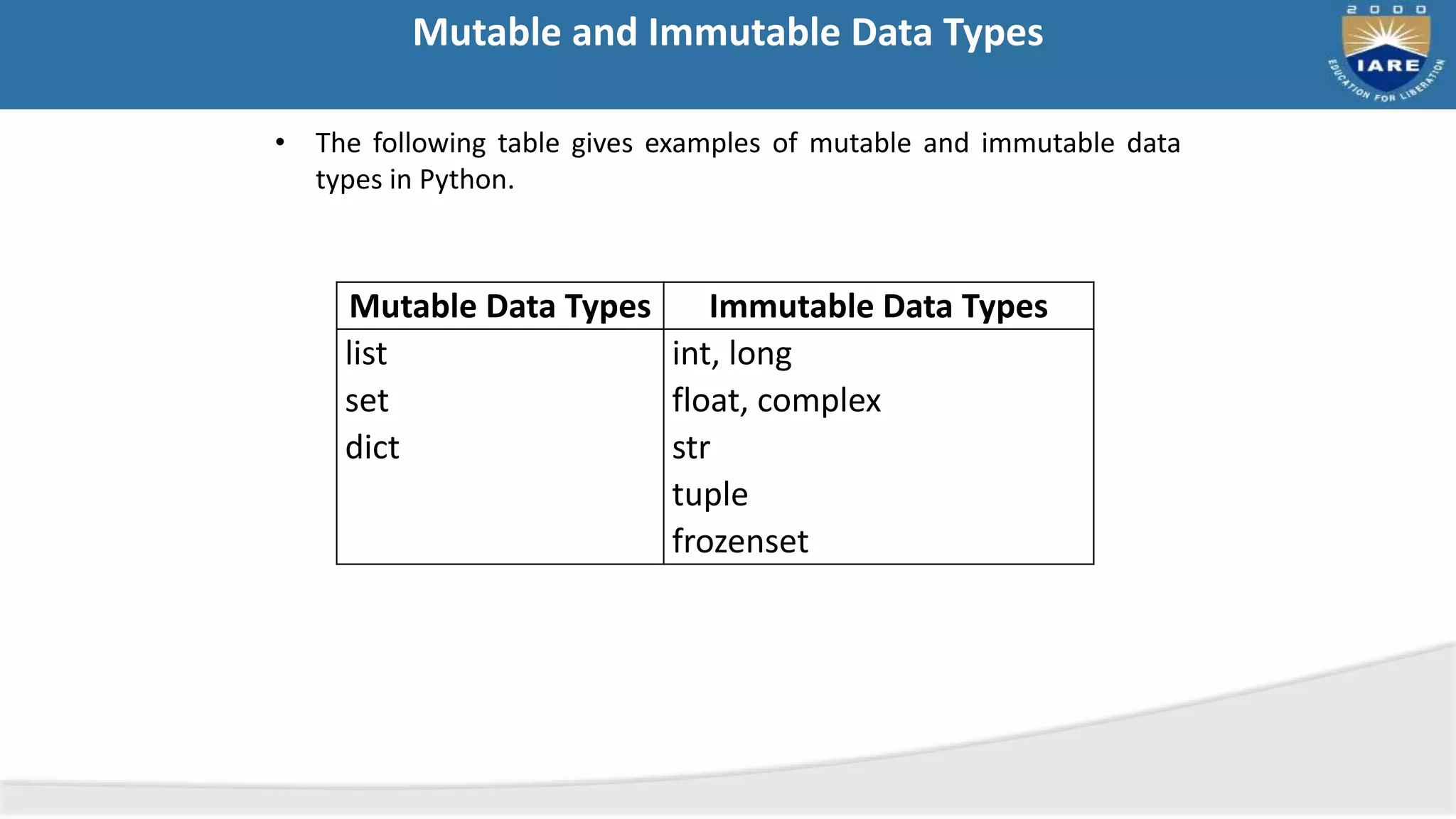
• The following table gives examples of mutable and immutable data
types in Python.
Mutable Data Types Immutable Data Types
list int, long
set float, complex
dict str
tuple
frozenset
Operators in Python
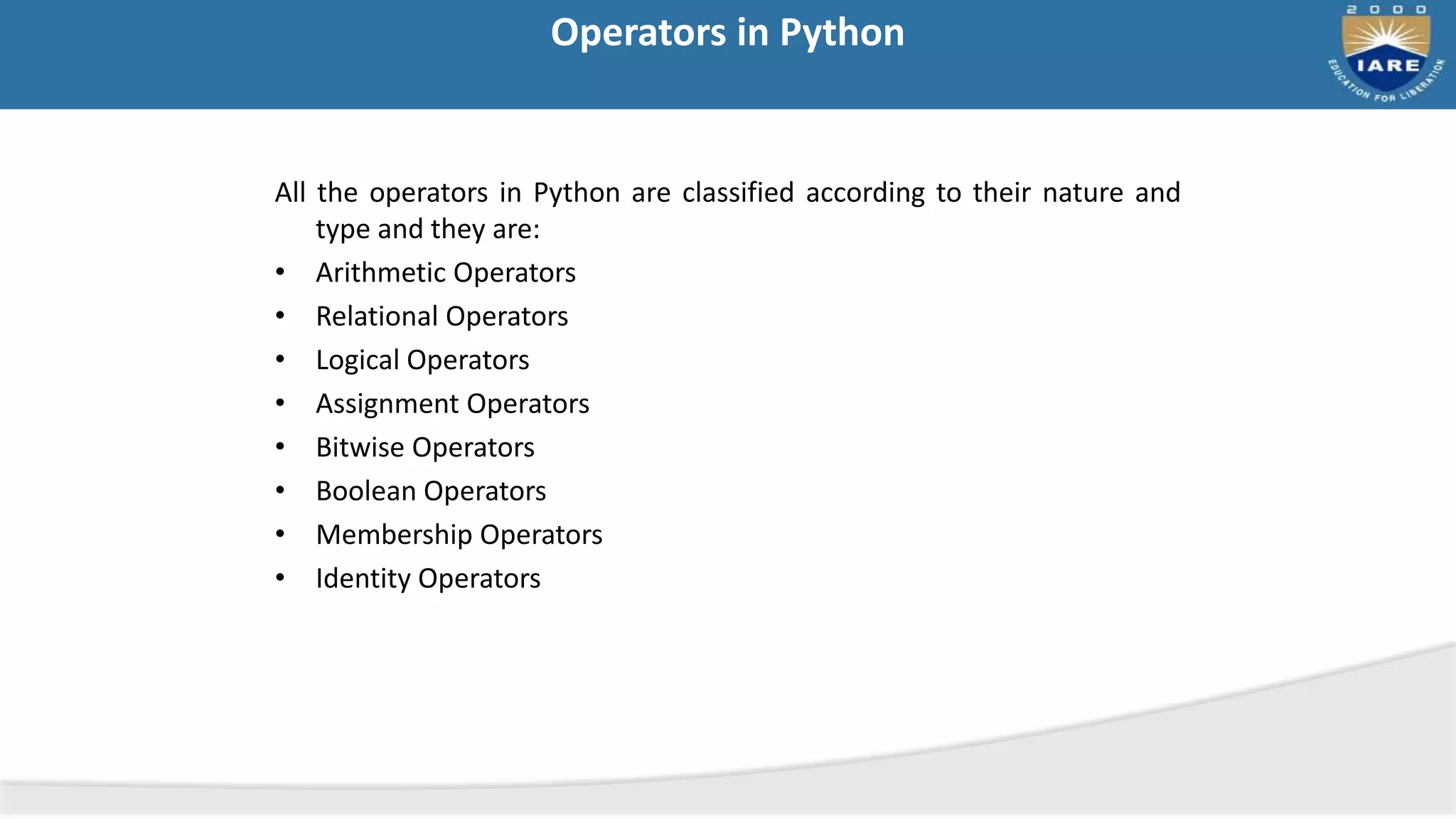
All the operators in Python are classified according to their nature and
type and they are:
• Arithmetic Operators
• Relational Operators
• Logical Operators
• Assignment Operators
• Bitwise Operators
• Boolean Operators
• Membership Operators
• Identity Operators
Bitwise Operators
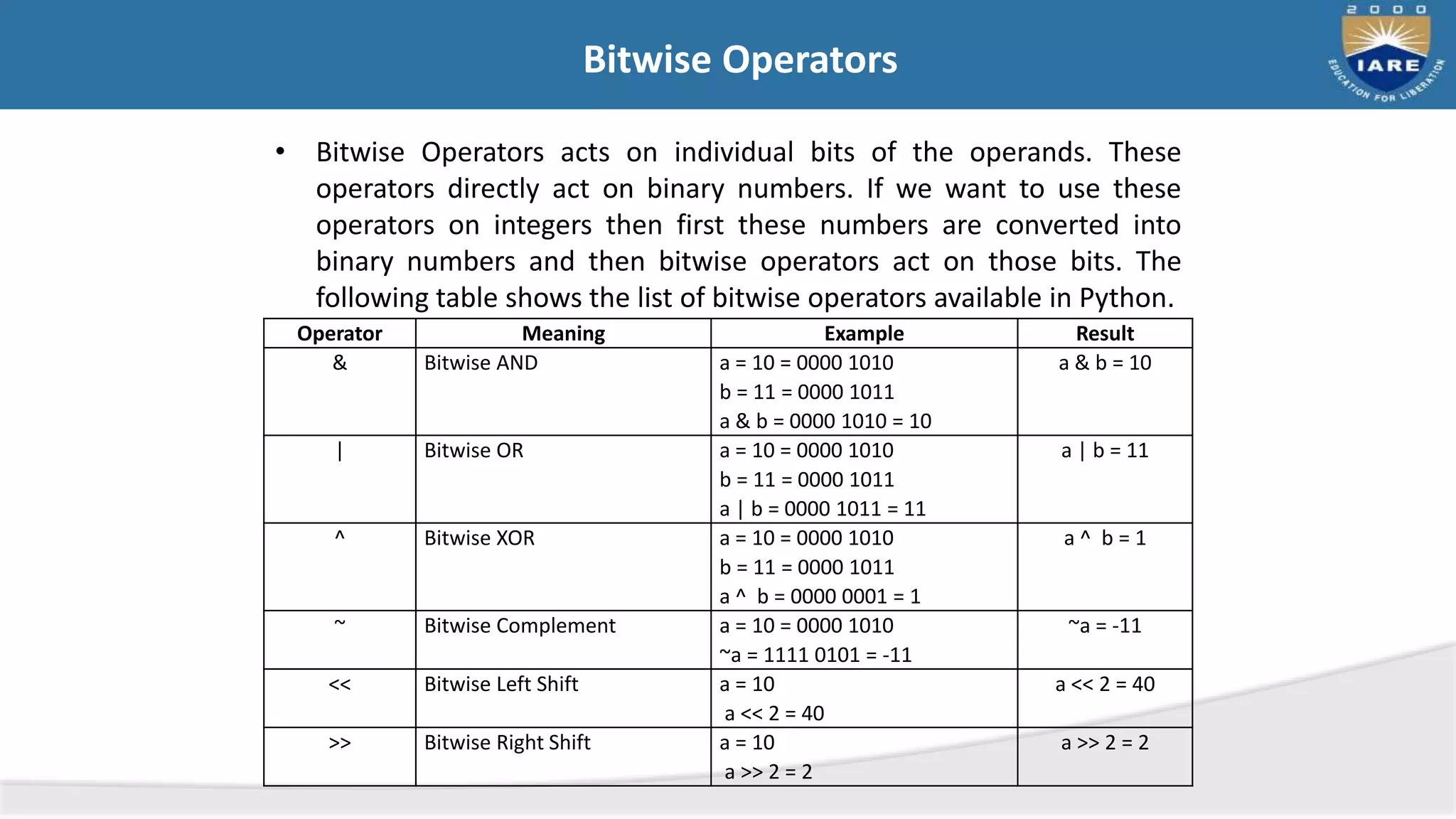
• Bitwise Operators acts on individual bits of the operands. These
operators directly act on binary numbers. If we want to use these
operators on integers then first these numbers are converted into
binary numbers and then bitwise operators act on those bits. The
following table shows the list of bitwise operators available in Python.
Operator Meaning Example Result
& Bitwise AND a = 10 = 0000 1010
b = 11 = 0000 1011
a & b = 0000 1010 = 10
a & b = 10
| Bitwise OR a = 10 = 0000 1010
b = 11 = 0000 1011
a | b = 0000 1011 = 11
a | b = 11
^ Bitwise XOR a = 10 = 0000 1010
b = 11 = 0000 1011
a ^ b = 0000 0001 = 1
a ^ b = 1
~ Bitwise Complement a = 10 = 0000 1010
~a = 1111 0101 = -11
~a = -11
<< Bitwise Left Shift a = 10
a << 2 = 40
a << 2 = 40
>> Bitwise Right Shift a = 10
a >> 2 = 2
a >> 2 = 2
Boolean Operators
• There are three boolean operators that act on bool type literals and
provide bool type output. The result of the boolean operators are
either True or False.
Operator Meaning Example Result
and Boolean AND a = True, b = False
a and b = True and
False
a and b = False
or Boolean OR a = True, b = False
a or b = True or False
a or b = True
not Boolean NOT a = True
not a = not True
not a = False
Operator Precedence and Associativity
• An expression may contain several operators and the order in which
these operators are executed in sequence is called operator
precedence. The following table summarizes the operators in
descending order of their precedence.
Operator Name Precedence
( ) Parenthesis 1st
** Exponentiation 2nd
-, ~ Unary minus, bitwise complement 3rd
*, /, //, % Multiplication, Division, Floor Division, Modulus 4th
+, - Addition, Subtraction 5th
<<, >> Bitwise left shift, bitwise right shift 6th
& Bitwise AND 7th
^ Bitwise XOR 8th
| Bitwise OR 9th
>, >=, <, <=, = =, != Relational Operators 10th
=, %=, /=, //=, -=, +=, *=, **= Assignment Operators 11th
is, is not Identity Operators 12th
in, not in Membership Operators 13th
not Logical NOT 14th
or Logical OR 15th
and Logical AND 16th

1 Standard Data types.pptx

  • 1.
    Mutable and ImmutableData Types • The following table gives examples of mutable and immutable data types in Python. Mutable Data Types Immutable Data Types list int, long set float, complex dict str tuple frozenset
  • 2.
    Operators in Python Allthe operators in Python are classified according to their nature and type and they are: • Arithmetic Operators • Relational Operators • Logical Operators • Assignment Operators • Bitwise Operators • Boolean Operators • Membership Operators • Identity Operators
  • 3.
    Bitwise Operators • BitwiseOperators acts on individual bits of the operands. These operators directly act on binary numbers. If we want to use these operators on integers then first these numbers are converted into binary numbers and then bitwise operators act on those bits. The following table shows the list of bitwise operators available in Python. Operator Meaning Example Result & Bitwise AND a = 10 = 0000 1010 b = 11 = 0000 1011 a & b = 0000 1010 = 10 a & b = 10 | Bitwise OR a = 10 = 0000 1010 b = 11 = 0000 1011 a | b = 0000 1011 = 11 a | b = 11 ^ Bitwise XOR a = 10 = 0000 1010 b = 11 = 0000 1011 a ^ b = 0000 0001 = 1 a ^ b = 1 ~ Bitwise Complement a = 10 = 0000 1010 ~a = 1111 0101 = -11 ~a = -11 << Bitwise Left Shift a = 10 a << 2 = 40 a << 2 = 40 >> Bitwise Right Shift a = 10 a >> 2 = 2 a >> 2 = 2
  • 4.
    Boolean Operators • Thereare three boolean operators that act on bool type literals and provide bool type output. The result of the boolean operators are either True or False. Operator Meaning Example Result and Boolean AND a = True, b = False a and b = True and False a and b = False or Boolean OR a = True, b = False a or b = True or False a or b = True not Boolean NOT a = True not a = not True not a = False
  • 5.
    Operator Precedence andAssociativity • An expression may contain several operators and the order in which these operators are executed in sequence is called operator precedence. The following table summarizes the operators in descending order of their precedence. Operator Name Precedence ( ) Parenthesis 1st ** Exponentiation 2nd -, ~ Unary minus, bitwise complement 3rd *, /, //, % Multiplication, Division, Floor Division, Modulus 4th +, - Addition, Subtraction 5th <<, >> Bitwise left shift, bitwise right shift 6th & Bitwise AND 7th ^ Bitwise XOR 8th | Bitwise OR 9th >, >=, <, <=, = =, != Relational Operators 10th =, %=, /=, //=, -=, +=, *=, **= Assignment Operators 11th is, is not Identity Operators 12th in, not in Membership Operators 13th not Logical NOT 14th or Logical OR 15th and Logical AND 16th