UNDERSTANDING
TRAFFICKING IN
PERSONS
 It is tied with illegal arms
trade and considered as the
2nd
largest criminal activity
next to illegal drugs trade.
 Human trafficking has
developed into an illicit global
enterprise estimated to be
worth $32 billion.
TIP AS A GLOBAL CHALLENGE
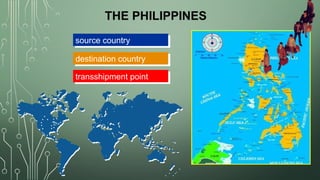
source country
destination country
transshipment point
THE PHILIPPINES
ANTI-TRAFFICKING IN PERSONS ACT OF 2003
Republic Act No. 9208
Effective June 19, 2003
LEGISLATIVE RESPONSE
EXPANDED ANTI-TRAFFICKING IN PERSONS ACT OF 2012
Republic Act No. 10364
Effective March 1, 2013
EXPANDED ANTI-TRAFFICKING IN PERSONS ACT OF 2022
Republic Act No. 11862
Effective July 13, 2022
WHAT IS TRAFFICKING IN PERSONS (TIP)?
TIP refers to the recruitment, obtaining, hiring, providing, offering,
transportation, transfer, maintaining, harboring, or receipt of persons
with or without the victim’s consent or knowledge, within or across
national borders by means of threat, or use of force, or other forms of
coercion, abduction, fraud, deception, abuse of power or of position,
taking advantage of the vulnerability of the person, or, the giving or
receiving of payments or benefits to achieve the consent of a person
having control over another person for the purpose of exploitation
which includes at a minimum, the exploitation or the prostitution of
others or the engagement of others for the production or distribution,
or both, of materials that depict child sexual abuse or exploitation, or
other forms of sexual exploitation, forced labor or services, slavery,
servitude or the removal or sale of organs.
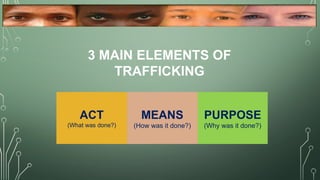
3 MAIN ELEMENTS OF
TRAFFICKING
ACT
(What was done?)
MEANS
(How was it done?)
PURPOSE
(Why was it done?)
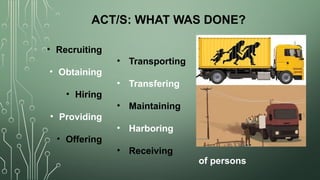
ACT/S: WHAT WAS DONE?
• Recruiting
• Obtaining
• Hiring
• Providing
• Offering
• Transporting
• Transfering
• Maintaining
• Harboring
• Receiving
of persons
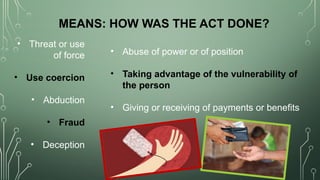
• Threat or use
of force
• Use coercion
• Abduction
• Fraud
• Deception
MEANS: HOW WAS THE ACT DONE?
• Abuse of power or of position
• Taking advantage of the vulnerability of
the person
• Giving or receiving of payments or benefits
EXPLOITATIVE PURPOSE: WHY WAS THE
ACT DONE?
• Prostitution of others
• Child sexual abuse or
exploitation materials (CSAEM)
• Other forms of sexual
exploitation
• Forced labor or services
• Slavery
• Servitude
• Removal or sale of organs
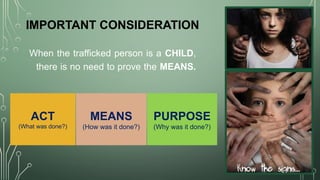
When the trafficked person is a CHILD,
there is no need to prove the MEANS.
IMPORTANT CONSIDERATION
ACT
(What was done?)
MEANS
(How was it done?)
PURPOSE
(Why was it done?)
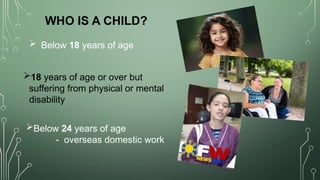
 Below 18 years of age
WHO IS A CHILD?
18 years of age or over but
suffering from physical or mental
disability
Below 24 years of age
- overseas domestic work
IMPORTANT CONSIDERATIONS
• Trafficking may be within or
across National Borders
• Philippine courts have
jurisdiction even if the other
elements transpired in another
country
• Consent of the victim is
irrelevant
x
ACTS OF TIP
 TIP in general including those done in the pretext of
domestic or overseas employment for the purpose of
prostitution, pornography, sexual abuse or exploitation,
production, creation, or distribution of CSAEM or CSAM,
forced labor, slavery, involuntary servitude, or debt bondage
ACTS OF TIP
 TIP in the pretext of mail order spouse for the purpose
of prostitution, pornography, sexual exploitation, forced
labor, slavery, involuntary servitude or debt bondage
ACTS OF TIP
 TIP in the pretext of
marriage for the purpose of
prostitution, pornography,
sexual exploitation, forced
labor or slavery, involuntary
servitude or debt bondage
ACTS OF TIP
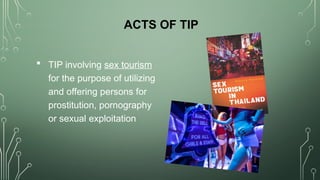
 TIP involving sex tourism
for the purpose of utilizing
and offering persons for
prostitution, pornography
or sexual exploitation
ACTS OF TIP
 TIP through adoption for the purpose of prostitution,
pornography, sexual exploitation, forced labor, slavery,
involuntary servitude or debt bondage, or to facilitate illegal
child adoptions or child-laundering, or for other exploitative
purposes
ACTS OF TIP
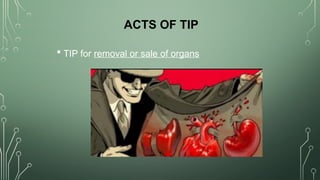
 TIP for removal or sale of organs
ACTS OF TIP
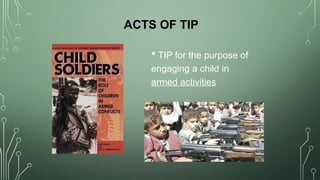
 TIP for the purpose of
engaging a child in
armed activities
ACTS OF TIP
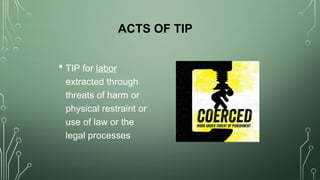
 TIP for labor
extracted through
threats of harm or
physical restraint or
use of law or the
legal processes
ACTS OF TIP
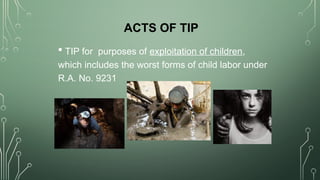
 TIP for purposes of exploitation of children,
which includes the worst forms of child labor under
R.A. No. 9231
ACTS OF TIP
 Organize, financially support or direct the
commission of TIP
ACTS OF TIP
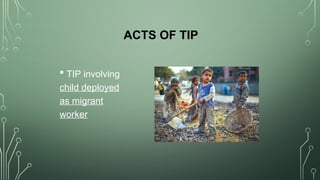
 TIP involving
child deployed
as migrant
worker
Other Prohibited Acts
 Acts that promote TIP
 Violation of confidentiality
 Qualified TIP
 Use of trafficked persons
 Attempted TIP
Who may be held liable for TIP?
 Accessory
 Accomplice
 Trafficker
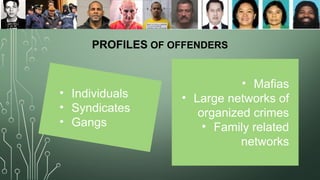
PROFILES OF OFFENDERS
• Mafias
• Large networks of
organized crimes
• Family related
networks
• Individuals
• Syndicates
• Gangs
 any person who has personal knowledge of the
commission of any offense
Who may file a complaint for TIP?
 the trafficked person
 parents of the trafficked person
 spouse of the trafficked person
 siblings of the trafficked person
 children of the trafficked person
 legal guardian of the trafficked person
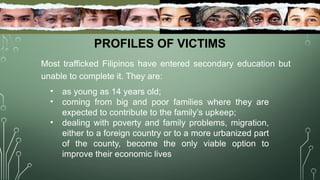
PROFILES OF VICTIMS
Most trafficked Filipinos have entered secondary education but
unable to complete it. They are:
• as young as 14 years old;
• coming from big and poor families where they are
expected to contribute to the family’s upkeep;
• dealing with poverty and family problems, migration,
either to a foreign country or to a more urbanized part
of the county, become the only viable option to
improve their economic lives
PROTECTION TO TRAFFICKED PERSONS
 Trafficked persons shall be considered victims and shall
not be penalized for unlawful acts committed
The past sexual behaviour or predisposition of a
trafficked person shall be considered inadmissible in
evidence of proving consent of the victim to the crime
Victims of trafficking for purposes of prostitution shall
not be prosecuted, fined, or otherwise penalized under
the said law
PRESCRIPTIVE PERIOD
General Rule: 10 years
Exception: 20 years, if committed:
- by a syndicate; or
- in large scale; or
- against a child
The prescriptive period shall commence to run from the day on
which:
i. the trafficked person is delivered or released from the
conditions of bondage; and
ii. in the case of a child victim, from the day the child reaches
the age of majority
1. RA 9208, as amended-Understanding TIP - FINAL.pptx

1. RA 9208, as amended-Understanding TIP - FINAL.pptx

  • 1.
  • 2.
     It istied with illegal arms trade and considered as the 2nd largest criminal activity next to illegal drugs trade.  Human trafficking has developed into an illicit global enterprise estimated to be worth $32 billion. TIP AS A GLOBAL CHALLENGE
  • 3.
  • 5.
    ANTI-TRAFFICKING IN PERSONSACT OF 2003 Republic Act No. 9208 Effective June 19, 2003 LEGISLATIVE RESPONSE EXPANDED ANTI-TRAFFICKING IN PERSONS ACT OF 2012 Republic Act No. 10364 Effective March 1, 2013 EXPANDED ANTI-TRAFFICKING IN PERSONS ACT OF 2022 Republic Act No. 11862 Effective July 13, 2022
  • 6.
    WHAT IS TRAFFICKINGIN PERSONS (TIP)? TIP refers to the recruitment, obtaining, hiring, providing, offering, transportation, transfer, maintaining, harboring, or receipt of persons with or without the victim’s consent or knowledge, within or across national borders by means of threat, or use of force, or other forms of coercion, abduction, fraud, deception, abuse of power or of position, taking advantage of the vulnerability of the person, or, the giving or receiving of payments or benefits to achieve the consent of a person having control over another person for the purpose of exploitation which includes at a minimum, the exploitation or the prostitution of others or the engagement of others for the production or distribution, or both, of materials that depict child sexual abuse or exploitation, or other forms of sexual exploitation, forced labor or services, slavery, servitude or the removal or sale of organs.
  • 7.
    3 MAIN ELEMENTSOF TRAFFICKING ACT (What was done?) MEANS (How was it done?) PURPOSE (Why was it done?)
  • 8.
    ACT/S: WHAT WASDONE? • Recruiting • Obtaining • Hiring • Providing • Offering • Transporting • Transfering • Maintaining • Harboring • Receiving of persons
  • 9.
    • Threat oruse of force • Use coercion • Abduction • Fraud • Deception MEANS: HOW WAS THE ACT DONE? • Abuse of power or of position • Taking advantage of the vulnerability of the person • Giving or receiving of payments or benefits
  • 10.
    EXPLOITATIVE PURPOSE: WHYWAS THE ACT DONE? • Prostitution of others • Child sexual abuse or exploitation materials (CSAEM) • Other forms of sexual exploitation • Forced labor or services • Slavery • Servitude • Removal or sale of organs
  • 11.
    When the traffickedperson is a CHILD, there is no need to prove the MEANS. IMPORTANT CONSIDERATION ACT (What was done?) MEANS (How was it done?) PURPOSE (Why was it done?)
  • 12.
     Below 18years of age WHO IS A CHILD? 18 years of age or over but suffering from physical or mental disability Below 24 years of age - overseas domestic work
  • 13.
    IMPORTANT CONSIDERATIONS • Traffickingmay be within or across National Borders • Philippine courts have jurisdiction even if the other elements transpired in another country • Consent of the victim is irrelevant x
  • 14.
    ACTS OF TIP TIP in general including those done in the pretext of domestic or overseas employment for the purpose of prostitution, pornography, sexual abuse or exploitation, production, creation, or distribution of CSAEM or CSAM, forced labor, slavery, involuntary servitude, or debt bondage
  • 15.
    ACTS OF TIP TIP in the pretext of mail order spouse for the purpose of prostitution, pornography, sexual exploitation, forced labor, slavery, involuntary servitude or debt bondage
  • 16.
    ACTS OF TIP TIP in the pretext of marriage for the purpose of prostitution, pornography, sexual exploitation, forced labor or slavery, involuntary servitude or debt bondage
  • 17.
    ACTS OF TIP TIP involving sex tourism for the purpose of utilizing and offering persons for prostitution, pornography or sexual exploitation
  • 18.
    ACTS OF TIP TIP through adoption for the purpose of prostitution, pornography, sexual exploitation, forced labor, slavery, involuntary servitude or debt bondage, or to facilitate illegal child adoptions or child-laundering, or for other exploitative purposes
  • 19.
    ACTS OF TIP TIP for removal or sale of organs
  • 20.
    ACTS OF TIP TIP for the purpose of engaging a child in armed activities
  • 21.
    ACTS OF TIP TIP for labor extracted through threats of harm or physical restraint or use of law or the legal processes
  • 22.
    ACTS OF TIP TIP for purposes of exploitation of children, which includes the worst forms of child labor under R.A. No. 9231
  • 23.
    ACTS OF TIP Organize, financially support or direct the commission of TIP
  • 24.
    ACTS OF TIP TIP involving child deployed as migrant worker
  • 25.
    Other Prohibited Acts Acts that promote TIP  Violation of confidentiality  Qualified TIP  Use of trafficked persons  Attempted TIP
  • 26.
    Who may beheld liable for TIP?  Accessory  Accomplice  Trafficker
  • 27.
    PROFILES OF OFFENDERS •Mafias • Large networks of organized crimes • Family related networks • Individuals • Syndicates • Gangs
  • 28.
     any personwho has personal knowledge of the commission of any offense Who may file a complaint for TIP?  the trafficked person  parents of the trafficked person  spouse of the trafficked person  siblings of the trafficked person  children of the trafficked person  legal guardian of the trafficked person
  • 29.
    PROFILES OF VICTIMS Mosttrafficked Filipinos have entered secondary education but unable to complete it. They are: • as young as 14 years old; • coming from big and poor families where they are expected to contribute to the family’s upkeep; • dealing with poverty and family problems, migration, either to a foreign country or to a more urbanized part of the county, become the only viable option to improve their economic lives
  • 30.
    PROTECTION TO TRAFFICKEDPERSONS  Trafficked persons shall be considered victims and shall not be penalized for unlawful acts committed The past sexual behaviour or predisposition of a trafficked person shall be considered inadmissible in evidence of proving consent of the victim to the crime Victims of trafficking for purposes of prostitution shall not be prosecuted, fined, or otherwise penalized under the said law
  • 31.
    PRESCRIPTIVE PERIOD General Rule:10 years Exception: 20 years, if committed: - by a syndicate; or - in large scale; or - against a child The prescriptive period shall commence to run from the day on which: i. the trafficked person is delivered or released from the conditions of bondage; and ii. in the case of a child victim, from the day the child reaches the age of majority