The Anti-Trafficking in
Persons Act of 2003
Republic Act 9208
The Expanded Anti-Trafficking
in Persons Act of 2012
RA 10364
What is Trafficking
in Persons (TIP)?
Trafficking in Person
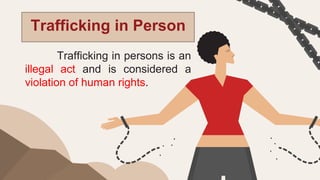
Trafficking in persons is an
illegal act and is considered a
violation of human rights.
It has three (3) inter-related and interdependent elements
for a situation to be considered trafficking in persons:
ACTS MEANS PURPOSE
ACTS
01
Recruitment/ hiring
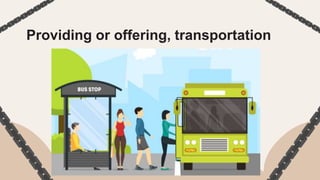
Providing or offering, transportation
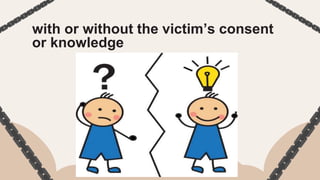
with or without the victim’s consent
or knowledge
within or across national
borders
MEANS
02
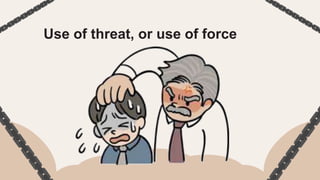
Use of threat, or use of force
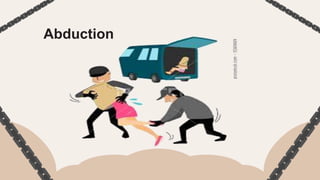
Abduction
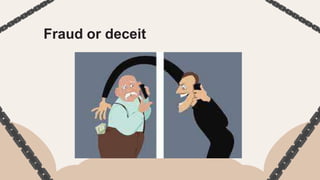
Fraud or deceit
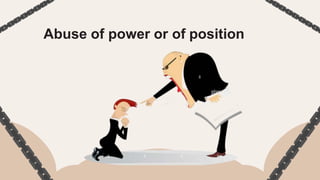
Abuse of power or of position
Offer or contract marriage
Undertake or organize tours and travel
plans consisting of tourism packages
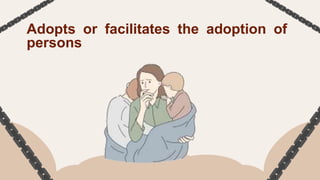
Adopts or facilitates the adoption of
persons
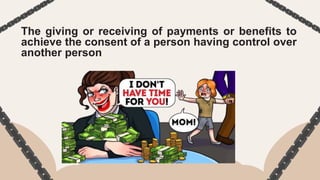
The giving or receiving of payments or benefits to
achieve the consent of a person having control over
another person
PURPOSE
02
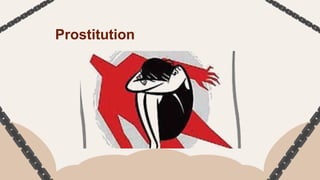
Prostitution
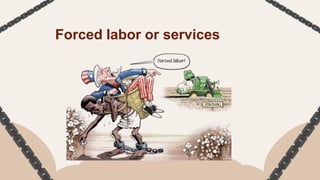
Forced labor or services
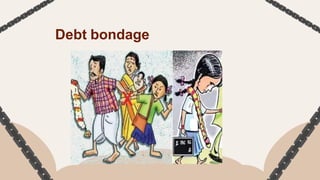
Debt bondage
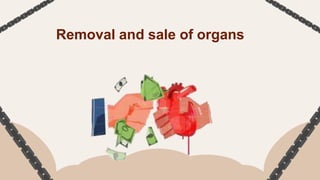
Removal and sale of organs
PUNISHABLE
ACTS
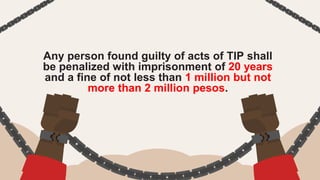
Any person found guilty of acts of TIP shall
be penalized with imprisonment of 20 years
and a fine of not less than 1 million but not
more than 2 million pesos.
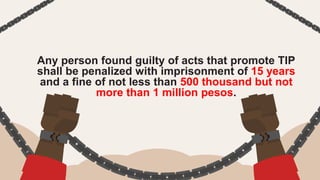
Any person found guilty of acts that promote TIP
shall be penalized with imprisonment of 15 years
and a fine of not less than 500 thousand but not
more than 1 million pesos.
Any person who buys or engages the services of
trafficked persons for prostitution shall be
penalized with imprisonment ranging from six (6)
years to forty (40) years and fine ranging from 50
thousand to 5 million pesos.
Qualified trafficking shall be penalized by life
imprisonment and a fine of not less than 2 million
but not more than 5 million pesos.
Any person found guilty of committing attempted TIP shall
be penalized with imprisonment of 15 years and a fine of
not less than 500 thousand but not more than 1 million
pesos.
How to identify the
Pimps/traffickers?
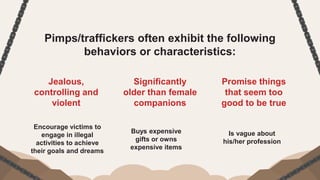
Pimps/traffickers often exhibit the following
behaviors or characteristics:
Jealous,
controlling and
violent
Encourage victims to
engage in illegal
activities to achieve
their goals and dreams
Significantly
older than female
companions
Buys expensive
gifts or owns
expensive items
Promise things
that seem too
good to be true
Is vague about
his/her profession
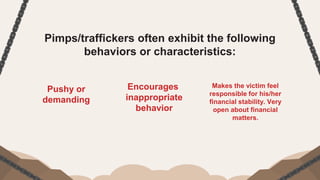
Pimps/traffickers often exhibit the following
behaviors or characteristics:
Pushy or
demanding
Encourages
inappropriate
behavior
Makes the victim feel
responsible for his/her
financial stability. Very
open about financial
matters.
Sinu-sino ang maaaring mag-file
ng kaso ng trafficking?
1. Ang mismong
biktima ng trafficking
Sinu-sino ang maaaring mag-file
ng kaso ng trafficking?
2. Ang mga magulang,
asawa, kapatid, mga anak
o legal guardian ng biktima.
Sinu-sino ang maaaring mag-file
ng kaso ng trafficking?
3. Sinumang may
personal na kaalaman
sa anumang paglabag
ng RA 9208
Ano ang proteksyon
ng batas para sa
biktima ng trafficking?
1. Upang mapangalagaan ang
karapatan ng biktima, ang
pagdinig sa kaso ng trafficking
ay confidential.
Mahalaga ang privacy ng
biktima at akusado sa anumang
antas ng imbestigasyon ng kaso.
2. Hindi rin maaaring
parusahan ang biktima
para sa mga krimeng
nagawa lamang bilang
pagsunod sa mga
kagustuhan ng may-sala.
3.Mapasailalim sa witness
protection program kung
kinakailangan.
Iba pang suportang serbisyo mula sa
iba’t ibang ahensya ng pamahalaan:
 Lugar na matitirhan (DSWD)
 Counseling (DSWD)
 Libreng serbisyo panlegal
(DOJ/POEA)
 Mga serbisyong medikal at
sikolohikal
 Mga programang
pangkabuhayan
 Pagtulong sa edukasyon ng
batang biktima
CREDITS: This presentation template was
created by Slidesgo, including icons by
Flaticon, infographics and images by Freepik
Thanks!
Do you have any questions?
youremail@freepik.com
+91 620 421 838
Yourcompany.com
Please keep this slide for attribution

TIP LECTURE.pptx