Social Impact Measurement &
the Social Impact Matrix
Dr Richard Hazenberg
Institute for Social Innovation & Impact
University of Northampton
Presentation Overview
• CEDS/ISII Collaboration
• Social impact measurement – Usual reactions
• Why measure SI?
• How to measure SI?
• Evaluating programmes.
• Social Impact Matrix
– UK
– Vietnam
• Summary
CEDS & ISII
• VNU University of Economics and Business and the University of
Northampton have an institutional partnership based upon a formal
collaboration between the Center for Economic Development
Studies and the Institution for Social Innovation and Impact.
• CEDS and ISII are collaborating to understand the:
– Similarities/differences between SEs in Vietnam/UK.
– Vietnamese/UK needs in relation to SI Measurement.
– Applicability of the SI Matrix to the Vietnamese SE sector.
• This is a British Academy funded project (Newton Fund).
• In the future, to create an online web-based SI Measurement tool for
Vietnamese SEs.
Social Impact Measurement
The usual reactions I often see
when delivering this
presentation…
Stay away, it’s too complicated!
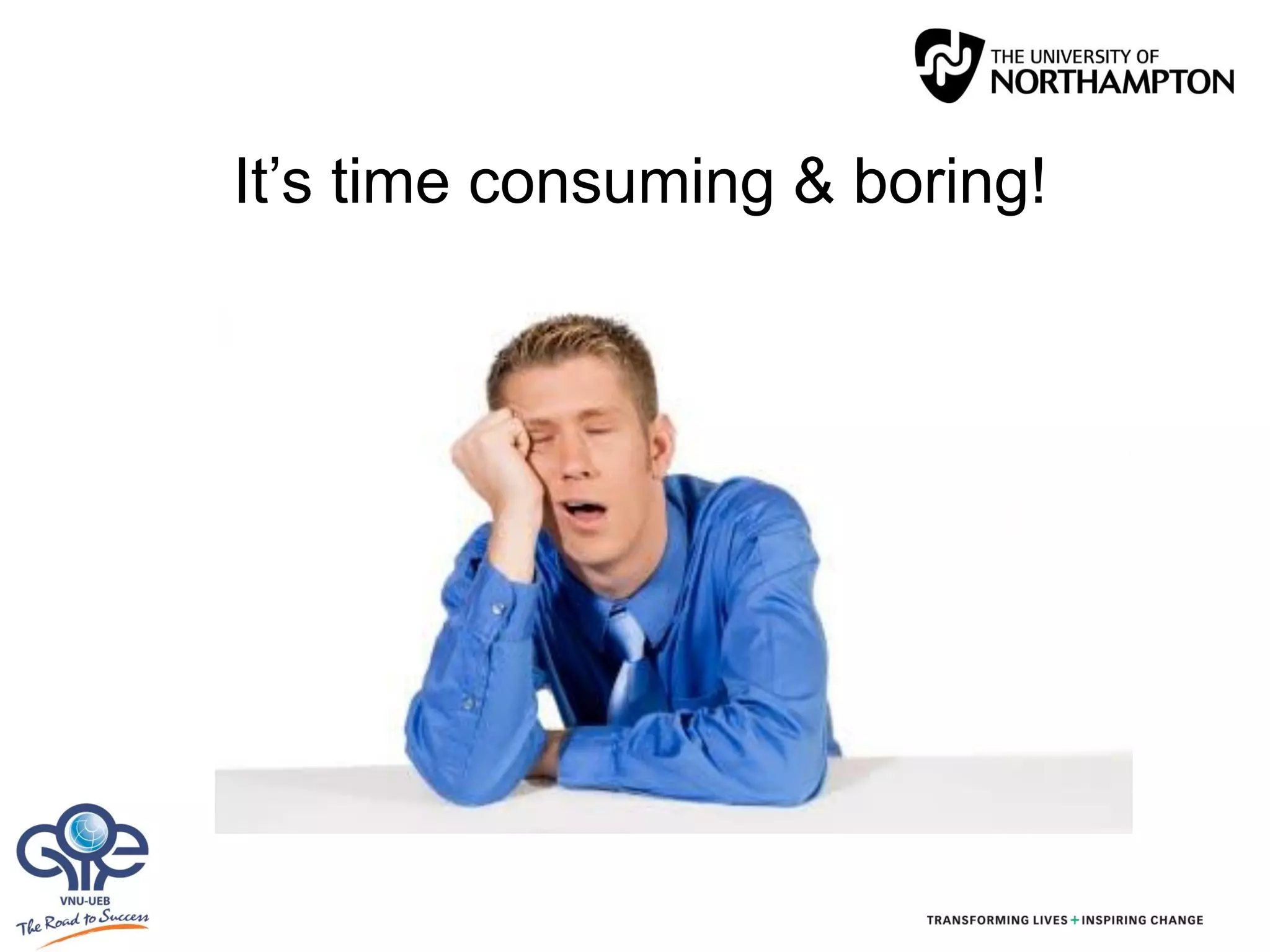
It’s time consuming & boring!
It’s too expensive!
So Why Measure Social
Impact?
• Provides evidence of the impact that you are having.
o Good evidence for stakeholders, funders & beneficiaries.
• Allows for organisational learning.
o Are you always having a positive impact?
• Can help secure contracts/investment. In the UK (NCVO, 2016):
o 81% VCSEs earned through competitive contract delivery (49%
in 2000/01).
o Government funding fell by 44% between 2008 and 2013.
• Transition in third sector relationship with the state/NGOs/investors:
o Desire for evidenced-based policy-making.
o Austerity & scarce resources.
Choosing?
• There is no right or wrong answer, the decision has to be
shaped by you.
• 3 main influencing factors are:
o Motivation
 Why are you engaging in SI measurement?
 What do you want to get out of it?
 What impact do you want it to have?
o Readiness
 How soon can you engage in SI measurement?
o Capacity
 Staff expertise & time.
 Financial resources.
 External contacts/networks.
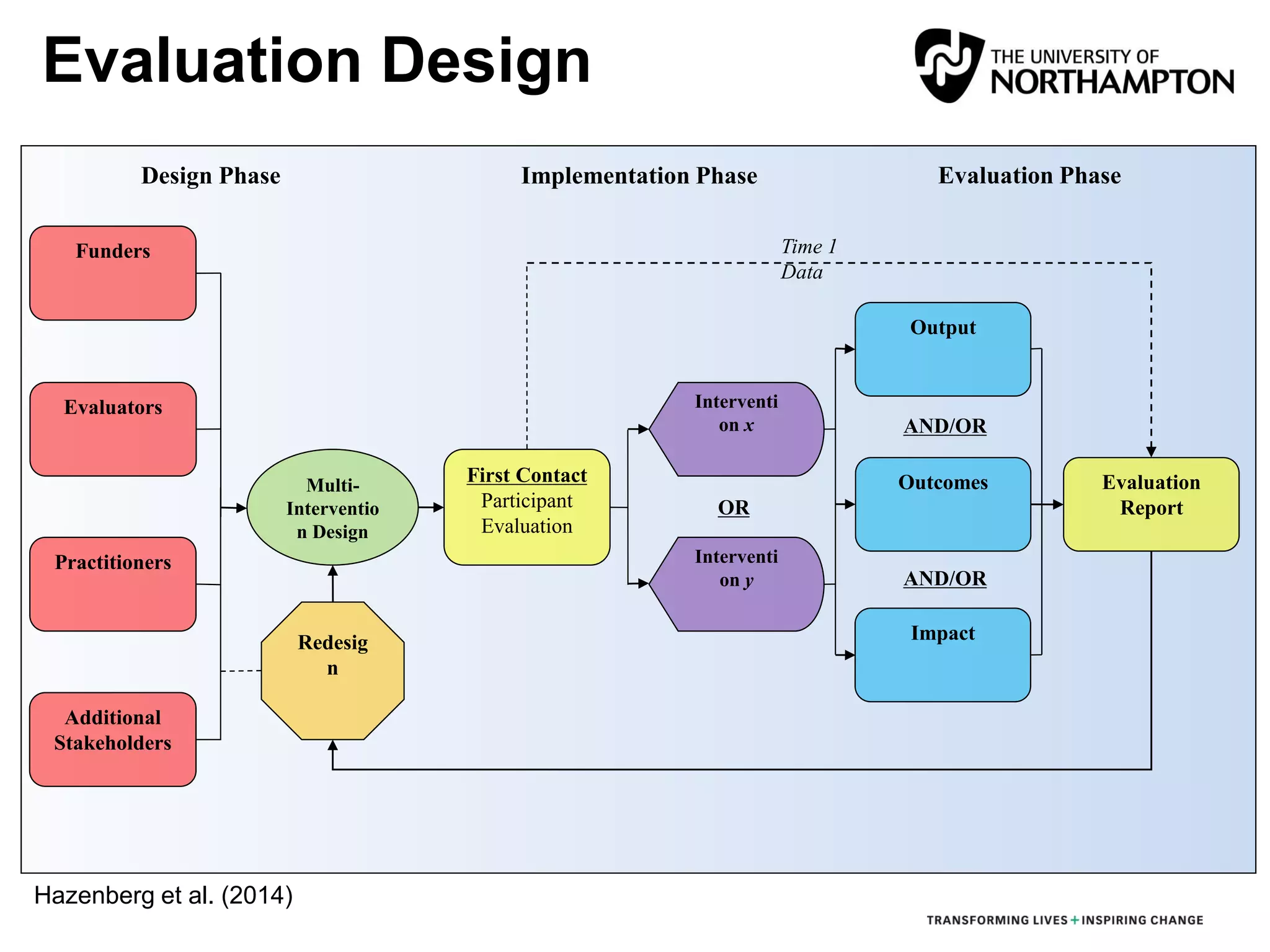
Design Phase Implementation Phase Evaluation Phase
Additional
Stakeholders
Funders
Practitioners
Evaluators
AND/OR
AND/OR
Outcomes
Impact
Output
Evaluation
Report
Multi-
Interventio
n Design
First Contact
Participant
Evaluation
Interventi
on y
OR
Interventi
on x
Redesig
n
Time 1
Data
Evaluation Design
Hazenberg et al. (2014)
The Social Impact Matrix
Measuring Social Impact
• McLoughlin et al. (2009) developed the SIMPLE
methodology that seeks to measure:
– Outputs: Direct and easily identifiable
(i.e. jobs created).
– Outcomes: Individual beneficiary benefits
(i.e. increased confidence).
– Impact: Wider benefit to society (i.e. reduced social
security payments).
• We combined this approach with an examination of the
triple bottom-line to create the ‘Social Impact Matrix’.
– Economic, social and environmental.
Social Impact
Matrix
Economic
Outputs
Outcomes
Impacts
Specific Tools
Specific Tools
Specific Tools
Social
Outputs
Outcomes
Impacts
Specific Tools
Specific Tools
Specific Tools
Environment
Outputs
Outcomes
Impacts
Specific Tools
Specific Tools
Specific Tools
Social Impact Matrix
Category
Sub-category
(where applicable)
DataInput Category
Sub-category
(where applicable)
DataInput Category
Sub-category
(where applicable)
DataInput
Full-timeN
Part-timeN
Full-timeN NI
{(Income) -(NIA=
£5,328)]x 1.12=NIx
Part-timeN
Full-timeN
Part-timeN
Full-timeN
Part-timeN
Nascent
Entrepreneurs
Supported
N
Self-employment
Tax
CorporationTax
(ProfitsMade x 1.2)
=Associate's
CorporationTax
(ACTx)
Start-upsCreated N
Early-stagers
Supported
N
EstablishedEnterp.
Support
N
OwnWorkshop
Progression
N
ImpactSector
Employment&
Entrepreneurship
Output Outcome
GSEscale
(Schwarzer&
Jerusalem1995)
Volunteering
N.O.volunteers
engagedinthe shop
N
VolunteerHours
Worked
Hrs
Social self-efficacy VolunteerSSE
Trainee Volunteer
GSE
Associate
Volunteers
Trainee Volunteers
Employment
Enterprise Support
Café/Shop
Alumni Businesses
Impact
Attitude to
Enterprise
Associate Volunteer
ATE
ATEscale (Athayde,
2009)
(Volunteerhours
workedx £8.80) =
Volunteeringfiscal
value (VFVx)
VolunteerValue to
GF
Volunteering
Impact
Unemployment
Benefits
Job-seeker
allowance x N.O.
employeesSelf-employment
welfare (where
applicable)
Otherbenefits
Include where
applicable
SSEScale (Smith&
Betz2000)
Income Tax
General self-
efficacy
Newemployment
tax
Newemployment
welfare (where
applicable)
[(Income) -(PTA=
£10k)]x 1.2=Tx
Include where
applicable
Otherbenefits
Unemployment
Benefits
Job-seeker
allowance x N.O.
employees
Example Matrix Section
• When engaging with the University of Northampton and the SI
Matrix, a social enterprise:
– Engages in full meetings with the research team, so that all aspects of the
business & impact can be understood & mapped out.
– Has a holistic SI Matrix produced that details all the areas that they deliver
impact.
– A collaborative process of selecting only key strategic areas for measurement is
undertaken.
– The relevant tools and reporting frameworks, as well as
methodological training, are provided to the social enterprise.
– The social enterprise then collects the data before sending
this to the research team.
– The research team then audits and analyses the data.
– A research report is then produced for the social enterprise,
badged by the University as a sign of independence
and quality.
SIM Process
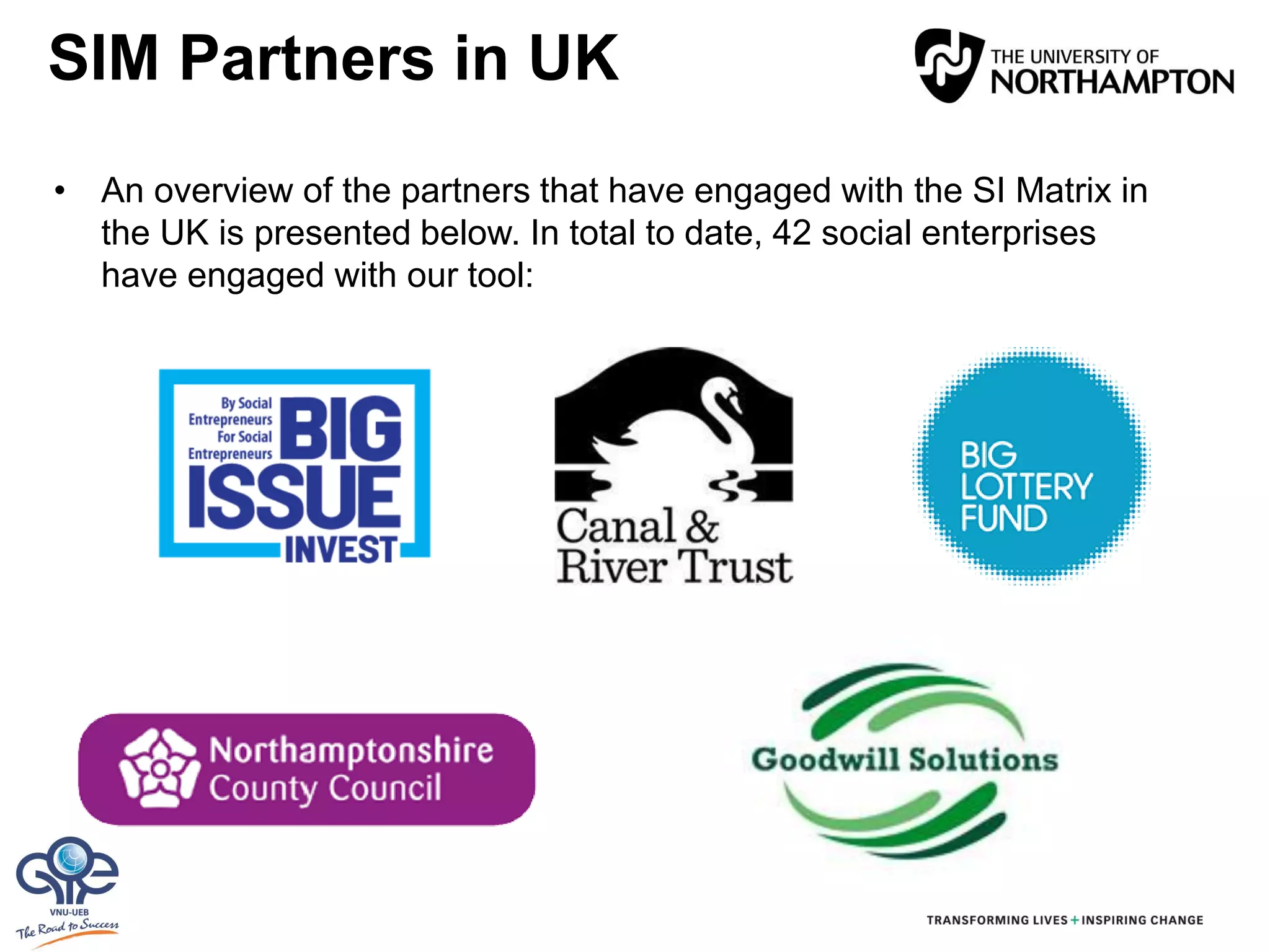
• An overview of the partners that have engaged with the SI Matrix in
the UK is presented below. In total to date, 42 social enterprises
have engaged with our tool:
SIM Partners in UK
• Our research with CEDs has identified the following barriers to SI
Measurement in the UK & Vietnam:
Vietnam & the UK
1. Financial Capacity.
2. Human Resources.
3. Intellectual Knowledge.
4. Time.
1. Financial Capacity.
2. Human Resources.
3. Intellectual Knowledge.
4. Time.
Summary
• There is no perfect measure of SI measurement.
– Organisations need to find the approach that works best for them and aligns with
their strategic aims.
• The ‘Social Impact Matrix’ provides a route to mapping & measuring
social impact that is:
– Grounded in prior research & theory.
– Allows for a tailored approach to individual organisations.
– Is not purely fiscally based (i.e. like SROI).
• This type of measurement is considered best practice by the EC (EC
Social Impact Sub-group, Feb 2014).
• Newton Fund output 2016: Publication of the SIM framework for
Vietnam will be made available on the CEDS website for
Vietnamese social enterprises to engage with.
Thank you
for listening
Any questions?
Dr Richard Hazenberg
Email: richard.hazenberg@northampton.ac.uk
Tel: +44 (0)7803924987

1 presention richard hazenberg

  • 1.
    Social Impact Measurement& the Social Impact Matrix Dr Richard Hazenberg Institute for Social Innovation & Impact University of Northampton
  • 2.
    Presentation Overview • CEDS/ISIICollaboration • Social impact measurement – Usual reactions • Why measure SI? • How to measure SI? • Evaluating programmes. • Social Impact Matrix – UK – Vietnam • Summary
  • 3.
    CEDS & ISII •VNU University of Economics and Business and the University of Northampton have an institutional partnership based upon a formal collaboration between the Center for Economic Development Studies and the Institution for Social Innovation and Impact. • CEDS and ISII are collaborating to understand the: – Similarities/differences between SEs in Vietnam/UK. – Vietnamese/UK needs in relation to SI Measurement. – Applicability of the SI Matrix to the Vietnamese SE sector. • This is a British Academy funded project (Newton Fund). • In the future, to create an online web-based SI Measurement tool for Vietnamese SEs.
  • 4.
    Social Impact Measurement Theusual reactions I often see when delivering this presentation…
  • 5.
    Stay away, it’stoo complicated!
  • 6.
  • 7.
  • 8.
    So Why MeasureSocial Impact? • Provides evidence of the impact that you are having. o Good evidence for stakeholders, funders & beneficiaries. • Allows for organisational learning. o Are you always having a positive impact? • Can help secure contracts/investment. In the UK (NCVO, 2016): o 81% VCSEs earned through competitive contract delivery (49% in 2000/01). o Government funding fell by 44% between 2008 and 2013. • Transition in third sector relationship with the state/NGOs/investors: o Desire for evidenced-based policy-making. o Austerity & scarce resources.
  • 9.
    Choosing? • There isno right or wrong answer, the decision has to be shaped by you. • 3 main influencing factors are: o Motivation  Why are you engaging in SI measurement?  What do you want to get out of it?  What impact do you want it to have? o Readiness  How soon can you engage in SI measurement? o Capacity  Staff expertise & time.  Financial resources.  External contacts/networks.
  • 10.
    Design Phase ImplementationPhase Evaluation Phase Additional Stakeholders Funders Practitioners Evaluators AND/OR AND/OR Outcomes Impact Output Evaluation Report Multi- Interventio n Design First Contact Participant Evaluation Interventi on y OR Interventi on x Redesig n Time 1 Data Evaluation Design Hazenberg et al. (2014)
  • 11.
  • 12.
    Measuring Social Impact •McLoughlin et al. (2009) developed the SIMPLE methodology that seeks to measure: – Outputs: Direct and easily identifiable (i.e. jobs created). – Outcomes: Individual beneficiary benefits (i.e. increased confidence). – Impact: Wider benefit to society (i.e. reduced social security payments). • We combined this approach with an examination of the triple bottom-line to create the ‘Social Impact Matrix’. – Economic, social and environmental.
  • 13.
    Social Impact Matrix Economic Outputs Outcomes Impacts Specific Tools SpecificTools Specific Tools Social Outputs Outcomes Impacts Specific Tools Specific Tools Specific Tools Environment Outputs Outcomes Impacts Specific Tools Specific Tools Specific Tools Social Impact Matrix
  • 14.
    Category Sub-category (where applicable) DataInput Category Sub-category (whereapplicable) DataInput Category Sub-category (where applicable) DataInput Full-timeN Part-timeN Full-timeN NI {(Income) -(NIA= £5,328)]x 1.12=NIx Part-timeN Full-timeN Part-timeN Full-timeN Part-timeN Nascent Entrepreneurs Supported N Self-employment Tax CorporationTax (ProfitsMade x 1.2) =Associate's CorporationTax (ACTx) Start-upsCreated N Early-stagers Supported N EstablishedEnterp. Support N OwnWorkshop Progression N ImpactSector Employment& Entrepreneurship Output Outcome GSEscale (Schwarzer& Jerusalem1995) Volunteering N.O.volunteers engagedinthe shop N VolunteerHours Worked Hrs Social self-efficacy VolunteerSSE Trainee Volunteer GSE Associate Volunteers Trainee Volunteers Employment Enterprise Support Café/Shop Alumni Businesses Impact Attitude to Enterprise Associate Volunteer ATE ATEscale (Athayde, 2009) (Volunteerhours workedx £8.80) = Volunteeringfiscal value (VFVx) VolunteerValue to GF Volunteering Impact Unemployment Benefits Job-seeker allowance x N.O. employeesSelf-employment welfare (where applicable) Otherbenefits Include where applicable SSEScale (Smith& Betz2000) Income Tax General self- efficacy Newemployment tax Newemployment welfare (where applicable) [(Income) -(PTA= £10k)]x 1.2=Tx Include where applicable Otherbenefits Unemployment Benefits Job-seeker allowance x N.O. employees Example Matrix Section
  • 15.
    • When engagingwith the University of Northampton and the SI Matrix, a social enterprise: – Engages in full meetings with the research team, so that all aspects of the business & impact can be understood & mapped out. – Has a holistic SI Matrix produced that details all the areas that they deliver impact. – A collaborative process of selecting only key strategic areas for measurement is undertaken. – The relevant tools and reporting frameworks, as well as methodological training, are provided to the social enterprise. – The social enterprise then collects the data before sending this to the research team. – The research team then audits and analyses the data. – A research report is then produced for the social enterprise, badged by the University as a sign of independence and quality. SIM Process
  • 16.
    • An overviewof the partners that have engaged with the SI Matrix in the UK is presented below. In total to date, 42 social enterprises have engaged with our tool: SIM Partners in UK
  • 17.
    • Our researchwith CEDs has identified the following barriers to SI Measurement in the UK & Vietnam: Vietnam & the UK 1. Financial Capacity. 2. Human Resources. 3. Intellectual Knowledge. 4. Time. 1. Financial Capacity. 2. Human Resources. 3. Intellectual Knowledge. 4. Time.
  • 18.
    Summary • There isno perfect measure of SI measurement. – Organisations need to find the approach that works best for them and aligns with their strategic aims. • The ‘Social Impact Matrix’ provides a route to mapping & measuring social impact that is: – Grounded in prior research & theory. – Allows for a tailored approach to individual organisations. – Is not purely fiscally based (i.e. like SROI). • This type of measurement is considered best practice by the EC (EC Social Impact Sub-group, Feb 2014). • Newton Fund output 2016: Publication of the SIM framework for Vietnam will be made available on the CEDS website for Vietnamese social enterprises to engage with.
  • 19.
    Thank you for listening Anyquestions? Dr Richard Hazenberg Email: richard.hazenberg@northampton.ac.uk Tel: +44 (0)7803924987