Four Models of Social Enterprises in Israel:
Implications for Measurement
Prof. Benjamin Gidron
School of Business Administration
College of Management Academic Studies (COMAS)
Rishon Le’Zion, Israel
Workshop on Social Impact Measurement
University of Economics and Business
Vietnam National University, Hanoi
March 16th, 2016
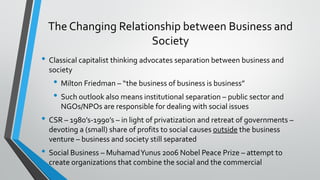
The Changing Relationship between Business and
Society
• Classical capitalist thinking advocates separation between business and
society
• Milton Friedman – “the business of business is business”
• Such outlook also means institutional separation – public sector and
NGOs/NPOs are responsible for dealing with social issues
• CSR – 1980’s-1990’s – in light of privatization and retreat of governments –
devoting a (small) share of profits to social causes outside the business
venture – business and society still separated
• Social Business – MuhamadYunus 2006 Nobel Peace Prize – attempt to
create organizations that combine the social and the commercial
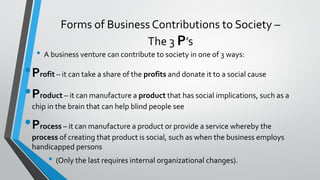
Forms of Business Contributions to Society –
The 3 P’s
• A business venture can contribute to society in one of 3 ways:
•Profit – it can take a share of the profits and donate it to a social cause
•Product – it can manufacture a product that has social implications, such as a
chip in the brain that can help blind people see
•Process – it can manufacture a product or provide a service whereby the
process of creating that product is social, such as when the business employs
handicapped persons
• (Only the last requires internal organizational changes).
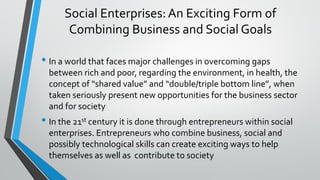
Social Enterprises:An Exciting Form of
Combining Business and Social Goals
• In a world that faces major challenges in overcoming gaps
between rich and poor, regarding the environment, in health, the
concept of “shared value” and “double/triple bottom line”, when
taken seriously present new opportunities for the business sector
and for society
• In the 21st century it is done through entrepreneurs within social
enterprises. Entrepreneurs who combine business, social and
possibly technological skills can create exciting ways to help
themselves as well as contribute to society
The Israeli Experience: Four Models
• Strong entrepreneurial spirit expressed in the 1990’s in high-tech
entrepreneurship. Existence of entrepreneurs, hubs and accelerators
• Four existing legal avenues to establish and incorporate Social
Enterprises: Business organizations, NPOs, public organizations,
cooperatives.
• Each of those has a different ideological base, suggesting one can
contribute to society from different ideological stances.
• All of them combine economic and social goals and are interested to
measure their success on both fronts and of course on the connection
between those two aspects.
• However, because of ideological differences, each has a different
emphasis as to what to measure and how to measure the impact of its
endeavor.
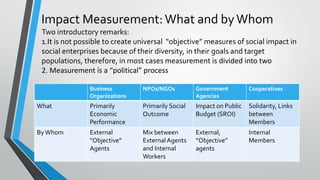
Impact Measurement:What and byWhom
Business
Organizations
NPOs/NGOs Government
Agencies
Cooperatives
What Primarily
Economic
Performance
Primarily Social
Outcome
Impact on Public
Budget (SROI)
Solidarity, Links
between
Members
ByWhom External
“Objective”
Agents
Mix between
External Agents
and Internal
Workers
External,
“Objective”
agents
Internal
Members
Two introductory remarks:
1.It is not possible to create universal “objective” measures of social impact in
social enterprises because of their diversity, in their goals and target
populations, therefore, in most cases measurement is divided into two
2. Measurement ís a “political” process
Conclusions
•Impact measurement – a major challenge for social
enterprises
•Two approaches to measurement: Economic/business
and social. Different traditions, different methodologies
•One should not strive to find fully “objective” measures
when measuring social impact: It does not exist
•There should be an emphasis on measurement and
accountability to show the success of the enterprise and
attempts to improve measurements all the time, but an
enterprise should not be enslaved by it.
Thank you

3 presentation benjamin gidron

  • 1.
    Four Models ofSocial Enterprises in Israel: Implications for Measurement Prof. Benjamin Gidron School of Business Administration College of Management Academic Studies (COMAS) Rishon Le’Zion, Israel Workshop on Social Impact Measurement University of Economics and Business Vietnam National University, Hanoi March 16th, 2016
  • 2.
    The Changing Relationshipbetween Business and Society • Classical capitalist thinking advocates separation between business and society • Milton Friedman – “the business of business is business” • Such outlook also means institutional separation – public sector and NGOs/NPOs are responsible for dealing with social issues • CSR – 1980’s-1990’s – in light of privatization and retreat of governments – devoting a (small) share of profits to social causes outside the business venture – business and society still separated • Social Business – MuhamadYunus 2006 Nobel Peace Prize – attempt to create organizations that combine the social and the commercial
  • 3.
    Forms of BusinessContributions to Society – The 3 P’s • A business venture can contribute to society in one of 3 ways: •Profit – it can take a share of the profits and donate it to a social cause •Product – it can manufacture a product that has social implications, such as a chip in the brain that can help blind people see •Process – it can manufacture a product or provide a service whereby the process of creating that product is social, such as when the business employs handicapped persons • (Only the last requires internal organizational changes).
  • 4.
    Social Enterprises:An ExcitingForm of Combining Business and Social Goals • In a world that faces major challenges in overcoming gaps between rich and poor, regarding the environment, in health, the concept of “shared value” and “double/triple bottom line”, when taken seriously present new opportunities for the business sector and for society • In the 21st century it is done through entrepreneurs within social enterprises. Entrepreneurs who combine business, social and possibly technological skills can create exciting ways to help themselves as well as contribute to society
  • 5.
    The Israeli Experience:Four Models • Strong entrepreneurial spirit expressed in the 1990’s in high-tech entrepreneurship. Existence of entrepreneurs, hubs and accelerators • Four existing legal avenues to establish and incorporate Social Enterprises: Business organizations, NPOs, public organizations, cooperatives. • Each of those has a different ideological base, suggesting one can contribute to society from different ideological stances. • All of them combine economic and social goals and are interested to measure their success on both fronts and of course on the connection between those two aspects. • However, because of ideological differences, each has a different emphasis as to what to measure and how to measure the impact of its endeavor.
  • 6.
    Impact Measurement:What andbyWhom Business Organizations NPOs/NGOs Government Agencies Cooperatives What Primarily Economic Performance Primarily Social Outcome Impact on Public Budget (SROI) Solidarity, Links between Members ByWhom External “Objective” Agents Mix between External Agents and Internal Workers External, “Objective” agents Internal Members Two introductory remarks: 1.It is not possible to create universal “objective” measures of social impact in social enterprises because of their diversity, in their goals and target populations, therefore, in most cases measurement is divided into two 2. Measurement ís a “political” process
  • 7.
    Conclusions •Impact measurement –a major challenge for social enterprises •Two approaches to measurement: Economic/business and social. Different traditions, different methodologies •One should not strive to find fully “objective” measures when measuring social impact: It does not exist •There should be an emphasis on measurement and accountability to show the success of the enterprise and attempts to improve measurements all the time, but an enterprise should not be enslaved by it.
  • 8.