Introduction to
Artificial Intelligence
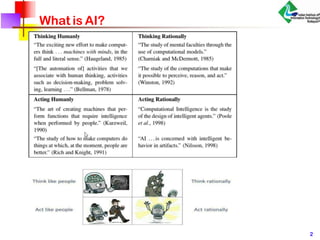
What is AI?
2
Acting humanly: The Turing Test approach
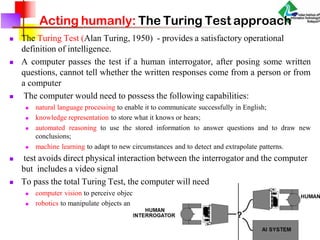
 The Turing Test (Alan Turing, 1950) - provides a satisfactory operational
definition of intelligence.
 A computer passes the test if a human interrogator, after posing some written
questions, cannot tell whether the written responses come from a person or from
a computer
 The computer would need to possess the following capabilities:



natural language processing to enable it to communicate successfully in English;
knowledge representation to store what it knows or hears;
automated reasoning to use the stored information to answer questions and to draw new
conclusions;
 machine learning to adapt to new circumstances and to detect and extrapolate patterns.
 test avoids direct physical interaction between the interrogator and the computer
but includes a video signal
 To pass the total Turing Test, the computer will need


computer vision to perceive objec
robotics to manipulate objects an
Thinking humanly: The cognitive modeling
approach
 introspection—trying to catch our own thoughts as they go by;
 psychological experiments—observing a person in action; and
 brain imaging—observing the brain in action
 cognitive science brings together computer models from AI and experimental
techniques from psychology to construct precise and testable theories of the
human mind.
4
Thinking rationally: The “laws of thought”
approach
 Aristotle was one of the first to attempt to codify “right thinking,” that is,
irrefutable reasoning processes.
 His syllogisms provided patterns for argument structures that always yielded
correct conclusions when given correct premises—for example,
 “Socrates is a man; all men are mortal; therefore, Socrates is mortal.”
 These laws of thought were supposed to govern the operation of the mind; their
study initiated the field called logic.
 There are two main obstacles to this approach.
 First, it is not easy to take informal knowledge and state it in the formal terms
required by logical notation, particularly when the knowledge is less than 100%
certain.
 Second, there is a big difference between solving a problem “in principle” and
solving it in practice.
5
Acting rationally: The rational agent
approach
 An agent is just something that acts
 all computer programs do something, but computer agents are expected to do
more: operate autonomously, perceive their environment, persist over a
prolonged time period, adapt to change, and create and pursue goals.
 A rational agent is one that acts so as to achieve the best outcome or, when there
is uncertainty, the best expected outcome
 Making correct inferences is sometimes part of being a rational agent
 There are two advantages over the other approaches.
 First, it is more general than the “laws of thought” approach because correct
inference is just on of several possible mechanisms for achieving rationality.
 Second, it is more amenable to scientific development than are approaches based
on human behavior or human though.
6
FOUNDATIONS OF AI
 Philosophy (rules of reasoning)




Can formal rules be used to draw valid conclusions?
How does the mind arise from a physical brain?
Where does knowledge come from?
How does knowledge lead to action?
 Aristotle (384–322 B . C .) - first to formulate a precise set of laws governing
the rational part of the mind.
 developed an informal system of syllogisms for proper reasoning to generate
conclusions mechanically, given initial premises.
 Ramon Lull (1315) - useful reasoning could actually be carried out by a
mechanical artifact.
 Thomas Hobbes (1588–1679) - reasoning was like numerical computation, that
“we add and subtract in our silent thoughts.”
 Around 1500, Leonardo da Vinci (1452–1519) designed but did not build a
mechanical calculator;
 Wilhelm Leibniz (1646–1716) built a mechanical device intended to carry out
operations on concepts rather than numbers,
7
FOUNDATIONS OF AI
 Mathematics (logic, algorithms, optimization)



What are the formal rules to draw valid conclusions?
What can be computed?
How do we reason with uncertain information?
 Mathematics formalizes the three main area of AI: computation, logic, and
probability
 Computation leads to analysis of the problems that can be computed -
complexity theory
 Probability contributes the “degree of belief” to handle uncertainty in AI
 Decision theory combines probability theory and utility theory
(“preferred outcomes” / bias)
8
FOUNDATIONS OF AI
 Economics



How should we make decisions so as to maximize payoff?
How should we do this when others may not go along?
How should we do this when the payoff may be far in the future?
 economics being about money?, but economists will say that they are really
studying how people make choices that lead to preferred outcomes(utility).
 Decision theory combines utility and probability theory provides a formal and
complete framework for decisions (economic or otherwise) made under
uncertainty
 Control theory and cybernetics



How can artifacts operate under their own control?
the science of communication and automatic control systems
The artifacts adjust their actions


To do better for the environment over time
Based on an objective function and feedback from the environment
9
FOUNDATIONS OF AI
 Neuroscience (model low level human/animal brain activity)



How do brains process information?
Study of the nervous system, esp. brain
A collection of simple cells can lead to thought and action
 Cognitive Science and Psychology (modeling high level human/animal thinking)




How do humans and animals think and act?
The study of human reasoning and acting
Provides reasoning models for AI
Strengthen the ideas
 humans and other animals can be considered as information processing machines
 Despite advances, we are still a long way from understanding how cognitive
processes actually work.
 Linguistics


How does language relate to thought?
computational linguistics or natural language processing
10
FOUNDATIONS OF AI
 Computer Engineering
 How can we build an efficient computer?
 artificial intelligence to succeed, we need two things: intelligence and an
artifact.
 The computer has been the artifact of choice.
 he first operational computer was the electromechanical Heath Robinson built in
1940 by Alan Turing’s team for a single purpose: deciphering German messages
 1943, the same group developed the Colossus, a powerful general-purpose
machine based on vacuum tubes.
 The first operational programmable computer was the Z-3, the invention of
Konrad Zuse in Germany in 1941. (also invented floating-point numbers and the
first high-level programming language).
 The first electronic computer, the ABC, was assembled by John Atanasoff and
his student Clifford Berry between 1940 and 1942 at Iowa State University
 Then ENIAC, developed as part of a secret military project at the University of
Pennsylvania by a team including John Mauchly and John Eckert, that proved to
be the most influential forerunner of modern computers
11
History of AI
The gestation (1943-1955):
♦ 1943: McCulloch & Pitts: model of neurons → Boolean circuit of the
brain
♦ 1949: Donald Hebb - updading rule for modifying the connection
strengths (Hebbian learning)
♦ 1950: Turing’s Computing Machinery and Intelligence: introduces Turing
Test, machine learning, genetic algorithms, and reinforcement learning.
The birth (1956):
♦ McCarthy (1927 -2011): 2 month, 10 man study of AI, to make machine
use language, form abstractions and concepts, solve kinds of problems now
reserved for humans, and improve themselves.
Main actors for the next 20 years from MIT, CMU, Standford and IBM
♦
12
History of AI
Early enthusiasm, great expectations (1952-1969):
. Newell and Simon’s early success was followed up with the General
Problem Solver, or GPS.
. Unlike Logic Theorist, this program was designed from the start to
imitate human problem-solving protocols.
♦ Geometry Theorem Prover, Logic Theorist, General Problem Solver,
Playing checkers (Given the primitive computers and programming tools)
♦ McCarthy: Lisp (1958), Time sharing (1959), AdviceTaker
at MIT
♦ Minsky: Microwords- algebra story problems, blocks world
”If the number of customers Tom gets is twice the square of 20 percent of
the number of advertisements he runs, and the number of advertisements he
runs is 45, what is the number of customers Tom gets?”
13
History of AI
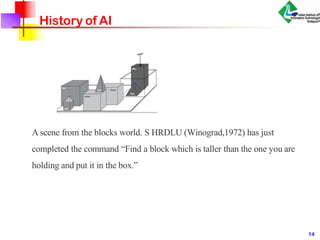
A scene from the blocks world. S HRDLU (Winograd,1972) has just
completed the command “Find a block which is taller than the one you are
holding and put it in the box.”
14
History of AI
A dose of reality (1966-1973):
♦ Translation of Russian scientific paper in context of Sputnik (Alpack
report 1966)
”the spirit is willing but the flesh is weak”
”the vodka is good but the meat is rotten”
♦ Lighthill report (1973) most successful algorithms would halt on real
world problems and were only suitable for solving ”toy” versions.
false optimism on: cobinatorial explosion to be solved by faster hard-
ware and larger memories, no progress on genetic algorithms
2 input perceptron cannot be trained to recognize that the inputs are
different
15
History of AI
Knowledge-based systems: The key to power? (1969-1979)
♦ expert systems: Dendral, Mycin (certainty factor)
♦ Prolog, 1972 (EU), Planner (US)
♦ Minsky: frames - facts about a particular object, taxonomy of types
roots for OOP
AI becomes an industry (1980-present)
♦ The first successful commercial expert system, R1 (savings of 40milion a
year)
♦ 1981, the Japanese announced the ”Fifth Generation project, a 10-year
plan to build intelligent computers running Prolog.
♦ hundreds of companies building expert systems, vision systems, robots,
♦ the return of neural networks: complements the symbolic approaches
16
History of AI
AI adopts the scientific method (1987-present)
♦
♦
build on existing theories than to propose brand-new ones
to base claims on rigorous theorems or hard experimental
evidence rather than on intuition
♦ and to show relevance to real-world applications rather than
toy examples
♦ speech recongition (HMM), datamining, bayesian networks
The emergence of intelligent agents (1995-present)
♦ Internet, the most important environment
The availability of very large data sets (2001-present)
17
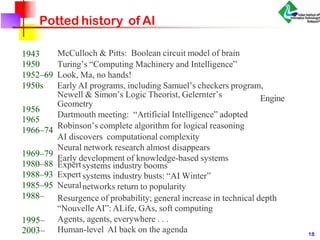
Potted history of AI
McCulloch & Pitts: Boolean circuit model of brain
Turing’s “Computing Machinery and Intelligence”
1943
1950
1952–69 Look, Ma, no hands!
1950s Early AI programs, including Samuel’s checkers program,
Newell & Simon’s Logic Theorist, Gelernter’s
Geometry
Engine
1956
1965
1966–74
Dartmouth meeting: “Artificial Intelligence” adopted
Robinson’s complete algorithm for logical reasoning
AI discovers computational complexity
Neural network research almost disappears
Early development of knowledge-based systems
1969–79
1980–88
1988–93 Expert
Expertsystems industry booms
systems industry busts: “AI Winter”
1985–95 Neuralnetworks return to popularity
1988– Resurgence of probability; general increase in technical depth
“Nouvelle AI”: ALife, GAs, soft computing
Agents, agents, everywhere . . .
1995–
2003– Human-level AI back on the agenda 18
State of the art
What can AI do today?
 Robotic vehicles – Auto Cars
 Speech recognition
 Autonomous planning and scheduling
 Game playing
 Spam fighting
 Logistics planning
 Robotics
 Machine Translation
 Image Processing – emotion detection
 Banking – Fraud detection
19

1. Inroduction to artificial intelligence.pptx

  • 1.
  • 2.
  • 3.
    Acting humanly: TheTuring Test approach  The Turing Test (Alan Turing, 1950) - provides a satisfactory operational definition of intelligence.  A computer passes the test if a human interrogator, after posing some written questions, cannot tell whether the written responses come from a person or from a computer  The computer would need to possess the following capabilities:    natural language processing to enable it to communicate successfully in English; knowledge representation to store what it knows or hears; automated reasoning to use the stored information to answer questions and to draw new conclusions;  machine learning to adapt to new circumstances and to detect and extrapolate patterns.  test avoids direct physical interaction between the interrogator and the computer but includes a video signal  To pass the total Turing Test, the computer will need   computer vision to perceive objec robotics to manipulate objects an
  • 4.
    Thinking humanly: Thecognitive modeling approach  introspection—trying to catch our own thoughts as they go by;  psychological experiments—observing a person in action; and  brain imaging—observing the brain in action  cognitive science brings together computer models from AI and experimental techniques from psychology to construct precise and testable theories of the human mind. 4
  • 5.
    Thinking rationally: The“laws of thought” approach  Aristotle was one of the first to attempt to codify “right thinking,” that is, irrefutable reasoning processes.  His syllogisms provided patterns for argument structures that always yielded correct conclusions when given correct premises—for example,  “Socrates is a man; all men are mortal; therefore, Socrates is mortal.”  These laws of thought were supposed to govern the operation of the mind; their study initiated the field called logic.  There are two main obstacles to this approach.  First, it is not easy to take informal knowledge and state it in the formal terms required by logical notation, particularly when the knowledge is less than 100% certain.  Second, there is a big difference between solving a problem “in principle” and solving it in practice. 5
  • 6.
    Acting rationally: Therational agent approach  An agent is just something that acts  all computer programs do something, but computer agents are expected to do more: operate autonomously, perceive their environment, persist over a prolonged time period, adapt to change, and create and pursue goals.  A rational agent is one that acts so as to achieve the best outcome or, when there is uncertainty, the best expected outcome  Making correct inferences is sometimes part of being a rational agent  There are two advantages over the other approaches.  First, it is more general than the “laws of thought” approach because correct inference is just on of several possible mechanisms for achieving rationality.  Second, it is more amenable to scientific development than are approaches based on human behavior or human though. 6
  • 7.
    FOUNDATIONS OF AI Philosophy (rules of reasoning)     Can formal rules be used to draw valid conclusions? How does the mind arise from a physical brain? Where does knowledge come from? How does knowledge lead to action?  Aristotle (384–322 B . C .) - first to formulate a precise set of laws governing the rational part of the mind.  developed an informal system of syllogisms for proper reasoning to generate conclusions mechanically, given initial premises.  Ramon Lull (1315) - useful reasoning could actually be carried out by a mechanical artifact.  Thomas Hobbes (1588–1679) - reasoning was like numerical computation, that “we add and subtract in our silent thoughts.”  Around 1500, Leonardo da Vinci (1452–1519) designed but did not build a mechanical calculator;  Wilhelm Leibniz (1646–1716) built a mechanical device intended to carry out operations on concepts rather than numbers, 7
  • 8.
    FOUNDATIONS OF AI Mathematics (logic, algorithms, optimization)    What are the formal rules to draw valid conclusions? What can be computed? How do we reason with uncertain information?  Mathematics formalizes the three main area of AI: computation, logic, and probability  Computation leads to analysis of the problems that can be computed - complexity theory  Probability contributes the “degree of belief” to handle uncertainty in AI  Decision theory combines probability theory and utility theory (“preferred outcomes” / bias) 8
  • 9.
    FOUNDATIONS OF AI Economics    How should we make decisions so as to maximize payoff? How should we do this when others may not go along? How should we do this when the payoff may be far in the future?  economics being about money?, but economists will say that they are really studying how people make choices that lead to preferred outcomes(utility).  Decision theory combines utility and probability theory provides a formal and complete framework for decisions (economic or otherwise) made under uncertainty  Control theory and cybernetics    How can artifacts operate under their own control? the science of communication and automatic control systems The artifacts adjust their actions   To do better for the environment over time Based on an objective function and feedback from the environment 9
  • 10.
    FOUNDATIONS OF AI Neuroscience (model low level human/animal brain activity)    How do brains process information? Study of the nervous system, esp. brain A collection of simple cells can lead to thought and action  Cognitive Science and Psychology (modeling high level human/animal thinking)     How do humans and animals think and act? The study of human reasoning and acting Provides reasoning models for AI Strengthen the ideas  humans and other animals can be considered as information processing machines  Despite advances, we are still a long way from understanding how cognitive processes actually work.  Linguistics   How does language relate to thought? computational linguistics or natural language processing 10
  • 11.
    FOUNDATIONS OF AI Computer Engineering  How can we build an efficient computer?  artificial intelligence to succeed, we need two things: intelligence and an artifact.  The computer has been the artifact of choice.  he first operational computer was the electromechanical Heath Robinson built in 1940 by Alan Turing’s team for a single purpose: deciphering German messages  1943, the same group developed the Colossus, a powerful general-purpose machine based on vacuum tubes.  The first operational programmable computer was the Z-3, the invention of Konrad Zuse in Germany in 1941. (also invented floating-point numbers and the first high-level programming language).  The first electronic computer, the ABC, was assembled by John Atanasoff and his student Clifford Berry between 1940 and 1942 at Iowa State University  Then ENIAC, developed as part of a secret military project at the University of Pennsylvania by a team including John Mauchly and John Eckert, that proved to be the most influential forerunner of modern computers 11
  • 12.
    History of AI Thegestation (1943-1955): ♦ 1943: McCulloch & Pitts: model of neurons → Boolean circuit of the brain ♦ 1949: Donald Hebb - updading rule for modifying the connection strengths (Hebbian learning) ♦ 1950: Turing’s Computing Machinery and Intelligence: introduces Turing Test, machine learning, genetic algorithms, and reinforcement learning. The birth (1956): ♦ McCarthy (1927 -2011): 2 month, 10 man study of AI, to make machine use language, form abstractions and concepts, solve kinds of problems now reserved for humans, and improve themselves. Main actors for the next 20 years from MIT, CMU, Standford and IBM ♦ 12
  • 13.
    History of AI Earlyenthusiasm, great expectations (1952-1969): . Newell and Simon’s early success was followed up with the General Problem Solver, or GPS. . Unlike Logic Theorist, this program was designed from the start to imitate human problem-solving protocols. ♦ Geometry Theorem Prover, Logic Theorist, General Problem Solver, Playing checkers (Given the primitive computers and programming tools) ♦ McCarthy: Lisp (1958), Time sharing (1959), AdviceTaker at MIT ♦ Minsky: Microwords- algebra story problems, blocks world ”If the number of customers Tom gets is twice the square of 20 percent of the number of advertisements he runs, and the number of advertisements he runs is 45, what is the number of customers Tom gets?” 13
  • 14.
    History of AI Ascene from the blocks world. S HRDLU (Winograd,1972) has just completed the command “Find a block which is taller than the one you are holding and put it in the box.” 14
  • 15.
    History of AI Adose of reality (1966-1973): ♦ Translation of Russian scientific paper in context of Sputnik (Alpack report 1966) ”the spirit is willing but the flesh is weak” ”the vodka is good but the meat is rotten” ♦ Lighthill report (1973) most successful algorithms would halt on real world problems and were only suitable for solving ”toy” versions. false optimism on: cobinatorial explosion to be solved by faster hard- ware and larger memories, no progress on genetic algorithms 2 input perceptron cannot be trained to recognize that the inputs are different 15
  • 16.
    History of AI Knowledge-basedsystems: The key to power? (1969-1979) ♦ expert systems: Dendral, Mycin (certainty factor) ♦ Prolog, 1972 (EU), Planner (US) ♦ Minsky: frames - facts about a particular object, taxonomy of types roots for OOP AI becomes an industry (1980-present) ♦ The first successful commercial expert system, R1 (savings of 40milion a year) ♦ 1981, the Japanese announced the ”Fifth Generation project, a 10-year plan to build intelligent computers running Prolog. ♦ hundreds of companies building expert systems, vision systems, robots, ♦ the return of neural networks: complements the symbolic approaches 16
  • 17.
    History of AI AIadopts the scientific method (1987-present) ♦ ♦ build on existing theories than to propose brand-new ones to base claims on rigorous theorems or hard experimental evidence rather than on intuition ♦ and to show relevance to real-world applications rather than toy examples ♦ speech recongition (HMM), datamining, bayesian networks The emergence of intelligent agents (1995-present) ♦ Internet, the most important environment The availability of very large data sets (2001-present) 17
  • 18.
    Potted history ofAI McCulloch & Pitts: Boolean circuit model of brain Turing’s “Computing Machinery and Intelligence” 1943 1950 1952–69 Look, Ma, no hands! 1950s Early AI programs, including Samuel’s checkers program, Newell & Simon’s Logic Theorist, Gelernter’s Geometry Engine 1956 1965 1966–74 Dartmouth meeting: “Artificial Intelligence” adopted Robinson’s complete algorithm for logical reasoning AI discovers computational complexity Neural network research almost disappears Early development of knowledge-based systems 1969–79 1980–88 1988–93 Expert Expertsystems industry booms systems industry busts: “AI Winter” 1985–95 Neuralnetworks return to popularity 1988– Resurgence of probability; general increase in technical depth “Nouvelle AI”: ALife, GAs, soft computing Agents, agents, everywhere . . . 1995– 2003– Human-level AI back on the agenda 18
  • 19.
    State of theart What can AI do today?  Robotic vehicles – Auto Cars  Speech recognition  Autonomous planning and scheduling  Game playing  Spam fighting  Logistics planning  Robotics  Machine Translation  Image Processing – emotion detection  Banking – Fraud detection 19