Paper
1
Solids, liquids
& gases
Density
&
pressure
Solids, liquids & gases
Density & pressure
objectives
• 5.3 know and use the relationship between density, mass and volume:
• 5.5 know and use the relationship between pressure, force and area:
• 5.6 understand how the pressure at a point in a gas or liquid at rest acts equally in all
Directions.
• 5.7 know and use the relationship for pressure difference:
• pressure difference = height × density × gravitational field strength
𝑑𝑒𝑛𝑠𝑖𝑡𝑦 =
𝑚𝑎𝑠𝑠
𝑣𝑜𝑙𝑢𝑚𝑒
Pressure =
𝑓𝑜𝑟𝑐𝑒
𝑎𝑟𝑒𝑎
What is density?
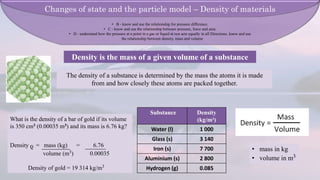
Density is the mass of a given volume of a substance
Substance Density
(kg/m3)
Water (l) 1 000
Glass (s) 3 140
Iron (s) 7 700
Aluminium (s) 2 800
Hydrogen (g) 0.085
What is the density of a bar of gold if its volume
is 350 cm3 (0.00035 m3) and its mass is 6.76 kg?
Density ᵨ = mass (kg) = 6.76
volume (m3) 0.00035
Density of gold = 19 314 kg/m3
Changes of state and the particle model – Density of materials
• B - know and use the relationship for pressure difference.
• C - know and use the relationship between pressure, force and area.
• D - understand how the pressure at a point in a gas or liquid at rest acts equally in all Directions. know and use
the relationship between density, mass and volume
The density of a substance is determined by the mass the atoms it is made
from and how closely these atoms are packed together.
• mass in kg
• volume in m3
• Density also depends on the state of a substance.
• In solids the particles are packed close together.
• In liquids the particles are free to move so the
same mass takes up more space.
• In gases the particles take up a much greater
volume than in liquids and solids.
For any particular substance, a solid is usually denser than its liquid and the liquid is usually
denser than the gas.
However, there are exceptions to this. Solid water (ice) is less dense than liquid water. This is
why ice floats on water.
Changes of state and the particle model – Density of materials
• B - know and use the relationship for pressure difference.
• C - know and use the relationship between pressure, force and area.
• D - understand how the pressure at a point in a gas or liquid at rest acts equally in all Directions. know and use
the relationship between density, mass and volume
Fluid densities – denser than you think
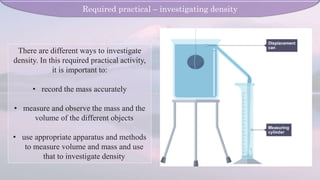
There are different ways to investigate
density. In this required practical activity,
it is important to:
• record the mass accurately
• measure and observe the mass and the
volume of the different objects
• use appropriate apparatus and methods
to measure volume and mass and use
that to investigate density
Required practical – investigating density
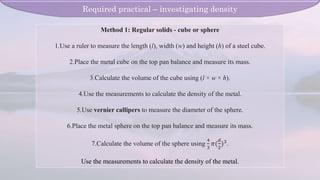
Method 1: Regular solids - cube or sphere
1.Use a ruler to measure the length (l), width (w) and height (h) of a steel cube.
2.Place the metal cube on the top pan balance and measure its mass.
3.Calculate the volume of the cube using (l × w × h).
4.Use the measurements to calculate the density of the metal.
5.Use vernier callipers to measure the diameter of the sphere.
6.Place the metal sphere on the top pan balance and measure its mass.
7.Calculate the volume of the sphere using
4
3
𝜋(
𝑑
2
)3.
Use the measurements to calculate the density of the metal.
Required practical – investigating density
Method 2: Stone or other irregular shaped object
1.Place the stone on the top pan balance and measure its mass.
2.Fill the displacement can until the water is level with the bottom of the pipe.
3.Place a measuring cylinder under the pipe ready to collect the displaced water.
4.Carefully drop the stone into the can and wait until no more water runs into the
cylinder.
5.Measure the volume of the displaced water.
6.Use the measurements to calculate the density of the stone
Required practical – investigating density
Method 3: Water (or any liquid)
1.Place the measuring cylinder on the top pan balance and measure its
mass.
2.Pour 50 cm3 of water into the measuring cylinder and measure its new
mass.
3.Subtract the mass in step 1 from the mass in step 2. This is the mass of
50 cm3 of water.
4.Use the measurements to calculate the density of the water.
Required practical – investigating density
What is pressure?
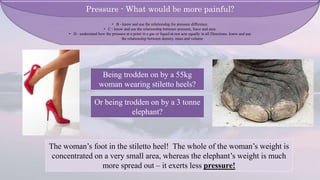
Being trodden on by a 55kg
woman wearing stiletto heels?
Or being trodden on by a 3 tonne
elephant?
The woman’s foot in the stiletto heel! The whole of the woman’s weight is
concentrated on a very small area, whereas the elephant’s weight is much
more spread out – it exerts less pressure!
Pressure - What would be more painful?
• B - know and use the relationship for pressure difference.
• C - know and use the relationship between pressure, force and area.
• D - understand how the pressure at a point in a gas or liquid at rest acts equally in all Directions. know and use
the relationship between density, mass and volume
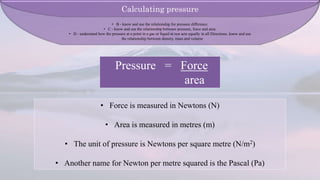
Pressure = Force
area
• Force is measured in Newtons (N)
• Area is measured in metres (m)
• The unit of pressure is Newtons per square metre (N/m2)
• Another name for Newton per metre squared is the Pascal (Pa)
Calculating pressure
• B - know and use the relationship for pressure difference.
• C - know and use the relationship between pressure, force and area.
• D - understand how the pressure at a point in a gas or liquid at rest acts equally in all Directions. know and use
the relationship between density, mass and volume
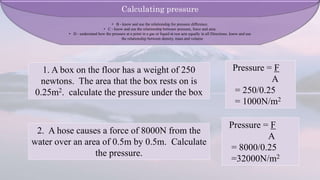
1. A box on the floor has a weight of 250
newtons. The area that the box rests on is
0.25m2. calculate the pressure under the box
2. A hose causes a force of 8000N from the
water over an area of 0.5m by 0.5m. Calculate
the pressure.
Pressure = F
A
= 250/0.25
= 1000N/m2
Pressure = F
A
= 8000/0.25
=32000N/m2
Calculating pressure
• B - know and use the relationship for pressure difference.
• C - know and use the relationship between pressure, force and area.
• D - understand how the pressure at a point in a gas or liquid at rest acts equally in all Directions. know and use
the relationship between density, mass and volume
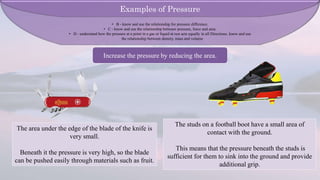
Increase the pressure by reducing the area.
The area under the edge of the blade of the knife is
very small.
Beneath it the pressure is very high, so the blade
can be pushed easily through materials such as fruit.
The studs on a football boot have a small area of
contact with the ground.
This means that the pressure beneath the studs is
sufficient for them to sink into the ground and provide
additional grip.
Examples of Pressure
• B - know and use the relationship for pressure difference.
• C - know and use the relationship between pressure, force and area.
• D - understand how the pressure at a point in a gas or liquid at rest acts equally in all Directions. know and use
the relationship between density, mass and volume
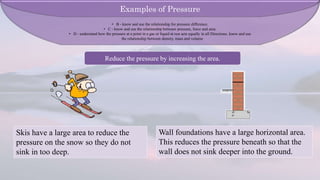
Reduce the pressure by increasing the area.
Skis have a large area to reduce the
pressure on the snow so they do not
sink in too deep.
Wall foundations have a large horizontal area.
This reduces the pressure beneath so that the
wall does not sink deeper into the ground.
Examples of Pressure
• B - know and use the relationship for pressure difference.
• C - know and use the relationship between pressure, force and area.
• D - understand how the pressure at a point in a gas or liquid at rest acts equally in all Directions. know and use
the relationship between density, mass and volume
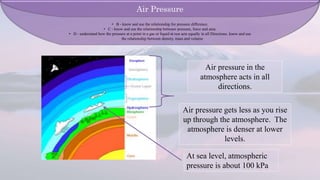
Air pressure in the
atmosphere acts in all
directions.
Air pressure gets less as you rise
up through the atmosphere. The
atmosphere is denser at lower
levels.
Air Pressure
• B - know and use the relationship for pressure difference.
• C - know and use the relationship between pressure, force and area.
• D - understand how the pressure at a point in a gas or liquid at rest acts equally in all Directions. know and use
the relationship between density, mass and volume
At sea level, atmospheric
pressure is about 100 kPa
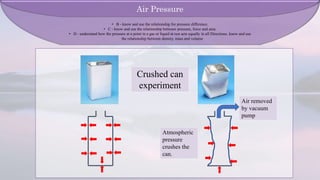
Crushed can
experiment
Air removed
by vacuum
pump
Atmospheric
pressure
crushes the
can.
Air Pressure
• B - know and use the relationship for pressure difference.
• C - know and use the relationship between pressure, force and area.
• D - understand how the pressure at a point in a gas or liquid at rest acts equally in all Directions. know and use
the relationship between density, mass and volume
The history of the barometer
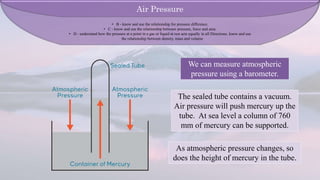
We can measure atmospheric
pressure using a barometer.
The sealed tube contains a vacuum.
Air pressure will push mercury up the
tube. At sea level a column of 760
mm of mercury can be supported.
As atmospheric pressure changes, so
does the height of mercury in the tube.
Air Pressure
• B - know and use the relationship for pressure difference.
• C - know and use the relationship between pressure, force and area.
• D - understand how the pressure at a point in a gas or liquid at rest acts equally in all Directions. know and use
the relationship between density, mass and volume
Pressure
increases
with
depth
Pressure acts in all
directions
Pressure in liquids
Do liquids exert pressure?
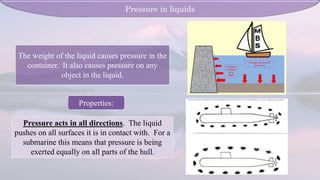
The weight of the liquid causes pressure in the
container. It also causes pressure on any
object in the liquid.
Properties:
Pressure acts in all directions. The liquid
pushes on all surfaces it is in contact with. For a
submarine this means that pressure is being
exerted equally on all parts of the hull.
Pressure in liquids
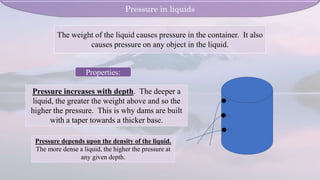
The weight of the liquid causes pressure in the container. It also
causes pressure on any object in the liquid.
Properties:
Pressure increases with depth. The deeper a
liquid, the greater the weight above and so the
higher the pressure. This is why dams are built
with a taper towards a thicker base.
Pressure depends upon the density of the liquid.
The more dense a liquid, the higher the pressure at
any given depth.
Pressure in liquids
Properties:
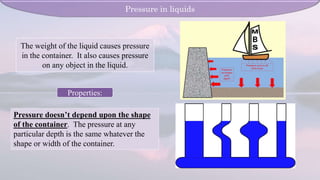
Pressure doesn’t depend upon the shape
of the container. The pressure at any
particular depth is the same whatever the
shape or width of the container.
Pressure in liquids
The weight of the liquid causes pressure
in the container. It also causes pressure
on any object in the liquid.
• B - know and use the relationship for pressure difference.
• C - know and use the relationship between pressure, force and area.
• D - understand how the pressure at a point in a gas or liquid at rest acts equally in all Directions. know and use
the relationship between density, mass and volume
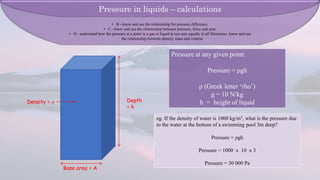
Depth
= h
Base area = A
Density = ρ
Pressure at any given point:
Pressure = ρgh
ρ (Greek letter ‘rho’)
g = 10 N/kg
h = height of liquid
eg. If the density of water is 1000 kg/m3, what is the pressure due
to the water at the bottom of a swimming pool 3m deep?
Pressure = ρgh
Pressure = 1000 x 10 x 3
Pressure = 30 000 Pa
Pressure in liquids – calculations
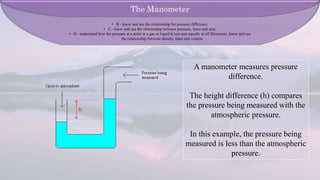
A manometer measures pressure
difference.
The height difference (h) compares
the pressure being measured with the
atmospheric pressure.
In this example, the pressure being
measured is less than the atmospheric
pressure.
h
• B - know and use the relationship for pressure difference.
• C - know and use the relationship between pressure, force and area.
• D - understand how the pressure at a point in a gas or liquid at rest acts equally in all Directions. know and use
the relationship between density, mass and volume
The Manometer
Hydraulics
Past paper questions
Paper 1
9 questions
Solids, liquids & gases
Density & pressure
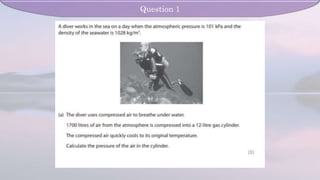
Question 1
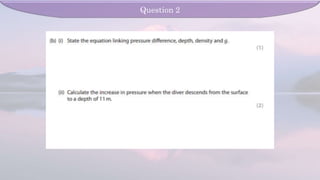
Question 2
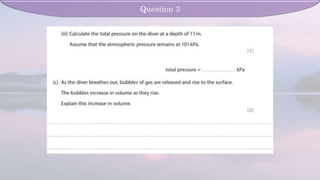
Question 3
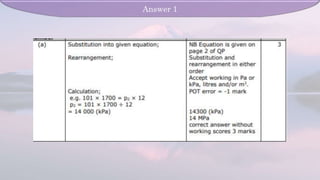
Answer 1
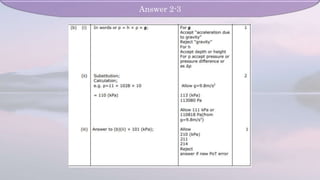
Answer 2-3
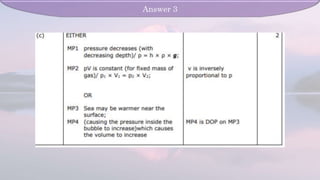
Answer 3
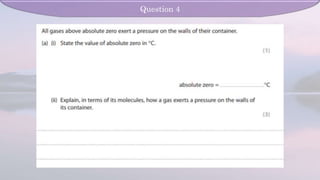
Question 4
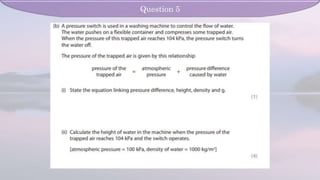
Question 5
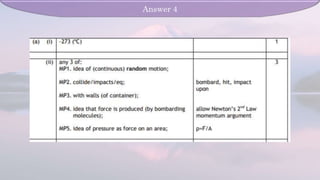
Answer 4
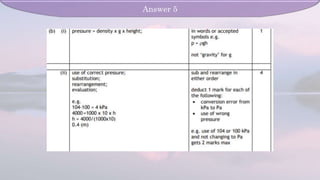
Answer 5
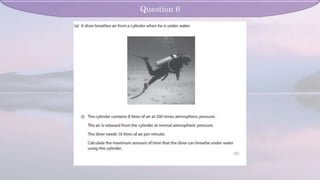
Question 6
Question 7
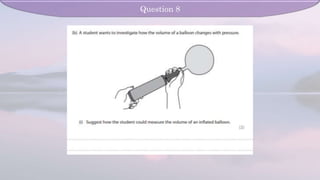
Question 8
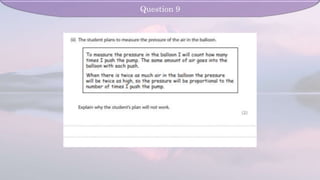
Question 9
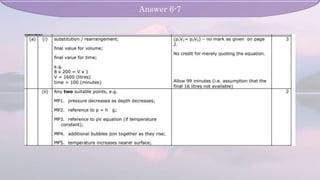
Answer 6-7
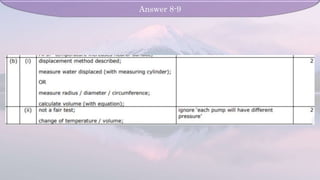
Answer 8-9

1-Density---pressure. physics for grade 8 igcse

  • 1.
  • 2.
    Solids, liquids &gases Density & pressure objectives • 5.3 know and use the relationship between density, mass and volume: • 5.5 know and use the relationship between pressure, force and area: • 5.6 understand how the pressure at a point in a gas or liquid at rest acts equally in all Directions. • 5.7 know and use the relationship for pressure difference: • pressure difference = height × density × gravitational field strength 𝑑𝑒𝑛𝑠𝑖𝑡𝑦 = 𝑚𝑎𝑠𝑠 𝑣𝑜𝑙𝑢𝑚𝑒 Pressure = 𝑓𝑜𝑟𝑐𝑒 𝑎𝑟𝑒𝑎
  • 3.
  • 4.
    Density is themass of a given volume of a substance Substance Density (kg/m3) Water (l) 1 000 Glass (s) 3 140 Iron (s) 7 700 Aluminium (s) 2 800 Hydrogen (g) 0.085 What is the density of a bar of gold if its volume is 350 cm3 (0.00035 m3) and its mass is 6.76 kg? Density ᵨ = mass (kg) = 6.76 volume (m3) 0.00035 Density of gold = 19 314 kg/m3 Changes of state and the particle model – Density of materials • B - know and use the relationship for pressure difference. • C - know and use the relationship between pressure, force and area. • D - understand how the pressure at a point in a gas or liquid at rest acts equally in all Directions. know and use the relationship between density, mass and volume The density of a substance is determined by the mass the atoms it is made from and how closely these atoms are packed together. • mass in kg • volume in m3
  • 5.
    • Density alsodepends on the state of a substance. • In solids the particles are packed close together. • In liquids the particles are free to move so the same mass takes up more space. • In gases the particles take up a much greater volume than in liquids and solids. For any particular substance, a solid is usually denser than its liquid and the liquid is usually denser than the gas. However, there are exceptions to this. Solid water (ice) is less dense than liquid water. This is why ice floats on water. Changes of state and the particle model – Density of materials • B - know and use the relationship for pressure difference. • C - know and use the relationship between pressure, force and area. • D - understand how the pressure at a point in a gas or liquid at rest acts equally in all Directions. know and use the relationship between density, mass and volume
  • 6.
    Fluid densities –denser than you think
  • 7.
    There are differentways to investigate density. In this required practical activity, it is important to: • record the mass accurately • measure and observe the mass and the volume of the different objects • use appropriate apparatus and methods to measure volume and mass and use that to investigate density Required practical – investigating density
  • 8.
    Method 1: Regularsolids - cube or sphere 1.Use a ruler to measure the length (l), width (w) and height (h) of a steel cube. 2.Place the metal cube on the top pan balance and measure its mass. 3.Calculate the volume of the cube using (l × w × h). 4.Use the measurements to calculate the density of the metal. 5.Use vernier callipers to measure the diameter of the sphere. 6.Place the metal sphere on the top pan balance and measure its mass. 7.Calculate the volume of the sphere using 4 3 𝜋( 𝑑 2 )3. Use the measurements to calculate the density of the metal. Required practical – investigating density
  • 9.
    Method 2: Stoneor other irregular shaped object 1.Place the stone on the top pan balance and measure its mass. 2.Fill the displacement can until the water is level with the bottom of the pipe. 3.Place a measuring cylinder under the pipe ready to collect the displaced water. 4.Carefully drop the stone into the can and wait until no more water runs into the cylinder. 5.Measure the volume of the displaced water. 6.Use the measurements to calculate the density of the stone Required practical – investigating density
  • 10.
    Method 3: Water(or any liquid) 1.Place the measuring cylinder on the top pan balance and measure its mass. 2.Pour 50 cm3 of water into the measuring cylinder and measure its new mass. 3.Subtract the mass in step 1 from the mass in step 2. This is the mass of 50 cm3 of water. 4.Use the measurements to calculate the density of the water. Required practical – investigating density
  • 11.
  • 12.
    Being trodden onby a 55kg woman wearing stiletto heels? Or being trodden on by a 3 tonne elephant? The woman’s foot in the stiletto heel! The whole of the woman’s weight is concentrated on a very small area, whereas the elephant’s weight is much more spread out – it exerts less pressure! Pressure - What would be more painful? • B - know and use the relationship for pressure difference. • C - know and use the relationship between pressure, force and area. • D - understand how the pressure at a point in a gas or liquid at rest acts equally in all Directions. know and use the relationship between density, mass and volume
  • 13.
    Pressure = Force area •Force is measured in Newtons (N) • Area is measured in metres (m) • The unit of pressure is Newtons per square metre (N/m2) • Another name for Newton per metre squared is the Pascal (Pa) Calculating pressure • B - know and use the relationship for pressure difference. • C - know and use the relationship between pressure, force and area. • D - understand how the pressure at a point in a gas or liquid at rest acts equally in all Directions. know and use the relationship between density, mass and volume
  • 14.
    1. A boxon the floor has a weight of 250 newtons. The area that the box rests on is 0.25m2. calculate the pressure under the box 2. A hose causes a force of 8000N from the water over an area of 0.5m by 0.5m. Calculate the pressure. Pressure = F A = 250/0.25 = 1000N/m2 Pressure = F A = 8000/0.25 =32000N/m2 Calculating pressure • B - know and use the relationship for pressure difference. • C - know and use the relationship between pressure, force and area. • D - understand how the pressure at a point in a gas or liquid at rest acts equally in all Directions. know and use the relationship between density, mass and volume
  • 15.
    Increase the pressureby reducing the area. The area under the edge of the blade of the knife is very small. Beneath it the pressure is very high, so the blade can be pushed easily through materials such as fruit. The studs on a football boot have a small area of contact with the ground. This means that the pressure beneath the studs is sufficient for them to sink into the ground and provide additional grip. Examples of Pressure • B - know and use the relationship for pressure difference. • C - know and use the relationship between pressure, force and area. • D - understand how the pressure at a point in a gas or liquid at rest acts equally in all Directions. know and use the relationship between density, mass and volume
  • 16.
    Reduce the pressureby increasing the area. Skis have a large area to reduce the pressure on the snow so they do not sink in too deep. Wall foundations have a large horizontal area. This reduces the pressure beneath so that the wall does not sink deeper into the ground. Examples of Pressure • B - know and use the relationship for pressure difference. • C - know and use the relationship between pressure, force and area. • D - understand how the pressure at a point in a gas or liquid at rest acts equally in all Directions. know and use the relationship between density, mass and volume
  • 17.
    Air pressure inthe atmosphere acts in all directions. Air pressure gets less as you rise up through the atmosphere. The atmosphere is denser at lower levels. Air Pressure • B - know and use the relationship for pressure difference. • C - know and use the relationship between pressure, force and area. • D - understand how the pressure at a point in a gas or liquid at rest acts equally in all Directions. know and use the relationship between density, mass and volume At sea level, atmospheric pressure is about 100 kPa
  • 18.
    Crushed can experiment Air removed byvacuum pump Atmospheric pressure crushes the can. Air Pressure • B - know and use the relationship for pressure difference. • C - know and use the relationship between pressure, force and area. • D - understand how the pressure at a point in a gas or liquid at rest acts equally in all Directions. know and use the relationship between density, mass and volume
  • 19.
    The history ofthe barometer
  • 20.
    We can measureatmospheric pressure using a barometer. The sealed tube contains a vacuum. Air pressure will push mercury up the tube. At sea level a column of 760 mm of mercury can be supported. As atmospheric pressure changes, so does the height of mercury in the tube. Air Pressure • B - know and use the relationship for pressure difference. • C - know and use the relationship between pressure, force and area. • D - understand how the pressure at a point in a gas or liquid at rest acts equally in all Directions. know and use the relationship between density, mass and volume
  • 21.
    Pressure increases with depth Pressure acts inall directions Pressure in liquids
  • 22.
  • 23.
    The weight ofthe liquid causes pressure in the container. It also causes pressure on any object in the liquid. Properties: Pressure acts in all directions. The liquid pushes on all surfaces it is in contact with. For a submarine this means that pressure is being exerted equally on all parts of the hull. Pressure in liquids
  • 24.
    The weight ofthe liquid causes pressure in the container. It also causes pressure on any object in the liquid. Properties: Pressure increases with depth. The deeper a liquid, the greater the weight above and so the higher the pressure. This is why dams are built with a taper towards a thicker base. Pressure depends upon the density of the liquid. The more dense a liquid, the higher the pressure at any given depth. Pressure in liquids
  • 25.
    Properties: Pressure doesn’t dependupon the shape of the container. The pressure at any particular depth is the same whatever the shape or width of the container. Pressure in liquids The weight of the liquid causes pressure in the container. It also causes pressure on any object in the liquid.
  • 26.
    • B -know and use the relationship for pressure difference. • C - know and use the relationship between pressure, force and area. • D - understand how the pressure at a point in a gas or liquid at rest acts equally in all Directions. know and use the relationship between density, mass and volume Depth = h Base area = A Density = ρ Pressure at any given point: Pressure = ρgh ρ (Greek letter ‘rho’) g = 10 N/kg h = height of liquid eg. If the density of water is 1000 kg/m3, what is the pressure due to the water at the bottom of a swimming pool 3m deep? Pressure = ρgh Pressure = 1000 x 10 x 3 Pressure = 30 000 Pa Pressure in liquids – calculations
  • 27.
    A manometer measurespressure difference. The height difference (h) compares the pressure being measured with the atmospheric pressure. In this example, the pressure being measured is less than the atmospheric pressure. h • B - know and use the relationship for pressure difference. • C - know and use the relationship between pressure, force and area. • D - understand how the pressure at a point in a gas or liquid at rest acts equally in all Directions. know and use the relationship between density, mass and volume The Manometer
  • 28.
  • 29.
    Past paper questions Paper1 9 questions Solids, liquids & gases Density & pressure
  • 30.
  • 31.
  • 32.
  • 33.
  • 34.
  • 35.
  • 36.
  • 37.
  • 38.
  • 39.
  • 40.
  • 41.
  • 42.
  • 43.
  • 44.
  • 45.