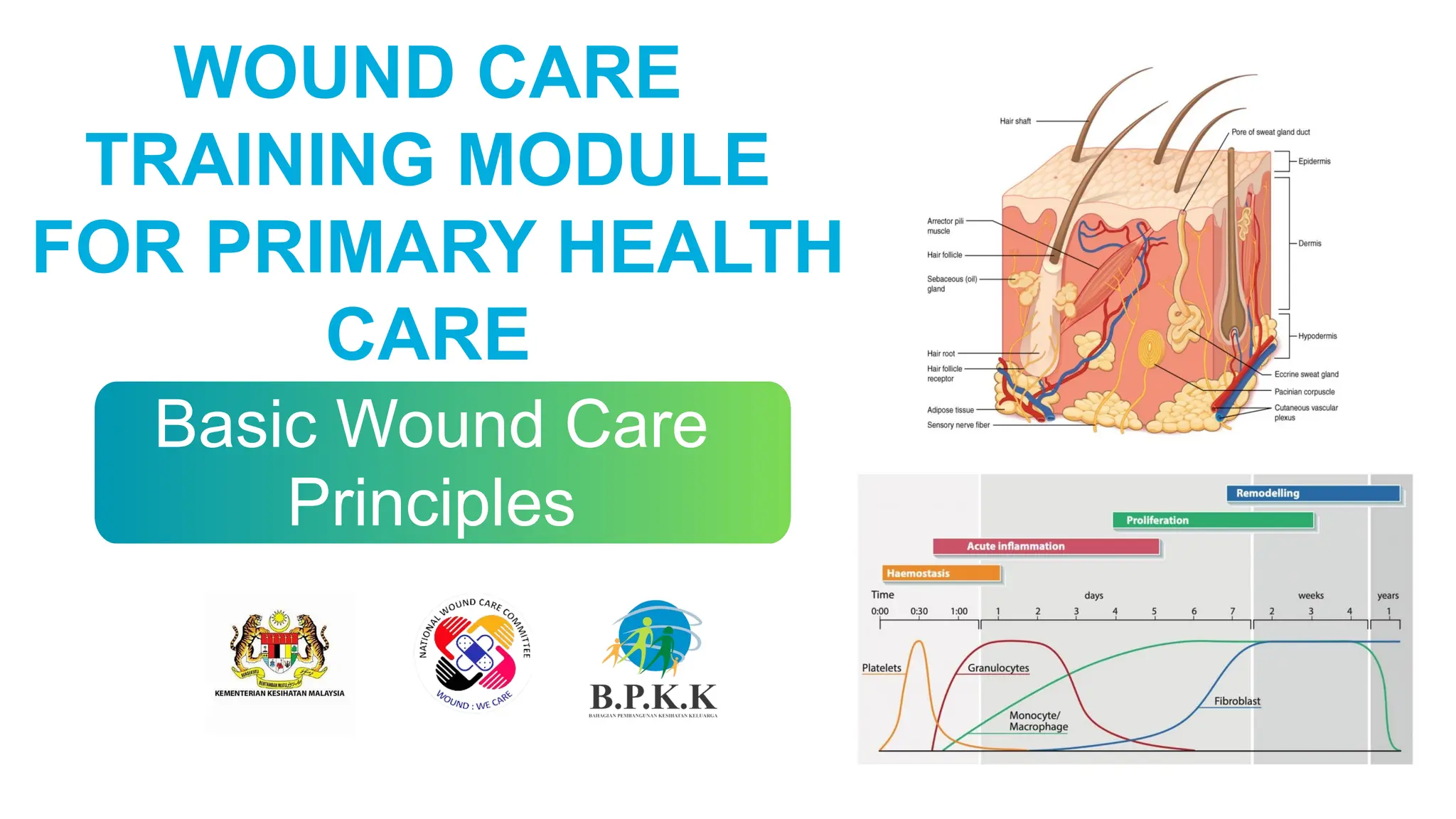
Basic Wound Care
Principles
WOUND CARE
TRAINING MODULE
FOR PRIMARY HEALTH
CARE
OBJECTIVES
Wound Care Training Module for Primary Health Care | Ministry of Health Malaysia
Able to
discuss the
functions and
different layer
of the skin
To understand
the
classification
of wound by
timing and
etiology
To understand
the different
stages of
wound healing
Factors
affecting
wound healing
categorized by
local and
systemic
CONTENT
Wound Care Training Module for Primary Health Care | Ministry of Health Malaysia
Part 1: Introduction
Part 2: What Is The Skin
Part 3: Definition Of Wound And Ulcer
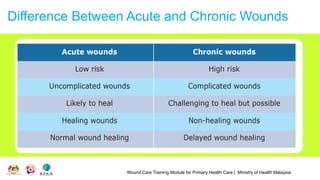
Part 4: Classification Of Wound
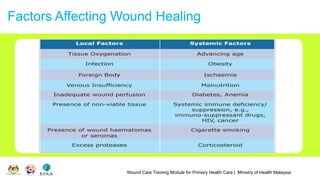
Part 5: Wound Healing
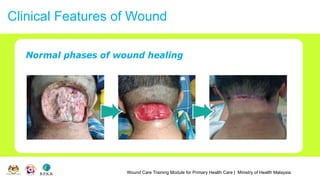
Part 6: Principal Of Wound Care
Wound Care Training Module for Primary Health Care | Ministry of Health Malaysia
Part 1: Introduction
Wound Care Training Module for Primary Health Care | Ministry of Health Malaysia
Introduction
• The skin is the body's largest organ and serves pertinent functions
such as maintaining a physical barrier, thermoregulation, and
participating in the regulation of water loss
• Damage to the skin barrier initiates a complex healing process
through the interactions of many cell types within various
microenvironments.
• Wounds can be present over different anatomical parts of the body.
• However, the basic principles of choosing a wound dressing remain
the same.
Wound Care Training Module for Primary Health Care | Ministry of Health Malaysia
Part 2: What Is The Skin?
Wound Care Training Module for Primary Health Care | Ministry of Health Malaysia
What Is The Skin?
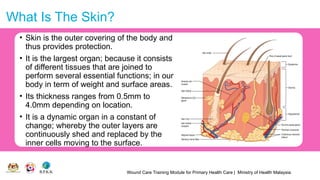
• Skin is the outer covering of the body and
thus provides protection.
• It is the largest organ; because it consists
of different tissues that are joined to
perform several essential functions; in our
body in term of weight and surface areas.
• Its thickness ranges from 0.5mm to
4.0mm depending on location.
• It is a dynamic organ in a constant of
change; whereby the outer layers are
continuously shed and replaced by the
inner cells moving to the surface.
Wound Care Training Module for Primary Health Care | Ministry of Health Malaysia
What Is The Skin?
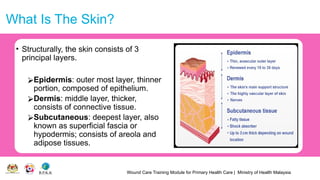
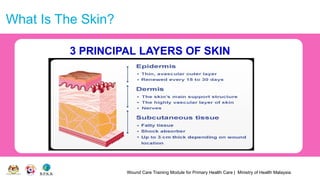
• Structurally, the skin consists of 3
principal layers.
⮚Epidermis: outer most layer, thinner
portion, composed of epithelium.
⮚Dermis: middle layer, thicker,
consists of connective tissue.
⮚Subcutaneous: deepest layer, also
known as superficial fascia or
hypodermis; consists of areola and
adipose tissues.
Wound Care Training Module for Primary Health Care | Ministry of Health Malaysia
What Is The Skin?
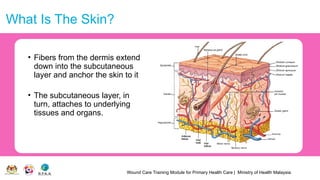
• Fibers from the dermis extend
down into the subcutaneous
layer and anchor the skin to it
• The subcutaneous layer, in
turn, attaches to underlying
tissues and organs.
Wound Care Training Module for Primary Health Care | Ministry of Health Malaysia
What Is The Skin?
3 PRINCIPAL LAYERS OF SKIN
Wound Care Training Module for Primary Health Care | Ministry of Health Malaysia
What Is The Skin?
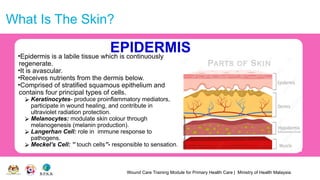
EPIDERMIS
•Epidermis is a labile tissue which is continuously
regenerate.
•It is avascular.
•Receives nutrients from the dermis below.
•Comprised of stratified squamous epithelium and
contains four principal types of cells.
⮚ Keratinocytes- produce proinflammatory mediators,
participate in wound healing, and contribute in
ultraviolet radiation protection.
⮚ Melanocytes: modulate skin colour through
melanogenesis (melanin production).
⮚ Langerhan Cell: role in immune response to
pathogens.
⮚ Meckel’s Cell: ” touch cells”- responsible to sensation.
Wound Care Training Module for Primary Health Care | Ministry of Health Malaysia
What Is The Skin?
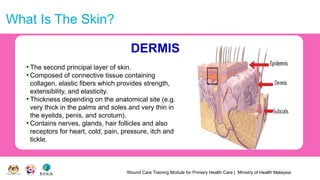
DERMIS
• The second principal layer of skin.
• Composed of connective tissue containing
collagen, elastic fibers which provides strength,
extensibility, and elasticity.
• Thickness depending on the anatomical site (e.g.
very thick in the palms and soles and very thin in
the eyelids, penis, and scrotum).
• Contains nerves, glands, hair follicles and also
receptors for heart, cold, pain, pressure, itch and
tickle.
Wound Care Training Module for Primary Health Care | Ministry of Health Malaysia
What Is The Skin?
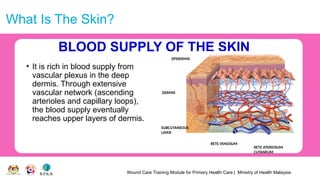
BLOOD SUPPLY OF THE SKIN
• It is rich in blood supply from
vascular plexus in the deep
dermis. Through extensive
vascular network (ascending
arterioles and capillary loops),
the blood supply eventually
reaches upper layers of dermis.
SUBCUTANEOUS
LAYER
DERMIS
EPIDERMIS
RETE VENOSUM
RETE ATERIOSUM
CUTANEUM
Wound Care Training Module for Primary Health Care | Ministry of Health Malaysia
What Is The Skin?
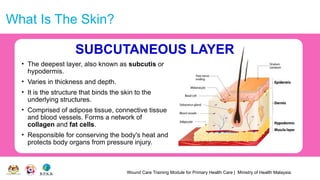
• The deepest layer, also known as subcutis or
hypodermis.
• Varies in thickness and depth.
• It is the structure that binds the skin to the
underlying structures.
• Comprised of adipose tissue, connective tissue
and blood vessels. Forms a network of
collagen and fat cells.
• Responsible for conserving the body's heat and
protects body organs from pressure injury.
SUBCUTANEOUS LAYER
Wound Care Training Module for Primary Health Care | Ministry of Health Malaysia
What Is The Skin?
FUNCTION OF THE SKIN
a) Body temperature regulation
b) Elimination of waste products (Excretion) - cellular waste products are
excreted via sweat glands.
c) Sensation - nerve endings originating from dermis sense pain, cold,
heat, touch and pressure.
d) Barrier function - to protect underlying tissue from mechanical injury,
dehydration, ultraviolet ray, chemicals and pathogens.
e) Immune function
f) Blood reservoir
g) Ultra-violet light protection h) Vitamin D is synthesized by the skin from
sunlight.
Wound Care Training Module for Primary Health Care | Ministry of Health Malaysia
What Is The Skin?
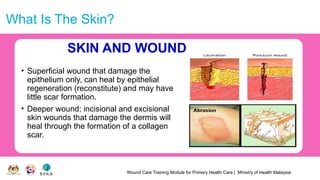
SKIN AND WOUND
• Superficial wound that damage the
epithelium only, can heal by epithelial
regeneration (reconstitute) and may have
little scar formation.
• Deeper wound; incisional and excisional
skin wounds that damage the dermis will
heal through the formation of a collagen
scar.
Wound Care Training Module for Primary Health Care | Ministry of Health Malaysia
What Is The Skin?
SKIN AND WOUND
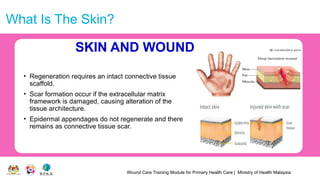
• Regeneration requires an intact connective tissue
scaffold.
• Scar formation occur if the extracellular matrix
framework is damaged, causing alteration of the
tissue architecture.
• Epidermal appendages do not regenerate and there
remains as connective tissue scar.
Wound Care Training Module for Primary Health Care | Ministry of Health Malaysia
Part 3: Definition Of Wound And Ulcer
Wound Care Training Module for Primary Health Care | Ministry of Health Malaysia
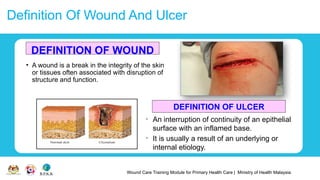
Definition Of Wound And Ulcer
• A wound is a break in the integrity of the skin
or tissues often associated with disruption of
structure and function.
DEFINITION OF WOUND
DEFINITION OF ULCER
• An interruption of continuity of an epithelial
surface with an inflamed base.
• It is usually a result of an underlying or
internal etiology.
Wound Care Training Module for Primary Health Care | Ministry of Health Malaysia
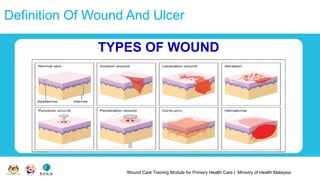
Definition Of Wound And Ulcer
TYPES OF WOUND
Wound Care Training Module for Primary Health Care | Ministry of Health Malaysia
Part 4 : Classification Of Wound
Wound Care Training Module for Primary Health Care | Ministry of Health Malaysia
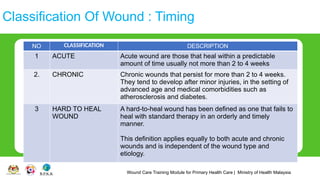
Classification Of Wound
Wounds can be classified in many ways; By
• wound chronicity,
• timing,
• etiology (e.g., pressure, trauma, venous leg ulcer, diabetic
foot ulcer),
• the depth of tissue involvement, or
• other characteristics such as closure (primary or secondary
intention).
Wound Care Training Module for Primary Health Care | Ministry of Health Malaysia
Classification Of Wound : Timing
NO CLASSIFICATION DESCRIPTION
1 ACUTE Acute wound are those that heal within a predictable
amount of time usually not more than 2 to 4 weeks
2. CHRONIC Chronic wounds that persist for more than 2 to 4 weeks.
They tend to develop after minor injuries, in the setting of
advanced age and medical comorbidities such as
atherosclerosis and diabetes.
3 HARD TO HEAL
WOUND
A hard-to-heal wound has been defined as one that fails to
heal with standard therapy in an orderly and timely
manner.
This definition applies equally to both acute and chronic
wounds and is independent of the wound type and
etiology.
Wound Care Training Module for Primary Health Care | Ministry of Health Malaysia
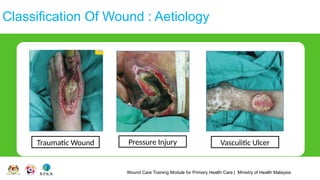
Classification Of Wound : Aetiology
Traumatic Wound Pressure Injury Vasculitic Ulcer
Wound Care Training Module for Primary Health Care | Ministry of Health Malaysia
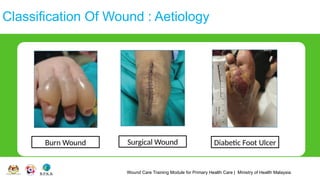
Classification Of Wound : Aetiology
Burn Wound Surgical Wound Diabetic Foot Ulcer
Wound Care Training Module for Primary Health Care | Ministry of Health Malaysia
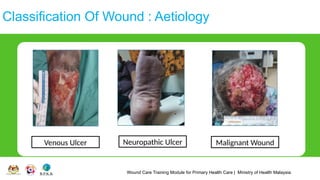
Classification Of Wound : Aetiology
Venous Ulcer Neuropathic Ulcer Malignant Wound
Wound Care Training Module for Primary Health Care | Ministry of Health Malaysia
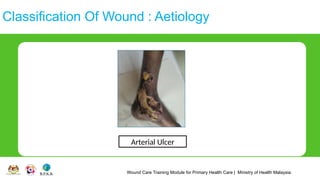
Classification Of Wound : Aetiology
Arterial Ulcer
Wound Care Training Module for Primary Health Care | Ministry of Health Malaysia
Part 5: Wound Healing
Wound Care Training Module for Primary Health Care | Ministry of Health Malaysia
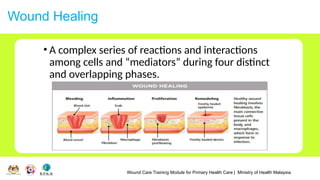
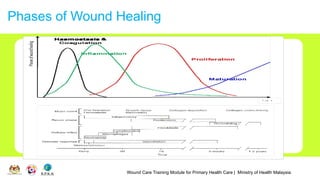
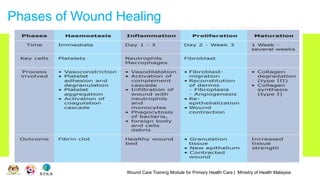
Wound Healing
• A complex series of reactions and interactions
among cells and “mediators” during four distinct
and overlapping phases.
Wound Care Training Module for Primary Health Care | Ministry of Health Malaysia
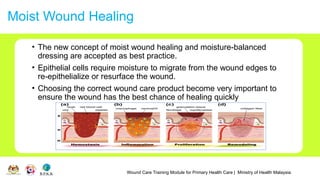
Moist Wound Healing
• The new concept of moist wound healing and moisture-balanced
dressing are accepted as best practice.
• Epithelial cells require moisture to migrate from the wound edges to
re-epithelialize or resurface the wound.
• Choosing the correct wound care product become very important to
ensure the wound has the best chance of healing quickly
Wound Care Training Module for Primary Health Care | Ministry of Health Malaysia
Phases of Wound Healing
Wound Care Training Module for Primary Health Care | Ministry of Health Malaysia
Phases of Wound Healing
Wound Care Training Module for Primary Health Care | Ministry of Health Malaysia
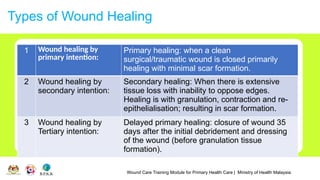
Types of Wound Healing
1 Wound healing by
primary intention:
Primary healing: when a clean
surgical/traumatic wound is closed primarily
healing with minimal scar formation.
2 Wound healing by
secondary intention:
Secondary healing: When there is extensive
tissue loss with inability to oppose edges.
Healing is with granulation, contraction and re-
epithelialisation; resulting in scar formation.
3 Wound healing by
Tertiary intention:
Delayed primary healing: closure of wound 35
days after the initial debridement and dressing
of the wound (before granulation tissue
formation).
Wound Care Training Module for Primary Health Care | Ministry of Health Malaysia
Difference Between Acute and Chronic Wounds
Wound Care Training Module for Primary Health Care | Ministry of Health Malaysia
Factors Affecting Wound Healing
Wound Care Training Module for Primary Health Care | Ministry of Health Malaysia
Clinical Features of Wound
Wound Care Training Module for Primary Health Care | Ministry of Health Malaysia
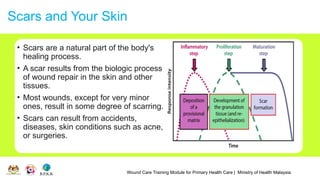
Scars and Your Skin
• Scars are a natural part of the body's
healing process.
• A scar results from the biologic process
of wound repair in the skin and other
tissues.
• Most wounds, except for very minor
ones, result in some degree of scarring.
• Scars can result from accidents,
diseases, skin conditions such as acne,
or surgeries.
Wound Care Training Module for Primary Health Care | Ministry of Health Malaysia
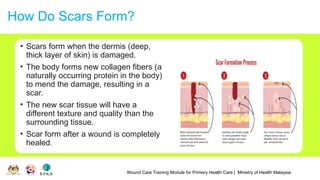
How Do Scars Form?
• Scars form when the dermis (deep,
thick layer of skin) is damaged.
• The body forms new collagen fibers (a
naturally occurring protein in the body)
to mend the damage, resulting in a
scar.
• The new scar tissue will have a
different texture and quality than the
surrounding tissue.
• Scar form after a wound is completely
healed.
Wound Care Training Module for Primary Health Care | Ministry of Health Malaysia
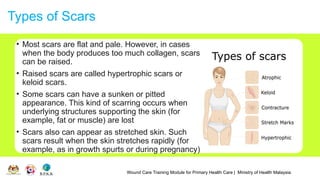
Types of Scars
• Most scars are flat and pale. However, in cases
when the body produces too much collagen, scars
can be raised.
• Raised scars are called hypertrophic scars or
keloid scars.
• Some scars can have a sunken or pitted
appearance. This kind of scarring occurs when
underlying structures supporting the skin (for
example, fat or muscle) are lost
• Scars also can appear as stretched skin. Such
scars result when the skin stretches rapidly (for
example, as in growth spurts or during pregnancy)
Wound Care Training Module for Primary Health Care | Ministry of Health Malaysia
Part 6: Principles Of Wound Care
Wound Care Training Module for Primary Health Care | Ministry of Health Malaysia
Clinical Considerations In Wound Management
Include:
1. Preventing and controlling infection and
contamination
2. Maintaining adequate moisture
3. Treating edema
4. Preventing further injury
Wound Care Training Module for Primary Health Care | Ministry of Health Malaysia
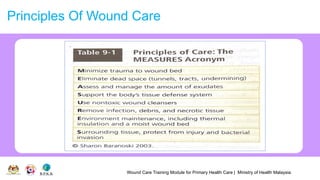
Principles Of Wound Care
Wound Care Training Module for Primary Health Care | Ministry of Health Malaysia
1) Wound Care Quick Reference, First Edition 2019. NWCC & MOH
2) Modul Latihan National Wound Care Committee ,MOH
3) Wound Care Manual, 1st Edition, 2014. MOH
4) Garispanduan Perkhidmatan Penjagaan Luka Di Fasiliti Kesihatan Primer 2019. MOH
5) Wound Care Essentials , 5th Edition
References:
Wound Care Training Module for Primary Health Care | Ministry of Health Malaysia
Prepared by:
∙ Dr. Hanihaselah binti Mohd Salleh, Pakar Perunding Perubatan
Keluarga, Jusa C , Klinik Kesihatan Kulai
∙ Pn. Ros Rafidah binti Mat Darus , Jururawat Kesihatan U29, KK
Jelebu

1. BASIC WOUND CARE PRINCIPLES 12.1.24.pptx

  • 1.
    Basic Wound Care Principles WOUNDCARE TRAINING MODULE FOR PRIMARY HEALTH CARE
  • 2.
    OBJECTIVES Wound Care TrainingModule for Primary Health Care | Ministry of Health Malaysia Able to discuss the functions and different layer of the skin To understand the classification of wound by timing and etiology To understand the different stages of wound healing Factors affecting wound healing categorized by local and systemic
  • 3.
    CONTENT Wound Care TrainingModule for Primary Health Care | Ministry of Health Malaysia Part 1: Introduction Part 2: What Is The Skin Part 3: Definition Of Wound And Ulcer Part 4: Classification Of Wound Part 5: Wound Healing Part 6: Principal Of Wound Care
  • 4.
    Wound Care TrainingModule for Primary Health Care | Ministry of Health Malaysia Part 1: Introduction
  • 5.
    Wound Care TrainingModule for Primary Health Care | Ministry of Health Malaysia Introduction • The skin is the body's largest organ and serves pertinent functions such as maintaining a physical barrier, thermoregulation, and participating in the regulation of water loss • Damage to the skin barrier initiates a complex healing process through the interactions of many cell types within various microenvironments. • Wounds can be present over different anatomical parts of the body. • However, the basic principles of choosing a wound dressing remain the same.
  • 6.
    Wound Care TrainingModule for Primary Health Care | Ministry of Health Malaysia Part 2: What Is The Skin?
  • 7.
    Wound Care TrainingModule for Primary Health Care | Ministry of Health Malaysia What Is The Skin? • Skin is the outer covering of the body and thus provides protection. • It is the largest organ; because it consists of different tissues that are joined to perform several essential functions; in our body in term of weight and surface areas. • Its thickness ranges from 0.5mm to 4.0mm depending on location. • It is a dynamic organ in a constant of change; whereby the outer layers are continuously shed and replaced by the inner cells moving to the surface.
  • 8.
    Wound Care TrainingModule for Primary Health Care | Ministry of Health Malaysia What Is The Skin? • Structurally, the skin consists of 3 principal layers. ⮚Epidermis: outer most layer, thinner portion, composed of epithelium. ⮚Dermis: middle layer, thicker, consists of connective tissue. ⮚Subcutaneous: deepest layer, also known as superficial fascia or hypodermis; consists of areola and adipose tissues.
  • 9.
    Wound Care TrainingModule for Primary Health Care | Ministry of Health Malaysia What Is The Skin? • Fibers from the dermis extend down into the subcutaneous layer and anchor the skin to it • The subcutaneous layer, in turn, attaches to underlying tissues and organs.
  • 10.
    Wound Care TrainingModule for Primary Health Care | Ministry of Health Malaysia What Is The Skin? 3 PRINCIPAL LAYERS OF SKIN
  • 11.
    Wound Care TrainingModule for Primary Health Care | Ministry of Health Malaysia What Is The Skin? EPIDERMIS •Epidermis is a labile tissue which is continuously regenerate. •It is avascular. •Receives nutrients from the dermis below. •Comprised of stratified squamous epithelium and contains four principal types of cells. ⮚ Keratinocytes- produce proinflammatory mediators, participate in wound healing, and contribute in ultraviolet radiation protection. ⮚ Melanocytes: modulate skin colour through melanogenesis (melanin production). ⮚ Langerhan Cell: role in immune response to pathogens. ⮚ Meckel’s Cell: ” touch cells”- responsible to sensation.
  • 12.
    Wound Care TrainingModule for Primary Health Care | Ministry of Health Malaysia What Is The Skin? DERMIS • The second principal layer of skin. • Composed of connective tissue containing collagen, elastic fibers which provides strength, extensibility, and elasticity. • Thickness depending on the anatomical site (e.g. very thick in the palms and soles and very thin in the eyelids, penis, and scrotum). • Contains nerves, glands, hair follicles and also receptors for heart, cold, pain, pressure, itch and tickle.
  • 13.
    Wound Care TrainingModule for Primary Health Care | Ministry of Health Malaysia What Is The Skin? BLOOD SUPPLY OF THE SKIN • It is rich in blood supply from vascular plexus in the deep dermis. Through extensive vascular network (ascending arterioles and capillary loops), the blood supply eventually reaches upper layers of dermis. SUBCUTANEOUS LAYER DERMIS EPIDERMIS RETE VENOSUM RETE ATERIOSUM CUTANEUM
  • 14.
    Wound Care TrainingModule for Primary Health Care | Ministry of Health Malaysia What Is The Skin? • The deepest layer, also known as subcutis or hypodermis. • Varies in thickness and depth. • It is the structure that binds the skin to the underlying structures. • Comprised of adipose tissue, connective tissue and blood vessels. Forms a network of collagen and fat cells. • Responsible for conserving the body's heat and protects body organs from pressure injury. SUBCUTANEOUS LAYER
  • 15.
    Wound Care TrainingModule for Primary Health Care | Ministry of Health Malaysia What Is The Skin? FUNCTION OF THE SKIN a) Body temperature regulation b) Elimination of waste products (Excretion) - cellular waste products are excreted via sweat glands. c) Sensation - nerve endings originating from dermis sense pain, cold, heat, touch and pressure. d) Barrier function - to protect underlying tissue from mechanical injury, dehydration, ultraviolet ray, chemicals and pathogens. e) Immune function f) Blood reservoir g) Ultra-violet light protection h) Vitamin D is synthesized by the skin from sunlight.
  • 16.
    Wound Care TrainingModule for Primary Health Care | Ministry of Health Malaysia What Is The Skin? SKIN AND WOUND • Superficial wound that damage the epithelium only, can heal by epithelial regeneration (reconstitute) and may have little scar formation. • Deeper wound; incisional and excisional skin wounds that damage the dermis will heal through the formation of a collagen scar.
  • 17.
    Wound Care TrainingModule for Primary Health Care | Ministry of Health Malaysia What Is The Skin? SKIN AND WOUND • Regeneration requires an intact connective tissue scaffold. • Scar formation occur if the extracellular matrix framework is damaged, causing alteration of the tissue architecture. • Epidermal appendages do not regenerate and there remains as connective tissue scar.
  • 18.
    Wound Care TrainingModule for Primary Health Care | Ministry of Health Malaysia Part 3: Definition Of Wound And Ulcer
  • 19.
    Wound Care TrainingModule for Primary Health Care | Ministry of Health Malaysia Definition Of Wound And Ulcer • A wound is a break in the integrity of the skin or tissues often associated with disruption of structure and function. DEFINITION OF WOUND DEFINITION OF ULCER • An interruption of continuity of an epithelial surface with an inflamed base. • It is usually a result of an underlying or internal etiology.
  • 20.
    Wound Care TrainingModule for Primary Health Care | Ministry of Health Malaysia Definition Of Wound And Ulcer TYPES OF WOUND
  • 21.
    Wound Care TrainingModule for Primary Health Care | Ministry of Health Malaysia Part 4 : Classification Of Wound
  • 22.
    Wound Care TrainingModule for Primary Health Care | Ministry of Health Malaysia Classification Of Wound Wounds can be classified in many ways; By • wound chronicity, • timing, • etiology (e.g., pressure, trauma, venous leg ulcer, diabetic foot ulcer), • the depth of tissue involvement, or • other characteristics such as closure (primary or secondary intention).
  • 23.
    Wound Care TrainingModule for Primary Health Care | Ministry of Health Malaysia Classification Of Wound : Timing NO CLASSIFICATION DESCRIPTION 1 ACUTE Acute wound are those that heal within a predictable amount of time usually not more than 2 to 4 weeks 2. CHRONIC Chronic wounds that persist for more than 2 to 4 weeks. They tend to develop after minor injuries, in the setting of advanced age and medical comorbidities such as atherosclerosis and diabetes. 3 HARD TO HEAL WOUND A hard-to-heal wound has been defined as one that fails to heal with standard therapy in an orderly and timely manner. This definition applies equally to both acute and chronic wounds and is independent of the wound type and etiology.
  • 24.
    Wound Care TrainingModule for Primary Health Care | Ministry of Health Malaysia Classification Of Wound : Aetiology Traumatic Wound Pressure Injury Vasculitic Ulcer
  • 25.
    Wound Care TrainingModule for Primary Health Care | Ministry of Health Malaysia Classification Of Wound : Aetiology Burn Wound Surgical Wound Diabetic Foot Ulcer
  • 26.
    Wound Care TrainingModule for Primary Health Care | Ministry of Health Malaysia Classification Of Wound : Aetiology Venous Ulcer Neuropathic Ulcer Malignant Wound
  • 27.
    Wound Care TrainingModule for Primary Health Care | Ministry of Health Malaysia Classification Of Wound : Aetiology Arterial Ulcer
  • 28.
    Wound Care TrainingModule for Primary Health Care | Ministry of Health Malaysia Part 5: Wound Healing
  • 29.
    Wound Care TrainingModule for Primary Health Care | Ministry of Health Malaysia Wound Healing • A complex series of reactions and interactions among cells and “mediators” during four distinct and overlapping phases.
  • 30.
    Wound Care TrainingModule for Primary Health Care | Ministry of Health Malaysia Moist Wound Healing • The new concept of moist wound healing and moisture-balanced dressing are accepted as best practice. • Epithelial cells require moisture to migrate from the wound edges to re-epithelialize or resurface the wound. • Choosing the correct wound care product become very important to ensure the wound has the best chance of healing quickly
  • 31.
    Wound Care TrainingModule for Primary Health Care | Ministry of Health Malaysia Phases of Wound Healing
  • 32.
    Wound Care TrainingModule for Primary Health Care | Ministry of Health Malaysia Phases of Wound Healing
  • 33.
    Wound Care TrainingModule for Primary Health Care | Ministry of Health Malaysia Types of Wound Healing 1 Wound healing by primary intention: Primary healing: when a clean surgical/traumatic wound is closed primarily healing with minimal scar formation. 2 Wound healing by secondary intention: Secondary healing: When there is extensive tissue loss with inability to oppose edges. Healing is with granulation, contraction and re- epithelialisation; resulting in scar formation. 3 Wound healing by Tertiary intention: Delayed primary healing: closure of wound 35 days after the initial debridement and dressing of the wound (before granulation tissue formation).
  • 34.
    Wound Care TrainingModule for Primary Health Care | Ministry of Health Malaysia Difference Between Acute and Chronic Wounds
  • 35.
    Wound Care TrainingModule for Primary Health Care | Ministry of Health Malaysia Factors Affecting Wound Healing
  • 36.
    Wound Care TrainingModule for Primary Health Care | Ministry of Health Malaysia Clinical Features of Wound
  • 37.
    Wound Care TrainingModule for Primary Health Care | Ministry of Health Malaysia Scars and Your Skin • Scars are a natural part of the body's healing process. • A scar results from the biologic process of wound repair in the skin and other tissues. • Most wounds, except for very minor ones, result in some degree of scarring. • Scars can result from accidents, diseases, skin conditions such as acne, or surgeries.
  • 38.
    Wound Care TrainingModule for Primary Health Care | Ministry of Health Malaysia How Do Scars Form? • Scars form when the dermis (deep, thick layer of skin) is damaged. • The body forms new collagen fibers (a naturally occurring protein in the body) to mend the damage, resulting in a scar. • The new scar tissue will have a different texture and quality than the surrounding tissue. • Scar form after a wound is completely healed.
  • 39.
    Wound Care TrainingModule for Primary Health Care | Ministry of Health Malaysia Types of Scars • Most scars are flat and pale. However, in cases when the body produces too much collagen, scars can be raised. • Raised scars are called hypertrophic scars or keloid scars. • Some scars can have a sunken or pitted appearance. This kind of scarring occurs when underlying structures supporting the skin (for example, fat or muscle) are lost • Scars also can appear as stretched skin. Such scars result when the skin stretches rapidly (for example, as in growth spurts or during pregnancy)
  • 40.
    Wound Care TrainingModule for Primary Health Care | Ministry of Health Malaysia Part 6: Principles Of Wound Care
  • 41.
    Wound Care TrainingModule for Primary Health Care | Ministry of Health Malaysia Clinical Considerations In Wound Management Include: 1. Preventing and controlling infection and contamination 2. Maintaining adequate moisture 3. Treating edema 4. Preventing further injury
  • 42.
    Wound Care TrainingModule for Primary Health Care | Ministry of Health Malaysia Principles Of Wound Care
  • 43.
    Wound Care TrainingModule for Primary Health Care | Ministry of Health Malaysia 1) Wound Care Quick Reference, First Edition 2019. NWCC & MOH 2) Modul Latihan National Wound Care Committee ,MOH 3) Wound Care Manual, 1st Edition, 2014. MOH 4) Garispanduan Perkhidmatan Penjagaan Luka Di Fasiliti Kesihatan Primer 2019. MOH 5) Wound Care Essentials , 5th Edition References:
  • 44.
    Wound Care TrainingModule for Primary Health Care | Ministry of Health Malaysia Prepared by: ∙ Dr. Hanihaselah binti Mohd Salleh, Pakar Perunding Perubatan Keluarga, Jusa C , Klinik Kesihatan Kulai ∙ Pn. Ros Rafidah binti Mat Darus , Jururawat Kesihatan U29, KK Jelebu

Editor's Notes