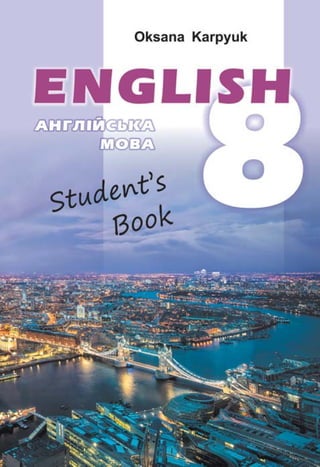
Oksana Karpyuk
Oксана Kарпюк
АНГЛІЙСЬКА
МОВА
ENGLIS H
(8-й рік навчання)
Year 8
A textbook for the eighth form of secondary schools
Підручник для 8-го класу
закладів загальної середньої освіти
Тернопіль
„Видавництво Астон”
2021
Contents
1
2
3
4
Unit
Unit
Unit
Unit
Appendix............................................................241
Starting Up..........................................................4
Lesson 1 Family and Friends ............................................18
Lesson 2 A Healthy Lifestyle..............................................30
Look Back...........................................................................46
PAGES 4 READERS..........................................................54
My Learning Diary ..............................................................58
Lesson 1 What’s Your School Like? ..................................62
Lesson 2 Are You a Good Team?......................................79
Look Back...........................................................................98
PAGES 4 READERS........................................................106
My Learning Diary ............................................................ 110
Lesson 1 Do You Need a Book?...................................... 114
Lesson 2 Music Is Heard Everywhere.............................137
Look Back.........................................................................164
PAGES 4 READERS........................................................174
My Learning Diary ............................................................178
Lesson 1 A Daily, a Weekly, a Monthly ... .......................182
Lesson 2 Geographical Outlook ......................................200
Look Back.........................................................................225
PAGES 4 READERS........................................................233
My Learning Diary ............................................................238
Grammar Reference.........................................................241
Vocabulary........................................................................270
Irregular Verbs..................................................................286
IT’S YOUR LIFE ...........................................17
YOUR SCHOOL TIME ............................... 61
YOUR PREFERENCES .............................113
BROADEN YOUR MIND! 181
3
4
STARTING UP
1 Look at the list of holiday expressions.
Recall their meanings.
VOCABULARY & READING
pack your
suitcase
1 What’s the best type of holidays for you?
a) abroad b) at the seaside c) in the mountains
Recall their meanings.
2 Do the quiz. Choose the right answer.
go sightseeing
make plans
buy
souvenirs
try local dishes
read
guidebooks
go on day trips
book
accommodation
5
5
2 Where does the money for your holidays come from?
a) your parents pay for everything
b) your parents pay for most of the things, but you save up
some pocket money
c) you get a job and make some money for your holidays
3 The most important thing on holidays for you is:
a) to see new places
b) to have a lot of fun
c) to get a good rest
4 Which of these activities do you like
best when you’re on holidays?
a) sightseeing
b) lying on the beach
c) walking and swimming
5 Which of these is number one for you?
a) good weather b) friendly people c) beautiful countryside
6 Where do you enjoy spending time?
a) at museums and art galleries b) in discos c) outdoors
7 How do you relax on holidays?
a) you go to the cinema or theatre
b) you play cards
c) you read a book
8 If you have some extra money, you like to spend it on:
a) a good guidebook
b) shopping
c) postcards and souvenirs
9 Your ideal type of holidays would be:
a) with your family
b) with a group of friends
c) with your best friend
10 Which of these would you choose for your next holidays?
a) a language course in England
b) a summer camp for teenagers at the seaside
c) a stay in the country with your family
8 If you have some extra money, you like to spend it on:
6
3 Look at your answers and find out what kind
of person you are.
Most A answers:
You like travelling and
learning about new places.
You think holidays
shouldn’t be just fun but
also a time to learn about
new places and people.
Most B answers:
You believe holidays
should be fun and
nothing but fun. You like
going out and spending
time with your friends.
4 Match the words with their definitions.
 1 accommodation
 2 book
 3 local dishes
 4 sightseeing
a typical food eaten in some
place or in a certain region
b place to stay (hotel,
campsite, youth hostel, bed
and breakfast place ...)
c visiting places of interest as
a tourist
d reserve accommodation,
a ticket, etc.
Most C answers:
You like to get a good rest
on your holiday. You don’t
like crowded places. You
prefer peace and quiet and
natural beauties.
6
5 Look at the quiz and find the words for:
1 something you buy to remind you of a
place where you spent your holiday
2 places away from your own country
3 visiting places of interest as a tourist
s......................
a......................
s......................
6 Look at the words below. Check with a friend if you
understand what they mean. Ask your teacher for
help if you have a problem.
7 Sort out the words from task 6 in your notebook.
TYPE OF PLACE ACTIVITIES
water skiing dancing
swimming fishing
a big city camping
windsurfing visiting museums
sunbathing hiking
the mountains photographing
the countryside cycling
diving
volleyball
tennis
the beach
a seaside resort writing postcards
7
8
GRAMMAR
PRESENT TENSES
2 Copy the table and identify different forms of English
present tenses. Fill in the gaps.
1 a) Match the sentences to the tenses below.
Are you doing anything at the moment?
Jim has already done lots of work today.
Bill never does anything.
Present Simple Present Continuous Present Perfect
c) Make up your own sentences using the tense forms above.
b) Complete the rules with the words from the box.
z
z We use the Present Continuous Tense for something that
is happening ... .
z
z We use the Present Simple Tense for something that
happens ... .
z
z We use the Present Perfect Tense for something in the
past which tells us something about the ... .
present, regularly, at the moment
English
present
tenses
Questions
Positive
answers
Negative
answers
Present …
Is he still watching
Titanic?
Yes, he is. No, he isn’t.
Present …
Do you sometimes
go to the cinema?
Yes, I do. No, I don’t.
9
3 Revise the English grammar rules you learnt in English
lessons last year. Check your knowledge by doing the
following Grammar Quiz.
Present …
Have you already
seen Titanic?
Oh yes, I have.
And I’m quite
impressed by it.
No, I haven’t.
a) Present Simple
b) Present Continuous
c) Present Perfect
a) Present Simple
b) Present Continuous
c) Present Perfect
a) Present Simple
b) Present Continuous
c) Present Perfect
a) Present Simple
b) Present Continuous
c) Present Perfect
a) Present Simple
b) Present Continuous
c) Present Perfect
3 Which of the present tenses
describes an action that happened at
an indefinite time before the present?
4 Which of the present tenses is
used to describe something that
is generally true?
2 Which of the present tenses is
used to describe a regularly
repeated action?
5 Which of the tenses should be
used to describe thoughts and
states with the focus on them
and not on the activities?
1 Which of the present tenses do
English speakers usually use when
they describe an activity which is in
progress at the present moment?
6 Which of the tenses is usually
used with such adverbs as ‘so far’,
‘up to now’, ‘already’, ‘yet’, ‘just’?
a) Present Simple
b) Present Continuous
c) Present Perfect
10
When you learn a language, you have to learn different tenses.
While revising or learning a tense form try to think about:
a three basic forms of any tense: positive (розповідна),
negative (заперечна) and interrogative (питальна);
b two other important questions:
z
z Is the tense form the same for all persons
(I, you, he, we, etc)?
z
z Are there any irregular verbs?
LEARNING TIP
PAST TENSES
4 a) Match these sentences to the tenses below.
Pete put his books away on the bookshelf.
She had put the medicine on its place before Tim asked
her for it.
Past Simple Past Perfect
b) Complete these rules.
c) Make up your own sentences using the tense forms above.
z
z We use the Past Simple for a … action.
z
z We use the Past Perfect for an action which happened
before a … time in the past.
definite, past
5 Group up the sentences into the following columns.
Past Perfect Tense / Past Simple Tense
1 I had read the book before she came.
2 He never did it.
3 My family went to the seaside last summer.
11
4 She didn’t put her hat on.
5 Had he arrived before the show began?
6 When did you feed the parrot?
7 Read and say which action was the first and which one was
the second.
1 Nick found the key that I had lost last week.
2 They had spoken to him before they went home.
3 After he had sold his car, he bought a new one.
4 She showed us the pictures she had taken.
5 The house was very quiet because everybody had gone to
sleep.
6 After she had brushed her teeth, she went to bed.
8 Tell the class what you had done by 9 o'clock yesterday
morning.
a) What did Jack do yesterday morning?
Jack … (sleep) until 6.30 am. He … (get) up at 7. First, he …
(read) his school timetable and … (put) his books in the bag.
Then he … (drink) a glass of warm milk and … (eat) some
toast with jam and butter. After that, he … (cut) two slices of
bread and … (make) a sandwich. Before he … (leave) the
house, he had fed his dog. He … (meet) his friend Larry at the
bus stop. They … (go) to school together.
b) What did he do after school yesterday?
He … (come) home at 4 pm. He … (throw) his books in the
corner and … (go) to the kitchen. He … (find) some pizza in
the fridge and … (eat) it. Then he … (take) his dog to the park.
They …(run) around for a while. They … (see) some other kids
and dogs in the park. They …(have) fun. On the way home,
Jack … (buy) some dog food in the pet shop.
6 Сomplete the text with the Past Simple of the verbs
in brackets.
SPEAKING
1 Discuss with a partner.
WHY DO PEOPLE ...?
z
z Why do people go on holidays?
z
z Why do some people pack loads of things when they
go on holidays?
z
z Why do some people like camping?
z
z Why do some people never travel by plane?
z
z Why do some people enjoy going on holiday alone?
2 Tell your friend about your
summer holidays.
z
z Did anything unusual happen to you?
z
z Where were you?
z
z Who were you with?
12
z
z How long were you there?
z
z What did you do?
Who were you with? What did you do?
Did you go
Did you play
Did you take
Did you
swimming / fishing / diving /
dancing / hiking / windsurfing.
tennis / football / volleyball / cards?
photographs / long walks?
sunbathe / visit any museums /
write postcards / meet anybody?
13
3 Report back to the class on what you remember
about your friend’s holidays.
LISTENING
1 Listen to the stories and say if the statements below
are true or false.
TWO HOLIDAYS
Nikki
Bruno
1 Nikki stayed at a hotel.
2 Bruno expected a great
holiday.
3 Nikki wanted to stay with
Sandra before.
4 Nikki liked Sandra’s parents.
5 Bruno fell in love.
6 Bruno’s English was no
problem at all.
7 Nikki enjoyed water skiing.
8 Nikki fell in love too.
9 Bruno is going to work on
his English.
10 Nikki is going to spend
more time at Sandra’s
home this year.
2 Listen to the stories again and answer the questions.
THE BIG BROTHER
1 Did Nikki stay at the hotel?
2 What did Nikki try once? Did she like it?
3 Where did Nikki go with her friends in the evenings?
4 What does Steve look like?
5 What is Nikki going to do?
1 Imagine that you have decided to study English at
a language school during your summer holidays.
Copy and complete the application form below.
WRITING
PERSONAL INFORMATION
Family name ...............................................
First name ...................................................
Nationality ...................................................
Native language ..........................................
Date of birth ................................................
Place of birth ...............................................
Occupation .................................................
Home address ............................................
Please write 4-5 sentences
about yourself, your interests
and activities ...............................................
...............................................
...................................................
...................................................
..........................................
................................................
...............................................
.................................................
............................................
...............................................
A SURPRISE FROM SWEDEN
1 Where did Bruno spend his holiday?
2 Was the weather nice?
3 Did he meet anyone?
4 Why was Bruno’s English a problem?
5 Is he going to work on his English this year?
3 Match the expressions with their definitions.
a keep in touch
b It’s not my cup of tea.
c hang out
d cool
e chat
 great
 talk in a friendly way
 write, communicate
 I don’t like it.
 spend a lot of time
14
z
z Where do you study English? .......................................
z
z How long have you studied English? ...........................
......................................................................................
z
z How many lessons a week? .........................................
z
z Do you have any special reasons for learning English?
......................................................................................
z
z Why do you want to improve your English?
......................................................................................
z
z Have you ever been to a language school before?
 Yes  No
z
z If yes, name the school ................................................
Dates .......................................
ACADEMIC INFORMATION
z
z Current level of English:
 very good
 good
 medium
 weak
 beginner
2 Write a paragraph on your success in learning English.
Use some of the phrases below.
z
z The hardest thing for me is …
z
z I don’t have any problems with …
z
z I spend a lot of time …ing.
z
z I try very hard with …
z
z I’m getting good at …
z
z I’m OK with …
z
z I like …ing.
z
z I like … best because …
15
16
3 Design a poster on English language
skills development.
FILE FOR
PROJECT
My Further English Study
a Divide into groups and brainstorm the ideas about:
z
z how you can improve your reading, writing or conversation
skills, and how you can improve your pronunciation
z
z why you think a lot of attention should be paid to your
pronunciation
z
z what opportunities1
for your English practice you have
outside your classroom
b Discuss your ideas and make the list of the best ones.
c Classify and present your ideas on a poster.
1
an opportunity [0ApC9tju:nCtI] — можливість
1
1
1
Unit
Unit
IT’S
YOUR
LIFE
z Family and Friends
z A Healthy Lifestyle
Do your family members have hobbies?
How much time do you spend with your friends?
What does your best friend look like?
What is he / she like?
What do you know about healthy habits?
What helps to provide a healthy lifestyle?
Pr
e-
re
ad
in
g
qu
es
tio
ns
17
18
FAMILY AND FRIENDS
VOCABULARY
1 Look at these words. What do they mean?
18
2 Say which of these words are positive and which are negative.
3 Fill in the definitions below. Write in your notebook.
A person who
z
z doesn’t like working hard is l…
z
z never lets you down is r…
z
z always tells the truth is h...
z
z often believes bad things will happen is p...
z
z is always happy to give more than usual is h…
z
z is never happy with what he or she gets is c...
z
z always likes to be in the company of other people is s…
z
z usually treats everybody the same is f…
z
z wants to be successful is a…
z
z usually tells jokes is a…
OVERPROTECTIVE JEALOUS PESSIMISTIC
AMBITIOUS HONEST LAZY STRICT FRIENDLY
COMPLAINING AMUSING
FAIR KIND HELPFUL
RELIABLE SOCIABLE
UNDERSTANDING
19
Lesson 1
4 Look at the adjectives describing
someone’s character and find the right ending.
A person who is...
 1 helpful
 2 trustworthy
 3 shy
 4 outgoing
 5 chatty
 6 honest
 7 responsible
 8 caring
a likes talking to people.
b doesn’t like meeting new people.
c always gives his / her opinion.
d is ready to help.
e doesn’t forget to do things
f is friendly and likes parties.
g doesn’t tell your secrets to other
people.
h thinks about what others need.
LISTENING
1 Listen to the four dialogues and finish the sentences.
Who are they talking about?
1 John and his mum are talking about …
2 Gary and Lisa are talking about …
3 Brenda and Sarah are talking about …
4 Susan and Maria are talking about …
3 Do the quiz from a teen magazine. Think of your best friend.
QUIZ
20
1 Does your friend tell you his / her secrets?
a) always b) rarely c) never
2 Why does your friend like spending time with you? Because ...
a) it’s fun b) you have a lot in common
c) you are a nice person to know
3 You have to pick up your friend to go out together, but you are
late. What does your friend think?
a) He / She is often late. b) I hope everything is OK.
c) I’ll never wait for him / her again.
4 You are cheating in a test. Does your friend ...?
a) tell you it’s not a good idea because you can get into trouble
b) ask you for your cheat sheet to copy it
c) report you to the teacher
5 Does your friend know about ... ?
a) your happy moments b) your sad moments
c) your happy and sad moments
6 Your friend is jealous of one of your new friends.
What does he / she do?
a) asks you to stop seeing that friend
b) gets to know your new friend better c) stops seeing you
7 You’ve a new hairstyle / haircut. Your friend
doesn’t like it. What does he / she say?
a) You look awful!
b) It’s OK, but I prefer your
old hairstyle.
c) It’s great!
2 Listen once more. Tick all the adjectives in task 1
(Vocabulary) that the teenagers mention in their
conversation.
7 You’ve a new hairstyle / haircut. Your friend
doesn’t like it. What does he / she say?
a) You look awful!
b) It’s OK, but I prefer your
21
Lesson 1
4 Ask your friend if you are right about the answers.
8 You have a difficult test in Maths
and you have to work hard. Your friend,
who is good at maths, phones you to go out. Does he / she ...?
a) come over to your place and help you with studying
b) talk you into going out
c) go out without you
1 Guess the missing words in the poem.
SPEAKING
What does a true friend do?
He’s/She’s there for y...
When you are happy,
But when you are s..., too.
How does true friendship show itself?
It begins with a short ‘H...!’
And then with time and care
It starts to g... and g...
What does a true friend say?
‘Don’t worry. You’ll be O...’
And with an understanding s...
Your problems seem to go away.
WHAT DOES A TRUE FRIEND DO?
Think and say.
1 When do you
feel happy?
2 When do you
feel sad?
3 When do you
feel worried?
4 How does a
friendship grow?
5 Listen to Emma’s answers to the quiz above. Tick her answers.
There are two questions she didn’t answer. Which ones?
22
z
z How are things?
z
z Good for you!
z
z What’s the matter?
3 Work in pairs. Ask your partner.
1 What’s your best friend like?
2 How do you get on with your parents? What are they like?
3 What would you like your teachers to be like? Say why.
Emma: Hi, it’s me, Emma. How are things?
Tara: I’m bored!
Emma: Do you want to come round to my
place? I’ve got new Sims.
Tara: Cool!
Emma: Yes, I’m designing a new character.
Tara: What does she look like?
4 Listen and read. Then answer the questions.
z
z Oh, poor thing!
z
z How did it go?
z
z Oh, lucky you!
z
z What is Tara like?
z
z What is Emma like?
z
z What is your best friend like? How do you know?
Emma: It’s a he. He’s tall, a bit on the plump side. He’s got
shoulder-length straight hair. He’s nice and understanding.
He likes music, plays the guitar, is good at acting and...
Tara: Emma!!!
Emma: ...and he is madly in love with a pretty girl called Tara...
...and he is madly in love with a pretty girl called Tara...
Tara: Get lost, Emma! That’s Luke. I’ll
never tell you any of my secrets
again!
Emma: Sorry, Tara. I’m just teasing you.
2 a) Look at these expressions and say when you use them.
b) Make a four-line dialogue using the expressions from (a).
23
Lesson 1
Tara: Yes, I see. And I don’t feel
like coming to your place any more.
Emma: Come on, Tara!
Tara: Ok, then. See you in half an hour!
5 Match the questions and answers.
1 What does Emma
suggest?
2 Why does Tara get
angry?
3 What does Luke look
like?
4 What does he like?
5 What is he like?
a Music and acting.
b Caring and understanding.
c Because Emma is teasing
her.
d Coming over to her place
to play The Sims.
e Tall and plump, with long
straight hair.
6 Listen to and read the dialogue to find out
if Luke has accepted Eve’s invitation.
Eve: Hi, it’s Eve here! Have you got any plans
for the weekend?
Luke: No, why?
Eve: We’re going to the Activity Centre.
Would you like to come with us?
Luke: Us?
Eve: Yes, my friends Tara and Lee.
Luke: I don’t know. You know I don’t like meeting new people.
Eve: But you know them, I’m sure. They are in my class. Tara is
tall and thin with long curly hair, often in a ponytail.
Luke: Oh, Tara from the acting group. I know her.
She seems very nice.
Eve: Yes, she is. And Lee is short and thin, easy to
talk to, he plays the violin. He likes music.
Luke: All right then.
Eve: Let’s meet in front of the Activity Centre at 10.
She seems very nice.
Eve: Yes, she is. And Lee is short and thin, easy to
talk to, he plays the violin. He likes music.
Luke: All right then.
Eve: Let’s meet in front of the Activity Centre at 10.
24
7 First unscramble the questions. Then answer them.
1 at first doesn’t Why Luke to want go the Centre Activity to?
2 like look What Tara does?
3 is like What she?
4 Lee What like does?
8 Act out one of the dialogues (task 4 or 6). Use the sentences
from the box above. Call your friend and invite him / her:
to a birthday party More help:
to your place Hi, it’s ... (your name) here.
to a basketball match When?
to an acting class When does it start?
to the cinema What’s on?
REMEMBER!
MAKING INVITATIONS
MAKING SUGGESTIONS
Do you want to
come over to my
place?
Would you like to
go to the Activity
Centre with us?
Let’s meet in front of the Activity Centre. OK. See you there.
Yes, I’d love to. I’m not sure
about that.
Yes, sure.
Yes, great.
No, I can’t. I’m busy.
No, I can’t. I have a
test tomorrow.
25
Lesson 1
GRAMMAR
REMEMBER!
1 Compare these people with the help of ‘as … as”
or ‘not as/so … as’.
1 Ann has got eyes of the same colour as John’s.
2 Rose is taller than Cathy.
3 Linda has got curly hair. Mary has got curly hair, too.
4 Bill and Tom are good pupils.
5 My grandparents are older than yours.
6 Brenda is better at skating than Lisa.
z
z We use as + adjective / adverb + as to make comparisons
when the things / people we are comparing are equal in
some way:
James is as tall as his older sister.
The world’s biggest bull is as big as a small elephant.
The weather this summer is as bad as last year.
z
z We use not as / so … as to make comparisons between
things / people that aren’t equal:
She is not so good at cooking as her mother.
Paris is not as big as Tokyo.
If you would like to make a description more vivid and lively1
use a simile2
. In a simile the two things that we compare, we
usually join with the word as.
For example: Liz is as busy as a bee.
George was as quiet as a sleeping cat.
Tim was as scared as a rabbit.
Isn’t such language more interesting?
LEARNING TIP
1
vivid and lively [9vivid 3nd 9laivlI] — яскравий і жвавий
2
a simile [9simClI] — порівняння
usually join with the word
For example:
George was
Tim was
READING
1 Read the letter and name all the people in June’s life.
Ann has just come from holidays. Before going away she sent her
address to a youth magazine called ‘Sugar’. When she got back
home, she was very surprised to find a letter.
26
Sydney, 2nd September
Dear Ann,
While I was reading ‘Sugar’
, I came across your address, so
I decided to write to you because we seem to have a lot in
common. At least we both like reading the same magazine.
I’m 15 years old and I live with my brother and parents
in Sydney. You could say that I live with my parents but I
don’t see them very often.
My Mum works for an advertising agency. I think her job
is much more interesting than my Dad’s. I get on very well
with her, but sometimes she worries too much.
My father is a bit of a workaholic. He works for a big
publishing company. He works late hours, even weekends.
He’s nice, but when I go out, he wants me to be back by
10 o’clock.
I like drawing a lot, I’d like to be a designer or maybe
illustrate children’s books. I’ve taken up extra painting
classes and it’s a lot of fun. My brother thinks I’m not
talented at all but that’s my brother. He’s a bit of a
weirdo, anyway. He is 18, but still spends most of the
time on his skateboard. He has a bunch of friends who are
all crazy about it. They all think they are cool.
He hopes to become a famous musician. He spends hours
practising, the rest of the time he teases me. He’s taking
exams at the moment. He pretends to be studying, but he
is playing computer games or watching videos.
My best mate is called Eve. She’s a real friend. She never
lets me down. We go to the same school. When school is
over, we go to the beach to watch windsurfers. I like one
of the boys there a lot. Eve says he is a real joker. His
name is Pete, but he doesn’t even notice me.
This weekend I’m going birdwatching with my parents. We
will go into the bush with binoculars1
, sleep in tents and
Lesson 1
a bunch [byntS]
a weirdo [9wiCdCU]
a workaholic [wE:kC9hAlik]
to pretend [pri9tend]
to tease [tI:x]
z
z to catch up (with)
z
z to come across
z
z to get on well (with)
z
z to have sth in
common
VOCABULARY BOX
1
binoculars [bi9nAkjClCx] — бінокль
have a lot of fun. Eve’s coming with us and
we have to catch up with all the news. That’s
all for now! I hope to hear from you soon.
Love,
June
27
2 Find in the letter the words that mean the following and write
them in your notebook.
1 a person who can’t stop working hard – w...
2 a strange person – w...
3 a group of friends – a b ... of friends
4 an area of wild land in Australia – the b...
5 these make objects that are far away seem nearer – b...
3 Find the missing word.
1 You come ... someone’s address or an old photo.
2 You take ... painting classes or some hobby.
3 You catch ... with the gossip1
or with others after missing a
week at school.
4 Find all the sentences where June talks about the important
people in her life. Then use some adjectives (прикметники)
from task 1 to describe what they are like.
5 Choose one person from June’s life and write 5 things he or
she does every day. The others in the class should guess
who the person is. What tense would you use?
6 Discuss in groups.
z
z What do you like about June’s life?
z
z Do you have anything in common
with her or her brother?
28
1
gossip [9gAsip] — плітки
Lesson 1
WRITING
3 You want a pen friend. Write a
letter about yourself. Follow
June’s outline and use some of
the expressions from task 2.
REMEMBER!
AN INFORMAL LETTER
An informal letter is a letter you write to a friend.
You start it with Dear Ann,
You end it with Yours / Love / Best wishes
You use paragraphs to organise the information in the letter.
1 Look back at the information in June’s letter.
Put the topics below in the proper order.
 Her family
 Reasons for writing a letter
 Her interests
 Her best friend
 Her plans for the weekend
(notice that she uses
the Present Continuous
for plans in the future)
2 Look at the expressions below. Which of them would you put
at the beginning (B) and which at the end (E) of an informal
letter? Group up the expressions into B and E columns in
your notebook.
Write back soon.
I’m sorry I haven’t written sooner.
I was very happy to receive your letter.
Keep in touch.
Thanks a lot for your letter I got two weeks ago.
Give my love to your ...
29
A HEALTHY LIFESTYLE
1 Work in pairs. Talk to your partner.
1 How many hours’ sleep do you need every night?
2 Do you fall asleep easily?
3 What helps you fall asleep?
4 Do you wake up during the night or do you sleep like a log?
5 Do you sometimes not sleep a wink? When does it happen?
6 Do you dream?
7 Do you remember your dreams in the morning?
8 Do you wake up easily in the morning?
READING
2 Listen to and read the text.
Every person goes through five stages of sleep. To feel good
we need to go through each stage every night.
During stages 1 and 2 you sleep lightly. It is easy for someone
or something to wake you. During stages 3 and 4 you sleep
deeply. It is not easy for anyone to wake you. You hear no
sounds and see no lights.
Then comes the last stage
of sleep. It is called REM
(rapid eye movement). This
is the stage in which
you dream. You
breathe more
30
31
Lesson 2
quickly than in the previous stages.
Your eyes move rapidly under your eyelids and you dream.
There are all kinds of dreams: good ones, bad ones and
nightmares. You need your dreams. You dream more if you have
a special problem. Dreams help you solve your problem and give
you answers to some questions. Actually, you dream four to six
times during the REM stage. Very often you don’t remember what
you have dreamt about.
If you have problems falling asleep, you should think about the
following:
a Chocolate, tea and Coca-Cola have caffeine and they keep
you awake. Try not to have them in the evening.
b Too much food makes it difficult for your body to relax. Think
about how much you eat before you go to sleep.
c Exercise wakes you up. Don’t exercise before bedtime.
d Your bed should be used for sleeping only. Eating, studying or
watching TV shouldn’t be done in bed.
3 Find in the text the words for:
quickly — r...
find and answer a problem — s...
a very frightening dream — n...
take and let out air — b...
a period or a step in a process — s...
4 Say if the following statements are true or false.
1 We go through the 4 stages of sleep.
2 We dream in the last stage.
3 We dream only once.
4 REM means “remember everything in the morning”.
5 Our body is more active in the REM stage.
6 Dreams are good for us.
7 Chocolate in the evening is a good idea.
8 Exercising before bedtime helps you fall asleep.
an eyelid [9ailid]
a nightmare [9naitmeC]
a stage [steidz]
to relax [ri9l2ks]
previous [9prI:vICs]
rapid [9r2pid]
VOCABULARY BOX
32
5 a) Explain the meanings of the following expressions.
b) Choose the expressions from (a) and complete the
sentences below. Mind the correct tense forms.
The baby was crying all night and I did .......................................
I didn’t hear any noise last night because I was ..........................
I didn’t hear the phone this morning because I ...........................
6 Fill in the sentences with the adverbs of manner.
1 Some people can’t fall asleep … (easy).
2 I often dream that I’m running … (fast).
3 “I didn’t sleep a wink last night,” she said … (nervous)
4 “I slept like a log,” he said … (happy)
1 How do you sleep during stages 1 and 2?
2 How do you sleep during stages 3 and 4?
sleep like a log be fast asleep not sleep a wink
3 How do you breathe during
stage 5?
4 How do your eyes move
during stage 5?
5 What are nightmares?
6 What shouldn’t you do if you
have problems falling asleep?
7 Answer the questions.
33
33
a flavour [9fleivC]
to depend (on) [di9pend]
to overeat [0CUvC9rI:t]
fizzy [9fixI]
z
z to be at risk
z
z to take one’s time
VOCABULARY BOX
REMEMBER!
ARTICLES
z
z You use a in expressions like:
I slept like a log.
I didn’t sleep a wink.
z
z You use the in expressions like:
In the first stages you sleep lightly.
In the last stage you dream.
z
z You use no article with nouns like:
Sleep is very important.
Some people often dream about money and love.
Chocolate, tea and Coca-Cola keep you awake.
LISTENING & VOCABULARY
1 Ask and answer in pairs.
z
z What’s your favourite food?
z
z Is there any food you don’t like?
z
z Do you regularly have breakfast? What do you have?
z
z What snacks do you usually have? (chocolate bars, crisps,
sandwiches)
z
z Can you cook anything?
Lesson 2
3 Choose the sentences that are true for you in this
questionnaire1
. If you have more happy faces than
sad faces, you eat a healthy diet.
 I always have breakfast on school days,
usually a sandwich and a glass
of orange juice.
 I don’t drink any milk.
 I drink tea instead of coffee.
 I don’t eat much meat.
 I eat a lot of bread and pasta.
 I always have some vegetables for lunch.
 I drink a lot of fizzy drinks.
 I don’t eat any junk food, such as
hamburgers, pizzas or hot dogs.
 I spend a lot of pocket money on snacks.
 I eat an apple or a banana between
meals.
 I don’t like any vegetables, especially
tomatoes and cucumbers.
 I love fruit, especially
raspberries.
1
a questionnaire [0kwWestSC9neC] —
анкета, опитування
2 Find the wrong definition of the word DIET.
Explain your choice.
1 a drink with sugar
2 the food that you eat every day
3 the food that you eat when you want to get thinner
34
HOW HEALTHY IS YOUR DIET?
I don’t eat any junk food, such as
hamburgers, pizzas or hot dogs.
I spend a lot of pocket money on snacks.
I eat an apple or a banana between
I don’t like any vegetables, especially
анкета, опитування
35
35
4 a) Look at the following statements,
discuss them with your partner
and decide if they are true or false.
1 It’s very important to have a
proper breakfast every morning.
2 It’s enough to have two meals a day.
3 We need to drink at least
two litres of water a day.
4 Portions have become
much larger nowadays.
5 We should eat as much
food as our body uses.
6 You can eat as much sugar
and salt as you want.
7 Eat your food as fast as possible.
b) Listen and check if you were right.
5 Listen again and choose a, b or c.
1 People who don’t eat breakfast regularly
are more at risk ... .
a) of becoming ill. b) of becoming fat.
c) of becoming smaller.
2 If you eat five to six times a day, you ... .
a) won’t get enough energy.
b) will get too hungry and overeat.
c) won’t get too hungry and overeat.
3 How much water we should drink
a day depends on ... .
a) our physical activity and the weather.
b) the time of the day and the food we eat.
c) the other drinks we have and where we are.
4 We should eat our food ... .
a) in a hurry. b) slowly. c) in front of the TV.
Lesson 2
2
3
4
b) the time of the day and the food we eat.
c) the other drinks we have and where we are.
a) in a hurry. b) slowly. c) in front of the TV.
Step 1 Prepare a questionnaire. You are going to find
out what pupils in your class usually eat during
the day. You might use these questions:
a) What do you have for breakfast?
b) What kind of food do you eat at lunchtime?
c) Do you have any snacks during the day?
Step 2 Interview as many people as possible.
Step 3 Present your results on a poster.
Oksana Victor
What do you have for breakfast?
What does your usual lunch consist of?
tea hot chocolate
a toast a sandwich
36
FILE FOR
PROJECT
Healthy Eaters
6 Choose the right meaning for the words in bold.
1 If you are at risk of something, you a) are in danger of it.
b) aren't in danger of it.
2 If you skip something, you a) do it fast.
b) don't do it.
3 The flavour of food is its a) taste.
b) smell.
4 If you take your time, you a) are in a hurry.
b) aren't in a hurry.
5 A fizzy drink is a drink a) with bubbles.
b) without bubbles.
6 A snack is a) a small amount of food.
b) a great amount of food.
7 Do a class survey1
. Find out if your classmates and you are
healthy eaters. Follow the plan below.
Healthy Eaters
1
a survey [9sE:vei] — дослідження
37
Lesson 2
GRAMMAR
FUTURE TENSES
REMEMBER!
To talk about things that have been planned and arranged, or
are already known we use the Present Continuous Tense.
We are playing tennis next week.
(We have a plan to play tennis.)
We are eating at a restaurant tonight.
(We have made a plan to eat in a restaurant.)
She isn’t coming next week.
(We already know that she will not arrive next week.)
Note. We use the Present Simple to talk about timetables,
programmes, scheduled events, trains, planes or buses.
Their plane leaves Heathrow at 12:35 on Sunday.
The opera begins at 19:00 on Thursday.
Our class meets from 13:00 to 14:30 on Tuesdays.
1 I am playing tennis
tomorrow at ten.
2 I am travelling to Scotland
in the summer.
3 She is working until seven
tomorrow.
1 I play tennis.
2 I travel to Scotland
every summer.
3 She works everyday
until five.
1 Compare to see the difference between general facts written
in the Present Simple, and future plans written in the Present
Continuous.
2 Use the Present Continuous in these sentences.
1 We … for Kyiv next week. (leave)
2 She … a new project next week. (start)
3 I … at my granny’s when I get to Kharkiv. (stay)
38
4 He … until next week. (not come)
5 We … shopping our first day there. (go)
6 I … home and … tonight. (stay, read)
3 Write six sentences about what you are doing
the next few days.
4 Make questions. All the sentences are about the future.
Example: you / go / out tonight? Are you going out tonight?
1 what time / Bob and Sue / come?
2 you / work / next week?
3 when / Liz / go / on holiday?
4 what / you / do / tomorrow evening? .
5 Use the words to make sentences about the future.
Use the Present Continuous or Present Simple.
1 I / meet / my friends this evening
2 I / not / go out / tonight
3 the concert / start / at 8.15
4 Tom / not / come / to the party / on Thursday
5 The English course / finish / on 7 May
6 I / not / go / to London tomorrow
7 my sister / get married / next December
8 my train / leave / at 8.45
6 Fill in the gaps using the Present Simple or Present
Continuous.
1 Peter …(work) in his studio every day.
2 He … (paint) his greatest work at the moment.
3 We … (travel) to Rome to see the painter’s opening night.
4 On Thursday, our train … (depart) at 11 am and …(arrive)
at 7 pm.
5 Peter … (finish) three different pieces for the exhibition.
6 His manager … (pick) up the finished work on Wednesday.
7 The show … (begin) promptly at 9 pm on Thursday.
39
Lesson 2
7 Complete the following sentences using the right future
tense of the verbs in brackets.
1 The plane …(arrive) at 6 pm.
2 My cousin …(have) a birthday party this Friday.
3 I … probably …(come), but I’m not sure.
4 I think you …(like) Scotland.
5 Adrian …(not come) to Amy’s party because he is grounded.
REMEMBER!
z
z We use the Future Simple to say what you
think will happen in the future.
z
z We use the Future Simple to make promises.
I’II try to come, but I won’t make it by 7 pm.
I’II definitely come to your party.
SPEAKING
1 a) Do the quiz in pairs. Find out if your partner likes
to spend his / her free time outdoors or indoors.
Pupil A asks, pupil B answers. Then take turns.
1 You want to see a good film but the nearest cinema
is 5 km from your house. You decide to:
 a) wait for a bus
 b) watch an old film on TV instead
 c) walk to the cinema
2 On your summer holiday at the seaside you:
 a) go to a local disco in the evenings
 b) go for long walks on the beach
 c) sit and play chess/cards with your family
QUIZ: ARE YOU AN INDOOR OR AN OUTDOOR PERSON?
40
3 Your class at school wants to organise an outing1
.
You want to:
 a) climb a mountain
 b) visit a local factory
 c) visit a local farm
4 It’s Sunday afternoon. It’s raining.
There’s nothing interesting on TV. You decide to:
 a) go to your room and read a book
 b) put on a coat and go for a walk
 c) run to your friend’s house and listen to music
5 In summer you:
 a) sleep with your bedroom window closed
 b) sleep with your bedroom window open
 c) sleep on the balcony
1
an outing [9aUtiN] — екскурсія
b) Find out your score and express your attitude to it
(agree or disagree).
16-30 points:
You like to spend your free time outside but not too
much. You’re pretty normal.
31-50 points:
You’re an outdoor type, maybe a fresh-air fanatic!
RESULTS:
0-15 points:
You’re a real indoor type person!
You can’t stand fresh air. You only
go outside when you have to! In your
free time try to go out of doors.
You will see that it is more pleasant
to spend your time in such a way!
YOUR SCORE:
1 a) 5
2 a) 5
3 a) 10
4 a) 0
5 a) 0
b) 0
b) 10
b) 0
b) 10
b) 5
c) 10
c) 10
c) 5
c) 5
c) 10
41
2 a) Before listening to the radio
programme, read the statement,
then agree or disagree with it.
c) Share your notes with your class.
If you have chosen a hobby
according to your character and
taste, you are lucky because your
life becomes more interesting.
3 Match the words to their definitions.
1 an entry
2 a range
3 a specimen
4 absorbing
5 to gain
6 to reveal
a to show, to be seen, to make known
b to achieve something important
c the right or opportunity to enter a place
d a single typical thing or example
e a set of different objects of the same kind
f interesting, holding somebody’s attention
b) Listen to the extract of the radio
programme and note some things which
you consider to be important for a teenager.
Lesson 2
42
4 Listen again and complete the sentences.
1 The advice for a long healthy life is …
2 Stamp collecting is our entry into …
3 Stamps celebrate …
4 The philatelist can …
5 Another hobby with international links is …
6 Through your letter exchange …
7 In the process you gain a …
8 Both pen friendship and stamp collecting will give you a
good amount of ...
5 a) Look at the photos and name the free-time activities
you can see.
b) Work in pairs. Say which of the following activities you
enjoy / don’t enjoy and which you do in your free time.
fishing
swimming in the pool
reading a book
visiting a museum
playing football
skateboarding
rollerblading
watching a film at the cinema
watching TV
listening to music
taking photos
surfing the internet
Lesson 2
6 Read to answer the questions
on page 44.
Hi, my name is George. I’m staying at Kids’
Camp in Ireland. It’s a really fun place to be.
The scenery is beautiful and the atmosphere
is friendly. I’m sharing a room with a boy who
is the oldest in our group. He is Irish and he
speaks with a funny accent. He is also the
best swimmer. Every day we get up at seven.
I hate getting up early, but here I don’t mind it
so much because I enjoy having breakfast
with all the other kids. In the morning we play
water polo for two hours which is great. We
do different things every afternoon — we play
tennis, we go hiking, horse riding or we just
hang around the camp. I love going hiking in
the woods, especially when we have a
treasure hunt. That is the best! We spend the
evenings in the camp. There is one boy, Sam,
who is very good at playing the guitar, so we
sometimes listen to him and sing. I don’t mind
singing but I prefer playing cards or
Monopoly. The other day we went on a day
trip. We visited Dublin. We went
sightseeing and shopping. I would
like to stay in the camp for as long
as I can.
43
an atmosphere [92tmCsfiC]
a treasure hunt [trezC hynt]
hiking [haiking]
scenery [9sI:nCri]
VOCABULARY BOX
Brian is
tired of going
to the same
place every
summer and
he’s dreaming
of going to a
holiday camp
this year. He
is surfing the
internet and
has found
one.
44
7 a) Work in pairs. Ask and answer the questions.
1 Why is Brian dreaming of visiting a holiday camp?
2 Who wrote the text?
3 Where is the camp?
4 What’s its name?
5 When do the children get up there?
6 What does George think about getting up early?
7 What do the children do in the morning?
8 Which activity does George like best?
9 How do they spend the evenings?
10 What is Sam good at?
b) Make true sentences about yourself.
You can use some of the expressions below.
dancing, getting up early,
eating fast food, swimming
in the pool, surfing the
internet, listening to loud
music, lying on a sunny
beach, reading novels,
travelling to new places,
watching sports on TV,
doing housework, taking
my dog for a walk
I love …
I enjoy …
I’m good at …
I’m interested in …
I’m tired of …
I can’t stand …
I’m bad at …
8 Read and check which three things Brian would like to do.
I’ve never been to a holiday camp and I
would really like to visit this one. I would
like to try horse riding and I’d like to go
on a treasure hunt. But most of all I’d
like to play as much water polo as I can.
I like playing water polo!
45
Lesson 2
9 Discuss in a group.
z
z How do you usually spend your holidays?
z
z How would you like to spend your ideal holidays?
z
z Have you ever been to a holiday camp? Would you like to
spend your holidays in a camp such as Kids’ Camp?
z
z Have you ever tried horse riding? Would you like to try it?
z
z Would you like to go on a treasure hunt?
z
z What other things would you like to do?
WRITING
1 Read the e-mail and write a similar one about free-time
activities you and your friends and you do.
3 Write about your dream holidays. Think about where you
would like to go to, what you would like to do there and who
you would like to spend your holidays with.
2 Work in pairs. Think about a healthy lifestyle. Note the points
that are important to live a healthy, happy and long life. Make a
list of ‘The Rules of a Healthy Lifestyle’ and present it in class.
My friend and I are interested in sports and entertainments.
Some of my classmates have such hobbies as skateboarding
or roller skating. Almost everyone likes music and
communication. We like to walk together, joke and discuss
different life problems, especially personal relations and school
life. We like to arrange parties and celebrate birthdays.
To:
From:
Subject:
kids.world@com
Nick Dobson
Free time
46
L K BACK!
1 Work in pairs. Ask and answer about your partner’s plans.
You / Your partner have / has some ideas.
get away, some shoes, this evening,
Spain, fish, to a restaurant, tomorrow
a bee
the grave (могила)
two peas
the day
snow
the hills
gold
a bear
2 Match the words to make up a simile.
Use them in sentences of your own.
as like as
as silent as
as hungry as
as busy as
as clear as
as white as
as old as
as good as
I am going out ...
Where are you going for your
holidays next year?
Where are you going tonight?
When will you see Ann again?
What are you going to buy
when you go shopping?
What are you doing at the
weekend?
When are you going to phone
John?
What are you going to have
for dinner tonight?
47
Lessons 1-2
3 Read the words and say what
kind of people make good (true) friends.
faithful, selfish, attentive, friendly, honest, devoted,
thoughtful of others, boastful, heartless, kind-hearted,
unselfish, brave, good-looking, hard-working, cheerful,
lazy, untruthful, pessimistic, reliable, understanding,
jealous1
, fair, complaining, amusing
4 Do the questionnaire and test yourself to find
out if it is easy to be a good friend.
CAN YOU BE A REAL FRIEND?
1 Your friend wants to borrow your new computer game but
you don’t want to give your CD to anyone. What do you say?
a) Sorry, but I don’t like to give my CDs to anyone.
b) Yes, of course.
c) Buy your own CD!
2 Your friend made a new acquaintance and tries to introduce
his/her new friend to you. You’ll ... .
a) do it easily
b) pretend you feel good,
but feel jealous
c) say you don’t want to make
the acquaintance
3 You are at home and feel tired.
Your friend phones and asks
you to go out. You’ll ... .
a) go out easily
b) explain that you’re tired
and say ‘no’
c) explain you’re tired and invite
him to come to your place
1 a) 1 b) 2 c) 0
2 a) 2 b) 1 c) 0
3 a) 0 b) 2 c) 1
4 a) 2 b) 1 c) 0
WHAT IS
YOUR SCORE?
1
jealous [9dzel3s] — ревнивий, заздрісний
1
to make an excuse [ik9skju:x] — вибачати
2
to interrupt [int39rypt] — перебивати
5 Speak on the theme ‘Friendship as I See It’. Work in groups.
The following questions will help you.
1 How does a friend differ from an acquaintance?
2 Do you have a true friend?
3 Do you think a man can have only one or many true friends?
What about you?
4 What do you have in common with your friend: views,
interests, tastes, way of thinking or way of life?
4 You are very busy at the moment. Your friend phones
and tells he/she needs your help. You’ll ... .
a) hurry up to your friend
b) explain that you’re busy but in an hour or two you’ll visit him
c) make an excuse1
and explain that you don’t like when
someone interrupts2
you at work when is important to you
RESULTS:
6-8 You’re a real friend. You are kind and helpful.
3-5 You can be a good friend, but try to be less selfish.
0-2 Oh, no … You’re too selfish! Friends are important
in everyone’s life. If you want to have a real friend,
you should be more helpful and kind to others.
48
5 In what way do you differ from your friend?
6 Do you think your friend will come to help
you when you are in trouble?
7 What kind of a boy / girl is your friend?
Describe him / her.
8 How long have you been friends?
9 What does friendship mean to you?
10 What can you advise a person who
has no friends and feels lonely?
49
Lessons 1-2
6 Write sentences about some
of your family members.
My sister Tina is serious
and hard-working.
She always does well at school.
My brother Ted is shy,
but he’s also very clever.
My friend Paul is very popular.
He’s got a lot of friends.
7 Read the text and find the answers to the following
questions. Use your dictionary.
1 Why is sleep important for teenagers?
2 What is typical of many teenagers?
3 What does the new research suggest?
4 What is melatonin?
5 When does the body of a teenager start producing melatonin?
What’s the result of that?
6 What have some schools in America decided to do? Why?
Many teenagers have the energy to play computer games
until late at night but can’t find the energy to get out of bed in time
for school. Is it just laziness or is it something more? New
research suggests that the reason for such behaviour may be the
50
hormonal changes of
puberty. It could be the
hormones that stop
teenagers from going to
bed early and make them
sleepy in the morning. One
thing is for certain - sleep is
extremely important for teenagers
because it is while they are sleeping that they release a hormone
that is essential for their growth. They need more sleep than both
children and adults.
At night our body produces the ‘darkness hormone’ melatonin
which helps us to fall asleep.
Most adults start to produce melatonin at about 10 pm.
Research has shown that teenagers start to produce the
hormone at 1 am. In other words, teenagers are being kept
awake by their bodies and there is not much they can do about it.
The fact that they play computer games and watch television late
at night stimulates the brain even more and makes it harder for
them to fall asleep.
Whatever the reason, most teenagers do not get enough
sleep. This results in bad moods and sometimes depression. In
America, some schools have decided to start their classes later
in the morning to give their teenagers some extra time in bed.
They noticed their students did much better in class when they
did not have to get up early.
8 Ask your friend and report back to the class.
1 Do you usually go to bed late?
2 Is it hard for you to get out of bed in the morning?
3 Do you play computer games or watch TV late at night?
4 Are you often in a bad mood in the morning?
5 Do you think your classes start too early in the morning?
6 What would be a good time for you to start school? Why?
51
Lessons 1-2
Teacher: What’s wrong, Alison?
Alison: I have a headache.
T: Did you have anything to eat
before school?
A: I overslept and had no time for
breakfast. I watched a late
movie on TV last night.
T: You should eat something
in the morning and you
shouldn’t stay up so late
on a school night.
A: I know, I know, but my
headache is getting worse.
T: Why don’t you go to the canteen
and have something to eat?
A: I can’t really. I think I
have a temperature
too.
T: Well, you’d better call
your parents then
and go home. OK.
10 Do the quiz and find out how healthy you are.
1 How many portions of fruit and vegetables
should you eat every day?
a) 2 b) 3 c) 4 d) 5 or more
2 Vitamin A helps us to see at night.
Which of these gives us a lot of vitamin A?
a) carrots b) potatoes c) oranges d) bread
GIVING ADVICE
You should take an aspirin.
Why don’t you eat something?
You’d better do physical exercises.
You shouldn’t stay up so late.
REMEMBER!
10 Do the quiz and find out how healthy you are.
How many portions of fruit and vegetables
Which of these gives us a lot of vitamin A?
a) carrots b) potatoes c) oranges d) bread
10 Do the quiz and find out how healthy you are.
a) carrots b) potatoes c) oranges d) bread
QUIZ: FOOD AND HEALTH
9 Listen and read,
then discuss in class.
52
1
а vegetarian [0vedzi9te3rI3n] — вегетаріанець
3 Vitamin D is good for our skin. Which
of these gives us a lot of vitamin D?
a) bread b) carrots c) eggs d) oranges
4 Which of these contains the most fat?
a) 50 g of hard cheese b) 50 g of chocolate
c) 50 g of chips d) 50 g of peanuts
5 How often should we exercise?
a) at least 20 min. once a week
b) at least 20 min. twice a week
c) at least 20 min. three times a week
6 Which activity burns up the most energy per
minute?
a) swimming b) football c) walking quickly
7 Which of these is a vegetarian1
allowed to eat?
a) meat b) eggs c) cheese d) nuts
11 Read the sentences below and decide if you agree or
disagree. Discuss with your partner. Think of some examples
to illustrate your opinion.
1 Teenagers eat too little fruit and vegetables.
2 They eat too many unhealthy snacks.
3 Parents are to blame when children eat too much fast food.
4 A lot of people eat their dinner and watch TV at the same time.
5 A lot of young people eat only some food, not all.
6 Not many people sit down together and eat as a family.
7 Cooking could be one of the school subjects.
YOUR SCORE
12-14 Congratulations! You are an expert.
7-11 Good. Very good.
0-6 You should learn more about diet and health!
The
correct
answers:
1
-
d
2
-
a
3
-
c
4
-
d
5
-
c
6
-
a
7
-
d
Give yourself two points for each correct answer.
a) bread b) carrots c) eggs d) oranges
53
Lessons 1-2
FILE FOR
PROJECT
An Adventure Holiday
Step 1 Think and discuss, then list some of the possibilities.
z
z Are there any mountains to climb?
z
z Are there any caves to explore?
z
z Where can you use skis or skateboards, rollerskates, etc?
Use your imagination and brainstorm the ideas for different
activities that are exciting and somewhat risky.
Step 2 Think about the contents of
your brochure.
Include photos
or pictures for
the activities
you plan.
Step 3 Design the
brochure and
present it in class.
12 You have decided to start a company offering a new type
of adventure holiday. Design a brochure advertising your
type of adventure holiday. Work in a group of four.
53
present it in class.
activities that are exciting and somewhat risky.
Think about the contents of
Wildlife and adventure holidays are very popular in Britain.
You can camp, ski, go on boats and climb mountains. There
are other types of holidays, too. ‘Theme parks’ (like
Disneyland) are very popular.
Every year, two million people visit Alton Towers,
a theme park in England. It has got 40 rides!
DO YOU KNOW?
54
1 Listen to and read the story.
THE DEVOTED FRIEND
Adapted from ‘The Devoted Friend’by O. Wilde
“Once upon a time,” said a
Linnet1
, “there was an honest
fellow named Hans.”
“Was he famous?” asked a
Water Rat.
“No,” answered the
Linnet, “I don’t think he was
famous at all, but he had a
kind heart and a funny, good-
humoured round face. He
lived in a small cottage all by
himself2
, and every day he
worked in his garden. In all the country side there was no
garden so lovely as his. Different flowers grew there, and they
bloomed or blossomed, so that there were always beautiful
things to look at.
Hans had many friends, but the most devoted friend of all
was big Hugh [hju:], the Miller3
. Indeed, so devoted was the
rich Miller to Hans, that he would never go by his garden
without filling his pockets with plums and apples if it was the
fruit season.”
“Real friends should have everything in common,” the
Miller used to say, and little Hans nodded and smiled, and felt
very proud of having a friend with such noble4
ideas.
Sometimes, indeed, the neighbours thought it was strange
that the rich Miller never gave little Hans anything in return5
,
1 Listen to and read the story.
1
a linnet [9linit] — коноплянка
(різновид пташки)
2
all by himself — сам-один
3
a miller [9mil3] — мельник
4
noble [9n3Ubl] — благородний
5
in return [in ri9tE:n] — у відповідь
Lessons 1-2
though he had a hundred sacks of flour
in his mill, and six cows, and many sheep; but Hans never
troubled his head about these things, and nothing gave him a
greater pleasure than to listen to all the wonderful things the
Miller said about the unselfishness of true friendship.
So little Hans worked away in his garden. During the
spring, the summer, and the autumn he was very happy, but
when the winter came, and he had neither fruit nor flowers to
bring to the market, he suffered1
a lot from cold and hunger,
and often had to go to bed without any supper. In the winter,
he was very lonely, as the Miller never came to see him.
“There is no good in my visits to Hans while there is
snow,” the Miller said to his Wife, “because when people are
in trouble, no visitor should bother them. This is my idea
about friendship, and I am sure I am right. So I shall wait till
the spring comes, and then I shall visit him, and he will be
able to give me a large basket of roses, and that will make him
so happy.”
“You are certainly very thoughtful about others,” answered
the Wife, as she sat in her comfortable armchair by the fire,
“very thoughtful indeed. It is quite a pleasure to hear you talk
about friendship!”
2 Read and choose the right
word to fill in the gaps.
1 Hans was ... .
a) a famous person
b) a miller
c) an honest fellow
2 He lived in ... .
a) a garden b) a small cottage c) a palace
devoted [di9v3Utid]
generous [9dzen3r3s]
greedy [9grI:dI]
lonely [9l3UnlI]
to bother [9bAq3]
to devote [di9v3Ut]
VOCABULARY BOX
1
to suffer [9syf3] — страждати, потерпати
55
PAGES
PAGES
4READERS
56
3 Every day he worked … .
a) in his garden b) at his mill c) in his cottage
4 Hans felt … of having a friend with such noble ideas.
a) very lonely b) very surprised c) very proud
5 The rich Miller … gave little Hans anything to help with food.
a) always b) never c) sometimes
6 In winter, little Hans ... .
a) got a great help from the Miller
b) asked the Miller to help
c) suffered from cold and hunger
7 The Miller said: ...
a) “There is no good in my visit to Hans.”
b) “I should go to visit Hans.”
c) “I have to help my friend when he is in trouble.”
8 The Miller’s wife was … her husband’s words.
a) unpleased with b) pleased with c) afraid of
3 Speak on the Miller’s words. Agree or disagree with him.
“…when people are in trouble, no visitor should bother them.”
4 Discuss in groups.
1 Prove that Hans was a hard-working and kind-hearted man.
2 Do you agree that the most devoted friend was big Hugh, the
Miller? Give your reasons.
3 “Real friends should have everything in common,” the Miller
used to say. Do you agree with these words?
4 “Actions speak louder than words.” Comment on this proverb
and say which of the two characters was a man of actions and
which was a man of words.
5 Say which of the two characters proved to be a devoted
friend. Give your opinion.
6 What is your idea of a true friend?
5 Comment on the proverbs.
1 If you want to have a friend — be one.
2 The way to your friend is never too long.
3 A friend in need is a friend indeed.
6 Speak about the episode described in the story
‘The Devoted Friend’ from the point of view:
a of Hans
b of one of the neighbours
c of Hugh, the Miller
7 Give a character sketch1
of Hans and the Miller.
Say who is more sympathetic to you.
1
to give a character sketch — коротко змалювати образ (персонаж)
57
You may find the
following words
helpful when
describing the Miller:
selfish
unfriendly
mean
greedy
unable to be thankful
thoughtless
You may find the
following words
helpful when
describing Hans:
kind-hearted
unselfish
generous
devoted
willing to help
friendly
open-hearted
8 Work in groups. Discuss if selfish people can be true
(devoted) friends. Explain why.
PAGES
PAGES
4READERS
My Learning Diary
Photocopy for Your Portfolio
58
The topics of this unit are ……..…………..........................……………
……………………………………………………….......………………….
I find this unit very easy / quite easy / quite difficult / very difficult.
(Underline what is true for you.)
I think that the most important thing I have learnt is …………...………
…………………………………………………………………………..…...
…………………………………………………………………………...…..
The most difficult thing for me was ………………………………………
………………..………………………………………………………….…..
The things that I enjoyed most in the Unit were ....……..………………
……………………………………………………………………………….
……………………...………………………………………………………..
The things that I didn’t enjoy were …………..…………………………..
……………...………………………………………………………………..
The ways I used working with the Unit were ....…………….….……….
…………………………………………………………………………….....
……………………………………………………………………………….
My favourite activities / tasks were ……………….............…………….
……………...………………………………………………………………..
The new grammar I have learnt in the Unit is ……...…………………
……………...………………………………………………………………..
The best lesson I had in my English class was .....................…...……
……………...………………………………………………………………..
The things that are easy to read are .………...………………………….
……………...………………………………………………………………..
59
Lessons 1-2
Photocopy for Your Portfolio
The things that are easy to listen to ………….................………………
……………...………………………………………………………………..
The things that are easy to talk about ……………………......…………
……………...………………………………………………………………..
The things that are easy to write about ...………...…………………….
……………...………………………………………………………………..
The things that are difficult to read about …................………………..
……………...………………………………………………………………..
The things that are difficult to listen to .………………………………….
……………...………………………………………………………………..
The things that are difficult to talk about …………..……………………
……………...………………………………………………………………..
The things that are difficult to write about ……..……………………….
……………...………………………………………………………………..
Three things I would like to remember from this unit are …..…………
……………...………………………………………………………………..
……………...………………………………………………………………..
………………….....…………. because ……………................….……..
……………...………………………………………………………………..
I would like to improve my pronunciation / spelling / vocabulary /
grammar / fluency. (Underline what is true for you.)
The things that I would like to learn are ..............................................
……………...………………………………………………………………..
……………...………………………………………………………………..
You have finished the unit. Choose the adjectives
that best describe how you feel about it.
?happy
relieved
satisfied
unhappy
frustrated
excited
motivated
sorry
good
tired
60
60
60
My Learning Diary
After the unit I can:
Photocopy for Your Portfolio
NOW I CAN
z
z name qualities of a person
z
z describe someone’s character
z
z compare things or people with ‘as … as’, ‘not so/s … as’
z
z share my ideas about what a true friend is
z
z invite someone to somewhere
z
z make suggestions about doing something
z
z talk about things that have been planned / arranged
z
z speak on free-time activities
z
z give advice on how to be healthy
z
z talk about healthy habits
z
z listen to the radio and share the information I heard
z
z read and understand articles about a healthy lifestyle
z
z do quizzes from teen magazines and sites
z
z do a class survey of healthy habits of my mates
z
z make new e-mail friends
z
z understand the difference between the articles ‘a’ and
‘the’
z
z understand and use the Present Continuous Tense in the
meaning of future
z
z write an informal letter about my life
z
z write a list of rules of a healthy lifestyle
z
z do a project on my dream holidays
MY WORK
2
2
2
Unit
Unit
61
YOUR
SCHOOL
TIME
z What’s Your
School Like?
z Are You a
Good Team?
What kind of school do you go to?
What does your school building look like?
Are you good at school subjects?
How often do you take part in school parties
and festivals?
Do you always keep to school rules?
Are your teachers too strict?
Pr
e-
re
ad
in
g
qu
es
tio
ns
62
LISTENING
LISTENING
LISTENING
1 Share your impressions of your
first day at school this year.
WHAT’S YOUR
SCHOOL LIKE?
Were you curious and excited
as well as a little scared1
?
1
to be scared [skeCd] — бути наляканим
2 a) Listen to the letter Amelia
wrote to Lilly and notice
the expressions she used
at the beginning and at
the end of her letter.
b) Say if the statements
are true or false.
1 Amelia has received
Lilly’s letter already.
2 She wrote that she had
gone back to school on
Monday.
3 Amelia wrote that she
had got into trouble the
day before because she
had been late for school.
4 Her class teacher was
very pleased with her.
5 Amelia likes her school
uniform very much.
63
Lesson 1
3 Listen to Amelia’s letter again
and write a reply to her. Answer her questions
and describe your first day at school.
Use the expressions below.
z
z Please write soon.
z
z It was really nice to hear from you.
z
z I am looking forward to hearing from you.
z
z Thanks for your letter.
Lilly: That was an interesting
lesson! I really like
History — it’s my
favourite subject. After
English, of course.
Mary: As for me, I don’t like
memorising the dates. I
got a really bad mark for
the History test.
Chris: Never mind, Mary.
You might have a good
mark next time. Anyway,
you can ask your teacher to
improve the situation.
Lilly: Well, we decided to visit Terry
on Saturday, didn’t we?
Chris: We did. Let’s meet at four.
Mary: OK.
4 Listen and read, then answer the questions.
a university [0ju:ni9vE:sCtI]
to decide [di9said]
to improve [im9pru:v]
to memorise [9mem3raix]
z to cheer [tSi3] smb up
VOCABULARY BOX
a Who is good at History?
b Who has got a bad mark for the History test? Why?
c In what way does Chris cheer Mary up?
d When did they decide to visit Terry?
5 Act out the talk in a group of three.
64
GRAMMAR
1 Complete with ‘should’ or ‘shouldn’t’.
1 A: It’s getting late.
B: Yes, we … go back before it gets too dark to see.
2 A: You … do things to hurt other people.
B: Yes, sometimes I … think first.
3 A: … we buy the tickets the day before the concert?
B: Yes, we … . We … wait until the last minute.
4 A: You have everything you need. It … be too hard to
do your homework.
B: Yes, I … start today.
5 A: You … spend all your free time playing computer games.
B: I know I … . But I am crazy about them.
6 A: If you have a temperature, you … stay in bed.
B: Yes. The doctor says that I … go to school before Monday.
7 A: Parking near schools … be allowed.
B: I agree. But where … teachers and parents park then?
8 A: Why … I walk if we have three cars?
B: You … walk as much as possible. It’s good for you.
REMEMBER!
We use should / shouldn’t:
z
z to ask for and to give advice or to express personal opinion:
— Should I call him? Should I go to his house?
— No, you shouldn’t. You should wait.
I think you shouldn’t spend all your money on make-up.
You should stay in bed if you are sick.
z
z when we hope for the better but don’t know something for
certain:
The weekend should be nice. (Our friends have done
everything to make it nice.)
MODAL VERBS
65
Lesson 1
2 Read and compare.
1 I am playing football
tomorrow. (Sure)
2 Tom is going to Italy
next weekend. (Sure)
3 I am not going to
school tomorrow.
(I am sure I won’t go.)
4 Sally won’t eat rice.
(I am sure that she
doesn’t like it.)
1 I may play football tomorrow.
(Possible)
2 Tom might go to Italy next
weekend. (Possible, not sure)
3 I might not go to school
tomorrow. (Perhaps I won’t
go, but I am not sure.)
4 Sally may not eat rice.
(Perhaps she won’t eat rice
because I am not sure if she
likes it.)
3 Put the words in the correct order.
1 to work / not / My mum / go / may
2 beat / might / He / at tennis / me
3 phone / might / me / Tom
4 may / our cousins / not / We / visit
5 might / actors / They / become
6 to the cinema / go / may / You
7 not / get up / I / early / might
REMEMBER!
z
z We use may / might to say what will possibly
happen in the future.
They may / might join us.
z
z We use may not / might not to say that we are
not sure some action will happen in the future.
He may not / might not enjoy playing water polo.
9 A: You … lift this by yourself.
It’s too heavy.
B: ... I ask someone to help me?
10 A: Teachers … give so much reading for homework.
B: I agree. We … read only five books every semester.
66
5 Write true sentences about what you are doing tomorrow.
Use: I’m (not) -ing or I’m (not) going to ... or I may ... or I might ... .
Example: (watch television) I am not going to watch television.
6 Complete the dialogues with
the phrases.
1 — What are you going to do tonight?
— I’m not sure. I might go to the cinema.
2 — Does Annie want the fish and chips?
— No. … (the chicken salad).
3 — Will the film finish before nine?
— … (at about nine thirty).
4 — How are you going to buy
that new phone cover?
— … (my dad for some money).
1 (write a story)
2 (get up early)
3 (go to the party)
4 (have a shower)
5 (buy a dress)
6 (play volleyball)
7 (make a cake)
8 (do my homework)
4 Write sentences with may / might or may not / might not.
1 (Perhaps I will go to the picnic) — I …
2 (Perhaps I will see Stella tomorrow) — I …
3 (Perhaps Tom will be late) — Tom …
4 (Perhaps it will rain today) — It …
5 (Perhaps I will go swimming) — I …
6 (Perhaps they will not come) — They …
7 (Perhaps I will not go out tonight) — I …
67
Lesson 1
7 Revise the model verb should / shouldn’t and choose
the correct answers.
1 You should / shouldn’t eat vegetables because they are
healthy.
2 It’s early. The shops should / might not be open yet.
3 That’s a great poster. You should / shouldn’t hang it on the
wall.
4 Michael should / shouldn’t eat so much ice cream. It isn’t
healthy.
5 I am very busy today. I may not / should have time to see
you.
6 My room is a mess. I should / shouldn’t clean it.
7 It is very cold. It may not / might snow tonight.
8 You might not / shouldn’t listen to loud music. It can damage
your hearing.
9 I can’t meet you now, but I may / shouldn’t have some time
after lunch.
10 Children should / shouldn’t sleep at least eight hours a night.
11 That dress looks small. It shouldn’t / might not fit you.
12 This cake is delicious. You shouldn’t / should try it!
5 — Is your mum going
to change her job?
— … (to a different office).
6 — Is your dad going to come and meet you?
— … (if he finishes work early).
7 — Are they going to the concert?
— … (if they can get the tickets).
8 — Do you want an ice cream?
— No, but … (a drink).
9 — Is it going to rain today?
— We don’t know. … (our umbrellas).
10 — Is your teacher going to give you a test?
— I don’t think so. ... (kind to us)!
1 a) Read the statements and say if they are true or false.
1 British children start school when they are six.
2 They leave their primary school when they are 11.
3 When they are 13, they go to the 10th form.
4 They start a school day at 8 o’clock.
5 They usually have lunch at school.
6 They don’t have lessons in the afternoon.
7 They go to school on Saturdays.
b) Read the article to check your answers in (a).
SCHOOLS IN BRITAIN
Ted and Mark go to a typical British school. When they were
eleven, they left their primary school and went to the secondary
school. Now they are thirteen and they are in year 8.
British schoolchildren study the same subjects and have the
same lessons until they are thirteen. At thirteen they choose the
subjects they want to do for the national GCSE (General
Certificate of Secondary Education) exams. They take these
exams in year 11 (at the age of sixteen). British children should
take national exams in six subjects, although they might take
more. Then they might stay at
an education [0edjU9keiSn]
a technology [tek9nAl3dzI]
national [9n2Sn3l]
primary [9praim3rI]
secondary [9sek3nd3rI]
typical [9ti pik3l]
z to take an exam
VOCABULARY BOX
68
READING & VOCABULARY
69
school for two more years and study for two or more A-level1
exams. But they might leave school after their GCSEs.
Ted and Mark are doing eight subjects. They have to study
English and Maths, and they have chosen French, Physics,
Biology, Chemistry, Art and Design, and Information Technology2
.
Their classmates chose different subjects so they don’t have
many lessons together even though they are still in the same
form. They’re taking their GCSE exams in June. They also do
PE1
but there isn’t a PE exam.
Ted and Mark go to school from Monday to Friday. School
starts at 9 o’clock. There is a 20-minute break at half past 10.
They have lunch at one o’clock. A few people go home but most
of them eat lunch in the canteen.
Afternoon lessons start at quarter to 2 and finish at quarter to
4. After school the boys do sport. In their school pupils can also
join the music group or belong to a club. When they get home,
they have to do their homework.
They like their school but Ted hates the uniform they have to
wear.
After school the boys would like to go to a university but none
of them has decided what they want to study yet.
1
A-level is the exam that English schoolchildren take when they’re about 18.
2
Information Technology [0inf39meiSn tek9nAl3dzI] — інформатика
3
PE (Physical Education) — фізкультура
Lesson 1
70
2 Complete the sentences.
1 When British schoolchildren are eleven ...
2 At thirteen ...
3 They should take GCSEs in ...
4 They might leave school ...
5 If they decide to go to a university, they should ...
6 In the school pupils can also join ...
3 Answer the questions in your notebook.
Then discuss your answers in a small group.
z
z What do you think
of life at Mark and
Ted’s school?
z
z What are the main
differences between
school life in Britain
and in Ukraine?
Example:
We leave primary school when we’re ten.
LEARNING TIP
Groupwork Speaking Strategies
z
z Always try to speak English.
z
z Don’t interrupt other people.
z
z Respect other people’s ideas.
z
z Choose a secretary to make
notes of group decisions.
4 Ask and answer about your school. Work in pairs.
1 What school do you study at?
2 Where is it situated?
3 What is there behind the school building and in front of it?
4 When was the school built?
5 How do the classrooms look like?
6 Which floor is your classroom situated on?
7 What do you think of your form master (mistress)?
8 What subject does he/she teach?
9 How many lessons have you got a day?
10 What do the pupils use their daybooks for?
11 Are the pupils often called to the board in your school?
12 What happens if the pupils make mistakes?
71
Lesson 1
5 Speak about different types of schools in Ukraine.
Work in groups.
z
z In what way are specialised schools / lyceums [lai9sI:Cmx] /
gymnasiums [dzim9neixICmx] different from the ordinary3
ones?
z
z What are their advantages or disadvantages?
z
z What kind of school would you like to study in? Why?
13 What do the teachers give
you after every lesson?
14 What do you get at the end of each term?
15 What compulsory1
subjects do you study at your school?
16 Are you good at all of them?
17 Do you realise2
that a good knowledge of English is important
nowadays? Prove it.
6 Work in groups. Read the schoolchildren’s e-mails
and talk about their schools.
1
compulsory [k3m9pyls3rI] —
обов’язковий (для всіх)
2
to realise [9ri3laix] — усвідомлювати
3
ordinary [9c:dCnCrI] — звичайний
I live in the middle of Australia, and there isn’t a school near my
house. I use my radio and the internet to study. A teacher
sometimes visits me, too. I like doing projects and talking to other
kids. The internet is a great thing! We have a web camera, so I
can see Science experiments and other things. I don’t have to sit
in a classroom and keep quiet. In two years I am going to the
boarding school and will spend more time with other kids.
Best wishes.
Daniel
To:
From:
Subject:
editors@teenmag.com
Daniel Grint
My School
72
1
sneakers [9snI:kCx] — кеди; тенісні туфлі, кросівки
2
the Pledge of Allegiance [0pledz Cf C9lI:dzCns] — клятва вірності; присяга
To:
From:
Subject:
editors@teenmag.com
Steve Wonder
My School
We do different subjects at my school: Maths and English, Music
and Art, Science and Technology.
I love Literature, but I don’t like Science much. We do Geography
and History, too. We study Spanish because there are a lot of
Latinos here — people from Latin America, like my friend Miguel
[mi9gel].
We have no uniform and most kids wear T-shirts, jeans and
sneakers1
. In American schools you have to get good grades,
otherwise you can be ‘left back’. That means you do the year
again. It’s pretty unusual.
Another thing — every morning we have the Pledge ofAllegiance2
.
Sometimes we all say it together, but usually we just stand up and
listen to one kid saying it. If you talk during the Pledge, our teacher
Mr. Schumacher gets really mad. I don’t know why, but he really
loves the Pledge. A lot of schools don’t do the Pledge anymore.
P.S. Tomorrow we are
going to the Air and
Space Museum.
It’s a great museum
and I am looking
forward to visiting it.
Bye, Steve
73
Lesson 1
8 Make a list of five differences between Steve’s and Daniel’s
school situations. Which situation do you like more?
1 project
2 grade
3 subject
4 uniform
5 mad
a special school clothes
b American word meaning ‘angry’
c American word meaning both ‘a school
year’ and ‘an exam result’
d a long piece of school work
e you study it at school, e.g. Science,
Spanish, History
7 Match these words with their meanings.
1
a guardian [9g4:dI3n] — опікун
2
jewellery [9dzu:3lrI] — коштовності, ювелірні вироби
3
to yawn [jc:n] — позіхати
SPEAKING
1 a) Read the children’s opinions about their school lessons and
say which of the subjects they like or don’t like and why.
Today, in the middle of the boring Maths
lesson I started yawning3
. Miss Turner
looked at me just at the moment. She told
me to learn one page from our Maths book
by heart! And I spent hours on that!
Henry
Many British schools have a charter or code which students
sign, promising to behave well. These are some typical rules:
z No student may go out of the school grounds during the
day without a written request from a parent or guardian1
.
z No jewellery2
is permitted with school uniform, with the
exception of a watch.
DO YOU KNOW?
74
Melinda
George
b) Make up some sentences about the kids above.
2 Speak about what makes a school subject interesting
and what makes it boring.
Melinda
Henry
George
hates ...
likes only ...
prefers ...
because ...
the textbook is nice.
there are a lot of experiments.
it helps me with ... .
the homework is not very hard.
there is a lot to memorise.
it’s useful for my future profession.
the teacher is good.
we read (learn) about ... .
we work with computers.
we discover new things.
It is ... if
The last lessons of the day are History
and Maths. History is really boring, lots
of reading and writing, of course.
Besides, I think that everything was
discovered before us. It’s no use to
study History, but Maths is really great!
I’d like to be a pilot and work for an
air-taxi firm. I study hard. I study
History, Geography and Maths
especially hard because of my future
profession. I don’t use only textbooks.
I’ve read a lot of specialised magazines
and history books, too.
equipment
[i9kwipmCnt]
a facility
[fC9silitI]
a workshop
[9wE:kSAp]
z to be
well-equipped
VOCABULARY
BOX
75
Lesson 1
z
z How can illustrations, pictures, posters, schemes and tables
be helpful in lessons?
z
z What do you think the classroom (the lab, the workshop)
should look like? How should it be equipped to make it a good
place to work?
z
z What are the advantages of well-equipped classrooms?
Do you think the use of modern facilities is important only
in your Science lessons?
3 Work in pairs. Give your ideas
and discuss the questions.
z
z Arts and Crafts Room
z
z Assembly Hall
z
z Canteen
z
z Gymnasium
4 Speak about the facilities you’ve got in your school and talk
about the activities pupils do there. Work in groups.
5 Work in a group of five. Role-play the situation. Imagine
you are taking foreign pupils around your school.
A, you are a pupil of the school
and you are going to show the
Chemistry Lab. Use the following:
Chemistry; a lab; to be well-
equipped; tables and diagrams; to do
experiments; to make observations.
z
z Laboratory
z
z Computer Room
z
z Library
z
z Workshop
B, you are a pupil of the school
and you are going to show the
Workshop. Use the following:
modern equipment; to be taught;
to use some tools and machines;
to practise; to get skills.
C, you are going to
show the Assembly
Hall. Answer the
guests’ questions. Use
the following: to be
decorated with; to hold
200 people; to arrange a
performance; a stage; to
hold parties (concerts).
6 Read the suggestions made by some boys and girls. Say
what each of them suggested, and if you are ‘for’ or ‘against’
these suggestions. Give reasons for your arguments.
76
More educational
excursions should
be arranged.
The school should
invite a guest speaker
every week.
Uniform should not be
compulsory at school.
A school orchestra
should be formed.
77
Lesson 1
7 a) Work in groups.
Give your opinion on the following.
z
z Which of the school rooms are best-equipped?
z
z Which of the traditions observed in your school do you
consider to be the most interesting?
z
z What do you think about educational television programmes
at school?
b) Discuss the ways to make your school life more interesting
and work out the list of improvements for your school.
WRITING
1 Write to your pen friend about
the school subjects you have.
Use the words from the box.
z
z What school subjects do you like most? Why?
z
z What school subjects are boring to you? Why?
dull, awful, boring, useful,
interesting, exciting
2 You are not satisfied with something at your school. Write
into an ‘Angry Column!’ of your school.
Example:
ANGRY COLUMN!
There is nothing to do at
lunchtime. Somebody
should organise games
because everybody
likes sport.
There’s nowhere to go
after school! Somebody
should organise a disco
because everybody
likes music and dancing.
78
3 Write a personal story telling about your school experience1
.
Remember the most interesting or memorable day you ever
had at school.
Use this plan to help you write your Personal Story.
I Planning
a Begin by studying the features2
of a Personal Story.
z
z A personal story tells us about true or made-up events
that happened to the author.
z
z The author uses the words ‘I’, ‘me’ or ‘my’.
z
z It shows the writer’s feelings about his/her experience.
b Choose a topic. Be sure your topic is small enough to write
about in one paragraph.
II Composing
Now it is time to write your first draft3
.
a Brainstorm your ideas with a classmate.
b Begin your paragraph with a topic sentence.
This tells the main idea of your paragraph.
c Add some details that help to learn more about the main idea.
z
z Write your events in order.
z
z Include the characters, time, and place of the experience
you are writing about.
z
z Say how you felt about what happened.
III Revising
If you have written your first draft, your next step is to check over
your writing.
LEARNING TIP
WRITING A PERSONAL STORY
1
an experience [9ik9spiCrICns] — досвід
2
a feature [9fI:tSC] — особливість, характерна риса
3
a draft [dr4:ft] — чернетка
Lesson 2
ARE YOU
A GOOD TEAM?
1 a) Look at the adjectives below and say which ones you know.
VOCABULARY
b) Look the other words up in your dictionary.
2 a) Copy the nouns. Match the adjectives in task 1 with the nouns.
_____________ teachers
_____________ people
_____________ marks
_____________ lessons
b) Work in pairs. Compare your ideas with your partner’s.
_____________ pupils
_____________ children
_____________ school subjects
_____________ school holidays
responsible boring hard
good
smart busy short firm
low
fair
aggressive strict interesting
patient
79
80
1 Nobody likes … people because they often fight.
2 … teachers don’t let their pupils speak in class.
3 Mr Parker is never strict with Tom because Tom is his … .
4 People often … when they are angry.
5 Jane is so … . She has no problems with school.
6 … people don’t tell lies1
.
7 My history teacher is very … . She waits till we think of a good
answer. She never hurries us up.
8 My parents let me babysit my little brother because they know
that I am … .
READING
1
to tell lies — брехати, казати неправду
4 Sort out the adjectives from tasks 1 and 3 into two columns:
1 Say what these nouns mean and if these people work in your
school.
3 Read the sentences and complete them with the words
from the box.
shout, aggressive, pet student, smart,
strict, honest, patient, responsible
POSITIVE NEGATIVE
a headmaster
a caretaker
a librarian
an IT teacher
a psychologist
81
Lesson 2
2 Look at the sentences below
and say which of them you agree with.
3 a) Say who you think says the sentences below
and how you know this.
a “I get very upset when children break things on
purpose.”
b “What I like is that both students and teachers are
interested in new technology.”
c “They borrow only books that are on their reading lists.”
d “The school council consists of pupils from each year
group, teachers and parents.”
e “Some of the children have problems at home and
some have problems in class.”
has to be good at Maths
has to be young
mustn’t be patient
has to love books
doesn’t have to have
computer skills
has to be good with his/her
hands doesn’t have to be
responsible
has to be good at
talking to people
doesn’t have to be
a good listener
has to be good at
organising things
doesn’t have to be
hard-working
mustn’t be tense
A good IT teacher
A good librarian
A good caretaker
A good psychologist
A good headmaster
82
Mrs Jones teaches IT. Children have IT twice a week
and teachers have it once a week. They ask her a
lot of questions. Mrs Jones helps them make the
best use of computers and interactive whiteboards.
(1)......... When she doesn’t have classes, she designs
programmes. “I get a lot of ideas from my students every
week,” says Mrs Jones.
Mr Jenkins comes to school at 7 o’clock every
day. In the morning he first unlocks the front
gate. In winter he turns on the heating and in
summer he opens the windows. “The children are
kind to me. Well, most of them. (2)......... ,” Mr
Jenkins says. He fixes taps or paints the walls. At
noon he has coffee in the canteen. In the
afternoon he repairs broken chairs or tables in
his workshop. From time to time children bring a
broken bike to him. He is always happy to repair it.
He is very friendly and often smiles.
Mr Goldring comes to school 3 times a week to talk with
pupils about their problems. Children feel lonely.
Their parents work until late and they don’t have
anyone to talk to. “Some pupils study several hours
a day but they don’t get good marks. They can’t
show what they really know. School pushes pupils
to be successful and this is very stressful. (3).........
I’m very happy when they ask me for help.”
In the morning Miss Havilland teaches English
and in the afternoon she works in the library.
She works there four hours a day. The library opens at 12.
Some children come to the library every week. “Miss Havilland
b) Read the text and insert the sentences (task a)
in the proper places.
Mr Goldring comes to school 3 times a week to talk with
pupils about their problems. Children feel lonely.
Their parents work until late and they don’t have
anyone to talk to. “Some pupils study several hours
a day but they don’t get good marks. They can’t
show what they really know. School pushes pupils
to be successful and this is very stressful. (3).........
I’m very happy when they ask me for help.”
(1)......... When she doesn’t have classes, she designs
programmes. “I get a lot of ideas from my students every
week,” says Mrs Jones.
Mr Jenkins comes to school at 7 o’clock every
day. In the morning he first unlocks the front
b) Read the text and insert the sentences (task a)
in the proper places.
83
4 Match and copy the pairs in your notebook.
1 interactive
2 front
3 broken
4 good
5 telephone
6 reading
a chairs
b whiteboards
c calls
d gate
e list
f marks
is great. She helps us out with
our projects,” say pupils. “Some children come only
once a month. (4)......... They rarely read anything
else. They are more into computers but l still believe
in a good read,” says Miss Havilland.
“It’s not easy, but I love it,” says Mr Rogers. He
gets to school at 8. He first greets the teachers in
the staff room. He makes a lot of telephone
calls and sends a lot of e-mails. He meets the
school council twice a month. (5)......... They
discuss school outings, anti-bullying strategies or
problems like skipping classes. To make school a good
place for teaching and learning, it’s important that
teachers, students and parents work things out together. I
think we are a good team,” says Mr Rogers.
is great. She helps us out with
our projects,” say pupils. “Some children come only
in a good read,” says Miss Havilland.
“It’s not easy, but I love it,” says Mr Rogers. He
gets to school at 8. He first greets the teachers in
the staff room. He makes a lot of telephone
calls and sends a lot of e-mails. He meets the
school council twice a month. (5)......... They
discuss school outings, anti-bullying strategies or
gets to school at 8. He first greets the teachers in
teachers, students and parents work things out together. I
Lesson 2
5 Choose the correct answer. Check in the text.
1 “She helps us out” means ... .
a) she opens the door for us
b) she helps us when something is not easy
2 “They are into computers” means ... .
a) they like computers
b) they break computers to see what’s inside
3 “Skipping classes” means ... .
a) jumping in the classroom
b) not coming to school without a good reason
84
6 a) Work in pairs. Choose one of the people from Ann’s school
and practise talking about him / her.
b) Work in groups. Say what you know about people who do
these jobs in your school. Talk about them.
GRAMMAR
4 “A good read” means ... .
a) a person who reads fast
b) a book that is interesting
5 “Anti-bullying strategies” means ... .
a) ways of bullying
b) ways to stop bullying
6 “School outings” means ... .
a) outside walls
b) day trips
7 “We are a good team” means ... .
a) we play football together
b) we work well together
1 Read paying attention to the words in bold.
Mother: What was the teacher doing while you were
exchanging text messages with your friend?
Jill: She was reading something. She didn’t see us.
1 While Jill was exchanging text messages with her friend
yesterday, the other girls were giggling.
2 At the same time, some boys were playing with their mobile
phones under their desks and some were doing their Maths
homework.
3 The teacher was sitting at her desk.
4 She wasn’t looking at the pupils.
85
Lesson 2
REMEMBER!
The Past Continuous Tense is used to describe
past actions that lasted for some time.
Use the Past Continuous to describe:
z
z an action that was taking place at a specific time in the past
At 10 pm last night Jill was telling her mother about her day
at school.
Around 11 pm she was getting ready for bed. At 12 pm she
was sleeping.
z
z a background scene of a story
It was snowing outside and everyone in the house was
sleeping.
The sun was shining, but the wind was blowing. The kids
were listening to the teacher. Suddenly ...
z
z actions that were taking place at the same time in the past
While the teacher was reading, the students were sending
text messages to each other.
While I was talking, the others were listening.
While their dad was driving, the children were sleeping in
the back seat.
We form the Past Continuous Tense with the Past Simple
of the verb ‘to be’ (was / were) + the -ing form of the verb.
1 (we) shop — We were shopping.
2 (I) play
3 (they) listen
4 (he) swim
1 They played yesterday.
2 We shopped all day.
3 It snowed in Hawaii.
5 (you) phone
6 (it) rain
7 (we) eat
8 (she) wait
2 Write these verbs in the Past Continuous form.
4 I baked some bread.
5 She slept.
3 Change these sentences from the Past Simple Tense
to the Past Continuous Tense.
86
REMEMBER!
Adverbs used with the Past Continuous:
z
z at / around 6 am / noon / midnight / dinner time
z
z from 5 to 6 pm
z
z between 5 and 7 pm
z
z from Monday to / till Friday
z
z from morning till evening
z
z all morning / day / night / last week
z
z while
At 5 am I was sleeping.
From 5 to 7 pm we were watching a football game.
They were working hard between Monday and Friday.
I was cleaning my room all morning yesterday.
While I was doing my homework, my brothers were
playing football.
What were you doing around 6 am?
Examples:
4 Complete with was or were.
It was Sunday yesterday. All afternoon ...
... Harry … helping his friend with homework.
... Harry’s brothers … playing football in the garden.
... his mother … reading a book.
... his father and grandfather … repairing the car.
... his grandmother ... watching TV.
… his dog and cat … sleeping in their baskets.
5 Complete with the Past Continuous of the verbs in brackets.
Around 9 pm last Saturday ...
... Jill’s friend …(cut) her hair in a bathroom.
... Jill’s mum …(put) stamps on a lot of letters.
... Jill’s dad …(study) some brochures on computers.
... Jill’s cousin …(write) a book report.
... Jill’s grandparents …(fly) to Paris.
... their next-door neighbours …(jog) in the park.
Lesson 2
LISTENING
LISTENING
LISTENING
1 a) Read the letter and answer the questions below.
1 Why does Mrs Rolland think that it is hard to
be a good teacher?
2 How does Mrs Rolland feel about her job?
3 Why does she like her job?
4 Who is hard to teach?
5 How does she solve the problem?
87
It’s so hard to be a good teacher. I have to teach my
subject well and take good care of my pupils. I mean,
I should help them become good and responsible people.
Still I like it very much. Most children are so warm, smart
and interesting.
Well, I have some problems from time to time.
Mostly with those kids who are aggressive or who
aren’t interested in anything. The best way to solve
the problem is to keep them busy. It always works.
Mrs Rolland
6 Make sentences with while.
Last night
a ... Harry / do homework / his brother / watch TV
b ... Bob / brush his teeth / his father / listen to music
c ... Mary / read a book / her friends / walk around the shopping
centre
d ... Veronica and Pat / exchange text messages / their parents /
play cards
e ... I / talk on the phone / my pets / fight in the garden
f ... the teacher / wait for the bus / the traffic / move slowly
88
coffin [9kAfin]
comparison [kCm9p2risn]
fame [feim]
funeral [9fju:nCrCl]
novelist [9nAvClist]
pressure [9preSC]
to contribute [kCn9tribju:t]
to inspire [in9spaiC]
to punish [9pyniS]
creative [krI9eitiv]
powerful [9paUCfCl]
incredibly [in9kredCblI]
instead [in9sted]
VOCABULARY BOX
2 Listen and find out what the two pupils
think about their teachers.
3 Listen again and complete the sentences in your notebook.
Miss Davis teaches ...
She is ..., kind, ... and honest.
She never gives …
She has a very good sense of ...
Mr Novak teaches ...
He never ... or tells ...
He even ... ... his students when
they don’t do their homework.
4 Look the words in the Vocabulary
Box up in the dictionary and make
up a sentence with each of them.
1 Do you think it’s hard to be a teacher? Why? / Why not?
2 Do teachers like their jobs?
b) Give your opinion on the following questions.
89
5 Listen to the radio show and choose the right answer.
All the children are: a) thirteen
b) fourteen
c) between thirteen and fourteen
6 Copy the grid. Listen once again and fill in the grid with the
sentences below.
1 Class master.
2 English literature teacher.
3 PE teacher.
4 School psychologist.
5 She is so creative.
6 He makes us talk about life.
7 He was a great coach.
8 She treats us as human beings.
Name Subject / Teacher Why they like(d) him/her
a) Bruce
b) Kim
c) Matej
d) Hana
7 Say whose story you like best. Explain why.
Lesson 2
1 You have looked sad and absent-minded for days, Amy. Can
we help? Is there a problem you are ready to share with us?
You know, we have all experienced injustice1
, disappointments,
fears ... Or would you rather talk to me alone after class?
2 Don’t cheat, Alex. Who do you think you are fooling? Only
yourself. That’s how it all starts. … By breaking school rules,
sports rules and little by little all the other rules. If you start doing
it now, you might end up behind bars one day, believe me.
3 The world would be a better place without certain rude words.
For instance: fool, idiot, moron, dirty words, swear words, etc.
We sometimes use them carelessly when we have nothing
better to say. Can you promise not to use them at least for a
week? Yes? Cross your heart.2
4 Do you know what Mozart did? As a child, he learnt to play all
the instruments one by one. He composed about twenty
operas, for instance the mega-famous The Magic Flute. And
what did Gloria Glitter do? She put on make-up, had a photo
session for a fashion magazine and went out with a football star
a couple of times. Big deal. But she is a celebrity for our media.
8 Read and say whose teacher is talking:
Bruce’s, Kim’s, Matej’s or Hana’s.
9 Work in pairs. Speak on whose teacher you like best and why.
1
injustice [in9dzystis] — несправедливість
2
Cross your heart. — Заприсягнися.
90
91
Lesson 2
SPEAKING
1 Work in pairs. Do the quiz to find
out what sort of pupil you are.
1 Do you feel bored at school?
a) sometimes b) never c) often
2 Do you study hard for school?
a) always b) usually c) never
3 Do you take notes in class?
a) usually not b) always
c) sometimes
4 Do you do your homework?
a) always b) sometimes
c) rarely
5 Do you talk in class?
a) never b) sometimes c) usually
6 Do you forget your PE kit?
a) sometimes b) never
c) almost always
7 Do you cheat1
at the tests?
a) never b) always
c) only sometimes
8 Do you argue with the teachers?
a) sometimes b) very often
c) never
9 Are you absent from school?
a) never b) sometimes c) often
10 Are you late for school?
a) sometimes b) never c) often
1
to cheat [tSI:t] — шахраювати, обманювати
2
ahead [39hed] — попереду
READ THE SCORE.
DO YOU AGREE?
Mostly ‘a’
You like going to school.
It’s interesting. You are a
very curious and hard-
working boy / girl. There is
a bright future ahead2
of
you. Well done!
Mostly ‘b’
You don’t mind going to
school. However, you
prefer doing sports,
watching TV or just being
with your friends, don’t
you? You can do much
better, that’s for sure. Be
more serious about it and
the results will be better.
Mostly ‘c’
You have a problem.
That’s too bad. You have
to change or you can
expect very little from your
life. Wake up! Be more
serious!
Nearly equal ‘a’, ‘b’, ‘c’
You can be rather serious
as well as light-headed.
So, set your goals and
make your plans. Keep to
the plans and soon you’ll
become the master of your
mood. It’ll help in your
study and life.
2 Discuss in class the questions below.
Explain why the answer is YES or NO.
Do they
study several hours a day?
arrive at school at 8.30?
always get good marks if they study hard?
think that tests or exams are stressful?
worry about doing well at school?
have problems with their parents?
have problems with their teachers?
read only books that are on the reading list?
show great interest in computers?
sometimes feel lonely?
greet teachers when they meet them?
What about children in your class or at your school?
1 Most of my classmates have
mobile phones. I myself don’t
have one. They bring their
phones to school. They cannot
use the phones during the
class,but they sometimes send
and get messages,so they can-
not concentrate on the lesson.
When the teachers notice this,
they get very upset, they send
them to the headmaster, they
confiscate the phone and they
give all of us lectures. What a
waste of time and energy! The
worst thing is when a phone
rings! What do you think?
2 We have a new boy in our class.
He is quiet and okay but some
people are horrible to him,
especially this one boy who is
92
93
Lesson 2
93
the time and he has all
A’s.” I’m sick and tired of
hearing it. And I’m sick and
tired of my cousin! In my
opinion, parents put too much
pressure on their children to
have all A’s at school. The bad
thing is that they are only
interested in grades, not in
how much their children know
or how much they learn. We
study for ourselves and not for
our parents! What do you
think?
the time and he has all
3 a) Look at the pages of ‘Buzz’,
a school newspaper. Find a letter
about each of the topics below (1-3).
MOBILE PHONES IN SCHOOL
PARENT PRESSURE
BULLYING
b) Read the letters and say if you agree with what they say.
What do you think? 15 October
really arrogant and full of
himself. The new boy has to
defend himself all the time. My
dad says bullies can be boys or
girls. They pick on kids who are
new or who are different for
some reason. Maybe they are
talented and this makes some
people jealous! I think all this
is horrible. Can kids solve
problems like these themselves
orshouldtheytelltheirparents
and their teachers? What do
you think?
3 This is what I hear at home:
“You only enjoy yourself! How
can you get into a good school
or get a good job one day if you
don’t study hard? Look at your
cousin Robert! He studies all
the time and he has all
buzz
think?
4 Listen to the three dialogues and say which letter from
‘Buzz’ the two friends are discussing in each of them.
5 a) Read the dialogues and answer the questions.
z
z In which dialogues do the two girls agree?
z
z In which do they disagree?
z
z Do you agree more with Celia or with Sarah?
1
Sarah: I always leave my mobile phone at home. I think school’s
not a place for mobile phones.
Celia: I don’t think so. What if we have to call our parents during
the break?
Sarah: We can use the public phone. If we have our mobiles, we
forget ourselves and start sending messages.
2
Sarah: I agree with this. I get good marks at school but it’s
because I want it myself, not because my parents want it.
Celia: I don’t agree. I believe parents are right to push their
children. Kids are lazy.
Sarah: Speak for yourself!
94
94
3
Celia: In my opinion, this is
very serious. This new
boy really has a hard
time. He can’t solve this
problem by himself.
They have to speak to
their teacher.
Sarah: You’re right. I think
they also have to speak
to this stupid bully.
Celia: Of course, but I’m not
sure he wants to listen.
Lesson 2
b) Work in pairs. Choose one
of the dialogues and act it out in class.
6 Work in groups. Speak on the following questions.
1 Do your teachers sometimes confiscate something
during the class?
2 Who sometimes gives you lectures?
3 What are you sick and tired of?
4 How do you enjoy yourself at the weekend?
5 Can you defend yourself?
6 Do you have a feeling that somebody picks on you?
7 Work in groups. Agree or disagree with the statements
below. Give your reasons.
z
z You make an opinion about a person based on the way they
look and the clothes they wear.
z
z School uniforms are a good idea.
z
z Girls are never bullies.
z
z Life without a mobile phone is difficult.
z
z Teachers must be strict.
z
z School grades are more important than how much you know.
REMEMBER!
Saying what you think: I think ... I believe ... In my opinion, ...
Agreeing: I agree (with you). You’re right. Of course.
Disagreeing: I don’t agree. I don’t think so.
95
8 Read some of the qualities teachers have.
Which qualities do you think are important?
Compare your ideas with your partner’s.
9 a) Read the e-mail and answer the questions.
REMEMBER!
— What do you think about geography?
— Well, I think it’s very interesting.
— Do children hate school?
— If you ask me, I believe they don’t.
To:
From:
Subject:
Mike
Jenny
School
If you ask me, school is OK. It would probably be boring without
it. I would miss my friends. Maybe holidays are too short. And
teachers? Some are good and others are not. Just like us, pupils.
I like Miss Polly best. She teaches History. Her lessons are
always interesting and fun.
What I like most is that she is always ready to listen to us and
she’s really patient. Besides, she’s always fair.
96
a teach their subject well
b are strict
c tell jokes
d often laugh
e are friendly and kind
f are patient
g are firm with students
but not too strict
h are fair and honest
i have pet students
j shout in class
k are young
l give too much
homework
m give low marks
Lesson 2
2 Choose one of the
letters you read
in this unit and
answer it.
1 What does Jenny think about school?
2 What does she say about holidays?
3 Who is her favourite teacher?
4 Why does she like Miss Polly best?
5 What does she think about teachers?
WRITING
I like my … teacher because …
I don’t like when teachers …
.....................................................
b) Work in pairs. Compare your opinion with Jenny’s.
10 Work in groups. Share your opinions on the following.
z
z What do / don’t you like about school? Why?
z
z What kind of teachers do / don’t you like? Why?
1 Write about some of your teachers.
LEARNING TIP
When you give your opinion about something or somebody,
say why you think so. To do this, use because.
Example: I like school because I have a lot of friends there.
97
L K BACK!
3 a) Read the extracts to find out more about rules
in British schools.
THE REGISTER
In the past, teachers used to call the
register at the start of the school day.
Today attendance is checked more
informally, but that means that children
are expected to attend school.
98
2 Write questions in the Past Continuous. Give short answers too.
1 you / sleep / around 10 pm last night
2 your mum / watch TV / around 11 pm yesterday
3 your dad / read a book / between 10 and noon last Sunday
4 you and your best friend / talk on the phone / all last evening
5 your parents / wash the car / yesterday afternoon
6 your mum and her friend / have coffee / all afternoon yesterday
1 Write true sentences. Use the Past Continuous
(positive or negative).
Between 8 and 10 pm last night ...
... I … (listen) to my CD player.
... my dad … (test-drive) a new car.
... my friend … (have) a pyjama party.
... my grandparents … (make) ice cream.
... my teachers … (visit) my party.
... my neighbours … (watch) a video.
... it … (rain).
... the wind … (blow).
99
1
authority [c:98ArCtI] — тут влада, повноваження
2
to be excluded [ik9sklu:did] — бути виключеним
3
to adopt [39dApt] — переймати
PREFECTS
In some schools,
older students are
given some
authority1
to help
control younger
pupils outside
classes. They are
called ‘prefects’
and they wear
prefect’s
badges.
PUNISHMENTS
Teachers are not allowed
to hit pupils. But teachers
can make students stand
outside or move them to
sit on their own. Some
schools have a system of
marks for behaviour. If
you do something serious,
like a broken window, you
can be excluded2
. If
students are excluded
from a state school, the
authorities have to find
them another one.
b) Compare the things you have read about with the rules in
your school. What is similar? What is different? Which things
are you eager to adopt 3
in your school? Work in pairs.
and they wear
Lessons 1-2
100
1
to include [in9klu:d] — тут брати до уваги чиїсь потреби
2
bullying [9bUlIiN] — цькування
3
property [9prApCtI] — особисті речі, власність
4 a) Work in groups. Read
the charter on the right.
Write down the charter
for your ‘perfect school’.
b) Present your charter along
with your mates and
arrange a ‘Gallery Walk’.
c) Observe all the charters
and vote for the best one.
Explain your choice.
BEAUMONT GRAMMAR
SCHOOL CHARTER
FRIENDLINESS
I will try to be kind to others.
I will try to include1
new or
lonely people.
I will consider other people’s
feelings at all times.
BULLYING2
I will not hurt others by my
behaviour.
RESPECT
for other people’s property3
I will not move, borrow or
take other people’s property.
5 a) Do the questionnaire.
Work out your score.
1 WHAT DO YOU LIKE ABOUT SCHOOL?
 a) interesting lessons
 b) vacation time
 c) meeting with schoolmates
2 IMAGINE YOU’VE GOT A LOT OF HOMEWORK
FOR TOMORROW. WHAT ARE YOU GOING TO DO?
 a) do only the things which you will likely be asked
 b) try to do everything
 c) take it easy and throw the schoolbooks away
ARE YOU GOOD AT SCHOOL?
101
101
Lessons 1-2
3 IMAGINE YOU ARE LATE
FOR SCHOOL. WHAT ARE YOU GOING TO DO?
 a) apologise to the teacher and take a seat
 b) not to worry about it and take your seat
 c) go back home with the hope that next time
you’ll be on time
4 YOU ARE GOING TO CHOOSE A FOREIGN LANGUAGE TO
STUDY AT SCHOOL. YOU’LL PREFER THE ONE WHICH …
 a) you think is the easiest
 b) is with the nicest teacher
 c) you think is the most useful in your future
5 WHAT DO YOU THINK ABOUT THE IMPORTANCE
OF YOUR STUDIES AT SCHOOL?
 a) Study develops your mind, and the knowledge
you are getting will be useful in the future.
 b) It’s important to study quite a few things
at school which will help in your future life.
 c) School studies are not so important
because they’re not useful in your real life
as an adult after school.
6 WHAT PLACE DO YOU USUALLY
TAKE IN THE CLASSROOM?
 a) the place where
you can see and listen
to your teacher clearly
 b) somewhere where you’ll
have a possibility not to be
seen by your teacher
 c) any place will do
YOUR SCORE:
1 a) 2
2 a) 1
3 a) 2
4 a) 0
5 a) 2
6 a) 2
b) 0
b) 2
b) 1
b) 1
b) 1
b) 0
c) 1
c) 0
c) 0
c) 2
c) 0
c) 1
102
b) Now compare your scores
in a small group. Do you
agree with your score?
Why (Why not)? Start like
this:
I agree with my score.
I got thirteen and I ...
I don’t agree with my score.
I got only five points but I ...
c) Work in your group. What
do you think is necessary
to do to make your school
life more exciting (to make
your lessons more
interesting)? Compare
your ideas with the rest
of the class.
6 a) Read the information about the two schools.
All pupils study Maths, Science and a Foreign Language
— some choose English, others French or German.
Pupils get a lot of homework every day, but not at
weekends. The school is also closed at weekends.
Children have an hour and a half for lunch, and during
this time they can study in the library or join a music
club — there is a very good music teacher at
school. The school is in the centre of the city, but,
unfortunately, there is nowhere to do sport and
pupils have to go to a sports centre by bus.
The school is near a public transport station,
so pupils don’t have to come to school by
bicycle or motorbike.
RESULTS:
Less than 3
SOS! You have problems!
You have to change your
attitude to school, or you’ll
be at the back of your class.
Ask for help and try your best.
More than 3 but less than 9
Your school success depends
upon your efforts at study
and other school activities.
You’re one of ‘so-so’ pupils.
More than 9
Wow! You are a real top-class
pupil. You’ve got a chance
to go far in your future.
Don’t stop. Go on!
103
The school has excellent
sports facilities — basketball and tennis courts, a
modern gymnasium1
, football and hockey fields. The
children in the school are from 6 to 16 years old.
Only those pupils over 11 get homework.
Everybody takes Maths, English and Science.
Children can eat lunch in the school and one of
the teachers organises a lunchtime disco in the
hall. There is no library or music room.
The school is open on Saturdays for
sports activities. The school
organises school buses, and
nobody can come to school by
bicycle.
b) Work in a group of three. Role-play the situation.
Task for pupils A, B
Imagine you are head
teachers of two different
schools like the one
described above. Read
the information and then
answer your partner’s
questions.
Task for pupil C
Imagine you are a parent who
wants to send his / her child to
school. You visit two schools
and have talks with their head
teachers. Ask them (first pupil
A, then B) questions about the
schools they represent.
Example: Does everybody learn a foreign language?
z
z everybody / learn a foreign language?
z
z anybody / teach Computer Studies?
z
z anywhere / to do private study?
z
z anything / to do at lunchtime?
z
z anybody / teach Music?
z
z everybody / study Science?
children in the school are from 6 to 16 years old.
Only those pupils over 11 get homework.
Everybody takes Maths, English and Science.
Children can eat lunch in the school and one of
the teachers organises a lunchtime disco in the
hall. There is no library or music room.
The school is open on Saturdays for
Lessons 1-2
1
gymnasium [dzim9neixICm] — спортзал
104
introduces you to different sorts of people.
helps you make your own decisions.
helps you understand yourself better.
makes you polite and well-behaved.
introduces you to new science ideas.
helps you use your free time sensibly.
trains you for a future job.
teaches you moral values.
teaches you about your country, its history and culture.
7 Agree or disagree with the reasons why children go to school.
School
1 Can you say that school is your second home? Give your reasons.
2 What does school give you?
3 Do you have a favourite teacher?
4 What is an ideal teacher (pupil), in your opinion?
5 Why do some students hate school? What does it depend on?
6 What is your idea of a modern school?
7 Give your own idea of the school in the future.
8 Work in pairs. Speak on the topic ‘School in My Life’.
Then write 12-15 sentences to express your thoughts.
Use the following questions.
105
Lessons 1-2
9 Make a poster of the school
of your dreams.
FILE FOR
PROJECT
My Perfect School
SCHOOL
Step 1 Split into groups of three-four and brainstorm
your ideas according to the items:
z
z the building: classrooms and facilities;
z
z the timetable: subjects and time;
z
z clubs and activities;
z
z school rules for pupils;
z
z school rules for teachers, etc.
Step 2 Make the poster:
z
z draw your school;
z
z make a timetable;
z
z advertise various clubs;
z
z make the ‘Table of Rules’.
Step 3 Take part in the contest
of projects.
106
1 Listen to read the story. Say where the story takes
place and who the main characters are.
GOOD MORNING, MISS DOVE
(after Frances Gray Patton)
Miss Dove [9mis 0dyv] was a strict teacher. If a pupil wanted
to leave the classroom to get a drink of water, Miss Dove just
looked at him and said nothing. They were afraid of that look and
they called her ‘the terrible Miss Dove’, though she never shouted
at them or scolded them.
On that day, forty children were sitting in her class in the
Geography lesson. They heard the bell, but they did not move,
they did not talk, they all waited in silence and looked at Miss
Dove. Only after she had told them to close their books and go,
they left the classroom quietly without shouting or running. A
boy who had talked during the lesson was left in the room and
had to write twenty times “I must not talk during the lessons.”
The next lesson began. The pupils came into the classroom
and took their places. Miss Dove gave them written work to do,
because it was Tuesday, and on Tuesdays they always had some
written work.
One of the boys pushed the girl who was sitting next to him.
Miss Dove looked at him, and he stopped moving, though she did
not scold him. Miss Dove looked at the boy but she did not see
him. Instead of him she saw his elder brother, Thomas Baker
[9tcmCs 9beikC], who had sat in that place some six or seven years
before. The war brought the children she had taught to different
parts of the world. One was in Germany, another — in the jungle1
of New Guinea [nju: 9ginI], a third one — somewhere in Africa.
She did not know where all of them were. Though all of them had
finished school many years before, she now saw them as they had
been at seven, at ten or at twelve.
The pupil she thought about most often was Thomas Baker.
1
jungle [dzyngl] — джунглі
107
1
a raft [r4:ft] — пліт
The German planes had bombed his
ship, and for many days he
had lain on a raft1
without
anything to eat and very little
to drink. When they found
him, he was almost dying.
The newspapers wrote much
about him in those days.
Randy [9rBndi] Baker put
his hand up.
“Yes, Baker?” Miss Dove
asked.
“I got a letter from Tom yesterday,” the boy explained. “May
I read it to the class?”
“Yes, certainly.”
“But it’s a long one.”
“I’m sure it will be useful for
everyone to hear the letter of such
a brave man,” explained the
teacher.
Randy looked around and began
to read. Tom told his younger
brother what he had seen from
the plane in which he was
brought back to England.
He wrote that the land
below looked like
the map they had
used in the
Geography lessons at
school. Then he wrote how he
had suffered on the raft with
almost no water to drink. “Do
a penalty [9penltI]
to bomb [bAm]
to scold [sk3Uld]
strict [strikt]
terrible [9terCbl]
z to depend [di9pend] on/upon
z instead (of) [in9sted]
VOCABULARY BOX
“But it’s a long one.”
“I’m sure it will be useful for
everyone to hear the letter of such
a brave man,” explained the
Randy looked around and began
to read. Tom told his younger
brother what he had seen from
the plane in which he was
brought back to England.
school. Then he wrote how he
had suffered on the raft with
almost no water to drink. “Do
PAGES
PAGES
4READERS
108
you know who I was thinking about then? It wasn’t a boy or a
girl,” he explained. “I was thinking about Miss Dove, and out
there in the open ocean I played a game. No, I am not joking.
And it helped me to stay alive1
. I imagined that I was back again
in the Geography class; I remembered the look Miss Dove gave
us when we wanted to leave the classroom for a drink of water.
So I imagined that I was in her lesson and kept thinking2
all the
time, “The bell will go in a few minutes. You can wait a little
longer. You must wait for the bell.” And it made everything
easier. It was almost as difficult there in the ocean as it had been
at school. Tell that to the boys, will you?”
Randy stopped suddenly.
“Is that all?” Miss Dove asked.
“No,” said Randy. His face became very red. “It says here,
“Please thank Miss Dove and give her a kiss for me3
.”
Miss Dove went up to the boy.
“Well, Randy,” she said. “I’m waiting.” In the silence that
followed little Randy kissed “the terrible Miss Dove”. Nobody in
the class laughed or even joked about it; everybody was silent
except one girl who suddenly spoke.
“It’s like a medal,” she said. “It’s just like a medal he has
given to Miss Dove.”
2 Answer the questions.
1 How do we know that Miss Dove was a strict teacher?
2 How did the children call their teacher?
3 Describe the way the lessons usually ended.
4 What methods did Miss Dove use as a penalty?
5 What did the teacher sometimes remember when she
looked at her pupils?
6 Did she allow Randy Baker to read his brother’s letter? Why?
1
to stay alive [C9laiv] — вижити
2
to keep thinking — безперервно думати
3
... give her a kiss for me — ... поцілуй її за мене
109
3 Discuss the text in groups of four.
1 Do you agree with the statement “Miss Dove was too
strict and cruel with her pupils”?
2 What would you do in Thomas Baker’s place at the time
when he was alone on the raft in the open ocean?
3 Can human beings be born brave?
4 Is it important to be self-disciplined in order to be brave?
5 What had helped Thomas to stay alive?
6 Can you prove that Miss Dove loved her pupils?
7 Did she think of the future of her pupils? What makes you
think so?
8 Can you name the main thing Miss Dove taught her children?
9 Was Miss Dove a good teacher?
10 Do you like her as a person? Why (Why not)?
11 What do you think the ‘medal’ for Miss Dove was?
12 Do you want to be a teacher? Why (Why not)?
13 What is your idea of a good teacher?
4 Describe Miss Dove’s thoughts when she looked at the
boy who pushed the girl next to him.
5 Role-play the situations.
a) Imagine Thomas and Miss Dove meet.
Dramatise the dialogue between them. Work in pairs.
b) A new pupil has appeared in Miss Dove’s class.
Work in groups of four.
He asks questions about the school and the teacher. The
children answer him and give him some pieces of advice.
7 What happened
to Thomas Baker once?
8 Define the main content of the letter.
9 Why did Randy’s face become very red?
10 What was that kiss compared with? Do you agree? Why?
PAGES
PAGES
4READERS
My Learning Diary
Photocopy for Your Portfolio
110
The topics of this unit are ……..…………..........................……………
……………………………………………………….......………………….
I find this unit very easy / quite easy / quite difficult / very difficult.
(Underline what is true for you.)
I think that the most important thing I have learnt is …………...………
…………………………………………………………………………..…...
…………………………………………………………………………...…..
The most difficult thing for me was ………………………………………
………………..………………………………………………………….…..
The things that I enjoyed most in the Unit were ....……..………………
……………………………………………………………………………….
……………………...………………………………………………………..
The things that I didn’t enjoy were …………..…………………………..
……………...………………………………………………………………..
The ways I used working with the Unit were ....…………….….……….
…………………………………………………………………………….....
……………………………………………………………………………….
My favourite activities / tasks were ……………….............…………….
……………...………………………………………………………………..
The new grammar I have learnt in the Unit is .....................................
……………...………………………………………………………………..
The best lesson I had in my English class was .....................…...……
……………...………………………………………………………………..
The things that are easy to read are .………...………………………….
……………...………………………………………………………………..
Photocopy for Your Portfolio
Lessons 1-2
The things that are easy to listen to ………….................………………
……………...………………………………………………………………..
The things that are easy to talk about ……………………......…………
……………...………………………………………………………………..
The things that are easy to write about ...………...…………………….
……………...………………………………………………………………..
The things that are difficult to read about …................………………..
……………...………………………………………………………………..
The things that are difficult to listen to .………………………………….
……………...………………………………………………………………..
The things that are difficult to talk about …………..……………………
……………...………………………………………………………………..
The things that are difficult to write about ……..……………………….
……………...………………………………………………………………..
Three things I would like to remember from this unit are …..…………
……………...………………………………………………………………..
……………...………………………………………………………………..
………………….....…………. because ……………................….……..
……………...………………………………………………………………..
I would like to improve my pronunciation / spelling / vocabulary /
grammar / fluency. (Underline what is true for you.)
The things that I would like to learn are ..............................................
……………...………………………………………………………………..
……………...………………………………………………………………..
You have finished the unit. Choose the adjectives
that best describe how you feel about it.
?happy
relieved
satisfied
unhappy
frustrated
excited
motivated
sorry
good
tired
111
My Learning Diary
Photocopy for Your Portfolio
112
After the unit I can:
NOW I CAN
z
z name jobs that people do at school
z
z describe responsibilities of people who work at school
z
z express my impressions of a school day / lesson
z
z read and understand articles about education and school life
z
z read a school newspaper and understand problems of
schooling
z
z understand different ways of teaching
z
z share the information I heard or read about different
types of school
z
z exchange ideas about what makes a school subject
interesting / boring
z
z discuss ways of making school life more interesting
z
z express agreement or disagreement
z
z give reasons for my opinion
z
z ask for and give some advice with ‘should / shouldn’t’
z
z express the probability of actions in the future with
‘may / may not / might / mightn’t’
z
z describe past actions that lasted for some time with
the Past Continuous Tense
z
z answer my e-mail friends about school life
z
z write some suggestions to my school newspaper
z
z write a school charter
z
z write a personal story about my school experience
z
z write about my favourite teacher
z
z do a project to present the school of my dreams
MY WORK
113
3
3
Unit
YOUR
PREFERENCES
z Do You Need
a Book?
z Music Is Heard
Everywhere
What was your favourite fairy tale
in childhood?
Do you like reading? Why?
What do you know about your
favourite writer?
What music do you prefer?
What’s your favourite band or singer?
Do you play any musical instrument?
Pr
e-
re
ad
in
g
qu
es
tio
ns
114
DO YOU NEED
A BOOK?
1 Read and complete the sentences after the text.
VOCABULARY & READING
“Books and friends
should be few but good,”
says an English proverb.
“Except1
a living man
there is nothing more
wonderful than a book! It
teaches us and opens its
heart to us as a brother,”
wrote Charles
Kingsley, an English
writer of the 19th
century. The book is
certainly a friend and a
teacher. We learn
many things by reading
books. Books teach
people to live. After
reading some books it is
easy to understand what should be done and what must not be
done. There are books which help pupils with their lessons.
In general, books can be divided into two main groups: fiction
and non-fiction. Fiction books contain made-up stories, non-
fiction books are books that give facts.
In ancient times books were written by hand and few copies
were made. Sometimes several men were needed to copy a book
OUR FRIENDS AND TEACHERS
1
except [ik9sept] — окрім, за винятком
teaches us and opens its
heart to us as a brother,”
certainly a friend and a
many things by reading
reading some books it is
heart to us as a brother,”
Lesson 1
as the work was slow. For many years
the number of books in the world was
very small. Only a few people had
copies of them to read and study.
The invention of printing changed
a lot in history. Printing played a very
important role in the development of
culture, science and literature.
Today, there are many thousands
of public libraries in Ukraine.
Librarians are always ready to help
people to find a book on any subject if those do not know the title
of the book they want. Those who know how to use the catalogue
can find a book and needn’t consult the librarian.
Conferences, exhibitions and other events take place in
libraries. Thematic selections of books are prepared beforehand1
to help the visitors develop their reading preferences.
1 By reading books we …
2 There are books which …
3 In general, books can be divided into …
4 In ancient times …
5 Printing played …
6 A librarian is always …
7 Those who know how to use the catalogue …
8 New interests can be …
9 Many libraries have …
1
beforehand [bi9fc:h2nd] — заздалегідь
a catalogue [9k2t3lAg]
fiction [9fikSn]
non-fiction [0nAn 9fikSn]
a title [9taitl]
to consult [k3n9sylt]
to contain [k3n9tein]
z made-up stories
z in general
VOCABULARY BOX
Many libraries have reading rooms and the
rooms equipped with computers to give the
opportunity to work with the internet. Some
libraries have a room where students learning
a foreign language can have practice in
speaking and listening.
115
116
2 Make up sentences using the tables.
a)
b)
Books about
great people
Books about
famous
travellers
Books on history
Books about
children
to be kind and clever.
to be noble.
to be brave and honest.
to be a true friend.
to be hard-working.
to help old people and
younger ones.
to understand other people.
to love our motherland.
to be polite, to have good
manners.
teach us
Stories about
birds and
animals
Fairy tales
Fables
Poems
to understand the beauty
of nature.
to love nature and to take
care of it.
to help animals and birds.
to be kind and clever.
to understand what is right
and what is wrong.
not to be lazy and naughty.
not to boast.
can teach us
contents [9kAntents] the contents of a book. Have you discussed
the contents of the play?
a table of contents The table of contents shows the order in
which the topics in the book are discussed; it gives the title of
each chapter and the page on which it begins.
to publish [9pybliS] to publish a book; to publish news/information.
When was the book first published? Was the article published
in yesterday’s newspaper?
3 Read and guess the meaning of the words in bold.
117
Lesson 1
an atmosphere [92tm3sfi3] a warm
atmosphere of understanding; in the atmosphere of love.
This atmosphere created a special feeling.
z
z the author of the book
z
z the publisher
z
z the year it was published
z
z the topics the book covers
4 Describe a book as an edition.
b) Give your opinion if this
information is valuable
to the reader.
a) Take any book you like. Examine its cover, the title page and
the table of contents. Say what information they tell you:
Literature is my favourite
subject at school. Ukrainian is my
mother tongue, so I understand its beauty very
well. That’s why I’m fond of the world of Ukrainian
poetry. It’s the poetry of love for people and
the native land. Every Ukrainian should read
such famous authors as Taras Shevchenko, Ivan
Franko or Lesia Ukrainka. They described the
real life of Ukrainian people in the past. Their
books are very truthful and interesting.
Among the modern Ukrainian poets I like
Lina Kostenko most of all. I study English at
school. I hope that time will come and I’ll be
5 Read the letter and speak about
the genre Julia likes in the
literature. Explain why.
an author [9c:83]
a genre [9zAnr3]
an emotion [i9m3USn]
a pattern [9p2tn]
a poet [9p3Uit]
poetry [9p3UitrI]
a novel [9nAvl]
a novelist [9nAvlist]
drama [9dr4:m3]
a dramatist [9dr2m3tist]
amusing [39mju:xiN]
emotional [i9m3USn3l]
VOCABULARY BOX
able to read the poetry of famous English poets like
William Shakespeare, Robert Burns and George Gordon
Byron in the original. I’m trying to do this now, but
mostly I’ve read their Ukrainian and Russian translations.
I think these poets opened their great and generous
hearts to us.
Here’s my favourite poem by R. Burns, a Scottish
national poet. And I am proud to show my own
translation of this beautiful poem.
Julia Afanasyeva
Robert Burns
(1759-1796)
Robert Burns
(1759-1796)
118
(1759-1796)
Між гір моє серце,
душа моя там,
Полюю на оленя й кіз,
ніби пан,
Стрілою лякаю
їх дивне життя.
Вершини — то моє
найвище буття.
My heart’s in the
Highlands, my heart is not here;
My heart’s in the Highlands
a-chasing the deer;
A-chasing the wild deer, and following the roe —
My heart’s in the Highlands wherever I go.
119
Lesson 1
6 Read and match the names
of the famous writers to the paragraphs about them.
 Agatha
Christie
 William
Shakespeare
 Walter
Scott
 Sir Arthur
Conan Doyle
She was born in 1890.
She wrote 66 detective
novels. She died in 1976.
He was fond of Scottish folk songs
and ballads. He is considered to be
the founder1
of a historical novel.
He was English. He was
born in 1564. He was a
dramatist, a poet and an
actor. He died in 1616.
He was born in 1859. He was a
writer of detective stories. The
main character of his stories is
Sherlock Holmes.
Lewis Carroll is a pen name of Charles Dodgson,
the man who wrote such famous books for children
as Alice’s Adventures in Wonderland and Through
the Looking-Glass. Lewis Carroll was a wonderful
children’s writer. He understood children and he
could enter the world of children’s imagination.
Samuel Langhorne Clemens wrote under the name
Mark Twain. Clemens was well-known as the author
of The Adventures of Tom Sawyer [0tAm 9sc:j3] and
Huckleberry Finn and other novels about growing up
in a small town on the Mississippi River in the USA.
7 Get acquainted with some of the famous English
and American authors.
1 2
3 4
1
a founder [9faUnd3] — засновник
120
Walter Scott [0wc:lt3 9skAt] is the creator of a his-
torical novel in English literature. He was born in
Edinburgh, Scotland. He loved his native land
deeply and was greatly interested in its past. In his
youth he made a good collection of the old Scottish
ballads1
. Walter Scott first became known as a
poet. In 1814 his first novel Waverley [9weiv3lI] appeared. During
the next few years Scott published many novels among which are
Rob Roy, Ivanhoe [9aiv3nh3U], and he became the most famous
novelist of his days.
John Ronald Reuel Tolkien, a professor of
Literature and English at Oxford and a storyteller,
became famous with his trilogy The Lord of the
Rings (1954-1955). It is especially loved by young
people. Tolkien’s epic world is populated by elves,
magicians, dwarves and monsters. Since the
publication of The Lord of the Rings, a whole
industry of fantasy literature, computer games, and other products
has been created by worldwide Tolkien’s fans to continue his work.
1
a ballad [9b2l3d] — балада
REMEMBER!
HISTORIC or HISTORICAL?
a historic battle
a historic place
a historic building
a historic meeting
a historic change
historical novel
historical drama
historical museum
(‘historic’ means
‘important in history’)
(‘historical’ means ‘based on
history’; ‘happening in the past’;
‘dealing with real or imaginary
people and events in the past’;
‘helpful in studying the past’)
121
Lesson 1
8 a) Read the names of the book
characters. Complete the following sentences.
1 Friday and ...
2 Father Wolf, Mother Wolf,
Baloo, the bear ...
3 Tom, Becky and ...
4 Ron, Hermione and ...
5 Jane, Michael and ...
6 Christopher Robin, his
Teddy Bear and ...
are the characters in ...
Example: Mary Poppins is famous for her magic.
b) Guess and write about the characters as in the example.
z
z Who are they?
z
z What are they famous for?
... is famous for
her adventures in Wonderland.
his adventures at school and at home.
his adventures in seas and in strange lands.
his adventures in the jungle.
9 Read the poem
and answer the
questions below.
z
z Books need much
care, don’t they?
z
z In which way must
we treat books?
z
z Why do we use
bookmarks?
z
z Why mustn’t we
turn an open book
upon its face?
Since books are friends,
They need much care.
When you’re reading them,
Be good to them and fair.
Use bookmarks,
To hold your place,
And don’t turn a book
Upon its clear face.
B. Walker
BOOKS ARE OUR FRIENDS
122
GRAMMAR
Active and Passive Voices
(Активний і пасивний стан)
The tense forms of the verbs can be used in Active Voice:
We divide books into two main groups. (Present Simple Active)
or in Passive Voice:
Books are divided into two main groups. (Present Simple Passive).
z
z We often prefer the Passive Form when it is not so important
who or what does the action:
Millions of books are published every year.
z
z When you want to say who does the action or what causes
the action, use by in Passive Voice:
Fairy tales are read by children with pleasure.
The website is visited by lots of people.
REMEMBER!
For Present Simple Passive use the correct
form of ‘to be’ (am/is/are) + 3rd form of the
verb: am done, is done, are done.
1 Make up sentences.
Many books
The country
This dinner
The prize
The newspaper
The children
published
cooked
looked after
washed
read
won
by children in the library.
in the competition.
every month.
by the sea.
by their mums.
every week.
is
are
2 Complete with the Present Simple Passive forms of the verbs
in brackets.
Example: Secrets ... (never, tell).
Secrets are never told.
123
Lesson 1
1 Ukrainian … (speak) in Ukraine.
2 Many people … (usually, meet) during summer holidays.
3 Teen magazines … (usually, read) by young people.
4 He … (know) as a polite person.
5 The headmaster … (always, inform) about all the important
events in school.
6 We … (rarely, invite) to join some sports clubs.
7 His music … (love) by many.
8 She … (give) some pocket money every week.
1 A lot of books are
published every year.
2 Are these books sold
here?
3 This doll is not made
in Ukraine.
4 Where are these
comics printed?
1 These books were
published last year.
2 Were these books
sold yesterday?
3 This doll wasn’t
made in Ukraine.
4 Where were these
comics printed?
3 Read and compare.
4 Choose the correct answers, active or passive.
1 English and Arabic (teach / are taught) at our school.
2 What name (writes / is written) at the top of the page?
3 They (play / are played) tennis twice a week.
4 Chocolate (makes / is made) from cocoa beans.
5 Why (do your dogs leave / are your dogs left) alone all day?
6 We (do / are done) the dishes every evening.
7 The Olympic Games (hold / are held) every four years.
8 Thousands of people (visit / are visited) the museum every day.
9 In this hotel, meals (don’t serve / aren’t served) in guests’
rooms.
10 This programme (watches / is watched) by millions of people.
11 I (allow / am allowed) to stay out late at weekends.
12 They (wear / are worn) sandals in the summer.
5 Complete the sentences with the correct forms of the verbs
in brackets. Use the Present Simple Passive.
1 Milkshakes are made with milk and ice cream. (make)
2 Hundreds of e-mails … every second. (send)
3 The old newspapers … every Monday. (collect)
4 The internet … by millions of people. (use)
5 What kind of food … in that restaurant? (serve)
6 Spanish … in Argentina. (speak)
7 The computers … early in the morning. (turn on)
8 All Lana’s friends … to the party. (invite)
9 French and English … in this school. (teach)
10 Our class … every afternoon. (clean)
6 Complete the dialogue with the correct form of the verbs in
brackets. Use the Present Simple, active or passive.
Sharon: Good morning. I’d like some information about the
Seaview cruise, please. What do we do (do) on the ship
every day?
Travel agent: Well, you … (take) to a different island every day,
for example, Santorini or Rhodes.
Sharon: That … (sound) like fun. … we … (allow) to leave the
boat?
124
Travel agent: Of course. Guests
usually … (have) a few hours to
walk around the islands.
Sharon: And what activities … (offer)
on the ship?
Travel agent: During the day, activities
… (organise) near the pool and in
the evenings, films … (show). And
children … (not forget)! There are
lots of activities for them.
Sharon: Great! Now, what about
meals?
125
Lesson 1
1 Read the sentences below carefully.
Then listen to the girl and choose the correct word.
LISTENING
1 She (sometimes / rarely) goes to the school library.
2 She (rarely / never) reads anything that is not
on the reading list.
3 She (always / never) hands in book reports.
4 She (usually / often) surfs the Net.
5 She (always / usually) looks up some information online.
7 Rewrite the sentences in the passive.
1 Someone cleans this office every day.
This office is cleaned every day.
2 They grow bananas in the country. Bananas …
3 Smoking causes terrible illnesses. Terrible illnesses …
4 They play rugby in schools in Britain. Rugby …
5 They don’t paint the school every year. The school …
6 They sell newspapers at this supermarket. Newspapers …
Travel agent: Breakfast …
(serve) in the dining room, but lunch and dinner … (eat)
in a restaurant. All the food … (prepare) by top chefs.
Sharon: Great. Thank you.
2 a) Listen to the boy and read what he says.
126
I like reading. I often go to the school library after school.
Sometimes I just flick through music magazines to find out
about new CDs or concerts. I also borrow books that are on
my reading list. Some of them are OK but some are boring. I
read other stuff as well. I usually take out 2 to 3 books. I
never take out more than 4, that’s how many you can take,
actually. I always ask Miss Havilland for advice. She helps me
pick out one or two. I look at the cover first. I like fantasy
novels like The Hobbit or The Chronicles of Narnia. I often
take adventure books like Robinson Crusoe. I sometimes
take non-fiction. For example, Great Mysteries of the World or
the Guinness Book of Records or some books about animals.
Do my parents read a lot? Well, I just live with my mum. She
is always busy, but when she has time, she reads books
about music or crime stories. She’s fond of Agatha Christie.
Lesson 1
3 Sort the books the boy mentions
into two groups. Add some more books to the list.
z
z flick through ...
z
z find out ...
b) In your notebook write
the word(s) from below and those
that follow them in the previous text.
z
z pick out ...
z
z borrow ...
z
z look at ...
z
z be fond of ...
4 Unscramble the words to make sentences.
Write them in your notebook.
1 often / Sarah / about / talks / books / her / friends / with
2 adventure / books / out / I / pick / usually
3 never / reads / She / novels / are / too long / that
4 reads / Emma / sometimes / fairy tales / her / to / sister / younger
5 mum / My / chooses / stories / detective / always
6 dad / My / rarely / reads / stories / horror
FICTION NON-FICTION
127
b) Listen and say what genre of literature
the popular author created.
c) Listen again and write about A. Milne.
6 a) Before listening, answer the questions:
z
z What do you know about Alan Milne?
z
z Which of his books made him well-known?
5 Look back at your sentences and say how many
types of books you can find in them.
128
7 Complete the sentences with
a), b) or c) to speak about Alan Milne.
1 Alan Milne was an editor of … .
a) the school newspaper
b) the university newspaper
c) the scientific newspaper
2 During the war he wrote … .
a) his first novel
b) his first detective story
c) his first play
3 By 1919 Milne had become
a well-known … .
a) playwright
b) novelist
c) poet
4 ... inspired him to write the poems
and stories for children.
a) English children
b) His wife and son
c) London’s public
5 The title of his only detective novel is ... .
a) The White House Mystery
b) The Red House Mystery
c) The Red House
6 He published his … in 1939.
a) detective novel
b) collection of poems
c) autobiography
7 A. Milne achieved the worldwide
popularity due to ... .
a) his short stories and poems
b) his adventure stories about
the Winnie-the-Pooh bear
c) his plays and essays
an achievement [39tSI:vm3nt]
an essay [9esei]
an inspiration [0inspi9reiSn]
a success [s3k9ses]
to achieve [39tSI:v]
to inspire [in9spai3]
noble [9n3Ubl]
z due to sth
VOCABULARY BOX
REMEMBER!
z
z The writer of a
biography
[bai9Agr3fI] tells the
story of another
person’s life.
z
z The writer of an
autobiography
[0c:t3bai9Agr3fI] tells
the story of his or
her own life.
129
Lesson 1
Emma: Hello.
Miss Havilland: Can I help you?
Emma: Yes, I’d like to join the library.
Miss Havilland: You have already got a membership card,
haven’t you?
Emma: Yes, here is last year’s card.
2 Listen and read, then act out the dialogue in pairs.
SPEAKING
1 a) Look at the pictures and say which of these book characters
you like and why.
1
4
2 3
5 6
b) Speak about your favourite book characters
and say why you like them.
c) Say what book characters you do not like and why.
130
3 a) Look at the questions Emma has to answer.
Say what the questions are connected with.
Rarely
Sometimes
Often
Always
a How often do you borrow more than one book
from the school library?
b How do you choose a book?
c How often do you read magazines?
d What kinds of magazines do you read?
e How often do you get a book as a present?
f Who do you get them from?
g How often do you give a book as a present?
h What kinds of books do you buy?
i How often do you read comics?
j What comics do you read?
k How often does your mum or dad read books?
l What do they read?
m How often do you surf the Net?
n What sites or pages do you visit?
Miss Havilland: Thanks.
Can you fill in this
form? There are some
questions on the back.
I’d really like you to
answer them.
Emma: Sure. No problem.
131
5 Work in pairs. Guess and say what book
characters we can describe as:
a brave and strong, clever and honest, fond of nature,
not afraid of wild animals, a true friend of his animal friends,
ready to save his animal friends;
b lively and brave, naughty and lazy, a true friend, full of ideas,
fond of adventures;
c lazy and naughty, dirty and untidy, does not want to go to
school, wants to play all day long, likes to boast, silly but kind;
d beautiful and clever, tidy and clean, kind and hard-working,
ready to help other people;
e strict and kind, fond of children, clever and full of wonderful
ideas, can do magic things, can make children happy.
6 Comment on the joke.
A man entered a bookshop saying, “I’d like to have
the book entitled How To Become a Polyglot in Ten
Days.” “Science fiction is in the next department,
please,” answered the shop assistant.
b) Copy and answer the questions.
Then work in pairs. Ask your partner
the questions above.
4 Work in pairs. Ask and answer.
z
z What helps you to make a choice — the
pictures in the book, its cover, the table
of contents, the advice of the librarian
or one of your classmates?
z
z Do you find it easy to make a choice when
you see a lot of new books in the library?
z
z What does a reader’s card tell about
the reader and his/her reading interests?
z
z Why is it useful to consult a library catalogue?
z
z What kinds of books are useful in your studies?
Lesson 1
Mary: Hi, Chris! You asked me to phone
you. What are you doing now?
Chris: Hello, Mary. I’ve just finished
reading two books. They are so
different from each other.
Mary: Really? And you enjoyed both of
them, didn’t you?
Chris: Oh, no! Only one of them. The
other one makes unhappy reading.
But I won’t tell you the story. You may
want to read it. Better tell me what
you are reading or have read.
b) Read and act out the dialogue in pairs.
7 Work in pairs. Ask and answer.
1 Who wrote the book and when?
2 How many pages are there in the book?
3 Who are the characters in the story?
4 How old are they?
5 Do you like them?
6 Why do (don't) you like this book?
132
What are you reading now?
8 a) Listen to find out if the statements (1-8) are true or false.
1 Chris asked Mary to phone her.
2 Chris enjoyed both of the books she had read.
3 Chris told Mary both of the stories.
4 Mary has just finished one of the true-to-life stories.
5 Chris hopes Mary will like the book that she has read
and enjoyed much.
6 Chris asks Mary to go to the library the next day.
7 Chris hasn’t heard anything of Lilly.
8 The girls are going to visit Lilly after the library.
133
Mary: Well, I usually prefer
true-to-life stories, but this time
I chose something different. I’ve
just finished it.
Chris: An adventure story, eh?
Mary: Yes, and the author has a fine
imagination. He holds your interest
right to the end of the book. But you
haven’t told me anything about the
other book you’ve just finished. The
one you said you enjoyed.
Chris: Well, it is a book you could spend
hours with. It’s a very funny story. I
laughed all the time while I was
reading it. And, besides, the author
has created very truthful characters.
Mary: Do you think it would interest me?
Chris: I think so. Come with me to the
library tomorrow, if you like.
Mary: That’s an idea. Besides, my dad
asked me to bring a detective story for him. By the way,
have you heard of Lilly? She has been ill for the last
week, as far as I know.
Chris: Yes, she has. She phoned me yesterday and told us to
find some information about Alan Milne. She needs it for
the article. That’s why
I asked you to phone
me. We should go to
the library tomorrow.
Mary: Fine! Let’s do it right
after the lessons.
Then we can visit Lilly
together.
Lesson 1
an imagination [i0m2dzi9neiSn]
truthful [9tru:8f3l]
true-to-life [0tru: t3 9laif]
VOCABULARY BOX
attention
interest
z to hold sb’s
z right after sth
134
10 Work in groups. Speak about reading books.
Make use of the questions.
1 Are you fond of reading?
2 What books do you prefer to read? (Fiction, detective stories,
adventure books, travel books, science fiction or historical
novels.)
3 What books do you read and study in your literature class?
4 What books have you read in English?
5 Is it difficult for you to read books in English?
6 What Ukrainian and foreign classics have you read?
7 What English and American writers do you know?
8 Is there a book that you’ve read several times?
9 Do people make you read books?
10 Do you put aside a book that seems dull to you?
11 Do you always read a book to the end?
12 Can you name a book which you read from the very
beginning to the end (from cover to cover) without
putting it down?
13 Who is your favourite writer?
14 What do you like in your favourite book characters?
15 What can we learn from different kinds of books?
9 a) Work in pairs. Ask your partner about the latest book
he / she has read. Ask him / her the questions below.
1 Who was the book written by?
2 Where does the story take place?
3 What is the story about?
4 Who are the main characters?
5 What are the characters like?
6 How does the story end?
7 How did you like it?
b) Report back to the class on the book
your friend has read.
135
Lesson 1
WRITING
1 Read the ‘Learning Tip’ and write a paragraph about the
library you go to.
z
z What library do you go to?
z
z How often do you go there?
z
z When did you join the library?
z
z Why did you join this library?
z
z How do you choose books there?
z
z How can the librarian help you?
LEARNING TIP
PARAGRAPH WRITING
Paragraph
Red is a very powerful
colour because it creates
an effect of excitement. It is
the most popular colour for
sports cars, for example,
and is also used in warning
signs to show danger.
Separate sentences
z
z Red is a very powerful colour.
z
z Red creates an effect of
excitement.
z
z Red is the most popular
colour for sports cars.
z
z Red is used in warning4
signs to show danger.
Compare:
The paragraph is created in the following ways:
z
z showing the relationships1
between the ideas with words
like: because, for example, and, also, besides;
z
z using pronouns to replace2
repeated nouns;
z
z leaving out the second subject3
when two verbs have the
same subject.
1
a relationship [ri9leiSnSip] — взаємозв’язок
2
to replace [ri9pleis] — замінити
3
a subject [9sybdzikt] — тут підмет
4
warning [9wc:niN] — попереджувальний
TITLE: …
WRITER: …
PLOT: First …
Then …
In the end …
Then …
Then …
In the end …
2 Write a paragraph about the author of a book you like
and say what you know about this book.
Example: Daniel Defoe is the author of
“Robinson Crusoe”. He is a
famous English writer. The
book is well-known all over
the world and is one of
my favourite books. It
is about Robinson
Crusoe and his
strange adventures.
3 Write a short review of your favourite book.
Use the prompts below to help you.
1 Who/What is the book about?
2 What is special about the main character?
3 Where does the
action take place?
4 What is the plot
about?
5 How does the
book end?
6 I like the book
because ...
136
137
Lesson 2
MUSIC IS
HEARD EVERYWHERE
VOCABULARY
1 a) Look and read paying attention to the words in bold.
A concert of
classical music.
Pianist Sviatoslav
Richter, playing one
of Beethoven’s
piano sonatas.
Vanessa-Mae,
violinist, playing
a violin concerto
by Mozart.
Cellist Yo-Yo Ma,
playing a cello
concerto by
English composer
Edward Elgar.
Sir Simon Rattle,
conductor of the
Berlin Philharmonic
Orchestra (2002-2018).
Opera singer Cecilia
Bartoli, performing
Cosi Fan Tutte.
b) Cover the texts and look at the pictures.
Say what you can see in each one.
138
c) Complete the sentences
with the words from (a).
REMEMBER!
We say: a book by (Dickens),
a song by (Robbie Williams),
a symphony by (Mozart),
a painting by (Picasso),
a film by (Ivan Mykolaichuk),
etc.
1 A large group of people
who play music together is called an …
2 A person who stands in front of them is a …
3 A person who plays the piano is a …
4 A person who plays the violin is a …
5 A person who plays the cello is a …
6 A person who sings opera is an …
7 A person who writes music is a …
8 Carmen is an opera … Bizet.
9 Last night we went to a classical music ... .
Placido Domingo was ... with the London
Symphony Orchestra. It was fantastic.
Example: Music by Bach,
Brahms or Mozart
is classical music.
2 a) Look at these words. Do you know what they mean? Write
out the new words and look them up in your dictionary.
138
out the new words and look them up in your dictionary.
MUSICAL
INSTRUMENTS
trumpet
drum
harp piano
organ
flute
violin
cello
accordion
guitar
saxophone
139
Lesson 2
POP MUSIC
heavy metal
rhythm and blues (R&B) harp
disco
rap
punk
violin
gothic
rock’n’roll hip-hop
hard rock
CLASSICAL MUSIC
conductor
choir
oratorio trio
piano
sonata concert
opera
symphony
ballet
crossover
b) Make a personal comment or name some examples of
the words above. Add more words to the groups above
if you can.
c) Think and say.
z
z Where would you put a waltz, a tango, a musical or jazz?
Into the classical or pop music bubble, or somewhere in
between?
z
z How about folk music and the so-called folk-pop music?
3 Consult the dictionary and complete the table in your
notebook. Use the words from the box.
guitar, cellist, drum, piano,
drummer, violin, guitarist,
trumpet, cello, pianist,
violinist, trumpeter
INSTRUMENT PERSON
violin violinist
140
4 Listen to the soundtrack and write the three words
you hear in each group.
5 Complete these sentences in your notebook.
About yourself:
1 I have never listened to …
2 I have listened to … several times but …
3 I listen to … all the time because ...
4 Maybe I will listen to … some day.
5 I know I’ll never listen to … because ...
About your family and friends:
1 My … has always been crazy about …
2 My … has never liked …
6 a) Match and say.
1 band
2 well-known
3 be able to
4 download
music
5 single
6 number one
7 the singles
chart
8 album
9 lead singer
a copy music from the internet onto a
computer, MP3 player, etc
b a number of songs, usually about 10,
on a CD
c the most important singer
d one song on a CD
e also group
f the list of pop music singles that sell
most in one week
g famous
h the single that sells most in one week
i you can do it
b) Complete the text with the words from (a).
Arctic Monkeys are a four-piece … from Sheffield, England.
They first became … … in 2004 when people were able to …
their music from the internet. Their first two … went to number
one in the UK … … in 2005-2006, and their first album,
Whatever People Say I Am, That’s What I’m Not, sold over
350,000 copies in its first week.
141
Lesson 2
The group are: Alex Turner, who
is the … … and plays the guitar,
Jamie Cook and Nick O’Malley,
who both play the guitar, and
Matthew Helders, who is the
drummer and also sings.
c) Choose the correct word.
1 There are four / five
people in the band.
2 They first became well-
known / important in 2004.
3 People were able / unable to
download music in 2004.
4 Their first two singles went to number two / number one.
5 Their first single / album sold over 350,000 copies in the first
week.
6 Alex Turner is the drummer / lead singer.
7 Matthew Helders plays the guitar / drums.
7 Work in pairs. Ask and answer the questions.
1 Who’s your favourite group?
2 Who’s in the band, and what instruments do they play?
3 When did they first become well-known?
4 What’s the name of one of their singles?
5 What’s the name of one of their albums?
6 What’s your favourite song by this band?
The group are: Alex Turner, who
is the … … and plays the guitar,
Jamie Cook and Nick O’Malley,
in 2004.
The children are talking about … .
a) piano music b) rock music c) different tastes in music
READING
1 a) Listen to and read the dialogue to choose
the right answer (a, b or c).
142
b) Read the dialogue again and match the sentence halves.
1 I don’t care
2 I bet you didn’t go
3 My piano teacher
4 I haven’t been to a concert
5 He’s been my idol
6 I’ve built this world
 for years.
 since then.
 about being IN.
 of my own.
 gave me a few hints.
 to the U2 concert.
Linda: What’s the best concert
you’ve ever been to?
John: Maksim’s concert a year
ago. He’s been my idol for
years. Maksim’s the
absolute king of the piano.
Actually, I haven’t been to
a concert since then.
Linda: A boring piano concert? And you call that music? It’s just
old-fashioned ‘plink-plonk’ on the keyboard! No electric guitars,
no drum section, no hands in the air. You are so not IN.
John: I don’t care about being IN. What’s in today is out
tomorrow. I don’t care about trendy stuff, I care about top
quality music. I’ve built this world of my own.
Linda: What world?
John: My own music world — no INS and no OUTS, just the best
stuff from the past and the best from the present. My piano
teacher gave me a few hints.
Linda: Come on. How can you be so snobbish? I bet you didn’t
go to the U2 concert.
John: No, I didn’t. I hate all this artificial hysteria the media
created about it.
c) Agree or disagree.
1 John doesn’t care about being popular.
2 He is stubborn.
Lesson 2
3 Linda likes electric guitars
and having her hands in the air in concerts.
4 She likes the sound of the piano.
5 The media decides what or who is a ‘must-see’.
6 The INS only follow public opinion.
2 a) Listen and read to the end of the dialogue.
Linda: There’s nothing artificial about U2. There were a
hundred thousand people at the stadium. And a giant
stage. And giant loudspeakers.
John: Yes, I heard the music all right. I had to close the windows
but those ‘ka-booms’ went through the walls all the same.
Linda: So you heard it after all? All those messages of love
and peace ...
John: Come on. Chopin’s music is about love and peace. And
Mozart’s. It has survived for centuries. It’s romantic and
soft like love itself.
Linda: Hello! That’s the taste of a hundred years ago or so.
You have to wake up! You should ... er ... no, you must
listen to what all the young people are listening to today.
John: Should? Must? Come on! There are no ‘shoulds’ or
‘shouldn’ts’ or ‘musts’ and ‘mustn’ts’ in music. You know
that as well as I do. Music is a matter of taste, it’s your
personal choice, like the friends you choose, beliefs,
attitudes, colours and whatever ...
Linda: Oops! I got carried away. I haven’t been myself since I
heard U2 live. Right. There’s no point in arguing about
matters of taste, of course! Sorry, mate.
143
144
1 There were ... people at the concert.
a) a thousand
b) ten thousand
c) a hundred thousand
2 John heard the music because
it was ... .
a) romantic and soft
b) loud
c) about love and peace
3 Music is a matter of personal
choice like ... .
a) peace
b) Mozart
c) the colours we choose
b) Choose your answer.
3 Join the words and phrases with their synonyms
or definitions.
1 trendy stuff
2 artificial
3 create hysteria
4 get carried away
 plan and organise extreme
excitement
 forget to stop
 things that are considered modern
 fake, not natural
4 a) Find the opposites.
1 loud
2 artificial
3 snobbish
4 trendy
5 quality
 natural
 soft
 ordinary, poor, inferior
 old-fashioned
 modest
b) Work in pairs. Write down a few nouns that can go with
the adjectives above.
John heard the music because
145
Lesson 2
You like nice, loud music — everything from
The Rolling Stones to today’s heavy metal
(like Guns N’ Roses or Metallica).
You have long hair and wear a leather1
jacket.
You like pretty songs on the radio 24 hours
a day and in supermarkets. English Ed
Sheeran and Adele are your favourites
these days. You look … well, normal!
You like mostly black bands — with
a heavy beat and lots of words. You
wear dark glasses and athletics shoes.
You like a non-stop beat. The music
is more important than the words!
You like very new British bands — different, modern,
interesting. You buy your clothes at street markets.
You like a non-stop beat. The music
is more important than the words!
5 Work in pairs. One of you is A
and the other is B. Read the dialogue in 2 a) again and say:
A Who B What
1 ... defends the media. 1 ... U2 had at their concert.
2 ... has to wake up. 2 ... went through the walls.
3 ... got carried away. 3 ... has survived for centuries.
4 ... is sorry. 4 ... kind of messages music sends.
6 Work in pairs. Read and identify your music style.
POP
1
leather [9leq3] — шкіра
RAP
DANCE
INDIE
ROCK
‘N‛ ROLL
146
7 Read and guess the meanings of the following words.
to release [ri9lI:s] to release a film; to release a programme.
When is it the best moment to release the article in the
newspaper? Eminem has released a new album of his songs.
a broadcast, to broadcast (broadcast, broadcast) [9brc:dk4:st]
to broadcast a programme; to broadcast music. They were
encouraged to make these broadcasts. An interesting film was
broadcast last night.
to produce [pr39dju:s] to produce goods. What does the farm
produce? What kind of music do they produce?
to relax [ri9l2ks], relaxing When I am tired, I like to relax in a
deep armchair. “We’ve done a lot of things today! Let’s just
have a rest and relax with some pleasant melody.” “I don’t like
relaxing music, it is boring. I feel better when I listen to some
lively and rhythmic sounds.”
GRAMMAR
1 Put the verbs in brackets into the past passive form.
1 The myth about Loch Ness … (create) by Scottish people.
2 The legends about Robin Hood … (pass) from generation to
generation.
3 Peter Pan … (write) by Scottish novelist and playwright
J.M. Barrie.
REMEMBER!
Past Simple Passive
is formed with was/were + 3rd form of the verb:
His music was performed at the concert yesterday.
All the albums were recorded in the 1960s.
This song was written by Paul McCartney.
147
Lesson 2
2 Сhange the sentences using passive structures.
Example: The local orchestra performed the concert yesterday.
The concert was performed by the local orchestra.
1 S. Richter played piano sonatas at the concert.
2 Mozart composed this beautiful music.
3 You can hear music everywhere.
4 They consider Elvis Presley to be the king of rock’n’roll.
5 They decorated the stage in blue and pink.
6 They introduced the album in 1984.
7 They called the band Take That.
8 Someone helped them to record their first single.
9 They changed the band’s name to The Beatles.
10 Many loved their lyrics.
4 This novel … (admire)
by the audience in London.
5 The character of the film … (love) by many.
6 The song … (sing) by John Lennon.
3 Work in pairs. Ask and answer.
Yes, it was. / No, it wasn’t.
It was written by …
Was … written by …?
4 Complete the sentences with passive structures
of the verbs in brackets.
1 The cinema ... (invent) in France.
2 St. Sophia Cathedral in Kyiv ... (build) in the 11th century.
3 The Mona Lisa ... (paint) by Leonardo da Vinci.
4 David Copperfield ... (write) by Charles Dickens.
148
6 Put the wh-questions to the following sentences.
Use the words in brackets.
Example: “The Lord of the Rings” was written in 1955. (When?)
When was “The Lord of the Rings” written?
1 Sherlock Holmes was created by Conan Doyle for his series
of detective books. (Why?)
2 Walter Scott was known as a poet at the beginning of his
career. (When?)
3 The legend was put into songs and plays. (What?)
4 It was published in 2012. (When?)
5 The reading room was locked by the librarian at 12:30. (What
time?)
6 The reasons for the popularity of the book were mentioned in
the report. (Where?)
7 The plot of the story was retold in six sentences. (How many?)
8 Agatha Christie was born in England. (Where?)
9 The topics of the book are shown in the table of contents.
(What?)
10 A special feeling was created in the atmosphere of
understanding. (Where?)
5 Change the sentences using passive structures.
Example: Good books teach people to live.
People are taught to live by good books.
1 People wrote books by hand in ancient times.
2 The invention of printing changed a lot in history.
3 Librarians help people to find a book on any subject.
4 Thematic selections of books develop their visitors’
reading preferences.
5 The author introduced his main characters only
in the 2nd part of the story.
6 They discussed the topic two days ago.
7 They coloured the walls in green and yellow stripes.
8 They published the series of books last year.
Lesson 2
149
LISTENING
jazz
rock’n’roll
a violin solo
rap
a Scottish dance
an Irish folk song
Music A
Music B
Music C
Music D
Music E
Music F
1 Listen to the six pieces of music and identify1
each type.
Whose fans are excited today?
Whose girlfriend is celebrating her birthday?
Whose tattoos are new?
Whose leather jacket has a skull on the back?
Whose autobiography are they talking about?
Whose home town is this?
3 a) Listen again and answer the questions.
b) Complete the sentences.
The Rats are having a ... tonight. The concert starts at ... .
They have a new ... . The name of the ... is Trouble.
Pete is playing a special ... . The song is for his ... .
Billy Ugly has a new ... . It has a ... on the back.
Jack Dirty has a new ... . It shows a ... .
Now they’re having an ... .The interview is for the radio.
2 Listen to the interview with a rock band
The Rats about their concert tonight.
Then complete the sentences below.
1 The Rats’ new album is called …
2 Pete’s girlfriend is … years old.
3 They are preparing a real … for
tonight’s concert.
4 This is Toby’s parents’ … town.
1
to identify [ai9dentifai] — визначати
Whose leather jacket has a skull on the back?
Whose autobiography are they talking about?
4 a) Say if you have ever heard about The Beatles. Do the quiz.
(Find appropriate information on the internet.)
150
1 Where did The Beatles come from?
a) London b) Liverpool
c) Los Angeles
2 Who was not a Beatle?
a) George Harrison
b) Paul McCartney
c) Ringo Starr
d) Elvis Presley
e) John Lennon
3 When did The Beatles first become famous?
a) in the 1960s b) in the 1970s c) in the 1980s
4 What instrument did John Lennon play?
a) lead guitar b) rhythm guitar c) drums
5 Who wrote most of the songs?
a) Paul McCartney and Ringo Starr
b) Paul McCartney and John Lennon
c) Brian Epstein and George Harrison
6 How many albums had they recorded by 1970?
a) 7 b) 10 c) 12
7 Which of The Beatles films was a cartoon?
a) A Hard Day’s Night b) Help!
c) Yellow Submarine
8 Which Beatle died a violent death?
a) Ringo Starr b) John Lennon
151
Lesson 2
b) Before listening to the dialogue
between the girl and her granny, check
the meaning of these words in the dictionary.
с) Listen to and read the dialogue.
Then answer the questions.
to bunk off school, to be devastated, to get over something,
to sew, beat, lyrics, to argue, gardening tips, cranky
Stella: What was it like then?
Granny: Oh, nice. Or maybe it seemed nicer because I was
so young then. Well, John Lennon went to my school.
Quarry Bank High School. He played in a band called
The Quarrymen. We were crazy about John.
Stella: Why did you like him so much?
Granny: I think he was very talented. He played the guitar,
and boys with a guitar are always popular. He wasn’t a
good pupil, he used to bunk off school, but he was very
good at writing and art, and our headmaster later helped
him to get to art college.
Stella: Why did he bunk off?
1 Who went to Quarry Bank High School?
2 Who helped John to get to art college?
3 What helped John in getting over his tragic loss?
152
Granny: I think he was very unhappy at that time. His mum died
in an accident. She was crossing the street when a car hit
her. John was devastated by it. His dad had left home
earlier. He worked on a ship like a lot of men from Liverpool
at that time. I think music helped him a lot in getting over it.
John met Paul McCartney who joined The Quarrymen in
1957. They soon changed the band’s name to The Beatles.
They played in the Cavern Club in Liverpool every night and
they soon became the most popular band in England. Your
grandpa bought their first single Love Me Do.
Stella: Oh, I know, one of those funny black records.
Granny: Yes, he still has it. It’s a bit scratchy, though …
Stella: What did you like about their music?
Granny: I liked the beat. I loved the lyrics
and the sound of the electric guitars.
But, I also loved their use of other
classical musical instruments. Their
look, with
The Beatles jacket and hairstyle, was
special, too. It was created by their
manager, Brian Epstein.
Stella: What songs did you like best,
granny?
Granny: Lots of them. I Want to Hold Your
Hand, With a Little Help from My
Friends, She’s Leaving Home ... There
are so many nice memories that come
back with them. When your mum was
a baby, and when she was cranky, I let
her listen to Blackbird and Octopus’s
Garden. These were her favourites.
Now I like When I’m 64. Oh, dear, it all
seemed like ... Yesterday (starts
singing). Let’s have a cup of tea now!
Lesson 2
5 a) Complete the questions with the
correct forms of the verbs in brackets. Then answer them.
1 Who … The Quarrymen in 1957? (join)
2 Who … to sea? (go)
3 Who … their first single? (buy)
4 Who … The Beatles look? (create)
5 Who … to Blackbird and Octopus’s Garden? (listen)
6 What events of John’s life … him unhappy? (make)
The girls at Quarry Bank High School were crazy ... John Lennon.
John Lennon was good ... writing and art.
He was devastated ... his mother’s tragic death.
b) Go back to the talk and find the missing prepositions.
c) Write at least 4 sentences about yourself using the words
in bold (adjectives) + prepositions.
6 Work in groups. Talk about The Beatles.
Explain what granny means by saying:
“Oh, maybe it seemed nicer because I was younger.”
“Guys with guitars are always popular.”
“Music helped him in getting over it.”
“It all seemed like yesterday!”
7 a) Read the two articles.
Use your dictionary if necessary.
Ruslana Lyzhychko is a Ukrainian pop singer who
won the Eurovision Song Contest in 2004 with her
Wild Dances. She is never at rest; she is always on
the move, meeting people, while she moves
from place to place. This energetic woman
with a sunny smile welcomes people,
makes new friends and signs
autographs, all at the same time.
She is active in public life and
153
A, you are the interviewer for Music Magazine. Interview
Ruslana or Jamala (6-8 questions). Use one of the
articles above.
b) Work in pairs to role-play the situation.
politics. Ruslana was the Deputy1
of Ukraine and the UNICEF2
Goodwill Ambassador3
.
* * *
She is unique and enigmatic. Her voice range is four octaves.
Her musical talents became evident when she was still a little girl.
She studied piano playing and opera singing. She won many first
prizes in different music contests and maybe it was her success at
the New Wave-2009 in Yurmala, Latvia, which was a great boost
in her career as a pop singer. It’s all about Jamala, whose real
name is Susana Jamaladinova. Then there was her song Smile in
2011 which evoked positive emotions and could be called as an
international tourist hymn. But she became a Eurovision winner in
2016 with a ballad about the 1944 deportation of the Crimean
Tatars, a song that arises sadness and sorrow… She was sure
that Europeans were “ready to hear about the pain of other people”.
Accepting her Eurovision trophy, she said: “I know that you sing
a song about peace and love, but actually, I really want peace and
love to everyone.” She then thrust the glass microphone prize and
yelled: “Thank you, Europe — welcome to Ukraine!”
154
1
a deputy [9depjutI] — депутат
2
UNICEF (United Nations
Children’s Fund) — ЮНІСЕФ
(Дитячий фонд ООН)
3
a goodwill ambassador
[0gUdwil 2m9b2s3d3] — посол
доброї волі
B, imagine you are Ruslana /
Jamala. Search for the
information on the internet
to answer A’s questions.
155
Lesson 2
8 Prepare your individual project
on a musician or a rock group of your choice.
Bring a poster or photos and report on it in class.
You may use the plan below.
SPEAKING
1 a) Listen and read the talk.
Terry: John and I went to a rock concert
on Saturday. It was at the Central
Stadium.
Chris: Who performed at the concert?
John: Okean Elzy, my favourite group.
Terry: It was only three o’clock in the afternoon when we got
there, so we watched as they were setting up the speakers
for the sound system. One of the men working there even
asked me to help, so we ran over and gave him a hand.
Lilly: When did they start the concert?
FILE FOR
PROJECT
1 The name of the group or the musician.
2 How it all began.
3 The first years.
4 The characteristics
of their music.
5 Examples (the
songs / albums /
pieces of music
that you like).
6 Their mission /
message to the
world.
John: At six o’clock, and since we had helped earlier, we were
allowed to sit at the edge of the stage. We were close
enough to touch the performers.
Terry: For me the best moment of the concert was when
Sviatoslav Vakarchuk and his team appeared. I couldn’t
believe when I saw him walking out. I felt so excited to be
near my favourite singer.
Chris: Did you speak to him?
John: Well, there were too many people. Everyone clapped.
Sviatoslav stopped right in front of us, leaned over and
said, “Enjoy the show!”
Lilly: What happened then?
Terry: He started singing all of his hits. We all joined him and
danced to the music. The rest of the concert was
wonderful, and everybody had a great time.
Chris: How did you feel after the concert?
John: As for me, I was happy because I had had the chance to
see my favourite band and talk to Sviatoslav in front of five
thousand people.
Lilly: And what about you, Terry?
Terry: I felt exhausted, but also delighted.
I enjoyed the concert very much.
Chris: I see you really spent a great time
at the weekend.
John: Yes, we were lucky.
z to lean over
z to give a hand
z to walk out
VOCABULARY
BOX
156
157
1 John and Terry had a … weekend.
a) terrible b) wonderful c) so-so
2 They went to the … .
a) theatre b) cinema c) concert
3 The performance started
at … o’clock.
a) six b) three c) nine
4 The boys were allowed to … .
a) sit at the stage
b) stand in front of the stage
c) sing with their favourite band
5 The singer told the boys to … .
a) enjoy the show
b) sing along c) dance
6 John was happy because … .
a) he watched the men who set up
the sound system
b) he had talked to his favourite singer
c) he talked to Lilly and Chris
b) Read and choose the proper item.
2 a) Answer the questions.
1 Did John and Terry have a really wonderful time
on Saturday?
2 When did they arrive at the place?
3 What did they watch at three o’clock?
4 Where were the boys during the concert?
5 How did Terry feel at the concert? Why?
6 What did the singer tell the audience?
7 What was the concert like?
8 How did the boys feel after the concert?
b) Work in a group of four. Read again and role-play the talk
above.
Lesson 2
3 Ask and answer in pairs.
1 Have you ever been to a concert?
2 When and where was it?
3 What was it like? (the decorations, light, public, music, etc.)
4 How did you feel:
z
z before the concert?
z
z during the concert?
z
z after the concert?
4 a) Match the words and their definitions.
hit
the charts
album
number one
1 a record, tape or CD that has a collection
of songs on it;
2 a song that is very popular;
3 the list of the most popular pop songs at
the moment;
4 a song that is at the top of the charts.
b) Work in pairs.
A, read the article.
B, ask questions to get the information
about the ‘Top 40’ radio programme.
158
159
5 Work in pairs. Ask and answer the questions.
Use the words from the box.
1 What song is number one in Ukraine
at the moment?
2 Which Ukrainian singers are at the top
of the charts?
3 What was the last year’s biggest hit single?
4 What’s your favourite band’s biggest hit single?
5 What’s your favourite album?
6 Who’s your favourite musician?
7 What kind of music does he/she play?
exciting,
slow,
boring,
noisy, full
of emotion,
gentle,
relaxing,
with a nice
melody
For B:
a What is the programme about?
b On which radio station is it broadcast?
c When is the broadcast?
d Who is the ‘Top 40’ produced by?
e What is the process of doing the chart? Describe it.
For A:
Every Sunday afternoon at five o’clock the new singles chart
is released on Radio 1st ‘Top 40’ programme. Radios in Britain
and Europe are switched on to hear the latest news about pop
music. The ‘Top 40’ is broadcast live on Radio 1st and it is
Europe’s most popular programme. The chart is produced by
Gallup Chart Services. How is it done?
Well, first discs are recorded. They are released and each
record is given a code number. Then copies of the records are
sent to shops. When the records are bought, their code numbers
are recorded in the shop’s computer. Then this information is sent
to the central computer. The information is sorted and the ‘Top 40’
chart is produced. Then the chart is sent to the radio station and
the programme is written by the producer and the DJ. Finally the
programme is broadcast on Sunday afternoon.
Lesson 2
7 Do a mini-research project in your class. Find someone who:
1 plays a musical instrument;
2 plays in a band;
3 plays in an orchestra;
Make a table according to the items (1-6) and
fill in the names of the pupils you’ll find out.
Example: — Do you play a musical instrument?
— Yes, I do. / No, I don’t.
8 Read the article below and point out:
z
z the number of people who don’t play
musical instruments
z
z the three things we need to be good musicians
z
z the reason why some children are better at
music than others
z
z the number of hours that good musicians
practise before they are 18
Step 1 Work in pairs. Make up a questionnaire with as many
questions as you can.
Example: Do you like pop music?
Have you heard of ‘a-ha’?
Step 2 Show your list to another pair to add some more questions.
Step 3 Interview as many older people as possible.
Try to use English.
Step 4 Write a short report on your interviews.
Step 5 Share the results with your class.
You are going to compare the music tastes of different people.
Interview some older people to find out what kind of music they
like. Compare their tastes with those of your mates. Do you think
they know much about modern music?
6 Do a music survey among people of different ages.
4 sings in a choir;
5 takes music lessons;
6 listens to loud music.
160
161
HOW TO BE
A GOOD MUSICIAN
A recent report by a British
psychologist shows that practice
is the key to musical success.
Nine out of ten people don’t play a
musical instrument because they
think they aren’t musical.
However, professor Sloboda
believes we can all be good
musicians. You need support and help from your family, a kind
teacher and lots of practice.
Professor Sloboda thinks practice makes the difference between
young people who are good at music and those who aren’t.
Professor Sloboda spoke to 120 children in school. They all
played musical instruments. The good musicians practised three
to four times more than the others. In fact, the best musicians
practise 5,000 to 10,000 hours before they are 18. And yes —
even Mozart had to practise!
9 Make up an article ‘Music Stars’ about some facts from private
lives of musical talents at your school.
FILE FOR
PROJECT
Step 1 Make up your questionnaire. Use the following questions:
a) How old were you when you started singing
or playing the instrument?
b) Are your parents musical?
c) How often do you practise?
d) What instrument do you prefer?
Step 2 Interview some musical people in your class / school.
Imagine they are music stars.
Step 3 Write the article about them. (See example on page 162.)
Step 4 Present it in the Gallery of Your Group Works.
Lesson 2
162
WRITING
1 Read the text, then write a paragraph about the importance
of music in your life. Make use of the questions below.
MUSIC ... MUSIC ... MUSIC ...
We hear so much music in a week that we may not
even notice some of it. Some days you may hear a
school band, an orchestra or music in a church. You may
hear music on YouTube or on the radio. You hear music
during television shows and films …
You should know music is a language. People use it
to express moods and feelings. Some music is happy,
and another1
is sad. Some is serious, and another can
make people laugh. Many popular songs are love songs.
1
another [39nyq3] — інший, інакший, відмінний
Harry plays the guitar in his school
band. He started lessons when he
was 9. His parents are very
musical. His mother plays the
piano and his father plays the
trombone.
Jane plays the violin in her school
orchestra. She practises every day
now. She plays classical music, but
she also likes pop music. Her
favourite singer is Michael Jackson.
163
1
to whistle [9wisl] — свистіти; тут насвистувати
z
z Do you listen to music in your free time?
z
z Do you buy music on YouTube or a lot of CDs?
z
z Do you go to concerts?
z
z Do you talk to your friends a lot about music?
2 Write a description of a music event you attended.
If necessary, invent your own details. Make use of the
‘Learning Tip’. Divide your description into paragraphs
and be sure you answer all the questions.
HOW TO WRITE AN ARTICLE
ABOUT AN EVENT YOU ATTENDED
Paragraph 1
z
z What event did you attend? Where / When was the event?
z
z Was it inside or outside?
z
z What was the weather like?
Paragraph 2
z
z What were the preparations there before the event?
Paragraph 3
z
z What happened during the event?
z
z What group / orchestra / band was playing?
z
z What was the music like? (slow, fast, exciting)
z
z What were the people there wearing?
z
z What were they doing?
Paragraph 4
z
z How did you feel at the end of the event?
LEARNING TIP
People make their own music, too.
Whenever you hum or whistle1
a tune, you are making
music. Classes and choirs sing together. Many boys and
girls study to become good musicians. They may take
singing lessons or learn to play a musical instrument.
And what about you?
Lesson 2
164
L K BACK!
1 The last ... of the book was really exciting.
2 Although the book was written for children, it is ...
for adults as well.
3 The ... was a happy one because the hero wins.
4 A picture of the author is on the ... .
5 The ... in the story are very amusing.
6 The ... is the galaxy.
7 The ... of the book is Douglas Adams.
8 The ... of the second novel is The Restaurant at
the End of the Universe.
1 Complete the sentences with the words from the box.
ending, cover, characters, setting, author, title, part, interesting
2 а) Match the halves of the book titles (1-10) and
write out the books you have heard about.
Charles Dickens
Lewis Carroll
Sir Arthur Conan Doyle
Jane Austen
Jonathan Swift
Daniel Defoe
Mark Twain
J.R.R. Tolkien
H.G. Wells
Robert Louis Stevenson
1 Great ...
2 Alice’s Adventures in ...
3 The Adventures of ...
4 Pride and ...
5 Gulliver’s ...
6 Robinson ...
7 The Adventures of ...
8 The Lord of the ...
9 The Time ...
10 Treasure ...
 Machine
 Sherlock Holmes
 Crusoe
 Tom Sawyer
 Island
 Expectations
 Prejudice
 Wonderland
 Travels
 Rings
165
Lessons 1-2
b) Name the books that
were made into films.
3 Work in groups.
Read and answer the questions.
Kindle is an attempt to create an
electronic book. There is no
paper, there are no bookshelves,
you just press a button when you
want to read a new page.
Science fiction? No, this is reality.
Look at the photo.
z
z Which one do you prefer:
an e-book or a real book?
Why?
4 a) Listen to Terry Tomlin who is doing a research
on the reading habits of teenagers. Here’s the
interview with Gemma. Put the questions below
in order as you hear them in the interview.
 1 Do you buy books or do you borrow them from a library?
 2 Do you like reading?
 3 What’s your favourite book?
 4 What do you read?
 5 What was it about?
 6 When do you usually read?
 7 Who’s your favourite writer?
 8 What was the last book you have read?
b) Listen again and answer the questions.
c) Copy the answers on strips of paper. Put them face down.
Take turns to pick a strip. Read the answer and say what
the question is.
4 a) Listen to Terry Tomlin who is doing a research
on the reading habits of teenagers. Here’s the
interview with Gemma. Put the questions below
in order as you hear them in the interview.
5 Prepare a two-minute talk using the questions in task 4 a).
c) Copy the answers on strips of paper. Put them face down.
6 Role-play the situations.
a) Work in pairs.
A, B, you and your friend
come to the library to get
something interesting.
You cannot choose a
book and you ask the
librarian to help you.
After he/she has brought
you some books,
discuss with your friend
which one to choose.
C, you are the librarian. You
bring to pupils A, B
some books and say a
few words about them.
A, you have read a very interesting book, which you took out
from the library. On the way to the library to return the book
you meet your friend who gets interested in the book. Tell
him/her about your impressions of the book and invite him/
her to go to the library with you and get this book.
B, express your interest in the book. Accept your friend’s
invitation gladly.
b) Work in a group of three.
166
z
z funny
z
z amusing
z
z exciting adventure
z
z emotional nature
z
z to have fun
z
z full of love (sorrow)
z
z to improve human nature
z
z to be able to love and
hate
z
z good and bad
z
z to be friendly
z
z rich imagination
z
z to develop somebody’s
mind
z
z to bring up feelings and
emotions
You may use
the following:
167
1 Why do you read?
a) for information
b) for fun
c) to while away the time
2 What kinds of books
do you like to read?
a) fiction
b) non-fiction
c) serious books
d) detective stories
e) science fiction
7 Do a mini-research on
what your classmates
prefer to read and why.
a) Make up a questionnaire to
interview your classmates
about their reading
preferences. Use this
example. Think of other
questions to ask.
Lessons 1-2
b) Work in groups of four. Discuss the pupils’ reading
preferences and the reasons for the popularity of
their favourite books.
c) Make a report on your research.
d) Present the results in class.
f) biographies
g) historical novels
h) adventure stories
3 Do you think you can do without any library at all?
a) I can. I’ve got a lot of books at home.
b) I can’t. My home library is not very rich in books.
4 Where do you get books?
a) from the school library
b) from the district library
c) from a bookshop
168
8 Choose the correct tense form, active or passive.
1 The book (wrote / was written) in 1989.
2 Thousands of people (visit / are visited) the museum every day.
3 What name (writes / is written) at the top of the page?
4 The letter (didn’t send / wasn’t sent) in time for the meeting.
5 English and Arabic (teach / are taught) at our school.
6 This programme (watches / is watched) by millions of people.
7 The children (told / were told) to be quiet in the library.
8 The dog (didn’t take / wasn’t taken) for a walk an hour ago.
9 Put the verbs in brackets into the correct tense form.
1 They’ll produce a single before their album ... (be done).
2 If I ... (take part) in the contest, I’ll win the CD of my favourite
rock singer.
3 When we ... (make) the programme of our band’s
development, we’ll send it to the Producers’ Centre.
4 Phone Tom after you ... (come back) from the concert.
5 They’ll call me as soon as the radio programme ... (finish).
11 Complete the sentences.
Example: Paul McCartney plays the guitar.
1 Another word for a band is a … .
2 The most important singer is the … singer.
3 Someone who plays the drum is the … .
4 A CD with one song on it is a … .
10 Guess and match the words with their definitions.
1 band
2 rap
3 message
4 heavy metal
5 beat
6 greats
a the ideas in the words of a song
b the rhythm or time of music
c the most popular people/things
in the history of something
d a group of musicians
e modern rock’n’roll, very loud
f music with important words and
a strong rhythm
169
Lessons 1-2
12 a) Look at the photos and say what they show. Read the
texts below and match each text with the right picture.
 The tamburitza is a string instrument. It is an important instrument
in traditional folk music in Croatia. A tamburitza orchestra has
three to ten musicians. The tamburitza has three parts: a body, a
neck and a head. There are different types of tamburitza, with
different number of strings, four, five, six or even more.
 A philharmonic orchestra is a big group of musicians, about a
hundred. It has different sections: a string section (the violin,
the cello ...), a brass section (the trumpet, the trombone ...), a
woodwind section (the flute, the clarinet ...) and a percussion
section (the drums, the triangle ...). They play different music.
 There are usually five members in a rock band. The music they
play is very loud with a lot of rhythm. The instruments are the
electric guitar, the bass guitar, the drums and the keyboard.
Thefifthmemberinarockbandistheleadsingerwhosometimes
also plays an instrument.
5 A CD with about ten songs on it is an … .
6 The … is the list of singles that sell most in a week.
7 The Beatles first became well-... in the 1960s.
8 You can … music from the internet.
a
c
b
170
b) Answer the questions.
1 What kind of music do these three groups of musicians play?
2 What instruments do they play?
3 How many members are there in each group?
c) Listen to these three pieces of music and match them
with the pictures in (a).
 The first piece
 The second piece
 The third piece
13 Work in pairs. Read, ask and answer.
Which of these opinions do you agree with? Why?
Jazz is for me. I like the mixture
of different types of music.
I’m a pop fan and I love
dance music. It’s the
music of today.
I love
classical
music. It’s
got feeling
and emotion.
Pop music is
just noise.
And I hate
classical music.
It’s boring and
the musicians
wear old-
fashioned
clothes.
I prefer folk. It’s
traditional:
the music of
the people.
171
Lessons 1-2
14 Read the e-mails and say
what music preferences Mark and Maggie have.
Actually, I like all types of music. But at the
moment rap is my number one. Call it ‘rap’,
or call it ‘hip-hop’, it’s the same thing. Public
Enemy are really good, and so is Eminem. I
really respect some of the first hip-hoppers, like
Afrika Bambaataa. The words are important.
It’s not just music — there’s a message.
You can dance and think at the same time!
I haven’t got pictures of Selena
Gomez or Justin Timberlake on my
bedroom walls. I don’t like rap or indie
groups either. I prefer my parents’
record collection, and I know a lot about
the history of rock.
My all-time greats are Jimi Hendrix,
Janis Joplin and The Beatles.
To:
From:
Subject:
To:
From:
Subject:
English Bridge
Mark Turner, Atlanta (USA)
Favourite Music
English Bridge
Maggie Fairfax, London (UK)
Favourite Music
172
15 Work in pairs. Ask and answer.
1 How often do you listen to music?
2 Who’s your favourite composer? What do you know about
him/her?
3 What’s your favourite orchestra or pop group?
4 Do you play a musical instrument? Are you good at it? Did you
take music lessons? How long?
5 Have you got any records? Are they expensive? What records
do you collect?
6 Have you been to a concert recently? What was it like? Who
were the performers?
7 In several words say whom you consider a real music fan.
8 Imagine that a friend of yours has just read a review of a
concert in a newspaper. You want him to explain the gist1
of
the review. What questions would you ask him/her?
9 Give a short review of a concert you have been to. Say how
you rated2
it.
16 Discuss the following question.
If you argue with someone, for instance, about the colour they
like, is that clever? Imagine the result of the argument.
Write a mini dialogue, for example:
A: Why do you like ...?
B: Because ... .
17 a) Read the old saying and say if you agree with it. Why?
There is no arguing about matters of taste.
1
a gist [dzist] — суть, сутність 2
to rate [reit] — оцінювати
173
Lessons 1-2
FILE FOR
PROJECT
Step 1
Brainstorm the ideas about the name, music style, instruments,
lead singer.
Step 2
Discuss the image of the band (appearance, atmosphere, spirit).
Step 3
List the useful ideas about the ways to make your band popular.
Step 4
Write a profile of your band (including the timetable and a
programme of forthcoming tour around Ukraine).
Step 5
Choose a producer in your group to take part in the contest of
producers
to present
your
project.
18 Work in a group of four.
Invent your own band.
b) Choose the words from the box
which are matters of personal taste.
c) Work in groups. Discuss your choice.
books, food, pets, sports, websites, ignoring people, make-
up, clothes, study, personal hygiene, hobbies, cheating in
tests, helping people in need, being polite to people
Choose a producer in your group to take part in the contest of
1 Look at the words in the left column. Check the meaning
in your dictionary. Match them with the definitions.
174
1 wealthy
2 involved
3 poison
4 Paris
5 tutor
6 mystery
a the capital of France
b a private teacher
c taking part in something
d a story or play about crime
e a substance that can make you die
f rich
3 Look up some more words in the dictionary.
Match them with the definitions in the right column.
1 shy
2 attend
3 keep occupied
4 divorce
5 background
6 mind
7 screenplay
8 novel
 an invented story long enough
to fill a complete book
 nervous and afraid to speak in
the presence of others
 the legal ending of a marriage
 intelligence, cleverness
 go regularly to a place
 the part of a picture behind the
main objects
 the text (story) used in a film
 keep busy
2 Work in pairs. Ask and answer
the following questions.
1 Do you know any books with a character
called Hercule Poirot?
2 Have you ever read Death on the Nile?
Have you seen the film?
3 Have you seen any TV programmes
about Hercule Poirot?
Can you describe him?
What does he look like?
4 Who created that character?
175
4 Read the text.
A BIOGRAPHY
OF AGATHA CHRISTIE
Agatha Christie was born in Devon, England, on the 15th
of September, 1890, the youngest of three children in a
wealthy family. As a child, she never attended school because
her mother wanted her to be taught at home by a governess
and tutors. She was a very shy child who learned very early to
create games to keep herself occupied. She studied piano and
music in Paris and later turned to writing.
In 1914, at the age of 24, she married Archie Christie, a
World War I fighter pilot. During the First World War, Agatha
worked as a nurse. It was while she was working in a hospital
that Agatha Christie came up with the idea of writing a
detective novel. In the hospital she learned a lot about drugs
and poisons and she used this information in her novels. Her
first novel was published in 1920 and the main character was
a Belgian detective, Hercule Poirot. Christie wrote about 30
novels featuring Poirot.
Among the most popular were
Murder on the Orient Express
and Death on the Nile.
In 1926 Archie asked for a
divorce and Agatha, feeling
lost and upset, suddenly
disappeared. For two weeks
nobody knew where she was.
All of England became
involved in the case of the
missing writer. Eventually,
she was found in a
small hotel, explaining
novels featuring Poirot.
Among the most popular were
Murder on the Orient Express
and Death on the Nile
In 1926 Archie asked for a
divorce and Agatha, feeling
lost and upset, suddenly
disappeared. For two weeks
nobody knew where she was.
All of England became
involved in the case of the
missing writer. Eventually,
PAGES
PAGES
4READERS
176
5 Work in pairs.
Ask and answer the questions.
to the police that she had lost her memory. Even today nobody
knows exactly what happened to her during those two weeks.
Her second marriage was to Max Mallowan, a young
archaeologist whom she met on a trip to Baghdad. They went
home to England on the Orient Express and got married in 1930.
Christie and her husband travelled to the Middle East many
times. These journeys created the background for several of her
novels, for example Death on the Nile.
Another one of Christie’s well-known characters was introduced
in The Murder at the Vicarage. It was Miss Jane Marple, an old lady
who solved mysteries with her sharp mind and intuition.
During her life, Christie wrote over 70 novels and a number
of short stories, plays and screenplays. Some of
her novels have been made into successful films.
Her work has been translated into more than a
hundred languages and she is the most popular
mystery writer of all times. Agatha Christie died
on the 12th January, 1976, at the age of 85.
1 When was Agatha Christie born?
2 Was she an only child?
3 Did she attend school?
4 What was she like as a child?
5 What did she study in Paris?
6 Who was her first husband?
7 When did she start writing detective novels?
8 What happened in 1926?
9 How did she meet her second husband?
10 Where did she often travel?
11 Who were her most popular characters?
12 How old was she when she died?
177
6 Say something about
these names that are mentioned in the text.
7 Fill in the factfile on Agatha Christie in your notebook.
DEVON
ARCHIE CHRISTIE
PARIS
HERCULE POIROT
MAX MALLOWAN
THE ORIENT EXPRESS
THE MIDDLE EAST
MISS JANE MARPLE
8 Talk about Agatha Christie
using the information from the factfile.
9 Work in pairs. Ask your partner and report back.
1 Where were you born?
2 How many children are there in your family?
3 Are you shy?
4 What school do you attend?
5 Do you like mystery novels and films?
Who is your favourite character?
6 Have you ever left your country?
7 Where did you go?
8 Where would you like to travel?
9 Do you sometimes travel by train?
10 How do you keep yourself occupied when you travel
somewhere?
BORN: ....................
DIED: ....................
FAMILY: ..................
EDUCATION: ...............
JOBS: ....................
MARRIAGES: ...............
FAMOUS NOVELS: ...........
FAMOUS CHARACTERS: .......
LITERARY WORK: ...........
using the information from the factfile.
....................
....................
..................
...............
....................
...............
...........
.......
...........
PAGES
PAGES
4READERS
My Learning Diary
Photocopy for Your Portfolio
The topics of this unit are ……..…………..........................……………
……………………………………………………….......………………….
I find this unit very easy / quite easy / quite difficult / very difficult.
(Underline what is true for you.)
I think that the most important thing I have learnt is …………...………
…………………………………………………………………………..…...
…………………………………………………………………………...…..
The most difficult thing for me was ………………………………………
………………..………………………………………………………….…..
The things that I enjoyed most in the Unit were ....……..………………
……………………………………………………………………………….
……………………...………………………………………………………..
The things that I didn’t enjoy were …………..…………………………..
……………...………………………………………………………………..
The ways I used working with the Unit were ....…………….….……….
…………………………………………………………………………….....
……………………………………………………………………………….
My favourite activities / tasks were ……………….............…………….
……………...………………………………………………………………..
The new grammar I have learnt in the Unit is ……...…………………
……………...………………………………………………………………..
The best lesson I had in my English class was .....................…...……
……………...………………………………………………………………..
The things that are easy to read are .………...………………………….
……………...………………………………………………………………..
178
Photocopy for Your Portfolio
You have finished the unit. Choose the adjective
that best describe how you feel about it.
?happy
relieved
satisfied
unhappy
frustrated
excited
motivated
sorry
good
tired
179
Lessons 1-2
The things that are easy to listen to ………….................………………
……………...………………………………………………………………..
The things that are easy to talk about ……………………......…………
……………...………………………………………………………………..
The things that are easy to write about ...………...…………………….
……………...………………………………………………………………..
The things that are difficult to read about …................………………..
……………...………………………………………………………………..
The things that are difficult to listen to .………………………………….
……………...………………………………………………………………..
The things that are difficult to talk about …………..……………………
……………...………………………………………………………………..
The things that are difficult to write about ……..……………………….
……………...………………………………………………………………..
Three things I would like to remember from this unit are …..…………
……………...………………………………………………………………..
……………...………………………………………………………………..
………………….....…………. because ……………................….……..
……………...………………………………………………………………..
I would like to improve my pronunciation / spelling / vocabulary /
grammar / fluency. (Underline what is true for you.)
The things that I would like to learn are ..............................................
……………...………………………………………………………………..
……………...………………………………………………………………..
You have finished the unit. Choose the adjectives
that best describe how you feel about it.
?happy
relieved
satisfied
unhappy
frustrated
excited
motivated
sorry
good
tired
My Learning Diary
Photocopy for Your Portfolio
After the unit I can:
NOW I CAN
z
z name different genres of books / styles of music / musical
instruments
z
z read and understand articles about books and their authors
z
z read and understand news on music
z
z listen to and understand music preferences
z
z describe a character of a book
z
z express my impressions of the book I have recently read
z
z express my attitude to reading / music
z
z describe the music I am listening to
z
z talk to the librarian
z
z tell someone about my favourite book / writer / singer /
band
z
z talk about popular bands or singers
z
z interview a singer or a leader of a band
z
z share impressions of visiting a concert
z
z do a survey of my mates’ music preferences
z
z prove that there is no arguing about matters of taste
z
z understand and use the Present and Past Simple
Passive constructions
z
z write a paragraph about the library I go to
z
z write a short review of my favourite book
z
z do a project on the invention of a new band
z
z do a project on musical talents from my school / town
MY WORK
180
181
4
4
4
Unit
Unit
BROADEN
YOUR
MIND!
z A Daily, a Weekly,
a Monthly…
z Geographical
Outlook
Have you ever read a newspaper?
How often do your parents read
periodicals?
Is any magazine or newspaper
made at your school?
How good are you at geography?
Where is Ukraine situated?
What is the climate in the UK like?
Pr
e-
re
ad
in
g
qu
es
tio
ns
182
A DAILY, A WEEKLY,
A MONTHLY ...
1	 а)	Guess	and	match.
1 A reporter ...
2 A driver ...
3 A correspondent ...
4 A secretary ...
5 A compositor ...
6 A news editor ...
a makes the newspaper pages.
b types the messages.
c chooses the best stories.
d interviews people.
e sends stories through the phone
and e-mail.
f delivers newspapers to shops.
	 b)	Read	and	check	your	answers	in	(a).
MAKING A NEWSPAPER
VOCABULARY
Millions of people read different
newspapers.
Who makes newspapers? Who
sends them to newsagents and
stations? Let’s see.
A newspaper office gets information
and different messages through the
phone and the internet, from their
readers and correspondents. Editors
send out reporters and photographers
to interview people.
Sometimes the reporters can’t get
back to the office on time. They
telephone their stories. Secretaries type
them. News editors choose the best stories.
Compositors make the newspaper pages.
183
Lesson 1
People use machines to print a
newspaper. Drivers deliver
newspapers to the shops and
stations.
So, to make a newspaper
you need people, means of
communication, machines and
lots of paper.
2	 Complete	the	sentences.
1 A newspaper office gets ......
2 Editors send out ......
3 Sometimes the reporters can’t ......
4 People use machines to ......
5 To make a newspaper ......
3	 Complete	the	sentences	with	the	words	from	the	box.
event, reporter, magazines, press,
advertisement, media, report
1 TV, radio, newspapers, magazines and the internet are
called the … .
2 Printed newspapers and magazines are called … .
3 The person who gives information on the news is called a … .
4 You can buy … every week or month, often with stories and
coloured photos.
5 Journalists … the news from all over the world.
6 An … is something important that happens. It can be good or
bad.
7 An … is a text, picture or short film which tries to sell you
something.
a compositor [k3m9pcxit3]
a correspondent
[0kcri9spcnd3nt]
a machine [m391I:n]
to deliver [di9liv3]
to print [print]
z means of communicationM
VOCABULARY BOX
184
4	 Match,	then	make	sentences	with	the	words	in	the	left	column.
1 newspaper
2 find out
3 happen
4 article
5 the news
6 nothing much
7 weather forecast
8 believe
a get information or facts
b a description of the weather for the
next few days
c a description of an event
d The Times, Holos Ukrainy,
The Washington Post
e think that something is true
f a piece of writing in a paper or a
magazine
g nothing important
h take place
REMEMBER!
z
z ‘A daily’, ‘a weekly’, ‘a monthly’ are the nouns which
mean the periodicals (newspapers and magazines).
Different dailies, weeklies and monthlies are
published in our country.
z
z ‘Daily’, ‘weekly’, ‘monthly’ can be adjectives.
There are many daily newspapers in Ukraine.
My dad usually buys his favourite weekly newspaper
‘Dzerkalo Tyzhnya’.
5	 a)	Write	out	the	sentences	with	the	same	meaning.
1 What’s your opinion of
the news?
2 It was a great event.
3 He is reporting from
Kyiv.
4 I read it in an article.
1 What do you think of the
news?
2 It was a great advertisement.
3 He is giving the news from
Kyiv.
4 I read it in a letter.
	 b)	Work	in	pairs.	Make	up	a	short	dialogue	using	the
				sentences	you’ve	written	out	from	(a).
185
Lesson 1
READING
1	 Work	in	pairs.	Ask	and	answer.
z
z Do you read newspapers?
z
z Are there any newspapers or magazines for children?
z
z What is your favourite newspaper (magazine)?
z
z Why do you like it?
z
z Would you like to work in a newspaper office?
z
z Is there a newspaper (magazine) at your school?
z
z What do the schoolchildren need to make a school
newspaper?
z
z What can you do in a school newspaper office?
2	 Read	and	fi
	nd	out:
z
z the names of the first Ukrainian periodicals and the date of
their first issues
z
z the names of the main national newspapers and digital media
z
z the names of popular magazines
z
z the number of publications in Ukraine
WHAT NEWSPAPERS AND MAGAZINES
WE READ IN UKRAINE
Millions of people all over the world read newspapers and
magazines. They play an important role in the life of any nation.
Among the first newspapers in Ukraine were the Lviv Courier
(started in 1749) and Kharkiv Weekly
(started in 1812). Since Ukraine became
an independent state, the proportion of
newspapers and magazines in the
Ukrainian language has increased. A
total of more than 1 200 newspapers are
published in Ukraine, plus 1 700
magazines.
186
The main national news-
papers are Holos Ukrainy,
Silski Visti, Ukraina Moloda,
Den and some others. They
report national and interna-
tional news thoroughly1
.
Some popular online media
include Ukrainska Pravda,
Suspilne, Dzerkalo Tyzhnia
and Radio Svoboda.
Among popular maga-
zines are Dilovyi Visnyk, Korespond-
ent, Ukrainskyi Tyzhden etc. There
are magazines and periodicals for
many trades, professions and inter-
ests. They can print interesting facts
about anyone and anything: the army,
officials, private [9praivit] individuals,
politics and so on. There are many
local editions, too. Newspapers can
be of daily or weekly publication. Mag-
azines are usually monthlies. They
vary in contents, size and appeal to
different kinds of readers.
Ukrainian periodicals are inde-
pendent today. The state of Ukraine
guarantees their economic independ-
ence. But in practice editors and
journalists sometimes face different problems. In any democratic
society press is a real ‘fourth estate’2
that provides the control of
different aspects of the life of society.
a journalist [9dzE:n3list]
an official [39fiSl]
a periodical [0pi3rI9Adik3l]
press [pres]
society [s39saiCtI]
a trade [treid]
to appeal [39pI:l]
to guarantee [0g2r3n9tI:]
to increase [in9krI:s]
z to subscribe to (periodicals)
VOCABULARY BOX
1
thoroughly [98yr3lI] — старанно, як належить
2
fourth estate [i9steit] — преса, тут “четверта гілка влади”
(окрім законодавчої, виконавчої і судової)
187
Lesson 1
3	 In	the	text	above	fi
	nd	
the	names	of	the	newspapers	
and	magazines	matching	them	
to	their	English	translations.
1 Rural News
2 The Weekly Mirror
3 The Voice of Ukraine
4 Ukrainian Truth
5 The Business Reporter
6 The Correspondent
7 The Day
4	 Choose	and	complete	the	sentences.	
1 Lviv Courier and Kharkiv Weekly … .
a are very popular newspapers nowadays.
b were among the first newspapers in Ukraine in the 18th-
19th centuries.
c are well-known newspapers of independent Ukraine.
2 The number of newspapers and magazines which are
published in Ukrainian has increased … .
a since Ukraine became an independent state.
b in the 18th-19th centuries.
c after World War II.
3 National newspapers report … .
a national news.
b on private individuals.
c national and international news.
4 The army, top officials, private individuals … .
a are those who the periodicals make their publications
about.
b have increased in their number.
c are a real ‘fourth estate’.
5 Ukrainian newspapers are usually … .
a monthlies. b dailies. c dailies and weeklies.
are very popular newspapers nowadays.
188
6 Magazines and newspapers differ … .
a in size and contents.
b in their interests.
c in shops where they are sold.
7 In any democratic society newspapers and magazines … .
a face different problems.
b are in the control of the life of society.
c are local.
5	 Work	in	groups.	Speak	on	the	following.
1 What daily and weekly newspapers do you know?
2 Which of them you / your parents / friends read regularly?
3 What periodicals does your family subscribe to?
4 What periodicals are you planning to subscribe to next
year?
5 Do you think it is convenient to subscribe to newspapers and
magazines?
6 Why do you think some people prefer to buy single issues?
6	 Your	e-mail	friend	is	interested	in	newspapers	and	
magazines	which	are	published	in	Ukraine.	Answer	his	/	her	
letter.
189
Lesson 1
LISTENING
				1	Listen	to	the	text	about	British	newspapers	and	magazines	
and	name	the	two	main	
groups	they	belong	to.
2	 Complete	the	sentences.
1 The papers in Britain are divided
into …
2 The quality papers are …
3 The tabloids are …
4 Sunday papers are …
5 A number of papers produce colour
magazines as …
6 The British press provides reading material about …
7 The bright covers of magazines for women are …
8 There are magazines for …
finance [9fain2ns]
an item [9ait3m]
a heading [9hediN]
a headline [9hedlain]
quality [9kwAlitI]
to cater [9keit3]
to cover [9kyv3]
z to catch the eye
z to provide material about
(sth)
z to succeed in doing sth
VOCABULARY BOX
In Britain over 15 million newspapers are
read every day. Most of them are printed in
Wapping [9wApiN] in London. The papers are
produced at night and then they are sent to newsagents,
stations and airports.
DO YOU KNOW?
				1	Listen	to	the	text	about	British	newspapers	and	magazines	
REMEMBER!
a / one million books
two million papers
five million magazines
BUT:
millions of magazines
millions of people
190
3	 Divide	the	newspapers	into	quality	papers	and	tabloids	
according	to	their	descriptions	below.	Fill	in	the	table.
z
z The Financial Times is large in
size and publishes articles on
business and finance.
z
z The Daily Express is rather1
small in size with a lot of pictures
and all kinds of articles.
z
z The Independent is a serious
paper with a lot of articles
about national and international
events.
z
z The Sun is a very popular
paper, small in size, containing2
a lot of articles about private
life. It is the biggest-selling3
paper in the UK.
z
z The Guardian is large in size
with a lot of articles on politics.
z
z The Times is the oldest paper
in Britain, large in size, with many serious articles.
z
z The Daily Mirror is very popular, small in size, with a lot of
short articles and pictures.
4	 a)	Read	the	titles	of	some	British	magazines	
				and	guess	what	they	are	about.
There is a wide variety of magazines in Britain. Their titles
show that they cater for all tastes and interests:
z
z Majesty Magazine
z
z Country Life
z
z Amateur Gardening
z
z Everything Horse Magazine
z
z Robotics & Innovation
z
z Men’s Health
1
rather [9r4:q3] — радше
2
to contain [k3n9tein] — містити
3
biggest-selling — той, що найкраще продається; має найбільший попит
Quality Papers Tabloids
191
Lesson 1
z
z Good Housekeeping
z
z House & Garden
z
z Good Food
	 b)	What	magazine	would	you	choose	from	this	list?	Why?
5	 Work	in	groups.	Do	and	discuss	the	following.
1 Make a list of the things you would expect to find in
newspapers.
2 Which of the newspapers give information and which provide
entertainment?
3 Which are, in your opinion, the most important newspapers in
Ukraine? Describe two of them.
4 Do you like to read newspapers/magazines?
5 What sort of them do you prefer?
6 Are the Ukrainians such keen readers of newspapers as the
British are? Why do you think so?
GRAMMAR
MIXED TENSES
1	 Choose	the	correct	form:	‘will’/‘shall’,	‘going	to’	or	Present	
Continuous.	Explain	your	choice.
1 We’ve got some great plans.
We (’ll spend) / (’re going to spend) the holidays in Italy.
2 I’m busy. I (’ll talk) / (’m talking) to you this afternoon.
3 A: This bag is heavy!
B: I (’ll help) / (’m going to help) you.
4 I promise I (’m sending) / (’ll send) you a postcard.
5 She’s busy every afternoon this week.
On Monday she (’ll go) / (’s going) to the dentist.
2	 Choose	the	correct	tense	form	of	the	verb.
1 I … to the North last summer.
a) travel b) travelled c) have travelled
2 We … down the river at this time last July.
a) sailed b) were sailing c) had sailed
3 I … some books about the North before I started travelling.
a) was reading b) read c) had read
4 We … home by the 20th of August.
a) have returned b) were returning c) had returned
5 We … already ... for the beginning of the new school year.
a) prepare b) are preparing c) have prepared
6 We … books and copybooks already.
a) bought b) are buying c) have bought
3	 Match	these	sentences	with	the	tenses.
1 In this photo I am playing the piano.
2 She was working hard when they
came.
3 He does his morning exercises
every day.
4 It was a nice birthday party.
5 We’ll invite some famous people for
this.
a Present Simple
b Past Simple
c Future Simple
d Present Continuous
e Past Continuous
4	 Choose	the	correct	tense	form.
1 The nurse talks / is talking / will talk to a patient right now.
2 I write / wrote / am writing an entry on Facebook a few
minutes ago.
3 I don’t read / didn’t read / am not reading my e-mails every day.
4 Pam and her brother visit / will visit / visited family in the
USA next month.
5 I am going to call / called / call my grandmother this evening.
6 We watched / watch / are watching TV every night.
192
5	 Choose	the	correct	answer.
1 It’s still dark outside. The sun hasn’t risen … .
a) yesterday b) yet
2 I … a headache yesterday.
a) had b) have had
3 Have you seen a good film ...?
a) lately b) yesterday
4 I have … received an SMS, but I haven’t read it yet.
a) yesterday b) just
5 Nick is a doctor. He … medicine for many years.
a) studied b) has studied
6 Ben is still eating his breakfast. He … to school yet.
a) hasn’t gone b) didn’t go
7 I ... some money in the street yesterday.
a) have found b) found
6	 Choose	the	correct	answer.
1 Keren and her family have lived / lived here for a long time. They
have moved / moved to this neighbourhood seven years ago.
2 Mr Livne hasn’t taught / didn’t teach in this school in 1999.
He has started / started teaching here six years ago.
3 Galia has visited / visited France and England last year. She
hasn’t been / wasn’t to Italy yet.
4 I have already spoken / already spoke to the police about
the robbery. I have told / told them about it a few hours ago.
5 The last time it has rained / rained was in April. We haven’t
had / didn’t have any rain for a long time.
7	 Complete	the	sentences	with	the	correct	form	of	the	verbs	in	
brackets.	Use	the	Present	Perfect	Simple	or	the	Past	Simple.
1 I haven’t seen (not see) Sigal since she moved to Haifa.
2 I ... (not enjoy) the judo class yesterday.
3 I ... (not visit) my grandparents for a long time.
4 It ... (not rain) at all last week.
193
Lesson 1
194
5 We ... (not have) any exams since Tuesday.
6 Ted ... (answer) all his e-mails last night.
SPEAKING
1	 Choose	your	answers	to	the	questions	or	add	your	own	
ones.	Explain	your	answers.
1 Why do you read a newspaper?
a because it has interesting articles
b to find out what happened
c for sports results
d for school news
2 Do you believe what you read in the news?
a Yes, all of it.
b Yes, most of it.
c Yes, some of it.
d No, none of it.
2	 Look	at	the	magazine	covers	below.	
Which	one(s)	would	you	like	to	read?	Why?	
What	do	you	think	you	will	fi
	nd	in	it	/	them?
195
Lesson 1
3	 a)	Read	the	teens’	opinions	about	
				the	newspapers	and	the	topics	they	are	interested	in.
I don’t read
papers. They are
too boring. I
prefer to look
through
magazines about
fashion. It is more
interesting
to me.
I’m interested in
music and I read a
lot of articles about
my favourite groups
and singers. I like to
learn more about
their private lives. I
don’t like to read
about politics. It is
dull and boring.
Reading about music
is more entertaining.
Most of all I like
comics. They tell
short funny stories
and it’s very
entertaining to read
them. My mother
likes them, too.
Sue,
17 years old
Rick,
16 years old
Liz,
13 years old
Mike,
15 years old
fashion. It is more
Rick,
	 b)	Look	through	the	opinions	again	and	say	what	every	
				person	thinks	about	newspapers.	Use	the	scheme	below.
… is a young man (woman) of …
He / She is interested in …, and he/she …
He / She doesn’t like … because he/she thinks that …
He / She believes that …
	 c)	Say	if	you	agree	or	disagree	with	their	opinions.	
I am fond of
computers, that’s
why I prefer
playing computer
games. Reading
papers is a waste
of time.
196
4	 a)	Interview	some	of	your	classmates	about	their	favourite
				teen	magazines.	Use	the	questions	below.
z
z Why is it better than others?
z
z What is the most interesting (boring, useful …) part of the
magazine? Etc.
	 b)	Make	a	short	presentation	of	magazines	you’ve	learnt	
				about.
197
Lesson 1
5	 Work	in	groups.	Name	a	newspaper	
or	a	magazine	which	you	and	your	
family	read	regularly.	Say:
z
z if it is a daily, weekly or monthly
publication;
z
z how large it is and how many
pages it consists of;
z
z what it looks like;
z
z what kinds of readers may be
interested in it;
z
z what reputation1
this newspaper
(or magazine) has.
6	 Discuss	why	it	is	often	diffi
	cult	to	make	a	choice	which	
newspaper	to	buy	or	to	subscribe	to.	Say	what	helps	you	to	
make	this	choice.	You	may	use	the	following	phrases:
a great choice of; a great variety of; to appeal to; to raise an
interest; in different newspapers and magazines; for all tastes;
look attractive; a wide range of topics and problems; serious,
entertaining reading.
7	 a)	Read	the	advertisement.	
	 b)	Work	in	groups.	Give	your	own	idea	of	the	contents	for	
				a	school	magazine	which	may	be	interesting	for	pupils	
				of	your	age.	Advertise	it	as	in	the	example	above.
creativity [0krI:ei9tivitI]
a gadget [9g2dzit]
amazing [39meixiN]
to encourage [in9kyridz]
to establish [i9st2bliS]
z to care about sb
VOCABULARY BOX
1
a reputation [0repjU9teiSn] — репутація
If you like fashion, pop music and TV stars,
THIS MAGAZINE IS FOR YOU! You’ll find
horoscopes, love stories, cartoons, quizzes
and a problem page. You can even cut out the
photos to put on your bedroom walls!
	 b)	Work	in	groups.	Give	your	own	idea	of	the	contents	for	
	 b)	Work	in	groups.	Give	your	own	idea	of	the	contents	for
198
8	 Read	one	of	the	news	from	the	school	newspaper	
and	write	an	interview	with	one	of	the	heroes.
TEEN HEROES
When	…?	What	…?	Who	…?	Where	…?	
How	…?	Why	…?	How	many	…?
?
Sarah R. (13), Celia G. (13)
and Brian B. (14) put their lives
at risk while they were saving
their friend Amy W. (14) from a
fire yesterday.
Sarah was just leaving the
school building when she heard
a bang and then a loud scream.
It was coming from the chemis-
try lab. She ran towards the lab,
but there was already smoke in
the hall. Her eyes were itching
and she started coughing. She
wanted to call 999, but her mo-
bile phone went dead. While
she was shouting for help, the
fire alarm went off.
Celia and Brian came run-
ning from the nearby play-
ground. They didn’t hesitate a
moment. Amy had to be saved!
The girls soaked their jackets
in water, Brian took the fire ex-
tinguisher, and off they went.
While they were running to the
lab, Brian tripped over some-
thing. It was Amy! She was on
the floor. She was lying uncon-
scious. They carried her out of
the building and Celia gave her
mouth-to-mouth respira-
tion. Her first aid gold
medal finally paid off.
Amy woke up. They
were all coughing, cry-
ing and laughing at the
same time when the fire
brigade and the ambu-
lance arrived.
199
Lesson 1
WRITING
1	 a)	Read	the	e-mail	and	explain	the	boy’s	choice.
Vulyk is a great magazine. The main hero is Bee, which is the
symbol of a very active and curious child. In this magazine one
can find a lot of interesting information about the world and
celebrities, many fairy tales, poems, puzzles and riddles. The
legends of our country are told in the way of a game that helps to
know more about Ukrainian history. ‘Academy of Magic’ is the
page for children who like to amuse others with special tricks.
Each edition also has an envelope where you can put your letter
and send it to Bee, get an answer and even win a prize!
To: English Bridge
From: Serhiy Ponomarenko, Sumy (Ukraine)
Subject: Favourite Magazines
	 b)	Write	a	short	e-mail	presentation	of	any	magazine	or	
					paper	you	like.
2	 Make	an	‘Information	Page’	for	your	magazine.
FILE FOR
PROJECT
Step 1 Work in a group of three or four.
Find out about local newspapers in your town / region.
z
z How many newspapers are produced there?
z
z What are their titles?
z
z Where are they printed?
z
z Where are they sold in your town / village?
z
z Are there any national or foreign newspapers sold in your town?
Step 2 Prepare an Information Page for your magazine,
using the facts you’ve learnt.
Step 3 Present it in class.
200
GEOGRAPHICAL
OUTLOOK
VOCABULARY
1	 a)	Look	at	the	words	below	and	decide	what	they	are:	
				capital	cities,	countries	or	continents.	Name	the	continents.
Asia, Rome, France, North America, Washington, D.C.,
Italy, Africa, South America, Canberra, Kyiv, Australia,
Germany, Paris, Europe
	 b)	Look	at	the	map	of	the	world.	Label	the	continents.	
				Use	the	words	from	(a).
2	 Check	up	how	good	you	are	at	geography.	Find	the	correct	
answers	in	the	box	on	the	next	page.
1 Which country lies between Mexico and Canada?
2 What’s the capital of France?
3 Where is Edinburgh?
4 Do you know any states in America that start with the letter ‘M’?
5 What’s the longest river in Africa?
6 What’s the largest continent?
7 What’s the smallest continent?
8 What’s the name of the sea between Italy and Croatia?
9 What’s the name of the ocean between Africa and Australia?
10 What is the name of the mountain range in the west of North
America?
11 Where is Dublin?
12 Where does a person who is Dutch come from?
13 What’s the name of the river that flows through London?
201
Lesson 2
the Thames, Asia, Australia, the United States of America,
Paris, the Nile, the Rocky Mountains, the Adriatic Sea,
Montana, Michigan, the Netherlands, in Scotland, in Ireland,
the Indian Ocean
Definite Article THE with Geographical Names
REMEMBER!
z
z We DO NOT USE the definite article THE with:
Towns	/	Cities: Oxford, London
Countries: Ireland, Germany (BUT: the United Kingdom, the USA)
Continents: Europe, Africa
Mountains: Ben Nevis (BUT: the Rocky Mountains)
Lakes: Lake Ontario (BUT: the Great Lakes)
Falls: Niagara Falls
Islands: Phillip Island, Kangaroo Island (BUT: the British Isles)
z
z We USE the definite article THE with:
Areas: the Northern Territory
Rivers: the St. Lawrence River
Seas: the Adriatic Sea, the Irish Sea
Oceans: the Atlantic Ocean
Unions: the European Union
Reefs: the Great Barrier Reef
3	 Put	in	‘the’	or	nothing.	
… London lies on … River Thames.
… Danube is the second longest river in … Europe.
… France is also in … European Union.
… Switzerland has four official languages: French, German,
Italian and Romansh.
…Odesa is a port city on … Black Sea.
The ocean between … Europe and … America is … Atlantic Ocean.
Many tourists visit … Michigan every year.
202
4	 Match	the	words	with	their	meanings.
1 capital
2 inland
3 major
4 famous
5 popular
6 enormous
7 kilometres long
8 metres high
a distance from top to bottom
b large and important
c many people like it
d distance from one end to the other
e very big
f many people know about it
g a city where a country has its
government
h not near the coast1
5	 Complete	the	text	with	the	words	from	the	box.
inland, river, kilometres long, major, metres high, south,
popular, enormous, highest mountain, famous
Brazil is … . The Atlantic coast is more than 7 000 …, and in
the north, …, and west, there are borders2
with ten different
countries. The longest … is
the Amazon. Pico da
Neblina is about 3 000 …:
it’s the … in Brazil. The
capital, Brasilia, is …, but
many of the … cities are on
the coast. The most … is
Rio de Janeiro, which has
Sugar Loaf mountain,
Corcovado and some
great beaches. It is very …
with tourists.
1
a coast [k3Ust] — узбережжя 2
a border [9bc:d3] — кордон
countries. The longest … is
many of the … cities are on
203
Lesson 2
LISTENING
REMEMBER!
in the north (northwest)
in the south (southeast)
in the east (northeast)
in the west (southwest)
to the north of
to the south of
to the east of
to the west of
to the northwest of
to the southeast of
to the northeast of
to the southwest of
1	 Look	at	the	pictures	and	do	the	quiz	about	Ireland.	Choose	
the	correct	answer.
1 Ireland is situated in … of Europe.
a the northeast
b the northwest
c the south
2 The colours of the flag of Ireland,
from left to right, are … .
a blue, white, red
b green, white, orange
c green, white, red
3 The capital of the Republic of
Ireland and its biggest city is … .
a Cork
b Limerick
c Dublin
4 The longest river in Ireland is ... .
a the River Shannon
b the Sava
c the River Liffey
5 Which of these mountains is in Ireland?
a Carrauntoohill
b Mont Blanc
c Mount Everest
Ireland is situated in … of Europe.
Which of these mountains is in Ireland?
204
6 Which of these lakes is in Ireland?
a Lake Superior
b Loch Ness
c Lough Corrib
7 To the west of Ireland there is ... .
a the Atlantic Ocean
b the Pacific Ocean
c the Arctic Ocean
8 To the east of Ireland there is ... .
a the Black Sea
b the Irish Sea
c the Mediterranean Sea
9 The official language(s) in Ireland is / are … .
a Irish
b English
c both English and Irish
10 The patron saint of Ireland is … .
a St Patrick
b St George
c St Andrew
11 The symbol of Ireland is … .
a the rose c the thistle2
b the shamrock1
12 In old Irish stories we find magic creatures called … .
a hobbits c leprechauns
b dwarfs
13 The climate in Ireland is … .
a hot and dry c hot and wet
b warm and wet
14 As the Republic of Ireland is the member of the European
Union, the money used there is … .
a the American dollar c the euro
b the Irish pound
In old Irish stories we find magic creatures called … .
1
a shamrock [912mrAk] — трилисник 2
a thistle [98isl] — будяк, чортополох
The official language(s) in Ireland is / are … .
205
Lesson 2
						2		Listen	to	Brian	who	is	reading	a	book	about	Ireland.
					Check	your	answers	in	task	1.
3	 a)	Look	back	at	the	quiz	and	complete	the	gaps	with	‘the’	
				if	necessary.
1 … Ireland
2 … Dublin
3 … Europe
4 … Irish
5 … Carrauntoohill
6 … Lough Corrib
7 … Shannon
8 … Irish Sea
9 … Atlantic Ocean
10 … South
11 … Republic of Ireland
12 … European Union
	 b)	Match	the	names	from	(a)	with	what	they	are.
 a mountain
 a lake
 a river
 one of the points of the compass
 a country
 a continent
 a language
 a sea
 a union
 an ocean
 a city
 a republic
4	 a)	Talk	about	Ukraine	using	the	questions	in	task	1.
	 b)	Make	a	similar	quiz	about	Ukraine.
5	 Before	listening,	learn	to	read	and	pronounce	the	names	
of	some	British	cities.	Find	them	on	the	map.
Manchester [9m2ntSist3]
Liverpool [9liv3pu:l]
Bristol [9bristl]
Plymouth [9plim38]
Portsmouth [9pc:tsm38]
Birmingham [9bE:miN3m]
Stratford-upon-Avon
[0str2tf3d 3pAn 9eiv3n]
Leeds [lI:dx]
						2		Listen	to	Brian	who	is	reading	a	book	about	Ireland.
206
					6		a)	Listen	to	the	lecture	about	the	population	of	the	UK	
								and	try	to	remember	the	nationalities	of	the	inhabitants
								who	live	in	different	parts	of	the	country.
	 b)	 Copy	and	fi
	ll	in	the	table	with	the	names	of	people	
						who	inhabit	the	United	Kingdom.
COUNTRY CAPITAL PEOPLE LANGUAGE
The UK
England
Scotland
Wales
Northern Ireland
London
London
Edinburgh
Cardiff [9k4:dif]
Belfast [0bel9f4:st]
the British
…
…
…
…
English
English
English, Gaelic
English, Welsh
English, Irish
Liverpool Manchester
Bristol
a fisherman [9fiS3m3n]
an industry [in9d3strI]
an inhabitant [in9h2bit3nt]
population [0pApju9leiSn]
a sailor [9seil3]
to inhabit [in9h2bit]
industrial [in9dystrI3l]
z
z to be proud of
z
z to be buried
VOCABULARY BOX
					6		a)	Listen	to	the	lecture	about	the	population	of	the	UK
207
Lesson 2
					7		Listen	again	and	complete	the	sentences	
				choosing	the	right	answers.
1
besides [bi9saidx] — окрім; крім того
6 Everyone in the UK speaks English … .
a clearly b in the same way c differently
1 More than … million people live in the UK.
a 65 b 46 c 56
2 … are the biggest industrial cities
in the northwest of England.
a Manchester and Leeds
b Liverpool and Manchester
c Leeds and Birmingham
3 Many sailors and fishermen live in Liverpool, … .
a Plymouth and Portsmouth
b Sheffield and Portsmouth
c Portsmouth and London
4 … is the birthplace of Shakespeare.
5 In some parts of … and Wales people
speak other languages besides1
English.
a England b Scotland c Britain
a Bristol b Manchester
c Stratford-upon-Avon
z
z Make sure you know what you have to do, e.g. match, fill in
gaps or complete a table.
z
z Make notes as you listen.
z
z Use the sentences for filling in gaps or the topics from the
table to help you while you are listening.
z
z If you miss some information, write a question mark to remind you
to listen carefully the second time, e.g. the people of Scotland?
LEARNING TIP
Listening for Specific Information
					7		Listen	again	and	complete	the	sentences
208
8	 a)	Use	the	table	you	have	copied	
				(see	task	6	b)	and	name	the	capitals	of:
England, Northern Ireland, Scotland, the UK, Wales
z
z What country has the same capital as the UK as a whole1
?
	 b)	Work	in	pairs.	Ask	and	answer	about	the	people,	
				the	languages	and	the	capitals	of	each	part	of	the	UK.
GRAMMAR
1	 Compare	the	meanings	of	Simple	Tense	Passive	forms.
Simple Present
Passive
Simple Past
Passive
Simple Future
Passive
Great Britain is
washed by seas on
all sides.
Great Britain was
known as England
for many centuries.
Nick will be taken
on a sea trip to
England next
summer.
1
as a whole [h3Ul] — загалом
REMEMBER!
Present Perfect Passive
(Теперішній перфектний час. Пасивний стан)
is used when the doer of the action is not known or not important.
Compare:
Active Voice Passive Voice
The President has
established a new rule.
Bob has	fi
	nished	his
geographical report.
A new rule has	been	
established	recently.
The geographical report has
been	fi
	nished	at last.
209
Lesson 2
2	 a)	Read	and	compare	the	following.
is done
is surrounded
are situated
are washed
was done
was surrounded
were situated
were washed
has been done
has been surrounded
have been situated
have been washed
	 b)	Fill	in	the	missing	parts	of	the	forms.
1 to know
have been …
… been known
2 to tell
have been …
have … told
3 to discover
has been …
has … discovered
4 to find
has … found
… been found
3	 Put	the	verbs	in	brackets	into	Present	Perfect	Passive.
1 The issue of the school newspaper … (release) already.
2 I am happy with the fact I … (choose) to travel around Britain.
3 The topic … (cover) by the editor.
4 The leading article … already ... (write) by my sister.
5 The place … (visit) by thousands of people lately.
6 A new bridge over the river … (build) this year.
7 She was surprised by the building that … (construct)
recently.
8 The new construction of the museum … (finish) already.
4	 Make	up	interrogative	and	negative	sentences	from	
the	following	ones.
Example: A new library has been built in our street.
Has a new library been built in your street?
A new library has not been built in our street.
1 Many schools have been constructed this year.
2 The new project has been finished already.
3 Our library has been turned into a shopping centre.
Present Perfect
Passive is formed
with the help of
have/has been +
3rd form of the
action verb.
NOTE!
210
4 The problem has been discussed already.
5 The letters have been posted.
5	 Make	these	sentences	passive.
1 They have published her new book recently.
2 The town council has just opened our local museum.
3 Their house looks very neat after they have painted it.
4 The room looks nice. Somebody has cleaned it.
5 My dress is clean. Someone has washed it.
6 Dinner is ready and hot. Someone has just cooked it.
7 They have opened a new theatre in the city.
8 There are no letters on the table. Somebody has posted them.
REMEMBER!
by + agent
‘Treasure Island’ was written by R.L. Stevenson.
with + tool / material / ingredient
The way has been chosen with	a compass.
6	 Rewrite	the	sentences	in	the	passive.
Example: Jack has shown me his new car.
The new car has been shown to me by Jack.
1 Lisa has sent Tim an invitation.
2 Her mother has given Molly a new dress.
3 Fiona has cooked this tasty dish.
4 Simon has organised this party.
5 A dog has chased its owner.
6 The British Council has supported the English language
programme.
7	 Correct	the	mistakes.
1 Your homework must finished by Monday.
2 The house is been decorated recently.
211
Lesson 2
3 Mike has been tell about his new school.
4 The letters were being opened every morning in the office.
5 The woman seen taking the children to school.
8	 Turn	the	following	questions	into	the	passive.
Example: Has anybody read the article?
Has the article been read by anybody?
1 Have you invited Mary?
2 Has she written any Christmas card?
3 Has Mike made the report already?
4 Have they done their shopping?
5 Has Ben repaired the door?
9	 Imagine	you	are	an	editor	and	want	to	know	if	the	boys	and	
girls	have	done	everything	to	release	the	current	issue	of	the	
paper.	Ask	as	many	questions	as	possible.	Use	the	Present	
Perfect	passive	form.
Phrases to help: to write articles; to make photos; to
compose poems; to write jokes; to collect interesting materials
from magazines; to draw pictures; to design pages; to finish the
leading article; to make up a crossword; to choose questions for
the quiz; to print the texts, etc.
212
READING
1	 a)	Read	the	information	below	and	study	the	map	
				of	the	UK.
Great Britain (also Britain) is a large island divided into England,
Scotland and Wales. These three countries and Northern Ireland
are the United Kingdom1
of Great Britain and Northern Ireland.
	 b)	Find	the	four	parts	of	the	country.	Write	their	names	down.	
				Use	the	dictionary	if	necessary.
2	 a)	Read	and	pronounce	the	geographical	names	correctly:
Ben Nevis [0ben 9nevis] — a mountain in Scotland
Loch Lomond [0lAk 9lCUmCnd] — a lake in Scotland
the Gulf Stream [9gylf strI:m] — a warm current2
which flows
from the Gulf of Mexico towards Europe
Wales [weilx] — one of the countries of the UK
Northern Ireland [0nc:q3n 9ai3l3nd] — one of the countries of
the UK
the Thames [temx] — a river London stands on
	 b)	Read	the	article	paying	attention	to	the	meaning	
				of	the	words	in	bold.	
THE UNITED KINGDOM OF GREAT BRITAIN
AND NORTHERN IRELAND
Geography and Climate
The United Kingdom of Great Britain and Northern Ireland is
situated on islands. Northern Ireland occupies the northeast
part of Ireland. It is situated on a separate island. Great Britain
consists of three parts. Their names are England, Scotland and
Wales. Scotland is situated in the north of Great Britain, Wales
— in the southwest, and England — in the southeast.
1
a kingdom [9kiNd3m] — королівство 2
a current [9kyr3nt] — течія
213
Lesson 2
Loch Lomond Ben Nevis
Thames
G
u
l
f
S
t
r
e
a
m
Loch
Lomond
Ben Nevis
North Sea
Great Britain is surrounded by seas on all sides and is
separated from the continent by the North Sea and the English
Channel. The rivers in Great Britain are not long, but many of
them are deep. The capital of the UK, London, is situated on the
River Thames. There are many
mountains in the north of England and in
Scotland, but they are not very high. The
highest mountain in Great Britain is Ben
Nevis. There are many lakes in Scotland.
The most beautiful is Loch Lomond.
There are many countries which are
connected with the UK by sea.
Thanks to the Gulf Stream the climate
of the UK is mild. The weather is often
foggy and rainy. Summer is not very hot
and winter is not very cold. Winter
temperature seldom1
falls below zero.
1
seldom [9seld3m] — рідко
a climate [9klaimCt]
a compass [9kymp3s]
an island [9ail3nd]
a strait [streit]
a zero [9xi3r3U]
mild [maild]
to occupy [9Akjupai]
to separate [9sep3reit]
to surround [s39raUnd]
z
z to be situated
z
z to be washed
VOCABULARY BOX
214
3	 Work	in	pairs.	Ask	and	answer	
the	following	questions.
1 What is an island?
2 Is the United Kingdom situated on an island or a continent?
3 What territory does Northern Ireland occupy?
4 How many parts does Great Britain consist of?
5 What are their names?
6 Where are they situated?
7 What is Great Britain surrounded by?
8 What can you say about the rivers in Great Britain?
9 Where are the mountains situated?
10 What do you know about London?
11 What do we say about the climate of a country where winters
are not very cold and summers are not very hot?
12 Why do we say that the UK has a very good geographical
position?
13 Which countries are separated from the UK by sea?
14 What makes the climate of the UK mild?
15 What can you say about the climate of the UK?
4	 a)	Before	reading,	try	to	pronounce	the	following	
				geographical	names	correctly.
Russia [9rySC]
Belarus [0bel39ru:s]
Moldova [mAl9d3UvC]
Slovakia [slC9vBkIC]
Hungary [9hyNgCrI]
Poland [9p3UlCnd]
Romania [rCU9meinIC]
the Carpathians [k4:9pei8iCnx]
or
the Carpathian Mountains
the Crimean [krai9mI:Cn] Mountains
the Dnieper [9dnI:pC]
the Dniester [9dnI:stC]
the Bug [bug]
the Donets [9dAnets]
Czech [tSek]
Jew [dzu:]
Pole [p3Ul]
Bulgarian [byl9geCrICn]
square [skweC]
kilometre [9kilC0mI:tC]
215
Lesson 2
	 b)	Read	the	text	using	the	map	of	Ukraine.
THE GEOGRAPHY AND CLIMATE OF UKRAINE
Ukraine is one of the largest countries in Eastern Europe. It
covers an area of 603 700 square kilometres. Its territory stretches
for 893 kilometres from the north to the south and for
1 316 kilometres from the east to the west. Ukraine borders Russia,
Belarus, Moldova, Poland, Slovakia, Hungary and Romania. In the
south it is washed by the Black Sea and the Sea of Azov. The
major part of Ukraine is flat and only 5 % (per cent) of the whole
territory is mountainous.
The two mountainous areas in Ukraine are the Carpathians and
the Crimean Mountains, but they are not high. The main rivers are
the Dnieper, the Dniester, the Bug, the Donets and others.
The climate is mild and soft in the west and in the centre, warm
and dry in the east and hot in the south. The flora of Ukraine is rich
in a great variety of plants which number up to 30 000. The animal
life is also unusual and specific.
The population of Ukraine is 43 million inhabitants. Many
nationalities inhabit our country: Ukrainians, Russians, Jews,
Poles, Crimean Tatars, Armenians, Belarusians, Moldovans,
Bulgarians, Hungarians, Czechs, Greeks, etc.
216
5	 Complete	the	sentences.
1 Ukraine covers an area of …
2 Its territory stretches for …
3 Our country borders …
4 Ukraine is washed by …
5 The two mountainous areas
are …
6 The main rivers are …
7 The climate is …
8 The flora of Ukraine is …
9 The fauna (animal life) is …
10 The population of Ukraine is …
6	 Role-play	the	situation	in	pairs.	You	are	in	one	of	British	
schools.	The	British	geography	teacher	wants	his	/	her	
pupils	to	know	more	about	Ukraine.	Answer	his	/	her	
questions.	
1 Where is Ukraine situated?
2 What can you say about its geographical position?
3 What countries does it border?
4 What seas is Ukraine washed by?
5 What part of Ukraine is occupied by the mountains?
6 Is Ukraine visited by tourists?
7 What are tops of high mountains usually covered with?
8 What nationalities is your country inhabited by?
9 What sea is the southern part of Ukraine washed by?
10 What languages are spoken in Ukraine?
7	 a)	Use	the	information	from	the	factfile	below	to	complete
				the	text.
1 The full name of the UK is …
2 It is ... to the northwest of Europe.
3 It is washed by …
4 Its … is …
an area [9e3rI3]
a border [9bc:d3]
a territory [9terCt3rI]
flat [fl2t]
major [9meidz3]
mountainous [9maUntin3s]
to border (on) [9bc:d3]
to stretch [stretS]
VOCABULARY BOX
217
Lesson 2
5 The capital city is …
6 It is … with a population of …
7 … is spoken here.
	 b)	Make	a	geographical	outline	of	the	countries	in	a	written	
				form.	The	factfiles	below	will	help	you.	Use	the	Passive	
				Voice	in	your	description.
THE UNITED KINGDOM
Full name: The United Kingdom
of Great Britain and Northern
Ireland
Capital: London
Area: 242 500 square kilometres
Population: 67 886 000
Climate: Temperate — not very hot,
not very cold. A lot of rain in the
west and in Scotland.
Highest mountain: Ben Nevis in
Scotland (1 343 metres)
Official language: English
Other languages: Irish, Welsh,
Gaelic [9geilik]
Money: pounds and pence
CANADA
Capital: Ottawa
Area: 9 984 670 sq km
Population: 38 219 000
Climate: Temperate in the south.
The north is in the Arctic Circle;
temperatures in winter go down
to -45 ºC.
Highest mountain: Mount Logan
(5 959 metres)
Official languages: English, French
Money: Canadian dollar
218
8	 Before	getting	some	more	information	about	the	climate	of	our	
country,	read	and	guess	the	meaning	of	the	following	words.
an influence [9influ3ns] (n): Computers have a strong influence
on our life. We don’t know everything about the
influence of climate on people.
to influence (v): What has influenced your opinion?
REMEMBER!
to influence somebody/something
but
to have an influence on somebody/something
CLIMATE OF UKRAINE
Climate is the weather a certain1
place has over a long period
of time. Climate has a very important influence on plants, animals
and people, and it varies in different parts of the world.
The climate of any country is determined2
by its geographical
position. Ukraine’s territory is in the temperate zone. In general,
the country’s climate is moderately continental, subtropical only in
the southern part of the Crimea. The differences in climate are
caused3
by many factors: landscape, distance to seas and oceans
… . The climate varies not only from north to south but also from
northwest to southeast as the warm air masses are moving from
the Atlantic Ocean.
The average4
temperature in Ukraine varies between +5, +7 °C
in the north and +11, +13 °C in the south.
The coldest month is January with a record low of -42 °C. The
warmest month is July with a record high of +42 °C. Rain and snow
range5
from about 75 cm a year in the west to about 35 cm in the
south. The highest rainfall is in the Carpathian and Crimean
Mountains.
1
certain [9sE:tn] — певний 2
to determine [di9tE:min] — визначати
3
to be caused (by) — бути спричиненим 4
average [92vridz] — середній
5
to range [reindz] — коливатися в межах
219
Lesson 2
But recently the climate has changed a lot.
Some scientists think the weather is getting hotter. Winters have
become warmer. Sometimes there is little snow in January, and
there were winters when it rained
on New Year’s Eve in Ukraine.
Can these changes be
dangerous for our country or
even planet? The Earth is millions
of years old. We know many of its
secrets. Yet, there is still much to
learn.
z
z Before you start reading, look at the title. Are you familiar
with the topic? What experience have you had with this
subject? Now, as you read the text, you may find the
material easier to understand.
z
z First read the text quickly for general understanding. This
is called skimming. Try to summarise the situation in your
mind, then start from the beginning, reading the text
carefully this time. This method will help you to understand
better what you read.
z
z Don’t stop reading every time you don’t understand a word.
Continue reading and try to find out the main idea of the
sentence. After you have read a paragraph, go back to
unknown words. You may have enough information to guess
their meaning now. Use a dictionary to check your guesses.
Otherwise just enjoy reading what you do understand.
z
z To understand a long sentence, separate it into smaller
parts. One way you can see the smaller parts is by
noticing the commas (,). Commas often separate two
different ideas, and they join these ideas in the sentence.
LEARNING TIP
Reading Strategies
become warmer. Sometimes there is little snow in January, and
dangerous for our country or
even planet? The Earth is millions
of years old. We know many of its
secrets. Yet, there is still much to
220
9	 Imagine	you	have	got	to	give	a	lecture	on	the	geographical	
position	of	Ukraine	in	one	of	American	schools.	Use	the	
map.	Point	out	the	border,	the	bordering	countries,	seas,	
rivers	and	mountains	of	Ukraine.	Speak	about	its	climate	and	
nature.
SPEAKING
1	 	Ask	and	answer	in	pairs.
1 Do you like to imagine that you are travelling to some places?
2 What imaginary places do you travel to?
3 Who do you travel with?
4 How do you travel? Do you take a map and a compass or do
you just imagine things?
5 Is it more interesting to travel when you have a map and a
compass?
					2	a)	Listen	and	say	if	the	statements	below	are	true	or	false.
John:	Did you have a nice evening?
Terry:	Yes, I’ve been watching a documentary film on TV.
John:	Really? What was it about?
Terry:	About a sea trip to Great Britain.
John:	A sea trip? I would prefer to fly there by airplane.
					2	a)	Listen	and	say	if	the	statements	below	are	true	or	false.
221
Lesson 2
Terry:	Sure, it is the fastest way. But if
you want to make your visit to Great Britain more exciting, you
should choose the other way.
John:	Well, what is it like?
Terry:	First, you go to Calais
[9k2lei] by train, and then
cross the Strait of Dover on
board the channel boat. The
English Channel is rather
narrow here — only twenty-
one miles wide and the
crossing takes only an hour
and a quarter. Then you’ll
see the white cliffs of Dover.
John:	Dover? What is it?
Terry:	Dover is one of the most
ancient ports. Right above
the harbour1
on a cliff stands
Dover Castle called the ‘Key
of England’.
John:	Really? It sounds interesting …
Can you show me the way on the map?
1 Terry watched a documentary last evening.
2 The documentary was about a sea trip to Australia.
3 The fastest way to get to Great Britain is going there by train.
4 Sailing on board a ship is more interesting.
5 It takes three hours to cross the English Channel by ship.
6 Dover is a very ancient town.
7 Dover Castle stands at the bottom of the mountain.
8 Dover Castle is called the ‘Key of England’.
9 What can you learn when you imagine that you are travelling?
	 b)	Work	in	pairs.	Act	out	the	dialogue.
Dover Castle
1
a harbour [9h4:b3] — гавань, порт
White Cliffs of Dover
222
3	 Work	in	a	group	of	three.	Role-play	the	situation.	
You are all on board a ship which is sailing to Great Britain.
Make up a short dialogue.
4	 Imagine	you’ve	been	to	Great	Britain.	Now	you	are	going	to	
make	a	report	on	your	trip.	Get	ready	to	do	it	in	a	written	
form.	Make	use	of	the	‘Learning	Tip’	below.
1 Choose a topic.
2 Find the information you need.
3 Bring together the most important facts and ideas.
4 Choose words that will express the exact meaning of what
you want to say in your report.
5 Show pictures or maps to illustrate your report.
6 Be interested yourself in what you say to your audience1
.
7 Look at your audience when you speak.
LEARNING TIP
HOW TO MAKE A REPORT
ON SOCIAL STUDIES
1
an audience [9c:dI3ns] — аудиторія; публіка
Lesson 2
WRITING
1	 a)	Read,	answer	the	question	and	make	a	list.
When people think of a foreign country, they picture in their
minds different things. What do you usually imagine when you
think of the UK?
	 b)	Compare	your	list	with	your	partner’s.
	 c)	Make	up	a	Word	Map	of	the	UK.
2	 a)	Read	the	e-mails	about	the	impressions	of	some	travellers.	
I was also impressed by beautiful gardens all over England.
By the way, the symbol of England is the red rose and English
people are crazy about gardening.
Some of the wildest and most beautiful countrysides in
England are in the north. They are very popular with walkers,
campers and climbers.
I went to the northeast near Newcastle and saw the famous
Hadrian’s Wall. Roman soldiers
built it 2000 years
ago.
Fantastic!
I was also impressed by beautiful gardens all over England.
By the way, the symbol of England is the red rose and English
people are crazy about gardening.
built it 2000 years
ago.
Fantastic!
Some of the wildest and most beautiful countrysides in
England are in the north. They are very popular with walkers,
campers and climbers.
I went to the northeast near Newcastle and saw the famous
Hadrian’s Wall. Roman soldiers
To: my.world@com
From: Olena Tatarchuk
Subject: Travelling
223
I had a chance to visit Wales on my last holiday. I came across
a red dragon — the oldest symbol of Wales everywhere.
Holidaymakers love the beautiful Welsh beaches, and the
mountains of Snowdonia are popular, too. There are some ancient
castles which are also big tourist attractions. A popular musical
instrument in Wales is the harp1
. Welsh people like singing and
organising music festivals. The Welsh are crazy about rugby. It’s
their national sport. There is a fantastic stadium in Cardiff.
I was surprised when I learnt that there are two official
languages in Wales, Welsh and English. Children study Welsh at
school. Road signs are usually in Welsh and English, too.
To: my.world@com
From: Max Chubenko
Subject: Travelling
	 b)	Share	your	impressions	of	a	country	or	a	place	you’ve	
					been	to.
1
a harp [h4:p] — арфа
3	 Read,	then	write	a	letter.
Imagine you’ve won a prize
— a trip to any country you like.
Write a letter to your e-mail friend
and tell him / her about your
choice. Explain why you’d like to
visit this country. Share the
information you’ve got, your
thoughts and opinions.
224
225
Lessons 1-2
1	 These	are	the	usual	newspaper	themes.	Match	them	with	the	
pictures.	
politics
economy & finance
ecology
education
art & culture
business
science & technology
health
entertainment
weather
TV guide
private life
2	 Work	in	pairs.	Compare	any	two	newspapers	or	magazines	
and	say	how	they	differ.	Give	your	comments	on	the	way	
different	topics	are	covered.
3	 Give	an	example	of	a	newspaper	or	a	magazine	with	a	
section	which	is	extremely	popular	among	the	readers.	
4	 a)	Look	through	the	list	of	items	(1-14)	and	the	extracts	
				from	a	school	magazine	(a-e).	Find	the	right	heading	
				for	each	extract.
1 Hockey Report
2 Athletics Report
L K BACK!












a
e
i
b
f
j
c
g
k
d
h
l
226
3 Tennis Report
4 Public Speaking Competition
5 A Trip to Paris
6 The Spanish Trip
7 Our Impressions of Italy
8 Easter Cruise
9 Play On
10 Drama Festival
11 Memories of the School Concert
12 Thirteen Is …
13 If Music Be …
14 Orchestral and Choral Concerts
	 b)	Work	in	pairs	and	speak	on	the	following.	
What aspects of the schoolchildren’s life does the magazine
deal with? Is the material offered on the pages of the magazine
entertaining or informative?
The School Concert was a
nail-biting, knee-trembling day.
The long wait between the end
of school and the beginning of
the concert at seven-thirty did
not help! At seven pm the
orchestra arrived and started
tuning up in the Sixth Form
Common Room and at seven-
fifteen the other performers
arrived making the room even
more crowded and noisy.
Jim a
When I arrived, everyone
was panicking about
something. “My clarinet’s
not in tune.” “I’m losing my
voice.” “Where’s my
costume?” “Oh, no, this
shield has snapped!”
Elizabeth
I was not actually in the
Concert which was rather
disappointing.
I helped to put out all the
chairs. It was a very pleasant
performance but next time I
hope I’ll be in the right place
at the right time so I can see
the Concert.
Anna
Once on stage, I tried to
keep my eyes away from
the audience. The lights
were burning against my
cheeks, and I felt them turn
red. My first speech went
fine, although when I saw
how large the audience
was, I almost stuttered!
Robert
Joint Second Orchestra
gives a concert at
St Antony’s. Chamber
Concert “Ballads, Songs &
Snatches” is in Powell Hall.
Orchestra & Choral work-
shop is in Stuart Centre.
George
b
c
d e
L K BACK!
227
Lessons 1-2
FILE FOR
PROJECT
5	 Work	in	groups.	Speak	about	
British	newspapers	and	magazines.
1 What British newspapers and magazines do you know?
2 Are they easy to buy in your country?
3 Are they interesting to read?
4 What are your impressions?
5 What, in your opinion, are some advantages and
disadvantages of having a wide choice of newspapers and
magazines offered to readers?
6	 Write	a	report	on	the	newspapers	that	are	sold	in	your	
region.	Use	the	questions	below.
z
z How many newspapers are produced there?
z
z What are their titles?
z
z Where are they printed?
z
z Where are they sold in your town / village?
z
z Are there any national or foreign newspapers sold in your town?
7	 Design	Your	Class	Newspaper.
Step 1
Think about the name
for your newspaper.
Step 3
Decide who will
take each section.
Step 4
Find interesting
information or a story.
Step 2
Choose the sections
for your newspaper.
Examples:
School News
Factfile
Meet Our Guest
Time for Fun
Gallery of Our Works
Weather
Special Day for …
Advice Bag
Comic Strip Section
1 Work in groups of three-four.
Read the instructions below. Discuss your ideas.
2 Follow the steps.
228
FILE FOR
PROJECT
8	 Read	and	say	using	passive	structures.	
John has been away from his home city for ten years. Now he is
back to Mansfield and sees many changes. Say what John noticed.
1 They’ve built a new hospital.
2 They’ve rebuilt the old library.
3 They’ve turned the city centre into a real shopping area.
4 They’ve opened a theatre.
5 They’ve changed the names of some streets.
6 They’ve closed the city open market.
7 They’ve planted many trees.
Example:	John sees that a new hospital has been built.
9	 Give	the	corresponding	words	for	the	following	defi
	nitions.
1 ... — to make up
2 ... — a person who lives in a town or country
3 ... — a line separating two countries
4 ... — a narrow passage of water connecting two seas
5 ... — a mountainous country
6 ... — a river which flows into another river
7 ... — a starting point of a river
8 ... — a chain of mountains
L K BACK!
Step 7
Show your story to
the others. They will
check and correct it.
Step 10
Display your work.
Step 5
Collect your
classmates’ ideas.
Vote for the best
ones. Decide who will
write each article.
Step 6
Write your story in English.
Step 8
Write the article correctly.
Use a photo or a picture.
Write a headline.
Step 9
Arrange articles and
sections on a poster or a
large piece of paper.
Lessons 1-2
10	Work	in	pairs.	Look	at	the	map	of	the	world	and	say	what	
countries	Ukraine	(the	USA,	France,	the	UK)	borders.	
11	Work	in	pairs.	Ask	and	answer	about	the	UK.
1 What countries are situated on the
British Isles?
2 What languages are spoken in
England, Wales, Scotland and
Northern Ireland?
3 How many people live in the UK? Who
are they?
4 What is the Union Jack?
5 What do you know about it? Who are
the national patron saints? What are
the colours of the British? Say what
you know about them.
12	Work	in	pairs.	Do	the	quiz.
SCOTLAND
1 What’s the biggest Scottish city?
a Dundee
b Edinburgh
c Glasgow
d Aberdeen
2 What is Scotland famous for?
a sunny beaches
b a great number of lakes
c long rivers
d its warm sea
SCOTLAND
What’s the biggest Scottish city?
229
230
L K BACK!
3 What is a kilt?
a a knee-length skirt for men
b a long party skirt
c knee-length trousers
d a woollen cardigan
4 Who is Scotland’s most famous poet?
a Edgar Allan Poe
b Robert Burns
c James Joyce
d Ian Fleming
5 Which of these actors
is not Scottish?
a Hugh Jackman
b Ewan McGregor
c Sean Connery
d Gerard Butler
13	Look	at	the	factfi
	le	and	check	
your	answers.
z
z Scotland is a country in the north of the United Kingdom.
z
z It occupies a third of Great Britain.
z
z The national flag of Scotland is blue with a white cross.
z
z The flag is known as St Andrew’s cross.
z
z St Andrew is the patron saint of Scotland.
z
z There are more than five million inhabitants in Scotland.
z
z The capital is Edinburgh. It is Scotland’s second largest city.
z
z The largest city is Glasgow.
z
z Scotland is surrounded by the Atlantic Ocean and the North Sea.
z
z Scotland’s only land border, which it shares with England,
is about 96 miles long.
13	Look	at	the	factfi
	le	and	check
231
Lessons 1-2
z
z There are about 30 000 smaller and bigger lakes in Scotland
called lochs.
z
z There are almost 800 islands in Scotland.
z
z Tartan is a woollen material with crossed stripes of different
colours. The particular pattern is the symbol of a clan or a family.
z
z Scotland’s most famous poet is Robert Burns. His birthday is
celebrated all over the world by the Scots wherever they are
on 25 January. It is Burns Night.
z
z Some famous actors from Scotland are Sean Connery, Ewan
McGregor, Gerard Butler, Billy Connolly, etc.
14	Work	in	pairs.	Student	A	prepares	questions	A	and	student	B	
prepares	questions	B	in	their	notebooks.	Now	ask	your	
partner	questions	with	both	your	books	shut.
A B
1 … geographical position? 1 … capital?
2 … size? 2 … the largest city?
3 … part of any kingdom? 3 … seas?
4 … colour of the Scottish flag? 4 … land border?
5 … St Andrew’s cross? 5 … lochs?
6 … inhabitants? 6 … islands?
15	Work	in	pairs.	Role-play	the	situation.	
Two passengers are on board a ship
for Dover. They discuss the pleasure of
travelling by sea, talk about the modern
conveniences1
on board the ship and
about the UK. One of them who has
never been there before asks his fellow
passenger questions about the country
he is going to see.
1
modern conveniences [k3n9vI:nI3nsix] — сучасні зручності
232
L K BACK!
16	Work	in	groups.	Arrange	a	quiz	competition	game.	
Step 1 Decide if your quiz will be about all the English-speaking
countries or about one of them. Think about some
interesting information you know about it/them.
Step 2 Brainstorm your ideas about the questions in your quiz.
Step 3 Make up a quiz (20-25 questions).
Be sure you covered all of the main points: the geographical
position, the landscape, the climate, the people, the cities, the
flag, some customs and traditions, maybe some national
character features …
Step 4 Make up the rules of your competition.
Step 5 Conduct your quiz competition in class.
Make use of the phrases:
z
z What is the name for …?
z
z What is the largest / longest / highest …?
z
z How large / high / long is the …?
z
z Name the …
z
z What do they call …?
z
z How many …?
z
z Why is … called …?
z
z What is the number of …?
z
z Where is the …?
z
z What language is spoken in …?
z
z What is the capital of …?
Etc.
Lessons 1-2
1	 a)	Learn	to	pronounce	the	
				proper	names	in	the	box	
				correctly.
	 b)	Listen,	then	read	the	story.	
				Think	of	its	main	idea.
Years ago, there were many
things that women didn’t do. But
that didn’t stop Nellie Bly. She
even ventured to try things no
one, not even men, could do at
her time.
NELLIE BLY
after Jeanette Cook
For many years most women worked only at home. Their job
was to cook food, clean house and take care of children. But in
the late 1800s, a few women started looking for work outside the
home. This made many people angry.
One day a Pittsburgh newspaper
published a story that said that a woman
should work only at home. Many people
who read it wrote letters to the editor.
Most of them agreed with the story.
But one well-written letter did not
agree. It said that because America did
not use the minds of its women, it was
not as strong as it could be.
The name at the end of the letter was
E. Cochrane.
The editor thought the letter was very
good. In a newspaper story, he asked E.
Cochrane to come and talk to him about
a job. To his surprise, it was not a man,
but a young woman, who came to see
Pittsburgh [9pitsbE:g]
Elizabeth Cochrane
[i9lix3b38 9kAkrein]
Joseph Pulitzer
[0dz3Uxif 9pUlitxC]
Jules Verne [9dzu:lx vE:n]
the Suez Canal [9su:ix k39n2l]
San Francisco [0s2n fr3n9sisk3U]
New Jersey [0nju: 9dzE:xI]
Nellie Bly [9nelI blai]
PAGES
PAGES
4READERS
233
	 b)	Listen,	then	read	the	story.
him. She said that her name was E. Cochrane ... Elizabeth
Cochrane.
Elizabeth needed a job. She had to make a living for herself
and her mother. Her family thought that she would be a nurse or
a teacher. But Elizabeth wanted to be a reporter.
At first the editor was against the idea. He tried to say ‘no’ to
Elizabeth. But after he heard her ideas for stories, he said that he
would give her a chance.
Elizabeth began to write exciting stories. On each story she
put the name Nellie Bly. This name soon became hers.
Women reporters for other newspapers wrote stories about
flowers and dresses. But not Nellie. She wanted to help poor
people. She sometimes went to dangerous places to get the
stories she wanted.
At first many readers were upset. They said it was a man’s job
to write about poor people who had no homes. In the 1800s
factories1
were not safe. When Nellie wrote that factories were
dangerous places to work, the owners of the factories became
angry. At last she left Pittsburgh and began to look for a job as a
reporter in New York City.
Many people in New York City heard of the woman reporter
from Pittsburgh, but only one person wanted to give her a job.
Joseph Pulitzer was happy to put Nellie to work on his newspaper,
the World.
To get her stories, Nellie sometimes
pretended to be someone else. She
lived with poor people, worked in
factories, and even had herself put in
jail2
. This is why readers could believe
the things she said in her stories.
Although Nellie wrote many stories
that helped people, she became best
known for her trip around the world. She
234
a penalty [9penltI]
a mind [maind]
a venture [9ventS3]
mysterious [mi9sti3rI3s]
upset [0yp9set]
to venture [9ventS3]
z to make a living
z to give a chance
VOCABULARY BOX
1
a factory [9f2kt3rI] — фабрика 2
a jail [dzeil] — в’язниця
Lessons 1-2
235
read Jules Verne’s Around the
World in Eighty Days, a make-believe story about a man’s eighty-
day trip around the world.
Going around the world in only eighty days sounded
impossible, but Nellie thought that it could be done. Joseph
Pulitzer agreed with her. He gave her money for the trip.
On November 14, 1889, at 9:40 a.m., Nellie left New Jersey
on a steamship. The steamship sailed across the Atlantic Ocean
and landed on the south shore of England.
From England, Nellie sailed to France. Jules Verne came to
greet her and wish her luck. Then she went by train to Italy.
Nellie boarded another steamship to travel across the
Mediterranean Sea, the Suez Canal, and the Red Sea. Then she
went across the Indian Ocean to China and Japan.
All along the way she sent back stories about her trip. These
stories were used in the World. Soon many people learnt of
Nellie’s race against time. Each day they looked in the World for
a story by Nellie. Would Nellie make it?
In Japan, Nellie boarded a steamship to cross the Pacific
Ocean. When the ship landed in San Francisco, thousands of
people were there to greet Nellie. She was filled with joy.
Then Nellie crossed the United States by train. Each time the
train stopped, hundreds of people
were there to meet her. They
wanted to see Nellie to believe her
exciting stories about the trip.
On January 26, 1890, at 3:15
p.m., Nellie was back in New
Jersey. She went around the world
faster than any other person. It
took her seventy-two days, six
hours, and eleven minutes.
And it all started with Elizabeth
Cochrane’s letter to an editor.
Then Nellie crossed the United States by train. Each time the
PAGES
PAGES
4READERS
236
2	 Work	in	pairs.	Speak	on	the	following.
z
z In what period of history does this story take place?
z
z Mention the details that say how Elizabeth got a job.
z
z What details help you to understand that Nellie was an
unusual person? Read them.
z
z Remember the details that describe Nellie’s trip.
z
z What is the main idea of the story?
z
z How did you feel about the article?
3	 Think	about	what	you	have	read	and	answer	the	questions.
1 How did Nellie BIy prove that women should work outside the
home?
2 How do you know that Nellie BIy thought differently from other
women reporters?
3 How do you know that Nellie’s way of exploring the world and
collecting news for stories was dangerous?
4 Why do you think Nellie BIy wanted to prove that a person
could go around the world in eighty days?
4	 Answer	the	following	questions	about	the	story.
z
z What is the main idea of the story?
z
z What are the details?
z
z How do the main idea and details help you to pick out the
most important things that happened to Nellie BIy?
5	 Work	in	groups.	Discuss	the	following	items.
z
z Do you think Nellie BIy was a brave person?
z
z What do you think of her ventures?
z
z Share your opinion of Nellie BIy. Find facts to support your
opinion. Listen as your classmates share their opinions.
237
PAGES
PAGES
4READERS
6	 Suppose	you	were	Nellie	BIy.	Write	a	short	newspaper	article	
describing	an	adventure	you	have	had	in	a	foreign	country.
z
z think of a good title for your article — you want to attract
the reader’s interest
z
z make sure that the first sentence of the article is linked1
to
the title and introduces the topic
z
z organise your ideas into paragraphs; each new point
should start a new paragraph
z
z make sure that the last paragraph brings the article to a
definite end; depending on the topic, the last paragraph
can sum up the topic, reach a conclusion2
or express your
opinion on the topic
LEARNING TIP
WRITING AN ARTICLE
1
to be linked [liNkt] (to) — бути у зв’язку з чимось
2
a conclusion [k3n9klu:zn] — висновок
The topics of this unit are ……..…………..........................……………
……………………………………………………….......………………….
I find this unit very easy / quite easy / quite difficult / very difficult.
(Underline what is true for you.)
I think that the most important thing I have learnt is …………...………
…………………………………………………………………………..…...
…………………………………………………………………………...…..
The most difficult thing for me was ………………………………………
………………..………………………………………………………….…..
The things that I enjoyed most in the Unit were ....……..………………
……………………………………………………………………………….
……………………...………………………………………………………..
The things that I didn’t enjoy were …………..…………………………..
……………...………………………………………………………………..
The ways I used working with the Unit were ....…………….….……….
…………………………………………………………………………….....
……………………………………………………………………………….
My favourite activities / tasks were ……………….............…………….
……………...………………………………………………………………..
The new grammar I have learnt in the Unit is ……...…………………
……………...………………………………………………………………..
The best lesson I had in my English class was .....................…...……
……………...………………………………………………………………..
The things that are easy to read are .………...………………………….
……………...………………………………………………………………..
The topics of this unit are ……..…………..........................……………
Photocopy for Your Portfolio
238
My Learning Diary
Photocopy for Your Portfolio
Lessons 1-2
The things that are easy to listen to ………….................………………
……………...………………………………………………………………..
The things that are easy to talk about ……………………......…………
……………...………………………………………………………………..
The things that are easy to write about ...………...…………………….
……………...………………………………………………………………..
The things that are difficult to read about …................………………..
……………...………………………………………………………………..
The things that are difficult to listen to .………………………………….
……………...………………………………………………………………..
The things that are difficult to talk about …………..……………………
……………...………………………………………………………………..
The things that are difficult to write about ……..……………………….
……………...………………………………………………………………..
Three things I would like to remember from this unit are …..…………
……………...………………………………………………………………..
……………...………………………………………………………………..
………………….....…………. because ……………................….……..
……………...………………………………………………………………..
I would like to improve my pronunciation / spelling / vocabulary /
grammar / fluency. (Underline what is true for you.)
The things that I would like to learn are ..............................................
……………...………………………………………………………………..
……………...………………………………………………………………..
You	have	fi
	nished	the	unit.	Choose	the	adjectives	
that	best	describe	how	you	feel	about	it.
? Are	there	any	things	which	you	don’t	understand	very	
well	and	would	like	to	study	again?
239
240
My Learning Diary
Photocopy for Your Portfolio
240
After	the	unit	I	can:
NOW I CAN
z
z name the jobs of people who make a newspaper /
magazine
z
z name different types of periodicals
z
z comment on magazine / newspaper contents
z
z listen to and understand information about British
newspapers and magazines
z
z speak about the press in Ukraine
z
z present my favourite teen magazine
z
z interview people about the topics they are interested in
z
z read and understand texts on geography and climate
z
z use the definite article ‘the’ with geographical names
z
z understand and use the Present Perfect Passive
z
z speak on the geographical position of Ukraine and the UK
z
z tell someone about the climate of Ukraine and the UK
z
z make a geographical outline of a place / country
z
z express my impressions of the country or place I visited
z
z write an advertisement of a school newspaper / magazine
z
z write some information for a school newspaper
z
z write a factfile of a country
z
z make a report on my real / imaginary trip
z
z do a project on making a class newspaper
z
z arrange a quiz competition game on geography
MY WORK
Appendix
241
GRAMMAR
REFERENCE
(Ãðàìàòè÷íèé äîâ³äíèê)
ІМЕННИК
§ 1. Множина
Множина іменників утворюється за допомогою закінчення -(e)s, яке додається
до основи іменника: a cat – cats; а cow – cows; a monkey – monkeys.
Запам’ятайте такі особливості утворення множини деяких іменників:
1. Якщо іменник закінчується на шиплячий приголосний або -о, додаємо
закінчення -es: a box – boxes; a boss – bosses; a bush – bushes; a potato –
potatoes.
Примітка: Деякі іменники на -о потребують для утворення множини
закінчення -s (photos; pianos; kilos).
2. Деякі іменники, що закінчуються на -f(e), змінюють -f(e) на -v і додають -es.
Це такі іменники: calf, half, knife, leaf, life, loaf, shelf, thief, wife, wolf:
knife – knives, wife – wives.
Leaves are yellow in autumn. Two halves of the apple.
АЛЕ: a roof – roofs; a safe – safes; a handkerchief – handkerchiefs.
Вимова закінчення -(e)s:
після глухих приголосних: cats [s]; після шиплячих приголосних: watches
[ix]; після дзвінких приголосних та голосних: dogs; cows [x].
3. Іменники на -у з попереднім приголосним при утворенні множини
змінюють у на і і додають -es: a fly – flies; а story – stories.
Примітка: Запам’ятайте вимову слова houses [9haUxix].
4. Запам’ятайте форми множини таких іменників:
Child	–	children,	person	–	people, man	[m2n]	–	men [men],	woman	–	
women [9wimin],	foot	[fUt]	–	feet [fI:t],	tooth	–	teeth,	goose	–	geese,	deer	–	
deer,	fish	–	fish,	mouse	–	mice,	ox	–	oxen,	sheep	–	sheep.
Іменник people має два значення — люди (множина) та народ (однина): а
lot of people — багато людей; all peoples of the world — усі народи світу.
5. Запам’ятайте іменники, що вживаються лише в множині: trousers (штани),
glasses (окуляри), headphones (навушники), thanks (подяка), stairs
(сходи), scissors (ножиці), jeans (джинси) і т. ін.
6. Так звані збірні іменники (a family, a crew, a choir, а team, an army, a class)
можуть сполучатися з дієсловами та заміщатися особовими займенниками
як в однині, так і в множині. Якщо ми сприймаємо таку спільноту або
колектив як єдине ціле, вживаємо дієслова або займенники в однині.
242
Якщо ж маємо на увазі кожного члена спільноти зокрема, вживаємо
множину: Our family is very big. — Наша сім’я дуже велика. Our family have
fair hair. — Усі в нашій сім’ї світловолосі.
§ 2. Відмінки іменників
Відмінок — це форма іменника, що виражає його зв’язок з іншими словами в
реченні.
Порівняймо українські речення Я малюю олівцем і Я малюю олівець. У
першому реченні олівець є знаряддям дії (це виражено формою орудного
відмінка), а в другому — об’єктом дії (на що вказує форма знахідного відмінка).
На відміну від української мови, де є сім відмінків іменника, в англійській мові їх
лише два: загальний (the Common Case) і присвійний (the Possessive Case).
Загальний відмінок не має спеціальних відмінкових закінчень. Зв’язок іменника
в загальному відмінку з іншими словами виражається прийменниками, а також
місцем, яке іменник займає в реченні. Так, англійським відповідником першого з
наведених вище українських речень Я малюю олівцем є I am drawing with a pencil,
а другого Я малюю олівець — I am drawing a pencil. Знаряддя дії виражено тут
загальним відмінком з прийменником with, а об’єкт дії — загальним відмінком
іменника (без прийменника), що стоїть після дієслова-присудка.
Іменник у загальному відмінку з прийменником to або for може відповідати
українському іменнику в давальному відмінку:
I gave the ticket to my sister. Я віддав квиток сестрі.
Не bought a ball for his son. Він купив м’яч синові.
Сполучення іменника в загальному відмінку з прийменником of здебільшого
відповідає українському родовому відмінку:
the back of the chair спинка стільця
the answers of the pupils відповіді учнів
Загальний відмінок іменника з прийменниками by і with часто виражає такі
відношення між словами, які в українській мові передаються орудним відмінком:
America was discovered by Columbus. Америка була відкрита Колумбом.
The letter was written with a pencil. Лист був написаний олівцем.
Отже, загальний відмінок іменників з різними прийменниками виражає
відношення, які в українській мові передаються непрямими відмінками з
прийменниками і без них:
Nick was a bit late for breakfast. Нік трохи спізнився на сніданок.
Are you fond of	presents? Ви любите подарунки?
§ 3. Присвійний відмінок
Присвійний відмінок утворюємо додаванням ’s до основи іменника. Він
означає приналежність / власність і вживається з назвами живих істот: Tom’s
room — кімната Тома, my father’s hat — капелюх мого батька.
Якщо множина іменника закінчується на -s, то при утворенні присвійного
відмінка додаємо лише апостроф: the dogs’ houses, the boys’ parents.
Appendix
243
Якщо ж множина іменника не має закінчення -s, у присвійному додаємо ’s:
the children’s toys.
Примітка: вимова ’s збігається з вимовою закінчення -(e)s для множини
іменників.
§ 4. Злічувані та незлічувані іменники
Злічувані іменники можна порахувати: a boy, a bird, а flower, a day.
Незлічувані іменники не можна порахувати: air, hair, water, peace, poetry,
progress. Вони мають такі відмінності:
Злічувані іменники Незлічувані іменники
1. Можуть вживатися з неозначеним
артиклем:
This is a table.
What a nice kitten!
1. Не вживаються з неозначеним
артиклем:
This is snow.
What fine weather!
2. Утворюють множину і
вживаються з кількісними
числівниками: There are five books
on the shelf.
2. Не утворюють множини і
не вживаються з кількісними
числівниками.
3. Вживаються зі словом many,
There are many pencils in the box.
3. Вживаються зі словом much,
There is much water in the pond.
4. Запам’ятайте іменники, які в англійській мові є незлічуваними і тому
вживаються в однині: news (новина/новини), advice (порада/поради),
furniture (меблі), money (гроші), fruit (фрукти), cream (вершки).
АРТИКЛЬ
В англійській мові є два артиклі — неозначений (а/аn) та означений (the).
Артикль ніколи не вживається самостійно, він завжди стоїть перед іменником (a /
the boy) або перед його означенням (a / the little boy).
Вимова артиклів:
Артикль Під наголосом Без наголосу і
а (перед приголосною)
an (перед голосним)
the
[å³]
[2n]
[qI:]
[3]
[3n]
[q3] (перед приголосною)
[qI] (перед голосним)
§ 1. Неозначений артикль
Неозначений артикль вживається перед злічуваними іменниками в однині у
таких випадках:
1. Коли ми називаємо щось або когось вперше або позначаємо приналежність
244
об’єкту до певного класу предметів чи осіб. В цьому випадку значення
артикля інколи можна передати словами «якийсь / один»: This is an
elephant. Once I saw a very big snake. There is a plate on the table. A woman
crossed the road. (Якась жінка перейшла дорогу.)
2. Якщо артикль можна замінити словом any (будь-який) та перед іменниками,
що мають узагальнювальне значення: Take an	/	any apple. A teacher is a
person who teaches.
3. Після слів what (в окличних реченнях): What	a clever child!
4. Перед числівниками hundred, thousand та million та іменниками, які
означають одиниці виміру, періоди часу і т. д., неозначений артикль може
заміняти числівник one: a / one hundred — сто; a / one bottle of milk —
пляшка молока; a / one thousand — тисяча; a / one hour later — годиною
пізніше.
5. В кількісних словосполученнях такого типу: three times a week — три рази
на тиждень.
6. В сталих виразах (див. також розділ «Прийменник»): to have a talk; a number
of... (низка/певна кількість).
§ 2. Означений артикль
1. Означений артикль може вживатися перед іменниками як в однині, так і в
множині, коли відомо, про яку саме річ або особу йдеться, тобто коли:
— про це вже згадували раніше: He’s got a dog and a cat. The cat is very
funny.
— іменник має означення, що індивідуалізує його значення (прикметник;
підрядне речення; of + іменник і т. ін.): The water in the lake is very cold.
The cake I ate for breakfast was very tasty. The winter of last year wasn’t
frosty.
— означенням іменника є порядковий числівник, найвищий ступінь
прикметника або слова following, next, last (у значенні «останній»): the
first floor, the best pupil, the next day, the last month, the following task
АЛЕ: last / next month (week, year) з точки зору теперішнього часу: We
had a holiday last	month.
2. Означений артикль вживається також перед деякими категоріями іменників:
1. Назви унікальних предметів та явищ, які існують в однині: the Moon;
the sky; the world;
2. Назви, вжиті в узагальнювальному значенні:
— тварин та рослин: The canary is a singing bird.
— явищ культури та наукових винаходів: I don’t listen to the radio. I go to
the theatre.
— музичних інструментів: to play the piano/guitar/violin;
— кліматичних та природних явищ: Do you like the rain? We often go to
the mountains. They live not far from the sea.
Appendix
245
— збірні іменники, утворені від прикметників: the young (молодь),
the rich (багаті), the English (англійці), the Ukrainians (українці).
3. Іменники the north/south/east/west: to the north; in the south;
the Far East; the West.
4. Назви держав з позначенням державного устрою: the United States of
America, the United Kingdom.
5. Назви кораблів, закладів культури, ресторанів та кафе, готелів:
the National Gallery, the Globe (театр).
6. Прізвища людей в множині, якщо вони позначають всю сім’ю або
кількох її представників: the Smiths (Сміти/сім’я Смітів).
§ 3. Відсутність артикля
Артикль не вживається:
1. Якщо перед іменником стоїть вказівний, присвійний, неозначений чи
заперечний займенник, а також прикметники many/much/every/each: this
street; his hat; some/many apples; no/much snow; every day
2. Якщо перед іменником або після нього стоїть кількісний числівник: five
interesting books; day two of the trip
3. Перед множиною злічуваних іменників та незлічуваними іменниками,
коли зміст потребує і неозначеного артикля (див. «Неозначений артикль»,
п. 1): There are children in the yard. Do you have sugar?
4. Перед такими власними назвами:
— імена та прізвища людей: Do you know Jack	Brown?
— назви континентів, країн та їхніх складових частин (штатів,
графств), міст, сіл, вулиць: South America
§ 4. Вживання артикля з власними іменниками
1. Прізвища та імена людей, а також клички тварин і птахів вживаються
без артикля: Tom Brown, John Smith, Viktor Pavlenko.
Rag had the luck to escape next day. (Rag — кличка кролика)
Регу пощастило наступного дня втекти.
A minute or two later Silverspot would cry out, “A man with a gun.” (Silverspot —
прізвисько ворони)
За хвилину-другу Сілверспот вигукував: «Людина з рушницею».
2. Прізвища та імена, а також клички тварин і птахів, що мають означення,
вживаються з означеним артиклем:
the frightened Mary злякана Мері
the timid John несміливий Джон
the hungry Tom голодний Том
246
ПРИМІТКА. Без артикля вживаються
імена з прикметниками: young молодий, old старий, little маленький, poor
бідний, dear дорогий, lazy ледачий, honest чесний: little Tom, poor Jane, old James.
3. Означений артикль вживається, коли прізвище стоїть у множині і позначає
сім’ю в цілому — всіх членів сім’ї:
We will invite the Pavlenkos. Ми запросимо Павленків.
ПРИКМЕТНИК
§ 1. Ступені порівняння
Звичайний Вищий * Найвищий **
1. Односкладові:
short shorter (the) shortest
hot hotter (the) hottest
fine finer (the) finest
2. Двоскладові на -у з попереднім приголосним:
happy happier (the) happiest
3. Двоскладові та багатоскладові:
famous more famous (the) most famous
interesting more interesting (the) most interesting
4. Винятки:
bad worse (the) worst
good better (the) best
far farther, further (the) farthest (відстань), (the) furthest
old older, elder (the) oldest, (the) eldest (сім'я)
little less (the) least
many/much more (the) most
* Вищий ступінь часто вживається зі сполучником than: The Nile is longer than
the Amazon.
**Найвищий ступінь часто вживається з прийменниками in (для позначення
місця) та of: The Nile is the longest river in the world. The Nile is the longest of all
rivers.
5. Прикметники можуть утворювати ступені порівняння, що мають
зменшувальне значення, за такою моделлю: less/(the)	least + прикметник
less attractive — менш привабливий
(the) least attractive — найменш привабливий
less happy — менш щасливий
(the) least happy — найменш щасливий
Appendix
247
less thick — менш густий
(the) least thick —- найменш густий
6. Найвищий ступінь порівняння прикметників утворює таку граматичну
конструкцію:
Gold is one of the	most expensive metals. (Золото — один з найдорожчих
металів.)
You are one of my best friends. (Ти один з моїх найкращих друзів.)
§ 2. Порядок прикметників
Якщо кілька прикметників стоять перед іменником і є його означеннями, то
порядок цих прикметників залежить від їхніх значень.
1. Прикметники, які називають об’єктивні характеристики предмета
вживаються у такому порядку:
1 розмір 2 форма 3 вік 4 колір 5 походження 6 матеріал
big square oak table
old brown coat
large blue lndian woolen carpet
2. Прикметники, що називають суб’єктивні характеристики предмета, стоять
на першому місці:
a beautiful young girl; a nice small glass vase; a boring old black-and-white
film
ПРИСЛІВНИК
§ 1. Утворення прислівників
Найчастіше прислівники утворюються від інших частин мови (здебільшого від
прикметників) за допомогою суфікса -lу:
quick швидкий — quickly швидко
year рік — yearly щороку
Буква ‘у’ перед суфіксом -lу змінюється на і:
happy щасливий — happily щасливо
gay веселий — gaily весело
day день — daily щодня
Деякі прислівники в англійській мові збігаються за формою з прикметниками:
fast швидкий, швидко; early ранній, рано; loud голосний, голосно. Їх легко
відрізнити від прикметників, тому що прислівник, як правило, відноситься до
дієслова, а прикметник — до іменника:
They got up early. Вони встали рано.
We grow early vegetables Ми вирощуємо ранні овочі.
248
§ 2. Ступені порівняння
Прислівники способу дії та деякі інші прислівники мають ступені порівняння.
Вищий ступінь порівняння односкладових прислівників утворюється за допомогою
закінчення -еr, найвищий — закінчення -est:
late — later — latest
fast — faster — fastest
Ступені порівняння прислівників, що мають два і більше складів, утворюються
за допомогою слів more (у вищому ступені) і most (у найвищому ступені):
quietly — more quietly — most quietly
carefully — more carefully — most carefully
Виняток:	early	—	earlier—earliest
Ступені порівняння прислівників well добре і badly погано утворюються від
інших коренів:
well — better — best
badly — worse — worst
§ 3. Категорії прислівників та їхнє місце у реченні
Категорії Прислівники Місце в реченні
Способу дії
badly, well fast, slowly,
quickly, hard, kindly, etc
They spoke quietly. I dance badly.
Місця і
напрямку
here, there, home, upstairs,
outside, above, below,
abroad, etc
I’ll be waiting for you there.
Часу
today, tomorrow, yesterday,
this year, now, then, etc
Yesterday I received a letter.
I received a letter yesterday.
already, yet, soon, recently,
lately, now
He will soon come.
He will come soon.
just, still I have just seen him.
late, early, before I went to bed early.
Частотності
always, never, seldom,
rarely, often, sometimes,
occasionally, etc
He never writes letters. She has
never been to London.
Ступеню і
кількості
much, (a) little, very, too,
badly, almost, nearly, rather,
quite, fairly, pretty, greatly,
just, hardly, scarcely, really,
etc
Перед прикметниками,
прислівниками, іменниками:
very well; quite good; just a
child. Після допом. дієслова be:
I’m just trying to help.
enough old enough, well enough; enough
time
a lot, (very) much, (a) little I don’t like it much.
Appendix
249
ЧИСЛІВНИК
§ 1. Кількісні та порядкові числівники
Кількісні	числівники означають кількість	предметів і відповідають на
запитання How many? (Скільки?)
Порядкові	числівники означають порядок	при	лічбі і відповідають на
запитання Which? (Який по порядку?)
§ 2. Числівники в різних конструкціях та сполученнях
Вік I am fifteen (years old). — Мені 15 (років).
She is four (years old). — їй 4 (роки).
Час 5.00 — five (o’clock) (a.m./ in the
morning;p.m./in the afternoon)
5.10 — ten (minutes) past five / five ten
5.15 — a quarter past five / five fifteen
5.30 — half past five / five thirty
5.45 — a quarter to six / five forty-five
5.50 — ten (minutes) to six / five fifty
Роки 1889 — eighteen eighty-nine
1900 — the year nineteen hundred
2000 — the year two thousand
Дати June, 15 — the fifteenth of June / June the
fifteenth
Температура +10° — ten degrees above zero
-10° — ten degrees below zero
a hundred, three hundred, seven hundred
one thousand, four thousand, fifteen thousand
АЛЕ: hundreds of years — сотні років;
thousands of books — тисячі книжок;
millions of people — мільйони людей
Кількісні числівники Порядкові числівники
0 zero, nought, nil
1 one 1st first
2 two 2nd second
3 three 3rd third
4 four 4th fourth
5 five 5th fifth
250
6 six 6th sixth
7 seven 7th seventh
8 eight 8th eighth
9 nine 9th ninth
10 ten 10th tenth
11 eleven 11th eleventh
12 twelve 12th twelfth
13 thirteen 13th thirteenth
14 fourteen 14th fourteenth
15 fifteen 15th fifteenth
16 sixteen 16th sixteenth
17 seventeen 17th seventeenth
18 eighteen 18th eighteenth
19 nineteen 19th nineteenth
20 twenty 20th twentieth
21 twenty-one 21st twenty-first
22 twenty-two 22nd twenty-second
23 twenty-three 23rd twenty-third
24 twenty-four 24th twenty-fourth
30 thirty 30th thirtieth
31 thirty-one 31st thirty-first
40 forty 40th fortieth
50 fifty 50th fiftieth
60 sixty 60th sixtieth
70 seventy 70th seventieth
80 eighty 80th eightieth
90 ninety 90th ninetieth
100 a/one hundred 100th hundredth
101 a/one hundred and one 101st hundred and first
152 hundred and fifty-two 152nd hundred and fifty-second
200 two hundred 200th two hundredth
1 000 a/one thousand 1 000th thousandth
1 000 000 a/one million 1 000 000th millionth
1 000 000 000 a/one billion 1 000 000 000th billionth
Appendix
251
ЗАЙМЕННИК
§ 1. Вказівні займенники
1. Вказівні займенники this / these (цей / ці) позначають щось наближене в
просторі або часі, а that / those (той / ті) — щось віддалене.
2. Вони можуть стояти перед іменником і бути його означенням, а також
вживатися замість іменника: Who are these people? Give me this.
§ 2. Особові займенники
Особа Число Особові
Називний відмінок Об’єктний відмінок
1 Однина І me
Множина we us
2 Множина you you
3 Однина he him
she her
it it
Множина they them
3. Займенник І (я) завжди пишеться великою літерою.
4. Займенник другої особи you вживається при звертанні до однієї особи (ти/
ви) та до багатьох осіб (ви).
5. Займенники третьої особи he (він) та she (вона) позначають людей та
інколи тварин, а займенник it (він/ вона/воно) — неживі предмети та тварин.
Займенник they (вони) позначає живих істот та неживі предмети:
Is Kate at home? — No, she is out.
Where is my umbrella? — It is in your bag.
Did you see my shoes? — They are under the bed.
6. Особові займенники в називному відмінку
вживаються в реченні у функції підмета, а в об’єктному — у функції додатка:
Не is my friend (підмет). I know him (прямий додаток). Give him a pen
(непрямий додаток). I’ll talk to him (прийменниковий додаток).
7. Присвійні займенники стоять перед іменником і є його означенням:
This is my book.
Your car is fast, but mine is faster (підмет).
I haven’t got a pen. Give me your pen (додаток).
8. Український присвійний займенник «свій» перекладається англійською
мовою присвійним	займенником відповідної особи:
Вона взяла свої окуляри. — She took her glasses.
252
§ 3. Присвійні займенники
В англійській мові присвійні займенники мають дві форми: залежну (conjoint) і
незалежну (absolute).
Залежна форма Незалежна форма Українські відповідники
mу mine мій, моя, моє, мої
his his його (чоловічий рід)
her hers її (жіночий рід)
its — його (середній рід), її
our ours наш, наша, наше, наші
your yours ваш, ваша, ваше, ваші
ТВІЙ, ТВОЯ, ТВОЄ, ТВОЇ
their theirs їхній, їхня, їхнє, їхні
Присвійні займенники в залежній формі вживаються перед іменниками в
ролі означення: my address моя адреса; his name – його ім’я; its windows – його
вікна (напр., будинку); our school – наша школа; your coat – твоє (ваше) пальто;
their house – їхній будинок.
Присвійні займенники в незалежній формі не вживаються перед
іменниками; вони замінюють їх і виконують функції підмета, іменної частини
присудка, додатка:
Where are all our toys? Де всі наші іграшки? —
Mine are here. Мої тут.
They are mine. Вони мої.
У функції означення присвійний займенник у незалежній формі
вживається з прийменником ‘of’ після означуваного іменника.
It’s no business of	mine. Це не моє діло.
§ 4. Деякі неозначені займенники
1. Займенник much — багато, значна частина вживається з незлічуваними
іменниками, а займенник many — багато із злічуваними іменниками в
множині. Порівняйте: much work, many days.
— Займенники some і any (деяка кількість, кілька) вживаються як із
злічуваними, так і з незлічуваними іменниками в однині і множині.
— Займенник some вживається, головним чином, у стверджувальних
реченнях, де має значення «кілька, деяка кількість, деякі»: give me
some water, please. Some boys like playing hockey.
— Some вживається також у запитаннях, які виражають прохання,
пропозицію або передбачають з’ясування чогось. Can I have some more
milk? Where can I buy some sweets?
— Займенник any вживається переважно у питальних реченнях, де він
означає «будь-який, скільки-небудь» або просто підсилює питання, і
Appendix
253
в заперечних реченнях, де у сполученні із заперечною часткою він
виражає просте або підсилене заперечення. Is there any water in the jug?
There isn’t any milk in the bottle. Have you got any new books?
— У стверджувальних реченнях займенник any має значення «будь-
який, всякий». You can take any book you like. Do you need a black pencil
or a red pencil? — Oh, any will do.
§ 5. Неознaчені і заперечні займенники
Неозначені займенники Заперечні займенники
some — якийсь / кілька
somebody — хтось
someone — хтось
something — щось
any — якийсь
anybody — хто-небудь
anyone — хто-небудь
anything — що-небудь
no — ніякий / жоден
nobody — ніхто
no one — ніхто
nothing — ніщо
none — ніхто / ніщо / жоден
1 В стверджувальних
реченнях:
There is somebody
there.
2 В питаннях,
які за змістом є
пропозицією чи
проханням або коли
позитивна відповідь є
очевидною:
Some tea?
Is there somebody
there? I hear some
noise.
1 В загальних
питаннях:
Do you know
anything?
2 В заперечних
реченнях (не в
функції підмета)
з дієсловом в
заперечній формі:
I don’t know anything.
3 В стверджувальних
реченнях в значенні
«будь-який / будь-
хто / будь-що»:
You can choose
anything.
В заперечних
реченнях з дієсловом в
стверджувальній формі:
I know nothing. None of us
spoke Japanese.
Неозначені та заперечні займенники, подібно до іменників, можуть вживатися в
присвійному відмінку:
It’s nobody’s house. (Це нічий дім.)
§ 6. Неозначений займенник ‘one’
Неозначений займенник one може заміняти лише злі чувані іменники.
1 Він може позначати людей взагалі:
One should be careful crossing a busy street.
(Слід бути обережним, переходячи вулицю з пожвавленим рухом).
One should remember one’s duty. (Слід пам’ятати свій обов’язок).
254
2 Mоже заміняти будь-який злічуваний іменник
з означенням, щоб уникнути його повторення, при цьому one вживається з
артиклями та має множину:
Which boy is your brother? – The one with red hair. (… З рудим волоссям)
What language would you like to study? – An easy one. (… – Просту)
I like these shoes, the black ones. (…, чорні)
§ 7. Зворотні займенники
Зворотні займенники утворюються від особових або присвійних займенників та
неозначеного займенника one за допомогою суфіксів -self (в однині) та -selves
(в множині):
1 особа
I myself 1 Відповідають зворотному займеннику
себе та частці -ся:
Look at yourself!
(Подивись на себе!)
2 Виконують підсилювальну функцію,
акцентуючи суб’єкт чи об’єкт дії (сам):
I don’t know this myself.
(Я й сам не знаю цього.)
we ourselves
2 особа you
yourself
(одна особа)
yourselves
(більше осіб)
3 особа
he himself
she herself
it itself
they themselves
Неознач.
займеник
one oneself
Запам’ятайте:
1 Дієслова behave (поводитися), feel (почуватися) та afford (дозволити собі)
вживаються без зворотних займенників.
I feel well. — Я почуваюся добре.
He behaves as usual. — Він поводиться як звичайно.
2 В сучасній англійській мові дієслова dress, wash, shave інколи вживаються без
зворотних займенників.
3 Зворотні займенники з прийменником by мають два значення — «самостійно /
без допомоги» та «один / самотньо»:
I’m sure I’ll do it by myself. (самостійно)
Do you live by yourself? (один)
4 Help yourself / yourselves (to…). — Пригощайтесь / беріть …. .
Appendix
255
ПРИЙМЕННИК
§ 1. Деякі прийменники місця
Прийменник Значення Приклади
at 1) в / на (точці)
2) на / в (установі /
закладі і т. п.)
3) за адресою
4) в якійсь частині цілого
5) в / на (кінцевий пункт
руху)
6) на (якомусь заході)
1) at the crossroads
2) at the post-office / station
3) I live at 3, Baker St., London.
4) at the back / front / top / bottom of...
5) The lift stopped at the 3rd floor.
6) at the performance / concert /
meeting
in 1) в (всередині)
2) в / на (країна / місто /
село / вулиця / місцевість)
3) на (півдні / півночі /
заході / сході)
1) in a room / pocket / an armchair;
to swim in the river
2) in Spain / Poltava / a village / High
Street / the mountains
3) in the South (of)
on 1) на (поверхні/ площині)
2) на (лінії)
1) on a table / chair / the Continent /
the second floor
2) on the way home / from London
to Oxford;
Kyiv is on the river Dnieper.
§ 2. Деякі прийменники часу
Прийменник Значення Приклади
in 1) в (століття / роки / пори
року / місяці / тижні);
2) через / за (якийсь час);
3) за (якийсь період)
1) in the 20th century / 1999 / winter /
May / the following weeks
2) I’ll be back in a week / 2 hours.
3) He swam 1 km in 15 minutes.
on в (дні та дати) on Monday/my birthday/the 5th of April
at 1) в/о (момент часу)
2) на (свята)
1) at half past three/ noon/that moment
2) at Easter/New Year
for протягом (як довго?) for 5 hours/three years; for hours;
for the rest of his life
before до before the performance/noon
after після after midnight/the lesson
by до (щось сталося /
станеться не пізніше
якогось моменту)
He’ll be back by next Monday.
256
since з (якогось моменту до
теперішнього часу)
I’ve been waiting for you since 7 am.
Примітка 1. Запам’ятайте такі сталі словосполучення з прийменниками часу:
1) at present, in the past, in (the) future
2) in the morning, in the afternoon, in the evening, at night
З цими словами вживається прийменник on, якщо вони мають якесь
означення, тобто коли йдеться про конкретний ранок, вечір і т. ін.: on	Friday	
morning,	on	a	warm	summer	evening,	on	the	afternoon	of	September	23rd
3) at	the	weekend — у вихідні дні (суботу та неділю)
Примітка 2.
Запам’ятайте сталі вирази з прийменниками місця та напрямку (зверніть
увагу на відсутність артиклів!):
be at school
at college
at university
at home
at work
at breakfast / dinner etc
at / in church
in class
in hospital
in prison
in bed
go to / into hospital
to school/college/university/
work/church/prison/bed
Але: go/come home
Якщо не йдеться про використання установи або місця за прямим
призначенням, прийменники та артиклі вживаються як звичайно:
There was a big gym in the school.
(В приміщенні школи був великий спортивний зал.)
in/to town — в місті / в місто (про місто, у якому ми перебуваємо, або
найближче місто в цій місцевості; діловий/торговельний центр міста)
in/to the town — в місті / в місто (про міста взагалі)
in/to the country — за містом, в селі/за місто, в село (а не в місто)
Appendix
257
Примітка 3.
Зверніть увагу на різницю у значенні таких словосполучень з прийменниками часу:
on time — вчасно (точно на призначений час/за розкладом)
The plane landed on time.
in time (for) — вчасно (не спізнитися / встигнути)
He came in time for the dinner.
at the beginning (of) — на початку (року / уроку / зборів і т. ін.)
They bought a new car at the beginning of the year.
in the beginning = at first — спочатку
In the beginning / At first he wanted to leave school after the 9th form,
but later he changed his mind.
at the end (of) — наприкінці / в кінці (тижня / року / концерту і т. ін.)
At the end (of the concert) she sang her best songs.
in the end = at last — нарешті / врешті-решт / кінець кінцем
At first he didn’t want to go with us, but in the end he went.
СПОЛУЧНИК
Сполучники в англійській мові, як і в українській, вживаються для зв’язку членів
речення і цілих речень у складному реченні. Вони виражають різні відношення між
членами речення і між реченнями, але самі не є членами речення:
Наприклад, сполучник and (і, та) є сполучним:
Nick and Pete are students. Микола і Петро — студенти.
Сполучник but (але) є протиставним:
I came here but you weren’t in.
Я приходив сюди раніше, але вас не було вдома.
Сполучник because (тому що, оскільки) є причинним:
She explained me the rule again because I had made a lot of mistakes.
Вона пояснила мені правило знову, оскільки я зробив багато помилок.
ДІЄСЛОВО
§ 1. Present Simple Tense
1. The Present Simple Tense називає регулярну, повторювану дію або
постійний стан в теперішньому часі. Цей час утворюється так:
V (основа дієслова в 3-й особі однини) + -(e)s
2. The Present Simple часто вживається з такими обставинами часу:
— every day / week / month / year; daily; weekly; on Sundays / Mondays /
etc.; in the evening; in the morning; in the afternoon; in spring; etc.;
— always; never; seldom; rarely; frequently; often; usually; sometimes
(прислівники, що з дієсловом в Present Simple звичайно стоять перед
присудком, але після дієслова be): We gо to school every	day. They often
play tennis. He is never late.
258
§ 2. Past Simple Tense
1. The Past Simple Tense вказує на дію, що регулярно або одноразово мала
місце у минулому часі. Цей час утворюється так:
V(основа дієслова) + -ed (II форма дієслова)
2. При утворенні Past Simple у всіх особах однини та множини до основи
дієслова додається суфікс -ed за такими моделями:
work – worked, phone – phoned, drop – dropped, travel – travelled, try – tried
3. Так звані неправильні дієслова утворюють Past Simple не за правилом і
тому їх треба запам’ятати (див. таблицю неправильних дієслів Irregular
Verbs III pages 286-287).
4. Past Simple означає:
а) дію, що відбулась в минулому
(обставина часу в такому реченні — це, як правило, минулий момент або
завершений відтинок часу — in 1964; yesterday; last week / month / year;
at 5 o’clock; etc):
She came home at 3 o’clock. They finished school last year.
б) стан або повторювану дію в минулому:
Не lived in Lviv when he was young. We swam in the river every day in summer.
в) послідовні дії в минулому:
She stood up, came up to the window and opened it.
§ 3. The Future Simple Tense
1. The Future Simple Tense вживається для вираження:
— передбачення: People will	live on the Moon in future.
(В майбутньому люди житимуть на Місяці.)
— обіцянки: I’ll	help you. (Я допоможу тобі.)
— відмови: I won’t	gо there. (Я не піду туди.) I shan’t	wash the dishes.
(Я не митиму посуд.)
— вірогідної дії (в умовних реченнях та інколи після слів I’m sure / I think
/ perhaps):
I think I’ll	buy it. (Думаю, я куплю це.)
Perhaps I’ll	buy it. (Можливо, я куплю це.)
I’ll	buy it if I have money. (..., якщо матиму гроші.)
— майбутньої дії, рішення про яку приймається в момент мовлення:
Which ice cream will you eat? — I’II	take strawberry ice cream.
(Яке морозиво ти їстимеш? — Я візьму полуничне.)
2. З дієсловом be може означати заплановану на майбутнє дію:
There will	be 15 people at my birthday party.
(У мене на іменинах буде п’ятнадцятеро гостей.)
§ 4. The Present Continuous Tense
1. The Present Continuous Tense утворюється так: V(основа дієслова) + -ing
Appendix
259
2. The Present Continuous Tense позначає :
— безперервну дію або дію, що відбувається в даний момент:
Our planet is orbiting the Sun. (Наша планета обертається навколо
Сонця.)
We are working now / at this moment / at the moment. (Ми працюємо
зараз / в даний момент.)
— тимчасову дію, що відбувається в теперішньому часі:
Не is writing a new book now	/	nowadays.(Він пише нову книгу зараз.)
— дію, яка здається безперервною (здебільшого тому, що є
набридливою):
Не is	always	/	constantly	eating something. (Він завжди/постійно щось
їсть.)
They are	talking all the time. (Вони весь час розмовляють.)
Примітка. Додавання суфікса -ing призводить до змін в основі дієслів, які
закінчуються на:
1) приголосну + наголошену голосну + приголосну: stop – stopping; begin –
beginning
2) голосну + I: travel - travelling
3) -ie: lie – lying; die – dying
4) голосну + приголосну + e: come – coming; take – taking
§ 5. The Past Continuous Tense
Past Continuous утворюється так:
Особа + – ?
l/he/she/it
we/you/ they
was
+ V-ing
were
was not
+ V-ing
were not
Was l/he/she/
it V-ing?
Were we/you/
they V-ing?
Наприклад: She was reading a book.
The children were	not/weren’t	sleeping.
Were	you	playing the piano? — Yes, I was./No, I wasn’t.
Значення Past Continuous:
1. Цей час позначає дію, що відбувалась в якийсь момент або протягом
певного відтинку часу в минулому (в тому числі і кілька дій, що
відбувались одночасно). Минулий момент може позначатися як відповідною
обставиною часу, так і іншою дією в Past Simple:
I was	watching TV all	evening	yesterday.
He was	having breakfast	at	8	o’clock.
When I came, they were	waiting for Harry.
While she was	playing, we were	listening.
2. Він може також вживатися для позначення повторюваної дії, яка
здавалась безперервною:
260
Не was	always	talking. They were	making noise all the time.
3. Тимчасовий стан або дію в минулому також може бути виражено цим
часом:
We were	living in the country at	that	time.
He was	taking driving lessons.
§ 6. The Present Perfect Tense
1. The Present Perfect Tense (теперішній перфектний час) утворюється за
такою формулою: have + V3 (Participle II)
2. The Present Perfect Tense вживається:
а) Якщо дія відбулась в минулому, а її результат якимось чином відчувається
зараз. В цьому випадку в стверджувальних реченнях (та інколи в
питальних) часто вживається прислівник already (вже), який стоїть після
дієслова have, а в заперечних та питальних реченнях — прислівник yet (ще
не), який стоїть в кінці речення:
We have	already	done the work and can go home. We have	not	done the
work yet. Have	you	done the work yet?
б) Коли йдеться про попередній досвід людини (до теперішнього моменту).
В цьому випадку можуть вживатися прислівники seldom / often / always /
never / ever / etc, які стоять після дієслова have:
I	have	never	been to Spain.
This writer has	written many interesting books.
Have you ever	heard this song?
в) Коли в реченні є обставина часу, що означає незавершений проміжок
часу: (today / this week / this month / this year), а дія, про яку йдеться, вже
відбулася:
We have	had three lessons today.
г) Якщо обставиною часу є прислівник just
(щойно), який ставиться після дієслова have, або recently / lately
(нещодавно):
Не has	just	left.
I’ve met him recently.
Примітка: якщо обставиною є сповосполучення just now, вживається Past Simple:
I did it just	now. (Я зробив це щойно.)
Запам’ятайте: Present Perfect ніколи не вживається з обставиною часу, яка
вказує на конкретний момент або проміжок часу в минулому (in 1988 / at 5
o’clock / yesterday / a week ago / etc). Саме тому цей час ніколи не вживається в
питальних реченнях, що починаються питальним словом When.
§ 7. The Past Perfect Tense
1. The Past Perfect Tense (минулий перфектний час) означає дію, яка
відбулася або відбувалася до певного моменту часу в минулому. Цей момент
Appendix
261
може бути позначений обставиною часу (як правило
з прийменником by) або іншою минулою дією в Past Simple:
They had finished the project by the end of May. When I met him, he had already
lived here for 10 years.
2. На відміну від Present Perfect, Past Perfect може вживатися з обставиною,
яка позначає конкретний момент або проміжок часу в минулому:
I knew that he had arrived on Monday.
3. Для дій, що відбувались послідовно або одночасно в минулому, вживається
час Past Simple. Порівняйте такі речення:
Не saw light in the window and understood that mother was at home.
He saw the dinner on the table and understood that mother had been at home.
§ 8. Пасивний стан.
Утворення пасивного стану
Пасивний стан дієслова утворюється за такою формулою:
be + V3 (III форма дієслова)
Щоб утворити пасивний стан від якогось часу, необхідно допоміжне дієслово
be в наведеній вище формулі поставити в цьому часі, як це наведено в таблиці
(зважте, що не всі часи утворюють пасивний стан):
Indefinite: Present
Past
Future
am/is/are
was/were
shall/will be
+ V3
It is	done.
it was	done.
It will	be	done.
Perfect: Present
Past
Future
have/has been
had been
shall/will
have been
It has	been	done.	
It had	been	done.
It will	have	been	done.
Continu-
ous:
Present
Past
am/is/are being was/
were being
It is	being	done.	
It was	being	done.
Часто в реченнях з присудком в пасивному стані згадується виконавець дії (з
прийменником by) або знаряддя дії (з прийменником with):
The letter was	written	by my friend / with a pencil.
Лист був написаний моїм другом / олівцем.
Особливості пасивних конструкцій в англійській мові
На відміну від української мови, в англійській мові в пасивний стан можна
трансформувати присудок, який має непрямий (після дієслів give; grant; offer;
pay; promise; show; tell; etc) або прийменниковий (після дієслів agree on;
depend on; insist on; laugh at; listen to; refer to; rely on; send for; speak to/
about/of; take care of; etc) додаток. Причому, якщо після дієслова є прийменник,
він залишається після присудка в пасивному стані. Порівняйте можливості таких
трансформацій в англійській та українській мовах:
262
Активний стан Пасивний стан
Не wrote the letter
(прямий додаток)
Він написав лист.
They told her.
(непрямий додаток)
Вони сказали їй.
We laughed at Paul.
(прийменниковий додаток)
Ми сміялися з Пола.
The letter was	written	by him.
Лист був написаний ним.
She was	told. (Їй сказали.)
—
Paul was	laughed	at. (3 Пола
сміялись.)
—
§ 9. Позначення майбутньої дії
за допомогою be going to
1. Структура be	going	to	+	V має значення:
а) Заздалегідь запланованої дії або наміру, як з обставиною часу, так і без неї:
We are	going	to buy a new flat next year. (Ми збираємось купити нову
квартиру наступного року.)
Не is	not	going	to look for a new job. (Він не збирається шукати нову роботу.)
What are	you	going	to	do this evening? (Що ти збираєшся робити сьогодні
ввечері?)
б) Майбутньої дії, яку можна передбачити, виходячи з певних ознак в
теперішній ситуації:
Look at those clouds. It’s	going	to	rain. (Подивись на ті хмари. Схоже, буде
дощ.)
Примітка: Дієслово go в цій конструкції, як правило, пропускають, залишаючи
лише be going:
Не is	going	to Spain next week. (Він збирається їхати / їде до Іспанії наступного
тижня.)
§ 10. Present Continuous (майбутній час)
Заздалегідь запланована дія. Обов’язково з обставиною часу (на відміну від
be going to):
We are	visiting our friends tonight.
§ 11. Modal Verbs (модальні дієслова)
Більшість модальних дієслів має два значення, перше з яких можна вважати
первинним або головним. За першим значенням модальні дієслова дуже
відрізняються: вони виражають обов’язок, дозвіл, вміння і т. ін., тоді як у
другому значенні всі вони означають різні ступені ймовірності.
1. Can / Сould (здатність / вміння)
Головне значення дієслова can — фізична або розумова здатність до дії, вміння:
Appendix
263
She can	swim. (Вона вміє плавати.)
Не can	speak English. (Він може говорити англійською.)
У цьому значенні дієслово can може належати тільки до теперішнього
часу, could — тільки до минулого, а еквівалент to be able / unable to V може
утворювати всі часи, крім часів Continuous:
She could	swim when she was a little girl.
She is	able	to	swim.
She will	be	able	to	swim soon.
Заперечна форма: I cannot / can’t dance. I could not / couldn’t dance.
I am not able to dance. / I am unable to dance.
Питальна форма: Can you dance? — Yes, I саn. / No, I can’t.
Could you dance? — Yes, I could. / No, I couldn’t.
2. May (дозвіл)
Значення «дозвіл / прохання» можна передати модальним дієсловом may:
May I come	in?
3. Must (обов’язок)
Модальне дієслово must означає необхідність / обов’язок / наказ. Воно має
лише форму теперішнього часу, яка може належати як до теперішнього, так і до
майбутнього часу:
I must	go now. (Зараз я маю йти.)
I must	be in Lviv tomorrow. (Завтра я повинен бути у Львові.)
Дієслово must має два еквіваленти:
— to have to (вживається в усіх часах, у тому числі в теперішньому; утворює
заперечну та питальну форми за допомогою допоміжного дієслова do) —
вимушена дія:
Не fell ill and had	to stay at home. (Він захворів і змушений був залишитися
вдома.)
Do you have	to stay at home today? I don’t	have	to stay at home.
— to be to (вживається в Present Simple та Past Simple, причому Present
Simple належить до теперішнього або майбутнього часу) — спланована
дія / наказ:
We are	to write a dictation tomorrow.
(Завтра ми повинні писати диктант.)
You are	not	to do it. (Ти не повинен це робити.)
Запитання Відповідь Заперечна форма
Must we come?
Need we come?
Yes, you must.
No, you needn’t.
You must not / mustn’t
come (заборона). You don’t need
to / needn’t come (відсутність
необхідності / необов’язково).
264
4. Have to / Had to
Дієслово have, вжите як модальне, виражає необхідність чи обов’язковість
дії, зумовленої обставинами або правилами.
На відміну від інших модальних дієслів, дієслово have має форми інфінітива,
дієприкметника і герундія і може вживатися в часових формах, яких не мають
інші модальні дієслова, зокрема в майбутньому часі. Дієслово have, вжите як
модальне, має після себе частку to:
I have	to	get	up the next morning at seven.
Завтра вранці я маю встати о сьомій годині.
I	had	to	sell my house.
Я змушений був продати свій будинок.
You’ll	have	to	go home now.
Вам доведеться зараз піти додому.
Питальна й заперечна форми модального дієслова have to у Present Simple і
Past Simple утворюються з допоміжним дієсловом do:
Do we have	to	sleep with him in here?
Ми мусимо спати з ним тут?
You	don’t	have	to	go	in.	
Вам не обов’язково заходити.
You	did	not	have	to	think	about	it.
Вам не треба було думати про це.
5. Will – Would / Won’t – Wouldn’t
У питальних реченнях will і would вживаються у другій особі для вираження
ввічливого прохання, запрошення, причому would надає проханню особливо
ввічливого відтінку:
Will you have a cup of tea? Випийте чашку чаю.
Won’t you sit down? Сідайте, будь ласка.
Would you help me? Допоможіть мені, будь ласка.
Would you like some coffee? Вип’єте кави?
У заперечних реченнях стосовно предметів will і would вказують на те, що
предмет не виконує дії, позначеної інфінітивом основного дієслова:
Appendix
265
The knife won’t	cut. Ніж не ріже.
The window wouldn’t	open. Вікно не відчинялося.
— You ought to lock your door. Тобі слід би замкнути двері.
— I have tried. It won’t	lock. Я пробувала. Вони не замикаються.
6. Ought to / Should
Модальні дієслова ought to/should мають значення «(моральний) обов’язок /
порада». Вони мають лише одну форму, яка може належати до теперішнього або
майбутнього часу:
You ought to/should work harder. (Вам слід працювати наполегливіше.)
You ought not/oughtn’t to be late. (Вам не слід спізнюватись.)
You should not/shouldn’t be late.
Should we help them? (Нам слід допомогти їм?)
Ought we to help them?
ought to/should + перфектний інфінітив (have V3) — бажаність /
небажаність дії, що (не) відбулася в минулому:
You ought to/should have helped her. Why didn’t you? (Вам слід було б допомогти
їй. Чому ви цього не зробили?)
I shouldn’t have eaten so much. (Мені не слід було так багато їсти.)
7. Need
Дієслово need вживається як модальне в значенні «чи	треба?	/	чи	повинен?	
/	не	треба	/	нема	потреби	/	не	повинен». У цьому випадку воно вживається
здебільшого в заперечних та питальних реченнях:
Need you gо now? — Yes, I must. / No, I needn’t. You needn’t go now.
Якщо дієслово need означає «потребувати	(чогось)», воно вживається як
звичайне дієслово:
She needs our help. — Does she need our help? — She doesn’t need our help. He
needed to see a doctor. You will need an umbrella.
Примітка: Need як звичайне дієслово не вживається в часах Continuous.
8. May / Might
Значення «дозвіл / прохання» можуть передаватись модальними дієсловами
may / might / can / could та їхнім еквівалентом to be allowed to V.
До теперішнього та майбутнього часу можуть належати: may / might (дуже
ввічлива форма) / can/could (ввічлива форма):
May / Might / Can / Could I come later tomorrow?
До минулого часу можуть належати: might (в непрямій мові) / could.
Не said I might come later the next day.
I couldn’t read my father’s books when I went to school.
266
Еквівалент to be allowed to V може утворювати всі часи.
You’II be allowed to sleep late on Sunday.
I have always been allowed to eat a lot of ice cream.
Прохання про дозвіл Дозвіл/заборона
Розмовна
мова
Формальний
стиль
Can
Could
May
Might
I come in?
Yes, you can.
No, you can’t.
Yes, you may.
No, you may not.
§ 12. Модальні дієслова в другому значенні
Модальні дієслова можуть виражати різний ступінь ймовірності - від
найбільшого сумніву до цілковитої впевненості. В наведеній таблиці дієслова
розташовані в порядку зростання впевненості. Зверніть увагу, що деякі
стверджувальні, заперечні та питальні форми утворені від різних дієслів:
+ – ? Приклади
may
might
could
may	not	
might	not/	
mightn’t
Might
Could he...?
Can
He could	be at home.
He may not be at home.
Might he be at home?
should
ought to
should	not	/	
shouldn’t	
ought	not	to	/	
oughtn’t	to
Should	he	...?
Ought	he to...?
He shouldn’t	have any
problems.
must can’t	
couldn’t
Can	he ...?
Could he ...?
He must	be very old.
He can’t be that old.
Час модальних дієслів в другому значенні залежить не від форми самого
дієслова, а від форми інфінітива, який стоїть після нього:
модальне дієслово +
V/be Ving
have V3/
have been V3
– теперішній
– минулий
She might	be	ill. - Можливо, вона хвора.
She might	have	been ill. - Можливо, вона хворіла.
He must	be	reading now. - Напевне, він зараз читає.
Не must	have	been	reading all night. - Безсумнівно, він читав всю ніч.
Appendix
267
СИНТАКСИС
§ 1. Розповідні речення
Просте розповідне речення має фіксований порядок членів речення. В поданій
нижче таблиці жирним шрифтом наведені ті члени речення, місце яких в реченні
є незмінним, а курсивом — ті члени речення, місце яких може змінюватись (див.
примітки):
Підмет Присудок Додаток Обставина
непрямий прямий способу
дії
місця часу
Father
Mother
She
He
I
They
told
bought
smiled
went
saw
have worked
us
me
him
a story
a dress
happily
hard
to work
in town
yesterday.
at 8 am.
on Friday.
for years.
Примітки:
1. Функцію обставин можуть виконувати прислівники. Про місце прислівників в
реченні див. розділ “Прислівник”.
2. Обставина може стояти на початку речення, якщо необхідно зробити на ній акцент:
After breakfast, he went to work.
At home, she wears slippers.
3. Означення стоїть перед означуваним словом або після нього:
Не showed me some book written by an unknown author.
4. Непрямий додаток може стояти після прямого додатка, але з прийменниками to
(після дієслів bring, give, lend, pay, show, write) та for (після дієслів buy, cook,
do, fetch, find, get, make, order):
Give me the apple. = Give the apple to me.
Buy her one/some. = Buy one/some for her.
Але: Якщо прямий додаток є особовим займенником, а непрямий — іменником,
то непрямий додаток з наведеними вище прийменниками завжди стоїть після
прямого додатка:
Give them to the boy. Buy it for the girl.
5. Є дієслова, після яких завжди стоїть прямий додаток, а після нього може стояти
непрямий додаток з прийменником to. Ось деякі з них: explain, announce,
demonstrate, describe, introduce, mention, propose, prove, repeat, say:
He explained everything to us.
§ 2. Заперечні речення
1. На відміну від української мови, в англійській мові заперечне речення може
мати лише один заперечний елемент. Порівняйте:
Ніхто не хоче нічого робити. — Nobody wants to do anything.
268
2. Заперечне речення можна утворити за допомогою
а) заперечної форми дієслова:
Не doesn’t speak Polish.
б) заперечних займенників:
Nobody speaks Polish here. I’ve got no time. He knows nothing.
в) заперечних прислівників:
I’ve never been to New York.
3. В заперечних реченнях, утворених за допомогою заперечної форми дієслова
або заперечних прислівників, вживаються неозначений займенник any та його
похідні (див. § 5. «Неозначені та заперечні займенники», стор. 253):
She didn’t hear anything.
We won’t go anywhere.
Але в функції підмета вживаються заперечні займенники:
Nobody came. Nothing was done.
Примітка: He завжди заперечні речення, утворені різними способами, мають
однакове значення. Порівняйте:
Не doesn’t play tennis.
Не never plays tennis.
§ 3. Питальні речення
Про вживання неозначених займенників в питальних реченнях див. § 5.
«Неозначені та заперечні займенники» на стор. 253.
1. Загальні питання
Це питання до присудка. Вони потребують відповіді «так» або «ні». Про
утворення питальних форм дієслова в різних часах див. «Дієслово стор. 257-
262». Узагальнювальне правило можна сформулювати так:
Щоб утворити загальне питання, необхідно перше дієслово присудка
поставити перед підметом. В Present та Past	Simple цю роль виконує
дієслово do у відповідній формі.
В короткій відповіді на загальне питання використовується особовий
займенник, що відповідає підмету, та стверджувальна або скорочена
заперечна форма дієслова, яке стоїть перед підметом:
Paul is a student. — Is Paul a student? — Yes, he is. / No, he isn’t.
You can help me. — Can you help me? — Yes, I can. / No, I can’t.
Ruth has done it. — Has Ruth done it? — Yes, she has. / No, she hasn’t.
People know him. — Do people know him? — Yes, they do. / No, they don’t.
2. Спеціальні питання
Це питання до всіх членів речення, крім присудка.
Щоб утворити спеціальне питання, необхідно перед і загальним
питанням поставити відповідне питальне слово — Who(m)?, What?, When?,
Appendix
269
Where?, Why?, How?, Whose?, Which?, etc:
Where did you buy this book? — In the bookshop.
How do you like this performance? — I think it’s good.
When were you born? — In 1980.
Who(m) did you meet at the station? — My brother.
Питання до підмета або його означення мають прямий порядок слів, тому
що функцію підмета або його означення виконує відповідне питальне слово —
Who?, What?, Whose?, Which?:
Who wrote the letter? — Pete did.
What mountain is the highest in the world? — Everest.
Whose book is on the desk? — Mine.
Which coat is yours? — The red one.
Якщо питання ставиться до члена речення, перед яким є прийменник, то цей
прийменник, як правило, стоїть в кінці питання (в українській мові такі питання
починаються з прийменника):
Для чого ти це зробив? — What did you do it for?
3. Альтернативні питання
Це питання, які містять в собі вибір, що передається сполучником or:
Is it autumn or spring in the picture? — It’s autumn.
Have you got a bad or a good mark today?
4. Розділові питання (Tag-questions)
Ці питання складаються з двох частин — розповідного речення та короткого
питання, що відокремлюється комою. Друга частина (коротке питання)
складається з допоміжного дієслова, що відповідає часу присудка першої
частини, та особового займенника, що відповідає її підмету. Причому, якщо
перша частина речення є стверджувальною, то друга — заперечною, і навпаки:
You speak English, don’t you? — Yes, I do. / No, I don’t.
Ви розмовляєте англійською, чи не так?
Не isn’t your brother, is he? — Yes, he is. / No, he isn’t.
Він не ваш брат, чи не так?
Заперечна форма допоміжного дієслова, що утворює другу частину
розділового питання, завжди має скорочену форму. Але оскільки am not не має
скороченої форми, то для першої особи однини дієслова be використовується
форма aren’t:
I’m your friend, aren’t I? — Я твій друг, хіба ні?
270
A
abroad [əˊbrɔ:d] adv. за кордоном; за
кордон
absent-minded [ˊæbsǝnt ˊmaɪndɪd]
adj. неуважний
absorbing [əbˊsɔ:bɪŋ] adj. захоплюючий
accept [əkˊsept] v. приймати
accommodation [əˏkɒməˊdeɪʃn] n. місце,
приміщення; пристановище
according (to) [əˊkɔ:dɪŋ] adv. згідно (із),
відповідно (до)
achieve [əˊtʃi:v] v. досягати
achievement [əˊtʃi:vmənt] n. досягнення
acquaintance [əˊkweɪntəns]
n. знайомство; знайомий
across [əˊkrɒs] prep. через
act [ækt) v. діяти, чинити
activity [ækˊtɪvətɪ] n. діяльність
adjective [ˊædʒɪktɪv] n. прикметник
adventure [ədˊventʃə] n. пригода
adverb [ˊædvɜ:b] n. прислівник
advice [ədˊvaɪs] n. порада
afford [əˊfɔ:d] v. спромогтися
after-school [ˊɑ:ftə sku:l]
adj. позашкільний
against [əˊgenst] prep. проти
agency [ˊeɪdʒǝnsɪ] n. агенція
allow [əˊlaυ] n. дозволяти
alone [əˊləυn] pron. сам, один;
adv. самотньо
also [ˊɔ:lsəυ] adv. також
although [ɔ:lˊðəυ] conj. хоча,
незважаючи на
amazing [əˊmeɪzɪŋ] adj. дивовижний,
гідний подиву
ambitious [æmˊbɪʃəs] adj. честолюбний;
що прагне чогось
among [əˊmʌŋ] prep. серед
amount [əˊmaυnt] n. кількість
amusing [əˊmju:zɪŋ] adj. забавний,
кумедний, цікавий
ancient [ˊeɪnʃǝnt] adj. давній
apologize [əˊpɒlədʒaɪz] v. вибачати(сь)
appear [əˊpɪə] v. з’являтись
application [ˏæplɪˊkeɪʃn] n. заява,
звернення, прохання
apply [əˊplaɪ] v. звертатись;
застосовувати
appropriate [əˊprəυprɪət] adj. відповідний
architect [ˊɑ:kɪtekt] n. архітектор
area [ˊeərɪə] n. площа, простір
arrange [əˊreɪndʒ] v. організовувати,
влаштовувати
arrive [əˊraɪv] v. прибути
arrogant [ˊærəgənt] adj. зарозумілий,
гордовитий, пихатий
article [ˊɑ:tɪkǝl] n. 1) артикль; 2) стаття
artificial [ˏɑ:tɪˊfɪʃǝl] adj. 1) штучний;
2) удаваний, неприродний
as…as — такий як
Asia [ˊeɪʃǝ] n. Азія
Assembly Hall [əˊsemblɪ hɔ:l] n. актовий
зал
attempt [əˊtempt] n. спроба, намагання;
v. намагатись
attend [əˊtend] v. відвідувати
attendance [əˊtendəns] n. відвідування
attention [əˊtenʃǝn] n. увага
attitude [ˊætɪtju:d] n. ставлення
VOCABULARY
(Ñëîâíèê) Прийняті	позначення:
n. = noun (іменник)
v. = verb (дієслово)
adj. = adjective (прикметник)
adv. = adverb (прислівник)
prep. = preposition (прийменник)
pron. = pronoun (займенник)
conj. = conjunction (сполучник)
Appendix
271
attract [əˊtrækt] v. приваблювати
attraction [əˊtrækʃn] n. привабливість;
атракціон
audience [ˊɔ:dɪəns] n. публіка, глядачі,
аудиторія
authentic [ɔ:ˊθentɪk] adj. автентичний,
оригінальний
author [ˊɔ:θə] n. автор
avoid [əˊvɔɪd] v. уникати
awake [əˊweɪk] (awoke; awoken)
v. пробуджувати; прокидатись
award [əˊwɔ:d] n. нагорода;
v. нагороджувати
away [əˊweɪ] adj. віддалений;
adv. далеко, віддалік, здаля
awful [ˊɔ:fǝl] adj. жахливий
B
background [ˊbækgraυnd] n. 1) фон;
2) обстановка, місце дії; 3) музичний
супровід
ballet [ˊbæleɪ] n. балет
band [bænd] n. група музикантів
basic [ˊbeɪsɪk] adj. 1) основний,
головний; 2) початковий,
елементарний
behaviour [bɪˊheɪvjə] n. поведінка
Belgian [ˊbeldʒǝn] n. бельгієць;
adj. бельгійський
Belgium [ˊbeldʒǝm] n. Бельгія
belong [bɪˊlɒŋ] v. належати
besides [bɪˊsaɪdz] prep. крім, окрім
birthplace [ˊbɜ:θpleɪs] n. місце
народження
blame [bleɪm] n. провина;
v. звинувачувати
bloom [blu:m] ) n. 1) цвітіння, 2) квітка,
3) розквіт; v. цвісти, розквітати
blossom [ˊblɒsǝm] n. розквіт; v. 1) цвісти,
розквітати; 2) досягати успіху
boarding school [ˊbɔ:dɪŋ sku:l] n. школа-
інтернат, пансіон
boastful [ˊbəυstfǝl] adj. хвалькуватий
bold [bəυld] adj. жирний (про шрифт)
in bold — виділений жирним
шрифтом
bomb [bɒm] n. бомба; v. бомбардувати
book [bυk] n. книжка, книга;
v. реєструвати(сь), замовляти
(заздалегідь); приймати замовлення
border [ˊbɔ:də] n. кордон, межа;
v. межувати
borrow [ˊbɒrəυ] v. позичати
bother [ˊbɒðə] n. турбота, клопіт;
v. набридати; надокучати;
турбувати(сь), непокоїти(сь)
brackets [ˊbrækɪts] n. дужки
brainstorm [ˊbreɪnstɔ:m] v. обмінюватись
ідеями, проводити мозкову атаку
brass [brɑ:s] n. мідні духові інструменти
(також brasses)
breath [breθ] n. дихання; v. дихати
broad up [brɔ:d ʌp] v. розширювати
broadcast [ˊbrɔ:dkɑ:st] n. радіомовлення;
програма, передача; v. передавати
по радіо або телебаченню
bullying [ˈbυliɪŋ] n. цькування,
знущання
bully [ˊbυlɪ] n. хуліган, громило,
задирака
bunch [bʌntʃ] n. група, компанія
bury [ˊberɪ] v. ховати, хоронити
C
canteen [kænˊti:n] n. їдальня
care [keə] n. турбота, піклування,
догляд; v. піклуватися, турбуватися;
цікавитися
272
carelessly [ˊkeəlɪslɪ] adv. 1) недбало,
неуважно; 2) легковажно,
безтурботно
caretaker [ˈkeəteɪkə] n. прибиральник(-ця)
caring [ˊkeərɪŋ] adj. дбайливий
carry [ˊkærɪ] v. нести
case [keɪs] n. випадок
catch the eye — притягувати погляд
catch up (with) — надолужувати;
підтягуватись (за)
catchy [ˊkætʃɪ] adj. яскравий,
привабливий; причепливий, той, що
легко запам’ятовується
cater [ˊkeɪtə] v. постачати продукти;
забезпечувати продуктами
cave [keɪv] n. печера
cellist [ˊtʃelɪst] n. віоланчеліст
cello [ˊtʃeləυ] n. віолончель
century [ˊsentʃərɪ] n. вік, століття
certain [ˊsɜ:tn] adj. певний, конкретний
certificate [səˊtɪfɪkət] n. сертифікат
character [ˊkærəktə] n. герой, персонаж
charm [tʃɑ:m] n. шарм, чари
chart [tʃɑ:t] n. схема, таблиця, графік;
v. складати схему (таблицю, графік)
charter [ˊtʃɑ:tə] n. статут
chasing [ˊtʃeɪsɪŋ] n. переслідування,
погоня
chat room [tʃæt ru:m] n. чат (в інтернеті),
кімната для переговорів
chatty [ˊtʃætɪ] adj. балакучий, говіркий
cheat [tʃi:t] n. шахрайство, обман;
v. шахраювати, дурити, обманювати
check [tʃek] n. перевірка; v. перевіряти
cheer [tʃɪə] n. схвальний вигук, оплески;
v. аплодувати, схвалювати,
підтримувати
childhood [ˊtʃaɪldhυd] n. дитинство
choice [tʃɔɪs] n. вибір
choir [ˊkwaɪə] n. хор
chop [tʃɒp] v. дрібно нарізати,
подрібнювати
chore [tʃɔ:] n. хатня робота
do chores — виконувати хатню
роботу
cliff [klɪf] n. круча, стрімка скеля
climate [ˊklaɪmət] n. клімат
close [kləυs] adj. близький
close to — adv. близько до
clue [klu:] n. підказка
coach [kəυtʃ] n. пасажирський вагон,
туристський автобус; v. тренуватися,
готуватися до змагань
coaching session [ˌkəυtʃɪŋ ˊseʃn]
n. тренувальні заняття
code [kəυd] n. кодекс, звід правил
(законів)
coffin [ˊkɒfɪn] n. труна
collapse [kəˊlæps] n. падіння,
руйнування, катастрофа;
v. руйнуватися, зазнати краху;
виснажуватися
column [ˊkɒləm] n. стовпчик
come across [kʌm əˊkrɒs]
v. зустрічати(сь)
come true [kʌm tru:] здійснюватись
comedy [ˊkɒmədɪ] n. комедія
comma [ˊkɒmə] n. кома
commentary [ˊkɒməntǝrɪ] n. коментар
common [ˊkɒmən] adj.спільний
to have smth in common — мати
щось спільне
compare [kəmˊpeə] v. порівнювати
comparison [kəmˊpærɪsǝn]
n. порівняння
compass [ˊkʌmpəs] n. компас
complain [kəmˊpleɪn] v. жалітись
compositor [kəmˊpɒzɪtə]
n. 1) композитор; 2) верстальник
(тексту)
Appendix
273
compulsory [kəmˊpʌlsǝrɪ]
adj. обов’язковий
concentrate [ˊkɒnsǝntreɪt]
v. концентрувати(ся),
зосереджувати(ся)
condition [kənˊdɪʃn] n. стан, умови
conductor [kənˊdʌktə] n. диригент
confusing [kənˊfju:zɪŋ] adj. такий, що
бентежить або соромить
congratulation [kənˏgrætʃυˊleɪʃn]
n. поздоровлення
connect [kəˊnekt] v. з’єднувати
consider [kənˊsɪdə] v. розглядати,
вважати
consist (of) [kənˊsɪst] v. складатись (із)
construction [kənˊstrʌkʃn] n. конструкція,
будівля
contain [kənˊteɪn] v. містити, вміщати
contents [ˊkɒntents] n. зміст
contest [ˊkɒntest] n. змагання;
v. змагатись
contribute [kənˊtrɪbju:t] v. вносити вклад
conversation [ˏkɒnvəˊseɪʃn] n. розмова
convincing [kənˊvɪnsɪŋ]
adj. переконливий
cook [kυk] v. готувати їсти
corn [kɔ:n] n. зерно, збіжжя, пшениця
council [ˊkaυnsǝl] n. рада
countryside [ˊkʌntrɪsaɪd] n. сільська
місцевість
course [kɔ:s] n. 1) курс; 2) страва
main course — головна страва
cover [ˊkʌvə] n. кришка; v. покривати,
накривати
cozy [ˊkəυzɪ] adj. затишний
cranky [ˊkræŋkɪ] adj. примхливий
creative [krɪˊeɪtɪv] adj. творчий
creativity [ˏkrɪeɪˊtɪvɪtɪ] n. творчість
creator [krɪˊeɪtə] n. творець
creature [ˊkri:tʃə] n. творіння
crime [kraɪm] n. злочин
Croatia [krəυˊeɪʃn] n. Хорватія
crossover [ˊkrɒsˏəυvə] n. перехід з однієї
партії в іншу (муз.)
culture [ˊkʌltʃə] n. культура
curious [ˊkjυərɪəs] adj. цікавий,
допитливий
current [ˊkʌrənt] adj. поточний
D
daily [ˊdeɪlɪ] adj. щоденний
а daily — n. щоденне періодичне
видання
dangerous [ˊdeɪndʒərəs]
adj. небезпечний
Danube [ˈdænju:b] n. Дунай
darkness [ˊdɑ:knəs] n. темрява
daydream [ˊdeɪdri:m] n. мрії, фантазії;
v. мріяти, фантазувати
decide [dɪˊsaɪd] v. вирішувати
defend [dɪˊfend] v. захищати
defender [dɪˊfendə] n. захисник
definite [ˊdefǝnət] adj. означений
definitely [ˊdefǝnətlɪ] adv. звісно,
безсумнівно
definition [ˏdefəˊnɪʃn] n. визначення
degree [dɪˊgri:] n. градус
delicious [dɪˊlɪʃəs] adj. смачний
delight [dɪˊlaɪt] n. задоволення,
насолода; v. захоплювати, тішити
deliver [dɪˊlɪvə] v. розносити, доставляти
department [dɪˊpɑ:tmənt] n. відділ
depend on [dɪˊpend ɒn] v. залежати від
deserve [dɪˊzɜ:v] v. заслуговувати
design [dɪˊzaɪn] n. дизайн, композиція,
ескіз, розробка; v. дизайнувати,
розробляти, планувати
dessert [dɪˊzɜ:t] n. десерт
destroy [dɪˊstrɔɪ] v. руйнувати
devastated [ˊdevəsteɪtɪd]
adj. спустошений
274
develop [dɪˊveləp] v. розвивати(ся),
удосконалювати(ся); створювати
development [dɪˊveləpmənt] n. розвиток,
удосконалення
devoted [dɪˊvəυtɪd] adj. відданий
deсision [dɪˊsɪʒən] n. рішення
diary [ˊdaɪərɪ] n. щоденник
dictionary [ˊdɪkʃǝnrɪ] n. словник
die [daɪ] v. вмирати
diet [ˊdaɪət] n. харчування, їжа; дієта
differ [ˊdɪfə] v. відрізнятись
difficult [ˊdɪfɪklt] adj. складний, важкий
dig [dɪg] v. копати
direction [daɪˊrekʃn] n. напрямок
dirty [ˊdɜ:tɪ] adj. брудний
disadvantage [ˏdɪsədˊvɑ:ntɪdʒ]
n. недолік; несприятливі умови,
невигода
disagree [ˏdɪsəˊgri:] v. не погоджуватись,
сперечатися
disappear [ˏdɪsəˊpɪə] v. зникати
disappointing [ˏdɪsəˊpɔɪntɪŋ]
adj. невтішний
disappointment [ˏdɪsəˊpɔɪntmənt]
n. розчарування; неприємність
discover [dɪˊskʌvə] v. робити відкриття;
виявляти, знаходити; досліджувати
disease [dɪˊzi:z] n. хвороба,
захворювання
dish [dɪʃ] n. страва; тарілка
display [dɪˊspleɪ] n. показ, демонстрація;
v. демонструвати, показувати
distance [ˊdɪstǝns] n. відстань
divide [dɪˊvaɪd] v. поділити
divorce [dɪˊvɔ:s] n. розлучений (про
особу); v. розлучатися
download [ˊdaυnləud] v. завантажувати
(комп’ютерн.)
drama [ˊdrɑ:mə] n. драма, п’єса
dramatist [ˊdræmətɪst] n. драматург
draw [drɔ:] n. нічия (спорт.)
Dutch [dʌtʃ] n. голландець;
adj. голландський
dwarf [dwɔ:f] n. гном
E
each [i:tʃ] adj. кожний
each other — один одного
edge [edʒ] n. край
edition [ɪˊdɪʃn] n. видання
editor [ˊedɪtə] n. редактор
education [ˏedjυˊkeɪʃn] n. освіта
effort [ˊefət] n. зусилля
emotion [ɪˊməυʃn] n. емоція
emotional [ɪˊməυʃnǝl] adj. емоційний
encourage [ɪnˊkʌrɪdʒ] v. заохочувати
enormous [ɪˊnɔ:məs] adj. величезний
enough [ɪˊnʌf] adv. достатньо
enter [ˊentə] v. входити, вступати
entertain [ˏentəˊteɪn] v. розважати
entertainment [ˏentəˊteɪnmənt]
n. розваги
entrance [ˊentrǝns] n. вхід
entry [ˊentrɪ] n. вхід, вступ; стаття (про
словник)
equipment [ɪˊkwɪpmənt] n. обладнання,
оснащення, устаткування,
спорядження
be well-equipped — бути добре
обладнаним (спорядженим,
оснащеним)
especially [ɪˊspeʃlɪ] adv. особливо
essay [ˊeseɪ] n. есе, твір
essential [ɪˊsenʃl] adj. суттєвий, істотний,
основний
establish [ɪˊstæblɪʃ] v. засновувати;
створювати; установлювати,
влаштовувати
Europe [ˏjυərəˊp] n. Європа
event [ɪˊvent] n. подія; захід
Appendix
275
eventually [ɪˊventʃυǝlɪ] adv. 1) зрештою;
2) за певних обставин
every [ˊevrɪ] adj. кожний
everybody [ˊevrɪbɒdɪ] pron. кожний, всі
(про людей)
everything [ˊevrɪθɪŋ] pron. все (про
неістоти)
everywhere [ˊevrɪweə] pron. всюди
evil [ˊi:vl] n. зло; adj. злий
exam [ɪgˊzæm] n. іспит
take an exam — складати іспит
exception [ɪkˊsepʃn] n. вийняток
excited [ɪkˊsaɪted] adj. захоплений,
збуджений
exciting [ɪkˊsaɪtɪŋ] adj. захоплюючий
exhausted [ɪgˊzɔ:stɪd] adj. виснажений
exist [ɪgˊzɪst] v. існувати
expect [ɪkˊspekt] v. чекати, очікувати;
розраховувати, надіятися (на)
expensive [ɪkˊspensɪv] adj. дорогий,
коштовний
experience [ɪkˊspɪərɪəns] n. досвід
explain [ɪkˊspleɪn] v. пояснювати
explanation [ˏekspləˊneɪʃn] n. пояснення
explore [ɪkˊsplɔ:] v. досліджувати,
вивчати
expression [ɪkˊspreʃn] n. вираз
extra-class [ˊekstrə klɑ:s]
adj. позашкільний, позаурочний
extract [ˊekstrækt] n. уривок
extremely [ɪkˊstri:mlɪ] adv. вкрай
eyelid [ˊaɪlɪd] n. повіка
F
fable [ˊfeɪbl] n. байка
fabulous [ˊfæbjυləs] adj. чарівний,
казковий
face [feɪs] v. 1) стояти (сидіти) обличчям
до; 2) дивитись у вічі; 3) зустрічати
сміливо
face-to-face — обличчям до
обличчя, сам на сам
facility [fəˊsɪlətɪ] n. можливість, умови;
обладнання, пристосування
factory [ˊfæktǝrɪ] n. фабрика
fair [feə] adj. справедливий; n. ярмарок
fairy [ˊfeərɪ] n. казка; adj. казковий
faithful [ˊfeɪθfǝl] adj. відданний
fake [feɪk] n. підробка
fall asleep — засинати
falls [fɔ:lz] n. водоспад
fame [feɪm] n. слава
familiar [fəˊmɪlɪə] adj. близький,
знайомий
famous (for) [ˊfeɪməs] adj. знаменитий,
відомий (завдяки)
fascinating [ˊfæsɪneɪtɪŋ] adj. чарівний,
захопливий
fashionable [ˊfæʃǝnəbl] adj. модний
fault [fɔ:lt] n. провина
fellow [ˊfeləυ] n. парубок, хлопець
fiction [ˊfɪkʃn] n. художня література,
художня проза
finance [ˊfaɪnæns] n. фінанси, гроші
firm [fɜ:m] adj. твердий
fisherman [ˊfɪʃəmən] n. рибалка
fit [fɪt] adj. пристосований; такий, що
відповідає; v. підходити, відповідати
(чомусь)
keep fit — підтримувати хорошу
фізичну форму
fix [fɪks] v. ремонтувати
fizzy [ˊfɪzɪ] adj. шипучий, пінистий
flame [fleɪm] n. полум’я
flat [flæt] n. площина, плоска поверхня;
adj. плоский, рівний, гладкий
flavor [ˊfleɪvə] n. смак
flick [flɪk] v. змахувати, пурхати
flour [ˊflaυə] n. борошно
flow [fləυ] v. литись; плавно переходити (в)
276
flowerpot [ˊflaυəpɒt] n. вазон
fluency [ˊflu:ənsɪ] n. вільність, плавність,
невимушеність (про мову)
flute [flu:t] n. флейта
follow [ˊfɒləυ] v. йти за; слідкувати
following [ˊfɒləυɪŋ] adj. наступний
foreign [ˊfɒrǝn] adj. закордонний
forever [fərˊevə] adv. назавжи
forward [ˊfɔ:wəd] adv. вперед
look forward — очікувати
freedom [ˊfri:dəm] n. свобода
friendship [ˊfrendʃɪp] n. дружба
frighten [ˊfraɪtn] v. лякати, жахати,
страхати
frightening [ˊfraɪtnɪŋ] adj. жахаючий
funeral [ˊfju:nǝrəl] n. похорон
further [ˊfɜ:ðə] adj. подальший, дальший
G
gadget [ˊgædʒɪt] n. гаджет, пристрій,
технічна новинка
gain [geɪn] n. користь; заробіток;
v. одержувати, здобувати; заробляти
gap [gæp] проміжок, інтервал; пробіл,
пропуск
garbage [ˊgɑ:bɪdʒ] n. сміття
gate [geɪt] n. ворота, хвіртка
gather [ˊgæðə] v. збирати(сь)
general [ˊdʒenrǝl] adj. загальний
generation [ˏdʒenəˊreɪʃn] n. покоління
generous [ˊdʒenrəs] adj. щедрий
genre [ˊʒɒnrə] n. жанр
gentle [ˊdʒentl] adj. м’який, ніжний
get married — одружуватись
get over smth — долати, проходити
через
get well — одужувати
giant [ˊdʒaɪənt] n. гігант; величезний
give a chance — дати можливість
goal [gəυl] n. гол (спорт); мета, ціль
governess [ˊgʌvnəs] n. гувернантка,
вихователька
government [ˊgʌvnmənt] n. уряд
grade [grade] n. клас (амер.)
grid [grɪd] n. решітка
grill [grɪl] n. гриль
gripping [ˊgrɪpɪŋ] adj. схоплюючий,
охоплюючий
growing up [ˊgrəυɪŋ ʌp] n. зростання
guarantee [ˏgærǝnˊti:] n. гарантія
guide [gaɪd] n. гід, екскурсовод
gym [dʒɪm] n. спортивний зал
H
habit [ˊhæbɪt] n. звичка
hang around [hæŋ əˊraυnd] v. вештатись
навколо
hang out [ˊhæŋaυt] (сленг.)
v. тусоватись
happen [ˊhæpǝn] v. траплятись
hard [hɑ:d] adj. важкий; старанний;
adv. важко; старанно, наполегливо
harm [hɑ:m] n. шкода, збиток
harp [hɑ:p] n. арфа
heading [ˊhedɪŋ] n. заголовок
headline [ˊhedlaɪn] n. заголовок
headmaster [ˏhedˊmɑ:stə] n. директор
(школи)
heartless [ˊhɑ:tləs] adj. безсердечний
heavy [ˊhevɪ] adj. важкий (про вагу)
helpful [ˊhelpfǝl] adj. корисний
hiking [haɪkɪŋ] n. пішохідна екскурсія;
туризм
hold [həυld] v. тримати
hold smb’s attention — тримати
чиюсь увагу
honest [ˊɒnɪst] adj. чесний
hormone [ˊhɔ:məυn] n. гормон
horrible [ˊhɒrəbl] adj. жахливий
horror [ˊhɒrə] n. жах
Appendix
277
hostel [ˊhɒstl] n. гуртожиток; готель
however [haυˊevə] conj. але
huge [hju:dʒ] adj. величезний
hum [hʌm] n. дзижчання, гудіння;
v. дзижчати, гудіти
human [ˊhju:mən] adj. людський
human being — людська істота
hunger [ˊhʌngə] n. голод
hurry [ˊhʌrɪ] n. поспіх, квапливість;
v. поспішати, квапитись
be in a hurry — поспішати
I
idea [aɪˊdɪə] n. думка, ідея
identify [aɪˊdentɪfaɪ] v. ідентифікувати
ignore [ɪgˊnɔ:] v. ігнорувати
imagination [ɪˏmædʒɪˊneɪʃn] n. уява
imagine [ɪˊmædʒɪn] v. уявляти
immunity [ɪˊmju:nətɪ] n. імунітет
important [ɪmˊpɔ:tnt] adj. важливий
impossible [ɪmˊpɒsəbl] adj. неможливий
impression [ɪmˊpreʃn] n. враження
impressive [ɪmˊpresɪv] n. вражаючий
improve [ɪmˊpru:v] v. покращувати
improvement [ɪmˊpru:vmənt]
n. покращення
include [ɪnˊklu:d] v. включати
increase [ˊɪŋkri:s] v. збільшувати
incredibly [ɪnˊkredəblɪ] adv. неймовірно
independence [ˏɪndɪˊpendǝns]
n. незалежність
industrial [ɪnˊdʌstrɪəl] adj. промисловий
industry [ˊɪndəstrɪ] n. промисловість
infected [ɪnˊfektɪd] adj. інфiкований
inferior [ɪnˊfɪərɪə] n. підлеглий;
adj. нижчий (за рангом), гірший,
менший, поганий
influence [ˊɪnflυəns] n. вплив
informal [ɪnˊfɔ:ml] adj. неофіційний;
невимушений, простий
information [ˏɪnfəˊmeɪʃn] n. інформація
ingredient [ɪnˊgri:dɪənt] n. складник
inhabit [ɪnˊhæbɪt] v. населяти
inhabitant [ɪnˊhæbɪtǝnt] n. житель
injection [ɪnˊdʒekʃn] n. укол, ін’єкція
inside [ˏɪnˊsaɪd] adv. всередині
inspire [ɪnˊspa(ɪ)ə] v. надихати
instead (of) [ɪnˊsted] adv. замість
(чогось)
intelligent [ɪnˊtelɪdʒǝnt] adj. розумний
interrupt [ˏɪntəˊrʌpt] v. перебивати,
переривати
introduce [ˏɪntrəˊdju:s] v. вводити;
представляти
invention [ɪnˊvenʃn] n. винахід
involved [ɪnˊvɒlvd] adj. задіяний,
залучений
irregular [ɪˊregjυlə] adj. неправильний
island [ˊaɪlənd] n. острів
isolate [ˊaɪsəleɪt] v. ізолювати
IT [aɪˊtɪ] n. інформаційні технології
item [ˊaɪtəm] n. пункт; питання; окремий
предмет
J
janitor [ˊdʒænɪtə] n. прибиральник(-ця)
(амер.)
jeаlous [ˊdʒeləs] adj. ревнивий,
заздрісний
jewellery [ˊdʒu:əlrɪ] n. коштовності;
ювелірні вироби
join [dʒɔɪn] v. приєднуватись, вступати
(до)
junior [ˊdʒu:nɪə] adj. молодший (за
віком); юніор (спорт.)
just [dʒʌst] adv. щойно, тільки-що
justify [ˊdʒʌstɪfaɪ] v. виправдовувати
278
K
keen on [ki:nɒn] adj. вправний (у чомусь)
keyboard [ˊki:bɔ:d] n. клавіатура
knit [nɪt] n. в’язка, плетіння; v. в’язати,
плести; зв’язувати
knowledge [ˊnɒlɪdʒ] n. знання
L
landscape [ˊlændskeɪp] n. ландшафт
last [lɑ:st] adj. останній; v. тривати
laugh [lɑ:f] n. сміх; v. сміятись
laziness [ˊleɪzɪnəs] n. лінь
leaflet [ˊli:flət] n. буклет
lean [li:n] v. нахиляти
lean over — перехилити(сь)
legal [ˊli:gl] adj. законний
leisure [ˊleʒə] n. дозвілля
have leisure — відпочивати,
проводити дозвілля
length [leŋθ] n. довжина
leprechaun [ˊleprəkɔ:n] n. леприкон
(казковий персонаж)
level [ˊlevǝl] n. рівень
library [ˊlaɪbrərɪ] n. бібліотека
life [laɪf] n. життя
lifestyle [ˊlaɪfstaɪl] n. спосіб життя
literature [ˊlɪtǝrətʃə] n. література
load [ləυd] n. вантаж; v. вантажити,
завантажити
local [ˊləυkǝl] adj. місцевий
locker [ˊlɒkə] n. шафка, що закривається
на замок
look round — v. оглядати
look through — v. проглядати
look well — гарно виглядати
loudspeaker [ˏlaυdˊspi:kə]
n. гучномовець
lovely [ˊlʌvlɪ] n. гарний
luckily [ˊlʌkɪlɪ] adv. на щастя
M
machine [məˊʃi:n] n. машина
mad [mæd] n. божевільний
magazine [ˏmægəˊzi:n] n. журнал
magnificent [mægˊnɪfɪsǝnt] n. чудовий,
неймовірний
main [meɪn] n. головний
major [ˊmeɪdʒə] adj. більший,
важливіший; головний, важливий
make a living — заробляти на
прожиття
manner [ˊmænə] n. манера
marry [ˊmærɪ] v. одружувати(сь)
mash [mæʃ] v. розминати
master [ˊmɑ:stə ] n. господар
class master — класний керівник
mean [mi:n] v. означати; мати на увазі
meaning [ˊmi:nɪŋ] n. значення
means of communication — засоби
комунікації
member [ˊmembə] n. член
membership [ˊmembəʃɪp] n. членство
memorise [ˊmeməraɪz] v. запам’ятати,
запам’ятовувати
memorial [məˊmɔ:rɪəl] n. пам’ятник,
меморіал
mention [ˊmenʃn] v. згадувати
mess [mes] n. безлад
message [ˊmesɪdʒ] n. повідомлення
method [ˊmeθəd] n. спосіб
middle [ˊmɪdl] n. середина; adj. середній
mild [maɪld] adj. м’який
miller [ˊmɪlə] n. мельник
mind [maɪnd] n. розум, пам’ять; v. бути
уважним, запам’ятовувати
Never mind. Не зважайте.
miss [mɪs] v. пропускати; сумувати (за)
missing [ˊmɪsɪŋ] adj. пропущений
mistake [mɪˊsteɪk] n. помилка
mix [mɪks] n. суміш; v. змішувати,
перемішувати
Appendix
279
mixture [ˊmɪkstʃə] n. суміш; змішування;
мікстура
modern [ˊmɒdn] adj. сучасний
modest [ˊmɒdəst] adj. скромний
monthly [ˊmʌnθlɪ] adj. щомісячний
а monthly — n. щомісячне
періодичне видання
mood [mu:d] n. настрій
motherland [ˊmʌðəlænd] n. батьківщина
mountainous [ˊmaυntɪnəs] adj. гірський
movement [ˊmu:vmənt] n. рух
musician [mju:ˊzɪʃn] n. музикант
mysterious [mɪˊstɪərɪəs] adj. таємничий,
містичний
mystery [ˊmɪstǝrɪ] n. таємниця, містика
N
naughty [ˊnɔ:tɪ] adj. неслухняний,
капризний
necessary [ˊnesəsǝrɪ] adj. необхідний
neighbour [ˊneɪbə] n. сусід
networking [ˊnetwɜ:kɪŋ] n. соціальні
мережі
news [nju:z] n. новини
nickname [ˊnɪkneɪm] n. прізвисько
nightmare [ˊnaɪtmeə] n. кошмар, жах
Nile [naıl] n. Нил (річка в Єгипті)
noble [ˊnəυbl] n. дворянин;
adj. благородний
nod [nɒd] v. кивати
non-fiction [ˏnɒnˊfɪkʃn] n. документальна
література
Northern Ireland [ˊnɔ:ðən ˈaıələnd]
n. Північна Ірландія
notice [ˊnəυtɪs] v. помічати
noun [naυn] n. іменник
novel [ˊnɒvǝl] n. роман
novelist [ˊnɒvǝlɪst] n. письменник-
романист
nowadays [ˊnaʋədeɪz] adv. наші дні,
сьогодення
numerous [ˊnju:mǝrəs] adj. чисельний
nurse [nɜ:s] n. медсестра; няня
nut [nʌt] n. горіх
O
observation [ˏɒbzəˊveɪʃn]
n. спостереження
make observations — вести
спостереження
observe [əbˊzɜ:v] v. спостерігати
occasion [əˊkeɪʒn] n. випадок
occupy [ˊɒkjυpaɪ] v. займати
offer [ˊɒfə] v. пропонувати
official [əˊfɪʃǝl] adj. офіційний
oil [ɔɪl] n. олія
once [wʌns] adv. одного разу
online [ˊɒnlaɪn] adv. в режимі онлайн
opinion [əˊpɪnjən] n. думка
orchestra [ˊɔ:kɪstrə] n. оркестр
order [ˊɔ:də] n. порядок; v. складати по
порядку; наказувати
in order to — для того, щоб
organize [ˊɔ:gənaɪz] v. організовувати
Orient [ˊɔ:rɪənt] adj. східний
otherwise [ˊʌðəwaɪz] adv. інакше, по-
іншому
outgoing [ˏaυtˊgəυɪŋ] adj. що відходить
(відбуває, вирушає)
outlook [ˊaυtlυk] n. погляд, ракурс;
горизонт, кругозір
outside [ˏaυtˊsaɪd] adv. зовні; на вулиці;
prep. поза, за (межами)
oven [ˊʌvn] n. піч
overeat [ˏəυvərˊi:t] v. переїдати(сь)
overprotective [ˏəυvəprəˊtektɪv]
n. з надмірним захистом (охороною,
заступництвом)
280
overproduce [ˏəυvəprəˊdju:s] v. надмірно
виробляти (випускати)
oversleep [ˏəυvəˊsli:p] v. пересипати
own [əυn] adj. власний, свій особистий
P
pacific [pəˊsɪfɪk] adj. тихий, спокійний,
мирний
Pacific Ocean — Тихий океан
package [ˊpækɪdʒ] n. упаковка
pancake [ˊpænkeɪk] n. млинець
paragraph [ˊpærəgrɑ:f] n. абзац
parliament [ˊpɑ:ləmənt] n. парламент
part [pɑ:t] n. частина
past [pɑ:st] adj. минулий
(the) past — n. минуле
pasta [ˊpɑ:stə] n. вермішель, спагеті
patient [ˊpeɪʃnt] n. пацієнт;
adj. терплячий
patron [ˊpeɪtrǝn] n. покровитель
pattern [ˊpætn] n. зразок, взірець,
приклад
penalty [ˊpenltɪ] n. покарання; пенальті
(спорт.)
pen name [ˊpen neɪm] n. псевдонім
percussion [pəˊkʌʃn] n. удар
percussion instrument — ударний
інструмент
perfect [ˊpɜ:fɪkt] adj. досконалий,
чудовий
perform [pəˊfɔ:m] v. представляти, грати
(на сцені)
performance [pəˊfɔ:məns] n. вистава
arrange a performance —
влаштувати (організувати) виставу
perhaps [pəˊhæps] adv. можливо
periodical [ˏpɪərɪˊɒdɪkl] n. періодичне
видання
permit [ˊpɜ:mɪt] v. дозволяти
personal [ˊpɜ:snǝl] adj. особистий
pick out [pɪk aυt] v. вибрати, обирати
pick up [pɪk ʌp] v. збирати, зривати;
вишукувати
pile [paɪl] n. купа
pilgrim [ˊpɪlgrɪm] n. пілігрим, подорожній
playwright [ˊpleɪraɪt] n. драматург
plot [plɒt] n. сюжет
plump [plʌmp] adj. повний, огрядний;
пухкий
poet [ˊpəυɪt] n. поет
poetry [ˊpəυətrɪ] n. поезія
point [pɔɪnt] n. пункт, питання; очко
(спорт.)
point of view — погляд, точка зору
point out [pɔɪnt aυt] v. вказувати
poison [ˊpɔɪzn] n. отрута
politics [ˊpɒlətɪks] n. політика
population [ˏpɒpjυˊleɪʃn] n. населення
possibility [ˏpɒsəˊbɪlətɪ] n. можливість
possible [ˊpɒsəbl] adj. можливий
pour [pɔ:] v. лити, поливати, виливати
power [ˊpaυə] n. сила
powerful [ˊpaυəfl] adj. сильний; могутній
predictable [prɪˊdɪktəbl]
adj. передбачуваний
prefer [prɪˊfɜ:] v. надавати перевагу
preference [ˊprefrǝns] n. перевага,
відання переваги
prejudice [ˊpredʒυdɪs] n. упередження;
забобон
pressure [ˊpreʃə] n. тиск
put pressure — здійснювати тиск
pretend [prɪˊtend] v. вдавати
previous [ˊpri:vɪəs] adj. попередній
primary [ˊpraɪmǝrɪ] adj. початковий
produce [ˊprɒdju:s] v. виробляти
production [prəˊdʌkʃn] n. виробництво
profile [ˊprəυfaɪl] n. короткий
біографічний нарис
prompt [prɒmpt] n. підказка;
v. підказувати
Appendix
281
pronoun [ˊprəυnaυn] n. займенник
pronunciation [prəˏnʌnsɪˊeɪʃn] n. вимова
proper [ˊprɒpə] adj. властивий;
правильний
proper name — власна назва
protein [ˊprəυti:n] n. протеїн, білки;
adj. білковий
proud [praυd] adj. гордий, з почуттям
гідності
prove [pru:v] v. доводити, доказувати
proverb [ˊprɒvɜ:b] n. прислів’я
provide [prəˊvaɪd] v. постачати,
забезпечувати, надавати
puberty [ˊpju:bətɪ] n. статева зрілість,
змужнілість
publish [ˊpʌblɪʃ] v. публікувати
punish [ˊpʌnɪʃ] v. карати
push [pυʃ] v. штовхати
Q
quality [ˊkwɒlətɪ] n. якість
question mark — знак питання
questionnaire [ˏkwestəˊneə] n. анкета,
перелік питань
quietly [ˊkwaɪətlɪ] adv. тихо
R
rainfall [ˊreɪnfɔ:l] n. опади, дощ
raise [reɪz] n. зростання, збільшення;
v. піднімати, підносити
raise an interest — збільшити
зацікавленість
range [reɪndʒ] n. ряд, низка
range of interests — коло інтересів
rapid [ˊræpɪd] adj. швидкий
rarely [ˊreəlɪ] adv. рідко
rash [ræʃ] adj. жвавий, спритний,
моторний; невідкладний
have a rash — мати висипку (мед.)
reach [ri:tʃ] v. досягати
ready [ˊredɪ] adj. готовий
realise [ˊrɪəlaɪz] v. усвідомлювати
reason [ˊri:zn] n. причина
receive [rɪˊsi:v] v. отримувати
recent [ˊri:snt] adj. недавній, сучасний,
свіжий
recipe [ˊresəpɪ] n. рецепт
recommend [ˏrekəˊmend]
v. рекомендувати
record [ˊrekɔ:d] n. запис
record [rɪˊkɔ:d] v. записувати
recover [rɪˊkʌvə] v. одужувати
refer [rɪˊfɜ:] v. відноситись (до),
стосуватись (чогось)
register [ˊredʒɪstə] n. журнал; запис;
реєстратор
regular [ˊregjυlə] adj. регулярний,
постійний; нормальний, правильний
regularly [ˊregjυləlɪ] adv. регулярно,
постійно
relation [rɪˊleɪʃn] n. відношення; (pl.)
стосунки, взаємини, відносини
relax [rɪˊlæks] v. розслабляти(ся)
relaxing [rɪˊlæksɪŋ] adj. розслабляючий
release [rɪˊli:s] n. випуск нового (фільму,
книги, продукції); опублікування
reliable [rɪˊlaɪəbl] adj. надійний, на якого
можна покластися
relieved [rɪˊli:v] adj. полегшений,
заспокоєний
remain [rɪˊmeɪn] v. залишати(сь)
remind [rɪˊmaɪnd] v. нагадувати
repair [rɪˊpeə] v. ремонтувати
report [rɪˊpɔ:t] n. доповідь,
повідомлення; v. доповідати;
повідомляти, передавати
reporter [rɪˊpɔ:tə] n. репортер,
кореспондент
represent [ˏreprɪˊzent] v. представляти,
репрезентувати
282
request [rɪˊkwest] n. прохання; запит,
заявка; v. просити; робити запит
research [rɪˊsɜ:tʃ] n. дослідження;
v. досліджувати
reserve [rɪˊzɜ:v] n. запас; v. резервувати,
замовляти заздалегідь
respect [rɪˊspekt] v. поважати
respiration [ˏrespəˊreɪʃn] n. дихання
responsible [rɪˊspɒnsəbl]
adj. відповідальний
reveal [rɪˊvi:l] n. викриття, виявлення;
v. відкривати, виявляти
review [rɪˊvju:] n. огляд, рев’ю; v. робити
огляд
revise [rɪˊvaɪz] n. перевірка, перегляд;
v. переглядати, опрацьовувати;
перевіряти, виправляти;
rich [rɪtʃ] adj. багатий
right after smth — відразу після
чогось
be at risk — v. ризикувати
road [rəυd] n. дорога
rocky [ˊrɒkɪ] adj. скалистий
row [rəυ] n. ряд
rowing [ˊrəυɪŋ] n. гребля
ruin [ˊru:ɪn] n. руїна; v. руйнувати
rule [ru:l] n. правило; v. правити
S
sack [sæk] n. мішок
safe [seɪf] adj. безпечний
safety [ˊseɪftɪ] n. безпека
sailing [ˊseɪlɪŋ] n. плавання, ходіння під
парусом
sailor [ˊseɪlə] n. моряк
saint [seɪnt] n. святий
satisfied [ˈsætɪsfɑid] adj. вдоволений,
задоволений
save [seɪv] v. рятувати
scenery [ˊsi:nǝrɪ] n. декорації для сцени
schedule [ˊʃedju:l] n. розклад, графік,
план
scheduled [ˊʃedju:ld] adj. запланований
science fiction [ˏsaɪəns ˊfɪkʃn] n. наукова
фантастика
scientist [ˊsaɪəntɪst] n. науковець
scold [skəυld] v. сварити(сь), лаяти(сь);
бурчати
score [skɔ:] n. рахунок, кількість
набраних очок
scream [skri:m] v. скрикувати
screenplay [ˊskri:npleɪ] n. екранна
версія, екранізація; v. екранізувати
secondary [ˊsekǝndǝrɪ] adj. середній
self-disciplined [self ˊdɪsɪplɪnd]
adj. самодисциплінований
selfish [ˊselfɪʃ] adj. егоїстичний,
себелюбний
sensible [ˊsensəbl] adj. чутливий
separate [ˊseprət] v. відділяти;
adj. окремий
serve [sɜ:v] v. слугувати, обслуговувати;
подавати (їжу)
set [set] n. набір; v. встановлювати
setting [ˊsetɪŋ] n. навколишня
остановка; художнє оформлення,
постановка (фільму тощо);
декорація
several [ˊsevrǝl] pron. декілька
sew [səυ] v. шити
shabby [ˊʃæbɪ] adj. темний
share [ʃeə] v. ділитись
sharp [ʃɑ:p] adj. гострий
sheet [ʃi:t] n. аркуш; простирадло
shoot [ʃu:t] v. стріляти
shout [ʃaυt] v. кричати
show around — показувати довкілля
shy [ʃaɪ] adj. сором’язливий
sick [sɪk] adj. кволий; той, якого нудить
be sick and tired of smth — якому
надзвичайно набридло щось
283
sight [saɪt] n. вид, місце
sign [saɪn] n. знак; v. зазначати
silence [ˊsaɪləns] n. тиша
silly [ˊsɪlɪ] adj. нерозумний, дурненький
silver [ˊsɪlvə] n. срібло; adj. срібний
similar [ˊsɪmǝlə] adj. схожий
situated [ˊsɪtʃυeɪtɪd] adj. розташований
size [saɪz] n. розмір
skill [skɪl] n. навичка, уміння
skin [skɪn] n. шкіра
skip smth — пропускати щось
skyscraper [ˊskaɪskreɪpə] n. хмарочос
sleep like a log — спати «без задніх
ніг»
slice [slaɪs] n. скибка
slow [sləυ] adj. повільний
smart [smɑ:t] adj. тямущий, кмітливий,
здібний
smell [smel] n. запах; v. пахнути
smoke [sməυk] n. дим; v. палити
sneeze [sni:z] v. чхати
snobbery [ˊsnɒbǝrɪ] n. снобізм
snobbish [ˊsnɒbɪʃ] adj. бундючний,
чванливий
so…as — такий як
soak [səυk] v. мочити, промочити,
просочувати; усмоктуватися
sociable [ˊsəυʃəbl] adj. товариський,
компанійський; дружелюбний,
дружній
social [ˊsəυʃl] adj. соціальний,
суспільний
society [səˊsaɪətɪ] n. суспільство
solve [sɒlv] v. розв’язувати
soon [su:n] n. скоро
as soon as — як тільки
soul [səυl] n. душа
sound [saυnd] n. звук; v. звучати
soundtrack [ˊsaυndtræk] n. звукова
доріжка (муз.)
space [speɪs] n. місце, простір; космос
spacious [ˊspeɪʃəs] adj. просторий
sparrow [ˊspærəυ] n. горобець
specimen [ˊspesəmɪn] n. зразок,
екземпляр
spectacular [spekˊtækjυlə]
adj. видовищний
spectator [spekˊteɪtə] n. глядач
spirit [ˊspɪrɪt] n. дух
spread [spred] v. поширювати(сь),
простягати(сь)
square [skweə] n. площа; квадрат
stage [steɪdʒ] n. сцена
state [steɪt] n. стан; становище,
положення
statement [ˊsteɪtmənt] n. твердження
stay [steɪ] n. перебування; зупинка;
v. залишатися, затримуватися;
гостювати, перебувати
steamship [ˊsti:mʃɪp] n. пароплав
still [stɪl] n. ще, все ще
strait [streɪt] n. протока
stretch [stretʃ] v. простягатись
strict [strɪkt] n. строгий
string [ˊstrɪŋ] n. струна
strip [strɪp] n. смужка, стрічка
stubborn [ˊstʌbǝn] adj. впертий
stuff [stʌf] n. речі, майно; кадровий
склад
stupid [ˊstju:pɪd] n. дурень; adj. дурний,
тупий, нетямущий; нудний, нецікавий
stutter [ˊstʌtǝ] v. заїкатися, затинатися;
говорити невпевнено
stutterer [ˊstʌtǝrə] n. заїка
subscribe [səbˊskraɪb]
v. передплачувати (про пресу)
substance [ˊsʌbstǝns] n. речовина
succeed (in) [səkˊsi:d] v. досягти мети
(успіхів), добитися чогось
success [səkˊses] n. успіх
Appendix
284
successful [səkˊsesfl] adj. успішний,
вдалий
suffer [ˊsʌfə] v. страждати
suggest [səˊdʒest] v. пропонувати
summarize [ˊsʌməraɪz] v. підсумовувати
suppose [səˊpəυz] v. припускати
surf the Net — блукати по інтернету
surround [səˊraυnd] v. оточувати
surrounding [səˊraυndɪŋ] n. оточення
survey [ˊsɜ:veɪ] n. дослідження,
докладне вивчення чого-небудь
survival [səˊvaɪvl] n. виживання
Sweden [swi:dn] n. Швеція
switch on / off [swɪtʃ ɒn / ɒf] v. включати /
виключати
Switzerland [ˈswıtsələnd] n. Швейцарія
Т
tablecloth [ˊteɪblklɒθ] n. скатерка
take care of [teɪk keə ɒv] v. доглядати
(за)
take part [teɪk pɑ:t] v. брати участь
take photo — v. фотографувати
take place — v. мати місце,
проводити
tease [ti:z] v. дражнити, набридати
technology [tekˊnɒlədʒɪ] n. технологія
temperate [ˊtempǝrət] adj. помірний (про
клімат)
tense [tens] n. час (грам.);
adj. натягнутий, напружений
terrible [ˊterəbl] adj. жахливий
territory [ˊterətǝrɪ] n. територія
theatre [ˊθɪətə] n. театр
theme [θi:m] n. тема
thirsty [ˊθɜ:stɪ] adj. спраглий
thought [θɔ:t] n. думка
thriller [ˊθrɪlə] n. трилер
throat [θrəυt] n. горло
through [θru:] prep. крізь
throw [θrəυ] (threw, thrown) v. кидати
on time — adv. вчасно
take one’s time — не квапитись
tip [tɪp] n. підказка
tired [ˊtaɪəd] adj. змучений
title [ˊtaɪtl] n. назва
tongue [tʌŋ] n. язик
mother tongue — рідна мова
tonight — сьогодні увечері
top [tɒp] n. верх, верхівка
total [ˊtəυtl] adj. весь, цілий, загальний,
сукупний
tragedy [ˊtrædʒədɪ] n. трагедія
trait [treɪ] n. риса
translation [trænsˊleɪʃn] n. переклад
treasure [ˊtreʒə] n. скарб
treasure hunt — пошуки скарбів
trendy [ˊtrendɪ] adj. модний
trouble [ˊtrʌbl] n. проблема, турбота
get into trouble — потрапляти в
халепу (біду)
true to life — реалістичний
trumpet [ˊtrʌmpɪt] n. труба (муз.)
trustworthy [ˊtrʌstwɜ:ðɪ] adj. надійний;
правдивий
try out [ˊtraɪ aυt] n. репетиція, перевірка;
змагання (спорт.); v. проводити
репетицію; змагатись
turn off [tɜ:n ɒf] v. виключати
turn on[tɜ:n ɒn] v. включати
tutor [ˊtju:tə] n. наставник; керівник групи
студентів
twice [twaɪs] adv. двічі
twist [twɪst] v. скручувати, вигинати,
викривляти
type [taɪp] n. тип; v. друкувати на
клавіатурі
285
U
unconscious [ʌnˊkɒnʃəs] adj. несвідомий
(чогось); непритомний
unfortunately [ʌnˊfɔ:tʃǝnət] adv. на жаль
untruthful [ʌnˊtru:θfl] adj. неправдивий
unusual [ʌnˊju:ʒυǝl] adj. незвичайний
upset [ʌpˊset] adj. розчарований,
засмучений; v. засмучувати
get upset — засмучуватись
useful [ˊju:sfl] adj. корисний
V
value [ˊvælju:] n. цінність
variety [vəˊraɪətɪ] n. різновид; розмаїття
various [ˊveərɪəs] adj. різноманітний
venture [ˊventʃə] n. ризикована,
смілива справа; v. ставити на карту;
наважуватись, насмілюватись
verb [vɜ:b] n. дієслово
view [vju:] n. вид, вигляд; огляд
viewpoint [ˊvju:pɔɪnt] n. точка зору,
погляд
vinegar [ˊvɪnɪgə] n. оцет
violence [ˊvaɪələns] n. насилля
violent [ˊvaɪələnt] adj. насильницький
violin [ˏvaɪəˊlɪn] n. скрипка
violinist [ˏvaɪəˊlɪnɪst] n. скрипаль
voice [vɔɪs] n. голос
passive voice — пасивний стан
W
Wales [weılz] n. Уельс
walk out [wɔ:k aυt] v. виходити;
ушиватися (розм.)
wеalthy [ˊwelθɪ] adj. заможний
waltz [wɔ:ls] n. вальс
wander [ˊwɒndə] n. мандрівка;
v. блукати, мандрувати
waste of time — марна трата часу
weekly [ˊwi:klɪ] adj. щотижневий
а weekly — n. щотижневе
періодичне видання
weirdo [ˊwɪədəυ] n. дивак
well-known [ˏwelˊnəυn] adj. добре
відомий
Welsh [welʃ] adj. уельський; n. житель
Уельсу
whenever [wenˊevə] adv. коли ж (розм.)
conj. кожного разу, щоразу
while [waɪl] conj. поки, коли; у той же
час, тоді як
whisper [ˊwɪspə] n. шепіт; v. шепотіти
whistle [ˊwɪsl] n. свист; v. свистіти
whiteboard [waɪtbɔ:d] n. інтерактивна
дошка
whole [həυl] adj. весь, цілий
whose [hu:z] pron. чий, чия, чиє, чиї
wide [waɪd] adj. широкий
wildlife [ˊwaɪldlaɪf] n. жива природа
wink [wɪŋk] кліпання; v. моргати
not sleep a wink — не зімкнути очей
workaholic [ˏwɜ:kəˊhɒlɪk] n. трудоголік
workshop [ˊwɜ:kʃɒp] n. майстерня;
семінар, майстер-клас
world [ˊwɜ:ld] n. світ
worldwide [ˏwɜ:ldˊwaɪd] adj. світовий,
всесвітній
worry [ˊwʌrɪ] v. хвилювати(сь)
worth [wɜ:θ ] adj. що заслуговує; що має
цінність (важливість)
wrong [rɒŋ] adj. невірний, неправильний
Y
youth [ju:θ] n. молодь
Z
zero [ˊzɪərəυ] n. нуль
Appendix
286
I II III
be [bI:] was[wAx] / were
[9we3]
been [bI:n] бути
begin [bi9gin] began [bi9g2n] begun [bi9gyn] починати
become [bi9kym] became [bi9keim] become [bi9kym] ставати
blow [bl3U] blew [blU:] blown [bl3Un] дути
break [breik] broke [br3Uk] broken [9br3Uk3n] розбивати, рвати
bring [briN] brought [brc:t] brought [brc:t] приносити
build [bild] built [bilt] built [bilt] будувати
buy [bai] bought [bc:t] bought [bc:t] купувати
catch [k2tS] caught [kc:t] caught [kc:t] ловити
come [kym] came[keim] come [kym] приходити
cost [k3Ust] cost [k3Ust] cost [k3Ust] коштувати
cut [kyt] cut [kyt] cut [kyt] різати
do [du:] did [did] done [dyn] робити,
виконувати
dream [drI:m] dreamt [dremt] dreamt [dremt] мріяти
drink [drink] drank [dr2Nk] drunk [dryNk] пити
eat [I:t] ate[eit] eaten [9I:t3n] їсти
fall [fc:l] fell [fel] fallen [9fc:l3n] падати
feel [fI:l] felt [felt] felt [felt] відчувати
find [faind] found [9faUnd] found [9faUnd] знаходити
fly [flai] flew [flu:] flown [fl3Un] літати
forget [f39get] forgot [f39gAt] forgotten
[forgotten]
забувати
get [get] got [gAt] got [gAt] отримувати
give [giv] gave [geiv] given [9giv3n] давати
go [g3U] went [went] gone [gyn] ходити
grow [gr3U] grew [grU:] grown [gr3Un] рости
hang [h2N] hung [hyN] hung [hyN] вішати, висіти
have [h2v] had [h2d] had [h2d] мати
hear [hi3] heard [h5:d] heard [h5:d] чути
hide[haid] hid [hid] hidden [hidn] ховати
hurt [hE:t] hurt [hE:t] hurt [hE:t] вдаряти, боліти
keep [kI:p] kept [kept] kept [kept] тримати, зберігати
IRREGULAR VERBS
287
I II III
lead [lI:d] led [led] led [led] вести, прямувати
learn [l5:n] learnt [9l5:nt] learnt [9l5:nt] вивчати
leave [lI:v] left [left] left [left] залишати,
виїжджати
make [meik] made [meid] made [meid] робити,
виготовити
meet [mI:t] met [met] met [met] зустрічати
put [pUt] put [pUt] put [pUt] класти
read [rI:d] read [red] read [red] читати
rise [raix] rose [r3Ux] risen [9raix3n] піднімати(сь)
run [ryn] ran [ryn] run [ryn] бігати
see [sI:] saw [sc:] seen [sI:n] бачити
sell [sel] sold [s3Uld] sold [s3Uld] продавати
send [send] sent [sent] sent [sent] надсилати
shine [Sain] shone [Scn] shone [Scn] світити, сяяти
shut [Syt] shut [Syt] shut [Syt] закривати
sing [siN] sang[s2N] sung [syN] співати
sit [sit] sat [s2t] sat [s2t] сидіти
sleep [slI:p] slept [slept] slept [slept] спати
speak [spI:k] spoke [sp3Uk] spoken [9sp3Uk3n] розмовляти
spend [spend] spent [spent] spent [spent] витрачати
stand [st2nd] stood [stU:d] stood [stU:d] стояти
swim [swim] swam [sw2m] swum [swym] плавати
take [teik] took [tUk] taken [teik3n] брати, взяти
tell [tel] told [t3Uld] told [t3Uld] розповідати
think [8iNk] thought [8c:t] thought [8c:t] думати
throw [8r3U] threw [8ru:] thrown [8r3Un] кидати
understand
[0ynd39st2nd]
understood
[0ynd39stU:d]
understood
[0ynd39stU:d]
розуміти
wake up
[weik yp]
woke up
[w3uk yp]
woken up
[w3uk3n yp]
прокидатись
wear [we3] wore [wc3] worn [wc:n] одягати, носити
win [win] won [wyn] won [wyn] перемагати
write [rait] wrote [r3Ut] written [9rit3n] писати
(Íåïðàâèëüí³ ä³ºñëîâà)
Appendix

1

  • 2.
    Oksana Karpyuk Oксана Kарпюк АНГЛІЙСЬКА МОВА ENGLISH (8-й рік навчання) Year 8 A textbook for the eighth form of secondary schools Підручник для 8-го класу закладів загальної середньої освіти Тернопіль „Видавництво Астон” 2021
  • 3.
    Contents 1 2 3 4 Unit Unit Unit Unit Appendix............................................................241 Starting Up..........................................................4 Lesson 1Family and Friends ............................................18 Lesson 2 A Healthy Lifestyle..............................................30 Look Back...........................................................................46 PAGES 4 READERS..........................................................54 My Learning Diary ..............................................................58 Lesson 1 What’s Your School Like? ..................................62 Lesson 2 Are You a Good Team?......................................79 Look Back...........................................................................98 PAGES 4 READERS........................................................106 My Learning Diary ............................................................ 110 Lesson 1 Do You Need a Book?...................................... 114 Lesson 2 Music Is Heard Everywhere.............................137 Look Back.........................................................................164 PAGES 4 READERS........................................................174 My Learning Diary ............................................................178 Lesson 1 A Daily, a Weekly, a Monthly ... .......................182 Lesson 2 Geographical Outlook ......................................200 Look Back.........................................................................225 PAGES 4 READERS........................................................233 My Learning Diary ............................................................238 Grammar Reference.........................................................241 Vocabulary........................................................................270 Irregular Verbs..................................................................286 IT’S YOUR LIFE ...........................................17 YOUR SCHOOL TIME ............................... 61 YOUR PREFERENCES .............................113 BROADEN YOUR MIND! 181 3
  • 4.
    4 STARTING UP 1 Lookat the list of holiday expressions. Recall their meanings. VOCABULARY & READING VOCABULARY & READING VOCABULARY & READING pack your suitcase 1 What’s the best type of holidays for you? a) abroad b) at the seaside c) in the mountains Recall their meanings. 2 Do the quiz. Choose the right answer. go sightseeing make plans buy souvenirs try local dishes read guidebooks go on day trips book accommodation
  • 5.
    5 5 2 Where doesthe money for your holidays come from? a) your parents pay for everything b) your parents pay for most of the things, but you save up some pocket money c) you get a job and make some money for your holidays 3 The most important thing on holidays for you is: a) to see new places b) to have a lot of fun c) to get a good rest 4 Which of these activities do you like best when you’re on holidays? a) sightseeing b) lying on the beach c) walking and swimming 5 Which of these is number one for you? a) good weather b) friendly people c) beautiful countryside 6 Where do you enjoy spending time? a) at museums and art galleries b) in discos c) outdoors 7 How do you relax on holidays? a) you go to the cinema or theatre b) you play cards c) you read a book 8 If you have some extra money, you like to spend it on: a) a good guidebook b) shopping c) postcards and souvenirs 9 Your ideal type of holidays would be: a) with your family b) with a group of friends c) with your best friend 10 Which of these would you choose for your next holidays? a) a language course in England b) a summer camp for teenagers at the seaside c) a stay in the country with your family 8 If you have some extra money, you like to spend it on: 8 If you have some extra money, you like to spend it on:
  • 6.
    6 3 Look atyour answers and find out what kind of person you are. Most A answers: You like travelling and learning about new places. You think holidays shouldn’t be just fun but also a time to learn about new places and people. Most B answers: You believe holidays should be fun and nothing but fun. You like going out and spending time with your friends. 4 Match the words with their definitions.  1 accommodation  2 book  3 local dishes  4 sightseeing a typical food eaten in some place or in a certain region b place to stay (hotel, campsite, youth hostel, bed and breakfast place ...) c visiting places of interest as a tourist d reserve accommodation, a ticket, etc. Most C answers: You like to get a good rest on your holiday. You don’t like crowded places. You prefer peace and quiet and natural beauties. 6
  • 7.
    5 Look atthe quiz and find the words for: 1 something you buy to remind you of a place where you spent your holiday 2 places away from your own country 3 visiting places of interest as a tourist s...................... a...................... s...................... 6 Look at the words below. Check with a friend if you understand what they mean. Ask your teacher for help if you have a problem. 7 Sort out the words from task 6 in your notebook. TYPE OF PLACE ACTIVITIES water skiing dancing swimming fishing a big city camping windsurfing visiting museums sunbathing hiking the mountains photographing the countryside cycling diving volleyball tennis the beach a seaside resort writing postcards 7
  • 8.
    8 GRAMMAR PRESENT TENSES 2 Copythe table and identify different forms of English present tenses. Fill in the gaps. 1 a) Match the sentences to the tenses below. Are you doing anything at the moment? Jim has already done lots of work today. Bill never does anything. Present Simple Present Continuous Present Perfect c) Make up your own sentences using the tense forms above. b) Complete the rules with the words from the box. z z We use the Present Continuous Tense for something that is happening ... . z z We use the Present Simple Tense for something that happens ... . z z We use the Present Perfect Tense for something in the past which tells us something about the ... . present, regularly, at the moment English present tenses Questions Positive answers Negative answers Present … Is he still watching Titanic? Yes, he is. No, he isn’t. Present … Do you sometimes go to the cinema? Yes, I do. No, I don’t.
  • 9.
    9 3 Revise theEnglish grammar rules you learnt in English lessons last year. Check your knowledge by doing the following Grammar Quiz. Present … Have you already seen Titanic? Oh yes, I have. And I’m quite impressed by it. No, I haven’t. a) Present Simple b) Present Continuous c) Present Perfect a) Present Simple b) Present Continuous c) Present Perfect a) Present Simple b) Present Continuous c) Present Perfect a) Present Simple b) Present Continuous c) Present Perfect a) Present Simple b) Present Continuous c) Present Perfect 3 Which of the present tenses describes an action that happened at an indefinite time before the present? 4 Which of the present tenses is used to describe something that is generally true? 2 Which of the present tenses is used to describe a regularly repeated action? 5 Which of the tenses should be used to describe thoughts and states with the focus on them and not on the activities? 1 Which of the present tenses do English speakers usually use when they describe an activity which is in progress at the present moment? 6 Which of the tenses is usually used with such adverbs as ‘so far’, ‘up to now’, ‘already’, ‘yet’, ‘just’? a) Present Simple b) Present Continuous c) Present Perfect
  • 10.
    10 When you learna language, you have to learn different tenses. While revising or learning a tense form try to think about: a three basic forms of any tense: positive (розповідна), negative (заперечна) and interrogative (питальна); b two other important questions: z z Is the tense form the same for all persons (I, you, he, we, etc)? z z Are there any irregular verbs? LEARNING TIP PAST TENSES 4 a) Match these sentences to the tenses below. Pete put his books away on the bookshelf. She had put the medicine on its place before Tim asked her for it. Past Simple Past Perfect b) Complete these rules. c) Make up your own sentences using the tense forms above. z z We use the Past Simple for a … action. z z We use the Past Perfect for an action which happened before a … time in the past. definite, past 5 Group up the sentences into the following columns. Past Perfect Tense / Past Simple Tense 1 I had read the book before she came. 2 He never did it. 3 My family went to the seaside last summer.
  • 11.
    11 4 She didn’tput her hat on. 5 Had he arrived before the show began? 6 When did you feed the parrot? 7 Read and say which action was the first and which one was the second. 1 Nick found the key that I had lost last week. 2 They had spoken to him before they went home. 3 After he had sold his car, he bought a new one. 4 She showed us the pictures she had taken. 5 The house was very quiet because everybody had gone to sleep. 6 After she had brushed her teeth, she went to bed. 8 Tell the class what you had done by 9 o'clock yesterday morning. a) What did Jack do yesterday morning? Jack … (sleep) until 6.30 am. He … (get) up at 7. First, he … (read) his school timetable and … (put) his books in the bag. Then he … (drink) a glass of warm milk and … (eat) some toast with jam and butter. After that, he … (cut) two slices of bread and … (make) a sandwich. Before he … (leave) the house, he had fed his dog. He … (meet) his friend Larry at the bus stop. They … (go) to school together. b) What did he do after school yesterday? He … (come) home at 4 pm. He … (throw) his books in the corner and … (go) to the kitchen. He … (find) some pizza in the fridge and … (eat) it. Then he … (take) his dog to the park. They …(run) around for a while. They … (see) some other kids and dogs in the park. They …(have) fun. On the way home, Jack … (buy) some dog food in the pet shop. 6 Сomplete the text with the Past Simple of the verbs in brackets.
  • 12.
    SPEAKING 1 Discuss witha partner. WHY DO PEOPLE ...? z z Why do people go on holidays? z z Why do some people pack loads of things when they go on holidays? z z Why do some people like camping? z z Why do some people never travel by plane? z z Why do some people enjoy going on holiday alone? 2 Tell your friend about your summer holidays. z z Did anything unusual happen to you? z z Where were you? z z Who were you with? 12 z z How long were you there? z z What did you do? Who were you with? What did you do? Did you go Did you play Did you take Did you swimming / fishing / diving / dancing / hiking / windsurfing. tennis / football / volleyball / cards? photographs / long walks? sunbathe / visit any museums / write postcards / meet anybody?
  • 13.
    13 3 Report backto the class on what you remember about your friend’s holidays. LISTENING 1 Listen to the stories and say if the statements below are true or false. TWO HOLIDAYS Nikki Bruno 1 Nikki stayed at a hotel. 2 Bruno expected a great holiday. 3 Nikki wanted to stay with Sandra before. 4 Nikki liked Sandra’s parents. 5 Bruno fell in love. 6 Bruno’s English was no problem at all. 7 Nikki enjoyed water skiing. 8 Nikki fell in love too. 9 Bruno is going to work on his English. 10 Nikki is going to spend more time at Sandra’s home this year. 2 Listen to the stories again and answer the questions. THE BIG BROTHER 1 Did Nikki stay at the hotel? 2 What did Nikki try once? Did she like it? 3 Where did Nikki go with her friends in the evenings? 4 What does Steve look like? 5 What is Nikki going to do?
  • 14.
    1 Imagine thatyou have decided to study English at a language school during your summer holidays. Copy and complete the application form below. WRITING PERSONAL INFORMATION Family name ............................................... First name ................................................... Nationality ................................................... Native language .......................................... Date of birth ................................................ Place of birth ............................................... Occupation ................................................. Home address ............................................ Please write 4-5 sentences about yourself, your interests and activities ............................................... ............................................... ................................................... ................................................... .......................................... ................................................ ............................................... ................................................. ............................................ ............................................... A SURPRISE FROM SWEDEN 1 Where did Bruno spend his holiday? 2 Was the weather nice? 3 Did he meet anyone? 4 Why was Bruno’s English a problem? 5 Is he going to work on his English this year? 3 Match the expressions with their definitions. a keep in touch b It’s not my cup of tea. c hang out d cool e chat  great  talk in a friendly way  write, communicate  I don’t like it.  spend a lot of time 14
  • 15.
    z z Where doyou study English? ....................................... z z How long have you studied English? ........................... ...................................................................................... z z How many lessons a week? ......................................... z z Do you have any special reasons for learning English? ...................................................................................... z z Why do you want to improve your English? ...................................................................................... z z Have you ever been to a language school before?  Yes  No z z If yes, name the school ................................................ Dates ....................................... ACADEMIC INFORMATION z z Current level of English:  very good  good  medium  weak  beginner 2 Write a paragraph on your success in learning English. Use some of the phrases below. z z The hardest thing for me is … z z I don’t have any problems with … z z I spend a lot of time …ing. z z I try very hard with … z z I’m getting good at … z z I’m OK with … z z I like …ing. z z I like … best because … 15
  • 16.
    16 3 Design aposter on English language skills development. FILE FOR PROJECT My Further English Study a Divide into groups and brainstorm the ideas about: z z how you can improve your reading, writing or conversation skills, and how you can improve your pronunciation z z why you think a lot of attention should be paid to your pronunciation z z what opportunities1 for your English practice you have outside your classroom b Discuss your ideas and make the list of the best ones. c Classify and present your ideas on a poster. 1 an opportunity [0ApC9tju:nCtI] — можливість
  • 17.
    1 1 1 Unit Unit IT’S YOUR LIFE z Family andFriends z A Healthy Lifestyle Do your family members have hobbies? How much time do you spend with your friends? What does your best friend look like? What is he / she like? What do you know about healthy habits? What helps to provide a healthy lifestyle? Pr e- re ad in g qu es tio ns 17
  • 18.
    18 FAMILY AND FRIENDS VOCABULARY 1Look at these words. What do they mean? 18 2 Say which of these words are positive and which are negative. 3 Fill in the definitions below. Write in your notebook. A person who z z doesn’t like working hard is l… z z never lets you down is r… z z always tells the truth is h... z z often believes bad things will happen is p... z z is always happy to give more than usual is h… z z is never happy with what he or she gets is c... z z always likes to be in the company of other people is s… z z usually treats everybody the same is f… z z wants to be successful is a… z z usually tells jokes is a… OVERPROTECTIVE JEALOUS PESSIMISTIC AMBITIOUS HONEST LAZY STRICT FRIENDLY COMPLAINING AMUSING FAIR KIND HELPFUL RELIABLE SOCIABLE UNDERSTANDING
  • 19.
    19 Lesson 1 4 Lookat the adjectives describing someone’s character and find the right ending. A person who is...  1 helpful  2 trustworthy  3 shy  4 outgoing  5 chatty  6 honest  7 responsible  8 caring a likes talking to people. b doesn’t like meeting new people. c always gives his / her opinion. d is ready to help. e doesn’t forget to do things f is friendly and likes parties. g doesn’t tell your secrets to other people. h thinks about what others need. LISTENING 1 Listen to the four dialogues and finish the sentences. Who are they talking about? 1 John and his mum are talking about … 2 Gary and Lisa are talking about … 3 Brenda and Sarah are talking about … 4 Susan and Maria are talking about …
  • 20.
    3 Do thequiz from a teen magazine. Think of your best friend. QUIZ 20 1 Does your friend tell you his / her secrets? a) always b) rarely c) never 2 Why does your friend like spending time with you? Because ... a) it’s fun b) you have a lot in common c) you are a nice person to know 3 You have to pick up your friend to go out together, but you are late. What does your friend think? a) He / She is often late. b) I hope everything is OK. c) I’ll never wait for him / her again. 4 You are cheating in a test. Does your friend ...? a) tell you it’s not a good idea because you can get into trouble b) ask you for your cheat sheet to copy it c) report you to the teacher 5 Does your friend know about ... ? a) your happy moments b) your sad moments c) your happy and sad moments 6 Your friend is jealous of one of your new friends. What does he / she do? a) asks you to stop seeing that friend b) gets to know your new friend better c) stops seeing you 7 You’ve a new hairstyle / haircut. Your friend doesn’t like it. What does he / she say? a) You look awful! b) It’s OK, but I prefer your old hairstyle. c) It’s great! 2 Listen once more. Tick all the adjectives in task 1 (Vocabulary) that the teenagers mention in their conversation. 7 You’ve a new hairstyle / haircut. Your friend doesn’t like it. What does he / she say? a) You look awful! b) It’s OK, but I prefer your
  • 21.
    21 Lesson 1 4 Askyour friend if you are right about the answers. 8 You have a difficult test in Maths and you have to work hard. Your friend, who is good at maths, phones you to go out. Does he / she ...? a) come over to your place and help you with studying b) talk you into going out c) go out without you 1 Guess the missing words in the poem. SPEAKING What does a true friend do? He’s/She’s there for y... When you are happy, But when you are s..., too. How does true friendship show itself? It begins with a short ‘H...!’ And then with time and care It starts to g... and g... What does a true friend say? ‘Don’t worry. You’ll be O...’ And with an understanding s... Your problems seem to go away. WHAT DOES A TRUE FRIEND DO? Think and say. 1 When do you feel happy? 2 When do you feel sad? 3 When do you feel worried? 4 How does a friendship grow? 5 Listen to Emma’s answers to the quiz above. Tick her answers. There are two questions she didn’t answer. Which ones?
  • 22.
    22 z z How arethings? z z Good for you! z z What’s the matter? 3 Work in pairs. Ask your partner. 1 What’s your best friend like? 2 How do you get on with your parents? What are they like? 3 What would you like your teachers to be like? Say why. Emma: Hi, it’s me, Emma. How are things? Tara: I’m bored! Emma: Do you want to come round to my place? I’ve got new Sims. Tara: Cool! Emma: Yes, I’m designing a new character. Tara: What does she look like? 4 Listen and read. Then answer the questions. z z Oh, poor thing! z z How did it go? z z Oh, lucky you! z z What is Tara like? z z What is Emma like? z z What is your best friend like? How do you know? Emma: It’s a he. He’s tall, a bit on the plump side. He’s got shoulder-length straight hair. He’s nice and understanding. He likes music, plays the guitar, is good at acting and... Tara: Emma!!! Emma: ...and he is madly in love with a pretty girl called Tara... ...and he is madly in love with a pretty girl called Tara... Tara: Get lost, Emma! That’s Luke. I’ll never tell you any of my secrets again! Emma: Sorry, Tara. I’m just teasing you. 2 a) Look at these expressions and say when you use them. b) Make a four-line dialogue using the expressions from (a).
  • 23.
    23 Lesson 1 Tara: Yes,I see. And I don’t feel like coming to your place any more. Emma: Come on, Tara! Tara: Ok, then. See you in half an hour! 5 Match the questions and answers. 1 What does Emma suggest? 2 Why does Tara get angry? 3 What does Luke look like? 4 What does he like? 5 What is he like? a Music and acting. b Caring and understanding. c Because Emma is teasing her. d Coming over to her place to play The Sims. e Tall and plump, with long straight hair. 6 Listen to and read the dialogue to find out if Luke has accepted Eve’s invitation. Eve: Hi, it’s Eve here! Have you got any plans for the weekend? Luke: No, why? Eve: We’re going to the Activity Centre. Would you like to come with us? Luke: Us? Eve: Yes, my friends Tara and Lee. Luke: I don’t know. You know I don’t like meeting new people. Eve: But you know them, I’m sure. They are in my class. Tara is tall and thin with long curly hair, often in a ponytail. Luke: Oh, Tara from the acting group. I know her. She seems very nice. Eve: Yes, she is. And Lee is short and thin, easy to talk to, he plays the violin. He likes music. Luke: All right then. Eve: Let’s meet in front of the Activity Centre at 10. She seems very nice. Eve: Yes, she is. And Lee is short and thin, easy to talk to, he plays the violin. He likes music. Luke: All right then. Eve: Let’s meet in front of the Activity Centre at 10.
  • 24.
    24 7 First unscramblethe questions. Then answer them. 1 at first doesn’t Why Luke to want go the Centre Activity to? 2 like look What Tara does? 3 is like What she? 4 Lee What like does? 8 Act out one of the dialogues (task 4 or 6). Use the sentences from the box above. Call your friend and invite him / her: to a birthday party More help: to your place Hi, it’s ... (your name) here. to a basketball match When? to an acting class When does it start? to the cinema What’s on? REMEMBER! MAKING INVITATIONS MAKING SUGGESTIONS Do you want to come over to my place? Would you like to go to the Activity Centre with us? Let’s meet in front of the Activity Centre. OK. See you there. Yes, I’d love to. I’m not sure about that. Yes, sure. Yes, great. No, I can’t. I’m busy. No, I can’t. I have a test tomorrow.
  • 25.
    25 Lesson 1 GRAMMAR REMEMBER! 1 Comparethese people with the help of ‘as … as” or ‘not as/so … as’. 1 Ann has got eyes of the same colour as John’s. 2 Rose is taller than Cathy. 3 Linda has got curly hair. Mary has got curly hair, too. 4 Bill and Tom are good pupils. 5 My grandparents are older than yours. 6 Brenda is better at skating than Lisa. z z We use as + adjective / adverb + as to make comparisons when the things / people we are comparing are equal in some way: James is as tall as his older sister. The world’s biggest bull is as big as a small elephant. The weather this summer is as bad as last year. z z We use not as / so … as to make comparisons between things / people that aren’t equal: She is not so good at cooking as her mother. Paris is not as big as Tokyo. If you would like to make a description more vivid and lively1 use a simile2 . In a simile the two things that we compare, we usually join with the word as. For example: Liz is as busy as a bee. George was as quiet as a sleeping cat. Tim was as scared as a rabbit. Isn’t such language more interesting? LEARNING TIP 1 vivid and lively [9vivid 3nd 9laivlI] — яскравий і жвавий 2 a simile [9simClI] — порівняння usually join with the word For example: George was Tim was
  • 26.
    READING 1 Read theletter and name all the people in June’s life. Ann has just come from holidays. Before going away she sent her address to a youth magazine called ‘Sugar’. When she got back home, she was very surprised to find a letter. 26 Sydney, 2nd September Dear Ann, While I was reading ‘Sugar’ , I came across your address, so I decided to write to you because we seem to have a lot in common. At least we both like reading the same magazine. I’m 15 years old and I live with my brother and parents in Sydney. You could say that I live with my parents but I don’t see them very often. My Mum works for an advertising agency. I think her job is much more interesting than my Dad’s. I get on very well with her, but sometimes she worries too much. My father is a bit of a workaholic. He works for a big publishing company. He works late hours, even weekends. He’s nice, but when I go out, he wants me to be back by 10 o’clock. I like drawing a lot, I’d like to be a designer or maybe illustrate children’s books. I’ve taken up extra painting classes and it’s a lot of fun. My brother thinks I’m not talented at all but that’s my brother. He’s a bit of a weirdo, anyway. He is 18, but still spends most of the time on his skateboard. He has a bunch of friends who are all crazy about it. They all think they are cool.
  • 27.
    He hopes tobecome a famous musician. He spends hours practising, the rest of the time he teases me. He’s taking exams at the moment. He pretends to be studying, but he is playing computer games or watching videos. My best mate is called Eve. She’s a real friend. She never lets me down. We go to the same school. When school is over, we go to the beach to watch windsurfers. I like one of the boys there a lot. Eve says he is a real joker. His name is Pete, but he doesn’t even notice me. This weekend I’m going birdwatching with my parents. We will go into the bush with binoculars1 , sleep in tents and Lesson 1 a bunch [byntS] a weirdo [9wiCdCU] a workaholic [wE:kC9hAlik] to pretend [pri9tend] to tease [tI:x] z z to catch up (with) z z to come across z z to get on well (with) z z to have sth in common VOCABULARY BOX 1 binoculars [bi9nAkjClCx] — бінокль have a lot of fun. Eve’s coming with us and we have to catch up with all the news. That’s all for now! I hope to hear from you soon. Love, June 27
  • 28.
    2 Find inthe letter the words that mean the following and write them in your notebook. 1 a person who can’t stop working hard – w... 2 a strange person – w... 3 a group of friends – a b ... of friends 4 an area of wild land in Australia – the b... 5 these make objects that are far away seem nearer – b... 3 Find the missing word. 1 You come ... someone’s address or an old photo. 2 You take ... painting classes or some hobby. 3 You catch ... with the gossip1 or with others after missing a week at school. 4 Find all the sentences where June talks about the important people in her life. Then use some adjectives (прикметники) from task 1 to describe what they are like. 5 Choose one person from June’s life and write 5 things he or she does every day. The others in the class should guess who the person is. What tense would you use? 6 Discuss in groups. z z What do you like about June’s life? z z Do you have anything in common with her or her brother? 28 1 gossip [9gAsip] — плітки
  • 29.
    Lesson 1 WRITING 3 Youwant a pen friend. Write a letter about yourself. Follow June’s outline and use some of the expressions from task 2. REMEMBER! AN INFORMAL LETTER An informal letter is a letter you write to a friend. You start it with Dear Ann, You end it with Yours / Love / Best wishes You use paragraphs to organise the information in the letter. 1 Look back at the information in June’s letter. Put the topics below in the proper order.  Her family  Reasons for writing a letter  Her interests  Her best friend  Her plans for the weekend (notice that she uses the Present Continuous for plans in the future) 2 Look at the expressions below. Which of them would you put at the beginning (B) and which at the end (E) of an informal letter? Group up the expressions into B and E columns in your notebook. Write back soon. I’m sorry I haven’t written sooner. I was very happy to receive your letter. Keep in touch. Thanks a lot for your letter I got two weeks ago. Give my love to your ... 29
  • 30.
    A HEALTHY LIFESTYLE 1Work in pairs. Talk to your partner. 1 How many hours’ sleep do you need every night? 2 Do you fall asleep easily? 3 What helps you fall asleep? 4 Do you wake up during the night or do you sleep like a log? 5 Do you sometimes not sleep a wink? When does it happen? 6 Do you dream? 7 Do you remember your dreams in the morning? 8 Do you wake up easily in the morning? READING 2 Listen to and read the text. Every person goes through five stages of sleep. To feel good we need to go through each stage every night. During stages 1 and 2 you sleep lightly. It is easy for someone or something to wake you. During stages 3 and 4 you sleep deeply. It is not easy for anyone to wake you. You hear no sounds and see no lights. Then comes the last stage of sleep. It is called REM (rapid eye movement). This is the stage in which you dream. You breathe more 30
  • 31.
    31 Lesson 2 quickly thanin the previous stages. Your eyes move rapidly under your eyelids and you dream. There are all kinds of dreams: good ones, bad ones and nightmares. You need your dreams. You dream more if you have a special problem. Dreams help you solve your problem and give you answers to some questions. Actually, you dream four to six times during the REM stage. Very often you don’t remember what you have dreamt about. If you have problems falling asleep, you should think about the following: a Chocolate, tea and Coca-Cola have caffeine and they keep you awake. Try not to have them in the evening. b Too much food makes it difficult for your body to relax. Think about how much you eat before you go to sleep. c Exercise wakes you up. Don’t exercise before bedtime. d Your bed should be used for sleeping only. Eating, studying or watching TV shouldn’t be done in bed. 3 Find in the text the words for: quickly — r... find and answer a problem — s... a very frightening dream — n... take and let out air — b... a period or a step in a process — s... 4 Say if the following statements are true or false. 1 We go through the 4 stages of sleep. 2 We dream in the last stage. 3 We dream only once. 4 REM means “remember everything in the morning”. 5 Our body is more active in the REM stage. 6 Dreams are good for us. 7 Chocolate in the evening is a good idea. 8 Exercising before bedtime helps you fall asleep. an eyelid [9ailid] a nightmare [9naitmeC] a stage [steidz] to relax [ri9l2ks] previous [9prI:vICs] rapid [9r2pid] VOCABULARY BOX
  • 32.
    32 5 a) Explainthe meanings of the following expressions. b) Choose the expressions from (a) and complete the sentences below. Mind the correct tense forms. The baby was crying all night and I did ....................................... I didn’t hear any noise last night because I was .......................... I didn’t hear the phone this morning because I ........................... 6 Fill in the sentences with the adverbs of manner. 1 Some people can’t fall asleep … (easy). 2 I often dream that I’m running … (fast). 3 “I didn’t sleep a wink last night,” she said … (nervous) 4 “I slept like a log,” he said … (happy) 1 How do you sleep during stages 1 and 2? 2 How do you sleep during stages 3 and 4? sleep like a log be fast asleep not sleep a wink 3 How do you breathe during stage 5? 4 How do your eyes move during stage 5? 5 What are nightmares? 6 What shouldn’t you do if you have problems falling asleep? 7 Answer the questions.
  • 33.
    33 33 a flavour [9fleivC] todepend (on) [di9pend] to overeat [0CUvC9rI:t] fizzy [9fixI] z z to be at risk z z to take one’s time VOCABULARY BOX REMEMBER! ARTICLES z z You use a in expressions like: I slept like a log. I didn’t sleep a wink. z z You use the in expressions like: In the first stages you sleep lightly. In the last stage you dream. z z You use no article with nouns like: Sleep is very important. Some people often dream about money and love. Chocolate, tea and Coca-Cola keep you awake. LISTENING & VOCABULARY LISTENING & VOCABULARY LISTENING & VOCABULARY 1 Ask and answer in pairs. z z What’s your favourite food? z z Is there any food you don’t like? z z Do you regularly have breakfast? What do you have? z z What snacks do you usually have? (chocolate bars, crisps, sandwiches) z z Can you cook anything? Lesson 2
  • 34.
    3 Choose thesentences that are true for you in this questionnaire1 . If you have more happy faces than sad faces, you eat a healthy diet.  I always have breakfast on school days, usually a sandwich and a glass of orange juice.  I don’t drink any milk.  I drink tea instead of coffee.  I don’t eat much meat.  I eat a lot of bread and pasta.  I always have some vegetables for lunch.  I drink a lot of fizzy drinks.  I don’t eat any junk food, such as hamburgers, pizzas or hot dogs.  I spend a lot of pocket money on snacks.  I eat an apple or a banana between meals.  I don’t like any vegetables, especially tomatoes and cucumbers.  I love fruit, especially raspberries. 1 a questionnaire [0kwWestSC9neC] — анкета, опитування 2 Find the wrong definition of the word DIET. Explain your choice. 1 a drink with sugar 2 the food that you eat every day 3 the food that you eat when you want to get thinner 34 HOW HEALTHY IS YOUR DIET? I don’t eat any junk food, such as hamburgers, pizzas or hot dogs. I spend a lot of pocket money on snacks. I eat an apple or a banana between I don’t like any vegetables, especially анкета, опитування
  • 35.
    35 35 4 a) Lookat the following statements, discuss them with your partner and decide if they are true or false. 1 It’s very important to have a proper breakfast every morning. 2 It’s enough to have two meals a day. 3 We need to drink at least two litres of water a day. 4 Portions have become much larger nowadays. 5 We should eat as much food as our body uses. 6 You can eat as much sugar and salt as you want. 7 Eat your food as fast as possible. b) Listen and check if you were right. 5 Listen again and choose a, b or c. 1 People who don’t eat breakfast regularly are more at risk ... . a) of becoming ill. b) of becoming fat. c) of becoming smaller. 2 If you eat five to six times a day, you ... . a) won’t get enough energy. b) will get too hungry and overeat. c) won’t get too hungry and overeat. 3 How much water we should drink a day depends on ... . a) our physical activity and the weather. b) the time of the day and the food we eat. c) the other drinks we have and where we are. 4 We should eat our food ... . a) in a hurry. b) slowly. c) in front of the TV. Lesson 2 2 3 4 b) the time of the day and the food we eat. c) the other drinks we have and where we are. a) in a hurry. b) slowly. c) in front of the TV.
  • 36.
    Step 1 Preparea questionnaire. You are going to find out what pupils in your class usually eat during the day. You might use these questions: a) What do you have for breakfast? b) What kind of food do you eat at lunchtime? c) Do you have any snacks during the day? Step 2 Interview as many people as possible. Step 3 Present your results on a poster. Step 3 Present your results on a poster. Oksana Victor What do you have for breakfast? What does your usual lunch consist of? tea hot chocolate a toast a sandwich 36 FILE FOR PROJECT Healthy Eaters 6 Choose the right meaning for the words in bold. 1 If you are at risk of something, you a) are in danger of it. b) aren't in danger of it. 2 If you skip something, you a) do it fast. b) don't do it. 3 The flavour of food is its a) taste. b) smell. 4 If you take your time, you a) are in a hurry. b) aren't in a hurry. 5 A fizzy drink is a drink a) with bubbles. b) without bubbles. 6 A snack is a) a small amount of food. b) a great amount of food. 7 Do a class survey1 . Find out if your classmates and you are healthy eaters. Follow the plan below. Healthy Eaters 1 a survey [9sE:vei] — дослідження
  • 37.
    37 Lesson 2 GRAMMAR FUTURE TENSES REMEMBER! Totalk about things that have been planned and arranged, or are already known we use the Present Continuous Tense. We are playing tennis next week. (We have a plan to play tennis.) We are eating at a restaurant tonight. (We have made a plan to eat in a restaurant.) She isn’t coming next week. (We already know that she will not arrive next week.) Note. We use the Present Simple to talk about timetables, programmes, scheduled events, trains, planes or buses. Their plane leaves Heathrow at 12:35 on Sunday. The opera begins at 19:00 on Thursday. Our class meets from 13:00 to 14:30 on Tuesdays. 1 I am playing tennis tomorrow at ten. 2 I am travelling to Scotland in the summer. 3 She is working until seven tomorrow. 1 I play tennis. 2 I travel to Scotland every summer. 3 She works everyday until five. 1 Compare to see the difference between general facts written in the Present Simple, and future plans written in the Present Continuous. 2 Use the Present Continuous in these sentences. 1 We … for Kyiv next week. (leave) 2 She … a new project next week. (start) 3 I … at my granny’s when I get to Kharkiv. (stay)
  • 38.
    38 4 He …until next week. (not come) 5 We … shopping our first day there. (go) 6 I … home and … tonight. (stay, read) 3 Write six sentences about what you are doing the next few days. 4 Make questions. All the sentences are about the future. Example: you / go / out tonight? Are you going out tonight? 1 what time / Bob and Sue / come? 2 you / work / next week? 3 when / Liz / go / on holiday? 4 what / you / do / tomorrow evening? . 5 Use the words to make sentences about the future. Use the Present Continuous or Present Simple. 1 I / meet / my friends this evening 2 I / not / go out / tonight 3 the concert / start / at 8.15 4 Tom / not / come / to the party / on Thursday 5 The English course / finish / on 7 May 6 I / not / go / to London tomorrow 7 my sister / get married / next December 8 my train / leave / at 8.45 6 Fill in the gaps using the Present Simple or Present Continuous. 1 Peter …(work) in his studio every day. 2 He … (paint) his greatest work at the moment. 3 We … (travel) to Rome to see the painter’s opening night. 4 On Thursday, our train … (depart) at 11 am and …(arrive) at 7 pm. 5 Peter … (finish) three different pieces for the exhibition. 6 His manager … (pick) up the finished work on Wednesday. 7 The show … (begin) promptly at 9 pm on Thursday.
  • 39.
    39 Lesson 2 7 Completethe following sentences using the right future tense of the verbs in brackets. 1 The plane …(arrive) at 6 pm. 2 My cousin …(have) a birthday party this Friday. 3 I … probably …(come), but I’m not sure. 4 I think you …(like) Scotland. 5 Adrian …(not come) to Amy’s party because he is grounded. REMEMBER! z z We use the Future Simple to say what you think will happen in the future. z z We use the Future Simple to make promises. I’II try to come, but I won’t make it by 7 pm. I’II definitely come to your party. SPEAKING 1 a) Do the quiz in pairs. Find out if your partner likes to spend his / her free time outdoors or indoors. Pupil A asks, pupil B answers. Then take turns. 1 You want to see a good film but the nearest cinema is 5 km from your house. You decide to:  a) wait for a bus  b) watch an old film on TV instead  c) walk to the cinema 2 On your summer holiday at the seaside you:  a) go to a local disco in the evenings  b) go for long walks on the beach  c) sit and play chess/cards with your family QUIZ: ARE YOU AN INDOOR OR AN OUTDOOR PERSON?
  • 40.
    40 3 Your classat school wants to organise an outing1 . You want to:  a) climb a mountain  b) visit a local factory  c) visit a local farm 4 It’s Sunday afternoon. It’s raining. There’s nothing interesting on TV. You decide to:  a) go to your room and read a book  b) put on a coat and go for a walk  c) run to your friend’s house and listen to music 5 In summer you:  a) sleep with your bedroom window closed  b) sleep with your bedroom window open  c) sleep on the balcony 1 an outing [9aUtiN] — екскурсія b) Find out your score and express your attitude to it (agree or disagree). 16-30 points: You like to spend your free time outside but not too much. You’re pretty normal. 31-50 points: You’re an outdoor type, maybe a fresh-air fanatic! RESULTS: 0-15 points: You’re a real indoor type person! You can’t stand fresh air. You only go outside when you have to! In your free time try to go out of doors. You will see that it is more pleasant to spend your time in such a way! YOUR SCORE: 1 a) 5 2 a) 5 3 a) 10 4 a) 0 5 a) 0 b) 0 b) 10 b) 0 b) 10 b) 5 c) 10 c) 10 c) 5 c) 5 c) 10
  • 41.
    41 2 a) Beforelistening to the radio programme, read the statement, then agree or disagree with it. c) Share your notes with your class. If you have chosen a hobby according to your character and taste, you are lucky because your life becomes more interesting. 3 Match the words to their definitions. 1 an entry 2 a range 3 a specimen 4 absorbing 5 to gain 6 to reveal a to show, to be seen, to make known b to achieve something important c the right or opportunity to enter a place d a single typical thing or example e a set of different objects of the same kind f interesting, holding somebody’s attention b) Listen to the extract of the radio programme and note some things which you consider to be important for a teenager. Lesson 2
  • 42.
    42 4 Listen againand complete the sentences. 1 The advice for a long healthy life is … 2 Stamp collecting is our entry into … 3 Stamps celebrate … 4 The philatelist can … 5 Another hobby with international links is … 6 Through your letter exchange … 7 In the process you gain a … 8 Both pen friendship and stamp collecting will give you a good amount of ... 5 a) Look at the photos and name the free-time activities you can see. b) Work in pairs. Say which of the following activities you enjoy / don’t enjoy and which you do in your free time. fishing swimming in the pool reading a book visiting a museum playing football skateboarding rollerblading watching a film at the cinema watching TV listening to music taking photos surfing the internet
  • 43.
    Lesson 2 6 Readto answer the questions on page 44. Hi, my name is George. I’m staying at Kids’ Camp in Ireland. It’s a really fun place to be. The scenery is beautiful and the atmosphere is friendly. I’m sharing a room with a boy who is the oldest in our group. He is Irish and he speaks with a funny accent. He is also the best swimmer. Every day we get up at seven. I hate getting up early, but here I don’t mind it so much because I enjoy having breakfast with all the other kids. In the morning we play water polo for two hours which is great. We do different things every afternoon — we play tennis, we go hiking, horse riding or we just hang around the camp. I love going hiking in the woods, especially when we have a treasure hunt. That is the best! We spend the evenings in the camp. There is one boy, Sam, who is very good at playing the guitar, so we sometimes listen to him and sing. I don’t mind singing but I prefer playing cards or Monopoly. The other day we went on a day trip. We visited Dublin. We went sightseeing and shopping. I would like to stay in the camp for as long as I can. 43 an atmosphere [92tmCsfiC] a treasure hunt [trezC hynt] hiking [haiking] scenery [9sI:nCri] VOCABULARY BOX Brian is tired of going to the same place every summer and he’s dreaming of going to a holiday camp this year. He is surfing the internet and has found one.
  • 44.
    44 7 a) Workin pairs. Ask and answer the questions. 1 Why is Brian dreaming of visiting a holiday camp? 2 Who wrote the text? 3 Where is the camp? 4 What’s its name? 5 When do the children get up there? 6 What does George think about getting up early? 7 What do the children do in the morning? 8 Which activity does George like best? 9 How do they spend the evenings? 10 What is Sam good at? b) Make true sentences about yourself. You can use some of the expressions below. dancing, getting up early, eating fast food, swimming in the pool, surfing the internet, listening to loud music, lying on a sunny beach, reading novels, travelling to new places, watching sports on TV, doing housework, taking my dog for a walk I love … I enjoy … I’m good at … I’m interested in … I’m tired of … I can’t stand … I’m bad at … 8 Read and check which three things Brian would like to do. I’ve never been to a holiday camp and I would really like to visit this one. I would like to try horse riding and I’d like to go on a treasure hunt. But most of all I’d like to play as much water polo as I can. I like playing water polo!
  • 45.
    45 Lesson 2 9 Discussin a group. z z How do you usually spend your holidays? z z How would you like to spend your ideal holidays? z z Have you ever been to a holiday camp? Would you like to spend your holidays in a camp such as Kids’ Camp? z z Have you ever tried horse riding? Would you like to try it? z z Would you like to go on a treasure hunt? z z What other things would you like to do? WRITING 1 Read the e-mail and write a similar one about free-time activities you and your friends and you do. 3 Write about your dream holidays. Think about where you would like to go to, what you would like to do there and who you would like to spend your holidays with. 2 Work in pairs. Think about a healthy lifestyle. Note the points that are important to live a healthy, happy and long life. Make a list of ‘The Rules of a Healthy Lifestyle’ and present it in class. My friend and I are interested in sports and entertainments. Some of my classmates have such hobbies as skateboarding or roller skating. Almost everyone likes music and communication. We like to walk together, joke and discuss different life problems, especially personal relations and school life. We like to arrange parties and celebrate birthdays. To: From: Subject: kids.world@com Nick Dobson Free time
  • 46.
    46 L K BACK! 1Work in pairs. Ask and answer about your partner’s plans. You / Your partner have / has some ideas. get away, some shoes, this evening, Spain, fish, to a restaurant, tomorrow a bee the grave (могила) two peas the day snow the hills gold a bear 2 Match the words to make up a simile. Use them in sentences of your own. as like as as silent as as hungry as as busy as as clear as as white as as old as as good as I am going out ... Where are you going for your holidays next year? Where are you going tonight? When will you see Ann again? What are you going to buy when you go shopping? What are you doing at the weekend? When are you going to phone John? What are you going to have for dinner tonight?
  • 47.
    47 Lessons 1-2 3 Readthe words and say what kind of people make good (true) friends. faithful, selfish, attentive, friendly, honest, devoted, thoughtful of others, boastful, heartless, kind-hearted, unselfish, brave, good-looking, hard-working, cheerful, lazy, untruthful, pessimistic, reliable, understanding, jealous1 , fair, complaining, amusing 4 Do the questionnaire and test yourself to find out if it is easy to be a good friend. CAN YOU BE A REAL FRIEND? 1 Your friend wants to borrow your new computer game but you don’t want to give your CD to anyone. What do you say? a) Sorry, but I don’t like to give my CDs to anyone. b) Yes, of course. c) Buy your own CD! 2 Your friend made a new acquaintance and tries to introduce his/her new friend to you. You’ll ... . a) do it easily b) pretend you feel good, but feel jealous c) say you don’t want to make the acquaintance 3 You are at home and feel tired. Your friend phones and asks you to go out. You’ll ... . a) go out easily b) explain that you’re tired and say ‘no’ c) explain you’re tired and invite him to come to your place 1 a) 1 b) 2 c) 0 2 a) 2 b) 1 c) 0 3 a) 0 b) 2 c) 1 4 a) 2 b) 1 c) 0 WHAT IS YOUR SCORE? 1 jealous [9dzel3s] — ревнивий, заздрісний
  • 48.
    1 to make anexcuse [ik9skju:x] — вибачати 2 to interrupt [int39rypt] — перебивати 5 Speak on the theme ‘Friendship as I See It’. Work in groups. The following questions will help you. 1 How does a friend differ from an acquaintance? 2 Do you have a true friend? 3 Do you think a man can have only one or many true friends? What about you? 4 What do you have in common with your friend: views, interests, tastes, way of thinking or way of life? 4 You are very busy at the moment. Your friend phones and tells he/she needs your help. You’ll ... . a) hurry up to your friend b) explain that you’re busy but in an hour or two you’ll visit him c) make an excuse1 and explain that you don’t like when someone interrupts2 you at work when is important to you RESULTS: 6-8 You’re a real friend. You are kind and helpful. 3-5 You can be a good friend, but try to be less selfish. 0-2 Oh, no … You’re too selfish! Friends are important in everyone’s life. If you want to have a real friend, you should be more helpful and kind to others. 48 5 In what way do you differ from your friend? 6 Do you think your friend will come to help you when you are in trouble? 7 What kind of a boy / girl is your friend? Describe him / her. 8 How long have you been friends? 9 What does friendship mean to you? 10 What can you advise a person who has no friends and feels lonely?
  • 49.
    49 Lessons 1-2 6 Writesentences about some of your family members. My sister Tina is serious and hard-working. She always does well at school. My brother Ted is shy, but he’s also very clever. My friend Paul is very popular. He’s got a lot of friends. 7 Read the text and find the answers to the following questions. Use your dictionary. 1 Why is sleep important for teenagers? 2 What is typical of many teenagers? 3 What does the new research suggest? 4 What is melatonin? 5 When does the body of a teenager start producing melatonin? What’s the result of that? 6 What have some schools in America decided to do? Why? Many teenagers have the energy to play computer games until late at night but can’t find the energy to get out of bed in time for school. Is it just laziness or is it something more? New research suggests that the reason for such behaviour may be the
  • 50.
    50 hormonal changes of puberty.It could be the hormones that stop teenagers from going to bed early and make them sleepy in the morning. One thing is for certain - sleep is extremely important for teenagers because it is while they are sleeping that they release a hormone that is essential for their growth. They need more sleep than both children and adults. At night our body produces the ‘darkness hormone’ melatonin which helps us to fall asleep. Most adults start to produce melatonin at about 10 pm. Research has shown that teenagers start to produce the hormone at 1 am. In other words, teenagers are being kept awake by their bodies and there is not much they can do about it. The fact that they play computer games and watch television late at night stimulates the brain even more and makes it harder for them to fall asleep. Whatever the reason, most teenagers do not get enough sleep. This results in bad moods and sometimes depression. In America, some schools have decided to start their classes later in the morning to give their teenagers some extra time in bed. They noticed their students did much better in class when they did not have to get up early. 8 Ask your friend and report back to the class. 1 Do you usually go to bed late? 2 Is it hard for you to get out of bed in the morning? 3 Do you play computer games or watch TV late at night? 4 Are you often in a bad mood in the morning? 5 Do you think your classes start too early in the morning? 6 What would be a good time for you to start school? Why?
  • 51.
    51 Lessons 1-2 Teacher: What’swrong, Alison? Alison: I have a headache. T: Did you have anything to eat before school? A: I overslept and had no time for breakfast. I watched a late movie on TV last night. T: You should eat something in the morning and you shouldn’t stay up so late on a school night. A: I know, I know, but my headache is getting worse. T: Why don’t you go to the canteen and have something to eat? A: I can’t really. I think I have a temperature too. T: Well, you’d better call your parents then and go home. OK. 10 Do the quiz and find out how healthy you are. 1 How many portions of fruit and vegetables should you eat every day? a) 2 b) 3 c) 4 d) 5 or more 2 Vitamin A helps us to see at night. Which of these gives us a lot of vitamin A? a) carrots b) potatoes c) oranges d) bread GIVING ADVICE You should take an aspirin. Why don’t you eat something? You’d better do physical exercises. You shouldn’t stay up so late. REMEMBER! 10 Do the quiz and find out how healthy you are. How many portions of fruit and vegetables Which of these gives us a lot of vitamin A? a) carrots b) potatoes c) oranges d) bread 10 Do the quiz and find out how healthy you are. a) carrots b) potatoes c) oranges d) bread QUIZ: FOOD AND HEALTH 9 Listen and read, then discuss in class.
  • 52.
    52 1 а vegetarian [0vedzi9te3rI3n]— вегетаріанець 3 Vitamin D is good for our skin. Which of these gives us a lot of vitamin D? a) bread b) carrots c) eggs d) oranges 4 Which of these contains the most fat? a) 50 g of hard cheese b) 50 g of chocolate c) 50 g of chips d) 50 g of peanuts 5 How often should we exercise? a) at least 20 min. once a week b) at least 20 min. twice a week c) at least 20 min. three times a week 6 Which activity burns up the most energy per minute? a) swimming b) football c) walking quickly 7 Which of these is a vegetarian1 allowed to eat? a) meat b) eggs c) cheese d) nuts 11 Read the sentences below and decide if you agree or disagree. Discuss with your partner. Think of some examples to illustrate your opinion. 1 Teenagers eat too little fruit and vegetables. 2 They eat too many unhealthy snacks. 3 Parents are to blame when children eat too much fast food. 4 A lot of people eat their dinner and watch TV at the same time. 5 A lot of young people eat only some food, not all. 6 Not many people sit down together and eat as a family. 7 Cooking could be one of the school subjects. YOUR SCORE 12-14 Congratulations! You are an expert. 7-11 Good. Very good. 0-6 You should learn more about diet and health! The correct answers: 1 - d 2 - a 3 - c 4 - d 5 - c 6 - a 7 - d Give yourself two points for each correct answer. a) bread b) carrots c) eggs d) oranges a) bread b) carrots c) eggs d) oranges
  • 53.
    53 Lessons 1-2 FILE FOR PROJECT AnAdventure Holiday Step 1 Think and discuss, then list some of the possibilities. z z Are there any mountains to climb? z z Are there any caves to explore? z z Where can you use skis or skateboards, rollerskates, etc? Use your imagination and brainstorm the ideas for different activities that are exciting and somewhat risky. Step 2 Think about the contents of your brochure. Include photos or pictures for the activities you plan. Step 3 Design the brochure and present it in class. 12 You have decided to start a company offering a new type of adventure holiday. Design a brochure advertising your type of adventure holiday. Work in a group of four. 53 present it in class. activities that are exciting and somewhat risky. Think about the contents of Wildlife and adventure holidays are very popular in Britain. You can camp, ski, go on boats and climb mountains. There are other types of holidays, too. ‘Theme parks’ (like Disneyland) are very popular. Every year, two million people visit Alton Towers, a theme park in England. It has got 40 rides! DO YOU KNOW?
  • 54.
    54 1 Listen toand read the story. THE DEVOTED FRIEND Adapted from ‘The Devoted Friend’by O. Wilde “Once upon a time,” said a Linnet1 , “there was an honest fellow named Hans.” “Was he famous?” asked a Water Rat. “No,” answered the Linnet, “I don’t think he was famous at all, but he had a kind heart and a funny, good- humoured round face. He lived in a small cottage all by himself2 , and every day he worked in his garden. In all the country side there was no garden so lovely as his. Different flowers grew there, and they bloomed or blossomed, so that there were always beautiful things to look at. Hans had many friends, but the most devoted friend of all was big Hugh [hju:], the Miller3 . Indeed, so devoted was the rich Miller to Hans, that he would never go by his garden without filling his pockets with plums and apples if it was the fruit season.” “Real friends should have everything in common,” the Miller used to say, and little Hans nodded and smiled, and felt very proud of having a friend with such noble4 ideas. Sometimes, indeed, the neighbours thought it was strange that the rich Miller never gave little Hans anything in return5 , 1 Listen to and read the story. 1 a linnet [9linit] — коноплянка (різновид пташки) 2 all by himself — сам-один 3 a miller [9mil3] — мельник 4 noble [9n3Ubl] — благородний 5 in return [in ri9tE:n] — у відповідь
  • 55.
    Lessons 1-2 though hehad a hundred sacks of flour in his mill, and six cows, and many sheep; but Hans never troubled his head about these things, and nothing gave him a greater pleasure than to listen to all the wonderful things the Miller said about the unselfishness of true friendship. So little Hans worked away in his garden. During the spring, the summer, and the autumn he was very happy, but when the winter came, and he had neither fruit nor flowers to bring to the market, he suffered1 a lot from cold and hunger, and often had to go to bed without any supper. In the winter, he was very lonely, as the Miller never came to see him. “There is no good in my visits to Hans while there is snow,” the Miller said to his Wife, “because when people are in trouble, no visitor should bother them. This is my idea about friendship, and I am sure I am right. So I shall wait till the spring comes, and then I shall visit him, and he will be able to give me a large basket of roses, and that will make him so happy.” “You are certainly very thoughtful about others,” answered the Wife, as she sat in her comfortable armchair by the fire, “very thoughtful indeed. It is quite a pleasure to hear you talk about friendship!” 2 Read and choose the right word to fill in the gaps. 1 Hans was ... . a) a famous person b) a miller c) an honest fellow 2 He lived in ... . a) a garden b) a small cottage c) a palace devoted [di9v3Utid] generous [9dzen3r3s] greedy [9grI:dI] lonely [9l3UnlI] to bother [9bAq3] to devote [di9v3Ut] VOCABULARY BOX 1 to suffer [9syf3] — страждати, потерпати 55 PAGES PAGES 4READERS
  • 56.
    56 3 Every dayhe worked … . a) in his garden b) at his mill c) in his cottage 4 Hans felt … of having a friend with such noble ideas. a) very lonely b) very surprised c) very proud 5 The rich Miller … gave little Hans anything to help with food. a) always b) never c) sometimes 6 In winter, little Hans ... . a) got a great help from the Miller b) asked the Miller to help c) suffered from cold and hunger 7 The Miller said: ... a) “There is no good in my visit to Hans.” b) “I should go to visit Hans.” c) “I have to help my friend when he is in trouble.” 8 The Miller’s wife was … her husband’s words. a) unpleased with b) pleased with c) afraid of 3 Speak on the Miller’s words. Agree or disagree with him. “…when people are in trouble, no visitor should bother them.” 4 Discuss in groups. 1 Prove that Hans was a hard-working and kind-hearted man. 2 Do you agree that the most devoted friend was big Hugh, the Miller? Give your reasons. 3 “Real friends should have everything in common,” the Miller used to say. Do you agree with these words? 4 “Actions speak louder than words.” Comment on this proverb and say which of the two characters was a man of actions and which was a man of words. 5 Say which of the two characters proved to be a devoted friend. Give your opinion. 6 What is your idea of a true friend?
  • 57.
    5 Comment onthe proverbs. 1 If you want to have a friend — be one. 2 The way to your friend is never too long. 3 A friend in need is a friend indeed. 6 Speak about the episode described in the story ‘The Devoted Friend’ from the point of view: a of Hans b of one of the neighbours c of Hugh, the Miller 7 Give a character sketch1 of Hans and the Miller. Say who is more sympathetic to you. 1 to give a character sketch — коротко змалювати образ (персонаж) 57 You may find the following words helpful when describing the Miller: selfish unfriendly mean greedy unable to be thankful thoughtless You may find the following words helpful when describing Hans: kind-hearted unselfish generous devoted willing to help friendly open-hearted 8 Work in groups. Discuss if selfish people can be true (devoted) friends. Explain why. PAGES PAGES 4READERS
  • 58.
    My Learning Diary Photocopyfor Your Portfolio 58 The topics of this unit are ……..…………..........................…………… ……………………………………………………….......…………………. I find this unit very easy / quite easy / quite difficult / very difficult. (Underline what is true for you.) I think that the most important thing I have learnt is …………...……… …………………………………………………………………………..…... …………………………………………………………………………...….. The most difficult thing for me was ……………………………………… ………………..………………………………………………………….….. The things that I enjoyed most in the Unit were ....……..……………… ………………………………………………………………………………. ……………………...……………………………………………………….. The things that I didn’t enjoy were …………..………………………….. ……………...……………………………………………………………….. The ways I used working with the Unit were ....…………….….………. ……………………………………………………………………………..... ………………………………………………………………………………. My favourite activities / tasks were ……………….............……………. ……………...……………………………………………………………….. The new grammar I have learnt in the Unit is ……...………………… ……………...……………………………………………………………….. The best lesson I had in my English class was .....................…...…… ……………...……………………………………………………………….. The things that are easy to read are .………...…………………………. ……………...………………………………………………………………..
  • 59.
    59 Lessons 1-2 Photocopy forYour Portfolio The things that are easy to listen to ………….................……………… ……………...……………………………………………………………….. The things that are easy to talk about ……………………......………… ……………...……………………………………………………………….. The things that are easy to write about ...………...……………………. ……………...……………………………………………………………….. The things that are difficult to read about …................……………….. ……………...……………………………………………………………….. The things that are difficult to listen to .…………………………………. ……………...……………………………………………………………….. The things that are difficult to talk about …………..…………………… ……………...……………………………………………………………….. The things that are difficult to write about ……..………………………. ……………...……………………………………………………………….. Three things I would like to remember from this unit are …..………… ……………...……………………………………………………………….. ……………...……………………………………………………………….. ………………….....…………. because ……………................….…….. ……………...……………………………………………………………….. I would like to improve my pronunciation / spelling / vocabulary / grammar / fluency. (Underline what is true for you.) The things that I would like to learn are .............................................. ……………...……………………………………………………………….. ……………...……………………………………………………………….. You have finished the unit. Choose the adjectives that best describe how you feel about it. ?happy relieved satisfied unhappy frustrated excited motivated sorry good tired
  • 60.
    60 60 60 My Learning Diary Afterthe unit I can: Photocopy for Your Portfolio NOW I CAN z z name qualities of a person z z describe someone’s character z z compare things or people with ‘as … as’, ‘not so/s … as’ z z share my ideas about what a true friend is z z invite someone to somewhere z z make suggestions about doing something z z talk about things that have been planned / arranged z z speak on free-time activities z z give advice on how to be healthy z z talk about healthy habits z z listen to the radio and share the information I heard z z read and understand articles about a healthy lifestyle z z do quizzes from teen magazines and sites z z do a class survey of healthy habits of my mates z z make new e-mail friends z z understand the difference between the articles ‘a’ and ‘the’ z z understand and use the Present Continuous Tense in the meaning of future z z write an informal letter about my life z z write a list of rules of a healthy lifestyle z z do a project on my dream holidays MY WORK
  • 61.
    2 2 2 Unit Unit 61 YOUR SCHOOL TIME z What’s Your SchoolLike? z Are You a Good Team? What kind of school do you go to? What does your school building look like? Are you good at school subjects? How often do you take part in school parties and festivals? Do you always keep to school rules? Are your teachers too strict? Pr e- re ad in g qu es tio ns
  • 62.
    62 LISTENING LISTENING LISTENING 1 Share yourimpressions of your first day at school this year. WHAT’S YOUR SCHOOL LIKE? Were you curious and excited as well as a little scared1 ? 1 to be scared [skeCd] — бути наляканим 2 a) Listen to the letter Amelia wrote to Lilly and notice the expressions she used at the beginning and at the end of her letter. b) Say if the statements are true or false. 1 Amelia has received Lilly’s letter already. 2 She wrote that she had gone back to school on Monday. 3 Amelia wrote that she had got into trouble the day before because she had been late for school. 4 Her class teacher was very pleased with her. 5 Amelia likes her school uniform very much.
  • 63.
    63 Lesson 1 3 Listento Amelia’s letter again and write a reply to her. Answer her questions and describe your first day at school. Use the expressions below. z z Please write soon. z z It was really nice to hear from you. z z I am looking forward to hearing from you. z z Thanks for your letter. Lilly: That was an interesting lesson! I really like History — it’s my favourite subject. After English, of course. Mary: As for me, I don’t like memorising the dates. I got a really bad mark for the History test. Chris: Never mind, Mary. You might have a good mark next time. Anyway, you can ask your teacher to improve the situation. Lilly: Well, we decided to visit Terry on Saturday, didn’t we? Chris: We did. Let’s meet at four. Mary: OK. 4 Listen and read, then answer the questions. a university [0ju:ni9vE:sCtI] to decide [di9said] to improve [im9pru:v] to memorise [9mem3raix] z to cheer [tSi3] smb up VOCABULARY BOX a Who is good at History? b Who has got a bad mark for the History test? Why? c In what way does Chris cheer Mary up? d When did they decide to visit Terry? 5 Act out the talk in a group of three.
  • 64.
    64 GRAMMAR 1 Complete with‘should’ or ‘shouldn’t’. 1 A: It’s getting late. B: Yes, we … go back before it gets too dark to see. 2 A: You … do things to hurt other people. B: Yes, sometimes I … think first. 3 A: … we buy the tickets the day before the concert? B: Yes, we … . We … wait until the last minute. 4 A: You have everything you need. It … be too hard to do your homework. B: Yes, I … start today. 5 A: You … spend all your free time playing computer games. B: I know I … . But I am crazy about them. 6 A: If you have a temperature, you … stay in bed. B: Yes. The doctor says that I … go to school before Monday. 7 A: Parking near schools … be allowed. B: I agree. But where … teachers and parents park then? 8 A: Why … I walk if we have three cars? B: You … walk as much as possible. It’s good for you. REMEMBER! We use should / shouldn’t: z z to ask for and to give advice or to express personal opinion: — Should I call him? Should I go to his house? — No, you shouldn’t. You should wait. I think you shouldn’t spend all your money on make-up. You should stay in bed if you are sick. z z when we hope for the better but don’t know something for certain: The weekend should be nice. (Our friends have done everything to make it nice.) MODAL VERBS
  • 65.
    65 Lesson 1 2 Readand compare. 1 I am playing football tomorrow. (Sure) 2 Tom is going to Italy next weekend. (Sure) 3 I am not going to school tomorrow. (I am sure I won’t go.) 4 Sally won’t eat rice. (I am sure that she doesn’t like it.) 1 I may play football tomorrow. (Possible) 2 Tom might go to Italy next weekend. (Possible, not sure) 3 I might not go to school tomorrow. (Perhaps I won’t go, but I am not sure.) 4 Sally may not eat rice. (Perhaps she won’t eat rice because I am not sure if she likes it.) 3 Put the words in the correct order. 1 to work / not / My mum / go / may 2 beat / might / He / at tennis / me 3 phone / might / me / Tom 4 may / our cousins / not / We / visit 5 might / actors / They / become 6 to the cinema / go / may / You 7 not / get up / I / early / might REMEMBER! z z We use may / might to say what will possibly happen in the future. They may / might join us. z z We use may not / might not to say that we are not sure some action will happen in the future. He may not / might not enjoy playing water polo. 9 A: You … lift this by yourself. It’s too heavy. B: ... I ask someone to help me? 10 A: Teachers … give so much reading for homework. B: I agree. We … read only five books every semester.
  • 66.
    66 5 Write truesentences about what you are doing tomorrow. Use: I’m (not) -ing or I’m (not) going to ... or I may ... or I might ... . Example: (watch television) I am not going to watch television. 6 Complete the dialogues with the phrases. 1 — What are you going to do tonight? — I’m not sure. I might go to the cinema. 2 — Does Annie want the fish and chips? — No. … (the chicken salad). 3 — Will the film finish before nine? — … (at about nine thirty). 4 — How are you going to buy that new phone cover? — … (my dad for some money). 1 (write a story) 2 (get up early) 3 (go to the party) 4 (have a shower) 5 (buy a dress) 6 (play volleyball) 7 (make a cake) 8 (do my homework) 4 Write sentences with may / might or may not / might not. 1 (Perhaps I will go to the picnic) — I … 2 (Perhaps I will see Stella tomorrow) — I … 3 (Perhaps Tom will be late) — Tom … 4 (Perhaps it will rain today) — It … 5 (Perhaps I will go swimming) — I … 6 (Perhaps they will not come) — They … 7 (Perhaps I will not go out tonight) — I …
  • 67.
    67 Lesson 1 7 Revisethe model verb should / shouldn’t and choose the correct answers. 1 You should / shouldn’t eat vegetables because they are healthy. 2 It’s early. The shops should / might not be open yet. 3 That’s a great poster. You should / shouldn’t hang it on the wall. 4 Michael should / shouldn’t eat so much ice cream. It isn’t healthy. 5 I am very busy today. I may not / should have time to see you. 6 My room is a mess. I should / shouldn’t clean it. 7 It is very cold. It may not / might snow tonight. 8 You might not / shouldn’t listen to loud music. It can damage your hearing. 9 I can’t meet you now, but I may / shouldn’t have some time after lunch. 10 Children should / shouldn’t sleep at least eight hours a night. 11 That dress looks small. It shouldn’t / might not fit you. 12 This cake is delicious. You shouldn’t / should try it! 5 — Is your mum going to change her job? — … (to a different office). 6 — Is your dad going to come and meet you? — … (if he finishes work early). 7 — Are they going to the concert? — … (if they can get the tickets). 8 — Do you want an ice cream? — No, but … (a drink). 9 — Is it going to rain today? — We don’t know. … (our umbrellas). 10 — Is your teacher going to give you a test? — I don’t think so. ... (kind to us)!
  • 68.
    1 a) Readthe statements and say if they are true or false. 1 British children start school when they are six. 2 They leave their primary school when they are 11. 3 When they are 13, they go to the 10th form. 4 They start a school day at 8 o’clock. 5 They usually have lunch at school. 6 They don’t have lessons in the afternoon. 7 They go to school on Saturdays. b) Read the article to check your answers in (a). SCHOOLS IN BRITAIN Ted and Mark go to a typical British school. When they were eleven, they left their primary school and went to the secondary school. Now they are thirteen and they are in year 8. British schoolchildren study the same subjects and have the same lessons until they are thirteen. At thirteen they choose the subjects they want to do for the national GCSE (General Certificate of Secondary Education) exams. They take these exams in year 11 (at the age of sixteen). British children should take national exams in six subjects, although they might take more. Then they might stay at an education [0edjU9keiSn] a technology [tek9nAl3dzI] national [9n2Sn3l] primary [9praim3rI] secondary [9sek3nd3rI] typical [9ti pik3l] z to take an exam VOCABULARY BOX 68 READING & VOCABULARY READING & VOCABULARY READING & VOCABULARY
  • 69.
    69 school for twomore years and study for two or more A-level1 exams. But they might leave school after their GCSEs. Ted and Mark are doing eight subjects. They have to study English and Maths, and they have chosen French, Physics, Biology, Chemistry, Art and Design, and Information Technology2 . Their classmates chose different subjects so they don’t have many lessons together even though they are still in the same form. They’re taking their GCSE exams in June. They also do PE1 but there isn’t a PE exam. Ted and Mark go to school from Monday to Friday. School starts at 9 o’clock. There is a 20-minute break at half past 10. They have lunch at one o’clock. A few people go home but most of them eat lunch in the canteen. Afternoon lessons start at quarter to 2 and finish at quarter to 4. After school the boys do sport. In their school pupils can also join the music group or belong to a club. When they get home, they have to do their homework. They like their school but Ted hates the uniform they have to wear. After school the boys would like to go to a university but none of them has decided what they want to study yet. 1 A-level is the exam that English schoolchildren take when they’re about 18. 2 Information Technology [0inf39meiSn tek9nAl3dzI] — інформатика 3 PE (Physical Education) — фізкультура Lesson 1
  • 70.
    70 2 Complete thesentences. 1 When British schoolchildren are eleven ... 2 At thirteen ... 3 They should take GCSEs in ... 4 They might leave school ... 5 If they decide to go to a university, they should ... 6 In the school pupils can also join ... 3 Answer the questions in your notebook. Then discuss your answers in a small group. z z What do you think of life at Mark and Ted’s school? z z What are the main differences between school life in Britain and in Ukraine? Example: We leave primary school when we’re ten. LEARNING TIP Groupwork Speaking Strategies z z Always try to speak English. z z Don’t interrupt other people. z z Respect other people’s ideas. z z Choose a secretary to make notes of group decisions. 4 Ask and answer about your school. Work in pairs. 1 What school do you study at? 2 Where is it situated? 3 What is there behind the school building and in front of it? 4 When was the school built? 5 How do the classrooms look like? 6 Which floor is your classroom situated on? 7 What do you think of your form master (mistress)? 8 What subject does he/she teach? 9 How many lessons have you got a day? 10 What do the pupils use their daybooks for? 11 Are the pupils often called to the board in your school? 12 What happens if the pupils make mistakes?
  • 71.
    71 Lesson 1 5 Speakabout different types of schools in Ukraine. Work in groups. z z In what way are specialised schools / lyceums [lai9sI:Cmx] / gymnasiums [dzim9neixICmx] different from the ordinary3 ones? z z What are their advantages or disadvantages? z z What kind of school would you like to study in? Why? 13 What do the teachers give you after every lesson? 14 What do you get at the end of each term? 15 What compulsory1 subjects do you study at your school? 16 Are you good at all of them? 17 Do you realise2 that a good knowledge of English is important nowadays? Prove it. 6 Work in groups. Read the schoolchildren’s e-mails and talk about their schools. 1 compulsory [k3m9pyls3rI] — обов’язковий (для всіх) 2 to realise [9ri3laix] — усвідомлювати 3 ordinary [9c:dCnCrI] — звичайний I live in the middle of Australia, and there isn’t a school near my house. I use my radio and the internet to study. A teacher sometimes visits me, too. I like doing projects and talking to other kids. The internet is a great thing! We have a web camera, so I can see Science experiments and other things. I don’t have to sit in a classroom and keep quiet. In two years I am going to the boarding school and will spend more time with other kids. Best wishes. Daniel To: From: Subject: editors@teenmag.com Daniel Grint My School
  • 72.
    72 1 sneakers [9snI:kCx] —кеди; тенісні туфлі, кросівки 2 the Pledge of Allegiance [0pledz Cf C9lI:dzCns] — клятва вірності; присяга To: From: Subject: editors@teenmag.com Steve Wonder My School We do different subjects at my school: Maths and English, Music and Art, Science and Technology. I love Literature, but I don’t like Science much. We do Geography and History, too. We study Spanish because there are a lot of Latinos here — people from Latin America, like my friend Miguel [mi9gel]. We have no uniform and most kids wear T-shirts, jeans and sneakers1 . In American schools you have to get good grades, otherwise you can be ‘left back’. That means you do the year again. It’s pretty unusual. Another thing — every morning we have the Pledge ofAllegiance2 . Sometimes we all say it together, but usually we just stand up and listen to one kid saying it. If you talk during the Pledge, our teacher Mr. Schumacher gets really mad. I don’t know why, but he really loves the Pledge. A lot of schools don’t do the Pledge anymore. P.S. Tomorrow we are going to the Air and Space Museum. It’s a great museum and I am looking forward to visiting it. Bye, Steve
  • 73.
    73 Lesson 1 8 Makea list of five differences between Steve’s and Daniel’s school situations. Which situation do you like more? 1 project 2 grade 3 subject 4 uniform 5 mad a special school clothes b American word meaning ‘angry’ c American word meaning both ‘a school year’ and ‘an exam result’ d a long piece of school work e you study it at school, e.g. Science, Spanish, History 7 Match these words with their meanings. 1 a guardian [9g4:dI3n] — опікун 2 jewellery [9dzu:3lrI] — коштовності, ювелірні вироби 3 to yawn [jc:n] — позіхати SPEAKING 1 a) Read the children’s opinions about their school lessons and say which of the subjects they like or don’t like and why. Today, in the middle of the boring Maths lesson I started yawning3 . Miss Turner looked at me just at the moment. She told me to learn one page from our Maths book by heart! And I spent hours on that! Henry Many British schools have a charter or code which students sign, promising to behave well. These are some typical rules: z No student may go out of the school grounds during the day without a written request from a parent or guardian1 . z No jewellery2 is permitted with school uniform, with the exception of a watch. DO YOU KNOW?
  • 74.
    74 Melinda George b) Make upsome sentences about the kids above. 2 Speak about what makes a school subject interesting and what makes it boring. Melinda Henry George hates ... likes only ... prefers ... because ... the textbook is nice. there are a lot of experiments. it helps me with ... . the homework is not very hard. there is a lot to memorise. it’s useful for my future profession. the teacher is good. we read (learn) about ... . we work with computers. we discover new things. It is ... if The last lessons of the day are History and Maths. History is really boring, lots of reading and writing, of course. Besides, I think that everything was discovered before us. It’s no use to study History, but Maths is really great! I’d like to be a pilot and work for an air-taxi firm. I study hard. I study History, Geography and Maths especially hard because of my future profession. I don’t use only textbooks. I’ve read a lot of specialised magazines and history books, too. equipment [i9kwipmCnt] a facility [fC9silitI] a workshop [9wE:kSAp] z to be well-equipped VOCABULARY BOX
  • 75.
    75 Lesson 1 z z Howcan illustrations, pictures, posters, schemes and tables be helpful in lessons? z z What do you think the classroom (the lab, the workshop) should look like? How should it be equipped to make it a good place to work? z z What are the advantages of well-equipped classrooms? Do you think the use of modern facilities is important only in your Science lessons? 3 Work in pairs. Give your ideas and discuss the questions. z z Arts and Crafts Room z z Assembly Hall z z Canteen z z Gymnasium 4 Speak about the facilities you’ve got in your school and talk about the activities pupils do there. Work in groups. 5 Work in a group of five. Role-play the situation. Imagine you are taking foreign pupils around your school. A, you are a pupil of the school and you are going to show the Chemistry Lab. Use the following: Chemistry; a lab; to be well- equipped; tables and diagrams; to do experiments; to make observations. z z Laboratory z z Computer Room z z Library z z Workshop B, you are a pupil of the school and you are going to show the Workshop. Use the following: modern equipment; to be taught; to use some tools and machines; to practise; to get skills.
  • 76.
    C, you aregoing to show the Assembly Hall. Answer the guests’ questions. Use the following: to be decorated with; to hold 200 people; to arrange a performance; a stage; to hold parties (concerts). 6 Read the suggestions made by some boys and girls. Say what each of them suggested, and if you are ‘for’ or ‘against’ these suggestions. Give reasons for your arguments. 76 More educational excursions should be arranged. The school should invite a guest speaker every week. Uniform should not be compulsory at school. A school orchestra should be formed.
  • 77.
    77 Lesson 1 7 a)Work in groups. Give your opinion on the following. z z Which of the school rooms are best-equipped? z z Which of the traditions observed in your school do you consider to be the most interesting? z z What do you think about educational television programmes at school? b) Discuss the ways to make your school life more interesting and work out the list of improvements for your school. WRITING 1 Write to your pen friend about the school subjects you have. Use the words from the box. z z What school subjects do you like most? Why? z z What school subjects are boring to you? Why? dull, awful, boring, useful, interesting, exciting 2 You are not satisfied with something at your school. Write into an ‘Angry Column!’ of your school. Example: ANGRY COLUMN! There is nothing to do at lunchtime. Somebody should organise games because everybody likes sport. There’s nowhere to go after school! Somebody should organise a disco because everybody likes music and dancing.
  • 78.
    78 3 Write apersonal story telling about your school experience1 . Remember the most interesting or memorable day you ever had at school. Use this plan to help you write your Personal Story. I Planning a Begin by studying the features2 of a Personal Story. z z A personal story tells us about true or made-up events that happened to the author. z z The author uses the words ‘I’, ‘me’ or ‘my’. z z It shows the writer’s feelings about his/her experience. b Choose a topic. Be sure your topic is small enough to write about in one paragraph. II Composing Now it is time to write your first draft3 . a Brainstorm your ideas with a classmate. b Begin your paragraph with a topic sentence. This tells the main idea of your paragraph. c Add some details that help to learn more about the main idea. z z Write your events in order. z z Include the characters, time, and place of the experience you are writing about. z z Say how you felt about what happened. III Revising If you have written your first draft, your next step is to check over your writing. LEARNING TIP WRITING A PERSONAL STORY 1 an experience [9ik9spiCrICns] — досвід 2 a feature [9fI:tSC] — особливість, характерна риса 3 a draft [dr4:ft] — чернетка
  • 79.
    Lesson 2 ARE YOU AGOOD TEAM? 1 a) Look at the adjectives below and say which ones you know. VOCABULARY b) Look the other words up in your dictionary. 2 a) Copy the nouns. Match the adjectives in task 1 with the nouns. _____________ teachers _____________ people _____________ marks _____________ lessons b) Work in pairs. Compare your ideas with your partner’s. _____________ pupils _____________ children _____________ school subjects _____________ school holidays responsible boring hard good smart busy short firm low fair aggressive strict interesting patient 79
  • 80.
    80 1 Nobody likes… people because they often fight. 2 … teachers don’t let their pupils speak in class. 3 Mr Parker is never strict with Tom because Tom is his … . 4 People often … when they are angry. 5 Jane is so … . She has no problems with school. 6 … people don’t tell lies1 . 7 My history teacher is very … . She waits till we think of a good answer. She never hurries us up. 8 My parents let me babysit my little brother because they know that I am … . READING 1 to tell lies — брехати, казати неправду 4 Sort out the adjectives from tasks 1 and 3 into two columns: 1 Say what these nouns mean and if these people work in your school. 3 Read the sentences and complete them with the words from the box. shout, aggressive, pet student, smart, strict, honest, patient, responsible POSITIVE NEGATIVE a headmaster a caretaker a librarian an IT teacher a psychologist
  • 81.
    81 Lesson 2 2 Lookat the sentences below and say which of them you agree with. 3 a) Say who you think says the sentences below and how you know this. a “I get very upset when children break things on purpose.” b “What I like is that both students and teachers are interested in new technology.” c “They borrow only books that are on their reading lists.” d “The school council consists of pupils from each year group, teachers and parents.” e “Some of the children have problems at home and some have problems in class.” has to be good at Maths has to be young mustn’t be patient has to love books doesn’t have to have computer skills has to be good with his/her hands doesn’t have to be responsible has to be good at talking to people doesn’t have to be a good listener has to be good at organising things doesn’t have to be hard-working mustn’t be tense A good IT teacher A good librarian A good caretaker A good psychologist A good headmaster
  • 82.
    82 Mrs Jones teachesIT. Children have IT twice a week and teachers have it once a week. They ask her a lot of questions. Mrs Jones helps them make the best use of computers and interactive whiteboards. (1)......... When she doesn’t have classes, she designs programmes. “I get a lot of ideas from my students every week,” says Mrs Jones. Mr Jenkins comes to school at 7 o’clock every day. In the morning he first unlocks the front gate. In winter he turns on the heating and in summer he opens the windows. “The children are kind to me. Well, most of them. (2)......... ,” Mr Jenkins says. He fixes taps or paints the walls. At noon he has coffee in the canteen. In the afternoon he repairs broken chairs or tables in his workshop. From time to time children bring a broken bike to him. He is always happy to repair it. He is very friendly and often smiles. Mr Goldring comes to school 3 times a week to talk with pupils about their problems. Children feel lonely. Their parents work until late and they don’t have anyone to talk to. “Some pupils study several hours a day but they don’t get good marks. They can’t show what they really know. School pushes pupils to be successful and this is very stressful. (3)......... I’m very happy when they ask me for help.” In the morning Miss Havilland teaches English and in the afternoon she works in the library. She works there four hours a day. The library opens at 12. Some children come to the library every week. “Miss Havilland b) Read the text and insert the sentences (task a) in the proper places. Mr Goldring comes to school 3 times a week to talk with pupils about their problems. Children feel lonely. Their parents work until late and they don’t have anyone to talk to. “Some pupils study several hours a day but they don’t get good marks. They can’t show what they really know. School pushes pupils to be successful and this is very stressful. (3)......... I’m very happy when they ask me for help.” (1)......... When she doesn’t have classes, she designs programmes. “I get a lot of ideas from my students every week,” says Mrs Jones. Mr Jenkins comes to school at 7 o’clock every day. In the morning he first unlocks the front b) Read the text and insert the sentences (task a) in the proper places.
  • 83.
    83 4 Match andcopy the pairs in your notebook. 1 interactive 2 front 3 broken 4 good 5 telephone 6 reading a chairs b whiteboards c calls d gate e list f marks is great. She helps us out with our projects,” say pupils. “Some children come only once a month. (4)......... They rarely read anything else. They are more into computers but l still believe in a good read,” says Miss Havilland. “It’s not easy, but I love it,” says Mr Rogers. He gets to school at 8. He first greets the teachers in the staff room. He makes a lot of telephone calls and sends a lot of e-mails. He meets the school council twice a month. (5)......... They discuss school outings, anti-bullying strategies or problems like skipping classes. To make school a good place for teaching and learning, it’s important that teachers, students and parents work things out together. I think we are a good team,” says Mr Rogers. is great. She helps us out with our projects,” say pupils. “Some children come only in a good read,” says Miss Havilland. “It’s not easy, but I love it,” says Mr Rogers. He gets to school at 8. He first greets the teachers in the staff room. He makes a lot of telephone calls and sends a lot of e-mails. He meets the school council twice a month. (5)......... They discuss school outings, anti-bullying strategies or gets to school at 8. He first greets the teachers in teachers, students and parents work things out together. I Lesson 2 5 Choose the correct answer. Check in the text. 1 “She helps us out” means ... . a) she opens the door for us b) she helps us when something is not easy 2 “They are into computers” means ... . a) they like computers b) they break computers to see what’s inside 3 “Skipping classes” means ... . a) jumping in the classroom b) not coming to school without a good reason
  • 84.
    84 6 a) Workin pairs. Choose one of the people from Ann’s school and practise talking about him / her. b) Work in groups. Say what you know about people who do these jobs in your school. Talk about them. GRAMMAR 4 “A good read” means ... . a) a person who reads fast b) a book that is interesting 5 “Anti-bullying strategies” means ... . a) ways of bullying b) ways to stop bullying 6 “School outings” means ... . a) outside walls b) day trips 7 “We are a good team” means ... . a) we play football together b) we work well together 1 Read paying attention to the words in bold. Mother: What was the teacher doing while you were exchanging text messages with your friend? Jill: She was reading something. She didn’t see us. 1 While Jill was exchanging text messages with her friend yesterday, the other girls were giggling. 2 At the same time, some boys were playing with their mobile phones under their desks and some were doing their Maths homework. 3 The teacher was sitting at her desk. 4 She wasn’t looking at the pupils.
  • 85.
    85 Lesson 2 REMEMBER! The PastContinuous Tense is used to describe past actions that lasted for some time. Use the Past Continuous to describe: z z an action that was taking place at a specific time in the past At 10 pm last night Jill was telling her mother about her day at school. Around 11 pm she was getting ready for bed. At 12 pm she was sleeping. z z a background scene of a story It was snowing outside and everyone in the house was sleeping. The sun was shining, but the wind was blowing. The kids were listening to the teacher. Suddenly ... z z actions that were taking place at the same time in the past While the teacher was reading, the students were sending text messages to each other. While I was talking, the others were listening. While their dad was driving, the children were sleeping in the back seat. We form the Past Continuous Tense with the Past Simple of the verb ‘to be’ (was / were) + the -ing form of the verb. 1 (we) shop — We were shopping. 2 (I) play 3 (they) listen 4 (he) swim 1 They played yesterday. 2 We shopped all day. 3 It snowed in Hawaii. 5 (you) phone 6 (it) rain 7 (we) eat 8 (she) wait 2 Write these verbs in the Past Continuous form. 4 I baked some bread. 5 She slept. 3 Change these sentences from the Past Simple Tense to the Past Continuous Tense.
  • 86.
    86 REMEMBER! Adverbs used withthe Past Continuous: z z at / around 6 am / noon / midnight / dinner time z z from 5 to 6 pm z z between 5 and 7 pm z z from Monday to / till Friday z z from morning till evening z z all morning / day / night / last week z z while At 5 am I was sleeping. From 5 to 7 pm we were watching a football game. They were working hard between Monday and Friday. I was cleaning my room all morning yesterday. While I was doing my homework, my brothers were playing football. What were you doing around 6 am? Examples: 4 Complete with was or were. It was Sunday yesterday. All afternoon ... ... Harry … helping his friend with homework. ... Harry’s brothers … playing football in the garden. ... his mother … reading a book. ... his father and grandfather … repairing the car. ... his grandmother ... watching TV. … his dog and cat … sleeping in their baskets. 5 Complete with the Past Continuous of the verbs in brackets. Around 9 pm last Saturday ... ... Jill’s friend …(cut) her hair in a bathroom. ... Jill’s mum …(put) stamps on a lot of letters. ... Jill’s dad …(study) some brochures on computers. ... Jill’s cousin …(write) a book report. ... Jill’s grandparents …(fly) to Paris. ... their next-door neighbours …(jog) in the park.
  • 87.
    Lesson 2 LISTENING LISTENING LISTENING 1 a)Read the letter and answer the questions below. 1 Why does Mrs Rolland think that it is hard to be a good teacher? 2 How does Mrs Rolland feel about her job? 3 Why does she like her job? 4 Who is hard to teach? 5 How does she solve the problem? 87 It’s so hard to be a good teacher. I have to teach my subject well and take good care of my pupils. I mean, I should help them become good and responsible people. Still I like it very much. Most children are so warm, smart and interesting. Well, I have some problems from time to time. Mostly with those kids who are aggressive or who aren’t interested in anything. The best way to solve the problem is to keep them busy. It always works. Mrs Rolland 6 Make sentences with while. Last night a ... Harry / do homework / his brother / watch TV b ... Bob / brush his teeth / his father / listen to music c ... Mary / read a book / her friends / walk around the shopping centre d ... Veronica and Pat / exchange text messages / their parents / play cards e ... I / talk on the phone / my pets / fight in the garden f ... the teacher / wait for the bus / the traffic / move slowly
  • 88.
    88 coffin [9kAfin] comparison [kCm9p2risn] fame[feim] funeral [9fju:nCrCl] novelist [9nAvClist] pressure [9preSC] to contribute [kCn9tribju:t] to inspire [in9spaiC] to punish [9pyniS] creative [krI9eitiv] powerful [9paUCfCl] incredibly [in9kredCblI] instead [in9sted] VOCABULARY BOX 2 Listen and find out what the two pupils think about their teachers. 3 Listen again and complete the sentences in your notebook. Miss Davis teaches ... She is ..., kind, ... and honest. She never gives … She has a very good sense of ... Mr Novak teaches ... He never ... or tells ... He even ... ... his students when they don’t do their homework. 4 Look the words in the Vocabulary Box up in the dictionary and make up a sentence with each of them. 1 Do you think it’s hard to be a teacher? Why? / Why not? 2 Do teachers like their jobs? b) Give your opinion on the following questions.
  • 89.
    89 5 Listen tothe radio show and choose the right answer. All the children are: a) thirteen b) fourteen c) between thirteen and fourteen 6 Copy the grid. Listen once again and fill in the grid with the sentences below. 1 Class master. 2 English literature teacher. 3 PE teacher. 4 School psychologist. 5 She is so creative. 6 He makes us talk about life. 7 He was a great coach. 8 She treats us as human beings. Name Subject / Teacher Why they like(d) him/her a) Bruce b) Kim c) Matej d) Hana 7 Say whose story you like best. Explain why. Lesson 2
  • 90.
    1 You havelooked sad and absent-minded for days, Amy. Can we help? Is there a problem you are ready to share with us? You know, we have all experienced injustice1 , disappointments, fears ... Or would you rather talk to me alone after class? 2 Don’t cheat, Alex. Who do you think you are fooling? Only yourself. That’s how it all starts. … By breaking school rules, sports rules and little by little all the other rules. If you start doing it now, you might end up behind bars one day, believe me. 3 The world would be a better place without certain rude words. For instance: fool, idiot, moron, dirty words, swear words, etc. We sometimes use them carelessly when we have nothing better to say. Can you promise not to use them at least for a week? Yes? Cross your heart.2 4 Do you know what Mozart did? As a child, he learnt to play all the instruments one by one. He composed about twenty operas, for instance the mega-famous The Magic Flute. And what did Gloria Glitter do? She put on make-up, had a photo session for a fashion magazine and went out with a football star a couple of times. Big deal. But she is a celebrity for our media. 8 Read and say whose teacher is talking: Bruce’s, Kim’s, Matej’s or Hana’s. 9 Work in pairs. Speak on whose teacher you like best and why. 1 injustice [in9dzystis] — несправедливість 2 Cross your heart. — Заприсягнися. 90
  • 91.
    91 Lesson 2 SPEAKING 1 Workin pairs. Do the quiz to find out what sort of pupil you are. 1 Do you feel bored at school? a) sometimes b) never c) often 2 Do you study hard for school? a) always b) usually c) never 3 Do you take notes in class? a) usually not b) always c) sometimes 4 Do you do your homework? a) always b) sometimes c) rarely 5 Do you talk in class? a) never b) sometimes c) usually 6 Do you forget your PE kit? a) sometimes b) never c) almost always 7 Do you cheat1 at the tests? a) never b) always c) only sometimes 8 Do you argue with the teachers? a) sometimes b) very often c) never 9 Are you absent from school? a) never b) sometimes c) often 10 Are you late for school? a) sometimes b) never c) often 1 to cheat [tSI:t] — шахраювати, обманювати 2 ahead [39hed] — попереду READ THE SCORE. DO YOU AGREE? Mostly ‘a’ You like going to school. It’s interesting. You are a very curious and hard- working boy / girl. There is a bright future ahead2 of you. Well done! Mostly ‘b’ You don’t mind going to school. However, you prefer doing sports, watching TV or just being with your friends, don’t you? You can do much better, that’s for sure. Be more serious about it and the results will be better. Mostly ‘c’ You have a problem. That’s too bad. You have to change or you can expect very little from your life. Wake up! Be more serious! Nearly equal ‘a’, ‘b’, ‘c’ You can be rather serious as well as light-headed. So, set your goals and make your plans. Keep to the plans and soon you’ll become the master of your mood. It’ll help in your study and life.
  • 92.
    2 Discuss inclass the questions below. Explain why the answer is YES or NO. Do they study several hours a day? arrive at school at 8.30? always get good marks if they study hard? think that tests or exams are stressful? worry about doing well at school? have problems with their parents? have problems with their teachers? read only books that are on the reading list? show great interest in computers? sometimes feel lonely? greet teachers when they meet them? What about children in your class or at your school? 1 Most of my classmates have mobile phones. I myself don’t have one. They bring their phones to school. They cannot use the phones during the class,but they sometimes send and get messages,so they can- not concentrate on the lesson. When the teachers notice this, they get very upset, they send them to the headmaster, they confiscate the phone and they give all of us lectures. What a waste of time and energy! The worst thing is when a phone rings! What do you think? 2 We have a new boy in our class. He is quiet and okay but some people are horrible to him, especially this one boy who is 92
  • 93.
    93 Lesson 2 93 the timeand he has all A’s.” I’m sick and tired of hearing it. And I’m sick and tired of my cousin! In my opinion, parents put too much pressure on their children to have all A’s at school. The bad thing is that they are only interested in grades, not in how much their children know or how much they learn. We study for ourselves and not for our parents! What do you think? the time and he has all 3 a) Look at the pages of ‘Buzz’, a school newspaper. Find a letter about each of the topics below (1-3). MOBILE PHONES IN SCHOOL PARENT PRESSURE BULLYING b) Read the letters and say if you agree with what they say. What do you think? 15 October really arrogant and full of himself. The new boy has to defend himself all the time. My dad says bullies can be boys or girls. They pick on kids who are new or who are different for some reason. Maybe they are talented and this makes some people jealous! I think all this is horrible. Can kids solve problems like these themselves orshouldtheytelltheirparents and their teachers? What do you think? 3 This is what I hear at home: “You only enjoy yourself! How can you get into a good school or get a good job one day if you don’t study hard? Look at your cousin Robert! He studies all the time and he has all the time and he has all buzz think?
  • 94.
    4 Listen tothe three dialogues and say which letter from ‘Buzz’ the two friends are discussing in each of them. 5 a) Read the dialogues and answer the questions. z z In which dialogues do the two girls agree? z z In which do they disagree? z z Do you agree more with Celia or with Sarah? 1 Sarah: I always leave my mobile phone at home. I think school’s not a place for mobile phones. Celia: I don’t think so. What if we have to call our parents during the break? Sarah: We can use the public phone. If we have our mobiles, we forget ourselves and start sending messages. 2 Sarah: I agree with this. I get good marks at school but it’s because I want it myself, not because my parents want it. Celia: I don’t agree. I believe parents are right to push their children. Kids are lazy. Sarah: Speak for yourself! 94 94 3 Celia: In my opinion, this is very serious. This new boy really has a hard time. He can’t solve this problem by himself. They have to speak to their teacher. Sarah: You’re right. I think they also have to speak to this stupid bully. Celia: Of course, but I’m not sure he wants to listen.
  • 95.
    Lesson 2 b) Workin pairs. Choose one of the dialogues and act it out in class. 6 Work in groups. Speak on the following questions. 1 Do your teachers sometimes confiscate something during the class? 2 Who sometimes gives you lectures? 3 What are you sick and tired of? 4 How do you enjoy yourself at the weekend? 5 Can you defend yourself? 6 Do you have a feeling that somebody picks on you? 7 Work in groups. Agree or disagree with the statements below. Give your reasons. z z You make an opinion about a person based on the way they look and the clothes they wear. z z School uniforms are a good idea. z z Girls are never bullies. z z Life without a mobile phone is difficult. z z Teachers must be strict. z z School grades are more important than how much you know. REMEMBER! Saying what you think: I think ... I believe ... In my opinion, ... Agreeing: I agree (with you). You’re right. Of course. Disagreeing: I don’t agree. I don’t think so. 95
  • 96.
    8 Read someof the qualities teachers have. Which qualities do you think are important? Compare your ideas with your partner’s. 9 a) Read the e-mail and answer the questions. REMEMBER! — What do you think about geography? — Well, I think it’s very interesting. — Do children hate school? — If you ask me, I believe they don’t. To: From: Subject: Mike Jenny School If you ask me, school is OK. It would probably be boring without it. I would miss my friends. Maybe holidays are too short. And teachers? Some are good and others are not. Just like us, pupils. I like Miss Polly best. She teaches History. Her lessons are always interesting and fun. What I like most is that she is always ready to listen to us and she’s really patient. Besides, she’s always fair. 96 a teach their subject well b are strict c tell jokes d often laugh e are friendly and kind f are patient g are firm with students but not too strict h are fair and honest i have pet students j shout in class k are young l give too much homework m give low marks
  • 97.
    Lesson 2 2 Chooseone of the letters you read in this unit and answer it. 1 What does Jenny think about school? 2 What does she say about holidays? 3 Who is her favourite teacher? 4 Why does she like Miss Polly best? 5 What does she think about teachers? WRITING I like my … teacher because … I don’t like when teachers … ..................................................... b) Work in pairs. Compare your opinion with Jenny’s. 10 Work in groups. Share your opinions on the following. z z What do / don’t you like about school? Why? z z What kind of teachers do / don’t you like? Why? 1 Write about some of your teachers. LEARNING TIP When you give your opinion about something or somebody, say why you think so. To do this, use because. Example: I like school because I have a lot of friends there. 97
  • 98.
    L K BACK! 3a) Read the extracts to find out more about rules in British schools. THE REGISTER In the past, teachers used to call the register at the start of the school day. Today attendance is checked more informally, but that means that children are expected to attend school. 98 2 Write questions in the Past Continuous. Give short answers too. 1 you / sleep / around 10 pm last night 2 your mum / watch TV / around 11 pm yesterday 3 your dad / read a book / between 10 and noon last Sunday 4 you and your best friend / talk on the phone / all last evening 5 your parents / wash the car / yesterday afternoon 6 your mum and her friend / have coffee / all afternoon yesterday 1 Write true sentences. Use the Past Continuous (positive or negative). Between 8 and 10 pm last night ... ... I … (listen) to my CD player. ... my dad … (test-drive) a new car. ... my friend … (have) a pyjama party. ... my grandparents … (make) ice cream. ... my teachers … (visit) my party. ... my neighbours … (watch) a video. ... it … (rain). ... the wind … (blow).
  • 99.
    99 1 authority [c:98ArCtI] —тут влада, повноваження 2 to be excluded [ik9sklu:did] — бути виключеним 3 to adopt [39dApt] — переймати PREFECTS In some schools, older students are given some authority1 to help control younger pupils outside classes. They are called ‘prefects’ and they wear prefect’s badges. PUNISHMENTS Teachers are not allowed to hit pupils. But teachers can make students stand outside or move them to sit on their own. Some schools have a system of marks for behaviour. If you do something serious, like a broken window, you can be excluded2 . If students are excluded from a state school, the authorities have to find them another one. b) Compare the things you have read about with the rules in your school. What is similar? What is different? Which things are you eager to adopt 3 in your school? Work in pairs. and they wear Lessons 1-2
  • 100.
    100 1 to include [in9klu:d]— тут брати до уваги чиїсь потреби 2 bullying [9bUlIiN] — цькування 3 property [9prApCtI] — особисті речі, власність 4 a) Work in groups. Read the charter on the right. Write down the charter for your ‘perfect school’. b) Present your charter along with your mates and arrange a ‘Gallery Walk’. c) Observe all the charters and vote for the best one. Explain your choice. BEAUMONT GRAMMAR SCHOOL CHARTER FRIENDLINESS I will try to be kind to others. I will try to include1 new or lonely people. I will consider other people’s feelings at all times. BULLYING2 I will not hurt others by my behaviour. RESPECT for other people’s property3 I will not move, borrow or take other people’s property. 5 a) Do the questionnaire. Work out your score. 1 WHAT DO YOU LIKE ABOUT SCHOOL?  a) interesting lessons  b) vacation time  c) meeting with schoolmates 2 IMAGINE YOU’VE GOT A LOT OF HOMEWORK FOR TOMORROW. WHAT ARE YOU GOING TO DO?  a) do only the things which you will likely be asked  b) try to do everything  c) take it easy and throw the schoolbooks away ARE YOU GOOD AT SCHOOL?
  • 101.
    101 101 Lessons 1-2 3 IMAGINEYOU ARE LATE FOR SCHOOL. WHAT ARE YOU GOING TO DO?  a) apologise to the teacher and take a seat  b) not to worry about it and take your seat  c) go back home with the hope that next time you’ll be on time 4 YOU ARE GOING TO CHOOSE A FOREIGN LANGUAGE TO STUDY AT SCHOOL. YOU’LL PREFER THE ONE WHICH …  a) you think is the easiest  b) is with the nicest teacher  c) you think is the most useful in your future 5 WHAT DO YOU THINK ABOUT THE IMPORTANCE OF YOUR STUDIES AT SCHOOL?  a) Study develops your mind, and the knowledge you are getting will be useful in the future.  b) It’s important to study quite a few things at school which will help in your future life.  c) School studies are not so important because they’re not useful in your real life as an adult after school. 6 WHAT PLACE DO YOU USUALLY TAKE IN THE CLASSROOM?  a) the place where you can see and listen to your teacher clearly  b) somewhere where you’ll have a possibility not to be seen by your teacher  c) any place will do YOUR SCORE: 1 a) 2 2 a) 1 3 a) 2 4 a) 0 5 a) 2 6 a) 2 b) 0 b) 2 b) 1 b) 1 b) 1 b) 0 c) 1 c) 0 c) 0 c) 2 c) 0 c) 1
  • 102.
    102 b) Now compareyour scores in a small group. Do you agree with your score? Why (Why not)? Start like this: I agree with my score. I got thirteen and I ... I don’t agree with my score. I got only five points but I ... c) Work in your group. What do you think is necessary to do to make your school life more exciting (to make your lessons more interesting)? Compare your ideas with the rest of the class. 6 a) Read the information about the two schools. All pupils study Maths, Science and a Foreign Language — some choose English, others French or German. Pupils get a lot of homework every day, but not at weekends. The school is also closed at weekends. Children have an hour and a half for lunch, and during this time they can study in the library or join a music club — there is a very good music teacher at school. The school is in the centre of the city, but, unfortunately, there is nowhere to do sport and pupils have to go to a sports centre by bus. The school is near a public transport station, so pupils don’t have to come to school by bicycle or motorbike. RESULTS: Less than 3 SOS! You have problems! You have to change your attitude to school, or you’ll be at the back of your class. Ask for help and try your best. More than 3 but less than 9 Your school success depends upon your efforts at study and other school activities. You’re one of ‘so-so’ pupils. More than 9 Wow! You are a real top-class pupil. You’ve got a chance to go far in your future. Don’t stop. Go on!
  • 103.
    103 The school hasexcellent sports facilities — basketball and tennis courts, a modern gymnasium1 , football and hockey fields. The children in the school are from 6 to 16 years old. Only those pupils over 11 get homework. Everybody takes Maths, English and Science. Children can eat lunch in the school and one of the teachers organises a lunchtime disco in the hall. There is no library or music room. The school is open on Saturdays for sports activities. The school organises school buses, and nobody can come to school by bicycle. b) Work in a group of three. Role-play the situation. Task for pupils A, B Imagine you are head teachers of two different schools like the one described above. Read the information and then answer your partner’s questions. Task for pupil C Imagine you are a parent who wants to send his / her child to school. You visit two schools and have talks with their head teachers. Ask them (first pupil A, then B) questions about the schools they represent. Example: Does everybody learn a foreign language? z z everybody / learn a foreign language? z z anybody / teach Computer Studies? z z anywhere / to do private study? z z anything / to do at lunchtime? z z anybody / teach Music? z z everybody / study Science? children in the school are from 6 to 16 years old. Only those pupils over 11 get homework. Everybody takes Maths, English and Science. Children can eat lunch in the school and one of the teachers organises a lunchtime disco in the hall. There is no library or music room. The school is open on Saturdays for Lessons 1-2 1 gymnasium [dzim9neixICm] — спортзал
  • 104.
    104 introduces you todifferent sorts of people. helps you make your own decisions. helps you understand yourself better. makes you polite and well-behaved. introduces you to new science ideas. helps you use your free time sensibly. trains you for a future job. teaches you moral values. teaches you about your country, its history and culture. 7 Agree or disagree with the reasons why children go to school. School 1 Can you say that school is your second home? Give your reasons. 2 What does school give you? 3 Do you have a favourite teacher? 4 What is an ideal teacher (pupil), in your opinion? 5 Why do some students hate school? What does it depend on? 6 What is your idea of a modern school? 7 Give your own idea of the school in the future. 8 Work in pairs. Speak on the topic ‘School in My Life’. Then write 12-15 sentences to express your thoughts. Use the following questions.
  • 105.
    105 Lessons 1-2 9 Makea poster of the school of your dreams. FILE FOR PROJECT My Perfect School SCHOOL Step 1 Split into groups of three-four and brainstorm your ideas according to the items: z z the building: classrooms and facilities; z z the timetable: subjects and time; z z clubs and activities; z z school rules for pupils; z z school rules for teachers, etc. Step 2 Make the poster: z z draw your school; z z make a timetable; z z advertise various clubs; z z make the ‘Table of Rules’. Step 3 Take part in the contest of projects.
  • 106.
    106 1 Listen toread the story. Say where the story takes place and who the main characters are. GOOD MORNING, MISS DOVE (after Frances Gray Patton) Miss Dove [9mis 0dyv] was a strict teacher. If a pupil wanted to leave the classroom to get a drink of water, Miss Dove just looked at him and said nothing. They were afraid of that look and they called her ‘the terrible Miss Dove’, though she never shouted at them or scolded them. On that day, forty children were sitting in her class in the Geography lesson. They heard the bell, but they did not move, they did not talk, they all waited in silence and looked at Miss Dove. Only after she had told them to close their books and go, they left the classroom quietly without shouting or running. A boy who had talked during the lesson was left in the room and had to write twenty times “I must not talk during the lessons.” The next lesson began. The pupils came into the classroom and took their places. Miss Dove gave them written work to do, because it was Tuesday, and on Tuesdays they always had some written work. One of the boys pushed the girl who was sitting next to him. Miss Dove looked at him, and he stopped moving, though she did not scold him. Miss Dove looked at the boy but she did not see him. Instead of him she saw his elder brother, Thomas Baker [9tcmCs 9beikC], who had sat in that place some six or seven years before. The war brought the children she had taught to different parts of the world. One was in Germany, another — in the jungle1 of New Guinea [nju: 9ginI], a third one — somewhere in Africa. She did not know where all of them were. Though all of them had finished school many years before, she now saw them as they had been at seven, at ten or at twelve. The pupil she thought about most often was Thomas Baker. 1 jungle [dzyngl] — джунглі
  • 107.
    107 1 a raft [r4:ft]— пліт The German planes had bombed his ship, and for many days he had lain on a raft1 without anything to eat and very little to drink. When they found him, he was almost dying. The newspapers wrote much about him in those days. Randy [9rBndi] Baker put his hand up. “Yes, Baker?” Miss Dove asked. “I got a letter from Tom yesterday,” the boy explained. “May I read it to the class?” “Yes, certainly.” “But it’s a long one.” “I’m sure it will be useful for everyone to hear the letter of such a brave man,” explained the teacher. Randy looked around and began to read. Tom told his younger brother what he had seen from the plane in which he was brought back to England. He wrote that the land below looked like the map they had used in the Geography lessons at school. Then he wrote how he had suffered on the raft with almost no water to drink. “Do a penalty [9penltI] to bomb [bAm] to scold [sk3Uld] strict [strikt] terrible [9terCbl] z to depend [di9pend] on/upon z instead (of) [in9sted] VOCABULARY BOX “But it’s a long one.” “I’m sure it will be useful for everyone to hear the letter of such a brave man,” explained the Randy looked around and began to read. Tom told his younger brother what he had seen from the plane in which he was brought back to England. school. Then he wrote how he had suffered on the raft with almost no water to drink. “Do PAGES PAGES 4READERS
  • 108.
    108 you know whoI was thinking about then? It wasn’t a boy or a girl,” he explained. “I was thinking about Miss Dove, and out there in the open ocean I played a game. No, I am not joking. And it helped me to stay alive1 . I imagined that I was back again in the Geography class; I remembered the look Miss Dove gave us when we wanted to leave the classroom for a drink of water. So I imagined that I was in her lesson and kept thinking2 all the time, “The bell will go in a few minutes. You can wait a little longer. You must wait for the bell.” And it made everything easier. It was almost as difficult there in the ocean as it had been at school. Tell that to the boys, will you?” Randy stopped suddenly. “Is that all?” Miss Dove asked. “No,” said Randy. His face became very red. “It says here, “Please thank Miss Dove and give her a kiss for me3 .” Miss Dove went up to the boy. “Well, Randy,” she said. “I’m waiting.” In the silence that followed little Randy kissed “the terrible Miss Dove”. Nobody in the class laughed or even joked about it; everybody was silent except one girl who suddenly spoke. “It’s like a medal,” she said. “It’s just like a medal he has given to Miss Dove.” 2 Answer the questions. 1 How do we know that Miss Dove was a strict teacher? 2 How did the children call their teacher? 3 Describe the way the lessons usually ended. 4 What methods did Miss Dove use as a penalty? 5 What did the teacher sometimes remember when she looked at her pupils? 6 Did she allow Randy Baker to read his brother’s letter? Why? 1 to stay alive [C9laiv] — вижити 2 to keep thinking — безперервно думати 3 ... give her a kiss for me — ... поцілуй її за мене
  • 109.
    109 3 Discuss thetext in groups of four. 1 Do you agree with the statement “Miss Dove was too strict and cruel with her pupils”? 2 What would you do in Thomas Baker’s place at the time when he was alone on the raft in the open ocean? 3 Can human beings be born brave? 4 Is it important to be self-disciplined in order to be brave? 5 What had helped Thomas to stay alive? 6 Can you prove that Miss Dove loved her pupils? 7 Did she think of the future of her pupils? What makes you think so? 8 Can you name the main thing Miss Dove taught her children? 9 Was Miss Dove a good teacher? 10 Do you like her as a person? Why (Why not)? 11 What do you think the ‘medal’ for Miss Dove was? 12 Do you want to be a teacher? Why (Why not)? 13 What is your idea of a good teacher? 4 Describe Miss Dove’s thoughts when she looked at the boy who pushed the girl next to him. 5 Role-play the situations. a) Imagine Thomas and Miss Dove meet. Dramatise the dialogue between them. Work in pairs. b) A new pupil has appeared in Miss Dove’s class. Work in groups of four. He asks questions about the school and the teacher. The children answer him and give him some pieces of advice. 7 What happened to Thomas Baker once? 8 Define the main content of the letter. 9 Why did Randy’s face become very red? 10 What was that kiss compared with? Do you agree? Why? PAGES PAGES 4READERS
  • 110.
    My Learning Diary Photocopyfor Your Portfolio 110 The topics of this unit are ……..…………..........................…………… ……………………………………………………….......…………………. I find this unit very easy / quite easy / quite difficult / very difficult. (Underline what is true for you.) I think that the most important thing I have learnt is …………...……… …………………………………………………………………………..…... …………………………………………………………………………...….. The most difficult thing for me was ……………………………………… ………………..………………………………………………………….….. The things that I enjoyed most in the Unit were ....……..……………… ………………………………………………………………………………. ……………………...……………………………………………………….. The things that I didn’t enjoy were …………..………………………….. ……………...……………………………………………………………….. The ways I used working with the Unit were ....…………….….………. ……………………………………………………………………………..... ………………………………………………………………………………. My favourite activities / tasks were ……………….............……………. ……………...……………………………………………………………….. The new grammar I have learnt in the Unit is ..................................... ……………...……………………………………………………………….. The best lesson I had in my English class was .....................…...…… ……………...……………………………………………………………….. The things that are easy to read are .………...…………………………. ……………...………………………………………………………………..
  • 111.
    Photocopy for YourPortfolio Lessons 1-2 The things that are easy to listen to ………….................……………… ……………...……………………………………………………………….. The things that are easy to talk about ……………………......………… ……………...……………………………………………………………….. The things that are easy to write about ...………...……………………. ……………...……………………………………………………………….. The things that are difficult to read about …................……………….. ……………...……………………………………………………………….. The things that are difficult to listen to .…………………………………. ……………...……………………………………………………………….. The things that are difficult to talk about …………..…………………… ……………...……………………………………………………………….. The things that are difficult to write about ……..………………………. ……………...……………………………………………………………….. Three things I would like to remember from this unit are …..………… ……………...……………………………………………………………….. ……………...……………………………………………………………….. ………………….....…………. because ……………................….…….. ……………...……………………………………………………………….. I would like to improve my pronunciation / spelling / vocabulary / grammar / fluency. (Underline what is true for you.) The things that I would like to learn are .............................................. ……………...……………………………………………………………….. ……………...……………………………………………………………….. You have finished the unit. Choose the adjectives that best describe how you feel about it. ?happy relieved satisfied unhappy frustrated excited motivated sorry good tired 111
  • 112.
    My Learning Diary Photocopyfor Your Portfolio 112 After the unit I can: NOW I CAN z z name jobs that people do at school z z describe responsibilities of people who work at school z z express my impressions of a school day / lesson z z read and understand articles about education and school life z z read a school newspaper and understand problems of schooling z z understand different ways of teaching z z share the information I heard or read about different types of school z z exchange ideas about what makes a school subject interesting / boring z z discuss ways of making school life more interesting z z express agreement or disagreement z z give reasons for my opinion z z ask for and give some advice with ‘should / shouldn’t’ z z express the probability of actions in the future with ‘may / may not / might / mightn’t’ z z describe past actions that lasted for some time with the Past Continuous Tense z z answer my e-mail friends about school life z z write some suggestions to my school newspaper z z write a school charter z z write a personal story about my school experience z z write about my favourite teacher z z do a project to present the school of my dreams MY WORK
  • 113.
    113 3 3 Unit YOUR PREFERENCES z Do YouNeed a Book? z Music Is Heard Everywhere What was your favourite fairy tale in childhood? Do you like reading? Why? What do you know about your favourite writer? What music do you prefer? What’s your favourite band or singer? Do you play any musical instrument? Pr e- re ad in g qu es tio ns
  • 114.
    114 DO YOU NEED ABOOK? 1 Read and complete the sentences after the text. VOCABULARY & READING VOCABULARY & READING VOCABULARY & READING “Books and friends should be few but good,” says an English proverb. “Except1 a living man there is nothing more wonderful than a book! It teaches us and opens its heart to us as a brother,” wrote Charles Kingsley, an English writer of the 19th century. The book is certainly a friend and a teacher. We learn many things by reading books. Books teach people to live. After reading some books it is easy to understand what should be done and what must not be done. There are books which help pupils with their lessons. In general, books can be divided into two main groups: fiction and non-fiction. Fiction books contain made-up stories, non- fiction books are books that give facts. In ancient times books were written by hand and few copies were made. Sometimes several men were needed to copy a book OUR FRIENDS AND TEACHERS 1 except [ik9sept] — окрім, за винятком teaches us and opens its heart to us as a brother,” certainly a friend and a many things by reading reading some books it is heart to us as a brother,”
  • 115.
    Lesson 1 as thework was slow. For many years the number of books in the world was very small. Only a few people had copies of them to read and study. The invention of printing changed a lot in history. Printing played a very important role in the development of culture, science and literature. Today, there are many thousands of public libraries in Ukraine. Librarians are always ready to help people to find a book on any subject if those do not know the title of the book they want. Those who know how to use the catalogue can find a book and needn’t consult the librarian. Conferences, exhibitions and other events take place in libraries. Thematic selections of books are prepared beforehand1 to help the visitors develop their reading preferences. 1 By reading books we … 2 There are books which … 3 In general, books can be divided into … 4 In ancient times … 5 Printing played … 6 A librarian is always … 7 Those who know how to use the catalogue … 8 New interests can be … 9 Many libraries have … 1 beforehand [bi9fc:h2nd] — заздалегідь a catalogue [9k2t3lAg] fiction [9fikSn] non-fiction [0nAn 9fikSn] a title [9taitl] to consult [k3n9sylt] to contain [k3n9tein] z made-up stories z in general VOCABULARY BOX Many libraries have reading rooms and the rooms equipped with computers to give the opportunity to work with the internet. Some libraries have a room where students learning a foreign language can have practice in speaking and listening. 115
  • 116.
    116 2 Make upsentences using the tables. a) b) Books about great people Books about famous travellers Books on history Books about children to be kind and clever. to be noble. to be brave and honest. to be a true friend. to be hard-working. to help old people and younger ones. to understand other people. to love our motherland. to be polite, to have good manners. teach us Stories about birds and animals Fairy tales Fables Poems to understand the beauty of nature. to love nature and to take care of it. to help animals and birds. to be kind and clever. to understand what is right and what is wrong. not to be lazy and naughty. not to boast. can teach us contents [9kAntents] the contents of a book. Have you discussed the contents of the play? a table of contents The table of contents shows the order in which the topics in the book are discussed; it gives the title of each chapter and the page on which it begins. to publish [9pybliS] to publish a book; to publish news/information. When was the book first published? Was the article published in yesterday’s newspaper? 3 Read and guess the meaning of the words in bold.
  • 117.
    117 Lesson 1 an atmosphere[92tm3sfi3] a warm atmosphere of understanding; in the atmosphere of love. This atmosphere created a special feeling. z z the author of the book z z the publisher z z the year it was published z z the topics the book covers 4 Describe a book as an edition. b) Give your opinion if this information is valuable to the reader. a) Take any book you like. Examine its cover, the title page and the table of contents. Say what information they tell you: Literature is my favourite subject at school. Ukrainian is my mother tongue, so I understand its beauty very well. That’s why I’m fond of the world of Ukrainian poetry. It’s the poetry of love for people and the native land. Every Ukrainian should read such famous authors as Taras Shevchenko, Ivan Franko or Lesia Ukrainka. They described the real life of Ukrainian people in the past. Their books are very truthful and interesting. Among the modern Ukrainian poets I like Lina Kostenko most of all. I study English at school. I hope that time will come and I’ll be 5 Read the letter and speak about the genre Julia likes in the literature. Explain why. an author [9c:83] a genre [9zAnr3] an emotion [i9m3USn] a pattern [9p2tn] a poet [9p3Uit] poetry [9p3UitrI] a novel [9nAvl] a novelist [9nAvlist] drama [9dr4:m3] a dramatist [9dr2m3tist] amusing [39mju:xiN] emotional [i9m3USn3l] VOCABULARY BOX
  • 118.
    able to readthe poetry of famous English poets like William Shakespeare, Robert Burns and George Gordon Byron in the original. I’m trying to do this now, but mostly I’ve read their Ukrainian and Russian translations. I think these poets opened their great and generous hearts to us. Here’s my favourite poem by R. Burns, a Scottish national poet. And I am proud to show my own translation of this beautiful poem. Julia Afanasyeva Robert Burns (1759-1796) Robert Burns (1759-1796) 118 (1759-1796) Між гір моє серце, душа моя там, Полюю на оленя й кіз, ніби пан, Стрілою лякаю їх дивне життя. Вершини — то моє найвище буття. My heart’s in the Highlands, my heart is not here; My heart’s in the Highlands a-chasing the deer; A-chasing the wild deer, and following the roe — My heart’s in the Highlands wherever I go.
  • 119.
    119 Lesson 1 6 Readand match the names of the famous writers to the paragraphs about them.  Agatha Christie  William Shakespeare  Walter Scott  Sir Arthur Conan Doyle She was born in 1890. She wrote 66 detective novels. She died in 1976. He was fond of Scottish folk songs and ballads. He is considered to be the founder1 of a historical novel. He was English. He was born in 1564. He was a dramatist, a poet and an actor. He died in 1616. He was born in 1859. He was a writer of detective stories. The main character of his stories is Sherlock Holmes. Lewis Carroll is a pen name of Charles Dodgson, the man who wrote such famous books for children as Alice’s Adventures in Wonderland and Through the Looking-Glass. Lewis Carroll was a wonderful children’s writer. He understood children and he could enter the world of children’s imagination. Samuel Langhorne Clemens wrote under the name Mark Twain. Clemens was well-known as the author of The Adventures of Tom Sawyer [0tAm 9sc:j3] and Huckleberry Finn and other novels about growing up in a small town on the Mississippi River in the USA. 7 Get acquainted with some of the famous English and American authors. 1 2 3 4 1 a founder [9faUnd3] — засновник
  • 120.
    120 Walter Scott [0wc:lt39skAt] is the creator of a his- torical novel in English literature. He was born in Edinburgh, Scotland. He loved his native land deeply and was greatly interested in its past. In his youth he made a good collection of the old Scottish ballads1 . Walter Scott first became known as a poet. In 1814 his first novel Waverley [9weiv3lI] appeared. During the next few years Scott published many novels among which are Rob Roy, Ivanhoe [9aiv3nh3U], and he became the most famous novelist of his days. John Ronald Reuel Tolkien, a professor of Literature and English at Oxford and a storyteller, became famous with his trilogy The Lord of the Rings (1954-1955). It is especially loved by young people. Tolkien’s epic world is populated by elves, magicians, dwarves and monsters. Since the publication of The Lord of the Rings, a whole industry of fantasy literature, computer games, and other products has been created by worldwide Tolkien’s fans to continue his work. 1 a ballad [9b2l3d] — балада REMEMBER! HISTORIC or HISTORICAL? a historic battle a historic place a historic building a historic meeting a historic change historical novel historical drama historical museum (‘historic’ means ‘important in history’) (‘historical’ means ‘based on history’; ‘happening in the past’; ‘dealing with real or imaginary people and events in the past’; ‘helpful in studying the past’)
  • 121.
    121 Lesson 1 8 a)Read the names of the book characters. Complete the following sentences. 1 Friday and ... 2 Father Wolf, Mother Wolf, Baloo, the bear ... 3 Tom, Becky and ... 4 Ron, Hermione and ... 5 Jane, Michael and ... 6 Christopher Robin, his Teddy Bear and ... are the characters in ... Example: Mary Poppins is famous for her magic. b) Guess and write about the characters as in the example. z z Who are they? z z What are they famous for? ... is famous for her adventures in Wonderland. his adventures at school and at home. his adventures in seas and in strange lands. his adventures in the jungle. 9 Read the poem and answer the questions below. z z Books need much care, don’t they? z z In which way must we treat books? z z Why do we use bookmarks? z z Why mustn’t we turn an open book upon its face? Since books are friends, They need much care. When you’re reading them, Be good to them and fair. Use bookmarks, To hold your place, And don’t turn a book Upon its clear face. B. Walker BOOKS ARE OUR FRIENDS
  • 122.
    122 GRAMMAR Active and PassiveVoices (Активний і пасивний стан) The tense forms of the verbs can be used in Active Voice: We divide books into two main groups. (Present Simple Active) or in Passive Voice: Books are divided into two main groups. (Present Simple Passive). z z We often prefer the Passive Form when it is not so important who or what does the action: Millions of books are published every year. z z When you want to say who does the action or what causes the action, use by in Passive Voice: Fairy tales are read by children with pleasure. The website is visited by lots of people. REMEMBER! For Present Simple Passive use the correct form of ‘to be’ (am/is/are) + 3rd form of the verb: am done, is done, are done. 1 Make up sentences. Many books The country This dinner The prize The newspaper The children published cooked looked after washed read won by children in the library. in the competition. every month. by the sea. by their mums. every week. is are 2 Complete with the Present Simple Passive forms of the verbs in brackets. Example: Secrets ... (never, tell). Secrets are never told.
  • 123.
    123 Lesson 1 1 Ukrainian… (speak) in Ukraine. 2 Many people … (usually, meet) during summer holidays. 3 Teen magazines … (usually, read) by young people. 4 He … (know) as a polite person. 5 The headmaster … (always, inform) about all the important events in school. 6 We … (rarely, invite) to join some sports clubs. 7 His music … (love) by many. 8 She … (give) some pocket money every week. 1 A lot of books are published every year. 2 Are these books sold here? 3 This doll is not made in Ukraine. 4 Where are these comics printed? 1 These books were published last year. 2 Were these books sold yesterday? 3 This doll wasn’t made in Ukraine. 4 Where were these comics printed? 3 Read and compare. 4 Choose the correct answers, active or passive. 1 English and Arabic (teach / are taught) at our school. 2 What name (writes / is written) at the top of the page? 3 They (play / are played) tennis twice a week. 4 Chocolate (makes / is made) from cocoa beans. 5 Why (do your dogs leave / are your dogs left) alone all day? 6 We (do / are done) the dishes every evening. 7 The Olympic Games (hold / are held) every four years. 8 Thousands of people (visit / are visited) the museum every day. 9 In this hotel, meals (don’t serve / aren’t served) in guests’ rooms. 10 This programme (watches / is watched) by millions of people. 11 I (allow / am allowed) to stay out late at weekends. 12 They (wear / are worn) sandals in the summer.
  • 124.
    5 Complete thesentences with the correct forms of the verbs in brackets. Use the Present Simple Passive. 1 Milkshakes are made with milk and ice cream. (make) 2 Hundreds of e-mails … every second. (send) 3 The old newspapers … every Monday. (collect) 4 The internet … by millions of people. (use) 5 What kind of food … in that restaurant? (serve) 6 Spanish … in Argentina. (speak) 7 The computers … early in the morning. (turn on) 8 All Lana’s friends … to the party. (invite) 9 French and English … in this school. (teach) 10 Our class … every afternoon. (clean) 6 Complete the dialogue with the correct form of the verbs in brackets. Use the Present Simple, active or passive. Sharon: Good morning. I’d like some information about the Seaview cruise, please. What do we do (do) on the ship every day? Travel agent: Well, you … (take) to a different island every day, for example, Santorini or Rhodes. Sharon: That … (sound) like fun. … we … (allow) to leave the boat? 124 Travel agent: Of course. Guests usually … (have) a few hours to walk around the islands. Sharon: And what activities … (offer) on the ship? Travel agent: During the day, activities … (organise) near the pool and in the evenings, films … (show). And children … (not forget)! There are lots of activities for them. Sharon: Great! Now, what about meals?
  • 125.
    125 Lesson 1 1 Readthe sentences below carefully. Then listen to the girl and choose the correct word. LISTENING 1 She (sometimes / rarely) goes to the school library. 2 She (rarely / never) reads anything that is not on the reading list. 3 She (always / never) hands in book reports. 4 She (usually / often) surfs the Net. 5 She (always / usually) looks up some information online. 7 Rewrite the sentences in the passive. 1 Someone cleans this office every day. This office is cleaned every day. 2 They grow bananas in the country. Bananas … 3 Smoking causes terrible illnesses. Terrible illnesses … 4 They play rugby in schools in Britain. Rugby … 5 They don’t paint the school every year. The school … 6 They sell newspapers at this supermarket. Newspapers … Travel agent: Breakfast … (serve) in the dining room, but lunch and dinner … (eat) in a restaurant. All the food … (prepare) by top chefs. Sharon: Great. Thank you.
  • 126.
    2 a) Listento the boy and read what he says. 126 I like reading. I often go to the school library after school. Sometimes I just flick through music magazines to find out about new CDs or concerts. I also borrow books that are on my reading list. Some of them are OK but some are boring. I read other stuff as well. I usually take out 2 to 3 books. I never take out more than 4, that’s how many you can take, actually. I always ask Miss Havilland for advice. She helps me pick out one or two. I look at the cover first. I like fantasy novels like The Hobbit or The Chronicles of Narnia. I often take adventure books like Robinson Crusoe. I sometimes take non-fiction. For example, Great Mysteries of the World or the Guinness Book of Records or some books about animals. Do my parents read a lot? Well, I just live with my mum. She is always busy, but when she has time, she reads books about music or crime stories. She’s fond of Agatha Christie.
  • 127.
    Lesson 1 3 Sortthe books the boy mentions into two groups. Add some more books to the list. z z flick through ... z z find out ... b) In your notebook write the word(s) from below and those that follow them in the previous text. z z pick out ... z z borrow ... z z look at ... z z be fond of ... 4 Unscramble the words to make sentences. Write them in your notebook. 1 often / Sarah / about / talks / books / her / friends / with 2 adventure / books / out / I / pick / usually 3 never / reads / She / novels / are / too long / that 4 reads / Emma / sometimes / fairy tales / her / to / sister / younger 5 mum / My / chooses / stories / detective / always 6 dad / My / rarely / reads / stories / horror FICTION NON-FICTION 127 b) Listen and say what genre of literature the popular author created. c) Listen again and write about A. Milne. 6 a) Before listening, answer the questions: z z What do you know about Alan Milne? z z Which of his books made him well-known? 5 Look back at your sentences and say how many types of books you can find in them.
  • 128.
    128 7 Complete thesentences with a), b) or c) to speak about Alan Milne. 1 Alan Milne was an editor of … . a) the school newspaper b) the university newspaper c) the scientific newspaper 2 During the war he wrote … . a) his first novel b) his first detective story c) his first play 3 By 1919 Milne had become a well-known … . a) playwright b) novelist c) poet 4 ... inspired him to write the poems and stories for children. a) English children b) His wife and son c) London’s public 5 The title of his only detective novel is ... . a) The White House Mystery b) The Red House Mystery c) The Red House 6 He published his … in 1939. a) detective novel b) collection of poems c) autobiography 7 A. Milne achieved the worldwide popularity due to ... . a) his short stories and poems b) his adventure stories about the Winnie-the-Pooh bear c) his plays and essays an achievement [39tSI:vm3nt] an essay [9esei] an inspiration [0inspi9reiSn] a success [s3k9ses] to achieve [39tSI:v] to inspire [in9spai3] noble [9n3Ubl] z due to sth VOCABULARY BOX REMEMBER! z z The writer of a biography [bai9Agr3fI] tells the story of another person’s life. z z The writer of an autobiography [0c:t3bai9Agr3fI] tells the story of his or her own life.
  • 129.
    129 Lesson 1 Emma: Hello. MissHavilland: Can I help you? Emma: Yes, I’d like to join the library. Miss Havilland: You have already got a membership card, haven’t you? Emma: Yes, here is last year’s card. 2 Listen and read, then act out the dialogue in pairs. SPEAKING 1 a) Look at the pictures and say which of these book characters you like and why. 1 4 2 3 5 6 b) Speak about your favourite book characters and say why you like them. c) Say what book characters you do not like and why.
  • 130.
    130 3 a) Lookat the questions Emma has to answer. Say what the questions are connected with. Rarely Sometimes Often Always a How often do you borrow more than one book from the school library? b How do you choose a book? c How often do you read magazines? d What kinds of magazines do you read? e How often do you get a book as a present? f Who do you get them from? g How often do you give a book as a present? h What kinds of books do you buy? i How often do you read comics? j What comics do you read? k How often does your mum or dad read books? l What do they read? m How often do you surf the Net? n What sites or pages do you visit? Miss Havilland: Thanks. Can you fill in this form? There are some questions on the back. I’d really like you to answer them. Emma: Sure. No problem.
  • 131.
    131 5 Work inpairs. Guess and say what book characters we can describe as: a brave and strong, clever and honest, fond of nature, not afraid of wild animals, a true friend of his animal friends, ready to save his animal friends; b lively and brave, naughty and lazy, a true friend, full of ideas, fond of adventures; c lazy and naughty, dirty and untidy, does not want to go to school, wants to play all day long, likes to boast, silly but kind; d beautiful and clever, tidy and clean, kind and hard-working, ready to help other people; e strict and kind, fond of children, clever and full of wonderful ideas, can do magic things, can make children happy. 6 Comment on the joke. A man entered a bookshop saying, “I’d like to have the book entitled How To Become a Polyglot in Ten Days.” “Science fiction is in the next department, please,” answered the shop assistant. b) Copy and answer the questions. Then work in pairs. Ask your partner the questions above. 4 Work in pairs. Ask and answer. z z What helps you to make a choice — the pictures in the book, its cover, the table of contents, the advice of the librarian or one of your classmates? z z Do you find it easy to make a choice when you see a lot of new books in the library? z z What does a reader’s card tell about the reader and his/her reading interests? z z Why is it useful to consult a library catalogue? z z What kinds of books are useful in your studies? Lesson 1
  • 132.
    Mary: Hi, Chris!You asked me to phone you. What are you doing now? Chris: Hello, Mary. I’ve just finished reading two books. They are so different from each other. Mary: Really? And you enjoyed both of them, didn’t you? Chris: Oh, no! Only one of them. The other one makes unhappy reading. But I won’t tell you the story. You may want to read it. Better tell me what you are reading or have read. b) Read and act out the dialogue in pairs. 7 Work in pairs. Ask and answer. 1 Who wrote the book and when? 2 How many pages are there in the book? 3 Who are the characters in the story? 4 How old are they? 5 Do you like them? 6 Why do (don't) you like this book? 132 What are you reading now? 8 a) Listen to find out if the statements (1-8) are true or false. 1 Chris asked Mary to phone her. 2 Chris enjoyed both of the books she had read. 3 Chris told Mary both of the stories. 4 Mary has just finished one of the true-to-life stories. 5 Chris hopes Mary will like the book that she has read and enjoyed much. 6 Chris asks Mary to go to the library the next day. 7 Chris hasn’t heard anything of Lilly. 8 The girls are going to visit Lilly after the library.
  • 133.
    133 Mary: Well, Iusually prefer true-to-life stories, but this time I chose something different. I’ve just finished it. Chris: An adventure story, eh? Mary: Yes, and the author has a fine imagination. He holds your interest right to the end of the book. But you haven’t told me anything about the other book you’ve just finished. The one you said you enjoyed. Chris: Well, it is a book you could spend hours with. It’s a very funny story. I laughed all the time while I was reading it. And, besides, the author has created very truthful characters. Mary: Do you think it would interest me? Chris: I think so. Come with me to the library tomorrow, if you like. Mary: That’s an idea. Besides, my dad asked me to bring a detective story for him. By the way, have you heard of Lilly? She has been ill for the last week, as far as I know. Chris: Yes, she has. She phoned me yesterday and told us to find some information about Alan Milne. She needs it for the article. That’s why I asked you to phone me. We should go to the library tomorrow. Mary: Fine! Let’s do it right after the lessons. Then we can visit Lilly together. Lesson 1 an imagination [i0m2dzi9neiSn] truthful [9tru:8f3l] true-to-life [0tru: t3 9laif] VOCABULARY BOX attention interest z to hold sb’s z right after sth
  • 134.
    134 10 Work ingroups. Speak about reading books. Make use of the questions. 1 Are you fond of reading? 2 What books do you prefer to read? (Fiction, detective stories, adventure books, travel books, science fiction or historical novels.) 3 What books do you read and study in your literature class? 4 What books have you read in English? 5 Is it difficult for you to read books in English? 6 What Ukrainian and foreign classics have you read? 7 What English and American writers do you know? 8 Is there a book that you’ve read several times? 9 Do people make you read books? 10 Do you put aside a book that seems dull to you? 11 Do you always read a book to the end? 12 Can you name a book which you read from the very beginning to the end (from cover to cover) without putting it down? 13 Who is your favourite writer? 14 What do you like in your favourite book characters? 15 What can we learn from different kinds of books? 9 a) Work in pairs. Ask your partner about the latest book he / she has read. Ask him / her the questions below. 1 Who was the book written by? 2 Where does the story take place? 3 What is the story about? 4 Who are the main characters? 5 What are the characters like? 6 How does the story end? 7 How did you like it? b) Report back to the class on the book your friend has read.
  • 135.
    135 Lesson 1 WRITING 1 Readthe ‘Learning Tip’ and write a paragraph about the library you go to. z z What library do you go to? z z How often do you go there? z z When did you join the library? z z Why did you join this library? z z How do you choose books there? z z How can the librarian help you? LEARNING TIP PARAGRAPH WRITING Paragraph Red is a very powerful colour because it creates an effect of excitement. It is the most popular colour for sports cars, for example, and is also used in warning signs to show danger. Separate sentences z z Red is a very powerful colour. z z Red creates an effect of excitement. z z Red is the most popular colour for sports cars. z z Red is used in warning4 signs to show danger. Compare: The paragraph is created in the following ways: z z showing the relationships1 between the ideas with words like: because, for example, and, also, besides; z z using pronouns to replace2 repeated nouns; z z leaving out the second subject3 when two verbs have the same subject. 1 a relationship [ri9leiSnSip] — взаємозв’язок 2 to replace [ri9pleis] — замінити 3 a subject [9sybdzikt] — тут підмет 4 warning [9wc:niN] — попереджувальний
  • 136.
    TITLE: … WRITER: … PLOT:First … Then … In the end … Then … Then … In the end … 2 Write a paragraph about the author of a book you like and say what you know about this book. Example: Daniel Defoe is the author of “Robinson Crusoe”. He is a famous English writer. The book is well-known all over the world and is one of my favourite books. It is about Robinson Crusoe and his strange adventures. 3 Write a short review of your favourite book. Use the prompts below to help you. 1 Who/What is the book about? 2 What is special about the main character? 3 Where does the action take place? 4 What is the plot about? 5 How does the book end? 6 I like the book because ... 136
  • 137.
    137 Lesson 2 MUSIC IS HEARDEVERYWHERE VOCABULARY 1 a) Look and read paying attention to the words in bold. A concert of classical music. Pianist Sviatoslav Richter, playing one of Beethoven’s piano sonatas. Vanessa-Mae, violinist, playing a violin concerto by Mozart. Cellist Yo-Yo Ma, playing a cello concerto by English composer Edward Elgar. Sir Simon Rattle, conductor of the Berlin Philharmonic Orchestra (2002-2018). Opera singer Cecilia Bartoli, performing Cosi Fan Tutte. b) Cover the texts and look at the pictures. Say what you can see in each one.
  • 138.
    138 c) Complete thesentences with the words from (a). REMEMBER! We say: a book by (Dickens), a song by (Robbie Williams), a symphony by (Mozart), a painting by (Picasso), a film by (Ivan Mykolaichuk), etc. 1 A large group of people who play music together is called an … 2 A person who stands in front of them is a … 3 A person who plays the piano is a … 4 A person who plays the violin is a … 5 A person who plays the cello is a … 6 A person who sings opera is an … 7 A person who writes music is a … 8 Carmen is an opera … Bizet. 9 Last night we went to a classical music ... . Placido Domingo was ... with the London Symphony Orchestra. It was fantastic. Example: Music by Bach, Brahms or Mozart is classical music. 2 a) Look at these words. Do you know what they mean? Write out the new words and look them up in your dictionary. 138 out the new words and look them up in your dictionary. MUSICAL INSTRUMENTS trumpet drum harp piano organ flute violin cello accordion guitar saxophone
  • 139.
    139 Lesson 2 POP MUSIC heavymetal rhythm and blues (R&B) harp disco rap punk violin gothic rock’n’roll hip-hop hard rock CLASSICAL MUSIC conductor choir oratorio trio piano sonata concert opera symphony ballet crossover b) Make a personal comment or name some examples of the words above. Add more words to the groups above if you can. c) Think and say. z z Where would you put a waltz, a tango, a musical or jazz? Into the classical or pop music bubble, or somewhere in between? z z How about folk music and the so-called folk-pop music? 3 Consult the dictionary and complete the table in your notebook. Use the words from the box. guitar, cellist, drum, piano, drummer, violin, guitarist, trumpet, cello, pianist, violinist, trumpeter INSTRUMENT PERSON violin violinist
  • 140.
    140 4 Listen tothe soundtrack and write the three words you hear in each group. 5 Complete these sentences in your notebook. About yourself: 1 I have never listened to … 2 I have listened to … several times but … 3 I listen to … all the time because ... 4 Maybe I will listen to … some day. 5 I know I’ll never listen to … because ... About your family and friends: 1 My … has always been crazy about … 2 My … has never liked … 6 a) Match and say. 1 band 2 well-known 3 be able to 4 download music 5 single 6 number one 7 the singles chart 8 album 9 lead singer a copy music from the internet onto a computer, MP3 player, etc b a number of songs, usually about 10, on a CD c the most important singer d one song on a CD e also group f the list of pop music singles that sell most in one week g famous h the single that sells most in one week i you can do it b) Complete the text with the words from (a). Arctic Monkeys are a four-piece … from Sheffield, England. They first became … … in 2004 when people were able to … their music from the internet. Their first two … went to number one in the UK … … in 2005-2006, and their first album, Whatever People Say I Am, That’s What I’m Not, sold over 350,000 copies in its first week.
  • 141.
    141 Lesson 2 The groupare: Alex Turner, who is the … … and plays the guitar, Jamie Cook and Nick O’Malley, who both play the guitar, and Matthew Helders, who is the drummer and also sings. c) Choose the correct word. 1 There are four / five people in the band. 2 They first became well- known / important in 2004. 3 People were able / unable to download music in 2004. 4 Their first two singles went to number two / number one. 5 Their first single / album sold over 350,000 copies in the first week. 6 Alex Turner is the drummer / lead singer. 7 Matthew Helders plays the guitar / drums. 7 Work in pairs. Ask and answer the questions. 1 Who’s your favourite group? 2 Who’s in the band, and what instruments do they play? 3 When did they first become well-known? 4 What’s the name of one of their singles? 5 What’s the name of one of their albums? 6 What’s your favourite song by this band? The group are: Alex Turner, who is the … … and plays the guitar, Jamie Cook and Nick O’Malley, in 2004. The children are talking about … . a) piano music b) rock music c) different tastes in music READING 1 a) Listen to and read the dialogue to choose the right answer (a, b or c).
  • 142.
    142 b) Read thedialogue again and match the sentence halves. 1 I don’t care 2 I bet you didn’t go 3 My piano teacher 4 I haven’t been to a concert 5 He’s been my idol 6 I’ve built this world  for years.  since then.  about being IN.  of my own.  gave me a few hints.  to the U2 concert. Linda: What’s the best concert you’ve ever been to? John: Maksim’s concert a year ago. He’s been my idol for years. Maksim’s the absolute king of the piano. Actually, I haven’t been to a concert since then. Linda: A boring piano concert? And you call that music? It’s just old-fashioned ‘plink-plonk’ on the keyboard! No electric guitars, no drum section, no hands in the air. You are so not IN. John: I don’t care about being IN. What’s in today is out tomorrow. I don’t care about trendy stuff, I care about top quality music. I’ve built this world of my own. Linda: What world? John: My own music world — no INS and no OUTS, just the best stuff from the past and the best from the present. My piano teacher gave me a few hints. Linda: Come on. How can you be so snobbish? I bet you didn’t go to the U2 concert. John: No, I didn’t. I hate all this artificial hysteria the media created about it. c) Agree or disagree. 1 John doesn’t care about being popular. 2 He is stubborn.
  • 143.
    Lesson 2 3 Lindalikes electric guitars and having her hands in the air in concerts. 4 She likes the sound of the piano. 5 The media decides what or who is a ‘must-see’. 6 The INS only follow public opinion. 2 a) Listen and read to the end of the dialogue. Linda: There’s nothing artificial about U2. There were a hundred thousand people at the stadium. And a giant stage. And giant loudspeakers. John: Yes, I heard the music all right. I had to close the windows but those ‘ka-booms’ went through the walls all the same. Linda: So you heard it after all? All those messages of love and peace ... John: Come on. Chopin’s music is about love and peace. And Mozart’s. It has survived for centuries. It’s romantic and soft like love itself. Linda: Hello! That’s the taste of a hundred years ago or so. You have to wake up! You should ... er ... no, you must listen to what all the young people are listening to today. John: Should? Must? Come on! There are no ‘shoulds’ or ‘shouldn’ts’ or ‘musts’ and ‘mustn’ts’ in music. You know that as well as I do. Music is a matter of taste, it’s your personal choice, like the friends you choose, beliefs, attitudes, colours and whatever ... Linda: Oops! I got carried away. I haven’t been myself since I heard U2 live. Right. There’s no point in arguing about matters of taste, of course! Sorry, mate. 143
  • 144.
    144 1 There were... people at the concert. a) a thousand b) ten thousand c) a hundred thousand 2 John heard the music because it was ... . a) romantic and soft b) loud c) about love and peace 3 Music is a matter of personal choice like ... . a) peace b) Mozart c) the colours we choose b) Choose your answer. 3 Join the words and phrases with their synonyms or definitions. 1 trendy stuff 2 artificial 3 create hysteria 4 get carried away  plan and organise extreme excitement  forget to stop  things that are considered modern  fake, not natural 4 a) Find the opposites. 1 loud 2 artificial 3 snobbish 4 trendy 5 quality  natural  soft  ordinary, poor, inferior  old-fashioned  modest b) Work in pairs. Write down a few nouns that can go with the adjectives above. John heard the music because
  • 145.
    145 Lesson 2 You likenice, loud music — everything from The Rolling Stones to today’s heavy metal (like Guns N’ Roses or Metallica). You have long hair and wear a leather1 jacket. You like pretty songs on the radio 24 hours a day and in supermarkets. English Ed Sheeran and Adele are your favourites these days. You look … well, normal! You like mostly black bands — with a heavy beat and lots of words. You wear dark glasses and athletics shoes. You like a non-stop beat. The music is more important than the words! You like very new British bands — different, modern, interesting. You buy your clothes at street markets. You like a non-stop beat. The music is more important than the words! 5 Work in pairs. One of you is A and the other is B. Read the dialogue in 2 a) again and say: A Who B What 1 ... defends the media. 1 ... U2 had at their concert. 2 ... has to wake up. 2 ... went through the walls. 3 ... got carried away. 3 ... has survived for centuries. 4 ... is sorry. 4 ... kind of messages music sends. 6 Work in pairs. Read and identify your music style. POP 1 leather [9leq3] — шкіра RAP DANCE INDIE ROCK ‘N‛ ROLL
  • 146.
    146 7 Read andguess the meanings of the following words. to release [ri9lI:s] to release a film; to release a programme. When is it the best moment to release the article in the newspaper? Eminem has released a new album of his songs. a broadcast, to broadcast (broadcast, broadcast) [9brc:dk4:st] to broadcast a programme; to broadcast music. They were encouraged to make these broadcasts. An interesting film was broadcast last night. to produce [pr39dju:s] to produce goods. What does the farm produce? What kind of music do they produce? to relax [ri9l2ks], relaxing When I am tired, I like to relax in a deep armchair. “We’ve done a lot of things today! Let’s just have a rest and relax with some pleasant melody.” “I don’t like relaxing music, it is boring. I feel better when I listen to some lively and rhythmic sounds.” GRAMMAR 1 Put the verbs in brackets into the past passive form. 1 The myth about Loch Ness … (create) by Scottish people. 2 The legends about Robin Hood … (pass) from generation to generation. 3 Peter Pan … (write) by Scottish novelist and playwright J.M. Barrie. REMEMBER! Past Simple Passive is formed with was/were + 3rd form of the verb: His music was performed at the concert yesterday. All the albums were recorded in the 1960s. This song was written by Paul McCartney.
  • 147.
    147 Lesson 2 2 Сhangethe sentences using passive structures. Example: The local orchestra performed the concert yesterday. The concert was performed by the local orchestra. 1 S. Richter played piano sonatas at the concert. 2 Mozart composed this beautiful music. 3 You can hear music everywhere. 4 They consider Elvis Presley to be the king of rock’n’roll. 5 They decorated the stage in blue and pink. 6 They introduced the album in 1984. 7 They called the band Take That. 8 Someone helped them to record their first single. 9 They changed the band’s name to The Beatles. 10 Many loved their lyrics. 4 This novel … (admire) by the audience in London. 5 The character of the film … (love) by many. 6 The song … (sing) by John Lennon. 3 Work in pairs. Ask and answer. Yes, it was. / No, it wasn’t. It was written by … Was … written by …? 4 Complete the sentences with passive structures of the verbs in brackets. 1 The cinema ... (invent) in France. 2 St. Sophia Cathedral in Kyiv ... (build) in the 11th century. 3 The Mona Lisa ... (paint) by Leonardo da Vinci. 4 David Copperfield ... (write) by Charles Dickens.
  • 148.
    148 6 Put thewh-questions to the following sentences. Use the words in brackets. Example: “The Lord of the Rings” was written in 1955. (When?) When was “The Lord of the Rings” written? 1 Sherlock Holmes was created by Conan Doyle for his series of detective books. (Why?) 2 Walter Scott was known as a poet at the beginning of his career. (When?) 3 The legend was put into songs and plays. (What?) 4 It was published in 2012. (When?) 5 The reading room was locked by the librarian at 12:30. (What time?) 6 The reasons for the popularity of the book were mentioned in the report. (Where?) 7 The plot of the story was retold in six sentences. (How many?) 8 Agatha Christie was born in England. (Where?) 9 The topics of the book are shown in the table of contents. (What?) 10 A special feeling was created in the atmosphere of understanding. (Where?) 5 Change the sentences using passive structures. Example: Good books teach people to live. People are taught to live by good books. 1 People wrote books by hand in ancient times. 2 The invention of printing changed a lot in history. 3 Librarians help people to find a book on any subject. 4 Thematic selections of books develop their visitors’ reading preferences. 5 The author introduced his main characters only in the 2nd part of the story. 6 They discussed the topic two days ago. 7 They coloured the walls in green and yellow stripes. 8 They published the series of books last year.
  • 149.
    Lesson 2 149 LISTENING jazz rock’n’roll a violinsolo rap a Scottish dance an Irish folk song Music A Music B Music C Music D Music E Music F 1 Listen to the six pieces of music and identify1 each type. Whose fans are excited today? Whose girlfriend is celebrating her birthday? Whose tattoos are new? Whose leather jacket has a skull on the back? Whose autobiography are they talking about? Whose home town is this? 3 a) Listen again and answer the questions. b) Complete the sentences. The Rats are having a ... tonight. The concert starts at ... . They have a new ... . The name of the ... is Trouble. Pete is playing a special ... . The song is for his ... . Billy Ugly has a new ... . It has a ... on the back. Jack Dirty has a new ... . It shows a ... . Now they’re having an ... .The interview is for the radio. 2 Listen to the interview with a rock band The Rats about their concert tonight. Then complete the sentences below. 1 The Rats’ new album is called … 2 Pete’s girlfriend is … years old. 3 They are preparing a real … for tonight’s concert. 4 This is Toby’s parents’ … town. 1 to identify [ai9dentifai] — визначати Whose leather jacket has a skull on the back? Whose autobiography are they talking about?
  • 150.
    4 a) Sayif you have ever heard about The Beatles. Do the quiz. (Find appropriate information on the internet.) 150 1 Where did The Beatles come from? a) London b) Liverpool c) Los Angeles 2 Who was not a Beatle? a) George Harrison b) Paul McCartney c) Ringo Starr d) Elvis Presley e) John Lennon 3 When did The Beatles first become famous? a) in the 1960s b) in the 1970s c) in the 1980s 4 What instrument did John Lennon play? a) lead guitar b) rhythm guitar c) drums 5 Who wrote most of the songs? a) Paul McCartney and Ringo Starr b) Paul McCartney and John Lennon c) Brian Epstein and George Harrison 6 How many albums had they recorded by 1970? a) 7 b) 10 c) 12 7 Which of The Beatles films was a cartoon? a) A Hard Day’s Night b) Help! c) Yellow Submarine 8 Which Beatle died a violent death? a) Ringo Starr b) John Lennon
  • 151.
    151 Lesson 2 b) Beforelistening to the dialogue between the girl and her granny, check the meaning of these words in the dictionary. с) Listen to and read the dialogue. Then answer the questions. to bunk off school, to be devastated, to get over something, to sew, beat, lyrics, to argue, gardening tips, cranky Stella: What was it like then? Granny: Oh, nice. Or maybe it seemed nicer because I was so young then. Well, John Lennon went to my school. Quarry Bank High School. He played in a band called The Quarrymen. We were crazy about John. Stella: Why did you like him so much? Granny: I think he was very talented. He played the guitar, and boys with a guitar are always popular. He wasn’t a good pupil, he used to bunk off school, but he was very good at writing and art, and our headmaster later helped him to get to art college. Stella: Why did he bunk off? 1 Who went to Quarry Bank High School? 2 Who helped John to get to art college? 3 What helped John in getting over his tragic loss?
  • 152.
    152 Granny: I thinkhe was very unhappy at that time. His mum died in an accident. She was crossing the street when a car hit her. John was devastated by it. His dad had left home earlier. He worked on a ship like a lot of men from Liverpool at that time. I think music helped him a lot in getting over it. John met Paul McCartney who joined The Quarrymen in 1957. They soon changed the band’s name to The Beatles. They played in the Cavern Club in Liverpool every night and they soon became the most popular band in England. Your grandpa bought their first single Love Me Do. Stella: Oh, I know, one of those funny black records. Granny: Yes, he still has it. It’s a bit scratchy, though … Stella: What did you like about their music? Granny: I liked the beat. I loved the lyrics and the sound of the electric guitars. But, I also loved their use of other classical musical instruments. Their look, with The Beatles jacket and hairstyle, was special, too. It was created by their manager, Brian Epstein. Stella: What songs did you like best, granny? Granny: Lots of them. I Want to Hold Your Hand, With a Little Help from My Friends, She’s Leaving Home ... There are so many nice memories that come back with them. When your mum was a baby, and when she was cranky, I let her listen to Blackbird and Octopus’s Garden. These were her favourites. Now I like When I’m 64. Oh, dear, it all seemed like ... Yesterday (starts singing). Let’s have a cup of tea now!
  • 153.
    Lesson 2 5 a)Complete the questions with the correct forms of the verbs in brackets. Then answer them. 1 Who … The Quarrymen in 1957? (join) 2 Who … to sea? (go) 3 Who … their first single? (buy) 4 Who … The Beatles look? (create) 5 Who … to Blackbird and Octopus’s Garden? (listen) 6 What events of John’s life … him unhappy? (make) The girls at Quarry Bank High School were crazy ... John Lennon. John Lennon was good ... writing and art. He was devastated ... his mother’s tragic death. b) Go back to the talk and find the missing prepositions. c) Write at least 4 sentences about yourself using the words in bold (adjectives) + prepositions. 6 Work in groups. Talk about The Beatles. Explain what granny means by saying: “Oh, maybe it seemed nicer because I was younger.” “Guys with guitars are always popular.” “Music helped him in getting over it.” “It all seemed like yesterday!” 7 a) Read the two articles. Use your dictionary if necessary. Ruslana Lyzhychko is a Ukrainian pop singer who won the Eurovision Song Contest in 2004 with her Wild Dances. She is never at rest; she is always on the move, meeting people, while she moves from place to place. This energetic woman with a sunny smile welcomes people, makes new friends and signs autographs, all at the same time. She is active in public life and 153
  • 154.
    A, you arethe interviewer for Music Magazine. Interview Ruslana or Jamala (6-8 questions). Use one of the articles above. b) Work in pairs to role-play the situation. politics. Ruslana was the Deputy1 of Ukraine and the UNICEF2 Goodwill Ambassador3 . * * * She is unique and enigmatic. Her voice range is four octaves. Her musical talents became evident when she was still a little girl. She studied piano playing and opera singing. She won many first prizes in different music contests and maybe it was her success at the New Wave-2009 in Yurmala, Latvia, which was a great boost in her career as a pop singer. It’s all about Jamala, whose real name is Susana Jamaladinova. Then there was her song Smile in 2011 which evoked positive emotions and could be called as an international tourist hymn. But she became a Eurovision winner in 2016 with a ballad about the 1944 deportation of the Crimean Tatars, a song that arises sadness and sorrow… She was sure that Europeans were “ready to hear about the pain of other people”. Accepting her Eurovision trophy, she said: “I know that you sing a song about peace and love, but actually, I really want peace and love to everyone.” She then thrust the glass microphone prize and yelled: “Thank you, Europe — welcome to Ukraine!” 154 1 a deputy [9depjutI] — депутат 2 UNICEF (United Nations Children’s Fund) — ЮНІСЕФ (Дитячий фонд ООН) 3 a goodwill ambassador [0gUdwil 2m9b2s3d3] — посол доброї волі B, imagine you are Ruslana / Jamala. Search for the information on the internet to answer A’s questions.
  • 155.
    155 Lesson 2 8 Prepareyour individual project on a musician or a rock group of your choice. Bring a poster or photos and report on it in class. You may use the plan below. SPEAKING 1 a) Listen and read the talk. Terry: John and I went to a rock concert on Saturday. It was at the Central Stadium. Chris: Who performed at the concert? John: Okean Elzy, my favourite group. Terry: It was only three o’clock in the afternoon when we got there, so we watched as they were setting up the speakers for the sound system. One of the men working there even asked me to help, so we ran over and gave him a hand. Lilly: When did they start the concert? FILE FOR PROJECT 1 The name of the group or the musician. 2 How it all began. 3 The first years. 4 The characteristics of their music. 5 Examples (the songs / albums / pieces of music that you like). 6 Their mission / message to the world.
  • 156.
    John: At sixo’clock, and since we had helped earlier, we were allowed to sit at the edge of the stage. We were close enough to touch the performers. Terry: For me the best moment of the concert was when Sviatoslav Vakarchuk and his team appeared. I couldn’t believe when I saw him walking out. I felt so excited to be near my favourite singer. Chris: Did you speak to him? John: Well, there were too many people. Everyone clapped. Sviatoslav stopped right in front of us, leaned over and said, “Enjoy the show!” Lilly: What happened then? Terry: He started singing all of his hits. We all joined him and danced to the music. The rest of the concert was wonderful, and everybody had a great time. Chris: How did you feel after the concert? John: As for me, I was happy because I had had the chance to see my favourite band and talk to Sviatoslav in front of five thousand people. Lilly: And what about you, Terry? Terry: I felt exhausted, but also delighted. I enjoyed the concert very much. Chris: I see you really spent a great time at the weekend. John: Yes, we were lucky. z to lean over z to give a hand z to walk out VOCABULARY BOX 156
  • 157.
    157 1 John andTerry had a … weekend. a) terrible b) wonderful c) so-so 2 They went to the … . a) theatre b) cinema c) concert 3 The performance started at … o’clock. a) six b) three c) nine 4 The boys were allowed to … . a) sit at the stage b) stand in front of the stage c) sing with their favourite band 5 The singer told the boys to … . a) enjoy the show b) sing along c) dance 6 John was happy because … . a) he watched the men who set up the sound system b) he had talked to his favourite singer c) he talked to Lilly and Chris b) Read and choose the proper item. 2 a) Answer the questions. 1 Did John and Terry have a really wonderful time on Saturday? 2 When did they arrive at the place? 3 What did they watch at three o’clock? 4 Where were the boys during the concert? 5 How did Terry feel at the concert? Why? 6 What did the singer tell the audience? 7 What was the concert like? 8 How did the boys feel after the concert? b) Work in a group of four. Read again and role-play the talk above. Lesson 2
  • 158.
    3 Ask andanswer in pairs. 1 Have you ever been to a concert? 2 When and where was it? 3 What was it like? (the decorations, light, public, music, etc.) 4 How did you feel: z z before the concert? z z during the concert? z z after the concert? 4 a) Match the words and their definitions. hit the charts album number one 1 a record, tape or CD that has a collection of songs on it; 2 a song that is very popular; 3 the list of the most popular pop songs at the moment; 4 a song that is at the top of the charts. b) Work in pairs. A, read the article. B, ask questions to get the information about the ‘Top 40’ radio programme. 158
  • 159.
    159 5 Work inpairs. Ask and answer the questions. Use the words from the box. 1 What song is number one in Ukraine at the moment? 2 Which Ukrainian singers are at the top of the charts? 3 What was the last year’s biggest hit single? 4 What’s your favourite band’s biggest hit single? 5 What’s your favourite album? 6 Who’s your favourite musician? 7 What kind of music does he/she play? exciting, slow, boring, noisy, full of emotion, gentle, relaxing, with a nice melody For B: a What is the programme about? b On which radio station is it broadcast? c When is the broadcast? d Who is the ‘Top 40’ produced by? e What is the process of doing the chart? Describe it. For A: Every Sunday afternoon at five o’clock the new singles chart is released on Radio 1st ‘Top 40’ programme. Radios in Britain and Europe are switched on to hear the latest news about pop music. The ‘Top 40’ is broadcast live on Radio 1st and it is Europe’s most popular programme. The chart is produced by Gallup Chart Services. How is it done? Well, first discs are recorded. They are released and each record is given a code number. Then copies of the records are sent to shops. When the records are bought, their code numbers are recorded in the shop’s computer. Then this information is sent to the central computer. The information is sorted and the ‘Top 40’ chart is produced. Then the chart is sent to the radio station and the programme is written by the producer and the DJ. Finally the programme is broadcast on Sunday afternoon. Lesson 2
  • 160.
    7 Do amini-research project in your class. Find someone who: 1 plays a musical instrument; 2 plays in a band; 3 plays in an orchestra; Make a table according to the items (1-6) and fill in the names of the pupils you’ll find out. Example: — Do you play a musical instrument? — Yes, I do. / No, I don’t. 8 Read the article below and point out: z z the number of people who don’t play musical instruments z z the three things we need to be good musicians z z the reason why some children are better at music than others z z the number of hours that good musicians practise before they are 18 Step 1 Work in pairs. Make up a questionnaire with as many questions as you can. Example: Do you like pop music? Have you heard of ‘a-ha’? Step 2 Show your list to another pair to add some more questions. Step 3 Interview as many older people as possible. Try to use English. Step 4 Write a short report on your interviews. Step 5 Share the results with your class. You are going to compare the music tastes of different people. Interview some older people to find out what kind of music they like. Compare their tastes with those of your mates. Do you think they know much about modern music? 6 Do a music survey among people of different ages. 4 sings in a choir; 5 takes music lessons; 6 listens to loud music. 160
  • 161.
    161 HOW TO BE AGOOD MUSICIAN A recent report by a British psychologist shows that practice is the key to musical success. Nine out of ten people don’t play a musical instrument because they think they aren’t musical. However, professor Sloboda believes we can all be good musicians. You need support and help from your family, a kind teacher and lots of practice. Professor Sloboda thinks practice makes the difference between young people who are good at music and those who aren’t. Professor Sloboda spoke to 120 children in school. They all played musical instruments. The good musicians practised three to four times more than the others. In fact, the best musicians practise 5,000 to 10,000 hours before they are 18. And yes — even Mozart had to practise! 9 Make up an article ‘Music Stars’ about some facts from private lives of musical talents at your school. FILE FOR PROJECT Step 1 Make up your questionnaire. Use the following questions: a) How old were you when you started singing or playing the instrument? b) Are your parents musical? c) How often do you practise? d) What instrument do you prefer? Step 2 Interview some musical people in your class / school. Imagine they are music stars. Step 3 Write the article about them. (See example on page 162.) Step 4 Present it in the Gallery of Your Group Works. Lesson 2
  • 162.
    162 WRITING 1 Read thetext, then write a paragraph about the importance of music in your life. Make use of the questions below. MUSIC ... MUSIC ... MUSIC ... We hear so much music in a week that we may not even notice some of it. Some days you may hear a school band, an orchestra or music in a church. You may hear music on YouTube or on the radio. You hear music during television shows and films … You should know music is a language. People use it to express moods and feelings. Some music is happy, and another1 is sad. Some is serious, and another can make people laugh. Many popular songs are love songs. 1 another [39nyq3] — інший, інакший, відмінний Harry plays the guitar in his school band. He started lessons when he was 9. His parents are very musical. His mother plays the piano and his father plays the trombone. Jane plays the violin in her school orchestra. She practises every day now. She plays classical music, but she also likes pop music. Her favourite singer is Michael Jackson.
  • 163.
    163 1 to whistle [9wisl]— свистіти; тут насвистувати z z Do you listen to music in your free time? z z Do you buy music on YouTube or a lot of CDs? z z Do you go to concerts? z z Do you talk to your friends a lot about music? 2 Write a description of a music event you attended. If necessary, invent your own details. Make use of the ‘Learning Tip’. Divide your description into paragraphs and be sure you answer all the questions. HOW TO WRITE AN ARTICLE ABOUT AN EVENT YOU ATTENDED Paragraph 1 z z What event did you attend? Where / When was the event? z z Was it inside or outside? z z What was the weather like? Paragraph 2 z z What were the preparations there before the event? Paragraph 3 z z What happened during the event? z z What group / orchestra / band was playing? z z What was the music like? (slow, fast, exciting) z z What were the people there wearing? z z What were they doing? Paragraph 4 z z How did you feel at the end of the event? LEARNING TIP People make their own music, too. Whenever you hum or whistle1 a tune, you are making music. Classes and choirs sing together. Many boys and girls study to become good musicians. They may take singing lessons or learn to play a musical instrument. And what about you? Lesson 2
  • 164.
    164 L K BACK! 1The last ... of the book was really exciting. 2 Although the book was written for children, it is ... for adults as well. 3 The ... was a happy one because the hero wins. 4 A picture of the author is on the ... . 5 The ... in the story are very amusing. 6 The ... is the galaxy. 7 The ... of the book is Douglas Adams. 8 The ... of the second novel is The Restaurant at the End of the Universe. 1 Complete the sentences with the words from the box. ending, cover, characters, setting, author, title, part, interesting 2 а) Match the halves of the book titles (1-10) and write out the books you have heard about. Charles Dickens Lewis Carroll Sir Arthur Conan Doyle Jane Austen Jonathan Swift Daniel Defoe Mark Twain J.R.R. Tolkien H.G. Wells Robert Louis Stevenson 1 Great ... 2 Alice’s Adventures in ... 3 The Adventures of ... 4 Pride and ... 5 Gulliver’s ... 6 Robinson ... 7 The Adventures of ... 8 The Lord of the ... 9 The Time ... 10 Treasure ...  Machine  Sherlock Holmes  Crusoe  Tom Sawyer  Island  Expectations  Prejudice  Wonderland  Travels  Rings
  • 165.
    165 Lessons 1-2 b) Namethe books that were made into films. 3 Work in groups. Read and answer the questions. Kindle is an attempt to create an electronic book. There is no paper, there are no bookshelves, you just press a button when you want to read a new page. Science fiction? No, this is reality. Look at the photo. z z Which one do you prefer: an e-book or a real book? Why? 4 a) Listen to Terry Tomlin who is doing a research on the reading habits of teenagers. Here’s the interview with Gemma. Put the questions below in order as you hear them in the interview.  1 Do you buy books or do you borrow them from a library?  2 Do you like reading?  3 What’s your favourite book?  4 What do you read?  5 What was it about?  6 When do you usually read?  7 Who’s your favourite writer?  8 What was the last book you have read? b) Listen again and answer the questions. c) Copy the answers on strips of paper. Put them face down. Take turns to pick a strip. Read the answer and say what the question is. 4 a) Listen to Terry Tomlin who is doing a research on the reading habits of teenagers. Here’s the interview with Gemma. Put the questions below in order as you hear them in the interview. 5 Prepare a two-minute talk using the questions in task 4 a). c) Copy the answers on strips of paper. Put them face down.
  • 166.
    6 Role-play thesituations. a) Work in pairs. A, B, you and your friend come to the library to get something interesting. You cannot choose a book and you ask the librarian to help you. After he/she has brought you some books, discuss with your friend which one to choose. C, you are the librarian. You bring to pupils A, B some books and say a few words about them. A, you have read a very interesting book, which you took out from the library. On the way to the library to return the book you meet your friend who gets interested in the book. Tell him/her about your impressions of the book and invite him/ her to go to the library with you and get this book. B, express your interest in the book. Accept your friend’s invitation gladly. b) Work in a group of three. 166 z z funny z z amusing z z exciting adventure z z emotional nature z z to have fun z z full of love (sorrow) z z to improve human nature z z to be able to love and hate z z good and bad z z to be friendly z z rich imagination z z to develop somebody’s mind z z to bring up feelings and emotions You may use the following:
  • 167.
    167 1 Why doyou read? a) for information b) for fun c) to while away the time 2 What kinds of books do you like to read? a) fiction b) non-fiction c) serious books d) detective stories e) science fiction 7 Do a mini-research on what your classmates prefer to read and why. a) Make up a questionnaire to interview your classmates about their reading preferences. Use this example. Think of other questions to ask. Lessons 1-2 b) Work in groups of four. Discuss the pupils’ reading preferences and the reasons for the popularity of their favourite books. c) Make a report on your research. d) Present the results in class. f) biographies g) historical novels h) adventure stories 3 Do you think you can do without any library at all? a) I can. I’ve got a lot of books at home. b) I can’t. My home library is not very rich in books. 4 Where do you get books? a) from the school library b) from the district library c) from a bookshop
  • 168.
    168 8 Choose thecorrect tense form, active or passive. 1 The book (wrote / was written) in 1989. 2 Thousands of people (visit / are visited) the museum every day. 3 What name (writes / is written) at the top of the page? 4 The letter (didn’t send / wasn’t sent) in time for the meeting. 5 English and Arabic (teach / are taught) at our school. 6 This programme (watches / is watched) by millions of people. 7 The children (told / were told) to be quiet in the library. 8 The dog (didn’t take / wasn’t taken) for a walk an hour ago. 9 Put the verbs in brackets into the correct tense form. 1 They’ll produce a single before their album ... (be done). 2 If I ... (take part) in the contest, I’ll win the CD of my favourite rock singer. 3 When we ... (make) the programme of our band’s development, we’ll send it to the Producers’ Centre. 4 Phone Tom after you ... (come back) from the concert. 5 They’ll call me as soon as the radio programme ... (finish). 11 Complete the sentences. Example: Paul McCartney plays the guitar. 1 Another word for a band is a … . 2 The most important singer is the … singer. 3 Someone who plays the drum is the … . 4 A CD with one song on it is a … . 10 Guess and match the words with their definitions. 1 band 2 rap 3 message 4 heavy metal 5 beat 6 greats a the ideas in the words of a song b the rhythm or time of music c the most popular people/things in the history of something d a group of musicians e modern rock’n’roll, very loud f music with important words and a strong rhythm
  • 169.
    169 Lessons 1-2 12 a)Look at the photos and say what they show. Read the texts below and match each text with the right picture.  The tamburitza is a string instrument. It is an important instrument in traditional folk music in Croatia. A tamburitza orchestra has three to ten musicians. The tamburitza has three parts: a body, a neck and a head. There are different types of tamburitza, with different number of strings, four, five, six or even more.  A philharmonic orchestra is a big group of musicians, about a hundred. It has different sections: a string section (the violin, the cello ...), a brass section (the trumpet, the trombone ...), a woodwind section (the flute, the clarinet ...) and a percussion section (the drums, the triangle ...). They play different music.  There are usually five members in a rock band. The music they play is very loud with a lot of rhythm. The instruments are the electric guitar, the bass guitar, the drums and the keyboard. Thefifthmemberinarockbandistheleadsingerwhosometimes also plays an instrument. 5 A CD with about ten songs on it is an … . 6 The … is the list of singles that sell most in a week. 7 The Beatles first became well-... in the 1960s. 8 You can … music from the internet. a c b
  • 170.
    170 b) Answer thequestions. 1 What kind of music do these three groups of musicians play? 2 What instruments do they play? 3 How many members are there in each group? c) Listen to these three pieces of music and match them with the pictures in (a).  The first piece  The second piece  The third piece 13 Work in pairs. Read, ask and answer. Which of these opinions do you agree with? Why? Jazz is for me. I like the mixture of different types of music. I’m a pop fan and I love dance music. It’s the music of today. I love classical music. It’s got feeling and emotion. Pop music is just noise. And I hate classical music. It’s boring and the musicians wear old- fashioned clothes. I prefer folk. It’s traditional: the music of the people.
  • 171.
    171 Lessons 1-2 14 Readthe e-mails and say what music preferences Mark and Maggie have. Actually, I like all types of music. But at the moment rap is my number one. Call it ‘rap’, or call it ‘hip-hop’, it’s the same thing. Public Enemy are really good, and so is Eminem. I really respect some of the first hip-hoppers, like Afrika Bambaataa. The words are important. It’s not just music — there’s a message. You can dance and think at the same time! I haven’t got pictures of Selena Gomez or Justin Timberlake on my bedroom walls. I don’t like rap or indie groups either. I prefer my parents’ record collection, and I know a lot about the history of rock. My all-time greats are Jimi Hendrix, Janis Joplin and The Beatles. To: From: Subject: To: From: Subject: English Bridge Mark Turner, Atlanta (USA) Favourite Music English Bridge Maggie Fairfax, London (UK) Favourite Music
  • 172.
    172 15 Work inpairs. Ask and answer. 1 How often do you listen to music? 2 Who’s your favourite composer? What do you know about him/her? 3 What’s your favourite orchestra or pop group? 4 Do you play a musical instrument? Are you good at it? Did you take music lessons? How long? 5 Have you got any records? Are they expensive? What records do you collect? 6 Have you been to a concert recently? What was it like? Who were the performers? 7 In several words say whom you consider a real music fan. 8 Imagine that a friend of yours has just read a review of a concert in a newspaper. You want him to explain the gist1 of the review. What questions would you ask him/her? 9 Give a short review of a concert you have been to. Say how you rated2 it. 16 Discuss the following question. If you argue with someone, for instance, about the colour they like, is that clever? Imagine the result of the argument. Write a mini dialogue, for example: A: Why do you like ...? B: Because ... . 17 a) Read the old saying and say if you agree with it. Why? There is no arguing about matters of taste. 1 a gist [dzist] — суть, сутність 2 to rate [reit] — оцінювати
  • 173.
    173 Lessons 1-2 FILE FOR PROJECT Step1 Brainstorm the ideas about the name, music style, instruments, lead singer. Step 2 Discuss the image of the band (appearance, atmosphere, spirit). Step 3 List the useful ideas about the ways to make your band popular. Step 4 Write a profile of your band (including the timetable and a programme of forthcoming tour around Ukraine). Step 5 Choose a producer in your group to take part in the contest of producers to present your project. 18 Work in a group of four. Invent your own band. b) Choose the words from the box which are matters of personal taste. c) Work in groups. Discuss your choice. books, food, pets, sports, websites, ignoring people, make- up, clothes, study, personal hygiene, hobbies, cheating in tests, helping people in need, being polite to people Choose a producer in your group to take part in the contest of
  • 174.
    1 Look atthe words in the left column. Check the meaning in your dictionary. Match them with the definitions. 174 1 wealthy 2 involved 3 poison 4 Paris 5 tutor 6 mystery a the capital of France b a private teacher c taking part in something d a story or play about crime e a substance that can make you die f rich 3 Look up some more words in the dictionary. Match them with the definitions in the right column. 1 shy 2 attend 3 keep occupied 4 divorce 5 background 6 mind 7 screenplay 8 novel  an invented story long enough to fill a complete book  nervous and afraid to speak in the presence of others  the legal ending of a marriage  intelligence, cleverness  go regularly to a place  the part of a picture behind the main objects  the text (story) used in a film  keep busy 2 Work in pairs. Ask and answer the following questions. 1 Do you know any books with a character called Hercule Poirot? 2 Have you ever read Death on the Nile? Have you seen the film? 3 Have you seen any TV programmes about Hercule Poirot? Can you describe him? What does he look like? 4 Who created that character?
  • 175.
    175 4 Read thetext. A BIOGRAPHY OF AGATHA CHRISTIE Agatha Christie was born in Devon, England, on the 15th of September, 1890, the youngest of three children in a wealthy family. As a child, she never attended school because her mother wanted her to be taught at home by a governess and tutors. She was a very shy child who learned very early to create games to keep herself occupied. She studied piano and music in Paris and later turned to writing. In 1914, at the age of 24, she married Archie Christie, a World War I fighter pilot. During the First World War, Agatha worked as a nurse. It was while she was working in a hospital that Agatha Christie came up with the idea of writing a detective novel. In the hospital she learned a lot about drugs and poisons and she used this information in her novels. Her first novel was published in 1920 and the main character was a Belgian detective, Hercule Poirot. Christie wrote about 30 novels featuring Poirot. Among the most popular were Murder on the Orient Express and Death on the Nile. In 1926 Archie asked for a divorce and Agatha, feeling lost and upset, suddenly disappeared. For two weeks nobody knew where she was. All of England became involved in the case of the missing writer. Eventually, she was found in a small hotel, explaining novels featuring Poirot. Among the most popular were Murder on the Orient Express and Death on the Nile In 1926 Archie asked for a divorce and Agatha, feeling lost and upset, suddenly disappeared. For two weeks nobody knew where she was. All of England became involved in the case of the missing writer. Eventually, PAGES PAGES 4READERS
  • 176.
    176 5 Work inpairs. Ask and answer the questions. to the police that she had lost her memory. Even today nobody knows exactly what happened to her during those two weeks. Her second marriage was to Max Mallowan, a young archaeologist whom she met on a trip to Baghdad. They went home to England on the Orient Express and got married in 1930. Christie and her husband travelled to the Middle East many times. These journeys created the background for several of her novels, for example Death on the Nile. Another one of Christie’s well-known characters was introduced in The Murder at the Vicarage. It was Miss Jane Marple, an old lady who solved mysteries with her sharp mind and intuition. During her life, Christie wrote over 70 novels and a number of short stories, plays and screenplays. Some of her novels have been made into successful films. Her work has been translated into more than a hundred languages and she is the most popular mystery writer of all times. Agatha Christie died on the 12th January, 1976, at the age of 85. 1 When was Agatha Christie born? 2 Was she an only child? 3 Did she attend school? 4 What was she like as a child? 5 What did she study in Paris? 6 Who was her first husband? 7 When did she start writing detective novels? 8 What happened in 1926? 9 How did she meet her second husband? 10 Where did she often travel? 11 Who were her most popular characters? 12 How old was she when she died?
  • 177.
    177 6 Say somethingabout these names that are mentioned in the text. 7 Fill in the factfile on Agatha Christie in your notebook. DEVON ARCHIE CHRISTIE PARIS HERCULE POIROT MAX MALLOWAN THE ORIENT EXPRESS THE MIDDLE EAST MISS JANE MARPLE 8 Talk about Agatha Christie using the information from the factfile. 9 Work in pairs. Ask your partner and report back. 1 Where were you born? 2 How many children are there in your family? 3 Are you shy? 4 What school do you attend? 5 Do you like mystery novels and films? Who is your favourite character? 6 Have you ever left your country? 7 Where did you go? 8 Where would you like to travel? 9 Do you sometimes travel by train? 10 How do you keep yourself occupied when you travel somewhere? BORN: .................... DIED: .................... FAMILY: .................. EDUCATION: ............... JOBS: .................... MARRIAGES: ............... FAMOUS NOVELS: ........... FAMOUS CHARACTERS: ....... LITERARY WORK: ........... using the information from the factfile. .................... .................... .................. ............... .................... ............... ........... ....... ........... PAGES PAGES 4READERS
  • 178.
    My Learning Diary Photocopyfor Your Portfolio The topics of this unit are ……..…………..........................…………… ……………………………………………………….......…………………. I find this unit very easy / quite easy / quite difficult / very difficult. (Underline what is true for you.) I think that the most important thing I have learnt is …………...……… …………………………………………………………………………..…... …………………………………………………………………………...….. The most difficult thing for me was ……………………………………… ………………..………………………………………………………….….. The things that I enjoyed most in the Unit were ....……..……………… ………………………………………………………………………………. ……………………...……………………………………………………….. The things that I didn’t enjoy were …………..………………………….. ……………...……………………………………………………………….. The ways I used working with the Unit were ....…………….….………. ……………………………………………………………………………..... ………………………………………………………………………………. My favourite activities / tasks were ……………….............……………. ……………...……………………………………………………………….. The new grammar I have learnt in the Unit is ……...………………… ……………...……………………………………………………………….. The best lesson I had in my English class was .....................…...…… ……………...……………………………………………………………….. The things that are easy to read are .………...…………………………. ……………...……………………………………………………………….. 178
  • 179.
    Photocopy for YourPortfolio You have finished the unit. Choose the adjective that best describe how you feel about it. ?happy relieved satisfied unhappy frustrated excited motivated sorry good tired 179 Lessons 1-2 The things that are easy to listen to ………….................……………… ……………...……………………………………………………………….. The things that are easy to talk about ……………………......………… ……………...……………………………………………………………….. The things that are easy to write about ...………...……………………. ……………...……………………………………………………………….. The things that are difficult to read about …................……………….. ……………...……………………………………………………………….. The things that are difficult to listen to .…………………………………. ……………...……………………………………………………………….. The things that are difficult to talk about …………..…………………… ……………...……………………………………………………………….. The things that are difficult to write about ……..………………………. ……………...……………………………………………………………….. Three things I would like to remember from this unit are …..………… ……………...……………………………………………………………….. ……………...……………………………………………………………….. ………………….....…………. because ……………................….…….. ……………...……………………………………………………………….. I would like to improve my pronunciation / spelling / vocabulary / grammar / fluency. (Underline what is true for you.) The things that I would like to learn are .............................................. ……………...……………………………………………………………….. ……………...……………………………………………………………….. You have finished the unit. Choose the adjectives that best describe how you feel about it. ?happy relieved satisfied unhappy frustrated excited motivated sorry good tired
  • 180.
    My Learning Diary Photocopyfor Your Portfolio After the unit I can: NOW I CAN z z name different genres of books / styles of music / musical instruments z z read and understand articles about books and their authors z z read and understand news on music z z listen to and understand music preferences z z describe a character of a book z z express my impressions of the book I have recently read z z express my attitude to reading / music z z describe the music I am listening to z z talk to the librarian z z tell someone about my favourite book / writer / singer / band z z talk about popular bands or singers z z interview a singer or a leader of a band z z share impressions of visiting a concert z z do a survey of my mates’ music preferences z z prove that there is no arguing about matters of taste z z understand and use the Present and Past Simple Passive constructions z z write a paragraph about the library I go to z z write a short review of my favourite book z z do a project on the invention of a new band z z do a project on musical talents from my school / town MY WORK 180
  • 181.
    181 4 4 4 Unit Unit BROADEN YOUR MIND! z A Daily,a Weekly, a Monthly… z Geographical Outlook Have you ever read a newspaper? How often do your parents read periodicals? Is any magazine or newspaper made at your school? How good are you at geography? Where is Ukraine situated? What is the climate in the UK like? Pr e- re ad in g qu es tio ns
  • 182.
    182 A DAILY, AWEEKLY, A MONTHLY ... 1 а) Guess and match. 1 A reporter ... 2 A driver ... 3 A correspondent ... 4 A secretary ... 5 A compositor ... 6 A news editor ... a makes the newspaper pages. b types the messages. c chooses the best stories. d interviews people. e sends stories through the phone and e-mail. f delivers newspapers to shops. b) Read and check your answers in (a). MAKING A NEWSPAPER VOCABULARY Millions of people read different newspapers. Who makes newspapers? Who sends them to newsagents and stations? Let’s see. A newspaper office gets information and different messages through the phone and the internet, from their readers and correspondents. Editors send out reporters and photographers to interview people. Sometimes the reporters can’t get back to the office on time. They telephone their stories. Secretaries type them. News editors choose the best stories. Compositors make the newspaper pages.
  • 183.
    183 Lesson 1 People usemachines to print a newspaper. Drivers deliver newspapers to the shops and stations. So, to make a newspaper you need people, means of communication, machines and lots of paper. 2 Complete the sentences. 1 A newspaper office gets ...... 2 Editors send out ...... 3 Sometimes the reporters can’t ...... 4 People use machines to ...... 5 To make a newspaper ...... 3 Complete the sentences with the words from the box. event, reporter, magazines, press, advertisement, media, report 1 TV, radio, newspapers, magazines and the internet are called the … . 2 Printed newspapers and magazines are called … . 3 The person who gives information on the news is called a … . 4 You can buy … every week or month, often with stories and coloured photos. 5 Journalists … the news from all over the world. 6 An … is something important that happens. It can be good or bad. 7 An … is a text, picture or short film which tries to sell you something. a compositor [k3m9pcxit3] a correspondent [0kcri9spcnd3nt] a machine [m391I:n] to deliver [di9liv3] to print [print] z means of communicationM VOCABULARY BOX
  • 184.
    184 4 Match, then make sentences with the words in the left column. 1 newspaper 2find out 3 happen 4 article 5 the news 6 nothing much 7 weather forecast 8 believe a get information or facts b a description of the weather for the next few days c a description of an event d The Times, Holos Ukrainy, The Washington Post e think that something is true f a piece of writing in a paper or a magazine g nothing important h take place REMEMBER! z z ‘A daily’, ‘a weekly’, ‘a monthly’ are the nouns which mean the periodicals (newspapers and magazines). Different dailies, weeklies and monthlies are published in our country. z z ‘Daily’, ‘weekly’, ‘monthly’ can be adjectives. There are many daily newspapers in Ukraine. My dad usually buys his favourite weekly newspaper ‘Dzerkalo Tyzhnya’. 5 a) Write out the sentences with the same meaning. 1 What’s your opinion of the news? 2 It was a great event. 3 He is reporting from Kyiv. 4 I read it in an article. 1 What do you think of the news? 2 It was a great advertisement. 3 He is giving the news from Kyiv. 4 I read it in a letter. b) Work in pairs. Make up a short dialogue using the sentences you’ve written out from (a).
  • 185.
    185 Lesson 1 READING 1 Work in pairs. Ask and answer. z zDo you read newspapers? z z Are there any newspapers or magazines for children? z z What is your favourite newspaper (magazine)? z z Why do you like it? z z Would you like to work in a newspaper office? z z Is there a newspaper (magazine) at your school? z z What do the schoolchildren need to make a school newspaper? z z What can you do in a school newspaper office? 2 Read and fi nd out: z z the names of the first Ukrainian periodicals and the date of their first issues z z the names of the main national newspapers and digital media z z the names of popular magazines z z the number of publications in Ukraine WHAT NEWSPAPERS AND MAGAZINES WE READ IN UKRAINE Millions of people all over the world read newspapers and magazines. They play an important role in the life of any nation. Among the first newspapers in Ukraine were the Lviv Courier (started in 1749) and Kharkiv Weekly (started in 1812). Since Ukraine became an independent state, the proportion of newspapers and magazines in the Ukrainian language has increased. A total of more than 1 200 newspapers are published in Ukraine, plus 1 700 magazines.
  • 186.
    186 The main nationalnews- papers are Holos Ukrainy, Silski Visti, Ukraina Moloda, Den and some others. They report national and interna- tional news thoroughly1 . Some popular online media include Ukrainska Pravda, Suspilne, Dzerkalo Tyzhnia and Radio Svoboda. Among popular maga- zines are Dilovyi Visnyk, Korespond- ent, Ukrainskyi Tyzhden etc. There are magazines and periodicals for many trades, professions and inter- ests. They can print interesting facts about anyone and anything: the army, officials, private [9praivit] individuals, politics and so on. There are many local editions, too. Newspapers can be of daily or weekly publication. Mag- azines are usually monthlies. They vary in contents, size and appeal to different kinds of readers. Ukrainian periodicals are inde- pendent today. The state of Ukraine guarantees their economic independ- ence. But in practice editors and journalists sometimes face different problems. In any democratic society press is a real ‘fourth estate’2 that provides the control of different aspects of the life of society. a journalist [9dzE:n3list] an official [39fiSl] a periodical [0pi3rI9Adik3l] press [pres] society [s39saiCtI] a trade [treid] to appeal [39pI:l] to guarantee [0g2r3n9tI:] to increase [in9krI:s] z to subscribe to (periodicals) VOCABULARY BOX 1 thoroughly [98yr3lI] — старанно, як належить 2 fourth estate [i9steit] — преса, тут “четверта гілка влади” (окрім законодавчої, виконавчої і судової)
  • 187.
    187 Lesson 1 3 In the text above fi nd the names of the newspapers and magazines matching them to their English translations. 1Rural News 2 The Weekly Mirror 3 The Voice of Ukraine 4 Ukrainian Truth 5 The Business Reporter 6 The Correspondent 7 The Day 4 Choose and complete the sentences. 1 Lviv Courier and Kharkiv Weekly … . a are very popular newspapers nowadays. b were among the first newspapers in Ukraine in the 18th- 19th centuries. c are well-known newspapers of independent Ukraine. 2 The number of newspapers and magazines which are published in Ukrainian has increased … . a since Ukraine became an independent state. b in the 18th-19th centuries. c after World War II. 3 National newspapers report … . a national news. b on private individuals. c national and international news. 4 The army, top officials, private individuals … . a are those who the periodicals make their publications about. b have increased in their number. c are a real ‘fourth estate’. 5 Ukrainian newspapers are usually … . a monthlies. b dailies. c dailies and weeklies. are very popular newspapers nowadays.
  • 188.
    188 6 Magazines andnewspapers differ … . a in size and contents. b in their interests. c in shops where they are sold. 7 In any democratic society newspapers and magazines … . a face different problems. b are in the control of the life of society. c are local. 5 Work in groups. Speak on the following. 1 What daily and weekly newspapers do you know? 2 Which of them you / your parents / friends read regularly? 3 What periodicals does your family subscribe to? 4 What periodicals are you planning to subscribe to next year? 5 Do you think it is convenient to subscribe to newspapers and magazines? 6 Why do you think some people prefer to buy single issues? 6 Your e-mail friend is interested in newspapers and magazines which are published in Ukraine. Answer his / her letter.
  • 189.
    189 Lesson 1 LISTENING 1 Listen to the text about British newspapers and magazines and name the two main groups they belong to. 2 Complete the sentences. 1The papers in Britain are divided into … 2 The quality papers are … 3 The tabloids are … 4 Sunday papers are … 5 A number of papers produce colour magazines as … 6 The British press provides reading material about … 7 The bright covers of magazines for women are … 8 There are magazines for … finance [9fain2ns] an item [9ait3m] a heading [9hediN] a headline [9hedlain] quality [9kwAlitI] to cater [9keit3] to cover [9kyv3] z to catch the eye z to provide material about (sth) z to succeed in doing sth VOCABULARY BOX In Britain over 15 million newspapers are read every day. Most of them are printed in Wapping [9wApiN] in London. The papers are produced at night and then they are sent to newsagents, stations and airports. DO YOU KNOW? 1 Listen to the text about British newspapers and magazines REMEMBER! a / one million books two million papers five million magazines BUT: millions of magazines millions of people
  • 190.
    190 3 Divide the newspapers into quality papers and tabloids according to their descriptions below. Fill in the table. z z TheFinancial Times is large in size and publishes articles on business and finance. z z The Daily Express is rather1 small in size with a lot of pictures and all kinds of articles. z z The Independent is a serious paper with a lot of articles about national and international events. z z The Sun is a very popular paper, small in size, containing2 a lot of articles about private life. It is the biggest-selling3 paper in the UK. z z The Guardian is large in size with a lot of articles on politics. z z The Times is the oldest paper in Britain, large in size, with many serious articles. z z The Daily Mirror is very popular, small in size, with a lot of short articles and pictures. 4 a) Read the titles of some British magazines and guess what they are about. There is a wide variety of magazines in Britain. Their titles show that they cater for all tastes and interests: z z Majesty Magazine z z Country Life z z Amateur Gardening z z Everything Horse Magazine z z Robotics & Innovation z z Men’s Health 1 rather [9r4:q3] — радше 2 to contain [k3n9tein] — містити 3 biggest-selling — той, що найкраще продається; має найбільший попит Quality Papers Tabloids
  • 191.
    191 Lesson 1 z z GoodHousekeeping z z House & Garden z z Good Food b) What magazine would you choose from this list? Why? 5 Work in groups. Do and discuss the following. 1 Make a list of the things you would expect to find in newspapers. 2 Which of the newspapers give information and which provide entertainment? 3 Which are, in your opinion, the most important newspapers in Ukraine? Describe two of them. 4 Do you like to read newspapers/magazines? 5 What sort of them do you prefer? 6 Are the Ukrainians such keen readers of newspapers as the British are? Why do you think so? GRAMMAR MIXED TENSES 1 Choose the correct form: ‘will’/‘shall’, ‘going to’ or Present Continuous. Explain your choice. 1 We’ve got some great plans. We (’ll spend) / (’re going to spend) the holidays in Italy. 2 I’m busy. I (’ll talk) / (’m talking) to you this afternoon. 3 A: This bag is heavy! B: I (’ll help) / (’m going to help) you. 4 I promise I (’m sending) / (’ll send) you a postcard. 5 She’s busy every afternoon this week. On Monday she (’ll go) / (’s going) to the dentist.
  • 192.
    2 Choose the correct tense form of the verb. 1 I… to the North last summer. a) travel b) travelled c) have travelled 2 We … down the river at this time last July. a) sailed b) were sailing c) had sailed 3 I … some books about the North before I started travelling. a) was reading b) read c) had read 4 We … home by the 20th of August. a) have returned b) were returning c) had returned 5 We … already ... for the beginning of the new school year. a) prepare b) are preparing c) have prepared 6 We … books and copybooks already. a) bought b) are buying c) have bought 3 Match these sentences with the tenses. 1 In this photo I am playing the piano. 2 She was working hard when they came. 3 He does his morning exercises every day. 4 It was a nice birthday party. 5 We’ll invite some famous people for this. a Present Simple b Past Simple c Future Simple d Present Continuous e Past Continuous 4 Choose the correct tense form. 1 The nurse talks / is talking / will talk to a patient right now. 2 I write / wrote / am writing an entry on Facebook a few minutes ago. 3 I don’t read / didn’t read / am not reading my e-mails every day. 4 Pam and her brother visit / will visit / visited family in the USA next month. 5 I am going to call / called / call my grandmother this evening. 6 We watched / watch / are watching TV every night. 192
  • 193.
    5 Choose the correct answer. 1 It’sstill dark outside. The sun hasn’t risen … . a) yesterday b) yet 2 I … a headache yesterday. a) had b) have had 3 Have you seen a good film ...? a) lately b) yesterday 4 I have … received an SMS, but I haven’t read it yet. a) yesterday b) just 5 Nick is a doctor. He … medicine for many years. a) studied b) has studied 6 Ben is still eating his breakfast. He … to school yet. a) hasn’t gone b) didn’t go 7 I ... some money in the street yesterday. a) have found b) found 6 Choose the correct answer. 1 Keren and her family have lived / lived here for a long time. They have moved / moved to this neighbourhood seven years ago. 2 Mr Livne hasn’t taught / didn’t teach in this school in 1999. He has started / started teaching here six years ago. 3 Galia has visited / visited France and England last year. She hasn’t been / wasn’t to Italy yet. 4 I have already spoken / already spoke to the police about the robbery. I have told / told them about it a few hours ago. 5 The last time it has rained / rained was in April. We haven’t had / didn’t have any rain for a long time. 7 Complete the sentences with the correct form of the verbs in brackets. Use the Present Perfect Simple or the Past Simple. 1 I haven’t seen (not see) Sigal since she moved to Haifa. 2 I ... (not enjoy) the judo class yesterday. 3 I ... (not visit) my grandparents for a long time. 4 It ... (not rain) at all last week. 193 Lesson 1
  • 194.
    194 5 We ...(not have) any exams since Tuesday. 6 Ted ... (answer) all his e-mails last night. SPEAKING 1 Choose your answers to the questions or add your own ones. Explain your answers. 1 Why do you read a newspaper? a because it has interesting articles b to find out what happened c for sports results d for school news 2 Do you believe what you read in the news? a Yes, all of it. b Yes, most of it. c Yes, some of it. d No, none of it. 2 Look at the magazine covers below. Which one(s) would you like to read? Why? What do you think you will fi nd in it / them?
  • 195.
    195 Lesson 1 3 a) Read the teens’ opinions about the newspapers and the topics they are interested in. Idon’t read papers. They are too boring. I prefer to look through magazines about fashion. It is more interesting to me. I’m interested in music and I read a lot of articles about my favourite groups and singers. I like to learn more about their private lives. I don’t like to read about politics. It is dull and boring. Reading about music is more entertaining. Most of all I like comics. They tell short funny stories and it’s very entertaining to read them. My mother likes them, too. Sue, 17 years old Rick, 16 years old Liz, 13 years old Mike, 15 years old fashion. It is more Rick, b) Look through the opinions again and say what every person thinks about newspapers. Use the scheme below. … is a young man (woman) of … He / She is interested in …, and he/she … He / She doesn’t like … because he/she thinks that … He / She believes that … c) Say if you agree or disagree with their opinions. I am fond of computers, that’s why I prefer playing computer games. Reading papers is a waste of time.
  • 196.
    196 4 a) Interview some of your classmates about their favourite teen magazines. Use the questions below. z z Whyis it better than others? z z What is the most interesting (boring, useful …) part of the magazine? Etc. b) Make a short presentation of magazines you’ve learnt about.
  • 197.
    197 Lesson 1 5 Work in groups. Name a newspaper or a magazine which you and your family read regularly. Say: z zif it is a daily, weekly or monthly publication; z z how large it is and how many pages it consists of; z z what it looks like; z z what kinds of readers may be interested in it; z z what reputation1 this newspaper (or magazine) has. 6 Discuss why it is often diffi cult to make a choice which newspaper to buy or to subscribe to. Say what helps you to make this choice. You may use the following phrases: a great choice of; a great variety of; to appeal to; to raise an interest; in different newspapers and magazines; for all tastes; look attractive; a wide range of topics and problems; serious, entertaining reading. 7 a) Read the advertisement. b) Work in groups. Give your own idea of the contents for a school magazine which may be interesting for pupils of your age. Advertise it as in the example above. creativity [0krI:ei9tivitI] a gadget [9g2dzit] amazing [39meixiN] to encourage [in9kyridz] to establish [i9st2bliS] z to care about sb VOCABULARY BOX 1 a reputation [0repjU9teiSn] — репутація If you like fashion, pop music and TV stars, THIS MAGAZINE IS FOR YOU! You’ll find horoscopes, love stories, cartoons, quizzes and a problem page. You can even cut out the photos to put on your bedroom walls! b) Work in groups. Give your own idea of the contents for b) Work in groups. Give your own idea of the contents for
  • 198.
    198 8 Read one of the news from the school newspaper and write an interview with one of the heroes. TEEN HEROES When …? What …? Who …? Where …? How …? Why …? How many …? ? SarahR. (13), Celia G. (13) and Brian B. (14) put their lives at risk while they were saving their friend Amy W. (14) from a fire yesterday. Sarah was just leaving the school building when she heard a bang and then a loud scream. It was coming from the chemis- try lab. She ran towards the lab, but there was already smoke in the hall. Her eyes were itching and she started coughing. She wanted to call 999, but her mo- bile phone went dead. While she was shouting for help, the fire alarm went off. Celia and Brian came run- ning from the nearby play- ground. They didn’t hesitate a moment. Amy had to be saved! The girls soaked their jackets in water, Brian took the fire ex- tinguisher, and off they went. While they were running to the lab, Brian tripped over some- thing. It was Amy! She was on the floor. She was lying uncon- scious. They carried her out of the building and Celia gave her mouth-to-mouth respira- tion. Her first aid gold medal finally paid off. Amy woke up. They were all coughing, cry- ing and laughing at the same time when the fire brigade and the ambu- lance arrived.
  • 199.
    199 Lesson 1 WRITING 1 a) Read the e-mail and explain the boy’s choice. Vulykis a great magazine. The main hero is Bee, which is the symbol of a very active and curious child. In this magazine one can find a lot of interesting information about the world and celebrities, many fairy tales, poems, puzzles and riddles. The legends of our country are told in the way of a game that helps to know more about Ukrainian history. ‘Academy of Magic’ is the page for children who like to amuse others with special tricks. Each edition also has an envelope where you can put your letter and send it to Bee, get an answer and even win a prize! To: English Bridge From: Serhiy Ponomarenko, Sumy (Ukraine) Subject: Favourite Magazines b) Write a short e-mail presentation of any magazine or paper you like. 2 Make an ‘Information Page’ for your magazine. FILE FOR PROJECT Step 1 Work in a group of three or four. Find out about local newspapers in your town / region. z z How many newspapers are produced there? z z What are their titles? z z Where are they printed? z z Where are they sold in your town / village? z z Are there any national or foreign newspapers sold in your town? Step 2 Prepare an Information Page for your magazine, using the facts you’ve learnt. Step 3 Present it in class.
  • 200.
    200 GEOGRAPHICAL OUTLOOK VOCABULARY 1 a) Look at the words below and decide what they are: capital cities, countries or continents. Name the continents. Asia, Rome,France, North America, Washington, D.C., Italy, Africa, South America, Canberra, Kyiv, Australia, Germany, Paris, Europe b) Look at the map of the world. Label the continents. Use the words from (a). 2 Check up how good you are at geography. Find the correct answers in the box on the next page. 1 Which country lies between Mexico and Canada? 2 What’s the capital of France? 3 Where is Edinburgh? 4 Do you know any states in America that start with the letter ‘M’? 5 What’s the longest river in Africa? 6 What’s the largest continent? 7 What’s the smallest continent? 8 What’s the name of the sea between Italy and Croatia? 9 What’s the name of the ocean between Africa and Australia? 10 What is the name of the mountain range in the west of North America? 11 Where is Dublin? 12 Where does a person who is Dutch come from? 13 What’s the name of the river that flows through London?
  • 201.
    201 Lesson 2 the Thames,Asia, Australia, the United States of America, Paris, the Nile, the Rocky Mountains, the Adriatic Sea, Montana, Michigan, the Netherlands, in Scotland, in Ireland, the Indian Ocean Definite Article THE with Geographical Names REMEMBER! z z We DO NOT USE the definite article THE with: Towns / Cities: Oxford, London Countries: Ireland, Germany (BUT: the United Kingdom, the USA) Continents: Europe, Africa Mountains: Ben Nevis (BUT: the Rocky Mountains) Lakes: Lake Ontario (BUT: the Great Lakes) Falls: Niagara Falls Islands: Phillip Island, Kangaroo Island (BUT: the British Isles) z z We USE the definite article THE with: Areas: the Northern Territory Rivers: the St. Lawrence River Seas: the Adriatic Sea, the Irish Sea Oceans: the Atlantic Ocean Unions: the European Union Reefs: the Great Barrier Reef 3 Put in ‘the’ or nothing. … London lies on … River Thames. … Danube is the second longest river in … Europe. … France is also in … European Union. … Switzerland has four official languages: French, German, Italian and Romansh. …Odesa is a port city on … Black Sea. The ocean between … Europe and … America is … Atlantic Ocean. Many tourists visit … Michigan every year.
  • 202.
    202 4 Match the words with their meanings. 1 capital 2inland 3 major 4 famous 5 popular 6 enormous 7 kilometres long 8 metres high a distance from top to bottom b large and important c many people like it d distance from one end to the other e very big f many people know about it g a city where a country has its government h not near the coast1 5 Complete the text with the words from the box. inland, river, kilometres long, major, metres high, south, popular, enormous, highest mountain, famous Brazil is … . The Atlantic coast is more than 7 000 …, and in the north, …, and west, there are borders2 with ten different countries. The longest … is the Amazon. Pico da Neblina is about 3 000 …: it’s the … in Brazil. The capital, Brasilia, is …, but many of the … cities are on the coast. The most … is Rio de Janeiro, which has Sugar Loaf mountain, Corcovado and some great beaches. It is very … with tourists. 1 a coast [k3Ust] — узбережжя 2 a border [9bc:d3] — кордон countries. The longest … is many of the … cities are on
  • 203.
    203 Lesson 2 LISTENING REMEMBER! in thenorth (northwest) in the south (southeast) in the east (northeast) in the west (southwest) to the north of to the south of to the east of to the west of to the northwest of to the southeast of to the northeast of to the southwest of 1 Look at the pictures and do the quiz about Ireland. Choose the correct answer. 1 Ireland is situated in … of Europe. a the northeast b the northwest c the south 2 The colours of the flag of Ireland, from left to right, are … . a blue, white, red b green, white, orange c green, white, red 3 The capital of the Republic of Ireland and its biggest city is … . a Cork b Limerick c Dublin 4 The longest river in Ireland is ... . a the River Shannon b the Sava c the River Liffey 5 Which of these mountains is in Ireland? a Carrauntoohill b Mont Blanc c Mount Everest Ireland is situated in … of Europe. Which of these mountains is in Ireland?
  • 204.
    204 6 Which ofthese lakes is in Ireland? a Lake Superior b Loch Ness c Lough Corrib 7 To the west of Ireland there is ... . a the Atlantic Ocean b the Pacific Ocean c the Arctic Ocean 8 To the east of Ireland there is ... . a the Black Sea b the Irish Sea c the Mediterranean Sea 9 The official language(s) in Ireland is / are … . a Irish b English c both English and Irish 10 The patron saint of Ireland is … . a St Patrick b St George c St Andrew 11 The symbol of Ireland is … . a the rose c the thistle2 b the shamrock1 12 In old Irish stories we find magic creatures called … . a hobbits c leprechauns b dwarfs 13 The climate in Ireland is … . a hot and dry c hot and wet b warm and wet 14 As the Republic of Ireland is the member of the European Union, the money used there is … . a the American dollar c the euro b the Irish pound In old Irish stories we find magic creatures called … . 1 a shamrock [912mrAk] — трилисник 2 a thistle [98isl] — будяк, чортополох The official language(s) in Ireland is / are … .
  • 205.
    205 Lesson 2 2 Listen to Brian who is reading a book about Ireland. Check your answers in task 1. 3 a) Look back at the quiz and complete the gaps with ‘the’ if necessary. 1… Ireland 2 … Dublin 3 … Europe 4 … Irish 5 … Carrauntoohill 6 … Lough Corrib 7 … Shannon 8 … Irish Sea 9 … Atlantic Ocean 10 … South 11 … Republic of Ireland 12 … European Union b) Match the names from (a) with what they are.  a mountain  a lake  a river  one of the points of the compass  a country  a continent  a language  a sea  a union  an ocean  a city  a republic 4 a) Talk about Ukraine using the questions in task 1. b) Make a similar quiz about Ukraine. 5 Before listening, learn to read and pronounce the names of some British cities. Find them on the map. Manchester [9m2ntSist3] Liverpool [9liv3pu:l] Bristol [9bristl] Plymouth [9plim38] Portsmouth [9pc:tsm38] Birmingham [9bE:miN3m] Stratford-upon-Avon [0str2tf3d 3pAn 9eiv3n] Leeds [lI:dx] 2 Listen to Brian who is reading a book about Ireland.
  • 206.
    206 6 a) Listen to the lecture about the population of the UK and try to remember the nationalities of the inhabitants who live in different parts of the country. b) Copy and fi ll in the table with the names of people who inhabit the United Kingdom. COUNTRYCAPITAL PEOPLE LANGUAGE The UK England Scotland Wales Northern Ireland London London Edinburgh Cardiff [9k4:dif] Belfast [0bel9f4:st] the British … … … … English English English, Gaelic English, Welsh English, Irish Liverpool Manchester Bristol a fisherman [9fiS3m3n] an industry [in9d3strI] an inhabitant [in9h2bit3nt] population [0pApju9leiSn] a sailor [9seil3] to inhabit [in9h2bit] industrial [in9dystrI3l] z z to be proud of z z to be buried VOCABULARY BOX 6 a) Listen to the lecture about the population of the UK
  • 207.
    207 Lesson 2 7 Listen again and complete the sentences choosing the right answers. 1 besides [bi9saidx]— окрім; крім того 6 Everyone in the UK speaks English … . a clearly b in the same way c differently 1 More than … million people live in the UK. a 65 b 46 c 56 2 … are the biggest industrial cities in the northwest of England. a Manchester and Leeds b Liverpool and Manchester c Leeds and Birmingham 3 Many sailors and fishermen live in Liverpool, … . a Plymouth and Portsmouth b Sheffield and Portsmouth c Portsmouth and London 4 … is the birthplace of Shakespeare. 5 In some parts of … and Wales people speak other languages besides1 English. a England b Scotland c Britain a Bristol b Manchester c Stratford-upon-Avon z z Make sure you know what you have to do, e.g. match, fill in gaps or complete a table. z z Make notes as you listen. z z Use the sentences for filling in gaps or the topics from the table to help you while you are listening. z z If you miss some information, write a question mark to remind you to listen carefully the second time, e.g. the people of Scotland? LEARNING TIP Listening for Specific Information 7 Listen again and complete the sentences
  • 208.
    208 8 a) Use the table you have copied (see task 6 b) and name the capitals of: England, NorthernIreland, Scotland, the UK, Wales z z What country has the same capital as the UK as a whole1 ? b) Work in pairs. Ask and answer about the people, the languages and the capitals of each part of the UK. GRAMMAR 1 Compare the meanings of Simple Tense Passive forms. Simple Present Passive Simple Past Passive Simple Future Passive Great Britain is washed by seas on all sides. Great Britain was known as England for many centuries. Nick will be taken on a sea trip to England next summer. 1 as a whole [h3Ul] — загалом REMEMBER! Present Perfect Passive (Теперішній перфектний час. Пасивний стан) is used when the doer of the action is not known or not important. Compare: Active Voice Passive Voice The President has established a new rule. Bob has fi nished his geographical report. A new rule has been established recently. The geographical report has been fi nished at last.
  • 209.
    209 Lesson 2 2 a) Read and compare the following. isdone is surrounded are situated are washed was done was surrounded were situated were washed has been done has been surrounded have been situated have been washed b) Fill in the missing parts of the forms. 1 to know have been … … been known 2 to tell have been … have … told 3 to discover has been … has … discovered 4 to find has … found … been found 3 Put the verbs in brackets into Present Perfect Passive. 1 The issue of the school newspaper … (release) already. 2 I am happy with the fact I … (choose) to travel around Britain. 3 The topic … (cover) by the editor. 4 The leading article … already ... (write) by my sister. 5 The place … (visit) by thousands of people lately. 6 A new bridge over the river … (build) this year. 7 She was surprised by the building that … (construct) recently. 8 The new construction of the museum … (finish) already. 4 Make up interrogative and negative sentences from the following ones. Example: A new library has been built in our street. Has a new library been built in your street? A new library has not been built in our street. 1 Many schools have been constructed this year. 2 The new project has been finished already. 3 Our library has been turned into a shopping centre. Present Perfect Passive is formed with the help of have/has been + 3rd form of the action verb. NOTE!
  • 210.
    210 4 The problemhas been discussed already. 5 The letters have been posted. 5 Make these sentences passive. 1 They have published her new book recently. 2 The town council has just opened our local museum. 3 Their house looks very neat after they have painted it. 4 The room looks nice. Somebody has cleaned it. 5 My dress is clean. Someone has washed it. 6 Dinner is ready and hot. Someone has just cooked it. 7 They have opened a new theatre in the city. 8 There are no letters on the table. Somebody has posted them. REMEMBER! by + agent ‘Treasure Island’ was written by R.L. Stevenson. with + tool / material / ingredient The way has been chosen with a compass. 6 Rewrite the sentences in the passive. Example: Jack has shown me his new car. The new car has been shown to me by Jack. 1 Lisa has sent Tim an invitation. 2 Her mother has given Molly a new dress. 3 Fiona has cooked this tasty dish. 4 Simon has organised this party. 5 A dog has chased its owner. 6 The British Council has supported the English language programme. 7 Correct the mistakes. 1 Your homework must finished by Monday. 2 The house is been decorated recently.
  • 211.
    211 Lesson 2 3 Mikehas been tell about his new school. 4 The letters were being opened every morning in the office. 5 The woman seen taking the children to school. 8 Turn the following questions into the passive. Example: Has anybody read the article? Has the article been read by anybody? 1 Have you invited Mary? 2 Has she written any Christmas card? 3 Has Mike made the report already? 4 Have they done their shopping? 5 Has Ben repaired the door? 9 Imagine you are an editor and want to know if the boys and girls have done everything to release the current issue of the paper. Ask as many questions as possible. Use the Present Perfect passive form. Phrases to help: to write articles; to make photos; to compose poems; to write jokes; to collect interesting materials from magazines; to draw pictures; to design pages; to finish the leading article; to make up a crossword; to choose questions for the quiz; to print the texts, etc.
  • 212.
    212 READING 1 a) Read the information below and study the map of the UK. Great Britain(also Britain) is a large island divided into England, Scotland and Wales. These three countries and Northern Ireland are the United Kingdom1 of Great Britain and Northern Ireland. b) Find the four parts of the country. Write their names down. Use the dictionary if necessary. 2 a) Read and pronounce the geographical names correctly: Ben Nevis [0ben 9nevis] — a mountain in Scotland Loch Lomond [0lAk 9lCUmCnd] — a lake in Scotland the Gulf Stream [9gylf strI:m] — a warm current2 which flows from the Gulf of Mexico towards Europe Wales [weilx] — one of the countries of the UK Northern Ireland [0nc:q3n 9ai3l3nd] — one of the countries of the UK the Thames [temx] — a river London stands on b) Read the article paying attention to the meaning of the words in bold. THE UNITED KINGDOM OF GREAT BRITAIN AND NORTHERN IRELAND Geography and Climate The United Kingdom of Great Britain and Northern Ireland is situated on islands. Northern Ireland occupies the northeast part of Ireland. It is situated on a separate island. Great Britain consists of three parts. Their names are England, Scotland and Wales. Scotland is situated in the north of Great Britain, Wales — in the southwest, and England — in the southeast. 1 a kingdom [9kiNd3m] — королівство 2 a current [9kyr3nt] — течія
  • 213.
    213 Lesson 2 Loch LomondBen Nevis Thames G u l f S t r e a m Loch Lomond Ben Nevis North Sea Great Britain is surrounded by seas on all sides and is separated from the continent by the North Sea and the English Channel. The rivers in Great Britain are not long, but many of them are deep. The capital of the UK, London, is situated on the River Thames. There are many mountains in the north of England and in Scotland, but they are not very high. The highest mountain in Great Britain is Ben Nevis. There are many lakes in Scotland. The most beautiful is Loch Lomond. There are many countries which are connected with the UK by sea. Thanks to the Gulf Stream the climate of the UK is mild. The weather is often foggy and rainy. Summer is not very hot and winter is not very cold. Winter temperature seldom1 falls below zero. 1 seldom [9seld3m] — рідко a climate [9klaimCt] a compass [9kymp3s] an island [9ail3nd] a strait [streit] a zero [9xi3r3U] mild [maild] to occupy [9Akjupai] to separate [9sep3reit] to surround [s39raUnd] z z to be situated z z to be washed VOCABULARY BOX
  • 214.
    214 3 Work in pairs. Ask and answer the following questions. 1 Whatis an island? 2 Is the United Kingdom situated on an island or a continent? 3 What territory does Northern Ireland occupy? 4 How many parts does Great Britain consist of? 5 What are their names? 6 Where are they situated? 7 What is Great Britain surrounded by? 8 What can you say about the rivers in Great Britain? 9 Where are the mountains situated? 10 What do you know about London? 11 What do we say about the climate of a country where winters are not very cold and summers are not very hot? 12 Why do we say that the UK has a very good geographical position? 13 Which countries are separated from the UK by sea? 14 What makes the climate of the UK mild? 15 What can you say about the climate of the UK? 4 a) Before reading, try to pronounce the following geographical names correctly. Russia [9rySC] Belarus [0bel39ru:s] Moldova [mAl9d3UvC] Slovakia [slC9vBkIC] Hungary [9hyNgCrI] Poland [9p3UlCnd] Romania [rCU9meinIC] the Carpathians [k4:9pei8iCnx] or the Carpathian Mountains the Crimean [krai9mI:Cn] Mountains the Dnieper [9dnI:pC] the Dniester [9dnI:stC] the Bug [bug] the Donets [9dAnets] Czech [tSek] Jew [dzu:] Pole [p3Ul] Bulgarian [byl9geCrICn] square [skweC] kilometre [9kilC0mI:tC]
  • 215.
    215 Lesson 2 b) Read the text using the map of Ukraine. THEGEOGRAPHY AND CLIMATE OF UKRAINE Ukraine is one of the largest countries in Eastern Europe. It covers an area of 603 700 square kilometres. Its territory stretches for 893 kilometres from the north to the south and for 1 316 kilometres from the east to the west. Ukraine borders Russia, Belarus, Moldova, Poland, Slovakia, Hungary and Romania. In the south it is washed by the Black Sea and the Sea of Azov. The major part of Ukraine is flat and only 5 % (per cent) of the whole territory is mountainous. The two mountainous areas in Ukraine are the Carpathians and the Crimean Mountains, but they are not high. The main rivers are the Dnieper, the Dniester, the Bug, the Donets and others. The climate is mild and soft in the west and in the centre, warm and dry in the east and hot in the south. The flora of Ukraine is rich in a great variety of plants which number up to 30 000. The animal life is also unusual and specific. The population of Ukraine is 43 million inhabitants. Many nationalities inhabit our country: Ukrainians, Russians, Jews, Poles, Crimean Tatars, Armenians, Belarusians, Moldovans, Bulgarians, Hungarians, Czechs, Greeks, etc.
  • 216.
    216 5 Complete the sentences. 1 Ukrainecovers an area of … 2 Its territory stretches for … 3 Our country borders … 4 Ukraine is washed by … 5 The two mountainous areas are … 6 The main rivers are … 7 The climate is … 8 The flora of Ukraine is … 9 The fauna (animal life) is … 10 The population of Ukraine is … 6 Role-play the situation in pairs. You are in one of British schools. The British geography teacher wants his / her pupils to know more about Ukraine. Answer his / her questions. 1 Where is Ukraine situated? 2 What can you say about its geographical position? 3 What countries does it border? 4 What seas is Ukraine washed by? 5 What part of Ukraine is occupied by the mountains? 6 Is Ukraine visited by tourists? 7 What are tops of high mountains usually covered with? 8 What nationalities is your country inhabited by? 9 What sea is the southern part of Ukraine washed by? 10 What languages are spoken in Ukraine? 7 a) Use the information from the factfile below to complete the text. 1 The full name of the UK is … 2 It is ... to the northwest of Europe. 3 It is washed by … 4 Its … is … an area [9e3rI3] a border [9bc:d3] a territory [9terCt3rI] flat [fl2t] major [9meidz3] mountainous [9maUntin3s] to border (on) [9bc:d3] to stretch [stretS] VOCABULARY BOX
  • 217.
    217 Lesson 2 5 Thecapital city is … 6 It is … with a population of … 7 … is spoken here. b) Make a geographical outline of the countries in a written form. The factfiles below will help you. Use the Passive Voice in your description. THE UNITED KINGDOM Full name: The United Kingdom of Great Britain and Northern Ireland Capital: London Area: 242 500 square kilometres Population: 67 886 000 Climate: Temperate — not very hot, not very cold. A lot of rain in the west and in Scotland. Highest mountain: Ben Nevis in Scotland (1 343 metres) Official language: English Other languages: Irish, Welsh, Gaelic [9geilik] Money: pounds and pence CANADA Capital: Ottawa Area: 9 984 670 sq km Population: 38 219 000 Climate: Temperate in the south. The north is in the Arctic Circle; temperatures in winter go down to -45 ºC. Highest mountain: Mount Logan (5 959 metres) Official languages: English, French Money: Canadian dollar
  • 218.
    218 8 Before getting some more information about the climate of our country, read and guess the meaning of the following words. an influence[9influ3ns] (n): Computers have a strong influence on our life. We don’t know everything about the influence of climate on people. to influence (v): What has influenced your opinion? REMEMBER! to influence somebody/something but to have an influence on somebody/something CLIMATE OF UKRAINE Climate is the weather a certain1 place has over a long period of time. Climate has a very important influence on plants, animals and people, and it varies in different parts of the world. The climate of any country is determined2 by its geographical position. Ukraine’s territory is in the temperate zone. In general, the country’s climate is moderately continental, subtropical only in the southern part of the Crimea. The differences in climate are caused3 by many factors: landscape, distance to seas and oceans … . The climate varies not only from north to south but also from northwest to southeast as the warm air masses are moving from the Atlantic Ocean. The average4 temperature in Ukraine varies between +5, +7 °C in the north and +11, +13 °C in the south. The coldest month is January with a record low of -42 °C. The warmest month is July with a record high of +42 °C. Rain and snow range5 from about 75 cm a year in the west to about 35 cm in the south. The highest rainfall is in the Carpathian and Crimean Mountains. 1 certain [9sE:tn] — певний 2 to determine [di9tE:min] — визначати 3 to be caused (by) — бути спричиненим 4 average [92vridz] — середній 5 to range [reindz] — коливатися в межах
  • 219.
    219 Lesson 2 But recentlythe climate has changed a lot. Some scientists think the weather is getting hotter. Winters have become warmer. Sometimes there is little snow in January, and there were winters when it rained on New Year’s Eve in Ukraine. Can these changes be dangerous for our country or even planet? The Earth is millions of years old. We know many of its secrets. Yet, there is still much to learn. z z Before you start reading, look at the title. Are you familiar with the topic? What experience have you had with this subject? Now, as you read the text, you may find the material easier to understand. z z First read the text quickly for general understanding. This is called skimming. Try to summarise the situation in your mind, then start from the beginning, reading the text carefully this time. This method will help you to understand better what you read. z z Don’t stop reading every time you don’t understand a word. Continue reading and try to find out the main idea of the sentence. After you have read a paragraph, go back to unknown words. You may have enough information to guess their meaning now. Use a dictionary to check your guesses. Otherwise just enjoy reading what you do understand. z z To understand a long sentence, separate it into smaller parts. One way you can see the smaller parts is by noticing the commas (,). Commas often separate two different ideas, and they join these ideas in the sentence. LEARNING TIP Reading Strategies become warmer. Sometimes there is little snow in January, and dangerous for our country or even planet? The Earth is millions of years old. We know many of its secrets. Yet, there is still much to
  • 220.
    220 9 Imagine you have got to give a lecture on the geographical position of Ukraine in one of American schools. Use the map. Point out the border, the bordering countries, seas, rivers and mountains of Ukraine. Speak about its climate and nature. SPEAKING 1 Ask and answer in pairs. 1Do you like to imagine that you are travelling to some places? 2 What imaginary places do you travel to? 3 Who do you travel with? 4 How do you travel? Do you take a map and a compass or do you just imagine things? 5 Is it more interesting to travel when you have a map and a compass? 2 a) Listen and say if the statements below are true or false. John: Did you have a nice evening? Terry: Yes, I’ve been watching a documentary film on TV. John: Really? What was it about? Terry: About a sea trip to Great Britain. John: A sea trip? I would prefer to fly there by airplane. 2 a) Listen and say if the statements below are true or false.
  • 221.
    221 Lesson 2 Terry: Sure, itis the fastest way. But if you want to make your visit to Great Britain more exciting, you should choose the other way. John: Well, what is it like? Terry: First, you go to Calais [9k2lei] by train, and then cross the Strait of Dover on board the channel boat. The English Channel is rather narrow here — only twenty- one miles wide and the crossing takes only an hour and a quarter. Then you’ll see the white cliffs of Dover. John: Dover? What is it? Terry: Dover is one of the most ancient ports. Right above the harbour1 on a cliff stands Dover Castle called the ‘Key of England’. John: Really? It sounds interesting … Can you show me the way on the map? 1 Terry watched a documentary last evening. 2 The documentary was about a sea trip to Australia. 3 The fastest way to get to Great Britain is going there by train. 4 Sailing on board a ship is more interesting. 5 It takes three hours to cross the English Channel by ship. 6 Dover is a very ancient town. 7 Dover Castle stands at the bottom of the mountain. 8 Dover Castle is called the ‘Key of England’. 9 What can you learn when you imagine that you are travelling? b) Work in pairs. Act out the dialogue. Dover Castle 1 a harbour [9h4:b3] — гавань, порт White Cliffs of Dover
  • 222.
    222 3 Work in a group of three. Role-play the situation. You areall on board a ship which is sailing to Great Britain. Make up a short dialogue. 4 Imagine you’ve been to Great Britain. Now you are going to make a report on your trip. Get ready to do it in a written form. Make use of the ‘Learning Tip’ below. 1 Choose a topic. 2 Find the information you need. 3 Bring together the most important facts and ideas. 4 Choose words that will express the exact meaning of what you want to say in your report. 5 Show pictures or maps to illustrate your report. 6 Be interested yourself in what you say to your audience1 . 7 Look at your audience when you speak. LEARNING TIP HOW TO MAKE A REPORT ON SOCIAL STUDIES 1 an audience [9c:dI3ns] — аудиторія; публіка
  • 223.
    Lesson 2 WRITING 1 a) Read, answer the question and make a list. Whenpeople think of a foreign country, they picture in their minds different things. What do you usually imagine when you think of the UK? b) Compare your list with your partner’s. c) Make up a Word Map of the UK. 2 a) Read the e-mails about the impressions of some travellers. I was also impressed by beautiful gardens all over England. By the way, the symbol of England is the red rose and English people are crazy about gardening. Some of the wildest and most beautiful countrysides in England are in the north. They are very popular with walkers, campers and climbers. I went to the northeast near Newcastle and saw the famous Hadrian’s Wall. Roman soldiers built it 2000 years ago. Fantastic! I was also impressed by beautiful gardens all over England. By the way, the symbol of England is the red rose and English people are crazy about gardening. built it 2000 years ago. Fantastic! Some of the wildest and most beautiful countrysides in England are in the north. They are very popular with walkers, campers and climbers. I went to the northeast near Newcastle and saw the famous Hadrian’s Wall. Roman soldiers To: my.world@com From: Olena Tatarchuk Subject: Travelling 223
  • 224.
    I had achance to visit Wales on my last holiday. I came across a red dragon — the oldest symbol of Wales everywhere. Holidaymakers love the beautiful Welsh beaches, and the mountains of Snowdonia are popular, too. There are some ancient castles which are also big tourist attractions. A popular musical instrument in Wales is the harp1 . Welsh people like singing and organising music festivals. The Welsh are crazy about rugby. It’s their national sport. There is a fantastic stadium in Cardiff. I was surprised when I learnt that there are two official languages in Wales, Welsh and English. Children study Welsh at school. Road signs are usually in Welsh and English, too. To: my.world@com From: Max Chubenko Subject: Travelling b) Share your impressions of a country or a place you’ve been to. 1 a harp [h4:p] — арфа 3 Read, then write a letter. Imagine you’ve won a prize — a trip to any country you like. Write a letter to your e-mail friend and tell him / her about your choice. Explain why you’d like to visit this country. Share the information you’ve got, your thoughts and opinions. 224
  • 225.
    225 Lessons 1-2 1 These are the usual newspaper themes. Match them with the pictures. politics economy& finance ecology education art & culture business science & technology health entertainment weather TV guide private life 2 Work in pairs. Compare any two newspapers or magazines and say how they differ. Give your comments on the way different topics are covered. 3 Give an example of a newspaper or a magazine with a section which is extremely popular among the readers. 4 a) Look through the list of items (1-14) and the extracts from a school magazine (a-e). Find the right heading for each extract. 1 Hockey Report 2 Athletics Report L K BACK!             a e i b f j c g k d h l
  • 226.
    226 3 Tennis Report 4Public Speaking Competition 5 A Trip to Paris 6 The Spanish Trip 7 Our Impressions of Italy 8 Easter Cruise 9 Play On 10 Drama Festival 11 Memories of the School Concert 12 Thirteen Is … 13 If Music Be … 14 Orchestral and Choral Concerts b) Work in pairs and speak on the following. What aspects of the schoolchildren’s life does the magazine deal with? Is the material offered on the pages of the magazine entertaining or informative? The School Concert was a nail-biting, knee-trembling day. The long wait between the end of school and the beginning of the concert at seven-thirty did not help! At seven pm the orchestra arrived and started tuning up in the Sixth Form Common Room and at seven- fifteen the other performers arrived making the room even more crowded and noisy. Jim a When I arrived, everyone was panicking about something. “My clarinet’s not in tune.” “I’m losing my voice.” “Where’s my costume?” “Oh, no, this shield has snapped!” Elizabeth I was not actually in the Concert which was rather disappointing. I helped to put out all the chairs. It was a very pleasant performance but next time I hope I’ll be in the right place at the right time so I can see the Concert. Anna Once on stage, I tried to keep my eyes away from the audience. The lights were burning against my cheeks, and I felt them turn red. My first speech went fine, although when I saw how large the audience was, I almost stuttered! Robert Joint Second Orchestra gives a concert at St Antony’s. Chamber Concert “Ballads, Songs & Snatches” is in Powell Hall. Orchestra & Choral work- shop is in Stuart Centre. George b c d e L K BACK!
  • 227.
    227 Lessons 1-2 FILE FOR PROJECT 5 Work in groups. Speak about British newspapers and magazines. 1 What British newspapers and magazines do you know? 2 Are they easy to buy in your country? 3 Are they interesting to read? 4 What are your impressions? 5 What, in your opinion, are some advantages and disadvantages of having a wide choice of newspapers and magazines offered to readers? 6 Write a report on the newspapers that are sold in your region. Use the questions below. z z How many newspapers are produced there? z z What are their titles? z z Where are they printed? z z Where are they sold in your town / village? z z Are there any national or foreign newspapers sold in your town? 7 Design Your Class Newspaper. Step 1 Think about the name for your newspaper. Step 3 Decide who will take each section. Step 4 Find interesting information or a story. Step 2 Choose the sections for your newspaper. Examples: School News Factfile Meet Our Guest Time for Fun Gallery of Our Works Weather Special Day for … Advice Bag Comic Strip Section 1 Work in groups of three-four. Read the instructions below. Discuss your ideas. 2 Follow the steps.
  • 228.
    228 FILE FOR PROJECT 8 Read and say using passive structures. Johnhas been away from his home city for ten years. Now he is back to Mansfield and sees many changes. Say what John noticed. 1 They’ve built a new hospital. 2 They’ve rebuilt the old library. 3 They’ve turned the city centre into a real shopping area. 4 They’ve opened a theatre. 5 They’ve changed the names of some streets. 6 They’ve closed the city open market. 7 They’ve planted many trees. Example: John sees that a new hospital has been built. 9 Give the corresponding words for the following defi nitions. 1 ... — to make up 2 ... — a person who lives in a town or country 3 ... — a line separating two countries 4 ... — a narrow passage of water connecting two seas 5 ... — a mountainous country 6 ... — a river which flows into another river 7 ... — a starting point of a river 8 ... — a chain of mountains L K BACK! Step 7 Show your story to the others. They will check and correct it. Step 10 Display your work. Step 5 Collect your classmates’ ideas. Vote for the best ones. Decide who will write each article. Step 6 Write your story in English. Step 8 Write the article correctly. Use a photo or a picture. Write a headline. Step 9 Arrange articles and sections on a poster or a large piece of paper.
  • 229.
    Lessons 1-2 10 Work in pairs. Look at the map of the world and say what countries Ukraine (the USA, France, the UK) borders. 11 Work in pairs. Ask and answer about the UK. 1 Whatcountries are situated on the British Isles? 2 What languages are spoken in England, Wales, Scotland and Northern Ireland? 3 How many people live in the UK? Who are they? 4 What is the Union Jack? 5 What do you know about it? Who are the national patron saints? What are the colours of the British? Say what you know about them. 12 Work in pairs. Do the quiz. SCOTLAND 1 What’s the biggest Scottish city? a Dundee b Edinburgh c Glasgow d Aberdeen 2 What is Scotland famous for? a sunny beaches b a great number of lakes c long rivers d its warm sea SCOTLAND What’s the biggest Scottish city? 229
  • 230.
    230 L K BACK! 3What is a kilt? a a knee-length skirt for men b a long party skirt c knee-length trousers d a woollen cardigan 4 Who is Scotland’s most famous poet? a Edgar Allan Poe b Robert Burns c James Joyce d Ian Fleming 5 Which of these actors is not Scottish? a Hugh Jackman b Ewan McGregor c Sean Connery d Gerard Butler 13 Look at the factfi le and check your answers. z z Scotland is a country in the north of the United Kingdom. z z It occupies a third of Great Britain. z z The national flag of Scotland is blue with a white cross. z z The flag is known as St Andrew’s cross. z z St Andrew is the patron saint of Scotland. z z There are more than five million inhabitants in Scotland. z z The capital is Edinburgh. It is Scotland’s second largest city. z z The largest city is Glasgow. z z Scotland is surrounded by the Atlantic Ocean and the North Sea. z z Scotland’s only land border, which it shares with England, is about 96 miles long. 13 Look at the factfi le and check
  • 231.
    231 Lessons 1-2 z z Thereare about 30 000 smaller and bigger lakes in Scotland called lochs. z z There are almost 800 islands in Scotland. z z Tartan is a woollen material with crossed stripes of different colours. The particular pattern is the symbol of a clan or a family. z z Scotland’s most famous poet is Robert Burns. His birthday is celebrated all over the world by the Scots wherever they are on 25 January. It is Burns Night. z z Some famous actors from Scotland are Sean Connery, Ewan McGregor, Gerard Butler, Billy Connolly, etc. 14 Work in pairs. Student A prepares questions A and student B prepares questions B in their notebooks. Now ask your partner questions with both your books shut. A B 1 … geographical position? 1 … capital? 2 … size? 2 … the largest city? 3 … part of any kingdom? 3 … seas? 4 … colour of the Scottish flag? 4 … land border? 5 … St Andrew’s cross? 5 … lochs? 6 … inhabitants? 6 … islands? 15 Work in pairs. Role-play the situation. Two passengers are on board a ship for Dover. They discuss the pleasure of travelling by sea, talk about the modern conveniences1 on board the ship and about the UK. One of them who has never been there before asks his fellow passenger questions about the country he is going to see. 1 modern conveniences [k3n9vI:nI3nsix] — сучасні зручності
  • 232.
    232 L K BACK! 16 Work in groups. Arrange a quiz competition game. Step1 Decide if your quiz will be about all the English-speaking countries or about one of them. Think about some interesting information you know about it/them. Step 2 Brainstorm your ideas about the questions in your quiz. Step 3 Make up a quiz (20-25 questions). Be sure you covered all of the main points: the geographical position, the landscape, the climate, the people, the cities, the flag, some customs and traditions, maybe some national character features … Step 4 Make up the rules of your competition. Step 5 Conduct your quiz competition in class. Make use of the phrases: z z What is the name for …? z z What is the largest / longest / highest …? z z How large / high / long is the …? z z Name the … z z What do they call …? z z How many …? z z Why is … called …? z z What is the number of …? z z Where is the …? z z What language is spoken in …? z z What is the capital of …? Etc.
  • 233.
    Lessons 1-2 1 a) Learn to pronounce the proper names in the box correctly. b) Listen, then read the story. Think of its main idea. Years ago, there were many things that women didn’t do. But that didn’t stop Nellie Bly. She even ventured to try things no one, not even men, could do at her time. NELLIE BLY after Jeanette Cook For many years most women worked only at home. Their job was to cook food, clean house and take care of children. But in the late 1800s, a few women started looking for work outside the home. This made many people angry. One day a Pittsburgh newspaper published a story that said that a woman should work only at home. Many people who read it wrote letters to the editor. Most of them agreed with the story. But one well-written letter did not agree. It said that because America did not use the minds of its women, it was not as strong as it could be. The name at the end of the letter was E. Cochrane. The editor thought the letter was very good. In a newspaper story, he asked E. Cochrane to come and talk to him about a job. To his surprise, it was not a man, but a young woman, who came to see Pittsburgh [9pitsbE:g] Elizabeth Cochrane [i9lix3b38 9kAkrein] Joseph Pulitzer [0dz3Uxif 9pUlitxC] Jules Verne [9dzu:lx vE:n] the Suez Canal [9su:ix k39n2l] San Francisco [0s2n fr3n9sisk3U] New Jersey [0nju: 9dzE:xI] Nellie Bly [9nelI blai] PAGES PAGES 4READERS 233 b) Listen, then read the story.
  • 234.
    him. She saidthat her name was E. Cochrane ... Elizabeth Cochrane. Elizabeth needed a job. She had to make a living for herself and her mother. Her family thought that she would be a nurse or a teacher. But Elizabeth wanted to be a reporter. At first the editor was against the idea. He tried to say ‘no’ to Elizabeth. But after he heard her ideas for stories, he said that he would give her a chance. Elizabeth began to write exciting stories. On each story she put the name Nellie Bly. This name soon became hers. Women reporters for other newspapers wrote stories about flowers and dresses. But not Nellie. She wanted to help poor people. She sometimes went to dangerous places to get the stories she wanted. At first many readers were upset. They said it was a man’s job to write about poor people who had no homes. In the 1800s factories1 were not safe. When Nellie wrote that factories were dangerous places to work, the owners of the factories became angry. At last she left Pittsburgh and began to look for a job as a reporter in New York City. Many people in New York City heard of the woman reporter from Pittsburgh, but only one person wanted to give her a job. Joseph Pulitzer was happy to put Nellie to work on his newspaper, the World. To get her stories, Nellie sometimes pretended to be someone else. She lived with poor people, worked in factories, and even had herself put in jail2 . This is why readers could believe the things she said in her stories. Although Nellie wrote many stories that helped people, she became best known for her trip around the world. She 234 a penalty [9penltI] a mind [maind] a venture [9ventS3] mysterious [mi9sti3rI3s] upset [0yp9set] to venture [9ventS3] z to make a living z to give a chance VOCABULARY BOX 1 a factory [9f2kt3rI] — фабрика 2 a jail [dzeil] — в’язниця
  • 235.
    Lessons 1-2 235 read JulesVerne’s Around the World in Eighty Days, a make-believe story about a man’s eighty- day trip around the world. Going around the world in only eighty days sounded impossible, but Nellie thought that it could be done. Joseph Pulitzer agreed with her. He gave her money for the trip. On November 14, 1889, at 9:40 a.m., Nellie left New Jersey on a steamship. The steamship sailed across the Atlantic Ocean and landed on the south shore of England. From England, Nellie sailed to France. Jules Verne came to greet her and wish her luck. Then she went by train to Italy. Nellie boarded another steamship to travel across the Mediterranean Sea, the Suez Canal, and the Red Sea. Then she went across the Indian Ocean to China and Japan. All along the way she sent back stories about her trip. These stories were used in the World. Soon many people learnt of Nellie’s race against time. Each day they looked in the World for a story by Nellie. Would Nellie make it? In Japan, Nellie boarded a steamship to cross the Pacific Ocean. When the ship landed in San Francisco, thousands of people were there to greet Nellie. She was filled with joy. Then Nellie crossed the United States by train. Each time the train stopped, hundreds of people were there to meet her. They wanted to see Nellie to believe her exciting stories about the trip. On January 26, 1890, at 3:15 p.m., Nellie was back in New Jersey. She went around the world faster than any other person. It took her seventy-two days, six hours, and eleven minutes. And it all started with Elizabeth Cochrane’s letter to an editor. Then Nellie crossed the United States by train. Each time the PAGES PAGES 4READERS
  • 236.
    236 2 Work in pairs. Speak on the following. z z Inwhat period of history does this story take place? z z Mention the details that say how Elizabeth got a job. z z What details help you to understand that Nellie was an unusual person? Read them. z z Remember the details that describe Nellie’s trip. z z What is the main idea of the story? z z How did you feel about the article? 3 Think about what you have read and answer the questions. 1 How did Nellie BIy prove that women should work outside the home? 2 How do you know that Nellie BIy thought differently from other women reporters? 3 How do you know that Nellie’s way of exploring the world and collecting news for stories was dangerous? 4 Why do you think Nellie BIy wanted to prove that a person could go around the world in eighty days? 4 Answer the following questions about the story. z z What is the main idea of the story? z z What are the details? z z How do the main idea and details help you to pick out the most important things that happened to Nellie BIy? 5 Work in groups. Discuss the following items. z z Do you think Nellie BIy was a brave person? z z What do you think of her ventures? z z Share your opinion of Nellie BIy. Find facts to support your opinion. Listen as your classmates share their opinions.
  • 237.
    237 PAGES PAGES 4READERS 6 Suppose you were Nellie BIy. Write a short newspaper article describing an adventure you have had in a foreign country. z z thinkof a good title for your article — you want to attract the reader’s interest z z make sure that the first sentence of the article is linked1 to the title and introduces the topic z z organise your ideas into paragraphs; each new point should start a new paragraph z z make sure that the last paragraph brings the article to a definite end; depending on the topic, the last paragraph can sum up the topic, reach a conclusion2 or express your opinion on the topic LEARNING TIP WRITING AN ARTICLE 1 to be linked [liNkt] (to) — бути у зв’язку з чимось 2 a conclusion [k3n9klu:zn] — висновок
  • 238.
    The topics ofthis unit are ……..…………..........................…………… ……………………………………………………….......…………………. I find this unit very easy / quite easy / quite difficult / very difficult. (Underline what is true for you.) I think that the most important thing I have learnt is …………...……… …………………………………………………………………………..…... …………………………………………………………………………...….. The most difficult thing for me was ……………………………………… ………………..………………………………………………………….….. The things that I enjoyed most in the Unit were ....……..……………… ………………………………………………………………………………. ……………………...……………………………………………………….. The things that I didn’t enjoy were …………..………………………….. ……………...……………………………………………………………….. The ways I used working with the Unit were ....…………….….………. ……………………………………………………………………………..... ………………………………………………………………………………. My favourite activities / tasks were ……………….............……………. ……………...……………………………………………………………….. The new grammar I have learnt in the Unit is ……...………………… ……………...……………………………………………………………….. The best lesson I had in my English class was .....................…...…… ……………...……………………………………………………………….. The things that are easy to read are .………...…………………………. ……………...……………………………………………………………….. The topics of this unit are ……..…………..........................…………… Photocopy for Your Portfolio 238 My Learning Diary
  • 239.
    Photocopy for YourPortfolio Lessons 1-2 The things that are easy to listen to ………….................……………… ……………...……………………………………………………………….. The things that are easy to talk about ……………………......………… ……………...……………………………………………………………….. The things that are easy to write about ...………...……………………. ……………...……………………………………………………………….. The things that are difficult to read about …................……………….. ……………...……………………………………………………………….. The things that are difficult to listen to .…………………………………. ……………...……………………………………………………………….. The things that are difficult to talk about …………..…………………… ……………...……………………………………………………………….. The things that are difficult to write about ……..………………………. ……………...……………………………………………………………….. Three things I would like to remember from this unit are …..………… ……………...……………………………………………………………….. ……………...……………………………………………………………….. ………………….....…………. because ……………................….…….. ……………...……………………………………………………………….. I would like to improve my pronunciation / spelling / vocabulary / grammar / fluency. (Underline what is true for you.) The things that I would like to learn are .............................................. ……………...……………………………………………………………….. ……………...……………………………………………………………….. You have fi nished the unit. Choose the adjectives that best describe how you feel about it. ? Are there any things which you don’t understand very well and would like to study again? 239
  • 240.
    240 My Learning Diary Photocopyfor Your Portfolio 240 After the unit I can: NOW I CAN z z name the jobs of people who make a newspaper / magazine z z name different types of periodicals z z comment on magazine / newspaper contents z z listen to and understand information about British newspapers and magazines z z speak about the press in Ukraine z z present my favourite teen magazine z z interview people about the topics they are interested in z z read and understand texts on geography and climate z z use the definite article ‘the’ with geographical names z z understand and use the Present Perfect Passive z z speak on the geographical position of Ukraine and the UK z z tell someone about the climate of Ukraine and the UK z z make a geographical outline of a place / country z z express my impressions of the country or place I visited z z write an advertisement of a school newspaper / magazine z z write some information for a school newspaper z z write a factfile of a country z z make a report on my real / imaginary trip z z do a project on making a class newspaper z z arrange a quiz competition game on geography MY WORK
  • 241.
    Appendix 241 GRAMMAR REFERENCE (Ãðàìàòè÷íèé äîâ³äíèê) ІМЕННИК § 1.Множина Множина іменників утворюється за допомогою закінчення -(e)s, яке додається до основи іменника: a cat – cats; а cow – cows; a monkey – monkeys. Запам’ятайте такі особливості утворення множини деяких іменників: 1. Якщо іменник закінчується на шиплячий приголосний або -о, додаємо закінчення -es: a box – boxes; a boss – bosses; a bush – bushes; a potato – potatoes. Примітка: Деякі іменники на -о потребують для утворення множини закінчення -s (photos; pianos; kilos). 2. Деякі іменники, що закінчуються на -f(e), змінюють -f(e) на -v і додають -es. Це такі іменники: calf, half, knife, leaf, life, loaf, shelf, thief, wife, wolf: knife – knives, wife – wives. Leaves are yellow in autumn. Two halves of the apple. АЛЕ: a roof – roofs; a safe – safes; a handkerchief – handkerchiefs. Вимова закінчення -(e)s: після глухих приголосних: cats [s]; після шиплячих приголосних: watches [ix]; після дзвінких приголосних та голосних: dogs; cows [x]. 3. Іменники на -у з попереднім приголосним при утворенні множини змінюють у на і і додають -es: a fly – flies; а story – stories. Примітка: Запам’ятайте вимову слова houses [9haUxix]. 4. Запам’ятайте форми множини таких іменників: Child – children, person – people, man [m2n] – men [men], woman – women [9wimin], foot [fUt] – feet [fI:t], tooth – teeth, goose – geese, deer – deer, fish – fish, mouse – mice, ox – oxen, sheep – sheep. Іменник people має два значення — люди (множина) та народ (однина): а lot of people — багато людей; all peoples of the world — усі народи світу. 5. Запам’ятайте іменники, що вживаються лише в множині: trousers (штани), glasses (окуляри), headphones (навушники), thanks (подяка), stairs (сходи), scissors (ножиці), jeans (джинси) і т. ін. 6. Так звані збірні іменники (a family, a crew, a choir, а team, an army, a class) можуть сполучатися з дієсловами та заміщатися особовими займенниками як в однині, так і в множині. Якщо ми сприймаємо таку спільноту або колектив як єдине ціле, вживаємо дієслова або займенники в однині.
  • 242.
    242 Якщо ж маємона увазі кожного члена спільноти зокрема, вживаємо множину: Our family is very big. — Наша сім’я дуже велика. Our family have fair hair. — Усі в нашій сім’ї світловолосі. § 2. Відмінки іменників Відмінок — це форма іменника, що виражає його зв’язок з іншими словами в реченні. Порівняймо українські речення Я малюю олівцем і Я малюю олівець. У першому реченні олівець є знаряддям дії (це виражено формою орудного відмінка), а в другому — об’єктом дії (на що вказує форма знахідного відмінка). На відміну від української мови, де є сім відмінків іменника, в англійській мові їх лише два: загальний (the Common Case) і присвійний (the Possessive Case). Загальний відмінок не має спеціальних відмінкових закінчень. Зв’язок іменника в загальному відмінку з іншими словами виражається прийменниками, а також місцем, яке іменник займає в реченні. Так, англійським відповідником першого з наведених вище українських речень Я малюю олівцем є I am drawing with a pencil, а другого Я малюю олівець — I am drawing a pencil. Знаряддя дії виражено тут загальним відмінком з прийменником with, а об’єкт дії — загальним відмінком іменника (без прийменника), що стоїть після дієслова-присудка. Іменник у загальному відмінку з прийменником to або for може відповідати українському іменнику в давальному відмінку: I gave the ticket to my sister. Я віддав квиток сестрі. Не bought a ball for his son. Він купив м’яч синові. Сполучення іменника в загальному відмінку з прийменником of здебільшого відповідає українському родовому відмінку: the back of the chair спинка стільця the answers of the pupils відповіді учнів Загальний відмінок іменника з прийменниками by і with часто виражає такі відношення між словами, які в українській мові передаються орудним відмінком: America was discovered by Columbus. Америка була відкрита Колумбом. The letter was written with a pencil. Лист був написаний олівцем. Отже, загальний відмінок іменників з різними прийменниками виражає відношення, які в українській мові передаються непрямими відмінками з прийменниками і без них: Nick was a bit late for breakfast. Нік трохи спізнився на сніданок. Are you fond of presents? Ви любите подарунки? § 3. Присвійний відмінок Присвійний відмінок утворюємо додаванням ’s до основи іменника. Він означає приналежність / власність і вживається з назвами живих істот: Tom’s room — кімната Тома, my father’s hat — капелюх мого батька. Якщо множина іменника закінчується на -s, то при утворенні присвійного відмінка додаємо лише апостроф: the dogs’ houses, the boys’ parents.
  • 243.
    Appendix 243 Якщо ж множинаіменника не має закінчення -s, у присвійному додаємо ’s: the children’s toys. Примітка: вимова ’s збігається з вимовою закінчення -(e)s для множини іменників. § 4. Злічувані та незлічувані іменники Злічувані іменники можна порахувати: a boy, a bird, а flower, a day. Незлічувані іменники не можна порахувати: air, hair, water, peace, poetry, progress. Вони мають такі відмінності: Злічувані іменники Незлічувані іменники 1. Можуть вживатися з неозначеним артиклем: This is a table. What a nice kitten! 1. Не вживаються з неозначеним артиклем: This is snow. What fine weather! 2. Утворюють множину і вживаються з кількісними числівниками: There are five books on the shelf. 2. Не утворюють множини і не вживаються з кількісними числівниками. 3. Вживаються зі словом many, There are many pencils in the box. 3. Вживаються зі словом much, There is much water in the pond. 4. Запам’ятайте іменники, які в англійській мові є незлічуваними і тому вживаються в однині: news (новина/новини), advice (порада/поради), furniture (меблі), money (гроші), fruit (фрукти), cream (вершки). АРТИКЛЬ В англійській мові є два артиклі — неозначений (а/аn) та означений (the). Артикль ніколи не вживається самостійно, він завжди стоїть перед іменником (a / the boy) або перед його означенням (a / the little boy). Вимова артиклів: Артикль Під наголосом Без наголосу і а (перед приголосною) an (перед голосним) the [å³] [2n] [qI:] [3] [3n] [q3] (перед приголосною) [qI] (перед голосним) § 1. Неозначений артикль Неозначений артикль вживається перед злічуваними іменниками в однині у таких випадках: 1. Коли ми називаємо щось або когось вперше або позначаємо приналежність
  • 244.
    244 об’єкту до певногокласу предметів чи осіб. В цьому випадку значення артикля інколи можна передати словами «якийсь / один»: This is an elephant. Once I saw a very big snake. There is a plate on the table. A woman crossed the road. (Якась жінка перейшла дорогу.) 2. Якщо артикль можна замінити словом any (будь-який) та перед іменниками, що мають узагальнювальне значення: Take an / any apple. A teacher is a person who teaches. 3. Після слів what (в окличних реченнях): What a clever child! 4. Перед числівниками hundred, thousand та million та іменниками, які означають одиниці виміру, періоди часу і т. д., неозначений артикль може заміняти числівник one: a / one hundred — сто; a / one bottle of milk — пляшка молока; a / one thousand — тисяча; a / one hour later — годиною пізніше. 5. В кількісних словосполученнях такого типу: three times a week — три рази на тиждень. 6. В сталих виразах (див. також розділ «Прийменник»): to have a talk; a number of... (низка/певна кількість). § 2. Означений артикль 1. Означений артикль може вживатися перед іменниками як в однині, так і в множині, коли відомо, про яку саме річ або особу йдеться, тобто коли: — про це вже згадували раніше: He’s got a dog and a cat. The cat is very funny. — іменник має означення, що індивідуалізує його значення (прикметник; підрядне речення; of + іменник і т. ін.): The water in the lake is very cold. The cake I ate for breakfast was very tasty. The winter of last year wasn’t frosty. — означенням іменника є порядковий числівник, найвищий ступінь прикметника або слова following, next, last (у значенні «останній»): the first floor, the best pupil, the next day, the last month, the following task АЛЕ: last / next month (week, year) з точки зору теперішнього часу: We had a holiday last month. 2. Означений артикль вживається також перед деякими категоріями іменників: 1. Назви унікальних предметів та явищ, які існують в однині: the Moon; the sky; the world; 2. Назви, вжиті в узагальнювальному значенні: — тварин та рослин: The canary is a singing bird. — явищ культури та наукових винаходів: I don’t listen to the radio. I go to the theatre. — музичних інструментів: to play the piano/guitar/violin; — кліматичних та природних явищ: Do you like the rain? We often go to the mountains. They live not far from the sea.
  • 245.
    Appendix 245 — збірні іменники,утворені від прикметників: the young (молодь), the rich (багаті), the English (англійці), the Ukrainians (українці). 3. Іменники the north/south/east/west: to the north; in the south; the Far East; the West. 4. Назви держав з позначенням державного устрою: the United States of America, the United Kingdom. 5. Назви кораблів, закладів культури, ресторанів та кафе, готелів: the National Gallery, the Globe (театр). 6. Прізвища людей в множині, якщо вони позначають всю сім’ю або кількох її представників: the Smiths (Сміти/сім’я Смітів). § 3. Відсутність артикля Артикль не вживається: 1. Якщо перед іменником стоїть вказівний, присвійний, неозначений чи заперечний займенник, а також прикметники many/much/every/each: this street; his hat; some/many apples; no/much snow; every day 2. Якщо перед іменником або після нього стоїть кількісний числівник: five interesting books; day two of the trip 3. Перед множиною злічуваних іменників та незлічуваними іменниками, коли зміст потребує і неозначеного артикля (див. «Неозначений артикль», п. 1): There are children in the yard. Do you have sugar? 4. Перед такими власними назвами: — імена та прізвища людей: Do you know Jack Brown? — назви континентів, країн та їхніх складових частин (штатів, графств), міст, сіл, вулиць: South America § 4. Вживання артикля з власними іменниками 1. Прізвища та імена людей, а також клички тварин і птахів вживаються без артикля: Tom Brown, John Smith, Viktor Pavlenko. Rag had the luck to escape next day. (Rag — кличка кролика) Регу пощастило наступного дня втекти. A minute or two later Silverspot would cry out, “A man with a gun.” (Silverspot — прізвисько ворони) За хвилину-другу Сілверспот вигукував: «Людина з рушницею». 2. Прізвища та імена, а також клички тварин і птахів, що мають означення, вживаються з означеним артиклем: the frightened Mary злякана Мері the timid John несміливий Джон the hungry Tom голодний Том
  • 246.
    246 ПРИМІТКА. Без артиклявживаються імена з прикметниками: young молодий, old старий, little маленький, poor бідний, dear дорогий, lazy ледачий, honest чесний: little Tom, poor Jane, old James. 3. Означений артикль вживається, коли прізвище стоїть у множині і позначає сім’ю в цілому — всіх членів сім’ї: We will invite the Pavlenkos. Ми запросимо Павленків. ПРИКМЕТНИК § 1. Ступені порівняння Звичайний Вищий * Найвищий ** 1. Односкладові: short shorter (the) shortest hot hotter (the) hottest fine finer (the) finest 2. Двоскладові на -у з попереднім приголосним: happy happier (the) happiest 3. Двоскладові та багатоскладові: famous more famous (the) most famous interesting more interesting (the) most interesting 4. Винятки: bad worse (the) worst good better (the) best far farther, further (the) farthest (відстань), (the) furthest old older, elder (the) oldest, (the) eldest (сім'я) little less (the) least many/much more (the) most * Вищий ступінь часто вживається зі сполучником than: The Nile is longer than the Amazon. **Найвищий ступінь часто вживається з прийменниками in (для позначення місця) та of: The Nile is the longest river in the world. The Nile is the longest of all rivers. 5. Прикметники можуть утворювати ступені порівняння, що мають зменшувальне значення, за такою моделлю: less/(the) least + прикметник less attractive — менш привабливий (the) least attractive — найменш привабливий less happy — менш щасливий (the) least happy — найменш щасливий
  • 247.
    Appendix 247 less thick —менш густий (the) least thick —- найменш густий 6. Найвищий ступінь порівняння прикметників утворює таку граматичну конструкцію: Gold is one of the most expensive metals. (Золото — один з найдорожчих металів.) You are one of my best friends. (Ти один з моїх найкращих друзів.) § 2. Порядок прикметників Якщо кілька прикметників стоять перед іменником і є його означеннями, то порядок цих прикметників залежить від їхніх значень. 1. Прикметники, які називають об’єктивні характеристики предмета вживаються у такому порядку: 1 розмір 2 форма 3 вік 4 колір 5 походження 6 матеріал big square oak table old brown coat large blue lndian woolen carpet 2. Прикметники, що називають суб’єктивні характеристики предмета, стоять на першому місці: a beautiful young girl; a nice small glass vase; a boring old black-and-white film ПРИСЛІВНИК § 1. Утворення прислівників Найчастіше прислівники утворюються від інших частин мови (здебільшого від прикметників) за допомогою суфікса -lу: quick швидкий — quickly швидко year рік — yearly щороку Буква ‘у’ перед суфіксом -lу змінюється на і: happy щасливий — happily щасливо gay веселий — gaily весело day день — daily щодня Деякі прислівники в англійській мові збігаються за формою з прикметниками: fast швидкий, швидко; early ранній, рано; loud голосний, голосно. Їх легко відрізнити від прикметників, тому що прислівник, як правило, відноситься до дієслова, а прикметник — до іменника: They got up early. Вони встали рано. We grow early vegetables Ми вирощуємо ранні овочі.
  • 248.
    248 § 2. Ступеніпорівняння Прислівники способу дії та деякі інші прислівники мають ступені порівняння. Вищий ступінь порівняння односкладових прислівників утворюється за допомогою закінчення -еr, найвищий — закінчення -est: late — later — latest fast — faster — fastest Ступені порівняння прислівників, що мають два і більше складів, утворюються за допомогою слів more (у вищому ступені) і most (у найвищому ступені): quietly — more quietly — most quietly carefully — more carefully — most carefully Виняток: early — earlier—earliest Ступені порівняння прислівників well добре і badly погано утворюються від інших коренів: well — better — best badly — worse — worst § 3. Категорії прислівників та їхнє місце у реченні Категорії Прислівники Місце в реченні Способу дії badly, well fast, slowly, quickly, hard, kindly, etc They spoke quietly. I dance badly. Місця і напрямку here, there, home, upstairs, outside, above, below, abroad, etc I’ll be waiting for you there. Часу today, tomorrow, yesterday, this year, now, then, etc Yesterday I received a letter. I received a letter yesterday. already, yet, soon, recently, lately, now He will soon come. He will come soon. just, still I have just seen him. late, early, before I went to bed early. Частотності always, never, seldom, rarely, often, sometimes, occasionally, etc He never writes letters. She has never been to London. Ступеню і кількості much, (a) little, very, too, badly, almost, nearly, rather, quite, fairly, pretty, greatly, just, hardly, scarcely, really, etc Перед прикметниками, прислівниками, іменниками: very well; quite good; just a child. Після допом. дієслова be: I’m just trying to help. enough old enough, well enough; enough time a lot, (very) much, (a) little I don’t like it much.
  • 249.
    Appendix 249 ЧИСЛІВНИК § 1. Кількісніта порядкові числівники Кількісні числівники означають кількість предметів і відповідають на запитання How many? (Скільки?) Порядкові числівники означають порядок при лічбі і відповідають на запитання Which? (Який по порядку?) § 2. Числівники в різних конструкціях та сполученнях Вік I am fifteen (years old). — Мені 15 (років). She is four (years old). — їй 4 (роки). Час 5.00 — five (o’clock) (a.m./ in the morning;p.m./in the afternoon) 5.10 — ten (minutes) past five / five ten 5.15 — a quarter past five / five fifteen 5.30 — half past five / five thirty 5.45 — a quarter to six / five forty-five 5.50 — ten (minutes) to six / five fifty Роки 1889 — eighteen eighty-nine 1900 — the year nineteen hundred 2000 — the year two thousand Дати June, 15 — the fifteenth of June / June the fifteenth Температура +10° — ten degrees above zero -10° — ten degrees below zero a hundred, three hundred, seven hundred one thousand, four thousand, fifteen thousand АЛЕ: hundreds of years — сотні років; thousands of books — тисячі книжок; millions of people — мільйони людей Кількісні числівники Порядкові числівники 0 zero, nought, nil 1 one 1st first 2 two 2nd second 3 three 3rd third 4 four 4th fourth 5 five 5th fifth
  • 250.
    250 6 six 6thsixth 7 seven 7th seventh 8 eight 8th eighth 9 nine 9th ninth 10 ten 10th tenth 11 eleven 11th eleventh 12 twelve 12th twelfth 13 thirteen 13th thirteenth 14 fourteen 14th fourteenth 15 fifteen 15th fifteenth 16 sixteen 16th sixteenth 17 seventeen 17th seventeenth 18 eighteen 18th eighteenth 19 nineteen 19th nineteenth 20 twenty 20th twentieth 21 twenty-one 21st twenty-first 22 twenty-two 22nd twenty-second 23 twenty-three 23rd twenty-third 24 twenty-four 24th twenty-fourth 30 thirty 30th thirtieth 31 thirty-one 31st thirty-first 40 forty 40th fortieth 50 fifty 50th fiftieth 60 sixty 60th sixtieth 70 seventy 70th seventieth 80 eighty 80th eightieth 90 ninety 90th ninetieth 100 a/one hundred 100th hundredth 101 a/one hundred and one 101st hundred and first 152 hundred and fifty-two 152nd hundred and fifty-second 200 two hundred 200th two hundredth 1 000 a/one thousand 1 000th thousandth 1 000 000 a/one million 1 000 000th millionth 1 000 000 000 a/one billion 1 000 000 000th billionth
  • 251.
    Appendix 251 ЗАЙМЕННИК § 1. Вказівнізайменники 1. Вказівні займенники this / these (цей / ці) позначають щось наближене в просторі або часі, а that / those (той / ті) — щось віддалене. 2. Вони можуть стояти перед іменником і бути його означенням, а також вживатися замість іменника: Who are these people? Give me this. § 2. Особові займенники Особа Число Особові Називний відмінок Об’єктний відмінок 1 Однина І me Множина we us 2 Множина you you 3 Однина he him she her it it Множина they them 3. Займенник І (я) завжди пишеться великою літерою. 4. Займенник другої особи you вживається при звертанні до однієї особи (ти/ ви) та до багатьох осіб (ви). 5. Займенники третьої особи he (він) та she (вона) позначають людей та інколи тварин, а займенник it (він/ вона/воно) — неживі предмети та тварин. Займенник they (вони) позначає живих істот та неживі предмети: Is Kate at home? — No, she is out. Where is my umbrella? — It is in your bag. Did you see my shoes? — They are under the bed. 6. Особові займенники в називному відмінку вживаються в реченні у функції підмета, а в об’єктному — у функції додатка: Не is my friend (підмет). I know him (прямий додаток). Give him a pen (непрямий додаток). I’ll talk to him (прийменниковий додаток). 7. Присвійні займенники стоять перед іменником і є його означенням: This is my book. Your car is fast, but mine is faster (підмет). I haven’t got a pen. Give me your pen (додаток). 8. Український присвійний займенник «свій» перекладається англійською мовою присвійним займенником відповідної особи: Вона взяла свої окуляри. — She took her glasses.
  • 252.
    252 § 3. Присвійнізайменники В англійській мові присвійні займенники мають дві форми: залежну (conjoint) і незалежну (absolute). Залежна форма Незалежна форма Українські відповідники mу mine мій, моя, моє, мої his his його (чоловічий рід) her hers її (жіночий рід) its — його (середній рід), її our ours наш, наша, наше, наші your yours ваш, ваша, ваше, ваші ТВІЙ, ТВОЯ, ТВОЄ, ТВОЇ their theirs їхній, їхня, їхнє, їхні Присвійні займенники в залежній формі вживаються перед іменниками в ролі означення: my address моя адреса; his name – його ім’я; its windows – його вікна (напр., будинку); our school – наша школа; your coat – твоє (ваше) пальто; their house – їхній будинок. Присвійні займенники в незалежній формі не вживаються перед іменниками; вони замінюють їх і виконують функції підмета, іменної частини присудка, додатка: Where are all our toys? Де всі наші іграшки? — Mine are here. Мої тут. They are mine. Вони мої. У функції означення присвійний займенник у незалежній формі вживається з прийменником ‘of’ після означуваного іменника. It’s no business of mine. Це не моє діло. § 4. Деякі неозначені займенники 1. Займенник much — багато, значна частина вживається з незлічуваними іменниками, а займенник many — багато із злічуваними іменниками в множині. Порівняйте: much work, many days. — Займенники some і any (деяка кількість, кілька) вживаються як із злічуваними, так і з незлічуваними іменниками в однині і множині. — Займенник some вживається, головним чином, у стверджувальних реченнях, де має значення «кілька, деяка кількість, деякі»: give me some water, please. Some boys like playing hockey. — Some вживається також у запитаннях, які виражають прохання, пропозицію або передбачають з’ясування чогось. Can I have some more milk? Where can I buy some sweets? — Займенник any вживається переважно у питальних реченнях, де він означає «будь-який, скільки-небудь» або просто підсилює питання, і
  • 253.
    Appendix 253 в заперечних реченнях,де у сполученні із заперечною часткою він виражає просте або підсилене заперечення. Is there any water in the jug? There isn’t any milk in the bottle. Have you got any new books? — У стверджувальних реченнях займенник any має значення «будь- який, всякий». You can take any book you like. Do you need a black pencil or a red pencil? — Oh, any will do. § 5. Неознaчені і заперечні займенники Неозначені займенники Заперечні займенники some — якийсь / кілька somebody — хтось someone — хтось something — щось any — якийсь anybody — хто-небудь anyone — хто-небудь anything — що-небудь no — ніякий / жоден nobody — ніхто no one — ніхто nothing — ніщо none — ніхто / ніщо / жоден 1 В стверджувальних реченнях: There is somebody there. 2 В питаннях, які за змістом є пропозицією чи проханням або коли позитивна відповідь є очевидною: Some tea? Is there somebody there? I hear some noise. 1 В загальних питаннях: Do you know anything? 2 В заперечних реченнях (не в функції підмета) з дієсловом в заперечній формі: I don’t know anything. 3 В стверджувальних реченнях в значенні «будь-який / будь- хто / будь-що»: You can choose anything. В заперечних реченнях з дієсловом в стверджувальній формі: I know nothing. None of us spoke Japanese. Неозначені та заперечні займенники, подібно до іменників, можуть вживатися в присвійному відмінку: It’s nobody’s house. (Це нічий дім.) § 6. Неозначений займенник ‘one’ Неозначений займенник one може заміняти лише злі чувані іменники. 1 Він може позначати людей взагалі: One should be careful crossing a busy street. (Слід бути обережним, переходячи вулицю з пожвавленим рухом). One should remember one’s duty. (Слід пам’ятати свій обов’язок).
  • 254.
    254 2 Mоже замінятибудь-який злічуваний іменник з означенням, щоб уникнути його повторення, при цьому one вживається з артиклями та має множину: Which boy is your brother? – The one with red hair. (… З рудим волоссям) What language would you like to study? – An easy one. (… – Просту) I like these shoes, the black ones. (…, чорні) § 7. Зворотні займенники Зворотні займенники утворюються від особових або присвійних займенників та неозначеного займенника one за допомогою суфіксів -self (в однині) та -selves (в множині): 1 особа I myself 1 Відповідають зворотному займеннику себе та частці -ся: Look at yourself! (Подивись на себе!) 2 Виконують підсилювальну функцію, акцентуючи суб’єкт чи об’єкт дії (сам): I don’t know this myself. (Я й сам не знаю цього.) we ourselves 2 особа you yourself (одна особа) yourselves (більше осіб) 3 особа he himself she herself it itself they themselves Неознач. займеник one oneself Запам’ятайте: 1 Дієслова behave (поводитися), feel (почуватися) та afford (дозволити собі) вживаються без зворотних займенників. I feel well. — Я почуваюся добре. He behaves as usual. — Він поводиться як звичайно. 2 В сучасній англійській мові дієслова dress, wash, shave інколи вживаються без зворотних займенників. 3 Зворотні займенники з прийменником by мають два значення — «самостійно / без допомоги» та «один / самотньо»: I’m sure I’ll do it by myself. (самостійно) Do you live by yourself? (один) 4 Help yourself / yourselves (to…). — Пригощайтесь / беріть …. .
  • 255.
    Appendix 255 ПРИЙМЕННИК § 1. Деякіприйменники місця Прийменник Значення Приклади at 1) в / на (точці) 2) на / в (установі / закладі і т. п.) 3) за адресою 4) в якійсь частині цілого 5) в / на (кінцевий пункт руху) 6) на (якомусь заході) 1) at the crossroads 2) at the post-office / station 3) I live at 3, Baker St., London. 4) at the back / front / top / bottom of... 5) The lift stopped at the 3rd floor. 6) at the performance / concert / meeting in 1) в (всередині) 2) в / на (країна / місто / село / вулиця / місцевість) 3) на (півдні / півночі / заході / сході) 1) in a room / pocket / an armchair; to swim in the river 2) in Spain / Poltava / a village / High Street / the mountains 3) in the South (of) on 1) на (поверхні/ площині) 2) на (лінії) 1) on a table / chair / the Continent / the second floor 2) on the way home / from London to Oxford; Kyiv is on the river Dnieper. § 2. Деякі прийменники часу Прийменник Значення Приклади in 1) в (століття / роки / пори року / місяці / тижні); 2) через / за (якийсь час); 3) за (якийсь період) 1) in the 20th century / 1999 / winter / May / the following weeks 2) I’ll be back in a week / 2 hours. 3) He swam 1 km in 15 minutes. on в (дні та дати) on Monday/my birthday/the 5th of April at 1) в/о (момент часу) 2) на (свята) 1) at half past three/ noon/that moment 2) at Easter/New Year for протягом (як довго?) for 5 hours/three years; for hours; for the rest of his life before до before the performance/noon after після after midnight/the lesson by до (щось сталося / станеться не пізніше якогось моменту) He’ll be back by next Monday.
  • 256.
    256 since з (якогосьмоменту до теперішнього часу) I’ve been waiting for you since 7 am. Примітка 1. Запам’ятайте такі сталі словосполучення з прийменниками часу: 1) at present, in the past, in (the) future 2) in the morning, in the afternoon, in the evening, at night З цими словами вживається прийменник on, якщо вони мають якесь означення, тобто коли йдеться про конкретний ранок, вечір і т. ін.: on Friday morning, on a warm summer evening, on the afternoon of September 23rd 3) at the weekend — у вихідні дні (суботу та неділю) Примітка 2. Запам’ятайте сталі вирази з прийменниками місця та напрямку (зверніть увагу на відсутність артиклів!): be at school at college at university at home at work at breakfast / dinner etc at / in church in class in hospital in prison in bed go to / into hospital to school/college/university/ work/church/prison/bed Але: go/come home Якщо не йдеться про використання установи або місця за прямим призначенням, прийменники та артиклі вживаються як звичайно: There was a big gym in the school. (В приміщенні школи був великий спортивний зал.) in/to town — в місті / в місто (про місто, у якому ми перебуваємо, або найближче місто в цій місцевості; діловий/торговельний центр міста) in/to the town — в місті / в місто (про міста взагалі) in/to the country — за містом, в селі/за місто, в село (а не в місто)
  • 257.
    Appendix 257 Примітка 3. Зверніть увагуна різницю у значенні таких словосполучень з прийменниками часу: on time — вчасно (точно на призначений час/за розкладом) The plane landed on time. in time (for) — вчасно (не спізнитися / встигнути) He came in time for the dinner. at the beginning (of) — на початку (року / уроку / зборів і т. ін.) They bought a new car at the beginning of the year. in the beginning = at first — спочатку In the beginning / At first he wanted to leave school after the 9th form, but later he changed his mind. at the end (of) — наприкінці / в кінці (тижня / року / концерту і т. ін.) At the end (of the concert) she sang her best songs. in the end = at last — нарешті / врешті-решт / кінець кінцем At first he didn’t want to go with us, but in the end he went. СПОЛУЧНИК Сполучники в англійській мові, як і в українській, вживаються для зв’язку членів речення і цілих речень у складному реченні. Вони виражають різні відношення між членами речення і між реченнями, але самі не є членами речення: Наприклад, сполучник and (і, та) є сполучним: Nick and Pete are students. Микола і Петро — студенти. Сполучник but (але) є протиставним: I came here but you weren’t in. Я приходив сюди раніше, але вас не було вдома. Сполучник because (тому що, оскільки) є причинним: She explained me the rule again because I had made a lot of mistakes. Вона пояснила мені правило знову, оскільки я зробив багато помилок. ДІЄСЛОВО § 1. Present Simple Tense 1. The Present Simple Tense називає регулярну, повторювану дію або постійний стан в теперішньому часі. Цей час утворюється так: V (основа дієслова в 3-й особі однини) + -(e)s 2. The Present Simple часто вживається з такими обставинами часу: — every day / week / month / year; daily; weekly; on Sundays / Mondays / etc.; in the evening; in the morning; in the afternoon; in spring; etc.; — always; never; seldom; rarely; frequently; often; usually; sometimes (прислівники, що з дієсловом в Present Simple звичайно стоять перед присудком, але після дієслова be): We gо to school every day. They often play tennis. He is never late.
  • 258.
    258 § 2. PastSimple Tense 1. The Past Simple Tense вказує на дію, що регулярно або одноразово мала місце у минулому часі. Цей час утворюється так: V(основа дієслова) + -ed (II форма дієслова) 2. При утворенні Past Simple у всіх особах однини та множини до основи дієслова додається суфікс -ed за такими моделями: work – worked, phone – phoned, drop – dropped, travel – travelled, try – tried 3. Так звані неправильні дієслова утворюють Past Simple не за правилом і тому їх треба запам’ятати (див. таблицю неправильних дієслів Irregular Verbs III pages 286-287). 4. Past Simple означає: а) дію, що відбулась в минулому (обставина часу в такому реченні — це, як правило, минулий момент або завершений відтинок часу — in 1964; yesterday; last week / month / year; at 5 o’clock; etc): She came home at 3 o’clock. They finished school last year. б) стан або повторювану дію в минулому: Не lived in Lviv when he was young. We swam in the river every day in summer. в) послідовні дії в минулому: She stood up, came up to the window and opened it. § 3. The Future Simple Tense 1. The Future Simple Tense вживається для вираження: — передбачення: People will live on the Moon in future. (В майбутньому люди житимуть на Місяці.) — обіцянки: I’ll help you. (Я допоможу тобі.) — відмови: I won’t gо there. (Я не піду туди.) I shan’t wash the dishes. (Я не митиму посуд.) — вірогідної дії (в умовних реченнях та інколи після слів I’m sure / I think / perhaps): I think I’ll buy it. (Думаю, я куплю це.) Perhaps I’ll buy it. (Можливо, я куплю це.) I’ll buy it if I have money. (..., якщо матиму гроші.) — майбутньої дії, рішення про яку приймається в момент мовлення: Which ice cream will you eat? — I’II take strawberry ice cream. (Яке морозиво ти їстимеш? — Я візьму полуничне.) 2. З дієсловом be може означати заплановану на майбутнє дію: There will be 15 people at my birthday party. (У мене на іменинах буде п’ятнадцятеро гостей.) § 4. The Present Continuous Tense 1. The Present Continuous Tense утворюється так: V(основа дієслова) + -ing
  • 259.
    Appendix 259 2. The PresentContinuous Tense позначає : — безперервну дію або дію, що відбувається в даний момент: Our planet is orbiting the Sun. (Наша планета обертається навколо Сонця.) We are working now / at this moment / at the moment. (Ми працюємо зараз / в даний момент.) — тимчасову дію, що відбувається в теперішньому часі: Не is writing a new book now / nowadays.(Він пише нову книгу зараз.) — дію, яка здається безперервною (здебільшого тому, що є набридливою): Не is always / constantly eating something. (Він завжди/постійно щось їсть.) They are talking all the time. (Вони весь час розмовляють.) Примітка. Додавання суфікса -ing призводить до змін в основі дієслів, які закінчуються на: 1) приголосну + наголошену голосну + приголосну: stop – stopping; begin – beginning 2) голосну + I: travel - travelling 3) -ie: lie – lying; die – dying 4) голосну + приголосну + e: come – coming; take – taking § 5. The Past Continuous Tense Past Continuous утворюється так: Особа + – ? l/he/she/it we/you/ they was + V-ing were was not + V-ing were not Was l/he/she/ it V-ing? Were we/you/ they V-ing? Наприклад: She was reading a book. The children were not/weren’t sleeping. Were you playing the piano? — Yes, I was./No, I wasn’t. Значення Past Continuous: 1. Цей час позначає дію, що відбувалась в якийсь момент або протягом певного відтинку часу в минулому (в тому числі і кілька дій, що відбувались одночасно). Минулий момент може позначатися як відповідною обставиною часу, так і іншою дією в Past Simple: I was watching TV all evening yesterday. He was having breakfast at 8 o’clock. When I came, they were waiting for Harry. While she was playing, we were listening. 2. Він може також вживатися для позначення повторюваної дії, яка здавалась безперервною:
  • 260.
    260 Не was always talking. Theywere making noise all the time. 3. Тимчасовий стан або дію в минулому також може бути виражено цим часом: We were living in the country at that time. He was taking driving lessons. § 6. The Present Perfect Tense 1. The Present Perfect Tense (теперішній перфектний час) утворюється за такою формулою: have + V3 (Participle II) 2. The Present Perfect Tense вживається: а) Якщо дія відбулась в минулому, а її результат якимось чином відчувається зараз. В цьому випадку в стверджувальних реченнях (та інколи в питальних) часто вживається прислівник already (вже), який стоїть після дієслова have, а в заперечних та питальних реченнях — прислівник yet (ще не), який стоїть в кінці речення: We have already done the work and can go home. We have not done the work yet. Have you done the work yet? б) Коли йдеться про попередній досвід людини (до теперішнього моменту). В цьому випадку можуть вживатися прислівники seldom / often / always / never / ever / etc, які стоять після дієслова have: I have never been to Spain. This writer has written many interesting books. Have you ever heard this song? в) Коли в реченні є обставина часу, що означає незавершений проміжок часу: (today / this week / this month / this year), а дія, про яку йдеться, вже відбулася: We have had three lessons today. г) Якщо обставиною часу є прислівник just (щойно), який ставиться після дієслова have, або recently / lately (нещодавно): Не has just left. I’ve met him recently. Примітка: якщо обставиною є сповосполучення just now, вживається Past Simple: I did it just now. (Я зробив це щойно.) Запам’ятайте: Present Perfect ніколи не вживається з обставиною часу, яка вказує на конкретний момент або проміжок часу в минулому (in 1988 / at 5 o’clock / yesterday / a week ago / etc). Саме тому цей час ніколи не вживається в питальних реченнях, що починаються питальним словом When. § 7. The Past Perfect Tense 1. The Past Perfect Tense (минулий перфектний час) означає дію, яка відбулася або відбувалася до певного моменту часу в минулому. Цей момент
  • 261.
    Appendix 261 може бути позначенийобставиною часу (як правило з прийменником by) або іншою минулою дією в Past Simple: They had finished the project by the end of May. When I met him, he had already lived here for 10 years. 2. На відміну від Present Perfect, Past Perfect може вживатися з обставиною, яка позначає конкретний момент або проміжок часу в минулому: I knew that he had arrived on Monday. 3. Для дій, що відбувались послідовно або одночасно в минулому, вживається час Past Simple. Порівняйте такі речення: Не saw light in the window and understood that mother was at home. He saw the dinner on the table and understood that mother had been at home. § 8. Пасивний стан. Утворення пасивного стану Пасивний стан дієслова утворюється за такою формулою: be + V3 (III форма дієслова) Щоб утворити пасивний стан від якогось часу, необхідно допоміжне дієслово be в наведеній вище формулі поставити в цьому часі, як це наведено в таблиці (зважте, що не всі часи утворюють пасивний стан): Indefinite: Present Past Future am/is/are was/were shall/will be + V3 It is done. it was done. It will be done. Perfect: Present Past Future have/has been had been shall/will have been It has been done. It had been done. It will have been done. Continu- ous: Present Past am/is/are being was/ were being It is being done. It was being done. Часто в реченнях з присудком в пасивному стані згадується виконавець дії (з прийменником by) або знаряддя дії (з прийменником with): The letter was written by my friend / with a pencil. Лист був написаний моїм другом / олівцем. Особливості пасивних конструкцій в англійській мові На відміну від української мови, в англійській мові в пасивний стан можна трансформувати присудок, який має непрямий (після дієслів give; grant; offer; pay; promise; show; tell; etc) або прийменниковий (після дієслів agree on; depend on; insist on; laugh at; listen to; refer to; rely on; send for; speak to/ about/of; take care of; etc) додаток. Причому, якщо після дієслова є прийменник, він залишається після присудка в пасивному стані. Порівняйте можливості таких трансформацій в англійській та українській мовах:
  • 262.
    262 Активний стан Пасивнийстан Не wrote the letter (прямий додаток) Він написав лист. They told her. (непрямий додаток) Вони сказали їй. We laughed at Paul. (прийменниковий додаток) Ми сміялися з Пола. The letter was written by him. Лист був написаний ним. She was told. (Їй сказали.) — Paul was laughed at. (3 Пола сміялись.) — § 9. Позначення майбутньої дії за допомогою be going to 1. Структура be going to + V має значення: а) Заздалегідь запланованої дії або наміру, як з обставиною часу, так і без неї: We are going to buy a new flat next year. (Ми збираємось купити нову квартиру наступного року.) Не is not going to look for a new job. (Він не збирається шукати нову роботу.) What are you going to do this evening? (Що ти збираєшся робити сьогодні ввечері?) б) Майбутньої дії, яку можна передбачити, виходячи з певних ознак в теперішній ситуації: Look at those clouds. It’s going to rain. (Подивись на ті хмари. Схоже, буде дощ.) Примітка: Дієслово go в цій конструкції, як правило, пропускають, залишаючи лише be going: Не is going to Spain next week. (Він збирається їхати / їде до Іспанії наступного тижня.) § 10. Present Continuous (майбутній час) Заздалегідь запланована дія. Обов’язково з обставиною часу (на відміну від be going to): We are visiting our friends tonight. § 11. Modal Verbs (модальні дієслова) Більшість модальних дієслів має два значення, перше з яких можна вважати первинним або головним. За першим значенням модальні дієслова дуже відрізняються: вони виражають обов’язок, дозвіл, вміння і т. ін., тоді як у другому значенні всі вони означають різні ступені ймовірності. 1. Can / Сould (здатність / вміння) Головне значення дієслова can — фізична або розумова здатність до дії, вміння:
  • 263.
    Appendix 263 She can swim. (Вонавміє плавати.) Не can speak English. (Він може говорити англійською.) У цьому значенні дієслово can може належати тільки до теперішнього часу, could — тільки до минулого, а еквівалент to be able / unable to V може утворювати всі часи, крім часів Continuous: She could swim when she was a little girl. She is able to swim. She will be able to swim soon. Заперечна форма: I cannot / can’t dance. I could not / couldn’t dance. I am not able to dance. / I am unable to dance. Питальна форма: Can you dance? — Yes, I саn. / No, I can’t. Could you dance? — Yes, I could. / No, I couldn’t. 2. May (дозвіл) Значення «дозвіл / прохання» можна передати модальним дієсловом may: May I come in? 3. Must (обов’язок) Модальне дієслово must означає необхідність / обов’язок / наказ. Воно має лише форму теперішнього часу, яка може належати як до теперішнього, так і до майбутнього часу: I must go now. (Зараз я маю йти.) I must be in Lviv tomorrow. (Завтра я повинен бути у Львові.) Дієслово must має два еквіваленти: — to have to (вживається в усіх часах, у тому числі в теперішньому; утворює заперечну та питальну форми за допомогою допоміжного дієслова do) — вимушена дія: Не fell ill and had to stay at home. (Він захворів і змушений був залишитися вдома.) Do you have to stay at home today? I don’t have to stay at home. — to be to (вживається в Present Simple та Past Simple, причому Present Simple належить до теперішнього або майбутнього часу) — спланована дія / наказ: We are to write a dictation tomorrow. (Завтра ми повинні писати диктант.) You are not to do it. (Ти не повинен це робити.) Запитання Відповідь Заперечна форма Must we come? Need we come? Yes, you must. No, you needn’t. You must not / mustn’t come (заборона). You don’t need to / needn’t come (відсутність необхідності / необов’язково).
  • 264.
    264 4. Have to/ Had to Дієслово have, вжите як модальне, виражає необхідність чи обов’язковість дії, зумовленої обставинами або правилами. На відміну від інших модальних дієслів, дієслово have має форми інфінітива, дієприкметника і герундія і може вживатися в часових формах, яких не мають інші модальні дієслова, зокрема в майбутньому часі. Дієслово have, вжите як модальне, має після себе частку to: I have to get up the next morning at seven. Завтра вранці я маю встати о сьомій годині. I had to sell my house. Я змушений був продати свій будинок. You’ll have to go home now. Вам доведеться зараз піти додому. Питальна й заперечна форми модального дієслова have to у Present Simple і Past Simple утворюються з допоміжним дієсловом do: Do we have to sleep with him in here? Ми мусимо спати з ним тут? You don’t have to go in. Вам не обов’язково заходити. You did not have to think about it. Вам не треба було думати про це. 5. Will – Would / Won’t – Wouldn’t У питальних реченнях will і would вживаються у другій особі для вираження ввічливого прохання, запрошення, причому would надає проханню особливо ввічливого відтінку: Will you have a cup of tea? Випийте чашку чаю. Won’t you sit down? Сідайте, будь ласка. Would you help me? Допоможіть мені, будь ласка. Would you like some coffee? Вип’єте кави? У заперечних реченнях стосовно предметів will і would вказують на те, що предмет не виконує дії, позначеної інфінітивом основного дієслова:
  • 265.
    Appendix 265 The knife won’t cut.Ніж не ріже. The window wouldn’t open. Вікно не відчинялося. — You ought to lock your door. Тобі слід би замкнути двері. — I have tried. It won’t lock. Я пробувала. Вони не замикаються. 6. Ought to / Should Модальні дієслова ought to/should мають значення «(моральний) обов’язок / порада». Вони мають лише одну форму, яка може належати до теперішнього або майбутнього часу: You ought to/should work harder. (Вам слід працювати наполегливіше.) You ought not/oughtn’t to be late. (Вам не слід спізнюватись.) You should not/shouldn’t be late. Should we help them? (Нам слід допомогти їм?) Ought we to help them? ought to/should + перфектний інфінітив (have V3) — бажаність / небажаність дії, що (не) відбулася в минулому: You ought to/should have helped her. Why didn’t you? (Вам слід було б допомогти їй. Чому ви цього не зробили?) I shouldn’t have eaten so much. (Мені не слід було так багато їсти.) 7. Need Дієслово need вживається як модальне в значенні «чи треба? / чи повинен? / не треба / нема потреби / не повинен». У цьому випадку воно вживається здебільшого в заперечних та питальних реченнях: Need you gо now? — Yes, I must. / No, I needn’t. You needn’t go now. Якщо дієслово need означає «потребувати (чогось)», воно вживається як звичайне дієслово: She needs our help. — Does she need our help? — She doesn’t need our help. He needed to see a doctor. You will need an umbrella. Примітка: Need як звичайне дієслово не вживається в часах Continuous. 8. May / Might Значення «дозвіл / прохання» можуть передаватись модальними дієсловами may / might / can / could та їхнім еквівалентом to be allowed to V. До теперішнього та майбутнього часу можуть належати: may / might (дуже ввічлива форма) / can/could (ввічлива форма): May / Might / Can / Could I come later tomorrow? До минулого часу можуть належати: might (в непрямій мові) / could. Не said I might come later the next day. I couldn’t read my father’s books when I went to school.
  • 266.
    266 Еквівалент to beallowed to V може утворювати всі часи. You’II be allowed to sleep late on Sunday. I have always been allowed to eat a lot of ice cream. Прохання про дозвіл Дозвіл/заборона Розмовна мова Формальний стиль Can Could May Might I come in? Yes, you can. No, you can’t. Yes, you may. No, you may not. § 12. Модальні дієслова в другому значенні Модальні дієслова можуть виражати різний ступінь ймовірності - від найбільшого сумніву до цілковитої впевненості. В наведеній таблиці дієслова розташовані в порядку зростання впевненості. Зверніть увагу, що деякі стверджувальні, заперечні та питальні форми утворені від різних дієслів: + – ? Приклади may might could may not might not/ mightn’t Might Could he...? Can He could be at home. He may not be at home. Might he be at home? should ought to should not / shouldn’t ought not to / oughtn’t to Should he ...? Ought he to...? He shouldn’t have any problems. must can’t couldn’t Can he ...? Could he ...? He must be very old. He can’t be that old. Час модальних дієслів в другому значенні залежить не від форми самого дієслова, а від форми інфінітива, який стоїть після нього: модальне дієслово + V/be Ving have V3/ have been V3 – теперішній – минулий She might be ill. - Можливо, вона хвора. She might have been ill. - Можливо, вона хворіла. He must be reading now. - Напевне, він зараз читає. Не must have been reading all night. - Безсумнівно, він читав всю ніч.
  • 267.
    Appendix 267 СИНТАКСИС § 1. Розповідніречення Просте розповідне речення має фіксований порядок членів речення. В поданій нижче таблиці жирним шрифтом наведені ті члени речення, місце яких в реченні є незмінним, а курсивом — ті члени речення, місце яких може змінюватись (див. примітки): Підмет Присудок Додаток Обставина непрямий прямий способу дії місця часу Father Mother She He I They told bought smiled went saw have worked us me him a story a dress happily hard to work in town yesterday. at 8 am. on Friday. for years. Примітки: 1. Функцію обставин можуть виконувати прислівники. Про місце прислівників в реченні див. розділ “Прислівник”. 2. Обставина може стояти на початку речення, якщо необхідно зробити на ній акцент: After breakfast, he went to work. At home, she wears slippers. 3. Означення стоїть перед означуваним словом або після нього: Не showed me some book written by an unknown author. 4. Непрямий додаток може стояти після прямого додатка, але з прийменниками to (після дієслів bring, give, lend, pay, show, write) та for (після дієслів buy, cook, do, fetch, find, get, make, order): Give me the apple. = Give the apple to me. Buy her one/some. = Buy one/some for her. Але: Якщо прямий додаток є особовим займенником, а непрямий — іменником, то непрямий додаток з наведеними вище прийменниками завжди стоїть після прямого додатка: Give them to the boy. Buy it for the girl. 5. Є дієслова, після яких завжди стоїть прямий додаток, а після нього може стояти непрямий додаток з прийменником to. Ось деякі з них: explain, announce, demonstrate, describe, introduce, mention, propose, prove, repeat, say: He explained everything to us. § 2. Заперечні речення 1. На відміну від української мови, в англійській мові заперечне речення може мати лише один заперечний елемент. Порівняйте: Ніхто не хоче нічого робити. — Nobody wants to do anything.
  • 268.
    268 2. Заперечне реченняможна утворити за допомогою а) заперечної форми дієслова: Не doesn’t speak Polish. б) заперечних займенників: Nobody speaks Polish here. I’ve got no time. He knows nothing. в) заперечних прислівників: I’ve never been to New York. 3. В заперечних реченнях, утворених за допомогою заперечної форми дієслова або заперечних прислівників, вживаються неозначений займенник any та його похідні (див. § 5. «Неозначені та заперечні займенники», стор. 253): She didn’t hear anything. We won’t go anywhere. Але в функції підмета вживаються заперечні займенники: Nobody came. Nothing was done. Примітка: He завжди заперечні речення, утворені різними способами, мають однакове значення. Порівняйте: Не doesn’t play tennis. Не never plays tennis. § 3. Питальні речення Про вживання неозначених займенників в питальних реченнях див. § 5. «Неозначені та заперечні займенники» на стор. 253. 1. Загальні питання Це питання до присудка. Вони потребують відповіді «так» або «ні». Про утворення питальних форм дієслова в різних часах див. «Дієслово стор. 257- 262». Узагальнювальне правило можна сформулювати так: Щоб утворити загальне питання, необхідно перше дієслово присудка поставити перед підметом. В Present та Past Simple цю роль виконує дієслово do у відповідній формі. В короткій відповіді на загальне питання використовується особовий займенник, що відповідає підмету, та стверджувальна або скорочена заперечна форма дієслова, яке стоїть перед підметом: Paul is a student. — Is Paul a student? — Yes, he is. / No, he isn’t. You can help me. — Can you help me? — Yes, I can. / No, I can’t. Ruth has done it. — Has Ruth done it? — Yes, she has. / No, she hasn’t. People know him. — Do people know him? — Yes, they do. / No, they don’t. 2. Спеціальні питання Це питання до всіх членів речення, крім присудка. Щоб утворити спеціальне питання, необхідно перед і загальним питанням поставити відповідне питальне слово — Who(m)?, What?, When?,
  • 269.
    Appendix 269 Where?, Why?, How?,Whose?, Which?, etc: Where did you buy this book? — In the bookshop. How do you like this performance? — I think it’s good. When were you born? — In 1980. Who(m) did you meet at the station? — My brother. Питання до підмета або його означення мають прямий порядок слів, тому що функцію підмета або його означення виконує відповідне питальне слово — Who?, What?, Whose?, Which?: Who wrote the letter? — Pete did. What mountain is the highest in the world? — Everest. Whose book is on the desk? — Mine. Which coat is yours? — The red one. Якщо питання ставиться до члена речення, перед яким є прийменник, то цей прийменник, як правило, стоїть в кінці питання (в українській мові такі питання починаються з прийменника): Для чого ти це зробив? — What did you do it for? 3. Альтернативні питання Це питання, які містять в собі вибір, що передається сполучником or: Is it autumn or spring in the picture? — It’s autumn. Have you got a bad or a good mark today? 4. Розділові питання (Tag-questions) Ці питання складаються з двох частин — розповідного речення та короткого питання, що відокремлюється комою. Друга частина (коротке питання) складається з допоміжного дієслова, що відповідає часу присудка першої частини, та особового займенника, що відповідає її підмету. Причому, якщо перша частина речення є стверджувальною, то друга — заперечною, і навпаки: You speak English, don’t you? — Yes, I do. / No, I don’t. Ви розмовляєте англійською, чи не так? Не isn’t your brother, is he? — Yes, he is. / No, he isn’t. Він не ваш брат, чи не так? Заперечна форма допоміжного дієслова, що утворює другу частину розділового питання, завжди має скорочену форму. Але оскільки am not не має скороченої форми, то для першої особи однини дієслова be використовується форма aren’t: I’m your friend, aren’t I? — Я твій друг, хіба ні?
  • 270.
    270 A abroad [əˊbrɔ:d] adv.за кордоном; за кордон absent-minded [ˊæbsǝnt ˊmaɪndɪd] adj. неуважний absorbing [əbˊsɔ:bɪŋ] adj. захоплюючий accept [əkˊsept] v. приймати accommodation [əˏkɒməˊdeɪʃn] n. місце, приміщення; пристановище according (to) [əˊkɔ:dɪŋ] adv. згідно (із), відповідно (до) achieve [əˊtʃi:v] v. досягати achievement [əˊtʃi:vmənt] n. досягнення acquaintance [əˊkweɪntəns] n. знайомство; знайомий across [əˊkrɒs] prep. через act [ækt) v. діяти, чинити activity [ækˊtɪvətɪ] n. діяльність adjective [ˊædʒɪktɪv] n. прикметник adventure [ədˊventʃə] n. пригода adverb [ˊædvɜ:b] n. прислівник advice [ədˊvaɪs] n. порада afford [əˊfɔ:d] v. спромогтися after-school [ˊɑ:ftə sku:l] adj. позашкільний against [əˊgenst] prep. проти agency [ˊeɪdʒǝnsɪ] n. агенція allow [əˊlaυ] n. дозволяти alone [əˊləυn] pron. сам, один; adv. самотньо also [ˊɔ:lsəυ] adv. також although [ɔ:lˊðəυ] conj. хоча, незважаючи на amazing [əˊmeɪzɪŋ] adj. дивовижний, гідний подиву ambitious [æmˊbɪʃəs] adj. честолюбний; що прагне чогось among [əˊmʌŋ] prep. серед amount [əˊmaυnt] n. кількість amusing [əˊmju:zɪŋ] adj. забавний, кумедний, цікавий ancient [ˊeɪnʃǝnt] adj. давній apologize [əˊpɒlədʒaɪz] v. вибачати(сь) appear [əˊpɪə] v. з’являтись application [ˏæplɪˊkeɪʃn] n. заява, звернення, прохання apply [əˊplaɪ] v. звертатись; застосовувати appropriate [əˊprəυprɪət] adj. відповідний architect [ˊɑ:kɪtekt] n. архітектор area [ˊeərɪə] n. площа, простір arrange [əˊreɪndʒ] v. організовувати, влаштовувати arrive [əˊraɪv] v. прибути arrogant [ˊærəgənt] adj. зарозумілий, гордовитий, пихатий article [ˊɑ:tɪkǝl] n. 1) артикль; 2) стаття artificial [ˏɑ:tɪˊfɪʃǝl] adj. 1) штучний; 2) удаваний, неприродний as…as — такий як Asia [ˊeɪʃǝ] n. Азія Assembly Hall [əˊsemblɪ hɔ:l] n. актовий зал attempt [əˊtempt] n. спроба, намагання; v. намагатись attend [əˊtend] v. відвідувати attendance [əˊtendəns] n. відвідування attention [əˊtenʃǝn] n. увага attitude [ˊætɪtju:d] n. ставлення VOCABULARY (Ñëîâíèê) Прийняті позначення: n. = noun (іменник) v. = verb (дієслово) adj. = adjective (прикметник) adv. = adverb (прислівник) prep. = preposition (прийменник) pron. = pronoun (займенник) conj. = conjunction (сполучник)
  • 271.
    Appendix 271 attract [əˊtrækt] v.приваблювати attraction [əˊtrækʃn] n. привабливість; атракціон audience [ˊɔ:dɪəns] n. публіка, глядачі, аудиторія authentic [ɔ:ˊθentɪk] adj. автентичний, оригінальний author [ˊɔ:θə] n. автор avoid [əˊvɔɪd] v. уникати awake [əˊweɪk] (awoke; awoken) v. пробуджувати; прокидатись award [əˊwɔ:d] n. нагорода; v. нагороджувати away [əˊweɪ] adj. віддалений; adv. далеко, віддалік, здаля awful [ˊɔ:fǝl] adj. жахливий B background [ˊbækgraυnd] n. 1) фон; 2) обстановка, місце дії; 3) музичний супровід ballet [ˊbæleɪ] n. балет band [bænd] n. група музикантів basic [ˊbeɪsɪk] adj. 1) основний, головний; 2) початковий, елементарний behaviour [bɪˊheɪvjə] n. поведінка Belgian [ˊbeldʒǝn] n. бельгієць; adj. бельгійський Belgium [ˊbeldʒǝm] n. Бельгія belong [bɪˊlɒŋ] v. належати besides [bɪˊsaɪdz] prep. крім, окрім birthplace [ˊbɜ:θpleɪs] n. місце народження blame [bleɪm] n. провина; v. звинувачувати bloom [blu:m] ) n. 1) цвітіння, 2) квітка, 3) розквіт; v. цвісти, розквітати blossom [ˊblɒsǝm] n. розквіт; v. 1) цвісти, розквітати; 2) досягати успіху boarding school [ˊbɔ:dɪŋ sku:l] n. школа- інтернат, пансіон boastful [ˊbəυstfǝl] adj. хвалькуватий bold [bəυld] adj. жирний (про шрифт) in bold — виділений жирним шрифтом bomb [bɒm] n. бомба; v. бомбардувати book [bυk] n. книжка, книга; v. реєструвати(сь), замовляти (заздалегідь); приймати замовлення border [ˊbɔ:də] n. кордон, межа; v. межувати borrow [ˊbɒrəυ] v. позичати bother [ˊbɒðə] n. турбота, клопіт; v. набридати; надокучати; турбувати(сь), непокоїти(сь) brackets [ˊbrækɪts] n. дужки brainstorm [ˊbreɪnstɔ:m] v. обмінюватись ідеями, проводити мозкову атаку brass [brɑ:s] n. мідні духові інструменти (також brasses) breath [breθ] n. дихання; v. дихати broad up [brɔ:d ʌp] v. розширювати broadcast [ˊbrɔ:dkɑ:st] n. радіомовлення; програма, передача; v. передавати по радіо або телебаченню bullying [ˈbυliɪŋ] n. цькування, знущання bully [ˊbυlɪ] n. хуліган, громило, задирака bunch [bʌntʃ] n. група, компанія bury [ˊberɪ] v. ховати, хоронити C canteen [kænˊti:n] n. їдальня care [keə] n. турбота, піклування, догляд; v. піклуватися, турбуватися; цікавитися
  • 272.
    272 carelessly [ˊkeəlɪslɪ] adv.1) недбало, неуважно; 2) легковажно, безтурботно caretaker [ˈkeəteɪkə] n. прибиральник(-ця) caring [ˊkeərɪŋ] adj. дбайливий carry [ˊkærɪ] v. нести case [keɪs] n. випадок catch the eye — притягувати погляд catch up (with) — надолужувати; підтягуватись (за) catchy [ˊkætʃɪ] adj. яскравий, привабливий; причепливий, той, що легко запам’ятовується cater [ˊkeɪtə] v. постачати продукти; забезпечувати продуктами cave [keɪv] n. печера cellist [ˊtʃelɪst] n. віоланчеліст cello [ˊtʃeləυ] n. віолончель century [ˊsentʃərɪ] n. вік, століття certain [ˊsɜ:tn] adj. певний, конкретний certificate [səˊtɪfɪkət] n. сертифікат character [ˊkærəktə] n. герой, персонаж charm [tʃɑ:m] n. шарм, чари chart [tʃɑ:t] n. схема, таблиця, графік; v. складати схему (таблицю, графік) charter [ˊtʃɑ:tə] n. статут chasing [ˊtʃeɪsɪŋ] n. переслідування, погоня chat room [tʃæt ru:m] n. чат (в інтернеті), кімната для переговорів chatty [ˊtʃætɪ] adj. балакучий, говіркий cheat [tʃi:t] n. шахрайство, обман; v. шахраювати, дурити, обманювати check [tʃek] n. перевірка; v. перевіряти cheer [tʃɪə] n. схвальний вигук, оплески; v. аплодувати, схвалювати, підтримувати childhood [ˊtʃaɪldhυd] n. дитинство choice [tʃɔɪs] n. вибір choir [ˊkwaɪə] n. хор chop [tʃɒp] v. дрібно нарізати, подрібнювати chore [tʃɔ:] n. хатня робота do chores — виконувати хатню роботу cliff [klɪf] n. круча, стрімка скеля climate [ˊklaɪmət] n. клімат close [kləυs] adj. близький close to — adv. близько до clue [klu:] n. підказка coach [kəυtʃ] n. пасажирський вагон, туристський автобус; v. тренуватися, готуватися до змагань coaching session [ˌkəυtʃɪŋ ˊseʃn] n. тренувальні заняття code [kəυd] n. кодекс, звід правил (законів) coffin [ˊkɒfɪn] n. труна collapse [kəˊlæps] n. падіння, руйнування, катастрофа; v. руйнуватися, зазнати краху; виснажуватися column [ˊkɒləm] n. стовпчик come across [kʌm əˊkrɒs] v. зустрічати(сь) come true [kʌm tru:] здійснюватись comedy [ˊkɒmədɪ] n. комедія comma [ˊkɒmə] n. кома commentary [ˊkɒməntǝrɪ] n. коментар common [ˊkɒmən] adj.спільний to have smth in common — мати щось спільне compare [kəmˊpeə] v. порівнювати comparison [kəmˊpærɪsǝn] n. порівняння compass [ˊkʌmpəs] n. компас complain [kəmˊpleɪn] v. жалітись compositor [kəmˊpɒzɪtə] n. 1) композитор; 2) верстальник (тексту)
  • 273.
    Appendix 273 compulsory [kəmˊpʌlsǝrɪ] adj. обов’язковий concentrate[ˊkɒnsǝntreɪt] v. концентрувати(ся), зосереджувати(ся) condition [kənˊdɪʃn] n. стан, умови conductor [kənˊdʌktə] n. диригент confusing [kənˊfju:zɪŋ] adj. такий, що бентежить або соромить congratulation [kənˏgrætʃυˊleɪʃn] n. поздоровлення connect [kəˊnekt] v. з’єднувати consider [kənˊsɪdə] v. розглядати, вважати consist (of) [kənˊsɪst] v. складатись (із) construction [kənˊstrʌkʃn] n. конструкція, будівля contain [kənˊteɪn] v. містити, вміщати contents [ˊkɒntents] n. зміст contest [ˊkɒntest] n. змагання; v. змагатись contribute [kənˊtrɪbju:t] v. вносити вклад conversation [ˏkɒnvəˊseɪʃn] n. розмова convincing [kənˊvɪnsɪŋ] adj. переконливий cook [kυk] v. готувати їсти corn [kɔ:n] n. зерно, збіжжя, пшениця council [ˊkaυnsǝl] n. рада countryside [ˊkʌntrɪsaɪd] n. сільська місцевість course [kɔ:s] n. 1) курс; 2) страва main course — головна страва cover [ˊkʌvə] n. кришка; v. покривати, накривати cozy [ˊkəυzɪ] adj. затишний cranky [ˊkræŋkɪ] adj. примхливий creative [krɪˊeɪtɪv] adj. творчий creativity [ˏkrɪeɪˊtɪvɪtɪ] n. творчість creator [krɪˊeɪtə] n. творець creature [ˊkri:tʃə] n. творіння crime [kraɪm] n. злочин Croatia [krəυˊeɪʃn] n. Хорватія crossover [ˊkrɒsˏəυvə] n. перехід з однієї партії в іншу (муз.) culture [ˊkʌltʃə] n. культура curious [ˊkjυərɪəs] adj. цікавий, допитливий current [ˊkʌrənt] adj. поточний D daily [ˊdeɪlɪ] adj. щоденний а daily — n. щоденне періодичне видання dangerous [ˊdeɪndʒərəs] adj. небезпечний Danube [ˈdænju:b] n. Дунай darkness [ˊdɑ:knəs] n. темрява daydream [ˊdeɪdri:m] n. мрії, фантазії; v. мріяти, фантазувати decide [dɪˊsaɪd] v. вирішувати defend [dɪˊfend] v. захищати defender [dɪˊfendə] n. захисник definite [ˊdefǝnət] adj. означений definitely [ˊdefǝnətlɪ] adv. звісно, безсумнівно definition [ˏdefəˊnɪʃn] n. визначення degree [dɪˊgri:] n. градус delicious [dɪˊlɪʃəs] adj. смачний delight [dɪˊlaɪt] n. задоволення, насолода; v. захоплювати, тішити deliver [dɪˊlɪvə] v. розносити, доставляти department [dɪˊpɑ:tmənt] n. відділ depend on [dɪˊpend ɒn] v. залежати від deserve [dɪˊzɜ:v] v. заслуговувати design [dɪˊzaɪn] n. дизайн, композиція, ескіз, розробка; v. дизайнувати, розробляти, планувати dessert [dɪˊzɜ:t] n. десерт destroy [dɪˊstrɔɪ] v. руйнувати devastated [ˊdevəsteɪtɪd] adj. спустошений
  • 274.
    274 develop [dɪˊveləp] v.розвивати(ся), удосконалювати(ся); створювати development [dɪˊveləpmənt] n. розвиток, удосконалення devoted [dɪˊvəυtɪd] adj. відданий deсision [dɪˊsɪʒən] n. рішення diary [ˊdaɪərɪ] n. щоденник dictionary [ˊdɪkʃǝnrɪ] n. словник die [daɪ] v. вмирати diet [ˊdaɪət] n. харчування, їжа; дієта differ [ˊdɪfə] v. відрізнятись difficult [ˊdɪfɪklt] adj. складний, важкий dig [dɪg] v. копати direction [daɪˊrekʃn] n. напрямок dirty [ˊdɜ:tɪ] adj. брудний disadvantage [ˏdɪsədˊvɑ:ntɪdʒ] n. недолік; несприятливі умови, невигода disagree [ˏdɪsəˊgri:] v. не погоджуватись, сперечатися disappear [ˏdɪsəˊpɪə] v. зникати disappointing [ˏdɪsəˊpɔɪntɪŋ] adj. невтішний disappointment [ˏdɪsəˊpɔɪntmənt] n. розчарування; неприємність discover [dɪˊskʌvə] v. робити відкриття; виявляти, знаходити; досліджувати disease [dɪˊzi:z] n. хвороба, захворювання dish [dɪʃ] n. страва; тарілка display [dɪˊspleɪ] n. показ, демонстрація; v. демонструвати, показувати distance [ˊdɪstǝns] n. відстань divide [dɪˊvaɪd] v. поділити divorce [dɪˊvɔ:s] n. розлучений (про особу); v. розлучатися download [ˊdaυnləud] v. завантажувати (комп’ютерн.) drama [ˊdrɑ:mə] n. драма, п’єса dramatist [ˊdræmətɪst] n. драматург draw [drɔ:] n. нічия (спорт.) Dutch [dʌtʃ] n. голландець; adj. голландський dwarf [dwɔ:f] n. гном E each [i:tʃ] adj. кожний each other — один одного edge [edʒ] n. край edition [ɪˊdɪʃn] n. видання editor [ˊedɪtə] n. редактор education [ˏedjυˊkeɪʃn] n. освіта effort [ˊefət] n. зусилля emotion [ɪˊməυʃn] n. емоція emotional [ɪˊməυʃnǝl] adj. емоційний encourage [ɪnˊkʌrɪdʒ] v. заохочувати enormous [ɪˊnɔ:məs] adj. величезний enough [ɪˊnʌf] adv. достатньо enter [ˊentə] v. входити, вступати entertain [ˏentəˊteɪn] v. розважати entertainment [ˏentəˊteɪnmənt] n. розваги entrance [ˊentrǝns] n. вхід entry [ˊentrɪ] n. вхід, вступ; стаття (про словник) equipment [ɪˊkwɪpmənt] n. обладнання, оснащення, устаткування, спорядження be well-equipped — бути добре обладнаним (спорядженим, оснащеним) especially [ɪˊspeʃlɪ] adv. особливо essay [ˊeseɪ] n. есе, твір essential [ɪˊsenʃl] adj. суттєвий, істотний, основний establish [ɪˊstæblɪʃ] v. засновувати; створювати; установлювати, влаштовувати Europe [ˏjυərəˊp] n. Європа event [ɪˊvent] n. подія; захід
  • 275.
    Appendix 275 eventually [ɪˊventʃυǝlɪ] adv.1) зрештою; 2) за певних обставин every [ˊevrɪ] adj. кожний everybody [ˊevrɪbɒdɪ] pron. кожний, всі (про людей) everything [ˊevrɪθɪŋ] pron. все (про неістоти) everywhere [ˊevrɪweə] pron. всюди evil [ˊi:vl] n. зло; adj. злий exam [ɪgˊzæm] n. іспит take an exam — складати іспит exception [ɪkˊsepʃn] n. вийняток excited [ɪkˊsaɪted] adj. захоплений, збуджений exciting [ɪkˊsaɪtɪŋ] adj. захоплюючий exhausted [ɪgˊzɔ:stɪd] adj. виснажений exist [ɪgˊzɪst] v. існувати expect [ɪkˊspekt] v. чекати, очікувати; розраховувати, надіятися (на) expensive [ɪkˊspensɪv] adj. дорогий, коштовний experience [ɪkˊspɪərɪəns] n. досвід explain [ɪkˊspleɪn] v. пояснювати explanation [ˏekspləˊneɪʃn] n. пояснення explore [ɪkˊsplɔ:] v. досліджувати, вивчати expression [ɪkˊspreʃn] n. вираз extra-class [ˊekstrə klɑ:s] adj. позашкільний, позаурочний extract [ˊekstrækt] n. уривок extremely [ɪkˊstri:mlɪ] adv. вкрай eyelid [ˊaɪlɪd] n. повіка F fable [ˊfeɪbl] n. байка fabulous [ˊfæbjυləs] adj. чарівний, казковий face [feɪs] v. 1) стояти (сидіти) обличчям до; 2) дивитись у вічі; 3) зустрічати сміливо face-to-face — обличчям до обличчя, сам на сам facility [fəˊsɪlətɪ] n. можливість, умови; обладнання, пристосування factory [ˊfæktǝrɪ] n. фабрика fair [feə] adj. справедливий; n. ярмарок fairy [ˊfeərɪ] n. казка; adj. казковий faithful [ˊfeɪθfǝl] adj. відданний fake [feɪk] n. підробка fall asleep — засинати falls [fɔ:lz] n. водоспад fame [feɪm] n. слава familiar [fəˊmɪlɪə] adj. близький, знайомий famous (for) [ˊfeɪməs] adj. знаменитий, відомий (завдяки) fascinating [ˊfæsɪneɪtɪŋ] adj. чарівний, захопливий fashionable [ˊfæʃǝnəbl] adj. модний fault [fɔ:lt] n. провина fellow [ˊfeləυ] n. парубок, хлопець fiction [ˊfɪkʃn] n. художня література, художня проза finance [ˊfaɪnæns] n. фінанси, гроші firm [fɜ:m] adj. твердий fisherman [ˊfɪʃəmən] n. рибалка fit [fɪt] adj. пристосований; такий, що відповідає; v. підходити, відповідати (чомусь) keep fit — підтримувати хорошу фізичну форму fix [fɪks] v. ремонтувати fizzy [ˊfɪzɪ] adj. шипучий, пінистий flame [fleɪm] n. полум’я flat [flæt] n. площина, плоска поверхня; adj. плоский, рівний, гладкий flavor [ˊfleɪvə] n. смак flick [flɪk] v. змахувати, пурхати flour [ˊflaυə] n. борошно flow [fləυ] v. литись; плавно переходити (в)
  • 276.
    276 flowerpot [ˊflaυəpɒt] n.вазон fluency [ˊflu:ənsɪ] n. вільність, плавність, невимушеність (про мову) flute [flu:t] n. флейта follow [ˊfɒləυ] v. йти за; слідкувати following [ˊfɒləυɪŋ] adj. наступний foreign [ˊfɒrǝn] adj. закордонний forever [fərˊevə] adv. назавжи forward [ˊfɔ:wəd] adv. вперед look forward — очікувати freedom [ˊfri:dəm] n. свобода friendship [ˊfrendʃɪp] n. дружба frighten [ˊfraɪtn] v. лякати, жахати, страхати frightening [ˊfraɪtnɪŋ] adj. жахаючий funeral [ˊfju:nǝrəl] n. похорон further [ˊfɜ:ðə] adj. подальший, дальший G gadget [ˊgædʒɪt] n. гаджет, пристрій, технічна новинка gain [geɪn] n. користь; заробіток; v. одержувати, здобувати; заробляти gap [gæp] проміжок, інтервал; пробіл, пропуск garbage [ˊgɑ:bɪdʒ] n. сміття gate [geɪt] n. ворота, хвіртка gather [ˊgæðə] v. збирати(сь) general [ˊdʒenrǝl] adj. загальний generation [ˏdʒenəˊreɪʃn] n. покоління generous [ˊdʒenrəs] adj. щедрий genre [ˊʒɒnrə] n. жанр gentle [ˊdʒentl] adj. м’який, ніжний get married — одружуватись get over smth — долати, проходити через get well — одужувати giant [ˊdʒaɪənt] n. гігант; величезний give a chance — дати можливість goal [gəυl] n. гол (спорт); мета, ціль governess [ˊgʌvnəs] n. гувернантка, вихователька government [ˊgʌvnmənt] n. уряд grade [grade] n. клас (амер.) grid [grɪd] n. решітка grill [grɪl] n. гриль gripping [ˊgrɪpɪŋ] adj. схоплюючий, охоплюючий growing up [ˊgrəυɪŋ ʌp] n. зростання guarantee [ˏgærǝnˊti:] n. гарантія guide [gaɪd] n. гід, екскурсовод gym [dʒɪm] n. спортивний зал H habit [ˊhæbɪt] n. звичка hang around [hæŋ əˊraυnd] v. вештатись навколо hang out [ˊhæŋaυt] (сленг.) v. тусоватись happen [ˊhæpǝn] v. траплятись hard [hɑ:d] adj. важкий; старанний; adv. важко; старанно, наполегливо harm [hɑ:m] n. шкода, збиток harp [hɑ:p] n. арфа heading [ˊhedɪŋ] n. заголовок headline [ˊhedlaɪn] n. заголовок headmaster [ˏhedˊmɑ:stə] n. директор (школи) heartless [ˊhɑ:tləs] adj. безсердечний heavy [ˊhevɪ] adj. важкий (про вагу) helpful [ˊhelpfǝl] adj. корисний hiking [haɪkɪŋ] n. пішохідна екскурсія; туризм hold [həυld] v. тримати hold smb’s attention — тримати чиюсь увагу honest [ˊɒnɪst] adj. чесний hormone [ˊhɔ:məυn] n. гормон horrible [ˊhɒrəbl] adj. жахливий horror [ˊhɒrə] n. жах
  • 277.
    Appendix 277 hostel [ˊhɒstl] n.гуртожиток; готель however [haυˊevə] conj. але huge [hju:dʒ] adj. величезний hum [hʌm] n. дзижчання, гудіння; v. дзижчати, гудіти human [ˊhju:mən] adj. людський human being — людська істота hunger [ˊhʌngə] n. голод hurry [ˊhʌrɪ] n. поспіх, квапливість; v. поспішати, квапитись be in a hurry — поспішати I idea [aɪˊdɪə] n. думка, ідея identify [aɪˊdentɪfaɪ] v. ідентифікувати ignore [ɪgˊnɔ:] v. ігнорувати imagination [ɪˏmædʒɪˊneɪʃn] n. уява imagine [ɪˊmædʒɪn] v. уявляти immunity [ɪˊmju:nətɪ] n. імунітет important [ɪmˊpɔ:tnt] adj. важливий impossible [ɪmˊpɒsəbl] adj. неможливий impression [ɪmˊpreʃn] n. враження impressive [ɪmˊpresɪv] n. вражаючий improve [ɪmˊpru:v] v. покращувати improvement [ɪmˊpru:vmənt] n. покращення include [ɪnˊklu:d] v. включати increase [ˊɪŋkri:s] v. збільшувати incredibly [ɪnˊkredəblɪ] adv. неймовірно independence [ˏɪndɪˊpendǝns] n. незалежність industrial [ɪnˊdʌstrɪəl] adj. промисловий industry [ˊɪndəstrɪ] n. промисловість infected [ɪnˊfektɪd] adj. інфiкований inferior [ɪnˊfɪərɪə] n. підлеглий; adj. нижчий (за рангом), гірший, менший, поганий influence [ˊɪnflυəns] n. вплив informal [ɪnˊfɔ:ml] adj. неофіційний; невимушений, простий information [ˏɪnfəˊmeɪʃn] n. інформація ingredient [ɪnˊgri:dɪənt] n. складник inhabit [ɪnˊhæbɪt] v. населяти inhabitant [ɪnˊhæbɪtǝnt] n. житель injection [ɪnˊdʒekʃn] n. укол, ін’єкція inside [ˏɪnˊsaɪd] adv. всередині inspire [ɪnˊspa(ɪ)ə] v. надихати instead (of) [ɪnˊsted] adv. замість (чогось) intelligent [ɪnˊtelɪdʒǝnt] adj. розумний interrupt [ˏɪntəˊrʌpt] v. перебивати, переривати introduce [ˏɪntrəˊdju:s] v. вводити; представляти invention [ɪnˊvenʃn] n. винахід involved [ɪnˊvɒlvd] adj. задіяний, залучений irregular [ɪˊregjυlə] adj. неправильний island [ˊaɪlənd] n. острів isolate [ˊaɪsəleɪt] v. ізолювати IT [aɪˊtɪ] n. інформаційні технології item [ˊaɪtəm] n. пункт; питання; окремий предмет J janitor [ˊdʒænɪtə] n. прибиральник(-ця) (амер.) jeаlous [ˊdʒeləs] adj. ревнивий, заздрісний jewellery [ˊdʒu:əlrɪ] n. коштовності; ювелірні вироби join [dʒɔɪn] v. приєднуватись, вступати (до) junior [ˊdʒu:nɪə] adj. молодший (за віком); юніор (спорт.) just [dʒʌst] adv. щойно, тільки-що justify [ˊdʒʌstɪfaɪ] v. виправдовувати
  • 278.
    278 K keen on [ki:nɒn]adj. вправний (у чомусь) keyboard [ˊki:bɔ:d] n. клавіатура knit [nɪt] n. в’язка, плетіння; v. в’язати, плести; зв’язувати knowledge [ˊnɒlɪdʒ] n. знання L landscape [ˊlændskeɪp] n. ландшафт last [lɑ:st] adj. останній; v. тривати laugh [lɑ:f] n. сміх; v. сміятись laziness [ˊleɪzɪnəs] n. лінь leaflet [ˊli:flət] n. буклет lean [li:n] v. нахиляти lean over — перехилити(сь) legal [ˊli:gl] adj. законний leisure [ˊleʒə] n. дозвілля have leisure — відпочивати, проводити дозвілля length [leŋθ] n. довжина leprechaun [ˊleprəkɔ:n] n. леприкон (казковий персонаж) level [ˊlevǝl] n. рівень library [ˊlaɪbrərɪ] n. бібліотека life [laɪf] n. життя lifestyle [ˊlaɪfstaɪl] n. спосіб життя literature [ˊlɪtǝrətʃə] n. література load [ləυd] n. вантаж; v. вантажити, завантажити local [ˊləυkǝl] adj. місцевий locker [ˊlɒkə] n. шафка, що закривається на замок look round — v. оглядати look through — v. проглядати look well — гарно виглядати loudspeaker [ˏlaυdˊspi:kə] n. гучномовець lovely [ˊlʌvlɪ] n. гарний luckily [ˊlʌkɪlɪ] adv. на щастя M machine [məˊʃi:n] n. машина mad [mæd] n. божевільний magazine [ˏmægəˊzi:n] n. журнал magnificent [mægˊnɪfɪsǝnt] n. чудовий, неймовірний main [meɪn] n. головний major [ˊmeɪdʒə] adj. більший, важливіший; головний, важливий make a living — заробляти на прожиття manner [ˊmænə] n. манера marry [ˊmærɪ] v. одружувати(сь) mash [mæʃ] v. розминати master [ˊmɑ:stə ] n. господар class master — класний керівник mean [mi:n] v. означати; мати на увазі meaning [ˊmi:nɪŋ] n. значення means of communication — засоби комунікації member [ˊmembə] n. член membership [ˊmembəʃɪp] n. членство memorise [ˊmeməraɪz] v. запам’ятати, запам’ятовувати memorial [məˊmɔ:rɪəl] n. пам’ятник, меморіал mention [ˊmenʃn] v. згадувати mess [mes] n. безлад message [ˊmesɪdʒ] n. повідомлення method [ˊmeθəd] n. спосіб middle [ˊmɪdl] n. середина; adj. середній mild [maɪld] adj. м’який miller [ˊmɪlə] n. мельник mind [maɪnd] n. розум, пам’ять; v. бути уважним, запам’ятовувати Never mind. Не зважайте. miss [mɪs] v. пропускати; сумувати (за) missing [ˊmɪsɪŋ] adj. пропущений mistake [mɪˊsteɪk] n. помилка mix [mɪks] n. суміш; v. змішувати, перемішувати
  • 279.
    Appendix 279 mixture [ˊmɪkstʃə] n.суміш; змішування; мікстура modern [ˊmɒdn] adj. сучасний modest [ˊmɒdəst] adj. скромний monthly [ˊmʌnθlɪ] adj. щомісячний а monthly — n. щомісячне періодичне видання mood [mu:d] n. настрій motherland [ˊmʌðəlænd] n. батьківщина mountainous [ˊmaυntɪnəs] adj. гірський movement [ˊmu:vmənt] n. рух musician [mju:ˊzɪʃn] n. музикант mysterious [mɪˊstɪərɪəs] adj. таємничий, містичний mystery [ˊmɪstǝrɪ] n. таємниця, містика N naughty [ˊnɔ:tɪ] adj. неслухняний, капризний necessary [ˊnesəsǝrɪ] adj. необхідний neighbour [ˊneɪbə] n. сусід networking [ˊnetwɜ:kɪŋ] n. соціальні мережі news [nju:z] n. новини nickname [ˊnɪkneɪm] n. прізвисько nightmare [ˊnaɪtmeə] n. кошмар, жах Nile [naıl] n. Нил (річка в Єгипті) noble [ˊnəυbl] n. дворянин; adj. благородний nod [nɒd] v. кивати non-fiction [ˏnɒnˊfɪkʃn] n. документальна література Northern Ireland [ˊnɔ:ðən ˈaıələnd] n. Північна Ірландія notice [ˊnəυtɪs] v. помічати noun [naυn] n. іменник novel [ˊnɒvǝl] n. роман novelist [ˊnɒvǝlɪst] n. письменник- романист nowadays [ˊnaʋədeɪz] adv. наші дні, сьогодення numerous [ˊnju:mǝrəs] adj. чисельний nurse [nɜ:s] n. медсестра; няня nut [nʌt] n. горіх O observation [ˏɒbzəˊveɪʃn] n. спостереження make observations — вести спостереження observe [əbˊzɜ:v] v. спостерігати occasion [əˊkeɪʒn] n. випадок occupy [ˊɒkjυpaɪ] v. займати offer [ˊɒfə] v. пропонувати official [əˊfɪʃǝl] adj. офіційний oil [ɔɪl] n. олія once [wʌns] adv. одного разу online [ˊɒnlaɪn] adv. в режимі онлайн opinion [əˊpɪnjən] n. думка orchestra [ˊɔ:kɪstrə] n. оркестр order [ˊɔ:də] n. порядок; v. складати по порядку; наказувати in order to — для того, щоб organize [ˊɔ:gənaɪz] v. організовувати Orient [ˊɔ:rɪənt] adj. східний otherwise [ˊʌðəwaɪz] adv. інакше, по- іншому outgoing [ˏaυtˊgəυɪŋ] adj. що відходить (відбуває, вирушає) outlook [ˊaυtlυk] n. погляд, ракурс; горизонт, кругозір outside [ˏaυtˊsaɪd] adv. зовні; на вулиці; prep. поза, за (межами) oven [ˊʌvn] n. піч overeat [ˏəυvərˊi:t] v. переїдати(сь) overprotective [ˏəυvəprəˊtektɪv] n. з надмірним захистом (охороною, заступництвом)
  • 280.
    280 overproduce [ˏəυvəprəˊdju:s] v.надмірно виробляти (випускати) oversleep [ˏəυvəˊsli:p] v. пересипати own [əυn] adj. власний, свій особистий P pacific [pəˊsɪfɪk] adj. тихий, спокійний, мирний Pacific Ocean — Тихий океан package [ˊpækɪdʒ] n. упаковка pancake [ˊpænkeɪk] n. млинець paragraph [ˊpærəgrɑ:f] n. абзац parliament [ˊpɑ:ləmənt] n. парламент part [pɑ:t] n. частина past [pɑ:st] adj. минулий (the) past — n. минуле pasta [ˊpɑ:stə] n. вермішель, спагеті patient [ˊpeɪʃnt] n. пацієнт; adj. терплячий patron [ˊpeɪtrǝn] n. покровитель pattern [ˊpætn] n. зразок, взірець, приклад penalty [ˊpenltɪ] n. покарання; пенальті (спорт.) pen name [ˊpen neɪm] n. псевдонім percussion [pəˊkʌʃn] n. удар percussion instrument — ударний інструмент perfect [ˊpɜ:fɪkt] adj. досконалий, чудовий perform [pəˊfɔ:m] v. представляти, грати (на сцені) performance [pəˊfɔ:məns] n. вистава arrange a performance — влаштувати (організувати) виставу perhaps [pəˊhæps] adv. можливо periodical [ˏpɪərɪˊɒdɪkl] n. періодичне видання permit [ˊpɜ:mɪt] v. дозволяти personal [ˊpɜ:snǝl] adj. особистий pick out [pɪk aυt] v. вибрати, обирати pick up [pɪk ʌp] v. збирати, зривати; вишукувати pile [paɪl] n. купа pilgrim [ˊpɪlgrɪm] n. пілігрим, подорожній playwright [ˊpleɪraɪt] n. драматург plot [plɒt] n. сюжет plump [plʌmp] adj. повний, огрядний; пухкий poet [ˊpəυɪt] n. поет poetry [ˊpəυətrɪ] n. поезія point [pɔɪnt] n. пункт, питання; очко (спорт.) point of view — погляд, точка зору point out [pɔɪnt aυt] v. вказувати poison [ˊpɔɪzn] n. отрута politics [ˊpɒlətɪks] n. політика population [ˏpɒpjυˊleɪʃn] n. населення possibility [ˏpɒsəˊbɪlətɪ] n. можливість possible [ˊpɒsəbl] adj. можливий pour [pɔ:] v. лити, поливати, виливати power [ˊpaυə] n. сила powerful [ˊpaυəfl] adj. сильний; могутній predictable [prɪˊdɪktəbl] adj. передбачуваний prefer [prɪˊfɜ:] v. надавати перевагу preference [ˊprefrǝns] n. перевага, відання переваги prejudice [ˊpredʒυdɪs] n. упередження; забобон pressure [ˊpreʃə] n. тиск put pressure — здійснювати тиск pretend [prɪˊtend] v. вдавати previous [ˊpri:vɪəs] adj. попередній primary [ˊpraɪmǝrɪ] adj. початковий produce [ˊprɒdju:s] v. виробляти production [prəˊdʌkʃn] n. виробництво profile [ˊprəυfaɪl] n. короткий біографічний нарис prompt [prɒmpt] n. підказка; v. підказувати
  • 281.
    Appendix 281 pronoun [ˊprəυnaυn] n.займенник pronunciation [prəˏnʌnsɪˊeɪʃn] n. вимова proper [ˊprɒpə] adj. властивий; правильний proper name — власна назва protein [ˊprəυti:n] n. протеїн, білки; adj. білковий proud [praυd] adj. гордий, з почуттям гідності prove [pru:v] v. доводити, доказувати proverb [ˊprɒvɜ:b] n. прислів’я provide [prəˊvaɪd] v. постачати, забезпечувати, надавати puberty [ˊpju:bətɪ] n. статева зрілість, змужнілість publish [ˊpʌblɪʃ] v. публікувати punish [ˊpʌnɪʃ] v. карати push [pυʃ] v. штовхати Q quality [ˊkwɒlətɪ] n. якість question mark — знак питання questionnaire [ˏkwestəˊneə] n. анкета, перелік питань quietly [ˊkwaɪətlɪ] adv. тихо R rainfall [ˊreɪnfɔ:l] n. опади, дощ raise [reɪz] n. зростання, збільшення; v. піднімати, підносити raise an interest — збільшити зацікавленість range [reɪndʒ] n. ряд, низка range of interests — коло інтересів rapid [ˊræpɪd] adj. швидкий rarely [ˊreəlɪ] adv. рідко rash [ræʃ] adj. жвавий, спритний, моторний; невідкладний have a rash — мати висипку (мед.) reach [ri:tʃ] v. досягати ready [ˊredɪ] adj. готовий realise [ˊrɪəlaɪz] v. усвідомлювати reason [ˊri:zn] n. причина receive [rɪˊsi:v] v. отримувати recent [ˊri:snt] adj. недавній, сучасний, свіжий recipe [ˊresəpɪ] n. рецепт recommend [ˏrekəˊmend] v. рекомендувати record [ˊrekɔ:d] n. запис record [rɪˊkɔ:d] v. записувати recover [rɪˊkʌvə] v. одужувати refer [rɪˊfɜ:] v. відноситись (до), стосуватись (чогось) register [ˊredʒɪstə] n. журнал; запис; реєстратор regular [ˊregjυlə] adj. регулярний, постійний; нормальний, правильний regularly [ˊregjυləlɪ] adv. регулярно, постійно relation [rɪˊleɪʃn] n. відношення; (pl.) стосунки, взаємини, відносини relax [rɪˊlæks] v. розслабляти(ся) relaxing [rɪˊlæksɪŋ] adj. розслабляючий release [rɪˊli:s] n. випуск нового (фільму, книги, продукції); опублікування reliable [rɪˊlaɪəbl] adj. надійний, на якого можна покластися relieved [rɪˊli:v] adj. полегшений, заспокоєний remain [rɪˊmeɪn] v. залишати(сь) remind [rɪˊmaɪnd] v. нагадувати repair [rɪˊpeə] v. ремонтувати report [rɪˊpɔ:t] n. доповідь, повідомлення; v. доповідати; повідомляти, передавати reporter [rɪˊpɔ:tə] n. репортер, кореспондент represent [ˏreprɪˊzent] v. представляти, репрезентувати
  • 282.
    282 request [rɪˊkwest] n.прохання; запит, заявка; v. просити; робити запит research [rɪˊsɜ:tʃ] n. дослідження; v. досліджувати reserve [rɪˊzɜ:v] n. запас; v. резервувати, замовляти заздалегідь respect [rɪˊspekt] v. поважати respiration [ˏrespəˊreɪʃn] n. дихання responsible [rɪˊspɒnsəbl] adj. відповідальний reveal [rɪˊvi:l] n. викриття, виявлення; v. відкривати, виявляти review [rɪˊvju:] n. огляд, рев’ю; v. робити огляд revise [rɪˊvaɪz] n. перевірка, перегляд; v. переглядати, опрацьовувати; перевіряти, виправляти; rich [rɪtʃ] adj. багатий right after smth — відразу після чогось be at risk — v. ризикувати road [rəυd] n. дорога rocky [ˊrɒkɪ] adj. скалистий row [rəυ] n. ряд rowing [ˊrəυɪŋ] n. гребля ruin [ˊru:ɪn] n. руїна; v. руйнувати rule [ru:l] n. правило; v. правити S sack [sæk] n. мішок safe [seɪf] adj. безпечний safety [ˊseɪftɪ] n. безпека sailing [ˊseɪlɪŋ] n. плавання, ходіння під парусом sailor [ˊseɪlə] n. моряк saint [seɪnt] n. святий satisfied [ˈsætɪsfɑid] adj. вдоволений, задоволений save [seɪv] v. рятувати scenery [ˊsi:nǝrɪ] n. декорації для сцени schedule [ˊʃedju:l] n. розклад, графік, план scheduled [ˊʃedju:ld] adj. запланований science fiction [ˏsaɪəns ˊfɪkʃn] n. наукова фантастика scientist [ˊsaɪəntɪst] n. науковець scold [skəυld] v. сварити(сь), лаяти(сь); бурчати score [skɔ:] n. рахунок, кількість набраних очок scream [skri:m] v. скрикувати screenplay [ˊskri:npleɪ] n. екранна версія, екранізація; v. екранізувати secondary [ˊsekǝndǝrɪ] adj. середній self-disciplined [self ˊdɪsɪplɪnd] adj. самодисциплінований selfish [ˊselfɪʃ] adj. егоїстичний, себелюбний sensible [ˊsensəbl] adj. чутливий separate [ˊseprət] v. відділяти; adj. окремий serve [sɜ:v] v. слугувати, обслуговувати; подавати (їжу) set [set] n. набір; v. встановлювати setting [ˊsetɪŋ] n. навколишня остановка; художнє оформлення, постановка (фільму тощо); декорація several [ˊsevrǝl] pron. декілька sew [səυ] v. шити shabby [ˊʃæbɪ] adj. темний share [ʃeə] v. ділитись sharp [ʃɑ:p] adj. гострий sheet [ʃi:t] n. аркуш; простирадло shoot [ʃu:t] v. стріляти shout [ʃaυt] v. кричати show around — показувати довкілля shy [ʃaɪ] adj. сором’язливий sick [sɪk] adj. кволий; той, якого нудить be sick and tired of smth — якому надзвичайно набридло щось
  • 283.
    283 sight [saɪt] n.вид, місце sign [saɪn] n. знак; v. зазначати silence [ˊsaɪləns] n. тиша silly [ˊsɪlɪ] adj. нерозумний, дурненький silver [ˊsɪlvə] n. срібло; adj. срібний similar [ˊsɪmǝlə] adj. схожий situated [ˊsɪtʃυeɪtɪd] adj. розташований size [saɪz] n. розмір skill [skɪl] n. навичка, уміння skin [skɪn] n. шкіра skip smth — пропускати щось skyscraper [ˊskaɪskreɪpə] n. хмарочос sleep like a log — спати «без задніх ніг» slice [slaɪs] n. скибка slow [sləυ] adj. повільний smart [smɑ:t] adj. тямущий, кмітливий, здібний smell [smel] n. запах; v. пахнути smoke [sməυk] n. дим; v. палити sneeze [sni:z] v. чхати snobbery [ˊsnɒbǝrɪ] n. снобізм snobbish [ˊsnɒbɪʃ] adj. бундючний, чванливий so…as — такий як soak [səυk] v. мочити, промочити, просочувати; усмоктуватися sociable [ˊsəυʃəbl] adj. товариський, компанійський; дружелюбний, дружній social [ˊsəυʃl] adj. соціальний, суспільний society [səˊsaɪətɪ] n. суспільство solve [sɒlv] v. розв’язувати soon [su:n] n. скоро as soon as — як тільки soul [səυl] n. душа sound [saυnd] n. звук; v. звучати soundtrack [ˊsaυndtræk] n. звукова доріжка (муз.) space [speɪs] n. місце, простір; космос spacious [ˊspeɪʃəs] adj. просторий sparrow [ˊspærəυ] n. горобець specimen [ˊspesəmɪn] n. зразок, екземпляр spectacular [spekˊtækjυlə] adj. видовищний spectator [spekˊteɪtə] n. глядач spirit [ˊspɪrɪt] n. дух spread [spred] v. поширювати(сь), простягати(сь) square [skweə] n. площа; квадрат stage [steɪdʒ] n. сцена state [steɪt] n. стан; становище, положення statement [ˊsteɪtmənt] n. твердження stay [steɪ] n. перебування; зупинка; v. залишатися, затримуватися; гостювати, перебувати steamship [ˊsti:mʃɪp] n. пароплав still [stɪl] n. ще, все ще strait [streɪt] n. протока stretch [stretʃ] v. простягатись strict [strɪkt] n. строгий string [ˊstrɪŋ] n. струна strip [strɪp] n. смужка, стрічка stubborn [ˊstʌbǝn] adj. впертий stuff [stʌf] n. речі, майно; кадровий склад stupid [ˊstju:pɪd] n. дурень; adj. дурний, тупий, нетямущий; нудний, нецікавий stutter [ˊstʌtǝ] v. заїкатися, затинатися; говорити невпевнено stutterer [ˊstʌtǝrə] n. заїка subscribe [səbˊskraɪb] v. передплачувати (про пресу) substance [ˊsʌbstǝns] n. речовина succeed (in) [səkˊsi:d] v. досягти мети (успіхів), добитися чогось success [səkˊses] n. успіх Appendix
  • 284.
    284 successful [səkˊsesfl] adj.успішний, вдалий suffer [ˊsʌfə] v. страждати suggest [səˊdʒest] v. пропонувати summarize [ˊsʌməraɪz] v. підсумовувати suppose [səˊpəυz] v. припускати surf the Net — блукати по інтернету surround [səˊraυnd] v. оточувати surrounding [səˊraυndɪŋ] n. оточення survey [ˊsɜ:veɪ] n. дослідження, докладне вивчення чого-небудь survival [səˊvaɪvl] n. виживання Sweden [swi:dn] n. Швеція switch on / off [swɪtʃ ɒn / ɒf] v. включати / виключати Switzerland [ˈswıtsələnd] n. Швейцарія Т tablecloth [ˊteɪblklɒθ] n. скатерка take care of [teɪk keə ɒv] v. доглядати (за) take part [teɪk pɑ:t] v. брати участь take photo — v. фотографувати take place — v. мати місце, проводити tease [ti:z] v. дражнити, набридати technology [tekˊnɒlədʒɪ] n. технологія temperate [ˊtempǝrət] adj. помірний (про клімат) tense [tens] n. час (грам.); adj. натягнутий, напружений terrible [ˊterəbl] adj. жахливий territory [ˊterətǝrɪ] n. територія theatre [ˊθɪətə] n. театр theme [θi:m] n. тема thirsty [ˊθɜ:stɪ] adj. спраглий thought [θɔ:t] n. думка thriller [ˊθrɪlə] n. трилер throat [θrəυt] n. горло through [θru:] prep. крізь throw [θrəυ] (threw, thrown) v. кидати on time — adv. вчасно take one’s time — не квапитись tip [tɪp] n. підказка tired [ˊtaɪəd] adj. змучений title [ˊtaɪtl] n. назва tongue [tʌŋ] n. язик mother tongue — рідна мова tonight — сьогодні увечері top [tɒp] n. верх, верхівка total [ˊtəυtl] adj. весь, цілий, загальний, сукупний tragedy [ˊtrædʒədɪ] n. трагедія trait [treɪ] n. риса translation [trænsˊleɪʃn] n. переклад treasure [ˊtreʒə] n. скарб treasure hunt — пошуки скарбів trendy [ˊtrendɪ] adj. модний trouble [ˊtrʌbl] n. проблема, турбота get into trouble — потрапляти в халепу (біду) true to life — реалістичний trumpet [ˊtrʌmpɪt] n. труба (муз.) trustworthy [ˊtrʌstwɜ:ðɪ] adj. надійний; правдивий try out [ˊtraɪ aυt] n. репетиція, перевірка; змагання (спорт.); v. проводити репетицію; змагатись turn off [tɜ:n ɒf] v. виключати turn on[tɜ:n ɒn] v. включати tutor [ˊtju:tə] n. наставник; керівник групи студентів twice [twaɪs] adv. двічі twist [twɪst] v. скручувати, вигинати, викривляти type [taɪp] n. тип; v. друкувати на клавіатурі
  • 285.
    285 U unconscious [ʌnˊkɒnʃəs] adj.несвідомий (чогось); непритомний unfortunately [ʌnˊfɔ:tʃǝnət] adv. на жаль untruthful [ʌnˊtru:θfl] adj. неправдивий unusual [ʌnˊju:ʒυǝl] adj. незвичайний upset [ʌpˊset] adj. розчарований, засмучений; v. засмучувати get upset — засмучуватись useful [ˊju:sfl] adj. корисний V value [ˊvælju:] n. цінність variety [vəˊraɪətɪ] n. різновид; розмаїття various [ˊveərɪəs] adj. різноманітний venture [ˊventʃə] n. ризикована, смілива справа; v. ставити на карту; наважуватись, насмілюватись verb [vɜ:b] n. дієслово view [vju:] n. вид, вигляд; огляд viewpoint [ˊvju:pɔɪnt] n. точка зору, погляд vinegar [ˊvɪnɪgə] n. оцет violence [ˊvaɪələns] n. насилля violent [ˊvaɪələnt] adj. насильницький violin [ˏvaɪəˊlɪn] n. скрипка violinist [ˏvaɪəˊlɪnɪst] n. скрипаль voice [vɔɪs] n. голос passive voice — пасивний стан W Wales [weılz] n. Уельс walk out [wɔ:k aυt] v. виходити; ушиватися (розм.) wеalthy [ˊwelθɪ] adj. заможний waltz [wɔ:ls] n. вальс wander [ˊwɒndə] n. мандрівка; v. блукати, мандрувати waste of time — марна трата часу weekly [ˊwi:klɪ] adj. щотижневий а weekly — n. щотижневе періодичне видання weirdo [ˊwɪədəυ] n. дивак well-known [ˏwelˊnəυn] adj. добре відомий Welsh [welʃ] adj. уельський; n. житель Уельсу whenever [wenˊevə] adv. коли ж (розм.) conj. кожного разу, щоразу while [waɪl] conj. поки, коли; у той же час, тоді як whisper [ˊwɪspə] n. шепіт; v. шепотіти whistle [ˊwɪsl] n. свист; v. свистіти whiteboard [waɪtbɔ:d] n. інтерактивна дошка whole [həυl] adj. весь, цілий whose [hu:z] pron. чий, чия, чиє, чиї wide [waɪd] adj. широкий wildlife [ˊwaɪldlaɪf] n. жива природа wink [wɪŋk] кліпання; v. моргати not sleep a wink — не зімкнути очей workaholic [ˏwɜ:kəˊhɒlɪk] n. трудоголік workshop [ˊwɜ:kʃɒp] n. майстерня; семінар, майстер-клас world [ˊwɜ:ld] n. світ worldwide [ˏwɜ:ldˊwaɪd] adj. світовий, всесвітній worry [ˊwʌrɪ] v. хвилювати(сь) worth [wɜ:θ ] adj. що заслуговує; що має цінність (важливість) wrong [rɒŋ] adj. невірний, неправильний Y youth [ju:θ] n. молодь Z zero [ˊzɪərəυ] n. нуль Appendix
  • 286.
    286 I II III be[bI:] was[wAx] / were [9we3] been [bI:n] бути begin [bi9gin] began [bi9g2n] begun [bi9gyn] починати become [bi9kym] became [bi9keim] become [bi9kym] ставати blow [bl3U] blew [blU:] blown [bl3Un] дути break [breik] broke [br3Uk] broken [9br3Uk3n] розбивати, рвати bring [briN] brought [brc:t] brought [brc:t] приносити build [bild] built [bilt] built [bilt] будувати buy [bai] bought [bc:t] bought [bc:t] купувати catch [k2tS] caught [kc:t] caught [kc:t] ловити come [kym] came[keim] come [kym] приходити cost [k3Ust] cost [k3Ust] cost [k3Ust] коштувати cut [kyt] cut [kyt] cut [kyt] різати do [du:] did [did] done [dyn] робити, виконувати dream [drI:m] dreamt [dremt] dreamt [dremt] мріяти drink [drink] drank [dr2Nk] drunk [dryNk] пити eat [I:t] ate[eit] eaten [9I:t3n] їсти fall [fc:l] fell [fel] fallen [9fc:l3n] падати feel [fI:l] felt [felt] felt [felt] відчувати find [faind] found [9faUnd] found [9faUnd] знаходити fly [flai] flew [flu:] flown [fl3Un] літати forget [f39get] forgot [f39gAt] forgotten [forgotten] забувати get [get] got [gAt] got [gAt] отримувати give [giv] gave [geiv] given [9giv3n] давати go [g3U] went [went] gone [gyn] ходити grow [gr3U] grew [grU:] grown [gr3Un] рости hang [h2N] hung [hyN] hung [hyN] вішати, висіти have [h2v] had [h2d] had [h2d] мати hear [hi3] heard [h5:d] heard [h5:d] чути hide[haid] hid [hid] hidden [hidn] ховати hurt [hE:t] hurt [hE:t] hurt [hE:t] вдаряти, боліти keep [kI:p] kept [kept] kept [kept] тримати, зберігати IRREGULAR VERBS
  • 287.
    287 I II III lead[lI:d] led [led] led [led] вести, прямувати learn [l5:n] learnt [9l5:nt] learnt [9l5:nt] вивчати leave [lI:v] left [left] left [left] залишати, виїжджати make [meik] made [meid] made [meid] робити, виготовити meet [mI:t] met [met] met [met] зустрічати put [pUt] put [pUt] put [pUt] класти read [rI:d] read [red] read [red] читати rise [raix] rose [r3Ux] risen [9raix3n] піднімати(сь) run [ryn] ran [ryn] run [ryn] бігати see [sI:] saw [sc:] seen [sI:n] бачити sell [sel] sold [s3Uld] sold [s3Uld] продавати send [send] sent [sent] sent [sent] надсилати shine [Sain] shone [Scn] shone [Scn] світити, сяяти shut [Syt] shut [Syt] shut [Syt] закривати sing [siN] sang[s2N] sung [syN] співати sit [sit] sat [s2t] sat [s2t] сидіти sleep [slI:p] slept [slept] slept [slept] спати speak [spI:k] spoke [sp3Uk] spoken [9sp3Uk3n] розмовляти spend [spend] spent [spent] spent [spent] витрачати stand [st2nd] stood [stU:d] stood [stU:d] стояти swim [swim] swam [sw2m] swum [swym] плавати take [teik] took [tUk] taken [teik3n] брати, взяти tell [tel] told [t3Uld] told [t3Uld] розповідати think [8iNk] thought [8c:t] thought [8c:t] думати throw [8r3U] threw [8ru:] thrown [8r3Un] кидати understand [0ynd39st2nd] understood [0ynd39stU:d] understood [0ynd39stU:d] розуміти wake up [weik yp] woke up [w3uk yp] woken up [w3uk3n yp] прокидатись wear [we3] wore [wc3] worn [wc:n] одягати, носити win [win] won [wyn] won [wyn] перемагати write [rait] wrote [r3Ut] written [9rit3n] писати (Íåïðàâèëüí³ ä³ºñëîâà) Appendix