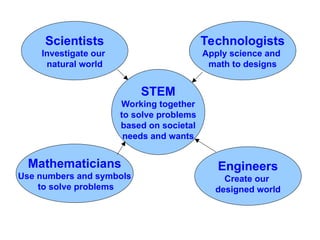
Scientists
Investigate our
natural world
Technologists
Apply science and
math to designs
Mathematicians
Use numbers and symbols
to solve problems
Engineers
Create our
designed world
STEM
Working together
to solve problems
based on societal
needs and wants
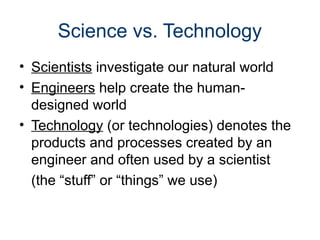
Science vs. Technology
• Scientists investigate our natural world
• Engineers help create the human-
designed world
• Technology (or technologies) denotes the
products and processes created by an
engineer and often used by a scientist
(the “stuff” or “things” we use)
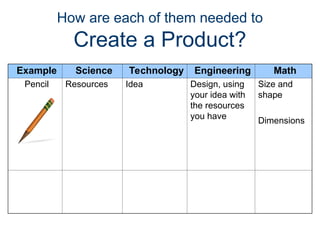
How are each of them needed to
Create a Product?
Example Science Technology Engineering Math
Pencil Resources Idea Design, using
your idea with
the resources
you have
Size and
shape
Dimensions
How are each of them needed to
Create a Product?
Example Science Technology Engineering Math
Pencil Discovery of
graphite and
the fact that
rubber
(an eraser)
will remove
graphite
Creating a
writing device
that doesn’t
use ink
Designing a
device with a
graphite insert,
an exterior
holder, and an
attached eraser
What is the
optimal
length,
diameter,
or shape for
the device?
Science…Math…
• Knowledge of science and math is
necessary for the creation of new
technologies
• People working in multiple career areas
helped put the cereal you may have eaten
this morning
• Think about the tables and or chairs you
may have used so far today.
Scientists…Engineers…
• Information from a scientist helped the
farmer to plant, grow, and harvest the
grains (corn, oats, wheat, rice, and barley)
• The responsibility of an engineer includes
designing the equipment used to harvest
the grain and designing the factory where
the grain was processed into what you eat
today
Engineers…Technologists…
• An engineering technologist built the
factory, built the tools and equipment
necessary for converting the grains into
cereal
• Engineering technologists were part of a
team that built the farm equipment (that
an engineer designed)
Mathematicians…
• All along the way, mathematicians were
needed to solve problems…like how big the
factory should be or how much cereal
should go in one box
• Have you ever noticed that most cereal
boxes are the same width, but they vary in
height and/or thickness? Why do
you think these particular dimensions are
chosen?
What is Engineering?
CONCEPTS
• Science is the study of the natural world,
while technology is the study of how
humans develop new products to meet
needs and wants.
• Teams of people can accomplish more
than one individual working alone.
Introduction to Engineering
• Scientists investigate, explore, study…
• Engineers create, build, produce…
• Technologies = products and processes
created by an engineer and often used by
a scientist
• Knowledge of science and math is
necessary for the creation of new
technologies
What is Engineering?
CONCEPTS
• Technological change is illustrated through
inventions, innovations, and the evolution
of technological artifacts, processes, and
systems
• Technology can have both positive and
negative consequences (effects)
social, cultural, economical, political, and
environmental consequences
What is Engineering?
CONCEPTS
• Engineers, designers, and engineering
technologists are needed in high demand
for the development of future technology
to meet societal needs and wants.
• An engineering notebook is used to
record original ideas or designs.
• A portfolio is an organized collection of
best works.
What is Engineering?
Key Terms
• Agriculture
The raising of crops and animals for food,
feed, fiber, fuel, or other useful products.
• Artifact
A human-made object.
• Biotechnology
All technology connected with plant and
animal life.
What is Engineering?
Key Terms
• Communication
The transmission of information through a
common system of symbols, signs, behavior,
speech, writing, or signals
• Construction
The act or process of building, erecting, or
constructing buildings, roads, or other structures
• Energy
The ability to do work; one of the basic resources
used by a technological system
What is Engineering?
Key Terms
• Engineering
Using technological and scientific
knowledge to solve practical problems
• Environment
The surroundings in which a person,
animal, or plant lives
• Ergonomics
The study of workplace equipment design
or how to arrange and design devices,
machines, or workspace so that people and
things interact safely and most efficiently
What is Engineering?
Key Terms
• Industrial
Anything relating to (or resulting from) industry,
manufacturing, production, etc.
• Invention
A new product, system, or process that has
never existed before, created by study and
experimentation
• Innovation
An improvement of an existing technological
product, system, or method of doing
something
What is Engineering?
Key Terms
• Manufacturing
The process of making a raw material into
a finished product; especially in large
quantities
• Math
The science of patterns and order and the
study of measurement, properties, and the
relationships of quantities using numbers
and symbols
What is Engineering?
Key Terms
• Nanotechnology
The science and technology of building
devices, such as electronic circuits, from
single atoms and molecules
• Process
Human activities used to create, invent,
design, transform, produce, control,
maintain, and use products or systems; a
sequence of actions that combines
resources to produce an output
What is Engineering?
Key Terms
• Science
The study of our natural world through
observation, identification, description,
experimental investigation, and theoretical
explanations
• System
A group of interacting, interrelated, or
interdependent elements/parts that function
together as a whole to accomplish a goal
What is Engineering?
Key Terms
• Technology
The way people use resources to meet
their wants and needs; the devices humans use
• Transportation
The process by which passengers or
goods are moved or delivered from one place to
another
What is Engineering?
Essential Questions
1) What is the purpose of a
portfolio for a student?
2) What is the purpose of a
portfolio for an engineer?
3) Why is it important for engineers
to document their work in their
engineering notebook?
What is Engineering?
Essential Questions
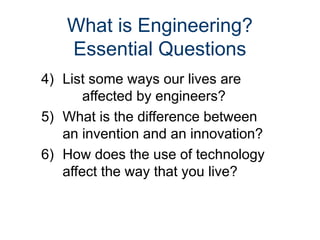
4) List some ways our lives are
affected by engineers?
5) What is the difference between
an invention and an innovation?
6) How does the use of technology
affect the way that you live?
Introduction to Engineering:
What Do Engineers Do?
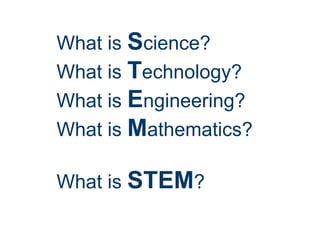
What is Science?
What is Technology?
What is Engineering?
What is Mathematics?
What is STEM?
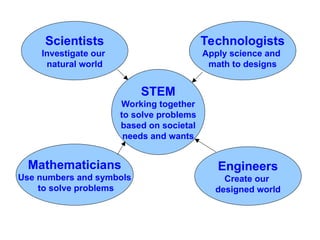
Scientists
Investigate our
natural world
Technologists
Apply science and
math to designs
Mathematicians
Use numbers and symbols
to solve problems
Engineers
Create our
designed world
STEM
Working together
to solve problems
based on societal
needs and wants
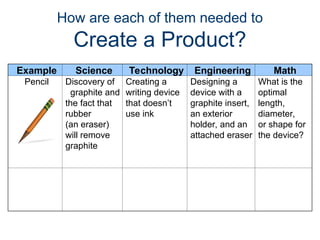
How are each of them needed to
Create a Product?
Example Science Technology Engineering Math
Pencil Discovery of
graphite and
the fact that
rubber
(an eraser)
will remove
graphite
Creating a
writing device
that doesn’t
use ink
Designing a
device with a
graphite insert,
an exterior
holder, and an
attached eraser
What is the
optimal
length,
diameter,
or shape for
the device?
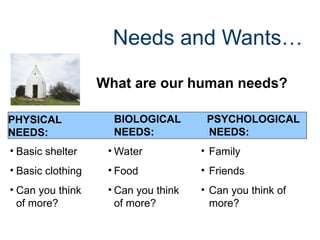
PHYSICAL
NEEDS:
• Basic shelter
• Basic clothing
• Can you think
of more?
What are our human needs?
Needs and Wants…
PHYSICAL
NEEDS:
BIOLOGICAL
NEEDS:
• Water
• Food
• Can you think
of more?
PSYCHOLOGICAL
NEEDS:
• Family
• Friends
• Can you think of
more?
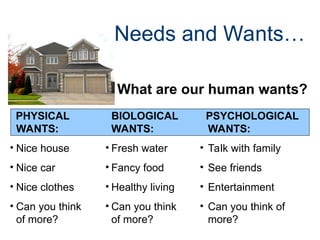
What are our human wants?
PHYSICAL
WANTS:
• Nice house
• Nice car
• Nice clothes
• Can you think
of more?
BIOLOGICAL
WANTS:
• Fresh water
• Fancy food
• Healthy living
• Can you think
of more?
PSYCHOLOGICAL
WANTS:
• Talk with family
• See friends
• Entertainment
• Can you think of
more?
Needs and Wants…
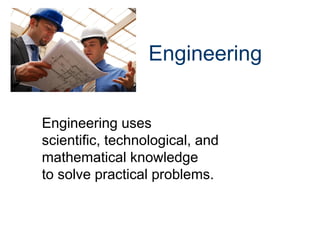
Engineering
Engineering uses
scientific, technological, and
mathematical knowledge
to solve practical problems.
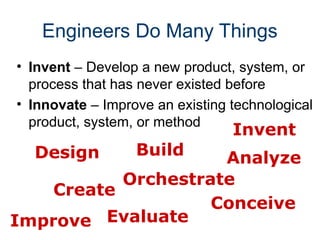
Engineers Do Many Things
• Invent – Develop a new product, system, or
process that has never existed before
• Innovate – Improve an existing technological
product, system, or method
Create
Build
Conceive
Design
Evaluate
Analyze
Orchestrate
Invent
Improve
• An electrical engineer may design a
GPS system for your vehicle.
• A pharmaceutical/chemical engineer
may find a cure for disease.
• A computer engineer may build
a computer the size of your watch.
• A mechanical engineer may create
a robot to discover water on a planet.
• An agricultural engineer may evaluate the
effects of global warming on food production.
Engineers Work to Solve Many
Kinds of Problems
Engineers make our lives better
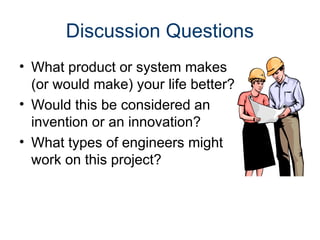
Discussion Questions
• What product or system makes
(or would make) your life better?
• Would this be considered an
invention or an innovation?
• What types of engineers might
work on this project?
Image Resources
Microsoft, Inc. (2008). Clip Art. Retrieved September 10, 2008, from
http://office.microsoft.com/en-us/clipart/default.aspx

1-1-2-Introduction_to_Engineering-mg4-(2).ppt

  • 2.
    Scientists Investigate our natural world Technologists Applyscience and math to designs Mathematicians Use numbers and symbols to solve problems Engineers Create our designed world STEM Working together to solve problems based on societal needs and wants
  • 3.
    Science vs. Technology •Scientists investigate our natural world • Engineers help create the human- designed world • Technology (or technologies) denotes the products and processes created by an engineer and often used by a scientist (the “stuff” or “things” we use)
  • 4.
    How are eachof them needed to Create a Product? Example Science Technology Engineering Math Pencil Resources Idea Design, using your idea with the resources you have Size and shape Dimensions
  • 5.
    How are eachof them needed to Create a Product? Example Science Technology Engineering Math Pencil Discovery of graphite and the fact that rubber (an eraser) will remove graphite Creating a writing device that doesn’t use ink Designing a device with a graphite insert, an exterior holder, and an attached eraser What is the optimal length, diameter, or shape for the device?
  • 6.
    Science…Math… • Knowledge ofscience and math is necessary for the creation of new technologies • People working in multiple career areas helped put the cereal you may have eaten this morning • Think about the tables and or chairs you may have used so far today.
  • 7.
    Scientists…Engineers… • Information froma scientist helped the farmer to plant, grow, and harvest the grains (corn, oats, wheat, rice, and barley) • The responsibility of an engineer includes designing the equipment used to harvest the grain and designing the factory where the grain was processed into what you eat today
  • 8.
    Engineers…Technologists… • An engineeringtechnologist built the factory, built the tools and equipment necessary for converting the grains into cereal • Engineering technologists were part of a team that built the farm equipment (that an engineer designed)
  • 9.
    Mathematicians… • All alongthe way, mathematicians were needed to solve problems…like how big the factory should be or how much cereal should go in one box • Have you ever noticed that most cereal boxes are the same width, but they vary in height and/or thickness? Why do you think these particular dimensions are chosen?
  • 10.
    What is Engineering? CONCEPTS •Science is the study of the natural world, while technology is the study of how humans develop new products to meet needs and wants. • Teams of people can accomplish more than one individual working alone.
  • 11.
    Introduction to Engineering •Scientists investigate, explore, study… • Engineers create, build, produce… • Technologies = products and processes created by an engineer and often used by a scientist • Knowledge of science and math is necessary for the creation of new technologies
  • 12.
    What is Engineering? CONCEPTS •Technological change is illustrated through inventions, innovations, and the evolution of technological artifacts, processes, and systems • Technology can have both positive and negative consequences (effects) social, cultural, economical, political, and environmental consequences
  • 13.
    What is Engineering? CONCEPTS •Engineers, designers, and engineering technologists are needed in high demand for the development of future technology to meet societal needs and wants. • An engineering notebook is used to record original ideas or designs. • A portfolio is an organized collection of best works.
  • 14.
    What is Engineering? KeyTerms • Agriculture The raising of crops and animals for food, feed, fiber, fuel, or other useful products. • Artifact A human-made object. • Biotechnology All technology connected with plant and animal life.
  • 15.
    What is Engineering? KeyTerms • Communication The transmission of information through a common system of symbols, signs, behavior, speech, writing, or signals • Construction The act or process of building, erecting, or constructing buildings, roads, or other structures • Energy The ability to do work; one of the basic resources used by a technological system
  • 16.
    What is Engineering? KeyTerms • Engineering Using technological and scientific knowledge to solve practical problems • Environment The surroundings in which a person, animal, or plant lives • Ergonomics The study of workplace equipment design or how to arrange and design devices, machines, or workspace so that people and things interact safely and most efficiently
  • 17.
    What is Engineering? KeyTerms • Industrial Anything relating to (or resulting from) industry, manufacturing, production, etc. • Invention A new product, system, or process that has never existed before, created by study and experimentation • Innovation An improvement of an existing technological product, system, or method of doing something
  • 18.
    What is Engineering? KeyTerms • Manufacturing The process of making a raw material into a finished product; especially in large quantities • Math The science of patterns and order and the study of measurement, properties, and the relationships of quantities using numbers and symbols
  • 19.
    What is Engineering? KeyTerms • Nanotechnology The science and technology of building devices, such as electronic circuits, from single atoms and molecules • Process Human activities used to create, invent, design, transform, produce, control, maintain, and use products or systems; a sequence of actions that combines resources to produce an output
  • 20.
    What is Engineering? KeyTerms • Science The study of our natural world through observation, identification, description, experimental investigation, and theoretical explanations • System A group of interacting, interrelated, or interdependent elements/parts that function together as a whole to accomplish a goal
  • 21.
    What is Engineering? KeyTerms • Technology The way people use resources to meet their wants and needs; the devices humans use • Transportation The process by which passengers or goods are moved or delivered from one place to another
  • 22.
    What is Engineering? EssentialQuestions 1) What is the purpose of a portfolio for a student? 2) What is the purpose of a portfolio for an engineer? 3) Why is it important for engineers to document their work in their engineering notebook?
  • 23.
    What is Engineering? EssentialQuestions 4) List some ways our lives are affected by engineers? 5) What is the difference between an invention and an innovation? 6) How does the use of technology affect the way that you live?
  • 24.
  • 25.
    What is Science? Whatis Technology? What is Engineering? What is Mathematics? What is STEM?
  • 26.
    Scientists Investigate our natural world Technologists Applyscience and math to designs Mathematicians Use numbers and symbols to solve problems Engineers Create our designed world STEM Working together to solve problems based on societal needs and wants
  • 27.
    How are eachof them needed to Create a Product? Example Science Technology Engineering Math Pencil Discovery of graphite and the fact that rubber (an eraser) will remove graphite Creating a writing device that doesn’t use ink Designing a device with a graphite insert, an exterior holder, and an attached eraser What is the optimal length, diameter, or shape for the device?
  • 28.
    PHYSICAL NEEDS: • Basic shelter •Basic clothing • Can you think of more? What are our human needs? Needs and Wants… PHYSICAL NEEDS: BIOLOGICAL NEEDS: • Water • Food • Can you think of more? PSYCHOLOGICAL NEEDS: • Family • Friends • Can you think of more?
  • 29.
    What are ourhuman wants? PHYSICAL WANTS: • Nice house • Nice car • Nice clothes • Can you think of more? BIOLOGICAL WANTS: • Fresh water • Fancy food • Healthy living • Can you think of more? PSYCHOLOGICAL WANTS: • Talk with family • See friends • Entertainment • Can you think of more? Needs and Wants…
  • 30.
    Engineering Engineering uses scientific, technological,and mathematical knowledge to solve practical problems.
  • 31.
    Engineers Do ManyThings • Invent – Develop a new product, system, or process that has never existed before • Innovate – Improve an existing technological product, system, or method Create Build Conceive Design Evaluate Analyze Orchestrate Invent Improve
  • 32.
    • An electricalengineer may design a GPS system for your vehicle. • A pharmaceutical/chemical engineer may find a cure for disease. • A computer engineer may build a computer the size of your watch. • A mechanical engineer may create a robot to discover water on a planet. • An agricultural engineer may evaluate the effects of global warming on food production. Engineers Work to Solve Many Kinds of Problems Engineers make our lives better
  • 33.
    Discussion Questions • Whatproduct or system makes (or would make) your life better? • Would this be considered an invention or an innovation? • What types of engineers might work on this project?
  • 34.
    Image Resources Microsoft, Inc.(2008). Clip Art. Retrieved September 10, 2008, from http://office.microsoft.com/en-us/clipart/default.aspx

Editor's Notes

  • #2 Our knowledge-based economy is driven by constant innovation. The foundation of innovation lies in a dynamic, motivated, and well-educated workforce equipped with STEM skills. However, the nature of our workforce and the needs of our industries have changed over time. Today, an understanding of scientific and mathematical principles, a working knowledge of computer hardware and software, and the problem solving skills developed by courses in STEM are necessary for most jobs. Therefore, STEM education is an enormous and pressing need. http://www.stemedcaucus.org/
  • #4 Teacher and/or students can add an additional example to the table.
  • #5 Teacher and/or students can add an additional example to the table.
  • #26 Our knowledge-based economy is driven by constant innovation. The foundation of innovation lies in a dynamic, motivated, and well-educated workforce equipped with STEM skills. However, the nature of our workforce and the needs of our industries have changed over time. Today, an understanding of scientific and mathematical principles, a working knowledge of computer hardware and software, and the problem solving skills developed by courses in STEM are necessary for most jobs. Therefore, STEM education is an enormous and pressing need. http://www.stemedcaucus.org/
  • #27 Teacher and/or students can add an additional example to the table.
  • #30 Engineers strive to make our lives better, easier, cheaper, more efficient, and more fun by solving problems in everyday life.