Important Gender and Development Concepts 39
Important Gender and Development
Concepts
Gender and development
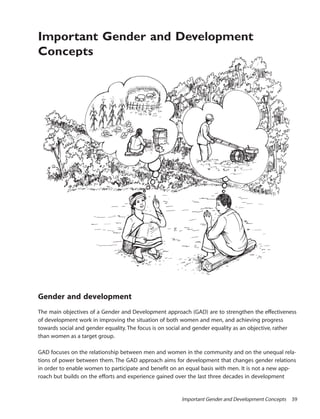
The main objectives of a Gender and Development approach (GAD) are to strengthen the effectiveness
of development work in improving the situation of both women and men, and achieving progress
towards social and gender equality. The focus is on social and gender equality as an objective, rather
than women as a target group.
GAD focuses on the relationship between men and women in the community and on the unequal rela-
tions of power between them. The GAD approach aims for development that changes gender relations
in order to enable women to participate and benefit on an equal basis with men. It is not a new app-
roach but builds on the efforts and experience gained over the last three decades in development
40 Improving Livelihoods in the Uplands of the Lao PDR
Changes in gender identity and
gender relations
Gender roles and characteristics in almost all
societies have undergone many recent adjust-
ments and changes in response to development,
technological change and globalisation, which
have led to massive economic and social
changes in all parts of the world. Changes in
gender roles and relations often meet
resistance, particularly in the form of tradition.
Social and gender analysis can demonstrate
that change in certain aspects of social roles
and relations between women and men can
improve the quality and conditions of life for
everyone.
Social and gender analysis
Social and gender analysis attempts to
understand the roles of different social groups,
(including women and men) in relation to what
they do in the village and in relation to the
resources they have.There is also a need to
understand gender relations: how women and
men relate to one another and who makes
decisions over which resources.
work to understand and improve the position
of women and disadvantaged groups in the
community.
Based on this experience there has been:
Discrimination and the
constitution
Article 24 in the Constitution adopted by the
National Assembly in 1991 is very clear on
gender discrimination and states that:
'Discrimination is interpreted as any
distinction, exclusion or restriction, made on
the basis of sex, which has the effect or
purpose of impairing the recognition of
rights and freedoms in the political,
economic, social, cultural or other field.'
A shift in understanding of gender equality.
Recognition that gender equality is
integral to development goals.
Realisation that previous approaches were
not really changing the position of women
or improving gender equality.
This means:
Ensuring that forestry and agricultural
extension work not only responds to
differences in needs and interests of
women and men but seeks to increase
gender equality, by empowering women
(where women are at a disadvantage).
Gender differences relevant to an initiative
should be identified, not only to improve
efficiency but also to identify the
inequalities that constrain women from
participating and benefiting on an equal
basis with men.
The Lao Women's Union
(LWU)
The LWU is a mass organisation for women
in the Lao political system. It has an
organisational network from the central level
down to the grass roots level, serving as a
bridge between the party and the
government and Lao women of various
ethnic groups and social strata. It has a long
history rooted in political mobilisation and,
rural development and is now also taking on
gender advocacy.
Gender refers to social attributes learned when
growing up as a member of a community.
Important Gender and Development Concepts 41
While carrying out social and gender analysis
increases knowledge of social and gender
roles, inequalities and different impacts, this
alone will not automatically bring about
change.The results of social and gender analy-
sis should be used to bring about necessary
changes in relation to planning, priorities,
choice of methods, division of labour and
implementation of activities.
Social and gender analysis identifies the roles,
relations, responsibilities, access to and control
over resources, decision-making and power, as
well as the needs and potentials of different
social groups of both women and men. Social
and gender analysis is not limited only to the
social sectors, but can also be used at all levels
and areas of village development.
Sex and gender
Sex refers to the biological differences be-
tween men and women, which are universal
and do not change. Gender refers to social
attributes that are learned when growing up as
a member of a community. Because these
attributes are learned behaviours, they can and
do change over time. In addition, they vary
between different cultures and ethnic groups.
Gender therefore refers to the socially given
attributes, roles, activities, responsibilities and
needs connected to being men (masculine)
and women (feminine) in a given society at a
given time. Women’s and men's gender identity
determines how they are perceived and how
they are expected to think and act as men and
women. Gender is one of the variables (along
with ethnicity, age and class) used in the
distribution of privilege, prestige, power and a
range of social and economic resources.
Sexual division of labour
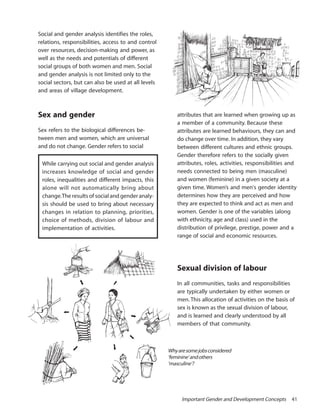
In all communities, tasks and responsibilities
are typically undertaken by either women or
men. This allocation of activities on the basis of
sex is known as the sexual division of labour,
and is learned and clearly understood by all
members of that community.
Whyaresomejobsconsidered
‘feminine’andothers
‘masculine’?
42 Improving Livelihoods in the Uplands of the Lao PDR
Productive work
This is work that produces items for
consumption by the household and goods and
services for exchange in the market place. Both
men and women contribute to family income
with various forms of productive work, although
men usually dominate in productive work.
Reproductive work
This work involves all the tasks associated with
supporting the immediate and extended
family, young and old. It includes childcare, food
preparation, care for the sick or old,
socialisation of the young, and so on. Reproduc-
tive work is the basis of productive work.
Women of all ages are mainly responsible for
this work, which is usually unpaid.
Practical gender needs and
interests
Women and men have different roles and
responsibilities and therefore have different
needs and interests.
Access and control over
resources
When examining how resources are allocated
between women and men, it is important to
distinguish between access
to resources (e.g.
land, labour,
credit, income)
and control over
them. Access gives
a person the use of
a resource, e.g. land
to grow crops.
Control allows a
person to make
decisions about who
uses the resource or
to dispose of the
resource, for instance by
selling the land.
Community work
This work involves activities for the village -
usually voluntary unpaid work, such as
organising festivals or ceremonies, receiving
visitors, or maintaining a village resource, such
as a well.
Important Gender and Development Concepts 43
In most cases, the empowerment of women
requires change in the division of labour and
transformation of society.
Gender equity
Gender equity is concerned with promoting
personal, social, cultural, political and
economic equality for all. Traditions and
discriminatory practices have resulted in the
systematic devaluation of attitudes, activities
and abilities attributed to, and associated with,
girls and women. The consequences of these
discriminatory practices negatively affect men
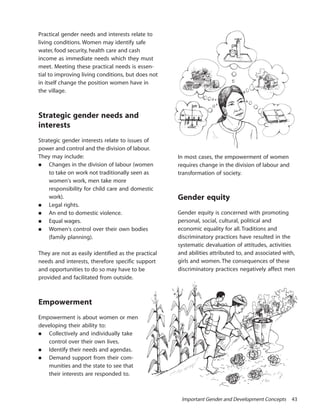
Practical gender needs and interests relate to
living conditions. Women may identify safe
water, food security, health care and cash
income as immediate needs which they must
meet. Meeting these practical needs is essen-
tial to improving living conditions, but does not
in itself change the position women have in
the village.
Strategic gender needs and
interests
Strategic gender interests relate to issues of
power and control and the division of labour.
They may include:
Changes in the division of labour (women
to take on work not traditionally seen as
women's work, men take more
responsibility for child care and domestic
work).
Legal rights.
An end to domestic violence.
Equal wages.
Women's control over their own bodies
(family planning).
They are not as easily identified as the practical
needs and interests, therefore specific support
and opportunities to do so may have to be
provided and facilitated from outside.
Empowerment
Empowerment is about women or men
developing their ability to:
Collectively and individually take
control over their own lives.
Identify their needs and agendas.
Demand support from their com-
munities and the state to see that
their interests are responded to.
44 Improving Livelihoods in the Uplands of the Lao PDR
as well as women. Initially however, gender
equity initiatives will place greater emphasis
on improving conditions and attitudes as they
affect girls and women. In the long-term, these
initiatives will also improve the situation for
boys and men.
For more information regarding tools for
carrying out Social and Gender Analysis please
refer to "Field Guide Gender and Develop-
ment", Lao-Swedish Forestry Programme, June
2001. NAFRI/Ministry of Agriculture and
Forestry. Vientiane.
Extracted from:
Lao-Swedish Forestry Programme. 2001. Field
Guide Gender and Development. Ministry of
Agriculture and Forestry. Vientiane.
ImprovingLivelihoodsintheUplandsofthe
Lao PDR was produced in 2005 by NAFRI,
NAFES and NUOL.

07 genderconcepts lsfp

  • 1.
    Important Gender andDevelopment Concepts 39 Important Gender and Development Concepts Gender and development The main objectives of a Gender and Development approach (GAD) are to strengthen the effectiveness of development work in improving the situation of both women and men, and achieving progress towards social and gender equality. The focus is on social and gender equality as an objective, rather than women as a target group. GAD focuses on the relationship between men and women in the community and on the unequal rela- tions of power between them. The GAD approach aims for development that changes gender relations in order to enable women to participate and benefit on an equal basis with men. It is not a new app- roach but builds on the efforts and experience gained over the last three decades in development
  • 2.
    40 Improving Livelihoodsin the Uplands of the Lao PDR Changes in gender identity and gender relations Gender roles and characteristics in almost all societies have undergone many recent adjust- ments and changes in response to development, technological change and globalisation, which have led to massive economic and social changes in all parts of the world. Changes in gender roles and relations often meet resistance, particularly in the form of tradition. Social and gender analysis can demonstrate that change in certain aspects of social roles and relations between women and men can improve the quality and conditions of life for everyone. Social and gender analysis Social and gender analysis attempts to understand the roles of different social groups, (including women and men) in relation to what they do in the village and in relation to the resources they have.There is also a need to understand gender relations: how women and men relate to one another and who makes decisions over which resources. work to understand and improve the position of women and disadvantaged groups in the community. Based on this experience there has been: Discrimination and the constitution Article 24 in the Constitution adopted by the National Assembly in 1991 is very clear on gender discrimination and states that: 'Discrimination is interpreted as any distinction, exclusion or restriction, made on the basis of sex, which has the effect or purpose of impairing the recognition of rights and freedoms in the political, economic, social, cultural or other field.' A shift in understanding of gender equality. Recognition that gender equality is integral to development goals. Realisation that previous approaches were not really changing the position of women or improving gender equality. This means: Ensuring that forestry and agricultural extension work not only responds to differences in needs and interests of women and men but seeks to increase gender equality, by empowering women (where women are at a disadvantage). Gender differences relevant to an initiative should be identified, not only to improve efficiency but also to identify the inequalities that constrain women from participating and benefiting on an equal basis with men. The Lao Women's Union (LWU) The LWU is a mass organisation for women in the Lao political system. It has an organisational network from the central level down to the grass roots level, serving as a bridge between the party and the government and Lao women of various ethnic groups and social strata. It has a long history rooted in political mobilisation and, rural development and is now also taking on gender advocacy. Gender refers to social attributes learned when growing up as a member of a community.
  • 3.
    Important Gender andDevelopment Concepts 41 While carrying out social and gender analysis increases knowledge of social and gender roles, inequalities and different impacts, this alone will not automatically bring about change.The results of social and gender analy- sis should be used to bring about necessary changes in relation to planning, priorities, choice of methods, division of labour and implementation of activities. Social and gender analysis identifies the roles, relations, responsibilities, access to and control over resources, decision-making and power, as well as the needs and potentials of different social groups of both women and men. Social and gender analysis is not limited only to the social sectors, but can also be used at all levels and areas of village development. Sex and gender Sex refers to the biological differences be- tween men and women, which are universal and do not change. Gender refers to social attributes that are learned when growing up as a member of a community. Because these attributes are learned behaviours, they can and do change over time. In addition, they vary between different cultures and ethnic groups. Gender therefore refers to the socially given attributes, roles, activities, responsibilities and needs connected to being men (masculine) and women (feminine) in a given society at a given time. Women’s and men's gender identity determines how they are perceived and how they are expected to think and act as men and women. Gender is one of the variables (along with ethnicity, age and class) used in the distribution of privilege, prestige, power and a range of social and economic resources. Sexual division of labour In all communities, tasks and responsibilities are typically undertaken by either women or men. This allocation of activities on the basis of sex is known as the sexual division of labour, and is learned and clearly understood by all members of that community. Whyaresomejobsconsidered ‘feminine’andothers ‘masculine’?
  • 4.
    42 Improving Livelihoodsin the Uplands of the Lao PDR Productive work This is work that produces items for consumption by the household and goods and services for exchange in the market place. Both men and women contribute to family income with various forms of productive work, although men usually dominate in productive work. Reproductive work This work involves all the tasks associated with supporting the immediate and extended family, young and old. It includes childcare, food preparation, care for the sick or old, socialisation of the young, and so on. Reproduc- tive work is the basis of productive work. Women of all ages are mainly responsible for this work, which is usually unpaid. Practical gender needs and interests Women and men have different roles and responsibilities and therefore have different needs and interests. Access and control over resources When examining how resources are allocated between women and men, it is important to distinguish between access to resources (e.g. land, labour, credit, income) and control over them. Access gives a person the use of a resource, e.g. land to grow crops. Control allows a person to make decisions about who uses the resource or to dispose of the resource, for instance by selling the land. Community work This work involves activities for the village - usually voluntary unpaid work, such as organising festivals or ceremonies, receiving visitors, or maintaining a village resource, such as a well.
  • 5.
    Important Gender andDevelopment Concepts 43 In most cases, the empowerment of women requires change in the division of labour and transformation of society. Gender equity Gender equity is concerned with promoting personal, social, cultural, political and economic equality for all. Traditions and discriminatory practices have resulted in the systematic devaluation of attitudes, activities and abilities attributed to, and associated with, girls and women. The consequences of these discriminatory practices negatively affect men Practical gender needs and interests relate to living conditions. Women may identify safe water, food security, health care and cash income as immediate needs which they must meet. Meeting these practical needs is essen- tial to improving living conditions, but does not in itself change the position women have in the village. Strategic gender needs and interests Strategic gender interests relate to issues of power and control and the division of labour. They may include: Changes in the division of labour (women to take on work not traditionally seen as women's work, men take more responsibility for child care and domestic work). Legal rights. An end to domestic violence. Equal wages. Women's control over their own bodies (family planning). They are not as easily identified as the practical needs and interests, therefore specific support and opportunities to do so may have to be provided and facilitated from outside. Empowerment Empowerment is about women or men developing their ability to: Collectively and individually take control over their own lives. Identify their needs and agendas. Demand support from their com- munities and the state to see that their interests are responded to.
  • 6.
    44 Improving Livelihoodsin the Uplands of the Lao PDR as well as women. Initially however, gender equity initiatives will place greater emphasis on improving conditions and attitudes as they affect girls and women. In the long-term, these initiatives will also improve the situation for boys and men. For more information regarding tools for carrying out Social and Gender Analysis please refer to "Field Guide Gender and Develop- ment", Lao-Swedish Forestry Programme, June 2001. NAFRI/Ministry of Agriculture and Forestry. Vientiane. Extracted from: Lao-Swedish Forestry Programme. 2001. Field Guide Gender and Development. Ministry of Agriculture and Forestry. Vientiane. ImprovingLivelihoodsintheUplandsofthe Lao PDR was produced in 2005 by NAFRI, NAFES and NUOL.