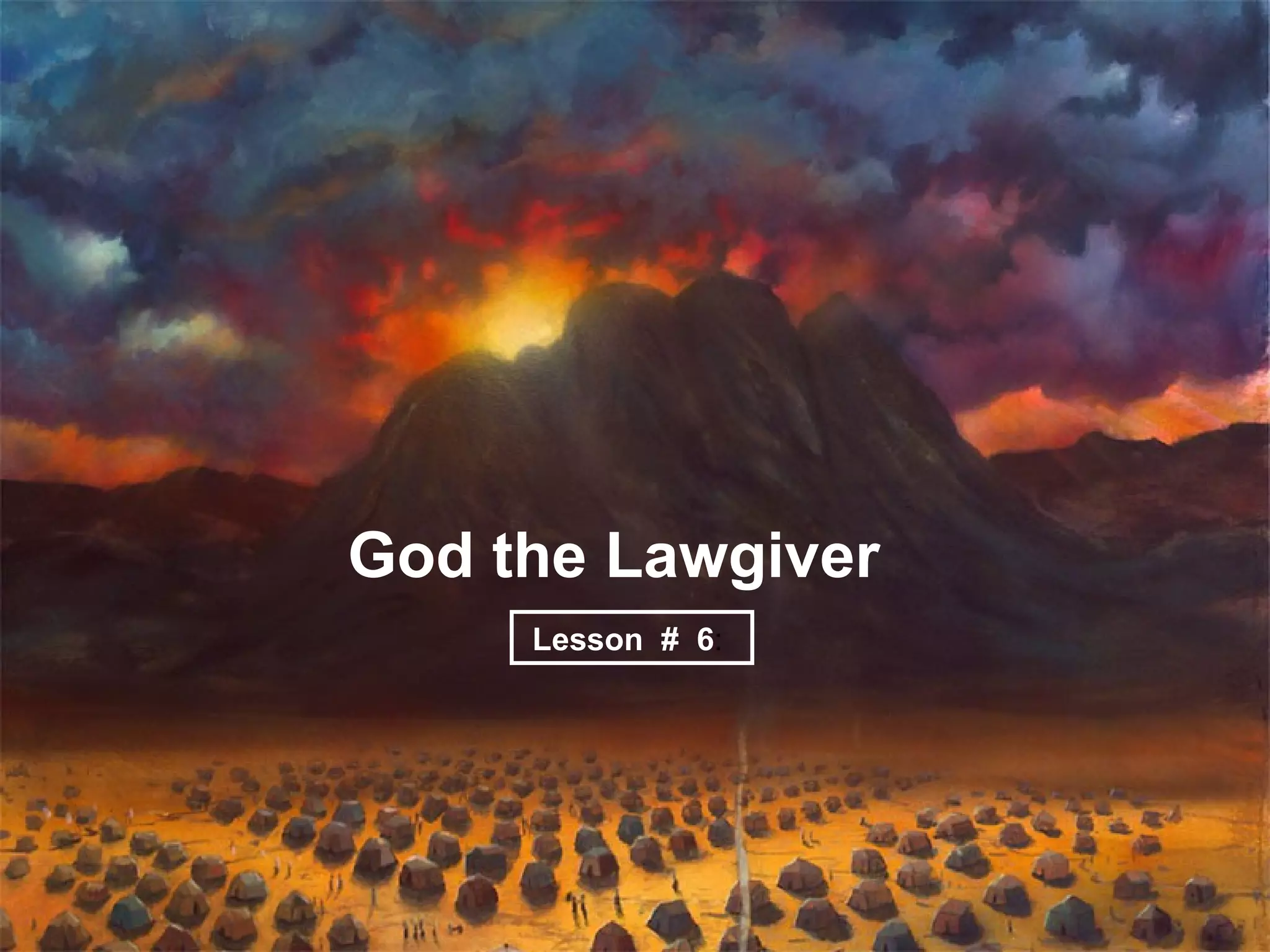
God the Lawgiver
     Lesson # 6:
Key Text:
“For the Lord is our
Judge, the Lord is our
Law-giver, the Lord is our
King; He will save us”
                                (Isaiah 33:22, NKJV).


Key Thought:
God’s law is an inseparable part of the Old and New
Testaments. It is also an expression of His love.
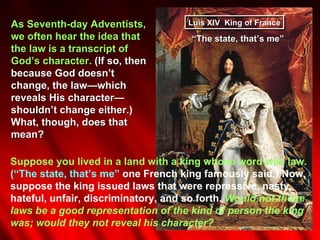
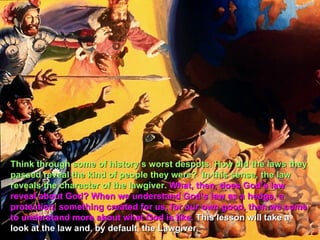
As Seventh-day Adventists,           Luis XIV King of France
we often hear the idea that          “The state, that’s me”
the law is a transcript of
God’s character. (If so, then
because God doesn’t
change, the law—which
reveals His character—
shouldn’t change either.)
What, though, does that
mean?

Suppose you lived in a land with a king whose word was law.
(“The state, that’s me” one French king famously said.) Now,
suppose the king issued laws that were repressive, nasty,
hateful, unfair, discriminatory, and so forth. Would not those
laws be a good representation of the kind of person the king
was; would they not reveal his character?
Think through some of history’s worst despots. How did the laws they
passed reveal the kind of people they were? In this sense, the law
reveals the character of the lawgiver. What, then, does God’s law
reveal about God? When we understand God’s law as a hedge, a
protection, something created for us, for our own good, then we come
to understand more about what God is like. This lesson will take a
look at the law and, by default, the Lawgiver.
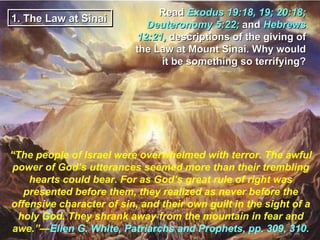
Read Exodus 19:18, 19; 20:18;
1. The Law at Sinai
                             Deuteronomy 5:22; and Hebrews
                           12:21, descriptions of the giving of
                           the Law at Mount Sinai. Why would
                                it be something so terrifying?


“The people of Israel were overwhelmed with terror. The awful
power of God’s utterances seemed more than their trembling
    hearts could bear. For as God’s great rule of right was
   presented before them, they realized as never before the
offensive character of sin, and their own guilt in the sight of a
  holy God. They shrank away from the mountain in fear and
 awe.”—Ellen G. White, Patriarchs and Prophets, pp. 309, 310.
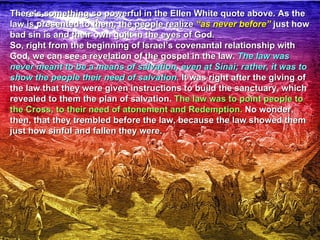
There’s something so powerful in the Ellen White quote above. As the
law is presented to them, the people realize “as never before” just how
bad sin is and their own guilt in the eyes of God.
So, right from the beginning of Israel’s covenantal relationship with
God, we can see a revelation of the gospel in the law. The law was
never meant to be a means of salvation, even at Sinai; rather, it was to
show the people their need of salvation. It was right after the giving of
the law that they were given instructions to build the sanctuary, which
revealed to them the plan of salvation. The law was to point people to
the Cross, to their need of atonement and Redemption. No wonder,
then, that they trembled before the law, because the law showed them
just how sinful and fallen they were.
Read
Romans 7:8–
13. How do
these verses
reveal this
crucial truth?
What is Paul
saying that
the law
does? (See
also Ps.
119:6.)


   In a sense, Paul is saying here what Ellen White said
happened at Sinai. The problem is not with God’s law; the
 problem is with sinners who have violated the law, as we
all have done. Paul is showing how the law is inseparably
tied to the gospel, that it is the law that shows us just how
                 sinful and fallen we are.
REFLECTION:


    Read Exodus 20:1–17.
Do you find yourself trembling
       before the law?
Do you find yourself convicted
            by it?
What are your emotions as you
  read the law and compare
      yourself with it?
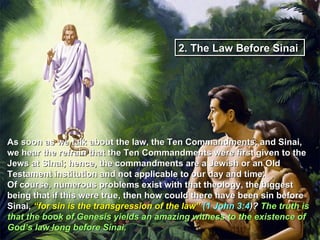
2. The Law Before Sinai


As soon as we talk about the law, the Ten Commandments, and Sinai,
we hear the refrain that the Ten Commandments were first given to the
Jews at Sinai; hence, the commandments are a Jewish or an Old
Testament institution and not applicable to our day and time.
Of course, numerous problems exist with that theology, the biggest
being that if this were true, then how could there have been sin before
Sinai, “for sin is the transgression of the law” (1 John 3:4)? The truth is
that the book of Genesis yields an amazing witness to the existence of
God’s law long before Sinai.
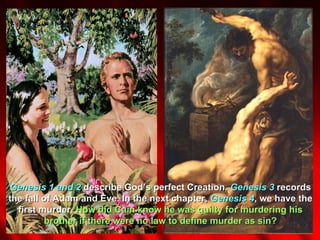
Genesis 1 and 2 describe God’s perfect Creation. Genesis 3 records
the fall of Adam and Eve. In the next chapter, Genesis 4, we have the
  first murder. How did Cain know he was guilty for murdering his
         brother if there were no law to define murder as sin?
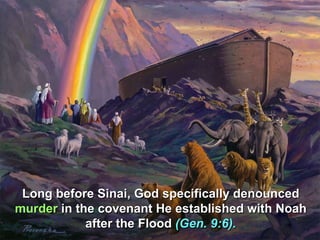
Long before Sinai, God specifically denounced
murder in the covenant He established with Noah
            after the Flood (Gen. 9:6).
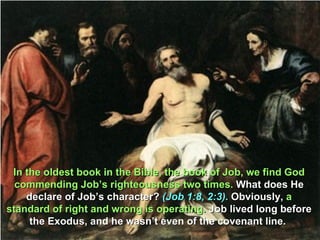
In the oldest book in the Bible, the book of Job, we find God
  commending Job’s righteousness two times. What does He
    declare of Job’s character? (Job 1:8, 2:3). Obviously, a
standard of right and wrong is operating. Job lived long before
     the Exodus, and he wasn’t even of the covenant line.
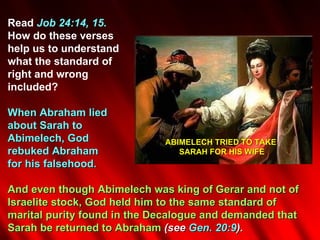
Read Job 24:14, 15.
How do these verses
help us to understand
what the standard of
right and wrong
included?

When Abraham lied
about Sarah to
Abimelech, God               ABIMELECH TRIED TO TAKE
rebuked Abraham                 SARAH FOR HIS WIFE
for his falsehood.

And even though Abimelech was king of Gerar and not of
Israelite stock, God held him to the same standard of
marital purity found in the Decalogue and demanded that
Sarah be returned to Abraham (see Gen. 20:9).
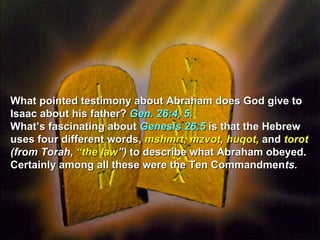
What pointed testimony about Abraham does God give to
Isaac about his father? Gen. 26:4, 5.
What’s fascinating about Genesis 26:5 is that the Hebrew
uses four different words, mshmrt, mzvot, huqot, and torot
(from Torah, “the law”) to describe what Abraham obeyed.
Certainly among all these were the Ten Commandments.
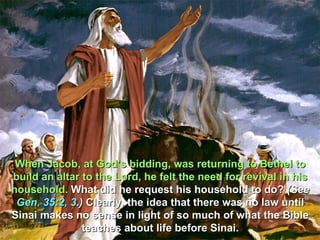
When Jacob, at God’s bidding, was returning to Bethel to
build an altar to the Lord, he felt the need for revival in his
household. What did he request his household to do? (See
 Gen. 35:2, 3.) Clearly, the idea that there was no law until
Sinai makes no sense in light of so much of what the Bible
               teaches about life before Sinai.
3. The Sabbath Before Sinai


God doesn’t reveal how He communicated the eternal principles
 of His law to humanity before Mount Sinai, but the evidence is
clear and substantial that the giving of the law on Sinai was not
the world’s initial exposure to its precepts. Many people, forced
    to concede that point, argue, instead, that it was only the
 Sabbath commandment, not the others, that was first given at
    Sinai, and, therefore, it is exclusively Jewish and doesn’t
       pertain to Christians today. How valid is that claim?
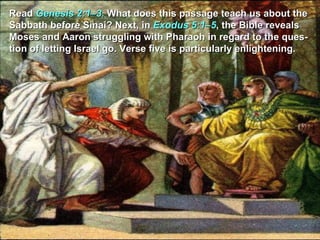
Read Genesis 2:1–3. What does this passage teach us about the
Sabbath before Sinai? Next, in Exodus 5:1–5, the Bible reveals
Moses and Aaron struggling with Pharaoh in regard to the ques-
tion of letting Israel go. Verse five is particularly enlightening.
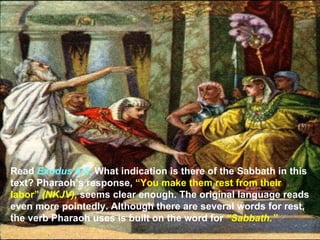
Read Exodus 5:5. What indication is there of the Sabbath in this
text? Pharaoh’s response, “You make them rest from their
labor” (NKJV), seems clear enough. The original language reads
even more pointedly. Although there are several words for rest,
the verb Pharaoh uses is built on the word for “Sabbath.”
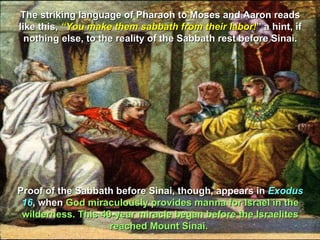
The striking language of Pharaoh to Moses and Aaron reads
like this, “You make them sabbath from their labor!” a hint, if
  nothing else, to the reality of the Sabbath rest before Sinai.


Proof of the Sabbath before Sinai, though, appears in Exodus
 16, when God miraculously provides manna for Israel in the
 wilderness. This 40-year miracle began before the Israelites
                    reached Mount Sinai.
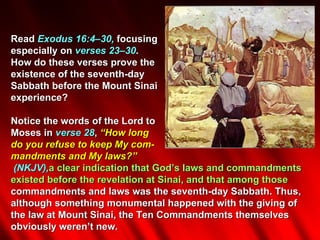
Read Exodus 16:4–30, focusing
especially on verses 23–30.
How do these verses prove the
existence of the seventh-day
Sabbath before the Mount Sinai
experience?

Notice the words of the Lord to
Moses in verse 28, “How long
do you refuse to keep My com-
mandments and My laws?”
 (NKJV),a clear indication that God’s laws and commandments
existed before the revelation at Sinai, and that among those
commandments and laws was the seventh-day Sabbath. Thus,
although something monumental happened with the giving of
the law at Mount Sinai, the Ten Commandments themselves
obviously weren’t new.
REFLECTION:


How is your Sabbath experience?
Do you love the Sabbath, dread it,
 or are you ambivalent about it?
What can you do to have a deeper
  and richer experience with the
   Lord through the gift of His
          Sabbath day?
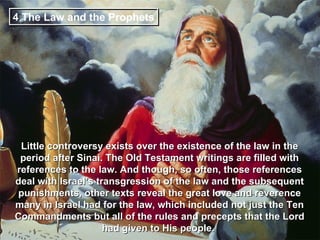
4 The Law and the Prophets


 Little controversy exists over the existence of the law in the
 period after Sinai. The Old Testament writings are filled with
references to the law. And though, so often, those references
deal with Israel’s transgression of the law and the subsequent
punishments, other texts reveal the great love and reverence
many in Israel had for the law, which included not just the Ten
Commandments but all of the rules and precepts that the Lord
                     had given to His people.
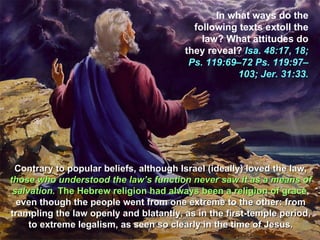
In what ways do the
                                          following texts extoll the
                                            law? What attitudes do
                                        they reveal? Isa. 48:17, 18;
                                         Ps. 119:69–72 Ps. 119:97–
                                                    103; Jer. 31:33.


 Contrary to popular beliefs, although Israel (ideally) loved the law,
those who understood the law’s function never saw it as a means of
 salvation. The Hebrew religion had always been a religion of grace,
  even though the people went from one extreme to the other: from
trampling the law openly and blatantly, as in the first-temple period,
     to extreme legalism, as seen so clearly in the time of Jesus.
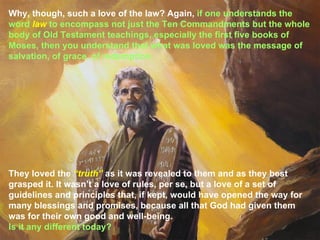
Why, though, such a love of the law? Again, if one understands the
word law to encompass not just the Ten Commandments but the whole
body of Old Testament teachings, especially the first five books of
Moses, then you understand that what was loved was the message of
salvation, of grace, of redemption.


They loved the “truth” as it was revealed to them and as they best
grasped it. It wasn’t a love of rules, per se, but a love of a set of
guidelines and principles that, if kept, would have opened the way for
many blessings and promises, because all that God had given them
was for their own good and well-being.
Is it any different today?
REFLECTION:


 Think about what God has
   given us as a people.
  How can we live out the
wonderful light with which we
    have been blessed?
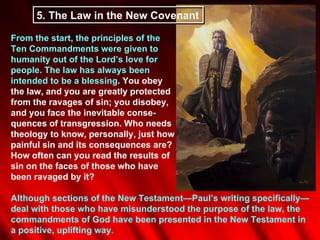
5. The Law in the New Covenant

From the start, the principles of the
Ten Commandments were given to
humanity out of the Lord’s love for
people. The law has always been
intended to be a blessing. You obey
the law, and you are greatly protected
from the ravages of sin; you disobey,
and you face the inevitable conse-
quences of transgression. Who needs
theology to know, personally, just how
painful sin and its consequences are?
How often can you read the results of
sin on the faces of those who have
been ravaged by it?

Although sections of the New Testament—Paul’s writing specifically—
deal with those who have misunderstood the purpose of the law, the
commandments of God have been presented in the New Testament in
a positive, uplifting way.
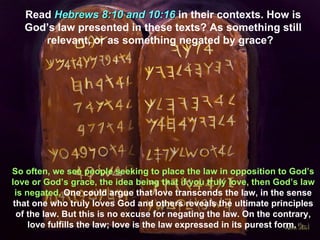
Read Hebrews 8:10 and 10:16 in their contexts. How is
   God’s law presented in these texts? As something still
      relevant, or as something negated by grace?


So often, we see people seeking to place the law in opposition to God’s
love or God’s grace, the idea being that if you truly love, then God’s law
 is negated. One could argue that love transcends the law, in the sense
 that one who truly loves God and others reveals the ultimate principles
  of the law. But this is no excuse for negating the law. On the contrary,
     love fulfills the law; love is the law expressed in its purest form.
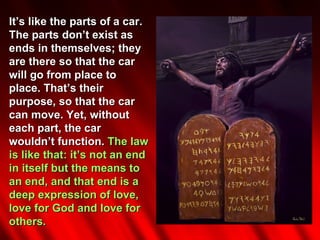
It’s like the parts of a car.
The parts don’t exist as
ends in themselves; they
are there so that the car
will go from place to
place. That’s their
purpose, so that the car
can move. Yet, without
each part, the car
wouldn’t function. The law
is like that: it’s not an end
in itself but the means to
an end, and that end is a
deep expression of love,
love for God and love for
others.
Look up these texts. How do they help us to understand
the link between love and law? Rom. 13:8–10; Gal. 5:14;
               James 2:8; 1 John 5:2, 3.

                    REFLECTION:


 Dwell more on the links between
       God’s law and love.
Law-keeping without love leads to
              what?
Love without law-keeping leads to
              what?
ADAPT it!                           Effective for
                                   SMALL GROUPS
      Teaching Approach


ASSOCIATE truth – Why should I study this lesson?
DISCOVER truth – What does the Bible say about this
truth?
APPLY truth – How can this truth affect my life today?
PLAN using the truth – How can I use this truth today?
TRANSFER truth to life – What changes do I need in my
life
  ?
                 We invite you to download and study
                  each one of the 13 lessons about
                         “Glimpses of God”
                     Slideshare.net/chucho1943

06 god the lawgiver

  • 1.
    God the Lawgiver Lesson # 6:
  • 2.
    Key Text: “For theLord is our Judge, the Lord is our Law-giver, the Lord is our King; He will save us” (Isaiah 33:22, NKJV). Key Thought: God’s law is an inseparable part of the Old and New Testaments. It is also an expression of His love.
  • 3.
    As Seventh-day Adventists, Luis XIV King of France we often hear the idea that “The state, that’s me” the law is a transcript of God’s character. (If so, then because God doesn’t change, the law—which reveals His character— shouldn’t change either.) What, though, does that mean? Suppose you lived in a land with a king whose word was law. (“The state, that’s me” one French king famously said.) Now, suppose the king issued laws that were repressive, nasty, hateful, unfair, discriminatory, and so forth. Would not those laws be a good representation of the kind of person the king was; would they not reveal his character?
  • 4.
    Think through someof history’s worst despots. How did the laws they passed reveal the kind of people they were? In this sense, the law reveals the character of the lawgiver. What, then, does God’s law reveal about God? When we understand God’s law as a hedge, a protection, something created for us, for our own good, then we come to understand more about what God is like. This lesson will take a look at the law and, by default, the Lawgiver.
  • 5.
    Read Exodus 19:18,19; 20:18; 1. The Law at Sinai Deuteronomy 5:22; and Hebrews 12:21, descriptions of the giving of the Law at Mount Sinai. Why would it be something so terrifying? “The people of Israel were overwhelmed with terror. The awful power of God’s utterances seemed more than their trembling hearts could bear. For as God’s great rule of right was presented before them, they realized as never before the offensive character of sin, and their own guilt in the sight of a holy God. They shrank away from the mountain in fear and awe.”—Ellen G. White, Patriarchs and Prophets, pp. 309, 310.
  • 6.
    There’s something sopowerful in the Ellen White quote above. As the law is presented to them, the people realize “as never before” just how bad sin is and their own guilt in the eyes of God. So, right from the beginning of Israel’s covenantal relationship with God, we can see a revelation of the gospel in the law. The law was never meant to be a means of salvation, even at Sinai; rather, it was to show the people their need of salvation. It was right after the giving of the law that they were given instructions to build the sanctuary, which revealed to them the plan of salvation. The law was to point people to the Cross, to their need of atonement and Redemption. No wonder, then, that they trembled before the law, because the law showed them just how sinful and fallen they were.
  • 7.
    Read Romans 7:8– 13. Howdo these verses reveal this crucial truth? What is Paul saying that the law does? (See also Ps. 119:6.) In a sense, Paul is saying here what Ellen White said happened at Sinai. The problem is not with God’s law; the problem is with sinners who have violated the law, as we all have done. Paul is showing how the law is inseparably tied to the gospel, that it is the law that shows us just how sinful and fallen we are.
  • 8.
    REFLECTION: Read Exodus 20:1–17. Do you find yourself trembling before the law? Do you find yourself convicted by it? What are your emotions as you read the law and compare yourself with it?
  • 9.
    2. The LawBefore Sinai As soon as we talk about the law, the Ten Commandments, and Sinai, we hear the refrain that the Ten Commandments were first given to the Jews at Sinai; hence, the commandments are a Jewish or an Old Testament institution and not applicable to our day and time. Of course, numerous problems exist with that theology, the biggest being that if this were true, then how could there have been sin before Sinai, “for sin is the transgression of the law” (1 John 3:4)? The truth is that the book of Genesis yields an amazing witness to the existence of God’s law long before Sinai.
  • 10.
    Genesis 1 and2 describe God’s perfect Creation. Genesis 3 records the fall of Adam and Eve. In the next chapter, Genesis 4, we have the first murder. How did Cain know he was guilty for murdering his brother if there were no law to define murder as sin?
  • 11.
    Long before Sinai,God specifically denounced murder in the covenant He established with Noah after the Flood (Gen. 9:6).
  • 12.
    In the oldestbook in the Bible, the book of Job, we find God commending Job’s righteousness two times. What does He declare of Job’s character? (Job 1:8, 2:3). Obviously, a standard of right and wrong is operating. Job lived long before the Exodus, and he wasn’t even of the covenant line.
  • 13.
    Read Job 24:14,15. How do these verses help us to understand what the standard of right and wrong included? When Abraham lied about Sarah to Abimelech, God ABIMELECH TRIED TO TAKE rebuked Abraham SARAH FOR HIS WIFE for his falsehood. And even though Abimelech was king of Gerar and not of Israelite stock, God held him to the same standard of marital purity found in the Decalogue and demanded that Sarah be returned to Abraham (see Gen. 20:9).
  • 14.
    What pointed testimonyabout Abraham does God give to Isaac about his father? Gen. 26:4, 5. What’s fascinating about Genesis 26:5 is that the Hebrew uses four different words, mshmrt, mzvot, huqot, and torot (from Torah, “the law”) to describe what Abraham obeyed. Certainly among all these were the Ten Commandments.
  • 15.
    When Jacob, atGod’s bidding, was returning to Bethel to build an altar to the Lord, he felt the need for revival in his household. What did he request his household to do? (See Gen. 35:2, 3.) Clearly, the idea that there was no law until Sinai makes no sense in light of so much of what the Bible teaches about life before Sinai.
  • 16.
    3. The SabbathBefore Sinai God doesn’t reveal how He communicated the eternal principles of His law to humanity before Mount Sinai, but the evidence is clear and substantial that the giving of the law on Sinai was not the world’s initial exposure to its precepts. Many people, forced to concede that point, argue, instead, that it was only the Sabbath commandment, not the others, that was first given at Sinai, and, therefore, it is exclusively Jewish and doesn’t pertain to Christians today. How valid is that claim?
  • 17.
    Read Genesis 2:1–3.What does this passage teach us about the Sabbath before Sinai? Next, in Exodus 5:1–5, the Bible reveals Moses and Aaron struggling with Pharaoh in regard to the ques- tion of letting Israel go. Verse five is particularly enlightening.
  • 18.
    Read Exodus 5:5.What indication is there of the Sabbath in this text? Pharaoh’s response, “You make them rest from their labor” (NKJV), seems clear enough. The original language reads even more pointedly. Although there are several words for rest, the verb Pharaoh uses is built on the word for “Sabbath.”
  • 19.
    The striking languageof Pharaoh to Moses and Aaron reads like this, “You make them sabbath from their labor!” a hint, if nothing else, to the reality of the Sabbath rest before Sinai. Proof of the Sabbath before Sinai, though, appears in Exodus 16, when God miraculously provides manna for Israel in the wilderness. This 40-year miracle began before the Israelites reached Mount Sinai.
  • 20.
    Read Exodus 16:4–30,focusing especially on verses 23–30. How do these verses prove the existence of the seventh-day Sabbath before the Mount Sinai experience? Notice the words of the Lord to Moses in verse 28, “How long do you refuse to keep My com- mandments and My laws?” (NKJV),a clear indication that God’s laws and commandments existed before the revelation at Sinai, and that among those commandments and laws was the seventh-day Sabbath. Thus, although something monumental happened with the giving of the law at Mount Sinai, the Ten Commandments themselves obviously weren’t new.
  • 21.
    REFLECTION: How is yourSabbath experience? Do you love the Sabbath, dread it, or are you ambivalent about it? What can you do to have a deeper and richer experience with the Lord through the gift of His Sabbath day?
  • 22.
    4 The Lawand the Prophets Little controversy exists over the existence of the law in the period after Sinai. The Old Testament writings are filled with references to the law. And though, so often, those references deal with Israel’s transgression of the law and the subsequent punishments, other texts reveal the great love and reverence many in Israel had for the law, which included not just the Ten Commandments but all of the rules and precepts that the Lord had given to His people.
  • 23.
    In what waysdo the following texts extoll the law? What attitudes do they reveal? Isa. 48:17, 18; Ps. 119:69–72 Ps. 119:97– 103; Jer. 31:33. Contrary to popular beliefs, although Israel (ideally) loved the law, those who understood the law’s function never saw it as a means of salvation. The Hebrew religion had always been a religion of grace, even though the people went from one extreme to the other: from trampling the law openly and blatantly, as in the first-temple period, to extreme legalism, as seen so clearly in the time of Jesus.
  • 24.
    Why, though, sucha love of the law? Again, if one understands the word law to encompass not just the Ten Commandments but the whole body of Old Testament teachings, especially the first five books of Moses, then you understand that what was loved was the message of salvation, of grace, of redemption. They loved the “truth” as it was revealed to them and as they best grasped it. It wasn’t a love of rules, per se, but a love of a set of guidelines and principles that, if kept, would have opened the way for many blessings and promises, because all that God had given them was for their own good and well-being. Is it any different today?
  • 25.
    REFLECTION: Think aboutwhat God has given us as a people. How can we live out the wonderful light with which we have been blessed?
  • 26.
    5. The Lawin the New Covenant From the start, the principles of the Ten Commandments were given to humanity out of the Lord’s love for people. The law has always been intended to be a blessing. You obey the law, and you are greatly protected from the ravages of sin; you disobey, and you face the inevitable conse- quences of transgression. Who needs theology to know, personally, just how painful sin and its consequences are? How often can you read the results of sin on the faces of those who have been ravaged by it? Although sections of the New Testament—Paul’s writing specifically— deal with those who have misunderstood the purpose of the law, the commandments of God have been presented in the New Testament in a positive, uplifting way.
  • 27.
    Read Hebrews 8:10and 10:16 in their contexts. How is God’s law presented in these texts? As something still relevant, or as something negated by grace? So often, we see people seeking to place the law in opposition to God’s love or God’s grace, the idea being that if you truly love, then God’s law is negated. One could argue that love transcends the law, in the sense that one who truly loves God and others reveals the ultimate principles of the law. But this is no excuse for negating the law. On the contrary, love fulfills the law; love is the law expressed in its purest form.
  • 28.
    It’s like theparts of a car. The parts don’t exist as ends in themselves; they are there so that the car will go from place to place. That’s their purpose, so that the car can move. Yet, without each part, the car wouldn’t function. The law is like that: it’s not an end in itself but the means to an end, and that end is a deep expression of love, love for God and love for others.
  • 29.
    Look up thesetexts. How do they help us to understand the link between love and law? Rom. 13:8–10; Gal. 5:14; James 2:8; 1 John 5:2, 3. REFLECTION: Dwell more on the links between God’s law and love. Law-keeping without love leads to what? Love without law-keeping leads to what?
  • 30.
    ADAPT it! Effective for SMALL GROUPS Teaching Approach ASSOCIATE truth – Why should I study this lesson? DISCOVER truth – What does the Bible say about this truth? APPLY truth – How can this truth affect my life today? PLAN using the truth – How can I use this truth today? TRANSFER truth to life – What changes do I need in my life ? We invite you to download and study each one of the 13 lessons about “Glimpses of God” Slideshare.net/chucho1943