Innovative IT solutions to support
OSH – what is going on in Europe?
Dr. Zinta Podniece
Policy Analyst, Health, Safety and Hygiene at Work Unit
Latvian Presidency Conference on
Occupational Safety and Health
4 April 2015, Rīga
EU OSH Strategic Framework 2014-2020
Challenge:
• Improve the implementation record of Member States, in
particular by enhancing the capacity of micro and small
enterprises to put in place effective and efficient risk
prevention measures
Key strategic objective:
• Facilitate compliance with OSH legislation, particularly by
micro and small enterprises
Action:
provide financial and technical support on implementing OIRA
and other IT-based tools in Member States, focusing on priority
sectors (Member States, with support from the European Social
Fund and EU-OSHA)
What are OSH e-Tools?
• An electronic tool – not paper-based
• Interactive – user has to drive process
• User can record data (e.g. noise level)
• User can enter information (e.g. type in data)
• User makes decisions (e.g. select options in
software)
• Output is tailored to user needs or data
entered
• Focuses on health and safety at work issues
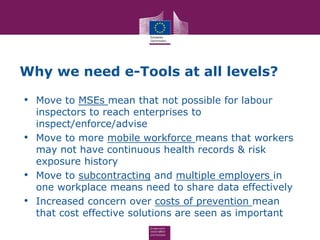
Why we need e-Tools at all levels?
• Move to MSEs mean that not possible for labour
inspectors to reach enterprises to
inspect/enforce/advise
• Move to more mobile workforce means that workers
may not have continuous health records & risk
exposure history
• Move to subcontracting and multiple employers in
one workplace means need to share data effectively
• Increased concern over costs of prevention mean
that cost effective solutions are seen as important
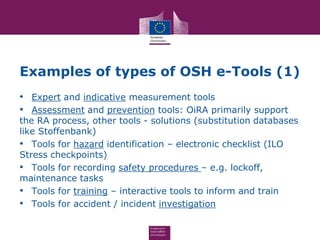
Examples of types of OSH e-Tools (1)
• Expert and indicative measurement tools
• Assessment and prevention tools: OiRA primarily support
the RA process, other tools - solutions (substitution databases
like Stoffenbank)
• Tools for hazard identification – electronic checklist (ILO
Stress checkpoints)
• Tools for recording safety procedures – e.g. lockoff,
maintenance tasks
• Tools for training – interactive tools to inform and train
• Tools for accident / incident investigation
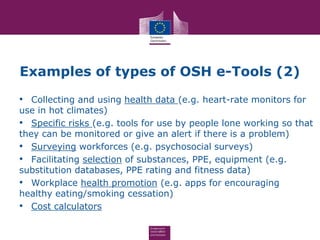
Examples of types of OSH e-Tools (2)
• Collecting and using health data (e.g. heart-rate monitors for
use in hot climates)
• Specific risks (e.g. tools for use by people lone working so that
they can be monitored or give an alert if there is a problem)
• Surveying workforces (e.g. psychosocial surveys)
• Facilitating selection of substances, PPE, equipment (e.g.
substitution databases, PPE rating and fitness data)
• Workplace health promotion (e.g. apps for encouraging
healthy eating/smoking cessation)
• Cost calculators
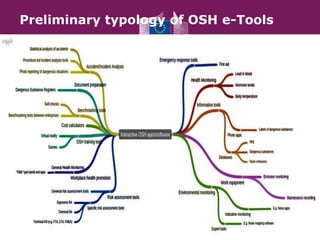
Preliminary typology of OSH e-Tools
Aspects for consideration
• Credibility and quality of OSH e-Tools
• Purpose, use and limitations
• Accessibility and use of personal/private/health data
• Need for interaction between technology developers,
and OSH experts, and business users
• Need for technology to be adopted not just by
enterprises, but also workers and inspectorates and OSH
professional services
• Involvement of social partners
OSH e-Tool example 1: OiRA
• EU-OSHA internationalised existing Dutch RI&E tool
• Created an online community
• Sharing knowledge and materials (e.g. images)
• A common platform / software (18 languages)
• Plone software – open-source philosophy
• More than 50 tools created in 15 countries (end 2014)
• Tools under development: 30
• More than 10 000 OiRA user accounts
• More than 15 000 risk assessments created
• Social partner engagement to reach end-users
• Ongoing tool development to cover more sectors
OSH e-Tool example 2: STOFFENMANAGER
 Tool which allows companies to safely work
with hazardous substances and comply with
regulations
 The tool has been in place for more than ten
years
 Exists in four different languages
• Dutch, English, Finnish and German
 More information available at:
• www.stoffenmanager.nl
OSH e-Tool example 3: SUBSPORT
• An internet portal that is a state-of-the-art resource
on safer alternatives to the use of hazardous chemicals
• It is a source of information on:
• Alternative substances and technologies
• Tools and guidance for substance evaluation and
• Substitution management
• Training activities within and outside Europe
• More information available at
• www.subsport.eu
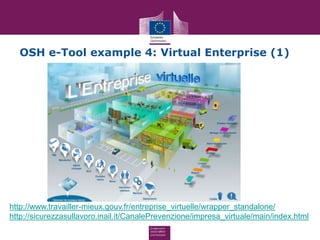
OSH e-Tool example 4: Virtual Enterprise (1)
http://www.travailler-mieux.gouv.fr/entreprise_virtuelle/wrapper_standalone/
http://sicurezzasullavoro.inail.it/CanalePrevenzione/impresa_virtuale/main/index.html
OSH e-Tool example 4: Virtual Enterprise (2)
• Interactive tool featuring a virtual workplace and a variety
of situations relevant
• Relevant to different types of worker (e.g. office
workers, cleaners)
• Provides a variety of workplace settings and highlights the
most important OSH issues
• E.g. handling chemicals, stress
• Tool originally developed by the French Ministry of Work in
cooperation with a range of organisations
• Italian version of the tool was set up by INAIL
EU-OSHA role as facilitator for e-Tools
• Create an e-Tools community
• Increasing general awareness of e-tools
• Sharing knowledge about the development of tools
• Sharing knowledge about dissemination methods
• Contributing to the dissemination of specific e-tools
• Encouraging the development of e-tools in partnership
• Encouraging the sharing, adoption, and adaption of
existing tools
• Promoting the design of tools that allow sharing
• E.g. structure of software to permit multilingualism
• Identification of potential sources of EU funding for
developing / promoting e-tools
How EU-OSHA can facilitate OSH e-Tools
• Using the EU-OSHA website and OSHWiki
• http://oshwiki.eu/wiki/Occupational_risk_assessment_in_micro-
enterprises:_the_assets_of_digital_tools
• Facilitating a specific network
• E.g. IRAT network (sharing information about Online risk
assessment tools)
• http://www.oiraproject.eu/partners/irat-network
• Using networks
• To find out about existing tools
• Promotion by EU-OSHA networks (e.g. Focal Points)
• Promotion by other networks (e.g. Baltic Sea Network)
• Connecting interested parties
• Organising meetings or exchanging contact details
Thank you
for your attention!
More information available on:
EU OSH Strategic Framework 2014-2020
http://ec.europa.eu/social/main.jsp?catId=151&langId=en
Health and Safety at Work (EC)
http://ec.europa.eu/social/main.jsp?catId=148&langId=en
EU-OSHA Online interactive Risk Assessment Tool (OiRA)
http://www.oiraproject.eu/

Innovative IT solutions to support OSH – what is going on in Europe?

  • 1.
    Innovative IT solutionsto support OSH – what is going on in Europe? Dr. Zinta Podniece Policy Analyst, Health, Safety and Hygiene at Work Unit Latvian Presidency Conference on Occupational Safety and Health 4 April 2015, Rīga
  • 2.
    EU OSH StrategicFramework 2014-2020 Challenge: • Improve the implementation record of Member States, in particular by enhancing the capacity of micro and small enterprises to put in place effective and efficient risk prevention measures Key strategic objective: • Facilitate compliance with OSH legislation, particularly by micro and small enterprises Action: provide financial and technical support on implementing OIRA and other IT-based tools in Member States, focusing on priority sectors (Member States, with support from the European Social Fund and EU-OSHA)
  • 3.
    What are OSHe-Tools? • An electronic tool – not paper-based • Interactive – user has to drive process • User can record data (e.g. noise level) • User can enter information (e.g. type in data) • User makes decisions (e.g. select options in software) • Output is tailored to user needs or data entered • Focuses on health and safety at work issues
  • 4.
    Why we neede-Tools at all levels? • Move to MSEs mean that not possible for labour inspectors to reach enterprises to inspect/enforce/advise • Move to more mobile workforce means that workers may not have continuous health records & risk exposure history • Move to subcontracting and multiple employers in one workplace means need to share data effectively • Increased concern over costs of prevention mean that cost effective solutions are seen as important
  • 5.
    Examples of typesof OSH e-Tools (1) • Expert and indicative measurement tools • Assessment and prevention tools: OiRA primarily support the RA process, other tools - solutions (substitution databases like Stoffenbank) • Tools for hazard identification – electronic checklist (ILO Stress checkpoints) • Tools for recording safety procedures – e.g. lockoff, maintenance tasks • Tools for training – interactive tools to inform and train • Tools for accident / incident investigation
  • 6.
    Examples of typesof OSH e-Tools (2) • Collecting and using health data (e.g. heart-rate monitors for use in hot climates) • Specific risks (e.g. tools for use by people lone working so that they can be monitored or give an alert if there is a problem) • Surveying workforces (e.g. psychosocial surveys) • Facilitating selection of substances, PPE, equipment (e.g. substitution databases, PPE rating and fitness data) • Workplace health promotion (e.g. apps for encouraging healthy eating/smoking cessation) • Cost calculators
  • 7.
  • 8.
    Aspects for consideration •Credibility and quality of OSH e-Tools • Purpose, use and limitations • Accessibility and use of personal/private/health data • Need for interaction between technology developers, and OSH experts, and business users • Need for technology to be adopted not just by enterprises, but also workers and inspectorates and OSH professional services • Involvement of social partners
  • 9.
    OSH e-Tool example1: OiRA • EU-OSHA internationalised existing Dutch RI&E tool • Created an online community • Sharing knowledge and materials (e.g. images) • A common platform / software (18 languages) • Plone software – open-source philosophy • More than 50 tools created in 15 countries (end 2014) • Tools under development: 30 • More than 10 000 OiRA user accounts • More than 15 000 risk assessments created • Social partner engagement to reach end-users • Ongoing tool development to cover more sectors
  • 10.
    OSH e-Tool example2: STOFFENMANAGER  Tool which allows companies to safely work with hazardous substances and comply with regulations  The tool has been in place for more than ten years  Exists in four different languages • Dutch, English, Finnish and German  More information available at: • www.stoffenmanager.nl
  • 11.
    OSH e-Tool example3: SUBSPORT • An internet portal that is a state-of-the-art resource on safer alternatives to the use of hazardous chemicals • It is a source of information on: • Alternative substances and technologies • Tools and guidance for substance evaluation and • Substitution management • Training activities within and outside Europe • More information available at • www.subsport.eu
  • 12.
    OSH e-Tool example4: Virtual Enterprise (1) http://www.travailler-mieux.gouv.fr/entreprise_virtuelle/wrapper_standalone/ http://sicurezzasullavoro.inail.it/CanalePrevenzione/impresa_virtuale/main/index.html
  • 13.
    OSH e-Tool example4: Virtual Enterprise (2) • Interactive tool featuring a virtual workplace and a variety of situations relevant • Relevant to different types of worker (e.g. office workers, cleaners) • Provides a variety of workplace settings and highlights the most important OSH issues • E.g. handling chemicals, stress • Tool originally developed by the French Ministry of Work in cooperation with a range of organisations • Italian version of the tool was set up by INAIL
  • 14.
    EU-OSHA role asfacilitator for e-Tools • Create an e-Tools community • Increasing general awareness of e-tools • Sharing knowledge about the development of tools • Sharing knowledge about dissemination methods • Contributing to the dissemination of specific e-tools • Encouraging the development of e-tools in partnership • Encouraging the sharing, adoption, and adaption of existing tools • Promoting the design of tools that allow sharing • E.g. structure of software to permit multilingualism • Identification of potential sources of EU funding for developing / promoting e-tools
  • 15.
    How EU-OSHA canfacilitate OSH e-Tools • Using the EU-OSHA website and OSHWiki • http://oshwiki.eu/wiki/Occupational_risk_assessment_in_micro- enterprises:_the_assets_of_digital_tools • Facilitating a specific network • E.g. IRAT network (sharing information about Online risk assessment tools) • http://www.oiraproject.eu/partners/irat-network • Using networks • To find out about existing tools • Promotion by EU-OSHA networks (e.g. Focal Points) • Promotion by other networks (e.g. Baltic Sea Network) • Connecting interested parties • Organising meetings or exchanging contact details
  • 16.
    Thank you for yourattention! More information available on: EU OSH Strategic Framework 2014-2020 http://ec.europa.eu/social/main.jsp?catId=151&langId=en Health and Safety at Work (EC) http://ec.europa.eu/social/main.jsp?catId=148&langId=en EU-OSHA Online interactive Risk Assessment Tool (OiRA) http://www.oiraproject.eu/

Editor's Notes

  • #11 The quantitative exposure model of Stoffenmanager is accepted by the Dutch Labour Inspectorate as method to evaluate exposure to chemical substances at the workplace. This part of the tool is also promoted in the European REACH R.14 Guidance.
  • #12 Consortium of European partners in 4 countries (DE, FR,ES,…)