Agence Française de Développement 
Working 
Paper 
November 2006 34 
Vocational Training in the Informal Sector 
Report on the Ethiopia Field Survey 
Research financed by GTZ 
(Gesellschaft für Technische Zusammenarbeit) 
Richard Walther, ITG Consultant 
(walther.richard@wanadoo.fr) 
Translation: Adam Ffoulkes Roberts 
DEPARTEMENT DE LA RECHERCHE 
Agence Française de Développement 
Direction de la Stratégie 
Département de la Recherche 
5 rue Roland Barthes 
75012 Paris - France 
www.afd.fr
Foreword 
This report is an integral part of the survey and analysis work launched by the Research Department of the French 
Development Agency (Agence Française de Développement, AFD) on training in the informal sector in five African countries 
(South Africa, Benin, Cameroon, Morocco and Senegal). It was commissioned by the French Ministry of Foreign Affairs and 
uses the same working assumptions as those applied to the other countries studied. It is also complementary to the report on 
Ethiopia, which was produced on behalf of the German technical co-operation agency (GTZ) and also used the methodologi-cal 
framework developed by the AFD. 
The Angola field survey was carried out with extensive support from the French Embassy. However, the objectives could not 
have been met without assistance from Emilio Ferreira and Fernando Madeira, experts with the firm HRD (Human Resources 
Development) who helped the field survey mission to interpret the subtleties embedded in certain situations and accounts of 
different experiences. Above all, they were able to convince certain people with little availability that they should provide the 
survey team with information and analysis coming under their area of authority. The survey benefited from the expertise of 
Anna Sofia Manzoni., who helped to identify the most legitimate Angolan representatives in the area studied and also provi-ded 
her support in identifying documentary sources on the subject. The survey also benefited from the extremely useful help 
of Abel Piqueras Candela, of the European Commission, who agreed to make a critical appraisal of the final report and nota-bly 
checked that the sources quoted really do reflect the most recent changes in the country’s education and vocational trai-ning 
policies. 
Lastly, this report was also able to draw on extensive and very useful documentation, notably thanks to the representatives of 
the European Commission Delegation, the UNDP, the DW, USAID and IDIA. They are very warmly thanked for their contribu-tions. 
 Working Paper N° 15 : Vocational Training in the Informal Sector - Concept Note. 
 Working Paper N° 16 : Vocational Training in the Informal Sector – Report on the Morocco Field Survey. 
 Working Paper N° 17 : Vocational Training in the Informal Sector – Report on the Cameroon Field Survey. 
 Working Paper N° 19 : Vocational Training in the Informal Sector – Report on the Benin Field Survey. 
 Working Paper N° 21 : Vocational Training in the Informal Sector – Report on the Senegal Field Survey. 
 Working Paper N° 30 : Vocational Training in the Informal Sector – Report on the South Africa Field Survey. 
 Working Paper N° 34 : Vocational Training in the Informal Sector – Report on the Ethiopia Field Survey. 
 Working Paper N° 35 : Vocational Training in the Informal Sector – Report on the Angola Field Survey. 
The Ethiopian case study has been produced by the GTZ in partnership with the AFD as a part of efforts to align the action of 
French and German development agencies. 
Disclaimer 
The analysis and conclusions of this document are those of the authors. They do not necessarily reflect the official position of 
the AFD or its partner institutions. 
© AFD Working paper No 34  Vocational Training in the Informal Sector - Report on the Ethiopia Field Survey 2
Table of contents 
1. Introduction: Ethiopia, a country waking up to the reality of the informal sector 4 
1.1. How the survey was carried out 4 
1.2. The contribution of existing reports and studies 5 
2. The country’s economic and social challenges 7 
2.1. Growth is strong, but vulnerable to climatic and political conditions 7 
2.2. Persistent poverty 8 
2.3. Major educational needs 9 
2.4. An essentially rural and informal labour force 11 
2.4.1. A strong contrast between rural and urban activities 11 
2.4.2. Difficulties in appraising the informal sector as a whole 12 
3. Vocational training reform geared to the economic and social challenges 15 
3.1. Current state of TVET 15 
3.2. Towards a reform focusing on those concerned in the informal economy 16 
3.2.1. The main thrust of the reform 17 
3.2.2. The reform implementation process 18 
3.2.3. The challenges of reform: moving from an institutional to a grassroots approach 22 
4. Current training initiatives in the informal sector 23 
4.1. The reality of traditional apprenticeship – a difficult issue 23 
4.2. Public policies targeting the creation of micro activities 24 
4.2.1. FEMSEDA entrepreneur training 24 
4.2.2. The Dire Dawa REMSEDA’s integration and support role 25 
4.2.3. The Addis Ababa weavers’ training project (ILO) 27 
4.2.4. On-site training for MSEs in the building sector (GTZ) 29 
4.3. The strategic role of women in the informal sector 30 
4.3.1. The ILO survey and the profile of women entrepreneurs 30 
4.3.2. Dire Dawa Women Entrepreneurs Association (DDWEA) 31 
4.3.3. Dire Dawa Women’s Association (DDWA) 31 
4.3.4. A training programme for empowering women 32 
4.4. Varied experiences from the world of agriculture 32 
4.4.1. The highly informal nature of employment in rural areas 33 
© AFD Working paper No 34  Vocational Training in the Informal Sector - Report on the Ethiopia Field Survey 3
Table of contents 
4.4.2. Training farmers and agricultural development officials 33 
4.4.3. Training the rural population in community skills training centres (CSTC) 33 
4.4.4. The innovative activities of the Harar technical and agricultural training centre 35 
4.4.5. NGO actions 37 
5. Future developments and actions 39 
5.1. TVET reform and the opportunities for the informal sector 39 
5.1.1. Training institutions can ensure that training becomes an effective aspect of social 
and economic development 39 
5.1.2. The TVET system: skills assessment and certification for informal sector workers 41 
5.2. The outreach of reform in the informal sector 42 
5.2.1. The low impact of the training system on the informal sector 42 
5.2.2. TVET reform and the lack of recognition of skills development processes in the informal economy 43 
5.2.3. A paradigm shift with limited effects 43 
5.3. The challenge of revitalising the informal sector 44 
5.3.1. Looking closely at the real potential of traditional apprenticeship and self-learning methods 44 
5.3.2. The need for a qualitative analysis of informal economy occupations 45 
5.3.3. The need to go through with plans to recognise skills acquired in the informal sector 45 
5.3.4. The need to strengthen sectoral, territorial and institutional dynamics 45 
5.3.5. How to have informal sector workers take on responsibility for their own training and skills 46 
In conclusion: the need to refocus the reform on grassroots initiatives 48 
Appendix: recommendations and proposals for action 49 
List of acronyms and abbreviations 51 
References 52 
© AFD Working paper No 34  Vocational Training in the Informal Sector - Report on the Ethiopia Field Survey 4
1. Introduction: Ethiopia, a country waking up to the reality 
of the informal sector 
The Ethiopian government is undertaking a complete 
reform of its education and vocational training system and 
wants the informal sector to be included in any changes. 
This is an ambitious strategy, which will entail a complete 
overhaul of the education and training system, focusing on 
outcomes and responding to the economy’s needs, thus 
contributing to the country’s development. It will also mean 
integrating the different kinds of training systems (formal, 
non-formal, informal) into an overall approach focusing on 
skills that have previously acquired, through whichever 
means. This shift from a unified system to a flexible and 
modular one, and from a qualification-based paradigm to 
one based on acquired vocational skills, offers a real oppor-tunity 
for those working in the informal sector to obtain 
recognised qualifications. The reform notably includes 
plans for Centres of Competence whose purpose will be to 
acknowledge not only skills acquired through experience 
and work, but also those obtained through the various exist-ing 
types of training. 
However, the inclusion of informal sector workers among 
the beneficiaries of the reform is not as easy as it sounds. 
The various officials met during the survey will have to 
acknowledge the reality of the informal sector and econo-my. 
This will not come easily. During our interviews, for 
example, it was difficult, if not impossible, to obtain precise 
figures concerning the informal sector’s role in the labour 
market or its contribution to national wealth. It was even 
more difficult to gain any idea of the real situation concern-ing 
production and service activities in the informal sector, 
or to identify the traditional methods used for acquiring 
knowledge and know-how. Differing opinions were 
expressed and there was much debate as to the existence 
or otherwise of traditional forms of apprenticeship. It was as 
if the informal sector was viewed in terms of the role 
assigned to it by the reform, rather than by taking account 
of the actual situation and trends. 
In this respect, Ethiopia is at a crossroads. Domestic work-ers, 
women involved in income-generating activities, street 
vendors, small-holders vulnerable to the vagaries of the 
weather and all the micro-enterprises involved in production 
and service activities will not see any lasting improvement 
in their situation unless the reform acknowledges the reali-ty 
of this situation and take steps to improve it. Moreover, 
the reform will not succeed in achieving its aim of training 
all those involved in economic production unless it takes 
account of the sector as it exists, and, more importantly, 
unless it involves and exploits the potential of existing 
stakeholders, partners and trends. 
The operational success of the current reform will undoubt-edly 
enable Ethiopia’s informal sector to shift from a para-digm 
of mere survival to one of growth and development. 
However, this will only happen if the reform, which is 
designed to facilitate the recognition and accreditation of 
the sector’s human and vocational capital, first of all helps 
to develop and enhance what already exists instead of pur-suing 
its own training agenda. 
© AFD Working paper No 34  Vocational Training in the Informal Sector - Report on the Ethiopia Field Survey 5
1. Introduction: Ethiopia, a country waking up to the reality of the informal sector 
1.1. How the survey was carried out 
The Ethiopia field survey differs from those carried out in 
the other countries in that it is the result of a fruitful part-nership 
between German and French development agen-cies, 
namely the German Technical Co-operation Agency 
(Gesellschaft für Technische Zusammenarbeit - GTZ), 
which provides technical assistance to the Ethiopian 
authorities in the design and delivery of the reform of tech-nical 
and vocational education and training (TVET), and the 
French development agency (Agence Française de 
Développement – AFD), which has overall responsibility for 
the study on vocational training in the informal sector. 
The Ethiopia survey reflects the desire of the German and 
French agencies to align their thinking and efforts in the 
education and training field. It was funded under the Ethio- 
German TVET project, which started in 1999, and was 
organised further to a joint agreement between the 
Ethiopian education authorities and German technical 
assistance providers. The various German development aid 
agencies constitute the largest donor and support provider 
in the current process of vocational training reform.1 The 
survey was carried out between 5 and 16 September 2006. 
It started in Addis Ababa, where meetings were held with 
the various officials responsible at federal and regional lev-els 
in the various ministries involved in vocational training. 
Meetings took place with the major international organisa-tions 
involved in this field, as well as with national employ-ers’ 
and trade union federations. It was also possible to 
meet some of the actors working closely with those eco-nomically 
and professionally active in the informal sector. 
After the interviews in the capital, the survey was complet-ed 
by a field trip to the Dire Dawa region, where it was pos-sible 
to interview project leaders working with micro-enter-prises 
and production and service units, as well as some of 
the workers who actually benefited from the training and 
skills development activities. These meetings were particu-larly 
useful in that they shed light on the real situation in the 
informal economy and the way in which those working in it 
are trying to raise themselves above subsistence level. 
1.2. The contribution of existing reports and studies 
Unlike Morocco and Cameroon, Ethiopia has not undertak-en 
any specific national surveys on the informal economy. 
Neither has Addis Ababa been the subject of a specific sur-vey 
such as those carried out for the major capital cities of 
West Africa.2 However, the 2005 Labour Force Survey car-ried 
out by the Central Statistical Agency (CSA) of Ethiopia3 
provides some data which can be used to make an objec-tive 
appraisal of the significance and role of those working 
in the informal sector. 
However, current data and forecast trends concerning the 
economic, social and educational situation are widely avail-able. 
The Plan for Accelerated and Sustained Development 
to End Poverty (PASDEP),4 published in October 2005, fol-lows 
on from the Sustainable Development and Poverty 
Reduction Program (SDPRP).5 It describes in detail the 
progress made since 2000 and sets out the major policies 
and means required to enable Ethiopia to achieve econom-ic 
growth and reduce poverty. It also includes useful data for 
this study, notably regarding what is happening in the edu-cation 
and training area and how efforts to boost micro and 
small enterprises (MSEs) can improve national economic 
growth and reduce unemployment, and on the strategic 
sectors and market niches which have job growth potential. 
This plan thus combines economic strategy, a skills devel- 
1 German technical assistance in the reform of TVET is being supported by most institutions 
or organisations specialised in international development aid: the Centre for International 
Migration (Center für Internationale Migration - CIM), the German Development Service 
(Deutscher Entwicklungsdienst - DED), Capacity Building International (Internationale 
Weiterbildung und Entwicklung gGmbh - InWEnt) and Senior Expert Service (SES). The 
GTZ, which is the technical cooperation agency, is responsible for coordinating all of the 
partners involved. The German Development Bank KfW also provides financial support for 
some parts of the reform programme. 
2 STATECO, (2005), Méthodes statistiques et économiques pour le développement et la 
transition, No. 99. 
3 Central Statistical Agency, (2006), The 2005 Labour Force Survey. 
4 Ministry of Finance and Economic Development (MoFED), (2005), Ethiopia: Building on 
Progress: A Plan for Accelerated and Sustained Development to End Poverty (PASDEP) 
(2005/6-2009/10). 
5 The Sustainable Development and Poverty Reduction Program (SDPRP) covered the 
years 2000/01-2003/04. 
© AFD Working paper No 34  Vocational Training in the Informal Sector - Report on the Ethiopia Field Survey 6
1. Introduction: Ethiopia, a country waking up to the reality of the informal sector 
phases of its development. The reform’s implementation 
framework, notably regarding the inclusion of non-formal 
training in the future TVET system, is dealt with in a sepa-rate 
document which has been produced by the Education 
Ministry with German technical assistance.8 
All of these documents, which are constantly being updat-ed, 
clearly show that the inclusion of vocational training in 
the country’s development strategy, and notably efforts to 
recognise the informal sector’s role and skills needs, is at 
the heart of the political agenda. 
The only things missing from this comprehensive bibliogra-phy 
are a very detailed analysis of the informal sector/econ-omy, 
and an objective picture of its contribution to the coun-try’s 
growth and poverty-reduction policy. 
6 Ministry of Education, (2005), Education Sector Development Program (ESDP-III), 
2005/2006-2010, Program Action Plan (PAP). 
7 Ministry of Education (September 2006), National Technical and Vocational Education and 
Training (TVET) Strategy. 
8 Engineering Capacity Building Program (ECPB, July 2006), Non-Formal TVET 
Implementation Framework, Building Ethiopia. 
opment strategy, and the inclusion of informal sector work-ers 
in the vision of the country’s future. 
The third phase of the Education Sector Development 
Program (ESDP-III),6 which follows on from a programme 
initially launched by the Ethiopian Government in 1997, 
gives an overview of the education system and explains in 
detail how training and education policies are contributing 
to the overall strategy for boosting growth and reducing 
poverty. 
Information on the current TVET reform may be found in a 
number of reports, the most important of which is the 
National Technical and Vocational Education and Training 
(TVET) Strategy.7 The latest version of this report was 
being completed during our survey. The document sets out 
and explains the reform’s key guidelines and the various 
© AFD Working paper No 34  Vocational Training in the Informal Sector - Report on the Ethiopia Field Survey 7
2. The country’s economic and social challenges 
Ethiopia’s informal sector is part of an economy that 
remains heavily dependent on the primary sector, although 
a noticeable shift towards services and production activities 
is under way. It has also been fully included in the policy to 
combat poverty and reduce illiteracy and under-education 
rates among the population. 
2.1. Growth is strong, but vulnerable to climatic and political conditions 
Since the Federal State was established in 1994, Ethiopia 
has enjoyed a relatively sustained rate of growth, signifi-cantly 
above that of Sub-Saharan Africa as a whole. 
However, this rate suddenly fell from 8.8% to 2.7% in 2002, 
and there was negative growth in 2003 (-3.7%). This was 
due to the drought that afflicted the country in 2002/2003. 
Economic growth then peaked at an unprecedented 13.1% 
in 2004, mainly due to the quick recovery of agricultural pro-duction. 
According to the OECD, the Ethiopian economy 
should continue to show good results following the 2004 
peak. Economic growth for 2004/2005 was 6.8% and a rate 
of 5.8% has been forecast for 2005/2006. 
Table 1. GDP growth: Ethiopia and Sub-Saharan Africa 
1990 1995 2000 2001 2002 2003 2004 
CGDP (current prices, in billions of dollars), Ethiopia 8.61 5.78 6.53 6.51 6.06 6.65 8 
GDP (current prices, in billions of dollars) Sub-Saharan Africa 298.38 317.52 326.24 324.87 337.21 439.29 .. 
Annual GDP growth, Ethiopia (%) 2.6 6.1 6.0 8.8 2.7 -3.7 13.1 
Annual GDP growth, Sub-Saharan Africa (%) L 3.8 3.2 3.3 3.4 3.9 4.8 
GDP per capita (in constant 2000 dollars), Ethiopia 94.7 90.2 101.5 108.0 108.6 102.4 .. 
Gross National Income (GNI) per capita, Ethiopia 170 110 110 110 100 90 110 
Source: World Bank (2005), World Development Indicators. 
The Ethiopian economy is heavily driven by the agricultural 
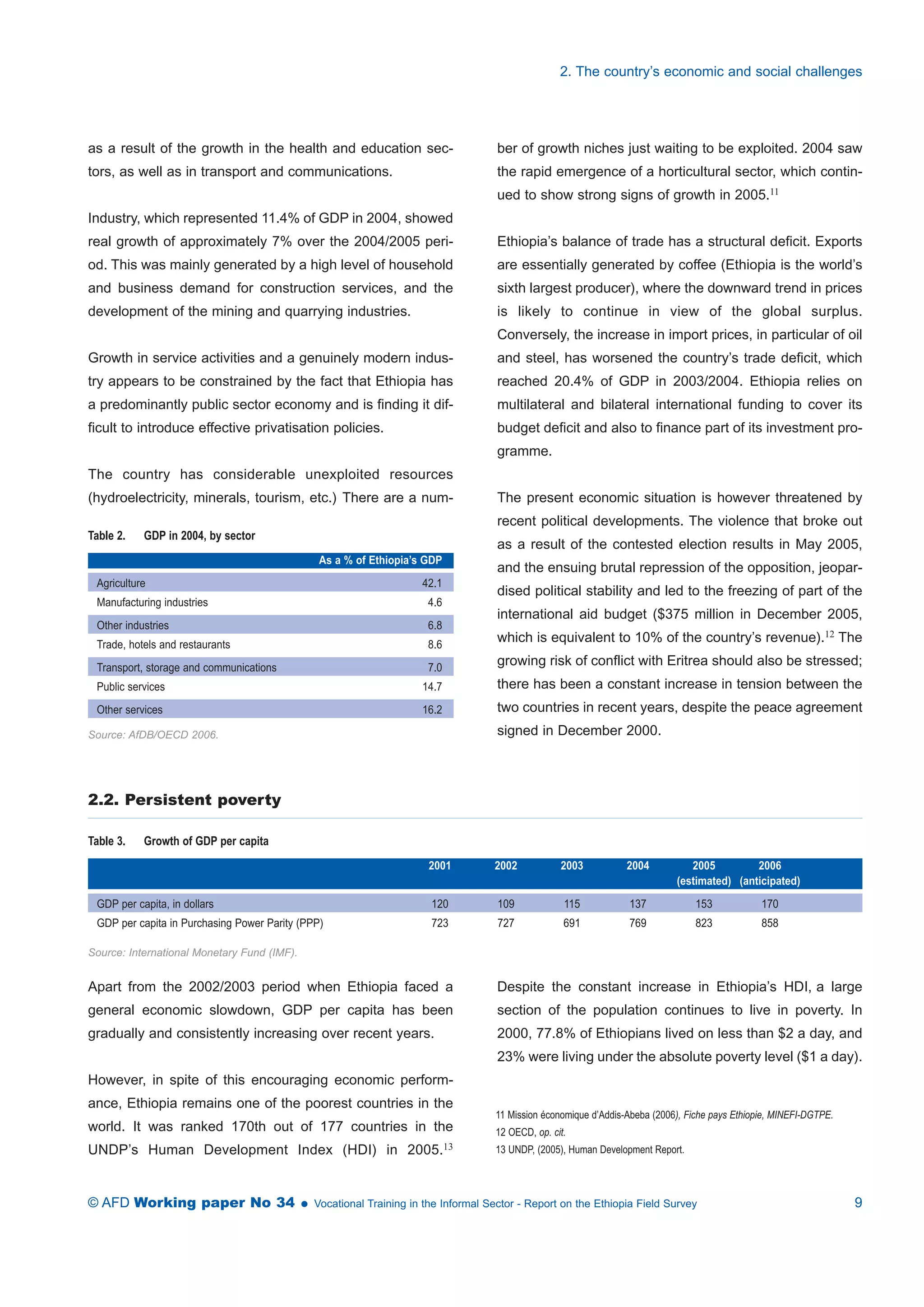
sector, which represented 42.1% of GDP in 2004,9 employs 
80% of the population (89% in 2001 according to World 
Bank figures) and provides around 90% of export revenue. 
The estimated increase in agricultural production is 6.6% in 
2004/2005, and 7.4% in 2005/2006 and 2006/2007. 
Agriculture receives support from public aid programmes 
such as the national food security programme, and benefits 
from the extension of public services to rural areas and the 
protection of farmers’ rights. However, given the constraints 
affecting agricultural markets (partially due to the lack of 
roads), low levels of productivity (due to the limited use of 
pesticides and fertilisers, irregular rainfall, poor soil fertility, 
and environmental degradation)10 as well as chronic short-ages 
of foodstuffs, the OECD estimates that approximately 
5 million Ethiopians continue to depend on food aid. 
Services represented 46.5% of GDP in 2004. This sector 
grew by approximately 7% between 2004 and 2005, chiefly 
9 OECD (2006), African Economic Outlook 2005/2006 – Country Studies: Ethiopia. 
10 World Food Programme (2006), Draft County Programme - Ethiopia 10430.0 (2007-2011). 
© AFD Working paper No 34  Vocational Training in the Informal Sector - Report on the Ethiopia Field Survey 8
as a result of the growth in the health and education sec-tors, 
as well as in transport and communications. 
Industry, which represented 11.4% of GDP in 2004, showed 
real growth of approximately 7% over the 2004/2005 peri-od. 
This was mainly generated by a high level of household 
and business demand for construction services, and the 
development of the mining and quarrying industries. 
Growth in service activities and a genuinely modern indus-try 
appears to be constrained by the fact that Ethiopia has 
a predominantly public sector economy and is finding it dif-ficult 
to introduce effective privatisation policies. 
The country has considerable unexploited resources 
(hydroelectricity, minerals, tourism, etc.) There are a num-ber 
2. The country’s economic and social challenges 
of growth niches just waiting to be exploited. 2004 saw 
the rapid emergence of a horticultural sector, which contin-ued 
to show strong signs of growth in 2005.11 
Ethiopia’s balance of trade has a structural deficit. Exports 
are essentially generated by coffee (Ethiopia is the world’s 
sixth largest producer), where the downward trend in prices 
is likely to continue in view of the global surplus. 
Conversely, the increase in import prices, in particular of oil 
and steel, has worsened the country’s trade deficit, which 
reached 20.4% of GDP in 2003/2004. Ethiopia relies on 
multilateral and bilateral international funding to cover its 
budget deficit and also to finance part of its investment pro-gramme. 
The present economic situation is however threatened by 
recent political developments. The violence that broke out 
as a result of the contested election results in May 2005, 
and the ensuing brutal repression of the opposition, jeopar-dised 
political stability and led to the freezing of part of the 
international aid budget ($375 million in December 2005, 
which is equivalent to 10% of the country’s revenue).12 The 
growing risk of conflict with Eritrea should also be stressed; 
there has been a constant increase in tension between the 
two countries in recent years, despite the peace agreement 
signed in December 2000. 
Table 2. GDP in 2004, by sector 
As a % of Ethiopia’s GDP 
Agriculture 42.1 
Manufacturing industries 4.6 
Other industries 6.8 
Trade, hotels and restaurants 8.6 
Transport, storage and communications 7.0 
Public services 14.7 
Other services 16.2 
Source: AfDB/OECD 2006. 
2.2. Persistent poverty 
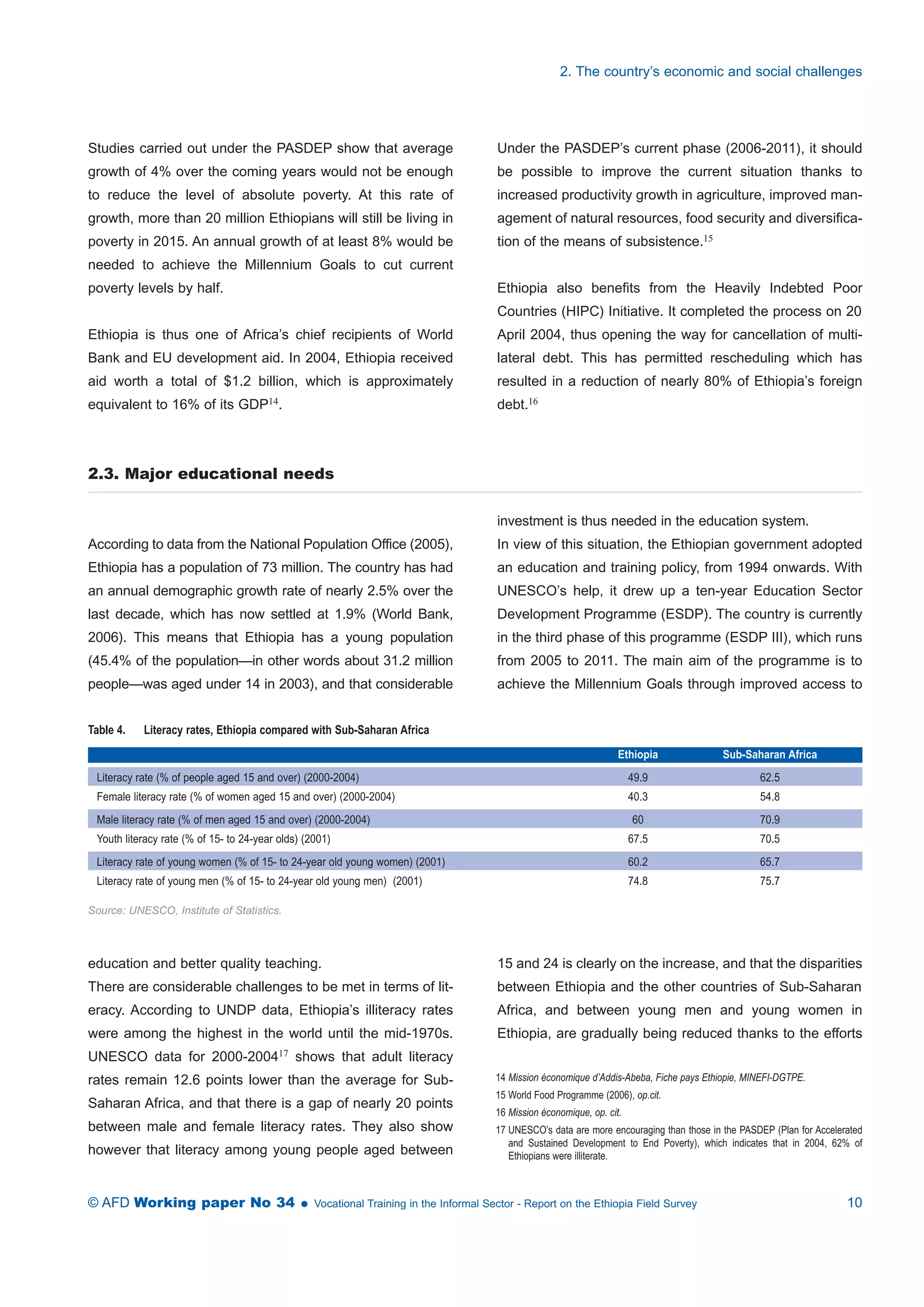
Table 3. Growth of GDP per capita 
2001 2002 2003 2004 2005 2006 
(estimated) (anticipated) 
GDP per capita, in dollars 120 109 115 137 153 170 
GDP per capita in Purchasing Power Parity (PPP) 723 727 691 769 823 858 
Source: International Monetary Fund (IMF). 
Apart from the 2002/2003 period when Ethiopia faced a 
general economic slowdown, GDP per capita has been 
gradually and consistently increasing over recent years. 
However, in spite of this encouraging economic perform-ance, 
Ethiopia remains one of the poorest countries in the 
world. It was ranked 170th out of 177 countries in the 
UNDP’s Human Development Index (HDI) in 2005.13 
Despite the constant increase in Ethiopia’s HDI, a large 
section of the population continues to live in poverty. In 
2000, 77.8% of Ethiopians lived on less than $2 a day, and 
23% were living under the absolute poverty level ($1 a day). 
11 Mission économique d’Addis-Abeba (2006), Fiche pays Ethiopie, MINEFI-DGTPE. 
12 OECD, op. cit. 
13 UNDP, (2005), Human Development Report. 
© AFD Working paper No 34  Vocational Training in the Informal Sector - Report on the Ethiopia Field Survey 9
Studies carried out under the PASDEP show that average 
growth of 4% over the coming years would not be enough 
to reduce the level of absolute poverty. At this rate of 
growth, more than 20 million Ethiopians will still be living in 
poverty in 2015. An annual growth of at least 8% would be 
needed to achieve the Millennium Goals to cut current 
poverty levels by half. 
Ethiopia is thus one of Africa’s chief recipients of World 
Bank and EU development aid. In 2004, Ethiopia received 
aid worth a total of $1.2 billion, which is approximately 
equivalent to 16% of its GDP14. 
2. The country’s economic and social challenges 
Under the PASDEP’s current phase (2006-2011), it should 
be possible to improve the current situation thanks to 
increased productivity growth in agriculture, improved man-agement 
of natural resources, food security and diversifica-tion 
of the means of subsistence.15 
Ethiopia also benefits from the Heavily Indebted Poor 
Countries (HIPC) Initiative. It completed the process on 20 
April 2004, thus opening the way for cancellation of multi-lateral 
debt. This has permitted rescheduling which has 
resulted in a reduction of nearly 80% of Ethiopia’s foreign 
debt.16 
2.3. Major educational needs 
According to data from the National Population Office (2005), 
Ethiopia has a population of 73 million. The country has had 
an annual demographic growth rate of nearly 2.5% over the 
last decade, which has now settled at 1.9% (World Bank, 
2006). This means that Ethiopia has a young population 
(45.4% of the population—in other words about 31.2 million 
people—was aged under 14 in 2003), and that considerable 
investment is thus needed in the education system. 
In view of this situation, the Ethiopian government adopted 
an education and training policy, from 1994 onwards. With 
UNESCO’s help, it drew up a ten-year Education Sector 
Development Programme (ESDP). The country is currently 
in the third phase of this programme (ESDP III), which runs 
from 2005 to 2011. The main aim of the programme is to 
achieve the Millennium Goals through improved access to 
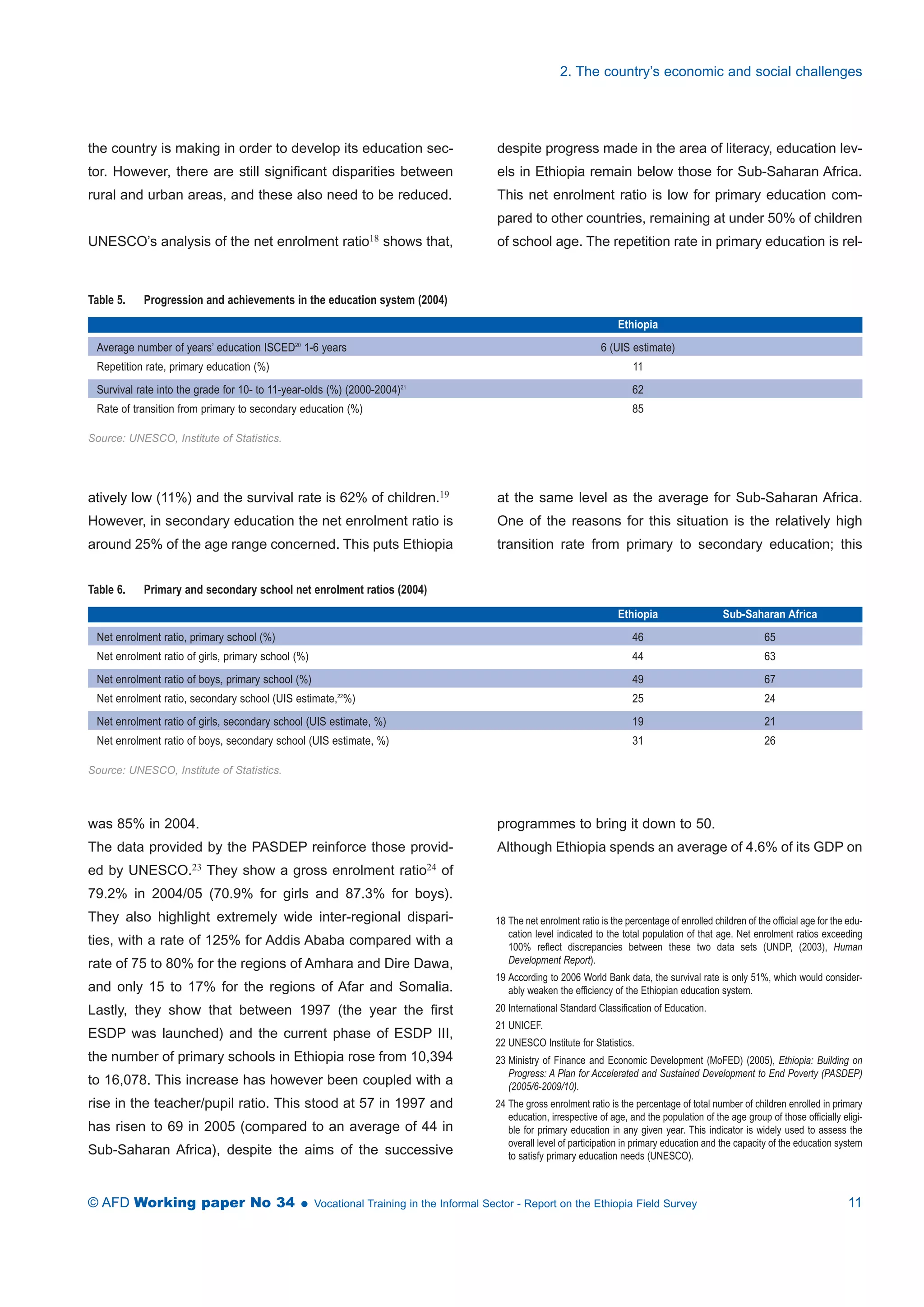
Table 4. Literacy rates, Ethiopia compared with Sub-Saharan Africa 
Ethiopia Sub-Saharan Africa 
Literacy rate (% of people aged 15 and over) (2000-2004) 49.9 62.5 
Female literacy rate (% of women aged 15 and over) (2000-2004) 40.3 54.8 
Male literacy rate (% of men aged 15 and over) (2000-2004) 60 70.9 
Youth literacy rate (% of 15- to 24-year olds) (2001) 67.5 70.5 
Literacy rate of young women (% of 15- to 24-year old young women) (2001) 60.2 65.7 
Literacy rate of young men (% of 15- to 24-year old young men) (2001) 74.8 75.7 
Source: UNESCO, Institute of Statistics. 
education and better quality teaching. 
There are considerable challenges to be met in terms of lit-eracy. 
According to UNDP data, Ethiopia’s illiteracy rates 
were among the highest in the world until the mid-1970s. 
UNESCO data for 2000-200417 shows that adult literacy 
rates remain 12.6 points lower than the average for Sub- 
Saharan Africa, and that there is a gap of nearly 20 points 
between male and female literacy rates. They also show 
however that literacy among young people aged between 
15 and 24 is clearly on the increase, and that the disparities 
between Ethiopia and the other countries of Sub-Saharan 
Africa, and between young men and young women in 
Ethiopia, are gradually being reduced thanks to the efforts 
14 Mission économique d’Addis-Abeba, Fiche pays Ethiopie, MINEFI-DGTPE. 
15 World Food Programme (2006), op.cit. 
16 Mission économique, op. cit. 
17 UNESCO’s data are more encouraging than those in the PASDEP (Plan for Accelerated 
and Sustained Development to End Poverty), which indicates that in 2004, 62% of 
Ethiopians were illiterate. 
© AFD Working paper No 34  Vocational Training in the Informal Sector - Report on the Ethiopia Field Survey 10
the country is making in order to develop its education sec-tor. 
However, there are still significant disparities between 
rural and urban areas, and these also need to be reduced. 
UNESCO’s analysis of the net enrolment ratio18 shows that, 
2. The country’s economic and social challenges 
despite progress made in the area of literacy, education lev-els 
in Ethiopia remain below those for Sub-Saharan Africa. 
This net enrolment ratio is low for primary education com-pared 
to other countries, remaining at under 50% of children 
of school age. The repetition rate in primary education is rel- 
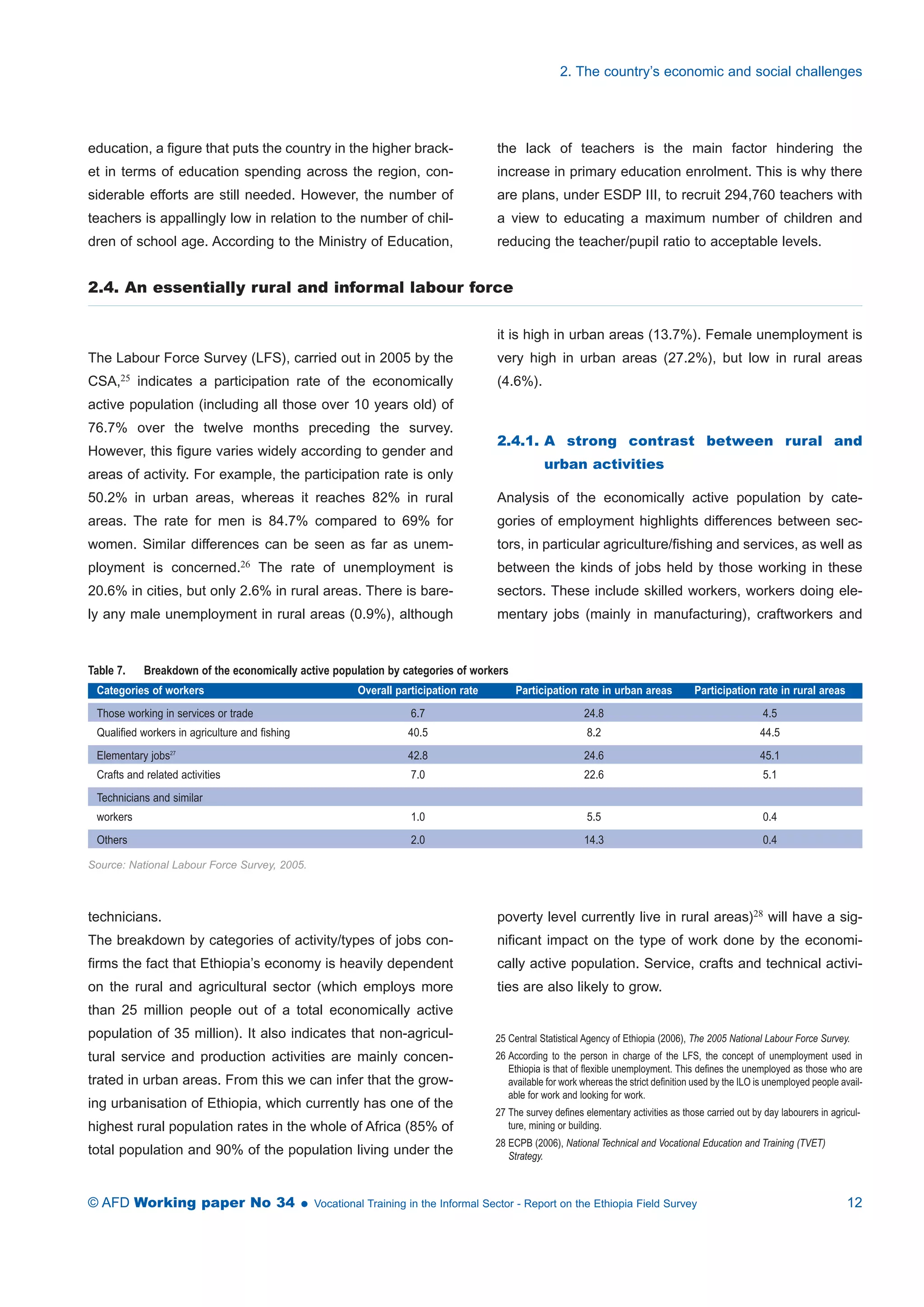
Table 5. Progression and achievements in the education system (2004) 
Ethiopia 
Average number of years’ education ISCED20 1-6 years 6 (UIS estimate) 
Repetition rate, primary education (%) 11 
Survival rate into the grade for 10- to 11-year-olds (%) (2000-2004)21 62 
Rate of transition from primary to secondary education (%) 85 
Source: UNESCO, Institute of Statistics. 
atively low (11%) and the survival rate is 62% of children.19 
However, in secondary education the net enrolment ratio is 
around 25% of the age range concerned. This puts Ethiopia 
Table 6. Primary and secondary school net enrolment ratios (2004) 
at the same level as the average for Sub-Saharan Africa. 
One of the reasons for this situation is the relatively high 
transition rate from primary to secondary education; this 
Ethiopia Sub-Saharan Africa 
Net enrolment ratio, primary school (%) 46 65 
Net enrolment ratio of girls, primary school (%) 44 63 
Net enrolment ratio of boys, primary school (%) 49 67 
Net enrolment ratio, secondary school (UIS estimate,22%) 25 24 
Net enrolment ratio of girls, secondary school (UIS estimate, %) 19 21 
Net enrolment ratio of boys, secondary school (UIS estimate, %) 31 26 
Source: UNESCO, Institute of Statistics. 
was 85% in 2004. 
The data provided by the PASDEP reinforce those provid-ed 
by UNESCO.23 They show a gross enrolment ratio24 of 
79.2% in 2004/05 (70.9% for girls and 87.3% for boys). 
They also highlight extremely wide inter-regional dispari-ties, 
with a rate of 125% for Addis Ababa compared with a 
rate of 75 to 80% for the regions of Amhara and Dire Dawa, 
and only 15 to 17% for the regions of Afar and Somalia. 
Lastly, they show that between 1997 (the year the first 
ESDP was launched) and the current phase of ESDP III, 
the number of primary schools in Ethiopia rose from 10,394 
to 16,078. This increase has however been coupled with a 
rise in the teacher/pupil ratio. This stood at 57 in 1997 and 
has risen to 69 in 2005 (compared to an average of 44 in 
Sub-Saharan Africa), despite the aims of the successive 
programmes to bring it down to 50. 
Although Ethiopia spends an average of 4.6% of its GDP on 
18 The net enrolment ratio is the percentage of enrolled children of the official age for the edu-cation 
level indicated to the total population of that age. Net enrolment ratios exceeding 
100% reflect discrepancies between these two data sets (UNDP, (2003), Human 
Development Report). 
19 According to 2006 World Bank data, the survival rate is only 51%, which would consider-ably 
weaken the efficiency of the Ethiopian education system. 
20 International Standard Classification of Education. 
21 UNICEF. 
22 UNESCO Institute for Statistics. 
23 Ministry of Finance and Economic Development (MoFED) (2005), Ethiopia: Building on 
Progress: A Plan for Accelerated and Sustained Development to End Poverty (PASDEP) 
(2005/6-2009/10). 
24 The gross enrolment ratio is the percentage of total number of children enrolled in primary 
education, irrespective of age, and the population of the age group of those officially eligi-ble 
for primary education in any given year. This indicator is widely used to assess the 
overall level of participation in primary education and the capacity of the education system 
to satisfy primary education needs (UNESCO). 
© AFD Working paper No 34  Vocational Training in the Informal Sector - Report on the Ethiopia Field Survey 11
education, a figure that puts the country in the higher brack-et 
in terms of education spending across the region, con-siderable 
efforts are still needed. However, the number of 
teachers is appallingly low in relation to the number of chil-dren 
of school age. According to the Ministry of Education, 
2. The country’s economic and social challenges 
the lack of teachers is the main factor hindering the 
increase in primary education enrolment. This is why there 
are plans, under ESDP III, to recruit 294,760 teachers with 
a view to educating a maximum number of children and 
reducing the teacher/pupil ratio to acceptable levels. 
2.4. An essentially rural and informal labour force 
The Labour Force Survey (LFS), carried out in 2005 by the 
CSA,25 indicates a participation rate of the economically 
active population (including all those over 10 years old) of 
76.7% over the twelve months preceding the survey. 
However, this figure varies widely according to gender and 
areas of activity. For example, the participation rate is only 
50.2% in urban areas, whereas it reaches 82% in rural 
areas. The rate for men is 84.7% compared to 69% for 
women. Similar differences can be seen as far as unem-ployment 
is concerned.26 The rate of unemployment is 
20.6% in cities, but only 2.6% in rural areas. There is bare-ly 
any male unemployment in rural areas (0.9%), although 
it is high in urban areas (13.7%). Female unemployment is 
very high in urban areas (27.2%), but low in rural areas 
(4.6%). 
2.4.1. A strong contrast between rural and 
urban activities 
Analysis of the economically active population by cate-gories 
of employment highlights differences between sec-tors, 
in particular agriculture/fishing and services, as well as 
between the kinds of jobs held by those working in these 
sectors. These include skilled workers, workers doing ele-mentary 
jobs (mainly in manufacturing), craftworkers and 
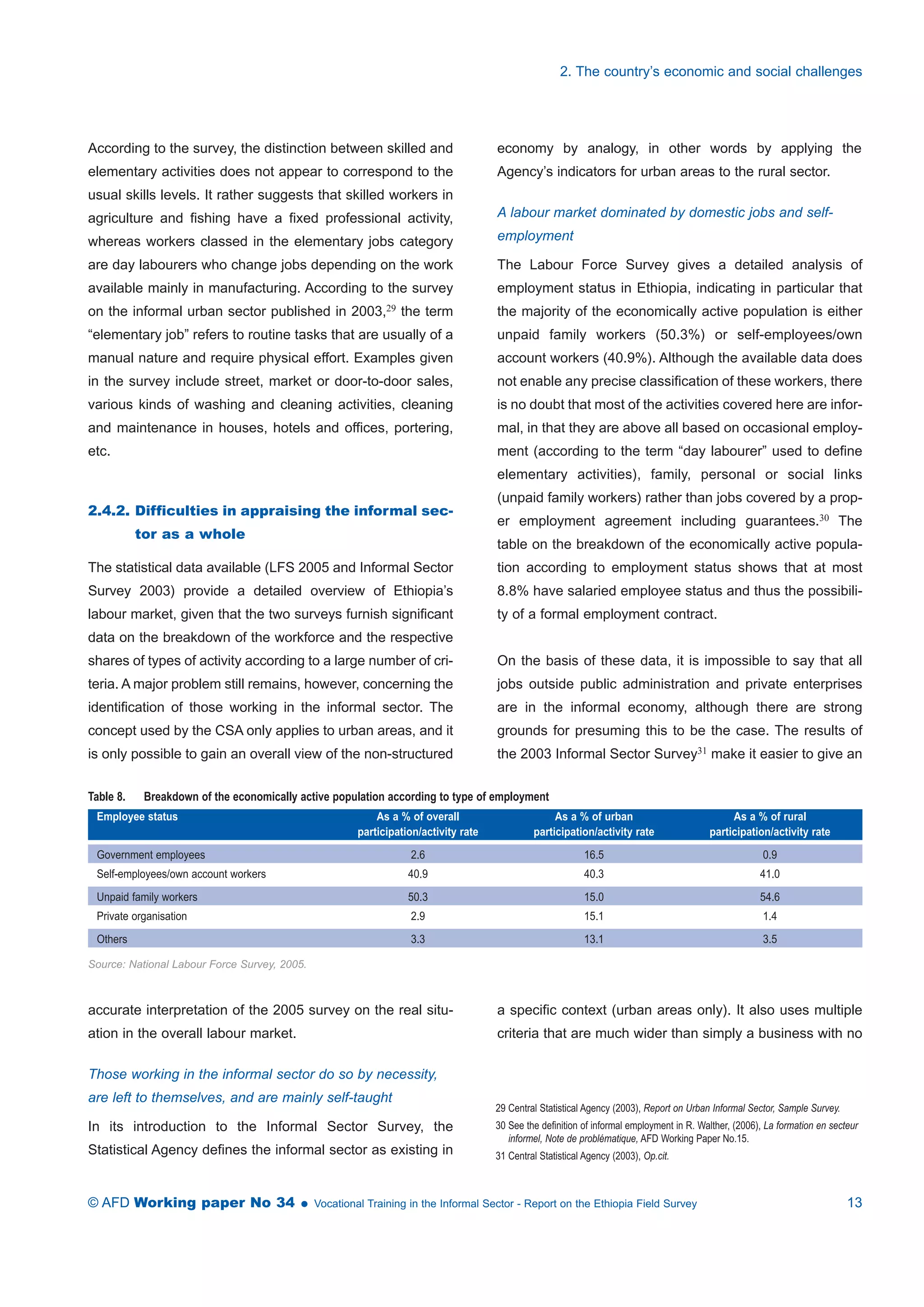
Table 7. Breakdown of the economically active population by categories of workers 
Categories of workers Overall participation rate Participation rate in urban areas Participation rate in rural areas 
Those working in services or trade 6.7 24.8 4.5 
Qualified workers in agriculture and fishing 40.5 8.2 44.5 
Elementary jobs27 42.8 24.6 45.1 
Crafts and related activities 7.0 22.6 5.1 
Technicians and similar 
workers 1.0 5.5 0.4 
Others 2.0 14.3 0.4 
Source: National Labour Force Survey, 2005. 
technicians. 
The breakdown by categories of activity/types of jobs con-firms 
the fact that Ethiopia’s economy is heavily dependent 
on the rural and agricultural sector (which employs more 
than 25 million people out of a total economically active 
population of 35 million). It also indicates that non-agricul-tural 
service and production activities are mainly concen-trated 
in urban areas. From this we can infer that the grow-ing 
urbanisation of Ethiopia, which currently has one of the 
highest rural population rates in the whole of Africa (85% of 
total population and 90% of the population living under the 
poverty level currently live in rural areas)28 will have a sig-nificant 
impact on the type of work done by the economi-cally 
active population. Service, crafts and technical activi-ties 
are also likely to grow. 
25 Central Statistical Agency of Ethiopia (2006), The 2005 National Labour Force Survey. 
26 According to the person in charge of the LFS, the concept of unemployment used in 
Ethiopia is that of flexible unemployment. This defines the unemployed as those who are 
available for work whereas the strict definition used by the ILO is unemployed people avail-able 
for work and looking for work. 
27 The survey defines elementary activities as those carried out by day labourers in agricul-ture, 
mining or building. 
28 ECPB (2006), National Technical and Vocational Education and Training (TVET) 
Strategy. 
© AFD Working paper No 34  Vocational Training in the Informal Sector - Report on the Ethiopia Field Survey 12
According to the survey, the distinction between skilled and 
elementary activities does not appear to correspond to the 
usual skills levels. It rather suggests that skilled workers in 
agriculture and fishing have a fixed professional activity, 
whereas workers classed in the elementary jobs category 
are day labourers who change jobs depending on the work 
available mainly in manufacturing. According to the survey 
on the informal urban sector published in 2003,29 the term 
“elementary job” refers to routine tasks that are usually of a 
manual nature and require physical effort. Examples given 
in the survey include street, market or door-to-door sales, 
various kinds of washing and cleaning activities, cleaning 
and maintenance in houses, hotels and offices, portering, 
etc. 
2.4.2. Difficulties in appraising the informal sec-tor 
as a whole 
The statistical data available (LFS 2005 and Informal Sector 
Survey 2003) provide a detailed overview of Ethiopia’s 
labour market, given that the two surveys furnish significant 
data on the breakdown of the workforce and the respective 
shares of types of activity according to a large number of cri-teria. 
Amajor problem still remains, however, concerning the 
identification of those working in the informal sector. The 
concept used by the CSA only applies to urban areas, and it 
is only possible to gain an overall view of the non-structured 
2. The country’s economic and social challenges 
economy by analogy, in other words by applying the 
Agency’s indicators for urban areas to the rural sector. 
A labour market dominated by domestic jobs and self-employment 
The Labour Force Survey gives a detailed analysis of 
employment status in Ethiopia, indicating in particular that 
the majority of the economically active population is either 
unpaid family workers (50.3%) or self-employees/own 
account workers (40.9%). Although the available data does 
not enable any precise classification of these workers, there 
is no doubt that most of the activities covered here are infor-mal, 
in that they are above all based on occasional employ-ment 
(according to the term “day labourer” used to define 
elementary activities), family, personal or social links 
(unpaid family workers) rather than jobs covered by a prop-er 
employment agreement including guarantees.30 The 
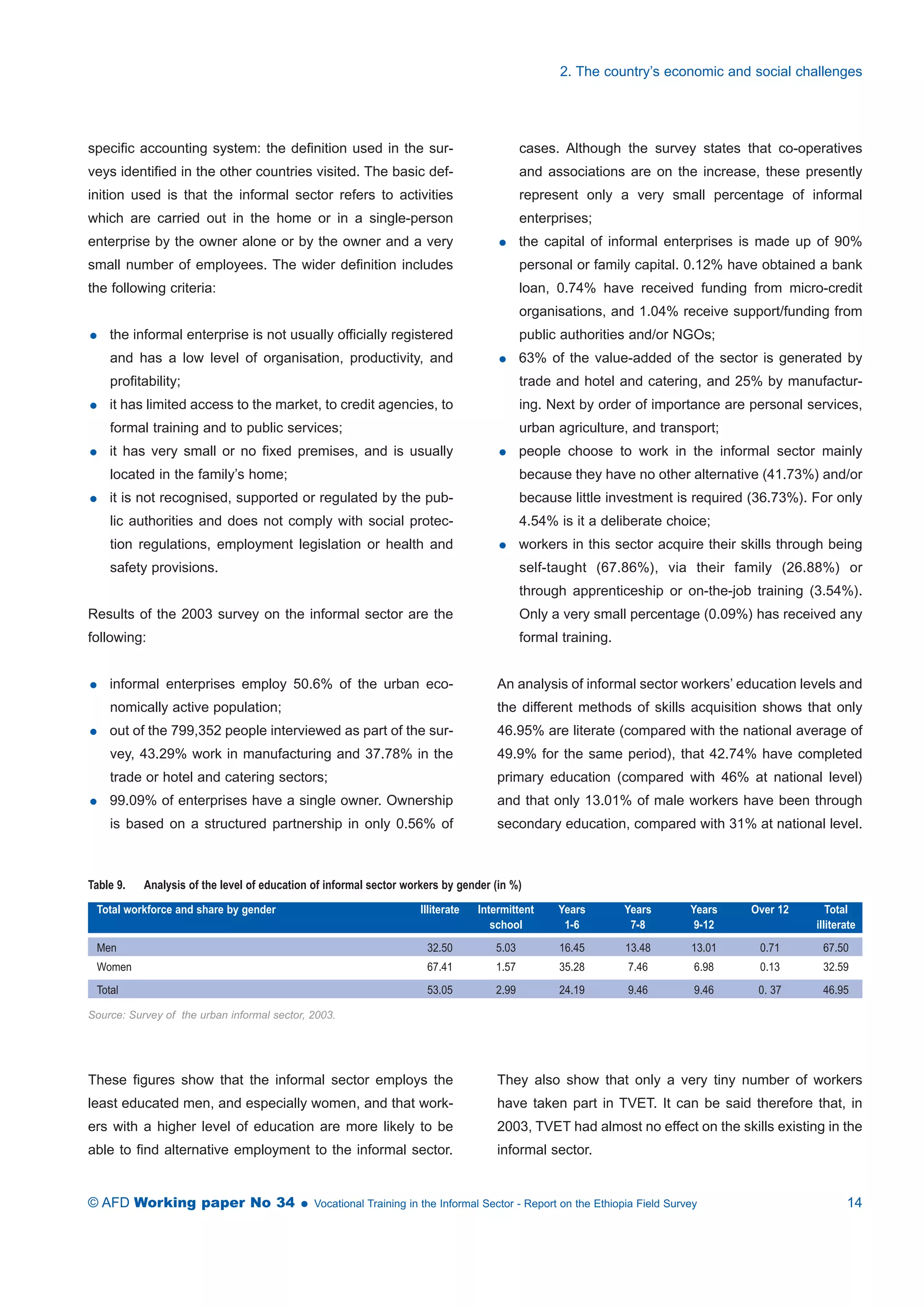
table on the breakdown of the economically active popula-tion 
according to employment status shows that at most 
8.8% have salaried employee status and thus the possibili-ty 
of a formal employment contract. 
On the basis of these data, it is impossible to say that all 
jobs outside public administration and private enterprises 
are in the informal economy, although there are strong 
grounds for presuming this to be the case. The results of 
the 2003 Informal Sector Survey31 make it easier to give an 
Table 8. Breakdown of the economically active population according to type of employment 
Employee status As a % of overall As a % of urban As a % of rural 
participation/activity rate participation/activity rate participation/activity rate 
Government employees 2.6 16.5 0.9 
Self-employees/own account workers 40.9 40.3 41.0 
Unpaid family workers 50.3 15.0 54.6 
Private organisation 2.9 15.1 1.4 
Others 3.3 13.1 3.5 
Source: National Labour Force Survey, 2005. 
accurate interpretation of the 2005 survey on the real situ-ation 
in the overall labour market. 
Those working in the informal sector do so by necessity, 
are left to themselves, and are mainly self-taught 
In its introduction to the Informal Sector Survey, the 
Statistical Agency defines the informal sector as existing in 
a specific context (urban areas only). It also uses multiple 
criteria that are much wider than simply a business with no 
29 Central Statistical Agency (2003), Report on Urban Informal Sector, Sample Survey. 
30 See the definition of informal employment in R. Walther, (2006), La formation en secteur 
informel, Note de problématique, AFD Working Paper No.15. 
31 Central Statistical Agency (2003), Op.cit. 
© AFD Working paper No 34  Vocational Training in the Informal Sector - Report on the Ethiopia Field Survey 13
specific accounting system: the definition used in the sur-veys 
identified in the other countries visited. The basic def-inition 
used is that the informal sector refers to activities 
which are carried out in the home or in a single-person 
enterprise by the owner alone or by the owner and a very 
small number of employees. The wider definition includes 
the following criteria: 
 the informal enterprise is not usually officially registered 
and has a low level of organisation, productivity, and 
profitability; 
 it has limited access to the market, to credit agencies, to 
formal training and to public services; 
 it has very small or no fixed premises, and is usually 
located in the family’s home; 
 it is not recognised, supported or regulated by the pub-lic 
authorities and does not comply with social protec-tion 
regulations, employment legislation or health and 
safety provisions. 
Results of the 2003 survey on the informal sector are the 
following: 
 informal enterprises employ 50.6% of the urban eco-nomically 
active population; 
 out of the 799,352 people interviewed as part of the sur-vey, 
43.29% work in manufacturing and 37.78% in the 
trade or hotel and catering sectors; 
 99.09% of enterprises have a single owner. Ownership 
is based on a structured partnership in only 0.56% of 
2. The country’s economic and social challenges 
cases. Although the survey states that co-operatives 
and associations are on the increase, these presently 
represent only a very small percentage of informal 
enterprises; 
 the capital of informal enterprises is made up of 90% 
personal or family capital. 0.12% have obtained a bank 
loan, 0.74% have received funding from micro-credit 
organisations, and 1.04% receive support/funding from 
public authorities and/or NGOs; 
 63% of the value-added of the sector is generated by 
trade and hotel and catering, and 25% by manufactur-ing. 
Next by order of importance are personal services, 
urban agriculture, and transport; 
 people choose to work in the informal sector mainly 
because they have no other alternative (41.73%) and/or 
because little investment is required (36.73%). For only 
4.54% is it a deliberate choice; 
 workers in this sector acquire their skills through being 
self-taught (67.86%), via their family (26.88%) or 
through apprenticeship or on-the-job training (3.54%). 
Only a very small percentage (0.09%) has received any 
formal training. 
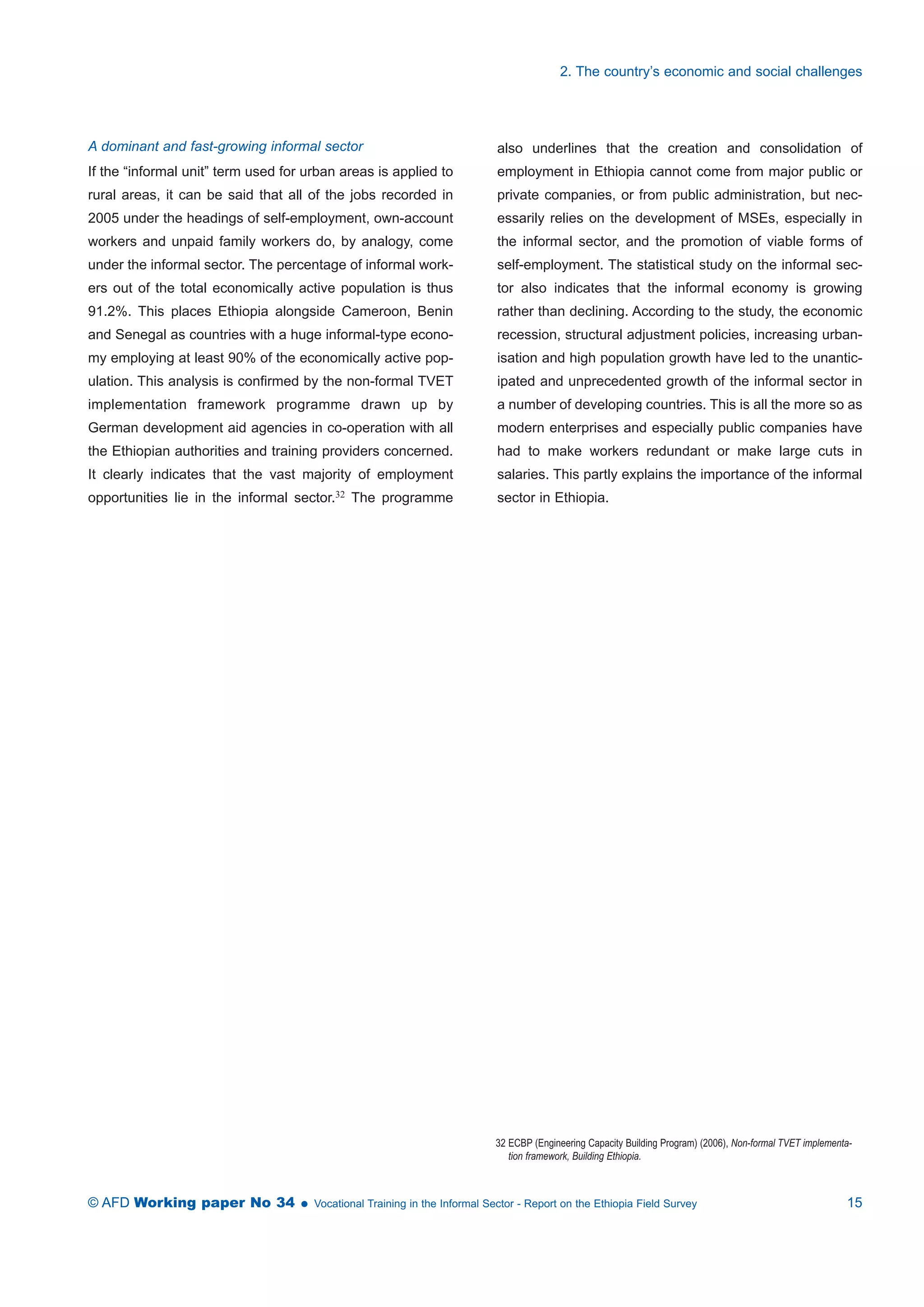
An analysis of informal sector workers’ education levels and 
the different methods of skills acquisition shows that only 
46.95% are literate (compared with the national average of 
49.9% for the same period), that 42.74% have completed 
primary education (compared with 46% at national level) 
and that only 13.01% of male workers have been through 
secondary education, compared with 31% at national level. 
Table 9. Analysis of the level of education of informal sector workers by gender (in %) 
Total workforce and share by gender Illiterate Intermittent Years Years Years Over 12 Total 
school 1-6 7-8 9-12 illiterate 
Men 32.50 5.03 16.45 13.48 13.01 0.71 67.50 
Women 67.41 1.57 35.28 7.46 6.98 0.13 32.59 
Total 53.05 2.99 24.19 9.46 9.46 0. 37 46.95 
Source: Survey of the urban informal sector, 2003. 
These figures show that the informal sector employs the 
least educated men, and especially women, and that work-ers 
with a higher level of education are more likely to be 
able to find alternative employment to the informal sector. 
They also show that only a very tiny number of workers 
have taken part in TVET. It can be said therefore that, in 
2003, TVET had almost no effect on the skills existing in the 
informal sector. 
© AFD Working paper No 34  Vocational Training in the Informal Sector - Report on the Ethiopia Field Survey 14
A dominant and fast-growing informal sector 
If the “informal unit” term used for urban areas is applied to 
rural areas, it can be said that all of the jobs recorded in 
2005 under the headings of self-employment, own-account 
workers and unpaid family workers do, by analogy, come 
under the informal sector. The percentage of informal work-ers 
out of the total economically active population is thus 
91.2%. This places Ethiopia alongside Cameroon, Benin 
and Senegal as countries with a huge informal-type econo-my 
employing at least 90% of the economically active pop-ulation. 
This analysis is confirmed by the non-formal TVET 
implementation framework programme drawn up by 
German development aid agencies in co-operation with all 
the Ethiopian authorities and training providers concerned. 
It clearly indicates that the vast majority of employment 
opportunities lie in the informal sector.32 The programme 
2. The country’s economic and social challenges 
also underlines that the creation and consolidation of 
employment in Ethiopia cannot come from major public or 
private companies, or from public administration, but nec-essarily 
relies on the development of MSEs, especially in 
the informal sector, and the promotion of viable forms of 
self-employment. The statistical study on the informal sec-tor 
also indicates that the informal economy is growing 
rather than declining. According to the study, the economic 
recession, structural adjustment policies, increasing urban-isation 
and high population growth have led to the unantic-ipated 
and unprecedented growth of the informal sector in 
a number of developing countries. This is all the more so as 
modern enterprises and especially public companies have 
had to make workers redundant or make large cuts in 
salaries. This partly explains the importance of the informal 
sector in Ethiopia. 
32 ECBP (Engineering Capacity Building Program) (2006), Non-formal TVET implementa-tion 
framework, Building Ethiopia. 
© AFD Working paper No 34  Vocational Training in the Informal Sector - Report on the Ethiopia Field Survey 15
3. Vocational training reform geared to the economic and social 
challenges 
The TVET system is currently the focus of an in-depth strate-gic 
rethinking and a reform intended to provide the Ethiopian 
economy with the skills it needs in order to grow. This rethink-ing 
and reform process is part and parcel of an overarching 
policy entitled “Building Ethiopia”, which is being implement-ed 
by the Ethiopian Government under the supervision of the 
Ministry of Capacity Building and in partnership with the 
Ministry of Education, the Ministry of Trade and Industry and 
the private sector. The Engineering Capacity Building 
Program (ECBP)33 is responsible for the policy’s overall 
implementation. It is funded by the German Ministry of 
Economic Co-operation and Development (BMZ), and oper-ates 
with assistance from various German aid agencies 
under the co-ordination of the largest such agency, the GTZ. 
The purpose of the overall programme is to reform voca-tional 
training and engineering courses. It is also designed 
to introduce a national framework for qualifications and 
standards, to develop the private sector and to encourage 
it to contribute to the various types of action being taken. 
The reform of the TVET system is a key component in the 
programme. This reform, which is just getting under way, is 
being implemented as part of the ECBP by the Ministry of 
Education with technical assistance from German aid agen-cies, 
in conjunction with local and regional authorities and 
with the co-operation of all the economic and social part-ners 
concerned. 
3.1. Current state of TVET 
According to the Ethiopian Ministry, technical and vocation-al 
education and training comprises three main types of 
training: 
 formal training schemes run by accredited public or pri-vate 
vocational training centres and leading to recog-nised 
technician-level certification; 
 “non-formal” training courses,34 which do not meet 
recognised standards relating to content and the neces-sary 
length of training in order to obtain certification. 
They are delivered by public or private institutions such 
as NGOs, community training centres, religious agen-cies 
and private profit-making bodies. Non-formal train-ing 
focuses primarily on helping people obtain employ-ment. 
It is aimed at school leavers, school dropouts, 
young and adult workers and groups excluded from the 
labour market; 
 informal training, which refers to the acquisition of 
knowledge and skills in a non-structured environment. It 
consists primarily of on-the-job training that is not cur-rently 
recognised or validated and traditional appren-ticeships 
in MSEs, particularly in the craft sector. 
33 As the term ECBP is commonly used in Ethiopia, it seems logical for this report to refer to 
the Ethiopian capacity building programme in this way. 
34 The definition of non-formal training given in the reference documents is taken from 
CEDEFOP’s 2003 Glossary on Transparency and Validation of Non-Formal and Informal 
Training. It defines non-formal training as “learning which is embedded in planned activi-ties 
that are not explicitly designated as learning (in terms of objectives, time or support), 
but which contain an important learning element. Non-formal learning is intentional from 
the learner’s perspective.” The strategic and operational papers mentioned define the con-cept 
of informal training along the same lines as CEDEFOP (learning resulting from every-day 
activities related to work, family or leisure, which in most cases is unintentional from 
the learner’s perspective), while incorporating it into the overarching concept of non-formal 
training. 
© AFD Working paper No 34  Vocational Training in the Informal Sector - Report on the Ethiopia Field Survey 16
3. Vocational training reform geared to the economic and social challenges 
Training is also available in the agricultural sector, but the 
Ministry of Education is not responsible for it. 
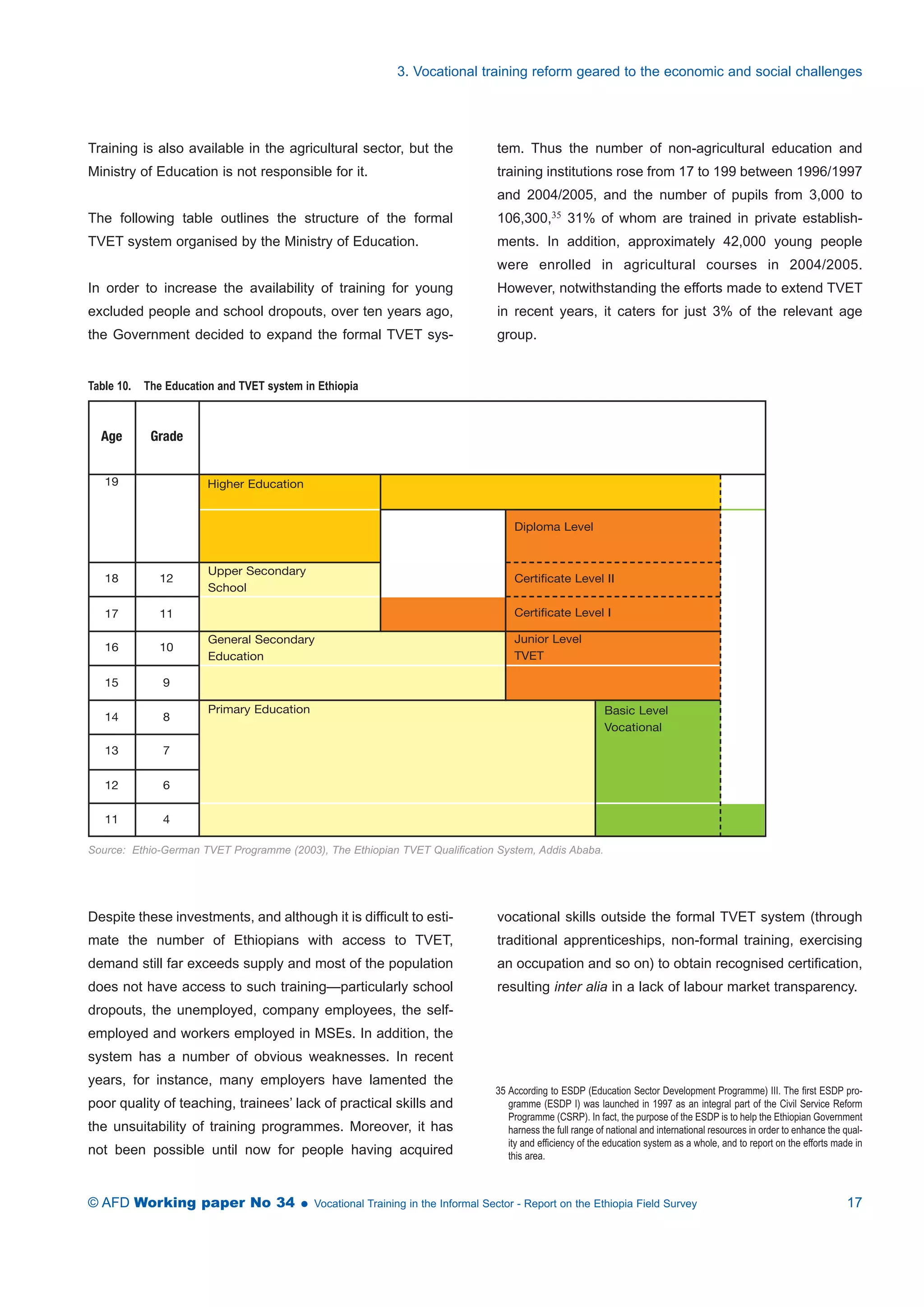
The following table outlines the structure of the formal 
TVET system organised by the Ministry of Education. 
In order to increase the availability of training for young 
excluded people and school dropouts, over ten years ago, 
the Government decided to expand the formal TVET sys-tem. 
Thus the number of non-agricultural education and 
training institutions rose from 17 to 199 between 1996/1997 
and 2004/2005, and the number of pupils from 3,000 to 
106,300,35 31% of whom are trained in private establish-ments. 
In addition, approximately 42,000 young people 
were enrolled in agricultural courses in 2004/2005. 
However, notwithstanding the efforts made to extend TVET 
in recent years, it caters for just 3% of the relevant age 
group. 
Table 10. The Education and TVET system in Ethiopia 
Age 
Grade 
19 Higher Education 
Diploma Level 
Certificate Level II 
Certificate Level I 
Junior Level 
TVET 
Upper Secondary 
School 
General Secondary 
Education 
Primary Education 
18 
17 
16 
15 
14 
13 
12 
11 
12 
11 
10 
9 
8 
7 
6 
4 
Source: Ethio-German TVET Programme (2003), The Ethiopian TVET Qualification System, Addis Ababa. 
Basic Level 
Vocational 
Despite these investments, and although it is difficult to esti-mate 
the number of Ethiopians with access to TVET, 
demand still far exceeds supply and most of the population 
does not have access to such training—particularly school 
dropouts, the unemployed, company employees, the self-employed 
and workers employed in MSEs. In addition, the 
system has a number of obvious weaknesses. In recent 
years, for instance, many employers have lamented the 
poor quality of teaching, trainees’ lack of practical skills and 
the unsuitability of training programmes. Moreover, it has 
not been possible until now for people having acquired 
vocational skills outside the formal TVET system (through 
traditional apprenticeships, non-formal training, exercising 
an occupation and so on) to obtain recognised certification, 
resulting inter alia in a lack of labour market transparency. 
35 According to ESDP (Education Sector Development Programme) III. The first ESDP pro-gramme 
(ESDP I) was launched in 1997 as an integral part of the Civil Service Reform 
Programme (CSRP). In fact, the purpose of the ESDP is to help the Ethiopian Government 
harness the full range of national and international resources in order to enhance the qual-ity 
and efficiency of the education system as a whole, and to report on the efforts made in 
this area. 
© AFD Working paper No 34  Vocational Training in the Informal Sector - Report on the Ethiopia Field Survey 17
3. Vocational training reform geared to the economic and social challenges 
3.2. Towards a reform focusing on those concerned in the informal economy 
The strategic thrust of the reform was defined as part of the 
implementation of the PASDEP and in the context of the var-ious 
national and sector-specific economic development 
plans. The public authorities responsible for overseeing it 
with technical assistance from German aid agencies have 
the task of training a skilled, motivated and competent work 
force. The aim is to develop the private sector and introduce 
education and training schemes geared to demand and tai-lored 
to the economic and social needs of the labour market, 
particularly with a view to creating self-employment opportu-nities. 
The current reform thus directly focuses on upgrading 
the skills of those employed in the informal economy. 
3.2.1. The main thrust of the reform 
The main thrust of the reform may be described as follows: 
 broadly, it seeks to change the vocational training para-digm 
by moving from a supply-driven approach to one 
driven by demand and, more importantly, by the accred-itation 
of existing skills, irrespective of how they have 
been acquired; 
 by turning the system around, it will improve access to 
training among people who are usually excluded (young 
people and adults who have dropped out of school, 
have a low level of education or are illiterate, entrepre-neurs 
and workers in the formal and informal economy 
who need to upgrade their skills and obtain recognised 
qualifications, farmers and agricultural workers, unem-ployed 
people seeking skills in order to enter the labour 
market, and so on); 
 it is designed to gear training to MSEs, to encourage 
training centres to concentrate on the informal econo-my’s 
skills needs, to introduce incentives aimed at 
encouraging business start-ups at local level and in par-ticular 
linking the acquisition of skills to access to micro-credit 
so as to create self-employment opportunities, 
and, lastly, to enable the various training institutions to 
develop training courses tailored to the needs of their 
target groups. 
At a more structural level, the current reform is intended to 
ensure that non-formal training becomes an integral part 
of the training system. This means that the new system 
must explicitly define the objectives and content of such 
training and specify operational procedures, and that all 
the relevant partners must be involved in the planning, 
management and assessment phases when it comes to 
developing non-formal training provision. It also means 
that the existing distinction between formal training lead-ing 
to specific qualifications and non-formal training lead-ing 
to unvalidated, unrecognised competencies and skills 
must be abandoned. To this end, the reform proposes that 
the entire training system be based on occupational stan-dards 
as well as a single format for accrediting all different 
types of courses. It also proposes that training be 
assessed and certified on the basis of outcomes, that is, 
the competencies actually acquired as a result of formal or 
informal training and validated using a uniform certifica-tion 
method and system. 
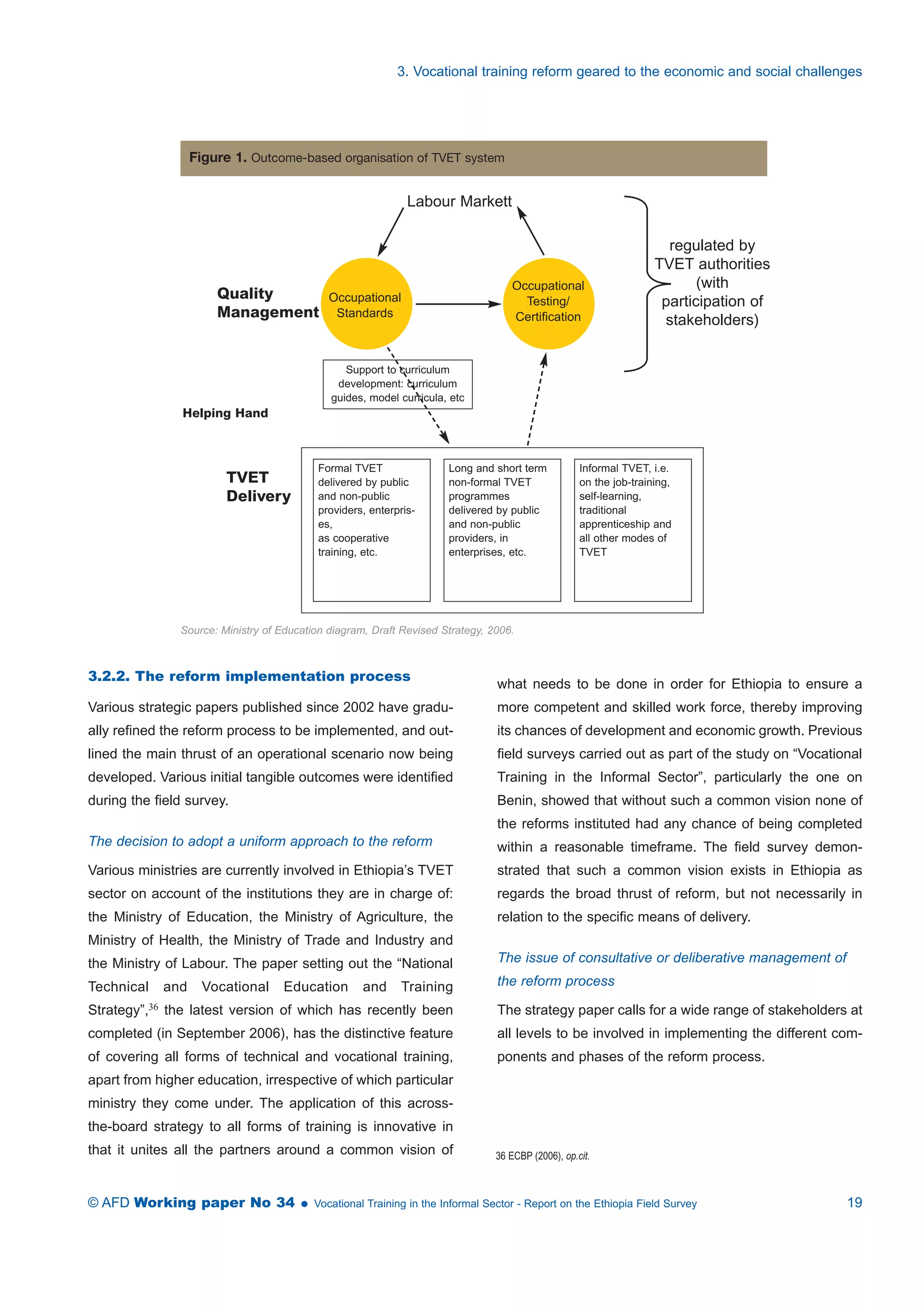
Figure 1 shows how the reform makes the transition from 
supply-driven training to demand-led training, notably tak-ing 
account of labour market needs. These needs are 
reflected in, and organised into occupational standards 
serving as a basis for the design of training curricula and 
various modes of formal, non-formal, workplace, on-the-job 
training and self-learning. If the system is to be successful, 
a quality-management approach should be adopted during 
the labour market analysis to ensure this is used effective-ly 
to draw up occupational standards, and to incorporate 
various forms of training into a service geared to the skills 
development needs of individuals and businesses. ` 
According to the strategic and operational reference docu-ments, 
delivery of the reform clearly calls for an overhaul of 
all existing training schemes so as to tailor them to the com-petencies 
and skills needed by the market, particularly in 
the micro- and small enterprise sector. These schemes also 
require institutional changes in line with the objectives to be 
achieved. In particular, all private and public, economic and 
social, and national and local partners must be involved 
both in developing new training content and modes of train-ing 
and in managing the overall training, assessment and 
certification system. 
© AFD Working paper No 34  Vocational Training in the Informal Sector - Report on the Ethiopia Field Survey 18
3. Vocational training reform geared to the economic and social challenges 
Figure 1. Outcome-based organisation of TVET system 
Labour Markett 
Occupational 
Standards 
Support to curriculum 
development: curriculum 
guides, model curricula, etc 
Occupational 
Quality 
Management 
Helping Hand 
TVET 
Delivery 
Formal TVET 
delivered by public 
and non-public 
providers, enterpris-es, 
as cooperative 
training, etc. 
Long and short term 
non-formal TVET 
programmes 
delivered by public 
and non-public 
providers, in 
enterprises, etc. 
Source: Ministry of Education diagram, Draft Revised Strategy, 2006. 
3.2.2. The reform implementation process 
Various strategic papers published since 2002 have gradu-ally 
refined the reform process to be implemented, and out-lined 
the main thrust of an operational scenario now being 
developed. Various initial tangible outcomes were identified 
during the field survey. 
The decision to adopt a uniform approach to the reform 
Various ministries are currently involved in Ethiopia’s TVET 
sector on account of the institutions they are in charge of: 
the Ministry of Education, the Ministry of Agriculture, the 
Ministry of Health, the Ministry of Trade and Industry and 
the Ministry of Labour. The paper setting out the “National 
Technical and Vocational Education and Training 
Strategy”,36 the latest version of which has recently been 
completed (in September 2006), has the distinctive feature 
of covering all forms of technical and vocational training, 
apart from higher education, irrespective of which particular 
ministry they come under. The application of this across-the- 
board strategy to all forms of training is innovative in 
that it unites all the partners around a common vision of 
regulated by 
TVET authorities 
(with 
participation of 
stakeholders) 
Testing/ 
Certification 
Informal TVET, i.e. 
on the job-training, 
self-learning, 
traditional 
apprenticeship and 
all other modes of 
TVET 
what needs to be done in order for Ethiopia to ensure a 
more competent and skilled work force, thereby improving 
its chances of development and economic growth. Previous 
field surveys carried out as part of the study on “Vocational 
Training in the Informal Sector”, particularly the one on 
Benin, showed that without such a common vision none of 
the reforms instituted had any chance of being completed 
within a reasonable timeframe. The field survey demon-strated 
that such a common vision exists in Ethiopia as 
regards the broad thrust of reform, but not necessarily in 
relation to the specific means of delivery. 
The issue of consultative or deliberative management of 
the reform process 
The strategy paper calls for a wide range of stakeholders at 
all levels to be involved in implementing the different com-ponents 
and phases of the reform process. 
36 ECBP (2006), op.cit. 
© AFD Working paper No 34  Vocational Training in the Informal Sector - Report on the Ethiopia Field Survey 19
3. Vocational training reform geared to the economic and social challenges 
The public authorities have opted for the greatest possible 
representation of stakeholders. The partners normally 
involved in consultation forums in other countries (min-istries, 
employers, trade unions and sector bodies) are 
included, but so are representatives of teachers, parents, 
local authorities, the beneficiaries and leading national 
communication agencies. As a result, some of the organi-sations 
met with during the survey, particularly employers’ 
organisations and trade unions, feel that their voices cannot 
be heard properly. The key consultation forums identified in 
the strategic paper are the national and regional commit-tees 
responsible for helping the authorities introduce the 
reform according to the main guidelines set. A number of 
those met mentioned the current debate over the proper 
nature of these committees: will they continue to serve as 
mere forums for expression and information sharing, or will 
they, as many seem to hope, be given genuine decision-making 
authority? It appears that employers, who have 
trouble finding the time and motivation to take part in these 
committees, will play an active role in them only if their func-tion 
is deliberative rather than purely consultative. 
The crucial need for a uniform approach to reorganising 
demand, supply and certification 
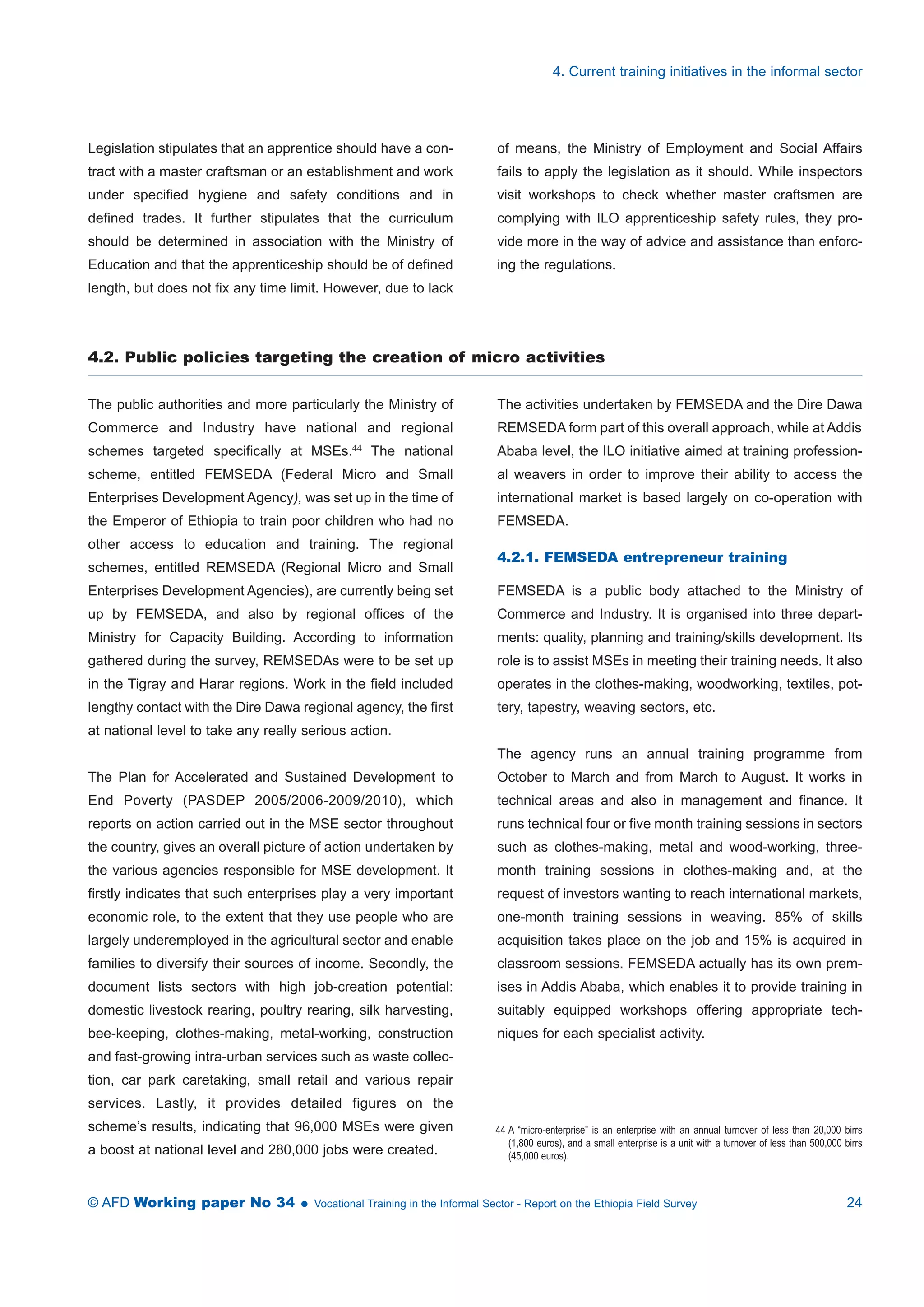
The fact that the reform focuses on outcomes (i.e. the com-petencies 
acquired and certified) has led to a complete 
overhaul of the training system by means of a process 
divided into interlinked phases in terms of both methodolo-gy 
and timeframe. This process may be described as fol-lows: 
 analysis of the labour market and business demands 
culminates in the setting of occupational benchmarks 
standardised at national level; 
 these benchmarks, which identify the competencies to 
be developed, serve as standards for the development 
of training curricula and quality management of the var-ious 
training mechanisms (formal, non-formal and infor-mal) 
introduced; 
 both training outcomes and competencies acquired on 
the job are assessed and certified in relation to the stan-dardised 
occupational benchmarks; 
 assessment and certification give access to recognised 
national qualifications, which are identical regardless of 
how they are gained (through training or the validation 
of competencies acquired on the job).37 
The reform project sets out procedures for implementing 
each of these phases. For instance, the task of analysing 
demand is described as being the joint responsibility of 
training centres and employers. The federal authorities are 
responsible for setting occupational benchmarks, although 
employers and trade unions must also be consulted and 
actively involved, and contributions must be sought from 
experts who are knowledgeable about the world of work. 
Curriculum development is assigned to experts within train-ing 
centres, whose sole obligation is to produce modular 
courses leading to the outcomes identified by the corre-sponding 
benchmarks.38 Assessment and certification, car-ried 
out on an independent basis at the Centres of 
Competence still to be set up, undoubtedly form the cen-trepiece 
of the entire reform. By assessing competencies 
rather than the knowledge acquired during training courses, 
the system as a whole can focus on the new target groups: 
as well as graduates of formal and non-formal training 
schemes, these include apprentices, workers trained on the 
job and, by extension, those employed in the informal sec-tor, 
many of whom have no educational qualifications other 
than proven occupational know-how. 
The field survey was able to verify that the reform imple-mentation 
scenario was not merely hypothetical, but had 
actually begun to take shape, particularly in the construc-tion 
sector, which is regarded as a priority. Some bench-marks 
for occupations in areas such as structural work, fin-ishing 
work and interior fittings have been finalised.39 While 
the curricula for these benchmarks are not yet finished, they 
are at least in the process of being completed. The experts 
37 The “Engineering Capacity Building Program, National Training Qualification Framework” 
paper gives a very clear picture of the overall qualification framework on which the current 
reform is based. As well as outlining the process of moving from labour-market analysis to 
certification by means of occupational benchmarks and assessment of the competencies 
acquired, it explains the different qualification levels: basic level, junior level, intermediate 
levels I and II (leading to certificates) and intermediate level (leading to a diploma). It 
shows that the qualification framework does not go beyond the recognition of technician-level 
diplomas, to use the terminology employed by the European Union. 
38 Although training centres are responsible for curriculum development, they receive initial 
assistance from the Ministry of Education. It sends them “model curricula” developed at the 
central level, which they can adopt and/or adapt according to their own situation and 
needs. 
39 According to the PASDEP, more than 50 occupational benchmarks had been set by the 
end of 2005. 
© AFD Working paper No 34  Vocational Training in the Informal Sector - Report on the Ethiopia Field Survey 20
3. Vocational training reform geared to the economic and social challenges 
responsible for testing and certifying them have received 
methodological training. All that remains is to set up the 
Centres of Competence at Entoto College in Addis Ababa. 
The centre’s development plan has been finalised, and 
methodologically speaking everything is in place. The cen-tre 
is not yet operational however, and some of the people 
we talked to expressed their impatience in this respect. In 
total, five or six Centres of Competence are to be set up 
throughout the country. 
The difficulty of developing dual-type training and/or 
apprenticeships 
The TVET system currently includes a form of training 
known as “apprenticeship”. It involves young people in 
grades 10+1, 10+2 and 10+3, that is, young people taking 
formal technical and vocational courses. It operates as fol-lows: 
 young people spend 70% of the school year, or 9 
months, being trained at the centre; 
 for the remaining 30% of the year, they are placed in 
firms. The firms are usually identified and selected by 
the training centre or college within its immediate eco-nomic 
environment. They are generally small or medi-um- 
sized enterprises forming part of the local economic 
fabric. 
In educational terms, work placements count for 22% of the 
overall assessment for the year. A number of those we 
spoke to told us that such placements are simply a form of 
work experience. According to the head of the Education 
Office in Addis Ababa, there are institutions that train busi-ness 
executives to become genuine apprenticeship mas-ters 

and thus to supervise young people on internships. 
Some of those institutions (including the college we visited 
in Dire Dawa) have stopped offering this type of training. 
The field survey found that this type of apprenticeship 
raised a number of problems in practice. Firstly, this is an 
inappropriate description in that it refers to the experience 
of working in a firm rather than a form of training alternating 
between theory and practice: in this sense, the word “intern-ship” 
would be far more appropriate than “apprenticeship”. 
Secondly, no reference is made to any kind of contractual 
relationship between employer and trainee, and the young 
person continues to be regarded as a school pupil through-out 
his or her time in the firm. Moreover, colleges have real 
difficulty placing young people in firms and/or finding intern-ships 
matching the technological and vocational content 
covered by the school syllabus. 
The reform of the TVET system includes the design and 
implementation of co-operative training courses.40 In prac-tice, 
the initial aim is to introduce a pilot dual training 
scheme in partnership with major Ethiopian public and pri-vate 
enterprises. The enterprises participating in the project 
will select the young trainees according to the skills they 
need. However, the plan is also for these enterprises to 
take partial responsibility for training young people who 
may be hired by enterprises not involved in the pilot phase 
or who start their own businesses. The TVET centres par-ticipating 
in the scheme will have to bring both their teach-ing 
quality and technological investment into line with the 
needs of enterprises. 
The project currently being launched provides for the subse-quent 
extension of the pilot scheme to MSEs and, in particu-lar, 
production and service units in the informal sector and co-operatives 
and training centres in rural areas. The document 
says that this second phase is particularly important because 
of the predominance of MSEs in the Ethiopian economy, the 
current reform’s key requirement to open the TVET system to 
a wide range of target groups, and the Government’s goal of 
significantly increasing the number of people trained in the 
vocational education and training system. 
It is unlikely that successful co-operative training in large, 
modern enterprises can be extended to the informal sector 
as it stands. At present, the reform plan does not provide for 
a significant investment in training for adult workers in 
MSEs, let alone in training for the heads of such enterpris-es 
to become “apprenticeship masters”, albeit only for 
those young people under their responsibility within the tra-ditional 
apprenticeship system. A comparison with the other 
countries surveyed shows that such investment is the only 
way to motivate professionals to take on young trainees 
40 ECBP (August 2006), Co-operative Training and Enterprise Training. 
© AFD Working paper No 34  Vocational Training in the Informal Sector - Report on the Ethiopia Field Survey 21
3. Vocational training reform geared to the economic and social challenges 
and involve them in an effective learning process. Training 
young people without giving adults already in work (many of 
whom are under-educated) the means to upgrade their own 
skills and thus to develop their careers engenders—as 
craftworkers in Benin put it—a sense of fear among adults 
vis-à-vis the growing influence of young people with greater 
skills, which can but be detrimental to the smooth develop-ment 
of on-the-job training. 
Figure 2. The phases of the reforms process 
Source: Richard Walther. 
3.2.3. The challenges of reform: moving from an 
institutional to a grassroots approach 
All the strategic and operational papers setting out and 
organising the different phases and key points in the reform 
process promise that the system will be opened up to those 
currently excluded from it, and that efforts will be made to 
involve its future beneficiaries. While target groups in the 
informal sector are seen for their true worth, with an accu-rate 
assessment of their situation, they are regarded as 
potential individual beneficiaries rather than possible asso-ciations 
set up to deal with economic, occupational or 
industrial processes. 
The various field surveys show that the institutional mind-set 
of vocational training practitioners when it comes to 
approaching people working in the informal sector is unlike-ly 
to motivate the latter unless representative associations 
are involved, be these territorial, vocational or sectoral or 
simply NGOs. The field survey in Ethiopia was unable to 
identify any highly structured organisations of informal 
workers. However, steps are already being taken to form 
groupings of stakeholders (which are mandatory in some 
cases, particularly as a prerequisite for obtaining micro-credit), 
networks of businesswomen, local, regional and 
national agencies for MSEs, sectoral associations linked to 
chambers of commerce and so on. A 2003 Ministry of Trade 
and Industry directive41 lists several dozen sectoral associ-ations, 
many of which are active in the informal sector. The 
directive has the distinctive feature, however, of attempting 
to organise and regulate—at the local, regional and nation-al 
level and in conjunction with chambers of commerce— 
organisations that exist first and foremost to represent 
workers at the grassroots level. 
In the light of a comparative analysis of training policies and 
practices in the informal sector in the various countries sur-veyed, 
it appears that the current TVET reform will be more 
effective and relevant if it is not confined to an excessively 
institutional approach, but brings on board all the collectives 
and associations represented in the non-structured econo-my. 
This means that the reform’s proponents must pay 
greater attention to the processes already at work in the 
informal sector and use them to underpin their efforts to 
enable the sector’s many workers to upgrade their skills. 
41 A Directive Issued to implement Proclamation No. 341/2002 of Chamber of Commerce 
and Sectoral Associations Council. 
© AFD Working paper No 34  Vocational Training in the Informal Sector - Report on the Ethiopia Field Survey 22
4. Current training initiatives in the informal sector 
Although it was easy to obtain all available information on 
training provided in formal establishments and on the broad 
outlines of current TVET reform, it was difficult to find out 
about training in the informal economy. There are several 
reasons for this: the information was scattered; few people 
work in this area; there is little communication among the 
various public and private agencies involved, and, although 
the matter is considered important, it is not a priority. 
The field survey did, however, identify a number of 
schemes and operators in the field. It was not always pos-sible 
to obtain full information or meet the people best 
placed to report on what has been done, but the information 
gathered provides the broad outlines of current training ini-tiatives 
in the sector. 
4.1. The reality of traditional apprenticeship – a difficult issue 
The Non-Formal TVET Implementation paper published 
recently as part of the Capacity Building Programme men-tions 
traditional apprenticeship in the MSE sector. 
According to this document, this sector includes employers 
or very often master craftsmen owning small enterprises in 
the crafts, services, repairs, transport or trade sectors. The 
latter make partial or full use of family members as unqual-ified 
workers or apprentices.42 
Despite this formal statement about the existence of tradi-tional 
apprenticeship, the field survey revealed little to con-firm 
the reality of its existence. Some people said that, in 
the light of the situation in Sub-Saharan countries, there 
was actually no traditional system established in crafts or 
services. Others said that there was only the school 
apprenticeship scheme offered in training establishments, 
involving work placements in businesses rather than the 
implementation of a well-balanced combination of class-room- 
based training and work experience. Others said that 
the term “apprenticeship” referred to the plans for designing 
and developing co-operative or dual-type training in associ-ation 
with the largest and/or best performing enterprises in 
the country. Lastly, the meeting with an official from the 
Ministry of Employment and Social Affairs made it possible 
to make a rapid appraisal of the training scheme for which 
it is responsible. The major features are as follows: 
 in Ethiopia, as in West African countries, skills are large-ly 
acquired within the family or neighbourhood. On this 
subject, it is worth noting that only 3% of young people 
go through the TVET system and that only 25% of pupils 
who complete primary education go on to secondary 
school. A 1999 survey recorded 12,100 apprentices 
while a 2005 survey recorded 85,622, of whom 26% 
were in the crafts production sector (such as woodwork, 
weaving, sewing and so on), the remainder being in the 
services sector;43 
 traditional apprenticeship is not an organised process: 
there is no curriculum, no training premises, no qualified 
trainers and no structured progression; 
 the main fields concerned are motor mechanics, main-tenance 
and crafts. 
42 ECPB (July 2006), Non-Formal TVET Implementation Framework. 
43 This data was obtained from the Ministry of Employment and Social Affairs. The 2005 sur-vey 
on employment and the active population indicates that apprentices represent 0.3% of 
the 31,435,108 people in work, namely a total of 94,305 apprentices. It also indicates that 
50.3% of employees are unpaid family members. Although such employees are not 
apprentices, it is clear that they learned their trade as they went along, since only a tiny 
number undertook vocational training. Since the Ministry has no clear picture of the reali-ty 
of what happens, it wishes to carry out a major study to establish the facts. 
© AFD Working paper No 34  Vocational Training in the Informal Sector - Report on the Ethiopia Field Survey 23
Legislation stipulates that an apprentice should have a con-tract 
with a master craftsman or an establishment and work 
under specified hygiene and safety conditions and in 
defined trades. It further stipulates that the curriculum 
should be determined in association with the Ministry of 
Education and that the apprenticeship should be of defined 
length, but does not fix any time limit. However, due to lack 
4. Current training initiatives in the informal sector 
of means, the Ministry of Employment and Social Affairs 
fails to apply the legislation as it should. While inspectors 
visit workshops to check whether master craftsmen are 
complying with ILO apprenticeship safety rules, they pro-vide 
more in the way of advice and assistance than enforc-ing 
the regulations. 
4.2. Public policies targeting the creation of micro activities 
The public authorities and more particularly the Ministry of 
Commerce and Industry have national and regional 
schemes targeted specifically at MSEs.44 The national 
scheme, entitled FEMSEDA (Federal Micro and Small 
Enterprises Development Agency), was set up in the time of 
the Emperor of Ethiopia to train poor children who had no 
other access to education and training. The regional 
schemes, entitled REMSEDA (Regional Micro and Small 
Enterprises Development Agencies), are currently being set 
up by FEMSEDA, and also by regional offices of the 
Ministry for Capacity Building. According to information 
gathered during the survey, REMSEDAs were to be set up 
in the Tigray and Harar regions. Work in the field included 
lengthy contact with the Dire Dawa regional agency, the first 
at national level to take any really serious action. 
The Plan for Accelerated and Sustained Development to 
End Poverty (PASDEP 2005/2006-2009/2010), which 
reports on action carried out in the MSE sector throughout 
the country, gives an overall picture of action undertaken by 
the various agencies responsible for MSE development. It 
firstly indicates that such enterprises play a very important 
economic role, to the extent that they use people who are 
largely underemployed in the agricultural sector and enable 
families to diversify their sources of income. Secondly, the 
document lists sectors with high job-creation potential: 
domestic livestock rearing, poultry rearing, silk harvesting, 
bee-keeping, clothes-making, metal-working, construction 
and fast-growing intra-urban services such as waste collec-tion, 
car park caretaking, small retail and various repair 
services. Lastly, it provides detailed figures on the 
scheme’s results, indicating that 96,000 MSEs were given 
a boost at national level and 280,000 jobs were created. 
The activities undertaken by FEMSEDA and the Dire Dawa 
REMSEDA form part of this overall approach, while at Addis 
Ababa level, the ILO initiative aimed at training profession-al 
weavers in order to improve their ability to access the 
international market is based largely on co-operation with 
FEMSEDA. 
4.2.1. FEMSEDA entrepreneur training 
FEMSEDA is a public body attached to the Ministry of 
Commerce and Industry. It is organised into three depart-ments: 
quality, planning and training/skills development. Its 
role is to assist MSEs in meeting their training needs. It also 
operates in the clothes-making, woodworking, textiles, pot-tery, 
tapestry, weaving sectors, etc. 
The agency runs an annual training programme from 
October to March and from March to August. It works in 
technical areas and also in management and finance. It 
runs technical four or five month training sessions in sectors 
such as clothes-making, metal and wood-working, three-month 
training sessions in clothes-making and, at the 
request of investors wanting to reach international markets, 
one-month training sessions in weaving. 85% of skills 
acquisition takes place on the job and 15% is acquired in 
classroom sessions. FEMSEDA actually has its own prem-ises 
in Addis Ababa, which enables it to provide training in 
suitably equipped workshops offering appropriate tech-niques 
for each specialist activity. 
44 A “micro-enterprise” is an enterprise with an annual turnover of less than 20,000 birrs 
(1,800 euros), and a small enterprise is a unit with a turnover of less than 500,000 birrs 
(45,000 euros). 
© AFD Working paper No 34  Vocational Training in the Informal Sector - Report on the Ethiopia Field Survey 24
Training is aimed at the informal, essentially crafts, sector. 
People can undertake the various training sessions without 
having any specific level of skills, with the exception of 
some, such as tapestry, wood-working and so on, which 
require level 10, which is in fact TVET Grade 1. 
Often, trainers in TVET centres or establishments do not 
have the practical capabilities required for organising train-ing 
schemes targeted at people in the informal sector. This 
means that, during the holidays, some of them attend train-ing 
sessions held in FEMSEDA premises. 
The agency runs training to help MSEs improve the way 
they launch or manage their business. It uses a training 
package for literate people, which has been designed and 
produced by ILO. For illiterate people, it uses a World Bank 
aid that is practical and very visual in design. It offers train-ing 
in creating and managing work. In each technical 
course, it also includes an introduction to management and 
entrepreneurship. All training sessions form part of an 
annual training plan. The 2006 plan relating to MSE man-agement 
provides a clear picture of the means implement-ed 
by FEMSEDA to launch and stimulate the informal sec-tor. 
Training plan objectives 
 to help individuals wishing to set up their own MSE to 
acquire the basic notions of economics; 
 to enable them to acquire the skills they need in order to 
launch a profitable and successful business; 
 to promote effective and high quality production and 
service units in their field of activity. 
Courses offered 
Courses organised at federal level come under the general 
title: “Develop a skills-based economic activity through 
business creation.” They aim to encourage participants to 
be self-critical, adopt an entrepreneurial approach and 
develop the ability to set up their own business. They are 
divided into three main types of training: 
 Starting Your Own Business. Training is intended to 
encourage informal economy workers to adopt an entre-preneurial 
attitude so that they know how to set up a 
4. Current training initiatives in the informal sector 
business, obtain the necessary start-up capital, draw up 
a financial plan, prepare a marketing plan, hire staff, 
produce and sell and, lastly, develop the business suc-cessfully; 
 Improving Your Business. The aim of the course is to 
help those who already have an established business to 
improve and modernise their management practices by 
developing their skills in the areas of market access, 
purchasing, stock control, financial and accounts man-agement 
and business planning; 
 Acquiring Basic Economic Skills. Following the example 
of what is offered in South Africa, the idea is to develop 
entrepreneurial attitudes and provide training in the fun-damental 
concepts of entrepreneurship, in order to 
enable participants to distinguish clearly between fami-ly 
and professional activities, to encourage them to 
keep a cash book and to acquire basic business plan-ning 
skills. 
All courses are based on active learning methods specifi-cally 
tailored to the needs of the people to be trained. They 
include discussion groups, role-playing, case studies, site 
visits, films and the analysis of good practice. 
These courses are aimed more particularly at people who 
want to launch or improve their business and, to this end, 
wish to develop their technical and managerial skills. Each 
course lasts five days and may be delivered as a one-week 
training package or as ten half-days of training. 
Fees are payable for all courses, except for those with min-isterial 
exemptions and those targeting strategic sectors 
such as clothes-making. The cost is 137 birrs per person, 
or 12 euros,45 when delivered on agency premises, and 86 
birrs, or 7.8 euros, when delivered off premises. When 
courses are run outside Addis Ababa, the cost is 127 birrs, 
or 11.5 euros. 
In 2005, the agency trained 800 people from the informal 
sector, including 500 in clothes-making, 150 in design and 
120 in the metal-working, wood-working and silk sectors. All 
of the people trained were selected for their ability to cas- 
45 Exchange rate at 4 October, 2006. 
© AFD Working paper No 34  Vocational Training in the Informal Sector - Report on the Ethiopia Field Survey 25
cade what they learned to other members of their local 
association or co-operative. 
4.2.2. The Dire Dawa REMSEDA’s integration 
and support role 
The Dire Dawa REMSEDA has been in existence for two 
years. The agency is really the institutional partner in an 
economic development project that already existed in the 
region. It currently comprises a planning and programming 
department and a research and development department, 
which are in turn subdivided into a piloting and support 
service and an MSE development training and promotion 
service. Other services are to be added, including a spe-cialised 
service to support those developing income-gener-ating 
activities, and an information and advice service to 
assist trained people in accessing the job market. At pres-ent, 
REMSEDA employs ten staff, soon to be supplement-ed 
by a number of experts specialising in the fields in which 
the agency is involved. The Dire Dawa REMSEDA is in fact 
the first operational regional agency. Consequently, people 
are always asking to visit it, and it often serves as an exam-ple 
to other agencies that are in the course of being set up. 
Strategic intervention areas 
The agency focuses its work on sectors forming part of the 
region’s economic strategy and which make a significant 
contribution to GDP, such as property development, public 
works (including road-building), food, textiles, arboriculture, 
etc. The agency works on the principle that there is a mar-ket 
for all of these activities. Construction is one of the 
areas in which the agency has invested most, particularly 
as the Government itself has issued calls for tenders in the 
above-mentioned areas of roads and property, and also in 
local agency creation and the building of schools, training 
centres and rural development centres. 
Local councillors, administrators and the various officials 
concerned, including those involved in education and voca-tional 
training, meet on a monthly basis. These regional 
steering groups enable the agency to intervene according 
to local development priorities and to play an effective role 
in integrating the working population of the informal sector 
into the job market. 
4. Current training initiatives in the informal sector 
The model for empowering people to find work 
REMSEDA runs a scheme that enables unemployed and 
unoccupied people to come together into groupings in order 
to work on public interest projects, before gradually devel-oping 
such projects into profitable activities. The scheme 
can be described as follows: 
 thanks to its fortunate public circumstances (financial 
resources and the availability of land to establish busi-ness 
parks), REMSEDA acts as an economic develop-ment 
and job agency. It supports the creation of associ-ations 
and co-operatives of young people and adults 
(with a maximum of 15 members) as part of works com-missioned 
by public authorities or forming part of the 
regional development plan. It helps these associations 
and co-operatives to set up production and services 
units on the public land made available. It sets up infor-mation 
and financial support offices as close to its busi-ness 
parks as possible, so as to give the groupings eas-ier 
access to public and private market opportunities. 
REMSEDA has thus enabled its members to bid for the 
construction of universities and enterprises, hospital 
catering services or the delivery of traditional food to 
local authorities. To date, REMSEDA has facilitated the 
creation of 220 co-operatives or associations, including 
63 in construction, 43 in food processing, 40 in metal-working, 
25 in waste disposal, 11 in clothes-making, 6 in 
wood-working, 5 in urban agriculture and so on; 
 REMSEDA helps to consolidate the work of associa-tions 
and co-operatives at a professional and financial 
level. It makes technical, financial and management 
training run by the Dire Dawa TVET College available to 
members of groupings. It helps them to obtain loans 
from micro-credit organisations by giving them assis-tance 
in drawing up their development plan. To date, 
over 2,500 groupings have benefited from loans of up to 
20,000 birrs (about 1,800 euros).46 It provides machin-ery 
suited to their professional needs and compliant 
with technical standards, and advises them throughout 
the business development process; 
46 Recently the Government decided to guarantee loans from micro credit organisations (to 
the tune of 212 million birrs, which is about 19 million euros). This will make it possible to 
provide MSEs with loans of 50,000 to 100,000 birrs (about 9,000 euros). 
© AFD Working paper No 34  Vocational Training in the Informal Sector - Report on the Ethiopia Field Survey 26
lastly, REMSEDA promotes structured co-operation 
between MSEs. It helps enterprises to organise trade 
fairs that enable them to compete with private industry 
products, to sell goods and to position their products to 
meet export market demand. The agency invited 
Djiboutian entrepreneurs to fairs that it organised so 
that they could help Dire Dawa MSEs to evaluate the 
quality of their products in the face of international com-petition. 
REMSEDA also helped to bring together exist-ing 
groupings in order to create sector associations. It 
set up a production and service unit forum with a view 
to transferring the responsibility for the creation of such 
associations to members of the forum. The idea is that 
forum members analyse opportunities for creating larg-er 
groupings, express their joint training needs and, if 
possible, respond jointly to invitations to tender. 
Training activities organised 
There have been many of these and they have improved 
technical skills in all sectors: construction (1,012 people), 
metal- and wood-working (682 people), sewing and textiles 
(444 people), urban agriculture (430 people), food process-ing 
(411 people), and so on. Training also addressed man-agement 
and entrepreneurial skills (4,387 people). Over a 
period of two years, a total of 12,935 of the working popu-lation 
in the informal sector have received training. It is dif-ficult 
to evaluate the impact of such training, especially 
since it forms part of overall measures to achieve progres-sive 
integration into jobs and stable employment. But the 
fact that during the same period, 13,056 people found per-manent 
or temporary employment demonstrates that such 
training is at the very least an effective support in the over-all 
process of entry into the world of work. 
An example of job creation: cutting cobblestones for 
paving roads 
The field survey visited several sites, including one where 
cobblestones were being prepared for building or repairing 
Dire Dawa’s roads and pavements. This site has the fol-lowing 
features: 
 it encompasses all manufacturing stages of the final 
product (a 10cm-sided cobblestone), including the quar-riers 
(from outside the Dire Dawa region), the lorry driv-ers 
4. Current training initiatives in the informal sector 
bringing the stone to town, the various stone-cutters 
who rough-hew the stone, break it into semi-finished 
and then finished blocks and those who lay the cobble-stones 
to make the roads and pavements. (This is a 
long and complicated process requiring project-type 
organisation that manages each stage from the original 
product to the final stages of hewing and laying. It can 
be successfully completed only through effective man-agement 
of the various stages involved in production, 
from the very start to the finished product); 
 it operates as a commercial organisation to the extent 
that the producers involved in each stage are set up as 
profit-making companies, buy a product at a certain 
stage of production, work on it in accordance with pre-determined 
standards and then sell it after having cal-culated 
the added value and the profit to be distributed 
to each stone-cutter and layer. The work site assumes 
de facto that there are a series of commercial compa-nies 
demanding both management and financial skills 
from members; 
 from the discussions held, it emerged that the scheme 
has a significant effect on those involved. It enables 
them to acquire skills (quarrying, stonecutting and lay-ing); 
it makes them comply with standards and dead-lines, 
and lastly, it encourages them to manage their 
part of the work in accordance with precise and clear 
financial and accounting rules. So it includes both 
apprenticeship in a trade and apprenticeship in the 
basic concepts of business management. 
The young people interviewed showed an in-depth knowl-edge 
of the entire process of production and marketing and 
confirmed that it was a valuable learning experience. 
Several were motivated to organise themselves further, and 
were able to develop their work into other areas and func-tions. 
There is no doubt that the Dire Dawa REMSEDA scheme, 
spanning the creation of associations and co-operatives 
promoting integration into the world of work through to their 
consolidation into micro- and small production and service 
enterprises, serves as model for development aid. It com-bines 
public intervention with job creation, promotes social 
and vocational integration and the acquisition of financial 
© AFD Working paper No 34  Vocational Training in the Informal Sector - Report on the Ethiopia Field Survey 27
and entrepreneurial independence, and, finally, helps sup-port 
activities and the creation of enterprises capable of 
developing in such a way as to help lift people out of pover-ty. 
The field survey was to have highlighted the training activi-ties 
benefiting Addis Ababa MSEs. However, as the person 
responsible was absent at the time of the interview, this was 
not possible. According to the experts met, there would 
seem to be some training aimed at job creation, in particu-lar 
for young people in the capital, with these youngsters 
undertaking to cascade what they learn to members of their 
association or co-operative. 
4.2.3. The Addis Ababa weavers’ training pro-ject 
(ILO) 
As part of the survey, the meeting with the ILO established 
a close concurrence of opinion between the aims of the 
study on training in the informal sector and the ILO’s poli-cies 
in the field. Thus the “Resolution concerning decent 
work and the informal economy” passed at the 90th session 
of the ILO’s general meeting emphasised that “many peo-ple 
working in the informal economy have real business 
acumen, creativity, dynamism and innovation and such 
potential could flourish if certain obstacles were removed.” 
Similarly, an internal document on how to raise the level of 
the informal economy47 emphasises that any such efforts 
cannot happen without raising the skills level of workers in 
the informal economy. 
The meeting also provided an opportunity to learn about the 
means which the ILO was making available to Ethiopians 
working in the weaving sector. 
Project objectives: accessing the international market 
The project formed part of a co-operative arrangement 
between the ILO and the Ethiopian Government within the 
national programme for promoting decent jobs. Given that 
the programme aimed to promote sustainable development 
and reduce poverty, the ILO identified cotton, textiles and 
more broadly clothes-making as priority sectors, following 
the end of the 1974 multi-fibre agreement. Specific studies 
had in fact demonstrated the benefits of incorporating this 
sub-sector into the national value chain48 and identified that 
4. Current training initiatives in the informal sector 
this integration required improved technical skills in weav-ing 
and in management capabilities as a pre-requisite for 
greater market access and increased financing. 
In concrete terms, the aim of the current project is to train 
weaving MSEs with a view to enabling them to achieve the 
following objectives: 
 gain access to improved means of finance; 
 acquire suitable premises and new-generation looms; 
 open production to the international market by exploiting 
new niches in the national market; 
 improve working conditions; 
 update products and the production process. 
Project stages: training at all skill levels 
The project aims to train sector workers at various levels. 
 Basic level: acquisition of elementary weaving skills. 
This training is for people who want to work in the weav-ing 
trade but who have not had the opportunity to learn 
the skills through traditional apprenticeship schemes. 
 Intermediate level: improving existing skills. For people 
who already work in the weaving trade, this is designed 
to give them the ability to produce goods of the neces-sary 
quality and quantity required by the international 
market. This training lies at the heart of the project, to 
the extent that its purpose is to integrate home workers 
into standardised production processes at global level 
and to make them able to respond to the specifications 
of international buyers. 
 Specialised level: training in the design of new products. 
There is no doubt that the Ethiopian weaving and 
clothes-making sector will not be able to develop unless 
it produces clothes that conform to the demands of 
international fashion, which requires the radical updat-ing 
of existing products and usual production methods. 
This training is aimed at a limited number of designers 
47 The document aims to define routes for the gradual formalisation of the informal economy 
and sets as an objective for the next ten years the elimination of all legislative, economic 
and administrative factors that foster the existence of the informal economy. 
48 In the internal project presentation document (Technical Cooperation Summary Project 
Outline), the ILO defines the value chain as all the activities required for creating a prod-uct 
or service from its design to delivery. It stresses that the challenge in this particular 
case is to improve the competitiveness and effectiveness of the entire value chain, with the 
aim of supporting jobs creation and boosting economic growth. 
© AFD Working paper No 34  Vocational Training in the Informal Sector - Report on the Ethiopia Field Survey 28
and clothes-makers who will act as the link with interna-tional 
market aspirations and specialise in the ranges 
demanded by this market. 
 Specialised level: training in the design of new woven 
products. This is to train clothes-makers to produce the 
new ranges created by the designers, in accordance 
with standards, and to adopt the new weaving and 
clothes-making techniques demanded by this market. 
The purpose of these various training courses is not to 
replace existing training but to support what already exists 
by complementing and improving it. They will be run in 
association with FEMSEDA, the priority being to support 
both enterprises and private providers, in particular NGOs. 
It is all about using training to foster the growth of sustain-able 
production capable of providing jobs, while at the same 
time accessing international market outlets. 
Fees will be payable for the training, although the ILO pro-vides 
financial support, particularly in the acquisition of 
basic skills, to people who cannot afford their training. 
Expected results: integration of the informal economy into 
a buoyant market 
The overall aim of the project is to encourage job creation 
in the informal sector, refocus public and especially private 
training on demand and on the issues facing the weaving 
and clothes-making sector, facilitate access for all enter-prises 
to invitations to tender and market opportunities, and 
develop a favourable legislative and administrative environ-ment 
in the informal sector for creating decent jobs. 
More concretely, it aims to achieve the following results: 
 evaluate the training currently available in Addis Ababa 
in the field of basic skills and, depending on the gaps 
identified, improve the content, the training of trainers 
and apprenticeship methods; 
 carry out a similar evaluation at intermediate level, in 
design training and in the use of new techniques, and 
create and test, where necessary and in association 
with professionals in the sector, curricula and training 
methods appropriate to the objectives set and the meth-ods 
of certification required. 
4. Current training initiatives in the informal sector 
The overall project proposes to run dual-type training and 
entails major educational work on vocational apprentice-ships 
and on upgrading host enterprises with regard to the 
quality and production standards demanded by internation-al 
competition. This means that the project will succeed 
only if all the partners involved (sector professionals, train-ing 
providers, exporters, weaving, clothes-making and 
design technology experts, and so on) work together for the 
success of the operation. 
The current project has the great advantage of combining 
elements likely to stimulate training in the informal sector: 
intervention targeted specifically at people in MSEs, skills 
development linked to the production of goods and servic-es 
complying with international standards, the involvement 
of professionals and training providers in the process of 
skills development and, lastly, a sustainable development 
project that will gradually equip MSEs in the informal sector 
with recognised skills and a real capacity to access nation-al 
and international markets. 
All these elements suggest that it will be worthwhile and 
indeed important to evaluate the results obtained as the 
project progresses. This will provide matter for reflection 
and analysis regarding the contribution training can make to 
the economic success of the informal sector. 
4.2.4. On-site training for MSEs in the building 
sector (GTZ) 
Germany, or more precisely the GTZ, assumed project 
ownership of the construction by the Ethiopian Government 
of the university of Dire Dawa. The university is to admit its 
first students in autumn 2006 and, when completed, will 
have the capacity to accept about 10,000 students. A fea-ture 
of the site is that it is a sort of “on-site school” for many 
MSE sub-contractors involved and for young people from 
TVET colleges who are on vocational placement there. 
Training combined with on-site experience 
Every day, employees of small enterprises working on the 
building site receive training given at the end of the day by 
the German person in charge. This trainer is specifically 
charged with raising skill levels among the many MSEs 
involved, with the support of an Ethiopian manager who 
© AFD Working paper No 34  Vocational Training in the Informal Sector - Report on the Ethiopia Field Survey 29
acts as interpreter when necessary, and ensures that 
everyone understands the information conveyed. The train-er 
starts from the work done every day, takes concrete 
examples from the moulding and drying of bricks, the pour-ing 
of concrete screed or the erection of partitions or walls. 
From such working situations, he goes back over measure-ment- 
taking, shuttering techniques, new concrete finishing 
standards and, using these examples, he tries to gradually 
improve the quality of the work and the techniques used. 
The entire process of alternating between theory and prac-tical 
application is in keeping with the experience of build-ing 
construction. The various training sessions give rise to 
evaluations and, in the end, are incorporated into a certified 
training curriculum. Workers trained in this way can improve 
their vocational qualifications while working on the job, and 
they emerge finally with a higher level of vocational skills. 
The difficult link between training, cultural tradition and 
innovation 
The site visit enabled discussion with the project owners on 
the limits of this training initiative as a form of apprentice-ship 
in modern construction techniques. One of the prob-lems 
encountered is the resistance of the enterprises on 
site to the application of present day construction proce-dures. 
This resistance concerns the concrete shuttering 
and is evidenced by the workers’ refusal to discontinue the 
widespread Ethiopian practice of using oil to obtain smooth 
concrete (using it means that paint cannot be applied direct-ly 
to the surfaces underneath the shuttering) and of scratch-ing 
the surfaces with a view to applying a roughcast onto 
which the paint will be applied. It also concerns shuttering 
techniques (single-use wooden shuttering, as opposed to 
reusable shuttering) and the transportation of cement or 
mortar (strong resistance to using wheelbarrows instead of 
traditional carrying methods). 
4. Current training initiatives in the informal sector 
The reasons for keeping to tradition at all costs are low-budget 
contracts that do not specify technical constraints, 
but perhaps, at an even deeper level, there is the weight of 
tradition: “we’ve always done it like that, so why change 
something that works?” This poses the problem not only of 
the relationship between training, tradition and technologi-cal 
innovation, but also of how to implement the means and 
methodologies for acquiring skills that integrate resistance 
to cultural change as an inevitable dimension in the qualifi-cation 
process. Whatever the answers to these problems, 
the solutions cannot ignore the fact that training on its own 
cannot overcome the resistance to change and that specif-ic 
approaches to taking innovation on board in a cultural 
context have to be designed and implemented. 
The field survey’s pinpointing of the actions taken to bene-fit 
informal MSEs is inevitably limited. It suffices, however, 
to highlight the importance given by the federal and region-al 
authorities (FEMSEDA and REMSEDA) and internation-al 
organisations (ILO and GTZ) to developing such enter-prises. 
They are actually alone in being able to integrate 
very many young people and adults into the world of work 
and, more fundamental still, to foster the dynamics of effec-tive 
local development. The examples recorded demon-strate 
that well-structured integration and training can lead 
to job creation and stable employment and thus help the 
population to rise above mere survival level and give hope 
for a standard of living that is above the poverty threshold. 
They also emphasise the fact that there are buoyant sec-tors 
in which job creation and employment can go beyond 
the local market and access production and service levels 
suited to the national and international markets. But this is 
possible only on the condition (achieved by the Dire Dawa 
region) that support for income-generating job creation and 
the fight against poverty is incorporated into a sustainable 
economic and social growth strategy and, in the medium 
term, clearly defined together with all the stakeholders 
involved. 
© AFD Working paper No 34  Vocational Training in the Informal Sector - Report on the Ethiopia Field Survey 30
4.3. The strategic role of women in the informal sector 
The field study made it possible to widen the scope of the 
initiatives launched in the informal sector to include training 
and start-up activities promoted by women’s associations. 
There is no doubt that Ethiopian women’s associations play 
a significant role in the informal sector. This has been evi-denced 
by PASDEP, which stresses not only the strategic 
role women play in the development of the country, but also 
the need to improve labour market access for women in 
order to achieve this development. The initiatives are all 
funded or supported by donors and international develop-ment 
aid and support agencies. 
4.3.1. The ILO survey and the profile of women 
entrepreneurs 
The ILO study (2003) entitled “Ethiopian Women 
Entrepreneurs: Going for Growth” also showed women’s 
positive impact on development in the country. From the 
sample studied, it found that 123 women entrepreneurs had 
created 852 jobs for their immediate families and relatives. 
This included 596 full-time jobs, with an average 4.8 jobs 
per enterprise. Previously, about 70% of these women had 
been either employed in the informal sector or simply 
housewives. Most of the women had to draw on personal or 
family resources to launch their enterprises. These are in a 
wide variety of sectors, such as services, commerce, pro-duction 
and handicrafts. One of the characteristics of these 
activities is that they all address the local market, and more 
specifically the local community market. Another is that 
almost 90% of the women interviewed said they found 
working on their own account immensely satisfying, while 
75% said they would not want to leave their current work for 
a permanent job. 
4.3.2. Dire Dawa Women Entrepreneurs 
Association (DDWEA) 
This association was created in 2000. It has today 250 
members, most of whom are MSEs. The executive commit-tee 
meets once a month to determine members’ training 
needs. About 300 women entrepreneurs are trained each 
year, and the number of requests for training is on the 
increase. 
4. Current training initiatives in the informal sector 
DDWEA aims to provide training both in technical skills and 
in those related to enterprise management and develop-ment. 
Training programmes thus cover a wide variety of 
areas including: textiles, clothes-making, food processing, 
urban agriculture, business management and entrepre-neurship, 
financial management, communication and mar-keting. 
Training sessions last about eight days and are run 
by an outside consultant specialising in the relevant field. 
While the majority of requests for training focus on entre-preneurship 
(three sessions are organised during the year), 
the types of training that have the most immediate impact 
are those in clothes-making, food processing and vegetable 
growing. 
DDWEA operates in the informal sector in the sense that its 
members are micro-enterprises working in the local market 
essentially for local customers. There is a membership fee 
of 5 birrs (or 0.45 euros) per month. DDWEA is financed 
largely through member contributions, although it also 
attracts financial aid from the European Union, USAID, the 
Friedrich Ebert Foundation and other international donors. 
The total annual budget is 151,946 birrs (or 13,700 euros). 
The cost of training per person is in the region of 1,000 birrs 
(or 90 euros). 
DDWEA does not appear to make a very detailed analysis 
of its members’ training needs or of the impact of its work. 
Nevertheless, the fact that the Dire Dawa women entrepre-neurs 
have decided to join forces to provide skills training 
relevant to their expanding activities gives an indication of 
the success of the action plan. 
4.3.3. Dire Dawa Women’s Association (DDWA) 
DDWA, which was founded in 2004, has 5000 members 
and 9 local groups. Its financial resources come from mem-bership 
fees and the financial support given by Pathfinders 
International. The aim of the association is to help HIV-pos-itive 
women and prostitutes develop income-generating 
activities. To this end, it has set up “Singer workshops” (so 
named after the German sewing machines), which are 
workshops for producing items of clothing. The women 
receive practical training in making clothes specifically for 
© AFD Working paper No 34  Vocational Training in the Informal Sector - Report on the Ethiopia Field Survey 31
the local market, and other training in sales, accounting and 
business management. All the training is provided by the 
TVET College visited during the survey. 
The second strand of the action plan takes the form of an 
awareness campaign designed to help the women involved 
in the income-generating activities both to come to terms 
with their condition and change their behaviour. Members of 
DDWA thus go from home to home and urge women who 
have AIDS to accept the fact and agree to treatment. They 
give the women instruction in bottle-feeding to prevent the 
children from contracting the disease through their mother’s 
milk, and put the women in contact with organisations spe-cialised 
in treating AIDS so that they have better access to 
medical care. The women are also taught to respect certain 
rules of hygiene when carrying out domestic tasks. 
DDWA has 20 social care workers who have been trained 
to assist women in need. A principle central to DDWA’s 
mode of operation is mutual training: in other words, a 
woman trained by the association agrees either to pass on 
to another what she has learned, or to take part in an 
awareness-raising campaign for women needing assis-tance 
or support. The action plan is an excellent example of 
how social and economic integration can be achieved. 
4.3.4. A training programme for empowering 
women 
The Integrated Programme for the Empowerment of 
Women, a pilot programme developed by the Institute for 
International Co-operation under the aegis of the German 
Institute for Adult Education (IIZ/DW),49 is an integral part of 
the country’s overall development strategy. It aims to pro-vide 
capacity-building support for poor women and their 
families by combining three types of action: 
 adult literacy programmes; 
 training to promote income-generating activities; 
 training in entrepreneurship focusing on management 
skills and funding opportunities for starting up a manu-facturing 
or service enterprise. 
The project, which began in July 2006, is planned to last for 
five years and funded by the Dutch Embassy in Ethiopia. Its 
main target groups are poor women and their families 
4. Current training initiatives in the informal sector 
(including husbands), women trainers in existing training 
centres, key persons in administrative departments and 
NGOs directly involved in support programmes for women, 
persons in regional offices with special responsibility for 
education and women’s affairs, and trainers in TVET 
Colleges. 
Women in key positions or responsible for the operational 
delivery of support programmes for poor women will be 
given introductory briefings on the contents and methods of 
the different types of training delivered. Special emphasis 
will be put on the conditions necessary for successfully 
completing action plans aimed at helping women to devel-op 
income-generating activities. 
The contents of the training programmes will be based on 
both the educational level of the women concerned and an 
assessment of the economic potential of the local market. 
All the programmes will offer training in enterprise develop-ment, 
group training on opportunities and procedures for 
starting up income-generating activities, and access to 
micro-credit. 
The complete training course will last a minimum 360 hours 
spread over three years. It will be organised to take into 
account the women’s particular circumstances: work-load, 
the seasonal character of their work, and their family 
responsibilities. The three basic components of the action 
programme (functional literacy, the acquisition of practical 
skills for career development in a given sector, and facilitat-ing 
the transition from learning to working situations through 
access to micro-credit) will be tailored to the women’s spe-cific 
needs. Financial aid for start-up operations will be 
available through a special fund but subject to certain con-ditions: 
the women should be able to read, write and count, 
and demonstrate that they are capable of managing an 
income-generating enterprise and keeping accounts. 
The action plan will be closely monitored. A national steer-ing 
committee will be set up and have special responsibili-ty 
for co-ordinating the umbrella project at the regional and 
local level. It will keep a particular watch on programmes at 
49 Institut für internationale Zusammenarbeit des Deutschen Volkshochschul-Verbandes, 
which aims to promote education in the informal sector in East Africa. 
© AFD Working paper No 34  Vocational Training in the Informal Sector - Report on the Ethiopia Field Survey 32
the local level to make sure that these work with rather than 
simply add to other projects initiated by government organ-isations, 
NGOs, local or regional women’s associations, 
and other local community or religious groups. The project 
will also benefit from the assistance of a panel of experts 
4. Current training initiatives in the informal sector 
who will evaluate the actions and their results and provide 
relevant support for achieving overall aims. 
The total budget (8,215 euros) should enable the project 
to achieve its objectives. 
4.4. Varied experiences from the world of agriculture 
The field survey failed to identify exhaustively what training 
had been carried out in the agricultural sector. However, the 
PASDEP presentation did shed light on the official reports 
produced by the Ministry for Finance and Economic 
Development. Secondly, and thanks to the German devel-opment 
agencies, it was possible to pinpoint the difficulties 
encountered by rural area training centres in providing 
training tailored to the needs of local people. Lastly, it pro-vided 
an opportunity to visit a technical and vocational body 
that is developing innovative co-operative training 
approaches among farmers. 
4.4.1. The highly informal nature of employment 
in rural areas 
86% of Ethiopia’s working population lives in rural areas, 
although not all of them are employed in agriculture. 
Breaking down the working population into job categories50 
actually reveals that qualified workers in agriculture and 
fishing account for 44.5% of the working population, while 
those in services and crafts total 10%. The remainder are 
identified under the term “elementary jobs”, a term that 
refers to day labourers in the construction or mining indus-tries 
and agriculture. It is therefore impossible to establish 
how many of the working population are employed exclu-sively 
in agriculture or related activities, with the exception 
of skilled workers. 
Comparative analysis of workers in rural and urban areas 
by job type reveals a very homogeneous labour market 
structure as regards freelance or self-employed workers, 
who represent 40.3% and 41% of the overall labour force 
respectively. It indicates that domestic jobs are much high-er 
in rural areas (54.6%) than in urban areas (15%). Given 
that such jobs are very characteristic of a non-structured 
economy, it can be concluded that statistical analyses car-ried 
out on the informal urban sector take only very partial 
account of informal economic activity in Ethiopia. Moreover, 
any action taken to foster the creation of income-generating 
activities, as well as MSEs, must take account of not only 
agricultural and rural production and services units, but also 
urban production and services units. 
4.4.2. Training farmers and agricultural deve-lopment 
officials 
According to the report drawn up by PASDEP, the policy 
implemented by the Ministry of Agriculture consisted of a 
programme (still in progress) of intensive training for farm-ers 
and rural development officials. It has led to the net-working 
of agricultural training centres and then to the deliv-ery 
of training curricula designed for practical use in these 
centres. Thus, depending on the type of local crop and 
activity, the various centres provide information and day-to-day 
help to farmers in the surrounding area, and serve as 
demonstration sites for certain types of crop-growing or ani-mal 
husbandry (such as bee-keeping or vegetable produc-tion). 
In more concrete terms, the centres run 2- or 3-month train-ing 
modules to help farmers adopt technologies and spe-cialist 
techniques, such as cultivation using irrigation or silk-worm 
breeding. At a broader level, the various education 
and training establishments are currently training 55,000 
development agents. 45,000 are to be placed in agricultur-al 
training centres to provide direct support to farmers, 
5,000 will operate in the veterinary field and 5,000 will pro-vide 
support to existing co-operatives. At the end of 2005, 
23,000 of these agents had obtained their qualification and 
were placed in centres. 
50 Labour Force Survey (2005), Op.cit. 
© AFD Working paper No 34  Vocational Training in the Informal Sector - Report on the Ethiopia Field Survey 33
During the course of the survey, it was impossible to evalu-ate 
the results of the entire programme. Some of the peo-ple 
met expressed doubts about the effectiveness of the 
training, because it focused more on transferring knowl-edge 
to farmers than really helping them acquire opera-tional 
skills. 
4.4.3. Training the rural population in communi-ty 
skills training centres (CSTC)51 
Agricultural training centres are not the only training facili-ties 
available in agricultural areas. An analysis of training 
facilities in the Oromiya52 region, one of the largest in 
Ethiopia, indicates that it has 38 training establishments 
offering technical education and vocational training at level 
10+1 and 10+2 in 20 different trades, 11 agricultural train-ing 
centres, 6 health training centres and 154 CSTCs. The 
latter, offering informal type training, are aimed primarily at 
young people excluded from the school system and adults 
from rural areas. They are currently being reformed and 
should eventually be better integrated into the overall voca-tional 
training provision. 
What are CSTCs? 
At present, it is difficult to understand the role of CSTCs 
without knowing their history. The first community centres 
were created in 1976, when the public authorities first 
launched a massive literacy campaign. Initially, CSTCs 
were set up at woreda53 level in order to foster integrated 
rural development. The objectives may be defined as fol-lows: 
 to introduce and disseminate technology suited to the 
needs of the rural community, particularly farmers; 
 to improve backward agricultural practices through 
appropriate training schemes; 
 to train members of the local community and enable 
them to acquire the skills they need in order to do their 
job; 
 to operate as a resource centre for the population con-cerned. 
The initial plan had been to create a CSTC in each woreda. 
According to available data, 404 were operational at the 
beginning of the 90s. Under the administrative responsibili-ty 
4. Current training initiatives in the informal sector 
of the district, the centres were run jointly by the various 
sectoral managers, namely for education, health and agri-culture, 
with the education office running the establishment. 
However, it very soon became apparent that co-operation 
among the various administrations was not producing the 
anticipated results, and the CSTCs gradually became 
directly dependent on the financial and human resources of 
the woredas. 
It is in this context that the CSTCs delivered training to peo-ple 
in rural areas. According to the data gathered, training 
provision was either very limited (for example, 25 people 
trained per year in the Oromiya region) or unsuited to the 
needs of the local job market. According to Ministry of 
Education data, the CSTCs trained 100,000 adults between 
1978 and 1991, with the majority being farmers in rural 
areas. 
The EXPRO project or the setting up of model CSTCs 
focussing on job creation training 
In 2002, the Institute for International Co-operation of the 
German Adult Education Association (Institut für 
Internationale Zusammenarbeit des Deutschen 
Volkshochschulverbandes - IIZ-DVV) decided, with special 
funding from the German Ministry for Economic Co-opera-tion 
and Development (Bundesministerium für 
wirtschaftliche Zusammenarbeit - BMZ), to set up a non-for-mal 
training project, entitled EXPRO,54 which focuses on 
the creation of subsistence activities. The aim of the project 
was to breathe new life into the CSTCs in various geo-graphical 
and socio-economic contexts and to develop a 
new centre model based on vocational training able to 
encourage the people trained, especially in rural areas, to 
create income-generating jobs. EXPRO was involved in the 
2015 Action Programme set up by the German Government 
in 2001 with a view to helping Ethiopia combat poverty and 
51 Information on CSTCs or Community Skills Training Centres is taken from the IIZ-DVV 
paper (2005), Poverty Reduction and Capacity Building through Livelihood Skill Training at 
CSTCs and VTCs, Internal Paper No.33. 
52 Oromiya Regional State, TVET Commission (2003), Regional Technical and Vocational 
Education and Training (TVET) Policy. 
53 A woreda is an administrative sub-division in Ethiopia equivalent to a district. A woreda is 
itself divided into kebeles which correspond in size to an urban area or a delimited rural 
area. 
54 Bernd Sandhaas, IIZ/DVV, (2004), Community Based Non-formal Livelihood Skills 
Training for Youth and. Adults in Selected Regions of Ethiopia. 
© AFD Working paper No 34  Vocational Training in the Informal Sector - Report on the Ethiopia Field Survey 34
achieve the Millennium Goals. It was also in line with the 
second Education Sector Development Programme (ESDP 
II) run by the public authorities for the 2002-2005 period, 
the aim of which was to deliver basic training in 43 new 
CSTCs to 65,000 young people and adults who did not 
have the ten years of schooling required to access TVET, or 
who often had no education at all. 
The current project has the following objectives: 
 to raise awareness among decision-makers, involved 
NGOs and national, regional and district level commu-nity 
organisations as to the need and opportunities for 
training young people and adults through non-formal 
education; 
 to develop and/or modify non-formal training pro-grammes 
delivered by the CSTCs, functional literacy 
programmes for adults and similar initiatives, with a 
view to effectively meeting the needs of the target pop-ulations; 
 to provide training for CSTC trainers and administrative 
staff to help them to plan, implement and evaluate adult 
education programmes and projects focusing on 
demand and income generation; 
 to select a small number of community centres, voca-tional 
training centres and agricultural centres in specif-ic 
regions in order to make them service delivery mod-els 
with acknowledged non-formal training programmes 
focusing on demand and income generation for young 
people and adults; 
 to set up, in various public, private or community centres 
in rural areas especially, model functional adult literacy 
(FAL) projects and strengthen co-operation between 
regional and local governments/administrations on the 
one hand, and the public authorities and NGOs on the 
other. 
The project also set up a work programme based on aware-ness- 
raising among decision-makers and managers on 
non-formal training issues, on their involvement in the vari-ous 
district and establishment councils, and on the involve-ment 
of target groups and their communities in the design 
and delivery of the training. It promoted working method-ologies 
4. Current training initiatives in the informal sector 
and assumptions, such as the use of participative 
rural problem identification, participative project planning 
and market analysis prior to training needs assessment. 
Training was targeted at subsistence jobs and the people 
keen on doing them. At the same time, the project advocat-ed 
access for these people to sufficient loans to support the 
creation of income-generating jobs, as well as strengthen-ing 
analytical capacity, training and dialogue among the 
stakeholders responsible for implementing the entire 
scheme. 
The project also defined the conditions under which a cen-tre 
had the opportunity to develop and deliver job creation 
training. It also defined ten criteria or conditions for effective 
delivery: the need to complete a prior analysis of the cen-tre’s 
situation, the surrounding job market, training needs 
and available human and technical resources; rooting the 
training in an annual training programme and establishing 
clear selection procedures and criteria for the target group 
and qualified trainers for these people; drawing up simple 
curricula based on detailed frames of reference, and failing 
that, on practical skills, effective and qualitative monitoring 
of training delivery and putting in place tools to evaluate the 
results of the training and its impact. 
EXPRO is still running today. The results for the end of 
2004 in the 17 model centres (some of which started oper-ating 
only in 2005) are as follows: 2,013 people trained, 
including 541 men and 1,472 women. None of the people 
trained were landowners and all were unemployed. 
Although there is no accurate assessment of the impact of 
the training delivered, two thirds of the centres operating 
indicated that the training had improved the situation of the 
people trained. Although they did not all obtain work imme-diately, 
they all acquired skills that enabled them to com-pete 
effectively on the local job market, and they were moti-vated 
to create, either alone or in collaboration with others, 
income-generating work. 
The upshot of these results is that many CSTCs are cur-rently 
asking to set up the same type of training and to be 
able to benefit from project funds to deliver training aimed 
at job creation. 
© AFD Working paper No 34  Vocational Training in the Informal Sector - Report on the Ethiopia Field Survey 35
4.4.4. The innovative activities of the Harar 
technical and agricultural training centre 
The centre was set up and continues to be funded by a 
German foundation.55 Its strategy is to work with farmers 
committed to rural development. It initially organised train-ing 
lasting nine months, but subsequently reduced this to 
three months and then to three weeks, depending on the 
requests and availability of farmers. It intervenes in various 
areas, including the preservation of natural resources, agri-cultural 
production, dairy farming, household economics 
and care of animals. The centre has moved from quantita-tive 
training to training in specialist areas. It works in partic-ular 
with research centres, and improves animal breeding 
(crossbreeding cows to adapt them to local conditions, 
importing poultry from Egypt, and so on). 
From model farmer to “copy” farmer: training of 
professionals by professionals 
The centre established a training model based on mutual 
training among farmers. In this respect, it classified farms or 
farmers into two categories: model farmers and “copy” or 
contact farmers.56 The distinction is not based on education 
level since some model farmers have eight years of basic 
education while others are quite simply illiterate. It is based 
exclusively on people’s motivation and keenness to devel-op. 
A farmer is a model farmer when he has a sense of and a 
desire for progress, develops relationships with other farm-ers 
and is capable of evaluating different approaches nec-essary 
for introducing new cultivation or animal husbandry 
methods. A hundred days after he begins his own experi-ment, 
he then becomes responsible for transferring his new 
skills to the farmers he is in charge of. The model farmer 
maintains close contact with the training centre. The “copy” 
or contact farmer implements what his mentor transmits to 
him. He has no direct relationship with the training centre, 
except in the event of serious problems that the model 
farmer is unable to resolve. 
The process operates as follows: the centre experiments 
with new methods of cultivation or animal husbandry. It then 
transfers the experiment to the model farmer, who contin-ues 
it and tests it until the experiment is complete. Once the 
4. Current training initiatives in the informal sector 
experiment is validated, the model farmer cascades the 
process to his contact farmer, who in turn reaps the bene-fit. 
The centre also trained two development officials who in 
turn have trained farmers in their area. Furthermore, the 
centre received prior accreditation from the Ministry of 
Higher Education to train 50 people per year to degree level 
in agricultural disciplines. 
Example one: creating model farms in the field of milk 
production 
Main aims of the project: 
To help farmers expand their milk herds and achieve a daily 
level of milk production enabling them to substantially 
improve their subsistence income. To this end, the centre 
helps the farmer to attain optimum milk production levels 
and management without using grazing pasture. 
The experiment is run on the model farm and then trans-ferred 
to the copy farm, provided that farm is able to buy or 
own a herd genetically suited to gradually increasing milk 
production. 
The model farmers selected are trained at the centre once 
the project is set up. The aim of the training is to facilitate 
cascading the experiment to copy farms. Experience 
demonstrates that farmer-to-farmer transfer is quicker than 
trainer to farmer. Model farms serve as case studies for 
training in the centre and for studies into improving milk pro-duction. 
Project implementation methods 
Model farmers must have a farm and be prepared to cover 
25% of the set-up costs. They must have access to running 
water or have land where they can sink a well. They must 
undertake not to allow their herd to graze on pasture and to 
carry out the project with the help of the centre until they are 
economically independent. The centre provides participat- 
55 It is the Menschen für Menschen foundation established by the German actor, Karl Heinz 
Boehm, at the time of the 1981 drought. 
56 The centre uses the “model farm” and “copy farm” concepts. 
© AFD Working paper No 34  Vocational Training in the Informal Sector - Report on the Ethiopia Field Survey 36
ing farmers with a heifer in calf, either free of charge, on 
credit or through a savings or rebate plan, whichever finan-cial 
incentive method best suits their particular circum-stances. 
The cost of treatments, vaccinations and assis-tance 
is free for the first year. If the milk producer already 
has a dairy, he receives the amount of money required to 
update or maintain it. 
A contractual agreement lays down the responsibilities to 
be shared between the centre and the farmers selected. 
The estimated overall cost per farmer is 4,365 birrs (about 
400 euros). 
An operational plan lays down what has to be done to 
launch each operation. Short-term training is given during 
the set-up stage and successful farmers are certified as 
“milk producers”. This certification allows each farmer to 
cascade his know-how to copy farmers. Farmers also 
receive specifications laying down standards regarding 
quality, production times and hygiene. 
Example two: creating model farms in the field of poultry-rearing 
Project objectives 
The aim is to introduce poultry rearing, which is considered 
to be one of the most productive activities in terms of the 
creation of income-generating jobs. Small poultry-rearing 
units can be set up with a minimum of investment and cost 
to farmers and can very soon cover daily expenses and 
provide a minimum income. Gradual growth in production 
levels can later raise the farmer’s standard of living. 
The poultry is genetically improved. The farmers selected 
benefit from these improvements, as do the other farmers 
who meet defined rearing criteria. The aim is to compare 
domestically reared poultry with imported poultry. 
The farmers selected receive short-term training on how to 
organise the hen houses, feed the poultry and avoid dis-eases 
through prevention and control. The aim is to enable 
them to cascade their know-how to copy farmers. Both 
model and copy farms and farmers will serve as demon-stration 
and experimental locations. 
4. Current training initiatives in the informal sector 
The project itself 
Since it is not so easy to introduce new ideas and new farm-ing 
practices, launching the project requires some incen-tives 
from the centre to the farmers involved. 
As with the milk production project, farmers must have a 
plot of land and cover 25% of the set-up costs. They must 
have access to running water and agree to keep all brood-ers 
away from the hen- house. As with the preceding proj-ect, 
they sign an agreement regarding responsibilities 
shared with the centre and undertake to continue until they 
are self-sufficient. 
The centre provides farmers with hens of a certain age for 
a fixed period free of charge. They can also buy them at low 
prices from the centre’s breeding unit or buy fertilised eggs. 
As with the preceding project, all treatment costs, vaccina-tion 
and other support are paid by the centre for the first 
year. The estimated cost for setting up a poultry-rearing unit 
is 2030 birrs per unit, or about 180 euros. 
There is a detailed plan for setting up each hen-house. 
Model farmers are certified as “poultry producers”, which 
allows each farmer to cascade his know-how to copy farm-ers. 
They also receive specifications laying down standards 
regarding quality, production times and hygiene. 
4.4.5. NGO actions 
The field survey could be no more than limited and selec-tive. 
There was no possibility of contact with other experi-ments 
such as those run by NGOs. It had only documentary 
access to very interesting experiments run by FARM Africa. 
This NGO, which has been working in Ethiopia since 1988, 
is developing innovative solutions through partnerships with 
local communities and farmers themselves.57 Following the 
example of the Harar centre, it intervenes in the animal hus-bandry 
field and thereby helps women in the Afar and 
Oromiya areas to combat poverty. It provided training for 
these women, enabled them to buy goats in order to set up 
a goat-herding activity and thereby earn a minimum income 
for themselves and their families. The NGO highlights the 
57 Information is available on FarmAfrica’s web site. This NGO is developing several projects 
in Ethiopia with help from the European Union and CORDAID. 
© AFD Working paper No 34  Vocational Training in the Informal Sector - Report on the Ethiopia Field Survey 37
example of Abebech, who received two goats on credit, was 
trained in providing elementary veterinary care and is now 
able to treat up to 70 animals per month. 
A project launched and run jointly by various NGOs includ-ing, 
Farm Africa, Care Ethiopia, SOS Sahel, Action for 
Development and the Afar animal husbandry development 
association, aims to assist and train farmers to deal with 
drought, respond to emergencies in the case of enforced 
4. Current training initiatives in the informal sector 
slaughtering, set up meat drying procedures and manage 
model Prosopis plantations that resist severe drought con-ditions. 
There is therefore no doubt that numerous initiatives, which 
are too many to list, are under way in Ethiopia’s vast rural 
areas, although they do not all reach the critical mass 
required to significantly reduce the extreme poverty affect-ing 
over 30% of the people living there. 
© AFD Working paper No 34  Vocational Training in the Informal Sector - Report on the Ethiopia Field Survey 38
5. Future developments and actions 
5.1. TVET reform and the opportunities for the informal sector 
The current TVET reform aims to focus vocational training 
on the country’s economic development needs, and notably 
to provide access to such training for those working in the 
informal sector. The priority target groups are clearly listed 
in the official paper on the national strategy in this area: 
school dropouts, illiterate people, persons with no formal 
training, entrepreneurs and employees in the informal sec-tor 
needing skills recognition or further skills training, farm-ers 
and their families, the unemployed and the underem-ployed 
who need improved access to the labour market, 
and those categories of persons who have difficulty finding 
work due to their family situation (single women), their eth-nic 
origins, or handicap.58 All of these target groups work 
outside of the formally structured sector. 
However, studies carried out in different Sub-Saharan 
countries show that re-focusing the formal training system 
to address the needs of craftworkers, the self-employed or 
owners of informal production units in industrial, trade or 
service activities will not in itself be enough to encourage 
their interest in training. Rather, the uptake of training can 
only come from initiatives within the informal sector itself, if 
those working in the sector take on responsibility for organ-ising, 
at an occupational level, the actors involved, and also 
raise awareness about the benefits of training and skills 
development. 
In this respect the TVET reform in Ethiopia marks a step for-ward. 
Yet there are also certain weaknesses that need to be 
taken into account if the objectives are to be achieved. 
5.1.1. Training institutions can ensure that trai-ning 
becomes an effective aspect of social and 
economic development 
The Ethiopian TVET reform puts informal sector objectives 
and target groups at the heart of the vocational education 
and training system. Thus the strategy paper published in 
Summer 2006,59 which clearly emphasises the need to pro-mote 
self-employment and the development of MSEs, also 
includes basic training in entrepreneurship and manage-ment 
skills in informal, non-formal and formal training 
schemes. The changes in training programme content and 
organisation will undoubtedly give informal sector players 
improved access to training and thus enhance their employ-ment 
prospects. 
Linking training schemes to economic strategy and labour 
market needs 
One of the most significant aspects of the reform is that it 
allows training institutions to tailor their training provision to 
the local economic development and labour market. The 
field study at Dire Dawa and the interviews with key per-sons 
at the TVET College there provided interesting infor-mation 
on what has been done in this respect. 
In order to link training with local priorities in economic 
development and employment, the Dire Dawa College 
takes part in three-monthly meetings with the city Mayor, 
the director of the offices of the Ministry for Capacity 
Building, the REMSEDA director and other key persons. 
Through these meetings, at which local policy, strategy and 
58 Ministry of Education (2006), Op.cit. 
59 Op.cit. 
© AFD Working paper No 34  Vocational Training in the Informal Sector - Report on the Ethiopia Field Survey 39
action plans are defined, the College, in partnership with 
REMSEDA and the real-estate and public works sectors, 
plays an active part in helping young people to find work 
and start up their own enterprise. By the same token, it con-tributes 
to the local authorities’ effort to reduce the number 
of unemployed persons in the city by 10%. It also assists in 
analysing the training needs of MSEs and, on the basis of 
the results, develops training curricula for sectors with job-creating 
potential, such as food processing, stone masonry 
and sewing. As a result of this direct involvement with other 
local players, there are now 1,192 pupils in formal educa-tion 
at the centre and 2,500 other persons in training 
schemes more specifically designed to meet the develop-ment 
and employment needs in the non-formal and informal 
sectors. 
The TVET reform also gives the College authority to 
change the internal training process, even as regards for-mal 
education. In the majority of the countries studied, train-ing 
institutions have nationally determined teaching obliga-tions, 
and any modification of the qualification or certifica-tion 
systems to suit local needs is a lengthy process. The 
reform in Ethiopia offers an effective means of combining 
the move towards national occupational standards with the 
freedom to adapt these standards to locally defined course 
content and curricula. The Dire Dawa TVET College thus 
opens up or closes down formal training sections (10+1, 
10+2, 10+3) according to market needs. It is also changing 
existing training provision: this can be in the light of local 
policy changes, or further to an analysis carried out by each 
department into skills shortages that need to be catered for, 
which means that they can make the most appropriate 
changes to course content. 
Training can be adapted to the needs and circumstances 
of the informal sector 
The reform has also introduced the concept of flexible, 
modular courses aimed at giving young persons and adult 
MSE entrepreneurs in the informal sector improved access 
to training. This is a pre-requisite for encouraging these tar-get 
groups to take up the training available. Indeed, studies 
in Benin and South Africa show that only those training 
schemes adapted to the work pattern of craftworkers, 
traders and various service sector workers have any 
5. Future developments and actions 
chance of arousing interest and of being taken up. Flexible 
scheduling, however, is not the only consideration. 
Flexibility should also be an essential component of teach-ing 
methodology and follow-up: training will thus be deliv-ered 
as close as possible to the place of work, and the con-straints 
of work should be reflected in the teaching 
approach. Training modules should also be flexible enough 
to allow sufficient time for those attending courses after a 
day’s work to assimilate new skills learning at an appropri-ate 
rhythm. 
The Dire Dawa College has taken full measure of the local 
environment and now provides a wide variety of customised 
training schemes for workers in the building construction, 
road construction and food processing sectors. For exam-ple, 
there are one- to two-week sessions and evening or 
weekend courses according to demand or trainee availabil-ity, 
and real on-the-job training. As a result, the College is 
now working in direct contact with 75 associations or co-operative 
groups with 15 or so members each. In addition 
to delivering relevant skills training, the College provides 
post-training support and advisory services designed to 
help users find work and obtain funding for starting up a 
new enterprise. The current TVET reform clearly not only 
encourages training providers to introduce more flexibility 
and modularity into existing training schemes, but also 
gives them real opportunities for re-directing their training 
efforts according to target group needs. 
More flexible budgetary control for better investment and 
training 
The reform also explicitly reinforces the power of public 
sector training centres to act and take decisions. Ministerial 
directives on the reform show that the authorities aim to del-egate 
maximum responsibility to the directors of these 
establishments: delegation is seen as the best way of 
ensuring that training provision is tailored to local market 
requirements. According to the same directives, in the 
longer term, training institutions will be accountable for their 
actions, and funding will be performance-related. 
The decision-makers at Dire Dawa College have already 
shown that they are making full use of their authority to act 
by closing training programmes offering few or no employ- 
© AFD Working paper No 34  Vocational Training in the Informal Sector - Report on the Ethiopia Field Survey 40
ment prospects, and by preparing curricula and modules 
totally in line with local economic development and jobs 
strategies. However, such authority is not truly meaningful 
unless coupled with the authority for financial and budget-ary 
decision-making. The College has developed income-generating 
activities to finance its activities: re-upholstering 
seats in a cinema nearby not only provides income, but also 
serves as a vehicle for apprenticeship arrangements; 
organising the plumbing in the College brings financial 
rewards as well as giving trainees hands-on experience. 
These activities are but two examples of the latitude the 
College has for creating “training-production” opportuni-ties. 
60 The profits generated by these activities are included 
in the College budget, and are allocated by the College for 
upgrading equipment to maintain quality, needs-related 
training.61 Public funding accounts for 50% of the College 
budget, the other 50% come from non-formal training 
sources. 
The power to take financial decisions necessarily condi-tions 
the response a training institution will give to requests 
for training from the informal sector. Field studies show, 
especially in West African countries, that institutions work-ing 
with the formal education system would have had no 
chance of getting craftworkers or MSE entrepreneurs to 
enrol in classes, had the course content and equipment 
provided not been tailored to their conditions of work and 
production. While the financial policy adopted by the Dire 
Dawa College shows that budgetary control is one of the 
ingredients of reform, it has yet to be seen whether it will be 
more generally applied. Indeed, the Director of Education 
for the Addis Ababa region interprets the texts in a more 
restrictive way, deploring the fact that the institutions under 
his authority have too little control over their budget. 
5.1.2. The TVET system: skills assessment and 
certification for informal sector workers 
One of the basic characteristics of the current reform is the 
emphasis laid on training outcomes, notably the acquisition 
of vocational skills. The foremost criterion for assessing the 
relevance of the system is no longer the level of certification 
or of the diploma obtained, but rather the level of qualifica-tion 
recognised for a given occupation. Qualifications will be 
defined within the national qualification system, recognised 
5. Future developments and actions 
by the professions in a given sector, and reflect the ability 
to carry on a trade at a certain level of responsibility and 
with the relevant skills. With this change in approach, It is 
expected that the TVET reform will have positive effects in 
the informal sector. 
The decisive choice of assessing educational outcomes 
and skills acquisition 
The new emphasis on assessment and certification proce-dures 
as defined by the National Qualifications Standards 
changes the very nature of the training system: it marks a 
radical move away from content-based learning to skills 
assessment either through trade testing or through formal, 
non-formal or informal educational channels. This change 
in perspective is of fundamental importance to workers in 
MSEs. 
 It shows that the quality to be certified is not knowledge 
acquired at school, but the capacity to do a job accord-ing 
to nationally defined standards and performance cri-teria. 
The informal sector is included in this process of 
skills enhancement, and can claim recognition and cer-tification 
for what it is and what it does. 
 It creates opportunities for workers to take up training. 
This does not mean that workers will be required to start 
all over again or re-learn in a formal context what they 
already know. Rather, with recognition of previous skills 
and learning, they will build on what they know to 
acquire new improved skills for work. 
The decision to bring the informal sector within the com-pass 
of the new assessment and certification process has 
undoubtedly created the right environment for promoting 
the development of the informal economy in Ethiopia 
through new skills acquisition and training. However, it 
remains to be seen whether the reform will actually lead to 
the recognition of skills in the sector. 
60 This is an Algerian, not Ethiopian, term. It refers to a system whereby a training institu-tion 
agrees to release trainees for paid outside work, thus linking training and production, 
and increasing the general budget. 
61 According to the College staff interviewed, a Federal law gives the College decision-mak-ers 
authority for taking decisions on the allocation of resources. The survey was not able 
to take this law into account. The Draft TVET Financing Framework (October 2006) cur-rently 
being prepared with the support of ECBP foresees various modes of “cost sharing” 
in TVET. 
© AFD Working paper No 34  Vocational Training in the Informal Sector - Report on the Ethiopia Field Survey 41
The importance of truly recognising acquired skills in the 
informal sector 
The informal sector certainly constitutes a reservoir of skills 
and aptitudes, and this partly explains why its contribution 
to the national economy is so huge in all the countries sur-veyed. 
As is stated in the resolution of the ILO’s 90th ses-sion 
on work and the informal sector: “Many people work-ing 
in the informal economy have real business acumen, 
creativity, dynamism and innovation, and such potential 
could flourish if certain obstacles could be removed. The 
informal economy could also serve as an incubator for busi-ness 
potential and an opportunity for on-the-job skills acqui-sition.” 
62 
By focusing on vocational skills, the Ethiopian TVET reform 
should encourage recognition of this reservoir of skills and 
thus give added value to the skills of those now working in 
the informal economy. The strategic document on the 
choices of the reform specifically states that access to 
assessment and certification procedures will be open to all 
those who have been trained informally, that is to say, on 
the job, through traditional apprenticeship or through self-learning. 
5. Future developments and actions 
However, this principle of skills recognition for all 
those working in the informal sector is not so obvious. It 
implies that all the trades in the sector be subject to qualifi-cation 
standards analysis and then brought into the nation-al 
qualification system, otherwise workers in the sector will 
not be able to seek recognition for the work they do. With 
the new system, the skills recognition process must be 
completed before, and not after, the start of training. This 
means that training schemes can then be designed to focus 
either on consolidating identified skills or on meeting new 
skills needs, rather on skills already acquired. Otherwise, it 
would not only represent a waste of time and money but, 
more importantly, it would be tantamount to a non-recogni-tion 
of acquired skills. 
Official texts and the interviews available do indeed confirm 
the change in approach brought about by the reform. On 
the other hand, they do not seem to indicate that the insti-gators 
of the reform fully understood the implications of the 
recognition/certification process or that they were aware of 
the immensity of the task ahead. 
5.2. The outreach of reform in the informal sector 
The current TVET reform may have a positive effect on 
stimulating activities in the informal sector, but certain 
aspects may very likely reduce both its effectiveness and its 
relevance to the sector. A comparison with the situation in 
the other countries studied reveals certain weaknesses and 
problems in Ethiopia: the low impact of the existing training 
system on the country’s economic situation, the lack of 
plans to structure or improve training schemes in the infor-mal 
sector, and the continued poor image of vocational 
training in relation to the overall education system. 
5.2.1. The low impact of the training system on 
the informal sector 
The TVET system as it stands today concerns approxi-mately 
3% of young people in any age group. This is equiv-alent 
to the number of young people in traditional appren-ticeship 
(106,300 young people at school in 2004/2005 
compared with 94,305 in apprenticeship in the informal sec-tor). 
In terms of impact on skills in the informal sector, the 
TVET system trained a mere 0.0009% of persons working 
in the sector in 2003.63 Self-training accounted for 30% of 
new skills acquisition and skills acquisition through on-the-job 
training in family enterprise accounted for the remaining 
69%. 
These figures show clearly how little the current technical 
and vocational training impacts the informal sector. This is 
not in itself a reason for rejecting the reform, but it does 
nevertheless raise three important questions. 
 Given the current scale of vocational training, it is 
impossible for training institutions to attract a significant 
proportion of the 99% of workers who have never been 
in formal training simply on the basis of the reform. It is 
62 ILO, op.cit 
63 Central Statistical Agency (2003) op.cit. 
© AFD Working paper No 34  Vocational Training in the Informal Sector - Report on the Ethiopia Field Survey 42
only by working with enterprises in the field and by writ-ing 
training action plans into local strategies and devel-opment 
plans (such as at Dire Dawa) that the informal 
sector and training institutions will be brought closer 
together. 
 In addition to private and public-sector TVET Colleges, 
there are many community training centres (CTCs) and 
farming institutions that are in direct contact with the 
local population. It is difficult to imagine that the reform 
could have a determining effect in the informal sector if 
all or most of these institutions and their trainers are not 
involved in implementing it. The Benin study demon-strates 
that only plans worked out by all the institution-al, 
economic, social and professional key players will 
successfully drive implementation of reform. This will 
only happen in Ethiopia if national policy encourages 
the training institutions and key players to work togeth-er. 
Otherwise, the reform will not produce the desired 
effects, and will have very little impact on the target 
groups. 
 The TVET Colleges will need to have more than an 
open-door policy. In other words, they should be capa-ble 
of delivering training away from the centre and 
analysing the local market. They should also define 
teaching approaches tailored to the particular situation 
and work patterns of workers in the informal sector, 
develop new forms of cognitive learning, and construct 
technical and management training schemes that lead 
progressively from technical skills acquisition to enter-prise 
development and management. Given the low 
impact they have on the informal sector and their lack of 
expertise in this domain, if the Colleges are to succeed 
in the venture, they will need to work in partnership with 
other training institutions and in close collaboration with 
trainers already in contact with MSEs in the informal 
sector. 
5.2.2. TVET reform and the lack of recognition 
of skills development processes in the 
informal economy 
One of the problem areas of the reform is the lack of con-sideration 
given to training potential within the informal sec-tor, 
in spite of the fact that provision is made for recognis-ing 
skills acquired in the sector. 
5. Future developments and actions 
Nowhere does the reform mention traditional apprentice-ship 
as an environment for training and skills development. 
Apprenticeship is approached from the angle of employers 
and employees who have gone through the apprenticeship 
system and who now need to raise their level of recognised 
skills and qualifications. While apprenticeship in Ethiopia 
does not have the same dimension or innovative strengths 
as in Benin, Senegal or Cameroon, it is nonetheless the 
major source of acquired skills for young people entering 
the job market, alongside self-training and on-the-job train-ing 
in a family environment. As in West African countries, 
this raises the question not only of how to raise the level of 
skills variously acquired in the informal sector, but also of 
how to improve the ways of acquiring skills and know-how 
for people who have no other way of acquiring job-related 
skills and finding work. Rather than focus on the reform of 
the education system and its capacity to re-train or qualify 
groups with no experience of formal education, would it not 
be more constructive to concentrate on a large-scale proj-ect 
aimed at helping craftworkers and producers of goods 
and services sectors to improve the skills and trade know-how 
of the young people they are responsible for? 
Such a project implies that TVET reform should focus on 
working adults and make a considerable effort to raise the 
skills levels of all MSE entrepreneurs who provide appren-ticeship 
or on-the-job training. The benefits of the project 
would be threefold: 
 similarly to what is planned for the weaving and clothes-making 
sectors (ILO project), it would raise the quality 
level of producers and products in the informal sector; 
 it would create opportunities for helping apprenticeship 
masters better structure the training paths for their 
apprentices, and thereby provide improved training; 
 it would enable some players to work towards extending 
co-operative forms of training as proposed by the 
reform, and others towards encouraging MSEs to fulfil 
their role as on-the-job training providers for young peo-ple. 
These remarks and observations raise the question of 
whether TVET reform can invest both in a quality-oriented 
organisation of existing modes of apprenticeship in the 
© AFD Working paper No 34  Vocational Training in the Informal Sector - Report on the Ethiopia Field Survey 43
informal sector and in the re-organisation of the modes of 
intervention of training institutions aimed at target groups in 
this sector. 
5.2.3. A paradigm shift with limited effects 
In terms of the options for the informal economy, TVET 
reform targets specific groups: entrepreneurs, the self-employed, 
independent traders, and domestic workers who 
engage in profit or income-generating activities. These 
groups may be illiterate, poorly educated or trained, fre-quently 
unemployed or underemployed, and are often 
seeking ways to improve their social and professional inte-gration 
into the job market. These choices reflect the high 
priority given to the reform of the TVET system in the fight 
against poverty and, more generally, the belief that recog-nising 
and raising the skills level of all people in work, 
including informal sector workers, is a necessary condition 
for achieving the Millennium Objectives and for ensuring 
that the Ethiopian economy moves from survival and sub-sistence 
to development and growth. 
The analysis of the different components of the reform and 
of the field studies show that there are doubts that TVET will 
be able to act as significant dynamo for change. The rea-sons 
given are: 
 the attitudes of the vocational training institutions in the 
education system seem to have changed, and now 
more attention is paid to the choice of pupils going into 
secondary school. Entrance to TVET institutions is no 
longer on the basis of negative selection, which meant 
that pupils with the lowest grades in the class were 
automatically sent there. Today, pupils can choose the 
technical and vocational path of studies if that is what 
they want to do. Similarly, TVET training no longer leads 
5. Future developments and actions 
to a dead-end: pupils who obtain their diploma at 10+3 
level can now go to university and continue their stud-ies. 
However, TVET is still perceived as being reserved 
for those who do not have the aptitude for going into the 
general studies section in secondary school. This is 
reinforced by the fact that vocational training is limited to 
jobs or posts for labourers and technicians. On the other 
hand, the analysis of TVET’s role in developing and 
emerging countries shows that vocational training has 
an attraction, and thus an effectiveness, in direct pro-portion 
to the level of social integration of those young 
men and women who have chosen that path; 
 for the moment, the reform does not take into account in 
any explicit or structured way the situation of young 
people who drop out of school before the legal working 
age. As a result, like most of their fellow Africans, in the 
streets, they forget the little knowledge they acquired at 
school. The absence of any thinking on pre-vocational 
training for under-achieving young people in the context 
of TVET reform, will most probably have a dampening 
effect on plans to make these young people a priority 
category of the target groups. It also means that com-plementary 
training schemes targeting these young 
people may well be introduced when they have already 
lost the basic schooling skills that would allow them to 
acquire new knowledge and skills in the best possible 
conditions. 
These observations are not intended to pass a negative 
judgement on the current reform. They merely aim, by a 
comparative analysis of the situation in Ethiopia and in the 
other countries studied, to encourage a debate about the 
best possible ways of ensuring the successful implementa-tion 
and optimal impact of this reform, which has complete-ly 
pertinent objectives. 
5.3. The challenge of revitalising the informal sector 
The analysis of the strengths and weaknesses of TVET 
reform in relation to the informal economy, with emphasis 
on ongoing training trends, provides an opportunity to make 
a number of proposals for constructive thinking and action 
in order to optimise the means made available by the 
Ethiopian authorities, with support from German develop-ment 
aid agencies, for raising skills and training levels in 
MSEs. She are based on the initial conclusions of the 
reports on the other countries studied, but remain firmly 
rooted in Ethiopia’s specific context. 
© AFD Working paper No 34  Vocational Training in the Informal Sector - Report on the Ethiopia Field Survey 44
5.3.1. Looking closely at the real potential of 
traditional apprenticeship and self-lear-ning 
methods 
The field study highlighted how difficult it is for key persons 
in TVET to perceive the reality, or even the existence of tra-ditional 
apprenticeship. Through the statistical analysis of 
the skills sources in the informal sector,64 it also showed 
that the same key persons had a very vague notion not only 
of the types and level of the vocational skills of MSE 
employees and entrepreneurs, but also of the way in which 
these had been acquired. 
At present, it would seem difficult for the artisans of TVET 
reform to develop relevant training for groups in the non-structured 
economy without first knowing exactly how train-ing 
in all its forms, be it on the job, apprenticeship, or self-learning, 
is provided. A good builder knows the type of soil 
on which he lays his foundations to support his walls. 
The proposal made by the Director of the Ministry of 
Employment and Social Affairs to launch a comprehensive 
survey on apprenticeship is more than timely. This should 
contribute towards a better understanding of the different 
activities in the sector, the various trades, and the nature of 
the training and contractual linkages between master-craftsmen 
and their apprentices. It will serve to identify the 
cornerstones that could underpin not only more effective 
development of ways of passing on or cascading know-how 
and skills, but also the inclusion of improved apprenticeship 
within the overall reform process. The study should howev-er 
widen the scope of its remit to include the different forms 
of skills transfer in the informal sector. It should also extend 
its approach to apprenticeship to forms of self- and family-based 
ways of learning. 
5.3.2. The need for a qualitative analysis of 
informal economy occupations 
The implementation of the vocational accreditation and cer-tification 
process on the basis of occupational standards 
applies to both the informal and formal sectors. However, 
given the current status of the project for identifying the 
standards and establishing Centres of Competence, this 
assumes that experience acquired in the informal sector will 
be validated on the basis of trades that are common to the 
5. Future developments and actions 
two sectors. It is not clear that this assumption is really 
valid, and it might be useful, as in Benin, to consider having 
progressive skills development stages, or, as in Cameroon 
and South Africa, to adopt a descriptive approach for spe-cific 
informal sector trades and activities. 
Whatever the case may be, the research departments in 
the future Centres of Competence research departments 
need to think about different forms of accreditation and cer-tification 
that take account of a combination of factors. 
These include the concrete relationship that informal sector 
workers have with their knowledge and skills, the degree to 
which their activities are similar to or different from occupa-tional 
standards and the eventual need to identify the occu-pations 
that are unique to the world of MSEs and self-employment. 
5.3.3. The need to go through with plans to 
recognise skills acquired in the informal 
sector 
The reform acknowledges that the sector offers a great pool 
of skills or, as the ILO puts it, an opportunity to acquire skills 
on the job. It thus constitutes something of cultural revolu-tion 
because it takes into account both the relative limits of 
formal training schemes and the cognitive and experiential 
value provided by the workplace, whether this be an 
income-generating activity or a micro-enterprise focused on 
an exclusively local market. All the conditions are therefore 
in place to give the informal economy its rightful role in the 
development of human resources. 
However, the certification of skills acquired in the workplace 
is not self-evident. It can be neither successfully introduced 
simply by passing legislation, nor exclusively reserved for 
participants in TVET system training courses. It must be 
able to work as a tool for motivating people to train more, 
and thus be included in any activities that aim to enhance 
the role effectively played by MSEs in production and serv-ices 
in order to provide incentives for their skills develop-ment. 
The Benin precedent, with the setting up of occupa-tional 
centres, may serve as a point of reference, especial-ly 
given that both FEMSEDA and the REMSEDAs are 
64 Central Statistical Agency (2003), op.cit. 
© AFD Working paper No 34  Vocational Training in the Informal Sector - Report on the Ethiopia Field Survey 45
already acting as places for enhancing and promoting 
MSEs. Certification schemes for informal sector workers 
will only be effective if they are included in an action plan 
that acknowledges the informal economy’s contribution to 
development and employment policies, its capacity for ini-tiative, 
creativity and innovation, as the ILO puts it, and thus 
also the skills development of its workers and the skills 
shortages that prevent it from making full use of its capaci-ties. 
In the absence of such an overarching plan, it is high-ly 
unlikely that informal sector workers will seek certification 
in the Centres of Competence. 
5.3.4. The need to strengthen sectoral, territo-rial 
and institutional dynamics 
The current reform is creating multi-partner TVET advisory 
boards at federal, regional and local levels, alongside the 
training centres. It also provides for the creation of working 
committees with the same partners, which will be active in 
the strategic planning and funding of the national qualifica-tions 
framework, non-formal training, co-operative training, 
apprenticeship, guidance, curriculum development, etc. All 
of these boards and committees include at least ten mem-bers 
representing the authorities, the economic and social 
partners, users (parents and students), training providers 
and so on. The field survey made it possible to go beyond 
this rather formal and established approach to representa-tion 
and to identify the territorial partnerships that are work-ing 
on the definition of local development policies and the 
organisation of training centres’ training provision. 
However, neither the documentary analysis nor the numer-ous 
meetings in the capital and provinces brought to light 
any Ethiopian sectoral/trade organisations sufficiently influ-ential 
to defend their members’ interests and their repre-sentative 
participation in defining the specifics of given pro-fessions 
along with their skills and training needs. 
The employers’ federation emphasised both its wish to 
encourage the development of sectoral bodies and its prob-lems 
in bringing them together, given that the public author-ities 
have attributed this task to the Chamber of Commerce. 
The Ethiopian trade union confederation spoke of the prob-lems 
it has in getting informal economy workers to join a 
5. Future developments and actions 
union due to their lack of organisation and the instability of 
their work. Accordingly, they also find it difficult to represent 
these workers’ interests as far as their skills and training 
needs are concerned. 
The meeting with the Chamber of Commerce shed light on 
the existence of Directive No.341/2002, which authorises 
the creation of sectoral associations at national, regional 
and woreda level. These, however, have to be affiliated to 
the chambers of commerce. They also have a legal status 
that sets them more on a level of authorised and supervised 
organisations, rather than on a level of real trade associa-tions 
able to act as a driving force for analysis, initiative and 
decision-making in fields such as skills and training needs. 
In comparison to the other countries surveyed, Ethiopia 
lacks the sectoral dynamics that have inspired and under-pinned 
the national TVET reform in Benin, which is enhanc-ing 
and developing traditional apprenticeship. The same 
dynamics inspired South Africa’s sectoral skills funds to 
invest in the MSEs’ priority skill needs, and also motivated 
Benin craftworkers to design and develop forms and for-mats 
for youth apprenticeship suited to initial educational 
levels and the specific nature of the trades to be acquired. 
Such sectoral dynamics would make a vital contribution to 
enabling MSEs to take on responsibility for the reform that 
is being launched in their interest. 
5.3.5. How to have informal sector workers take 
on responsibility for their own training and 
skills 
The information provided on training schemes outside the 
TVET area reveals the extent to which skills development in 
the informal sector is based on learning processes that dif-fer 
from those in the established training system, whether 
formal or non-formal. The example of schemes for women 
shows how important it is to run awareness-raising activi-ties 
prior to training. REMSEDA’s training scheme, although 
run by TVET College trainers, proves how useful it is to link 
training activities to business development, which increas-ingly 
requires new technical knowledge and new manage-ment 
skills. The agricultural training model, which brings 
together model farmers and copy farmers by cascading 
© AFD Working paper No 34  Vocational Training in the Informal Sector - Report on the Ethiopia Field Survey 46
experiences and activities, clearly emphasises that peer-to-peer 
relationships are much more effective than those 
between trainers and trainees. 
This small selection of examples offers just a glimpse of 
what is really happening when it comes to cascading and 
transferring experience in the informal sector. However, 
there is no analysis of self-learning routes, such as the 
apprentices’ “seeing, listening and acting” approach in their 
relationship with the apprenticeship master, or the stone-cutters 
5. Future developments and actions 
route, where learning and doing are closely linked, 
as well as the experiments of profit-making centres. 
All of these examples show that training in the informal sec-tor 
is truly effective when it develops and rolls out training 
models that have been instigated in the informal sector 
itself, and when it gives those working in the sector the 
opportunity to become stakeholders in their own skills 
development. 
© AFD Working paper No 34  Vocational Training in the Informal Sector - Report on the Ethiopia Field Survey 47
In conclusion: the need to refocus the reform on grassroots initiatives 
Ethiopia is presently transforming its whole TVET model. 
The current reform has provided a structured basis for all 
the conditions needed to give informal economy workers 
access to the benefits of training and qualifications. It has 
effectively established a virtual right for such people to ben-efit 
from all the advantages that were previously reserved 
for students in formal training establishments. They can 
now effectively access certification and qualifications. They 
are totally free to take part in flexible and modular training 
tailored to their initial educational level and working circum-stances. 
They even have the possibility of choosing options 
that will lead to training in business creation, as well as 
financial and technical support. Everything is therefore in 
place to ensure that the reform of the system contributes to 
efforts to reduce poverty. This process will help the informal 
sector to move away from being a subsistence economy 
towards growth and development. 
However, as the survey demonstrated, there is a lack of 
synergy between the legislators’ intentions and people 
working at grassroots level. Such synergy is possible, as 
the Dire Dawa region has proved by setting the example of 
the various ways and means that can be used. 
Nonetheless, it will only be effective if the reform integrates 
into its own priorities and policies the potential contribution 
of existing training schemes, pilot projects, and innovative 
approaches being developed in the informal sector, and if it 
accepts the need to refocus its institutional vision by 
empowering informal sector workers to improve their own 
skills and qualification levels. 
© AFD Working paper No 34  Vocational Training in the Informal Sector - Report on the Ethiopia Field Survey 48
Appendix: recommendations and proposals for action 
Having analysed the strengths and weaknesses of the 
TVET reform, it is important now to make some recommen-dations 
and proposals for action in order to maximise the 
effectiveness of the objectives and measures introduced by 
the reform. The following recommendations and proposals 
could be implemented in a three-step programme. 
Step 1: Draw up an inventory of existing skills 
in the informal sector 
A statistical analysis of the training routes for informal sec-tor 
workers shows that more than 99% of them are trained 
in family situations, through traditional apprenticeship 
schemes or on-the-job training. However, we have no clear 
picture of the skills that actually exist in the informal sector 
in Ethiopia today. 
 There is no real understanding of the role and place of 
traditional apprenticeship. 
 No assessment has been made of existing skills or skills 
that need to be developed by informal sector workers in 
those sectors identified by the PASDEP as having 
potential for employment growth (certain agricultural 
occupations, clothes-making, metal-working, the con-struction 
industry, intra-urban services, etc.). The devel-opment 
of skills in these sectors would improve occu-pational 
profitability and enhance the marketing quality 
of the products produced and services provided. 
 There is no job description of the occupations that are 
predominant in the informal sector or analysis of the 
way in which such descriptions could be recognised 
under the national qualifications system. 
All these elements are prerequisites for the certification and 
skills enhancement of informal sector workers. It is difficult 
to see, however, how they could be taken into consideration 
if the authorities do not decide to draw up a precise inven-tory 
of existing skills on which to base a priority action plan. 
1. Gain a better understanding of current practice in tradi-tional 
apprenticeship schemes, and improve the organi-sation 
of such schemes, in particular to help apprentice-ship 
mentors improve the training they provide for young 
apprentices. 
2. Identify occupations in the informal economy that have 
high employment potential and include them, if they are 
not already listed, in the proposed national standardised 
directory of skills. 
3. Introduce a methodology for accrediting prior skills, 
which is adapted to the illiteracy or low level of educa-tion 
of the majority of those working in the informal sec-tor. 
4. Define the concrete measures needed to increase these 
workers’ employment skills: what types of training, in 
what fields, and aiming at what outcomes? 
Step 2: Help informal sector workers to plan 
their own skills development 
Overall, the country surveys have shown that initiatives in 
the informal sector are only really effective if those working 
in the sector are involved in their own skills development. 
Consequently, the success of the reform as far as the infor-mal 
sector is concerned will depend on a certain number of 
prerequisites. 
 If the reform is to reach the set target group, it would 
appear desirable, if not indispensable, that the profes-sional 
organisations of informal sector workers be 
involved in the implementation of the reform. The survey 
has shown, however, that the consultation bodies, 
whether at national, regional or local level, do not suffi- 
© AFD Working paper No 34  Vocational Training in the Informal Sector - Report on the Ethiopia Field Survey 49
ciently involve representatives from the different cate-gories 
of craft workers, MSE associations (manufactur-ing 
and services) or women who create income-gener-ating 
activities. This makes it difficult for these bodies to 
take into consideration the actual skills demands of the 
90% of informal sector workers who make up the 
Ethiopian labour market. 
 A comparative analysis between Ethiopia and other 
countries such as Benin or South Africa shows that rais-ing 
the level of skills of those working in micro-enter-prises 
or small production or service units requires the 
introduction of specific training measures entailing on-the- 
job skills development, while progressively ensuring 
that such skills development is brought into line with 
more structured and effective methods of apprentice-ship. 
Although the reform intends to recognise skills 
acquired in this way, it still does not explicitly envisage 
any means for designing and developing training con-tent 
that would enable traditional apprenticeship to 
evolve into a real dual-type training system in which the-ory 
and practice are combined, or which would help the 
various methods of peer-to-peer training in order to 
progress towards a more structured form of tutored 
learning or mentorship. 
The fact that informal sector workers have in a sense been 
left outside the current reform process has led the instiga-tors 
of the reform to question whether this sector will in fact 
be able to move from a paradigm of survival to an econom-ic 
paradigm of growth and development. If they do want to 
achieve this, they will need to implement the following pri-orities: 
1. support the informal sector’s professional associations 
by actively involving them in the definition of their own 
skills needs; 
2. compile a compendium of good practice in the acquisi-tion 
of knowledge and skills outside the TVET system 
and look at how such practice could be applied to other 
workers in the informal economy; 
3. give thought to training schemes for managers of micro-enterprises 
and SMEs enabling them to enhance their 
own professional skills while providing the best possible 
training for the young trainees under their responsibility. 
Appendix: recommendations and proposals for action 
Step 3: Foster synergies between stakeholders 
and initiatives in the informal sector 
The field survey has highlighted the existence in Ethiopia of 
a great many initiatives aimed at informal sector workers. 
However, information about the actions carried out is insuf-ficiently 
shared among their instigators, and there is even 
less interaction between them concerning the outcomes 
and impacts. This dispersal of efforts and means poses a 
problem; the analysis of the situation in the various coun-tries 
shows that a shared vision based on a partnership 
between public and private players in the field of training in 
the informal sector is needed if skills are to be improved 
and profitability increased. Those in charge of the TVET 
reform would be well advised to take the following steps: 
1. make an inventory of all initiatives aimed at upgrading 
skills in the informal sector and improving quality in pro-duction 
and services, and analyse the possibilities for 
synergies and complementarities; 
2. set up a co-ordination and study group bringing togeth-er 
the national authorities, bilateral and multilateral 
donors, national and international government agencies 
and NGOs in order to establish a minimum of co-opera-tion 
in the implementation of the various different proj-ects 
and programmes; 
3. draw on the conclusions of this report and, in particular, 
on the partnership it has established between the 
German and French co-operation agencies, and invite 
this partnership to work together in moving on from a 
stage of analysis and observation to one of co-ordinated 
and effective action. 
We recommend that the GTZ and AFD give a joint presen-tation, 
in Addis Ababa, of the conclusions of the study on 
training in the informal sector in the seven African countries 
(South Africa, Angola, Benin, Cameroon, Ethiopia, Morocco 
and Senegal), and that this lead to a debate, under the 
responsibility of the Ethiopian authorities in charge of edu-cation 
and training, on the ways and means of stimulating 
the informal sector in Ethiopia through a reform of TVET. In 
this perspective, it would be useful to organise a joint work-shop 
between GTZ and AFD, in the framework of the ECBP, 
to be held during the first six months of 2007, to discuss the 
results of this report and the recommendations it makes. 
© AFD Working paper No 34  Vocational Training in the Informal Sector - Report on the Ethiopia Field Survey 50
List of acronyms and abbreviations 
AFD Agence Française de Développement 
French Development Agency 
BMZ Bundesministerium für wirtschaftliche Zusammenarbeit und Entwicklung 
German Ministry for Economic Co-operation and Development 
CIM Center für Internationale Migration 
Centre for International Migration 
CSTC Community Skills Training Centre 
DED Deutscher Entwicklungsdienst 
German Development Service 
ECBP Engineering Capacity Building Program 
ESDP Education Sector Development Program 
FAL Functional Adult Literacy 
FEMSEDA Federal Micro and Small Enterprises Development Agency enterprises 
GDP Gross domestic product 
GNI Gross National Income 
GTZ Gesellschaft für technische Zusammenarbeit 
German Agency for Technical Co-operation 
HDI Human Development Indicator 
IIZ/DW OrganizationInstitut für internationale Zusammenarbeit des Deutschen Volkshochschul-Verbandes 
Institute for International Co-operation of the German Adult Education Association 
ILO International Labour Organisation 
LFS Labour Force Survey 
MSEs Micro and small enterprises 
NGOs Non-governmental organisation 
OECD Organisation for Economic Co-operation and Development 
PASDEP Plan for Accelerated and Sustained Development to End Poverty 
REMSEDA Regional Micro and Small Enterprises Development Agencies 
SES Senior Expert Service 
TVET Technical and Vocational Education and Training 
UNDP United Nations Development Programme 
UNESCO United Nations Organisation for Education, Science and Culture 
© AFD Working paper No 34  Vocational Training in the Informal Sector - Report on the Ethiopia Field Survey 51
References 
CEDEFOP (2003), Glossary on transparency and validation of non formal and informal learning. 
Central Statistical Agency of Ethiopia (2003), Report on Urban Informal Sector Sample Survey, January. 
Central Statistical Agency of Ethiopia (2006), The 2005 Labour Force Survey. 
Central Statistical Agency of Ethiopia (2005), The 2005 National Labour Force Survey. 
Engineering Capacity Building Program (ECPB) (2006), National Technical and Vocational Education and Training (TVET) 
Strategy Draft paper. 
ECPB (2006), National Training Qualification Framework. 
ECPB (2006), Co-operative training and enterprise training, August. 
ECBP (2006), Non-Formal TVET Implementation Framework, Building Ethiopia, July. 
ILO (2003), Ethiopian Women Entrepreneurs: Going for Growth. 
ILO (2006), Technical Co-operation Summary Project Outline. 
IIZ-DVV (2005), Poverty Reduction and Capacity Building through Livelihood Skill Training at CSTCs and VTCs, Internal Paper 
No.33. 
Ministry of Education (2005), Education Sector Development Program (ESDP-III), 2005/2006-2010, Program Action Plan 
(PAP). 
Ministry of Education (2006), National Technical and Vocational Education and Training (TVET) Strategy, September. 
MoFED (Ministry of Finance and Economic Development), (2005), Ethiopia: Building on Progress: A Plan for Accelerated and 
Sustained Development to End Poverty (PASDEP) (2005/6-2009/10). 
Mission économique d’Addis-Ababa, Fiche pays Ethiopie, MINEFI-DGTPE. 
OECD (2006), African Economic Outlook 2005/2006 – Country Studies: Ethiopia. 
Oromiya Regional State, TVET Commission (2003), Regional Technical and Vocational Education and Training (TVET) Policy. 
UNDP (2005), World Human Development Report, Economica, Paris. 
Sandhaas, B., IIZ/DVV (2004), Community Based Non-formal Livelihood Skills Training for Youth and. Adults in Selected 
Regions of Ethiopia. 
STATECO (2005), Méthodes statistiques et économiques pour le développement et la transition, No.99. 
Walther R. (2006), La formation en secteur informel, Note de problématique, AFD Working Paper No.15. 
World Food Programme (2006), Draft County Programme - Ethiopia 10430.0 (2007-2011). 
© AFD Working paper No 34  Vocational Training in the Informal Sector - Report on the Ethiopia Field Survey 52

034 document-travail-va

  • 1.
    Agence Française deDéveloppement Working Paper November 2006 34 Vocational Training in the Informal Sector Report on the Ethiopia Field Survey Research financed by GTZ (Gesellschaft für Technische Zusammenarbeit) Richard Walther, ITG Consultant (walther.richard@wanadoo.fr) Translation: Adam Ffoulkes Roberts DEPARTEMENT DE LA RECHERCHE Agence Française de Développement Direction de la Stratégie Département de la Recherche 5 rue Roland Barthes 75012 Paris - France www.afd.fr
  • 2.
    Foreword This reportis an integral part of the survey and analysis work launched by the Research Department of the French Development Agency (Agence Française de Développement, AFD) on training in the informal sector in five African countries (South Africa, Benin, Cameroon, Morocco and Senegal). It was commissioned by the French Ministry of Foreign Affairs and uses the same working assumptions as those applied to the other countries studied. It is also complementary to the report on Ethiopia, which was produced on behalf of the German technical co-operation agency (GTZ) and also used the methodologi-cal framework developed by the AFD. The Angola field survey was carried out with extensive support from the French Embassy. However, the objectives could not have been met without assistance from Emilio Ferreira and Fernando Madeira, experts with the firm HRD (Human Resources Development) who helped the field survey mission to interpret the subtleties embedded in certain situations and accounts of different experiences. Above all, they were able to convince certain people with little availability that they should provide the survey team with information and analysis coming under their area of authority. The survey benefited from the expertise of Anna Sofia Manzoni., who helped to identify the most legitimate Angolan representatives in the area studied and also provi-ded her support in identifying documentary sources on the subject. The survey also benefited from the extremely useful help of Abel Piqueras Candela, of the European Commission, who agreed to make a critical appraisal of the final report and nota-bly checked that the sources quoted really do reflect the most recent changes in the country’s education and vocational trai-ning policies. Lastly, this report was also able to draw on extensive and very useful documentation, notably thanks to the representatives of the European Commission Delegation, the UNDP, the DW, USAID and IDIA. They are very warmly thanked for their contribu-tions. Working Paper N° 15 : Vocational Training in the Informal Sector - Concept Note. Working Paper N° 16 : Vocational Training in the Informal Sector – Report on the Morocco Field Survey. Working Paper N° 17 : Vocational Training in the Informal Sector – Report on the Cameroon Field Survey. Working Paper N° 19 : Vocational Training in the Informal Sector – Report on the Benin Field Survey. Working Paper N° 21 : Vocational Training in the Informal Sector – Report on the Senegal Field Survey. Working Paper N° 30 : Vocational Training in the Informal Sector – Report on the South Africa Field Survey. Working Paper N° 34 : Vocational Training in the Informal Sector – Report on the Ethiopia Field Survey. Working Paper N° 35 : Vocational Training in the Informal Sector – Report on the Angola Field Survey. The Ethiopian case study has been produced by the GTZ in partnership with the AFD as a part of efforts to align the action of French and German development agencies. Disclaimer The analysis and conclusions of this document are those of the authors. They do not necessarily reflect the official position of the AFD or its partner institutions. © AFD Working paper No 34 Vocational Training in the Informal Sector - Report on the Ethiopia Field Survey 2
  • 3.
    Table of contents 1. Introduction: Ethiopia, a country waking up to the reality of the informal sector 4 1.1. How the survey was carried out 4 1.2. The contribution of existing reports and studies 5 2. The country’s economic and social challenges 7 2.1. Growth is strong, but vulnerable to climatic and political conditions 7 2.2. Persistent poverty 8 2.3. Major educational needs 9 2.4. An essentially rural and informal labour force 11 2.4.1. A strong contrast between rural and urban activities 11 2.4.2. Difficulties in appraising the informal sector as a whole 12 3. Vocational training reform geared to the economic and social challenges 15 3.1. Current state of TVET 15 3.2. Towards a reform focusing on those concerned in the informal economy 16 3.2.1. The main thrust of the reform 17 3.2.2. The reform implementation process 18 3.2.3. The challenges of reform: moving from an institutional to a grassroots approach 22 4. Current training initiatives in the informal sector 23 4.1. The reality of traditional apprenticeship – a difficult issue 23 4.2. Public policies targeting the creation of micro activities 24 4.2.1. FEMSEDA entrepreneur training 24 4.2.2. The Dire Dawa REMSEDA’s integration and support role 25 4.2.3. The Addis Ababa weavers’ training project (ILO) 27 4.2.4. On-site training for MSEs in the building sector (GTZ) 29 4.3. The strategic role of women in the informal sector 30 4.3.1. The ILO survey and the profile of women entrepreneurs 30 4.3.2. Dire Dawa Women Entrepreneurs Association (DDWEA) 31 4.3.3. Dire Dawa Women’s Association (DDWA) 31 4.3.4. A training programme for empowering women 32 4.4. Varied experiences from the world of agriculture 32 4.4.1. The highly informal nature of employment in rural areas 33 © AFD Working paper No 34 Vocational Training in the Informal Sector - Report on the Ethiopia Field Survey 3
  • 4.
    Table of contents 4.4.2. Training farmers and agricultural development officials 33 4.4.3. Training the rural population in community skills training centres (CSTC) 33 4.4.4. The innovative activities of the Harar technical and agricultural training centre 35 4.4.5. NGO actions 37 5. Future developments and actions 39 5.1. TVET reform and the opportunities for the informal sector 39 5.1.1. Training institutions can ensure that training becomes an effective aspect of social and economic development 39 5.1.2. The TVET system: skills assessment and certification for informal sector workers 41 5.2. The outreach of reform in the informal sector 42 5.2.1. The low impact of the training system on the informal sector 42 5.2.2. TVET reform and the lack of recognition of skills development processes in the informal economy 43 5.2.3. A paradigm shift with limited effects 43 5.3. The challenge of revitalising the informal sector 44 5.3.1. Looking closely at the real potential of traditional apprenticeship and self-learning methods 44 5.3.2. The need for a qualitative analysis of informal economy occupations 45 5.3.3. The need to go through with plans to recognise skills acquired in the informal sector 45 5.3.4. The need to strengthen sectoral, territorial and institutional dynamics 45 5.3.5. How to have informal sector workers take on responsibility for their own training and skills 46 In conclusion: the need to refocus the reform on grassroots initiatives 48 Appendix: recommendations and proposals for action 49 List of acronyms and abbreviations 51 References 52 © AFD Working paper No 34 Vocational Training in the Informal Sector - Report on the Ethiopia Field Survey 4
  • 5.
    1. Introduction: Ethiopia,a country waking up to the reality of the informal sector The Ethiopian government is undertaking a complete reform of its education and vocational training system and wants the informal sector to be included in any changes. This is an ambitious strategy, which will entail a complete overhaul of the education and training system, focusing on outcomes and responding to the economy’s needs, thus contributing to the country’s development. It will also mean integrating the different kinds of training systems (formal, non-formal, informal) into an overall approach focusing on skills that have previously acquired, through whichever means. This shift from a unified system to a flexible and modular one, and from a qualification-based paradigm to one based on acquired vocational skills, offers a real oppor-tunity for those working in the informal sector to obtain recognised qualifications. The reform notably includes plans for Centres of Competence whose purpose will be to acknowledge not only skills acquired through experience and work, but also those obtained through the various exist-ing types of training. However, the inclusion of informal sector workers among the beneficiaries of the reform is not as easy as it sounds. The various officials met during the survey will have to acknowledge the reality of the informal sector and econo-my. This will not come easily. During our interviews, for example, it was difficult, if not impossible, to obtain precise figures concerning the informal sector’s role in the labour market or its contribution to national wealth. It was even more difficult to gain any idea of the real situation concern-ing production and service activities in the informal sector, or to identify the traditional methods used for acquiring knowledge and know-how. Differing opinions were expressed and there was much debate as to the existence or otherwise of traditional forms of apprenticeship. It was as if the informal sector was viewed in terms of the role assigned to it by the reform, rather than by taking account of the actual situation and trends. In this respect, Ethiopia is at a crossroads. Domestic work-ers, women involved in income-generating activities, street vendors, small-holders vulnerable to the vagaries of the weather and all the micro-enterprises involved in production and service activities will not see any lasting improvement in their situation unless the reform acknowledges the reali-ty of this situation and take steps to improve it. Moreover, the reform will not succeed in achieving its aim of training all those involved in economic production unless it takes account of the sector as it exists, and, more importantly, unless it involves and exploits the potential of existing stakeholders, partners and trends. The operational success of the current reform will undoubt-edly enable Ethiopia’s informal sector to shift from a para-digm of mere survival to one of growth and development. However, this will only happen if the reform, which is designed to facilitate the recognition and accreditation of the sector’s human and vocational capital, first of all helps to develop and enhance what already exists instead of pur-suing its own training agenda. © AFD Working paper No 34 Vocational Training in the Informal Sector - Report on the Ethiopia Field Survey 5
  • 6.
    1. Introduction: Ethiopia,a country waking up to the reality of the informal sector 1.1. How the survey was carried out The Ethiopia field survey differs from those carried out in the other countries in that it is the result of a fruitful part-nership between German and French development agen-cies, namely the German Technical Co-operation Agency (Gesellschaft für Technische Zusammenarbeit - GTZ), which provides technical assistance to the Ethiopian authorities in the design and delivery of the reform of tech-nical and vocational education and training (TVET), and the French development agency (Agence Française de Développement – AFD), which has overall responsibility for the study on vocational training in the informal sector. The Ethiopia survey reflects the desire of the German and French agencies to align their thinking and efforts in the education and training field. It was funded under the Ethio- German TVET project, which started in 1999, and was organised further to a joint agreement between the Ethiopian education authorities and German technical assistance providers. The various German development aid agencies constitute the largest donor and support provider in the current process of vocational training reform.1 The survey was carried out between 5 and 16 September 2006. It started in Addis Ababa, where meetings were held with the various officials responsible at federal and regional lev-els in the various ministries involved in vocational training. Meetings took place with the major international organisa-tions involved in this field, as well as with national employ-ers’ and trade union federations. It was also possible to meet some of the actors working closely with those eco-nomically and professionally active in the informal sector. After the interviews in the capital, the survey was complet-ed by a field trip to the Dire Dawa region, where it was pos-sible to interview project leaders working with micro-enter-prises and production and service units, as well as some of the workers who actually benefited from the training and skills development activities. These meetings were particu-larly useful in that they shed light on the real situation in the informal economy and the way in which those working in it are trying to raise themselves above subsistence level. 1.2. The contribution of existing reports and studies Unlike Morocco and Cameroon, Ethiopia has not undertak-en any specific national surveys on the informal economy. Neither has Addis Ababa been the subject of a specific sur-vey such as those carried out for the major capital cities of West Africa.2 However, the 2005 Labour Force Survey car-ried out by the Central Statistical Agency (CSA) of Ethiopia3 provides some data which can be used to make an objec-tive appraisal of the significance and role of those working in the informal sector. However, current data and forecast trends concerning the economic, social and educational situation are widely avail-able. The Plan for Accelerated and Sustained Development to End Poverty (PASDEP),4 published in October 2005, fol-lows on from the Sustainable Development and Poverty Reduction Program (SDPRP).5 It describes in detail the progress made since 2000 and sets out the major policies and means required to enable Ethiopia to achieve econom-ic growth and reduce poverty. It also includes useful data for this study, notably regarding what is happening in the edu-cation and training area and how efforts to boost micro and small enterprises (MSEs) can improve national economic growth and reduce unemployment, and on the strategic sectors and market niches which have job growth potential. This plan thus combines economic strategy, a skills devel- 1 German technical assistance in the reform of TVET is being supported by most institutions or organisations specialised in international development aid: the Centre for International Migration (Center für Internationale Migration - CIM), the German Development Service (Deutscher Entwicklungsdienst - DED), Capacity Building International (Internationale Weiterbildung und Entwicklung gGmbh - InWEnt) and Senior Expert Service (SES). The GTZ, which is the technical cooperation agency, is responsible for coordinating all of the partners involved. The German Development Bank KfW also provides financial support for some parts of the reform programme. 2 STATECO, (2005), Méthodes statistiques et économiques pour le développement et la transition, No. 99. 3 Central Statistical Agency, (2006), The 2005 Labour Force Survey. 4 Ministry of Finance and Economic Development (MoFED), (2005), Ethiopia: Building on Progress: A Plan for Accelerated and Sustained Development to End Poverty (PASDEP) (2005/6-2009/10). 5 The Sustainable Development and Poverty Reduction Program (SDPRP) covered the years 2000/01-2003/04. © AFD Working paper No 34 Vocational Training in the Informal Sector - Report on the Ethiopia Field Survey 6
  • 7.
    1. Introduction: Ethiopia,a country waking up to the reality of the informal sector phases of its development. The reform’s implementation framework, notably regarding the inclusion of non-formal training in the future TVET system, is dealt with in a sepa-rate document which has been produced by the Education Ministry with German technical assistance.8 All of these documents, which are constantly being updat-ed, clearly show that the inclusion of vocational training in the country’s development strategy, and notably efforts to recognise the informal sector’s role and skills needs, is at the heart of the political agenda. The only things missing from this comprehensive bibliogra-phy are a very detailed analysis of the informal sector/econ-omy, and an objective picture of its contribution to the coun-try’s growth and poverty-reduction policy. 6 Ministry of Education, (2005), Education Sector Development Program (ESDP-III), 2005/2006-2010, Program Action Plan (PAP). 7 Ministry of Education (September 2006), National Technical and Vocational Education and Training (TVET) Strategy. 8 Engineering Capacity Building Program (ECPB, July 2006), Non-Formal TVET Implementation Framework, Building Ethiopia. opment strategy, and the inclusion of informal sector work-ers in the vision of the country’s future. The third phase of the Education Sector Development Program (ESDP-III),6 which follows on from a programme initially launched by the Ethiopian Government in 1997, gives an overview of the education system and explains in detail how training and education policies are contributing to the overall strategy for boosting growth and reducing poverty. Information on the current TVET reform may be found in a number of reports, the most important of which is the National Technical and Vocational Education and Training (TVET) Strategy.7 The latest version of this report was being completed during our survey. The document sets out and explains the reform’s key guidelines and the various © AFD Working paper No 34 Vocational Training in the Informal Sector - Report on the Ethiopia Field Survey 7
  • 8.
    2. The country’seconomic and social challenges Ethiopia’s informal sector is part of an economy that remains heavily dependent on the primary sector, although a noticeable shift towards services and production activities is under way. It has also been fully included in the policy to combat poverty and reduce illiteracy and under-education rates among the population. 2.1. Growth is strong, but vulnerable to climatic and political conditions Since the Federal State was established in 1994, Ethiopia has enjoyed a relatively sustained rate of growth, signifi-cantly above that of Sub-Saharan Africa as a whole. However, this rate suddenly fell from 8.8% to 2.7% in 2002, and there was negative growth in 2003 (-3.7%). This was due to the drought that afflicted the country in 2002/2003. Economic growth then peaked at an unprecedented 13.1% in 2004, mainly due to the quick recovery of agricultural pro-duction. According to the OECD, the Ethiopian economy should continue to show good results following the 2004 peak. Economic growth for 2004/2005 was 6.8% and a rate of 5.8% has been forecast for 2005/2006. Table 1. GDP growth: Ethiopia and Sub-Saharan Africa 1990 1995 2000 2001 2002 2003 2004 CGDP (current prices, in billions of dollars), Ethiopia 8.61 5.78 6.53 6.51 6.06 6.65 8 GDP (current prices, in billions of dollars) Sub-Saharan Africa 298.38 317.52 326.24 324.87 337.21 439.29 .. Annual GDP growth, Ethiopia (%) 2.6 6.1 6.0 8.8 2.7 -3.7 13.1 Annual GDP growth, Sub-Saharan Africa (%) L 3.8 3.2 3.3 3.4 3.9 4.8 GDP per capita (in constant 2000 dollars), Ethiopia 94.7 90.2 101.5 108.0 108.6 102.4 .. Gross National Income (GNI) per capita, Ethiopia 170 110 110 110 100 90 110 Source: World Bank (2005), World Development Indicators. The Ethiopian economy is heavily driven by the agricultural sector, which represented 42.1% of GDP in 2004,9 employs 80% of the population (89% in 2001 according to World Bank figures) and provides around 90% of export revenue. The estimated increase in agricultural production is 6.6% in 2004/2005, and 7.4% in 2005/2006 and 2006/2007. Agriculture receives support from public aid programmes such as the national food security programme, and benefits from the extension of public services to rural areas and the protection of farmers’ rights. However, given the constraints affecting agricultural markets (partially due to the lack of roads), low levels of productivity (due to the limited use of pesticides and fertilisers, irregular rainfall, poor soil fertility, and environmental degradation)10 as well as chronic short-ages of foodstuffs, the OECD estimates that approximately 5 million Ethiopians continue to depend on food aid. Services represented 46.5% of GDP in 2004. This sector grew by approximately 7% between 2004 and 2005, chiefly 9 OECD (2006), African Economic Outlook 2005/2006 – Country Studies: Ethiopia. 10 World Food Programme (2006), Draft County Programme - Ethiopia 10430.0 (2007-2011). © AFD Working paper No 34 Vocational Training in the Informal Sector - Report on the Ethiopia Field Survey 8
  • 9.
    as a resultof the growth in the health and education sec-tors, as well as in transport and communications. Industry, which represented 11.4% of GDP in 2004, showed real growth of approximately 7% over the 2004/2005 peri-od. This was mainly generated by a high level of household and business demand for construction services, and the development of the mining and quarrying industries. Growth in service activities and a genuinely modern indus-try appears to be constrained by the fact that Ethiopia has a predominantly public sector economy and is finding it dif-ficult to introduce effective privatisation policies. The country has considerable unexploited resources (hydroelectricity, minerals, tourism, etc.) There are a num-ber 2. The country’s economic and social challenges of growth niches just waiting to be exploited. 2004 saw the rapid emergence of a horticultural sector, which contin-ued to show strong signs of growth in 2005.11 Ethiopia’s balance of trade has a structural deficit. Exports are essentially generated by coffee (Ethiopia is the world’s sixth largest producer), where the downward trend in prices is likely to continue in view of the global surplus. Conversely, the increase in import prices, in particular of oil and steel, has worsened the country’s trade deficit, which reached 20.4% of GDP in 2003/2004. Ethiopia relies on multilateral and bilateral international funding to cover its budget deficit and also to finance part of its investment pro-gramme. The present economic situation is however threatened by recent political developments. The violence that broke out as a result of the contested election results in May 2005, and the ensuing brutal repression of the opposition, jeopar-dised political stability and led to the freezing of part of the international aid budget ($375 million in December 2005, which is equivalent to 10% of the country’s revenue).12 The growing risk of conflict with Eritrea should also be stressed; there has been a constant increase in tension between the two countries in recent years, despite the peace agreement signed in December 2000. Table 2. GDP in 2004, by sector As a % of Ethiopia’s GDP Agriculture 42.1 Manufacturing industries 4.6 Other industries 6.8 Trade, hotels and restaurants 8.6 Transport, storage and communications 7.0 Public services 14.7 Other services 16.2 Source: AfDB/OECD 2006. 2.2. Persistent poverty Table 3. Growth of GDP per capita 2001 2002 2003 2004 2005 2006 (estimated) (anticipated) GDP per capita, in dollars 120 109 115 137 153 170 GDP per capita in Purchasing Power Parity (PPP) 723 727 691 769 823 858 Source: International Monetary Fund (IMF). Apart from the 2002/2003 period when Ethiopia faced a general economic slowdown, GDP per capita has been gradually and consistently increasing over recent years. However, in spite of this encouraging economic perform-ance, Ethiopia remains one of the poorest countries in the world. It was ranked 170th out of 177 countries in the UNDP’s Human Development Index (HDI) in 2005.13 Despite the constant increase in Ethiopia’s HDI, a large section of the population continues to live in poverty. In 2000, 77.8% of Ethiopians lived on less than $2 a day, and 23% were living under the absolute poverty level ($1 a day). 11 Mission économique d’Addis-Abeba (2006), Fiche pays Ethiopie, MINEFI-DGTPE. 12 OECD, op. cit. 13 UNDP, (2005), Human Development Report. © AFD Working paper No 34 Vocational Training in the Informal Sector - Report on the Ethiopia Field Survey 9
  • 10.
    Studies carried outunder the PASDEP show that average growth of 4% over the coming years would not be enough to reduce the level of absolute poverty. At this rate of growth, more than 20 million Ethiopians will still be living in poverty in 2015. An annual growth of at least 8% would be needed to achieve the Millennium Goals to cut current poverty levels by half. Ethiopia is thus one of Africa’s chief recipients of World Bank and EU development aid. In 2004, Ethiopia received aid worth a total of $1.2 billion, which is approximately equivalent to 16% of its GDP14. 2. The country’s economic and social challenges Under the PASDEP’s current phase (2006-2011), it should be possible to improve the current situation thanks to increased productivity growth in agriculture, improved man-agement of natural resources, food security and diversifica-tion of the means of subsistence.15 Ethiopia also benefits from the Heavily Indebted Poor Countries (HIPC) Initiative. It completed the process on 20 April 2004, thus opening the way for cancellation of multi-lateral debt. This has permitted rescheduling which has resulted in a reduction of nearly 80% of Ethiopia’s foreign debt.16 2.3. Major educational needs According to data from the National Population Office (2005), Ethiopia has a population of 73 million. The country has had an annual demographic growth rate of nearly 2.5% over the last decade, which has now settled at 1.9% (World Bank, 2006). This means that Ethiopia has a young population (45.4% of the population—in other words about 31.2 million people—was aged under 14 in 2003), and that considerable investment is thus needed in the education system. In view of this situation, the Ethiopian government adopted an education and training policy, from 1994 onwards. With UNESCO’s help, it drew up a ten-year Education Sector Development Programme (ESDP). The country is currently in the third phase of this programme (ESDP III), which runs from 2005 to 2011. The main aim of the programme is to achieve the Millennium Goals through improved access to Table 4. Literacy rates, Ethiopia compared with Sub-Saharan Africa Ethiopia Sub-Saharan Africa Literacy rate (% of people aged 15 and over) (2000-2004) 49.9 62.5 Female literacy rate (% of women aged 15 and over) (2000-2004) 40.3 54.8 Male literacy rate (% of men aged 15 and over) (2000-2004) 60 70.9 Youth literacy rate (% of 15- to 24-year olds) (2001) 67.5 70.5 Literacy rate of young women (% of 15- to 24-year old young women) (2001) 60.2 65.7 Literacy rate of young men (% of 15- to 24-year old young men) (2001) 74.8 75.7 Source: UNESCO, Institute of Statistics. education and better quality teaching. There are considerable challenges to be met in terms of lit-eracy. According to UNDP data, Ethiopia’s illiteracy rates were among the highest in the world until the mid-1970s. UNESCO data for 2000-200417 shows that adult literacy rates remain 12.6 points lower than the average for Sub- Saharan Africa, and that there is a gap of nearly 20 points between male and female literacy rates. They also show however that literacy among young people aged between 15 and 24 is clearly on the increase, and that the disparities between Ethiopia and the other countries of Sub-Saharan Africa, and between young men and young women in Ethiopia, are gradually being reduced thanks to the efforts 14 Mission économique d’Addis-Abeba, Fiche pays Ethiopie, MINEFI-DGTPE. 15 World Food Programme (2006), op.cit. 16 Mission économique, op. cit. 17 UNESCO’s data are more encouraging than those in the PASDEP (Plan for Accelerated and Sustained Development to End Poverty), which indicates that in 2004, 62% of Ethiopians were illiterate. © AFD Working paper No 34 Vocational Training in the Informal Sector - Report on the Ethiopia Field Survey 10
  • 11.
    the country ismaking in order to develop its education sec-tor. However, there are still significant disparities between rural and urban areas, and these also need to be reduced. UNESCO’s analysis of the net enrolment ratio18 shows that, 2. The country’s economic and social challenges despite progress made in the area of literacy, education lev-els in Ethiopia remain below those for Sub-Saharan Africa. This net enrolment ratio is low for primary education com-pared to other countries, remaining at under 50% of children of school age. The repetition rate in primary education is rel- Table 5. Progression and achievements in the education system (2004) Ethiopia Average number of years’ education ISCED20 1-6 years 6 (UIS estimate) Repetition rate, primary education (%) 11 Survival rate into the grade for 10- to 11-year-olds (%) (2000-2004)21 62 Rate of transition from primary to secondary education (%) 85 Source: UNESCO, Institute of Statistics. atively low (11%) and the survival rate is 62% of children.19 However, in secondary education the net enrolment ratio is around 25% of the age range concerned. This puts Ethiopia Table 6. Primary and secondary school net enrolment ratios (2004) at the same level as the average for Sub-Saharan Africa. One of the reasons for this situation is the relatively high transition rate from primary to secondary education; this Ethiopia Sub-Saharan Africa Net enrolment ratio, primary school (%) 46 65 Net enrolment ratio of girls, primary school (%) 44 63 Net enrolment ratio of boys, primary school (%) 49 67 Net enrolment ratio, secondary school (UIS estimate,22%) 25 24 Net enrolment ratio of girls, secondary school (UIS estimate, %) 19 21 Net enrolment ratio of boys, secondary school (UIS estimate, %) 31 26 Source: UNESCO, Institute of Statistics. was 85% in 2004. The data provided by the PASDEP reinforce those provid-ed by UNESCO.23 They show a gross enrolment ratio24 of 79.2% in 2004/05 (70.9% for girls and 87.3% for boys). They also highlight extremely wide inter-regional dispari-ties, with a rate of 125% for Addis Ababa compared with a rate of 75 to 80% for the regions of Amhara and Dire Dawa, and only 15 to 17% for the regions of Afar and Somalia. Lastly, they show that between 1997 (the year the first ESDP was launched) and the current phase of ESDP III, the number of primary schools in Ethiopia rose from 10,394 to 16,078. This increase has however been coupled with a rise in the teacher/pupil ratio. This stood at 57 in 1997 and has risen to 69 in 2005 (compared to an average of 44 in Sub-Saharan Africa), despite the aims of the successive programmes to bring it down to 50. Although Ethiopia spends an average of 4.6% of its GDP on 18 The net enrolment ratio is the percentage of enrolled children of the official age for the edu-cation level indicated to the total population of that age. Net enrolment ratios exceeding 100% reflect discrepancies between these two data sets (UNDP, (2003), Human Development Report). 19 According to 2006 World Bank data, the survival rate is only 51%, which would consider-ably weaken the efficiency of the Ethiopian education system. 20 International Standard Classification of Education. 21 UNICEF. 22 UNESCO Institute for Statistics. 23 Ministry of Finance and Economic Development (MoFED) (2005), Ethiopia: Building on Progress: A Plan for Accelerated and Sustained Development to End Poverty (PASDEP) (2005/6-2009/10). 24 The gross enrolment ratio is the percentage of total number of children enrolled in primary education, irrespective of age, and the population of the age group of those officially eligi-ble for primary education in any given year. This indicator is widely used to assess the overall level of participation in primary education and the capacity of the education system to satisfy primary education needs (UNESCO). © AFD Working paper No 34 Vocational Training in the Informal Sector - Report on the Ethiopia Field Survey 11
  • 12.
    education, a figurethat puts the country in the higher brack-et in terms of education spending across the region, con-siderable efforts are still needed. However, the number of teachers is appallingly low in relation to the number of chil-dren of school age. According to the Ministry of Education, 2. The country’s economic and social challenges the lack of teachers is the main factor hindering the increase in primary education enrolment. This is why there are plans, under ESDP III, to recruit 294,760 teachers with a view to educating a maximum number of children and reducing the teacher/pupil ratio to acceptable levels. 2.4. An essentially rural and informal labour force The Labour Force Survey (LFS), carried out in 2005 by the CSA,25 indicates a participation rate of the economically active population (including all those over 10 years old) of 76.7% over the twelve months preceding the survey. However, this figure varies widely according to gender and areas of activity. For example, the participation rate is only 50.2% in urban areas, whereas it reaches 82% in rural areas. The rate for men is 84.7% compared to 69% for women. Similar differences can be seen as far as unem-ployment is concerned.26 The rate of unemployment is 20.6% in cities, but only 2.6% in rural areas. There is bare-ly any male unemployment in rural areas (0.9%), although it is high in urban areas (13.7%). Female unemployment is very high in urban areas (27.2%), but low in rural areas (4.6%). 2.4.1. A strong contrast between rural and urban activities Analysis of the economically active population by cate-gories of employment highlights differences between sec-tors, in particular agriculture/fishing and services, as well as between the kinds of jobs held by those working in these sectors. These include skilled workers, workers doing ele-mentary jobs (mainly in manufacturing), craftworkers and Table 7. Breakdown of the economically active population by categories of workers Categories of workers Overall participation rate Participation rate in urban areas Participation rate in rural areas Those working in services or trade 6.7 24.8 4.5 Qualified workers in agriculture and fishing 40.5 8.2 44.5 Elementary jobs27 42.8 24.6 45.1 Crafts and related activities 7.0 22.6 5.1 Technicians and similar workers 1.0 5.5 0.4 Others 2.0 14.3 0.4 Source: National Labour Force Survey, 2005. technicians. The breakdown by categories of activity/types of jobs con-firms the fact that Ethiopia’s economy is heavily dependent on the rural and agricultural sector (which employs more than 25 million people out of a total economically active population of 35 million). It also indicates that non-agricul-tural service and production activities are mainly concen-trated in urban areas. From this we can infer that the grow-ing urbanisation of Ethiopia, which currently has one of the highest rural population rates in the whole of Africa (85% of total population and 90% of the population living under the poverty level currently live in rural areas)28 will have a sig-nificant impact on the type of work done by the economi-cally active population. Service, crafts and technical activi-ties are also likely to grow. 25 Central Statistical Agency of Ethiopia (2006), The 2005 National Labour Force Survey. 26 According to the person in charge of the LFS, the concept of unemployment used in Ethiopia is that of flexible unemployment. This defines the unemployed as those who are available for work whereas the strict definition used by the ILO is unemployed people avail-able for work and looking for work. 27 The survey defines elementary activities as those carried out by day labourers in agricul-ture, mining or building. 28 ECPB (2006), National Technical and Vocational Education and Training (TVET) Strategy. © AFD Working paper No 34 Vocational Training in the Informal Sector - Report on the Ethiopia Field Survey 12
  • 13.
    According to thesurvey, the distinction between skilled and elementary activities does not appear to correspond to the usual skills levels. It rather suggests that skilled workers in agriculture and fishing have a fixed professional activity, whereas workers classed in the elementary jobs category are day labourers who change jobs depending on the work available mainly in manufacturing. According to the survey on the informal urban sector published in 2003,29 the term “elementary job” refers to routine tasks that are usually of a manual nature and require physical effort. Examples given in the survey include street, market or door-to-door sales, various kinds of washing and cleaning activities, cleaning and maintenance in houses, hotels and offices, portering, etc. 2.4.2. Difficulties in appraising the informal sec-tor as a whole The statistical data available (LFS 2005 and Informal Sector Survey 2003) provide a detailed overview of Ethiopia’s labour market, given that the two surveys furnish significant data on the breakdown of the workforce and the respective shares of types of activity according to a large number of cri-teria. Amajor problem still remains, however, concerning the identification of those working in the informal sector. The concept used by the CSA only applies to urban areas, and it is only possible to gain an overall view of the non-structured 2. The country’s economic and social challenges economy by analogy, in other words by applying the Agency’s indicators for urban areas to the rural sector. A labour market dominated by domestic jobs and self-employment The Labour Force Survey gives a detailed analysis of employment status in Ethiopia, indicating in particular that the majority of the economically active population is either unpaid family workers (50.3%) or self-employees/own account workers (40.9%). Although the available data does not enable any precise classification of these workers, there is no doubt that most of the activities covered here are infor-mal, in that they are above all based on occasional employ-ment (according to the term “day labourer” used to define elementary activities), family, personal or social links (unpaid family workers) rather than jobs covered by a prop-er employment agreement including guarantees.30 The table on the breakdown of the economically active popula-tion according to employment status shows that at most 8.8% have salaried employee status and thus the possibili-ty of a formal employment contract. On the basis of these data, it is impossible to say that all jobs outside public administration and private enterprises are in the informal economy, although there are strong grounds for presuming this to be the case. The results of the 2003 Informal Sector Survey31 make it easier to give an Table 8. Breakdown of the economically active population according to type of employment Employee status As a % of overall As a % of urban As a % of rural participation/activity rate participation/activity rate participation/activity rate Government employees 2.6 16.5 0.9 Self-employees/own account workers 40.9 40.3 41.0 Unpaid family workers 50.3 15.0 54.6 Private organisation 2.9 15.1 1.4 Others 3.3 13.1 3.5 Source: National Labour Force Survey, 2005. accurate interpretation of the 2005 survey on the real situ-ation in the overall labour market. Those working in the informal sector do so by necessity, are left to themselves, and are mainly self-taught In its introduction to the Informal Sector Survey, the Statistical Agency defines the informal sector as existing in a specific context (urban areas only). It also uses multiple criteria that are much wider than simply a business with no 29 Central Statistical Agency (2003), Report on Urban Informal Sector, Sample Survey. 30 See the definition of informal employment in R. Walther, (2006), La formation en secteur informel, Note de problématique, AFD Working Paper No.15. 31 Central Statistical Agency (2003), Op.cit. © AFD Working paper No 34 Vocational Training in the Informal Sector - Report on the Ethiopia Field Survey 13
  • 14.
    specific accounting system:the definition used in the sur-veys identified in the other countries visited. The basic def-inition used is that the informal sector refers to activities which are carried out in the home or in a single-person enterprise by the owner alone or by the owner and a very small number of employees. The wider definition includes the following criteria: the informal enterprise is not usually officially registered and has a low level of organisation, productivity, and profitability; it has limited access to the market, to credit agencies, to formal training and to public services; it has very small or no fixed premises, and is usually located in the family’s home; it is not recognised, supported or regulated by the pub-lic authorities and does not comply with social protec-tion regulations, employment legislation or health and safety provisions. Results of the 2003 survey on the informal sector are the following: informal enterprises employ 50.6% of the urban eco-nomically active population; out of the 799,352 people interviewed as part of the sur-vey, 43.29% work in manufacturing and 37.78% in the trade or hotel and catering sectors; 99.09% of enterprises have a single owner. Ownership is based on a structured partnership in only 0.56% of 2. The country’s economic and social challenges cases. Although the survey states that co-operatives and associations are on the increase, these presently represent only a very small percentage of informal enterprises; the capital of informal enterprises is made up of 90% personal or family capital. 0.12% have obtained a bank loan, 0.74% have received funding from micro-credit organisations, and 1.04% receive support/funding from public authorities and/or NGOs; 63% of the value-added of the sector is generated by trade and hotel and catering, and 25% by manufactur-ing. Next by order of importance are personal services, urban agriculture, and transport; people choose to work in the informal sector mainly because they have no other alternative (41.73%) and/or because little investment is required (36.73%). For only 4.54% is it a deliberate choice; workers in this sector acquire their skills through being self-taught (67.86%), via their family (26.88%) or through apprenticeship or on-the-job training (3.54%). Only a very small percentage (0.09%) has received any formal training. An analysis of informal sector workers’ education levels and the different methods of skills acquisition shows that only 46.95% are literate (compared with the national average of 49.9% for the same period), that 42.74% have completed primary education (compared with 46% at national level) and that only 13.01% of male workers have been through secondary education, compared with 31% at national level. Table 9. Analysis of the level of education of informal sector workers by gender (in %) Total workforce and share by gender Illiterate Intermittent Years Years Years Over 12 Total school 1-6 7-8 9-12 illiterate Men 32.50 5.03 16.45 13.48 13.01 0.71 67.50 Women 67.41 1.57 35.28 7.46 6.98 0.13 32.59 Total 53.05 2.99 24.19 9.46 9.46 0. 37 46.95 Source: Survey of the urban informal sector, 2003. These figures show that the informal sector employs the least educated men, and especially women, and that work-ers with a higher level of education are more likely to be able to find alternative employment to the informal sector. They also show that only a very tiny number of workers have taken part in TVET. It can be said therefore that, in 2003, TVET had almost no effect on the skills existing in the informal sector. © AFD Working paper No 34 Vocational Training in the Informal Sector - Report on the Ethiopia Field Survey 14
  • 15.
    A dominant andfast-growing informal sector If the “informal unit” term used for urban areas is applied to rural areas, it can be said that all of the jobs recorded in 2005 under the headings of self-employment, own-account workers and unpaid family workers do, by analogy, come under the informal sector. The percentage of informal work-ers out of the total economically active population is thus 91.2%. This places Ethiopia alongside Cameroon, Benin and Senegal as countries with a huge informal-type econo-my employing at least 90% of the economically active pop-ulation. This analysis is confirmed by the non-formal TVET implementation framework programme drawn up by German development aid agencies in co-operation with all the Ethiopian authorities and training providers concerned. It clearly indicates that the vast majority of employment opportunities lie in the informal sector.32 The programme 2. The country’s economic and social challenges also underlines that the creation and consolidation of employment in Ethiopia cannot come from major public or private companies, or from public administration, but nec-essarily relies on the development of MSEs, especially in the informal sector, and the promotion of viable forms of self-employment. The statistical study on the informal sec-tor also indicates that the informal economy is growing rather than declining. According to the study, the economic recession, structural adjustment policies, increasing urban-isation and high population growth have led to the unantic-ipated and unprecedented growth of the informal sector in a number of developing countries. This is all the more so as modern enterprises and especially public companies have had to make workers redundant or make large cuts in salaries. This partly explains the importance of the informal sector in Ethiopia. 32 ECBP (Engineering Capacity Building Program) (2006), Non-formal TVET implementa-tion framework, Building Ethiopia. © AFD Working paper No 34 Vocational Training in the Informal Sector - Report on the Ethiopia Field Survey 15
  • 16.
    3. Vocational trainingreform geared to the economic and social challenges The TVET system is currently the focus of an in-depth strate-gic rethinking and a reform intended to provide the Ethiopian economy with the skills it needs in order to grow. This rethink-ing and reform process is part and parcel of an overarching policy entitled “Building Ethiopia”, which is being implement-ed by the Ethiopian Government under the supervision of the Ministry of Capacity Building and in partnership with the Ministry of Education, the Ministry of Trade and Industry and the private sector. The Engineering Capacity Building Program (ECBP)33 is responsible for the policy’s overall implementation. It is funded by the German Ministry of Economic Co-operation and Development (BMZ), and oper-ates with assistance from various German aid agencies under the co-ordination of the largest such agency, the GTZ. The purpose of the overall programme is to reform voca-tional training and engineering courses. It is also designed to introduce a national framework for qualifications and standards, to develop the private sector and to encourage it to contribute to the various types of action being taken. The reform of the TVET system is a key component in the programme. This reform, which is just getting under way, is being implemented as part of the ECBP by the Ministry of Education with technical assistance from German aid agen-cies, in conjunction with local and regional authorities and with the co-operation of all the economic and social part-ners concerned. 3.1. Current state of TVET According to the Ethiopian Ministry, technical and vocation-al education and training comprises three main types of training: formal training schemes run by accredited public or pri-vate vocational training centres and leading to recog-nised technician-level certification; “non-formal” training courses,34 which do not meet recognised standards relating to content and the neces-sary length of training in order to obtain certification. They are delivered by public or private institutions such as NGOs, community training centres, religious agen-cies and private profit-making bodies. Non-formal train-ing focuses primarily on helping people obtain employ-ment. It is aimed at school leavers, school dropouts, young and adult workers and groups excluded from the labour market; informal training, which refers to the acquisition of knowledge and skills in a non-structured environment. It consists primarily of on-the-job training that is not cur-rently recognised or validated and traditional appren-ticeships in MSEs, particularly in the craft sector. 33 As the term ECBP is commonly used in Ethiopia, it seems logical for this report to refer to the Ethiopian capacity building programme in this way. 34 The definition of non-formal training given in the reference documents is taken from CEDEFOP’s 2003 Glossary on Transparency and Validation of Non-Formal and Informal Training. It defines non-formal training as “learning which is embedded in planned activi-ties that are not explicitly designated as learning (in terms of objectives, time or support), but which contain an important learning element. Non-formal learning is intentional from the learner’s perspective.” The strategic and operational papers mentioned define the con-cept of informal training along the same lines as CEDEFOP (learning resulting from every-day activities related to work, family or leisure, which in most cases is unintentional from the learner’s perspective), while incorporating it into the overarching concept of non-formal training. © AFD Working paper No 34 Vocational Training in the Informal Sector - Report on the Ethiopia Field Survey 16
  • 17.
    3. Vocational trainingreform geared to the economic and social challenges Training is also available in the agricultural sector, but the Ministry of Education is not responsible for it. The following table outlines the structure of the formal TVET system organised by the Ministry of Education. In order to increase the availability of training for young excluded people and school dropouts, over ten years ago, the Government decided to expand the formal TVET sys-tem. Thus the number of non-agricultural education and training institutions rose from 17 to 199 between 1996/1997 and 2004/2005, and the number of pupils from 3,000 to 106,300,35 31% of whom are trained in private establish-ments. In addition, approximately 42,000 young people were enrolled in agricultural courses in 2004/2005. However, notwithstanding the efforts made to extend TVET in recent years, it caters for just 3% of the relevant age group. Table 10. The Education and TVET system in Ethiopia Age Grade 19 Higher Education Diploma Level Certificate Level II Certificate Level I Junior Level TVET Upper Secondary School General Secondary Education Primary Education 18 17 16 15 14 13 12 11 12 11 10 9 8 7 6 4 Source: Ethio-German TVET Programme (2003), The Ethiopian TVET Qualification System, Addis Ababa. Basic Level Vocational Despite these investments, and although it is difficult to esti-mate the number of Ethiopians with access to TVET, demand still far exceeds supply and most of the population does not have access to such training—particularly school dropouts, the unemployed, company employees, the self-employed and workers employed in MSEs. In addition, the system has a number of obvious weaknesses. In recent years, for instance, many employers have lamented the poor quality of teaching, trainees’ lack of practical skills and the unsuitability of training programmes. Moreover, it has not been possible until now for people having acquired vocational skills outside the formal TVET system (through traditional apprenticeships, non-formal training, exercising an occupation and so on) to obtain recognised certification, resulting inter alia in a lack of labour market transparency. 35 According to ESDP (Education Sector Development Programme) III. The first ESDP pro-gramme (ESDP I) was launched in 1997 as an integral part of the Civil Service Reform Programme (CSRP). In fact, the purpose of the ESDP is to help the Ethiopian Government harness the full range of national and international resources in order to enhance the qual-ity and efficiency of the education system as a whole, and to report on the efforts made in this area. © AFD Working paper No 34 Vocational Training in the Informal Sector - Report on the Ethiopia Field Survey 17
  • 18.
    3. Vocational trainingreform geared to the economic and social challenges 3.2. Towards a reform focusing on those concerned in the informal economy The strategic thrust of the reform was defined as part of the implementation of the PASDEP and in the context of the var-ious national and sector-specific economic development plans. The public authorities responsible for overseeing it with technical assistance from German aid agencies have the task of training a skilled, motivated and competent work force. The aim is to develop the private sector and introduce education and training schemes geared to demand and tai-lored to the economic and social needs of the labour market, particularly with a view to creating self-employment opportu-nities. The current reform thus directly focuses on upgrading the skills of those employed in the informal economy. 3.2.1. The main thrust of the reform The main thrust of the reform may be described as follows: broadly, it seeks to change the vocational training para-digm by moving from a supply-driven approach to one driven by demand and, more importantly, by the accred-itation of existing skills, irrespective of how they have been acquired; by turning the system around, it will improve access to training among people who are usually excluded (young people and adults who have dropped out of school, have a low level of education or are illiterate, entrepre-neurs and workers in the formal and informal economy who need to upgrade their skills and obtain recognised qualifications, farmers and agricultural workers, unem-ployed people seeking skills in order to enter the labour market, and so on); it is designed to gear training to MSEs, to encourage training centres to concentrate on the informal econo-my’s skills needs, to introduce incentives aimed at encouraging business start-ups at local level and in par-ticular linking the acquisition of skills to access to micro-credit so as to create self-employment opportunities, and, lastly, to enable the various training institutions to develop training courses tailored to the needs of their target groups. At a more structural level, the current reform is intended to ensure that non-formal training becomes an integral part of the training system. This means that the new system must explicitly define the objectives and content of such training and specify operational procedures, and that all the relevant partners must be involved in the planning, management and assessment phases when it comes to developing non-formal training provision. It also means that the existing distinction between formal training lead-ing to specific qualifications and non-formal training lead-ing to unvalidated, unrecognised competencies and skills must be abandoned. To this end, the reform proposes that the entire training system be based on occupational stan-dards as well as a single format for accrediting all different types of courses. It also proposes that training be assessed and certified on the basis of outcomes, that is, the competencies actually acquired as a result of formal or informal training and validated using a uniform certifica-tion method and system. Figure 1 shows how the reform makes the transition from supply-driven training to demand-led training, notably tak-ing account of labour market needs. These needs are reflected in, and organised into occupational standards serving as a basis for the design of training curricula and various modes of formal, non-formal, workplace, on-the-job training and self-learning. If the system is to be successful, a quality-management approach should be adopted during the labour market analysis to ensure this is used effective-ly to draw up occupational standards, and to incorporate various forms of training into a service geared to the skills development needs of individuals and businesses. ` According to the strategic and operational reference docu-ments, delivery of the reform clearly calls for an overhaul of all existing training schemes so as to tailor them to the com-petencies and skills needed by the market, particularly in the micro- and small enterprise sector. These schemes also require institutional changes in line with the objectives to be achieved. In particular, all private and public, economic and social, and national and local partners must be involved both in developing new training content and modes of train-ing and in managing the overall training, assessment and certification system. © AFD Working paper No 34 Vocational Training in the Informal Sector - Report on the Ethiopia Field Survey 18
  • 19.
    3. Vocational trainingreform geared to the economic and social challenges Figure 1. Outcome-based organisation of TVET system Labour Markett Occupational Standards Support to curriculum development: curriculum guides, model curricula, etc Occupational Quality Management Helping Hand TVET Delivery Formal TVET delivered by public and non-public providers, enterpris-es, as cooperative training, etc. Long and short term non-formal TVET programmes delivered by public and non-public providers, in enterprises, etc. Source: Ministry of Education diagram, Draft Revised Strategy, 2006. 3.2.2. The reform implementation process Various strategic papers published since 2002 have gradu-ally refined the reform process to be implemented, and out-lined the main thrust of an operational scenario now being developed. Various initial tangible outcomes were identified during the field survey. The decision to adopt a uniform approach to the reform Various ministries are currently involved in Ethiopia’s TVET sector on account of the institutions they are in charge of: the Ministry of Education, the Ministry of Agriculture, the Ministry of Health, the Ministry of Trade and Industry and the Ministry of Labour. The paper setting out the “National Technical and Vocational Education and Training Strategy”,36 the latest version of which has recently been completed (in September 2006), has the distinctive feature of covering all forms of technical and vocational training, apart from higher education, irrespective of which particular ministry they come under. The application of this across-the- board strategy to all forms of training is innovative in that it unites all the partners around a common vision of regulated by TVET authorities (with participation of stakeholders) Testing/ Certification Informal TVET, i.e. on the job-training, self-learning, traditional apprenticeship and all other modes of TVET what needs to be done in order for Ethiopia to ensure a more competent and skilled work force, thereby improving its chances of development and economic growth. Previous field surveys carried out as part of the study on “Vocational Training in the Informal Sector”, particularly the one on Benin, showed that without such a common vision none of the reforms instituted had any chance of being completed within a reasonable timeframe. The field survey demon-strated that such a common vision exists in Ethiopia as regards the broad thrust of reform, but not necessarily in relation to the specific means of delivery. The issue of consultative or deliberative management of the reform process The strategy paper calls for a wide range of stakeholders at all levels to be involved in implementing the different com-ponents and phases of the reform process. 36 ECBP (2006), op.cit. © AFD Working paper No 34 Vocational Training in the Informal Sector - Report on the Ethiopia Field Survey 19
  • 20.
    3. Vocational trainingreform geared to the economic and social challenges The public authorities have opted for the greatest possible representation of stakeholders. The partners normally involved in consultation forums in other countries (min-istries, employers, trade unions and sector bodies) are included, but so are representatives of teachers, parents, local authorities, the beneficiaries and leading national communication agencies. As a result, some of the organi-sations met with during the survey, particularly employers’ organisations and trade unions, feel that their voices cannot be heard properly. The key consultation forums identified in the strategic paper are the national and regional commit-tees responsible for helping the authorities introduce the reform according to the main guidelines set. A number of those met mentioned the current debate over the proper nature of these committees: will they continue to serve as mere forums for expression and information sharing, or will they, as many seem to hope, be given genuine decision-making authority? It appears that employers, who have trouble finding the time and motivation to take part in these committees, will play an active role in them only if their func-tion is deliberative rather than purely consultative. The crucial need for a uniform approach to reorganising demand, supply and certification The fact that the reform focuses on outcomes (i.e. the com-petencies acquired and certified) has led to a complete overhaul of the training system by means of a process divided into interlinked phases in terms of both methodolo-gy and timeframe. This process may be described as fol-lows: analysis of the labour market and business demands culminates in the setting of occupational benchmarks standardised at national level; these benchmarks, which identify the competencies to be developed, serve as standards for the development of training curricula and quality management of the var-ious training mechanisms (formal, non-formal and infor-mal) introduced; both training outcomes and competencies acquired on the job are assessed and certified in relation to the stan-dardised occupational benchmarks; assessment and certification give access to recognised national qualifications, which are identical regardless of how they are gained (through training or the validation of competencies acquired on the job).37 The reform project sets out procedures for implementing each of these phases. For instance, the task of analysing demand is described as being the joint responsibility of training centres and employers. The federal authorities are responsible for setting occupational benchmarks, although employers and trade unions must also be consulted and actively involved, and contributions must be sought from experts who are knowledgeable about the world of work. Curriculum development is assigned to experts within train-ing centres, whose sole obligation is to produce modular courses leading to the outcomes identified by the corre-sponding benchmarks.38 Assessment and certification, car-ried out on an independent basis at the Centres of Competence still to be set up, undoubtedly form the cen-trepiece of the entire reform. By assessing competencies rather than the knowledge acquired during training courses, the system as a whole can focus on the new target groups: as well as graduates of formal and non-formal training schemes, these include apprentices, workers trained on the job and, by extension, those employed in the informal sec-tor, many of whom have no educational qualifications other than proven occupational know-how. The field survey was able to verify that the reform imple-mentation scenario was not merely hypothetical, but had actually begun to take shape, particularly in the construc-tion sector, which is regarded as a priority. Some bench-marks for occupations in areas such as structural work, fin-ishing work and interior fittings have been finalised.39 While the curricula for these benchmarks are not yet finished, they are at least in the process of being completed. The experts 37 The “Engineering Capacity Building Program, National Training Qualification Framework” paper gives a very clear picture of the overall qualification framework on which the current reform is based. As well as outlining the process of moving from labour-market analysis to certification by means of occupational benchmarks and assessment of the competencies acquired, it explains the different qualification levels: basic level, junior level, intermediate levels I and II (leading to certificates) and intermediate level (leading to a diploma). It shows that the qualification framework does not go beyond the recognition of technician-level diplomas, to use the terminology employed by the European Union. 38 Although training centres are responsible for curriculum development, they receive initial assistance from the Ministry of Education. It sends them “model curricula” developed at the central level, which they can adopt and/or adapt according to their own situation and needs. 39 According to the PASDEP, more than 50 occupational benchmarks had been set by the end of 2005. © AFD Working paper No 34 Vocational Training in the Informal Sector - Report on the Ethiopia Field Survey 20
  • 21.
    3. Vocational trainingreform geared to the economic and social challenges responsible for testing and certifying them have received methodological training. All that remains is to set up the Centres of Competence at Entoto College in Addis Ababa. The centre’s development plan has been finalised, and methodologically speaking everything is in place. The cen-tre is not yet operational however, and some of the people we talked to expressed their impatience in this respect. In total, five or six Centres of Competence are to be set up throughout the country. The difficulty of developing dual-type training and/or apprenticeships The TVET system currently includes a form of training known as “apprenticeship”. It involves young people in grades 10+1, 10+2 and 10+3, that is, young people taking formal technical and vocational courses. It operates as fol-lows: young people spend 70% of the school year, or 9 months, being trained at the centre; for the remaining 30% of the year, they are placed in firms. The firms are usually identified and selected by the training centre or college within its immediate eco-nomic environment. They are generally small or medi-um- sized enterprises forming part of the local economic fabric. In educational terms, work placements count for 22% of the overall assessment for the year. A number of those we spoke to told us that such placements are simply a form of work experience. According to the head of the Education Office in Addis Ababa, there are institutions that train busi-ness executives to become genuine apprenticeship mas-ters and thus to supervise young people on internships. Some of those institutions (including the college we visited in Dire Dawa) have stopped offering this type of training. The field survey found that this type of apprenticeship raised a number of problems in practice. Firstly, this is an inappropriate description in that it refers to the experience of working in a firm rather than a form of training alternating between theory and practice: in this sense, the word “intern-ship” would be far more appropriate than “apprenticeship”. Secondly, no reference is made to any kind of contractual relationship between employer and trainee, and the young person continues to be regarded as a school pupil through-out his or her time in the firm. Moreover, colleges have real difficulty placing young people in firms and/or finding intern-ships matching the technological and vocational content covered by the school syllabus. The reform of the TVET system includes the design and implementation of co-operative training courses.40 In prac-tice, the initial aim is to introduce a pilot dual training scheme in partnership with major Ethiopian public and pri-vate enterprises. The enterprises participating in the project will select the young trainees according to the skills they need. However, the plan is also for these enterprises to take partial responsibility for training young people who may be hired by enterprises not involved in the pilot phase or who start their own businesses. The TVET centres par-ticipating in the scheme will have to bring both their teach-ing quality and technological investment into line with the needs of enterprises. The project currently being launched provides for the subse-quent extension of the pilot scheme to MSEs and, in particu-lar, production and service units in the informal sector and co-operatives and training centres in rural areas. The document says that this second phase is particularly important because of the predominance of MSEs in the Ethiopian economy, the current reform’s key requirement to open the TVET system to a wide range of target groups, and the Government’s goal of significantly increasing the number of people trained in the vocational education and training system. It is unlikely that successful co-operative training in large, modern enterprises can be extended to the informal sector as it stands. At present, the reform plan does not provide for a significant investment in training for adult workers in MSEs, let alone in training for the heads of such enterpris-es to become “apprenticeship masters”, albeit only for those young people under their responsibility within the tra-ditional apprenticeship system. A comparison with the other countries surveyed shows that such investment is the only way to motivate professionals to take on young trainees 40 ECBP (August 2006), Co-operative Training and Enterprise Training. © AFD Working paper No 34 Vocational Training in the Informal Sector - Report on the Ethiopia Field Survey 21
  • 22.
    3. Vocational trainingreform geared to the economic and social challenges and involve them in an effective learning process. Training young people without giving adults already in work (many of whom are under-educated) the means to upgrade their own skills and thus to develop their careers engenders—as craftworkers in Benin put it—a sense of fear among adults vis-à-vis the growing influence of young people with greater skills, which can but be detrimental to the smooth develop-ment of on-the-job training. Figure 2. The phases of the reforms process Source: Richard Walther. 3.2.3. The challenges of reform: moving from an institutional to a grassroots approach All the strategic and operational papers setting out and organising the different phases and key points in the reform process promise that the system will be opened up to those currently excluded from it, and that efforts will be made to involve its future beneficiaries. While target groups in the informal sector are seen for their true worth, with an accu-rate assessment of their situation, they are regarded as potential individual beneficiaries rather than possible asso-ciations set up to deal with economic, occupational or industrial processes. The various field surveys show that the institutional mind-set of vocational training practitioners when it comes to approaching people working in the informal sector is unlike-ly to motivate the latter unless representative associations are involved, be these territorial, vocational or sectoral or simply NGOs. The field survey in Ethiopia was unable to identify any highly structured organisations of informal workers. However, steps are already being taken to form groupings of stakeholders (which are mandatory in some cases, particularly as a prerequisite for obtaining micro-credit), networks of businesswomen, local, regional and national agencies for MSEs, sectoral associations linked to chambers of commerce and so on. A 2003 Ministry of Trade and Industry directive41 lists several dozen sectoral associ-ations, many of which are active in the informal sector. The directive has the distinctive feature, however, of attempting to organise and regulate—at the local, regional and nation-al level and in conjunction with chambers of commerce— organisations that exist first and foremost to represent workers at the grassroots level. In the light of a comparative analysis of training policies and practices in the informal sector in the various countries sur-veyed, it appears that the current TVET reform will be more effective and relevant if it is not confined to an excessively institutional approach, but brings on board all the collectives and associations represented in the non-structured econo-my. This means that the reform’s proponents must pay greater attention to the processes already at work in the informal sector and use them to underpin their efforts to enable the sector’s many workers to upgrade their skills. 41 A Directive Issued to implement Proclamation No. 341/2002 of Chamber of Commerce and Sectoral Associations Council. © AFD Working paper No 34 Vocational Training in the Informal Sector - Report on the Ethiopia Field Survey 22
  • 23.
    4. Current traininginitiatives in the informal sector Although it was easy to obtain all available information on training provided in formal establishments and on the broad outlines of current TVET reform, it was difficult to find out about training in the informal economy. There are several reasons for this: the information was scattered; few people work in this area; there is little communication among the various public and private agencies involved, and, although the matter is considered important, it is not a priority. The field survey did, however, identify a number of schemes and operators in the field. It was not always pos-sible to obtain full information or meet the people best placed to report on what has been done, but the information gathered provides the broad outlines of current training ini-tiatives in the sector. 4.1. The reality of traditional apprenticeship – a difficult issue The Non-Formal TVET Implementation paper published recently as part of the Capacity Building Programme men-tions traditional apprenticeship in the MSE sector. According to this document, this sector includes employers or very often master craftsmen owning small enterprises in the crafts, services, repairs, transport or trade sectors. The latter make partial or full use of family members as unqual-ified workers or apprentices.42 Despite this formal statement about the existence of tradi-tional apprenticeship, the field survey revealed little to con-firm the reality of its existence. Some people said that, in the light of the situation in Sub-Saharan countries, there was actually no traditional system established in crafts or services. Others said that there was only the school apprenticeship scheme offered in training establishments, involving work placements in businesses rather than the implementation of a well-balanced combination of class-room- based training and work experience. Others said that the term “apprenticeship” referred to the plans for designing and developing co-operative or dual-type training in associ-ation with the largest and/or best performing enterprises in the country. Lastly, the meeting with an official from the Ministry of Employment and Social Affairs made it possible to make a rapid appraisal of the training scheme for which it is responsible. The major features are as follows: in Ethiopia, as in West African countries, skills are large-ly acquired within the family or neighbourhood. On this subject, it is worth noting that only 3% of young people go through the TVET system and that only 25% of pupils who complete primary education go on to secondary school. A 1999 survey recorded 12,100 apprentices while a 2005 survey recorded 85,622, of whom 26% were in the crafts production sector (such as woodwork, weaving, sewing and so on), the remainder being in the services sector;43 traditional apprenticeship is not an organised process: there is no curriculum, no training premises, no qualified trainers and no structured progression; the main fields concerned are motor mechanics, main-tenance and crafts. 42 ECPB (July 2006), Non-Formal TVET Implementation Framework. 43 This data was obtained from the Ministry of Employment and Social Affairs. The 2005 sur-vey on employment and the active population indicates that apprentices represent 0.3% of the 31,435,108 people in work, namely a total of 94,305 apprentices. It also indicates that 50.3% of employees are unpaid family members. Although such employees are not apprentices, it is clear that they learned their trade as they went along, since only a tiny number undertook vocational training. Since the Ministry has no clear picture of the reali-ty of what happens, it wishes to carry out a major study to establish the facts. © AFD Working paper No 34 Vocational Training in the Informal Sector - Report on the Ethiopia Field Survey 23
  • 24.
    Legislation stipulates thatan apprentice should have a con-tract with a master craftsman or an establishment and work under specified hygiene and safety conditions and in defined trades. It further stipulates that the curriculum should be determined in association with the Ministry of Education and that the apprenticeship should be of defined length, but does not fix any time limit. However, due to lack 4. Current training initiatives in the informal sector of means, the Ministry of Employment and Social Affairs fails to apply the legislation as it should. While inspectors visit workshops to check whether master craftsmen are complying with ILO apprenticeship safety rules, they pro-vide more in the way of advice and assistance than enforc-ing the regulations. 4.2. Public policies targeting the creation of micro activities The public authorities and more particularly the Ministry of Commerce and Industry have national and regional schemes targeted specifically at MSEs.44 The national scheme, entitled FEMSEDA (Federal Micro and Small Enterprises Development Agency), was set up in the time of the Emperor of Ethiopia to train poor children who had no other access to education and training. The regional schemes, entitled REMSEDA (Regional Micro and Small Enterprises Development Agencies), are currently being set up by FEMSEDA, and also by regional offices of the Ministry for Capacity Building. According to information gathered during the survey, REMSEDAs were to be set up in the Tigray and Harar regions. Work in the field included lengthy contact with the Dire Dawa regional agency, the first at national level to take any really serious action. The Plan for Accelerated and Sustained Development to End Poverty (PASDEP 2005/2006-2009/2010), which reports on action carried out in the MSE sector throughout the country, gives an overall picture of action undertaken by the various agencies responsible for MSE development. It firstly indicates that such enterprises play a very important economic role, to the extent that they use people who are largely underemployed in the agricultural sector and enable families to diversify their sources of income. Secondly, the document lists sectors with high job-creation potential: domestic livestock rearing, poultry rearing, silk harvesting, bee-keeping, clothes-making, metal-working, construction and fast-growing intra-urban services such as waste collec-tion, car park caretaking, small retail and various repair services. Lastly, it provides detailed figures on the scheme’s results, indicating that 96,000 MSEs were given a boost at national level and 280,000 jobs were created. The activities undertaken by FEMSEDA and the Dire Dawa REMSEDA form part of this overall approach, while at Addis Ababa level, the ILO initiative aimed at training profession-al weavers in order to improve their ability to access the international market is based largely on co-operation with FEMSEDA. 4.2.1. FEMSEDA entrepreneur training FEMSEDA is a public body attached to the Ministry of Commerce and Industry. It is organised into three depart-ments: quality, planning and training/skills development. Its role is to assist MSEs in meeting their training needs. It also operates in the clothes-making, woodworking, textiles, pot-tery, tapestry, weaving sectors, etc. The agency runs an annual training programme from October to March and from March to August. It works in technical areas and also in management and finance. It runs technical four or five month training sessions in sectors such as clothes-making, metal and wood-working, three-month training sessions in clothes-making and, at the request of investors wanting to reach international markets, one-month training sessions in weaving. 85% of skills acquisition takes place on the job and 15% is acquired in classroom sessions. FEMSEDA actually has its own prem-ises in Addis Ababa, which enables it to provide training in suitably equipped workshops offering appropriate tech-niques for each specialist activity. 44 A “micro-enterprise” is an enterprise with an annual turnover of less than 20,000 birrs (1,800 euros), and a small enterprise is a unit with a turnover of less than 500,000 birrs (45,000 euros). © AFD Working paper No 34 Vocational Training in the Informal Sector - Report on the Ethiopia Field Survey 24
  • 25.
    Training is aimedat the informal, essentially crafts, sector. People can undertake the various training sessions without having any specific level of skills, with the exception of some, such as tapestry, wood-working and so on, which require level 10, which is in fact TVET Grade 1. Often, trainers in TVET centres or establishments do not have the practical capabilities required for organising train-ing schemes targeted at people in the informal sector. This means that, during the holidays, some of them attend train-ing sessions held in FEMSEDA premises. The agency runs training to help MSEs improve the way they launch or manage their business. It uses a training package for literate people, which has been designed and produced by ILO. For illiterate people, it uses a World Bank aid that is practical and very visual in design. It offers train-ing in creating and managing work. In each technical course, it also includes an introduction to management and entrepreneurship. All training sessions form part of an annual training plan. The 2006 plan relating to MSE man-agement provides a clear picture of the means implement-ed by FEMSEDA to launch and stimulate the informal sec-tor. Training plan objectives to help individuals wishing to set up their own MSE to acquire the basic notions of economics; to enable them to acquire the skills they need in order to launch a profitable and successful business; to promote effective and high quality production and service units in their field of activity. Courses offered Courses organised at federal level come under the general title: “Develop a skills-based economic activity through business creation.” They aim to encourage participants to be self-critical, adopt an entrepreneurial approach and develop the ability to set up their own business. They are divided into three main types of training: Starting Your Own Business. Training is intended to encourage informal economy workers to adopt an entre-preneurial attitude so that they know how to set up a 4. Current training initiatives in the informal sector business, obtain the necessary start-up capital, draw up a financial plan, prepare a marketing plan, hire staff, produce and sell and, lastly, develop the business suc-cessfully; Improving Your Business. The aim of the course is to help those who already have an established business to improve and modernise their management practices by developing their skills in the areas of market access, purchasing, stock control, financial and accounts man-agement and business planning; Acquiring Basic Economic Skills. Following the example of what is offered in South Africa, the idea is to develop entrepreneurial attitudes and provide training in the fun-damental concepts of entrepreneurship, in order to enable participants to distinguish clearly between fami-ly and professional activities, to encourage them to keep a cash book and to acquire basic business plan-ning skills. All courses are based on active learning methods specifi-cally tailored to the needs of the people to be trained. They include discussion groups, role-playing, case studies, site visits, films and the analysis of good practice. These courses are aimed more particularly at people who want to launch or improve their business and, to this end, wish to develop their technical and managerial skills. Each course lasts five days and may be delivered as a one-week training package or as ten half-days of training. Fees are payable for all courses, except for those with min-isterial exemptions and those targeting strategic sectors such as clothes-making. The cost is 137 birrs per person, or 12 euros,45 when delivered on agency premises, and 86 birrs, or 7.8 euros, when delivered off premises. When courses are run outside Addis Ababa, the cost is 127 birrs, or 11.5 euros. In 2005, the agency trained 800 people from the informal sector, including 500 in clothes-making, 150 in design and 120 in the metal-working, wood-working and silk sectors. All of the people trained were selected for their ability to cas- 45 Exchange rate at 4 October, 2006. © AFD Working paper No 34 Vocational Training in the Informal Sector - Report on the Ethiopia Field Survey 25
  • 26.
    cade what theylearned to other members of their local association or co-operative. 4.2.2. The Dire Dawa REMSEDA’s integration and support role The Dire Dawa REMSEDA has been in existence for two years. The agency is really the institutional partner in an economic development project that already existed in the region. It currently comprises a planning and programming department and a research and development department, which are in turn subdivided into a piloting and support service and an MSE development training and promotion service. Other services are to be added, including a spe-cialised service to support those developing income-gener-ating activities, and an information and advice service to assist trained people in accessing the job market. At pres-ent, REMSEDA employs ten staff, soon to be supplement-ed by a number of experts specialising in the fields in which the agency is involved. The Dire Dawa REMSEDA is in fact the first operational regional agency. Consequently, people are always asking to visit it, and it often serves as an exam-ple to other agencies that are in the course of being set up. Strategic intervention areas The agency focuses its work on sectors forming part of the region’s economic strategy and which make a significant contribution to GDP, such as property development, public works (including road-building), food, textiles, arboriculture, etc. The agency works on the principle that there is a mar-ket for all of these activities. Construction is one of the areas in which the agency has invested most, particularly as the Government itself has issued calls for tenders in the above-mentioned areas of roads and property, and also in local agency creation and the building of schools, training centres and rural development centres. Local councillors, administrators and the various officials concerned, including those involved in education and voca-tional training, meet on a monthly basis. These regional steering groups enable the agency to intervene according to local development priorities and to play an effective role in integrating the working population of the informal sector into the job market. 4. Current training initiatives in the informal sector The model for empowering people to find work REMSEDA runs a scheme that enables unemployed and unoccupied people to come together into groupings in order to work on public interest projects, before gradually devel-oping such projects into profitable activities. The scheme can be described as follows: thanks to its fortunate public circumstances (financial resources and the availability of land to establish busi-ness parks), REMSEDA acts as an economic develop-ment and job agency. It supports the creation of associ-ations and co-operatives of young people and adults (with a maximum of 15 members) as part of works com-missioned by public authorities or forming part of the regional development plan. It helps these associations and co-operatives to set up production and services units on the public land made available. It sets up infor-mation and financial support offices as close to its busi-ness parks as possible, so as to give the groupings eas-ier access to public and private market opportunities. REMSEDA has thus enabled its members to bid for the construction of universities and enterprises, hospital catering services or the delivery of traditional food to local authorities. To date, REMSEDA has facilitated the creation of 220 co-operatives or associations, including 63 in construction, 43 in food processing, 40 in metal-working, 25 in waste disposal, 11 in clothes-making, 6 in wood-working, 5 in urban agriculture and so on; REMSEDA helps to consolidate the work of associa-tions and co-operatives at a professional and financial level. It makes technical, financial and management training run by the Dire Dawa TVET College available to members of groupings. It helps them to obtain loans from micro-credit organisations by giving them assis-tance in drawing up their development plan. To date, over 2,500 groupings have benefited from loans of up to 20,000 birrs (about 1,800 euros).46 It provides machin-ery suited to their professional needs and compliant with technical standards, and advises them throughout the business development process; 46 Recently the Government decided to guarantee loans from micro credit organisations (to the tune of 212 million birrs, which is about 19 million euros). This will make it possible to provide MSEs with loans of 50,000 to 100,000 birrs (about 9,000 euros). © AFD Working paper No 34 Vocational Training in the Informal Sector - Report on the Ethiopia Field Survey 26
  • 27.
    lastly, REMSEDA promotesstructured co-operation between MSEs. It helps enterprises to organise trade fairs that enable them to compete with private industry products, to sell goods and to position their products to meet export market demand. The agency invited Djiboutian entrepreneurs to fairs that it organised so that they could help Dire Dawa MSEs to evaluate the quality of their products in the face of international com-petition. REMSEDA also helped to bring together exist-ing groupings in order to create sector associations. It set up a production and service unit forum with a view to transferring the responsibility for the creation of such associations to members of the forum. The idea is that forum members analyse opportunities for creating larg-er groupings, express their joint training needs and, if possible, respond jointly to invitations to tender. Training activities organised There have been many of these and they have improved technical skills in all sectors: construction (1,012 people), metal- and wood-working (682 people), sewing and textiles (444 people), urban agriculture (430 people), food process-ing (411 people), and so on. Training also addressed man-agement and entrepreneurial skills (4,387 people). Over a period of two years, a total of 12,935 of the working popu-lation in the informal sector have received training. It is dif-ficult to evaluate the impact of such training, especially since it forms part of overall measures to achieve progres-sive integration into jobs and stable employment. But the fact that during the same period, 13,056 people found per-manent or temporary employment demonstrates that such training is at the very least an effective support in the over-all process of entry into the world of work. An example of job creation: cutting cobblestones for paving roads The field survey visited several sites, including one where cobblestones were being prepared for building or repairing Dire Dawa’s roads and pavements. This site has the fol-lowing features: it encompasses all manufacturing stages of the final product (a 10cm-sided cobblestone), including the quar-riers (from outside the Dire Dawa region), the lorry driv-ers 4. Current training initiatives in the informal sector bringing the stone to town, the various stone-cutters who rough-hew the stone, break it into semi-finished and then finished blocks and those who lay the cobble-stones to make the roads and pavements. (This is a long and complicated process requiring project-type organisation that manages each stage from the original product to the final stages of hewing and laying. It can be successfully completed only through effective man-agement of the various stages involved in production, from the very start to the finished product); it operates as a commercial organisation to the extent that the producers involved in each stage are set up as profit-making companies, buy a product at a certain stage of production, work on it in accordance with pre-determined standards and then sell it after having cal-culated the added value and the profit to be distributed to each stone-cutter and layer. The work site assumes de facto that there are a series of commercial compa-nies demanding both management and financial skills from members; from the discussions held, it emerged that the scheme has a significant effect on those involved. It enables them to acquire skills (quarrying, stonecutting and lay-ing); it makes them comply with standards and dead-lines, and lastly, it encourages them to manage their part of the work in accordance with precise and clear financial and accounting rules. So it includes both apprenticeship in a trade and apprenticeship in the basic concepts of business management. The young people interviewed showed an in-depth knowl-edge of the entire process of production and marketing and confirmed that it was a valuable learning experience. Several were motivated to organise themselves further, and were able to develop their work into other areas and func-tions. There is no doubt that the Dire Dawa REMSEDA scheme, spanning the creation of associations and co-operatives promoting integration into the world of work through to their consolidation into micro- and small production and service enterprises, serves as model for development aid. It com-bines public intervention with job creation, promotes social and vocational integration and the acquisition of financial © AFD Working paper No 34 Vocational Training in the Informal Sector - Report on the Ethiopia Field Survey 27
  • 28.
    and entrepreneurial independence,and, finally, helps sup-port activities and the creation of enterprises capable of developing in such a way as to help lift people out of pover-ty. The field survey was to have highlighted the training activi-ties benefiting Addis Ababa MSEs. However, as the person responsible was absent at the time of the interview, this was not possible. According to the experts met, there would seem to be some training aimed at job creation, in particu-lar for young people in the capital, with these youngsters undertaking to cascade what they learn to members of their association or co-operative. 4.2.3. The Addis Ababa weavers’ training pro-ject (ILO) As part of the survey, the meeting with the ILO established a close concurrence of opinion between the aims of the study on training in the informal sector and the ILO’s poli-cies in the field. Thus the “Resolution concerning decent work and the informal economy” passed at the 90th session of the ILO’s general meeting emphasised that “many peo-ple working in the informal economy have real business acumen, creativity, dynamism and innovation and such potential could flourish if certain obstacles were removed.” Similarly, an internal document on how to raise the level of the informal economy47 emphasises that any such efforts cannot happen without raising the skills level of workers in the informal economy. The meeting also provided an opportunity to learn about the means which the ILO was making available to Ethiopians working in the weaving sector. Project objectives: accessing the international market The project formed part of a co-operative arrangement between the ILO and the Ethiopian Government within the national programme for promoting decent jobs. Given that the programme aimed to promote sustainable development and reduce poverty, the ILO identified cotton, textiles and more broadly clothes-making as priority sectors, following the end of the 1974 multi-fibre agreement. Specific studies had in fact demonstrated the benefits of incorporating this sub-sector into the national value chain48 and identified that 4. Current training initiatives in the informal sector this integration required improved technical skills in weav-ing and in management capabilities as a pre-requisite for greater market access and increased financing. In concrete terms, the aim of the current project is to train weaving MSEs with a view to enabling them to achieve the following objectives: gain access to improved means of finance; acquire suitable premises and new-generation looms; open production to the international market by exploiting new niches in the national market; improve working conditions; update products and the production process. Project stages: training at all skill levels The project aims to train sector workers at various levels. Basic level: acquisition of elementary weaving skills. This training is for people who want to work in the weav-ing trade but who have not had the opportunity to learn the skills through traditional apprenticeship schemes. Intermediate level: improving existing skills. For people who already work in the weaving trade, this is designed to give them the ability to produce goods of the neces-sary quality and quantity required by the international market. This training lies at the heart of the project, to the extent that its purpose is to integrate home workers into standardised production processes at global level and to make them able to respond to the specifications of international buyers. Specialised level: training in the design of new products. There is no doubt that the Ethiopian weaving and clothes-making sector will not be able to develop unless it produces clothes that conform to the demands of international fashion, which requires the radical updat-ing of existing products and usual production methods. This training is aimed at a limited number of designers 47 The document aims to define routes for the gradual formalisation of the informal economy and sets as an objective for the next ten years the elimination of all legislative, economic and administrative factors that foster the existence of the informal economy. 48 In the internal project presentation document (Technical Cooperation Summary Project Outline), the ILO defines the value chain as all the activities required for creating a prod-uct or service from its design to delivery. It stresses that the challenge in this particular case is to improve the competitiveness and effectiveness of the entire value chain, with the aim of supporting jobs creation and boosting economic growth. © AFD Working paper No 34 Vocational Training in the Informal Sector - Report on the Ethiopia Field Survey 28
  • 29.
    and clothes-makers whowill act as the link with interna-tional market aspirations and specialise in the ranges demanded by this market. Specialised level: training in the design of new woven products. This is to train clothes-makers to produce the new ranges created by the designers, in accordance with standards, and to adopt the new weaving and clothes-making techniques demanded by this market. The purpose of these various training courses is not to replace existing training but to support what already exists by complementing and improving it. They will be run in association with FEMSEDA, the priority being to support both enterprises and private providers, in particular NGOs. It is all about using training to foster the growth of sustain-able production capable of providing jobs, while at the same time accessing international market outlets. Fees will be payable for the training, although the ILO pro-vides financial support, particularly in the acquisition of basic skills, to people who cannot afford their training. Expected results: integration of the informal economy into a buoyant market The overall aim of the project is to encourage job creation in the informal sector, refocus public and especially private training on demand and on the issues facing the weaving and clothes-making sector, facilitate access for all enter-prises to invitations to tender and market opportunities, and develop a favourable legislative and administrative environ-ment in the informal sector for creating decent jobs. More concretely, it aims to achieve the following results: evaluate the training currently available in Addis Ababa in the field of basic skills and, depending on the gaps identified, improve the content, the training of trainers and apprenticeship methods; carry out a similar evaluation at intermediate level, in design training and in the use of new techniques, and create and test, where necessary and in association with professionals in the sector, curricula and training methods appropriate to the objectives set and the meth-ods of certification required. 4. Current training initiatives in the informal sector The overall project proposes to run dual-type training and entails major educational work on vocational apprentice-ships and on upgrading host enterprises with regard to the quality and production standards demanded by internation-al competition. This means that the project will succeed only if all the partners involved (sector professionals, train-ing providers, exporters, weaving, clothes-making and design technology experts, and so on) work together for the success of the operation. The current project has the great advantage of combining elements likely to stimulate training in the informal sector: intervention targeted specifically at people in MSEs, skills development linked to the production of goods and servic-es complying with international standards, the involvement of professionals and training providers in the process of skills development and, lastly, a sustainable development project that will gradually equip MSEs in the informal sector with recognised skills and a real capacity to access nation-al and international markets. All these elements suggest that it will be worthwhile and indeed important to evaluate the results obtained as the project progresses. This will provide matter for reflection and analysis regarding the contribution training can make to the economic success of the informal sector. 4.2.4. On-site training for MSEs in the building sector (GTZ) Germany, or more precisely the GTZ, assumed project ownership of the construction by the Ethiopian Government of the university of Dire Dawa. The university is to admit its first students in autumn 2006 and, when completed, will have the capacity to accept about 10,000 students. A fea-ture of the site is that it is a sort of “on-site school” for many MSE sub-contractors involved and for young people from TVET colleges who are on vocational placement there. Training combined with on-site experience Every day, employees of small enterprises working on the building site receive training given at the end of the day by the German person in charge. This trainer is specifically charged with raising skill levels among the many MSEs involved, with the support of an Ethiopian manager who © AFD Working paper No 34 Vocational Training in the Informal Sector - Report on the Ethiopia Field Survey 29
  • 30.
    acts as interpreterwhen necessary, and ensures that everyone understands the information conveyed. The train-er starts from the work done every day, takes concrete examples from the moulding and drying of bricks, the pour-ing of concrete screed or the erection of partitions or walls. From such working situations, he goes back over measure-ment- taking, shuttering techniques, new concrete finishing standards and, using these examples, he tries to gradually improve the quality of the work and the techniques used. The entire process of alternating between theory and prac-tical application is in keeping with the experience of build-ing construction. The various training sessions give rise to evaluations and, in the end, are incorporated into a certified training curriculum. Workers trained in this way can improve their vocational qualifications while working on the job, and they emerge finally with a higher level of vocational skills. The difficult link between training, cultural tradition and innovation The site visit enabled discussion with the project owners on the limits of this training initiative as a form of apprentice-ship in modern construction techniques. One of the prob-lems encountered is the resistance of the enterprises on site to the application of present day construction proce-dures. This resistance concerns the concrete shuttering and is evidenced by the workers’ refusal to discontinue the widespread Ethiopian practice of using oil to obtain smooth concrete (using it means that paint cannot be applied direct-ly to the surfaces underneath the shuttering) and of scratch-ing the surfaces with a view to applying a roughcast onto which the paint will be applied. It also concerns shuttering techniques (single-use wooden shuttering, as opposed to reusable shuttering) and the transportation of cement or mortar (strong resistance to using wheelbarrows instead of traditional carrying methods). 4. Current training initiatives in the informal sector The reasons for keeping to tradition at all costs are low-budget contracts that do not specify technical constraints, but perhaps, at an even deeper level, there is the weight of tradition: “we’ve always done it like that, so why change something that works?” This poses the problem not only of the relationship between training, tradition and technologi-cal innovation, but also of how to implement the means and methodologies for acquiring skills that integrate resistance to cultural change as an inevitable dimension in the qualifi-cation process. Whatever the answers to these problems, the solutions cannot ignore the fact that training on its own cannot overcome the resistance to change and that specif-ic approaches to taking innovation on board in a cultural context have to be designed and implemented. The field survey’s pinpointing of the actions taken to bene-fit informal MSEs is inevitably limited. It suffices, however, to highlight the importance given by the federal and region-al authorities (FEMSEDA and REMSEDA) and internation-al organisations (ILO and GTZ) to developing such enter-prises. They are actually alone in being able to integrate very many young people and adults into the world of work and, more fundamental still, to foster the dynamics of effec-tive local development. The examples recorded demon-strate that well-structured integration and training can lead to job creation and stable employment and thus help the population to rise above mere survival level and give hope for a standard of living that is above the poverty threshold. They also emphasise the fact that there are buoyant sec-tors in which job creation and employment can go beyond the local market and access production and service levels suited to the national and international markets. But this is possible only on the condition (achieved by the Dire Dawa region) that support for income-generating job creation and the fight against poverty is incorporated into a sustainable economic and social growth strategy and, in the medium term, clearly defined together with all the stakeholders involved. © AFD Working paper No 34 Vocational Training in the Informal Sector - Report on the Ethiopia Field Survey 30
  • 31.
    4.3. The strategicrole of women in the informal sector The field study made it possible to widen the scope of the initiatives launched in the informal sector to include training and start-up activities promoted by women’s associations. There is no doubt that Ethiopian women’s associations play a significant role in the informal sector. This has been evi-denced by PASDEP, which stresses not only the strategic role women play in the development of the country, but also the need to improve labour market access for women in order to achieve this development. The initiatives are all funded or supported by donors and international develop-ment aid and support agencies. 4.3.1. The ILO survey and the profile of women entrepreneurs The ILO study (2003) entitled “Ethiopian Women Entrepreneurs: Going for Growth” also showed women’s positive impact on development in the country. From the sample studied, it found that 123 women entrepreneurs had created 852 jobs for their immediate families and relatives. This included 596 full-time jobs, with an average 4.8 jobs per enterprise. Previously, about 70% of these women had been either employed in the informal sector or simply housewives. Most of the women had to draw on personal or family resources to launch their enterprises. These are in a wide variety of sectors, such as services, commerce, pro-duction and handicrafts. One of the characteristics of these activities is that they all address the local market, and more specifically the local community market. Another is that almost 90% of the women interviewed said they found working on their own account immensely satisfying, while 75% said they would not want to leave their current work for a permanent job. 4.3.2. Dire Dawa Women Entrepreneurs Association (DDWEA) This association was created in 2000. It has today 250 members, most of whom are MSEs. The executive commit-tee meets once a month to determine members’ training needs. About 300 women entrepreneurs are trained each year, and the number of requests for training is on the increase. 4. Current training initiatives in the informal sector DDWEA aims to provide training both in technical skills and in those related to enterprise management and develop-ment. Training programmes thus cover a wide variety of areas including: textiles, clothes-making, food processing, urban agriculture, business management and entrepre-neurship, financial management, communication and mar-keting. Training sessions last about eight days and are run by an outside consultant specialising in the relevant field. While the majority of requests for training focus on entre-preneurship (three sessions are organised during the year), the types of training that have the most immediate impact are those in clothes-making, food processing and vegetable growing. DDWEA operates in the informal sector in the sense that its members are micro-enterprises working in the local market essentially for local customers. There is a membership fee of 5 birrs (or 0.45 euros) per month. DDWEA is financed largely through member contributions, although it also attracts financial aid from the European Union, USAID, the Friedrich Ebert Foundation and other international donors. The total annual budget is 151,946 birrs (or 13,700 euros). The cost of training per person is in the region of 1,000 birrs (or 90 euros). DDWEA does not appear to make a very detailed analysis of its members’ training needs or of the impact of its work. Nevertheless, the fact that the Dire Dawa women entrepre-neurs have decided to join forces to provide skills training relevant to their expanding activities gives an indication of the success of the action plan. 4.3.3. Dire Dawa Women’s Association (DDWA) DDWA, which was founded in 2004, has 5000 members and 9 local groups. Its financial resources come from mem-bership fees and the financial support given by Pathfinders International. The aim of the association is to help HIV-pos-itive women and prostitutes develop income-generating activities. To this end, it has set up “Singer workshops” (so named after the German sewing machines), which are workshops for producing items of clothing. The women receive practical training in making clothes specifically for © AFD Working paper No 34 Vocational Training in the Informal Sector - Report on the Ethiopia Field Survey 31
  • 32.
    the local market,and other training in sales, accounting and business management. All the training is provided by the TVET College visited during the survey. The second strand of the action plan takes the form of an awareness campaign designed to help the women involved in the income-generating activities both to come to terms with their condition and change their behaviour. Members of DDWA thus go from home to home and urge women who have AIDS to accept the fact and agree to treatment. They give the women instruction in bottle-feeding to prevent the children from contracting the disease through their mother’s milk, and put the women in contact with organisations spe-cialised in treating AIDS so that they have better access to medical care. The women are also taught to respect certain rules of hygiene when carrying out domestic tasks. DDWA has 20 social care workers who have been trained to assist women in need. A principle central to DDWA’s mode of operation is mutual training: in other words, a woman trained by the association agrees either to pass on to another what she has learned, or to take part in an awareness-raising campaign for women needing assis-tance or support. The action plan is an excellent example of how social and economic integration can be achieved. 4.3.4. A training programme for empowering women The Integrated Programme for the Empowerment of Women, a pilot programme developed by the Institute for International Co-operation under the aegis of the German Institute for Adult Education (IIZ/DW),49 is an integral part of the country’s overall development strategy. It aims to pro-vide capacity-building support for poor women and their families by combining three types of action: adult literacy programmes; training to promote income-generating activities; training in entrepreneurship focusing on management skills and funding opportunities for starting up a manu-facturing or service enterprise. The project, which began in July 2006, is planned to last for five years and funded by the Dutch Embassy in Ethiopia. Its main target groups are poor women and their families 4. Current training initiatives in the informal sector (including husbands), women trainers in existing training centres, key persons in administrative departments and NGOs directly involved in support programmes for women, persons in regional offices with special responsibility for education and women’s affairs, and trainers in TVET Colleges. Women in key positions or responsible for the operational delivery of support programmes for poor women will be given introductory briefings on the contents and methods of the different types of training delivered. Special emphasis will be put on the conditions necessary for successfully completing action plans aimed at helping women to devel-op income-generating activities. The contents of the training programmes will be based on both the educational level of the women concerned and an assessment of the economic potential of the local market. All the programmes will offer training in enterprise develop-ment, group training on opportunities and procedures for starting up income-generating activities, and access to micro-credit. The complete training course will last a minimum 360 hours spread over three years. It will be organised to take into account the women’s particular circumstances: work-load, the seasonal character of their work, and their family responsibilities. The three basic components of the action programme (functional literacy, the acquisition of practical skills for career development in a given sector, and facilitat-ing the transition from learning to working situations through access to micro-credit) will be tailored to the women’s spe-cific needs. Financial aid for start-up operations will be available through a special fund but subject to certain con-ditions: the women should be able to read, write and count, and demonstrate that they are capable of managing an income-generating enterprise and keeping accounts. The action plan will be closely monitored. A national steer-ing committee will be set up and have special responsibili-ty for co-ordinating the umbrella project at the regional and local level. It will keep a particular watch on programmes at 49 Institut für internationale Zusammenarbeit des Deutschen Volkshochschul-Verbandes, which aims to promote education in the informal sector in East Africa. © AFD Working paper No 34 Vocational Training in the Informal Sector - Report on the Ethiopia Field Survey 32
  • 33.
    the local levelto make sure that these work with rather than simply add to other projects initiated by government organ-isations, NGOs, local or regional women’s associations, and other local community or religious groups. The project will also benefit from the assistance of a panel of experts 4. Current training initiatives in the informal sector who will evaluate the actions and their results and provide relevant support for achieving overall aims. The total budget (8,215 euros) should enable the project to achieve its objectives. 4.4. Varied experiences from the world of agriculture The field survey failed to identify exhaustively what training had been carried out in the agricultural sector. However, the PASDEP presentation did shed light on the official reports produced by the Ministry for Finance and Economic Development. Secondly, and thanks to the German devel-opment agencies, it was possible to pinpoint the difficulties encountered by rural area training centres in providing training tailored to the needs of local people. Lastly, it pro-vided an opportunity to visit a technical and vocational body that is developing innovative co-operative training approaches among farmers. 4.4.1. The highly informal nature of employment in rural areas 86% of Ethiopia’s working population lives in rural areas, although not all of them are employed in agriculture. Breaking down the working population into job categories50 actually reveals that qualified workers in agriculture and fishing account for 44.5% of the working population, while those in services and crafts total 10%. The remainder are identified under the term “elementary jobs”, a term that refers to day labourers in the construction or mining indus-tries and agriculture. It is therefore impossible to establish how many of the working population are employed exclu-sively in agriculture or related activities, with the exception of skilled workers. Comparative analysis of workers in rural and urban areas by job type reveals a very homogeneous labour market structure as regards freelance or self-employed workers, who represent 40.3% and 41% of the overall labour force respectively. It indicates that domestic jobs are much high-er in rural areas (54.6%) than in urban areas (15%). Given that such jobs are very characteristic of a non-structured economy, it can be concluded that statistical analyses car-ried out on the informal urban sector take only very partial account of informal economic activity in Ethiopia. Moreover, any action taken to foster the creation of income-generating activities, as well as MSEs, must take account of not only agricultural and rural production and services units, but also urban production and services units. 4.4.2. Training farmers and agricultural deve-lopment officials According to the report drawn up by PASDEP, the policy implemented by the Ministry of Agriculture consisted of a programme (still in progress) of intensive training for farm-ers and rural development officials. It has led to the net-working of agricultural training centres and then to the deliv-ery of training curricula designed for practical use in these centres. Thus, depending on the type of local crop and activity, the various centres provide information and day-to-day help to farmers in the surrounding area, and serve as demonstration sites for certain types of crop-growing or ani-mal husbandry (such as bee-keeping or vegetable produc-tion). In more concrete terms, the centres run 2- or 3-month train-ing modules to help farmers adopt technologies and spe-cialist techniques, such as cultivation using irrigation or silk-worm breeding. At a broader level, the various education and training establishments are currently training 55,000 development agents. 45,000 are to be placed in agricultur-al training centres to provide direct support to farmers, 5,000 will operate in the veterinary field and 5,000 will pro-vide support to existing co-operatives. At the end of 2005, 23,000 of these agents had obtained their qualification and were placed in centres. 50 Labour Force Survey (2005), Op.cit. © AFD Working paper No 34 Vocational Training in the Informal Sector - Report on the Ethiopia Field Survey 33
  • 34.
    During the courseof the survey, it was impossible to evalu-ate the results of the entire programme. Some of the peo-ple met expressed doubts about the effectiveness of the training, because it focused more on transferring knowl-edge to farmers than really helping them acquire opera-tional skills. 4.4.3. Training the rural population in communi-ty skills training centres (CSTC)51 Agricultural training centres are not the only training facili-ties available in agricultural areas. An analysis of training facilities in the Oromiya52 region, one of the largest in Ethiopia, indicates that it has 38 training establishments offering technical education and vocational training at level 10+1 and 10+2 in 20 different trades, 11 agricultural train-ing centres, 6 health training centres and 154 CSTCs. The latter, offering informal type training, are aimed primarily at young people excluded from the school system and adults from rural areas. They are currently being reformed and should eventually be better integrated into the overall voca-tional training provision. What are CSTCs? At present, it is difficult to understand the role of CSTCs without knowing their history. The first community centres were created in 1976, when the public authorities first launched a massive literacy campaign. Initially, CSTCs were set up at woreda53 level in order to foster integrated rural development. The objectives may be defined as fol-lows: to introduce and disseminate technology suited to the needs of the rural community, particularly farmers; to improve backward agricultural practices through appropriate training schemes; to train members of the local community and enable them to acquire the skills they need in order to do their job; to operate as a resource centre for the population con-cerned. The initial plan had been to create a CSTC in each woreda. According to available data, 404 were operational at the beginning of the 90s. Under the administrative responsibili-ty 4. Current training initiatives in the informal sector of the district, the centres were run jointly by the various sectoral managers, namely for education, health and agri-culture, with the education office running the establishment. However, it very soon became apparent that co-operation among the various administrations was not producing the anticipated results, and the CSTCs gradually became directly dependent on the financial and human resources of the woredas. It is in this context that the CSTCs delivered training to peo-ple in rural areas. According to the data gathered, training provision was either very limited (for example, 25 people trained per year in the Oromiya region) or unsuited to the needs of the local job market. According to Ministry of Education data, the CSTCs trained 100,000 adults between 1978 and 1991, with the majority being farmers in rural areas. The EXPRO project or the setting up of model CSTCs focussing on job creation training In 2002, the Institute for International Co-operation of the German Adult Education Association (Institut für Internationale Zusammenarbeit des Deutschen Volkshochschulverbandes - IIZ-DVV) decided, with special funding from the German Ministry for Economic Co-opera-tion and Development (Bundesministerium für wirtschaftliche Zusammenarbeit - BMZ), to set up a non-for-mal training project, entitled EXPRO,54 which focuses on the creation of subsistence activities. The aim of the project was to breathe new life into the CSTCs in various geo-graphical and socio-economic contexts and to develop a new centre model based on vocational training able to encourage the people trained, especially in rural areas, to create income-generating jobs. EXPRO was involved in the 2015 Action Programme set up by the German Government in 2001 with a view to helping Ethiopia combat poverty and 51 Information on CSTCs or Community Skills Training Centres is taken from the IIZ-DVV paper (2005), Poverty Reduction and Capacity Building through Livelihood Skill Training at CSTCs and VTCs, Internal Paper No.33. 52 Oromiya Regional State, TVET Commission (2003), Regional Technical and Vocational Education and Training (TVET) Policy. 53 A woreda is an administrative sub-division in Ethiopia equivalent to a district. A woreda is itself divided into kebeles which correspond in size to an urban area or a delimited rural area. 54 Bernd Sandhaas, IIZ/DVV, (2004), Community Based Non-formal Livelihood Skills Training for Youth and. Adults in Selected Regions of Ethiopia. © AFD Working paper No 34 Vocational Training in the Informal Sector - Report on the Ethiopia Field Survey 34
  • 35.
    achieve the MillenniumGoals. It was also in line with the second Education Sector Development Programme (ESDP II) run by the public authorities for the 2002-2005 period, the aim of which was to deliver basic training in 43 new CSTCs to 65,000 young people and adults who did not have the ten years of schooling required to access TVET, or who often had no education at all. The current project has the following objectives: to raise awareness among decision-makers, involved NGOs and national, regional and district level commu-nity organisations as to the need and opportunities for training young people and adults through non-formal education; to develop and/or modify non-formal training pro-grammes delivered by the CSTCs, functional literacy programmes for adults and similar initiatives, with a view to effectively meeting the needs of the target pop-ulations; to provide training for CSTC trainers and administrative staff to help them to plan, implement and evaluate adult education programmes and projects focusing on demand and income generation; to select a small number of community centres, voca-tional training centres and agricultural centres in specif-ic regions in order to make them service delivery mod-els with acknowledged non-formal training programmes focusing on demand and income generation for young people and adults; to set up, in various public, private or community centres in rural areas especially, model functional adult literacy (FAL) projects and strengthen co-operation between regional and local governments/administrations on the one hand, and the public authorities and NGOs on the other. The project also set up a work programme based on aware-ness- raising among decision-makers and managers on non-formal training issues, on their involvement in the vari-ous district and establishment councils, and on the involve-ment of target groups and their communities in the design and delivery of the training. It promoted working method-ologies 4. Current training initiatives in the informal sector and assumptions, such as the use of participative rural problem identification, participative project planning and market analysis prior to training needs assessment. Training was targeted at subsistence jobs and the people keen on doing them. At the same time, the project advocat-ed access for these people to sufficient loans to support the creation of income-generating jobs, as well as strengthen-ing analytical capacity, training and dialogue among the stakeholders responsible for implementing the entire scheme. The project also defined the conditions under which a cen-tre had the opportunity to develop and deliver job creation training. It also defined ten criteria or conditions for effective delivery: the need to complete a prior analysis of the cen-tre’s situation, the surrounding job market, training needs and available human and technical resources; rooting the training in an annual training programme and establishing clear selection procedures and criteria for the target group and qualified trainers for these people; drawing up simple curricula based on detailed frames of reference, and failing that, on practical skills, effective and qualitative monitoring of training delivery and putting in place tools to evaluate the results of the training and its impact. EXPRO is still running today. The results for the end of 2004 in the 17 model centres (some of which started oper-ating only in 2005) are as follows: 2,013 people trained, including 541 men and 1,472 women. None of the people trained were landowners and all were unemployed. Although there is no accurate assessment of the impact of the training delivered, two thirds of the centres operating indicated that the training had improved the situation of the people trained. Although they did not all obtain work imme-diately, they all acquired skills that enabled them to com-pete effectively on the local job market, and they were moti-vated to create, either alone or in collaboration with others, income-generating work. The upshot of these results is that many CSTCs are cur-rently asking to set up the same type of training and to be able to benefit from project funds to deliver training aimed at job creation. © AFD Working paper No 34 Vocational Training in the Informal Sector - Report on the Ethiopia Field Survey 35
  • 36.
    4.4.4. The innovativeactivities of the Harar technical and agricultural training centre The centre was set up and continues to be funded by a German foundation.55 Its strategy is to work with farmers committed to rural development. It initially organised train-ing lasting nine months, but subsequently reduced this to three months and then to three weeks, depending on the requests and availability of farmers. It intervenes in various areas, including the preservation of natural resources, agri-cultural production, dairy farming, household economics and care of animals. The centre has moved from quantita-tive training to training in specialist areas. It works in partic-ular with research centres, and improves animal breeding (crossbreeding cows to adapt them to local conditions, importing poultry from Egypt, and so on). From model farmer to “copy” farmer: training of professionals by professionals The centre established a training model based on mutual training among farmers. In this respect, it classified farms or farmers into two categories: model farmers and “copy” or contact farmers.56 The distinction is not based on education level since some model farmers have eight years of basic education while others are quite simply illiterate. It is based exclusively on people’s motivation and keenness to devel-op. A farmer is a model farmer when he has a sense of and a desire for progress, develops relationships with other farm-ers and is capable of evaluating different approaches nec-essary for introducing new cultivation or animal husbandry methods. A hundred days after he begins his own experi-ment, he then becomes responsible for transferring his new skills to the farmers he is in charge of. The model farmer maintains close contact with the training centre. The “copy” or contact farmer implements what his mentor transmits to him. He has no direct relationship with the training centre, except in the event of serious problems that the model farmer is unable to resolve. The process operates as follows: the centre experiments with new methods of cultivation or animal husbandry. It then transfers the experiment to the model farmer, who contin-ues it and tests it until the experiment is complete. Once the 4. Current training initiatives in the informal sector experiment is validated, the model farmer cascades the process to his contact farmer, who in turn reaps the bene-fit. The centre also trained two development officials who in turn have trained farmers in their area. Furthermore, the centre received prior accreditation from the Ministry of Higher Education to train 50 people per year to degree level in agricultural disciplines. Example one: creating model farms in the field of milk production Main aims of the project: To help farmers expand their milk herds and achieve a daily level of milk production enabling them to substantially improve their subsistence income. To this end, the centre helps the farmer to attain optimum milk production levels and management without using grazing pasture. The experiment is run on the model farm and then trans-ferred to the copy farm, provided that farm is able to buy or own a herd genetically suited to gradually increasing milk production. The model farmers selected are trained at the centre once the project is set up. The aim of the training is to facilitate cascading the experiment to copy farms. Experience demonstrates that farmer-to-farmer transfer is quicker than trainer to farmer. Model farms serve as case studies for training in the centre and for studies into improving milk pro-duction. Project implementation methods Model farmers must have a farm and be prepared to cover 25% of the set-up costs. They must have access to running water or have land where they can sink a well. They must undertake not to allow their herd to graze on pasture and to carry out the project with the help of the centre until they are economically independent. The centre provides participat- 55 It is the Menschen für Menschen foundation established by the German actor, Karl Heinz Boehm, at the time of the 1981 drought. 56 The centre uses the “model farm” and “copy farm” concepts. © AFD Working paper No 34 Vocational Training in the Informal Sector - Report on the Ethiopia Field Survey 36
  • 37.
    ing farmers witha heifer in calf, either free of charge, on credit or through a savings or rebate plan, whichever finan-cial incentive method best suits their particular circum-stances. The cost of treatments, vaccinations and assis-tance is free for the first year. If the milk producer already has a dairy, he receives the amount of money required to update or maintain it. A contractual agreement lays down the responsibilities to be shared between the centre and the farmers selected. The estimated overall cost per farmer is 4,365 birrs (about 400 euros). An operational plan lays down what has to be done to launch each operation. Short-term training is given during the set-up stage and successful farmers are certified as “milk producers”. This certification allows each farmer to cascade his know-how to copy farmers. Farmers also receive specifications laying down standards regarding quality, production times and hygiene. Example two: creating model farms in the field of poultry-rearing Project objectives The aim is to introduce poultry rearing, which is considered to be one of the most productive activities in terms of the creation of income-generating jobs. Small poultry-rearing units can be set up with a minimum of investment and cost to farmers and can very soon cover daily expenses and provide a minimum income. Gradual growth in production levels can later raise the farmer’s standard of living. The poultry is genetically improved. The farmers selected benefit from these improvements, as do the other farmers who meet defined rearing criteria. The aim is to compare domestically reared poultry with imported poultry. The farmers selected receive short-term training on how to organise the hen houses, feed the poultry and avoid dis-eases through prevention and control. The aim is to enable them to cascade their know-how to copy farmers. Both model and copy farms and farmers will serve as demon-stration and experimental locations. 4. Current training initiatives in the informal sector The project itself Since it is not so easy to introduce new ideas and new farm-ing practices, launching the project requires some incen-tives from the centre to the farmers involved. As with the milk production project, farmers must have a plot of land and cover 25% of the set-up costs. They must have access to running water and agree to keep all brood-ers away from the hen- house. As with the preceding proj-ect, they sign an agreement regarding responsibilities shared with the centre and undertake to continue until they are self-sufficient. The centre provides farmers with hens of a certain age for a fixed period free of charge. They can also buy them at low prices from the centre’s breeding unit or buy fertilised eggs. As with the preceding project, all treatment costs, vaccina-tion and other support are paid by the centre for the first year. The estimated cost for setting up a poultry-rearing unit is 2030 birrs per unit, or about 180 euros. There is a detailed plan for setting up each hen-house. Model farmers are certified as “poultry producers”, which allows each farmer to cascade his know-how to copy farm-ers. They also receive specifications laying down standards regarding quality, production times and hygiene. 4.4.5. NGO actions The field survey could be no more than limited and selec-tive. There was no possibility of contact with other experi-ments such as those run by NGOs. It had only documentary access to very interesting experiments run by FARM Africa. This NGO, which has been working in Ethiopia since 1988, is developing innovative solutions through partnerships with local communities and farmers themselves.57 Following the example of the Harar centre, it intervenes in the animal hus-bandry field and thereby helps women in the Afar and Oromiya areas to combat poverty. It provided training for these women, enabled them to buy goats in order to set up a goat-herding activity and thereby earn a minimum income for themselves and their families. The NGO highlights the 57 Information is available on FarmAfrica’s web site. This NGO is developing several projects in Ethiopia with help from the European Union and CORDAID. © AFD Working paper No 34 Vocational Training in the Informal Sector - Report on the Ethiopia Field Survey 37
  • 38.
    example of Abebech,who received two goats on credit, was trained in providing elementary veterinary care and is now able to treat up to 70 animals per month. A project launched and run jointly by various NGOs includ-ing, Farm Africa, Care Ethiopia, SOS Sahel, Action for Development and the Afar animal husbandry development association, aims to assist and train farmers to deal with drought, respond to emergencies in the case of enforced 4. Current training initiatives in the informal sector slaughtering, set up meat drying procedures and manage model Prosopis plantations that resist severe drought con-ditions. There is therefore no doubt that numerous initiatives, which are too many to list, are under way in Ethiopia’s vast rural areas, although they do not all reach the critical mass required to significantly reduce the extreme poverty affect-ing over 30% of the people living there. © AFD Working paper No 34 Vocational Training in the Informal Sector - Report on the Ethiopia Field Survey 38
  • 39.
    5. Future developmentsand actions 5.1. TVET reform and the opportunities for the informal sector The current TVET reform aims to focus vocational training on the country’s economic development needs, and notably to provide access to such training for those working in the informal sector. The priority target groups are clearly listed in the official paper on the national strategy in this area: school dropouts, illiterate people, persons with no formal training, entrepreneurs and employees in the informal sec-tor needing skills recognition or further skills training, farm-ers and their families, the unemployed and the underem-ployed who need improved access to the labour market, and those categories of persons who have difficulty finding work due to their family situation (single women), their eth-nic origins, or handicap.58 All of these target groups work outside of the formally structured sector. However, studies carried out in different Sub-Saharan countries show that re-focusing the formal training system to address the needs of craftworkers, the self-employed or owners of informal production units in industrial, trade or service activities will not in itself be enough to encourage their interest in training. Rather, the uptake of training can only come from initiatives within the informal sector itself, if those working in the sector take on responsibility for organ-ising, at an occupational level, the actors involved, and also raise awareness about the benefits of training and skills development. In this respect the TVET reform in Ethiopia marks a step for-ward. Yet there are also certain weaknesses that need to be taken into account if the objectives are to be achieved. 5.1.1. Training institutions can ensure that trai-ning becomes an effective aspect of social and economic development The Ethiopian TVET reform puts informal sector objectives and target groups at the heart of the vocational education and training system. Thus the strategy paper published in Summer 2006,59 which clearly emphasises the need to pro-mote self-employment and the development of MSEs, also includes basic training in entrepreneurship and manage-ment skills in informal, non-formal and formal training schemes. The changes in training programme content and organisation will undoubtedly give informal sector players improved access to training and thus enhance their employ-ment prospects. Linking training schemes to economic strategy and labour market needs One of the most significant aspects of the reform is that it allows training institutions to tailor their training provision to the local economic development and labour market. The field study at Dire Dawa and the interviews with key per-sons at the TVET College there provided interesting infor-mation on what has been done in this respect. In order to link training with local priorities in economic development and employment, the Dire Dawa College takes part in three-monthly meetings with the city Mayor, the director of the offices of the Ministry for Capacity Building, the REMSEDA director and other key persons. Through these meetings, at which local policy, strategy and 58 Ministry of Education (2006), Op.cit. 59 Op.cit. © AFD Working paper No 34 Vocational Training in the Informal Sector - Report on the Ethiopia Field Survey 39
  • 40.
    action plans aredefined, the College, in partnership with REMSEDA and the real-estate and public works sectors, plays an active part in helping young people to find work and start up their own enterprise. By the same token, it con-tributes to the local authorities’ effort to reduce the number of unemployed persons in the city by 10%. It also assists in analysing the training needs of MSEs and, on the basis of the results, develops training curricula for sectors with job-creating potential, such as food processing, stone masonry and sewing. As a result of this direct involvement with other local players, there are now 1,192 pupils in formal educa-tion at the centre and 2,500 other persons in training schemes more specifically designed to meet the develop-ment and employment needs in the non-formal and informal sectors. The TVET reform also gives the College authority to change the internal training process, even as regards for-mal education. In the majority of the countries studied, train-ing institutions have nationally determined teaching obliga-tions, and any modification of the qualification or certifica-tion systems to suit local needs is a lengthy process. The reform in Ethiopia offers an effective means of combining the move towards national occupational standards with the freedom to adapt these standards to locally defined course content and curricula. The Dire Dawa TVET College thus opens up or closes down formal training sections (10+1, 10+2, 10+3) according to market needs. It is also changing existing training provision: this can be in the light of local policy changes, or further to an analysis carried out by each department into skills shortages that need to be catered for, which means that they can make the most appropriate changes to course content. Training can be adapted to the needs and circumstances of the informal sector The reform has also introduced the concept of flexible, modular courses aimed at giving young persons and adult MSE entrepreneurs in the informal sector improved access to training. This is a pre-requisite for encouraging these tar-get groups to take up the training available. Indeed, studies in Benin and South Africa show that only those training schemes adapted to the work pattern of craftworkers, traders and various service sector workers have any 5. Future developments and actions chance of arousing interest and of being taken up. Flexible scheduling, however, is not the only consideration. Flexibility should also be an essential component of teach-ing methodology and follow-up: training will thus be deliv-ered as close as possible to the place of work, and the con-straints of work should be reflected in the teaching approach. Training modules should also be flexible enough to allow sufficient time for those attending courses after a day’s work to assimilate new skills learning at an appropri-ate rhythm. The Dire Dawa College has taken full measure of the local environment and now provides a wide variety of customised training schemes for workers in the building construction, road construction and food processing sectors. For exam-ple, there are one- to two-week sessions and evening or weekend courses according to demand or trainee availabil-ity, and real on-the-job training. As a result, the College is now working in direct contact with 75 associations or co-operative groups with 15 or so members each. In addition to delivering relevant skills training, the College provides post-training support and advisory services designed to help users find work and obtain funding for starting up a new enterprise. The current TVET reform clearly not only encourages training providers to introduce more flexibility and modularity into existing training schemes, but also gives them real opportunities for re-directing their training efforts according to target group needs. More flexible budgetary control for better investment and training The reform also explicitly reinforces the power of public sector training centres to act and take decisions. Ministerial directives on the reform show that the authorities aim to del-egate maximum responsibility to the directors of these establishments: delegation is seen as the best way of ensuring that training provision is tailored to local market requirements. According to the same directives, in the longer term, training institutions will be accountable for their actions, and funding will be performance-related. The decision-makers at Dire Dawa College have already shown that they are making full use of their authority to act by closing training programmes offering few or no employ- © AFD Working paper No 34 Vocational Training in the Informal Sector - Report on the Ethiopia Field Survey 40
  • 41.
    ment prospects, andby preparing curricula and modules totally in line with local economic development and jobs strategies. However, such authority is not truly meaningful unless coupled with the authority for financial and budget-ary decision-making. The College has developed income-generating activities to finance its activities: re-upholstering seats in a cinema nearby not only provides income, but also serves as a vehicle for apprenticeship arrangements; organising the plumbing in the College brings financial rewards as well as giving trainees hands-on experience. These activities are but two examples of the latitude the College has for creating “training-production” opportuni-ties. 60 The profits generated by these activities are included in the College budget, and are allocated by the College for upgrading equipment to maintain quality, needs-related training.61 Public funding accounts for 50% of the College budget, the other 50% come from non-formal training sources. The power to take financial decisions necessarily condi-tions the response a training institution will give to requests for training from the informal sector. Field studies show, especially in West African countries, that institutions work-ing with the formal education system would have had no chance of getting craftworkers or MSE entrepreneurs to enrol in classes, had the course content and equipment provided not been tailored to their conditions of work and production. While the financial policy adopted by the Dire Dawa College shows that budgetary control is one of the ingredients of reform, it has yet to be seen whether it will be more generally applied. Indeed, the Director of Education for the Addis Ababa region interprets the texts in a more restrictive way, deploring the fact that the institutions under his authority have too little control over their budget. 5.1.2. The TVET system: skills assessment and certification for informal sector workers One of the basic characteristics of the current reform is the emphasis laid on training outcomes, notably the acquisition of vocational skills. The foremost criterion for assessing the relevance of the system is no longer the level of certification or of the diploma obtained, but rather the level of qualifica-tion recognised for a given occupation. Qualifications will be defined within the national qualification system, recognised 5. Future developments and actions by the professions in a given sector, and reflect the ability to carry on a trade at a certain level of responsibility and with the relevant skills. With this change in approach, It is expected that the TVET reform will have positive effects in the informal sector. The decisive choice of assessing educational outcomes and skills acquisition The new emphasis on assessment and certification proce-dures as defined by the National Qualifications Standards changes the very nature of the training system: it marks a radical move away from content-based learning to skills assessment either through trade testing or through formal, non-formal or informal educational channels. This change in perspective is of fundamental importance to workers in MSEs. It shows that the quality to be certified is not knowledge acquired at school, but the capacity to do a job accord-ing to nationally defined standards and performance cri-teria. The informal sector is included in this process of skills enhancement, and can claim recognition and cer-tification for what it is and what it does. It creates opportunities for workers to take up training. This does not mean that workers will be required to start all over again or re-learn in a formal context what they already know. Rather, with recognition of previous skills and learning, they will build on what they know to acquire new improved skills for work. The decision to bring the informal sector within the com-pass of the new assessment and certification process has undoubtedly created the right environment for promoting the development of the informal economy in Ethiopia through new skills acquisition and training. However, it remains to be seen whether the reform will actually lead to the recognition of skills in the sector. 60 This is an Algerian, not Ethiopian, term. It refers to a system whereby a training institu-tion agrees to release trainees for paid outside work, thus linking training and production, and increasing the general budget. 61 According to the College staff interviewed, a Federal law gives the College decision-mak-ers authority for taking decisions on the allocation of resources. The survey was not able to take this law into account. The Draft TVET Financing Framework (October 2006) cur-rently being prepared with the support of ECBP foresees various modes of “cost sharing” in TVET. © AFD Working paper No 34 Vocational Training in the Informal Sector - Report on the Ethiopia Field Survey 41
  • 42.
    The importance oftruly recognising acquired skills in the informal sector The informal sector certainly constitutes a reservoir of skills and aptitudes, and this partly explains why its contribution to the national economy is so huge in all the countries sur-veyed. As is stated in the resolution of the ILO’s 90th ses-sion on work and the informal sector: “Many people work-ing in the informal economy have real business acumen, creativity, dynamism and innovation, and such potential could flourish if certain obstacles could be removed. The informal economy could also serve as an incubator for busi-ness potential and an opportunity for on-the-job skills acqui-sition.” 62 By focusing on vocational skills, the Ethiopian TVET reform should encourage recognition of this reservoir of skills and thus give added value to the skills of those now working in the informal economy. The strategic document on the choices of the reform specifically states that access to assessment and certification procedures will be open to all those who have been trained informally, that is to say, on the job, through traditional apprenticeship or through self-learning. 5. Future developments and actions However, this principle of skills recognition for all those working in the informal sector is not so obvious. It implies that all the trades in the sector be subject to qualifi-cation standards analysis and then brought into the nation-al qualification system, otherwise workers in the sector will not be able to seek recognition for the work they do. With the new system, the skills recognition process must be completed before, and not after, the start of training. This means that training schemes can then be designed to focus either on consolidating identified skills or on meeting new skills needs, rather on skills already acquired. Otherwise, it would not only represent a waste of time and money but, more importantly, it would be tantamount to a non-recogni-tion of acquired skills. Official texts and the interviews available do indeed confirm the change in approach brought about by the reform. On the other hand, they do not seem to indicate that the insti-gators of the reform fully understood the implications of the recognition/certification process or that they were aware of the immensity of the task ahead. 5.2. The outreach of reform in the informal sector The current TVET reform may have a positive effect on stimulating activities in the informal sector, but certain aspects may very likely reduce both its effectiveness and its relevance to the sector. A comparison with the situation in the other countries studied reveals certain weaknesses and problems in Ethiopia: the low impact of the existing training system on the country’s economic situation, the lack of plans to structure or improve training schemes in the infor-mal sector, and the continued poor image of vocational training in relation to the overall education system. 5.2.1. The low impact of the training system on the informal sector The TVET system as it stands today concerns approxi-mately 3% of young people in any age group. This is equiv-alent to the number of young people in traditional appren-ticeship (106,300 young people at school in 2004/2005 compared with 94,305 in apprenticeship in the informal sec-tor). In terms of impact on skills in the informal sector, the TVET system trained a mere 0.0009% of persons working in the sector in 2003.63 Self-training accounted for 30% of new skills acquisition and skills acquisition through on-the-job training in family enterprise accounted for the remaining 69%. These figures show clearly how little the current technical and vocational training impacts the informal sector. This is not in itself a reason for rejecting the reform, but it does nevertheless raise three important questions. Given the current scale of vocational training, it is impossible for training institutions to attract a significant proportion of the 99% of workers who have never been in formal training simply on the basis of the reform. It is 62 ILO, op.cit 63 Central Statistical Agency (2003) op.cit. © AFD Working paper No 34 Vocational Training in the Informal Sector - Report on the Ethiopia Field Survey 42
  • 43.
    only by workingwith enterprises in the field and by writ-ing training action plans into local strategies and devel-opment plans (such as at Dire Dawa) that the informal sector and training institutions will be brought closer together. In addition to private and public-sector TVET Colleges, there are many community training centres (CTCs) and farming institutions that are in direct contact with the local population. It is difficult to imagine that the reform could have a determining effect in the informal sector if all or most of these institutions and their trainers are not involved in implementing it. The Benin study demon-strates that only plans worked out by all the institution-al, economic, social and professional key players will successfully drive implementation of reform. This will only happen in Ethiopia if national policy encourages the training institutions and key players to work togeth-er. Otherwise, the reform will not produce the desired effects, and will have very little impact on the target groups. The TVET Colleges will need to have more than an open-door policy. In other words, they should be capa-ble of delivering training away from the centre and analysing the local market. They should also define teaching approaches tailored to the particular situation and work patterns of workers in the informal sector, develop new forms of cognitive learning, and construct technical and management training schemes that lead progressively from technical skills acquisition to enter-prise development and management. Given the low impact they have on the informal sector and their lack of expertise in this domain, if the Colleges are to succeed in the venture, they will need to work in partnership with other training institutions and in close collaboration with trainers already in contact with MSEs in the informal sector. 5.2.2. TVET reform and the lack of recognition of skills development processes in the informal economy One of the problem areas of the reform is the lack of con-sideration given to training potential within the informal sec-tor, in spite of the fact that provision is made for recognis-ing skills acquired in the sector. 5. Future developments and actions Nowhere does the reform mention traditional apprentice-ship as an environment for training and skills development. Apprenticeship is approached from the angle of employers and employees who have gone through the apprenticeship system and who now need to raise their level of recognised skills and qualifications. While apprenticeship in Ethiopia does not have the same dimension or innovative strengths as in Benin, Senegal or Cameroon, it is nonetheless the major source of acquired skills for young people entering the job market, alongside self-training and on-the-job train-ing in a family environment. As in West African countries, this raises the question not only of how to raise the level of skills variously acquired in the informal sector, but also of how to improve the ways of acquiring skills and know-how for people who have no other way of acquiring job-related skills and finding work. Rather than focus on the reform of the education system and its capacity to re-train or qualify groups with no experience of formal education, would it not be more constructive to concentrate on a large-scale proj-ect aimed at helping craftworkers and producers of goods and services sectors to improve the skills and trade know-how of the young people they are responsible for? Such a project implies that TVET reform should focus on working adults and make a considerable effort to raise the skills levels of all MSE entrepreneurs who provide appren-ticeship or on-the-job training. The benefits of the project would be threefold: similarly to what is planned for the weaving and clothes-making sectors (ILO project), it would raise the quality level of producers and products in the informal sector; it would create opportunities for helping apprenticeship masters better structure the training paths for their apprentices, and thereby provide improved training; it would enable some players to work towards extending co-operative forms of training as proposed by the reform, and others towards encouraging MSEs to fulfil their role as on-the-job training providers for young peo-ple. These remarks and observations raise the question of whether TVET reform can invest both in a quality-oriented organisation of existing modes of apprenticeship in the © AFD Working paper No 34 Vocational Training in the Informal Sector - Report on the Ethiopia Field Survey 43
  • 44.
    informal sector andin the re-organisation of the modes of intervention of training institutions aimed at target groups in this sector. 5.2.3. A paradigm shift with limited effects In terms of the options for the informal economy, TVET reform targets specific groups: entrepreneurs, the self-employed, independent traders, and domestic workers who engage in profit or income-generating activities. These groups may be illiterate, poorly educated or trained, fre-quently unemployed or underemployed, and are often seeking ways to improve their social and professional inte-gration into the job market. These choices reflect the high priority given to the reform of the TVET system in the fight against poverty and, more generally, the belief that recog-nising and raising the skills level of all people in work, including informal sector workers, is a necessary condition for achieving the Millennium Objectives and for ensuring that the Ethiopian economy moves from survival and sub-sistence to development and growth. The analysis of the different components of the reform and of the field studies show that there are doubts that TVET will be able to act as significant dynamo for change. The rea-sons given are: the attitudes of the vocational training institutions in the education system seem to have changed, and now more attention is paid to the choice of pupils going into secondary school. Entrance to TVET institutions is no longer on the basis of negative selection, which meant that pupils with the lowest grades in the class were automatically sent there. Today, pupils can choose the technical and vocational path of studies if that is what they want to do. Similarly, TVET training no longer leads 5. Future developments and actions to a dead-end: pupils who obtain their diploma at 10+3 level can now go to university and continue their stud-ies. However, TVET is still perceived as being reserved for those who do not have the aptitude for going into the general studies section in secondary school. This is reinforced by the fact that vocational training is limited to jobs or posts for labourers and technicians. On the other hand, the analysis of TVET’s role in developing and emerging countries shows that vocational training has an attraction, and thus an effectiveness, in direct pro-portion to the level of social integration of those young men and women who have chosen that path; for the moment, the reform does not take into account in any explicit or structured way the situation of young people who drop out of school before the legal working age. As a result, like most of their fellow Africans, in the streets, they forget the little knowledge they acquired at school. The absence of any thinking on pre-vocational training for under-achieving young people in the context of TVET reform, will most probably have a dampening effect on plans to make these young people a priority category of the target groups. It also means that com-plementary training schemes targeting these young people may well be introduced when they have already lost the basic schooling skills that would allow them to acquire new knowledge and skills in the best possible conditions. These observations are not intended to pass a negative judgement on the current reform. They merely aim, by a comparative analysis of the situation in Ethiopia and in the other countries studied, to encourage a debate about the best possible ways of ensuring the successful implementa-tion and optimal impact of this reform, which has complete-ly pertinent objectives. 5.3. The challenge of revitalising the informal sector The analysis of the strengths and weaknesses of TVET reform in relation to the informal economy, with emphasis on ongoing training trends, provides an opportunity to make a number of proposals for constructive thinking and action in order to optimise the means made available by the Ethiopian authorities, with support from German develop-ment aid agencies, for raising skills and training levels in MSEs. She are based on the initial conclusions of the reports on the other countries studied, but remain firmly rooted in Ethiopia’s specific context. © AFD Working paper No 34 Vocational Training in the Informal Sector - Report on the Ethiopia Field Survey 44
  • 45.
    5.3.1. Looking closelyat the real potential of traditional apprenticeship and self-lear-ning methods The field study highlighted how difficult it is for key persons in TVET to perceive the reality, or even the existence of tra-ditional apprenticeship. Through the statistical analysis of the skills sources in the informal sector,64 it also showed that the same key persons had a very vague notion not only of the types and level of the vocational skills of MSE employees and entrepreneurs, but also of the way in which these had been acquired. At present, it would seem difficult for the artisans of TVET reform to develop relevant training for groups in the non-structured economy without first knowing exactly how train-ing in all its forms, be it on the job, apprenticeship, or self-learning, is provided. A good builder knows the type of soil on which he lays his foundations to support his walls. The proposal made by the Director of the Ministry of Employment and Social Affairs to launch a comprehensive survey on apprenticeship is more than timely. This should contribute towards a better understanding of the different activities in the sector, the various trades, and the nature of the training and contractual linkages between master-craftsmen and their apprentices. It will serve to identify the cornerstones that could underpin not only more effective development of ways of passing on or cascading know-how and skills, but also the inclusion of improved apprenticeship within the overall reform process. The study should howev-er widen the scope of its remit to include the different forms of skills transfer in the informal sector. It should also extend its approach to apprenticeship to forms of self- and family-based ways of learning. 5.3.2. The need for a qualitative analysis of informal economy occupations The implementation of the vocational accreditation and cer-tification process on the basis of occupational standards applies to both the informal and formal sectors. However, given the current status of the project for identifying the standards and establishing Centres of Competence, this assumes that experience acquired in the informal sector will be validated on the basis of trades that are common to the 5. Future developments and actions two sectors. It is not clear that this assumption is really valid, and it might be useful, as in Benin, to consider having progressive skills development stages, or, as in Cameroon and South Africa, to adopt a descriptive approach for spe-cific informal sector trades and activities. Whatever the case may be, the research departments in the future Centres of Competence research departments need to think about different forms of accreditation and cer-tification that take account of a combination of factors. These include the concrete relationship that informal sector workers have with their knowledge and skills, the degree to which their activities are similar to or different from occupa-tional standards and the eventual need to identify the occu-pations that are unique to the world of MSEs and self-employment. 5.3.3. The need to go through with plans to recognise skills acquired in the informal sector The reform acknowledges that the sector offers a great pool of skills or, as the ILO puts it, an opportunity to acquire skills on the job. It thus constitutes something of cultural revolu-tion because it takes into account both the relative limits of formal training schemes and the cognitive and experiential value provided by the workplace, whether this be an income-generating activity or a micro-enterprise focused on an exclusively local market. All the conditions are therefore in place to give the informal economy its rightful role in the development of human resources. However, the certification of skills acquired in the workplace is not self-evident. It can be neither successfully introduced simply by passing legislation, nor exclusively reserved for participants in TVET system training courses. It must be able to work as a tool for motivating people to train more, and thus be included in any activities that aim to enhance the role effectively played by MSEs in production and serv-ices in order to provide incentives for their skills develop-ment. The Benin precedent, with the setting up of occupa-tional centres, may serve as a point of reference, especial-ly given that both FEMSEDA and the REMSEDAs are 64 Central Statistical Agency (2003), op.cit. © AFD Working paper No 34 Vocational Training in the Informal Sector - Report on the Ethiopia Field Survey 45
  • 46.
    already acting asplaces for enhancing and promoting MSEs. Certification schemes for informal sector workers will only be effective if they are included in an action plan that acknowledges the informal economy’s contribution to development and employment policies, its capacity for ini-tiative, creativity and innovation, as the ILO puts it, and thus also the skills development of its workers and the skills shortages that prevent it from making full use of its capaci-ties. In the absence of such an overarching plan, it is high-ly unlikely that informal sector workers will seek certification in the Centres of Competence. 5.3.4. The need to strengthen sectoral, territo-rial and institutional dynamics The current reform is creating multi-partner TVET advisory boards at federal, regional and local levels, alongside the training centres. It also provides for the creation of working committees with the same partners, which will be active in the strategic planning and funding of the national qualifica-tions framework, non-formal training, co-operative training, apprenticeship, guidance, curriculum development, etc. All of these boards and committees include at least ten mem-bers representing the authorities, the economic and social partners, users (parents and students), training providers and so on. The field survey made it possible to go beyond this rather formal and established approach to representa-tion and to identify the territorial partnerships that are work-ing on the definition of local development policies and the organisation of training centres’ training provision. However, neither the documentary analysis nor the numer-ous meetings in the capital and provinces brought to light any Ethiopian sectoral/trade organisations sufficiently influ-ential to defend their members’ interests and their repre-sentative participation in defining the specifics of given pro-fessions along with their skills and training needs. The employers’ federation emphasised both its wish to encourage the development of sectoral bodies and its prob-lems in bringing them together, given that the public author-ities have attributed this task to the Chamber of Commerce. The Ethiopian trade union confederation spoke of the prob-lems it has in getting informal economy workers to join a 5. Future developments and actions union due to their lack of organisation and the instability of their work. Accordingly, they also find it difficult to represent these workers’ interests as far as their skills and training needs are concerned. The meeting with the Chamber of Commerce shed light on the existence of Directive No.341/2002, which authorises the creation of sectoral associations at national, regional and woreda level. These, however, have to be affiliated to the chambers of commerce. They also have a legal status that sets them more on a level of authorised and supervised organisations, rather than on a level of real trade associa-tions able to act as a driving force for analysis, initiative and decision-making in fields such as skills and training needs. In comparison to the other countries surveyed, Ethiopia lacks the sectoral dynamics that have inspired and under-pinned the national TVET reform in Benin, which is enhanc-ing and developing traditional apprenticeship. The same dynamics inspired South Africa’s sectoral skills funds to invest in the MSEs’ priority skill needs, and also motivated Benin craftworkers to design and develop forms and for-mats for youth apprenticeship suited to initial educational levels and the specific nature of the trades to be acquired. Such sectoral dynamics would make a vital contribution to enabling MSEs to take on responsibility for the reform that is being launched in their interest. 5.3.5. How to have informal sector workers take on responsibility for their own training and skills The information provided on training schemes outside the TVET area reveals the extent to which skills development in the informal sector is based on learning processes that dif-fer from those in the established training system, whether formal or non-formal. The example of schemes for women shows how important it is to run awareness-raising activi-ties prior to training. REMSEDA’s training scheme, although run by TVET College trainers, proves how useful it is to link training activities to business development, which increas-ingly requires new technical knowledge and new manage-ment skills. The agricultural training model, which brings together model farmers and copy farmers by cascading © AFD Working paper No 34 Vocational Training in the Informal Sector - Report on the Ethiopia Field Survey 46
  • 47.
    experiences and activities,clearly emphasises that peer-to-peer relationships are much more effective than those between trainers and trainees. This small selection of examples offers just a glimpse of what is really happening when it comes to cascading and transferring experience in the informal sector. However, there is no analysis of self-learning routes, such as the apprentices’ “seeing, listening and acting” approach in their relationship with the apprenticeship master, or the stone-cutters 5. Future developments and actions route, where learning and doing are closely linked, as well as the experiments of profit-making centres. All of these examples show that training in the informal sec-tor is truly effective when it develops and rolls out training models that have been instigated in the informal sector itself, and when it gives those working in the sector the opportunity to become stakeholders in their own skills development. © AFD Working paper No 34 Vocational Training in the Informal Sector - Report on the Ethiopia Field Survey 47
  • 48.
    In conclusion: theneed to refocus the reform on grassroots initiatives Ethiopia is presently transforming its whole TVET model. The current reform has provided a structured basis for all the conditions needed to give informal economy workers access to the benefits of training and qualifications. It has effectively established a virtual right for such people to ben-efit from all the advantages that were previously reserved for students in formal training establishments. They can now effectively access certification and qualifications. They are totally free to take part in flexible and modular training tailored to their initial educational level and working circum-stances. They even have the possibility of choosing options that will lead to training in business creation, as well as financial and technical support. Everything is therefore in place to ensure that the reform of the system contributes to efforts to reduce poverty. This process will help the informal sector to move away from being a subsistence economy towards growth and development. However, as the survey demonstrated, there is a lack of synergy between the legislators’ intentions and people working at grassroots level. Such synergy is possible, as the Dire Dawa region has proved by setting the example of the various ways and means that can be used. Nonetheless, it will only be effective if the reform integrates into its own priorities and policies the potential contribution of existing training schemes, pilot projects, and innovative approaches being developed in the informal sector, and if it accepts the need to refocus its institutional vision by empowering informal sector workers to improve their own skills and qualification levels. © AFD Working paper No 34 Vocational Training in the Informal Sector - Report on the Ethiopia Field Survey 48
  • 49.
    Appendix: recommendations andproposals for action Having analysed the strengths and weaknesses of the TVET reform, it is important now to make some recommen-dations and proposals for action in order to maximise the effectiveness of the objectives and measures introduced by the reform. The following recommendations and proposals could be implemented in a three-step programme. Step 1: Draw up an inventory of existing skills in the informal sector A statistical analysis of the training routes for informal sec-tor workers shows that more than 99% of them are trained in family situations, through traditional apprenticeship schemes or on-the-job training. However, we have no clear picture of the skills that actually exist in the informal sector in Ethiopia today. There is no real understanding of the role and place of traditional apprenticeship. No assessment has been made of existing skills or skills that need to be developed by informal sector workers in those sectors identified by the PASDEP as having potential for employment growth (certain agricultural occupations, clothes-making, metal-working, the con-struction industry, intra-urban services, etc.). The devel-opment of skills in these sectors would improve occu-pational profitability and enhance the marketing quality of the products produced and services provided. There is no job description of the occupations that are predominant in the informal sector or analysis of the way in which such descriptions could be recognised under the national qualifications system. All these elements are prerequisites for the certification and skills enhancement of informal sector workers. It is difficult to see, however, how they could be taken into consideration if the authorities do not decide to draw up a precise inven-tory of existing skills on which to base a priority action plan. 1. Gain a better understanding of current practice in tradi-tional apprenticeship schemes, and improve the organi-sation of such schemes, in particular to help apprentice-ship mentors improve the training they provide for young apprentices. 2. Identify occupations in the informal economy that have high employment potential and include them, if they are not already listed, in the proposed national standardised directory of skills. 3. Introduce a methodology for accrediting prior skills, which is adapted to the illiteracy or low level of educa-tion of the majority of those working in the informal sec-tor. 4. Define the concrete measures needed to increase these workers’ employment skills: what types of training, in what fields, and aiming at what outcomes? Step 2: Help informal sector workers to plan their own skills development Overall, the country surveys have shown that initiatives in the informal sector are only really effective if those working in the sector are involved in their own skills development. Consequently, the success of the reform as far as the infor-mal sector is concerned will depend on a certain number of prerequisites. If the reform is to reach the set target group, it would appear desirable, if not indispensable, that the profes-sional organisations of informal sector workers be involved in the implementation of the reform. The survey has shown, however, that the consultation bodies, whether at national, regional or local level, do not suffi- © AFD Working paper No 34 Vocational Training in the Informal Sector - Report on the Ethiopia Field Survey 49
  • 50.
    ciently involve representativesfrom the different cate-gories of craft workers, MSE associations (manufactur-ing and services) or women who create income-gener-ating activities. This makes it difficult for these bodies to take into consideration the actual skills demands of the 90% of informal sector workers who make up the Ethiopian labour market. A comparative analysis between Ethiopia and other countries such as Benin or South Africa shows that rais-ing the level of skills of those working in micro-enter-prises or small production or service units requires the introduction of specific training measures entailing on-the- job skills development, while progressively ensuring that such skills development is brought into line with more structured and effective methods of apprentice-ship. Although the reform intends to recognise skills acquired in this way, it still does not explicitly envisage any means for designing and developing training con-tent that would enable traditional apprenticeship to evolve into a real dual-type training system in which the-ory and practice are combined, or which would help the various methods of peer-to-peer training in order to progress towards a more structured form of tutored learning or mentorship. The fact that informal sector workers have in a sense been left outside the current reform process has led the instiga-tors of the reform to question whether this sector will in fact be able to move from a paradigm of survival to an econom-ic paradigm of growth and development. If they do want to achieve this, they will need to implement the following pri-orities: 1. support the informal sector’s professional associations by actively involving them in the definition of their own skills needs; 2. compile a compendium of good practice in the acquisi-tion of knowledge and skills outside the TVET system and look at how such practice could be applied to other workers in the informal economy; 3. give thought to training schemes for managers of micro-enterprises and SMEs enabling them to enhance their own professional skills while providing the best possible training for the young trainees under their responsibility. Appendix: recommendations and proposals for action Step 3: Foster synergies between stakeholders and initiatives in the informal sector The field survey has highlighted the existence in Ethiopia of a great many initiatives aimed at informal sector workers. However, information about the actions carried out is insuf-ficiently shared among their instigators, and there is even less interaction between them concerning the outcomes and impacts. This dispersal of efforts and means poses a problem; the analysis of the situation in the various coun-tries shows that a shared vision based on a partnership between public and private players in the field of training in the informal sector is needed if skills are to be improved and profitability increased. Those in charge of the TVET reform would be well advised to take the following steps: 1. make an inventory of all initiatives aimed at upgrading skills in the informal sector and improving quality in pro-duction and services, and analyse the possibilities for synergies and complementarities; 2. set up a co-ordination and study group bringing togeth-er the national authorities, bilateral and multilateral donors, national and international government agencies and NGOs in order to establish a minimum of co-opera-tion in the implementation of the various different proj-ects and programmes; 3. draw on the conclusions of this report and, in particular, on the partnership it has established between the German and French co-operation agencies, and invite this partnership to work together in moving on from a stage of analysis and observation to one of co-ordinated and effective action. We recommend that the GTZ and AFD give a joint presen-tation, in Addis Ababa, of the conclusions of the study on training in the informal sector in the seven African countries (South Africa, Angola, Benin, Cameroon, Ethiopia, Morocco and Senegal), and that this lead to a debate, under the responsibility of the Ethiopian authorities in charge of edu-cation and training, on the ways and means of stimulating the informal sector in Ethiopia through a reform of TVET. In this perspective, it would be useful to organise a joint work-shop between GTZ and AFD, in the framework of the ECBP, to be held during the first six months of 2007, to discuss the results of this report and the recommendations it makes. © AFD Working paper No 34 Vocational Training in the Informal Sector - Report on the Ethiopia Field Survey 50
  • 51.
    List of acronymsand abbreviations AFD Agence Française de Développement French Development Agency BMZ Bundesministerium für wirtschaftliche Zusammenarbeit und Entwicklung German Ministry for Economic Co-operation and Development CIM Center für Internationale Migration Centre for International Migration CSTC Community Skills Training Centre DED Deutscher Entwicklungsdienst German Development Service ECBP Engineering Capacity Building Program ESDP Education Sector Development Program FAL Functional Adult Literacy FEMSEDA Federal Micro and Small Enterprises Development Agency enterprises GDP Gross domestic product GNI Gross National Income GTZ Gesellschaft für technische Zusammenarbeit German Agency for Technical Co-operation HDI Human Development Indicator IIZ/DW OrganizationInstitut für internationale Zusammenarbeit des Deutschen Volkshochschul-Verbandes Institute for International Co-operation of the German Adult Education Association ILO International Labour Organisation LFS Labour Force Survey MSEs Micro and small enterprises NGOs Non-governmental organisation OECD Organisation for Economic Co-operation and Development PASDEP Plan for Accelerated and Sustained Development to End Poverty REMSEDA Regional Micro and Small Enterprises Development Agencies SES Senior Expert Service TVET Technical and Vocational Education and Training UNDP United Nations Development Programme UNESCO United Nations Organisation for Education, Science and Culture © AFD Working paper No 34 Vocational Training in the Informal Sector - Report on the Ethiopia Field Survey 51
  • 52.
    References CEDEFOP (2003),Glossary on transparency and validation of non formal and informal learning. Central Statistical Agency of Ethiopia (2003), Report on Urban Informal Sector Sample Survey, January. Central Statistical Agency of Ethiopia (2006), The 2005 Labour Force Survey. Central Statistical Agency of Ethiopia (2005), The 2005 National Labour Force Survey. Engineering Capacity Building Program (ECPB) (2006), National Technical and Vocational Education and Training (TVET) Strategy Draft paper. ECPB (2006), National Training Qualification Framework. ECPB (2006), Co-operative training and enterprise training, August. ECBP (2006), Non-Formal TVET Implementation Framework, Building Ethiopia, July. ILO (2003), Ethiopian Women Entrepreneurs: Going for Growth. ILO (2006), Technical Co-operation Summary Project Outline. IIZ-DVV (2005), Poverty Reduction and Capacity Building through Livelihood Skill Training at CSTCs and VTCs, Internal Paper No.33. Ministry of Education (2005), Education Sector Development Program (ESDP-III), 2005/2006-2010, Program Action Plan (PAP). Ministry of Education (2006), National Technical and Vocational Education and Training (TVET) Strategy, September. MoFED (Ministry of Finance and Economic Development), (2005), Ethiopia: Building on Progress: A Plan for Accelerated and Sustained Development to End Poverty (PASDEP) (2005/6-2009/10). Mission économique d’Addis-Ababa, Fiche pays Ethiopie, MINEFI-DGTPE. OECD (2006), African Economic Outlook 2005/2006 – Country Studies: Ethiopia. Oromiya Regional State, TVET Commission (2003), Regional Technical and Vocational Education and Training (TVET) Policy. UNDP (2005), World Human Development Report, Economica, Paris. Sandhaas, B., IIZ/DVV (2004), Community Based Non-formal Livelihood Skills Training for Youth and. Adults in Selected Regions of Ethiopia. STATECO (2005), Méthodes statistiques et économiques pour le développement et la transition, No.99. Walther R. (2006), La formation en secteur informel, Note de problématique, AFD Working Paper No.15. World Food Programme (2006), Draft County Programme - Ethiopia 10430.0 (2007-2011). © AFD Working paper No 34 Vocational Training in the Informal Sector - Report on the Ethiopia Field Survey 52