
Tracking Clean
Energy Progress 2014
Energy Technology Perspectives 2014 Excerpt
IEA Input to the Clean Energy Ministerial
Please note that this PDF is subject to specific
restrictions that limit its use and distribution.
The terms and conditions are available online at
http://www.iea.org/termsandconditionsuseandcopyright/
Visualise and explore the data behind Tracking Clean Energy Progress 2014
Visit www.iea.org/etp/tracking for interactive data visualisation tools.
The figures that appear in the report – and the data behind them – are also available for download free of charge.
Tracking Clean
Energy Progress 2014
Energy Technology Perspectives 2014 Excerpt
IEA Input to the Clean Energy Ministerial
INTERNATIONAL ENERGY AGENCY
The International Energy Agency (IEA), an autonomous agency, was established in November 1974.
Its primary mandate was – and is – two-fold: to promote energy security amongst its member
countries through collective response to physical disruptions in oil supply, and provide authoritative
research and analysis on ways to ensure reliable, affordable and clean energy for its 28 member
countries and beyond. The IEA carries out a comprehensive programme of energy co-operation among
its member countries, each of which is obliged to hold oil stocks equivalent to 90 days of its net imports.
The Agency’s aims include the following objectives:
n Secure member countries’ access to reliable and ample supplies of all forms of energy; in particular,
through maintaining effective emergency response capabilities in case of oil supply disruptions.
n Promote sustainable energy policies that spur economic growth and environmental protection
in a global context – particularly in terms of reducing greenhouse-gas emissions that contribute
to climate change.
n Improve transparency of international markets through collection and analysis of
energy data.
n Support global collaboration on energy technology to secure future energy supplies
and mitigate their environmental impact, including through improved energy
efficiency and development and deployment of low-carbon technologies.
n Find solutions to global energy challenges through engagement and
dialogue with non-member countries, industry, international
organisations and other stakeholders.
IEA member countries:
Australia
Austria
Belgium
Canada
Czech Republic
Denmark
Estonia
Finland
France
Germany
Greece
Hungary
Ireland
Italy
Japan
Korea (Republic of)
Luxembourg
Netherlands
New Zealand
Norway
Poland
Portugal
Slovak Republic
Spain
Sweden
Switzerland
Turkey
United Kingdom
United States
The European Commission
also participates in
the work of the IEA.
Please note that this publication
is subject to specific restrictions
that limit its use and distribution.
The terms and conditions are available online at
http://www.iea.org/termsandconditionsuseandcopyright/
© OECD/IEA, 2014
International Energy Agency
9 rue de la Fédération
75739 Paris Cedex 15, France
www.iea.org
Secure Sustainable Together
Table of Contents
Introduction 4
Foreword 4
Key Findings 6
Tracking Progress: How and Against What? 16
Chapter 1 Tracking Clean Energy Progress 19
Renewable Power 20
Nuclear Power 26
Natural Gas-Fired Power 28
Coal-Fired Power 30
Carbon Capture and Storage 32
Industry 34
Chemicals and Petrochemicals 36
Iron and Steel 38
Transport 40
Electric and Hybrid Electric Vehicles 42
Biofuels 44
Buildings Energy Efficiency 46
Building Envelope 48
Appliances and Equipment 50
Co-generation and District Heating and Cooling 52
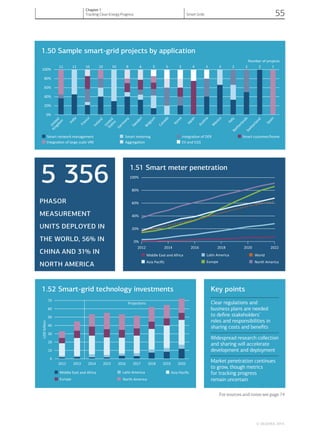
Smart Grids 54
Chapter 2 Getting “Smart” about Staying on Line 57
Everyone and Everything is Becoming Connected 59
Rapidly Expanding Digital Economy Carries an Energy Cost 60
Energy Efficiency Opportunities 62
Market Creation 64
The Way Forward 65
Annexes 67
Acronyms, Abbreviations and Units 68
Technology Overview Notes 71
References 75
Acknowledgements 77
© OECD/IEA, 2014.
Table of Contents 3
Foreword
The International Energy Agency (IEA) Energy Technology Perspectives (ETP) analysis offers a
comprehensive, long-term view of energy system trends and technologies essential to meet
goals for affordable, secure and low-carbon energy. This long-term view is regularly challenged
by developments that have lasting and transformative impacts, such as the shale gas boom in
North America, cost reductions in several renewable technologies and the uncertainty in
nuclear power progress. These examples clearly show that technology, market developments
and external events influence the evolution of energy systems.
These interactions draw attention to a troubling fact. In the face of rapidly growing demand
and the increasingly urgent threat of climate change, we are continuing to respond to the
energy system as it evolves rather than actively managing its transformation towards the aim
of achieving a clean, secure and economic energy supply. A radical change of course is long
overdue, and ETP shows the necessity of technology to obtain these goals.
Considering the links between effective short- and long-term development of energy systems, the
IEA has taken a strategic decision to transition ETP to an annual publication in which each edition
sharpens its focus to allow a “deep dive” into analysis of timely topics and trends. The ETP online
presence has been expanded to deliver downloadable analysis updates, data visualisations and
sector specific commentary, maintaining its comprehensive analysis, while increasing usability.
We also continue to monitor the status of global technology efforts to meet long term targets
through “Tracking Clean Energy Progress”, a key chapter in ETP and is the IEA fourth
submission to the Clean Energy Ministerial on global clean energy technology development
and deployment. We find growing evidence that a partial energy transition is under way – and
that emerging economies have stepped into the lead, achieving the greatest gains in the past
year. But it is clear that some of the encouraging trends observed in 2013 are in dire need of
renewed support.
The theme of ETP 2014, Harnessing Electricity’s Potential, reflects an opportunity arising from
the convergence of two trends: rapidly rising global electricity demand and the evident need
for increased system integration. Electricity production uses 40% of global primary energy and
produces an equal share of energy-based carbon dioxide emissions today. However,
cost-effective and practical solutions exist that can increase efficiency and reduce electricity
demand as well as carbon emissions between now and 2050. Four key points emerge in this
year’s analysis:
■ The unrelenting rise in coal use without deployment of carbon capture and storage is
fundamentally incompatible with climate change objectives.
■ Natural gas can, in the short term, play a dual role of replacing coal and supporting integration
of variable renewable energy (VRE), in the medium to longer term, gas must be seen for what it
is – a transitional fuel, not a low-carbon solution.
■ Deployment of VRE technology is growing, and in some cases becoming competitive;
experience now shows that balancing VRE supply and patterns of energy demand must – and
can – be actively managed.
© OECD/IEA, 2014.
4 Introduction Foreword
■ Electricity storage can play multiple roles in an integrated system, as can other technologies
with which it must compete. Contrary to many other voices, ETP analysis finds that electricity
storage alone is not a necessary game-changer for the future energy system.
A new feature of each edition will be a country case study of particular relevance to the theme,
with the inaugural example being India’s tremendous challenge of expanding both capacity
and generation of electricity to meet a doubling of demand in the next decade. A low-carbon,
more integrated future will require strong policy action to manage the use of its substantial
coal resources and to address the administrative hurdles that impede both innovation and
investment.
The timescale for this publication is 40 years. As the IEA enters its 40th year, energy
challenges are as daunting as they were in 1974. While energy security is still a concern,
shifting the world to a sustainable energy path has become an additional urgent priority. Our
efforts during the last four decades have not addressed this challenge. The greater focus of
ETP and the associated series of publications further the IEA’s underlying aim of providing truly
transformative “calls to action” so that governments can take the steps necessary to move to
a cleaner path. But we must start now; we cannot afford to wait another 40 years.
This publication is produced under my authority as Executive Director of the IEA.
Maria van der Hoeven
Executive Director
International Energy Agency
© OECD/IEA, 2014.
Introduction Foreword 5
6 Introduction
© OECD/IEA, 2013.
Key Findings
Emerging economies step up clean energy ambition,
but policy uncertainty stalls momentum in OECD
countries.
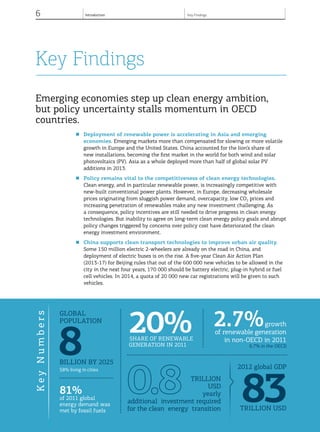
■	 Deployment of renewable power is accelerating in Asia and emerging
economies. Emerging markets more than compensated for slowing or more volatile
growth in Europe and the United States. China accounted for the lion’s share of
new installations, becoming the first market in the world for both wind and solar
photovoltaics (PV). Asia as a whole deployed more than half of global solar PV
additions in 2013.
■	 Policy remains vital to the competitiveness of clean energy technologies.
Clean energy, and in particular renewable power, is increasingly competitive with
new-built conventional power plants. However, in Europe, decreasing wholesale
prices originating from sluggish power demand, overcapacity, low CO2 prices and
increasing penetration of renewables make any new investment challenging. As
a consequence, policy incentives are still needed to drive progress in clean energy
technologies. But inability to agree on long-term clean energy policy goals and abrupt
policy changes triggered by concerns over policy cost have deteriorated the clean
energy investment environment.
■	 China supports clean transport technologies to improve urban air quality.
Some 150 million electric 2-wheelers are already on the road in China, and
deployment of electric buses is on the rise. A five-year Clean Air Action Plan
(2013-17) for Beijing rules that out of the 600 000 new vehicles to be allowed in the
city in the next four years, 170 000 should be battery electric, plug-in hybrid or fuel
cell vehicles. In 2014, a quota of 20 000 new car registrations will be given to such
vehicles.
Key Findings
© OECD/IEA, 2013.© OECD/IEA, 2013.
81%
of 2011 global
energy demand was
met by fossil fuels
20% Share of Renewable
generation in 2011
Global
population
8billion by 2025
58% living in cities
2.7%growth
of renewable generation
in non-OECD in 2011
6.7% in the OECD
83
KeyNumbers
trillion USD
2012 global GDP
TRILLION
USD
yearly
additional investment required
for the clean energy transition
Introduction 7
© OECD/IEA, 2013.
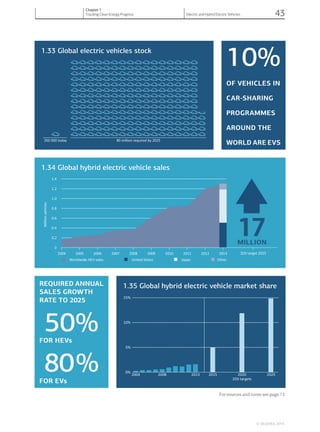
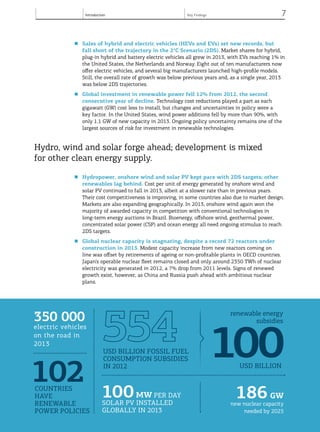
■	 Sales of hybrid and electric vehicles (HEVs and EVs) set new records, but
fall short of the trajectory in the 2°C Scenario (2DS). Market shares for hybrid,
plug-in hybrid and battery electric vehicles all grew in 2013, with EVs reaching 1% in
the United States, the Netherlands and Norway. Eight out of ten manufacturers now
offer electric vehicles, and several big manufacturers launched high-profile models.
Still, the overall rate of growth was below previous years and, as a single year, 2013
was below 2DS trajectories.
■	 Global investment in renewable power fell 12% from 2012, the second
consecutive year of decline. Technology cost reductions played a part as each
gigawatt (GW) cost less to install, but changes and uncertainties in policy were a
key factor. In the United States, wind power additions fell by more than 90%, with
only 1.1 GW of new capacity in 2013. Ongoing policy uncertainty remains one of the
largest sources of risk for investment in renewable technologies.
Hydro, wind and solar forge ahead; development is mixed
for other clean energy supply.
■	 Hydropower, onshore wind and solar PV kept pace with 2DS targets; other
renewables lag behind. Cost per unit of energy generated by onshore wind and
solar PV continued to fall in 2013, albeit at a slower rate than in previous years.
Their cost competitiveness is improving, in some countries also due to market design.
Markets are also expanding geographically. In 2013, onshore wind again won the
majority of awarded capacity in competition with conventional technologies in
long-term energy auctions in Brazil. Bioenergy, offshore wind, geothermal power,
concentrated solar power (CSP) and ocean energy all need ongoing stimulus to reach
2DS targets.
■	 Global nuclear capacity is stagnating, despite a record 72 reactors under
construction in 2013. Modest capacity increase from new reactors coming on
line was offset by retirements of ageing or non-profitable plants in OECD countries.
Japan’s operable nuclear fleet remains closed and only around 2350 TWh of nuclear
electricity was generated in 2012, a 7% drop from 2011 levels. Signs of renewed
growth exist, however, as China and Russia push ahead with ambitious nuclear
plans.
© OECD/IEA, 2013.© OECD/IEA, 2013.
102countries
have
renewable
power policies
350 000
electric vehicles
on the road in
2013
100 MW per day
solar PV installed
globally in 2013
	186GW
new nuclear capacity
needed by 2025
USD billion fossil fuel
consumption subsidies
in 2012
renewable energy
subsidies
100USD billion
Key Findings
8 Introduction
© OECD/IEA, 2013.
Coal use continues to increase, underlining the need to
scale up carbon capture and storage and improve coal plant
efficiency.
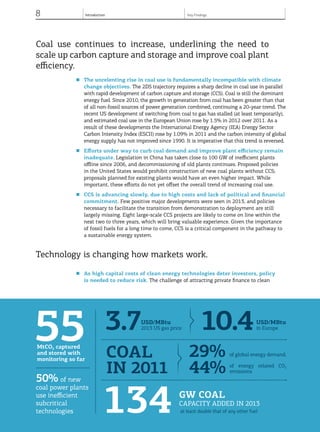
■	 The unrelenting rise in coal use is fundamentally incompatible with climate
change objectives. The 2DS trajectory requires a sharp decline in coal use in parallel
with rapid development of carbon capture and storage (CCS). Coal is still the dominant
energy fuel. Since 2010, the growth in generation from coal has been greater than that
of all non-fossil sources of power generation combined, continuing a 20-year trend. The
recent US development of switching from coal to gas has stalled (at least temporarily),
and estimated coal use in the European Union rose by 1.5% in 2012 over 2011. As a
result of these developments the International Energy Agency (IEA) Energy Sector
Carbon Intensity Index (ESCII) rose by 1.09% in 2011 and the carbon intensity of global
energy supply has not improved since 1990. It is imperative that this trend is reversed.
■	 Efforts under way to curb coal demand and improve plant efficiency remain
inadequate. Legislation in China has taken close to 100 GW of inefficient plants
offline since 2006, and decommissioning of old plants continues. Proposed policies
in the United States would prohibit construction of new coal plants without CCS;
proposals planned for existing plants would have an even higher impact. While
important, these efforts do not yet offset the overall trend of increasing coal use.
■	 CCS is advancing slowly, due to high costs and lack of political and financial
commitment. Few positive major developments were seen in 2013, and policies
necessary to facilitate the transition from demonstration to deployment are still
largely missing. Eight large-scale CCS projects are likely to come on line within the
next two to three years, which will bring valuable experience. Given the importance
of fossil fuels for a long time to come, CCS is a critical component in the pathway to
a sustainable energy system.
Technology is changing how markets work.
■	 As high capital costs of clean energy technologies deter investors, policy
is needed to reduce risk. The challenge of attracting private finance to clean
© OECD/IEA, 2013.© OECD/IEA, 2013.
50% of new
coal power plants
use inefficient
subcritical
technologies
55MtCO2 captured
and stored with
monitoring so far
29% of global energy demand,
44% of energy related CO2
emissions
coal
in 2011
3.7USD/MBtu
2013 US gas price 10.4USD/MBtu
in Europe
Key Findings
134 GW coal
capacity added in 2013
at least double that of any other fuel
Introduction 9
© OECD/IEA, 2013.
energy technologies is especially evident in liberalised markets. A recent example of
policy intervention to reduce risk is in the United Kingdom, where the government
is offering guaranteed price levels over 35 years to a new nuclear facility. Although
the proposal is still under review, it shows that the UK government is reconsidering
market design in the light of requirements to meet environmental and energy
security goals.
■	 Flexibility is increasingly important for gas-fired power plants as electricity
systems evolve. Penetration of variable renewable electricity is firmly on an
upwards trajectory. In principle, this creates value for flexible operation of thermal
generation. However, the current wholesale market conditions in Europe, exacerbated
by high gas import prices, lack of flexibility markets and extensive deployment
of renewables, undermine the economics of combined-cycle gas turbines (CCGTs).
Technical developments are set to improve flexibility of CCGTs; however, depending
on power market structures, competing technologies such as engines and single-cycle
turbines may become more competitive. This is particularly true if investors look to
reduce capital and maintenance costs to compensate for fewer operating hours.
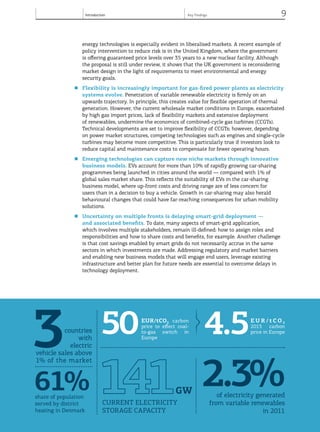
■	 Emerging technologies can capture new niche markets through innovative
business models. EVs account for more than 10% of rapidly growing car-sharing
programmes being launched in cities around the world — compared with 1% of
global sales market share. This reflects the suitability of EVs in the car-sharing
business model, where up-front costs and driving range are of less concern for
users than in a decision to buy a vehicle. Growth in car-sharing may also herald
behavioural changes that could have far-reaching consequences for urban mobility
solutions.
■	 Uncertainty on multiple fronts is delaying smart-grid deployment —
and associated benefits. To date, many aspects of smart-grid application,
which involves multiple stakeholders, remain ill-defined: how to assign roles and
responsibilities and how to share costs and benefits, for example. Another challenge
is that cost savings enabled by smart grids do not necessarily accrue in the same
sectors in which investments are made. Addressing regulatory and market barriers
and enabling new business models that will engage end users, leverage existing
infrastructure and better plan for future needs are essential to overcome delays in
technology deployment.
© OECD/IEA, 2013.© OECD/IEA, 2013.
50EUR/tCO2 carbon
price to effect coal-
to-gas switch in
Europe
4.5E U R / t C O 2
2013 carbon
price in Europe
Key Findings
61%share of population
served by district
heating in Denmark
3countries
with
electric
vehicle sales above
1% of the market
GW
current electricity
storage capacity
2.3%of electricity generated
from variable renewables
in 2011
10 Introduction
© OECD/IEA, 2013.
End-use sectors show slow technology improvements;
recent breakthroughs limited to passenger transport.
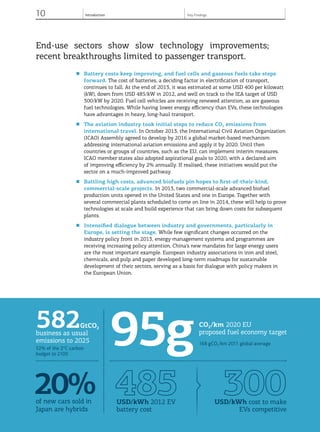
■	 Battery costs keep improving, and fuel cells and gaseous fuels take steps
forward. The cost of batteries, a deciding factor in electrification of transport,
continues to fall. At the end of 2013, it was estimated at some USD 400 per kilowatt
(kW), down from USD 485/kW in 2012, and well on track to the IEA target of USD
300/kW by 2020. Fuel cell vehicles are receiving renewed attention, as are gaseous
fuel technologies. While having lower energy efficiency than EVs, these technologies
have advantages in heavy, long-haul transport.
■	 The aviation industry took initial steps to reduce CO2 emissions from
international travel. In October 2013, the International Civil Aviation Organization
(ICAO) Assembly agreed to develop by 2016 a global market-based mechanism
addressing international aviation emissions and apply it by 2020. Until then
countries or groups of countries, such as the EU, can implement interim measures.
ICAO member states also adopted aspirational goals to 2020, with a declared aim
of improving efficiency by 2% annually. If realised, these initiatives would put the
sector on a much-improved pathway.
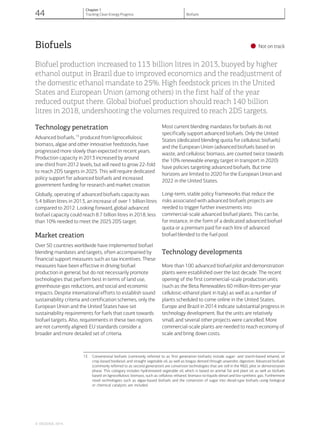
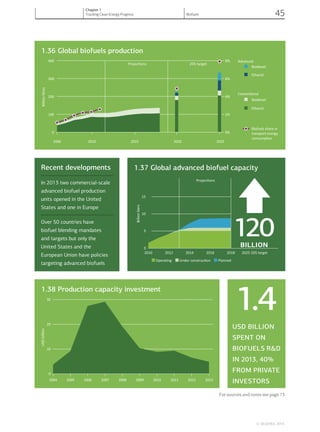
■	 Battling high costs, advanced biofuels pin hopes to first-of-their-kind,
commercial-scale projects. In 2013, two commercial-scale advanced biofuel
production units opened in the United States and one in Europe. Together with
several commercial plants scheduled to come on line in 2014, these will help to prove
technologies at scale and build experience that can bring down costs for subsequent
plants.
■	 Intensified dialogue between industry and governments, particularly in
Europe, is setting the stage. While few significant changes occurred on the
industry policy front in 2013, energy management systems and programmes are
receiving increasing policy attention. China’s new mandates for large energy users
are the most important example. European industry associations in iron and steel,
chemicals, and pulp and paper developed long-term roadmaps for sustainable
development of their sectors, serving as a basis for dialogue with policy makers in
the European Union.
© OECD/IEA, 2013.© OECD/IEA, 2013.
20%of new cars sold in
Japan are hybrids
582GtCO2
business as usual
emissions to 2025
52% of the 2°C carbon
budget to 2100
95gCO2/km 2020 EU
proposed fuel economy target
168 gCO2/km 2011 global average
USD/kWh cost to make
EVs competitive
Key Findings
USD/kWh 2012 EV
battery cost
Introduction 11
© OECD/IEA, 2013.
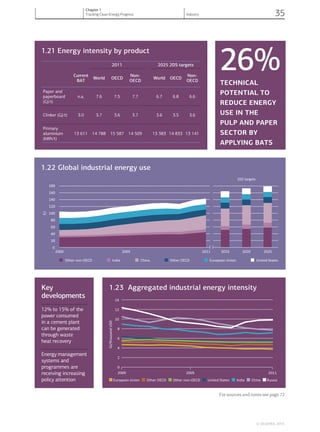
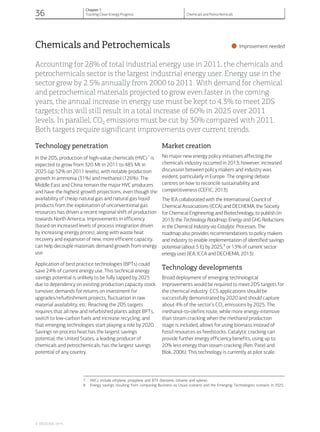
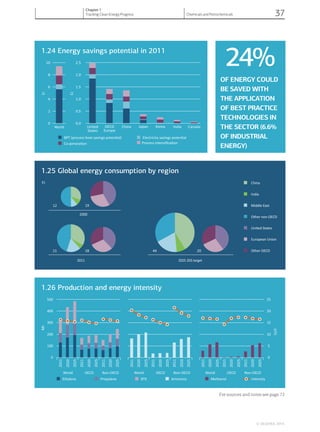
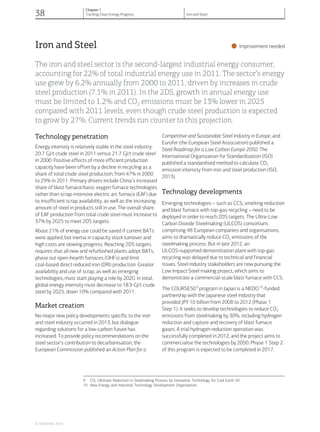
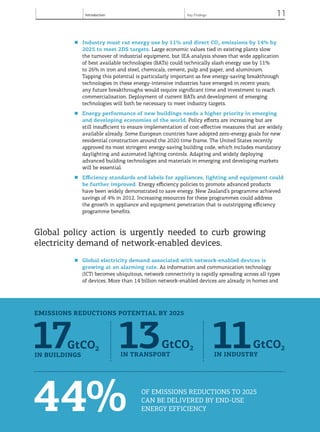
■	 Industry must cut energy use by 11% and direct CO2 emissions by 14% by
2025 to meet 2DS targets. Large economic values tied in existing plants slow
the turnover of industrial equipment, but IEA analysis shows that wide application
of best available technologies (BATs) could technically slash energy use by 11%
to 26% in iron and steel, chemicals, cement, pulp and paper, and aluminium.
Tapping this potential is particularly important as few energy-saving breakthrough
technologies in these energy-intensive industries have emerged in recent years;
any future breakthroughs would require significant time and investment to reach
commercialisation. Deployment of current BATs and development of emerging
technologies will both be necessary to meet industry targets.
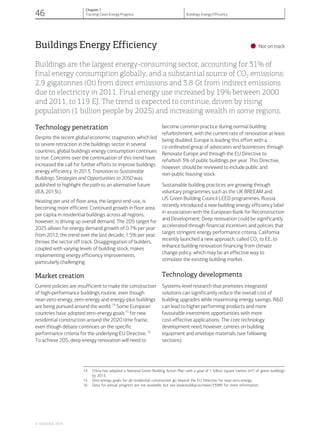
■	 Energy performance of new buildings needs a higher priority in emerging
and developing economies of the world. Policy efforts are increasing but are
still insufficient to ensure implementation of cost-effective measures that are widely
available already. Some European countries have adopted zero-energy goals for new
residential construction around the 2020 time frame. The United States recently
approved its most stringent energy-saving building code, which includes mandatory
daylighting and automated lighting controls. Adapting and widely deploying
advanced building technologies and materials in emerging and developing markets
will be essential.
■	 Efficiency standards and labels for appliances, lighting and equipment could
be further improved. Energy efficiency policies to promote advanced products
have been widely demonstrated to save energy. New Zealand’s programme achieved
savings of 4% in 2012. Increasing resources for these programmes could address
the growth in appliance and equipment penetration that is outstripping efficiency
programme benefits.
Global policy action is urgently needed to curb growing
electricity demand of network-enabled devices.
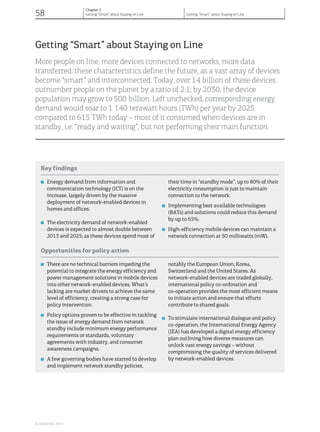
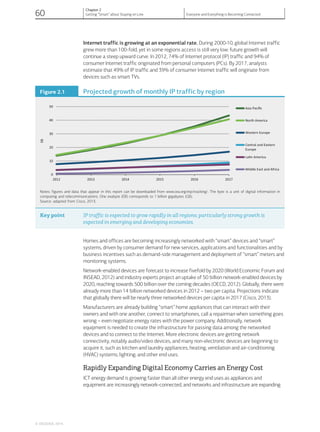
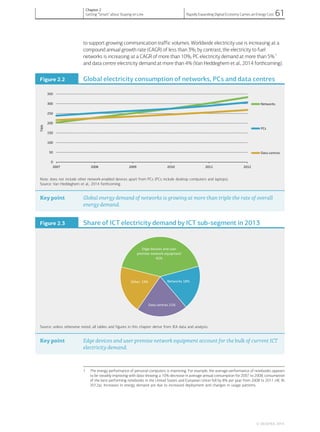
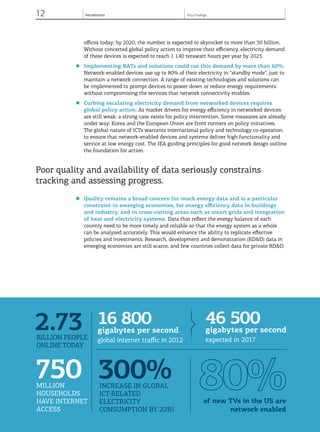
■	 Global electricity demand associated with network-enabled devices is
growing at an alarming rate. As information and communication technology
(ICT) becomes ubiquitous, network connectivity is rapidly spreading across all types
of devices. More than 14 billion network-enabled devices are already in homes and
© OECD/IEA, 2013.© OECD/IEA, 2013.
44% of emissions reductions to 2025
can be delivered by END-USE
ENERGY EFFICIENCY
17GtCO2
in buildings
13GtCO2
in transport
11GtCO2
in industry
Key Findings
emissions reductions potential by 2025
12 Introduction
© OECD/IEA, 2013.
offices today; by 2020, the number is expected to skyrocket to more than 50 billion.
Without concerted global policy action to improve their efficiency, electricity demand
of these devices is expected to reach 1 140 terawatt hours per year by 2025.
■	 Implementing BATs and solutions could cut this demand by more than 60%.
Network-enabled devices use up to 80% of their electricity in “standby mode”, just to
maintain a network connection. A range of existing technologies and solutions can
be implemented to prompt devices to power down or reduce energy requirements
without compromising the services that network connectivity enables.
■	 Curbing escalating electricity demand from networked devices requires
global policy action. As market drivers for energy efficiency in networked devices
are still weak, a strong case exists for policy intervention. Some measures are already
under way: Korea and the European Union are front runners on policy initiatives.
The global nature of ICTs warrants international policy and technology co-operation
to ensure that network-enabled devices and systems deliver high functionality and
service at low energy cost. The IEA guiding principles for good network design outline
the foundation for action.
Poor quality and availability of data seriously constrains
tracking and assessing progress.
■	 Quality remains a broad concern for much energy data and is a particular
constraint in emerging economies, for energy efficiency data in buildings
and industry, and in cross-cutting areas such as smart grids and integration
of heat and electricity systems. Data that reflect the energy balance of each
country need to be more timely and reliable so that the energy system as a whole
can be analysed accurately. This would enhance the ability to replicate effective
policies and investments. Research, development and demonstration (RD&D) data in
emerging economies are still scarce, and few countries collect data for private RD&D.
© OECD/IEA, 2013.© OECD/IEA, 2013.
2.73billion people
online today
of new TVs in the US are
network enabled
300%increase in global
ICT-related
electricity
consumption by 2030
750million
households
have internet
access
16 800gigabytes per second
global internet traffic in 2012
46 500gigabytes per second
expected in 2017
Key Findings
Box I.1 The IEA Energy Sector Carbon Intensity Index (ESCII)
0
20
40
60
80
100
120
1970 1980 1990 2000 2010 2020 2030 2040 2050
Carbonintensity(2010=100)
6DS
4DS
2DS
Note: the ETP scenarios (2DS, 4DS and 6DS) are defined in Box I.2. Figures and data that appear in this report can be downloaded from
www.iea.org/etp/tracking. Unless otherwise noted, all tables and figures derive from IEA data and analysis.
The IEA ESCII tracks how many tonnes of CO2 (tCO2)
are emitted for each unit of energy supplied. The
index shows that the global aggregate impact of all
changes in supply technologies since 1970 has been
minimal. Responses to the oil shocks of the 1970s
made the energy supply 6% cleaner from 1971 to
1990. Since 1990, however, the ESCII has remained
essentially static despite the important climate
policy commitments at the 1992 Rio Conference and
under the 1997 Kyoto Protocol, as well as the boom
in renewable technologies over the last decade
(Figure I.1). In 1990, the underlying carbon intensity
of supply was 57.1 tCO2 per terajoule (TJ) (2.39 tCO2
per tonne of oil equivalent [toe]); in 2011 it was 55.9
tCO2/TJ (2.34 tCO2/toe). This reflects the continued
domination of fossil fuels – particularly coal – in the
energy mix and the slow uptake of other,
lower-carbon supply technologies. The ESCII shows
only one side of the decarbonisation challenge,
however: the world must slow the growth of energy
demand as well as make its energy supply cleaner.
To meet 2DS targets, aggressive energy efficiency
improvements are needed as well as a steep drop in
the global ESCII. The index needs to break from its
40-year stable trend and decline by 12% by 2025,
and 64% by 2050.
Figure I.1 Trade-off between improving ESCII and reducing energy demand
0 10 20 30 40 50 60 70
Totalprimaryenergydemand(EJ)
ESCII in 2050
0
200
400
600
800
1 000
1 200
1 400
1 600
Higher ESCII
Higherdemand
Lower ESCII
4 C
o
2
Co
2 C
o
6 C
o
Lowerdemand
2DS
© OECD/IEA, 2014.
Introduction Key Findings 13
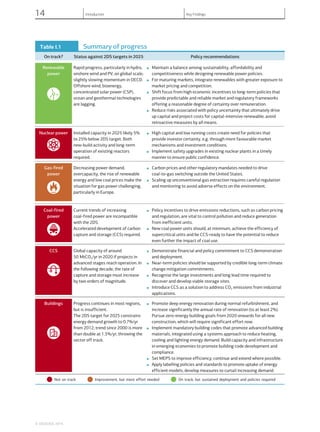
Table I.1 Summary of progress
On track? Status against 2DS targets in 2025 Policy recommendations
Renewable
power
Rapid progress, particularly in hydro,
onshore wind and PV, on global scale;
slightly slowing momentum in OECD.
Offshore wind, bioenergy,
concentrated solar power (CSP),
ocean and geothermal technologies
are lagging.
■ Maintain a balance among sustainability, affordability and
competitiveness while designing renewable power policies.
■ For maturing markets, integrate renewables with greater exposure to
market pricing and competition.
■ Shift focus from high economic incentives to long-term policies that
provide predictable and reliable market and regulatory frameworks
offering a reasonable degree of certainty over remuneration.
■ Reduce risks associated with policy uncertainty that ultimately drive
up capital and project costs for capital-intensive renewable; avoid
retroactive measures by all means.
..........................................................................................................................................................................................................................................................................
Nuclear power Installed capacity in 2025 likely 5%
to 25% below 2DS target. Both
new-build activity and long-term
operation of existing reactors
required.
■ High capital and low running costs create need for policies that
provide investor certainty, e.g. through more favourable market
mechanisms and investment conditions.
■ Implement safety upgrades in existing nuclear plants in a timely
manner to ensure public confidence.
..........................................................................................................................................................................................................................................................................
Gas-fired
power
Decreasing power demand,
overcapacity, the rise of renewable
energy and low coal prices make the
situation for gas power challenging,
particularly in Europe.
■ Carbon prices and other regulatory mandates needed to drive
coal-to-gas switching outside the United States.
■ Scaling up unconventional gas extraction requires careful regulation
and monitoring to avoid adverse effects on the environment.
..........................................................................................................................................................................................................................................................................
Coal-fired
power
Current trends of increasing
coal-fired power are incompatible
with the 2DS.
Accelerated development of carbon
capture and storage (CCS) required.
■ Policy incentives to drive emissions reductions, such as carbon pricing
and regulation, are vital to control pollution and reduce generation
from inefficient units.
■ New coal power units should, at minimum, achieve the efficiency of
supercritical units and be CCS-ready to have the potential to reduce
even further the impact of coal use.
CCS Global capacity of around
50 MtCO2/yr in 2020 if projects in
advanced stages reach operation. In
the following decade, the rate of
capture and storage must increase
by two orders of magnitude.
■ Demonstrate financial and policy commitment to CCS demonstration
and deployment.
■ Near-term policies should be supported by credible long-term climate
change mitigation commitments.
■ Recognise the large investments and long lead time required to
discover and develop viable storage sites.
■ Introduce CCS as a solution to address CO2 emissions from industrial
applications.
Buildings Progress continues in most regions,
but is insufficient.
The 2DS target for 2025 constrains
energy demand growth to 0.7%/yr
from 2012; trend since 2000 is more
than double at 1.5%/yr, throwing the
sector off track.
■ Promote deep energy renovation during normal refurbishment, and
increase significantly the annual rate of renovation (to at least 2%).
Pursue zero-energy building goals from 2020 onwards for all new
construction, which will require significant effort now.
■ Implement mandatory building codes that promote advanced building
materials, integrated using a systems approach to reduce heating,
cooling and lighting energy demand. Build capacity and infrastructure
in emerging economies to promote building code development and
compliance.
■ Set MEPS to improve efficiency; continue and extend where possible.
■ Apply labelling policies and standards to promote uptake of energy
efficient models; develop measures to curtail increasing demand.
•Not on track
•Improvement, but more effort needed
•On track, but sustained deployment and policies required
© OECD/IEA, 2014.
14 Introduction Key Findings
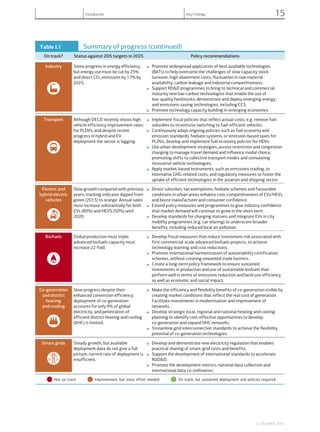
Table I.1 Summary of progress (continued)
On track? Status against 2DS targets in 2025 Policy recommendations
Industry Some progress in energy efficiency,
but energy use must be cut by 25%
and direct CO2 emissions by 17% by
2025.
■ Promote widespread application of best available technologies
(BATs) to help overcome the challenges of slow capacity stock
turnover, high abatement costs, fluctuation in raw material
availability, carbon leakage and industrial competitiveness.
■ Support RD&D programmes to bring to technical and commercial
maturity new low-carbon technologies that enable the use of
low-quality feedstocks; demonstrate and deploy emerging energy-
and emissions-saving technologies, including CCS.
■ Promote technology capacity building in emerging economies.
Transport Although OECD recently shows high
vehicle efficiency improvement rates
for PLDVs, and despite recent
progress in hybrid and EV
deployment the sector is lagging.
■ Implement fiscal policies that reflect actual costs, e.g. remove fuel
subsidies to incentivise switching to fuel-efficient vehicles.
■ Continuously adapt ongoing policies such as fuel economy and
emission standards, feebate systems, or emission-based taxes for
PLDVs; develop and implement fuel economy policies for HDVs.
■ Use urban development strategies, access restriction and congestion
charging to manage travel demand and influence modal choice,
promoting shifts to collective transport modes and stimulating
innovative vehicle technologies.
■ Apply market-based instruments, such as emissions trading, to
internalise GHG-related costs, and regulatory measures to foster the
uptake of efficient technologies in the aviation and shipping sector...........................................................................................................................................................................................................................................................................
Electric and
hybrid electric
vehicles
Slow growth compared with previous
years; tracking indicator dipped from
green (2013) to orange. Annual sales
must increase substantially for both
EVs (80%) and HEVS (50%) until
2020.
■ Direct subsidies, tax exemptions, feebate schemes and favourable
conditions in urban areas enhance cost-competitiveness of EVs/HEVs
and boost manufacturer and consumer confidence.
■ Extend policy measures and programmes to give industry confidence
that market demand will continue to grow in the short term.
■ Develop standards for charging stations and integrate EVs in city
mobility programmes (e.g. car sharing) to underscore broader
benefits, including reduced local air pollution...........................................................................................................................................................................................................................................................................
Biofuels Global production must triple;
advanced biofuels capacity must
increase 22-fold.
■ Develop fiscal measures that reduce investment risk associated with
first commercial-scale advanced biofuels projects, to achieve
technology learning and cost reductions.
■ Promote international harmonisation of sustainability certification
schemes, without creating unwanted trade barriers.
■ Create a long-term policy framework to ensure sustained
investments in production and use of sustainable biofuels that
perform well in terms of emissions reduction and land-use efficiency,
as well as economic and social impact.
Co-generation
and district
heating
and cooling
Slow progress despite their
enhanced conversion efficiency;
deployment of co-generation
accounts for only 9% of global
electricity, and penetration of
efficient district heating and cooling
(DHC) is limited.
■ Make the efficiency and flexibility benefits of co-generation visible by
creating market conditions that reflect the real cost of generation.
Facilitate investments in modernisation and improvement of
networks.
■ Develop strategic local, regional and national heating and cooling
planning to identify cost-effective opportunities to develop
co-generation and expand DHC networks.
■ Streamline grid interconnection standards to achieve the flexibility
potential of co-generation technologies.
Smart grids Steady growth, but available
deployment data do not give a full
picture; current rate of deployment is
insufficient.
■ Develop and demonstrate new electricity regulation that enables
practical sharing of smart-grid costs and benefits.
■ Support the development of international standards to accelerate
RDD&D.
■ Promote the development metrics, national data collection and
international data co-ordination.
•Not on track
•Improvement, but more effort needed
•On track, but sustained deployment and policies required
© OECD/IEA, 2014.
Introduction Key Findings 15
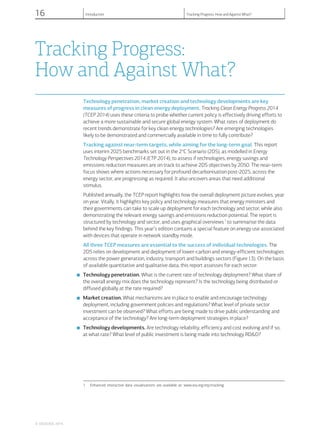
Tracking Progress:
How and Against What?
Technology penetration, market creation and technology developments are key
measures of progress in clean energy deployment. Tracking Clean Energy Progress 2014
(TCEP 2014) uses these criteria to probe whether current policy is effectively driving efforts to
achieve a more sustainable and secure global energy system. What rates of deployment do
recent trends demonstrate for key clean energy technologies? Are emerging technologies
likely to be demonstrated and commercially available in time to fully contribute?
Tracking against near-term targets, while aiming for the long-term goal. This report
uses interim 2025 benchmarks set out in the 2o
C Scenario (2DS), as modelled in Energy
Technology Perspectives 2014 (ETP 2014), to assess if technologies, energy savings and
emissions reduction measures are on track to achieve 2DS objectives by 2050. The near-term
focus shows where actions necessary for profound decarbonisation post-2025, across the
energy sector, are progressing as required. It also uncovers areas that need additional
stimulus.
Published annually, the TCEP report highlights how the overall deployment picture evolves, year
on year. Vitally, it highlights key policy and technology measures that energy ministers and
their governments can take to scale up deployment for each technology and sector, while also
demonstrating the relevant energy savings and emissions reduction potential. The report is
structured by technology and sector, and uses graphical overviews1
to summarise the data
behind the key findings. This year’s edition contains a special feature on energy use associated
with devices that operate in network standby mode.
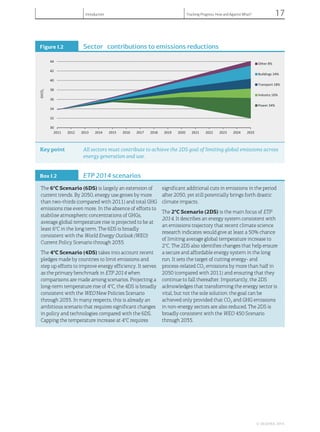
All three TCEP measures are essential to the success of individual technologies. The
2DS relies on development and deployment of lower-carbon and energy-efficient technologies
across the power generation, industry, transport and buildings sectors (Figure I.3). On the basis
of available quantitative and qualitative data, this report assesses for each sector:
■ Technology penetration. What is the current rate of technology deployment? What share of
the overall energy mix does the technology represent? Is the technology being distributed or
diffused globally at the rate required?
■ Market creation. What mechanisms are in place to enable and encourage technology
deployment, including government policies and regulations? What level of private sector
investment can be observed? What efforts are being made to drive public understanding and
acceptance of the technology? Are long-term deployment strategies in place?
■ Technology developments. Are technology reliability, efficiency and cost evolving and if so,
at what rate? What level of public investment is being made into technology RD&D?
1 Enhanced interactive data visualisations are available at: www.iea.org/etp/tracking.
© OECD/IEA, 2014.
16 Introduction Tracking Progress: How and Against What?
Figure I.2 Sector contributions to emissions reductions
30
32
34
36
38
40
42
44
2011 2012 2013 2014 2015 2016 2017 2018 2019 2020 2021 2022 2023 2024 2025
GtCO2
Other 8%
Buildings 24%
Transport 18%
Industry 16%
Power 34%
Key point All sectors must contribute to achieve the 2DS goal of limiting global emissions across
energy generation and use.
Box I.2 ETP 2014 scenarios
The 6o
C Scenario (6DS) is largely an extension of
current trends. By 2050, energy use grows by more
than two-thirds (compared with 2011) and total GHG
emissions rise even more. In the absence of efforts to
stabilise atmospheric concentrations of GHGs,
average global temperature rise is projected to be at
least 6o
C in the long term. The 6DS is broadly
consistent with the World Energy Outlook (WEO)
Current Policy Scenario through 2035.
The 4o
C Scenario (4DS) takes into account recent
pledges made by countries to limit emissions and
step up efforts to improve energy efficiency. It serves
as the primary benchmark in ETP 2014 when
comparisons are made among scenarios. Projecting a
long-term temperature rise of 4o
C, the 4DS is broadly
consistent with the WEO New Policies Scenario
through 2035. In many respects, this is already an
ambitious scenario that requires significant changes
in policy and technologies compared with the 6DS.
Capping the temperature increase at 4o
C requires
significant additional cuts in emissions in the period
after 2050, yet still potentially brings forth drastic
climate impacts.
The 2o
C Scenario (2DS) is the main focus of ETP
2014. It describes an energy system consistent with
an emissions trajectory that recent climate science
research indicates would give at least a 50% chance
of limiting average global temperature increase to
2o
C. The 2DS also identifies changes that help ensure
a secure and affordable energy system in the long
run. It sets the target of cutting energy- and
process-related CO2 emissions by more than half in
2050 (compared with 2011) and ensuring that they
continue to fall thereafter. Importantly, the 2DS
acknowledges that transforming the energy sector is
vital, but not the sole solution: the goal can be
achieved only provided that CO2 and GHG emissions
in non-energy sectors are also reduced. The 2DS is
broadly consistent with the WEO 450 Scenario
through 2035.
© OECD/IEA, 2014.
Introduction Tracking Progress: How and Against What? 17
Chapter 1
Tracking Clean
Energy Progress
Renewable Power
•On track
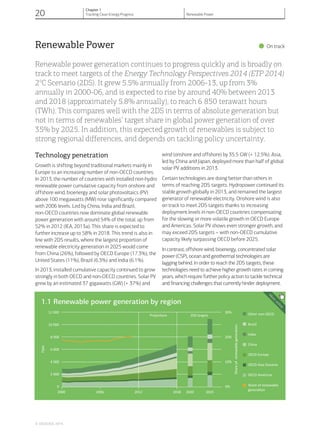
Renewable power generation continues to progress quickly and is broadly on
track to meet targets of the Energy Technology Perspectives 2014 (ETP 2014)
2o
C Scenario (2DS). It grew 5.5% annually from 2006-13, up from 3%
annually in 2000-06, and is expected to rise by around 40% between 2013
and 2018 (approximately 5.8% annually), to reach 6 850 terawatt hours
(TWh). This compares well with the 2DS in terms of absolute generation but
not in terms of renewables’ target share in global power generation of over
35% by 2025. In addition, this expected growth of renewables is subject to
strong regional differences, and depends on tackling policy uncertainty.
Technology penetration
Growth is shifting beyond traditional markets mainly in
Europe to an increasing number of non-OECD countries.
In 2013, the number of countries with installed non-hydro
renewable power cumulative capacity from onshore and
offshore wind, bioenergy and solar photovoltaics (PV)
above 100 megawatts (MW) rose significantly compared
with 2006 levels. Led by China, India and Brazil,
non-OECD countries now dominate global renewable
power generation with around 54% of the total, up from
52% in 2012 (IEA, 2013a). This share is expected to
further increase up to 58% in 2018. This trend is also in
line with 2DS results, where the largest proportion of
renewable electricity generation in 2025 would come
from China (26%), followed by OECD Europe (17.3%), the
United States (11%), Brazil (6.3%) and India (6.1%).
In 2013, installed cumulative capacity continued to grow
strongly in both OECD and non-OECD countries. Solar PV
grew by an estimated 37 gigawatts (GW) (+ 37%) and
wind (onshore and offshore) by 35.5 GW (+ 12.5%). Asia,
led by China and Japan, deployed more than half of global
solar PV additions in 2013.
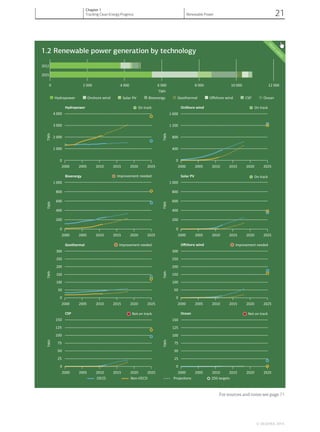
Certain technologies are doing better than others in
terms of reaching 2DS targets. Hydropower continued its
stable growth globally in 2013, and remained the largest
generator of renewable electricity. Onshore wind is also
on track to meet 2DS targets thanks to increasing
deployment levels in non-OECD countries compensating
for the slowing or more volatile growth in OECD Europe
and Americas. Solar PV shows even stronger growth, and
may exceed 2DS targets – with non-OECD cumulative
capacity likely surpassing OECD before 2025.
In contrast, offshore wind, bioenergy, concentrated solar
power (CSP), ocean and geothermal technologies are
lagging behind. In order to reach the 2DS targets, these
technologies need to achieve higher growth rates in coming
years, which require further policy action to tackle technical
and financing challenges that currently hinder deployment.
1.1 Renewable power generation by region
M
ore
online
0%
10%
20%
30%
0
2 000
4 000
6 000
8 000
10 000
12 000
2000 2006 2012 2018 2020 2025
rahSoerfweneelbarenegnoita
TWh
Other non-OECD
Brazil
India
China
OECD Europe
OECD Asia Oceania
OECD Americas
Share of renewable
generaƟon
2DS targetsProjecƟons
© OECD/IEA, 2014.
20
Chapter 1
Tracking Clean Energy Progress Renewable Power
1.2 Renewable power generation by technology
M
ore
online
2025
2012
0 2 000 4 000 6 000 8 000 10 000 12 000
Onshore wind Solar PV Bioenergy Geothermal Offshore wind CSP OceanHydropower
Hydropower
0
200
400
600
800
1 000
WTh
WTh
Bioenergy Solar PVImprovement needed
Geothermal Offshore wind
0
1 000
2 000
3 000
4 000
0
2000 2005 2010 2015 2020 2025
TWh
TWh
On track OnShore wind On track
On track
2000 2005 2010 2015 2020 2025TWh
2000 2005 2010 2015 2020 2025
0
200
400
600
800
1 000
2000 2005 2010 2015 2020 2025
00
00
2000 2000
2000 2000
2005 2005
2005 2005
2010 2010
2010 2010
2015 2015
2015 2015
2020 2020
2020 2020
2025 2025
2025 2025
50
100
150
200
250
300
WTh
WTh
WTh
WTh
Improvement needed Improvement needed
25
50
75
100
125
150
CSP Not on track Not on track
OECD ProjecƟonsNon-OECD
400
800
1 200
1 600
50
100
150
200
250
300
25
50
75
100
125
150
Ocean
2DS targets
For sources and notes see page 71
© OECD/IEA, 2014.
Chapter 1
Tracking Clean Energy Progress Renewable Power 21
Market creation
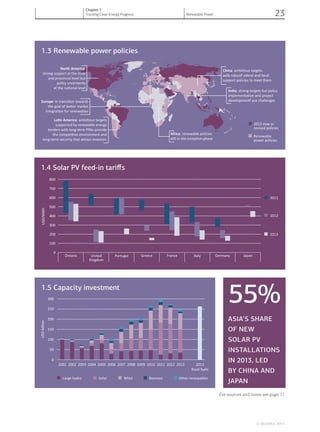
By the end of 2013, over 100 countries had a renewable
electricity support measure (e.g. targets, feed-in tariffs
[FiTs], tenders, tax incentives). During 2013, new or
revised policies supporting the deployment of renewable
power were adopted in 16 countries.
A major policy challenge is to balance the affordability of
support schemes with effectiveness and the need for
investor certainty in order to drive deployment. In 2013,
governments continued to be mindful of the affordability
aspect of renewable energy deployment, allowing faster
downward adjustment to cost changes.
In Germany, the revision of supported solar PV system
categories and the monthly adjustment of solar FiTs have
so far worked well. However, several countries made
more drastic and even retroactive changes to renewable
energy policies, which damaged investor confidence for
future projects and affected the profitability of existing
renewable energy assets in some markets. Onshore wind
and solar PV have been affected, resulting in boom and
bust investment cycles in some markets.
Installations of new wind capacity in the United States
tumbled to 1 GW in 2013, a fraction of the record 13 GW
in 2012. Developers rushed to finish projects before an
expected expiration of the renewable electricity
production tax credit (PTC) at the end of 2012, leaving an
empty project pipeline for 2013. The situation is foreseen
to partly recover since the PTC was extended in late
2012, with around 15 GW of new wind projects expected
to come on line by 2015, but it has hurt the industry.
Greece experienced a solar PV boom in 2012 but
introduced FiT cuts and retroactive taxes in 2013, which
dramatically decreased investor interest in solar PV. The
Romanian government has proposed suspending half of
the wind certificates due under current incentive
arrangements until 2018, applying retroactively to all
projects started after 1 July 2013. In Spain, the 2013
electricity reform abandoned all FiTs and premiums
provided to renewables retroactively by introducing a cap
to limit projects’ profits based on the average yield of
Spanish government bonds. Also, the moratorium on
renewable energy subsidies and the additional 7% tax for
all power generators are still in place.
Inflexible and overly generous remuneration mechanisms
may also be detrimental. Japan revised its PV FiT
downward by only 10% in 2013, still maintaining tariff
levels more than twice as high as Germany. This led to
record deployment in 2013 but at a relatively high cost,
and prompted questions over the financial sustainability
of the FiT.
Stable policy can lead to lower cost of capital, which
helps renewable technologies that have relatively high
up-front costs. Long-term market power planning
combined with competitive bidding (such as tenders and
auctions for long-term power purchase agreements) has
proved effective in triggering competitive deployment of
renewables. In 2013, wind power won the majority of
long-term contracts in Brazil in competition with other
technologies, including natural gas. South Africa
announced its third bid window for several renewable
energy technologies with costs for onshore wind being
around 30% lower than those for new coal plants. Saudi
Arabia unveiled a white paper detailing the tender
process for new solar PV and CSP plants.
Early estimates indicate that investment in renewable
power was USD 211 billion in 2013, down 12% compared
with 2012 and 22% lower than the record
USD 270 billion in 2011, partly reflecting cost reductions
but also due to uncertain policy and market frameworks.
© OECD/IEA, 2014.
22
Chapter 1
Tracking Clean Energy Progress Renewable Power
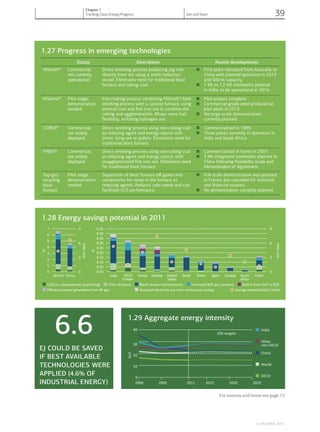
1.3 Renewable power policies
1.4 Solar PV feed-in tariffs
1.5 Capacity investment
0
100
200
300
400
500
600
700
800
Ontario United
Kingdom
Portugal Greece France Italy Germany Japan
WM/DSUh
2011
2012
2013
0
50
100
150
200
250
300
2001 2002 2003 2004 2005 2006 2007 2008 2009 2010 2011 2012 2013 2013
fossil fuels
BiomassWindSolarLarge hydro
DSUbillion
Other renewables
: in transiƟon towards
the goal of beƩer market
integraƟon for renewables
Europe
China: ambiƟous targets
with robusƞ ederal and local
support policies to meet them
India: strong targets but policy
implementaƟon and project
developmenƞ ace challenges
Africa: renewable policies
sƟll in the incepƟon phase
LaƟn America: ambiƟous targets
supported by renewable energy
tenders with long-term PPAs provide
the compeƟƟve environment and
long-term security that aƩract investors
North America:
strong support at the state
and provincial level but
policy uncertainty
at the naƟonal level
Renewable
power policies
2013 new or
revised policies
55%
ASIA’S SHARE
OF NEW
SOLAR PV
INSTALLATIONS
IN 2013, LED
BY CHINA AND
JAPAN
For sources and notes see page 71
© OECD/IEA, 2014.
Chapter 1
Tracking Clean Energy Progress Renewable Power 23
Technology developments
In 2013, price reductions of solar PV modules slowed
considerably following a consolidation in the industry.
Between 2008 and 2012, module prices decreased by
around 80% from USD 3.98 per watt (W) to USD 0.79 per
watt, while in 2013 prices remained more or less stable.
The European Union and China agreed on a minimum
export price (EUR 0.56/W) for Chinese solar panels in the
EU, with imports at this price from China capped at 7 GW
(a high import tariff is applied to additional imports from
China).
Reductions in investment costs for CSP are expected to
accelerate following the commissioning of large new
projects in 2013 and early 2014. The United States
commissioned the three largest CSP plants in the world:
Ivanpah (391 MW tower with direct steam generation at
an investment cost of USD 5 600 per kilowatt [kW]);
Solana (280 MW with six-hour storage at
USD 7 600/kW); and Crescent Dunes (110 MW with
ten-hour storage at USD 9 000/kW). Offshore wind
projects totalling 1.6 GW became operational in
Denmark, Germany and the United Kingdom in 2013, but
investment costs are expected to increase in coming
years as projects will be installed farther from the coast.
Costs per kilowatt hour (kWh) of electricity can fall more
quickly than costs per installed kW. Wind turbine
manufacturers have focused on turbines that can harness
more energy at equal capital costs, and on site-tailored
overall project development and management. These are
often low- and medium-wind turbines in the 2.0 MW to
2.5 MW capacity range. Similarly, higher efficiency of PV
systems in areas with higher capacity factors led to
increased average output per installed MW capacity in
2013. The world’s first unsubsidised, utility-scale solar PV
power plant was financed in Chile in 2013, and is to sell
electricity to the wholesale market without a power
purchase agreement. In Brazil, utility-scale solar PV was
included for the first time in energy auctions, although no
PV project was selected in the end. The government is
now planning to open solar-only auctions.
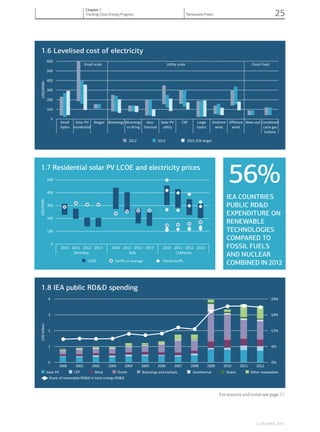
The falling costs of distributed solar PV systems are
increasingly supporting deployment for self-consumption
in markets such as Italy, Germany and California where
costs for self-generation are on par with household
electricity prices. Turkey’s first commercial
self-consumption solar PV plant was commissioned in
2013.
For geothermal, early-stage exploration and drilling risks
remain a major deployment challenge. Technology
development activities focus on enhanced geothermal
systems, which can be used to upgrade existing wells or
create geothermal reservoirs where none previously
existed. Several testing activities are under way in the
United States. Still, the degree to which
commercial-scale deployment in existing plants or new
projects will transpire over the next five years is
uncertain.
Ocean power technologies are still at the research and
development (R&D) stage, and most remain relatively
expensive. As of 2013, there were ten wave and tidal
single-device test machines operational ranging from
250 kW to 1000 kW in the European Marine Energy
Centre (EMEC), the largest ocean energy test centre in
the world. The SeaGen tidal stream device in the United
Kingdom, commissioned in 2008, remains the largest
operational generating capacity.
Increased investment in research, development and
demonstration (RD&D) in emerging technologies,
particularly ocean and enhanced geothermal, is needed
to enhance competitiveness. In 2012, public RD&D
expenditure on fossil fuels and nuclear combined was
80% higher than on renewable technologies.
© OECD/IEA, 2014.
24
Chapter 1
Tracking Clean Energy Progress Renewable Power
1.6 Levelised cost of electricity
1.7 Residential solar PV LCOE and electricity prices
1.8 IEA public RD&D spending
0
100
200
300
400
500
2010 2011 2012 2013 2010 2011 2012 2013 2010 2011 2012 2013
Germany Italy California
hWM/DSU
LCOE Tariffs or average Tiered tariffs
0%
6%
12%
18%
24%
0
1
2
3
4
2000 2001 2002 2003 2004 2005 2006 2007 2008 2009 2010 2011 2012
DSUbillion
Solar PV CSP Wind Ocean Bioenergy and biofuels Geothermal Hydro Other renewables
Share of renewable RD&D in total energy RD&D
0
100
200
300
400
500
600
Small
hydro
Solar PV
residenƟal
Biogas Bioenergy Bioenergy
co-firing
Geo-
thermal
Solar PV
uƟlity
CSP Large
hydro
Onshore
wind
Offshore
wind
New coal Combined
cycle gas
turbine
hWM/DSU
2012 2013 2025 2DS target
Small scale UƟlity scale Fossil fuels
56%
IEA COUNTRIES
PUBLIC RD&D
EXPENDITURE ON
RENEWABLE
TECHNOLOGIES
COMPARED TO
FOSSIL FUELS
AND NUCLEAR
COMBINED IN 2012
For sources and notes see page 71
© OECD/IEA, 2014.
Chapter 1
Tracking Clean Energy Progress Renewable Power 25
Nuclear Power
•Not on track
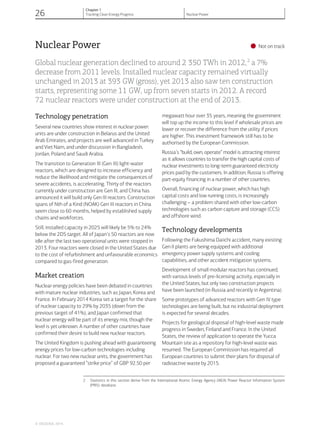
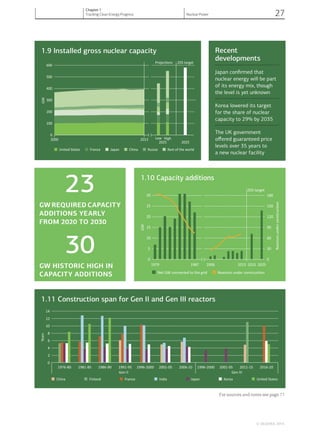
Global nuclear generation declined to around 2 350 TWh in 2012,2
a 7%
decrease from 2011 levels. Installed nuclear capacity remained virtually
unchanged in 2013 at 393 GW (gross), yet 2013 also saw ten construction
starts, representing some 11 GW, up from seven starts in 2012. A record
72 nuclear reactors were under construction at the end of 2013.
Technology penetration
Several new countries show interest in nuclear power:
units are under construction in Belarus and the United
Arab Emirates, and projects are well advanced in Turkey
and Viet Nam, and under discussion in Bangladesh,
Jordan, Poland and Saudi Arabia.
The transition to Generation III (Gen III) light-water
reactors, which are designed to increase efficiency and
reduce the likelihood and mitigate the consequences of
severe accidents, is accelerating. Thirty of the reactors
currently under construction are Gen III, and China has
announced it will build only Gen III reactors. Construction
spans of Nth of a Kind (NOAK) Gen III reactors in China
seem close to 60 months, helped by established supply
chains and workforces.
Still, installed capacity in 2025 will likely be 5% to 24%
below the 2DS target. All of Japan’s 50 reactors are now
idle after the last two operational units were stopped in
2013. Four reactors were closed in the United States due
to the cost of refurbishment and unfavourable economics
compared to gas-fired generation.
Market creation
Nuclear energy policies have been debated in countries
with mature nuclear industries, such as Japan, Korea and
France. In February 2014 Korea set a target for the share
of nuclear capacity to 29% by 2035 (down from the
previous target of 41%), and Japan confirmed that
nuclear energy will be part of its energy mix, though the
level is yet unknown. A number of other countries have
confirmed their desire to build new nuclear reactors.
The United Kingdom is pushing ahead with guaranteeing
energy prices for low-carbon technologies including
nuclear. For two new nuclear units, the government has
proposed a guaranteed “strike price” of GBP 92.50 per
megawatt hour over 35 years, meaning the government
will top up the income to this level if wholesale prices are
lower or recover the difference from the utility if prices
are higher. This investment framework still has to be
authorised by the European Commission.
Russia’s “build, own, operate” model is attracting interest
as it allows countries to transfer the high capital costs of
nuclear investments to long-term guaranteed electricity
prices paid by the customers. In addition, Russia is offering
part-equity financing in a number of other countries.
Overall, financing of nuclear power, which has high
capital costs and low running costs, is increasingly
challenging – a problem shared with other low-carbon
technologies such as carbon capture and storage (CCS)
and offshore wind.
Technology developments
Following the Fukushima Daiichi accident, many existing
Gen II plants are being equipped with additional
emergency power supply systems and cooling
capabilities, and other accident mitigation systems.
Development of small modular reactors has continued,
with various levels of pre-licensing activity, especially in
the United States, but only two construction projects
have been launched (in Russia and recently in Argentina).
Some prototypes of advanced reactors with Gen IV type
technologies are being built, but no industrial deployment
is expected for several decades.
Projects for geological disposal of high-level waste made
progress in Sweden, Finland and France. In the United
States, the review of application to operate the Yucca
Mountain site as a repository for high-level waste was
resumed. The European Commission has required all
European countries to submit their plans for disposal of
radioactive waste by 2015.
2 Statistics in this section derive from the International Atomic Energy Agency (IAEA) Power Reactor Information System
(PRIS) database.
© OECD/IEA, 2014.
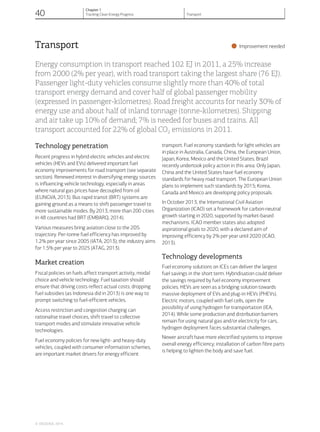
26
Chapter 1
Tracking Clean Energy Progress Nuclear Power
1.9 Installed gross nuclear capacity
1.11 Construction span for Gen II and Gen III reactors
1.10 Capacity additions
Recent
developments
Japan confirmed that
nuclear energy will be part
of its energy mix, though
the level is yet unknown
Korea lowered its target
for the share of nuclear
capacity to 29% by 2035
The UK government
offered guaranteed price
levels over 35 years to
a new nuclear facility
23
GW REQUIRED CAPACITY
ADDITIONS YEARLY
FROM 2020 TO 2030
30
GW HISTORIC HIGH IN
CAPACITY ADDITIONS
0
100
200
300
400
500
600
2000 2013 Low High
2DS targetProjecƟons
2025 2025
WG
Rest of the worldRussiaChinaJapanFranceUnited States
0
5
10
15
20
25
30
1979 1987 2006 2013 2015 2025
2DS target
WG
0
30
60
90
120
150
180
Rrotcaesrednucoitcurtsnon
Net GW connected to the grid Reactors under construcƟon
IndiaFinlandChina Japan KoreaFrance United States
0
2
4
6
8
10
12
14
1976-80 1981-85 1986-90 1991-95 1996-2000 2001-05 2006-10 1996-2000 2001-05 2011-15 2016-20
Gen II Gen III
Yraes
For sources and notes see page 71
© OECD/IEA, 2014.
Chapter 1
Tracking Clean Energy Progress Nuclear Power 27
Natural Gas-Fired Power
•Improvement needed
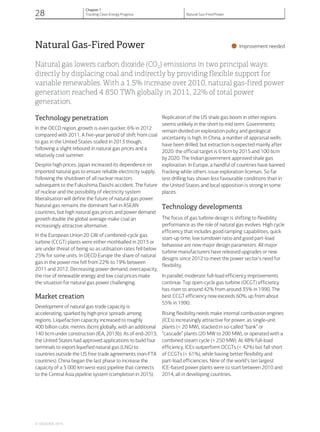
Natural gas lowers carbon dioxide (CO2) emissions in two principal ways:
directly by displacing coal and indirectly by providing flexible support for
variable renewables. With a 1.5% increase over 2010, natural gas-fired power
generation reached 4 850 TWh globally in 2011, 22% of total power
generation.
Technology penetration
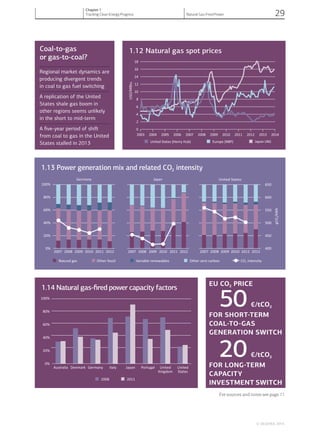
In the OECD region, growth is even quicker, 6% in 2012
compared with 2011. A five-year period of shift from coal
to gas in the United States stalled in 2013 though,
following a slight rebound in natural gas prices and a
relatively cool summer.
Despite high prices, Japan increased its dependence on
imported natural gas to ensure reliable electricity supply,
following the shutdown of all nuclear reactors
subsequent to the Fukushima Daiichi accident. The future
of nuclear and the possibility of electricity system
liberalisation will define the future of natural gas power.
Natural gas remains the dominant fuel in ASEAN
countries, but high natural gas prices and power demand
growth double the global average make coal an
increasingly attractive alternative.
In the European Union 20 GW of combined-cycle gas
turbine (CCGT) plants were either mothballed in 2013 or
are under threat of being so as utilisation rates fell below
25% for some units. In OECD Europe the share of natural
gas in the power mix fell from 22% to 19% between
2011 and 2012. Decreasing power demand, overcapacity,
the rise of renewable energy and low coal prices make
the situation for natural gas power challenging.
Market creation
Development of natural gas trade capacity is
accelerating, sparked by high price spreads among
regions. Liquefaction capacity increased to roughly
400 billion cubic metres (bcm) globally, with an additional
140 bcm under construction (IEA, 2013b). As of end-2013,
the United States had approved applications to build four
terminals to export liquefied natural gas (LNG) to
countries outside the US free trade agreements (non-FTA
countries). China began the last phase to increase the
capacity of a 5 000 km west-east pipeline that connects
to the Central Asia pipeline system (completion in 2015).
Replication of the US shale gas boom in other regions
seems unlikely in the short to mid term. Governments
remain divided on exploration policy and geological
uncertainty is high. In China, a number of appraisal wells
have been drilled, but extraction is expected mainly after
2020: the official target is 6 bcm by 2015 and 100 bcm
by 2020. The Indian government approved shale gas
exploration. In Europe, a handful of countries have banned
fracking while others issue exploration licenses. So far
test drilling has shown less favourable conditions than in
the United States and local opposition is strong in some
places.
Technology developments
The focus of gas turbine design is shifting to flexibility
performance as the role of natural gas evolves. High cycle
efficiency that includes good ramping capabilities, quick
start-up time, low turndown ratio and good part-load
behaviour are now major design parameters. All major
turbine manufacturers have released upgrades or new
designs since 2012 to meet the power sector’s need for
flexibility.
In parallel, moderate full-load efficiency improvements
continue. Top open-cycle gas turbine (OCGT) efficiency
has risen to around 42% from around 35% in 1990. The
best CCGT efficiency now exceeds 60%, up from about
55% in 1990.
Rising flexibility needs make internal combustion engines
(ICEs) increasingly attractive for power, as single-unit
plants (< 20 MW), stacked in so-called “bank” or
“cascade” plants (20 MW to 200 MW), or operated with a
combined steam cycle (> 250 MW). At 48% full-load
efficiency, ICEs outperform OCGTs (< 42%) but fall short
of CCGTs (< 61%), while having better flexibility and
part-load efficiencies. Nine of the world’s ten largest
ICE-based power plants were to start between 2010 and
2014, all in developing countries.
© OECD/IEA, 2014.
28
Chapter 1
Tracking Clean Energy Progress Natural Gas-Fired Power
EU CO2 PRICE
50€/tCO2
FOR SHOR ERM
CO O
GENERATION SWITCH
20€/tCO2
FOR LO TERM
CAPACITY
INVESTMENT SWITCH
1.12 Natural gas spot prices
1.13 Power generation mix and related CO2 intensity
1.14 Natural gas-fired power capacity factors
0%
20%
40%
60%
80%
100%
2007 2008 2009 2010 2011 2012
Germany
CO intensity2
2007 2008 2009 2010 2011 2012
Japan
400
450
500
550
600
650
2007 2008 2009 2010 2011 2012
United States
OCghWk/2
Natural gas Other fossil Variable renewables Other zero carbon
0%
20%
40%
60%
80%
100%
Australia Denmark Germany Italy Japan Portugal United
Kingdom
United
States
2008 2011
0
2
4
6
8
10
12
14
16
18
2003 2004 2005 2006 2007 2008 2009 2010 2011 2012 2013 2014
BM/DSUut
United States (Henry Hub) Europe (NBP) Japan LNG
Coal-to-gas
or gas-to-coal?
Regional market dynamics are
producing divergent trends
in coal to gas fuel switching
A replication of the United
States shale gas boom in
other regions seems unlikely
in the short to mid-term
from coal to gas in the United
States stalled in 2013
For sources and notes see page 71
© OECD/IEA, 2014.
Chapter 1
Tracking Clean Energy Progress Natural Gas-Fired Power 29
Coal-Fired Power
•Not on track
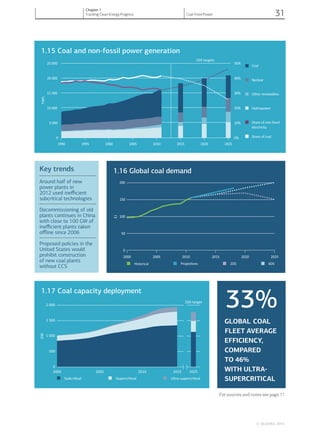
Coal continues to dominate global power generation. In 2011, coal-fired
electricity generation was over 9 100 TWh, a 52% increase over 2000 levels.
At 41%, coal has the largest share in global generation by far. Driven by
coal-to-gas switching in the United States, the share of coal in power
generation fell to 32.1% in OECD in 2012, down from 33.4% in 2011.
Technology penetration
China and, to a lesser extent, India play key roles in driving
this growth in demand. In 2012, China built 48 GW of new
coal capacity and accounted for almost 50%
(3 678 million tonnes [Mt]) of global coal consumption;
India’s share (753 Mt) was almost 10%. In Germany,
2.7 GW of lignite capacity became operational in 2012.
Primary coal demand is estimated to increase from
158 exajoules (EJ) (7 697 Mt) in 2012 to 186 EJ
(8 799 Mt) in 2018 (+ 2.3% per annum). These trends are
not compatible with the 2DS.
The efficiency of generation is increasing. Globally, 64%
of plants under construction are supercritical or
ultra-supercritical, up from 50% in 2012. More than 60%
of subcritical units under construction are in India.
Between 2006 and 2010, China retired 77 GW of old
inefficient plants, with a target to retire a further 20 GW
by 2015. Having recently retired 1.4 GW, Germany plans
to retire a further 1.5 GW by 2015. These essential trends
to increase global generation efficiency must be
combined with accelerated development of CCS if 2DS
targets are to be reached.
Market creation
Policy offers routes to emissions reductions. China’s
recently released Air Pollution Action Plan aims to reduce
the share of coal below 65% of total power generation by
2017 (from 79% in 2011). In September 2013, China
announced that it will ban construction of new coal-fired
power plants in the Beijing, Shanghai and Guangdong
regions. Overall, the provinces around Beijing will reduce
annual coal consumption by 73 Mt, around 10% of 2012
levels.
While Canada has already imposed emissions
performance standards on its coal plants to become
effective in 2015, the US Environmental Protection
Agency’s proposal to limit CO2 emissions to 500 gCO2 per
kilowatt hour for new coal-fired plants, a level that cannot
be achieved without CCS, was published in the Federal
Register in January 2014. Furthermore, the EPA proposes
to issue emissions standards for existing power plants by
mid-2014, to be finalised by mid-2015.
Cleaner use of coal can be achieved by strengthening
bilateral or multilateral co-operation. China and the
United States, the world’s two largest coal users,
emphasised in 2013 further co-operation in cleaner
coal use, pollutant control in pulverised power
generation plants, CCS, and selected CO2 utilisation
options.
Technology developments
The size of units is increasing, again, trends are most
pronounced in China. The country has become a world
leader both in number of installed units and in unit size.
China installed the first 1 GW ultra-supercritical
coal-fired unit in 2006, and by mid-2012, a further
46 units of this size were in operation. Japan’s 600 MW
Isogo Power Station Unit 2 possesses the world’s most
advanced environmental control system to minimise
sulphur dioxide (SO2) and nitrogen oxide (NOX) emissions,
as well as waste-water discharge. With a net efficiency of
45%, it emits over 25% less CO2 than a plant operating
with global average efficiency.
A major advantage of integrated gasification combined
cycle (IGCC) plants is that they may reduce the cost of
CO2 capture. Climate change targets therefore offer the
technology a second opportunity, after the cost of
generation halted commercial interest after the first
wave of IGCCs was commissioned in the 1990s. IGCC
plants have recently been commissioned in China
(GreenGen in Tianjin) and the United States (Edwardsport
in Indiana), with further plants following closely behind in
the United States (Kemper County, Hydrogen Energy
California and Summit Texas Clean Energy) and in Japan
(Osaki).
© OECD/IEA, 2014.
30
Chapter 1
Tracking Clean Energy Progress Coal-Fired Power
1.17 Coal capacity deployment
1.15 Coal and non-fossil power generation
Key trends
Around half of new
power plants in
2012 used inefficient
subcritical technologies
Decommissioning of old
plants continues in China
with close to 100 GW of
inefficient plants taken
offline since 2006
Proposed policies in the
United States would
prohibit construction
of new coal plants
without CCS
33%
GLOBAL COAL
AVERFLEET AGE
EFFICIENCY,
COMPARED
TO 46%
WITH ULTRA
SUPERCRITICAL
1.16 Global coal demand
0
500
1 000
1 500
2 000
2000 2005 2010 2015 2025
2DS target
WG
SubcriƟcal SupercriƟcal Ultra-supercriƟcal
0%
10%
20%
30%
40%
50%
0
5 000
10 000
15 000
20 000
25 000
1990 1995 2000 2005 2010 2015 2020 2025
TWh
Coal
Other renewables
Hydropower
Share of non-fossil
electricity
Share of coal
2DS targets
0
50
100
150
200
2000 2005 2010 2015 2020 2025
JE
Historical 2DS 6DSProjecƟons
For sources and notes see page 71
© OECD/IEA, 2014.
Chapter 1
Tracking Clean Energy Progress Coal-Fired Power 31
Carbon Capture and Storage
•Not on track
Deployment of CCS in both power and industry is critical to address climate
change. While progress is being made in demonstrating elements of capture,
transport and storage the current pace of development must grow rapidly if
CCS is to fulfil its potential.
Technology penetration
As of end-2013, four large-scale CCS projects are in
operation and have captured and stored approximately
55 MtCO2 in total. In addition, four large-scale enhanced
oil recovery (EOR) projects that demonstrate elements of
CO2 capture, transport and storage entered operation in
2013, bringing the number of projects using
anthropogenic CO2 for EOR to eight.
Construction of nine large-scale projects with combined
potential to capture and store an additional 14 MtCO2
per year by 2016 is proceeding in Australia, Canada,
Saudi Arabia, the United Arab Emirates, and the United
States. Among these are two of the first projects built in
the electricity sector. An additional 15 projects are in
advanced stages of planning; if built, they could
contribute an additional 29 MtCO2 per year.
Of these 36 projects, 28 are in OECD countries. In the 2DS
in 2025, OECD countries contribute only one-third of the
CO2 captured – additional demonstrations are thus needed
in non-OECD countries. In the 2DS, 226 MtCO2 per year
are captured and stored by 2025, which means that the
rate of capture and storage must increase by two orders of
magnitude in the next decade to achieve 2DS targets.
Market creation
One CCS project took a positive final investment decision
in 2013, and increasing the cumulative investment in CCS
by USD 123 million to USD 10.5 billion. Up to six projects
are expected to take final investment decisions in 2014.
OECD governments offered approximately USD 22 billion
in direct financial support to large-scale CCS projects
between 2008 and 2012. Most funded projects in North
America are progressing, but few projects were funded in
Europe and Australia, and many have since been
cancelled or face serious delays.
Development of co-ordinated policy packages that
address distinct market risks will be crucial in the coming
years. In late 2013, the United Kingdom passed
legislation that will allow the government to provide
operating support to CCS projects. This mechanism will
operate alongside a CO2 price floor and emissions
performance standard for new power generation. Carbon
pricing is a critical long-term driver for CCS but is unlikely
to stimulate deployment in the short term. In 2013, the
US EPA proposed a rule that would require new coal-fired
generation to be equipped with CCS. If this rule is
adopted, the United States will join Canada and the
United Kingdom in having regulations that effectively
prohibit construction of new coal-fired generation
without CCS. Moreover several international financing
banks restricted funding for coal plants without CCS.
In the near term, utilisation of captured CO2 (such as in
EOR), will continue to drive interest in CCS, particularly
from private investors: 24 large-scale projects are
providing, or are expected to provide, CO2 for EOR.
Technology developments
At least six CCS pilot projects began operation in 2013,
and construction of several other projects has been
announced, including a capture demonstration at a
cement plant in Norway. This brings the total number of
CCS pilot projects to approximately 60.3
IEA member governments spent an estimated
USD 1.1 billion on RD&D for CCS in 2012, about 6.6% of
their total energy RD&D expenditure, up 21% from 2011.
The share of CCS in fossil fuel RD&D expenditure has
increased significantly since 2008, from 22% to almost 54%
in 2012. The number of new patent applications that relate
to CCS continues to grow each year. Commercial interest in
developing relevant technologies is still growing, but the level
of patenting activity in 2012 may signal a slight softening of
the exponential growth between 2006 and 2011.
3 Pilot projects are defined as those that test one or more elements of capture, transport or storage at a scale that is one
or two orders of magnitude below that required for commercial use, in this case on the order of 10 kilotonnes of CO2
per year. For information on storage projects, see GHG IA, 2013 for capture, see Aldous et al., 2013.
© OECD/IEA, 2014.
32
Chapter 1
Tracking Clean Energy Progress Carbon Capture and Storage
1.18 Large-scale CO2 capture projects
1.19PatentingactivityinCCS-relatedtechnologies
1.20 IEA public RD&D spending
0
50
100
150
200
250
2000 2002 2004 2006 2008 2010 2012
ApplicaƟonsGranted patents
0%
10%
20%
30%
40%
50%
60%
0
200
400
600
800
1 000
1 200
2004 2005 2006 2007 2008 2009 2010 2011 2012
USmDillion
Share of CCS RD&D in fossil fuels RD&D spending Share of CCS RD&D in total energy RD&D spendingCCS RD&D spending
0
10
20
30
40
Maximum projected
capacity
50
60
70
1996 2000 2004 2008 2012 2016 2020
CtMO2
RefiningPower generaƟonNatural gas processingIron and steelChemicalsBiofuels
55
MILLION
TONNES
OF CO2
STORED WITH
MONITORING
SO FAR
Key developments
The first two coal-fired
power plants to capture
over 1 million tonnes of
their CO2 per year will
start operation in 2014
Commercial CO2
capture in the refining
and gas processing
sectors continues to
provide CO2 for EOR,
increasing confidence
in the technology
M
ore
online
For sources and notes see page 72
© OECD/IEA, 2014.
Chapter 1
Tracking Clean Energy Progress Carbon Capture and Storage 33
Industry
•Improvement needed
Global industrial energy intensity has decreased 10% since 2000, mainly as a
result of efficient capacity additions in emerging economies outweighing the
upward effects of structural changes in the sector.4
Despite this trend,
industrial energy use and CO2 emissions increased significantly.
Technology penetration
Industrial energy use reached 143 EJ5
in 2011, up 36%
since 2000. The increase is largely fuelled by rising
materials demand in non-OECD countries, which now use
66% of industrial energy, up from 50% in 2000. Growth in
industrial energy use must be cut to 1.7% per year in the
period from 2011-25 compared with 3.3% per year in
2000-11. Similarly, trends in industrial CO2 emissions
must be reversed: from 2007 to 2011, emissions grew by
17%; by 2025, they must be reduced by 17% to meet 2DS
targets.
Improvements in energy efficiency have offset the
upward effect of structural changes in the industrial
sector, such that overall industrial energy intensity is
decreasing; in 2011 most regions were below a level of
ten gigajoules (GJ) per thousand USD purchasing power
parity (PPP) of industrial value added. China (2.4%) and
India (1.9%) have had the highest annual reductions since
2000. Thanks to high shares of new capacity, China is
now among the world’s most energy-efficient primary
aluminium producers.
Substantial potential to further improve energy efficiency
exists. By applying current best available technologies
(BATs), the technical potential to reduce energy use in the
cement sector is 18%, 26% in pulp and paper, and 11% in
aluminium. These potentials are unlikely to be fully
tapped by 2025 due to slow turnover of capacity stock,
high costs and fluctuation in raw material availability.
Meeting 2DS targets will also require resolving
challenges related to increased use of alternative fuels
and clinker substitutes, and greater penetration of waste
heat recovery (WHR)6
in the cement sector, among
others.
Market creation
Energy management systems (EnMS) can be effective
tools to enable energy efficiency improvements, but in
most countries they are still voluntary. In 2013, China
mandated provincial-level implementation of energy
management programmes in companies covered by the
Top-10 000 Program, an energy conservation policy for
large energy users. In the United States, pilot companies
in the Superior Energy Performance programme on
average improved their energy performance by 10% in
18 months. The Australian Energy Efficiency
Opportunities programme, which is mandatory for large
energy users, was estimated to have enabled 40% energy
savings in participating firms. A growing number of
industrial sites have certified EnMS (ISO 50001) in place:
6 750 in 70 countries in March 2014, up by more than
300% over the previous year (Peglau, 2014).
Technology developments
Innovative energy-saving technology developments have
been relatively slow in energy-intensive industries over
the last decade and need to accelerate: in the 2DS for
instance, deployment of CCS starts before 2025. To
stimulate investment in CCS, industry is investigating
opportunities for CO2 use in EOR and developing
processes that use CO2 as a feedstock (e.g. in polymer
production).
In pulp and paper, the Confederation of European Paper
Industries (CEPI) announced in 2013 promising lab-scale
results of deep eutectic solvents (DES) allowing the
production of pulp at low temperatures and atmospheric
pressure. Applying DES-based pulp making throughout
the sector could reduce CO2 emissions by 20% from
current levels by 2050 (CEPI, 2013).
4 Structural changes in the industrial sector refer to a shift in the share that energy-intensive industries represent in total
industrial energy use. The energy-intensive sectors increased their share to 67% in 2011 from 57% in 1990.
5 Industry energy use data includes feedstock in the chemicals and petrochemicals sector, and coke ovens and blast furnaces
in the iron and steel sector.
6 IEA analysis shows that 12% to 15% of the power consumption of a cement plant can be generated by WHR technologies.
© OECD/IEA, 2014.
34
Chapter 1
Tracking Clean Energy Progress Industry
1.21 Energy intensity by product
1.22 Global industrial energy use
1.23 Aggregated industrial energy intensity
26%TECHNICAL
POTENTIAL TO
REDUCE ENERGY
USE IN THE
PULP AND PAPER
SECTOR BY
APPLYING BATS
Key
developments
12% to 15% of the
power consumed
in a cement plant
can be generated
through waste
heat recovery
Energy management
systems and
programmes are
receiving increasing
policy attention
0
20
40
60
80
100
120
140
JE
160
180
2000 2005 2011 2015 2020 2025
Other non-OECD India China Other OECD European Union United States
2DS targets
2000 2005 2011
0
2
4
6
8
10
12
14
dnasuoht/JGDSU
European Union Other OECD Other non-OECD United States India China Russia
2011 2025 2DS targets
Current
BAT
World OECD
Non-
OECD
World OECD
Non-
OECD
Paper and
paperboard
(GJ/t)
n.a. 7.6 7.5 7.7 6.7 6.8 6.6
Clinker (GJ/t) 3.0 3.7 3.6 3.7 3.6 3.5 3.6
Primary
aluminium
(kWh/t)
13 611 14 788 15 587 14 509 13 383 14 833 13 141
For sources and notes see page 72
© OECD/IEA, 2014.
Chapter 1
Tracking Clean Energy Progress Industry 35
Chemicals and Petrochemicals
•Improvement needed
Accounting for 28% of total industrial energy use in 2011, the chemicals and
petrochemicals sector is the largest industrial energy user. Energy use in the
sector grew by 2.5% annually from 2000 to 2011. With demand for chemical
and petrochemical materials projected to grow even faster in the coming
years, the annual increase in energy use must be kept to 4.3% to meet 2DS
targets; this will still result in a total increase of 60% in 2025 over 2011
levels. In parallel, CO2 emissions must be cut by 30% compared with 2011.
Both targets require significant improvements over current trends.
Technology penetration
In the 2DS, production of high-value chemicals (HVC)7
is
expected to grow from 320 Mt in 2011 to 485 Mt in
2025 (up 52% on 2011 levels), with notable production
growth in ammonia (31%) and methanol (126%). The
Middle East and China remain the major HVC producers
and have the highest growth projections, even though the
availability of cheap natural gas and natural gas liquid
products from the exploitation of unconventional gas
resources has driven a recent regional shift of production
towards North America. Improvements in efficiency
(based on increased levels of process integration driven
by increasing energy prices), along with waste heat
recovery and expansion of new, more efficient capacity,
can help decouple materials demand growth from energy
use.
Application of best practice technologies (BPTs) could
save 24% of current energy use. This technical energy
savings potential is unlikely to be fully tapped by 2025
due to dependency on existing production capacity stock
turnover, demands for returns on investment for
upgrades/refurbishment projects, fluctuation in raw
material availability, etc. Reaching the 2DS targets
requires that all new and refurbished plants adopt BPTs,
switch to low-carbon fuels and increase recycling, and
that emerging technologies start playing a role by 2020.
Savings on process heat has the largest savings
potential; the United States, a leading producer of
chemicals and petrochemicals, has the largest savings
potential of any country.
Market creation
No major new energy policy initiatives affecting the
chemicals industry occurred in 2013; however, increased
discussion between policy makers and industry was
evident, particularly in Europe. The ongoing debate
centres on how to reconcile sustainability and
competitiveness (CEFIC, 2013).
The IEA collaborated with the International Council of
Chemical Associations (ICCA) and DECHEMA, the Society
for Chemical Engineering and Biotechnology, to publish (in
2013) the Technology Roadmap: Energy and GHG Reductions
in the Chemical Industry via Catalytic Processes. The
roadmap also provides recommendations to policy makers
and industry to enable implementation of identified savings
potential (about 5 EJ by 2025,8
or 13% of current sector
energy use) (IEA, ICCA and DECHEMA, 2013).
Technology developments
Broad deployment of emerging technological
improvements would be required to meet 2DS targets for
the chemical industry. CCS applications should be
successfully demonstrated by 2020 and should capture
about 4% of the sector’s CO2 emissions by 2025. The
methanol-to-olefins route, while more energy-intensive
than steam cracking when the methanol production
stage is included, allows for using biomass instead of
fossil resources as feedstocks. Catalytic cracking can
provide further energy efficiency benefits, using up to
20% less energy than steam cracking (Ren, Patel and
Blok, 2006). This technology is currently at pilot scale.
7 HVCs include ethylene, propylene and BTX (benzene, toluene and xylene).
8 Energy savings resulting from comparing Business as Usual scenario and the Emerging Technologies scenario in 2025.
© OECD/IEA, 2014.
36
Chapter 1
Tracking Clean Energy Progress Chemicals and Petrochemicals
1.24 Energy savings potential in 2011
1.26 Production and energy intensity
1.25 Global energy consumption by region
24%
OF ENERGY COULD
BE SAVED WITH
THE APPLICATION
OF BEST PRACTICE
TECHNOLOGIES IN
THE SECT
OF INDUSTRIAL
ENERGY
0
5
10
15
20
25
0
100
200
300
400
500
1102
0202
5202
1102
0202
5202
1102
0202
5202
1102
0202
5202
1102
0202
5202
1102
0202
5202
1102
0202
5202
1102
0202
5202
1102
0202
5202
World OECD Non-OECD Non-OECD Non-OECDWorld OECD World OECD
t/JG
Mt
IntensityEthylene Propylene BTX Ammonia Methanol
2000
European Union
2011
United States
Other OECD
China
India
Middle East
Other non-OECD
19
18
12
21
2025 2DS target
2044
EJ
JE
0.00
0.52
1.04
1.56
2.08
2.510
United
States
OECD
Europe
China Japan Korea India Canada
JE
BPT (process heat savings potenƟal) Electricity savings potenƟal
Co-generaƟon Process intensificaƟon
World
For sources and notes see page 72
© OECD/IEA, 2014.
Chapter 1
Tracking Clean Energy Progress Chemicals and Petrochemicals 37
Iron and Steel
•Improvement needed
The iron and steel sector is the second-largest industrial energy consumer,
accounting for 22% of total industrial energy use in 2011. The sector’s energy
use grew by 6.2% annually from 2000 to 2011, driven by increases in crude
steel production (7.1% in 2011). In the 2DS, growth in annual energy use
must be limited to 1.2% and CO2 emissions must be 13% lower in 2025
compared with 2011 levels, even though crude steel production is expected
to grow by 27%. Current trends run counter to this projection.
Technology penetration
Energy intensity is relatively stable in the steel industry:
20.7 GJ/t crude steel in 2011 versus 21.7 GJ/t crude steel
in 2000. Positive effects of more efficient production
capacity have been offset by a decline in recycling as a
share of total crude steel production; from 47% in 2000
to 29% in 2011. Primary drivers include China’s increased
share of blast furnace/basic oxygen furnace technologies
rather than scrap-intensive electric arc furnace (EAF) due
to insufficient scrap availability, as well as the increasing
amount of steel in products still in use. The overall share
of EAF production from total crude steel must increase to
37% by 2025 to meet 2DS targets.
About 21% of energy use could be saved if current BATs
were applied, but inertia in capacity stock turnover and
high costs are slowing progress. Reaching 2DS targets
requires that all new and refurbished plants adopt BATs,
phase out open-hearth furnaces (OHFs) and limit
coal-based direct reduced iron (DRI) production. Greater
availability and use of scrap, as well as emerging
technologies, must start playing a role by 2020. In total,
global energy intensity must decrease to 18.9 GJ/t crude
steel by 2025, down 10% compared with 2011.
Market creation
No major new policy developments specific to the iron
and steel industry occurred in 2013, but dialogue
regarding solutions for a low-carbon future has
increased. To provide policy recommendations on the
steel sector’s contribution to decarbonisation, the
European Commission published an Action Plan for a
Competitive and Sustainable Steel Industry in Europe, and
Eurofer (the European Steel Association) published a
Steel Roadmap for a Low Carbon Europe 2050. The
International Organization for Standardization (ISO)
published a standardised method to calculate CO2
emission intensity from iron and steel production (ISO,
2013).
Technology developments
Emerging technologies – such as CCS, smelting reduction
and blast furnace with top-gas recycling – need to be
deployed in order to reach 2DS targets. The Ultra-Low
Carbon Dioxide Steelmaking (ULCOS) consortium,
comprising 48 European companies and organisations,
aims to dramatically reduce CO2 emissions of the
steelmaking process. But in late 2012, an
ULCOS-supported demonstration plant with top-gas
recycling was delayed due to technical and financial
issues. Steel industry stakeholders are now pursuing the
Low Impact Steel making project, which aims to
demonstrate a commercial-scale blast furnace with CCS.
The COURSE509
program in Japan is a NEDO10
-funded
partnership with the Japanese steel industry that
provided JPY 10 billion from 2008 to 2012 (Phase 1
Step 1). It seeks to develop technologies to reduce CO2
emissions from steelmaking by 30%, including hydrogen
reduction and capture and recovery of blast furnace
gases. A trial hydrogen reduction operation was
successfully completed in 2012, and the project aims to
commercialise the technologies by 2050. Phase 1 Step 2
of this program is expected to be completed in 2017.
9 CO2 Ultimate Reduction in Steelmaking Process by Innovative Technology for Cool Earth 50.
10 New Energy and Industrial Technology Development Organization.
© OECD/IEA, 2014.
38
Chapter 1
Tracking Clean Energy Progress Iron and Steel
1.28 Energy savings potential in 2011
1.27 Progress in emerging technologies
1.29 Aggregate energy intensity
0
10
20
30
40
2000 2005 2011 2015 2020 2025
t/JG
World
OECD
China
India
Other
non-OECD
2DS targets
0
3
6
9
0
3
6
9
0
1
2
3
4
5
6
7
World China
JE
JE
0.00
0.05
0.10
0.15
0.20
0.25
0.30
0.35
0.40
0.45
India OECD
Europe
Russia Ukraine United
States
Brazil Korea Japan Canada South
Africa
Other
t/JGtslee
t/JGtslee
CDQ (or advanced wet quenching) COG recovery Blasƞ urnace improvements Increased BOF gas recovery Switch from OHF to BOF
Savings potenƟal (GJ/t steel)Efficiency power generaƟon from BF gas Reduced electricity use from conƟnuous casƟng
Status Description Recent developments
HISmelt® Commercial,
not currently
operational.
Direct smelting process producing pig iron
directly from ore using a smelt reduction
vessel. Eliminates need for traditional blast
furnace and coking coal.
■ First plant relocated from Australia to
China with planned operation in 2014
and 500 kt capacity.
■ 1 Mt to 1.2 Mt steelworks planned
in India, to be operational in 2016.
HISarna® Pilot stage,
demonstration
needed.
Iron-making process combining HISmelt® bath
smelting process with a cyclone furnace, using
thermal coal and fine iron ore to combine the
coking and agglomeration. Allows more fuel
flexibility, including hydrogen use.
■ Pilot project complete.
■ Commercial grade steel produced at
pilot plant in 2013.
■ No large-scale demonstration
currently planned.
COREX® Commercial,
not widely
deployed.
Direct smelting process using non-coking coal
as reducing agent and energy source with
sinter, lump ore or pellets. Eliminates need for
traditional blast furnace.
■ Commercialised in 1989.
■ Three plants currently in operation in
India and South Africa.
FINEX® Commercial,
not widely
deployed.
Direct smelting process using non-coking coal
as reducing agent and energy source, with
unagglomerated fine iron ore. Eliminates need
for traditional blast furnace.
■ Commercialised in Korea in 2007.
■ 3 Mt integrated steelworks planned in
China following feasibility study and
Memorandum of Agreement.
Top-gas
recycling
blast
furnace
Pilot stage,
demonstration
needed.
Separation of blast furnace off-gases into
components for reuse in the furnace as
reducing agents. Reduces coke needs and can
facilitate CCS performance.
■ Full-scale demonstration was planned
in France, but cancelled for technical
and financial reasons.
■ No demonstration currently planned.
6.6
EJ COULD BE SAVED
IF BEST AVAILABLE
TECHNOLOGIES WERE
OF
INDUSTRIAL ENERGY
For sources and notes see page 72
© OECD/IEA, 2014.
Chapter 1
Tracking Clean Energy Progress Iron and Steel 39
Transport
•Improvement needed
Energy consumption in transport reached 102 EJ in 2011, a 25% increase
from 2000 (2% per year), with road transport taking the largest share (76 EJ).
Passenger light-duty vehicles consume slightly more than 40% of total
transport energy demand and cover half of global passenger mobility
(expressed in passenger-kilometres). Road freight accounts for nearly 30% of
energy use and about half of inland tonnage (tonne-kilometres). Shipping
and air take up 10% of demand; 7% is needed for buses and trains. All
transport accounted for 22% of global CO2 emissions in 2011.
Technology penetration
Recent progress in hybrid electric vehicles and electric
vehicles (HEVs and EVs) delivered important fuel
economy improvements for road transport (see separate
section). Renewed interest in diversifying energy sources
is influencing vehicle technology, especially in areas
where natural gas prices have decoupled from oil
(EUNGVA, 2013). Bus rapid transit (BRT) systems are
gaining ground as a means to shift passenger travel to
more sustainable modes. By 2013, more than 200 cities
in 48 countries had BRT (EMBARQ, 2014).
Various measures bring aviation close to the 2DS
trajectory. Per-tonne fuel efficiency has improved by
1.2% per year since 2005 (IATA, 2013); the industry aims
for 1.5% per year to 2025 (ATAG, 2013).
Market creation
Fiscal policies on fuels affect transport activity, modal
choice and vehicle technology. Fuel taxation should
ensure that driving costs reflect actual costs; dropping
fuel subsidies (as Indonesia did in 2013) is one way to
prompt switching to fuel-efficient vehicles.
Access restriction and congestion charging can
rationalise travel choices, shift travel to collective
transport modes and stimulate innovative vehicle
technologies.
Fuel economy policies for new light- and heavy-duty
vehicles, coupled with consumer information schemes,
are important market drivers for energy efficient
transport. Fuel economy standards for light vehicles are
in place in Australia, Canada, China, the European Union,
Japan, Korea, Mexico and the United States; Brazil
recently undertook policy action in this area. Only Japan,
China and the United States have fuel economy
standards for heavy road transport. The European Union
plans to implement such standards by 2015; Korea,
Canada and Mexico are developing policy proposals.
In October 2013, the International Civil Aviation
Organization (ICAO) set a framework for carbon-neutral
growth starting in 2020, supported by market-based
mechanisms. ICAO member states also adopted
aspirational goals to 2020, with a declared aim of
improving efficiency by 2% per year until 2020 (ICAO,
2013).
Technology developments
Fuel economy solutions on ICEs can deliver the largest
fuel savings in the short term. Hybridisation could deliver
the savings required by fuel economy improvement
policies. HEVs are seen as a bridging solution towards
massive deployment of EVs and plug-in HEVs (PHEVs).
Electric motors, coupled with fuel cells, open the
possibility of using hydrogen for transportation (IEA,
2014). While some production and distribution barriers
remain for using natural gas and/or electricity for cars,
hydrogen deployment faces substantial challenges,
Newer aircraft have more electrified systems to improve
overall energy efficiency; installation of carbon fibre parts
is helping to lighten the body and save fuel.
© OECD/IEA, 2014.
40
Chapter 1
Tracking Clean Energy Progress Transport
1.30 Well-to-wheel CO2 intensity
1.31 Bus Rapid Transit systems
1.32 Average new vehicle driving cost in selected countries
Many ciƟes
One city
0
5
10
15
20
25
1990 1995 2000 2005 2011
001/DSUmk
United States Canada FranceAustralia United Kingdom Germany Korea Turkey
3
COUNTRIES
HAVE FUEL
ECONOMY
STANDARDS
FOR HEAVY
ROAD
TRANSPORT
0 50 100 150 200 250
Air
PLDVs
2Ws
Bus
Rail
gCO /pkm2
2010 2025 2DS target World average
1 10 100 1 000
Air
Road
freight
Freight
rail
Shipping
gCO /tkm2
For sources and notes see page 73
© OECD/IEA, 2014.
Chapter 1
Tracking Clean Energy Progress Transport 41
Electric and Hybrid Electric Vehicles
•Improvement needed
Sales of EVs grew 50% from 2012 to 2013, reaching 170 000; sales of
non-plug-in HEVs remained stable at 1.3 million. This is encouraging, but it
falls below the levels needed to meet the ambitious 2DS targets, as in 2025
EV and HEV sales should grow 80% and 50% per year respectively.
Technology penetration
With almost 100 000 vehicles sold, the United States had
the biggest increase and almost matched global EV sales
in 2012 (115 000).
The global EV stock reached 350 000 vehicles at the end
of 2013, still far from the 2DS target of 1 million in 2015
and the extremely ambitious target of 80 million EVs by
2025. In the Netherlands, Norway and the United States,
among other countries, EVs now account for over 1% of
sales.
Sales of non-plug-in HEVs reached 1.6% of global market
share in 2013, with 52% of sales in Japan and 39% in the
United States. The 2DS sees annual HEV sales at
17 million in 2025 (15% market share).
Growth of electric bikes is also significant. China has the
biggest fleet, with more than 150 million battery-electric
2-wheelers on the road (over 50% of the 2-wheelers
stock). The 2 600 plants in China that manufacture
36 million e-bikes annually will drive the stock increase in
all of Asia.
Market creation
Early estimates11
show that the EV charging
infrastructure has continued to expand rapidly, with
12 500 (+ 27%) slow and 1 300 (+ 67%) fast chargers
installed in 2013.
Governments participating in the Clean Energy
Ministerial (CEM) Electric Vehicles Initiative (EVI)
continued putting in place policy measures such as
rebates or tax credits on vehicles, purchase subsidies, or
exemption from vehicle registration taxes or license fees.
Policy measures and programmes should have longer
time frames and create favourable conditions in urban
areas subject to access restriction and congestion
charging to boost industry confidence that market
demand will continue to grow over the short term and
beyond.
Car sharing of EVs is growing in popularity and accounts
for 10% of global vehicles in such schemes. Renting or
leasing EVs helps to mitigate some consumer concern
about battery life and range.
A five-year Clean Air Action Plan (2013-17) for Beijing
rules that of 600 000 new vehicles to be allowed in the
city in the next four years, 170 000 should be EVs, PHEVs
or fuel-cell vehicles. In 2014, a quota of 20 000 new car
registrations will be given to such vehicles.
HEVs failed to expand beyond core markets in Japan and
the United States (91% of global sales in 2013). Japan’s
initial subsidies for HEVs were discontinued at the end of
September 2012, with no further incentives envisioned. A
tax reduction still exists for HEVs, PHEVs, battery-electric
vehicles (BEVs) and clean diesel vehicles. The United
States has no subsidies at the federal level, although
HEVs qualify within vehicle acquisition laws that promote
alternative fuel vehicles in government fleets. Several
state incentives exist, both financial and non-financial
(e.g. priority access on highways).
Technology developments
Batteries remain the most costly component of EVs.
Encouraging signals are emerging from research
laboratories,12
with costs moving towards the target of
USD 300/kWh by 2020 (from the 485 USD/kWh estimate
of 2012), which should make EVs competitive with ICEs.
11 Data only available for six countries until end of September 2013.
12 According to the US Department of Energy (personal communication), battery cost is based on development efforts
costing USD 400/kWh of usable energy at the end of 2013. Costs do not include warranty costs or profit, and are based
on a production volume of at least 100 000 batteries per year.
© OECD/IEA, 2014.
42
Chapter 1
Tracking Clean Energy Progress Electric and Hybrid Electric Vehicles
1.35 Global hybrid electric vehicle market share
1.33 Global electric vehicles stock
1.34 Global hybrid electric vehicle sales
10%
OF VEHICLES IN
CA SHARING
PROGRAMMES
AROUND THE
WORLD ARE EVS
REQUIRED ANNUAL
SALES GROWTH
RATE TO 2025
50%FOR HEVs
80%FOR EVs
0
0.2
0.4
0.6
0.8
1.0
1.2
1.4
2004 2005 2006 2007 2008 2009 2010 2011 2012 2013
Millionvselcihe
Worldwide HEV sales OtherJapanUnited States
2DS target 2025
0%
5%
10%
15%
2004 2008 2013 2015 2020 2025
2DS targets
350 000 toda 8y 0 million required by 2025
17MILLION
For sources and notes see page 73
© OECD/IEA, 2014.
Chapter 1
Tracking Clean Energy Progress Electric and Hybrid Electric Vehicles 43
Biofuels
•Not on track
Biofuel production increased to 113 billion litres in 2013, buoyed by higher
ethanol output in Brazil due to improved economics and the readjustment of
the domestic ethanol mandate to 25%. High feedstock prices in the United
States and European Union (among others) in the first half of the year
reduced output there. Global biofuel production should reach 140 billion
litres in 2018, undershooting the volumes required to reach 2DS targets.
Technology penetration
Advanced biofuels,13
produced from lignocellulosic
biomass, algae and other innovative feedstocks, have
progressed more slowly than expected in recent years.
Production capacity in 2013 increased by around
one-third from 2012 levels, but will need to grow 22-fold
to reach 2DS targets in 2025. This will require dedicated
policy support for advanced biofuels and increased
government funding for research and market creation.
Globally, operating of advanced biofuels capacity was
5.4 billion litres in 2013, an increase of over 1 billion litres
compared to 2012. Looking forward, global advanced
biofuel capacity could reach 8.7 billion litres in 2018, less
than 10% needed to meet the 2025 2DS target.
Market creation
Over 50 countries worldwide have implemented biofuel
blending mandates and targets, often accompanied by
financial support measures such as tax incentives. These
measures have been effective in driving biofuel
production in general, but do not necessarily promote
technologies that perform best in terms of land use,
greenhouse-gas reductions, and social and economic
impacts. Despite international efforts to establish sound
sustainability criteria and certification schemes, only the
European Union and the United States have set
sustainability requirements for fuels that count towards
biofuel targets. Also, requirements in these two regions
are not currently aligned: EU standards consider a
broader and more detailed set of criteria.
Most current blending mandates for biofuels do not
specifically support advanced biofuels. Only the United
States (dedicated blending quota for cellulosic biofuels)
and the European Union (advanced biofuels based on
waste, and cellulosic biomass, are counted twice towards
the 10% renewable energy target in transport in 2020)
have policies targeting advanced biofuels. But time
horizons are limited to 2020 for the European Union and
2022 in the United States.
Long-term, stable policy frameworks that reduce the
risks associated with advanced biofuels projects are
needed to trigger further investments into
commercial-scale advanced biofuel plants. This can be,
for instance, in the form of a dedicated advanced biofuel
quota or a premium paid for each litre of advanced
biofuel blended to the fuel pool.
Technology developments
More than 100 advanced biofuel pilot and demonstration
plants were established over the last decade. The recent
opening of the first commercial-scale production units
(such as the Beta Renewables 60 million-litres-per-year
cellulosic-ethanol plant in Italy) as well as a number of
plants scheduled to come online in the United States,
Europe and Brazil in 2014 indicate substantial progress in
technology development. But the units are relatively
small, and several other projects were cancelled. More
commercial-scale plants are needed to reach economy of
scale and bring down costs.
13 Conventional biofuels (commonly referred to as first generation biofuels) include sugar- and starch-based ethanol, oil
crop-based biodiesel, and straight vegetable oil, as well as biogas derived through anaerobic digestion. Advanced biofuels
(commonly referred to as second generation) are conversion technologies that are still in the R&D, pilot or demonstration
phase. This category includes hydrotreated vegetable oil, which is based on animal fat and plant oil, as well as biofuels
based on lignocellulosic biomass, such as cellulosic-ethanol, biomass-to-liquids-diesel and bio-synthetic gas. Furthermore
novel technologies such as algae-based biofuels and the conversion of sugar into diesel-type biofuels using biological
or chemical catalysts are included.
© OECD/IEA, 2014.
44
Chapter 1
Tracking Clean Energy Progress Biofuels
1.37 Global advanced biofuel capacity
1.36 Global biofuels production
1.38 Production capacity investment
1.4
USD BILLION
SPENT ON
BIOFUELS R&D
IN 2013, 40%
FROM PRIVATE
INVESTORS
0
5
10
15
2010 2012 2014 2016 2018
noilliBlitres
Under construcƟon
2025 2DS target
ProjecƟons
OperaƟng Planned
0%
2%
4%
6%
8%
0
100
200
300
400
2006 2015 2020 2025
noilliBrtilse
Ethanol
Biodiesel
Ethanol
Biofuels share in
transport energy
consumpƟon
Advanced
ConvenƟonal
2010
Biodiesel
2DS targetProjecƟons
0
10
20
30
2004 2005 2006 2007 2008 2009 2010 2011 2012 2013
DSUbillion
Recent developments
In 2013 two commercial-scale
advanced biofuel production
units opened in the United
States and one in Europe
Over 50 countries have
biofuel blending mandates
and targets but only the
United States and the
European Union have policies
targeting advanced biofuels
120BILLION
For sources and notes see page 73
© OECD/IEA, 2014.
Chapter 1
Tracking Clean Energy Progress Biofuels 45
Buildings Energy Efficiency
•Not on track
Buildings are the largest energy-consuming sector, accounting for 31% of
final energy consumption globally, and a substantial source of CO2 emissions:
2.9 gigatonnes (Gt) from direct emissions and 3.8 Gt from indirect emissions
due to electricity in 2011. Final energy use increased by 19% between 2000
and 2011, to 119 EJ. The trend is expected to continue, driven by rising
population (1 billion people by 2025) and increasing wealth in some regions.
Technology penetration
Despite the recent global economic stagnation, which led
to severe retraction in the buildings sector in several
countries, global buildings energy consumption continues
to rise. Concerns over the continuation of this trend have
increased the call for further efforts to improve buildings
energy efficiency. In 2013, Transition to Sustainable
Buildings: Strategies and Opportunities to 2050 was
published to highlight the path to an alternative future
(IEA, 2013c).
Heating per unit of floor area, the largest end-use, is
becoming more efficient. Continued growth in floor area
per capita in residential buildings across all regions,
however, is driving up overall demand. The 2DS target for
2025 allows for energy demand growth of 0.7% per year
from 2012; the trend over the last decade, 1.5% per year,
throws the sector off track. Disaggregation of builders,
coupled with varying levels of building stock, makes
implementing energy efficiency improvements
particularly challenging.
Market creation
Current policies are insufficient to make the construction
of high-performance buildings routine, even though
near-zero-energy, zero-energy and energy-plus buildings
are being pursued around the world.14
Some European
countries have adopted zero-energy goals15
for new
residential construction around the 2020 time frame,
even though debate continues on the specific
performance criteria for the underlying EU Directive.16
To achieve 2DS, deep energy renovation will need to
become common practice during normal building
refurbishment, with the current rate of renovation at least
being doubled. Europe is leading this effort with a
co-ordinated group of advocates and businesses through
Renovate Europe and through the EU Directive to
refurbish 3% of public buildings per year. This Directive,
however, should be reviewed to include public and
non-public housing stock.
Sustainable building practices are growing through
voluntary programmes such as the UK BREEAM and
US Green Building Council LEED programmes. Russia
recently introduced a new building energy efficiency label
in association with the European Bank for Reconstruction
and Development. Deep renovation could be significantly
accelerated through financial incentives and policies that
target stringent energy performance criteria. California
recently launched a new approach, called CO2 to EE, to
enhance building renovation financing from climate
change policy, which may be an effective way to
stimulate the existing building market.
Technology developments
Systems-level research that promotes integrated
solutions can significantly reduce the overall cost of
building upgrades while maximising energy savings. R&D
can lead to higher performing products and more
favourable investment opportunities with more
cost-effective applications. The core technology
development need, however, centres on building
equipment and envelope materials (see following
sections).
14 China has adopted a National Green Building Action Plan with a goal of 1 billion square metres (m2
) of green buildings
by 2015.
15 Zero-energy goals for all residential construction go beyond the EU Directive for near-zero-energy.
16 Data for annual progress are not available, but see www.buildup.eu/news/33980 for more information.
© OECD/IEA, 2014.
46
Chapter 1
Tracking Clean Energy Progress Buildings Energy Efficiency
1.39 Buildings energy consumption by end use
1.40 Buildings electricity consumption
1.41 Floor area by sub-sector
Key trends
Residential
consumption has
been relatively static
since 1990, despite
energy efficiency
improvements
The current rate of
renovation should
at least double to
meet 2DS targets
0
2 000
4 000
6 000
8 000
10 000
12 000
2000 2001 2002 2003 2004 2005 2006 2007 2008 2009 2010 2011 2025
2DS target
TWh
United States European Union Other OECD
China India and other developing Asia Other non-OECD
0
10
20
30
40
50
60
70
80
90
2000 2011 2025 2000 2011 2025 2000 2011 2025 2000 2011 2025 2000 2011 2025 2000 2011 2025 2000 2011 2025
United States European Union Other OECD China India Other developing
Asia
Other non-OECD
noilliBm2
ServicesResidenƟal
0
5
10
15
20
2000 2011 2000 2011 2000 2011 2000 2011 2000 2011 2000 2011 2000 2011
United States European
Union
Other OECD China India and other
dev. Asia
Middle East
and Africa
Other
non-OECD
JE
Appliances
and other
Cooking
LighƟng
Water heaƟng
Space cooling
Space heaƟng
© OECD/IEA, 2014.
Chapter 1
Tracking Clean Energy Progress Buildings Energy Efficiency 47
Building Envelope
•Not on track
The thermal performance of the building envelope determines energy
requirements for heating and cooling, and can reduce artificial lighting
requirements. A systems approach for new construction and deep renovation
is essential, as are advanced building materials that enable the construction
of high-performance buildings.
Technology penetration
With space heating and cooling accounting for one-third
of all energy consumed in buildings – and the figure rising
to 60% in residential buildings in cold climates – building
envelopes have a significant impact on global energy
consumption. Global residential heating represents the
largest end use; overall growth was low (0.1% per year
from 2000) despite China’s average growth being over
5.4%. Cooling demand increased dramatically since 2000
(4.5% per year), with developing countries being the
largest driver and high US growth (2.8% per year) playing
a role.
Market creation
Mandatory building codes are the most effective policy to
reduce heating and cooling demand; progress continues
in most regions, but not aggressively enough to reach
2DS targets. The United States recently implemented its
most stringent energy-saving building code, which
includes mandatory daylighting and automated lighting
controls. Future stringency to achieve near-zero energy
performance is unlikely. In 2013, Viet Nam implemented a
new building code that was significantly influenced by
previous policy action within the Asia-Pacific Economic
Cooperation (APEC),17
and progress continued on a
regional building material testing and rating centre in
Thailand.
The IEA Technology Roadmap for Energy Efficient Building
Envelopes includes a market assessment of high-priority
building envelope components. From a technological
perspective, insulation and low-emissivity (low-e)
windows have been the most successful measures; from
a regional perspective, Canada, the European Union and
the United States have been the most successful. Highly
insulated windows have achieved 54% market share in a
few European countries, but remain very low in other
parts of the world. More programmes are required to
promote and mandate advanced building materials such
as double-glazed, low-e windows for the world and highly
insulated windows (triple-pane low-e windows with low
conductive frames) for cold climates.
The Cool Roofs and Pavements Working Group of the
Global Superior Energy Performance Partnership (GSEP),
an initiative of CEM and the International Partnership for
Energy Efficiency Co-operation (IPEEC), continues to
pursue policies to adopt reflective surfaces that provide
building energy efficiency and reduce urban heat islands
while increasing global cooling benefits. The group’s
recent analysis showed that switching to cool roofs could
reduce Mexico’s cooling load by 22%; now Mexico
preferential green mortgages can be used to install cool
roofs.
Technology developments
Significant progress has been made in dynamic glazings
that can improve passive heating benefits, reduce
lighting loads (up to 60%), reduce cooling loads (up to
20%) and lower peak electricity demand (up to 25%).
More R&D and economy of scale are needed to improve
market viability, which is also true for automated solar
control shading for regions that cannot eliminate cooling
equipment due to severe climatic conditions. R&D
continues on advanced insulation, such as aerogel and
vacuum-insulated panels, and is needed to pursue lower
cost validated air sealing techniques, reflective materials
and the development of highly insulated windows for
zero-energy buildings (U-values18
^ 0.6 W/m2
k while the
typical best practice U-value is 1.8W/m2
K) (IEA, 2013d).
17 For example, APEC’s effort on Cooperative Energy Efficient Design for Sustainability effort on building codes.
18 Thermal transmittance is a term to describe heat transfer across a material or assembly over a specified difference in
temperature, the most common descriptor being a U-value.
© OECD/IEA, 2014.
48
Chapter 1
Tracking Clean Energy Progress Building Envelope
1.42 Residential heating per square metre
1.43 Market maturity for high-priority building envelope components
0
200
400
2DS targets
600
800
1 000
2005 2010 2015 2020 2025
m/JM2
Other non-OECD China United StatesOther OECD European Union Russia
32%
SHARE OF
SPACE HEATING
AND COOLING
IN BUILDINGS
ENERGY
CONSUMPTION
Mature market Established market
Initial market
ASEAN
Brazil
China
European
Union
India
Japan/Korea
Mexico
MiddleEast
Australia/
NewZealand
Russia
SouthAfrica
UnitedStates/
Canada
Double-glazed
low-e glass    
Window films
       
Window
attachments (e.g.
shutters, shades,
storm panels)
   
Highly insulating
windows (e.g.
triple-glazed)
       
Typical insulation
Exterior insulation
   
Advanced insulation
(e.g. aerogel, VIPs)     
Air sealing
     
Cool roofs
       
BIPV/
advanced roofs         
© OECD/IEA, 2014.
Chapter 1
Tracking Clean Energy Progress Building Envelope 49
Appliances and Equipment
•Improvement needed
Improved energy efficiency of appliances and equipment can moderate
demand in energy without sacrificing features. Labelling and standards
programmes have been very effective when pursued aggressively and should
be expanded further to reach 2DS targets.
Technology penetration
Extensive evaluations show that voluntary and
mandatory policies have underpinned significant
progress towards more efficient appliances and
equipment in developed regions. Savings achieved,
however, have in many cases been eroded by increased
“productivity” such as larger dwellings, larger
refrigerators, brighter spaces and improved comfort.
Average growth of electricity in the buildings sector was
3.4% per year19
from 2000 through 2011, driven by the
demand of appliances and electronics reaching 34 EJ. To
achieve 2DS targets, this figure must be reduced to 2%
per year through 2025. Space cooling, which increased by
4.5% per year, needs to be reduced to 1.8% per year. The
more modest growth of water heating (0.9% per year)
still needs to be halved, to 0.5% per year through 2025.
More effort is needed to develop new programmes where
they do not exist, and to expand the scope, stringency and
compliance of existing programmes.
Market creation
Mandatory requirements for condensing boilers in the
United Kingdom, and a similar requirement for new
construction in France, have helped to temper residential
heating, which represents the largest end use in buildings.
Improved lighting deployment continues to grow thanks
to efforts such as the United Nations Environment
Programme (UNEP) Global Environment Facility (GEF)
en.lighten initiative’s Global Efficient Lighting Partnership
Programme, which supports 55 countries in following an
integrated approach to implement policies and measures
to accelerate the market transformation to efficient
lighting technologies by 2016 (27 countries will complete
the transition by 2014). Many countries now ban
inefficient incandescent lamps (IIL), although some still
allow “halogen” (which use around 80% the energy of a
typical IIL). Current compact fluorescent lamps (CFLs)
and light-emitting diode (LED) technologies use one-third
to a fifth of the energy of IILs. With potential to become
twice as efficient as CFLs, LEDs are growing in market
share: global sales were about USD 24 billion in 2012,
and are expected to reach USD 57 billion by 2018. In the
United States, LEDs saved 75 petajoules (PJ) of primary
energy in 2012 of an annual savings potential of
4 086 PJ.
Voluntary (ENERGY STAR) and mandatory (minimum
energy performance standards) programmes enabled
New Zealand to reduce total electricity demand for
buildings by 4% in 2012. China recently introduced ten
new efficiency standards. Japan expanded its Top Runner
programme in 2013, and is developing improved energy
performance ratings to ensure they reflect real-world
conditions. The European Union issued several new
directives, including one to improve the labelling and
promotion of heat pump water heaters and solar thermal
systems. The CEM-IPEEC Super-Efficient Appliance and
Equipment Deployment (SEAD) initiative pursued several
lighting, air conditioning and electronic efforts to reduce
energy use.
Technology developments
Development of cold climate and gas thermal heat
pumps20
within the IEA Technology Network, continues
but with a limited number of country participants. Japan
has seen significant growth in sales of heat pump water
heaters (500 000 sold in 2012) while high cost and
market barriers limit EU sales (58 000 sold in 2012,
mostly in France, Denmark and Poland) and the United
States (26 000). With millions of electric resistance water
heaters being sold annually around the world, more R&D
and economies of scale to drive lower cost of heat pump
water heaters is a priority.
19 Significant variation exists, with the United States growing at 1.5% per year whereas China grew at 12.2% per year.
20 Current performance of heat pumps in cold climates is severely degraded and the most efficient source of gas heating
is condensing boilers at around 95%; gas thermal heat pumps can improve that by around 25% (IEA, 2013d).
© OECD/IEA, 2014.
50
Chapter 1
Tracking Clean Energy Progress Appliances and Equipment
1.45 Selected appliance ownership
1.44 Labelling and standards programmes within the SEAD initiative
1.46 Typical lamp efficacies
0%
50%
100%
150%
200%
250%
300%
2000 2010 2000 2010 2000 2010
Refrigerators Clothes dryers Televisions Australia
Canada
France
Germany
Japan
United Kingdom
United States
China (urban est.)
China (rural est.)
India (urban est.)
India (rural est.)
200
150
100
50
1940 1960 1980 2000 2020
0
Incandescent
Compact fluorescent
White
LED
lamp
White
OLED
panel
Halogen
lm/W
Linear
fluorescent
166
lm/W, MINIMUM
TARGET EFFICIENCY
OF LED SYSTEMS BY
2020 IN THE US
lm/W, COMMON
INCANDESCENT
Australia Canada
European
Union
India Japan Korea Mexico
South
Africa
United
States
Phase-out of conventional
incandescent light bulb
Clothes washers
Residential refrigeration
Commercial refrigeration
Computers
Distribution transformers
Fans
Motors
Room air conditioners
Standby power
Televisions
Mandatory standard Comparative label: Mandatory Voluntary
For sources and notes see page 73
© OECD/IEA, 2014.
Chapter 1
Tracking Clean Energy Progress Appliances and Equipment 51
Co-generation and DHC
•Improvement needed
Global electricity generation from co-generation technologies remained
stagnant at around 10% over the last decade, and deployment of efficient
district heating and cooling (DHC) systems has also been limited, despite
their significant potential for efficiency gains, emissions reductions and
enhanced flexibility.
Technology penetration
With a global average efficiency of 58% in 2011,
co-generation of heat and power is much more efficient
than conventional thermal power plants (37%)21
In fact,
state-of-the-art plants can reach efficiencies of up to
90% (IEA, 2011). When coupled with DHC, the
system-wide benefits of co-generation increase further.
Yet global penetration of co-generation technologies is
low and progress is sluggish; co-generation produced
only 9% of global power in 2011, of which 26% was in
industrial facilities.
Penetration and performance of DHC vary by region.
Highly efficient district heating (DH) serves 61% of
Denmark while emitting only 26 tonnes of CO2 per
terajoule. China and Russia have the world’s largest
networks but with lower efficiencies and higher emissions.
China is the fastest-growing region expanding its DH
network (trench length of DH pipeline doubled in the period
2005-11). The United States has the greatest reported DC
sales (24.7 TWh) and DC capacity in Korea more than
tripled in the period 2009-11 (Euroheat&Power, 2013).
Micro co-generation technologies, such as gas engines
and fuel cells, are gaining wider deployment in some
countries, such as Japan and Korea.
Market creation
Co-generation faces several deployment barriers, such as
higher up-front capital investment needs, often grid access
limitations, limited demand for local heat and in some
cases failure of local markets to reward energy efficiency.
Strategic and integrated planning is key for co-generation
and DHC since assets are long-lived and future
improvements costly. Lack of data (especially
heat-related) makes it difficult to assess existing potential
for cost-effective deployment. In 2012, EU countries were
mandated to map national heating and cooling demand
and generation to establish the base for a cost-benefit
assessment of the application of these technologies (EU,
2012). Korea designated urban areas that must include a
heat supply network connecting buildings, and introduced
policies to improve efficiency and fuel diversification of
district energy (Third Basic Supply Plan of District Energy).
Japan released a national co-generation roadmap that
calls for a 250% increase in capacity (to 22 GW) by 2030.
The United States bolstered efforts on industrial
co-generation, including a focus on deployment with
technical assistance, best practice guidance, increased
co-ordination across agencies and new funding
opportunities (US, 2012). Russia has implemented market
reforms to reward energy efficiency, and although more is
needed these will incentivise network improvements and
more efficient use of heat by consumers.
The IEA CHP/DHC Collaborative published country
scorecards for Finland, Japan and Korea in 2013, and will
release additional reports in 2014.
Technology developments
DHC networks with low supply and return temperature
have been demonstrated, and could provide significant
energy savings, as could improved control systems and
insulation materials. Similarly, demonstration projects
show the feasibility of very low-carbon DHC networks
that integrate different energy sources including
renewables, energy storage and heat pumps to enhance
flexibility. These networks are already used commercially
in Denmark. The 2DS envisions a decarbonisation of DH
with the average CO2 intensity peaking in 2020 before
falling to 70% of current levels.
21 According to IEA energy balance conventions, for auto-producer co-generation plants, only heat generation and fuel
input for heat sold are considered, whereas the fuel input for heat used within the auto-producer’s establishment in not
included, but accounted for in the final energy demand in the appropriate consuming sector. Transmission and distribution
losses are not included.
© OECD/IEA, 2014.
52
Chapter 1
Tracking Clean Energy Progress Co-generation and District Heating and Cooling
1.47 Global power and heat generation energy flows, 2011
1.48 Co-generation share of power production in 2011
1.49Districtheatsalesandshareofpopulationserved,2011
0%
10%
20%
30%
40%
50%
FranceJapanM
exicoKorea
United
KingdomCanadaSpain
United
StatesW
orldSw
eden
European
Union
ItalyChina
Czech
Rep.
Germ
anyAustriaPolandHungaryRussia
NetherlandsFinland
Denm
arkLatvia
0%
25%
50%
75%
100%
0
100
200
300
400
6.9 EJ 2.8 EJ
RussiaChina
United
States
Germ
anyPolandKoreaSwedenFinland
Denm
ark
Czech
Rep.SlovakiaFranceAustriaRom
aniaHungary
NetherlandsIceland
Italy
LithuaniaLatviaEstoniaJapanBulgaria
SwitzerlandNorway
JP
District heaƟng sales Share of populaƟon served
Coal 99 EJ
Biomass and
waste 5.6 EJ
Nuclear 28 EJ
Natural gas 47 EJ
Oil 12 EJ
ConvenƟonal
thermal electricity
plants 158 EJ
Non-combusƟon
electricity plants
17 EJ
Co-generaƟon
plants 24 EJ
Heat plants
9.5 EJ
Geothermal 2.4 EJ
Hydro 13 EJ
Wind 1.6 EJ
Electricity
80 EJ
Heat
14 EJ
Conversion losses 115 EJ
58%
GLOBAL
EFFICIENCY OF
IN THERMAL
Key point
Fast-growing
regions open a
big opportunity
for efficient DHC
deployment;
China doubled
its DH trench
length from 2005
to 2011. At this
fast pace, energy
infrastructure
strategic planning
becomes even
more important.
For sources and notes see page 74
© OECD/IEA, 2014.
Chapter 1
Tracking Clean Energy Progress Co-generation and District Heating and Cooling 53
Smart Grids
•Improvement needed
Improved efficiency, ability to integrate renewable energy and EVs, and
enabling customer involvement in shifting electricity consumption: smart
grids are vital to transforming electricity grids into systems that can support
the transition to the 2DS. Electricity will exceed a 20% share of overall
energy demand in the 2DS by 2025, with variable renewable capacities
growing from less than 6% of overall electricity generation capacity in 2011
to over 21% by 2025.
Technology penetration
Data are limited on smart-grid pilots and technology
deployments globally. Improved effort is needed to
develop effective indicators and collect data to track
progress and impacts on the electricity system. At
present, consensus is lacking as to which technologies
can be considered authoritative indicators of the
smartening of grids, though there are several
agreed-upon groups emerging from the debate.
Global penetration of smart meters reached 20% in
2013, and is projected to achieve 55% by 2020
(Navigant Research, 2013a). Phasor measurement units
(PMUs), as part of high-voltage wide-area monitoring,
protection and control (WAMPAC) of the power systems,
grew from almost zero to 5 356 units between 2002 and
2013 (ISGAN, 2013). Although smart-grid systems are
growing steadily in many technology applications, the
current rate of deployment does not appear sufficient to
adequately support 2DS goals.
Market creation
Global smart-grid technology investments reached USD
45 billion in 2013, up from USD 33 billion in 2012,
covering five main applications: transmission upgrades,
substation automation, distribution automation,
smart-grid information and operations technology, and
smart meters. Investments are expected to reach over
USD 70 billion by 2020 (Navigant Research, 2013b).
Development of international standards for
interoperability stimulates market creation by increasing
efficiency for manufacturers, encouraging supplier
competition, and facilitating cost savings that benefit
both utilities and consumers. European standardisation
organisations are employing Mandate M/490 with the
Smart Grid Coordination Group to tackle the challenge of
interoperability within Europe. In North America, the
Smart Grid Interoperability Panel provides a framework
for co-ordinating stakeholder efforts to accelerate
standards harmonisation.
The smart-grid market is expanding, but deployment
slowed in some regions because of uncertainty over roles
and responsibilities in some applications, and the need to
share costs and benefits among different stakeholders.
Cost reductions enabled by smart grids do not necessarily
accrue in the same sectors in which investments are
made. This creates the need for clear regulation and
business models that manage cross-sectoral cost
recovery such as: appointing a distribution system
operator as a neutral market facilitator;
demand-response programmes and aggregation models;
and enabling net metering on solar energy projects.
Technology developments
The need to integrate diverse technologies is the
greatest barrier in developing and deploying smart grids.
The Smart Grid International Research Facility Network
(SIRFN), part of the International Smart Grid Action
Network (ISGAN), is a newly co-ordinated network of
smart-grid research test-bed facilities that determines
how new technologies, services and demonstrations can
be reliably incorporated in different utility systems.
© OECD/IEA, 2014.
54
Chapter 1
Tracking Clean Energy Progress Smart Grids
1.50 Sample smart-grid projects by application
1.51 Smart meter penetration
1.52 Smart-grid technology investments Key points
Clear regulations and
business plans are needed
to define stakeholders’
roles and responsibilities in
sharing costs and benefits
Widespread research collection
and sharing will accelerate
development and deployment
Market penetration continues
to grow, though metrics
for tracking progress
remain uncertain
11 11 10 10 10 8 6 5 5 5 4 3 3 2 2 2 1
0%
20%
40%
60%
80%
100%
United
Kingdom
India
France
Ireland
United
States
Germ
any
Sweden
Belgium
Canada
Korea
Japan
Austria
M
exico
ItalyNetherlandsSwitzerland
Spain
Number of projects
Smart network management Smart metering IntegraƟon of DER Smart customer/home
IntegraƟon of large scale VRE AggregaƟon EV and V2G
0%
20%
40%
60%
80%
100%
2012 2014 2016 2018 2020 2022
North AmericaEuropeAsia Pacific
LaƟn AmericaMiddle East and Africa World
North AmericaEurope
Asia PacificMiddle East and Africa LaƟn America
0
10
20
30
40
50
60
70
2012 2013 2014 2015 2016 2017 2018 2019 2020
DSUbillion
ProjecƟons
5 356
PHASOR
MEASUREMENT
UNITS DEPLOYED IN
THE WORLD, 56% IN
CHINA AND 31% IN
NORTH AMERICA
For sources and notes see page 74
© OECD/IEA, 2014.
Chapter 1
Tracking Clean Energy Progress Smart Grids 55
Chapter 2
Getting “Smart”
about Staying on Line
Getting “Smart” about Staying on Line
More people on line, more devices connected to networks, more data
transferred: these characteristics define the future, as a vast array of devices
become “smart” and interconnected. Today, over 14 billion of these devices
outnumber people on the planet by a ratio of 2:1; by 2030, the device
population may grow to 500 billion. Left unchecked, corresponding energy
demand would soar to 1 140 terawatt hours (TWh) per year by 2025
compared to 615 TWh today – most of it consumed when devices are in
standby, i.e. “ready and waiting”, but not performing their main function.
Key findings
...............................................................................................................................................................................................................................................
■ Energy demand from information and
communication technology (ICT) is on the
increase, largely driven by the massive
deployment of network-enabled devices in
homes and offices.
■ The electricity demand of network-enabled
devices is expected to almost double between
2013 and 2025; as these devices spend most of
their time in “standby mode”, up to 80% of their
electricity consumption is just to maintain
connection to the network.
■ Implementing best available technologies
(BATs) and solutions could reduce this demand
by up to 65%.
■ High-efficiency mobile devices can maintain a
network connection at 50 milliwatts (mW).
Opportunities for policy action
...............................................................................................................................................................................................................................................
■ There are no technical barriers impeding the
potential to integrate the energy efficiency and
power management solutions in mobile devices
into other network-enabled devices. What’s
lacking are market drivers to achieve the same
level of efficiency, creating a strong case for
policy intervention.
■ Policy options proven to be effective in tackling
the issue of energy demand from network
standby include minimum energy performance
requirements or standards, voluntary
agreements with industry, and consumer
awareness campaigns.
■ A few governing bodies have started to develop
and implement network standby policies,
notably the European Union, Korea,
Switzerland and the United States. As
network-enabled devices are traded globally,
international policy co-ordination and
co-operation provides the most efficient means
to initiate action and ensure that efforts
contribute to shared goals.
■ To stimulate international dialogue and policy
co-operation, the International Energy Agency
(IEA) has developed a digital energy efficiency
plan outlining how diverse measures can
unlock vast energy savings – without
compromising the quality of services delivered
by network-enabled devices.
© OECD/IEA, 2014.
58
Chapter 2
Getting “Smart” about Staying on Line Getting “Smart” about Staying on Line
The ability to be “on line all the time” relies on two things: a complex infrastructure of network
equipment and the ability of “edge devices” (computers, smartphones, etc.) to connect. A
largely invisible aspect of our increasingly networked society is a rapid surge in energy demand
to power an increasingly broad array of network-enabled devices. The ICT sector, which
comprises end-use devices, network equipment and network infrastructure, accounted for
more than 8% of total final global electricity consumption in 2013 (IEA and 4E IA, 2014
forthcoming).
To participate in a network, edge devices such as set-top boxes and smart TVs are “on” or
“almost on” 24 hours a day, seven days a week, the end result being that two-thirds or more of
their electricity consumption occurs when they are not actually in use (NRDC, 2010). For some
device categories the situation is even more extreme: some games consoles use 80% or more
of their electricity not to provide entertainment but just to maintain a network connection
(Hittinger, 2011; NRDC, 2013).
At present, some 14 billion network-enabled devices have been deployed globally. The vast
majority, irrespective of whether they are in “active” or “standby” mode, draw energy as though
they were constantly in use. In reality, a very large proportion of this energy demand is simply
wasted – as much as 80% in some cases. The underlying default is the inability of
network-enabled devices to power down to low-power modes at times of low usage.
Lack of technical solutions is not the barrier: rather, with rapid response being the prime selling
feature and low consumer awareness of energy draw, there is little market incentive to embed
technologies that could change the equation. Analysis shows that – with existing solutions –
energy consumption of network-enabled devices could be slashed by 65% (Bio Intelligence
Service, 2013; IEA and 4E IA, 2014 forthcoming). The current situation creates a strong case
for policies to support the development and implementation of energy efficient solutions to
tackle network standby.
The European Union, Korea, Switzerland and the United States are front runners in developing
policies that cover diverse aspects of standby in network-enabled devices using varied
approaches. As network-enabled devices evolve rapidly and are traded globally, a strong case
can be made for the need to develop international policies and standards: co-operation by all
stakeholders can ensure resource efficiency and enable rapid and well-targeted policy
responses in a complex technology environment. Political leadership is vital to enable this high
level of co-operation.
The importance of network standby as an increasingly urgent issue has prompted the IEA
together with the Implementing Agreement for a Co-operative Programme on Energy Efficient
End-Use Equipment (4E IA) to publish a book that provides an overview of trends, technology and
technical solutions, and policy initiatives. More Data, Less Energy: Making Network Standby More
Efficient in Billions of Connected Devices, scheduled for release in mid-2014, provides actionable
policy guidance and outlines a work plan for action (IEA and 4E IA, 2014 forthcoming).
Everyone and Everything is Becoming Connected
More people are going online, in more ways. From 1990 to 2013, Internet users increased
from 3 million to 2.7 billion. Today, they use many more types of devices to take advantage of
diverse on-line technologies such as broadband connectivity, wireless mobility, cloud
computing, e-commerce, social media and sensors. Already, more than 4.3 billion
video-enabled devices – such as tablets, smart TVs, games consoles, smartphones, set-top
boxes and Blu-ray players – are connected to the Internet. This is expected to almost double to
8.2 billion units by 2017 (IHS, 2013), as nearly all electronic and electrical technologies will
become networked in the near future.
© OECD/IEA, 2014.
Chapter 2
Getting “Smart” about Staying on Line Everyone and Everything is Becoming Connected 59
Internet traffic is growing at an exponential rate. During 2000-10, global Internet traffic
grew more than 100-fold, yet in some regions access is still very low: future growth will
continue a steep upward curve. In 2012, 74% of Internet protocol (IP) traffic and 94% of
consumer Internet traffic originated from personal computers (PCs). By 2017, analysts
estimate that 49% of IP traffic and 39% of consumer Internet traffic will originate from
devices such as smart TVs.
Figure 2.1 Projected growth of monthly IP traffic by region
0
10
20
30
40
50
2012 2013 2014 2015 2016 2017
EB
Asia Pacific
North America
Western Europe
Central and Eastern
Europe
LaƟn America
Middle East and Africa
Notes: figures and data that appear in this report can be downloaded from www.iea.org/etp/tracking/. The byte is a unit of digital information in
computing and telecommunications. One exabyte (EB) corresponds to 1 billion gigabytes (GB).
Source: adapted from Cisco, 2013.
Key point IP traffic is expected to grow rapidly in all regions; particularly strong growth is
expected in emerging and developing economies.
Homes and offices are becoming increasingly networked with “smart” devices and “smart”
systems, driven by consumer demand for new services, applications and functionalities and by
business incentives such as demand-side management and deployment of “smart” meters and
monitoring systems.
Network-enabled devices are forecast to increase fivefold by 2020 (World Economic Forum and
INSEAD, 2012) and industry experts project an uptake of 50 billion network-enabled devices by
2020, reaching towards 500 billion over the coming decades (OECD, 2012). Globally, there were
already more than 14 billion networked devices in 2012 – two per capita. Projections indicate
that globally there will be nearly three networked devices per capita in 2017 (Cisco, 2013).
Manufacturers are already building “smart” home appliances that can interact with their
owners and with one another, connect to smartphones, call a repairman when something goes
wrong – even negotiate energy rates with the power company. Additionally, network
equipment is needed to create the infrastructure for passing data among the networked
devices and to connect to the Internet. More electronic devices are getting network
connectivity, notably audio/video devices, and many non-electronic devices are beginning to
acquire it, such as kitchen and laundry appliances; heating, ventilation and air-conditioning
(HVAC) systems; lighting; and other end uses.
Rapidly Expanding Digital Economy Carries an Energy Cost
ICT energy demand is growing faster than all other energy end uses as appliances and
equipment are increasingly network-connected, and networks and infrastructure are expanding
© OECD/IEA, 2014.
60
Chapter 2
Getting “Smart” about Staying on Line Everyone and Everything is Becoming Connected
to support growing communication traffic volumes. Worldwide electricity use is increasing at a
compound annual growth rate (CAGR) of less than 3%; by contrast, the electricity to fuel
networks is increasing at a CAGR of more than 10%, PC electricity demand at more than 5%1
and data centre electricity demand at more than 4% (Van Heddeghem et al., 2014 forthcoming).
Figure 2.2 Global electricity consumption of networks, PCs and data centres
0
50
100
150
200
250
300
350
2007 2008 2009 2010 2011 2012
TWh
Networks
PCs
Data centres
Note: does not include other network-enabled devices apart from PCs (PCs include desktop computers and laptops).
Source: Van Heddeghem et al., 2014 forthcoming.
Key point Global energy demand of networks is growing at more than triple the rate of overall
energy demand.
Figure 2.3 Share of ICT electricity demand by ICT sub-segment in 2013
Edge devices and user
premise network equipment
42%
Networks 18%
Data centres 21%
Other 19%
Source: unless otherwise noted, all tables and figures in this chapter derive from IEA data and analysis.
Key point Edge devices and user premise network equipment account for the bulk of current ICT
electricity demand.
1 The energy performance of personal computers is improving. For example, the average performance of notebooks appears
to be steadily improving with data showing a 10% decrease in average annual consumption for 2007 to 2008; consumption
of the best-performing notebooks in the United States and European Union fell by 8% per year from 2008 to 2011 (4E IA,
2012a). Increases in energy demand are due to increased deployment and changes in usage patterns.
© OECD/IEA, 2014.
Chapter 2
Getting “Smart” about Staying on Line Rapidly Expanding Digital Economy Carries an Energy Cost 61
Edge devices (such as set-top boxes, games consoles and printers) and user premise network
equipment (such as modems and routers), i.e. the aggregate of electronics located in homes
and offices, constitute more than 40% of ICT electricity demand.
A single network-enabled games console continuously drawing up to 190 watts (W) per hour
may not seem like much to worry about, but the scale of deployment for network-enabled
devices makes the cumulative effect quite staggering. By 2013, the global population of
network-enabled devices had already reached 14 billion – two for every person on the planet.
In 2013, network-enabled devices used more than 615 TWh – surpassing the electricity
production of Germany (611 TWh in 2012).
With a projected increase to 50 billion devices by 2020 (OECD, 2012), the amount of wasted
energy becomes substantial. By 2025, without any radical efforts to improve energy efficiency,
these devices are projected to consume close to 1 140 TWh, surpassing the current electricity
production of Russia and accounting for 6% of total final global electricity consumption.
Energy Efficiency Opportunities
The savings potentials from mainstreaming energy efficiency solutions across all components
of ICT-based systems – network-enabled devices, networking equipment, and network
infrastructure – are considerable and grow as these systems expand and connectivity spreads.
The solution is not to pull the plug on connectivity. Some devices, particularly network
equipment that has the primary function of transmitting data, need to be on continuously. The
challenge is more about ensuring that network-enabled devices do not use excessive amounts
of energy unnecessarily.
Figure 2.4
Example of annual energy consumption using a typical duty cycle
of a 2010 games console model
Low power modes with
network conne vity
80%
Gaming
9%
Gaming pause
6%
Menu 2%
Media 3%
Note: a 2010 games console model with a low-power active mode in which the console appears to be in standby but remains connected. The console
uses 10 W of power per hour in standby mode, which accounts for 80% of the annual energy consumption using a typical duty cycle.
Source: NRDC, 2013.
Key point Some network-enabled devices are using up to 80% of their electricity demand to
maintain connectivity.
Technologies and solutions: powering down and power scaling
The ICT sector is designed to be on all the time, operating with maximum capacity and
speed: no break time, and no loss of service; electricity demand does not change with
© OECD/IEA, 2014.
62
Chapter 2
Getting “Smart” about Staying on Line Energy Efficiency Opportunities
changes in traffic volumes (Auer et al., 2011). This design principle is crucial for the core
components of networks. But a large number of devices that are becoming network-enabled
– for example, those offering entertainment or comfort features – do not need to be on all
the time. In fact, global electricity demand of network-enabled edge devices and network
equipment could be slashed by 65% by implementing BATs – resulting in savings of almost
740 TWh per year by 2025 and corresponding to 4% of current global total final electricity
consumption.
Solutions already exist that enable such devices to maintain connectivity when needed but to
“power down” (i.e. reduce their energy draw) when not in use or not engaged in sending or
receiving important messages. Other solutions ensure that devices can stay connected
continuously, but with far lower energy consumption. This can be done by, for example,
shutting down those parts of the device not needed when the equipment is not
communicating.
Even devices that need to be connected all the time can be designed to maintain connectivity
for less energy. The principle of power scaling is to match the energy demand of such devices
to the actual work performed; rather than needing to draw large quantities of power just to
maintain capacity, they would have the capacity to use less power when less data is being
transmitted. One option is to reduce the processing rate of a device when its workload is low.
Some solutions can be embedded in devices; others require changes in how networks or other
devices on the network function. While some solutions incur extra costs, many just require use
of technology standards that enable power management and more energy efficient device
behaviour.
Figure 2.5
Global network-enabled device electricity consumption and savings
potential
0
300
600
900
1 200
2010
2015
2020
2025
World
TWh
Savings potenƟal Remaining consumpƟon
0
100
200
300
400
2011
2015
2020
2025
2011
2015
2020
2025
2011
2015
2020
2025
2011
2015
2020
2025
Australia, Japan,
Korea, New Zealand
Asia
ex. Japan and Korea
European Union United States
TWh
Notes: domestically and professionally used network-enabled equipment, connected to external or internal networks. Savings potential estimated on
the difference between the BAT and the average device on the market.
Source: Bio Intelligence Service, 2013.
Key point Early action to improve energy efficiency of devices leads to greater savings over time,
even as the number of devices in use rises steeply.
Mainstreaming energy efficiency in the ICT sector is not a one-off activity – it requires
sustained effort by multiple stakeholders. Policy makers play an important role in facilitating
the development and uptake of solutions, and in creating market demand for more efficient
devices and systems.
© OECD/IEA, 2014.
Chapter 2
Getting “Smart” about Staying on Line Energy Efficiency Opportunities 63
Market Creation
While energy efficiency in ICTs and networks is gaining attention, some areas require policies
to accelerate progress and create a demand for energy efficient solutions.
Where energy efficiency contributes to an improved bottom line, industry itself often drives the
development and implementation of energy efficient solutions. This is true, for example, in
optimising energy use in data centres. For portable devices that rely on batteries, strong
consumer demand for lightweight devices with long battery life encourages manufacturers to
incorporate design criteria that support energy efficiency.
Box 2.1 From standby to network standby
Standby power refers to the electricity consumed by
appliances while not performing their primary
functions. There are two general types of secondary
functions for stand-alone devices (i.e. not network
connected) that use energy in low power modes:
■ the ability to be activated via a remote control and
quicker start-up;
■ features provided for convenience such as a clock
display.
The issue of standby energy consumption is aptly
illustrated by the case of the microwave oven.
Heating food (the primary function) requires
100 times more power than running the clock
displayed on most microwave ovens. But most
microwave ovens are in standby mode(s) more than
99% of the time; over their life cycle, more energy is
used to run the clock display than to cook food.
Standby power was first recognised as an area of
significant energy waste in 1986. Experts estimate
that standby energy now accounts for 1% to 2% of
global electricity consumption and approximately
10% of residential electricity use (Energy Efficient
Strategies, 2011). In 1999, the IEA proposed that all
countries harmonise energy policies to reduce
standby power use to no more than 1 W per hour.
Widespread uptake of this initiative has had a clear
impact in driving down energy consumption of
televisions (other appliances show similar trends).
Figure 2.6 Average standby power of TVs
0
1
2
3
4
5
6
7
2000 2001 2002 2003 2004 2005 2006 2007 2008 2009 2010 2011
W
Australia and
New Zealand
Canada
EU 13
India
Korea
United States
Notes: EU 13 includes data from Austria, Belgium, the Czech Republic, Denmark, France, Germany, Greece, Hungary, Italy, Latvia, Portugal,
Romania and the United Kingdom. TVs covered include: cathode ray tube, liquid crystal display and plasma.
Source: 4E IA, 2012b.
Key point In a relatively short time, policy intervention has been instrumental in pushing
standby power of TVs to 1 W or less in multiple countries and regions.
© OECD/IEA, 2014.
64
Chapter 2
Getting “Smart” about Staying on Line Market Creation
In fact, portable devices by far surpass devices that are mains-connected (i.e. devices that
need to be plugged into electricity sockets) in terms of energy efficiency, including standby
power consumption. High-efficiency mobile devices can maintain a network connection at
50 mW, whereas some set-top boxes use up to 40 W for that purpose. There are no technical
barriers to implementing a similar emphasis on integrated energy efficiency and power
management solutions in other network-enabled devices. What is lacking is the same level of
drivers for efficiency.
This creates a strong case for policy intervention to support and foster the development and
implementation of energy efficient solutions for the mains-connected devices that account for
a large share of this energy demand. Concerted, international efforts such as those that were
initiated as part of the IEA 1-Watt Plan of 1999 are needed, with recognition that technologies
have advanced rapidly and tackling network standby will be more complex.
To date, policy initiatives for low-power modes for network standby have been limited, but
progress is under way. Both Korea and the European Union have established minimum energy
performance requirements to reduce standby energy consumption in network-enabled devices.
The European policy (the most far-reaching to date) is estimated to achieve savings of
approximately 49 TWh per year by 2025 (European Commission, 2013).
Voluntary endorsement programmes, such as ENERGY STAR and industry-led initiatives, also
play an important role in fostering the uptake of energy efficient solutions. Rule-making to
consider efficiency standards for set-top boxes spurred the US set-top industry to launch its
voluntary agreement in 2013. The agreement engaged 15 industry-leading, multi-channel
video providers and device manufacturers that deliver service to more than 90 million US
households and is expected to result in annual residential electricity savings of USD 1.5 billion.
Rule-making considerations have also promoted focus on energy efficiency in games consoles.
In May 2013, the Swiss Federal Office of Energy, together with leading service providers,
launched a large awareness campaign on how customers can optimise the energy
performance of modems, routers and set-top boxes (the country has more than 3 million
modems and 2 million set-top boxes). The initiative aims to slash annual energy consumption
of these devices from 500 gigawatt hours (GWh) per year to 320 GWh per year. The resulting
savings of 180 GWh represents enough electricity supply to power 40 000 households
(Brüniger, 2013).
These examples should spur other countries to follow suit and start addressing energy wasted
by network-enabled devices. Without policy interventions, it is expected that:
■ Energy efficiency will continue to be a low priority in device design.
■ The value chain will lack incentives to develop energy-saving solutions.
■ The rate of energy efficiency improvements will be slow.
Where policies and implementation vary considerably among countries, there is a risk that
devices that do not comply with legislation in one jurisdiction will be sold in countries lacking
legislation or with weaker requirements – i.e. inefficient devices will dominate in markets
lacking interventions.
The Way Forward
International dialogue and alignment in this area will reduce the resources needed to develop
policy responses. Ultimately, aligned approaches will reduce costs and unnecessary
constraints on industry by avoiding situations in which globally traded devices must comply
with a multitude of diverse regulatory approaches and procedures.
© OECD/IEA, 2014.
Chapter 2
Getting “Smart” about Staying on Line Market Creation 65
Building on the success of the 1-Watt Standby Plan, the IEA proposes a Digital Energy Efficiency
Plan. This plan aims to initiate an ongoing process to enable the necessary research, stakeholder
dialogue and information sharing that will enable policy makers to ensure that energy efficiency
considerations are a core consideration in moving towards increasingly digitalised societies.
The IEA has developed a set of Guiding Principles to ensure that networks and
network-enabled devices are designed with energy efficiency in mind. Leading industry
associations have already adopted elements of the IEA guidelines, but further work is needed
to mainstream energy efficiency in the design of ICT systems and devices.
Box 2.2
IEA Guiding Principles for Energy Efficient Networks
and Network-Enabled Devices
The IEA Guiding Principles for Energy Efficient Networks and Network-Enabled Devices (IEA, 2007) sets out
broad principles that support low(er) energy consumption in networks and network-enabled systems,
focusing on both hardware and technology and on policy.
Five principles for hardware and technology
design:
■ Devices should support effective power
management.
■ A network function should not stop power
management internally.
■ A network function should not stop power
management in other devices on the network.
■ Devices should cope with legacy equipment on the
network (that may have poor behaviour or lack
suitable energy management features).
■ Devices should scale power requirements in
proportion to the service being provided.
Four principles for energy policy:
■ Require power management to automatically
enter low-power modes.
■ Put reasonable power limits on low-power modes.
■ Encourage network-enabled devices to minimise
their total energy consumption, using
industry-wide protocols for power management in
networks.
■ Keep performance requirements generic; require
specific hardware or software technologies only
after careful consideration.
As part of the Digital Energy Efficiency Plan, the IEA recommends that governments take three
broad steps to stimulate implementation of the IEA Guiding Principles.
■ Develop policies with clear and measurable energy efficiency objectives to promote power
management in network-enabled devices.
■ Intensify international co-operation to develop technical foundations for policy making,
including the development of energy efficiency metrics and test procedures.
■ Work towards establishing or supporting international initiatives to promote energy efficiency
in the broader context of digital economies.
Considering the rapidly growing share of network power consumption, energy efficiency in a
digital context needs to become an integrated part of the agenda of IEA member countries as
well as key international initiative such as the Clean Energy Ministerial (CEM) and the G20.
CEM ministers are encouraged to enable and endorse a collective global approach to
addressing network standby, by expanding the activities of the Super Efficient Appliance
Deployment (SEAD) and related initiatives and adding their respective country’s expertise and
effort to international co-operation on network power energy efficiency solutions.
© OECD/IEA, 2014.
66
Chapter 2
Getting “Smart” about Staying on Line The Way Forward
Annexes
Acronyms, Abbreviations and Units
Acronyms
APEC Asia Pacific Economic Cooperation
ASEAN Association of Southeast Asian Nations
BAT best available technologies
BEV battery-electric vehicle
BF blast furnace
BOF basic oxygen furnace
BPT best practice technologies
BRT bus rapid transit
CAGR compound annual growth rate
CCGT combined cycle gas turbine
CCS carbon capture and storage
CDQ coke-dry quenching
CEM Clean Energy Ministerial
CEPI Confederation of European Paper Industries
CFL compact fluorescent lamp
CHP combined heat and power
COG coke oven gas
CSP concentrated solar power
DES deep eutectic solvents
DH district heating
DHC district heating and cooling
DRI direct reduced iron
EAF electric arc furnace
EMEC European Marine Energy Centre
EnMS energy management systems
EOR enhanced oil recovery
EPA Environmental Protection Agency
ESCII Energy Sector Carbon Intensity Index
ETP Energy Technology Perspectives
EU European Union
EUR euro
EV electric vehicle
EVI Electric Vehicles Initiative
FiT feed-in tariffs
FTA Free Trade Agreement
GBP Great Britain pound
GEF Global Environment Facility
GHG greenhouse gas
GSEP Global Superior Energy Performance Partnership
HDV heavy-duty vehicle
HEV hybrid-electric vehicle
HVAC heating, ventilation and air-conditioning
HVC high-value chemicals
ICAO International Civil Aviation Organization
© OECD/IEA, 2014.
68 Annexes Acronyms, Abbreviations and Units
ICE internal combustion engine
ICT information and communication technologies
IEA International Energy Agency
IGCC integrated gasification combined cycle
IIL inefficient incandescent lamps
IP internet protocol
IPEEC International Partnership for Energy Efficiency Co-operation
ISGAN International Smart Grid Action Network
ISO International Organisation for Standardisation
JPY Japan Yen
LED light-emitting diode
LEED Leadership in Energy and Environmental Design
LIS Low Impact Steel
LNG liquefied natural gas
low-e low-emissivity
MEPS Minimum Energy Performance Standards
NEA Nuclear Energy Agency
NEDO New Energy and Industrial Technology Development Organization
NOAK Nth of a Kind
OCGT open-cycle gas turbine
OECD Organisation for Economic Co-operation and Development
OHF open-hearth furnaces
PC personal computers
PHEV plug-in hybrid-electric vehicle
PLDV passenger light-duty vehicle
PMU phasor measurement units
PPP purchasing power parity
PTC production tax credit
PV photovoltaic
R&D research and development
RD&D research, development and demonstration
RDD&D research, development, demonstration and deployment
SEAD Super-Efficient Equipment and Appliance Deployment
SIRFN Smart Grid International Research Facility Network
ULCOS Ultra-Low Carbon Dioxide Steelmaking
USD United States dollar
WAMPAC wide-area monitoring, protection and control
WHR waste heat recovery
© OECD/IEA, 2014.
Annexes Acronyms, Abbreviations and Units 69
Abbreviations
2DS ETP2014 2o
C Scenario
4DS ETP2012 4o
C Scenario
6DS ETP2012 6o
C Scenario
CO2 carbon dioxide
NOx nitrogen oxide
SO2 sulfur dioxide
Units of measure
bcm billion cubic metres
EB Exabyte
EJ exajoule
G gramme
GB gigabyte
GJ gigajoule
Gt gigatonne
GW gigawatt
GWh gigawatt-hour
km kilometre
kW kilowatt
kWh kilowatt-hour
m2
square metre
Mbtu 1 000 British termal units
Mt megatonne
MW megawatt
mW milliwatt
PJ petajoule
pkm passenger-kilometre
TJ terajoule
tkm tonne-kilometre
toe tonne of oil equivalent
TWh terawatt-hour
W watt
© OECD/IEA, 2014.
70 Annexes Acronyms, Abbreviations and Units
Technology Overview Notes
Figures and data that appear in this report can be downloaded from www.iea.org/etp/tracking.
Enhanced interactive data visualisations are also available for the figures marked with the
“more online” ribbon.
Unless otherwise noted, data in this report derives from IEA statistics and analysis. The notes
below provide additional sources and details related to data and methodologies.
Renewable Power (page 20)
Figures 1.1, 1.2: source: data for 2000-2018 from IEA (2013), Medium Term Renewable Energy
Market Report, OECD/IEA, Paris.
Figure 1.5: source: Bloomberg New Energy Finance database, 2014.
Figure 1.8: data in USD 2012 prices and PPP. Bioenergy and biofuels includes solid biofuels
used for heat and power and liquid biofuels used for transport. Other renewables refers to
techniques, processes, equipment, and systems related to renewable energy and not limited to
a specific technology or fuel source as well as technologies used for monitoring and measuring
renewable energy.
Nuclear Power (page 26)
Figure 1.9: source: historic data from IAEA, PRIS Database. Projections from Nuclear Energy
Agency (2012), The Role of Nuclear Energy in a Low-Carbon Energy Future, OECD/NEA, Paris.
Figure 1.10: 2DS numbers are required average yearly capacity additions: 12 GW/year in the
decade to 2020, and 23 GW/year between 2020 and 2030.
Source: historic data from IAEA, PRIS Database.
Figure 1.11: construction span from first concrete to grid connection. Gen III construction
spans starting in 2011 are estimated. Grid connection for projects under construction is
estimated based on recent public information.
Source: realised grid connection data from IAEA PRIS database; OECD/NEA.
Natural Gas-Fired Power (page 28)
Figure 1.12: NBP = National Balancing Point (United Kingdom), representative of European gas
prices.
Sources: Henry Hub: Intercontinental Exchange; NBP: GasTerra; Japan LNG: Japan Customs.
Figure 1.13: oil-fired power generation is negligible in Germany and the United States (<1%),
but represents 15% in Japan (2011).
Figure 1.14: the capacity factor represents the full load hours a plant was operated as a
percentage over a whole year (8 760 hours).
Coal-Fired Power (page 30)
Figure 1.15: other renewables includes geothermal, solar, wind, ocean, biofuels and waste.
Figure 1.16: source: 2011-2018 projections from IEA (2013), Medium Term Coal Market Report,
OECD/IEA, Paris.
Figure 1.17: source: Platts database.
© OECD/IEA, 2014.
Annexes Technology Overview Notes 71
Carbon Capture and Storage (page 32)
Figure 1.18: large-scale projects are defined in accordance with the definitions of the Global
CCS Institute: projects involving the capture, transport and storage of CO2 at a scale of at least
800 000 tonnes of CO2 annually for a coal-based power plant, or at least 400 000 tonnes of
CO2 annually for other emission-intensive industrial facilities (including natural gas-based
power generation). Advanced stage of planning has been defined as projects that have
reached at least the Define stage in accordance with the Global CCS Institute’s Asset Lifecycle
Model. Projects which do not have sufficient clarity at the end of 2013 over the support needed
to become operational by 2020 have not been included. Projects included are those
undertaking monitoring sufficient to provide confidence that injected CO2 is permanently
contained, which is assumed to be the case for all projects becoming operational after 2014.
Source: GCCSI (2014), The global status of CCS: February 2014, Global CCS Institute, Melbourne,
Australia; IEA analysis.
Figure 1.19: the CCS patent database was constructed using a combination of keywords and
patent classification codes to retrieve CCS-related patents in the United States, European and
Japanese patent offices. Patents were sought for their pertinence to a range of practices
including inter alia CO2 capture from flue gases, CO2 capture from industrial processes, natural
gas clean-up, CO2 enhanced oil recovery, CO2 storage site management, CO2 stream clean-up
and oxyfuel power generation. The results were examined by subject matter experts to remove
as many irrelevant patents as possible. Duplicates and triplicates (i.e., patents appearing in
more than one patent office) were consolidated into single patents for the computation of
these statistics.
Source: Science-Metrix Inc.
Figure 1.20: data in USD 2012 prices and PPP.
Industry (page 34)
Figure 1.21: the paper and paperboard category includes a wide variety of products with a
range of BAT energy intensity values. Because of this variety, no overall energy intensity
related to BAT is included.
Sources: IEA (2009), Energy Technology Transitions for Industry, IEA/OECD, Paris; Worrell, E., L.
Price, M. Neelis, C. Galitsky and Z. Nan (2008), World Best Practice Energy Intensity Values for
Selected Industrial Sectors, Lawrence Berkeley National Laboratory.
Figure 1.23: industrial energy use per unit of industrial value added in USD 2005 prices and
PPP.
Chemicals and Petrochemicals (page 36)
Figure 1.26: 2025 data are 2DS targets. BPT values: steam cracking, naphtha based = 12.0
GJ/t; ammonia, coal based = 19.7 GJ/t; ammonia, oil based = 15.1 GJ/t; ammonia, gas based =
7.3 GJ/t; methanol, coal based = 12.8 GJ/t; methanol, gas based = 8.5 GJ/t. All energy intensities
exclude energy associated with feedstocks (Source: IEA (2009), Energy Technology Transitions
for Industry, IEA/OECD, Paris). Methanol production is mainly based on gas in OECD-member
countries. A shift toward biomass-based methanol increases the level of energy intensity while
reducing CO2 footprint.
Iron and Steel (page 38)
Figure 1.28: depending on the specific status of the relevant process or plant, not all the
indicated energy savings potentials may be relevant or able to be cumulatively tapped. “Other”
refers to all countries and regions not included individually. BF = blast furnace; OHF =
© OECD/IEA, 2014.
72 Annexes Technology Overview Notes
open-hearth furnace; BOF = basic oxygen furnace; COG = coke oven gas; CDQ = coke-dry
quenching (also includes advanced dry quenching).
Figure 1.29: aggregated energy intensity includes energy use in blast furnaces and coke ovens.
Comparisons of this indicator among countries and regions are limited, as there are
considerable differences in the iron and steel sector, specifically structure and quality of iron
ore. Global overall crude steel energy intensity increases slightly in the short-term (2015)
driven by fast capacity growth in some regions, with local scrap availability being unable to
follow that increase. BAT values: coke oven net energy use = 3.7 GJ/t coke; blast furnace net
energy use = 10.4 GJ/t hot metal; DRI gas = 10.4 GJ/t DRI; DRI coal = 20.0 GJ/tDRI; scrap-based
EAF = 350 kWh to 370 kWh (1.3 GJ/t steel).
Source: IEA (2007), Tracking Industrial Energy Efficiency and CO2 Emissions, IEA/OECD, Paris.
Transport (page 40)
Figure 1.30: Well-to-wheel refers to the energy use and GHG emissions in the production of a
fuel and its use in a vehicle. Well-to-wheel energy use and GHG emission estimates exclude the
production and end of life disposal of the vehicle and fuel production/distribution facilities. As
such, they provide a partial view of energy use and emissions resulting from a Life Cycle
Assessment (LCA) of fuel and vehicle production, use and disposal. LCA is a broader concept,
requiring more information that the well-to-wheel energy and GHG emissions estimates. LCA
is used to account for all the environmental impact (not only energy and GHG, but also many
kinds of pollutants and water requirements) resulting from the consumption of all the
materials needed for the production process.
Figure 1.31: source: BRT Centre of Excellence, EMBARQ, IEA and SIBRT. Global BRTdata
database www.brtdata.org
Figure 1.32: data calculated by multiplying average fuel price in a country with the average
new vehicle fuel economy. Sources: IEA (2013), Energy Prices and Taxes database, OECD/IEA,
Paris; Cuenot and Körner (2011), International comparison of light-duty vehicle fuel economy: an
update using 2010 and 2011 new registration data, GFEI IEA Working Paper 8.
Electric and Hybrid Electric Vehicles (page 42)
Figure 1.33: source: Electric Vehicles Initiative and MarkLines Database.
Figure 1.34: source: MarkLines Database.
Figure 1.35: source: MarkLines Database.
Biofuels (page 44)
Figure 1.36: an 85% capacity utilisation is assumed to derive the capacity requirements for the
2DS. Utilisation rates of new projects can lie well below this level in the first year of production.
Projections from IEA (2013), Medium Term Oil Market Report, OECD/IEA, Paris.
Figure 1.37: projections from IEA (2013), Medium Term Oil Market Report, OECD/IEA, Paris.
Figure 1.38: source for figure and textbox: Bloomberg New Energy Finance database, 2014.
Appliances and Equipment (page 50)
Figure 1.44: source: Super-Efficient Equipment and Appliance Deployment (SEAD) initiative,
2014.
Figure 1.45: ownership levels above 100% indicate more than one unit per household. For
instance, 150% television ownership indicates an average of 1.5 televisions per household.
© OECD/IEA, 2014.
Annexes Technology Overview Notes 73
Missing bars do not indicate 0%; rather, data were not available for those indicators. Japan
refrigerator data has not been updated since 2004.
Figure 1.46: source: adapted from US DOE (2012), Solid-State Lighting Research and
Development: Multi-Year Program Plan, prepared for Lighting Research and Development
Building Technologies Program, Office of Energy Efficiency & Renewable Energy, Washington,
DC.
Co-generation and district heating and cooling (page 52)
Figure 1.47: According to IEA energy balance conventions, for auto-producer co-generation
plants, only heat generation and fuel input for heat sold are considered, whereas the fuel input
for heat used within the auto-producer’s establishment is not included, but accounted for in
the final energy demand in the appropriate consuming sector. Transmission and distribution
losses are not included.
Figure 1.48: source: Euroheat & Power (2013), District Heating and Cooling: Country by country
2013 survey, Euroheat & Power, Brussels.
Figure 1.49: Russian data is from 2007.
Source: Euroheat & Power (2013), District Heating and Cooling: Country by country 2013 survey,
Euroheat & Power, Brussels.
Smart Grids (page 54)
Figure 1.50: source: ISGAN (2014), “ISGAN Inventory Report, Annex 1, Task 2”, Smart Grid
Project Catalogue: Part 1 by Project Main Application, United States.
Figure 1.51: source: Navigant Research (2013), “Executive Summary: Smart Meters”, Smart
Electric Meters, Advanced Metering Infrastructure, and meter Communications: Global Market
Analysis and Forecasts, United States.
Textbox source: ISGAN (2013), “ISGAN Annex 6 Discussion Paper”, Smarter & Stronger Power
Transmission: Review of Feasible Technologies for Enhanced Capacity and Flexibility, updates
through professional correspondence; Swedish Transmission Institute, Sweden; Department of
Electric Power Engineering, Norway.
Figure 1.52: investment includes transmission upgrades, substation automation, distribution
automation, smart grid information and operations technology, and smart metering. Data are
based on the best estimates available at the time of calculation. Annual revenues, shipments,
and sales are based on end-of-year figures unless otherwise noted. All values are expressed in
2013 USD.
Source: Navigant Research (2013), “Executive Summary: Smart Grid Technologies”,
Transmission upgrades, Substation Automation, Distribution Automation, Smart grid information
technology and Smart Metering: Global market Analysis and Forecasts, United States.
© OECD/IEA, 2014.
74 Annexes Technology Overview Notes
References
4E IA (Implementing Agreement for a Co-operative Programme on Energy Efficient Electrical End-Use Equipment) (2012a),
“Mapping and Benchmarking of Notebooks and PCs, Mapping and Benchmarking Annex”, OECD/IEA, Paris,
http://mappingandbenchmarking.iea-4e.org/shared_files/359/download.
4E IA (2012b), Benchmarking of the Standby Power Performance of Domestic Appliances, IEA Mapping and Benchmarking Annex,
OECD/IEA, Paris, http://mappingandbenchmarking.iea-4e.org/shared_files/270/download.
4E IA (2012c), “Mapping and Benchmarking Annex”, OECD/IEA, Paris.
Aldous et al. (2013), CSLF Technology Assessment, CCS Technology Development; Gaps, Opportunities and Research Fronts, CO2CRC
Publication Number RPT13-4571, Cooperative Research Centre for Greenhouse Gas Technologies, Canberra, Australia.
ATAG (Air Transport Action Group) (2013), Geneva, Switzerland, www.atag.org/facts-and-figures.html.
Auer, G.V. et al. (2011), “How much energy is needed to run a wireless network? Technologies for Green Radio Communication
Networks”, IEEE Wireless Communications, Volume 18, Issue 5, October 2011.
BIO Intelligence Service (2013), personal communication.
BNEF (2014), personal communication.
Brüniger, R. (2013), personal communication.
CEFIC (European Chemical Industry Council) (2013), European chemistry for growth: Unlocking a competitive, low carbon and energy
efficient future, CEFIC, Brussels.
CEPI (Confederation of European Paper Industries) (2013), Unfold the Future: The Two Team Project, CEPI, Brussels.
Cisco (2013), Cisco Visual Networking Index: Forecast and Methodology, 2012–2017, Cisco White Paper, Cisco Systems, Inc., San Jose, CA,
US,
www.cisco.com/c/en/us/solutions/collateral/service-provider/ip-ngn-ip-next-generation-network/white_paper_c11-481360.pdf.
EMBARQ (2014), Personal communication with Cristina Albuquerque, Erin Cooper, Dario Hidalgo and Benoit Lefevre.
Energy Efficient Strategies (2011), Third Survey of Residential Standby Power Consumption of Australian Homes – 2010, prepared on
behalf of the Commonwealth of Australia, Canberra,
www.energyrating.gov.au/wpcontent/uploads/Energy_Rating_Documents/Library/Standby_Power/Standby_Power/E3-2010-Intru-
sive-Survey-FINAL-Report.pdf.
European Commission (2013), “Commission Regulation (EU) No 801/2013 of 22 August 2013, amending Regulation (EC) No
1275/2008 with regard to ecodesign requirements for standby, off mode electric power consumption of electrical and electronic
household and office equipment, and amending Regulation (EC) No 642/2009 with regard to ecodesign requirements for televisions”,
Official Journal of the European Union, Brussels, L 225/1,
http://eurlex.europa.eu/LexUriServ/LexUriServ.do?uri=OJ:L:2013:225:0001:0012:EN:PDF.
EU (European Union) (2012), Directive of the European Parliament and of the Council of 25 October on Energy Efficiency Amending Directives
2009/125/EC and 2010/30/EU and repealing Directives 2004/8/EC and 2006/32/EC, European Parliament, Brussels.
EUNGVA (European Union Natural and Bio Gas Vehicle Association) (2013), NG Vehicle Catalogue, EUNGVA Europe,
www.ngvaeurope.eu/cars.
Euroheat&Power (2013), District Heating and Cooling: Country by country 2013 survey, Euroheat&Power, Brussels.
Eurofer (2013), A Steel Roadmap for a Low Carbon Europe 2050, Eurofer, Brussels.
GCCSI (2014), The global status of CCS 2014, February Report, Global CCS Institute, Melbourne, Australia.
GFEI (Global Fuel Economy Initiative) (2013), International comparison of light-duty vehicle fuel economy: An update using 2010 and 2011
registration data, London, UK, www.globalfueleconomy.org/Documents/Publications/wp8_international_comparison.pdf.
GHG IA (Implementing Agreement for a Co-operative Programme on Technologies Relating to Greenhouse Gases derived from Fossil
Fuel Use) (2013), The Process of Developing a CO2 Test Injection: Experience to date and best practice, Report 2013-13, IEA Greenhouse
Gas Programme, Cheltenham, UK.
Hittinger, E. (2011), “Power consumption of video game consoles under realistic usage patterns”, Carnegie Mellon Electricity
Industry Center (CEIC) Working Paper, CEIC, Pittsburgh, US, http://wpweb2.tepper.cmu.edu/ceic/pdfs/CEIC_11_01.pdf.
IATA (International Air Transport Association) (2013), World Air Transport Statistics, www.iata.org/publications/pages/wats.aspx.
© OECD/IEA, 2014.
Annexes References 75
ICAO (International Civil Aviation Organization) (2013), 38th Assembly resolution A38-18, Dakar, Senegal,
www.icao.int/Meetings/a38/Documents/Forms/AllItems.aspx?RootFolder=%2FMeetings%2Fa38%2FDocuments%2FResolu-
tions&FolderCTID=0x0120009231FF27FBD91B4DACC2C16DC2E90293.
IEA (2014 forthcoming), Hydrogen Technology Roadmap, OECD/IEA, Paris.
IEA (2013a), Medium Term Renewable Energy Market Report, OECD/IEA, Paris.
IEA (2013b), Medium Term Natural Gas Market Report, OECD/IEA, Paris.
IEA (2013c), Transition to Sustainable Buildings: Strategies and Opportunities to 2050, OECD/IEA, Paris.
IEA (2013d), Energy Efficient Building Envelopes, Technology Roadmap, OECD/IEA, Paris.
IEA (2013e), World Energy Outlook 2013, OECD/IEA, Paris.
IEA (2013f), Energy Prices and Taxes, OECD/IEA, Paris.
IEA (2012), Energy Efficiency Indicators Database, OECD/IEA, Paris.
IEA (2011), Cogeneration and Renewables: Solutions for a low-carbon energy future, OECD/IEA, Paris.
IEA (2007a), Tracking Industrial Energy Efficiency and CO2 Emissions, IEA/OECD, Paris.
IEA (2007b), “Standby Power Use and the IEA 1-watt Plan”, IEA Fact Sheet, OECD/IEA, Paris.
IEA (International Energy Agency) and 4E IA (2014 forthcoming), More Data, Less Energy: Making Network Standby More Efficient in
Billions of Connected Devices, OECD/IEA, Paris.
IEA, ICCA and DECHEMA (2013), Energy and GHG Reductions in the Chemical Industry via Catalytic Processes, OECD/IEA, Paris.
IHS (2013), “Installed Base of Internet-Connected Video Devices to Exceed Global Population in 2017”, October 8, press release,
http://press.ihs.com/press-release/design-supply-chain-media/installed-base-internet-connected-video-devices-exceed-globa
(accessed 20 March 2014).
ISO (International Organization for Standardization) (2013), “Part 1: Steep Plant with Blast Furnace”, Calculation Method of Carbon
Dioxide Emission Intensity from Iron and Steel Production, ISO 14404:2013, Geneva.
JISF (Japan Iron and Steel Federation) (2012), “Steel Industry Measures to Combat Global Warming: Voluntary Action Plan Progress
Report,” www.jisf.or.jp/en/activity/climate/docs/voluntaryactionplanprogressreport_2012.pdf (accessed 6 March 2014).
Moya, J.A. and N. Pardo (2013), “The potential for improvements in energy efficiency and CO2 emissions in the EU27 iron and steel
industry under different payback periods,” Journal of Cleaner Production, Vol. 52, Elsevier, Amsterdam, pp. 71-83.
NRDC (Natural Resources Defence Council) (2013), personal communication.
NRDC (2011), “Better viewing, Lower Energy Bills, and Less Pollution: Improving the Efficiency of Television Set-Top Boxes, NDRC”,
www.nrdc.org/energy/settopboxes.asp (accessed 28 February 2014).
OECD (2012), OECD Internet Economy Outlook 2012, OECD, Paris, www.oecd.org/sti/ieconomy/ieoutlook.htm (accessed 28 February
2014).
Peglau, R. (2014), Federal Environment Agency of Germany, personal communication, Umweltbundesamt.
Ren, T., M. Patel and K. Blok (2006), “Olefins from conventional and heavy feedstocks: Energy use in steam cracking and alternative
processes”, Energy, Vol. 31, No. 4, Elsevier, Amsterdam, pp. 425-451.
Tonomura, S. (2013), “Outline of Course 50,” Energy Procedia, Vol. 37, pp. 7160-7167,
http://journals.ohiolink.edu/ejc/article.cgi?issn=18766102&issue=v37inone_c&article=7160_ooc5.
UNEP (United Nations Environment Programme) (2013), Global Trends in Renewable Energy Investment, Frankfurt School-UNEP
Centre/BNEF, Frankfurt, www.unep.org/pdf/GTR-UNEP-FS-BNEF2.pdf
US (United States Government) (2012), Executive Order 13624: Accelerating Investment in Industrial Energy Efficiency, Federal Register,
Washington, DC.
US DOE (US Department of Energy) (2013), personal communication.
Van Heddeghem, W. et al. (2014 forthcoming), “Trends in Worldwide ICT Electricity Consumption from 2007 to 2012”, Computer
Communications, Ghent University, iMinds, Gent, Belgium, http://dx.doi.org/10.1016/j.comcom.2014.02.008.
Worrell, E. et al. (2008), World Best Practice Energy Intensity Values for Selected Industrial Sectors, Ernest Orlando Lawrence Berkeley
National Laboratory, Berkeley, US.
World Economic Forum and INSEAD (2012), The Global Information Technology Report 2012: Living in a Hyperconnected World, World
Economic Forum and INSEAD, Geneva, www3.weforum.org/docs/Global_IT_Report_2012.pdf (accessed 3 March 2014).
© OECD/IEA, 2014.
76 Annexes References
Acknowledgements
This publication was prepared by the International Energy Agency’s Directorate of Sustainable
Energy Policy and Technology, under the leadership of Didier Houssin, and in co-operation with
other divisions of the IEA. Davide D’Ambrosio and Markus Wråke (IVL Swedish Environmental
Research Institute, former Energy Technology Perspectives Project Manager) co-ordinated
and were lead authors of this report.
The following colleagues provided substantive input and ideas to the report: Heymi Bahar,
Yasmina Abdelilah and Paolo Frankl (Renewable Power); Henri Paillere of the OECD Nuclear
Energy Agency (Nuclear Power); Steve Heinen (Natural Gas-Fired Power); Yuan Qin of the
Administrative Centre for China’s Agenda 21 and Keith Burnard (Coal-Fired Power); Sean
McCoy, Simon Bennett and Juho Lipponen (Carbon Capture and Storage); Araceli Fernandez
Pales and Kira West (Industry; Co-generation and District Heating and Cooling); François
Cuenot and Pierpaolo Cazzola (Transport); Tali Trigg (Electric and Hybrid Electric Vehicles);
Anselm Eisentraut (Biofuels); Marc LaFrance and John Dulac (Buildings); David Elzinga, Mindy
Blank and ISGAN IA (Smart Grids); Vida Rozite and Robert Tromop (Getting “Smart” about
Staying on Line); Uwe Remme and Luis Munuera (modelling and analytical input). In addition,
Chris Besson, Anne-Sophie Corbeau, Emer Dennehy, Carlos Fernandez Alvarez, Timur Gül,
Alexander Körner and Cecilia Tam provided valuable comments.
Maria van der Hoeven, Didier Houssin, Jean-François Gagné and Rebecca Gaghen provided
guidance and important feedback to the draft report.
Tracking Clean Energy Progress 2014 is an excerpt of Energy Technology Perspectives 2014,
managed by David Elzinga. For more information and analysis please refer to the publication
Energy Technology Perspectives 2014, and to www.iea.org/etp.
Marilyn Smith (consultant) held the role of Managing Editor with the support of external editor
Erin Crum.
Diana Louis and Katerina Rus provided administrative support. Jane Barbière, Muriel Custodio,
Astrid Dumond, Cheryl Haines, Bertrand Sadin and Therese Walsh of the IEA communications
office made the publication of the report possible.
Many thanks are due to experts who gave their time and expertise to review the drafts of this
report: Rosemary Albinson (BP), Robert Arnot (Natural Resources Canada), Giuseppe Astarita
(Federchimica), Florian Ausfelder (DECHEMA), Dina Bacovsky (Bioenergie 2020), Quan Bai
(Tsinghua University), Anup Bandivadekar (ICCT), Chris Bayliss (World Aluminium), Alexis
Bazzanella (DECHEMA), Helen Bennett (Department of Industry, Australia), Thore Berntsson
(Industry Energy Technologies and Systems Implementing Agreement), Jean-Pierre Birat
(European Steel Technology Platform), Christer Björkqvist (European Turbine Network), Eduard
Bolshakov (ALITinform), Tony Bouza (Department of Energy, United States), Mick Buffier
(Glencore), Ron Cameron (OECD Nuclear Energy Agency), Russ Conklin (Department of Energy,
United States), Kathryn Conway (United Nations Environmental Programme), Antonio di Cecca
(Climespace), Bo Diczfalusy (Swedish Ministry of Enterprise, Energy and Communications), Tim
Dixon (GHG IA), Joe Durkan (Sustainable Energy Association of Ireland), Arnaud Duvielguerbigny
(Cogen Europe), Mark Ellis (4E IA), Meredydd Evans (Pacific Northwest National Laboratory),
Laura Fuller (United Nations Environmental Programme), Lew Fulton (University of California,
Davis), Kathryn Gagnon (Natural Resources Canada), John Gale (GHG IA), Jacob Handelsman
(American Forest & Paper Association), Cynthia Handler (Natural Resources Canada), Ali
Hasanbeigi (China Energy Group, LBNL), Satu Helynen (VTT Technical Research Centre of
Finland), Volker Hoenig (VDZ GmbH), Winfried Hoffmann (European Photovoltaic Industry
Association), Shiro Hori (Ministry of Economy Trade and Industry, Japan), Roland Hunziker
(World Business Council for Sustainable Development), Lana Ikkers (Natural Resources
© OECD/IEA, 2014.
Annexes Acknowledgements 77
Canada), Yoshito Izumi (Japan Cement Association), Stuart Jeffcott (Jeffcott Associates),
Zhang Jianguo (Energy Research Institute of National Development and Reform Commission),
Barry Jones (GCCSI), Taran Kambo (ALITinform), Koa Kanou (Japan Iron and Steel Federation),
Richard Karney (Department of Energy, United States), Greg Katts (Capital E), Birger Kerckow
(FNR), Ron Knapp (World Aluminium), Michael Ladwig (ALSTOM), Krzysztof Laskowski
(Euroheat and Power), Gareth Lloyd (GCCSI), Claude Lorea (CEMBUREAU), Caroline Mcgregor
(Department of Energy, United States), Gilles Mercier (Natural Resources Canada), Andrew
Minchener (CCC IA), Nobuaki Mita (Japan Petrochemical Industry Association), Hisashi Miura
(National Institute for Land and Infrastructure Management), Mike Muskett (BP), Itaru
Nakamura (J-Power), Naokazu Nakano (Sumitomo Metal Industries), Roger Nordman (SP
Technical Research Institute of Sweden), Philippe Novelli (ICAO), Carl Öhlén (STRI AB), Phil
Overholt (Department of Energy, United States), Fredrik Palmer (Peabody Energy), Reinhard
Peglau (Umweltbundesamt, Federal Environment Agency of Germany), Edward Petrow (Lincoln
Technical Services), Bill Prindle (ICF International), Graham Pugh (Department of Energy,
United States), Pentti Puhakka (Finland Ministry of Employment and the Economy), Takao
Sawachi (Building Research Institute), Steve Sawyer (Global Wind Energy Council), Silke
Schlinnertz (Euroheat and Power), Chris Scruton (Cisco), Kurt Shickman (Global Cool Cities
Alliance), Kari Sipilä (VTT Technical Research Centre of Finland), Paul Telleen (Department of
Energy, United States), Eddie Thompson (Energy Efficiency and Conservation Authority), Sui
Tongbo (Sinoma Research Institute), Ferenc Toth (IAEA), Rob van der Meer
(HeidelbergCement), Robert Vance (NEA), Gonzalo Visedo (Sindicato Nacional da Industria do
Cimento), Thibaud Voita (International Partnership for Energy Efficiency Co-operation), Yanjia
Wang (Tsinghua University), Paul Wang (Energy & Environmental Resources Group, LLC),
Manfred Wörgetter (Bioenergie 2020), Kong Xiangzhong (Chinese Cement Association) and
Carl Zipper (Virginia Tech).
Finally, the IEA gratefully acknowledges the voluntary financial contribution from the United
States (US Department of Energy) and Korea (Ministry of Trade, Industry and Energy), without
which this project would not have been possible.
© OECD/IEA, 2014.
78 Annexes Acknowledgements
Explore the data behind
Tracking Clean Energy Progress 2014
www.iea.org/etp/tracking
Visit our website for interactive data visualisation tools. The figures that appear in the book – and the data behind
them – are also available for download free of charge.
Recently released
More Data, Less Energy (free for download in mid 2014). The growing energy demand
of billions of networked devices such as smart phones, tablets and set-top boxes is a
great cause of concern. In 2013, such devices consumed 616 terawatt hours (TWh) of
electricity. The International Energy Agency uses this publication to set the stage for
tackling the challenge of network standby. In exploring policy and technology solutions,
the book charts a path forward and identifies which stakeholders should take the lead in
particular areas. www.iea.org/etp/networkstandby
Resources to Reserves (released in May 2013). There is no shortage of oil, gas and coal
in the ground, but quenching the world’s thirst for them in a sustainable manner will
call for major investment in modern technologies. The publication reviews recent and
anticipated future technological developments in the production of oil, gas and coal and
their impact on future supplies of hydrocarbons. www.iea.org/etp/resourcestoreserves
Technology Transition for Buildings: Strategies and Opportunities to 2050 (released
in June 2013) addresses building energy trends and technologies in both the residential
and services sectors and necessary technology pathways to achieve objectives identified
in Energy Technology Perspectives 2012. www.iea.org/etp/buildings
The Technology Roadmaps are free publications that identify priority actions for
governments, industry, financial partners and civil society that could advance technology
developments described in the ETP 2DS. As of May 2014, 20 global roadmaps have been
published, covering a wide range of energy demand and supply technologies including
solar photovoltaic energy, electric vehicles, carbon capture and storage, hydropower,
energy storage and energy efficient buildings: heating and cooling equipment. More will
follow in 2014. www.iea.org/roadmaps
For more information, please visit www.iea.org/etp
Energy Technology Perspectives is the International Energy Agency’s
most ambitious project on new developments in energy technology.
The analysis and scenarios published in Energy Technology Perspectives
provide the benchmarks used in Tracking Clean Energy Progress, and also
support other analysis in the ETP series. Starting from the premise that
electricity will be an increasingly important vector in energy systems of
the future, Energy Technology Perspectives 2014 takes a deep dive into
actions needed to support deployment of sustainable options for
generation, distribution and consumption.
www.iea.org/etp2014
Also in the ETP series
Other ETP publications available in the IEA bookshop
www.iea.org/books
PDF versions
at 20% discount
nline
bookshop
Tel: +33 (0)1 40 57 66 90
E-mail: books@iea.org
International Energy Agency
9 rue de la Fédération
75739 Paris Cedex 15, France
Secure Sustainable Together
This publication reflects the views of the International Energy Agency (IEA) Secretariat but does not
necessarily reflect those of individual IEA member countries. The IEA makes no representation
or warranty, express or implied, in respect to the publication’s contents (including its completeness
or accuracy) and shall not be responsible for any use of, or reliance on, the publication.
This document and any map included herein are without prejudice to the status of or sovereignty
over any territory, to the delimitation of international frontiers and boundaries and to the name
of any territory, city or area.
The paper used for this document has received certification from the Programme
for the Endorsement of Forest Certification (PEFC) for being produced respecting PEFC’s ecological,
social and ethical standards. PEFC is an international non-profit, non-governmental organization dedicated to promoting
Sustainable Forest Management (SFM) through independent third-party certification.
IEA PUBLICATIONS, 9 rue de la Fédération, 75739 PARIS CEDEX 15
Layout and Printed in France by CORLET, May 2014
Photo credits: Graphic Obsession
The 22 countries that participate in the Clean Energy Ministerial (CEM) share a
strong interest in the development and deployment of clean energy technologies.
As these same countries represent more than 75% of global energy consumption,
80% of global CO2
emissions and 75% of global GDP, they have the power to drive
the transition to a cleaner energy system and, since CEM first convened in 2010,
have taken steps toward this challenging goal. So how much progress has been
made thus far?
This comprehensive overview examines the latest developments in key clean energy
technologies:
n	Technology penetration: how much are clean energy technologies being used?
n	Market creation: what is being done to foster the necessary markets?
n	Technology developments: how are individual technologies performing?
Each technology and sector is tracked against interim 2025 targets in the IEA 2014
Energy Technology Perspectives (ETP 2014) 2°C scenario, which lays out pathways
to a sustainable energy system in 2050.
Deployment of solar photovoltaics (PV), onshore wind and electric vehicles (EVs) is
still increasing rapidly, but their growth rates are slowing. Growth of coal-fired power
generation exceeds that of all non-fossil fuels combined.
Nuclear power generation is stagnating. Development
of carbon capture and storage (CCS) remains too slow.
These trends reflect inadequate political and financial
commitment to long-term sustainability of the global
energy system.
The report is an excerpt of ETP 2014 and together they provide specific
recommendations to governments on how to scale up deployment of these key
technologies toward a secure, clean and competitive energy future.
Tracking Clean Energy Progress 2014
Energy Technology Perspectives 2014 Excerpt
IEA Input to the Clean Energy Ministerial
www.iea.org/etp/tracking
Visit our website for
interactive tools, additional
data, presentations and more.

Tracking clean energy_progress_2014

  • 1.
    Tracking Clean Energy Progress2014 Energy Technology Perspectives 2014 Excerpt IEA Input to the Clean Energy Ministerial Please note that this PDF is subject to specific restrictions that limit its use and distribution. The terms and conditions are available online at http://www.iea.org/termsandconditionsuseandcopyright/
  • 2.
    Visualise and explorethe data behind Tracking Clean Energy Progress 2014 Visit www.iea.org/etp/tracking for interactive data visualisation tools. The figures that appear in the report – and the data behind them – are also available for download free of charge. Tracking Clean Energy Progress 2014 Energy Technology Perspectives 2014 Excerpt IEA Input to the Clean Energy Ministerial
  • 3.
    INTERNATIONAL ENERGY AGENCY TheInternational Energy Agency (IEA), an autonomous agency, was established in November 1974. Its primary mandate was – and is – two-fold: to promote energy security amongst its member countries through collective response to physical disruptions in oil supply, and provide authoritative research and analysis on ways to ensure reliable, affordable and clean energy for its 28 member countries and beyond. The IEA carries out a comprehensive programme of energy co-operation among its member countries, each of which is obliged to hold oil stocks equivalent to 90 days of its net imports. The Agency’s aims include the following objectives: n Secure member countries’ access to reliable and ample supplies of all forms of energy; in particular, through maintaining effective emergency response capabilities in case of oil supply disruptions. n Promote sustainable energy policies that spur economic growth and environmental protection in a global context – particularly in terms of reducing greenhouse-gas emissions that contribute to climate change. n Improve transparency of international markets through collection and analysis of energy data. n Support global collaboration on energy technology to secure future energy supplies and mitigate their environmental impact, including through improved energy efficiency and development and deployment of low-carbon technologies. n Find solutions to global energy challenges through engagement and dialogue with non-member countries, industry, international organisations and other stakeholders. IEA member countries: Australia Austria Belgium Canada Czech Republic Denmark Estonia Finland France Germany Greece Hungary Ireland Italy Japan Korea (Republic of) Luxembourg Netherlands New Zealand Norway Poland Portugal Slovak Republic Spain Sweden Switzerland Turkey United Kingdom United States The European Commission also participates in the work of the IEA. Please note that this publication is subject to specific restrictions that limit its use and distribution. The terms and conditions are available online at http://www.iea.org/termsandconditionsuseandcopyright/ © OECD/IEA, 2014 International Energy Agency 9 rue de la Fédération 75739 Paris Cedex 15, France www.iea.org Secure Sustainable Together
  • 4.
    Table of Contents Introduction4 Foreword 4 Key Findings 6 Tracking Progress: How and Against What? 16 Chapter 1 Tracking Clean Energy Progress 19 Renewable Power 20 Nuclear Power 26 Natural Gas-Fired Power 28 Coal-Fired Power 30 Carbon Capture and Storage 32 Industry 34 Chemicals and Petrochemicals 36 Iron and Steel 38 Transport 40 Electric and Hybrid Electric Vehicles 42 Biofuels 44 Buildings Energy Efficiency 46 Building Envelope 48 Appliances and Equipment 50 Co-generation and District Heating and Cooling 52 Smart Grids 54 Chapter 2 Getting “Smart” about Staying on Line 57 Everyone and Everything is Becoming Connected 59 Rapidly Expanding Digital Economy Carries an Energy Cost 60 Energy Efficiency Opportunities 62 Market Creation 64 The Way Forward 65 Annexes 67 Acronyms, Abbreviations and Units 68 Technology Overview Notes 71 References 75 Acknowledgements 77 © OECD/IEA, 2014. Table of Contents 3
  • 5.
    Foreword The International EnergyAgency (IEA) Energy Technology Perspectives (ETP) analysis offers a comprehensive, long-term view of energy system trends and technologies essential to meet goals for affordable, secure and low-carbon energy. This long-term view is regularly challenged by developments that have lasting and transformative impacts, such as the shale gas boom in North America, cost reductions in several renewable technologies and the uncertainty in nuclear power progress. These examples clearly show that technology, market developments and external events influence the evolution of energy systems. These interactions draw attention to a troubling fact. In the face of rapidly growing demand and the increasingly urgent threat of climate change, we are continuing to respond to the energy system as it evolves rather than actively managing its transformation towards the aim of achieving a clean, secure and economic energy supply. A radical change of course is long overdue, and ETP shows the necessity of technology to obtain these goals. Considering the links between effective short- and long-term development of energy systems, the IEA has taken a strategic decision to transition ETP to an annual publication in which each edition sharpens its focus to allow a “deep dive” into analysis of timely topics and trends. The ETP online presence has been expanded to deliver downloadable analysis updates, data visualisations and sector specific commentary, maintaining its comprehensive analysis, while increasing usability. We also continue to monitor the status of global technology efforts to meet long term targets through “Tracking Clean Energy Progress”, a key chapter in ETP and is the IEA fourth submission to the Clean Energy Ministerial on global clean energy technology development and deployment. We find growing evidence that a partial energy transition is under way – and that emerging economies have stepped into the lead, achieving the greatest gains in the past year. But it is clear that some of the encouraging trends observed in 2013 are in dire need of renewed support. The theme of ETP 2014, Harnessing Electricity’s Potential, reflects an opportunity arising from the convergence of two trends: rapidly rising global electricity demand and the evident need for increased system integration. Electricity production uses 40% of global primary energy and produces an equal share of energy-based carbon dioxide emissions today. However, cost-effective and practical solutions exist that can increase efficiency and reduce electricity demand as well as carbon emissions between now and 2050. Four key points emerge in this year’s analysis: ■ The unrelenting rise in coal use without deployment of carbon capture and storage is fundamentally incompatible with climate change objectives. ■ Natural gas can, in the short term, play a dual role of replacing coal and supporting integration of variable renewable energy (VRE), in the medium to longer term, gas must be seen for what it is – a transitional fuel, not a low-carbon solution. ■ Deployment of VRE technology is growing, and in some cases becoming competitive; experience now shows that balancing VRE supply and patterns of energy demand must – and can – be actively managed. © OECD/IEA, 2014. 4 Introduction Foreword
  • 6.
    ■ Electricity storagecan play multiple roles in an integrated system, as can other technologies with which it must compete. Contrary to many other voices, ETP analysis finds that electricity storage alone is not a necessary game-changer for the future energy system. A new feature of each edition will be a country case study of particular relevance to the theme, with the inaugural example being India’s tremendous challenge of expanding both capacity and generation of electricity to meet a doubling of demand in the next decade. A low-carbon, more integrated future will require strong policy action to manage the use of its substantial coal resources and to address the administrative hurdles that impede both innovation and investment. The timescale for this publication is 40 years. As the IEA enters its 40th year, energy challenges are as daunting as they were in 1974. While energy security is still a concern, shifting the world to a sustainable energy path has become an additional urgent priority. Our efforts during the last four decades have not addressed this challenge. The greater focus of ETP and the associated series of publications further the IEA’s underlying aim of providing truly transformative “calls to action” so that governments can take the steps necessary to move to a cleaner path. But we must start now; we cannot afford to wait another 40 years. This publication is produced under my authority as Executive Director of the IEA. Maria van der Hoeven Executive Director International Energy Agency © OECD/IEA, 2014. Introduction Foreword 5
  • 7.
    6 Introduction © OECD/IEA,2013. Key Findings Emerging economies step up clean energy ambition, but policy uncertainty stalls momentum in OECD countries. ■ Deployment of renewable power is accelerating in Asia and emerging economies. Emerging markets more than compensated for slowing or more volatile growth in Europe and the United States. China accounted for the lion’s share of new installations, becoming the first market in the world for both wind and solar photovoltaics (PV). Asia as a whole deployed more than half of global solar PV additions in 2013. ■ Policy remains vital to the competitiveness of clean energy technologies. Clean energy, and in particular renewable power, is increasingly competitive with new-built conventional power plants. However, in Europe, decreasing wholesale prices originating from sluggish power demand, overcapacity, low CO2 prices and increasing penetration of renewables make any new investment challenging. As a consequence, policy incentives are still needed to drive progress in clean energy technologies. But inability to agree on long-term clean energy policy goals and abrupt policy changes triggered by concerns over policy cost have deteriorated the clean energy investment environment. ■ China supports clean transport technologies to improve urban air quality. Some 150 million electric 2-wheelers are already on the road in China, and deployment of electric buses is on the rise. A five-year Clean Air Action Plan (2013-17) for Beijing rules that out of the 600 000 new vehicles to be allowed in the city in the next four years, 170 000 should be battery electric, plug-in hybrid or fuel cell vehicles. In 2014, a quota of 20 000 new car registrations will be given to such vehicles. Key Findings © OECD/IEA, 2013.© OECD/IEA, 2013. 81% of 2011 global energy demand was met by fossil fuels 20% Share of Renewable generation in 2011 Global population 8billion by 2025 58% living in cities 2.7%growth of renewable generation in non-OECD in 2011 6.7% in the OECD 83 KeyNumbers trillion USD 2012 global GDP TRILLION USD yearly additional investment required for the clean energy transition
  • 8.
    Introduction 7 © OECD/IEA,2013. ■ Sales of hybrid and electric vehicles (HEVs and EVs) set new records, but fall short of the trajectory in the 2°C Scenario (2DS). Market shares for hybrid, plug-in hybrid and battery electric vehicles all grew in 2013, with EVs reaching 1% in the United States, the Netherlands and Norway. Eight out of ten manufacturers now offer electric vehicles, and several big manufacturers launched high-profile models. Still, the overall rate of growth was below previous years and, as a single year, 2013 was below 2DS trajectories. ■ Global investment in renewable power fell 12% from 2012, the second consecutive year of decline. Technology cost reductions played a part as each gigawatt (GW) cost less to install, but changes and uncertainties in policy were a key factor. In the United States, wind power additions fell by more than 90%, with only 1.1 GW of new capacity in 2013. Ongoing policy uncertainty remains one of the largest sources of risk for investment in renewable technologies. Hydro, wind and solar forge ahead; development is mixed for other clean energy supply. ■ Hydropower, onshore wind and solar PV kept pace with 2DS targets; other renewables lag behind. Cost per unit of energy generated by onshore wind and solar PV continued to fall in 2013, albeit at a slower rate than in previous years. Their cost competitiveness is improving, in some countries also due to market design. Markets are also expanding geographically. In 2013, onshore wind again won the majority of awarded capacity in competition with conventional technologies in long-term energy auctions in Brazil. Bioenergy, offshore wind, geothermal power, concentrated solar power (CSP) and ocean energy all need ongoing stimulus to reach 2DS targets. ■ Global nuclear capacity is stagnating, despite a record 72 reactors under construction in 2013. Modest capacity increase from new reactors coming on line was offset by retirements of ageing or non-profitable plants in OECD countries. Japan’s operable nuclear fleet remains closed and only around 2350 TWh of nuclear electricity was generated in 2012, a 7% drop from 2011 levels. Signs of renewed growth exist, however, as China and Russia push ahead with ambitious nuclear plans. © OECD/IEA, 2013.© OECD/IEA, 2013. 102countries have renewable power policies 350 000 electric vehicles on the road in 2013 100 MW per day solar PV installed globally in 2013 186GW new nuclear capacity needed by 2025 USD billion fossil fuel consumption subsidies in 2012 renewable energy subsidies 100USD billion Key Findings
  • 9.
    8 Introduction © OECD/IEA,2013. Coal use continues to increase, underlining the need to scale up carbon capture and storage and improve coal plant efficiency. ■ The unrelenting rise in coal use is fundamentally incompatible with climate change objectives. The 2DS trajectory requires a sharp decline in coal use in parallel with rapid development of carbon capture and storage (CCS). Coal is still the dominant energy fuel. Since 2010, the growth in generation from coal has been greater than that of all non-fossil sources of power generation combined, continuing a 20-year trend. The recent US development of switching from coal to gas has stalled (at least temporarily), and estimated coal use in the European Union rose by 1.5% in 2012 over 2011. As a result of these developments the International Energy Agency (IEA) Energy Sector Carbon Intensity Index (ESCII) rose by 1.09% in 2011 and the carbon intensity of global energy supply has not improved since 1990. It is imperative that this trend is reversed. ■ Efforts under way to curb coal demand and improve plant efficiency remain inadequate. Legislation in China has taken close to 100 GW of inefficient plants offline since 2006, and decommissioning of old plants continues. Proposed policies in the United States would prohibit construction of new coal plants without CCS; proposals planned for existing plants would have an even higher impact. While important, these efforts do not yet offset the overall trend of increasing coal use. ■ CCS is advancing slowly, due to high costs and lack of political and financial commitment. Few positive major developments were seen in 2013, and policies necessary to facilitate the transition from demonstration to deployment are still largely missing. Eight large-scale CCS projects are likely to come on line within the next two to three years, which will bring valuable experience. Given the importance of fossil fuels for a long time to come, CCS is a critical component in the pathway to a sustainable energy system. Technology is changing how markets work. ■ As high capital costs of clean energy technologies deter investors, policy is needed to reduce risk. The challenge of attracting private finance to clean © OECD/IEA, 2013.© OECD/IEA, 2013. 50% of new coal power plants use inefficient subcritical technologies 55MtCO2 captured and stored with monitoring so far 29% of global energy demand, 44% of energy related CO2 emissions coal in 2011 3.7USD/MBtu 2013 US gas price 10.4USD/MBtu in Europe Key Findings 134 GW coal capacity added in 2013 at least double that of any other fuel
  • 10.
    Introduction 9 © OECD/IEA,2013. energy technologies is especially evident in liberalised markets. A recent example of policy intervention to reduce risk is in the United Kingdom, where the government is offering guaranteed price levels over 35 years to a new nuclear facility. Although the proposal is still under review, it shows that the UK government is reconsidering market design in the light of requirements to meet environmental and energy security goals. ■ Flexibility is increasingly important for gas-fired power plants as electricity systems evolve. Penetration of variable renewable electricity is firmly on an upwards trajectory. In principle, this creates value for flexible operation of thermal generation. However, the current wholesale market conditions in Europe, exacerbated by high gas import prices, lack of flexibility markets and extensive deployment of renewables, undermine the economics of combined-cycle gas turbines (CCGTs). Technical developments are set to improve flexibility of CCGTs; however, depending on power market structures, competing technologies such as engines and single-cycle turbines may become more competitive. This is particularly true if investors look to reduce capital and maintenance costs to compensate for fewer operating hours. ■ Emerging technologies can capture new niche markets through innovative business models. EVs account for more than 10% of rapidly growing car-sharing programmes being launched in cities around the world — compared with 1% of global sales market share. This reflects the suitability of EVs in the car-sharing business model, where up-front costs and driving range are of less concern for users than in a decision to buy a vehicle. Growth in car-sharing may also herald behavioural changes that could have far-reaching consequences for urban mobility solutions. ■ Uncertainty on multiple fronts is delaying smart-grid deployment — and associated benefits. To date, many aspects of smart-grid application, which involves multiple stakeholders, remain ill-defined: how to assign roles and responsibilities and how to share costs and benefits, for example. Another challenge is that cost savings enabled by smart grids do not necessarily accrue in the same sectors in which investments are made. Addressing regulatory and market barriers and enabling new business models that will engage end users, leverage existing infrastructure and better plan for future needs are essential to overcome delays in technology deployment. © OECD/IEA, 2013.© OECD/IEA, 2013. 50EUR/tCO2 carbon price to effect coal- to-gas switch in Europe 4.5E U R / t C O 2 2013 carbon price in Europe Key Findings 61%share of population served by district heating in Denmark 3countries with electric vehicle sales above 1% of the market GW current electricity storage capacity 2.3%of electricity generated from variable renewables in 2011
  • 11.
    10 Introduction © OECD/IEA,2013. End-use sectors show slow technology improvements; recent breakthroughs limited to passenger transport. ■ Battery costs keep improving, and fuel cells and gaseous fuels take steps forward. The cost of batteries, a deciding factor in electrification of transport, continues to fall. At the end of 2013, it was estimated at some USD 400 per kilowatt (kW), down from USD 485/kW in 2012, and well on track to the IEA target of USD 300/kW by 2020. Fuel cell vehicles are receiving renewed attention, as are gaseous fuel technologies. While having lower energy efficiency than EVs, these technologies have advantages in heavy, long-haul transport. ■ The aviation industry took initial steps to reduce CO2 emissions from international travel. In October 2013, the International Civil Aviation Organization (ICAO) Assembly agreed to develop by 2016 a global market-based mechanism addressing international aviation emissions and apply it by 2020. Until then countries or groups of countries, such as the EU, can implement interim measures. ICAO member states also adopted aspirational goals to 2020, with a declared aim of improving efficiency by 2% annually. If realised, these initiatives would put the sector on a much-improved pathway. ■ Battling high costs, advanced biofuels pin hopes to first-of-their-kind, commercial-scale projects. In 2013, two commercial-scale advanced biofuel production units opened in the United States and one in Europe. Together with several commercial plants scheduled to come on line in 2014, these will help to prove technologies at scale and build experience that can bring down costs for subsequent plants. ■ Intensified dialogue between industry and governments, particularly in Europe, is setting the stage. While few significant changes occurred on the industry policy front in 2013, energy management systems and programmes are receiving increasing policy attention. China’s new mandates for large energy users are the most important example. European industry associations in iron and steel, chemicals, and pulp and paper developed long-term roadmaps for sustainable development of their sectors, serving as a basis for dialogue with policy makers in the European Union. © OECD/IEA, 2013.© OECD/IEA, 2013. 20%of new cars sold in Japan are hybrids 582GtCO2 business as usual emissions to 2025 52% of the 2°C carbon budget to 2100 95gCO2/km 2020 EU proposed fuel economy target 168 gCO2/km 2011 global average USD/kWh cost to make EVs competitive Key Findings USD/kWh 2012 EV battery cost
  • 12.
    Introduction 11 © OECD/IEA,2013. ■ Industry must cut energy use by 11% and direct CO2 emissions by 14% by 2025 to meet 2DS targets. Large economic values tied in existing plants slow the turnover of industrial equipment, but IEA analysis shows that wide application of best available technologies (BATs) could technically slash energy use by 11% to 26% in iron and steel, chemicals, cement, pulp and paper, and aluminium. Tapping this potential is particularly important as few energy-saving breakthrough technologies in these energy-intensive industries have emerged in recent years; any future breakthroughs would require significant time and investment to reach commercialisation. Deployment of current BATs and development of emerging technologies will both be necessary to meet industry targets. ■ Energy performance of new buildings needs a higher priority in emerging and developing economies of the world. Policy efforts are increasing but are still insufficient to ensure implementation of cost-effective measures that are widely available already. Some European countries have adopted zero-energy goals for new residential construction around the 2020 time frame. The United States recently approved its most stringent energy-saving building code, which includes mandatory daylighting and automated lighting controls. Adapting and widely deploying advanced building technologies and materials in emerging and developing markets will be essential. ■ Efficiency standards and labels for appliances, lighting and equipment could be further improved. Energy efficiency policies to promote advanced products have been widely demonstrated to save energy. New Zealand’s programme achieved savings of 4% in 2012. Increasing resources for these programmes could address the growth in appliance and equipment penetration that is outstripping efficiency programme benefits. Global policy action is urgently needed to curb growing electricity demand of network-enabled devices. ■ Global electricity demand associated with network-enabled devices is growing at an alarming rate. As information and communication technology (ICT) becomes ubiquitous, network connectivity is rapidly spreading across all types of devices. More than 14 billion network-enabled devices are already in homes and © OECD/IEA, 2013.© OECD/IEA, 2013. 44% of emissions reductions to 2025 can be delivered by END-USE ENERGY EFFICIENCY 17GtCO2 in buildings 13GtCO2 in transport 11GtCO2 in industry Key Findings emissions reductions potential by 2025
  • 13.
    12 Introduction © OECD/IEA,2013. offices today; by 2020, the number is expected to skyrocket to more than 50 billion. Without concerted global policy action to improve their efficiency, electricity demand of these devices is expected to reach 1 140 terawatt hours per year by 2025. ■ Implementing BATs and solutions could cut this demand by more than 60%. Network-enabled devices use up to 80% of their electricity in “standby mode”, just to maintain a network connection. A range of existing technologies and solutions can be implemented to prompt devices to power down or reduce energy requirements without compromising the services that network connectivity enables. ■ Curbing escalating electricity demand from networked devices requires global policy action. As market drivers for energy efficiency in networked devices are still weak, a strong case exists for policy intervention. Some measures are already under way: Korea and the European Union are front runners on policy initiatives. The global nature of ICTs warrants international policy and technology co-operation to ensure that network-enabled devices and systems deliver high functionality and service at low energy cost. The IEA guiding principles for good network design outline the foundation for action. Poor quality and availability of data seriously constrains tracking and assessing progress. ■ Quality remains a broad concern for much energy data and is a particular constraint in emerging economies, for energy efficiency data in buildings and industry, and in cross-cutting areas such as smart grids and integration of heat and electricity systems. Data that reflect the energy balance of each country need to be more timely and reliable so that the energy system as a whole can be analysed accurately. This would enhance the ability to replicate effective policies and investments. Research, development and demonstration (RD&D) data in emerging economies are still scarce, and few countries collect data for private RD&D. © OECD/IEA, 2013.© OECD/IEA, 2013. 2.73billion people online today of new TVs in the US are network enabled 300%increase in global ICT-related electricity consumption by 2030 750million households have internet access 16 800gigabytes per second global internet traffic in 2012 46 500gigabytes per second expected in 2017 Key Findings
  • 14.
    Box I.1 TheIEA Energy Sector Carbon Intensity Index (ESCII) 0 20 40 60 80 100 120 1970 1980 1990 2000 2010 2020 2030 2040 2050 Carbonintensity(2010=100) 6DS 4DS 2DS Note: the ETP scenarios (2DS, 4DS and 6DS) are defined in Box I.2. Figures and data that appear in this report can be downloaded from www.iea.org/etp/tracking. Unless otherwise noted, all tables and figures derive from IEA data and analysis. The IEA ESCII tracks how many tonnes of CO2 (tCO2) are emitted for each unit of energy supplied. The index shows that the global aggregate impact of all changes in supply technologies since 1970 has been minimal. Responses to the oil shocks of the 1970s made the energy supply 6% cleaner from 1971 to 1990. Since 1990, however, the ESCII has remained essentially static despite the important climate policy commitments at the 1992 Rio Conference and under the 1997 Kyoto Protocol, as well as the boom in renewable technologies over the last decade (Figure I.1). In 1990, the underlying carbon intensity of supply was 57.1 tCO2 per terajoule (TJ) (2.39 tCO2 per tonne of oil equivalent [toe]); in 2011 it was 55.9 tCO2/TJ (2.34 tCO2/toe). This reflects the continued domination of fossil fuels – particularly coal – in the energy mix and the slow uptake of other, lower-carbon supply technologies. The ESCII shows only one side of the decarbonisation challenge, however: the world must slow the growth of energy demand as well as make its energy supply cleaner. To meet 2DS targets, aggressive energy efficiency improvements are needed as well as a steep drop in the global ESCII. The index needs to break from its 40-year stable trend and decline by 12% by 2025, and 64% by 2050. Figure I.1 Trade-off between improving ESCII and reducing energy demand 0 10 20 30 40 50 60 70 Totalprimaryenergydemand(EJ) ESCII in 2050 0 200 400 600 800 1 000 1 200 1 400 1 600 Higher ESCII Higherdemand Lower ESCII 4 C o 2 Co 2 C o 6 C o Lowerdemand 2DS © OECD/IEA, 2014. Introduction Key Findings 13
  • 15.
    Table I.1 Summaryof progress On track? Status against 2DS targets in 2025 Policy recommendations Renewable power Rapid progress, particularly in hydro, onshore wind and PV, on global scale; slightly slowing momentum in OECD. Offshore wind, bioenergy, concentrated solar power (CSP), ocean and geothermal technologies are lagging. ■ Maintain a balance among sustainability, affordability and competitiveness while designing renewable power policies. ■ For maturing markets, integrate renewables with greater exposure to market pricing and competition. ■ Shift focus from high economic incentives to long-term policies that provide predictable and reliable market and regulatory frameworks offering a reasonable degree of certainty over remuneration. ■ Reduce risks associated with policy uncertainty that ultimately drive up capital and project costs for capital-intensive renewable; avoid retroactive measures by all means. .......................................................................................................................................................................................................................................................................... Nuclear power Installed capacity in 2025 likely 5% to 25% below 2DS target. Both new-build activity and long-term operation of existing reactors required. ■ High capital and low running costs create need for policies that provide investor certainty, e.g. through more favourable market mechanisms and investment conditions. ■ Implement safety upgrades in existing nuclear plants in a timely manner to ensure public confidence. .......................................................................................................................................................................................................................................................................... Gas-fired power Decreasing power demand, overcapacity, the rise of renewable energy and low coal prices make the situation for gas power challenging, particularly in Europe. ■ Carbon prices and other regulatory mandates needed to drive coal-to-gas switching outside the United States. ■ Scaling up unconventional gas extraction requires careful regulation and monitoring to avoid adverse effects on the environment. .......................................................................................................................................................................................................................................................................... Coal-fired power Current trends of increasing coal-fired power are incompatible with the 2DS. Accelerated development of carbon capture and storage (CCS) required. ■ Policy incentives to drive emissions reductions, such as carbon pricing and regulation, are vital to control pollution and reduce generation from inefficient units. ■ New coal power units should, at minimum, achieve the efficiency of supercritical units and be CCS-ready to have the potential to reduce even further the impact of coal use. CCS Global capacity of around 50 MtCO2/yr in 2020 if projects in advanced stages reach operation. In the following decade, the rate of capture and storage must increase by two orders of magnitude. ■ Demonstrate financial and policy commitment to CCS demonstration and deployment. ■ Near-term policies should be supported by credible long-term climate change mitigation commitments. ■ Recognise the large investments and long lead time required to discover and develop viable storage sites. ■ Introduce CCS as a solution to address CO2 emissions from industrial applications. Buildings Progress continues in most regions, but is insufficient. The 2DS target for 2025 constrains energy demand growth to 0.7%/yr from 2012; trend since 2000 is more than double at 1.5%/yr, throwing the sector off track. ■ Promote deep energy renovation during normal refurbishment, and increase significantly the annual rate of renovation (to at least 2%). Pursue zero-energy building goals from 2020 onwards for all new construction, which will require significant effort now. ■ Implement mandatory building codes that promote advanced building materials, integrated using a systems approach to reduce heating, cooling and lighting energy demand. Build capacity and infrastructure in emerging economies to promote building code development and compliance. ■ Set MEPS to improve efficiency; continue and extend where possible. ■ Apply labelling policies and standards to promote uptake of energy efficient models; develop measures to curtail increasing demand. •Not on track •Improvement, but more effort needed •On track, but sustained deployment and policies required © OECD/IEA, 2014. 14 Introduction Key Findings
  • 16.
    Table I.1 Summaryof progress (continued) On track? Status against 2DS targets in 2025 Policy recommendations Industry Some progress in energy efficiency, but energy use must be cut by 25% and direct CO2 emissions by 17% by 2025. ■ Promote widespread application of best available technologies (BATs) to help overcome the challenges of slow capacity stock turnover, high abatement costs, fluctuation in raw material availability, carbon leakage and industrial competitiveness. ■ Support RD&D programmes to bring to technical and commercial maturity new low-carbon technologies that enable the use of low-quality feedstocks; demonstrate and deploy emerging energy- and emissions-saving technologies, including CCS. ■ Promote technology capacity building in emerging economies. Transport Although OECD recently shows high vehicle efficiency improvement rates for PLDVs, and despite recent progress in hybrid and EV deployment the sector is lagging. ■ Implement fiscal policies that reflect actual costs, e.g. remove fuel subsidies to incentivise switching to fuel-efficient vehicles. ■ Continuously adapt ongoing policies such as fuel economy and emission standards, feebate systems, or emission-based taxes for PLDVs; develop and implement fuel economy policies for HDVs. ■ Use urban development strategies, access restriction and congestion charging to manage travel demand and influence modal choice, promoting shifts to collective transport modes and stimulating innovative vehicle technologies. ■ Apply market-based instruments, such as emissions trading, to internalise GHG-related costs, and regulatory measures to foster the uptake of efficient technologies in the aviation and shipping sector........................................................................................................................................................................................................................................................................... Electric and hybrid electric vehicles Slow growth compared with previous years; tracking indicator dipped from green (2013) to orange. Annual sales must increase substantially for both EVs (80%) and HEVS (50%) until 2020. ■ Direct subsidies, tax exemptions, feebate schemes and favourable conditions in urban areas enhance cost-competitiveness of EVs/HEVs and boost manufacturer and consumer confidence. ■ Extend policy measures and programmes to give industry confidence that market demand will continue to grow in the short term. ■ Develop standards for charging stations and integrate EVs in city mobility programmes (e.g. car sharing) to underscore broader benefits, including reduced local air pollution........................................................................................................................................................................................................................................................................... Biofuels Global production must triple; advanced biofuels capacity must increase 22-fold. ■ Develop fiscal measures that reduce investment risk associated with first commercial-scale advanced biofuels projects, to achieve technology learning and cost reductions. ■ Promote international harmonisation of sustainability certification schemes, without creating unwanted trade barriers. ■ Create a long-term policy framework to ensure sustained investments in production and use of sustainable biofuels that perform well in terms of emissions reduction and land-use efficiency, as well as economic and social impact. Co-generation and district heating and cooling Slow progress despite their enhanced conversion efficiency; deployment of co-generation accounts for only 9% of global electricity, and penetration of efficient district heating and cooling (DHC) is limited. ■ Make the efficiency and flexibility benefits of co-generation visible by creating market conditions that reflect the real cost of generation. Facilitate investments in modernisation and improvement of networks. ■ Develop strategic local, regional and national heating and cooling planning to identify cost-effective opportunities to develop co-generation and expand DHC networks. ■ Streamline grid interconnection standards to achieve the flexibility potential of co-generation technologies. Smart grids Steady growth, but available deployment data do not give a full picture; current rate of deployment is insufficient. ■ Develop and demonstrate new electricity regulation that enables practical sharing of smart-grid costs and benefits. ■ Support the development of international standards to accelerate RDD&D. ■ Promote the development metrics, national data collection and international data co-ordination. •Not on track •Improvement, but more effort needed •On track, but sustained deployment and policies required © OECD/IEA, 2014. Introduction Key Findings 15
  • 17.
    Tracking Progress: How andAgainst What? Technology penetration, market creation and technology developments are key measures of progress in clean energy deployment. Tracking Clean Energy Progress 2014 (TCEP 2014) uses these criteria to probe whether current policy is effectively driving efforts to achieve a more sustainable and secure global energy system. What rates of deployment do recent trends demonstrate for key clean energy technologies? Are emerging technologies likely to be demonstrated and commercially available in time to fully contribute? Tracking against near-term targets, while aiming for the long-term goal. This report uses interim 2025 benchmarks set out in the 2o C Scenario (2DS), as modelled in Energy Technology Perspectives 2014 (ETP 2014), to assess if technologies, energy savings and emissions reduction measures are on track to achieve 2DS objectives by 2050. The near-term focus shows where actions necessary for profound decarbonisation post-2025, across the energy sector, are progressing as required. It also uncovers areas that need additional stimulus. Published annually, the TCEP report highlights how the overall deployment picture evolves, year on year. Vitally, it highlights key policy and technology measures that energy ministers and their governments can take to scale up deployment for each technology and sector, while also demonstrating the relevant energy savings and emissions reduction potential. The report is structured by technology and sector, and uses graphical overviews1 to summarise the data behind the key findings. This year’s edition contains a special feature on energy use associated with devices that operate in network standby mode. All three TCEP measures are essential to the success of individual technologies. The 2DS relies on development and deployment of lower-carbon and energy-efficient technologies across the power generation, industry, transport and buildings sectors (Figure I.3). On the basis of available quantitative and qualitative data, this report assesses for each sector: ■ Technology penetration. What is the current rate of technology deployment? What share of the overall energy mix does the technology represent? Is the technology being distributed or diffused globally at the rate required? ■ Market creation. What mechanisms are in place to enable and encourage technology deployment, including government policies and regulations? What level of private sector investment can be observed? What efforts are being made to drive public understanding and acceptance of the technology? Are long-term deployment strategies in place? ■ Technology developments. Are technology reliability, efficiency and cost evolving and if so, at what rate? What level of public investment is being made into technology RD&D? 1 Enhanced interactive data visualisations are available at: www.iea.org/etp/tracking. © OECD/IEA, 2014. 16 Introduction Tracking Progress: How and Against What?
  • 18.
    Figure I.2 Sectorcontributions to emissions reductions 30 32 34 36 38 40 42 44 2011 2012 2013 2014 2015 2016 2017 2018 2019 2020 2021 2022 2023 2024 2025 GtCO2 Other 8% Buildings 24% Transport 18% Industry 16% Power 34% Key point All sectors must contribute to achieve the 2DS goal of limiting global emissions across energy generation and use. Box I.2 ETP 2014 scenarios The 6o C Scenario (6DS) is largely an extension of current trends. By 2050, energy use grows by more than two-thirds (compared with 2011) and total GHG emissions rise even more. In the absence of efforts to stabilise atmospheric concentrations of GHGs, average global temperature rise is projected to be at least 6o C in the long term. The 6DS is broadly consistent with the World Energy Outlook (WEO) Current Policy Scenario through 2035. The 4o C Scenario (4DS) takes into account recent pledges made by countries to limit emissions and step up efforts to improve energy efficiency. It serves as the primary benchmark in ETP 2014 when comparisons are made among scenarios. Projecting a long-term temperature rise of 4o C, the 4DS is broadly consistent with the WEO New Policies Scenario through 2035. In many respects, this is already an ambitious scenario that requires significant changes in policy and technologies compared with the 6DS. Capping the temperature increase at 4o C requires significant additional cuts in emissions in the period after 2050, yet still potentially brings forth drastic climate impacts. The 2o C Scenario (2DS) is the main focus of ETP 2014. It describes an energy system consistent with an emissions trajectory that recent climate science research indicates would give at least a 50% chance of limiting average global temperature increase to 2o C. The 2DS also identifies changes that help ensure a secure and affordable energy system in the long run. It sets the target of cutting energy- and process-related CO2 emissions by more than half in 2050 (compared with 2011) and ensuring that they continue to fall thereafter. Importantly, the 2DS acknowledges that transforming the energy sector is vital, but not the sole solution: the goal can be achieved only provided that CO2 and GHG emissions in non-energy sectors are also reduced. The 2DS is broadly consistent with the WEO 450 Scenario through 2035. © OECD/IEA, 2014. Introduction Tracking Progress: How and Against What? 17
  • 20.
  • 21.
    Renewable Power •On track Renewablepower generation continues to progress quickly and is broadly on track to meet targets of the Energy Technology Perspectives 2014 (ETP 2014) 2o C Scenario (2DS). It grew 5.5% annually from 2006-13, up from 3% annually in 2000-06, and is expected to rise by around 40% between 2013 and 2018 (approximately 5.8% annually), to reach 6 850 terawatt hours (TWh). This compares well with the 2DS in terms of absolute generation but not in terms of renewables’ target share in global power generation of over 35% by 2025. In addition, this expected growth of renewables is subject to strong regional differences, and depends on tackling policy uncertainty. Technology penetration Growth is shifting beyond traditional markets mainly in Europe to an increasing number of non-OECD countries. In 2013, the number of countries with installed non-hydro renewable power cumulative capacity from onshore and offshore wind, bioenergy and solar photovoltaics (PV) above 100 megawatts (MW) rose significantly compared with 2006 levels. Led by China, India and Brazil, non-OECD countries now dominate global renewable power generation with around 54% of the total, up from 52% in 2012 (IEA, 2013a). This share is expected to further increase up to 58% in 2018. This trend is also in line with 2DS results, where the largest proportion of renewable electricity generation in 2025 would come from China (26%), followed by OECD Europe (17.3%), the United States (11%), Brazil (6.3%) and India (6.1%). In 2013, installed cumulative capacity continued to grow strongly in both OECD and non-OECD countries. Solar PV grew by an estimated 37 gigawatts (GW) (+ 37%) and wind (onshore and offshore) by 35.5 GW (+ 12.5%). Asia, led by China and Japan, deployed more than half of global solar PV additions in 2013. Certain technologies are doing better than others in terms of reaching 2DS targets. Hydropower continued its stable growth globally in 2013, and remained the largest generator of renewable electricity. Onshore wind is also on track to meet 2DS targets thanks to increasing deployment levels in non-OECD countries compensating for the slowing or more volatile growth in OECD Europe and Americas. Solar PV shows even stronger growth, and may exceed 2DS targets – with non-OECD cumulative capacity likely surpassing OECD before 2025. In contrast, offshore wind, bioenergy, concentrated solar power (CSP), ocean and geothermal technologies are lagging behind. In order to reach the 2DS targets, these technologies need to achieve higher growth rates in coming years, which require further policy action to tackle technical and financing challenges that currently hinder deployment. 1.1 Renewable power generation by region M ore online 0% 10% 20% 30% 0 2 000 4 000 6 000 8 000 10 000 12 000 2000 2006 2012 2018 2020 2025 rahSoerfweneelbarenegnoita TWh Other non-OECD Brazil India China OECD Europe OECD Asia Oceania OECD Americas Share of renewable generaƟon 2DS targetsProjecƟons © OECD/IEA, 2014. 20 Chapter 1 Tracking Clean Energy Progress Renewable Power
  • 22.
    1.2 Renewable powergeneration by technology M ore online 2025 2012 0 2 000 4 000 6 000 8 000 10 000 12 000 Onshore wind Solar PV Bioenergy Geothermal Offshore wind CSP OceanHydropower Hydropower 0 200 400 600 800 1 000 WTh WTh Bioenergy Solar PVImprovement needed Geothermal Offshore wind 0 1 000 2 000 3 000 4 000 0 2000 2005 2010 2015 2020 2025 TWh TWh On track OnShore wind On track On track 2000 2005 2010 2015 2020 2025TWh 2000 2005 2010 2015 2020 2025 0 200 400 600 800 1 000 2000 2005 2010 2015 2020 2025 00 00 2000 2000 2000 2000 2005 2005 2005 2005 2010 2010 2010 2010 2015 2015 2015 2015 2020 2020 2020 2020 2025 2025 2025 2025 50 100 150 200 250 300 WTh WTh WTh WTh Improvement needed Improvement needed 25 50 75 100 125 150 CSP Not on track Not on track OECD ProjecƟonsNon-OECD 400 800 1 200 1 600 50 100 150 200 250 300 25 50 75 100 125 150 Ocean 2DS targets For sources and notes see page 71 © OECD/IEA, 2014. Chapter 1 Tracking Clean Energy Progress Renewable Power 21
  • 23.
    Market creation By theend of 2013, over 100 countries had a renewable electricity support measure (e.g. targets, feed-in tariffs [FiTs], tenders, tax incentives). During 2013, new or revised policies supporting the deployment of renewable power were adopted in 16 countries. A major policy challenge is to balance the affordability of support schemes with effectiveness and the need for investor certainty in order to drive deployment. In 2013, governments continued to be mindful of the affordability aspect of renewable energy deployment, allowing faster downward adjustment to cost changes. In Germany, the revision of supported solar PV system categories and the monthly adjustment of solar FiTs have so far worked well. However, several countries made more drastic and even retroactive changes to renewable energy policies, which damaged investor confidence for future projects and affected the profitability of existing renewable energy assets in some markets. Onshore wind and solar PV have been affected, resulting in boom and bust investment cycles in some markets. Installations of new wind capacity in the United States tumbled to 1 GW in 2013, a fraction of the record 13 GW in 2012. Developers rushed to finish projects before an expected expiration of the renewable electricity production tax credit (PTC) at the end of 2012, leaving an empty project pipeline for 2013. The situation is foreseen to partly recover since the PTC was extended in late 2012, with around 15 GW of new wind projects expected to come on line by 2015, but it has hurt the industry. Greece experienced a solar PV boom in 2012 but introduced FiT cuts and retroactive taxes in 2013, which dramatically decreased investor interest in solar PV. The Romanian government has proposed suspending half of the wind certificates due under current incentive arrangements until 2018, applying retroactively to all projects started after 1 July 2013. In Spain, the 2013 electricity reform abandoned all FiTs and premiums provided to renewables retroactively by introducing a cap to limit projects’ profits based on the average yield of Spanish government bonds. Also, the moratorium on renewable energy subsidies and the additional 7% tax for all power generators are still in place. Inflexible and overly generous remuneration mechanisms may also be detrimental. Japan revised its PV FiT downward by only 10% in 2013, still maintaining tariff levels more than twice as high as Germany. This led to record deployment in 2013 but at a relatively high cost, and prompted questions over the financial sustainability of the FiT. Stable policy can lead to lower cost of capital, which helps renewable technologies that have relatively high up-front costs. Long-term market power planning combined with competitive bidding (such as tenders and auctions for long-term power purchase agreements) has proved effective in triggering competitive deployment of renewables. In 2013, wind power won the majority of long-term contracts in Brazil in competition with other technologies, including natural gas. South Africa announced its third bid window for several renewable energy technologies with costs for onshore wind being around 30% lower than those for new coal plants. Saudi Arabia unveiled a white paper detailing the tender process for new solar PV and CSP plants. Early estimates indicate that investment in renewable power was USD 211 billion in 2013, down 12% compared with 2012 and 22% lower than the record USD 270 billion in 2011, partly reflecting cost reductions but also due to uncertain policy and market frameworks. © OECD/IEA, 2014. 22 Chapter 1 Tracking Clean Energy Progress Renewable Power
  • 24.
    1.3 Renewable powerpolicies 1.4 Solar PV feed-in tariffs 1.5 Capacity investment 0 100 200 300 400 500 600 700 800 Ontario United Kingdom Portugal Greece France Italy Germany Japan WM/DSUh 2011 2012 2013 0 50 100 150 200 250 300 2001 2002 2003 2004 2005 2006 2007 2008 2009 2010 2011 2012 2013 2013 fossil fuels BiomassWindSolarLarge hydro DSUbillion Other renewables : in transiƟon towards the goal of beƩer market integraƟon for renewables Europe China: ambiƟous targets with robusƞ ederal and local support policies to meet them India: strong targets but policy implementaƟon and project developmenƞ ace challenges Africa: renewable policies sƟll in the incepƟon phase LaƟn America: ambiƟous targets supported by renewable energy tenders with long-term PPAs provide the compeƟƟve environment and long-term security that aƩract investors North America: strong support at the state and provincial level but policy uncertainty at the naƟonal level Renewable power policies 2013 new or revised policies 55% ASIA’S SHARE OF NEW SOLAR PV INSTALLATIONS IN 2013, LED BY CHINA AND JAPAN For sources and notes see page 71 © OECD/IEA, 2014. Chapter 1 Tracking Clean Energy Progress Renewable Power 23
  • 25.
    Technology developments In 2013,price reductions of solar PV modules slowed considerably following a consolidation in the industry. Between 2008 and 2012, module prices decreased by around 80% from USD 3.98 per watt (W) to USD 0.79 per watt, while in 2013 prices remained more or less stable. The European Union and China agreed on a minimum export price (EUR 0.56/W) for Chinese solar panels in the EU, with imports at this price from China capped at 7 GW (a high import tariff is applied to additional imports from China). Reductions in investment costs for CSP are expected to accelerate following the commissioning of large new projects in 2013 and early 2014. The United States commissioned the three largest CSP plants in the world: Ivanpah (391 MW tower with direct steam generation at an investment cost of USD 5 600 per kilowatt [kW]); Solana (280 MW with six-hour storage at USD 7 600/kW); and Crescent Dunes (110 MW with ten-hour storage at USD 9 000/kW). Offshore wind projects totalling 1.6 GW became operational in Denmark, Germany and the United Kingdom in 2013, but investment costs are expected to increase in coming years as projects will be installed farther from the coast. Costs per kilowatt hour (kWh) of electricity can fall more quickly than costs per installed kW. Wind turbine manufacturers have focused on turbines that can harness more energy at equal capital costs, and on site-tailored overall project development and management. These are often low- and medium-wind turbines in the 2.0 MW to 2.5 MW capacity range. Similarly, higher efficiency of PV systems in areas with higher capacity factors led to increased average output per installed MW capacity in 2013. The world’s first unsubsidised, utility-scale solar PV power plant was financed in Chile in 2013, and is to sell electricity to the wholesale market without a power purchase agreement. In Brazil, utility-scale solar PV was included for the first time in energy auctions, although no PV project was selected in the end. The government is now planning to open solar-only auctions. The falling costs of distributed solar PV systems are increasingly supporting deployment for self-consumption in markets such as Italy, Germany and California where costs for self-generation are on par with household electricity prices. Turkey’s first commercial self-consumption solar PV plant was commissioned in 2013. For geothermal, early-stage exploration and drilling risks remain a major deployment challenge. Technology development activities focus on enhanced geothermal systems, which can be used to upgrade existing wells or create geothermal reservoirs where none previously existed. Several testing activities are under way in the United States. Still, the degree to which commercial-scale deployment in existing plants or new projects will transpire over the next five years is uncertain. Ocean power technologies are still at the research and development (R&D) stage, and most remain relatively expensive. As of 2013, there were ten wave and tidal single-device test machines operational ranging from 250 kW to 1000 kW in the European Marine Energy Centre (EMEC), the largest ocean energy test centre in the world. The SeaGen tidal stream device in the United Kingdom, commissioned in 2008, remains the largest operational generating capacity. Increased investment in research, development and demonstration (RD&D) in emerging technologies, particularly ocean and enhanced geothermal, is needed to enhance competitiveness. In 2012, public RD&D expenditure on fossil fuels and nuclear combined was 80% higher than on renewable technologies. © OECD/IEA, 2014. 24 Chapter 1 Tracking Clean Energy Progress Renewable Power
  • 26.
    1.6 Levelised costof electricity 1.7 Residential solar PV LCOE and electricity prices 1.8 IEA public RD&D spending 0 100 200 300 400 500 2010 2011 2012 2013 2010 2011 2012 2013 2010 2011 2012 2013 Germany Italy California hWM/DSU LCOE Tariffs or average Tiered tariffs 0% 6% 12% 18% 24% 0 1 2 3 4 2000 2001 2002 2003 2004 2005 2006 2007 2008 2009 2010 2011 2012 DSUbillion Solar PV CSP Wind Ocean Bioenergy and biofuels Geothermal Hydro Other renewables Share of renewable RD&D in total energy RD&D 0 100 200 300 400 500 600 Small hydro Solar PV residenƟal Biogas Bioenergy Bioenergy co-firing Geo- thermal Solar PV uƟlity CSP Large hydro Onshore wind Offshore wind New coal Combined cycle gas turbine hWM/DSU 2012 2013 2025 2DS target Small scale UƟlity scale Fossil fuels 56% IEA COUNTRIES PUBLIC RD&D EXPENDITURE ON RENEWABLE TECHNOLOGIES COMPARED TO FOSSIL FUELS AND NUCLEAR COMBINED IN 2012 For sources and notes see page 71 © OECD/IEA, 2014. Chapter 1 Tracking Clean Energy Progress Renewable Power 25
  • 27.
    Nuclear Power •Not ontrack Global nuclear generation declined to around 2 350 TWh in 2012,2 a 7% decrease from 2011 levels. Installed nuclear capacity remained virtually unchanged in 2013 at 393 GW (gross), yet 2013 also saw ten construction starts, representing some 11 GW, up from seven starts in 2012. A record 72 nuclear reactors were under construction at the end of 2013. Technology penetration Several new countries show interest in nuclear power: units are under construction in Belarus and the United Arab Emirates, and projects are well advanced in Turkey and Viet Nam, and under discussion in Bangladesh, Jordan, Poland and Saudi Arabia. The transition to Generation III (Gen III) light-water reactors, which are designed to increase efficiency and reduce the likelihood and mitigate the consequences of severe accidents, is accelerating. Thirty of the reactors currently under construction are Gen III, and China has announced it will build only Gen III reactors. Construction spans of Nth of a Kind (NOAK) Gen III reactors in China seem close to 60 months, helped by established supply chains and workforces. Still, installed capacity in 2025 will likely be 5% to 24% below the 2DS target. All of Japan’s 50 reactors are now idle after the last two operational units were stopped in 2013. Four reactors were closed in the United States due to the cost of refurbishment and unfavourable economics compared to gas-fired generation. Market creation Nuclear energy policies have been debated in countries with mature nuclear industries, such as Japan, Korea and France. In February 2014 Korea set a target for the share of nuclear capacity to 29% by 2035 (down from the previous target of 41%), and Japan confirmed that nuclear energy will be part of its energy mix, though the level is yet unknown. A number of other countries have confirmed their desire to build new nuclear reactors. The United Kingdom is pushing ahead with guaranteeing energy prices for low-carbon technologies including nuclear. For two new nuclear units, the government has proposed a guaranteed “strike price” of GBP 92.50 per megawatt hour over 35 years, meaning the government will top up the income to this level if wholesale prices are lower or recover the difference from the utility if prices are higher. This investment framework still has to be authorised by the European Commission. Russia’s “build, own, operate” model is attracting interest as it allows countries to transfer the high capital costs of nuclear investments to long-term guaranteed electricity prices paid by the customers. In addition, Russia is offering part-equity financing in a number of other countries. Overall, financing of nuclear power, which has high capital costs and low running costs, is increasingly challenging – a problem shared with other low-carbon technologies such as carbon capture and storage (CCS) and offshore wind. Technology developments Following the Fukushima Daiichi accident, many existing Gen II plants are being equipped with additional emergency power supply systems and cooling capabilities, and other accident mitigation systems. Development of small modular reactors has continued, with various levels of pre-licensing activity, especially in the United States, but only two construction projects have been launched (in Russia and recently in Argentina). Some prototypes of advanced reactors with Gen IV type technologies are being built, but no industrial deployment is expected for several decades. Projects for geological disposal of high-level waste made progress in Sweden, Finland and France. In the United States, the review of application to operate the Yucca Mountain site as a repository for high-level waste was resumed. The European Commission has required all European countries to submit their plans for disposal of radioactive waste by 2015. 2 Statistics in this section derive from the International Atomic Energy Agency (IAEA) Power Reactor Information System (PRIS) database. © OECD/IEA, 2014. 26 Chapter 1 Tracking Clean Energy Progress Nuclear Power
  • 28.
    1.9 Installed grossnuclear capacity 1.11 Construction span for Gen II and Gen III reactors 1.10 Capacity additions Recent developments Japan confirmed that nuclear energy will be part of its energy mix, though the level is yet unknown Korea lowered its target for the share of nuclear capacity to 29% by 2035 The UK government offered guaranteed price levels over 35 years to a new nuclear facility 23 GW REQUIRED CAPACITY ADDITIONS YEARLY FROM 2020 TO 2030 30 GW HISTORIC HIGH IN CAPACITY ADDITIONS 0 100 200 300 400 500 600 2000 2013 Low High 2DS targetProjecƟons 2025 2025 WG Rest of the worldRussiaChinaJapanFranceUnited States 0 5 10 15 20 25 30 1979 1987 2006 2013 2015 2025 2DS target WG 0 30 60 90 120 150 180 Rrotcaesrednucoitcurtsnon Net GW connected to the grid Reactors under construcƟon IndiaFinlandChina Japan KoreaFrance United States 0 2 4 6 8 10 12 14 1976-80 1981-85 1986-90 1991-95 1996-2000 2001-05 2006-10 1996-2000 2001-05 2011-15 2016-20 Gen II Gen III Yraes For sources and notes see page 71 © OECD/IEA, 2014. Chapter 1 Tracking Clean Energy Progress Nuclear Power 27
  • 29.
    Natural Gas-Fired Power •Improvementneeded Natural gas lowers carbon dioxide (CO2) emissions in two principal ways: directly by displacing coal and indirectly by providing flexible support for variable renewables. With a 1.5% increase over 2010, natural gas-fired power generation reached 4 850 TWh globally in 2011, 22% of total power generation. Technology penetration In the OECD region, growth is even quicker, 6% in 2012 compared with 2011. A five-year period of shift from coal to gas in the United States stalled in 2013 though, following a slight rebound in natural gas prices and a relatively cool summer. Despite high prices, Japan increased its dependence on imported natural gas to ensure reliable electricity supply, following the shutdown of all nuclear reactors subsequent to the Fukushima Daiichi accident. The future of nuclear and the possibility of electricity system liberalisation will define the future of natural gas power. Natural gas remains the dominant fuel in ASEAN countries, but high natural gas prices and power demand growth double the global average make coal an increasingly attractive alternative. In the European Union 20 GW of combined-cycle gas turbine (CCGT) plants were either mothballed in 2013 or are under threat of being so as utilisation rates fell below 25% for some units. In OECD Europe the share of natural gas in the power mix fell from 22% to 19% between 2011 and 2012. Decreasing power demand, overcapacity, the rise of renewable energy and low coal prices make the situation for natural gas power challenging. Market creation Development of natural gas trade capacity is accelerating, sparked by high price spreads among regions. Liquefaction capacity increased to roughly 400 billion cubic metres (bcm) globally, with an additional 140 bcm under construction (IEA, 2013b). As of end-2013, the United States had approved applications to build four terminals to export liquefied natural gas (LNG) to countries outside the US free trade agreements (non-FTA countries). China began the last phase to increase the capacity of a 5 000 km west-east pipeline that connects to the Central Asia pipeline system (completion in 2015). Replication of the US shale gas boom in other regions seems unlikely in the short to mid term. Governments remain divided on exploration policy and geological uncertainty is high. In China, a number of appraisal wells have been drilled, but extraction is expected mainly after 2020: the official target is 6 bcm by 2015 and 100 bcm by 2020. The Indian government approved shale gas exploration. In Europe, a handful of countries have banned fracking while others issue exploration licenses. So far test drilling has shown less favourable conditions than in the United States and local opposition is strong in some places. Technology developments The focus of gas turbine design is shifting to flexibility performance as the role of natural gas evolves. High cycle efficiency that includes good ramping capabilities, quick start-up time, low turndown ratio and good part-load behaviour are now major design parameters. All major turbine manufacturers have released upgrades or new designs since 2012 to meet the power sector’s need for flexibility. In parallel, moderate full-load efficiency improvements continue. Top open-cycle gas turbine (OCGT) efficiency has risen to around 42% from around 35% in 1990. The best CCGT efficiency now exceeds 60%, up from about 55% in 1990. Rising flexibility needs make internal combustion engines (ICEs) increasingly attractive for power, as single-unit plants (< 20 MW), stacked in so-called “bank” or “cascade” plants (20 MW to 200 MW), or operated with a combined steam cycle (> 250 MW). At 48% full-load efficiency, ICEs outperform OCGTs (< 42%) but fall short of CCGTs (< 61%), while having better flexibility and part-load efficiencies. Nine of the world’s ten largest ICE-based power plants were to start between 2010 and 2014, all in developing countries. © OECD/IEA, 2014. 28 Chapter 1 Tracking Clean Energy Progress Natural Gas-Fired Power
  • 30.
    EU CO2 PRICE 50€/tCO2 FORSHOR ERM CO O GENERATION SWITCH 20€/tCO2 FOR LO TERM CAPACITY INVESTMENT SWITCH 1.12 Natural gas spot prices 1.13 Power generation mix and related CO2 intensity 1.14 Natural gas-fired power capacity factors 0% 20% 40% 60% 80% 100% 2007 2008 2009 2010 2011 2012 Germany CO intensity2 2007 2008 2009 2010 2011 2012 Japan 400 450 500 550 600 650 2007 2008 2009 2010 2011 2012 United States OCghWk/2 Natural gas Other fossil Variable renewables Other zero carbon 0% 20% 40% 60% 80% 100% Australia Denmark Germany Italy Japan Portugal United Kingdom United States 2008 2011 0 2 4 6 8 10 12 14 16 18 2003 2004 2005 2006 2007 2008 2009 2010 2011 2012 2013 2014 BM/DSUut United States (Henry Hub) Europe (NBP) Japan LNG Coal-to-gas or gas-to-coal? Regional market dynamics are producing divergent trends in coal to gas fuel switching A replication of the United States shale gas boom in other regions seems unlikely in the short to mid-term from coal to gas in the United States stalled in 2013 For sources and notes see page 71 © OECD/IEA, 2014. Chapter 1 Tracking Clean Energy Progress Natural Gas-Fired Power 29
  • 31.
    Coal-Fired Power •Not ontrack Coal continues to dominate global power generation. In 2011, coal-fired electricity generation was over 9 100 TWh, a 52% increase over 2000 levels. At 41%, coal has the largest share in global generation by far. Driven by coal-to-gas switching in the United States, the share of coal in power generation fell to 32.1% in OECD in 2012, down from 33.4% in 2011. Technology penetration China and, to a lesser extent, India play key roles in driving this growth in demand. In 2012, China built 48 GW of new coal capacity and accounted for almost 50% (3 678 million tonnes [Mt]) of global coal consumption; India’s share (753 Mt) was almost 10%. In Germany, 2.7 GW of lignite capacity became operational in 2012. Primary coal demand is estimated to increase from 158 exajoules (EJ) (7 697 Mt) in 2012 to 186 EJ (8 799 Mt) in 2018 (+ 2.3% per annum). These trends are not compatible with the 2DS. The efficiency of generation is increasing. Globally, 64% of plants under construction are supercritical or ultra-supercritical, up from 50% in 2012. More than 60% of subcritical units under construction are in India. Between 2006 and 2010, China retired 77 GW of old inefficient plants, with a target to retire a further 20 GW by 2015. Having recently retired 1.4 GW, Germany plans to retire a further 1.5 GW by 2015. These essential trends to increase global generation efficiency must be combined with accelerated development of CCS if 2DS targets are to be reached. Market creation Policy offers routes to emissions reductions. China’s recently released Air Pollution Action Plan aims to reduce the share of coal below 65% of total power generation by 2017 (from 79% in 2011). In September 2013, China announced that it will ban construction of new coal-fired power plants in the Beijing, Shanghai and Guangdong regions. Overall, the provinces around Beijing will reduce annual coal consumption by 73 Mt, around 10% of 2012 levels. While Canada has already imposed emissions performance standards on its coal plants to become effective in 2015, the US Environmental Protection Agency’s proposal to limit CO2 emissions to 500 gCO2 per kilowatt hour for new coal-fired plants, a level that cannot be achieved without CCS, was published in the Federal Register in January 2014. Furthermore, the EPA proposes to issue emissions standards for existing power plants by mid-2014, to be finalised by mid-2015. Cleaner use of coal can be achieved by strengthening bilateral or multilateral co-operation. China and the United States, the world’s two largest coal users, emphasised in 2013 further co-operation in cleaner coal use, pollutant control in pulverised power generation plants, CCS, and selected CO2 utilisation options. Technology developments The size of units is increasing, again, trends are most pronounced in China. The country has become a world leader both in number of installed units and in unit size. China installed the first 1 GW ultra-supercritical coal-fired unit in 2006, and by mid-2012, a further 46 units of this size were in operation. Japan’s 600 MW Isogo Power Station Unit 2 possesses the world’s most advanced environmental control system to minimise sulphur dioxide (SO2) and nitrogen oxide (NOX) emissions, as well as waste-water discharge. With a net efficiency of 45%, it emits over 25% less CO2 than a plant operating with global average efficiency. A major advantage of integrated gasification combined cycle (IGCC) plants is that they may reduce the cost of CO2 capture. Climate change targets therefore offer the technology a second opportunity, after the cost of generation halted commercial interest after the first wave of IGCCs was commissioned in the 1990s. IGCC plants have recently been commissioned in China (GreenGen in Tianjin) and the United States (Edwardsport in Indiana), with further plants following closely behind in the United States (Kemper County, Hydrogen Energy California and Summit Texas Clean Energy) and in Japan (Osaki). © OECD/IEA, 2014. 30 Chapter 1 Tracking Clean Energy Progress Coal-Fired Power
  • 32.
    1.17 Coal capacitydeployment 1.15 Coal and non-fossil power generation Key trends Around half of new power plants in 2012 used inefficient subcritical technologies Decommissioning of old plants continues in China with close to 100 GW of inefficient plants taken offline since 2006 Proposed policies in the United States would prohibit construction of new coal plants without CCS 33% GLOBAL COAL AVERFLEET AGE EFFICIENCY, COMPARED TO 46% WITH ULTRA SUPERCRITICAL 1.16 Global coal demand 0 500 1 000 1 500 2 000 2000 2005 2010 2015 2025 2DS target WG SubcriƟcal SupercriƟcal Ultra-supercriƟcal 0% 10% 20% 30% 40% 50% 0 5 000 10 000 15 000 20 000 25 000 1990 1995 2000 2005 2010 2015 2020 2025 TWh Coal Other renewables Hydropower Share of non-fossil electricity Share of coal 2DS targets 0 50 100 150 200 2000 2005 2010 2015 2020 2025 JE Historical 2DS 6DSProjecƟons For sources and notes see page 71 © OECD/IEA, 2014. Chapter 1 Tracking Clean Energy Progress Coal-Fired Power 31
  • 33.
    Carbon Capture andStorage •Not on track Deployment of CCS in both power and industry is critical to address climate change. While progress is being made in demonstrating elements of capture, transport and storage the current pace of development must grow rapidly if CCS is to fulfil its potential. Technology penetration As of end-2013, four large-scale CCS projects are in operation and have captured and stored approximately 55 MtCO2 in total. In addition, four large-scale enhanced oil recovery (EOR) projects that demonstrate elements of CO2 capture, transport and storage entered operation in 2013, bringing the number of projects using anthropogenic CO2 for EOR to eight. Construction of nine large-scale projects with combined potential to capture and store an additional 14 MtCO2 per year by 2016 is proceeding in Australia, Canada, Saudi Arabia, the United Arab Emirates, and the United States. Among these are two of the first projects built in the electricity sector. An additional 15 projects are in advanced stages of planning; if built, they could contribute an additional 29 MtCO2 per year. Of these 36 projects, 28 are in OECD countries. In the 2DS in 2025, OECD countries contribute only one-third of the CO2 captured – additional demonstrations are thus needed in non-OECD countries. In the 2DS, 226 MtCO2 per year are captured and stored by 2025, which means that the rate of capture and storage must increase by two orders of magnitude in the next decade to achieve 2DS targets. Market creation One CCS project took a positive final investment decision in 2013, and increasing the cumulative investment in CCS by USD 123 million to USD 10.5 billion. Up to six projects are expected to take final investment decisions in 2014. OECD governments offered approximately USD 22 billion in direct financial support to large-scale CCS projects between 2008 and 2012. Most funded projects in North America are progressing, but few projects were funded in Europe and Australia, and many have since been cancelled or face serious delays. Development of co-ordinated policy packages that address distinct market risks will be crucial in the coming years. In late 2013, the United Kingdom passed legislation that will allow the government to provide operating support to CCS projects. This mechanism will operate alongside a CO2 price floor and emissions performance standard for new power generation. Carbon pricing is a critical long-term driver for CCS but is unlikely to stimulate deployment in the short term. In 2013, the US EPA proposed a rule that would require new coal-fired generation to be equipped with CCS. If this rule is adopted, the United States will join Canada and the United Kingdom in having regulations that effectively prohibit construction of new coal-fired generation without CCS. Moreover several international financing banks restricted funding for coal plants without CCS. In the near term, utilisation of captured CO2 (such as in EOR), will continue to drive interest in CCS, particularly from private investors: 24 large-scale projects are providing, or are expected to provide, CO2 for EOR. Technology developments At least six CCS pilot projects began operation in 2013, and construction of several other projects has been announced, including a capture demonstration at a cement plant in Norway. This brings the total number of CCS pilot projects to approximately 60.3 IEA member governments spent an estimated USD 1.1 billion on RD&D for CCS in 2012, about 6.6% of their total energy RD&D expenditure, up 21% from 2011. The share of CCS in fossil fuel RD&D expenditure has increased significantly since 2008, from 22% to almost 54% in 2012. The number of new patent applications that relate to CCS continues to grow each year. Commercial interest in developing relevant technologies is still growing, but the level of patenting activity in 2012 may signal a slight softening of the exponential growth between 2006 and 2011. 3 Pilot projects are defined as those that test one or more elements of capture, transport or storage at a scale that is one or two orders of magnitude below that required for commercial use, in this case on the order of 10 kilotonnes of CO2 per year. For information on storage projects, see GHG IA, 2013 for capture, see Aldous et al., 2013. © OECD/IEA, 2014. 32 Chapter 1 Tracking Clean Energy Progress Carbon Capture and Storage
  • 34.
    1.18 Large-scale CO2capture projects 1.19PatentingactivityinCCS-relatedtechnologies 1.20 IEA public RD&D spending 0 50 100 150 200 250 2000 2002 2004 2006 2008 2010 2012 ApplicaƟonsGranted patents 0% 10% 20% 30% 40% 50% 60% 0 200 400 600 800 1 000 1 200 2004 2005 2006 2007 2008 2009 2010 2011 2012 USmDillion Share of CCS RD&D in fossil fuels RD&D spending Share of CCS RD&D in total energy RD&D spendingCCS RD&D spending 0 10 20 30 40 Maximum projected capacity 50 60 70 1996 2000 2004 2008 2012 2016 2020 CtMO2 RefiningPower generaƟonNatural gas processingIron and steelChemicalsBiofuels 55 MILLION TONNES OF CO2 STORED WITH MONITORING SO FAR Key developments The first two coal-fired power plants to capture over 1 million tonnes of their CO2 per year will start operation in 2014 Commercial CO2 capture in the refining and gas processing sectors continues to provide CO2 for EOR, increasing confidence in the technology M ore online For sources and notes see page 72 © OECD/IEA, 2014. Chapter 1 Tracking Clean Energy Progress Carbon Capture and Storage 33
  • 35.
    Industry •Improvement needed Global industrialenergy intensity has decreased 10% since 2000, mainly as a result of efficient capacity additions in emerging economies outweighing the upward effects of structural changes in the sector.4 Despite this trend, industrial energy use and CO2 emissions increased significantly. Technology penetration Industrial energy use reached 143 EJ5 in 2011, up 36% since 2000. The increase is largely fuelled by rising materials demand in non-OECD countries, which now use 66% of industrial energy, up from 50% in 2000. Growth in industrial energy use must be cut to 1.7% per year in the period from 2011-25 compared with 3.3% per year in 2000-11. Similarly, trends in industrial CO2 emissions must be reversed: from 2007 to 2011, emissions grew by 17%; by 2025, they must be reduced by 17% to meet 2DS targets. Improvements in energy efficiency have offset the upward effect of structural changes in the industrial sector, such that overall industrial energy intensity is decreasing; in 2011 most regions were below a level of ten gigajoules (GJ) per thousand USD purchasing power parity (PPP) of industrial value added. China (2.4%) and India (1.9%) have had the highest annual reductions since 2000. Thanks to high shares of new capacity, China is now among the world’s most energy-efficient primary aluminium producers. Substantial potential to further improve energy efficiency exists. By applying current best available technologies (BATs), the technical potential to reduce energy use in the cement sector is 18%, 26% in pulp and paper, and 11% in aluminium. These potentials are unlikely to be fully tapped by 2025 due to slow turnover of capacity stock, high costs and fluctuation in raw material availability. Meeting 2DS targets will also require resolving challenges related to increased use of alternative fuels and clinker substitutes, and greater penetration of waste heat recovery (WHR)6 in the cement sector, among others. Market creation Energy management systems (EnMS) can be effective tools to enable energy efficiency improvements, but in most countries they are still voluntary. In 2013, China mandated provincial-level implementation of energy management programmes in companies covered by the Top-10 000 Program, an energy conservation policy for large energy users. In the United States, pilot companies in the Superior Energy Performance programme on average improved their energy performance by 10% in 18 months. The Australian Energy Efficiency Opportunities programme, which is mandatory for large energy users, was estimated to have enabled 40% energy savings in participating firms. A growing number of industrial sites have certified EnMS (ISO 50001) in place: 6 750 in 70 countries in March 2014, up by more than 300% over the previous year (Peglau, 2014). Technology developments Innovative energy-saving technology developments have been relatively slow in energy-intensive industries over the last decade and need to accelerate: in the 2DS for instance, deployment of CCS starts before 2025. To stimulate investment in CCS, industry is investigating opportunities for CO2 use in EOR and developing processes that use CO2 as a feedstock (e.g. in polymer production). In pulp and paper, the Confederation of European Paper Industries (CEPI) announced in 2013 promising lab-scale results of deep eutectic solvents (DES) allowing the production of pulp at low temperatures and atmospheric pressure. Applying DES-based pulp making throughout the sector could reduce CO2 emissions by 20% from current levels by 2050 (CEPI, 2013). 4 Structural changes in the industrial sector refer to a shift in the share that energy-intensive industries represent in total industrial energy use. The energy-intensive sectors increased their share to 67% in 2011 from 57% in 1990. 5 Industry energy use data includes feedstock in the chemicals and petrochemicals sector, and coke ovens and blast furnaces in the iron and steel sector. 6 IEA analysis shows that 12% to 15% of the power consumption of a cement plant can be generated by WHR technologies. © OECD/IEA, 2014. 34 Chapter 1 Tracking Clean Energy Progress Industry
  • 36.
    1.21 Energy intensityby product 1.22 Global industrial energy use 1.23 Aggregated industrial energy intensity 26%TECHNICAL POTENTIAL TO REDUCE ENERGY USE IN THE PULP AND PAPER SECTOR BY APPLYING BATS Key developments 12% to 15% of the power consumed in a cement plant can be generated through waste heat recovery Energy management systems and programmes are receiving increasing policy attention 0 20 40 60 80 100 120 140 JE 160 180 2000 2005 2011 2015 2020 2025 Other non-OECD India China Other OECD European Union United States 2DS targets 2000 2005 2011 0 2 4 6 8 10 12 14 dnasuoht/JGDSU European Union Other OECD Other non-OECD United States India China Russia 2011 2025 2DS targets Current BAT World OECD Non- OECD World OECD Non- OECD Paper and paperboard (GJ/t) n.a. 7.6 7.5 7.7 6.7 6.8 6.6 Clinker (GJ/t) 3.0 3.7 3.6 3.7 3.6 3.5 3.6 Primary aluminium (kWh/t) 13 611 14 788 15 587 14 509 13 383 14 833 13 141 For sources and notes see page 72 © OECD/IEA, 2014. Chapter 1 Tracking Clean Energy Progress Industry 35
  • 37.
    Chemicals and Petrochemicals •Improvementneeded Accounting for 28% of total industrial energy use in 2011, the chemicals and petrochemicals sector is the largest industrial energy user. Energy use in the sector grew by 2.5% annually from 2000 to 2011. With demand for chemical and petrochemical materials projected to grow even faster in the coming years, the annual increase in energy use must be kept to 4.3% to meet 2DS targets; this will still result in a total increase of 60% in 2025 over 2011 levels. In parallel, CO2 emissions must be cut by 30% compared with 2011. Both targets require significant improvements over current trends. Technology penetration In the 2DS, production of high-value chemicals (HVC)7 is expected to grow from 320 Mt in 2011 to 485 Mt in 2025 (up 52% on 2011 levels), with notable production growth in ammonia (31%) and methanol (126%). The Middle East and China remain the major HVC producers and have the highest growth projections, even though the availability of cheap natural gas and natural gas liquid products from the exploitation of unconventional gas resources has driven a recent regional shift of production towards North America. Improvements in efficiency (based on increased levels of process integration driven by increasing energy prices), along with waste heat recovery and expansion of new, more efficient capacity, can help decouple materials demand growth from energy use. Application of best practice technologies (BPTs) could save 24% of current energy use. This technical energy savings potential is unlikely to be fully tapped by 2025 due to dependency on existing production capacity stock turnover, demands for returns on investment for upgrades/refurbishment projects, fluctuation in raw material availability, etc. Reaching the 2DS targets requires that all new and refurbished plants adopt BPTs, switch to low-carbon fuels and increase recycling, and that emerging technologies start playing a role by 2020. Savings on process heat has the largest savings potential; the United States, a leading producer of chemicals and petrochemicals, has the largest savings potential of any country. Market creation No major new energy policy initiatives affecting the chemicals industry occurred in 2013; however, increased discussion between policy makers and industry was evident, particularly in Europe. The ongoing debate centres on how to reconcile sustainability and competitiveness (CEFIC, 2013). The IEA collaborated with the International Council of Chemical Associations (ICCA) and DECHEMA, the Society for Chemical Engineering and Biotechnology, to publish (in 2013) the Technology Roadmap: Energy and GHG Reductions in the Chemical Industry via Catalytic Processes. The roadmap also provides recommendations to policy makers and industry to enable implementation of identified savings potential (about 5 EJ by 2025,8 or 13% of current sector energy use) (IEA, ICCA and DECHEMA, 2013). Technology developments Broad deployment of emerging technological improvements would be required to meet 2DS targets for the chemical industry. CCS applications should be successfully demonstrated by 2020 and should capture about 4% of the sector’s CO2 emissions by 2025. The methanol-to-olefins route, while more energy-intensive than steam cracking when the methanol production stage is included, allows for using biomass instead of fossil resources as feedstocks. Catalytic cracking can provide further energy efficiency benefits, using up to 20% less energy than steam cracking (Ren, Patel and Blok, 2006). This technology is currently at pilot scale. 7 HVCs include ethylene, propylene and BTX (benzene, toluene and xylene). 8 Energy savings resulting from comparing Business as Usual scenario and the Emerging Technologies scenario in 2025. © OECD/IEA, 2014. 36 Chapter 1 Tracking Clean Energy Progress Chemicals and Petrochemicals
  • 38.
    1.24 Energy savingspotential in 2011 1.26 Production and energy intensity 1.25 Global energy consumption by region 24% OF ENERGY COULD BE SAVED WITH THE APPLICATION OF BEST PRACTICE TECHNOLOGIES IN THE SECT OF INDUSTRIAL ENERGY 0 5 10 15 20 25 0 100 200 300 400 500 1102 0202 5202 1102 0202 5202 1102 0202 5202 1102 0202 5202 1102 0202 5202 1102 0202 5202 1102 0202 5202 1102 0202 5202 1102 0202 5202 World OECD Non-OECD Non-OECD Non-OECDWorld OECD World OECD t/JG Mt IntensityEthylene Propylene BTX Ammonia Methanol 2000 European Union 2011 United States Other OECD China India Middle East Other non-OECD 19 18 12 21 2025 2DS target 2044 EJ JE 0.00 0.52 1.04 1.56 2.08 2.510 United States OECD Europe China Japan Korea India Canada JE BPT (process heat savings potenƟal) Electricity savings potenƟal Co-generaƟon Process intensificaƟon World For sources and notes see page 72 © OECD/IEA, 2014. Chapter 1 Tracking Clean Energy Progress Chemicals and Petrochemicals 37
  • 39.
    Iron and Steel •Improvementneeded The iron and steel sector is the second-largest industrial energy consumer, accounting for 22% of total industrial energy use in 2011. The sector’s energy use grew by 6.2% annually from 2000 to 2011, driven by increases in crude steel production (7.1% in 2011). In the 2DS, growth in annual energy use must be limited to 1.2% and CO2 emissions must be 13% lower in 2025 compared with 2011 levels, even though crude steel production is expected to grow by 27%. Current trends run counter to this projection. Technology penetration Energy intensity is relatively stable in the steel industry: 20.7 GJ/t crude steel in 2011 versus 21.7 GJ/t crude steel in 2000. Positive effects of more efficient production capacity have been offset by a decline in recycling as a share of total crude steel production; from 47% in 2000 to 29% in 2011. Primary drivers include China’s increased share of blast furnace/basic oxygen furnace technologies rather than scrap-intensive electric arc furnace (EAF) due to insufficient scrap availability, as well as the increasing amount of steel in products still in use. The overall share of EAF production from total crude steel must increase to 37% by 2025 to meet 2DS targets. About 21% of energy use could be saved if current BATs were applied, but inertia in capacity stock turnover and high costs are slowing progress. Reaching 2DS targets requires that all new and refurbished plants adopt BATs, phase out open-hearth furnaces (OHFs) and limit coal-based direct reduced iron (DRI) production. Greater availability and use of scrap, as well as emerging technologies, must start playing a role by 2020. In total, global energy intensity must decrease to 18.9 GJ/t crude steel by 2025, down 10% compared with 2011. Market creation No major new policy developments specific to the iron and steel industry occurred in 2013, but dialogue regarding solutions for a low-carbon future has increased. To provide policy recommendations on the steel sector’s contribution to decarbonisation, the European Commission published an Action Plan for a Competitive and Sustainable Steel Industry in Europe, and Eurofer (the European Steel Association) published a Steel Roadmap for a Low Carbon Europe 2050. The International Organization for Standardization (ISO) published a standardised method to calculate CO2 emission intensity from iron and steel production (ISO, 2013). Technology developments Emerging technologies – such as CCS, smelting reduction and blast furnace with top-gas recycling – need to be deployed in order to reach 2DS targets. The Ultra-Low Carbon Dioxide Steelmaking (ULCOS) consortium, comprising 48 European companies and organisations, aims to dramatically reduce CO2 emissions of the steelmaking process. But in late 2012, an ULCOS-supported demonstration plant with top-gas recycling was delayed due to technical and financial issues. Steel industry stakeholders are now pursuing the Low Impact Steel making project, which aims to demonstrate a commercial-scale blast furnace with CCS. The COURSE509 program in Japan is a NEDO10 -funded partnership with the Japanese steel industry that provided JPY 10 billion from 2008 to 2012 (Phase 1 Step 1). It seeks to develop technologies to reduce CO2 emissions from steelmaking by 30%, including hydrogen reduction and capture and recovery of blast furnace gases. A trial hydrogen reduction operation was successfully completed in 2012, and the project aims to commercialise the technologies by 2050. Phase 1 Step 2 of this program is expected to be completed in 2017. 9 CO2 Ultimate Reduction in Steelmaking Process by Innovative Technology for Cool Earth 50. 10 New Energy and Industrial Technology Development Organization. © OECD/IEA, 2014. 38 Chapter 1 Tracking Clean Energy Progress Iron and Steel
  • 40.
    1.28 Energy savingspotential in 2011 1.27 Progress in emerging technologies 1.29 Aggregate energy intensity 0 10 20 30 40 2000 2005 2011 2015 2020 2025 t/JG World OECD China India Other non-OECD 2DS targets 0 3 6 9 0 3 6 9 0 1 2 3 4 5 6 7 World China JE JE 0.00 0.05 0.10 0.15 0.20 0.25 0.30 0.35 0.40 0.45 India OECD Europe Russia Ukraine United States Brazil Korea Japan Canada South Africa Other t/JGtslee t/JGtslee CDQ (or advanced wet quenching) COG recovery Blasƞ urnace improvements Increased BOF gas recovery Switch from OHF to BOF Savings potenƟal (GJ/t steel)Efficiency power generaƟon from BF gas Reduced electricity use from conƟnuous casƟng Status Description Recent developments HISmelt® Commercial, not currently operational. Direct smelting process producing pig iron directly from ore using a smelt reduction vessel. Eliminates need for traditional blast furnace and coking coal. ■ First plant relocated from Australia to China with planned operation in 2014 and 500 kt capacity. ■ 1 Mt to 1.2 Mt steelworks planned in India, to be operational in 2016. HISarna® Pilot stage, demonstration needed. Iron-making process combining HISmelt® bath smelting process with a cyclone furnace, using thermal coal and fine iron ore to combine the coking and agglomeration. Allows more fuel flexibility, including hydrogen use. ■ Pilot project complete. ■ Commercial grade steel produced at pilot plant in 2013. ■ No large-scale demonstration currently planned. COREX® Commercial, not widely deployed. Direct smelting process using non-coking coal as reducing agent and energy source with sinter, lump ore or pellets. Eliminates need for traditional blast furnace. ■ Commercialised in 1989. ■ Three plants currently in operation in India and South Africa. FINEX® Commercial, not widely deployed. Direct smelting process using non-coking coal as reducing agent and energy source, with unagglomerated fine iron ore. Eliminates need for traditional blast furnace. ■ Commercialised in Korea in 2007. ■ 3 Mt integrated steelworks planned in China following feasibility study and Memorandum of Agreement. Top-gas recycling blast furnace Pilot stage, demonstration needed. Separation of blast furnace off-gases into components for reuse in the furnace as reducing agents. Reduces coke needs and can facilitate CCS performance. ■ Full-scale demonstration was planned in France, but cancelled for technical and financial reasons. ■ No demonstration currently planned. 6.6 EJ COULD BE SAVED IF BEST AVAILABLE TECHNOLOGIES WERE OF INDUSTRIAL ENERGY For sources and notes see page 72 © OECD/IEA, 2014. Chapter 1 Tracking Clean Energy Progress Iron and Steel 39
  • 41.
    Transport •Improvement needed Energy consumptionin transport reached 102 EJ in 2011, a 25% increase from 2000 (2% per year), with road transport taking the largest share (76 EJ). Passenger light-duty vehicles consume slightly more than 40% of total transport energy demand and cover half of global passenger mobility (expressed in passenger-kilometres). Road freight accounts for nearly 30% of energy use and about half of inland tonnage (tonne-kilometres). Shipping and air take up 10% of demand; 7% is needed for buses and trains. All transport accounted for 22% of global CO2 emissions in 2011. Technology penetration Recent progress in hybrid electric vehicles and electric vehicles (HEVs and EVs) delivered important fuel economy improvements for road transport (see separate section). Renewed interest in diversifying energy sources is influencing vehicle technology, especially in areas where natural gas prices have decoupled from oil (EUNGVA, 2013). Bus rapid transit (BRT) systems are gaining ground as a means to shift passenger travel to more sustainable modes. By 2013, more than 200 cities in 48 countries had BRT (EMBARQ, 2014). Various measures bring aviation close to the 2DS trajectory. Per-tonne fuel efficiency has improved by 1.2% per year since 2005 (IATA, 2013); the industry aims for 1.5% per year to 2025 (ATAG, 2013). Market creation Fiscal policies on fuels affect transport activity, modal choice and vehicle technology. Fuel taxation should ensure that driving costs reflect actual costs; dropping fuel subsidies (as Indonesia did in 2013) is one way to prompt switching to fuel-efficient vehicles. Access restriction and congestion charging can rationalise travel choices, shift travel to collective transport modes and stimulate innovative vehicle technologies. Fuel economy policies for new light- and heavy-duty vehicles, coupled with consumer information schemes, are important market drivers for energy efficient transport. Fuel economy standards for light vehicles are in place in Australia, Canada, China, the European Union, Japan, Korea, Mexico and the United States; Brazil recently undertook policy action in this area. Only Japan, China and the United States have fuel economy standards for heavy road transport. The European Union plans to implement such standards by 2015; Korea, Canada and Mexico are developing policy proposals. In October 2013, the International Civil Aviation Organization (ICAO) set a framework for carbon-neutral growth starting in 2020, supported by market-based mechanisms. ICAO member states also adopted aspirational goals to 2020, with a declared aim of improving efficiency by 2% per year until 2020 (ICAO, 2013). Technology developments Fuel economy solutions on ICEs can deliver the largest fuel savings in the short term. Hybridisation could deliver the savings required by fuel economy improvement policies. HEVs are seen as a bridging solution towards massive deployment of EVs and plug-in HEVs (PHEVs). Electric motors, coupled with fuel cells, open the possibility of using hydrogen for transportation (IEA, 2014). While some production and distribution barriers remain for using natural gas and/or electricity for cars, hydrogen deployment faces substantial challenges, Newer aircraft have more electrified systems to improve overall energy efficiency; installation of carbon fibre parts is helping to lighten the body and save fuel. © OECD/IEA, 2014. 40 Chapter 1 Tracking Clean Energy Progress Transport
  • 42.
    1.30 Well-to-wheel CO2intensity 1.31 Bus Rapid Transit systems 1.32 Average new vehicle driving cost in selected countries Many ciƟes One city 0 5 10 15 20 25 1990 1995 2000 2005 2011 001/DSUmk United States Canada FranceAustralia United Kingdom Germany Korea Turkey 3 COUNTRIES HAVE FUEL ECONOMY STANDARDS FOR HEAVY ROAD TRANSPORT 0 50 100 150 200 250 Air PLDVs 2Ws Bus Rail gCO /pkm2 2010 2025 2DS target World average 1 10 100 1 000 Air Road freight Freight rail Shipping gCO /tkm2 For sources and notes see page 73 © OECD/IEA, 2014. Chapter 1 Tracking Clean Energy Progress Transport 41
  • 43.
    Electric and HybridElectric Vehicles •Improvement needed Sales of EVs grew 50% from 2012 to 2013, reaching 170 000; sales of non-plug-in HEVs remained stable at 1.3 million. This is encouraging, but it falls below the levels needed to meet the ambitious 2DS targets, as in 2025 EV and HEV sales should grow 80% and 50% per year respectively. Technology penetration With almost 100 000 vehicles sold, the United States had the biggest increase and almost matched global EV sales in 2012 (115 000). The global EV stock reached 350 000 vehicles at the end of 2013, still far from the 2DS target of 1 million in 2015 and the extremely ambitious target of 80 million EVs by 2025. In the Netherlands, Norway and the United States, among other countries, EVs now account for over 1% of sales. Sales of non-plug-in HEVs reached 1.6% of global market share in 2013, with 52% of sales in Japan and 39% in the United States. The 2DS sees annual HEV sales at 17 million in 2025 (15% market share). Growth of electric bikes is also significant. China has the biggest fleet, with more than 150 million battery-electric 2-wheelers on the road (over 50% of the 2-wheelers stock). The 2 600 plants in China that manufacture 36 million e-bikes annually will drive the stock increase in all of Asia. Market creation Early estimates11 show that the EV charging infrastructure has continued to expand rapidly, with 12 500 (+ 27%) slow and 1 300 (+ 67%) fast chargers installed in 2013. Governments participating in the Clean Energy Ministerial (CEM) Electric Vehicles Initiative (EVI) continued putting in place policy measures such as rebates or tax credits on vehicles, purchase subsidies, or exemption from vehicle registration taxes or license fees. Policy measures and programmes should have longer time frames and create favourable conditions in urban areas subject to access restriction and congestion charging to boost industry confidence that market demand will continue to grow over the short term and beyond. Car sharing of EVs is growing in popularity and accounts for 10% of global vehicles in such schemes. Renting or leasing EVs helps to mitigate some consumer concern about battery life and range. A five-year Clean Air Action Plan (2013-17) for Beijing rules that of 600 000 new vehicles to be allowed in the city in the next four years, 170 000 should be EVs, PHEVs or fuel-cell vehicles. In 2014, a quota of 20 000 new car registrations will be given to such vehicles. HEVs failed to expand beyond core markets in Japan and the United States (91% of global sales in 2013). Japan’s initial subsidies for HEVs were discontinued at the end of September 2012, with no further incentives envisioned. A tax reduction still exists for HEVs, PHEVs, battery-electric vehicles (BEVs) and clean diesel vehicles. The United States has no subsidies at the federal level, although HEVs qualify within vehicle acquisition laws that promote alternative fuel vehicles in government fleets. Several state incentives exist, both financial and non-financial (e.g. priority access on highways). Technology developments Batteries remain the most costly component of EVs. Encouraging signals are emerging from research laboratories,12 with costs moving towards the target of USD 300/kWh by 2020 (from the 485 USD/kWh estimate of 2012), which should make EVs competitive with ICEs. 11 Data only available for six countries until end of September 2013. 12 According to the US Department of Energy (personal communication), battery cost is based on development efforts costing USD 400/kWh of usable energy at the end of 2013. Costs do not include warranty costs or profit, and are based on a production volume of at least 100 000 batteries per year. © OECD/IEA, 2014. 42 Chapter 1 Tracking Clean Energy Progress Electric and Hybrid Electric Vehicles
  • 44.
    1.35 Global hybridelectric vehicle market share 1.33 Global electric vehicles stock 1.34 Global hybrid electric vehicle sales 10% OF VEHICLES IN CA SHARING PROGRAMMES AROUND THE WORLD ARE EVS REQUIRED ANNUAL SALES GROWTH RATE TO 2025 50%FOR HEVs 80%FOR EVs 0 0.2 0.4 0.6 0.8 1.0 1.2 1.4 2004 2005 2006 2007 2008 2009 2010 2011 2012 2013 Millionvselcihe Worldwide HEV sales OtherJapanUnited States 2DS target 2025 0% 5% 10% 15% 2004 2008 2013 2015 2020 2025 2DS targets 350 000 toda 8y 0 million required by 2025 17MILLION For sources and notes see page 73 © OECD/IEA, 2014. Chapter 1 Tracking Clean Energy Progress Electric and Hybrid Electric Vehicles 43
  • 45.
    Biofuels •Not on track Biofuelproduction increased to 113 billion litres in 2013, buoyed by higher ethanol output in Brazil due to improved economics and the readjustment of the domestic ethanol mandate to 25%. High feedstock prices in the United States and European Union (among others) in the first half of the year reduced output there. Global biofuel production should reach 140 billion litres in 2018, undershooting the volumes required to reach 2DS targets. Technology penetration Advanced biofuels,13 produced from lignocellulosic biomass, algae and other innovative feedstocks, have progressed more slowly than expected in recent years. Production capacity in 2013 increased by around one-third from 2012 levels, but will need to grow 22-fold to reach 2DS targets in 2025. This will require dedicated policy support for advanced biofuels and increased government funding for research and market creation. Globally, operating of advanced biofuels capacity was 5.4 billion litres in 2013, an increase of over 1 billion litres compared to 2012. Looking forward, global advanced biofuel capacity could reach 8.7 billion litres in 2018, less than 10% needed to meet the 2025 2DS target. Market creation Over 50 countries worldwide have implemented biofuel blending mandates and targets, often accompanied by financial support measures such as tax incentives. These measures have been effective in driving biofuel production in general, but do not necessarily promote technologies that perform best in terms of land use, greenhouse-gas reductions, and social and economic impacts. Despite international efforts to establish sound sustainability criteria and certification schemes, only the European Union and the United States have set sustainability requirements for fuels that count towards biofuel targets. Also, requirements in these two regions are not currently aligned: EU standards consider a broader and more detailed set of criteria. Most current blending mandates for biofuels do not specifically support advanced biofuels. Only the United States (dedicated blending quota for cellulosic biofuels) and the European Union (advanced biofuels based on waste, and cellulosic biomass, are counted twice towards the 10% renewable energy target in transport in 2020) have policies targeting advanced biofuels. But time horizons are limited to 2020 for the European Union and 2022 in the United States. Long-term, stable policy frameworks that reduce the risks associated with advanced biofuels projects are needed to trigger further investments into commercial-scale advanced biofuel plants. This can be, for instance, in the form of a dedicated advanced biofuel quota or a premium paid for each litre of advanced biofuel blended to the fuel pool. Technology developments More than 100 advanced biofuel pilot and demonstration plants were established over the last decade. The recent opening of the first commercial-scale production units (such as the Beta Renewables 60 million-litres-per-year cellulosic-ethanol plant in Italy) as well as a number of plants scheduled to come online in the United States, Europe and Brazil in 2014 indicate substantial progress in technology development. But the units are relatively small, and several other projects were cancelled. More commercial-scale plants are needed to reach economy of scale and bring down costs. 13 Conventional biofuels (commonly referred to as first generation biofuels) include sugar- and starch-based ethanol, oil crop-based biodiesel, and straight vegetable oil, as well as biogas derived through anaerobic digestion. Advanced biofuels (commonly referred to as second generation) are conversion technologies that are still in the R&D, pilot or demonstration phase. This category includes hydrotreated vegetable oil, which is based on animal fat and plant oil, as well as biofuels based on lignocellulosic biomass, such as cellulosic-ethanol, biomass-to-liquids-diesel and bio-synthetic gas. Furthermore novel technologies such as algae-based biofuels and the conversion of sugar into diesel-type biofuels using biological or chemical catalysts are included. © OECD/IEA, 2014. 44 Chapter 1 Tracking Clean Energy Progress Biofuels
  • 46.
    1.37 Global advancedbiofuel capacity 1.36 Global biofuels production 1.38 Production capacity investment 1.4 USD BILLION SPENT ON BIOFUELS R&D IN 2013, 40% FROM PRIVATE INVESTORS 0 5 10 15 2010 2012 2014 2016 2018 noilliBlitres Under construcƟon 2025 2DS target ProjecƟons OperaƟng Planned 0% 2% 4% 6% 8% 0 100 200 300 400 2006 2015 2020 2025 noilliBrtilse Ethanol Biodiesel Ethanol Biofuels share in transport energy consumpƟon Advanced ConvenƟonal 2010 Biodiesel 2DS targetProjecƟons 0 10 20 30 2004 2005 2006 2007 2008 2009 2010 2011 2012 2013 DSUbillion Recent developments In 2013 two commercial-scale advanced biofuel production units opened in the United States and one in Europe Over 50 countries have biofuel blending mandates and targets but only the United States and the European Union have policies targeting advanced biofuels 120BILLION For sources and notes see page 73 © OECD/IEA, 2014. Chapter 1 Tracking Clean Energy Progress Biofuels 45
  • 47.
    Buildings Energy Efficiency •Noton track Buildings are the largest energy-consuming sector, accounting for 31% of final energy consumption globally, and a substantial source of CO2 emissions: 2.9 gigatonnes (Gt) from direct emissions and 3.8 Gt from indirect emissions due to electricity in 2011. Final energy use increased by 19% between 2000 and 2011, to 119 EJ. The trend is expected to continue, driven by rising population (1 billion people by 2025) and increasing wealth in some regions. Technology penetration Despite the recent global economic stagnation, which led to severe retraction in the buildings sector in several countries, global buildings energy consumption continues to rise. Concerns over the continuation of this trend have increased the call for further efforts to improve buildings energy efficiency. In 2013, Transition to Sustainable Buildings: Strategies and Opportunities to 2050 was published to highlight the path to an alternative future (IEA, 2013c). Heating per unit of floor area, the largest end-use, is becoming more efficient. Continued growth in floor area per capita in residential buildings across all regions, however, is driving up overall demand. The 2DS target for 2025 allows for energy demand growth of 0.7% per year from 2012; the trend over the last decade, 1.5% per year, throws the sector off track. Disaggregation of builders, coupled with varying levels of building stock, makes implementing energy efficiency improvements particularly challenging. Market creation Current policies are insufficient to make the construction of high-performance buildings routine, even though near-zero-energy, zero-energy and energy-plus buildings are being pursued around the world.14 Some European countries have adopted zero-energy goals15 for new residential construction around the 2020 time frame, even though debate continues on the specific performance criteria for the underlying EU Directive.16 To achieve 2DS, deep energy renovation will need to become common practice during normal building refurbishment, with the current rate of renovation at least being doubled. Europe is leading this effort with a co-ordinated group of advocates and businesses through Renovate Europe and through the EU Directive to refurbish 3% of public buildings per year. This Directive, however, should be reviewed to include public and non-public housing stock. Sustainable building practices are growing through voluntary programmes such as the UK BREEAM and US Green Building Council LEED programmes. Russia recently introduced a new building energy efficiency label in association with the European Bank for Reconstruction and Development. Deep renovation could be significantly accelerated through financial incentives and policies that target stringent energy performance criteria. California recently launched a new approach, called CO2 to EE, to enhance building renovation financing from climate change policy, which may be an effective way to stimulate the existing building market. Technology developments Systems-level research that promotes integrated solutions can significantly reduce the overall cost of building upgrades while maximising energy savings. R&D can lead to higher performing products and more favourable investment opportunities with more cost-effective applications. The core technology development need, however, centres on building equipment and envelope materials (see following sections). 14 China has adopted a National Green Building Action Plan with a goal of 1 billion square metres (m2 ) of green buildings by 2015. 15 Zero-energy goals for all residential construction go beyond the EU Directive for near-zero-energy. 16 Data for annual progress are not available, but see www.buildup.eu/news/33980 for more information. © OECD/IEA, 2014. 46 Chapter 1 Tracking Clean Energy Progress Buildings Energy Efficiency
  • 48.
    1.39 Buildings energyconsumption by end use 1.40 Buildings electricity consumption 1.41 Floor area by sub-sector Key trends Residential consumption has been relatively static since 1990, despite energy efficiency improvements The current rate of renovation should at least double to meet 2DS targets 0 2 000 4 000 6 000 8 000 10 000 12 000 2000 2001 2002 2003 2004 2005 2006 2007 2008 2009 2010 2011 2025 2DS target TWh United States European Union Other OECD China India and other developing Asia Other non-OECD 0 10 20 30 40 50 60 70 80 90 2000 2011 2025 2000 2011 2025 2000 2011 2025 2000 2011 2025 2000 2011 2025 2000 2011 2025 2000 2011 2025 United States European Union Other OECD China India Other developing Asia Other non-OECD noilliBm2 ServicesResidenƟal 0 5 10 15 20 2000 2011 2000 2011 2000 2011 2000 2011 2000 2011 2000 2011 2000 2011 United States European Union Other OECD China India and other dev. Asia Middle East and Africa Other non-OECD JE Appliances and other Cooking LighƟng Water heaƟng Space cooling Space heaƟng © OECD/IEA, 2014. Chapter 1 Tracking Clean Energy Progress Buildings Energy Efficiency 47
  • 49.
    Building Envelope •Not ontrack The thermal performance of the building envelope determines energy requirements for heating and cooling, and can reduce artificial lighting requirements. A systems approach for new construction and deep renovation is essential, as are advanced building materials that enable the construction of high-performance buildings. Technology penetration With space heating and cooling accounting for one-third of all energy consumed in buildings – and the figure rising to 60% in residential buildings in cold climates – building envelopes have a significant impact on global energy consumption. Global residential heating represents the largest end use; overall growth was low (0.1% per year from 2000) despite China’s average growth being over 5.4%. Cooling demand increased dramatically since 2000 (4.5% per year), with developing countries being the largest driver and high US growth (2.8% per year) playing a role. Market creation Mandatory building codes are the most effective policy to reduce heating and cooling demand; progress continues in most regions, but not aggressively enough to reach 2DS targets. The United States recently implemented its most stringent energy-saving building code, which includes mandatory daylighting and automated lighting controls. Future stringency to achieve near-zero energy performance is unlikely. In 2013, Viet Nam implemented a new building code that was significantly influenced by previous policy action within the Asia-Pacific Economic Cooperation (APEC),17 and progress continued on a regional building material testing and rating centre in Thailand. The IEA Technology Roadmap for Energy Efficient Building Envelopes includes a market assessment of high-priority building envelope components. From a technological perspective, insulation and low-emissivity (low-e) windows have been the most successful measures; from a regional perspective, Canada, the European Union and the United States have been the most successful. Highly insulated windows have achieved 54% market share in a few European countries, but remain very low in other parts of the world. More programmes are required to promote and mandate advanced building materials such as double-glazed, low-e windows for the world and highly insulated windows (triple-pane low-e windows with low conductive frames) for cold climates. The Cool Roofs and Pavements Working Group of the Global Superior Energy Performance Partnership (GSEP), an initiative of CEM and the International Partnership for Energy Efficiency Co-operation (IPEEC), continues to pursue policies to adopt reflective surfaces that provide building energy efficiency and reduce urban heat islands while increasing global cooling benefits. The group’s recent analysis showed that switching to cool roofs could reduce Mexico’s cooling load by 22%; now Mexico preferential green mortgages can be used to install cool roofs. Technology developments Significant progress has been made in dynamic glazings that can improve passive heating benefits, reduce lighting loads (up to 60%), reduce cooling loads (up to 20%) and lower peak electricity demand (up to 25%). More R&D and economy of scale are needed to improve market viability, which is also true for automated solar control shading for regions that cannot eliminate cooling equipment due to severe climatic conditions. R&D continues on advanced insulation, such as aerogel and vacuum-insulated panels, and is needed to pursue lower cost validated air sealing techniques, reflective materials and the development of highly insulated windows for zero-energy buildings (U-values18 ^ 0.6 W/m2 k while the typical best practice U-value is 1.8W/m2 K) (IEA, 2013d). 17 For example, APEC’s effort on Cooperative Energy Efficient Design for Sustainability effort on building codes. 18 Thermal transmittance is a term to describe heat transfer across a material or assembly over a specified difference in temperature, the most common descriptor being a U-value. © OECD/IEA, 2014. 48 Chapter 1 Tracking Clean Energy Progress Building Envelope
  • 50.
    1.42 Residential heatingper square metre 1.43 Market maturity for high-priority building envelope components 0 200 400 2DS targets 600 800 1 000 2005 2010 2015 2020 2025 m/JM2 Other non-OECD China United StatesOther OECD European Union Russia 32% SHARE OF SPACE HEATING AND COOLING IN BUILDINGS ENERGY CONSUMPTION Mature market Established market Initial market ASEAN Brazil China European Union India Japan/Korea Mexico MiddleEast Australia/ NewZealand Russia SouthAfrica UnitedStates/ Canada Double-glazed low-e glass     Window films         Window attachments (e.g. shutters, shades, storm panels)     Highly insulating windows (e.g. triple-glazed)         Typical insulation Exterior insulation     Advanced insulation (e.g. aerogel, VIPs)      Air sealing       Cool roofs         BIPV/ advanced roofs          © OECD/IEA, 2014. Chapter 1 Tracking Clean Energy Progress Building Envelope 49
  • 51.
    Appliances and Equipment •Improvementneeded Improved energy efficiency of appliances and equipment can moderate demand in energy without sacrificing features. Labelling and standards programmes have been very effective when pursued aggressively and should be expanded further to reach 2DS targets. Technology penetration Extensive evaluations show that voluntary and mandatory policies have underpinned significant progress towards more efficient appliances and equipment in developed regions. Savings achieved, however, have in many cases been eroded by increased “productivity” such as larger dwellings, larger refrigerators, brighter spaces and improved comfort. Average growth of electricity in the buildings sector was 3.4% per year19 from 2000 through 2011, driven by the demand of appliances and electronics reaching 34 EJ. To achieve 2DS targets, this figure must be reduced to 2% per year through 2025. Space cooling, which increased by 4.5% per year, needs to be reduced to 1.8% per year. The more modest growth of water heating (0.9% per year) still needs to be halved, to 0.5% per year through 2025. More effort is needed to develop new programmes where they do not exist, and to expand the scope, stringency and compliance of existing programmes. Market creation Mandatory requirements for condensing boilers in the United Kingdom, and a similar requirement for new construction in France, have helped to temper residential heating, which represents the largest end use in buildings. Improved lighting deployment continues to grow thanks to efforts such as the United Nations Environment Programme (UNEP) Global Environment Facility (GEF) en.lighten initiative’s Global Efficient Lighting Partnership Programme, which supports 55 countries in following an integrated approach to implement policies and measures to accelerate the market transformation to efficient lighting technologies by 2016 (27 countries will complete the transition by 2014). Many countries now ban inefficient incandescent lamps (IIL), although some still allow “halogen” (which use around 80% the energy of a typical IIL). Current compact fluorescent lamps (CFLs) and light-emitting diode (LED) technologies use one-third to a fifth of the energy of IILs. With potential to become twice as efficient as CFLs, LEDs are growing in market share: global sales were about USD 24 billion in 2012, and are expected to reach USD 57 billion by 2018. In the United States, LEDs saved 75 petajoules (PJ) of primary energy in 2012 of an annual savings potential of 4 086 PJ. Voluntary (ENERGY STAR) and mandatory (minimum energy performance standards) programmes enabled New Zealand to reduce total electricity demand for buildings by 4% in 2012. China recently introduced ten new efficiency standards. Japan expanded its Top Runner programme in 2013, and is developing improved energy performance ratings to ensure they reflect real-world conditions. The European Union issued several new directives, including one to improve the labelling and promotion of heat pump water heaters and solar thermal systems. The CEM-IPEEC Super-Efficient Appliance and Equipment Deployment (SEAD) initiative pursued several lighting, air conditioning and electronic efforts to reduce energy use. Technology developments Development of cold climate and gas thermal heat pumps20 within the IEA Technology Network, continues but with a limited number of country participants. Japan has seen significant growth in sales of heat pump water heaters (500 000 sold in 2012) while high cost and market barriers limit EU sales (58 000 sold in 2012, mostly in France, Denmark and Poland) and the United States (26 000). With millions of electric resistance water heaters being sold annually around the world, more R&D and economies of scale to drive lower cost of heat pump water heaters is a priority. 19 Significant variation exists, with the United States growing at 1.5% per year whereas China grew at 12.2% per year. 20 Current performance of heat pumps in cold climates is severely degraded and the most efficient source of gas heating is condensing boilers at around 95%; gas thermal heat pumps can improve that by around 25% (IEA, 2013d). © OECD/IEA, 2014. 50 Chapter 1 Tracking Clean Energy Progress Appliances and Equipment
  • 52.
    1.45 Selected applianceownership 1.44 Labelling and standards programmes within the SEAD initiative 1.46 Typical lamp efficacies 0% 50% 100% 150% 200% 250% 300% 2000 2010 2000 2010 2000 2010 Refrigerators Clothes dryers Televisions Australia Canada France Germany Japan United Kingdom United States China (urban est.) China (rural est.) India (urban est.) India (rural est.) 200 150 100 50 1940 1960 1980 2000 2020 0 Incandescent Compact fluorescent White LED lamp White OLED panel Halogen lm/W Linear fluorescent 166 lm/W, MINIMUM TARGET EFFICIENCY OF LED SYSTEMS BY 2020 IN THE US lm/W, COMMON INCANDESCENT Australia Canada European Union India Japan Korea Mexico South Africa United States Phase-out of conventional incandescent light bulb Clothes washers Residential refrigeration Commercial refrigeration Computers Distribution transformers Fans Motors Room air conditioners Standby power Televisions Mandatory standard Comparative label: Mandatory Voluntary For sources and notes see page 73 © OECD/IEA, 2014. Chapter 1 Tracking Clean Energy Progress Appliances and Equipment 51
  • 53.
    Co-generation and DHC •Improvementneeded Global electricity generation from co-generation technologies remained stagnant at around 10% over the last decade, and deployment of efficient district heating and cooling (DHC) systems has also been limited, despite their significant potential for efficiency gains, emissions reductions and enhanced flexibility. Technology penetration With a global average efficiency of 58% in 2011, co-generation of heat and power is much more efficient than conventional thermal power plants (37%)21 In fact, state-of-the-art plants can reach efficiencies of up to 90% (IEA, 2011). When coupled with DHC, the system-wide benefits of co-generation increase further. Yet global penetration of co-generation technologies is low and progress is sluggish; co-generation produced only 9% of global power in 2011, of which 26% was in industrial facilities. Penetration and performance of DHC vary by region. Highly efficient district heating (DH) serves 61% of Denmark while emitting only 26 tonnes of CO2 per terajoule. China and Russia have the world’s largest networks but with lower efficiencies and higher emissions. China is the fastest-growing region expanding its DH network (trench length of DH pipeline doubled in the period 2005-11). The United States has the greatest reported DC sales (24.7 TWh) and DC capacity in Korea more than tripled in the period 2009-11 (Euroheat&Power, 2013). Micro co-generation technologies, such as gas engines and fuel cells, are gaining wider deployment in some countries, such as Japan and Korea. Market creation Co-generation faces several deployment barriers, such as higher up-front capital investment needs, often grid access limitations, limited demand for local heat and in some cases failure of local markets to reward energy efficiency. Strategic and integrated planning is key for co-generation and DHC since assets are long-lived and future improvements costly. Lack of data (especially heat-related) makes it difficult to assess existing potential for cost-effective deployment. In 2012, EU countries were mandated to map national heating and cooling demand and generation to establish the base for a cost-benefit assessment of the application of these technologies (EU, 2012). Korea designated urban areas that must include a heat supply network connecting buildings, and introduced policies to improve efficiency and fuel diversification of district energy (Third Basic Supply Plan of District Energy). Japan released a national co-generation roadmap that calls for a 250% increase in capacity (to 22 GW) by 2030. The United States bolstered efforts on industrial co-generation, including a focus on deployment with technical assistance, best practice guidance, increased co-ordination across agencies and new funding opportunities (US, 2012). Russia has implemented market reforms to reward energy efficiency, and although more is needed these will incentivise network improvements and more efficient use of heat by consumers. The IEA CHP/DHC Collaborative published country scorecards for Finland, Japan and Korea in 2013, and will release additional reports in 2014. Technology developments DHC networks with low supply and return temperature have been demonstrated, and could provide significant energy savings, as could improved control systems and insulation materials. Similarly, demonstration projects show the feasibility of very low-carbon DHC networks that integrate different energy sources including renewables, energy storage and heat pumps to enhance flexibility. These networks are already used commercially in Denmark. The 2DS envisions a decarbonisation of DH with the average CO2 intensity peaking in 2020 before falling to 70% of current levels. 21 According to IEA energy balance conventions, for auto-producer co-generation plants, only heat generation and fuel input for heat sold are considered, whereas the fuel input for heat used within the auto-producer’s establishment in not included, but accounted for in the final energy demand in the appropriate consuming sector. Transmission and distribution losses are not included. © OECD/IEA, 2014. 52 Chapter 1 Tracking Clean Energy Progress Co-generation and District Heating and Cooling
  • 54.
    1.47 Global powerand heat generation energy flows, 2011 1.48 Co-generation share of power production in 2011 1.49Districtheatsalesandshareofpopulationserved,2011 0% 10% 20% 30% 40% 50% FranceJapanM exicoKorea United KingdomCanadaSpain United StatesW orldSw eden European Union ItalyChina Czech Rep. Germ anyAustriaPolandHungaryRussia NetherlandsFinland Denm arkLatvia 0% 25% 50% 75% 100% 0 100 200 300 400 6.9 EJ 2.8 EJ RussiaChina United States Germ anyPolandKoreaSwedenFinland Denm ark Czech Rep.SlovakiaFranceAustriaRom aniaHungary NetherlandsIceland Italy LithuaniaLatviaEstoniaJapanBulgaria SwitzerlandNorway JP District heaƟng sales Share of populaƟon served Coal 99 EJ Biomass and waste 5.6 EJ Nuclear 28 EJ Natural gas 47 EJ Oil 12 EJ ConvenƟonal thermal electricity plants 158 EJ Non-combusƟon electricity plants 17 EJ Co-generaƟon plants 24 EJ Heat plants 9.5 EJ Geothermal 2.4 EJ Hydro 13 EJ Wind 1.6 EJ Electricity 80 EJ Heat 14 EJ Conversion losses 115 EJ 58% GLOBAL EFFICIENCY OF IN THERMAL Key point Fast-growing regions open a big opportunity for efficient DHC deployment; China doubled its DH trench length from 2005 to 2011. At this fast pace, energy infrastructure strategic planning becomes even more important. For sources and notes see page 74 © OECD/IEA, 2014. Chapter 1 Tracking Clean Energy Progress Co-generation and District Heating and Cooling 53
  • 55.
    Smart Grids •Improvement needed Improvedefficiency, ability to integrate renewable energy and EVs, and enabling customer involvement in shifting electricity consumption: smart grids are vital to transforming electricity grids into systems that can support the transition to the 2DS. Electricity will exceed a 20% share of overall energy demand in the 2DS by 2025, with variable renewable capacities growing from less than 6% of overall electricity generation capacity in 2011 to over 21% by 2025. Technology penetration Data are limited on smart-grid pilots and technology deployments globally. Improved effort is needed to develop effective indicators and collect data to track progress and impacts on the electricity system. At present, consensus is lacking as to which technologies can be considered authoritative indicators of the smartening of grids, though there are several agreed-upon groups emerging from the debate. Global penetration of smart meters reached 20% in 2013, and is projected to achieve 55% by 2020 (Navigant Research, 2013a). Phasor measurement units (PMUs), as part of high-voltage wide-area monitoring, protection and control (WAMPAC) of the power systems, grew from almost zero to 5 356 units between 2002 and 2013 (ISGAN, 2013). Although smart-grid systems are growing steadily in many technology applications, the current rate of deployment does not appear sufficient to adequately support 2DS goals. Market creation Global smart-grid technology investments reached USD 45 billion in 2013, up from USD 33 billion in 2012, covering five main applications: transmission upgrades, substation automation, distribution automation, smart-grid information and operations technology, and smart meters. Investments are expected to reach over USD 70 billion by 2020 (Navigant Research, 2013b). Development of international standards for interoperability stimulates market creation by increasing efficiency for manufacturers, encouraging supplier competition, and facilitating cost savings that benefit both utilities and consumers. European standardisation organisations are employing Mandate M/490 with the Smart Grid Coordination Group to tackle the challenge of interoperability within Europe. In North America, the Smart Grid Interoperability Panel provides a framework for co-ordinating stakeholder efforts to accelerate standards harmonisation. The smart-grid market is expanding, but deployment slowed in some regions because of uncertainty over roles and responsibilities in some applications, and the need to share costs and benefits among different stakeholders. Cost reductions enabled by smart grids do not necessarily accrue in the same sectors in which investments are made. This creates the need for clear regulation and business models that manage cross-sectoral cost recovery such as: appointing a distribution system operator as a neutral market facilitator; demand-response programmes and aggregation models; and enabling net metering on solar energy projects. Technology developments The need to integrate diverse technologies is the greatest barrier in developing and deploying smart grids. The Smart Grid International Research Facility Network (SIRFN), part of the International Smart Grid Action Network (ISGAN), is a newly co-ordinated network of smart-grid research test-bed facilities that determines how new technologies, services and demonstrations can be reliably incorporated in different utility systems. © OECD/IEA, 2014. 54 Chapter 1 Tracking Clean Energy Progress Smart Grids
  • 56.
    1.50 Sample smart-gridprojects by application 1.51 Smart meter penetration 1.52 Smart-grid technology investments Key points Clear regulations and business plans are needed to define stakeholders’ roles and responsibilities in sharing costs and benefits Widespread research collection and sharing will accelerate development and deployment Market penetration continues to grow, though metrics for tracking progress remain uncertain 11 11 10 10 10 8 6 5 5 5 4 3 3 2 2 2 1 0% 20% 40% 60% 80% 100% United Kingdom India France Ireland United States Germ any Sweden Belgium Canada Korea Japan Austria M exico ItalyNetherlandsSwitzerland Spain Number of projects Smart network management Smart metering IntegraƟon of DER Smart customer/home IntegraƟon of large scale VRE AggregaƟon EV and V2G 0% 20% 40% 60% 80% 100% 2012 2014 2016 2018 2020 2022 North AmericaEuropeAsia Pacific LaƟn AmericaMiddle East and Africa World North AmericaEurope Asia PacificMiddle East and Africa LaƟn America 0 10 20 30 40 50 60 70 2012 2013 2014 2015 2016 2017 2018 2019 2020 DSUbillion ProjecƟons 5 356 PHASOR MEASUREMENT UNITS DEPLOYED IN THE WORLD, 56% IN CHINA AND 31% IN NORTH AMERICA For sources and notes see page 74 © OECD/IEA, 2014. Chapter 1 Tracking Clean Energy Progress Smart Grids 55
  • 58.
  • 59.
    Getting “Smart” aboutStaying on Line More people on line, more devices connected to networks, more data transferred: these characteristics define the future, as a vast array of devices become “smart” and interconnected. Today, over 14 billion of these devices outnumber people on the planet by a ratio of 2:1; by 2030, the device population may grow to 500 billion. Left unchecked, corresponding energy demand would soar to 1 140 terawatt hours (TWh) per year by 2025 compared to 615 TWh today – most of it consumed when devices are in standby, i.e. “ready and waiting”, but not performing their main function. Key findings ............................................................................................................................................................................................................................................... ■ Energy demand from information and communication technology (ICT) is on the increase, largely driven by the massive deployment of network-enabled devices in homes and offices. ■ The electricity demand of network-enabled devices is expected to almost double between 2013 and 2025; as these devices spend most of their time in “standby mode”, up to 80% of their electricity consumption is just to maintain connection to the network. ■ Implementing best available technologies (BATs) and solutions could reduce this demand by up to 65%. ■ High-efficiency mobile devices can maintain a network connection at 50 milliwatts (mW). Opportunities for policy action ............................................................................................................................................................................................................................................... ■ There are no technical barriers impeding the potential to integrate the energy efficiency and power management solutions in mobile devices into other network-enabled devices. What’s lacking are market drivers to achieve the same level of efficiency, creating a strong case for policy intervention. ■ Policy options proven to be effective in tackling the issue of energy demand from network standby include minimum energy performance requirements or standards, voluntary agreements with industry, and consumer awareness campaigns. ■ A few governing bodies have started to develop and implement network standby policies, notably the European Union, Korea, Switzerland and the United States. As network-enabled devices are traded globally, international policy co-ordination and co-operation provides the most efficient means to initiate action and ensure that efforts contribute to shared goals. ■ To stimulate international dialogue and policy co-operation, the International Energy Agency (IEA) has developed a digital energy efficiency plan outlining how diverse measures can unlock vast energy savings – without compromising the quality of services delivered by network-enabled devices. © OECD/IEA, 2014. 58 Chapter 2 Getting “Smart” about Staying on Line Getting “Smart” about Staying on Line
  • 60.
    The ability tobe “on line all the time” relies on two things: a complex infrastructure of network equipment and the ability of “edge devices” (computers, smartphones, etc.) to connect. A largely invisible aspect of our increasingly networked society is a rapid surge in energy demand to power an increasingly broad array of network-enabled devices. The ICT sector, which comprises end-use devices, network equipment and network infrastructure, accounted for more than 8% of total final global electricity consumption in 2013 (IEA and 4E IA, 2014 forthcoming). To participate in a network, edge devices such as set-top boxes and smart TVs are “on” or “almost on” 24 hours a day, seven days a week, the end result being that two-thirds or more of their electricity consumption occurs when they are not actually in use (NRDC, 2010). For some device categories the situation is even more extreme: some games consoles use 80% or more of their electricity not to provide entertainment but just to maintain a network connection (Hittinger, 2011; NRDC, 2013). At present, some 14 billion network-enabled devices have been deployed globally. The vast majority, irrespective of whether they are in “active” or “standby” mode, draw energy as though they were constantly in use. In reality, a very large proportion of this energy demand is simply wasted – as much as 80% in some cases. The underlying default is the inability of network-enabled devices to power down to low-power modes at times of low usage. Lack of technical solutions is not the barrier: rather, with rapid response being the prime selling feature and low consumer awareness of energy draw, there is little market incentive to embed technologies that could change the equation. Analysis shows that – with existing solutions – energy consumption of network-enabled devices could be slashed by 65% (Bio Intelligence Service, 2013; IEA and 4E IA, 2014 forthcoming). The current situation creates a strong case for policies to support the development and implementation of energy efficient solutions to tackle network standby. The European Union, Korea, Switzerland and the United States are front runners in developing policies that cover diverse aspects of standby in network-enabled devices using varied approaches. As network-enabled devices evolve rapidly and are traded globally, a strong case can be made for the need to develop international policies and standards: co-operation by all stakeholders can ensure resource efficiency and enable rapid and well-targeted policy responses in a complex technology environment. Political leadership is vital to enable this high level of co-operation. The importance of network standby as an increasingly urgent issue has prompted the IEA together with the Implementing Agreement for a Co-operative Programme on Energy Efficient End-Use Equipment (4E IA) to publish a book that provides an overview of trends, technology and technical solutions, and policy initiatives. More Data, Less Energy: Making Network Standby More Efficient in Billions of Connected Devices, scheduled for release in mid-2014, provides actionable policy guidance and outlines a work plan for action (IEA and 4E IA, 2014 forthcoming). Everyone and Everything is Becoming Connected More people are going online, in more ways. From 1990 to 2013, Internet users increased from 3 million to 2.7 billion. Today, they use many more types of devices to take advantage of diverse on-line technologies such as broadband connectivity, wireless mobility, cloud computing, e-commerce, social media and sensors. Already, more than 4.3 billion video-enabled devices – such as tablets, smart TVs, games consoles, smartphones, set-top boxes and Blu-ray players – are connected to the Internet. This is expected to almost double to 8.2 billion units by 2017 (IHS, 2013), as nearly all electronic and electrical technologies will become networked in the near future. © OECD/IEA, 2014. Chapter 2 Getting “Smart” about Staying on Line Everyone and Everything is Becoming Connected 59
  • 61.
    Internet traffic isgrowing at an exponential rate. During 2000-10, global Internet traffic grew more than 100-fold, yet in some regions access is still very low: future growth will continue a steep upward curve. In 2012, 74% of Internet protocol (IP) traffic and 94% of consumer Internet traffic originated from personal computers (PCs). By 2017, analysts estimate that 49% of IP traffic and 39% of consumer Internet traffic will originate from devices such as smart TVs. Figure 2.1 Projected growth of monthly IP traffic by region 0 10 20 30 40 50 2012 2013 2014 2015 2016 2017 EB Asia Pacific North America Western Europe Central and Eastern Europe LaƟn America Middle East and Africa Notes: figures and data that appear in this report can be downloaded from www.iea.org/etp/tracking/. The byte is a unit of digital information in computing and telecommunications. One exabyte (EB) corresponds to 1 billion gigabytes (GB). Source: adapted from Cisco, 2013. Key point IP traffic is expected to grow rapidly in all regions; particularly strong growth is expected in emerging and developing economies. Homes and offices are becoming increasingly networked with “smart” devices and “smart” systems, driven by consumer demand for new services, applications and functionalities and by business incentives such as demand-side management and deployment of “smart” meters and monitoring systems. Network-enabled devices are forecast to increase fivefold by 2020 (World Economic Forum and INSEAD, 2012) and industry experts project an uptake of 50 billion network-enabled devices by 2020, reaching towards 500 billion over the coming decades (OECD, 2012). Globally, there were already more than 14 billion networked devices in 2012 – two per capita. Projections indicate that globally there will be nearly three networked devices per capita in 2017 (Cisco, 2013). Manufacturers are already building “smart” home appliances that can interact with their owners and with one another, connect to smartphones, call a repairman when something goes wrong – even negotiate energy rates with the power company. Additionally, network equipment is needed to create the infrastructure for passing data among the networked devices and to connect to the Internet. More electronic devices are getting network connectivity, notably audio/video devices, and many non-electronic devices are beginning to acquire it, such as kitchen and laundry appliances; heating, ventilation and air-conditioning (HVAC) systems; lighting; and other end uses. Rapidly Expanding Digital Economy Carries an Energy Cost ICT energy demand is growing faster than all other energy end uses as appliances and equipment are increasingly network-connected, and networks and infrastructure are expanding © OECD/IEA, 2014. 60 Chapter 2 Getting “Smart” about Staying on Line Everyone and Everything is Becoming Connected
  • 62.
    to support growingcommunication traffic volumes. Worldwide electricity use is increasing at a compound annual growth rate (CAGR) of less than 3%; by contrast, the electricity to fuel networks is increasing at a CAGR of more than 10%, PC electricity demand at more than 5%1 and data centre electricity demand at more than 4% (Van Heddeghem et al., 2014 forthcoming). Figure 2.2 Global electricity consumption of networks, PCs and data centres 0 50 100 150 200 250 300 350 2007 2008 2009 2010 2011 2012 TWh Networks PCs Data centres Note: does not include other network-enabled devices apart from PCs (PCs include desktop computers and laptops). Source: Van Heddeghem et al., 2014 forthcoming. Key point Global energy demand of networks is growing at more than triple the rate of overall energy demand. Figure 2.3 Share of ICT electricity demand by ICT sub-segment in 2013 Edge devices and user premise network equipment 42% Networks 18% Data centres 21% Other 19% Source: unless otherwise noted, all tables and figures in this chapter derive from IEA data and analysis. Key point Edge devices and user premise network equipment account for the bulk of current ICT electricity demand. 1 The energy performance of personal computers is improving. For example, the average performance of notebooks appears to be steadily improving with data showing a 10% decrease in average annual consumption for 2007 to 2008; consumption of the best-performing notebooks in the United States and European Union fell by 8% per year from 2008 to 2011 (4E IA, 2012a). Increases in energy demand are due to increased deployment and changes in usage patterns. © OECD/IEA, 2014. Chapter 2 Getting “Smart” about Staying on Line Rapidly Expanding Digital Economy Carries an Energy Cost 61
  • 63.
    Edge devices (suchas set-top boxes, games consoles and printers) and user premise network equipment (such as modems and routers), i.e. the aggregate of electronics located in homes and offices, constitute more than 40% of ICT electricity demand. A single network-enabled games console continuously drawing up to 190 watts (W) per hour may not seem like much to worry about, but the scale of deployment for network-enabled devices makes the cumulative effect quite staggering. By 2013, the global population of network-enabled devices had already reached 14 billion – two for every person on the planet. In 2013, network-enabled devices used more than 615 TWh – surpassing the electricity production of Germany (611 TWh in 2012). With a projected increase to 50 billion devices by 2020 (OECD, 2012), the amount of wasted energy becomes substantial. By 2025, without any radical efforts to improve energy efficiency, these devices are projected to consume close to 1 140 TWh, surpassing the current electricity production of Russia and accounting for 6% of total final global electricity consumption. Energy Efficiency Opportunities The savings potentials from mainstreaming energy efficiency solutions across all components of ICT-based systems – network-enabled devices, networking equipment, and network infrastructure – are considerable and grow as these systems expand and connectivity spreads. The solution is not to pull the plug on connectivity. Some devices, particularly network equipment that has the primary function of transmitting data, need to be on continuously. The challenge is more about ensuring that network-enabled devices do not use excessive amounts of energy unnecessarily. Figure 2.4 Example of annual energy consumption using a typical duty cycle of a 2010 games console model Low power modes with network conne vity 80% Gaming 9% Gaming pause 6% Menu 2% Media 3% Note: a 2010 games console model with a low-power active mode in which the console appears to be in standby but remains connected. The console uses 10 W of power per hour in standby mode, which accounts for 80% of the annual energy consumption using a typical duty cycle. Source: NRDC, 2013. Key point Some network-enabled devices are using up to 80% of their electricity demand to maintain connectivity. Technologies and solutions: powering down and power scaling The ICT sector is designed to be on all the time, operating with maximum capacity and speed: no break time, and no loss of service; electricity demand does not change with © OECD/IEA, 2014. 62 Chapter 2 Getting “Smart” about Staying on Line Energy Efficiency Opportunities
  • 64.
    changes in trafficvolumes (Auer et al., 2011). This design principle is crucial for the core components of networks. But a large number of devices that are becoming network-enabled – for example, those offering entertainment or comfort features – do not need to be on all the time. In fact, global electricity demand of network-enabled edge devices and network equipment could be slashed by 65% by implementing BATs – resulting in savings of almost 740 TWh per year by 2025 and corresponding to 4% of current global total final electricity consumption. Solutions already exist that enable such devices to maintain connectivity when needed but to “power down” (i.e. reduce their energy draw) when not in use or not engaged in sending or receiving important messages. Other solutions ensure that devices can stay connected continuously, but with far lower energy consumption. This can be done by, for example, shutting down those parts of the device not needed when the equipment is not communicating. Even devices that need to be connected all the time can be designed to maintain connectivity for less energy. The principle of power scaling is to match the energy demand of such devices to the actual work performed; rather than needing to draw large quantities of power just to maintain capacity, they would have the capacity to use less power when less data is being transmitted. One option is to reduce the processing rate of a device when its workload is low. Some solutions can be embedded in devices; others require changes in how networks or other devices on the network function. While some solutions incur extra costs, many just require use of technology standards that enable power management and more energy efficient device behaviour. Figure 2.5 Global network-enabled device electricity consumption and savings potential 0 300 600 900 1 200 2010 2015 2020 2025 World TWh Savings potenƟal Remaining consumpƟon 0 100 200 300 400 2011 2015 2020 2025 2011 2015 2020 2025 2011 2015 2020 2025 2011 2015 2020 2025 Australia, Japan, Korea, New Zealand Asia ex. Japan and Korea European Union United States TWh Notes: domestically and professionally used network-enabled equipment, connected to external or internal networks. Savings potential estimated on the difference between the BAT and the average device on the market. Source: Bio Intelligence Service, 2013. Key point Early action to improve energy efficiency of devices leads to greater savings over time, even as the number of devices in use rises steeply. Mainstreaming energy efficiency in the ICT sector is not a one-off activity – it requires sustained effort by multiple stakeholders. Policy makers play an important role in facilitating the development and uptake of solutions, and in creating market demand for more efficient devices and systems. © OECD/IEA, 2014. Chapter 2 Getting “Smart” about Staying on Line Energy Efficiency Opportunities 63
  • 65.
    Market Creation While energyefficiency in ICTs and networks is gaining attention, some areas require policies to accelerate progress and create a demand for energy efficient solutions. Where energy efficiency contributes to an improved bottom line, industry itself often drives the development and implementation of energy efficient solutions. This is true, for example, in optimising energy use in data centres. For portable devices that rely on batteries, strong consumer demand for lightweight devices with long battery life encourages manufacturers to incorporate design criteria that support energy efficiency. Box 2.1 From standby to network standby Standby power refers to the electricity consumed by appliances while not performing their primary functions. There are two general types of secondary functions for stand-alone devices (i.e. not network connected) that use energy in low power modes: ■ the ability to be activated via a remote control and quicker start-up; ■ features provided for convenience such as a clock display. The issue of standby energy consumption is aptly illustrated by the case of the microwave oven. Heating food (the primary function) requires 100 times more power than running the clock displayed on most microwave ovens. But most microwave ovens are in standby mode(s) more than 99% of the time; over their life cycle, more energy is used to run the clock display than to cook food. Standby power was first recognised as an area of significant energy waste in 1986. Experts estimate that standby energy now accounts for 1% to 2% of global electricity consumption and approximately 10% of residential electricity use (Energy Efficient Strategies, 2011). In 1999, the IEA proposed that all countries harmonise energy policies to reduce standby power use to no more than 1 W per hour. Widespread uptake of this initiative has had a clear impact in driving down energy consumption of televisions (other appliances show similar trends). Figure 2.6 Average standby power of TVs 0 1 2 3 4 5 6 7 2000 2001 2002 2003 2004 2005 2006 2007 2008 2009 2010 2011 W Australia and New Zealand Canada EU 13 India Korea United States Notes: EU 13 includes data from Austria, Belgium, the Czech Republic, Denmark, France, Germany, Greece, Hungary, Italy, Latvia, Portugal, Romania and the United Kingdom. TVs covered include: cathode ray tube, liquid crystal display and plasma. Source: 4E IA, 2012b. Key point In a relatively short time, policy intervention has been instrumental in pushing standby power of TVs to 1 W or less in multiple countries and regions. © OECD/IEA, 2014. 64 Chapter 2 Getting “Smart” about Staying on Line Market Creation
  • 66.
    In fact, portabledevices by far surpass devices that are mains-connected (i.e. devices that need to be plugged into electricity sockets) in terms of energy efficiency, including standby power consumption. High-efficiency mobile devices can maintain a network connection at 50 mW, whereas some set-top boxes use up to 40 W for that purpose. There are no technical barriers to implementing a similar emphasis on integrated energy efficiency and power management solutions in other network-enabled devices. What is lacking is the same level of drivers for efficiency. This creates a strong case for policy intervention to support and foster the development and implementation of energy efficient solutions for the mains-connected devices that account for a large share of this energy demand. Concerted, international efforts such as those that were initiated as part of the IEA 1-Watt Plan of 1999 are needed, with recognition that technologies have advanced rapidly and tackling network standby will be more complex. To date, policy initiatives for low-power modes for network standby have been limited, but progress is under way. Both Korea and the European Union have established minimum energy performance requirements to reduce standby energy consumption in network-enabled devices. The European policy (the most far-reaching to date) is estimated to achieve savings of approximately 49 TWh per year by 2025 (European Commission, 2013). Voluntary endorsement programmes, such as ENERGY STAR and industry-led initiatives, also play an important role in fostering the uptake of energy efficient solutions. Rule-making to consider efficiency standards for set-top boxes spurred the US set-top industry to launch its voluntary agreement in 2013. The agreement engaged 15 industry-leading, multi-channel video providers and device manufacturers that deliver service to more than 90 million US households and is expected to result in annual residential electricity savings of USD 1.5 billion. Rule-making considerations have also promoted focus on energy efficiency in games consoles. In May 2013, the Swiss Federal Office of Energy, together with leading service providers, launched a large awareness campaign on how customers can optimise the energy performance of modems, routers and set-top boxes (the country has more than 3 million modems and 2 million set-top boxes). The initiative aims to slash annual energy consumption of these devices from 500 gigawatt hours (GWh) per year to 320 GWh per year. The resulting savings of 180 GWh represents enough electricity supply to power 40 000 households (Brüniger, 2013). These examples should spur other countries to follow suit and start addressing energy wasted by network-enabled devices. Without policy interventions, it is expected that: ■ Energy efficiency will continue to be a low priority in device design. ■ The value chain will lack incentives to develop energy-saving solutions. ■ The rate of energy efficiency improvements will be slow. Where policies and implementation vary considerably among countries, there is a risk that devices that do not comply with legislation in one jurisdiction will be sold in countries lacking legislation or with weaker requirements – i.e. inefficient devices will dominate in markets lacking interventions. The Way Forward International dialogue and alignment in this area will reduce the resources needed to develop policy responses. Ultimately, aligned approaches will reduce costs and unnecessary constraints on industry by avoiding situations in which globally traded devices must comply with a multitude of diverse regulatory approaches and procedures. © OECD/IEA, 2014. Chapter 2 Getting “Smart” about Staying on Line Market Creation 65
  • 67.
    Building on thesuccess of the 1-Watt Standby Plan, the IEA proposes a Digital Energy Efficiency Plan. This plan aims to initiate an ongoing process to enable the necessary research, stakeholder dialogue and information sharing that will enable policy makers to ensure that energy efficiency considerations are a core consideration in moving towards increasingly digitalised societies. The IEA has developed a set of Guiding Principles to ensure that networks and network-enabled devices are designed with energy efficiency in mind. Leading industry associations have already adopted elements of the IEA guidelines, but further work is needed to mainstream energy efficiency in the design of ICT systems and devices. Box 2.2 IEA Guiding Principles for Energy Efficient Networks and Network-Enabled Devices The IEA Guiding Principles for Energy Efficient Networks and Network-Enabled Devices (IEA, 2007) sets out broad principles that support low(er) energy consumption in networks and network-enabled systems, focusing on both hardware and technology and on policy. Five principles for hardware and technology design: ■ Devices should support effective power management. ■ A network function should not stop power management internally. ■ A network function should not stop power management in other devices on the network. ■ Devices should cope with legacy equipment on the network (that may have poor behaviour or lack suitable energy management features). ■ Devices should scale power requirements in proportion to the service being provided. Four principles for energy policy: ■ Require power management to automatically enter low-power modes. ■ Put reasonable power limits on low-power modes. ■ Encourage network-enabled devices to minimise their total energy consumption, using industry-wide protocols for power management in networks. ■ Keep performance requirements generic; require specific hardware or software technologies only after careful consideration. As part of the Digital Energy Efficiency Plan, the IEA recommends that governments take three broad steps to stimulate implementation of the IEA Guiding Principles. ■ Develop policies with clear and measurable energy efficiency objectives to promote power management in network-enabled devices. ■ Intensify international co-operation to develop technical foundations for policy making, including the development of energy efficiency metrics and test procedures. ■ Work towards establishing or supporting international initiatives to promote energy efficiency in the broader context of digital economies. Considering the rapidly growing share of network power consumption, energy efficiency in a digital context needs to become an integrated part of the agenda of IEA member countries as well as key international initiative such as the Clean Energy Ministerial (CEM) and the G20. CEM ministers are encouraged to enable and endorse a collective global approach to addressing network standby, by expanding the activities of the Super Efficient Appliance Deployment (SEAD) and related initiatives and adding their respective country’s expertise and effort to international co-operation on network power energy efficiency solutions. © OECD/IEA, 2014. 66 Chapter 2 Getting “Smart” about Staying on Line The Way Forward
  • 68.
  • 69.
    Acronyms, Abbreviations andUnits Acronyms APEC Asia Pacific Economic Cooperation ASEAN Association of Southeast Asian Nations BAT best available technologies BEV battery-electric vehicle BF blast furnace BOF basic oxygen furnace BPT best practice technologies BRT bus rapid transit CAGR compound annual growth rate CCGT combined cycle gas turbine CCS carbon capture and storage CDQ coke-dry quenching CEM Clean Energy Ministerial CEPI Confederation of European Paper Industries CFL compact fluorescent lamp CHP combined heat and power COG coke oven gas CSP concentrated solar power DES deep eutectic solvents DH district heating DHC district heating and cooling DRI direct reduced iron EAF electric arc furnace EMEC European Marine Energy Centre EnMS energy management systems EOR enhanced oil recovery EPA Environmental Protection Agency ESCII Energy Sector Carbon Intensity Index ETP Energy Technology Perspectives EU European Union EUR euro EV electric vehicle EVI Electric Vehicles Initiative FiT feed-in tariffs FTA Free Trade Agreement GBP Great Britain pound GEF Global Environment Facility GHG greenhouse gas GSEP Global Superior Energy Performance Partnership HDV heavy-duty vehicle HEV hybrid-electric vehicle HVAC heating, ventilation and air-conditioning HVC high-value chemicals ICAO International Civil Aviation Organization © OECD/IEA, 2014. 68 Annexes Acronyms, Abbreviations and Units
  • 70.
    ICE internal combustionengine ICT information and communication technologies IEA International Energy Agency IGCC integrated gasification combined cycle IIL inefficient incandescent lamps IP internet protocol IPEEC International Partnership for Energy Efficiency Co-operation ISGAN International Smart Grid Action Network ISO International Organisation for Standardisation JPY Japan Yen LED light-emitting diode LEED Leadership in Energy and Environmental Design LIS Low Impact Steel LNG liquefied natural gas low-e low-emissivity MEPS Minimum Energy Performance Standards NEA Nuclear Energy Agency NEDO New Energy and Industrial Technology Development Organization NOAK Nth of a Kind OCGT open-cycle gas turbine OECD Organisation for Economic Co-operation and Development OHF open-hearth furnaces PC personal computers PHEV plug-in hybrid-electric vehicle PLDV passenger light-duty vehicle PMU phasor measurement units PPP purchasing power parity PTC production tax credit PV photovoltaic R&D research and development RD&D research, development and demonstration RDD&D research, development, demonstration and deployment SEAD Super-Efficient Equipment and Appliance Deployment SIRFN Smart Grid International Research Facility Network ULCOS Ultra-Low Carbon Dioxide Steelmaking USD United States dollar WAMPAC wide-area monitoring, protection and control WHR waste heat recovery © OECD/IEA, 2014. Annexes Acronyms, Abbreviations and Units 69
  • 71.
    Abbreviations 2DS ETP2014 2o CScenario 4DS ETP2012 4o C Scenario 6DS ETP2012 6o C Scenario CO2 carbon dioxide NOx nitrogen oxide SO2 sulfur dioxide Units of measure bcm billion cubic metres EB Exabyte EJ exajoule G gramme GB gigabyte GJ gigajoule Gt gigatonne GW gigawatt GWh gigawatt-hour km kilometre kW kilowatt kWh kilowatt-hour m2 square metre Mbtu 1 000 British termal units Mt megatonne MW megawatt mW milliwatt PJ petajoule pkm passenger-kilometre TJ terajoule tkm tonne-kilometre toe tonne of oil equivalent TWh terawatt-hour W watt © OECD/IEA, 2014. 70 Annexes Acronyms, Abbreviations and Units
  • 72.
    Technology Overview Notes Figuresand data that appear in this report can be downloaded from www.iea.org/etp/tracking. Enhanced interactive data visualisations are also available for the figures marked with the “more online” ribbon. Unless otherwise noted, data in this report derives from IEA statistics and analysis. The notes below provide additional sources and details related to data and methodologies. Renewable Power (page 20) Figures 1.1, 1.2: source: data for 2000-2018 from IEA (2013), Medium Term Renewable Energy Market Report, OECD/IEA, Paris. Figure 1.5: source: Bloomberg New Energy Finance database, 2014. Figure 1.8: data in USD 2012 prices and PPP. Bioenergy and biofuels includes solid biofuels used for heat and power and liquid biofuels used for transport. Other renewables refers to techniques, processes, equipment, and systems related to renewable energy and not limited to a specific technology or fuel source as well as technologies used for monitoring and measuring renewable energy. Nuclear Power (page 26) Figure 1.9: source: historic data from IAEA, PRIS Database. Projections from Nuclear Energy Agency (2012), The Role of Nuclear Energy in a Low-Carbon Energy Future, OECD/NEA, Paris. Figure 1.10: 2DS numbers are required average yearly capacity additions: 12 GW/year in the decade to 2020, and 23 GW/year between 2020 and 2030. Source: historic data from IAEA, PRIS Database. Figure 1.11: construction span from first concrete to grid connection. Gen III construction spans starting in 2011 are estimated. Grid connection for projects under construction is estimated based on recent public information. Source: realised grid connection data from IAEA PRIS database; OECD/NEA. Natural Gas-Fired Power (page 28) Figure 1.12: NBP = National Balancing Point (United Kingdom), representative of European gas prices. Sources: Henry Hub: Intercontinental Exchange; NBP: GasTerra; Japan LNG: Japan Customs. Figure 1.13: oil-fired power generation is negligible in Germany and the United States (<1%), but represents 15% in Japan (2011). Figure 1.14: the capacity factor represents the full load hours a plant was operated as a percentage over a whole year (8 760 hours). Coal-Fired Power (page 30) Figure 1.15: other renewables includes geothermal, solar, wind, ocean, biofuels and waste. Figure 1.16: source: 2011-2018 projections from IEA (2013), Medium Term Coal Market Report, OECD/IEA, Paris. Figure 1.17: source: Platts database. © OECD/IEA, 2014. Annexes Technology Overview Notes 71
  • 73.
    Carbon Capture andStorage (page 32) Figure 1.18: large-scale projects are defined in accordance with the definitions of the Global CCS Institute: projects involving the capture, transport and storage of CO2 at a scale of at least 800 000 tonnes of CO2 annually for a coal-based power plant, or at least 400 000 tonnes of CO2 annually for other emission-intensive industrial facilities (including natural gas-based power generation). Advanced stage of planning has been defined as projects that have reached at least the Define stage in accordance with the Global CCS Institute’s Asset Lifecycle Model. Projects which do not have sufficient clarity at the end of 2013 over the support needed to become operational by 2020 have not been included. Projects included are those undertaking monitoring sufficient to provide confidence that injected CO2 is permanently contained, which is assumed to be the case for all projects becoming operational after 2014. Source: GCCSI (2014), The global status of CCS: February 2014, Global CCS Institute, Melbourne, Australia; IEA analysis. Figure 1.19: the CCS patent database was constructed using a combination of keywords and patent classification codes to retrieve CCS-related patents in the United States, European and Japanese patent offices. Patents were sought for their pertinence to a range of practices including inter alia CO2 capture from flue gases, CO2 capture from industrial processes, natural gas clean-up, CO2 enhanced oil recovery, CO2 storage site management, CO2 stream clean-up and oxyfuel power generation. The results were examined by subject matter experts to remove as many irrelevant patents as possible. Duplicates and triplicates (i.e., patents appearing in more than one patent office) were consolidated into single patents for the computation of these statistics. Source: Science-Metrix Inc. Figure 1.20: data in USD 2012 prices and PPP. Industry (page 34) Figure 1.21: the paper and paperboard category includes a wide variety of products with a range of BAT energy intensity values. Because of this variety, no overall energy intensity related to BAT is included. Sources: IEA (2009), Energy Technology Transitions for Industry, IEA/OECD, Paris; Worrell, E., L. Price, M. Neelis, C. Galitsky and Z. Nan (2008), World Best Practice Energy Intensity Values for Selected Industrial Sectors, Lawrence Berkeley National Laboratory. Figure 1.23: industrial energy use per unit of industrial value added in USD 2005 prices and PPP. Chemicals and Petrochemicals (page 36) Figure 1.26: 2025 data are 2DS targets. BPT values: steam cracking, naphtha based = 12.0 GJ/t; ammonia, coal based = 19.7 GJ/t; ammonia, oil based = 15.1 GJ/t; ammonia, gas based = 7.3 GJ/t; methanol, coal based = 12.8 GJ/t; methanol, gas based = 8.5 GJ/t. All energy intensities exclude energy associated with feedstocks (Source: IEA (2009), Energy Technology Transitions for Industry, IEA/OECD, Paris). Methanol production is mainly based on gas in OECD-member countries. A shift toward biomass-based methanol increases the level of energy intensity while reducing CO2 footprint. Iron and Steel (page 38) Figure 1.28: depending on the specific status of the relevant process or plant, not all the indicated energy savings potentials may be relevant or able to be cumulatively tapped. “Other” refers to all countries and regions not included individually. BF = blast furnace; OHF = © OECD/IEA, 2014. 72 Annexes Technology Overview Notes
  • 74.
    open-hearth furnace; BOF= basic oxygen furnace; COG = coke oven gas; CDQ = coke-dry quenching (also includes advanced dry quenching). Figure 1.29: aggregated energy intensity includes energy use in blast furnaces and coke ovens. Comparisons of this indicator among countries and regions are limited, as there are considerable differences in the iron and steel sector, specifically structure and quality of iron ore. Global overall crude steel energy intensity increases slightly in the short-term (2015) driven by fast capacity growth in some regions, with local scrap availability being unable to follow that increase. BAT values: coke oven net energy use = 3.7 GJ/t coke; blast furnace net energy use = 10.4 GJ/t hot metal; DRI gas = 10.4 GJ/t DRI; DRI coal = 20.0 GJ/tDRI; scrap-based EAF = 350 kWh to 370 kWh (1.3 GJ/t steel). Source: IEA (2007), Tracking Industrial Energy Efficiency and CO2 Emissions, IEA/OECD, Paris. Transport (page 40) Figure 1.30: Well-to-wheel refers to the energy use and GHG emissions in the production of a fuel and its use in a vehicle. Well-to-wheel energy use and GHG emission estimates exclude the production and end of life disposal of the vehicle and fuel production/distribution facilities. As such, they provide a partial view of energy use and emissions resulting from a Life Cycle Assessment (LCA) of fuel and vehicle production, use and disposal. LCA is a broader concept, requiring more information that the well-to-wheel energy and GHG emissions estimates. LCA is used to account for all the environmental impact (not only energy and GHG, but also many kinds of pollutants and water requirements) resulting from the consumption of all the materials needed for the production process. Figure 1.31: source: BRT Centre of Excellence, EMBARQ, IEA and SIBRT. Global BRTdata database www.brtdata.org Figure 1.32: data calculated by multiplying average fuel price in a country with the average new vehicle fuel economy. Sources: IEA (2013), Energy Prices and Taxes database, OECD/IEA, Paris; Cuenot and Körner (2011), International comparison of light-duty vehicle fuel economy: an update using 2010 and 2011 new registration data, GFEI IEA Working Paper 8. Electric and Hybrid Electric Vehicles (page 42) Figure 1.33: source: Electric Vehicles Initiative and MarkLines Database. Figure 1.34: source: MarkLines Database. Figure 1.35: source: MarkLines Database. Biofuels (page 44) Figure 1.36: an 85% capacity utilisation is assumed to derive the capacity requirements for the 2DS. Utilisation rates of new projects can lie well below this level in the first year of production. Projections from IEA (2013), Medium Term Oil Market Report, OECD/IEA, Paris. Figure 1.37: projections from IEA (2013), Medium Term Oil Market Report, OECD/IEA, Paris. Figure 1.38: source for figure and textbox: Bloomberg New Energy Finance database, 2014. Appliances and Equipment (page 50) Figure 1.44: source: Super-Efficient Equipment and Appliance Deployment (SEAD) initiative, 2014. Figure 1.45: ownership levels above 100% indicate more than one unit per household. For instance, 150% television ownership indicates an average of 1.5 televisions per household. © OECD/IEA, 2014. Annexes Technology Overview Notes 73
  • 75.
    Missing bars donot indicate 0%; rather, data were not available for those indicators. Japan refrigerator data has not been updated since 2004. Figure 1.46: source: adapted from US DOE (2012), Solid-State Lighting Research and Development: Multi-Year Program Plan, prepared for Lighting Research and Development Building Technologies Program, Office of Energy Efficiency & Renewable Energy, Washington, DC. Co-generation and district heating and cooling (page 52) Figure 1.47: According to IEA energy balance conventions, for auto-producer co-generation plants, only heat generation and fuel input for heat sold are considered, whereas the fuel input for heat used within the auto-producer’s establishment is not included, but accounted for in the final energy demand in the appropriate consuming sector. Transmission and distribution losses are not included. Figure 1.48: source: Euroheat & Power (2013), District Heating and Cooling: Country by country 2013 survey, Euroheat & Power, Brussels. Figure 1.49: Russian data is from 2007. Source: Euroheat & Power (2013), District Heating and Cooling: Country by country 2013 survey, Euroheat & Power, Brussels. Smart Grids (page 54) Figure 1.50: source: ISGAN (2014), “ISGAN Inventory Report, Annex 1, Task 2”, Smart Grid Project Catalogue: Part 1 by Project Main Application, United States. Figure 1.51: source: Navigant Research (2013), “Executive Summary: Smart Meters”, Smart Electric Meters, Advanced Metering Infrastructure, and meter Communications: Global Market Analysis and Forecasts, United States. Textbox source: ISGAN (2013), “ISGAN Annex 6 Discussion Paper”, Smarter & Stronger Power Transmission: Review of Feasible Technologies for Enhanced Capacity and Flexibility, updates through professional correspondence; Swedish Transmission Institute, Sweden; Department of Electric Power Engineering, Norway. Figure 1.52: investment includes transmission upgrades, substation automation, distribution automation, smart grid information and operations technology, and smart metering. Data are based on the best estimates available at the time of calculation. Annual revenues, shipments, and sales are based on end-of-year figures unless otherwise noted. All values are expressed in 2013 USD. Source: Navigant Research (2013), “Executive Summary: Smart Grid Technologies”, Transmission upgrades, Substation Automation, Distribution Automation, Smart grid information technology and Smart Metering: Global market Analysis and Forecasts, United States. © OECD/IEA, 2014. 74 Annexes Technology Overview Notes
  • 76.
    References 4E IA (ImplementingAgreement for a Co-operative Programme on Energy Efficient Electrical End-Use Equipment) (2012a), “Mapping and Benchmarking of Notebooks and PCs, Mapping and Benchmarking Annex”, OECD/IEA, Paris, http://mappingandbenchmarking.iea-4e.org/shared_files/359/download. 4E IA (2012b), Benchmarking of the Standby Power Performance of Domestic Appliances, IEA Mapping and Benchmarking Annex, OECD/IEA, Paris, http://mappingandbenchmarking.iea-4e.org/shared_files/270/download. 4E IA (2012c), “Mapping and Benchmarking Annex”, OECD/IEA, Paris. Aldous et al. (2013), CSLF Technology Assessment, CCS Technology Development; Gaps, Opportunities and Research Fronts, CO2CRC Publication Number RPT13-4571, Cooperative Research Centre for Greenhouse Gas Technologies, Canberra, Australia. ATAG (Air Transport Action Group) (2013), Geneva, Switzerland, www.atag.org/facts-and-figures.html. Auer, G.V. et al. (2011), “How much energy is needed to run a wireless network? Technologies for Green Radio Communication Networks”, IEEE Wireless Communications, Volume 18, Issue 5, October 2011. BIO Intelligence Service (2013), personal communication. BNEF (2014), personal communication. Brüniger, R. (2013), personal communication. CEFIC (European Chemical Industry Council) (2013), European chemistry for growth: Unlocking a competitive, low carbon and energy efficient future, CEFIC, Brussels. CEPI (Confederation of European Paper Industries) (2013), Unfold the Future: The Two Team Project, CEPI, Brussels. Cisco (2013), Cisco Visual Networking Index: Forecast and Methodology, 2012–2017, Cisco White Paper, Cisco Systems, Inc., San Jose, CA, US, www.cisco.com/c/en/us/solutions/collateral/service-provider/ip-ngn-ip-next-generation-network/white_paper_c11-481360.pdf. EMBARQ (2014), Personal communication with Cristina Albuquerque, Erin Cooper, Dario Hidalgo and Benoit Lefevre. Energy Efficient Strategies (2011), Third Survey of Residential Standby Power Consumption of Australian Homes – 2010, prepared on behalf of the Commonwealth of Australia, Canberra, www.energyrating.gov.au/wpcontent/uploads/Energy_Rating_Documents/Library/Standby_Power/Standby_Power/E3-2010-Intru- sive-Survey-FINAL-Report.pdf. European Commission (2013), “Commission Regulation (EU) No 801/2013 of 22 August 2013, amending Regulation (EC) No 1275/2008 with regard to ecodesign requirements for standby, off mode electric power consumption of electrical and electronic household and office equipment, and amending Regulation (EC) No 642/2009 with regard to ecodesign requirements for televisions”, Official Journal of the European Union, Brussels, L 225/1, http://eurlex.europa.eu/LexUriServ/LexUriServ.do?uri=OJ:L:2013:225:0001:0012:EN:PDF. EU (European Union) (2012), Directive of the European Parliament and of the Council of 25 October on Energy Efficiency Amending Directives 2009/125/EC and 2010/30/EU and repealing Directives 2004/8/EC and 2006/32/EC, European Parliament, Brussels. EUNGVA (European Union Natural and Bio Gas Vehicle Association) (2013), NG Vehicle Catalogue, EUNGVA Europe, www.ngvaeurope.eu/cars. Euroheat&Power (2013), District Heating and Cooling: Country by country 2013 survey, Euroheat&Power, Brussels. Eurofer (2013), A Steel Roadmap for a Low Carbon Europe 2050, Eurofer, Brussels. GCCSI (2014), The global status of CCS 2014, February Report, Global CCS Institute, Melbourne, Australia. GFEI (Global Fuel Economy Initiative) (2013), International comparison of light-duty vehicle fuel economy: An update using 2010 and 2011 registration data, London, UK, www.globalfueleconomy.org/Documents/Publications/wp8_international_comparison.pdf. GHG IA (Implementing Agreement for a Co-operative Programme on Technologies Relating to Greenhouse Gases derived from Fossil Fuel Use) (2013), The Process of Developing a CO2 Test Injection: Experience to date and best practice, Report 2013-13, IEA Greenhouse Gas Programme, Cheltenham, UK. Hittinger, E. (2011), “Power consumption of video game consoles under realistic usage patterns”, Carnegie Mellon Electricity Industry Center (CEIC) Working Paper, CEIC, Pittsburgh, US, http://wpweb2.tepper.cmu.edu/ceic/pdfs/CEIC_11_01.pdf. IATA (International Air Transport Association) (2013), World Air Transport Statistics, www.iata.org/publications/pages/wats.aspx. © OECD/IEA, 2014. Annexes References 75
  • 77.
    ICAO (International CivilAviation Organization) (2013), 38th Assembly resolution A38-18, Dakar, Senegal, www.icao.int/Meetings/a38/Documents/Forms/AllItems.aspx?RootFolder=%2FMeetings%2Fa38%2FDocuments%2FResolu- tions&FolderCTID=0x0120009231FF27FBD91B4DACC2C16DC2E90293. IEA (2014 forthcoming), Hydrogen Technology Roadmap, OECD/IEA, Paris. IEA (2013a), Medium Term Renewable Energy Market Report, OECD/IEA, Paris. IEA (2013b), Medium Term Natural Gas Market Report, OECD/IEA, Paris. IEA (2013c), Transition to Sustainable Buildings: Strategies and Opportunities to 2050, OECD/IEA, Paris. IEA (2013d), Energy Efficient Building Envelopes, Technology Roadmap, OECD/IEA, Paris. IEA (2013e), World Energy Outlook 2013, OECD/IEA, Paris. IEA (2013f), Energy Prices and Taxes, OECD/IEA, Paris. IEA (2012), Energy Efficiency Indicators Database, OECD/IEA, Paris. IEA (2011), Cogeneration and Renewables: Solutions for a low-carbon energy future, OECD/IEA, Paris. IEA (2007a), Tracking Industrial Energy Efficiency and CO2 Emissions, IEA/OECD, Paris. IEA (2007b), “Standby Power Use and the IEA 1-watt Plan”, IEA Fact Sheet, OECD/IEA, Paris. IEA (International Energy Agency) and 4E IA (2014 forthcoming), More Data, Less Energy: Making Network Standby More Efficient in Billions of Connected Devices, OECD/IEA, Paris. IEA, ICCA and DECHEMA (2013), Energy and GHG Reductions in the Chemical Industry via Catalytic Processes, OECD/IEA, Paris. IHS (2013), “Installed Base of Internet-Connected Video Devices to Exceed Global Population in 2017”, October 8, press release, http://press.ihs.com/press-release/design-supply-chain-media/installed-base-internet-connected-video-devices-exceed-globa (accessed 20 March 2014). ISO (International Organization for Standardization) (2013), “Part 1: Steep Plant with Blast Furnace”, Calculation Method of Carbon Dioxide Emission Intensity from Iron and Steel Production, ISO 14404:2013, Geneva. JISF (Japan Iron and Steel Federation) (2012), “Steel Industry Measures to Combat Global Warming: Voluntary Action Plan Progress Report,” www.jisf.or.jp/en/activity/climate/docs/voluntaryactionplanprogressreport_2012.pdf (accessed 6 March 2014). Moya, J.A. and N. Pardo (2013), “The potential for improvements in energy efficiency and CO2 emissions in the EU27 iron and steel industry under different payback periods,” Journal of Cleaner Production, Vol. 52, Elsevier, Amsterdam, pp. 71-83. NRDC (Natural Resources Defence Council) (2013), personal communication. NRDC (2011), “Better viewing, Lower Energy Bills, and Less Pollution: Improving the Efficiency of Television Set-Top Boxes, NDRC”, www.nrdc.org/energy/settopboxes.asp (accessed 28 February 2014). OECD (2012), OECD Internet Economy Outlook 2012, OECD, Paris, www.oecd.org/sti/ieconomy/ieoutlook.htm (accessed 28 February 2014). Peglau, R. (2014), Federal Environment Agency of Germany, personal communication, Umweltbundesamt. Ren, T., M. Patel and K. Blok (2006), “Olefins from conventional and heavy feedstocks: Energy use in steam cracking and alternative processes”, Energy, Vol. 31, No. 4, Elsevier, Amsterdam, pp. 425-451. Tonomura, S. (2013), “Outline of Course 50,” Energy Procedia, Vol. 37, pp. 7160-7167, http://journals.ohiolink.edu/ejc/article.cgi?issn=18766102&issue=v37inone_c&article=7160_ooc5. UNEP (United Nations Environment Programme) (2013), Global Trends in Renewable Energy Investment, Frankfurt School-UNEP Centre/BNEF, Frankfurt, www.unep.org/pdf/GTR-UNEP-FS-BNEF2.pdf US (United States Government) (2012), Executive Order 13624: Accelerating Investment in Industrial Energy Efficiency, Federal Register, Washington, DC. US DOE (US Department of Energy) (2013), personal communication. Van Heddeghem, W. et al. (2014 forthcoming), “Trends in Worldwide ICT Electricity Consumption from 2007 to 2012”, Computer Communications, Ghent University, iMinds, Gent, Belgium, http://dx.doi.org/10.1016/j.comcom.2014.02.008. Worrell, E. et al. (2008), World Best Practice Energy Intensity Values for Selected Industrial Sectors, Ernest Orlando Lawrence Berkeley National Laboratory, Berkeley, US. World Economic Forum and INSEAD (2012), The Global Information Technology Report 2012: Living in a Hyperconnected World, World Economic Forum and INSEAD, Geneva, www3.weforum.org/docs/Global_IT_Report_2012.pdf (accessed 3 March 2014). © OECD/IEA, 2014. 76 Annexes References
  • 78.
    Acknowledgements This publication wasprepared by the International Energy Agency’s Directorate of Sustainable Energy Policy and Technology, under the leadership of Didier Houssin, and in co-operation with other divisions of the IEA. Davide D’Ambrosio and Markus Wråke (IVL Swedish Environmental Research Institute, former Energy Technology Perspectives Project Manager) co-ordinated and were lead authors of this report. The following colleagues provided substantive input and ideas to the report: Heymi Bahar, Yasmina Abdelilah and Paolo Frankl (Renewable Power); Henri Paillere of the OECD Nuclear Energy Agency (Nuclear Power); Steve Heinen (Natural Gas-Fired Power); Yuan Qin of the Administrative Centre for China’s Agenda 21 and Keith Burnard (Coal-Fired Power); Sean McCoy, Simon Bennett and Juho Lipponen (Carbon Capture and Storage); Araceli Fernandez Pales and Kira West (Industry; Co-generation and District Heating and Cooling); François Cuenot and Pierpaolo Cazzola (Transport); Tali Trigg (Electric and Hybrid Electric Vehicles); Anselm Eisentraut (Biofuels); Marc LaFrance and John Dulac (Buildings); David Elzinga, Mindy Blank and ISGAN IA (Smart Grids); Vida Rozite and Robert Tromop (Getting “Smart” about Staying on Line); Uwe Remme and Luis Munuera (modelling and analytical input). In addition, Chris Besson, Anne-Sophie Corbeau, Emer Dennehy, Carlos Fernandez Alvarez, Timur Gül, Alexander Körner and Cecilia Tam provided valuable comments. Maria van der Hoeven, Didier Houssin, Jean-François Gagné and Rebecca Gaghen provided guidance and important feedback to the draft report. Tracking Clean Energy Progress 2014 is an excerpt of Energy Technology Perspectives 2014, managed by David Elzinga. For more information and analysis please refer to the publication Energy Technology Perspectives 2014, and to www.iea.org/etp. Marilyn Smith (consultant) held the role of Managing Editor with the support of external editor Erin Crum. Diana Louis and Katerina Rus provided administrative support. Jane Barbière, Muriel Custodio, Astrid Dumond, Cheryl Haines, Bertrand Sadin and Therese Walsh of the IEA communications office made the publication of the report possible. Many thanks are due to experts who gave their time and expertise to review the drafts of this report: Rosemary Albinson (BP), Robert Arnot (Natural Resources Canada), Giuseppe Astarita (Federchimica), Florian Ausfelder (DECHEMA), Dina Bacovsky (Bioenergie 2020), Quan Bai (Tsinghua University), Anup Bandivadekar (ICCT), Chris Bayliss (World Aluminium), Alexis Bazzanella (DECHEMA), Helen Bennett (Department of Industry, Australia), Thore Berntsson (Industry Energy Technologies and Systems Implementing Agreement), Jean-Pierre Birat (European Steel Technology Platform), Christer Björkqvist (European Turbine Network), Eduard Bolshakov (ALITinform), Tony Bouza (Department of Energy, United States), Mick Buffier (Glencore), Ron Cameron (OECD Nuclear Energy Agency), Russ Conklin (Department of Energy, United States), Kathryn Conway (United Nations Environmental Programme), Antonio di Cecca (Climespace), Bo Diczfalusy (Swedish Ministry of Enterprise, Energy and Communications), Tim Dixon (GHG IA), Joe Durkan (Sustainable Energy Association of Ireland), Arnaud Duvielguerbigny (Cogen Europe), Mark Ellis (4E IA), Meredydd Evans (Pacific Northwest National Laboratory), Laura Fuller (United Nations Environmental Programme), Lew Fulton (University of California, Davis), Kathryn Gagnon (Natural Resources Canada), John Gale (GHG IA), Jacob Handelsman (American Forest & Paper Association), Cynthia Handler (Natural Resources Canada), Ali Hasanbeigi (China Energy Group, LBNL), Satu Helynen (VTT Technical Research Centre of Finland), Volker Hoenig (VDZ GmbH), Winfried Hoffmann (European Photovoltaic Industry Association), Shiro Hori (Ministry of Economy Trade and Industry, Japan), Roland Hunziker (World Business Council for Sustainable Development), Lana Ikkers (Natural Resources © OECD/IEA, 2014. Annexes Acknowledgements 77
  • 79.
    Canada), Yoshito Izumi(Japan Cement Association), Stuart Jeffcott (Jeffcott Associates), Zhang Jianguo (Energy Research Institute of National Development and Reform Commission), Barry Jones (GCCSI), Taran Kambo (ALITinform), Koa Kanou (Japan Iron and Steel Federation), Richard Karney (Department of Energy, United States), Greg Katts (Capital E), Birger Kerckow (FNR), Ron Knapp (World Aluminium), Michael Ladwig (ALSTOM), Krzysztof Laskowski (Euroheat and Power), Gareth Lloyd (GCCSI), Claude Lorea (CEMBUREAU), Caroline Mcgregor (Department of Energy, United States), Gilles Mercier (Natural Resources Canada), Andrew Minchener (CCC IA), Nobuaki Mita (Japan Petrochemical Industry Association), Hisashi Miura (National Institute for Land and Infrastructure Management), Mike Muskett (BP), Itaru Nakamura (J-Power), Naokazu Nakano (Sumitomo Metal Industries), Roger Nordman (SP Technical Research Institute of Sweden), Philippe Novelli (ICAO), Carl Öhlén (STRI AB), Phil Overholt (Department of Energy, United States), Fredrik Palmer (Peabody Energy), Reinhard Peglau (Umweltbundesamt, Federal Environment Agency of Germany), Edward Petrow (Lincoln Technical Services), Bill Prindle (ICF International), Graham Pugh (Department of Energy, United States), Pentti Puhakka (Finland Ministry of Employment and the Economy), Takao Sawachi (Building Research Institute), Steve Sawyer (Global Wind Energy Council), Silke Schlinnertz (Euroheat and Power), Chris Scruton (Cisco), Kurt Shickman (Global Cool Cities Alliance), Kari Sipilä (VTT Technical Research Centre of Finland), Paul Telleen (Department of Energy, United States), Eddie Thompson (Energy Efficiency and Conservation Authority), Sui Tongbo (Sinoma Research Institute), Ferenc Toth (IAEA), Rob van der Meer (HeidelbergCement), Robert Vance (NEA), Gonzalo Visedo (Sindicato Nacional da Industria do Cimento), Thibaud Voita (International Partnership for Energy Efficiency Co-operation), Yanjia Wang (Tsinghua University), Paul Wang (Energy & Environmental Resources Group, LLC), Manfred Wörgetter (Bioenergie 2020), Kong Xiangzhong (Chinese Cement Association) and Carl Zipper (Virginia Tech). Finally, the IEA gratefully acknowledges the voluntary financial contribution from the United States (US Department of Energy) and Korea (Ministry of Trade, Industry and Energy), without which this project would not have been possible. © OECD/IEA, 2014. 78 Annexes Acknowledgements
  • 80.
    Explore the databehind Tracking Clean Energy Progress 2014 www.iea.org/etp/tracking Visit our website for interactive data visualisation tools. The figures that appear in the book – and the data behind them – are also available for download free of charge.
  • 81.
    Recently released More Data,Less Energy (free for download in mid 2014). The growing energy demand of billions of networked devices such as smart phones, tablets and set-top boxes is a great cause of concern. In 2013, such devices consumed 616 terawatt hours (TWh) of electricity. The International Energy Agency uses this publication to set the stage for tackling the challenge of network standby. In exploring policy and technology solutions, the book charts a path forward and identifies which stakeholders should take the lead in particular areas. www.iea.org/etp/networkstandby Resources to Reserves (released in May 2013). There is no shortage of oil, gas and coal in the ground, but quenching the world’s thirst for them in a sustainable manner will call for major investment in modern technologies. The publication reviews recent and anticipated future technological developments in the production of oil, gas and coal and their impact on future supplies of hydrocarbons. www.iea.org/etp/resourcestoreserves Technology Transition for Buildings: Strategies and Opportunities to 2050 (released in June 2013) addresses building energy trends and technologies in both the residential and services sectors and necessary technology pathways to achieve objectives identified in Energy Technology Perspectives 2012. www.iea.org/etp/buildings The Technology Roadmaps are free publications that identify priority actions for governments, industry, financial partners and civil society that could advance technology developments described in the ETP 2DS. As of May 2014, 20 global roadmaps have been published, covering a wide range of energy demand and supply technologies including solar photovoltaic energy, electric vehicles, carbon capture and storage, hydropower, energy storage and energy efficient buildings: heating and cooling equipment. More will follow in 2014. www.iea.org/roadmaps For more information, please visit www.iea.org/etp Energy Technology Perspectives is the International Energy Agency’s most ambitious project on new developments in energy technology. The analysis and scenarios published in Energy Technology Perspectives provide the benchmarks used in Tracking Clean Energy Progress, and also support other analysis in the ETP series. Starting from the premise that electricity will be an increasingly important vector in energy systems of the future, Energy Technology Perspectives 2014 takes a deep dive into actions needed to support deployment of sustainable options for generation, distribution and consumption. www.iea.org/etp2014 Also in the ETP series Other ETP publications available in the IEA bookshop
  • 82.
    www.iea.org/books PDF versions at 20%discount nline bookshop Tel: +33 (0)1 40 57 66 90 E-mail: books@iea.org International Energy Agency 9 rue de la Fédération 75739 Paris Cedex 15, France Secure Sustainable Together
  • 83.
    This publication reflectsthe views of the International Energy Agency (IEA) Secretariat but does not necessarily reflect those of individual IEA member countries. The IEA makes no representation or warranty, express or implied, in respect to the publication’s contents (including its completeness or accuracy) and shall not be responsible for any use of, or reliance on, the publication. This document and any map included herein are without prejudice to the status of or sovereignty over any territory, to the delimitation of international frontiers and boundaries and to the name of any territory, city or area. The paper used for this document has received certification from the Programme for the Endorsement of Forest Certification (PEFC) for being produced respecting PEFC’s ecological, social and ethical standards. PEFC is an international non-profit, non-governmental organization dedicated to promoting Sustainable Forest Management (SFM) through independent third-party certification. IEA PUBLICATIONS, 9 rue de la Fédération, 75739 PARIS CEDEX 15 Layout and Printed in France by CORLET, May 2014 Photo credits: Graphic Obsession
  • 84.
    The 22 countriesthat participate in the Clean Energy Ministerial (CEM) share a strong interest in the development and deployment of clean energy technologies. As these same countries represent more than 75% of global energy consumption, 80% of global CO2 emissions and 75% of global GDP, they have the power to drive the transition to a cleaner energy system and, since CEM first convened in 2010, have taken steps toward this challenging goal. So how much progress has been made thus far? This comprehensive overview examines the latest developments in key clean energy technologies: n Technology penetration: how much are clean energy technologies being used? n Market creation: what is being done to foster the necessary markets? n Technology developments: how are individual technologies performing? Each technology and sector is tracked against interim 2025 targets in the IEA 2014 Energy Technology Perspectives (ETP 2014) 2°C scenario, which lays out pathways to a sustainable energy system in 2050. Deployment of solar photovoltaics (PV), onshore wind and electric vehicles (EVs) is still increasing rapidly, but their growth rates are slowing. Growth of coal-fired power generation exceeds that of all non-fossil fuels combined. Nuclear power generation is stagnating. Development of carbon capture and storage (CCS) remains too slow. These trends reflect inadequate political and financial commitment to long-term sustainability of the global energy system. The report is an excerpt of ETP 2014 and together they provide specific recommendations to governments on how to scale up deployment of these key technologies toward a secure, clean and competitive energy future. Tracking Clean Energy Progress 2014 Energy Technology Perspectives 2014 Excerpt IEA Input to the Clean Energy Ministerial www.iea.org/etp/tracking Visit our website for interactive tools, additional data, presentations and more.