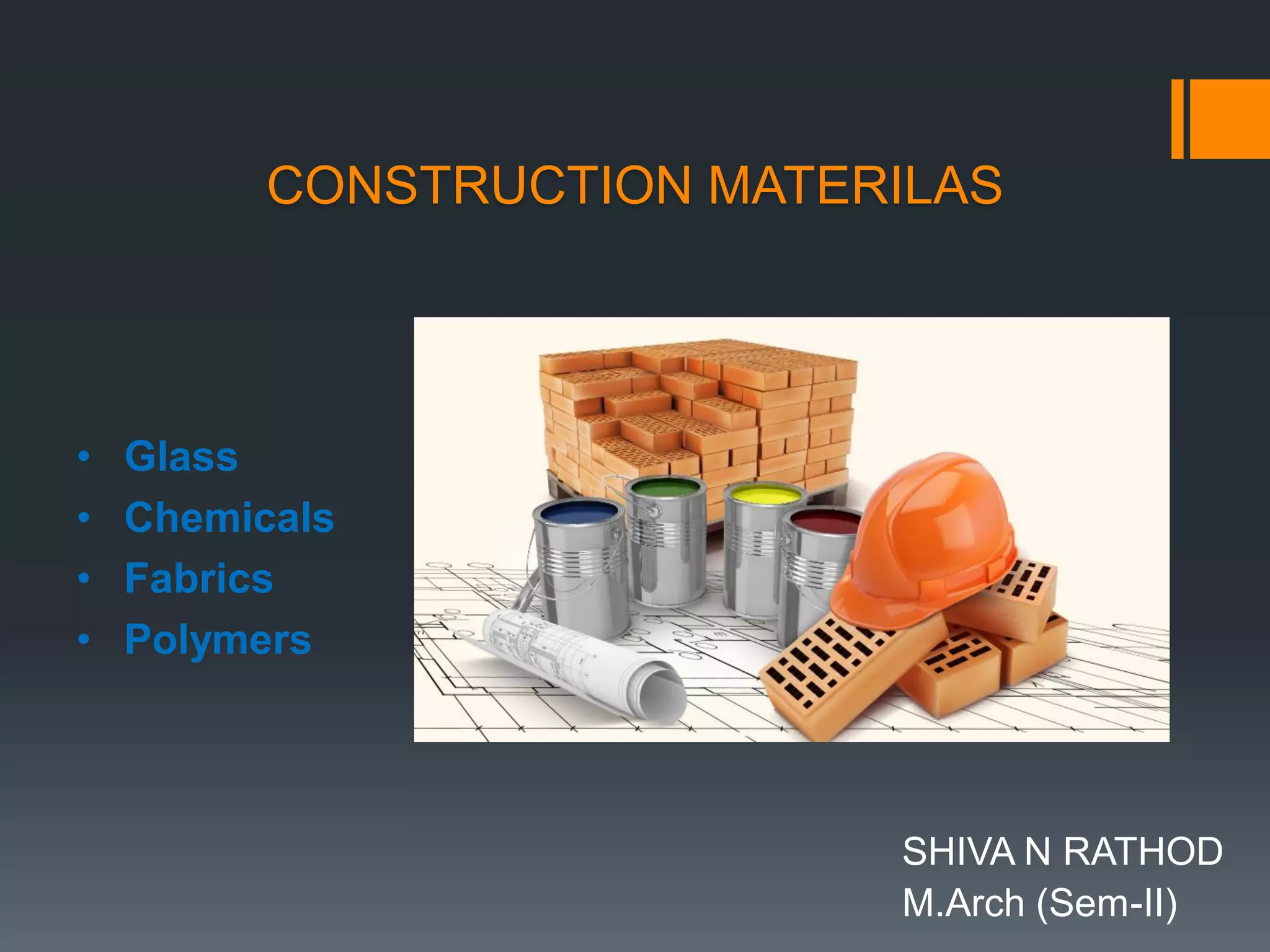
CONSTRUCTION MATERILAS
โ€ข Glass
โ€ข Chemicals
โ€ข Fabrics
โ€ข Polymers
SHIVA N RATHOD
M.Arch (Sem-II)
TYPES OF GLASS
๏‚ง Float glass
๏‚ง Laminated glass
๏‚ง Toughened glass:
TYPES OF GLASS
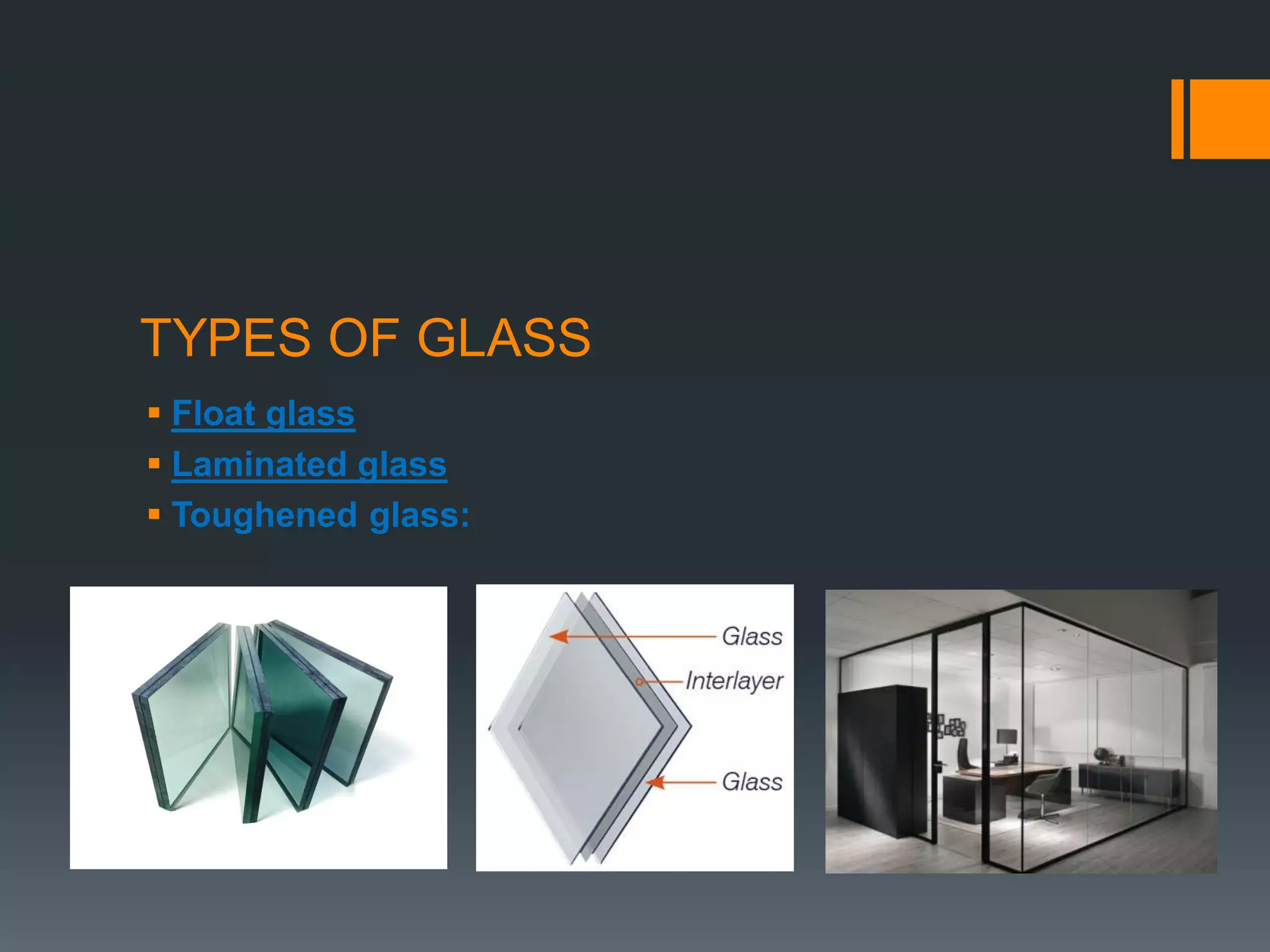
01 ) Float glass is Float glass is essentially a super smooth, distortion-free
glass which is used for designing other glass items such as laminated glass,
heat-toughened glass, and so on. With a natural greenish hue and translucent
nature, it is capable of transmitting about 87% of the incident light, and unlike
sheet glass, float glass provides users with a crystal-clear view.
Applications: showroom display cases, retail shop windows, Facades, Wall Panels
Benefits : Energy-efficiency refers to the ability of glass to regulate indoor
temperature by keeping the interiors relatively cool during summers and warm
during winters.
Cost: 100-150 Rs /Per Sq.ft
01 ) Float glass
TYPES OF GLASS
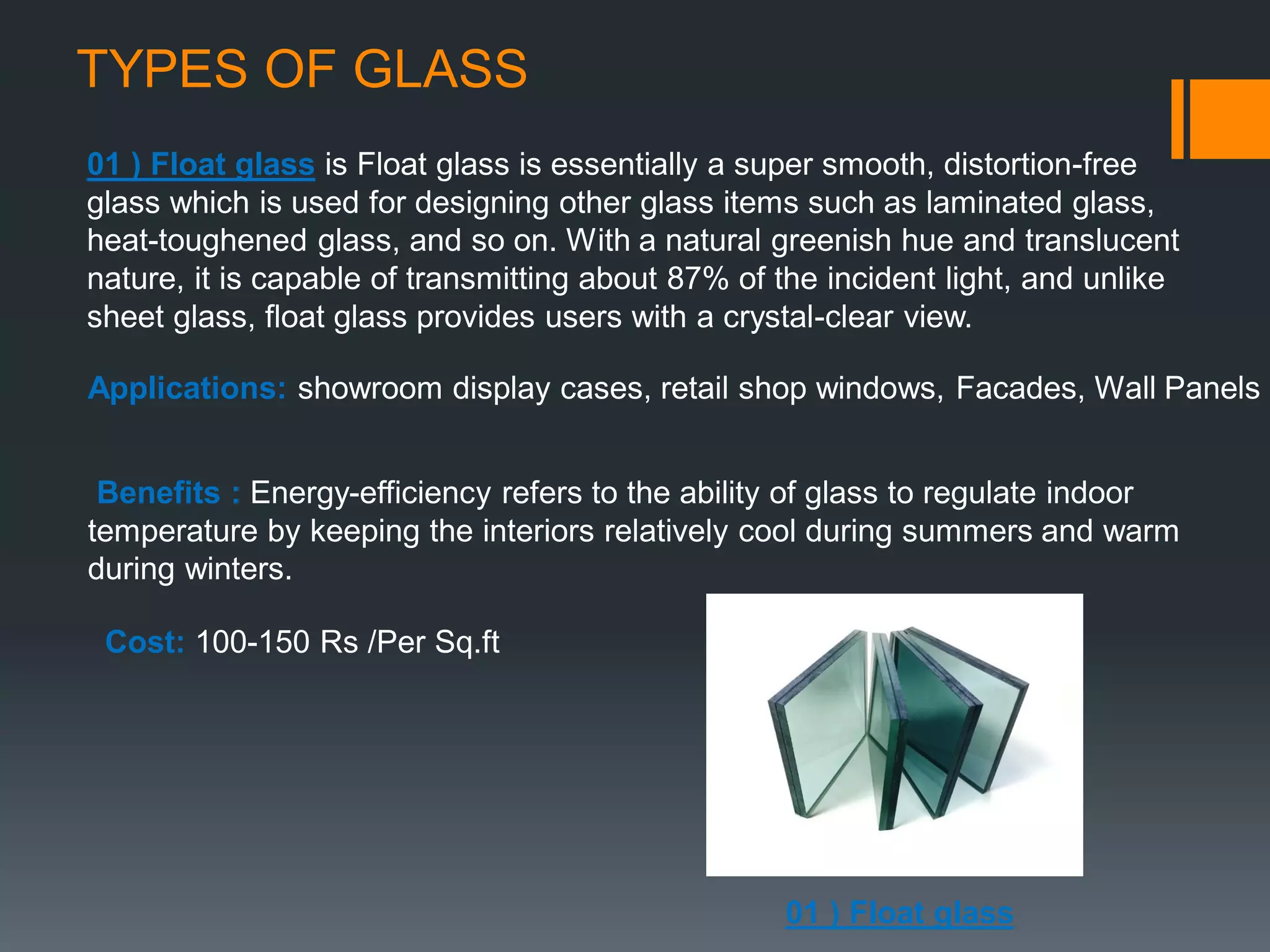
02 ) Laminated glass is a type of safety glass consisting of two or more
layers of glass with one or more thin polymer interlayers between them
which prevent the glass from breaking into large sharp pieces.[
Applications: Laminated glass is used for architecture, glazing, automobile
safety, photovoltaic, UV protection, and artistic expression
Benefits : The main benefits of laminated glass are: increased safety/security,
reduced emissions, reduced noise pollution, and protection during natural
disasters.
Cost: 275-325 Rs /Per Sq.ft
01 ) Laminated
TYPES OF GLASS
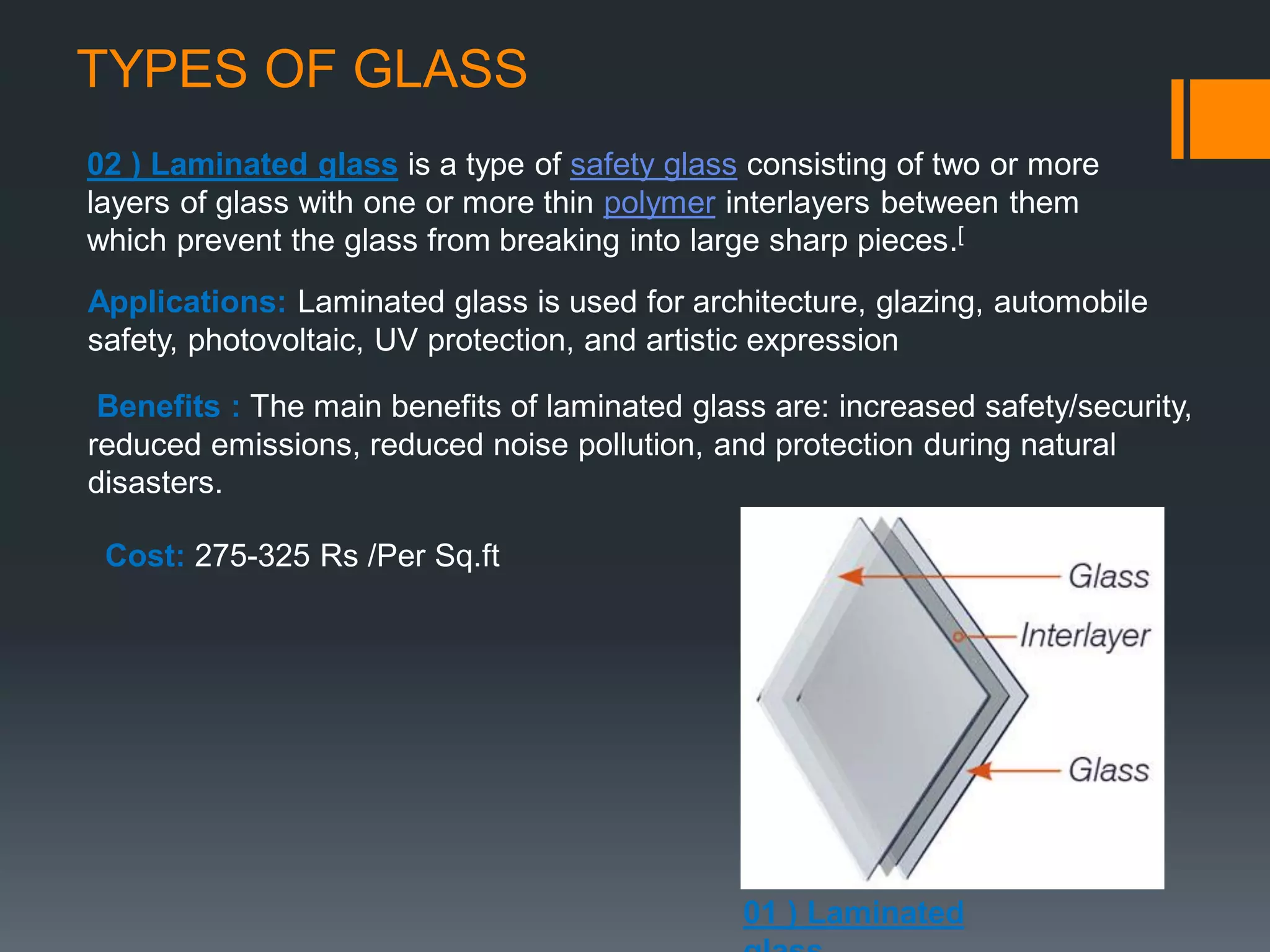
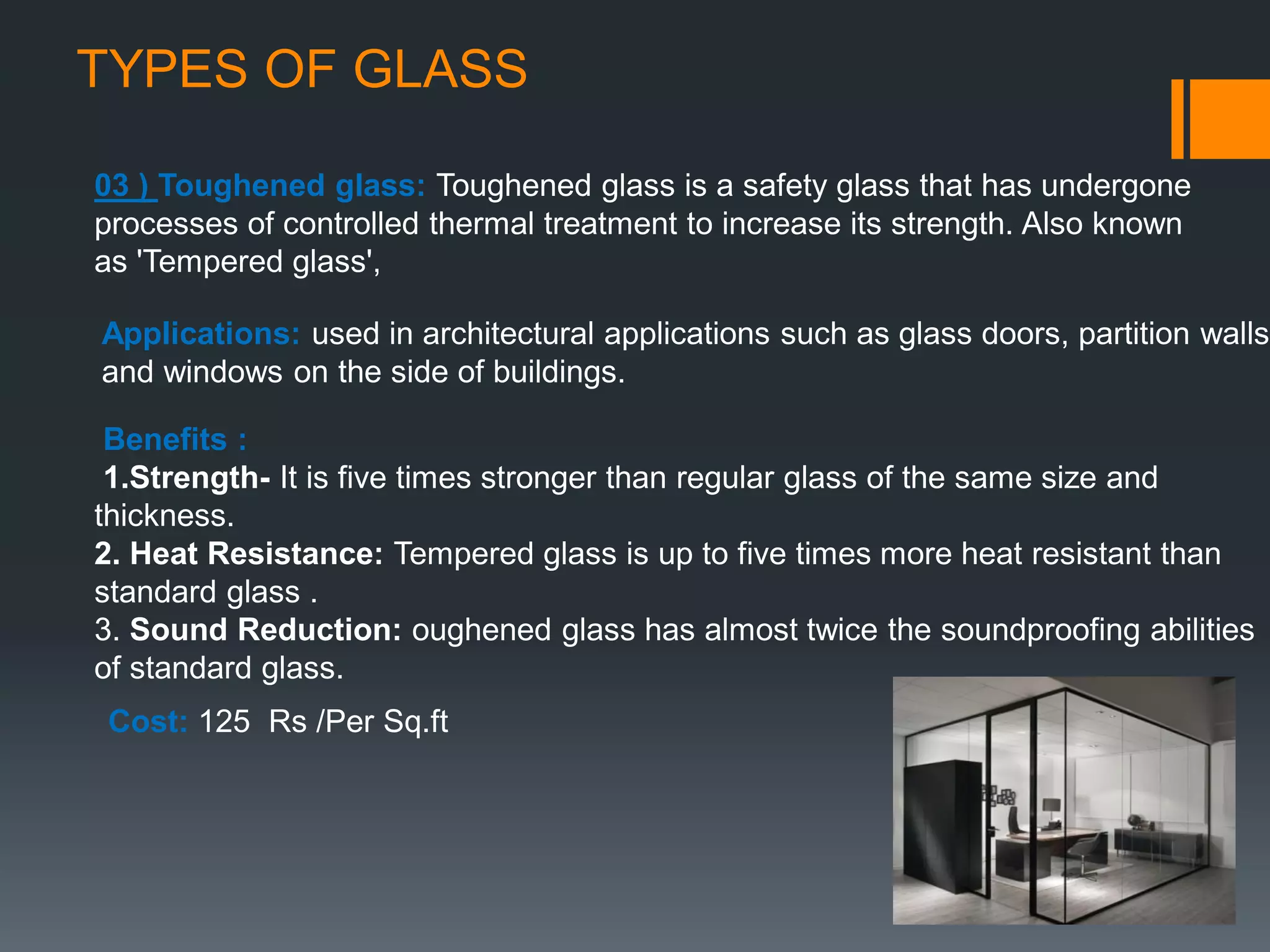
03 ) Toughened glass: Toughened glass is a safety glass that has undergone
processes of controlled thermal treatment to increase its strength. Also known
as 'Tempered glass',
Applications: used in architectural applications such as glass doors, partition walls
and windows on the side of buildings.
Benefits :
1.Strength- It is five times stronger than regular glass of the same size and
thickness.
2. Heat Resistance: Tempered glass is up to five times more heat resistant than
standard glass .
3. Sound Reduction: oughened glass has almost twice the soundproofing abilities
of standard glass.
Cost: 125 Rs /Per Sq.ft
CONSTRUCTION CHEMICALS
๏‚ง Concrete Hardeners.
๏‚ง Epoxy Coating,
๏‚ง Mould Releasing Agents
CONSTRUCTION CHEMICALS
๏‚ง Most construction chemicals are used as hardening agents either for surface application, coating or
as repair materials and is also effective as a waterproofing chemical.
3. 1. Concrete Hardeners
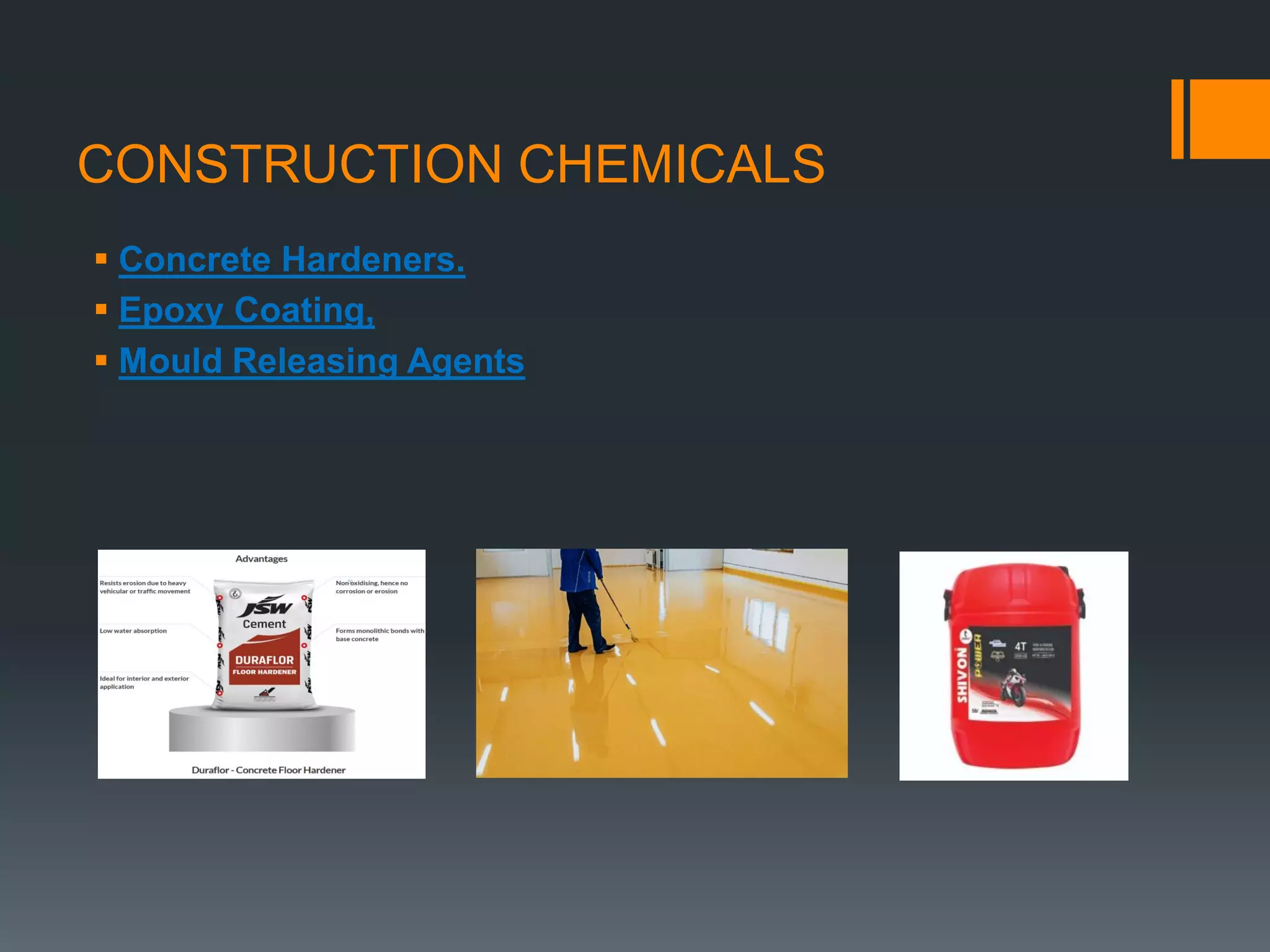
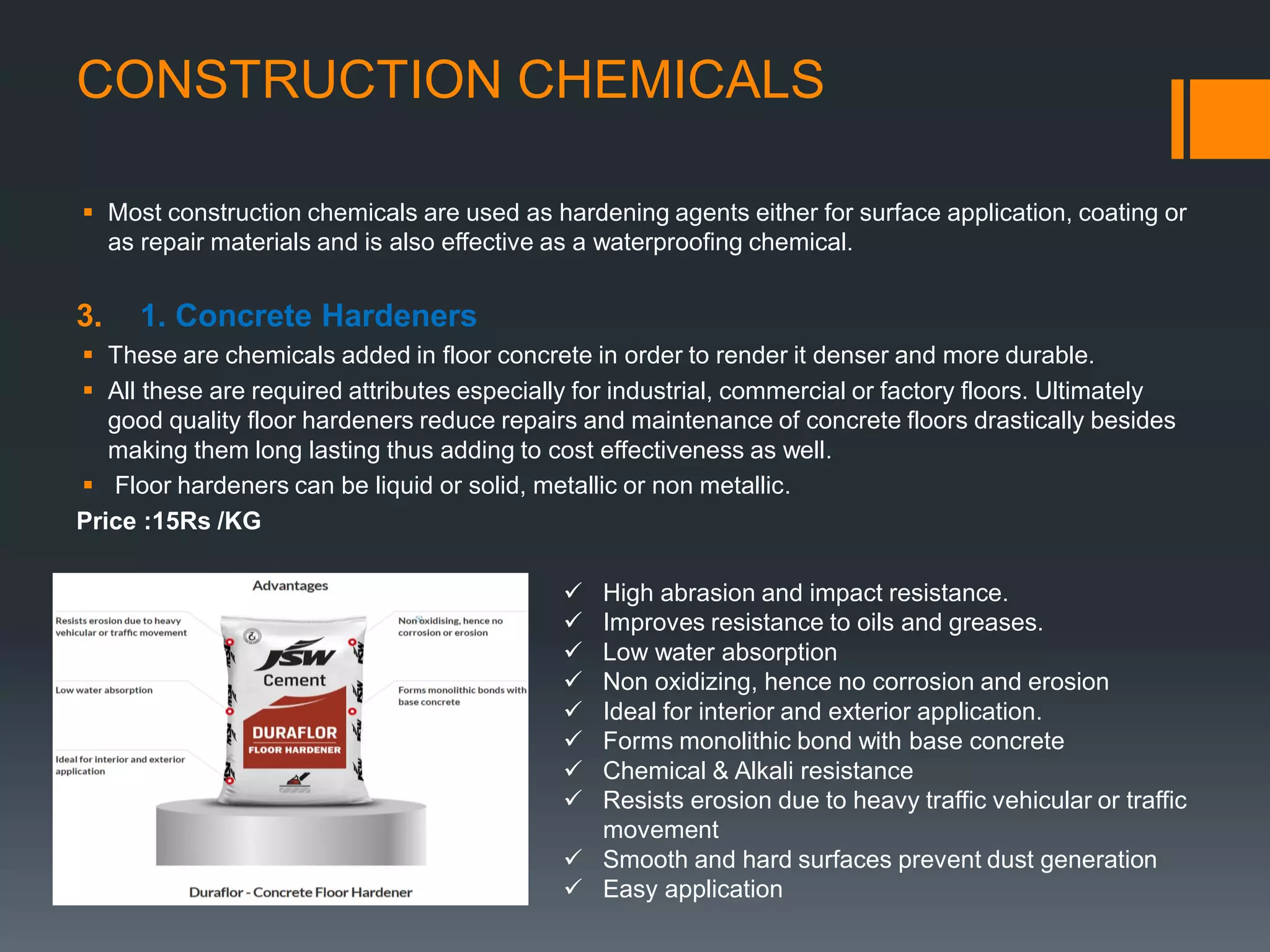
๏‚ง These are chemicals added in floor concrete in order to render it denser and more durable.
๏‚ง All these are required attributes especially for industrial, commercial or factory floors. Ultimately
good quality floor hardeners reduce repairs and maintenance of concrete floors drastically besides
making them long lasting thus adding to cost effectiveness as well.
๏‚ง Floor hardeners can be liquid or solid, metallic or non metallic.
Price :15Rs /KG
๏ƒผ High abrasion and impact resistance.
๏ƒผ Improves resistance to oils and greases.
๏ƒผ Low water absorption
๏ƒผ Non oxidizing, hence no corrosion and erosion
๏ƒผ Ideal for interior and exterior application.
๏ƒผ Forms monolithic bond with base concrete
๏ƒผ Chemical & Alkali resistance
๏ƒผ Resists erosion due to heavy traffic vehicular or traffic
movement
๏ƒผ Smooth and hard surfaces prevent dust generation
๏ƒผ Easy application
CONSTRUCTION CHEMICALS
3. Epoxy Coating
๏‚ง These can come as water or oil based solutions or as solvent-free.
๏‚ง They can be single or two-component. Single-component epoxy paints are usually oil
based.
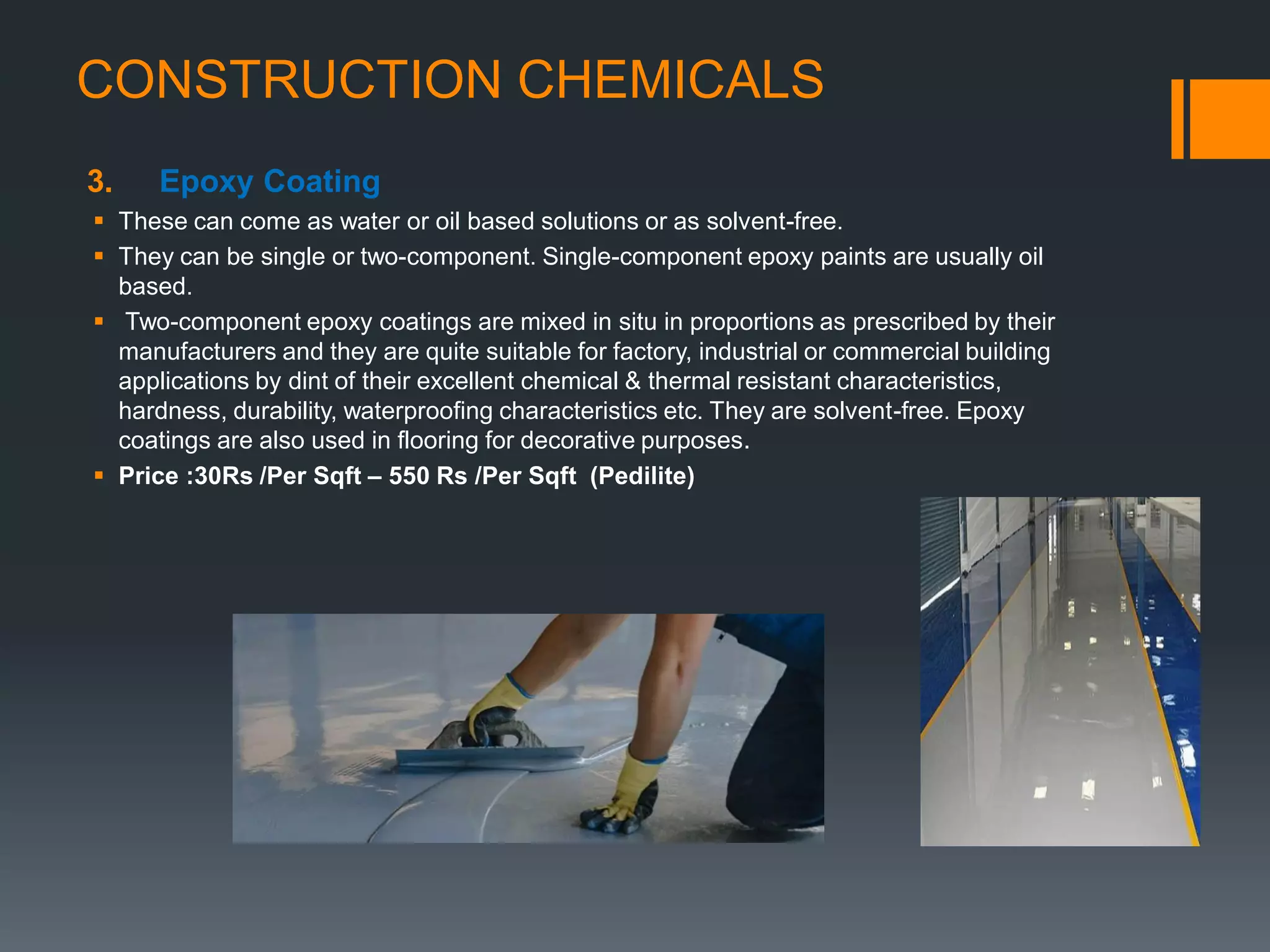
๏‚ง Two-component epoxy coatings are mixed in situ in proportions as prescribed by their
manufacturers and they are quite suitable for factory, industrial or commercial building
applications by dint of their excellent chemical & thermal resistant characteristics,
hardness, durability, waterproofing characteristics etc. They are solvent-free. Epoxy
coatings are also used in flooring for decorative purposes.
๏‚ง Price :30Rs /Per Sqft โ€“ 550 Rs /Per Sqft (Pedilite)
Construction Chemicals
3. Mould Releasing Agents
๏‚ง Mould release agents come in handy when you have materials that are shaped and constructed in moulds.
Without the releasing agent, your mould may become damaged or even break when it is time to remove it.
๏‚ง Mould release agents come in a variety of textures with the most commonly used one being an oil type base.
๏‚ง If you have never used a releasing agent before, it is similar to placing oil or butter in the bottom of a dish to
remove your final baking product. Below, you will find the three most commonly used types and their purpose in
the manufacturing industry.
โ€ข Some very beneficial and famous shuttering oils in construction industry are:
โ€ข (DSO):- it is well known in construction industry as De-shuttering oil: - These oils
can simply be diluted with water. It is basically a shuttering agent which is well
known as releasing agent specially used in mould. Its ratio of dilution is
approximately ratios of 1:3 to 1:5
โ€ข Price : 100 Rs per /Liter (Master Fix)
โ€ข (DSOE):- in construction industry this term is explained as De-shuttering oil
emulsion: - This oil requires almost no dilution; it comes in such form that you can
instantly use it without any dilution process. No need to dilute it with water.
โ€ข Price :Durable Reebol Emulsion Extra Shuttering Oil-4000 Rs per 20 lit.
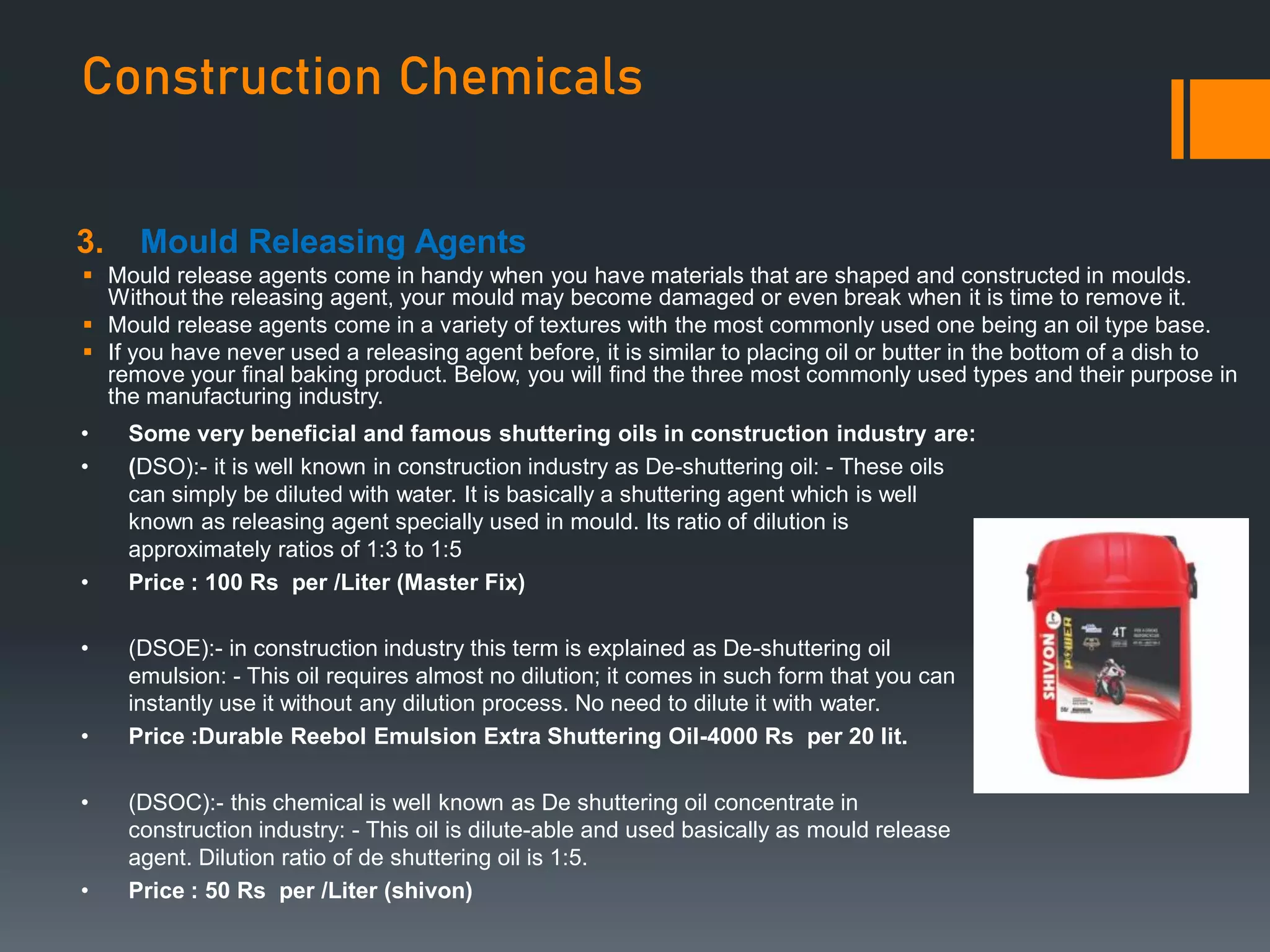
โ€ข (DSOC):- this chemical is well known as De shuttering oil concentrate in
construction industry: - This oil is dilute-able and used basically as mould release
agent. Dilution ratio of de shuttering oil is 1:5.
โ€ข Price : 50 Rs per /Liter (shivon)
CONSTRUCTION FABRICS
๏‚ง Geotextile
๏‚ง Fiberglass:
๏‚ง Carbon Fibre
CONSTRUCTION FABRICS
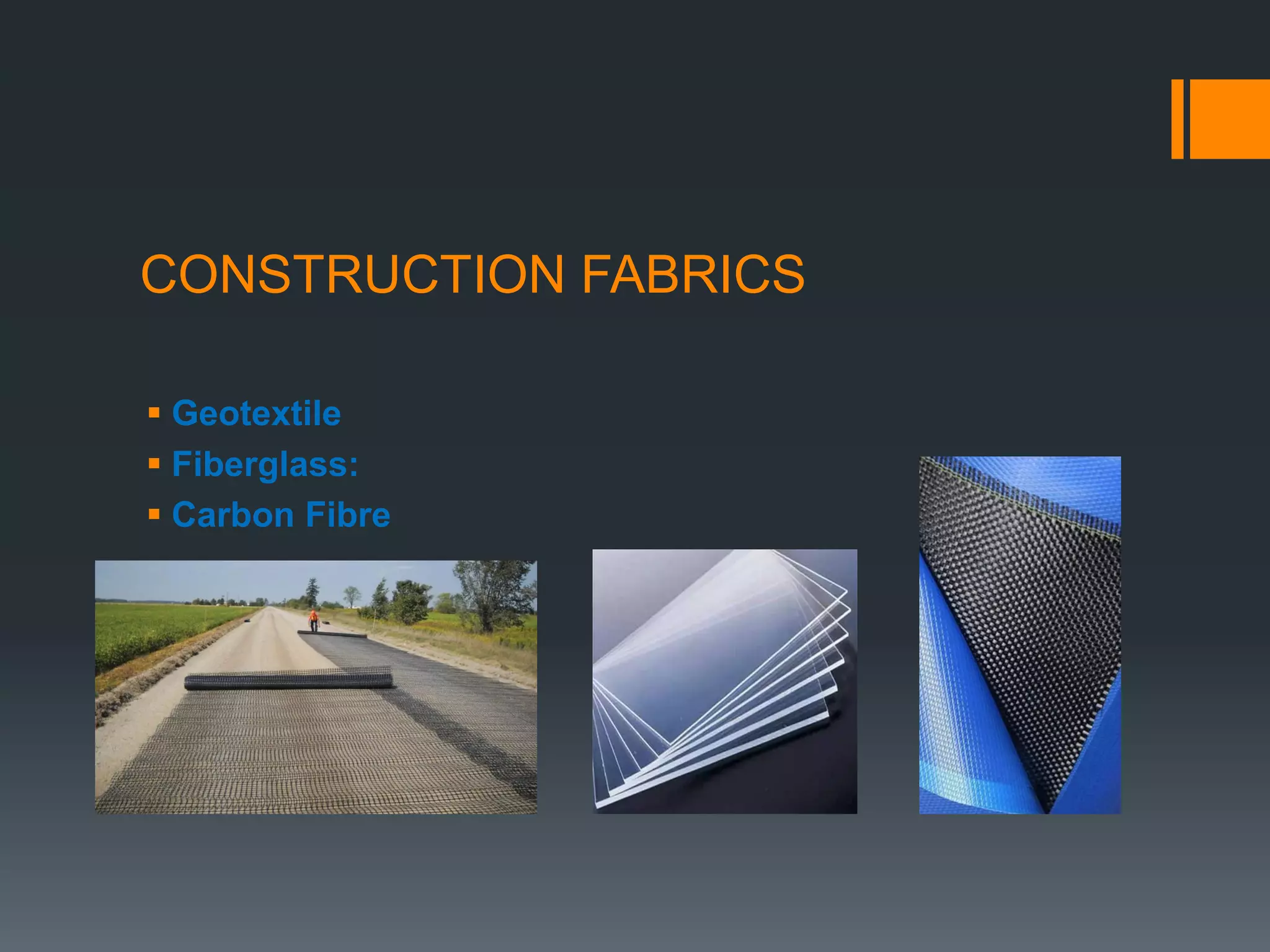
01 ) Geotextile
Modern geotextiles are usually made from a synthetic polymer such
as polypropylene, polyester, polyethylene and polyamides. Geotextiles
can be woven, knitted or non-woven.
Varying polymers and manufacturing processes result in an array of
geotextiles suitable for a variety of civil construction applications.
Applications: Geotextiles now are most widely used for stabilizing roads
through separation and drainage.
Benefits : It improve & stability and decreases the process of wind &
water erosion. It helps to prevent the erosion of soil but allows the water to
drain off
Cost: 50-80 RS Per Sq.ft
CONSTRUCTION FABRICS
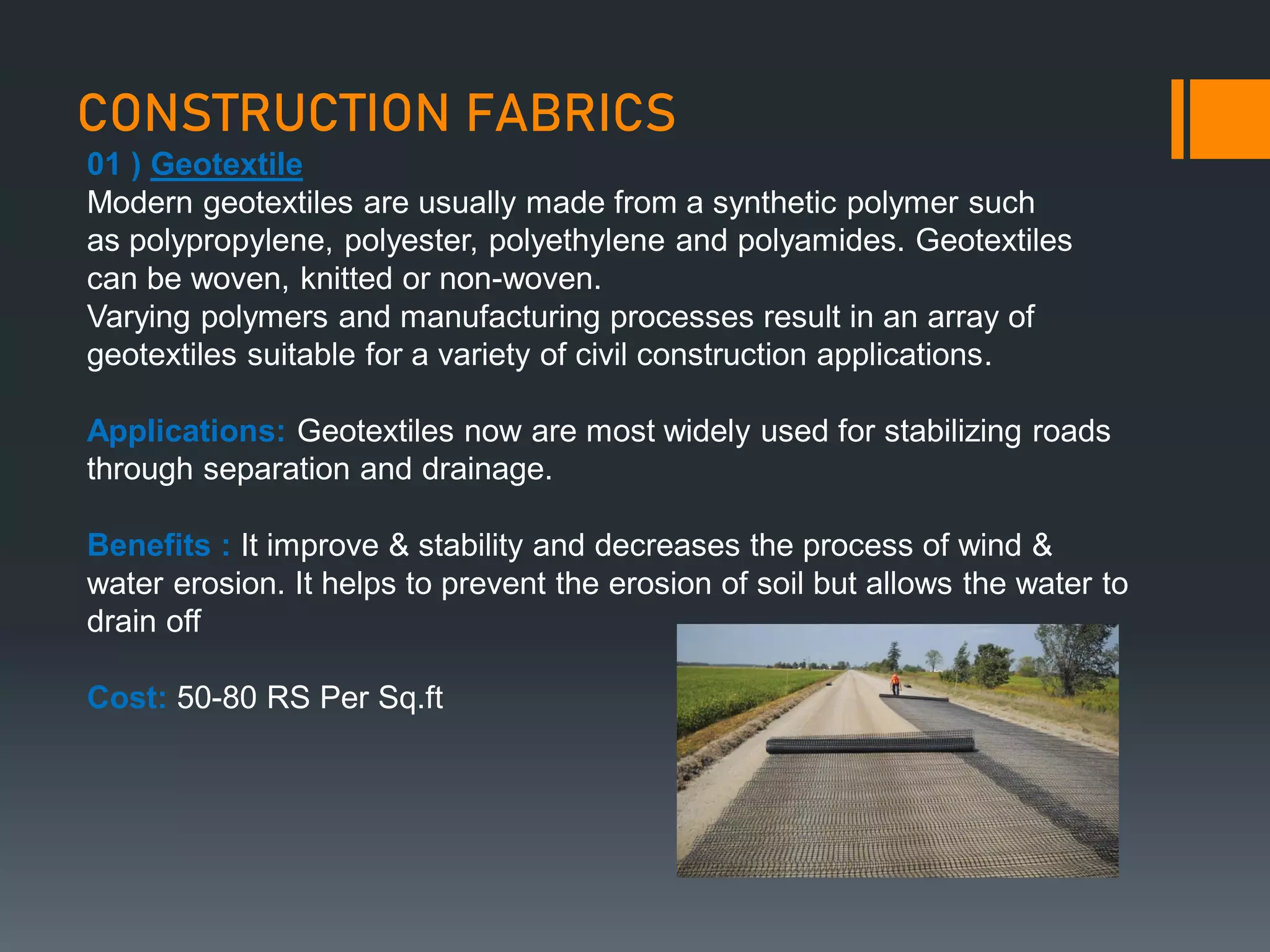
02 ) Fiberglass:
which is also described as glass fiber, is mostly used as insulation, cladding,
surface coating and roofing raw material in construction and construction
sector.
Applications:
Applications of fiberglass include aircraft, boats, automobiles, bath tubs and
enclosures, swimming pools, hot tubs, septic tanks, water tanks, roofing,
pipes, cladding, casts, surfboards, and external door skins
Benefits :
This material is highly resistant to heat and offers high mechanical strength.
Its strength, durability, and color makes it a popular choice in the construction
industry.
Cost:75-125 RS Per Sq.ft
CONSTRUCTION FABRICS
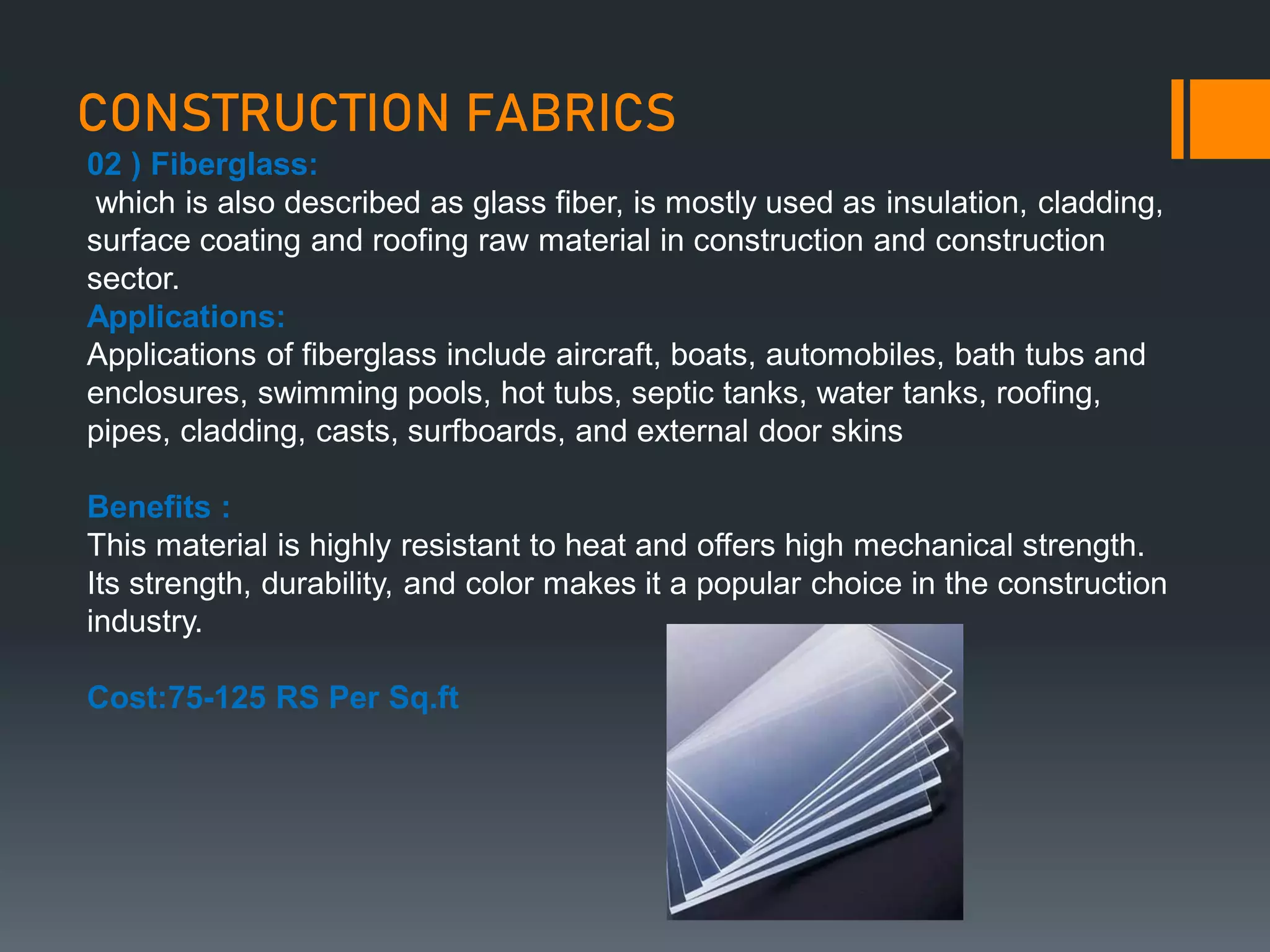
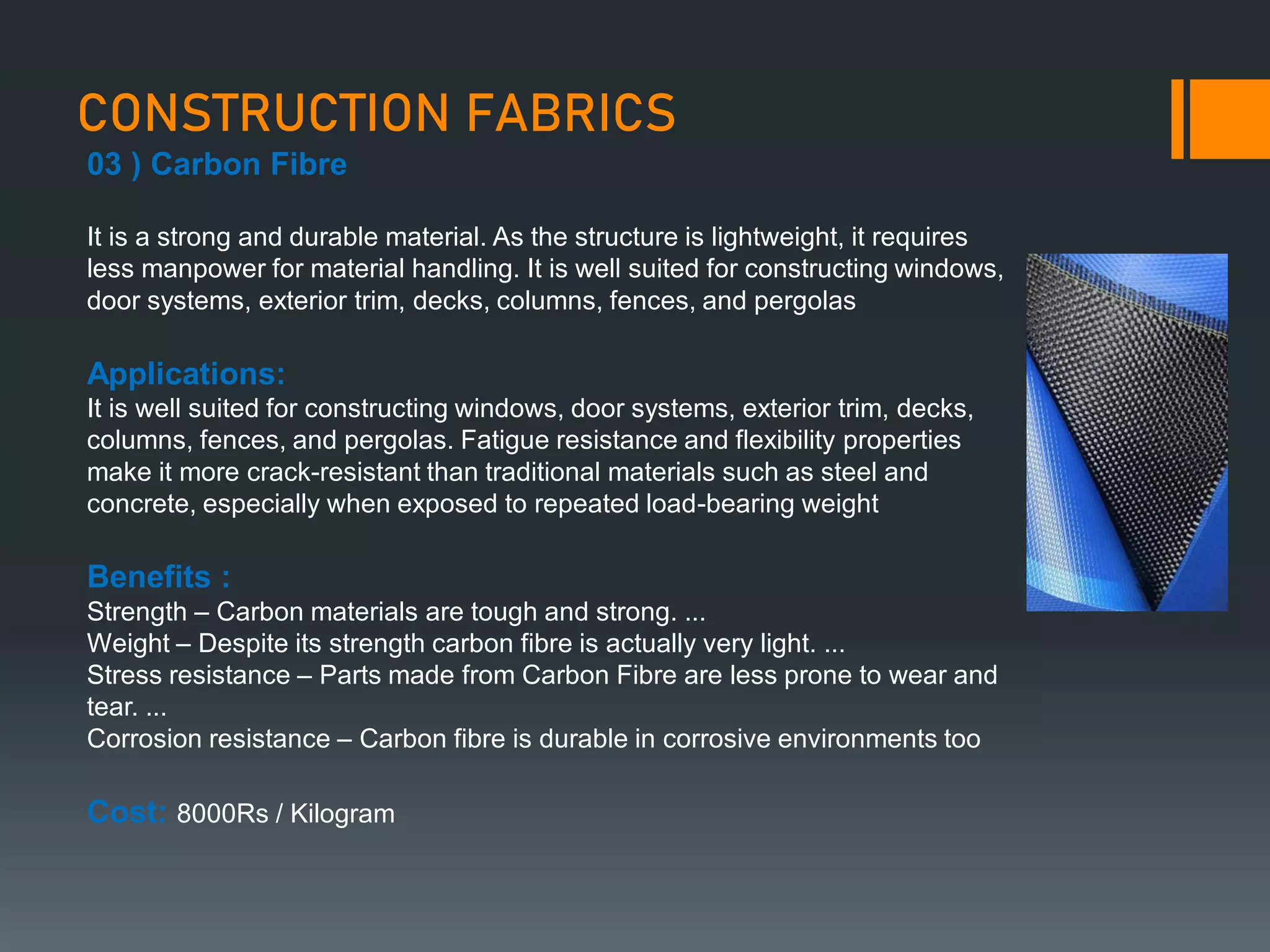
03 ) Carbon Fibre
It is a strong and durable material. As the structure is lightweight, it requires
less manpower for material handling. It is well suited for constructing windows,
door systems, exterior trim, decks, columns, fences, and pergolas
Applications:
It is well suited for constructing windows, door systems, exterior trim, decks,
columns, fences, and pergolas. Fatigue resistance and flexibility properties
make it more crack-resistant than traditional materials such as steel and
concrete, especially when exposed to repeated load-bearing weight
Benefits :
Strength โ€“ Carbon materials are tough and strong. ...
Weight โ€“ Despite its strength carbon fibre is actually very light. ...
Stress resistance โ€“ Parts made from Carbon Fibre are less prone to wear and
tear. ...
Corrosion resistance โ€“ Carbon fibre is durable in corrosive environments too
Cost: 8000Rs / Kilogram
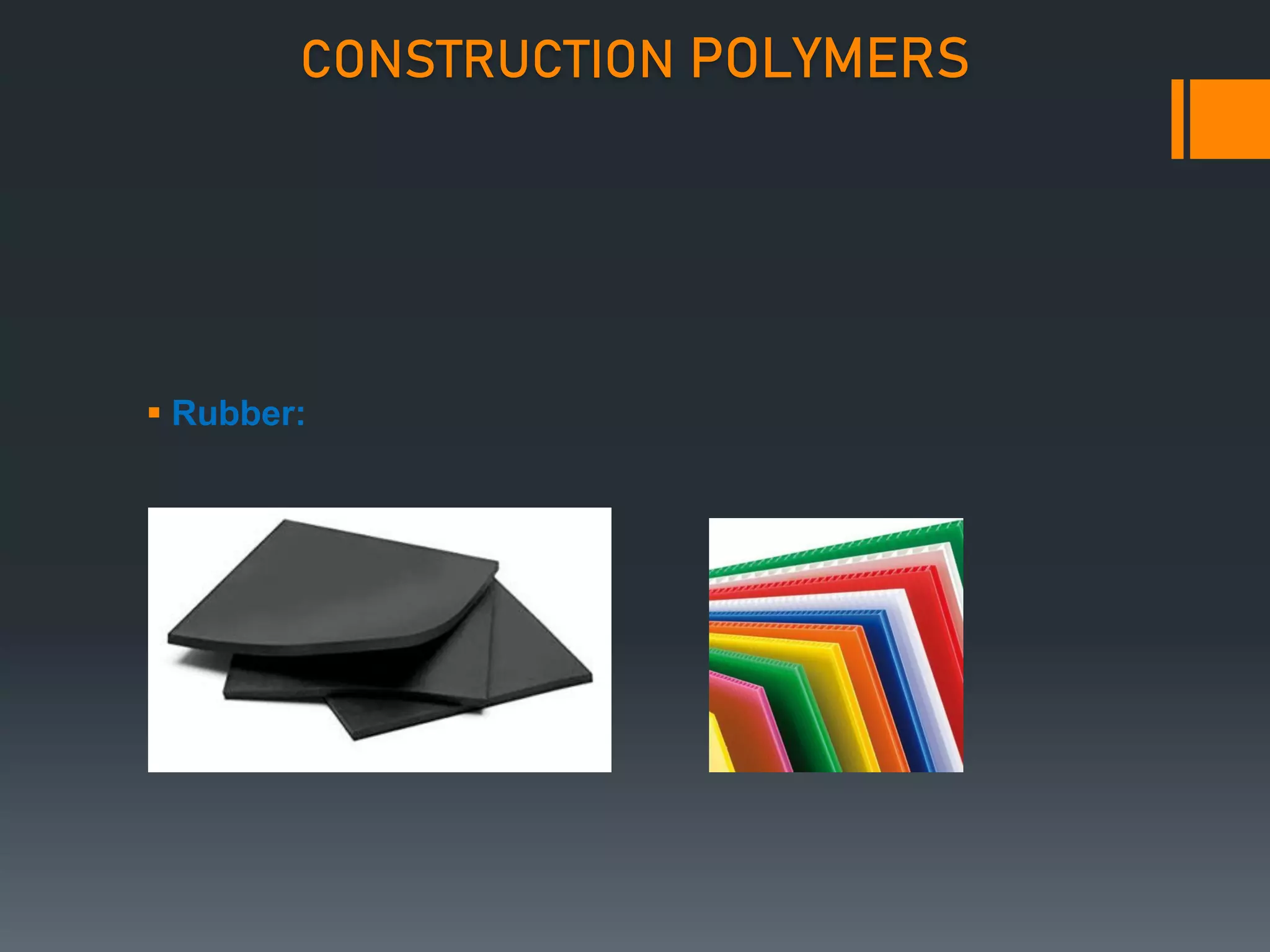
๏‚ง Rubber:
CONSTRUCTION POLYMERS
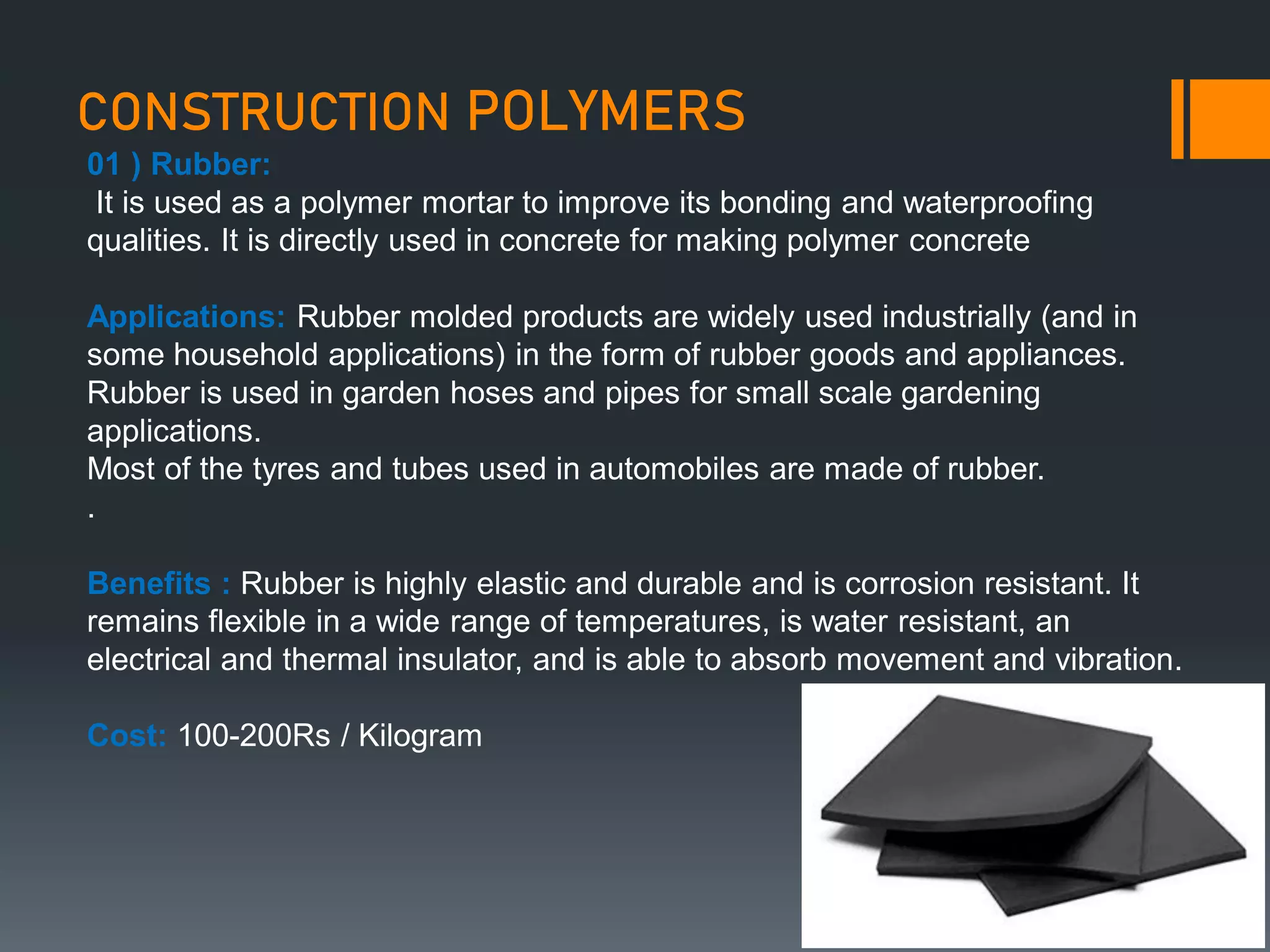
01 ) Rubber:
It is used as a polymer mortar to improve its bonding and waterproofing
qualities. It is directly used in concrete for making polymer concrete
Applications: Rubber molded products are widely used industrially (and in
some household applications) in the form of rubber goods and appliances.
Rubber is used in garden hoses and pipes for small scale gardening
applications.
Most of the tyres and tubes used in automobiles are made of rubber.
.
Benefits : Rubber is highly elastic and durable and is corrosion resistant. It
remains flexible in a wide range of temperatures, is water resistant, an
electrical and thermal insulator, and is able to absorb movement and vibration.
Cost: 100-200Rs / Kilogram
CONSTRUCTION POLYMERS
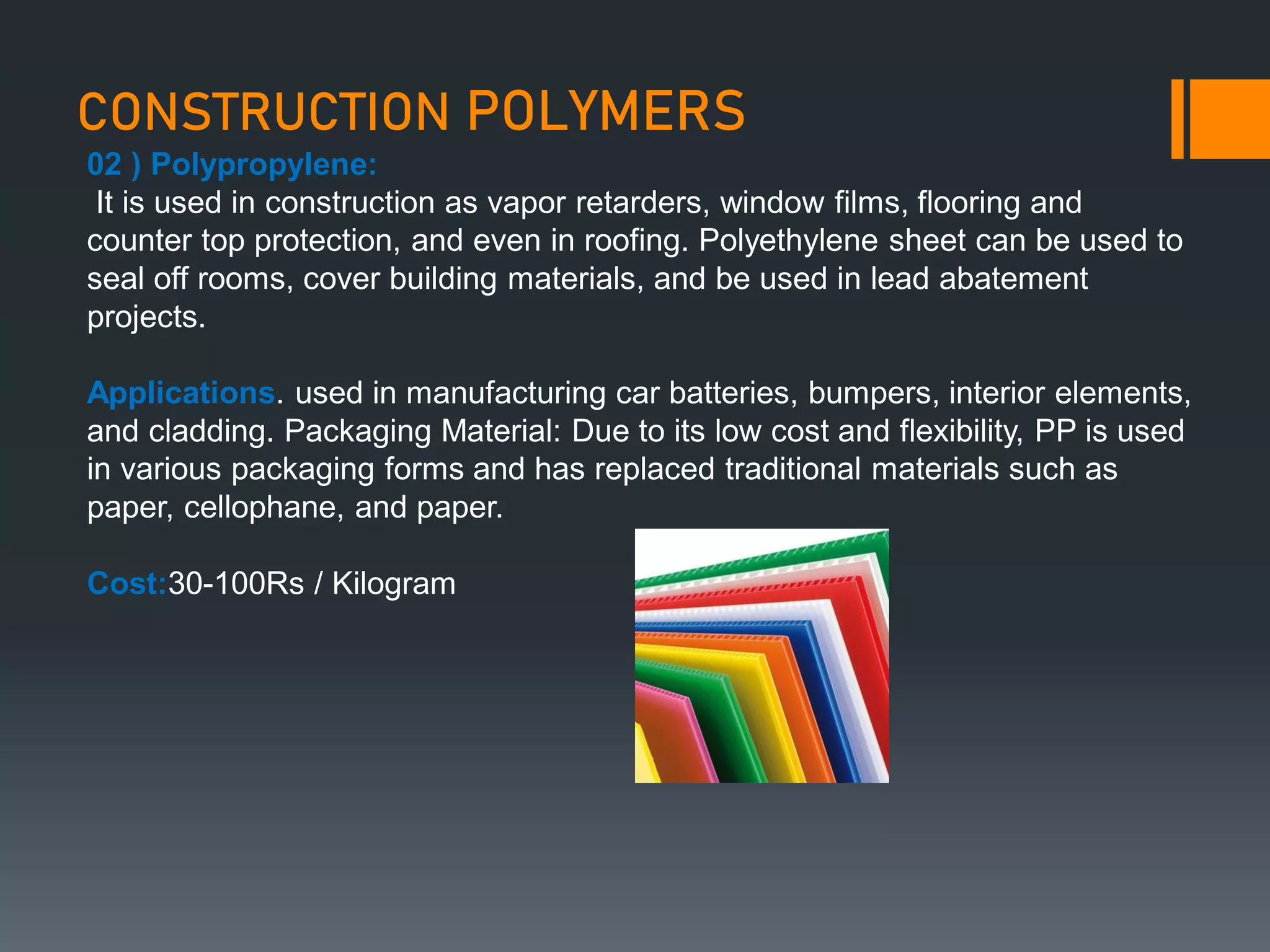
02 ) Polypropylene:
It is used in construction as vapor retarders, window films, flooring and
counter top protection, and even in roofing. Polyethylene sheet can be used to
seal off rooms, cover building materials, and be used in lead abatement
projects.
Applications. used in manufacturing car batteries, bumpers, interior elements,
and cladding. Packaging Material: Due to its low cost and flexibility, PP is used
in various packaging forms and has replaced traditional materials such as
paper, cellophane, and paper.
Cost:30-100Rs / Kilogram
THANK YOUโ€ฆโ€ฆโ€ฆ
๏‚ง SHIVA N RATHOD
๏‚ง M.Arch (Sem-II)

02 material PPT.pdf

  • 1.
    CONSTRUCTION MATERILAS โ€ข Glass โ€ขChemicals โ€ข Fabrics โ€ข Polymers SHIVA N RATHOD M.Arch (Sem-II)
  • 2.
    TYPES OF GLASS ๏‚งFloat glass ๏‚ง Laminated glass ๏‚ง Toughened glass:
  • 3.
    TYPES OF GLASS 01) Float glass is Float glass is essentially a super smooth, distortion-free glass which is used for designing other glass items such as laminated glass, heat-toughened glass, and so on. With a natural greenish hue and translucent nature, it is capable of transmitting about 87% of the incident light, and unlike sheet glass, float glass provides users with a crystal-clear view. Applications: showroom display cases, retail shop windows, Facades, Wall Panels Benefits : Energy-efficiency refers to the ability of glass to regulate indoor temperature by keeping the interiors relatively cool during summers and warm during winters. Cost: 100-150 Rs /Per Sq.ft 01 ) Float glass
  • 4.
    TYPES OF GLASS 02) Laminated glass is a type of safety glass consisting of two or more layers of glass with one or more thin polymer interlayers between them which prevent the glass from breaking into large sharp pieces.[ Applications: Laminated glass is used for architecture, glazing, automobile safety, photovoltaic, UV protection, and artistic expression Benefits : The main benefits of laminated glass are: increased safety/security, reduced emissions, reduced noise pollution, and protection during natural disasters. Cost: 275-325 Rs /Per Sq.ft 01 ) Laminated
  • 5.
    TYPES OF GLASS 03) Toughened glass: Toughened glass is a safety glass that has undergone processes of controlled thermal treatment to increase its strength. Also known as 'Tempered glass', Applications: used in architectural applications such as glass doors, partition walls and windows on the side of buildings. Benefits : 1.Strength- It is five times stronger than regular glass of the same size and thickness. 2. Heat Resistance: Tempered glass is up to five times more heat resistant than standard glass . 3. Sound Reduction: oughened glass has almost twice the soundproofing abilities of standard glass. Cost: 125 Rs /Per Sq.ft
  • 6.
    CONSTRUCTION CHEMICALS ๏‚ง ConcreteHardeners. ๏‚ง Epoxy Coating, ๏‚ง Mould Releasing Agents
  • 7.
    CONSTRUCTION CHEMICALS ๏‚ง Mostconstruction chemicals are used as hardening agents either for surface application, coating or as repair materials and is also effective as a waterproofing chemical. 3. 1. Concrete Hardeners ๏‚ง These are chemicals added in floor concrete in order to render it denser and more durable. ๏‚ง All these are required attributes especially for industrial, commercial or factory floors. Ultimately good quality floor hardeners reduce repairs and maintenance of concrete floors drastically besides making them long lasting thus adding to cost effectiveness as well. ๏‚ง Floor hardeners can be liquid or solid, metallic or non metallic. Price :15Rs /KG ๏ƒผ High abrasion and impact resistance. ๏ƒผ Improves resistance to oils and greases. ๏ƒผ Low water absorption ๏ƒผ Non oxidizing, hence no corrosion and erosion ๏ƒผ Ideal for interior and exterior application. ๏ƒผ Forms monolithic bond with base concrete ๏ƒผ Chemical & Alkali resistance ๏ƒผ Resists erosion due to heavy traffic vehicular or traffic movement ๏ƒผ Smooth and hard surfaces prevent dust generation ๏ƒผ Easy application
  • 8.
    CONSTRUCTION CHEMICALS 3. EpoxyCoating ๏‚ง These can come as water or oil based solutions or as solvent-free. ๏‚ง They can be single or two-component. Single-component epoxy paints are usually oil based. ๏‚ง Two-component epoxy coatings are mixed in situ in proportions as prescribed by their manufacturers and they are quite suitable for factory, industrial or commercial building applications by dint of their excellent chemical & thermal resistant characteristics, hardness, durability, waterproofing characteristics etc. They are solvent-free. Epoxy coatings are also used in flooring for decorative purposes. ๏‚ง Price :30Rs /Per Sqft โ€“ 550 Rs /Per Sqft (Pedilite)
  • 9.
    Construction Chemicals 3. MouldReleasing Agents ๏‚ง Mould release agents come in handy when you have materials that are shaped and constructed in moulds. Without the releasing agent, your mould may become damaged or even break when it is time to remove it. ๏‚ง Mould release agents come in a variety of textures with the most commonly used one being an oil type base. ๏‚ง If you have never used a releasing agent before, it is similar to placing oil or butter in the bottom of a dish to remove your final baking product. Below, you will find the three most commonly used types and their purpose in the manufacturing industry. โ€ข Some very beneficial and famous shuttering oils in construction industry are: โ€ข (DSO):- it is well known in construction industry as De-shuttering oil: - These oils can simply be diluted with water. It is basically a shuttering agent which is well known as releasing agent specially used in mould. Its ratio of dilution is approximately ratios of 1:3 to 1:5 โ€ข Price : 100 Rs per /Liter (Master Fix) โ€ข (DSOE):- in construction industry this term is explained as De-shuttering oil emulsion: - This oil requires almost no dilution; it comes in such form that you can instantly use it without any dilution process. No need to dilute it with water. โ€ข Price :Durable Reebol Emulsion Extra Shuttering Oil-4000 Rs per 20 lit. โ€ข (DSOC):- this chemical is well known as De shuttering oil concentrate in construction industry: - This oil is dilute-able and used basically as mould release agent. Dilution ratio of de shuttering oil is 1:5. โ€ข Price : 50 Rs per /Liter (shivon)
  • 10.
    CONSTRUCTION FABRICS ๏‚ง Geotextile ๏‚งFiberglass: ๏‚ง Carbon Fibre
  • 11.
    CONSTRUCTION FABRICS 01 )Geotextile Modern geotextiles are usually made from a synthetic polymer such as polypropylene, polyester, polyethylene and polyamides. Geotextiles can be woven, knitted or non-woven. Varying polymers and manufacturing processes result in an array of geotextiles suitable for a variety of civil construction applications. Applications: Geotextiles now are most widely used for stabilizing roads through separation and drainage. Benefits : It improve & stability and decreases the process of wind & water erosion. It helps to prevent the erosion of soil but allows the water to drain off Cost: 50-80 RS Per Sq.ft
  • 12.
    CONSTRUCTION FABRICS 02 )Fiberglass: which is also described as glass fiber, is mostly used as insulation, cladding, surface coating and roofing raw material in construction and construction sector. Applications: Applications of fiberglass include aircraft, boats, automobiles, bath tubs and enclosures, swimming pools, hot tubs, septic tanks, water tanks, roofing, pipes, cladding, casts, surfboards, and external door skins Benefits : This material is highly resistant to heat and offers high mechanical strength. Its strength, durability, and color makes it a popular choice in the construction industry. Cost:75-125 RS Per Sq.ft
  • 13.
    CONSTRUCTION FABRICS 03 )Carbon Fibre It is a strong and durable material. As the structure is lightweight, it requires less manpower for material handling. It is well suited for constructing windows, door systems, exterior trim, decks, columns, fences, and pergolas Applications: It is well suited for constructing windows, door systems, exterior trim, decks, columns, fences, and pergolas. Fatigue resistance and flexibility properties make it more crack-resistant than traditional materials such as steel and concrete, especially when exposed to repeated load-bearing weight Benefits : Strength โ€“ Carbon materials are tough and strong. ... Weight โ€“ Despite its strength carbon fibre is actually very light. ... Stress resistance โ€“ Parts made from Carbon Fibre are less prone to wear and tear. ... Corrosion resistance โ€“ Carbon fibre is durable in corrosive environments too Cost: 8000Rs / Kilogram
  • 14.
  • 15.
    CONSTRUCTION POLYMERS 01 )Rubber: It is used as a polymer mortar to improve its bonding and waterproofing qualities. It is directly used in concrete for making polymer concrete Applications: Rubber molded products are widely used industrially (and in some household applications) in the form of rubber goods and appliances. Rubber is used in garden hoses and pipes for small scale gardening applications. Most of the tyres and tubes used in automobiles are made of rubber. . Benefits : Rubber is highly elastic and durable and is corrosion resistant. It remains flexible in a wide range of temperatures, is water resistant, an electrical and thermal insulator, and is able to absorb movement and vibration. Cost: 100-200Rs / Kilogram
  • 16.
    CONSTRUCTION POLYMERS 02 )Polypropylene: It is used in construction as vapor retarders, window films, flooring and counter top protection, and even in roofing. Polyethylene sheet can be used to seal off rooms, cover building materials, and be used in lead abatement projects. Applications. used in manufacturing car batteries, bumpers, interior elements, and cladding. Packaging Material: Due to its low cost and flexibility, PP is used in various packaging forms and has replaced traditional materials such as paper, cellophane, and paper. Cost:30-100Rs / Kilogram
  • 17.
    THANK YOUโ€ฆโ€ฆโ€ฆ ๏‚ง SHIVAN RATHOD ๏‚ง M.Arch (Sem-II)