Astronomy & Standards
Interoperability of astronomical data
Juan de Dios Santander Vela (IAA-CSIC)
Overview


Astrophysical records

Sharing astrophysical data

Interoperability standards
Astrophysical Records
Astrophysical records


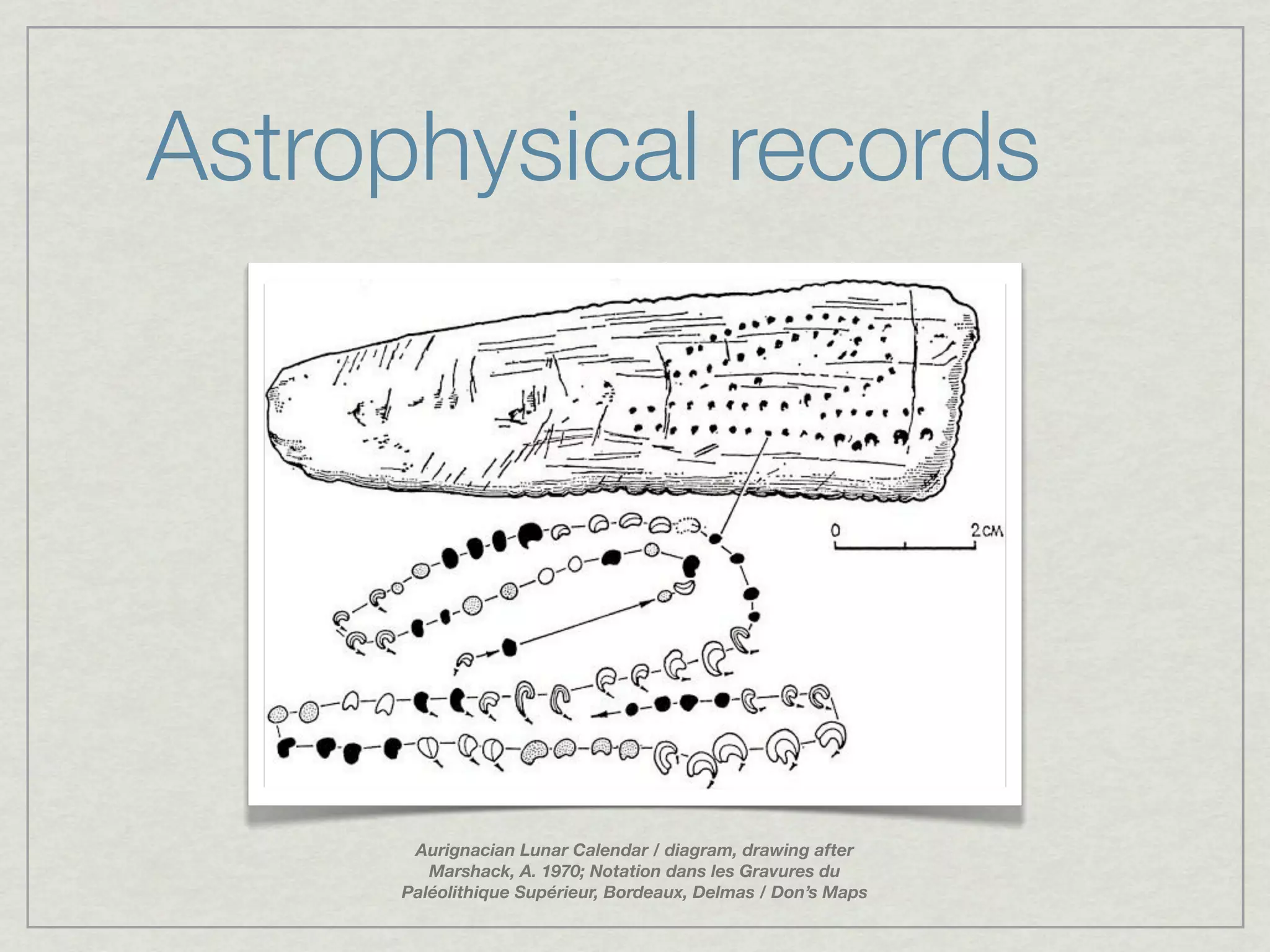
      Aurignacian Lunar Calendar / diagram, drawing after
        Marshack, A. 1970; Notation dans les Gravures du
     Paléolithique Supérieur, Bordeaux, Delmas / Don’s Maps
Astrophysical records

In astrophysics, we record the EM radiation from
distant objects, in order to:

  understand the processes that generated the
  EM radiation

  understand the processes that affect the
  received EM radiation
Many different records
Astrophysical records are different by means of
their

  EM/energy range (long vs. short-λ radio, IR,
  optical, UV, X-Ray, ɣ-Ray)

  Product type (images, time series, spectra,
  spectral cube, image cube, combinations…)

  Instrument setup
Many different records

Many, many things can change

 Coordinate system, physical measurement,
 physical support…

 And that’s just the observation generation!
Many different records
Most of those records can be represented as
multi-dimensional arrays

  Need to specify

    Units

    Sampling

    Physical meaning
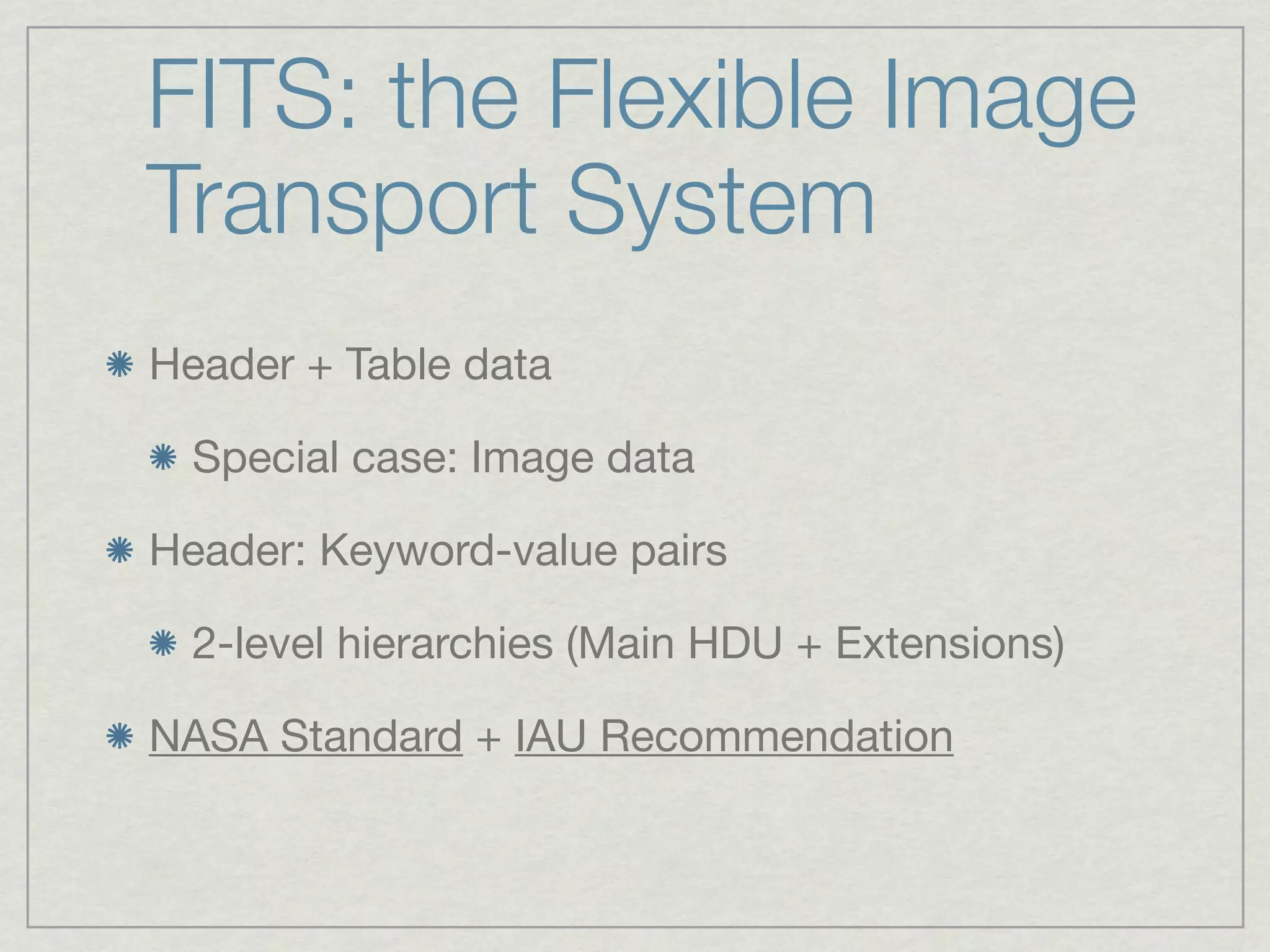
FITS: the Flexible Image
Transport System
Header + Table data

  Special case: Image data

Header: Keyword-value pairs

  2-level hierarchies (Main HDU + Extensions)

NASA Standard + IAU Recommendation
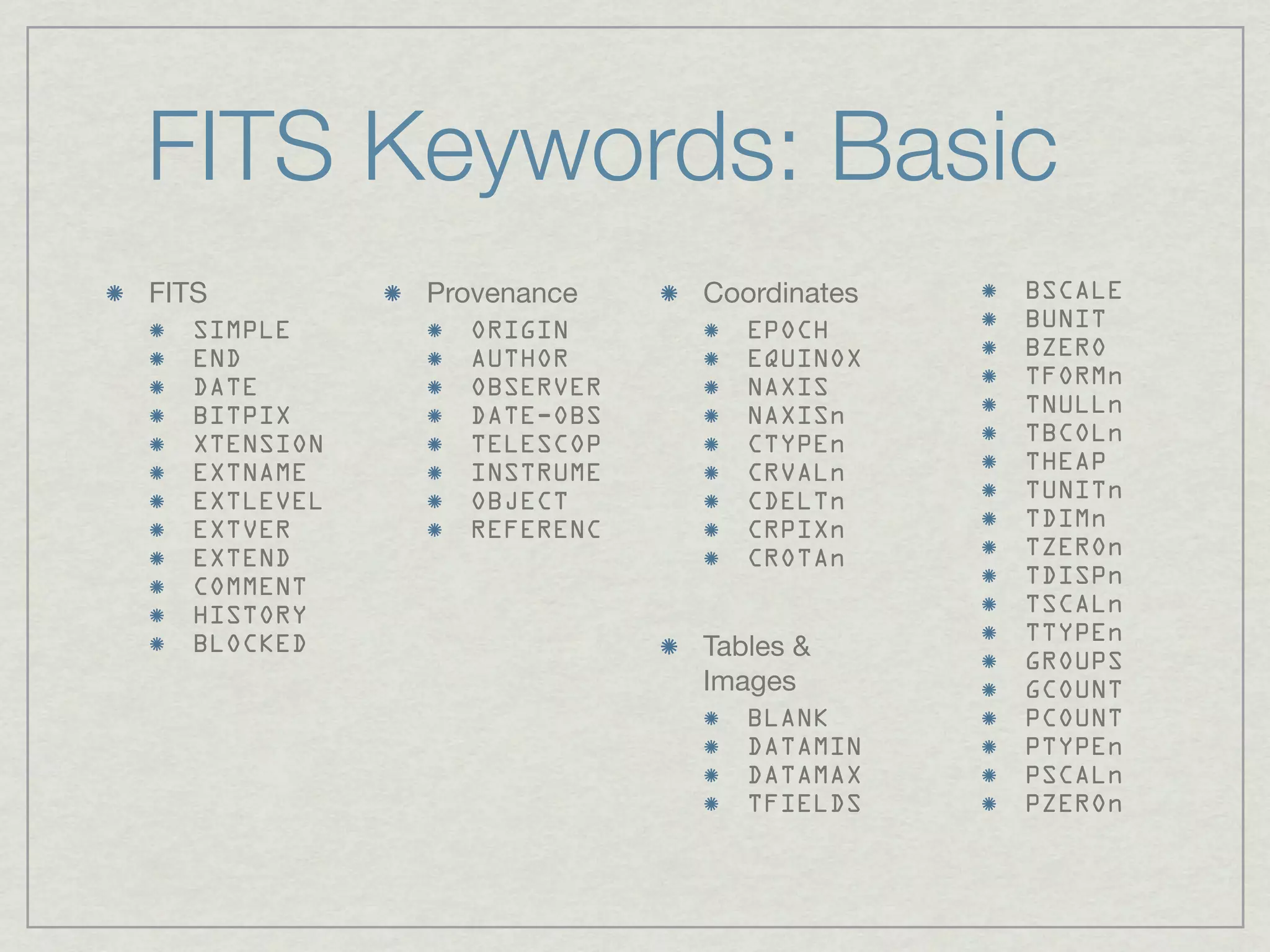
FITS Keywords: Basic
FITS          Provenance    Coordinates   BSCALE
   SIMPLE        ORIGIN       EPOCH       BUNIT
   END           AUTHOR       EQUINOX     BZERO
   DATE          OBSERVER     NAXIS       TFORMn
   BITPIX        DATE-OBS     NAXISn      TNULLn
   XTENSION      TELESCOP     CTYPEn      TBCOLn
   EXTNAME       INSTRUME     CRVALn      THEAP
   EXTLEVEL      OBJECT       CDELTn      TUNITn
   EXTVER        REFERENC     CRPIXn      TDIMn
   EXTEND                     CROTAn      TZEROn
   COMMENT                                TDISPn
   HISTORY                                TSCALn
                                          TTYPEn
   BLOCKED                  Tables &      GROUPS
                            Images        GCOUNT
                               BLANK      PCOUNT
                               DATAMIN    PTYPEn
                               DATAMAX    PSCALn
                               TFIELDS    PZEROn
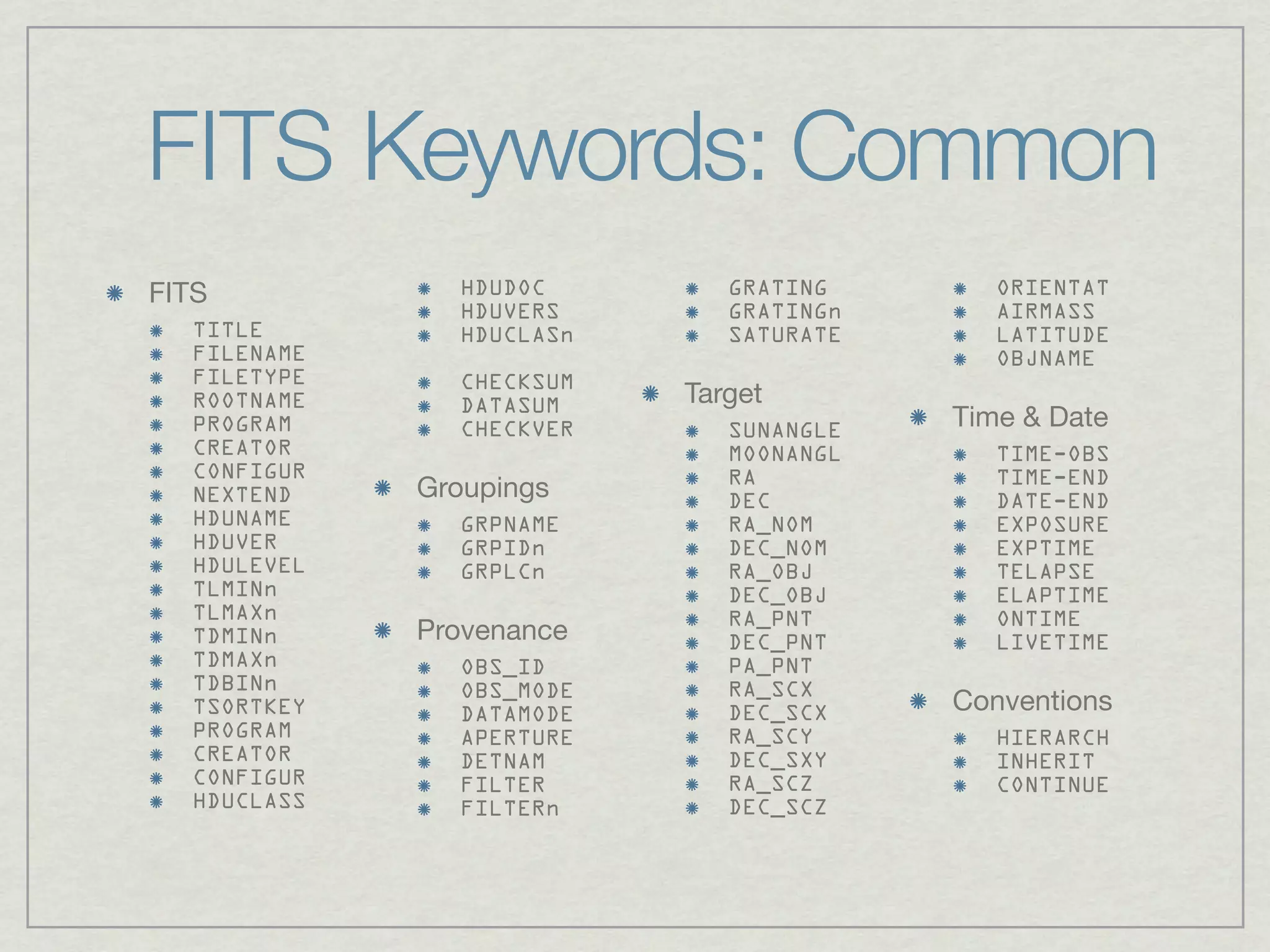
FITS Keywords: Common
FITS           HDUDOC        GRATING       ORIENTAT
               HDUVERS       GRATINGn      AIRMASS
  TITLE        HDUCLASn      SATURATE      LATITUDE
  FILENAME                                 OBJNAME
  FILETYPE     CHECKSUM
  ROOTNAME     DATASUM    Target
  PROGRAM      CHECKVER      SUNANGLE   Time & Date
  CREATOR                    MOONANGL      TIME-OBS
  CONFIGUR                   RA            TIME-END
  NEXTEND    Groupings       DEC           DATE-END
  HDUNAME      GRPNAME       RA_NOM        EXPOSURE
  HDUVER       GRPIDn        DEC_NOM       EXPTIME
  HDULEVEL     GRPLCn        RA_OBJ        TELAPSE
  TLMINn                     DEC_OBJ       ELAPTIME
  TLMAXn                     RA_PNT        ONTIME
  TDMINn     Provenance      DEC_PNT       LIVETIME
  TDMAXn       OBS_ID        PA_PNT
  TDBINn       OBS_MODE      RA_SCX
  TSORTKEY     DATAMODE      DEC_SCX    Conventions
  PROGRAM      APERTURE      RA_SCY        HIERARCH
  CREATOR      DETNAM        DEC_SXY       INHERIT
  CONFIGUR     FILTER        RA_SCZ        CONTINUE
  HDUCLASS     FILTERn       DEC_SCZ
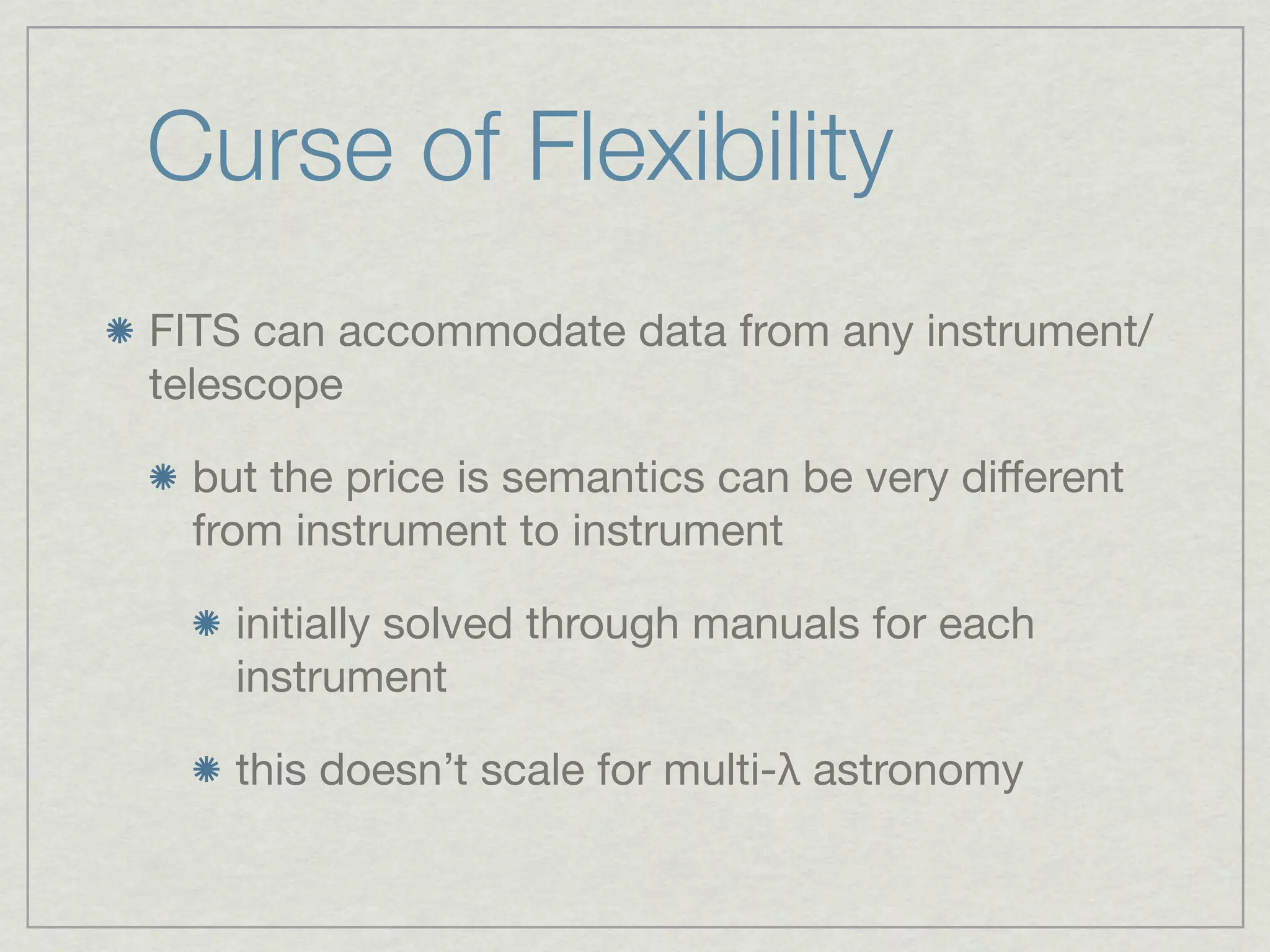
Curse of Flexibility
FITS can accommodate data from any instrument/
telescope

 but the price is semantics can be very different
 from instrument to instrument

   initially solved through manuals for each
   instrument

   this doesn’t scale for multi-λ astronomy
Astronomical Catalogues


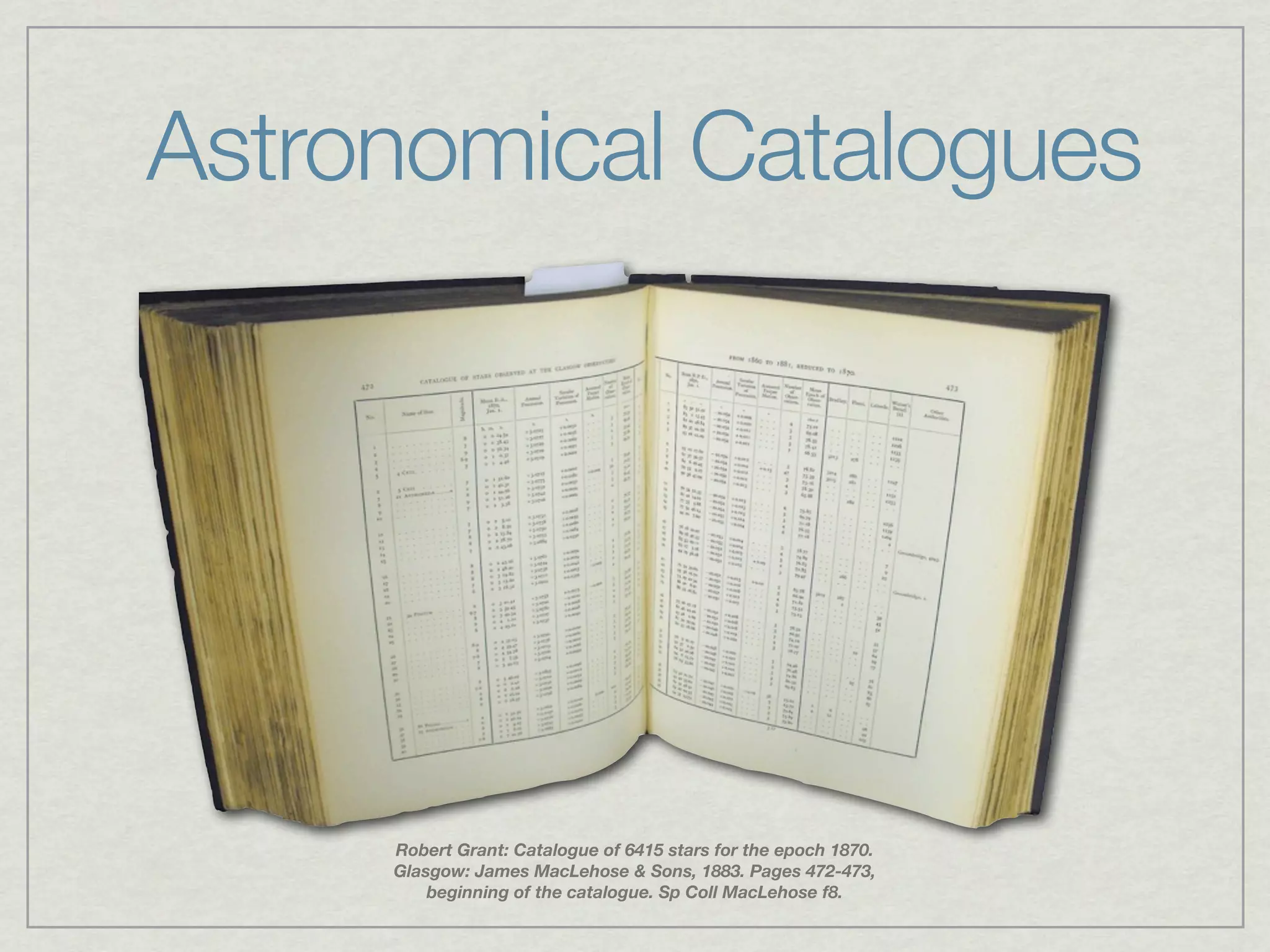
     Robert Grant: Catalogue of 6415 stars for the epoch 1870.
     Glasgow: James MacLehose & Sons, 1883. Pages 472-473,
         beginning of the catalogue. Sp Coll MacLehose f8.
Astronomical Catalogues
Collections of astronomical object properties

Typically, the result of many observations, or
exhaustive treatment of all object in a observation

Main index types
  Spatial
  Temporal
  Object template
Astronomical Catalogues

Explosion of catalogues since early ‘90s, thanks to
  Digitised astronomy
  Internet (FTP ➡ WWW)
  Journal tables
Astronomical Catalogues
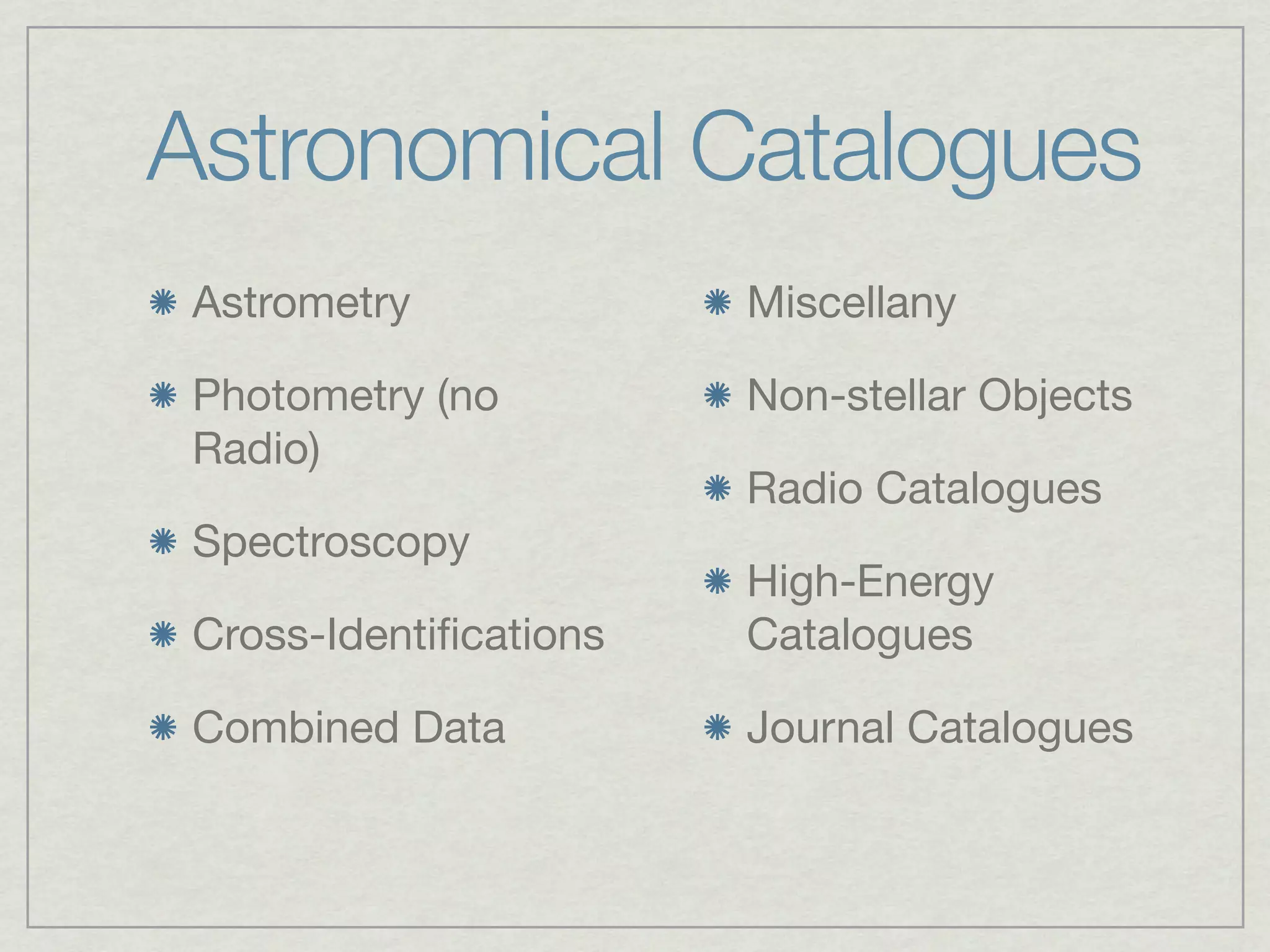
 Astrometry             Miscellany

 Photometry (no         Non-stellar Objects
 Radio)
                        Radio Catalogues
 Spectroscopy
                        High-Energy
 Cross-Identifications   Catalogues

 Combined Data          Journal Catalogues
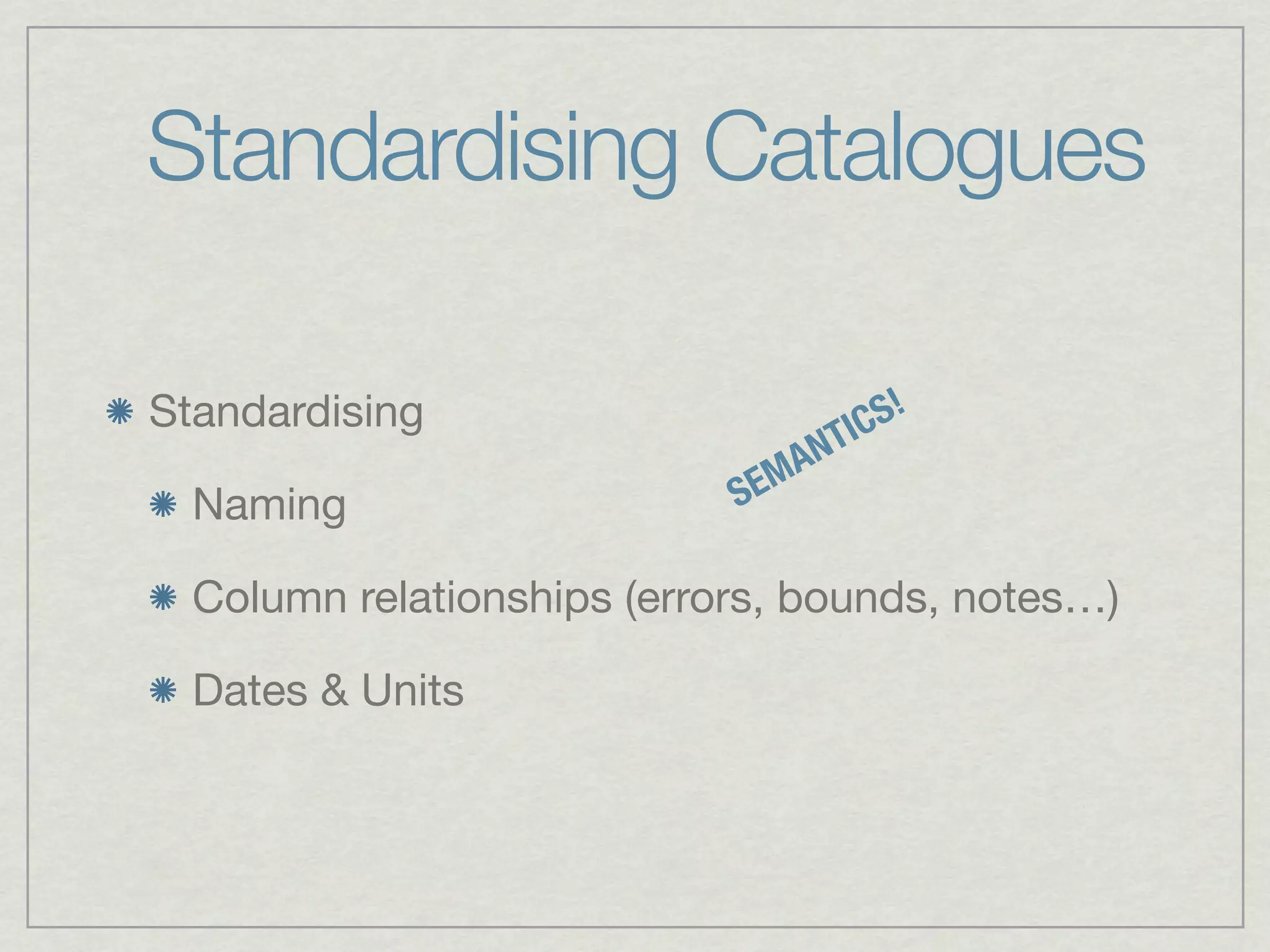
Standardising Catalogues

Standardising                       IC S!
                                A NT
                            S EM
  Naming

  Column relationships (errors, bounds, notes…)

  Dates & Units
References & Links
FITS Standard Document

FITS World Coordinate System

FITS Dictionaries

Standard for Documentation of Astronomical
Catalogues

UCD List

VO Course 02: Astronomy & Standards

  • 1.
    Astronomy & Standards Interoperabilityof astronomical data Juan de Dios Santander Vela (IAA-CSIC)
  • 2.
  • 3.
  • 4.
    Astrophysical records Aurignacian Lunar Calendar / diagram, drawing after Marshack, A. 1970; Notation dans les Gravures du Paléolithique Supérieur, Bordeaux, Delmas / Don’s Maps
  • 5.
    Astrophysical records In astrophysics,we record the EM radiation from distant objects, in order to: understand the processes that generated the EM radiation understand the processes that affect the received EM radiation
  • 6.
    Many different records Astrophysicalrecords are different by means of their EM/energy range (long vs. short-λ radio, IR, optical, UV, X-Ray, ɣ-Ray) Product type (images, time series, spectra, spectral cube, image cube, combinations…) Instrument setup
  • 7.
    Many different records Many,many things can change Coordinate system, physical measurement, physical support… And that’s just the observation generation!
  • 8.
    Many different records Mostof those records can be represented as multi-dimensional arrays Need to specify Units Sampling Physical meaning
  • 9.
    FITS: the FlexibleImage Transport System Header + Table data Special case: Image data Header: Keyword-value pairs 2-level hierarchies (Main HDU + Extensions) NASA Standard + IAU Recommendation
  • 10.
    FITS Keywords: Basic FITS Provenance Coordinates BSCALE SIMPLE ORIGIN EPOCH BUNIT END AUTHOR EQUINOX BZERO DATE OBSERVER NAXIS TFORMn BITPIX DATE-OBS NAXISn TNULLn XTENSION TELESCOP CTYPEn TBCOLn EXTNAME INSTRUME CRVALn THEAP EXTLEVEL OBJECT CDELTn TUNITn EXTVER REFERENC CRPIXn TDIMn EXTEND CROTAn TZEROn COMMENT TDISPn HISTORY TSCALn TTYPEn BLOCKED Tables & GROUPS Images GCOUNT BLANK PCOUNT DATAMIN PTYPEn DATAMAX PSCALn TFIELDS PZEROn
  • 11.
    FITS Keywords: Common FITS HDUDOC GRATING ORIENTAT HDUVERS GRATINGn AIRMASS TITLE HDUCLASn SATURATE LATITUDE FILENAME OBJNAME FILETYPE CHECKSUM ROOTNAME DATASUM Target PROGRAM CHECKVER SUNANGLE Time & Date CREATOR MOONANGL TIME-OBS CONFIGUR RA TIME-END NEXTEND Groupings DEC DATE-END HDUNAME GRPNAME RA_NOM EXPOSURE HDUVER GRPIDn DEC_NOM EXPTIME HDULEVEL GRPLCn RA_OBJ TELAPSE TLMINn DEC_OBJ ELAPTIME TLMAXn RA_PNT ONTIME TDMINn Provenance DEC_PNT LIVETIME TDMAXn OBS_ID PA_PNT TDBINn OBS_MODE RA_SCX TSORTKEY DATAMODE DEC_SCX Conventions PROGRAM APERTURE RA_SCY HIERARCH CREATOR DETNAM DEC_SXY INHERIT CONFIGUR FILTER RA_SCZ CONTINUE HDUCLASS FILTERn DEC_SCZ
  • 12.
    Curse of Flexibility FITScan accommodate data from any instrument/ telescope but the price is semantics can be very different from instrument to instrument initially solved through manuals for each instrument this doesn’t scale for multi-λ astronomy
  • 13.
    Astronomical Catalogues Robert Grant: Catalogue of 6415 stars for the epoch 1870. Glasgow: James MacLehose & Sons, 1883. Pages 472-473, beginning of the catalogue. Sp Coll MacLehose f8.
  • 14.
    Astronomical Catalogues Collections ofastronomical object properties Typically, the result of many observations, or exhaustive treatment of all object in a observation Main index types Spatial Temporal Object template
  • 15.
    Astronomical Catalogues Explosion ofcatalogues since early ‘90s, thanks to Digitised astronomy Internet (FTP ➡ WWW) Journal tables
  • 16.
    Astronomical Catalogues Astrometry Miscellany Photometry (no Non-stellar Objects Radio) Radio Catalogues Spectroscopy High-Energy Cross-Identifications Catalogues Combined Data Journal Catalogues
  • 17.
    Standardising Catalogues Standardising IC S! A NT S EM Naming Column relationships (errors, bounds, notes…) Dates & Units
  • 18.
    References & Links FITSStandard Document FITS World Coordinate System FITS Dictionaries Standard for Documentation of Astronomical Catalogues UCD List