Centralized Client-Server
Architecture
Understanding core Principles
And Applications
Ansar A
Agenda
1. Introduction
2. What is Client- Server Architecture
3. Centralized Client-Server Architecture
4. Components of Centralized Architecture
5. How Centralized Client-Server Architecture works?
6. Advantages of Centralized Client-Server Architecture
7. Challenges of Centralized Client-Server Architecture
8. Use Cases and Applications
9. Comparison with Other Architectures
10. Real-world Examples
11. Future Trends and Developments
12. Conclusion
Introduction
Overview: Centralized Client-Server Architecture
features a single central server providing resources
and services to multiple client devices. This model
centralizes data management and simplifies system
administration.
Agenda:
Architecture Overview: Definition and key
components
Components: Roles of clients, server, and network
Advantages & Challenges: Benefits and limitations
Applications: Use cases and real-world examples
Client - Server
Architecture
Definition: Client-Server Architecture is a
model where multiple clients connect to a
central server to request and receive resources
or services.
Basic Components:
Client: The user interface that initiates
requests for services.
Server: The central system that processes
requests and provides resources.
Centralized Client -
Server Architecture
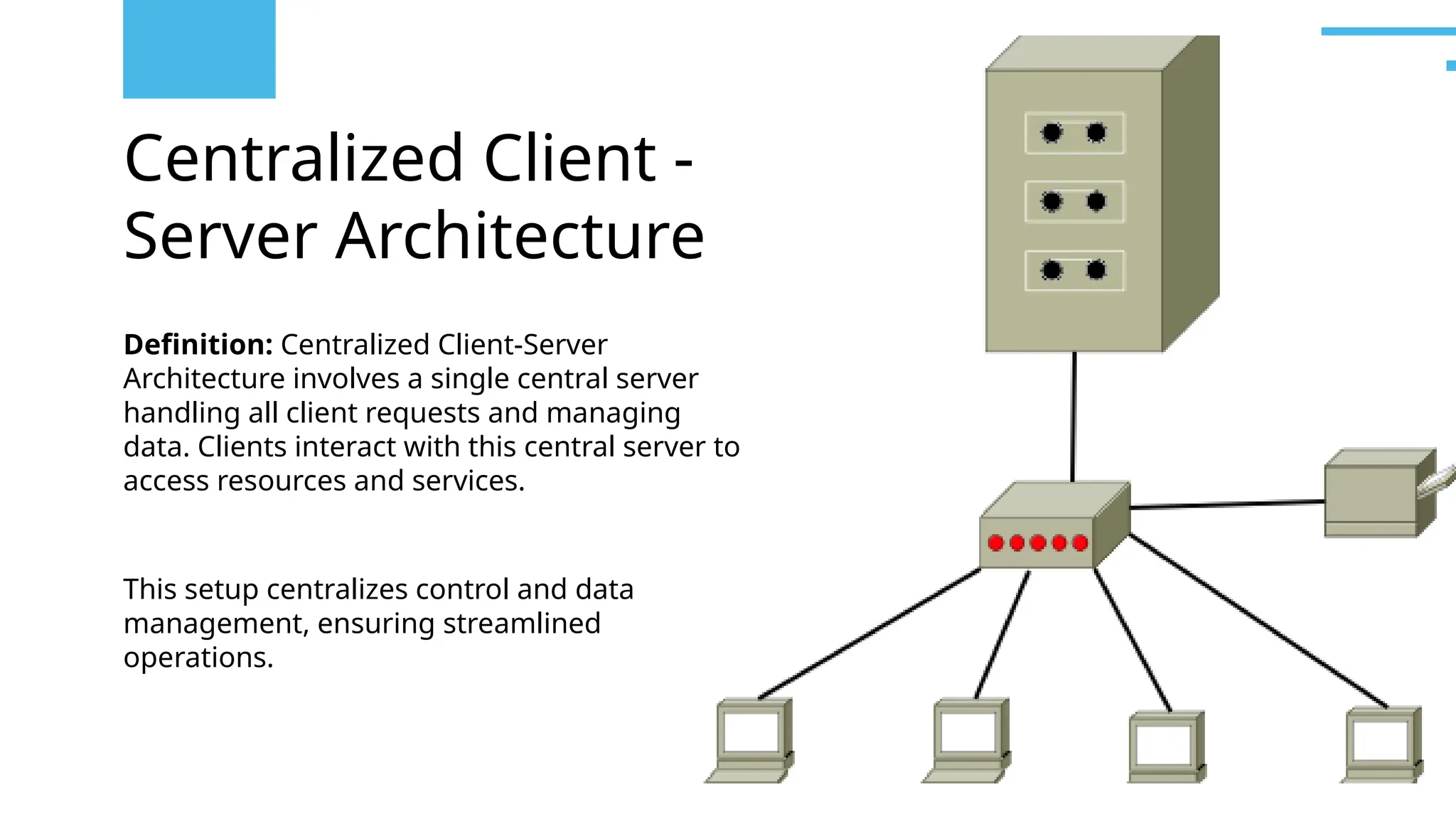
Definition: Centralized Client-Server
Architecture involves a single central server
handling all client requests and managing
data. Clients interact with this central server to
access resources and services.
This setup centralizes control and data
management, ensuring streamlined
operations.
Components of
Centralized
Architecture
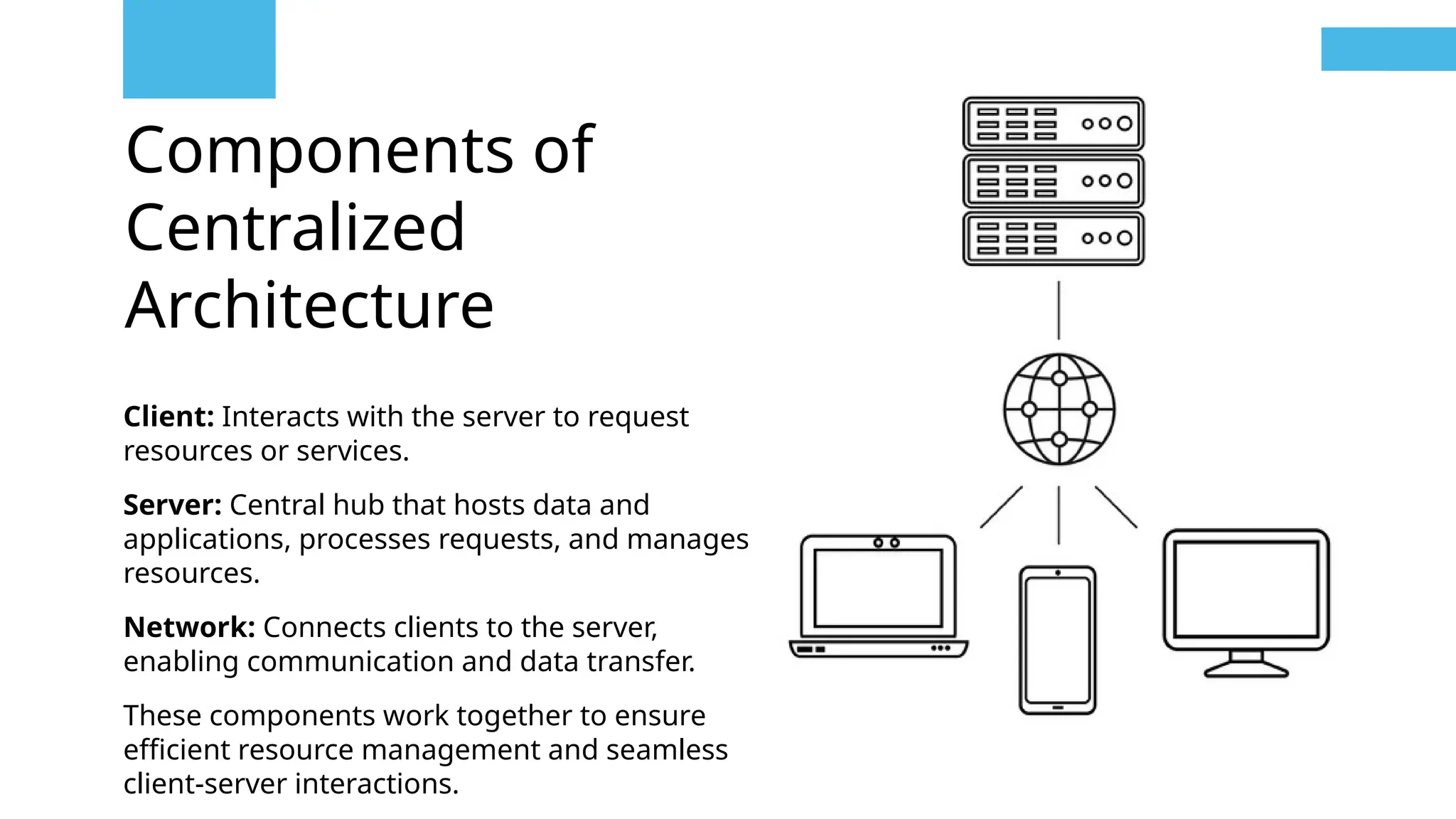
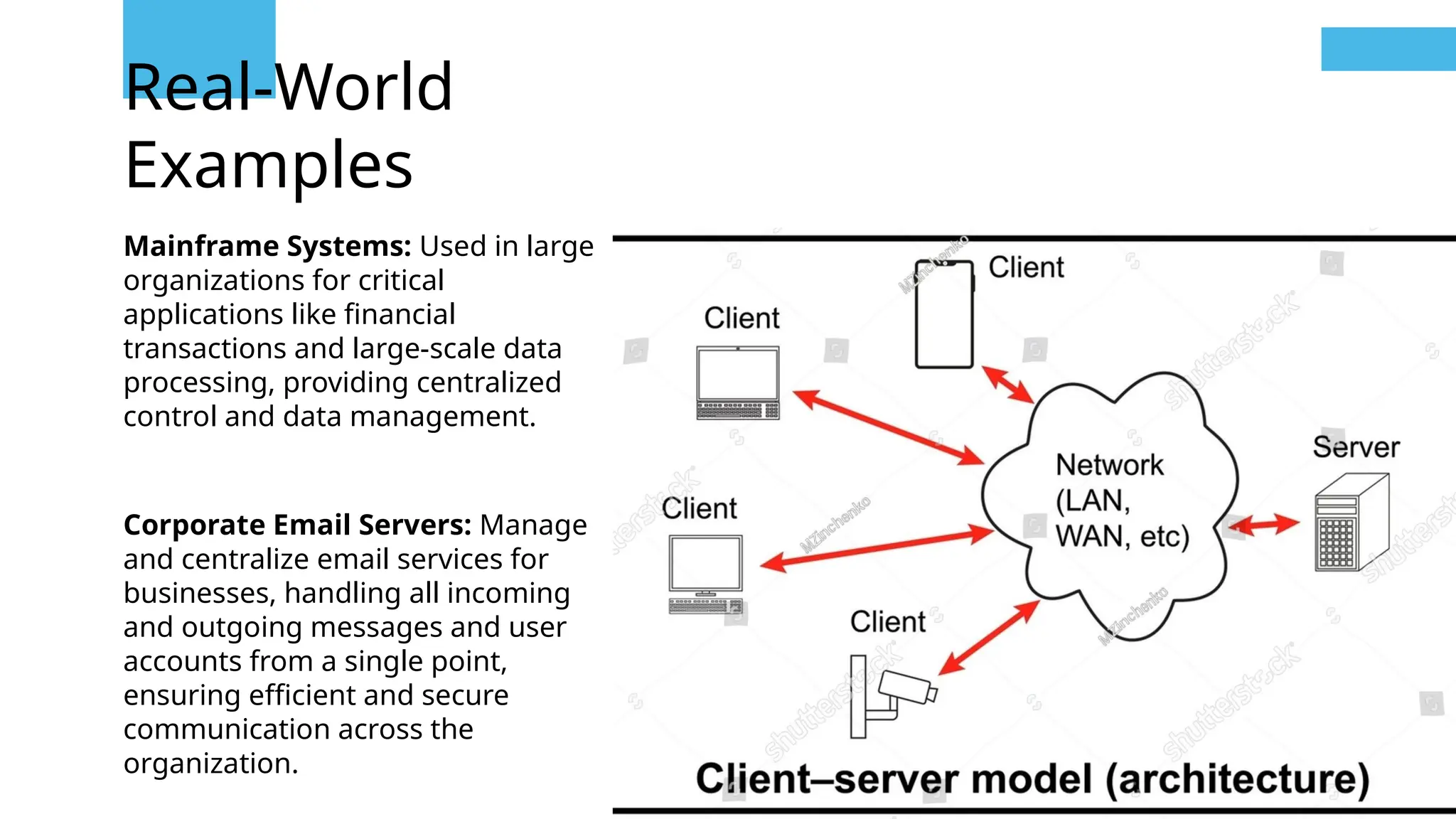
Client: Interacts with the server to request
resources or services.
Server: Central hub that hosts data and
applications, processes requests, and manages
resources.
Network: Connects clients to the server,
enabling communication and data transfer.
These components work together to ensure
efficient resource management and seamless
client-server interactions.
How Centralized
Client-Server
Architecture Works
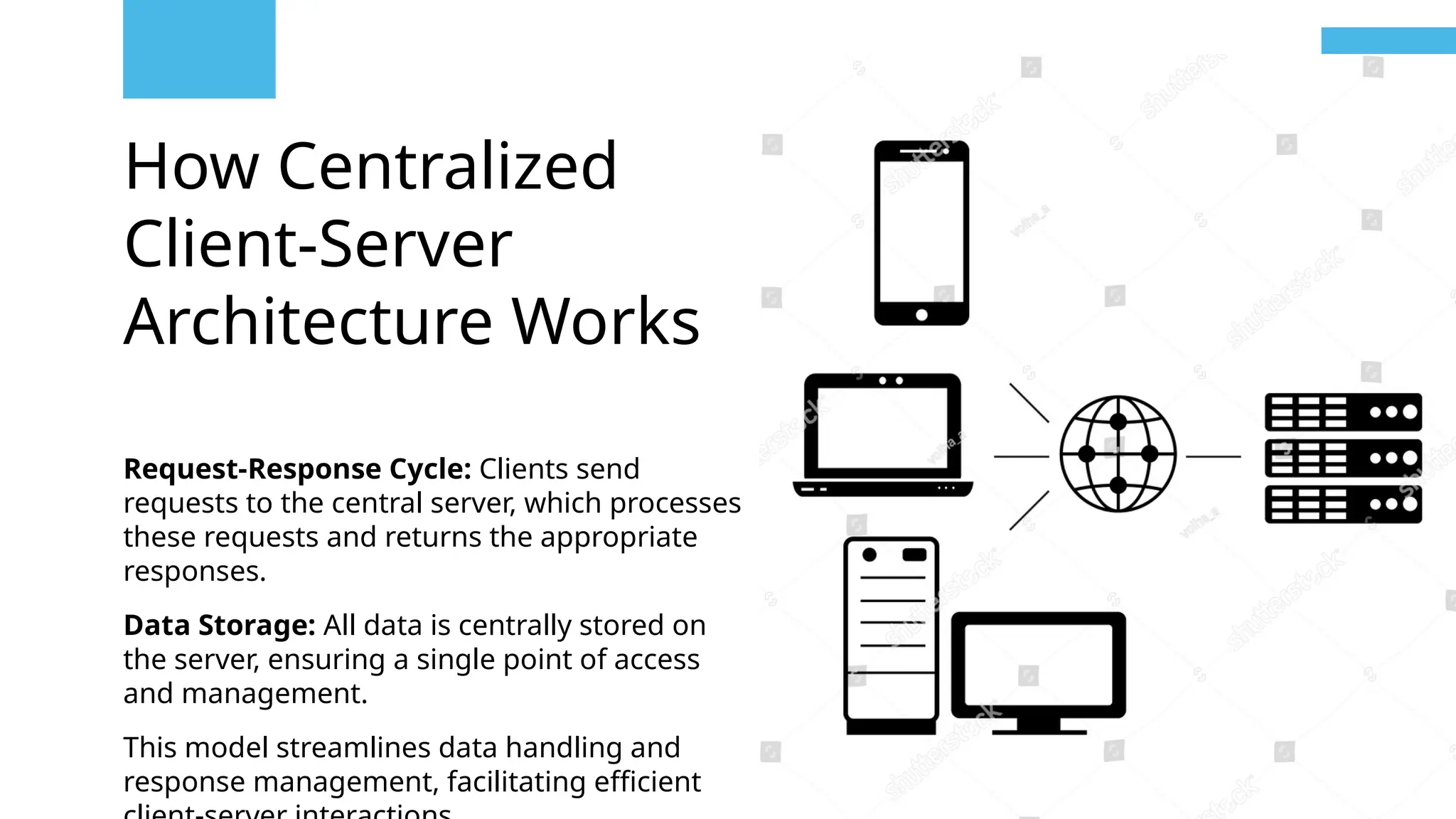
Request-Response Cycle: Clients send
requests to the central server, which processes
these requests and returns the appropriate
responses.
Data Storage: All data is centrally stored on
the server, ensuring a single point of access
and management.
This model streamlines data handling and
response management, facilitating efficient
Advantages of Centralized Client-Server
Architecture
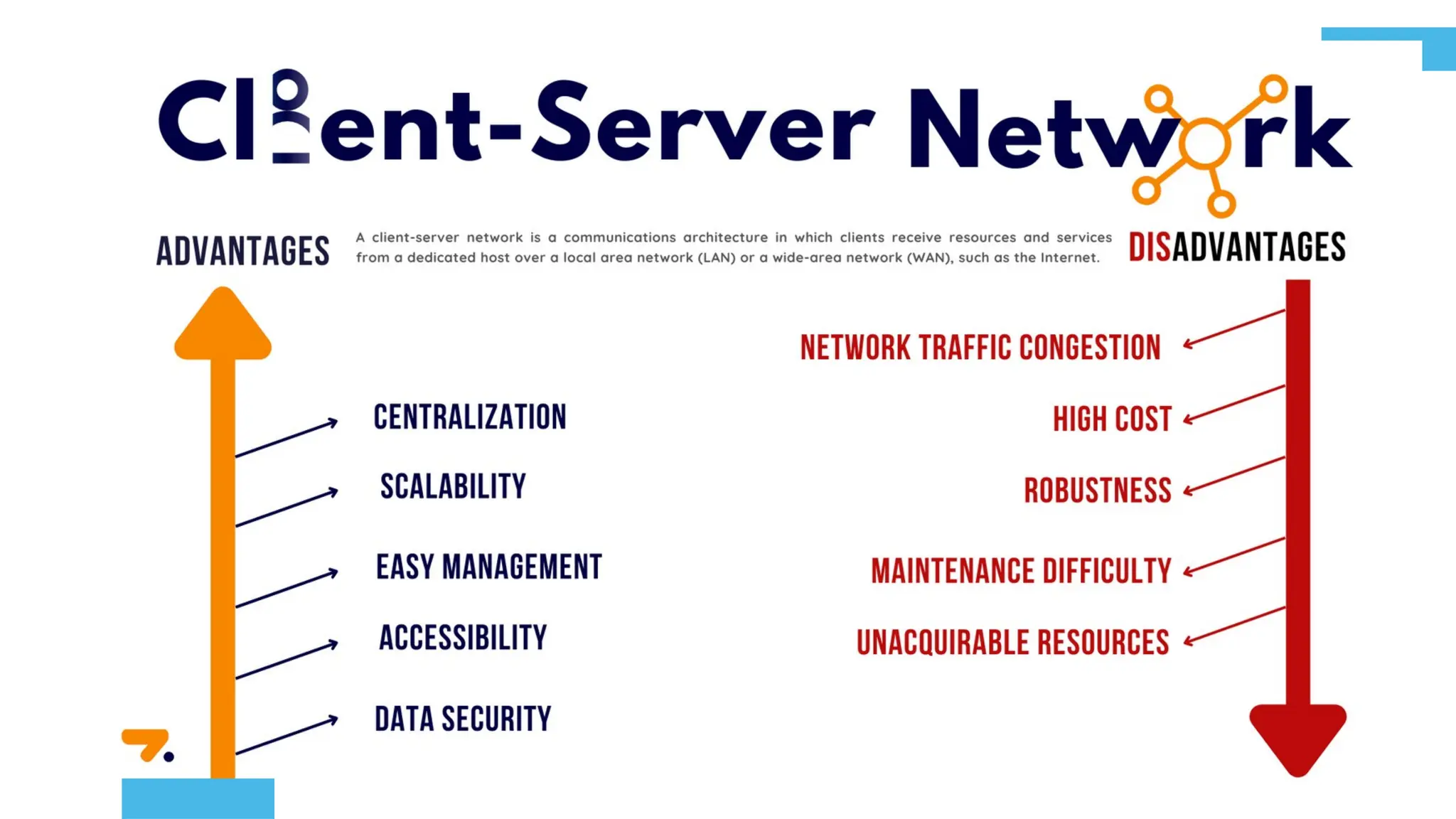
Data Consistency: A single data repository ensures uniform and accurate
information.
Simplified Management: Centralized systems make it easier to manage,
update, and secure data and applications.
Reduced Client Complexity: Clients focus on user interface and requests,
minimizing their complexity.
Centralized Control: Easier enforcement of security policies and
system updates from one central point.
Challenges of Centralized Client-Server
Architecture
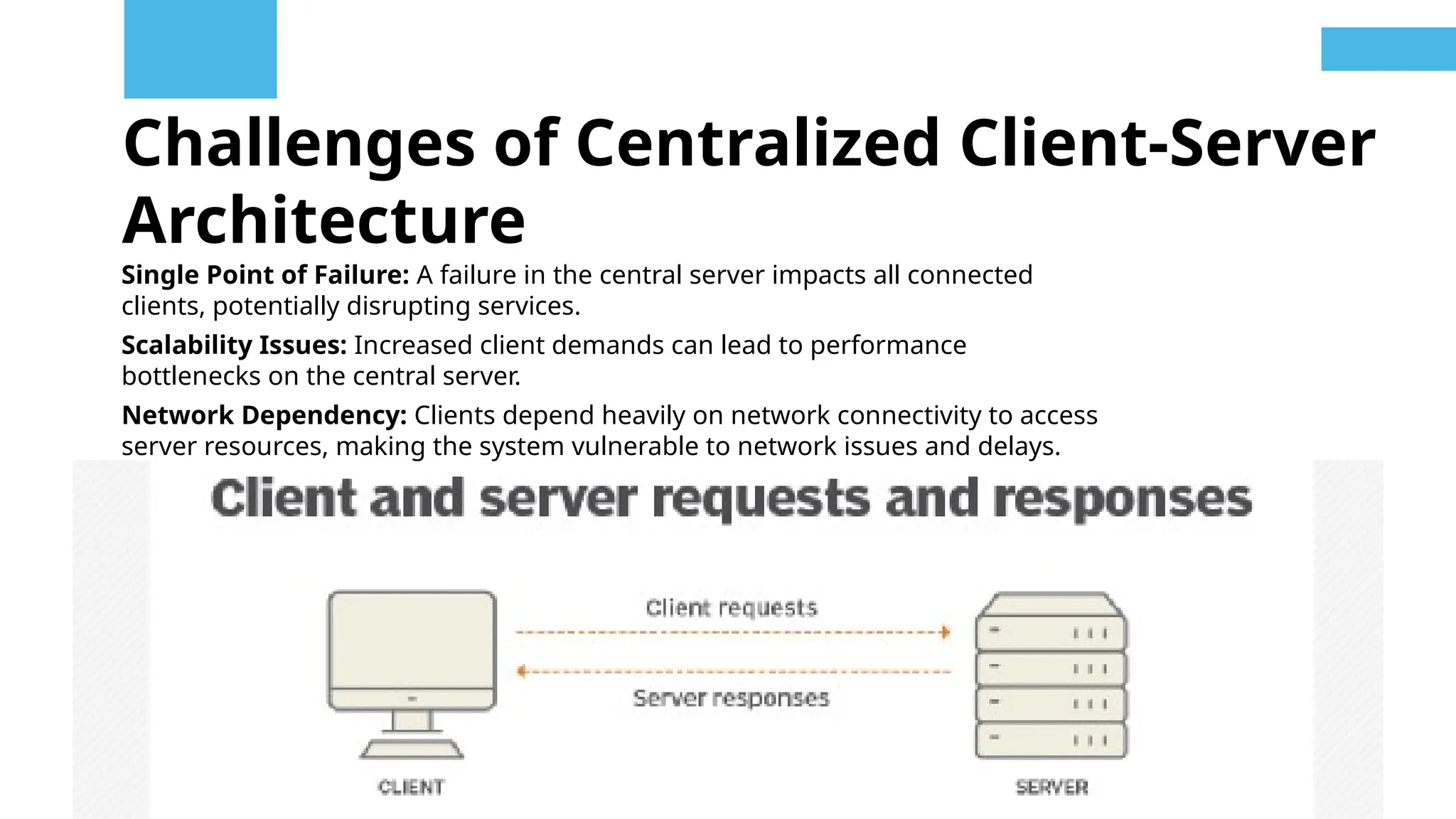
Single Point of Failure: A failure in the central server impacts all connected
clients, potentially disrupting services.
Scalability Issues: Increased client demands can lead to performance
bottlenecks on the central server.
Network Dependency: Clients depend heavily on network connectivity to access
server resources, making the system vulnerable to network issues and delays.
Use Cases and Applications
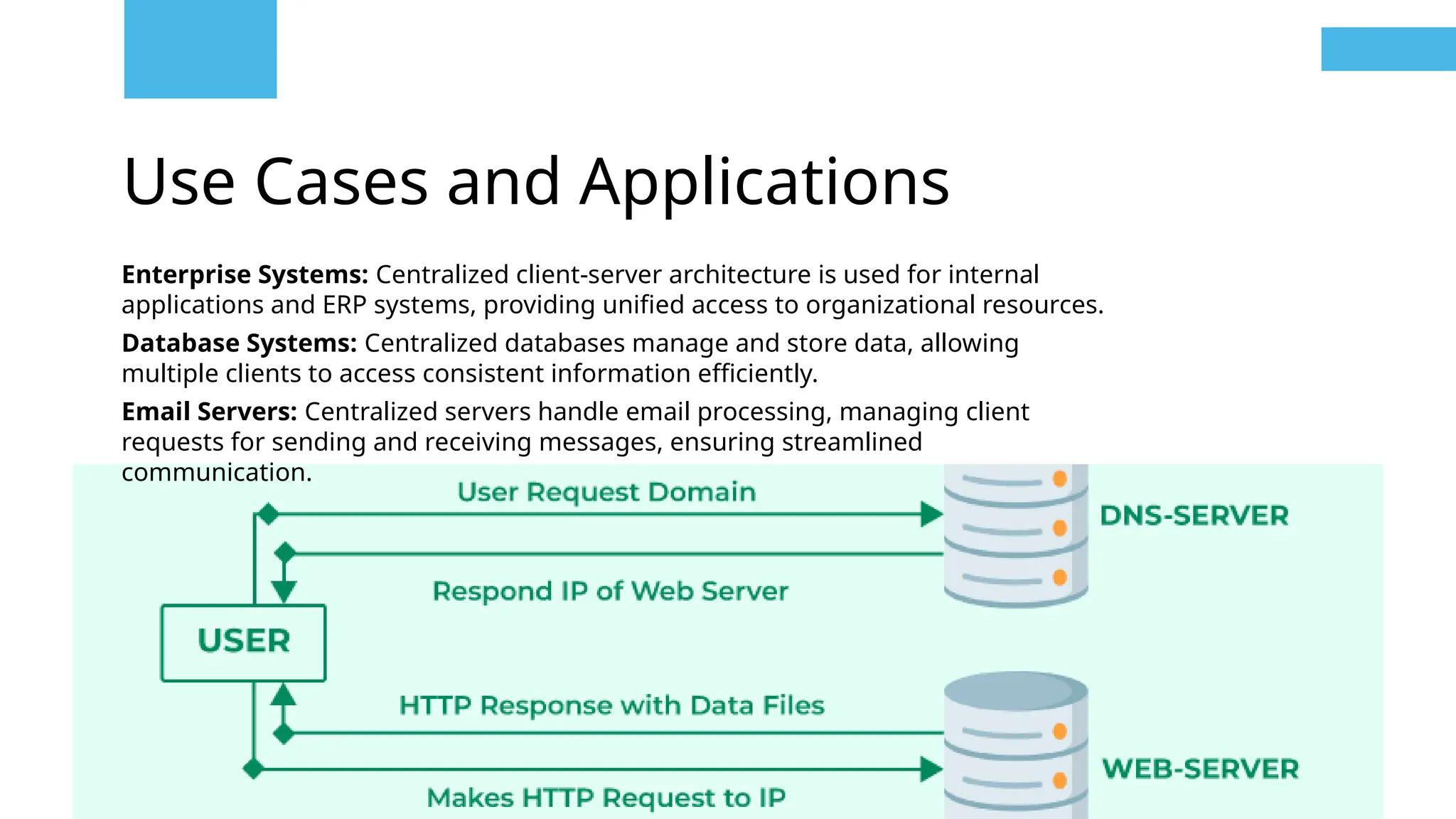
Enterprise Systems: Centralized client-server architecture is used for internal
applications and ERP systems, providing unified access to organizational resources.
Database Systems: Centralized databases manage and store data, allowing
multiple clients to access consistent information efficiently.
Email Servers: Centralized servers handle email processing, managing client
requests for sending and receiving messages, ensuring streamlined
communication.
Comparison with Other Architectures
Decentralized Architecture: Uses multiple servers and distributes data
across them, reducing single points of failure but increasing complexity.
Peer-to-Peer (P2P): Clients function as both servers and clients, enabling
direct resource sharing but lacking centralized control.
Distributed Systems: Spread data and services across multiple servers,
enhancing fault tolerance and scalability but requiring complex
management.
Real-World
Examples
Mainframe Systems: Used in large
organizations for critical
applications like financial
transactions and large-scale data
processing, providing centralized
control and data management.
Corporate Email Servers: Manage
and centralize email services for
businesses, handling all incoming
and outgoing messages and user
accounts from a single point,
ensuring efficient and secure
communication across the
organization.
Future Trends and
Developments
Integration with Cloud Services: Centralized
servers are increasingly being integrated into
cloud environments, offering scalable and
flexible solutions. Cloud platforms like AWS,
Azure, and Google Cloud provide centralized
resources while leveraging the cloud’s
elasticity. This integration allows businesses to
scale resources up or down based on demand,
optimize costs, and benefit from advanced
cloud services, such as global distribution and
enhanced security features.
Future Trends and
Developments
Advancements in Server Technology:
Modern server technology is continually
evolving to improve performance and
reliability. Innovations such as high-
performance processors, advanced memory
technologies, and faster storage solutions
enhance server capabilities. These
advancements support more efficient
processing, higher throughput, and increased
resilience, enabling centralized systems to
handle larger workloads and more complex
applications with greater efficiency and
reliability.
Future Trends and Developments
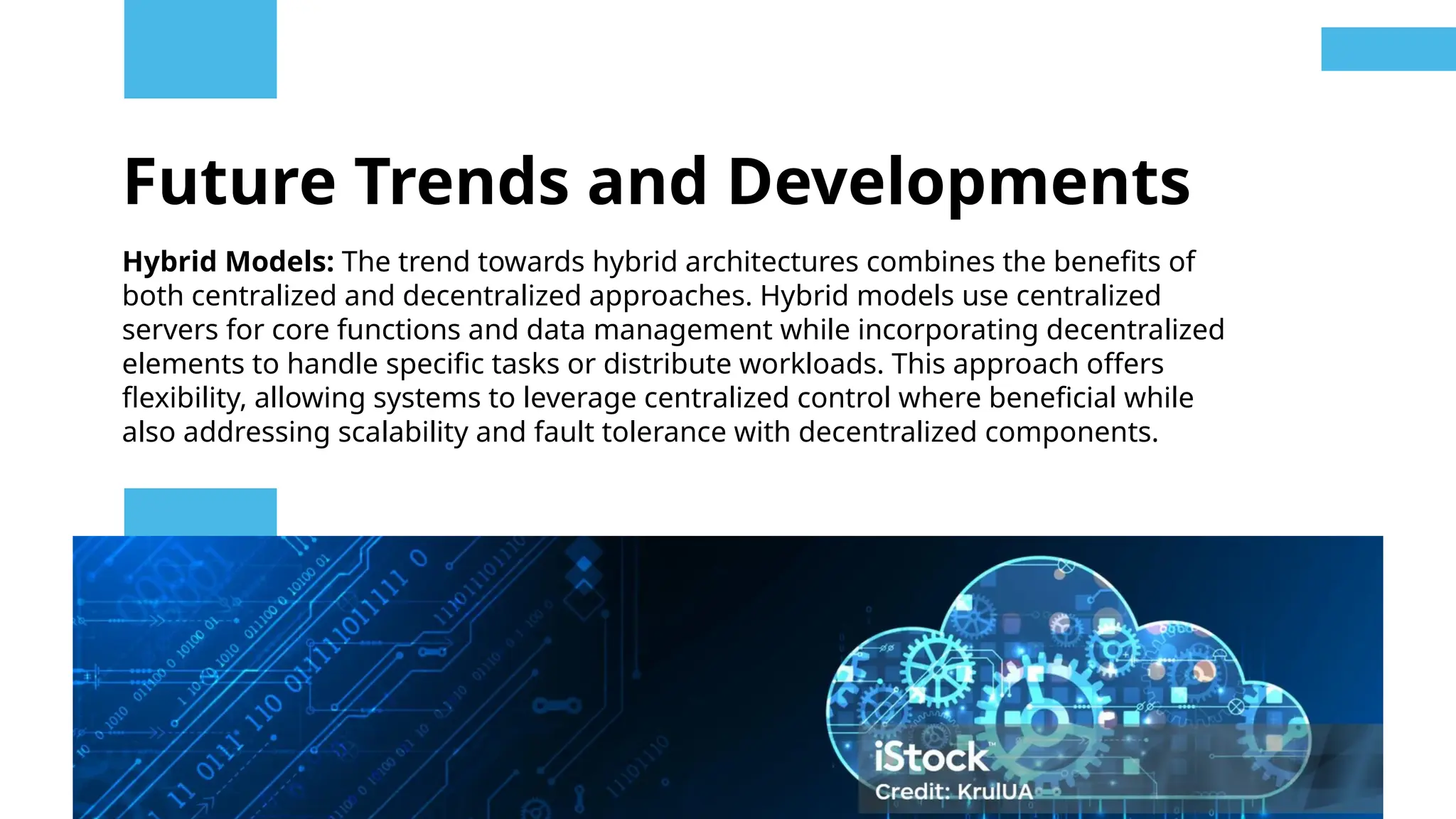
Hybrid Models: The trend towards hybrid architectures combines the benefits of
both centralized and decentralized approaches. Hybrid models use centralized
servers for core functions and data management while incorporating decentralized
elements to handle specific tasks or distribute workloads. This approach offers
flexibility, allowing systems to leverage centralized control where beneficial while
also addressing scalability and fault tolerance with decentralized components.
Future Trends and
Developments
Emerging Technologies: The rise of
technologies like edge computing and
blockchain is influencing centralized systems.
Edge computing brings computation closer to
the data source, reducing latency and
bandwidth usage, while blockchain provides
decentralized verification for added security
and transparency in centralized systems. These
technologies are shaping the future of client-
server architectures, enhancing performance
and security.
Conclusion
Summary: Centralized Client-Server Architecture centralizes data and
resource management, streamlining operations and control.
Key Takeaways: It offers benefits like data consistency and simplified
management but faces challenges such as scalability issues and a single
point of failure. Real-world applications include mainframes and
corporate email servers, demonstrating its practical importance.
Conclusion
Any Questions?
Feel free to ask about any specific details we discussed, or if
there’s anything else you’re curious about regarding centralized
systems and their applications
The End

01_Centralized Client-Server Architecture (2).pptx

  • 1.
  • 2.
    Agenda 1. Introduction 2. Whatis Client- Server Architecture 3. Centralized Client-Server Architecture 4. Components of Centralized Architecture 5. How Centralized Client-Server Architecture works? 6. Advantages of Centralized Client-Server Architecture 7. Challenges of Centralized Client-Server Architecture 8. Use Cases and Applications 9. Comparison with Other Architectures 10. Real-world Examples 11. Future Trends and Developments 12. Conclusion
  • 3.
    Introduction Overview: Centralized Client-ServerArchitecture features a single central server providing resources and services to multiple client devices. This model centralizes data management and simplifies system administration. Agenda: Architecture Overview: Definition and key components Components: Roles of clients, server, and network Advantages & Challenges: Benefits and limitations Applications: Use cases and real-world examples
  • 4.
    Client - Server Architecture Definition:Client-Server Architecture is a model where multiple clients connect to a central server to request and receive resources or services. Basic Components: Client: The user interface that initiates requests for services. Server: The central system that processes requests and provides resources.
  • 5.
    Centralized Client - ServerArchitecture Definition: Centralized Client-Server Architecture involves a single central server handling all client requests and managing data. Clients interact with this central server to access resources and services. This setup centralizes control and data management, ensuring streamlined operations.
  • 6.
    Components of Centralized Architecture Client: Interactswith the server to request resources or services. Server: Central hub that hosts data and applications, processes requests, and manages resources. Network: Connects clients to the server, enabling communication and data transfer. These components work together to ensure efficient resource management and seamless client-server interactions.
  • 7.
    How Centralized Client-Server Architecture Works Request-ResponseCycle: Clients send requests to the central server, which processes these requests and returns the appropriate responses. Data Storage: All data is centrally stored on the server, ensuring a single point of access and management. This model streamlines data handling and response management, facilitating efficient
  • 8.
    Advantages of CentralizedClient-Server Architecture Data Consistency: A single data repository ensures uniform and accurate information. Simplified Management: Centralized systems make it easier to manage, update, and secure data and applications. Reduced Client Complexity: Clients focus on user interface and requests, minimizing their complexity. Centralized Control: Easier enforcement of security policies and system updates from one central point.
  • 9.
    Challenges of CentralizedClient-Server Architecture Single Point of Failure: A failure in the central server impacts all connected clients, potentially disrupting services. Scalability Issues: Increased client demands can lead to performance bottlenecks on the central server. Network Dependency: Clients depend heavily on network connectivity to access server resources, making the system vulnerable to network issues and delays.
  • 11.
    Use Cases andApplications Enterprise Systems: Centralized client-server architecture is used for internal applications and ERP systems, providing unified access to organizational resources. Database Systems: Centralized databases manage and store data, allowing multiple clients to access consistent information efficiently. Email Servers: Centralized servers handle email processing, managing client requests for sending and receiving messages, ensuring streamlined communication.
  • 12.
    Comparison with OtherArchitectures Decentralized Architecture: Uses multiple servers and distributes data across them, reducing single points of failure but increasing complexity. Peer-to-Peer (P2P): Clients function as both servers and clients, enabling direct resource sharing but lacking centralized control. Distributed Systems: Spread data and services across multiple servers, enhancing fault tolerance and scalability but requiring complex management.
  • 13.
    Real-World Examples Mainframe Systems: Usedin large organizations for critical applications like financial transactions and large-scale data processing, providing centralized control and data management. Corporate Email Servers: Manage and centralize email services for businesses, handling all incoming and outgoing messages and user accounts from a single point, ensuring efficient and secure communication across the organization.
  • 14.
    Future Trends and Developments Integrationwith Cloud Services: Centralized servers are increasingly being integrated into cloud environments, offering scalable and flexible solutions. Cloud platforms like AWS, Azure, and Google Cloud provide centralized resources while leveraging the cloud’s elasticity. This integration allows businesses to scale resources up or down based on demand, optimize costs, and benefit from advanced cloud services, such as global distribution and enhanced security features.
  • 15.
    Future Trends and Developments Advancementsin Server Technology: Modern server technology is continually evolving to improve performance and reliability. Innovations such as high- performance processors, advanced memory technologies, and faster storage solutions enhance server capabilities. These advancements support more efficient processing, higher throughput, and increased resilience, enabling centralized systems to handle larger workloads and more complex applications with greater efficiency and reliability.
  • 16.
    Future Trends andDevelopments Hybrid Models: The trend towards hybrid architectures combines the benefits of both centralized and decentralized approaches. Hybrid models use centralized servers for core functions and data management while incorporating decentralized elements to handle specific tasks or distribute workloads. This approach offers flexibility, allowing systems to leverage centralized control where beneficial while also addressing scalability and fault tolerance with decentralized components.
  • 17.
    Future Trends and Developments EmergingTechnologies: The rise of technologies like edge computing and blockchain is influencing centralized systems. Edge computing brings computation closer to the data source, reducing latency and bandwidth usage, while blockchain provides decentralized verification for added security and transparency in centralized systems. These technologies are shaping the future of client- server architectures, enhancing performance and security.
  • 18.
    Conclusion Summary: Centralized Client-ServerArchitecture centralizes data and resource management, streamlining operations and control. Key Takeaways: It offers benefits like data consistency and simplified management but faces challenges such as scalability issues and a single point of failure. Real-world applications include mainframes and corporate email servers, demonstrating its practical importance. Conclusion
  • 20.
    Any Questions? Feel freeto ask about any specific details we discussed, or if there’s anything else you’re curious about regarding centralized systems and their applications
  • 21.