NATIONAL ECONOMICS UNIVERSITY
NEU COLLEGE OF TECHNOLOGY
FACULTY OF INFORMATION TECHNOLOGY
INTRODUCTIONTO INFORMATIONTECHNOLOGY
CHAPTER 1. OVERVIEW OF INFORMATIONTECHNOLOGY
LECTURER
MSC. PHAMTHAO
Senior Lecture
📞 0966 986 689
📩 thaop@neu.edu.vn
https://fit.neu.edu.vn/lecturer/th-s-pham-thao
CHAPTER 1. OVERVIEW OF INFORMATIONTECHNOLOGY
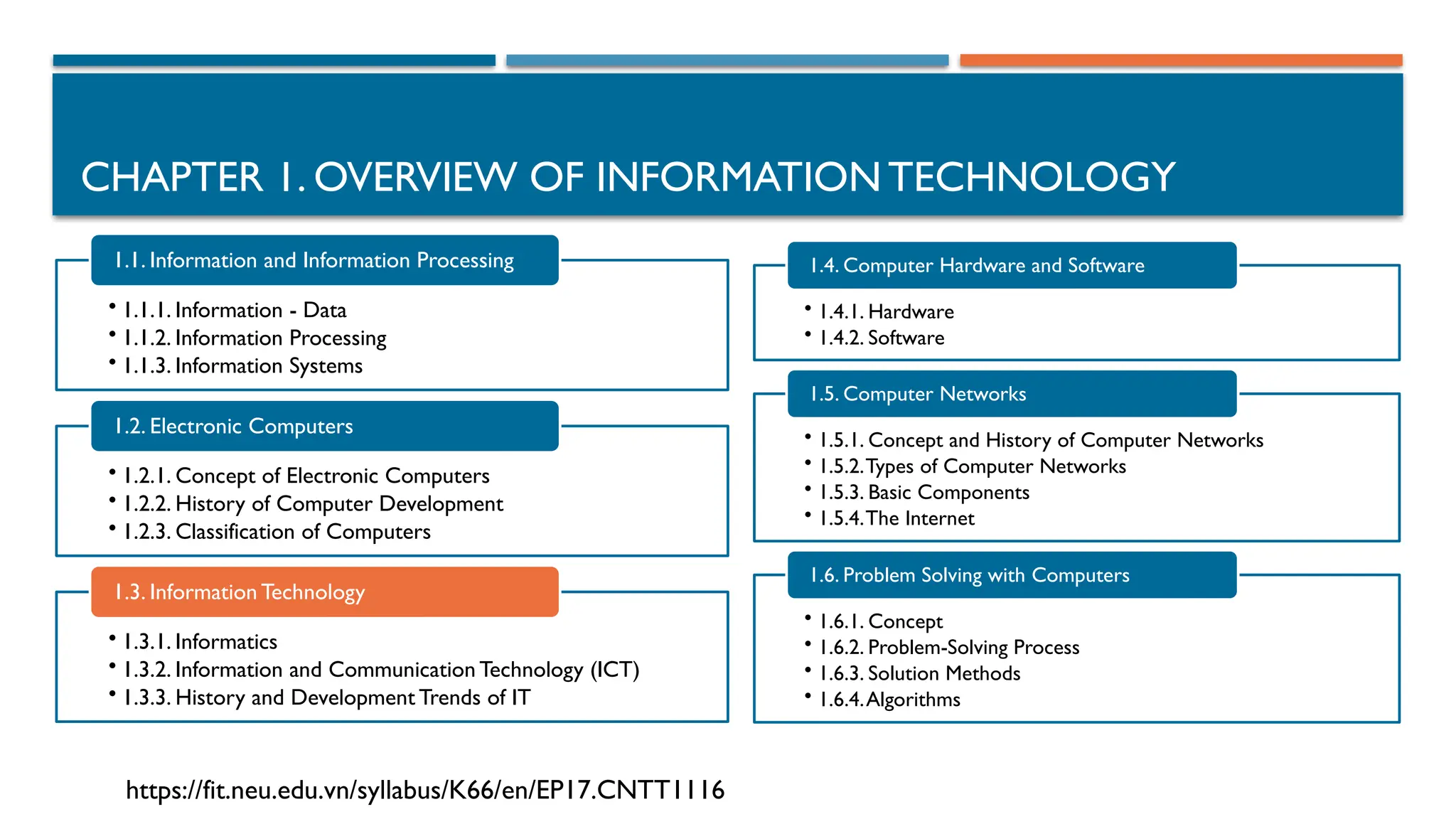
https://fit.neu.edu.vn/syllabus/K66/en/EP17.CNTT1116
• 1.1.1. Information - Data
• 1.1.2. Information Processing
• 1.1.3. Information Systems
1.1. Information and Information Processing
• 1.2.1. Concept of Electronic Computers
• 1.2.2. History of Computer Development
• 1.2.3. Classification of Computers
1.2. Electronic Computers
• 1.3.1. Informatics
• 1.3.2. Information and Communication Technology (ICT)
• 1.3.3. History and Development Trends of IT
1.3. Information Technology
• 1.4.1. Hardware
• 1.4.2. Software
1.4. Computer Hardware and Software
• 1.5.1. Concept and History of Computer Networks
• 1.5.2.Types of Computer Networks
• 1.5.3. Basic Components
• 1.5.4.The Internet
1.5. Computer Networks
• 1.6.1. Concept
• 1.6.2. Problem-Solving Process
• 1.6.3. Solution Methods
• 1.6.4.Algorithms
1.6. Problem Solving with Computers
1.3. INFORMATIONTECHNOLOGY
1.3.1. INFORMATICS
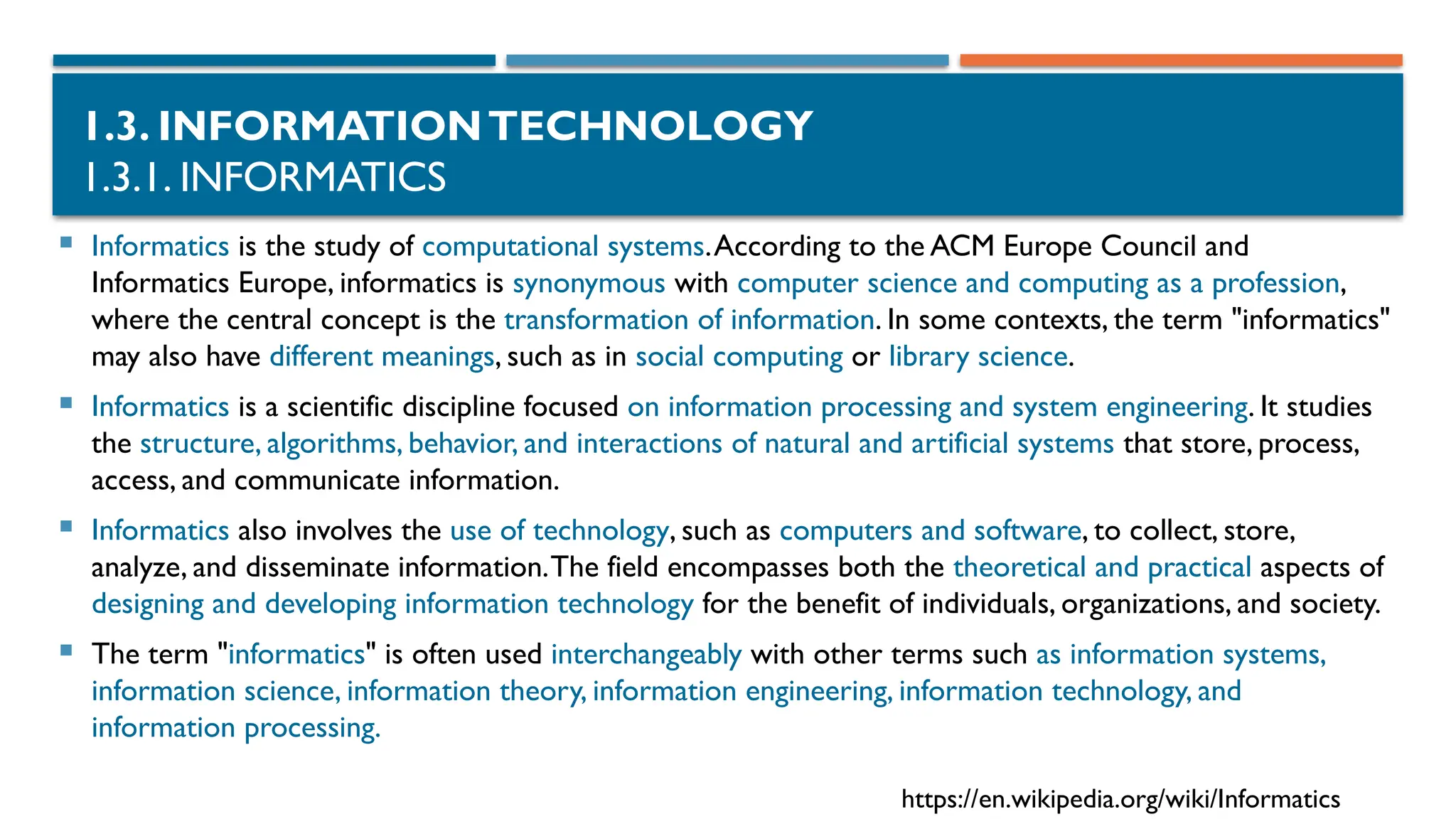
 Informatics is the study of computational systems.According to the ACM Europe Council and
Informatics Europe, informatics is synonymous with computer science and computing as a profession,
where the central concept is the transformation of information. In some contexts, the term "informatics"
may also have different meanings, such as in social computing or library science.
 Informatics is a scientific discipline focused on information processing and system engineering. It studies
the structure, algorithms, behavior, and interactions of natural and artificial systems that store, process,
access, and communicate information.
 Informatics also involves the use of technology, such as computers and software, to collect, store,
analyze, and disseminate information.The field encompasses both the theoretical and practical aspects of
designing and developing information technology for the benefit of individuals, organizations, and society.
 The term "informatics" is often used interchangeably with other terms such as information systems,
information science, information theory, information engineering, information technology, and
information processing.
https://en.wikipedia.org/wiki/Informatics
1.3. INFORMATIONTECHNOLOGY
1.3.1. INFORMATICS
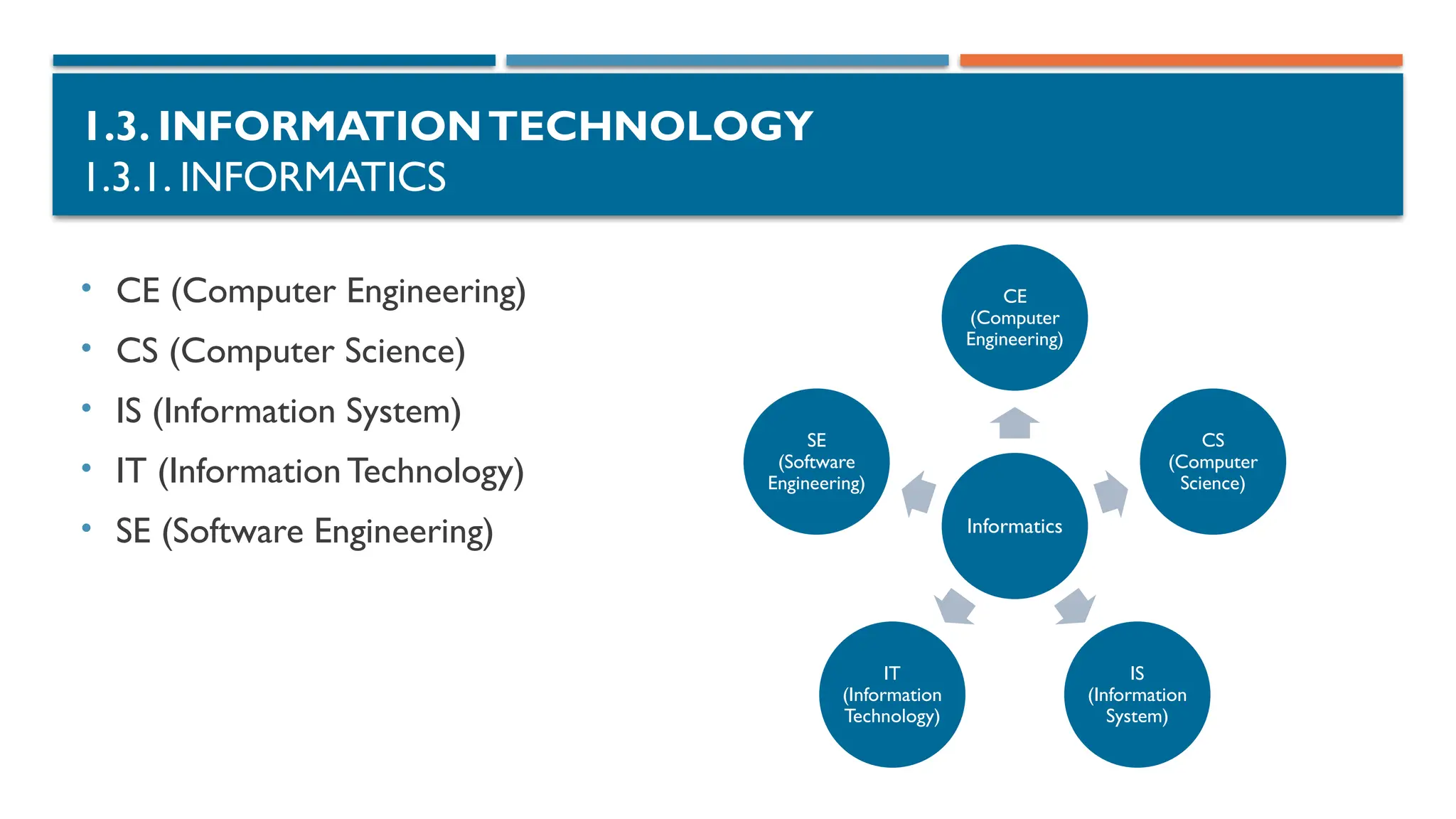
 Computing refers to any goal-oriented activity that requires, benefits from, or results in
the creation of computing machinery.
 It involves the study and experimentation of algorithmic processes, as well as the
development of both hardware and software.
 Computing encompasses scientific, engineering, mathematical, technological, and social
dimensions.
 The major computing disciplines include computer engineering, computer science,
cybersecurity, data science, information systems, information technology, and software
engineering.
https://en.wikipedia.org/wiki/Informatics
1.3. INFORMATIONTECHNOLOGY
1.3.1. INFORMATICS
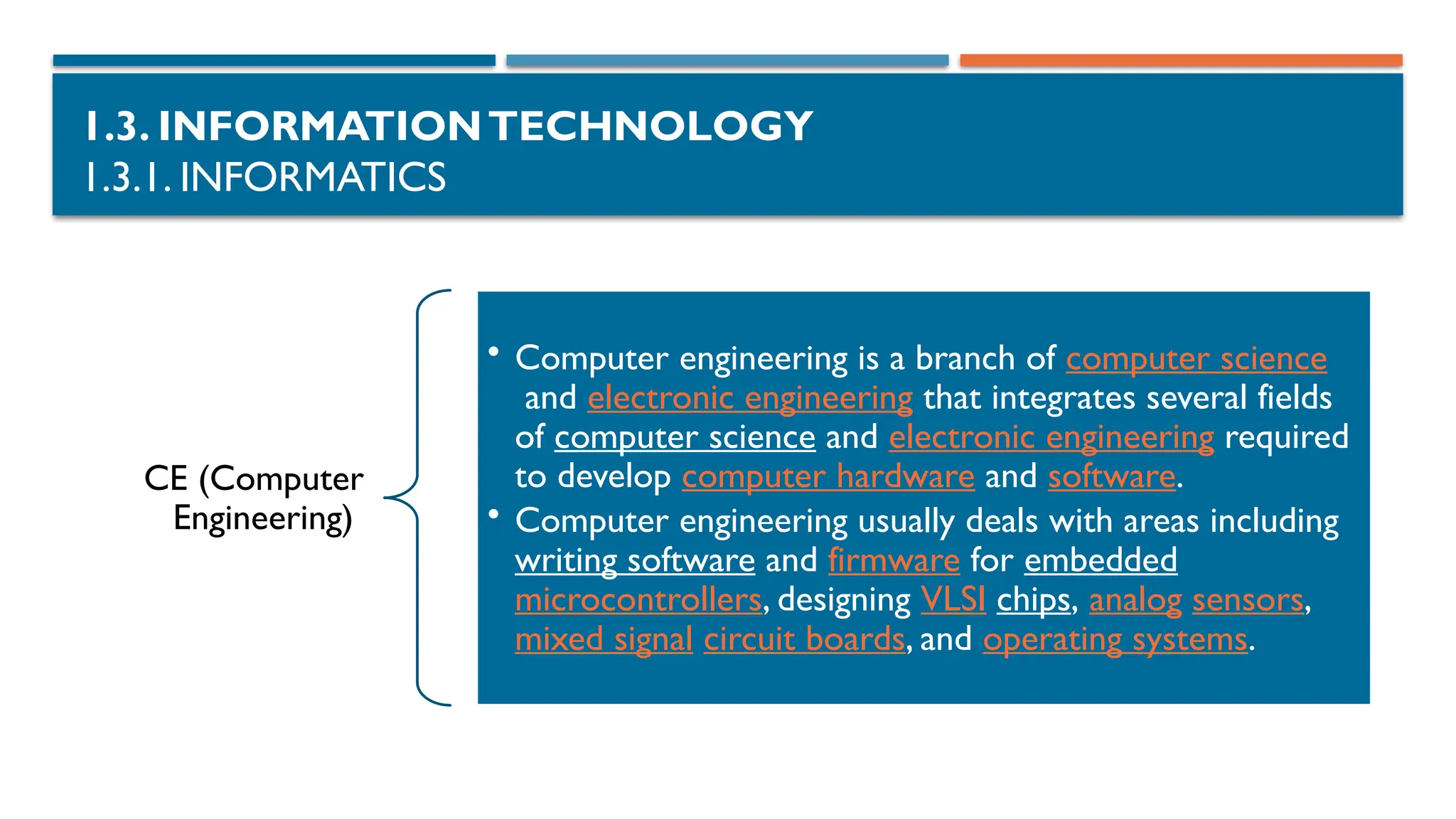
• CE (Computer Engineering)
• CS (Computer Science)
• IS (Information System)
• IT (Information Technology)
• SE (Software Engineering) Informatics
CE
(Computer
Engineering)
CS
(Computer
Science)
IS
(Information
System)
IT
(Information
Technology)
SE
(Software
Engineering)
1.3. INFORMATIONTECHNOLOGY
1.3.1. INFORMATICS
CE (Computer
Engineering)
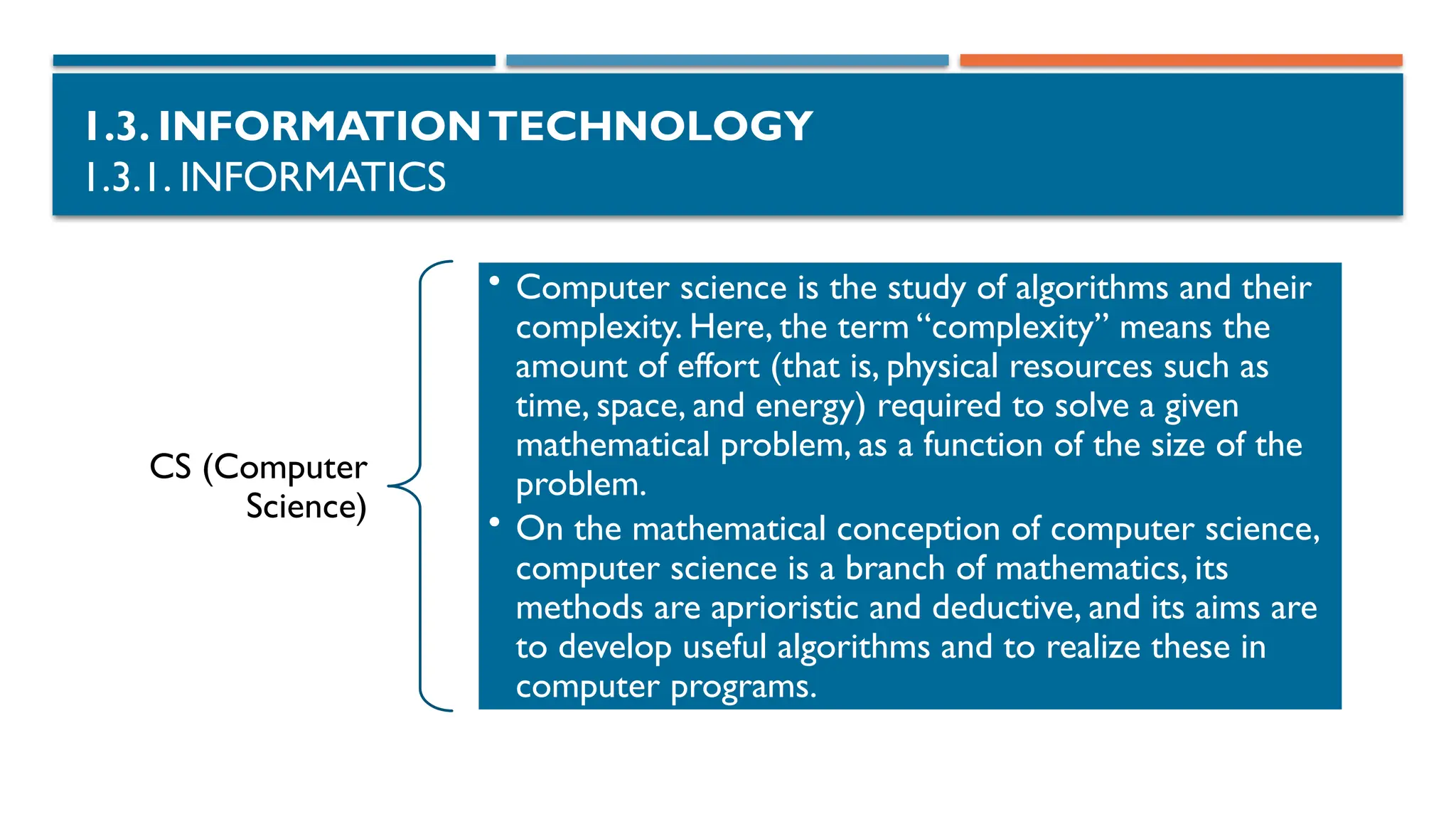
• Computer engineering is a branch of computer science
and electronic engineering that integrates several fields
of computer science and electronic engineering required
to develop computer hardware and software.
• Computer engineering usually deals with areas including
writing software and firmware for embedded
microcontrollers, designing VLSI chips, analog sensors,
mixed signal circuit boards, and operating systems.
1.3. INFORMATIONTECHNOLOGY
1.3.1. INFORMATICS
CS (Computer
Science)
• Computer science is the study of algorithms and their
complexity. Here, the term “complexity” means the
amount of effort (that is, physical resources such as
time, space, and energy) required to solve a given
mathematical problem, as a function of the size of the
problem.
• On the mathematical conception of computer science,
computer science is a branch of mathematics, its
methods are aprioristic and deductive, and its aims are
to develop useful algorithms and to realize these in
computer programs.
1.3. INFORMATIONTECHNOLOGY
1.3.1. INFORMATICS
SE (Software Engineering)
• According to the Association for Computing Machinery (ACM), software engineering is concerned with
developing and maintaining software systems that behave reliably and efficiently, are affordable to develop and
maintain, and satisfy all the requirements that customers have defined for them [ACM 2006]. IEEE dsystematic,
disciplined, quantifiable approach to the development, operation, and maintenance of softwareefines software
engineering more succinctly as “a.”
• Software engineering (SE) emerged as a discipline in the late 70s and early 80s
• Software Engineering is a multidisciplinary discipline involving different social and technological features.
• To understand how software engineers maintain complex software systems, it is necessary to investigate not
only the tools and processes they use but also the cognitive and social processes surrounding them.
• It requires the study of human activities.We need to understand how software engineers individually develop
software as well as how teams and organizations coordinate their efforts
• Software engineering is an evolving engineering discipline. It deals with systematic approaches to building large
software systems by teams of programmers.We have given a brief review of the essential elements of
software engineering including product-related issues such as requirements, design, and validation, and
process-related issues including process models and their assessment.
Mehdi Jazayeri, in Encyclopedia of Physical Science and Technology (Third Editio
2003
Paulo Sérgio Medeiros dos Santos, Guilherme Horta Travassos, in
Advances in Computers, 2011
1.3. INFORMATIONTECHNOLOGY
1.3.1. INFORMATICS
IS
(Information
System)
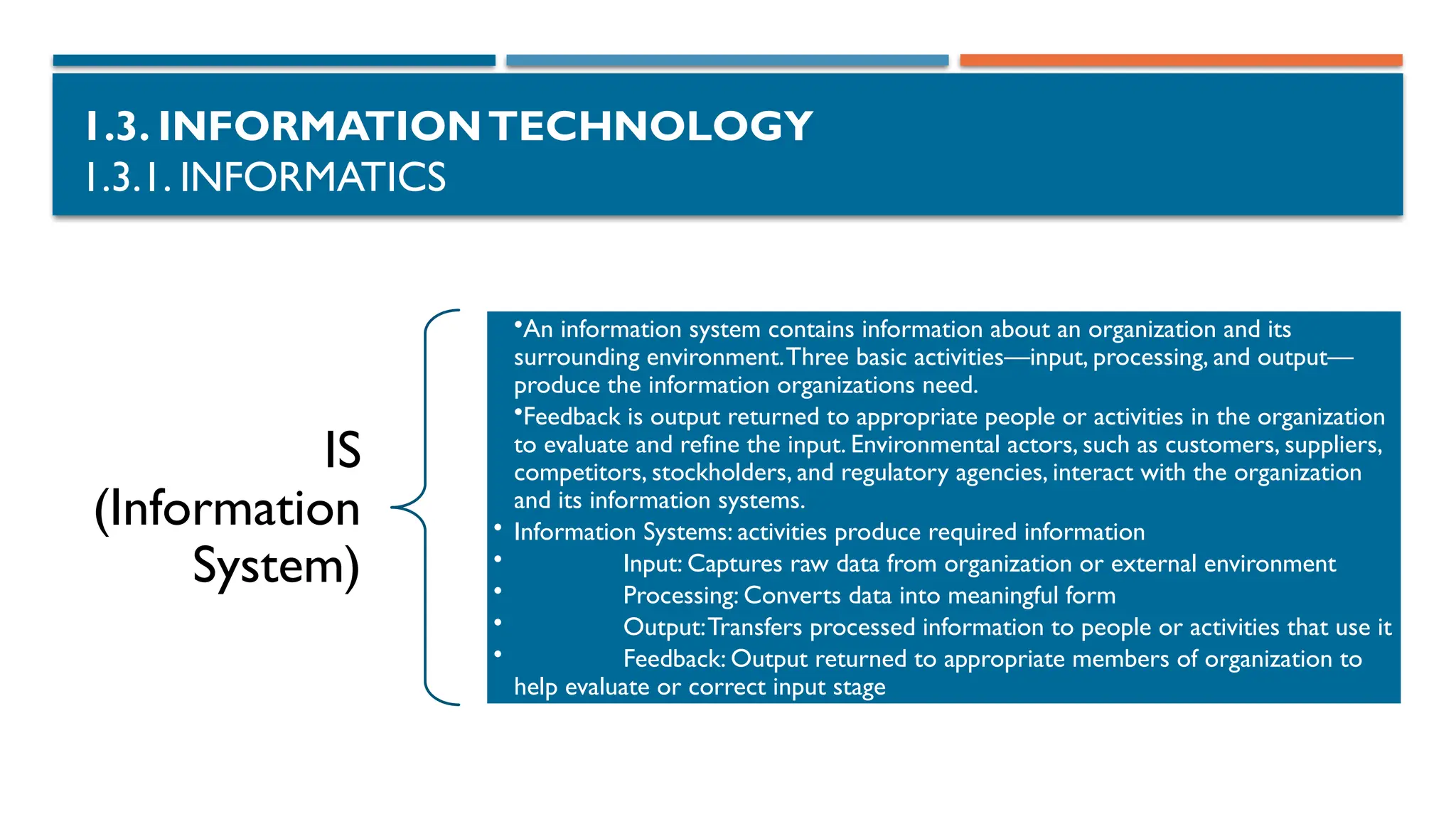
•An information system contains information about an organization and its
surrounding environment.Three basic activities—input, processing, and output—
produce the information organizations need.
•Feedback is output returned to appropriate people or activities in the organization
to evaluate and refine the input. Environmental actors, such as customers, suppliers,
competitors, stockholders, and regulatory agencies, interact with the organization
and its information systems.
• Information Systems: activities produce required information
• Input: Captures raw data from organization or external environment
• Processing: Converts data into meaningful form
• Output:Transfers processed information to people or activities that use it
• Feedback: Output returned to appropriate members of organization to
help evaluate or correct input stage
1.3. INFORMATIONTECHNOLOGY
1.3.1. INFORMATICS
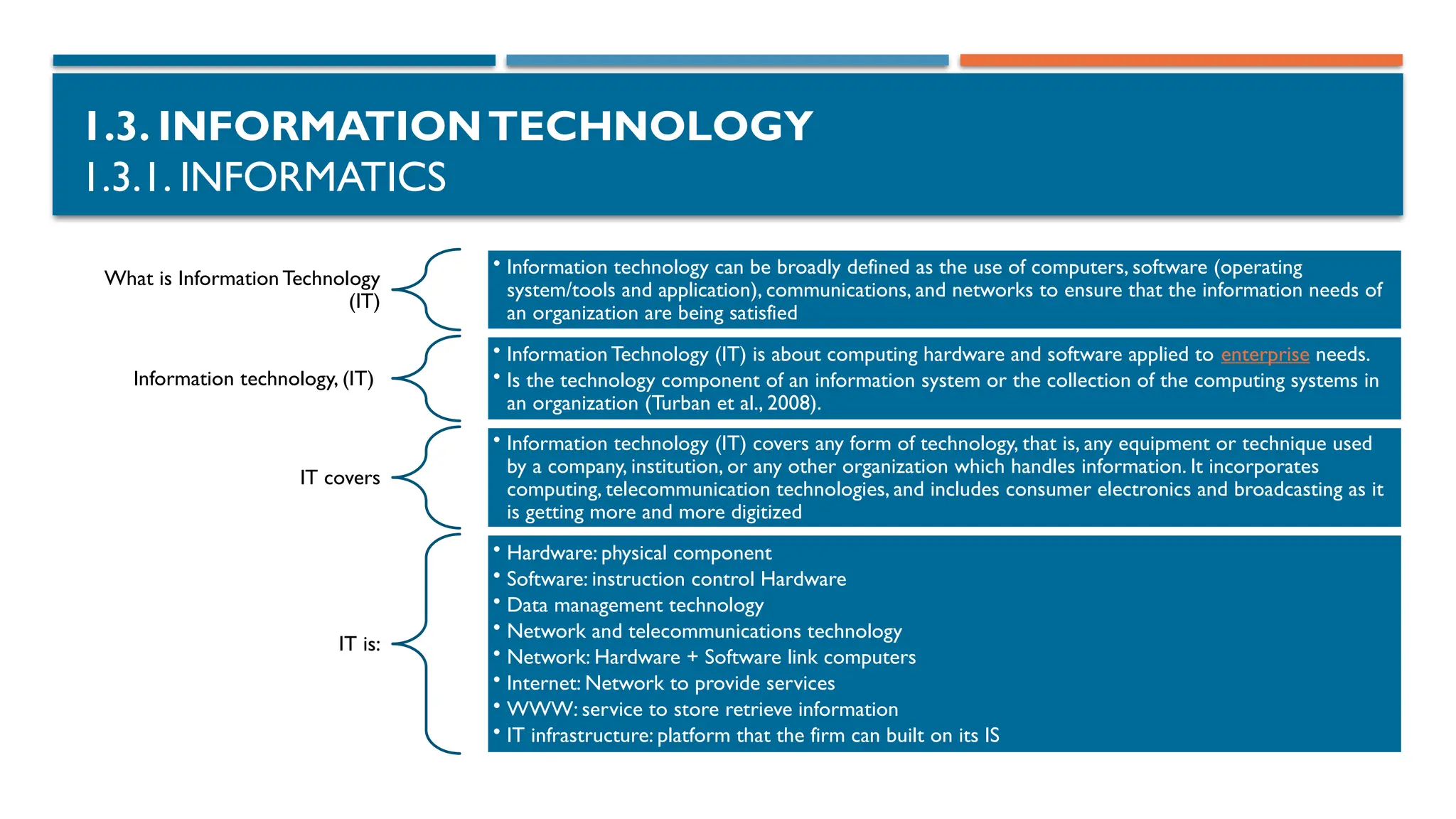
What is Information Technology
(IT)
• Information technology can be broadly defined as the use of computers, software (operating
system/tools and application), communications, and networks to ensure that the information needs of
an organization are being satisfied
Information technology, (IT)
• Information Technology (IT) is about computing hardware and software applied to enterprise needs.
• Is the technology component of an information system or the collection of the computing systems in
an organization (Turban et al., 2008).
IT covers
• Information technology (IT) covers any form of technology, that is, any equipment or technique used
by a company, institution, or any other organization which handles information. It incorporates
computing, telecommunication technologies, and includes consumer electronics and broadcasting as it
is getting more and more digitized
IT is:
• Hardware: physical component
• Software: instruction control Hardware
• Data management technology
• Network and telecommunications technology
• Network: Hardware + Software link computers
• Internet: Network to provide services
• WWW: service to store retrieve information
• IT infrastructure: platform that the firm can built on its IS
1.3. INFORMATIONTECHNOLOGY
1.3.1. INFORMATICS
More about
Information
Technology (IT)
• Information technology will collaborate with
production engineering, production, distribution, sales,
and field services to implement necessary changes to
systems to support the new product.
• Information technology will work with enterprise
architecture, production engineering, and production
to implement new or changed capability unit business
processes.
• Information Technology (IT) is one of the most
rapidly evolving, widely used, and pervasive high
technologies in the world today.
1.3. INFORMATIONTECHNOLOGY
1.3.2. INFORMATION AND COMMUNICATION TECHNOLOGIES (ICT)
Information and
communication
technologies (ICT)
• ICT, or information and communications technology (or
technologies), is the infrastructure and components that enable
modern computing.Among the goals of IC technologies, tools and
systems is to improve the way humans create, process and share data
or information with each other.
• Allowing and accompanying the development of Internet, by giving
access to incomparable transmission capacity required by massive
data transportation
• Since years, the research community in electronics, Radio Frequency
(RF) components/platforms, system integration and engineering, as
well as Information and Communication Technology (ICT) is spurred
by drivers like the Internet of Things (IoT)
• The exceptional growth of ICT (Information and Communication
Technologies) allowed scientists to create new smart
instrumentation.
1.3. INFORMATIONTECHNOLOGY
1.3.2. INFORMATION AND COMMUNICATION TECHNOLOGIES (ICT)
1.3. INFORMATIONTECHNOLOGY
1.3.2. INFORMATION AND COMMUNICATION TECHNOLOGIES (ICT)
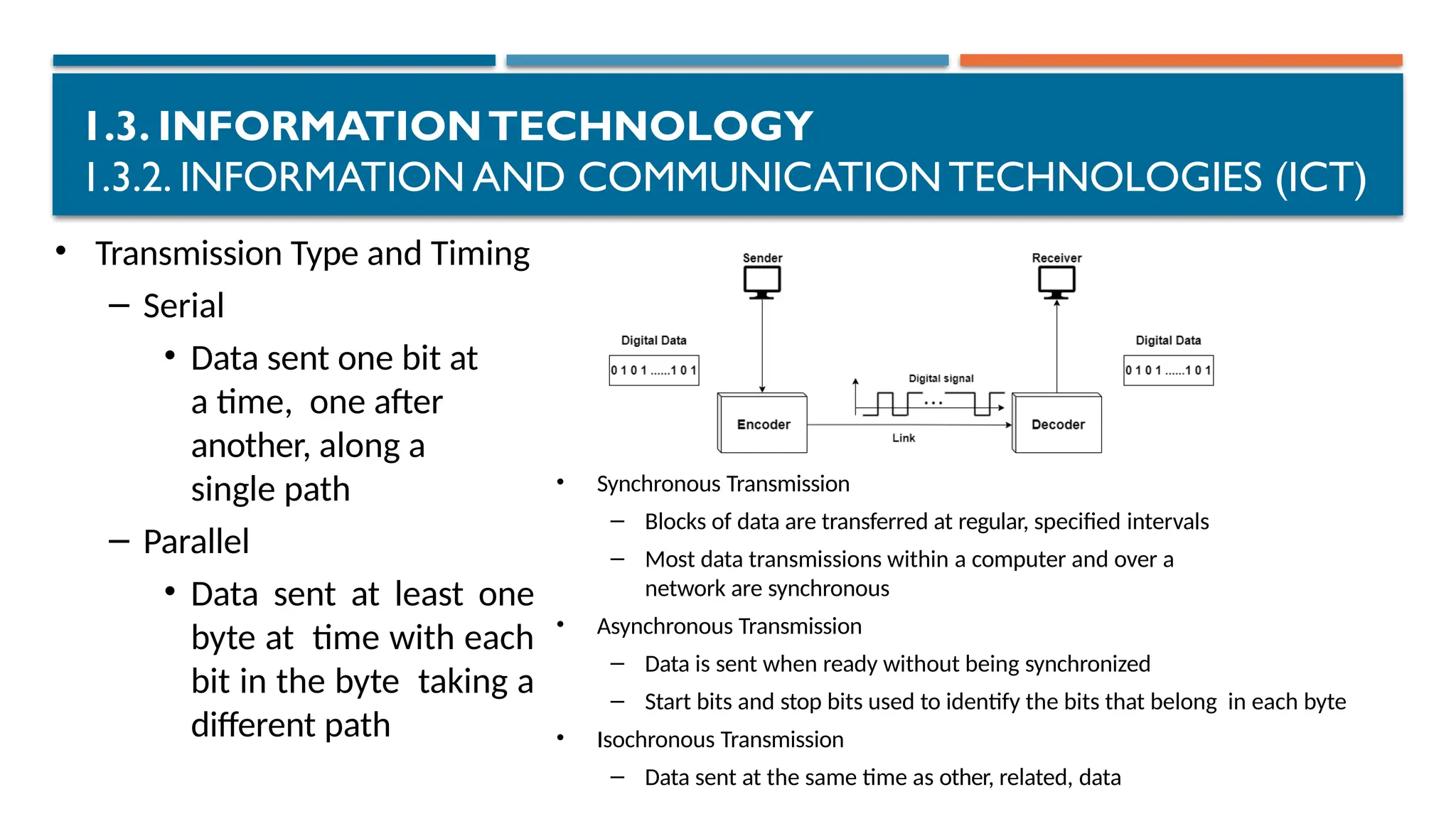
• Transmission Type and Timing
– Serial
• Data sent one bit at
a time, one after
another, along a
single path
– Parallel
• Data sent at least one
byte at time with each
bit in the byte taking a
different path
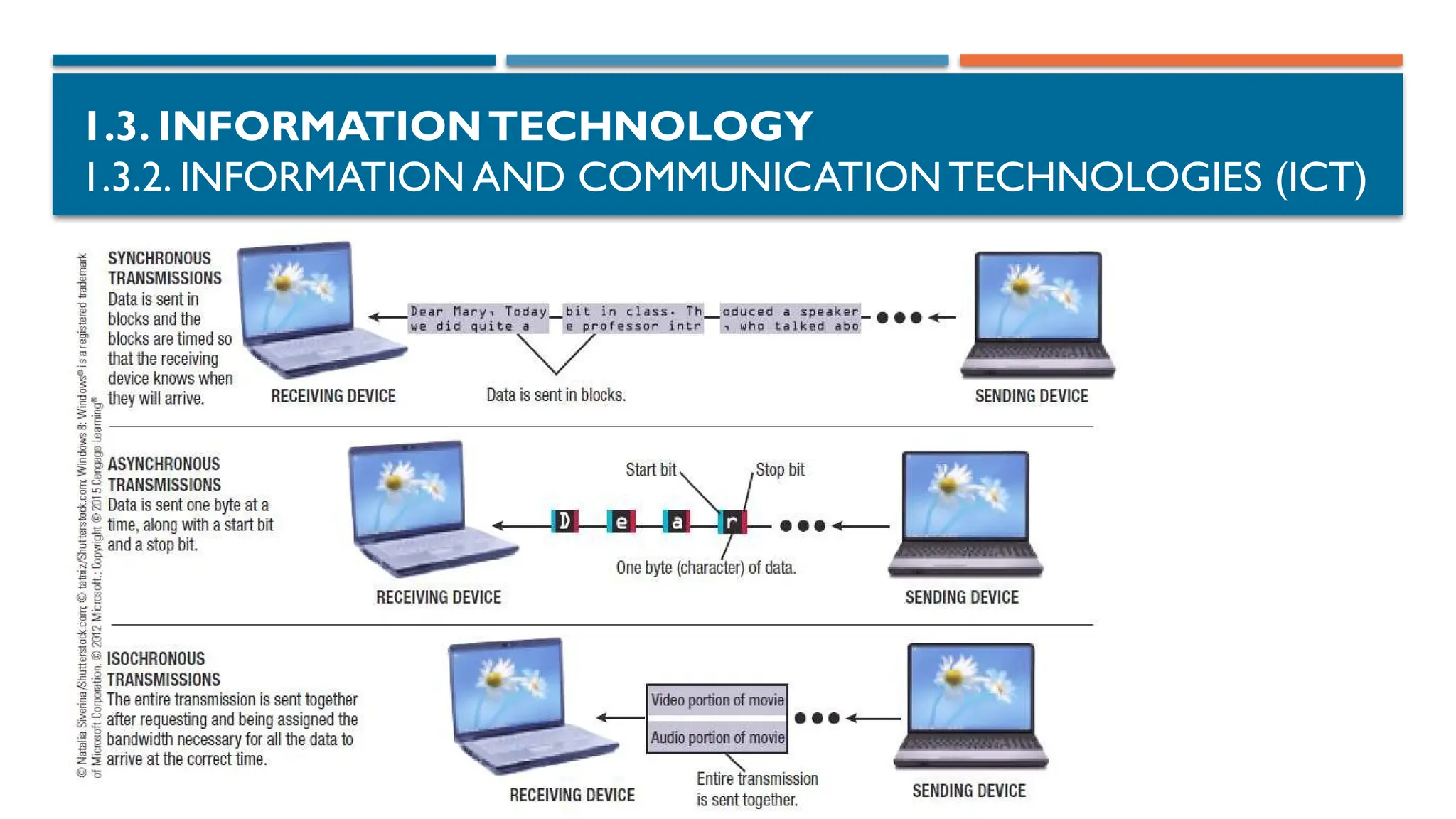
• Synchronous Transmission
– Blocks of data are transferred at regular, specified intervals
– Most data transmissions within a computer and over a
network are synchronous
• Asynchronous Transmission
– Data is sent when ready without being synchronized
– Start bits and stop bits used to identify the bits that belong in each byte
• Isochronous Transmission
– Data sent at the same time as other, related, data
1.3. INFORMATIONTECHNOLOGY
1.3.3. HISTORY OF INFORMATION TECHNOLOGY
 Information technology (IT) is a set of related fields that encompass computer
systems, software, programming languages, and data and information processing,
and storage.[1]
IT forms part of information and communications technology (ICT)
 Ideas of computer science were first mentioned before the 1950s under the
Massachusetts Institute of Technology (MIT) and Harvard University, where they
had discussed and began thinking of computer circuits and numerical calculations.
As time went on, the field of information technology and computer science
became more complex and was able to handle the processing of more data.
 The development of the personal computer (PC) in the 1970s, and the emergence
of information and communications technology (ICT)
1.3. INFORMATIONTECHNOLOGY
1.3.3. HISTORY OF INFORMATION TECHNOLOGY
 By the year of 1984, according to the National Westminster Bank Quarterly
Review, the term information technology had been redefined as "The
development of cable television was made possible by the convergence of
telecommunications and computing technology (…generally known in Britain
as information technology).
 Innovations in technology have already revolutionized the world by the twenty-
first century as people were able to access different online services.
 This has changed the workforce drastically as thirty percent of U.S. workers
were already in careers in this profession. 136.9 million people were personally
connected to the Internet

01 Chapter 1 - Introduction to information technology - Part 3.pptx

  • 1.
    NATIONAL ECONOMICS UNIVERSITY NEUCOLLEGE OF TECHNOLOGY FACULTY OF INFORMATION TECHNOLOGY INTRODUCTIONTO INFORMATIONTECHNOLOGY CHAPTER 1. OVERVIEW OF INFORMATIONTECHNOLOGY
  • 2.
    LECTURER MSC. PHAMTHAO Senior Lecture 📞0966 986 689 📩 thaop@neu.edu.vn https://fit.neu.edu.vn/lecturer/th-s-pham-thao
  • 3.
    CHAPTER 1. OVERVIEWOF INFORMATIONTECHNOLOGY https://fit.neu.edu.vn/syllabus/K66/en/EP17.CNTT1116 • 1.1.1. Information - Data • 1.1.2. Information Processing • 1.1.3. Information Systems 1.1. Information and Information Processing • 1.2.1. Concept of Electronic Computers • 1.2.2. History of Computer Development • 1.2.3. Classification of Computers 1.2. Electronic Computers • 1.3.1. Informatics • 1.3.2. Information and Communication Technology (ICT) • 1.3.3. History and Development Trends of IT 1.3. Information Technology • 1.4.1. Hardware • 1.4.2. Software 1.4. Computer Hardware and Software • 1.5.1. Concept and History of Computer Networks • 1.5.2.Types of Computer Networks • 1.5.3. Basic Components • 1.5.4.The Internet 1.5. Computer Networks • 1.6.1. Concept • 1.6.2. Problem-Solving Process • 1.6.3. Solution Methods • 1.6.4.Algorithms 1.6. Problem Solving with Computers
  • 4.
    1.3. INFORMATIONTECHNOLOGY 1.3.1. INFORMATICS Informatics is the study of computational systems.According to the ACM Europe Council and Informatics Europe, informatics is synonymous with computer science and computing as a profession, where the central concept is the transformation of information. In some contexts, the term "informatics" may also have different meanings, such as in social computing or library science.  Informatics is a scientific discipline focused on information processing and system engineering. It studies the structure, algorithms, behavior, and interactions of natural and artificial systems that store, process, access, and communicate information.  Informatics also involves the use of technology, such as computers and software, to collect, store, analyze, and disseminate information.The field encompasses both the theoretical and practical aspects of designing and developing information technology for the benefit of individuals, organizations, and society.  The term "informatics" is often used interchangeably with other terms such as information systems, information science, information theory, information engineering, information technology, and information processing. https://en.wikipedia.org/wiki/Informatics
  • 5.
    1.3. INFORMATIONTECHNOLOGY 1.3.1. INFORMATICS Computing refers to any goal-oriented activity that requires, benefits from, or results in the creation of computing machinery.  It involves the study and experimentation of algorithmic processes, as well as the development of both hardware and software.  Computing encompasses scientific, engineering, mathematical, technological, and social dimensions.  The major computing disciplines include computer engineering, computer science, cybersecurity, data science, information systems, information technology, and software engineering. https://en.wikipedia.org/wiki/Informatics
  • 6.
    1.3. INFORMATIONTECHNOLOGY 1.3.1. INFORMATICS •CE (Computer Engineering) • CS (Computer Science) • IS (Information System) • IT (Information Technology) • SE (Software Engineering) Informatics CE (Computer Engineering) CS (Computer Science) IS (Information System) IT (Information Technology) SE (Software Engineering)
  • 7.
    1.3. INFORMATIONTECHNOLOGY 1.3.1. INFORMATICS CE(Computer Engineering) • Computer engineering is a branch of computer science and electronic engineering that integrates several fields of computer science and electronic engineering required to develop computer hardware and software. • Computer engineering usually deals with areas including writing software and firmware for embedded microcontrollers, designing VLSI chips, analog sensors, mixed signal circuit boards, and operating systems.
  • 8.
    1.3. INFORMATIONTECHNOLOGY 1.3.1. INFORMATICS CS(Computer Science) • Computer science is the study of algorithms and their complexity. Here, the term “complexity” means the amount of effort (that is, physical resources such as time, space, and energy) required to solve a given mathematical problem, as a function of the size of the problem. • On the mathematical conception of computer science, computer science is a branch of mathematics, its methods are aprioristic and deductive, and its aims are to develop useful algorithms and to realize these in computer programs.
  • 9.
    1.3. INFORMATIONTECHNOLOGY 1.3.1. INFORMATICS SE(Software Engineering) • According to the Association for Computing Machinery (ACM), software engineering is concerned with developing and maintaining software systems that behave reliably and efficiently, are affordable to develop and maintain, and satisfy all the requirements that customers have defined for them [ACM 2006]. IEEE dsystematic, disciplined, quantifiable approach to the development, operation, and maintenance of softwareefines software engineering more succinctly as “a.” • Software engineering (SE) emerged as a discipline in the late 70s and early 80s • Software Engineering is a multidisciplinary discipline involving different social and technological features. • To understand how software engineers maintain complex software systems, it is necessary to investigate not only the tools and processes they use but also the cognitive and social processes surrounding them. • It requires the study of human activities.We need to understand how software engineers individually develop software as well as how teams and organizations coordinate their efforts • Software engineering is an evolving engineering discipline. It deals with systematic approaches to building large software systems by teams of programmers.We have given a brief review of the essential elements of software engineering including product-related issues such as requirements, design, and validation, and process-related issues including process models and their assessment. Mehdi Jazayeri, in Encyclopedia of Physical Science and Technology (Third Editio 2003 Paulo Sérgio Medeiros dos Santos, Guilherme Horta Travassos, in Advances in Computers, 2011
  • 10.
    1.3. INFORMATIONTECHNOLOGY 1.3.1. INFORMATICS IS (Information System) •Aninformation system contains information about an organization and its surrounding environment.Three basic activities—input, processing, and output— produce the information organizations need. •Feedback is output returned to appropriate people or activities in the organization to evaluate and refine the input. Environmental actors, such as customers, suppliers, competitors, stockholders, and regulatory agencies, interact with the organization and its information systems. • Information Systems: activities produce required information • Input: Captures raw data from organization or external environment • Processing: Converts data into meaningful form • Output:Transfers processed information to people or activities that use it • Feedback: Output returned to appropriate members of organization to help evaluate or correct input stage
  • 11.
    1.3. INFORMATIONTECHNOLOGY 1.3.1. INFORMATICS Whatis Information Technology (IT) • Information technology can be broadly defined as the use of computers, software (operating system/tools and application), communications, and networks to ensure that the information needs of an organization are being satisfied Information technology, (IT) • Information Technology (IT) is about computing hardware and software applied to enterprise needs. • Is the technology component of an information system or the collection of the computing systems in an organization (Turban et al., 2008). IT covers • Information technology (IT) covers any form of technology, that is, any equipment or technique used by a company, institution, or any other organization which handles information. It incorporates computing, telecommunication technologies, and includes consumer electronics and broadcasting as it is getting more and more digitized IT is: • Hardware: physical component • Software: instruction control Hardware • Data management technology • Network and telecommunications technology • Network: Hardware + Software link computers • Internet: Network to provide services • WWW: service to store retrieve information • IT infrastructure: platform that the firm can built on its IS
  • 12.
    1.3. INFORMATIONTECHNOLOGY 1.3.1. INFORMATICS Moreabout Information Technology (IT) • Information technology will collaborate with production engineering, production, distribution, sales, and field services to implement necessary changes to systems to support the new product. • Information technology will work with enterprise architecture, production engineering, and production to implement new or changed capability unit business processes. • Information Technology (IT) is one of the most rapidly evolving, widely used, and pervasive high technologies in the world today.
  • 13.
    1.3. INFORMATIONTECHNOLOGY 1.3.2. INFORMATIONAND COMMUNICATION TECHNOLOGIES (ICT) Information and communication technologies (ICT) • ICT, or information and communications technology (or technologies), is the infrastructure and components that enable modern computing.Among the goals of IC technologies, tools and systems is to improve the way humans create, process and share data or information with each other. • Allowing and accompanying the development of Internet, by giving access to incomparable transmission capacity required by massive data transportation • Since years, the research community in electronics, Radio Frequency (RF) components/platforms, system integration and engineering, as well as Information and Communication Technology (ICT) is spurred by drivers like the Internet of Things (IoT) • The exceptional growth of ICT (Information and Communication Technologies) allowed scientists to create new smart instrumentation.
  • 14.
    1.3. INFORMATIONTECHNOLOGY 1.3.2. INFORMATIONAND COMMUNICATION TECHNOLOGIES (ICT)
  • 15.
    1.3. INFORMATIONTECHNOLOGY 1.3.2. INFORMATIONAND COMMUNICATION TECHNOLOGIES (ICT) • Transmission Type and Timing – Serial • Data sent one bit at a time, one after another, along a single path – Parallel • Data sent at least one byte at time with each bit in the byte taking a different path • Synchronous Transmission – Blocks of data are transferred at regular, specified intervals – Most data transmissions within a computer and over a network are synchronous • Asynchronous Transmission – Data is sent when ready without being synchronized – Start bits and stop bits used to identify the bits that belong in each byte • Isochronous Transmission – Data sent at the same time as other, related, data
  • 16.
    1.3. INFORMATIONTECHNOLOGY 1.3.3. HISTORYOF INFORMATION TECHNOLOGY  Information technology (IT) is a set of related fields that encompass computer systems, software, programming languages, and data and information processing, and storage.[1] IT forms part of information and communications technology (ICT)  Ideas of computer science were first mentioned before the 1950s under the Massachusetts Institute of Technology (MIT) and Harvard University, where they had discussed and began thinking of computer circuits and numerical calculations. As time went on, the field of information technology and computer science became more complex and was able to handle the processing of more data.  The development of the personal computer (PC) in the 1970s, and the emergence of information and communications technology (ICT)
  • 17.
    1.3. INFORMATIONTECHNOLOGY 1.3.3. HISTORYOF INFORMATION TECHNOLOGY  By the year of 1984, according to the National Westminster Bank Quarterly Review, the term information technology had been redefined as "The development of cable television was made possible by the convergence of telecommunications and computing technology (…generally known in Britain as information technology).  Innovations in technology have already revolutionized the world by the twenty- first century as people were able to access different online services.  This has changed the workforce drastically as thirty percent of U.S. workers were already in careers in this profession. 136.9 million people were personally connected to the Internet

Editor's Notes

  • #3 1.3.1 Tin học 1.3.2 Công nghệ thông tin và truyền thông 1.3.3 Lịch sử hình thành và xu hướng phát triển CNTT
  • #5 Computing: Tin học hóa
  • #7 Nghiên cứu về thiết kế và chế tạo máy tính và các hệ thống dựa trên máy tính Lĩnh vực này cũng nghiên cứu về phát triển phần mềm, tập trung vào các phần mềm dành cho các thiết bị điện tử và tương tác giữa các thiết bị này với người sử dụng, giữa các thiết bị với nhau Ví dụ: các hệ thống nhúng với sự có mặt của các thiết bị có nhúng phần cứng và phần mềm trong đó đang là một xu hướng nổi bật, ví dụ điện thoại di động, digital audio player, máy quay video, các hệ thống báo động, các máy X quang, và các công cụ phẫu thuật laser.
  • #8 Aprioristic: tiên nghiệm Deductive: Suy diễn Với ba lĩnh vực nghiên cứu chính là thiết kế và triển khai phần mềm, tìm ra cách thức mới sử dụng máy tính, phát triển cách thức giải quyết vấn đề của máy tính một cách hiệu quả Lĩnh vực khoa học máy tính không nghiên cứu phần cứng trên đó chạy các phần mềm, cũng không nghiên cứu các tổ chức sử dụng thông tin do các hệ thống máy tính cung cấp. Khoa học máy tính thiết kế và phát triển tất cả các phần mềm: từ phần mềm cơ sở hệ thống như hệ điều hành, phần mềm truyền thông cho đến các phần mềm ứng dụng như trình duyệt Web, cơ sở dữ liệu hay các công cụ tìm kiếm.
  • #9 Nghiên cứu về phát triển và bảo trì các hệ thống phần mềm hoạt động hiệu quả và có độ tin cậy cao. Tập trung chủ yếu vào phát triển phần mềm một cách có hệ thống, cụ thể là phát triển các mô hình và công cụ tin cậy để tạo ra được các sản phẩm phần mềm có chất lượng cao, đúng thời hạn và với mức chi phí trong giới hạn cho phép
  • #10 Tập trung vào yếu tố thông tin coi công nghệ là công cụ để tạo ra, xử lý, phân phối thông tin Tập trung nghiên cứu tích hợp giải pháp công nghệ thông tin với các tiến trình nghiệp vụ nhằm đáp ứng nhu cầu thông tin của tổ chức, nâng cao hoạt động quản lí đồng thời tạo ưu thế cạnh tranh cho doanh nghiệp.
  • #11 Tin học, Tin học hóa Các lĩnh vực nghiên cứu của tin học
  • #12 Công nghệ thông tin: tập trung nghiên cứu vào khía cạnh công nghệ nhiều hơn là khía cạnh thông tin mà nó xử lý và mang tải CNTT được xác định là ngành công nghiệp sử dụng máy tính, mạng, lập trình phần mềm, các thiết bị và các quy trình để lưu trữ, xử lý, tìm kiếm, truyền và bảo vệ thông tin. Chuyên gia CNTT thực hiện hàng loạt các chức năng từ cài đặt ứng dụng đến thiết kế các mạng máy tính phức tạp và cơ sở dữ liệu thông tin; quản trị dữ liệu, quản trị mạng, kỹ thuật phần cứng, thiết kế phần mềm cũng như quản trị toàn bộ hệ thống CNTT Gần như mọi loại hình tổ chức đều phụ thuộc vào CNTT
  • #13 Truyền thông là quá trình chia sẻ thông tin. Truyền thông là một kiểu tương tác xã hội trong đó ít nhất có hai tác nhân tương tác lẫn nhau, chia sẻ các qui tắc và tín hiệu chung Mô hình truyền thông như sau: Truyền thông máy tính (Communication Technology): là sự kết nối máy tính với nhau trong một phạm vi địa lý nhằm chia sẻ thông tin. Công nghệ thông tin và truyền thông: IT + CT = ICT: Phạm vi địa lý xóa nhòa thông qua mạng viễn thông. Mạng toàn cầu, Mạng Internet: sản phẩm của ngành ICT
  • #14 Truyền thông là quá trình chia sẻ thông tin. Truyền thông là một kiểu tương tác xã hội trong đó ít nhất có hai tác nhân tương tác lẫn nhau, chia sẻ các qui tắc và tín hiệu chung Mô hình truyền thông như sau: Truyền thông máy tính (Communication Technology): là sự kết nối máy tính với nhau trong một phạm vi địa lý nhằm chia sẻ thông tin. Công nghệ thông tin và truyền thông: IT + CT = ICT: Phạm vi địa lý xóa nhòa thông qua mạng viễn thông. Mạng toàn cầu, Mạng Internet: sản phẩm của ngành ICT
  • #15 Truyền thông là quá trình chia sẻ thông tin. Truyền thông là một kiểu tương tác xã hội trong đó ít nhất có hai tác nhân tương tác lẫn nhau, chia sẻ các qui tắc và tín hiệu chung Mô hình truyền thông như sau: Truyền thông máy tính (Communication Technology): là sự kết nối máy tính với nhau trong một phạm vi địa lý nhằm chia sẻ thông tin. Công nghệ thông tin và truyền thông: IT + CT = ICT: Phạm vi địa lý xóa nhòa thông qua mạng viễn thông. Mạng toàn cầu, Mạng Internet: sản phẩm của ngành ICT