The Waters Institute
 Franklin County Underground Railroad/
    African-American Heritage Tour

          A Proposal for Funding

                    to

The Franklin County Hotel Room Tax Program


              April 15, 2003


              Revised Edition
Franklin County Underground Railroad/African-American Heritage Tour
                               A Proposal for Funding
                        Answers to application questions

1. List the name of your organization . . .

   Org. name:       The Waters Institute for African-American History, Inc.
   Project name:    Franklin County Underground Railroad/African-American
                    Heritage Tour
   Municipality:    Chambersburg, Mercersburg
   Contact:         James Wolfson
                    610 Philadelphia Avenue
                    Chambersburg, PA 17201
                    (717) 263-0531, djw@cvn.net

2. How does your event enhance . . .
         This project enhances historical and cultural attractions in Franklin
     County, as it draws the specific attention of visitors local groups of adults and
     students. It does so in several ways: the tour and its sites will be advertised as
     never before, attractions will be explained in an entertaining way by
     experienced guides, and tours will contain special simulations related to the
     experience of fugitive slaves, providers of aid and comfort, and captors. A
     VHS media presentation will take place on the tour busses, based on the oral
     history of African-Americans in Franklin County. Finally, we plan to convene
     discussion groups after the tour.

3. How does your project enhance tourism . . .

   a)    There is increasing in the study of the Underground Railroad and African-
        American History across America. Large museums (Cincinnati, Ohio) and
        small museums (Frederick, Maryland) are opening. On February 28, the
        National Museum of American History held a full day program on the
        Underground Railroad and houses permanent exhibits on many African-
        American issues. The Pennsylvania Historical and Museum Commission has
        created an office to coordinate Underground Railroad studies across the
        Commonwealth. Further, the National Park Service has established an
        Underground Railroad District that encompasses all of our area. These facts
        matter when considered in light of paragraph b), below:

   b) There are no existing Underground Railroad tours in South Central
      Pennsylvania to meet this interest. Franklin County has enough related
      attractions to make such a tour feasible for the very near future. The presence
      of the Waters Institute and its research capabilities insures that appropriate


                                                                                          2
knowledge about the attractions is disseminated, and more important,
   discussed by tour participants.

c) As a heritage tour, this project attracts a targeted audience, which is extremely
   important in difficult economic times.


The project has great benefit to local residents, as well.

a) The pilot testing effort (see Appendix B), in which community efforts will
   become the first tourists and supply feedback on its every aspect, has benefits
   that go beyond any tourist business. They are important to the Waters
   Institute’ community building ideal. We intend to solicit the community for
   ideas on important sites and stories, for their opinions on our progress, and for
   their participation as our first heritage tourists. We will accomplish these
   activities through public hearings, meetings at community centers, and inviting
   all members of the community to experience our tours. We hope to involve
   community members in taking responsibility for helping maintain our sites in
   excellent condition.

b) A further benefit of our intended level of community participation is that
   participants will be come more familiar with the Underground Railroad and its
   important lessons for all of us. Additionally, we will use only Franklin County
   contractors when appropriate. The participation process matters, as well.
   Participation will bring us all closer together and create the trust necessary to
   continue the mission of the Waters Institute. We hope that the result will be
   that community members and outside visitors will feel that the tours are
   sponsored by the communities of Franklin County through its own vehicle, the
   Waters Institute. If we are successful in our efforts in building Franklin County
   heritage tours, we will have “secured investment of the hearts and minds of
   community members in the endeavors of the Waters Institute,” a critical part of
   our own mission.

c) Additionally, the tours will bring new dollars to Franklin County, its
   merchants, and its cultural resources. Early support of this project will not
   simply build a foundation for future tourism, it will have an immediate
   monetary return. According to statistics obtained from the Pennsylvania
   Heritage Tourism Study, prepared by D.K. Shifflet (1999), the heritage tourist
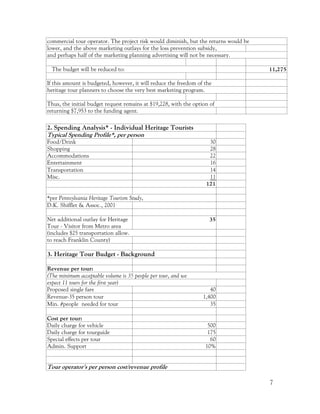
   spends just over $120 per day on heritage tours. This number rises to $131 per
   day when he or she takes the 1-day tour (see budget calculations, Appendix A).
   Consultations with local and national tour operators indicate that it would not
   be unreasonable to attract 500 participants in the first year of service. We will
   use 400 as the basis for our budget calculations.


                                                                                       3
4. Briefly explain the purpose of your organization or project.

            The Waters Institute for African-American History, Inc. was incorporated
       on August 29, 2002, to determine the significance of African-American History
       in the development of Franklin County and the Underground Railroad. It is
       to undertake a community building effort through the performance of
       charitable and educational acts that create a sense of mutual investment and
       trust between the community and the Institute, and to educate visitors in a
       manner that will promote multicultural goodwill and the accompanying social
       progress that can be expected to result.

            The purpose of this project is consistent with the community building
       mission of the Waters Institute. We believe that the Waters Institute belongs to
       its community. We strive to create an investment of the hearts and minds of
       community members, as we work to unite community members through our
       variety of local services, and to our Commonwealth and nation. The heritage
       tour project provides another opportunity for community involvement in its
       planning, testing, and maintenance. When the community takes advantage of
       this opportunity, we know it is a source of self-confidence, pride, among
       community members, consistent with our mission:
           We seek to preserve and make public physical and intellectual properties that are
       historically significant to the African-American community and the Underground
       Railroad in Franklin County.

           We seek to create an interactive experience for visitors to these properties, and to
       Franklin County, in order to create the feeling of what it was like to be alive during
       the periods under study.

           We seek to secure investment of the hearts and minds of community members in
       the endeavors of the Waters Institute through programming that creates an
       understanding of the linkage between our community history and the personal
       backgrounds of its members.

           We seek to illustrate the shared cultural heritage created by participants in the
       Underground Railroad so as to present our visitors with the opportunity to understand
       the lessons inherent in the events that constitute that heritage, including those
       concerning freedom, hope, dignity, and social justice.


5. How much grant funding do you need? . . .

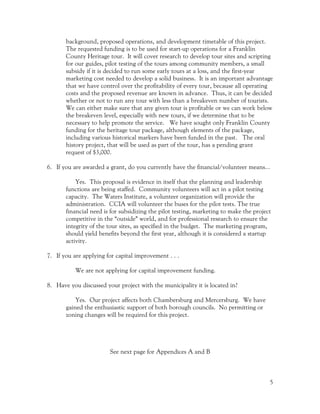
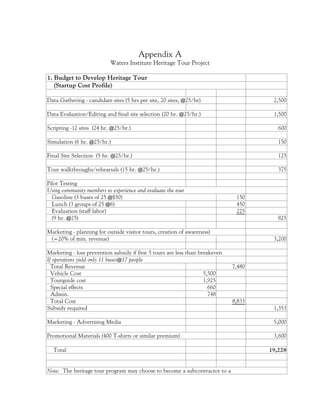
           We seek a total of $19,228. A complete budget is provided in Appendix A
       to this proposal, along with a narrative, Appendix B, that explains the

                                                                                                  4
background, proposed operations, and development timetable of this project.
       The requested funding is to be used for start-up operations for a Franklin
       County Heritage tour. It will cover research to develop tour sites and scripting
       for our guides, pilot testing of the tours among community members, a small
       subsidy if it is decided to run some early tours at a loss, and the first-year
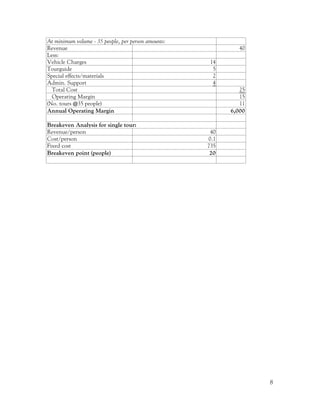
       marketing cost needed to develop a solid business. It is an important advantage
       that we have control over the profitability of every tour, because all operating
       costs and the proposed revenue are known in advance. Thus, it can be decided
       whether or not to run any tour with less than a breakeven number of tourists.
       We can either make sure that any given tour is profitable or we can work below
       the breakeven level, especially with new tours, if we determine that to be
       necessary to help promote the service. We have sought only Franklin County
       funding for the heritage tour package, although elements of the package,
       including various historical markers have been funded in the past. The oral
       history project, that will be used as part of the tour, has a pending grant
       request of $3,000.

6. If you are awarded a grant, do you currently have the financial/volunteer means…

           Yes. This proposal is evidence in itself that the planning and leadership
       functions are being staffed. Community volunteers will act in a pilot testing
       capacity. The Waters Institute, a volunteer organization will provide the
       administration. CCIA will volunteer the buses for the pilot tests. The true
       financial need is for subsidizing the pilot testing, marketing to make the project
       competitive in the “outside” world, and for professional research to ensure the
       integrity of the tour sites, as specified in the budget. The marketing program,
       should yield benefits beyond the first year, although it is considered a startup
       activity.

7. If you are applying for capital improvement . . .

           We are not applying for capital improvement funding.

8. Have you discussed your project with the municipality it is located in?

           Yes. Our project affects both Chambersburg and Mercersburg. We have
       gained the enthusiastic support of both borough councils. No permitting or
       zoning changes will be required for this project.


                        See next page for Appendices A and B


                                                                                        5
Appendix A
                           Waters Institute Heritage Tour Project

1. Budget to Develop Heritage Tour
   (Startup Cost Profile)

Data Gathering - candidate sites (5 hrs per site, 20 sites, @25/hr)                     2,500

Data Evaluation/Editing and final site selection (20 hr. @25/hr.)                       1,500

Scripting -12 sites (24 hr. @25/hr.)                                                      600

Simulation (6 hr. @25/hr.)                                                                150

Final Site Selection (5 hr. @25/hr.)                                                      125

Tour walkthroughs/rehearsals (15 hr. @25/hr.)                                             375

Pilot Testing
Using community members to experience and evaluate the tour
  Gasoline (3 buses of 25 @$50)                                                 150
  Lunch (3 groups of 25 @6)                                                     450
  Evaluation (staff labor)                                                      225
  (9 hr. @25)                                                                             825

Marketing - planning for outside visitor tours, creation of awareness)
 (=20% of min. revenue)                                                                 3,200

Marketing - loss prevention subsidy if first 5 tours are less than breakeven
If operations yield only 11 buses@17 people
  Total Revenue                                                                7,480
  Vehicle Cost                                                       5,500
  Tourguide cost                                                     1,925
  Special effects                                                      660
  Admin.                                                               748
  Total Cost                                                                   8,833
Subsidy required                                                                        1,353

Marketing - Advertising Media                                                           5,000

Promotional Materials (400 T-shirts or similar premium)                                 3,600

  Total                                                                                19,228


Note: The heritage tour program may choose to become a subcontractor to a
commercial tour operator. The project risk would diminish, but the returns would be
lower, and the above marketing outlays for the loss prevention subsidy,
and perhaps half of the marketing planning advertising will not be necessary.

  The budget will be reduced to:                                                      11,275

If this amount is budgeted, however, it will reduce the freedom of the
heritage tour planners to choose the very best marketing program.

Thus, the initial budget request remains at $19,228, with the option of
returning $7,953 to the funding agent.

2. Spending Analysis* - Individual Heritage Tourists
Typical Spending Profile*, per person
Food/Drink                                                          30
Shopping                                                            28
Accommodations                                                      22
Entertainment                                                       16
Transportation                                                      14
Misc.                                                               11
                                                                   121

*per Pennsylvania Heritage Tourism Study,
D.K. Shifflet & Assoc., 2001

Net additional outlay for Heritage                                   35
Tour - Visitor from Metro area
(includes $25 transportation allow.
to reach Franklin County)

3. Heritage Tour Budget - Background

Revenue per tour:
(The minimum acceptable volume is 35 people per tour, and we
expect 11 tours for the first year)
Proposed single fare                                                 40
Revenue-35 person tour                                            1,400
Min. #people needed for tour                                         35

Cost per tour:
Daily charge for vehicle                                            500
Daily charge for tourguide                                          175
Special effects per tour                                             60
Admin. Support                                                     10%


Tour operator's per person cost/revenue profile

                                                                                      7
At minimum volume - 35 people, per person amounts:
Revenue                                                       40
Less:
Vehicle Charges                                       14
Tourguide                                              5
Special effects/materials                              2
Admin. Support                                         4
  Total Cost                                                  25
  Operating Margin                                            15
(No. tours @35 people)                                        11
Annual Operating Margin                                    6,000

Breakeven Analysis for single tour:
Revenue/person                                        40
Cost/person                                          0.1
Fixed cost                                           735
Breakeven point (people)                              20


                                                                   8
Appendix B


              Grant Application to
 The Franklin County Hotel Room Tax Program

Application for Funding of Heritage Tours

For the enhancement and exhibition of the cultural
    and historical resources of Franklin County

           Background Narrative


                    Prepared by:

The Waters Institute of African American History, Inc.

                In Collaboration With

Chambersburg Community Improvement Association

            Chambersburg, Pennsylvania


                  February 28, 2003


                                                         9
Introduction
    The Waters Institute for African-American seeks to provide heritage tourists with
on and two-day tours of Franklin County’s historical attractions that highlight
Underground Railroad activity and local African-American History. Preliminary
studies commissioned by several Pennsylvania government agencies indicate that:

   •   The demand for this specific segment of tourism is rising.

   •   It is not difficult to identify target markets.

   •   There is increasing in the study of the Underground Railroad and African-
       American History across America. Large museums (Cincinnati, Ohio) and
       small museums (Frederick, Maryland) are opening. On February 28, the
       National Museum of American History held a full day program on the
       Underground Railroad and houses permanent exhibits on many African-
       American issues. Further, the National Park Service has established an
       Underground Railroad District that encompasses all of our area.

   •   The combination of Franklin County’s attractions, enhanced by the research
       undertaken by the Waters Institute makes a memorable tour that will have
       considerable impact on subsequent tourist activity.

   •   The tours will bring new dollars to Franklin County, its merchants, and its
       cultural resources. Early support of this project will not simply build a
       foundation for future tourism, it will have an immediate monetary return.
       According to statistics obtained from the Pennsylvania Heritage Tourism Study,
       prepared by D.K. Shifflet (1999), the heritage tourist spends just over $120 per
       day on heritage tours. Consultations with local and national tour operators
       indicate that it would not be unreasonable to attract 500 participants in the
       first year of service. (grouped in 11 tours @35 people)

    The term “heritage tourism,” according to agencies of the Pennsylvania
government, describes leisure trips undertaken by individuals with the primary
purpose of visiting historic, cultural, natural, recreational and scenic attractions to
learn more about the past in an enjoyable way. The Waters Institute Franklin County
tour package has been designed to attract heritage tourists of this profile, with the
additional goal of teaching the lessons of the specific history experienced. In this
proposal, we seek to illustrate the need for an orderly and disciplined development of
tours that benefit the County’s economy directly, and contain a built-in marketing
benefit that will help create further economic growth and education that will reinforce
the value o the education provided to today’s visitors.


                                                                                      10
Conceptual Development
    A heritage tourism program, especially when it involves the Underground Railroad
and African-American History in Franklin County, must have the support of as much
of the communities involved as possible. The first tourists must be community
members themselves. Not only are their insights invaluable, but they must develop a
sincere desire to be hospitable when visitors, many from cultural backgrounds other
than their own, come to visit their communities. This is an obvious statement
regarding shops and restaurants, but it is also clear that tourists can feel the hospitable
mood or lack of same among the community at large when it exists. Additionally, we
believe that the Waters Institute belongs to its community. We strive to create an
investment of the hearts and minds of community members, as we work to unite
community members through our local services, and to our Commonwealth and
nation.

    A tourism program is developed through a variety of steps, followed by pilot
testing in the community and with professional marketers whose demographic targets
are in nearby metropolitan areas or outside regions. Of course, early tours will be
under close scrutiny for enhancement and improvement needs. The need for
monitoring will be everlasting.

    The pilot testing effort in the community has benefits that go beyond any tourist
business. They are important to the Waters Institute’ community building ideal. We
intend to solicit the community for ideas on important sites and stories, for their
opinions on our progress, and for their participation as our first heritage tourists. We
will accomplish these activities through public hearings, meetings at community
centers, and inviting all members of the community to experience our tours. A further
benefit of our intended level of community participation is that participants will be
come more familiar with the Underground Railroad and its important lessons for all of
us. Additionally, we will use only Franklin County contractors when available. The
participation process matters, as well. Participation will bring us all closer together and
create the trust necessary to continue the mission of the Waters Institute. We hope
that the result will be that community members and outside visitors will feel that the
tours are sponsored by the communities of Franklin County through its own vehicle,
the Waters Institute. If we are successful in our efforts in building Franklin County
heritage tours, we will have “secured investment of the hearts and minds of community
members in the endeavors of the Waters Institute,” a critical part of our own mission.

Practical Development

   The Tour Package – The Franklin County heritage tour proposed herein is a one-
day, Saturday, tour of approximately seven hours that includes the opportunities to
shop and have lunch at one stop that affords a choice of restaurants or picnic sites. A
professional tour guide will ride with each group and there will be excerpts from our
Chambersburg oral history tape shown en route.


                                                                                        11
The proposed route will be almost a geographical loop that begins at the junction
of Interstate 81 and U.S. 30, where we will arrange for parking for out-of-town visitors.
It will begin with a visit to several sites in Caledonia and a simulation of the fugitive
slave experience in the State Park. Tour participants will then move West along U.S.
30 to sites in Chambersburg, Peters Township, Cove Gap, and Mercersburg. There
will be a lunch and shopping opportunity in downtown Mercersburg. The group will
proceed to Greencastle for a history discussion and shopping. They will return to
Chambersburg for a shopping and snacking experience, and then return to the
parking area. They will be encourage to patronize Chambersburg restaurants for
dinner and we will offer an overnight accommodations reservation service, should
participants desire to stay. We will also provide the opportunity for group discussion in
the evening and group meals, if desired. Participants will be invited to local houses of
worship on Sunday morning, along with a free brunch and an opportunity to discuss
the tour with local community members. The total package price for the tour is $40.00
per person. Pilot testing with local citizen groups will allow us to determine the proper
allocations of time to each site and the number of sites.

The following steps are necessary to the development of a tour that will meet the
standards of the Waters institute and gain community participation and approval.
The basic elements of the each step do not vary. All research and marketing services
are to be provided by professionals and invoiced appropriately. The steps are:

   •   Data Gathering – determination of a list of potential sights and the factual
       matter that describes them

   •   Evaluation and Editing of factual matter into presentation guidelines.
       Community members will be invited to participate.

   •   Scripting – development of “tight” guidelines for presentation by our guides.
       Guides will not be limited to simply presenting facts.

   •   Simulation – Community members will be invited to participate in evaluating
       simulated tour elements, including sites, experiential exercises, and eating
       arraingements.

   •   Selection – Final selection of sites and tour length options must be made when
       all evaluations have been completed. But, this work remains on paper. The
       next step is critical.

   •   Pilot Testing – Community members will be invited to take the tours. Their
       feedback, developed in local forums, will serve to shape future tours. We expect
       several iterations of pilot testing, in order to meet both quality and community
       “investment” objectives.


                                                                                       12
•   Marketing – We will market outside the community only when we are satisfied
    with the product. At that time, we will seek the services of specialists in the
    field of tour planning and operation. Business arrangements at this juncture
    may include cooperative efforts between Waters and the chosen parties,
    contracting by either party (one supplies a service to the other, such as the
    provision of guides or vehicles), or strictly the employment of consulting and
    marketing and advertising services by the Waters Institute.

       Marketing materials contemplated for use regarding heritage tours
      include a Web site, already under development, set of brochures
      for specific purposes, promotional items that will be sold, including
      t-shirts, DVD disks from our oral history project, and tapes and
      disks of performances by the group Seven Local Women.
      Additionally, we expect to entertain our guests on the tour busses
      with video selections from our oral history project.

•   Choosing a Staff – The project staff will include an administrator and one or
    more guides. The Institute will not own vehicles or any capital items that may
    be considered as assets serving only the tourist activity.

      The administrator will be responsible for supervision of the guides,
      community involvement, budgeting, accounting, management of
      the marketing function, stocking marketing materials, scheduling
      of tours, evaluation of tours, and quality control.

          Guides will be responsible for mastery of subject matter and
      entertaining presentation. They will be paid a single fee for each
      tour they serve. They are expected to participate in the
      solicitation of tourist feedback and to aid in the analysis of that
      feedback.

• Execution of Heritage Tours – We expect to offer one and two-day tour
  options. We plan to ask outside visitors to drive to a central location and then
  board our bus for the tours, but this plan is subject to scrutiny as part of our
  marketing operation. We must also evaluate options for lunch, shopping,
  overnight accommodation, tour length and number of stops, and experiential
  exercises, such as dining on “period” foods, fugitive escape participative
  simulations, everyday living simulations, and the celebration of specific lives of
  those buried in the cemeteries on the tour.

• Monitoring, Feedback, and Guidance –Feedback will be collected by guides
  and from the community and the vendors who interface with our tourists. The
  analytical work will be carried out by the administrator, the guides, and the
  community (perhaps represented by a committee or board). We have outlined


                                                                                   13
the sources of feedback above. Careful consideration of the implications of that
      feedback will be undertaken by this group.


Budget
   The budget represents the first fiscal year of operations of heritage tours. The
   budget appears on page 6 of this document.


Timetable
We expect to operate the pilot test tours during June, 2003, so that we can operate the
visitor (outside Franklin County) tours from July through November of 2003. We will
begin again in March or April of 2004. The steps we expect to undertake appear
above and the budget for those steps appears in Appendix A. The major variable is
the effectiveness of the marketing program. Considerable budget dollars have been
allocated to this effort, hopefully to cover the uncertainties created by today’s rapidly-
changing environment.


                                                                                        14

01 app for heritage tours proposal

  • 1.
    The Waters Institute Franklin County Underground Railroad/ African-American Heritage Tour A Proposal for Funding to The Franklin County Hotel Room Tax Program April 15, 2003 Revised Edition
  • 2.
    Franklin County UndergroundRailroad/African-American Heritage Tour A Proposal for Funding Answers to application questions 1. List the name of your organization . . . Org. name: The Waters Institute for African-American History, Inc. Project name: Franklin County Underground Railroad/African-American Heritage Tour Municipality: Chambersburg, Mercersburg Contact: James Wolfson 610 Philadelphia Avenue Chambersburg, PA 17201 (717) 263-0531, djw@cvn.net 2. How does your event enhance . . . This project enhances historical and cultural attractions in Franklin County, as it draws the specific attention of visitors local groups of adults and students. It does so in several ways: the tour and its sites will be advertised as never before, attractions will be explained in an entertaining way by experienced guides, and tours will contain special simulations related to the experience of fugitive slaves, providers of aid and comfort, and captors. A VHS media presentation will take place on the tour busses, based on the oral history of African-Americans in Franklin County. Finally, we plan to convene discussion groups after the tour. 3. How does your project enhance tourism . . . a) There is increasing in the study of the Underground Railroad and African- American History across America. Large museums (Cincinnati, Ohio) and small museums (Frederick, Maryland) are opening. On February 28, the National Museum of American History held a full day program on the Underground Railroad and houses permanent exhibits on many African- American issues. The Pennsylvania Historical and Museum Commission has created an office to coordinate Underground Railroad studies across the Commonwealth. Further, the National Park Service has established an Underground Railroad District that encompasses all of our area. These facts matter when considered in light of paragraph b), below: b) There are no existing Underground Railroad tours in South Central Pennsylvania to meet this interest. Franklin County has enough related attractions to make such a tour feasible for the very near future. The presence of the Waters Institute and its research capabilities insures that appropriate 2
  • 3.
    knowledge about theattractions is disseminated, and more important, discussed by tour participants. c) As a heritage tour, this project attracts a targeted audience, which is extremely important in difficult economic times. The project has great benefit to local residents, as well. a) The pilot testing effort (see Appendix B), in which community efforts will become the first tourists and supply feedback on its every aspect, has benefits that go beyond any tourist business. They are important to the Waters Institute’ community building ideal. We intend to solicit the community for ideas on important sites and stories, for their opinions on our progress, and for their participation as our first heritage tourists. We will accomplish these activities through public hearings, meetings at community centers, and inviting all members of the community to experience our tours. We hope to involve community members in taking responsibility for helping maintain our sites in excellent condition. b) A further benefit of our intended level of community participation is that participants will be come more familiar with the Underground Railroad and its important lessons for all of us. Additionally, we will use only Franklin County contractors when appropriate. The participation process matters, as well. Participation will bring us all closer together and create the trust necessary to continue the mission of the Waters Institute. We hope that the result will be that community members and outside visitors will feel that the tours are sponsored by the communities of Franklin County through its own vehicle, the Waters Institute. If we are successful in our efforts in building Franklin County heritage tours, we will have “secured investment of the hearts and minds of community members in the endeavors of the Waters Institute,” a critical part of our own mission. c) Additionally, the tours will bring new dollars to Franklin County, its merchants, and its cultural resources. Early support of this project will not simply build a foundation for future tourism, it will have an immediate monetary return. According to statistics obtained from the Pennsylvania Heritage Tourism Study, prepared by D.K. Shifflet (1999), the heritage tourist spends just over $120 per day on heritage tours. This number rises to $131 per day when he or she takes the 1-day tour (see budget calculations, Appendix A). Consultations with local and national tour operators indicate that it would not be unreasonable to attract 500 participants in the first year of service. We will use 400 as the basis for our budget calculations. 3
  • 4.
    4. Briefly explainthe purpose of your organization or project. The Waters Institute for African-American History, Inc. was incorporated on August 29, 2002, to determine the significance of African-American History in the development of Franklin County and the Underground Railroad. It is to undertake a community building effort through the performance of charitable and educational acts that create a sense of mutual investment and trust between the community and the Institute, and to educate visitors in a manner that will promote multicultural goodwill and the accompanying social progress that can be expected to result. The purpose of this project is consistent with the community building mission of the Waters Institute. We believe that the Waters Institute belongs to its community. We strive to create an investment of the hearts and minds of community members, as we work to unite community members through our variety of local services, and to our Commonwealth and nation. The heritage tour project provides another opportunity for community involvement in its planning, testing, and maintenance. When the community takes advantage of this opportunity, we know it is a source of self-confidence, pride, among community members, consistent with our mission: We seek to preserve and make public physical and intellectual properties that are historically significant to the African-American community and the Underground Railroad in Franklin County. We seek to create an interactive experience for visitors to these properties, and to Franklin County, in order to create the feeling of what it was like to be alive during the periods under study. We seek to secure investment of the hearts and minds of community members in the endeavors of the Waters Institute through programming that creates an understanding of the linkage between our community history and the personal backgrounds of its members. We seek to illustrate the shared cultural heritage created by participants in the Underground Railroad so as to present our visitors with the opportunity to understand the lessons inherent in the events that constitute that heritage, including those concerning freedom, hope, dignity, and social justice. 5. How much grant funding do you need? . . . We seek a total of $19,228. A complete budget is provided in Appendix A to this proposal, along with a narrative, Appendix B, that explains the 4
  • 5.
    background, proposed operations,and development timetable of this project. The requested funding is to be used for start-up operations for a Franklin County Heritage tour. It will cover research to develop tour sites and scripting for our guides, pilot testing of the tours among community members, a small subsidy if it is decided to run some early tours at a loss, and the first-year marketing cost needed to develop a solid business. It is an important advantage that we have control over the profitability of every tour, because all operating costs and the proposed revenue are known in advance. Thus, it can be decided whether or not to run any tour with less than a breakeven number of tourists. We can either make sure that any given tour is profitable or we can work below the breakeven level, especially with new tours, if we determine that to be necessary to help promote the service. We have sought only Franklin County funding for the heritage tour package, although elements of the package, including various historical markers have been funded in the past. The oral history project, that will be used as part of the tour, has a pending grant request of $3,000. 6. If you are awarded a grant, do you currently have the financial/volunteer means… Yes. This proposal is evidence in itself that the planning and leadership functions are being staffed. Community volunteers will act in a pilot testing capacity. The Waters Institute, a volunteer organization will provide the administration. CCIA will volunteer the buses for the pilot tests. The true financial need is for subsidizing the pilot testing, marketing to make the project competitive in the “outside” world, and for professional research to ensure the integrity of the tour sites, as specified in the budget. The marketing program, should yield benefits beyond the first year, although it is considered a startup activity. 7. If you are applying for capital improvement . . . We are not applying for capital improvement funding. 8. Have you discussed your project with the municipality it is located in? Yes. Our project affects both Chambersburg and Mercersburg. We have gained the enthusiastic support of both borough councils. No permitting or zoning changes will be required for this project. See next page for Appendices A and B 5
  • 6.
    Appendix A Waters Institute Heritage Tour Project 1. Budget to Develop Heritage Tour (Startup Cost Profile) Data Gathering - candidate sites (5 hrs per site, 20 sites, @25/hr) 2,500 Data Evaluation/Editing and final site selection (20 hr. @25/hr.) 1,500 Scripting -12 sites (24 hr. @25/hr.) 600 Simulation (6 hr. @25/hr.) 150 Final Site Selection (5 hr. @25/hr.) 125 Tour walkthroughs/rehearsals (15 hr. @25/hr.) 375 Pilot Testing Using community members to experience and evaluate the tour Gasoline (3 buses of 25 @$50) 150 Lunch (3 groups of 25 @6) 450 Evaluation (staff labor) 225 (9 hr. @25) 825 Marketing - planning for outside visitor tours, creation of awareness) (=20% of min. revenue) 3,200 Marketing - loss prevention subsidy if first 5 tours are less than breakeven If operations yield only 11 buses@17 people Total Revenue 7,480 Vehicle Cost 5,500 Tourguide cost 1,925 Special effects 660 Admin. 748 Total Cost 8,833 Subsidy required 1,353 Marketing - Advertising Media 5,000 Promotional Materials (400 T-shirts or similar premium) 3,600 Total 19,228 Note: The heritage tour program may choose to become a subcontractor to a
  • 7.
    commercial tour operator.The project risk would diminish, but the returns would be lower, and the above marketing outlays for the loss prevention subsidy, and perhaps half of the marketing planning advertising will not be necessary. The budget will be reduced to: 11,275 If this amount is budgeted, however, it will reduce the freedom of the heritage tour planners to choose the very best marketing program. Thus, the initial budget request remains at $19,228, with the option of returning $7,953 to the funding agent. 2. Spending Analysis* - Individual Heritage Tourists Typical Spending Profile*, per person Food/Drink 30 Shopping 28 Accommodations 22 Entertainment 16 Transportation 14 Misc. 11 121 *per Pennsylvania Heritage Tourism Study, D.K. Shifflet & Assoc., 2001 Net additional outlay for Heritage 35 Tour - Visitor from Metro area (includes $25 transportation allow. to reach Franklin County) 3. Heritage Tour Budget - Background Revenue per tour: (The minimum acceptable volume is 35 people per tour, and we expect 11 tours for the first year) Proposed single fare 40 Revenue-35 person tour 1,400 Min. #people needed for tour 35 Cost per tour: Daily charge for vehicle 500 Daily charge for tourguide 175 Special effects per tour 60 Admin. Support 10% Tour operator's per person cost/revenue profile 7
  • 8.
    At minimum volume- 35 people, per person amounts: Revenue 40 Less: Vehicle Charges 14 Tourguide 5 Special effects/materials 2 Admin. Support 4 Total Cost 25 Operating Margin 15 (No. tours @35 people) 11 Annual Operating Margin 6,000 Breakeven Analysis for single tour: Revenue/person 40 Cost/person 0.1 Fixed cost 735 Breakeven point (people) 20 8
  • 9.
    Appendix B Grant Application to The Franklin County Hotel Room Tax Program Application for Funding of Heritage Tours For the enhancement and exhibition of the cultural and historical resources of Franklin County Background Narrative Prepared by: The Waters Institute of African American History, Inc. In Collaboration With Chambersburg Community Improvement Association Chambersburg, Pennsylvania February 28, 2003 9
  • 10.
    Introduction The Waters Institute for African-American seeks to provide heritage tourists with on and two-day tours of Franklin County’s historical attractions that highlight Underground Railroad activity and local African-American History. Preliminary studies commissioned by several Pennsylvania government agencies indicate that: • The demand for this specific segment of tourism is rising. • It is not difficult to identify target markets. • There is increasing in the study of the Underground Railroad and African- American History across America. Large museums (Cincinnati, Ohio) and small museums (Frederick, Maryland) are opening. On February 28, the National Museum of American History held a full day program on the Underground Railroad and houses permanent exhibits on many African- American issues. Further, the National Park Service has established an Underground Railroad District that encompasses all of our area. • The combination of Franklin County’s attractions, enhanced by the research undertaken by the Waters Institute makes a memorable tour that will have considerable impact on subsequent tourist activity. • The tours will bring new dollars to Franklin County, its merchants, and its cultural resources. Early support of this project will not simply build a foundation for future tourism, it will have an immediate monetary return. According to statistics obtained from the Pennsylvania Heritage Tourism Study, prepared by D.K. Shifflet (1999), the heritage tourist spends just over $120 per day on heritage tours. Consultations with local and national tour operators indicate that it would not be unreasonable to attract 500 participants in the first year of service. (grouped in 11 tours @35 people) The term “heritage tourism,” according to agencies of the Pennsylvania government, describes leisure trips undertaken by individuals with the primary purpose of visiting historic, cultural, natural, recreational and scenic attractions to learn more about the past in an enjoyable way. The Waters Institute Franklin County tour package has been designed to attract heritage tourists of this profile, with the additional goal of teaching the lessons of the specific history experienced. In this proposal, we seek to illustrate the need for an orderly and disciplined development of tours that benefit the County’s economy directly, and contain a built-in marketing benefit that will help create further economic growth and education that will reinforce the value o the education provided to today’s visitors. 10
  • 11.
    Conceptual Development A heritage tourism program, especially when it involves the Underground Railroad and African-American History in Franklin County, must have the support of as much of the communities involved as possible. The first tourists must be community members themselves. Not only are their insights invaluable, but they must develop a sincere desire to be hospitable when visitors, many from cultural backgrounds other than their own, come to visit their communities. This is an obvious statement regarding shops and restaurants, but it is also clear that tourists can feel the hospitable mood or lack of same among the community at large when it exists. Additionally, we believe that the Waters Institute belongs to its community. We strive to create an investment of the hearts and minds of community members, as we work to unite community members through our local services, and to our Commonwealth and nation. A tourism program is developed through a variety of steps, followed by pilot testing in the community and with professional marketers whose demographic targets are in nearby metropolitan areas or outside regions. Of course, early tours will be under close scrutiny for enhancement and improvement needs. The need for monitoring will be everlasting. The pilot testing effort in the community has benefits that go beyond any tourist business. They are important to the Waters Institute’ community building ideal. We intend to solicit the community for ideas on important sites and stories, for their opinions on our progress, and for their participation as our first heritage tourists. We will accomplish these activities through public hearings, meetings at community centers, and inviting all members of the community to experience our tours. A further benefit of our intended level of community participation is that participants will be come more familiar with the Underground Railroad and its important lessons for all of us. Additionally, we will use only Franklin County contractors when available. The participation process matters, as well. Participation will bring us all closer together and create the trust necessary to continue the mission of the Waters Institute. We hope that the result will be that community members and outside visitors will feel that the tours are sponsored by the communities of Franklin County through its own vehicle, the Waters Institute. If we are successful in our efforts in building Franklin County heritage tours, we will have “secured investment of the hearts and minds of community members in the endeavors of the Waters Institute,” a critical part of our own mission. Practical Development The Tour Package – The Franklin County heritage tour proposed herein is a one- day, Saturday, tour of approximately seven hours that includes the opportunities to shop and have lunch at one stop that affords a choice of restaurants or picnic sites. A professional tour guide will ride with each group and there will be excerpts from our Chambersburg oral history tape shown en route. 11
  • 12.
    The proposed routewill be almost a geographical loop that begins at the junction of Interstate 81 and U.S. 30, where we will arrange for parking for out-of-town visitors. It will begin with a visit to several sites in Caledonia and a simulation of the fugitive slave experience in the State Park. Tour participants will then move West along U.S. 30 to sites in Chambersburg, Peters Township, Cove Gap, and Mercersburg. There will be a lunch and shopping opportunity in downtown Mercersburg. The group will proceed to Greencastle for a history discussion and shopping. They will return to Chambersburg for a shopping and snacking experience, and then return to the parking area. They will be encourage to patronize Chambersburg restaurants for dinner and we will offer an overnight accommodations reservation service, should participants desire to stay. We will also provide the opportunity for group discussion in the evening and group meals, if desired. Participants will be invited to local houses of worship on Sunday morning, along with a free brunch and an opportunity to discuss the tour with local community members. The total package price for the tour is $40.00 per person. Pilot testing with local citizen groups will allow us to determine the proper allocations of time to each site and the number of sites. The following steps are necessary to the development of a tour that will meet the standards of the Waters institute and gain community participation and approval. The basic elements of the each step do not vary. All research and marketing services are to be provided by professionals and invoiced appropriately. The steps are: • Data Gathering – determination of a list of potential sights and the factual matter that describes them • Evaluation and Editing of factual matter into presentation guidelines. Community members will be invited to participate. • Scripting – development of “tight” guidelines for presentation by our guides. Guides will not be limited to simply presenting facts. • Simulation – Community members will be invited to participate in evaluating simulated tour elements, including sites, experiential exercises, and eating arraingements. • Selection – Final selection of sites and tour length options must be made when all evaluations have been completed. But, this work remains on paper. The next step is critical. • Pilot Testing – Community members will be invited to take the tours. Their feedback, developed in local forums, will serve to shape future tours. We expect several iterations of pilot testing, in order to meet both quality and community “investment” objectives. 12
  • 13.
    Marketing – We will market outside the community only when we are satisfied with the product. At that time, we will seek the services of specialists in the field of tour planning and operation. Business arrangements at this juncture may include cooperative efforts between Waters and the chosen parties, contracting by either party (one supplies a service to the other, such as the provision of guides or vehicles), or strictly the employment of consulting and marketing and advertising services by the Waters Institute. Marketing materials contemplated for use regarding heritage tours include a Web site, already under development, set of brochures for specific purposes, promotional items that will be sold, including t-shirts, DVD disks from our oral history project, and tapes and disks of performances by the group Seven Local Women. Additionally, we expect to entertain our guests on the tour busses with video selections from our oral history project. • Choosing a Staff – The project staff will include an administrator and one or more guides. The Institute will not own vehicles or any capital items that may be considered as assets serving only the tourist activity. The administrator will be responsible for supervision of the guides, community involvement, budgeting, accounting, management of the marketing function, stocking marketing materials, scheduling of tours, evaluation of tours, and quality control. Guides will be responsible for mastery of subject matter and entertaining presentation. They will be paid a single fee for each tour they serve. They are expected to participate in the solicitation of tourist feedback and to aid in the analysis of that feedback. • Execution of Heritage Tours – We expect to offer one and two-day tour options. We plan to ask outside visitors to drive to a central location and then board our bus for the tours, but this plan is subject to scrutiny as part of our marketing operation. We must also evaluate options for lunch, shopping, overnight accommodation, tour length and number of stops, and experiential exercises, such as dining on “period” foods, fugitive escape participative simulations, everyday living simulations, and the celebration of specific lives of those buried in the cemeteries on the tour. • Monitoring, Feedback, and Guidance –Feedback will be collected by guides and from the community and the vendors who interface with our tourists. The analytical work will be carried out by the administrator, the guides, and the community (perhaps represented by a committee or board). We have outlined 13
  • 14.
    the sources offeedback above. Careful consideration of the implications of that feedback will be undertaken by this group. Budget The budget represents the first fiscal year of operations of heritage tours. The budget appears on page 6 of this document. Timetable We expect to operate the pilot test tours during June, 2003, so that we can operate the visitor (outside Franklin County) tours from July through November of 2003. We will begin again in March or April of 2004. The steps we expect to undertake appear above and the budget for those steps appears in Appendix A. The major variable is the effectiveness of the marketing program. Considerable budget dollars have been allocated to this effort, hopefully to cover the uncertainties created by today’s rapidly- changing environment. 14