OPIKOM.COM December 26, 2013 Design and Authored by: wilton 
Raise a thumb here: Wilton Learning sites
1 
Basic Intermediate English course | 12/26/2013 
PajoTalk Learning – private Language course written by Wilton Mak. Find out: opikom.com/learnings 
Raise a thumb here: Wilton Learning sites 
Basic Intermediate English course 
All Rights Reserved 
This Basic Intermediate English handbook is meant for 
learners whose levels are passed elementary. It is 
prepared with a view of Learners having basic 
foundation in English language, who might have 
attended basic schools, Primary or Secondary level and 
want to boost their communication skills and master day 
today spoken English. 
Acknowledgement: 
Much gratitude and Thanks goes to Pol and Anney for their 
practical ideas that fueled the launching of this work. 
With heartfelt appreciation, the author dedicated this book to our 
beloved brother Knor from Korea. With full assurance I stamped it to 
you that this book will quickly improve your English commands and 
spoken proficiency. 
Everything inside is presented practically in short and simplified 
formats with visual aids. 
Enjoy Learning@opikom with Wilton, and to all my dear readers of 
this preface enjoy not only this, but all the upcoming packages that 
are briefly summarized at the end note of this book on Page 24. 
Thanks- 
WiltonMak
2 
Basic Intermediate English course | 12/26/2013 
PajoTalk Learning – private Language course written by Wilton Mak. Find out: opikom.com/learnings 
Raise a thumb here: Wilton Learning sites 
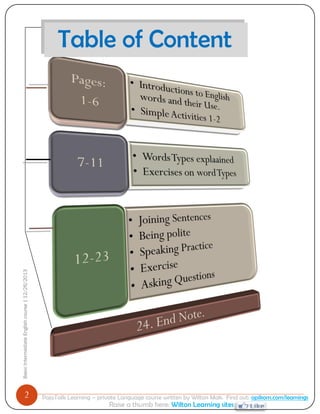
Table of Content
3 
Basic Intermediate English course | 12/26/2013 
PajoTalk Learning – private Language course written by Wilton Mak. Find out: opikom.com/learnings 
Raise a thumb here: Wilton Learning sites 
Write your additional examples here: ------------------------------------------------------------------------------------------------------------------------ ---------------------------------------------------------------------------------------------------------------------------- ---------------------------------------------------------------------------------------------------------------------------- ---------------------------------------------------------------------------------------------------------------------------- 
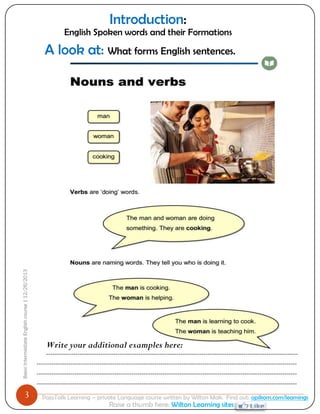
A look at: What forms English sentences. 
Introduction: 
English Spoken words and their Formations
4 
Basic Intermediate English course | 12/26/2013 
PajoTalk Learning – private Language course written by Wilton Mak. Find out: opikom.com/learnings 
Raise a thumb here: Wilton Learning sites 
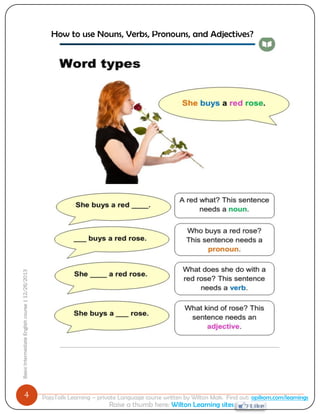
How to use Nouns, Verbs, Pronouns, and Adjectives?
5 
Basic Intermediate English course | 12/26/2013 
PajoTalk Learning – private Language course written by Wilton Mak. Find out: opikom.com/learnings 
Raise a thumb here: Wilton Learning sites 
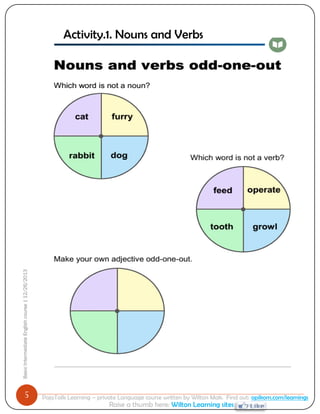
Activity.1. Nouns and Verbs
6 
Basic Intermediate English course | 12/26/2013 
PajoTalk Learning – private Language course written by Wilton Mak. Find out: opikom.com/learnings 
Raise a thumb here: Wilton Learning sites 
5 
Now try more sentences. Adhere to the flow of English sentences rule: [Subject + Verb + Object] 
Activity.2. Words Types in Sentences
7 
Basic Intermediate English course | 12/26/2013 
PajoTalk Learning – private Language course written by Wilton Mak. Find out: opikom.com/learnings 
Raise a thumb here: Wilton Learning sites 
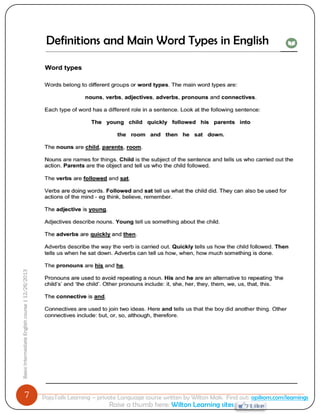
Definitions and Main Word Types in English
8 
Basic Intermediate English course | 12/26/2013 
PajoTalk Learning – private Language course written by Wilton Mak. Find out: opikom.com/learnings 
Raise a thumb here: Wilton Learning sites 
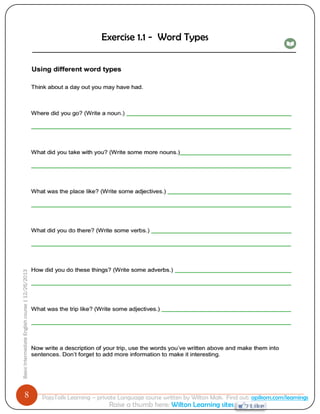
Exercise 1.1 - Word Types
9 
Basic Intermediate English course | 12/26/2013 
PajoTalk Learning – private Language course written by Wilton Mak. Find out: opikom.com/learnings 
Raise a thumb here: Wilton Learning sites 
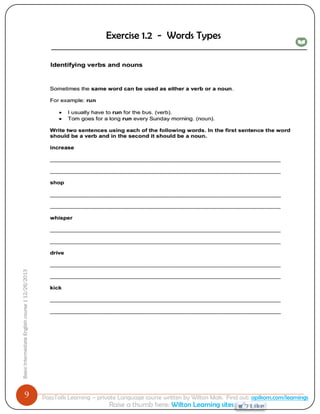
Exercise 1.2 - Words Types
10 
Basic Intermediate English course | 12/26/2013 
PajoTalk Learning – private Language course written by Wilton Mak. Find out: opikom.com/learnings 
Raise a thumb here: Wilton Learning sites 
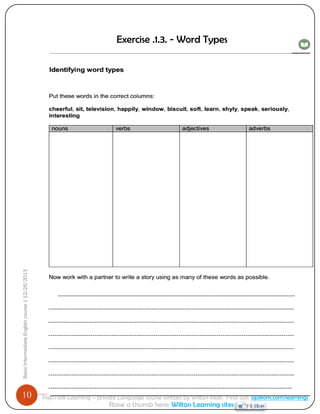
Exercise .1.3. - Word Types 
----------------------------------------------------------------------------------------------------------------- --------------------------------------------------------------------------------------------------------------------- --------------------------------------------------------------------------------------------------------------------- --------------------------------------------------------------------------------------------------------------------- --------------------------------------------------------------------------------------------------------------------- --------------------------------------------------------------------------------------------------------------------- --------------------------------------------------------------------------------------------------------------------- --------------------------------------------------------------------------------------------------------------------
11 
Basic Intermediate English course | 12/26/2013 
PajoTalk Learning – private Language course written by Wilton Mak. Find out: opikom.com/learnings 
Raise a thumb here: Wilton Learning sites 
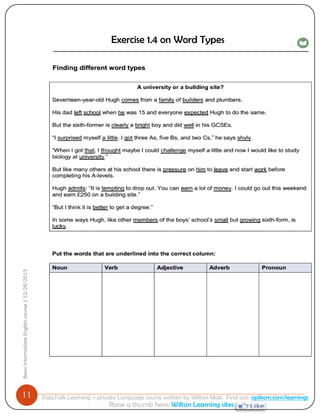
Exercise 1.4 on Word Types
12 
Basic Intermediate English course | 12/26/2013 
PajoTalk Learning – private Language course written by Wilton Mak. Find out: opikom.com/learnings 
Raise a thumb here: Wilton Learning sites 
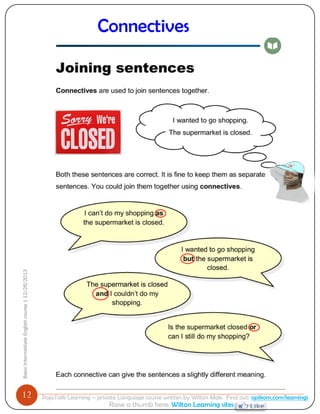
Connectives
13 
Basic Intermediate English course | 12/26/2013 
PajoTalk Learning – private Language course written by Wilton Mak. Find out: opikom.com/learnings 
Raise a thumb here: Wilton Learning sites 
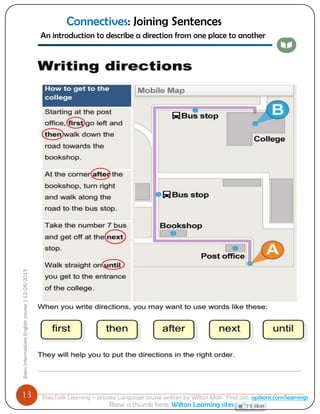
Connectives: Joining Sentences 
An introduction to describe a direction from one place to another
14 
Basic Intermediate English course | 12/26/2013 
PajoTalk Learning – private Language course written by Wilton Mak. Find out: opikom.com/learnings 
Raise a thumb here: Wilton Learning sites 
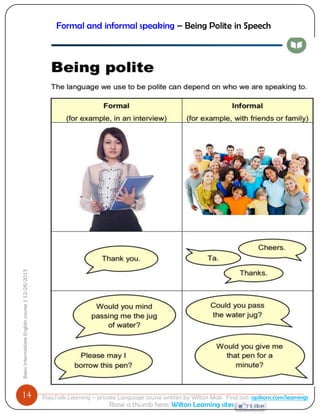
Formal and informal speaking – Being Polite in Speech 
Being polite
15 
Basic Intermediate English course | 12/26/2013 
PajoTalk Learning – private Language course written by Wilton Mak. Find out: opikom.com/learnings 
Raise a thumb here: Wilton Learning sites 
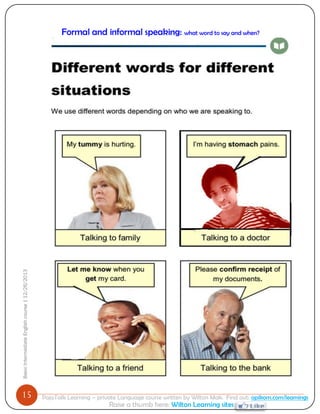
Formal and informal speaking: what word to say and when? 
Being polite
16 
Basic Intermediate English course | 12/26/2013 
PajoTalk Learning – private Language course written by Wilton Mak. Find out: opikom.com/learnings 
Raise a thumb here: Wilton Learning sites 
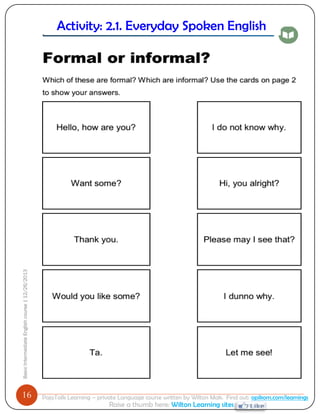
Activity: 2.1. Everyday Spoken English 
Being polite
17 
Basic Intermediate English course | 12/26/2013 
PajoTalk Learning – private Language course written by Wilton Mak. Find out: opikom.com/learnings 
Raise a thumb here: Wilton Learning sites 
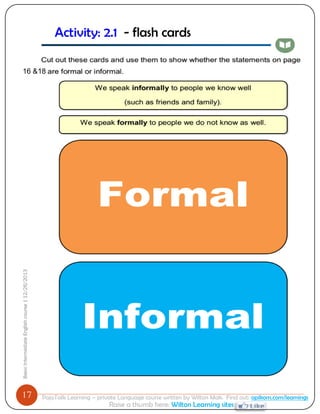
Activity: 2.1 - flash cards 
Being polite 
16 &18
18 
Basic Intermediate English course | 12/26/2013 
PajoTalk Learning – private Language course written by Wilton Mak. Find out: opikom.com/learnings 
Raise a thumb here: Wilton Learning sites 
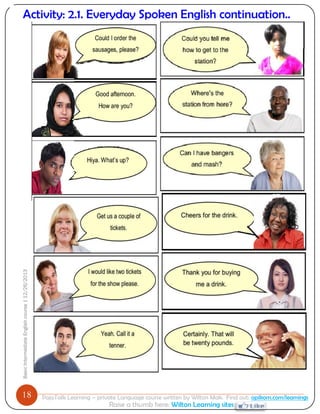
Activity: 2.1. Everyday Spoken English continuation.. 
Being polite
19 
Basic Intermediate English course | 12/26/2013 
PajoTalk Learning – private Language course written by Wilton Mak. Find out: opikom.com/learnings 
Raise a thumb here: Wilton Learning sites 
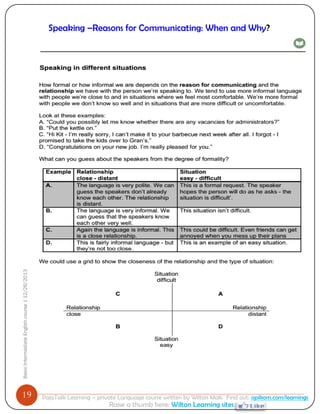
Speaking –Reasons for Communicating: When and Why? 
Being polite
20 
Basic Intermediate English course | 12/26/2013 
PajoTalk Learning – private Language course written by Wilton Mak. Find out: opikom.com/learnings 
Raise a thumb here: Wilton Learning sites 
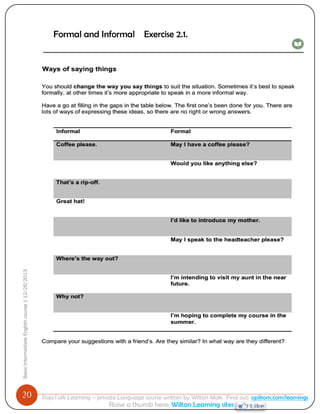
Formal and Informal Exercise 2.1. 
Being polite
21 
Basic Intermediate English course | 12/26/2013 
PajoTalk Learning – private Language course written by Wilton Mak. Find out: opikom.com/learnings 
Raise a thumb here: Wilton Learning sites 
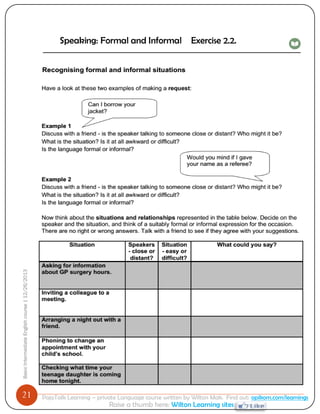
Speaking: Formal and Informal Exercise 2.2. 
Being polite
22 
Basic Intermediate English course | 12/26/2013 
PajoTalk Learning – private Language course written by Wilton Mak. Find out: opikom.com/learnings 
Raise a thumb here: Wilton Learning sites 
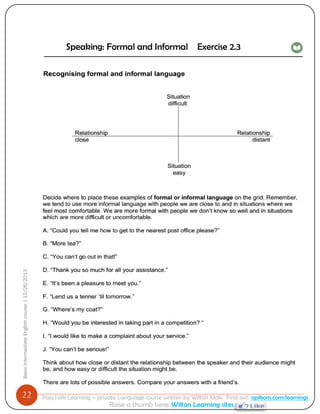
Speaking: Formal and Informal Exercise 2.3 
Being polite
23 
Basic Intermediate English course | 12/26/2013 
PajoTalk Learning – private Language course written by Wilton Mak. Find out: opikom.com/learnings 
Raise a thumb here: Wilton Learning sites 
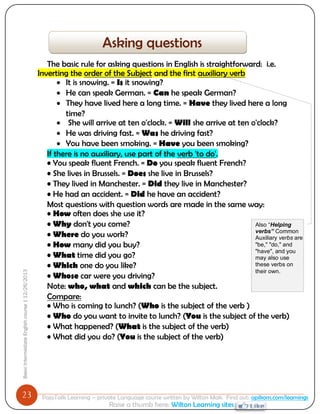
The basic rule for asking questions in English is straightforward: i.e. Inverting the order of the Subject and the first auxiliary verb 
 It is snowing. = Is it snowing? 
 He can speak German. = Can he speak German? 
 They have lived here a long time. = Have they lived here a long time? 
 She will arrive at ten o'clock. = Will she arrive at ten o'clock? 
 He was driving fast. = Was he driving fast? 
 You have been smoking. = Have you been smoking? If there is no auxiliary, use part of the verb 'to do'. • You speak fluent French. = Do you speak fluent French? • She lives in Brussels. = Does she live in Brussels? • They lived in Manchester. = Did they live in Manchester? • He had an accident. = Did he have an accident? Most questions with question words are made in the same way: • How often does she use it? 
• Why don't you come? • Where do you work? • How many did you buy? • What time did you go? • Which one do you like? • Whose car were you driving? Note: who, what and which can be the subject. Compare: • Who is coming to lunch? (Who is the subject of the verb ) • Who do you want to invite to lunch? (You is the subject of the verb) • What happened? (What is the subject of the verb) • What did you do? (You is the subject of the verb) 
Asking questions 
Also “Helping verbs” Common Auxiliary verbs are "be," "do," and "have", and you may also use these verbs on their own.
24 
Basic Intermediate English course | 12/26/2013 
PajoTalk Learning – private Language course written by Wilton Mak. Find out: opikom.com/learnings 
Raise a thumb here: Wilton Learning sites 
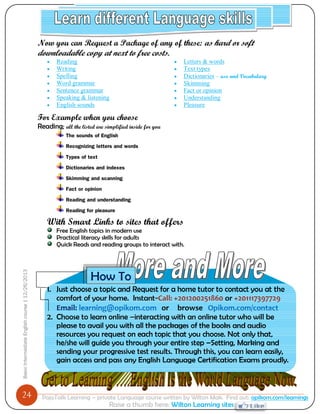
Now you can Request a Package of any of these: as hard or soft downloadable copy at next to free costs. 
 Reading 
 Writing 
 Spelling 
 Word grammar 
 Sentence grammar 
 Speaking & listening 
 English sounds 
 Letters & words 
 Text types 
 Dictionaries – use and Vocabulary 
 Skimming 
 Fact or opinion 
 Understanding 
 Pleasure 
For Example when you choose Reading; all the listed are simplified inside for you The sounds of English Recognizing letters and words Types of text Dictionaries and indexes Skimming and scanning Fact or opinion Reading and understanding Reading for pleasure 
With Smart Links to sites that offers Free English topics in modern use Practical literacy skills for adults Quick Reads and reading groups to interact with. 
1. Just choose a topic and Request for a home tutor to contact you at the comfort of your home. Instant-Call: +201200251860 or +201117397729 
Email: learning@opikom.com or browse Opikom.com/contact 
2. Choose to learn online –interacting with an online tutor who will be please to avail you with all the packages of the books and audio resources you request on each topic that you choose. Not only that, he/she will guide you through your entire step –Setting, Marking and sending your progressive test results. Through this, you can learn easily, gain access and pass any English Language Certification Exams proudly. 
How To

Basic intermediate english course p1

  • 1.
    OPIKOM.COM December 26,2013 Design and Authored by: wilton Raise a thumb here: Wilton Learning sites
  • 2.
    1 Basic IntermediateEnglish course | 12/26/2013 PajoTalk Learning – private Language course written by Wilton Mak. Find out: opikom.com/learnings Raise a thumb here: Wilton Learning sites Basic Intermediate English course All Rights Reserved This Basic Intermediate English handbook is meant for learners whose levels are passed elementary. It is prepared with a view of Learners having basic foundation in English language, who might have attended basic schools, Primary or Secondary level and want to boost their communication skills and master day today spoken English. Acknowledgement: Much gratitude and Thanks goes to Pol and Anney for their practical ideas that fueled the launching of this work. With heartfelt appreciation, the author dedicated this book to our beloved brother Knor from Korea. With full assurance I stamped it to you that this book will quickly improve your English commands and spoken proficiency. Everything inside is presented practically in short and simplified formats with visual aids. Enjoy Learning@opikom with Wilton, and to all my dear readers of this preface enjoy not only this, but all the upcoming packages that are briefly summarized at the end note of this book on Page 24. Thanks- WiltonMak
  • 3.
    2 Basic IntermediateEnglish course | 12/26/2013 PajoTalk Learning – private Language course written by Wilton Mak. Find out: opikom.com/learnings Raise a thumb here: Wilton Learning sites Table of Content
  • 4.
    3 Basic IntermediateEnglish course | 12/26/2013 PajoTalk Learning – private Language course written by Wilton Mak. Find out: opikom.com/learnings Raise a thumb here: Wilton Learning sites Write your additional examples here: ------------------------------------------------------------------------------------------------------------------------ ---------------------------------------------------------------------------------------------------------------------------- ---------------------------------------------------------------------------------------------------------------------------- ---------------------------------------------------------------------------------------------------------------------------- A look at: What forms English sentences. Introduction: English Spoken words and their Formations
  • 5.
    4 Basic IntermediateEnglish course | 12/26/2013 PajoTalk Learning – private Language course written by Wilton Mak. Find out: opikom.com/learnings Raise a thumb here: Wilton Learning sites How to use Nouns, Verbs, Pronouns, and Adjectives?
  • 6.
    5 Basic IntermediateEnglish course | 12/26/2013 PajoTalk Learning – private Language course written by Wilton Mak. Find out: opikom.com/learnings Raise a thumb here: Wilton Learning sites Activity.1. Nouns and Verbs
  • 7.
    6 Basic IntermediateEnglish course | 12/26/2013 PajoTalk Learning – private Language course written by Wilton Mak. Find out: opikom.com/learnings Raise a thumb here: Wilton Learning sites 5 Now try more sentences. Adhere to the flow of English sentences rule: [Subject + Verb + Object] Activity.2. Words Types in Sentences
  • 8.
    7 Basic IntermediateEnglish course | 12/26/2013 PajoTalk Learning – private Language course written by Wilton Mak. Find out: opikom.com/learnings Raise a thumb here: Wilton Learning sites Definitions and Main Word Types in English
  • 9.
    8 Basic IntermediateEnglish course | 12/26/2013 PajoTalk Learning – private Language course written by Wilton Mak. Find out: opikom.com/learnings Raise a thumb here: Wilton Learning sites Exercise 1.1 - Word Types
  • 10.
    9 Basic IntermediateEnglish course | 12/26/2013 PajoTalk Learning – private Language course written by Wilton Mak. Find out: opikom.com/learnings Raise a thumb here: Wilton Learning sites Exercise 1.2 - Words Types
  • 11.
    10 Basic IntermediateEnglish course | 12/26/2013 PajoTalk Learning – private Language course written by Wilton Mak. Find out: opikom.com/learnings Raise a thumb here: Wilton Learning sites Exercise .1.3. - Word Types ----------------------------------------------------------------------------------------------------------------- --------------------------------------------------------------------------------------------------------------------- --------------------------------------------------------------------------------------------------------------------- --------------------------------------------------------------------------------------------------------------------- --------------------------------------------------------------------------------------------------------------------- --------------------------------------------------------------------------------------------------------------------- --------------------------------------------------------------------------------------------------------------------- --------------------------------------------------------------------------------------------------------------------
  • 12.
    11 Basic IntermediateEnglish course | 12/26/2013 PajoTalk Learning – private Language course written by Wilton Mak. Find out: opikom.com/learnings Raise a thumb here: Wilton Learning sites Exercise 1.4 on Word Types
  • 13.
    12 Basic IntermediateEnglish course | 12/26/2013 PajoTalk Learning – private Language course written by Wilton Mak. Find out: opikom.com/learnings Raise a thumb here: Wilton Learning sites Connectives
  • 14.
    13 Basic IntermediateEnglish course | 12/26/2013 PajoTalk Learning – private Language course written by Wilton Mak. Find out: opikom.com/learnings Raise a thumb here: Wilton Learning sites Connectives: Joining Sentences An introduction to describe a direction from one place to another
  • 15.
    14 Basic IntermediateEnglish course | 12/26/2013 PajoTalk Learning – private Language course written by Wilton Mak. Find out: opikom.com/learnings Raise a thumb here: Wilton Learning sites Formal and informal speaking – Being Polite in Speech Being polite
  • 16.
    15 Basic IntermediateEnglish course | 12/26/2013 PajoTalk Learning – private Language course written by Wilton Mak. Find out: opikom.com/learnings Raise a thumb here: Wilton Learning sites Formal and informal speaking: what word to say and when? Being polite
  • 17.
    16 Basic IntermediateEnglish course | 12/26/2013 PajoTalk Learning – private Language course written by Wilton Mak. Find out: opikom.com/learnings Raise a thumb here: Wilton Learning sites Activity: 2.1. Everyday Spoken English Being polite
  • 18.
    17 Basic IntermediateEnglish course | 12/26/2013 PajoTalk Learning – private Language course written by Wilton Mak. Find out: opikom.com/learnings Raise a thumb here: Wilton Learning sites Activity: 2.1 - flash cards Being polite 16 &18
  • 19.
    18 Basic IntermediateEnglish course | 12/26/2013 PajoTalk Learning – private Language course written by Wilton Mak. Find out: opikom.com/learnings Raise a thumb here: Wilton Learning sites Activity: 2.1. Everyday Spoken English continuation.. Being polite
  • 20.
    19 Basic IntermediateEnglish course | 12/26/2013 PajoTalk Learning – private Language course written by Wilton Mak. Find out: opikom.com/learnings Raise a thumb here: Wilton Learning sites Speaking –Reasons for Communicating: When and Why? Being polite
  • 21.
    20 Basic IntermediateEnglish course | 12/26/2013 PajoTalk Learning – private Language course written by Wilton Mak. Find out: opikom.com/learnings Raise a thumb here: Wilton Learning sites Formal and Informal Exercise 2.1. Being polite
  • 22.
    21 Basic IntermediateEnglish course | 12/26/2013 PajoTalk Learning – private Language course written by Wilton Mak. Find out: opikom.com/learnings Raise a thumb here: Wilton Learning sites Speaking: Formal and Informal Exercise 2.2. Being polite
  • 23.
    22 Basic IntermediateEnglish course | 12/26/2013 PajoTalk Learning – private Language course written by Wilton Mak. Find out: opikom.com/learnings Raise a thumb here: Wilton Learning sites Speaking: Formal and Informal Exercise 2.3 Being polite
  • 24.
    23 Basic IntermediateEnglish course | 12/26/2013 PajoTalk Learning – private Language course written by Wilton Mak. Find out: opikom.com/learnings Raise a thumb here: Wilton Learning sites The basic rule for asking questions in English is straightforward: i.e. Inverting the order of the Subject and the first auxiliary verb  It is snowing. = Is it snowing?  He can speak German. = Can he speak German?  They have lived here a long time. = Have they lived here a long time?  She will arrive at ten o'clock. = Will she arrive at ten o'clock?  He was driving fast. = Was he driving fast?  You have been smoking. = Have you been smoking? If there is no auxiliary, use part of the verb 'to do'. • You speak fluent French. = Do you speak fluent French? • She lives in Brussels. = Does she live in Brussels? • They lived in Manchester. = Did they live in Manchester? • He had an accident. = Did he have an accident? Most questions with question words are made in the same way: • How often does she use it? • Why don't you come? • Where do you work? • How many did you buy? • What time did you go? • Which one do you like? • Whose car were you driving? Note: who, what and which can be the subject. Compare: • Who is coming to lunch? (Who is the subject of the verb ) • Who do you want to invite to lunch? (You is the subject of the verb) • What happened? (What is the subject of the verb) • What did you do? (You is the subject of the verb) Asking questions Also “Helping verbs” Common Auxiliary verbs are "be," "do," and "have", and you may also use these verbs on their own.
  • 25.
    24 Basic IntermediateEnglish course | 12/26/2013 PajoTalk Learning – private Language course written by Wilton Mak. Find out: opikom.com/learnings Raise a thumb here: Wilton Learning sites Now you can Request a Package of any of these: as hard or soft downloadable copy at next to free costs.  Reading  Writing  Spelling  Word grammar  Sentence grammar  Speaking & listening  English sounds  Letters & words  Text types  Dictionaries – use and Vocabulary  Skimming  Fact or opinion  Understanding  Pleasure For Example when you choose Reading; all the listed are simplified inside for you The sounds of English Recognizing letters and words Types of text Dictionaries and indexes Skimming and scanning Fact or opinion Reading and understanding Reading for pleasure With Smart Links to sites that offers Free English topics in modern use Practical literacy skills for adults Quick Reads and reading groups to interact with. 1. Just choose a topic and Request for a home tutor to contact you at the comfort of your home. Instant-Call: +201200251860 or +201117397729 Email: learning@opikom.com or browse Opikom.com/contact 2. Choose to learn online –interacting with an online tutor who will be please to avail you with all the packages of the books and audio resources you request on each topic that you choose. Not only that, he/she will guide you through your entire step –Setting, Marking and sending your progressive test results. Through this, you can learn easily, gain access and pass any English Language Certification Exams proudly. How To