TEN BASIC SAFETYRULES
АЮУЛГҮ Й АЖИЛЛАХ 10 ДҮ РЭМ
1.
Use personal protective
equipment. Wear safe
clothing. Keep items in
good condition.
1.
ХХХ-ээ байнга хэрэглэж
бай. ХАА-ны шаардлага
хангасан хувцсыг зохих
журмын дагуу цэвэр
цэмцгэр өмсөж бай.
2.
Follow instructions. Do not
take chances; if you do not
know, ASK.
2.
Хэрэв мэдэхгүй бол
ажиллах гэж бүү яар,
заавал АСУУ. Зааврыг
дагаж мөрд.
3.
Correct or report unsafe
conditions.
3.
Аюултай нөхцөл илэрвэл
засах арга хэмжээ ав
эсвэл мастертаа мэдээл.
9.
TEN BASIC SAFETYRULES
АЮУЛГҮ Й АЖИЛЛАХ 10 ДҮ РЭМ
4.
Ажлын байраа эмх
цэгцтэй цэвэрхэн
байлгахыг хичээж бай.
5.
Ажилдаа тохирсон багаж
зэвсэг хэрэглэж бай.
Report all injuries
immediately to your
supervisor no matter how
minor. Get first aid
treatment, if necessary.
6.
Гэмтэл авбал бага
гэлтгүй мастертаа шууд
мэдээлж
бай.Шаардлагатай бол
эмнэлэгт даруйхан үзүүл.
Use, adjust and repair
equipment only when
authorized.
7.
Тоног төхөөрөмжийг
ашиглаж, тохируулж,
засах ажлыг зөвхөн
зөвшөөрөгдсөн хүн л
гүйцэтгэж бай.
4.
Help keep the jobsite clean
and orderly.
5.
Use the right tools and
equipment for the job.
6.
7.
10.
TEN BASIC SAFETYRULES
АЮУЛГҮЙ АЖИЛЛАХ 10 ДҮРЭМ
8. No horseplay. Avoid
distracting others.
8. Тоглоом шоглоом бүү хий.
Бусдын анхаарлыг
сарниулахаас үргэлж
зайлхийж бай.
9. When lifting, bend your
knees. Get help for heavy
loads.
9. Ачаа өргөхдөө зөв горим
баримталж бай.Хүнд ачаа
өргөхөөр бол заавал
бусадтай хамжилцаж бай.
10.Comply with all safety rules
and signs.
10.Аюулгүй ажиллагааны
дүрэм журмууд ба тэмдэг
тэмдэглэгээг дагаж бай.
11.
Эрдэх авир болонаюулгү й
ажиллагаа
COMPLACENCY & SAFETY
Тодорхойлолтууд:
1.
"Бардам, сэтгэл хангалуун
мэдрэмж. Энэ мэдрэмж нь: 1.
аюул болон түүний үр
дагаврыг ойлгох, анхаарал
болгоомжийг тань
бууруулахаас гадна,
асуудал зөрчилдөөнийг
дагуулна."
Definitions
A feeling of
contentment or selfsatisfaction, especially
when coupled with an
unawareness of
danger, trouble, or
controversy or,
Эрдэх авир &Аюулгү й ажиллагаа
COMPLACENCY & SAFETY
2.
Тодорхойлолтууд:
Болзошгүй аюул,
2.
алдаатай нөхцөл
байдал болон бусад
хэвийн бус байдлаас
өөрийгөө аюулгүй гэж
өөртөө итгэж ажилдаа
хандах хандлага.
Definitions
Complacency can be
defined as a feeling of
quiet security often
while unaware of
some potential
danger, defect or the
like.
15.
Эрдэх авир &Аюулгүй ажиллагаа
COMPLACENCY & SAFETY
1. Эрдэх авир - хүний тархинд байгалиас заяасан үйлдэл.
A natural function of the brain
2. Хүнд бодох бололцоо өгөлгүй өөрөө илэрдэг
Automation
3. Ухамсарт хяналтыг сулруулдаг
Conscious guidance
4. Урьд нь олон давтагдсан үйлдэлд бид туршлагад эрдэн
ханддаг
Repetition
5. Тархи шинэ сонин, ер бусын нөхцлийг илүүд хүлээн авч,
төдий чинээ анхааралтай хариу өгдөг.
Brain scanning and responding to the unique, new unusual or
threatening
6. Бодит байдалд үнэлэлт өгөхгүй байх буюу урьдын
туршлагаар хандах
Habituation & absence of consequences
17.
ашиглаж болно!
Complacency cannever be cured. It
can Эрдэх be treated! ажиллагаа
only авир & Аюулгүй
COMPLACENCY & SAFETY
TASK PURPOSE ANDIMPORTANCE
Зорилго Ач холбогдол
PURPOSE:
To ensure that personnel are protected
from injury as a result of falling from
elevated positions.
POLICY:
Fall arresting equipment shall be
provided and used where employees
have to work at elevations greater than 3
meters, or where a fall from a lesser
height involves an unusual risk of injury.
Employees must not attempt to work in
an elevated position unless one or more
of the following are provided; guard
rails, safety harnesses, horizontal
lifelines, or rope grab.
Зорилго:
Өндөрт ажиллаж буй ажилчин
унахад түүнийг гэмтлээс
найдвартай хамгаалахад
оршино.
Бодлого:
3 м-ээс дээш өндөрт болон
түүнээс бага боловч аюул бүхий
өндөрт ажиллах ажилчин нь
өндрөөс хамгаалах бүсээр
хангагдаж, түүнийг ашиглаж
ажлаа гүйцэтгэх ёстой. Өндөрт
ажиллах ажилчин нь хашлага,
өндрөөс хамгаалах бүс түүнийг
бэхлэх тросс, цагираг зэрэг
хамгаалах хэрэгслүүдийн аль
нэг байхгүй бол заавал ажиллах
шаардлагагүй юм.
24.
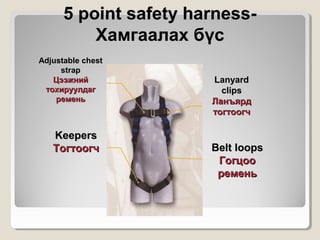
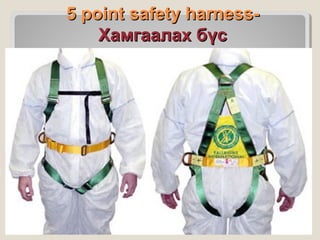
5 point safetyharnessХамгаалах бүс
Adjustable chest
strap
Цээжний
тохируулдаг
ремень
Keepers
Тогтоогч
Lanyard
clips
Ланъярд
тогтоогч
Belt loops
Гогцоо
ремень
25.
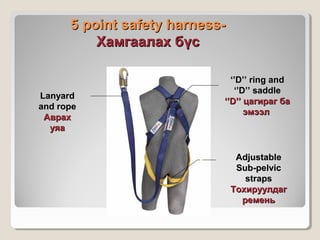
5 point safetyharnessХамгаалах бүс
Lanyard
and rope
Аврах
уяа
‘’D’’ ring and
‘’D’’ saddle
‘’D’’ цагираг ба
эмээл
Adjustable
Sub-pelvic
straps
Тохируулдаг
ремень
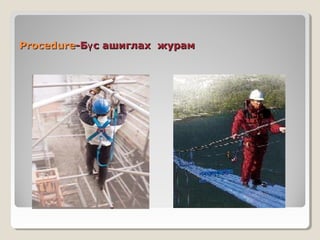
26.
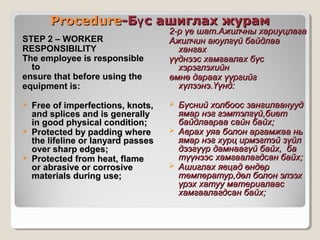
Procedure-Бү с ашиглахжурам
STEP 2 – WORKER
RESPONSIBILITY
The employee is responsible
to
ensure that before using the
equipment is:
Free of imperfections, knots,
and splices and is generally
in good physical condition;
Protected by padding where
the lifeline or lanyard passes
over sharp edges;
Protected from heat, flame
or abrasive or corrosive
materials during use;
2-р үе шат.Ажилчны хариуцлага
Ажилчин аюулгүй байдлаа
хангах
үүднээс хамгаалах бүс
хэрэглэхийн
өмнө дараах үүргийг
хүлээнэ.Үүнд:
Бүсний холбоос зангилаанууд
ямар нэг гэмтэлгүй,биет
байдлаараа сайн байх;
Аврах уяа болон аргамжаа нь
ямар нэг хурц ирмэгтэй зүйл
дээгүүр дамнаагүй байх, ба
түүнээс хамгаалагдсан байх;
Ашиглах явцад өндөр
температур,дөл болон элээх
үрэх хатуу материалаас
хамгаалагдсан байх;
27.
Procedure-Бүсэнд үзлэг хийхжурам
STEP 3 – METHOD OF 3-р үе шат.Үзлэг хий
Бүсний үндсэн хэсгийн
INSPECTION
гадаргуу ямар нэг
Inspect the entire
гэмтэлтэй эсэхийг
area surface of the
шалгах;
webbing for damage; Бүсний ирмэг элэгдэж
Look for frayed
сэмэрсэн,сүлжээсний
edges, broken fibers, ширхэгүүд
pulled stitches, cuts, тасарсан,оёдол суларч
or tuffs of material or тасарсан эсэх,химийн
бодисын болон халууны
obvious signs of
нөлөөгөөр гэмтсэн
chemical or heat
эсэхийг сайтар шалгах;
damage;
Checking timber ladders
Модоншатыг шалгах
тухай
Burns or
charring
Түлэгдэл г.м
Splits along
the timber grain
Хөлний дагуу
цууралт
хагаралт үүссэн
эсэх
Termite
Damage
Өт хорхойд идэгдэж
гэмтсэн эсэх
Moisture
damage
Чийгнээс
үүсэн гэмтэл
Cracks across
the timber grain
Гишгүүр гэмтсэн
хагарсан эсэх
33.
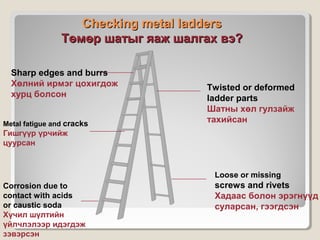
Checking metal ladders
Төмөршатыг яаж шалгах вэ?
Sharp edges and burrs
Хөлний ирмэг цохигдож
хурц болсон
Metal fatigue and cracks
Twisted or deformed
ladder parts
Шатны хөл гулзайж
тахийсан
Гишгүүр үрчийж
цуурсан
Loose or missing
Corrosion due to
contact with acids
or caustic soda
Хүчил шүлтийн
үйлчлэлээр идэгдэж
зэвэрсэн
screws and rivets
Хадаас болон эрэгнүүд
суларсан, гээгдсэн
34.
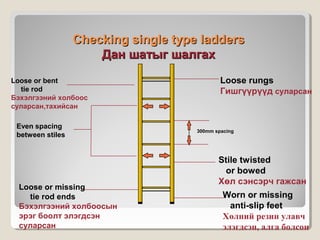
Checking single typeladders
Дан шатыг шалгах
Loose or bent
tie rod
Бэхэлгээний холбоос
суларсан,тахийсан
Even spacing
between stiles
Loose or missing
tie rod ends
Бэхэлгээний холбоосын
эрэг боолт элэгдсэн
суларсан
Loose rungs
Гишгүүрүүд суларсан
300mm spacing
Stile twisted
or bowed
Хөл сэнсэрч гажсан
Worn or missing
anti-slip feet
Хөлний резин улавч
элэгдсэн, алга болсон
35.
Checking step ladders
Тулгууртайшатыг шалгах
Seized hinges
Нугас ганхаж
муудсан
Loose tread or
missing screws
Гишгүүр суларсан,
эрэгнүүд алга болсон
Split or cracked
Stile
Хөл цуурсан,
хагарсан
Loose top plate- Тавцан суларсан
Loose batten
Screws Бэхэлгээний эрэгнүүд
суларсан
Warped or twisted
back leg-Арын хөл гажиж гулзайсан
Loose or split brace
Холбоосууд хагарч суларсан
Cracked or split
Batten
Бэхэлгээний мод
хагарч цуурсан
Frayed or cut cords
Бэхэлгээний утас элэгдсэн
тасарсан
36.
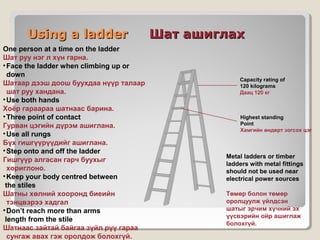
Using a ladder
Oneperson at a time on the ladder
Шат руу нэг л хүн гарна.
• Face the ladder when climbing up or
down
Шатаар дээш доош буухдаа нүүр талаар
шат руу хандана.
• Use both hands
Хоёр гараараа шатнаас барина.
• Three point of contact
Гурван цэгийн дүрэм ашиглана.
• Use all rungs
Бүх гишгүүрүүдийг ашиглана.
• Step onto and off the ladder
Гишгүүр алгасан гарч буухыг
хориглоно.
• Keep your body centred between
the stiles
Шатны хөлний хооронд биеийн
тэнцвэрээ хадгал
• Don’t reach more than arms
length from the stile
Шатнаас зайтай байгаа зүйл рүү гараа
сунгаж авах гэж оролдож болохгүй.
Шат ашиглах
Capacity rating of
120 kilograms
Даац 120 кг
Highest standing
Point
Хамгийн өндөрт зогсох цэг
Metal ladders or timber
ladders with metal fittings
should not be used near
electrical power sources
Төмөр болон төмөр
оролцуулж үйлдсэн
шатыг эрчим хүчний эх
үүсвэрийн ойр ашиглаж
болохгүй.
Editor's Notes
#11 Complacency is so insidious and dangerous. It happens in small incremental bites or steps that not even the most skilled persons will be aware of its existence. It is not until an incident occurs, and the process or procedure are investigated to determine what exactly happened/root cause will the deviations become apparent.
#16 Complacency is a natural function of the brain:
It is designed to automate repetitive behaviour. It has to react this way other wise we would not be able to complete the simplest of tasks, and everything we do would be overwhelming.
It happens in small incremental steps that even the most skilled operator is unaware of its existence until an accident occurs, and procedures are investigated to determine the cause, will the deviations become apparent. It is not the result of apathy or carelessness of personality flaw, it is simply the way the brain works. The brain can handle routine repetitive actions without any conscious guidance and basically required no further help from us.
Complacency is embedded within a mental bias that allows our experiences to guide our expectations. The mental resources needed to process information are reduced by this shortcut because present circumstances are normally a good match with past occurrences. Thus , mental resources are devoted to the more interesting, unique, unusual or threatening things and the mundane things or items are ignored almost in their entirety. This creates a false sense of control, which unfortunately will reduce safety awareness or actions to the lowest denominator.
Brain Scanning & Responding
The brain constantly scans the environment for signs of danger. We notice and respond very well to what is unique, unusual or threatening, however repeated exposure to situations, even if potentially dangerous, dulls our defense mechanisms and safety awareness.
6. Habituation and Absence of Consequences
This creates a false illusion of control. Almost all of the time nothing will happen. Past experiences will normally or usually dictate future actions and the absence of any consequences helps increase the illusion of control. Personal bias will insidiously take over the formal process and eventually, will unfortunately reduce safety awareness or actions to the lowest denominator and eventually result in a down-grading incident.
#18 Complacency is so insidious and dangerous. It happens in small incremental bites or steps that not even the most skilled persons will be aware of its existence. It is not until an incident occurs, and the process or procedure are investigated to determine what exactly happened/root cause will the deviations become apparent.
#20 The fight against complacency can never be ignored or relaxed. It is clearly recognized as a causal factor in accidents. So, what can we do to prevent complacency?
Have a healthy discontent with the way things are.
Question the status quo
Be very aware of its existence and the measures to be taken to offset any negative consequences
A deliberate effort to apply safety strategies un the absence of perceived danger
Form safety habits that that are done everyday until they override former unsafe behaviours and become automated.
Ask oneself “what if ? on every occasion where work is involved.
Adopt safety tactics that are you comfortable with and deliberately do them over and over on a consistent basis.
Create an awareness about the adverse effects of complacency and counteract the belief that “it can’t happen to me”
Do not accept things the way they are and constantly test to ensure safety integrity
Constantly Always check the mundane things as well as the new, exciting threatening things













![Hicheel de.blogspot.com [хөдөлмөрийн аюулгүй ажилгааны зааварчилгаа]](https://cdn.slidesharecdn.com/ss_thumbnails/hicheelde-blogspot-com-130420105559-phpapp02-thumbnail.jpg?width=640&height=640&fit=bounds)


