INTRODUCTION
Have you everwondered how children develop? Maybe at one time you have
compared your development with that of a sibling or cousin of yours. If this is the
case, you are interested in child development which is the pattern of growth,
change, and stability that occurs from conception up until adolescence. Children
do not grow at the same rate at the same time. This also goes for the students in an
inclusive classroom. Knowing their capabilities can help you better as their teacher.
Find out more about their development as this. chapter focuses on the typical and
atypical development among children from infancy to adolescence.
3.
OBJECTIVES
At the endof the chapter you will be able to:
Identify typical and atypical milestones in the various stages
of child development; and
Differentiate typical and atypical and atypical development
of children in various stages of their development.
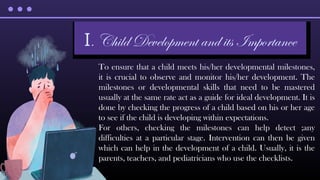
To ensure thata child meets his/her developmental milestones,
it is crucial to observe and monitor his/her development. The
milestones or developmental skills that need to be mastered
usually at the same rate act as a guide for ideal development. It is
done by checking the progress of a child based on his or her age
to see if the child is developing within expectations.
For others, checking the milestones can help detect ;any
difficulties at a particular stage. Intervention can then be given
which can help in the development of a child. Usually, it is the
parents, teachers, and pediatricians who use the checklists.
I. Child Development and its Importance
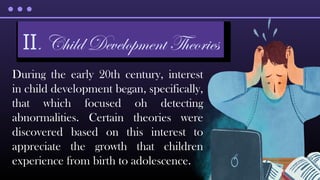
During the early20th century, interest
in child development began, specifically,
that which focused oh detecting
abnormalities. Certain theories were
discovered based on this interest to
appreciate the growth that children
experience from birth to adolescence.
II. Child Development Theories
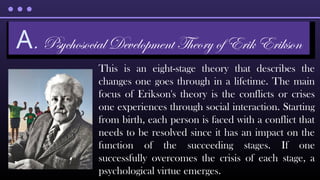
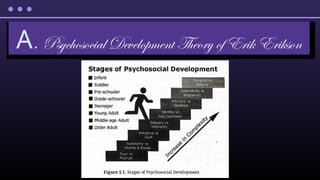
This is aneight-stage theory that describes the
changes one goes through in a lifetime. The main
focus of Erikson's theory is the conflicts or crises
one experiences through social interaction. Starting
from birth, each person is faced with a conflict that
needs to be resolved since it has an impact on the
function of the succeeding stages. If one
successfully overcomes the crisis of each stage, a
psychological virtue emerges.
A. Psychosocial Development Theory of Erik Erikson
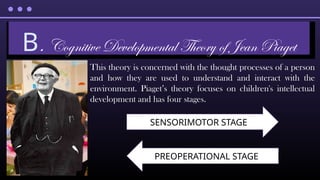
This theory isconcerned with the thought processes of a person
and how they are used to understand and interact with the
environment. Piaget’s theory focuses on children's intellectual
development and has four stages.
B. Cognitive Developmental Theory of Jean Piaget
SENSORIMOTOR STAGE
PREOPERATIONAL STAGE
13.
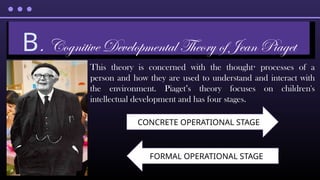
This theory isconcerned with the thought processes of a
·
person and how they are used to understand and interact with
the environment. Piaget’s theory focuses on children's
intellectual development and has four stages.
B. Cognitive Developmental Theory of Jean Piaget
CONCRETE OPERATIONAL STAGE
FORMAL OPERATIONAL STAGE
14.
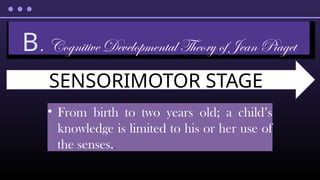
• From birthto two years old; a child’s
knowledge is limited to his or her use of
the senses..
B. Cognitive Developmental Theory of Jean Piaget
SENSORIMOTOR STAGE
15.
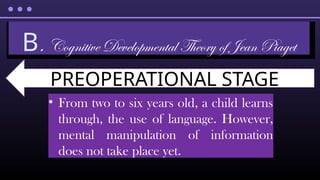
• From twoto six years old, a child learns
through, the use of language. However,
mental manipulation of information
does not take place yet.
B. Cognitive Developmental Theory of Jean Piaget
PREOPERATIONAL STAGE
16.
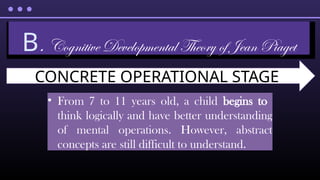
• From 7to 11 years old, a child begins to
think logically and have better understanding
of mental operations. However, abstract
concepts are still difficult to understand.
B. Cognitive Developmental Theory of Jean Piaget
CONCRETE OPERATIONAL STAGE
17.
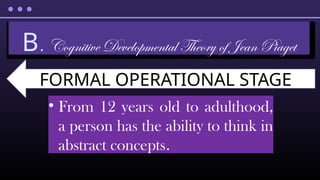
• From 12years old to adulthood,
a person has the ability to think in
abstract concepts.
B. Cognitive Developmental Theory of Jean Piaget
FORMAL OPERATIONAL STAGE
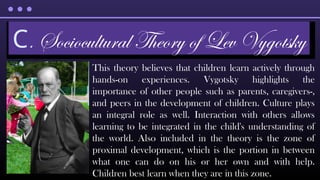
This theory believesthat children learn actively through
hands-on experiences. Vygotsky highlights the
importance of other people such as parents, caregivers-,
and peers in the development of children. Culture plays
an integral role as well. Interaction with others allows
learning to be integrated in the child's understanding of
the world. Also included in the theory is the zone of
proximal development, which is the portion in between
what one can do on his or her own and with help.
Children best learn when they are in this zone.
C. Sociocultural Theory of Lev Vygotsky
20.
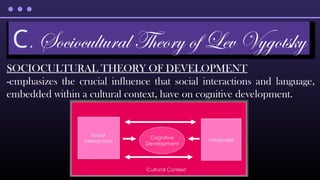
SOCIOCULTURAL THEORY OFDEVELOPMENT
-emphasizes the crucial influence that social interactions and language,
embedded within a cultural context, have on cognitive development.
C. Sociocultural Theory of Lev Vygotsky
21.
SOCIAL INTERACTION
Vygotskyemphasized that effective learning happens through
participation in social activities.
Parents, teachers and other adults in the learner's environment all
contribute to the process. They explain, model, assist, give directions
and provide feed back.
Peers, on the other hand, cooperate and collaborate and enrich the
learning experience.
C. Sociocultural Theory of Lev Vygotsky
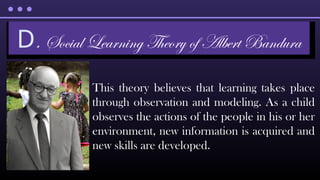
This theory believesthat learning takes place
through observation and modeling. As a child
observes the actions of the people in his or her
environment, new information is acquired and
new skills are developed.
D. Social Learning Theory of Albert Bandura
24.
Albert Bandura’s SocialLearning Theory proposes that individuals
acquire new behaviors by observing and imitating the actions of others.
Unlike earlier behaviorist models, which emphasized direct
reinforcement, Bandura introduced the idea that learning can occur
through social interaction and observation alone. His theory provided an
alternative to the work of B.F. Skinner, who focused on
operant conditioning, and expanded on existing theories of learning by
incorporating cognitive and environmental influences.
D. Social Learning Theory of Albert Bandura
25.
According to Bandura,learning is not solely the result of conditioning
but involves a dynamic interplay between cognition, environment, and
behavior. He identified two key processes that differentiate social
learning from traditional behaviorist theories:
1. Observational Learning – People learn behaviors by watching others
in their environment, such as parents, teachers, or peers.
2. Mediational Processes – Cognitive processes occur between the
stimulus and response, meaning individuals actively interpret and
internalize what they observe before deciding to replicate it.
D. Social Learning Theory of Albert Bandura
26.
What are theconditions for social learning?
1. ATTENTION
According to behavioural theories if people are learning anything from
a knowledge acquisition model, they must be paying attention to the
model's observable human learning behaviours. There are many reasons
for disturbance in the observer’s attention. For instance, if the observer
is distracted, ill, or sleepy, he may not learn the modelled behaviour and
imitate it in his classroom model.
D. Social Learning Theory of Albert Bandura
27.
2. RETENTION
According tosocial cognition theorists, the second
condition of observational learning is to memorize the
witnessed behaviour. If a student does not memorize the
social behaviour, there are fewer chances of imitating in
his classroom behaviour.
D. Social Learning Theory of Albert Bandura
28.
3. REPRODUCTION
According toChild behaviour and development theorists, it is a complex
process which includes the mental and physical ability of the person to copy the
observed behaviour while doing a physical task. For example, a child may see
an adult basketball player put on a ball. Afterwards, when the kid has a
basketball, he may try to put a ball like the adult player. But, the child's
physical capabilities are not like that of the adult player, and, regardless of how
many times he attempts, will not reach the basket to put the ball. A teenager or
an adult may be able to put the ball but possibly only after a lot of practice.
D. Social Learning Theory of Albert Bandura
29.
4. MOTIVATION
According toChild behaviour and development theorists, motivational factors
provide the most significant knowledge acquisition opportunities of
observational learning. According to behavioural theories, if someone has no
reason for the classroom model imitation, then no quantity of reproduction,
retention, or attention will overcome the absence of motivational factors.
According to Classical Theory, motivational factors such as emotional
experience punishment and positive reinforcement play an important role in
motivation.
D. Social Learning Theory of Albert Bandura
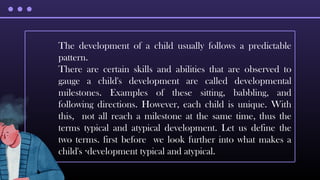
The development ofa child usually follows a predictable
pattern.
There are certain skills and abilities that are observed to
gauge a child's development are called developmental
milestones. Examples of these sitting, babbling, and
following directions. However, each child is unique. With
this, not all reach a milestone at the same time, thus the
terms typical and atypical development. Let us define the
two terms. first before we look further into what makes a
child's development typical and atypical.
·
32.
The term typicaldevelopment refers to the normal progression
where children grow by acquiring knowledge, skills, and behavior
called developmental milestones at a certain time frame.
Atypical development is a term used when development does
not follow the normal course. More so, a child is developing
atypically when he/ he reaches a milestone earlier or later than
other children his/her age.
III. Typical and Atypical Development
33.
There is noclear way to identify if a child is developing
typically or atypically. However, there are three commonly
accepted principles of child development that one should
look into. The principles are as follows:
1. Rate of development differs among children
2. Development occurs in a relatively orderly process
3. Development takes place gradually
III. Typical and Atypical Development
The developmental milestonesare categorized into four
domains namely, physical, social and emotional, language, and
cognitive.
The physical domain refers to the development of physical
changes such as size and strength. The development occurs in both
gross and fine motor skills. The development of the senses and their
uses are also part of the physical domain which is influenced by illness
and nutrition.
IV. Domains of Development
36.
A child's experience,expression, and management
of emotions along with the ability to establish positive
relationships with others refer to the social-emotional
domain. This includes both the intrapersonal and
interpersonal processes that take place in a child.
IV. Domains of Development
37.
The language domainrefers to the process of acquiring
language in a consistent order without the need for explicit
teaching from the environment.
Construction of thought process which includes
remembering, problem solving, and decision making
refers to the cognitive domain.
IV. Domains of Development
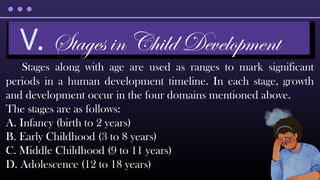
Stages along withage are used as ranges to mark significant
periods in a human development timeline. In each stage, growth
and development occur in the four domains mentioned above.
The stages are as follows:
A. Infancy (birth to 2 years)
B. Early Childhood (3 to 8 years)
C. Middle Childhood (9 to 11 years)
D. Adolescence (12 to 18 years)
V. Stages in Child Development
40.
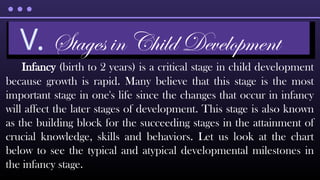
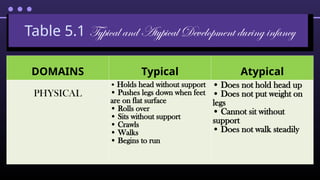
Infancy (birth to2 years) is a critical stage in child development
because growth is rapid. Many believe that this stage is the most
important stage in one's life since the changes that occur in infancy
will affect the later stages of development. This stage is also known
as the building block for the succeeding stages in the attainment of
crucial knowledge, skills and behaviors. Let us look at the chart
below to see the typical and atypical developmental milestones in
the infancy stage.
V. Stages in Child Development
41.
Table 5.1 Typicaland Atypical Development during infancy
DOMAINS Typical Atypical
PHYSICAL
• Holds head without support
• Pushes legs down when feet
are on flat surface
• Rolls over
• Sits without support
• Crawls
• Walks
• Begins to run
• Does not hold head up
• Does not put weight on
legs
• Cannot sit without
support
• Does not walk steadily
42.
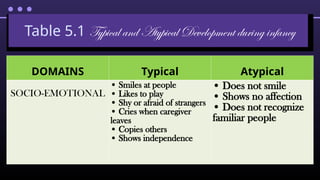
Table 5.1 Typicaland Atypical Development during infancy
DOMAINS Typical Atypical
SOCIO-EMOTIONAL
• Smiles at people
• Likes to play
• Shy or afraid of strangers
• Cries when caregiver
leaves
• Copies others
• Shows independence
• Does not smile
• Shows no affection
• Does not recognize
familiar people
43.
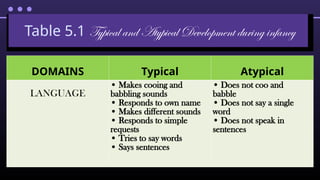
Table 5.1 Typicaland Atypical Development during infancy
DOMAINS Typical Atypical
LANGUAGE
• Makes cooing and
babbling sounds
• Responds to own name
• Makes different sounds
• Responds to simple
requests
• Tries to say words
• Says sentences
• Does not coo and
babble
• Does not say a single
word
• Does not speak in
sentences
44.
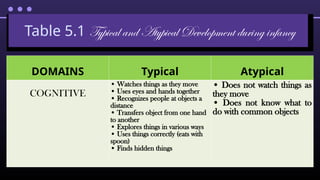
Table 5.1 Typicaland Atypical Development during infancy
DOMAINS Typical Atypical
COGNITIVE
• Watches things as they move
• Uses eyes and hands together
• Recognizes people at objects a
distance
• Transfers object from one hand
to another
• Explores things in various ways
• Uses things correctly (eats with
spoon)
• Finds hidden things
• Does not watch things as
they move
• Does not know what to
do with common objects
45.
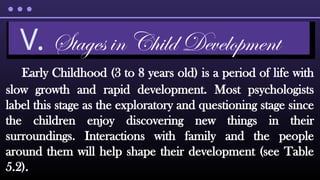
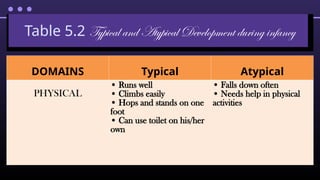
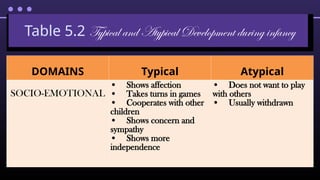
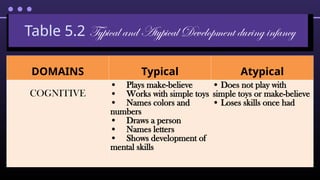
Early Childhood (3to 8 years old) is a period of life with
slow growth and rapid development. Most psychologists
label this stage as the exploratory and questioning stage since
the children enjoy discovering new things in their
surroundings. Interactions with family and the people
around them will help shape their development (see Table
5.2).
V. Stages in Child Development
46.
Table 5.2 Typicaland Atypical Development during infancy
DOMAINS Typical Atypical
PHYSICAL
• Runs well
• Climbs easily
• Hops and stands on one
foot
• Can use toilet on his/her
own
• Falls down often
• Needs help in physical
activities
47.
Table 5.2 Typicaland Atypical Development during infancy
DOMAINS Typical Atypical
SOCIO-EMOTIONAL
• Shows affection
• Takes turns in games
• Cooperates with other
children
• Shows concern and
sympathy
• Shows more
independence
• Does not want to play
with others
• Usually withdrawn
48.
Table 5.2 Typicaland Atypical Development during infancy
DOMAINS Typical Atypical
LANGUAGE
•Follows two to three step ·
instructions
•Uses pronouns
•Tells and retell stories
• Speaks clearly
• Has unclear speech
• Can't tell stories
articulately
49.
Table 5.2 Typicaland Atypical Development during infancy
DOMAINS Typical Atypical
COGNITIVE
• Plays make-believe
• Works with simple toys
• Names colors and
numbers
• Draws a person
• Names letters
• Shows development of
mental skills
• Does not play with
simple toys or make-believe
• Loses skills once had
50.
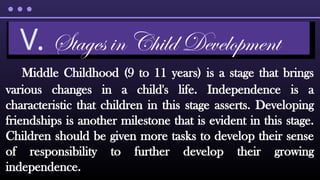
Middle Childhood (9to 11 years) is a stage that brings
various changes in a child's life. Independence is a
characteristic that children in this stage asserts. Developing
friendships is another milestone that is evident in this stage.
Children should be given more tasks to develop their sense
of responsibility to further develop their growing
independence.
V. Stages in Child Development
51.
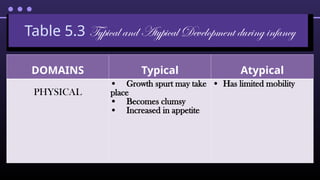
Table 5.3 Typicaland Atypical Development during infancy
DOMAINS Typical Atypical
PHYSICAL
• Growth spurt may take
place
• Becomes clumsy
• Increased in appetite
• Has limited mobility
52.
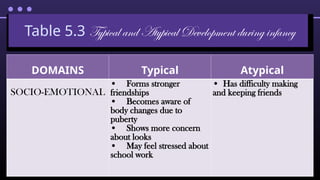
Table 5.3 Typicaland Atypical Development during infancy
DOMAINS Typical Atypical
SOCIO-EMOTIONAL
• Forms stronger
friendships
• Becomes aware of
body changes due to
puberty
• Shows more concern
about looks
• May feel stressed about
school work
• Has difficulty making
and keeping friends
53.
Table 5.3 Typicaland Atypical Development during infancy
DOMAINS Typical Atypical
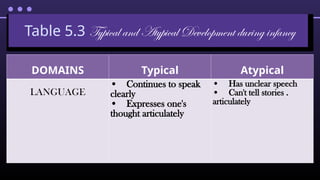
LANGUAGE
• Continues to speak
clearly
• Expresses one's
thought articulately
• Has unclear speech
• Can't tell stories .
articulately
54.
Table 5.3 Typicaland Atypical Development during infancy
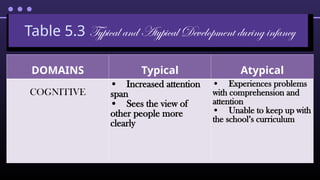
DOMAINS Typical Atypical
COGNITIVE
• Increased attention
span
• Sees the view of
other people more
clearly
• Experiences problems
with comprehension and
attention
• Unable to keep up with
the school’s curriculum
55.
Adolescence (12 to18 years) is the period where puberty
begins. By the end of this stage, most will have completed
·
puberty. The child is now called a teen during this stage.
The teen is becoming more vocal about his/ her opinions
due to the development of a unique personality. Peer
pressure, however, will be present, which is why guidance
from parents and guardians is very much needed.
V. Stages in Child Development
56.
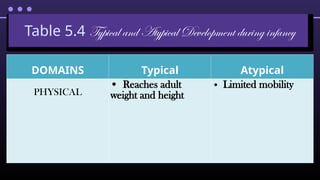
Table 5.4 Typicaland Atypical Development during infancy
DOMAINS Typical Atypical
PHYSICAL
• Reaches adult
weight and height
• Limited mobility
57.
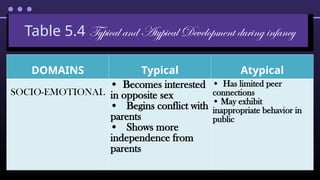
Table 5.4 Typicaland Atypical Development during infancy
DOMAINS Typical Atypical
SOCIO-EMOTIONAL
• Becomes interested
in opposite sex
• Begins conflict with
parents
• Shows more
independence from
parents
• Has limited peer
connections
• May exhibit
inappropriate behavior in
public
58.
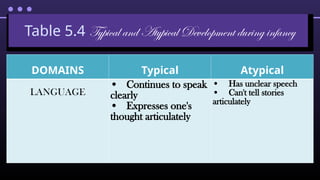
Table 5.4 Typicaland Atypical Development during infancy
DOMAINS Typical Atypical
LANGUAGE
• Continues to speak
clearly
• Expresses one's
thought articulately
• Has unclear speech
• Can't tell stories
articulately
59.
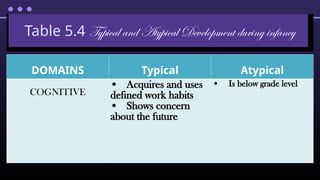
Table 5.4 Typicaland Atypical Development during infancy
DOMAINS Typical Atypical
COGNITIVE
• Acquires and uses
defined work habits
• Shows concern
about the future
• Is below grade level
60.
Behaviors that areatypical should -be
observed keenly and recorded
carefully. At times, the recorded
observations might just be isolated
events with no significant impact on
later development. However, they
might also be early warning signs of
needs. The observed patterns will be
useful to confirm if there is such a
need.